Cities worldwide aren’t adapting to climate change quickly enough
By John Rennie Short, professor, public policy, UMBC
Climate change is magnifying threats such as flooding, wildfires, tropical storms and drought. In 2020 the U.S. experienced a record-breaking 22 weather and climate disasters that each caused at least US$1 billion in damage. So far in 2021, the count stands at 18.
I study urban issues and have analyzed cities’ relationship with nature for many years. As I see it, cities are quickly becoming more vulnerable to extreme weather events and permanent shifts in their climate zones.
I am concerned that the pace of climate change is accelerating much more rapidly than urban areas are taking steps to adapt to it. In 1950, only 30% of the world’s population lived in urban areas; today that figure is 56%, and it is projected to rise to 68% by 2050. Failure to adapt urban areas to climate change will put millions of people at risk.
Extreme weather and long-term climate zone shifts
As the Intergovernmental Panel on Climate Change shows in its latest report, released in August 2021, global climate change is widespread, rapid and accelerating. For cities in temperate latitudes, this means more heat waves and shorter cold seasons. In subtropical and tropical latitudes, it means wetter rainy seasons and hotter dry seasons. Most coastal cities will be threatened by sea level rise.
Political analysis, without partisanship
Around the globe, cities will face a much higher probability of extreme weather events. Depending on their locations, these will include heavier snowfalls, more severe drought, water shortages, punishing heat waves, greater flooding, more wildfires, bigger storms and longer storm seasons. The heaviest costs will be borne by their most vulnerable residents: the old, the poor and others who lack wealth and political connections to protect themselves.
Extreme weather isn’t the only concern. A 2019 study of 520 cities around the world projected that even if nations limit warming to 2 degrees Celsius (about 3.6 degrees Fahrenheit) above preindustrial conditions, climate zones will shift hundreds of miles northward by 2050 worldwide. This would cause 77% of the cities in the study to experience a major change in their year-round climate regimes.
 A boy cools off in Seattle’s Yesler Terrace spray park in June 2021 during a record-setting Pacific Northwest heat wave. AP Photo/John Froschauer
For example, the study authors predicted that by midcentury, London’s climate will resemble that of modern-day Barcelona, and Seattle’s will be like current conditions in San Francisco. In short, in less than 30 years, three out of every four major cities in the world will have a completely different climate from the one for which its urban form and infrastructure were designed.
A similar study of climate change impacts on more than 570 European cities predicted that they will face an entirely new climate regime within 30 years – one characterized by more heat waves and droughts, and increased risk of flooding.
Mitigating climate change
Cities’ responses to climate change fall into two broad categories: mitigating (reducing) emissions that drive climate change, and adapting to effects that can’t be averted.
Cities produce more than 70% of global greenhouse gas emissions, mainly from heating and cooling buildings and powering cars, trucks and other vehicles. Urbanization also makes people more vulnerable to climate change impacts.
For example, as cities expand, people clear vegetation, which can increase the risk of flooding and sea level rise. They also create impermeable surfaces that don’t absorb water, such as roads and buildings.
This contributes to flooding risks and produces urban heat islands – zones where temperatures are hotter than in outlying areas. A recent study found that the urban heat island in Jakarta, Indonesia, expanded in recent years as more land was developed for housing, businesses, industry and warehouses.
But cities are also important sources of innovation. For example, the inaugural Oberlander Prize for landscape architecture was awarded on Oct. 14, 2021, to U.S. landscape architect Julie Bargemen for re-imagining polluted and neglected urban sites. And the prestigious Pritzker Architectural Prize went this year to French architects Anne Lacaton and Jean-Phillipe Vassal for creating resilient buildings by transforming existing structures instead of demolishing them to make room for new construction.
Just 25 of the world’s cities account for 52% of total urban greenhouse gas emissions. This means that focusing on these cities can make a huge difference to the arc of long-term warming.
Cities worldwide are pursuing a rich variety of mitigation measures, such as electrifying mass transit, cooling with green buildings and introducing low-carbon building codes. I see these steps as a source of hope in the medium to long term.
The mayors of Los Angeles, Paris and Accra, Ghana, along with Mumbai’s environment minister, talk about how climate change is affecting their cities and what they are doing about it.
Adaptating too slowly
In contrast, adaptation in the shorter term is moving much more sluggishly. This isn’t to say that nothing is happening. For example, Chicago is developing policies that anticipate a hotter and wetter climate. They include repaving streets with permeable materials that allow water to filter through to the underlying soil, planting trees to absorb air pollutants and stormwater runoff, and providing tax incentives to install green roofs as cooling features on office buildings. Similar plans are moving forward in cities around the world.
But reshaping cities in a timely manner can be extremely expensive. In response to levee failures that inundated New Orleans during Hurricane Katrina in 2005, the U.S. government spent more than $14 billion to build an improved flood control system for the city, which was completed in 2018. But many other cities around the world face similar threats, and few of them – especially in developing countries – can afford such an ambitious program.
Time is also a critical resource as the pace of climate change accelerates. In the European Union, about 75% of buildings are not energy efficient. A 2020 report from the European Commission predicted that it would take 50 years to make those buildings more sustainable and resilient to shifting climate conditions.
At best, urban infrastructures that were built for previous climate regimes and less extreme weather events can only be changed at a rate of about 3% per year. At that rate, which would be difficult even for the wealthiest cities in the world to maintain, it will take decades to make cities more sustainable and resilient. And the most vulnerable city dwellers live in fast-growing cities in the developing world, such as Dhaka, Bangladesh, Lagos, Nigeria, and Manila, Philipines, where local governments rarely have enough resources to make the expensive changes that are needed.
Remaking cities worldwide quickly enough to deal with more extreme weather events and new climate regimes requires massive investments in new ideas, practices and skills. I see this challenge as an ecological crisis, but also as an economic opportunity – and a chance to make cities more equitable for the 21st century and beyond.
*****
Header image: Flooding is seen in the Manayunk section of Philadelphia after the remnants of Hurricane Ida, Sept. 2, 2021. AP Photo/Matt Rourke
John Rennie Short, Professor, School of Public Policy, University of Maryland, Baltimore County
This article is republished from The Conversation under a Creative Commons license. Read the original article.
]]>
By John Rennie Short, professor, public policy, UMBC Climate change is magnifying threats such as flooding, wildfires, tropical storms and drought. In 2020 the U.S. experienced a...
https://umbc.edu/stories/cities-worldwide-arent-adapting-to-climate-change-quickly-enough/
https://my3.my.umbc.edu/api/v0/pixel/news/119539/guest@my.umbc.edu/4ecfdc9d0a89955ee4f4e427cbe3d4d7/api/pixel
climate-change
discovery
professorsnottomiss
public-policy
the-conversation
UMBC News & Magazine
https://my3.my.umbc.edu/groups/umbc-news-magazine
https://assets1-my.umbc.edu/system/shared/avatars/groups/000/001/943/24435aa6207c452e7bc15cc74b42c7bb/xsmall.png?1748556657
https://assets1-my.umbc.edu/system/shared/avatars/groups/000/001/943/24435aa6207c452e7bc15cc74b42c7bb/original.png?1748556657
https://assets2-my.umbc.edu/system/shared/avatars/groups/000/001/943/24435aa6207c452e7bc15cc74b42c7bb/xxlarge.png?1748556657
https://assets2-my.umbc.edu/system/shared/avatars/groups/000/001/943/24435aa6207c452e7bc15cc74b42c7bb/xlarge.png?1748556657
https://assets3-my.umbc.edu/system/shared/avatars/groups/000/001/943/24435aa6207c452e7bc15cc74b42c7bb/large.png?1748556657
https://assets1-my.umbc.edu/system/shared/avatars/groups/000/001/943/24435aa6207c452e7bc15cc74b42c7bb/medium.png?1748556657
https://assets2-my.umbc.edu/system/shared/avatars/groups/000/001/943/24435aa6207c452e7bc15cc74b42c7bb/small.png?1748556657
https://assets1-my.umbc.edu/system/shared/avatars/groups/000/001/943/24435aa6207c452e7bc15cc74b42c7bb/xsmall.png?1748556657
https://assets2-my.umbc.edu/system/shared/avatars/groups/000/001/943/24435aa6207c452e7bc15cc74b42c7bb/xxsmall.png?1748556657
UMBC News & Magazine
0
0
false
Wed, 20 Oct 2021 19:18:05 -0400
Viruses are both the villains and heroes of life as we know it

By Ivan Erill, associate professor of biological sciences, UMBC
Viruses have a bad reputation. They are responsible for the COVID-19 pandemic and a long list of maladies that have plagued humanity since time immemorial. Is there anything to celebrate about them?
Many biologists like me believe there is, at least for one specific type of virus – namely, bacteriophages, or viruses that infect bacteria. When the DNA of these viruses is captured by a cell, it may contain instructions that enable that cell to perform new tricks.
The mighty power of bacterial viruse
Bacteriophages, or phages for short, keep bacterial populations in check, both on land and at sea. They kill up to 40% of the oceans’ bacteria every day, helping control bacterial blooms and redistribution of organic matter.Bacteriophages are viruses that kill specific types of bacteria.
Bacteriophages are viruses that kill specific types of bacteria.
Their ability to selectively kill bacteria also has medical doctors excited. Natural and engineered phages have been successfully used to treat bacterial infections that do not respond to antibiotics. This process, known as phage therapy, could help fight antibiotic resistance.
Recent research points to another important function of phages: They may be nature’s ultimate genetic tinkerers, crafting novel genes that cells can retool to gain new functions.
Phages are the most abundant life form on the planet, with a nonillion – that’s a 1 with 31 zeroes after it – of them floating around the world at any moment. Like all viruses, phages also have high replication and mutation rates, meaning they form many variants with different characteristics each time they reproduce.
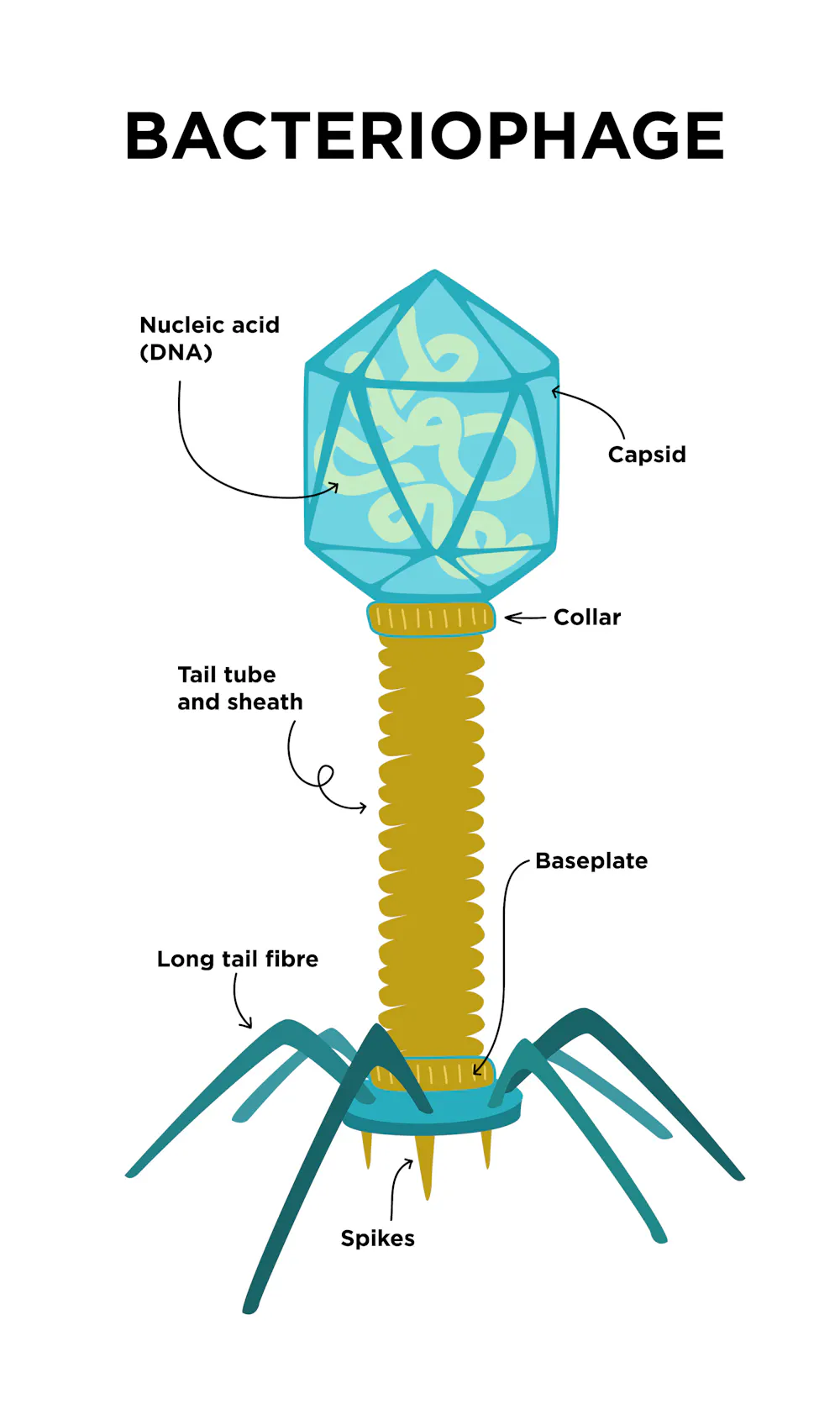
Most phages have a rigid shell called a capsid that is filled with their genetic material. In many cases, the shell has more space than the phage needs to store the DNA essential for its replication. This means that phages have room to carry extra genetic baggage: genes that are not actually necessary for the phage’s survival that it can modify at will.
How bacteria retooled a viral switch
To see how this plays out, let’s take a deeper look at the phage life cycle.
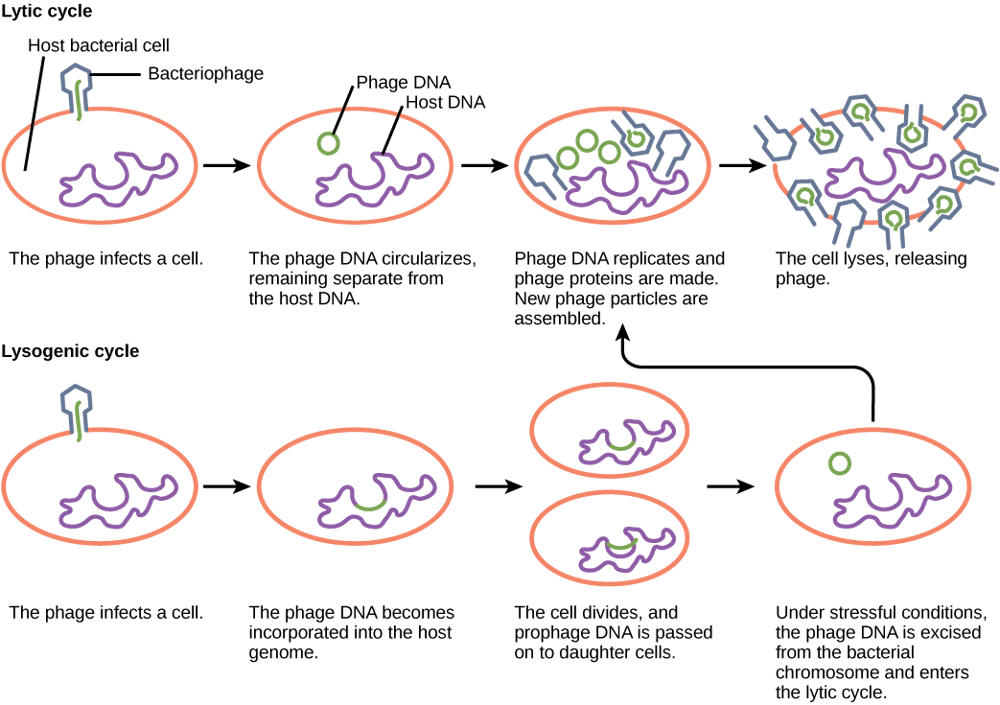
Phages come in two main flavors: temperate and virulent. Virulent phages, like many other viruses, operate on an invade-replicate-kill program. They enter the cell, hijack its components, make copies of themselves and burst out.
Temperate phages, on the other hand, play the long game. They fuse their DNA with the cell’s and may lay dormant for years until something triggers their activation. Then they revert to virulent behavior: replicate and burst out.
Many temperate phages use DNA damage as their trigger. It’s sort of a “Houston, we have a problem” signal. If the cell’s DNA is being damaged, that means the DNA of the resident phage is likely to go next, so the phage wisely decides to jump ship. The genes that direct phages to replicate and burst out are turned off unless DNA damage is detected.
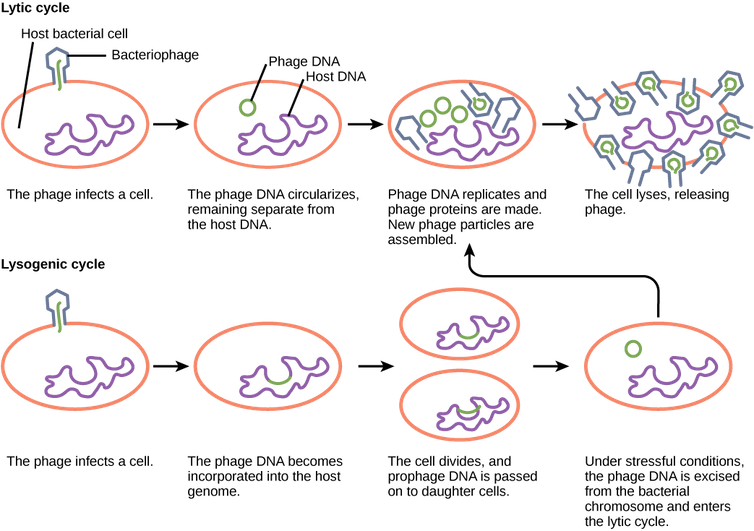 Virulent phages follow the lytic cycle of viral reproduction, destroying their hosts as soon as they complete replication. Temperate phages, on the other hand, follow the lysogenic cycle and stay dormant inside their host’s DNA until they’re triggered to burst out. CNX OpenStax/Wikimedia Commons, CC BY
Bacteria have retooled the mechanisms controlling that life cycle to generate a complex genetic system that my collaborators and I have been studying for over two decades.
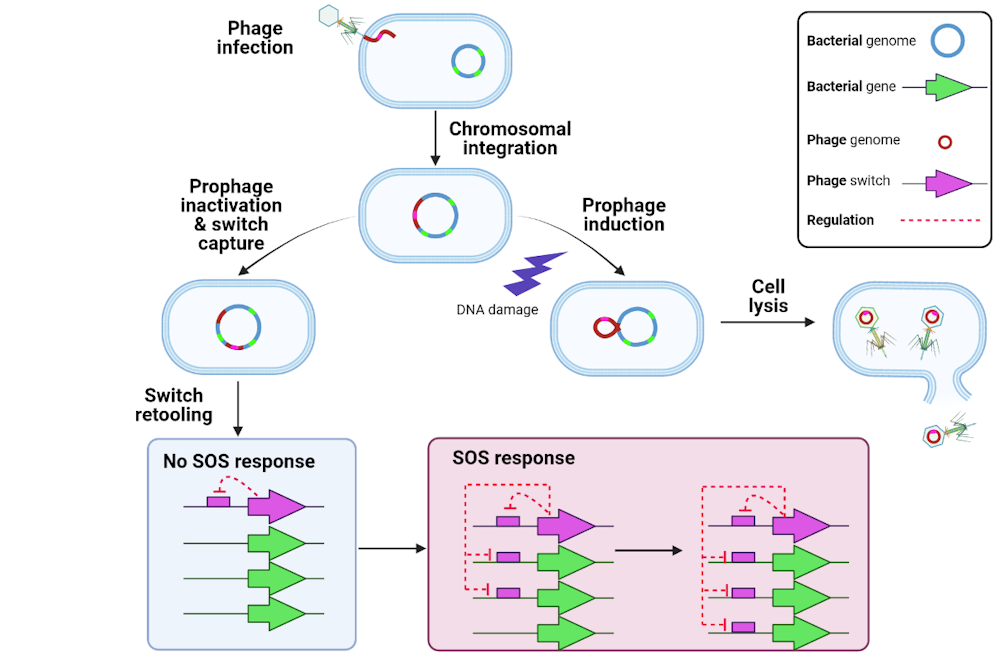
Bacterial cells are also interested in knowing if their DNA is getting busted. If it is, they activate a set of genes that attempt to repair the DNA. This is known as the bacterial SOS response because, if it fails, the cell is toast. Bacteria orchestrate the SOS response using a switch-like protein that responds to DNA damage: It turns on if there is damage and stays off if there isn’t.
Perhaps not surprisingly, bacterial and phage switches are evolutionarily related. This prompts the question: Who invented the switch, bacteria or viruses?
Our previous research and work by other researchers indicates that phages got there first. In our recent report, we discovered that the SOS response of Bacteroidetes, a group of bacteria that comprise up to a half of the bacteria living in your gut, is under control of a phage switch that was retooled to implement the bacteria’s own complex genetic programs. This suggests that bacterial SOS switches are in fact phage switches that got retooled eons ago.
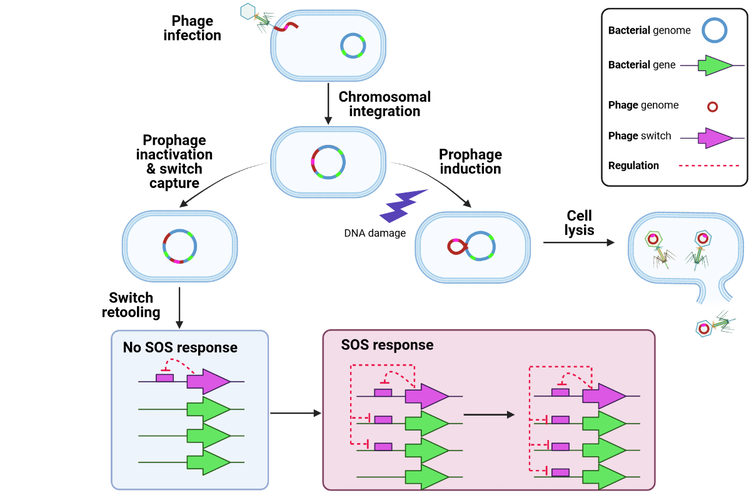 When a temperate phage infects a bacterial cell and integrates its genome with the cell’s DNA, it typically lays dormant until it’s triggered to burst out of the cell. But once the phage’s DNA is part of the bacterium’s, mutations can disrupt the phage’s genetic material and render it inactive. This means that when DNA damage occurs, the phage won’t be able to reform itself and burst out. Over time, the bacterium may adapt the phage’s switch to control its own SOS response genes. Miquel Sánchez-Osuna/Created with BioRender.com, CC BY-NC-ND
It’s not just bacterial switches that appear to be phage inventions. Beautiful detective work has shown that a bacterial gene needed for cell division also arose through “domestication” of a phage toxin gene. And many bacterial attack systems, such as toxins and the genetic guns used to inject them into cells, as well as the camouflage they use to evade the immune system, are known or suspected to have phage origins.
The upside of viruses
OK, you may think, phages are great, but the viruses that infect us are certainly not cool. Yet there is mounting evidence that the viruses that infect plants and animals are also a major source of genetic innovation in these organisms. Domesticated viral genes have been shown, for instance, to play a key role in the evolution of mammalian placentas and in keeping human skin moist.
Recent evidence suggests that even the nucleus of a cell, which houses DNA, could have also been a viral invention. Researchers have also speculated that the ancestors of today’s viruses may have pioneered the use of DNA as the primary molecule for life. Not a small feat.
So while you may be used to thinking of viruses as the quintessential villains, they are arguably nature’s powerhouses for genetic innovation. Humans are likely here today because of them.
*****
Ivan Erill, Associate Professor of Biological Sciences, University of Maryland, Baltimore County
This article is republished from The Conversation under a Creative Commons license. Read the original article.
Header image: Bacteriophages are viruses that infect bacteria and play a potential role in the evolution of life. NANOCLUSTERING/SCIENCE PHOTO LIBRARY/Science Photo Library via Getty Images
]]>
By Ivan Erill, associate professor of biological sciences, UMBC Viruses have a bad reputation. They are responsible for the COVID-19 pandemic and a long list of maladies that have plagued...
https://umbc.edu/stories/viruses-are-both-the-villains-and-heroes-of-life-as-we-know-it/
https://my3.my.umbc.edu/api/v0/pixel/news/119540/guest@my.umbc.edu/29bb77829a9169862afe25cac4be84a0/api/pixel
biological-sciences
cnms
discovery
professorsnottomiss
the-conversation
UMBC News & Magazine
https://my3.my.umbc.edu/groups/umbc-news-magazine
https://assets1-my.umbc.edu/system/shared/avatars/groups/000/001/943/24435aa6207c452e7bc15cc74b42c7bb/xsmall.png?1748556657
https://assets1-my.umbc.edu/system/shared/avatars/groups/000/001/943/24435aa6207c452e7bc15cc74b42c7bb/original.png?1748556657
https://assets2-my.umbc.edu/system/shared/avatars/groups/000/001/943/24435aa6207c452e7bc15cc74b42c7bb/xxlarge.png?1748556657
https://assets2-my.umbc.edu/system/shared/avatars/groups/000/001/943/24435aa6207c452e7bc15cc74b42c7bb/xlarge.png?1748556657
https://assets3-my.umbc.edu/system/shared/avatars/groups/000/001/943/24435aa6207c452e7bc15cc74b42c7bb/large.png?1748556657
https://assets1-my.umbc.edu/system/shared/avatars/groups/000/001/943/24435aa6207c452e7bc15cc74b42c7bb/medium.png?1748556657
https://assets2-my.umbc.edu/system/shared/avatars/groups/000/001/943/24435aa6207c452e7bc15cc74b42c7bb/small.png?1748556657
https://assets1-my.umbc.edu/system/shared/avatars/groups/000/001/943/24435aa6207c452e7bc15cc74b42c7bb/xsmall.png?1748556657
https://assets2-my.umbc.edu/system/shared/avatars/groups/000/001/943/24435aa6207c452e7bc15cc74b42c7bb/xxsmall.png?1748556657
UMBC News & Magazine
0
0
false
Wed, 20 Oct 2021 19:10:54 -0400
Over-the-counter rapid antigen tests for COVID-19 can help slow the spread of the delta variant
By Zoë McLaren, associate professor of Public Policy, UMBC
The rise of the highly transmissible delta variant around the U.S. has increased demand for rapid antigen COVID-19 tests that can be purchased from a pharmacy without a prescription, used at home, school or work and that give results in 15 minutes.
On Sept. 9, 2021, the White House announced several initiatives to improve access to rapid antigen tests: It will use the Defense Production Act to boost the production of tests, require retailers to sell rapid tests at cost, distribute free rapid tests to community health centers and food banks and expand free testing in pharmacies.
Rapid antigen testing makes it much easier to get tested for COVID-19, which helps detect infectious cases before they spread. But many people are still unsure of how best to use these tests and whether they are accurate enough to be useful.
There are several FDA-approved rapid tests on the market including Abbott BinaxNow, Ellume and Quidel QuickVue. These cost as little as $7-12 each and can be used to test adults and children aged 2 and up, regardless of whether they have symptoms.
Rapid antigen tests have a big advantage over lab-based PCR testing in terms of speed and convenience. Getting results in 15 minutes rather than waiting a day or more for PCR test results means it’s possible to identify COVID-19 cases right away and take precautions to prevent transmission. Having rapid testing available over-the-counter means that a lot more people will get tested since the test is easy to perform and far more convenient than PCR testing. So rapid tests can catch a lot more COVID-19 cases overall than relying only on PCR testing.
As a health economist who studies public health policy to combat infectious disease epidemics, I know that making COVID-19 testing accessible, accurate and fast is critical to slowing transmission of the virus and helping everyone resume normal activities safely.
How accurate are rapid antigen tests?
Two types of rapid tests are used for detecting an active COVID-19 infection: rapid antigen tests that detect viral proteins using a paper strip and rapid molecular tests – including PCR – that detect viral genetic material using a medical device.
It’s important to remember that rapid antigen tests serve a different purpose than PCR testing, which is considered the gold standard even though it isn’t 100% accurate. Rapid tests are designed to identify cases with a high enough viral load in the nasal passage to be transmissible – not to diagnose all COVID-19 cases. The Abbott BinaxNOW rapid antigen test may only detect 85% of the positive cases detected by PCR tests. But the key is that published studies found that they detect over 93% of cases that pose a transmission risk, which is what matters most for getting the pandemic under control. Ellume correctly identifies 95% of all positive cases, and Quidel QuickVue accurately identifies 85%. All three tests correctly identify upwards of 97% of all negative cases, regardless of symptoms.
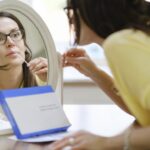
 One of the FDA-approved rapid antigen test kits, which can be used by adults and children age 2 and up. AP Photo/Business Wire
How should rapid tests be used?
Rapid antigen testing can be used in three ways to slow transmission. First, people can perform a rapid test when there is a suspected or known COVID-19 exposure. Second, rapid testing can provide an extra precaution before any activity with a higher risk of transmission, such as gatherings or travel. Third, it’s also possible to test on a regular basis – weekly, for instance, if enough tests are available – to catch cases that otherwise might go undetected.
It’s important to have a plan for what to do based on the test results. If you get a positive result, immediately take precautions to slow transmission such as self-isolating, letting close contacts know about the test result and reporting the case to health authorities. Less than 3% of positive results are false positives, but a second rapid test the following day or a PCR test can provide further confirmation if needed.
If you get a negative result from a rapid test, it means you are currently very unlikely to be infectious. A viral load that is too low to be detected by rapid antigen tests is almost surely too low to be transmissible. But it’s important not to let your guard down completely. The tests don’t detect 100% of infectious cases, so it’s possible for a small number to evade detection or for some cases to become infectious within hours after the test. For this reason, it may be a good idea to maintain other precautions. And, if you have symptoms or a known exposure, it’s a good idea to do a follow-up rapid antigen or PCR test just in case the first test was a false negative.
Think of the rapid antigen test as a snapshot in time: A negative test doesn’t necessarily mean you don’t have COVID-19. COVID-19 is most transmissible when the viral load peaks, which is estimated to be within a week after infection. Those who are infected but who take a rapid test before or after the viral load peak will get a negative rapid test result – meaning that even though they are infected, they are not currently infectious. One way to reduce the risk of false negatives is with “serial testing,” where a second rapid test is performed 24-36 hours later to help catch any infectious cases that were missed with the first test.
Will the new initiatives be enough?
The White House initiatives to increase access to rapid testing are a critical step towards curbing case numbers. But one free test per person isn’t sufficient to help people resume normal activities safely. Authorizing additional inexpensive rapid tests through the Food and Drug Administration would further expand supply and reduce prices.
Making the COVID-19 vaccine free and easily accessible brought cases down quickly in the spring of 2021. Putting frequent rapid testing within reach for all could do the same now.
*****
Zoë McLaren, Associate Professor of Public Policy, University of Maryland, Baltimore County
This article is republished from The Conversation under a Creative Commons license. Read the original article.
Header image: Rapid antigen COVID-19 tests, designed for use at home, can show results in 15 minutes. Ellen Moran via Getty Images
]]>
By Zoë McLaren, associate professor of Public Policy, UMBC The rise of the highly transmissible delta variant around the U.S. has increased demand for rapid antigen COVID-19 tests that can be...
https://umbc.edu/stories/over-the-counter-rapid-antigen-tests-for-covid-19-can-help-slow-the-spread-of-the-delta-variant/
https://my3.my.umbc.edu/api/v0/pixel/news/119562/guest@my.umbc.edu/9a0cf2cc1fae4f40744027f5273fdbeb/api/pixel
covidresearch
discovery
professorsnottomiss
public-policy
UMBC News & Magazine
https://my3.my.umbc.edu/groups/umbc-news-magazine
https://assets1-my.umbc.edu/system/shared/avatars/groups/000/001/943/24435aa6207c452e7bc15cc74b42c7bb/xsmall.png?1748556657
https://assets1-my.umbc.edu/system/shared/avatars/groups/000/001/943/24435aa6207c452e7bc15cc74b42c7bb/original.png?1748556657
https://assets2-my.umbc.edu/system/shared/avatars/groups/000/001/943/24435aa6207c452e7bc15cc74b42c7bb/xxlarge.png?1748556657
https://assets2-my.umbc.edu/system/shared/avatars/groups/000/001/943/24435aa6207c452e7bc15cc74b42c7bb/xlarge.png?1748556657
https://assets3-my.umbc.edu/system/shared/avatars/groups/000/001/943/24435aa6207c452e7bc15cc74b42c7bb/large.png?1748556657
https://assets1-my.umbc.edu/system/shared/avatars/groups/000/001/943/24435aa6207c452e7bc15cc74b42c7bb/medium.png?1748556657
https://assets2-my.umbc.edu/system/shared/avatars/groups/000/001/943/24435aa6207c452e7bc15cc74b42c7bb/small.png?1748556657
https://assets1-my.umbc.edu/system/shared/avatars/groups/000/001/943/24435aa6207c452e7bc15cc74b42c7bb/xsmall.png?1748556657
https://assets2-my.umbc.edu/system/shared/avatars/groups/000/001/943/24435aa6207c452e7bc15cc74b42c7bb/xxsmall.png?1748556657
UMBC News & Magazine
0
0
false
Fri, 10 Sep 2021 17:46:43 -0400
Taxing bachelors and proposing marriage lotteries – how superpowers addressed declining birthrates in the past

By Amy Froide, professor of history, UMBC
There’s growing awareness – and concern – about declining birthrates in the U.S. and other countries around the world.
Falling birth rates are usually seen as a sign of societal decline, a nation’s diminishing power, and the eclipse of marriage and family values. Rarely are they put into any kind of historical context. But birthrates are cyclical and have gone up and down throughout history.
While some people might assume that the decision to have a child is a personal or private one, individuals and couples also respond to external forces. Economic, social and cultural factors heavily influence birth rates. As a historian who has researched the uptick of single people in the 17th and 18th centuries, I’m familiar with how governments and societies have traditionally responded to low marriage and birthrates with various persuasion techniques.
In the 1690s, England and France entered into a 120-year period of continuous hot and cold warfare. The two nations were also superpowers that engaged in trade, established colonies and fought wars on multiple continents.
Maintaining healthy population numbers was a top concern, seen as a crucial element for ensuring economic and military might. So each country advanced a number of pronatalist strategies to encourage marriage and births.
Marriage loses its luster
In the 17th century – a period when marriage and fertility were more closely connected than they are today – the English were primarily concerned about low marriage rates.
Demographic historians E.A. Wrigley and R.S. Schofield reconstructed England’s population trends from 1541 to 1871 to show how, thanks to a relatively late age at first marriage and high rates of people who never married, birthrates in England declined. From 1600 to 1750 the average Englishwoman did not marry until age 26 and the average man at age 28. This age at first marriage began to fall only after 1750 with the advent of the Industrial Revolution.
Perhaps more importantly, anywhere from 13% to 27% of those English people born between 1575 and 1700 never married. This was highest in the last decades of the 17th century.
Various factors account for the high percentage of people never marrying: war, colonization and outbreaks of illnesses, such as the plague. Literature from England’s Restoration also reveals a negative attitude toward marriage among elite men.
So when the English government passed the Marriage Duty Act in 1695 to raise money to fight the French, it simultaneously addressed revenue needs and fertility concerns.
The marriage duty tax levied fees on births, marriages and deaths. But it also gave people an incentive to get married by taxing bachelors over the age of 25 and childless widowers. Women weren’t usually taxed because the government assumed men were largely behind the decline in marriage.
Pushing spinsters into motherhood
Cultural pressure also served to persuade or encourage women to marry.
Emerging at the same time as the marriage duty tax were the first literary and visual depictions of the “old maid” archetype, a portrayal of never-married women that was always disparaging.
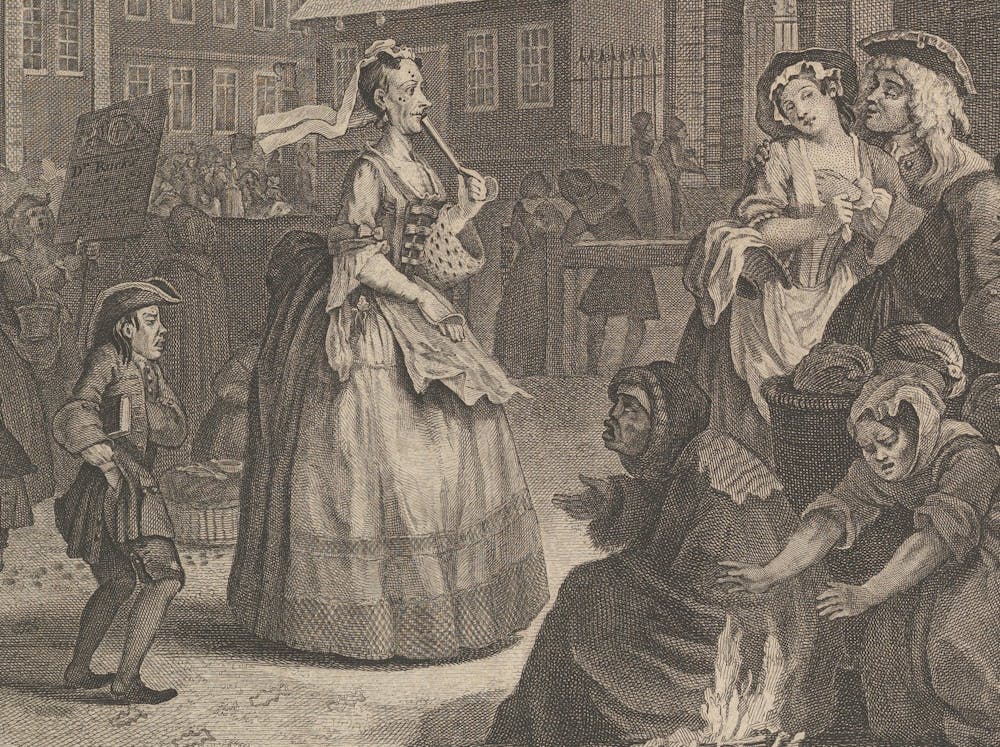
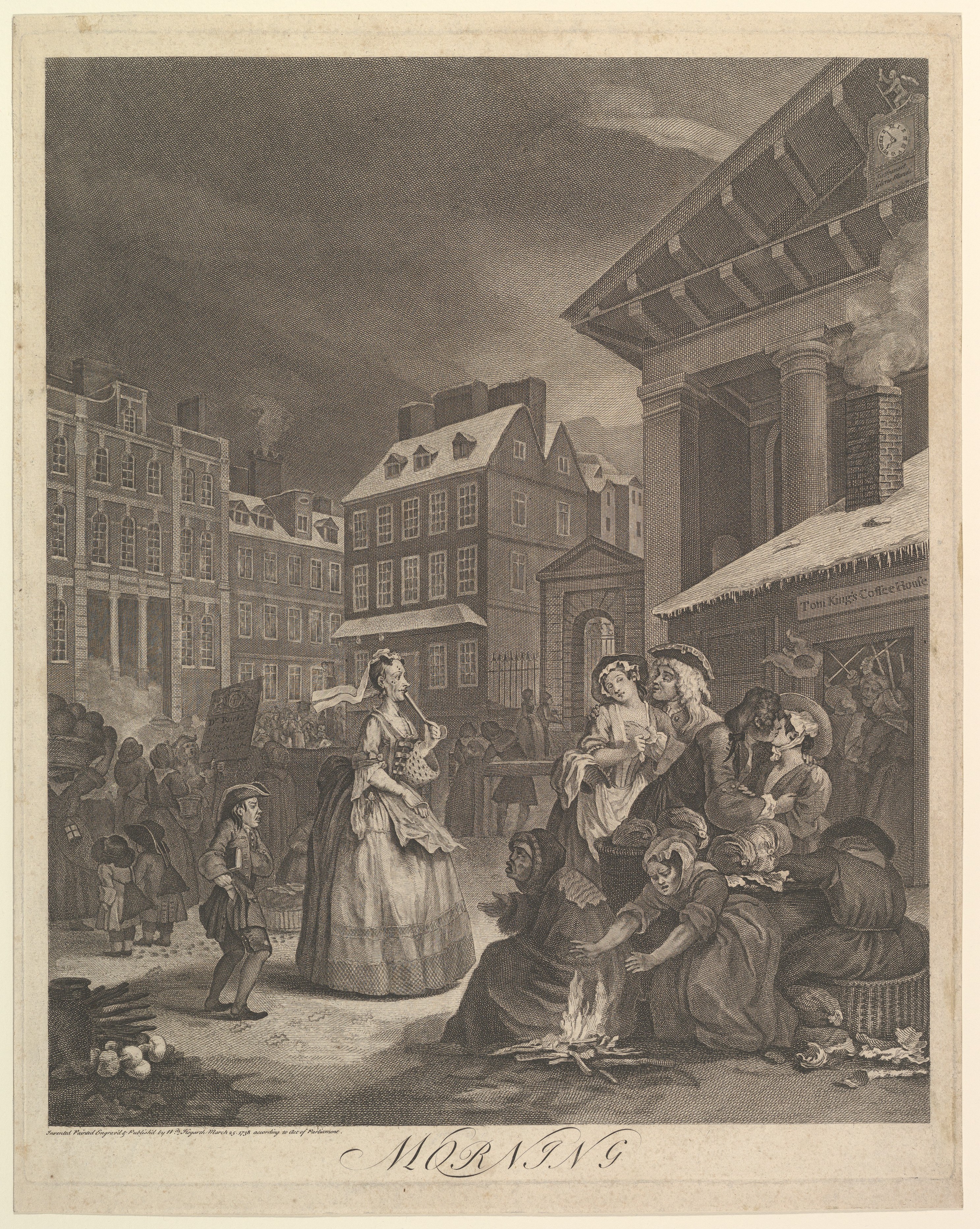
A classic example is William Hogarth’s print “Morning” from his “Four Times of the Day” series. It features a censorious, unpartnered, unattractive woman who is deemed to be past her prime.
Literary satirists also suggested marital lotteries to partner off undesirable spinsters. A 1710 proposal for “The Love Lottery: Or, a Woman the Prize” responded directly to the marriage duty tax. The author proclaimed that instead of taxing marriages “they shou’d have propos’d to help’d ‘em to Matches.” He suggested a lottery in which “maids and widows” could venture 10 shillings and the prize would be a husband or a dowry.
This proposal was one of many that appeared between the 1690s and 1730s. For example, 1734’s “A Bill for a Charitable Lottery for the Relief of the Distressed Virgins in Great Britain” stated that “for the necessary encouragement of propagation, which we ought particularly to attend to upon the prospect of an approaching war, that all the Virgins in Great Britain from 15 to 40 should be disposed of [gotten rid of] by lottery.”
Although framed as prospective legislation, the proposed bill appeared in print only.
Saving babies for France
France differed from England by focusing more directly on increasing births. Although French writers contemplated various reasons for what they perceived to be low birthrates, high infant mortality was seen as a major issue.
In the 1750s Parisian midwife Madame du Coudray capitalized on the French government’s pronatal stance and offered her services to Louis XV to train the country’s midwives in order to improve France’s live birth rates.
Du Coudray, herself unmarried and biologically childless, reproduced something else for France: what she called her machine – and what we might call a mannequin – on which midwives could practice different techniques used during difficult or dangerous births. Historian Nina Gelbart estimates that du Coudray and her disciples trained tens of thousands of midwives in successful delivery techniques.
 France’s ‘national midwife,’ Madame du Coudray, invented an instructional mannequin to improve birthrates. Frédéric Bisson/flickr, CC BY
Pronatalism today
Substitute 21st-century U.S. and China for 18th-century England and France and you’ll see the same sort of handwringing over birthrates in these two nations today.
In both countries, a resurgence of policies aimed at getting people to have more babies has already begun. China ended its one-child policy in 2016. After a disappointingly low jump in birthrates, it has recently begun to encourage three-child families.
It’s unlikely the U.S. will see the equivalent of a national midwife like du Coudray – or, to use today’s parlance, a “reproduction czar.” But the U.S. Congress is finally talking seriously about increasing funding for child care. And beginning in July 2021, the IRS started issuing monthly child tax credit checks to most parents in the U.S.
Today’s policies are more of a carrot than the stick approach pursued by England with its marriage duty tax; instead of taxing bachelors to encourage marriage, the U.S. is providing a credit to existing parents.
It’s less likely that we’ll see single women openly derided as contemporary spinsters for choosing not to have children – although, as I’ve written, Americans still tend to stigmatize women who choose to stay single and childless.
But if the past is any guide, 21st-century superpowers will continue to engage in pronatalist strategies, because marriage, family and reproduction are still seen as the cornerstones of societal and political power.
*****
Header image: In England, children were seen as a way to replenish the military and sustain the economy. Universal Images Group via Getty Images
Amy Froide, Professor of History, University of Maryland, Baltimore County
This article is republished from The Conversation under a Creative Commons license. Read the original article.
]]>
By Amy Froide, professor of history, UMBC There’s growing awareness – and concern – about declining birthrates in the U.S. and other countries around the world. Falling birth rates are...
https://umbc.edu/stories/taxing-bachelors-and-proposing-marriage-lotteries-how-superpowers-addressed-declining-birthrates-in-the-past/
https://my3.my.umbc.edu/api/v0/pixel/news/119575/guest@my.umbc.edu/8366b0cbe66460b99cc32acd2b64b1f7/api/pixel
cahss
discovery
history
professorsnottomiss
the-conversation
UMBC News & Magazine
https://my3.my.umbc.edu/groups/umbc-news-magazine
https://assets1-my.umbc.edu/system/shared/avatars/groups/000/001/943/24435aa6207c452e7bc15cc74b42c7bb/xsmall.png?1748556657
https://assets1-my.umbc.edu/system/shared/avatars/groups/000/001/943/24435aa6207c452e7bc15cc74b42c7bb/original.png?1748556657
https://assets2-my.umbc.edu/system/shared/avatars/groups/000/001/943/24435aa6207c452e7bc15cc74b42c7bb/xxlarge.png?1748556657
https://assets2-my.umbc.edu/system/shared/avatars/groups/000/001/943/24435aa6207c452e7bc15cc74b42c7bb/xlarge.png?1748556657
https://assets3-my.umbc.edu/system/shared/avatars/groups/000/001/943/24435aa6207c452e7bc15cc74b42c7bb/large.png?1748556657
https://assets1-my.umbc.edu/system/shared/avatars/groups/000/001/943/24435aa6207c452e7bc15cc74b42c7bb/medium.png?1748556657
https://assets2-my.umbc.edu/system/shared/avatars/groups/000/001/943/24435aa6207c452e7bc15cc74b42c7bb/small.png?1748556657
https://assets1-my.umbc.edu/system/shared/avatars/groups/000/001/943/24435aa6207c452e7bc15cc74b42c7bb/xsmall.png?1748556657
https://assets2-my.umbc.edu/system/shared/avatars/groups/000/001/943/24435aa6207c452e7bc15cc74b42c7bb/xxsmall.png?1748556657
UMBC News & Magazine
0
0
false
Mon, 09 Aug 2021 15:02:57 -0400
There’s a long history of dances being pilfered for profit – and TikTok is the latest battleground

Jill Vasbinder, Senior Lecturer in Dance, UMBC
In January 2020, 14-year-old Jalaiah Harmon created what would become one of the biggest viral dance sensations on TikTok.
But few users knew that Harmon, who is Black, invented the dance, which she dubbed the Renegade – at least not until a month later, when The New York Times drew attention to her case. That’s because a TikTok user had copied the dance, and it was that TikToker’s rendition that went viral.
Because Harmon didn’t get credit, she wasn’t able to reap the benefits of more views and followers, which, in turn, could have led to collaborations and sponsorships.
Harmon is only the latest in a long list of women and people of color whose choreography and dance work have been pilfered for profit – a story that dates back to the origins of jazz dance in the 19th and early 20th centuries.
But these days, TikTok is the battleground – and it isn’t just Harmon who’s had her work lifted. In June 2021 several popular Black creators were so fed up with having their dances stolen or not credited that they decided to join forces and go on strike, refusing to post new dance content to bring attention to the issue.
Choreographers fight for royalties
Laying claim to a dance isn’t as straightforward as, say, a poet saying they have exclusive rights to a poem they’ve written.
Designed to protect “intangible cultural goods,” copyright, according to the U.S. Copyright Office, gives “Authors and Inventors the exclusive right to their respective Writings and Discoveries.”
Established in the hopes of rewarding innovation and promoting progress, the first U.S. copyright laws, which were established in 1787 and 1790 and based on statutes from Britain, didn’t grant rights to artists and dancers. Only writers were protected.
In fact, the very concept of owning choreography didn’t exist until the 20th century when dancers started to lay claim to their work in court.
In 1909, an Indian dancer named Mohammed Ismail tried to sue white dancer Ruth St. Denis, claiming he was the originator of one of St. Denis’ “Oriental” dances. In 1926, African-American blues singer Alberta Hunter claimed she held the copyright to the popular dance the Black Bottom, an African American social dance. https://www.youtube.com/embed/rQ9qapVmWi4?wmode=transparent&start=0 George White’s Black Bottom became a national sensation.
Hunter performed the Black Bottom in front a white audience in 1925. A year later, the dance appeared in George White’s revue “Scandals,” which ignited the Black Bottom dance craze.
However, little came of Ismail and Hunter’s efforts. More attempts would follow. In 1963, performer Faith Dane sued M&H Company for royalties for her choreography in “Gypsy” and lost. In the 1950s and 1960s, choreographer Agnes de Mille advocated for copyrights specific to choreography because she got very limited royalties for her work on the hit musical “Oklahoma!”
It wasn’t until 1976 that copyright protection was updated to specifically include choreographic works.
A delicate dance with copyright
But this hasn’t exactly led to a windfall of royalties for choreographers.
Congress has established four guidelines to determine whether a work can be granted copyright protection: originality, fixation, idea versus expression and functionality.
In choreography, it’s the fixed “expression” that’s being protected, not the “idea” behind it. This is why New York City Ballet can copyright their choreographed version of “The Nutcracker,” but other artists can create their own versions or expressions of the story as plays, storybooks or choreographed dance.
Artists and scholars still debate what, exactly, it is that a dancer or choreographer is trying to claim as their own. Is it the dance as a work of art, the choreography or the specific performance?
So while creators can apply to register the recorded expression of their idea with the government, many choreographers – perhaps due to so many gray areas in what is eligible for copyright – still don’t realize that they they have something of value that can or should be protected.
George Balanchine, the founding artistic director of New York City Ballet, had a heart attack in 1978. But he did didn’t draw up a will until he was told the dozens of dances he created would generate licensing income that would go to next of kin unless he directed otherwise.
When pop culture pulls from avant-garde
Avant-garde artist Anna Teresa De Keersmaeker’s brief spat with Beyoncé illustrates the tricky nature of determining what constitutes copyright infringement or plagiarism.
In 2011, De Keersmaeker claimed that Beyoncé, in her music video “Countdown,” had plagiarized De Keersmaeker’s dances from two different works – “Rosas danst Rosas” and “Achterland” – without giving her credit. https://www.youtube.com/embed/vlLZExpgBOY?wmode=transparent&start=0 Anna De Keersmaeker’s ‘Rosas danst Rosas.’
Both artists made public statements acknowledging what happened. It seems that though a substantial amount of De Keermaeker’s movement was transposed into “Countdown,” it was also transformed – from a white, elite avant-garde setting to a Black pop culture setting. A case could be made for fair use, the doctrine that permits the unlicensed use of copyright-protected works in certain circumstances. https://www.youtube.com/embed/2XY3AvVgDns?wmode=transparent&start=0 Beyoncé’s ‘Countdown.’
Nonetheless, this episode illustrates the gray areas of what is protected by copyright. Does performing someone else’s dance movements in a new setting – for an audience who may not have any connection or knowledge of its origins – make it OK? Does this make it a new work?
Copyright protection was devised primarily to promote progress. The thinking went that if authors and artist were given control of their work they would create more original work, earn a living from it and continue creating.
But the incentive for progress can also exist outside of copyright protection. This is what dancer-turned-lawyer Jessica Goudreault argued in a 2018 article for the Cardozo Law Review.
She writes that for some dance styles “the field might never evolve without the opportunity to copy,” which “sustains and encourages innovation.”
I would argue that this applies to the dances on TikTok. Without the ability for users to freely imitate the dances, those moves wouldn’t go viral. The creators of the dances would not get their moment in the Sun – however brief it is in social media – and other creators might be less inspired to innovate if they didn’t have the examples of those who came before them.
[Over 106,000 readers rely on The Conversation’s newsletter to understand the world. Sign up today.]
Can copyright protection even work for TikTok?
If TikTokers and choreographers are looking to license a new dance, should they rely solely on the copyright system and all its restrictions? Or is there another way to get credit and promote innovation in dance?
When dance videos are posted to the web, they are, by default, protected under copyright. In theory, this should prevent dancers from having their work used by others without permission.
In reality, it is often difficult to know who made it first and what constitutes fair use. When does doing some dance steps turn them into a new dance piece? Furthermore, discovering the original author or authors of a dance isn’t easy.
That’s because unlike posts on Facebook, Twitter and Instagram, TikTok posts aren’t time-stamped. Posts appear in a user’s feed in order of popularity, not chronologically. Identifying who posted the content first is tricky.
I would suggest that common law copyright is not the right solution here – and that the principles of Open Source might better serve creators.
Open Source, a social movement by computer programmers, is underpinned by licensing criteria that ensures integrity of authorship, among other principles. Open-source licensing could resolve the issue of the correct people receiving credit for their works. This could take the form of an Open-source license – which has yet to be clearly laid out for dance works – or a Creative Commons license with a “CC-BY” designation that requires attribution, but leaves space for copying, adjusting, remixing and innovation. For this to happen, TikTok would need to add a time and date stamp, in addition to a license preference feature.
Perhaps honoring legacies and influences by naming where something came from can begin to heal the damage that’s taken place over the years to people of color and other choreographers who’ve had their work cribbed with nary an acknowledgment or thanks.
* * * * * *
Jill Vasbinder, Senior Lecturer in Dance, University of Maryland, Baltimore County
Header Image: Laying claim to a dance isn’t as straightforward as doing the same for a poem. Tara Moore via Getty Images
This article is republished from The Conversation under a Creative Commons license. Read the original article.
]]>
Jill Vasbinder, Senior Lecturer in Dance, UMBC In January 2020, 14-year-old Jalaiah Harmon created what would become one of the biggest viral dance sensations on TikTok. But few users...
https://umbc.edu/stories/theres-a-long-history-of-dances-being-pilfered-for-profit-and-tiktok-is-the-latest-battleground/
https://my3.my.umbc.edu/api/v0/pixel/news/119580/guest@my.umbc.edu/70ed33510e0db0f21b480404e9e0d5b5/api/pixel
discovery
jill-vasbinder
professorsnottomiss
UMBC News & Magazine
https://my3.my.umbc.edu/groups/umbc-news-magazine
https://assets1-my.umbc.edu/system/shared/avatars/groups/000/001/943/24435aa6207c452e7bc15cc74b42c7bb/xsmall.png?1748556657
https://assets1-my.umbc.edu/system/shared/avatars/groups/000/001/943/24435aa6207c452e7bc15cc74b42c7bb/original.png?1748556657
https://assets2-my.umbc.edu/system/shared/avatars/groups/000/001/943/24435aa6207c452e7bc15cc74b42c7bb/xxlarge.png?1748556657
https://assets2-my.umbc.edu/system/shared/avatars/groups/000/001/943/24435aa6207c452e7bc15cc74b42c7bb/xlarge.png?1748556657
https://assets3-my.umbc.edu/system/shared/avatars/groups/000/001/943/24435aa6207c452e7bc15cc74b42c7bb/large.png?1748556657
https://assets1-my.umbc.edu/system/shared/avatars/groups/000/001/943/24435aa6207c452e7bc15cc74b42c7bb/medium.png?1748556657
https://assets2-my.umbc.edu/system/shared/avatars/groups/000/001/943/24435aa6207c452e7bc15cc74b42c7bb/small.png?1748556657
https://assets1-my.umbc.edu/system/shared/avatars/groups/000/001/943/24435aa6207c452e7bc15cc74b42c7bb/xsmall.png?1748556657
https://assets2-my.umbc.edu/system/shared/avatars/groups/000/001/943/24435aa6207c452e7bc15cc74b42c7bb/xxsmall.png?1748556657
UMBC News & Magazine
0
0
false
Fri, 23 Jul 2021 13:33:23 -0400
Corrie Francis Parks: Artist, Community Builder, and Advocate for Students
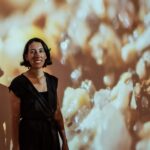
Compared to the tropical midsummer heat outside the Montpelier Arts Center in Laurel, Maryland, UMBC visual arts professor Corrie Francis Parks’ latest show “Uncanny Bodies” provides cool respite.
The exhibit’s home is in a dark room, where multiple projectors coat the walls in Parks’ unique animation style through which tiny sand particles are enlarged, diminishing your own size as they dance across your vision. The exhibit is multidimensionally entrancing, meanwhile, the sound design created by visual arts instructor Jason Charney, M.F.A. ’20, imaging and digital arts, is body-encompassing.
 View from inside artist Corrie Francis Parks’ exhibit “Uncanny Bodies” displayed at the Montpelier Arts Center. Photo courtesy of Thom Parks.
Even before her career began as an animator, and now as a professor, Parks has always made a point of creating her artwork through uncharted channels. Parks attributes her animation origins to her mentor and professor David Ehrlich at Dartmouth College. “He became very influential in challenging me to try things differently, like painting on glass which was really interesting to me because it looked different from anything else that was being made,” says Parks, “and I liked having my work stand out.”
Eventually, this path of striving for the unique led to Parks’ remarkable sand animation technique which has been displayed on walls from Disney to Serbia, and currently, at Montpelier Arts Center. And now Parks hopes to play a similar role promoting her own students’ work as her mentor did for her.
Giving students space to develop ideas
“People are interesting, and I see my students as people with really unique ideas that sometimes just need a little push,” says Parks. “As a professor, you’re supposed to do that. You have that authority and experience.” Throughout her past seven years as a professor at UMBC, Parks’ posture has allowed her to develop a reputation as an “above and beyond” professor. Her pride in promoting and developing her students’ talents is evident, her Instagram account @corrieeeee features a collection of her students’ animations, but goes beyond social media, too. “Some of the most influential professors I’ve had,” says Parks, “are the kind of professors who don’t necessarily develop that student-teacher relationship but rather a colleague relationship with their students.”
Camille Ollivierre, a senior visual arts student with a concentration in animation, describes Parks as someone who talks “to us with the same level of respect she would other professors, while still acknowledging we are young adults with much room for growth.”
Where that growth can come from is something that Parks helps her students find.
“She encouraged me to apply for an Undergraduate Research Award grant (URA),” says Ollivierre, “to explore my idea to create paint on glass animation by creating my own multiplane animation camera.” Receiving the URA allowed Ollivierre to work closely with Parks as her mentor. “She encouraged me to push myself further than I thought I was capable of,” says Ollivierre. “Also, since I’m interested in professionally pursuing stop motion animation, I’ve really enjoyed working with someone who has extensive experience using unconventional materials like sand and paint.”
Visual arts major senior Chase Nickoles expands upon Parks’ ability to connect students with new professional experiences. Nickoles found an opportunity to submit the class’s rotoscoping project to be displayed at the Carroll Arts Center in Westminster, Maryland. “Corrie was quick to help as much as possible with the logistics and providing necessary information,” says Nickoles. “Thanks to her help, our project was successfully displayed, pushing me into the Westminster art world as a representative of the piece, and pushing all the students to be seen by a wider circle.”
Constructive classroom communities
Meanwhile, within the classroom, Parks has found ways to connect with students on a level that is accessible and relatable to them—including creating a Discord server for her students to continue building community.
Visual arts senior Aaron Wescott says that “the space Corrie created online for the whole class was amazing, and it really let us bounce ideas off of each other and her. Being able to talk to someone who had genuine experience and talent in the field made me feel comfortable enough to start branching out and grow as an artist, and I even looked forward to talking with her. She is an amazing teacher and colleague.”
For Parks, creating a community that cultivates her students’ abilities is something that comes naturally.
 Angle of Repose. Photo courtesy of Thom Parks.
“The thing that I love about teaching college is we’re all adults, my students are just a few steps behind me in their development as an artist… I’m really happy to share my experience as to what it means to be an artist, I love sharing information,” she says.
Her exhibit, “Uncanny Bodies” is available from now until August 1, 2021. In Parks’ own words “It’s a really enveloping and calming space that is good to go to on a hot day, it’s cool in there. It takes you into a different perspective and it allows you to take a little break from whatever you’re dealing with right now”.
Visit it now and see what it means to be a grain of sand.
]]>
Compared to the tropical midsummer heat outside the Montpelier Arts Center in Laurel, Maryland, UMBC visual arts professor Corrie Francis Parks’ latest show “Uncanny Bodies” provides cool respite....
https://umbc.edu/stories/corrie-parks-artist-community-builder-and-advocate-for-students/
https://my3.my.umbc.edu/api/v0/pixel/news/119581/guest@my.umbc.edu/67f3e4901b2cdb67ad79427879e2f39f/api/pixel
cahss
campus-life
imda
professorsnottomiss
visual-arts
UMBC News & Magazine
https://my3.my.umbc.edu/groups/umbc-news-magazine
https://assets1-my.umbc.edu/system/shared/avatars/groups/000/001/943/24435aa6207c452e7bc15cc74b42c7bb/xsmall.png?1748556657
https://assets1-my.umbc.edu/system/shared/avatars/groups/000/001/943/24435aa6207c452e7bc15cc74b42c7bb/original.png?1748556657
https://assets2-my.umbc.edu/system/shared/avatars/groups/000/001/943/24435aa6207c452e7bc15cc74b42c7bb/xxlarge.png?1748556657
https://assets2-my.umbc.edu/system/shared/avatars/groups/000/001/943/24435aa6207c452e7bc15cc74b42c7bb/xlarge.png?1748556657
https://assets3-my.umbc.edu/system/shared/avatars/groups/000/001/943/24435aa6207c452e7bc15cc74b42c7bb/large.png?1748556657
https://assets1-my.umbc.edu/system/shared/avatars/groups/000/001/943/24435aa6207c452e7bc15cc74b42c7bb/medium.png?1748556657
https://assets2-my.umbc.edu/system/shared/avatars/groups/000/001/943/24435aa6207c452e7bc15cc74b42c7bb/small.png?1748556657
https://assets1-my.umbc.edu/system/shared/avatars/groups/000/001/943/24435aa6207c452e7bc15cc74b42c7bb/xsmall.png?1748556657
https://assets2-my.umbc.edu/system/shared/avatars/groups/000/001/943/24435aa6207c452e7bc15cc74b42c7bb/xxsmall.png?1748556657
UMBC News & Magazine
0
0
false
Fri, 16 Jul 2021 19:43:05 -0400
Connecting Interdisciplinary Narrative Research with Public Need
What if I told you a story? Would you listen? Over the last year and a half, as the world has faced major social justice and environmental issues, many people have questioned their roles in our shared past, present, and future. But, by talking and listening to stories different from our own, we can find a greater understanding of our diverse lives and some answers to challenging issues.
Now in its third year, UMBC’s Interdisciplinary CoLab: Summer Internship has given nine students from a variety of majors an opportunity to have hands-on experience in this type of humanities-based narrative research. Students were divided equally into three public-facing research projects focusing on civil rights, urban forests, and radical literature. Each team created a digital, audio, or print product that fit a specific need of a community or campus partner in real-time. The research was designed to introduce or strengthen students’ ability to collaborate and their story-gathering/telling skills such as archival research, oral histories, and technical writing.
The UMBC Interdisciplinary CoLab program is a partnership between The Provost’s Interdisciplinary Activities Advisory Committee, the Dresher Center for the Humanities, and the Office of Summer, Winter, & Special Programs.
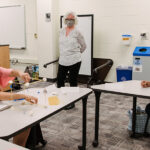
 Students gathered for CoLab research training that covered three areas: civil rights, urban forests, and radical literature.
BLM & Civil Rights oral histories
Nancy Kusmaul, associate professor of social work, was excited to hear her students discuss the Black Lives Matter (BLM) movement during the protests about George Floyd’s murder. But something was missing. Students were aware of BLM and the Civil Rights movement but they didn’t seem to see a connection between them. “I knew I had found an opportunity for students to listen to the past to build a link to the present,” shares Kusmaul, who led a CoLab project on these topics. “Because the CoLab experience focuses on our local communities, what better place to start than Baltimore City.”
Deysi Chitic-Amaya ’23, media and communication studies, was drawn to the project because of the focus on the Civil Rights and Black Lives Matter movements in Baltimore. “We can understand the roots of these global movements by learning how they have changed and influenced the lives and work of people in Baltimore’s communities and neighborhoods,” says Chitic-Amaya, who, with other students, spent the summer conducting virtual oral history interviews with community activists.
There were a few roadblocks. Many of the Civil Rights activists had passed away or were not available, but Kusmaul connected with Baltimore County historian Louis S. Diggs, Baltimore radio host Marc Steiner, and members of the grass-roots, member-led Baltimore organization, Organizing Black.
 Nancy Kusmaul, far right, works with her student researchers.
The student researchers learned interview skills using humanities-based research methods. These skills showed them how to listen across differences and how to approach sensitive topics and difficult questions. “I’ve learned how to interview individuals who are different from me whether it be race, gender, age, etc.,” shares Chitic-Amaya.
After the virtual interviews were completed the students transcribed them and deciphered the experiences between the two movements. The oral histories will be added to the Albin O. Kuhn Library Digital Collections with an explanatory essay and a podcast.
“I hope to come away with greater skills in humanities research methods,” says Chitic-Amaya of her time in the CoLab. “I want to be able to approach future projects with a more open-minded perspective that may help to produce something new and innovative.”
Urban forest data stories
Baltimore stories are not only about collecting oral histories. They also include the stories of the green spaces—and the data surrounding them—in and around Baltimore and how those stories shape the way people live and recreate in the city. It can be overwhelming to know where and how to begin or how to improve existing conservation efforts, but for citizen conservationists, wherever they might be, help is on its way.
Led by UMBC’s Jennifer Maher, associate professor of English, the CoLab participants worked in collaboration with the Baltimore non-profit organization Baltimore Green Space to develop a digital and print urban forest health research protocol manual. The manual will be used as a tool to train citizen and professional conservationists.

The team jumped right into creating a technical narrative with information about urban forests that was previously gathered by Baltimore Green Space through a collaborative project between Matt Baker, professor of geography and environmental system, the USDA Forest Service, and Johns Hopkins University. Community land stewards, alumni, and current students involved in the Summer Forest Patch Project, a collaborative project between UMBC and Howard County Community College, were also part of the collaboration.
“Technical writing is an occupation that the Bureau of Labor and Statistics identifies as growing faster than average,” explains Maher. “Students were not only helping to foster community-based science and civic engagement in Baltimore and beyond but also gaining marketable skills and professional experience.”
UMBC’s student conservationists learned how to weave data to present a factual and engaging narrative that will train both those already engaged in urban forest health and budding conservationists how to better collect data and share the information with the general public and policymakers. The technical narrative presents the information in a persuasive manner that could encourage more participation in urban health anywhere.
 Tevyur Mosely ’22, M30, biological sciences, took part in research based on data from Baltimore Green Space.
Tevyur Mosley ’22, M30, biological sciences, had a big reveal: “I was introduced to the idea that citizens can engage in community-based research that they can then share with their local officials to influence policy.”
Radical literature multimedia exhibition
Unlike the other CoLabs, the students in the Radical Literature in the First Half of the 20th Century group did not interview people. Instead, they learned to uncover stories hidden in the archives of the Albin O. Kuhn Library & Gallery Special Collections department, studying magazines, pamphlets, and essays that narrate the politics and ideas of the socialist movement.
This was a treasure hunt of sorts. Students sifted through and searched scanned documents for key narratives in order to ultimately design an online exhibition that includes a historical timeline, digital stories, research essays, and a video telling the story of the collection. Kate Drabinski, lecturer of gender, women’s, and sexuality studies, who led the group, said that while completing the program virtually had its challenges, seeing the students learn to collaborate from afar was really rewarding.
“As much as we’ve all been working online over the past year, doing this kind of intensive, daily collaboration was a different beast altogether,” she said. “This posed specific challenges, but also opportunities to learn how to work as a team remotely…and how to work with archival documents to do research, and get others excited about using the collection.”
To provide researchers with different perspectives on the socialist movement, “the collection features works of famous authors such as Friedrich Engels and Angela Davis, as well as many niche pieces from small, politically affiliated publishers and both local and national political organizations,” the students explain in their online exhibit. Now curious minds around the world can also discover the breadth and depth of the archive in a more visual and accessible way.
Learning on the job
The summer CoLab internships are not only an opportunity for students across colleges to develop the social and technical skills of working in interdisciplinary teams, but also to explore different fields. CoLab organizers Carole McCann, special assistant to the provost for interdisciplinary activities, and Donald Snyder, lecturer in media and communication studies, designed the program to have a lasting impact on students’ careers. Through public humanities and social science research methods, students are responsible for projects from conception to completion, strengthening their professional communication and project management skills.
“The CoLab experience is about students gaining professional research experience while learning how to appreciate their own skills and that of others,” says McCann. “They learn to meet the expectations of clients and community partners, to tell effective stories for the general public. And doing all of that in real-time.”
To learn more about the CoLab program, visit https://iaac.umbc.edu/co-lab/.
Photos by Marlayna Demond ’11 for UMBC Magazine.
]]>
What if I told you a story? Would you listen? Over the last year and a half, as the world has faced major social justice and environmental issues, many people have questioned their roles in our...
https://umbc.edu/stories/connecting-interdisciplinary-narrative-research-with-public-need/
https://my3.my.umbc.edu/api/v0/pixel/news/119586/guest@my.umbc.edu/f47f4c2ccb8de98ea2843b2e0810b765/api/pixel
discovery
professorsnottomiss
UMBC News & Magazine
https://my3.my.umbc.edu/groups/umbc-news-magazine
https://assets1-my.umbc.edu/system/shared/avatars/groups/000/001/943/24435aa6207c452e7bc15cc74b42c7bb/xsmall.png?1748556657
https://assets1-my.umbc.edu/system/shared/avatars/groups/000/001/943/24435aa6207c452e7bc15cc74b42c7bb/original.png?1748556657
https://assets2-my.umbc.edu/system/shared/avatars/groups/000/001/943/24435aa6207c452e7bc15cc74b42c7bb/xxlarge.png?1748556657
https://assets2-my.umbc.edu/system/shared/avatars/groups/000/001/943/24435aa6207c452e7bc15cc74b42c7bb/xlarge.png?1748556657
https://assets3-my.umbc.edu/system/shared/avatars/groups/000/001/943/24435aa6207c452e7bc15cc74b42c7bb/large.png?1748556657
https://assets1-my.umbc.edu/system/shared/avatars/groups/000/001/943/24435aa6207c452e7bc15cc74b42c7bb/medium.png?1748556657
https://assets2-my.umbc.edu/system/shared/avatars/groups/000/001/943/24435aa6207c452e7bc15cc74b42c7bb/small.png?1748556657
https://assets1-my.umbc.edu/system/shared/avatars/groups/000/001/943/24435aa6207c452e7bc15cc74b42c7bb/xsmall.png?1748556657
https://assets2-my.umbc.edu/system/shared/avatars/groups/000/001/943/24435aa6207c452e7bc15cc74b42c7bb/xxsmall.png?1748556657
UMBC News & Magazine
0
0
false
Tue, 06 Jul 2021 21:07:55 -0400
Leaving a Legacy of Support for UMBC’s Hispanic/Latinx Community

Ana María Schwartz Caballero, associate professor of modern languages, linguistics, and intercultural communication, is retiring from UMBC after more than 25 years of service. “This was a very difficult decision but it was the right time for me to retire,” says Schwartz Caballero. “UMBC has been my home for many years.”
Schwartz Caballero joined UMBC in 1984 as a lecturer for Spanish language classes in the modern languages and linguistics department. She became an assistant professor in 1996, received tenure as associate professor in 2002, and chaired the department from 2006 – 2012. Schwartz Caballero was one of the first faculty members to teach Spanish to heritage Spanish speakers.
The many programs, initiatives, associations, and committees she has led and participated in have helped establish a network of support and guidance for the success of UMBC’s Hispanic/Latinx community. And her legacy will continue to have an impact as faculty and students she has mentored carry on her work.
In a recent farewell event honoring Schwartz Caballero, President Freeman Hrabowski thanked her for being the voice for so many in the Latinx/Hispanic community on campus, in Baltimore City, and the State of Maryland. “Ana María has changed the culture of UMBC,” shares Hrabowski. “She has brought such rich diversity, and she has broadened our thinking about the world.”
 Schwartz Caballero’s headshot by Marlayna Demond ’11.
Language learning research
Schwartz Caballero began her career at UMBC as a graduate assistant in the education department while completing her Ph.D. in second language education at the University of Maryland College Park. Soon after graduation, she became a Spanish and second language pedagogy instructor in what is now UMBC’s modern languages, linguistics, and intercultural communication (MLLI) department.
Her research focused on heritage Spanish speakers, language teaching, learning strategies, and curriculum development. In 2002, Schwartz Caballero’s co-authored textbook, Noticias: An Advanced Intermediate Content-Based Course, presented educators with a new approach to teaching Spanish. Instead of a grammar-centered, isolated approach, Schwartz Caballero found students learned Spanish best by reading current Spanish-language media articles from Spanish-language speaking countries. This way students learn grammar structure in context while at the same time learning about the culture and current events.
Schwartz Caballero has developed local, state, and national level professional development courses and instructional materials for Spanish language teachers. She has also provided research-based strategies for the integration and application of the National Standards for Foreign Language Learning.
Understanding heritage speakers
In addition to her research on teaching Spanish as a foreign language, Schwartz Caballero’s work has helped develop best practices to support the learning needs of heritage Spanish speakers learning Spanish and other subjects. As a Spanish language heritage speaker herself from Cuba, Schwartz Caballero has a personal understanding of the complex needs heritage speakers face in the classroom.
 Schwartz Caballero with Ana Oskoz, the current chair of MLLI, on UMBC’s Immigrant Recognition Day in 2017. Photo courtesy of Schwartz Caballero.
She knows Hispanic/Latinx students who come to the U.S. as refugees, like she did when she left Cuba as a teenager, and those who immigrate or are born in the U.S. must grapple with their own diverse social-cultural identities in a country that often homogenizes their languages, race, cultures, and experiences. Her work has helped prepare student teachers and in-service educators with the skills necessary to support the learning needs of heritage Spanish speakers in a variety of contexts.
Schwartz Caballero also teaches educators how to be advocates. “Being an advocate for students,” she says, “can be the difference between a student graduating or dropping out. It is as important as their academic success.” She notes that teachers need to learn about the challenges Latinx/Hispanic students face beyond the classroom. Schwartz Caballero advocates educators to be understanding of a number of Latinx/Hispanic students who are often balancing work, family responsibilities, and financial hardships that hamper their success and can delay graduation.
Schwartz Caballero has been the faculty advisor to UMBC’s undergraduate Latino/Hispanic Union since 1997 and a founding member of the Latinx/Hispanic Admissions Advisory Group which develops best practices in recruitment and admissions.
Working with doctoral students
In addition to her work with undergraduate students, Schwartz Caballero also worked with many graduate and doctoral students, helping them navigate the field and prepare for the next steps of their careers. For many doctoral students, she was also a compassionate ear, a cheerleader, and like family in the most challenging of times—she helped them find solutions to move forward. Adriana Medina, M.A. ’99, intercultural communication, Ph.D. ’04, language, literacy, and culture, one of many doctoral students Schwartz Caballero has advised, credits Schwartz Caballero for her own success in the classroom. “Ana María has been such a fantastic role model as an educator,” shares Medina. “She is empathetic, compassionate, generous, and also tough at times while also encouraging you. Now, I have been able to be that for my students.”
“Ana María knew who I was, she knew my name, and my department. She made me feel so welcome…we are her legacy.”
María Célleri, assistant professor in gender, women’s, and sexuality studies
Luis Carcamo, M.A. ’95, intercultural communication, remembers how Schwartz Caballero “showed me the ropes of how teaching is done.” Now, in his 25th year of teaching, Carcamo has taken what he learned at UMBC to the southernmost tip of Latin America. “My city is the last city in South America. Ana María’s teachings reached not only the rest of the U.S. but also the rest of our America,” shares Carcamo.
In 2007, UMBC’s Chapter of Black and Latino Alumni awarded Schwartz Caballero with the Legends of Excellence Award: 40 Years of Inspiring African American and Latino Students.
Supporting faculty
Schwartz Caballero has worked tirelessly alongside Hispanic/Latinx faculty and UMBC leadership to recruit and retain Latinx/Hispanic faculty and support UMBC’s diversity initiatives. She was co-chair, with Philip Rous, provost and senior vice president for academic affairs, of UMBC’s Executive Committee on the Recruitment and Retention of Underrepresented Minority Faculty, and has been the president of the Hispanic-Latino Faculty Association for 10 years.
Through the Executive Committee, founded in 2011, UMBC has hosted 20 fellows from diverse backgrounds, including five who identify as Latinx. Two of these fellows are now UMBC faculty members, Fernando Tormos-Aponte, assistant professor of public policy, and Erika Fountain, assistant professor of psychology.
 Schwartz Caballero at a 2019 Humanities Forum with (l-r) Thania Muñoz
,
María Martha Manni,
Mayra Santos-Febres, Tania Lizarazo, and María Célleri. Photo courtesy of Schwartz Caballero.
As the lead organizer for the Hispanic Heritage Month speaker, part of the Dresher Center for the Humanities Forum, Schwartz Caballero has helped bring Latinx/Hispanic scholars to UMBC annually for more than a decade.
“Ana María has raised the issue of diversity and inclusion in relation to Hispanic/Latinx folks in meetings, public forums, and anywhere she could,” says Jessica Berman, director of the Dresher Center for the Humanities. “She worked tirelessly to bring issues facing Hispanic/Latinx people forward, especially through many years of arranging speakers for Hispanic Heritage Month.” Berman notes how Schwartz Caballero’s dedication to fundraise for and organize the speakers elevated the event and led to its inclusion as a permanent part of the fall Humanities Forum.
These efforts have drawn Hispanic/Latinx faculty to UMBC who are leading research across all of UMBC’s academic divisions, including economics, engineering, MLLI, psychology, and more.
Many of the Latinx/Hispanic faculty recall Schwartz Caballero as the first person they met when they came for an interview. She would often pick up faculty at the airport and guide them through their visit. Once they joined UMBC, Schwartz Caballero became a valuable resource, advocate, and supporter. María Célleri, assistant professor in gender, women’s, and sexuality studies, remembers her first week on campus in 2019 during Commencement week. “I didn’t know what was going on but Ana María knew who I was, she knew my name, and my department. She made me feel so welcome,” recalls Célleri. “I love her genuine commitment. We are her legacy.”
“Ana María’s teachings reached not only the rest of the U.S. but also the rest of our America.”
Luis Carcamo, M.A. ’95
Faculty also acknowledge her strong voice on their behalf and her example as a leader in her department, across campus, and beyond. “As a woman, it was very inspiring to hear Ana María, the voice of a strong woman in academia,” shares Renée Lambert-Brétière, associate professor of linguistics and French. “I thank her and I aspire to be like her and be a strong voice.”
In 2020, Schwartz Caballero received the UMBC Marilyn E. Demorest Award for Faculty Advancement.
Building on a legacy
Faculty have also valued her honest feedback and direction through different phases of their career by encouraging them to pursue leadership positions in their field, on campus, and in the community. Within the last year alone, María Cristina Sanchez, professor of the practice in mechanical engineering, has become the inaugural director of the Engineering & Computing Education Program, and Felipe Filomeno, associate professor of political science and global studies, has become the inaugural associate director of the Center for Social Science Research. Tormos-Aponte has recently received over $400,000 from the William T. Grant Foundation to conduct research on the policy impact of the Black Lives Matter Movement on youth.
Headshots of Sanchez, Filomeno, and Tormos-Aponte.
Sanchez has been collaborating with Schwartz Caballero in UMBC’s Hispanic/Latinx Faculty Association and in several committees preparing to further the work along with her colleagues. “A lot of us are in the place that we are because of Ana María,” shares Sanchez. “We will try to continue what she started.”
Service to the community
Schwartz Caballero has also worked closely with the Latinx/Hispanic community beyond campus. For 20 years she has been the UMBC representative in the Maryland State Department of Education for world languages. She is the commissioner of the Baltimore City Mayor’s Hispanic Commission. In 2016, her oral story was part of the Smithsonian’s Anacostia Community Museum “Gateways” bilingual exhibition about the Latinx experience in the U.S.
Her dedication to the Hispanic/Latinx community has received national recognition. In 2014, she was awarded the Hispanic Heritage Leadership Award from the National Football League and the Hispanic Heritage Foundation. The award included a $2,000 donation to UMBC’s Esperanza Fund, a scholarship for UMBC undergraduate and graduate students of Latinx or Hispanic ancestry and/or students committed to the advancement of minorities especially of Latinx or Hispanic descent.
UMBC’s broader outlook
Schwartz Caballero is excited for the future of UMBC and the growth of its Latinx/Hispanic community. She played a large part in creating the pathways that are helping Latinx/Hispanic students and faculty learn and contribute to the campus and regional community. “There are more Latinx/Hispanic faculty, staff, and students than when I started. But there is still so much to do,” says Schwartz Caballero. “I know many will continue the work and will also create new opportunities for UMBC to embrace and uplift the Latinx/Hispanic faculty, staff, and students.”
“Ana María has been, and continues to be, the North Star as we develop and evolve our plans to recruit Hispanic and Latinx students to UMBC,” says Dale Bittinger, assistant vice provost of undergraduate admissions, orientation, and school partnerships, and chair of the Hispanic/Latinx Admissions Advisory Group. “She is an invaluable resource and advocate whose teaching extends beyond the classroom. Her work and commitment to students is another example of why UMBC is such a special place.”
*****
Header image courtesy of Schwartz Caballero, her with students at graduation in 2014.
]]>
Ana María Schwartz Caballero, associate professor of modern languages, linguistics, and intercultural communication, is retiring from UMBC after more than 25 years of service. “This was a very...
https://umbc.edu/stories/leaving-a-legacy-of-support-for-umbcs-hispanic-latinx-community/
https://my3.my.umbc.edu/api/v0/pixel/news/119587/guest@my.umbc.edu/2f918cd0333c2988d38fceabb07d5a49/api/pixel
campus-life
hispanic-heritage-leadership-award
latino-hispanic-faculty-association
mlli
professorsnottomiss
spanish
spanish-language
umbc-hispanic-and-latino-student-admissions-advisory-group
UMBC News & Magazine
https://my3.my.umbc.edu/groups/umbc-news-magazine
https://assets1-my.umbc.edu/system/shared/avatars/groups/000/001/943/24435aa6207c452e7bc15cc74b42c7bb/xsmall.png?1748556657
https://assets1-my.umbc.edu/system/shared/avatars/groups/000/001/943/24435aa6207c452e7bc15cc74b42c7bb/original.png?1748556657
https://assets2-my.umbc.edu/system/shared/avatars/groups/000/001/943/24435aa6207c452e7bc15cc74b42c7bb/xxlarge.png?1748556657
https://assets2-my.umbc.edu/system/shared/avatars/groups/000/001/943/24435aa6207c452e7bc15cc74b42c7bb/xlarge.png?1748556657
https://assets3-my.umbc.edu/system/shared/avatars/groups/000/001/943/24435aa6207c452e7bc15cc74b42c7bb/large.png?1748556657
https://assets1-my.umbc.edu/system/shared/avatars/groups/000/001/943/24435aa6207c452e7bc15cc74b42c7bb/medium.png?1748556657
https://assets2-my.umbc.edu/system/shared/avatars/groups/000/001/943/24435aa6207c452e7bc15cc74b42c7bb/small.png?1748556657
https://assets1-my.umbc.edu/system/shared/avatars/groups/000/001/943/24435aa6207c452e7bc15cc74b42c7bb/xsmall.png?1748556657
https://assets2-my.umbc.edu/system/shared/avatars/groups/000/001/943/24435aa6207c452e7bc15cc74b42c7bb/xxsmall.png?1748556657
UMBC News & Magazine
0
0
false
Fri, 02 Jul 2021 18:53:28 -0400
MUTUAL FLOURISHING
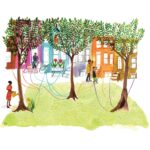
In music, science, and theatre classes, in research labs, in conservation efforts, and almost every corner of academia, there’s a growing awareness and dedication to community-engaged scholarship. How are different disciplines training up social justice-minded students to do no harm to the communities they work in? With one thriving relationship at a time.
A tree grows in Baltimore. Its roots push against the surface, its newly budding canopy blocks some of the dreary rain on this last day in March. The aphorism promises flowers soon, but the daffodils are already here, lush and golden against the wet grass. Rooted in this environment, the tree struggles to absorb water in a heavily-paved area. It faces possible invasive species, the whims of developers, a strike of lightning or disease.
These outside influences affect the flourishing of this tree, and the flourishing of the neighborhood it’s rooted in is just as interconnected. A tension, a balance, a system of reciprocity.
In Franklin Square Park, on a parcel of land donated by developers to the southwest Baltimore neighborhood in 1839, this tree and 96 others were recently surveyed by UMBC students at the request of the Franklin Square Neighborhood Association. They wanted a catalog of their natural resources, but also a record of what they’ve lost—only seven of the original 149 trees on a 1916 map of the park remain.
Working with members of the neighborhood, Mariya Shcheglovitova, Ph.D. ’20, geography and environmental systems, and Bee Brown ’21, environmental science, and other UMBC student researchers began their work. Their project would rapidly expand from an arboreal park survey to a community-focused project that invited local kids to participate in a scavenger hunt and other activities to build on the students’ existing connection to the park. As Shcheglovitova and Brown discovered, “understanding park quality is dynamic and can only be partially captured in a survey of the park features. Historic accounts and a focus on what happens in a park can enrich our understanding of park quality.”
What began in Franklin Square as an effort to catalog trees—separate trunks with roots and canopies equally intermingling—broadened to encompass the community who interacts with the park the most. Acknowledging this interconnectedness in research of all types at UMBC is not new to academia but is becoming a more prominent approach to research as different disciplines wrestle with ways to train up social justice-minded students and do no harm to the communities they work in.
Bridging campus and community
Community-engaged research gives a name to this method. At UMBC, most service-learning and community engagement experiences are facilitated through The Shriver Center, which was founded nearly 30 years ago. Director Michele Wolff explains that in the early days, the Center emphasized “that higher ed institutions shouldn’t tell communities what they need. The partnership should be one of mutuality and reciprocity. So our focus should be listening to community partners, hearing where their gaps are and then being a resource to work with them to fill the gaps.”
This is still the Center’s primary mission, and in January 2020, the Carnegie Foundation for the Advancement of Teaching honored UMBC with its distinguished Carnegie Community Engagement Classification, acknowledging UMBC faculty, staff, students, and partners for their deep commitment to strengthening the bonds between campus and community.
As part of the application process, more than 120 campus partners and dozens of community partners underwent a rigorous self-study. Along the way, they found that in music, science, and theatre classes, in research labs, in conservation efforts, and almost every corner of academia, there’s a growing awareness and dedication to community-engaged scholarship. Wolff sees this movement come alongside “an increased appreciation of disparities, racial inequities, and other social justice issues. At the same time, people have been working on increasing appreciation and inclusion of community members as experts, or thinking about what counts as scholarly work.”
Some departments are working on ways to adopt these methods, and others have this ethos baked into their core. American studies, one of the original majors at UMBC, calls community-based research and engagement one of the “signatures” of the major. With its joint focus on “coupled natural and human systems,” geography and environmental systems (GES) is another department that recognizes the necessity and power of community-engaged scholarship.
Slow scholarship
“In the field of environmental justice, it’s absolutely assumed and expected that you’re going to do community-engaged research,” says Dawn Biehler, a GES professor who first became aware of the concept as a graduate student. “More and more people are realizing that this is important and a good way of doing research, but to do it really well takes so much time and you have to be brave, in a way.”
As an academic, says Biehler, you have to honestly assess if your career—the timing of publications and tenure-track expectations—will suffer from this process. “It takes time to build genuine relationships with the community,” she continues. After engagement and research, then you still need to publish, and all of this takes more time than many instructors have allotted in their balance of research and teaching. “The other thing you have to recognize is that the people in the community you’re working with, they’re exposed to risks all the time, just a different set of risks,” says Biehler.
Institutionally, UMBC is changing to reflect community-engaged research as a priority. In May 2019, the Faculty Senate successfully proposed new language to include evaluation of community-engaged scholarship in the promotion and tenure policy for all departments, says Donald Snyder, chair of the committee that spearheaded the policy change and a lecturer in media and communications studies.
Still, even with the university’s acknowledgement of this methodology, why would professors or students voluntarily choose the inherently riskier, if not just slower, approach to research?
Wolff highlights two affective or social emotional competencies she hopes students take from their time in community work—perspective taking and shared humanness. “What better place to develop and grow (those competencies) than in experiences where you have the opportunity to work with others who are different from yourself and in contexts that are different from the ones you’re used to?” asks Wolff.
Intersectional research
As a doctoral student, Shcheglovitova was known as “the person who cared about trees and social justice in the city,” so she wasn’t surprised when undergraduate student Bee Brown approached her to collaborate on a research project that interwove those topics.
Biehler’s multi-year connection with the Franklin Square community, says Shcheglovitova, gave neighborhood folks someone to approach who was willing to listen and respond about local environmental issues and allowed her and Brown to more easily gain the trust of the people involved.
Scott Kashnow, vice president of the Franklin Square Neighborhood Association, wanted an updated survey of the park’s trees that could inform future plantings in the park. Looking at historical photos and a 1916 map of the park, it’s clear a lot has changed in the past 100 years. Park features have disappeared or degraded—the once bubbling fountain is planted over, the park bathroom is boarded shut, and many of the area’s ash trees were decimated by an invasive insect species.
After the survey was completed, Kashnow came up with the idea to invite students from a local school to celebrate the work and take part in the ongoing research. Shcheglovitova, Brown, and Biehler took the opportunity to gain a deeper understanding into community relationships with the park space.
“This is a way research can actually be helpful to the community,” says Kashnow, a Franklin Square resident for 14 years. “Through various organizations, we’ve been studied so much and oftentimes the studies don’t make any tangible difference in people’s lives. And people are still very happy to participate, you know, everybody has opinions, they love to talk about them. But does the research actually translate to some difference in people’s lives?”
Orchestrating social change
Regardless of the discipline, successful community-engaged scholarship depends on sustained relationships over time. Brian Kaufman, associate professor of music, sees grade school music teachers as great examples of this practice. Unlike other academic subjects in grade school where students have new instructors each year, music teachers interact with the same student musicians year after year. So it naturally follows for Kaufman that his music education students at UMBC should commit to a school for longer than a semester.

Through the Baltimore Symphony Orchestra initiative OrchKids (and with the support of The Shriver Center), UMBC students work with Kaufman at Booker T. Washington Middle School in West Baltimore for two years at a time. “It’s unusual for student teachers to spend four semesters at the same school, but to really build relationships with students, to see them develop, this is necessary,” Kaufman says, not just for the middle school students, but his UMBC students as well.
Pre-COVID, (although they have continued the program virtually) this would mean seven to 10 site visits to the school per semester. UMBC students spend the first half of the visit observing the teacher or engaging with the class, and the last hour spent in guided reflection.
“To me,” shares Kaufman, “that’s where the juicy part comes in.” Before heading back to campus in a Shriver Center van, Kaufman says, “we sit down and talk about what we learned. And we really try to unpack our experience and make connections to some bigger issues—issues of equity, and these larger discussions about teaching in the field and service-learning in the city and how these things tie together. That’s where the real richness comes in for the students.”
Science on the stage
If music education lends itself naturally to following a community-engaged process, what about cross-disciplinary initiatives like Erin Lavik and Lynn Watson’s project Theatre Arts and Communicating Science? Lavik, professor in the department of chemical, biochemical, and environmental engineering, and Watson, a theatre professor, collaborated with Arbutus Middle School science teachers to use theatre skills—playwriting, improvisation, and voice/speech—to help their young students tell stories about their capstone science projects.
Lavik had personally experienced the powerful interplay between STEM and theatre in her own studies, she says, “So I wanted to create a program that helped college students tell the story of their science and let them engage with students in middle school who were vulnerable to losing their passion in science.” When she approached Watson about the idea, the theatre professor was thrilled. “We shared an understanding of the power of theatrical storytelling that can bring communities of people together,” says Watson.
Prior to the program, the UMBC undergraduate and graduate engineering and theatre students spent a preparatory weekend workshopping with science teachers at Arbutus Middle School. Lavik and Watson saw the Retrievers’ confidence and community-building efforts gain steam over the weekend which led to a more successful outcome when they worked with the middle schoolers.
The students ultimately used a playwriting exercise to understand the plight of endangered species and improv scenarios to demonstrate the real world effects of Newton’s Laws of Motion—all of this performed with joy, says Watson. She noticed that the experience also “had a tremendous impact on the UMBC students in terms of confidence in their abilities as leaders and their ability to take action in contributing to the wider community, including outside the university.”
Before their joint project in January 2020, Lavik and Watson were both interested in the concept of community-engaged programming, but they attribute the successful launch of their vision to The Shriver Center. After the fact, Lavik observed that community-engaged scholarship can increase student retention—the stipends attached to the program, made possible by a Charlesmead Initiative for Arts Education grant, afforded students the time to participate. “I hope that over time, we will be able to show that programs that integrate arts and science can help students thrive at UMBC, and bringing these programs to our communities can increase the number of students, particularly from underrepresented populations, who can begin to see themselves as scientists and engineers with joy.”
Changing university culture
UMBC’s Center for Democracy and Civic Life has been instrumental in creating a campus culture of an engaged community—promoting equitable off-campus partnerships while emphasizing the importance of starting that process within the communities at UMBC. The Center’s Director David Hoffman, Ph.D. ’13, language, literacy, and culture, and Assistant Director Romy Hübler ’09, MLL, M.A. ’11, intercultural communications, Ph.D. ’15, LLC, say that an initiative that precedes the formalization of the Center is the BreakingGround grant program.
The origins of BreakingGround came from an effort to organize a UMBC Civic Year in 2012, says Hoffman, when “we discovered all of these people who were doing amazing things.” Greg Simmons, M.P.P. ’04, vice president of institutional advancement, challenged the group to think bigger, remembers Hoffman. “He said, ‘you know, you’re talking about this as a year, but this really is about UMBC’s identity. This is a place where we come together because we want to change the world and we want to change it in particular ways that align with values like inclusive excellence.’”
Hoffman, along with Wolff and others, recognized that community-engaged work was happening in classrooms, at service-learning sites, and in other campus settings, but there wasn’t a unifying structure for like-minded people to find each other easily. Through a sustaining grant from the provost’s office, BreakingGround has offered grants to 80 applicants to infuse courses and programs with opportunities for students to develop civic agency, and to shape their experiences so they’re not “just a one-off community service project, but an opportunity for lasting community engagement,” says Hoffman.
Hübler joined the BreakingGround working group in 2012 as the community liaison for the Graduate Student Association, and as a result of her involvement changed the topic of her dissertation. “I noticed among graduate students from all these different disciplines that many of us were drawn to our topics of study because we either had personal experience with them or we lived in communities where we would observe the effects of bad policy on people and centuries of oppression and marginalization.”
In 2013, UMBC began sending delegations to the Imagining America conference, which, according to the group’s mission, brings together people in higher education, non profit organizations, and activists to “imagine, study, and enact a more just and liberatory ‘America’ and world.” Imagining America’s leaders were struck by the holistic vision described by UMBC participants. “They saw how we were changing the university’s culture,” says Hübler. “Like this was not just one faculty member doing this in this discipline and another one over here, and they’re not communicating, but they could see that this was an organized effort.”
As a result, UMBC was asked to bring the 2015 conference to Baltimore. Hübler and others began to reach out to partners to co-organize workshops around the city. “What is the story that we want to tell of Baltimore?” Hübler would ask. “We didn’t want it to be UMBC saying, ‘this is the story,’ right? But we came up with the story together.” In between planning the conference and the actualization of the work, Freddie Gray died in police custody in April 2015. Uprisings shook the city and caused UMBC to conduct a campus-wide inventory of Baltimore-based engagement, and that accounting ultimately strengthened the intentionality to focus community-based activities on racial equity. One of the most significant outcomes of that reckoning would come in 2017, with the establishment of the Truth, Racial Healing, & Transformation Campus Center at UMBC, which works to break down racial hierarchies with a focus on the university’s service-learning and community-engagement partnerships in Baltimore City.
Importantly, Hübler notes that UMBC is, in fact, its own community and should apply the same community-engaged best practices internally. “There are challenges we have,” she says, “and UMBC can be better. We are constantly making and co-creating UMBC. Students are not just customers floating through to get a degree, but we all have responsibility for our own community. And if we want to co-create our space, there are skills, knowledge, and dispositions that we need that are pretty much the same as what we need when we work with communities elsewhere.”
Good stewardship
Alumna Briana Yancy always envisioned herself following a typical research path, as she thought of it, a scientist in a lab. So she was surprised when she found herself on her third trip to the Bahamas as a part of biological sciences Professor Kevin Omland’s lab studying the Bahama Oriole. Yancy and the other students working with Omland partnered with The Bahamas National Trust, and she says the local community was always excited to talk about their orioles, showing them nests and asking insightful questions.

“I started to see how important this community connection is,” says Yancy, now the diversity work group staffer at the Chesapeake Bay Program, a collective of organizations whose shared mission is to protect the Chesapeake Bay. “It’s important that scientists and researchers learn how to work with local communities and how to talk about the things that they’re working on, especially for the environmental field, because it impacts everybody. If you can’t articulate that, people aren’t going to care and they’re not going to try to make a difference or get involved.”
Yancy ’19, M27, environmental science, says Omland set an example in the Bahamas that she’s tried to emulate since in her own work. “He always made sure to invite people along, to take the time to explain things to people, and also stop to get their insight,” says Yancy. As an intern at the National Aquarium checking water quality in the harbor, Yancy remembers, “people would always come up to me and be like, ‘Oh, what are you doing?’ And I would take the time to explain to them, ‘I’m doing this. This is what this machine is called. And this is how I do it, the numbers I’m looking for, and why it’s important.’”

In her current position, Yancy sees an increased attention toward community-engaged research as organizations like the Chesapeake Bay Program ask themselves how they can reach a more diverse audience. “If we keep getting engagement from the same people from the same walks of life, we’re going to miss things,” says Yancy. “And we really can’t afford to miss anything. Climate change is now and the environment is struggling. And I think that, especially with COVID, we’re seeing more clearly the intricate connection between environmental health and public health.”
Moving toward the ideal
What does it mean to engage in relationships that encourage mutual flourishing? How can the roots and the canopy both benefit and nourish the good of the one tree? This is a question The Shriver Center and their partners at UMBC have been asking themselves and the thousands of students who use the Center’s service-learning structure to engage with the surrounding Baltimore County and City communities for the past 30 years.
Wolff sees community-engaged scholarship as a step away from transactional partnerships to transformational ones. The ideal, she says, should be to include the community from start to finish so everyone benefits.
“We’re recognizing community members as experts and moving forward with a goal of reciprocity and mutuality in our work,” says Wolff. “Part of the ideal is having community members be a part of every aspect of the activity. That’s where we want to get to. I think we’re moving toward that ideal.”
*****
Illustrations by Rebecca Bradley.
]]>
In music, science, and theatre classes, in research labs, in conservation efforts, and almost every corner of academia, there’s a growing awareness and dedication to community-engaged scholarship....
https://umbc.edu/stories/mutual-flourishing/
https://my3.my.umbc.edu/api/v0/pixel/news/119597/guest@my.umbc.edu/f54618ef01ea93bb68525f057a032028/api/pixel
cahss
cbee
center-for-democracy-and-civic-life
discovery
environmental-systems
feature
ges
music
professorsnottomiss
spring-2021
the-shriver-center
theatre
UMBC News & Magazine
https://my3.my.umbc.edu/groups/umbc-news-magazine
https://assets1-my.umbc.edu/system/shared/avatars/groups/000/001/943/24435aa6207c452e7bc15cc74b42c7bb/xsmall.png?1748556657
https://assets1-my.umbc.edu/system/shared/avatars/groups/000/001/943/24435aa6207c452e7bc15cc74b42c7bb/original.png?1748556657
https://assets2-my.umbc.edu/system/shared/avatars/groups/000/001/943/24435aa6207c452e7bc15cc74b42c7bb/xxlarge.png?1748556657
https://assets2-my.umbc.edu/system/shared/avatars/groups/000/001/943/24435aa6207c452e7bc15cc74b42c7bb/xlarge.png?1748556657
https://assets3-my.umbc.edu/system/shared/avatars/groups/000/001/943/24435aa6207c452e7bc15cc74b42c7bb/large.png?1748556657
https://assets1-my.umbc.edu/system/shared/avatars/groups/000/001/943/24435aa6207c452e7bc15cc74b42c7bb/medium.png?1748556657
https://assets2-my.umbc.edu/system/shared/avatars/groups/000/001/943/24435aa6207c452e7bc15cc74b42c7bb/small.png?1748556657
https://assets1-my.umbc.edu/system/shared/avatars/groups/000/001/943/24435aa6207c452e7bc15cc74b42c7bb/xsmall.png?1748556657
https://assets2-my.umbc.edu/system/shared/avatars/groups/000/001/943/24435aa6207c452e7bc15cc74b42c7bb/xxsmall.png?1748556657
UMBC News & Magazine
0
0
false
Thu, 10 Jun 2021 17:57:01 -0400
Losing Winter
Losing Winter, a new exhibition opening in mid-July at the Maryland Center for History and Culture (MCHC) in Baltimore, examines changes in winter weather patterns through photographs, video, and personal memory.
The brainchild of Lynn Cazabon, professor of art and director of CIRCA, and co-curated for MCHC by UMBC history alumnus Joe Tropea ’06, history and M.A. ’08, historical studies, the exhibit includes images as varied as a news report by a young Oprah Winfrey, “Snowmageddon” in 2010, icy conditions during the Great Fire of Baltimore in 1904, and the 1899 blizzard.
Although the exhibition doesn’t directly address climate change, it’s certainly a subtext, said Cazabon, whose interdisciplinary work has often centered on the intersection of environmental and social issues.
“Things are changing,” she said. “What are we doing about it?”
 Untitled. Winter Survival Class, Ice Rescue. Tim Ford (?-?) 1986. Gelatin silver print, 10 x 8 inch. Tim Ford photographs, the Photography Collections, University of Maryland, Baltimore County. UARC2015-07-01-0091
Winter Memories
Losing Winter was sparked by Cazabon’s own memory of freezing as she ice skated at age 14 in Michigan where she grew up. “That lake, in fact, doesn’t reliably freeze anymore,” she added. The idea percolated further in 2014 while Cazabon was making a film about women who had moved to the Yukon.
Talking about the weather used to be the quintessential conversation starter, she noted. “Now it’s fraught with emotion and worry. The weather is not an innocent topic anymore.”
“It forces us to think about the possibility of climate change. Why is our climate changing?” said Tropea, curator of films and photographs at MCHC.
The MCHC show features Maryland memories while a concurrent mounting of the exhibition at VisArts in Rockville will pair recorded reminiscences by area senior citizens with children’s artwork inspired by those memories. The VisArts exhibition opens in May.
At MCHC, home movies and weather reports from the 1970s, ‘80s and ‘90s will be on display, including a report from Oprah Winfrey, then on the WJZ news staff, interviewing ice skaters at the old Memorial Stadium.
“It’s an experience that takes you through the decades,” Tropea said.
 Snow on Palm Sunday. Park Avenue. A. Aubrey Bodine (1906-1970). March 29, 1942. 5 x 4 inch acetate negative. A. Aubrey Bodine Photo Collection. Baltimore City Life Museum Collection. Maryland Center for History and Culture, B1548-2.
Cazabon said she discovered “little moments of joy” along the way, such as a woman in her 80s recalling street skating in her boots, Baltimore Sun photographer A. Aubrey Bodine’s historic photos of Groundhog Day ceremonies, and old weather forecasts.
One of Tropea’s favorite pieces is 1928 industrial footage taken at the Holtwood Dam over the Susquehanna River. Ice floes rushing toward the bay caused extensive damage near the shoreline before the dam was built, Tropea said. The film, which will be projected on a large wall, depicts ice floes going over the dam and breaking apart as they fall.
“Just watching it makes me feel cold,” Tropea said.
For the MCHC show, Cazabon and Tropea delved into the archives at MCHC as well as in the Special Collections Department of the Albin O. Kuhn Library with the help of Lindsey Loeper ’04, American studies, reference and instruction archivist.
Since Covid-19 restrictions have closed the library to researchers, Loeper collected 35 photos to show the professor and Tropea via video conferencing.
“There were things I’ve never seen before,” she said, noting that the collection has millions of pieces. Among the items she shared were glass negatives and works by well-known photographers such as Marion E. Warren. The oldest photo featured children throwing snowballs in 1914.
 Ice covered ruins of Anderson & Ireland Hardware. Unidentified photographer, February 8, 1904 or after. Photo print, 8.5 x 7 inches. Subject Vertical File. MCHC.
Evolving Exhibit
Cazabon mounted her original Losing Winter exhibition at the National Museum of Contemporary Art in Bucharest, Romania, in 2018. It featured audio memories of past Romanian winters, along with melting ice sculptures by a local artist.
As part of the Losing Winter experience, Cazabon is also working with UMBC’s Imaging Research Center on an augmented reality app to display and allow people to experience the winter memories of others. Cazabon received a 2020-21 Saul Zaentz Innovation Fund grant to produce the app. The exhibition at MCHC will include a display of the app playing memories collected from people in Maryland. Cazabon has been working with MCHC Community Engagement Manager Martha Oster-Beal to host virtual workshops during which memories are shared and recorded.
 Marty Bass WJZ, circa 1978
The yearlong exhibition will be housed on the second floor of MCHC, in gallery space across from the H. Furlong Baldwin Library. Visiting at the hottest time of year, when the exhibit launches, “you might be dreaming of winter,” Cazabon said.
Cazabon said the project keeps evolving. The modular format of her project also makes it adaptable. She invites members of the UMBC community to contact her to participate. She’s open to a variety of memories and opinions.
“The project is designed to evolve with each new site,” she said, adding, “I would like it to be a collection that includes people from around the world.”
— Mary K. Tilghman ’79
 “Baltimore Hucksters,” Roland Freeman (1936- ), 1970. Gelatin silver print, 14 x 11 inch. Roland Freeman photographs, Special Collections, University of Maryland, Baltimore County, P79-42-004.
* * * * * *
MCHC will host participatory virtual workshops for residents to record their memories on April 29 and May 27. Go towww.mdhistory.org/events for details and registration.
For more information on how to participate in the project, visit https://www.losingwinter.net.
* * * *
Header image: Blizzard of 1922, Saturday afternoon. Unidentified photographer, January 28, 1922. Photo print, 10.25 x 13.5 inches. Municipal Museum Collection. Maryland Center for History and Culture, MC1909.
]]>
Losing Winter, a new exhibition opening in mid-July at the Maryland Center for History and Culture (MCHC) in Baltimore, examines changes in winter weather patterns through photographs, video, and...
https://umbc.edu/stories/losing-winter/
https://my3.my.umbc.edu/api/v0/pixel/news/119648/guest@my.umbc.edu/d87048c862e8287538fd7d76a7b58d65/api/pixel
circa
discovery
graduateschool
history
professorsnottomiss
visual-arts
UMBC News & Magazine
https://my3.my.umbc.edu/groups/umbc-news-magazine
https://assets1-my.umbc.edu/system/shared/avatars/groups/000/001/943/24435aa6207c452e7bc15cc74b42c7bb/xsmall.png?1748556657
https://assets1-my.umbc.edu/system/shared/avatars/groups/000/001/943/24435aa6207c452e7bc15cc74b42c7bb/original.png?1748556657
https://assets2-my.umbc.edu/system/shared/avatars/groups/000/001/943/24435aa6207c452e7bc15cc74b42c7bb/xxlarge.png?1748556657
https://assets2-my.umbc.edu/system/shared/avatars/groups/000/001/943/24435aa6207c452e7bc15cc74b42c7bb/xlarge.png?1748556657
https://assets3-my.umbc.edu/system/shared/avatars/groups/000/001/943/24435aa6207c452e7bc15cc74b42c7bb/large.png?1748556657
https://assets1-my.umbc.edu/system/shared/avatars/groups/000/001/943/24435aa6207c452e7bc15cc74b42c7bb/medium.png?1748556657
https://assets2-my.umbc.edu/system/shared/avatars/groups/000/001/943/24435aa6207c452e7bc15cc74b42c7bb/small.png?1748556657
https://assets1-my.umbc.edu/system/shared/avatars/groups/000/001/943/24435aa6207c452e7bc15cc74b42c7bb/xsmall.png?1748556657
https://assets2-my.umbc.edu/system/shared/avatars/groups/000/001/943/24435aa6207c452e7bc15cc74b42c7bb/xxsmall.png?1748556657
UMBC News & Magazine
0
0
false
Fri, 23 Apr 2021 16:18:31 -0400
 A boy cools off in Seattle’s Yesler Terrace spray park in June 2021 during a record-setting Pacific Northwest heat wave. AP Photo/John Froschauer