Record-setting group of UMBC students explores global careers through Albrecht Fellowship
Eight UMBC students are spending part of their summer meeting business leaders, visiting Maryland companies, and getting a closer look at careers that connect the state to the rest of the world.
They were selected for the World Trade Center Institute’s (WTCI) 2026 Albrecht Fellowship, a two-week professional development program hosted in Baltimore City and focused on international business and global affairs. This year, the UMBC group set a record.
Daniel Khoshkepazi, senior manager of fellowships at the World Trade Center Institute, called the eight students “a record for a single university from any given cohort in the past.” WTCI typically limits participation to five or six students from one institution, he says. But UMBC students ranked so highly during what he described as the program’s most competitive application cycle to date that “their exceptional performance earned them a place in the cohort.”
For the students participating, the two weeks are a chance to test assumptions about their careers, see what they have studied at UMBC in practice, and, in some cases, discover work they had never considered.
Trying something different
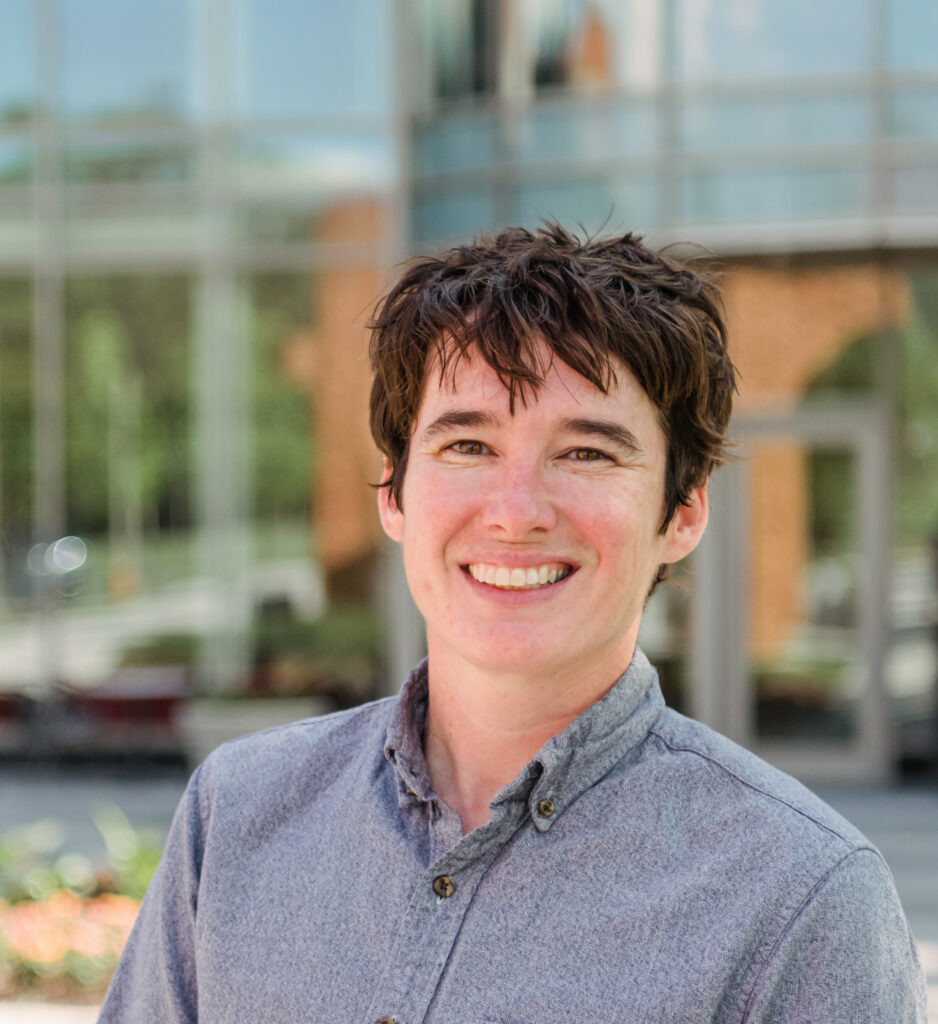
 Headshot courtesy of Matthew O’Donnell
Matthew O’Donnell applied for the fellowship the day after hearing WTCI CEO Eddie Resende speak at UMBC. O’Donnell, a senior global studies major and political science minor, had been thinking about how he spent his first few years of college and wanted to push himself to try something different. Resende’s description of the fellowship and its focus on global trade and business caught his attention.
“I began to realize I need to step out of my comfort zone more,” O’Donnell says. “I felt that I spent my first semesters too close to the norm, and I wanted to try a new experience to see how it would go.”
Gouri Gupta, a junior, initially had a different reaction when she heard about the opportunity. A global studies and political science double major on the pre-law track, Gupta initially brushed off the fellowship. Marketing, global supply chains, logistics, and other business-oriented topics did not seem particularly relevant to her plans to pursue human rights law or federal law enforcement.
Eventually, that became part of the appeal. Gupta decided there could be value in pursuing an experience that did not neatly match the future she had planned for herself. A few hours before the application closed, she started filling it out. She hit submit just seconds before midnight.
The experience introduced Gupta to industries she had rarely considered. Through site visits, she got a closer look at the systems behind everyday products, from olive oil and power saws to athletic wear. She also began connecting concepts from the classroom with areas such as supply chain management and logistics. For Gupta, the fellowship helped clear up some of the “fuzziness” surrounding careers and industries she had previously known primarily as a consumer.
Seeing coursework in action
That sense of discovery is showing up in the classroom connections students are making, too.
During a fellowship panel on global business and supply chains, O’Donnell found himself fascinated by a field he had known little about. He stayed after the session to talk with several panelists about their work. As he explores new fields through the fellowship, he is also seeing connections to topics he has discussed in his global studies courses at UMBC, including global trade, artificial intelligence, international boundaries, and negotiation.
Bibi Qudsia Tolwak, a senior global studies major and public humanities minor, has studied national and international organizations in her UMBC courses. Through the fellowship, she had the chance to visit organizations and businesses and talk directly with professionals about their work.
Originally from Afghanistan, Tolwak is interested in global affairs, humanitarian work, refugee issues, and advocacy. But one of the things that has stood out to her during the fellowship has less to do with any particular industry.
The professionals the students heard from have taken very different routes to their current roles. Some started as interns. Some applied multiple times before an opportunity came through. Others changed directions or faced challenges such as building careers while speaking English as a second language.
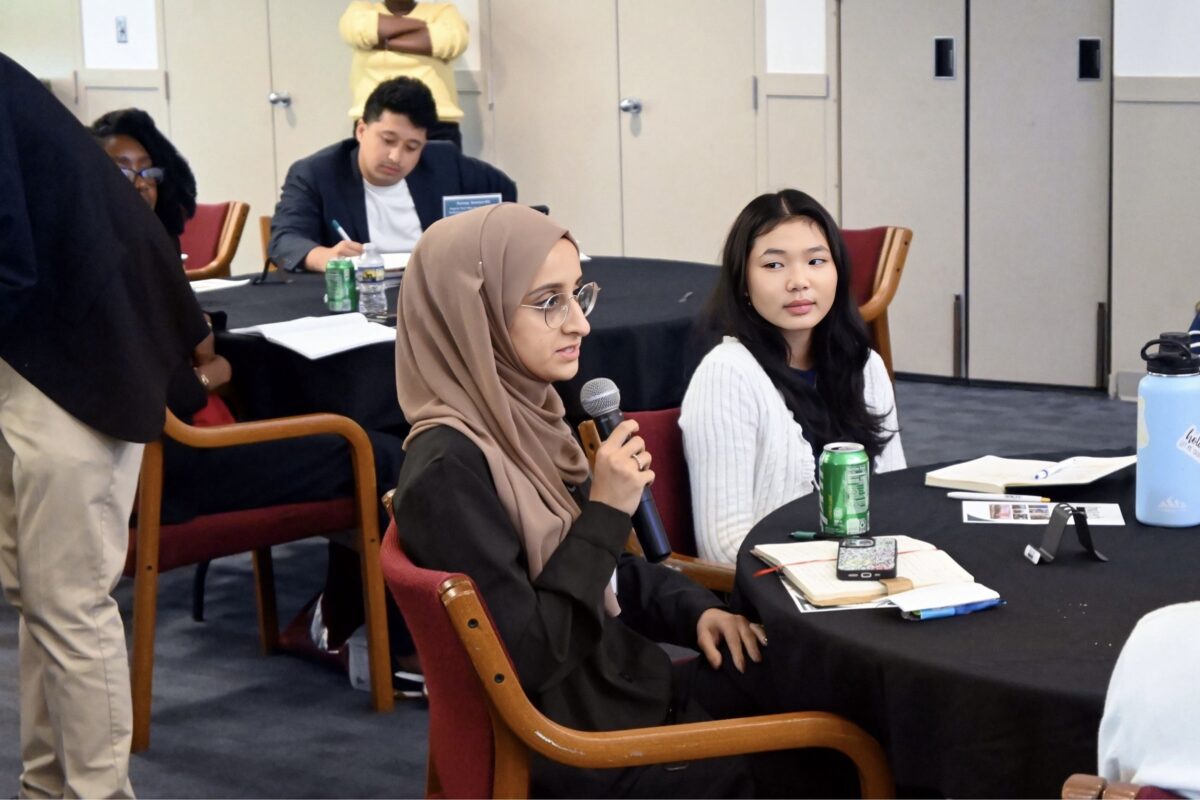 Bibi Qudsia Tolwak speaks at a WTCI group meeting. (Photo courtesy of Tolwak)
“It reminded me that careers do not always happen all at once,” Tolwak says. “Sometimes you just have to say yes to an opportunity and keep moving forward.”
The message resonated with Gupta, too. During a visit to McCormick’s plant and global headquarters in Hunt Valley, Maryland, a panelist shared a message about how the steps toward one career goal may not be the same ones that lead to the next. Gupta says it put into words one of the biggest lessons she is taking from the fellowship: Growth requires being willing to learn and adapt.
Eight Retrievers, one cohort
The size of UMBC’s group has added another dimension to the experience. “It has been great meeting other Retrievers from different majors and backgrounds and learning from their experiences,” Tolwak says. “It also makes me proud to see so many UMBC students represented in the fellowship.”
O’Donnell appreciates that the students bring different interests and strengths to the group. “One thing I love is that nobody feels like they’re overshadowing one another,” he says. “We each have our interests and strengths, and no matter if it’s a group setting or an individual one, we always contribute in a way that aids both ourselves and the group.”
Their paths to the fellowship began months earlier. In April, UMBC’s Global Studies Program hosted Global Career Conversations with Resende, an event focused on international careers. Felipe Filomeno, director of the Global Studies Program, and Christine Routzahn, director of the Career Center, worked together to promote the fellowship and encourage students to apply.
After the UMBC students were selected, the university worked to make sure cost would not prevent any of them from participating. The Division of Student Affairs provided support through a combination of the Career Center’s intern and service funds and divisional resources, allowing all eight students to participate.
Making room for what comes next
As the fellowship continues, the students are not necessarily finding one answer about what comes next. Instead, they are becoming more comfortable with the possibility that their careers may take unexpected turns.
O’Donnell is interested in international relations and more recently, community engagement and local government as well. The fellowship has given him more possibilities to consider rather than one definitive answer.
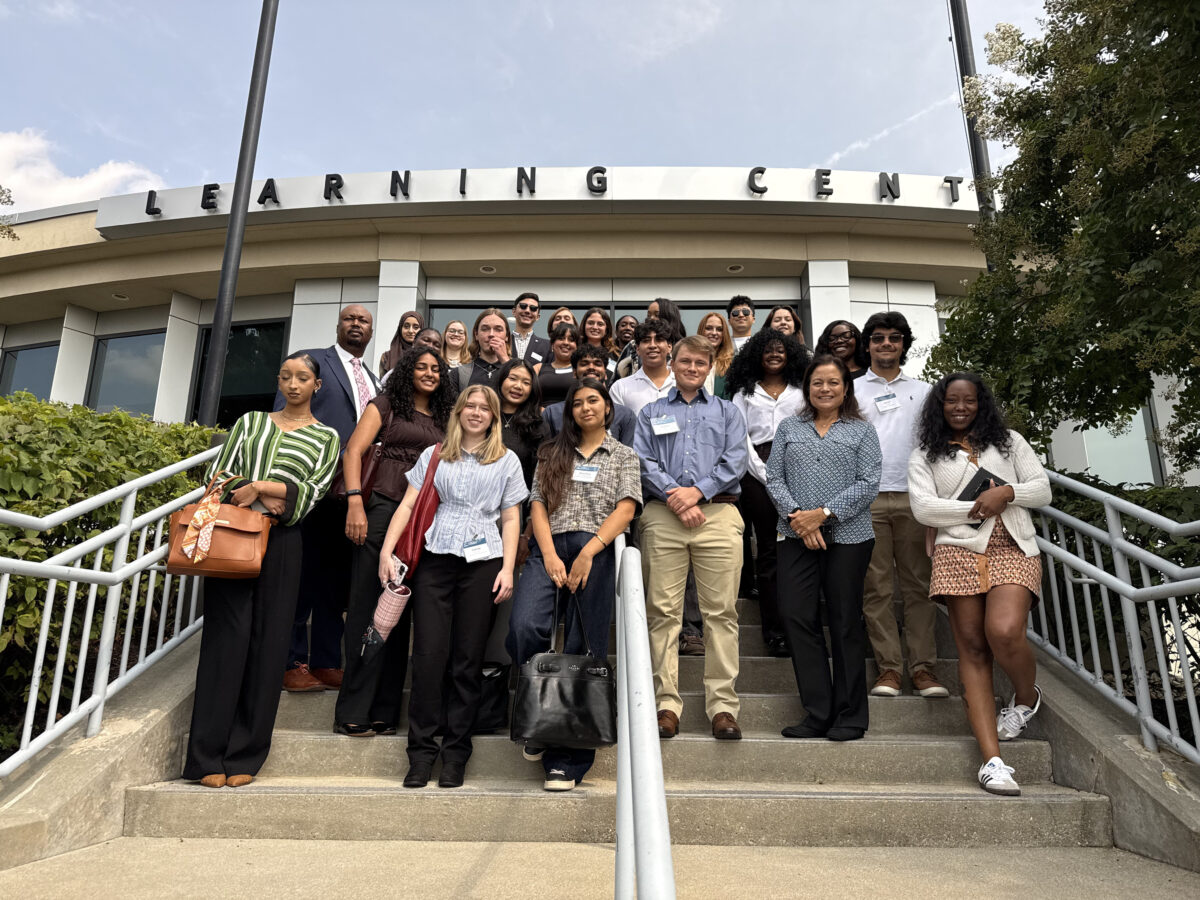 The WTCI interns gather at another site visit. (Photo courtesy of Tolwak).
“The Albrecht Fellowship has certainly given me more to think on, and that’s really what I wanted from this opportunity,” he says.
Tolwak is also still exploring where her interests will lead after UMBC. “I have learned that successful careers are not always straightforward,” Tolwak says. “You do not have to have everything figured out at the beginning; you just have to be willing to learn, keep trying, and say yes to opportunities that can help you grow.”
Gupta is considering law school and careers in human rights or federal law enforcement. The fellowship is also changing how she thinks about entering spaces where she may be younger or less experienced than the people around her.
“If there is one important lesson that the fellowship taught me, it’s that we—as students and professionals—can own our space,” Gupta says.
She hopes to carry that confidence into a field where she wants to make a difference: Gupta specifically wants to increase the representation of South Asian women in federal law enforcement. “I want to change that, and the Albrecht Fellowship has solidified the notion that I can change it.”
]]>
Eight UMBC students are spending part of their summer meeting business leaders, visiting Maryland companies, and getting a closer look at careers that connect the state to the rest of the world....
https://umbc.edu/stories/exploring-global-careers-albrecht-fellowship/
https://my3.my.umbc.edu/api/v0/pixel/news/162085/guest@my.umbc.edu/172c155646d287fefd0c96cd8334dee5/api/pixel
cahss
campus-life
career-center
community
global-studies
political-science
pre-law
public-humanities
stories
story
UMBC News & Magazine
https://my3.my.umbc.edu/groups/umbc-news-magazine
https://assets1-my.umbc.edu/system/shared/avatars/groups/000/001/943/24435aa6207c452e7bc15cc74b42c7bb/xsmall.png?1748556657
https://assets1-my.umbc.edu/system/shared/avatars/groups/000/001/943/24435aa6207c452e7bc15cc74b42c7bb/original.png?1748556657
https://assets2-my.umbc.edu/system/shared/avatars/groups/000/001/943/24435aa6207c452e7bc15cc74b42c7bb/xxlarge.png?1748556657
https://assets2-my.umbc.edu/system/shared/avatars/groups/000/001/943/24435aa6207c452e7bc15cc74b42c7bb/xlarge.png?1748556657
https://assets3-my.umbc.edu/system/shared/avatars/groups/000/001/943/24435aa6207c452e7bc15cc74b42c7bb/large.png?1748556657
https://assets1-my.umbc.edu/system/shared/avatars/groups/000/001/943/24435aa6207c452e7bc15cc74b42c7bb/medium.png?1748556657
https://assets2-my.umbc.edu/system/shared/avatars/groups/000/001/943/24435aa6207c452e7bc15cc74b42c7bb/small.png?1748556657
https://assets1-my.umbc.edu/system/shared/avatars/groups/000/001/943/24435aa6207c452e7bc15cc74b42c7bb/xsmall.png?1748556657
https://assets2-my.umbc.edu/system/shared/avatars/groups/000/001/943/24435aa6207c452e7bc15cc74b42c7bb/xxsmall.png?1748556657
UMBC News & Magazine
0
0
false
Thu, 27 Aug 2026 14:39:28 -0400
Thu, 27 Aug 2026 14:39:28 -0400
Shared Stories, Shared Purpose
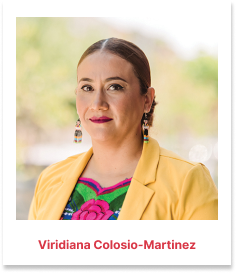
On a warm and bright sunny day in April when the trees in Baltimore City’s Patterson Park are changing from bright green buds to full leaf and the birds are competing with the car horns, Viridiana Colosio-Martinez ’22, modern languages, linguistics, and intercultural communication, and M.A. ’24, intercultural communication, waits in front of the Creative Alliance, a community and performance space a few blocks away from the park. After three years of undergraduate and graduate classes with her professor Tania Lizarazo, Colosio-Martinez is finally meeting her in person.
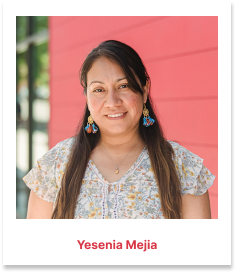
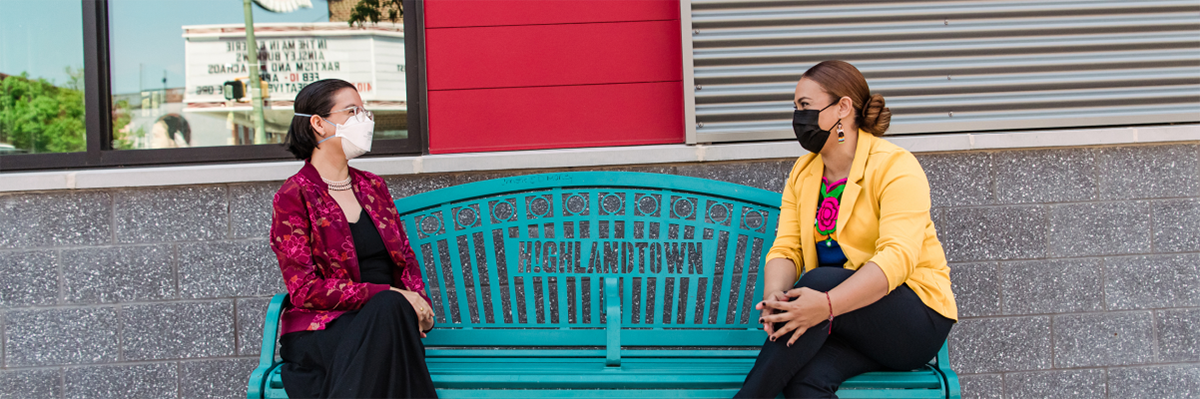
“I’m nervous and excited,” she says, waving to Lizarazo, associate professor of modern languages, linguistics and intercultural communication and global studies, as Lizarazo crosses the street to meet her and collaborator Yesenia Mejia, director of Creative Immigrant Educators of Latin American Origin (CIELO) and the Artesanas Latin American cultural enrichment program coordinator at the Creative Alliance.
“I can’t believe it’s the first time I’m seeing them outside of Webex,” says Colosio-Martinez.
There was a lot of hugging—the kind of hugging that is reserved for a friend you haven’t seen in years. Together, the group is gathering to review digital storytelling projects they’ve been working on together virtually for the past year, which they will present at the International Digital Storytelling Conference in Baltimore this summer.
Led by Lizarazo, and in collaboration with local Latin American communities, they are working to center the human experience by collecting and sharing a range of immigrant journeys that have previously been unrecognized.
“Lived experience is knowledge and should be part of knowledge production. A lot of our students are immigrants or their parents are immigrants and seeing experiences of migration beyond academic writing motivates them to explore their own personal and family stories,” says Lizarazo.
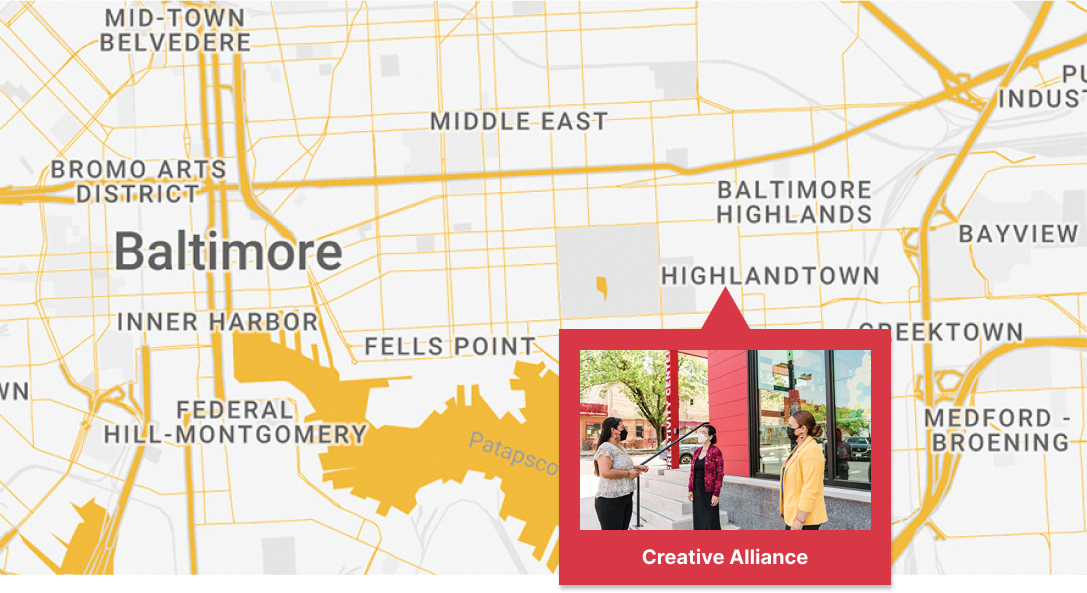
Tania Lizarazo, Viridiana Colosio-Martinez ’22, M.A. ’24, and Yesenia Mejia have been working together to tell the immigration stories of Baltimore’s Latin American communities.
Making teaching and research accessible
When Lizarazo moved from the University of California, Davis (UC Davis) to teach at UMBC in 2015, she felt an urgent need to create community. It had been easy to find a Latinx community in Davis but less so in Maryland.
“I arrived in Baltimore and suddenly I’m walking into places where I’m the only Latina. I don’t think that it’s healthy for anyone,” says Lizarazo. She began volunteering at the Creative Alliance where she met Mejia and started Latinas in Baltimore.
During the pandemic, Lizarazo, who is chronically ill and immunocompromised, has found that virtual classes and tools allow her to continue teaching and engaging in research with the community. In fact, the pandemic made accessibility that had previously been considered impossible the norm.
“We were so close to reimagining what community care could look like in 2020. We should not leave anyone behind or require people to choose between showing up or protecting themselves, their families, and their communities,” says Lizarazo.
“I am also committed to showing that we don’t have to choose between presence and safety. We can imagine collaborations that do not require additional exposures during an ongoing pandemic, that acknowledge that we have different access to resources such as healthcare, and that value interdependence and community care. Not only do I want to collaborate in producing knowledge but I want to be mindful of the context of these collaborations and not pick and choose what justice is when marginalized people keep being the most affected by the pandemic.”
Together with the Baltimore Field School, a part of UMBC’s overarching public humanities programming, and her partner researchers, Lizarazo has spent numerous hours building the relationships needed to help community members tell their stories.
“In the same way, community members rarely feel included in academia in different ways than research subjects. Creating opportunities for dialogues opens up opportunities to imagine new interactions and collaborations where not only the researcher’s knowledge is valued. Researchers would not be able to do anything without relationships and collaborations with students and community members.”
Slow research
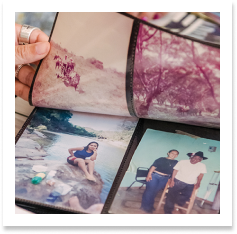
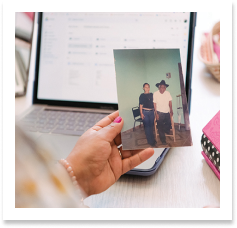
The researchers sit around a table and listen to Mejia describe photos of her family back in Santa María Zacatepec, Oaxaca, Mexico, during the 1990s. A faded photo shows her and her sister riding horses at a ranch. She picks up a picture of her father and pauses. “I didn’t get to see him.” Mejia has not been able to return to Mexico for almost 20 years, during which her father died. Colosio-Martinez and Lizarazo nod, understanding the pain and joy in between Baltimore and Oaxaca.
Mejia, a Baltimore Field School fellow, is working on a digital story, a story map, and website for her project on Representations of Indigenous Traditions from Latin America in Baltimore. She unfolds a calf-length, white cotton huipil (tunic) hand embroidered with red and orange nahuales and proudly shows a family picture with her mom wearing the same huipil.
“My mom always wears her huipil,” says Mejia. “Nahuales are spirit animals that are assigned to a baby according to the day they were born.” This spurs a lot of questions about the nahuales while she shows another hand-embroidered item, a bag with nahuales made by a fellow Indigenous Tacuate artist from Zacatepec.
This community-centered approach to research where students and community members are the knowledge creators is a key approach to Lizarazo’s community-engaged research on Latin American studies, transnational feminism using collaborative methods. It’s a shift away from the colonial-minded ethnography methods created by academics in the global north to research communities in the global south.
“We need to recognize that trust-building is a slow process,” says Lizarazo. “It’s based on reciprocity and it’s essential to meaningful communication and collaboration with communities.”
“Academia has historically excluded marginalized groups while extracting their knowledge. This extraction translates into personal gain for researchers but rarely benefits the communities that have been researched. As universities are not always reflections of the local communities where they are located, I have always been interested in learning from community members,” says Lizarazo. “I enjoy creating, collaborating on, and supporting projects that would not have an exclusively academic audience and won’t exist (only) behind paywalls. This is particularly important in public universities.”
Lizarazo calls this “slow research.” She had been practicing it in her home country of Colombia and at UC Davis as a doctoral student.
“Tania was an early proponent of experimenting with digital storytelling as a research method. Uncomfortable with academic ‘interventions’ into communities, she liked the idea of putting digital communication tools in the hands of vulnerable groups, like migrants, who might not otherwise have access to share their experiences in the public sphere,” shares Lizarazo’s mentor, Robert Irwin, director of the UC Davis Global Migration Center.
“She was an advocate for listening to and learning from migrants. Hers was an important voice in the research group that designed our first strategies for deploying this methodology.”
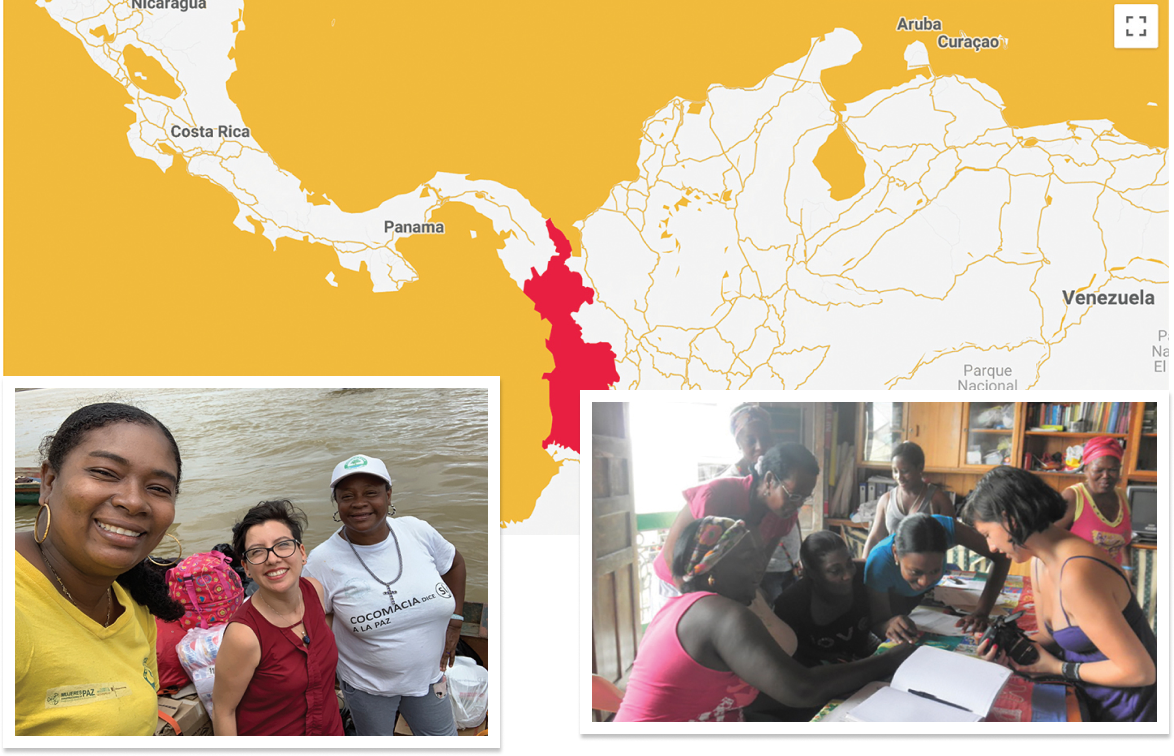 At left: Lizarazo (center) meets with community journalist Lucely Rivas (left) and Gender Commissioner Julia Susana Mena Becerra at the Atrato River. At right: Working with partners on the Mujeres Pacíficas project at the Gender Commission’s office in downtown Quibdó in 2013. Pictured (l-r): Rubiela Cuesta Córdoba, María del Socorro Mosquera Pérez, Yenny Palacios Romaña, Carmen Aides Navia Mena, Banessa Rivas López (in blue), Luz Adonis Mena Becerra and Ana Rosa Heredia Cuesta. Photos courtesy of Lizarazo.
Listening and learning
“Mujeres Pacíficas” was Lizarazo’s first digital storytelling project in collaboration with Afro-Colombian women activists in the department of Chocó, in Western Colombia, who were also advocates for land rights and women’s rights. She met the group in 2008. “Women were doing the work alongside men for years but their work had gone unrecognized,” says Lizarazo.
One of the first shared stories, recorded after five years of community building, was created in collaboration with Luz Adonis Mena Becerra, a member of the Main Community Council of the Integral Peasant Association of the Atrato River, a Black farmers’ association in the Colombian Pacific, where Black communities were officially granted territorial rights in 1993.
“In the process of creating Luz Adonis’s story, I found out she had faced forced displacement and had lost everything she owned in a fire years later,” says Lizarazo. “Despite this, she reconstructed her memories through community photographs for her story.”
The project inspired Lizarazo’s forthcoming book from the University of Illinois Press, Postconflict Utopias: Performing Everyday Survival in the Colombian Pacific, a part of the “Dissident Feminisms” series. “The willingness to imagine these stories before they had audiences, and in spite of the absence of personal archives, is utopian,” says Lizarazo. “Not because these stories are ideal or unrealistic but because they invite the audience to imagine what seems impossible: the end of decades of violent conflict into a material reality.”
Student-teacher and the teacher-student
Parting with colonial-minded immigration research means developing new frameworks that humanize data and shift the process of gathering and disseminating information from one person to a community with a diverse and evolving set of skills and expertise.
“Equipping immigrants with the tools and methods to co-create personal stories can help us understand migration as a hemispheric experience in the context of globalization, colonialism, neoliberalism, genocide, and marginalization, especially of Black and Indigenous communities in Latin America,” says Lizarazo.
These voices highlight the multitude of paths immigrants take that are equally stories of joy, success, family, and community love as they are stories of survival, sacrifice, separation, and pain. There isn’t one Central American experience, Mexican American life, or Latin American journey. Before immigrants became people of color, Latinos, or minorities, they were Aymara, Taino, Mayan, Colombian, Mexican.
“It’s important to critically study the connections between local and global contexts of production and consumption of these stories,” says Lizarazo.
“It’s a more horizontal teaching-learning experience, where students, community members, and instructors are teaching and learning. The world is messy; when we listen to each other, we can do things that we didn’t know were possible before.”
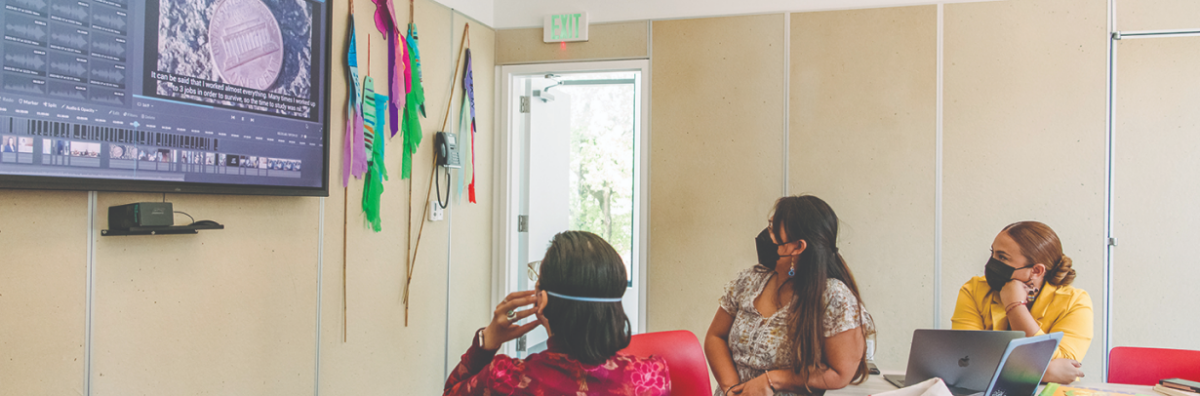 Colosio-Martinez shares photos and stories of her family’s journey with Mejia and Lizarazo.
One penny
After Mejia places her photos and huipil on the table, Colosio-Martinez, research assistant for the Moving Stories: Latinas In Baltimore digital storytelling project led by Lizarazo, takes a deep breath and preempts the debut of her digital story draft by apologizing for the tears to come. A clip of a map shows a blue line tracing the miles of her life from Caborca, Sonora, Mexico, three hours from Phoenix, Arizona, to New Haven, Connecticut, to Baltimore.
A small picture of a penny appears on the screen.
“I’ll never forget when me and my mom tried to register for community college,” she begins, “but we were short one penny.” With each description, the penny gets bigger. “The registrar said she didn’t have a penny and shut the window in our faces.” The penny fills the screen. “My mom and I went outside and searched the floor until we found a penny.”
The pursuit of education is the connecting thread throughout the narrative. A photo of Colosio-Martinez wearing her cap and gown and celebrating with her husband after earning her associate’s degree is followed later by a screenshot of an email welcoming her to UMBC.
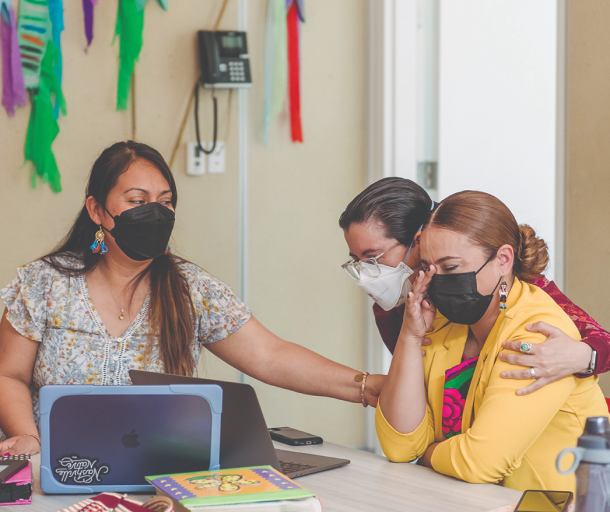
Colosio-Martinez covered her eyes to hide her tears. Lizarazo hugged her. Mejia touched her shoulder. They suggest she not cut her story.
]]>
On a warm and bright sunny day in April when the trees in Baltimore City’s Patterson Park are changing from bright green buds to full leaf and the birds are competing with the car horns, Viridiana...
https://umbc.edu/stories/shared-stories-shared-purpose-slow-research/
https://my3.my.umbc.edu/api/v0/pixel/news/133967/guest@my.umbc.edu/211995ee0714763b85b5693f515054b1/api/pixel
baltimore-field-school
cahss
discovery
global-studies
magazine
mlli
public-humanities
research
spring-2023
UMBC News & Magazine
https://my3.my.umbc.edu/groups/umbc-news-magazine
https://assets1-my.umbc.edu/system/shared/avatars/groups/000/001/943/24435aa6207c452e7bc15cc74b42c7bb/xsmall.png?1748556657
https://assets1-my.umbc.edu/system/shared/avatars/groups/000/001/943/24435aa6207c452e7bc15cc74b42c7bb/original.png?1748556657
https://assets2-my.umbc.edu/system/shared/avatars/groups/000/001/943/24435aa6207c452e7bc15cc74b42c7bb/xxlarge.png?1748556657
https://assets2-my.umbc.edu/system/shared/avatars/groups/000/001/943/24435aa6207c452e7bc15cc74b42c7bb/xlarge.png?1748556657
https://assets3-my.umbc.edu/system/shared/avatars/groups/000/001/943/24435aa6207c452e7bc15cc74b42c7bb/large.png?1748556657
https://assets1-my.umbc.edu/system/shared/avatars/groups/000/001/943/24435aa6207c452e7bc15cc74b42c7bb/medium.png?1748556657
https://assets2-my.umbc.edu/system/shared/avatars/groups/000/001/943/24435aa6207c452e7bc15cc74b42c7bb/small.png?1748556657
https://assets1-my.umbc.edu/system/shared/avatars/groups/000/001/943/24435aa6207c452e7bc15cc74b42c7bb/xsmall.png?1748556657
https://assets2-my.umbc.edu/system/shared/avatars/groups/000/001/943/24435aa6207c452e7bc15cc74b42c7bb/xxsmall.png?1748556657
UMBC News & Magazine
0
0
false
Thu, 08 Jun 2023 19:47:46 -0400
Thu, 08 Jun 2023 19:47:46 -0400
Rethinking collaborative public humanities research in New Orleans and Baltimore
If you were looking for Sarah Fouts in New Orleans, chances are you would find her at one of the many taco trucks or pop-up food vendors across the city, chatting with locals. Relationship-building is at the core of her work, which focuses on the experiences of Black, Central American, and Mexican food industry workers in post-Katrina New Orleans.
Fouts is an assistant professor of American studies at UMBC who earned her Ph.D. in Latin American studies at Tulane University. For more than a decade, she has volunteered for, collaborated with, and supported the work of grassroots organizations in New Orleans. Now, she is working with long-time partners there on an exciting new project.
 Sarah Fouts. (Marlayna Demond ’11/UMBC)
The Whiting Foundation has awarded a $50,000 Public Engagement Fellowship to Fouts along with local organizers Toya Ex Lewis and Fernando López to implement Project Neutral Grounds: At the Intersection of People, Street Food, and the Hustle. Lewis is the organizer of Project Hustle, born in New Orleans, and López is a Mexican-born documentarian. The three partners have worked together since 2013. Their latest collaboration will bring together Black, Brown, LGBTQ+, and immigrant food vendors in New Orleans to celebrate, share, and document their experiences and histories.
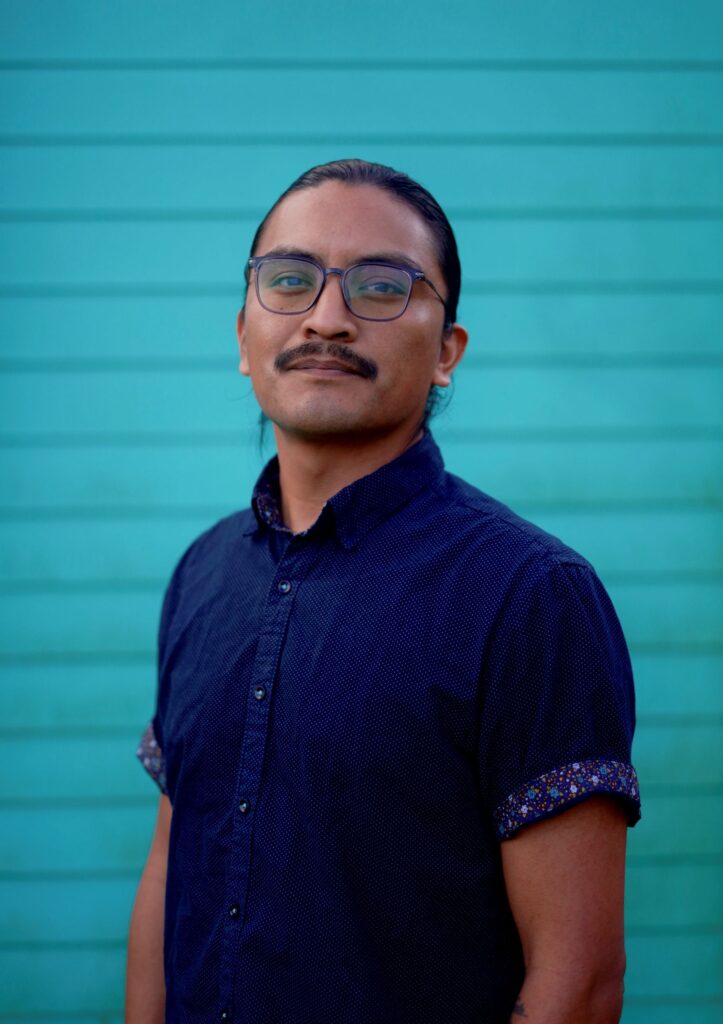 Fernando López. (Photo by López)
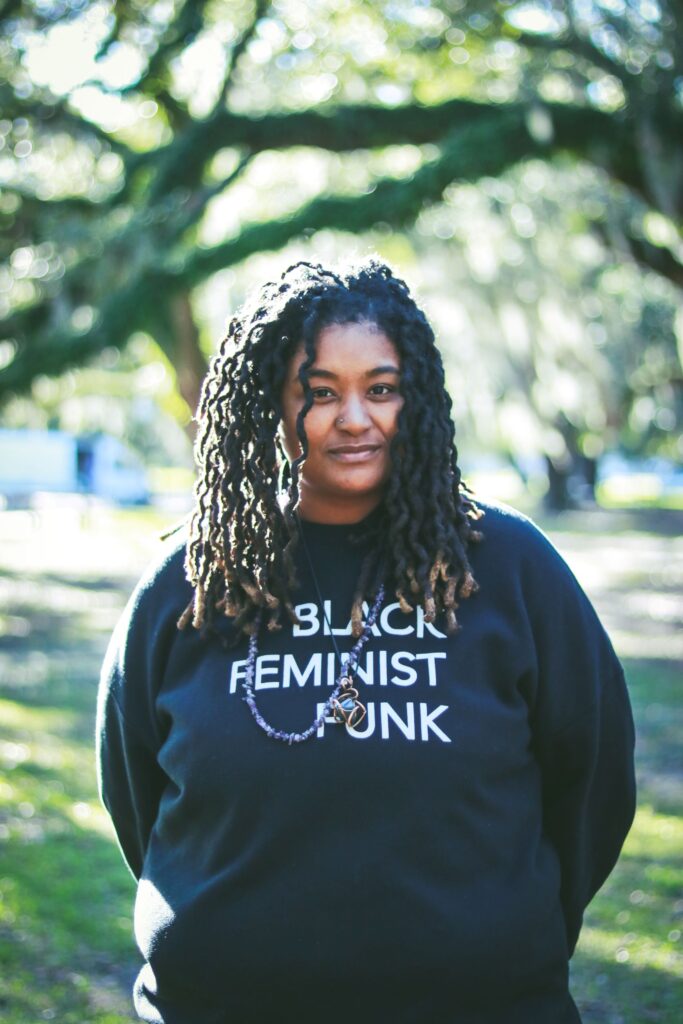 Toya Ex Lewis. (Photo by López)
“In collaboration with Black and Brown food vendors, Project Neutral Ground will showcase the culture, complexities, and potential futures of post-disaster economies,” says Fouts. “We seek to dismantle barriers and foster dialogue to build networks across factors like race, gender, and class in order to foment an understanding of these vendors as they occupy and vie for city spaces.”
Sharing community history
New Orleans has a rich history and culture of street food vendors, particularly led by the city’s Black community. In 2005, Hurricane Katrina devastated New Orleans with wind speeds of over 100 miles per hour and a monumental storm surge that flooded 80% of the city. Many Black and Brown vendors were forced to leave their homes and businesses or find new ways to continue to live and work. Central American food vendors migrated to the city to help fill the void.
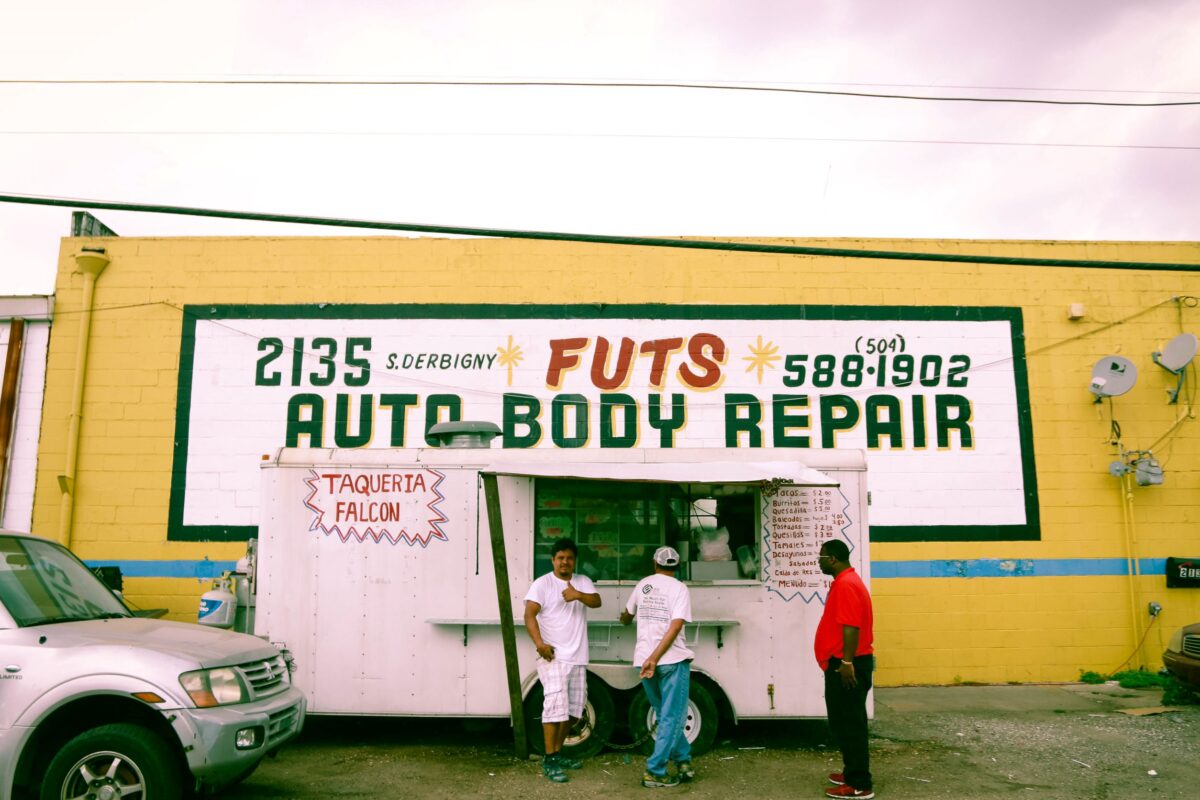 New Orleans taco truck. (Photo by Fernando López)
Now, almost 20 years after Katrina, New Orleans street vendor culture is a mixture of traditional and modern takes on Soul Food and Latin food representative of its burgeoning Black and Brown communities. The success of taco trucks and Soul Food pop-ups has raised complex questions about food truck regulation, worker rights, immigration issues, and local vs. tourist experiences that often pit these communities against each other.
The Whiting Foundation funding will help Fouts, the project director; Lewis, the organizing director; and López, the creative director, work in collaboration with the Southern Food and Beverage Museum to document and share the history, culture, cuisine, and personal journeys of ten food vendors in post-Katrina New Orleans food culture.
Collaborative storytelling
The team will first film and photograph the vendors cooking a dish of their choice at the Southern Food and Beverage Museum. A follow-up filming will document a “day in the life” of each food vendor. Finally, an audio recording will capture personal oral history interviews. Over the course of the year, López and Lewis will use the footage to develop ten mini-documentaries showcasing each vendor’s story.
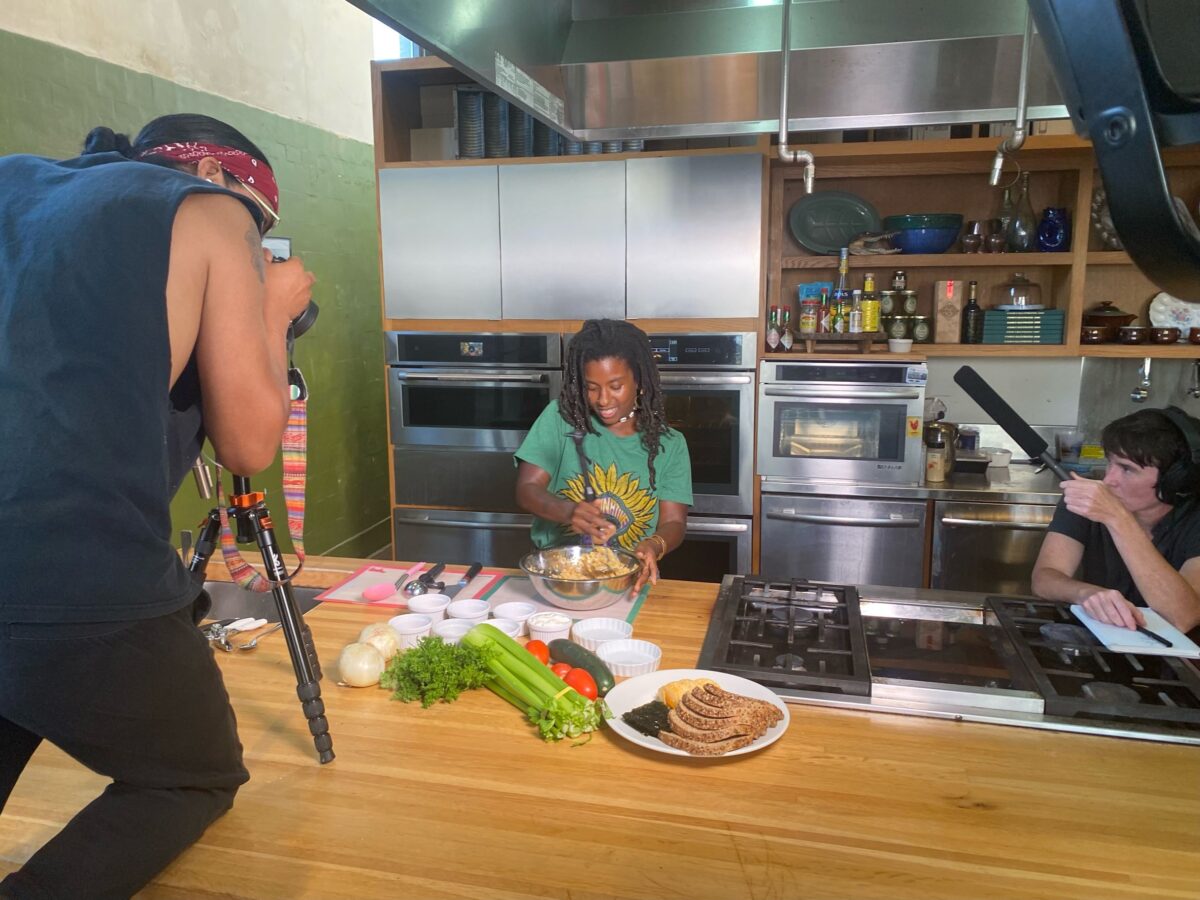 (l-r): López with food vendor and Fouts filming at the Southern Food and Beverage Museum. (Photo by Fernando López)
Fouts, Lewis, and local artist SheRa Phillips will work with students in Fouts’s UMBC Public Humanities course in fall 2022 to convert these stories into a zine that highlights historic and contemporary vendor stories, maps of where street food vendors are, a historical timeline of street vending in New Orleans, and recipes. Vendors will also be able to give the zine to their customers, helping to share this important part of New Orleans history with new audiences.
“This is a way for native New Orleanians to have opportunities to tell our own stories,” says Lewis, “instead of the usual extractive way our stories get taken and told for us.”
The Project Neutral Grounds digital and physical collection of stories will be on exhibit and archived at the Southern Food and Beverage Museum to share with future generations of locals, vendors, visitors, and public humanities scholars.
Public humanities in Baltimore
Since joining the faculty of UMBC, Fouts has also connected with Baltimore communities. The American Council of Learned Societies has awarded Fouts; Nicole King, professor and chair of American studies; and Tahira Mahdi, adjunct professor of psychology, a public engagement grant of over $150,000 to support their innovative public humanities work. The award, supported by the National Endowment for the Humanities, will fund the development and implementation of the project Baltimore Field School (BFS) 2.0: Undoing & Doing Anew in Public Humanities at UMBC 2022 – 2023.
Fouts, King, and Mahdi will work with community members, UMBC graduate students, and faculty to continue developing frameworks for community engagement between local communities and academia that have long-term benefits for local communities in particular.
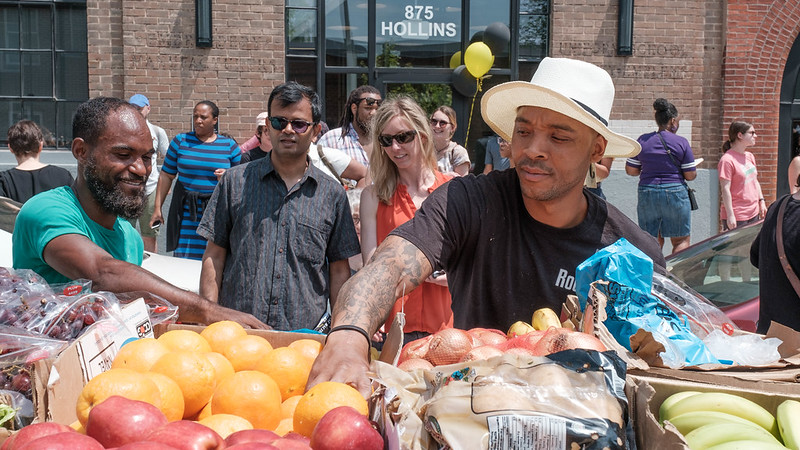 An arabber sells produce form a horse-drawn cart in Baltimore. (Bill Shewbridge/UMBC, Baltimore Traces project)
“This collaborative process takes a great deal of time, listening, and building trust,” King explains. “The people living and working in city neighborhoods and building grassroots organizations should be centered in the process of defining challenges and ways to address them in Baltimore and cities like it.”
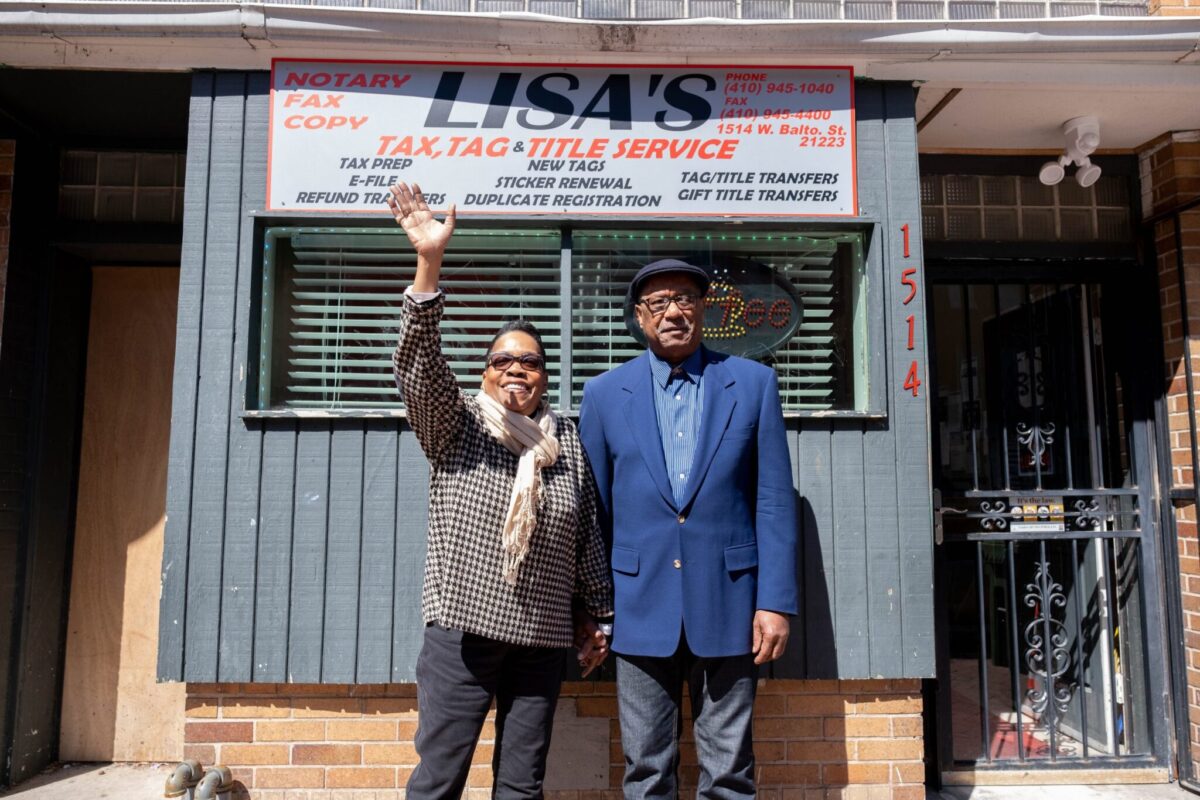 West Baltimore street walking tour with Curtis Eaddy. (Bill Shewbridge/UMBC, Baltimore Traces project)
The award will broaden the reach of the Baltimore Field School (BFS), launched through a $125,000 grant from the Andrew W. Mellon Foundation in 2020. BFS creates a framework for faculty to collaborate with community organizations in building ethical and sustainable research and teaching projects focused on public humanities.
“ACLS is proud to support these outstanding examples of publicly engaged, community-centered scholarship,” says ACLS President Joy Connolly. “Direct engagement with communities beyond the walls of academia is essential to the continued creation of knowledge for the public good. At the same time, these programs will help in expanding our definitions of humanistic scholarship and in contributing to solutions for a brighter future for all.”
]]>
If you were looking for Sarah Fouts in New Orleans, chances are you would find her at one of the many taco trucks or pop-up food vendors across the city, chatting with locals....
https://umbc.edu/stories/strong-public-humanities-in-new-orleans-strong/
https://my3.my.umbc.edu/api/v0/pixel/news/125939/guest@my.umbc.edu/bce533f66624f9128a426aff09b16c6b/api/pixel
americanstudies
baltimore
cahss
cahssresearch
community
news
policy-and-society
psychology
public-humanities
UMBC News & Magazine
https://my3.my.umbc.edu/groups/umbc-news-magazine
https://assets1-my.umbc.edu/system/shared/avatars/groups/000/001/943/24435aa6207c452e7bc15cc74b42c7bb/xsmall.png?1748556657
https://assets1-my.umbc.edu/system/shared/avatars/groups/000/001/943/24435aa6207c452e7bc15cc74b42c7bb/original.png?1748556657
https://assets2-my.umbc.edu/system/shared/avatars/groups/000/001/943/24435aa6207c452e7bc15cc74b42c7bb/xxlarge.png?1748556657
https://assets2-my.umbc.edu/system/shared/avatars/groups/000/001/943/24435aa6207c452e7bc15cc74b42c7bb/xlarge.png?1748556657
https://assets3-my.umbc.edu/system/shared/avatars/groups/000/001/943/24435aa6207c452e7bc15cc74b42c7bb/large.png?1748556657
https://assets1-my.umbc.edu/system/shared/avatars/groups/000/001/943/24435aa6207c452e7bc15cc74b42c7bb/medium.png?1748556657
https://assets2-my.umbc.edu/system/shared/avatars/groups/000/001/943/24435aa6207c452e7bc15cc74b42c7bb/small.png?1748556657
https://assets1-my.umbc.edu/system/shared/avatars/groups/000/001/943/24435aa6207c452e7bc15cc74b42c7bb/xsmall.png?1748556657
https://assets2-my.umbc.edu/system/shared/avatars/groups/000/001/943/24435aa6207c452e7bc15cc74b42c7bb/xxsmall.png?1748556657
UMBC News & Magazine
0
0
false
Fri, 17 Jun 2022 07:52:00 -0400
Fri, 17 Jun 2022 07:52:00 -0400
Meaningful Representation
Assigned an oral history project in 2007 for her master’s degree in community arts at Maryland Institute College of Art, Ashley Minner—now professor of the practice and folklorist in the Department of American Studies at UMBC—knew exactly who she would ask to interview. She walked across the street from her parents’ house and knocked on Uncle John’s door.
“There will never be a person like Uncle John,” says Minner, an enrolled member of the Lumbee Tribe of North Carolina. “I don’t know, he was just like that, always telling stories. He was a character. When he was younger, he had pork chop sideburns. He had a really thick Robeson County accent. He was a good man. I believe he was touched by God, he was—he is—a Lumbee Legend.”
Sharing their heritage with Baltimore
 Photo by Jill Fannon, M.F.A. ’11, for
 BmoreArt.
John Walker, if not a direct relative of Minner’s, played that role, telling her about their shared heritage and regaling her with stories of his youth in North Carolina, where many Lumbees moved from in the 1950s and ’60s to Baltimore in search of work. Minner’s subsequent research has helped tell the wider story of Lumbee migration to Baltimore, specifically to the neighborhoods of Upper Fells Point and Washington Hill, affectionately called “The Reservation.”
The original oral history project turned into a thesis of five artist books—which include transcriptions of five elders’ stories along with compiled photographs. This project grew into an exhibit at the Baltimore Museum of Industry in 2011 that featured five additional oral histories and cultural artifacts. It felt like the project could keep snowballing, says Minner. It was around this time, she noticed that more often the oral histories were being used at elders’ funerals.
“They became more precious after that,” she says, as the growing awareness of losing a generation began to sink in.
In fall 2019, Minner met with staff in UMBC Special Collections to discuss the creation of a home for her work and other Baltimore Lumbee related research and ephemera. To be housed in the Maryland Folklife Archives, Minner’s recordings will become part of “The Ashley Minner Collection,” along with other documents and photographs shared by tribal members.
Preserving people’s stories
“This collection really demonstrates how the University connects with the surrounding community in Baltimore,” says Beth Saunders, curator and head of UMBC’s Special Collections and Gallery. “In other words, we benefit from stronger ties to the community we serve. Ashley really dug into local archives and did the legwork and other researchers will be able to benefit from that.”
 Jeanette W. Jones holds a 1957 issue of
 Ebony
magazine, which features the article ‘Mystery People of Baltimore: Neither red, nor black, nor white. Strange ‘Indian’ tribe lives in world of its own.’ She is pictured at center, with her hand on her hip. Photo by Sean Scheidt ’05, visual arts.
Minner sees the archive as a necessary repository for stories and photographs, that otherwise might be lost as the Lumbees who previously lived and worked close together spread out into the counties surrounding Baltimore. “Ashley has a real, practical sense of the value of archives for preserving history and people’s stories,” says Saunders. “This new collection is an opportunity to preserve a part of that history that has been neglected and that she is bringing to broader awareness.”
Minner hopes the creation of the archive will encourage more Lumbees to dig into their past, while also finding pride in their present. ”We are made to feel as if we don’t belong on this landscape,” says Minner. “Many of our young people don’t know their history because frankly…their parents don’t know the history.”
“I think being able to point and explain and show pictures and ground them in the fact that our people have been here for close to a 100 years now and have really made contributions, that does something. That helps with security, self-esteem, and feeling empowered—like you do belong, like nobody lied to you. You are who you are.”
Ethics of community research
Minner bridges multiple spheres with her work—she’s an artist, a scholar, and also a granddaughter, a friend, a fellow tribal member. The only hat she can take off, as she puts it, is her UMBC hat. Otherwise, “what I’m doing and what I’m about is bigger than a job,” says Minner, “bigger than a job title or discipline.”
Part of having her feet in two worlds is training students how to develop holistic approaches to public scholarship and community collaboration. In Fall 2019, Minner was hired as the director of UMBC’s new public humanities minor. “We’re lifting up stories that get pushed to the margins,” says Minner. “And we spend a lot of time on ethics. The last thing I want to do is turn a bunch of college students loose on communities that might be harmed through the interaction.”
 The Baltimore American Indian Center, 113 S. Broadway, is the hub of cultural activities for area Indians. Photo by John Davis, The News American, October 24, 1985. Baltimore News American Photo Archive, Special Collections and University Archives, University of Maryland College Park. Permission granted for Minner’s use by the Hearst Corporation.
Minner is uniquely suited to the directorship, says Nicole King, associate professor and chair of the Department of American Studies. “Her broad range of experiences and skills, speaks to the many positions we all hold in our everyday lives. These human aspects are often flattened in an institutional context. Yet, Ashley is more than all of these credentials and roles because her practice focuses on seeing the humanity and beauty of everyday people and places. What Ashley offers to our students at UMBC is lived experiences that are both ordinary and extraordinary and an understanding of the connections between the two.”
From this perspective, Minner can see how outsiders often miss the mark when trying to tell the Baltimore Lumbee story. “They latch on to urban renewal and displacement,” explains Minner, “but the elders don’t see it that way. They’re not victims, that’s not the story they want to tell. It’s important to teach folks to listen deeply and to check in and make sure people are being represented the way they want to be represented.”
A memorable occasion
Minner has a story, one of her own that’s stuck with her as she’s watched her research expand through a process she describes as “pretty serendipitous.” Aunt Jeanette Walker Jones, Uncle John’s widow, says Minner, was instrumental in connecting Minner to her heritage. When Minner and her best friend, Nicole—Aunt Jeanette’s granddaughter—were 4 or 5 years old, she took them to have ribbon dresses made.
The fabric for the dresses was light pink with teepees on it and the ribbons adorning it were white, black, and hot pink, remembers Minner. They attended an event at the former Festival Hall downtown—an annual pow wow put on by the Baltimore American Indian Center. “We were out there hopping around; we didn’t know what we were doing. Some Indian guy looked at my mom, and when she nodded at him, he scooped me up and held my hand while I danced with him. I was like ‘ahhhh,’” she says, making an excitedly terrified face. “It was a thrill!”
******
Header image: The Inter-Tribal Restaurant was owned and operated by the Baltimore American Indian Center in the unit block of South Broadway. Photo courtesy of the Baltimore American Indian Center, provided by Minner.
]]>
Assigned an oral history project in 2007 for her master’s degree in community arts at Maryland Institute College of Art, Ashley Minner—now professor of the practice and folklorist in the...
https://umbc.edu/stories/meaningful-representation/
https://my3.my.umbc.edu/api/v0/pixel/news/119738/guest@my.umbc.edu/49b08a27a2100d4afcf70d7e26c953eb/api/pixel
american-studies
cahss
discovery
fall-2020
professorsnottomiss
public-humanities
UMBC News & Magazine
https://my3.my.umbc.edu/groups/umbc-news-magazine
https://assets1-my.umbc.edu/system/shared/avatars/groups/000/001/943/24435aa6207c452e7bc15cc74b42c7bb/xsmall.png?1748556657
https://assets1-my.umbc.edu/system/shared/avatars/groups/000/001/943/24435aa6207c452e7bc15cc74b42c7bb/original.png?1748556657
https://assets2-my.umbc.edu/system/shared/avatars/groups/000/001/943/24435aa6207c452e7bc15cc74b42c7bb/xxlarge.png?1748556657
https://assets2-my.umbc.edu/system/shared/avatars/groups/000/001/943/24435aa6207c452e7bc15cc74b42c7bb/xlarge.png?1748556657
https://assets3-my.umbc.edu/system/shared/avatars/groups/000/001/943/24435aa6207c452e7bc15cc74b42c7bb/large.png?1748556657
https://assets1-my.umbc.edu/system/shared/avatars/groups/000/001/943/24435aa6207c452e7bc15cc74b42c7bb/medium.png?1748556657
https://assets2-my.umbc.edu/system/shared/avatars/groups/000/001/943/24435aa6207c452e7bc15cc74b42c7bb/small.png?1748556657
https://assets1-my.umbc.edu/system/shared/avatars/groups/000/001/943/24435aa6207c452e7bc15cc74b42c7bb/xsmall.png?1748556657
https://assets2-my.umbc.edu/system/shared/avatars/groups/000/001/943/24435aa6207c452e7bc15cc74b42c7bb/xxsmall.png?1748556657
UMBC News & Magazine
0
0
false
Wed, 25 Nov 2020 19:36:45 -0500