Who is “Fulbright material”? UMBC’s six 2025 – 2026 Fulbright U.S. Student Program recipients share their not-so-secret recipe for success
Alyssa Thomas is more of an “and” person than an “or” person. Growing up in a military family stationed in Florida, Thomas learned flexibility, a sense of curiosity, and a “Why not?” approach to life. So when Shin Yon Kim, assistant teaching professor of Asian studies, encouraged her to apply to the U.S. Fulbright Student Program during her junior year, Thomas was skeptical. “I decided to give it a try, but I didn’t think I’d get very far because I had never studied abroad,” said Thomas. “And then Dr. Kim said, ‘I need you to start believing in yourself and actually push yourself to apply for it.'” Those words of encouragement stuck with her. Thomas took her own advice and said, “Why not?”
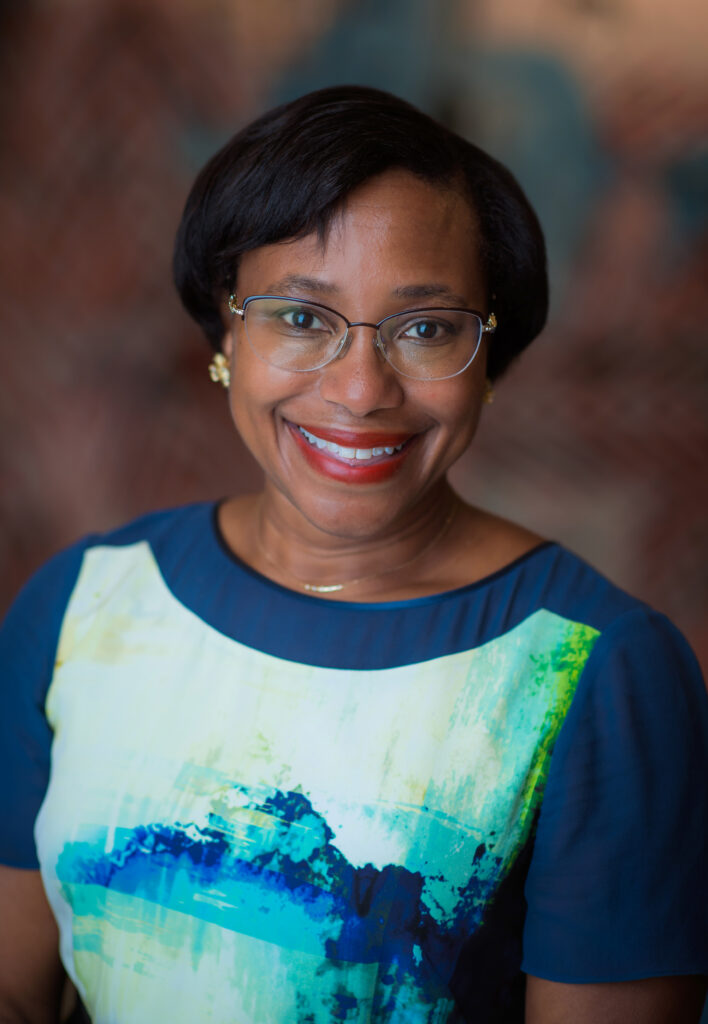
Thomas ’25, Asian studies, ended her summer by moving to Taipei, Taiwan, where she is already working as a Fulbright English Teaching Assistant. She hopes her rudimentary Mandarin will help her learn Taiwanese Mandarin and the various dialects while she’s there. “There’s a big difference between learning in the classroom and in person. Accents, tempo, and slang are elements of Mandarin I’ve yet to adjust to,” says Thomas.

Retriever advice from Alyssa Thomas ’25
U.S. Fulbright Student Program
English Teaching Assistant, Taipei, Taiwan
“It’s important to learn how to manage your stress, especially if you have never traveled abroad or applied for a Fulbright. For me, it’s morning walks. Find what works for you—whether it’s journaling or therapy—to help manage the unexpected.”
Deciding to apply for a Fulbright is only the beginning. The process usually starts with a mentor pointing the way toward Brian Souders, M.A. ’19, TESOL, and Ph.D. ’09, language, literacy, and culture, the associate director for global learning at UMBC’s Center for Global Engagement. CGE hosts Fulbright information sessions in the spring for undergraduate, graduate, and recent alumni. Retrievers can apply to earn a master’s, conduct research, or be an English Teaching Assistant in East Asia-Pacific, Europe and Eurasia, Middle East and North Africa, South and Central Asia, Sub-Saharan Africa, and the Western Hemisphere.
With three UMBC 2025 – 2026 Fulbrights already settled in Taiwan, Norway, and Indonesia, and three preparing to cross the Atlantic Ocean to Belgium, Israel, and Germany, these alumni are eager to share tips to inspire and prepare the next generations of Fulbright Retrievers.
Transforming the lives of incarcerated women
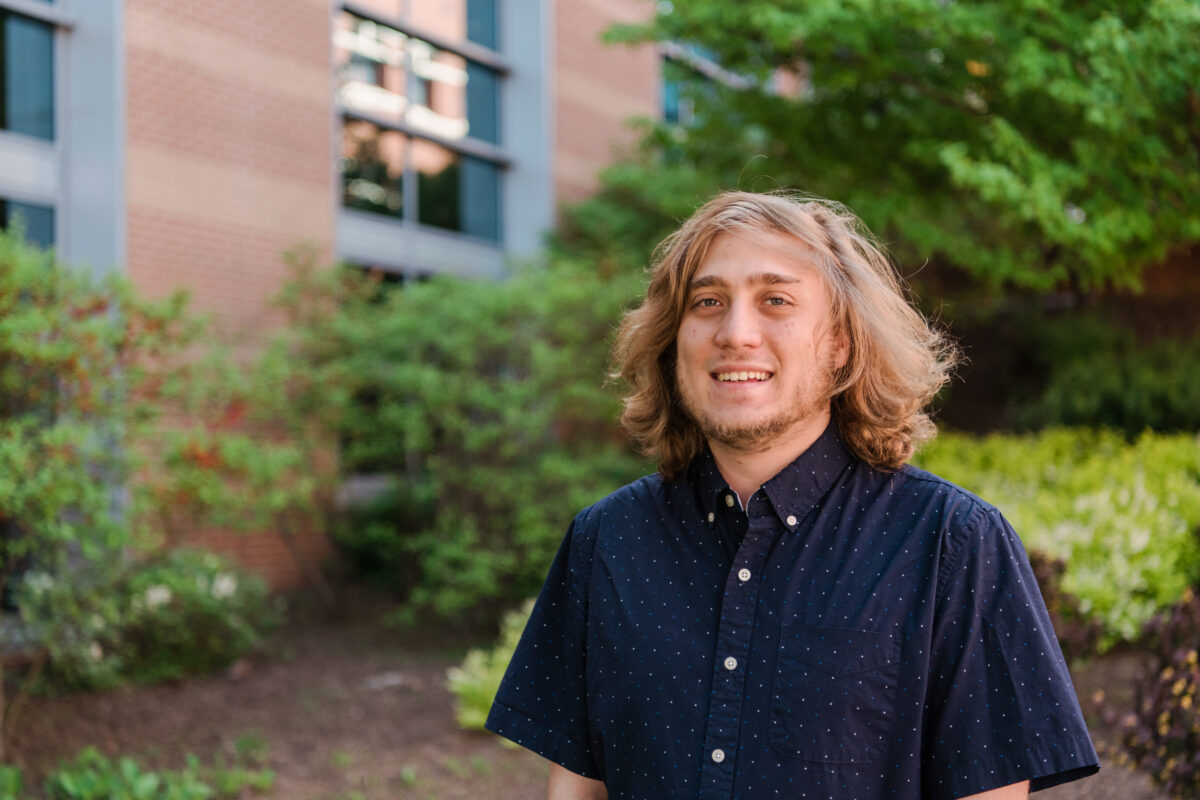
Right now, it is the beginning of fall in Bergen, Norway, where Shanika Freeman ’24 is settling in at the University of Bergen, working with faculty studying the reentry experiences of native Norwegian and non-native Norwegian women into the community after incarceration. Freeman’s individualized studies major at UMBC focused on recidivism and policy in urban communities, making Norway a perfect research location. The country’s progressive and humane approach to rehabilitation, from the point of entry into the carceral system to successful reentry, has made Norway have the world’s lowest recidivism rates. Though Baltimore and Norway are worlds apart geographically and culturally, Freeman hopes to use what she learns abroad to help transform the lives of incarcerated women in the U.S. by exploring practices that shift the focus from punishment to rehabilitation and community building.

Retriever advice from Shanika Freeman ’24
U.S. Fulbright Student Program
Research in Bergen, Norway
“Build a team. I found out about Fulbright through Dr. Brian Souders. I didn’t know anything about it before and felt like Fulbright was out of reach for me. The furthest I had traveled was to California, and that was only for a weekend. I never thought a person like me—low-income, two-time college dropout from Baltimore City—would get the opportunity to go abroad.”
Her team included the INDS faculty and her academic mentors: Tammy Henderson, associate teaching professor of Africana studies; Loren Henderson, director of the school of public policy; László Kőrössy, assistant director for academic advising, outreach, and assessment; and Eric Stokan, director of the Center for Social Science Scholarship. “I applied because the faculty encouraged me and supported my research. I knew that my research was important, and Fulbright allowed me to take it further. Applying was a bit overwhelming at times, but Dr. Souders was extremely thorough, patient, kind, and knowledgeable. My team of faculty and staff was instrumental in my development as a scholar and fostered my academic goals.”
Researching your roots
Since Eilah Goldberg ’25, history, with a Judaic studies minor, first learned about the Fulbright Program during her sophomore year, her academic goals became very clear—build a strong academic and social foundation to earn this prestigious award. Goldberg knew she wanted to study Jewish history, religion, and culture abroad. The first step was studying abroad in England at the University College London (UCL) Hebrew and Jewish studies department, with the intent of returning to earn a master’s. “When I told Dr. Souders my plan to return to London after graduation, he asked me what I really wanted to do,” says Goldberg. “I shared my deep interest in Jewish studies, and he helped me realize that I could go directly to Israel to study—that it was a real option.”

Retriever advice from Eilah Goldberg ’25
U.S. Fulbright Student Program
Master’s at Hebrew University of Jerusalem
“Stay true to yourself, your interests, passions, and intellectual curiosities. Don’t let fear stop you from traveling to places or studying topics that are personally and culturally meaningful to you. Take the opportunity to conduct firsthand research into your roots, identity, and beliefs. Lean on the support of student clubs and cultural communities, just as I did with UMBC’s Chabad and Hillel Jewish student organizations and UCL’s Jewish Student Union. It’s important to have people to encourage you and believe in you.”
Goldberg will earn a master’s in Israel Studies at the Hebrew University of Jerusalem, surrounded by her extended family in Israel, an hour away from Jerusalem. She will study the impact of American Aliyah—ascent in Hebrew—the immigration of American Jews to Israel, and how it shaped Israeli society historically, culturally, and politically.
Pre-med neurologocial research abroad
The summer before his first year at UMBC, Andrew Opincar ’25, biological sciences, mapped out a four-year plan to ensure he would complete his major requirements, gain clinical experience, and take the MCAT all before graduating. As a participant in STEM Build—a National Institutes of Health initiative focused on enhancing diversity in the biomedical and behavioral sciences workforce, Opincar was excited to explore diverse perspectives in healthcare and research. While planning for his final two years at UMBC, he took the opportunity to study abroad in Amsterdam, Netherlands, to learn about the Dutch public universal health system.

Retriever advice from Andrew Opincar ’25
U.S. Fulbright Student Program
Research at the University of Heidelberg, Germany
“For pre-med students to critically analyze the health systems around us, we need to understand systems and people different from ourselves. It’s difficult to be well-rounded physicians, scientists, or researchers when you’ve only lived in one place and had one kind of experience,” says Opincar, who, even though his mentors encouraged him to apply, was unsure if he was “Fulbright material.” “I like the sports quote, ‘You lose 100 percent of the shots you don’t take,’ so you really must take a chance on what you care about and put yourself out there.”
Now, Opincar has mapped the time between graduation and medical school to learn a new healthcare system and expand his research experience from cell migration in fruit flies to spinal cord regeneration in mouse models at Heidelberg University, Germany, a global center for molecular biology and neuroscience. He’s excited to plan for many unknowns, like exploring a new research field, becoming bilingual, and stepping outside of his comfort zone to gain more confidence personally and professionally.
Connecting with your community across borders
Law and politics have been on Navara Syed‘s mind as long as she can remember. Her political science professors, Carolyn Forestiere, Brian Grodsky, and Jeffrey Davis, fueled her passion for comparative politics, civil and human rights, and community advocacy, leading her to choose a major in political science. During her visits to Pakistan to visit family and to Thailand to study abroad, Syed began to understand the complexity and broadness of what community can mean, and is ready to embrace the community she will be part of during her Fulbright in Indonesia as an English Teaching Assistant.

Retriever advice from Navara Syed ’25
U.S. Fulbright Student Program
English Teaching Assistant
Padang, West Sumatra, Indonesia
“Dip your toes into different ponds. You never know what you will find. I’m Muslim and have never lived in a Muslim country. In the U.S., I always have to think about where to get Halal food. In Thailand, a kind person approached me and offered to show me where I could find Halal food. Our tour guide even made sure to include Halal restaurant options.
Indonesia is a Muslim country, so spending Ramadan and other major Muslim holidays without needing to explain them or figure out how to participate in them is a dream come true. No experience is a waste—it’s just as important to realize what you don’t like as it is to discover what you do.”
Since graduating in May, these connections, along with her time in Mock Trial, the Muslim Student Association, and the student events board, continue to plant seeds of possibilities for her future in the field of law, whether as a judge, legislator, professor, or advocate.
Intersectional approach to flood mitigation
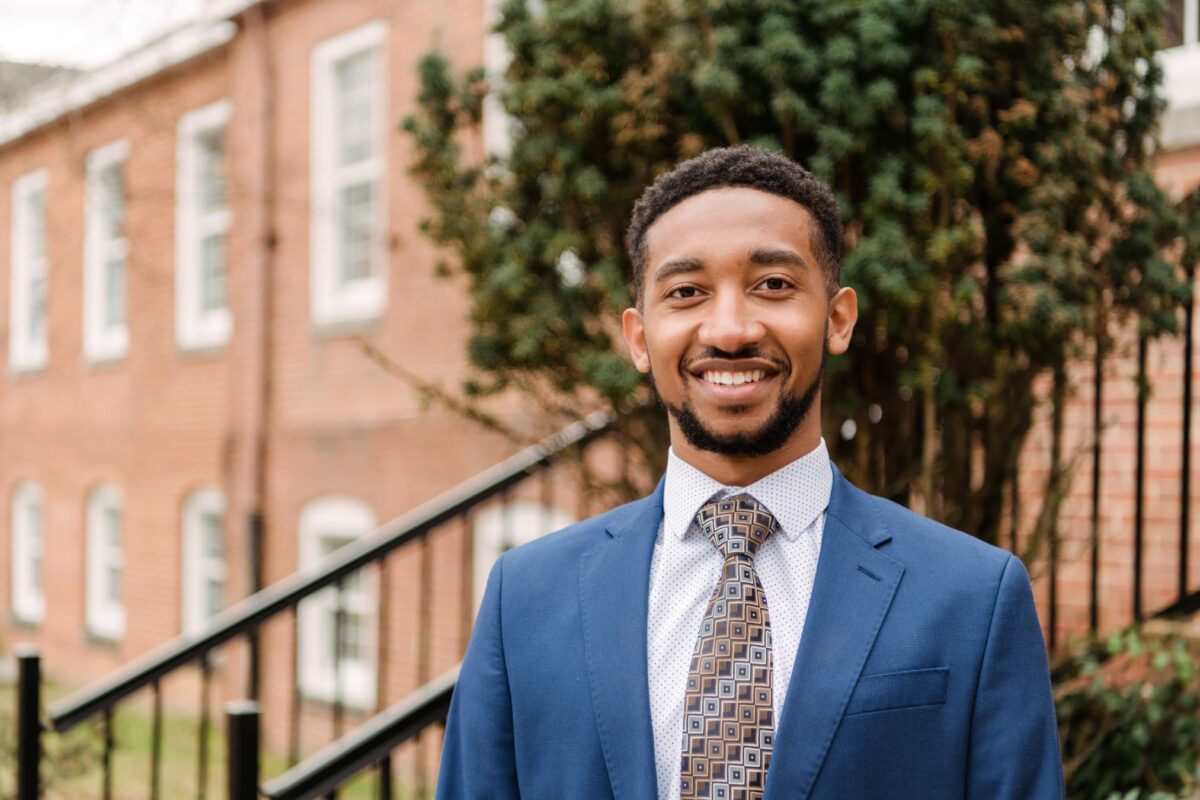
Daniel Douglas ’21, global studies, M.P.P. ’24, public policy, a current Ph.D. student, has been clear about his career path since his undergraduate years, when he began researching environmental policy focused on disaster mitigation and natural hazards. As a Fulbright recipient, he is now taking his expertise to the international level in Antwerp, Belgium.

Retriever advice from Daniel Douglas, Ph.D. student
U.S. Fulbright Student Program
Research at University of Antwerp, Belgium
“In every single field of study at UMBC, you can identify a way to apply your work for the common good. Find and seek your purpose above all else. This is especially important today when research and academia are being challenged. Now, we all have to uplift goodness, justice, and each other. And most of all, we can’t give up hope. I try my best to uplift those around me, knowing and trusting that they are pushing me forward to new heights.”
At the University of Antwerp, Douglas will conduct research on Belgium’s Sigma Plan—the primary flood mitigation plan along the Scheldt River Valley in Flanders, Belgium. Originally launched in 1977 as a single-purpose safety plan, it has since evolved to manage flood protection with nature conservation, recreation, and the needs of shipping and agriculture. This intersectional approach to flood mitigation is Douglas’s passion. He plans to build on his skill set in Belgium, then bring this newfound knowledge back to UMBC to complete his doctorate, and help communities worldwide—including Ellicott City—reduce the disastrous impacts of environmental hazards through disaster prevention, mitigation, and governance.
Learn more about UMBC’s Center for Global Education.
All photos by Brad Ziegler/UMBC, with the exception of Shanika Friedman’s, courtesy of INDS, and Daniel Douglas, courtesy of Douglas.
]]>
Alyssa Thomas is more of an “and” person than an “or” person. Growing up in a military family stationed in Florida, Thomas learned flexibility, a sense of curiosity, and a “Why not?” approach to...
https://umbc.edu/stories/2025-2026-fulbright-u-s-student-program-recipients-share-advice/
https://my3.my.umbc.edu/api/v0/pixel/news/153327/guest@my.umbc.edu/41b99848b6530be49b6743052c7a2469/api/pixel
africanastudies
asianstudies
baltimorecity
biologicalsciences
cahss
cnms
coeit
community
cs3
globalstudies
graduateschool
inds
international
judaicstudies
news
publicpolicy
story
UMBC News & Magazine
https://my3.my.umbc.edu/groups/umbc-news-magazine
https://assets1-my.umbc.edu/system/shared/avatars/groups/000/001/943/24435aa6207c452e7bc15cc74b42c7bb/xsmall.png?1748556657
https://assets1-my.umbc.edu/system/shared/avatars/groups/000/001/943/24435aa6207c452e7bc15cc74b42c7bb/original.png?1748556657
https://assets2-my.umbc.edu/system/shared/avatars/groups/000/001/943/24435aa6207c452e7bc15cc74b42c7bb/xxlarge.png?1748556657
https://assets2-my.umbc.edu/system/shared/avatars/groups/000/001/943/24435aa6207c452e7bc15cc74b42c7bb/xlarge.png?1748556657
https://assets3-my.umbc.edu/system/shared/avatars/groups/000/001/943/24435aa6207c452e7bc15cc74b42c7bb/large.png?1748556657
https://assets1-my.umbc.edu/system/shared/avatars/groups/000/001/943/24435aa6207c452e7bc15cc74b42c7bb/medium.png?1748556657
https://assets2-my.umbc.edu/system/shared/avatars/groups/000/001/943/24435aa6207c452e7bc15cc74b42c7bb/small.png?1748556657
https://assets1-my.umbc.edu/system/shared/avatars/groups/000/001/943/24435aa6207c452e7bc15cc74b42c7bb/xsmall.png?1748556657
https://assets2-my.umbc.edu/system/shared/avatars/groups/000/001/943/24435aa6207c452e7bc15cc74b42c7bb/xxsmall.png?1748556657
UMBC News & Magazine
0
0
false
Tue, 07 Oct 2025 09:08:23 -0400
Tue, 07 Oct 2025 09:08:23 -0400
A new world order isn’t coming, it’s already here − and this is what it looks like
Written by John Rennie Short, professor emeritus of public policy, UMBC
On Sept. 3, 2025, China celebrated the 80th anniversary of its victory over Japan by staging a carefully choreographed event in which 26 world leaders were offered a podium view of Beijing’s impressive military might.
The show of strength was deliberate and reignited a debate in Western media over whether we are on the cusp of a China-centric “new world order” to replace the U.S.-dominated international “rules-based order.”
But as someone who writes about geopolitics, I believe we are already there. It might be in flux, and the U.S. still has a big role in it, but a new world order has begun – and as it develops, it will look increasingly different than what it’s replacing.
A brief history of world orders
Global history can be understood as the rise and fall of different orders, defined as a given era’s dominant power relations and attendant institutions and norms.
From 1815 to 1880, the United Kingdom was the undisputed world superpower, with an empire and navy that spanned the globe. The period from 1880 to 1945 was one of imperial rivalries as other countries – largely European and the U.S. – sought to copy Britain’s success and replace its dominance. Supplanting that was the bipolar world of two competing superpowers, the Soviet Union and the U.S., marking the period from 1945 to 1991.
The fall of the Soviet Union was the beginning of a brief period, from 1991 to 2008, of a unipolar world centered on U.S. global dominance, military power and economic might. With the retreat of global communism, the U.S. increased its influence, and that of the international rules-based order it helped establish after 1945, through institutions such as the World Trade Organization, World Bank and International Monetary Fund.
 The tearing down of the Berlin Wall marked the end of the Cold War. Colin Campbell/Getty Images
It did not last long in the face of a long war on terrorism, the fiasco of the invasion of Iraq, the long occupation of Afghanistan and finally the 2008 global financial crisis that undermined U.S. strength and weakened domestic support for Washington’s role as the world’s policeman.
Toward a multipolar world
In recent years, a new multipolar world has emerged with at least four distinct sources of power.
The U.S. remains central to this world order. It is blessed with a huge territory, a dynamic economy and the strategic luxury of large oceans on its east and west and much smaller powers to its north and south. The U.S. had a global military presence in the previous bipolar and unipolar order. But the cost of this imperial overstretch has prompted Washington to shift the cost burden toward its former allies, leading to a new militarization in Europe and East Asia where most countries now aim to increase military spending.
There is also a change in economic arrangements. In the unipolar order, the U.S. promoted a frictionless free trade arrangement and economic globalization. This resulted in the global shift of manufacturing that in turn created a populist backlash in those countries where manufacturing employment was hollowed out.
Now, economic nationalism is becoming a much more common refrain than free trade. Long the promoter of purportedly open markets, the U.S. is now leading the way in resurrecting tariff barriers to levels that haven’t been seen on the global stage in decades.
The military realignments and growing trade barriers will make it increasingly difficult to assemble durable alliances. In the short term the U.S. can leverage its existing power to its advantage, but over the long term other countries will likely pivot away from too much reliance on the U.S. The American Century that publishing magnate Henry Luce famously described in 1941 has to all intents and purposes come to an end.
China is now a peer competitor to the U.S. in both economic and military power. Increasingly, under the powerful leadership of Xi Jinping, China openly seeks a more Sino-centric world order with institutions and a global arrangement to match. To that end, it is assembling an axis of resistance to a U.S.-dominated world order. Russia, suffering from post-imperial syndrome, is an important member but not an equal partner.
Russian power is limited to establishing a Eurasian sphere of influence across its former Soviet republics and disrupting liberal democracies. But in that, Russia is more of a spoiler than an architect of the new order.
And then there is Europe, facing what British Prime Minister Keir Starmer referred to as a “generational challenge” as the U.S. pivots away from Europe toward the Indo-Pacific just as Russia poses a more serious threat to Europe, especially for its easternmost states.
Europe is remilitarizing after decades of demilitarizing. Sweden and Finland joined NATO in 2023 and 2024, respectively. In the coming decades, Europe could emerge as an independent source of both economic and military power with a different agenda from the U.S. – more keen to confront Russia, less willing to support Israel, and perhaps more willing to engage with China.
But all three power centers – the U.S., China and Europe – will struggle with similar and unique internal challenges.
All of them have sluggish economies and aging populations. The U.S. faces growing inequality and political instability as it shifts from a liberal democracy to competitive authoritarianism. China has an untested military, a looming demographic crisis, a faltering economy and a forthcoming succession struggle.
Finally, Europe is beset with a nationalist populism and growing social welfare costs just as military expenditures are set to increase.
The growth of the Global South
This threefold division is strangely reminiscent of the tripartite global division in George Orwell’s “1984,” where Oceania, Eurasia and Eastasia fought a permanent war of shifting alliances.
But Orwell was writing at a time when much of what is now called the Global South was either under the informal or formal control of the superpowers. That is no longer the case in the Global South, especially in the case of the larger countries such as Brazil, India and Indonesia.
The Global South is not yet a coherent bloc, more an informal arrangement of independent actors that tend to hedge between the major powers.
A world in flux
Yet none of this new global reality means that things are now fixed. Indeed, the new world order is in a state of disruptive flux that promises years of growing pains. Both the U.S. and China need allies, and countries in the Global South will continue to hedge between the competing powers.
 It doesn’t have to end this way. Dan Kitwood/Getty Images
As such, the world is in for a process of constant jostling as the major powers seek alliances while dealing with domestic pressures. In that messy status quo, many questions remain: Who will be most effective in building durable alliances? Will China manage its internal challenges? Will Europe get its act together? Will Russia continue its disruptive ways? Could a post-Trump U.S., post-Putin Russia and post-Xi China move the world in yet a different direction altogether?
And there is one large question above all others: Can the major powers manage their competition through shared global interests, such as combating climate change, environmental pollution and pandemic threats? Or will mounting conflict in the newly contested areas of the Arctic, cyberspace, outer space and the oceanic realm, and in ongoing geopolitical hot spots provide the trigger for outright conflict?
All world orders come to an end. The hope is the old one is doing so with a whimper rather than a bang.
John Rennie Short, Professor Emeritus of Public Policy, University of Maryland, Baltimore County
This article is republished from The Conversation under a Creative Commons license. Read the original article and see more than 300 UMBC articles available in The Conversation.
]]>
Written by John Rennie Short, professor emeritus of public policy, UMBC On Sept. 3, 2025, China celebrated the 80th anniversary of its victory over Japan by staging a carefully choreographed...
https://umbc.edu/stories/a-new-world-order-is-already-here-john-short/
https://my3.my.umbc.edu/api/v0/pixel/news/152527/guest@my.umbc.edu/0219ee54cd5c5294b0b91cf59e8545c1/api/pixel
cahss
conversation
discovery
magazine
publicpolicy
research
story
UMBC News & Magazine
https://my3.my.umbc.edu/groups/umbc-news-magazine
https://assets1-my.umbc.edu/system/shared/avatars/groups/000/001/943/24435aa6207c452e7bc15cc74b42c7bb/xsmall.png?1748556657
https://assets1-my.umbc.edu/system/shared/avatars/groups/000/001/943/24435aa6207c452e7bc15cc74b42c7bb/original.png?1748556657
https://assets2-my.umbc.edu/system/shared/avatars/groups/000/001/943/24435aa6207c452e7bc15cc74b42c7bb/xxlarge.png?1748556657
https://assets2-my.umbc.edu/system/shared/avatars/groups/000/001/943/24435aa6207c452e7bc15cc74b42c7bb/xlarge.png?1748556657
https://assets3-my.umbc.edu/system/shared/avatars/groups/000/001/943/24435aa6207c452e7bc15cc74b42c7bb/large.png?1748556657
https://assets1-my.umbc.edu/system/shared/avatars/groups/000/001/943/24435aa6207c452e7bc15cc74b42c7bb/medium.png?1748556657
https://assets2-my.umbc.edu/system/shared/avatars/groups/000/001/943/24435aa6207c452e7bc15cc74b42c7bb/small.png?1748556657
https://assets1-my.umbc.edu/system/shared/avatars/groups/000/001/943/24435aa6207c452e7bc15cc74b42c7bb/xsmall.png?1748556657
https://assets2-my.umbc.edu/system/shared/avatars/groups/000/001/943/24435aa6207c452e7bc15cc74b42c7bb/xxsmall.png?1748556657
UMBC News & Magazine
1
0
false
Tue, 16 Sep 2025 12:25:25 -0400
Tue, 16 Sep 2025 12:25:25 -0400
Southeast Asian nations look to hedge their way out of troubled waters in the South China Sea
John Rennie Short, professor emeritus of public policy, UMBC
The South China Sea has long been a bubbling geopolitical hot spot. Recently, a series of moves by the various nations claiming a stake in the waters has stirred up yet more trouble.
Malaysia has of late reaffirmed its commitment to oil and gas exploration in waters claimed by China while quietly building up its military on the islands off Borneo.
Meanwhile, Chinese coast guard vessels have deployed water cannons against Filipino fishing boats. And the accidental grounding of a Chinese boat in shallow waters around the Philippines’ Thitu Island on June 8, 2025, was enough to put Filipino forces on alert.
Vietnam, too, has been active in the disputed waters. A Beijing-based think tank on June 7 flagged that Vietnamese engineers had been busy reclaiming land and installing military-related ports and airstrips around the Spratly Islands.
What the three Southeast Asian nations of Vietnam, the Philippines and Malaysia have in common is that they, along with others in the region, are trying to navigate a more assertive China at a time when the U.S. policy intentions under the second Trump Administration are fluid and hard to read. And in lieu of a coordinated response from the regional body Association of Southeast Asian Nations, or ASEAN, each member nation has been busy charting its course in these choppy waters.
US-China relations all at sea
Why is China trying to assert control in the South China Sea? In a 2023 speech, President Xi Jinping noted that “Western countries led by the United States have implemented all round containment, encirclement and suppression of China.”
This fear has been long held in Beijing and was reinforced by a U.S. Indo-Pacific policy announced in 2011 of rebalancing military forces away from Europe and toward Asia to confront China.
In response, China has in recent years embarked on an ambitious policy of attempting to outmuscle U.S. naval power in the South China Sea.
China is now the world’s leading builder of naval vessels and is estimated to have 440 battleships by 2030, compared with the United States’ 300.
And it comes at a time when U.S. naval power is spread around the world. China’s, meanwhile, is concentrated around the South China Sea where, since 2013, Chinese vessels have pumped sand onto reefs, turning them into islands and then weaponizing them.
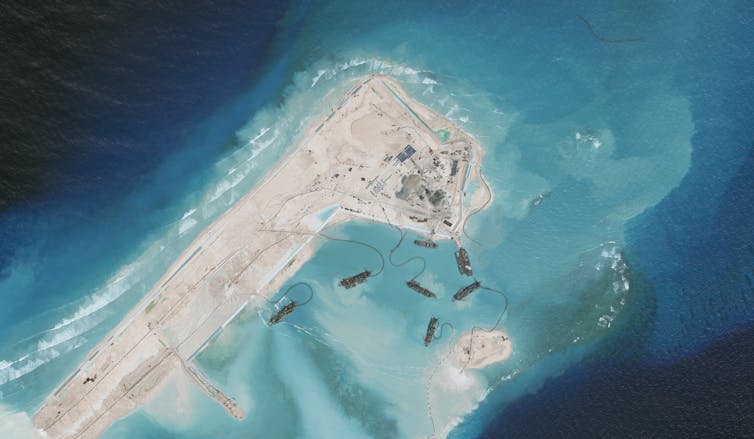 Satellite imagery shows the Fiery Cross Reef in the South China Sea, part of the Spratly Islands group, being built by Chinese dredges. Maxar via Getty Images
Then there is the activity of China’s maritime militia of approximately 300 nominally fishing boats equipped with water cannons and reinforced hulls for ramming. This so-called gray zone fleet is increasingly active in confronting Southeast Asia nations at sea.
The U.S. response to China’s militarization in the sea has been through so-called “freedom of navigation” exercises that often deploy carrier groups in a show of force. But these episodic displays are more performative than effective, doing little to deter China’s claims.
The U.S. has also strengthened military alliances with Australia, India, Japan and the Philippines, and has increased coast guard cooperation with the Philippines and Japan.
 A fleet from the U.S. Navy patrolling the Pacific Ocean. Sean M. Castellano US Navy via Getty Images
The South China Sea is a valuable resource
Yet the battle over control of the South China Seas is more than just geopolitical posturing between the two superpowers.
For adjoining countries, the sea is a valuable biological resource with rich fishing grounds that provide a staple of fish protein for close to 2 billion people. There are estimates of 190 trillion cubic feet of natural gas and 11 billion barrels of oil.
The U.N. Convention on the Law of the Sea, or UNCLOS, guarantees a nation an exclusive economic zone (EEZ) of 200 nautical miles from around its coastline.
China is a signatory of the UNCLOS. Yet it views ownership of the South China Sea through the lens of its nine-dash line, a reference to the boundary line that Beijing has invoked since 1948. While the claim has no legal or historical basis, the delineation makes major incursions into waters around Vietnam, the Philippines and Malaysia and, to a lesser extent, Brunei and Indonesia as well.
Despite China’s expansive claim to the South China Sea being dismissed in 2016 by the international Permanent Court of Arbitration, Beijing continues to assert its claim.

Hedging positions
As I explore in my recent book “Hedging and Conflict in the South China Sea,” part of the problem Southeast Asian nations face is that they have failed to forge a unified position.
ASEAN, the regional bloc representing 10 nations in Southeast Asia, has long been governed by the principle that major decisions need unanimous agreement. China is a major trading partner to ASEAN nations, so any regional country aligning too close to the U.S. comes with the real risk of economic consequences. And two ASEAN members, Cambodia and Laos, are especially close to China, making it difficult to generate a unified ASEAN policy that confronts China’s maritime claim.
Instead, ASEAN has promoted a regional code of conduct that effectively legitimizes China’s maritime claims, fails to mention the 2016 ruling and ignores the issue of conflicting claims.
Further complicating a united front against China is the competing claims among ASEAN nations themselves to disputed islands in the South China Sea.
In lieu of a coordinated response, Southeast Asian nations have instead turned to hedging — that is, maintaining good relationships with both China and the U.S. without fully committing to one or other.
A balancing act for Vietnam, Malaysia and the Philippines
Malaysia’s approach sees its government partition off the South China Sea dispute from its overall bilateral ties with China while continuing to promote an ASEAN code of conduct.
Until recently, Malaysia’s oil and gas activities were well within Malaysia’s EEZ and not far enough out to fall into China’s nine-dash claim.
But as these close-to-shore fields become exhausted, subsequent exploration will need to extend outward and into China’s nine-dash claim, putting Malaysia’s dealings with China under pressure.
China’s nine-dash line claims a significant amount of Vietnam’s EEZ, and the contested maritime area is a source of friction between the two countries; China’s maritime militia regularly harasses Vietnamese fishermen and disrupts drilling operations in Vietnam’s EEZ .
But Vietnam has to tread carefully. China plays a significant role in the Vietnamese economy as a major destination of exports and an important provider of foreign investment. China also has the ability to dam the Mekong River upstream of Vietnam — something that would disrupt agricultural production.
As a result, Vietnam’s hedging involves a careful calibration to avoid angering China. However, part of Vietnam’s heavy hedging involves the promotion of the South China Sea dispute as a core issue for domestic public opinion, which limits the Vietnamese government’s ability to offer concessions to China.
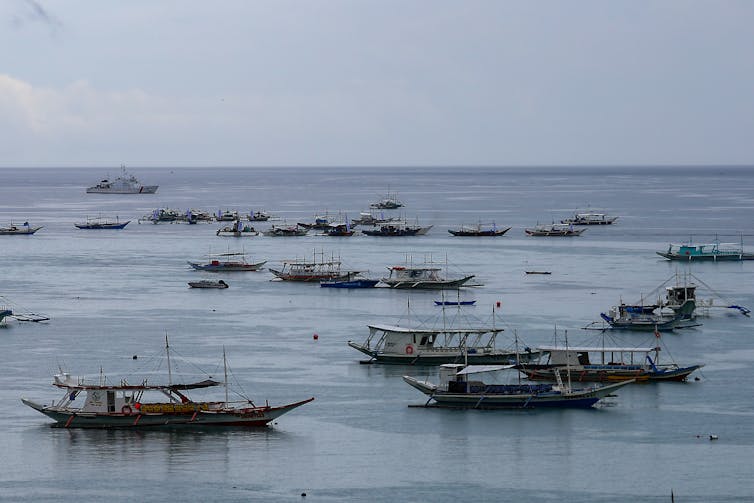 A Philippine coast guard ship and fishing boats are seen in El Nido, Palawan, Philippines, on May 26, 2025. Daniel Ceng/Anadolu via Getty ImagesDaniel Ceng/Anadolu via Getty Images
China’s nine-dash claim also includes a wide swath of the Philippines’ EEZ.
The Philippines has zigzagged in its dealings with China. The presidencies of Gloria Macapagal Arroyo (2001–2010) and Rodrigo Duterte (2016-2022) pursued a pro-China tack that downplayed Filipino claims in the South China Sea. Presidents Benigno Aquino (2010-2016) and Ferdinand “Bongbong” Marcos Jr. (2022-present), in contrast, have given U.S. forces greater access to its maritime bases and mobilized national and international opinion in favor of its claims.
Since coming to power, Marcos has also pursued even closer naval ties with the U.S.. But this has come at a cost: China now views the Philippines as a U.S. ally. As such, Beijing sees little to be gained by pulling back from its assertive activity in and around its waters.
The future
In the shadow of two major powers battling for power in the South China Sea, Southeast Asian nations are making the best of their position along a geopolitical fracture line by advancing their claims and interests while not overly antagonizing a more assertive China or losing the support of the U.S.
This may work to tamp down tensions in the South China Sea. But it is a fluid approach not without risk, and it could yet prove to be another source of instability in a geopolitically contested and dangerous region.
This article is republished from The Conversation under a Creative Commons license. Read the original article and see more than 250 UMBC articles available in The Conversation.
]]>
John Rennie Short, professor emeritus of public policy, UMBC The South China Sea has long been a bubbling geopolitical hot spot. Recently, a series of moves by the various nations claiming a...
https://umbc.edu/stories/southeast-asian-nations-look-to-hedge-their-way-out-of-troubled-waters-in-the-south-china-sea/
https://my3.my.umbc.edu/api/v0/pixel/news/150718/guest@my.umbc.edu/e3d65e03a4840140b76ea0206744d1b3/api/pixel
cahss
cahssresearch
discovery
magazine
publicpolicy
research
story
UMBC News & Magazine
https://my3.my.umbc.edu/groups/umbc-news-magazine
https://assets1-my.umbc.edu/system/shared/avatars/groups/000/001/943/24435aa6207c452e7bc15cc74b42c7bb/xsmall.png?1748556657
https://assets1-my.umbc.edu/system/shared/avatars/groups/000/001/943/24435aa6207c452e7bc15cc74b42c7bb/original.png?1748556657
https://assets2-my.umbc.edu/system/shared/avatars/groups/000/001/943/24435aa6207c452e7bc15cc74b42c7bb/xxlarge.png?1748556657
https://assets2-my.umbc.edu/system/shared/avatars/groups/000/001/943/24435aa6207c452e7bc15cc74b42c7bb/xlarge.png?1748556657
https://assets3-my.umbc.edu/system/shared/avatars/groups/000/001/943/24435aa6207c452e7bc15cc74b42c7bb/large.png?1748556657
https://assets1-my.umbc.edu/system/shared/avatars/groups/000/001/943/24435aa6207c452e7bc15cc74b42c7bb/medium.png?1748556657
https://assets2-my.umbc.edu/system/shared/avatars/groups/000/001/943/24435aa6207c452e7bc15cc74b42c7bb/small.png?1748556657
https://assets1-my.umbc.edu/system/shared/avatars/groups/000/001/943/24435aa6207c452e7bc15cc74b42c7bb/xsmall.png?1748556657
https://assets2-my.umbc.edu/system/shared/avatars/groups/000/001/943/24435aa6207c452e7bc15cc74b42c7bb/xxsmall.png?1748556657
UMBC News & Magazine
0
0
false
Wed, 18 Jun 2025 10:39:47 -0400
Wed, 18 Jun 2025 10:39:47 -0400
A fiscal crisis is looming for many US cities

Written by John Rennie Short, professor emeritus of public policy, UMBC
Five years after the start of the COVID-19 pandemic, many U.S. cities are still adjusting to a new normal, with more people working remotely and less economic activity in city centers. Other factors, such as underfunded pension plans for municipal employees, are pushing many city budgets into the red.
Urban fiscal struggles are not new, but historically they have mainly affected U.S. cities that are small, poor or saddled with incompetent managers. Today, however, even large cities, including Chicago, Houston and San Francisco, are under serious financial stress.
This is a looming nationwide threat, driven by factors that include climate change, declining downtown activity, loss of federal funds and large pension and retirement commitments.
Why cities struggle
Many U.S. cities have faced fiscal crises over the past century, for diverse reasons. Most commonly, stress occurs after an economic downturn or sharp fall in tax revenues.
Florida municipalities began to default in 1926 after the collapse of a land boom. Municipal defaults were common across the nation in the 1930s during the Great Depression: As unemployment rose, relief burdens swelled and tax collections dwindled.
 The New York Daily News, Oct. 30, 1975, after U.S. President Gerald Ford ruled out providing federal aid to save the city from bankruptcy. Several months later, Ford signed legislation authorizing federal loans. Edward Stojakovic/Flickr, CC BY
In 1934 Congress amended the U.S. bankruptcy code to allow municipalities to file formally for bankruptcy. Subsequently, 27 states enacted laws that authorized cities to become debtors and seek bankruptcy protection.
Declaring bankruptcy was not a cure-all. It allowed cities to refinance debt or stretch out payment schedules, but it also could lead to higher taxes and fees for residents, and lower pay and benefits for city employees. And it could stigmatize a city for many years afterward.
In the 1960s and 1970s, many urban residents and businesses left cities for adjoining suburbs. Many cities, including New York, Cleveland and Philadelphia, found it difficult to repay debts as their tax bases shrank.
In the wake of the 2008-2009 housing market collapse, cities including Detroit, San Bernardino, California, and Stockton, California, filed for bankruptcy. Other cities faced similar difficulties but were located in states that did not allow municipalities to declare bankruptcy.
Even large, affluent jurisdictions could go off the financial rails. For example, Orange County, California, went bankrupt in 2002 after its treasurer, Robert Citron, pursued a risky investment strategy of complex leveraging deals, losing some $1.65 billion in taxpayer funds.
Today, cities face a convergence of rising costs and decreasing revenues in many places. As I see it, the urban fiscal crisis is now a pervasive national challenge.
Climate-driven disasters
Climate change and its attendant increase in major disasters are putting financial pressure on municipalities across the country.
Events like wildfires and flooding have twofold effects on city finances. First, money has to be spent on rebuilding damaged infrastructure, such as roads, water lines and public buildings. Second, after the disaster, cities may either act on their own or be required under state or federal law to make expensive investments in preparation for the next storm or wildfire.
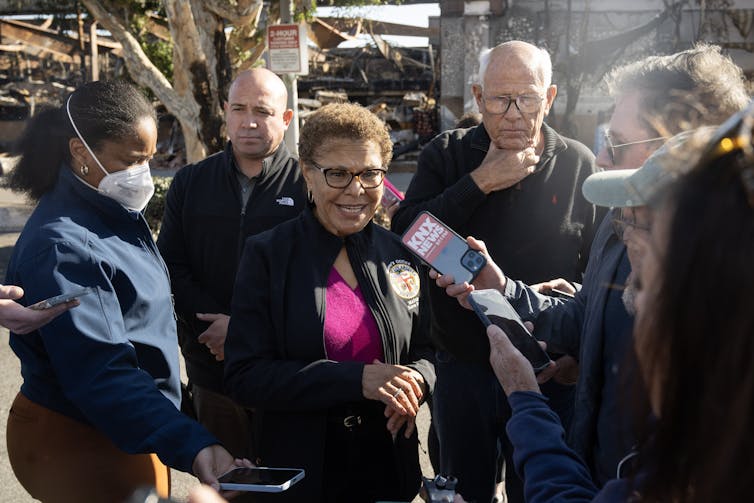 Los Angeles Mayor Karen Bass (center) discusses wildfire recovery in Pacific Palisades, Calif., Jan. 27, 2025. Cleaning up after the wildfires, which destroyed more than 16,000 structures, will include disposing of several million tons of toxic ash and debris. Drew A. Kelley/MediaNews Group/Long Beach Press-Telegram via Getty Images
In Houston, for example, court rulings after multiple years of severe flooding are forcing the city to spend $100 million on street repairs and drainage by mid-2025. This requirement will expand the deficit in Houston’s annual budget to $330 million.
In Massachusetts, towns on Cape Cod are spending millions of dollars to switch from septic systems to public sewer lines and upgrade wastewater treatment plants. Population growth has sharply increased water pollution on the Cape, and climate change is promoting blooms of toxic algae that feed on nutrients in wastewater.
Increasing uncertainty about the total costs of mitigating and adapting to climate change will inevitably lead rating agencies to downgrade municipal credit ratings. This raises cities’ costs to borrow money for climate-related projects like protecting shorelines and improving wastewater treatment.
Underfunded pensions
Cities also spend a lot of money on employees, and many large cities are struggling to fund pensions and health benefits for their workforces. As municipal retirees live longer and require more health care, the costs are mounting.
For example, Chicago currently faces a budget deficit of nearly $1 billion, which stems partly from underfunded retirement benefits for nearly 30,000 public employees. The city has $35 billion in unfunded pension liabilities and almost $2 billion in unfunded retiree health benefits. Chicago’s teachers are owed $14 billion in unfunded benefits.
Policy studies have shown for years that politicians tend to underfund retirement and pension benefits for public employees. This approach offloads the real cost of providing police, fire protection and education onto future taxpayers.
Struggling downtowns and less federal support
Cities aren’t just facing rising costs – they’re also losing revenues. In many U.S. cities, retail and commercial office economies are declining. Developers have overbuilt commercial properties, creating an excess supply. More unleased properties will mean lower tax revenues.
At the same time, pandemic-related federal aid that cushioned municipal finances from 2020 through 2024 is dwindling.
State and local governments received $150 billion through the 2020 Coronavirus Aid, Relief, and Economic Security (CARES) Act and an additional $130 billion through the 2021 American Rescue Plan Act. Now, however, this federal largesse – which some cities used to fill mounting fiscal cracks – is at an end.
In my view, President Donald Trump’s administration is highly unlikely to bail out urban areas – especially more liberal cities like Detroit, Philadelphia and San Francisco. Trump has portrayed large cities governed by Democrats in the darkest terms – for example, calling Baltimore a “rodent-infested mess” and Washington, D.C., a “dirty, crime-ridden death trap.” I expect that Trump’s animus against big cities, which was a staple of his 2024 campaign, could become a hallmark of his second term.
Resistance to new taxes
Cities can generate revenue from taxes on sales, businesses, property and utilities. However, increasing municipal taxes – particularly property taxes – can be very difficult.
In 1978, California adopted Proposition 13 – a ballot measure that limited property tax increases to the rate of inflation or 2% per year, whichever is lower. This high-profile campaign created a widespread narrative that property taxes were out of control and made it very hard for local officials to support property tax increases.
Thanks to caps like Prop 13, a persistent public view that taxes are too high and political resistance, property taxes have tended to lag behind inflation in many parts of the country.
The crunch
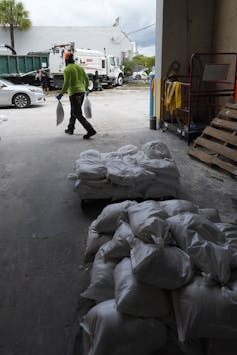 Workers in North Miami Beach, Fla., distribute sandbags to residents to help prevent flooding as Hurricane Milton approaches the state on Oct. 8, 2024. AP Photo/Wilfredo Lee
Taking these factors together, I see a fiscal crunch coming for U.S. cities. Small cities with low budgets are particularly vulnerable. But so are larger, more affluent cities, such as San Francisco with its collapsing downtown office market, or Houston, New York and Miami, which face growing costs from climate change.
One city manager who runs an affluent municipality in the Pacific Northwest told me that in these difficult circumstances, politicians need to be more frank and open with their constituents and explain convincingly and compellingly how and why taxpayer money is being spent.
Efforts to balance city budgets are opportunities to build consensus with the public about what municipalities can do, and at what cost. The coming months will show whether politicians and city residents are ready for these hard conversations.
This article is republished from The Conversation under a Creative Commons license. Read the original article and see more than 250 UMBC articles available in The Conversation.
]]>
Written by John Rennie Short, professor emeritus of public policy, UMBC Five years after the start of the COVID-19 pandemic, many U.S. cities are still adjusting to a new normal, with more...
https://umbc.edu/stories/a-fiscal-crisis-is-looming-for-many-us-cities/
https://my3.my.umbc.edu/api/v0/pixel/news/147507/guest@my.umbc.edu/fc65968ee4ebe77a7381c45111887c53/api/pixel
cahss
cahss-research
discovery
magazine
publicpolicy
research
story
UMBC News & Magazine
https://my3.my.umbc.edu/groups/umbc-news-magazine
https://assets1-my.umbc.edu/system/shared/avatars/groups/000/001/943/24435aa6207c452e7bc15cc74b42c7bb/xsmall.png?1748556657
https://assets1-my.umbc.edu/system/shared/avatars/groups/000/001/943/24435aa6207c452e7bc15cc74b42c7bb/original.png?1748556657
https://assets2-my.umbc.edu/system/shared/avatars/groups/000/001/943/24435aa6207c452e7bc15cc74b42c7bb/xxlarge.png?1748556657
https://assets2-my.umbc.edu/system/shared/avatars/groups/000/001/943/24435aa6207c452e7bc15cc74b42c7bb/xlarge.png?1748556657
https://assets3-my.umbc.edu/system/shared/avatars/groups/000/001/943/24435aa6207c452e7bc15cc74b42c7bb/large.png?1748556657
https://assets1-my.umbc.edu/system/shared/avatars/groups/000/001/943/24435aa6207c452e7bc15cc74b42c7bb/medium.png?1748556657
https://assets2-my.umbc.edu/system/shared/avatars/groups/000/001/943/24435aa6207c452e7bc15cc74b42c7bb/small.png?1748556657
https://assets1-my.umbc.edu/system/shared/avatars/groups/000/001/943/24435aa6207c452e7bc15cc74b42c7bb/xsmall.png?1748556657
https://assets2-my.umbc.edu/system/shared/avatars/groups/000/001/943/24435aa6207c452e7bc15cc74b42c7bb/xxsmall.png?1748556657
UMBC News & Magazine
0
0
false
Thu, 20 Feb 2025 11:02:22 -0500
Thu, 20 Feb 2025 11:02:22 -0500
UMBC celebrates another year offering free tax prep services in partnership with the CASH Campaign of Maryland

On January 31, the CASH Campaign of Maryland, a nonprofit working to promote the economic advancement of low-to-moderate income individuals and families in Baltimore and across Maryland, kicked off the 2025 tax season with a press conference at UMBC promoting free tax prep services in the Baltimore area, including services offered on the UMBC campus.
Maryland Governor Wes Moore, Maryland Comptroller Brooke Lierman, U.S. Congressman Kweisi Mfume, and new U.S. Congressman Johnny Olszewski, Ph.D. ’17, public policy, spoke at the event, applauding the reach of the CASH Campaign and the UMBC student volunteers who make time to help their fellow Marylanders.
UMBC student Riaz Chaudry, a senior in financial economics, who has volunteered at the UMBC free tax prep site since his first year and now serves as the student president and site coordinator, also spoke about his experience.
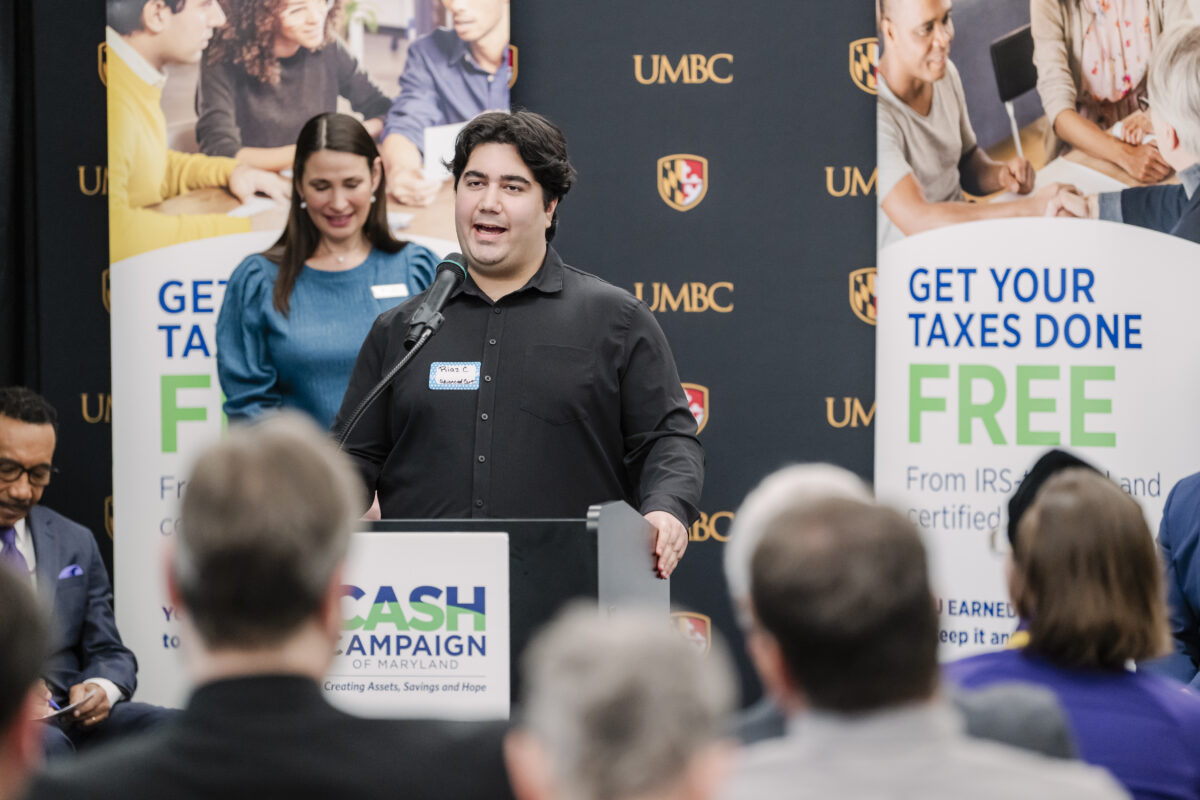 Financial economics senior Riaz Chaudry, who has volunteered at the UMBC free tax prep site for 4 years, spoke about his experiences. (Marlayna Demond ’11/UMBC)
Chaudry says that when he arrived on campus, he explored many student clubs and other ways to get involved. Volunteering to help prepare taxes for low-to-moderate income Marylanders was the activity that most inspired him, because he felt the immediate impact of giving back to the community.
“It’s rewarding knowing that I am making a difference in people’s lives,” he says.
Tax prep comes to UMBC
UMBC’s role as a free tax prep site started close to a decade ago, when Trisha Wells, theassistant vice provost for administration and finance for the Division of Professional Studies, says she and a few other UMBC community members who had volunteered as tax preparers at other sites came together to apply to open a UMBC site. The CASH Campaign supported the group with the application process, while UMBC partners such as Residential Life, the Division of Information Technology, the Career Center, and the Shriver Center worked to get space, computers, and more volunteers. The partnership continues with the CASH Campaign, which trains UMBC’s volunteers every year to be ready to prepare tax returns.
In the first year, the UMBC site prepared 115 tax returns, and now averages around 400 per year. Hundreds of trained student volunteers have participated in the efforts, which have saved clients hundreds of thousands of dollars.
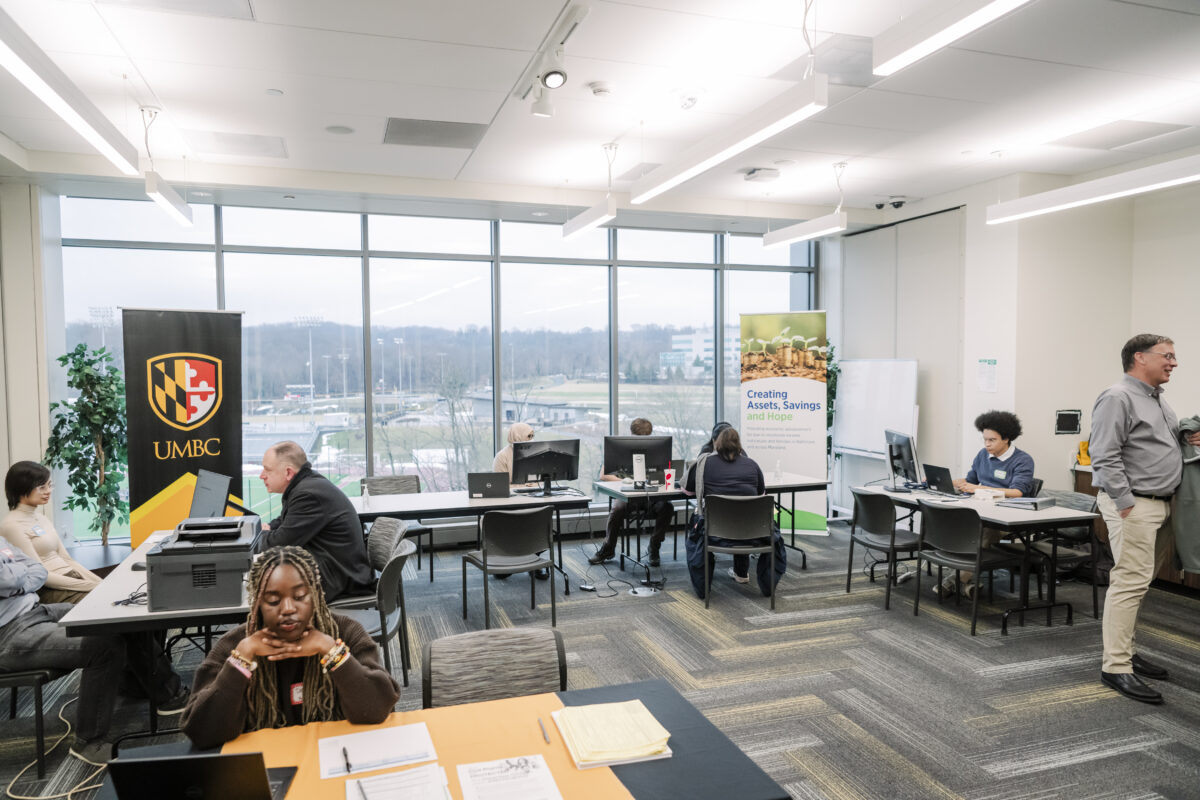 Volunteer tax preparers were on hand at the press event to help qualified Marylanders with their taxes. (Marlayna Demond ’11/UMBC)
This year, any individual or family in Maryland with a household income of $67,000 or less qualifies for the free tax prep services. Wells says a wide diversity of people have come to the UMBC site over the years, including retirees and people self-employed with jobs such as drivers and home health aides. The services not only save clients tax preparation fees—they often educate people about tax credits they didn’t know they qualified for.
Helping Marylanders save their earned money
The press conference was held on “National Earned Income Tax Credit Awareness Day,” to raise the visibility of a tax credit designed to help low-to-moderate income individuals and families save money on their taxes.
Chaudry says he remembers helping a client last year file a 2023 return, and also amend her 2022 and 2021 returns. Thanks to the earned income credit, Chaudry says the client received a refund, which she was planning to use on unpaid bills. “Delivering the news to her, I could see that she was immediately relieved,” he says. “This is one of the most rewarding feelings as a volunteer.”
Wells agrees that helping clients get better tax refunds is a great part of the job. She also loves how the effort brings together UMBC staff, community, and students, and how the student volunteers learn and grow throughout the tax season.
“Many of our students have graduated, but still come back to volunteer when they can. It is that rewarding!” she says.
]]>
On January 31, the CASH Campaign of Maryland, a nonprofit working to promote the economic advancement of low-to-moderate income individuals and families in Baltimore and across Maryland, kicked...
https://umbc.edu/stories/umbc-free-tax-prep-services/
https://my3.my.umbc.edu/api/v0/pixel/news/147031/guest@my.umbc.edu/a477df192083b073c81d55cfe9e1fe03/api/pixel
cahss
news
policy-and-society
publicpolicy
shriver-center
story
UMBC News & Magazine
https://my3.my.umbc.edu/groups/umbc-news-magazine
https://assets1-my.umbc.edu/system/shared/avatars/groups/000/001/943/24435aa6207c452e7bc15cc74b42c7bb/xsmall.png?1748556657
https://assets1-my.umbc.edu/system/shared/avatars/groups/000/001/943/24435aa6207c452e7bc15cc74b42c7bb/original.png?1748556657
https://assets2-my.umbc.edu/system/shared/avatars/groups/000/001/943/24435aa6207c452e7bc15cc74b42c7bb/xxlarge.png?1748556657
https://assets2-my.umbc.edu/system/shared/avatars/groups/000/001/943/24435aa6207c452e7bc15cc74b42c7bb/xlarge.png?1748556657
https://assets3-my.umbc.edu/system/shared/avatars/groups/000/001/943/24435aa6207c452e7bc15cc74b42c7bb/large.png?1748556657
https://assets1-my.umbc.edu/system/shared/avatars/groups/000/001/943/24435aa6207c452e7bc15cc74b42c7bb/medium.png?1748556657
https://assets2-my.umbc.edu/system/shared/avatars/groups/000/001/943/24435aa6207c452e7bc15cc74b42c7bb/small.png?1748556657
https://assets1-my.umbc.edu/system/shared/avatars/groups/000/001/943/24435aa6207c452e7bc15cc74b42c7bb/xsmall.png?1748556657
https://assets2-my.umbc.edu/system/shared/avatars/groups/000/001/943/24435aa6207c452e7bc15cc74b42c7bb/xxsmall.png?1748556657
UMBC News & Magazine
0
0
false
Tue, 04 Feb 2025 11:38:10 -0500
Tue, 04 Feb 2025 11:38:10 -0500
Academic Minute: Centering the voices of Black farmers

As a community, farmers in the United States often face challenges that are out of their control, such as drought, livestock disease, and global pandemics like COVID-19. For Black farmers, says Loren Henderson, associate professor of public policy, these obstacles are compounded by land theft, inadequate succession planning, systemic racism, and discriminatory U.S. Department of Agriculture policies and practices. As a result, Black farmers today are facing extinction. Henderson was featured on The Academic Minute to talk about her research.
Henderson, who will be the first African American director of UMBC’s School of Public Policy this fall, is the author of Race, Ethnicity, and the COVID-19 Pandemic(University of Cincinnati Press, 2023). She began researching how Black farmers were faring amid these hurdles during COVID-19. Henderson conducted 50 in-depth virtual interviews with Black farmers in the U.S. The project addressed Black farmers’ expertise and experiences in establishing and maintaining farms under the onslaught of systemic racism and COVID-19.
“Additionally, I asked the farmers about their use of governmental and private financial resources and their understanding of social policies that impact their ability to establish or maintain their farms,” Henderson shares with Lynn Pasquerella, president of the American Association of Colleges and Universities and host of The Academic Minute, a daily show featuring faculty from colleges and universities worldwide speaking about their cutting-edge research.
UMBC Academic Minute episodes
Henderson joins other UMBC scholars in sharing the latest research in media and communication studies; modern languages, linguistics, and intercultural communication; language, literacy, and culture; philosophy; gender, women’s, and sexuality studies; and history. This series is republished on NPR podcasts and Inside Higher Ed.
Learn more about Loren Henderson’s research
Get to know UMBC’s School of Public Policy.
]]>
As a community, farmers in the United States often face challenges that are out of their control, such as drought, livestock disease, and global pandemics like COVID-19. For Black farmers, says...
https://umbc.edu/stories/academic-minute-voices-of-black-farmers/
https://my3.my.umbc.edu/api/v0/pixel/news/143068/guest@my.umbc.edu/86660ebff5e529f64ccfdce894a52559/api/pixel
academic-minute
cahss
cahss-research
news
policy-and-society
publicpolicy
research
story
UMBC News & Magazine
https://my3.my.umbc.edu/groups/umbc-news-magazine
https://assets1-my.umbc.edu/system/shared/avatars/groups/000/001/943/24435aa6207c452e7bc15cc74b42c7bb/xsmall.png?1748556657
https://assets1-my.umbc.edu/system/shared/avatars/groups/000/001/943/24435aa6207c452e7bc15cc74b42c7bb/original.png?1748556657
https://assets2-my.umbc.edu/system/shared/avatars/groups/000/001/943/24435aa6207c452e7bc15cc74b42c7bb/xxlarge.png?1748556657
https://assets2-my.umbc.edu/system/shared/avatars/groups/000/001/943/24435aa6207c452e7bc15cc74b42c7bb/xlarge.png?1748556657
https://assets3-my.umbc.edu/system/shared/avatars/groups/000/001/943/24435aa6207c452e7bc15cc74b42c7bb/large.png?1748556657
https://assets1-my.umbc.edu/system/shared/avatars/groups/000/001/943/24435aa6207c452e7bc15cc74b42c7bb/medium.png?1748556657
https://assets2-my.umbc.edu/system/shared/avatars/groups/000/001/943/24435aa6207c452e7bc15cc74b42c7bb/small.png?1748556657
https://assets1-my.umbc.edu/system/shared/avatars/groups/000/001/943/24435aa6207c452e7bc15cc74b42c7bb/xsmall.png?1748556657
https://assets2-my.umbc.edu/system/shared/avatars/groups/000/001/943/24435aa6207c452e7bc15cc74b42c7bb/xxsmall.png?1748556657
UMBC News & Magazine
1
0
false
Tue, 06 Aug 2024 16:13:18 -0400
Tue, 06 Aug 2024 16:13:18 -0400
Josh Michael ’10, Ph.D. ’22, elected Maryland State Board of Education president

The Maryland State Board of Education has unanimously elected Josh Michael ’10, political science, Ph.D. ’22, public policy, as its new president following his completion of a one-year term as vice president last year. Michael, whose career in education advocacy has been greatly intertwined with UMBC for years, began his interaction with the Maryland State Department of Education (MSDE) as a student representative on the board in 2005.
Now, as president, Michael will continue to oversee the administration of MSDE with the 11-member board, which includes public school educators, parents, community leaders, and a student. UMBC alumna Chuen-Chin Bianca Chang ’91, nursing, is also a board member, representing Howard County since 2021.
Michael will work with the state superintendent to provide oversight of Maryland’s 24 school districts and lead the board’s work in guiding the implementation of MSDE’s Blueprint for Maryland’s Future, an initiative to increase state funding for education over the next 10 years with a focus on historically underserved students.
“Over the last 10 to 15 years, Maryland public schools have slowly declined in achievement, in literacy, and math. Our rankings have dropped in many ways. Taking this head-on has been a focus of our work,” Michael explains. “We seem to have lost sight of what is most important—ensuring our students are learning. Our schools must serve children from all backgrounds at all performance levels and provide opportunities to excel. The board is focused on restoring stability, vision, and direction for the state to support public schools.”
Direct service in the classroom and communities has humanized the policy process for me.
Josh Michael ’10, Ph.D. ’22
Education policy at work
Michael’s work with public education began as a UMBC Sondheim Public Affairs Scholar, where he learned about education policy. After graduating, he worked as a math teacher at Baltimore City’s Booker T. Washington Middle School and The Commodore John Rodgers School. After six years in the classroom, Michael returned to UMBC in 2016 to work on growing what was then called UMBC’s Sherman STEM Teachers Scholars Program with Rehana Shafi, the inaugural director, and with the support of The Sherman Family Foundation. The program prepared STEM majors to become high-quality K-12 teachers in urban settings through academic and professional coaching. The program has since broadened its scope and is now called the Sherman Teacher Scholars Program.
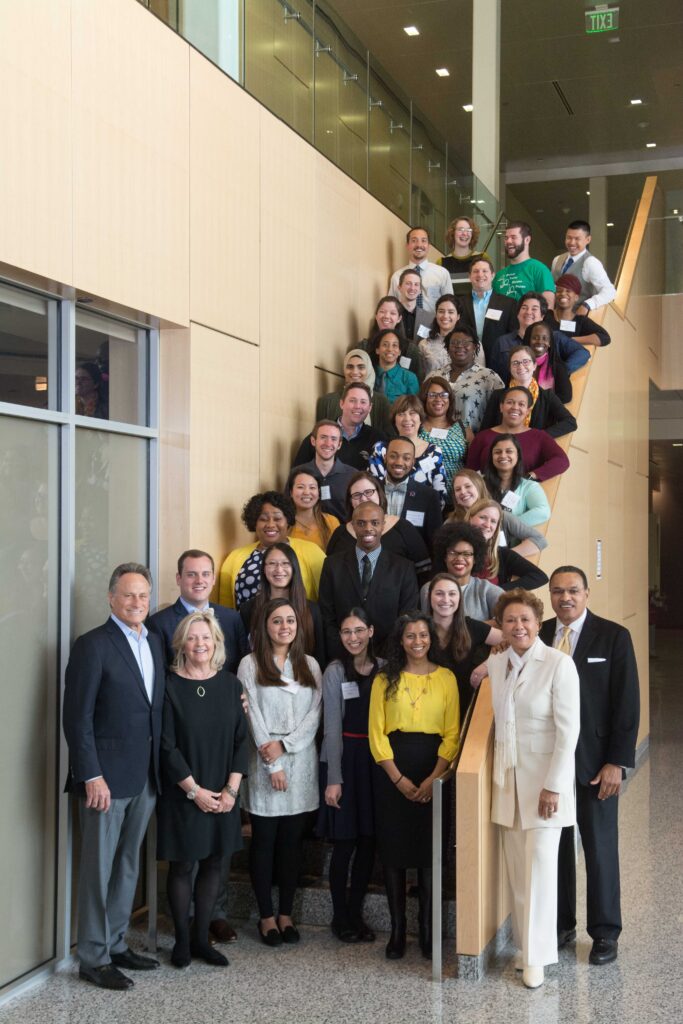 George and Betsy Sherman (first from left) in front of Josh Michael. Freeman Hrabowski, then-president of UMBC, and Jacqueline Hrabowski (first from right) next to Rehana Shafi (in yellow) at the Sherman STEM Teacher Scholars Program’s 10th anniversary.
Shafi and Michael fostered existing partnerships and helped establish the Lakeland Community and STEAM Center, where many Sherman Teacher Scholars continue to hold student-teacher placements and serve as math volunteers. During this six-year period, Michael also earned a doctorate degree at UMBC focused on mathematics achievement and improving outcomes for struggling students.
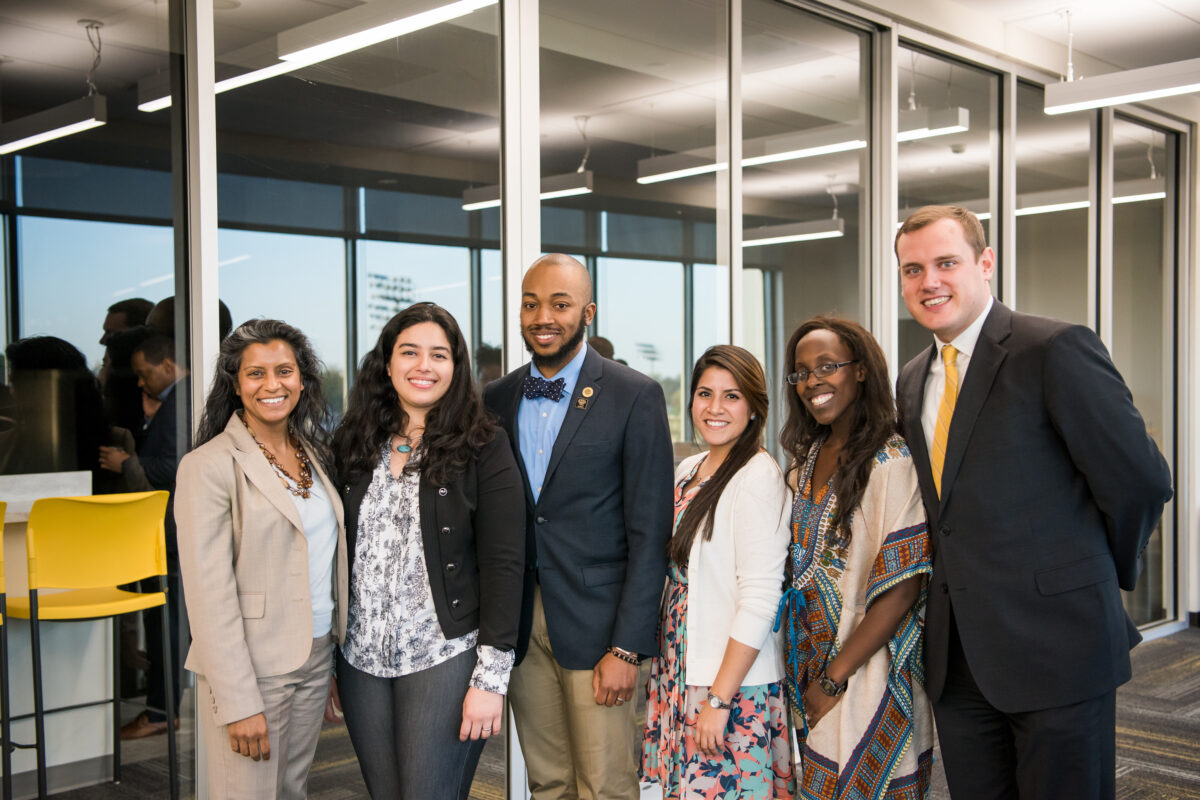 (l-r): Shafi, Monique Rivera-Velez, M.A.T ’17, education; Corey Carter ’08, biological sciences, M.A.T. ’10, education, current director of the Sherman scholars program; Emily Diaz ’16, biochemistry and molecular biology, and M.A.T ’17, education; Josephine Kalema-Kasozi ’13, dance, teaching certificate in secondary math education; and Michael at the 2018 Celebration of Teaching event. (Marlayna Demond ’11/UMBC)
Humanizing policy
“Josh’s work at the Sherman Teacher Scholars Program laid the groundwork for lasting partnerships between the university and City Schools. One example of this legacy is the Reach Together Tutoring Project (RTTP), which provides over 400 City Schools students each year with targeted math tutoring by UMBC students,” says Jane Lincove, professor of public policy and Michael’s dissertation chair. “The program is both reducing math achievement gaps and inspiring UMBC students to become math teachers. Josh’s work is a glowing example of how academic research by doctoral students in UMBC’s public policy program can be put to work to improve the lives of Marylanders.”
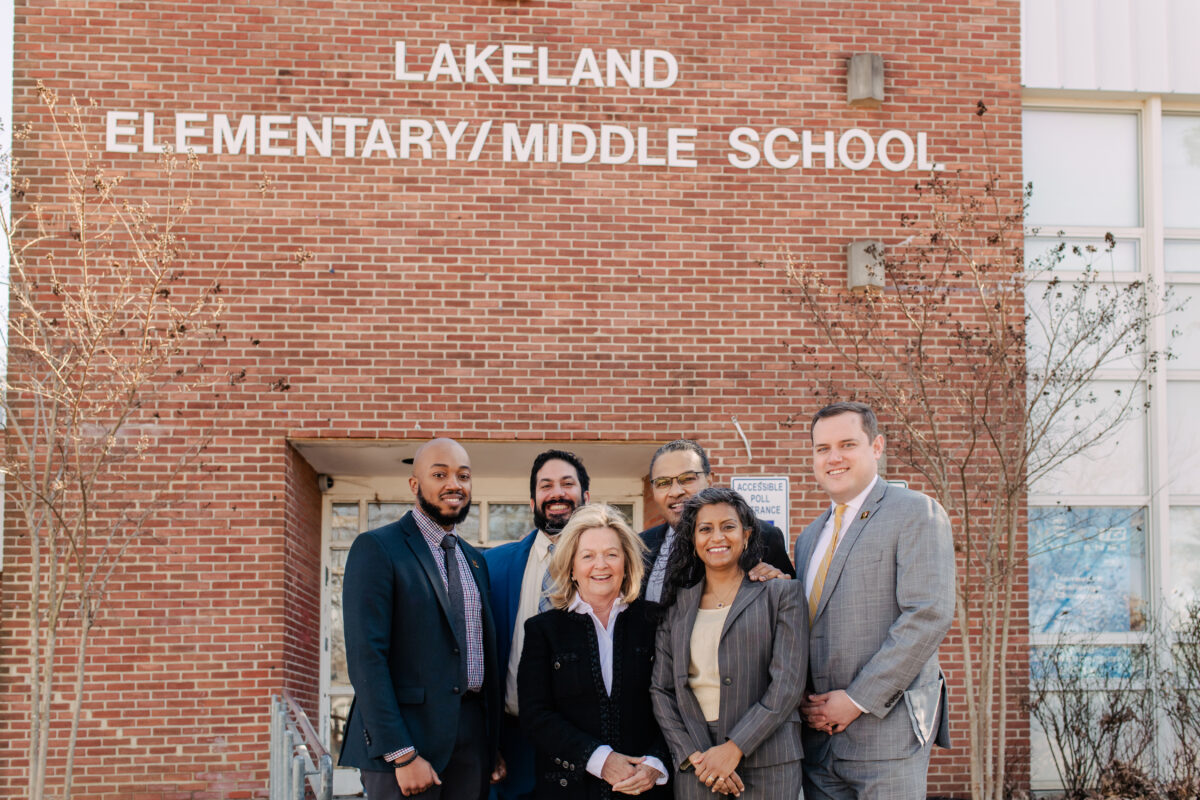 (l-r back row): Carter, Najib Jammal, then-principal of Lakeland Elementary/Middle School, Hrabowski, and Michael. (l-r front row): Betsy Sherman and Shafi. (Marlayna Demond ’11/UMBC)
“My advice to students interested in public policy is to serve in the communities you want to work with,” says Michael, currently the executive director at The Sherman Family Foundation and a board member of the Maryland Family Network, Cherry Hill Strong, and the Teach For America Baltimore Advisory Board. “Direct service in the classroom and communities have humanized the policy process for me.”
]]>
The Maryland State Board of Education has unanimously elected Josh Michael ’10, political science, Ph.D. ’22, public policy, as its new president following his completion of a one-year term as...
https://umbc.edu/stories/josh-michael-elected-msde-president/
https://my3.my.umbc.edu/api/v0/pixel/news/143029/guest@my.umbc.edu/fcaf3a9833b29e3c72c81413cedd1425/api/pixel
biochemistry
biological-sciences
cahss
dance
education
molecular-biology
news
policy-and-society
political-science
publicpolicy
sherman-stem-teacher-scholars-program
sondheim-public-affairs-scholars-program
story
UMBC News & Magazine
https://my3.my.umbc.edu/groups/umbc-news-magazine
https://assets1-my.umbc.edu/system/shared/avatars/groups/000/001/943/24435aa6207c452e7bc15cc74b42c7bb/xsmall.png?1748556657
https://assets1-my.umbc.edu/system/shared/avatars/groups/000/001/943/24435aa6207c452e7bc15cc74b42c7bb/original.png?1748556657
https://assets2-my.umbc.edu/system/shared/avatars/groups/000/001/943/24435aa6207c452e7bc15cc74b42c7bb/xxlarge.png?1748556657
https://assets2-my.umbc.edu/system/shared/avatars/groups/000/001/943/24435aa6207c452e7bc15cc74b42c7bb/xlarge.png?1748556657
https://assets3-my.umbc.edu/system/shared/avatars/groups/000/001/943/24435aa6207c452e7bc15cc74b42c7bb/large.png?1748556657
https://assets1-my.umbc.edu/system/shared/avatars/groups/000/001/943/24435aa6207c452e7bc15cc74b42c7bb/medium.png?1748556657
https://assets2-my.umbc.edu/system/shared/avatars/groups/000/001/943/24435aa6207c452e7bc15cc74b42c7bb/small.png?1748556657
https://assets1-my.umbc.edu/system/shared/avatars/groups/000/001/943/24435aa6207c452e7bc15cc74b42c7bb/xsmall.png?1748556657
https://assets2-my.umbc.edu/system/shared/avatars/groups/000/001/943/24435aa6207c452e7bc15cc74b42c7bb/xxsmall.png?1748556657
UMBC News & Magazine
1
0
false
Fri, 02 Aug 2024 12:18:57 -0400
Fri, 02 Aug 2024 12:18:57 -0400
The US invented shopping malls, but China is writing their next chapter

Written by John Rennie Short, professor emeritus of public policy, UMBC
On a recent research trip to China, I wandered through the Oasis Mall in suburban Shanghai. Like many Chinese shopping malls, this complex was filled with empty stores that reflected the end of China’s 30-year-long economic expansion. But there also were surprises.
Along a stretch of the mall’s interior walkway, a cluster of parents and grandparents sat on chairs. They were looking through a plate glass window, watching a dozen 5- to 7-year-old girls practice ballet steps, carefully following their teacher’s choreography. A space initially designed for retail had been turned into a dance studio.
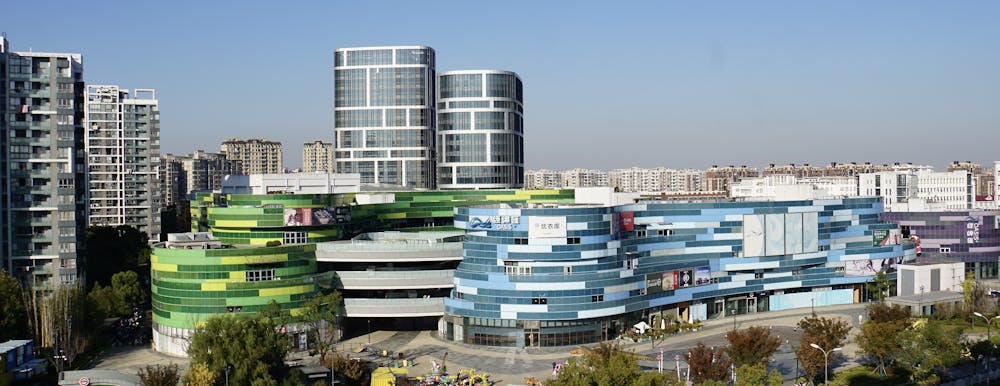
From 1990 through 2020, large, shiny shopping malls embodied China’s spectacular economic growth. They sprouted in cities large and small to meet consumer demand from an emerging middle class that was keen to express its newfound affluence. These centers look familiar to American eyes, which isn’t surprising: U.S. architectural firms built 170 malls in China during this period.
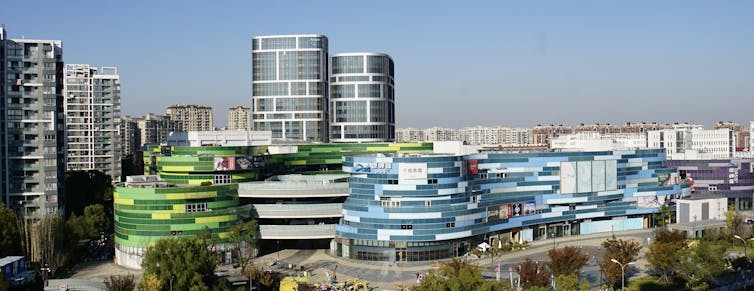 The Oasis (blue building) is one of some 6,700 shopping malls in Chinese cities. Hundreds of new centers open yearly. John Rennie Short, CC BY-ND
Like their U.S. counterparts, many Chinese malls have fallen on hard times. The COVID-19 pandemic and the rise of online shopping have devastated foot traffic, leaving the nation with a huge overhang of retail space. But many Chinese malls are being re-imagined by owners and users as palaces of experience – civic areas for communities to meet and interact, with new configurations of public and private space.
As a longtime urban policy scholar, I was fascinated by the new uses I saw for malls in China. In my view, these experiments could become models for new, creative uses of retail space in the U.S., where the mall was invented.
Serving a new consumer class
China opened up to foreign trade and investment less than 50 years ago. Since then, it has become the world’s second-largest economy, surpassed only by the U.S.
Rising incomes and a massive population shift from rural areas to cities have created a growing middle class with significant purchasing power. GDP per capita increased from US$293 in 1985 to $12,500 by 2021.
Today, approximately 350 million Chinese – 25% of the total population – can be considered middle class. More recent economic growth has generated growing income inequality that now is equivalent to U.S. levels.
Malls became a motif of modernity during the country’s economic expansion. They offered consumers year-round protection from heat, humidity, cold and frost, as well as from busy streets and polluting traffic. Malls were safe environments where the steadily increasing numbers of more affluent Chinese families could shop and eat, stroll and meet.
Over the past 30 years, China’s malls have faced economic booms and slumps. For example, the New South China Mall in Dongguan – which is twice the size of Minnesota’s Mall of America, its largest U.S. counterpart – opened in 2005. But most of its 2,300 storefronts remained closed for over a decade as China fought off recession after the 2008 world financial crisis. https://www.youtube.com/embed/5zPkm2SU1DM?wmode=transparent&start=0 This 2013 news report takes viewers inside the then-deserted New South China Mall in Dongguan.
China weathered that downturn through aggressive economic stimulus policies, and within a decade it replaced the U.S. as the world’s top driver of economic growth. This expansion buoyed its retail sector, including shopping centers. By 2018, a renovated and modernized New South China Mall was near full occupancy.
Then COVID-19 struck in 2020. The Chinese government adopted a rigid zero-COVID policy, in which local governments could impose lockdowns after detecting just a few cases. Hundreds of millions of people were restricted to their homes for weeks or months at a stretch.
This policy was lifted only in late 2022. China’s economy has yet to fully recover, and many experts argue that it will never again reach its previous rates of growth. An aging population, trade wars with the U.S. and a government focused on centralizing power under the Communist Party are all acting as drags on the economy, and online shopping is drawing consumers away from stores.
As a result, Chinese media reports abound with stories about well-known stores and venerable malls closing. In China, as in the U.S., what scholars once described as the “magic of the mall” has become an “allure of ruins.”
Malls with Chinese characteristics
But the Chinese are making creative use of excess mall space. New users are filling nonretail areas, such as indoor walkways and atriums that now house café tables. Others have become children’s play spaces filled with giant inflatable figures. The Raffles City Mall in Shenzen has a rooftop pet playground, a stage, an art display area and a sun-shaded lawn.
China’s informal economy of food stalls and sidewalk merchants is also filling the void. Although street vending has a long history in China, government officials sought to suppress it in recent years, calling it unsanitary and a throwback to pre-modern times. Now, however, they are encouraging it as a way to reduce growing unemployment, especially among young people, which currently exceeds 20%.
During my trip, I saw small-scale entrepreneurs selling produce, street food and crafts in mall parking lots and around public entrances. The distinction between public and private spaces is being reconfigured as vendors set up stalls in areas that once were open space.
Empty store spaces are also being repurposed. Some have been converted into electric vehicle showrooms, art museums and children’s play centers with dance studios, paddling pools, small skating rinks, gyms and yoga centers. Others have been redesigned as sites for art or cooking classes, or for multiplayer electronic gaming and virtual reality experiences. The Dream Time Mall in Wuhan contains an indoor snow center that offers ski lessons, ice mazes and tubing.
 People at Joy City Shopping Complex in Yantai, China, watch a live broadcast of the 2023 League of Legends world championship final on Nov. 19, 2023. League of Legends is a multiplayer online battle arena video game. Tang Ke/VCG via Getty Images
I see these experiments as a shift in the meaning of the mall. What began as a cathedral of retail consumerism is becoming a place where people can connect and enjoy individual and collective experiences that aren’t available online.
Some U.S. malls are moving in this direction, but China is doing it on a much larger scale. Just as former Chinese leader Deng Xiaoping once asserted that his government was pursuing its own version of socialism, with “Chinese characteristics,” the U.S.-designed mall is being rewritten with Chinese characters.
This article is republished from The Conversation under a Creative Commons license. Read the original article and see more than 250 UMBC articles available in The Conversation.
]]>
Written by John Rennie Short, professor emeritus of public policy, UMBC On a recent research trip to China, I wandered through the Oasis Mall in suburban Shanghai. Like many Chinese shopping...
https://umbc.edu/stories/china-is-reimagining-shopping-malls/
https://my3.my.umbc.edu/api/v0/pixel/news/138029/guest@my.umbc.edu/f3074e390e975051a3e779f12e869137/api/pixel
cahss
cahssresearch
discovery
international
magazine
publicpolicy
research
story
UMBC News & Magazine
https://my3.my.umbc.edu/groups/umbc-news-magazine
https://assets1-my.umbc.edu/system/shared/avatars/groups/000/001/943/24435aa6207c452e7bc15cc74b42c7bb/xsmall.png?1748556657
https://assets1-my.umbc.edu/system/shared/avatars/groups/000/001/943/24435aa6207c452e7bc15cc74b42c7bb/original.png?1748556657
https://assets2-my.umbc.edu/system/shared/avatars/groups/000/001/943/24435aa6207c452e7bc15cc74b42c7bb/xxlarge.png?1748556657
https://assets2-my.umbc.edu/system/shared/avatars/groups/000/001/943/24435aa6207c452e7bc15cc74b42c7bb/xlarge.png?1748556657
https://assets3-my.umbc.edu/system/shared/avatars/groups/000/001/943/24435aa6207c452e7bc15cc74b42c7bb/large.png?1748556657
https://assets1-my.umbc.edu/system/shared/avatars/groups/000/001/943/24435aa6207c452e7bc15cc74b42c7bb/medium.png?1748556657
https://assets2-my.umbc.edu/system/shared/avatars/groups/000/001/943/24435aa6207c452e7bc15cc74b42c7bb/small.png?1748556657
https://assets1-my.umbc.edu/system/shared/avatars/groups/000/001/943/24435aa6207c452e7bc15cc74b42c7bb/xsmall.png?1748556657
https://assets2-my.umbc.edu/system/shared/avatars/groups/000/001/943/24435aa6207c452e7bc15cc74b42c7bb/xxsmall.png?1748556657
UMBC News & Magazine
0
0
false
Fri, 05 Jan 2024 10:48:48 -0500
UMBC’s 2023 commencement speakers represent the best of higher education

This year’s UMBC commencement speakers represent the best of what higher education strives to be, applying insights to meet the needs of humanity.
Commencement speakers
Keith T. Elder, Ph.D. ’02, health policy and policy sciences, will address graduates at the ceremony for the College of Arts, Humanities, and Social Sciences; School of Social Work; and Erickson School of Aging Studies on May 25 at 10 a.m.
Paula Therese Hammond, this year’s honorary degree recipient, will speak at the 3 p.m. ceremony, addressing graduates from the College of Natural and Mathematical Sciences, College of Engineering and Information Technology, and Division of Undergraduate Academic Affairs.
Keith T. Elder’s commitment to improving healthcare
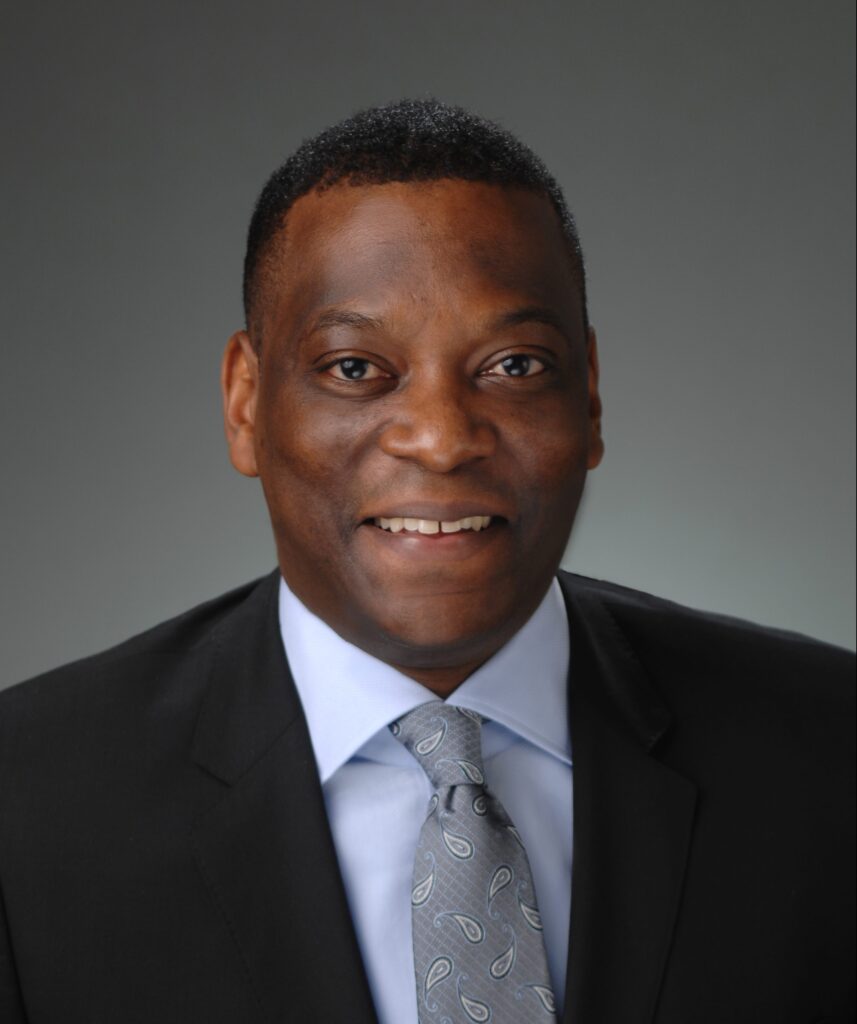
Keith T. Elder (Image courtesy of Keith T. Elder)
Elder is the provost and executive vice president of Mississippi College. His research focuses on finding ways to improve the quality of healthcare for our most vulnerable populations.
Elder is the founding editor-in-chief of the journal AIMS Public Health and has published more than 50 peer-reviewed articles and book chapters. His research has been supported by the National Institutes of Health, the Centers for Disease Control and Prevention, and the Alzheimer’s Association, among others. Elder is a 2022 UMBC Alumni Award winner for Outstanding Alumnus in Social and Behavioral Sciences, and has also received a distinguished service award from the Robert Wood Johnson Foundation.
“I got the chance to learn more about Dr. Elder’s research and work in public health and academia when he received a prestigious award from our alumni association this past fall,” says Stanyell Odom, director of alumni engagement. “Our graduates will gain inspiration from his UMBC story and life’s work as this year’s commencement speaker.”
Paula T. Hammond, nanomedicine innovator
 Paula T. Hammond (Image courtesy of MIT)
Hammond is an Institute Professor at the Massachusetts Institute of Technology, head of the department of chemical engineering, and a member of MIT’s Koch Institute for Integrative Cancer Research. Her research focuses on nanomedicine and novel responsive polymer architectures for targeted nanoparticle drug and gene delivery. She is a member of all three National Academies: Science, Engineering and Medicine.
In 2019, Hammond received the American Institute of Chemical Engineers (AIChE) Margaret H. Rousseau Pioneer Award for Lifetime Achievement by a Woman Chemical Engineer.
“Dr. Hammond is an extraordinary scientist and educator,” says Greg Simmons, M.P.P., ’04, vice president for Institutional Advancement. “We are very excited to have her participate in our commencement exercises and look forward to hearing her remarks.”
UMBC valedictorians
Also speaking during the commencement ceremonies will be UMBC’s two valedictorians: Christopher Slaughter ’23, M31, computer engineering, and Zinedine Partipilo Cornielles ’23, financial economics and mathematics.
Partipilo Cornielles’s passion for public service is fueled by his experience fleeing Venezuela at age 16 with his family to seek asylum in the U.S. He is a Sondheim Public Affairs Scholar who has researched the impact of financial literacy on student loan decisions among undergraduates across the United States. He also served as a teaching assistant and tutor for fellow students, taught English to local immigrants through the Esperanza Center, and was a member of the national championship-winning UMBC Mock Trial team. He is part of the Sloan Predoctoral Program through the UMBC economics department and will pursue a Ph.D. in economics.
 Zinedine Partipilo Cornielles (Marlayna Demond ’11/UMBC)
Christopher Slaughter is a Meyerhoff Scholar who won a Gates Cambridge Scholarship to pursue a Ph.D. in electrical engineering at the University of Cambridge this coming fall. He has worked with Govind Rao, professor of chemical and biochemical engineering, in the Center for Advanced Sensor Technology (CAST), helping develop technology that can sense glucose levels through the skin. He hopes to focus his career on developing novel biomedical technologies that meet the healthcare needs of under-resourced communities.
 Christopher Slaughter (Marlayna Demond ’11/UMBC)
Partipilo Cornielles will address graduates at the 10 a.m. ceremony, and Slaughter will speak at the 3 p.m. ceremony. UMBC’s graduate commencement ceremony will be May 24 at 10 a.m. Live videos of all three ceremonies will be available at commencement.umbc.edu.
]]>
This year’s UMBC commencement speakers represent the best of what higher education strives to be, applying insights to meet the needs of humanity. Commencement speakers Keith T. Elder,...
https://umbc.edu/stories/umbc-2023-commencement-speakers/
https://my3.my.umbc.edu/api/v0/pixel/news/133577/guest@my.umbc.edu/dbf3d06e93945dc8561100a2bcca916c/api/pixel
alumni
cahss
coeit
community
computer-engineering
economics
news
publicpolicy
UMBC News & Magazine
https://my3.my.umbc.edu/groups/umbc-news-magazine
https://assets1-my.umbc.edu/system/shared/avatars/groups/000/001/943/24435aa6207c452e7bc15cc74b42c7bb/xsmall.png?1748556657
https://assets1-my.umbc.edu/system/shared/avatars/groups/000/001/943/24435aa6207c452e7bc15cc74b42c7bb/original.png?1748556657
https://assets2-my.umbc.edu/system/shared/avatars/groups/000/001/943/24435aa6207c452e7bc15cc74b42c7bb/xxlarge.png?1748556657
https://assets2-my.umbc.edu/system/shared/avatars/groups/000/001/943/24435aa6207c452e7bc15cc74b42c7bb/xlarge.png?1748556657
https://assets3-my.umbc.edu/system/shared/avatars/groups/000/001/943/24435aa6207c452e7bc15cc74b42c7bb/large.png?1748556657
https://assets1-my.umbc.edu/system/shared/avatars/groups/000/001/943/24435aa6207c452e7bc15cc74b42c7bb/medium.png?1748556657
https://assets2-my.umbc.edu/system/shared/avatars/groups/000/001/943/24435aa6207c452e7bc15cc74b42c7bb/small.png?1748556657
https://assets1-my.umbc.edu/system/shared/avatars/groups/000/001/943/24435aa6207c452e7bc15cc74b42c7bb/xsmall.png?1748556657
https://assets2-my.umbc.edu/system/shared/avatars/groups/000/001/943/24435aa6207c452e7bc15cc74b42c7bb/xxsmall.png?1748556657
UMBC News & Magazine
0
0
false
Tue, 16 May 2023 10:32:22 -0400
Tue, 16 May 2023 10:32:22 -0400
UMBC, Maryland Matters host climate forum with top officials in Gov. Wes Moore’s administration

This week, UMBC and Maryland Matters hosted state officials in Governor Wes Moore’s administration for a community forum on Maryland’s plan to address concerns related to climate change and the administration’s proposed green energy initiatives.
Candace Dodson-Reed ’96, English, UMBC’s vice president of government relations and community affairs, and Josh Kurtz, founding editor and reporter at Maryland Matters, moderated the panel discussion on the state’s climate policies. The forum was part of the Maryland Matters Climate Calling project, an initiative that began in 2021 that examines the threats of climate change in the state and the administration’s response.
“It will take all of us as we partner with government, universities, the private sector, philanthropy, media, and beyond to address this crisis,” said Dodson-Reed. “We know that universities play a huge role in this space.”
President Valerie Sheares Ashby agrees, sharing with attendees that UMBC “wants to be a true partner. We are not just a partner in research and scholarship, but also workforce development. It is critical to us that we are producing the next brilliant minds who will actually remain in the state of Maryland to do this work.”
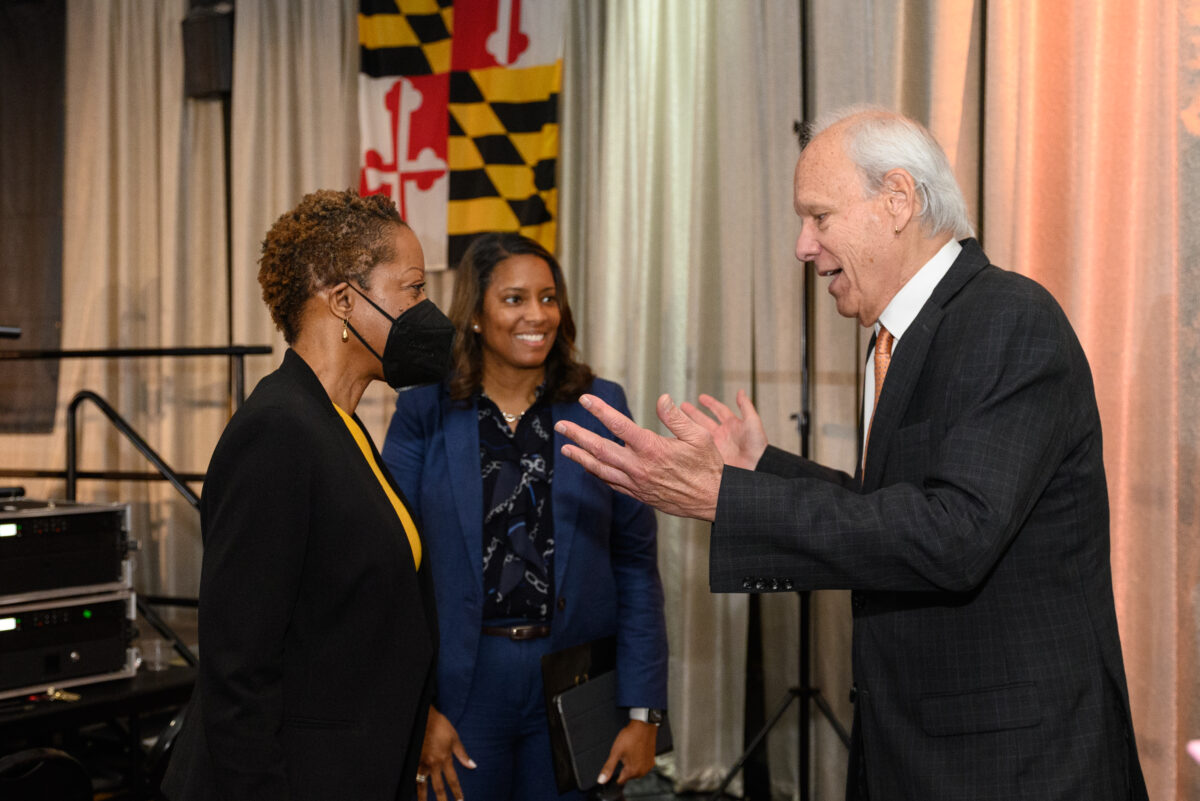 From left to right: President Valerie Sheares Ashby, Candace Dodson-Reed, and Paul Pinsky, director of the Maryland Energy Administration. (Abnet Shiferaw for UMBC)
Sheares Ashby referenced the work that UMBC students, faculty, and staff are already doing in response to climate change concerns, from long-term research, to a master’s program focused on work with communities around Baltimore’s Inner Harbor, to initiatives of the university’s Office of Sustainability.
“Environmental science and climate science are some of the least diverse of the sciences, yet it affects the broadest range of diverse human beings and communities,” said Sheares Ashby. “We have not fully brought all of the best and most diverse minds to the table, but here at UMBC, this is our focus.”
Maryland’s “bold” climate policies
Panelists included Lieutenant Governor Aruna Miller, who outlined the administration’s goals for addressing the climate crisis, pointing to the state’s “bold” solutions in Maryland’s Climate Solutions Act. The legislation is aiming to “reduce greenhouse gas emissions by 60 percent by 2031 and 100 percent by 2045,” says Lt. Gov. Miller.
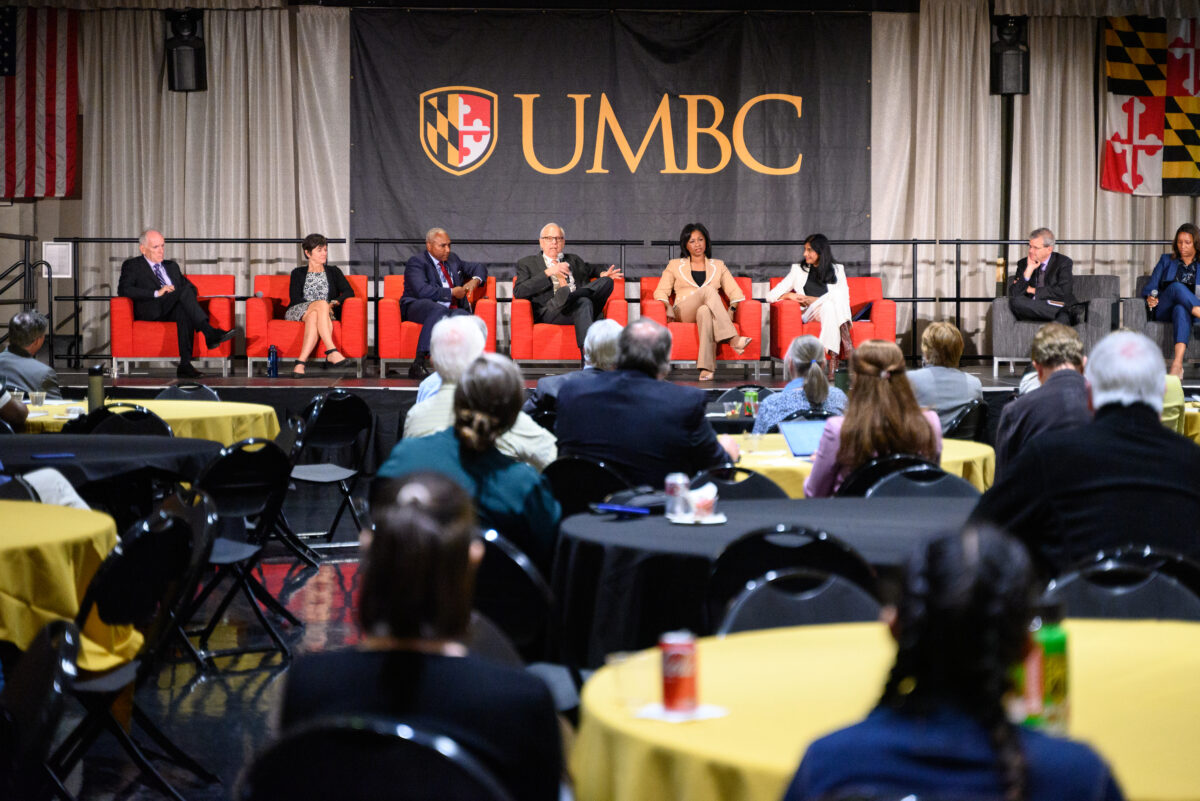 Governor Wes Moore’s administration during UMBC and Maryland Matters’ “Climate Calling: A Community Conversation” forum. From left to right: Secretary of Transportation Paul Wiedefeld, Secretary of Planning Rebecca Flora, Secretary of Commerce Kevin Anderson, Director of the Maryland Energy Administration Paul Pinsky, Secretary of the Environment Serena McIlwain, Lieutenant Governor Aruna Miller, and moderators Josh Kurtz and Candace Dodson-Reed. (Abnet Shiferaw for UMBC)
“We see this as an opportunity to get into the green economy…it’s going to create jobs and create emerging technologies,” she shared with the audience. “We have goals that are bold and aggressive, but we need to be like that in order to be able to reach those goals.”
Lt. Gov. Miller was joined by Secretary of Commerce Kevin Anderson, Secretary of Planning Rebecca Flora, Secretary of the Environment Serena McIlwain, Secretary of Transportation Paul Wiedefeld, and Paul Pinsky, director of the Maryland Energy Administration.
Secretary Mcllwain made note of the “cross-disciplinary approach” of the Moore administration’s plan to implement their climate policies, saying, “We have to do this in a very comprehensive way or we will lose. We have to look at solutions that have multiplier benefits.”
Paul Pinsky explained the state’s goals of producing more offshore wind energy with the Promoting Offshore Wind Energy Resources Act (POWER). “To meet our goals…we’re going to need new technologies. It’s going to be a challenge, but Maryland is in a position to be a leader,” said Pinksy.
Secretary Rebecca Flora proposed more efficient ways to plan for the effects of climate change, such as implementing “more scenario planning so we can actually show what will happen in different scenarios.”
To do that, Flora suggests using more visualization tools. She made note of the UMBC research on display at the forum, saying, “we need that kind of talent out there to help communities understand what we’re saying.”
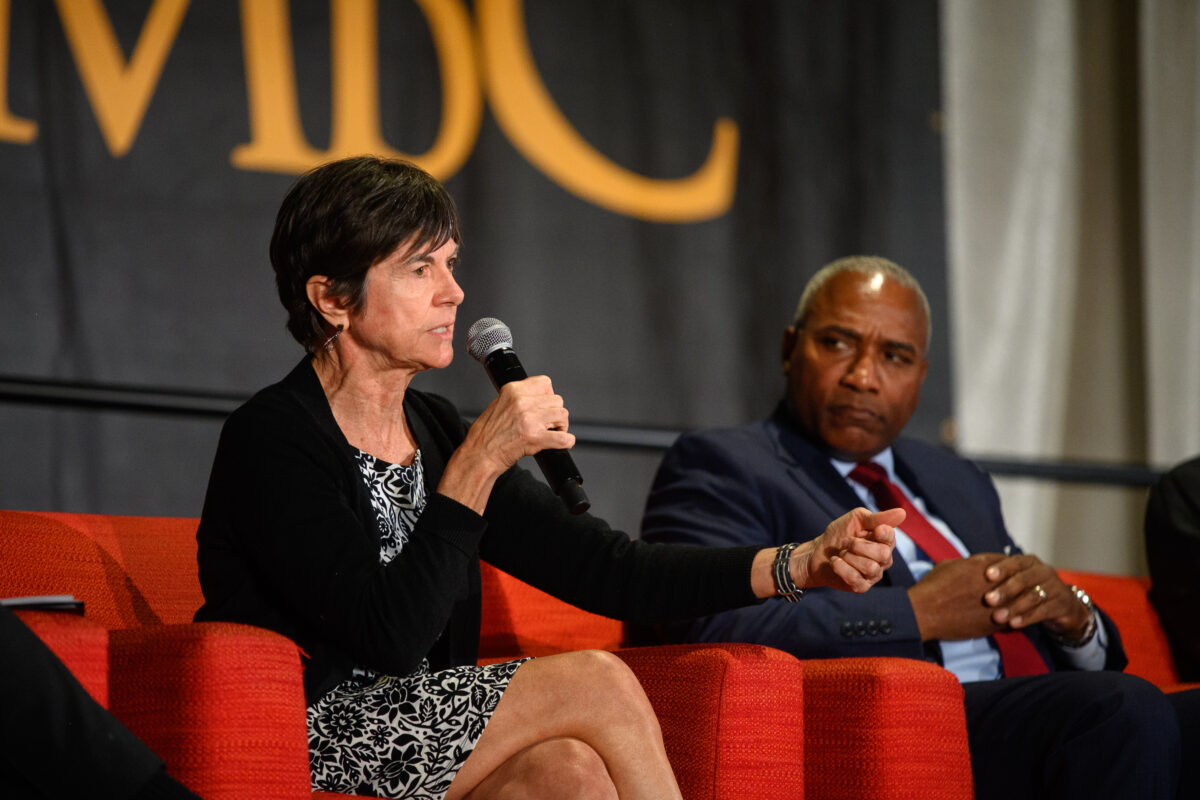 Secretary of Planning Rebecca Flora and Secretary of Commerce Kevin Anderson. (Abnet Shiferaw for UMBC)
Connecting students with state leaders
UMBC students joined in the discussion by asking questions about the current state of climate change and the environment in Maryland, plans to protect vulnerable populations, and how these issues will impact future generations.
Sondheim Public Affairs Scholar Devanshi Mistry ’26, chemical engineering, asked the panelists about the state’s approach to agricultural and environmental policies. Mistry previously worked with local government in her hometown as a student representative for the Carroll County Board of Education, and shared her passion for vocalizing the needs and concerns of teens and young adults.
“Local government is a really big passion of mine and I’m hopeful that more students will continue to be engaged in what’s happening in our society. It was really impactful to hear directly from state representatives on important issues like climate change,” Mistry shared, following the forum.
Full video of UMBC and Maryland Matters’ “Climate Calling: A Community Conversation” forum, held on May 10, 2023 at UMBC’s University Center Ballroom.
UMBC’s Student Government Association (SGA) leaders also participated in the Q&A discussion and assisted with moderating the event. These leaders include incoming SGA President Musa Jafri ’24, political science, and SGA Director of Government Affairs Zach Starr ’23, public health.
For more on this topic, see coverage of the forum on Maryland Matters and a commentary by Dodson-Reed and Maggie Holland, associate professor of geography and environmental systems, on the role of universities in addressing climate change in Maryland, published prior to the event.
]]>
This week, UMBC and Maryland Matters hosted state officials in Governor Wes Moore’s administration for a community forum on Maryland’s plan to address concerns related to climate change and the...
https://umbc.edu/stories/maryland-matters-climate-forum/
https://my3.my.umbc.edu/api/v0/pixel/news/133481/guest@my.umbc.edu/30c50d05ccab9502f575e718e6f48a3d/api/pixel
cahss
community
ges
meche
news
policy-and-society
politicalscience
publicpolicy
UMBC News & Magazine
https://my3.my.umbc.edu/groups/umbc-news-magazine
https://assets1-my.umbc.edu/system/shared/avatars/groups/000/001/943/24435aa6207c452e7bc15cc74b42c7bb/xsmall.png?1748556657
https://assets1-my.umbc.edu/system/shared/avatars/groups/000/001/943/24435aa6207c452e7bc15cc74b42c7bb/original.png?1748556657
https://assets2-my.umbc.edu/system/shared/avatars/groups/000/001/943/24435aa6207c452e7bc15cc74b42c7bb/xxlarge.png?1748556657
https://assets2-my.umbc.edu/system/shared/avatars/groups/000/001/943/24435aa6207c452e7bc15cc74b42c7bb/xlarge.png?1748556657
https://assets3-my.umbc.edu/system/shared/avatars/groups/000/001/943/24435aa6207c452e7bc15cc74b42c7bb/large.png?1748556657
https://assets1-my.umbc.edu/system/shared/avatars/groups/000/001/943/24435aa6207c452e7bc15cc74b42c7bb/medium.png?1748556657
https://assets2-my.umbc.edu/system/shared/avatars/groups/000/001/943/24435aa6207c452e7bc15cc74b42c7bb/small.png?1748556657
https://assets1-my.umbc.edu/system/shared/avatars/groups/000/001/943/24435aa6207c452e7bc15cc74b42c7bb/xsmall.png?1748556657
https://assets2-my.umbc.edu/system/shared/avatars/groups/000/001/943/24435aa6207c452e7bc15cc74b42c7bb/xxsmall.png?1748556657
UMBC News & Magazine
1
0
false
Fri, 12 May 2023 16:53:05 -0400
Fri, 12 May 2023 16:53:05 -0400