Sandra Barrueco, psychology, and colleagues receive nearly $1M to train graduate students in culturally competent behavioral health services for underserved Maryland youth
UMBC’s commitment to integrating training with research and community engagement drew Sandra Barrueco, professor of psychology,tojoin the psychology department last summer. Barrueco hit the ground running with a two-year grant of over $990,000 from the Health Resources and Services Administration (HRSA) to establish ADVANCE Maryland or, in Spanish, AVANCE Maryland. The grant provides a stipend to train 14 clinical psychology doctoral candidates and 10 social work master’s students and their faculty supervisors in delivering integrated, culturally and linguistically competent behavioral health services to children, youth, and young adults in underserved and rural English- and Spanish-speaking communities in Maryland.
“I love that UMBC is a community-engaged, R1, and minority-serving institution,” says Barrueco, who founded the BIENESTAR/Wellbeing Lab at UMBC for undergraduate and graduate researchers. BIENESTAR, the Spanish word for well-being, is an acronym for the lab’s myriad but interconnected research areas.
Preparing students for complex roles
Graduate students en route to becoming licensed psychologists require hands-on training to develop expertise in promoting well-being and prevention through diagnosing, treating, and managing psychological disorders in diverse settings. Barrueco, along with other UMBC psychology faculty, dedicates time to guiding students in the clinical track of the Ph.D. human services psychology program through the complexities of their roles, ensuring they are well-prepared for the challenges they will face in their careers.
“The psychology department is exactly all I embody—community, clinical, and developmental psychology—since I work extensively with children and families. So, it is a great fit in that way,” says Barrueco, who came to UMBC after nearly 20 years at Catholic University in Washington, D.C., where she was associate dean for graduate programs and research in the School of Arts and Sciences, a full professor, director of clinical psychology, and co-founder of Catholic University’s Institute for Latin American and Iberian Studies.
“Living in Maryland, I can see the needs of our local communities,” says Barrueco, “and the big-picture perspective of what UMBC has the capacity to do at a state level.” It’s a goal that requires partners. The grant’s foundation is an interdisciplinary partnership with over 20 institutions and organizations, including partnerships with Melissa Smith, associate professor of social work at the University of Maryland School of Social Work, with experiential sites, and with community and government organizations serving children, youth, and young adults in Maryland’s underserved and rural communities.
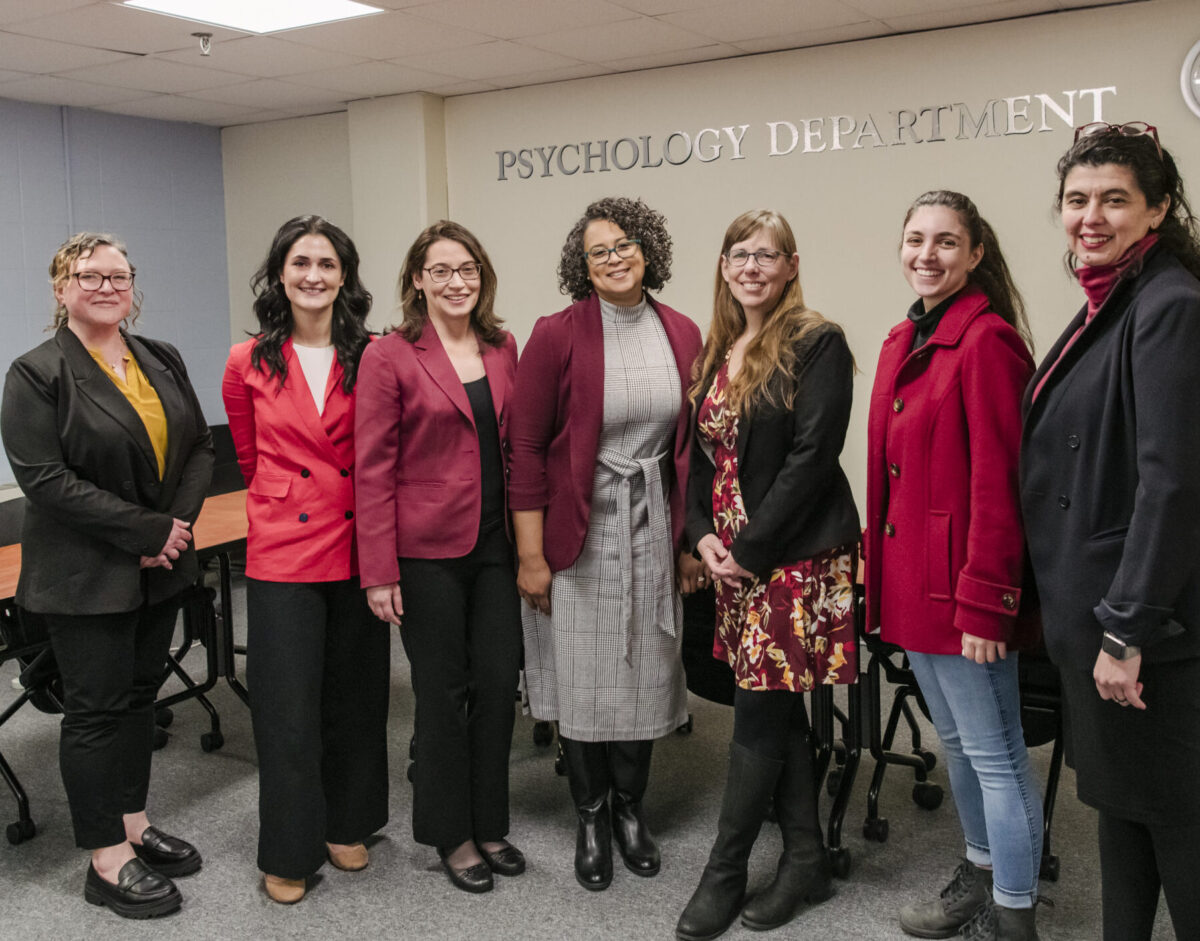 (l-r): Emily Lipsitz-Wardrick, a master of social work student at the University of Maryland School of Social Work, Pamela Rakhshan Rouhakhtar, Sandra Barrueco, Melissa Smith, Rebecca Schacht, Samantha Berg, and Doha Chibani ’08, psychology, M.P.P. ’22, public policy, UMBC psychology doctoral student, the department’s clinical coordinator, and director of clinical services at the STRIVE for Wellness Clinic. (Marlayna Demond ’11/UMBC)
“There’s often a lot of underfunding of doctoral and master’s students to pursue mental health training and to work in the field,” explains Barrueco. ADVANCE/AVANCE Maryland is changing that. Half of the grant purposefully funds graduate students and there is additional support to enhance the training of faculty and current service providers to prepare the next wave of psychology professionals to meet the needs of all communities affected by the national mental health crisis.
Barrueco notes that the students are in placements across the region with clients from various backgrounds. Through the grant, students learn how to provide services for culturally and linguistically diverse youth.
“One of the skills they are learning is how to work with interpreters. There are hundreds of languages in the immediate area, so it is a broader focus,” says Barrueco, who has expertise in Spanish. Since most bilingual speakers in the region are Spanish-speaking, students can get a strong sense of that community and learn from Barrueco’s expertise.
One-to-one solution
Samantha Berg, a fourth-year clinical psychology doctoral student in the human services psychology program at UMBC, is a research assistant at the Strive for Wellness Clinic, which provides evidence-based care to youth ages 14 – 25 through individual and family therapy, medication management, teletherapy, outreach and education, and consultation and assessment. The wellness clinic is run through a partnership between UMBC, the Maryland Early Intervention Program, the University of Maryland School of Medicine, the Maryland Coalition of Families, and On Our Own Maryland.
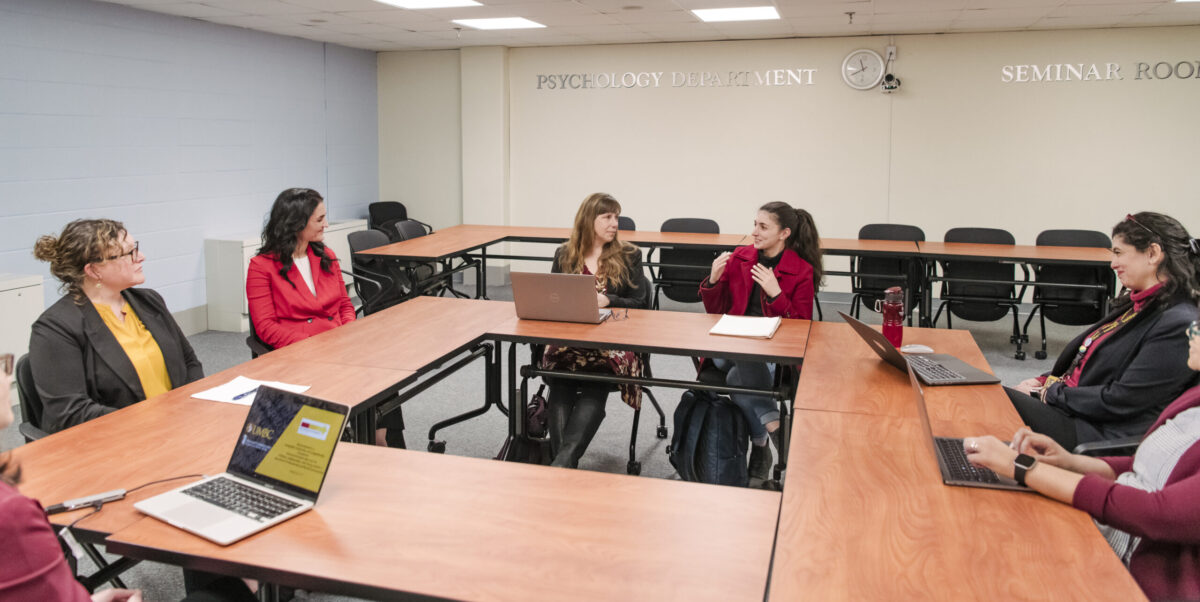 Samantha Berg (center in red coat) sits next to her advisor, Rebecca Schacht, sharing insights from her ADVANCE/AVANCE fellowship. (Marlayna Demond ’11/UMBC)
Berg’s passion for understanding psychopathology across a broad spectrum began almost a decade ago. It flourished when she entered UMBC’s doctoral program and met her advisor, Rebecca Schacht, an assistant professor of psychology, and co-director of the grant. Schacht’s research explores comorbid post-traumatic stress syndrome and substance use disorders. She is the director of the UMBC Psychology Training Clinic, where she supervises doctoral research students like Berg as they deliver low-cost, evidence-based individual psychotherapy related to anxiety, depression, relationship and family issues, and other types of mental health challenges. Schacht continues to be Berg’s advisor and provides clinical supervision.
Berg’s work at the wellness clinic aligned with the goals of the ADVANCE/AVANCE Maryland grant. She was one of the grant’s first doctoral fellows. “I was excited to learn new avenues for interacting with clients, such as how to work with an interpreter to do a bilingual mental health assessment. I want to be able to assess and treat as many people as possible, to serve as many populations as possible,” explains Berg. “I think it is part of my responsibility to gain new knowledge and understanding of how to engage with clients with whom I have different language proficiency. This is a one-to-one solution for this situation.”
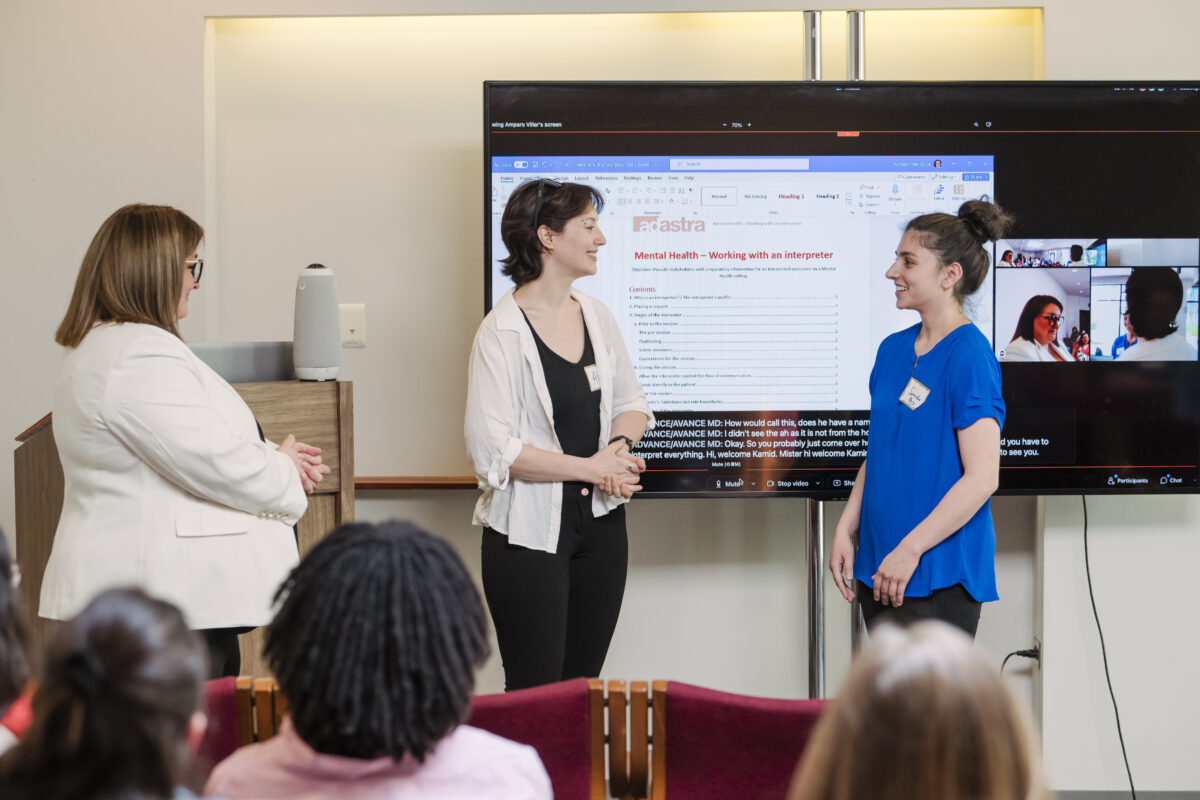 Amparo Villar Garcia (left), director of learning and development at Ad Astra language services, guides
Samantha Berg (in blue) and an attendee through a role-play to train how to work with an interpreter. (Marlayna Demond ’11/UMBC)
She is excited to be part of a significant shift in clinical psychology as it moves from a medical model to a community-based intervention model. “Part of the intervention movement includes assessments,” says Berg. “I have a personal passion for wanting to be part of the change, part of the development of treatment.”
Developing a workforce
“It’s a huge pitfall of clinical work that there isn’t enough training on how to engage and serve people who don’t speak English,” says Danielle Farrell, another research fellow on the ADVANCE/AVANCE Maryland grant. As she looks forward to her fourth year as a clinical psychology doctoral student, Farrell appreciates having access to experiential opportunities.
Farrell studies intimate partner violence. Like Berg, Farrell was already engaged with the community ADVANCE/AVANCE Maryland will be focusing on as a research assistant at the Strive for Wellness Clinic. Farrell assessed and connected adolescents and young adults with early intervention referrals for a range of mental health concerns, primarily psychosis, under the supervision of Pamela Rakhshan Rouhakhtar, an assistant professor of psychology in the human services doctoral program, another co-director of the grant, and director of the Equity in Psychosis-Spectrum Services (EQUIPS) lab at UMBC. Faculty, graduate, and predoctoral students conduct research around psychosis-spectrum experiences, with an emphasis on psychosocial factors and access to care.
The grant’s workshops, professional development meetings, and job fairs are helping Farrell maximize the skills she’s developed for a successful career after graduation.
Big picture changes
ADVANCE/AVANCE Maryland is the culmination of decades of Barrueco’s unique research, which has been instrumental in addressing developmental and mental health difficulties among language minority, immigrant, and migrant children. Her work has led to methodological improvements in the assessment and early identification of bilingual children, expansion of the theoretical and research bases related to developmental and clinical processes, and the creation and examination of multisystemic preventive interventions fostering linguistic and socioemotional functioning. This research has advanced the field of psychology and informed policy.
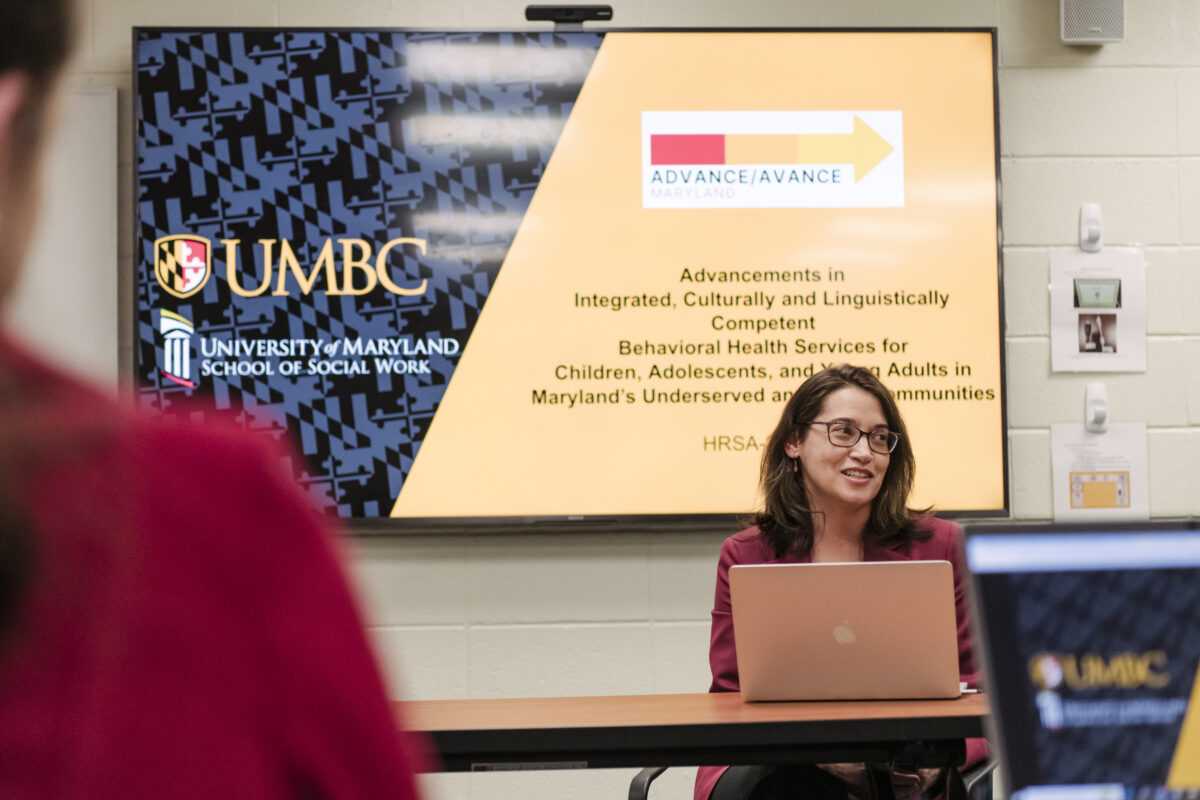 Barrueco updates the grant team. (Marlayna Demond ’11/UMBC)
Barrueco, now the director of UMBC’s clinical psychology Ph.D. program, is wholeheartedly invested in the future of UMBC’s work. “When I came to UMBC, our goal was: Let’s get some big-picture changes on the table,” she shares. “Funding psychology graduate students more quickly moves the needle on youth mental health in the nation.”
Learn more about UMBC’s psychology programs.
]]>
UMBC’s commitment to integrating training with research and community engagement drew Sandra Barrueco, professor of psychology,tojoin the psychology department last summer. Barrueco hit the ground...
https://umbc.edu/stories/barrueco-receives-990k-to-train-graduate-psychology-students-in-behavioral-health-md/
https://my3.my.umbc.edu/api/v0/pixel/news/142782/guest@my.umbc.edu/a78b741a33aff16d2b7a791125c3436b/api/pixel
cahss
cahss-research
news
policy-and-society
psychology
rca-1
research
social-work
story
UMBC News & Magazine
https://my3.my.umbc.edu/groups/umbc-news-magazine
https://assets1-my.umbc.edu/system/shared/avatars/groups/000/001/943/24435aa6207c452e7bc15cc74b42c7bb/xsmall.png?1748556657
https://assets1-my.umbc.edu/system/shared/avatars/groups/000/001/943/24435aa6207c452e7bc15cc74b42c7bb/original.png?1748556657
https://assets2-my.umbc.edu/system/shared/avatars/groups/000/001/943/24435aa6207c452e7bc15cc74b42c7bb/xxlarge.png?1748556657
https://assets2-my.umbc.edu/system/shared/avatars/groups/000/001/943/24435aa6207c452e7bc15cc74b42c7bb/xlarge.png?1748556657
https://assets3-my.umbc.edu/system/shared/avatars/groups/000/001/943/24435aa6207c452e7bc15cc74b42c7bb/large.png?1748556657
https://assets1-my.umbc.edu/system/shared/avatars/groups/000/001/943/24435aa6207c452e7bc15cc74b42c7bb/medium.png?1748556657
https://assets2-my.umbc.edu/system/shared/avatars/groups/000/001/943/24435aa6207c452e7bc15cc74b42c7bb/small.png?1748556657
https://assets1-my.umbc.edu/system/shared/avatars/groups/000/001/943/24435aa6207c452e7bc15cc74b42c7bb/xsmall.png?1748556657
https://assets2-my.umbc.edu/system/shared/avatars/groups/000/001/943/24435aa6207c452e7bc15cc74b42c7bb/xxsmall.png?1748556657
UMBC News & Magazine
0
0
false
Thu, 11 Jul 2024 18:45:07 -0400
Thu, 11 Jul 2024 18:45:07 -0400
Partnership with biotech giant Genentech benefits UMBC graduate students
UMBC doctoral students are reaping the benefits of an innovative partnership between UMBC and biotech leader Genentech. In year three of a five-year program, sixstudents have received financial support and started conducting research with the company through Genentech Fellowships. In addition, many more students have benefited from regular contact with Genentech senior scientists through their on-campus lecture series.
By supplying training opportunities in industry before graduation—the kind of preparation that has not always been supplied in traditional life science programs—the relationship between UMBC and Genentech is opening doors to a wider range of careers for graduate students in the life sciences.
Hands-on training at Genentech
 Maki Negesse on the Genentech campus in South San Francisco, California. (Photo courtesy of Negesse)
Each year during the five-year agreement, Genentech fully funds two life science Ph.D. candidates in the Meyerhoff Graduate Fellows Program who are progressing well through their doctoral work and have expressed interest in pursuing a career in industry. Selected students continue their thesis work with their Ph.D. advisors during the academic year; then they spend the summer as research interns at Genentech headquarters in South San Francisco, California. Alecia Dent ’12, biochemistry and molecular biology, who earned a Ph.D. at University of Maryland, Baltimore as a Meyerhoff Graduate Fellow and today works at Genentech, has generously helped the fellows acclimate to life on the West Coast by offering lodging at her home.
The internship at Genentech “was a great opportunity to grow my network and get hands-on training in a different area of expertise, and a great way to gain some industry experience,” shares Maki Negesse, a biological sciences Ph.D. candidate in Erin Green’s research group at UMBC.
When fellows return to UMBC, they present their research and experience at Genentech to all of the current Meyerhoff Graduate Fellows—a group that includes more than 100 UMBC and University of Maryland, Baltimore graduate students. In addition, Genentech scientists give multiple seminars at both campuses each year.
“My experience at Genentech has strengthened my desire to pursue a career in biotech companies,” Negesse adds. “I highly recommend that students pursue at least one internship during graduate school.”
Proactive steps for success
 Michael Summers played a key role in the development of the Meyerhoff Graduate Fellows Program. (Photo by Marlayna Demond ’11/UMBC)
The partnership signals that UMBC is proactively taking steps to ensure its graduate training programs set students up for success in various high-demand roles. Genentech, too, is committed to supporting the next generation of highly qualified biotech workers.
“Graduate programs in the life sciences are historically geared toward preparing Ph.D. students for academic careers. This partnership fills a gap in graduate education by providing on-site training at a world-class company for students who are interested in careers in the biotechnology industry,” shares Michael Summers, Distinguished University Professor of Chemistry and Biochemistry and co-director of the Meyerhoff Graduate Fellows Program. “It also provides opportunities to diversify the scientific workforce at Genentech, providing a win-win for the company and our students.”
]]>
UMBC doctoral students are reaping the benefits of an innovative partnership between UMBC and biotech leader Genentech. In year three of a five-year program, sixstudents have received financial...
https://umbc.edu/stories/grad-students-benefit-from-genentech-partnership/
https://my3.my.umbc.edu/api/v0/pixel/news/142556/guest@my.umbc.edu/17afe8eefc376b2e89cc8917ae160145/api/pixel
cnms
gradresearch
graduate-school
meyerhoff-scholars
news
rca-1
research
science-and-tech
story
UMBC News & Magazine
https://my3.my.umbc.edu/groups/umbc-news-magazine
https://assets1-my.umbc.edu/system/shared/avatars/groups/000/001/943/24435aa6207c452e7bc15cc74b42c7bb/xsmall.png?1748556657
https://assets1-my.umbc.edu/system/shared/avatars/groups/000/001/943/24435aa6207c452e7bc15cc74b42c7bb/original.png?1748556657
https://assets2-my.umbc.edu/system/shared/avatars/groups/000/001/943/24435aa6207c452e7bc15cc74b42c7bb/xxlarge.png?1748556657
https://assets2-my.umbc.edu/system/shared/avatars/groups/000/001/943/24435aa6207c452e7bc15cc74b42c7bb/xlarge.png?1748556657
https://assets3-my.umbc.edu/system/shared/avatars/groups/000/001/943/24435aa6207c452e7bc15cc74b42c7bb/large.png?1748556657
https://assets1-my.umbc.edu/system/shared/avatars/groups/000/001/943/24435aa6207c452e7bc15cc74b42c7bb/medium.png?1748556657
https://assets2-my.umbc.edu/system/shared/avatars/groups/000/001/943/24435aa6207c452e7bc15cc74b42c7bb/small.png?1748556657
https://assets1-my.umbc.edu/system/shared/avatars/groups/000/001/943/24435aa6207c452e7bc15cc74b42c7bb/xsmall.png?1748556657
https://assets2-my.umbc.edu/system/shared/avatars/groups/000/001/943/24435aa6207c452e7bc15cc74b42c7bb/xxsmall.png?1748556657
UMBC News & Magazine
1
0
false
Tue, 25 Jun 2024 15:46:44 -0400
Tue, 25 Jun 2024 15:46:44 -0400
Ph.D. student Jonas Miller receives USM Student Excellence Scholarship

Jonas Miller, Ph.D. candidate in the marine, estuarine, and environmental science graduate program, has received the 2024 University System of Maryland Board of Regents Student Excellence Scholarship for Academics, Scholarship, and Research. Only four graduate students across the system receive Student Excellence Scholarships—one each in four categories.
Miller has been conducting research under the mentorship of Yonathan Zohar, professor of marine biotechnology at UMBC, at the Institute of Marine and Environmental Technology (IMET) since January 2022. Miller’s work is central to enhancing sustainable land-based aquaculture of Atlantic salmon, an area in which Zohar is a world leader. Specifically, Miller is searching for genetic biomarkers in female salmon that predict the timing of spawning and the quality of the spawned eggs.
The end goal is to promote a consistent supply of domestic salmon for consumers by generating populations of fish that spawn at staggered times throughout the year, triggered by different light and temperature conditions in land-based facilities.
“Receiving the Board of Regents scholarship has provided me with the motivation to propel my research to the next level on my quest to find new predictive biomarkers pertaining to Atlantic salmon reproductive endocrinology,” Miller says.
“Jonas is a talented student able to formulate hypotheses and test them, methodically designing and carrying out experiments using the most advanced methods of genomics and endocrinology,” Zohar wrote in his letter recommending Miller for the scholarship. “His multi-year studies have already generated innovative findings, and his ongoing work will undoubtedly result in much more data and lead to scientific advances and, potentially, economic development opportunities.”
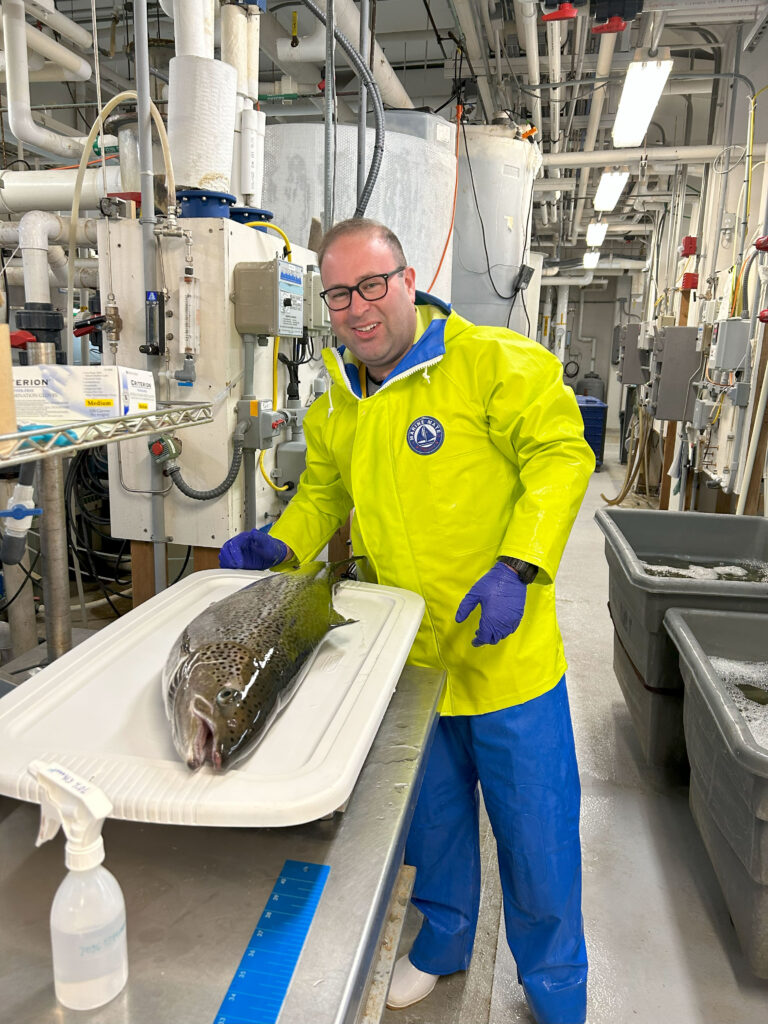
Left: Jonas Miller stands with a fish raised in the Aquaculture Research Center, the main laboratory for aquaculture research at IMET. (Courtesy of Miller)
Ongoing ripples of impact
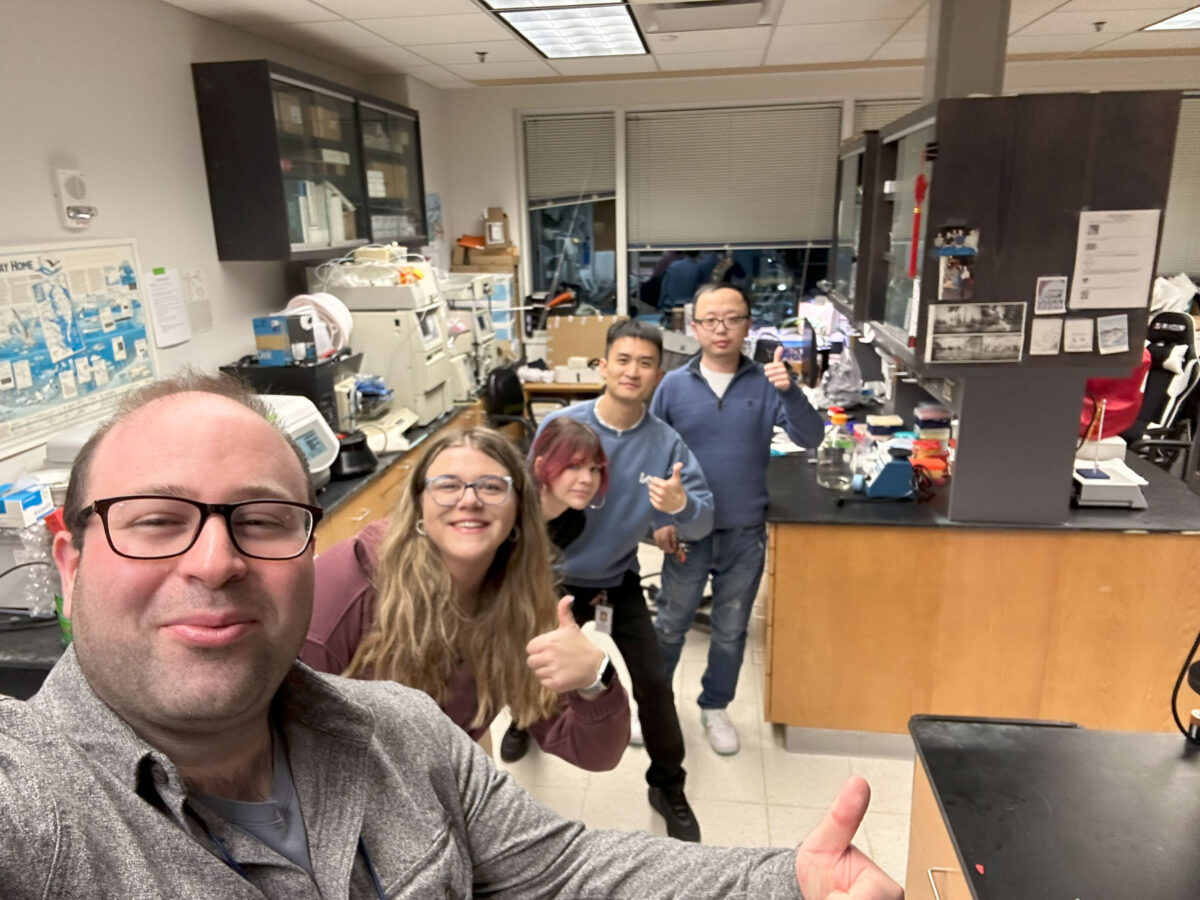 Jonas Miller mentors numerous students who participate in marine research. (Courtesy of Miller)
Miller’s contributions have gone far beyond the impact of his research. He served as IMET’s Graduate Student Association president for the 2022 – 2023 academic year, teaches weekly English classes to Chinese graduate students at IMET, and has mentored three high school students volunteering in Zohar’s research group. Miller also authored an 80-page white paper for the National Oceanic and Atmospheric Administration on the potential for tuna aquaculture in the United States.
“His understanding of the aquaculture field and the relevant literature, as well as his personal experience working on bluefin tuna in Japan, is of great benefit to his colleagues,” Zohar adds. Those colleagues include not only researchers at IMET, but also collaborators at the U.S. Department of Agriculture, University of Maine, University of Wisconsin-Stevens Point, and University of Maryland, College Park. Researchers at these institutions and others are involved in various projects led by Zohar, including a $10 million effort funded by the USDA to address specific challenges in the aquaculture industry.
When the personal propels the professional
Miller expressed gratitude to Zohar for the opportunity to work with him, and to his collaborators, “who have all made my experience as a Ph.D. student both fruitful and exciting.”
Miller’s accomplishments have not come without adversity, however. “I’d like to dedicate this scholarship to my best friend David Pardo Hernandez, and to my mom, Sheila Mann Miller, both of whom tragically and unexpectedly passed away during my first year as a Ph.D. student at UMBC in 2022,” Miller shares. “Finally, thanks to my dad for encouraging me to study fish biology and for constantly motivating me to study harder.”
“I am grateful to all of my friends at IMET who have given me support,” Miller adds. “I wish my mom and best friend were here to experience this. They would both be really proud of this accomplishment. They motivated me to work hard and I hope that I made them proud.”
]]>
Jonas Miller, Ph.D. candidate in the marine, estuarine, and environmental science graduate program, has received the 2024 University System of Maryland Board of Regents Student Excellence...
https://umbc.edu/stories/usm-student-excellence-scholarship/
https://my3.my.umbc.edu/api/v0/pixel/news/141569/guest@my.umbc.edu/63a92fbea63289d6b42bf400c89f832d/api/pixel
cnms
community
gradresearch
marinebiotech
news
rca-1
research
science-and-tech
story
UMBC News & Magazine
https://my3.my.umbc.edu/groups/umbc-news-magazine
https://assets1-my.umbc.edu/system/shared/avatars/groups/000/001/943/24435aa6207c452e7bc15cc74b42c7bb/xsmall.png?1748556657
https://assets1-my.umbc.edu/system/shared/avatars/groups/000/001/943/24435aa6207c452e7bc15cc74b42c7bb/original.png?1748556657
https://assets2-my.umbc.edu/system/shared/avatars/groups/000/001/943/24435aa6207c452e7bc15cc74b42c7bb/xxlarge.png?1748556657
https://assets2-my.umbc.edu/system/shared/avatars/groups/000/001/943/24435aa6207c452e7bc15cc74b42c7bb/xlarge.png?1748556657
https://assets3-my.umbc.edu/system/shared/avatars/groups/000/001/943/24435aa6207c452e7bc15cc74b42c7bb/large.png?1748556657
https://assets1-my.umbc.edu/system/shared/avatars/groups/000/001/943/24435aa6207c452e7bc15cc74b42c7bb/medium.png?1748556657
https://assets2-my.umbc.edu/system/shared/avatars/groups/000/001/943/24435aa6207c452e7bc15cc74b42c7bb/small.png?1748556657
https://assets1-my.umbc.edu/system/shared/avatars/groups/000/001/943/24435aa6207c452e7bc15cc74b42c7bb/xsmall.png?1748556657
https://assets2-my.umbc.edu/system/shared/avatars/groups/000/001/943/24435aa6207c452e7bc15cc74b42c7bb/xxsmall.png?1748556657
UMBC News & Magazine
2
0
false
Wed, 01 May 2024 09:51:29 -0400
Wed, 01 May 2024 09:51:29 -0400
NASA selects UMBC-led lunar instrument for implementation on Artemis III Moon landing mission

The University of Maryland Baltimore County (UMBC), along with several institutional partners, has been selected to develop one of the first three lunar instruments chosen for implementation and deployment as part of NASA’s forthcoming Artemis III mission, humanity’s first return to the lunar surface in more than 50 years.
The Lunar Environment Monitoring Station (LEMS), led by planetary scientist Mehdi Benna of UMBC’s Center for Space Sciences Technology (CSST), was selected as one of the first three candidate payloads to be a part of Artemis III, NASA’s mission that will send astronauts to explore the region near the lunar South Pole. Artemis III, currently planned to launch in 2026, will be the first time humans will return to the moon’s surface since the historic Apollo program in 1969-1972.
LEMS is a compact, autonomous seismometer designed to carry out continuous, long-term monitoring of seismic activity, namely ground motion from moonquakes, in the lunar south polar region, according to NASA’s recent announcement of the selected Artemis III instruments. During the Artemis III mission, LEMS will accompany the Lunar Effects on Agricultural Flora instrument, led by researchers at Space Lab Technologies in Boulder, Colorado, and the Lunar Dielectric Analyzer instrument, led by researchers at the University of Tokyo and supported by the Japan Aerospace Exploration Agency.
The LEMS project is the culmination of several years of collaboration between UMBC and partnering institutions, of which includes the University of Maryland, College Park (through deputy principal investigator Nicholas Schmerr) and NASA’s Goddard Space Flight Center, which will lead LEMS’ technical implementation process. The University of Arizona will supply LEMS’ two state-of-the-art seismometer sensors; Morehead State University will provide LEMS’ telecommunication system, and Washington University in St. Louis will manage the instrument’s data processing and dissemination to the larger scientific community.
Designed to withstand extreme conditions
Principal Investigator Benna, who operates out of the NASA’s Goddard Space Flight Center with the CSST, began conceptualizing with his team the idea behind the LEMS instrument in 2018 after realizing the need for technology that could withstand the Moon’s harsh conditions in order to measure lunar geophysical activity for a long duration of time.
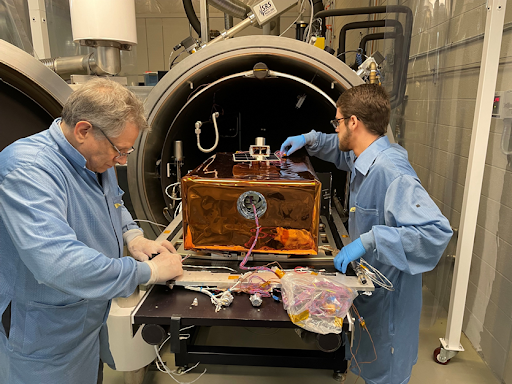 Team members during the final preparation of the Lunar Environment Monitoring Station (LEMS) engineering units for thermal-vacuum testing. During this test the LEMS prototype was subjected to the ultra-high vacuum and harsh thermal conditions that mimic the surface of the Moon to demonstrate the station can sustain itself and operate unassisted for long durations. (Photo Credit: NASA MSFC)
“The lunar environment is one of the harshest environments in the solar system. It’s hard to survive [on] the Moon because it rotates very slowly around itself—daytime on the Moon lasts about 15 Earth days, and night on the Moon lasts 15 Earth days,” says Benna. “Because the Moon doesn’t have an atmosphere, the days are very hot and the nights get really cold.”
Benna’s team began developing his idea of a small, self-sustaining station that operates almost like a buoy in the ocean—what Benna calls a “lunar buoy”—that can survive on the surface through the lunar night and operate during the day for an extended amount of time. In 2018, Benna’s team received funding from NASA’s Development and Advancement of Lunar Instrumentation program for engineering development and risk reduction of the LEMS instrument, which allowed it to reach the required NASA flight readiness level.
“The Apollo 11 of our generation”
LEMS, which is of the size of a standard carry-on airplane suitcase, is intended to operate on the lunar surface from three months up to two years following its deployment. The station’s battery is designed to be charged by its solar panels during the day. The stored power is used to keep the station operational at night. The LEMS instrument would then autonomously beam its data to one of NASA’s Deep Space Network ground stations once a month via its own communication antennas and radio system.
With the data retrieved from LEMS’ two distinct lunar-night-surviving seismometers, scientists will be able to characterize the structure of the local crust and mantle.
“Artemis III is the Apollo 11 of our generation—that’s significant. Landing astronauts on the Moon doesn’t get any easier 50 years later. Being a part of this adventure is extremely exciting,” shares Benna.
For more information on the Lunar Environment Monitoring Station (LEMS) science and technology, please contact: The University of Maryland, Baltimore County- Adriana Fraser; NASA’s Goddard Space Flight Center- Molly Wasser, Nancy Jones; The University of Arizona- Mikayla Kelley; Morehead State University- April Hobbs Nutter, Rick L. Hesterberg; Washington University in St. Louis- Paul Byrne; NASA Headquarters- Erin Morton.
]]>
The University of Maryland Baltimore County (UMBC), along with several institutional partners, has been selected to develop one of the first three lunar instruments chosen for implementation and...
https://umbc.edu/stories/lems-nasa-moon-instrument/
https://my3.my.umbc.edu/api/v0/pixel/news/140744/guest@my.umbc.edu/848c0ddb2c722e39f920edef140c1e7c/api/pixel
csst
nasa-goddard-space-flight-center
news
rca-1
research
science-and-tech
story
UMBC News & Magazine
https://my3.my.umbc.edu/groups/umbc-news-magazine
https://assets1-my.umbc.edu/system/shared/avatars/groups/000/001/943/24435aa6207c452e7bc15cc74b42c7bb/xsmall.png?1748556657
https://assets1-my.umbc.edu/system/shared/avatars/groups/000/001/943/24435aa6207c452e7bc15cc74b42c7bb/original.png?1748556657
https://assets2-my.umbc.edu/system/shared/avatars/groups/000/001/943/24435aa6207c452e7bc15cc74b42c7bb/xxlarge.png?1748556657
https://assets2-my.umbc.edu/system/shared/avatars/groups/000/001/943/24435aa6207c452e7bc15cc74b42c7bb/xlarge.png?1748556657
https://assets3-my.umbc.edu/system/shared/avatars/groups/000/001/943/24435aa6207c452e7bc15cc74b42c7bb/large.png?1748556657
https://assets1-my.umbc.edu/system/shared/avatars/groups/000/001/943/24435aa6207c452e7bc15cc74b42c7bb/medium.png?1748556657
https://assets2-my.umbc.edu/system/shared/avatars/groups/000/001/943/24435aa6207c452e7bc15cc74b42c7bb/small.png?1748556657
https://assets1-my.umbc.edu/system/shared/avatars/groups/000/001/943/24435aa6207c452e7bc15cc74b42c7bb/xsmall.png?1748556657
https://assets2-my.umbc.edu/system/shared/avatars/groups/000/001/943/24435aa6207c452e7bc15cc74b42c7bb/xxsmall.png?1748556657
UMBC News & Magazine
1
0
false
Wed, 10 Apr 2024 08:17:34 -0400
Wed, 10 Apr 2024 08:17:34 -0400
UMBC manufacturing research center gets boost from new partnership with U.S. Army

The Center for Research in Emergent Manufacturing (CREM), which started as the ambitious idea of two UMBC researchers in 2019, is launching a major new project with the U.S. Army and other partners this year. UMBC has received an initial amount of more than $3 million to fund the first year of the project, which will investigate ways to digitize the army’s supply chain.
CREM is led by director Nilanjan Banerjee, professor of computer science and electrical engineering, and associate director Donna Ruginski, associate vice president for center development in the Office of Research and Creative Achievement at UMBC. It aims to help manufacturers reap the benefits, and manage the risks, of new manufacturing approaches increasingly centered around computer systems—a concept known as digital manufacturing.
Since its founding, the center has already established programs to educate manufacturing professionals in cybersecurity. The new project will significantly advance the center’s research activities and impact.
“The partnership with the army is an important step in our evolution as a research center. We will be working on cutting edge problems for the Army in the areas of digitization,” says Banerjee.
“We’re new and full of energy,” says Ruginski. “I’m confident we’ll make a difference.”
From spinning jennies to generative AI
Manufacturing has come a long way since the 18th-century textile industry was revolutionized by the invention of machines such as spinning jennies, which greatly increased the amount of thread a single worker could produce. Since then, new technologies, such as the electric grid in the early 20th century and computers in the mid-century, brought further waves of change to the way goods are made.
On a modern factory floor, robots and their computer control systems increasingly take the place of humans in the assembly process, and the future of manufacturing will likely be even more automated and digitized than it is today. Companies are increasingly turning to new technologies such as smart sensors, AI, cloud computing, and advanced analytics to increase the flexibility, resilience, and efficiency of their operations. This transformation—called industry 4.0—holds enormous promise to improve living standards by increasing productivity, but it also comes with some perils, including vulnerability to cyberattacks.
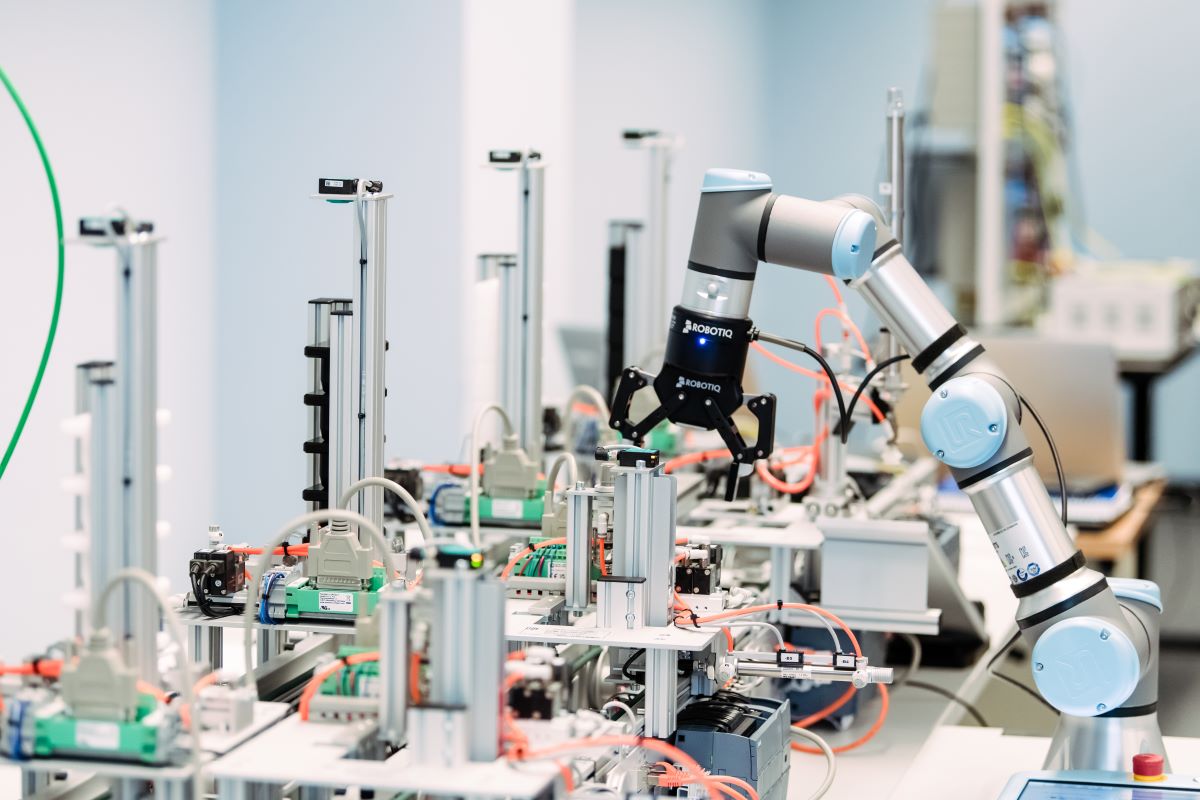 Equipment in the operations technology cyber range. (Marlayna Demond ’11/UMBC)
Training and research
UMBC aims to help manufacturers navigate the industry 4.0 shift. Part of that mission will be to educate future workers in digital manufacturing, be they UMBC students or working professionals looking to expand their skill set.
In 2020, under the auspices of CREM, Banerjee and Ruginski launched the Cybersecurity for Manufacturing Operational Technology (CyMOT) program to train manufacturing professionals in best practices for preventing cyberattacks on manufacturing operations. Through the program, CREM has educated more than 300 manufacturers from small and medium-sized businesses.
“The manufacturing sector has suffered a number of cyberattacks recently, so it’s important to make sure people in the sector are trained in cybersecurity,” says Banerjee.
CREM also hosts a state-of-the-art cybersecurity training and research facility, called a cyber range, specifically focused on digital manufacturing technology—one of only a few in the country. In the coming months, the cyber range will move to a new and dedicated location on the UMBC campus.
“The research and training efforts conducted by CREM under Dr. Banerjee’s leadership have wide-ranging consequences,” says Karl Steiner, the vice president for research and creative achievement at UMBC. “As digital manufacturing rapidly becomes a national and global standard, it is critical to develop adaptive cybersecurity strategies and protocols to secure the global supply pipeline. I am delighted that CREM is supported through one of three major research partnerships that UMBC developed in recent years with the U.S. Army.”
]]>
The Center for Research in Emergent Manufacturing (CREM), which started as the ambitious idea of two UMBC researchers in 2019, is launching a major new project with the U.S. Army and other...
https://umbc.edu/stories/crem-manufacturing-research-army/
https://my3.my.umbc.edu/api/v0/pixel/news/138230/guest@my.umbc.edu/9951b58bbc0b842e87c48f87014b9c88/api/pixel
coeit
crem
csee
news
rca-1
research
science-and-tech
story
UMBC News & Magazine
https://my3.my.umbc.edu/groups/umbc-news-magazine
https://assets1-my.umbc.edu/system/shared/avatars/groups/000/001/943/24435aa6207c452e7bc15cc74b42c7bb/xsmall.png?1748556657
https://assets1-my.umbc.edu/system/shared/avatars/groups/000/001/943/24435aa6207c452e7bc15cc74b42c7bb/original.png?1748556657
https://assets2-my.umbc.edu/system/shared/avatars/groups/000/001/943/24435aa6207c452e7bc15cc74b42c7bb/xxlarge.png?1748556657
https://assets2-my.umbc.edu/system/shared/avatars/groups/000/001/943/24435aa6207c452e7bc15cc74b42c7bb/xlarge.png?1748556657
https://assets3-my.umbc.edu/system/shared/avatars/groups/000/001/943/24435aa6207c452e7bc15cc74b42c7bb/large.png?1748556657
https://assets1-my.umbc.edu/system/shared/avatars/groups/000/001/943/24435aa6207c452e7bc15cc74b42c7bb/medium.png?1748556657
https://assets2-my.umbc.edu/system/shared/avatars/groups/000/001/943/24435aa6207c452e7bc15cc74b42c7bb/small.png?1748556657
https://assets1-my.umbc.edu/system/shared/avatars/groups/000/001/943/24435aa6207c452e7bc15cc74b42c7bb/xsmall.png?1748556657
https://assets2-my.umbc.edu/system/shared/avatars/groups/000/001/943/24435aa6207c452e7bc15cc74b42c7bb/xxsmall.png?1748556657
UMBC News & Magazine
0
0
false
Wed, 17 Jan 2024 11:45:52 -0500
Wed, 17 Jan 2024 11:45:52 -0500
UMBC, UMB receive $4 million NIH REACH grant to create new biomedical and life sciences accelerator program
UMBC is continuing its commitment to diversifying Maryland’s biomedical and life sciences ecosystem through its latest collaborative effort with the University of Maryland, Baltimore (UMB) to develop a new life sciences accelerator program focused on faculty development and research commercialization efforts.
UMBC and UMB were jointly awarded a four-year, $4 million Research Evaluation and Commercialization Hubs (REACH) grant from the National Institutes of Health (NIH) to advance the biomedical entrepreneurship and innovation economy in the Baltimore region. This grant will be used to build on the work that began when UMBC and the University of Maryland School of Medicine (UMSOM) received a $13 million NIH Common Fund Faculty Institutional Recruitment for Sustainable Transformation (FIRST) grant in 2022 to enhance recruitment and training of junior faculty from groups underrepresented in biomedical science.
“We have a long-term commitment to enhance the diversity of the faculty on our two campuses in the biomedical and life sciences,” says Karl V. Steiner, UMBC’s vice president of research and creative achievement and co-principal investigator of the new REACH grant. “We are pleased to further strengthen the close partnership with our colleagues at UMB and beyond with this next initiative.”
 Karl V. Steiner.
Building a life sciences accelerator program
The REACH grant will fund up to 44 early-career faculty and students from UMBC and UMB (11 each year) with up to $100,000 each to develop and test commercially-promising biomedical and life science technologies. Additionally, UMB will use a portion of the grant funding to create the University of Maryland, Baltimore Life Science Discovery (UM-BILD) Accelerator Program’s “proof-of-concept” hub that will be housed at the University of Maryland BioPark and at the bwtech@UMBC Research and Technology Park. The UM-BILD hub, set to launch next year, is one of only five REACH hubs awarded funding across the nation.
Aaron Miscenich, executive director of bwtech@UMBC, explains that bwtech@UMBC has done extensive work in developing a strong community centered around entrepreneurship and technology commercialization.
“UMBC’s partnership with UMB to create this technology commercialization hub will [further] enhance our work and bring additional support to UMBC’s research community,” Miscenich says. “It’s a great opportunity to bring together UMBC faculty and students with resources that can help further develop promising technologies and help them to grow into thriving businesses.”
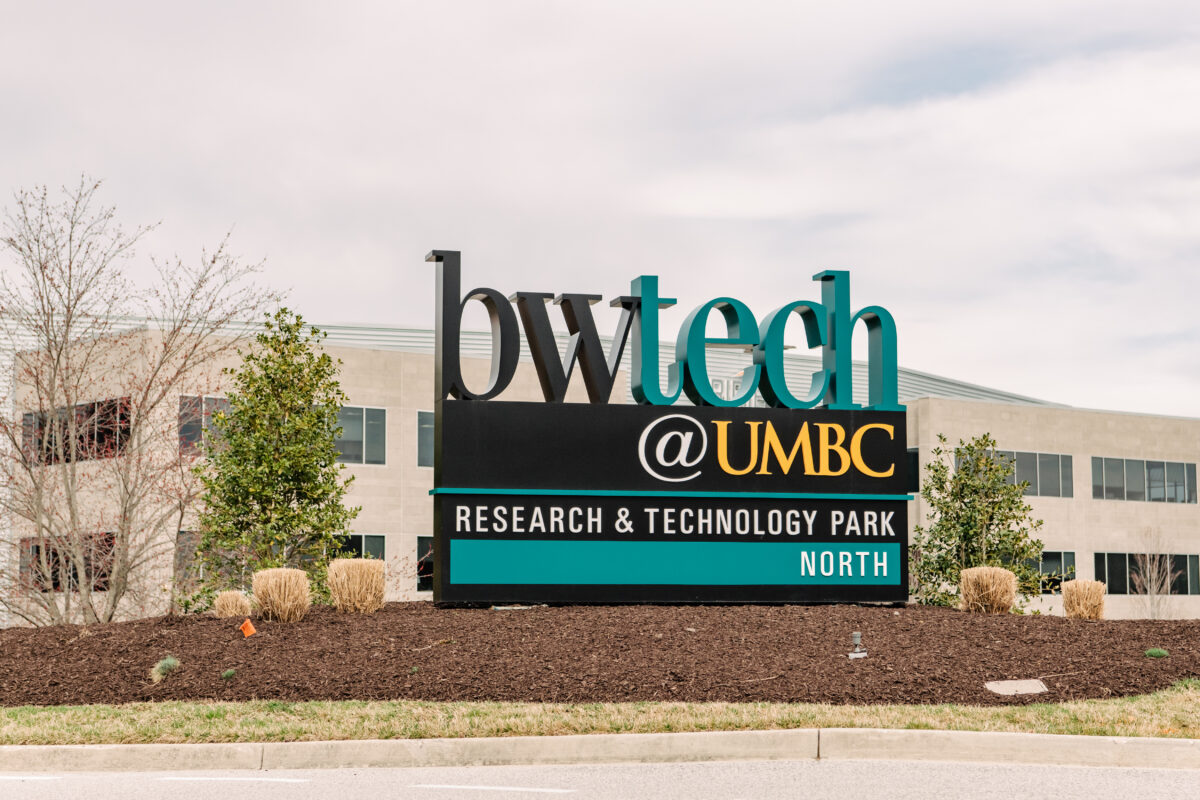 bwtech@UMBC Research and Technology Park, north campus.
UMSOM’s Jason Rose, principal investigator of the REACH grant, shared how both institutions plan to support the biotech entrepreneurs who take part in the accelerator program.
“We recognize that to create our own unique cohort of newly trained biotech entrepreneurs here in Baltimore, our accelerator will need to provide them with both research support and funding, as well as guidance through the process of commercialization and technology development,” Rose said in a UMSOM press release. “We will be providing mentoring and educational programs from a diverse set of successful life science innovators and leaders to help distill their broad experiences—from navigating FDA regulatory pathways to financing new companies—to all of those who interact with the hub.”
This initiative, Steiner adds, aims to increase the number of Black and Latinx entrepreneurs in the biomedical and life sciences.
“As we look at the makeup of entrepreneurs across our communities, it’s obvious that we are under-serving those underserved communities. This will be yet another building block in our joint commitment to ensure that we focus on and benefit from the breadth of entrepreneurial talent in Maryland,” says Steiner. “We’re looking to bring in more individuals from underrepresented communities into the faculty ranks and actively help them develop a strong network of peers and mentors to allow them to successfully build their careers and their businesses in Maryland, with support from UMBC with bwtech and support from UMB.”
UMBC President Valerie Sheares Ashby shares that “we are excited to work together to create opportunities for everyone to benefit from and contribute to this innovation ecosystem, staying true to our long-held commitment to inclusive excellence.”
Commercialization efforts at UMBC
 Wendy Martin.
Wendy Martin, director of UMBC’s Office of Technology Development, will assist in selecting and managing the projects that will be funded through the REACH grant. Martin has worked closely with faculty in all aspects of intellectual property protection and commercialization, including helping faculty to receive internal and external funding to develop new products. Those funding opportunities have included UMBC’s long-standing partnership with TEDCO’s Maryland Innovation Initiative (MII), which will also be a collaborator of the UM-BILD accelerator along with the University of Maryland, College Park, Morgan State University, and Blackbird Laboratories.
Since launching in 2012, MII has supported 39 UMBC faculty in their commercialization pursuits, including the development of bendable zinc-based batteries and vibration-powered sensor technology for wind turbines.
“I’m excited that we can bring everyone to the table. UMBC provides a continuum of support for these commercialization projects,” says Martin. “We’re building on enhancing things that we’re already doing. It’s great that we will have these additional resources to keep it going and to do it better.”
]]>
UMBC is continuing its commitment to diversifying Maryland’s biomedical and life sciences ecosystem through its latest collaborative effort with the University of Maryland, Baltimore (UMB) to...
https://umbc.edu/stories/umbc-umb-reach-grant-life-sciences-accelerator-program/
https://my3.my.umbc.edu/api/v0/pixel/news/137448/guest@my.umbc.edu/9e76698ced1b0d55ff2955a521c2d113/api/pixel
bwtech
bwtech-at-umbc
cnms
news
rca-1
research
science-and-tech
UMBC News & Magazine
https://my3.my.umbc.edu/groups/umbc-news-magazine
https://assets1-my.umbc.edu/system/shared/avatars/groups/000/001/943/24435aa6207c452e7bc15cc74b42c7bb/xsmall.png?1748556657
https://assets1-my.umbc.edu/system/shared/avatars/groups/000/001/943/24435aa6207c452e7bc15cc74b42c7bb/original.png?1748556657
https://assets2-my.umbc.edu/system/shared/avatars/groups/000/001/943/24435aa6207c452e7bc15cc74b42c7bb/xxlarge.png?1748556657
https://assets2-my.umbc.edu/system/shared/avatars/groups/000/001/943/24435aa6207c452e7bc15cc74b42c7bb/xlarge.png?1748556657
https://assets3-my.umbc.edu/system/shared/avatars/groups/000/001/943/24435aa6207c452e7bc15cc74b42c7bb/large.png?1748556657
https://assets1-my.umbc.edu/system/shared/avatars/groups/000/001/943/24435aa6207c452e7bc15cc74b42c7bb/medium.png?1748556657
https://assets2-my.umbc.edu/system/shared/avatars/groups/000/001/943/24435aa6207c452e7bc15cc74b42c7bb/small.png?1748556657
https://assets1-my.umbc.edu/system/shared/avatars/groups/000/001/943/24435aa6207c452e7bc15cc74b42c7bb/xsmall.png?1748556657
https://assets2-my.umbc.edu/system/shared/avatars/groups/000/001/943/24435aa6207c452e7bc15cc74b42c7bb/xxsmall.png?1748556657
UMBC News & Magazine
0
0
false
Fri, 01 Dec 2023 16:08:38 -0500
Fri, 01 Dec 2023 16:08:38 -0500
GRIT-X 2023 explores wide range of UMBC’s research and creative achievement around campus and beyond
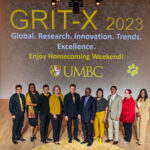
Spiders, robots, climate change, Vaudevillian history, and more—this year’s GRIT-X event had something for inquiring minds of all kinds, with explorations into elements of the past, our collective present, and possibilities for the future.
Back for its seventh year, GRIT-X returned to the Fine Arts Recital Hall during Homecoming 2023 with presentations from faculty and accomplished alumni addressing some of the most pressing issues facing society now and throughout history, and how UMBC scholars are working to build a better tomorrow.
“The goal of GRIT-X is to provide a sneak peek behind the scenes of some of the exciting and impactful research and creative achievement initiatives across our campus community,” says Karl V. Steiner, UMBC’s vice president of research and creative achievement. “[GRIT-X] takes you around the whole campus and beyond.”
Watch the GRIT-X 2023 talks.
“Disruptive” and intercultural thinking in the workforce
GRIT-X 2023 showcased how UMBC alumni are working to fuel innovation within the workforce and how faculty are strengthening the employability of future graduates. Melanie Harrison Okokoro, Ph.D. ’11, environmental science, opened this year’s GRIT-X with her discussion on how “bold and disruptive thinking” can help executives to lead, innovate, and transform their companies in the 21st century. Okokoro is the co-founder and CEO of Eco-Alpha, a firm that provides environmental compliance services and engineering workforce development training. Her talk outlined how leaders can create “disruptive strategies” in order to stay at the forefront of changes happening in their industries.
“Disruptive thinking is in my DNA,” said Okokoro during her presentation. “It defines how [Eco-Alpha] outcompetes our competitors in the marketplace and allows us to target a segment of the population that’s been traditionally overlooked.”
 Melanie Harrison Okokoro presenting her GRIT-X 2023 talk entitled “Disruptive Thinking: A Bold Business Strategy to Change How We Lead, Innovate, and Transform Companies in the 21st Century.”
Similarly to Okokoro, Zhensen Huang, M.S. ’00, Ph.D. ’04, information systems, used bold thinking to propel himself forward in his current career as CEO and founder of Precise Software Solutions, a firm that helps government and private sector clients modernize their IT systems. Huang spoke of his student experience at UMBC after emigrating to the U.S. from a small rural village in China—a future he says he didn’t think was possible when growing up. He shared how UMBC helped even when “It’s hard for us to make a connection between what we’re doing now to the great possibilities down the road,” says Huang.
“Embrace the present and envision the future,” Huang shared during his talk. “Sometimes you don’t know what your future possibilities are, and that’s okay. What’s important is to embrace what’s in front of you, especially the challenges.”
 Zhensen Huang
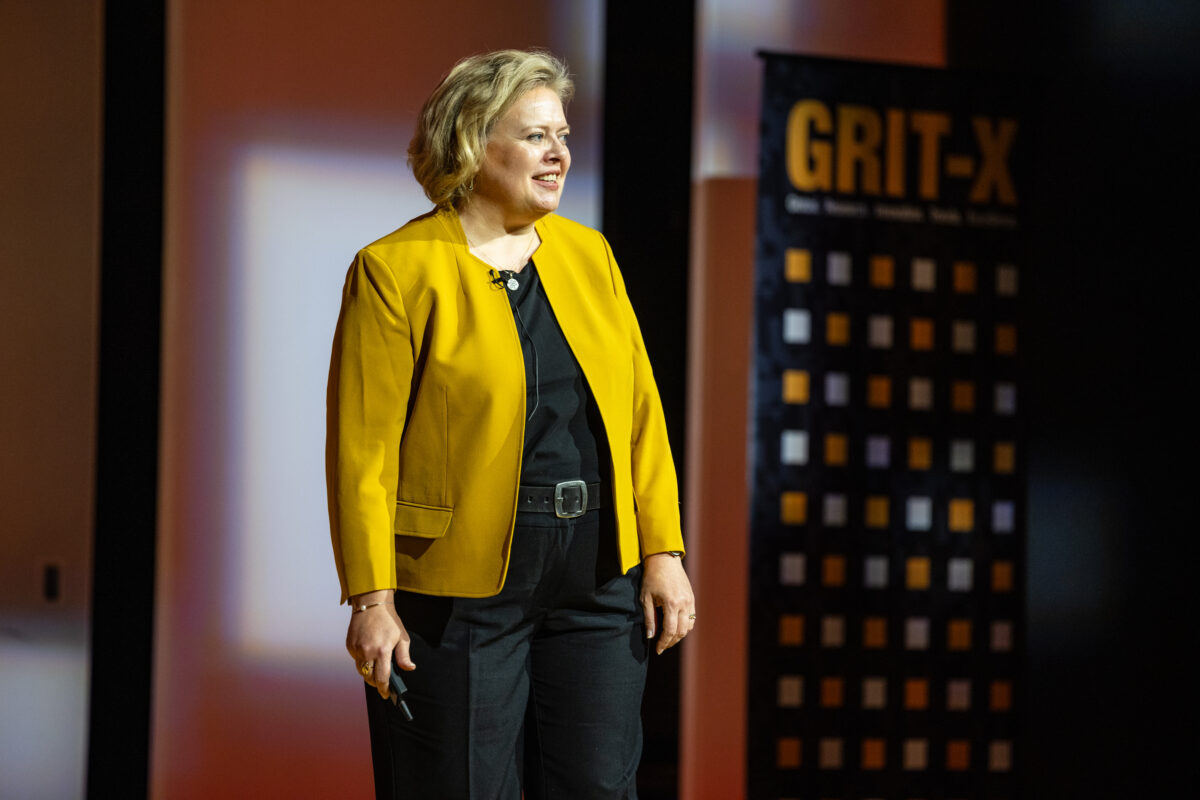 Irina Golubeva
Irina Golubeva, professor and director of UMBC’s intercultural communication graduate program, is working to address some of those challenges students face, such as navigating culturally-diverse environments. Her GRIT-X presentation focused on her research on intercultural learning, which includes the InterEqual training program she created based on student feedback. Golubeva shared how she’s helping UMBC students develop their intercultural competence as they prepare for their professional careers.
“We cannot ignore and disregard these tendencies of job markets, and we must prepare our students to work and live in multicultural societies by equipping them with essential intercultural and language skills,” says Golubeva.
Investigating earthly phenomena with math and science
Justin Webster, associate professor of mathematics and statistics, explored the “relationship between mathematical models and the phenomena in the world” during his presentation. He highlighted specific examples of how mathematical modeling can deepen our understanding of infrastructure disasters like the Tacoma Narrows Bridge collapse of 1940, and how his mathematical process helped researchers find a possible hypothesis for detecting the onset of glaucoma.
“Mathematical modeling is a scientific empowerment tool. Anyone, anywhere, can do math modeling and study anything that they’re interested in,” says Webster. “That’s why it is so important that our students at UMBC, and students more broadly, are mathematically competent and excited so that they can go on to be students of the world.”
 Justin Webster delivering his GRIT-X 2023 talk entitled “The Map is Not the Territory: Tales of Interest in Nonlinear Elasticity.”
Charles Ichoku, director of the UMBC-led Goddard Earth Science Technology and Research (GESTAR) Center II, also explored a phenomena that’s causing global concern—how rapidly the Earth is changing. Ichoku explained in his GRIT-X talk how climate change, people, and wildfire emissions are contributing to those changes to the Earth and the work he’s done with NASA’s Fire Energetics and Emissions Research project to understand causes of climate change.
“The world is warming dangerously, and human activities are driving the warming trend through the emission of heat-trapping long-lived greenhouse gasses (GHGs), particularly carbon dioxide (CO2), which has continued its upward trend over the last several decades. Wildfires are [also] contributing significantly to that,” shared Ichoku.
 Charles Ichoku
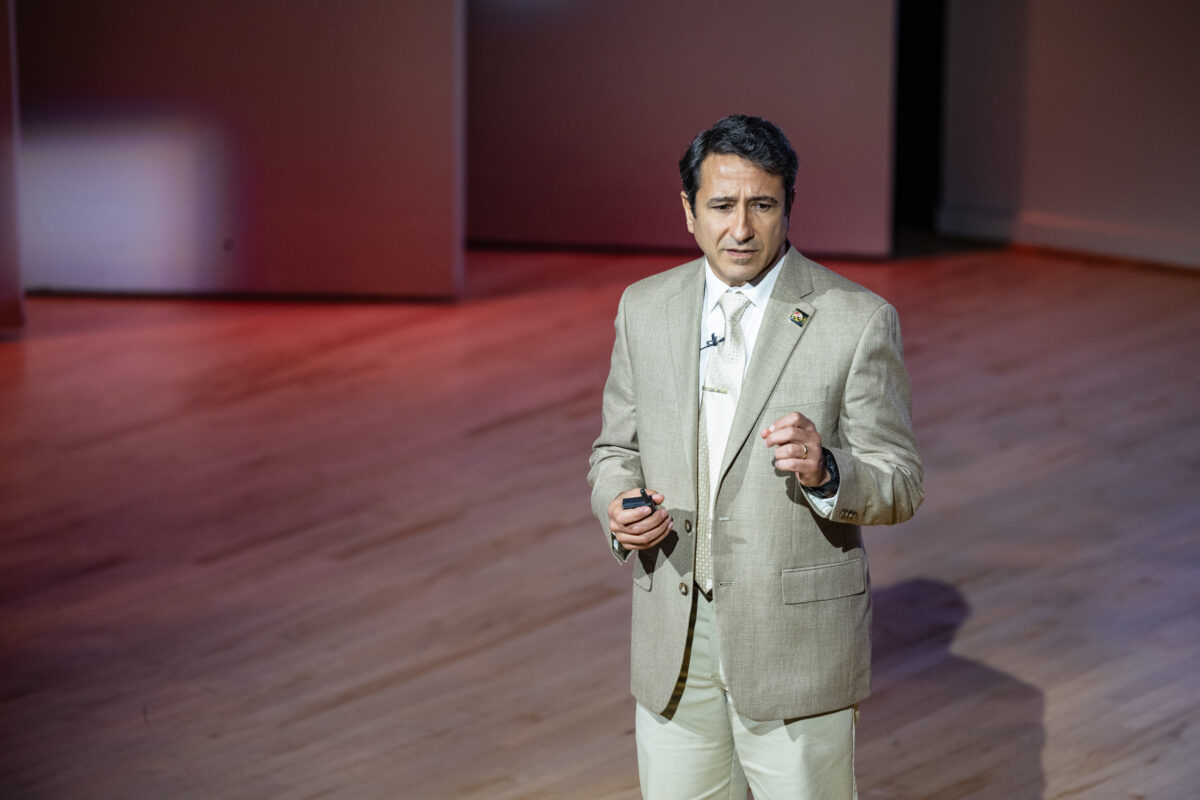 Carlos Romero-Talamás
Similarly, Carlos Romero-Talamás, associate professor of mechanical engineering, explained in his presentation how most sources of energy produce carbon and GHGs, and the work that’s being done to bring the global energy-related CO2 emission levels down to net zero. He discussed the benefits of using fusion energy to achieve that goal, which includes the work he’s doing as the principal investigator of the Centrifugal Mirror Fusion Experiment, a research effort between UMBC and the University of Maryland, College Park that explores a promising alternative to traditional fusion power approaches.
“Fusion energy is considered the ultimate source of energy—the fuel is abundant and is non radioactive,” says Romero-Talamás. “It is urgent to decarbonize our economy and our energy infrastructure because we are harming the planet [and] are running towards a climate disaster.”
Past histories and future possibilities
Michelle R. Scott, associate professor of history, brought the GRIT-X audience back to a moment in time in which Black Vaudeville performers used economic empowerment as a form of resistance in the 1920s. Scott explained her research into the institutional history of the Theater Owners’ Booking Association’s (T.O.B.A.) origins, which she wrote about in her book T.O.B.A. Time: Black Vaudeville and the Theater Owners’ Booking Association in Jazz Age America(University of Illinois Press, 2023).
“The [Vaudeville] circuit itself—its success—was a testament to Black excellence in terms of business, Black artistic skill, and a momentary period of interracial cooperation. It was truly an example of Jazz-age resistance,” Scott said during her presentation.
 Michelle R. Scott delivering her GRIT-X 2023 talk entitled “Jazz Age Resistance: Economic Empowerment and Entertainment in a Divided Nation.”
Mercedes Burns, assistant professor of biological sciences, explained a different kind of history—the history of arachnids. Burns, who received an NSF CAREER Award earlier this year, enlightened the audience with her research on spiders, opiliones (commonly known as daddy longlegs), and other kinds of arachnids. She outlined reasons why we should appreciate these “unloveable” creatures.
“Spiders have been living their lives for much longer than any vertebrate has —they’ve persisted over a millennia,” Burns explained in her GRIT-X talk. “Arachnids…thoughtfully consume unloveable things in our habitats. Arachnids are [also] quite attentive to their environment. They are master architects and material scientists. If you’re curious about the organisms that surround you and you’re interested in learning more or appreciating what those organisms do for the environment and their ecosystem, that leaves no room for fear.”
As a result of her being the first known female African American arachnologist, Burns had a species of trapdoor spiders named after her in 2021, called Ummidia mercedesburnsae. She reflected on the accomplishment, saying “Having experienced that honor of being the matranim of a described species really underscores the legacy that I want to leave.”
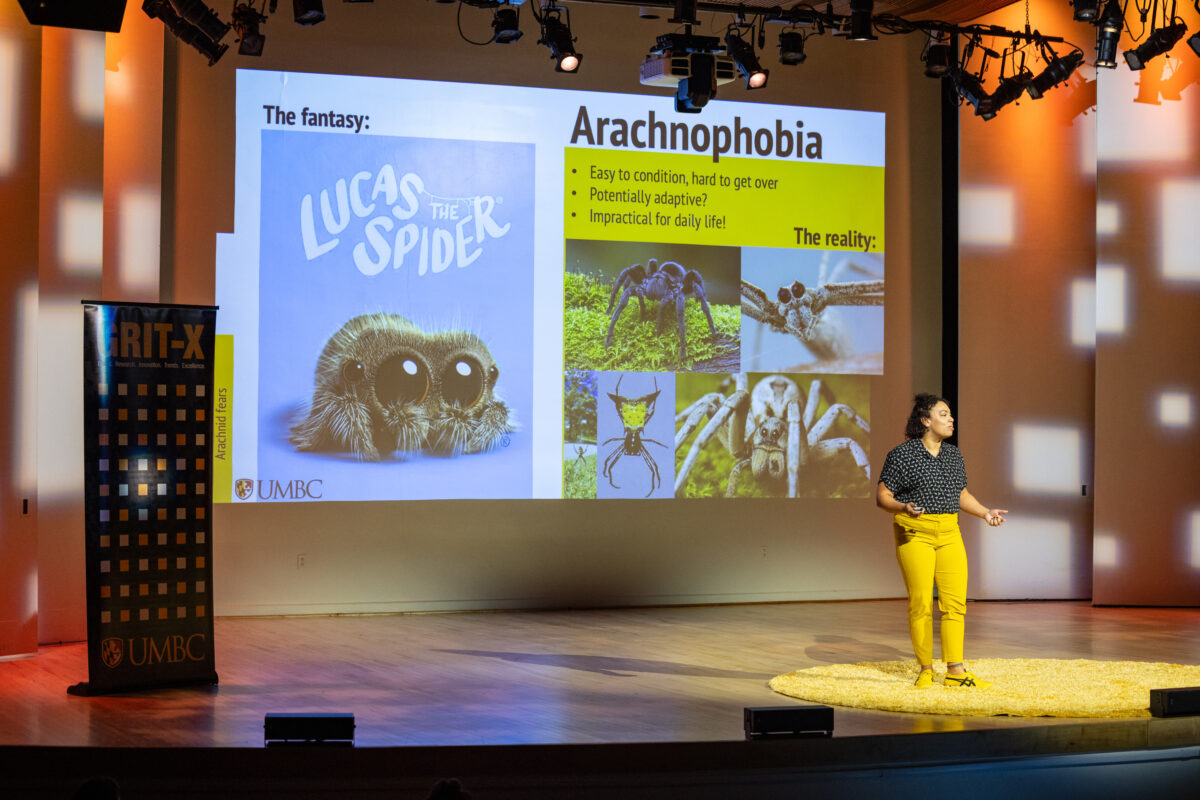 Mercedes Burns
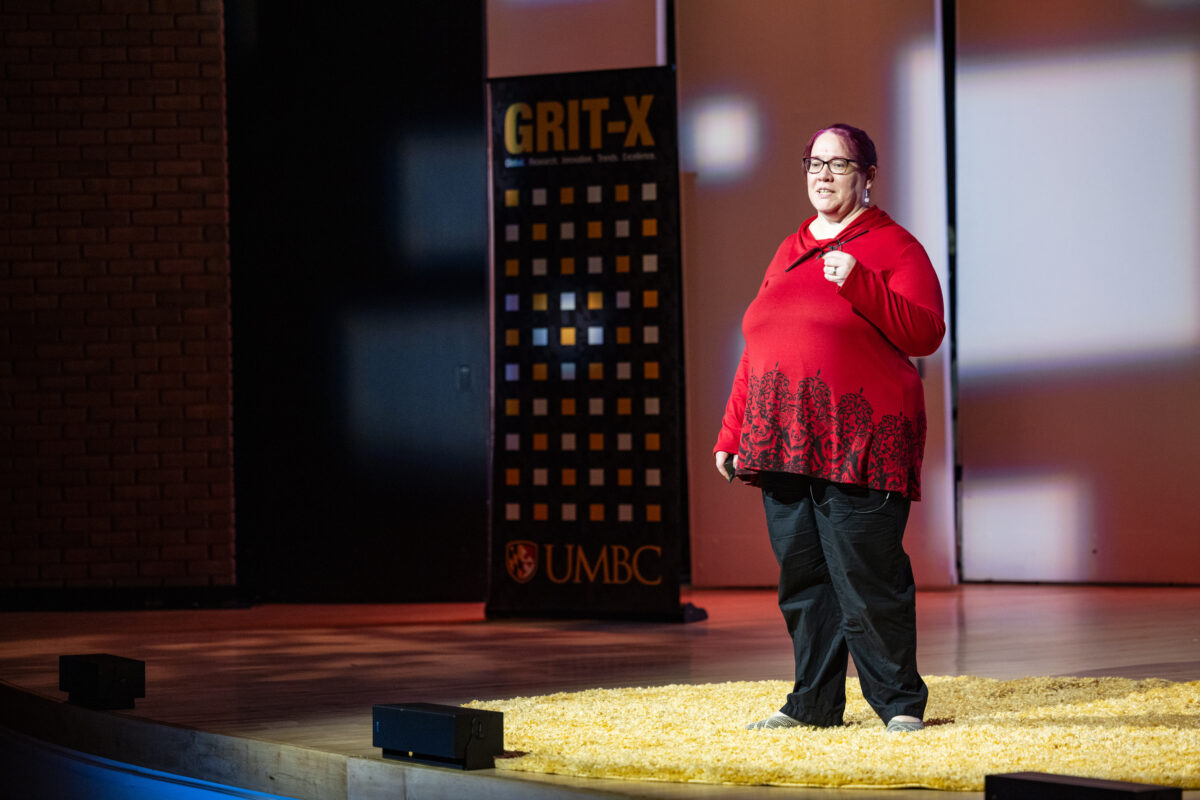 Cynthia Matuszek
Fellow UMBC NSF CAREER Award recipient Cynthia Matuszek, assistant professor of computer science and electrical engineering, brought the GRIT-X audience into the future with her presentation on the possibilities of human-robot interaction. Matuszek explained how humans and robots can interact and exist in the same space and how robots can be more useful.
Her work in UMBC’s Interactive Robotics and Language Lab focuses on using grounded language—which refers to language that has meaning in and pertains to the physical world—as a tool to build robots that can perform tasks in real-world environments, instead of being programmed to handle a fixed set of predetermined tasks.
“In order to have robots that are useful in human spaces, we need robots that are flexible and capable of interacting in a variety of contexts,” Matuszek explained in her presentation. “When people use language, we don’t just use words. We use gestures, we point to things, we look at things, and we use body language. Useful language learning for robots needs to take all of these factors into account.”
Learn more about GRIT-X 2023, past speakers, and their research.
]]>
Spiders, robots, climate change, Vaudevillian history, and more—this year’s GRIT-X event had something for inquiring minds of all kinds, with explorations into elements of the past, our collective...
https://umbc.edu/stories/grit-x-2023/
https://my3.my.umbc.edu/api/v0/pixel/news/136915/guest@my.umbc.edu/11dc6c9f4ebc3adc6cc062d7bde6fd42/api/pixel
cahss
cnms
coeit
community
grit-x
news
rca-1
research
science-and-tech
UMBC News & Magazine
https://my3.my.umbc.edu/groups/umbc-news-magazine
https://assets1-my.umbc.edu/system/shared/avatars/groups/000/001/943/24435aa6207c452e7bc15cc74b42c7bb/xsmall.png?1748556657
https://assets1-my.umbc.edu/system/shared/avatars/groups/000/001/943/24435aa6207c452e7bc15cc74b42c7bb/original.png?1748556657
https://assets2-my.umbc.edu/system/shared/avatars/groups/000/001/943/24435aa6207c452e7bc15cc74b42c7bb/xxlarge.png?1748556657
https://assets2-my.umbc.edu/system/shared/avatars/groups/000/001/943/24435aa6207c452e7bc15cc74b42c7bb/xlarge.png?1748556657
https://assets3-my.umbc.edu/system/shared/avatars/groups/000/001/943/24435aa6207c452e7bc15cc74b42c7bb/large.png?1748556657
https://assets1-my.umbc.edu/system/shared/avatars/groups/000/001/943/24435aa6207c452e7bc15cc74b42c7bb/medium.png?1748556657
https://assets2-my.umbc.edu/system/shared/avatars/groups/000/001/943/24435aa6207c452e7bc15cc74b42c7bb/small.png?1748556657
https://assets1-my.umbc.edu/system/shared/avatars/groups/000/001/943/24435aa6207c452e7bc15cc74b42c7bb/xsmall.png?1748556657
https://assets2-my.umbc.edu/system/shared/avatars/groups/000/001/943/24435aa6207c452e7bc15cc74b42c7bb/xxsmall.png?1748556657
UMBC News & Magazine
0
0
false
Tue, 07 Nov 2023 16:53:48 -0500
Tue, 07 Nov 2023 16:53:48 -0500
UMBC’s Vandana Janeja aims to boost high-performance computing know-how to tackle environmental science challenges with a $1 million NSF grant

The discovery of the Higgs boson. The first picture of a black hole. The Covid-19 vaccine. Many recent scientific advances, such as these, owe much to a largely unsung hero: high-performance computing.

Vandana Janeja (Marlayna Demond ’11/UMBC)
Yet the use of high-performance computing is generally limited to a niche group. “Some researchers are very sophisticated in the use of these tools, but many are not,” says Vandana Janeja, a professor of information systems at UMBC.
Janeja is on a mission to spread advanced computing know-how far beyond its current borders. “It’s not just for the elites,” she says.
She was recently awarded a nearly $1 million grant from the National Science Foundation (NSF) that will help further that mission. The grant is part of a larger NSF collaborative award with the University of Maryland Center for Environmental Sciences (UMCES).
Janeja and her UMBC and UMCES colleagues will work to connect a wide range of students and faculty with high-performance computing experts, creating and nurturing what has been called the cyberinfrastructure pipeline. The ultimate goal is to facilitate the flow of knowledge.
“Once one person gains experience, they can turn around and help someone else,” Janeja says. “It’s about supporting and connecting people with resources and not just about setting up the hardware and software.”
Building a high-performance computing workforce
The need for fast computers in research is driven in part by a modern deluge of data. For example, NASA estimates that it will soon have accumulated hundreds of petabytes of Earth science data, from sources such as satellites flying overhead and sensors installed on the ground. Making full use of all that data requires new approaches to computing. While traditional computers generally perform calculations one at a time, high-performance computing facilities break up the work between multiple computing nodes and run processes in parallel.
UMBC has its own high-performance computing facility, which houses computing equipment that can process data significantly faster than a standard laptop. University researchers have employed the fast computers to study topics as diverse as weather modeling, cancer treatment, and flight dynamics.
“Learning how to use high-performance computing is not straight-forward,” says Janeja. Users have to gain a good understanding of the infrastructure of the computers, and also hone their skills in identifying the best techniques to take full advantage of that infrastructure.
People with a good understanding of how these machines and their software work will be in high demand, Janeja adds.
Many modern AI algorithms, which are used by scientific researchers and big tech companies alike, require high-performance computing to operate. “While everyone is running toward the shiny object of AI, many don’t realize that there is a backbone, called cyberinfrastructure, that runs AI,” says Janeja.
Part of Janeja’s goal with the new grant is to educate students who may pursue careers building, maintaining, utilizing, and improving that cyberinfrastructure backbone. She also cares deeply about ensuring diverse groups of people have access to these roles.
“We are trying to democratize the use of cyberinfrastructure and make it accessible to people who have never used it,” Janeja says.
Jack Suess, ‘81, M.S. ‘94, UMBC’s vice president of information technology, says he is excited for his division to play a key role in the award, helping shape best practices and build a national cyberinfrastructure support structure. “I look forward to watching how this work informs not just how we support faculty, but how we train and support advanced undergraduates and graduate students to evolve into these roles,” he says.
Tackling environmental challenges
While there is no shortage of scientific questions that might be tackled with high-performance computing, Janeja and her colleagues on the new grant will test-run their collaborative initiatives with projects in environmental science.

Changes to the ice and snow in Greenland could contribute to sea level rise. (Image credit: NASA)
Janeja is also director of iHARP, an NSF-funded institute that aims to harness big data and advanced computing tools to better model how climate change will affect the polar regions. As part of the new grant, iHARP and UMCES researchers will partner with cyberinfrastructure professionals to explore environmental science questions, such as in iHARP investigating how to predict the rate of snow melting in Greenland.
Scientists increasingly rely on big data and high-performance computing to understand and predict changes in the environment. As human activities continue to put pressure on natural systems, it will be more important than ever to forge collaborations between researchers and computing experts that advance the science.
“I’m excited to leverage high-performance computing to solve real-world problems and make it accessible to students and researchers of all backgrounds,” Janeja says.
]]>
The discovery of the Higgs boson. The first picture of a black hole. The Covid-19 vaccine. Many recent scientific advances, such as these, owe much to a largely unsung hero: high-performance...
https://umbc.edu/stories/vandana-janeja-nsf-grant-computing/
https://my3.my.umbc.edu/api/v0/pixel/news/136681/guest@my.umbc.edu/df7ee24459cf2e6c8d3cbbcb80877422/api/pixel
coeit
doit
is
news
rca-1
research
science-and-tech
UMBC News & Magazine
https://my3.my.umbc.edu/groups/umbc-news-magazine
https://assets1-my.umbc.edu/system/shared/avatars/groups/000/001/943/24435aa6207c452e7bc15cc74b42c7bb/xsmall.png?1748556657
https://assets1-my.umbc.edu/system/shared/avatars/groups/000/001/943/24435aa6207c452e7bc15cc74b42c7bb/original.png?1748556657
https://assets2-my.umbc.edu/system/shared/avatars/groups/000/001/943/24435aa6207c452e7bc15cc74b42c7bb/xxlarge.png?1748556657
https://assets2-my.umbc.edu/system/shared/avatars/groups/000/001/943/24435aa6207c452e7bc15cc74b42c7bb/xlarge.png?1748556657
https://assets3-my.umbc.edu/system/shared/avatars/groups/000/001/943/24435aa6207c452e7bc15cc74b42c7bb/large.png?1748556657
https://assets1-my.umbc.edu/system/shared/avatars/groups/000/001/943/24435aa6207c452e7bc15cc74b42c7bb/medium.png?1748556657
https://assets2-my.umbc.edu/system/shared/avatars/groups/000/001/943/24435aa6207c452e7bc15cc74b42c7bb/small.png?1748556657
https://assets1-my.umbc.edu/system/shared/avatars/groups/000/001/943/24435aa6207c452e7bc15cc74b42c7bb/xsmall.png?1748556657
https://assets2-my.umbc.edu/system/shared/avatars/groups/000/001/943/24435aa6207c452e7bc15cc74b42c7bb/xxsmall.png?1748556657
UMBC News & Magazine
0
0
false
Mon, 30 Oct 2023 15:12:27 -0400
Mon, 30 Oct 2023 15:12:27 -0400
Erin Green receives $1.2 million NIH grant to study cellular pathways involved in cancer, neurodegeneration

Having a proper balance of proteins in our cells—the right kinds and the right number, depending on the cell type—is critical for optimal health. The proteins also need to avoid “misfolding”—contorting into shapes that prevent them from doing their jobs. It’s normal for proteins to misfold here and there, and there are mechanisms in cells to destroy aberrant proteins. But sometimes these systems fail. They also worsen as we age.
Protein misfolding “underlies a lot of diseases and aging,” says Erin Green, associate professor of biological sciences. In particular, cancer and neurodegenerative diseases like amyotrophic lateral sclerosis (ALS) and Alzheimer’s can be tied to a buildup of misfolded proteins.
In Green’s lab, she and her students are studying cellular pathways that may help maintain the balance of healthy proteins in a cell, a state called “proteostasis.” A deeper understanding of how cells protect healthy proteins and get rid of damaged ones may eventually lead to improved treatments for diseases caused by protein misfolding.
Now, a four-year, $1.2 million grant from the National Institute of General Medical Sciences will help the group build on work from a previous grant from the National Institute on Aging (NIA), and add further detail to the role of particular enzymes involved in proteostasis.
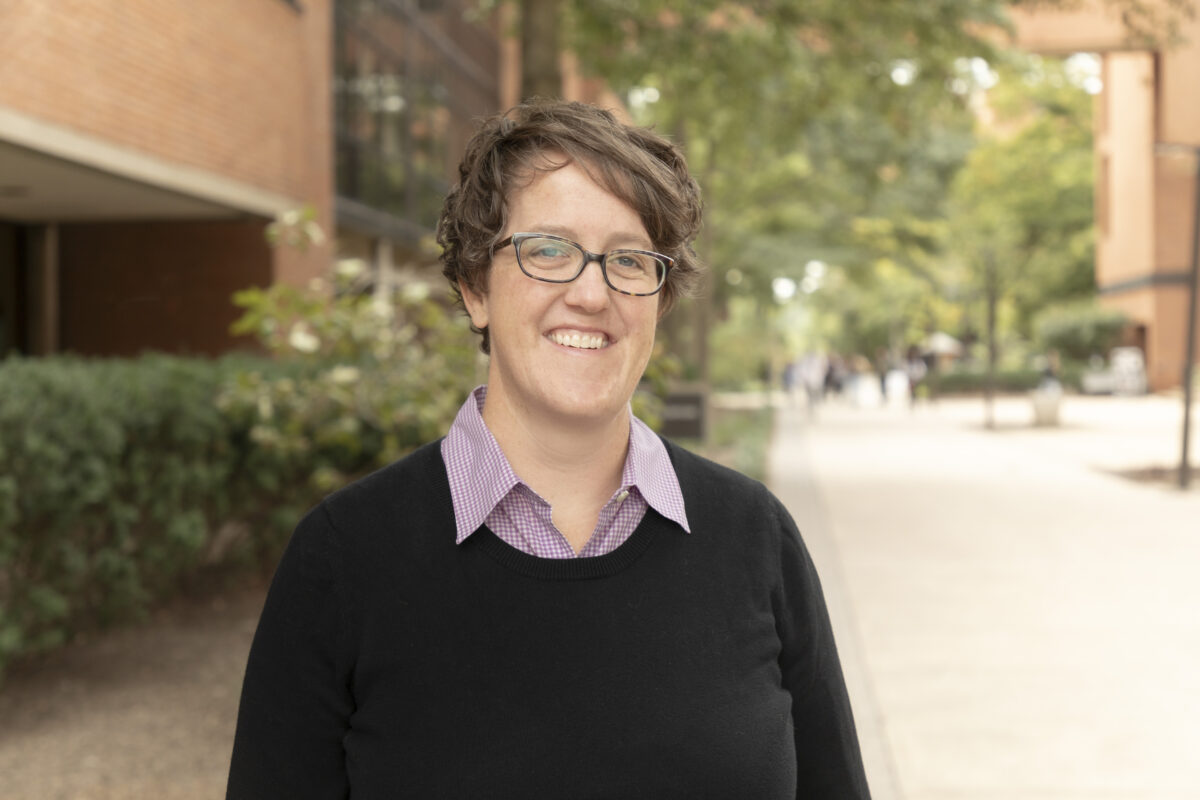 Erin Green’s research group is leaning into a new area of research on how organisms maintain a healthy balance of functional proteins. (Melissa Penley Cormier, M.F.A. ’17/UMBC)
Building discovery on discovery
With the NIA support, Green’s group discovered that the enzyme Set6 is important for maintaining protein balance in cells of budding yeast, a model organism. Set6 and other proteins in the same family are closely related to human enzymes in the SMYD gene family. Set6 adds methyl groups, small molecules made up of three carbon atoms and a hydrogen atom, to the amino acid lysine in proteins. These methyl groups can affect how proteins function.
“All of the machinery in yeast is very similar to in humans, and we have lots of tools for genetic and molecular manipulation in yeast,” Green explains. “You can do the same things in human cells, but it works much more rapidly and is simplified in yeast.”
After identifying the relevant enzyme, the team found molecules they believe Set6 interacts with. Now they’d like to confirm the interactions they identified, and then explore how they are controlled and their functions—all of which is unknown.
“There’s not a single published paper on Set6. Our goal is to uncover what I think will be a new function for this set of enzymes,” Green says. “Then we can apply that knowledge to investigating whether or not any of the human proteins have a similar role in human cells.”
If there’s a match with a human enzyme, then that would open the door to further work seeking to “keep proteostasis intact longer, and potentially prevent conversion into a disease state,” Green says.
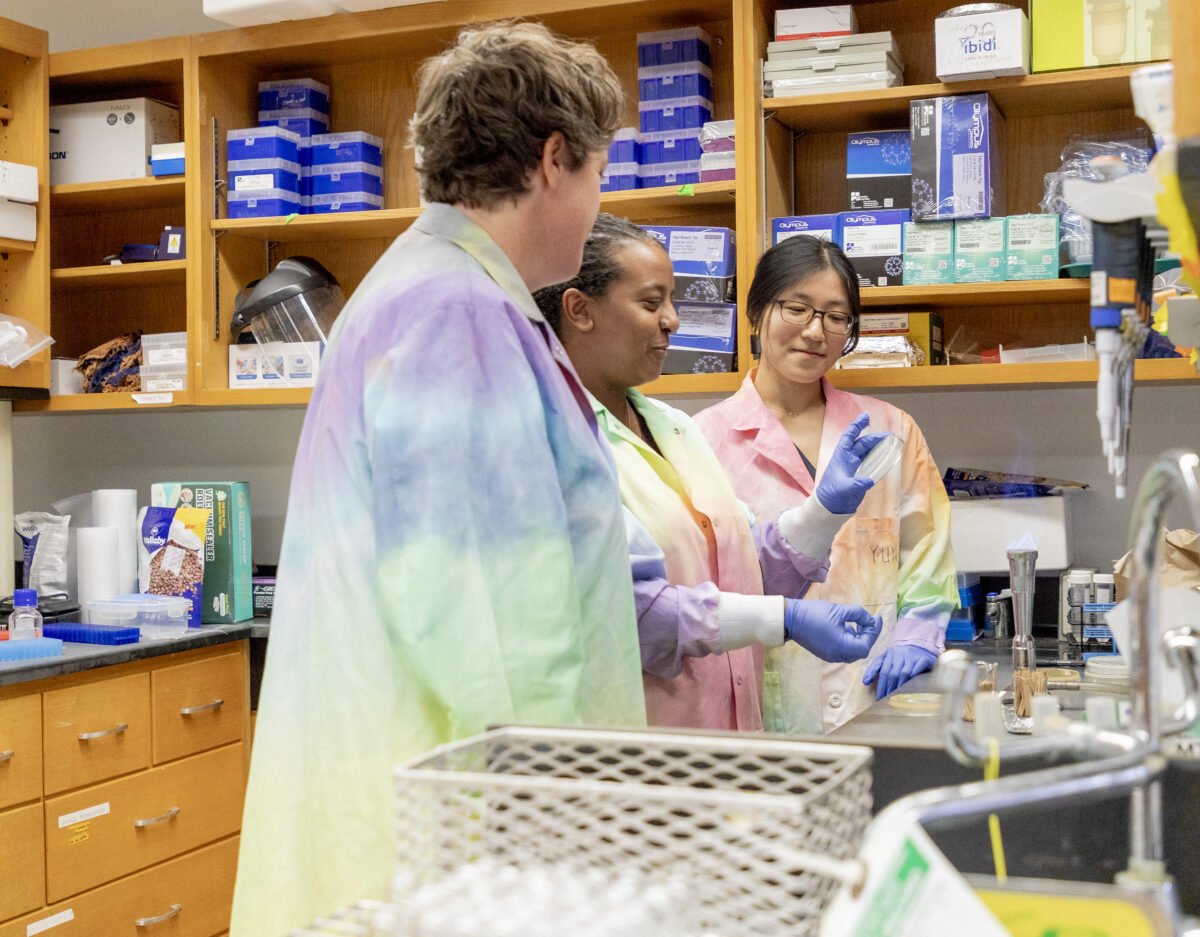 Left to right: Erin Green and graduate students Maki Negesse and Winny Sun hard at work in the Green lab. (Melissa Penley Cormier, M.F.A. ’17/UMBC)
Students lead the way
Luke Mason, a third-year Ph.D. student in Green’s lab, will take a leading role in the new project. He’ll be joined by a new graduate student supported by the NIH grant. “Set6 is upregulated under stressful conditions,” particularly a lack of nitrogen, Mason says. “I’m trying to figure out the specific interactions of Set6 and what it does.”
He has also found a home in Green’s lab. “It’s an environment that’s very conducive to teamwork,” Mason says. “People are always willing to share knowledge, skill sets, and really anything to help each other out.” That support is particularly valuable when knowledge about the enzymes they are investigating is still so limited, he adds.
Winny Sun, a Ph.D. student in her fourth year with Green’s lab, will be less directly involved in the new project, but her previous work on the related protein Set4 helped pave the way for this new direction. She studies Set4 under oxygen deprivation—a different kind of stress. Sun developed techniques for working with proteins that are only detectable under stress, and now Mason will apply them to the Set6 enzyme work.
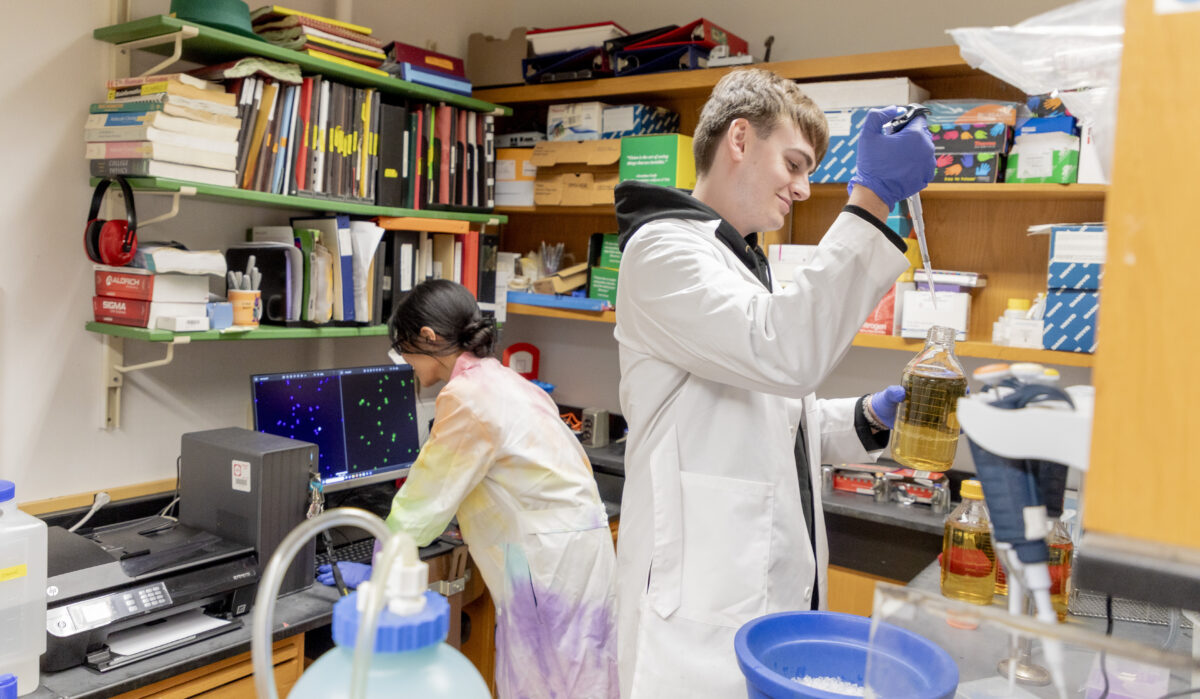 Winny Sun (left) and Luke Mason are two of the graduate students who have contributed substantially to the Set6 research in Erin Green’s lab. (Melissa Penley Cormier, M.F.A. ’17/UMBC)
Nurturing research leaders
“Erin provides a lot of opportunities to grow as a scientist,” Sun says. One Green Lab member completed an internship at biotech firm Genentech and another traveled to France to work with a collaborator, Sun says, adding that she has had opportunities to present at NIH conferences.
Oluwaseun Kintunde ’25, biological sciences, also appreciates working with Green. After her initial interview, she remembers thinking, “This is someone who I want to continue to mentor me, because she is so easy to talk to.” She has also received mentorship from the graduate students in the lab. “I can talk to Winny about anything,” Kintunde shares.
Green prioritizes mentoring her students, and works directly with both her graduate and undergraduate lab members. She knows a research career, whether in academia or industry, comes with successes alongside setbacks, so, she says, “The idea is to send them off into the world with the skill set that they need to deal with all the challenges they may face.”
Uncovering new biology
As the team forges ahead, the overall goal is to develop a molecular understanding of how Set6 contributes to proteostasis, Green says. That includes confirming what molecules it interacts with and exploring what biological pathways it may control. The group’s discovery of the enzyme’s response to stress is especially intriguing.
“There’s a ton of open questions, and I feel like there’s a lot of new biology to uncover there,” Green says. Given the SET family proteins’ implications for prevalent diseases like cancer and neurodegeneration, she adds, “If we can define at the molecular level how it’s working in yeast, there’s a lot of applications moving forward for broadening the research.”
]]>
Having a proper balance of proteins in our cells—the right kinds and the right number, depending on the cell type—is critical for optimal health. The proteins also need to avoid...
https://umbc.edu/stories/cellular-pathways-for-protein-health/
https://my3.my.umbc.edu/api/v0/pixel/news/135897/guest@my.umbc.edu/8e46b50e78922eae8c710a86d69c1d56/api/pixel
biology
cnms
gradresearch
news
rca-1
research
science-and-tech
UMBC News & Magazine
https://my3.my.umbc.edu/groups/umbc-news-magazine
https://assets1-my.umbc.edu/system/shared/avatars/groups/000/001/943/24435aa6207c452e7bc15cc74b42c7bb/xsmall.png?1748556657
https://assets1-my.umbc.edu/system/shared/avatars/groups/000/001/943/24435aa6207c452e7bc15cc74b42c7bb/original.png?1748556657
https://assets2-my.umbc.edu/system/shared/avatars/groups/000/001/943/24435aa6207c452e7bc15cc74b42c7bb/xxlarge.png?1748556657
https://assets2-my.umbc.edu/system/shared/avatars/groups/000/001/943/24435aa6207c452e7bc15cc74b42c7bb/xlarge.png?1748556657
https://assets3-my.umbc.edu/system/shared/avatars/groups/000/001/943/24435aa6207c452e7bc15cc74b42c7bb/large.png?1748556657
https://assets1-my.umbc.edu/system/shared/avatars/groups/000/001/943/24435aa6207c452e7bc15cc74b42c7bb/medium.png?1748556657
https://assets2-my.umbc.edu/system/shared/avatars/groups/000/001/943/24435aa6207c452e7bc15cc74b42c7bb/small.png?1748556657
https://assets1-my.umbc.edu/system/shared/avatars/groups/000/001/943/24435aa6207c452e7bc15cc74b42c7bb/xsmall.png?1748556657
https://assets2-my.umbc.edu/system/shared/avatars/groups/000/001/943/24435aa6207c452e7bc15cc74b42c7bb/xxsmall.png?1748556657
UMBC News & Magazine
1
0
false
Fri, 29 Sep 2023 17:17:49 -0400
Fri, 29 Sep 2023 17:17:49 -0400
UMBC joins collaboration to create new STEM education, research center at Arecibo Observatory site in Puerto Rico

This week UMBC was named as one of four institutions chosen to work together on a National Science Foundation-funded project to establish a new science educational center at the Arecibo Observatory site in Puerto Rico. NSF will contribute more than $5 million over five years to establish the multidisciplinary center, called the Arecibo Center for Culturally Relevant and Inclusive Science Education, Computational Skills, and Community Engagement (Arecibo C3).
The center is expected to open in early 2024 and will include a research laboratory and a hands-on, interactive science center open to the public.

Patricia Ordóñez (Photo courtesy of Patricia Ordóñez)
Patricia Ordóñez,M.S. ’10, Ph.D. ’12, computer science, an associate professor in information systems, will lead UMBC’s contributions to the project. As part of the Arecibo C3 collaboration, Ordóñez is organizing a Women in Data Science Puerto Rico conference, as well as several workshops in data science that will be held both online and in person. One of the workshops will prepare attendees to participate in the 2024 Women in Data Science Worldwide datathon. Other workshops will recruit mothers and daughters to learn coding together, and will teach new skills to women and other participants who already code.
Several UMBC graduate and undergraduate students and staff members have been involved in developing and testing the workshop materials.
“My passion has always been to increase the number of Latinas in computing,” says Ordóñez, who, before joining the faculty of UMBC, was a member of the computer science department at the University of Puerto Rico-Río Piedras. “There are too few of us in the field—creating inclusive programs from Arecibo C3 will help us bridge that gap.”
The other grant awardees are Cold Spring Harbor Laboratory, University of Puerto Rico-Río Piedras, and the Universidad del Sagrado Corazón. In addition to data science programming, Arecibo C3 will offer a suite of activities, including explorations of biodiversity and how to identify species using short segments of DNA. The Arecibo C3 team will also advance research to explore how STEM teaching can be enhanced through the presentation of data in audio, tactile, and other sensory forms, to increase accessibility.
“The new educational center builds on the great scientific, educational, and cultural legacy of the Arecibo Observatory and is closely aligned with NSF’s goal to create STEM opportunities everywhere,” said James L. Moore III, NSF assistant director for STEM Education, in a press release. “The center aims to create new opportunities for STEM education, exploration, discovery, engagement and participation of students, scientists and researchers in various STEM disciplines ranging from astronomy and radio science to biological, computer and natural sciences in Puerto Rico and beyond.”
Ordóñez credits the talents of the whole Arecibo C3 team with turning what feels like a dream of hers into a reality. “We recognize the responsibility of what we are doing and we are going to work very hard to create the environment of inclusive excellence in Arecibo that everyone deserves, so that everyone sees they have a place in STEM,” she says.
For updates on the project, please visit the Arecibo C3 website.
]]>
This week UMBC was named as one of four institutions chosen to work together on a National Science Foundation-funded project to establish a new science educational center at the Arecibo...
https://umbc.edu/stories/umbc-joins-arecibo-collaboration/
https://my3.my.umbc.edu/api/v0/pixel/news/135893/guest@my.umbc.edu/1a0bf4c1110d4158547aabb3b7e442a0/api/pixel
coeit
csee
news
puerto-rico
rca-1
research
science-and-tech
science-education
UMBC News & Magazine
https://my3.my.umbc.edu/groups/umbc-news-magazine
https://assets1-my.umbc.edu/system/shared/avatars/groups/000/001/943/24435aa6207c452e7bc15cc74b42c7bb/xsmall.png?1748556657
https://assets1-my.umbc.edu/system/shared/avatars/groups/000/001/943/24435aa6207c452e7bc15cc74b42c7bb/original.png?1748556657
https://assets2-my.umbc.edu/system/shared/avatars/groups/000/001/943/24435aa6207c452e7bc15cc74b42c7bb/xxlarge.png?1748556657
https://assets2-my.umbc.edu/system/shared/avatars/groups/000/001/943/24435aa6207c452e7bc15cc74b42c7bb/xlarge.png?1748556657
https://assets3-my.umbc.edu/system/shared/avatars/groups/000/001/943/24435aa6207c452e7bc15cc74b42c7bb/large.png?1748556657
https://assets1-my.umbc.edu/system/shared/avatars/groups/000/001/943/24435aa6207c452e7bc15cc74b42c7bb/medium.png?1748556657
https://assets2-my.umbc.edu/system/shared/avatars/groups/000/001/943/24435aa6207c452e7bc15cc74b42c7bb/small.png?1748556657
https://assets1-my.umbc.edu/system/shared/avatars/groups/000/001/943/24435aa6207c452e7bc15cc74b42c7bb/xsmall.png?1748556657
https://assets2-my.umbc.edu/system/shared/avatars/groups/000/001/943/24435aa6207c452e7bc15cc74b42c7bb/xxsmall.png?1748556657
UMBC News & Magazine
0
0
false
Fri, 29 Sep 2023 14:18:28 -0400
Fri, 29 Sep 2023 14:18:28 -0400