UMBC’s exploratory artist in residence Levester Williams examines history of Cockeysville marble in film project

Since 2014, multimedia artist Levester Williams has developed a personal connection and exploration with a natural material that is a historic staple of Baltimore life—Cockeysville, Maryland, marble.
Go down specific streets in neighborhoods like Highlandtown, Charles Village, Cherry Hill, or Mount Vernon and you’ll see the ubiquitous, three-to-four tiered steps made of marble outfitting the exterior of many rowhomes throughout Baltimore, much of it from Cockeysville. Beyond the steps, you’ll also find the stone in landmarks such as Baltimore’s City Hall, the Washington monuments in Baltimore and D.C., and the 108 columns of the U.S. Capitol Building.
“The stone is a literal and figurative bedrock of our nation. It’s used in many prominent monuments and institutions,” explains Williams, who is a 2023 – 2024 artist in residence in UMBC’s Exploratory Research Residency Program, a component of the university’s Center for Art, Design, and Visual Culture (CADVC).
In this pilot artist residency program, Williams is collaborating with the CADVC to complete a new video art project called “dreaming of a beyond: Baltimore,” in which the artist is researching the history of Cockeysville marble, underscoring the “intertwined history of African Americans’ plight to self-determined agency and full citizenship, and a rather benign stone.”
More than just marble
In his work, Williams examines the relationship between objects, humans, and the physical world with art that includes sculptures, installations, sound, animations, drawings, and videos. Williams is continuing that exploration in “dreaming of a beyond: Baltimore,” part of his ongoing series focused on the dolomitic stone that is quarried in Cockeysville, 25 miles from Catonsville. The series explores Williams’ desire to examine his idea of “the beyond—where race is no longer tethered to value; where my body matters just as much as other bodies matter,” he says.
 A drone image of the Texas Quarry in Cockeysville, Maryland, one of the locations where Cockeysville marble is mined. (Photo courtesy of Levester Williams)
The artist began his exploration into the stone after reading a passage in Lindon Barrett’s book Blackness and Value: Seeing Double about jazz singer Billie Holiday’s time growing up in Baltimore. The book references Holiday’s autobiography, Lady Sings the Blues, which documents her stint cleaning the marble steps in Baltimore as a teenager.
“White homeowners were obsessed with keeping the white marble stoops clean, and didn’t care how the inside of their homes looked, as long as the steps were clean,” says Williams in reference to the passage about Holiday in Blackness and Value. The steps were seen as a marker of class and economic status, he adds, explaining how “Holiday knew that and was able to bargain to get more money for cleaning the stoops.”
Through archival research, Williams learned more about the stone’s connection to Black people in Baltimore and their bodies as they handled, cleaned, and labored over the marble. As part of his CADVC residency, Williams conducted research at the Maryland Center for History and Culture, using the center’s digital archives of Baltimore’s historic Afro-American newspaper and photographer Paul Henderson’s collection of images he captured for the paper from 1930 through 1960. The archives showcase the long history of Baltimore’s Black residents who cleaned and maintained the marble steps as part of their daily routines.
“Bodies in space”
The “dreaming of a beyond” series consists of short vignettes capturing performers touching and physically engaging with structures, objects, and buildings made with Cockeysville marble at different sites throughout the northeast region. Beyond Maryland, the marble can be found in places such as the Buffalo AKG Art Museum in upstate New York; the Fisher Building in Detroit; Girard College in Philadelphia; and St. Patrick’s Cathedral in New York City.
In Baltimore, Williams filmed performers interacting with the (original) Washington Monument in Mount Vernon Place. Nia Hampton, an intermedia and digital arts (IMDA) graduate student at UMBC, and her mother, Sheila Gaskins, were featured in “dreaming of a beyond: Baltimore,” filmed with the assistance of IMDA student Bao Nguyen. A sneak peek of Williams’ in-development projection demo was on display at the CADVC in February.
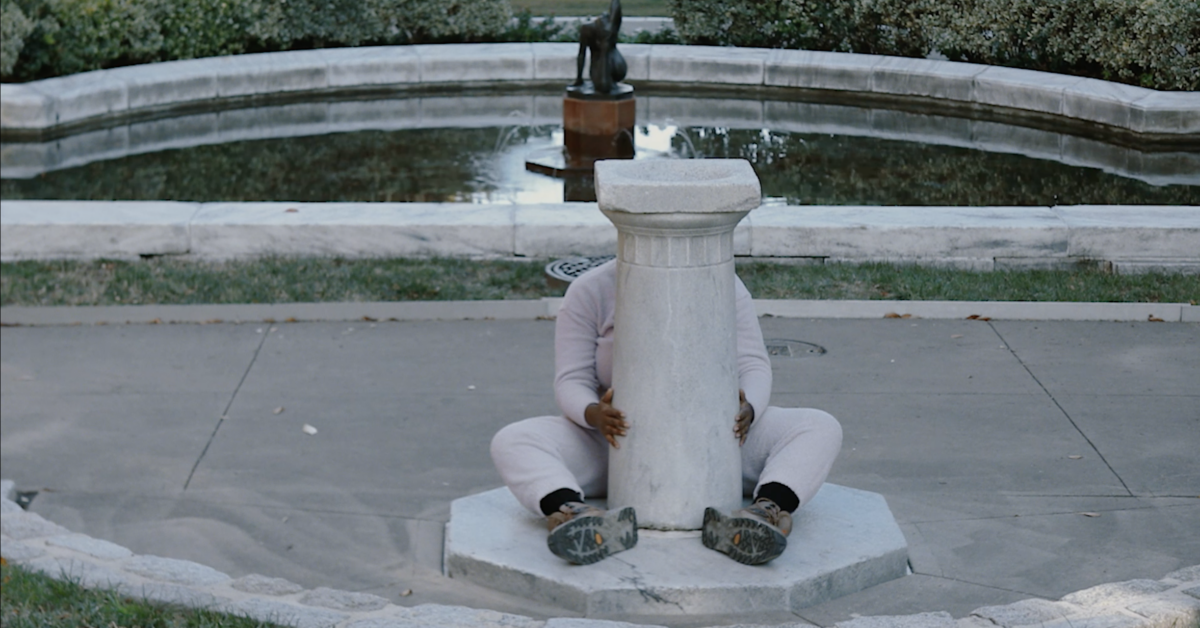 Video still of Nia Hampton in the vignette “Nia’s Embrace” from “dreaming of a beyond: Baltimore,” filmed at Mount Vernon Park Place in November 2023. (Photo by Levester Williams)
The film—which was projected onto the side of a building across from the CADVC’s outdoor amphitheater space—captures the mother-daughter duo physically engaging with the monument with movements that included hugging, caressing, scaling, and sprawling various body parts across the marble-encased statue. Williams worked with artist and intimacy coordinator Savannah Knoop to “reconfigure and think about bodies in space, non-human bodies, and what it is to give consent to these things,” he says.
“What I appreciate about Levester’s work is its level of obscurity,” says Hampton. “When I saw his work, I thought it was different—I never saw anything like it before.”
When she learned that the artist wanted the film’s subjects to be local residents with a deep connection to Baltimore’s history, Hampton referred Williams to her mother. Gaskins, a multi-disciplined artist who has been a local arts advocate and educator for more than four decades, wrote and directed “Last House Standing: A Play About the Highway to Nowhere”in 2016. The play included performers playing the role of the marbled stoop steps.
“When I was interacting with the marble [in the work with Williams], it wasn’t a pretty thing. I was thinking about my ancestors. Nia and I were having conversations about the slaves that probably built the monument. All of that was in our minds when we were interacting with the marble,” says Gaskins.
 Nia Hampton (left) and Sheila Gaskins in “standing ground (On Washington)” from “dreaming of a beyond: Baltimore,” filmed at the base of the Washington Monument in Baltimore. (Photo by Levester Williams)
“Black folks touching the stone have been an anchor in this master-slave dynamic. I reimagined this relationship between the Black body and the stone, which is not in service of this power dynamic,” says Williams. “I’m using this stone as a way to reimagine Black folks in public spaces.”
Artistic practice as research
This fall, the CADVC gallery is set to premiere a selection of Williams’ artwork that emerges from his “dreaming of a beyond: Baltimore” research as part of the introduction to the center’s public video projection gallery series, which will be on display in the Fine Arts Building Amphitheater. The series is anticipated to rotate new video artwork presentations and will run for the next several years, says Rebecca Uchill, director of the CADVC.
The fall projection presentation will also coincide with the “all matters aside” exhibition at the CADVC that will feature a retrospective of Williams’ work from the last 10 years, organized by curator Lisa Freiman. Williams’ work was previously featured in “Declaration,” the inaugural exhibition at the Institute for Contemporary Art at Virginia Commonwealth University that Freiman curated as the institute’s inaugural director.
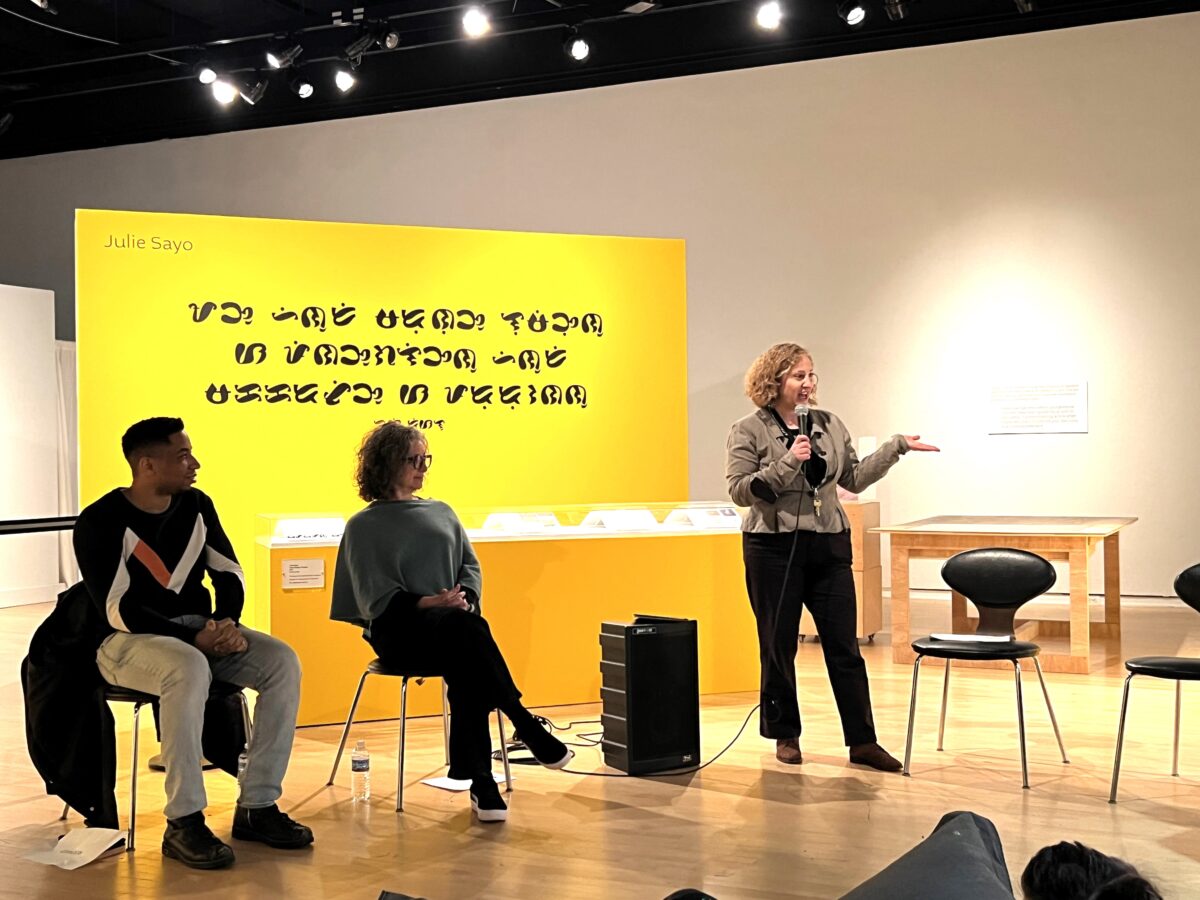 Levester Williams, Lisa Freiman, and Rebecca Uchill at the sneak peak projection demo of “dreaming of a beyond: Baltimore” in February 2024 at the CADVC. (Photo by Tedd Henn, courtesy of the CADVC)
Wiliams’ projection work will also feature an accompanying booklet that includes an essay by Michelle Wright, professor of history and Africana studies at the Community College of Baltimore County. Wright’s essay, “Scrubbed Clean,” examines the complex history of Beaver Dam marble, its use in Baltimore’s Washington Monument, and its connections to the city’s history of racial division.
Along with Williams, the CADVC Exploratory Research Residency Program also hosted artists Tomashi Jackson and Paul Rucker. Portions of the program have been funded by the Maryland State Arts Council, the Baltimore County Commission on Arts and Culture, and UMBC’s College of Arts, Humanities, and Social Sciences’ Big Ideas initiative. The pilot program, which launched in 2022, “recognizes the inherent research that is artistic practice,” Uchill explains.
“Artists are researchers, technicians, and producers. I think some of that occasionally may be underemphasized in certain contexts, but fortunately not at UMBC. CADVC’s residency program aligns with the rigor, creativity, and civic engagement of the university at large, and feeds into other areas of our center’s programs in exhibition, publication, and creative production,” says Uchill. “This has been an especially enriching opportunity because of UMBC’s laudable, sincere belief in the importance of the arts as research.”
For Williams, the exploratory residency program is helping him to expand his interpretation of being Black and existing in public spaces: “There’s no hierarchy of us existing in space and doing that through touch is what my project is focused on. Having these performers touch the stone in any way that they want is [my idea of] pushing back and getting to that ‘beyond’.”
]]>
Since 2014, multimedia artist Levester Williams has developed a personal connection and exploration with a natural material that is a historic staple of Baltimore life—Cockeysville, Maryland,...
https://umbc.edu/stories/exploratory-artist-levester-williams-marble/
https://my3.my.umbc.edu/api/v0/pixel/news/142784/guest@my.umbc.edu/6451d2c213b5ef5e11ff25ba1ef6b2c4/api/pixel
arts-and-culture
cadvc
cahss
community
feature
imda
news
rca-2
research
story
visualarts
UMBC News & Magazine
https://my3.my.umbc.edu/groups/umbc-news-magazine
https://assets1-my.umbc.edu/system/shared/avatars/groups/000/001/943/24435aa6207c452e7bc15cc74b42c7bb/xsmall.png?1748556657
https://assets1-my.umbc.edu/system/shared/avatars/groups/000/001/943/24435aa6207c452e7bc15cc74b42c7bb/original.png?1748556657
https://assets2-my.umbc.edu/system/shared/avatars/groups/000/001/943/24435aa6207c452e7bc15cc74b42c7bb/xxlarge.png?1748556657
https://assets2-my.umbc.edu/system/shared/avatars/groups/000/001/943/24435aa6207c452e7bc15cc74b42c7bb/xlarge.png?1748556657
https://assets3-my.umbc.edu/system/shared/avatars/groups/000/001/943/24435aa6207c452e7bc15cc74b42c7bb/large.png?1748556657
https://assets1-my.umbc.edu/system/shared/avatars/groups/000/001/943/24435aa6207c452e7bc15cc74b42c7bb/medium.png?1748556657
https://assets2-my.umbc.edu/system/shared/avatars/groups/000/001/943/24435aa6207c452e7bc15cc74b42c7bb/small.png?1748556657
https://assets1-my.umbc.edu/system/shared/avatars/groups/000/001/943/24435aa6207c452e7bc15cc74b42c7bb/xsmall.png?1748556657
https://assets2-my.umbc.edu/system/shared/avatars/groups/000/001/943/24435aa6207c452e7bc15cc74b42c7bb/xxsmall.png?1748556657
UMBC News & Magazine
0
0
false
Mon, 15 Jul 2024 14:48:42 -0400
Mon, 15 Jul 2024 14:48:42 -0400
The Mellon Foundation awards UMBC’s Gender, Women’s, and Sexuality Studies department $100,000 as part of its ‘Affirming Multivocal Humanities’ initiative
UMBC’s Gender, Women’s, and Sexuality Studies (GWST) department has received a $100,000 grant from the Mellon Foundation to implement its Advancing Gender and Sexuality Studies in Community project. UMBC is one of 95 public colleges and university programs leading research on race, ethnicity, gender, or sexuality to receive funding from the Mellon Foundation’s $18 million “Affirming Multivocal Humanities” initiative.
“[The] initiative champions the scholarship and teaching taking place in these disciplines—those that are too often undervalued and even undermined in American society today,” says Elizabeth Alexander, president of the Mellon Foundation. “We are proud to support colleges and universities in the United States advancing deep research and curricular engagement with the stories and histories of our country’s vastly diverse racial, ethnic, and gender identities.”
Advancing GWST
The Advancing Gender and Sexuality Studies in Community project broadens three programs. The UMBC LGBTQ+ Oral History Project, the Korenman Lecture series, and social change-skills development workshops. “This Mellon funding enables our students, faculty, and staff, to further expand our pedagogical and community-building work around critical sexuality studies,” says Vrushali Patil, chair and professor of GWST. “It also enhances how GWST helps realize UMBC’s goal of inclusive excellence.”
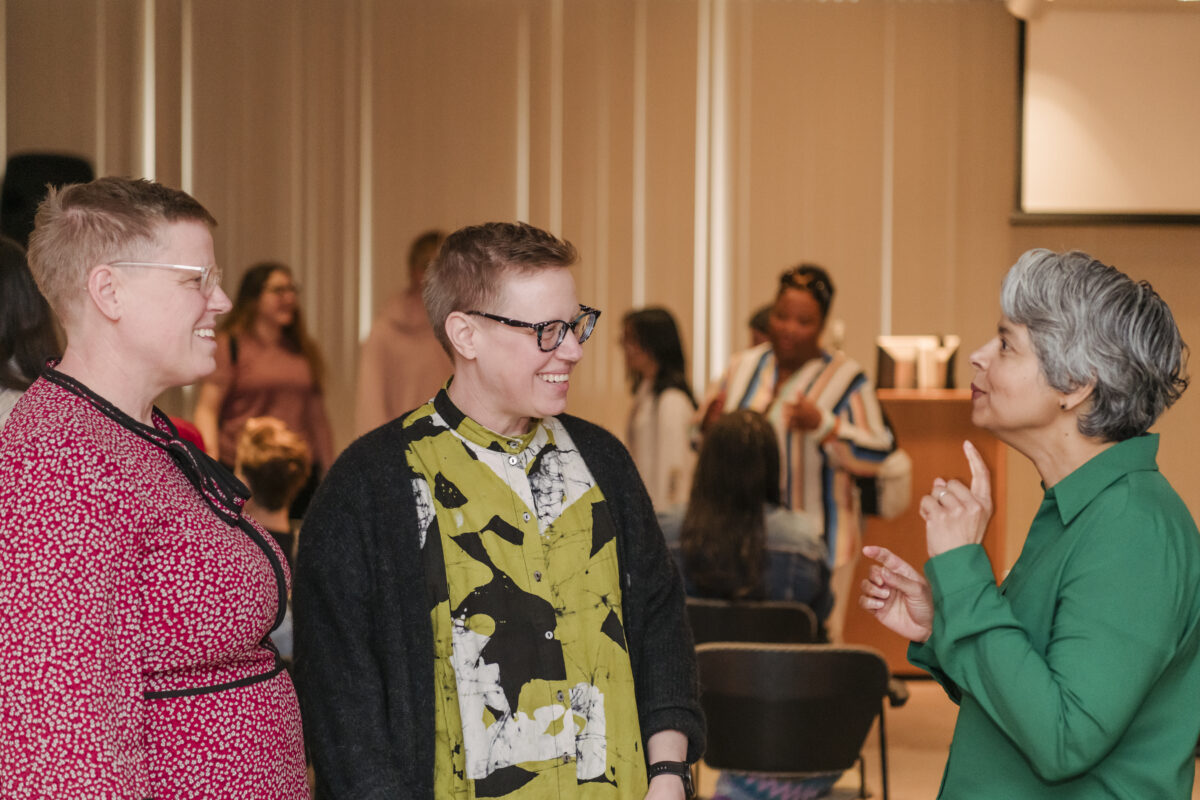 (l-r) Kate Drabinski, Kate Drabinski, Emily Drabinskis, president of the American Library Association, and Vrushali Patil.
The oral history project trains undergraduate students on oral history interview skills with community members such as the Charm City Kitty Club, a queer femme cabaret; Prettyboi Drag, a queer of color drag king troupe in the Baltimore and Washington, D.C. region; as well as queer UMBC community members. It is archived in the UMBC Albin O. Kuhn Library Special Collection.
“Students are building the oral history archive I wish I had as a researcher in Baltimore queer history,” says co-principal investigator Kate Drabinski, principal lecturer in GWST. “The grant will pay for more basic equipment and training.”
The annual Korenman Lecture series brings scholars, activists, and artists to campus for talks on cutting-edge topics in GWST and includes student workshops on related topics. Over the next three years, GWST will host three additional Korenman Lectures focused on transgender sexual politics, reproductive justice, decolonizing health, and sexuality and the carceral state.
The third program includes six social justice workshops for faculty and students. They will explore approaches to organizing such as running for political office, identifying social justice issues, zine making, and social media for social justice.
 GWST workshop: “How to Queer Any Text Using Black Out Poetry”
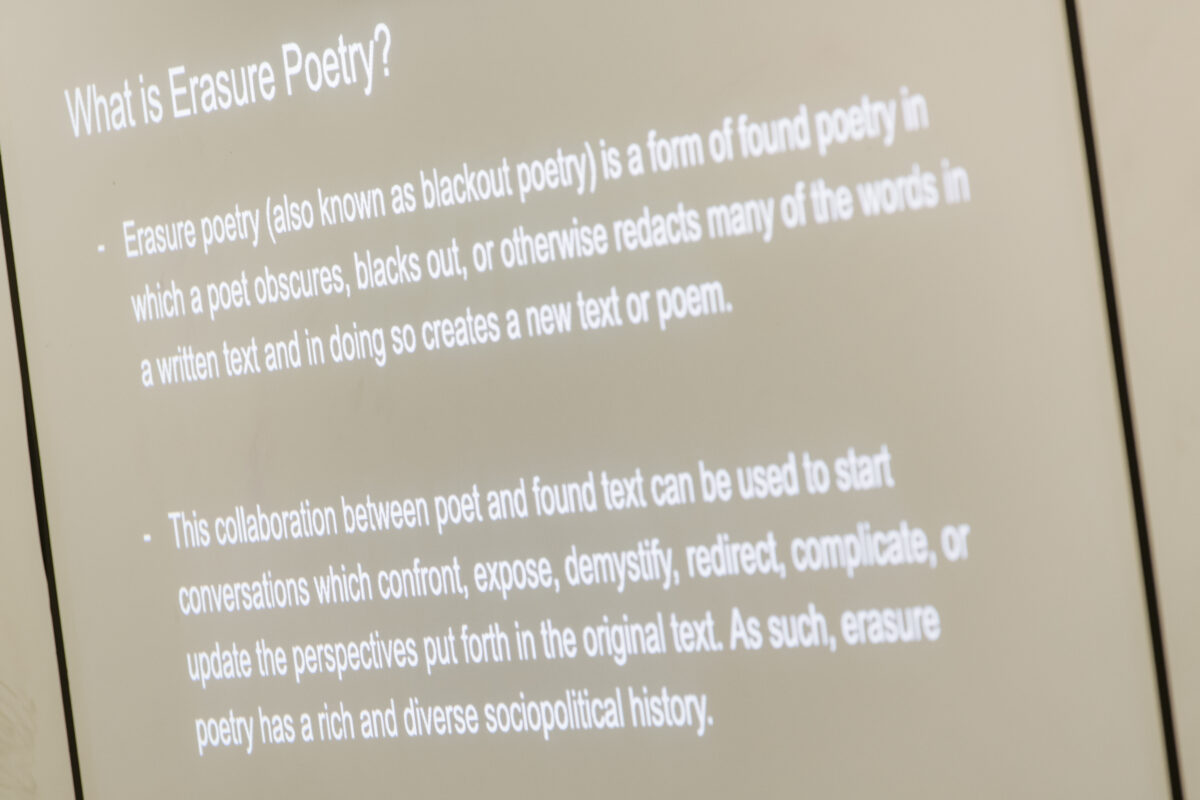
“The Affirming Multivocal Humanities grant provides an incredible opportunity to expand our ongoing work of challenging gender, sexuality, and race-based systems of oppression,” says Carole McCann, principal investigator and professor of GWST.
Additional GWST faculty participating in the grant: María Célleri, assistant professor; and Kathryn Kein, lecturer; and Courtney Cook, visiting lecturer.
Learn more about UMBC’s Gender, Women’s, and Sexuality Studies.
]]>
UMBC’s Gender, Women’s, and Sexuality Studies (GWST) department has received a $100,000 grant from the Mellon Foundation to implement its Advancing Gender and Sexuality Studies in Community...
https://umbc.edu/stories/mellon-foundation-awards-umbcs-gender-wst-100k/
https://my3.my.umbc.edu/api/v0/pixel/news/141253/guest@my.umbc.edu/d767536d505ae0c6a065cf246fdaa894/api/pixel
cahss
cahss-research
gwst
news
policy-and-society
rca-2
research
story
UMBC News & Magazine
https://my3.my.umbc.edu/groups/umbc-news-magazine
https://assets1-my.umbc.edu/system/shared/avatars/groups/000/001/943/24435aa6207c452e7bc15cc74b42c7bb/xsmall.png?1748556657
https://assets1-my.umbc.edu/system/shared/avatars/groups/000/001/943/24435aa6207c452e7bc15cc74b42c7bb/original.png?1748556657
https://assets2-my.umbc.edu/system/shared/avatars/groups/000/001/943/24435aa6207c452e7bc15cc74b42c7bb/xxlarge.png?1748556657
https://assets2-my.umbc.edu/system/shared/avatars/groups/000/001/943/24435aa6207c452e7bc15cc74b42c7bb/xlarge.png?1748556657
https://assets3-my.umbc.edu/system/shared/avatars/groups/000/001/943/24435aa6207c452e7bc15cc74b42c7bb/large.png?1748556657
https://assets1-my.umbc.edu/system/shared/avatars/groups/000/001/943/24435aa6207c452e7bc15cc74b42c7bb/medium.png?1748556657
https://assets2-my.umbc.edu/system/shared/avatars/groups/000/001/943/24435aa6207c452e7bc15cc74b42c7bb/small.png?1748556657
https://assets1-my.umbc.edu/system/shared/avatars/groups/000/001/943/24435aa6207c452e7bc15cc74b42c7bb/xsmall.png?1748556657
https://assets2-my.umbc.edu/system/shared/avatars/groups/000/001/943/24435aa6207c452e7bc15cc74b42c7bb/xxsmall.png?1748556657
UMBC News & Magazine
2
0
false
Tue, 23 Apr 2024 10:49:09 -0400
Tue, 23 Apr 2024 10:49:09 -0400
UMBC partners with American Statistical Association to organize annual African International Conference on Statistics
The eighth iteration of the African International Conference on Statistics (AIC), scheduled for June 2024 in Tunis, Tunisia, will mark a new era for the conference. Originally championed by Bimal Sinha, UMBC professor of statistics, the first AIC took place in 2014 in Senegal. Each conference since has been held in a different African country in collaboration with local institutions.
In 2018, relationships that grew out of the conference led UMBC to sign a collaborative agreement with the University of Limpopo in South Africa to foster academic exchange. At that time, Yehenew Kifle, assistant professor of statistics, was a visiting professor at UMBC and a faculty member at the University of Limpopo. Today he has taken the helm of the AIC from the soon-to-retire Sinha, who remains a core member of the planning committee.
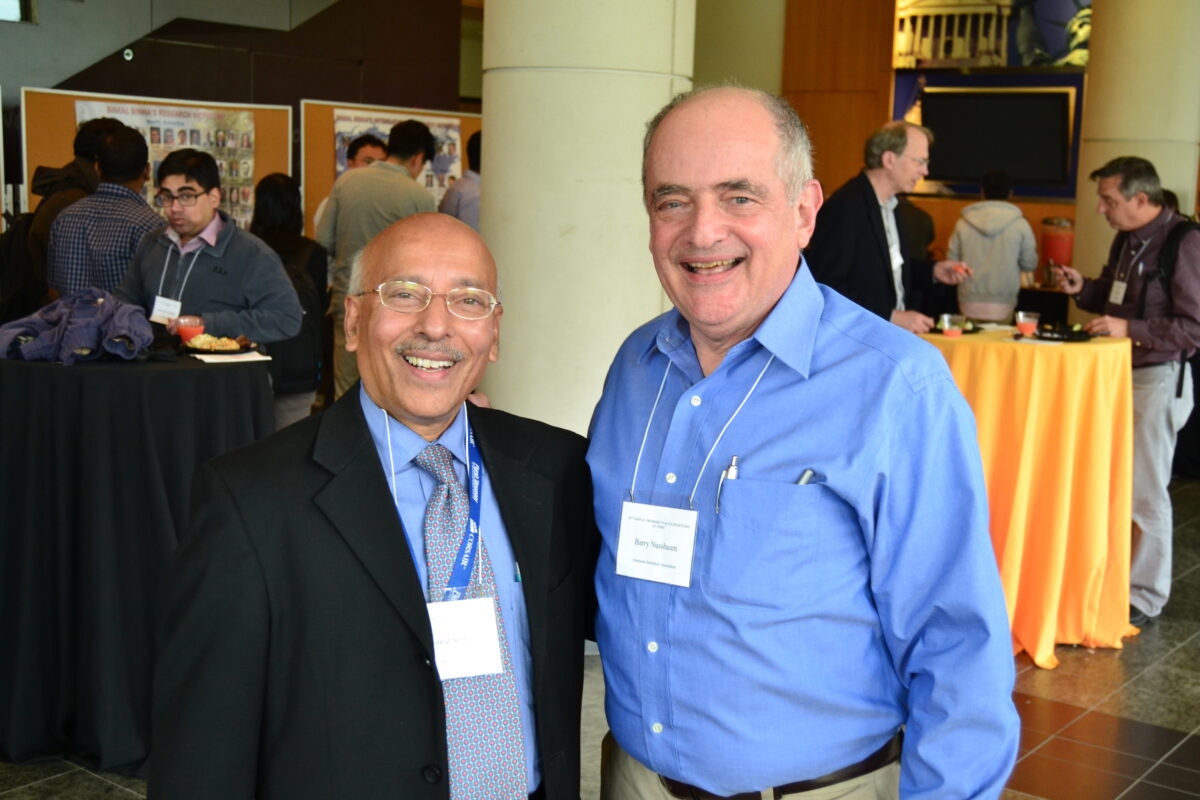 Bimal Sinha and Barry Nussbaum, former president of the American Statistical Association and current member of the AIC planning committee, at UMBC’s Probability and Statistics Day event in 2016. (Photo by Ricardo Moura)
This April, Kifle signed an agreement with the American Statistical Association (ASA) on behalf of UMBC that pledges financial support from the ASA for the conference for at least the next two years, with the possibility for an extended partnership.
“Through the African International Conference on Statistics, we achieved a significant milestone in 2018 by signing the first UMBC memorandum of understanding with an African university, which supports training for African students on a short- and long-term basis,” Kifle says. “Now we stand as partners with the world’s largest statistical association, the American Statistical Association. This partnership with ASA lays the foundation for great optimism about a promising future for the AIC.”
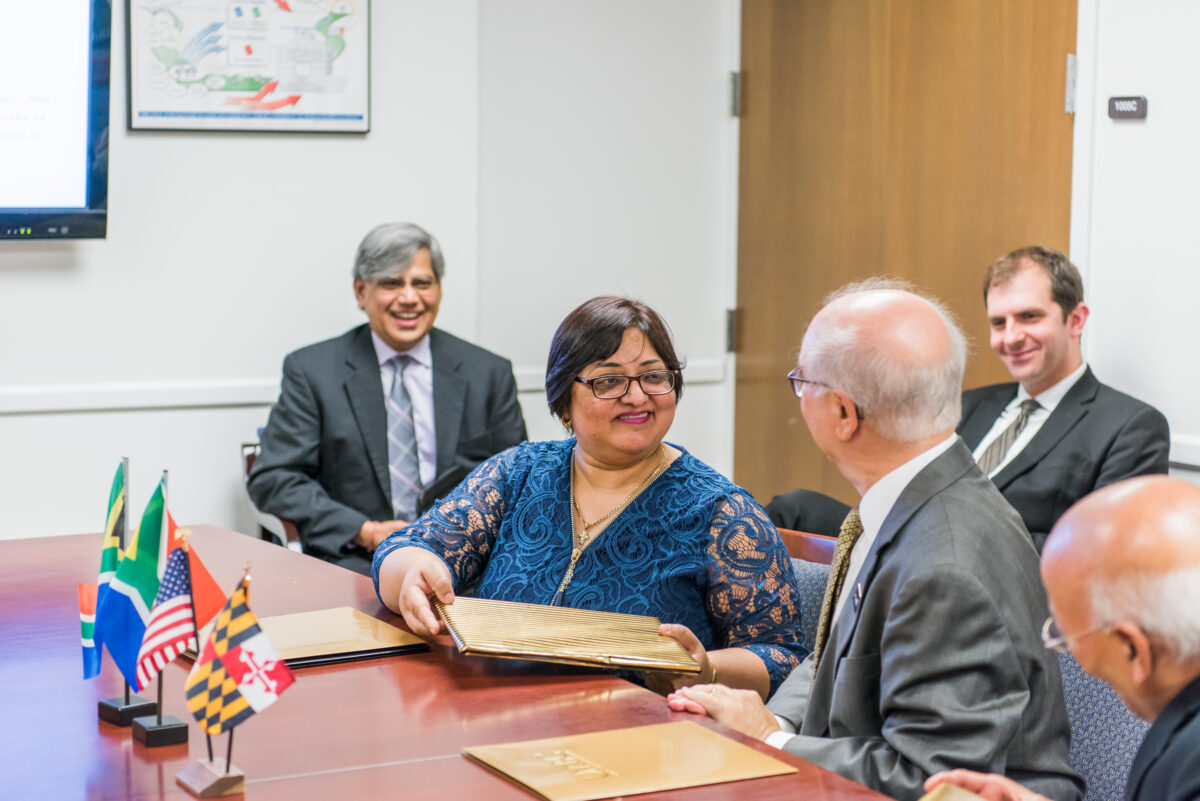 Jesika Singh, University of Limpopo (center left), and Antonio Moreira, vice provost for academic affairs at UMBC (center right), sign the agreement between UMBC and the University of Limpopo in 2018.
The theme of the 2024 AIC is “Empowering Innovation: Advanced Statistics and Data Science for Sustainable Development in Africa.” The theme speaks to the power of statistics to support progress in areas like agriculture, economic development, and environmental conservation that are relevant to people all over the world.
“ASA is delighted to partner with UMBC on the African International Conference on Statistics,” shares Ronald Wasserstein, executive director of ASA. “The AIC has established itself as an important contributor to advancing statistical science in Africa. We hope ASA’s support will provide the opportunity for the creative and enthusiastic minds at UMBC to take the conference to still higher levels.”
]]>
The eighth iteration of the African International Conference on Statistics (AIC), scheduled for June 2024 in Tunis, Tunisia, will mark a new era for the conference. Originally championed by Bimal...
https://umbc.edu/stories/new-partnership-supports-african-international-conference-on-statistics/
https://my3.my.umbc.edu/api/v0/pixel/news/141065/guest@my.umbc.edu/bd641865df629d7f29b02e70aaba7084/api/pixel
cnms
mathstat
news
rca-2
science-and-tech
story
UMBC News & Magazine
https://my3.my.umbc.edu/groups/umbc-news-magazine
https://assets1-my.umbc.edu/system/shared/avatars/groups/000/001/943/24435aa6207c452e7bc15cc74b42c7bb/xsmall.png?1748556657
https://assets1-my.umbc.edu/system/shared/avatars/groups/000/001/943/24435aa6207c452e7bc15cc74b42c7bb/original.png?1748556657
https://assets2-my.umbc.edu/system/shared/avatars/groups/000/001/943/24435aa6207c452e7bc15cc74b42c7bb/xxlarge.png?1748556657
https://assets2-my.umbc.edu/system/shared/avatars/groups/000/001/943/24435aa6207c452e7bc15cc74b42c7bb/xlarge.png?1748556657
https://assets3-my.umbc.edu/system/shared/avatars/groups/000/001/943/24435aa6207c452e7bc15cc74b42c7bb/large.png?1748556657
https://assets1-my.umbc.edu/system/shared/avatars/groups/000/001/943/24435aa6207c452e7bc15cc74b42c7bb/medium.png?1748556657
https://assets2-my.umbc.edu/system/shared/avatars/groups/000/001/943/24435aa6207c452e7bc15cc74b42c7bb/small.png?1748556657
https://assets1-my.umbc.edu/system/shared/avatars/groups/000/001/943/24435aa6207c452e7bc15cc74b42c7bb/xsmall.png?1748556657
https://assets2-my.umbc.edu/system/shared/avatars/groups/000/001/943/24435aa6207c452e7bc15cc74b42c7bb/xxsmall.png?1748556657
UMBC News & Magazine
0
0
false
Wed, 17 Apr 2024 16:22:09 -0400
Wed, 17 Apr 2024 16:22:09 -0400
UMBC chapter of National Society of Black Engineers (NSBE) shines at regional conference
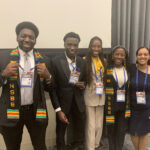
Members of UMBC’s chapter of the National Society of Black Engineers (NSBE) traveled to Norfolk, Virginia for their annual regional conference in November and came home with numerous awards.
The UMBC team defeated Carnegie Mellon University and North Carolina State University to win the Tech Bowl competition, a Jeopardy-style game that tests teams’ knowledge of fundamental engineering principles. UMBC also claimed first through third place in the research poster presentation contest, which involved a 10-minute technical research talk followed by questions from the judges and audience.
The team relied on prior knowledge to excel in the Tech Bowl, only having decided to participate upon arriving at the conference. “It was really exciting getting so many questions right with our only practice being from our coursework,” shares UMBC NSBE chapter president Nelanne Bolima ’24, chemical engineering. “That just goes to show how well UMBC’s College of Engineering and IT prepares students to succeed.”
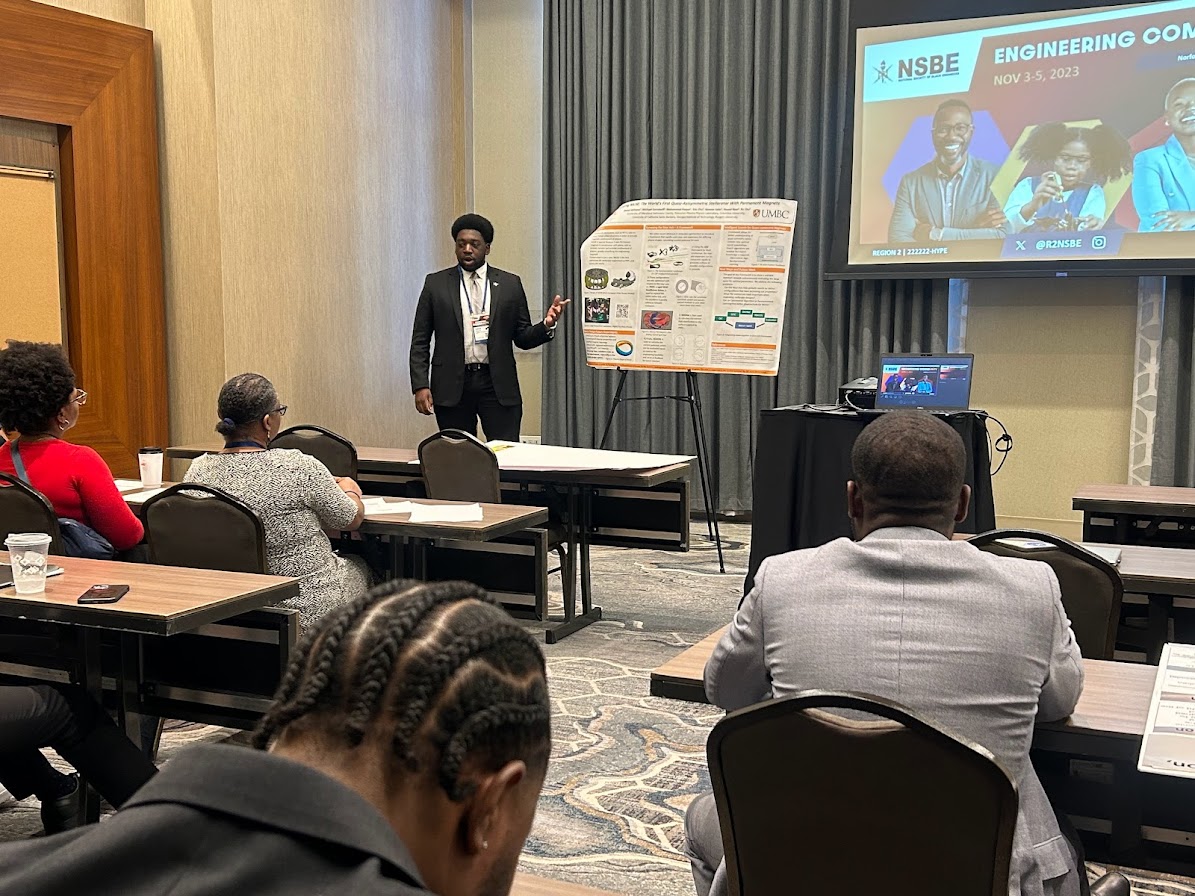 Daniel Williams gives his research presentation at the NSBE conference. (Image by Nelanne Bolima)
In addition to Bolima, the Tech Bowl team members included Kayla Magruder ’26, chemical engineering; Saleem Lawal ’25, computer science; and Daniel Williams ’24, computer science. Presentation winners were Williams (first), Bolima (second), and Christopher Appiah ’24, mechanical engineering (third). Keith Harmon, director of the UMBC Meyerhoff Scholars Program, serves as the chapter advisor.
“We are so proud of the UMBC NSBE Chapter,” Harmon shares. “They do tremendous work supporting UMBC STEM majors and offering service impacting youth in the Baltimore-Washington corridor.”
Students supporting students
NSBE is a completely student-run organization, creating leadership opportunities for hundreds of students across the country. UMBC’s NSBE chapter supports members through activities such as mentoring initiatives, conference preparation, networking opportunities, and leadership development programming. The chapter also focuses on community outreach, such as visiting high schools, collaborating with non-profits, and welcoming younger students to shadow the chapter’s board meetings.
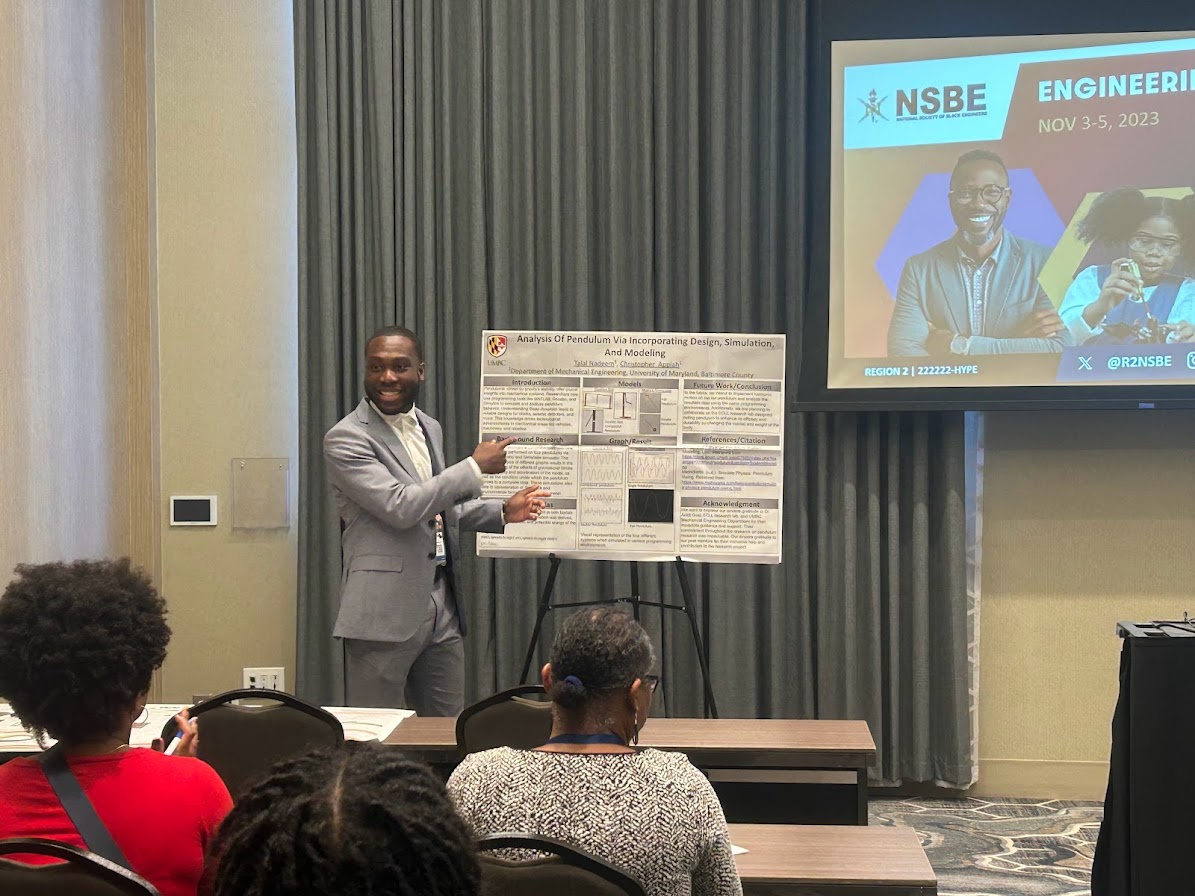 Christopher Appiah gives his research presentation at the NSBE conference. (Image by Nelanne Bolima)
“I have benefitted from being a member of this team by gaining invaluable public speaking and collaboration skills,” Appiah shares. “I learned how to effectively present, detailing the broader impact of research I have done.” Appiah conducts research with Ankit Goel, assistant professor of mechanical engineering. Goel’s group works on complex applications of control theory in robotics and autonomous systems.
For Jaden Somerville ’25, mechanical engineering, “the competition not only improved my technical skills, but also taught me teamwork, problem-solving, and effective time management.”
In March 2024, the chapter will take its talents to the 50th annual NSBE convention in Atlanta, Georgia.
]]>
Members of UMBC’s chapter of the National Society of Black Engineers (NSBE) traveled to Norfolk, Virginia for their annual regional conference in November and came home with numerous awards. ...
https://umbc.edu/stories/nsbe-shines-at-regional-conference/
https://my3.my.umbc.edu/api/v0/pixel/news/137559/guest@my.umbc.edu/101e4ba6879ab3f49b2abd337b9db36c/api/pixel
cbee
coeit
csee
meche
news
rca-2
science-and-tech
UMBC News & Magazine
https://my3.my.umbc.edu/groups/umbc-news-magazine
https://assets1-my.umbc.edu/system/shared/avatars/groups/000/001/943/24435aa6207c452e7bc15cc74b42c7bb/xsmall.png?1748556657
https://assets1-my.umbc.edu/system/shared/avatars/groups/000/001/943/24435aa6207c452e7bc15cc74b42c7bb/original.png?1748556657
https://assets2-my.umbc.edu/system/shared/avatars/groups/000/001/943/24435aa6207c452e7bc15cc74b42c7bb/xxlarge.png?1748556657
https://assets2-my.umbc.edu/system/shared/avatars/groups/000/001/943/24435aa6207c452e7bc15cc74b42c7bb/xlarge.png?1748556657
https://assets3-my.umbc.edu/system/shared/avatars/groups/000/001/943/24435aa6207c452e7bc15cc74b42c7bb/large.png?1748556657
https://assets1-my.umbc.edu/system/shared/avatars/groups/000/001/943/24435aa6207c452e7bc15cc74b42c7bb/medium.png?1748556657
https://assets2-my.umbc.edu/system/shared/avatars/groups/000/001/943/24435aa6207c452e7bc15cc74b42c7bb/small.png?1748556657
https://assets1-my.umbc.edu/system/shared/avatars/groups/000/001/943/24435aa6207c452e7bc15cc74b42c7bb/xsmall.png?1748556657
https://assets2-my.umbc.edu/system/shared/avatars/groups/000/001/943/24435aa6207c452e7bc15cc74b42c7bb/xxsmall.png?1748556657
UMBC News & Magazine
1
0
false
Tue, 05 Dec 2023 17:40:28 -0500
Tue, 05 Dec 2023 17:40:28 -0500
First Roth Research Award recipient broadens horizons after summer research experience
Inioluwa Oluseyi has wanted to be a neurosurgeon as long as she can remember. She didn’t anticipate how much fly husbandry would play a role in her reaching her goal. In a fall 2022 genetics class with Fernando Vonhoff, “He talked about how his lab works on flies to answer questions related to neurological issues, so that just immediately clicked for me,” says Oluseyi, a biological sciences junior.
She talked to Vonhoff, an assistant professor of biological sciences, after class about opportunities. He gave her a tour of the lab the following week, and she started working with his research group soon thereafter. In the fall and spring, Oluseyi gained skills in fly husbandry, dissection, and common testing protocols.
Vonhoff was impressed with her progress, and it was clear that by summer Oluseyi would be ready to take on her own project. Vonhoff suggested she apply for research scholarships, including the new Thomas F. Roth Research Award.
Roth joined the UMBC faculty in 1972 and helped get the fledgling university off the ground. He was instrumental in forging the culture of collegiality in the biological sciences department that continues today. Roth passed away in 2021, and his sons Kurt and Peter Roth established the research award in his memory.
Oluseyi is an international student from Nigeria, and she was happy to learn that she was eligible for the Roth award. Many scholarships are limited to U.S. citizens or permanent residents. “I was so excited,” she recalls. “Finally, I had this opportunity to apply to.”
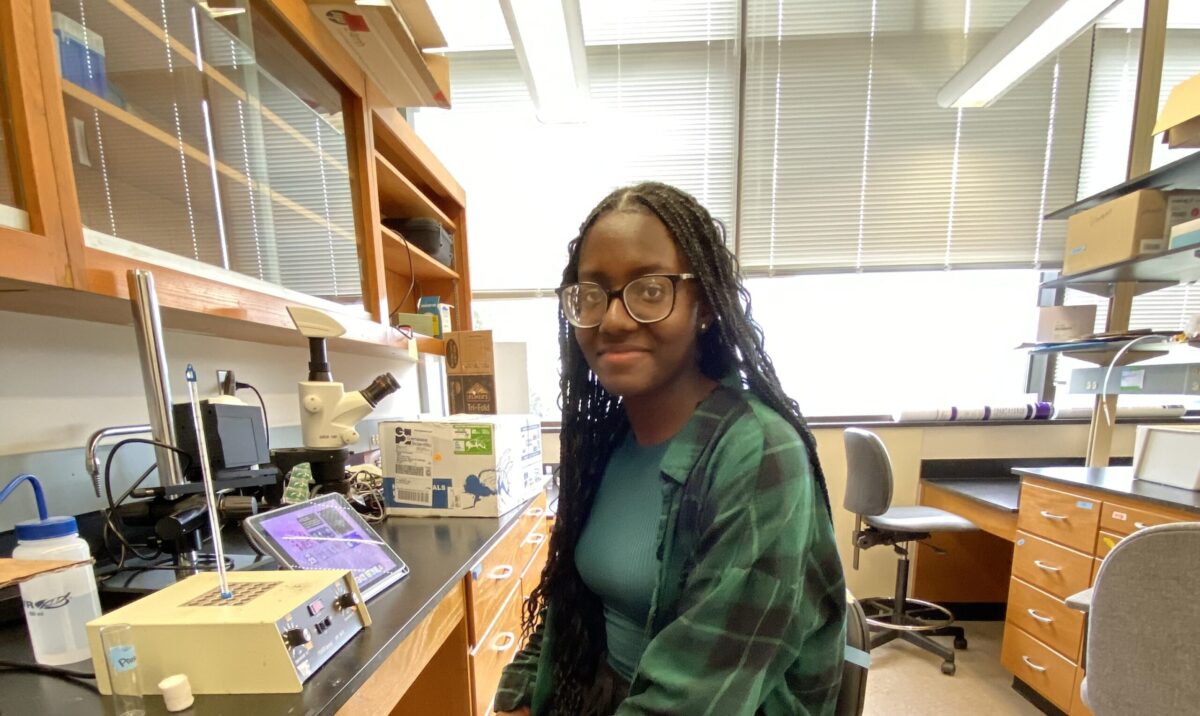 Inioluwa Oluseyi is thrilled to be pursuing biological research with Fernando Vonhoff and plans to pursue graduate work. (Image courtesy of Oluseyi)
Pushing her thinking
Oluseyi is the first recipient of the Thomas F. Roth Research Award. She also successfully applied for a UMBC Undergraduate Research Award (URA) for the 2023 – 2024 academic year based on her work in Vonhoff’s lab. Her URA proposal builds on her Roth-funded summer research and outlines experiments to study the behavioral responses of flies to pain, including whether experiencing pain changes their preference for plain versus ethanol-laced apple juice, or if it affects their mobility or feeding and mating patterns.
This summer, she bred the flies needed for her fall experiments. She also supported testing on flies with altered genes, for a project led by Ph.D. student Claudia Gualtieri, to learn how those genes are involved in various behaviors. “Ini has always been willing to go the extra mile,” Gualtieri says. “She was eager to learn despite challenges, and she did all of this while bringing a contagious smile into the lab,” Gualtieri says.
Oluseyi’s summer experiences funded by the Roth award “made me push my thinking,” she says, and may lead to changes in the project she proposed for her URA.
“I think I want to broaden my horizons,” Oluseyi says. “My research proposal was very much behavioral, but now I want to refine it and go deeper into the gene level.”
Growing relationships, setting goals
Spending so much time in the lab over the summer also afforded opportunities to enrich her relationships with labmates and think deeply about her future. “I branched out and talked to a lot of new people and learned what they were studying,” Oluseyi says. “That helped me to improve my scientific thinking.”
Her connection with Vonhoff also shifted. “Now we’ve talked more and connected in a different way,” Oluseyi says. “Before I saw him as my supervisor, but now I see him as a mentor—someone I can come to if I need anything.”
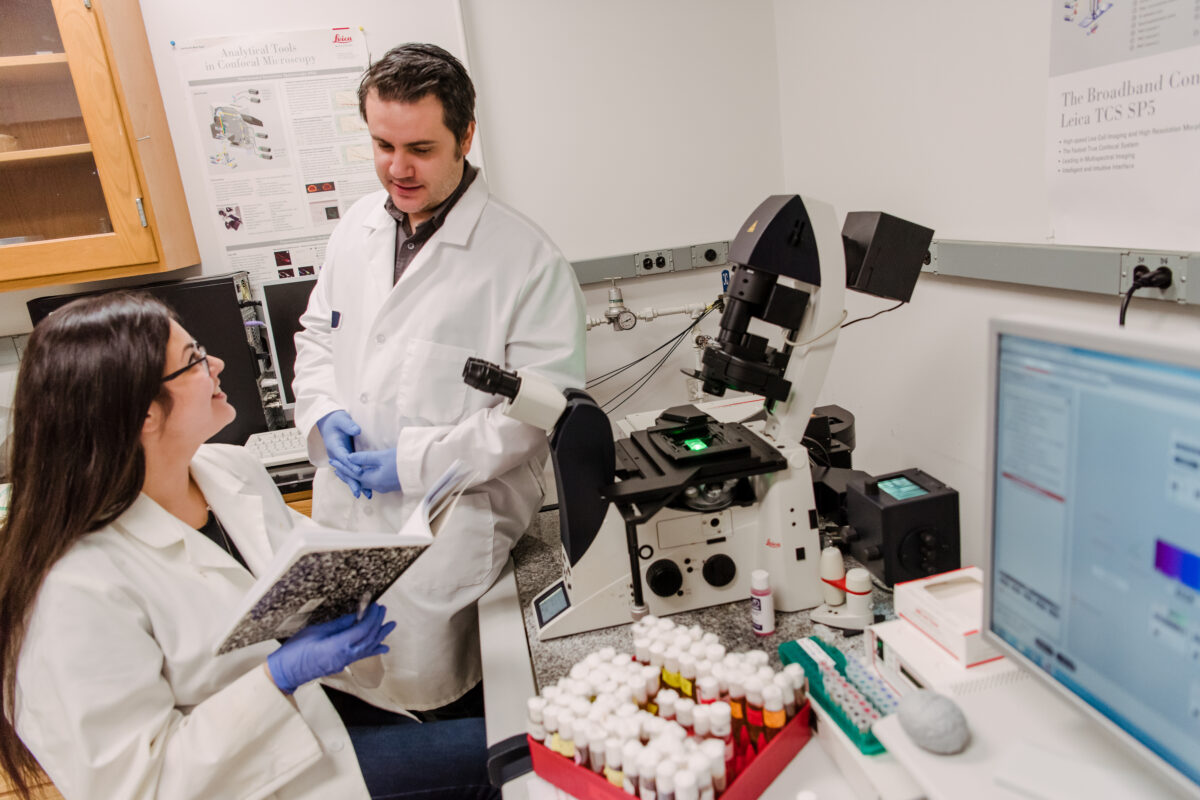 Fernando Vonhoff (right) and Abby Cruz ’17, biological sciences, discuss their research in Vonhoff’s laboratory. (Marlayna Demond ’11/UMBC)
Those conversations covered the immediate work in the lab as well as Oluseyi’s longer-term goals. Originally, she was planning on medical school. Now that she knows she enjoys research and has discussed her options with Vonhoff, Gualtieri, and others in the lab, the M.D./Ph.D. path toward life as a physician-scientist is appealing.
“Inioluwa is a living example of how access to research opportunities can be a transformative experience for growing young minds,” Vonhoff says. “From the beginning, it was obvious that Ini was driven by her intellectual curiosity and passion to make meaningful contributions to our society.”
A cool connection
The Roth award made these developments possible, but her connection to Roth extends beyond receiving support for her studies. In her spring 2023 cell biology class, around the time she was applying for the Roth award, Oluseyi was learning about coated pits—structures on a cell’s surface that help it take in large molecules. She also learned who discovered these pits: Thomas Roth.
Roth made the discovery as a graduate student under Keith R. Porter at Harvard University. Later in his career, Porter became a professor at UMBC, and UMBC’s Keith R. Porter Imaging Facility bears his name.
“When I found out about that, I told everybody—‘What we’re learning about is by this person!’” Oluseyi says. “It was so cool.”
Pursuing her dreams
Oluseyi’s research has not progressed as quickly as she hoped, mostly due to unexpected flooding in UMBC’s biology building last winter, but even the challenges became a learning experience. “My biggest takeaway from this summer is that research doesn’t always go as you want it to go,” she says. “But even if it changed, I liked what I did. I got to explore other things and learn more about flies in general.”
And the experience has paved the way for future work—which will certainly be full of both challenges and successes. “The Roth family’s generosity has made it possible for me to pursue my dreams,” Oluseyi says. “I’m looking forward to starting the URA project this semester.”
]]>
Inioluwa Oluseyi has wanted to be a neurosurgeon as long as she can remember. She didn’t anticipate how much fly husbandry would play a role in her reaching her goal. In a fall 2022 genetics class...
https://umbc.edu/stories/roth-summer-research-award-broadens-horizons/
https://my3.my.umbc.edu/api/v0/pixel/news/135694/guest@my.umbc.edu/c9692dcbf4ac2ad49b026d07162ac52f/api/pixel
alumni
biology
cnms
impact
magazine
rca-2
research
undergraduate-research
UMBC News & Magazine
https://my3.my.umbc.edu/groups/umbc-news-magazine
https://assets1-my.umbc.edu/system/shared/avatars/groups/000/001/943/24435aa6207c452e7bc15cc74b42c7bb/xsmall.png?1748556657
https://assets1-my.umbc.edu/system/shared/avatars/groups/000/001/943/24435aa6207c452e7bc15cc74b42c7bb/original.png?1748556657
https://assets2-my.umbc.edu/system/shared/avatars/groups/000/001/943/24435aa6207c452e7bc15cc74b42c7bb/xxlarge.png?1748556657
https://assets2-my.umbc.edu/system/shared/avatars/groups/000/001/943/24435aa6207c452e7bc15cc74b42c7bb/xlarge.png?1748556657
https://assets3-my.umbc.edu/system/shared/avatars/groups/000/001/943/24435aa6207c452e7bc15cc74b42c7bb/large.png?1748556657
https://assets1-my.umbc.edu/system/shared/avatars/groups/000/001/943/24435aa6207c452e7bc15cc74b42c7bb/medium.png?1748556657
https://assets2-my.umbc.edu/system/shared/avatars/groups/000/001/943/24435aa6207c452e7bc15cc74b42c7bb/small.png?1748556657
https://assets1-my.umbc.edu/system/shared/avatars/groups/000/001/943/24435aa6207c452e7bc15cc74b42c7bb/xsmall.png?1748556657
https://assets2-my.umbc.edu/system/shared/avatars/groups/000/001/943/24435aa6207c452e7bc15cc74b42c7bb/xxsmall.png?1748556657
UMBC News & Magazine
0
0
false
Fri, 22 Sep 2023 16:09:40 -0400
Fri, 22 Sep 2023 16:09:40 -0400
Justin Webster receives NSF grant to study mathematical models behind oscillation of plane wings, bridges, energy harvesters

Although objects like bridges, buildings, and airplane wings may seem quite rigid, by design they are capable of a surprising deal of bending. This elasticity allows them to deform safely and temporarily in windy conditions. However, very rarely, “Elastic systems like bridges, buildings, and planes can become oscillatory or unstable in the presence of everyday wind, with potential for the oscillations to become damaging,” says Justin Webster, associate professor of mathematics and statistics. “Understanding this has big implications for fields like civil engineering or alternative energy.”
Webster has received a new $290,000 National Science Foundation Division of Mathematical Sciences grant to “look at the mathematical models that describe these wind-structure systems,” he says, “and try to answer the questions, ‘What gives rise to these self-destabilization effects? And do I understand it well enough to stop it, or better yet, to prevent it altogether?’” In other words, can we prevent the bridge collapsing or the wings snapping off the plane in windy conditions?
The Tacoma Narrows Bridge collapse in November 1940 is a classic example of wind-induced oscillations having catastrophic effects.
In contrast, certain energy harvesting devices require oscillation to function. As wind flows over one of these flag-like surfaces, it flaps, or “flutters,” generating electrical current. With these energy harvesters—as opposed to planes and bridges—says Webster, “It’s the opposite: You want the oscillations to happen. Not only do we want this to happen, but we want it to happen in an optimal way.”
For some of these systems, there are no existing mathematical models. For others, models exist, but they don’t seem to capture the way these systems behave in the physical world very well. As a first step, Webster and his students, including new members brought on board with the NSF support, will work to generate new, relevant models or refine existing ones. Next, they will analyze how the models address key questions in three applications: a bridge, an airfoil (like a plane wing), and a flutter-driven energy harvesting device.
In each scenario, Webster and his team will ask, “What conditions give rise to flow-induced oscillations that appear to be spontaneous? And if they do happen, can the model predict what they will look like—such as bending, or, more dangerously, twisting?” Right now, the answer to the latter is “no.” The new grant will help Webster get closer to “yes,” and as a result, eventually improve infrastructure safety and the efficiency of some alternative energy devices.
]]>
Although objects like bridges, buildings, and airplane wings may seem quite rigid, by design they are capable of a surprising deal of bending. This elasticity allows them to deform safely and...
https://umbc.edu/stories/math-models-behind-oscillation/
https://my3.my.umbc.edu/api/v0/pixel/news/135195/guest@my.umbc.edu/ad3595c026f0b7b2f9c7eee2ffa44460/api/pixel
cnms
mathstat
news
rca-2
research
science-and-tech
UMBC News & Magazine
https://my3.my.umbc.edu/groups/umbc-news-magazine
https://assets1-my.umbc.edu/system/shared/avatars/groups/000/001/943/24435aa6207c452e7bc15cc74b42c7bb/xsmall.png?1748556657
https://assets1-my.umbc.edu/system/shared/avatars/groups/000/001/943/24435aa6207c452e7bc15cc74b42c7bb/original.png?1748556657
https://assets2-my.umbc.edu/system/shared/avatars/groups/000/001/943/24435aa6207c452e7bc15cc74b42c7bb/xxlarge.png?1748556657
https://assets2-my.umbc.edu/system/shared/avatars/groups/000/001/943/24435aa6207c452e7bc15cc74b42c7bb/xlarge.png?1748556657
https://assets3-my.umbc.edu/system/shared/avatars/groups/000/001/943/24435aa6207c452e7bc15cc74b42c7bb/large.png?1748556657
https://assets1-my.umbc.edu/system/shared/avatars/groups/000/001/943/24435aa6207c452e7bc15cc74b42c7bb/medium.png?1748556657
https://assets2-my.umbc.edu/system/shared/avatars/groups/000/001/943/24435aa6207c452e7bc15cc74b42c7bb/small.png?1748556657
https://assets1-my.umbc.edu/system/shared/avatars/groups/000/001/943/24435aa6207c452e7bc15cc74b42c7bb/xsmall.png?1748556657
https://assets2-my.umbc.edu/system/shared/avatars/groups/000/001/943/24435aa6207c452e7bc15cc74b42c7bb/xxsmall.png?1748556657
UMBC News & Magazine
0
0
false
Wed, 06 Sep 2023 14:15:07 -0400
Wed, 06 Sep 2023 14:15:07 -0400
Deepak Koirala to explore how RNA viruses hijack cellular machinery, with eye to future drug treatments
Viruses must hijack their hosts’ cellular machinery to make more viruses, so preventing this hijacking could lead to a host of new treatments for viral diseases. However, much is unknown about how the viruses actually accomplish their takeover. Scientific understanding is especially murky for RNA viruses, which use RNA as their genetic material, rather than DNA like animals. These viruses’ RNA serves as their genome and also codes directly for viral proteins.
With support from an NSF CAREER Award, Deepak Koirala, assistant professor of chemistry and biochemistry, has been working on figuring out how enteroviruses, a large group of RNA viruses, replicate their RNA genomes. Enteroviruses include viruses that cause polio, the common cold, and many more diseases that affect humans and other animals. Now Koirala has received a five-year, $1.8 million grant from the National Institutes of Health to solve another part of this puzzle: How do these viruses commandeer proteins in the host cell to produce viral proteins? The cell must build these viral proteins before the virus can replicate.
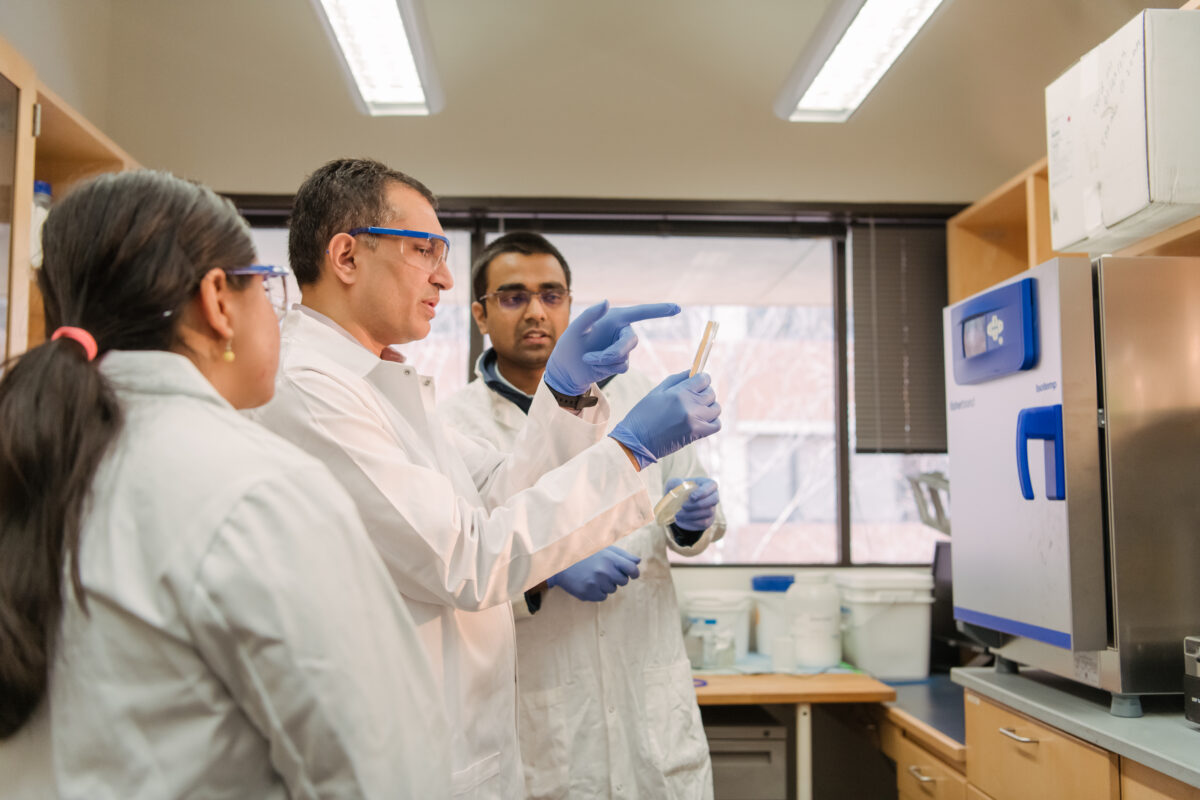 Deepak Koirala (pointing at petri dish) uses a wide range of techniques to answer scientific questions about RNA viruses. Naba Krishna Das (right), a Ph.D. student in Koirala’s lab, is a key contributor to the group’s viral replication research. (Marlayna Demond ’11/UMBC)
A new biological mechanism?
When a cell makes its own proteins, the cellular mRNA, a type of RNA that carries the instructions for building proteins, interacts with the protein-building machinery via a special structure at one end called a “cap,” Koirala explains. Enteroviral mRNAs lack this cap—and yet they are still perfectly capable of forcing the cell to do their bidding. Koirala is trying to figure out how.
Koirala has been studying unique structures at the ends of viral RNAs for their role in replication, but they may be doing double duty by initiating protein production as well, he believes. Koirala and his team, which includes undergraduate and graduate students, will use a technique called X-ray crystallography to deduce the precise molecular makeup of these special RNA structures.
At the same time, they will run experiments to learn how the structures interact with the cellular machinery. These two lines of investigation complement one another. “If we have the structure, that would allow us to pinpoint the critical nucleotide or amino acid that is important for the interaction,” Koirala says. “And then we can mutate that one, to see how that changes the interaction.”
By using a range of techniques, the team seeks to determine what the structures look like and how they work in the cell. “It could be a new biological mechanism we’ve never seen before,” Koirala says.
The team already has some early data supporting their goals, Koirala says. A related publication is under review at a top-tier academic journal. Several lab members are authors on the paper—including three undergraduates. “We are really excited about that,” Koirala says.
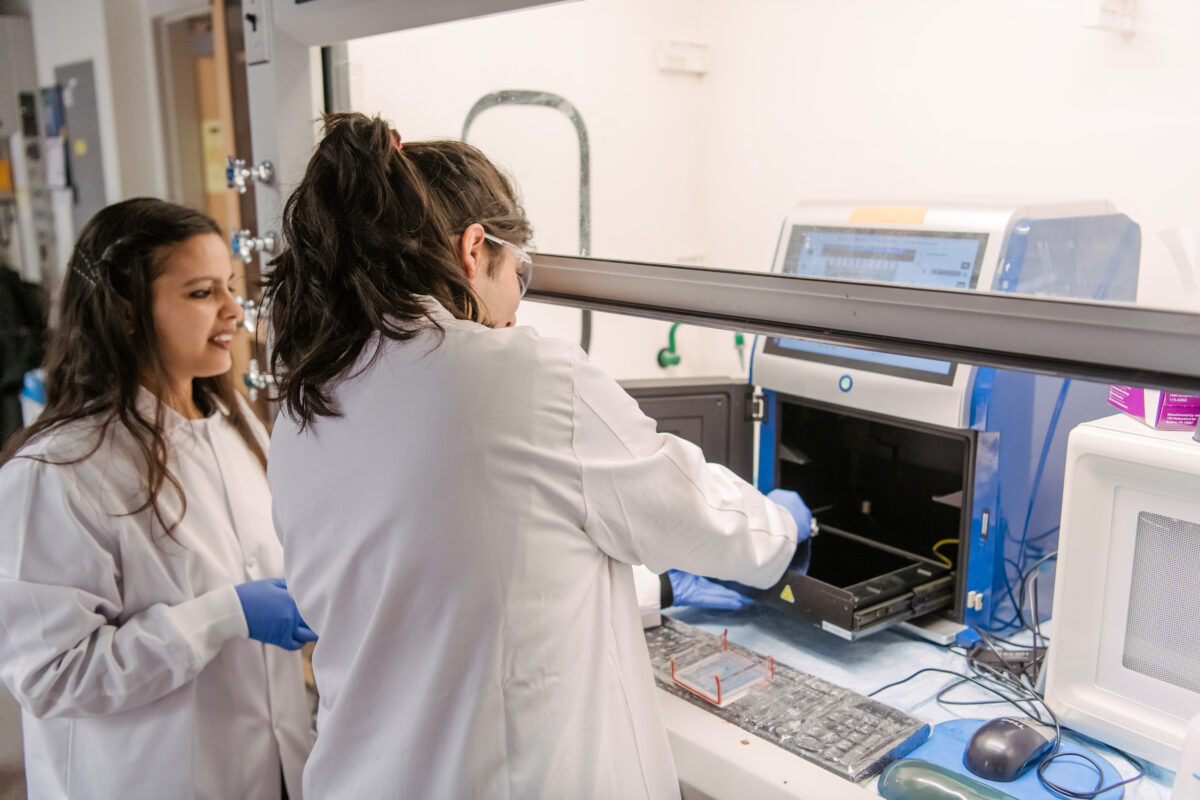 Manju Ojha, a Ph.D. student in Koirala’s lab, mentors undergraduate Zohra Mian. Ojha will have a leading role in the work related to viral protein production for the new grant. (Image by Marlayna Demond ’11/UMBC)
One drug, many targets
The project is likely to end up supporting other researchers, as well. In the course of the team’s work, “We are developing tools that facilitate our understanding of these RNA structures,” Koirala says. “The tools we develop may be useful not only for the particular system we are working on, but they could be useful in general for many other RNA structures in other fields of research.”
In addition, RNA structures found in one species of enterovirus are very similar to those found in other enteroviruses that cause different diseases—even some that infect very different kinds of organisms, Koirala discovered. That opens the door to developing antiviral treatments that are able to target many different viruses.
With the RNA structures in hand, the next step might be to use artificial intelligence to screen for other molecules that bind to the structures, preventing the viruses from taking over the cell and causing illness. Scientists could then take steps to develop new drugs using these molecules.
“Once we understand the structure, and we have a better understanding of the mechanism, we can better design drugs,” Koirala says. “But right now we are at the fundamental level of how these things even work.”
]]>
Viruses must hijack their hosts’ cellular machinery to make more viruses, so preventing this hijacking could lead to a host of new treatments for viral diseases. However, much is unknown about how...
https://umbc.edu/stories/research-on-rna-viruses-may-lead-to-future-drugs/
https://my3.my.umbc.edu/api/v0/pixel/news/134966/guest@my.umbc.edu/112a48703f85194c24ad1fc2c7225fe5/api/pixel
chembiochem
cnms
news
rca-2
research
science-and-tech
UMBC News & Magazine
https://my3.my.umbc.edu/groups/umbc-news-magazine
https://assets1-my.umbc.edu/system/shared/avatars/groups/000/001/943/24435aa6207c452e7bc15cc74b42c7bb/xsmall.png?1748556657
https://assets1-my.umbc.edu/system/shared/avatars/groups/000/001/943/24435aa6207c452e7bc15cc74b42c7bb/original.png?1748556657
https://assets2-my.umbc.edu/system/shared/avatars/groups/000/001/943/24435aa6207c452e7bc15cc74b42c7bb/xxlarge.png?1748556657
https://assets2-my.umbc.edu/system/shared/avatars/groups/000/001/943/24435aa6207c452e7bc15cc74b42c7bb/xlarge.png?1748556657
https://assets3-my.umbc.edu/system/shared/avatars/groups/000/001/943/24435aa6207c452e7bc15cc74b42c7bb/large.png?1748556657
https://assets1-my.umbc.edu/system/shared/avatars/groups/000/001/943/24435aa6207c452e7bc15cc74b42c7bb/medium.png?1748556657
https://assets2-my.umbc.edu/system/shared/avatars/groups/000/001/943/24435aa6207c452e7bc15cc74b42c7bb/small.png?1748556657
https://assets1-my.umbc.edu/system/shared/avatars/groups/000/001/943/24435aa6207c452e7bc15cc74b42c7bb/xsmall.png?1748556657
https://assets2-my.umbc.edu/system/shared/avatars/groups/000/001/943/24435aa6207c452e7bc15cc74b42c7bb/xxsmall.png?1748556657
UMBC News & Magazine
0
0
false
Wed, 30 Aug 2023 12:03:15 -0400
Wed, 30 Aug 2023 12:03:15 -0400
UMBC’s Steve Freeland co-leads $1.8 million research grant to predict the biochemical foundations of life beyond Earth
Every living thing on Earth, from bacteria to humans, uses the same set of 20 amino acids to build all of its proteins, called our “amino acid alphabet.” But why that particular set of 20? If other amino acids are possible, what makes a good alphabet? And how might we recognize life beyond Earth that’s using an alphabet other than our own?
These are all questions that Stephen Freeland, professor of biological sciences, has been asking for over a decade in his theoretical research at UMBC. Now he and colleagues at the Tokyo Institute of Technology, Charles University in the Czech Republic, and Johns Hopkins University will take this work into the laboratory for the first time.
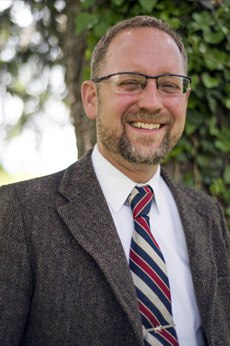 Stephen Freeland has been studying the origins of life for decades; now he’s taking the work into a new realm with international colleagues. (Image courtesy of UMBC Individualized Study Program)
The team seeks to marry Freeland’s theoretical work with his colleagues’ unique laboratory expertise to link together known alternative amino acids to form proteins. The Human Frontier Science Program (HFSP) is supporting the work with a new three-year, $1.8 million grant. The HFSP is a major international funding agency for basic life science research that specializes in supporting collaborations across continents.
The overarching question the project seeks to answer, Freeland says, is “What can we learn about how life could be different at the most fundamental level of biochemistry?” It’s a daunting question, with significant implications from biomedical applications to increasing our chances of detecting life on other planets.
Researchers have already created alternative amino acids in the lab and added individual alternative amino acids to proteins otherwise made of standard ones. However, no one has built entire proteins from scratch using nothing but a set of alternative amino acids. “This work is genuinely novel,” Freeland says. “Nobody knows what will happen. This is a first.”
Finding the essence
Freeland’s prior work has focused on determining what characteristics are necessary for a set of amino acids to function well as a basis for life. He and his students determined what differentiates our set of 20 amino acids from other random sets of 20 taken from a digital library of about 4,000 mathematically-generated amino acid structures.
That work led to a group of four equations that can be used to describe any set of 20 amino acids. “So it’s almost as if conceptually we boiled it and got the essence of it,” Freeland says, “We identified really unusual, simple characteristics that distinguish life on Earth’s set of 20 amino acids from random.”
With those factors in hand—what Freeland calls “design principles”—his team is now using a powerful computer program they developed to look at other sets of 20 amino acids and find examples that meet the same criteria. And this time around, they are taking the amino acids from a catalog of about 300 that can be obtained commercially—so any “good” set they find can be tested in the lab.
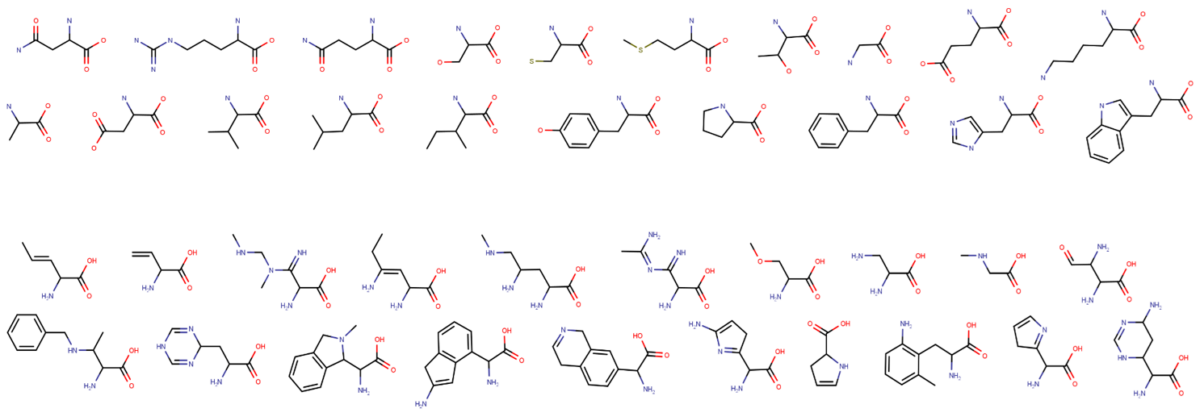 The top row includes molecular structures of the 20 amino acids found in all life on Earth. The bottom row is Xeno-ꞵ, an amino acid alphabet of 20 amino acids unlike any found within the genetic code of life on Earth. Yet, Xeno-ꞵ matches unusual mathematical properties of the chemical structures found in life’s alphabet. (Figure adapted from a 2022 paper published in Astrobiology and co-authored by UMBC Ph.D. candidate Sean Brown, collaborator Václav Voráček, and Stephen Freeland, courtesy of Freeland)
Going back in time to leap forward
This summer, the work entered a new phase. Sean Brown, a UMBC Ph.D. candidate in biological sciences working with Freeland, traveled to the Czech Republic to work in Klara Hlouchova’s lab, where they are preparing the technology to produce proteins with proposed alternative amino acid alphabets. “Basically, we’re asking, ‘Do our design principles work’?” Freeland says.
In some ways, this work will be like going back in time to the mid-20th century, when researchers were first discovering how life behaves at the molecular level. Since then, techniques for building and analyzing proteins have come to rely on everything we’ve learned about life’s amino acid alphabet. As such, these tools cannot be applied to alternative amino acid alphabets. For this project, the team will return to older approaches and techniques, in which the Czech researchers have retained expertise, to see if their alternative amino acids can actually form proteins.
If the experiments are successful, the team will be able to further hone the design principles for a generic life-producing amino acid alphabet, rather than basing the principles solely on the characteristics of life on Earth.
“If we can show that unusual, abstract properties of life as we know it are necessary, it helps us to understand why evolution on Earth went the path it did,” Freeland says. “It’s part of our own history, and it answers the question, ‘Why those 20?’”
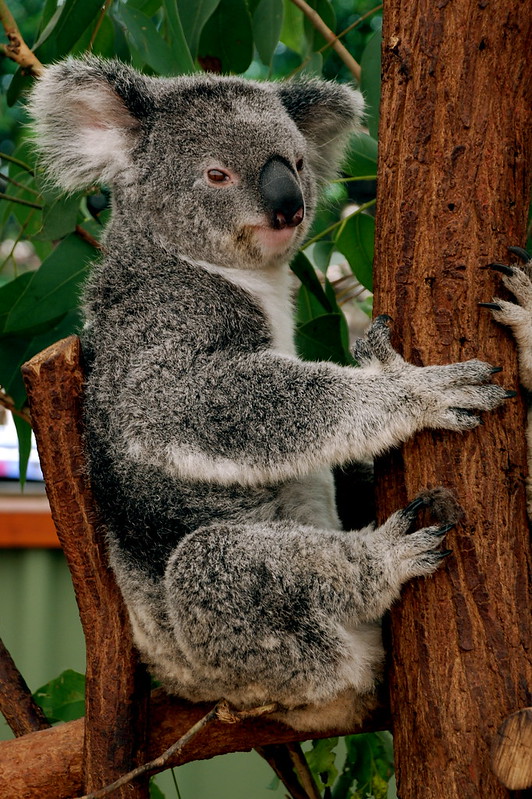
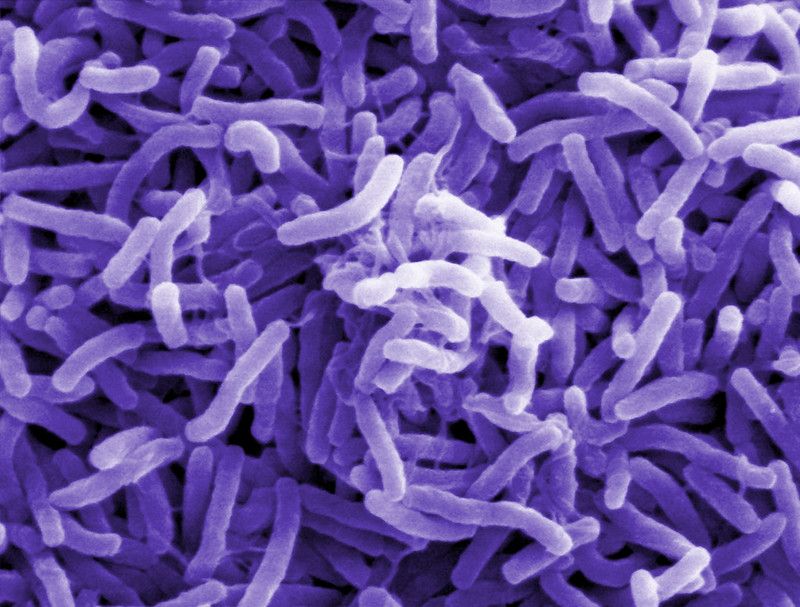


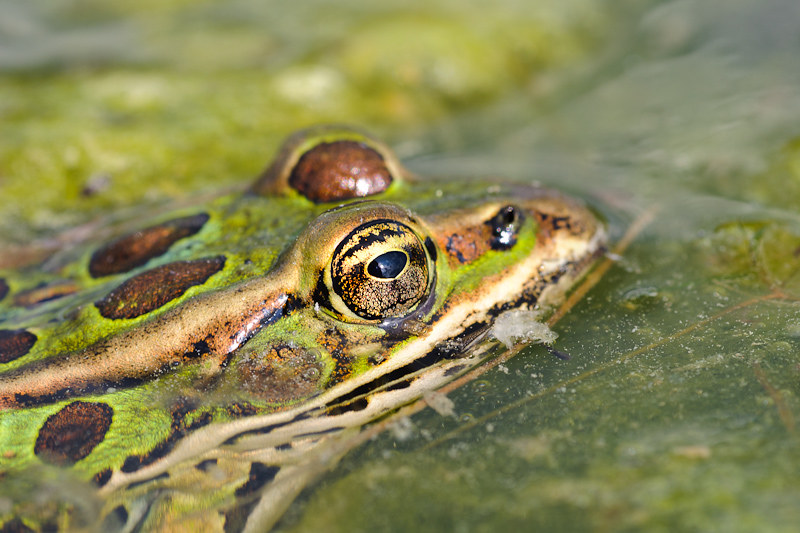 Organisms on Earth display remarkable diversity—but all of them without exception use the same set of 20 amino acids to build proteins. Stephen Freeland is part of team trying to figure out why those 20, and possibly help humans discover life that operates on a different basis elsewhere. (Frog by Breic, CC BY 2.0; sunflower by r44flyer, CC BY-NC-ND 2.0; tropicbird by Doug Greenberg, CC BY-NC 2.0; cholera bacteria by Sanofi, CC BY-NC-ND 2.0; koala by Azri, CC BY-NC-ND 2.0)
Knowing what to look for around the universe
Beyond understanding our own history, refining the design principles would better inform our approach to seeking life on other planets, Freeland says. Scientists generally agree that other life forms are most likely to be microbial, but “most of the ways we currently detect microbes absolutely rely on the molecules in use for life on Earth,” Freeland adds. This work could help researchers know how to detect a “molecular signature” of amino acids that are most likely to show up in life forms that originated independent of Earth.
Like all technologies, these developments come with great promise alongside risk. Freeland isn’t particularly concerned about individual synthetic proteins getting into the wild in the current stage of research, because proteins can’t replicate on their own. But he notes that there are important questions to ask about future, more advanced research. For example, there is potential for scientists working with DNA to build programmable genetic codes. Once this technology merges with fully synthetic proteins, he says, “is where the story takes a really interesting turn.”
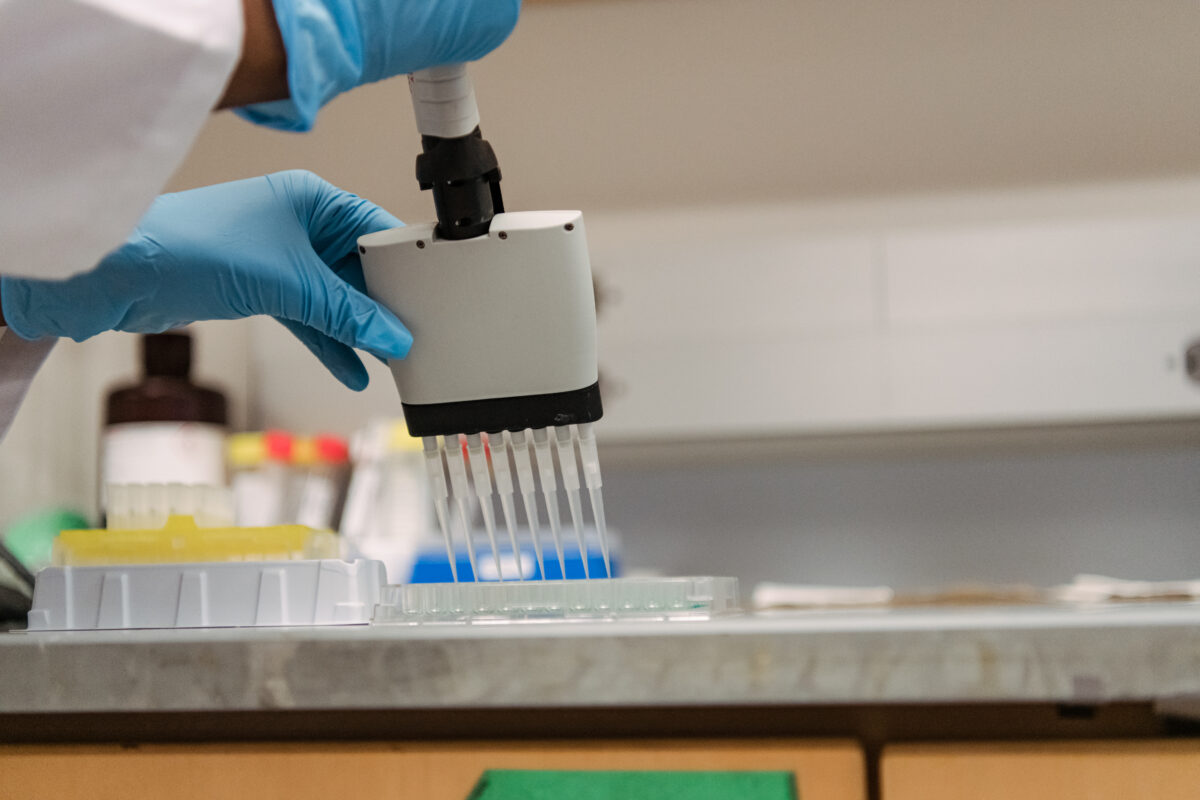 Synthetic DNA and proteins have many potential beneficial applications. But they also come with a host of ethical concerns. By putting their work in the public domain, Freeland and his team are working hard to make possible a transparent, public debate about whether and how these technologies should be used. (Image by Marlayna Demond ’11/UMBC)
Open-source proteins
Possible beneficial applications of synthetic proteins abound, and could include medical treatments or removing toxins from the environment. But without proper oversight, the technology could potentially also lead to harm, Freeland cautions.
Freeland is hoping to avoid the synthetic protein field following in the footsteps of synthetic DNA research. That field is much further ahead, but has mostly been carried out by private companies out of public view, “lending itself to patents and commercial ownership rather than to healthy, transparent debate and legislation,” Freeland says.
To create the best chance for responsible regulation around the use of synthetic proteins, Freeland and his colleagues are trying to quickly get their research into the public domain, he says, to make as robust as possible “what I think will be one of the more important debates of the 21st century when it comes to biotechnology: What are the laws, what are the ethics guiding our use of synthetic proteins and DNA?”
“Life on Earth is an example”
As Freeland and his colleagues lead the way into a new era of synthetic protein research, questions abound. Will proteins form from the amino acid combinations recommended by the algorithm? How can and should we use synthetic proteins, and who will decide? Will the research help us discover life on other planets? As the work develops and more researchers join this burgeoning field, researchers and the public will be constantly reminded of what Freeland describes as “one of the deepest principles of astrobiology.”
“Life on Earth is an example,” he says. “It would seem surprising to think it’s the only example.”
]]>
Every living thing on Earth, from bacteria to humans, uses the same set of 20 amino acids to build all of its proteins, called our “amino acid alphabet.” But why that particular set of 20? If...
https://umbc.edu/stories/predicting-the-foundations-of-life-beyond-earth/
https://my3.my.umbc.edu/api/v0/pixel/news/134872/guest@my.umbc.edu/4dd2628185b3257a1eab6158046be8a6/api/pixel
biology
cnms
news
rca-2
research
science-and-tech
UMBC News & Magazine
https://my3.my.umbc.edu/groups/umbc-news-magazine
https://assets1-my.umbc.edu/system/shared/avatars/groups/000/001/943/24435aa6207c452e7bc15cc74b42c7bb/xsmall.png?1748556657
https://assets1-my.umbc.edu/system/shared/avatars/groups/000/001/943/24435aa6207c452e7bc15cc74b42c7bb/original.png?1748556657
https://assets2-my.umbc.edu/system/shared/avatars/groups/000/001/943/24435aa6207c452e7bc15cc74b42c7bb/xxlarge.png?1748556657
https://assets2-my.umbc.edu/system/shared/avatars/groups/000/001/943/24435aa6207c452e7bc15cc74b42c7bb/xlarge.png?1748556657
https://assets3-my.umbc.edu/system/shared/avatars/groups/000/001/943/24435aa6207c452e7bc15cc74b42c7bb/large.png?1748556657
https://assets1-my.umbc.edu/system/shared/avatars/groups/000/001/943/24435aa6207c452e7bc15cc74b42c7bb/medium.png?1748556657
https://assets2-my.umbc.edu/system/shared/avatars/groups/000/001/943/24435aa6207c452e7bc15cc74b42c7bb/small.png?1748556657
https://assets1-my.umbc.edu/system/shared/avatars/groups/000/001/943/24435aa6207c452e7bc15cc74b42c7bb/xsmall.png?1748556657
https://assets2-my.umbc.edu/system/shared/avatars/groups/000/001/943/24435aa6207c452e7bc15cc74b42c7bb/xxsmall.png?1748556657
UMBC News & Magazine
10
0
false
Fri, 25 Aug 2023 12:04:42 -0400
Fri, 25 Aug 2023 12:04:42 -0400
STEM BUILD interns shine at UMBC’s Summer Undergraduate Research Fest
At Summer Undergraduate Research Fest (SURF) on August 9, 132 students presented posters and six gave short oral presentations, called “lightning talks,” about research projects covering topics from “forever” chemicals to prostate cancer to alcohol addiction. The University Center Ballroom buzzed with students, mentors, and guests as students shared their progress, interacted with other student researchers, and received feedback. The annual event, sponsored by the College of Natural and Mathematical Sciences (CNMS) since 2005, gives students who are often in the early stages of their research careers an important opportunity to feel like part of a scholarly community.
“We are proud of all that our students accomplished this summer. Now they are more knowledgeable, experienced, and skilled—they are better scientists,” shares CNMS Dean William R. LaCourse. “Their discoveries, their effort, and their willingness to explore have added to the vault of scientific knowledge, which in the end benefits society through empowerment—an empowerment of understanding, prediction, and invention.”
Undergraduate research boosts confidence, opens doors
Community college students who participated in the BUILD a Bridge to STEM Internship, a component of STEM BUILD at UMBC, presented research they conducted in small groups under the mentorship of Maria Cambraia, assistant director of research and international affairs in CNMS. Each group developed a different research question about the earthworm C. elegans, a common model organism, and then designed and carried out experiments to answer that question. The internship operates as a course-based undergraduate research experience, or CURE, a structure designed to create opportunities for more students to gain authentic research experience.
Emily Paz ’25, biological sciences, studied how high sugar diets affected the worms. It was Paz’s first time conducting quantitative research, and the BUILD internship created opportunities to make mistakes and learn from them, she says. “It expanded my career choices, and made me see I really have an interest in this field,” says Paz, a transfer student from Howard Community College.
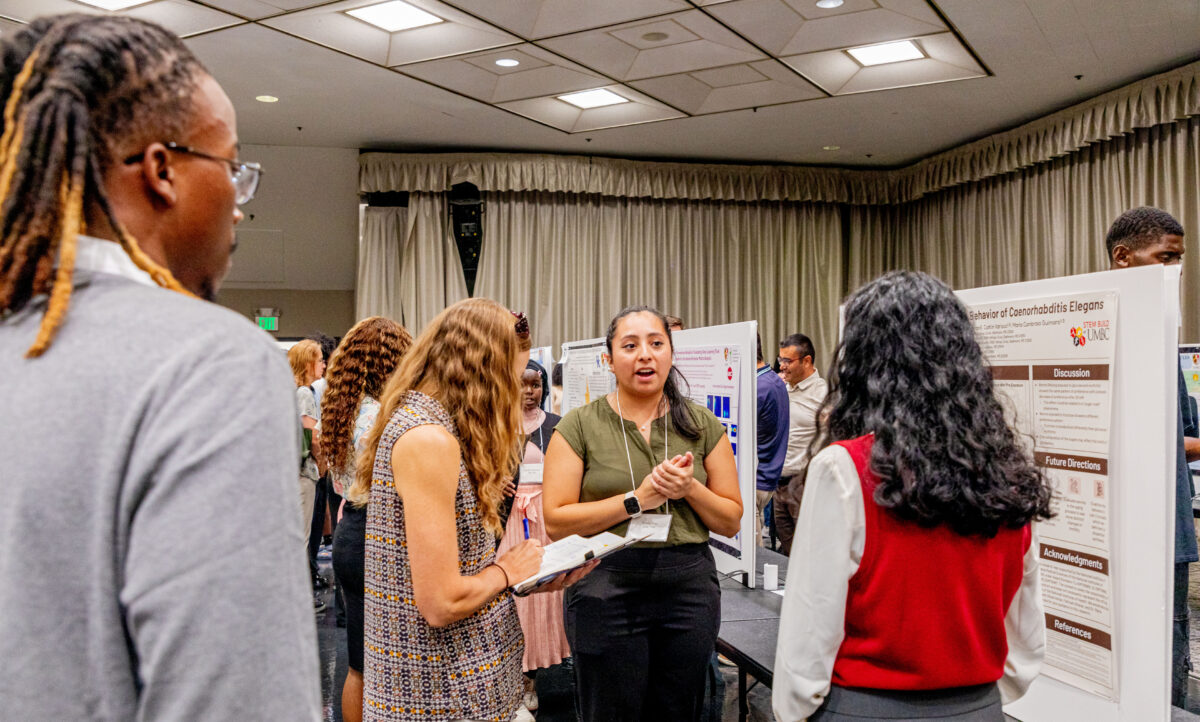 Emily Paz ’25 (center), biological sciences, explains her research to SURF attendees. (Image by Melissa Penley Cormier, M.F.A. ’17/UMBC)
In addition to work in the lab, the process of preparing for SURF and completing the Introduction to Research Badge as part of the internship was valuable for BUILD intern Emily Molnar, a Montgomery College student whose project focused on the relationship between stress and alcohol in C. elegans. Interns completed the badge, a sequence of activities designed to help them get ready to find and pursue undergraduate research opportunities, under the guidance of Caitlin Varisco, assistant director of undergraduate initiatives in CNMS.
“The internship gave me experience with abstracts, posters, and skills to get future opportunities, which boosted my confidence,” Molnar says.
Belonging in science
Student research at UMBC is frequently student driven, which was the experience of Samuel Barnett ’25, biochemistry and molecular biology, another Howard Community College transfer. His project looked at how nicotine influenced the appetite of C. elegans. “You have so much freedom in this program, which I love,” he says. “That really made me feel involved in the research process.”
Third- and fourth-year UMBC students, some of them former STEM BUILD Trainees, mentored the interns along with Cambraia. “I found it uplifting,” says mentor Courtney De Leon ’25, biological sciences. “I’m so proud of the students I mentored.” De Leon also presented her own project at SURF on how long-term nicotine consumption affected growth and reproduction in C. elegans.
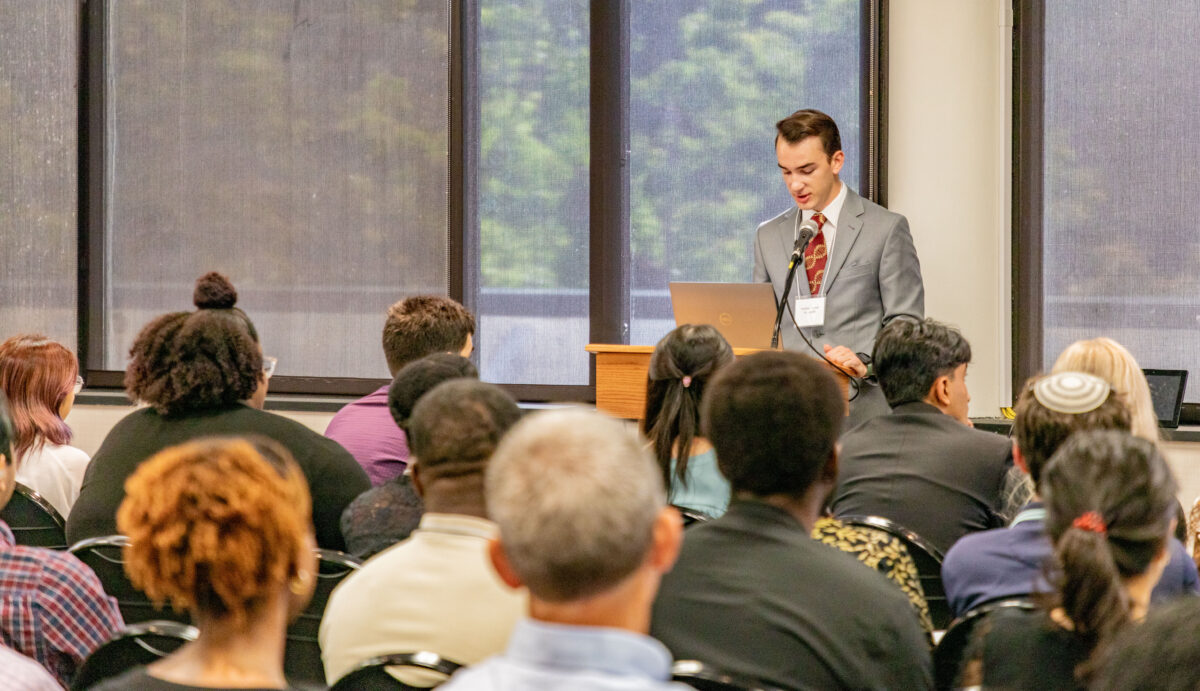 Andrew Opincar ’25, biological sciences and a STEM BUILD Trainee, presents a “lightning talk” at SURF. (Image by Melissa Penley Cormier, M.F.A. ’17/UMBC)
Cambraia notes that after the eight-week internship, the interns identified much more with being scientists than they had at the outset. “Science identity” is documented to increase the chances that students will complete STEM degrees and then continue in related careers.
“That’s why mentoring and peer mentoring are so important in this program,” Cambraia says. “We are not just mentoring them in wet lab techniques, experimental design, and data analysis skills. Our main goal is to help them see and feel that they belong in science and that they can be future leaders in this field.”
“A grand scholarly community”
BUILD a Bridge to STEM is just one example of a student research program that participated in SURF. Students in an array of programs supported by the likes of the National Institutes of Health, Howard Hughes Medical Institute, and the Louis Stokes Alliance for Minority Participation participated, as well as those who arranged their research projects individually.
“These projects all depend on mentors supporting undergraduate research with their time, energy, and resources,” LaCourse notes. UMBC faculty have shown time and again that they are happy to work with students to help them reach their goals, as evidenced by the huge number of students presenting original work at SURF. For many students, SURF is their first time presenting research—but LaCourse hopes it won’t be the last.
“This may be the first of many scientific talks you give,” he told the participants at the end of the day. “By practicing and applying the skills of performing research this summer, you are following in the footsteps of great scientists and researchers—making each of you a part of a grand scholarly community.”
]]>
At Summer Undergraduate Research Fest (SURF) on August 9, 132 students presented posters and six gave short oral presentations, called “lightning talks,” about research projects covering topics...
https://umbc.edu/stories/summer-undergraduate-research-fest-2023/
https://my3.my.umbc.edu/api/v0/pixel/news/134869/guest@my.umbc.edu/bf6ed568dee408d3b3b781a24d8e3346/api/pixel
biology
chemistry-and-biochemistry
cnms
news
rca-2
science-and-tech
stembuild
UMBC News & Magazine
https://my3.my.umbc.edu/groups/umbc-news-magazine
https://assets1-my.umbc.edu/system/shared/avatars/groups/000/001/943/24435aa6207c452e7bc15cc74b42c7bb/xsmall.png?1748556657
https://assets1-my.umbc.edu/system/shared/avatars/groups/000/001/943/24435aa6207c452e7bc15cc74b42c7bb/original.png?1748556657
https://assets2-my.umbc.edu/system/shared/avatars/groups/000/001/943/24435aa6207c452e7bc15cc74b42c7bb/xxlarge.png?1748556657
https://assets2-my.umbc.edu/system/shared/avatars/groups/000/001/943/24435aa6207c452e7bc15cc74b42c7bb/xlarge.png?1748556657
https://assets3-my.umbc.edu/system/shared/avatars/groups/000/001/943/24435aa6207c452e7bc15cc74b42c7bb/large.png?1748556657
https://assets1-my.umbc.edu/system/shared/avatars/groups/000/001/943/24435aa6207c452e7bc15cc74b42c7bb/medium.png?1748556657
https://assets2-my.umbc.edu/system/shared/avatars/groups/000/001/943/24435aa6207c452e7bc15cc74b42c7bb/small.png?1748556657
https://assets1-my.umbc.edu/system/shared/avatars/groups/000/001/943/24435aa6207c452e7bc15cc74b42c7bb/xsmall.png?1748556657
https://assets2-my.umbc.edu/system/shared/avatars/groups/000/001/943/24435aa6207c452e7bc15cc74b42c7bb/xxsmall.png?1748556657
UMBC News & Magazine
0
0
false
Thu, 24 Aug 2023 15:50:30 -0400
Thu, 24 Aug 2023 15:50:30 -0400
UMBC’s 2023-2024 Fulbright Student Program recipients announced
This year, the U.S. Fulbright Student Program, the U.S. government’s flagship international exchange program, has awarded nine UMBC students and alumni top research and teaching placements in countries such as Japan, Taiwan, and North Macedonia.
Each year, more than 10,000 students apply with just over 2,000 selected from hundreds of colleges and universities across the U.S. In the last decade, UMBC students and alumni have received more than 85 Fulbright U.S. Student Program awards for research and teaching placements in Africa, Asia and the Pacific, the Middle East, South America, and Europe. UMBC was named a Fulbright Top Producing Institution in 2019 – 2020.
This year’s class includes research award recipient Paul Ocone ’22, individualized study, who will be conducting research at Meiji University School of Global Japanese Studies in Japan. Fulbright research awards provide funding for research and training efforts overseas with a focus on non-Western foreign languages and area studies. Additionally, there are eight UMBC recipients of the English Teaching Assistant (ETA) award. ETA’s develop their own language skills and knowledge of their host country while working with student in elementary through college to strengthen their English-language abilities and knowledge of the U.S.
Three alumni will be headed to Taiwan to further their passion for global languages and communities: Nailah-Benā Chambers ’23, global studies, Kara Gavin ’20, English, and Milan Richardson ’23, bioinformatics.
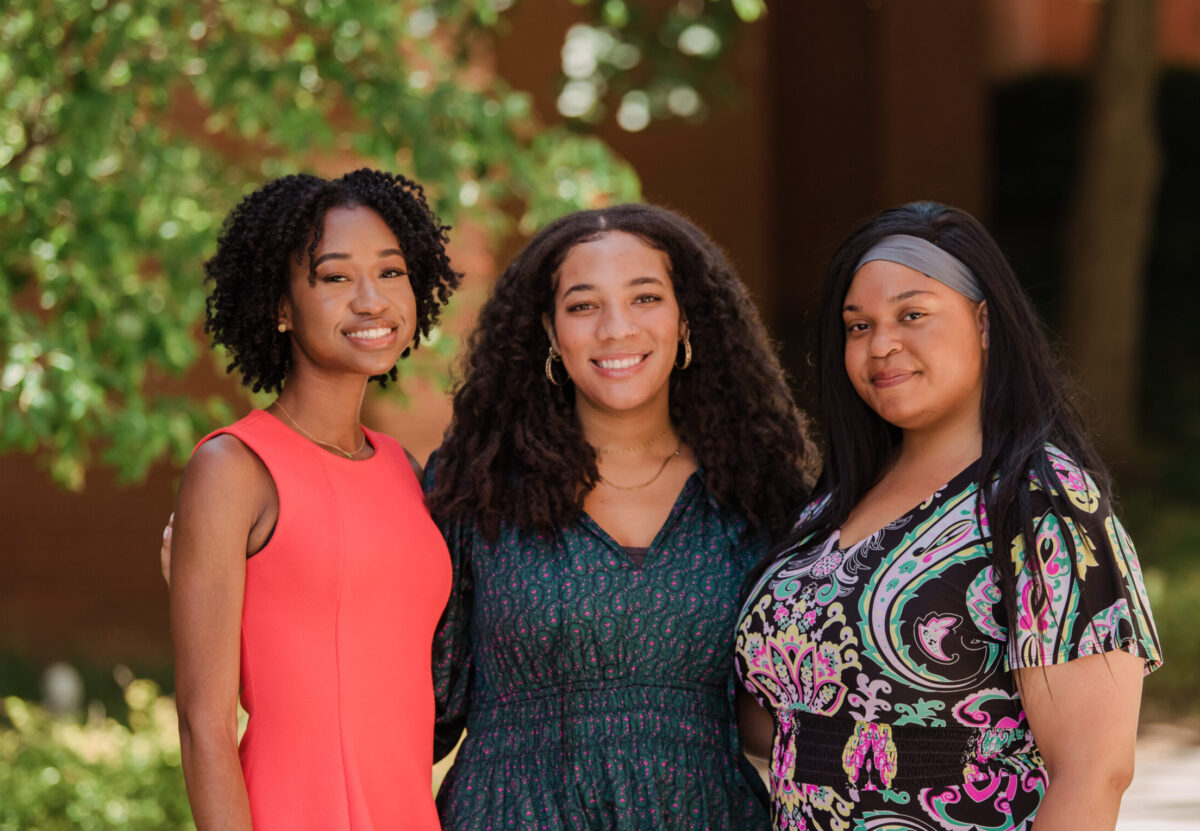 Kara Gavin, Nailah-Benā Chambers, and Milan Richardson. (Marlayna Demond ’11/UMBC)
Gavin brings experience as a Teaching of English as a Second Language (TESOL) volunteer which she completed during her study abroad program at the University of Brighton in the U.K. Chambers began learning how to move between different languages early in life as a student in a Chinese-language skills course. She later became a tutor, a skill she continued at UMBC’s English Language Institute (ELI). Teaching Baltimore Public City School’s diverse student population inspired Richardson to apply to the Fulbright program where she will continue working with students from all backgrounds.
David Bullman ’22, ancient studies, served in the U.S. Army as a musician and public diplomat. He will be returning to North Macedonia, one of the countries he previously served in.
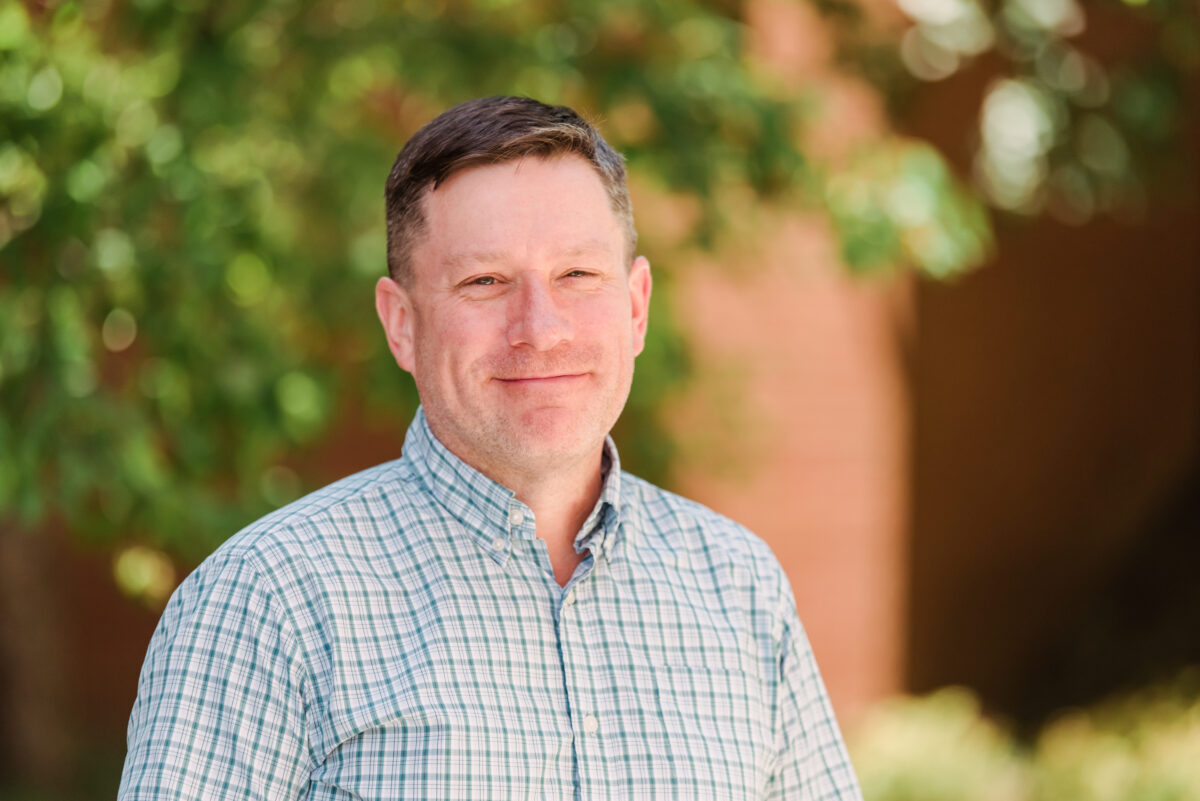 David Bullman. (Marlayna Demond ’11/UMBC)
In addition to teaching English, Leah Michaels, M.F.A ’21, intermedia and digital arts, will be conducting research for two films and teaching film workshops for the community in Piła, Poland.
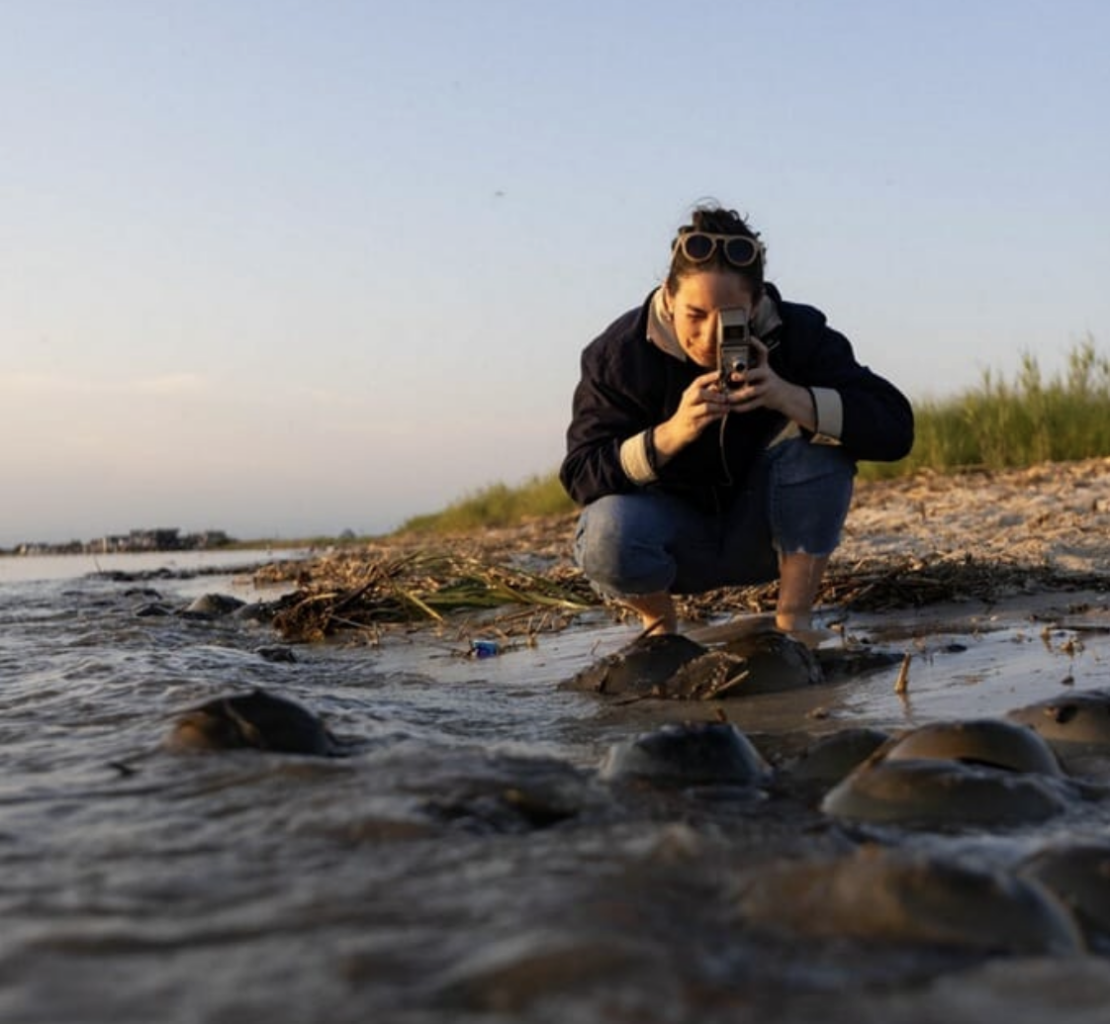 Leah Michaels in Cape May shooting the horseshoe crab mating period for a film she’s working on. (Image courtesy of Leah Michaels)
Tiffany Powell ’23, TESOL, spent three years teaching English in Seoul, Korea and will continue teaching in Romania after she graduates in December.
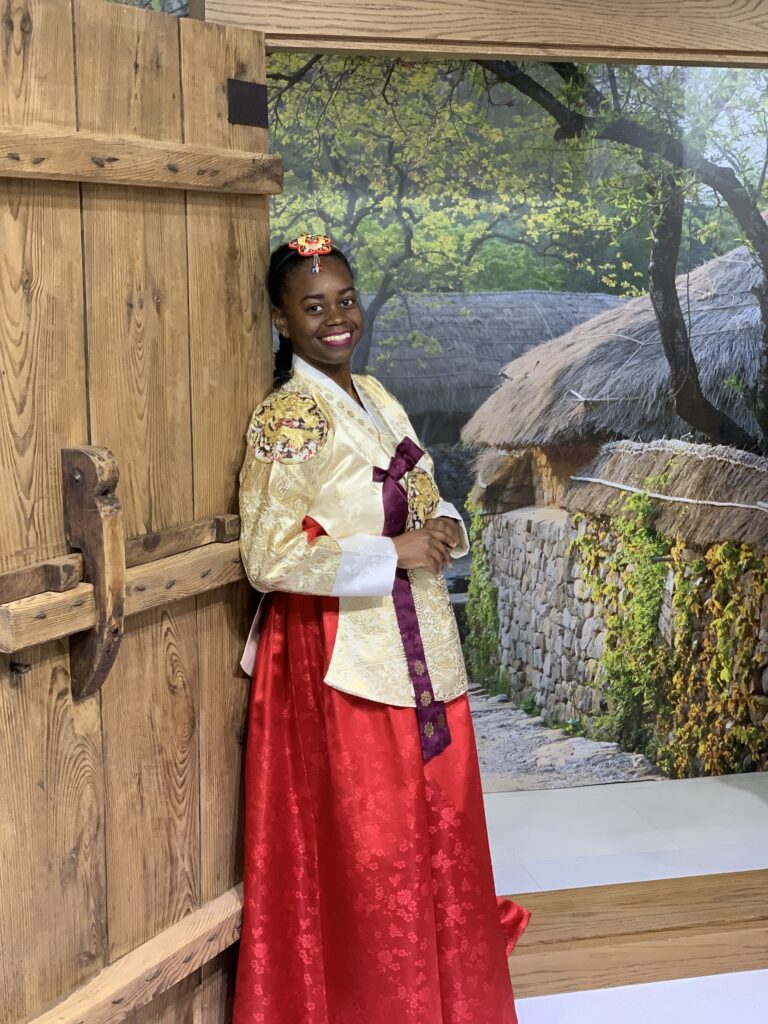 Tiffany Powell in Seoul wearing a hanbok, South Korean traditional clothing. (Image courtesy of Tiffany Powell)
Sianna Serio ’23, computer science, who studied abroad in France, Spain, and the U.K., will head to the Slovak Republic to teach high school students.
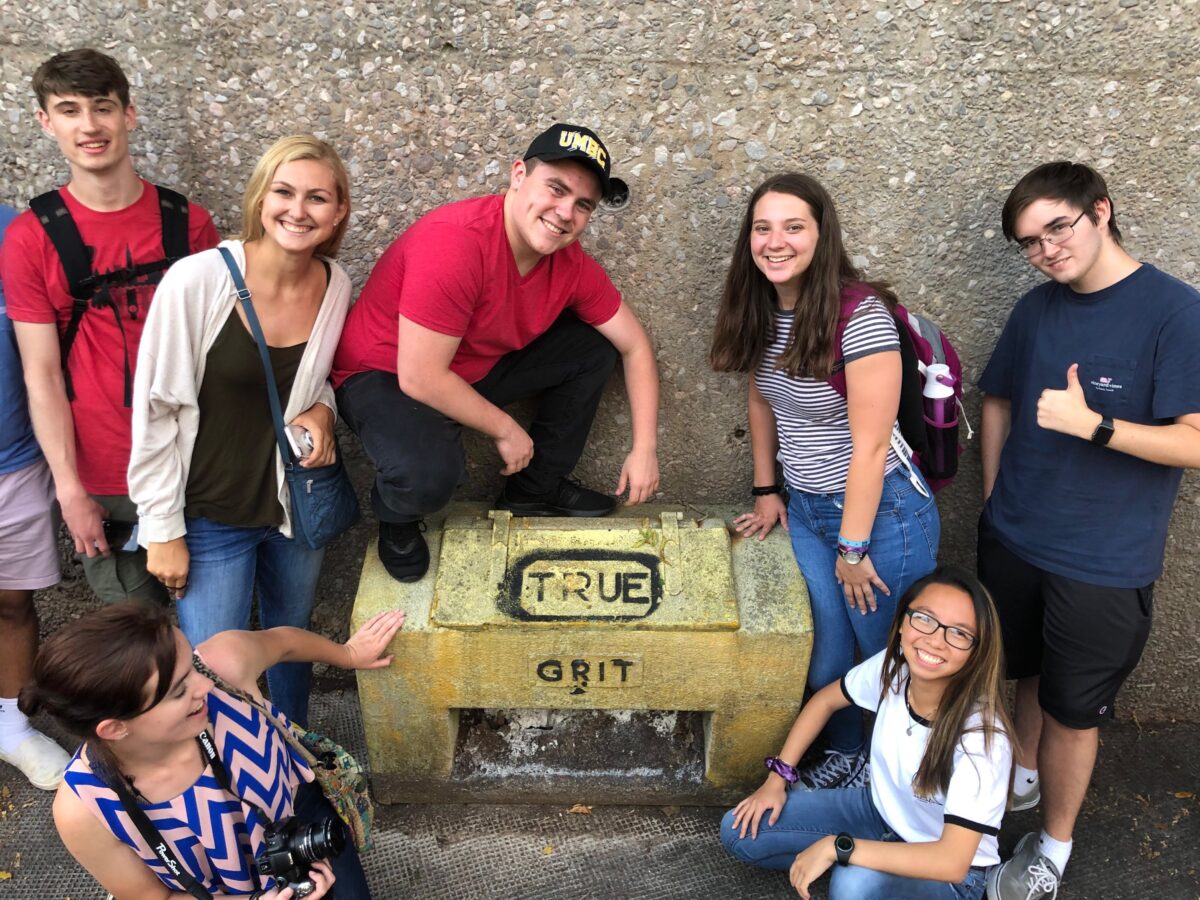 Sianna Serio, kneeling on right, in Bristol, U.K. (Image courtesy of Sianna Serios)
As a former marketing assistant at the ELI, Tasneem Mansour ’20, modern languages, linguistics and intercultural communication, supported visiting students from Peru, Nagoya and Tokyo, Japan. Mansour will head to South Korea.
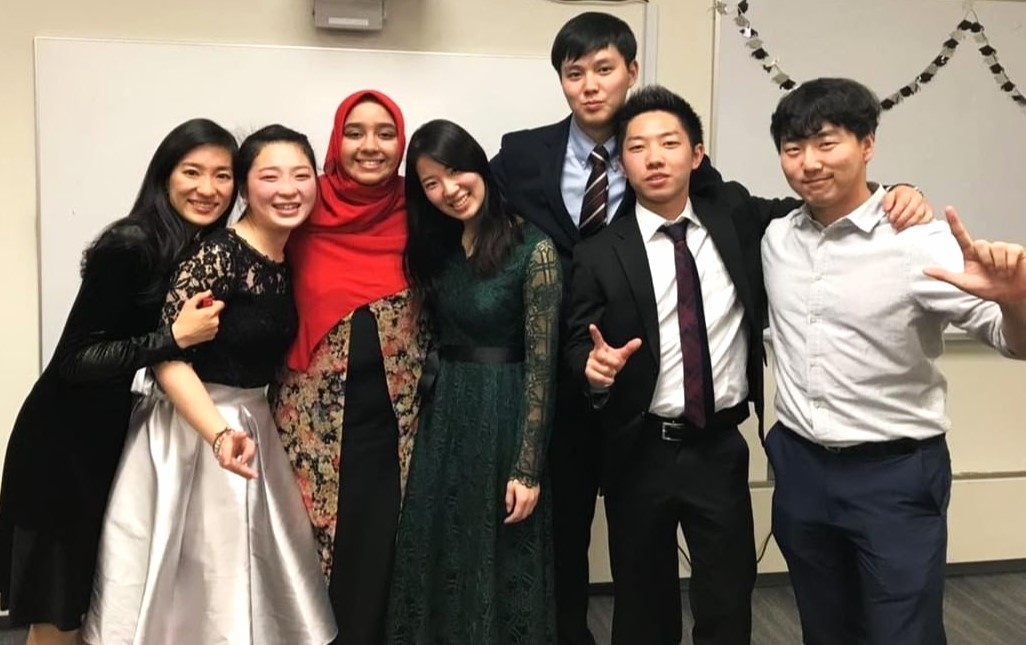
Tasneem Mansour, third from the left, with students from Nippon Sport-Science University in Tokyo, Japan. (Image courtesy of Tasneem Mansour)
UMBC’s global outlook
UMBC’s commitment to international collaboration and research begins at the Center for Global Engagement, which connects students and faculty from the U.S. with students and distinguished faculty from more than 100 countries with unique international academic opportunities. Together, they further the research and skills needed to address long-standing and new global challenges.
Brian Souders, M.A.’19, TESOL and Ph.D. ’09, language, literacy and culture, the associate director of global learning of the Center for Global Engagement, has led students through the Fulbright application process, as UMBC’s Fulbright Program advisor, for the last decade. “Our students are high achievers, the application process is a place for them to share their story,” says Souders. “Faculty and staff are there to ensure each student’s application reflects their years of hard work and the skills they have developed to collaborate with partners across the world.”
Research at home and abroad
With the vast network of Fulbright alumni at UMBC and across the U.S., it’s always helpful to get tips on how to conduct research in a new country and in a new language. Fulbright recipient Ocone, a long time fan of all things anime, began developing his ethnographic research skills with the support of Bambi Chapin, associate professor of anthropology. Chapin, a 1999 – 2000 Fulbright recipient, taught Ocone the theoretical and practical aspects of ethnographic research which he will now use to research the politics of inclusion and exclusion in otaku (anime/manga fan) spaces.
Chapin, along with Julie Christ Oakes, the assistant director of curriculum and retention of the Honors College and a 2001 – 2002 Fulbright research award recipient to Japan, also workshopped Ocone’s research proposal and Fulbright application. Oakes also shared her insights on the Fulbright experience.
“I went to Japan to do research for my dissertation research,” says Oakes. “I have a good idea of what [Ocone] will face as a relative “newbie” abroad and a non-native Japanese speaker and reader.”
The Fulbright experience is also about nurturing relationships with faculty abroad. Ocone said he feels honored for the opportunity to further his research with Kaichiro Morikawa, an associate professor at Meiji University and author of one of the foundational books on otaku spaces. Morikawa will help Ocone navigate the various resources on otaku culture. He wrote in Ocone’s recommendation letter that his “research is highly original as well as effectively focused,” and says he looks forward to supporting Ocone during his time at the university and in Japan.
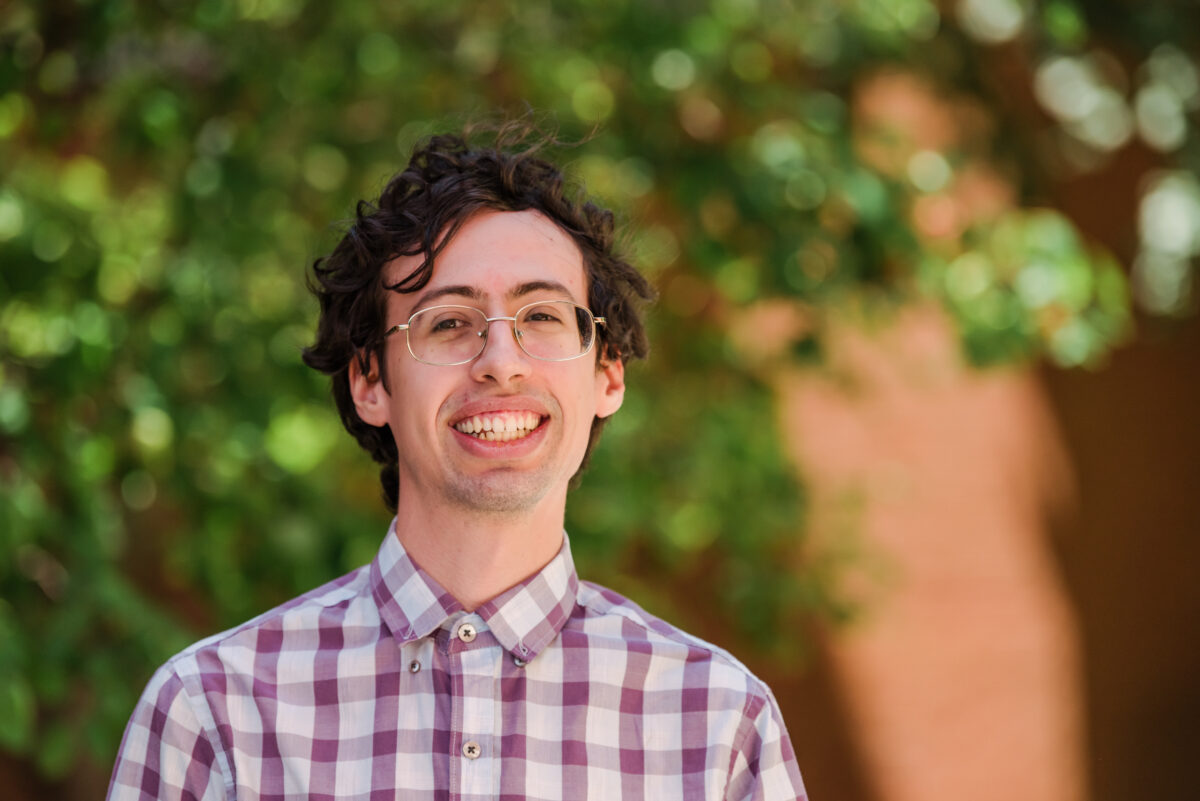 Paul Ocone. (Marlayna Demond ’11/UMBC)
“I am immensely grateful to all of my mentors for guiding me on my journey through my undergraduate degree—from my earliest fuzzy and broad ideas of what I wanted to do, to the more specific research plans, and to the rewarding thesis that eventually emerged,” says Ocone. “I’ll be continuing research on topics that I care deeply about, research that I will likely build upon in graduate school and beyond.”
Fulbright support network
The road to being a Fulbright recipient begins day one students’ UMBC experience as they explore majors, create a network of mentors, and hone their research skills. At the end of their junior year, students develop their initial application at the Fulbright Base Camp led by Souders, who is a 2023 – 2024 Fulbright International Education Administrator award recipient. “The camp helps elevate and support students to reach their Fulbright goals,” says Souders. “Students share drafts of their essays with me for feedback prior to the campus deadline, the first day of the fall semester. They participate in a campus evaluation process with UMBC faculty and staff to receive feedback on their applications.”
Souders, Chapin, and Maryam Elhabashy ’21, anthropology, a research assistant at Rutgers University and a 2022 Fulbright recipient to Kuwait City, discuss this process on the Retrieving the Social Science podcast, produced by UMBC’s Center for Social Science Scholarship.
“The panel gives students advice about how to craft a project, like how to take it apart and re-put it back together, what we see as strengths,” says Chapin. “We support them and encourage them as they go through that really difficult intellectual work, emotional work of figuring out how to make their strong projects even stronger.”
Learn more about the UMBC’s international education opportunities.
]]>
This year, the U.S. Fulbright Student Program, the U.S. government’s flagship international exchange program, has awarded nine UMBC students and alumni top research and teaching placements in...
https://umbc.edu/stories/2023-fulbright-recipients/
https://my3.my.umbc.edu/api/v0/pixel/news/134370/guest@my.umbc.edu/516ede6d25c349e81ae689cbf97868dc/api/pixel
ancientstudies
anthropology
cahss
coeit
computer-science
english
globalstudies
honorscollege
inds
intermedia-and-digital-arts
international-stories
llc
mlli
news
policy-and-society
rca-2
tesol
UMBC News & Magazine
https://my3.my.umbc.edu/groups/umbc-news-magazine
https://assets1-my.umbc.edu/system/shared/avatars/groups/000/001/943/24435aa6207c452e7bc15cc74b42c7bb/xsmall.png?1748556657
https://assets1-my.umbc.edu/system/shared/avatars/groups/000/001/943/24435aa6207c452e7bc15cc74b42c7bb/original.png?1748556657
https://assets2-my.umbc.edu/system/shared/avatars/groups/000/001/943/24435aa6207c452e7bc15cc74b42c7bb/xxlarge.png?1748556657
https://assets2-my.umbc.edu/system/shared/avatars/groups/000/001/943/24435aa6207c452e7bc15cc74b42c7bb/xlarge.png?1748556657
https://assets3-my.umbc.edu/system/shared/avatars/groups/000/001/943/24435aa6207c452e7bc15cc74b42c7bb/large.png?1748556657
https://assets1-my.umbc.edu/system/shared/avatars/groups/000/001/943/24435aa6207c452e7bc15cc74b42c7bb/medium.png?1748556657
https://assets2-my.umbc.edu/system/shared/avatars/groups/000/001/943/24435aa6207c452e7bc15cc74b42c7bb/small.png?1748556657
https://assets1-my.umbc.edu/system/shared/avatars/groups/000/001/943/24435aa6207c452e7bc15cc74b42c7bb/xsmall.png?1748556657
https://assets2-my.umbc.edu/system/shared/avatars/groups/000/001/943/24435aa6207c452e7bc15cc74b42c7bb/xxsmall.png?1748556657
UMBC News & Magazine
3
0
false
Sat, 22 Jul 2023 01:43:12 -0400
Sat, 22 Jul 2023 01:43:12 -0400
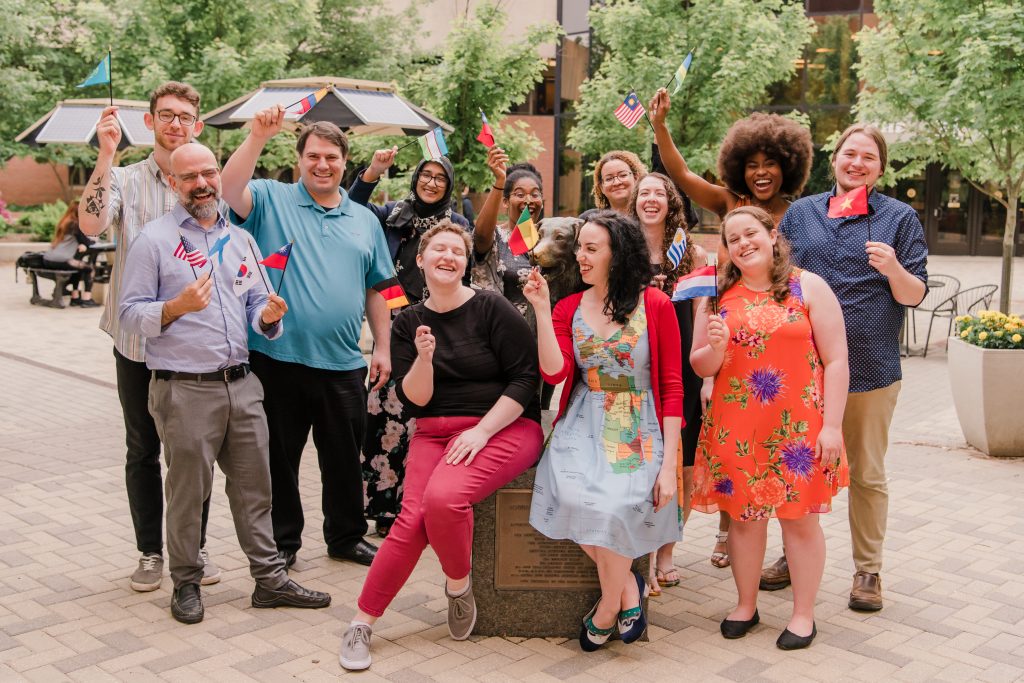 Souders (front left)with UMBC’s