“Don’t be afraid”—Doctoral student Demetrie Garner ’23, public health, and M.P.P ’25, overcame decades of opioid abuse disorder to serve as an overdose response expert
When Demetrie Garner moved from Maryland’s Eastern Shore to Baltimore, he found a wealth of opportunities in Baltimore, a strong spiritual practice, and a supportive network of friends and family. They became necessary anchors for recovering from opioid dependency and managing the workload of a full-time job while earning a bachelor’s, a master’s, and now a doctorate in public health from UMBC.
“My story has a lot of twists and turns. I came to Baltimore in 2018 for treatment for opioid use disorder after experiencing homelessness, incarceration, hospitalizations, and treatment programs. Recovery was a process of 26 years,” says Garner, who now works in the Baltimore City Mayor’s Office of Overdose Response. “When I came to Baltimore, I had a clean slate. I was able to go through an expungement process of criminal records, which was a list of misdemeanors that happened during my drug and alcohol addiction. My journey to UMBC began as an adult learner, at 40 years old, after a year in recovery.”
Understanding the bigger picture
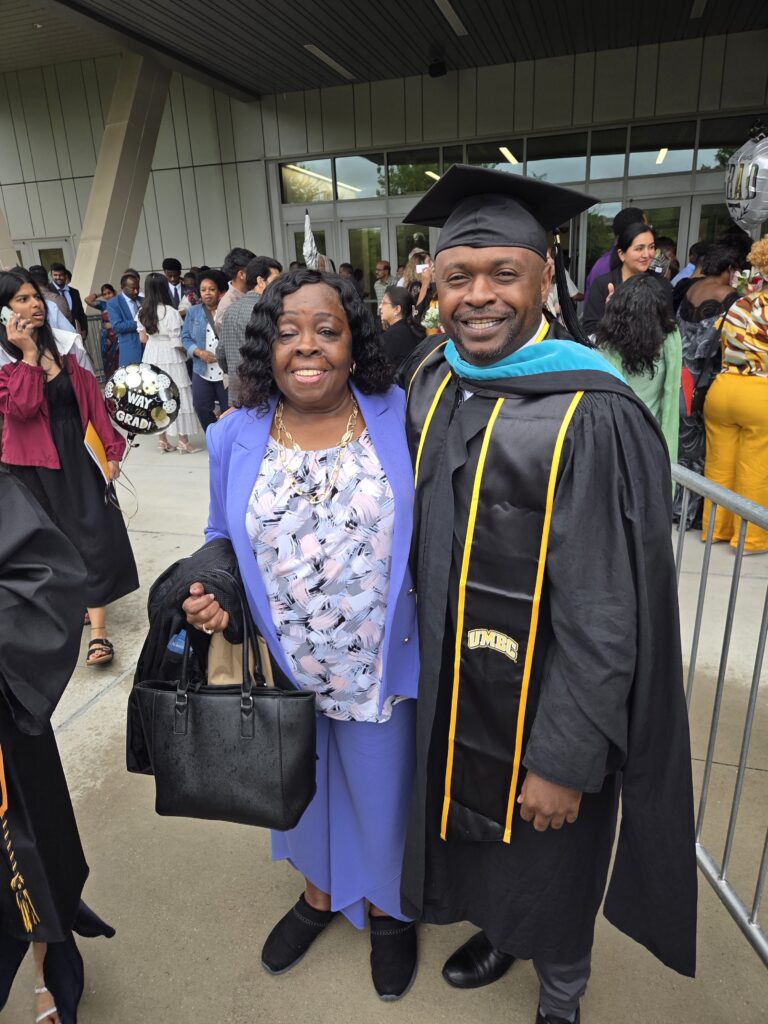 Garner with his mom, Clara Turner.
The inspiration to pursue a bachelor’s degree came from working as a recovery specialist at Franklin Square Hospital in Baltimore County, where he supported patients who had overdosed or were experiencing substance use disorders, many of whom faced significant social and economic conditions that negatively affected their health. Although he connected patients to treatment and recovery resources, he questioned why so many returned to the emergency department with the same challenges. That curiosity sparked a desire to better understand the systems, policies, and social factors driving addiction and recovery.
“I wanted to understand how healthcare is failing people in recovery,” says Garner. “I decided to go back to school. The logical step was to study public health.” Making the leap from working full-time and being a full-time student without a driver’s license posed many challenges. Thankfully, in addition to his faith, friends, and family, Garner also had a team of mentors at UMBC’s School of Public Policy that continue to support him to make his vision possible.
Garner immersed himself in public health research and learned about comorbidities, where patients are managing multiple health needs like substance dependency and mental health. He found that having multiple health needs with little to no healthcare is also exacerbated by homelessness, lack of transportation, inconsistent healthcare, or an environment not conducive to recovery. The emergency room could treat the symptoms but not the root causes.
“My undergrad journey into public health was transformative because the curriculum I was learning for the core courses in public health also exposed me to psychology and epidemiology,” says Garner. “UMBC helped me understand what was needed for me to actually serve. If I wanted to be of service, then I needed to understand not just what leads people into substance use disorder but also what drives the research.”
No limits in sight
Each learning moment inspired great curiosity. Garner sought faculty for advice and opportunities. A game-changing moment came in a research methods course with Pamela R. Bennett, professor of public policy. Bennett encouraged Garner to think beyond what was stated in the research and analyze what was in between the lines.
“I got a D in one discussion post, so I went to Dr. Bennett’s office hours. She told me to stop synthesizing information and to start thinking critically,” says Garner. “That was a game changer because I translated what she said to me into my work.”
UMBC offered me, someone with a lived experience of homelessness and substance use disorder, a door that I would normally not have access to. College is an opportunity to discover who you are and what matters to you. Don’t be afraid to engage with professors, challenge ideas, and use your voice.
Demetrie Garner ’23, public health, and M.P.P ’25
Another game-changing moment came in Lauren Hamilton Edwards‘ class. Hamilton Edwards, associate professor of public policy, told the class at the beginning of the semester that everyone had an A until they didn’t. Garner interpreted that as an incentive to do his best every day. “From the beginning, she gave me the kind of nurturing I needed,” says Garner. “Now, when I have an intern, I make sure that I’m the “Dr. Lauren Hamilton Edwards” to that intern, as she was with me.”
Additional supports like the McNair Scholars Program gave him the foundation and confidence to pursue graduate school, and his first experience presenting his research at UMBC’s Undergraduate Research and Creative Achievement Day was a humbling experience, he says.
 Garner with Baltimore City Mayor
Brandon Scott.
Garner is thriving thanks to the support of the faculty and staff in the public policy and sociology, anthropology, and public health departments, who recognized his potential.
“Associate Professor Andrea Kalfoglou called me Dr. Garner long before I believed it myself. My faculty advisor, Katie Birger, associate teaching professor, recognized my potential early on and encouraged me to pursue the B.A./M.A. pathway,” says Garner. “Now, with Professor Nancy Miller‘s mentorship, I am on track to finish my coursework by the end of the fall semester and begin my dissertation proposal in the spring of 2027.”
“Don’t be afraid”
As Garner’s expertise in public health and policy grew, so did his career opportunities. Today, he serves as the quality assurance manager for Baltimore City’s Behavioral Health Consent Decree. His work focuses on improving outcomes for people experiencing homelessness, substance use disorders, and behavioral health crises, giving him a unique perspective on how public safety and public health intersect to advance overdose prevention and crisis response.
“I no longer see those 26 years to recovery as a period of failure. They gave me lived experience that I now use to help others entering recovery,” says Garner, who, throughout that time, drew strength from the unwavering faith of his grandmother, Hazel Parker; his sister, Shontell Cooper, and his mother, Clara Turner, who never stopped believing change was possible. He hopes his story inspires others to begin their own path to healing.
“UMBC offered me, someone with a lived experience of homelessness and substance use disorder, a door that I would normally not have access to,” says Garner. “College is an opportunity to discover who you are and what matters to you. Don’t be afraid to engage with professors, challenge ideas, and use your voice.”
Learn more about UMBC’s public health programs.
]]>
When Demetrie Garner moved from Maryland’s Eastern Shore to Baltimore, he found a wealth of opportunities in Baltimore, a strong spiritual practice, and a supportive network of friends and family....
https://umbc.edu/stories/demetrie-garner-overcame-decades-of-opioid-abuse-disorder-to-serve-as-an-overdose-response-expert/
https://my3.my.umbc.edu/api/v0/pixel/news/160920/guest@my.umbc.edu/82de84a000ca166fe752f0323fb5678e/api/pixel
alumni
baltimore-city
cahss
mcnair-scholars
policy-and-society
public-policy
saph
stories
story
UMBC News & Magazine
https://my3.my.umbc.edu/groups/umbc-news-magazine
https://assets1-my.umbc.edu/system/shared/avatars/groups/000/001/943/24435aa6207c452e7bc15cc74b42c7bb/xsmall.png?1748556657
https://assets1-my.umbc.edu/system/shared/avatars/groups/000/001/943/24435aa6207c452e7bc15cc74b42c7bb/original.png?1748556657
https://assets2-my.umbc.edu/system/shared/avatars/groups/000/001/943/24435aa6207c452e7bc15cc74b42c7bb/xxlarge.png?1748556657
https://assets2-my.umbc.edu/system/shared/avatars/groups/000/001/943/24435aa6207c452e7bc15cc74b42c7bb/xlarge.png?1748556657
https://assets3-my.umbc.edu/system/shared/avatars/groups/000/001/943/24435aa6207c452e7bc15cc74b42c7bb/large.png?1748556657
https://assets1-my.umbc.edu/system/shared/avatars/groups/000/001/943/24435aa6207c452e7bc15cc74b42c7bb/medium.png?1748556657
https://assets2-my.umbc.edu/system/shared/avatars/groups/000/001/943/24435aa6207c452e7bc15cc74b42c7bb/small.png?1748556657
https://assets1-my.umbc.edu/system/shared/avatars/groups/000/001/943/24435aa6207c452e7bc15cc74b42c7bb/xsmall.png?1748556657
https://assets2-my.umbc.edu/system/shared/avatars/groups/000/001/943/24435aa6207c452e7bc15cc74b42c7bb/xxsmall.png?1748556657
UMBC News & Magazine
7
0
false
Thu, 02 Jul 2026 08:45:04 -0400
Thu, 02 Jul 2026 08:45:04 -0400
A global perspective on aging: Alfred Boakye’s gerontology journey from Ghana to Japan and the U.S.
Alfred Boakye first began thinking deeply about the care and well-being of elders and their families while caring for his centenarian grandmother, Margaret Nyarko, in his home city of Tema, on the Atlantic coast of South East Ghana. She was in charge of her essential self-care routine—bathing, dressing, eating, toileting, transferring from sitting to standing, and continence—and more complex daily tasks necessary for independent living: medication management, meal preparation, transportation, and shopping. But even with her mobility, his grandmother lacked a social network.
Acting as both a devoted grandchild and a caretaker, Boakye experienced firsthand the complexities of aging. He learned to respect his grandmother’s independence while finding ways to support her where she needed help. Boakye, now a UMBC gerontology Ph.D. student in the social, cultural, and behavioral track, notes that his grandmother’s children didn’t live with her, and her grandchildren didn’t understand her aging process. As her friends and siblings passed away, her social circle shrank. “I asked her what motivated her to stay at church for hours, and she says the church supports her, brings her communion, visits her, and brings her Christmas gifts.”
After earning a bachelor’s degree in English and a master’s degree in human resources at the University of Ghana, Boakye wanted to broaden his understanding of aging and caregiving. In 2021, he moved to the United States to pursue a master’s degree in gerontology at Georgia State University (GSU), where he met his mentor and master’s thesis chair, Jennifer Craft Morgan, professor and director of the GSU Gerontology Institute.
 Boakye at his GSU master’s graduation. (l-r): Antonius Skipper, assistant professor of gerontology at GSU and Boakye’s master’s thesis committee member; Reverend Kwaku Owusu-Boachie, Boakye’s uncle; Boakye; and Craft Morgan. (Image courtesy of Boakye)
In 2023, the year his grandmother passed away and the year he completed his master’s at GSU, Boakye published his first aging-related article, “Does the Church Care? Assessment of Social Support Strategies on the Health and Wellbeing of Older Adults within the Tema Metropolitan Assembly-Ghana” in the African Journal of Ageing Studies.
Craft Morgan fostered Boakye’s interest in gerontology and encouraged him to continue his work at the doctoral level, leading him to UMBC’s gerontology doctoral program, which is an interdisciplinary program in collaboration with the University of Baltimore. “Professor Craft Morgan has held my hand from the day I started my master’s program and continues to do so today,” says Boakye. “I always feel privileged that I have her in my corner.”
Stigma of male caregivers
Boakye’s studies are also informed by his experience being the primary caregiver to his father. Before moving to the U.S., Boakye did the grocery shopping, cooking, and laundry for Stephen, his 76‑year‑old father. He became aware of the multiple obligations children have when caretaking for themselves, their families, and their parents, as well as the isolation that can happen, especially if you are a male caregiver.
At the time, Boakye saw himself as being a “helpful child,” a term associated with a Ghanaian proverb that states, “If they take care of you to grow your teeth, you take care of them to lose theirs.” The proverb is more than words—it is a way of life in Ghana, which reinforced Boakye’s caregiving role and emphasized what it takes to be a helpful child—one built on responsibility and reciprocity. But it’s easier said than done. “I had to juggle my ‘identity’ as a male caregiver in a historically patriarchal society with my caring masculinity,” says Boakye. “Caregiving is predominantly perceived as ‘women’s work’ in Ghana, and men who take on these roles are often stigmatized and labeled ‘Kojo besia,’ which translates to ‘man woman’. To avoid such labeling, I was hesitant to ask for help, despite the toll caregiving took on my physical and psychological well‑being.”
 Boakye presents his research on male caregiving to GSA leadership during their visit to UMBC in spring 2026. (Bradley Ziegler/UMBC)
Boakye presented his research and personal experience to the leadership of the Gerontological Society of America (GSA) during their visit to UMBC this spring. Thanks to the UMB Provost’s Global Scholar Program, Boakye will be traveling to Ghana this summer to engage with male caregivers—to listen to their caregiving experiences, explore what these experiences mean to them, and co‑create resources to support them. He will use this research to finish his master’s thesis in applied sociology—Boakye’s third master’s degree.
Meeting Japan’s centenarians
In 2024, Boakye joined the Global Healthy Aging in Japan study abroad program, organized by Taka Yamashita, professor of sociology, anthropology, and public health and co-director of the gerontology doctoral program. The two-week program leads students through research, community centers, and historic sites in Kanagawa Prefecture, near Tokyo. Japan is known for its cutting-edge research and policy that supports the active lives of the world’s largest aging population and the highest number of centenarians. The students visited multigenerational living communities and centers that merge theoretical research with real-world practice and outcomes.
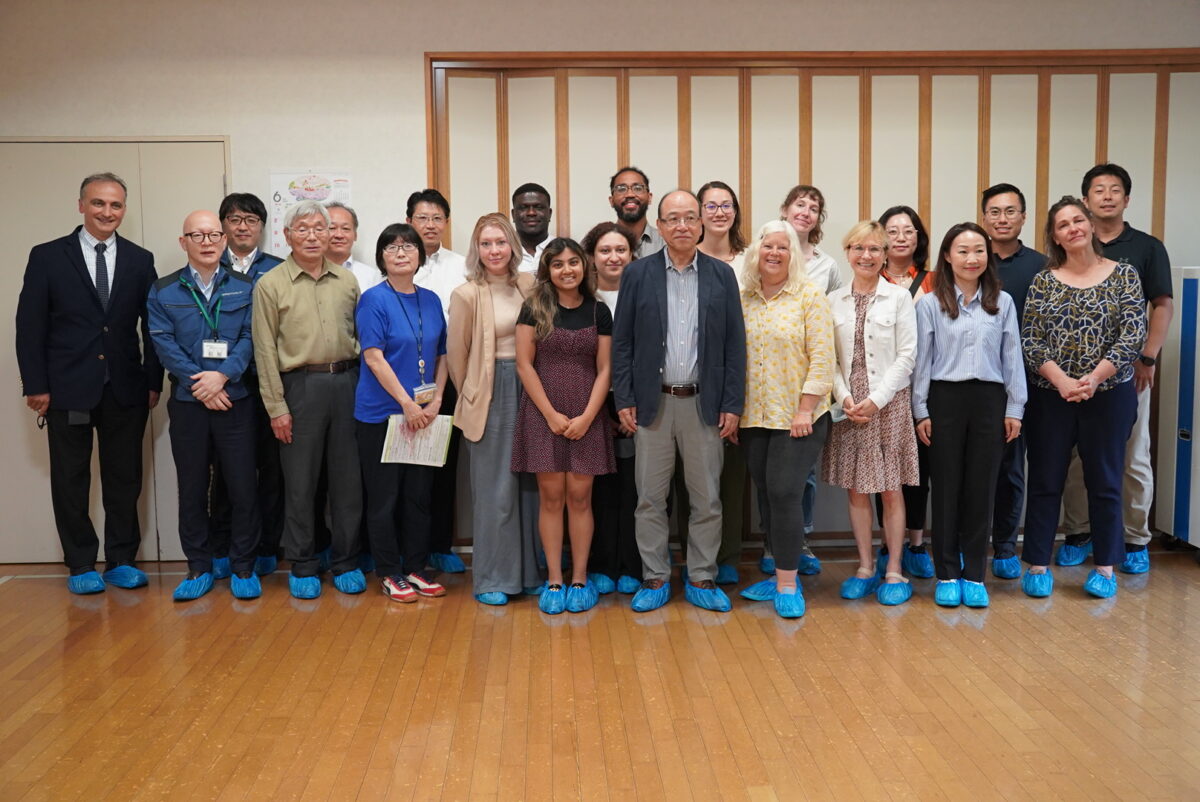 Boakye (second row, fifth from the left) at a senior center in Kanagawa Prefecture, Japan. (Image courtesy of TakaYamishita, professor of gerontology and sociology, second row, first on the right)
Boakye was not expecting that at a time when he was missing his grandmother the most, Kanagawa would make him feel like he was home in Tema. It wasn’t only that both Japan and Ghana operate on a similar collective familial care system focused on intergenerational living and inclusion, notes Boakye. It’s also the physical environment. “The buildings are close together, and people put chairs in front of their homes to talk,” says Boakye. “Older adults greet passersby, and people stop to have a conversation with them. They will tell you they are out for a little sun.”
A highlight of the trip for all the students was meeting a supercentenarian. The 110-year-old woman welcomed them and kissed each of them on the cheek. “All the students say that they were blessed to have this welcome and that she could still talk to us,” says Boakye. “It was really emotional for me. I just kept thinking of my grandmother.”
Boakye was also impressed by the Kanagawa ME-BYO approach to aging, which encourages monitoring vital signs using biomedical technologies. ME-BYO focuses on preventing and minimizing illness progression through programs that promote healthy behaviors such as a balanced diet, exercise, and social activities. “My experience in Japan has been one of the best things that has happened in my personal and academic life and in my career,” says Boakye, who wants to find a way to incorporate ME-BYO into his current and future caregiving research and practice. “This trip has equipped me with the cultural competence, literacy, sensitivity, communication, problem-solving, and critical thinking skills needed to have a real-world impact in the field of gerontology.”
Looking Ahead
With five years of longevity research, Boakye now understands that his grandmother’s experience is common for many older adults in Ghana. He discovered in the 2021 Population and Housing Census of Ghana that adults 65 years of age and older make up 4.3 percent of Ghana’s population. However, he explains, the need for person-centred and geriatric care services has not kept up with the demand.
“I feel like I am now clearly connecting the dots between my experiences in Ghana, what I saw in Japan, and what I have learned in class. I am passionate about encouraging more men to engage and support the people they love, but also seek help when they need it,” says Boakye. He plans to finish his doctoral program in fall 2027.
“It has been a pleasure to watch Alfred’s research grow during his time at UMBC,” says Nancy Kusmaul, professor at UMBC’s School of Social Work, his dissertation chair, who Boakye works with as a research assistant. “He is committed to raising the voices of paid and unpaid caregivers who provide vital services to older adults and people with disabilities in the US and abroad. I am confident that he will continue to make significant contributions to the field.”
He knows there is a long road ahead, but he is confident that he is on the right path. “I want to build culturally relevant and gender‑sensitive resources that support male caregivers, not only to improve their health and well‑being but also to amplify their voices when it matters most.” His grandmother, Margaret, continues to inspire Boakye’s work on how caregiving shapes the experiences of both the carer and the care recipient.
Learn more about UMBC’s gerontology doctoral program.
]]>
Alfred Boakye first began thinking deeply about the care and well-being of elders and their families while caring for his centenarian grandmother, Margaret Nyarko, in his home city of Tema, on the...
https://umbc.edu/stories/alfred-boakyes-gerontology-journey/
https://my3.my.umbc.edu/api/v0/pixel/news/160831/guest@my.umbc.edu/a44c085d6a24b6aba543a04a55557c3d/api/pixel
cahss
gerontology
international
policy-and-society
research
saph
socialwork
stories
story
UMBC News & Magazine
https://my3.my.umbc.edu/groups/umbc-news-magazine
https://assets1-my.umbc.edu/system/shared/avatars/groups/000/001/943/24435aa6207c452e7bc15cc74b42c7bb/xsmall.png?1748556657
https://assets1-my.umbc.edu/system/shared/avatars/groups/000/001/943/24435aa6207c452e7bc15cc74b42c7bb/original.png?1748556657
https://assets2-my.umbc.edu/system/shared/avatars/groups/000/001/943/24435aa6207c452e7bc15cc74b42c7bb/xxlarge.png?1748556657
https://assets2-my.umbc.edu/system/shared/avatars/groups/000/001/943/24435aa6207c452e7bc15cc74b42c7bb/xlarge.png?1748556657
https://assets3-my.umbc.edu/system/shared/avatars/groups/000/001/943/24435aa6207c452e7bc15cc74b42c7bb/large.png?1748556657
https://assets1-my.umbc.edu/system/shared/avatars/groups/000/001/943/24435aa6207c452e7bc15cc74b42c7bb/medium.png?1748556657
https://assets2-my.umbc.edu/system/shared/avatars/groups/000/001/943/24435aa6207c452e7bc15cc74b42c7bb/small.png?1748556657
https://assets1-my.umbc.edu/system/shared/avatars/groups/000/001/943/24435aa6207c452e7bc15cc74b42c7bb/xsmall.png?1748556657
https://assets2-my.umbc.edu/system/shared/avatars/groups/000/001/943/24435aa6207c452e7bc15cc74b42c7bb/xxsmall.png?1748556657
UMBC News & Magazine
0
0
false
Wed, 24 Jun 2026 12:31:18 -0400
Wed, 24 Jun 2026 12:31:18 -0400
A global perspective on aging: Alfred Boakye’s gerontology journey from Ghana to Japan and the U.S.
Alfred Boakye first began thinking deeply about the care and well-being of elders and their families while caring for his centenarian grandmother, Margaret Nyarko, in his home city of Tema, on the Atlantic coast of South East Ghana. She was in charge of her essential self-care routine—bathing, dressing, eating, toileting, transferring from sitting to standing, and continence—and more complex daily tasks necessary for independent living: medication management, meal preparation, transportation, and shopping. But even with her mobility, his grandmother lacked a social network.
Acting as both a devoted grandchild and a caretaker, Boakye experienced firsthand the complexities of aging. He learned to respect his grandmother’s independence while finding ways to support her where she needed help. Boakye, now a UMBC gerontology Ph.D. student in the social, cultural, and behavioral track, notes that his grandmother’s children didn’t live with her, and her grandchildren didn’t understand her aging process. As her friends and siblings passed away, her social circle shrank. “I asked her what motivated her to stay at church for hours, and she says the church supports her, brings her communion, visits her, and brings her Christmas gifts.”
After earning a bachelor’s degree in English and a master’s degree in human resources at the University of Ghana, Boakye wanted to broaden his understanding of aging and caregiving. In 2021, he moved to the United States to pursue a master’s degree in gerontology at Georgia State University (GSU), where he met his mentor and master’s thesis chair, Jennifer Craft Morgan, professor and director of the GSU Gerontology Institute.
Boakye at his GSU master’s graduation. (l-r): Antonius Skipper, assistant professor of gerontology at GSU and Boakye’s master’s thesis committee member; Reverend Kwaku Owusu-Boachie, Boakye’s uncle; Boakye; and Craft Morgan. (Image courtesy of Boakye)
In 2023, the year his grandmother passed away and the year he completed his master’s at GSU, Boakye published his first aging-related article, “Does the Church Care? Assessment of Social Support Strategies on the Health and Wellbeing of Older Adults within the Tema Metropolitan Assembly-Ghana” in the African Journal of Ageing Studies.
Craft Morgan fostered Boakye’s interest in gerontology and encouraged him to continue his work at the doctoral level, leading him to UMBC’s gerontology doctoral program, which is an interdisciplinary program in collaboration with the University of Baltimore. “Professor Craft Morgan has held my hand from the day I started my master’s program and continues to do so today,” says Boakye. “I always feel privileged that I have her in my corner.”
Stigma of male caregivers
Boakye’s studies are also informed by his experience being the primary caregiver to his father. Before moving to the U.S., Boakye did the grocery shopping, cooking, and laundry for Stephen, his 76‑year‑old father. He became aware of the multiple obligations children have when caretaking for themselves, their families, and their parents, as well as the isolation that can happen, especially if you are a male caregiver.
At the time, Boakye saw himself as being a “helpful child,” a term associated with a Ghanaian proverb that states, “If they take care of you to grow your teeth, you take care of them to lose theirs.” The proverb is more than words—it is a way of life in Ghana, which reinforced Boakye’s caregiving role and emphasized what it takes to be a helpful child—one built on responsibility and reciprocity. But it’s easier said than done. “I had to juggle my ‘identity’ as a male caregiver in a historically patriarchal society with my caring masculinity,” says Boakye. “Caregiving is predominantly perceived as ‘women’s work’ in Ghana, and men who take on these roles are often stigmatized and labeled ‘Kojo besia,’ which translates to ‘man woman’. To avoid such labeling, I was hesitant to ask for help, despite the toll caregiving took on my physical and psychological well‑being.”
Boakye presents his research on male caregiving to GSA leadership during their visit to UMBC in spring 2026. (Bradley Ziegler/UMBC)
Boakye presented his research and personal experience to the leadership of the Gerontological Society of America (GSA) during their visit to UMBC this spring. Thanks to the UMB Provost’s Global Scholar Program, Boakye will be traveling to Ghana this summer to engage with male caregivers—to listen to their caregiving experiences, explore what these experiences mean to them, and co‑create resources to support them. He will use this research to finish his master’s thesis in applied sociology—Boakye’s third master’s degree.
Meeting Japan’s centenarians
In 2024, Boakye joined the Global Healthy Aging in Japan study abroad program, organized by Taka Yamashita, professor of sociology, anthropology, and public health and co-director of the gerontology doctoral program. The two-week program leads students through research, community centers, and historic sites in Kanagawa Prefecture, near Tokyo. Japan is known for its cutting-edge research and policy that supports the active lives of the world’s largest aging population and the highest number of centenarians. The students visited multigenerational living communities and centers that merge theoretical research with real-world practice and outcomes.
Boakye (second row, fifth from the left) at a senior center in Kanagawa Prefecture, Japan. (Image courtesy of TakaYamishita, professor of gerontology and sociology, second row, first on the right)
Boakye was not expecting that at a time when he was missing his grandmother the most, Kanagawa would make him feel like he was home in Tema. It wasn’t only that both Japan and Ghana operate on a similar collective familial care system focused on intergenerational living and inclusion, notes Boakye. It’s also the physical environment. “The buildings are close together, and people put chairs in front of their homes to talk,” says Boakye. “Older adults greet passersby, and people stop to have a conversation with them. They will tell you they are out for a little sun.”
A highlight of the trip for all the students was meeting a supercentenarian. The 110-year-old woman welcomed them and kissed each of them on the cheek. “All the students say that they were blessed to have this welcome and that she could still talk to us,” says Boakye. “It was really emotional for me. I just kept thinking of my grandmother.”
Boakye was also impressed by the Kanagawa ME-BYO approach to aging, which encourages monitoring vital signs using biomedical technologies. ME-BYO focuses on preventing and minimizing illness progression through programs that promote healthy behaviors such as a balanced diet, exercise, and social activities. “My experience in Japan has been one of the best things that has happened in my personal and academic life and in my career,” says Boakye, who wants to find a way to incorporate ME-BYO into his current and future caregiving research and practice. “This trip has equipped me with the cultural competence, literacy, sensitivity, communication, problem-solving, and critical thinking skills needed to have a real-world impact in the field of gerontology.”
Looking Ahead
With five years of longevity research, Boakye now understands that his grandmother’s experience is common for many older adults in Ghana. He discovered in the 2021 Population and Housing Census of Ghana that adults 65 years of age and older make up 4.3 percent of Ghana’s population. However, he explains, the need for person-centred and geriatric care services has not kept up with the demand.
“I feel like I am now clearly connecting the dots between my experiences in Ghana, what I saw in Japan, and what I have learned in class. I am passionate about encouraging more men to engage and support the people they love, but also seek help when they need it,” says Boakye. He plans to finish his doctoral program in fall 2027.
“It has been a pleasure to watch Alfred’s research grow during his time at UMBC,” says Nancy Kusmaul, professor at UMBC’s School of Social Work, his dissertation chair, who Boakye works with as a research assistant. “He is committed to raising the voices of paid and unpaid caregivers who provide vital services to older adults and people with disabilities in the US and abroad. I am confident that he will continue to make significant contributions to the field.”
He knows there is a long road ahead, but he is confident that he is on the right path. “I want to build culturally relevant and gender‑sensitive resources that support male caregivers, not only to improve their health and well‑being but also to amplify their voices when it matters most.” His grandmother, Margaret, continues to inspire Boakye’s work on how caregiving shapes the experiences of both the carer and the care recipient.
Learn more about UMBC’s gerontology doctoral program.
]]>
Alfred Boakye first began thinking deeply about the care and well-being of elders and their families while caring for his centenarian grandmother, Margaret Nyarko, in his home city of Tema, on the...
https://umbc.edu/stories/a-global-perspective-on-aging-alfred-boakyes-gerontology-journey/
https://my3.my.umbc.edu/api/v0/pixel/news/160830/guest@my.umbc.edu/92ff94cfedaf1cafa34c3bbd1e692406/api/pixel
cahss
gerontology
international
policy-and-society
research
saph
socialwork
stories
story
UMBC News & Magazine
https://my3.my.umbc.edu/groups/umbc-news-magazine
https://assets1-my.umbc.edu/system/shared/avatars/groups/000/001/943/24435aa6207c452e7bc15cc74b42c7bb/xsmall.png?1748556657
https://assets1-my.umbc.edu/system/shared/avatars/groups/000/001/943/24435aa6207c452e7bc15cc74b42c7bb/original.png?1748556657
https://assets2-my.umbc.edu/system/shared/avatars/groups/000/001/943/24435aa6207c452e7bc15cc74b42c7bb/xxlarge.png?1748556657
https://assets2-my.umbc.edu/system/shared/avatars/groups/000/001/943/24435aa6207c452e7bc15cc74b42c7bb/xlarge.png?1748556657
https://assets3-my.umbc.edu/system/shared/avatars/groups/000/001/943/24435aa6207c452e7bc15cc74b42c7bb/large.png?1748556657
https://assets1-my.umbc.edu/system/shared/avatars/groups/000/001/943/24435aa6207c452e7bc15cc74b42c7bb/medium.png?1748556657
https://assets2-my.umbc.edu/system/shared/avatars/groups/000/001/943/24435aa6207c452e7bc15cc74b42c7bb/small.png?1748556657
https://assets1-my.umbc.edu/system/shared/avatars/groups/000/001/943/24435aa6207c452e7bc15cc74b42c7bb/xsmall.png?1748556657
https://assets2-my.umbc.edu/system/shared/avatars/groups/000/001/943/24435aa6207c452e7bc15cc74b42c7bb/xxsmall.png?1748556657
UMBC News & Magazine
1
0
false
Wed, 24 Jun 2026 12:31:18 -0400
Finley Bandy ’26 finds a future in history
Finley Bandy spent last summer in the cool temperatures and dim light of UMBC’s Albin O. Kuhn Library and Gallery Special Collections—the perfect environment to preserve rare books, photographs, manuscripts, archives, and artifacts. As part of UMBC’s 2025 Co-Lab interdisciplinary undergraduate summer research program, Bandy learned techniques to produce “Special Collections 101”, an informative video about how to use the resources in the collections. Bandy also loves being surrounded by thousands of historical narratives and working with Special Collections staff Beth Saunders, associate director and curator, and Lindsey Loeper, reference and instruction archivist. The infinite possibilities housed in Special Collections and the people who ensure historical narratives aren’t forgotten have inspired Bandy to join the cadre of museum and archive professionals.
“I was accepted into UMBC’s master’s program in historical studies,” says Bandy. “I love the process of using my historical and archival research to write about what I’m finding so that other people are aware that this piece of history exists. That’s why I want my master’s research to be an online exhibit that is accessible to the world.”
Museums and archives are only two of Bandy’s passions. When Bandy transferred to UMBC from Lamar Community College in Colorado, they brought their love of Russian language, history, and culture, and their deep love of Baltimore City.
Q: Did you come to UMBC already knowing what you wanted to study?
A: When I started at UMBC, I was all set to learn Russian and study Soviet history, but then I decided to go broader and major in history. I did finish all the Russian language courses, so I can speak Russian. I’m still interested in Russian history, and I love Russian music. I really love the language and like Eastern European culture.
Q: Where does your passion for Russian language and culture come from?
A: In my community college, I took a 20th-century world history class, and learned about the Cold War, which lasted from 1947 to 1991. A lot of the history really broke my heart. It made me want to learn more about it. I took a lot of Russian history classes and started reading Russian and Soviet literature. I really love how unique it is.
Q: Is there a modern piece of Russian culture that you enjoy, or are you focused on the history?
A: I think it’s really interesting to see how Soviet culture is beginning to meld with Western culture.
Soviet rock bands are really, really cool. There’s this great rock band that has been around since the ’70s called Akvarium or Aquarium. They were underground for a long time due to the war. I listen to them a lot. There’s also a current pop musician named Monetochka. She’s really cool.
I’ve never travelled abroad or have a passport, but one day I would like to visit Moscow and St. Petersburg, and travel all over Eastern Europe and the Balkans.
 UMBC’s proximity to Camden Yards makes for a great trip to cheer on the Orioles! (Image courtesy of Bandy)
Q: Do you have a community to speak Russian with and immerse yourself in Russian culture?
A: Yes! UMBC’s Russian Club is a really tight-knit group. In the past, we hosted many holiday celebrations. In post-Soviet Russia and Eastern Europe, they still celebrate Christmas, but New Year’s is celebrated more because during the Soviet era, atheism was promoted and New Year’s didn’t have religious ties. Towards the end of the fall semester, we organized a giant Novy God [New Year’s] celebration. And then in the spring, we celebrated Maslenitsa. In the Russian Orthodox Church, this is the last week to feast before a period of fasting that ends at Easter. We also hung out a lot and talked about different Eastern European cultures. It’s called the Russian Club, but we have students from all over Eastern Europe—Ukraine, Armenia, and Belarus.
Q: Why do you love Baltimore City?
A:. Even though I was in Colorado for community college, I spent a lot of my childhood in Baltimore City because my grandmother worked in the city and my mom lived there. I have a connection to Baltimore, but I never really knew its history. I took “The History of Baltimore” at the Lion Brothers Building downtown. Every week, we took field trips to historic sites in Baltimore City to connect what we were learning with real-world experiences.
Q: Why did you change your major from Russian to history, and who has inspired you in this path?
A: I decided to switch majors from Russian to history while doing research in Professor Melissa Blair‘s “The History of Baltimore” class. It inspired me to pivot and focus my work on Maryland’s transportation history. The experiential learning and field work inspired me to better understand Baltimore and its history. I think Baltimore is a very unique city with a rich history that is often ignored by the historical record. I enjoyed interacting with other public historians and museum professionals within the city through that class.
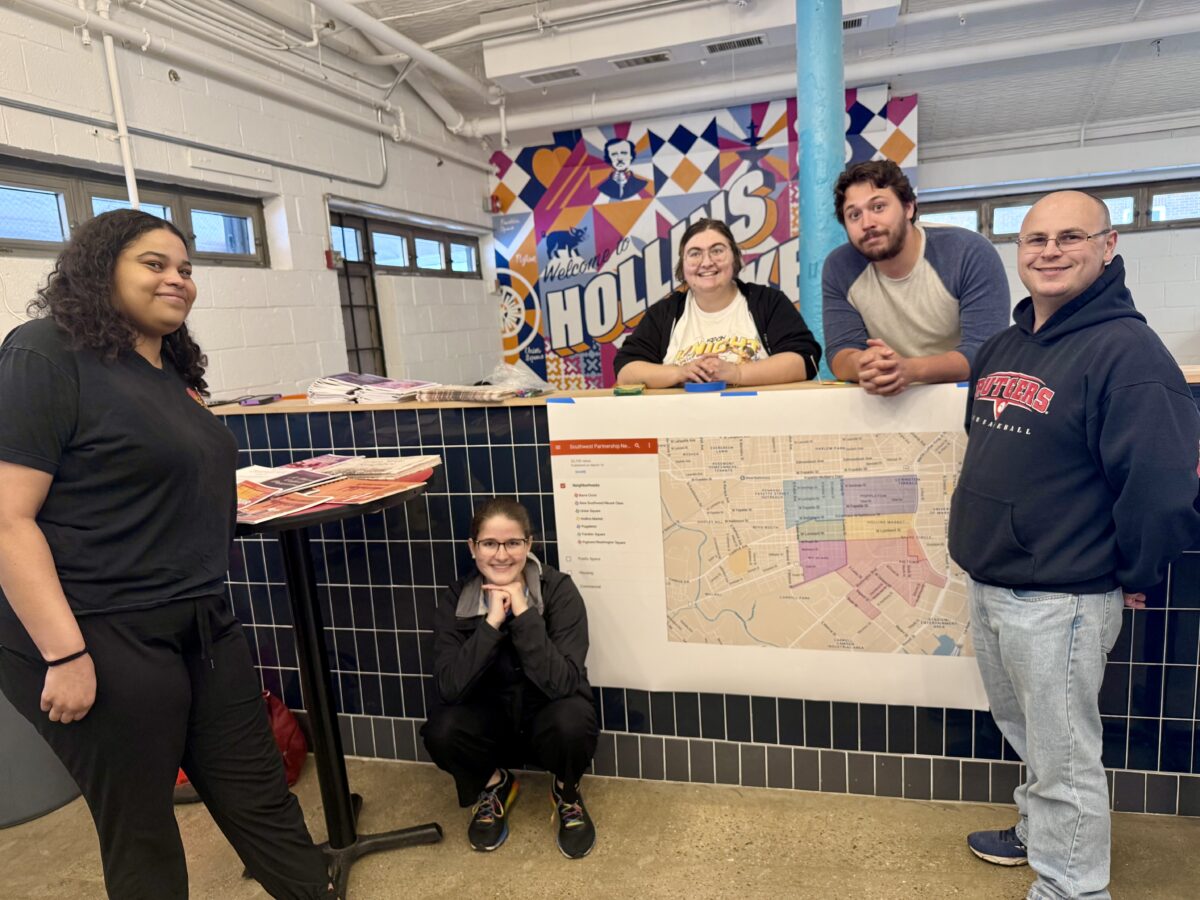 Students from King’s class, “Preserving Spaces, Making Spaces in Baltimore,” participated in a Community Archiving Day event. The class planned this event to engage with residents and community members from neighborhoods in Southwest Baltimore and to gauge interest in developing a Community Archive to preserve their histories. (l-r) Amina Thiam ’24, history, Em Schumacher, a geography and environmental systems senior, Bandy, Tristan Diaz ’25, cultural anthropology and sociology, and Bandy’s fiancé, Max Taylor (who is not a UMBC student). (Image courtesy of King)
I’ve also worked a lot with Professor Nicole King in American studies—I took her “Preserving Places, Making Spaces in Baltimore” class twice. In 2025, we worked with the Poppleton Now Community Association and the Southwest Partnership Historic Preservation Committee on a Public History and Preservation Study. It included my research on the “Highway to Nowhere,” a 1.4-mile stretch of U.S. Route 40 in West Baltimore, built in the 1970s, that ends abruptly. The highway cuts off a section of Poppleton, one of the city’s oldest historically Black neighborhoods. We also created an online story map.
Q: Why are you passionate about transportation equity?
A: I don’t have a car, so I rely on Baltimore’s terrible public transportation. I love public transit, and I need it to be better. In the Baltimore history class, I realized the bus schedules, the bus routes, and the history of highway construction in the city have limited transportation, not expanded it. I conducted research with American studies Professor Michael Cassiano, my public humanities advisor. I presented my research, “Our City Is a City Without an Expressway: A Historical Review of Transportation Injustice in Baltimore City,” at URCAD. I’m interested in exploring these topics in my master’s program.
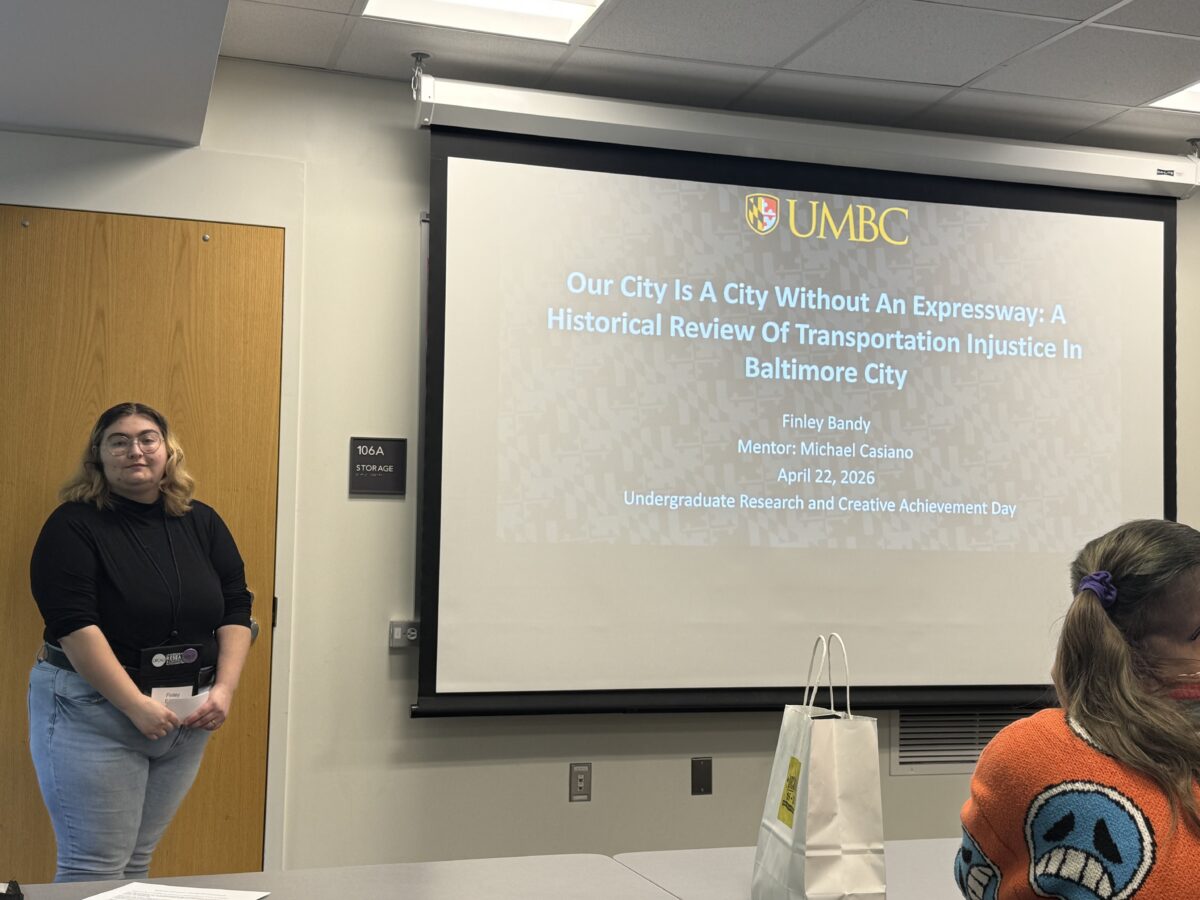 Bandy presents her research at the 2026 Undergraduate Research and Creative Achievement Day. (Image courtesy of King.)
Q: What is a challenge that you love?
A: I love creative writing. I’ve been writing since I was a kid. I think it’s a natural segue into history, because history is narrative-based. It’s very humanistic. I won’t say it comes naturally to me. It takes me probably an hour to write a sentence because I overthink my word choices a lot. But I love using language to evoke certain feelings and really press home on an idea. I try to choose the right word to fit what I’m talking about and its context. I also try to support students in the writing process as the History Student Council president. Last semester, we organized a bi-weekly writing group to encourage community and motivation within the major.
Q: What advice do you have for undergraduate and transfer students?
A: For undergraduate students, I would say to be realistic. Don’t put too much on your plate. That’s been the biggest challenge for me. I’ve been suffering a lot of burnout, because, in addition to my classes, I am a teaching assistant for “Introduction to the University for Transfer Students.” I started getting better at saying no to things. I encourage students to get out there, explore new things, but also recognize their limits. Prioritize making space for something that brings you joy.
For transfer students, I would say time management. Most of us work full-time or part-time, are raising families, and have other commitments. We’re not fresh out of high school and can sometimes internalize a feeling of being behind or not doing college “right.” It’s important to get over that because it doesn’t really matter. When I was 18 years old, my coworker was 40 years old. They had been working for decades. Once you leave high school, age doesn’t matter the same way—people are people, and everyone is busy. I wouldn’t focus on trying to get things done in a way that’s expected of you. Instead, focus on what you need to do to succeed.
Read more Class of 2026 stories.
]]>
Finley Bandy spent last summer in the cool temperatures and dim light of UMBC’s Albin O. Kuhn Library and Gallery Special Collections—the perfect environment to preserve rare books, photographs,...
https://umbc.edu/stories/finley-bandy-finds-a-future-in-history/
Video Preview
https://assets1-my.umbc.edu/system/shared/attachments/47e23a15081ddf29d6a98e4ee9c23e35/6a97a934/news/000/160/021/753b160cd612d83ee6b7c8c05e556046/2VV5_EeP8xs.jpg?1778616307
https://my3.my.umbc.edu/api/v0/pixel/news/160021/guest@my.umbc.edu/74ebb52b16afdf97b14dc160572a104f/api/pixel
american-studies
aok-library
baltimore-city
cahss
class-of-2026
ges
history
news
policy-and-society
saph
story
UMBC News & Magazine
https://my3.my.umbc.edu/groups/umbc-news-magazine
https://assets1-my.umbc.edu/system/shared/avatars/groups/000/001/943/24435aa6207c452e7bc15cc74b42c7bb/xsmall.png?1748556657
https://assets1-my.umbc.edu/system/shared/avatars/groups/000/001/943/24435aa6207c452e7bc15cc74b42c7bb/original.png?1748556657
https://assets2-my.umbc.edu/system/shared/avatars/groups/000/001/943/24435aa6207c452e7bc15cc74b42c7bb/xxlarge.png?1748556657
https://assets2-my.umbc.edu/system/shared/avatars/groups/000/001/943/24435aa6207c452e7bc15cc74b42c7bb/xlarge.png?1748556657
https://assets3-my.umbc.edu/system/shared/avatars/groups/000/001/943/24435aa6207c452e7bc15cc74b42c7bb/large.png?1748556657
https://assets1-my.umbc.edu/system/shared/avatars/groups/000/001/943/24435aa6207c452e7bc15cc74b42c7bb/medium.png?1748556657
https://assets2-my.umbc.edu/system/shared/avatars/groups/000/001/943/24435aa6207c452e7bc15cc74b42c7bb/small.png?1748556657
https://assets1-my.umbc.edu/system/shared/avatars/groups/000/001/943/24435aa6207c452e7bc15cc74b42c7bb/xsmall.png?1748556657
https://assets2-my.umbc.edu/system/shared/avatars/groups/000/001/943/24435aa6207c452e7bc15cc74b42c7bb/xxsmall.png?1748556657
UMBC News & Magazine
0
0
false
Tue, 12 May 2026 15:44:27 -0400
Tue, 12 May 2026 15:44:27 -0400
Zareen Taj earns her Ph.D., publishing the first autoethnography by a Hazara Afghan woman about the ongoing genocide of Hazara women under Taliban rule
This spring on Thursday evenings, students filled room 424 in the Fine Arts building for their Asian Diaspora in Motion: Media, Culture, Identity, and Activism class. At the head of the classroom was Zareen Taj, who designed the new 300-level class based on her experiences as a documentary filmmaker and activist defending the rights of her community—the Hazara women of Afghanistan, a community that has for over a century experienced extreme ethnic, religious, and gender oppression, including multiple massacres and starvation, under Taliban rule.
It’s a reality Taj grew up with as part of the Hazara people, a religious and ethnic minority. In the 1990s, when the Taliban increased their killings of the Hazara people, Taj and her family fled to a refugee settlement in Pakistan. There, Taj started speaking out against the systemic oppression of Hazara women. Her activism made her a Taliban target. With a scholarship from the Feminist Majority Foundation, Taj fled once more, this time to Towson University, where she earned a bachelor’s in political science and women’s studies and a master’s in women’s studies.
After graduation, Taj worked for Voice of America as an international broadcaster and producer. At UMBC, she worked for Chartwells in the HR department first and then as an accounting associate at The Shriver Center. A year later, Taj was accepted into the language, literacy, and culture (LLC) doctoral program. During her studies, she raised two children and created four short documentaries about Hazara women while teaching in the global studies, Asian studies, and American studies departments.
This semester, Taj successfully defended her dissertation, “Journey of a Scholar-Activist: An Autoethnographic and Multimodal Inquiry,” which includes written narratives and her fourth documentary short film titled “For My People.” The project marks the first time she took the time and space to reflect on her life.
“I learned from this journey that I am different. I look different. I work differently. I see things differently, but my difference is not a problem,” says Taj about her experience at UMBC, where she hopes to become a professor. “My experience is an asset. It’s my wealth. The UMBC community, particularly the LLC and my professors, were very supportive of what I’m doing. So they supported me at each stage of my life.”
Q: What was your journey to UMBC?
A: I studied in a refugee displacement settlement in Pakistan, so it was very hard. But I got the Feminist Majority Scholarship and moved to Maryland in 2000 to attend Towson University. I could not speak English well. I saw a computer for the first time in my life. It was very hard because I came from a very war-torn country. We don’t have that advanced education system, and it’s often interrupted by war. Every minute, I reminded myself about the other Afghan girls who didn’t have this opportunity, so I couldn’t give up.
I always wanted to get a Ph.D. That was my dream. I put all of my experiences into my academic world. In 2018, I applied to the LLC doctoral program. I talked with Carole McCann, professor of gender, sexuality, and women’s studies, about what I wanted to do. She said yes to being my advisor right away. Joby Taylor, Ph.D. ’05, assistant vice provost and co-leader of The Shriver Center for Public Service and Community Engagement, and Tania Lizarazo, associate professor of modern languages, linguistics, and intercultural communication, and global studies, also lent their support as co-chairs.
Q: How did you decide on the topic for your dissertation?
A: My master’s thesis, titled “Dual Identity, Dual Oppression of Hazara Women,” didn’t follow the same research path as a traditional thesis because there were no official documents that I could use for my research. I felt frustrated. My thesis was informed by my firsthand research trips to Afghanistan. This work represents the first contribution of its kind in the academic field. My personal experiences and frustrations motivated me to return to my country, which ultimately shaped and grounded the development of my thesis.
For my dissertation, my committee wanted me to talk about myself, to write a book. I appreciated them encouraging me, but I continued to focus on Hazara women until Dr. Tanya Saunders, associate professor of sociology, pointed out all the different types of ethnography I was doing and encouraged me to focus on myself to do an autoethnography. I was surprised that I could do that, and that’s how I started.
That gave me a kind of confidence in my writing. I’m always reflecting on all of these things I’m doing, but not reflecting on myself. I never had the chance, or I never thought of doing it. I never thought I would be allowed to talk about myself, so I didn’t. I come from a culture where we never talk about ourselves because this is taboo. Women would be told, “Why are you talking about yourself? We have bigger issues, bigger things to talk about.” That’s the culture, especially for Hazara women. We never talk about ourselves, our pain, our joy. Everything is internalized.
I am reaching a stage of very clear realizations about how this academic process is a very healing process for me. I’m making my people visible and bringing awareness to the cause. We’ll get to know people, my people, my ethnicity, their suffering, and also the resilience of these women.
Q: Why was this dissertation process a healing process?
A: My short documentary, “For My People,” which I produced for my dissertation, helped me process the anger and isolation I have carried after years of fighting for survival and against oppression. This process led to exploration and, for the first time, I explored healing and the shift to joy, community, and belonging I have found with the Hazara women who resettled in Washington, D.C., my global network of activists, and my UMBC community.
The more work I’m doing in the form of writing an article, creating films, or public speaking, the more visibility I have to those dimensions, those identities. It’s helping me feel that I do justice for them. That’s the process of healing. The more I work to bring community sustainability and collectiveness, the stronger my sense of belonging, satisfaction, and deep attachment to my community.
Q: What inspired the topics for your other films?
A: I was doing my master’s thesis about Hazara women, but there wasn’t much data. I decided to go back to Afghanistan for the first time since fleeing Pakistan to document the living conditions and experiences of Hazara women living under the fear of genocide. When I returned, I had 40 hours of videotapes, 700 photographs, and 20 hours of cassette recordings that helped me make my first film, “The Oppression of Hazara in Afghanistan.”
But I didn’t just want to show the oppression of Hazara women as victims. I wanted to show the resistance and leadership of Hazara women. After the fall of the last Afghan government in 2021, some Hazara refugees came to the Washington, D.C., Maryland, Virginia area. We have a lot of activists and advocates like Azra Jafari, the first woman in Afghanistan to hold the office of mayor. They were willing to be interviewed for “Our Face Tells: Seeing the Genocide of Hazaras in Afghanistan.”
Last year, I collaborated with several organizations and led efforts to train Hazara women to create and share their own stories. The Hazara Women of Afghanistan Share Digital Stories event trained and supported Hazara women to tell their own stories. That inspired “Voices of Resistance.”
Q: How have you passed on your documentary film skills to your students?
A: UMBC has given me so much and helped me to contribute to it. I taught three years in the global studies program as a visiting lecturer, and I designed, established, and taught Global Studies 409: Documentary Film as Global Activism. Students had to make a documentary about their families from any part of the world. They had to document where their identity and sense of belonging came from. Their films reflected their family backgrounds as well as their personal passions and engagement with social issues.
I still remember a student whose grandparents came from Ethiopia. His film was about them, and afterwards told me that when he was given the assignment, he said to himself, “If this lady, this lady from Afghanistan, can do these films, I can do that too.” It made me smile
Q: Looking back on everything that you have experienced and accomplished, has your purpose changed?
A: In 2021, when the Taliban returned, it was like the loss of a 20-year-old child. It was hard not to despair. But in all the chaos, some Hazara were able to get out and needed help arriving to live in the United States. That service rescued me from that vulnerable situation. Community work changed me again. It lifted me up.
 Zareen Taj (first row, second from the left), at the Hazara Women of Afghanistan Share Digital Stories event. (Image courtesy of Taj.)
After the Hazara Women of Afghanistan Share Digital Stories event, I realized I do not need to feel the responsibility to speak for Hazara women, as they are now able to articulate and share their own stories with the world. This is my message for Hazara around the world, especially Hazara women who feel like their stories do not matter. You need to tell your story because your story is our history. And your story is our future. Sharing our stories will hold us together and make us known to the world.
]]>
This spring on Thursday evenings, students filled room 424 in the Fine Arts building for their Asian Diaspora in Motion: Media, Culture, Identity, and Activism class. At the head of the classroom...
https://umbc.edu/stories/zareen-taj-publishes-first-autoethnography-by-a-hazara-afghan-woman/
Video Preview
https://assets3-my.umbc.edu/system/shared/attachments/7b6a1d6db6fb8d8e93a0caf9f76477c2/6a97a934/news/000/159/731/e0c4ba8f6e02c02ed67cc30334e8c183/2498820.jpg?1778009707
https://my3.my.umbc.edu/api/v0/pixel/news/159731/guest@my.umbc.edu/f9e9ea2143bc436276841dd469489856/api/pixel
asianstudies
cahss
class-of-2026
global-studies
gwst
international
language-literacy-and-culture
mlli
news
policy-and-society
saph
shrivercenter
story
UMBC News & Magazine
https://my3.my.umbc.edu/groups/umbc-news-magazine
https://assets1-my.umbc.edu/system/shared/avatars/groups/000/001/943/24435aa6207c452e7bc15cc74b42c7bb/xsmall.png?1748556657
https://assets1-my.umbc.edu/system/shared/avatars/groups/000/001/943/24435aa6207c452e7bc15cc74b42c7bb/original.png?1748556657
https://assets2-my.umbc.edu/system/shared/avatars/groups/000/001/943/24435aa6207c452e7bc15cc74b42c7bb/xxlarge.png?1748556657
https://assets2-my.umbc.edu/system/shared/avatars/groups/000/001/943/24435aa6207c452e7bc15cc74b42c7bb/xlarge.png?1748556657
https://assets3-my.umbc.edu/system/shared/avatars/groups/000/001/943/24435aa6207c452e7bc15cc74b42c7bb/large.png?1748556657
https://assets1-my.umbc.edu/system/shared/avatars/groups/000/001/943/24435aa6207c452e7bc15cc74b42c7bb/medium.png?1748556657
https://assets2-my.umbc.edu/system/shared/avatars/groups/000/001/943/24435aa6207c452e7bc15cc74b42c7bb/small.png?1748556657
https://assets1-my.umbc.edu/system/shared/avatars/groups/000/001/943/24435aa6207c452e7bc15cc74b42c7bb/xsmall.png?1748556657
https://assets2-my.umbc.edu/system/shared/avatars/groups/000/001/943/24435aa6207c452e7bc15cc74b42c7bb/xxsmall.png?1748556657
UMBC News & Magazine
0
0
false
Tue, 05 May 2026 15:29:15 -0400
Tue, 05 May 2026 15:29:15 -0400
UMBC’s Global Learning Lab receives Innovative Excellence in Internationalization Award
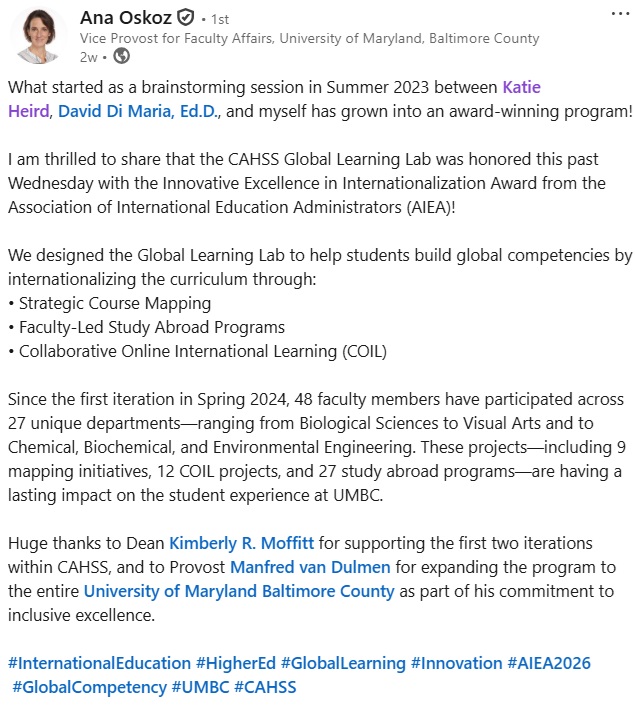
The Association of International Education Administrators (AIEA) has awarded UMBC’s Global Learning Lab one of two Innovative Excellence in Internationalization Awards. This award honors creative, replicable, and innovative initiatives that are critical to internationalization and require strong leadership to achieve. The AIEA commends the Global Learning Lab for reflecting UMBC’s commitment to justice, equity, diversity, and inclusion by fostering inclusive, cost-effective models that integrate global perspectives into the curriculum.
The lab’s primary mission is to support faculty development in increasing student access to global learning opportunities. Through a cohort-based model, the lab brings faculty together for a series of workshops to develop best practices for integrating applied global learning into the curriculum. The initiative was originally launched as a pilot program by the Center for Global Engagement (CGE) and the College of Arts, Humanities, and Social Sciences (CAHSS) Dean’s Office in support of CAHSS faculty. In fall 2025, the lab was opened to all faculty with support from the Office of the Provost. Faculty who participate in this initiative produce concrete deliverables, such as course maps, faculty-led study abroad programs, and Collaborative Online International Learning (COIL) projects.
“To date, 48 faculty members have participated across 27 unique departments ranging from biological sciences to visual arts to chemical, biochemical, and environmental engineering,” according to Provost Provost and Senior Vice President for Academic Affairs, Manfred van Dulmen‘s February campus newsletter. “Projects continue to positively impact the student experience and have included nine mapping initiatives, 12 COIL projects, and 27 study abroad programs.”
Developing an intercultural curriculum
To receive the Excellence in Internationalization Award, the Global Learning Lab had to be grounded in the principles of comprehensive internationalization—an inclusive process that impacts teaching, research, and service. It also had to align with at least two of UNESCO’s 17 Sustainable Development Goals, reflect the underlying principles of justice, equity, diversity, and inclusion in higher education, and serve as a replicable model for other institutions.
Cheryl North, clinical associate professor of education, and Takashi Yamashita, director and professor of sociology, anthropology, and public health (SAPH), are alumni of the inaugural cohort. They were both in the process of designing international university and community partnerships, in Germany and Japan, respectively, before the Global Learning Lab was launched. The lab provided technical and collegial support that bridged the gap between idea and implementation.
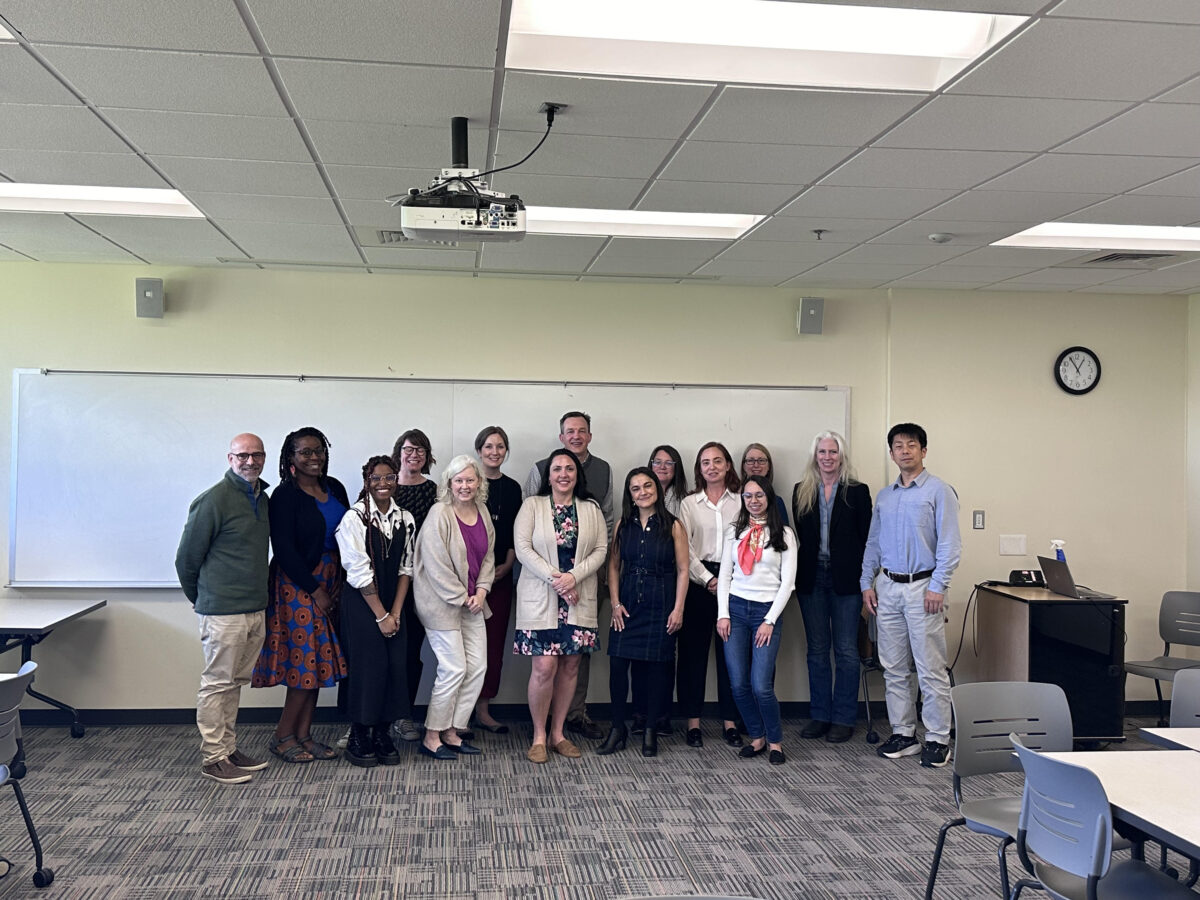 (l-r): Brian Souders (former CGE staff); Ogonna Owu Jones (former CGE staff); Alicyn Curtis (CGE staff); Rebecca Grenouilleau-Loescher (faculty fellow, modern languages, linguistics, and intercultrual communication); Katie Birger (faculty fellow, SAPH); Jessica Cook (faculty fellow, Sondheim Public Affairs Scholars Program); Katherine Heird (CGE staff); David Schultz (faculty fellow, pscyhology); Yolanda Valencia (faculty fellow, geography and environment sciences); Lauren Clay (faculty fellow, emergency and disaster health services); Racquel Matos (visiting dean of the faculty of education and psychology at Universidade Católica Portuguesa in Portugal); Jessica Pfeifer (faculty fellow, philosophy); Lina Mora (CGE intern/intercultural communication graduate student, North (second on the right); and Yamashita (first on the right). (Image courtesy of CGE)
North, along with faculty at the University of Kassel in Germany, had established the foundations for a virtual classroom exchange for their education students, but had experienced technical and scheduling conflicts. “After participating in the Global Learning Lab, we learned to structure the collaboration effectively,” said North. “When we implemented these insights, UMBC students were able to share completed lessons and reflections, while the German students shared their process in the early stages of planning and implementation. Despite the scheduling differences, the exchange was successful, meaningful, and professionally enriching for everyone involved.”
The lab’s funding, technical training, and networking opportunities provided essential support that helped Yamashita develop the Global Health and Aging in Japan faculty-led study abroad program, which will launch in summer 2026.
“Developing a study abroad program can often feel like an isolated effort for a single faculty member,” says Yamashita. “Having a dedicated technical support team from CGE, along with a community of UMBC colleagues to share unique ideas, made the process much more engaging. These interactions kept me inspired and motivated to bring this program to UMBC students.”
Campus-wide internationalization
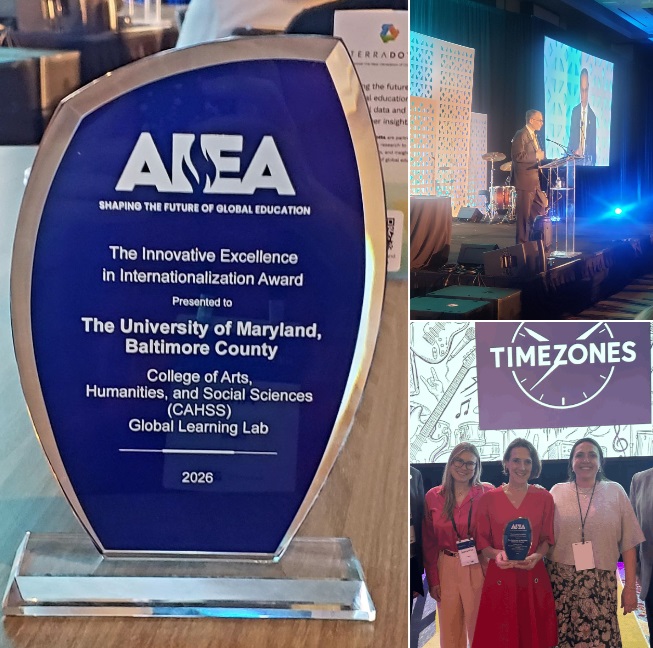
UMBC faculty and staff at the AIEA award. (Image courtesy of CGE)
“The impact of the Global Learning Lab has been profound,” wrote Ana Oskoz, vice provost for faculty affairs, in her recommendation letter. “It is a shining example of innovative internationalization that prioritizes inclusivity, equity, and academic excellence.”
Faculty interested in participating in the Global Learning Lab are encouraged to follow the Faculty Affairs page on MyUMBC for notifications regarding future offerings.
]]>
The Association of International Education Administrators (AIEA) has awarded UMBC’s Global Learning Lab one of two Innovative Excellence in Internationalization Awards. This award honors creative,...
https://umbc.edu/stories/umbcs-global-learning-lab-receives-internationalization-award/
https://my3.my.umbc.edu/api/v0/pixel/news/157429/guest@my.umbc.edu/139f4df23c515634323db492b84665cc/api/pixel
cahss
center-for-global-engagement
community
education
international
news
research
saph
story
UMBC News & Magazine
https://my3.my.umbc.edu/groups/umbc-news-magazine
https://assets1-my.umbc.edu/system/shared/avatars/groups/000/001/943/24435aa6207c452e7bc15cc74b42c7bb/xsmall.png?1748556657
https://assets1-my.umbc.edu/system/shared/avatars/groups/000/001/943/24435aa6207c452e7bc15cc74b42c7bb/original.png?1748556657
https://assets2-my.umbc.edu/system/shared/avatars/groups/000/001/943/24435aa6207c452e7bc15cc74b42c7bb/xxlarge.png?1748556657
https://assets2-my.umbc.edu/system/shared/avatars/groups/000/001/943/24435aa6207c452e7bc15cc74b42c7bb/xlarge.png?1748556657
https://assets3-my.umbc.edu/system/shared/avatars/groups/000/001/943/24435aa6207c452e7bc15cc74b42c7bb/large.png?1748556657
https://assets1-my.umbc.edu/system/shared/avatars/groups/000/001/943/24435aa6207c452e7bc15cc74b42c7bb/medium.png?1748556657
https://assets2-my.umbc.edu/system/shared/avatars/groups/000/001/943/24435aa6207c452e7bc15cc74b42c7bb/small.png?1748556657
https://assets1-my.umbc.edu/system/shared/avatars/groups/000/001/943/24435aa6207c452e7bc15cc74b42c7bb/xsmall.png?1748556657
https://assets2-my.umbc.edu/system/shared/avatars/groups/000/001/943/24435aa6207c452e7bc15cc74b42c7bb/xxsmall.png?1748556657
UMBC News & Magazine
8
0
false
Thu, 12 Mar 2026 10:10:48 -0400
Fri, 13 Mar 2026 15:49:18 -0400
Who is AI for? Eric Stokan receives USM professorship to address barriers and promote AI equity for students and faculty
For tech-savvy individuals like Eric Stokan, artificial intelligence, programming languages, and open-source software are powerful tools that can turn once-impossible ideas into reality. Researchers can use human language processing to analyze historical documents or legal texts. Through collaborative platforms, global organizations can collaborate quickly without incurring travel costs. In the social sciences, open-source tools provide students with unique opportunities to work with experts developing projects that address community needs. However, to take full advantage of these revolutionary technologies, these tools often require advanced computing skills or access to expensive software, which can limit their impact and exclude those without the necessary resources or training.
Stokan, director of the Center for Social Science Scholarship (CS3), is committed to removing these barriers for faculty and students in computational social science, which uses computers, data, and algorithms to study human behavior and social systems. His research lies at the intersection of urban policy, economic development, and computational social science, with a focus on how local governments make policy decisions and how those decisions impact equity, economic growth, and environmental sustainability.
The University System of Maryland (USM) William E. Kirwan Center for Academic Innovation has awarded Stokan the Elkins Professorship for Academic Transformation to address this gap with his project “Computational Social Science and Generative AI: Scalable, Modular Training for Teaching, Research, and Public Impact.”

The Elkins Professorship is named after Wilson H. Elkins, a former Rhodes Scholar and president of the University of Maryland, College Park from 1954 to 1978. This prestigious award is for faculty within USM who are working on innovative projects focused on the use of generative AI to advance academic transformation, foster improvements in access, affordability, quality of outcomes, and/or stewardship of people’s time, money, and other scarce resources.
 Stokan’s examples of the R open-source programming language.
“The professorship will allow me, through the Center for Social Science Scholarship, to first assist faculty and students in understanding how to leverage advances in computing and AI to address new research questions and scale their research in ways that were unfathomable during Dr. Elkins tenure,” says Stokan, associate professor of political science, who earned one of three $10,000 awards. He will use the funding to complete Computational Public Administration—his first book written with R, a free programming language used for statistical computing and graphics—about computational social science methods focused on addressing public policy and administration topics, such as climate change and economic development.
The funding will also support the design and implementation of five hands-on training modules and workshops tailored for faculty, students, and community organizations. Participants will learn to use generative AI large language models (LLM) like ChatGPT and R. The goal is to help participants answer novel and important research questions, develop marketable technical skills, to work more effectively with data, and better communicate the results of their analyses with the broader community.

 Left: Codi Hrynko, Ph.D. ’29, chemistry, and Sarah Lanasa, Ph.D. ’25, environmental engineering work together. Right: Nagaraj Neerchal, professor of statistics, at the first workshop series on AI, LLMs, and computational methods.
“I am deeply honored to receive the Elkins Professorship, in honor of the late Wilson H. Elkins, who was a transformational leader, administrator, and educator,” says Stokan. “This award is important to me because it not only provides support but also affirms my commitment to accommodating learners at all levels of experience in computational social sciences, promoting accessibility, equity, and methodological transparency.”
Initial support for the project came from the UMBC’s Faculty Development Center, the AOK Library’s Digital Scholarship Services, iHARP/Data Science Scholars, and the Institute for Public Leadership at the University of Maryland, College Park.
The workshops will be offered through CS3 in collaboration with CGC-SCIPE, the UMBC Division of Information Technology, and ScaleS. A lecture series component, which will include external speakers, is being co-sponsored with the Department of English, the Department of Sociology, Anthropology, and Public Health, and the Department of Modern Languages, Linguistics, and Intercultural Communications.
Register for the fall semester’s workshop series on AI, LLMs, and computational methods.
]]>
For tech-savvy individuals like Eric Stokan, artificial intelligence, programming languages, and open-source software are powerful tools that can turn once-impossible ideas into reality....
https://umbc.edu/stories/eric-stokan-elkins-professorship/
https://my3.my.umbc.edu/api/v0/pixel/news/153447/guest@my.umbc.edu/bbab2ee0a08b4098a167cd53ca08b643/api/pixel
cahss
cahss-research
cbee
cs3
doit
english
mathstat
mlli
news
politicalscience
research
saph
science-and-tech
story
UMBC News & Magazine
https://my3.my.umbc.edu/groups/umbc-news-magazine
https://assets1-my.umbc.edu/system/shared/avatars/groups/000/001/943/24435aa6207c452e7bc15cc74b42c7bb/xsmall.png?1748556657
https://assets1-my.umbc.edu/system/shared/avatars/groups/000/001/943/24435aa6207c452e7bc15cc74b42c7bb/original.png?1748556657
https://assets2-my.umbc.edu/system/shared/avatars/groups/000/001/943/24435aa6207c452e7bc15cc74b42c7bb/xxlarge.png?1748556657
https://assets2-my.umbc.edu/system/shared/avatars/groups/000/001/943/24435aa6207c452e7bc15cc74b42c7bb/xlarge.png?1748556657
https://assets3-my.umbc.edu/system/shared/avatars/groups/000/001/943/24435aa6207c452e7bc15cc74b42c7bb/large.png?1748556657
https://assets1-my.umbc.edu/system/shared/avatars/groups/000/001/943/24435aa6207c452e7bc15cc74b42c7bb/medium.png?1748556657
https://assets2-my.umbc.edu/system/shared/avatars/groups/000/001/943/24435aa6207c452e7bc15cc74b42c7bb/small.png?1748556657
https://assets1-my.umbc.edu/system/shared/avatars/groups/000/001/943/24435aa6207c452e7bc15cc74b42c7bb/xsmall.png?1748556657
https://assets2-my.umbc.edu/system/shared/avatars/groups/000/001/943/24435aa6207c452e7bc15cc74b42c7bb/xxsmall.png?1748556657
UMBC News & Magazine
0
0
false
Thu, 09 Oct 2025 17:19:07 -0400
Thu, 09 Oct 2025 17:19:07 -0400
Who is AI for? Eric Stokan receives USM professorship to address barriers and promote AI equity for students and faculty
For tech-savvy individuals like Eric Stokan, artificial intelligence, programming languages, and open-source software are powerful tools that can turn once-impossible ideas into reality. Researchers can use human language processing to analyze historical documents or legal texts. Through collaborative platforms, global organizations can collaborate quickly without incurring travel costs. In the social sciences, open-source tools provide students with unique opportunities to work with experts developing projects that address community needs. However, to take full advantage of these revolutionary technologies, these tools often require advanced computing skills or access to expensive software, which can limit their impact and exclude those without the necessary resources or training.
Stokan, director of the Center for Social Science Scholarship (CS3), is committed to removing these barriers for faculty and students in computational social science, which uses computers, data, and algorithms to study human behavior and social systems. His research lies at the intersection of urban policy, economic development, and computational social science, with a focus on how local governments make policy decisions and how those decisions impact equity, economic growth, and environmental sustainability.
The University System of Maryland (USM) William E. Kirwan Center for Academic Innovation has awarded Stokan the Elkins Professorship for Academic Transformation to address this gap with his project “Computational Social Science and Generative AI: Scalable, Modular Training for Teaching, Research, and Public Impact.”
The Elkins Professorship is named after Wilson H. Elkins, a former Rhodes Scholar and president of the University of Maryland, College Park from 1954 to 1978. This prestigious award is for faculty within USM who are working on innovative projects focused on the use of generative AI to advance academic transformation, foster improvements in access, affordability, quality of outcomes, and/or stewardship of people’s time, money, and other scarce resources.
Stokan’s examples of the R open-source programming language.
“The professorship will allow me, through the Center for Social Science Scholarship, to first assist faculty and students in understanding how to leverage advances in computing and AI to address new research questions and scale their research in ways that were unfathomable during Dr. Elkins tenure,” says Stokan, associate professor of political science, who earned one of three $10,000 awards. He will use the funding to complete Computational Public Administration—his first book written with R, a free programming language used for statistical computing and graphics—about computational social science methods focused on addressing public policy and administration topics, such as climate change and economic development.
The funding will also support the design and implementation of five hands-on training modules and workshops tailored for faculty, students, and community organizations. Participants will learn to use generative AI large language models (LLM) like ChatGPT and R. The goal is to help participants answer novel and important research questions, develop marketable technical skills, to work more effectively with data, and better communicate the results of their analyses with the broader community.
Left: Codi Hrynko, Ph.D. ’29, chemistry, and Sarah Lanasa, Ph.D. ’25, environmental engineering work together. Right: Nagaraj Neerchal, professor of statistics, at the first workshop series on AI, LLMs, and computational methods.
“I am deeply honored to receive the Elkins Professorship, in honor of the late Wilson H. Elkins, who was a transformational leader, administrator, and educator,” says Stokan. “This award is important to me because it not only provides support but also affirms my commitment to accommodating learners at all levels of experience in computational social sciences, promoting accessibility, equity, and methodological transparency.”
Initial support for the project came from the UMBC’s Faculty Development Center, the AOK Library’s Digital Scholarship Services, iHARP/Data Science Scholars, and the Institute for Public Leadership at the University of Maryland, College Park.
The workshops will be offered through CS3 in collaboration with CGC-SCIPE, the UMBC Division of Information Technology, and ScaleS. A lecture series component, which will include external speakers, is being co-sponsored with the Department of English, the Department of Sociology, Anthropology, and Public Health, and the Department of Modern Languages, Linguistics, and Intercultural Communications.
Register for the fall semester’s workshop series on AI, LLMs, and computational methods.
]]>
For tech-savvy individuals like Eric Stokan, artificial intelligence, programming languages, and open-source software are powerful tools that can turn once-impossible ideas into reality....
https://umbc.edu/stories/eric-stokan-usm-professorship-ai-access/
https://my3.my.umbc.edu/api/v0/pixel/news/153456/guest@my.umbc.edu/c3599eb85a6c2ad8fd93f23e15267920/api/pixel
cahss
cahss-research
cbee
coeit
cs3
doit
english
graduate-school
mathstat
mlli
news
politicalscience
research
saph
science-and-tech
story
UMBC News & Magazine
https://my3.my.umbc.edu/groups/umbc-news-magazine
https://assets1-my.umbc.edu/system/shared/avatars/groups/000/001/943/24435aa6207c452e7bc15cc74b42c7bb/xsmall.png?1748556657
https://assets1-my.umbc.edu/system/shared/avatars/groups/000/001/943/24435aa6207c452e7bc15cc74b42c7bb/original.png?1748556657
https://assets2-my.umbc.edu/system/shared/avatars/groups/000/001/943/24435aa6207c452e7bc15cc74b42c7bb/xxlarge.png?1748556657
https://assets2-my.umbc.edu/system/shared/avatars/groups/000/001/943/24435aa6207c452e7bc15cc74b42c7bb/xlarge.png?1748556657
https://assets3-my.umbc.edu/system/shared/avatars/groups/000/001/943/24435aa6207c452e7bc15cc74b42c7bb/large.png?1748556657
https://assets1-my.umbc.edu/system/shared/avatars/groups/000/001/943/24435aa6207c452e7bc15cc74b42c7bb/medium.png?1748556657
https://assets2-my.umbc.edu/system/shared/avatars/groups/000/001/943/24435aa6207c452e7bc15cc74b42c7bb/small.png?1748556657
https://assets1-my.umbc.edu/system/shared/avatars/groups/000/001/943/24435aa6207c452e7bc15cc74b42c7bb/xsmall.png?1748556657
https://assets2-my.umbc.edu/system/shared/avatars/groups/000/001/943/24435aa6207c452e7bc15cc74b42c7bb/xxsmall.png?1748556657
UMBC News & Magazine
0
0
false
Thu, 09 Oct 2025 17:19:07 -0400
Thu, 09 Oct 2025 17:19:07 -0400
Reverse discrimination? In spite of the MAGA bluster over DEI, data shows white Americans are still advantaged
Written by Fred L. Pincus, emeritus professor of Sociology, UMBC.
Two big assumptions underlie President Donald Trump’s attack on diversity, equity and inclusion (DEI) policies. The first is that discrimination against people of color is a thing of the past. The second is that DEI policies and practices discriminate against white people – especially white men – in what’s sometimes called “reverse discrimination.”
I’m a sociologist who’s spent decades studying race and inequality, and when I read the documents and statements coming out of the Trump White House, these assumptions jump out at me again and again – usually implicitly, but always there.
The problem is that the evidence doesn’t back these assumptions up.
For one thing, if discrimination against white Americans were widespread, you might expect large numbers to report being treated unfairly. But polling data shows otherwise. A 2025 Pew survey found that 70% of white Americans think Black people face “some” or “a lot” of discrimination in general, and roughly two-thirds say the same of Asian and Hispanic people. Meanwhile, only 45% of white Americans believe that white people in general experience that degree of discrimination.
In other words, white Americans believe that people of color, as a group, face more discrimination than white people do. People of color agree – and so do Americans overall.
In a second national study, using data collected in 2023, Americans were asked if they had personally experienced discrimination within the past year. Thirty-eight percent of white people said they had, compared to 54% of Black Americans, 50% of Latinos and 42% of Asian Americans. In other words, white Americans are much less likely to say that they’ve been discriminated against than people of color.
The ‘hard’ numbers show persistent privilege
These statistics are sometimes called “soft” data because they reflect people’s perceptions rather than verified incidents. To broaden the picture, it’s worth looking at “hard” data on measures like income, education and employment outcomes. These indicators also suggest that white Americans as a group are advantaged relative to people of color.
For example, federal agencies have documented racial disparities in income for decades, with white Americans, as a group, generally outearning Black and Latino Americans. This is true even when you control for education. When the Census Bureau looked at median annual earnings for Americans between 25 and 64 with at least a bachelor’s degree, it found that Black Americans received only 81% of what comparably educated white Americans earned, while Latinos earned only 80%. Asian Americans, on the other hand, earned 119% of what white people earned.
These gaps persist even when you hold college major constant. In the highest-paying major, electrical engineering, Black Americans earned only 71% of what white people did, while Latinos earned just 73%. Asian Americans, in contrast, earned 104% of what white people earned. In the lowest-paid major, family and consumer sciences, African Americans earned 97% of what white people did, and Latinos earned 94%. Asian Americans earned 117% of what white people earned. The same general pattern of white income advantage existed in all majors with two exceptions: Black people earned more in elementary education and nursing.
Remember, this is comparing individuals with a bachelor’s degree or higher to people with the same college major. Again, white Americans are still advantaged in most career paths over Black Americans and Latinos.
Disparities persist in the job market
Unemployment data show similar patterns. The July 2025 figures for workers at all education levels show that Black people were 1.9 times more likely to be unemployed than white Americans. Latinos were 1.4 times more likely to be unemployed, and Asian Americans, 1.1 times.
This same white advantage still occurs when looking only at workers who have earned a bachelor’s degree or more. Black Americans who have earned bachelor’s degrees or higher were 1.3 times more likely to be unemployed than similarly educated white Americans as of 2021, the last year for which data is available. Latinos with college degrees were 1.4 times more likely to be unemployed than similar white Americans. The white advantage was even higher for those with only a high school degree or less. Unfortunately, data for Asian Americans weren’t available.
In another study, researchers sent 80,000 fake resumes in response to 10,000 job listings posted by 97 of the largest employers in the country. The credentials on the resumes were essentially the same, but the names signaled race: Some had Black-sounding names, like Lakisha or Leroy, while others had more “white-sounding” names like Todd or Allison. This method is known as an “audit study.”
This research, which was conducted between 2019 and 2021, found that employers were 9.5% more likely to contact the Todds and Allisons than the Lakishas and Leroys within 30 days of receiving a resume. Of the 28 audit studies that have been conducted since 1989, each one showed that applicants with Black- or Latino-sounding names were less likely to be contacted that those with white-sounding or racially neutral names.
Finally, a 2025 study analyzed 600,000 letters of recommendation for college-bound students who used the Common App form during the 2018-19 and 2019-20 academic years. Only students who applied to at least one selective college were included. The study found that letters for Black and Latino students were shorter and said less about their intellectual promise.
Similarly, letters in support of first-generation students – that is, whose parents hadn’t graduated from a four-year college, and who are disproportionately likely to be Black and Latino – had fewer sentences dedicated to their scientific, athletic and artistic abilities, or their overall academic potential.
These and other studies don’t provide evidence of massive anti-white discrimination. Although scattered cases of white people being discriminated against undoubtedly exist, the data suggest that white people are still advantaged relative to non-Asian people of color. White Americans may be less advantaged than they were, but they’re still advantaged.
While it’s true that many working-class white Americans are having a tough time in the current economy, it’s not because of their race. It’s because of their class. It’s because of automation and overseas outsourcing taking away good jobs. It’s because of high health care costs and cuts in the safety nets.
In other words, while many working-class white people are struggling now, there’s little evidence race is the problem.
This article is republished from The Conversation under a Creative Commons license. Read the original article and see more than 300 UMBC articles available in The Conversation.
]]>
Written by Fred L. Pincus, emeritus professor of Sociology, UMBC. Two big assumptions underlie President Donald Trump’s attack on diversity, equity and inclusion (DEI) policies. The first is...
https://umbc.edu/stories/dei-data-shows-white-americans-are-advantaged/
https://my3.my.umbc.edu/api/v0/pixel/news/152241/guest@my.umbc.edu/a46e5541d7a915b9572fbe4fded54e77/api/pixel
conversation
discovery
magazine
research
saph
story
UMBC News & Magazine
https://my3.my.umbc.edu/groups/umbc-news-magazine
https://assets1-my.umbc.edu/system/shared/avatars/groups/000/001/943/24435aa6207c452e7bc15cc74b42c7bb/xsmall.png?1748556657
https://assets1-my.umbc.edu/system/shared/avatars/groups/000/001/943/24435aa6207c452e7bc15cc74b42c7bb/original.png?1748556657
https://assets2-my.umbc.edu/system/shared/avatars/groups/000/001/943/24435aa6207c452e7bc15cc74b42c7bb/xxlarge.png?1748556657
https://assets2-my.umbc.edu/system/shared/avatars/groups/000/001/943/24435aa6207c452e7bc15cc74b42c7bb/xlarge.png?1748556657
https://assets3-my.umbc.edu/system/shared/avatars/groups/000/001/943/24435aa6207c452e7bc15cc74b42c7bb/large.png?1748556657
https://assets1-my.umbc.edu/system/shared/avatars/groups/000/001/943/24435aa6207c452e7bc15cc74b42c7bb/medium.png?1748556657
https://assets2-my.umbc.edu/system/shared/avatars/groups/000/001/943/24435aa6207c452e7bc15cc74b42c7bb/small.png?1748556657
https://assets1-my.umbc.edu/system/shared/avatars/groups/000/001/943/24435aa6207c452e7bc15cc74b42c7bb/xsmall.png?1748556657
https://assets2-my.umbc.edu/system/shared/avatars/groups/000/001/943/24435aa6207c452e7bc15cc74b42c7bb/xxsmall.png?1748556657
UMBC News & Magazine
0
0
false
Tue, 09 Sep 2025 13:21:26 -0400
UMBC’s CIDER program supports new Hilltop Institute-led Medicaid study, other cross-collaborative projects
UMBC researchers are collaborating on a study that takes a closer look at specific diagnosis coding patterns that focus on societal factors that potentially influence the health of Maryland’s Medicaid recipients.
Morgan Henderson, director of analytics and research at UMBC’s The Hilltop Institute, and Jun Chu, assistant professor of public health, are among the five cross-collaborative teams selected to receive funding from UMBC’s Center and Institute Departmentally-Engaged Research (CIDER) program. Henderson and Chu’s CIDER-supported project will investigate potential “z code” patterns of the state’s Medicaid recipients. Z codes are a set of diagnosis codes that refer to factors influencing a patient’s health status beyond diseases or injuries, called social determinants of health.
“These specific diagnosis codes indicate certain social determinants of health-related factors, not just traditionally medical things,” explains Henderson, principal investigator of the study. Z code data indicates if a patient has an issue that’s related to social risk factors, such as unstable housing, lack of food, hazardous living environments, and employment status.
“There hasn’t been much analysis of z code patterns and we aim to lay a good foundation for better understanding these diagnosis codes within Maryland’s Medicaid data,” says Henderson.
A deeper look into z code diagnosing could be a useful identification “to bring extra resources to Medicaid recipients who are in need,” says Chu.
Analyzing Medicaid data
The study coincides with recent news of potential billion-dollar federal budget cuts to Maryland’s Medicaid program, which currently supports about 1.7 million Maryland residents. The Hilltop Institute specializes in working with the state’s Medicaid data. According to the institute’s Maryland Medicaid DataPort, two in five of those in Medicaid are children and Medicaid pays for 60 percent of nursing home stays.
Chu’s research has largely focused on social determinants of health with a particular focus on immigrant communities and Medicaid recipients who are children. Henderson helped to develop and currently manages Hilltop’s predictive modeling portfolio. These predictive models, which also utilize z code data, use a variety of risk factors derived from Medicare and Medicaid claims data to estimate the probability that a given patient incurs certain outcomes in the near future.
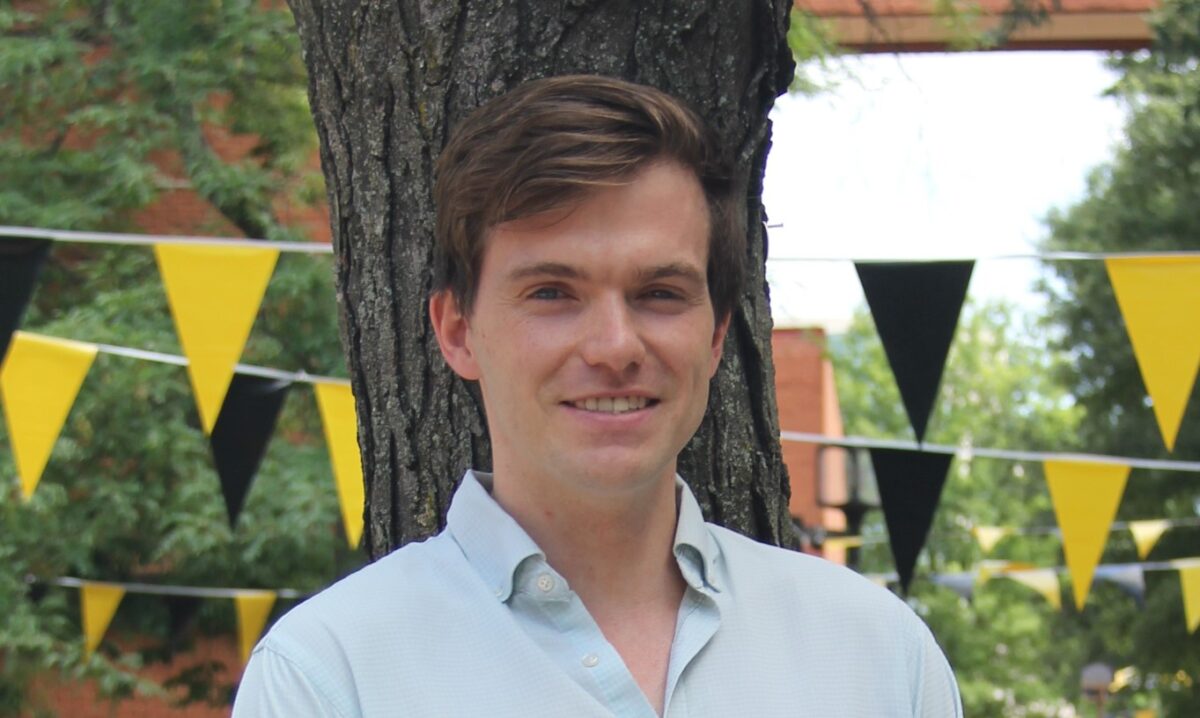
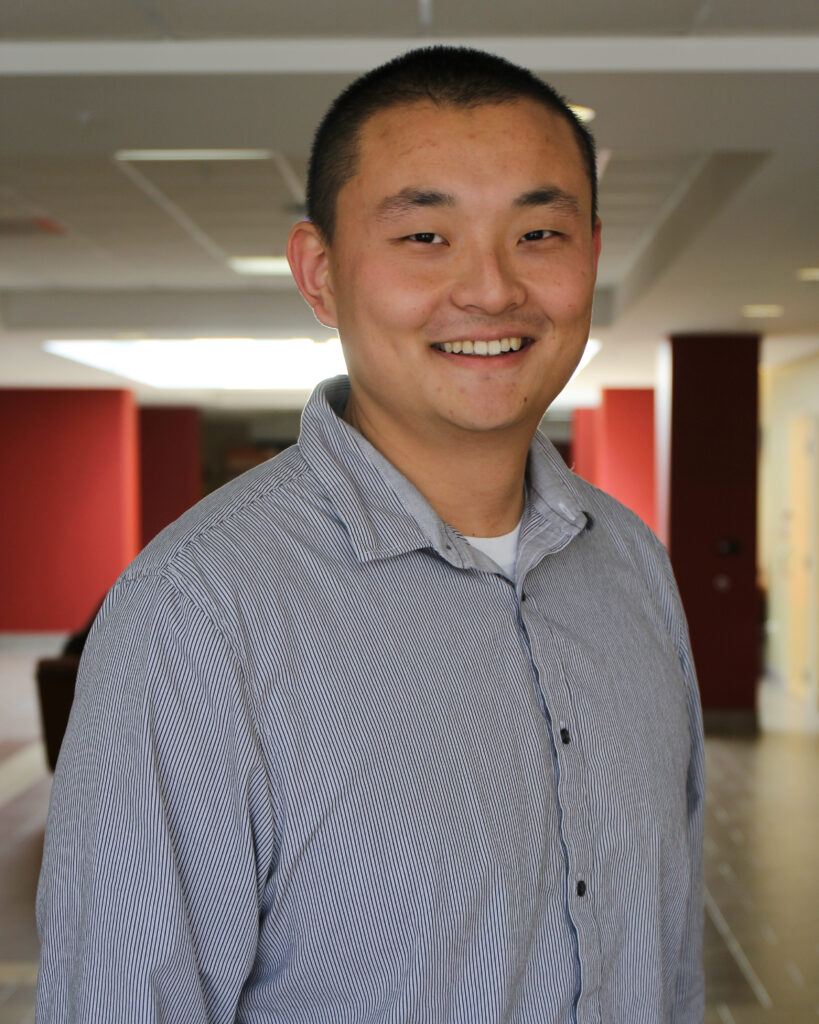 Principal investigator Morgan Henderson (left) and co-investigator Jun Chu of the CIDER Program study, “Analysis of Social Determinant of Health Diagnosis Coding Patterns Among Medicaid Recipients and Providers in Maryland.” (Photos courtesy of The Hilltop Institute and Jun Chu)
The pair’s project will include two studies: one study will focus specifically on the patients ascribed z codes to determine what patterns arise based on patient-specific factors such as demographics, health care utilization, or geography.
The second study will focus on analyzing the characteristics of the healthcare providers that indicate the z codes on Medicaid claims.
“Patient claims are the engine that so much of health analysis relies upon. It’s the decision of the provider on which coding diagnoses to include—it’s not a completely standardized process,” says Henderson.
CIDER 2025 recipients
The CIDER program’s goal includes supporting and promoting collaborative research between scholars based in one of UMBC’s affiliate centers and institutes and the university’s faculty researchers. Selected proposals are awarded up to $50,000 in seed funding for 18 months.
The 2025 CIDER program recipients include:
-
Anin Puthukkudy, Earth and Space Institute, and Vanderlei Martins, professor of physics
-
Jessica Sutton, Goddard Earth Sciences Technology and Research (GESTAR) II, Tejas Gokhale, assistant professor of computer science and electrical engineering, and Thomas Stanley, GESTAR II
-
Kaur Kullman, the Center for Space Sciences and Technology, Alan Sherman, Roberto Yus, and Enis Golaszewski, professors of computer science and electrical engineering
-
Morgan Henderson, The Hilltop Institute at UMBC, and Jun Chu, assistant professor of public health
-
Venkatesh Srinivasan, Center for Advanced Sensor Technology, Tyler Josephson, assistant professor of chemical, biochemical, and environmental engineering
Don Engel, associate vice president for research development, shares that the CIDER program was created to foster collaborations that draw on the full range of UMBC’s strengths in research and creative achievement.
“CIDER helps connect faculty in our research centers with colleagues in degree-granting departments to pursue work with real impact—work that informs policy, advances knowledge, and ultimately serves the public good,” says Engel.
Learn more about UMBC’s funding opportunities.
]]>
UMBC researchers are collaborating on a study that takes a closer look at specific diagnosis coding patterns that focus on societal factors that potentially influence the health of Maryland’s...
https://umbc.edu/stories/cider-program-hilltop-medicaid-study/
https://my3.my.umbc.edu/api/v0/pixel/news/149744/guest@my.umbc.edu/78db6f7fa7d09470bbd8c0df0856a68c/api/pixel
cahss
cbee
coeit
csee
gestar
hilltop-institute
news
policy-and-society
public-health
research
saph
story
UMBC News & Magazine
https://my3.my.umbc.edu/groups/umbc-news-magazine
https://assets1-my.umbc.edu/system/shared/avatars/groups/000/001/943/24435aa6207c452e7bc15cc74b42c7bb/xsmall.png?1748556657
https://assets1-my.umbc.edu/system/shared/avatars/groups/000/001/943/24435aa6207c452e7bc15cc74b42c7bb/original.png?1748556657
https://assets2-my.umbc.edu/system/shared/avatars/groups/000/001/943/24435aa6207c452e7bc15cc74b42c7bb/xxlarge.png?1748556657
https://assets2-my.umbc.edu/system/shared/avatars/groups/000/001/943/24435aa6207c452e7bc15cc74b42c7bb/xlarge.png?1748556657
https://assets3-my.umbc.edu/system/shared/avatars/groups/000/001/943/24435aa6207c452e7bc15cc74b42c7bb/large.png?1748556657
https://assets1-my.umbc.edu/system/shared/avatars/groups/000/001/943/24435aa6207c452e7bc15cc74b42c7bb/medium.png?1748556657
https://assets2-my.umbc.edu/system/shared/avatars/groups/000/001/943/24435aa6207c452e7bc15cc74b42c7bb/small.png?1748556657
https://assets1-my.umbc.edu/system/shared/avatars/groups/000/001/943/24435aa6207c452e7bc15cc74b42c7bb/xsmall.png?1748556657
https://assets2-my.umbc.edu/system/shared/avatars/groups/000/001/943/24435aa6207c452e7bc15cc74b42c7bb/xxsmall.png?1748556657
UMBC News & Magazine
0
0
false
Fri, 02 May 2025 15:04:11 -0400
Fri, 02 May 2025 15:04:11 -0400