UMBC to launch prestigious Beckman Scholars Program for aspiring M.D./Ph.D.s
UMBC has received a 2022 Beckman Foundation Award to launch a Beckman Scholars Program for outstanding students interested in graduate study in the biological or chemical sciences. The Arnold and Mabel Beckman Foundation today announced 14 institutions across the U.S. as new recipients of three-year institutional awards, totaling over $2.1 million. At UMBC, the program will support six students who aspire to pursue M.D./Ph.D. degrees, each paired with a mentor.
“The specific aim of the program is to build a strong foundation for the Beckman Scholars to become tomorrow’s well-rounded and accomplished physician scientists,” reads UMBC’s award proposal. Importantly, the program also aims to support students from underrepresented backgrounds in medicine.
UMBC is in a strong position to pursue this goal, being the #1 institution in the country for graduating Black students who go on to receive M.D./Ph.D. degrees. UMBC is also #1 for Black graduates who go on to complete Ph.D. degrees in the natural sciences and engineering.
 Weihong Lin (left); Ashley Majekodunmi ’21 (center), biological sciences, a UMBC STEM BUILD Trainee; and Abdullah Al-Matrouk (right), then a Ph.D. candidate in biological sciences, work in Lin’s neurobiology lab in 2018.
Strong foundation
Each Beckman Scholar will receive significant financial, academic, and research support. They will gain community service and leadership experience and have the opportunity to forge relationships with peers and mentors from UMBC and elsewhere. In this way, the program will prepare the scholars for future careers as physician scientists and ground them in a supportive network that they can rely on for years to come.
“I am delighted that UMBC and the College of Natural and Mathematical Sciences (CNMS) have been selected to receive this prestigious award,” says Provost Philip Rous. “This support from the Beckman Foundation recognizes the fundamental roles that justice, equity, diversity, and inclusion play in the advancement of science and innovation, consistent with UMBC’s shared value of inclusive excellence.”
 Provost Philip Rous receives an award from the American Democracy Project at the Civic Learning and Democratic Engagement Meeting in Baltimore, 2017.
Research and mentorship
The 15-month Beckman Scholar experience will include one academic year bookended by two summers. Scholars will conduct research with faculty mentors at UMBC full-time in the summer months and part-time during the school year. The goal is for this work to lead to a peer-reviewed publication, a rare and exciting opportunity for undergraduates.
Mentors will receive financial support as well as training from UMBC’s Faculty Development Center in culturally-responsive mentorship and techniques for fostering self-efficacy and inclusion in emerging researchers.
“Early exposure to research enhances our students’ readiness for post-graduate school and their chosen career paths,” says Bill LaCourse, dean of CNMS, which will house the program. “More importantly, independent research under the mentorship of UMBC’s dedicated faculty can spark a student’s lifelong interest in interdisciplinary learning. In the sciences at UMBC, our motto is, ‘It takes a scientist to train a scientist.’”
 A student works with fruit flies in the lab of Jeff Leips, biological sciences, at UMBC, summer 2019.
Entrepreneurship and service
Beckman Scholars will take courses in science communication, research ethics and integrity, and biomedical case studies. They will also complete UMBC’s Entrepreneurial Skills Training for STEM Undergraduates.
“Entrepreneurship is the ability of an individual to identify a goal, provide the leadership, and mobilize the assets necessary to reach that goal,” UMBC’s proposal says. “Individuals breaking ground in science and technology, by creating innovative solutions to society’s problems, are all entrepreneurs.”
Scholars will also provide community service at local hospitals or clinics, shadow campus leaders, benefit from intensive academic advising, and receive support with the medical school application process. Every aspect is designed to offer experiences and develop skills that will make the scholars competitive candidates for M.D./Ph.D. programs upon graduation.
Each year, the scholars are invited to attend the Beckman Summer Research Symposium, where they can connect with other fellow scholars from around the country. They will also plan and organize an annual Beckman Scholars Forum at UMBC, featuring speakers of interest to rising physician scientists.
 Howard Nicholson ’21, chemical engineering, shares his research on biosensors at UMBC’s 23rd annual Undergraduate Research and Creative Achievement Day (URCAD) in 2019. Students moved outside briefly in response to a fire drill.
Community connections
Because the number of students in the program is small, the Beckman Scholars will collaborate with other STEM-focused scholars programs at UMBC. This will include the renowned Meyerhoff Scholars and the CNMS Scholars, for women in STEM fields in which they are underrepresented.
The Beckman Scholars will benefit from the best practices to support student success that UMBC has developed over many years through these programs. Connecting with members of other programs will also help the Beckman Scholars build a strong sense of community. Community support and belonging are known to enhance persistence and success in STEM, especially among students from underrepresented groups.
 Three Meyerhoff Scholars connect at UMBC in spring 2021.
“We are very proud of the impact that programs such as the Meyerhoff Scholars and CNMS Scholars have had on retaining underrepresented students in STEM disciplines,” says Caitlin Kowalewski, assistant director of undergraduate academic initiatives in CNMS. “We look forward to using the lessons we have learned from these programs to provide the Beckman Scholars with a strong foundation to succeed at their goal of pursuing an M.D./Ph.D.”
UMBC also has a long history of using new programs as opportunities to learn how to best support students, and then institutionalize those elements for an even greater benefit over time. For example, inspired by the success of STEM BUILD, an NIH-funded initiative to diversify the biomedical sciences, CNMS launched The Learning Collaboratory, revitalized its STEM Living Learning Community, and expanded courses in ethics and science communication.
In the future, LaCourse says, “The college intends to use the Beckman Scholars program as a model for increasing the number of students applying for M.D./Ph.D. programs.”
 Meyerhoff Scholars and alumni at the Meyerhoff 30th anniversary celebration, June 2019. President Hrabowski (left) and original program sponsor Robert Meyerhoff (right) seated in front row. More than 800 of UMBC’s Meyerhoff alumni have already earned graduate and professional degrees. Photo by Jim Burger for UMBC.
Springboard to success
To be prepared to pursue an M.D./Ph.D., students must demonstrate a balance of research experience, leadership, community service, clinical experience, and a strong academic record. The Beckman Scholars Program provides ample resources and opportunities to meet all of these requirements and more.
“The Beckman Scholars Program at UMBC will serve as a springboard for students from all backgrounds to launch themselves into successful careers as physician scientists. And as Beckman Scholars, they will be surrounded by a community that enables them to explore, challenge themselves, and, yes, sometimes fail—all while feeling supported,” LaCourse says.
He notes, “Their peers and mentors will help them grow into confident and creative researchers who will make important contributions to medicine and science in the years to come.”
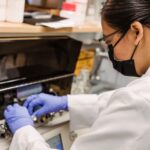
Featured image: Grace Tugado ’23, chemical engineering, working in the SeeTrue Technology lab on UMBC’s campus in summer 2021. The Maryland Technology Internship Program supported her work and she gained prior research experience through UMBC’s STEM BUILD program. All photos by Marlayna Demond ’11 for UMBC unless otherwise noted.
]]>
UMBC has received a 2022 Beckman Foundation Award to launch a Beckman Scholars Program for outstanding students interested in graduate study in the biological or chemical sciences. The Arnold and...
https://umbc.edu/stories/meet-umbc-people-15/
https://my3.my.umbc.edu/api/v0/pixel/news/119483/guest@my.umbc.edu/49b328576728adca4e3e74b89318e31c/api/pixel
beckmanscholars
cnms
diversityandinclusion
meyerhoffscholars
page1
science-and-technology
stembuild
UMBC News & Magazine
https://my3.my.umbc.edu/groups/umbc-news-magazine
https://assets1-my.umbc.edu/system/shared/avatars/groups/000/001/943/24435aa6207c452e7bc15cc74b42c7bb/xsmall.png?1748556657
https://assets1-my.umbc.edu/system/shared/avatars/groups/000/001/943/24435aa6207c452e7bc15cc74b42c7bb/original.png?1748556657
https://assets2-my.umbc.edu/system/shared/avatars/groups/000/001/943/24435aa6207c452e7bc15cc74b42c7bb/xxlarge.png?1748556657
https://assets2-my.umbc.edu/system/shared/avatars/groups/000/001/943/24435aa6207c452e7bc15cc74b42c7bb/xlarge.png?1748556657
https://assets3-my.umbc.edu/system/shared/avatars/groups/000/001/943/24435aa6207c452e7bc15cc74b42c7bb/large.png?1748556657
https://assets1-my.umbc.edu/system/shared/avatars/groups/000/001/943/24435aa6207c452e7bc15cc74b42c7bb/medium.png?1748556657
https://assets2-my.umbc.edu/system/shared/avatars/groups/000/001/943/24435aa6207c452e7bc15cc74b42c7bb/small.png?1748556657
https://assets1-my.umbc.edu/system/shared/avatars/groups/000/001/943/24435aa6207c452e7bc15cc74b42c7bb/xsmall.png?1748556657
https://assets2-my.umbc.edu/system/shared/avatars/groups/000/001/943/24435aa6207c452e7bc15cc74b42c7bb/xxsmall.png?1748556657
UMBC News & Magazine
0
0
false
Tue, 25 Jan 2022 19:01:51 -0500
UMBC continues to advance Maryland’s biotech workforce through $900K biomanufacturing grant

UMBC has received a $900,000 grant from the National Institute for Innovation in Manufacturing Biopharmaceuticals (NIIMBL) to develop and implement a new, short-term biomanufacturing training program. Four universities, all classified as minority-serving institutions (MSIs), received funding for similar programs, designed to meet critical national workforce needs.
UMBC will offer the biomanufacturing training program at its Universities at Shady Grove (USG) campus in Rockville, Maryland. The program will be adapted from a curriculum first developed at Texas A&M University. Annica Wayman ’99, M6, mechanical engineering, associate dean for Shady Grove affairs in CNMS, and co-lead Manik Ghosh, assistant director of the Translational Life Science Technology (TLST) laboratories at UMBC, will travel to Texas for training on the curriculum and will then work together to adapt it for UMBC. The anticipated training launch is late summer or fall 2023.
“This new program is really the next wave of UMBC expanding our training offerings,” Wayman says. “This kind of short-term programming could enhance our courses as well, to help with educating people in biomanufacturing and strengthening that workforce where there’s a huge gap.”
 Charmaine Hipolito ’20, and Titina Sirak ’20, right, alumni of UMBC’s TLST program at The Universities at Shady Grove, speak with visitors at a celebration for the opening of USG’s new Biomedical Sciences and Engineering Building in November 2019. Photo by Marlayna Demond ’11 for UMBC.
Snowball effect
The gap between supply and demand for skilled workers in biotech is very real, and it’s only growing in the BioHealth Capital Region. This region, which includes Maryland, Washington D.C., and Virginia, ranks #4 among the top biopharma clusters in the country. The pandemic has further expanded the biopharma industry, so the need for qualified local workers in a range of biotech roles has never been greater.
The new biomanufacturing program is a natural outgrowth of previous work by Wayman, Ghosh, and colleagues. The structure of the program will be similar to UMBC’s award-winning Biotech Boot Camp, which trained people who had lost their jobs during the pandemic for new careers in biotech. The boot camp has run twice so far, both times focusing on cell culture techniques and broader “wet lab” skills. Both times, the Montgomery County government and WorkSource Montgomery partnered with UMBC to offer the boot camps at no cost to the students.
The original boot camp was made possible by UMBC’s TLST bachelor’s degree program, fully launched in 2019 in partnership with Montgomery College. TLST was the college’s first new major developed in response to the growing need for biotech workforce development in the region. The TLST program bridges fundamental knowledge in the life sciences with industry-specific applications, practical laboratory skills, and an understanding of the regulatory process for biopharmaceuticals.
“The launch of the TLST program has led to a lot of education and partnership opportunities,” Wayman says. “It’s allowed UMBC to address gaps in the workforce that already existed, and that became even more prominent with the pandemic. We jumped in to help to fill those gaps in a variety of ways. TLST was the impetus and the start of that, and it snowballed from there.”

Associate Dean for Shady Grove Affairs Annica Wayman. Photo by Marlayna Demond ’11 for UMBC.
Short program, lasting impact
Even a short-term training program can have a huge impact on an individual’s career trajectory. A general biomanufacturing program could be the start of a career in fields as diverse as bench research, regulatory affairs, and biomanufacturing process design. These careers work toward answering big questions like, “How do we know this product is safe for use in the human body?” or, “How can we make this sequence of steps more efficient by taking advantage of new technologies?”
Roles in all these areas will be important to fill in the near future, and continuously asking the big questions as technologies emerge, regulations shift, and new scientific knowledge comes to light will help move the industry forward safely and reliably, Wayman notes. Programs like the new biomanufacturing training, the biotech boot camp, TLST, and more at UMBC have the potential to send thousands of well-prepared students into the biotech workforce.

A participant in the Biotech Boot Camp at USG in February 2021. Photo by Annica Wayman.
Looking ahead
Antonio Moreira, vice provost for academic affairs, has seen the potential for Maryland to be a biotechnology leader for years, and has championed UMBC’s efforts to grow opportunities in related fields. “As a component of the Maryland biotechnology ecosystem, UMBC is a major resource for preparing the workforce needed to develop and manufacture critical therapies,” Moreira explains. “Given a shortage in this workforce, graduating students need to be prepared to hit the ground running as they join these biotechnology companies.”
Bill LaCourse, dean of the College of Natural and Mathematical Sciences (CNMS) at UMBC, agrees. “At UMBC, we are driven by the vision that Maryland will continue to grow as a leader in biotech,” he says. “We’re establishing strong pathways to develop the workforce, where students and professionals have an array of choices about how to get to the biotech career they want and that the region needs.”
Wayman leads much of the day-to-day operations of UMBC’s biotech programs. Even while planning next steps, she tries to remind herself how much progress she and her team have already made toward narrowing the workforce gap and setting a new group of students on a path to success.
“When I take a step back, I see how amazing it is that we achieved all this through a pandemic,” she says. And then she, too, looks forward. “But there’s just so much more to do.”
This article describes work performed under a Project Award Agreement from the National Institute for Innovation in Manufacturing Biopharmaceuticals (NIIMBL) and financial assistance award 70NANB21H085 from the U.S. Department of Commerce, National Institute of Standards and Technology.
Header image: The Biomedical Sciences and Engineering Building at The Universities at Shady Grove. TLST courses, the Biotech Boot Camp, and the new biomanufacturing training program all happen here. Photo by Marlayna Demond ’11 for UMBC.
]]>
UMBC has received a $900,000 grant from the National Institute for Innovation in Manufacturing Biopharmaceuticals (NIIMBL) to develop and implement a new, short-term biomanufacturing training...
https://umbc.edu/stories/meet-umbc-people-14/
https://my3.my.umbc.edu/api/v0/pixel/news/119487/guest@my.umbc.edu/46b9bf4a716948e3434505092d495905/api/pixel
cnms
page1
science-and-technology
shadygrove
tlst
UMBC News & Magazine
https://my3.my.umbc.edu/groups/umbc-news-magazine
https://assets1-my.umbc.edu/system/shared/avatars/groups/000/001/943/24435aa6207c452e7bc15cc74b42c7bb/xsmall.png?1748556657
https://assets1-my.umbc.edu/system/shared/avatars/groups/000/001/943/24435aa6207c452e7bc15cc74b42c7bb/original.png?1748556657
https://assets2-my.umbc.edu/system/shared/avatars/groups/000/001/943/24435aa6207c452e7bc15cc74b42c7bb/xxlarge.png?1748556657
https://assets2-my.umbc.edu/system/shared/avatars/groups/000/001/943/24435aa6207c452e7bc15cc74b42c7bb/xlarge.png?1748556657
https://assets3-my.umbc.edu/system/shared/avatars/groups/000/001/943/24435aa6207c452e7bc15cc74b42c7bb/large.png?1748556657
https://assets1-my.umbc.edu/system/shared/avatars/groups/000/001/943/24435aa6207c452e7bc15cc74b42c7bb/medium.png?1748556657
https://assets2-my.umbc.edu/system/shared/avatars/groups/000/001/943/24435aa6207c452e7bc15cc74b42c7bb/small.png?1748556657
https://assets1-my.umbc.edu/system/shared/avatars/groups/000/001/943/24435aa6207c452e7bc15cc74b42c7bb/xsmall.png?1748556657
https://assets2-my.umbc.edu/system/shared/avatars/groups/000/001/943/24435aa6207c452e7bc15cc74b42c7bb/xxsmall.png?1748556657
UMBC News & Magazine
0
0
false
Wed, 19 Jan 2022 20:01:42 -0500
Smithsonian features Erle Ellis’s research on how humans have shaped ecology over millennia as a top discovery of 2021

The Smithsonian National Museum of Natural History (NMNH) has announced its top ten discoveries of 2021, featuring “attention-grabbing findings” by UMBC’s Erle Ellis, professor of geography. Ellis collaborated with an international team of researchers, which included Torben Rick, study co-author and curator of North American archaeology at the museum. Their analysis revealed that people have sustainably shaped Earth’s ecosystems for over 12,000 years.
The boundless curiosity of the researchers at @nmnh drives them to explore Earth, the species that depend upon it, the cultures that inhabit it, and the forces that alter it.
Here are some of our scientists’ top natural history discoveries of 2021.https://t.co/UUG0lWRq4q
— Smithsonian’s NMNH (@NMNH) December 31, 2021
“Our work shows that most areas depicted as ‘untouched,’ ‘wild,’ and ‘natural’ are actually areas with long histories of human inhabitation and use,” Ellis previously shared with UMBC News. They might be interpreted like this, he suggests, because in these areas, “societies used their landscapes in ways that sustained most of their native biodiversity and even increased their biodiversity, productivity, and resilience.”
The team found the current biodiversity crisis is due to the appropriation, colonization, and intensified use of lands previously managed sustainably.
“It is so exciting to see our work recognized by the Smithsonian,” says Ellis, in response to the NMNH coverage. “I hope that 2022 will mark a turning point in our understanding and care for nature—by learning from and empowering the Indigenous and traditional peoples and practices that have sustained nature across the planet for more than 12,000 years.”
Ellis will be speaking about this discovery on Wednesday, January 19, 2022 at the Global Land Programme Webinar: Prehistoric land use reshaped most of terrestrial nature – does that matter now?
Banner image: Erle Ellis. Photo by Marlayna Demond ’11 for UMBC.
]]>
The Smithsonian National Museum of Natural History (NMNH) has announced its top ten discoveries of 2021, featuring “attention-grabbing findings” by UMBC’s Erle Ellis, professor of geography. Ellis...
https://umbc.edu/stories/meet-umbc-people-13/
https://my3.my.umbc.edu/api/v0/pixel/news/119489/guest@my.umbc.edu/7591156274f673693b7fb2af6ee610b2/api/pixel
cahss
cahssresearch
cs3
ges
science-and-technology
UMBC News & Magazine
https://my3.my.umbc.edu/groups/umbc-news-magazine
https://assets1-my.umbc.edu/system/shared/avatars/groups/000/001/943/24435aa6207c452e7bc15cc74b42c7bb/xsmall.png?1748556657
https://assets1-my.umbc.edu/system/shared/avatars/groups/000/001/943/24435aa6207c452e7bc15cc74b42c7bb/original.png?1748556657
https://assets2-my.umbc.edu/system/shared/avatars/groups/000/001/943/24435aa6207c452e7bc15cc74b42c7bb/xxlarge.png?1748556657
https://assets2-my.umbc.edu/system/shared/avatars/groups/000/001/943/24435aa6207c452e7bc15cc74b42c7bb/xlarge.png?1748556657
https://assets3-my.umbc.edu/system/shared/avatars/groups/000/001/943/24435aa6207c452e7bc15cc74b42c7bb/large.png?1748556657
https://assets1-my.umbc.edu/system/shared/avatars/groups/000/001/943/24435aa6207c452e7bc15cc74b42c7bb/medium.png?1748556657
https://assets2-my.umbc.edu/system/shared/avatars/groups/000/001/943/24435aa6207c452e7bc15cc74b42c7bb/small.png?1748556657
https://assets1-my.umbc.edu/system/shared/avatars/groups/000/001/943/24435aa6207c452e7bc15cc74b42c7bb/xsmall.png?1748556657
https://assets2-my.umbc.edu/system/shared/avatars/groups/000/001/943/24435aa6207c452e7bc15cc74b42c7bb/xxsmall.png?1748556657
UMBC News & Magazine
0
0
false
Thu, 13 Jan 2022 17:54:53 -0500
UMBC research group tackles ongoing hurdles to efficient solar power tech

Two new papers from Can Ataca’s research group at UMBC set the stage for further advances in solar power and other renewable energy technologies. Daniel Wines, Ph.D. candidate in physics, led research using computational modeling to explain surprising properties of materials with potential for use in solar cells. Gracie Chaney, Ph.D. candidate in physics, led a project that used machine learning to characterize a new type of material that could improve lithium ion batteries.
Solving a puzzle
Wines’s paper, published in Applied Materials and Interfaces, will make it easier to design the best material for certain technologies that require energy transfer, from solar cells to LEDs. A research group at Arizona State University led by Sefaattin Tongay had run experiments on a class of materials called perovskites, which have a crystal structure well-suited to a range of engineered materials. They are an attractive candidate for use in solar cells, but the group was struggling to interpret its results.
Tongay and graduate student Han Li, the lead author on the paper, thought Ataca’s group might be able to figure out what was happening by modeling their experiments. They were right. By running computational simulations, Wines was able to confirm the group’s findings and determine the underlying physics causing Li’s surprising observations.
Under pressure
Li was studying how perovskites performed under different amounts of physical pressure. Pressure can change how electrons move through a material, which in turn changes the ideal conditions for generating electricity. In solar cell applications, for example, pressure can affect which frequencies of light will most efficiently produce power when they strike the material.
“It’s all about tuning the structure for the sunlight spectrum,” says Ataca, assistant professor of physics. “You want to absorb at certain frequencies so that you will have the best efficiency if you were making a photovoltaic cell from this.”
Both Wines and Li found that when the perovskite took a one-dimensional form, where the molecules are bound together in a long line, the amount of energy required to initiate conduction decreased linearly as pressure increased. However, in two-dimensional perovskites, which look more like a flat plane, there was an initial decrease, and then at a certain level of pressure, the required energy increased again. That inflection point was what puzzled Li, and where the simulations at UMBC became crucial.

This portion of figure 1 from Wines’s paper shows the atomic structure of the perovskite he and colleagues studied in its one-dimensional (left) and two-dimensional forms.
Structural change
Simulating the experiments allowed Wines to examine the structure of the perovskite crystals at each pressure level. He found that in one-dimensional perovskites, the primary structure stayed constant, but “stretched” as the pressure increased. However, in the two-dimensional perovskites, “there’s a critical point where there’s a phase transition, and there’s a certain rotation of some of the bonds and atoms,” Wines explains. That transition fundamentally changed the properties of the crystal, and explained the unusual observations.
Understanding why the properties changed at a molecular level will make it much easier to determine the best combination of structure and pressure for different applications of perovskite materials. While it might be possible to determine their properties with experiments alone, using computational simulations will make the discovery process much faster and less resource-intensive.
Two-faced materials
While Wines’s work may help develop solar cells that are more efficient at collecting the sun’s energy, Chaney’s research, also published in Applied Materials and Interfaces, looks at the next step—how to store that energy. “The sun doesn’t always shine, and sometimes it shines too much during the day and overwhelms the grid,” she says. “So we need something to store all that excess energy in the daytime and release it at night and on cloudy days. That’s why we need to improve batteries.”
Lithium ion batteries work by storing positively-charged lithium ions, which can be moved between electrodes inside the battery to generate electric current. A class of materials called transition metal dichalcogenides, or TMDs, are often used in lithium ion batteries to store lithium ions.
TMDs usually take the form of a molecular sandwich: two chalcogens (elements from a column on the right side of the periodic table) surround an atom from the transition metal family (several columns in the center of the periodic table). These sandwiches can form a plane, called a monolayer, or the layers can be stacked on top of each other to form a 3D structure.
Typical TMDs have the same atom on the top and bottom of the sandwich. But Chaney’s study investigated “Janus” materials, which have a different element on each side. These materials are named after Janus, the two-faced god in Roman mythology. “It’s not a typical TMD, and that’s what makes this special,” Chaney says. Her study looked at six different combinations of top and bottom elements.
 Current members of Ataca’s lab group. From left to right: Akram Ibrahim, Gracie Chaney, undergraduate Brenna Turnbull, postdoc Yelda Kadioglu, Daniel Wines, and Can Ataca. Photo courtesy Can Ataca.
Narrowing the “circle of searching”
Chaney and Akram Ibrahim, another Ph.D. candidate in Ataca’s group, used machine learning to predict the properties of the different combinations. One key property was how tightly the lithium ions would bind to the material. That’s important, “because we want the lithium not to escape from the 2D material where we are storing it,” Ibrahim says. “So we are searching for materials that lithium binds to strongly.”
Using machine learning to find the best composition for battery materials “saves a lot of time and resources,” Ibrahim says. After using the model to identify high-potential materials, only then would the lab use more energy- and time-intensive methods to get an even more accurate and detailed understanding of the materials’ properties. By using the model, Ibrahim says, “we have narrowed down the circle of searching.”
“Something that was really interesting was that the lithium transport and the binding energy really depended on which side you looked at,” Chaney says. The machine learning model was able to predict those differences, suggesting it is useful for better understanding both Janus materials and traditional TMDs.
Using computational models to learn more about how these materials store and transport lithium ions can inform future experimental studies to improve battery efficiency. That information could guide advances in anything from solar power storage to electric vehicle range.
Impact of collaboration
It may be some time before this research finds its way into solar panels or batteries. However, growing the fundamental understanding of how materials function – how they interact with light or store lithium ions – makes future technological advances possible.
“There’s being able to synthesize the material reliably, and then understanding the physics of the material itself and how you can tune the properties,” Wines says—which is where his and Chaney’s work is now. “Then, after that, implementing it into devices and testing the devices in the lab are the next steps” before technologies with the new material can be produced on a large scale.
Along the way, modeling and experiments complement each other, which is why collaborations like the one between the UMBC and Arizona State research groups are so valuable. “There’s a need for both kinds of research at every stage,” Wines says.
Header image: Current and former members of the Ataca lab group. From left: Former postdoc Fatih Ersan; Can Ataca; Gracie Chaney; Jaron Kropp, Ph.D. ’20; and Daniel Wines. Photo by Marlayna Demond ’11.
]]>
Two new papers from Can Ataca’s research group at UMBC set the stage for further advances in solar power and other renewable energy technologies. Daniel Wines, Ph.D. candidate in physics, led...
https://umbc.edu/stories/umbc-research-group-tackles-ongoing-hurdles-to-efficient-solar-power-tech/
https://my3.my.umbc.edu/api/v0/pixel/news/119495/guest@my.umbc.edu/1312916854cdd8d369ed0efda5c20dd4/api/pixel
cnms
gradresearch
physics
research
science-and-technology
UMBC News & Magazine
https://my3.my.umbc.edu/groups/umbc-news-magazine
https://assets1-my.umbc.edu/system/shared/avatars/groups/000/001/943/24435aa6207c452e7bc15cc74b42c7bb/xsmall.png?1748556657
https://assets1-my.umbc.edu/system/shared/avatars/groups/000/001/943/24435aa6207c452e7bc15cc74b42c7bb/original.png?1748556657
https://assets2-my.umbc.edu/system/shared/avatars/groups/000/001/943/24435aa6207c452e7bc15cc74b42c7bb/xxlarge.png?1748556657
https://assets2-my.umbc.edu/system/shared/avatars/groups/000/001/943/24435aa6207c452e7bc15cc74b42c7bb/xlarge.png?1748556657
https://assets3-my.umbc.edu/system/shared/avatars/groups/000/001/943/24435aa6207c452e7bc15cc74b42c7bb/large.png?1748556657
https://assets1-my.umbc.edu/system/shared/avatars/groups/000/001/943/24435aa6207c452e7bc15cc74b42c7bb/medium.png?1748556657
https://assets2-my.umbc.edu/system/shared/avatars/groups/000/001/943/24435aa6207c452e7bc15cc74b42c7bb/small.png?1748556657
https://assets1-my.umbc.edu/system/shared/avatars/groups/000/001/943/24435aa6207c452e7bc15cc74b42c7bb/xsmall.png?1748556657
https://assets2-my.umbc.edu/system/shared/avatars/groups/000/001/943/24435aa6207c452e7bc15cc74b42c7bb/xxsmall.png?1748556657
UMBC News & Magazine
0
0
false
Fri, 17 Dec 2021 17:19:46 -0500
Hero of the Year: TIME honors UMBC alum Kizzmekia Corbett, COVID-19 vaccine leader

TIME magazine’s famed Person of the Year issue today announced Kizzmekia Corbett as a Hero of the Year for her leadership in developing the COVID-19 vaccine. Corbett ’08, M16, biological sciences and sociology, served as the scientific lead of the Vaccine Research Center’s coronavirus team in the U.S. National Institute of Allergy and Infectious Diseases. There, she developed new mRNA technology used by Moderna’s COVID-19 vaccine and others, playing a pivotal role in the global fight against the virus.
“The scientific process gives us confidence that we can overcome even our most challenging problems,” says Bill LaCourse, dean of the College of Natural and Mathematical Sciences. “As we face the ongoing COVID pandemic, it is important that TIME is honoring the often unseen work of scientists who provide us with hope for the future.”
Vaccine scientists are TIME’s 2021 Heroes of the Year #TIMEPOY https://t.co/8qAiVzxRPP pic.twitter.com/pxee2faWdL
— TIME (@TIME) December 13, 2021
Corbett is honored alongside three other vaccine scientists, including Barney Graham. Graham serves as deputy director of the Vaccine Research Center and the chief of the Viral Pathogenesis Laboratory. He is known for his commitment to mentoring emerging scientists. Corbett initially worked in his lab during her UMBC years as a Meyerhoff Scholar and NIH Scholar.
In the spirit of the Meyerhoff program, Corbett has carried on that commitment to mentorship by welcoming scientists like Olubukola Abiona ’17, M25, biochemistry and molecular biology, to contribute to her lab’s research.
Addressing health disparities
Motivating Corbett’s work is a deep commitment to health equity, informed by her sociology studies at UMBC. “Vaccines have the potential to be the equalizer of health disparities, especially around infectious diseases,” she recently explained in Nature.
“Dr. Corbett and her work exemplify the tremendous value of blending biological sciences and social sciences to solve the world’s problems,” says Kimberly Moffitt, interim dean of the College of Arts, Humanities, and Social Sciences. “Her commitment to public health continues to be fostered by the teachings of sociological theory and the understanding of social inequities. We cannot be more proud of her example and her proven success at mastering the complexities of science with the human experience centered.”
 Dr. Kizzmekia Corbett at UMBC. Photo by Marlayna Demond ’11 for UMBC.
Since the launch of the COVID-19 vaccine, Corbett has joined the faculty of Harvard’s T.H. Chan School of Public Health, where she will continue vaccine development work. TIME writes that mRNA vaccines don’t just represent an important path out of the current pandemic, “but also a new approach to quelling future ones.” The profile notes, “Already, vaccine makers are testing mRNA-based vaccines against influenza, potentially making them more effective, safer and easier to produce.”
Learn more about Dr. Corbett’s UMBC journey and path to becoming the first Black woman in the world to invent a vaccine in UMBC Magazine. Earlier profiles are available in the Washington Post and Baltimore Sun.
Featured image: Kizzmekia Corbett. Photo by Marlayna Demond ’11 for UMBC.
]]>
TIME magazine’s famed Person of the Year issue today announced Kizzmekia Corbett as a Hero of the Year for her leadership in developing the COVID-19 vaccine. Corbett ’08, M16, biological sciences...
https://umbc.edu/stories/hero-of-the-year-time-honors-umbc-alum-kizzmekia-corbett-covid-19-vaccine-leader/
https://my3.my.umbc.edu/api/v0/pixel/news/119502/guest@my.umbc.edu/dd31abd080aaca7d101fcff05cc62d2f/api/pixel
alumni
meyerhoffscholars
page1
policy-and-society
science-and-technology
UMBC News & Magazine
https://my3.my.umbc.edu/groups/umbc-news-magazine
https://assets1-my.umbc.edu/system/shared/avatars/groups/000/001/943/24435aa6207c452e7bc15cc74b42c7bb/xsmall.png?1748556657
https://assets1-my.umbc.edu/system/shared/avatars/groups/000/001/943/24435aa6207c452e7bc15cc74b42c7bb/original.png?1748556657
https://assets2-my.umbc.edu/system/shared/avatars/groups/000/001/943/24435aa6207c452e7bc15cc74b42c7bb/xxlarge.png?1748556657
https://assets2-my.umbc.edu/system/shared/avatars/groups/000/001/943/24435aa6207c452e7bc15cc74b42c7bb/xlarge.png?1748556657
https://assets3-my.umbc.edu/system/shared/avatars/groups/000/001/943/24435aa6207c452e7bc15cc74b42c7bb/large.png?1748556657
https://assets1-my.umbc.edu/system/shared/avatars/groups/000/001/943/24435aa6207c452e7bc15cc74b42c7bb/medium.png?1748556657
https://assets2-my.umbc.edu/system/shared/avatars/groups/000/001/943/24435aa6207c452e7bc15cc74b42c7bb/small.png?1748556657
https://assets1-my.umbc.edu/system/shared/avatars/groups/000/001/943/24435aa6207c452e7bc15cc74b42c7bb/xsmall.png?1748556657
https://assets2-my.umbc.edu/system/shared/avatars/groups/000/001/943/24435aa6207c452e7bc15cc74b42c7bb/xxsmall.png?1748556657
UMBC News & Magazine
0
0
false
Mon, 13 Dec 2021 21:28:34 -0500
UMBC Marshall Scholar Joshua Slaughter seeks to advance equity in personalized medicine

Joshua Slaughter ‘22, M30, has received the Marshall Scholarship, becoming the second student in UMBC history and the first in 29 years to be selected for the prestigious award. Slaughter is one 41 American students selected this year from institutions across the country for the Marshall Scholarship, which supports graduate study at institutions in the United Kingdom. He was also a finalist for the Rhodes Scholarship.
Slaughter, who is earning his degree in computer engineering, will pursue his Ph.D. in informatics at the University of Edinburgh. His goal is to advance equity in the developing field of personalized medicine.
 Joshua Slaughter with mentor Chuck LaBerge.
Applying for the Marshall and Rhodes Scholarships is something that Slaughter has had his eye on since he arrived at UMBC. The Marshall Scholarship aims to produce global change-makers who use their education to improve society. Becoming a finalist for the Marshall and Rhodes, and then being named a Marshall Scholarship recipient, has been “a dream come true,” he says, because his selection has affirmed that he can truly have a global impact.
“I am incredibly proud that, in the past four years, UMBC has produced finalists and awardees in some of the most competitive and prestigious international scholars programs, including both the Marshall and Rhodes,” says UMBC President Freeman Hrabowski. “Our rise on the global stage is continuing at a rapid pace thanks to our exceptional students, and the caring faculty and staff who support them.”
Support from students who have been there
One of the first things that Slaughter did when he found out that he was finalist for both awards was to text Naomi Mburu ‘18, M26, chemical engineering, who was the first UMBC student to be named a Rhodes Scholar. While Mburu was not allowed to offer guidance during the interview processes, she did offer more general words of encouragement.
 Joshua Slaughter, right, with his fellow Goldwater Scholarship recipients Karan Luthria, left, and Kaitlynn Lilly, center.
“It is exciting to see the great strides UMBC has been making all over the world in recent years,” says Mburu. “Slaughter is an amazing and dedicated student who I had the pleasure of mentoring through Meyerhoff Summer Bridge, the Goldwater Scholarship, and now the Rhodes and Marshall interviews. I look forward to welcoming him to the UK next fall.”
Slaughter has also received encouragement and support from Sam Patterson ‘21, M29, mathematics, statistics, and economics. Last year, Patterson became UMBC’s second Rhodes Scholar. He is currently pursuing his interest in transportation equity at Oxford.
Opportunities to grow
In addition to being a Meyerhoff Scholar, Slaughter is a member of the UMBC Honors College and the U-RISE program, an undergraduate research program that prepares students from underrepresented groups to pursue a Ph.D. in the biomedical sciences. He is the president of UMBC’s chapter of the National Society of Black Engineers, and Tau Beta Pi, the honors society for engineering students.
Earlier this year, Slaughter was one of four UMBC students named Goldwater Scholars. The goal of the Barry Goldwater Scholarship and Excellence in Education Program is to provide the United States with “a continuing source of highly qualified scientists, mathematicians, and engineers” to move the nation forward.
Learning to research from researchers
At UMBC, Slaughter conducts research with Distinguished University Professor Tulay Adali, computer science and electrical engineering (CSEE). They study machine learning applications in fields such as neuroimaging, which uses data-driven algorithms to identify features of neurological disease.
Slaughter explains that it’s essential to diversify the field of machine learning. People of all backgrounds need to be involved in the development of algorithms, he says, to help produce algorithms that reflect the diversity of society and have equitable impacts.
 Joshua Slaughter.
In addition to conducting research at UMBC, Slaughter has completed research internships at Princeton University and Carnegie Mellon University, presented research at national conferences, and published two scientific papers.
His interest in research began when he was in high school. Slaughter connected with UMBC’s Matthew Fagan, assistant professor of geography and environmental systems, and began working in his lab several hours each week. While the focus of Slaughter’s research has shifted to computing, he says that Fagan provided important support that allowed him to see the impact that research can have on various communities.
When Slaughter came to UMBC, he took a class taught by Chuck LaBerge, professor of practice in CSEE. LaBerge went on to become one of Slaughter’s biggest supporters and mentors. He encouraged Slaughter and his classmates to examine real-world problems and envision success in engineering as using their skills and knowledge to create change in the world.
Research with public impact
April Householder, director of undergraduate research and prestigious scholarships, says that UMBC students’ success with earning prestigious international scholarships is inspiring for many reasons, but she is particularly excited that there is now a community of Retrievers pursuing graduate studies in the U.K. who can be there for each other. “Mburu, Patterson, and Slaughter are sharing this experience together, and supporting one another at the next level,” she says.
Householder also notes that, like UMBC’s prior prestigious scholarship winners, Slaughter cares deeply about UMBC’s values of equity and of inclusive excellence. “Slaughter is committed to changing computational methods to improve healthcare, particularly in underserved populations,” she notes. “He is a deep critical thinker, and he examines how asking questions about identities like race, gender, and class can help combat the biases inherent in biomedical research.”
 Slaughter with mentors Chuck LaBerge, April Householder, and David Hoffman.
Looking ahead, Slaughter is eager to get to the University of Edinburgh, but he says that UMBC has played an essential role in his journey. “Receiving the Marshall is a testament to all of the people who have come before me, and the amazing support group and environment that UMBC is. The support at UMBC is unmatched,” Slaughter says.
“I don’t think I could have done this anywhere else,” he shares. “It speaks volumes to the inclusive community that UMBC has fostered over the past 30 years.”
Banner image: Joshua Slaughter. All photos by Marlayna Demond ’11 for UMBC.
]]>
Joshua Slaughter ‘22, M30, has received the Marshall Scholarship, becoming the second student in UMBC history and the first in 29 years to be selected for the prestigious award. Slaughter is one...
https://umbc.edu/stories/umbc-marshall-scholar-joshua-slaughter-seeks-to-advance-equity-in-personalized-medicine/
https://my3.my.umbc.edu/api/v0/pixel/news/119505/guest@my.umbc.edu/07c0ed0b2582e9402d1bf339215f6d48/api/pixel
coeit
community
csee
honorscollege
majoraward
meyerhoffscholars
page1
science-and-technology
undergradresearch
UMBC News & Magazine
https://my3.my.umbc.edu/groups/umbc-news-magazine
https://assets1-my.umbc.edu/system/shared/avatars/groups/000/001/943/24435aa6207c452e7bc15cc74b42c7bb/xsmall.png?1748556657
https://assets1-my.umbc.edu/system/shared/avatars/groups/000/001/943/24435aa6207c452e7bc15cc74b42c7bb/original.png?1748556657
https://assets2-my.umbc.edu/system/shared/avatars/groups/000/001/943/24435aa6207c452e7bc15cc74b42c7bb/xxlarge.png?1748556657
https://assets2-my.umbc.edu/system/shared/avatars/groups/000/001/943/24435aa6207c452e7bc15cc74b42c7bb/xlarge.png?1748556657
https://assets3-my.umbc.edu/system/shared/avatars/groups/000/001/943/24435aa6207c452e7bc15cc74b42c7bb/large.png?1748556657
https://assets1-my.umbc.edu/system/shared/avatars/groups/000/001/943/24435aa6207c452e7bc15cc74b42c7bb/medium.png?1748556657
https://assets2-my.umbc.edu/system/shared/avatars/groups/000/001/943/24435aa6207c452e7bc15cc74b42c7bb/small.png?1748556657
https://assets1-my.umbc.edu/system/shared/avatars/groups/000/001/943/24435aa6207c452e7bc15cc74b42c7bb/xsmall.png?1748556657
https://assets2-my.umbc.edu/system/shared/avatars/groups/000/001/943/24435aa6207c452e7bc15cc74b42c7bb/xxsmall.png?1748556657
UMBC News & Magazine
0
0
false
Mon, 13 Dec 2021 15:03:16 -0500
UMBC and Israeli Ministry of Agriculture establish aquaculture research partnership
UMBC will grow its aquaculture collaboration with Israeli colleagues thanks to a new statement of intent signed last week at the Institute of Marine and Environmental Technology (IMET), a collaborative research facility in Baltimore’s Inner Harbor that supports faculty affiliated with UMBC; University of Maryland, Baltimore; and University of Maryland Center for Environmental Science. The new agreement builds on decades of collaboration between Israeli researchersand Yonathan Zohar, professor and chair of marine biotechnology at UMBC. It will enable them to grow their ongoing efforts to improve and expand the aquaculture industry around the world.
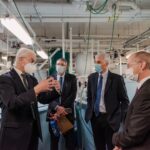
Coming together to sign the document were Oded Forer, Israeli Minister of Agriculture and Rural Development; Russell Hill, executive director of IMET; and Karl V. Steiner, UMBC’s vice president for research. The minister visited IMET on December 1 with a delegation from the agriculture ministry. Leaders from the United States Department of Agriculture (USDA) Animal Production and Protection program also attended the signing event, which was followed by a tour of the Aquaculture Research Center at IMET.
The partnership will center on addressing challenges to the industry that, once overcome, will make aquaculture more efficient and sustainable, and expand it to more seafood species. Developing zero-waste systems, improving fish health and performance in captivity, and scaling up land-based aquaculture systems are all among the partners’ priorities.
“This is a very important day for IMET and aquaculture,” Hill said at the event. “There is an urgent need to promote agriculture in a sustainable way in the U.S., and we hope to contribute as much as possible to that effort.”
 Representatives from IMET, UMBC, and the Israeli Ministry of Agriculture and Rural Development signed a statement of intent to increase collaboration on aquaculture. From left to right: Russell Hill, Yonathan Zohar, Oded Forer, Karl Steiner (front), and Yakov Poleg (rear). Photo by Marlayna Demond ’11 for UMBC.
Focused on the future
Zoharhas been working in the aquaculture space for over 35 years and is an international leader in aquaculture research. In fact, in November 2020, the Binational Agricultural Research Development Fund (BARD), a partnership program between the U.S. and Israel, honored him for the economic impact of his research.
In addition to the BARD recognition, Zohar has received several other awards and accolades in recent months. He was awarded a $10 million grant from the USDA to lead a consortium of aquaculture researchers. He also led the creation of a partnership with Aquacon, a Norwegian company investing $1 billion in aquaculture in the U.S., including a large land-based facility on Maryland’s Eastern Shore. And Zohar’s startup, Silfra Biosystems, LLC, founded in partnership with UMBC microbiologist Kevin Sowers, was recognized as a “Maryland Future 20” company for 2021.
Zohar continues to forge full speed ahead in his work to increase food production in a sustainable way for the increasing human population. “The world’s population is growing by 200,000 each day, placing an increasing demand on our food supply,” Zohar says. “Aquaculture is the fastest growing sector in all of agriculture, and now produces more fish than traditional fishing. Still, we must double production by 2030 to meet the growing demand for sustainable protein sources.”
The land-based systems Zohar pioneered and continues to champion will be a big part of the solution, he believes, especially for salmon. “Atlantic salmon’s U.S. future is land-based,” Zohar says.
 Yonathan Zohar shows the Israeli delegation one of the fish tanks at the Aquaculture Research Center. Photo by Marlayna Demond ’11 for UMBC.
Public research, public good
University System of Maryland (USM) Chancellor Jay Perman called the environmental research being conducted at IMET one of the “crown jewels” of the system, in remarks during the signing event. “I can’t think of anything in higher ed that’s more current than the environment,” Perman said.
Israeli institutions bring their own strengths to this field. For example, they’ve worked to develop agricultural systems that can succeed in drought conditions, which are common in Israel. In particular, the National Center for Mariculture (food production from the sea) in Eilat, Israel is a world leader.
“Bringing together the complementary expertise of UMBC, IMET, and Israeli institutions is exactly the kind of collaboration that is needed to produce innovations that advance aquaculture and the broader mariculture field,” Steiner says, and the public impact this work will have is directly in line with UMBC’s values.
“As a public research university, our motto is ‘public research for public good,’” Steiner continues. “I can think of no better way to embody this motto than by focusing on one of the most pressing questions of our time—how do we ensure that we can feed the world within rapidly changing ecosystems? We are absolutely delighted that this new agreement will allow us to further strengthen the impact of our faculty’s important work.”
 Yonathan Zohar (center) talks about operations at the Aquaculture Research Center with a delegation from Israel, including the Minister of Agriculture and Rural Development, Oded Forer (far right). Photo by Marlayna Demond ’11 for UMBC.
Header image: Yonathan Zohar (left) explains operations of the Aquaculture Research Center to Israeli officials Yakov Poleg, Senior Deputy Director General of the Foreign Trade and International Cooperation; Yoram Kapulnik, Executive Director of BARD; and Oded Forer, Minister of Agriculture and Rural Development, during the delegation’s visit. Photo by Marlayna Demond ’11 for UMBC.
]]>
UMBC will grow its aquaculture collaboration with Israeli colleagues thanks to a new statement of intent signed last week at the Institute of Marine and Environmental Technology (IMET), a...
https://umbc.edu/stories/umbc-and-israeli-ministry-of-agriculture-establish-aquaculture-research-partnership/
https://my3.my.umbc.edu/api/v0/pixel/news/119507/guest@my.umbc.edu/f33f88cf10c35ce6d7b9e8574bb8e619/api/pixel
cnms
imet
marinebiotech
research
science-and-technology
UMBC News & Magazine
https://my3.my.umbc.edu/groups/umbc-news-magazine
https://assets1-my.umbc.edu/system/shared/avatars/groups/000/001/943/24435aa6207c452e7bc15cc74b42c7bb/xsmall.png?1748556657
https://assets1-my.umbc.edu/system/shared/avatars/groups/000/001/943/24435aa6207c452e7bc15cc74b42c7bb/original.png?1748556657
https://assets2-my.umbc.edu/system/shared/avatars/groups/000/001/943/24435aa6207c452e7bc15cc74b42c7bb/xxlarge.png?1748556657
https://assets2-my.umbc.edu/system/shared/avatars/groups/000/001/943/24435aa6207c452e7bc15cc74b42c7bb/xlarge.png?1748556657
https://assets3-my.umbc.edu/system/shared/avatars/groups/000/001/943/24435aa6207c452e7bc15cc74b42c7bb/large.png?1748556657
https://assets1-my.umbc.edu/system/shared/avatars/groups/000/001/943/24435aa6207c452e7bc15cc74b42c7bb/medium.png?1748556657
https://assets2-my.umbc.edu/system/shared/avatars/groups/000/001/943/24435aa6207c452e7bc15cc74b42c7bb/small.png?1748556657
https://assets1-my.umbc.edu/system/shared/avatars/groups/000/001/943/24435aa6207c452e7bc15cc74b42c7bb/xsmall.png?1748556657
https://assets2-my.umbc.edu/system/shared/avatars/groups/000/001/943/24435aa6207c452e7bc15cc74b42c7bb/xxsmall.png?1748556657
UMBC News & Magazine
0
0
false
Fri, 10 Dec 2021 15:58:39 -0500
Viral inventors: UMBC study finds virus DNA orchestrates a critical cellular pathway in bacteria
A protein produced by viral DNA is orchestrating the critical “SOS response” in a large group of bacterial species, according to a new study in Nucleic Acids Research co-led by Ivan Erill, professor of biological sciences at UMBC, and first author Miquel Sánchez-Osuna, a graduate student at Universitat Autònoma de Barcelona (UAB) whom Erill advises.
Their new results suggest the relationship between these bacteria and the viruses that infect them, called bacteriophages or simply “phages,” may go back more than 1.5 billion years. Because of viruses’ prevalence and their ability to evolve so quickly, Erill believes there are likely other examples of this phenomenon that researchers have yet to discover. The results may even have implications for development of new antibiotics.
“The main message is that the bacterial SOS response is in reality a phage response,” Erill says. “It was not created by bacteria; it was the other way around.”
The bacterial SOS response involves over 40 genes and responds to DNA damage in the cell. When the cell is healthy, a protein called a repressor keeps the genes turned off. But when damage occurs, the repressor molecule self-destructs, allowing the genes to get to work fixing the DNA damage.
Phages also have a molecule that detects DNA damage. When the virus’s host cell experiences damage, that’s a signal to the virus to burst out of the cell and find a new home. “It’s the SOS response because if the bacteria or virus doesn’t get it right, they die,” Erill says.

Ivan Erill. Photo by Marlayna Demond ’11 for UMBC.
Unraveling a mystery
The exact mechanism and proteins involved in the SOS response vary across groups of bacteria. For this study, the research team set out to identify the repressor molecule in Bacteroidetes, a group of bacteria that makes up a significant fraction of the microbiota in the human gut, but for which the repressor was still unknown.
First, Erill used computational tools to search Bacteroidetes genomes for proteins closely related to the repressor molecules found in other groups of bacteria. But, surprisingly, there were none. “So we started scratching a little bit more,” Erill says.
Next, he looked at genes in Bacteroidetes that one would expect the repressor to regulate—those genes generally involved in the SOS response in other bacteria. Many of these genes in Bacteroidetes shared a particular pattern, like a keyhole for a shared key. Upon further investigation, including collaboration with Aaron Smith, assistant professor of chemistry and biochemistry, the mystery “key” turned out to be a known repressor protein—but, surprisingly, from a phage, not bacteria.
“So we have a bacteriophage repressor controlling the SOS response in this group of bacteria,” Erill says. “I always suspected that the bacterial repressor that controls this system was actually a phage repressor in disguise.”
 This figure from the paper models the structure of different regions of the Bacteroidetes repressors (green and orange). The researchers compared the Bacteroidetes structures to the structure of known repressors from phages and other bacteria (blue, red, and yellow). That information helped them determine that the repressor in Bacteroidetes came from a phage.
Creative repurposing
It’s well understood that over their billion-plus years of shared history, bacteria have incorporated phage DNA into their genomes and repurposed it for their own needs. “So,” Erill says, “it doesn’t take a stretch to imagine a phage at some point going into a bacterial cell, getting inactivated somehow, and then the cell deciding, ‘This repressor responds to DNA damage—that’s perfect!’”
“Our results suggest that bacteriophage repressors have taken up regulating the SOS response in Bacteroidetes,” says Sánchez-Osuna, who is co-advised by Jordi Barbé at UAB, another of the new paper’s authors. That means the most common SOS repressors in other groups of bacteria “may also have originated from the capture of a phage repressor,” he adds. “Why reinvent a function that already exists?”
A more complicated “trick”
What’s particularly exciting to Erill about this new study is that the SOS response regulated by the phage repressor in Bacteroidetes is so complex. Previous examples of bacteria gaining new functionality from phage genes have been more straightforward. “You can get a new gene and then get a new trick directly from the gene,” Erill says. In fact, bacteria that cause diseases such as cholera and botulism obtain their virulence directly from phage genes, he explains.
But the new study shows something altogether different. After the bacteria took up the phage repressor gene close to a billion years ago, a complex network of interdependent regulation evolved over time, involving dozens of genes and proteins. The phage repressor is the linchpin molecule for this network, and the network is virtually indistinguishable from similar networks in other groups of bacteria that employ a bacterial repressor.

This diagram from the new paper shows how a bacterial cell can take up a phage (red), and incorporate the phage genome into its own (1). In the typical process, when the bacterial cell suffers DNA damage (2′), the phage takes that as a signal to break out of the cell (3′). But, if the normal phage life cycle is inactivated somehow (2), then the phage genes, and the proteins they produce, can be repurposed. Eventually, many of the bacterial genes (green arrows) can come to be regulated by a phage protein (in this case, the repressor, represented by a pink arrow) (3).
One step beyond
“What we show here is that these networks are the result of convergent evolution,” Erill says. Convergent evolution occurs when organisms evolve very similar traits not based on shared genetic history, but, rather, because the organisms experience similar evolutionary pressures that drive the generation of functionally similar—but genetically distinct—systems. Other examples include wings in bats and birds and fins in whales and fish.
It’s easy to think of bacteria as all being closely related, but Bacteroidetes is no more closely related to other bacteria than humans are to sea sponges. So it is remarkable for Bacteroidetes and other bacteria to have evolved nearly identical systems for responding to DNA damage that are based on different “molecular switches”—different repressor molecules that turn the response on and off.
For Erill, this research finding “answers an important evolutionary question, and it points to this process being more frequent and being capable of generating more complexity than we thought,” he says. “We had typically been thinking about getting a gene and using it as-is, and this shows one step beyond that.”
 Aaron Smith, right, works with students in his laboratory. Photo by Maralayna Demond ’11 for UMBC.
Rethinking antibiotics
The results may also influence development of antibiotics. Most antibiotics induce DNA damage in the bacteria they target, which activates the SOS response. However, as the SOS response works to repair the damage, it often makes mistakes, introducing mutations into the DNA. More mutations increases the chances that a mutant will be resistant to the antibiotic.
Some scientists have suggested that new antibiotic drugs should also inhibit the SOS response to prevent the increased risk of generating resistant bacteria, Erill says. This study shows that to be effective, new drugs will need to target the phage repressor as well as the bacterial repressor that orchestrates the SOS response.
Viral innovation
While Erill finds the results and implications of this research exciting, he doesn’t find them terribly surprising. “To me, it always made sense that the origin of the switch was the virus,” he says. “In an evolutionary race between a bacterium and a virus, the virus always wins. It has a higher mutation rate and can replicate faster.”
In fact, 20 percent of human DNA is known to come from viruses, Erill says. He believes it is likely much higher. Viruses can do amazing things, like generate a protein that mimics the shape of DNA, which has so far proven impossible for any chemist. Examples like that, and this new study, “show you the level of evolutionary invention that viruses can have,” Erill says, which he discusses more in a piece for The Conversation.
This new study demonstrates Erill’s hunch more convincingly than ever before by deploying a suite of interdisciplinary techniques. Computational work identified the patterns in the Bacteroidetes genes that matched the phage repressor. Then, wet lab work confirmed that the phage repressor would bind to those patterns. Finally, structural analysis in Aaron Smith’s bioinorganic and structural biology lab further proved that the repressor in question was much more closely related to viral proteins than ones with bacterial origin.
“I think this work is a nice illustration of how a blend of big data, computational modeling, and wet-lab experimental biochemistry and molecular biology can come together to answer really intriguing and important questions about evolution,” Smith says.
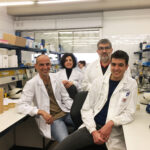
Header image: Pictured left to right, Ivan Erill, Pilar Cortés (UAB), Jordi Barbé, and Miquel Sánchez-Osuna are all authors on the new paper, along with Aaron Smith and Mark Lee, a chemistry Ph.D. student in Smith’s lab. Photo courtesy of Ivan Erill.
]]>
A protein produced by viral DNA is orchestrating the critical “SOS response” in a large group of bacterial species, according to a new study in Nucleic Acids Research co-led by Ivan Erill,...
https://umbc.edu/stories/viral-inventors-umbc-study-finds-virus-dna-orchestrates-a-critical-cellular-pathway-in-bacteria/
https://my3.my.umbc.edu/api/v0/pixel/news/119508/guest@my.umbc.edu/1edfd77928d2e4fd7793a691224e616e/api/pixel
biology
chembiochem
chemistry
cnms
research
science-and-technology
UMBC News & Magazine
https://my3.my.umbc.edu/groups/umbc-news-magazine
https://assets1-my.umbc.edu/system/shared/avatars/groups/000/001/943/24435aa6207c452e7bc15cc74b42c7bb/xsmall.png?1748556657
https://assets1-my.umbc.edu/system/shared/avatars/groups/000/001/943/24435aa6207c452e7bc15cc74b42c7bb/original.png?1748556657
https://assets2-my.umbc.edu/system/shared/avatars/groups/000/001/943/24435aa6207c452e7bc15cc74b42c7bb/xxlarge.png?1748556657
https://assets2-my.umbc.edu/system/shared/avatars/groups/000/001/943/24435aa6207c452e7bc15cc74b42c7bb/xlarge.png?1748556657
https://assets3-my.umbc.edu/system/shared/avatars/groups/000/001/943/24435aa6207c452e7bc15cc74b42c7bb/large.png?1748556657
https://assets1-my.umbc.edu/system/shared/avatars/groups/000/001/943/24435aa6207c452e7bc15cc74b42c7bb/medium.png?1748556657
https://assets2-my.umbc.edu/system/shared/avatars/groups/000/001/943/24435aa6207c452e7bc15cc74b42c7bb/small.png?1748556657
https://assets1-my.umbc.edu/system/shared/avatars/groups/000/001/943/24435aa6207c452e7bc15cc74b42c7bb/xsmall.png?1748556657
https://assets2-my.umbc.edu/system/shared/avatars/groups/000/001/943/24435aa6207c452e7bc15cc74b42c7bb/xxsmall.png?1748556657
UMBC News & Magazine
0
0
false
Thu, 09 Dec 2021 18:54:18 -0500
UMBC continues to advance biotech in Maryland through new $900K biomanufacturing grant
A growing list of programs and partnerships is positioning UMBC as a leader in developing Maryland’s biotech and biomanufacturing workforce. UMBC has just received a $900,000 grant from the National Institute for Innovation in Manufacturing Biopharmaceuticals (NIIMBL) to develop and implement a short-term biomanufacturing career training program. Four universities, all classified as minority-serving institutions (MSIs), received funding for similar programs, which will be adapted from a curriculum first developed at Texas A&M University.
UMBC will offer the biomanufacturing training program at its Universities at Shady Grove (USG) campus in Rockville, Maryland. It will be similar to UMBC’s Biotech Boot Camp, which trained people who had lost their jobs during the pandemic for new careers in biotech. The boot camp has run twice so far, both times focusing on cell culture techniques and broader “wet lab” skills.
Montgomery County government and WorkSource Montgomery partnered with UMBC to offer the original boot camps at no cost to the students. The new biomanufacturing training program will also be free to participants the first time it is offered, thanks to the support from NIIMBL.
The biotech industry is booming in the BioHealth Capital Region, which ranks #4 among the top biopharma clusters in the country. The pandemic has drawn even more attention to the biopharma industry, so the need for qualified local workers in a range of biotech roles has never been greater.
“We are driven by the vision that Maryland can be a leader in biotech,” says Bill LaCourse, dean of the College of Natural and Mathematical Sciences (CNMS) at UMBC. “We’re establishing strong pathways to develop the workforce, where students and professionals have an array of choices about how to get to the biotech career they want and that the region needs.”
A participant in the Biotech Boot Camp at USG in February 2021 practices their pipetting technique. Photo by Annica Wayman.
Opportunities at every level
The new NIIMBL program is just one of those choices. UMBC’s Translational Life Science Technology (TLST) bachelor’s degree program, fully launched in 2019 in partnership with Montgomery College, was the college’s first new major developed in response to the growing need for biotech workforce development in the region. The TLST program bridges fundamental knowledge in the life sciences with industry-specific applications, practical laboratory skills, and an understanding of the regulatory process for biopharmaceuticals.
“The launch of the TLST program has led to a lot of education and partnership opportunities,” says Annica Wayman ’99, M6, mechanical engineering, and associate dean for Shady Grove affairs in CNMS. “It’s allowed UMBC to address gaps in the workforce that already existed, and that became even more prominent with the pandemic. We jumped in to help to fill those gaps in a variety of ways.”
The TLST program, which has just launched a bioinformatics track, dovetails with the Master of Professional Studies in Biotechnology, also offered at USG. The master’s program is ideal for both recent TLST program graduates and professionals already in biotech seeking to advance their careers.
“We’re trying to build the education pathway that runs in parallel with the career pathways for students in biotech,” Wayman says.

Participants in the Biotech Boot Camp at USG, Feb 2021. Photo by Annica Wayman.
Engaging with industry
UMBC has also cultivated a growing number of partnerships with individuals, industry, government agencies, and regional community colleges that strengthen its offerings. A Biotechnology Advisory Committee includes representatives from companies such as Kite Pharma, Catalent, AstraZeneca, and American Gene Technologies, all of which have facilities in the region. Agencies like the National Institutes of Health (NIH) and National Institute of Standards and Technology (NIST) are also on the committee.
“They’re helping us to refine our curriculum to make sure we’re educating students on the things that industry needs,” Wayman says. “They’re also helping us determine what other gaps we could fill.”
For example, another huge growth area is biomanufacturing process development. With increasing automation and the need for large-scale production of some biopharmaceutical products, there are opportunities to improve the way biomanufacturing facilities operate.
UMBC’s biotech curricula often directly touch industry, as well. TLST courses regularly include guest lecturers from regional companies, and students must complete an internship in order to graduate. TLST classes have also included interviewing support and networking sessions with potential employers, such as members of the Frederick Innovative Technology Center, Inc.
 (l to r): Annica Wayman, Antonio Moreira, Keith Bowman, Bill LaCourse. Photo by Marlayna Demond ’11 for UMBC at the grand opening of the BSE building at USG.
Productive partnerships
UMBC’s new partnership with Aberdeen Proving Ground (APG), the U.S. Army facility near Aberdeen, Maryland, will further enhance opportunities for students across the region. APG has built a robust relationship with Harford Community College, while UMBC already has a thriving relationship with Montgomery College and has been deepening its relationship with Frederick Community College. The new APG partnership, still in its early stages, will create opportunities to enhance UMBC’s relationship with Harford Community College, as well.
“We’ve now built this education partnership alliance with Aberdeen Proving Ground, because we’re looking to provide a pathway for these students through their biotech career,” Wayman says. “They can go from Harford Community College to the TLST program, and have Aberdeen be that partner running throughout who provides experiential opportunities and eventually jobs for these students.”

UMBC’s Interdisciplinary Life Sciences Building offers state-of-the-art spaces for research and teaching. Photo by Marlayna Demond ’11 for UMBC.
An economic engine
Antonio Moreira, vice provost for academic affairs, has seen the potential for Maryland to be a biotechnology leader for years, with UMBC as a major driver of growth. Maryland’s strength “is the result of a life sciences ecosystem that includes federal agencies, major research universities, hundreds of biotechnology companies and strong community colleges,” he says. While this growth has been in process for some time, he notes that the pandemic has brought the need for a robust biotech sector into sharp relief.
“As a component of the Maryland biotechnology ecosystem, UMBC is a major resource for preparing the workforce needed to develop and manufacture critical therapies,” Moreira explains. Given a shortage in this workforce, “the students graduating from the universities need to be prepared to hit the ground running as they join these biotechnology companies.”
The innovative partnerships UMBC is developing with industry, government, and community colleges are creating opportunities for students to gain the complex skills needed to contribute to the growing biotech industry and to pursue careers in high-demand fields. “All these projects, programs, and partnerships are helping fulfill the mission of UMBC as an economic engine and source of workforce development in the state,” Dean LaCourse says.
“We are implementing our shared vision to build a workforce for the biotech industry right here, with the people in Maryland,” LaCourse continues. “We want Maryland businesses to look out their windows to find that workforce that they need—and it’s looking good.”
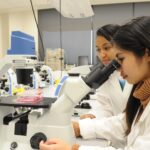
Header image: Charmaine Hipolito ’20 (right) and Titina Sirak ’20, both graduates of the TLST program, use the microscopes in a teaching lab at the Universities at Shady Grove in 2019. Photo by Marlayna Demond ’11 for UMBC.
]]>
A growing list of programs and partnerships is positioning UMBC as a leader in developing Maryland’s biotech and biomanufacturing workforce. UMBC has just received a $900,000 grant from the...
https://umbc.edu/stories/umbc-continues-to-advance-biotech-in-maryland-through-new-900k-biomanufacturing-grant/
https://my3.my.umbc.edu/api/v0/pixel/news/119518/guest@my.umbc.edu/9f9eedd07c0f342a8ed6967aac0ff235/api/pixel
cnms
science-and-technology
shadygrove
tlst
UMBC News & Magazine
https://my3.my.umbc.edu/groups/umbc-news-magazine
https://assets1-my.umbc.edu/system/shared/avatars/groups/000/001/943/24435aa6207c452e7bc15cc74b42c7bb/xsmall.png?1748556657
https://assets1-my.umbc.edu/system/shared/avatars/groups/000/001/943/24435aa6207c452e7bc15cc74b42c7bb/original.png?1748556657
https://assets2-my.umbc.edu/system/shared/avatars/groups/000/001/943/24435aa6207c452e7bc15cc74b42c7bb/xxlarge.png?1748556657
https://assets2-my.umbc.edu/system/shared/avatars/groups/000/001/943/24435aa6207c452e7bc15cc74b42c7bb/xlarge.png?1748556657
https://assets3-my.umbc.edu/system/shared/avatars/groups/000/001/943/24435aa6207c452e7bc15cc74b42c7bb/large.png?1748556657
https://assets1-my.umbc.edu/system/shared/avatars/groups/000/001/943/24435aa6207c452e7bc15cc74b42c7bb/medium.png?1748556657
https://assets2-my.umbc.edu/system/shared/avatars/groups/000/001/943/24435aa6207c452e7bc15cc74b42c7bb/small.png?1748556657
https://assets1-my.umbc.edu/system/shared/avatars/groups/000/001/943/24435aa6207c452e7bc15cc74b42c7bb/xsmall.png?1748556657
https://assets2-my.umbc.edu/system/shared/avatars/groups/000/001/943/24435aa6207c452e7bc15cc74b42c7bb/xxsmall.png?1748556657
UMBC News & Magazine
0
0
false
Tue, 23 Nov 2021 19:07:49 -0500
UMBC’s Lavik and Bieberich develop new approach to nanoparticles that stop internal bleeding
When a person experiences a trauma that leads to significant bleeding, the first few minutes are critical. It’s important that they receive intravenous medication quickly to control the bleeding, but delivering the medication at the right rate can prove challenging. Slower infusions can cause fewer negative reactions, but the medication might not work fast enough, particularly in the case of a serious trauma.
Four UMBC researchers have developed a unique way of modifying the surfaces of nanoparticles within these life-saving medications to provide infusions that can be delivered more quickly, but with a reduced risk of negative reactions. Infusion reactions can cause a range of symptoms, such as rashes and inflammatory responses. This can include anaphylaxis, a life-threatening respiratory failure. Up until this point, the seriousness of these reactions has limited the use of promising nanomedicines, and reducing the likelihood of adverse reactions could be game-changing.
 Erin Lavik (right) working in the lab with a student in 2018.
The core of the issue
In a paper recently published in Nano Letters, Erin Lavik, professor of chemical, biochemical, and environmental engineering; Chuck Bieberich, professor of biological sciences; Nuzhat Maisha, Ph.D. ‘21, chemical engineering; and Michael Rubenstein, M.S. ‘14, Ph.D. ‘22, biological sciences, discuss their novel approach to the research. They focused on the core material of the nanoparticles delivered to patients.
“We found that using a polyurethane core reduced the markers associated with infusion reactions,” explains Lavik, who is also the associate dean for research and faculty development in UMBC’s College of Engineering and Information Technology.
Currently, 7% of people experience infusion reactions, the authors note in their paper. “These reactions…limit the treatments available in a substantial portion of patients,” they explain.
 Chuck Bieberich.
“We, like most of the field, have spent a lot of time trying to modify the surfaces of nanoparticles to modulate the reaction,” says Lavik. She shares that while that approach does help to a degree, going a step further by changing the core material appears to have a greater impact.
The research conducted by Lavik, Bieberich, and their colleagues lays the groundwork for future testing of preclinical models using nanocapsules to stop internal bleeding. Lavik explains that collaboration was an important element of this work, especially being able to conduct the research in UMBC’s Interdisciplinary Life Sciences Building.
 The ILSB (at left) in the fall.
Banner image: Erin Lavik, left, working in the lab in 2018. All photos by Marlayna Demond ’11 for UMBC.
]]>
When a person experiences a trauma that leads to significant bleeding, the first few minutes are critical. It’s important that they receive intravenous medication quickly to control the bleeding,...
https://umbc.edu/stories/umbcs-lavik-and-bieberich-develop-new-approach-to-nanoparticles-that-stop-internal-bleeding/
https://my3.my.umbc.edu/api/v0/pixel/news/119519/guest@my.umbc.edu/7d0b5ba777e0a55b8dabf79f5cd9dfc4/api/pixel
cbee
coeit
science-and-technology
UMBC News & Magazine
https://my3.my.umbc.edu/groups/umbc-news-magazine
https://assets1-my.umbc.edu/system/shared/avatars/groups/000/001/943/24435aa6207c452e7bc15cc74b42c7bb/xsmall.png?1748556657
https://assets1-my.umbc.edu/system/shared/avatars/groups/000/001/943/24435aa6207c452e7bc15cc74b42c7bb/original.png?1748556657
https://assets2-my.umbc.edu/system/shared/avatars/groups/000/001/943/24435aa6207c452e7bc15cc74b42c7bb/xxlarge.png?1748556657
https://assets2-my.umbc.edu/system/shared/avatars/groups/000/001/943/24435aa6207c452e7bc15cc74b42c7bb/xlarge.png?1748556657
https://assets3-my.umbc.edu/system/shared/avatars/groups/000/001/943/24435aa6207c452e7bc15cc74b42c7bb/large.png?1748556657
https://assets1-my.umbc.edu/system/shared/avatars/groups/000/001/943/24435aa6207c452e7bc15cc74b42c7bb/medium.png?1748556657
https://assets2-my.umbc.edu/system/shared/avatars/groups/000/001/943/24435aa6207c452e7bc15cc74b42c7bb/small.png?1748556657
https://assets1-my.umbc.edu/system/shared/avatars/groups/000/001/943/24435aa6207c452e7bc15cc74b42c7bb/xsmall.png?1748556657
https://assets2-my.umbc.edu/system/shared/avatars/groups/000/001/943/24435aa6207c452e7bc15cc74b42c7bb/xxsmall.png?1748556657
UMBC News & Magazine
0
0
false
Tue, 23 Nov 2021 14:13:20 -0500
 Weihong Lin (left); Ashley Majekodunmi ’21 (center), biological sciences, a UMBC STEM BUILD Trainee; and Abdullah Al-Matrouk (right), then a Ph.D. candidate in biological sciences, work in Lin’s neurobiology lab in 2018.
 Provost Philip Rous receives an award from the American Democracy Project at the Civic Learning and Democratic Engagement Meeting in Baltimore, 2017.
 A student works with fruit flies in the lab of Jeff Leips, biological sciences, at UMBC, summer 2019.
 Howard Nicholson ’21, chemical engineering, shares his research on biosensors at UMBC’s 23rd annual Undergraduate Research and Creative Achievement Day (URCAD) in 2019. Students moved outside briefly in response to a fire drill.
 Three Meyerhoff Scholars connect at UMBC in spring 2021.
 Meyerhoff Scholars and alumni at the Meyerhoff 30th anniversary celebration, June 2019. President Hrabowski (left) and original program sponsor Robert Meyerhoff (right) seated in front row. More than 800 of UMBC’s Meyerhoff alumni have already earned graduate and professional degrees. Photo by Jim Burger for UMBC.


