“Researching” to “researcher”: UMBC students share why mentoring is the key
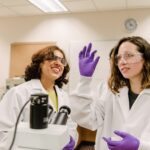
UMBC’s annual Undergraduate Research and Creative Achievement Day allows students to reflect on a year or more of work intensively focused on a project, often with close guidance from a faculty mentor. These mentors have deep and long-lasting impacts on the students who work with them, and the students’ creativity and fresh perspectives inspire their mentors.
Like many faculty across UMBC, Greg Szeto, assistant professor of chemical, biochemical, and environmental engineering, has guided undergraduate and graduate students to achieve a deeper understanding of their discipline. “Being a mentor is the most impactful thing we can do with our time,” he says.
“It’s a mentor’s job to provide comprehensive and diverse experiences that are customized to fit different individuals’ goals and stage of development and to consistently fine-tune those experiences over time,” Szeto explains. “We help provide a safe environment where students can explore their interests in research and determine what the right path is for their future.”
Engineering solutions to health challenges
When Nicole Couturier ‘19, chemical engineering, began exploring options to get involved with research, she wasn’t sure which direction to take. She was intrigued to learn about the interdisciplinary approach to Szeto’s lab, which combines engineering, biology, and human health.
Couturier, a MARC scholar, began working in Szeto’s lab in spring 2017, studying the properties of gold nanoparticles that can potentially be used as immunotherapy agents. She explains that these nanoparticles can “offer an alternative approach to traditional treatment methods by carrying drugs inside their core.” The nanoparticles also have molecules attached to their surfaces that direct them to specific sites within the body, Couturier adds.
Szeto has encouraged Couturier to explore and expand the scope of her work. “Because I have been able to participate in different projects with a range of focuses, I have been able to learn about many different areas of research both inside and outside the field of immunology,” she says. She adds that Szeto had helped her keep her expectations in check, sharing, “One of the most helpful pieces of advice that Dr. Szeto has shared is to remind me that it’s okay at the end of the day if I still don’t know the answer to something.”
For other students seeking research mentors, Szeto suggests, “The fit between a student and a mentor is even more important than finding a perfect intellectual match with research topic at most career stages.”
He notes that strong mentoring relationships benefit everyone, but are particularly important for people early in their careers. “Having supportive mentors and advocates invested in your success as an undergraduate can fundamentally change someone’s perspective on career goals, and their decision to pursue a Ph.D. or career in research,” Szeto says.
From doing research to becoming a researcher
Conducting research in Szeto’s lab has allowed Kojo Bonsu ‘18, chemical engineering, to think about how chemical engineering can address health challenges in new ways.
“I was always interested in applying chemical engineering principles and methodologies to research in biology and medicine, but did not think about doing so by approaching the problems from the immune system,” Bonsu says. “After meeting with Dr. Szeto, I clearly saw how chemical engineering could provide new solutions to long-standing problems in biotechnology and human health.”
Bonsu joined Szeto’s lab in fall 2017. With a strong background in research, he was looking for opportunities to do more independent work. Szeto worked with Bonsu to develop a research experience that included experimental design, data analysis, and project troubleshooting. Bonsu says that this time in Szeto’s lab challenged him to think about possible solutions to obstacles in creative ways.
“This experience truly allowed me to see myself as a researcher and spurred my desires to go to graduate school to further expand upon my knowledge of engineering solutions to a host of problems,” Bonsu says.
Creating a supportive environment for women in STEM
Karla Negrete ‘19, mechanical engineering, a Hill-Lopes Scholar, was drawn to Deepa Madan’s lab after she took a course about the chemical and physical aspects of materials.
Madan has guided Negrete through research on the materials and design of batteries. She focuses on preparing an efficient and safe electrolyte layer for batteries, to avoid the pitfalls of hazardous materials, short lifespan, and susceptibility to damage that are common to conventional designs.
 Karla Negrete, right, working in the lab along her mentors Aswani Poosapati and Deepa Madan.
Negrete is exploring how to replace the liquid in batteries with gel polymer electrolytes while avoiding the challenge of crystallization. “Our research seeks to…introduce the use of novel nanofiber cellulose, which is extracted from wood, as the main constituent in preparing our thin gel electrolytes,” she says.
“Dr. Madan has been a mentor to me in many ways,” Negrete reflects, “but the most important has been her ability to believe in me and stand behind me.”
That active interest, encouragement and confidence-building are central to Madan’s mentoring approach.“I believe the likelihood of students achieving their immediate and possibly long-term career goals can be significantly increased if students believe their mentors are genuinely interested in student success, and students see the activity and engagement as a stepping stone for their successful careers,” Madan says.
Negrete has also been mentored by Aswani Poosapati, Ph.D. ‘23, mechanical engineering, and she says that being a part of a supportive research team has been empowering. “The most rewarding part of working with Dr. Madan has been the welcoming environment that she creates in her lab,” says Negrete. “From the beginning, Dr. Madan and Aswani Poosapati have taught me, challenged me, guided me, and trusted me to be a part of this research.”
Much of Madan’s work with students like Negrete focuses on the nuts and bolts of research: how to conduct a literature review, how to access networking opportunities, and how to use research opportunities as steps toward achieving research goals. At another level, she also sees tremendous value in serving as a resource and sounding board for young women beginning careers in STEM fields.
“I feel my research experiences and story motivate our female students to come and talk to me about their research interests, which I feel some are hesitant to share,” she says. “Many of them are flourishing and are positively surprised by how well their research is progressing in a discipline that once appeared so intimidating.” In a field where women are underrepresented, Madan notes, “It’s not surprising to me that more than half of the students working in my lab are female students.”
Gaining confidence through challenges
Anna Feerick ‘19, chemistry, remembers standing outside the door to Lee Blaney’s lab. Blaney worked in a different department (chemical, biochemical, and environmental engineering), but Feerick was fascinated by how his lab applied chemistry to major environmental challenges.
“While reading the research posters outside of the lab, I could see the passion this lab has toward discovery and innovation,” recalls Feerick. “I wanted to match their enthusiasm with my own and was willing to work as hard as needed to get there.”
 Anna Feerick, working in the lab with Ke He.
The research conducted in Blaney’s lab is interdisciplinary, and involves undergraduate and graduate students. In addition to working with Blaney, Feerick has had an opportunity to work closely with Ke He, Ph.D. ‘17, chemical engineering, and Ethan Hain, Ph.D. ‘23, chemical engineering.
When Feerick first joined the lab, she spent time measuring salts for water samples, freeze-drying and measuring sediment samples, and measuring tissue from oysters from the Chesapeake Bay. These tasks showed her the importance of carefully following lab protocols to ensure that contaminant levels were accurately analyzed.
Over time, Feerick was able to take on increasingly challenging work in the lab, which she found to be highly rewarding. “[Blaney] balances the difficulty of the task with our ability to overcome it,” she says. “His confidence in my ability gives me the determination needed to complete it.”
Supporting this growth over time is the core of how Blaney sees mentoring. “Unlike many undergraduate and graduate courses, research involves open-ended questions without known answers,” he points out. “This scenario can be daunting for many students.”
“I think the real importance of mentors stems from their ability to help students make the transition from homework and exam problems to complex, long-term research projects,” Blaney explains. “Mentors play a critical role in contributing to the personal and professional growth of students at every step of that journey.”
Banner image: Karla Negrete, right, working alongside Deepa Madan in the lab. All photos by Marlayna Demond ’11 for UMBC unless otherwise noted.
]]>
UMBC’s annual Undergraduate Research and Creative Achievement Day allows students to reflect on a year or more of work intensively focused on a project, often with close guidance from a faculty...
https://umbc.edu/stories/researching-to-researcher-umbc-students-share-why-mentoring-is-the-key/
https://my3.my.umbc.edu/api/v0/pixel/news/120157/guest@my.umbc.edu/cd329b99303e56767a86f9adb147d563/api/pixel
biology
cbee
coeit
meche
page1
science-and-technology
se
undergradresearch
UMBC News & Magazine
https://my3.my.umbc.edu/groups/umbc-news-magazine
https://assets1-my.umbc.edu/system/shared/avatars/groups/000/001/943/24435aa6207c452e7bc15cc74b42c7bb/xsmall.png?1748556657
https://assets1-my.umbc.edu/system/shared/avatars/groups/000/001/943/24435aa6207c452e7bc15cc74b42c7bb/original.png?1748556657
https://assets2-my.umbc.edu/system/shared/avatars/groups/000/001/943/24435aa6207c452e7bc15cc74b42c7bb/xxlarge.png?1748556657
https://assets2-my.umbc.edu/system/shared/avatars/groups/000/001/943/24435aa6207c452e7bc15cc74b42c7bb/xlarge.png?1748556657
https://assets3-my.umbc.edu/system/shared/avatars/groups/000/001/943/24435aa6207c452e7bc15cc74b42c7bb/large.png?1748556657
https://assets1-my.umbc.edu/system/shared/avatars/groups/000/001/943/24435aa6207c452e7bc15cc74b42c7bb/medium.png?1748556657
https://assets2-my.umbc.edu/system/shared/avatars/groups/000/001/943/24435aa6207c452e7bc15cc74b42c7bb/small.png?1748556657
https://assets1-my.umbc.edu/system/shared/avatars/groups/000/001/943/24435aa6207c452e7bc15cc74b42c7bb/xsmall.png?1748556657
https://assets2-my.umbc.edu/system/shared/avatars/groups/000/001/943/24435aa6207c452e7bc15cc74b42c7bb/xxsmall.png?1748556657
UMBC News & Magazine
0
0
false
Thu, 18 Apr 2019 19:38:39 -0400
UMBC’s Meyerhoff Scholars model heads to UC Berkeley and UCSD through a $6.9M investment from the Chan Zuckerberg Initiative
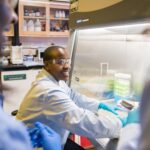
“The key to accelerating discoveries in science or the next tech breakthrough will be dependent on our ability to bring fresh perspectives to STEM fields,” says Priscilla Chan, co-founder of the Chan Zuckerberg Initiative (CZI). Now, CZI has turned to UMBC for a model of how to make that happen.
CZI announced today that it has awarded $6.9 million to support a unique partnership to replicate UMBC’s Meyerhoff Scholars Program at UC San Diego and UC Berkeley.
“California’s openness to new ways of thinking is what has made this state an innovation engine for the world,” says Chan. “With these new grants, we hope to help bring even more diversity of perspective and experience to our state—and to Silicon Valley.”
The UMBC Meyerhoff program, founded in 1989, is recognized as one of the most effective models in the nation to help engage and retain underrepresented students pursuing undergraduate and graduate degrees in STEM fields. Program participants have already earned 300 Ph.D. degrees, 130 M.D. degrees, 54 M.D.-Ph.D. degrees, and 253 master’s degrees. Hundreds more are currently pursuing graduate degrees.
 Abby Cruz ‘18, a Meyerhoff affiliate and MARC U*STAR Scholar, works in Fernando Vonhoff’s biology lab.
These achievements are particularly striking in a national context. UMBC graduates more African American students who go on to earn dual M.D.-Ph.D. degrees than any other college in the U.S.—a credit to the Meyerhoff program model. UMBC is also second in the nation when it comes to graduating African American students who go on to earn a Ph.D. in any STEM field.
A thrilling combination
“It is truly thrilling to think about the national and global impact the Meyerhoff Scholars Program will have through partnerships like this,” says Michael Summers, Robert E. Meyerhoff Chair for Excellence in Research and Mentoring and Distinguished University Professor at UMBC. “By working together we can help shape the future of our national Ph.D. pipeline, with inclusive excellence as a core shared value of our work.”
 Michael Summers (left) with two of the students who have worked in his lab, which focuses 3D structures of protein components that make up HIV-1.
The University of California system is the largest undergraduate and graduate educator of underrepresented and low-income students in the country within the Association of American Universities, and UC Berkeley and UC San Diego are major sources of top talent for Silicon Valley and STEM fields more broadly.
The CZI support announced today will enable UC San Diego and UC Berkeley to apply many of the strategies successfully used at UMBC. These include outreach to high achieving underrepresented high school students, robust research experiences, team learning, peer counseling, intensive advising, preparation in the summer before matriculation, and engagement with students’ families.
Informed by UMBC’s own approach to measuring the impact of student support initiatives, UC San Diego and UC Berkeley will provide rigorous data to measure the effects of their new programs over the five-year grant period. In this way, they hope to determine what approaches work best to create a welcoming and supportive environment for underrepresented groups, and ultimately to improve education for all in STEM fields.
As UMBC recognizes, these findings can also help a university support students beyond STEM, in any field, as they work to discover and fulfill their potential.
Extending community
UMBC Meyerhoff alumni pursuing graduate degrees at UC Berkeley and UC San Diego are particularly excited to see this new partnership grow.
 President Hrabowski congratulates Meyerhoff Scholar and valedictorian Eudorah Vital after she delivers commencement remarks, May 2018.
“Seeing a version of the program come to Berkeley is exciting because it means there is another initiative to increase the support for students of color. It means building and extending the community that wants to see us in academic spaces,” says Robyn Jasper ‘17, M25, biological sciences, who is currently a Ph.D. student at UC Berkeley in plant and microbial biology.
“Being a Meyerhoff Scholar has connected me and continues to connect me with advocates for my personal growth and institutional change,” she shares.
Rockford “Rocky” Sison ‘13, M21, mathematics, a current Ph.D. candidate in applied mathematics at Berkeley, feels similarly. “As an alum of the Meyerhoff Scholars Program, I’m so excited to see other programs spring up across the country,” they share. “It means a lot to me that more students will receive the type of financial, professional, and emotional support I received as an undergraduate. Ideally, every student would get this level of support.”
For Sison, “being a Meyerhoff Scholar meant that I hit the ground running in college.” The Summer Bridge program before their first year and subsequent programming meant “I knew what internships were, office hours weren’t as scary because I knew a couple faculty members, and I was friends with a bunch of people that would also be in my classes.”
 Rocky Sison ’13, M21, speaks at a press conference in California announcing the Chan Zuckerberg Initiative support for replication of the Meyerhoff Scholars in the University of California system. Photo courtesy Chan Zuckerberg Initiative.
Sison carries on that legacy of support, sharing, “When I graduated from UMBC, being a Meyerhoff Scholar meant that I was dedicated to paying it forward, and I had a sprawling network of people with the same commitment.”
Now, UMBC’s Meyerhoff Scholars Program model will reach more people than ever before, reshaping the future of STEM in California and the nation, and unlocking new opportunities for students.
Featured image: Naomi Mburu ’18, chemical engineering, a Meyerhoff Scholar and UMBC’s first Rhodes Scholar. She is now studying nuclear engineering at Oxford. All photos by Marlayna Demond ’11 for UMBC.
]]>
“The key to accelerating discoveries in science or the next tech breakthrough will be dependent on our ability to bring fresh perspectives to STEM fields,” says Priscilla Chan, co-founder of the...
https://umbc.edu/stories/meyerhoff-czi/
https://my3.my.umbc.edu/api/v0/pixel/news/120170/guest@my.umbc.edu/3ff8a8acefca38207471570c65051c3e/api/pixel
alumni
biology
chembiochem
cnms
coeit
community
icp
mathstat
meyerhoffscholars
page1
science-and-technology
se
strategic-planning
UMBC News & Magazine
https://my3.my.umbc.edu/groups/umbc-news-magazine
https://assets1-my.umbc.edu/system/shared/avatars/groups/000/001/943/24435aa6207c452e7bc15cc74b42c7bb/xsmall.png?1748556657
https://assets1-my.umbc.edu/system/shared/avatars/groups/000/001/943/24435aa6207c452e7bc15cc74b42c7bb/original.png?1748556657
https://assets2-my.umbc.edu/system/shared/avatars/groups/000/001/943/24435aa6207c452e7bc15cc74b42c7bb/xxlarge.png?1748556657
https://assets2-my.umbc.edu/system/shared/avatars/groups/000/001/943/24435aa6207c452e7bc15cc74b42c7bb/xlarge.png?1748556657
https://assets3-my.umbc.edu/system/shared/avatars/groups/000/001/943/24435aa6207c452e7bc15cc74b42c7bb/large.png?1748556657
https://assets1-my.umbc.edu/system/shared/avatars/groups/000/001/943/24435aa6207c452e7bc15cc74b42c7bb/medium.png?1748556657
https://assets2-my.umbc.edu/system/shared/avatars/groups/000/001/943/24435aa6207c452e7bc15cc74b42c7bb/small.png?1748556657
https://assets1-my.umbc.edu/system/shared/avatars/groups/000/001/943/24435aa6207c452e7bc15cc74b42c7bb/xsmall.png?1748556657
https://assets2-my.umbc.edu/system/shared/avatars/groups/000/001/943/24435aa6207c452e7bc15cc74b42c7bb/xxsmall.png?1748556657
UMBC News & Magazine
0
0
false
Tue, 09 Apr 2019 22:05:54 -0400
UMBC men’s basketball advances to the America East final after a gripping semifinal victory

They never said it would be easy, but they did say it would be exciting. After battling through two rounds of fatiguing overtime, UMBC men’s basketball bested Hartford 90-85 to advance to the America East championship game and defend their title.
While the Retrievers set a comfortable lead after the first half, never trailing, the Hawks ramped their offense and began to close the gap with six minutes left in gameplay. The final moments of regulation time were decided by fouls, with UMBC and Hartford alternating from the free throw line. With 16 seconds left, the Hawks pulled ahead by one. Junior guard K.J. Jackson, sociology, answered the call and sunk one out of his two free throws to tie up the game with 3.7 seconds left, forcing the game to overtime and keeping Retriever Nation on the edge of their seats.
 Retriever fans feel the intensity of the semifinal, as the game goes into double overtime.
Five minutes were added to the clock and, after a taxing back and forth, UMBC tied again with Brandon Horvath ‘21, financial economics, sinking both of his free throws. Starting with the second overtime, the Retrievers found their footing and pulled ahead, capitalizing on foul shots and pulling out a five-point victory.
“It was a crazy game, but this is what March is all about,” reflects Horvath.
Team mentality
Just after the win, Jackson spoke with the Baltimore Sun’s Edward Lee about the players’ team mentality. “I’ve got Joe, I’ve got Brandon, I’ve got everyone here with me playing just as hard,” he said. “It’s not time to be tired…It’s time to go make plays, and that’s what I did.”
 K.J. Jackson sets up for a three-pointer in the second half of Tuesday’s game.
Leading the pack, Jackson accounted for 21 of the Retrievers’ points, with R.J. Eytle-Rock ‘22, psychology, netting 16; Horvath posting up 14; and Joe Sherburne ‘18, financial economics and Arkel Lamar ‘21, sociology, each contributing 12.
Sherburne has been a force both on and off the court during his career at UMBC. He was recently named the 2018-19 Google Cloud Academic All-America® Team Member of the Year for Division I men’s basketball. In addition to his All-American of the Year accolade, Sherburne was also named to the America East All-Academic Team for the third time in his career and to the America East First Team for the first time.
Ready for Vermont
Retriever Nation won’t have a chance to catch their breath from last night’s adrenaline-filled win as there’s still one more victory in this tournament to claim. UMBC travels to Vermont to take on the Catamounts for the second year, to battle it out for the America East Championship title.
The final game is on Saturday, March 16, at 11 a.m. at the Patrick Gymnasium in Burlington. The game will be broadcast on ESPN2, with Retriever watch parties across the nation. UMBC will host a free family-friendly watch party in the Event Center for anyone interested, including community fans. Students interested in attending the game in Vermont have until 2 p.m. on March 14 to secure their spots. More information available here.
Banner image: Brandon Horvath dunks for two during UMBC’s semifinal for the America East. All photos by Maryland Demond ’11 for UMBC.
]]>
They never said it would be easy, but they did say it would be exciting. After battling through two rounds of fatiguing overtime, UMBC men’s basketball bested Hartford 90-85 to advance to the...
https://umbc.edu/stories/umbc-mens-basketball-advances-to-the-america-east-final-after-a-gripping-semifinal-victory/
https://my3.my.umbc.edu/api/v0/pixel/news/120192/guest@my.umbc.edu/0ed9dc83b1d6d1fcfa66865863af9e48/api/pixel
athletics
cahss
community
se
UMBC News & Magazine
https://my3.my.umbc.edu/groups/umbc-news-magazine
https://assets1-my.umbc.edu/system/shared/avatars/groups/000/001/943/24435aa6207c452e7bc15cc74b42c7bb/xsmall.png?1748556657
https://assets1-my.umbc.edu/system/shared/avatars/groups/000/001/943/24435aa6207c452e7bc15cc74b42c7bb/original.png?1748556657
https://assets2-my.umbc.edu/system/shared/avatars/groups/000/001/943/24435aa6207c452e7bc15cc74b42c7bb/xxlarge.png?1748556657
https://assets2-my.umbc.edu/system/shared/avatars/groups/000/001/943/24435aa6207c452e7bc15cc74b42c7bb/xlarge.png?1748556657
https://assets3-my.umbc.edu/system/shared/avatars/groups/000/001/943/24435aa6207c452e7bc15cc74b42c7bb/large.png?1748556657
https://assets1-my.umbc.edu/system/shared/avatars/groups/000/001/943/24435aa6207c452e7bc15cc74b42c7bb/medium.png?1748556657
https://assets2-my.umbc.edu/system/shared/avatars/groups/000/001/943/24435aa6207c452e7bc15cc74b42c7bb/small.png?1748556657
https://assets1-my.umbc.edu/system/shared/avatars/groups/000/001/943/24435aa6207c452e7bc15cc74b42c7bb/xsmall.png?1748556657
https://assets2-my.umbc.edu/system/shared/avatars/groups/000/001/943/24435aa6207c452e7bc15cc74b42c7bb/xxsmall.png?1748556657
UMBC News & Magazine
0
0
false
Wed, 13 Mar 2019 16:27:50 -0400
UMBC men’s and women’s swimming and diving shatter records, capture America East titles

After four days of intense competition, UMBC’s men’s and women’s swimming and diving teams have both been crowned 2019 America East champions. The men’s team successfully defended their title, giving them their 11th America East title win, and the women’s team collected their seventh conference win. This marks the first time both teams were named champions since the 2010-2011 season. The men also previously competed within the Coastal Collegiate Sports Association.

UMBC men’s and women’s swimming and diving teams celebrate their America East victory. Photo courtesy of Colleen Humel.
“At the beginning of the year, our captains chose the theme ‘enjoy it’ to help guide our season and that’s exactly what we did. We got to the championships and we added ‘live it’ and ‘love it,’ and we used that thinking to be the most relaxed and confident team,” says Coach Chad Cradock ’97, psychology. “From the minute the events started, we all rallied around each other to compete at our best.”
UMBC
]]>
After four days of intense competition, UMBC’s men’s and women’s swimming and diving teams have both been crowned 2019 America East champions. The men’s team successfully defended their title,...
https://umbc.edu/stories/umbc-mens-and-womens-swimming-and-diving-shatter-records-capture-america-east-titles/
https://my3.my.umbc.edu/api/v0/pixel/news/120208/guest@my.umbc.edu/24438ef7d09637fc1329de1f5e32dc9d/api/pixel
athletics
cahss
coeit
community
psychology
se
strategic-planning
visualarts
UMBC News & Magazine
https://my3.my.umbc.edu/groups/umbc-news-magazine
https://assets1-my.umbc.edu/system/shared/avatars/groups/000/001/943/24435aa6207c452e7bc15cc74b42c7bb/xsmall.png?1748556657
https://assets1-my.umbc.edu/system/shared/avatars/groups/000/001/943/24435aa6207c452e7bc15cc74b42c7bb/original.png?1748556657
https://assets2-my.umbc.edu/system/shared/avatars/groups/000/001/943/24435aa6207c452e7bc15cc74b42c7bb/xxlarge.png?1748556657
https://assets2-my.umbc.edu/system/shared/avatars/groups/000/001/943/24435aa6207c452e7bc15cc74b42c7bb/xlarge.png?1748556657
https://assets3-my.umbc.edu/system/shared/avatars/groups/000/001/943/24435aa6207c452e7bc15cc74b42c7bb/large.png?1748556657
https://assets1-my.umbc.edu/system/shared/avatars/groups/000/001/943/24435aa6207c452e7bc15cc74b42c7bb/medium.png?1748556657
https://assets2-my.umbc.edu/system/shared/avatars/groups/000/001/943/24435aa6207c452e7bc15cc74b42c7bb/small.png?1748556657
https://assets1-my.umbc.edu/system/shared/avatars/groups/000/001/943/24435aa6207c452e7bc15cc74b42c7bb/xsmall.png?1748556657
https://assets2-my.umbc.edu/system/shared/avatars/groups/000/001/943/24435aa6207c452e7bc15cc74b42c7bb/xxsmall.png?1748556657
UMBC News & Magazine
0
0
false
Tue, 19 Feb 2019 15:39:33 -0500
Tue, 19 Feb 2019 15:39:33 -0500
Boston Globe profiles UMBC as a model of excellence in higher ed

Last Sunday’s Boston Globe greeted readers with a front-page story about lessons to be learned from a top research university, but it wasn’t about local powerhouses Harvard or MIT. It was a profile of UMBC.
The bold headline read, “In Maryland, lessons for UMass Boston: Thriving UMBC has support of students, faculty, and, most importantly, the state.” Above that headline, just under the masthead for the Sunday Globe, was a quote from President Freeman Hrabowski. It gave a snapshot of UMBC, noting, “Nothing is more important here than brainpower and grit.”
In Maryland, there are lessons to be had for UMass Boston. https://t.co/1hmUR5qQKj pic.twitter.com/YZnHnKXeIW
— The Boston Globe (@BostonGlobe) July 22, 2018
The article starts in a math refresher course, where students are hard at work during the summer to prepare for the semester ahead. Even in the academic off-season, the campus is buzzing with activity, reporter Laura Krantz found. “At UMBC, black and yellow flags flutter above the central sidewalk and even in the summer,” she wrote, “the campus is alive with summer camps, graduate students doing research, and the Meyerhoff students, who are still in calculus class.”
 Black and gold spirit flags at UMBC.
Krantz spent hours meeting with students, faculty, staff, and alumni, and shadowing President Hrabowski, to learn what makes UMBC tick. “It’s never about the one person” at UMBC, President Hrabowski explained. “It has to be a tone that when the person comes in it’s not us versus them, but how do we work together.”
Working together to constantly improve is one of the secrets behind UMBC’s success, the article suggests. “We’re not perfect,” said Dean Bill LaCourse of the College of Natural and Mathematical Sciences. “But when we look in the mirror we don’t…blame the students, we don’t blame external aspects, we look at ourselves first and see what can we change.”
 Dean Bill LaCourse (center) at the Hill-Lopes Scholars Program launch celebration.
The supportive community that this kind of growth-oriented collaboration creates is meaningful for faculty, staff, and students alike. “It’s a very safe environment to try new things, to innovate, so that’s huge,” said Katharine Cole, vice provost and dean of undergraduate academic affairs.
 Dean Katharine Cole
State investment in education is another key to the university’s growth and its ability to serve as an economic engine for the region, the article also emphasizes. “The state feels that it is important to support higher education,” said Delegate Adrienne Jones ’76, psychology, Maryland House Speaker Pro Tem. “We see that as a link to the economy of the state and a well-educated workforce.”
Thanks to everyone who makes UMBC such a special community. “It’s one of those places where everyone always seems to be upbeat, even when it’s raining out and you’re dodging raindrops,” said @DelegateAJones.https://t.co/ebR7k5xyFf
— UMBC (@UMBC) July 24, 2018
Ultimately, said President Hrabowski, “We want working- and middle-class people to believe that they have opportunities to go to first-rate institutions that they can afford.”
 President Hrabowski poses for a selfie with Orientation Peer Advisors in front of UMBC’s library.
The Globe reports that data show UMBC is achieving its goal of providing a first-rate education to students of all backgrounds. The paper notes that the university’s graduation rate is strong across all racial and ethnic groups, and that 2018 alumni have gone on to promising careers and graduate programs at Columbia, Cornell, Duke, MIT, Harvard, and Yale.
UMBC is a place, the Globe notes, that has skyrocketed to “students’ first choice,” and continues to focus on growth.
Featured image: Orientation Peer Advisors at UMBC. All photos by Marlayna Demond.
]]>
Last Sunday’s Boston Globe greeted readers with a front-page story about lessons to be learned from a top research university, but it wasn’t about local powerhouses Harvard or MIT. It was a...
https://umbc.edu/stories/boston-globe-profiles-umbc-as-a-top-example-of-what-a-public-research-university-can-achieve/
https://my3.my.umbc.edu/api/v0/pixel/news/120365/guest@my.umbc.edu/22edd59955446b2281fe6c3e9aa2cefc/api/pixel
admin
community
diversityandinclusion
icp
meyerhoffscholars
se
strategic-planning
UMBC News & Magazine
https://my3.my.umbc.edu/groups/umbc-news-magazine
https://assets1-my.umbc.edu/system/shared/avatars/groups/000/001/943/24435aa6207c452e7bc15cc74b42c7bb/xsmall.png?1748556657
https://assets1-my.umbc.edu/system/shared/avatars/groups/000/001/943/24435aa6207c452e7bc15cc74b42c7bb/original.png?1748556657
https://assets2-my.umbc.edu/system/shared/avatars/groups/000/001/943/24435aa6207c452e7bc15cc74b42c7bb/xxlarge.png?1748556657
https://assets2-my.umbc.edu/system/shared/avatars/groups/000/001/943/24435aa6207c452e7bc15cc74b42c7bb/xlarge.png?1748556657
https://assets3-my.umbc.edu/system/shared/avatars/groups/000/001/943/24435aa6207c452e7bc15cc74b42c7bb/large.png?1748556657
https://assets1-my.umbc.edu/system/shared/avatars/groups/000/001/943/24435aa6207c452e7bc15cc74b42c7bb/medium.png?1748556657
https://assets2-my.umbc.edu/system/shared/avatars/groups/000/001/943/24435aa6207c452e7bc15cc74b42c7bb/small.png?1748556657
https://assets1-my.umbc.edu/system/shared/avatars/groups/000/001/943/24435aa6207c452e7bc15cc74b42c7bb/xsmall.png?1748556657
https://assets2-my.umbc.edu/system/shared/avatars/groups/000/001/943/24435aa6207c452e7bc15cc74b42c7bb/xxsmall.png?1748556657
UMBC News & Magazine
0
0
false
Tue, 24 Jul 2018 20:15:04 -0400


