Diane Alonso named senior fellow for generative AI pedagogy at USM Kirwan Center for Academic Innovation
Diane Alonso, a teaching professor and director of UMBC’s psychology program at the Universities at Shady Grove, has been named one of two senior fellows for generative AI pedagogy at the William E. Kirwan Center for Academic Innovation. The center was established in 2013 by the University System of Maryland (USM) Board of Regents and aims to be a focal point for advancing academic innovation both within Maryland and across higher education nationally.
Alonso will work alongside the other senior fellow—Tracy Tomlinson of the University of Maryland, College Park—and Jennifer Potter, the associate director at the Kirwan Center, to lead the development of the Kirwan Center’s generative AI programming in the 2025 – 2026 academic year. This includes the development of a curriculum to train and collaborate with select faculty from across the USM system in best practices for classroom use of generative AI, a type of AI that can create new content, including text, images, audio, and video, in response to prompts. These faculty will then convey the lessons from the sessions to their respective campus colleagues in spring 2026.
Bringing generative AI into the classroom
 Diane Alonso (Marlayna Demond ’11/UMBC)
Alonso has actively experimented with the integration of AI in her psychology courses over the past two years, sharing her insights with colleagues across the USM system. For example, she has asked students to compare their own handwritten ideas with ChatGPT-generated output on a similar topic and to evaluate the differences. Students learn about effective AI prompting and about ethical considerations such as biases and hallucinations. “We always follow these hands-on activities with debriefs and open discussions, and I make a point to model transparent and responsible AI usage,” Alonso says.
This year Alonso also worked with Neha Raikar, chemical, biochemical, and environmental engineering, to bring together a small group of UMBC faculty to engage in a year-long exploration of how to enhance teaching with AI. Participants shared ideas for using AI in the classroom, such as brainstorming discussion topics, generating podcasts from textbooks, and crafting and revising syllabi. They also shared concerns about the technology.
Alonso says she has been interested in technology’s role in education for decades. As early as the mid-1980s, she dabbled with basic AI programs and during her graduate education in the ’90s, she focused on how technology could transform the classroom. As a post-graduate, she worked in industry as a usability specialist, deepening her understanding of how people interact with complex systems.
“This role feels like the culmination of a lifetime fascination with technology, psychology, and education,” Alonso says. “I feel that things have now come full-circle.”
]]>
Diane Alonso, a teaching professor and director of UMBC’s psychology program at the Universities at Shady Grove, has been named one of two senior fellows for generative AI pedagogy at the William...
https://umbc.edu/stories/alonso-senior-fellow-for-generative-ai-pedagogy/
https://my3.my.umbc.edu/api/v0/pixel/news/150813/guest@my.umbc.edu/66475180c90a672b06714db491968c7e/api/pixel
cbee
coeit
news
policy-and-society
psychology
shady-grove
story
usm
UMBC News & Magazine
https://my3.my.umbc.edu/groups/umbc-news-magazine
https://assets1-my.umbc.edu/system/shared/avatars/groups/000/001/943/24435aa6207c452e7bc15cc74b42c7bb/xsmall.png?1748556657
https://assets1-my.umbc.edu/system/shared/avatars/groups/000/001/943/24435aa6207c452e7bc15cc74b42c7bb/original.png?1748556657
https://assets2-my.umbc.edu/system/shared/avatars/groups/000/001/943/24435aa6207c452e7bc15cc74b42c7bb/xxlarge.png?1748556657
https://assets2-my.umbc.edu/system/shared/avatars/groups/000/001/943/24435aa6207c452e7bc15cc74b42c7bb/xlarge.png?1748556657
https://assets3-my.umbc.edu/system/shared/avatars/groups/000/001/943/24435aa6207c452e7bc15cc74b42c7bb/large.png?1748556657
https://assets1-my.umbc.edu/system/shared/avatars/groups/000/001/943/24435aa6207c452e7bc15cc74b42c7bb/medium.png?1748556657
https://assets2-my.umbc.edu/system/shared/avatars/groups/000/001/943/24435aa6207c452e7bc15cc74b42c7bb/small.png?1748556657
https://assets1-my.umbc.edu/system/shared/avatars/groups/000/001/943/24435aa6207c452e7bc15cc74b42c7bb/xsmall.png?1748556657
https://assets2-my.umbc.edu/system/shared/avatars/groups/000/001/943/24435aa6207c452e7bc15cc74b42c7bb/xxsmall.png?1748556657
UMBC News & Magazine
2
0
false
Wed, 25 Jun 2025 10:34:40 -0400
Wed, 25 Jun 2025 10:34:40 -0400
Office Hours—Q&A with President Sheares Ashby and UMBC-Shady Grove student Jimmy Seavey
On a windy April day, President Valerie Sheares Ashby arrived at UMBC at the Universities at Shady Grove (USG) for her regular student office hours on the Rockville, Maryland, campus. Established in 2000, USG unites nine public universities in one convenient location, creating Retriever degree pathways for folks who might not otherwise be able to make it around the beltway for classes in Catonsville. James “Jimmy” Seavey, Jr. sits across from the president today. Seavey is a second-generation firefighter in the D.C. area in his first semester at UMBC-Shady Grove studying political science. Seavey, who comes from a long line of public servants, discusses the growing importance of public service and education with President Sheares Ashby.
James Seavey: So, like I said, my name’s Jimmy.
President Valerie Sheares Ashby: By the way, Jimmy. My dad was James. My brother is James. My nephew is James. My son is James. And Jimmy is what my oldest brother goes by. So, the name means something to me.
Seavey: That hits right at home because I’m a junior, my father and I were named after my great uncle. James goes back seven generations in my family.
Sheares Ashby: I love it, and I will take it one step further. My mother’s maiden name was James. So she was Shirley James and my dad was James Sheares. So it just goes on and on. Tell me about yourself.
Seavey: I’m an adult full-time student, and I work as a lieutenant for a fire department in the D.C. Metropolitan area. Outside of that, I have volunteered locally for over twenty years. I have found sincere passion in advocacy work, primarily on occupational cancer death benefits and basically expanding rightful benefits for public safety officials overall.
I came to UMBC from Montgomery College. I’m on a little more of a slow roll than a conventional student because of my full-time job. In public safety and sometimes in academia too, I feel the weight of assumptions about who we are and why we do things. Do you feel that as president?
Sheares Ashby: I really consider this role to be two things—which may seem like opposites but are not really. One: It is a privilege, because for me, leadership is service. What you do, that service—it is a privilege to serve a community. The second thing, I keep telling people, “I just have a job, like you do.” Those things are both true. It is a privilege to lead, and it’s just a job.

Seavey: I can certainly understand the weight of that privilege. Outside of my profession, there’s not many times that people will open their door and blindly tell you, “Please come in and help me.” When an Amazon package comes to your house, they leave it outside. When you order delivery, it gets left outside. But if there’s a problem in your home—electrical fire or medical issue with a family member or yourself—immediately you’re encouraging someone like me to come inside. There’s a large amount of responsibility not readily visible.
Sheares Ashby: They are trusting you. They are trusting that you are going to be what the role says. You’re going to be respectful, caring, a person of integrity, somebody with some professional expertise.
Seavey: My father always felt like he had something to prove, because he went into public safety rather than alternatively higher paying careers. But as a junior to his senior going into work in the same vocation, I definitely knew that I needed to work harder and make sure that my name separates in a good way. But losing my dad, unfortunately, six years ago was a key change in my life to say, “You know what? The money in my current career provides for me, but it isn’t everything which I find currency in.” And that’s when I started looking into what else brings joy to my life and found advocacy, which led me back to education.
Can I ask, what does public service mean to you as the university president?
Sheares Ashby: It literally means that we serve the people. It means when I wake up every day, I have to be asking: How are we serving the people of Maryland? And here is the key, not the people who are my students, but the whole state of Maryland. Because the people of Maryland actually pay for the university—we get state dollars. We are serving the people of our state and the nation, whether they ever come to UMBC or not. The research we do should make the lives of people in the state better. The students we send out into your communities, who are going to be the lieutenant of the fire department, those students should go in there and be extraordinary for that community. I literally work for everybody in Maryland. And by the way, everybody in Maryland thinks I work for them too. And that feels good to me, because you actually feel like it is the people’s university.
I particularly love that UMBC has a home here in Shady Grove. We are in a place where students do not have to pay room and board, because we are embedded in the community. That is cutting the cost of education in half already. Think about people who have full lives, full families, full jobs—it is hard to make education happen on top of that. And then I think about the composition of the student body here—it is a reflection of the composition of this community and the surrounding counties.
The other piece is that because of proximity to D.C., a lot of students are attracted to this location. So many Marylanders have lost their jobs in the federal government—these changes have definitely had the greatest impact on the state of Maryland. One of the things I am proud of that UMBC is doing is we have launched something called Paws and Pivot through the Division of Professional Studies and our Career Center, providing resources for all these folks, particularly our alums, who are needing to actually pause and pivot. Some of these people have not interviewed in decades, so we are thinking about resume assistance, job opportunities, and certificate programs. I am really proud that we were able to be responsive to that. There is so much that a university does beyond just the four-year degree.
Seavey: Arguably, I would not be a student at all, much less potentially re-endeavoring to complete another degree if I had to pick a university with a traditional location outside of my community. I really wanted to continue studying political science. But I kept asking myself, “Well, am I going to be able to do that at rush hour? Am I going to be able to do that on my days off? What sacrifice will my family need to endure? Is the faculty going to be understanding of an adult student?” So having the flexible schedule we have here, and plainly, the school being exactly where it is, afforded me that opportunity.
As a Marylander, and as a public servant myself, it was about it being realistic and available. So the availability here made it realistic. Imagine the people that have the fire inside them right now that want to do it. Then they say, “But I can’t get there.”
Sheares Ashby: That is the work that we have to continue to do—to take away the financial barriers, the geographic barriers, whatever it may be—to take that barrier down.
]]>
On a windy April day, President Valerie Sheares Ashby arrived at UMBC at the Universities at Shady Grove (USG) for her regular student office hours on the Rockville, Maryland, campus. Established...
https://umbc.edu/stories/office-hours-shady-grove-public-service/
https://my3.my.umbc.edu/api/v0/pixel/news/150644/guest@my.umbc.edu/e0ce8de138ebc6553dd761b7c04293ce/api/pixel
alumni
campus-life
magazine
office-hours
political-science
president
shady-grove
spring-2025
story
usg
UMBC News & Magazine
https://my3.my.umbc.edu/groups/umbc-news-magazine
https://assets1-my.umbc.edu/system/shared/avatars/groups/000/001/943/24435aa6207c452e7bc15cc74b42c7bb/xsmall.png?1748556657
https://assets1-my.umbc.edu/system/shared/avatars/groups/000/001/943/24435aa6207c452e7bc15cc74b42c7bb/original.png?1748556657
https://assets2-my.umbc.edu/system/shared/avatars/groups/000/001/943/24435aa6207c452e7bc15cc74b42c7bb/xxlarge.png?1748556657
https://assets2-my.umbc.edu/system/shared/avatars/groups/000/001/943/24435aa6207c452e7bc15cc74b42c7bb/xlarge.png?1748556657
https://assets3-my.umbc.edu/system/shared/avatars/groups/000/001/943/24435aa6207c452e7bc15cc74b42c7bb/large.png?1748556657
https://assets1-my.umbc.edu/system/shared/avatars/groups/000/001/943/24435aa6207c452e7bc15cc74b42c7bb/medium.png?1748556657
https://assets2-my.umbc.edu/system/shared/avatars/groups/000/001/943/24435aa6207c452e7bc15cc74b42c7bb/small.png?1748556657
https://assets1-my.umbc.edu/system/shared/avatars/groups/000/001/943/24435aa6207c452e7bc15cc74b42c7bb/xsmall.png?1748556657
https://assets2-my.umbc.edu/system/shared/avatars/groups/000/001/943/24435aa6207c452e7bc15cc74b42c7bb/xxsmall.png?1748556657
UMBC News & Magazine
2
0
false
Thu, 12 Jun 2025 12:48:51 -0400
Thu, 12 Jun 2025 12:48:51 -0400
Anna Ortiz ’25, social work—UMBC-Shady Grove student leads by example for herself, her kids, and her community
Anna Ortiz ’25, social work, has shown true resilience during her college journey, and she’s not done yet. Anna’s path to earn a bachelor’s degree from UMBC-Shady Grove has been longer than many, but she’s continuously been driven forward by the desire to set an example for her children. Her professors describe her as insightful, passionate, and as someone who will make “good trouble” in the tradition of social work. She credits her mentors for seeing something greater in her, encouraging her to keep going, and for being a listening ear when she has needed one most.
Q: What was your path to UMBC-Shady Grove?
A: I began my journey in 2013 at Montgomery College, and I am super proud to be able to say that I am finally done with my bachelor’s of social work. When I first found out I was pregnant with my daughter in 2012, I didn’t know what I was going to do. I was having a kid with no stable career. I decided I couldn’t repeat that cycle and chose to go back to school once I had her.
I didn’t know specifically what I wanted to do but I knew I had a passion for helping people. I did private duty certified nursing assistant work before, and by that time I was doing billing. So I knew I liked the healthcare dynamic and that type of workplace. So I went to Montgomery College hoping that they would point me in the right direction.
 Ortiz stops for a selfie at the UMBC-Shady Grove offices.
Since I was working and taking care of my kid, I was there longer than most people. I was there for three or four years since I was taking a class here and there. I did my associates in general studies. My advisor said that would allow me to go into whatever I wanted to do. After that I transferred to UMBC-Shady Grove. It was a bigger campus but quite similar when it came down to the class sizes and the environment.
Q: From that point, how did you decide to pursue social work?
A: After that I was still working at a clinical forensics office under a doctor named Dr. Ronald Weiner, who was really well known. He started mentoring me and giving me insight into what he does, and I grew more of an interest in the work. He told me, “You know you could do this. You could become a clinical social worker and be my protégé. I see that you have the mind to think outside the box, and you pick up things immediately.”
He told me that I should go back to school and become a social worker. At the time, I was just doing billing and coding, and I was okay with it. But he pushed me to keep going and try to do something better. Hearing what he saw in me inspired me.
That experience made me remember a time in fourth grade when my counselor took me under her wing. She would take me to schools where she worked with kids with disabilities, and I really liked helping her. So I thought maybe Dr. Weiner is right. I went back to school and now here I am with my BSW, and I plan to continue my education to earn a master’s in social work and become a clinical social worker.
Q: What are your plans after graduation?
A: After grad school my end goal is to open my own practice one day and to mentor and inspire others the way that Dr. Weiner did for me.
I have young kids and recently became a single mom. I had to make the hard decision to defer grad school for a year or two because I don’t want to go into grad school not being able to get what I need out of it. So I will continue working and test the waters to see what I specifically want to study in grad school.
Right now, I’m working as a registered behavioral technician, analyzing the behaviors of autistic kids. I like it so far, but I’m planning to continue exploring my options.
Q: How do you plan to use the skills you’ve learned in UMBC-Shady Grove’s social work program in your life and future career?
A: All of the fundamentals I learned from the program have really helped me in my life. I think I’ve grown a lot in this year alone with everything I’ve learned, especially about family structures. That part really intrigued me because it hit my heart and soul. Learning that the way that me and my sisters were raised was dysfunctional allowed me to apply those lessons to raising my kids in a different way. I’ve learned better mechanisms and techniques to cope with uncertainty, handle the curveballs life throws at you, and not be reactionary or go into crisis mode.
 UMBC-Shady Grove Campus. (Maximilian Franz Photography)
I also apply a lot of those things in my field, in my work, especially now working with autistic kids. I implement a lot of what I’ve learned from fundamental theories and treatments like cognitive behavioral therapy and dialectical behavioral therapy. Thank goodness I learned these things in the program because they have made my transition from being a student into the workforce much easier.
Q: What advice do you have for other students who may be facing challenges when it comes to earning their bachelor’s degree?
A: Don’t sit there and look at all of the negatives. Life is going to be life—it comes in waves—so you just have to keep looking forward. Don’t procrastinate because if you don’t take your life seriously, then nobody’s going to take you seriously.
But it’s definitely a challenge. I believe that nothing in this world is easy. It’s going to be challenging, and that’s just how you grow. So for sure, go and pursue your degree.
When I talk to my young kids, I always tell them: Do something that you want to do, that you’re going to be happy doing, that you’re going to wake up wanting to do—because that’s your life. And then you’re doing a benefit to the community and yourself.
Q: Was there anything that surprised you about the UMBC-Shady Grove community or your time as a student here?
A: What was really inspiring was how helpful my advisor was. Dr. Katie Morris [Ph.D. ’21, language, literacy, and culture] was behind me all the time. I loved her for that because I needed that. The social work faculty was there for me, listening to my problems this whole year, especially my field coordinator, Natalie Sanchez. Wow, I love Natalie. She’s been a great liaison on my behalf, holding me accountable and keeping me on my toes.
 Ortiz takes a break at Shady Grove for a selfie.
The two professors I will remember for sure are Dr. M. Nicole Belfiore and Professor Jeanette Hoover, the best teachers ever. They were very understanding, even though at first I wasn’t sure if they were going to be nice enough. Come to find out, they’re the nicest people I’ve ever dealt with. Professor Hoover has been very understanding, very accommodating to me with everything I’ve gone through in this past year alone, especially with the two losses of my brother and my mom. It was a lot. When you go to school, you think, ‘Oh, these people don’t care about me.’ No, they do. And they definitely will keep you going. And that right there, that was actually really beautiful to see that I had support in that way.
Q: What was your best experience as an undergrad at UMBC-Shady Grove?
A: My best experience was my field placement with La Clínica del Pueblo – Mi Refugio because I gained the experience of working at a school-based mental health clinic. It was a great opportunity to guide the kids into their senior year of high school, help them with school navigation, and of course to be a listening ear to them during these hard times.
Q: Is there anything else you would like to share with the community about your story?
A: Finances can make things really difficult, and it would have been easy to give up and not to graduate. But I kept going. One of my biggest inspirations was my kids. I realized that I can’t hold them accountable for going to school and becoming somebody later if they know that I didn’t do it. So I had to lead by example, and that’s always been my head-on-goal—to show them that it can be done.
By Evie Hoff ’18, senior marketing coordinator, Division of Professional Studies
Read more Commencement 2025 stories.
]]>
Anna Ortiz ’25, social work, has shown true resilience during her college journey, and she’s not done yet. Anna’s path to earn a bachelor’s degree from UMBC-Shady Grove has been longer than many,...
https://umbc.edu/stories/anna-ortiz-25-social-work-usg-leads-by-example/
https://my3.my.umbc.edu/api/v0/pixel/news/150617/guest@my.umbc.edu/005deb65d0e1638c7a2d12ce9d602a63/api/pixel
class-of-2025
news
shady-grove
social-work
story
usg
UMBC News & Magazine
https://my3.my.umbc.edu/groups/umbc-news-magazine
https://assets1-my.umbc.edu/system/shared/avatars/groups/000/001/943/24435aa6207c452e7bc15cc74b42c7bb/xsmall.png?1748556657
https://assets1-my.umbc.edu/system/shared/avatars/groups/000/001/943/24435aa6207c452e7bc15cc74b42c7bb/original.png?1748556657
https://assets2-my.umbc.edu/system/shared/avatars/groups/000/001/943/24435aa6207c452e7bc15cc74b42c7bb/xxlarge.png?1748556657
https://assets2-my.umbc.edu/system/shared/avatars/groups/000/001/943/24435aa6207c452e7bc15cc74b42c7bb/xlarge.png?1748556657
https://assets3-my.umbc.edu/system/shared/avatars/groups/000/001/943/24435aa6207c452e7bc15cc74b42c7bb/large.png?1748556657
https://assets1-my.umbc.edu/system/shared/avatars/groups/000/001/943/24435aa6207c452e7bc15cc74b42c7bb/medium.png?1748556657
https://assets2-my.umbc.edu/system/shared/avatars/groups/000/001/943/24435aa6207c452e7bc15cc74b42c7bb/small.png?1748556657
https://assets1-my.umbc.edu/system/shared/avatars/groups/000/001/943/24435aa6207c452e7bc15cc74b42c7bb/xsmall.png?1748556657
https://assets2-my.umbc.edu/system/shared/avatars/groups/000/001/943/24435aa6207c452e7bc15cc74b42c7bb/xxsmall.png?1748556657
UMBC News & Magazine
1
0
false
Wed, 11 Jun 2025 10:15:54 -0400
Wed, 11 Jun 2025 10:15:54 -0400
Lexi Kay ’25—A therapist acting on her dream to help others
While Lexi Kay ’25, psychology, may have a flair for the dramatics when she’s acting, she’s taking her talents offstage and implementing them into what will become her life’s work as a therapist. She has dual passions in psychology and theatre, so finding a master’s program that allows her to combine both seems like a dream come true. Just weeks after graduating, this Universities at Shady Grove (USG) student will begin coursework at Lesley University in Cambridge, Massachusetts, to pursue a master’s in clinical health, specializing in drama therapy.
Q: What exactly is drama therapy and how is it utilized within your field?
A: There are several different aspects to it, and the one I’m most interested in is called psychodrama. The idea behind psychodrama (when acting in a group setting) is that there’s an individual who is the focus of that session. The drama therapist would work with that individual to have them come up with a specific time period in their lives that they want to focus on and then decide whatever the big event is for them to work through in the therapeutic space.
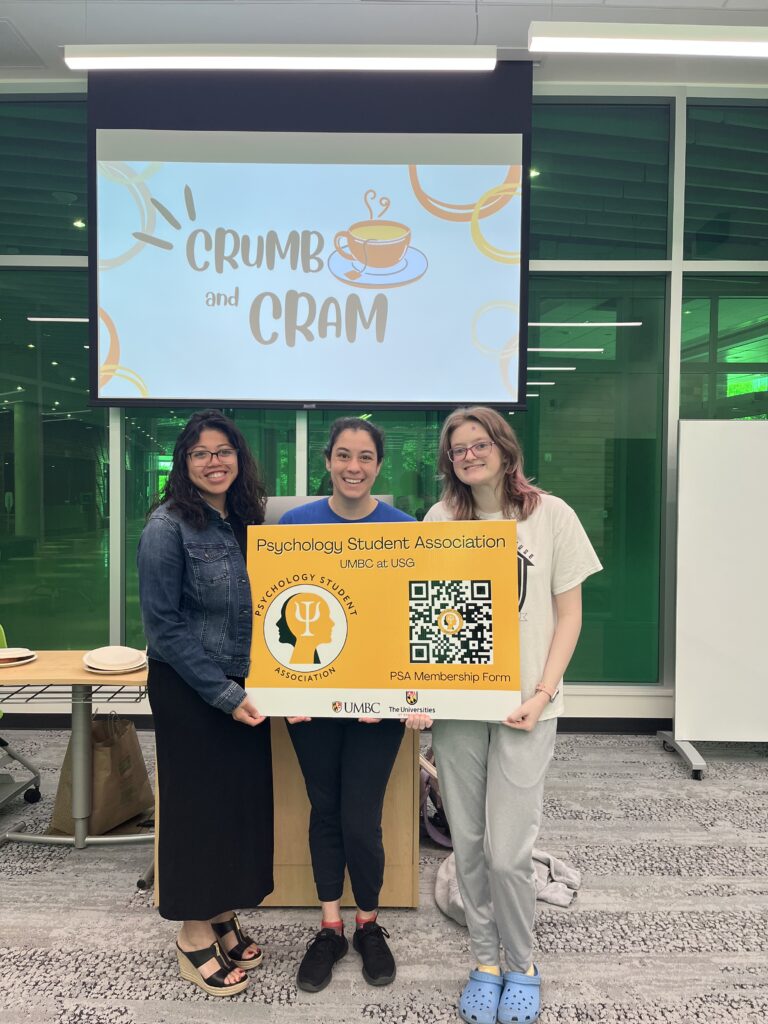 Psychology Student Association (PSA) executive board members at “Crumb and Crum” event. Left to right: treasurer Giovanna Cortez, Kay, president Caitlyn Clifton.
Using members of the group, the therapist would assign roles—for this example, let’s say it’s a family event. Someone would stand in as their mom, someone would stand in as their dad, and they would stand in as themselves. They’d give each person a line that describes their character in this situation. They’d play out the scene and then the drama therapist would ask if there’s anything they’d want to change or add. Once they were satisfied, they’d have them step out of the scene and watch it from the outside. It’s another way to use words that can be extremely beneficial and healing.
Q: How did you even know that this ultra-focused area of study existed?
A: I always knew I wanted to go into clinical mental health counseling for graduate school, but when I discovered drama therapy and realized it was a career where I combine two things I really love, I knew I’d found the right fit. There are only six accredited programs in the United States, so that really narrowed down my search. The program at Lesley University is a low-residency program, which allows me to take classes online throughout the year from Maryland and then go to Cambridge for a week each summer to do intensives. This will also allow me to do my clinicals and eventually get licensed in Maryland.
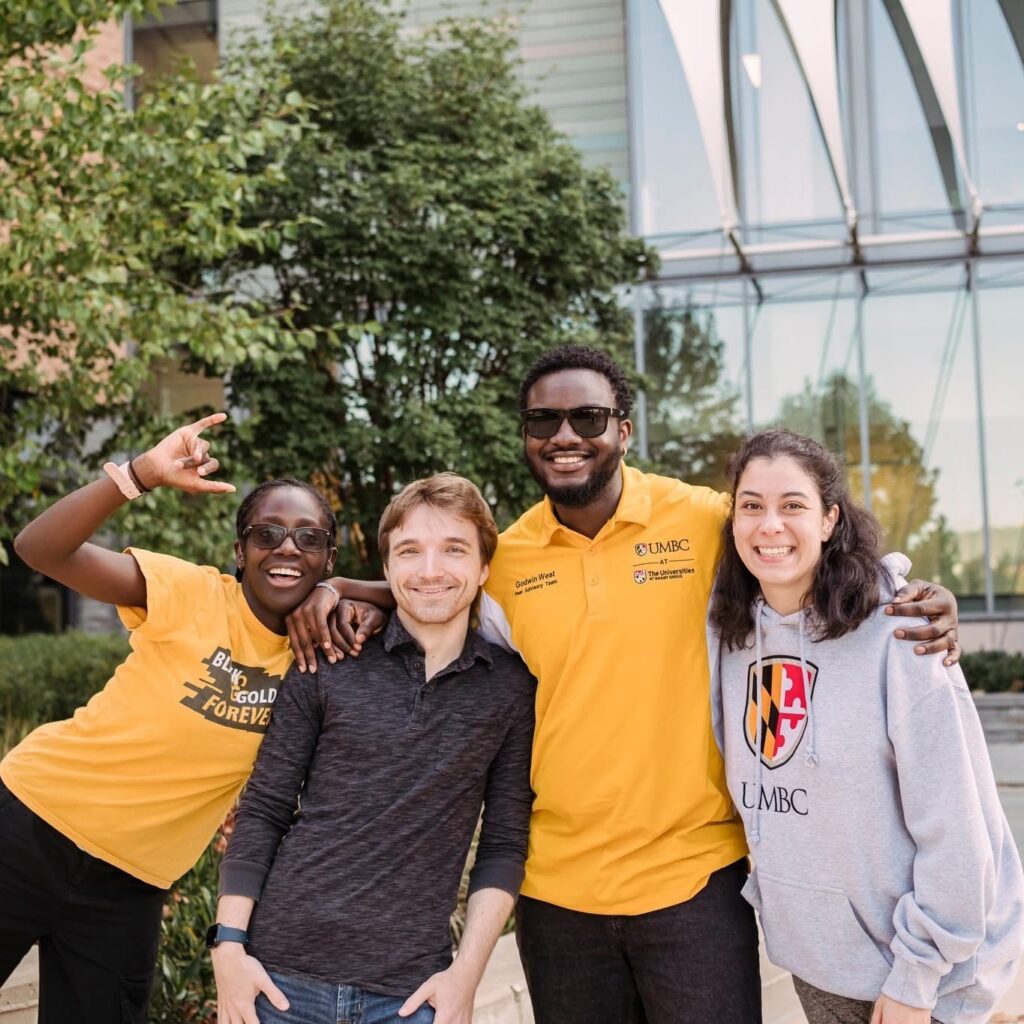 Members of the Peer Advisory Team (PAT) take a break for a quick photo opportunity.
Q: As a non-traditional student, your path has been a little different than your peers. Did that worry you when you started at USG?
A: I was in my late twenties when I started at Shady Grove, so I definitely had the fear that I was going to be the oldest person in the room. I went to my first class and realized that wasn’t the case. Some of my peers were already parents with children, some were working on their second career—it was a really comfortable mix of types of students. Right away, I felt like I fit in.
Q: You’ve taken on a number of leadership roles during your time. What does being a leader mean to you?
A: I see being a leader as being a role model, and I like being a role model to others. Thinking about my future career as a therapist, I’ve been through my own struggles and I want to show people that it can get better and being in these leadership roles was just another way to be a role model in an academic setting. Being involved in things like the Peer Advisory Team (PAT) has forced me to be more extroverted, even when it may not be in my nature. These positions have allowed me to come out of my shell a little bit more and to show myself that I could do it. I think for so long, I was under the impression that, “Oh, I’m not a leader; I’m a follower.” But it’s shown me that I can be one and people respond when that happens.
 Kay with Clifton.
Q: As you finish up your academic journey here, what’s the one thing that you’re going to take with you from this experience?
A: The faculty and staff at UMBC-Shady Grove have been so incredibly helpful. I’ve had similar experiences at other schools, but I’ve never been somewhere that I genuinely felt like every faculty or professor truly cares about the students, regardless of the time they’ve spent with them or the relationship they had. I’ll run into professors that I haven’t seen in a while and they’ll stop to ask how I am and really do remember who I am. That’s been really meaningful to me.
Read more Commencement 2025 stories.
]]>
While Lexi Kay ’25, psychology, may have a flair for the dramatics when she’s acting, she’s taking her talents offstage and implementing them into what will become her life’s work as a therapist....
https://umbc.edu/stories/lexi-kay-25-a-therapist-acting-to-help-others/
https://my3.my.umbc.edu/api/v0/pixel/news/150277/guest@my.umbc.edu/60101c7b8b3746ee0b36dc703b9cb364/api/pixel
class-of-2025
news
psychology
shady-grove
story
usg
UMBC News & Magazine
https://my3.my.umbc.edu/groups/umbc-news-magazine
https://assets1-my.umbc.edu/system/shared/avatars/groups/000/001/943/24435aa6207c452e7bc15cc74b42c7bb/xsmall.png?1748556657
https://assets1-my.umbc.edu/system/shared/avatars/groups/000/001/943/24435aa6207c452e7bc15cc74b42c7bb/original.png?1748556657
https://assets2-my.umbc.edu/system/shared/avatars/groups/000/001/943/24435aa6207c452e7bc15cc74b42c7bb/xxlarge.png?1748556657
https://assets2-my.umbc.edu/system/shared/avatars/groups/000/001/943/24435aa6207c452e7bc15cc74b42c7bb/xlarge.png?1748556657
https://assets3-my.umbc.edu/system/shared/avatars/groups/000/001/943/24435aa6207c452e7bc15cc74b42c7bb/large.png?1748556657
https://assets1-my.umbc.edu/system/shared/avatars/groups/000/001/943/24435aa6207c452e7bc15cc74b42c7bb/medium.png?1748556657
https://assets2-my.umbc.edu/system/shared/avatars/groups/000/001/943/24435aa6207c452e7bc15cc74b42c7bb/small.png?1748556657
https://assets1-my.umbc.edu/system/shared/avatars/groups/000/001/943/24435aa6207c452e7bc15cc74b42c7bb/xsmall.png?1748556657
https://assets2-my.umbc.edu/system/shared/avatars/groups/000/001/943/24435aa6207c452e7bc15cc74b42c7bb/xxsmall.png?1748556657
UMBC News & Magazine
2
0
false
Mon, 19 May 2025 11:30:21 -0400
Mon, 19 May 2025 11:30:21 -0400
Meet a Retriever—Mariam Yaldram ’20, Alumni Board Member & Special Educator
Meet Mariam Yaldram ’20, history, a graduate from UMBC at the Universities at Shady Grove with a passion for education, disability justice, and global citizenship. She is a special education 8th-grade English Language Arts (ELA) teacher, and a Teach for America corps member. She also serves on the UMBC Alumni Association Board of Directors and Fulbrighters with Disabilities. Outside of work, she loves writing, collecting antiques, and exploring different cultures. Take it away, Mariam!
Q: What is your WHY? What brought you to UMBC?
A: I chose UMBC Shady Grove because I had transferred from Montgomery College, where I concentrated in history. Being located in Montgomery County, it felt like a natural transition for me. As a caregiver with many responsibilities, the Shady Grove campus offered the flexibility I needed to balance my academic journey with my personal commitments.
It provided an environment where I could continue to pursue my passion for history while being close to home, allowing me to stay involved in my family’s needs. The campus also offered leadership opportunities, such as serving as the president of the History Student Association and co-founding the UMBC History Journal at Shady Grove. These opportunities gave me the chance to grow both academically and professionally.
Ultimately, choosing UMBC at Shady Grove allowed me to pursue my education and career goals without compromising my family responsibilities—making it a perfect fit for where I was in my life.
Q: What’s one thing you’d want someone to know about the UMBC community?
A: One thing I’d want someone who hasn’t yet joined the UMBC community to know is that you will always find support here—whether academically, professionally, or personally. The faculty, staff, and student organizations truly care about your growth and success. My professors challenged and mentored me, helping me develop critical thinking and leadership skills, while my advisors provided guidance in student engagement, networking, and advocacy.
Whether you’re a student or an alum, UMBC is a place where you’ll find a welcoming, diverse, and empowering community that encourages you to grow and make an impact.
Mariam Yaldram ’20
history
Q: Who has inspired you or supported you?
A: Andrew Nolan, UMBC history program director at UMBC-Shady Grove, Melissa Blair, lecturer and public history minor coordinator, and Chelsea Moyer, assistant vice provost at UMBC-Shady Grove, have all played crucial roles in inspiring and supporting me throughout my educational journey. Their collective support has shaped my academic and professional path, reinforcing my passion for education, advocacy, and leadership.

My history professors, Dr. Nolan and Dr. Blair, helped me develop strong critical thinking skills in historical analysis, research, and writing. Their mentorship also encouraged me to take on leadership opportunities, such as serving as the president of the History Student Association and co-founding the first-ever student-led UMBC History Journal at Shady Grove.
Moyer, my leadership advisor, was instrumental in my growth as a student leader. Through UMBC Peer Advisory, I gained valuable leadership development experience by assisting with orientations, preview nights, outreach, and student engagement. Her guidance helped me build confidence in networking and creating meaningful connections within the UMBC community.
Q: How has the UMBC community helped you grow beyond the classroom?
A: Beyond the classroom, UMBC provided me with invaluable opportunities and resources, including being a Returning Women Scholar, serving on the Shady Grove Campus Student Council, and working as a UMBC Shady Grove Blogger. These roles allowed me to amplify student voices, advocate for my peers, and share my educational journey, all while balancing my responsibilities as a caregiver.
With UMBC’s supportive network and mentorship, I was also able to secure a Fulbright English Teaching Assistantship (ETA)—a transformative experience that reinforced my passion for education and global citizenship. Now, as a special education 8th-grade ELA teacher and Teach for America corps member, I see how these experiences shaped my ability to lead, teach, and advocate for equity in education.
Photo Left: Mariam during UMBC Spirit Week 2020, showing her UMBC pride from home.
Q: How have you stayed connected with the UMBC community?
A: Even after graduation, the UMBC Chapter of Young Alumni (CYA) and the UMBC Alumni Association Board of Directors have continued to offer a strong support system, allowing me to stay connected, share my journey through panels and networking events, and support UMBC alumni—especially those from Shady Grove, whose voices I am passionate about uplifting. My involvement with these groups has been an incredible opportunity for leadership, advocacy, and community engagement. These organizations have allowed me to stay connected with UMBC while supporting fellow alumni
The people and opportunities at UMBC didn’t just support me—they empowered me to grow, push boundaries, and create meaningful change. That’s what makes UMBC so special!
Mariam Yaldram ’20
history
Through CYA, I have had the chance to participate in networking events, mentorship opportunities, and outreach initiatives that foster connections among recent graduates. Being on the Alumni Association Board of Directors has further strengthened my advocacy skills, as I’ve worked to highlight the achievements and needs of Shady Grove alumni. One of the most meaningful aspects has been sharing my educational journey on panels, where I can inspire current and future Retrievers by discussing my path from student leadership to becoming a special education teacher and Teach for America corps member.
UMBC has been instrumental in my personal and professional growth, from providing leadership roles in student organizations to helping me secure a Fulbright ETA. These experiences have shaped my ability to lead, advocate, and build meaningful connections—all while giving back to the UMBC community that has given me so much.
 Mariam Yaldram in Taiwan with her students during her Fulbright English Teaching Assistantship.
For anyone considering a partnership with UMBC, I’d say it’s a great investment in a dynamic, diverse, and innovative community. UMBC fosters meaningful connections, leadership opportunities, and global impact, making it an incredible place to collaborate, support, and grow together.
 Mariam and her UMBC-Shady Grove history class visiting the Montgomery County Historical Society.
Q: Tell us more about your current job. What do you like most about it?
A: I’m a special education 8th-grade ELA teacher at Ingenuity Prep and a Teach for America corps member. What I enjoy most about my work is helping students find their voice through reading, writing, and critical thinking. Seeing my students grow academically and gain confidence in their abilities is incredibly rewarding. I also love creating an inclusive and supportive classroom environment, where students with diverse learning needs feel empowered to succeed. My role allows me to advocate for educational equity and disability justice, ensuring that all students have access to meaningful learning experiences. Every day, I get to make a difference in their lives, and that’s what makes my job so fulfilling!
* * * * *
UMBC’s greatest strength is its people. When people meet Retrievers and hear about the passion they bring, the relationships they create, the ways they support each other, and the commitment they have to inclusive excellence, they truly get a sense of our community. That’s what “Meet a Retriever” is all about.
Learn more about how UMBC can help you achieve your goals.
]]>
Meet Mariam Yaldram ’20, history, a graduate from UMBC at the Universities at Shady Grove with a passion for education, disability justice, and global citizenship. She is a special education...
https://umbc.edu/stories/meet-mariam-yaldram-alumni-board/
https://my3.my.umbc.edu/api/v0/pixel/news/150073/guest@my.umbc.edu/eebb2c8bb83701ed102d3ab444f3549d/api/pixel
alumni
alumni-board
history
magazine
meet-a-retriever
shady-grove
story
UMBC News & Magazine
https://my3.my.umbc.edu/groups/umbc-news-magazine
https://assets1-my.umbc.edu/system/shared/avatars/groups/000/001/943/24435aa6207c452e7bc15cc74b42c7bb/xsmall.png?1748556657
https://assets1-my.umbc.edu/system/shared/avatars/groups/000/001/943/24435aa6207c452e7bc15cc74b42c7bb/original.png?1748556657
https://assets2-my.umbc.edu/system/shared/avatars/groups/000/001/943/24435aa6207c452e7bc15cc74b42c7bb/xxlarge.png?1748556657
https://assets2-my.umbc.edu/system/shared/avatars/groups/000/001/943/24435aa6207c452e7bc15cc74b42c7bb/xlarge.png?1748556657
https://assets3-my.umbc.edu/system/shared/avatars/groups/000/001/943/24435aa6207c452e7bc15cc74b42c7bb/large.png?1748556657
https://assets1-my.umbc.edu/system/shared/avatars/groups/000/001/943/24435aa6207c452e7bc15cc74b42c7bb/medium.png?1748556657
https://assets2-my.umbc.edu/system/shared/avatars/groups/000/001/943/24435aa6207c452e7bc15cc74b42c7bb/small.png?1748556657
https://assets1-my.umbc.edu/system/shared/avatars/groups/000/001/943/24435aa6207c452e7bc15cc74b42c7bb/xsmall.png?1748556657
https://assets2-my.umbc.edu/system/shared/avatars/groups/000/001/943/24435aa6207c452e7bc15cc74b42c7bb/xxsmall.png?1748556657
UMBC News & Magazine
11
0
false
Tue, 13 May 2025 08:54:00 -0400
Tue, 13 May 2025 08:54:00 -0400
Biotech Buzz

UMBC at the Universities at Shady Grove finds itself uniquely situated—at home within the country’s third largest biotech hub where the demand for highly skilled workers is growing. These Retrievers are filling specialized roles after graduating with the training they need to succeed in this booming industry.
It’s an early Friday morning in the Biological Sciences and Engineering Building and nine students, working in small groups, are bustling back and forth between fume hoods and a large centrifuge. They carefully swish flasks containing cells and growth medium. The smell of sanitizing alcohol pervades the space. Neon orange test tube racks and turquoise tube caps stand out within the sterile white look of the work benches, hoods, and lab coats.
As the cells use oxygen to release energy, they produce carbon dioxide. The CO2 turns the solution yellow, indicating successful cell growth. After the experiment, students sterilize their solution with bleach for disposal; in response to the alkalinity, it blooms to a brilliant magenta. In another room, one student offers tips to her classmate on how to use a pipet more effectively, and the instructor flits between groups, answering questions as needed—but for the most part, the students operate confidently on their own.
This is a regular day in Biotechnology 303: Applied Cell Biology in UMBC’s Translational Life Science Technology (TLST) program. The program, offered by UMBC’s College of Natural and Mathematical Sciences (CNMS) exclusively at the Universities at Shady Grove (USG), a multi-institution education facility in Rockville, Maryland, is designed to offer hands-on training to prepare students for careers in the booming biotech industry in USG’s backyard.
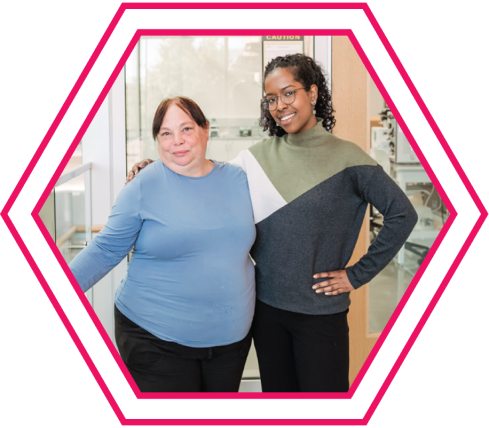
Elizabeth Friar (left) and Samantha Petros ’23 have stayed in touch since Petros graduated.
A clear direction
It was the promise of experiential work with real-world applications that drew Samantha Petros ’23 to the TLST program. “I really liked the convenience of the USG campus, and a lot of the courses were really focused on hands-on learning,” she says. Without really knowing what the work would look like before she started the program, “I was able to try out a lot of different things in a very low-stakes environment and get an idea as to what I found interesting.”
That turned out to be cell culture work. Applied Cell Biology with Elizabeth Friar, lecturer and undergraduate program director in TLST, “cemented that benchwork is what I enjoy doing,” Petros says. From then on, “There was a clearly defined arrowhead in the direction I wanted to go.”
That was a big shift from where she started, as a film major at Montgomery College (MC). A virology course to meet her science requirement turned her on to MC’s biotech associate degree, and then she transitioned to the TLST program at UMBC. After learning some basic lab techniques in TLST classes, she landed a part-time job, where she carried out entry-level manufacturing tasks for malaria vaccines. Today, Petros is thriving as a cell culture specialist studying malaria at Axle Informatics, a contractor for the National Institute of Allergy and Infectious Diseases.
The position she’s in now traditionally requires a master’s degree, which she doesn’t have—yet, anyway. “Knowing that I have valuable skill sets from TLST—working in manufacturing, getting good connections with my professors, and going to the networking events that TLST offers—all of that compounds and has got me to where I am now,” Petros says. “I genuinely believe that I wouldn’t be here if it weren’t for all of those factors, with TLST obviously being the biggest one.”
Location, location, location
TLST is a young program, but it is growing quickly. The first class—just two students—arrived in fall 2019. Friar joined in summer 2020 and began laying the groundwork for the program’s eventual growth. Today, “It’s humming along,” she says. There are currently 50 students who have declared TLST as their major. “Now we’re thinking about what we can do next. How can we expand?”
TLST is unique as the only undergraduate STEM program at UMBC without a footprint on the main campus. The location choice at USG is intentional. The Capital Biohealth Region, encompassing the District of Columbia, Virginia, and Maryland, is the third most competitive biotech hub in the country—and Montgomery County, Maryland, is the hub of the hub, boasting more than 350 life science companies and located a stone’s throw from the NIH, FDA, and National Institute of Standards and Technology (NIST). For TLST alumni, the employment options are seemingly limitless: 80 percent of American pharmaceutical companies are within a two-hour drive, and they can expect a nearly 23 percent growth rate in the biotech industry over the next 10 years—well above the national average.
As Friar puts it, “Regenxbio is down the street. MacroGenics is down the street. MilliporeSigma is opening their new lab right next door, and they’ve now hired eight of our alumni. Soon we’ll have an NIH vaccine lab right down the street. ATCC is right down the street.” All these biotech companies need qualified workers—and TLST is providing them.
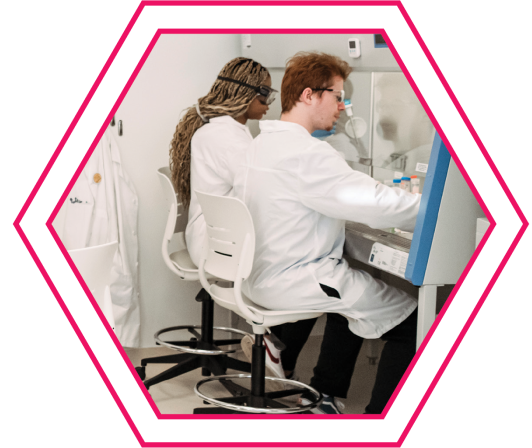
Steven Schaffer (right) and Princess Nyamali work under a biosafety cabinet in Elizabeth Friar’s Applied Cell Biology course.
Training lifetime learners
Jeff Galvin, CEO of American Gene Technologies (AGT), has hired TLST alumni and would hire more. “The TLST program seems to provide a great overview of not just biotechnology techniques,” he says, but it gives students “an understanding of the business in general. I find that UMBC students lean toward being self-motivated problem-solvers. It seems that the administration from the top all the way down promotes that idea of creating value through creative, hard work.”
Titina Sirak ’20, TLST, had a major impact at AGT. She established a brand-new laboratory certified to handle human cells from scratch, Galvin says, “And that’s not easy—there’s a lot of regulations associated with that, even economics.” While she wasn’t an expert at first, “she was able to do enough things right that the project came to life.”
Galvin emphasizes the importance of “learning how to learn,” saying, “Things are changing so fast, that it’s the folks who can adapt and become lifetime learners who are going to be the most successful.And that’s something I saw from the students coming out of TLST.”
A vision fulfilled
So far, TLST has graduated 25 students, and 94 percent of them were employed in the biotech industry within three months of walking across the Commencement stage. “We’ve had a number of really standout students who have gone on to do really great things, so I’m very excited about how it’s going,” Friar says.
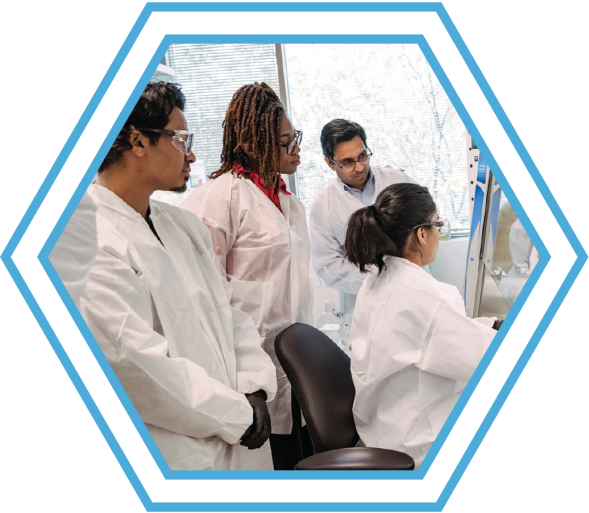
Merryll Kallungal ’24 works under a biosafety cabinet at ATCC. Interns Jason Bose (left) and Tamilore Akinde (second from left) and an ATCC lead scientist observe.
So is William R. LaCourse, CNMS dean, which offers the TLST program. He envisioned the program years before the first two students walked onto the USG campus, and it came together with input from faculty at Montgomery College and five departments at UMBC.
“TLST is an innovative and practical education that combines ‘know-what’ and ‘know-how,’” says LaCourse. “It is a highly flexible program with various pathways to serve the ever-changing needs of a growing industry. TLST is where the silos of disciplines break down and cross-disciplinary knowledge is the goal—both in content and practice.”
The program is shaping up just as LaCourse and Annica Wayman ’99, mechanical engineering, and former associate dean for Shady Grove Affairs in CNMS who led TLST’s launch, had hoped. The state of Maryland is growing its biotech hub while UMBC students are gaining the skills they need to succeed in the workplace and getting well-paying jobs, and the student population is growing.
Connections that build confidence
Just as important as high-demand lab skills, students and alumni value the relationships they’ve formed with faculty. “Every teacher I had was very supportive, very understanding, very willing to work with me,” Petros says. “I think it’s important to get your money’s worth out of college, and I definitely feel like I got that and more in TLST because of the support network that I had there and my teachers.”
Petros is still in touch periodically with Wayman and Friar. “Dr. Wayman was a shining inspiration. She’s just a wonderful person. She’s so knowledgeable and always willing to help,” Petros says. The support she has and the success she’s found now have inspired Petros to look back and help those coming up behind her. In addition to USG resources, as a student Petros attended networking events offered by BioBuzz, a community resource for biotech industry professionals and job seekers in the Capital Biohealth Region. In fact, it’s how she found her current role.
Today Petros is a BioBuzz Ambassador. “I wish I had known about BioBuzz when I first started in biotech,” she says. “Now I want to be that advocate for younger students or people who are just starting in science.”
A strong foundation
“Our students come to us because they want to make a difference in people’s lives, but they don’t necessarily want to go to medical school,” Friar says. It doesn’t hurt that “we have some really spectacular facilities that are a real draw for students,” she adds.
The Biological Sciences and Engineering Building opened at USG in fall 2019 and boasts beautiful modern laboratories and classrooms plus plenty of comfy nooks for meeting with a study group or just relaxing. TLST has also received over $1 million dollars from the National Institute for Innovation in Manufacturing Pharmaceuticals, some of which has supported further upgrades and additions to the teaching laboratories.
A flow cytometer, a machine that can detect properties of interest in up to 10,000 cells per minute, will enable a new mixed undergraduate/graduate course in flow cytometry launching next spring, for example. And equipment to practice skills like protein purification, biomanufacturing processes, and cell culture create rare opportunities for undergraduates. A required TLST course covers the wide range of instrumentation you might find in a modern biotech laboratory.
It’s normal for students to start off nervous when they use complicated and expensive equipment or work with human cells for the first time. “But by the end, they are old hands, and I think they would feel comfortable tackling anything in that lab on their own,” Friar says. “And it’s because the curriculum is really well scaffolded. We add skills as they go along, and then we repeat the old skills. The program is set up to foster growth and independence.”
Princess Nyamali stepped away from the centrifuge for a moment during Biotechnology 303 to share that the TLST coursework “is a really good foundation.” She’s currently completing an internship at NIST, and “everything I’m learning in this cell culture class is stuff I’m doing at NIST.” While it might have been daunting at first, trying so many different things across the TLST curriculum “helps you know that you want to do it,” she says, in addition to showing potential employers that you can.
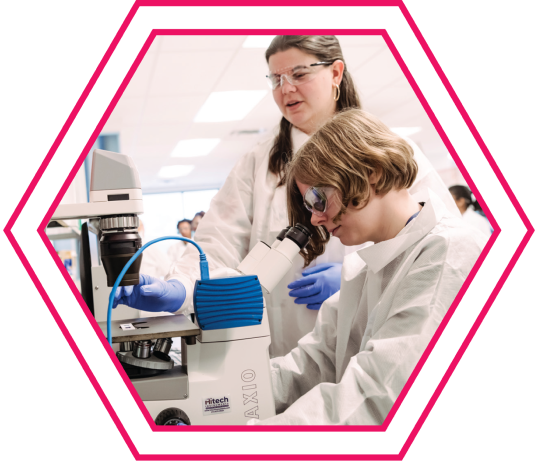
TLST student Fae Switzer works at the microscope with guidance from her mentor, Emma Todd, at ATCC.
Thinking ahead
Although the two-year program initially targeted transfers from regional community colleges, “we were getting so much interest from students on the Catonsville campus, we went ahead and put it on the list of majors for freshmen applying to UMBC,” Friar says. “That’s been the fastest growing cohort in our major.”
Steven Schaffer transferred to TLST after starting on the main campus in bioinformatics. Now he is in the bioinformatics track within TLST; the other option is a biomanufacturing track. Schaffer likes that there is a strong cohort connection because everyone takes mostly the same classes together. “I would recommend TLST. It’s a growing field and the skills you learn are very versatile,” Schaffer adds.
Schaffer hopes to eventually take on a role that leans into engineering at a place like Northrop Grumman. But before that, he’s eyeing UMBC’s Master of Professional Studies in biotechnology. The M.P.S. degree offers advanced instruction in the life sciences, plus coursework in regulatory affairs, leadership, management, and financial management. Friar describes it as “a cross between a science master’s and an M.B.A.”
Academic decathletes
Soon, the confident students in Friar’s cell biology class will arrive in labs across Montgomery County, the capital region, and beyond. They will contribute to drug discovery and production, design manufacturing processes, and, eventually, lead teams and make strategic decisions for major biotech companies.
Jeff Galvin, the ATG CEO, referred to TLST alumni as “academic decathletes.” Like decathletes, they have an array of skills and perform all of them admirably. But rather than medals, they’re seeking an opportunity to contribute to positive change through their work. They’ll translate basic science into diagnostic tests, treatments for disease, and more to improve the lives of their neighbors in Maryland and those in need around the world.
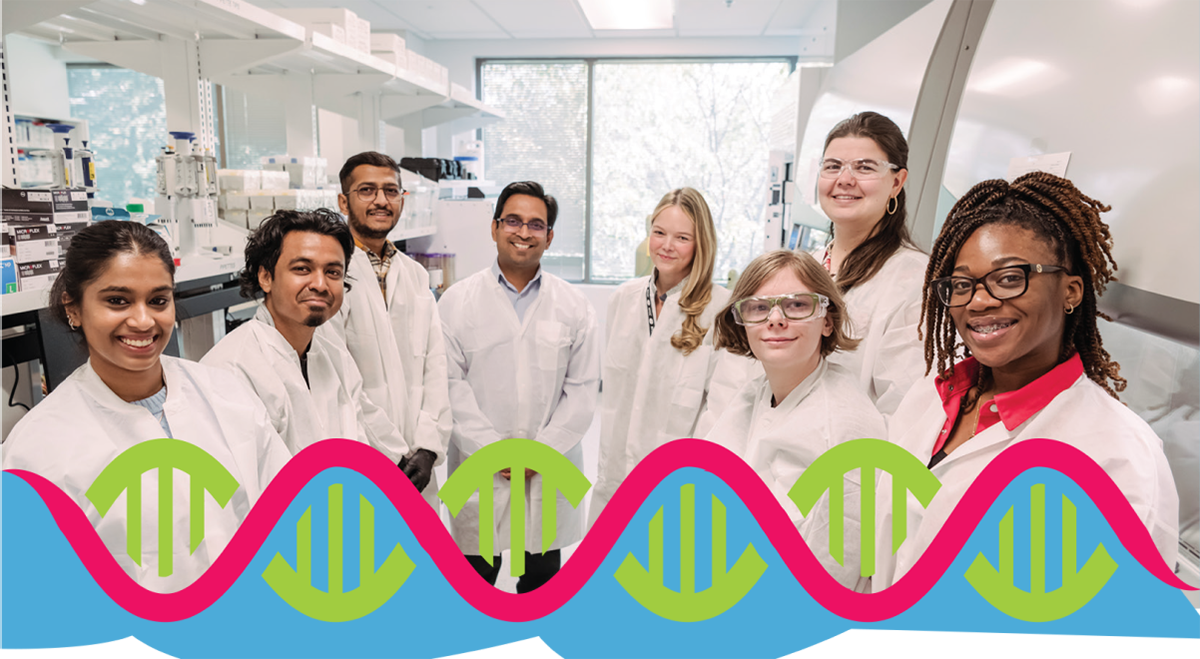
ATCC’s SPARC internship program offers opportunities for TLST students to conduct meaningful work in the biotech industry. Merryll Kallungal (far left) transitioned from her internship to a full-time role at ATCC this summer.
SPARC-ing Rewarding Careers
Just 10 minutes from USG in Gaithersburg, Maryland, biotech company ATCC has capitalized on the TLST talent pipeline. Their Student Partnership and Research Collaboration (SPARC) Program requires USG enrollment and offers qualified students paid, part-time career opportunities throughout the academic year at ATCC’s research facility. As the leading developer and supplier of authenticated cell lines, microorganisms, and associated data for academia, industry, and government, a successful internship at ATCC is a feather in the cap for students pursuing a TLST degree.
Of the seven interns selected for the SPARC program this year, four are TLST students—and they are thriving. The interns praised their SPARC experience while donning lab coats, shoe booties, safety glasses, and gloves in one of ATCC’s labs—where keeping employees safe and protecting lab samples and products from contamination is mission critical.
“I love the TLST program!” exclaimed Fae Switzer, who has wanted to pursue a career in biotech since she learned about CRISPR, the gene-editing platform, as a child. Switzer, a SPARC associate biologist in the microphysiological unit, notes that things she learned in her UMBC classes prepared her for the internship, and things she’s learning at ATCC now are helping her in her classes.
Jason Bose, a SPARC associate biologist on the microbiology team, knew he was interested in biologybut not medical school. When Bose learned about TLST, he thought, “Wow, this aligns with what I want to do,” he says. “It’s been really great so far.” He even uses the basic coding skills and tricks for Excel spreadsheets that he learned in class—which at the time he wasn’t so sure about. “Yep, I use them all the time at ATCC,” he says.
Tamilore Akinde completed an internship last summer at ATCC’s headquarters in Manassas, Virginia, and now she is a SPARC intern. “I like that TLST teaches multidisciplinary skills,” she says. Being able to pivot toward different opportunities that come her way is valuable, she adds.
“The hands-on lab training provided by the TLST program has prepared students for impactful careers at ATCC,” shares Ruth Cheng, general manager and senior vice president for research and industrial solutions at ATCC. “Witnessing students like Merryll Kallungal transition from the SPARC program to a full-time role in cryobiology R&D is a testament to the power of this collaboration.”
After interning at ATCC, Kallungal graduated from TLST in May and assumed a full-time associate biologist role in the cryobiology group in June. The lab techniques she learned in TLST came in handy at ATCC, and she has already learned a lot of new things, too. “I absolutely love what I do,” she says.

Amy Caballero graduated from UMBC 2022 with her bachelor’s degree in social work. She stayed on at the Shady Grove campus to complete her master’s in social work from the University of Maryland, Baltimore, and she graduates this May. She has a job lined up as a youth development specialist at a local nonprofit. Outside of academia, she says, she’s obsessed with her two dogs, enjoys bouldering, reading fiction and manga, and hanging out with friends. Take it away, Amy!
Q: What’s the one thing you’d want someone to know about the support you find at UMBC?
A: The support is here, and many are here to help! It can sometimes be scary to ask for help, but people here want to ensure that you succeed during your time at UMBC and beyond! I have still maintained contact with professors and staff post-graduation. I’d recommend that you look into the resources on campus and remember that they are there for you to use.
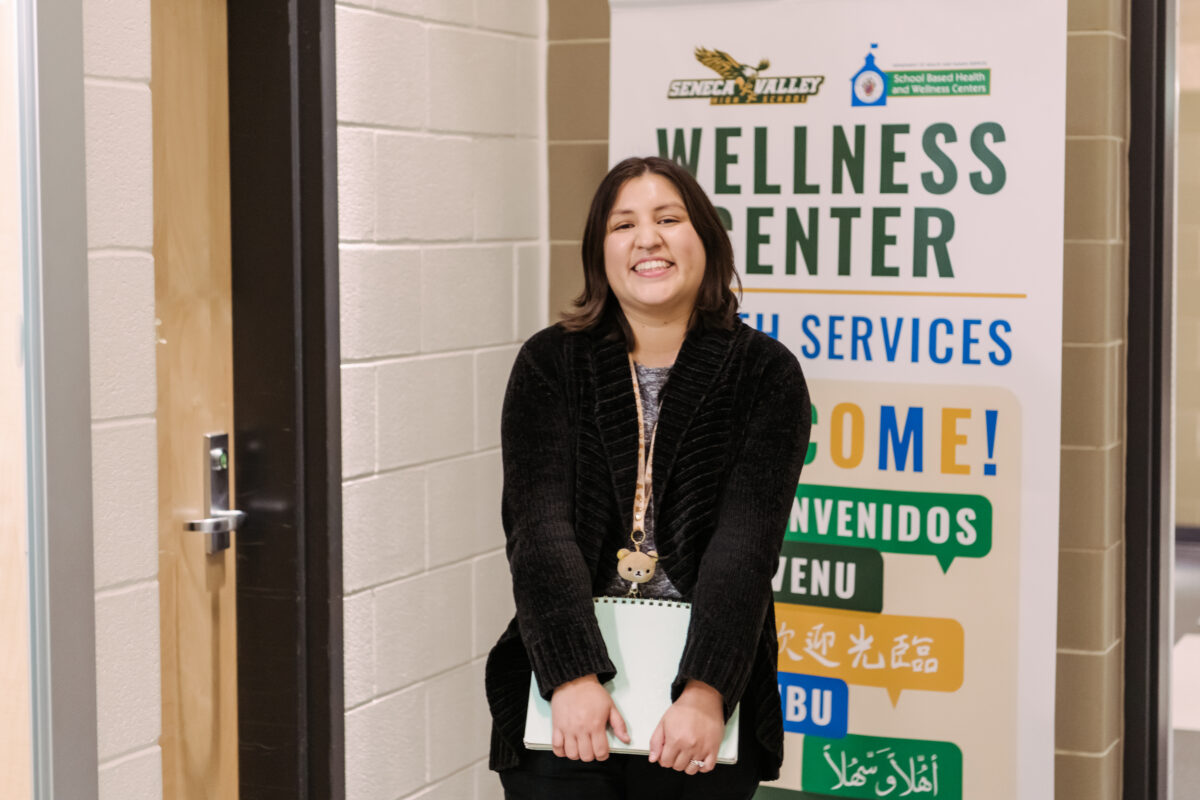 Caballero at her social work field placement.
Q: Tell us about someone in the community who has inspired you or supported you, and how they did it.
A: Dr. Katie Morris [Ph.D. ’21, language, literacy, and culture], the program director at UMBC-Shady Grove, was a great source of support for me during my undergrad years. Prior to starting, she advocated on my behalf to ensure that certain credits were accepted to fulfill the minor requirement. She provided a space to discuss any ideas or concerns I had while providing feedback. She is a great inspiration to me because of her advocacy on behalf of students.
Q: Tell us what you love about your academic program.
A: I loved how passionate all my professors were about social work and their love for the subject they taught. They were all eager to teach and ensure that all of us understood the subject matter. I was involved with the Social Worker Student Association (SWSA) and the creative freedom in creating events was something I enjoyed. It provided me with opportunities to learn more about the UMBC-Shady Grove community, meet other students, and network as well. During my time at SWSA, we were able to collect over 200 menstrual products and donate them to a local nonprofit, I Support the Girls.
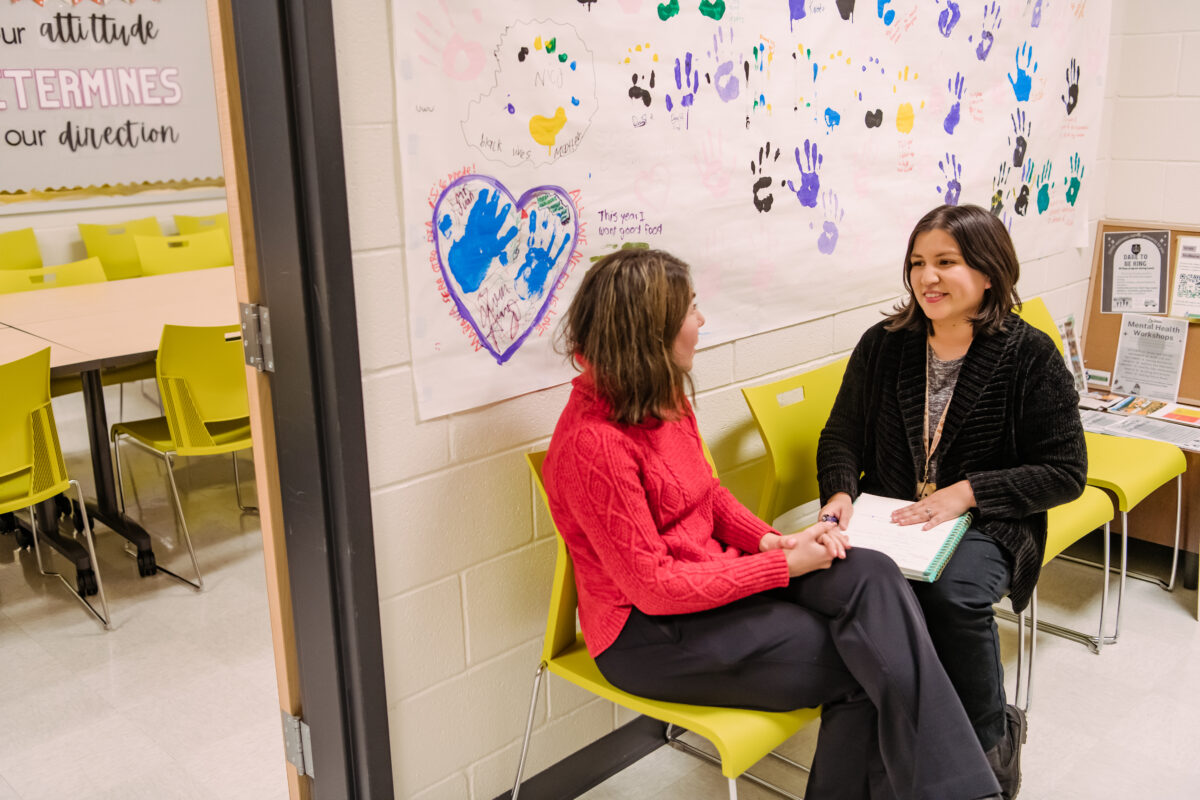 Amy Caballero ’22 talks with a colleague at her social work field placement in Seneca Valley High School.
Q: Tell us about your primary WHY, and how it led you to UMBC.
A: I became interested in social work because it has an interdisciplinary approach to social issues and advocacy. I came to UMBC because I had heard about its amazing social work program and saw that it was available at the UMBC-Shady Grove campus.
Q: Tell us about the people who helped you grow at UMBC, and why their HOW made such a difference to you.
A: I have found support through professors and staff at the UMBC-Shady Grove location. They helped connect me with internship and scholarship opportunities. They were really passionate about what they taught and are a prime example of the different routes you can take as a social worker.
Q: What’s your favorite part of being a part of Retriever Nation?
A: My favorite part is receiving UMBC Magazine and reading about updates related to UMBC. It’s pretty cool that they have events to welcome back alums!
(Right: Caballero’s dogs, Nori and Cookie.)

* * * * *
UMBC’s greatest strength is its people. When people meet Retrievers and hear about the passion they bring, the relationships they create, the ways they support each other, and the commitment they have to inclusive excellence, they truly get a sense of our community. That’s what “Meet a Retriever” is all about.
Learn more about how UMBC can help you achieve your goals.
]]>
Amy Caballero graduated from UMBC 2022 with her bachelor’s degree in social work. She stayed on at the Shady Grove campus to complete her master’s in social work from the University of Maryland,...
https://umbc.edu/stories/meet-a-retriever-amy-caballero-social-worker-shady-grove/
https://my3.my.umbc.edu/api/v0/pixel/news/142135/guest@my.umbc.edu/dbeb92f5f3ae0c6dbbdfef4fa70876e1/api/pixel
alumni
cahss
impact
magazine
meet-a-retriever
shady-grove
social-work
story
UMBC News & Magazine
https://my3.my.umbc.edu/groups/umbc-news-magazine
https://assets1-my.umbc.edu/system/shared/avatars/groups/000/001/943/24435aa6207c452e7bc15cc74b42c7bb/xsmall.png?1748556657
https://assets1-my.umbc.edu/system/shared/avatars/groups/000/001/943/24435aa6207c452e7bc15cc74b42c7bb/original.png?1748556657
https://assets2-my.umbc.edu/system/shared/avatars/groups/000/001/943/24435aa6207c452e7bc15cc74b42c7bb/xxlarge.png?1748556657
https://assets2-my.umbc.edu/system/shared/avatars/groups/000/001/943/24435aa6207c452e7bc15cc74b42c7bb/xlarge.png?1748556657
https://assets3-my.umbc.edu/system/shared/avatars/groups/000/001/943/24435aa6207c452e7bc15cc74b42c7bb/large.png?1748556657
https://assets1-my.umbc.edu/system/shared/avatars/groups/000/001/943/24435aa6207c452e7bc15cc74b42c7bb/medium.png?1748556657
https://assets2-my.umbc.edu/system/shared/avatars/groups/000/001/943/24435aa6207c452e7bc15cc74b42c7bb/small.png?1748556657
https://assets1-my.umbc.edu/system/shared/avatars/groups/000/001/943/24435aa6207c452e7bc15cc74b42c7bb/xsmall.png?1748556657
https://assets2-my.umbc.edu/system/shared/avatars/groups/000/001/943/24435aa6207c452e7bc15cc74b42c7bb/xxsmall.png?1748556657
UMBC News & Magazine
0
0
false
Tue, 21 May 2024 13:13:54 -0400
Meet a Retriever—Camilla Sandoval ’17, M.A. ’19, program coordinator for Maryland Humanities
Meet Camilla Sandoval ’17, history, M.A. ’19, historical studies, a first-generation student who spent part of her time on each of UMBC’s campuses before graduating and putting her studies to work. Today, she spends her days as the program coordinator for grants with Maryland Humanities, where she still employs lessons learned from her time as a Retriever. Thanks for sharing your story, Camilla!
Q: Briefly introduce yourself. What’s one essential thing you’d want another Retriever to know about you?
A: I am a first-generation college student, and I studied history and public history at UMBC’s Shady Grove campus (for my bachelor’s) and main campus (for my master’s). Both experiences were instrumental to my professional and personal growth. It was at UMBC where I started recognizing the humanities as a tool for community empowerment.
Q: What’s the one thing you’d want someone to know about the support you find here?
A: It was hard for me to accept when I had to ask for help—especially when I didn’t know what I didn’t know. But once I did, I found enormous support in my professors and in my cohort. They helped the academic experience feel less isolating and pushed me to believe in myself as much as they believed in me.
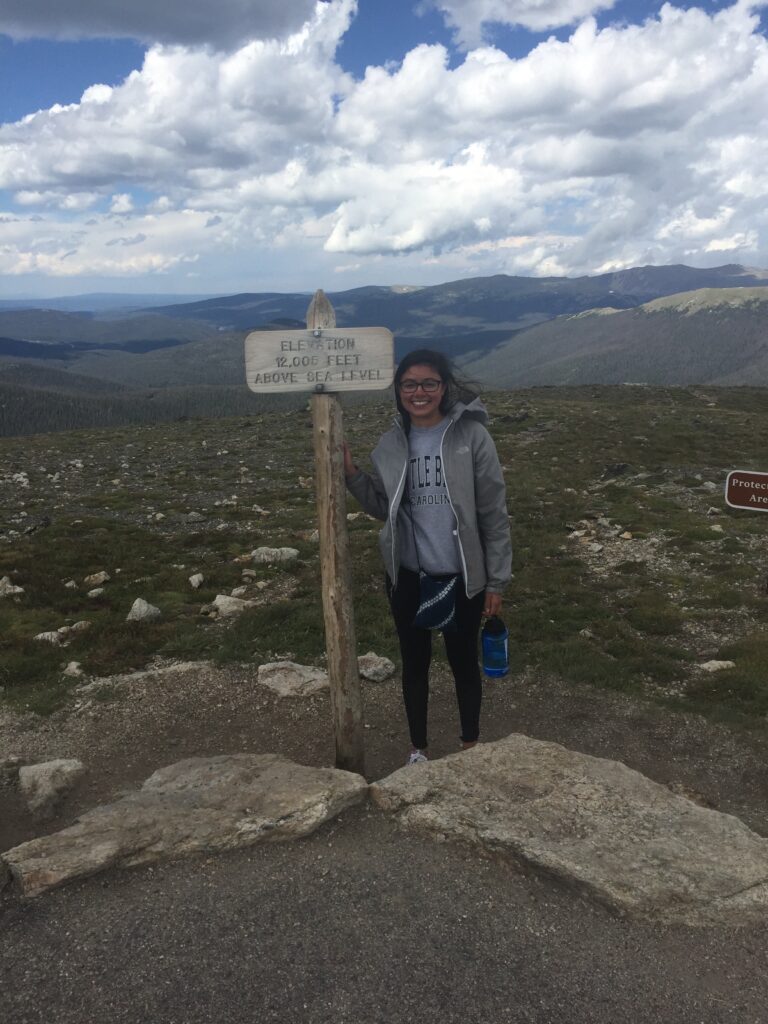
“This is me at Rocky Mountain National Park in August 2017, the summer between my undergraduate and graduate programs. I was there as part of the Latino Heritage Internship Program. Thank you to Dr. Melissa Blair for sharing the internship with me and helping with my application. This trip to Colorado has been one of the most rewarding experiences for me.”
Q: Where do you work? What do you enjoy most about it?
A: I’m currently the program coordinator for grants at Maryland Humanities, our state humanities council. In my role, I’m part of our grantmaking efforts. I’m able to help small humanities organizations across the state get access to funding that can be used for general operating expenses. I get the most joy out of hearing our grant recipients talk about using funds to continue preserving their local history or being able to keep their doors open for the communities they serve.
The history department at both UMBC- Shady Grove and the Catonsville campus were the biggest difference makers in my education and they have continued to support me in my professional career.
Camilla Sandoval ’17, history, M.A. ’19
Q: Tell us about your primary WHY, and how it led you to UMBC.
A: I came to UMBC because it was my best opportunity to study my field of interest while staying close to my family. I came with the hope of finding guidance and direction. I always loved history and knew it was important for understanding myself and the world, but I needed to learn how that translated into a career in which I could use the skills to support and lift up my community and culture. My family and community gave me everything they could, and I was committed to setting myself up on a career path in which I could contribute back in any way I could.
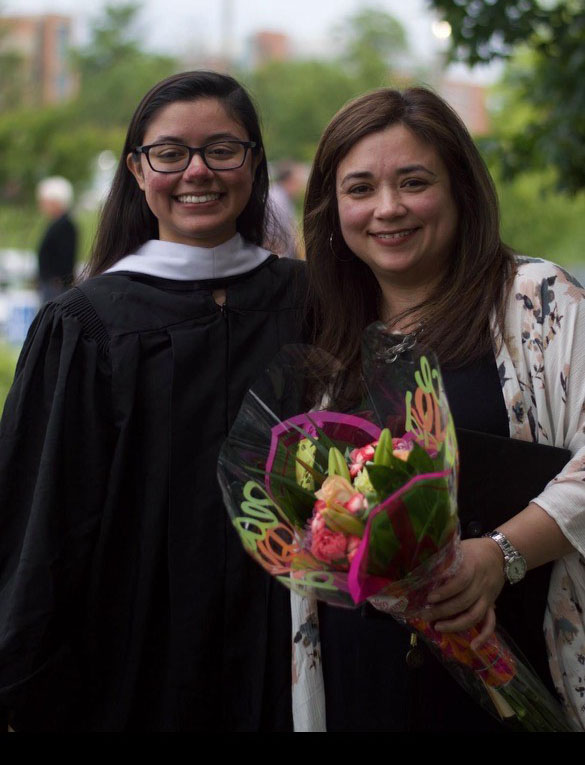 “
“
This is my mom and me at my master’s graduation on main campus in May 2019. My family here in the U.S. and in El Salvador has always been the most important and supportive part of my life. I am where I am today because of my mom.”
Q: Tell us about the people who helped you grow at UMBC, and why their HOW made such a difference to you.
A: My time at UMBC introduced me to new ideas and opened opportunities I didn’t know existed, and helped me out of my comfort zone to develop my skills. I left with deeper appreciation for history and a better belief in myself. My history and public history professors were especially impactful. They guided me as a first-generation college student, encouraged me to consider going for my master’s degree, and led me to internships that served as critical stepping stones in my career. The history department at both UMBC- Shady Grove and the Catonsville campus were the biggest difference makers in my education and they have continued to support me in my professional career.
* * * * *
UMBC’s greatest strength is its people. When people meet Retrievers and hear about the passion they bring, the relationships they create, the ways they support each other, and the commitment they have to inclusive excellence, they truly get a sense of our community. That’s what “Meet a Retriever” is all about.
Learn more about how UMBC can help you achieve your goals.
]]>
Meet Camilla Sandoval ’17, history, M.A. ’19, historical studies, a first-generation student who spent part of her time on each of UMBC’s campuses before graduating and putting her studies to...
https://umbc.edu/stories/meet-a-retriever-camilla-sandoval-humanities/
https://my3.my.umbc.edu/api/v0/pixel/news/141743/guest@my.umbc.edu/2a5eea53ba59fa924c3d4c0923f0c11d/api/pixel
alumni
cahss
history
impact
magazine
meet-a-retriever
perspectives
shady-grove
story
UMBC News & Magazine
https://my3.my.umbc.edu/groups/umbc-news-magazine
https://assets1-my.umbc.edu/system/shared/avatars/groups/000/001/943/24435aa6207c452e7bc15cc74b42c7bb/xsmall.png?1748556657
https://assets1-my.umbc.edu/system/shared/avatars/groups/000/001/943/24435aa6207c452e7bc15cc74b42c7bb/original.png?1748556657
https://assets2-my.umbc.edu/system/shared/avatars/groups/000/001/943/24435aa6207c452e7bc15cc74b42c7bb/xxlarge.png?1748556657
https://assets2-my.umbc.edu/system/shared/avatars/groups/000/001/943/24435aa6207c452e7bc15cc74b42c7bb/xlarge.png?1748556657
https://assets3-my.umbc.edu/system/shared/avatars/groups/000/001/943/24435aa6207c452e7bc15cc74b42c7bb/large.png?1748556657
https://assets1-my.umbc.edu/system/shared/avatars/groups/000/001/943/24435aa6207c452e7bc15cc74b42c7bb/medium.png?1748556657
https://assets2-my.umbc.edu/system/shared/avatars/groups/000/001/943/24435aa6207c452e7bc15cc74b42c7bb/small.png?1748556657
https://assets1-my.umbc.edu/system/shared/avatars/groups/000/001/943/24435aa6207c452e7bc15cc74b42c7bb/xsmall.png?1748556657
https://assets2-my.umbc.edu/system/shared/avatars/groups/000/001/943/24435aa6207c452e7bc15cc74b42c7bb/xxsmall.png?1748556657
UMBC News & Magazine
0
0
false
Mon, 06 May 2024 12:33:42 -0400
Mon, 06 May 2024 12:33:42 -0400
Finding Your Niche – Emilie Llenado M.P.S. ’12
When Emilie Llenado, M.P.S. ’12, professional studies, first moved to Maryland from Kansas City, Missouri, she didn’t know a soul, and was working as a server at Longhorn Steakhouse. But, she was hopeful, and she knew she wanted to do great things, so she enrolled in UMBC at the Shady Grove campus. Four years later in 2012, she graduated from the Industrial/Organizational Psychology program with life-long friends, and a new job at Freddie Mac.
“When I first moved to Maryland, I didn’t know anyone. I came right out of my undergraduate degree. I didn’t know what it would take to succeed at school,” said Llenado, who recently joined the UMBC Alumni Association Board of Directors. “I made three goals, as I knew they would help me be a happier person, and the best version of myself.”
Pillars of Success
Those three goals, or the pillars of success as she called them, were “academic excellence, career enhancement, and interpersonal relationship growth.” With that in mind, she made the most of every moment at the Shady Grove campus.
“If there was a job fair, I would go. If there was a luncheon, I would be there. If a professor would offer up special office hours or a group study session, I would participate. You definitely get out of the program what you put into it,” she said.
At Shady Grove, she said, she built a network of faculty and friends who all encouraged her to succeed. “As I started studying more and getting more involved in my classes, I became closer with my classmates and teachers, who in turn became not just friends, but critical resources in building out my future career,” said Llenado.
Years later, she remains close with the friends she made during her time on campus. They go on an annual beach trip to Ocean City. “We go to the beach, boardwalk, and get crab toast, every year, rain or shine!” said Llenado. “We’ve all been close since the year I moved to Maryland, and this past year marked our 7th annual beach trip.”
For their 10th anniversary, they have big plans for a cruise or a resort to “celebrate our friendship, and tradition in style!”
The spring before she graduated, Llenado was offered a job at the Federal Home Loan Mortgage Corporation, also known as Freddie Mac. After graduating on her birthday in December of 2012, she received another offer to advance at the company. After yet another offer and a promotion, she is now a multifamily underwriting senior associate.
“All of my daily activities, throughout my career, in Freddie Mac have directly aligned with skills learned through UMBC,” she said. UMBC gave her the ability to serve as a leader, collaborate with others, prepare presentations and more.
Giving Back as an Alumni Leader
In addition to her busy days at work, Llenado was invited to join UMBC’s Alumni Association Board of Directors (AABOD), a group that plans events and recognizes outstanding alums, all while creating a community atmosphere among UMBC’s 77,000-plus alumni. With the start of her term this spring, Llenado became the first Shady Grove alum representative on the board.
“It is important for us in alumni relations that UMBC at Shady Grove alumni see themselves in the work we do,” said Stanyell Odom, director of alumni relations. “Having an alumna on the board of directors that represents that voice will be instrumental as we develop strategic initiatives to thoughtfully organize events and initiatives that will speak to this community of alumni.”
Llenado believes that with the support of UMBC’s Shady Grove community, she was able to find success, which is a big part of why she now gives back as a part of the AABOD. “UMBC gives you all the tools you need to succeed, and that investment and engagement definitely works both ways!”
]]>
When Emilie Llenado, M.P.S. ’12, professional studies, first moved to Maryland from Kansas City, Missouri, she didn’t know a soul, and was working as a server at Longhorn Steakhouse. But, she was...
https://umbc.edu/stories/finding-your-niche-emilie-llenado-m-p-s-12/
https://my3.my.umbc.edu/api/v0/pixel/news/120262/guest@my.umbc.edu/926a4e79a76b9326aba50dba77b16773/api/pixel
alumni
fall-2018
graduateschool
shady-grove
UMBC News & Magazine
https://my3.my.umbc.edu/groups/umbc-news-magazine
https://assets1-my.umbc.edu/system/shared/avatars/groups/000/001/943/24435aa6207c452e7bc15cc74b42c7bb/xsmall.png?1748556657
https://assets1-my.umbc.edu/system/shared/avatars/groups/000/001/943/24435aa6207c452e7bc15cc74b42c7bb/original.png?1748556657
https://assets2-my.umbc.edu/system/shared/avatars/groups/000/001/943/24435aa6207c452e7bc15cc74b42c7bb/xxlarge.png?1748556657
https://assets2-my.umbc.edu/system/shared/avatars/groups/000/001/943/24435aa6207c452e7bc15cc74b42c7bb/xlarge.png?1748556657
https://assets3-my.umbc.edu/system/shared/avatars/groups/000/001/943/24435aa6207c452e7bc15cc74b42c7bb/large.png?1748556657
https://assets1-my.umbc.edu/system/shared/avatars/groups/000/001/943/24435aa6207c452e7bc15cc74b42c7bb/medium.png?1748556657
https://assets2-my.umbc.edu/system/shared/avatars/groups/000/001/943/24435aa6207c452e7bc15cc74b42c7bb/small.png?1748556657
https://assets1-my.umbc.edu/system/shared/avatars/groups/000/001/943/24435aa6207c452e7bc15cc74b42c7bb/xsmall.png?1748556657
https://assets2-my.umbc.edu/system/shared/avatars/groups/000/001/943/24435aa6207c452e7bc15cc74b42c7bb/xxsmall.png?1748556657
UMBC News & Magazine
0
0
false
Fri, 30 Nov 2018 20:40:09 -0500
Annica Wayman M6, ’99, to launch translational science program at Shady Grove
For Annica Wayman M6, ’99, mechanical engineering, this fall marks a homecoming wrapped up in a new beginning. After eight years with the U.S. Agency for International Development (USAID), building programs from the ground up to support research projects that address international development challenges such as global health, agriculture, food security, and renewable energy, Wayman is ready for a new chapter.
Wayman, who holds a Ph.D. in mechanical engineering with a bioengineering emphasis from Georgia Tech, sees parallels between what she did at USAID and her new role at UMBC as the College of Natural and Mathematical Science’s associate dean for Shady Grove affairs. In particular, a UMBC campaign t-shirt with “Transform Lives” in large, bold print caught her attention.
“That’s what I was doing at USAID,” Wayman says, “and that’s what I have a chance to do here through science and engineering.” As leader of the charge to launch UMBC’s new Translational Life Science Technology (TLST) undergraduate program at Shady Grove, “There’s still a theme of translating scientific discovery to solutions that transform society, so I’m able to do that, and I’m also transforming students’ lives so they can go on to do those things.”
Building a New Program
The brand-new TLST program, which is administered through the College of Natural and Mathematical Sciences (CNMS), trains students in the work that happens “behind the scenes,” Wayman explains—between discoveries in basic science and fully-forged applications in practitioners’ hands, such as drugs or medical devices. Often, gaps in communication and a lack of translational science professionals prevent promising new therapies from ever getting past the earliest stages of development.
The TLST program hopes to change that by training people in the “in between” tasks, such as conducting animal studies and clinical trials, developing processes to scale up production of promising treatments, and learning how to make sure new products are the ones practitioners actually need to help patients.
Wayman will also lead a re-launch of the Master of Professional Studies degree in biotechnology at Shady Grove, which had previously been offered at main campus. Other new programs may follow.
Wayman says UMBC is well-suited to offer such programs at Shady Grove for several reasons, including the Rockville campus’ location in the heart of Montgomery County, where 75 percent of Maryland’s 2,300 life science companies have set up shop. In addition, “UMBC is not scared to take risks,” Wayman says, “and we look for those cutting-edge opportunities to be at the forefront of what careers and industry needs are out there, so that we can prepare students for what is to come and not just what’s already here.”
UMBC’s culture of inclusive excellence is also an asset. “You really need a diverse set of folks—not just diverse in disciplines, but also a diversity of thinking and ethnicity,” says Wayman, who is an alumna of the Meyerhoff (M6 cohort) and MARC Scholar programs. “UMBC has always been really good at fostering an equal playing field,” she adds, “so that all people feel like their voices matter and they can all equally achieve and work together.”
A Supportive Community
Wayman credits her own success in part to the supportive culture she experienced as an undergraduate. “When I was here, I felt that the Meyerhoff staff and the faculty just had such a caring approach,” she shares. In addition, “as an engineering class, we were great peer mentors to each other… Being an African-American female in engineering, I was looking to be sure I could get the support I would need and UMBC delivered greater than my expectations.”
On top of her strong STEM background, Wayman understands that the success of the scientific enterprise is driven by interdisciplinary collaboration. “From where I come from at USAID, that’s huge—we realize that understanding the technology alone is not sufficient to solve a development challenge. You have to understand the culture, the people, the political context, the history of the country.”
“UMBC is continuing to try to push the envelope into what’s the next wave of innovative education, not just in STEM but also blending it with the arts and humanities,” Wayman says, and she’s looking forward to being part of that push.
Learn more about UMBC’s new Translational Life Science Technology and Master of Professional Studies in Biotechnology programs.
]]>
For Annica Wayman M6, ’99, mechanical engineering, this fall marks a homecoming wrapped up in a new beginning. After eight years with the U.S. Agency for International Development (USAID),...
https://umbc.edu/stories/annica-wayman-m6-99-to-launch-translational-science-program-at-shady-grove/
https://my3.my.umbc.edu/api/v0/pixel/news/120315/guest@my.umbc.edu/904dee7e3da8c3972d921dfed88c13dc/api/pixel
alumni
annica-wayman
cnms
fall-2018
meyerhoff
mhoff
shady-grove
usg
UMBC News & Magazine
https://my3.my.umbc.edu/groups/umbc-news-magazine
https://assets1-my.umbc.edu/system/shared/avatars/groups/000/001/943/24435aa6207c452e7bc15cc74b42c7bb/xsmall.png?1748556657
https://assets1-my.umbc.edu/system/shared/avatars/groups/000/001/943/24435aa6207c452e7bc15cc74b42c7bb/original.png?1748556657
https://assets2-my.umbc.edu/system/shared/avatars/groups/000/001/943/24435aa6207c452e7bc15cc74b42c7bb/xxlarge.png?1748556657
https://assets2-my.umbc.edu/system/shared/avatars/groups/000/001/943/24435aa6207c452e7bc15cc74b42c7bb/xlarge.png?1748556657
https://assets3-my.umbc.edu/system/shared/avatars/groups/000/001/943/24435aa6207c452e7bc15cc74b42c7bb/large.png?1748556657
https://assets1-my.umbc.edu/system/shared/avatars/groups/000/001/943/24435aa6207c452e7bc15cc74b42c7bb/medium.png?1748556657
https://assets2-my.umbc.edu/system/shared/avatars/groups/000/001/943/24435aa6207c452e7bc15cc74b42c7bb/small.png?1748556657
https://assets1-my.umbc.edu/system/shared/avatars/groups/000/001/943/24435aa6207c452e7bc15cc74b42c7bb/xsmall.png?1748556657
https://assets2-my.umbc.edu/system/shared/avatars/groups/000/001/943/24435aa6207c452e7bc15cc74b42c7bb/xxsmall.png?1748556657
UMBC News & Magazine
0
0
false
Fri, 05 Oct 2018 19:16:16 -0400