Magaly Lizama Hernandez ’26, a burgeoning public servant, receives the inaugural Bernard L. Berkowitz Memorial Award, honoring service to Baltimore City
Growing up in Bronx, New York, almost a century ago, Bernard “Bernie” L. Berkowitz, a first-generation son of Hungarian immigrants, may not have realized then that his life would take him beyond the bounds of New York City to Baltimore City and eventually to UMBC. In 1995, Berkowitz completed seven years of service to UMBC as the special assistant to the president for economic development efforts, which included planning for the bwtech@UMBC Research and Technology Park.
Thirty years later, Magaly Lizama Hernandez, a first-generation daughter of Salvadoran immigrants, is the recipient of the inaugural award bearing his name for her vision to develop a higher education pathway for Baltimore City students—a similar program to the one that led her to the psychology program at UMBC at the Universities at Shady Grove.
“Receiving the Bernard L. Berkowitz Memorial Award is not only an incredible and personal honor, but a reflection of a mission I’m deeply passionate about, making higher education more accessible for young people in Baltimore City,” said senior Lizama Hernandez at the awards ceremony this past May. “I’ve seen many talented and hardworking students feel that college was out of reach, not because of ability, but because they lacked access, support, and sometimes simply someone who believed in them. I know, because I was that student.”
As an alumna of the Achieving Collegiate Excellence and Success (ACES) program, a partnership between Montgomery County Public Schools, Montgomery College, and the Universities at Shady Grove, Lizama Hernandez knows firsthand the profound impact of mentorship. Beginning in her sophomore year at Gaithersburg High School in Montgomery County, Lizama Hernandez received one-on-one coaching to develop college-level skills and guidance on college and scholarship applications, which made her transition from high school to Montgomery College—and eventually to UMBC-Shady Grove—a success. Now, she wants to adapt the program for Baltimore City Public Schools.
The next generation of public servants
“The goal of the endowment is to inspire the next generation of committed Baltimore public servants,” said Rachel Edds, former deputy director of Baltimore City’s planning department, principal at Edds Consulting, and one of 10 founding donors. After Berkowitz passed in 2023, the group—composed of family, friends, and colleagues—established the award to commemorate his more than 40-year legacy of planning and economic development in Baltimore City.
Berkowitz began his service to Baltimore City in 1961 at the Baltimore City Department of Planning, becoming the director in 1968. He held various positions across the city, including on Mayor William Donald Schaefer’s economic development team (1974 – 1980), and more recently as the president of the Black/Jewish Forum of Baltimore (1997 – 1999) and as president of the Lexington Market Board (1990s – 2000s).
“We look to provide the recipients of the Bernard Berkowitz Memorial Award with planning, guidance, and leadership, assuring that the Baltimore region of the future remains sound and continues to be on very strong economic footing,” said Edds. She was joined in the audience by three other founding members: David Berkowitz, his son, Chris Ryer, director of planning for Baltimore City Mayor Brandon Scott, and David Hash, senior director of facilities planning at Johns Hopkins Bayview Medical Center, who worked with Berkowitz for over 20 years.
 (l-r): Eli Edds, Dave Hash, Rachel Edds, Lizama Hernandez, Erick Stokan, and Chris Ryer. (Image courtesy of Stokan)
“Bernie was a true professional whose work ethic was exemplary. He cared very much about serving the business community, calling upon companies who he thought might benefit from the numerous economic development programs available for their retention and expansion”, said David Hash, former executive vice president of the Baltimore Economic Development Corporation.
The fund marks the first student-centered endowment award administered by UMBC’s Center for Social Science Scholarship (CS3). Eric Stokan, director of CS3 and associate professor of political science, noted that Lizama Hernandez’s application stood out among the 16 submitted. “Magaly’s efforts to empower low-income students throughout their educational journey, providing them with tools, support, and confidence to thrive professionally and personally, align well with the spirit and purpose of the award,” said Stokan.
Stokan is grateful that the founding funders will ensure that CS3 can offer this award on an annual basis to students who embody the spirit of “Bernie” Berkowitz with a focus on local public service in the Baltimore area.
Investing in Baltimore City Public Schools
Impressed by Lizama Hernandez’s entrepreneurial spirit, the counseling staff at Gaithersburg High School hired her as a student worker to guide students like herself through the college application process. The knowledge she acquired as a student and staff member in the program has prepared her to begin the planning process for establishing the program at Baltimore City Public Schools with the guidance from the Bernard L. Berkowitz Memorial Fund donors.
“Bernie believed in transcending divisions—bringing together people of different social and economic backgrounds,” said Edds. “He is fondly remembered for his clear thinking, always with a sense of humor and kindness.”
His example has motivated Lizama Hernandez to take the next step in her academic and professional journey. “Through my studies in psychology and social work at UMBC and my work supporting students and families, I’ve seen firsthand the transformative power of education,” said Lizama Hernandez, who plans on earning a master’s in social work. “My goal as a future counselor is to help students know why their dreams are valid and achievable. Baltimore’s young people deserve every chance to thrive.”
Learn more about UMBC scholarship opportunities.
]]>
Growing up in Bronx, New York, almost a century ago, Bernard “Bernie” L. Berkowitz, a first-generation son of Hungarian immigrants, may not have realized then that his life would take him beyond...
https://umbc.edu/stories/lizama-hernandez-wins-bernard-l-berkowitz-award/
https://my3.my.umbc.edu/api/v0/pixel/news/150728/guest@my.umbc.edu/44efec996714b9d256f91e11ea2636b4/api/pixel
baltimore-city
cahss
cs3
news
policy-and-society
political-science
psychology
shadygrove
story
UMBC News & Magazine
https://my3.my.umbc.edu/groups/umbc-news-magazine
https://assets1-my.umbc.edu/system/shared/avatars/groups/000/001/943/24435aa6207c452e7bc15cc74b42c7bb/xsmall.png?1748556657
https://assets1-my.umbc.edu/system/shared/avatars/groups/000/001/943/24435aa6207c452e7bc15cc74b42c7bb/original.png?1748556657
https://assets2-my.umbc.edu/system/shared/avatars/groups/000/001/943/24435aa6207c452e7bc15cc74b42c7bb/xxlarge.png?1748556657
https://assets2-my.umbc.edu/system/shared/avatars/groups/000/001/943/24435aa6207c452e7bc15cc74b42c7bb/xlarge.png?1748556657
https://assets3-my.umbc.edu/system/shared/avatars/groups/000/001/943/24435aa6207c452e7bc15cc74b42c7bb/large.png?1748556657
https://assets1-my.umbc.edu/system/shared/avatars/groups/000/001/943/24435aa6207c452e7bc15cc74b42c7bb/medium.png?1748556657
https://assets2-my.umbc.edu/system/shared/avatars/groups/000/001/943/24435aa6207c452e7bc15cc74b42c7bb/small.png?1748556657
https://assets1-my.umbc.edu/system/shared/avatars/groups/000/001/943/24435aa6207c452e7bc15cc74b42c7bb/xsmall.png?1748556657
https://assets2-my.umbc.edu/system/shared/avatars/groups/000/001/943/24435aa6207c452e7bc15cc74b42c7bb/xxsmall.png?1748556657
UMBC News & Magazine
1
0
false
Wed, 18 Jun 2025 15:34:11 -0400
Wed, 18 Jun 2025 15:34:11 -0400
Voting Is an Everyday Practice
Today, millions of college students across the country are voting. Other students are not voting—they might be discouraged that their voice can make a difference, uninformed about their voting rights, or just unengaged with the political process.
In a conversation facilitated by UMBC Magazine, Musa Jafri ’24, political science, SGA director of civic engagement, Sunil Dasgupta, professor of political science, and founder and host of the podcast “I Hate Politics,” and David Hoffman, Ph.D. ’13, language, literacy, and culture, the director of UMBC’s Center for Democracy and Civic Life, discuss the vital democratic process—on campus and off—and the daily practice of voting.
“Voting is about you taking a stand and stating, ‘I’m here, I matter, I exist, and I have a voice.’ It’s a form of resistance, a way to try to change the climate you find yourself in.” says Jafri,co-chair of the University System of Maryland Student Civic Leaders Committee.
“I don’t understand how democracy became compartmentalized to something that happens every four years. Voting is the culmination of the work that we have done for the past four years between the time we last voted and now,” says Dasgupta. “Voting is a moment of celebration. A moment where we find out whether the work we did in between votes really mattered. There is no other way to think about democracy. Voting is what we do every day.”
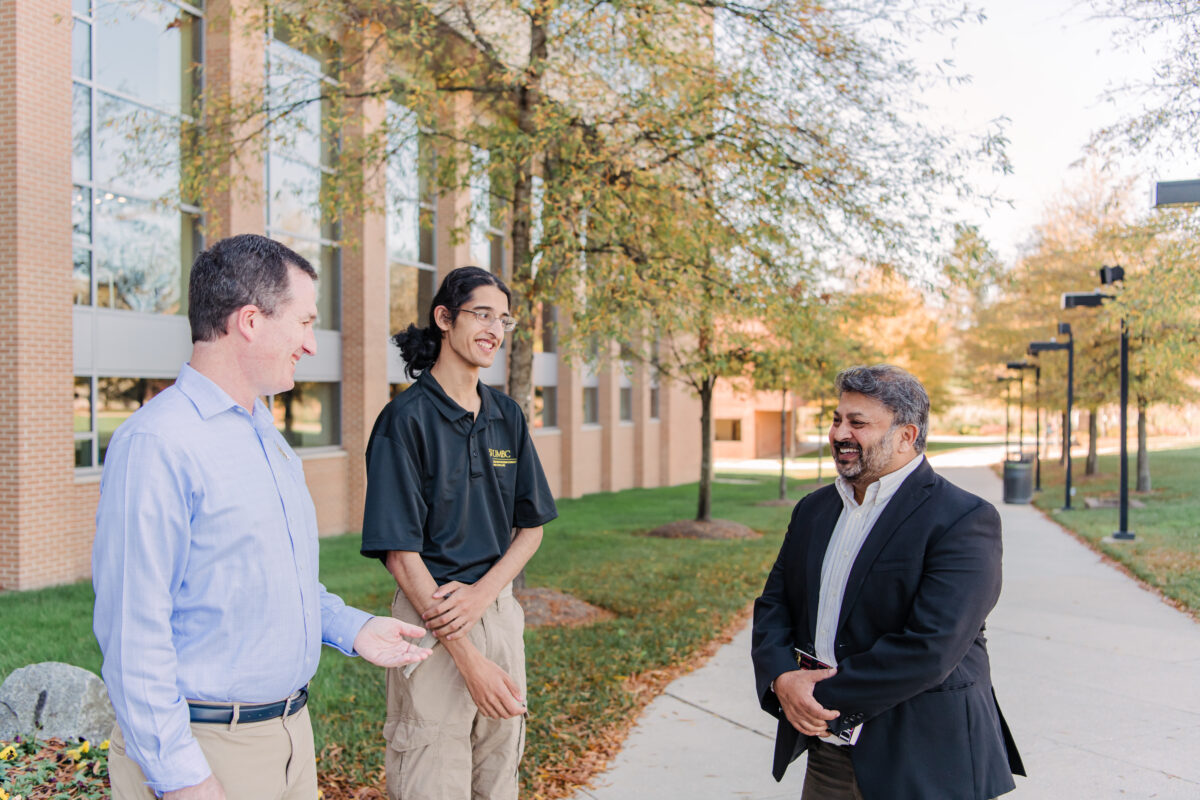 Hoffman, Jafri, and Dasgupta. (Marlayna Demond ’11/UMBC)
Dasgupta: From my way of thinking, a university campus can be very different than society at large. What is the difference and how does that manifest in civic life, on campus, and in communities? How do we navigate those differences?
Hoffman: In our broader culture, we speak too easily of universities as separate from the rest of society: as ivory towers where students are being prepared for the ‘real world.’ The reality is that universities are life. Students are alive right now and they are part of many communities within and beyond the university. What happens here matters to the lives of everyone at UMBC and the communities they are part of.
Jafri: I agree. There are many instances where the university and local community needs overlap. Recently, some UMBC students organized an event where we invited the Catonsville and Arbutus communities to meet the candidates in our district. By including these two communities we realized that we had similar concerns including education, clean water, and environmental protection.
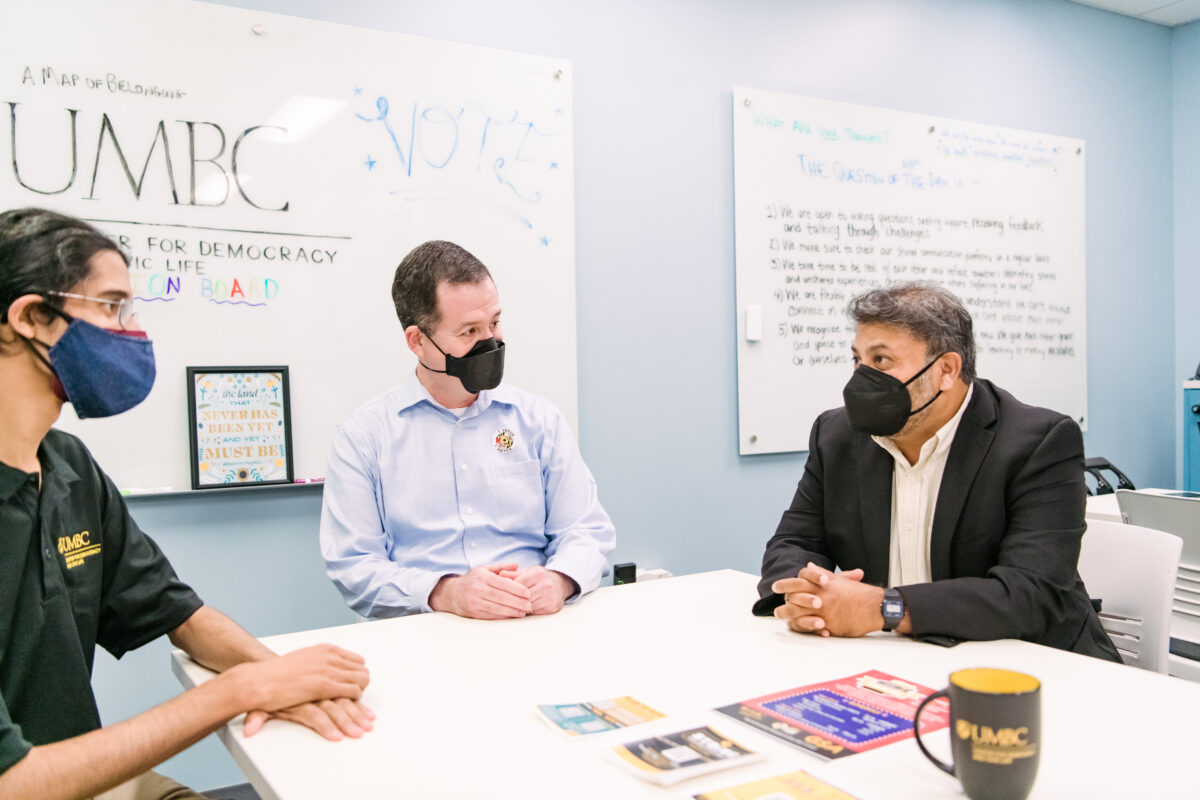 Jafri, Hoffman, and Dasgupta in the Center for Democracy and Civic Life. (Marlayna Demond ’11/UMBC)
Jafri: My generation is very politically active when it comes to voting and getting out to the polls. But with the plethora of social media platforms and news outlets how can students ensure they are getting valid and factual news?
Dasgupta: Let me be a professor and say there is more reading to be done. If your news derives from digital platforms, these platforms are algorithmic with a selection bias problem that is not your selection bias problem. You are essentially hostage to their selection bias. The way you have to overcome this is to move beyond one or two or even three sources of news. What all of us need to do is a triangulation between you and multiple sources. That takes work. Social media won’t replace in-person organizing or knocking on doors. On the other hand, organizing alone can be more effective with social media’s reach. The combination is necessary. At the risk of saying go do more work, I do think we have to understand that choosing one approach is not sufficient.
Hoffman: A part of what happens when you get involved in on-the-ground organizing is that you become better able to discern the plausibility of claims that you might encounter online. You become a better evaluator of the information you are receiving. One of the premises of Center for Democracy and Civic Life’s work is that democracy is not just a form of government, it’s not just politics and elections, it is a way of life that can be enacted in everyday settings. Ideally, people vote because they are so thoroughly engaged with the issues in their community and nation and understand them so well that voting is an obvious way to contribute. It’s one facet of how we shape our collective future, but far from the only one.
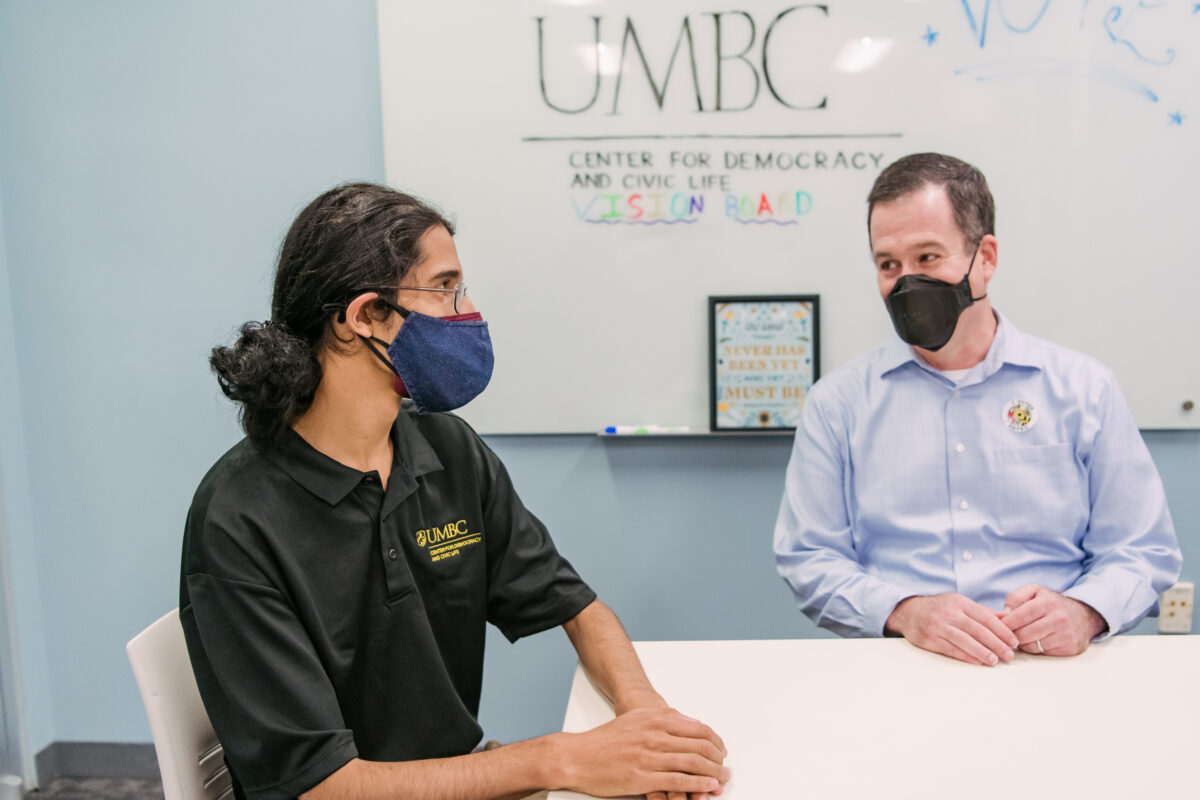 Jafri and Hoffman. (Marlayna Demond ’11/UMBC)
Jafri: One of the comments I often hear from students is that their one vote will not matter because it doesn’t determine the outcome. How can students and the broader community understand that voting is important even if their one vote may not be the deciding vote?
Hoffman: There are a lot of reasons to vote including enacting a symbolic and moral commitment to the well-being of your community. If your vote does not determine the outcome it will still be counted. Candidates and elected officials will review voting data to learn about who voted. In the elected official’s mind if a high percentage of young people voted then their concerns are important. This matters a lot.
Hoffman: What can communities do to help heal the deep divisions in our society that are evident all around us every day?
Jafri: I lean a lot on the power of storytelling—of meeting people where they are and hearing their stories. The divisions in the broader U.S. and in our communities come from a lack of understanding of someone else’s experience. Listening to another’s experience is very powerful and helps us see multiple realities. Maybe we can work together to address our concerns even if our approaches are different.
Dasgupta: I agree with Musa. Storytelling is very powerful and important especially when communities are in need of reliable news sources. I created my podcast to fill a gap in news coverage in Montgomery County. Providing a sound space where community leaders and elected officials can share their insights and plans for the future is one way I give back to the community, especially in areas where there isn’t a local newspaper.
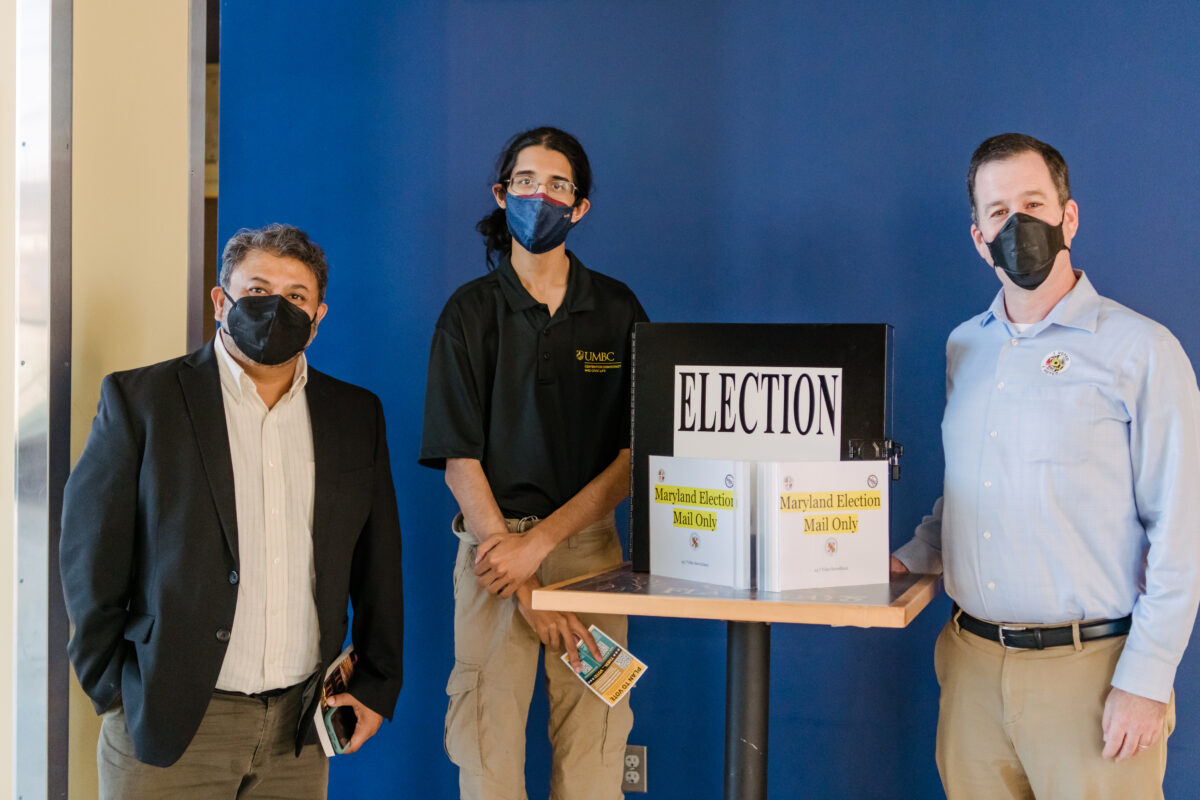 Dasgupta, Jafri, and Hoffman. (Marlayna Demond ’11/UMBC)
Hoffman: What are some practical examples of things students can do that may not be obvious to them as opportunities for civic engagement?
Jafri: Some define democracy and civic engagement as just voting. I don’t think that is a fair description of democracy and civic engagement. Simple things such as gathering with friends and inviting someone who has different views than your own is a very basic way to be civically engaged. I think that can do a lot of good in helping heal the divide.
UMBC Magazine: What wisdom can you impart to inspire students to not give up and to show up and vote?
Dasgupta: The challenges are always going to remain. Our lives’ work is to work through these challenges with hope. We don’t have to solve everything but we are duty-bound to try solve some of the issues we face.
Hoffman: I believe that the moral arc of the universe bends towards justice but that achieving it in our lifetime requires constant organizing. I also believe that democracy is a journey, not a destination. We will never fully achieve the just society that we aspire to but we can get closer and closer and work together to prevent backsliding. I have seen a lot of positive changes in my lifetime including the expansion of rights and the recognition of people based on their identities. The backsliding we have experienced lately has not fully erased this progress so I have hope that together we can build a more just society and that in fact, the seeds of that society have already been planted.
Update: In late November 2022, the ALL IN Campus Democracy Challenge released the results of its national student voter pledge competition. UMBC finished at #4 in the nation in the number of students pledging to vote in Election 2022, moving our campus community up from #9 in 2020.
]]>
Today, millions of college students across the country are voting. Other students are not voting—they might be discouraged that their voice can make a difference, uninformed about their voting...
https://umbc.edu/stories/voting/
https://my3.my.umbc.edu/api/v0/pixel/news/129063/guest@my.umbc.edu/13659b49b350a23d36641f16fee49a54/api/pixel
cahss
campus-life
center-for-democracy-and-civic-life
language-literacy-and-culture
magazine
politicalscience
shadygrove
UMBC News & Magazine
https://my3.my.umbc.edu/groups/umbc-news-magazine
https://assets1-my.umbc.edu/system/shared/avatars/groups/000/001/943/24435aa6207c452e7bc15cc74b42c7bb/xsmall.png?1748556657
https://assets1-my.umbc.edu/system/shared/avatars/groups/000/001/943/24435aa6207c452e7bc15cc74b42c7bb/original.png?1748556657
https://assets2-my.umbc.edu/system/shared/avatars/groups/000/001/943/24435aa6207c452e7bc15cc74b42c7bb/xxlarge.png?1748556657
https://assets2-my.umbc.edu/system/shared/avatars/groups/000/001/943/24435aa6207c452e7bc15cc74b42c7bb/xlarge.png?1748556657
https://assets3-my.umbc.edu/system/shared/avatars/groups/000/001/943/24435aa6207c452e7bc15cc74b42c7bb/large.png?1748556657
https://assets1-my.umbc.edu/system/shared/avatars/groups/000/001/943/24435aa6207c452e7bc15cc74b42c7bb/medium.png?1748556657
https://assets2-my.umbc.edu/system/shared/avatars/groups/000/001/943/24435aa6207c452e7bc15cc74b42c7bb/small.png?1748556657
https://assets1-my.umbc.edu/system/shared/avatars/groups/000/001/943/24435aa6207c452e7bc15cc74b42c7bb/xsmall.png?1748556657
https://assets2-my.umbc.edu/system/shared/avatars/groups/000/001/943/24435aa6207c452e7bc15cc74b42c7bb/xxsmall.png?1748556657
UMBC News & Magazine
0
0
false
Tue, 08 Nov 2022 11:12:08 -0500
Tue, 08 Nov 2022 11:12:08 -0500
Voting Is an Everyday Practice
Today, millions of college students across the country are voting. Other students are not voting—they might be discouraged that their voice can make a difference, uninformed about their voting rights, or just unengaged with the political process.
In a conversation facilitated by UMBC Magazine, Musa Jafri ’24, political science, SGA director of civic engagement, Sunil Dasgupta, professor of political science, and founder and host of the podcast “I Hate Politics,” and David Hoffman, Ph.D. ’13, language, literacy, and culture, the director of UMBC’s Center for Democracy and Civic Life, discuss the vital democratic process—on campus and off—and the daily practice of voting.
“Voting is about you taking a stand and stating, ‘I’m here, I matter, I exist, and I have a voice.’ It’s a form of resistance, a way to try to change the climate you find yourself in.” says Jafri,co-chair of the University System of Maryland Student Civic Leaders Committee.
“I don’t understand how democracy became compartmentalized to something that happens every four years. Voting is the culmination of the work that we have done for the past four years between the time we last voted and now,” says Dasgupta. “Voting is a moment of celebration. A moment where we find out whether the work we did in between votes really mattered. There is no other way to think about democracy. Voting is what we do every day.”
Hoffman, Jafri, and Dasgupta. (Marlayna Demond ’11/UMBC)
Dasgupta: From my way of thinking, a university campus can be very different than society at large. What is the difference and how does that manifest in civic life, on campus, and in communities? How do we navigate those differences?
Hoffman: In our broader culture, we speak too easily of universities as separate from the rest of society: as ivory towers where students are being prepared for the ‘real world.’ The reality is that universities are life. Students are alive right now and they are part of many communities within and beyond the university. What happens here matters to the lives of everyone at UMBC and the communities they are part of.
Jafri: I agree. There are many instances where the university and local community needs overlap. Recently, some UMBC students organized an event where we invited the Catonsville and Arbutus communities to meet the candidates in our district. By including these two communities we realized that we had similar concerns including education, clean water, and environmental protection.
Jafri, Hoffman, and Dasgupta in the Center for Democracy and Civic Life. (Marlayna Demond ’11/UMBC)
Jafri: My generation is very politically active when it comes to voting and getting out to the polls. But with the plethora of social media platforms and news outlets how can students ensure they are getting valid and factual news?
Dasgupta: Let me be a professor and say there is more reading to be done. If your news derives from digital platforms, these platforms are algorithmic with a selection bias problem that is not your selection bias problem. You are essentially hostage to their selection bias. The way you have to overcome this is to move beyond one or two or even three sources of news. What all of us need to do is a triangulation between you and multiple sources. That takes work. Social media won’t replace in-person organizing or knocking on doors. On the other hand, organizing alone can be more effective with social media’s reach. The combination is necessary. At the risk of saying go do more work, I do think we have to understand that choosing one approach is not sufficient.
Hoffman: A part of what happens when you get involved in on-the-ground organizing is that you become better able to discern the plausibility of claims that you might encounter online. You become a better evaluator of the information you are receiving. One of the premises of Center for Democracy and Civic Life’s work is that democracy is not just a form of government, it’s not just politics and elections, it is a way of life that can be enacted in everyday settings. Ideally, people vote because they are so thoroughly engaged with the issues in their community and nation and understand them so well that voting is an obvious way to contribute. It’s one facet of how we shape our collective future, but far from the only one.
Jafri and Hoffman. (Marlayna Demond ’11/UMBC)
Jafri: One of the comments I often hear from students is that their one vote will not matter because it doesn’t determine the outcome. How can students and the broader community understand that voting is important even if their one vote may not be the deciding vote?
Hoffman: There are a lot of reasons to vote including enacting a symbolic and moral commitment to the well-being of your community. If your vote does not determine the outcome it will still be counted. Candidates and elected officials will review voting data to learn about who voted. In the elected official’s mind if a high percentage of young people voted then their concerns are important. This matters a lot.
Hoffman: What can communities do to help heal the deep divisions in our society that are evident all around us every day?
Jafri: I lean a lot on the power of storytelling—of meeting people where they are and hearing their stories. The divisions in the broader U.S. and in our communities come from a lack of understanding of someone else’s experience. Listening to another’s experience is very powerful and helps us see multiple realities. Maybe we can work together to address our concerns even if our approaches are different.
Dasgupta: I agree with Musa. Storytelling is very powerful and important especially when communities are in need of reliable news sources. I created my podcast to fill a gap in news coverage in Montgomery County. Providing a sound space where community leaders and elected officials can share their insights and plans for the future is one way I give back to the community, especially in areas where there isn’t a local newspaper.
Dasgupta, Jafri, and Hoffman. (Marlayna Demond ’11/UMBC)
Hoffman: What are some practical examples of things students can do that may not be obvious to them as opportunities for civic engagement?
Jafri: Some define democracy and civic engagement as just voting. I don’t think that is a fair description of democracy and civic engagement. Simple things such as gathering with friends and inviting someone who has different views than your own is a very basic way to be civically engaged. I think that can do a lot of good in helping heal the divide.
UMBC Magazine: What wisdom can you impart to inspire students to not give up and to show up and vote?
Dasgupta: The challenges are always going to remain. Our lives’ work is to work through these challenges with hope. We don’t have to solve everything but we are duty-bound to try solve some of the issues we face.
Hoffman: I believe that the moral arc of the universe bends towards justice but that achieving it in our lifetime requires constant organizing. I also believe that democracy is a journey, not a destination. We will never fully achieve the just society that we aspire to but we can get closer and closer and work together to prevent backsliding. I have seen a lot of positive changes in my lifetime including the expansion of rights and the recognition of people based on their identities. The backsliding we have experienced lately has not fully erased this progress so I have hope that together we can build a more just society and that in fact, the seeds of that society have already been planted.
]]>
Today, millions of college students across the country are voting. Other students are not voting—they might be discouraged that their voice can make a difference, uninformed about their voting...
https://umbc.edu/stories/voting-is-an-everyday-practice/
https://my3.my.umbc.edu/api/v0/pixel/news/129026/guest@my.umbc.edu/f27ed75a0cdf002972d962dc5e5cbd62/api/pixel
cahss
campus-life
center-for-democracy-and-civic-life
language-literacy-and-culture
magazine
politicalscience
shadygrove
UMBC News & Magazine
https://my3.my.umbc.edu/groups/umbc-news-magazine
https://assets1-my.umbc.edu/system/shared/avatars/groups/000/001/943/24435aa6207c452e7bc15cc74b42c7bb/xsmall.png?1748556657
https://assets1-my.umbc.edu/system/shared/avatars/groups/000/001/943/24435aa6207c452e7bc15cc74b42c7bb/original.png?1748556657
https://assets2-my.umbc.edu/system/shared/avatars/groups/000/001/943/24435aa6207c452e7bc15cc74b42c7bb/xxlarge.png?1748556657
https://assets2-my.umbc.edu/system/shared/avatars/groups/000/001/943/24435aa6207c452e7bc15cc74b42c7bb/xlarge.png?1748556657
https://assets3-my.umbc.edu/system/shared/avatars/groups/000/001/943/24435aa6207c452e7bc15cc74b42c7bb/large.png?1748556657
https://assets1-my.umbc.edu/system/shared/avatars/groups/000/001/943/24435aa6207c452e7bc15cc74b42c7bb/medium.png?1748556657
https://assets2-my.umbc.edu/system/shared/avatars/groups/000/001/943/24435aa6207c452e7bc15cc74b42c7bb/small.png?1748556657
https://assets1-my.umbc.edu/system/shared/avatars/groups/000/001/943/24435aa6207c452e7bc15cc74b42c7bb/xsmall.png?1748556657
https://assets2-my.umbc.edu/system/shared/avatars/groups/000/001/943/24435aa6207c452e7bc15cc74b42c7bb/xxsmall.png?1748556657
UMBC News & Magazine
2
0
false
Tue, 08 Nov 2022 11:12:08 -0500
Tue, 08 Nov 2022 11:12:08 -0500
Non-Linear Paths to Leadership
Francisco Cartagena describes his academic journey as unorthodox. Now an employee for the City of Gaithersburg, Cartagena started his educational path as an undocumented student. While charting numerous challenges, Cartagena ’19, political science, M.P.S. ’22, cybersecurity, also found ample opportunities for growth along the way, becoming an effective leader of social change at UMBC at The Universities at Shady Grove.
Cartagena arrived with his family from El Salvador as a preteen. In 2009, he graduated from high school and set out to Montgomery College to pursue his associate’s degree in general studies—a goal that would take him a decade to accomplish because of his legal status. There, Cartagena joined the college’s Latino Student Union and together they advocated for the Maryland Dream Act—a statute that would allow undocumented high school students to pay for in-state college tuition.
“That experience really exposed me to the political science environment and how policy, with momentum, people, and activism, can actually be changed,” says Cartagena, who hopes eventually to leverage his role in local government to share the message that there are many attainable pathways to and through higher education.
Finding his momentum
Prior to the Maryland Dream Act’s passing in 2012, Cartagena was paying the international student rate for community college classes. To him, pursuing a bachelor’s degree seemed like a faraway dream.
“There were some instances when I couldn’t attend school or when I could only attend one class,” reflects Cartagena. “But it gave me that momentum to say, ‘I’m just going to keep at it.’”
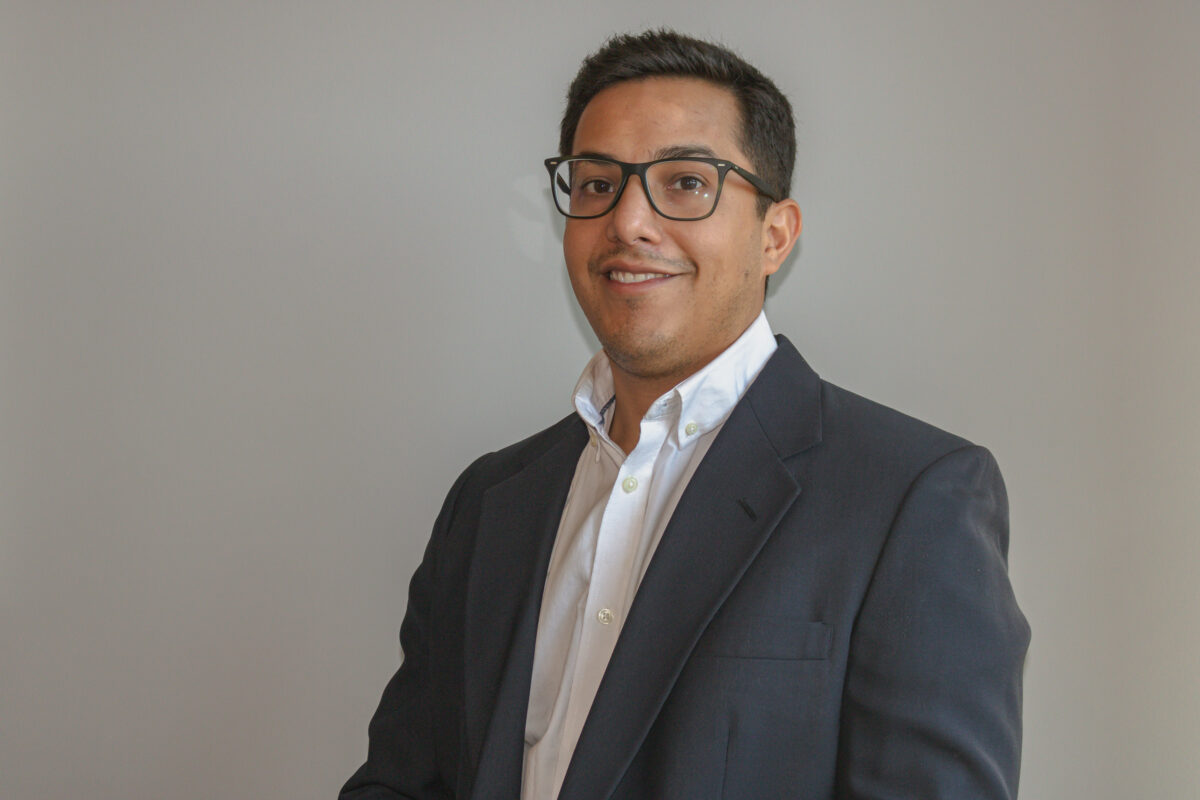
Francisco Cartagena
At Montgomery College, Cartagena learned about the UMBC-Shady Grove campus and its political science program. As a full-time working adult, he believed that UMBC-Shady Grove would be a good fit. With an extra push from his wife Cora Trelles Cartagena ’12, social work, Cartagena reached out to Sunil Dasgupta, political science program director and professor at UMBC-Shady Grove, to find out more.
To Cartagena’s surprise, Dasgupta asked a question that would sell him on applying: “Why do you think you can complete this program?” Motivated by the challenge, Cartagena pushed forward and eventually proved that he would do more than succeed—he would lead.
“Francisco is somebody that intuitively knew the importance of politics in transforming and changing our lives,” says Dasgupta. “I think part of the reason that happens is because he comes from an immigrant family. When you’re in that position, you quickly realize you have to master this if you want to help yourself, your family, and your community.”
An uplifting environment
Cartagena saw The Universities at Shady Grove (USG) as a place to practice his role in politics. As one of two students representing UMBC on the Student Government Association’s executive board, he learned more about the funding process at USG, the development of programs on campus, and the ins-and-outs of university partnerships.
“When you have an environment with multiple people from different schools, you can truly see the different backgrounds, their intent, and how people process things,” Cartagena says.
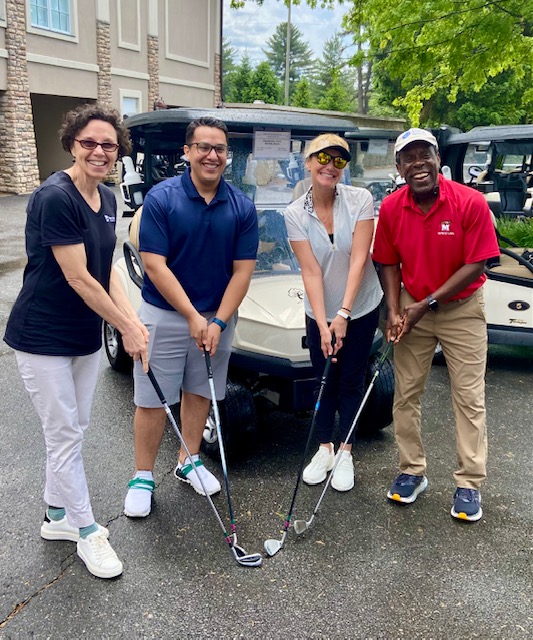 From left to right: Anne Khademian, USG Executive Director; Cartagena; Crystal Townsend, President & CEO of Healthcare Initiative Foundation; Kevin Beverly, Chair of the USG Board of Advisors.
When Cartagena attended USG’s job fair and spotted a table for Congressman Jamie Raskin’s office staffed by a fellow Latina, he saw a vision for his future. “At the time, a career in government or interning for a government official was so far-fetched, whether because of my status or my prior experiences. It was something I would just dream of,” explains Cartagena, who wound up spending the summer splitting his internship between Raskin’s Rockville office and his congressional office on the Hill—two experiences that propelled his career in government.
“I still pinch myself because I’m a first-generation immigrant who came here from El Salvador with my parents…To be able to represent the county I grew up in—it was a bunch of mixed feelings that were finally culminating into something very positive,” says Cartagena.
In 2018, Cartagena started with a role in the City of Gaithersburg’s human resources department and in 2021, transitioned to his current role as an I.T. project manager. Now, he oversees applications, business needs from different departments, and processes in the technology sector.
Continuing to lead
In 2019, as a master’s student studying cybersecurity at UMBC-Shady Grove, Cartagena continued his ongoing involvement on campus, joining the Graduate School Council and USG’s Advisory Board.
During his final year in the program, Cartagena received a phone call from Dasgupta, who was creating an interactive bot to help Maryland voters identify political candidates most aligned with their values. He hoped that the bot, along with his podcast, I Hate Politics, would serve as informative tools. But realizing that a significant portion of the county was Spanish speaking, he enlisted Cartagena’s help.
“The first person I called was Francisco. And it wasn’t a small job; it was pages and pages of translation,” Dasgupta says, adding that they only had about a couple of weeks to complete the project before elections began. Still, Cartagena took on the translation task without hesitation.
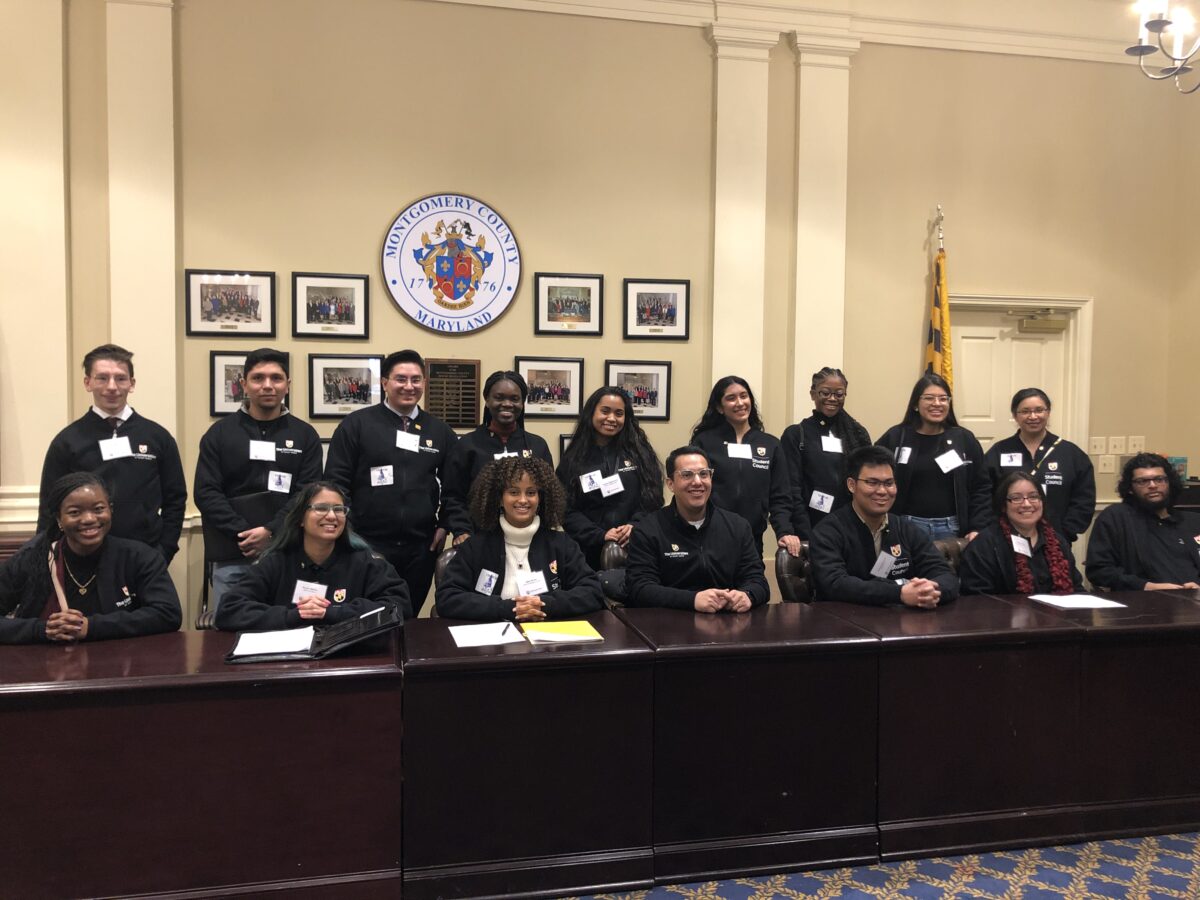 Cartagena and the USG Undergrad and Graduate Student Councils attend the State of Maryland House Appropriations meeting to advocate for the funding of USG by the State.
“That kind of collaboration uplifts UMBC and the community,” notes Dasgupta. “We continue to work with our students and alumni, and those interactions are very revitalizing. We find meaning through those relationships.”
Cartagena notes he wouldn’t have made it this far without the resources and opportunities he found at UMBC-Shady Grove. “If there was a change I could recommend, it would be showing students and adult learners that there are other pathways for you to get that Ph.D., get that bachelor’s, or get that associate degree,” says Cartagena. “I think oftentimes students are afraid; it’s an investment of money and time, and you don’t know if you’re going to make it through…but you will find your niche if you stick it out.”
]]>
Francisco Cartagena describes his academic journey as unorthodox. Now an employee for the City of Gaithersburg, Cartagena started his educational path as an undocumented student. While charting...
https://umbc.edu/stories/non-linear-paths-to-leadership/
https://my3.my.umbc.edu/api/v0/pixel/news/128360/guest@my.umbc.edu/b123bad86a3a147da7d64e0596278539/api/pixel
alumni
cybersecurity
magazine
politicalscience
shadygrove
universities-at-shady-grove
UMBC News & Magazine
https://my3.my.umbc.edu/groups/umbc-news-magazine
https://assets1-my.umbc.edu/system/shared/avatars/groups/000/001/943/24435aa6207c452e7bc15cc74b42c7bb/xsmall.png?1748556657
https://assets1-my.umbc.edu/system/shared/avatars/groups/000/001/943/24435aa6207c452e7bc15cc74b42c7bb/original.png?1748556657
https://assets2-my.umbc.edu/system/shared/avatars/groups/000/001/943/24435aa6207c452e7bc15cc74b42c7bb/xxlarge.png?1748556657
https://assets2-my.umbc.edu/system/shared/avatars/groups/000/001/943/24435aa6207c452e7bc15cc74b42c7bb/xlarge.png?1748556657
https://assets3-my.umbc.edu/system/shared/avatars/groups/000/001/943/24435aa6207c452e7bc15cc74b42c7bb/large.png?1748556657
https://assets1-my.umbc.edu/system/shared/avatars/groups/000/001/943/24435aa6207c452e7bc15cc74b42c7bb/medium.png?1748556657
https://assets2-my.umbc.edu/system/shared/avatars/groups/000/001/943/24435aa6207c452e7bc15cc74b42c7bb/small.png?1748556657
https://assets1-my.umbc.edu/system/shared/avatars/groups/000/001/943/24435aa6207c452e7bc15cc74b42c7bb/xsmall.png?1748556657
https://assets2-my.umbc.edu/system/shared/avatars/groups/000/001/943/24435aa6207c452e7bc15cc74b42c7bb/xxsmall.png?1748556657
UMBC News & Magazine
0
0
false
Mon, 10 Oct 2022 16:05:54 -0400
Mon, 10 Oct 2022 16:05:54 -0400
World traveler finds future in data science at UMBC
Tchuissi Mbu Nyamsi
Degree: MPS in Data Science
Hometown: Paris, France
Plans: Data science consultant at CrossCountry Consulting
“Thanks to the UMBC program and the support of the Career Center and others, I feel well prepared to enter the workforce in the U.S. and to bring [my] unique perspective.”
While working at Sodexo, a food services company, Tchuissi Mbu Nyamsi ’22 realized that there were data problems she wanted to solve. “I realized it was something I really wanted to have more knowledge in and I wanted to sharpen my skills,” she says. So she enrolled in UMBC’s master’s program in data science at the Universities at Shady Grove.
Mbu Nyamsi had only recently come to the United States from her home country of France to work at Sodexo, a French company, after having lived in several other countries around the world. “I wanted to experience this entrepreneurship mindset in the U.S. and have a new kind of international experience,” she says.
With her passion for math, knowledge of data science, and intercultural communication skills, Mbu Nyamsi looks forward to working as a consultant in data science. “It’s a big strength,” she notes, “to be able to combine my technical, language, and soft skills.”
Story written by Karen Stysley.
]]>
Tchuissi Mbu Nyamsi Degree: MPS in Data Science Hometown: Paris, France Plans: Data science consultant at CrossCountry Consulting “Thanks to the UMBC program and the support of the...
https://umbc.edu/stories/world-traveler-finds-future-in-data-science/
https://my3.my.umbc.edu/api/v0/pixel/news/125314/guest@my.umbc.edu/891c39df2cde6474f7c9c99ee59057a3/api/pixel
class-of-2022
datascience
intercultural
international-stories
news
shadygrove
UMBC News & Magazine
https://my3.my.umbc.edu/groups/umbc-news-magazine
https://assets1-my.umbc.edu/system/shared/avatars/groups/000/001/943/24435aa6207c452e7bc15cc74b42c7bb/xsmall.png?1748556657
https://assets1-my.umbc.edu/system/shared/avatars/groups/000/001/943/24435aa6207c452e7bc15cc74b42c7bb/original.png?1748556657
https://assets2-my.umbc.edu/system/shared/avatars/groups/000/001/943/24435aa6207c452e7bc15cc74b42c7bb/xxlarge.png?1748556657
https://assets2-my.umbc.edu/system/shared/avatars/groups/000/001/943/24435aa6207c452e7bc15cc74b42c7bb/xlarge.png?1748556657
https://assets3-my.umbc.edu/system/shared/avatars/groups/000/001/943/24435aa6207c452e7bc15cc74b42c7bb/large.png?1748556657
https://assets1-my.umbc.edu/system/shared/avatars/groups/000/001/943/24435aa6207c452e7bc15cc74b42c7bb/medium.png?1748556657
https://assets2-my.umbc.edu/system/shared/avatars/groups/000/001/943/24435aa6207c452e7bc15cc74b42c7bb/small.png?1748556657
https://assets1-my.umbc.edu/system/shared/avatars/groups/000/001/943/24435aa6207c452e7bc15cc74b42c7bb/xsmall.png?1748556657
https://assets2-my.umbc.edu/system/shared/avatars/groups/000/001/943/24435aa6207c452e7bc15cc74b42c7bb/xxsmall.png?1748556657
UMBC News & Magazine
0
0
false
Fri, 13 May 2022 15:21:10 -0400
Fri, 13 May 2022 15:21:10 -0400
UMBC continues to advance Maryland’s biotech workforce through $900K biomanufacturing grant
UMBC has received a $900,000 grant from the National Institute for Innovation in Manufacturing Biopharmaceuticals (NIIMBL) to develop and implement a new, short-term biomanufacturing training program. Four universities, all classified as minority-serving institutions (MSIs), received funding for similar programs, designed to meet critical national workforce needs.
UMBC will offer the biomanufacturing training program at its Universities at Shady Grove (USG) campus in Rockville, Maryland. The program will be adapted from a curriculum first developed at Texas A&M University. Annica Wayman ’99, M6, mechanical engineering, associate dean for Shady Grove affairs in CNMS, and co-lead Manik Ghosh, assistant director of the Translational Life Science Technology (TLST) laboratories at UMBC, will travel to Texas for training on the curriculum and will then work together to adapt it for UMBC. The anticipated training launch is late summer or fall 2023.
“This new program is really the next wave of UMBC expanding our training offerings,” Wayman says. “This kind of short-term programming could enhance our courses as well, to help with educating people in biomanufacturing and strengthening that workforce where there’s a huge gap.”
 Charmaine Hipolito ’20, and Titina Sirak ’20, right, alumni of UMBC’s TLST program at The Universities at Shady Grove, speak with visitors at a celebration for the opening of USG’s new Biomedical Sciences and Engineering Building in November 2019. Photo by Marlayna Demond ’11 for UMBC.
Snowball effect
The gap between supply and demand for skilled workers in biotech is very real, and it’s only growing in the BioHealth Capital Region. This region, which includes Maryland, Washington D.C., and Virginia, ranks #4 among the top biopharma clusters in the country. The pandemic has further expanded the biopharma industry, so the need for qualified local workers in a range of biotech roles has never been greater.
The new biomanufacturing program is a natural outgrowth of previous work by Wayman, Ghosh, and colleagues. The structure of the program will be similar to UMBC’s award-winning Biotech Boot Camp, which trained people who had lost their jobs during the pandemic for new careers in biotech. The boot camp has run twice so far, both times focusing on cell culture techniques and broader “wet lab” skills. Both times, the Montgomery County government and WorkSource Montgomery partnered with UMBC to offer the boot camps at no cost to the students.
The original boot camp was made possible by UMBC’s TLST bachelor’s degree program, fully launched in 2019 in partnership with Montgomery College. TLST was the college’s first new major developed in response to the growing need for biotech workforce development in the region. The TLST program bridges fundamental knowledge in the life sciences with industry-specific applications, practical laboratory skills, and an understanding of the regulatory process for biopharmaceuticals.
“The launch of the TLST program has led to a lot of education and partnership opportunities,” Wayman says. “It’s allowed UMBC to address gaps in the workforce that already existed, and that became even more prominent with the pandemic. We jumped in to help to fill those gaps in a variety of ways. TLST was the impetus and the start of that, and it snowballed from there.”

Associate Dean for Shady Grove Affairs Annica Wayman. Photo by Marlayna Demond ’11 for UMBC.
Short program, lasting impact
Even a short-term training program can have a huge impact on an individual’s career trajectory. A general biomanufacturing program could be the start of a career in fields as diverse as bench research, regulatory affairs, and biomanufacturing process design. These careers work toward answering big questions like, “How do we know this product is safe for use in the human body?” or, “How can we make this sequence of steps more efficient by taking advantage of new technologies?”
Roles in all these areas will be important to fill in the near future, and continuously asking the big questions as technologies emerge, regulations shift, and new scientific knowledge comes to light will help move the industry forward safely and reliably, Wayman notes. Programs like the new biomanufacturing training, the biotech boot camp, TLST, and more at UMBC have the potential to send thousands of well-prepared students into the biotech workforce.

A participant in the Biotech Boot Camp at USG in February 2021. Photo by Annica Wayman.
Looking ahead
Antonio Moreira, vice provost for academic affairs, has seen the potential for Maryland to be a biotechnology leader for years, and has championed UMBC’s efforts to grow opportunities in related fields. “As a component of the Maryland biotechnology ecosystem, UMBC is a major resource for preparing the workforce needed to develop and manufacture critical therapies,” Moreira explains. “Given a shortage in this workforce, graduating students need to be prepared to hit the ground running as they join these biotechnology companies.”
Bill LaCourse, dean of the College of Natural and Mathematical Sciences (CNMS) at UMBC, agrees. “At UMBC, we are driven by the vision that Maryland will continue to grow as a leader in biotech,” he says. “We’re establishing strong pathways to develop the workforce, where students and professionals have an array of choices about how to get to the biotech career they want and that the region needs.”
Wayman leads much of the day-to-day operations of UMBC’s biotech programs. Even while planning next steps, she tries to remind herself how much progress she and her team have already made toward narrowing the workforce gap and setting a new group of students on a path to success.
“When I take a step back, I see how amazing it is that we achieved all this through a pandemic,” she says. And then she, too, looks forward. “But there’s just so much more to do.”
This article describes work performed under a Project Award Agreement from the National Institute for Innovation in Manufacturing Biopharmaceuticals (NIIMBL) and financial assistance award 70NANB21H085 from the U.S. Department of Commerce, National Institute of Standards and Technology.
Header image: The Biomedical Sciences and Engineering Building at The Universities at Shady Grove. TLST courses, the Biotech Boot Camp, and the new biomanufacturing training program all happen here. Photo by Marlayna Demond ’11 for UMBC.
]]>
UMBC has received a $900,000 grant from the National Institute for Innovation in Manufacturing Biopharmaceuticals (NIIMBL) to develop and implement a new, short-term biomanufacturing training...
https://umbc.edu/stories/meet-umbc-people-14/
https://my3.my.umbc.edu/api/v0/pixel/news/119487/guest@my.umbc.edu/46b9bf4a716948e3434505092d495905/api/pixel
cnms
page1
science-and-technology
shadygrove
tlst
UMBC News & Magazine
https://my3.my.umbc.edu/groups/umbc-news-magazine
https://assets1-my.umbc.edu/system/shared/avatars/groups/000/001/943/24435aa6207c452e7bc15cc74b42c7bb/xsmall.png?1748556657
https://assets1-my.umbc.edu/system/shared/avatars/groups/000/001/943/24435aa6207c452e7bc15cc74b42c7bb/original.png?1748556657
https://assets2-my.umbc.edu/system/shared/avatars/groups/000/001/943/24435aa6207c452e7bc15cc74b42c7bb/xxlarge.png?1748556657
https://assets2-my.umbc.edu/system/shared/avatars/groups/000/001/943/24435aa6207c452e7bc15cc74b42c7bb/xlarge.png?1748556657
https://assets3-my.umbc.edu/system/shared/avatars/groups/000/001/943/24435aa6207c452e7bc15cc74b42c7bb/large.png?1748556657
https://assets1-my.umbc.edu/system/shared/avatars/groups/000/001/943/24435aa6207c452e7bc15cc74b42c7bb/medium.png?1748556657
https://assets2-my.umbc.edu/system/shared/avatars/groups/000/001/943/24435aa6207c452e7bc15cc74b42c7bb/small.png?1748556657
https://assets1-my.umbc.edu/system/shared/avatars/groups/000/001/943/24435aa6207c452e7bc15cc74b42c7bb/xsmall.png?1748556657
https://assets2-my.umbc.edu/system/shared/avatars/groups/000/001/943/24435aa6207c452e7bc15cc74b42c7bb/xxsmall.png?1748556657
UMBC News & Magazine
0
0
false
Wed, 19 Jan 2022 20:01:42 -0500
UMBC continues to advance biotech in Maryland through new $900K biomanufacturing grant
A growing list of programs and partnerships is positioning UMBC as a leader in developing Maryland’s biotech and biomanufacturing workforce. UMBC has just received a $900,000 grant from the National Institute for Innovation in Manufacturing Biopharmaceuticals (NIIMBL) to develop and implement a short-term biomanufacturing career training program. Four universities, all classified as minority-serving institutions (MSIs), received funding for similar programs, which will be adapted from a curriculum first developed at Texas A&M University.
UMBC will offer the biomanufacturing training program at its Universities at Shady Grove (USG) campus in Rockville, Maryland. It will be similar to UMBC’s Biotech Boot Camp, which trained people who had lost their jobs during the pandemic for new careers in biotech. The boot camp has run twice so far, both times focusing on cell culture techniques and broader “wet lab” skills.
Montgomery County government and WorkSource Montgomery partnered with UMBC to offer the original boot camps at no cost to the students. The new biomanufacturing training program will also be free to participants the first time it is offered, thanks to the support from NIIMBL.
The biotech industry is booming in the BioHealth Capital Region, which ranks #4 among the top biopharma clusters in the country. The pandemic has drawn even more attention to the biopharma industry, so the need for qualified local workers in a range of biotech roles has never been greater.
“We are driven by the vision that Maryland can be a leader in biotech,” says Bill LaCourse, dean of the College of Natural and Mathematical Sciences (CNMS) at UMBC. “We’re establishing strong pathways to develop the workforce, where students and professionals have an array of choices about how to get to the biotech career they want and that the region needs.”
A participant in the Biotech Boot Camp at USG in February 2021 practices their pipetting technique. Photo by Annica Wayman.
Opportunities at every level
The new NIIMBL program is just one of those choices. UMBC’s Translational Life Science Technology (TLST) bachelor’s degree program, fully launched in 2019 in partnership with Montgomery College, was the college’s first new major developed in response to the growing need for biotech workforce development in the region. The TLST program bridges fundamental knowledge in the life sciences with industry-specific applications, practical laboratory skills, and an understanding of the regulatory process for biopharmaceuticals.
“The launch of the TLST program has led to a lot of education and partnership opportunities,” says Annica Wayman ’99, M6, mechanical engineering, and associate dean for Shady Grove affairs in CNMS. “It’s allowed UMBC to address gaps in the workforce that already existed, and that became even more prominent with the pandemic. We jumped in to help to fill those gaps in a variety of ways.”
The TLST program, which has just launched a bioinformatics track, dovetails with the Master of Professional Studies in Biotechnology, also offered at USG. The master’s program is ideal for both recent TLST program graduates and professionals already in biotech seeking to advance their careers.
“We’re trying to build the education pathway that runs in parallel with the career pathways for students in biotech,” Wayman says.

Participants in the Biotech Boot Camp at USG, Feb 2021. Photo by Annica Wayman.
Engaging with industry
UMBC has also cultivated a growing number of partnerships with individuals, industry, government agencies, and regional community colleges that strengthen its offerings. A Biotechnology Advisory Committee includes representatives from companies such as Kite Pharma, Catalent, AstraZeneca, and American Gene Technologies, all of which have facilities in the region. Agencies like the National Institutes of Health (NIH) and National Institute of Standards and Technology (NIST) are also on the committee.
“They’re helping us to refine our curriculum to make sure we’re educating students on the things that industry needs,” Wayman says. “They’re also helping us determine what other gaps we could fill.”
For example, another huge growth area is biomanufacturing process development. With increasing automation and the need for large-scale production of some biopharmaceutical products, there are opportunities to improve the way biomanufacturing facilities operate.
UMBC’s biotech curricula often directly touch industry, as well. TLST courses regularly include guest lecturers from regional companies, and students must complete an internship in order to graduate. TLST classes have also included interviewing support and networking sessions with potential employers, such as members of the Frederick Innovative Technology Center, Inc.
 (l to r): Annica Wayman, Antonio Moreira, Keith Bowman, Bill LaCourse. Photo by Marlayna Demond ’11 for UMBC at the grand opening of the BSE building at USG.
Productive partnerships
UMBC’s new partnership with Aberdeen Proving Ground (APG), the U.S. Army facility near Aberdeen, Maryland, will further enhance opportunities for students across the region. APG has built a robust relationship with Harford Community College, while UMBC already has a thriving relationship with Montgomery College and has been deepening its relationship with Frederick Community College. The new APG partnership, still in its early stages, will create opportunities to enhance UMBC’s relationship with Harford Community College, as well.
“We’ve now built this education partnership alliance with Aberdeen Proving Ground, because we’re looking to provide a pathway for these students through their biotech career,” Wayman says. “They can go from Harford Community College to the TLST program, and have Aberdeen be that partner running throughout who provides experiential opportunities and eventually jobs for these students.”

UMBC’s Interdisciplinary Life Sciences Building offers state-of-the-art spaces for research and teaching. Photo by Marlayna Demond ’11 for UMBC.
An economic engine
Antonio Moreira, vice provost for academic affairs, has seen the potential for Maryland to be a biotechnology leader for years, with UMBC as a major driver of growth. Maryland’s strength “is the result of a life sciences ecosystem that includes federal agencies, major research universities, hundreds of biotechnology companies and strong community colleges,” he says. While this growth has been in process for some time, he notes that the pandemic has brought the need for a robust biotech sector into sharp relief.
“As a component of the Maryland biotechnology ecosystem, UMBC is a major resource for preparing the workforce needed to develop and manufacture critical therapies,” Moreira explains. Given a shortage in this workforce, “the students graduating from the universities need to be prepared to hit the ground running as they join these biotechnology companies.”
The innovative partnerships UMBC is developing with industry, government, and community colleges are creating opportunities for students to gain the complex skills needed to contribute to the growing biotech industry and to pursue careers in high-demand fields. “All these projects, programs, and partnerships are helping fulfill the mission of UMBC as an economic engine and source of workforce development in the state,” Dean LaCourse says.
“We are implementing our shared vision to build a workforce for the biotech industry right here, with the people in Maryland,” LaCourse continues. “We want Maryland businesses to look out their windows to find that workforce that they need—and it’s looking good.”
Header image: Charmaine Hipolito ’20 (right) and Titina Sirak ’20, both graduates of the TLST program, use the microscopes in a teaching lab at the Universities at Shady Grove in 2019. Photo by Marlayna Demond ’11 for UMBC.
]]>
A growing list of programs and partnerships is positioning UMBC as a leader in developing Maryland’s biotech and biomanufacturing workforce. UMBC has just received a $900,000 grant from the...
https://umbc.edu/stories/umbc-continues-to-advance-biotech-in-maryland-through-new-900k-biomanufacturing-grant/
https://my3.my.umbc.edu/api/v0/pixel/news/119518/guest@my.umbc.edu/9f9eedd07c0f342a8ed6967aac0ff235/api/pixel
cnms
science-and-technology
shadygrove
tlst
UMBC News & Magazine
https://my3.my.umbc.edu/groups/umbc-news-magazine
https://assets1-my.umbc.edu/system/shared/avatars/groups/000/001/943/24435aa6207c452e7bc15cc74b42c7bb/xsmall.png?1748556657
https://assets1-my.umbc.edu/system/shared/avatars/groups/000/001/943/24435aa6207c452e7bc15cc74b42c7bb/original.png?1748556657
https://assets2-my.umbc.edu/system/shared/avatars/groups/000/001/943/24435aa6207c452e7bc15cc74b42c7bb/xxlarge.png?1748556657
https://assets2-my.umbc.edu/system/shared/avatars/groups/000/001/943/24435aa6207c452e7bc15cc74b42c7bb/xlarge.png?1748556657
https://assets3-my.umbc.edu/system/shared/avatars/groups/000/001/943/24435aa6207c452e7bc15cc74b42c7bb/large.png?1748556657
https://assets1-my.umbc.edu/system/shared/avatars/groups/000/001/943/24435aa6207c452e7bc15cc74b42c7bb/medium.png?1748556657
https://assets2-my.umbc.edu/system/shared/avatars/groups/000/001/943/24435aa6207c452e7bc15cc74b42c7bb/small.png?1748556657
https://assets1-my.umbc.edu/system/shared/avatars/groups/000/001/943/24435aa6207c452e7bc15cc74b42c7bb/xsmall.png?1748556657
https://assets2-my.umbc.edu/system/shared/avatars/groups/000/001/943/24435aa6207c452e7bc15cc74b42c7bb/xxsmall.png?1748556657
UMBC News & Magazine
0
0
false
Tue, 23 Nov 2021 19:07:49 -0500
UMBC’s newest grads leave a legacy of advocacy, inclusion, and support for fellow students
On the back of every UMBC black and gold ID card is a guide to essential emergency resources, including numbers for health, counseling, sexual assault, and suicide prevention helplines. The new card design was the result of student advocacy through UMBC’s Retriever Courage initiative, seeking to better prevent and respond to sexual assault and violence. And the person who suggested that change is Autumn Cook ‘21, M29, chemistry, and gender, women’s, and sexuality studies (GWST), graduating this week.
A Meyerhoff Scholar and Honors College student, Cook has been a tireless advocate for all UMBC students, with a focus on supporting survivors of sexual assault and helping trans students find and build community, in the sciences and at UMBC broadly.
Committing to visibility
“I was the first openly trans Meyerhoff Scholar in the history of the program and I quickly learned that I would have to build my own community of transgender scholars at UMBC,” Cook shares. “Without having any friends like me, I connected and built bridges with people who did. I was lucky enough to find more trans people through both the LBGTQ+ Student Union and its programming, and then through the Women’s Center.”
 Autumn Cook in front of the Women’s Center. Photo by Marlayna Demond ’11 for UMBC.
Cook launched the LBGTQ+ Student Union’s weekly trans discussion group, then worked to restart and become a co-facilitator of the Women’s Center’s trans discussion group, Spectrum. “I always make it a priority to be extremely visible because I want to demonstrate to other people that transgender people exist, transgender people can thrive, and transgender people can be successful,” they share.
“I want to potentially be a role model for other transgender people,” says Cook, “to show them that I can do it, therefore so can you.”
Calling for change
Thinking about the impact of the new campus ID design, Cook says, “I’m proud that every UMBC student, faculty, and staff member now carries that card and that it is part of a legacy I’m leaving behind at UMBC.”
Their legacy also extends to other important changes that impact the daily life on campus. For example, Cook joined UMBC community members in calling for updating and expanding all-gender restrooms, including multi-person restrooms. The first multi-person, all-gender restroom opened in Sherman Hall A Wing in June 2019 and more have followed across the campus.
Amelia Meman, assistant director of the Women’s Center and Cook’s supervisor and mentor, says Cook is an asset to campus who will be missed. “As a student heavily involved with the administration in advocating for this project and later ensuring accountability in implementation, Autumn has left an indelible mark on our campus by ensuring access for everyone–affirming all people’s gender diversity.”
 Autumn Cook on National Coming Out Day in 2019. Photo by Amelia Meman.
In recognition of their scholarship and advocacy work at UMBC, Cook received two Lavender Awards: LQBTQ+ Scholar of the Year in 2021 and Emerging Student Leader in 2020. As a GWST major, they received the Jo Ann E. Argersinger Academic Achievement Award for GWST in 2020 and 2021.
Helping students succeed in science
Cook also sees important interconnections between their two majors: GWST and chemistry. After graduating from UMBC, they will pursue their Ph.D. in chemistry at University of Illinois, Urbana-Champaign, but they see GWST as foundational in their work to boost inclusion in science.
“I’ll be able to use my degree to push through more advocacy work within the next step of my educational and professional journey,” says Cook. “Whether it’s conducting research after I finish my Ph.D., dictating science policy on a national level, or supporting transgender scientists, I want to continue to fight for my community.”
 Autumn Cook in front of the Meyerhoff Chemistry Building. Photo by Marlayna Demond ’11 for UMBC.
Cook plans to become a chemistry professor and has already completed research with Joseph Bennett, research assistant professor of chemistry, and became one of the department’s youngest teaching assistants (TAs). They tutored students in the Chemistry Tutorial Center, and for that work, received the 2021 Mittino Award for Service from the chemistry and biochemistry department.
“When I started in chemistry, I struggled a lot. But because of the time and effort other people put into helping me, I was able to grasp the knowledge on a really deep level,” says Cook. “Tutoring and TA’ing was at first a way to pay it back to those people who helped me, but it quickly turned into a passion.”
“Once I realized that teaching chemistry as a professor was what I wanted to do, I made sure to take every opportunity that I could,” they add. “Being able to help students succeed is extremely gratifying and rewarding.”
Finding opportunities to lead
Christian Figueroa ‘21, social work, and Henri Maindidze, ‘21, psychology, say building community for students at UMBC-Shady Grove has been at the heart of their undergraduate experiences.
A first-generation student who transferred from Montgomery College, Figueroa dedicated himself to helping create a culture of belonging at UMBC-Shady Grove. It all started in 2019 when he “took a chance” to run for a leadership role as vice president of UMBC-Shady Grove’s Social Work Student Association (SWSA).
Figueroa says that experience opened more doors and encouraged him to apply for additional opportunities, like representing UMBC on the Universities at Shady Grove (USG) Student Council. He also served on the UMBC-Shady Grove Peer Advisory Team, collaborating with faculty, staff, and current students on recruitment and retention events for transfer students.
 Christian Figueroa on the UMBC-Shady Grove campus. Photo courtesy of Figueroa.
After becoming SWSA co-president in 2020, Figueroa gained additional leadership experience and learned the importance of flexibility and creativity in building community during challenging times. When UMBC transitioned to virtual classes during the pandemic, he wanted to provide ways for social work students to stay connected.
Collaborating with co-president Mariandree Paiz ‘21, social work, and clinical instructor Jeanette Hoover (SWSA’s advisor), Figueroa developed community discussions focused on current events, featuring clinical instructor Nicole Belfiore. They also coordinated self-care nights and opportunities for students to do service work.
Serving communities
While committing so much time to leadership and supporting his fellow students, Figueroa took advantage of professional development opportunities offered by USG as well. He was selected to participate in the Montgomery County Department of Health and Human Services (DHHS) Interprofessional Scholar Program, which enables students to collaborate on real-world projects. Figueroa says the experience validated his desire to be a social worker.
After graduation, Figueroa will enter the master of social work program at the University of Maryland, Baltimore with advanced standing, and will specialize in behavioral health. He will serve as an intern with the Montgomery County Crisis Center, one of the sites he worked with as part of his DHHS Fellowship.
 Christian Figueroa on the UMBC-Shady Grove campus. Photo courtesy of Figueroa.
“Christian exemplifies our Retriever spirit and UMBC grit,” says Chelsea S. Moyer, director of UMBC-Shady Grove. “He is a committed and engaged student leader exhibiting the social work value of service. He gives generously of his time and talents and is genuinely enthusiastic about and driven to make a difference in the lives of others. Importantly, he serves as both a problem-solver and bridge-builder in helping to create and build an inclusive community at the Universities at Shady Grove.”
Making space for conversations
Maindidze, who received his associate’s degree from Montgomery College, says getting involved in campus life at UMBC-Shady Grove was always a given. Seeing opportunities to create connections to support fellow students, Maindidze took the initiative to make them happen. “As students, we have a unique responsibility to make a difference and we only get a few years to do so,” he says. “It’s important to make this time worthwhile and leave a lasting impact.”

Henri Maindidze. Photo courtesy of Maindidze.
As relationship-building became more challenging because of the pandemic, Maindidze decided to create a conversation space where members could address current issues, share their stories, and celebrate their diverse voices. In August 2020, he launched the Nine Tea podcast, a name combining the nine University System of Maryland institutions that make up USG with the expression “spill the tea.” Featuring topics such as social justice, race relations, and mental health, Nine Tea has already reached around 900 listeners.
Someone to rely on
For his senior year, Maindidze took classes at both UMBC’s main campus and UMBC-Shady Grove. He joined Off-Campus Student Services (OCSS) at the main campus as a Transfer Student Network leader and again looked for ways to build community during COVID-19.
Maindidze hosted events so main campus students could meet their peers at UMBC-Shady Grove and get to know one another, which he hopes will continue. He also mentored incoming transfer students, providing a connection as they navigated a new campus. “It was important to try to reach students and let them know they could rely on me to help them along the way,” he says.

Henri Maindidze. Photo courtesy of Maindidze.
Chloe Terrell, OCSS coordinator for transfer student success, says Maindidze’s mentees shared how helpful he was at guiding them through their first semester at UMBC. “Henri has been a crucial team member in OCSS. He brings a calm yet confident energy to any space he’s in,” says Terrell. “Henri’s work in OCSS will leave a legacy.”
Like Figueroa, Maindidze represented UMBC-Shady Grove as a member of the USG Student Council. He was also on the USG assessment committee and vice president of the UMBC-Shady Grove Psychology Student Association, participating in service projects, study groups, and speaking engagements.
After graduating, Maindidze will pursue his Ph.D. in industrial and organizational psychology at SUNY Albany. He plans to continue creating community-building initiatives and mentoring students. He shares, “I want to create welcoming spaces where I can help students and make sure they have what they need to be successful.”
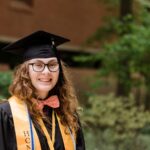
Featured image: Autumn Cook in graduation regalia on Academic Row, May 2021. Photo by Marlayna Demond ’11 for UMBC.
Article written by Eleanor Lewis, communication specialist in the Division of Student Affairs.
]]>
On the back of every UMBC black and gold ID card is a guide to essential emergency resources, including numbers for health, counseling, sexual assault, and suicide prevention helplines. The new...
https://umbc.edu/stories/umbcs-newest-grads-leave-a-legacy-of-advocacy-inclusion-and-support-for-fellow-students/
https://my3.my.umbc.edu/api/v0/pixel/news/119628/guest@my.umbc.edu/bdbca95944d4acd3d148406ef2ce0aa4/api/pixel
cahss
chemistry
classof2021
cnms
community
gwst
page1
psychology
shadygrove
socialwork
womenscenter
UMBC News & Magazine
https://my3.my.umbc.edu/groups/umbc-news-magazine
https://assets1-my.umbc.edu/system/shared/avatars/groups/000/001/943/24435aa6207c452e7bc15cc74b42c7bb/xsmall.png?1748556657
https://assets1-my.umbc.edu/system/shared/avatars/groups/000/001/943/24435aa6207c452e7bc15cc74b42c7bb/original.png?1748556657
https://assets2-my.umbc.edu/system/shared/avatars/groups/000/001/943/24435aa6207c452e7bc15cc74b42c7bb/xxlarge.png?1748556657
https://assets2-my.umbc.edu/system/shared/avatars/groups/000/001/943/24435aa6207c452e7bc15cc74b42c7bb/xlarge.png?1748556657
https://assets3-my.umbc.edu/system/shared/avatars/groups/000/001/943/24435aa6207c452e7bc15cc74b42c7bb/large.png?1748556657
https://assets1-my.umbc.edu/system/shared/avatars/groups/000/001/943/24435aa6207c452e7bc15cc74b42c7bb/medium.png?1748556657
https://assets2-my.umbc.edu/system/shared/avatars/groups/000/001/943/24435aa6207c452e7bc15cc74b42c7bb/small.png?1748556657
https://assets1-my.umbc.edu/system/shared/avatars/groups/000/001/943/24435aa6207c452e7bc15cc74b42c7bb/xsmall.png?1748556657
https://assets2-my.umbc.edu/system/shared/avatars/groups/000/001/943/24435aa6207c452e7bc15cc74b42c7bb/xxsmall.png?1748556657
UMBC News & Magazine
0
0
false
Tue, 18 May 2021 20:41:12 -0400
Retrievers buck ‘traditional’ timelines and redefine success
Evangeline Kirigua—mother, grandmother, immigrant, community college transfer student, civic entrepreneur—might have felt like the epitome of a “non-traditional” college student, but as she got closer to other Returning Women Scholars in the Women’s Center at UMBC, she realized that her “different” story might not be so different after all.
Navigating school during the pandemic hasn’t been effortless for anyone, but the wealth of online classes has made it easier for adult learners (ages 25 and up) to think about returning for an unfinished degree, as seen through the success of the UMBC Finish Line program. This unusual time also marks a good period to pause and reevaluate how UMBC approaches the terms “traditional” and “non-traditional” students.
 Kirigua, center in blue dress with white collar, with other Returning Women Scholars and President Freeman Hrabowski. Photo courtesy of The Women’s Center.
As with many public research universities, nearly 50 percent of UMBC’s 11,000 undergraduates are transfer students, “so the notion that transfer students are ‘non-traditional’ is actually far from the truth,” says Chloe Terrell, UMBC’s Transfer Student Success coordinator in Off-Campus Student Services (OCSS). “Transfer students bring a wealth of knowledge and experiences to our campus,” she continues. “Without them, we wouldn’t be the vibrant community we are.”
Understanding your own worth
As a student at Prince George’s Community College (PGCC), Sandra Crespin-Melgar ’21, social work, was really excited about what she heard from Katie Morris, the program director at UMBC at the Universities of Shady Grove and an instructor of social work, about transfering to UMBC. Crespin-Melgar, a first-generation student, immigrant, and adult learner, had been nervous about pursuing her bachelor’s degree, even though she knew that was her goal.
 Headshot of Sandra Crespin-Melgar, courtesy of The Women’s Center.
“When I started to learn more about UMBC,” says Crespin-Melgar, “I liked that they put forth the effort to create a space that provided belonging to all students. And that was something that really attracted me—the different ways of creating community on campus.”
Talking with Morris, Ph.D. ’21, language, literacy, and culture, not only led Crespin-Melgar to apply to UMBC, but also to major in social work. “I’m someone who has gone through different experiences in higher ed,” says Crespin-Melgar. “And I think that people who come from immigrant communities, there’s a lot of things that we have to tackle as far as dealing with imposter syndrome or feeling like we don’t belong. Even that fear of applying, you ask yourself, ‘Am I worthy enough to be in those spaces or am I worthy enough to even succeed?’”
Seek help, give help
Crespin-Melgar, who is also a Returning Women Scholar, suggests that other students with similar doubts find support at the Counseling Center. “Talking with someone who can really listen to what you’re going through and can relate to some of the struggles as a person of color, or as a woman—there’s a lot that goes into owning those spaces and feeling like, ‘yes, I belong here and I’m working to receive my degree because I put so much work into it and there’s no less value in my work than anyone else.’ That’s my biggest take-away from my journey as an undergrad at UMBC.”
 Crespin-Melgar at an event hosted by The Women’s Center. Photo courtesy of The Women’s Center.
While finishing her degree, Crespin-Melgar is also working in recruitment and admissions at PGCC. This fall, she will pursue a master’s of social work at the University of Maryland, Baltimore. She says that her experience at UMBC has made her want to continue to work in higher education, helping guide other first-generation students and Latinx students like herself through the complicated process of college.
“I feel really prepared and confident that I’m walking away from a school that really lives up to their words,” says Crespin-Melgar. “They told me what they were going to do for me, and they did it.”
The backbone of UMBC
At UMBC’s Shady Grove campus, “All the students are transfer students,” explains Katie Morris. “A majority are working and balancing family responsibilities, and they all have a life outside of school,” she says. “Shady Grove provides a place for students who are in this similar situation to see others like them, build a community, connect with faculty, learn in the classroom, and find success if they make the commitment to their learning and attaining their degree.”
 Students mingle at the Shady Grove campus in 2019. Photo by Marlayna Demond ’11.
Across UMBC’s campuses, 80 percent of transfer students come in from community colleges, versus other four-year institutions. This makes the community college transfer experience a common way of joining the UMBC community.
OCSS serves commuter, transfer, veteran, and adult-learner student populations. “Often,” Chloe Terrell says, “we’re referred to as the hub for ‘non-traditional’ students, but my time here has shown me that the students we serve are the backbone of UMBC.”
A break for mental health
In that respect, Ting Huang ’21, psychology, followed a well-worn path to UMBC, even if it felt less straightforward at the time. Despite a full-ride to a four-year college right out of high school, Huang made the decision to attend Montgomery College to better suit the needs of her family. She also knew about the Transfer Student Alliance, which helps smooth the application process to certain Maryland schools after obtaining an associate’s degree.

Headshot provided by Ting Huang.
Huang thought the process was going smoothly, despite the stress she was feeling. But a frequent customer at the restaurant where Huang worked helped gently reframe her perspective when she asked if Huang was feeling OK. She looked much thinner than usual, the customer said.
“I thought, well, if a stranger seemed to care about me, maybe I could care about me,” says Huang. She called her high school mentor to talk through this revelation, then went home and closed her transfer application for a semester.
When Huang did enroll at UMBC, she was drawn to study social psychology because of her own experiences. “I feel that my own psyche is really impacted by my upbringing and by my interactions with my family and the world around me—especially as a first-gen immigrant, like the transition from being a child in China to being a teenager in the U.S.,” says Huang.
 Huang, top middle, at an online family game night with her fellow McNair scholars. Photo courtesy of Huang.
At UMBC, she became a McNair Scholar. The program provides mentorship and community for low-income, first-generation college students, and students from other underrepresented groups, while helping them hone their research tools to potentially pursue doctoral degrees. “The McNair program makes me feel like I can accomplish the graduate process,” says Huang. Next, she will pursue a master’s degree in experimental psychology at Towson University, with the long-term goal of teaching psychology at the university level.
Building confidence
Alicyn Curtis ’21, modern languages and linguistics, originally matriculated to UMBC in 2011, but left her studies after three years. “I liked what I was studying, especially Korean, but I didn’t have the drive or passion at the time,” says Curtis. “I’m one of those people who can’t simply do things because it looks good on a résumé. If I’m going to do anything, I’m going to do it because I like it. So I was very depressed and lost and needed to take some time off.”

Alicyn Curtis in Korea while she was teaching abroad. Photo courtesy of Curtis.
Curtis had the opportunity to move to Korea for three years, and she took it. She taught English there, but realized that in order to progress in that career, she’d need to finish her degree. In fall 2020, Curtis re-enrolled at UMBC having a more clear goal for her studies. With the help of her Korean advisor, Kyung-Eun Yoon, she is graduating after two final semesters.
“Being abroad built my confidence in myself,” says Curtis. “When I first started at UMBC, I was very shy and standoffish. I didn’t really reach out to other people—I just went to school and went home. But this time around, I thought, if I can live in a different country for three years and navigate around in a different language, I can do anything. And I brought that sense of competence with me when I returned to campus.”
 Curtis poses with one of the symbols of Seoul. Photo courtesy of Curtis.
For the past year, Curtis has worked as a peer advisor in the Education Abroad office, encouraging more students to gain life skills and confidence overseas when the pandemic permits. Overall, of her time back at UMBC, Curtis says, “I never felt alienated because I’m technically ‘non-traditional.’ I felt just like a regular student on campus.”
Lifelong learners
Gayle Chapman ’21 also found a home in modern languages and linguistics, but that’s not the only home she has on campus. She’s worked at UMBC since 2002, and is now the assistant controller in Financial Services.
Chapman earned her master’s in public policy in 2011. A decade later, she is earning a second undergraduate degree in Russian. Her sons are also UMBC alumni: Daniel Chapman ’02, mathematics, ’03, physics; and David Chapman ’06, M.S. ’08, Ph.D. ’12, computer science—an assistant professor of computer science and electrical engineering at UMBC.
 Headshot courtesy of Gayle Chapman.
“I am not your traditional student, but a lifelong learner,” shares Chapman, who is also a member of the Russian Club and sings in the UMBC Russian Choir. “It is vitally important, in my opinion, to continue to broaden your knowledge and perspective of this world, and there is no better way than to study a major language and culture in our world.”
Chapman is in good company among other lifelong learners at UMBC. Jim Kruger ’13, political science, M.P.P. ’14, will complete his Ph.D. in public policy this spring at the age of 71. Kruger, spent his career in waste management and after retirement wanted to impact that field as a researcher. That goal, in addition to his love of learning, kept him coming back to the classroom.
 Jim Kruger and his wife Kathy on the bench they donated to UMBC. Photo by Marlayna Demond ’11.
During Kruger’s time on campus, UMBC and the University of Maryland, Baltimore partnered to become Maryland’s first “age-friendly” universities. They join 58 institutions worldwide that make up the Age-Friendly University Global Network, led by Dublin City University in Ireland.
No one “right” way
When Kirigua moved from Kenya to the United States in 2002, she put all her time and effort into finding a job and helping her children adjust to a new country. She told herself she’d attend to her own education after her son Joel graduated from college. True to her own word, before she heard Michelle Obama give the graduation address to her son’s college in 2016, Kirigua had enrolled at Montgomery College.

Kirigua with her son Joel (in pink) and his friends at the Lincoln Memorial in D.C.
“For me, personally, if you have something that you have a purpose to do—if you don’t do it—you owe yourself something,” says Kirigua. Pursuing higher education became her priority. “When you’re making that sacrifice, you don’t feel like someone is making you do it. You know you’re doing it for yourself.”
After transferring to UMBC in 2018, Kirigua has found fellowship through the Returning Women Scholars program—it’s been encouraging to hear the other students’ stories. “I thought that this was just me,” says Kirigua, “but there are others like me and who have had to face even more challenging situations.”
“When an adult learner thinks they’re the only one in the classroom, it can make them feel like maybe they don’t belong,” says Jess Myers, Women’s Center director. “Perhaps it may reinforce that their experience is the ‘wrong way’ to do college. So, when you put 20-25 adult learners in a room and give them the space to center their experiences of being older, being parents, having a full life before coming to UMBC, it feels…magical. I see some students struggle with their journeys and then once they hear from someone who is like them, an automatic sense of solidarity forms.”
 Kirigua with Jess Myers at a USM Women’s Forum Conference. Photo courtesy of Myers.
That sense of connection has spurred Kirigua forward. After graduating this month, she will continue on at UMBC, pursuing a master’s in public policy.
Featured image: Chloe Terrell, left, in the center for Off-Campus Student Services in 2019. Photo by Marlayna Demond ’11.
]]>
Evangeline Kirigua—mother, grandmother, immigrant, community college transfer student, civic entrepreneur—might have felt like the epitome of a “non-traditional” college student, but as she got...
https://umbc.edu/stories/retrievers-buck-traditional-timelines-and-redefine-success/
https://my3.my.umbc.edu/api/v0/pixel/news/119636/guest@my.umbc.edu/2d09e3642b02f5eb61e4b7e410f4fe8a/api/pixel
cahss
classof2021
community
international
mlli
page1
political-science
psychology
publicpolicy
shadygrove
socialwork
womenscenter
UMBC News & Magazine
https://my3.my.umbc.edu/groups/umbc-news-magazine
https://assets1-my.umbc.edu/system/shared/avatars/groups/000/001/943/24435aa6207c452e7bc15cc74b42c7bb/xsmall.png?1748556657
https://assets1-my.umbc.edu/system/shared/avatars/groups/000/001/943/24435aa6207c452e7bc15cc74b42c7bb/original.png?1748556657
https://assets2-my.umbc.edu/system/shared/avatars/groups/000/001/943/24435aa6207c452e7bc15cc74b42c7bb/xxlarge.png?1748556657
https://assets2-my.umbc.edu/system/shared/avatars/groups/000/001/943/24435aa6207c452e7bc15cc74b42c7bb/xlarge.png?1748556657
https://assets3-my.umbc.edu/system/shared/avatars/groups/000/001/943/24435aa6207c452e7bc15cc74b42c7bb/large.png?1748556657
https://assets1-my.umbc.edu/system/shared/avatars/groups/000/001/943/24435aa6207c452e7bc15cc74b42c7bb/medium.png?1748556657
https://assets2-my.umbc.edu/system/shared/avatars/groups/000/001/943/24435aa6207c452e7bc15cc74b42c7bb/small.png?1748556657
https://assets1-my.umbc.edu/system/shared/avatars/groups/000/001/943/24435aa6207c452e7bc15cc74b42c7bb/xsmall.png?1748556657
https://assets2-my.umbc.edu/system/shared/avatars/groups/000/001/943/24435aa6207c452e7bc15cc74b42c7bb/xxsmall.png?1748556657
UMBC News & Magazine
0
0
false
Wed, 12 May 2021 20:39:50 -0400
UMBC launches Biotech Boot Camp to train workers displaced by COVID-19 for in-demand jobs

This month, 11 Montgomery County residents completed a pilot Biotech Boot Camp offered by UMBC at the Universities at Shady Grove and Montgomery College. The participants were all people who had recently become unemployed or underemployed due to the pandemic. After four weeks of intensive, hands-on training in basic biotech techniques, they are now qualified to apply for in-demand, entry-level roles in the biotech industry.
While some industries have experienced significant setbacks and lost jobs during the pandemic, the biotech industry has seen explosive growth. Hundreds of biotech companies in the region are struggling to fill critical roles with qualified workers. The new program seeks to address this mismatch between available workers and available jobs.
A participant in the Biotech Boot Camp practices his skills at a fume hood. Photo by Elizabeth Friar.
UMBC and Montgomery College partnered with WorkSource Montgomery to identify eligible participants for a skills-based introductory training course. With the support of the Montgomery County government, the experience was tuition-free for participants.
Setting people up to succeed in well-paying new jobs and simultaneously filling the gap in the biotech workforce “is a win-win that we’re really excited to be a part of,” says Annica Wayman ‘99, M6, mechanical engineering. Wayman serves as associate dean for Shady Grove Affairs in UMBC’s College of Natural and Mathematical Sciences.
Leveraging skills
Some of the participants came to the program from lengthy careers in other fields, from sales to transportation. “We’re looking for ways to tie what they used to do to biotech, now that they have these new lab skills,” Wayman says. “We’re trying our best to be matchmakers—we’re racing to do that now.”
Manik Ghosh, assistant director of the Translational Life Science Technology degree program laboratories at UMBC-Shady Grove, is the lead instructor for the boot camp. He is confident that the training he designed will set participants up for success. “If they get interviewed, and they get an opportunity to join a company, we are 100 percent sure that they are capable of entry-level work,” he says.
 A participant in the Biotech Boot Camp loads samples into an incubator. Photo by Elizabeth Friar.
Because they already have extensive work experience, some of the participants may quickly ascend into mid-level positions. These roles can be especially difficult for companies to fill because of a pipeline gap.
“Leveraging their prior skills could be a great way for them to build mid-level careers in biotech very quickly,” Wayman says. A few have also already expressed interest in UMBC’s Master of Professional Studies in Biotechnology, which would help them rise even faster.
Seizing opportunity
When he heard about the project, “I got so excited!” recalls Ghosh, who also teaches courses on cancer biotechnology and biochemistry. His enthusiasm is impossible to ignore; his laughter and smile come easily as he recalls the experience of planning the boot camp and implementing it with the students. He described the planning group, including Wayman; Elizabeth Friar, TLST program director; and himself, as a “dream team.”
Offering the boot camp in person was challenging during the pandemic, though, with everyone masked, gloved, and maintaining social distance. “It’s a very dynamic and challenging environment,” Ghosh says. But at the same time, “This was a great opportunity for us, because this is a pilot program. We got a lot of great experience for if we run another boot camp, so we can change accordingly.”
Seated at a safe social distance, participants in the Biotech Boot Camp use microscopes to observe their samples. Photo by Gabrielle Miller
Optimism in a challenging time
On top of generating a blueprint for future programs, developing the students’ lab skills, and supplying local businesses with qualified talent, the boot camp offered something even more valuable to the participants: confidence and optimism.
“It’s been amazing,” Ghosh says. “The first day, when they joined the boot camp, they looked nervous because they didn’t know anything about biotech. But as time passed, we saw a significant change in their confidence level.”
For the participants who identify with groups underrepresented in STEM, Wayman has been an inspiring presence. “Just me being an African American woman in the sciences has been encouraging for them to know that there are people like them succeeding in this high tech industry, so they can do it, too,” she says.
Wayman has also been working with the students on their resumes and supporting them through personal challenges. “It’s been amazing to make these personal connections in such a short period of time.”
Kevin Wiglesworth came to the program from a long career in sales. Now he’s excited to blaze a new path. “The most exciting thing about camp was taking something I had no experience with and feeling confident in those skills when the camp was over. It proved to me I still have the ability to pursue a new career,” he shared in a note to Ghosh after the program concluded. “Thank you again for all the work you put into teaching a newbie like me. I’ll never forget that.”
Working with students like Wiglesworth “is a great feeling, because I know we worked very hard, and they worked very hard with us,” Ghosh says. “This is a very challenging time, and at the end of the day, we are very satisfied in our hearts because we helped the people who needed it.”
Banner image: The exterior of the Biomedical Sciences and Engineering Building at The Universities at Shady Grove. Dedicated in 2019, the building contains the labs where the Biotech Boot Camp took place. Photo courtesy of USG.
]]>
This month, 11 Montgomery County residents completed a pilot Biotech Boot Camp offered by UMBC at the Universities at Shady Grove and Montgomery College. The participants were all people who had...
https://umbc.edu/stories/umbc-launches-biotech-boot-camp-to-train-workers-displaced-by-covid-19-for-in-demand-jobs/
https://my3.my.umbc.edu/api/v0/pixel/news/119680/guest@my.umbc.edu/7d4dd171bb76413c6430643bd1b85cbf/api/pixel
cnms
science-and-technology
shadygrove
tlst
UMBC News & Magazine
https://my3.my.umbc.edu/groups/umbc-news-magazine
https://assets1-my.umbc.edu/system/shared/avatars/groups/000/001/943/24435aa6207c452e7bc15cc74b42c7bb/xsmall.png?1748556657
https://assets1-my.umbc.edu/system/shared/avatars/groups/000/001/943/24435aa6207c452e7bc15cc74b42c7bb/original.png?1748556657
https://assets2-my.umbc.edu/system/shared/avatars/groups/000/001/943/24435aa6207c452e7bc15cc74b42c7bb/xxlarge.png?1748556657
https://assets2-my.umbc.edu/system/shared/avatars/groups/000/001/943/24435aa6207c452e7bc15cc74b42c7bb/xlarge.png?1748556657
https://assets3-my.umbc.edu/system/shared/avatars/groups/000/001/943/24435aa6207c452e7bc15cc74b42c7bb/large.png?1748556657
https://assets1-my.umbc.edu/system/shared/avatars/groups/000/001/943/24435aa6207c452e7bc15cc74b42c7bb/medium.png?1748556657
https://assets2-my.umbc.edu/system/shared/avatars/groups/000/001/943/24435aa6207c452e7bc15cc74b42c7bb/small.png?1748556657
https://assets1-my.umbc.edu/system/shared/avatars/groups/000/001/943/24435aa6207c452e7bc15cc74b42c7bb/xsmall.png?1748556657
https://assets2-my.umbc.edu/system/shared/avatars/groups/000/001/943/24435aa6207c452e7bc15cc74b42c7bb/xxsmall.png?1748556657
UMBC News & Magazine
0
0
false
Fri, 26 Feb 2021 02:10:08 -0500


