$21M Sherman Family Foundation gift supports UMBC’s bold commitment to PreK-12 research, teaching, and learning

The largest gift in the history of UMBC—a $21 million donation from the Sherman Family Foundation—will dramatically expand the reach and impact of the university’s K-12 and early childhood education work. The transformational gift will provide funding to launch the Betsy & George Sherman Center as a national model to advance excellence in urban schools. This new center will expand and integrate UMBC’s work in teacher preparation, school partnerships, and applied research focused on early childhood education and improving learning outcomes for Baltimore’s students.
“If universities are to be major contributors to the development of society, they have to be involved with the schools and with neighborhoods and with communities,” says UMBC President Freeman Hrabowski. “Betsy and the Sherman Family Foundation have provided us with invaluable resources to make this collaborative work possible.”
“This gift represents a clear and bold commitment to developing teachers that can better support future generations of students in Baltimore City, especially in early learning and STEM,” said Sonja Brookins Santelises, chief executive officer of Baltimore City Public Schools. “It also expands the research partnership between City Schools and the university in ways that will further enhance teaching and learning in our community. We are excited about this next great step.”
Investing in education
Prior gifts from the Sherman Family Foundation supported the launch of UMBC’s Sherman Center for Early Learning in Urban Communities as well as the Sherman STEM Teacher Scholars program, which prepares UMBC students as culturally responsive and compassionate STEM educators. The Betsy & George Sherman Center will include these programs and more.

President Freeman Hrabowski and Betsy Sherman with students at Lakeland Elementary/Middle School.
Betsy and George Sherman’s philanthropy in STEM education has been inspired by Mrs. Sherman’s career in early childhood education and the late Mr. Sherman’s experience as an engineer and business leader. Their family foundation has now invested more than $38 million in UMBC’s education initiatives.
The Shermans have shared with UMBC a deep commitment to children’s equal access to high-quality education and a supportive community. “It is our job as the adults in the community to offer them an opportunity to grow in a way that will support them,” says Mrs. Sherman. “When a university is connected to a city, children thrive, families thrive.”

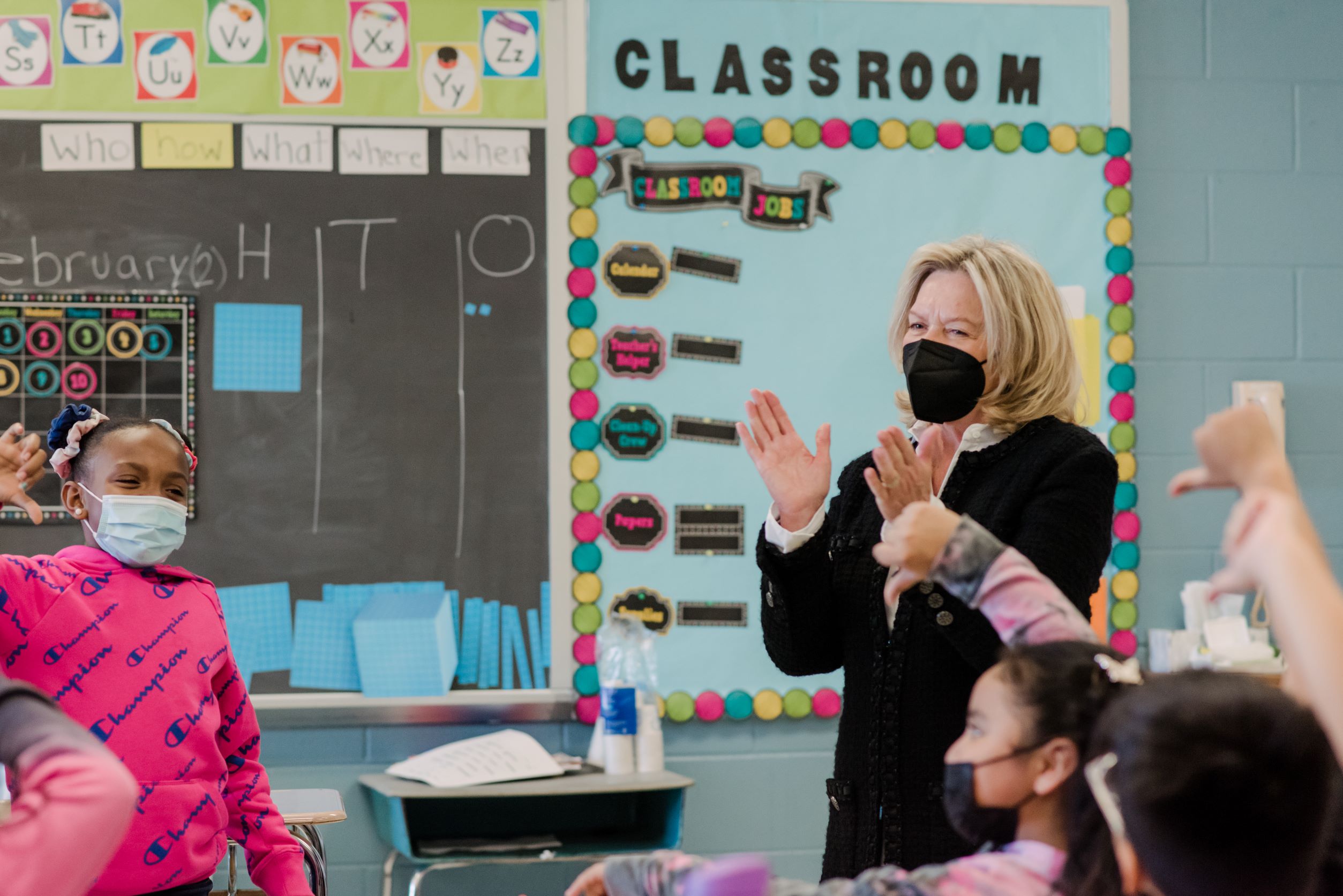
Betsy Sherman joins in a rhyming practice activity with students at Lakeland.
Meeting STEM needs
The Sherman STEM Teacher Scholars program, founded with the support of the Shermans in 2006, prepares UMBC undergraduate and graduate students from all majors to become highly qualified PreK-12 teachers with a focus on STEM education.
Lakeland Elementary/Middle School, in south Baltimore, was the first school to partner with UMBC through this program. Over the past decade, it has become a model of a full-service community school in Baltimore City. Among other exciting results, Lakeland now has a Community and STEAM Center, and the school has seen notable increases in students’ math test scores.
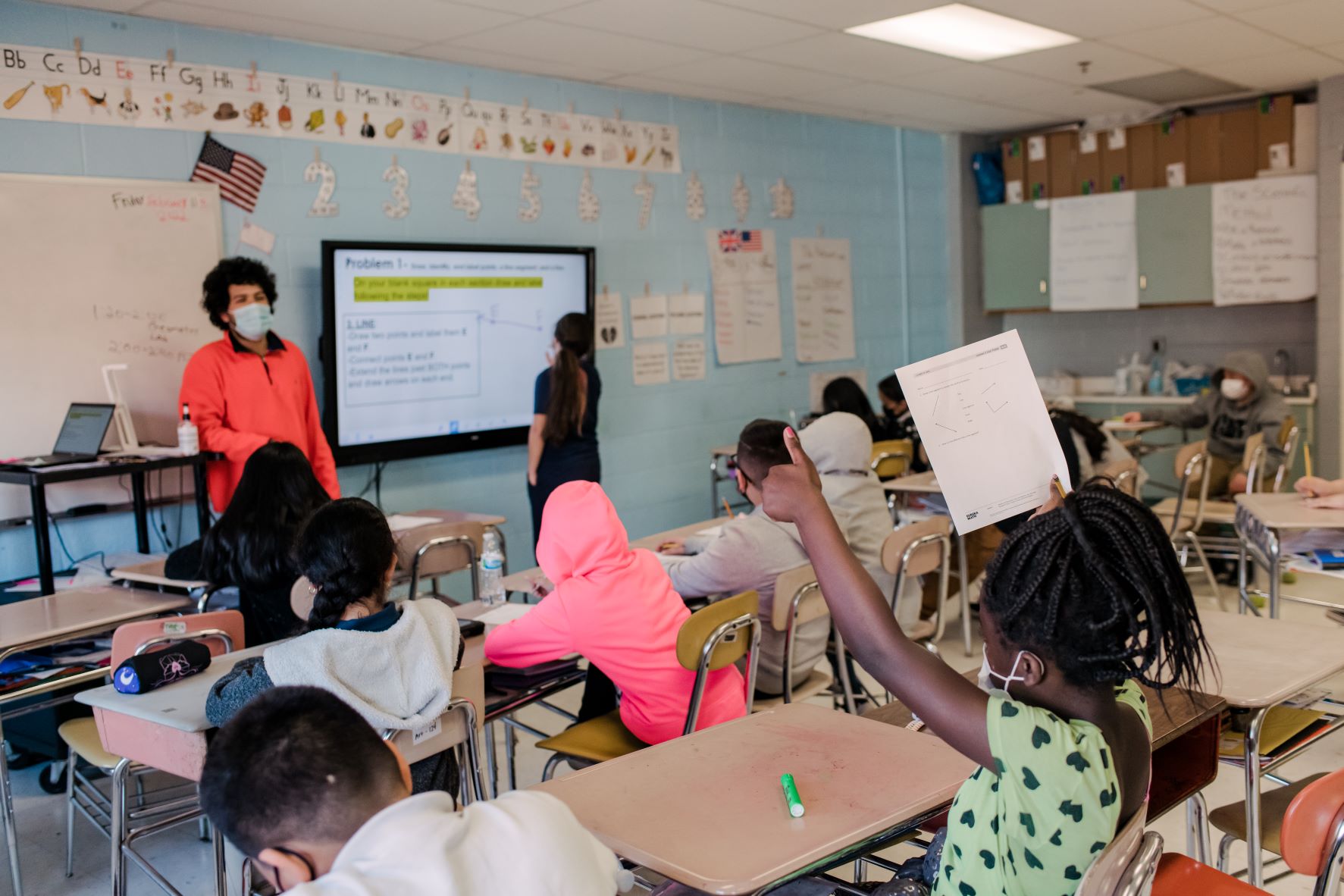
 Gustavo Sanabria
 ’22, American studies, and current Sherman Scholar, is completing a certificate in elementary education while serving as a long-term 4th-grade substitute teacher.
The Sherman Scholars program now partners with ten schools to promote academic achievement through professional development for teachers and intensive tutoring for students. For example, more than 90 UMBC students, including Sherman Scholars and others, provide evidence-based math tutoring for over 350 elementary and middle school students in several schools across Baltimore. Early data show this approach is working.
Moving the needle
Rehana Shafi, director of the Sherman Scholars program, remembers the program’s first steps with fondness. “It started off with an investment that we wanted to use to figure out, with the right sorts of support in place—teacher professional development, after school activities for kids, and community engagement—how could we really move the needle for Lakeland’s students and their families,” explains Shafi.
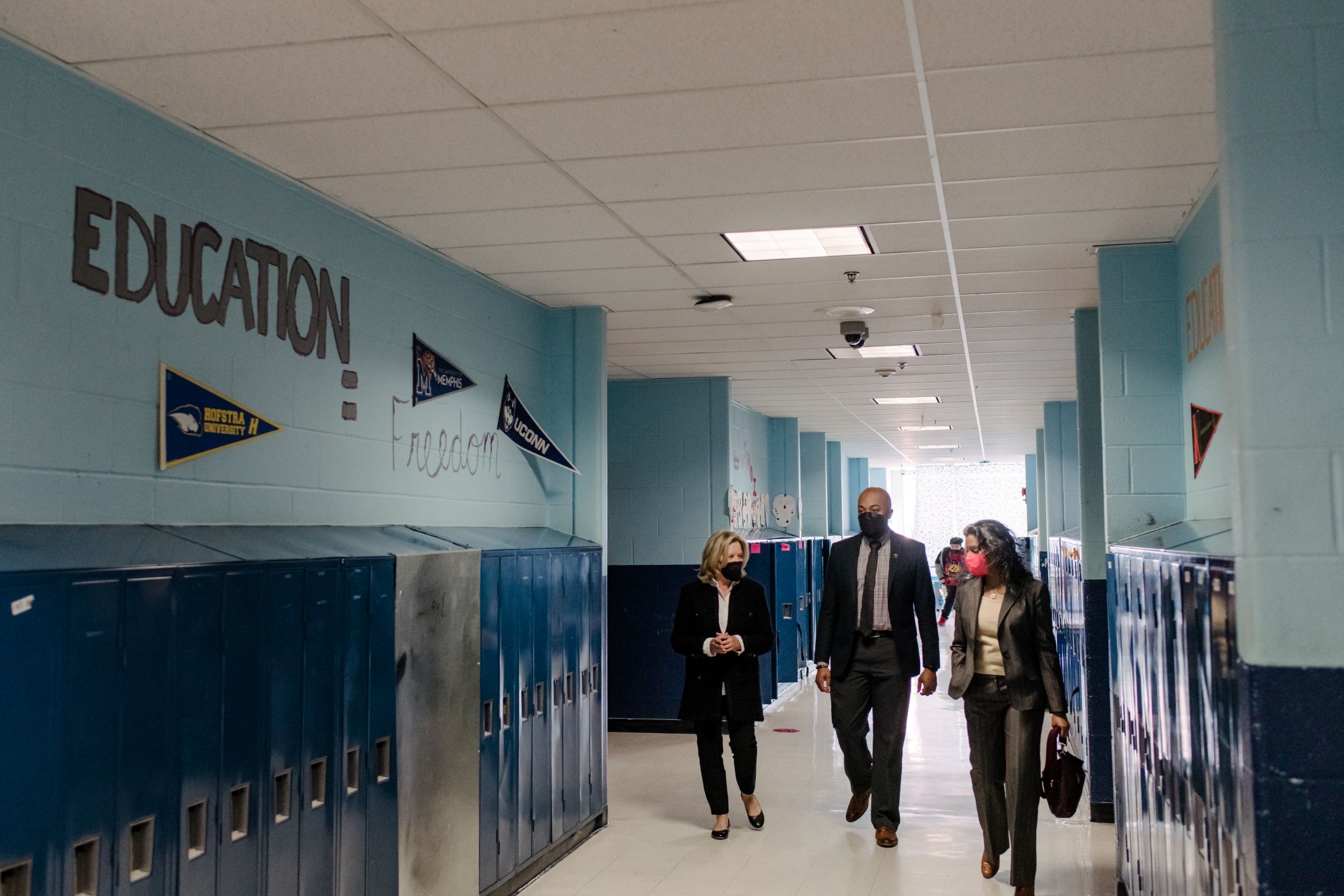
 (L-R) Betsy Sherman, with Corey Carter, and Rehana Shafi at Lakeland.
In 2021, the program graduated 22 scholars, 19 of whom are teaching in Baltimore City. Over the past 15 years (since 2007), the program has yielded 170 educators who are now teaching across the Baltimore region, the state of Maryland, and beyond, often in the most vulnerable school communities. An additional 20 conditionally certified teachers have been supported since 2020–educators meeting critical classroom needs while working to complete M.A.T. degrees.
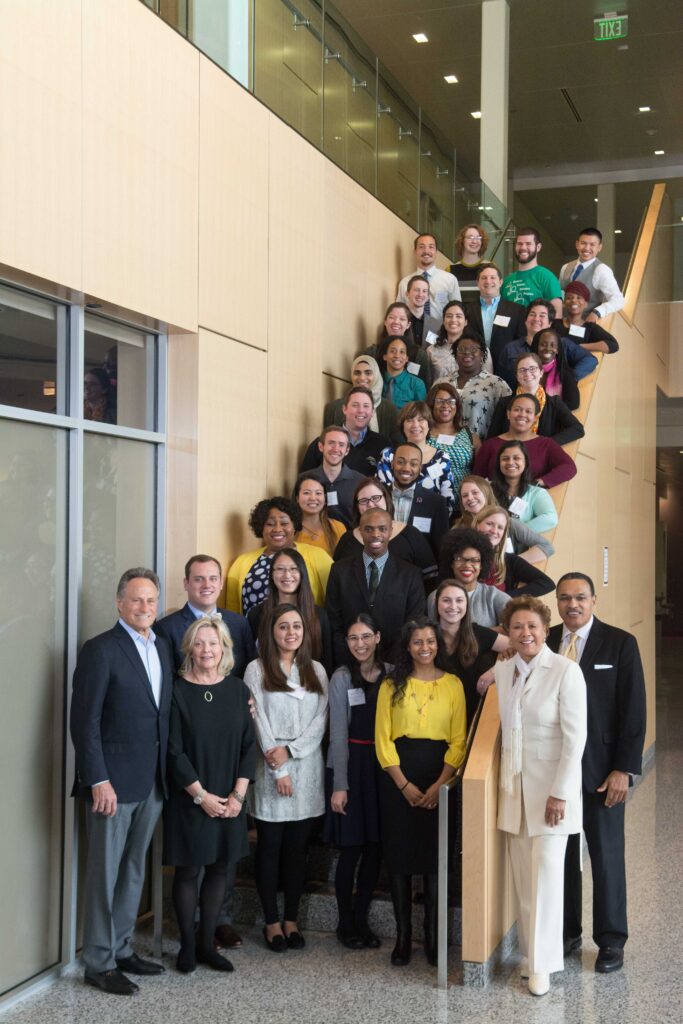
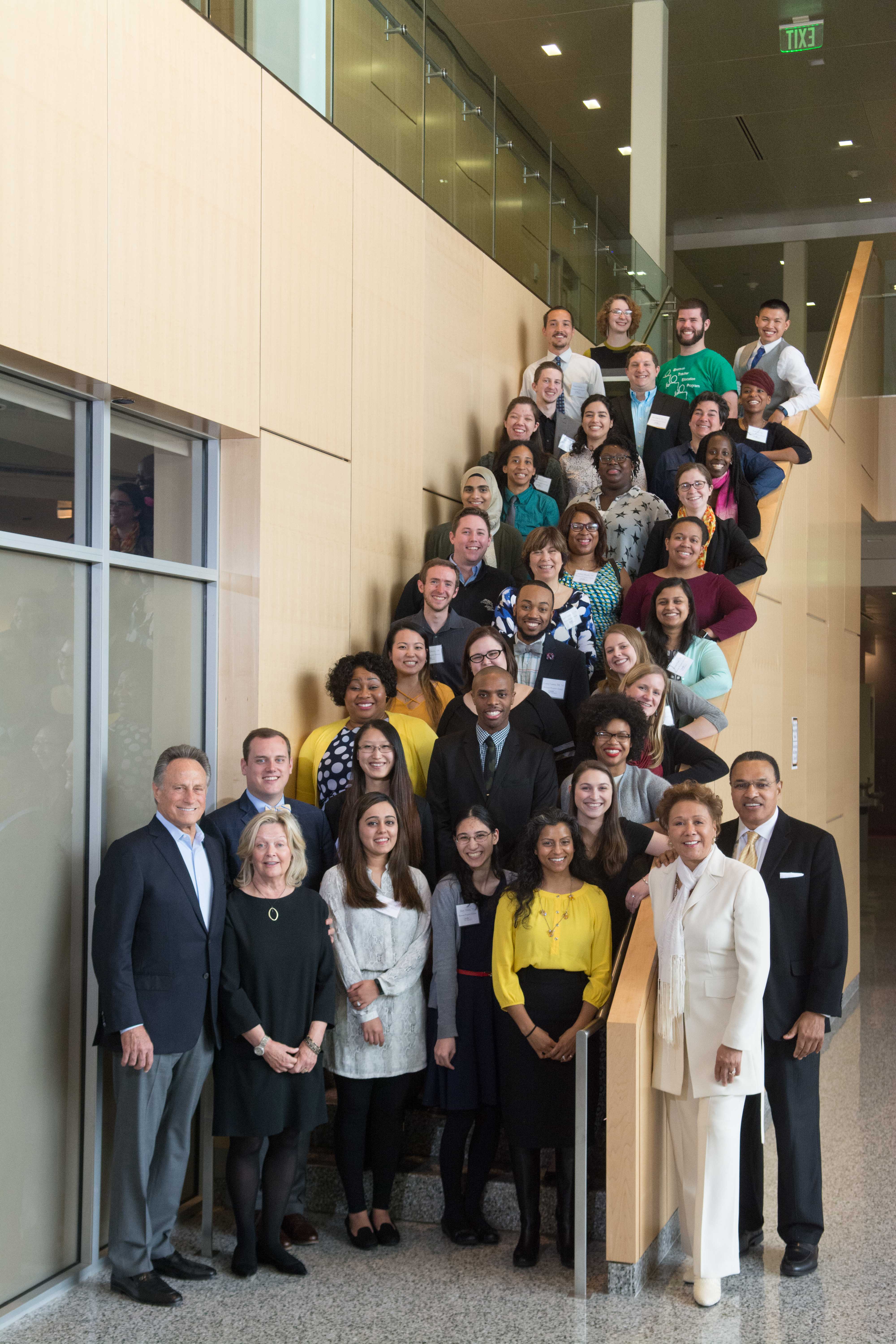
George and Betsy Sherman (front row, left) with President Freeman Hrabowski and Jacqueline Hrabowski (front row, right) next to Rehana Shafi (front row, in yellow) at the Sherman Scholars 10-year anniversary held on April 1, 2017.
More than a decade into the work, Shafi is proud of the strong collaborations that have developed. “Partnering with schools and with communities to walk together through the process of growth and dreaming and achieving…it’s what the work really is about,” she says.
Reflecting on this successful partnership model, she notes, “The work that we’re doing is ready to grow and expand, preparing even more teachers for classrooms across Maryland.”
Focus on early childhood
This new gift will also enable the expansion of UMBC’s early childhood programs. “I am excited to continue to grow our programming and further extend the impact and support for early childhood education,” shares Jennifer Mata-McMahon, director of the Sherman Center for Early Learning in Urban Communities and associate professor of early childhood education.

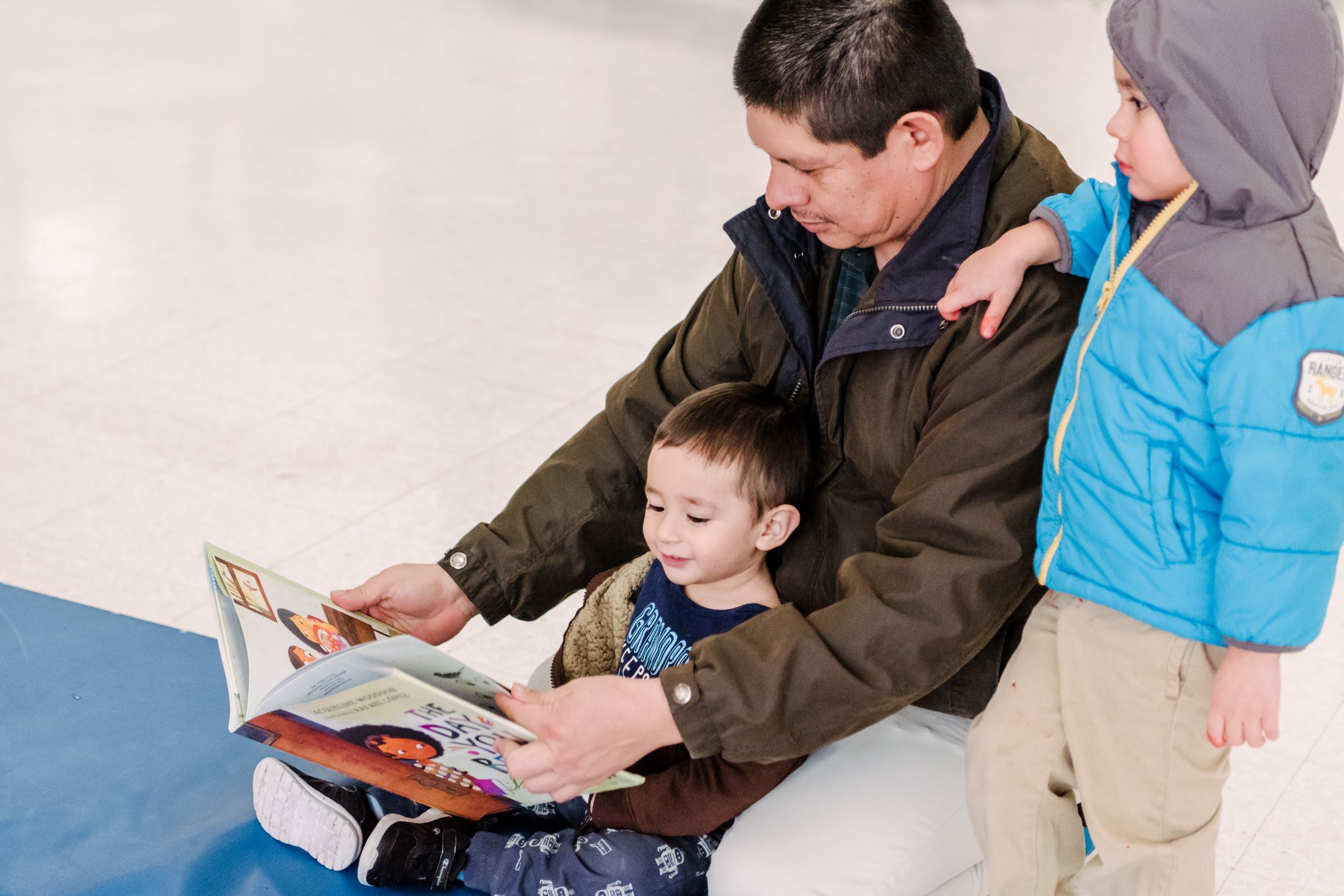
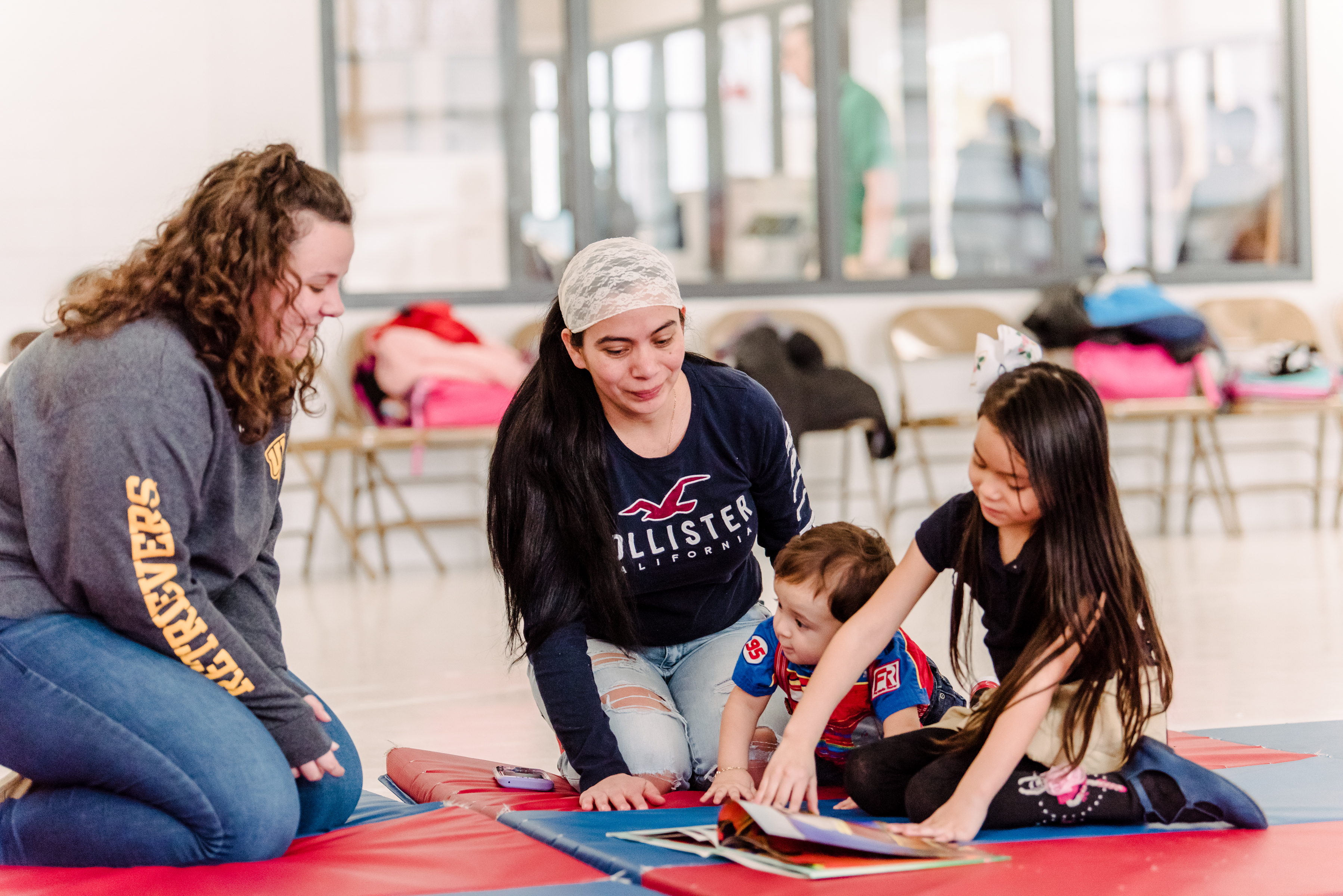
Lakeland community member at a Families, Libraries, and Early Literacy Project event.
In the last four years, the center has implemented four highly successful programs developed with and for teachers and families across five Baltimore City Schools: the Literacy Fellows Program in collaboration with UMBC’s Shriver Center, the Diverse Books Project, the Teacher Summer Institute, and the Families, Libraries, and Early Literacy Project. Hundreds of families have benefited from these programs.
UMBC’s students volunteer over 400 hundred hours a year in partner schools. Participating teachers receive research-based skill development and funding for teaching materials.
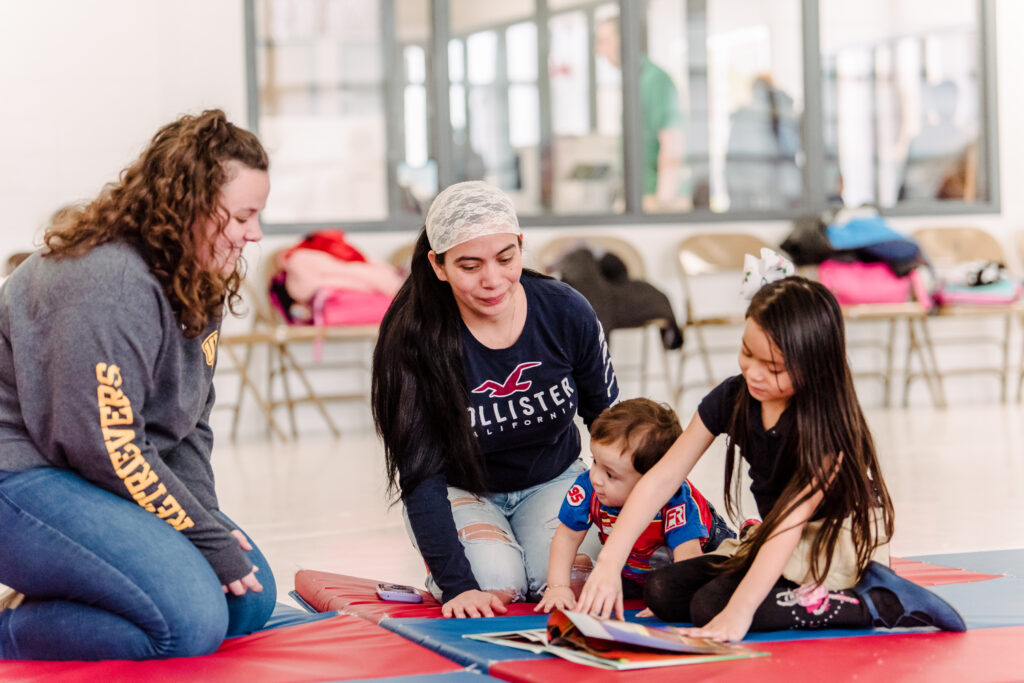 Olivia Grimes
 ’19, individualized study, Sherman Scholar alum and former Sherman Center program assistant, at left, with a Lakeland family in 2020.
The center also invests in community-engaged early childhood research to evaluate learning interventions, academic growth, social-emotional wellbeing, behavioral outcomes, and education policy with faculty across the College of Arts, Humanities, and Social Sciences (CAHSS).
Through its annual Faculty Research Award program, the center provides funding for new research projects. Past recipients have studied topics like Judy Centers in Baltimore, reading interventions, and culture-based computational thinking in urban preschools. Prior awardees have shared with the public their high-impact community-engaged scholarship on different ways to teach kids to read and math skills to prepare children for kindergarten.
“The College remains inspired by the enduring commitment of the Sherman family to urban education. This gift affords CAHSS faculty with the resources needed to further education research and practice,” shares Kimberly Moffitt, interim dean of CAHSS and professor of language, literacy, and culture. She is thrilled that UMBC students will have even more opportunities to work with PreK-12 students throughout Baltimore who are “deserving of dedicated teachers who believe in their abilities and their aspirations for the future.”
“This gift lays out the charge and we stand ready to fulfill it,” says Moffitt.

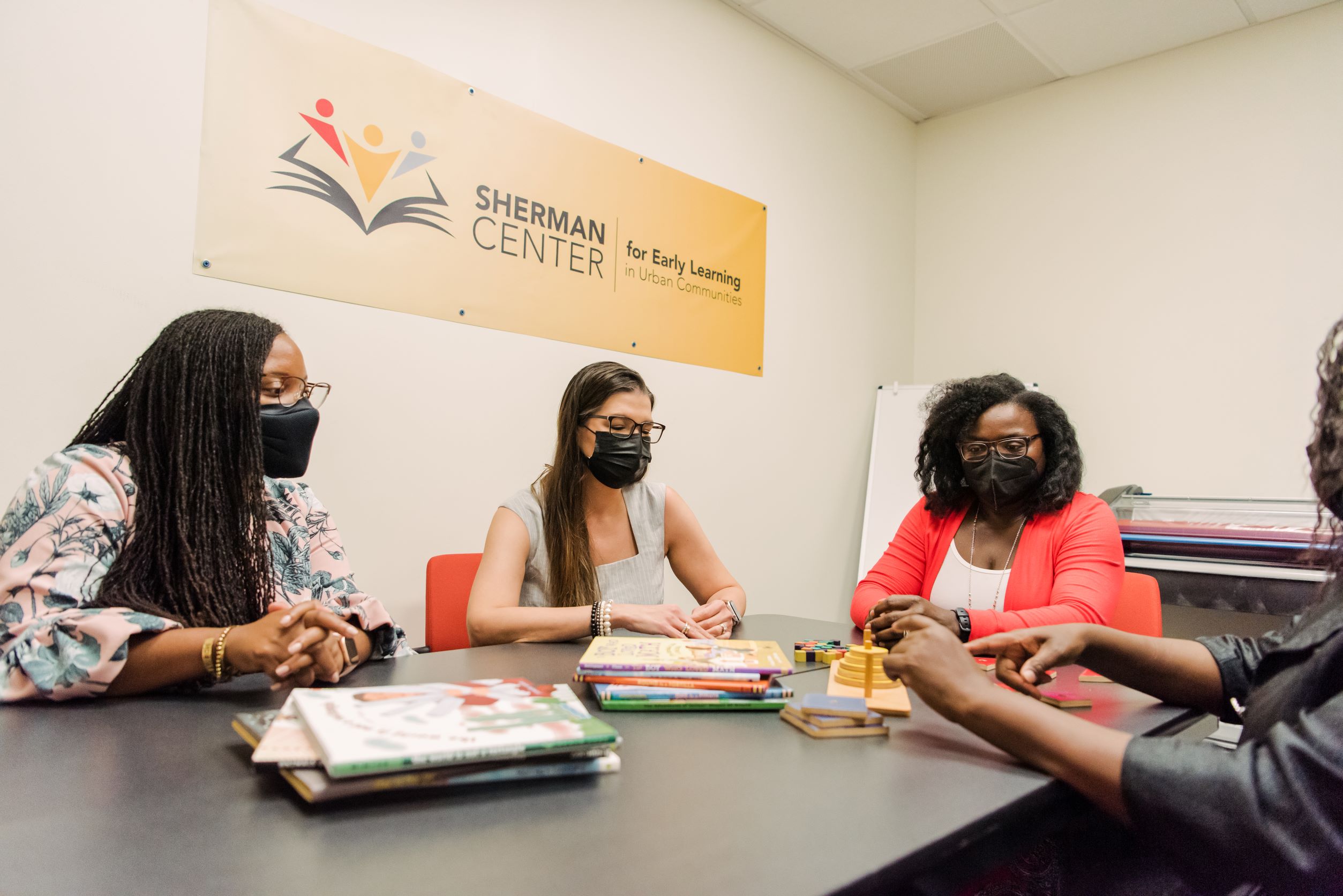
(L -R)
Shana Rochester, the center’s assistant director and research associate,
with Mata-McMahon, and
Patricia Young, professor of education, and 2020 recipient of the Faculty Research Award.
Scaling and expanding programs
In addition to supporting research and classrooms directly, the center also advances the field by providing leadership development to early childhood educators across the state through the Maryland Early Childhood Leadership Program, which started its third cohort in 2021.
“The new funding will not only ensure the scaling of these programs, but also support new initiatives like Breathe2Think and the Sherman Center Research Conference,” says Mata-McMahon. She is leading the implementation of both programs to further support teachers’ well-being and develop teachers’ skills as action researchers.
“This is about sustainability over time and long-lasting impact in urban communities,” she says.
Full circle
The ripple effect of the Sherman family’s investment is beginning to come full circle. UMBC’s Sherman Scholar alumni are now teaching in Baltimore City classrooms and beyond, preparing the next generation of change-makers. And one scholar has returned to UMBC to share his on-the-ground experience with UMBC students just beginning their journey as future teachers.
Sherman Scholar alum Corey Carter ’08, biological sciences, ’10 M.A.T., taught in both Baltimore City and Baltimore County Public Schools after graduating from UMBC. In 2016, Baltimore County Public Schools honored him as Teacher of the Year. Seeking to expand his impact as an educator in a new way, he returned to UMBC to serve as assistant director of the Sherman Scholars program.

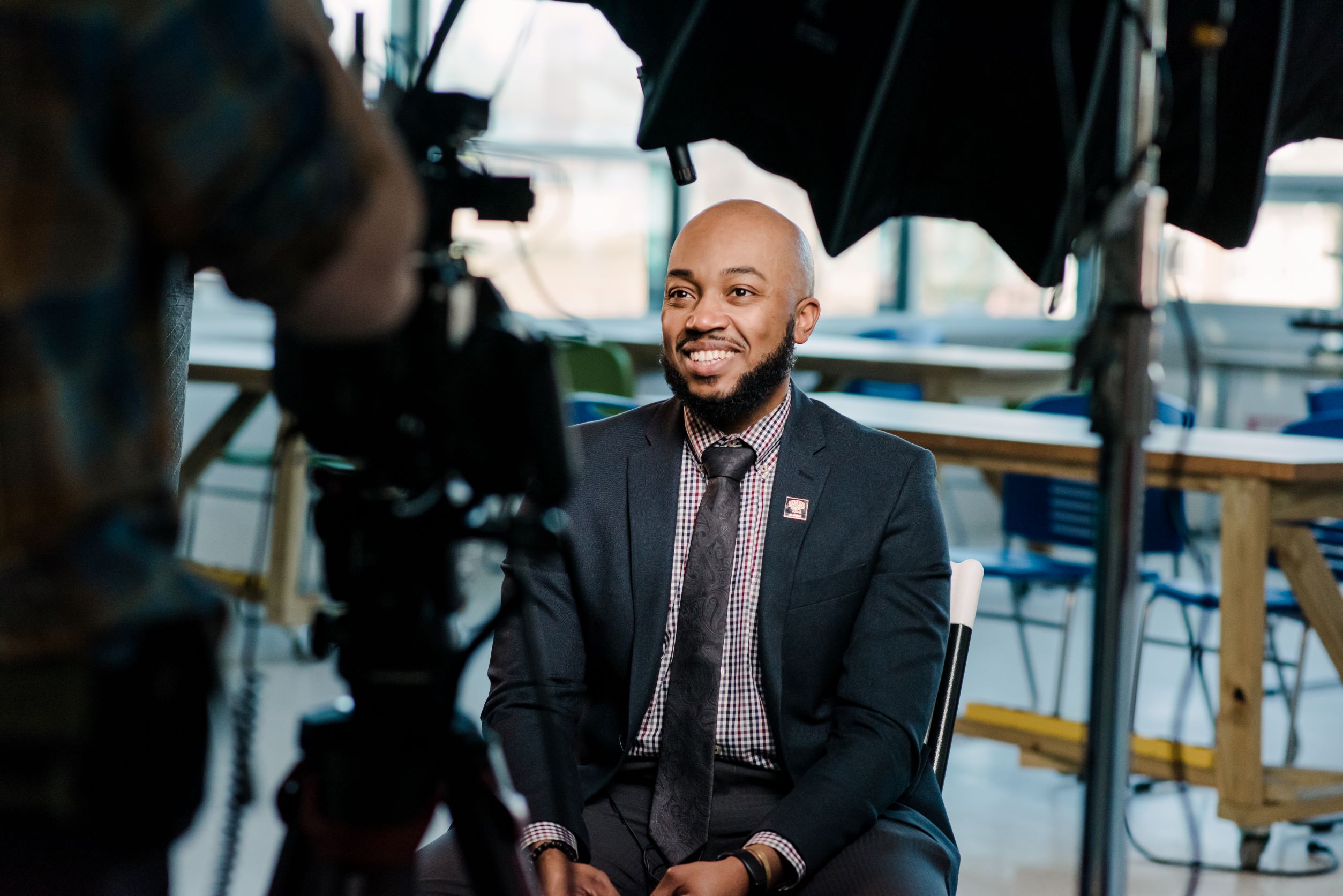
Corey Carter at Lakeland.
“I didn’t see myself in the classroom immediately when I came to UMBC,” says Carter. Without the Sherman STEM Teacher Scholars program, and the opportunities and guidance it provided, he isn’t sure that he would have found his way to the classroom. Now he sees the power of collaboration between universities and schools, fueled by philanthropy, to advance an education system truly centered around students and families.

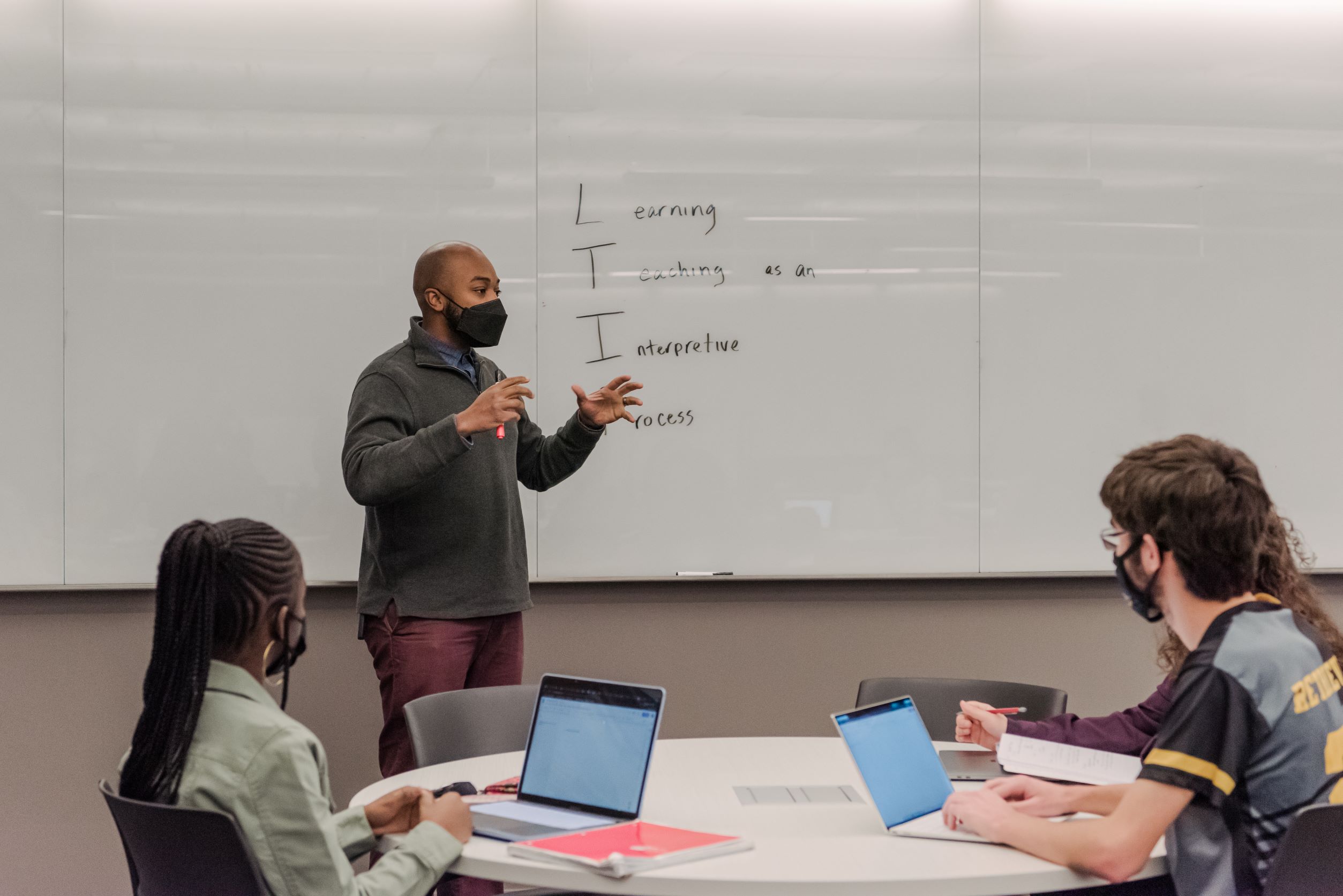
Corey Carter leads a group activity at UMBC.
As Carter supports the work of the new Betsy & George Sherman Center, he’s excited to see it expand even further. “The impact that we all can bring when we come together to the table—with community, university, and school staff—is a really powerful example,” he says. “I look forward to building our vision together and seeing this energy and momentum spread throughout Baltimore.”
Banner image: Betsy Sherman at Lakeland Elementary/Middle School. All photos by Marlayna Demond ’11 for UMBC.
Video by Corey Jennings ’10 for UMBC.
]]>
The largest gift in the history of UMBC—a $21 million donation from the Sherman Family Foundation—will dramatically expand the reach and impact of the university’s K-12 and early childhood...
https://umbc.edu/stories/21m-sherman-family-foundation-gift-supports-umbcs-bold-commitment-to-prek-12-research-teaching-and-learning/
https://my3.my.umbc.edu/api/v0/pixel/news/119472/guest@my.umbc.edu/1b98fc95d8c7d959b99db46c024c3543/api/pixel
americanstudies
biology
cahss
community
education
inds
news
page1
science-and-tech
shermancenter
shermanscholars
UMBC News & Magazine
https://my3.my.umbc.edu/groups/umbc-news-magazine
https://assets1-my.umbc.edu/system/shared/avatars/groups/000/001/943/24435aa6207c452e7bc15cc74b42c7bb/xsmall.png?1748556657
https://assets1-my.umbc.edu/system/shared/avatars/groups/000/001/943/24435aa6207c452e7bc15cc74b42c7bb/original.png?1748556657
https://assets2-my.umbc.edu/system/shared/avatars/groups/000/001/943/24435aa6207c452e7bc15cc74b42c7bb/xxlarge.png?1748556657
https://assets2-my.umbc.edu/system/shared/avatars/groups/000/001/943/24435aa6207c452e7bc15cc74b42c7bb/xlarge.png?1748556657
https://assets3-my.umbc.edu/system/shared/avatars/groups/000/001/943/24435aa6207c452e7bc15cc74b42c7bb/large.png?1748556657
https://assets1-my.umbc.edu/system/shared/avatars/groups/000/001/943/24435aa6207c452e7bc15cc74b42c7bb/medium.png?1748556657
https://assets2-my.umbc.edu/system/shared/avatars/groups/000/001/943/24435aa6207c452e7bc15cc74b42c7bb/small.png?1748556657
https://assets1-my.umbc.edu/system/shared/avatars/groups/000/001/943/24435aa6207c452e7bc15cc74b42c7bb/xsmall.png?1748556657
https://assets2-my.umbc.edu/system/shared/avatars/groups/000/001/943/24435aa6207c452e7bc15cc74b42c7bb/xxsmall.png?1748556657
UMBC News & Magazine
0
0
false
Thu, 24 Feb 2022 18:00:09 -0500
Patricia Young’s new book explores emerging ed-tech trends and how COVID has changed the future of the field

COVID-19 has fast-forwarded tech innovation, propelling millions of people to shift, nearly overnight, to virtual learning, remote work, and online health care. Patricia Young’s new book, Human Specialization in Design and Technology: The Current Wave for Learning, Culture, Industry, and Beyond (2021, Routledge), traces moments in history that have sparked or dampened innovation in instructional design and technology across industries.
Young, an associate professor of education at UMBC, examines the impact of those innovations on our current political, social, health, economic, and educational climate. She also provides insight on how to move forward more effectively, particularly in the education space.
“COVID has already changed the way we think and approach technology innovation,” says Young. “These are reasons why educational technologies and technology-enhanced learning must keep pace with trends in design and technology.”
Instructional technology
Young’s work over the last seventeen years at UMBC has centered around innovation in instructional technology. Her research integrates her background in media and communications with education to study culture-specific information and communication technologies.
During research for her second book, for example, Young led an instructional design software project in collaboration with UMBC’s Nilanjan Banerjee, professor of computer science and electrical engineering. They mentored fifteen computer science graduate students in developing prototypes for a mobile learning analytics tool, Proticy.
The goal of the software, which is still in its prototype phase, is to provide professors with pedagogical strategies to diminish bias and increase student retention. It also offers measurement tools to reduce bias in faculty evaluations.
In the process of creating prototypes, the students gained knowledge and experience in product design and developing an instructional technology application. The project has also helped them experience the client and designer relationship.
 Young (L) and Deborah Kabura Kariuki (R).
Computational thinking
Young’s first book, Instructional Design Frameworks and Intercultural Models (IGI, 2009), outlines the Culture Base Model as a framework for designing information and communication technologies. In the book, Young examines culture through several lenses: anthropological, psychological, and scientific.
Since then, her scholarship has continued to grow, examining the limitations and paradoxes of instructional technologies, and how they can be improved.
“At the same time we are encouraging diverse students to learn, we are also saying, through technology, ‘Your culture and the knowledge that you bring into the classroom is not valid here. There is only one way to learn this skill’,” says Young. “Innovative technology for a socially just world is a critical need in this time in history.”
And this isn’t just about higher education, Young points out. In 2019, she received a Sherman Center for Early Learning in Urban Communities Faculty Research Fellow award along with co-investigator Deborah Kabura Kariuki, clinical instructor of computer science education. Their research project studies how to infuse a culture-based computational thinking curriculum in urban preschools. Young and Kariuki are partnering with the Judith P. Hoyer Center Early Learning Hub at Lakeland Elementary/Middle School and community daycare centers to complete the study this academic year.
 (L to R) Kabura Kariuki; Shana Rochester, Sherman Center research associate; Jennifer Mata-McMahon, associate professor of education and director of the Sherman Center; and Young discuss a project.
Kariuki notes the importance of the project. “Students today are digital natives and think about creating, not memorizing,” she says. “Helping students build a computational thinking toolkit means they will be able to choose from a variety of approaches to solve a problem, increasing opportunities for engagement and success.”
“The study is timely and innovative,” says Mavis Sanders, professor of education and prior director of the Sherman Center. “The ability to problem-solve in a thoughtful and systematic way is an invaluable life skill. Dr. Young and Ms. Kariuki’s study explores how best to build this capacity among young learners in culturally responsive ways.”
Looking in the mirror
This year, Young has been promoted to full professor and named the special assistant for strategy and innovation in the College of Arts, Humanities, and Social Sciences (CAHSS). In this role, she will work with CAHSS Interim Dean Kimberly Moffitt, faculty, and staff to design and implement Looking in the Mirror, a year-long faculty-led discussion series focused on strengthening community.
“Patricia will work with me to cultivate a return to a more inclusive community that shows continued progress from the campus we left in March 2020, when COVID required us to shift to remote learning,” shares Moffitt. “I’m excited about her expertise and willingness to guide us through programmatic initiatives, such as Looking in the Mirror.”
The faculty- and staff-led discussion series will consider new approaches to strengthen the CAHSS community, benefiting from Young’s expertise in innovative, culture-based pedagogy.
After two decades of researching the process of innovation, Young is excited for her new role as the special assistant for strategy and innovation. She describes it as an opportunity to create programming that brings personal and institutional culture together for the benefit of all community members.
“Sometimes we are so focused on what is, that we can’t innovate past today,” says Young. “We have to engage everyone for who they are as a whole, not just as an end-user. COVID has shown us that collaborative problem-solving is the only way to create a future where inclusion, access, and equity are the norm from which we innovate.”
Banner image: Patricia Young. All photos by Marlayna Demond ’11 for UMBC.
]]>
COVID-19 has fast-forwarded tech innovation, propelling millions of people to shift, nearly overnight, to virtual learning, remote work, and online health care. Patricia Young’s new book, Human...
https://umbc.edu/stories/patricia-youngs-new-book-explores-emerging-ed-tech-trends-and-how-covid-has-changed-the-future-of-the-field/
https://my3.my.umbc.edu/api/v0/pixel/news/119554/guest@my.umbc.edu/dc292c9942570c3b38f8a25be6320f98/api/pixel
cahss
coeit
csee
education
page1
policy-and-society
science-and-technology
shermancenter
UMBC News & Magazine
https://my3.my.umbc.edu/groups/umbc-news-magazine
https://assets1-my.umbc.edu/system/shared/avatars/groups/000/001/943/24435aa6207c452e7bc15cc74b42c7bb/xsmall.png?1748556657
https://assets1-my.umbc.edu/system/shared/avatars/groups/000/001/943/24435aa6207c452e7bc15cc74b42c7bb/original.png?1748556657
https://assets2-my.umbc.edu/system/shared/avatars/groups/000/001/943/24435aa6207c452e7bc15cc74b42c7bb/xxlarge.png?1748556657
https://assets2-my.umbc.edu/system/shared/avatars/groups/000/001/943/24435aa6207c452e7bc15cc74b42c7bb/xlarge.png?1748556657
https://assets3-my.umbc.edu/system/shared/avatars/groups/000/001/943/24435aa6207c452e7bc15cc74b42c7bb/large.png?1748556657
https://assets1-my.umbc.edu/system/shared/avatars/groups/000/001/943/24435aa6207c452e7bc15cc74b42c7bb/medium.png?1748556657
https://assets2-my.umbc.edu/system/shared/avatars/groups/000/001/943/24435aa6207c452e7bc15cc74b42c7bb/small.png?1748556657
https://assets1-my.umbc.edu/system/shared/avatars/groups/000/001/943/24435aa6207c452e7bc15cc74b42c7bb/xsmall.png?1748556657
https://assets2-my.umbc.edu/system/shared/avatars/groups/000/001/943/24435aa6207c452e7bc15cc74b42c7bb/xxsmall.png?1748556657
UMBC News & Magazine
0
0
false
Wed, 22 Sep 2021 14:36:35 -0400
UMBC’s Sherman Center for Early Learning in Urban Communities is transforming early childhood education in Maryland

UMBC’s Sherman Center for Early Learning in Urban Communities is now in its third year of strengthening and expanding early childhood education in Maryland. The center was founded with the support of a $6 million grant from the George and Betsy Sherman Family Foundation in 2017. It has developed a series of research-based initiatives to address the needs of children from birth to eight years old in Maryland, and the workforce dedicated to educating them.
 (L to R) Betsy Sherman, Mavis Sanders, Louise Corwin, and Meredith Callanan. Photo by Chris Ferenzi for UMBC.
The initial grant founding the center helped establish the Maryland Early Childhood Leadership Program (MECLP), a faculty research fellowship, and an innovative literacy program. All three elements create a body of work that is transforming early childhood education—on campus, in Baltimore City, and across the state.
Strong partnerships with researchers, schools, and families are the foundation of this work. “We never say, ‘This is what we are going to do.’ We engage our partners in conversation about what they need,” shares Mavis Sanders, professor of education and director of the Sherman Center.
“We try not to be reactive or directive, but responsive,” she says. “It is about listening. We can’t do our work without our partnerships.”
 Sanders (on the right) speaking with a parent at one of the Sherman Center’s Families, Libraries, and Early Literacy Project events at Lakeland.
Investing in early childhood research
The Sherman Center’s faculty research fellowships support faculty and their doctoral students. The funding helps them undertake research that expands knowledge about policies and practices related to early childhood education. The program encourages collaborations within and across departments, fields, and institutions. Awards range from $50,000 to $100,000.
Kindel Nash andlanguage, literacy, and culture (LLC) doctoral student Josh Michael ‘10, political science and education, were the inaugural research fellows in 2017-2018. Nash is an associate professor of education and Michael is the assistant director of UMBC’s Sherman STEM Teachers Scholars Program. Their multi-year study, in collaboration with Maree G. Farring Elementary/Middle School, examines the effects of using the Read Two Impress intervention with struggling third-grade readers.
 (L to R) Josh Michael, Kindel Nash, and Olivia Grimes’s ‘19, individualized study, discuss Grimes’s science lesson guide at the 2019 Summer Teacher Institute.
Nash explains this intervention in “Parents can help kids catch up in reading with a 10-minute daily routine” for The Conversation. Their research found that having bilingual books with culturally authentic content led to increased engagement among Latinx children and their families. Nash’s new book, Toward Culturally Sustaining Teaching, further explores this topic.
Evaluating the literacy fellows program
Two additional faculty received the award in 2018 – 2019. Susan Sonnenschein, professor of psychology, and Claudia Galindo, associate professor of education policy, University of Maryland, and former associate professor of LLC at UMBC. The team is working with Bay-Brook Elementary/Middle School and Curtis Bay Elementary/Middle School. They are studying the outcomes of the Sherman Center’s Literacy Fellows program, a collaboration with UMBC’s Shriver Center.
The program provides teachers additional classroom support from UMBC student volunteers from all majors. Sherman Center Literacy fellows volunteered for nearly 300 hours in 2018 – 2019 and more than 500 hours in 2019 – 2020.
 Nihira Mugamba ‘21, political science and Africana studies at Bay-Brook Elementary/Middle School as Shriver Literacy Fellow. Photo courtesy of Mugamba.
“Dr. Sonneschein and I have been working collaboratively for ten years. We take an interdisciplinary approach to examine family and school mechanisms. This helps to improve the educational experiences and outcomes of Black and Brown students,” explains Galindo. “We have witnessed the potential and impact of the Literacy Fellows program on students and teachers in Baltimore City.”
Latest research awards focus on Judy Centers
Research awards for 2020 – 2021 were given to two research teams. The first team includes Patricia A. Young, associate professor of education, and Deborah Kabura Kariuki, clinical instructor of computer science education. Young and Kariuki are working on a year-long study, “Infusing a Culture-based Computational Thinking Curriculum in Urban Preschools.” They will partner with the Judith P. Hoyer Center Early Learning Hub at Lakeland Elementary/Middle School. Judy Centers help prepare children from age birth through kindergarten for school readiness.

Patricia Young.
Photo courtesy of Young.
“It is imperative that disenfranchised students and communities have opportunities to explore computational thinking, to be active participants in this technological revolution,” shares Young. “Our research provides an introduction into the practices of computational thinking for preschoolers and the pedagogy for preschool teachers.”
The team will create an e-learning module and computational thinking instructional materials to help children at the Judy Center learn these concepts.
 Judy Center staff members provide free books to early readers at a 2019 Sherman Center Families, Libraries, and Early Literacy Project event at Lakeland.
The second team includes Jane Lincove, associate professor of public policy; Lieny Jeon, assistant professor at the Johns Hopkins School of Education; and Sarah Bollard, citywide coordinator for Judy Centers. They are working on a three-year study, “Judy Centers in Baltimore: Improving Data-Informed Decisions.”
Diverse books anchor literacy
The cornerstone of the Sherman Center is its focus on improving literacy experiences and outcomes for young learners in Baltimore City. “Literacy is a gateway to knowledge across all curriculum areas,” says Sanders. The Sherman Center has implemented four literacy interventions: the Diverse Books Project; Teacher Summer Institute; Literacy Fellows; and Families, Libraries, and Early Literacy Project.
 The “Integrated Learning: Science Through Diverse Books” unit developed by UMBC alumna Olivia Grimes.
The Center implements these literacy programs through close partnerships with five Baltimore City Public Schools and 50 early childhood educators. Together, they reach about 1,250 children. They also work with approximately 30 families annually who have children ages birth to three, through the Judy Centers at Lakeland Elementary/Middle School and Curtis Bay Elementary/Middle School.
 A parent reads to her toddler at a 2019 Sherman Center event.
The Diverse Books Project is a growing library of books housed at the Sherman Center. It reflects the lives and cultures of children and families of color. The books are used by UMBC teaching interns, graduate students, volunteers, and faculty, and by early childhood educators. They use the books to introduce and reinforce literacy across all subjects.
 Lakeland teachers deliver school supplies to a student’s home in summer 2020.
Photo courtesy of Sanders.
Teaching with diverse books
During the Sherman Center’s Teacher Summer Institute teachers partner schools learn to use these books as tools to support literacy. They also explore how research-based strategies like translanguaging can support more inclusive, high-achieving classrooms.
 Jennifer McMahon, associate professor of education, working with early childhood educators from Baltimore City Public Schools during the 2019 Teacher Summer Institute.
In 2019, 49 educators across the state requested 250 diverse books after working with the Sherman Center. The Institute went virtual this summer. It provided 50 early childhood educators from partner schools with nearly $15,000 worth of supplies for their students and to set up virtual classrooms.
 A student from one of the Sherman Center’s partner schools unpacks new supplies for the 2020 – 2021 school year. Photo courtesy of Sanders.
Working directly with families
In addition to working with teachers, the Sherman Center also works directly with families. They are invited to attend quarterly Families, Libraries, and Early Literacy Project events at Lakeland and Curtis Bay Elementary/Middle Schools. The events provide families a safe space in their neighborhoods to meet other families. They also learn strategies to promote their children’s kindergarten readiness, and create materials to support learning at home.
In addition to these activities, a librarian from the Enoch Pratt Free Library leads a story time session for the families at the events. Families also have a chance to select and take home diverse books for their children. In 2019, UMBC distributed 178 multicultural books to families at Curtis Bay and Lakeland Judy Centers.
 An Enoch Pratt librarian leads a story time at the 2019 Sherman Center’s Families, Libraries, and Early Literacy Project event at Lakeland.
Creating a new system
As the world copes with COVID-19, the Sherman Center’s literacy, professional development, and research programs will continue to adapt. The center will support the literacy needs of children throughout Maryland in the current virtual environment.
“We are not preparing teachers, administrators, public servants, and students to adapt strategies to work within the status quo of early childhood,” notes Sanders. Instead, the Sherman Center is preparing education professionals to be innovators. She says, “We will create a new early childhood education system that reflects and serves the diversity of today and tomorrow.”
Banner image: Sanders (in the middle, in red) surrounded by Sherman Center, Judy Center, and Enoch Pratt Free Library staff at the Families, Libraries, and Early Literacy Project event at Lakeland in February 2019. All photos by Marlayna Demond ’11 for UMBC unless otherwise noted.
]]>
UMBC’s Sherman Center for Early Learning in Urban Communities is now in its third year of strengthening and expanding early childhood education in Maryland. The center was founded with the support...
https://umbc.edu/stories/umbcs-sherman-center-for-early-learning-in-urban-communities-is-transforming-early-childhood-education-in-maryland/
https://my3.my.umbc.edu/api/v0/pixel/news/119765/guest@my.umbc.edu/a252ccf41a77da57c72c966307e05c6e/api/pixel
africanastudies
cahss
cahssresearch
education
llc
page1
policy-and-society
psychology
publicpolicy
shermancenter
shermanscholars
shrivercenter
UMBC News & Magazine
https://my3.my.umbc.edu/groups/umbc-news-magazine
https://assets1-my.umbc.edu/system/shared/avatars/groups/000/001/943/24435aa6207c452e7bc15cc74b42c7bb/xsmall.png?1748556657
https://assets1-my.umbc.edu/system/shared/avatars/groups/000/001/943/24435aa6207c452e7bc15cc74b42c7bb/original.png?1748556657
https://assets2-my.umbc.edu/system/shared/avatars/groups/000/001/943/24435aa6207c452e7bc15cc74b42c7bb/xxlarge.png?1748556657
https://assets2-my.umbc.edu/system/shared/avatars/groups/000/001/943/24435aa6207c452e7bc15cc74b42c7bb/xlarge.png?1748556657
https://assets3-my.umbc.edu/system/shared/avatars/groups/000/001/943/24435aa6207c452e7bc15cc74b42c7bb/large.png?1748556657
https://assets1-my.umbc.edu/system/shared/avatars/groups/000/001/943/24435aa6207c452e7bc15cc74b42c7bb/medium.png?1748556657
https://assets2-my.umbc.edu/system/shared/avatars/groups/000/001/943/24435aa6207c452e7bc15cc74b42c7bb/small.png?1748556657
https://assets1-my.umbc.edu/system/shared/avatars/groups/000/001/943/24435aa6207c452e7bc15cc74b42c7bb/xsmall.png?1748556657
https://assets2-my.umbc.edu/system/shared/avatars/groups/000/001/943/24435aa6207c452e7bc15cc74b42c7bb/xxsmall.png?1748556657
UMBC News & Magazine
0
0
false
Tue, 27 Oct 2020 19:28:38 -0400
Maryland State Dept. of Education invests additional $150,000 in UMBC’s Maryland Early Childhood Leadership Education Program
When COVID-19 spread across the United States, essential workers scrambled to find open childcare centers with available spots. The pandemic exposed a longstanding shortage of licensed early childhood education providers, exacerbated by the public health crisis.
Among the many causes of this shortage has been a lack of professional development and career pathways for early childhood education providers and leaders who serve children from birth to age five. This is a challenge UMBC and the State of Maryland are working to address.
Investing in early childhood leaders
UMBC’s Sherman Center for Early Childhood Learning in Urban Communities has been leading change in this field in Maryland since 2017 through its Maryland Early Childhood Leadership Education Program (MECLP). The program’s 12-month post-baccalaureate course equips current leaders in early childhood education with the skills, knowledge, and network needed to implement effective and long-lasting change in classrooms, school districts, and nonprofits across the state.

(L to R) Betsy Sherman, Sanders, Corwin, and Meredith Callanan a MECLP advisory committee member.
Photo by Chris Ferenzi for UMBC.
In 2017 the Maryland State Department of Education (MSDE) granted $100,000 to UMBC’s Sherman Center. The MSDE grant, along with $50,000 from a $6 million grant from the George and Betsy Sherman Family Foundation to the Sherman Center, helped establish MECLP. In May, MSDE granted an additional $150,000 award to the Sherman Center to sustain MECLP’s programs and initiatives.
“We are thrilled to be a founding supporter of MECLP. It is the capstone of our workforce support for the Maryland early childhood community,” explains MSDE’s Steven Hicks, assistant state superintendent in the Division of Early Childhood. “We’re creating a career ladder that ensures quality learning and development. It will also ensure a robust supply of highly qualified early childhood leaders.”
Systems to support emerging leaders
Mavis Sanders, professor of education and director of the Sherman Center, welcomed Louise Corwin to the Sherman Center in 2018. Corwin would help the Sherman Center assess Maryland’s early childhood needs and create a framework to meet those needs. As the former executive director of the Ready at Five school readiness organization, housed at bwtech@UMBC, she brought extensive experience in early childhood education.

Sanders presenting at a MECLP meeting.
Photo by Chris Ferenzi for UMBC.
“The Sherman Center decided to bring Louise onboard as an executive in residence. We wanted her to help anchor and develop this idea at UMBC,” shares Sanders. Corwin developed an advisory committee of leading voices in Maryland’s early childhood work. Sanders and Corwin have continued to work together since 2018 to further develop MECLP.

Louise Corwin.
Photo courtesy of Corwin.
After identifying the needs they wanted to help the state address, Sanders and Corwin sought researchers across the country who had successfully implemented early childhood leadership programs. This includes experts like Anne Douglass, founder and executive director of the Institute for Early Education Leadership and Innovation at University of Massachusetts Boston.
Douglass tests, studies, and implements new policies, practices, and systems that increase the capacity of early educators to lead change and improvement in the field. She conducts her research in partnership with professional, community, government, and philanthropic systems that share this vision. Sanders and Corwin partnered with Douglass to adapt Boston’s program to meet Maryland’s needs.
Putting theory into practice
Through the post-baccalaureate program, fellows learn the leadership skills necessary to create and support pathways for organizational progress. They also learn to sustain improvements in early childhood education settings.
UMBC expects to graduate 12 early childhood professionals in December at the conclusion of the first year-long course. This cohort includes diverse leaders in policy development at the school district and state levels; high-achieving early childhood program leaders; and advocates for families, children, and childcare professionals across the state.
“Exposed to training in entrepreneurial leadership, cohort members advance their knowledge,” says Douglass. “They become more effective leaders, and implement new practices and systems to better support young children, their families, and communities.
 Photo by Marlayna Demon ’11 for UMBC.
During the program participants are connected with a network of mentors in the field. They will continue to have access to them after completing the program. This community of support proved to be invaluable for the educators during the transition to virtual education due to COVID-19.
At a moment when transformative leadership is needed in education, Corwin is confident that “MECLP graduates will affect state-level change in systems, policies, and programs, and advocate for equitable high-quality early childhood care and education for all children” in the years to come.
Banner image: The MECLP 2019 – 2020 cohort, fall 2019. Photo by Chris Ferenzi for UMBC.
]]>
When COVID-19 spread across the United States, essential workers scrambled to find open childcare centers with available spots. The pandemic exposed a longstanding shortage of licensed early...
https://umbc.edu/stories/maryland-state-dept-of-education-invests-additional-150000-in-umbcs-maryland-early-childhood-leadership-education-program/
https://my3.my.umbc.edu/api/v0/pixel/news/119767/guest@my.umbc.edu/fb6f9d0f34adf5a7bc5ab2f7add3cc1d/api/pixel
cahss
education
policy-and-society
shermancenter
UMBC News & Magazine
https://my3.my.umbc.edu/groups/umbc-news-magazine
https://assets1-my.umbc.edu/system/shared/avatars/groups/000/001/943/24435aa6207c452e7bc15cc74b42c7bb/xsmall.png?1748556657
https://assets1-my.umbc.edu/system/shared/avatars/groups/000/001/943/24435aa6207c452e7bc15cc74b42c7bb/original.png?1748556657
https://assets2-my.umbc.edu/system/shared/avatars/groups/000/001/943/24435aa6207c452e7bc15cc74b42c7bb/xxlarge.png?1748556657
https://assets2-my.umbc.edu/system/shared/avatars/groups/000/001/943/24435aa6207c452e7bc15cc74b42c7bb/xlarge.png?1748556657
https://assets3-my.umbc.edu/system/shared/avatars/groups/000/001/943/24435aa6207c452e7bc15cc74b42c7bb/large.png?1748556657
https://assets1-my.umbc.edu/system/shared/avatars/groups/000/001/943/24435aa6207c452e7bc15cc74b42c7bb/medium.png?1748556657
https://assets2-my.umbc.edu/system/shared/avatars/groups/000/001/943/24435aa6207c452e7bc15cc74b42c7bb/small.png?1748556657
https://assets1-my.umbc.edu/system/shared/avatars/groups/000/001/943/24435aa6207c452e7bc15cc74b42c7bb/xsmall.png?1748556657
https://assets2-my.umbc.edu/system/shared/avatars/groups/000/001/943/24435aa6207c452e7bc15cc74b42c7bb/xxsmall.png?1748556657
UMBC News & Magazine
0
0
false
Mon, 26 Oct 2020 21:48:01 -0400
 President Freeman Hrabowski and Betsy Sherman with students at Lakeland Elementary/Middle School.
 Betsy Sherman joins in a rhyming practice activity with students at Lakeland.
 Gustavo Sanabria ’22, American studies, and current Sherman Scholar, is completing a certificate in elementary education while serving as a long-term 4th-grade substitute teacher.
 (L-R) Betsy Sherman, with Corey Carter, and Rehana Shafi at Lakeland.
 George and Betsy Sherman (front row, left) with President Freeman Hrabowski and Jacqueline Hrabowski (front row, right) next to Rehana Shafi (front row, in yellow) at the Sherman Scholars 10-year anniversary held on April 1, 2017.
  Lakeland community member at a Families, Libraries, and Early Literacy Project event.
 Olivia Grimes ’19, individualized study, Sherman Scholar alum and former Sherman Center program assistant, at left, with a Lakeland family in 2020.
 (L -R) Shana Rochester, the center’s assistant director and research associate,
  Corey Carter at Lakeland.
 Corey Carter leads a group activity at UMBC.
