UMBC’s 2022 Fulbright student scholars will travel the world to explore difficult questions
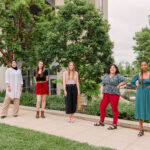
Eight recent UMBC graduates and alumni will soon travel to countries across three continents as 2022 Fulbright U.S. Student scholars. They include emerging leaders in education, astrophysics, cybersecurity, human rights, and more, and they are excited to explore difficult questions through fresh perspectives.
The Fulbright Program is the U.S. government’s flagship international exchange program. UMBC was named a Fulbright Top Producing Institution in 2019 – 2020. In the last decade, UMBC has received over 60 Fulbright U.S. Student Program awards for research and teaching placements in Africa, Asia and the Pacific, the Middle East, South America, and Europe.
Creating new paths
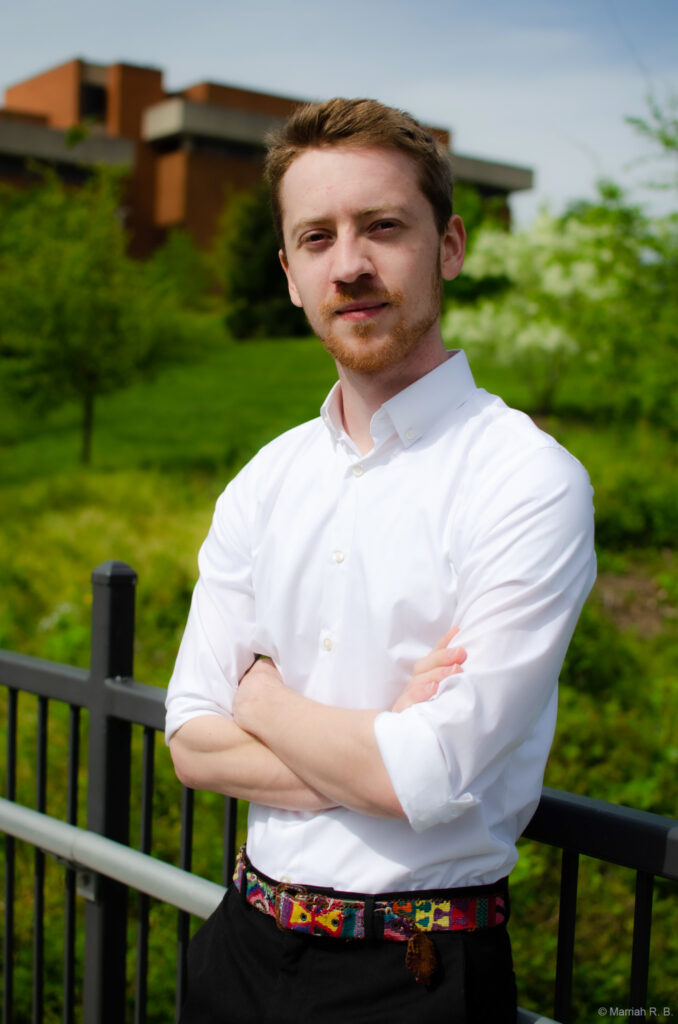 Caleb Jacobson.
(Image courtesy of Jacobson)
This year marks UMBC’s first Fulbright awards to El Salvador and to the UK. Caleb Jacobson ’21, global studies, and M.A. ’23, sociology, will research human rights and the transition to peace in post-conflict El Salvador. Kaitlyn Keaton ’22, computer engineering, a Cyber Scholar in the Center for Women In Technology, will head to Newcastle University (NU) in North East England to complete a master’s in cybersecurity. NU is recognized jointly by the UK’s National Cyber Security Center and the Engineering and Physical Sciences Research Council as an Academic Centre of Excellence in cyber security research.
Keaton has focused on making the most of her college education by pursuing a wide range of learning experiences. She has held competitive software engineering internships at General Dynamics Mission and Systems and Northrop Grumman Mission Systems, and has participated in Capture the Flags cybersecurity competitions, but this will be her first learning experience abroad.
As a Cyber Scholar and Tau Beta Pi Engineering Honors Society member, Keaton is determined to further develop the skills necessary to be on the cutting edge of cybersecurity research. She is also committed to creating new pathways for more women and girls to be leaders in engineering.
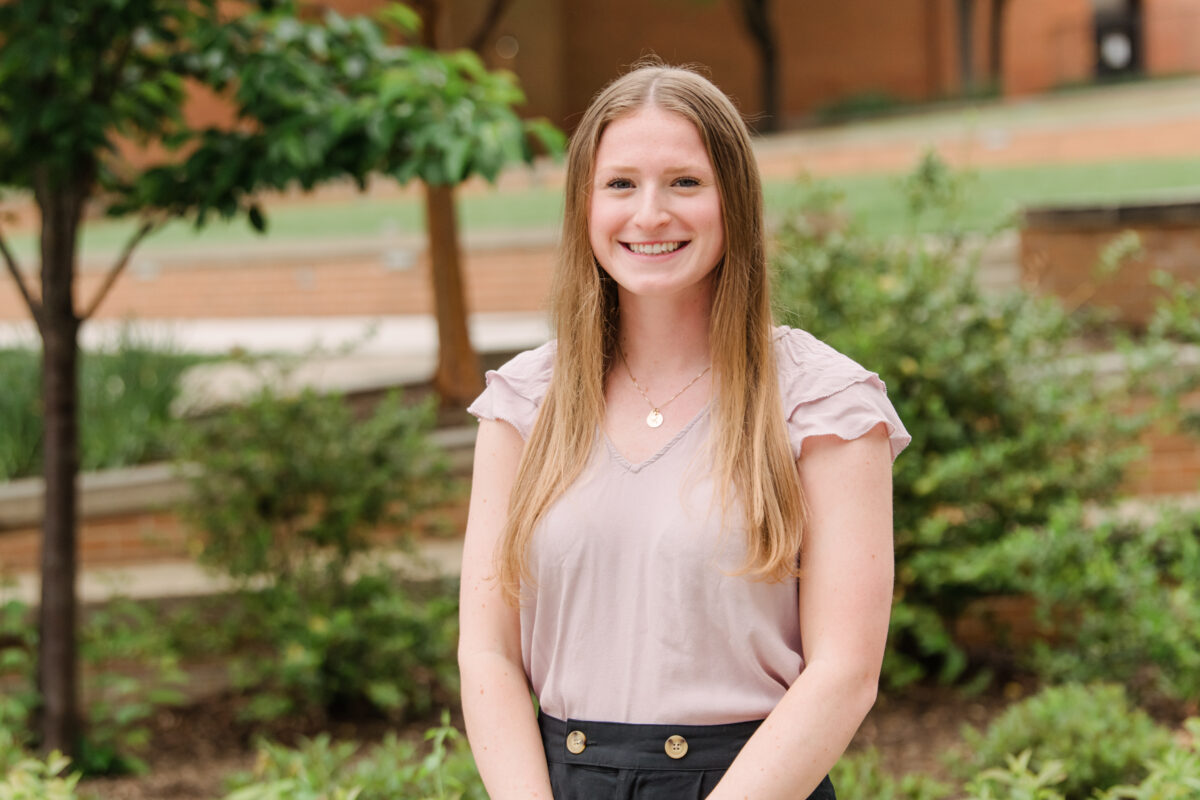 Kaitlyn Keaton. (Marlayna Demond ’11/UMBC)
“I want to inspire and encourage even more girls and young women to join the cybersecurity world,” says Keaton. “There is a critical need to get girls interested at younger ages to show them they can do it too.”
Intercultural understanding in medicine
Maryam Elhabashy ’21, anthropology, developed an interest in the process of healing early in her life while surrounded by a family of physicians. In high school, she shadowed a physician at a hospital and saw instances where patients’ cultural backgrounds sometimes conflicted with the physician’s concerns. She wondered if a lack of intercultural understanding in medicine can get in the way of good medical care, leading to health disparities.
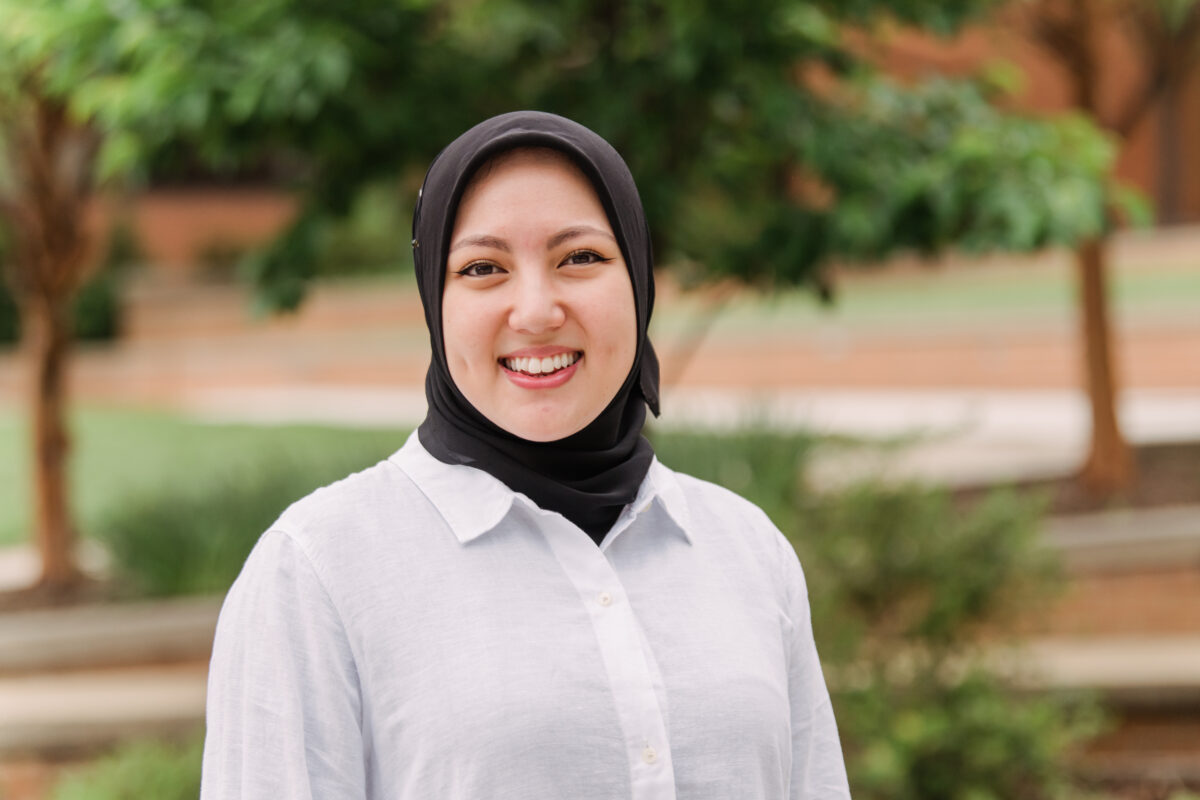 Maryam Elhabashy. (Marlayna Demond ’11/UMBC)
Elhabashy found an answer in listening to culturally diverse perspectives. As a student of anthropology with a focus on medical anthropology, she found that listening to people’s stories can help physicians develop empathy. This is one way to ensure patients feel heard, understood, and are able to navigate medical processes that can give them access to the best care possible.
While at UMBC, Elhabashy received an Undergraduate Research Award to research “Cupping and Wellness Among Muslims In the Baltimore-Washington Area.” She also served as a research assistant in sociology, anthropology, and public health (SAPH), studying physical activity among older African Americans in Baltimore.
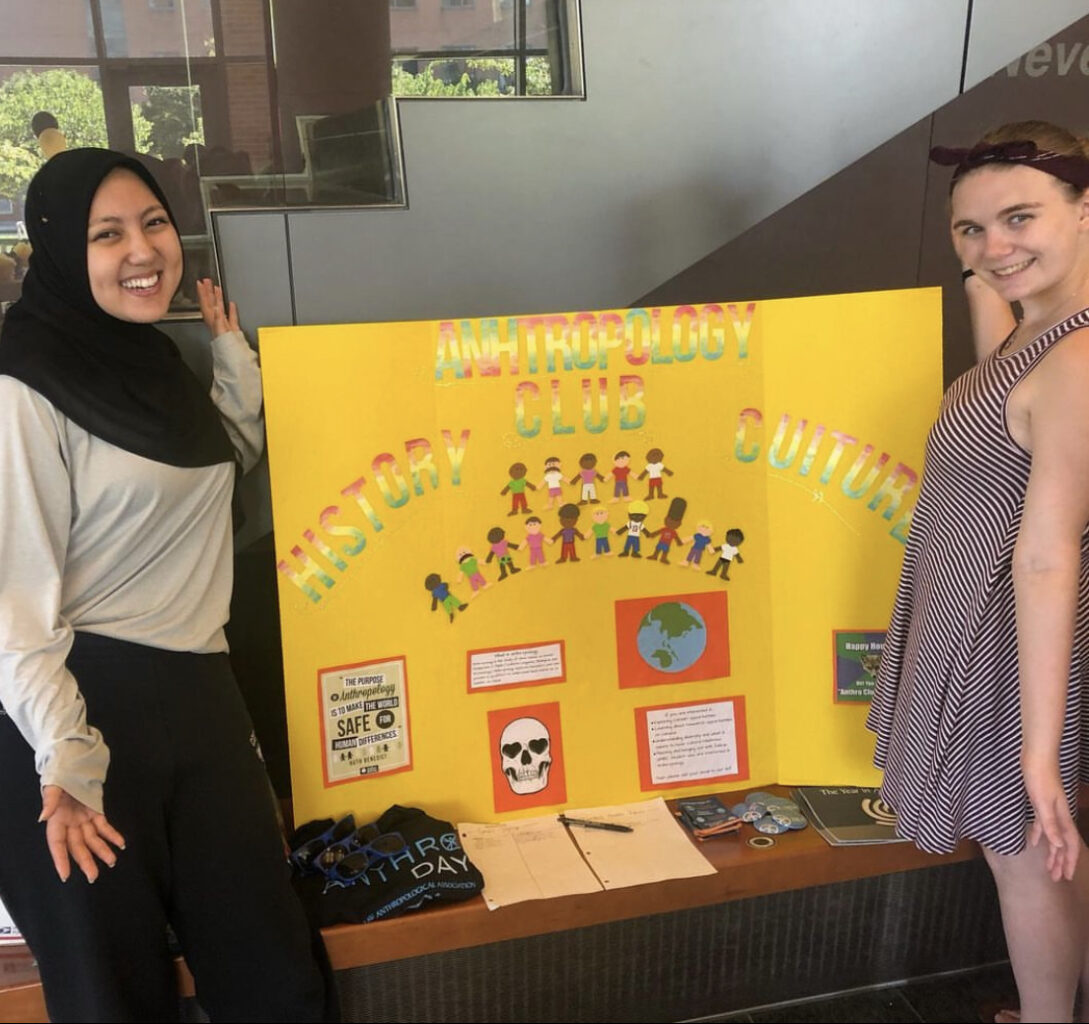 Elhabashy presenting with the Anthropology Club at SAPH’s Welcome Week Open House. (Image courtesy of Elhabashy)
After graduating, Elhabashy worked at Rutgers University as a research assistant studying tobacco and e-cigarette use among minority populations. In the past year, she interned at the Amgen Scholar Program at the National Institute of Health, working with leading biomedical scientists to identify and address health disparities as a potential result of societal, cultural, and environmental influences.
During her Fulbright year, Elhabashy will live in Kuwait City to work on her research project at Kuwait University titled, “Faith, Family, Food, and Fitness: Exploring Trends of Obesity Amongst Kuwaiti Women.”
“I hope to one day be at the forefront of a movement towards truly personalized medicine that embraces individuality and intercultural communication as a foundational tenet of the field,” she notes. “I hope my experience in Kuwait will serve as a strong foundation for this work.”
Latine teachers needed
Adrianna-Marie Urbina-Ruiz ’21, mathematics, and M.A.T., secondary education, was raised in Montgomery County, Maryland, but her roots are in Venezuela. She remembers only having four Hispanic teachers growing up. All were Spanish language teachers and supported her academic and personal growth. However, Urbina-Ruiz felt some of her other teachers had lower expectations of her, limiting her opportunities, and she saw other Hispanic students struggle with this same experience.
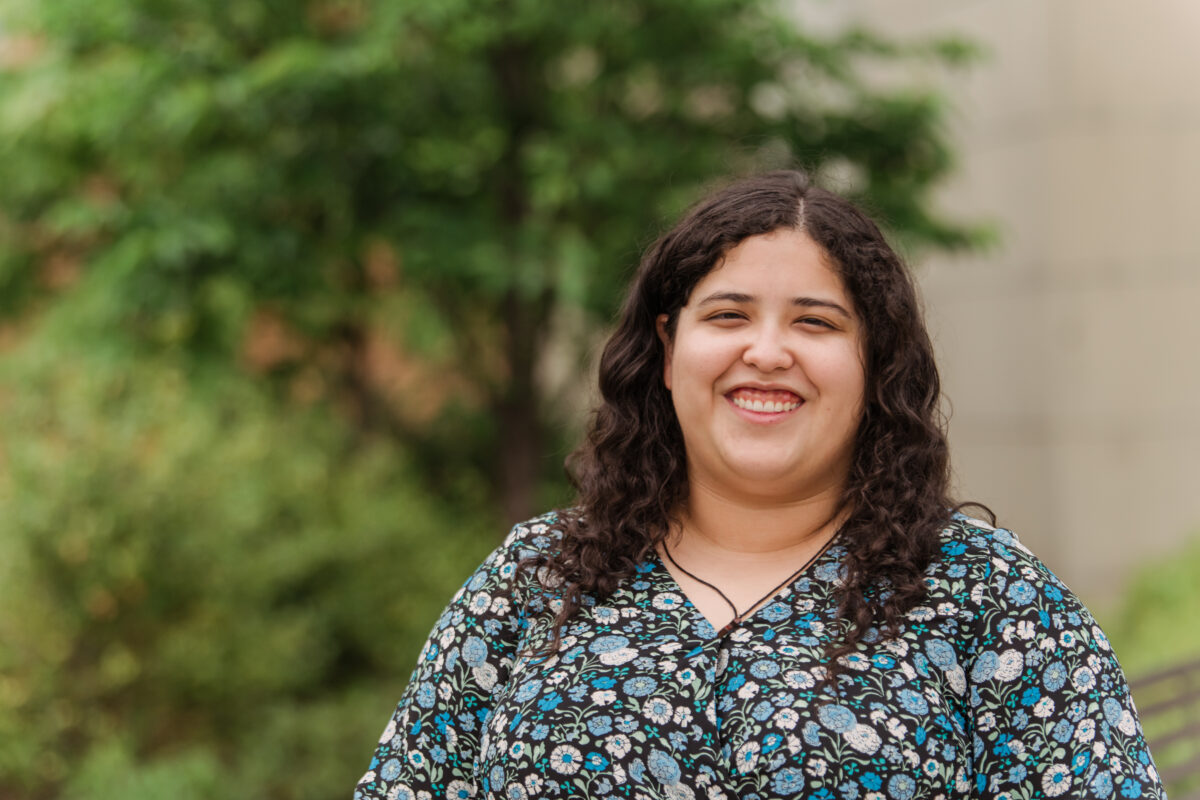 Adrianna-Marie Urbina-Ruiz. (Marlayna Demond ’11/UMBC)
“Many Hispanic students learning English and those who are bilingual have been seen as having limited academic knowledge, limited potential,” says Urbina-Ruiz. “I want to stop that narrative.”
At UMBC, Urbina-Ruiz met Bonny Tighe, a senior lecturer of mathematics, who encouraged her to become a math major and a math teacher through the Sherman STEM Teacher Scholars Program.
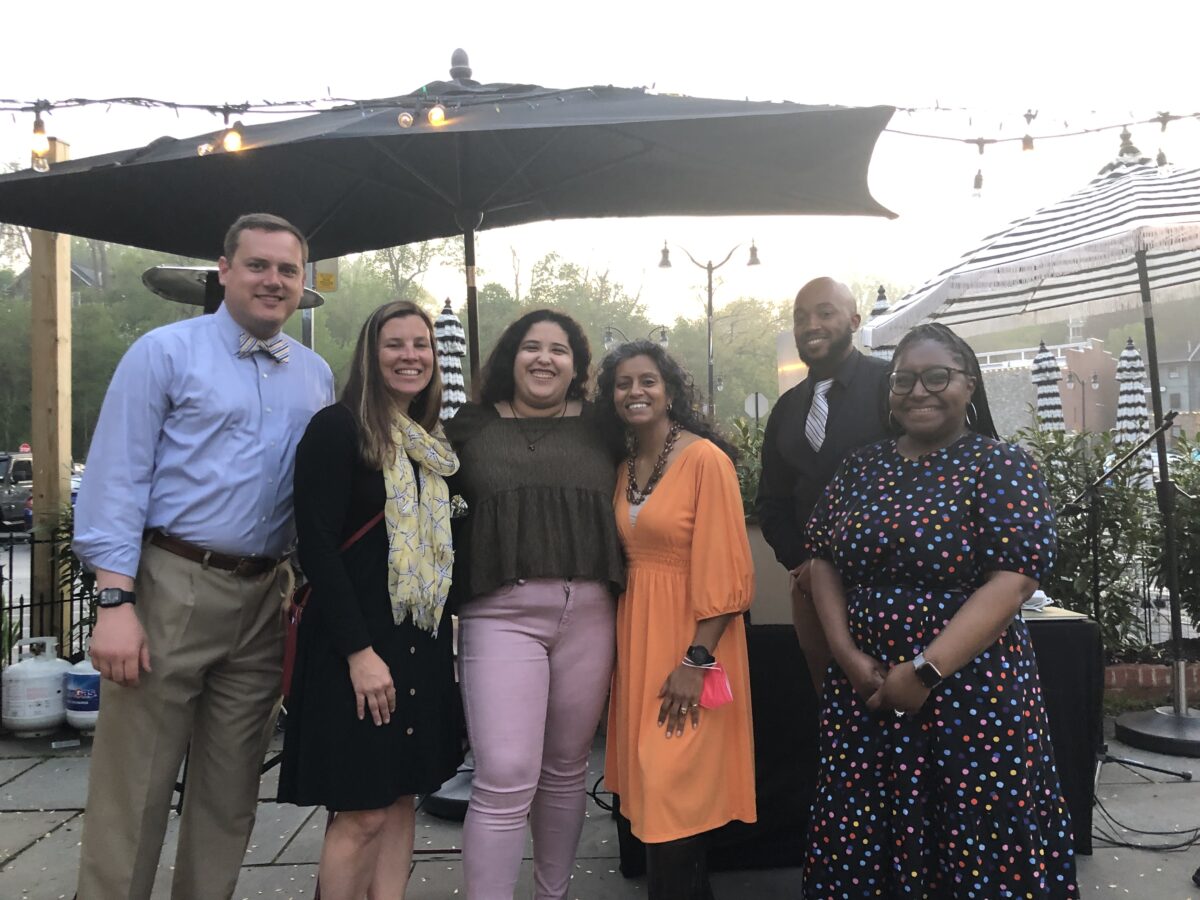 Urbina-Ruiz (in pink) with the Sherman STEM Teacher Scholar Program staff. (Image courtesy of Urbina-Ruiz)
“I will never forget walking into her office hours for the first time. She recognized me as having one of the highest grades in her Calculus I class,” says Urbina-Ruiz. “She and the Sherman staff had confidence that I would rise to any challenge. They built a strong foundation for my success.”
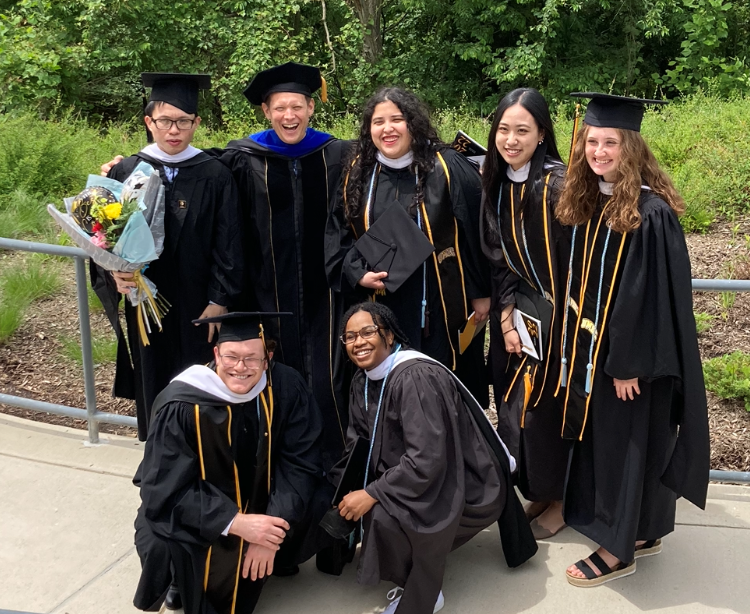 Urbina-Ruiz (standing row, center).
(Image courtesy of Urbina-Ruiz)
Urbina-Ruiz also completed a master’s in teaching and earned a certificate in teaching English to Speakers of Other Languages while student-teaching at Lakeland Elementary/Middle School in Baltimore City, which serves many Hispanic families. “I want to have as many tools at my disposal to make my classroom as accessible as possible,” says Urbina-Ruiz. “I want to be the Latine STEM teacher I never had.”
Urbina-Ruiz will work towards creating her first Collaborative Online International Learning program during her Fulbright year. She will connect college students at the Universidad Industrial de Santander in Colombia with students in Maryland while teaching English. “Latine teachers are needed around the world,” says Urbina-Ruiz.
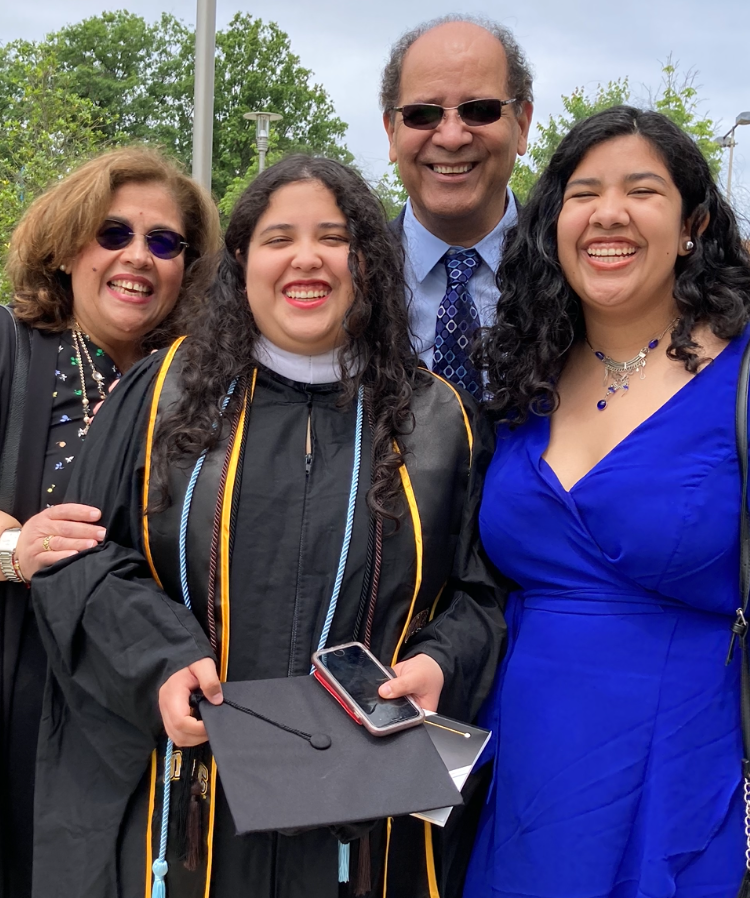 Urbina-Ruiz (wearing cap and gown) with her family at her master’s graduation. (Image courtesy of Urbina-Ruiz)
Urbina-Ruiz plans to return to teach in Baltimore City Public Schools where there is a high demand for bilingual Hispanic teachers.
Representation in science
Similar to Elhabashy, Maithily Diana Díaz ’21, biology and modern languages, linguistics, and intercultural communication, is pursuing a career focused on health equity. As a first-generation student, Díaz encourages other Latinos to go to college and to be ambitious even if it means they are in spaces where they are the only Latino, something she has experienced as a Latina in STEM.
“I’m usually the only Latina, but now it means something more,” says Díaz. “Now, it’s just the jump of saying Latinos can be scientists, researchers, physicians. If we believe in ourselves then someone else will too. And once that door is opened, then who knows how far we can go.”
Díaz recently moved to Tijuana, Mexico to work at a non-profit health clinic serving a largely refugee and migrant population. For the past school year she has been teaching science and medicine to predominantly Hispanic and African American K-12 students for Refugee Health Alliance in Harlem, while completing remote research in mental health at the Johns Hopkins School of Public Health.
During her Fulbright year, Díaz will complete a master’s in immunology and work on cancer research at the French National Institute of Health while mentoring undergraduate students at Sorbonne University. .
“It’s a dream come true that someone like me received a Fulbright at such prestigious institutions. My students were shocked,” says Díaz. “I want more and I intend to achieve it. But at the end of the day, this is for my community.”
While in France, Díaz will work with researchers seeking to identify more effective means of treating soft tissue sarcomas. The findings may reveal potentially novel immunotherapy targets for a variety of cancers.
As a linguist with proficiency in English, Spanish, French, Portuguese, and Russian, Díaz knows her ability to successfully communicate across multiple cultures and languages can lead to greater opportunities. She wants to show Latinos what can happen when they value their multicultural and multilingual lives as assets.
Following her Fulbright, Díaz plans to pursue an M.D., promoting equity in both research and healthcare.
Global education and disability
 Mimi Yaldram in traditional Pakistani dress. (Image courtesy of Yaldram)
Mimi Yaldram ’20, history, is very familiar with the process of acclimating to a new culture and country. When she was seven years old, her family left their home in Karachi, Pakistan for the United States to seek better mental health services.
“We came in 1999 right before 9/11,” says Yaldram. “It was a lot to manage the racism towards my Muslim family while learning how to live, study, access services, and work in the U.S.”
This experience inspired Yaldram’s passion for living and learning within multiple cultures, religions, and languages, which she began to explore at Montgomery College. There she held numerous executive student leadership roles and traveled abroad to Ethiopia, where she researched the influence of India on ancient trade routes and currency.
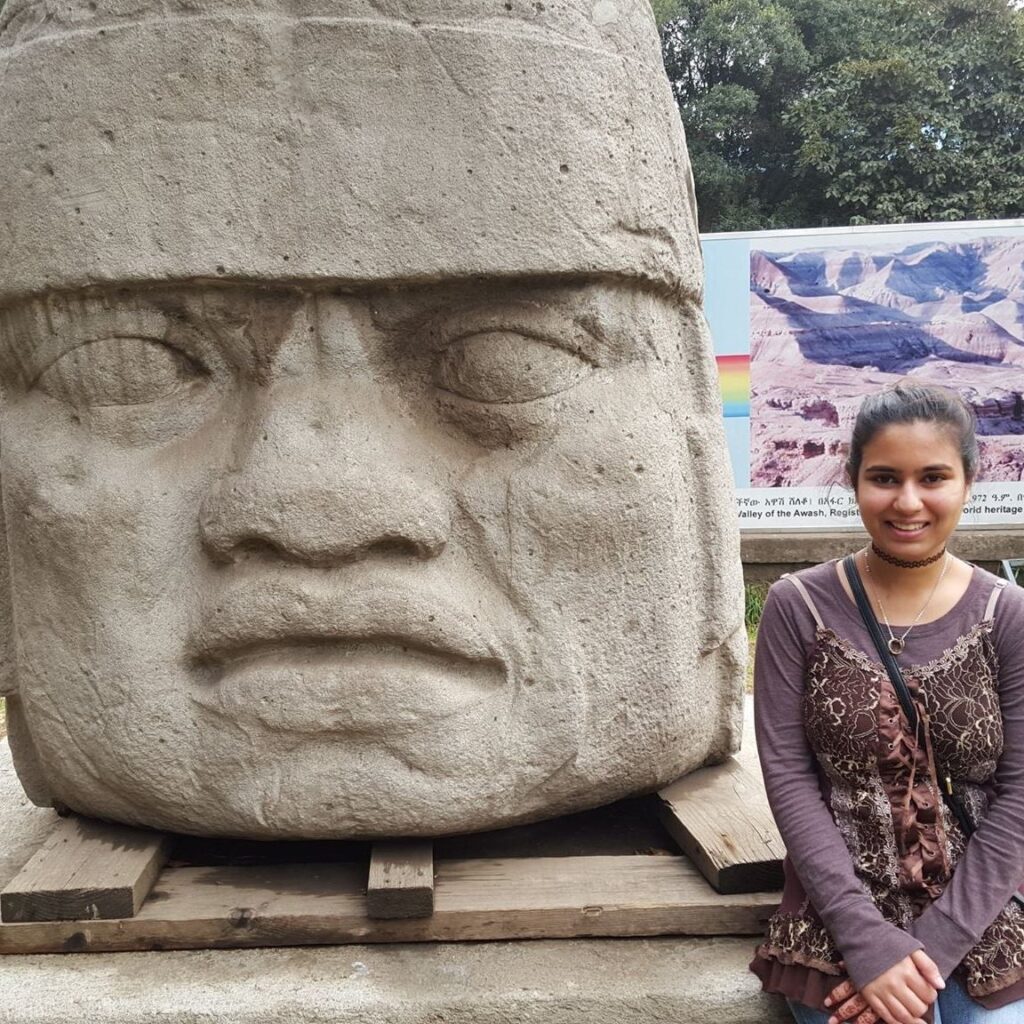 Yaldram in Ethiopia next to an ancient stone head sculpture of the Olmec civilization of Mexico. (Image courtesy of Yaldram)
In 2017, Yaldram joined UMBC’s Shady Grove campus, embarking on new student leadership opportunities, including serving as president of the Student History Association and studying abroad in Denmark. She learned about Viking history and participated in a dance project focusing on Danish pop dances and Pakistani Bollywood dances.
 Yaldram next to a sculpture of the Little Mermaid in Copenhagen, Denmark. (Image courtesy of Yaldram)
Yaldram identifies as a student with a mental health disability, and she is passionate about advocating for and teaching other students with disabilities and neurological differences. For the past two years, she has tutored students with autism spectrum disorder on strengthening their writing, communication, and social skills.
Now that she has earned her both her Teaching English as a Second Language and mental health first-aid certifications, she is ready to spend her Fulbright year teaching English in Taiwan. She is excited to be part of Taiwan’s goal to become a bilingual nation by 2030 by raising English proficiency. She also looks forward to sharing her skills in disability education and services while teaching.
“My dream is to make a positive impact on immigrant communities by utilizing my own experiences and education,” says Yaldram. “I hope to make a difference and bring that to the Fulbright program in Taiwan.”
Yaldram plans on a career at the intersection of global education, social justice, and disability beginning with humanitarian work in Pakistan after her Fulbright experience.
Korean world influence
Chemutai Wangui Nganga ’21, global studies, comes from a Kenyan family in the United States. During elementary school, she lived in Kenya for four years where she improved her Swahili skills and learned more about her Kenyan culture. When she moved back to the U.S., her family settled in Howard County, Maryland, home to numerous international communities, especially a thriving Korean community. Nganga learned about the influence the Korean economy, cuisine, music, art, and technology have had on the world.
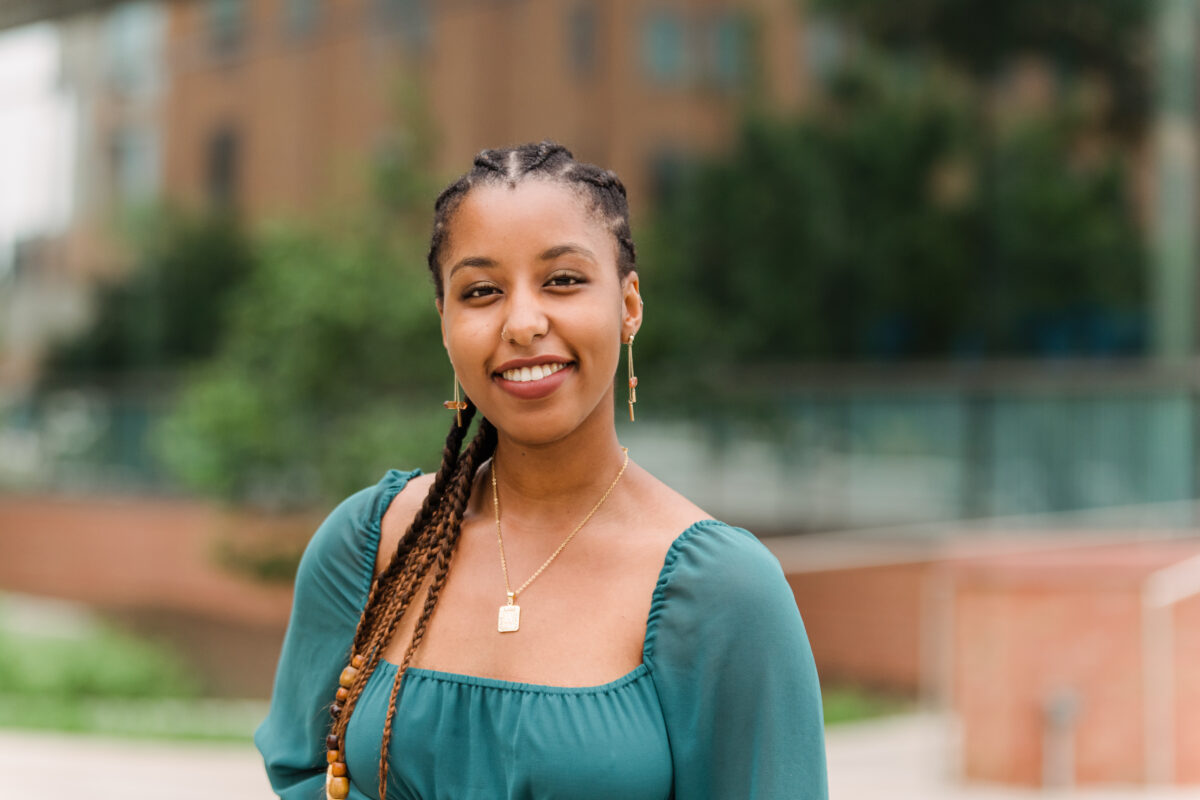 Chemutai Wangui Nganga. (Marlayna Demond ’11/UMBC)
Living in a diverse community, led Nganga to major in global studies at UMBC. She gained a greater understanding of the opportunities and conflicts of globalization and decided to focus on international politics and French. Her Asian studies courses increased her interest in Korean culture, which led her to pursue a Fulbright year in South Korea.
“For me, Korea is a full step into a new world,” says Nganga, who will be teaching English. “It is another chance to push the boundaries of my worldview as well as serve others.” She plans to explore a career path in foreign service on her return to the U.S.
Stellar research
As a burgeoning astrophysicist, Kaitlyn Szekerczes ’22, physics, lives and breathes for exploring the infinite universe. She didn’t know that all those nights stargazing on her deck with her dad and discussing the plausibility of science fiction shows would lead her to pursue a career in space science research.
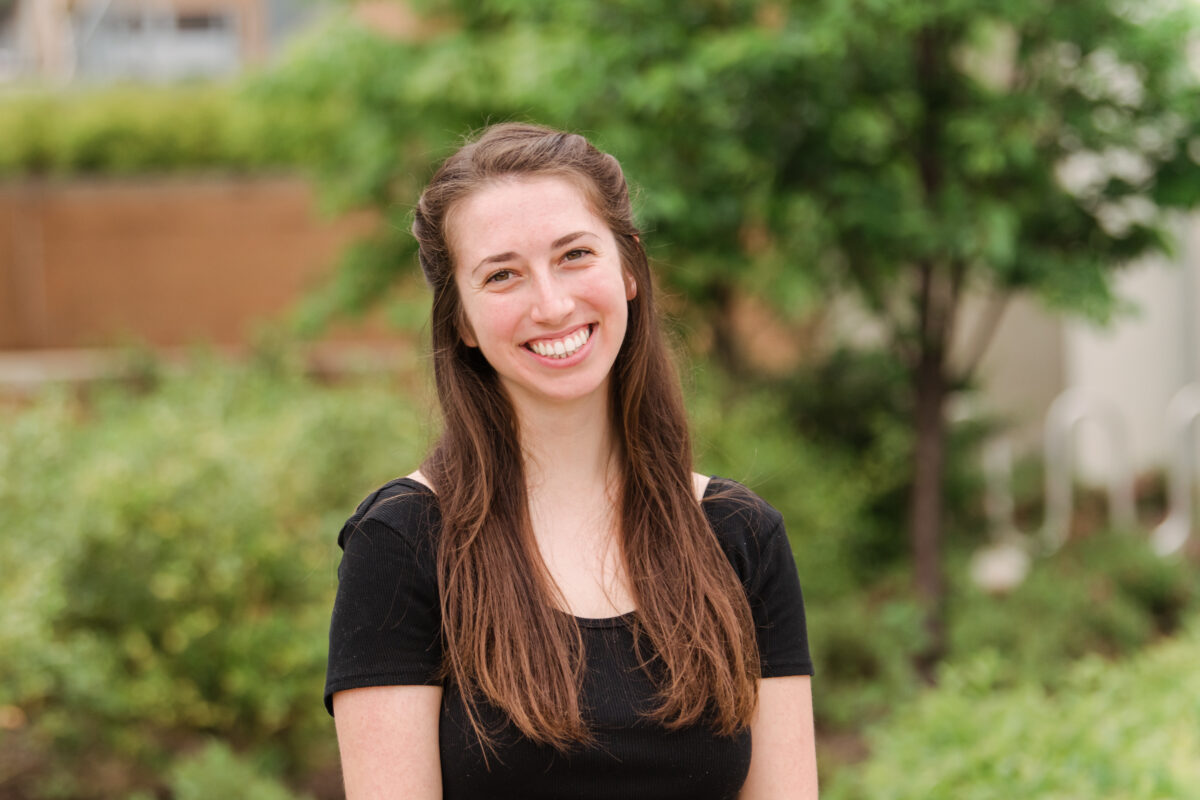 Kaitlyn Szekerczes. (Marlayna Demond ’11/UMBC)
“I was always fascinated by the questions we were not able to answer. We are not even close to knowing nearly everything when it comes to astronomy,” says Szekerczes. “My goal is to contribute to answering lesser-known big and challenging research questions.”
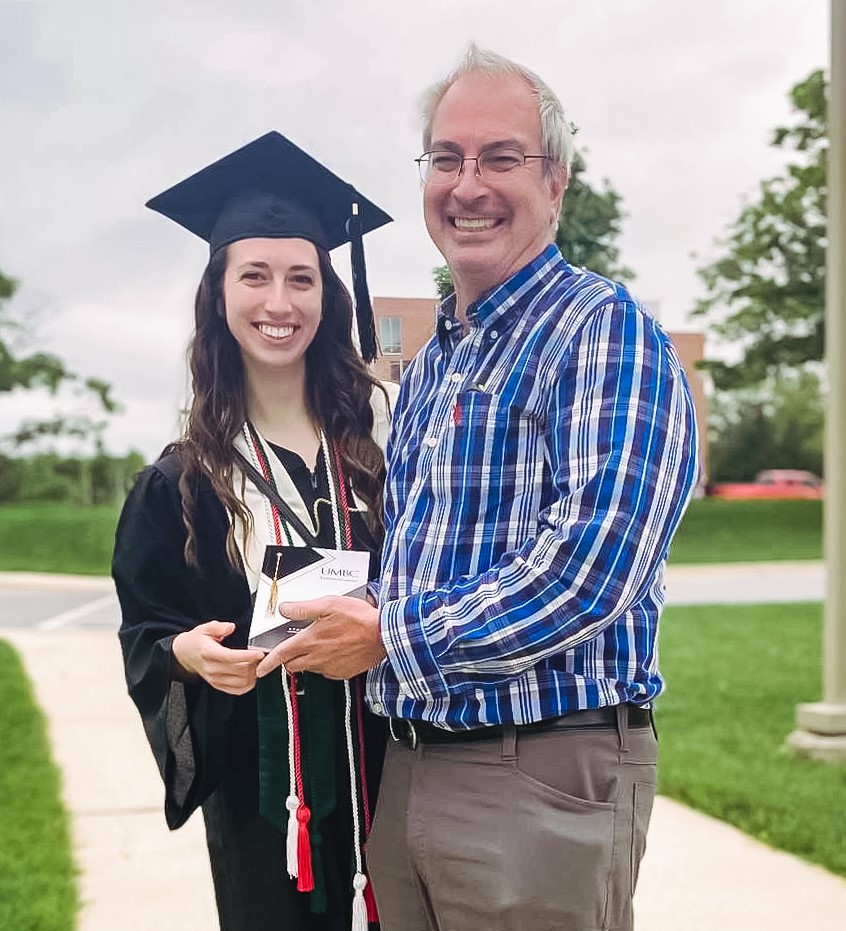 Szekerczes (l) with her dad.
(Image courtesy of Szekerczes)
Szekerczes will lead a project on gravitational lensing of tidal disruption events at the Max-Planck Institute for Astrophysics in Garching, Germany. It will be the first study to apply the technique of gravitational lensing—the bending of light by gravity—to researching tidal disruption events, which are events that happen when a supermassive black hole tidally disrupts a star.
“My dream job is to work as an astrophysicist for NASA,” says Szekerczes. “UMBC was the perfect fit for me because I was encouraged to pursue my passion for tackling challenging unanswered questions. I was also given the resources and support to piece together the puzzle of how to work towards my goals.”
After returning from Germany, Szekerczes will begin a Ph.D. program in astrophysics at Penn State University in fall 2023.
]]>
Eight recent UMBC graduates and alumni will soon travel to countries across three continents as 2022 Fulbright U.S. Student scholars. They include emerging leaders in education, astrophysics,...
https://umbc.edu/stories/umbc-2022-fulbright-student-scholars/
https://my3.my.umbc.edu/api/v0/pixel/news/125930/guest@my.umbc.edu/ba2dfd241a4dc3b3530386c46cc83d0a/api/pixel
anthropology
biology
cahss
cahssresearch
cnms
coeit
community
computer-engineering
cwit
education
globalstudies
history
international-stories
mathematics
mlli
news
physics
policy-and-society
research
saph
science-and-tech
shermanscholars
UMBC News & Magazine
https://my3.my.umbc.edu/groups/umbc-news-magazine
https://assets1-my.umbc.edu/system/shared/avatars/groups/000/001/943/24435aa6207c452e7bc15cc74b42c7bb/xsmall.png?1748556657
https://assets1-my.umbc.edu/system/shared/avatars/groups/000/001/943/24435aa6207c452e7bc15cc74b42c7bb/original.png?1748556657
https://assets2-my.umbc.edu/system/shared/avatars/groups/000/001/943/24435aa6207c452e7bc15cc74b42c7bb/xxlarge.png?1748556657
https://assets2-my.umbc.edu/system/shared/avatars/groups/000/001/943/24435aa6207c452e7bc15cc74b42c7bb/xlarge.png?1748556657
https://assets3-my.umbc.edu/system/shared/avatars/groups/000/001/943/24435aa6207c452e7bc15cc74b42c7bb/large.png?1748556657
https://assets1-my.umbc.edu/system/shared/avatars/groups/000/001/943/24435aa6207c452e7bc15cc74b42c7bb/medium.png?1748556657
https://assets2-my.umbc.edu/system/shared/avatars/groups/000/001/943/24435aa6207c452e7bc15cc74b42c7bb/small.png?1748556657
https://assets1-my.umbc.edu/system/shared/avatars/groups/000/001/943/24435aa6207c452e7bc15cc74b42c7bb/xsmall.png?1748556657
https://assets2-my.umbc.edu/system/shared/avatars/groups/000/001/943/24435aa6207c452e7bc15cc74b42c7bb/xxsmall.png?1748556657
UMBC News & Magazine
0
0
false
Thu, 16 Jun 2022 15:23:06 -0400
Thu, 16 Jun 2022 15:23:06 -0400
Future teacher makes mindful and inclusive early childhood education a priority
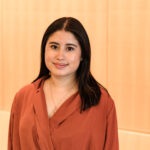
Ashley Delgado
Degree: B.A., Psychology
Hometown: Baltimore, MD
Plans: Teacher at Lakeland Elementary/Middle School
“Growing up in Baltimore City, I only saw Hispanic teachers as Spanish educators. As an intern at a city elementary/middle school, walking through and just seeing so many Spanish-speaking teachers who aren’t just teaching Spanish really spoke to me.”
Ashley Delgado ’22, psychology, is a Sherman STEM Scholar and first-generation college student with a focus on early childhood education.
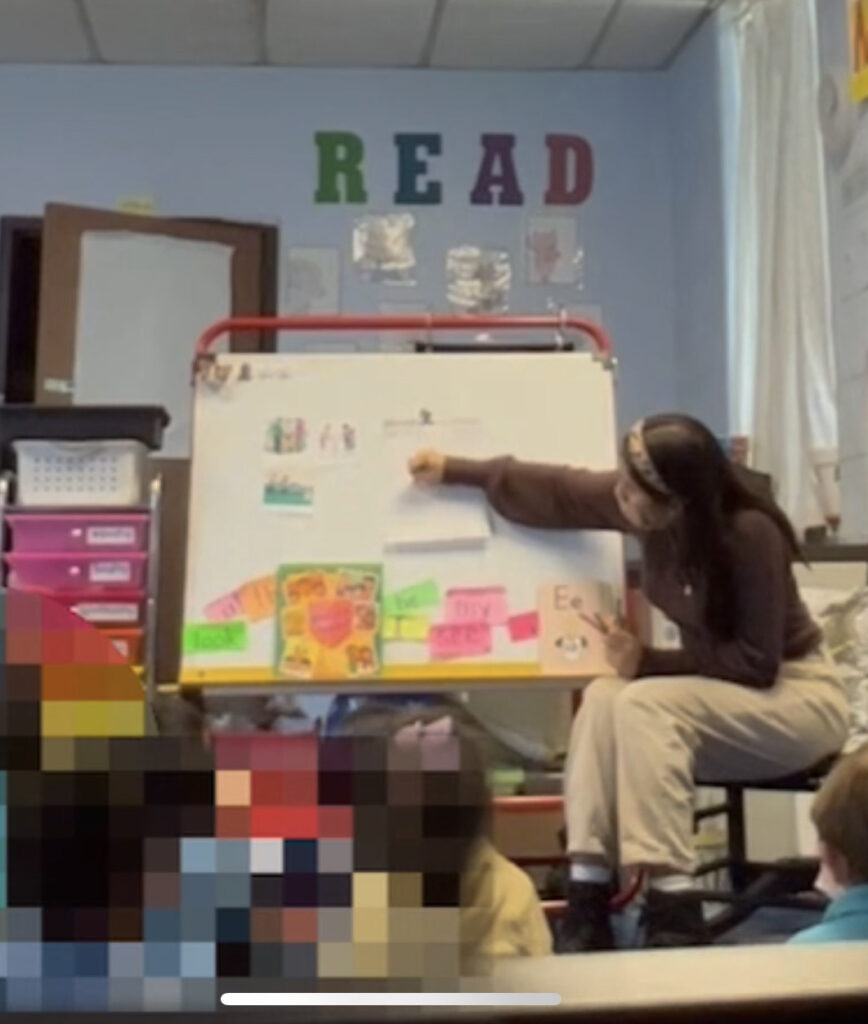
Ashley Delgado teaching at Maree G. Farring Elementary/Middle School in Baltimore. (Image courtesy of Delgado)
She completed research with Jennifer Mata-McMahon, associate professor of early childhood education. Delgado’s work was part of the Breathe2Think Program, a collaboration between the Sherman Center and the Sherman Scholars to teach emerging teachers how to use mindfulness techniques with young children and for themselves.
Already, Delgado has employed these techniques in her internship placements. She plans to continue using them in her teaching career, both with her students and for herself. Especially during a period of constant change, such as the pandemic, these techniques help children regulate their emotions in appropriate ways.
Delgado also prioritizes culturally responsive teaching. In her work, she will seek to “create that environment where students feel they are represented,” she says. She will also work to create “opportunities for them to express who they are and explain their backgrounds and their stories,” both to their instructors and their classmates.
Both Mata-McMahon and Jackie Peng, Delgado’s supervisor during her internship at Maree G. Farring Elementary/Middle School in Baltimore City, have served as important mentors for Delgado. They have helped her gain confidence in her teaching as she begins her career.
]]>
Ashley Delgado Degree: B.A., Psychology Hometown: Baltimore, MD Plans: Teacher at Lakeland Elementary/Middle School “Growing up in Baltimore City, I only saw Hispanic teachers as...
https://umbc.edu/stories/mindful-and-inclusive-early-childhood-education/
https://my3.my.umbc.edu/api/v0/pixel/news/125389/guest@my.umbc.edu/5fa89cd3cee02896fa085358ac8328f6/api/pixel
cahss
class-of-2022
news
psychology
shermanscholars
supportingyouth
UMBC News & Magazine
https://my3.my.umbc.edu/groups/umbc-news-magazine
https://assets1-my.umbc.edu/system/shared/avatars/groups/000/001/943/24435aa6207c452e7bc15cc74b42c7bb/xsmall.png?1748556657
https://assets1-my.umbc.edu/system/shared/avatars/groups/000/001/943/24435aa6207c452e7bc15cc74b42c7bb/original.png?1748556657
https://assets2-my.umbc.edu/system/shared/avatars/groups/000/001/943/24435aa6207c452e7bc15cc74b42c7bb/xxlarge.png?1748556657
https://assets2-my.umbc.edu/system/shared/avatars/groups/000/001/943/24435aa6207c452e7bc15cc74b42c7bb/xlarge.png?1748556657
https://assets3-my.umbc.edu/system/shared/avatars/groups/000/001/943/24435aa6207c452e7bc15cc74b42c7bb/large.png?1748556657
https://assets1-my.umbc.edu/system/shared/avatars/groups/000/001/943/24435aa6207c452e7bc15cc74b42c7bb/medium.png?1748556657
https://assets2-my.umbc.edu/system/shared/avatars/groups/000/001/943/24435aa6207c452e7bc15cc74b42c7bb/small.png?1748556657
https://assets1-my.umbc.edu/system/shared/avatars/groups/000/001/943/24435aa6207c452e7bc15cc74b42c7bb/xsmall.png?1748556657
https://assets2-my.umbc.edu/system/shared/avatars/groups/000/001/943/24435aa6207c452e7bc15cc74b42c7bb/xxsmall.png?1748556657
UMBC News & Magazine
0
0
false
Tue, 17 May 2022 14:11:30 -0400
Tue, 17 May 2022 14:11:30 -0400
UMBC’s Haleemat Adekoya receives prestigious Truman Scholarship for education advocacy

Haleemat Adekoya ‘23, political science, received a surprise phone call last Tuesday morning. On the line were both UMBC President Freeman Hrabowski and Valerie Sheares Ashby, who just one day earlier was announced as UMBC’s next president. They were calling together to share, with heartfelt congratulations, her selection as a 2022 Truman Scholar.
Adekoya has spent the last year preparing to apply for the renowned national scholarship focused on public service. After a series of rigorous interviews, the Harry S. Truman Scholarship Foundation announced Adekoya as one of just 58 students nationwide to receive the award. Adekoya is UMBC’s fifth Truman Scholar.
“I am incredibly proud of Haleemat. Her authenticity, sincerity and humility permeate everything she does,” says Carolyn Forestiere, professor of political science. “I feel very fortunate to have worked with this extraordinary young person as her professor at UMBC, and I know she will excel at whatever she decides to do with her future.”
The Foundation selected recipients from a pool of over 700 applicants who showed a strong record of public service and also submitted a policy proposal addressing a concerning issue in society. Scholars receive $30,000 to attend the graduate school of their choice, as well as access to public service programs, mentorship, and job opportunities within the federal government.
“It is an honor and a pleasure to know that I have been named a 2022 Truman Scholar. All I can say is Glory be to God and to my village, thank you forever,” says Adekoya. “I look forward to continuing to engage in my commitment to cultivate transformative learning spaces and elevating the voices of Black children and celebrating their brilliance.”
Two finalists
This year also marked the second time two UMBC students reached the final round of Truman Scholar selection. In addition to Adekoya, Rehman Liaqat ‘22, political science, was also chosen as a finalist.
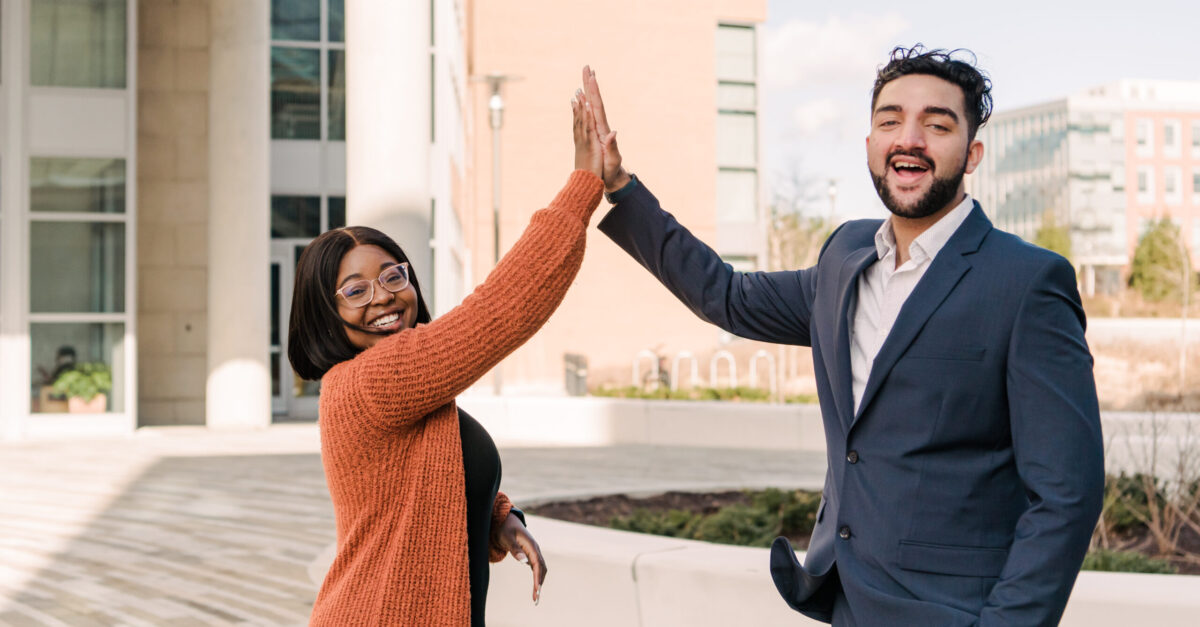 Haleemat Adekoya and Rehman Liaqat 2022. (Marlayna Demond ’11/UMBC)
“Having two finalists is a huge honor for UMBC,” says April Householder, director of undergraduate research and prestigious scholarships. “With only 58 winners selected, that means that our students are highly competitive for this award.” Other institutions with multiple finalists include Duke, Harvard, MIT, and Stanford.
Liaqat and Adekoya are macro thinkers who have learned to both identify everyday problems at a local level and work towards systemic solutions. Liaqat has focused on legal advocacy while Adekoya’s interest is in education reform. Their steadfast commitment to personal growth in service of numerous communities made them strong candidates for the 2022 Truman Scholarship.
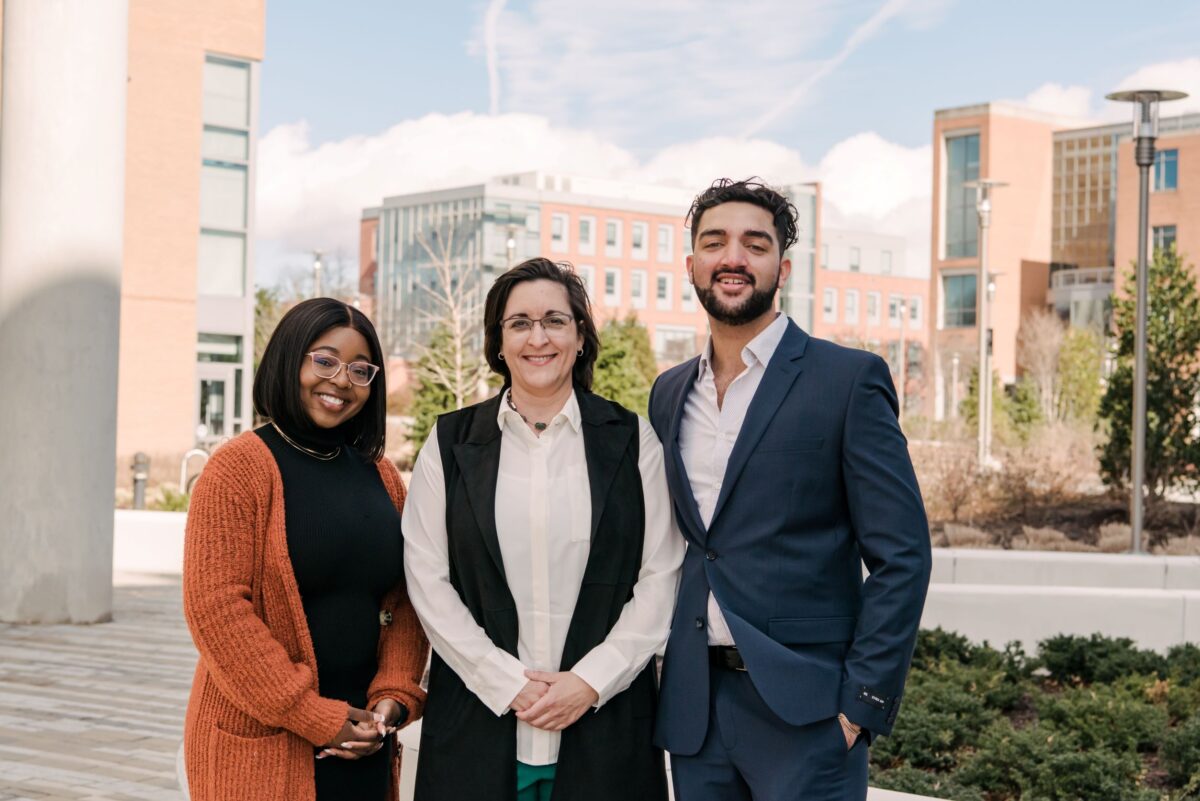 Adekoya (l), Householder (c), and Liaqat (r).
“Haleemat and I both began our journeys at UMBC serving with the Shriver Center, and now, we are both following a pathway towards lifelong public service,” says Liaqat. “This national recognition highlights the fact that UMBC is indeed a magical place that fosters community leaders and passionate public servants, such as Haleemat.”
“This journey has only solidified what UMBC is all about: a community of care and ‘true grit’ towards transformative excellence,” he reflects.
“To have been nominated as one of the two Truman Scholarship finalists is an experience that still has me on cloud nine. Words cannot describe how grateful I am to have been able to experience the scholarship process with someone as incredible as Rehman,” says Adekoya. “I am confident that the better world we reimagine is more than possible because of revolutionary, compassionate, and devoted dreamers like him.”
Collective vision
When Adekoya reflects on her path leading to the Truman Scholarship she sees the combined hard work of Baltimore City and County Public School teachers and students, her UMBC family, and the Sherman STEM Teacher Scholars Program. Their collective vision for sustainable and intentional full-service community schools propels her to think of education reform as an everyday practice.
“Education is said to be the most powerful tool one can use to change the world. However, our current education system excludes many Black students from experiencing such a transformative tool,” reflects Adekoya. “As an education advocate for Black students, I hope to one day develop multi-faceted strategies that address the flaws within our education system.”
Driving change
With this goal in mind, Adekoya participated in the launch of UMBC’s Sherman STEM Teacher Scholars Program intensive virtual math incubator for 150 students at Lakeland Elementary/Middle School in Baltimore City during the first COVID summer. Concurrently, she served as an intern at the Maryland State Department of Education, with the Student, Family, and School Support Committee, in 2020 – 2021. The Maryland Higher Education Commission (MHEC) then chose Adekoya as student representative, serving on its Education Policy Committee and Outreach, Grants, and Financial Assistance Committee for 2021 – 2022.
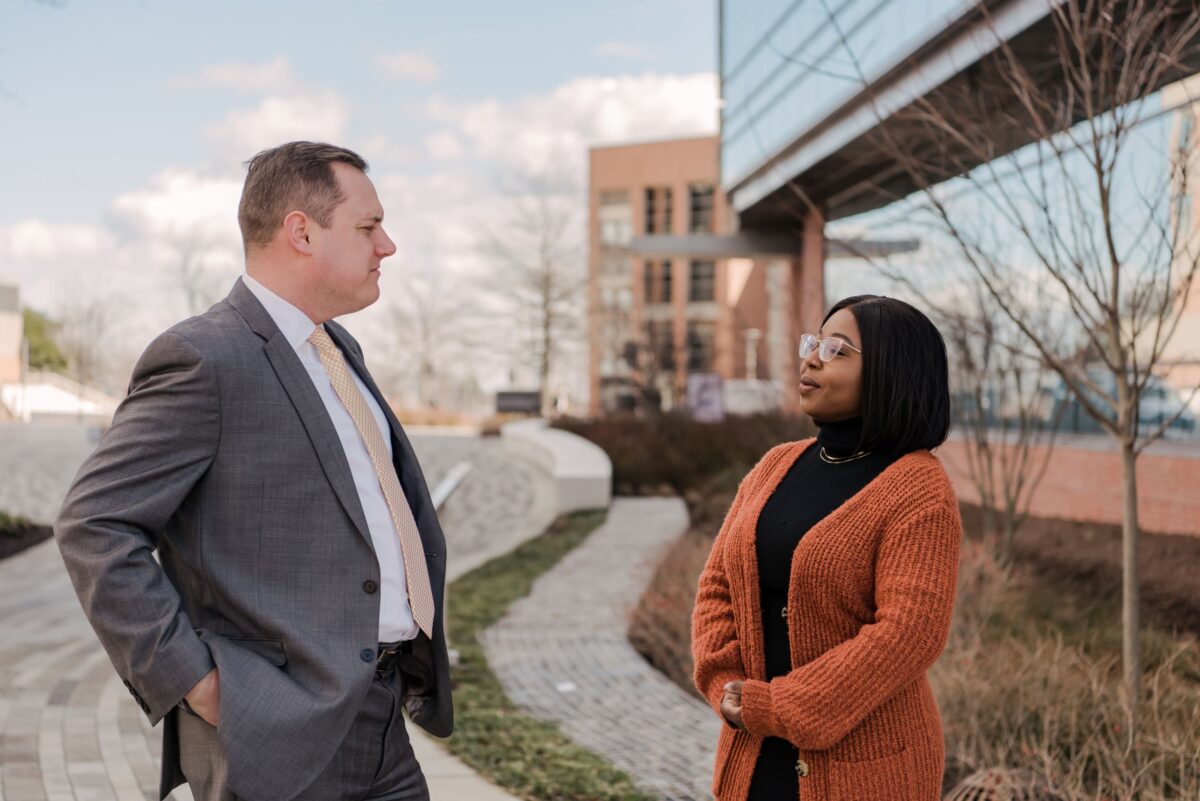 Adekoya (r) with Josh Michael ’10, political science and education, director of Baltimore school partnerships for UMBC’s Sherman STEM Teacher Scholars Program.
In 2019, prior to joining UMBC, Baltimore County Government awarded Adekoya with the “Young Woman of the Year” award for her community-engaged work as a member of the Superintendent’s Student Advisory Council; a mentor in a STEM program for girls; a local coordinator for the From Prison Cells to PhD program; and as founder of Dare2Bee, an empowerment organization for girls ages 9 – 18.
“Haleemat is such a strong and compassionate leader. One of the things that inspires me most about her is her commitment to others,” says her mentor Jasmine Lee, director of inclusive excellence in UMBC’s Division of Student Affairs.
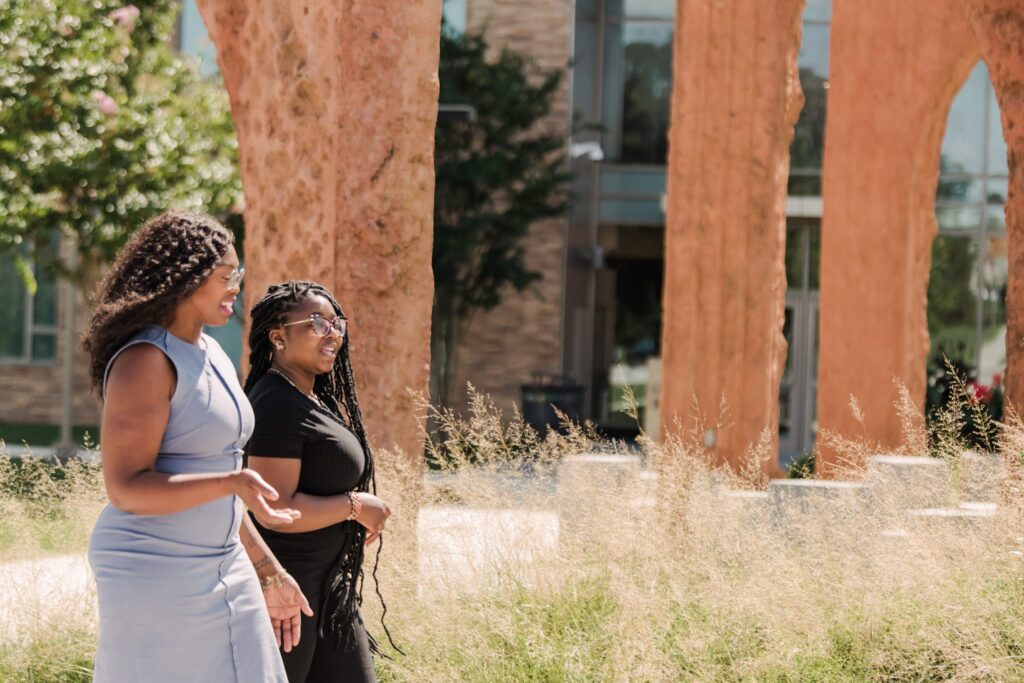 Adekoya (r) with Jasmine Lee.
“She’s not a leader because she’s ‘ahead of the pack’…but instead because she is concerned about everyone making it,” Lee shared when Adekoya was named MHEC student commissioner. “She seems to move from the front to the back, and throughout the middle, empowering everyone to move at their own pace.”
Striving together
Liaqat, a political science major, came to the United States from Pakistan when he was eleven. He spent his teen years in Salisbury, on Maryland’s eastern shore. His time was split between school and working at OC Quickstop, one of three family-owned gas stations.
He earned recognition for supporting his local community and came to UMBC ready to build connections and his leadership skills. He soon also discovered a love of constitutional law, and a commitment to promoting human rights internationally.
In addition to being named a Truman Scholar finalist, he has also earned the inaugural Campus Compact Mid-Atlantic Civic Fellow award. He is completing his master’s in public policy through an accelerated program at UMBC, at the same time as his undergraduate degree. Next, he will next enter a four-year joint degree program (MPP/JD) at the McCourt School of Public Policy and the Georgetown University Law Center.
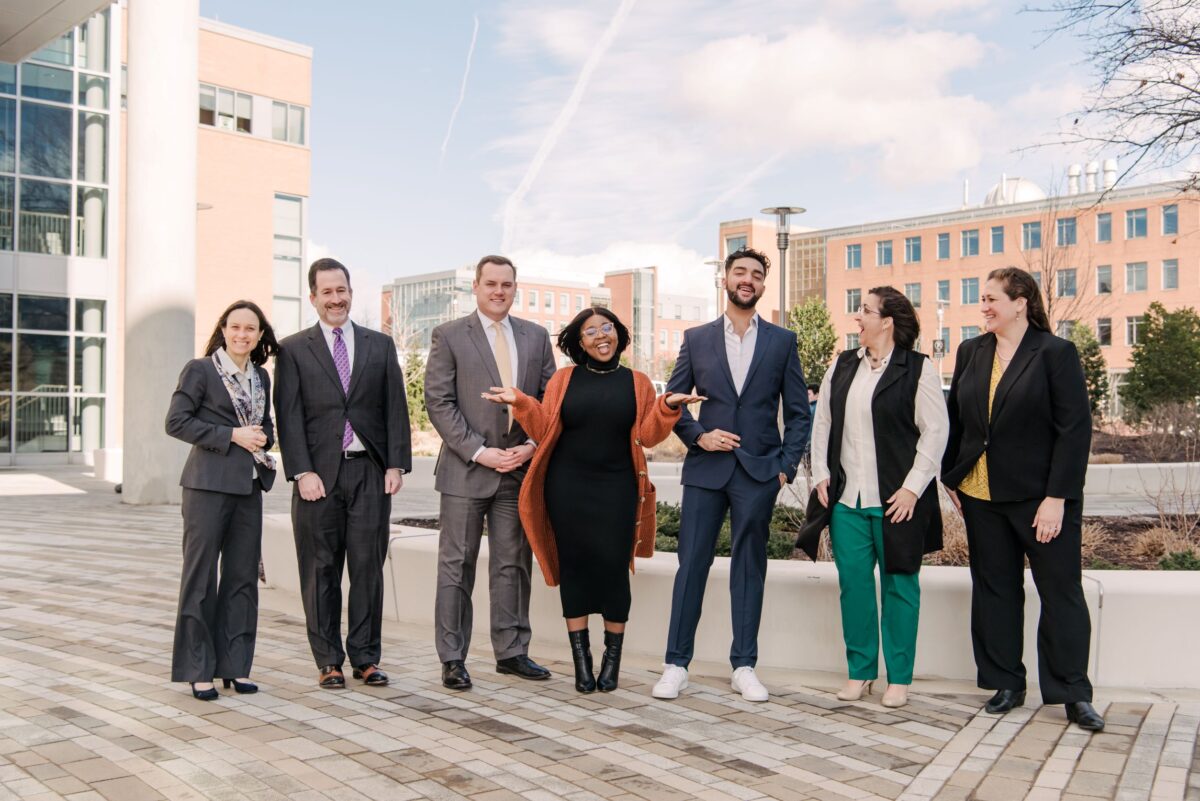 Adekoya and Liqat (center) with their mentors: (l-r) Laura Antkowiak, associate professor of political science and director of the Sondheim Scholars Program; David Hoffman, Ph.D. ’13, language, literacy, and culture, director of the Center for Democracy and Civic Life; Michael; Householder; and Lori Hardesty, associate director of applied learning and engagement at the Shriver Center.
Householder says Adekoya’s win and Liaqat’s recognition as a finalist are “a testament to the hard work of these students” and the support they receive from programs like the Sondheim Public Affairs Scholars and Sherman STEM Teacher Scholars, as well as the Honors College, Undergraduate Research and Prestigious Scholarships, and the Shriver Center.
“This is a community that provides rich experiences for our students,” says Householder. “Those experiences spark their passions for becoming public servants and using their well-honed talents to help others.”
Featured image: Haleemat Adekoya. All photos by Marlayna Demond ’11 for UMBC.
]]>
Haleemat Adekoya ‘23, political science, received a surprise phone call last Tuesday morning. On the line were both UMBC President Freeman Hrabowski and Valerie Sheares Ashby, who just one day...
https://umbc.edu/stories/umbcs-haleemat-adekoya-receives-prestigious-truman-scholarship-for-education-advocacy/
https://my3.my.umbc.edu/api/v0/pixel/news/119449/guest@my.umbc.edu/b89895f67caf32aeb7f4896c6a3a7022/api/pixel
cahss
cahssresearch
honorscollege
majoraward
news
page1
policy-and-society
politicalscience
shermanscholars
shrivercenter
sondheimscholars
UMBC News & Magazine
https://my3.my.umbc.edu/groups/umbc-news-magazine
https://assets1-my.umbc.edu/system/shared/avatars/groups/000/001/943/24435aa6207c452e7bc15cc74b42c7bb/xsmall.png?1748556657
https://assets1-my.umbc.edu/system/shared/avatars/groups/000/001/943/24435aa6207c452e7bc15cc74b42c7bb/original.png?1748556657
https://assets2-my.umbc.edu/system/shared/avatars/groups/000/001/943/24435aa6207c452e7bc15cc74b42c7bb/xxlarge.png?1748556657
https://assets2-my.umbc.edu/system/shared/avatars/groups/000/001/943/24435aa6207c452e7bc15cc74b42c7bb/xlarge.png?1748556657
https://assets3-my.umbc.edu/system/shared/avatars/groups/000/001/943/24435aa6207c452e7bc15cc74b42c7bb/large.png?1748556657
https://assets1-my.umbc.edu/system/shared/avatars/groups/000/001/943/24435aa6207c452e7bc15cc74b42c7bb/medium.png?1748556657
https://assets2-my.umbc.edu/system/shared/avatars/groups/000/001/943/24435aa6207c452e7bc15cc74b42c7bb/small.png?1748556657
https://assets1-my.umbc.edu/system/shared/avatars/groups/000/001/943/24435aa6207c452e7bc15cc74b42c7bb/xsmall.png?1748556657
https://assets2-my.umbc.edu/system/shared/avatars/groups/000/001/943/24435aa6207c452e7bc15cc74b42c7bb/xxsmall.png?1748556657
UMBC News & Magazine
0
0
false
Thu, 14 Apr 2022 11:36:01 -0400
Thu, 14 Apr 2022 11:36:01 -0400
$21M Sherman Family Foundation gift supports UMBC’s bold commitment to PreK-12 research, teaching, and learning

The largest gift in the history of UMBC—a $21 million donation from the Sherman Family Foundation—will dramatically expand the reach and impact of the university’s K-12 and early childhood education work. The transformational gift will provide funding to launch the Betsy & George Sherman Center as a national model to advance excellence in urban schools. This new center will expand and integrate UMBC’s work in teacher preparation, school partnerships, and applied research focused on early childhood education and improving learning outcomes for Baltimore’s students.
“If universities are to be major contributors to the development of society, they have to be involved with the schools and with neighborhoods and with communities,” says UMBC President Freeman Hrabowski. “Betsy and the Sherman Family Foundation have provided us with invaluable resources to make this collaborative work possible.”
“This gift represents a clear and bold commitment to developing teachers that can better support future generations of students in Baltimore City, especially in early learning and STEM,” said Sonja Brookins Santelises, chief executive officer of Baltimore City Public Schools. “It also expands the research partnership between City Schools and the university in ways that will further enhance teaching and learning in our community. We are excited about this next great step.”
Investing in education
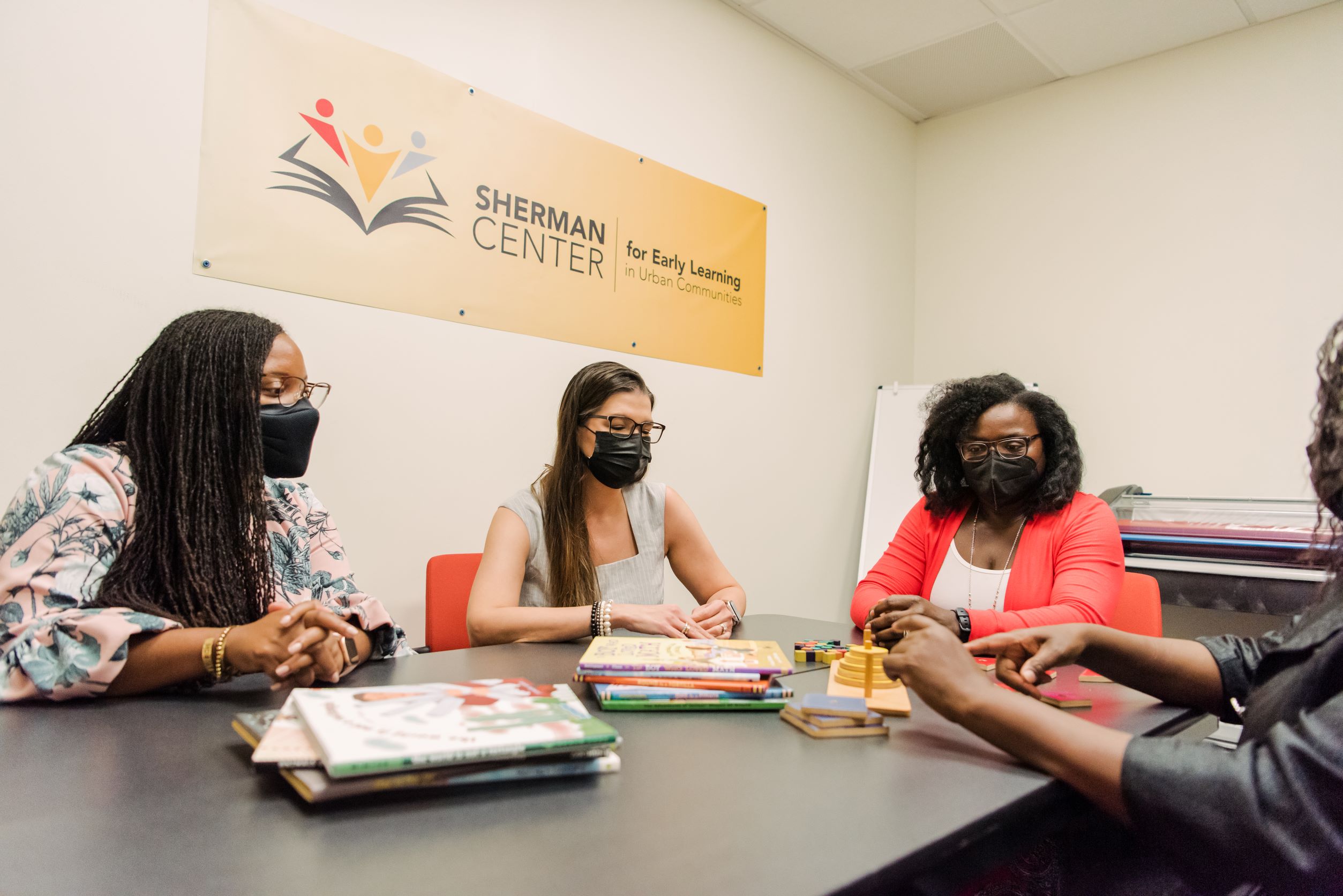
Prior gifts from the Sherman Family Foundation supported the launch of UMBC’s Sherman Center for Early Learning in Urban Communities as well as the Sherman STEM Teacher Scholars program, which prepares UMBC students as culturally responsive and compassionate STEM educators. The Betsy & George Sherman Center will include these programs and more.

President Freeman Hrabowski and Betsy Sherman with students at Lakeland Elementary/Middle School.
Betsy and George Sherman’s philanthropy in STEM education has been inspired by Mrs. Sherman’s career in early childhood education and the late Mr. Sherman’s experience as an engineer and business leader. Their family foundation has now invested more than $38 million in UMBC’s education initiatives.
The Shermans have shared with UMBC a deep commitment to children’s equal access to high-quality education and a supportive community. “It is our job as the adults in the community to offer them an opportunity to grow in a way that will support them,” says Mrs. Sherman. “When a university is connected to a city, children thrive, families thrive.”

Betsy Sherman joins in a rhyming practice activity with students at Lakeland.
Meeting STEM needs
The Sherman STEM Teacher Scholars program, founded with the support of the Shermans in 2006, prepares UMBC undergraduate and graduate students from all majors to become highly qualified PreK-12 teachers with a focus on STEM education.
Lakeland Elementary/Middle School, in south Baltimore, was the first school to partner with UMBC through this program. Over the past decade, it has become a model of a full-service community school in Baltimore City. Among other exciting results, Lakeland now has a Community and STEAM Center, and the school has seen notable increases in students’ math test scores.
 Gustavo Sanabria
 ’22, American studies, and current Sherman Scholar, is completing a certificate in elementary education while serving as a long-term 4th-grade substitute teacher.
The Sherman Scholars program now partners with ten schools to promote academic achievement through professional development for teachers and intensive tutoring for students. For example, more than 90 UMBC students, including Sherman Scholars and others, provide evidence-based math tutoring for over 350 elementary and middle school students in several schools across Baltimore. Early data show this approach is working.
Moving the needle
Rehana Shafi, director of the Sherman Scholars program, remembers the program’s first steps with fondness. “It started off with an investment that we wanted to use to figure out, with the right sorts of support in place—teacher professional development, after school activities for kids, and community engagement—how could we really move the needle for Lakeland’s students and their families,” explains Shafi.
 (L-R) Betsy Sherman, with Corey Carter, and Rehana Shafi at Lakeland.
In 2021, the program graduated 22 scholars, 19 of whom are teaching in Baltimore City. Over the past 15 years (since 2007), the program has yielded 170 educators who are now teaching across the Baltimore region, the state of Maryland, and beyond, often in the most vulnerable school communities. An additional 20 conditionally certified teachers have been supported since 2020–educators meeting critical classroom needs while working to complete M.A.T. degrees.
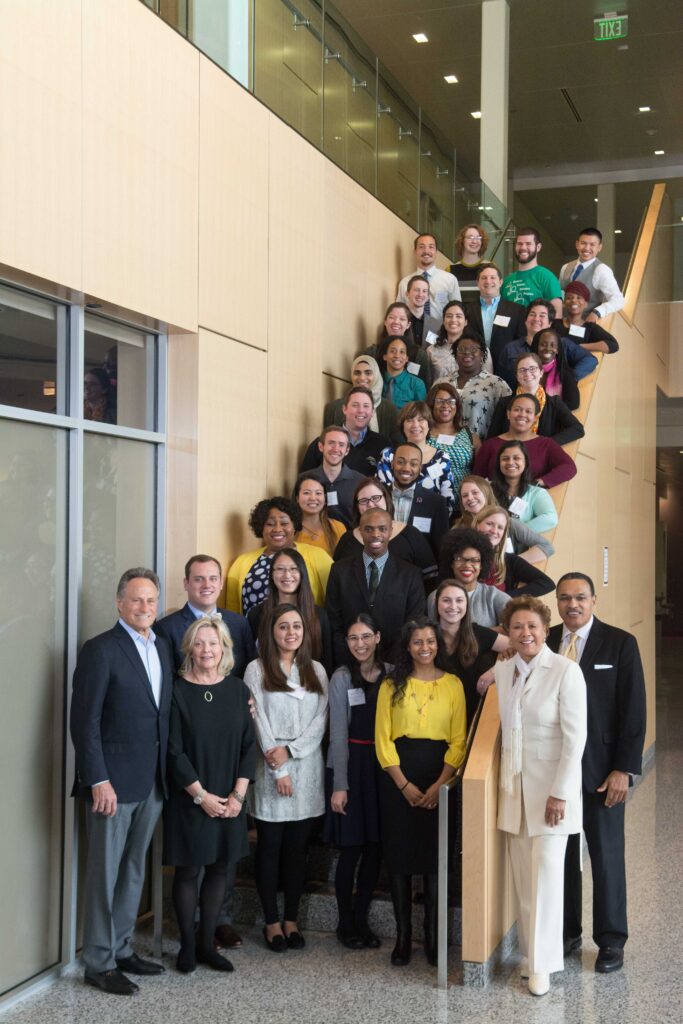
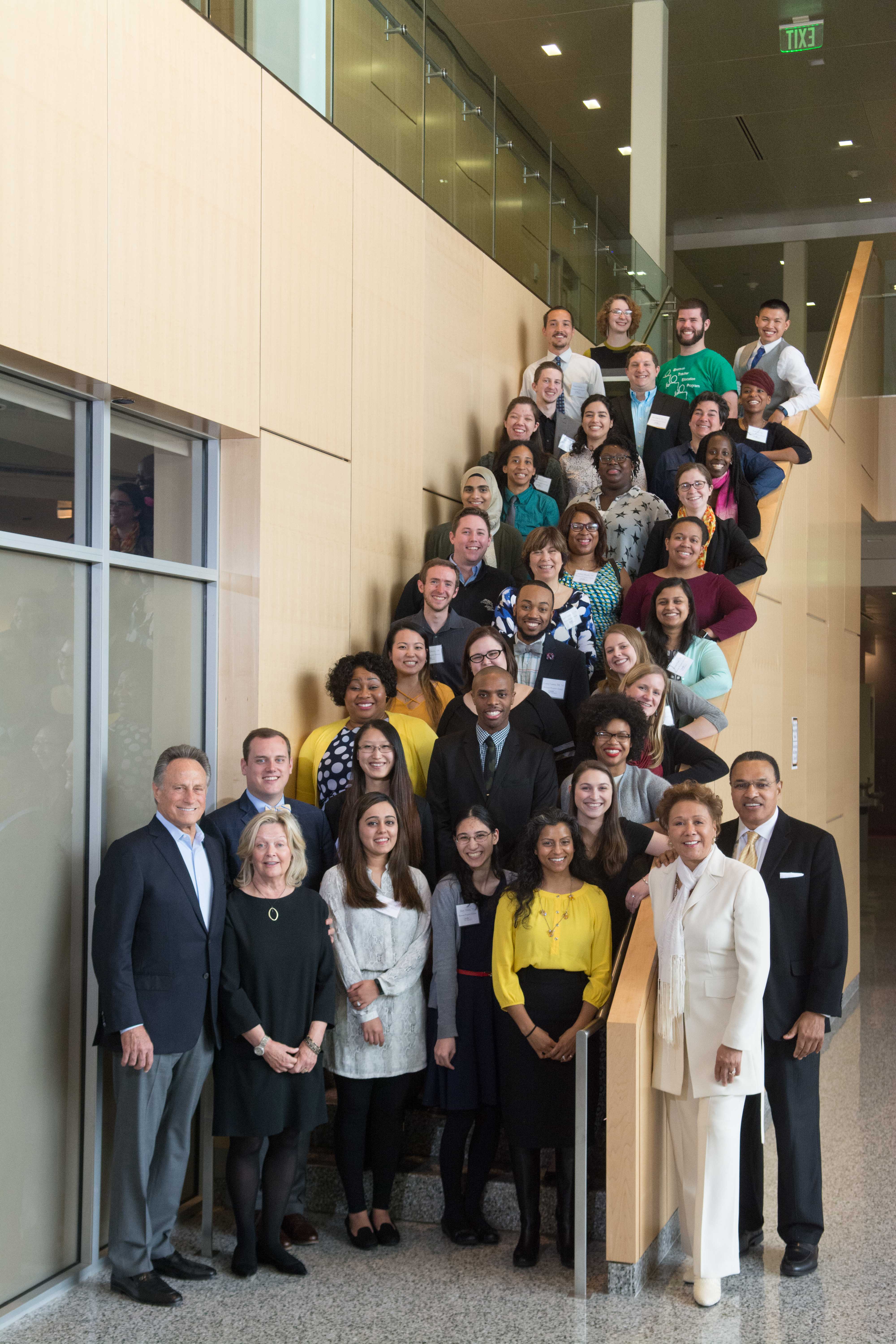
George and Betsy Sherman (front row, left) with President Freeman Hrabowski and Jacqueline Hrabowski (front row, right) next to Rehana Shafi (front row, in yellow) at the Sherman Scholars 10-year anniversary held on April 1, 2017.
More than a decade into the work, Shafi is proud of the strong collaborations that have developed. “Partnering with schools and with communities to walk together through the process of growth and dreaming and achieving…it’s what the work really is about,” she says.
Reflecting on this successful partnership model, she notes, “The work that we’re doing is ready to grow and expand, preparing even more teachers for classrooms across Maryland.”
Focus on early childhood
This new gift will also enable the expansion of UMBC’s early childhood programs. “I am excited to continue to grow our programming and further extend the impact and support for early childhood education,” shares Jennifer Mata-McMahon, director of the Sherman Center for Early Learning in Urban Communities and associate professor of early childhood education.

Lakeland community member at a Families, Libraries, and Early Literacy Project event.
In the last four years, the center has implemented four highly successful programs developed with and for teachers and families across five Baltimore City Schools: the Literacy Fellows Program in collaboration with UMBC’s Shriver Center, the Diverse Books Project, the Teacher Summer Institute, and the Families, Libraries, and Early Literacy Project. Hundreds of families have benefited from these programs.
UMBC’s students volunteer over 400 hundred hours a year in partner schools. Participating teachers receive research-based skill development and funding for teaching materials.
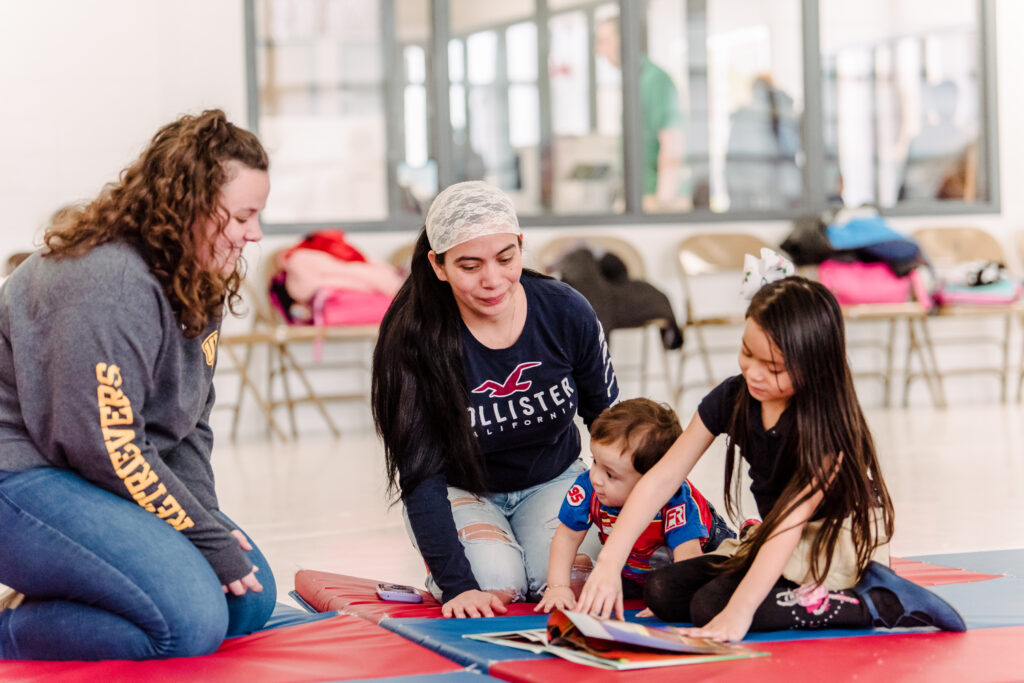 Olivia Grimes
 ’19, individualized study, Sherman Scholar alum and former Sherman Center program assistant, at left, with a Lakeland family in 2020.
The center also invests in community-engaged early childhood research to evaluate learning interventions, academic growth, social-emotional wellbeing, behavioral outcomes, and education policy with faculty across the College of Arts, Humanities, and Social Sciences (CAHSS).
Through its annual Faculty Research Award program, the center provides funding for new research projects. Past recipients have studied topics like Judy Centers in Baltimore, reading interventions, and culture-based computational thinking in urban preschools. Prior awardees have shared with the public their high-impact community-engaged scholarship on different ways to teach kids to read and math skills to prepare children for kindergarten.
“The College remains inspired by the enduring commitment of the Sherman family to urban education. This gift affords CAHSS faculty with the resources needed to further education research and practice,” shares Kimberly Moffitt, interim dean of CAHSS and professor of language, literacy, and culture. She is thrilled that UMBC students will have even more opportunities to work with PreK-12 students throughout Baltimore who are “deserving of dedicated teachers who believe in their abilities and their aspirations for the future.”
“This gift lays out the charge and we stand ready to fulfill it,” says Moffitt.

(L -R)
Shana Rochester, the center’s assistant director and research associate,
with Mata-McMahon, and
Patricia Young, professor of education, and 2020 recipient of the Faculty Research Award.
Scaling and expanding programs
In addition to supporting research and classrooms directly, the center also advances the field by providing leadership development to early childhood educators across the state through the Maryland Early Childhood Leadership Program, which started its third cohort in 2021.
“The new funding will not only ensure the scaling of these programs, but also support new initiatives like Breathe2Think and the Sherman Center Research Conference,” says Mata-McMahon. She is leading the implementation of both programs to further support teachers’ well-being and develop teachers’ skills as action researchers.
“This is about sustainability over time and long-lasting impact in urban communities,” she says.
Full circle
The ripple effect of the Sherman family’s investment is beginning to come full circle. UMBC’s Sherman Scholar alumni are now teaching in Baltimore City classrooms and beyond, preparing the next generation of change-makers. And one scholar has returned to UMBC to share his on-the-ground experience with UMBC students just beginning their journey as future teachers.
Sherman Scholar alum Corey Carter ’08, biological sciences, ’10 M.A.T., taught in both Baltimore City and Baltimore County Public Schools after graduating from UMBC. In 2016, Baltimore County Public Schools honored him as Teacher of the Year. Seeking to expand his impact as an educator in a new way, he returned to UMBC to serve as assistant director of the Sherman Scholars program.

Corey Carter at Lakeland.
“I didn’t see myself in the classroom immediately when I came to UMBC,” says Carter. Without the Sherman STEM Teacher Scholars program, and the opportunities and guidance it provided, he isn’t sure that he would have found his way to the classroom. Now he sees the power of collaboration between universities and schools, fueled by philanthropy, to advance an education system truly centered around students and families.

Corey Carter leads a group activity at UMBC.
As Carter supports the work of the new Betsy & George Sherman Center, he’s excited to see it expand even further. “The impact that we all can bring when we come together to the table—with community, university, and school staff—is a really powerful example,” he says. “I look forward to building our vision together and seeing this energy and momentum spread throughout Baltimore.”
Banner image: Betsy Sherman at Lakeland Elementary/Middle School. All photos by Marlayna Demond ’11 for UMBC.
Video by Corey Jennings ’10 for UMBC.
]]>
The largest gift in the history of UMBC—a $21 million donation from the Sherman Family Foundation—will dramatically expand the reach and impact of the university’s K-12 and early childhood...
https://umbc.edu/stories/21m-sherman-family-foundation-gift-supports-umbcs-bold-commitment-to-prek-12-research-teaching-and-learning/
https://my3.my.umbc.edu/api/v0/pixel/news/119472/guest@my.umbc.edu/1b98fc95d8c7d959b99db46c024c3543/api/pixel
americanstudies
biology
cahss
community
education
inds
news
page1
science-and-tech
shermancenter
shermanscholars
UMBC News & Magazine
https://my3.my.umbc.edu/groups/umbc-news-magazine
https://assets1-my.umbc.edu/system/shared/avatars/groups/000/001/943/24435aa6207c452e7bc15cc74b42c7bb/xsmall.png?1748556657
https://assets1-my.umbc.edu/system/shared/avatars/groups/000/001/943/24435aa6207c452e7bc15cc74b42c7bb/original.png?1748556657
https://assets2-my.umbc.edu/system/shared/avatars/groups/000/001/943/24435aa6207c452e7bc15cc74b42c7bb/xxlarge.png?1748556657
https://assets2-my.umbc.edu/system/shared/avatars/groups/000/001/943/24435aa6207c452e7bc15cc74b42c7bb/xlarge.png?1748556657
https://assets3-my.umbc.edu/system/shared/avatars/groups/000/001/943/24435aa6207c452e7bc15cc74b42c7bb/large.png?1748556657
https://assets1-my.umbc.edu/system/shared/avatars/groups/000/001/943/24435aa6207c452e7bc15cc74b42c7bb/medium.png?1748556657
https://assets2-my.umbc.edu/system/shared/avatars/groups/000/001/943/24435aa6207c452e7bc15cc74b42c7bb/small.png?1748556657
https://assets1-my.umbc.edu/system/shared/avatars/groups/000/001/943/24435aa6207c452e7bc15cc74b42c7bb/xsmall.png?1748556657
https://assets2-my.umbc.edu/system/shared/avatars/groups/000/001/943/24435aa6207c452e7bc15cc74b42c7bb/xxsmall.png?1748556657
UMBC News & Magazine
0
0
false
Thu, 24 Feb 2022 18:00:09 -0500
UMBC’s Haleemat Adekoya, education advocate, is named 2021–22 MHEC student commissioner
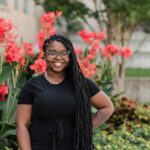
Haleemat Adekoya ‘22, political science, is serving as the 2021–22 student member of the Maryland Higher Education Commission (MHEC). The appointment recognizes Adekoya’s community-engaged work connecting students to resources and leading enrichment and leadership opportunities at both K–12 and university levels.
Adekoya is serving as a voting member of MHEC, which is responsible for establishing policies for public and private colleges and universities across the state of Maryland. She is representing students on MHEC’s Education Policy Committee and Outreach, Grants, and Financial Assistance Committee.
 Photo courtesy of UMBC’s department of education.
“Representing Maryland’s students is a responsibility that I take very seriously,” says Adekoya. “This work is not about me—it’s a collaboration with students. It’s about building relationships where I trust them to provide information about their challenges and needs and they trust me to take their concerns to the board and advocate for change.”
Bridging gaps
Prior to becoming MHEC student commissioner, Adekoya served as an intern at the Maryland State Department of Education (MSDE), with the Student, Family, and School Support Committee in 2020–2021. The committee’s work helped implement the state superintendent’s mental health initiative in the Baltimore area. Adekoya informed the design of K–12 programs that enhanced student learning and increased family engagement.
The internship required Adekoya to learn how to listen to and collaborate with teachers, policymakers, community leaders, support service providers, students, and families to meet the needs of Maryland’s public schools—experience she’ll apply to her work with MHEC. She notes that many community members may not be aware of the resources available to them and policymakers may not know the intricacies of schools’ widely variable daily needs. She hopes to help bridge that gap.
“Maryland schools would benefit from the Full-Service Community Schools model to more effectively continue addressing issues of inclusion, equity, and diversity,” Adekoya suggests. “I believe that education is the most powerful tool to change the world.”

Adeokoya (L) with Lee (R).
Photo courtesy of Marlayna Demond ’11.
“Haleemat is such a strong and compassionate leader. One of the things that inspires me most about her is her commitment to others,” shares her mentor Jasmine Lee, director of inclusive excellence in UMBC’s Division of Student Affairs.
“She’s not a leader because she’s ‘ahead of the pack’…but instead because she is concerned about everyone making it,” says Lee. “She seems to move from the front to the back, and throughout the middle, empowering everyone to move at their own pace.”
Mentor mindset
While new to this high level of state leadership, Adekoya for years gained experience as a leader in a range of education-focused organizations. In high school, she co-founded Dare2Be, a non-profit empowerment and mentorship program for Baltimore County and Baltimore City girls ages 9–18. She also served as a student member of the Baltimore County Board of Education.
Celebration of Teaching Reception: Dr. Hrabowski and I discussed the importance of teachers and teachers of color! I had great conversations with Atom Zerfas, math teacher at Pikesville HS; Haleemat Adekoya, UMBC student & former SMOB; Dr. Allen, UMBC Professor & Hampton Alumna. pic.twitter.com/YpN2i1Wy7W
— Dr. Darryl L. Williams (@BCPS_Sup) March 5, 2020
Adekoya (bottom left) with Dr. Darryl L. Williams, BCPS superintendent, during UMBC’s Celebration of Teaching event in early March 2020.
Inspired by the impact of her work in these roles, Adekoya came to UMBC determined to expand mentoring opportunities for students, which she sees as a powerful way to support students. She joined UMBC’s African Students Association and began Amowara, which pairs first- and second-year students with third- and fourth-year members who can guide them through the academic, professional, and social life at UMBC.
Adekoya also wanted to continue working with Baltimore City youth. She joined UMBC’s Sherman STEM Teacher Scholars Program. After working as a math tutor and coach at Lakeland Elementary/Middle School, the program selected her as a leader for its virtual summer math initiative.

Adekoya teaching virtually during the summer math initiative.
Screenshot courtesy of Catalina Dansberger Duque.
She also worked as a leader for Elev8 Baltimore Freedom Schools, an initiative providing middle school students with academic, health, and community support. There, Adekoya helped develop a summer enrichment curriculum for ten Baltimore City Public Schools. She also served as an academic mentor for the Baltimore City Summer Academic Mentorship Program and in various other community-based organizations.
Advocacy and policy
These leadership experiences have helped Adekoya, who is also a Jacqueline C. Hrabowski Scholar, begin moving toward her long-term career goal of becoming an educator and working on education advocacy and policy both in the U.S. and in Nigeria, where she was born. After completing her year as MHEC commissioner and graduating from UMBC, she hopes to begin UMBC’s masters of arts in teaching and continue her work at MSDE and MHEC.

Lee (left) with Adekoya (R).
Photo courtesy of Marlayna Demond ’11.
“I see all of my work as a way of helping create a more inclusive and equitable future,” shares Adekoya. “Rather than consider myself someone speaking for all Black people or all students, I see these roles as opportunities to pass around my mic and amplify others’ voices. I want to make space for those coming after me.”
Banner image: Haleemat Adekoya. Photo courtesy of Marlayna Demond ’11 for UMBC.
]]>
Haleemat Adekoya ‘22, political science, is serving as the 2021–22 student member of the Maryland Higher Education Commission (MHEC). The appointment recognizes Adekoya’s community-engaged work...
https://umbc.edu/stories/umbcs-haleemat-adekoya-education-advocate-is-named-2021-22-mhec-student-commissioner/
https://my3.my.umbc.edu/api/v0/pixel/news/119549/guest@my.umbc.edu/20b4b4b1907985244ef0f00da45c40a8/api/pixel
cahss
community
education
policy-and-society
politicalscience
shermanscholars
UMBC News & Magazine
https://my3.my.umbc.edu/groups/umbc-news-magazine
https://assets1-my.umbc.edu/system/shared/avatars/groups/000/001/943/24435aa6207c452e7bc15cc74b42c7bb/xsmall.png?1748556657
https://assets1-my.umbc.edu/system/shared/avatars/groups/000/001/943/24435aa6207c452e7bc15cc74b42c7bb/original.png?1748556657
https://assets2-my.umbc.edu/system/shared/avatars/groups/000/001/943/24435aa6207c452e7bc15cc74b42c7bb/xxlarge.png?1748556657
https://assets2-my.umbc.edu/system/shared/avatars/groups/000/001/943/24435aa6207c452e7bc15cc74b42c7bb/xlarge.png?1748556657
https://assets3-my.umbc.edu/system/shared/avatars/groups/000/001/943/24435aa6207c452e7bc15cc74b42c7bb/large.png?1748556657
https://assets1-my.umbc.edu/system/shared/avatars/groups/000/001/943/24435aa6207c452e7bc15cc74b42c7bb/medium.png?1748556657
https://assets2-my.umbc.edu/system/shared/avatars/groups/000/001/943/24435aa6207c452e7bc15cc74b42c7bb/small.png?1748556657
https://assets1-my.umbc.edu/system/shared/avatars/groups/000/001/943/24435aa6207c452e7bc15cc74b42c7bb/xsmall.png?1748556657
https://assets2-my.umbc.edu/system/shared/avatars/groups/000/001/943/24435aa6207c452e7bc15cc74b42c7bb/xxsmall.png?1748556657
UMBC News & Magazine
0
0
false
Thu, 07 Oct 2021 11:15:17 -0400
NSF grants UMBC’s Chris Rakes and Michele Stites $3M to transform undergraduate secondary mathematics teacher preparation programs

UMBC’s Chris Rakes and Michele Stites and colleagues have received a $3 million grant from the National Science Foundation to strengthen undergraduate secondary mathematics teacher preparation programs.
Rakes is an assistant professor of secondary mathematics education and Stites is an assistant professor of early childhood education. The grant will fund their study of the PrimeD framework in collaboration with Berea College, the University of Central Florida, and the University of Kentucky. They will examine the use of PrimeD to structure the training of over 150 undergraduate students per year for four years.
PrimeD framework

Chris Rakes.
Photo courtesy Rakes.
PrimeD stands for Professional Development: Research, Implementation, and Evaluation, an innovative approach to undergraduate secondary mathematics teacher preparation programs. Where traditional approaches to teacher preparation focus on learning how to teach specific mathematical skills, PrimeD structures teacher preparation as professional development. It creates an overarching system of learning, data collection, implementation, and evaluation based on a math teacher’s needs.
This structure supports teacher candidates with a mechanism to re-envision mathematics education as a scientific inquiry process—one that provides a unique and robust lens to examine diverse ideas and perspectives in math. PrimeD also addresses the systemic and individual challenges found in teacher preparation by incorporating culturally aware and equitable teaching practices. The PrimeD teacher preparation framework engages students as professional teacher leaders.
“I want educators to understand how mathematical ideas have meaning, and those meanings lead to procedures and skills,” says Rakes, the principal investigator. He wants everyone to learn to see mathematics as more than a set of skills and algorithms.
 Secondary education students working with math strips. Photo courtesy of Rakes.
Transforming classroom practice
Rakes is the coordinator of UMBC’s undergraduate secondary mathematics education program. Six years ago he collaborated with at team of secondary math education researchers. They evaluated a statewide math and science professional development program for secondary math teachers in Florida.
Their evaluation revealed that teachers were not implementing the strategies, tools, and activities learned through the professional development in their classroom. There was no unifying structure to connect professional development with classroom implementation and evaluation.
“We realized that what was missing was a coherent framework that was guiding the work, “ explains Rakes. “There was no common vision and nothing explicit that would help the teachers take it to the classroom. There was nothing that said, ‘This has been fun. Now, how are you going to do this?”
PrimeD, they hypothesized, could meet this need.
 Secondary mathematics students presenting their student-teacher experiences.
Photo courtesy of Rakes.
Teachers as researchers
PrimeD creates this link by equipping student-teachers, including aspiring math teachers, with the skills to conduct research on their teaching practices. They can then adjust their teaching based on their findings.
To assist teacher candidates with implementing what they’ve learned, PrimeD includes network “improvement communities.” Professors, mentor-teachers, and alumni guide aspiring teachers through the process. Research has shown this kind of peer and mentor support to be essential for teacher success and persistence in the first three years of teaching.
 Secondary math education students complete an exercise. Photo courtesy of Rakes.
Math as a change agent
Rakes will implement PrimeD at UMBC with student-teachers from the Sherman STEM Teacher Scholars Program. Stites, the co-principal investigator, will evaluate the implementation of the program at UMBC.
At the same time, researchers from partner universities will also study the implementation of PrimeD in their undergraduate secondary math teacher preparation programs. The participating researchers will gather, share, and evaluate fundamental data providing insights into PrimeD implementation in different contexts.

Michele Stites.
Photo courtesy of Stites.
If the research proves successful, Stites, who specializes in early childhood math and special education, plans to implement PrimeD in UMBC’s early childhood and elementary mathematics program in the future. She wants early childhood mathematics education candidates to learn how to teach about finding mathematics everywhere.
“Mathematics isn’t a skill. It’s a way of thinking about a problem,” says Stites. “It has to do with how we function in society.”
Both Rakes and Stites know there is much work to do, but they have a mission and a team of collaborators excited for the evolution of undergraduate mathematics teacher preparation programs. “I want the mathematics classroom to be a vibrant place,” says Rakes, “where students have the opportunity to put all the things they’ve learned together into a coherent web of knowledge, connected through mathematical thinking and understanding.”
Banner: Stock image by Monkey Business Images.
]]>
UMBC’s Chris Rakes and Michele Stites and colleagues have received a $3 million grant from the National Science Foundation to strengthen undergraduate secondary mathematics teacher preparation...
https://umbc.edu/stories/nsf-grants-umbcs-chris-rakes-and-michele-stites-3m-to-transform-undergraduate-secondary-mathematics-teacher-preparation-programs/
https://my3.my.umbc.edu/api/v0/pixel/news/119713/guest@my.umbc.edu/c55e1dfdc78710556df101591ecf9b5d/api/pixel
cahss
cahssresearch
education
policy-and-society
shermanscholars
UMBC News & Magazine
https://my3.my.umbc.edu/groups/umbc-news-magazine
https://assets1-my.umbc.edu/system/shared/avatars/groups/000/001/943/24435aa6207c452e7bc15cc74b42c7bb/xsmall.png?1748556657
https://assets1-my.umbc.edu/system/shared/avatars/groups/000/001/943/24435aa6207c452e7bc15cc74b42c7bb/original.png?1748556657
https://assets2-my.umbc.edu/system/shared/avatars/groups/000/001/943/24435aa6207c452e7bc15cc74b42c7bb/xxlarge.png?1748556657
https://assets2-my.umbc.edu/system/shared/avatars/groups/000/001/943/24435aa6207c452e7bc15cc74b42c7bb/xlarge.png?1748556657
https://assets3-my.umbc.edu/system/shared/avatars/groups/000/001/943/24435aa6207c452e7bc15cc74b42c7bb/large.png?1748556657
https://assets1-my.umbc.edu/system/shared/avatars/groups/000/001/943/24435aa6207c452e7bc15cc74b42c7bb/medium.png?1748556657
https://assets2-my.umbc.edu/system/shared/avatars/groups/000/001/943/24435aa6207c452e7bc15cc74b42c7bb/small.png?1748556657
https://assets1-my.umbc.edu/system/shared/avatars/groups/000/001/943/24435aa6207c452e7bc15cc74b42c7bb/xsmall.png?1748556657
https://assets2-my.umbc.edu/system/shared/avatars/groups/000/001/943/24435aa6207c452e7bc15cc74b42c7bb/xxsmall.png?1748556657
UMBC News & Magazine
0
0
false
Thu, 17 Dec 2020 21:09:10 -0500
UMBC’s Sherman Center for Early Learning in Urban Communities is transforming early childhood education in Maryland

UMBC’s Sherman Center for Early Learning in Urban Communities is now in its third year of strengthening and expanding early childhood education in Maryland. The center was founded with the support of a $6 million grant from the George and Betsy Sherman Family Foundation in 2017. It has developed a series of research-based initiatives to address the needs of children from birth to eight years old in Maryland, and the workforce dedicated to educating them.
 (L to R) Betsy Sherman, Mavis Sanders, Louise Corwin, and Meredith Callanan. Photo by Chris Ferenzi for UMBC.
The initial grant founding the center helped establish the Maryland Early Childhood Leadership Program (MECLP), a faculty research fellowship, and an innovative literacy program. All three elements create a body of work that is transforming early childhood education—on campus, in Baltimore City, and across the state.
Strong partnerships with researchers, schools, and families are the foundation of this work. “We never say, ‘This is what we are going to do.’ We engage our partners in conversation about what they need,” shares Mavis Sanders, professor of education and director of the Sherman Center.
“We try not to be reactive or directive, but responsive,” she says. “It is about listening. We can’t do our work without our partnerships.”
 Sanders (on the right) speaking with a parent at one of the Sherman Center’s Families, Libraries, and Early Literacy Project events at Lakeland.
Investing in early childhood research
The Sherman Center’s faculty research fellowships support faculty and their doctoral students. The funding helps them undertake research that expands knowledge about policies and practices related to early childhood education. The program encourages collaborations within and across departments, fields, and institutions. Awards range from $50,000 to $100,000.
Kindel Nash andlanguage, literacy, and culture (LLC) doctoral student Josh Michael ‘10, political science and education, were the inaugural research fellows in 2017-2018. Nash is an associate professor of education and Michael is the assistant director of UMBC’s Sherman STEM Teachers Scholars Program. Their multi-year study, in collaboration with Maree G. Farring Elementary/Middle School, examines the effects of using the Read Two Impress intervention with struggling third-grade readers.
 (L to R) Josh Michael, Kindel Nash, and Olivia Grimes’s ‘19, individualized study, discuss Grimes’s science lesson guide at the 2019 Summer Teacher Institute.
Nash explains this intervention in “Parents can help kids catch up in reading with a 10-minute daily routine” for The Conversation. Their research found that having bilingual books with culturally authentic content led to increased engagement among Latinx children and their families. Nash’s new book, Toward Culturally Sustaining Teaching, further explores this topic.
Evaluating the literacy fellows program
Two additional faculty received the award in 2018 – 2019. Susan Sonnenschein, professor of psychology, and Claudia Galindo, associate professor of education policy, University of Maryland, and former associate professor of LLC at UMBC. The team is working with Bay-Brook Elementary/Middle School and Curtis Bay Elementary/Middle School. They are studying the outcomes of the Sherman Center’s Literacy Fellows program, a collaboration with UMBC’s Shriver Center.
The program provides teachers additional classroom support from UMBC student volunteers from all majors. Sherman Center Literacy fellows volunteered for nearly 300 hours in 2018 – 2019 and more than 500 hours in 2019 – 2020.
 Nihira Mugamba ‘21, political science and Africana studies at Bay-Brook Elementary/Middle School as Shriver Literacy Fellow. Photo courtesy of Mugamba.
“Dr. Sonneschein and I have been working collaboratively for ten years. We take an interdisciplinary approach to examine family and school mechanisms. This helps to improve the educational experiences and outcomes of Black and Brown students,” explains Galindo. “We have witnessed the potential and impact of the Literacy Fellows program on students and teachers in Baltimore City.”
Latest research awards focus on Judy Centers
Research awards for 2020 – 2021 were given to two research teams. The first team includes Patricia A. Young, associate professor of education, and Deborah Kabura Kariuki, clinical instructor of computer science education. Young and Kariuki are working on a year-long study, “Infusing a Culture-based Computational Thinking Curriculum in Urban Preschools.” They will partner with the Judith P. Hoyer Center Early Learning Hub at Lakeland Elementary/Middle School. Judy Centers help prepare children from age birth through kindergarten for school readiness.

Patricia Young.
Photo courtesy of Young.
“It is imperative that disenfranchised students and communities have opportunities to explore computational thinking, to be active participants in this technological revolution,” shares Young. “Our research provides an introduction into the practices of computational thinking for preschoolers and the pedagogy for preschool teachers.”
The team will create an e-learning module and computational thinking instructional materials to help children at the Judy Center learn these concepts.
 Judy Center staff members provide free books to early readers at a 2019 Sherman Center Families, Libraries, and Early Literacy Project event at Lakeland.
The second team includes Jane Lincove, associate professor of public policy; Lieny Jeon, assistant professor at the Johns Hopkins School of Education; and Sarah Bollard, citywide coordinator for Judy Centers. They are working on a three-year study, “Judy Centers in Baltimore: Improving Data-Informed Decisions.”
Diverse books anchor literacy
The cornerstone of the Sherman Center is its focus on improving literacy experiences and outcomes for young learners in Baltimore City. “Literacy is a gateway to knowledge across all curriculum areas,” says Sanders. The Sherman Center has implemented four literacy interventions: the Diverse Books Project; Teacher Summer Institute; Literacy Fellows; and Families, Libraries, and Early Literacy Project.
 The “Integrated Learning: Science Through Diverse Books” unit developed by UMBC alumna Olivia Grimes.
The Center implements these literacy programs through close partnerships with five Baltimore City Public Schools and 50 early childhood educators. Together, they reach about 1,250 children. They also work with approximately 30 families annually who have children ages birth to three, through the Judy Centers at Lakeland Elementary/Middle School and Curtis Bay Elementary/Middle School.
 A parent reads to her toddler at a 2019 Sherman Center event.
The Diverse Books Project is a growing library of books housed at the Sherman Center. It reflects the lives and cultures of children and families of color. The books are used by UMBC teaching interns, graduate students, volunteers, and faculty, and by early childhood educators. They use the books to introduce and reinforce literacy across all subjects.
 Lakeland teachers deliver school supplies to a student’s home in summer 2020.
Photo courtesy of Sanders.
Teaching with diverse books
During the Sherman Center’s Teacher Summer Institute teachers partner schools learn to use these books as tools to support literacy. They also explore how research-based strategies like translanguaging can support more inclusive, high-achieving classrooms.
 Jennifer McMahon, associate professor of education, working with early childhood educators from Baltimore City Public Schools during the 2019 Teacher Summer Institute.
In 2019, 49 educators across the state requested 250 diverse books after working with the Sherman Center. The Institute went virtual this summer. It provided 50 early childhood educators from partner schools with nearly $15,000 worth of supplies for their students and to set up virtual classrooms.
 A student from one of the Sherman Center’s partner schools unpacks new supplies for the 2020 – 2021 school year. Photo courtesy of Sanders.
Working directly with families
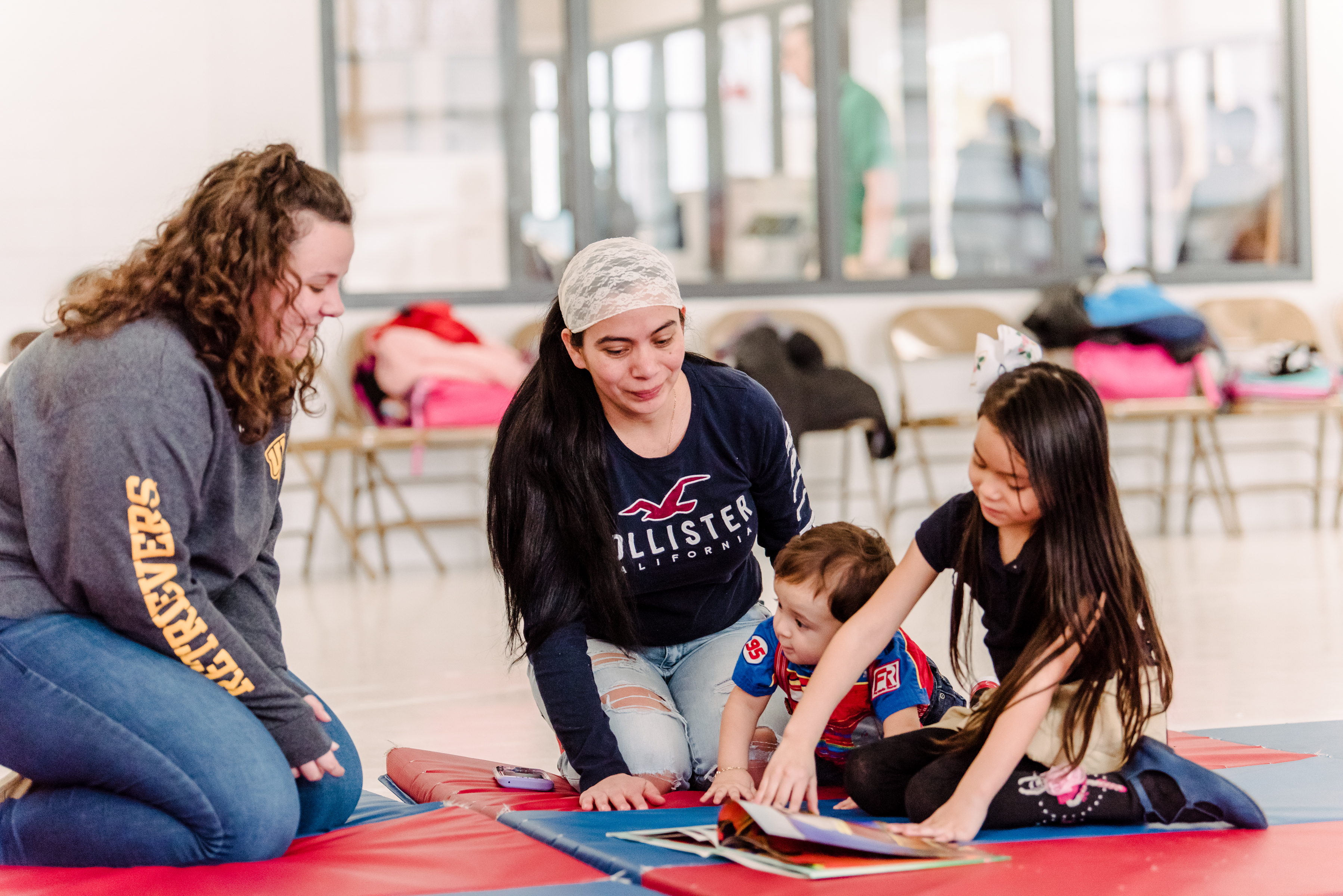
In addition to working with teachers, the Sherman Center also works directly with families. They are invited to attend quarterly Families, Libraries, and Early Literacy Project events at Lakeland and Curtis Bay Elementary/Middle Schools. The events provide families a safe space in their neighborhoods to meet other families. They also learn strategies to promote their children’s kindergarten readiness, and create materials to support learning at home.
In addition to these activities, a librarian from the Enoch Pratt Free Library leads a story time session for the families at the events. Families also have a chance to select and take home diverse books for their children. In 2019, UMBC distributed 178 multicultural books to families at Curtis Bay and Lakeland Judy Centers.
 An Enoch Pratt librarian leads a story time at the 2019 Sherman Center’s Families, Libraries, and Early Literacy Project event at Lakeland.
Creating a new system
As the world copes with COVID-19, the Sherman Center’s literacy, professional development, and research programs will continue to adapt. The center will support the literacy needs of children throughout Maryland in the current virtual environment.
“We are not preparing teachers, administrators, public servants, and students to adapt strategies to work within the status quo of early childhood,” notes Sanders. Instead, the Sherman Center is preparing education professionals to be innovators. She says, “We will create a new early childhood education system that reflects and serves the diversity of today and tomorrow.”
Banner image: Sanders (in the middle, in red) surrounded by Sherman Center, Judy Center, and Enoch Pratt Free Library staff at the Families, Libraries, and Early Literacy Project event at Lakeland in February 2019. All photos by Marlayna Demond ’11 for UMBC unless otherwise noted.
]]>
UMBC’s Sherman Center for Early Learning in Urban Communities is now in its third year of strengthening and expanding early childhood education in Maryland. The center was founded with the support...
https://umbc.edu/stories/umbcs-sherman-center-for-early-learning-in-urban-communities-is-transforming-early-childhood-education-in-maryland/
https://my3.my.umbc.edu/api/v0/pixel/news/119765/guest@my.umbc.edu/a252ccf41a77da57c72c966307e05c6e/api/pixel
africanastudies
cahss
cahssresearch
education
llc
page1
policy-and-society
psychology
publicpolicy
shermancenter
shermanscholars
shrivercenter
UMBC News & Magazine
https://my3.my.umbc.edu/groups/umbc-news-magazine
https://assets1-my.umbc.edu/system/shared/avatars/groups/000/001/943/24435aa6207c452e7bc15cc74b42c7bb/xsmall.png?1748556657
https://assets1-my.umbc.edu/system/shared/avatars/groups/000/001/943/24435aa6207c452e7bc15cc74b42c7bb/original.png?1748556657
https://assets2-my.umbc.edu/system/shared/avatars/groups/000/001/943/24435aa6207c452e7bc15cc74b42c7bb/xxlarge.png?1748556657
https://assets2-my.umbc.edu/system/shared/avatars/groups/000/001/943/24435aa6207c452e7bc15cc74b42c7bb/xlarge.png?1748556657
https://assets3-my.umbc.edu/system/shared/avatars/groups/000/001/943/24435aa6207c452e7bc15cc74b42c7bb/large.png?1748556657
https://assets1-my.umbc.edu/system/shared/avatars/groups/000/001/943/24435aa6207c452e7bc15cc74b42c7bb/medium.png?1748556657
https://assets2-my.umbc.edu/system/shared/avatars/groups/000/001/943/24435aa6207c452e7bc15cc74b42c7bb/small.png?1748556657
https://assets1-my.umbc.edu/system/shared/avatars/groups/000/001/943/24435aa6207c452e7bc15cc74b42c7bb/xsmall.png?1748556657
https://assets2-my.umbc.edu/system/shared/avatars/groups/000/001/943/24435aa6207c452e7bc15cc74b42c7bb/xxsmall.png?1748556657
UMBC News & Magazine
0
0
false
Tue, 27 Oct 2020 19:28:38 -0400
UMBC and Baltimore’s Lakeland Elementary/Middle School launch innovative online summer math program
UMBC’s Sherman STEM Teacher Scholars Program has launched an intensive virtual math incubator for Lakeland Elementary/Middle School in Baltimore City this summer. The free, voluntary five-week program is a math intervention for 150 Lakeland students in third through eighth grade. The program seeks to prevent summer learning loss, which could increase this year, intensified by COVID-19’s impact on student learning during the school year.
“With the changes this spring to learning, the UMBC/Lakeland Summer Math Program has allowed us to make up ground and get a head start with students in a targeted approach to math instruction,” says Lakeland Principal Najib Jammal. “This partnership lets us plan for students’ needs this fall knowing that 150 of our students had access to high-quality math instruction the summer.”
Jammal recently spoke about the collaboration in an interview for the segment “Staving Off Summer Slide” on WYPR’s On The Record.
The summer program was designed to also have a lasting impact beyond improving specific STEM skills. Lakeland teachers and UMBC partners are helping Lakeland students develop a positive math identity that will carry them forward into higher level math courses.
Moving online
The summer STEM program was originally designed to be held in person. COVID-19 both increased the need for the program and required Lakeland to move instruction online, decreasing student–teacher and peer interactions. To counter this challenge, program organizers knew they’d need more teachers to decrease the student–teacher ratio and reach more students overall.
 A rug in Lydia Coley’s classroom during her student teaching internship.
The Goldseker Foundation and Baltimore Children’s Youth Fund (BCYF) provided the funding needed to implement the program online and to hire more teachers. Their financial support also expanded the program from the initial 60 rising fourth through sixth graders to 150 rising third through eighth-grade students.
This creative intervention has three priorities: whole child development, math identity development, and math growth. The program is implemented under the direction of Josh Michael ‘10, political science and education, assistant director of UMBC’s Sherman STEM Teachers Scholars Program, in collaboration with five Baltimore City school teachers and twelve interns from the Sherman Scholars program.
Whole child development
UMBC has fostered a strong partnership with Lakeland for more than five years. It has supported Lakeland’s wrap-around academic and community services through the Sherman STEM Teachers Scholars Program, the Sherman Center for Early Learning in Urban Communities, and the Shriver Center Literacy Fellows program. Through additional collaboration with area community groups and companies, such as Northrop Grumman, Lakeland has built a safe and supportive community where students can thrive socially and academically.
The summer program also relies on a firm foundation of strong teacher, student, family, and community relationships. The Sherman STEM Teacher Scholars serve as program leaders. In this role, they dedicate the majority of their day to fostering relationships with students and their families through video chats, phone calls, texts, and emails.
 Coley’s classroom during her student teaching internship.
These program leaders coach the three Lakeland teachers who serve as program facilitators, including one UMBC alumna. Former Sherman Scholar Molly Hart, M.A.T. ‘19, elementary education, is now a sixth grade math teacher at Lakeland and serves as a facilitator for the summer STEM program.
“The program’s support system is incredible,” shares Haleemat Adekoya ‘23, political science. She says this experience has made her aware of the importance of consistent communication in the classroom.
If a student is absent one day, her priority is to get in touch with their family as soon as possible. “Every time I let a student and their family know they were missed, as an intricate part of the classroom community, they’ve shown up the next day and actively engaged.”
This structure of robust support is cultivating strong student and family relationships and student participation. Out of 150 enrolled students, an average of 120 consistently engage in math instruction and STEM activities each day. Nearly 100 percent engage each week. Once students feel supported and are engaged, teachers can then move forward to focus on further developing students’ math identity and math skills.
Math identity
Historically many Black, Latinx, and first-generation students, as well as English Language Learners (ELL) and students experiencing economic hardship, have faced obstacles in math achievement. Limited public school resources, insufficient access to quality culturally relevant instruction, and high social/emotional stresses have created learning gaps at lower grades, which often deepen in upper grades.
For many students, negative experiences in trying to build fundamental math skills have impeded their development of a positive math identity. Math identity is a student’s perception of their ability to perform well in math. It has been shown to impact math performance.

Coley’s classroom during her student teaching internship.
These factors have also contributed to a lack of diversity in STEM fields, reinforcing the negative stereotype that underrepresented students can’t do math regardless of the resources available to them. As a result, underrepresented students are less likely to feel confident enough to pursue higher level math courses. This further limits their access to a variety of academic, career, and social opportunities.
“I am terrified of math even though I was given all the support and resources to excel in math,” explains Adekoya. “Josh Michael and Lydia Coley give me the support and confidence to lean into this opportunity and not give in to imposter syndrome. I have to lead by example.”
Lydia Coley ’20, American studies, valedictorian of UMBC’s most recent graduating class, is also a program leader and a Sherman Scholar alumna. She is a first-year, sixth grade math teacher at Maree G. Farring Elementary/Middle School in Baltimore City.
Me, myself, and math
Lakeland serves 1,000 Pre-K to eighth-grade students. The majority come from underrepresented populations in STEM fields. They are less likely to have a positive math identity. Black students make up 32 percent of the school, 62 percent are Latinx, 42 percent are English Language Learners, 11 percent receive special education services, and most students come from low-income families.
The summer program aims to help Lakeland students break the cycle of underrepresentation. Immersing students in a safe and nurturing space encourages them to engage in the math learning process. It also broadens and strengthens their math skills and fosters a positive math identity.
Through daily interactive synchronous video lessons, based on common core standards, program leaders teach, model, and provide individualized instruction. Students develop a toolkit of strategies that build the confidence needed to take risks and see mistakes as learning opportunities.
 Coley’s classroom during her student teaching internship.
Program facilitator Iliana Hernandez, a fifth-year, third grade math and dual-language teacher at Lakeland, provides program leaders with best practices to support ELL learners. She admits her own fears of math in elementary school. “I don’t want my students to fear math like I did,” shares Hernandez. “When students stay connected and feel valued and cared for their confidence grows and they feel ready to learn.”
Math growth
With this foundation in place, rigorous math instruction can move forward. Program Director Carly Harkins leads the team in curriculum development and instruction. Under her guidance, program facilitators coach program leaders in weekly lesson planning, lesson delivery, assessments, and student support. After daily class, students practice independently through proven online learning tools wherever they are on their math journey.
The program also provides hands-on experience to help students apply what they are learning. Josh Massey, the STEM facilitator, works with Michael and Harkins to create hands-on STEM activities for students.
Massey ‘18, computer engineering, and M.A.T. ‘19, technology education, is a first-year computer science teacher at the Baltimore Polytechnic Institute in Baltimore City. He creates 150 STEM kits weekly, and helps deliver them to students’ homes. Each kit includes the materials needed to complete a project. They tie into the week’s topic, like circuits or small machines.
Adekoya showing the circuit flashlight STEM Kit project.
Photo courtesy of Adekoya.
Students first work on the project independently and then share their process in class. Each student is then the proud owner of something they have built themselves. These projects help support both math growth and a positive math identity.
Access to a bright future
When Michael sees students participating in these activities, he sees them as accessing the building blocks they’ll use to excel in the years ahead.
UMBC and Lakeland partners hope this extra support will ensure more Lakeland students will be better prepared for Algebra I when they enter eighth grade. Why? “Algebra I is a key academic gateway,” says Michael. “There is strong evidence that successfully completing Algebra I in eighth grade is related to higher math achievement in high school and attainment in college.”
Michael notes that it’s long been the case that students of color have had less access to Algebra I in eighth grade. He shares, “Our goal is to provide that access by helping students believe success in math is for them.”
Banner image: A math chart in Coley’s classroom during her student teaching internship. All images by Marlayna Demond ’11 unless otherwise noted.
]]>
UMBC’s Sherman STEM Teacher Scholars Program has launched an intensive virtual math incubator for Lakeland Elementary/Middle School in Baltimore City this summer. The free, voluntary five-week...
https://umbc.edu/stories/umbc-and-baltimores-lakeland-elementary-middle-school-launch-innovative-online-summer-math-program/
https://my3.my.umbc.edu/api/v0/pixel/news/119827/guest@my.umbc.edu/3db479bb9c38fac56547ece54e817530/api/pixel
americanstudies
cahss
coeit
education
history
page1
policy-and-society
politicalscience
resilience
shermanscholars
UMBC News & Magazine
https://my3.my.umbc.edu/groups/umbc-news-magazine
https://assets1-my.umbc.edu/system/shared/avatars/groups/000/001/943/24435aa6207c452e7bc15cc74b42c7bb/xsmall.png?1748556657
https://assets1-my.umbc.edu/system/shared/avatars/groups/000/001/943/24435aa6207c452e7bc15cc74b42c7bb/original.png?1748556657
https://assets2-my.umbc.edu/system/shared/avatars/groups/000/001/943/24435aa6207c452e7bc15cc74b42c7bb/xxlarge.png?1748556657
https://assets2-my.umbc.edu/system/shared/avatars/groups/000/001/943/24435aa6207c452e7bc15cc74b42c7bb/xlarge.png?1748556657
https://assets3-my.umbc.edu/system/shared/avatars/groups/000/001/943/24435aa6207c452e7bc15cc74b42c7bb/large.png?1748556657
https://assets1-my.umbc.edu/system/shared/avatars/groups/000/001/943/24435aa6207c452e7bc15cc74b42c7bb/medium.png?1748556657
https://assets2-my.umbc.edu/system/shared/avatars/groups/000/001/943/24435aa6207c452e7bc15cc74b42c7bb/small.png?1748556657
https://assets1-my.umbc.edu/system/shared/avatars/groups/000/001/943/24435aa6207c452e7bc15cc74b42c7bb/xsmall.png?1748556657
https://assets2-my.umbc.edu/system/shared/avatars/groups/000/001/943/24435aa6207c452e7bc15cc74b42c7bb/xxsmall.png?1748556657
UMBC News & Magazine
0
0
false
Fri, 24 Jul 2020 18:55:04 -0400
UMBC develops future STEM teachers, researchers through pilot program pairing high school and college students
This fall, Kimani Reed will enter UMBC as a new student in the pre-nursing program, but she’s already a member of the UMBC community. Through a partnership between UMBC and Cristo Rey Jesuit High School in Baltimore, Reed worked on campus one day a week throughout her high school career, gaining experience in several UMBC offices.
“From freshman year all the way through senior year, I met new people at UMBC who always supported me,” Reed says. When she worked in the UMBC Shriver Center, she shares, “The warm welcome I felt when I walked through the doors on the first day already made UMBC feel like home.”
Reed’s connection to The Shriver Center will continue this fall. She has chosen to participate in the Shriver Living Learning Community, a residential community for students committed to pursuing service-learning and community engagement.
Championing student success
Knowing she had her eye on a medical career, Reed’s UMBC mentors frequently pointed her toward programming that would help her reach her goal. So when her supervisor at the Shriver Center, Lori Hardesty, associate director of applied learning and engagement, found out about a special pilot program in the life sciences, she immediately recommended it to Reed.
Hua Lu, professor of biological sciences, led the pilot, and Reed jumped at the chance to work with her. She and Shaojie Chen ’21, chemistry, made up one of four student teams, each with one UMBC student and one local high school student.
Each team participated in a weeklong program in the summer of 2019 funded by the National Science Foundation and organized by Lu. The Research Training for Future Science Teachers and High School Students (RTTS) program has two goals: to create early research opportunities for high school students interested in STEM and to better prepare the next generation of STEM educators.
 Kimani Reed (left) and Shaojie Chen work together in Hua Lu’s lab during the summer program in 2019.
Transformative experiences
That’s how Reed found herself spending her 17th birthday, on a Friday in June last summer, in Hua Lu’s plant genetics lab at UMBC. She arrived by 8:30 a.m. to add the finishing touches to her presentation with Chen on CDF3, a protein found in arabidopsis plants.
Chen and the other UMBC participants were Sherman STEM Teacher Scholars. The Sherman program prepares undergraduates to be culturally responsive and compassionate educators, and many scholars work in Baltimore City. Their partners were all high school students, with the other three (beyond Reed) coming from Baltimore City College High School.
When Lu looks at Reed, Chen, and the other program participants, she sees the future of STEM teaching and learning. “I think we need to provide early, discipline-specific training for our future teachers,” she says. And for the high school participants, “It’s a lot of work, but when you see you can provide this many students with a hands-on experience, it’s definitely worth it.”
Lu is learning from these students’ experiences as she prepares for the program’s next iteration. The pandemic prevented her from running the program in person in 2020, but she is excited for it to relaunch in 2021.
Digging deeper
Based on Reed’s recent study of genetics in high school biology, sometimes she mentored Chen, rather than the other way around. The pair spent the week exploring the structure and function of CDF3 through hands-on laboratory work and research in scientific online databases.
 Ben Lockwood (right) and Youssef Maroud work together during the summer program in 2019. Photo by Hua Lu.
“I learned that molecules do so many different things. I knew they were complex, but looking at them up close through the different databases and digging deeper, I learned so much more,” Reed says. “This experience further confirmed my desire to pursue a medical-related career.” Reed has chosen nursing, after giving the biology major her full consideration thanks to her experience with “Mama Lu,” the students’ nickname for Lu based on her supportive attitude.
Whether a student ends up pursuing research or not, Lu says, an experience like this summer program can be a useful eye-opener about what a research career would be like.
Research for teachers
Ben Lockwood ’20, biological sciences, came at the experience from a different angle—he’s long known he wanted to pursue a teaching career. He was initially skeptical of a research experience, but thanks to the program’s team-based approach, he found it rewarding.
“I definitely feel like I gained from this research experience. And I think it was because I got to do it alongside a high school student,” Lockwood says. “It furthered my understanding of the science content, but it also helped grow my teaching skills, and pair them together, which I hadn’t experienced before.”
Working together with his partner, Youssef Maroud, got Lockwood thinking about “how I would approach labs and experimentation in the classroom,” he says. For example, he began to consider how he might partner with local labs and universities “to provide an upper-level lab environment that offers access to things the high school students wouldn’t normally do.”
Both the high school and UMBC students learned quite a bit about how important it is to use equipment correctly and carefully, and to record results thoroughly and accurately. A technique like pipetting is fairly simple, but also essential, they learned, especially when working with expensive or rare chemicals.
As a result, “Practicing professionalism in the lab is something that I hope to teach my students,” Lockwood says. “And I definitely know from this experience that I have to first provide students with a technical foundation. How can they come up with a procedure if they don’t know the capabilities of each piece of equipment? And how can they carry it out if they don’t know how to use the equipment?”
If Lockwood is any example, “This program is developing better teachers for society,” Lu says, “which will have a positive impact on future students and STEM professionals.”

Hua Lu. Photo by Marlayna Demond ’11 for UMBC.
Lasting bonds
The experience in Lu’s lab was a win for everyone in the pilot program. “The high school students brought so much energy to the lab,” Lu says. “They showed a passion for biology, and you’d see those lightbulb moments.”
The relationships the pairs formed were also a meaningful part of the experience. “I still text with my partner from time to time,” Lockwood says. Building their relationship was “easy, natural, and fun,” he adds. One of the reasons Lockwood wants to teach is to mentor students who may be struggling to find their way, so “being able to establish that relationship with Youssef was very affirming. And I look forward to being a mentor to many more students in the future.”
That’s exactly what Lu hopes students get out of the program: an understanding of not just how to do lab research, but also of how important relationships are to learning and discovery in science.
As Reed begins her UMBC career, she’s excited to extend the relationships she’s already formed at UMBC and to create new ones. “It meant a lot to me to be part of this, because I still got to stay where I felt at home—because I consider UMBC a home away from home—but I also got to make new family with the people I met,” Reed says. “Now I have a really large family and support system through UMBC, and I am so excited to see what I can do with all of them helping me grow.”
Banner image: Summer program participants and other members of Hua Lu’s lab enjoy lunch together on campus in summer 2019. From left to right: Ben Lockwood ’20; Malaysia McGinnis ’20; Min Gao, postdocotoral fellow; Hua Lu; Cora Bainum, Baltimore City College High School; Jessica Allison, Ph.D. student; Allen Stallings, Baltimore City College High School; Shaojie Chen ’21; Kimani Reed, Cristo Rey Jesuit High School; Riki Egoshi ’20 (front); Youssef Maroud, Baltimore City College High School. Photo courtesy Hua Lu.
]]>
This fall, Kimani Reed will enter UMBC as a new student in the pre-nursing program, but she’s already a member of the UMBC community. Through a partnership between UMBC and Cristo Rey Jesuit High...
https://umbc.edu/stories/umbc-develops-future-stem-teachers-researchers-through-pilot-program-pairing-high-school-and-college-students/
https://my3.my.umbc.edu/api/v0/pixel/news/119835/guest@my.umbc.edu/1f341bbd5eafc9fe9d5cedbcc69f9116/api/pixel
biology
cnms
community
science-and-technology
shermanscholars
shrivercenter
UMBC News & Magazine
https://my3.my.umbc.edu/groups/umbc-news-magazine
https://assets1-my.umbc.edu/system/shared/avatars/groups/000/001/943/24435aa6207c452e7bc15cc74b42c7bb/xsmall.png?1748556657
https://assets1-my.umbc.edu/system/shared/avatars/groups/000/001/943/24435aa6207c452e7bc15cc74b42c7bb/original.png?1748556657
https://assets2-my.umbc.edu/system/shared/avatars/groups/000/001/943/24435aa6207c452e7bc15cc74b42c7bb/xxlarge.png?1748556657
https://assets2-my.umbc.edu/system/shared/avatars/groups/000/001/943/24435aa6207c452e7bc15cc74b42c7bb/xlarge.png?1748556657
https://assets3-my.umbc.edu/system/shared/avatars/groups/000/001/943/24435aa6207c452e7bc15cc74b42c7bb/large.png?1748556657
https://assets1-my.umbc.edu/system/shared/avatars/groups/000/001/943/24435aa6207c452e7bc15cc74b42c7bb/medium.png?1748556657
https://assets2-my.umbc.edu/system/shared/avatars/groups/000/001/943/24435aa6207c452e7bc15cc74b42c7bb/small.png?1748556657
https://assets1-my.umbc.edu/system/shared/avatars/groups/000/001/943/24435aa6207c452e7bc15cc74b42c7bb/xsmall.png?1748556657
https://assets2-my.umbc.edu/system/shared/avatars/groups/000/001/943/24435aa6207c452e7bc15cc74b42c7bb/xxsmall.png?1748556657
UMBC News & Magazine
0
0
false
Mon, 20 Jul 2020 13:48:18 -0400
A Day in the Life of a Student Teacher
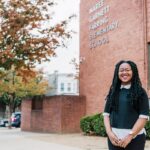
“In the Sherman STEM Teacher Scholars Program, we drive home two points. One: we teach children. Two: children are people. It sounds simple, but we tend to forget that children are younger versions of us. Sometimes in a “STEM” program, we become fixated on the math or biology, when what belongs at the center of all we do is the students.” — Rehana Shafi, director, Sherman STEM Teacher Scholars Program
Lydia Coley ’20, American studies, has started a new adventure this semester. Twice a week she wakes up by 5:30 a.m., crosses Baltimore City from north to south, and arrives at Maree G. Farring Elementary/Middle School by 7 a.m. to do what she has been preparing for over the last three years—be a student-teacher. As a scholar in the Sherman STEM program, Coley is among a group of future mathematics and science teachers who will eventually work throughout the Baltimore region and across the state, focusing on high-need schools.
She listens, observes, supports, and learns from her mentor teacher. Sometimes, this means she’s in the front of the classroom or leading small groups as she begins to transition into next semester’s role as a full-time lead student teacher. But what we found when UMBC Magazine followed Coley for a day, was not a student but a natural leader.
Coley smiles at the beginning of the day and enthusiastically welcomes each of the 90 students she is there to support. “This is a collaborative effort. I am here to learn from my mentor and to support students, but really most of the learning comes from what students are willing to share with me. They are also my teachers.”

It is 7 a.m. and Lydia Coley, a first-semester student teacher at Maree G. Farring Elementary/Middle School smiles at her day ahead. Her duties include supporting students while her mentor teacher leads lessons and, when possible, Coley leads parts of the lesson in small groups.
Coley runs into her mentor teacher, Theresa Frey, who has been teaching for 19 years. They take a few minutes to review the day and head in to prepare.

Coley signs in at the office and makes her way to her classroom. Maree G. Farring is 23% English language learners. Many students’ first language is Spanish.
It’s preparation time! Coley finalizes the details as she changes the date and takes note of the objective for the day. The cactus theme of the classroom encourages students with signs like “Looking Sharp” and “We Are on Point.” Coley’s classroom has about 30 students in each of the three blocks throughout the day. She helps the first block by putting all the chairs down for them because soon the students will come in with breakfast baskets and books in hand.
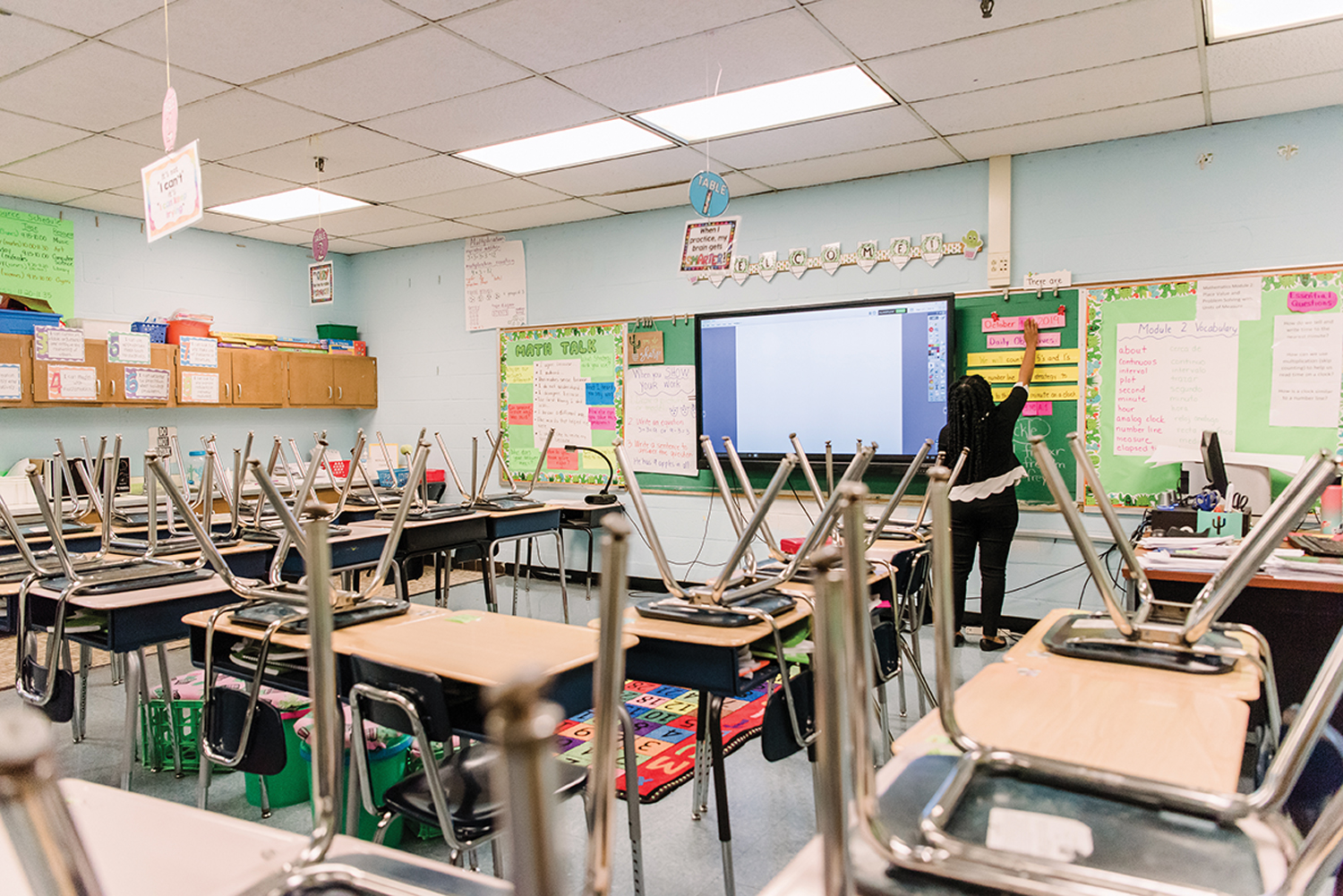
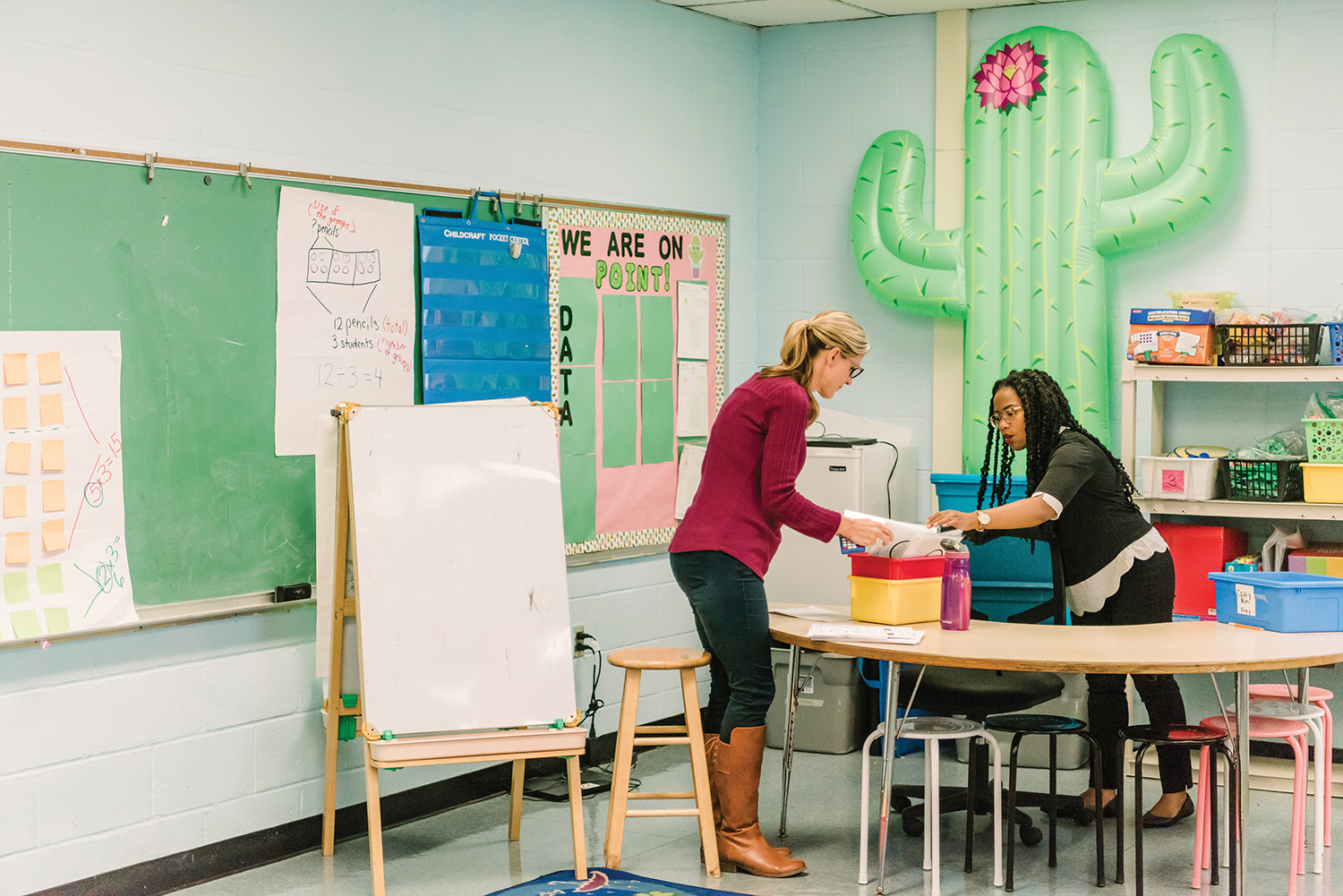
The day starts quickly. Frey and Coley go over the materials for today’s lesson—telling time counting by fives and a number line. Every minute literally counts!
Students begin to arrive but there is no time to waste. Coley goes over last night’s homework with a student while she finishes her breakfast. One-on-one time is precious and Coley is happy to provide it. She is also passionate about students eating fresh food as she studies the correlation between nutrition and academic behavior. She wants them to have time to eat so they also have time to think.

Coley leads the students through some critical thinking about how a clock ties into multiplication and number lines. Students compare answers and discuss the possible options by using their own clocks.
It’s time to delve deeper. Coley engages students to identify parts of a clock and determine the correct time using a variety of strategies. When she asks what time is shown on the clock (2:30 p.m.) one student smartly calls out “dismissal time!” The rest of the students show their work on whiteboards and raise them for a quick check.
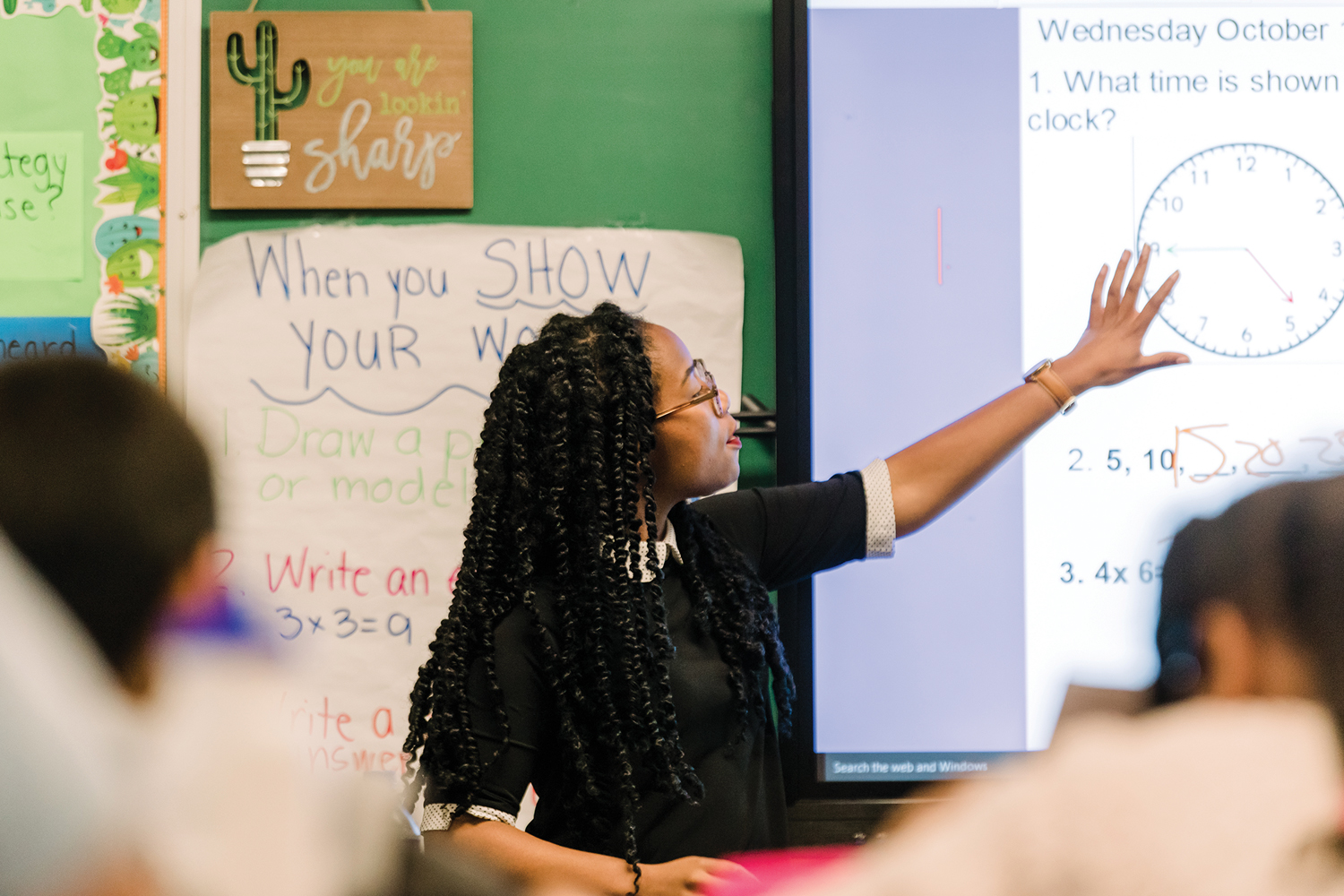
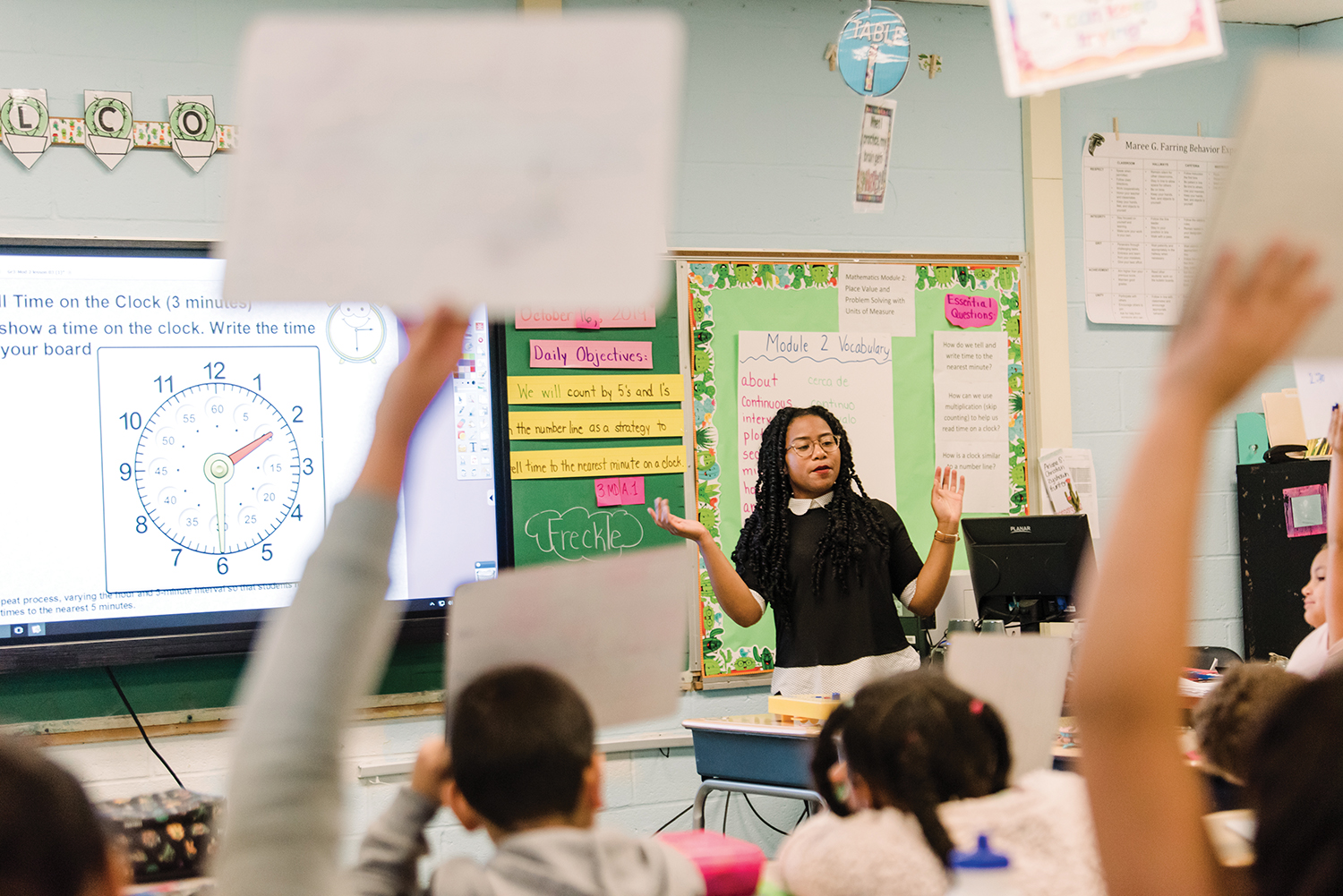
Coley becomes a student as she quietly observes her mentor teacher think out loud about the various ways to solve a word problem. “I became a teacher because I love learning. The classroom is full of ideas. It’s not only a place for academics but a place to build empathy,” she explains. “It is important for students to experience someone that respects, supports, and has a positive influence over them.” Coley looks forward to transitioning into a lead student teacher for third-grade mathematics and sixth-grade social science in the spring.

Each student requires a different type of support. Coley takes time to help a student think through the connection between her diagram and her multiplication process. “One of the greatest challenges in teaching math is that many students don’t feel they are good at math,” she explains. “It is my job to help them believe in themselves by showing them how these skills are connected to their lives.”
The first block of math is done. Students follow Coley to computer science for more applied math. Two more 90-minute blocks of math follow with two other classes of students to support before calling it a day.

The bell rings. It’s 2:30 p.m. and raining but students don’t mind. It is time to head home. Coley helps a student keep their hood on as they rush out the door. Teachers and students share smiles all around.

Quiet fills the classrooms and the hallways. It is the perfect time to catch up with a fellow alumna, Olivia Grimes ’19, individualized study and early childhood education, a first-year teacher at MGF. They exchange stories and Grimes gives advice on how to adjust to the full-time workload when Coley comes back in the spring.
It’s 3:15 p.m. and the day is done. Grimes and Coley head home with thoughts of equations, stories, and fun ways to educate their students tomorrow.

*****

Since its inception 12 years ago, the Sherman STEM Teaching Scholars Program has supported more than 150 students in becoming culturally responsive and compassionate STEM educators by collaborating with UMBC faculty and local, high-need schools. Currently, nine students and 13 alumni of the program are leading and learning in zip codes across Baltimore City.
All photos by Marlayna Demond ’11.
]]>
“In the Sherman STEM Teacher Scholars Program, we drive home two points. One: we teach children. Two: children are people. It sounds simple, but we tend to forget that children are younger...
https://umbc.edu/stories/a-day-in-the-life-of-a-student-teacher/
https://my3.my.umbc.edu/api/v0/pixel/news/119976/guest@my.umbc.edu/ad81663bbec19b26539af52c31c37913/api/pixel
cahss
discovery
fall-2019
feature
sherman-stem-teacher-scholars-program
shermanscholars
UMBC News & Magazine
https://my3.my.umbc.edu/groups/umbc-news-magazine
https://assets1-my.umbc.edu/system/shared/avatars/groups/000/001/943/24435aa6207c452e7bc15cc74b42c7bb/xsmall.png?1748556657
https://assets1-my.umbc.edu/system/shared/avatars/groups/000/001/943/24435aa6207c452e7bc15cc74b42c7bb/original.png?1748556657
https://assets2-my.umbc.edu/system/shared/avatars/groups/000/001/943/24435aa6207c452e7bc15cc74b42c7bb/xxlarge.png?1748556657
https://assets2-my.umbc.edu/system/shared/avatars/groups/000/001/943/24435aa6207c452e7bc15cc74b42c7bb/xlarge.png?1748556657
https://assets3-my.umbc.edu/system/shared/avatars/groups/000/001/943/24435aa6207c452e7bc15cc74b42c7bb/large.png?1748556657
https://assets1-my.umbc.edu/system/shared/avatars/groups/000/001/943/24435aa6207c452e7bc15cc74b42c7bb/medium.png?1748556657
https://assets2-my.umbc.edu/system/shared/avatars/groups/000/001/943/24435aa6207c452e7bc15cc74b42c7bb/small.png?1748556657
https://assets1-my.umbc.edu/system/shared/avatars/groups/000/001/943/24435aa6207c452e7bc15cc74b42c7bb/xsmall.png?1748556657
https://assets2-my.umbc.edu/system/shared/avatars/groups/000/001/943/24435aa6207c452e7bc15cc74b42c7bb/xxsmall.png?1748556657
UMBC News & Magazine
0
0
false
Tue, 07 Jan 2020 18:35:23 -0500