A place where kindness grows
Ten minutes south of True Grits, food is also being prepared for the local community. It’s 8:30 on a Wednesday morning in the parking lot of Arbutus United Methodist Church. To the right of the church building is the Southwest Emergency Services (SWES) office, where the clanking of canned goods on metal shelves and the rustling of brown paper bags echo in the back warehouse. Legacy volunteers, a UMBC Shriver Peaceworker Fellow, and Shriver Center undergraduate student volunteers quickly stock shelves and prepare to fill grocery bags with donated goods for families in the surrounding 21227 or 21229 zip codes in need of food assistance.
Rosmery De Jesus Dinzey Santana, a senior psychology student, pops out of the dried goods room to check the first order. She writes the number three on a sticky note and sticks it to a grocery cart that gets passed around from volunteer to volunteer, until it gets all the way to the back to Joan Birmingham. She is clad in a long-sleeved flannel, baseball cap, and plastic gloves to keep somewhat warm as she moves in and out of freezers—one for chicken, one for beef, one for pastries. Birmingham, a volunteer of 20+ years, quickly spins the cart back around, pushing it down the long hallway, the wobbly wheel hitting the metal, making a ding sound like it’s announcing it’s ready to check out.
While UMBC and SWES have been in close proximity for decades, it’s relatively new that an intentional cohort of Retrievers regularly volunteers there. This shift was led by a UMBC Peaceworker Fellow, Megan Hamilton, who began working with SWES for 20 hours a week in fall 2025. The Peaceworker Fellows Program, based in UMBC’s Shriver Center, offers a master’s degree in social change leadership for returning Peace Corps Volunteers. Fellows are required to complete 20 hours a week of service with community partner non-profits, government agencies, or campus-based service-learning for the entirety of the program, says Charlotte Keniston, Ph.D. ’24, language, literacy, and culture, an alum and current director of the program. “We now have weekly undergraduate volunteers working with the legacy volunteers, UMBC staff supporting grant writing, and a team of graduate students creating a data management system for them,” Keniston says.
A call to serve
For Hamilton, the experience has been deeply fulfilling. “Community service is one of the happiest things I can do with my life,” she says. “I think in this particular time, people have lost track of the joy of service a little bit.” The Retrievers at SWES are working to bring that back.
Back at SWES on Wednesday morning, it’s getting close to 9:00 a.m., and a stream of cars fills the parking lot. Hamilton greets each client with a genuine ear-to-ear smile as they walk in the door. When Hamilton sees Birmingham, she grabs the cart, calls on the family of three, and helps them get the cart out of the narrow doorway into the parking lot. Diane Moberg, a church volunteer and SWES board member, steps into the dried goods room to help unfold grocery bags while she waits for the next financial services client to arrive.
Hamilton has a booming, happy voice and laugh. She has deep roots in Baltimore’s grassroots organizing and co-founded the Creative Alliance in 1994, a performance and art community space in the city. Her big heart has also taken her around the world in the service of others, including her Peace Corps service in Albania.
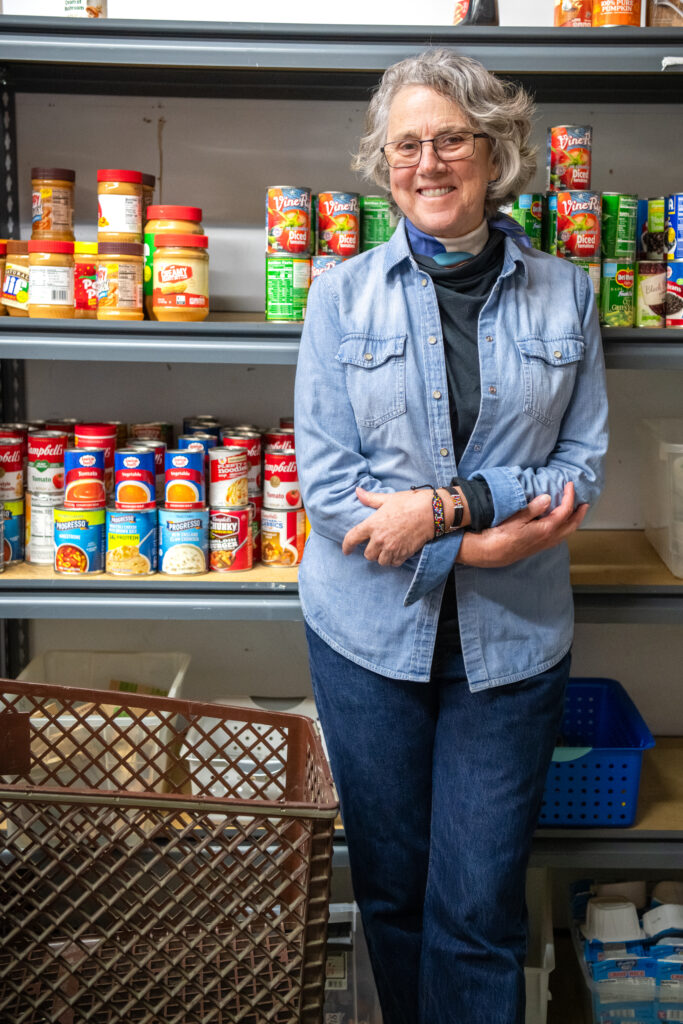 Megan Hamilton at SWES. (Brad Ziegler/UMBC)
Hamilton was beaming this morning because the Maryland Foodbank, which donates food to SWES, had just conducted a site visit and was impressed with how SWES is committed to shifting to a choice food pantry—a labor of love for Hamilton. Choice food pantries function similarly to a grocery store, where clients select the food they take, increasing agency and reducing waste.
“The loving energy catalyzed when the students meet, learn from, work with, and teach their elders is awe-inspiring,” says Hamilton. “It has meant worlds to the elders and the students, and those friendships are laying the groundwork for SWES’ long-term sustainability.
In the future, SWES is also looking to evolve its financial assistance program, where families receive partial funding to prevent evictions, utility shut-offs, and prescription costs. SWES covers part of the bill, and the family covers the rest. SWES hopes to leverage the renewed partnership with UMBC’s Peaceworkers and Shriver Center volunteers to develop a financial literacy skills program to help families become economically stable and prosperous, and pass those skills to future generations.
Powered by volunteers inspired by the community
Hamilton says part of what’s making the relationship between SWES and UMBC work so well is the physical proximity, as well as a shared commitment to service in the Baltimore area.
Dinzey Santana, the only Spanish-speaking volunteer, provides language support for Spanish-speaking families, helping to translate their needs to the rest of the team. She is quiet but fierce in her service, consistent, a master of organization, and overall just awesome, Birmingham says.
“I went to high school in Silver Springs with a lot of Latinos. Coming to UMBC, I learned so much about what is possible, and yet there is still so much that I have to learn. I want to go back and work with other Latinos to show them that it’s possible to go to college and give to your community at the same time,” says Dinzey Santana, almost at a whisper, smiling, and gliding between carts, bags, and shelves without stopping or looking—muscle memory. While she started UMBC on a pre-med track, after taking some psychology and social work classes, she was drawn to community-engaged work. Birmingham, Moberg, and Hamilton can feel her resolve. “I want students not to get frustrated if their path is unclear. Sometimes, the best path for you is not the one you set your heart on. There isn’t one path, and there is help. Everyone deserves help.”
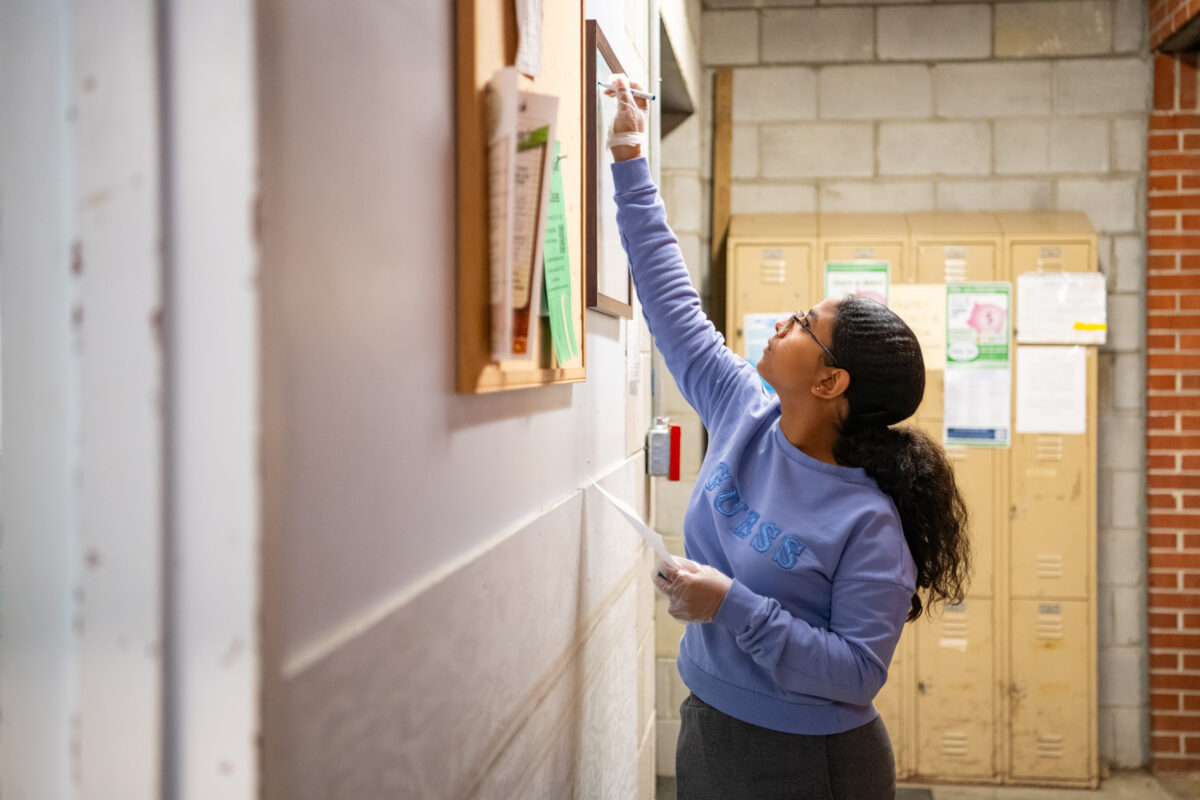 Rosemery De Jesus Dinzey Santana writes the names of the families picking up groceries. (Brad Ziegler/UMBC)
Working on a prayer
The UMBC volunteers serve alongside legacy volunteers from the community and surrounding areas who have, in some cases, been volunteering for decades. Star legacy volunteer Naomi Morris is ninety-two and has volunteered at SWES for thirty-years. Birmingham says that although SWES has seen its share of challenges, she is continually touched by the people she meets and the way they make it work.
Before becoming part of the SWES volunteer team, Birmingham worked in warehouses for 36 years, stocking and organizing shelves. “I wasn’t quite sure what I wanted to do after I retired,” she says. “I found out that [SWES] needed help through my church. I thought I would give it a try.” She started hanging clothes for their clothing donation shop for a day or two. “But I saw everything that SWES was doing, and it was unbelievable. It touched my heart. The people I have met here are just unbelievable.”
Moberg, who is a certified public accountant, joined the board and became a volunteer to support the financial assistance program. “I recognize things are really hard. Let’s face it, expenses have gone up exponentially. Gas, everything. Low to mid-range wages are not keeping pace. So, it’s really disheartening, which is why the finance mission is an extremely important one for me. “
Sometimes, when the pantry and the financial assistance dwindle, and there doesn’t seem to be an answer to how SWES will serve its community, Birmingham throws out a request to the heavens. “I learned it from my friend who volunteers with me. She just calls it out, ‘We need more of whatever it is,’ and sure enough, the next day someone walks in with what we need. Last week it was pasta, this year it was volunteers—both came in abundance, and Megan, Rosmery, and all the UMBC volunteers are now helping us legacy volunteers to keep it all going.”
Read more Alumni Magazine stories.
]]>
Ten minutes south of True Grits, food is also being prepared for the local community. It’s 8:30 on a Wednesday morning in the parking lot of Arbutus United Methodist Church. To the right of the...
https://umbc.edu/stories/swes-a-place-where-kindness-grows/
https://my3.my.umbc.edu/api/v0/pixel/news/160119/guest@my.umbc.edu/35a17967e12b096f5351768b98a06639/api/pixel
cahss
impact
magazine
psychology
shrivercenter
spring-2026
story
UMBC News & Magazine
https://my3.my.umbc.edu/groups/umbc-news-magazine
https://assets1-my.umbc.edu/system/shared/avatars/groups/000/001/943/24435aa6207c452e7bc15cc74b42c7bb/xsmall.png?1748556657
https://assets1-my.umbc.edu/system/shared/avatars/groups/000/001/943/24435aa6207c452e7bc15cc74b42c7bb/original.png?1748556657
https://assets2-my.umbc.edu/system/shared/avatars/groups/000/001/943/24435aa6207c452e7bc15cc74b42c7bb/xxlarge.png?1748556657
https://assets2-my.umbc.edu/system/shared/avatars/groups/000/001/943/24435aa6207c452e7bc15cc74b42c7bb/xlarge.png?1748556657
https://assets3-my.umbc.edu/system/shared/avatars/groups/000/001/943/24435aa6207c452e7bc15cc74b42c7bb/large.png?1748556657
https://assets1-my.umbc.edu/system/shared/avatars/groups/000/001/943/24435aa6207c452e7bc15cc74b42c7bb/medium.png?1748556657
https://assets2-my.umbc.edu/system/shared/avatars/groups/000/001/943/24435aa6207c452e7bc15cc74b42c7bb/small.png?1748556657
https://assets1-my.umbc.edu/system/shared/avatars/groups/000/001/943/24435aa6207c452e7bc15cc74b42c7bb/xsmall.png?1748556657
https://assets2-my.umbc.edu/system/shared/avatars/groups/000/001/943/24435aa6207c452e7bc15cc74b42c7bb/xxsmall.png?1748556657
UMBC News & Magazine
2
0
false
Fri, 15 May 2026 12:41:26 -0400
Fri, 15 May 2026 12:41:26 -0400
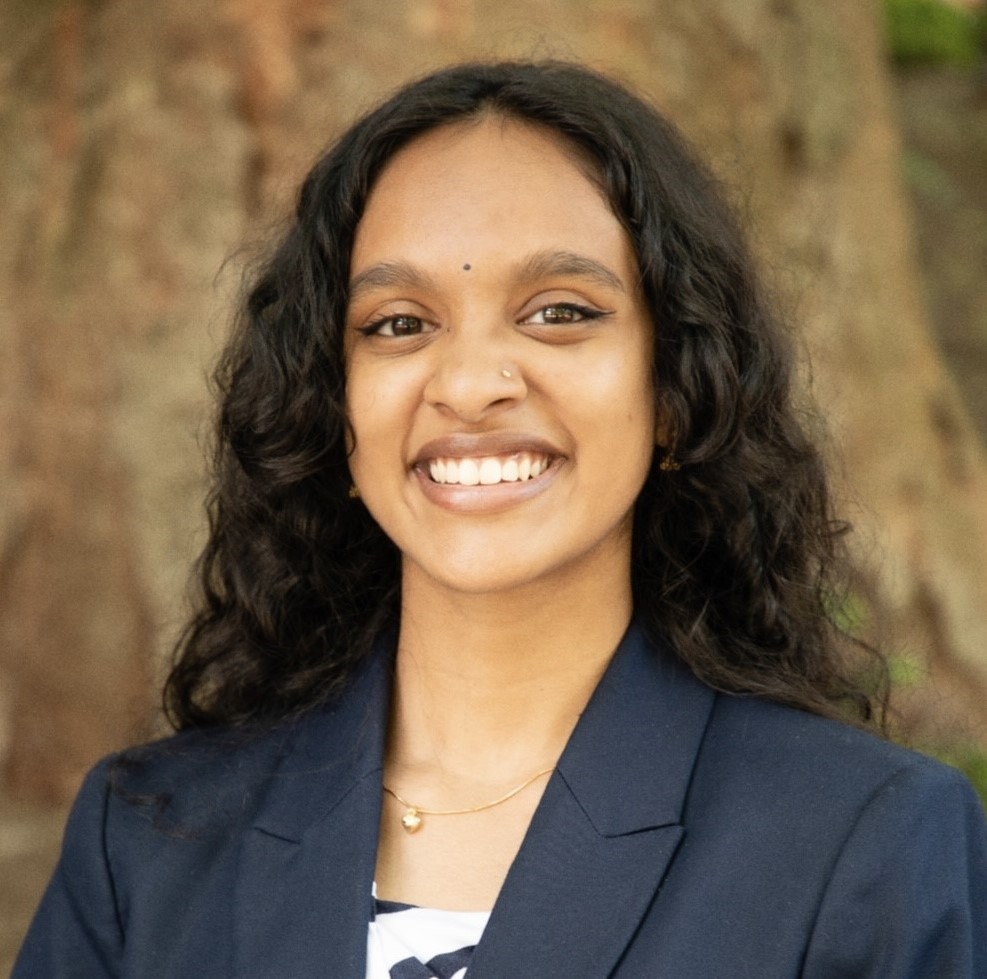
Vunnathi Ankem ’26—finding community and her place at UMBC
For Vunnathi Ankem, psychology, the UMBC experience has been defined by one word: community. As an resident assistant, a researcher, and a multifaceted student leader, she has spent her four years both building community and studying its impact on the human experience. From hosting public service retreats in Baltimore to interviewing members of the South Asian diaspora for her thesis, Ankem’s work bridges the gap between community-centered research and heartfelt advocacy. As she prepares to graduate, she leaves behind a campus made stronger by her leadership and a personal roadmap focused on healing, mentorship, and global research.
Q: What brought you to UMBC?
A: I was really trying to find community, to find a place that fit who I was. And I found that at UMBC. I’ve been welcomed by so many communities here, and that’s not just what brought me to UMBC—it continues to be the reason why I love it.
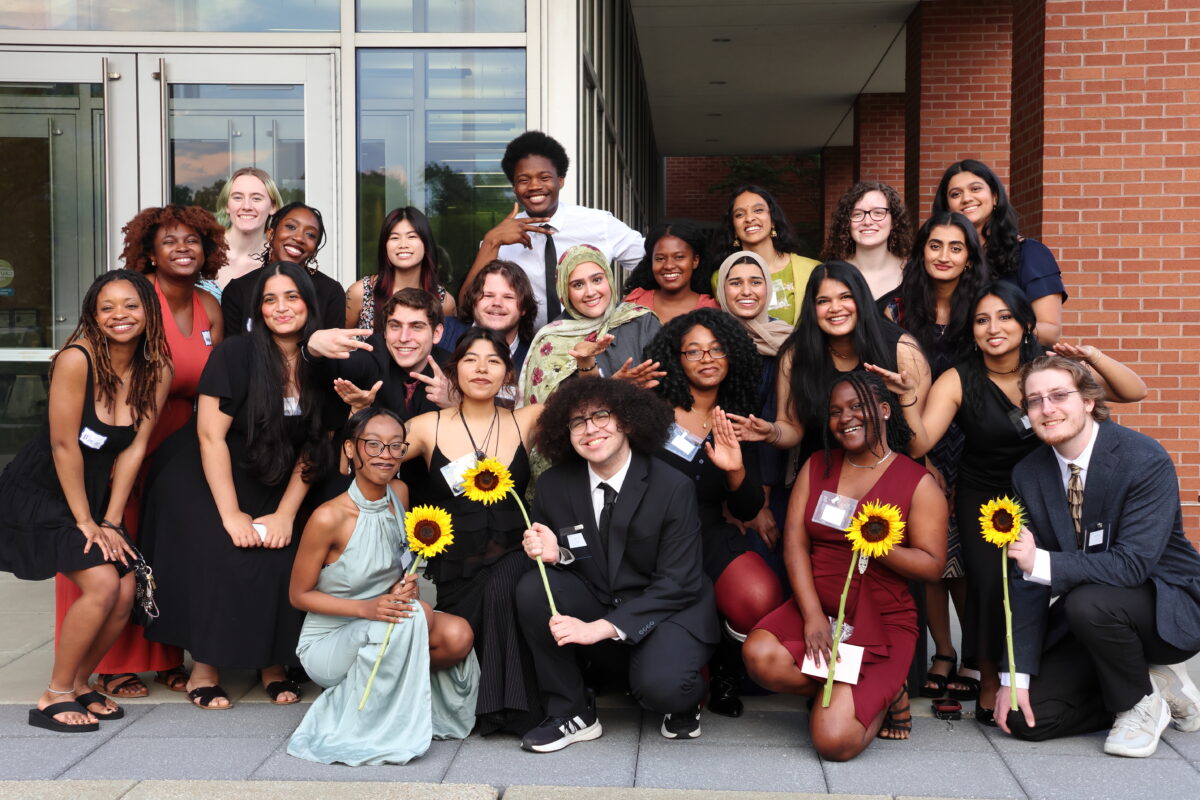 Peer mentors from this year’s Shriver LLC floor’s annual Passing of the Torch ceremony.
Q: What drew you to the leadership roles you’ve taken on?
A: The three leadership roles I think about are RA of the Shriver Living Learning Community (LLC), upperclassman chair of the Sondheim Scholars Program Steering Committee, and Honors College Council president. I initially never thought I’d become an RA, but the Shriver LLC floor is something I’m very passionate about. Everyone is always helping each other, and that sort of community is what I love. For Sondheim I was drawn to its public service orientation. I was able to host retreats in Baltimore for first-year students and could make sure they understood how beautiful this city is. My role in the Honors College has become something much deeper after we lost the president and my good friend. She was everywhere and her impact on my life, and on everyone else, continues to be inspiring to me after she’s gone.
Q: What does leadership mean to you?
A: A lot of leadership is serving and listening. As one person, you can’t have all the ideas and you can’t do everything yourself. The best leaders create other leaders because a huge part of leadership is mentorship. You have to always be looking to see who’s interested and giving people the opportunity to grow and blossom and become amazing student leaders. I’ve been lucky to watch that happen in every single role I’ve had on campus. It’s beautiful.
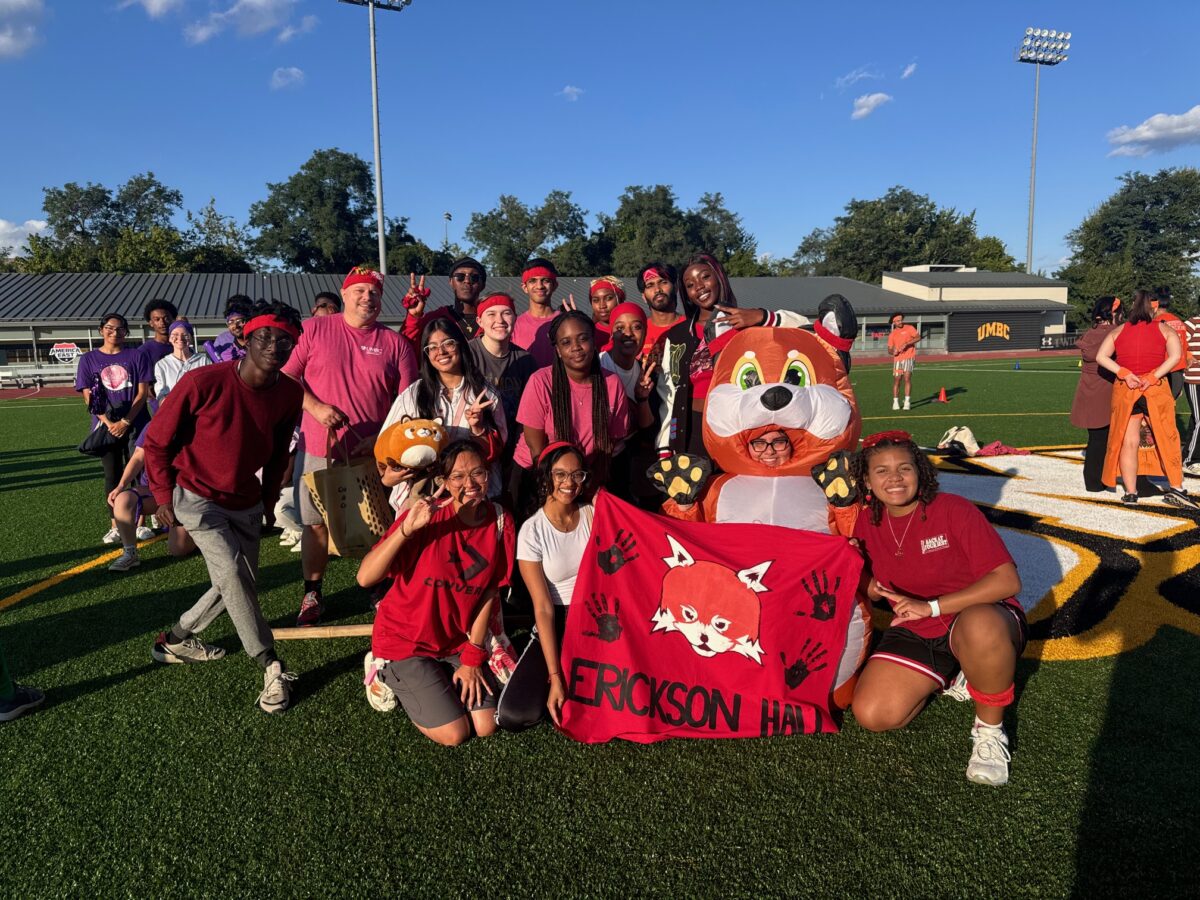 The resident assistant team from Erickson Hall participating in the ResLife tournament over summer training.
Q: Tell us about your honors thesis research.
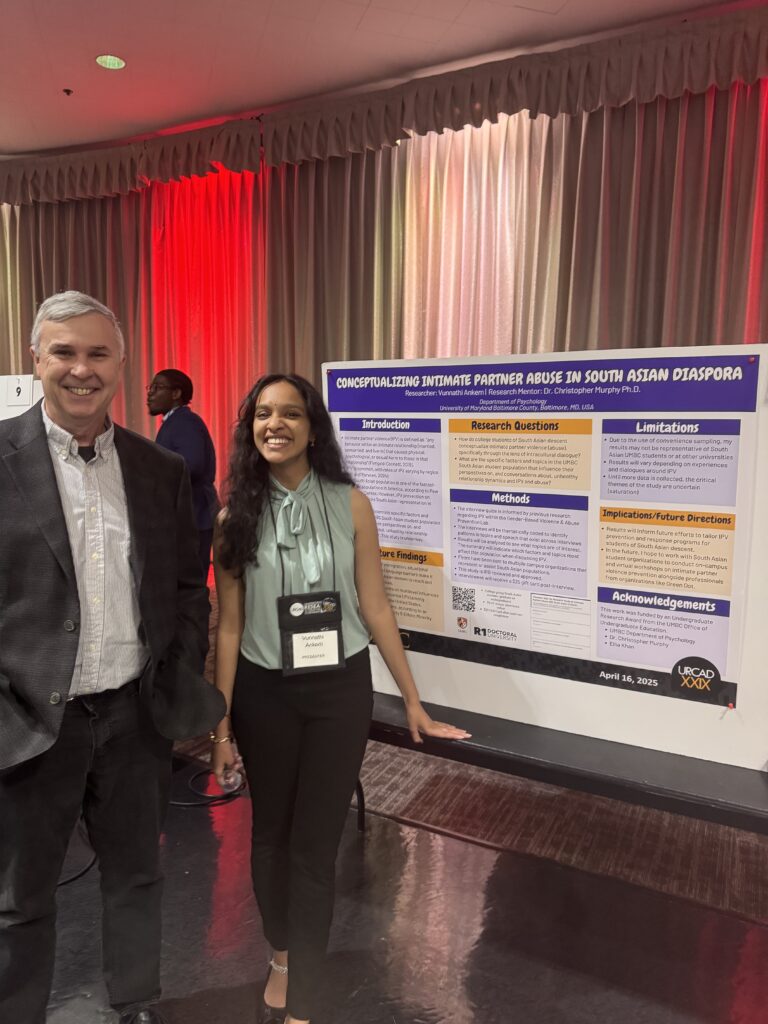
A: It all started with Alternative Spring Break. The topic was educational justice for youth experiencing intimate partner violence, which inspired me to do research in that field. A psychology grad student from Pakistan, Ellia Khan, in Dr. Christopher Murphy’s lab inspired me with her South Asian perspectives on this research. Our conversations led me to look into what social factors make us believe certain things and develop certain concepts about unhealthy relationships. The South Asian diaspora is an interesting population to study because it’s fast growing and there’s a wide range of experiences. I’ve done about 14 interviews now, and every single person I’ve talked to I’ve learned so much from.
 Ankem shows President Valerie Sheares Ashby how to dance to the popular Indian song Naatu Naatu.
Q: What advice do you have for incoming students?
A: When I think about what I’m proud of, it’s not the awards, it’s the people. I remember all the people who were there when I needed support—those people meant more to me than any accomplishment. My advice would be to think about what you’ll look back on. It will most likely be community—the people who were there when you weren’t at your best.
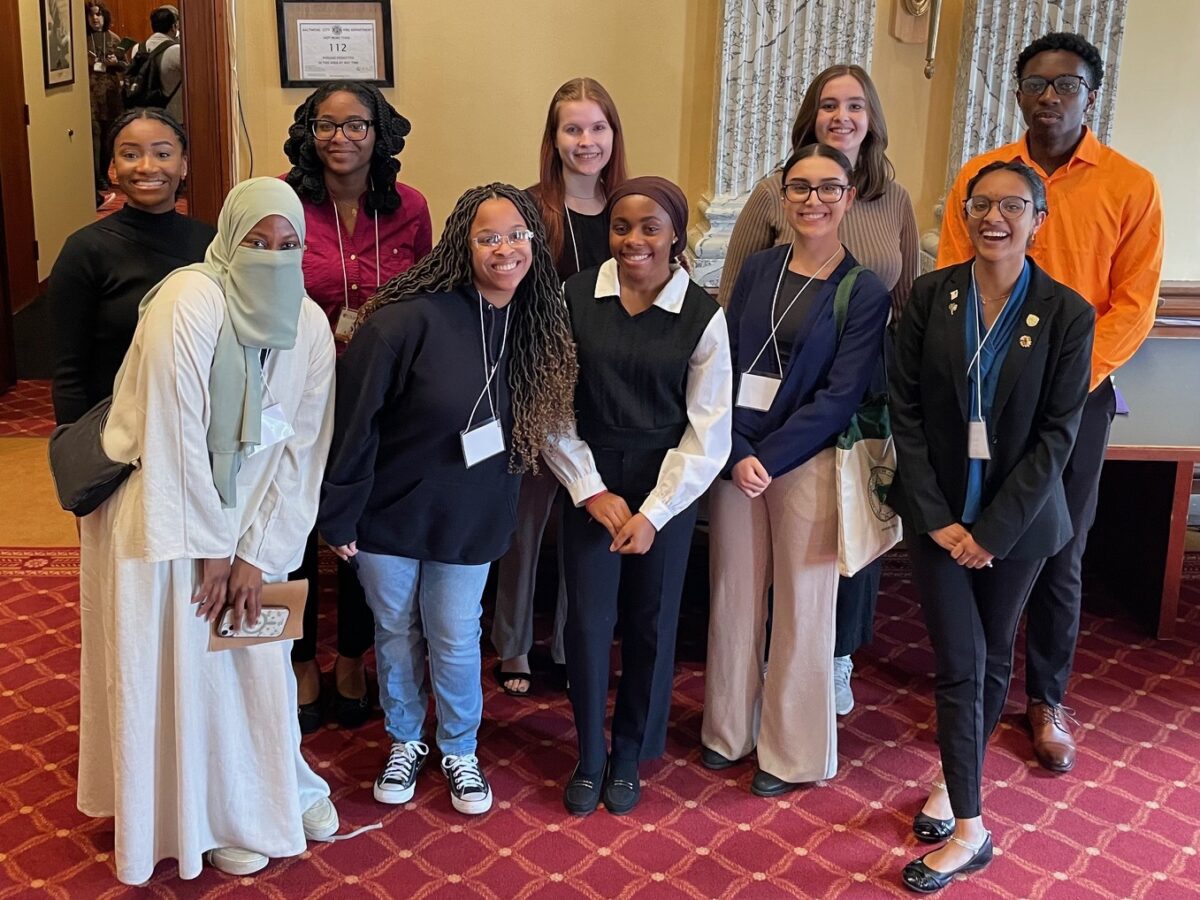 Ankem, front, right, and others visited Baltimore City Hall during the Alternative Spring Break trip she co-led for the health equity and patient care group.
Q: What does life after UMBC look like?
A: I’ve been thinking about this question for the whole year. I definitely want to pursue a clinical community psychology Ph.D. in the future—that’s the goal. I was awarded a Fulbright Scholarship, so I’ll be heading to India for a nine-month research project – a sort of extension of my thesis, but with people from different states across India. I’m also excited to return to my Indian classical dancing roots. Something about being on stage and dancing, it’s my ultimate peace.
All photos courtesy of Ankem. Story by Katharine Scrivener, assistant director of alumni and development communications.
]]>
For Vunnathi Ankem, psychology, the UMBC experience has been defined by one word: community. As an resident assistant, a researcher, and a multifaceted student leader, she has spent her four years...
https://umbc.edu/stories/vunnathi-ankem-26-finding-community-at-umbc/
https://my3.my.umbc.edu/api/v0/pixel/news/160037/guest@my.umbc.edu/94d479ecc7a982f61bd1b3bc504d2d2f/api/pixel
cahss
class-of-2026
honorscollege
news
policy-and-society
psychology
shrivercenter
story
UMBC News & Magazine
https://my3.my.umbc.edu/groups/umbc-news-magazine
https://assets1-my.umbc.edu/system/shared/avatars/groups/000/001/943/24435aa6207c452e7bc15cc74b42c7bb/xsmall.png?1748556657
https://assets1-my.umbc.edu/system/shared/avatars/groups/000/001/943/24435aa6207c452e7bc15cc74b42c7bb/original.png?1748556657
https://assets2-my.umbc.edu/system/shared/avatars/groups/000/001/943/24435aa6207c452e7bc15cc74b42c7bb/xxlarge.png?1748556657
https://assets2-my.umbc.edu/system/shared/avatars/groups/000/001/943/24435aa6207c452e7bc15cc74b42c7bb/xlarge.png?1748556657
https://assets3-my.umbc.edu/system/shared/avatars/groups/000/001/943/24435aa6207c452e7bc15cc74b42c7bb/large.png?1748556657
https://assets1-my.umbc.edu/system/shared/avatars/groups/000/001/943/24435aa6207c452e7bc15cc74b42c7bb/medium.png?1748556657
https://assets2-my.umbc.edu/system/shared/avatars/groups/000/001/943/24435aa6207c452e7bc15cc74b42c7bb/small.png?1748556657
https://assets1-my.umbc.edu/system/shared/avatars/groups/000/001/943/24435aa6207c452e7bc15cc74b42c7bb/xsmall.png?1748556657
https://assets2-my.umbc.edu/system/shared/avatars/groups/000/001/943/24435aa6207c452e7bc15cc74b42c7bb/xxsmall.png?1748556657
UMBC News & Magazine
0
0
false
Tue, 12 May 2026 13:24:41 -0400
Tue, 12 May 2026 13:24:41 -0400
Zareen Taj earns her Ph.D., publishing the first autoethnography by a Hazara Afghan woman about the ongoing genocide of Hazara women under Taliban rule
This spring on Thursday evenings, students filled room 424 in the Fine Arts building for their Asian Diaspora in Motion: Media, Culture, Identity, and Activism class. At the head of the classroom was Zareen Taj, who designed the new 300-level class based on her experiences as a documentary filmmaker and activist defending the rights of her community—the Hazara women of Afghanistan, a community that has for over a century experienced extreme ethnic, religious, and gender oppression, including multiple massacres and starvation, under Taliban rule.
It’s a reality Taj grew up with as part of the Hazara people, a religious and ethnic minority. In the 1990s, when the Taliban increased their killings of the Hazara people, Taj and her family fled to a refugee settlement in Pakistan. There, Taj started speaking out against the systemic oppression of Hazara women. Her activism made her a Taliban target. With a scholarship from the Feminist Majority Foundation, Taj fled once more, this time to Towson University, where she earned a bachelor’s in political science and women’s studies and a master’s in women’s studies.
After graduation, Taj worked for Voice of America as an international broadcaster and producer. At UMBC, she worked for Chartwells in the HR department first and then as an accounting associate at The Shriver Center. A year later, Taj was accepted into the language, literacy, and culture (LLC) doctoral program. During her studies, she raised two children and created four short documentaries about Hazara women while teaching in the global studies, Asian studies, and American studies departments.
This semester, Taj successfully defended her dissertation, “Journey of a Scholar-Activist: An Autoethnographic and Multimodal Inquiry,” which includes written narratives and her fourth documentary short film titled “For My People.” The project marks the first time she took the time and space to reflect on her life.
“I learned from this journey that I am different. I look different. I work differently. I see things differently, but my difference is not a problem,” says Taj about her experience at UMBC, where she hopes to become a professor. “My experience is an asset. It’s my wealth. The UMBC community, particularly the LLC and my professors, were very supportive of what I’m doing. So they supported me at each stage of my life.”
Q: What was your journey to UMBC?
A: I studied in a refugee displacement settlement in Pakistan, so it was very hard. But I got the Feminist Majority Scholarship and moved to Maryland in 2000 to attend Towson University. I could not speak English well. I saw a computer for the first time in my life. It was very hard because I came from a very war-torn country. We don’t have that advanced education system, and it’s often interrupted by war. Every minute, I reminded myself about the other Afghan girls who didn’t have this opportunity, so I couldn’t give up.
I always wanted to get a Ph.D. That was my dream. I put all of my experiences into my academic world. In 2018, I applied to the LLC doctoral program. I talked with Carole McCann, professor of gender, sexuality, and women’s studies, about what I wanted to do. She said yes to being my advisor right away. Joby Taylor, Ph.D. ’05, assistant vice provost and co-leader of The Shriver Center for Public Service and Community Engagement, and Tania Lizarazo, associate professor of modern languages, linguistics, and intercultural communication, and global studies, also lent their support as co-chairs.
Q: How did you decide on the topic for your dissertation?
A: My master’s thesis, titled “Dual Identity, Dual Oppression of Hazara Women,” didn’t follow the same research path as a traditional thesis because there were no official documents that I could use for my research. I felt frustrated. My thesis was informed by my firsthand research trips to Afghanistan. This work represents the first contribution of its kind in the academic field. My personal experiences and frustrations motivated me to return to my country, which ultimately shaped and grounded the development of my thesis.
For my dissertation, my committee wanted me to talk about myself, to write a book. I appreciated them encouraging me, but I continued to focus on Hazara women until Dr. Tanya Saunders, associate professor of sociology, pointed out all the different types of ethnography I was doing and encouraged me to focus on myself to do an autoethnography. I was surprised that I could do that, and that’s how I started.
That gave me a kind of confidence in my writing. I’m always reflecting on all of these things I’m doing, but not reflecting on myself. I never had the chance, or I never thought of doing it. I never thought I would be allowed to talk about myself, so I didn’t. I come from a culture where we never talk about ourselves because this is taboo. Women would be told, “Why are you talking about yourself? We have bigger issues, bigger things to talk about.” That’s the culture, especially for Hazara women. We never talk about ourselves, our pain, our joy. Everything is internalized.
I am reaching a stage of very clear realizations about how this academic process is a very healing process for me. I’m making my people visible and bringing awareness to the cause. We’ll get to know people, my people, my ethnicity, their suffering, and also the resilience of these women.
Q: Why was this dissertation process a healing process?
A: My short documentary, “For My People,” which I produced for my dissertation, helped me process the anger and isolation I have carried after years of fighting for survival and against oppression. This process led to exploration and, for the first time, I explored healing and the shift to joy, community, and belonging I have found with the Hazara women who resettled in Washington, D.C., my global network of activists, and my UMBC community.
The more work I’m doing in the form of writing an article, creating films, or public speaking, the more visibility I have to those dimensions, those identities. It’s helping me feel that I do justice for them. That’s the process of healing. The more I work to bring community sustainability and collectiveness, the stronger my sense of belonging, satisfaction, and deep attachment to my community.
Q: What inspired the topics for your other films?
A: I was doing my master’s thesis about Hazara women, but there wasn’t much data. I decided to go back to Afghanistan for the first time since fleeing Pakistan to document the living conditions and experiences of Hazara women living under the fear of genocide. When I returned, I had 40 hours of videotapes, 700 photographs, and 20 hours of cassette recordings that helped me make my first film, “The Oppression of Hazara in Afghanistan.”
But I didn’t just want to show the oppression of Hazara women as victims. I wanted to show the resistance and leadership of Hazara women. After the fall of the last Afghan government in 2021, some Hazara refugees came to the Washington, D.C., Maryland, Virginia area. We have a lot of activists and advocates like Azra Jafari, the first woman in Afghanistan to hold the office of mayor. They were willing to be interviewed for “Our Face Tells: Seeing the Genocide of Hazaras in Afghanistan.”
Last year, I collaborated with several organizations and led efforts to train Hazara women to create and share their own stories. The Hazara Women of Afghanistan Share Digital Stories event trained and supported Hazara women to tell their own stories. That inspired “Voices of Resistance.”
Q: How have you passed on your documentary film skills to your students?
A: UMBC has given me so much and helped me to contribute to it. I taught three years in the global studies program as a visiting lecturer, and I designed, established, and taught Global Studies 409: Documentary Film as Global Activism. Students had to make a documentary about their families from any part of the world. They had to document where their identity and sense of belonging came from. Their films reflected their family backgrounds as well as their personal passions and engagement with social issues.
I still remember a student whose grandparents came from Ethiopia. His film was about them, and afterwards told me that when he was given the assignment, he said to himself, “If this lady, this lady from Afghanistan, can do these films, I can do that too.” It made me smile
Q: Looking back on everything that you have experienced and accomplished, has your purpose changed?
A: In 2021, when the Taliban returned, it was like the loss of a 20-year-old child. It was hard not to despair. But in all the chaos, some Hazara were able to get out and needed help arriving to live in the United States. That service rescued me from that vulnerable situation. Community work changed me again. It lifted me up.
 Zareen Taj (first row, second from the left), at the Hazara Women of Afghanistan Share Digital Stories event. (Image courtesy of Taj.)
After the Hazara Women of Afghanistan Share Digital Stories event, I realized I do not need to feel the responsibility to speak for Hazara women, as they are now able to articulate and share their own stories with the world. This is my message for Hazara around the world, especially Hazara women who feel like their stories do not matter. You need to tell your story because your story is our history. And your story is our future. Sharing our stories will hold us together and make us known to the world.
]]>
This spring on Thursday evenings, students filled room 424 in the Fine Arts building for their Asian Diaspora in Motion: Media, Culture, Identity, and Activism class. At the head of the classroom...
https://umbc.edu/stories/zareen-taj-publishes-first-autoethnography-by-a-hazara-afghan-woman/
Video Preview
https://assets2-my.umbc.edu/system/shared/attachments/f4d9374d4accf059cd5add3f74de6ce7/6a9e657b/news/000/159/731/e0c4ba8f6e02c02ed67cc30334e8c183/2498820.jpg?1778009707
https://my3.my.umbc.edu/api/v0/pixel/news/159731/guest@my.umbc.edu/f9e9ea2143bc436276841dd469489856/api/pixel
asianstudies
cahss
class-of-2026
global-studies
gwst
international
language-literacy-and-culture
mlli
news
policy-and-society
saph
shrivercenter
story
UMBC News & Magazine
https://my3.my.umbc.edu/groups/umbc-news-magazine
https://assets1-my.umbc.edu/system/shared/avatars/groups/000/001/943/24435aa6207c452e7bc15cc74b42c7bb/xsmall.png?1748556657
https://assets1-my.umbc.edu/system/shared/avatars/groups/000/001/943/24435aa6207c452e7bc15cc74b42c7bb/original.png?1748556657
https://assets2-my.umbc.edu/system/shared/avatars/groups/000/001/943/24435aa6207c452e7bc15cc74b42c7bb/xxlarge.png?1748556657
https://assets2-my.umbc.edu/system/shared/avatars/groups/000/001/943/24435aa6207c452e7bc15cc74b42c7bb/xlarge.png?1748556657
https://assets3-my.umbc.edu/system/shared/avatars/groups/000/001/943/24435aa6207c452e7bc15cc74b42c7bb/large.png?1748556657
https://assets1-my.umbc.edu/system/shared/avatars/groups/000/001/943/24435aa6207c452e7bc15cc74b42c7bb/medium.png?1748556657
https://assets2-my.umbc.edu/system/shared/avatars/groups/000/001/943/24435aa6207c452e7bc15cc74b42c7bb/small.png?1748556657
https://assets1-my.umbc.edu/system/shared/avatars/groups/000/001/943/24435aa6207c452e7bc15cc74b42c7bb/xsmall.png?1748556657
https://assets2-my.umbc.edu/system/shared/avatars/groups/000/001/943/24435aa6207c452e7bc15cc74b42c7bb/xxsmall.png?1748556657
UMBC News & Magazine
0
0
false
Tue, 05 May 2026 15:29:15 -0400
Tue, 05 May 2026 15:29:15 -0400
UMBC Center for Global Engagement welcomes its second cohort of the Young African Leaders Initiative
This summer, UMBC’s Center for Global Engagement (CGE) is excited to welcome its second cohort of the prestigious Mandela Washington Fellowship for Young African Leaders, the six-week flagship program of the U.S. Government’s Young African Leaders Initiative (YALI). The new cohort includes 25 innovators from countries across Sub-Saharan Africa representing education, journalism, tech, health care, and more. The fellows will spend six weeks living at UMBC networking and attending diversity and leadership skills workshops. They will also meet with campus, local, and state leaders, learn more about Baltimore’s LGBTQ+ leaders of color, developmental disabilities at The ARC Baltimore, trauma-informed practices, and more.
“The fellowship is a beacon of hope,” says Jok Thon, M.P.S. ’24, entrepreneurship, innovation, and leadership, a 2018 University of Delaware YALI fellow and UMBC’s first Global Peaceworker Fellow. Thon is a father of four and the director and founder of Promised Land Primary and Secondary School and Promised Land College in Juba, South Sudan, which has educated over 1500 displaced students. “As a witness and participant in this transformative experience, I wholeheartedly attest the journey is as profound for the mentors as it is for the fellows.”
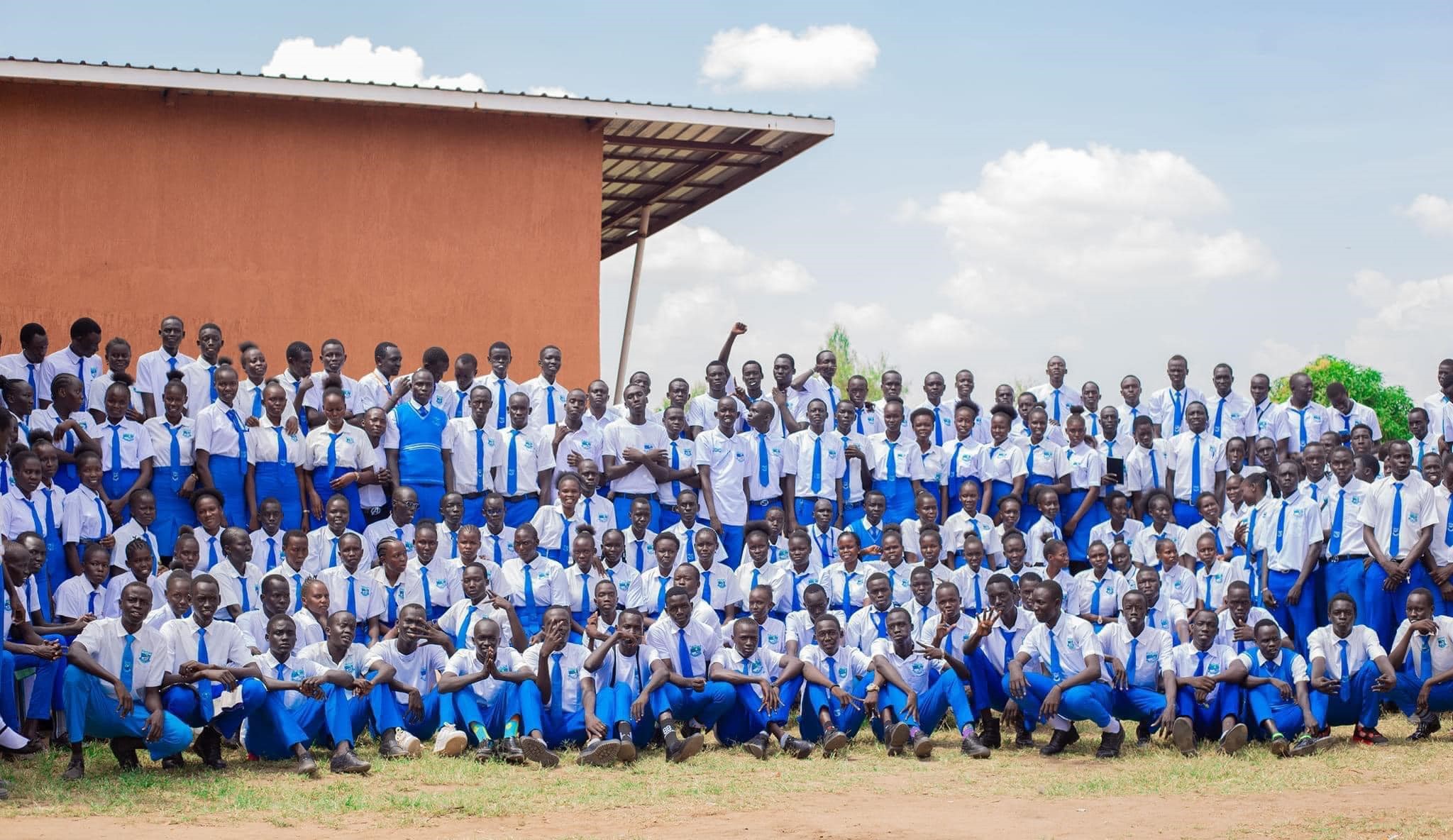 Promised Land Primary and Secondary School in Juba, South Sudan. (Image courtesy of Thon)
Thousands of leaders ages 25 – 35, across 49 Sub-Saharan African countries covet a prestigious YALI fellowship. YALI hopefuls must condense years of leadership in business, civic engagement, and public management into one application, demonstrating concrete ongoing efforts to broaden access to education, health care, and workforce development. These 700 spots across 28 U.S. educational institutions are considered a once-in-a-lifetime opportunity, for both fellows and host institutions, to strengthen connections between the U.S. and Africa and establish enduring partnerships between fellows, local communities, and private businesses through their expertise, perspectives, and experiences.
“YALI is a huge deal in my country and Africa. It’s a journey I want to take with my whole community, nation, and the world,” says 2023 UMBC YALI fellow Victoria Merab Akinyi. She is the CEO and co-founder of Streetlights Uganda, a visual and performing arts-based organization empowering children living on the streets with entrepreneurship and life skills to become self-employed and engaged citizens.
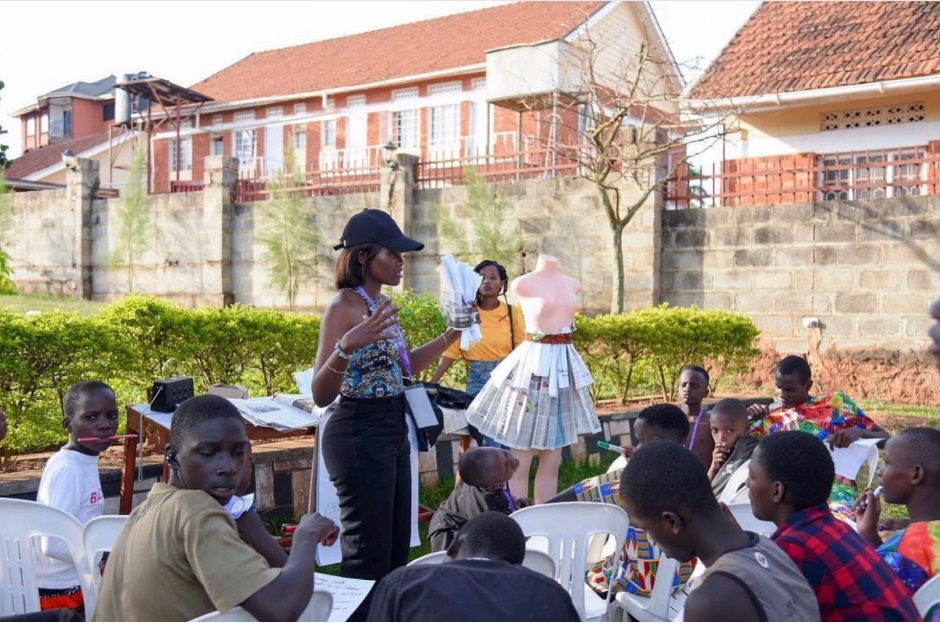 Victoria Merab Akinyi teaching a fashion design class at Streetlights Uganda. (Image courtesy of Merab Akinyi)
“I have a master’s degree in fine arts and two fashion companies. I don’t take my degrees, work with my community, and my YALI experiences for granted because they have all helped open doors for me.”
Creating a Retriever YALI Village
Becoming a YALI host is also an arduous but worthwhile process. It requires developing a six-week international residency program unique to the institution’s resources and the fellows’ needs. When Ryan Sheldon, M.A. ’15, teaching English to speakers of other languages, director of the English Language Institute and special programs within CGE, and Madison Pickard, M.A. ’24, intercultural communication, and assistant director of special programs and co-academic director of the YALI Fellowship, applied to bring YALI to UMBC in 2023, Thon was excited to join the team as a program assistant.
“It was so valuable to our fellowship having Jok as a program assistant and a resource for the fellows while they were here,” says Pickard. “Jok assisted the fellows in leadership activities, accompanied us on on-site visits, and facilitated their weekly feedback and reflection sessions as our leadership coordinator.”
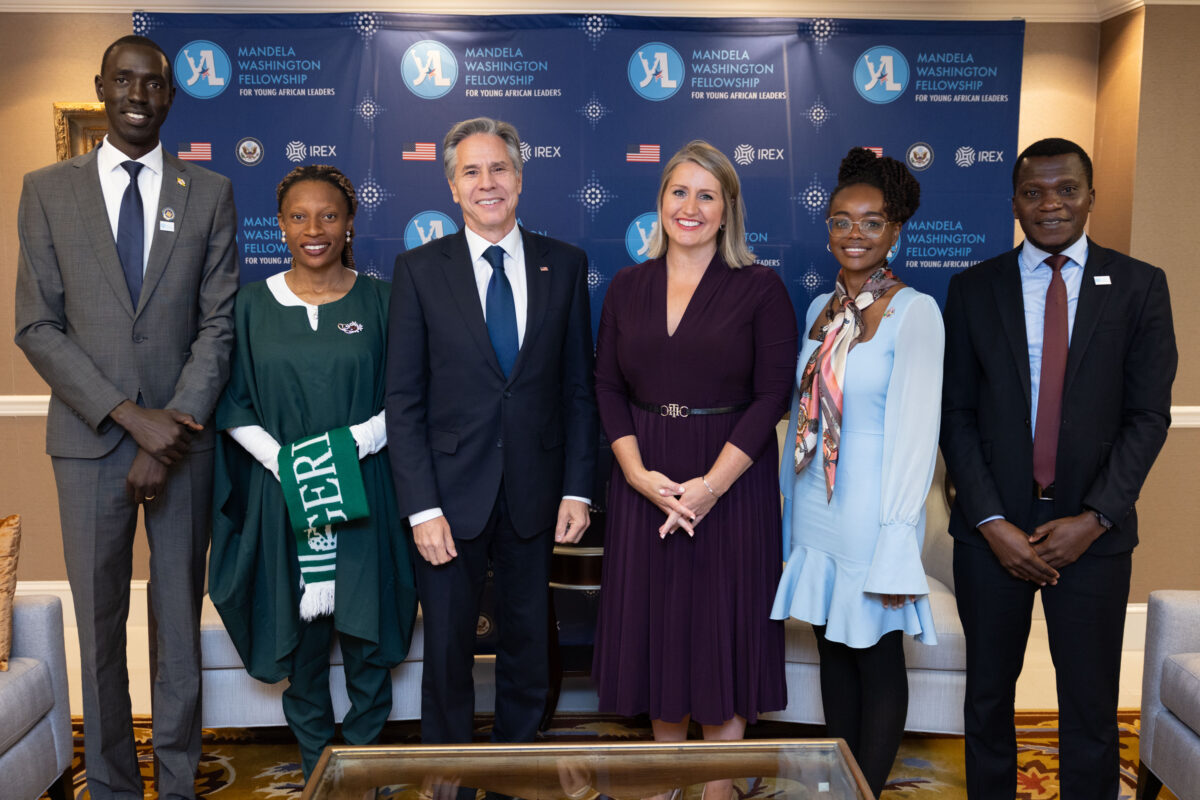 (l-r): Jok Thon, YALI fellow Blessing Ashi from Nigeria, U.S. Secretary of State Antony Blinken, Undersecretary of State Elizabeth Allen, and YALI fellows Shange-Ndamona Mungoba from Namibia and Khwima Mkamanga from Malawi. (Image courtesy of Thon)
Designing a “Retriever YALI Village” requires many hands. The village was equipped with campus housing, transportation, catering, activities, and a budget for each fellow. Thanks to campus and community partners, it also included workshops, projects, events, and speakers.
“We invited trusted partners aligned with our fellows, had conversations with them, and created a space for the fellows to choose their level of engagement,” says Pickard. The proposal was a winner.
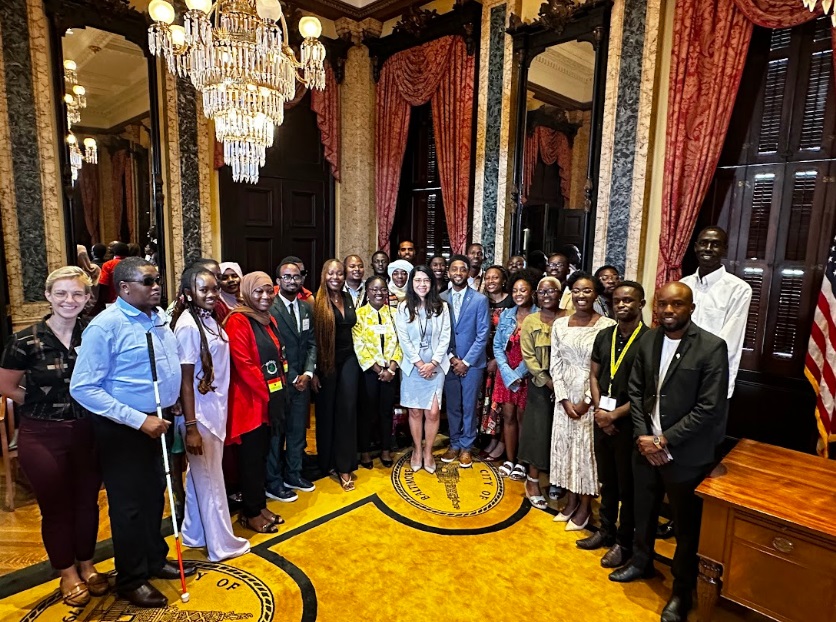 YALI fellows at Baltimore City Hall with Baltimore City Mayor Brandon Scott.
(Image courtesy of Mirab Akinyi)
In summer 2023, 24 young African leaders came to UMBC to share and learn new skills to empower them as critical leaders in addressing issues facing women, girls, and children, mental and public health, education, community organizing, NGO management, sustainability, and more. Fellows engaged in academic sessions, community service, site visits, and networking events and met state and local government leaders, businesses, and community organizations. They also joined in Baltimore’s baseball season at the Oriole Park at Camden Yards.
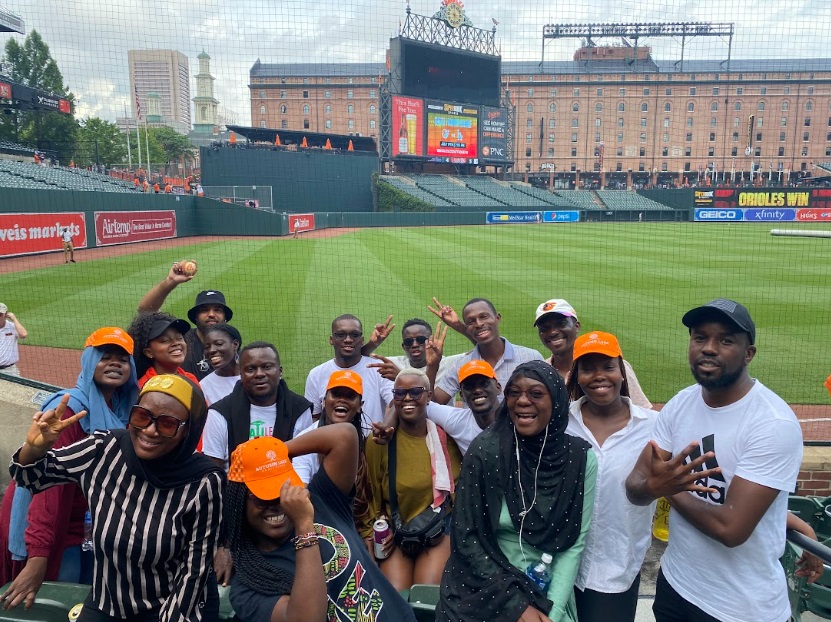 YALI fellows at the Oriole Park at Camden Yards in Baltimore City. (Image courtesy of CGE)
“Together, we explored the notion that true leadership is rooted in service and that we can drive meaningful progress by embracing diversity and harnessing collective strengths,” says Thon. Due to the program’s success, UMBC was chosen to host again in June 2024.
All for all
Fellows are often inspired into action by personal experiences. Their superpower is knowing they alone are not the answer. Fellows share their community-building strategies and acquire new expertise to address ongoing challenges. It’s not all-for-one, or one-for-all, but all-for-all.
Leveraging social media for social justice is a key approach for Ellen Kalaputse Nanyeni, a financial modeling and valuation analyst from Namibia. As a survivor of sexual and gender-based violence (SGBV), she understands the victim blaming and legal hurdles survivors face to access care and protection. Nanyeni promotes equal opportunity rights and the safety of women in Namibia via the #Shutitalldown Namibia SGBV awareness social media movement and through the #Breakfree #Befree support services initiative established by Monica Geingos, the First Lady of Namibia.
In Nigeria, Sunday Emmanuel Onuche networks with schools and disability organizations to further disability justice. Onuche promotes inclusion, leadership opportunities, and self-reliance for people with disabilities like himself via his VisionLink Initiative.
Skateboarding is John Kabiye Kalenga’s community development tool. As a professional skateboarder and the coach for Zambia’s first Olympic skateboard team at the 2022 Tokyo Olympics, Kalenga lives and breathes the sense of belonging skateboarding has given him. As vice president of the Skate Association of Zambia, he teamed up with more than 30 international skatepark construction volunteers to build Zambia’s first-ever skatepark creating a safe haven for young people.
CNN World: Zambian instructor empowers kids through skateboarding
These are just a few of the 2023 YALI fellows who connected over the summer of 2023 and returned to their countries with new leadership skills and tools for change.
Implementing the YALI Way
YALI is one summer, but it’s what comes afterward when the fellows return home that the work truly becomes YALI work. Merab Akinyi returned to Uganda intent on expanding Streetlights Uganda’s reach. She fundraised to remodel old houses in areas of high need. The additional classrooms and offices launched the Ntunga project, Changing Lives Through Fashion. It equips women and children with marketable skills to sustain their families. Her team continues to run the Mwalimu Mentorship, an apprenticeship connecting artists with youth, and the Unseen Me children’s exhibition.
Currently, Streetlights Uganda manages two training centers for women and two for street children. Merab Akinyi and her team of seven organizers have reached over 60 women in the past 3 years and over 400 street children.
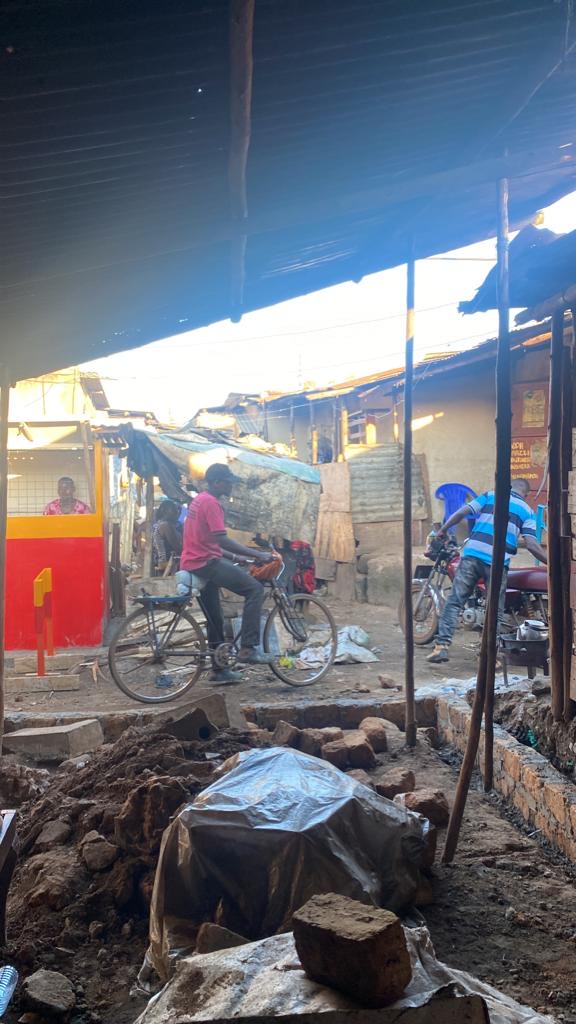
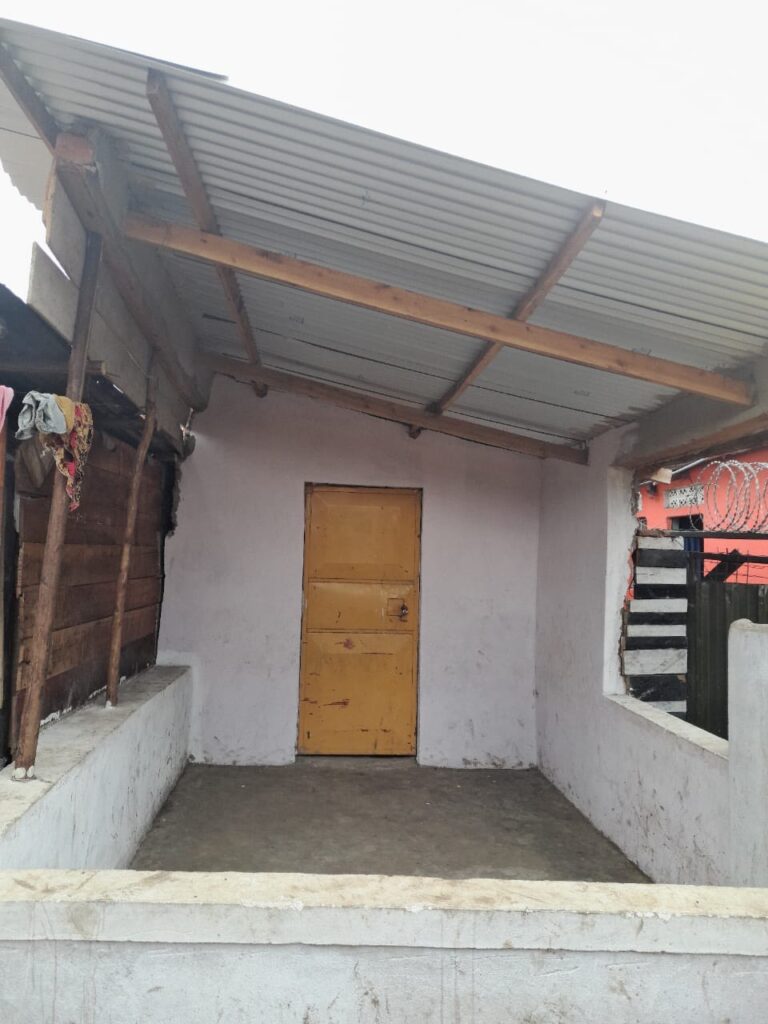
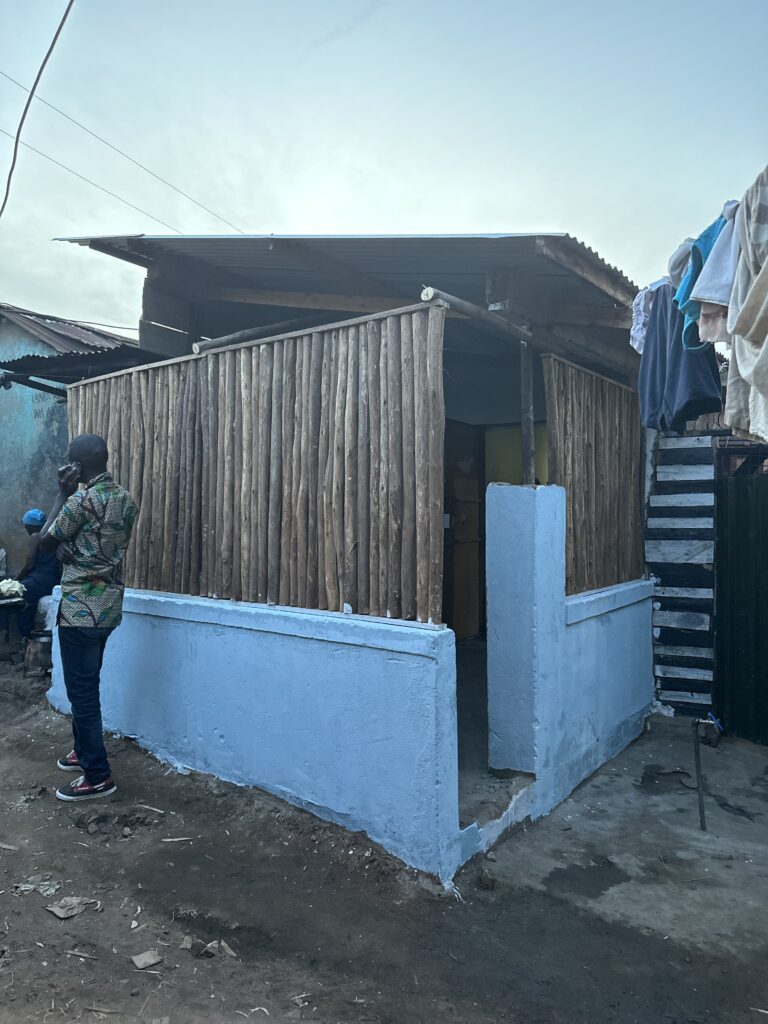 Streetlights Uganda’s phases of remodeling an additional center. (Images courtesy of Merab Akinyi)
Merab Akinyi’s next project is inspired by a YALI fellow who reuses empty bottles for building construction. “Many bottles are lying around. We are looking to develop an awareness campaign on how to use bottles to save the environment,” says Merab Akinyi. “These bottles can be repurposed to fix drainage problems around the centers and add more space.”
Pickard notes this is the goal of the fellowship. “We create opportunities for fellows to learn from each other and for everyone to challenge and develop their personal growth and values.”
Overlapping hearts and minds
The deep sense of camaraderie drew the attention of UMBC community members outside of YALI resulting in powerful friendships and mentorships that continue to this day. Pickard connected Merab Akinyi with artist Ariel Valéria Barbosa, M.P.S. ’24, community leadership, after noticing Merab Akinyi’s passion for using art as a vehicle for change. Barbosa is the program coordinator for UMBC’s food pantry Retriever Essentials and leads A Gente, an organization that gives opportunities to Black artists to travel to the African Diaspora to co-create free exhibitions for the local community.
“There are similarities in our surrealist art styles and wanting to use the little we have and our charisma and intelligence to expand impact for our people,” says Barbosa. “Victoria is really good at what she does, and I want her talents to be nurtured and supported.” Barbosa linked Pickard with DewMore, a nonprofit that uses poetry as a platform for youth leadership.
“It was full circle for me to listen to Victoria read a poem she wrote during the DewMore poetry workshop about her experience in Baltimore,” says Barbosa. “She carries herself with a lot of composure and dignity, like a voice for the people. That is just who she is.”
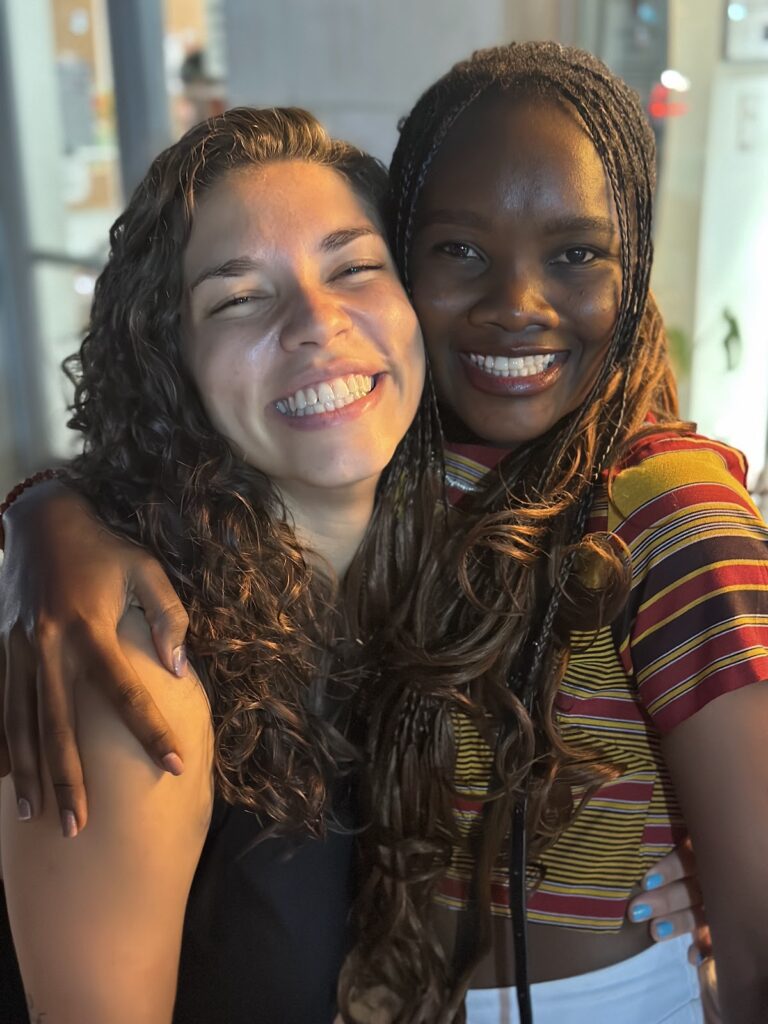
Ariel Barbosa and Victoria Merab Akinyi. (Image courtesy of Merab Akiniyi.)
A smile goes a long way
Lovetta Y. Qualah is the founder and CEO of Positive Actions Driving Safety (PADS), which addresses period poverty by providing free sanitary products to women and girls in Monrovia, Liberia. She found a kindred heart in Namrata Oruganti ’24, biology. As a summer conference assistant, Oruganti helped code keys, fold towels, organize sheets, and prepare comforters for the fellows. “I was blessed to be at that desk,” says Oruganti. The first night, the YALI group organized a party for a fellow who had arrived on his birthday.
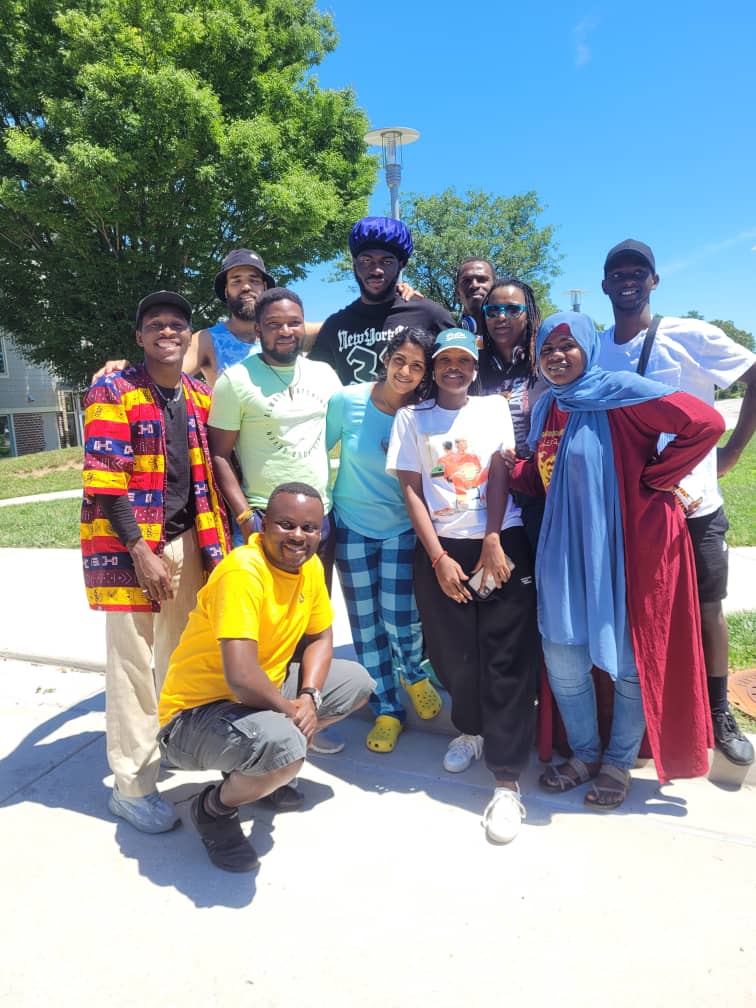
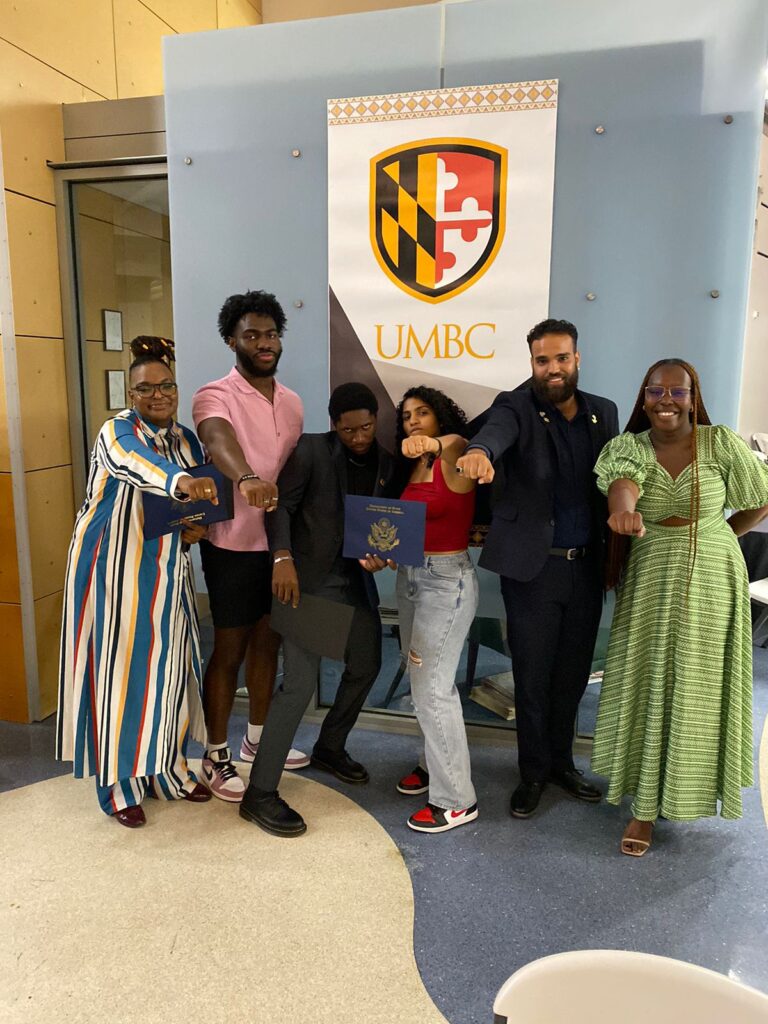 (l-r): Oruganti (center with plaid pants) with fellows on their last days and (center with red shirt) at the farewell ceremony. (Image courtesy of Oruganti)
“I couldn’t believe the fellows weren’t familiar with each other. Each person contributed something they already had,” says Oruganti. They invited her to share a meal and, once they learned of her love for Afro-beats, to dance.
Oruganti had no idea they were CEOs or experts. “Not one person made me feel like I was less than them. People in leadership sometimes forget that,” says Oruganti, known to her friends—which now include the fellows—as Smiley. “Sometimes I forget.”
“Smiley took an interest in me as a person, my work, and my progress,” says Qualah. “Smiley was a really good ambassador for UMBC. She is an image of positive energy. Always checking in on everybody.”
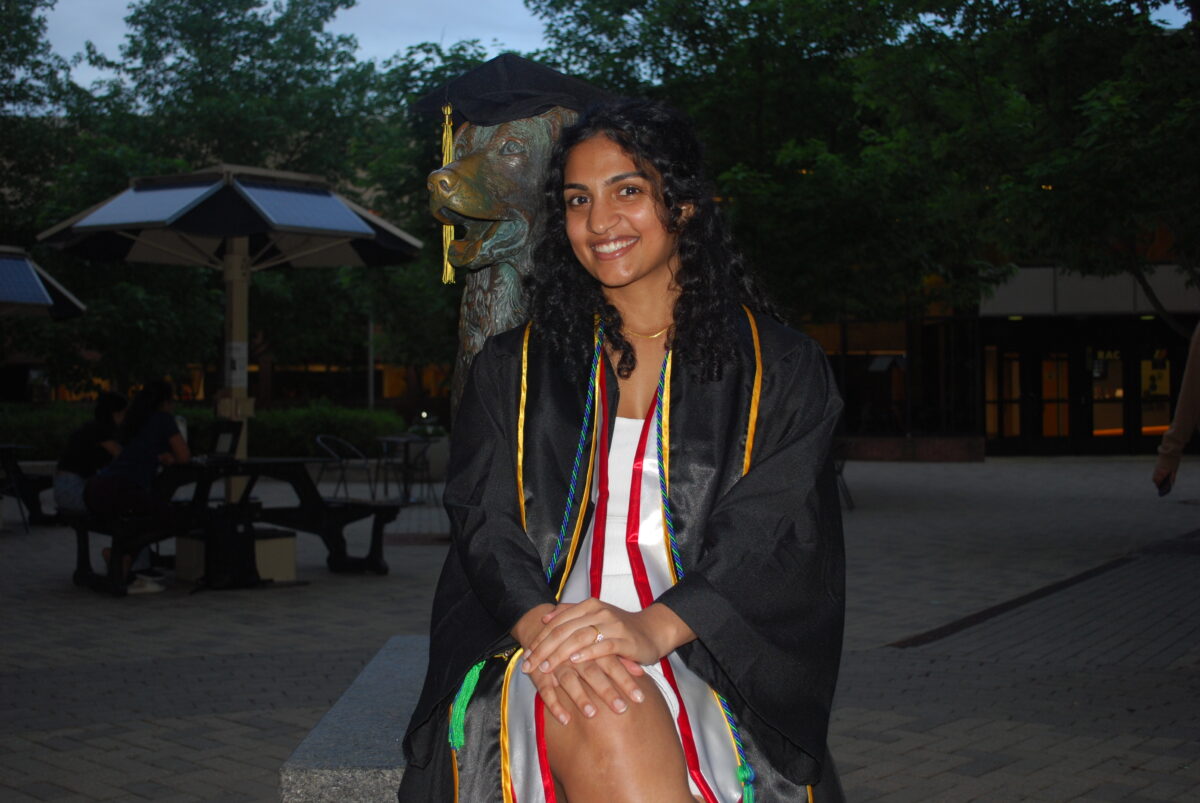
As Oruganti applies to medical school, she keeps her YALI lessons in mind. “The fellows are the most amazing, sweet, and humble people. They taught me how to be a collective,” says Oruganti. “They will always be part of my life story.” The fellows congratulated her on her recent graduation on their WhatsApp chat. “Smiley wasn’t even a part of YALI but she became an integral part,” says Qualah.
(Image courtesy of Oruganti)
Conversation + connection = action
Deep understanding is the goal. Mentorship is the path. To listen, think, share, and reflect is the YALI way. With the help of mentors like Joby Taylor, Ph.D. ’05, language, literacy, and culture, and director of the Shriver Center, fellows build mentorship tools to better communicate with their communities and instill mentorship programs. Taylor led a workshop on place, sense of place, and placemaking as social change in Africa and Baltimore City.
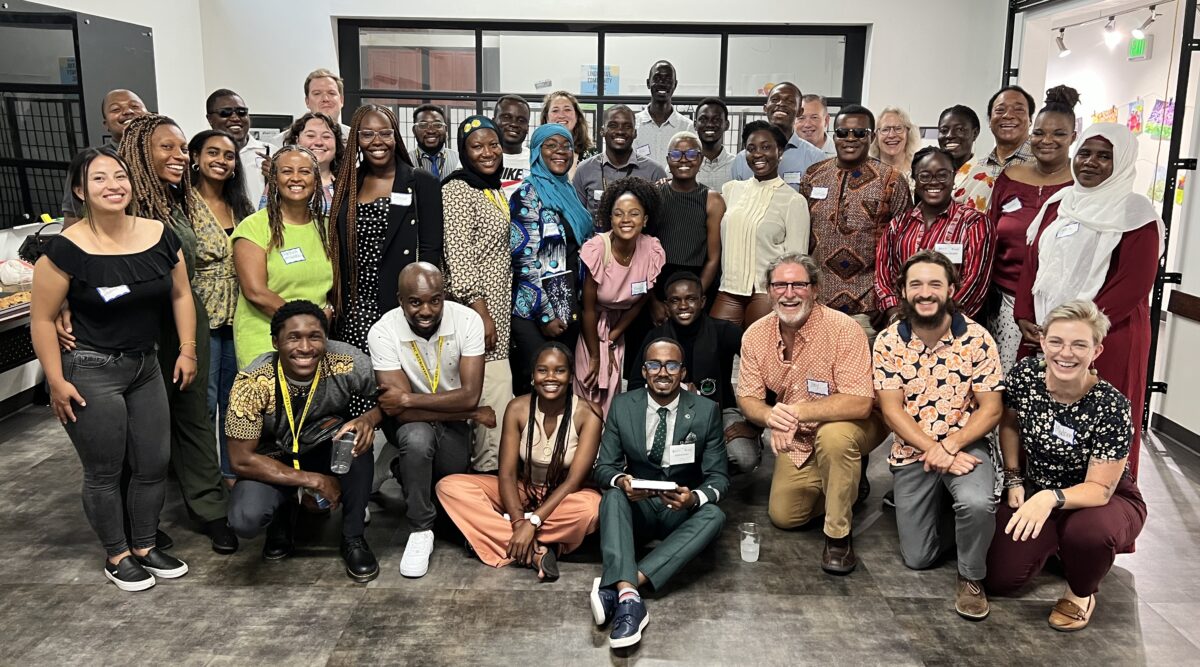 YALI fellows at OCA Mocha with UMBC Shriver Center and CGE staff, Peaceworker fellows, and the Baltimore Entrepreneurship and Leadership Network. (Image courtesy of Sally Scott, director of graduate programs in community leadership at The Shriver Center.)
“Jok and I have had a two-year conversation where we have learned so much about leadership from each other and South Sudan and Baltimore,” says Taylor, who is also Thon’s host family. “Living and working with him makes you want to be a better person.”
Thon put theory to practice by helping fellows complete paperwork and hone their professionalism skills. “This was my favorite part because I saw myself in their work and they saw themselves in my work at UMBC and back home in South Sudan,” says Thon. Heplayed basketball with them every Sunday. “They called me their mentor and big brother.”
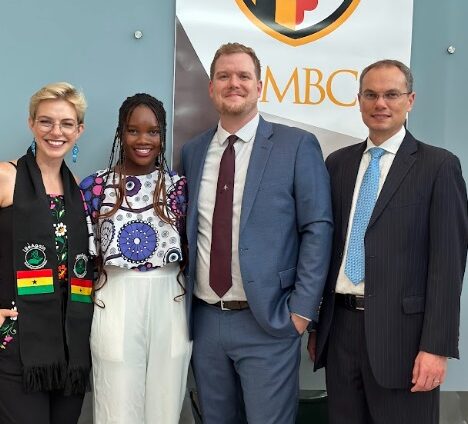
Merab Akinyi appreciated the intention, “Beyond the classes, the dedication, and humility of the facilitators—especially Ryan Sheldon, Madison, and Jok—were great lessons to me as a leader and great virtues for me to take back home.”
(l-r): Pickard, Merab Akinyi, Sheldon, David Di Maria, senior international officer and associate vice provost for international education. (Image courtesy of Mirab Akinyi)
A year later, Qualah continues to reflect on the fears she had while at YALI and how UMBC community members helped her overcome this. “While at YALI I had imposter syndrome. I was looking for validation every day,” says Qualah. “Everything changed when I met amazing people at UMBC: President Valerie Sheares Ashby, Sally Scott, Madison Pickard, Ryan Sheldon, Jok Thon, and, my dear friend and YALI fellow, Lillian Ndilwa. They challenged my perspective, highlighting the unique value I bring and the importance of my contributions. Words like ‘You deserve to be here,’ and ‘Your work is needed’ resonated deeply.” Today, Qualah puts these beliefs to work and is a visible and outspoken leader sharing PADS’ success and her UMBC YALI experience on Facebook.
Africans for Africa
This year, YALI celebrates its 10th anniversary. Nearly 6,500 leaders have taken YALI’s multi-tiered mentorship approach across all sub-Saharan countries. Thon notes convening 20-plus African leaders in one room is a feat on its own. “It’s hard bringing people together in Africa,” he says. “I can have connections in Congo or Kenya because those are my neighboring countries, but you cannot really know what the young people are doing in South Africa from South Sudan or a West African country.”
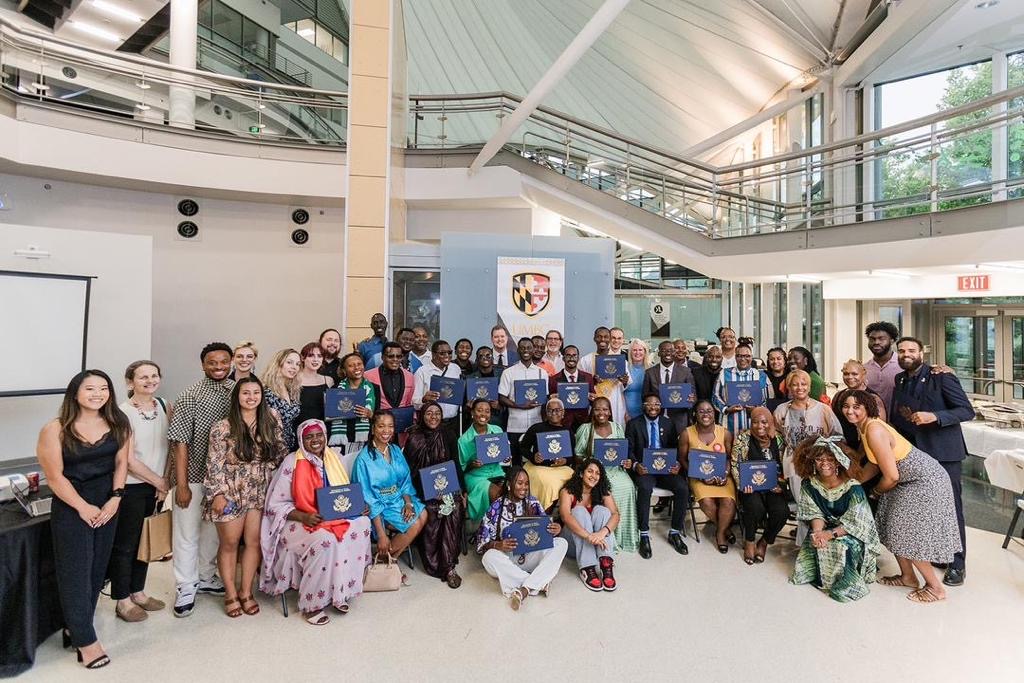 YALI 2023 fellows at their farewell ceremony with the CGE team, Peaceworker Fellows leadership, and Oruganti (center front row wearing red sneakers).
(Image courtesy of Oruganti)
This summer Thon will extend the YALI ripple effect, working as a partnership associate at CorpsAfrica, a non-profit organization focused on engaging youth and helping rural communities overcome extreme poverty.
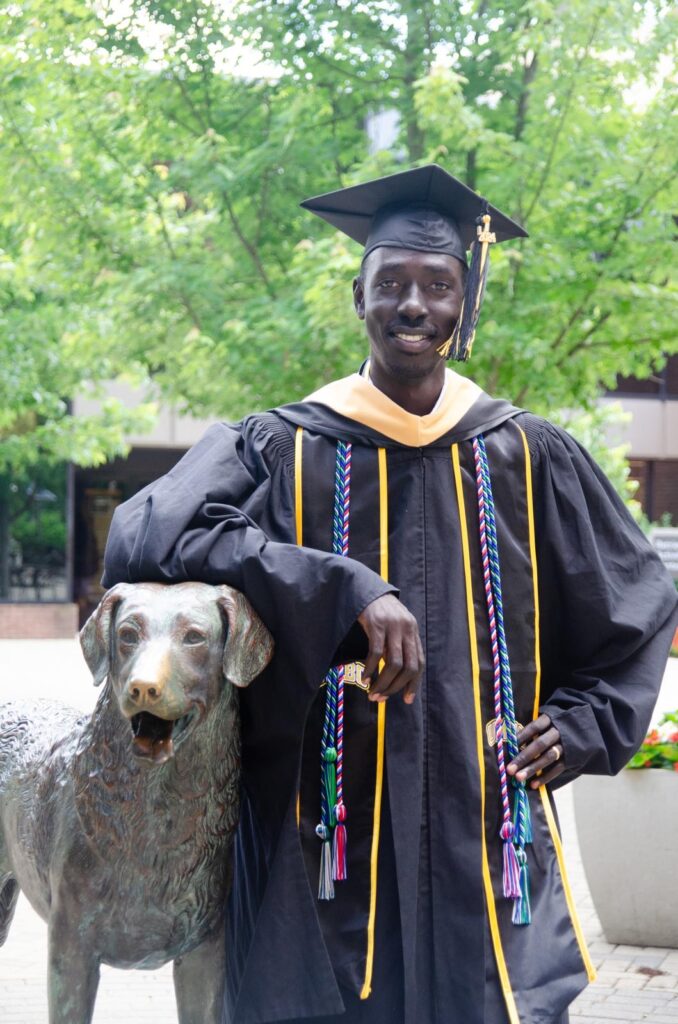 Jok Thon celebrating his 2024 graduation from UMBC.
(Image courtesy of Thon)
“Every little act of peace and kindness gets us closer to building a just and prosperous society where there is no weak or strong, poor or rich,” says Thon, “but a society that thrives on the basic principles of living a dignified life guided by empathy.”
]]>
This summer, UMBC’s Center for Global Engagement (CGE) is excited to welcome its second cohort of the prestigious Mandela Washington Fellowship for Young African Leaders, the six-week flagship...
https://umbc.edu/stories/umbc-center-for-global-engagement-welcomes-young-african-leaders/
https://my3.my.umbc.edu/api/v0/pixel/news/142500/guest@my.umbc.edu/ee1d8353c9a2f54a62f3581da961d3c9/api/pixel
biology
cge
community
international
llc
mlli
news
peaceworker
retriever-essentials
shrivercenter
story
tesol
UMBC News & Magazine
https://my3.my.umbc.edu/groups/umbc-news-magazine
https://assets1-my.umbc.edu/system/shared/avatars/groups/000/001/943/24435aa6207c452e7bc15cc74b42c7bb/xsmall.png?1748556657
https://assets1-my.umbc.edu/system/shared/avatars/groups/000/001/943/24435aa6207c452e7bc15cc74b42c7bb/original.png?1748556657
https://assets2-my.umbc.edu/system/shared/avatars/groups/000/001/943/24435aa6207c452e7bc15cc74b42c7bb/xxlarge.png?1748556657
https://assets2-my.umbc.edu/system/shared/avatars/groups/000/001/943/24435aa6207c452e7bc15cc74b42c7bb/xlarge.png?1748556657
https://assets3-my.umbc.edu/system/shared/avatars/groups/000/001/943/24435aa6207c452e7bc15cc74b42c7bb/large.png?1748556657
https://assets1-my.umbc.edu/system/shared/avatars/groups/000/001/943/24435aa6207c452e7bc15cc74b42c7bb/medium.png?1748556657
https://assets2-my.umbc.edu/system/shared/avatars/groups/000/001/943/24435aa6207c452e7bc15cc74b42c7bb/small.png?1748556657
https://assets1-my.umbc.edu/system/shared/avatars/groups/000/001/943/24435aa6207c452e7bc15cc74b42c7bb/xsmall.png?1748556657
https://assets2-my.umbc.edu/system/shared/avatars/groups/000/001/943/24435aa6207c452e7bc15cc74b42c7bb/xxsmall.png?1748556657
UMBC News & Magazine
3
0
false
Tue, 18 Jun 2024 13:55:38 -0400
Tue, 18 Jun 2024 13:55:38 -0400
A shift in plans leads to new opportunities, combining philosophy and science
Avi Newman
Degrees: B.S., Biochemistry and Molecular Biology; B.S., Biological Sciences; B.A., Philosophy
Hometown: Derwood, MD
Post-grad plans: Graduate school
Embracing all of the academic and social opportunities UMBC has to offer has been Avi Newman‘s approach to undergraduate life. He was originally scheduled to graduate sooner, but when complications from COVID extended his time at UMBC, he decide to take that as a chance to expand his learning, completing majors in biochemistry and molecular biology, biological sciences, and philosophy, plus minors.
He has pursued challenging research projects with chemistry faculty, supported peers as a chemistry and biological sciences teaching assistant, and held almost every leadership position in the UMBC Chemistry and Biochemistry Council of Majors. Appreciating the value of support, he has also served as a peer tutor with the Math and Science Tutoring Center and the Academic Success Center, sharing that he particularly enjoys helping fellow students learn and gain an appreciation for science.
Beyond academics, Newman has found meditation as a strategy to keep his mind and life grounded. He appreciates the art of teaching his brain to focus, to be mindful and cognizant of what is going on around him. Newman sees meditation and philosophy as having a reciprocal relationship, where both teach about having a broader outlook on life, to remain humble, and to remain open to different possibilities.
Newman has also volunteered with groups like UMBC’s chapter of Global Brigades, which enables students to provide public health support to communities worldwide.
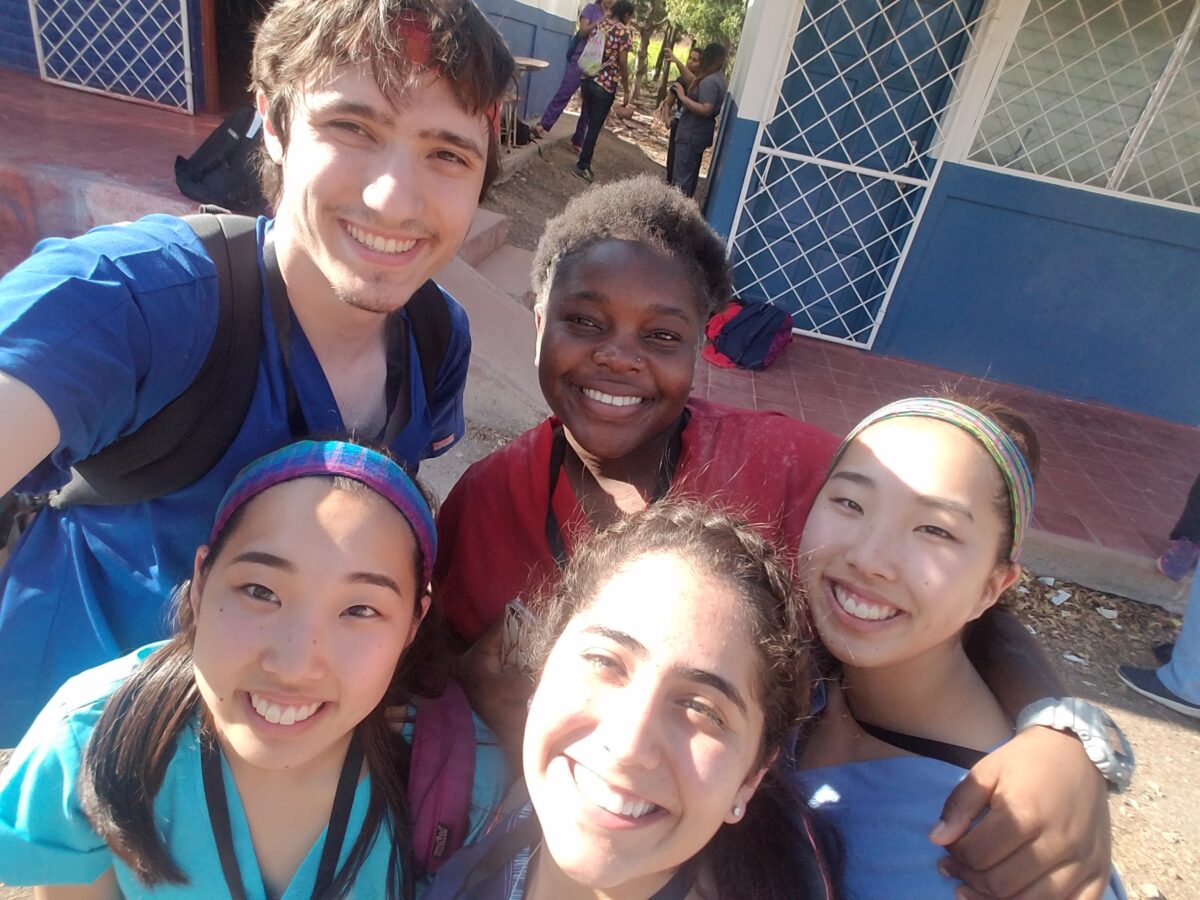 Avi Newman with Global Brigades partners. (Photo courtesy of Newman)
Is there a particular academic achievement you’re most proud of?
“Introduction to moral theory was the first philosophy course I took at UMBC. It gave me such a different world view and outlook about how people think about their goals and their frame of mind. I began with a few classes then decided to do a certificate, then a minor, and finally decided to make it one of my majors. I loved philosophy of science with Jessica Pfeifer, associate professor of philosophy, so much that it became my focus area, along with philosophy of logic and probability. What guides me in philosophy, in science, and in life in general is that I’m a person who is always asking questions.”
Has there been a mentor or student who influenced your time at UMBC?
“There have been many, including my research advisor Songon An, associate professor of chemistry and biochemistry. He has been very influential on my growth as a scientist by giving me a ton of opportunities to explore different areas of research and work in his lab to help prepare me for graduate school. He has also helped me learn how to focus my energy and has been very supportive helping me work through personal hurdles.
Allison Tracy, senior lecturer in chemistry and biochemistry; Sarah Leupen, principal lecturer in biological sciences; and Daniel Jenkins, philosophy instructor, have helped me through some very rough times and given me the inspiration of how I want to be as a professor and a teacher for students of all different backgrounds, different knowledge levels, and abilities. Elizabeth Stanwyck, principal lecturer of mathematics and statistics, helped me connect a wide variety of statistic material.
Whitney Schwab,associate professor of philosophy, made ancient Greek and Latin come alive; and Blake Francis, assistant professor of philosophy, taught macabre topics like climate change ethics and ethics concerning rights of the dead in a sensitive and engaging manner. All of these faculty are so knowledgeable, kind, and passionate about teaching and helped shape my understanding of the world around me.”
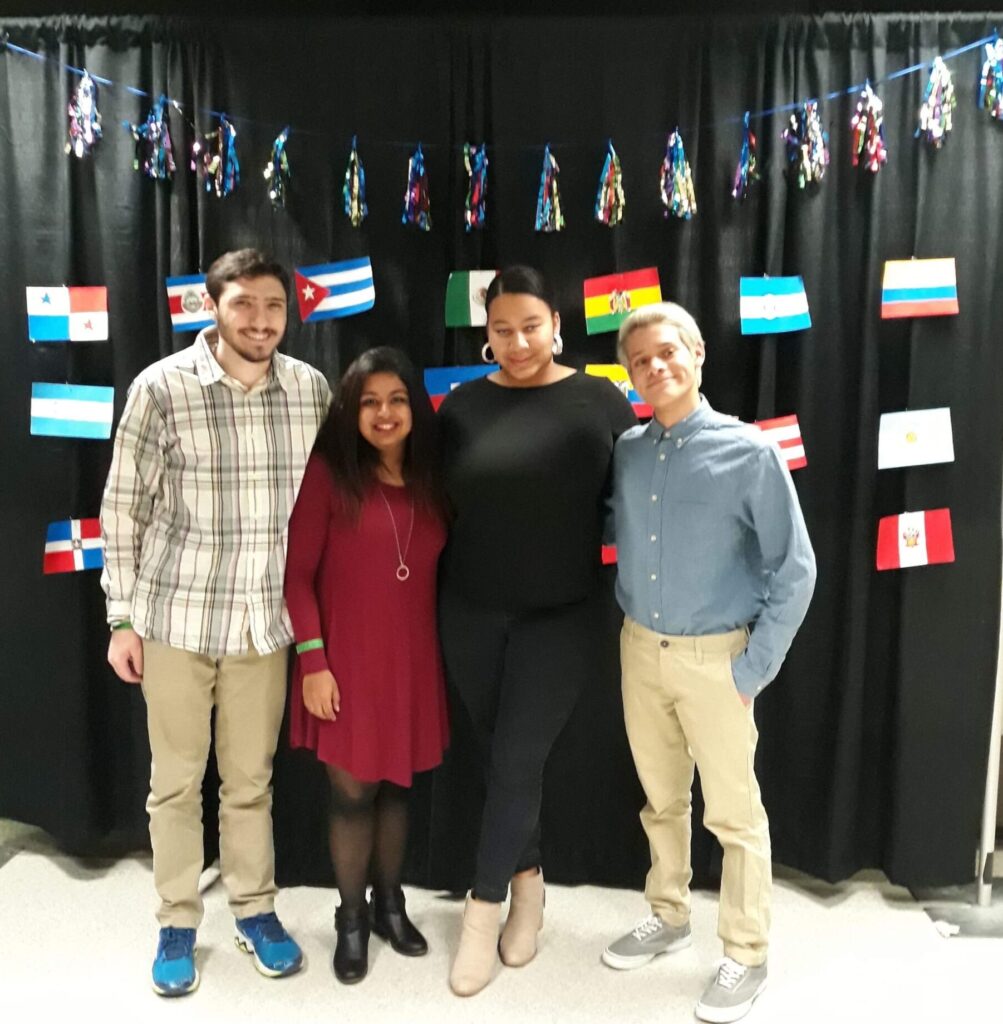 Newman with friends at UMBC’s Hispanic Latino Student Union formal event. (Photo courtesy of Newman)
]]>
Avi Newman Degrees: B.S., Biochemistry and Molecular Biology; B.S., Biological Sciences; B.A., Philosophy Hometown: Derwood, MD Post-grad plans: Graduate school Embracing all of the...
https://umbc.edu/stories/new-opportunities-combining-philosophy-and-science/
https://my3.my.umbc.edu/api/v0/pixel/news/133097/guest@my.umbc.edu/173d0bf200af17902bd12c8adeffcebc/api/pixel
biology
cahss
chemistry-and-biochemistry
class-of-2023
cnms
philosophy
shrivercenter
UMBC News & Magazine
https://my3.my.umbc.edu/groups/umbc-news-magazine
https://assets1-my.umbc.edu/system/shared/avatars/groups/000/001/943/24435aa6207c452e7bc15cc74b42c7bb/xsmall.png?1748556657
https://assets1-my.umbc.edu/system/shared/avatars/groups/000/001/943/24435aa6207c452e7bc15cc74b42c7bb/original.png?1748556657
https://assets2-my.umbc.edu/system/shared/avatars/groups/000/001/943/24435aa6207c452e7bc15cc74b42c7bb/xxlarge.png?1748556657
https://assets2-my.umbc.edu/system/shared/avatars/groups/000/001/943/24435aa6207c452e7bc15cc74b42c7bb/xlarge.png?1748556657
https://assets3-my.umbc.edu/system/shared/avatars/groups/000/001/943/24435aa6207c452e7bc15cc74b42c7bb/large.png?1748556657
https://assets1-my.umbc.edu/system/shared/avatars/groups/000/001/943/24435aa6207c452e7bc15cc74b42c7bb/medium.png?1748556657
https://assets2-my.umbc.edu/system/shared/avatars/groups/000/001/943/24435aa6207c452e7bc15cc74b42c7bb/small.png?1748556657
https://assets1-my.umbc.edu/system/shared/avatars/groups/000/001/943/24435aa6207c452e7bc15cc74b42c7bb/xsmall.png?1748556657
https://assets2-my.umbc.edu/system/shared/avatars/groups/000/001/943/24435aa6207c452e7bc15cc74b42c7bb/xxsmall.png?1748556657
UMBC News & Magazine
1
0
false
Mon, 01 May 2023 10:36:37 -0400
Wed, 03 May 2023 12:00:37 -0400
Meet a Retriever — Jok Thon, UMBC’s First Peaceworker Global Fellow
Newman with friends at UMBC’s Hispanic Latino Student Union formal event. (Photo courtesy of Newman)
]]>
Avi Newman Degrees: B.S., Biochemistry and Molecular Biology; B.S., Biological Sciences; B.A., Philosophy Hometown: Derwood, MD Post-grad plans: Graduate school Embracing all of the...
https://umbc.edu/stories/new-opportunities-combining-philosophy-and-science/
https://my3.my.umbc.edu/api/v0/pixel/news/133097/guest@my.umbc.edu/173d0bf200af17902bd12c8adeffcebc/api/pixel
biology
cahss
chemistry-and-biochemistry
class-of-2023
cnms
philosophy
shrivercenter
UMBC News & Magazine
https://my3.my.umbc.edu/groups/umbc-news-magazine
https://assets1-my.umbc.edu/system/shared/avatars/groups/000/001/943/24435aa6207c452e7bc15cc74b42c7bb/xsmall.png?1748556657
https://assets1-my.umbc.edu/system/shared/avatars/groups/000/001/943/24435aa6207c452e7bc15cc74b42c7bb/original.png?1748556657
https://assets2-my.umbc.edu/system/shared/avatars/groups/000/001/943/24435aa6207c452e7bc15cc74b42c7bb/xxlarge.png?1748556657
https://assets2-my.umbc.edu/system/shared/avatars/groups/000/001/943/24435aa6207c452e7bc15cc74b42c7bb/xlarge.png?1748556657
https://assets3-my.umbc.edu/system/shared/avatars/groups/000/001/943/24435aa6207c452e7bc15cc74b42c7bb/large.png?1748556657
https://assets1-my.umbc.edu/system/shared/avatars/groups/000/001/943/24435aa6207c452e7bc15cc74b42c7bb/medium.png?1748556657
https://assets2-my.umbc.edu/system/shared/avatars/groups/000/001/943/24435aa6207c452e7bc15cc74b42c7bb/small.png?1748556657
https://assets1-my.umbc.edu/system/shared/avatars/groups/000/001/943/24435aa6207c452e7bc15cc74b42c7bb/xsmall.png?1748556657
https://assets2-my.umbc.edu/system/shared/avatars/groups/000/001/943/24435aa6207c452e7bc15cc74b42c7bb/xxsmall.png?1748556657
UMBC News & Magazine
1
0
false
Mon, 01 May 2023 10:36:37 -0400
Wed, 03 May 2023 12:00:37 -0400
Meet a Retriever — Jok Thon, UMBC’s First Peaceworker Global Fellow
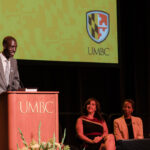
Meet Jok Abraham Thon, UMBC’s first Peaceworker Global Fellow and the first Retriever from South Sudan. Thon is pursuing his master’s in entrepreneurship, innovation, and leadership and plans to use these skills to continue to promote educational opportunities for other South Sudanese people.
Q: Tell us about yourself. What are the essential things you’d want another Retriever to know about you?
A: I am the father of four beautiful kids from the world’s youngest country, South Sudan. I left behind my young family in search of knowledge and skills so that when I return, I can play a part in transforming the lives of vulnerable children in my country.
When I was a refugee, it was not easy. We had our classes under trees; we didn’t have toys to play with, but I turned my bitter memories into positive energy to change the cycle of violence in my country by establishing Promised Land Primary and Secondary School with the motto of “Changing Minds from Bullets to Books.”
Let’s be great libraries for our children where they can find great stories of peace, love, and humanity. This message is for the parents and students who are our future leaders and policy makers. This principle will help them change policies that discriminate and instead create policies that embrace inclusion and equality.
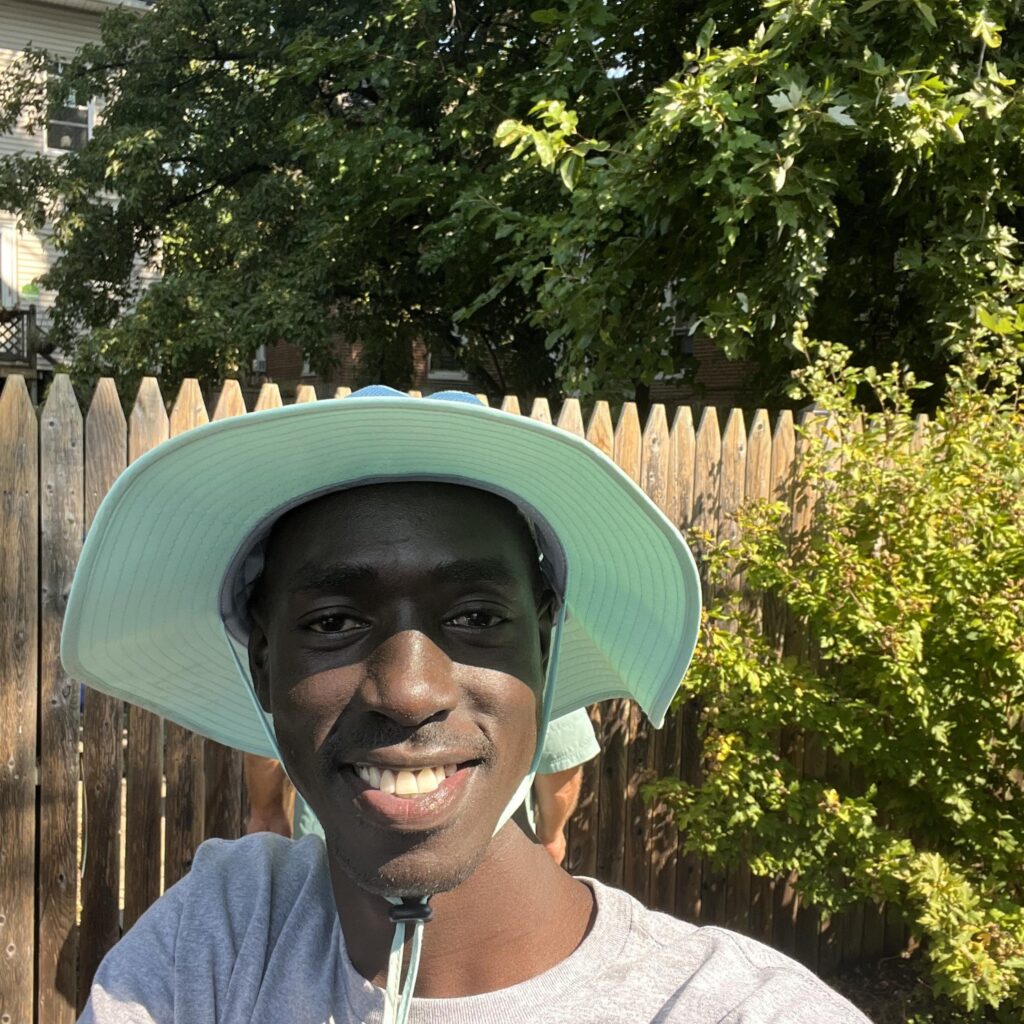 Jok Thon, UMBC’s first Peaceworker Global Fellow. Courtesy of Thon.
Q: Tell us about your primary WHY, and how it led you to UMBC.
A: I need to use the leadership and entrepreneurial skills I will get from UMBC to help transform South Sudan into a peaceful and democratic country.
Q: What do you love about your academic program?
A: My first course was Introduction to Community Leadership and my biggest takeaway was what I called a ‘”spiderweb” from placemaking—how public parks are great places to build more inclusive and peaceful communities; they’re great places for communities to come together for entertainment and family outings; they’re great places for communities to build back trust and take away fear and misinformation. In South Sudan there are some cultures that negatively affect women and girls—I want to see how we can use this placemaking idea to create parks that will bring all people together.
In my Developing the Entrepreneurial Mindset class, I am learning skills that will help me to establish a company to sustain my school and help in establishing more schools in the hard to reach villages in South Sudan. We want to provide education to the vulnerable 2.5 million children who are not in school in South Sudan and break the cycle that prohibits many girls from finishing their schooling—about 75 percent of girls don’t finish high school due to early forced marriage and poverty.
Let’s be great libraries for our children where they can find great stories of peace, love, and humanity.
Jok Thon
From my classes so far, I came up with two projects—one is Jonglei Multipurpose Memorial Park. It will not only be a park but also provide a great solution to the flooded villages along the River Nile as a way we can beautifully live with water as we fight climate change.
Second, is the Central Nile Paper Company that will produce paper sustainably from local sources of bamboo and papyrus for school workbooks and use the revenue from sales to support the Promised Land School while opening more schools across the country.
Q: Tell us about someone in the community who has inspired you or supported you, and how they did it.
A: My journey to UMBC came as an inspiration from the love I received from Joby Taylor (Ph.D. ’05, language, literacy, and culture) in the Shriver Center, Kenneth Baron in Academic Advising, David Di Maria in the Center for Global Engagement, Gib Mason (’95, economics) in the entrepreneurship, innovation, and leadership program, and Kimberly R. Moffitt, dean of the College of Arts, Humanities, and Social Sciences. This team and many more great faculty as well as staff from International Student and Scholar Services have changed my life.
I want to particularly thank Dr. Joby Taylor and his wife and children for being such a great host family. I am glad to call UMBC my sweet home far away from home.
* * * * *
UMBC’s greatest strength is its people. When people meet Retrievers and hear about the passion they bring, the relationships they create, the ways they support each other, and the commitment they have to inclusive excellence, they truly get a sense of our community. That’s what “Meet a Retriever” is all about.
Learn more about how UMBC can help you achieve your goals.
]]>
Meet Jok Abraham Thon, UMBC’s first Peaceworker Global Fellow and the first Retriever from South Sudan. Thon is pursuing his master’s in entrepreneurship, innovation, and leadership and plans to...
https://umbc.edu/stories/meet-jok-thon-first-peaceworker-global-fellow/
https://my3.my.umbc.edu/api/v0/pixel/news/128767/guest@my.umbc.edu/775fe605490c66d790bd3fa9d39818d9/api/pixel
cahss
division-of-professional-studies
dps
impact
magazine
meet-a-retriever
perspectives
shrivercenter
UMBC News & Magazine
https://my3.my.umbc.edu/groups/umbc-news-magazine
https://assets1-my.umbc.edu/system/shared/avatars/groups/000/001/943/24435aa6207c452e7bc15cc74b42c7bb/xsmall.png?1748556657
https://assets1-my.umbc.edu/system/shared/avatars/groups/000/001/943/24435aa6207c452e7bc15cc74b42c7bb/original.png?1748556657
https://assets2-my.umbc.edu/system/shared/avatars/groups/000/001/943/24435aa6207c452e7bc15cc74b42c7bb/xxlarge.png?1748556657
https://assets2-my.umbc.edu/system/shared/avatars/groups/000/001/943/24435aa6207c452e7bc15cc74b42c7bb/xlarge.png?1748556657
https://assets3-my.umbc.edu/system/shared/avatars/groups/000/001/943/24435aa6207c452e7bc15cc74b42c7bb/large.png?1748556657
https://assets1-my.umbc.edu/system/shared/avatars/groups/000/001/943/24435aa6207c452e7bc15cc74b42c7bb/medium.png?1748556657
https://assets2-my.umbc.edu/system/shared/avatars/groups/000/001/943/24435aa6207c452e7bc15cc74b42c7bb/small.png?1748556657
https://assets1-my.umbc.edu/system/shared/avatars/groups/000/001/943/24435aa6207c452e7bc15cc74b42c7bb/xsmall.png?1748556657
https://assets2-my.umbc.edu/system/shared/avatars/groups/000/001/943/24435aa6207c452e7bc15cc74b42c7bb/xxsmall.png?1748556657
UMBC News & Magazine
3
0
false
Wed, 26 Oct 2022 14:56:10 -0400
Wed, 26 Oct 2022 14:56:10 -0400
UMBC opens new academic year with new president, largest-ever incoming class
“This is a time when you begin to define what you love, what really matters to you, who you want to be in this world, and what difference you want to make in the lives of others.”
Valerie Sheares Ashby
UMBC President
As UMBC President Valerie Sheares Ashby looked out at the crowd of eager first-year students during Tuesday’s Convocation ceremony to open the academic year, she reinforced the importance of marking this formative chapter. And with well over 2,100 new first-year students, and record numbers of graduate and international students, this is a new chapter for UMBC’s largest incoming class yet.
“In an increasingly competitive college admissions landscape characterized by a declining pool of high school graduates and increasing costs of attendance, UMBC’s ability to continue to attract a strong and talented first-year class speaks to, among many things, our reputation as an institution that offers an exceptional collegiate experience that is affordable,” says Yvette Mozie-Ross ’88, UMBC’s vice provost for enrollment management and planning. This includes in-demand programs at both UMBC’s main campus and the Universities at Shady Grove in Montgomery County.
In addition to a record number of new first-year students, UMBC enrolled over 3,300 graduate students for fall 2022, marking an impressive 500-plus increase over last year’s fall enrollment.
Welcoming the incoming class
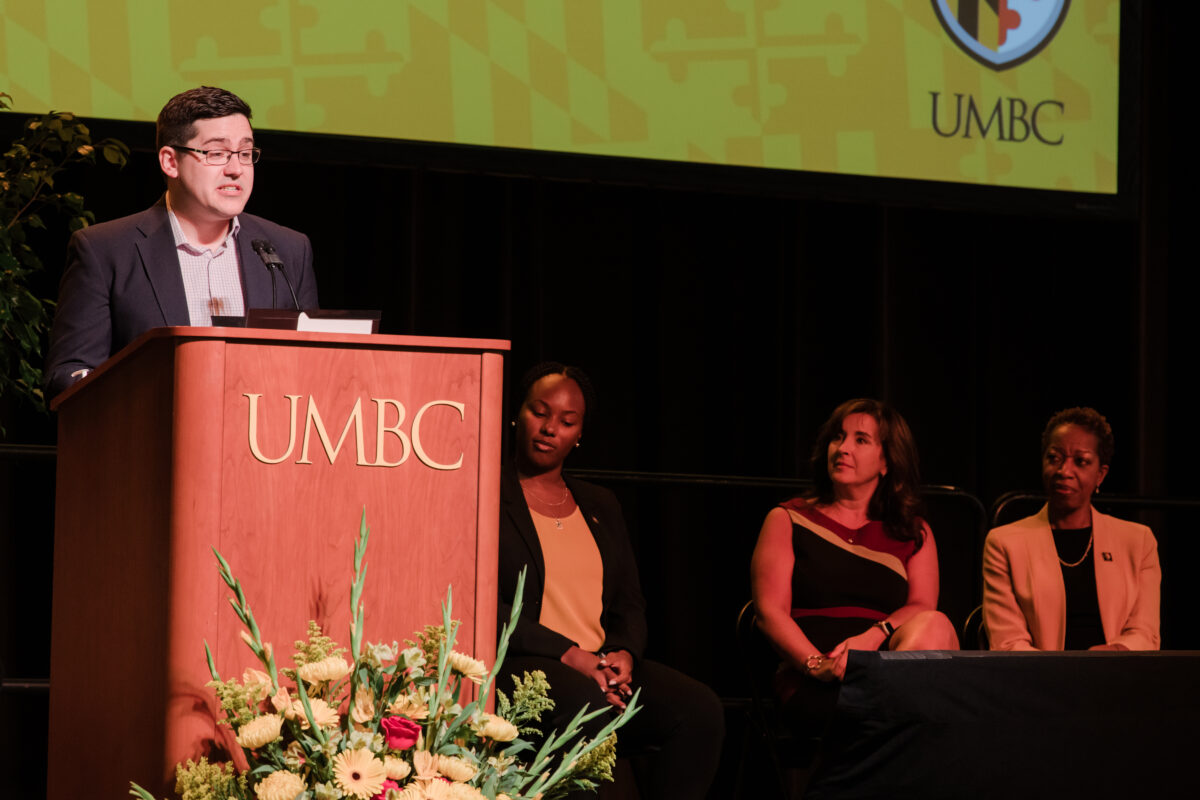
Veronica Goonan, an incoming first-year student, knew once she visited campus that she had found her place. “I had an incredible opportunity to tour campus with the [mock trial] team in the fall of my senior year, and that’s when I began to know that my place was here,” she said. “I could feel the innovation and excellence that UMBC boasts.”
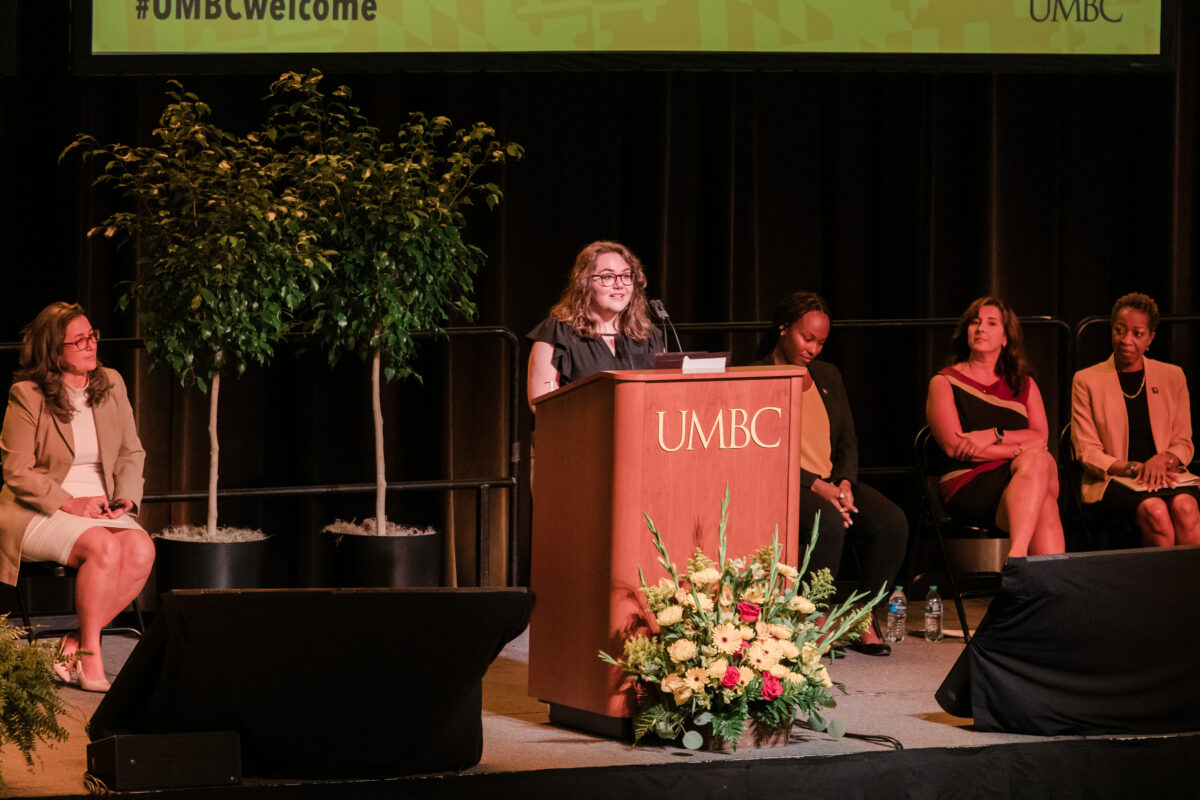 Goonan addresses the audience during Fall Opening Meeting. (Marlayna Demond ’11/UMBC)
One of the biggest goals in the first few weeks of the new academic year is to ensure students have opportunities to get to know the campus and begin learning about the possibilities available to them throughout their academic career.
“In the Division of Student Affairs, we take the role of welcoming and holding space for our students seriously. Those first few days and weeks are about making sure that we are doing all we can to help them carve out their own path while they are here,” says Jen Dress, associate director of campus life.
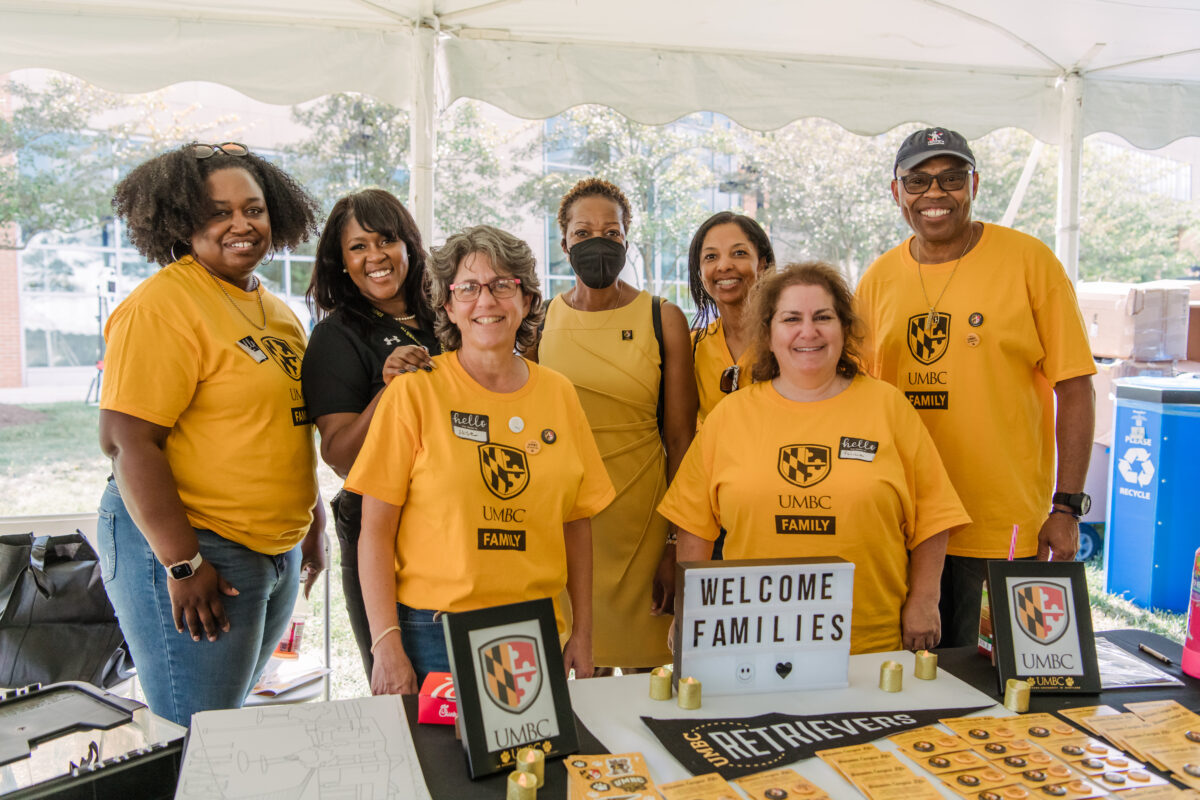 Parent volunteers welcome families to UMBC with President Sheares Ashby (c). (Marlayna Demond ’11/UMBC)
A robust Welcome Week full of fun and engaging events is an important part of this experience. When new students moved in last Saturday, they were treated to some of UMBC’s favorite traditions. Once the boxes were unpacked, the beds were made, and the posters of (insert cool band here) were hung, students and their families made their way to Erickson Field.
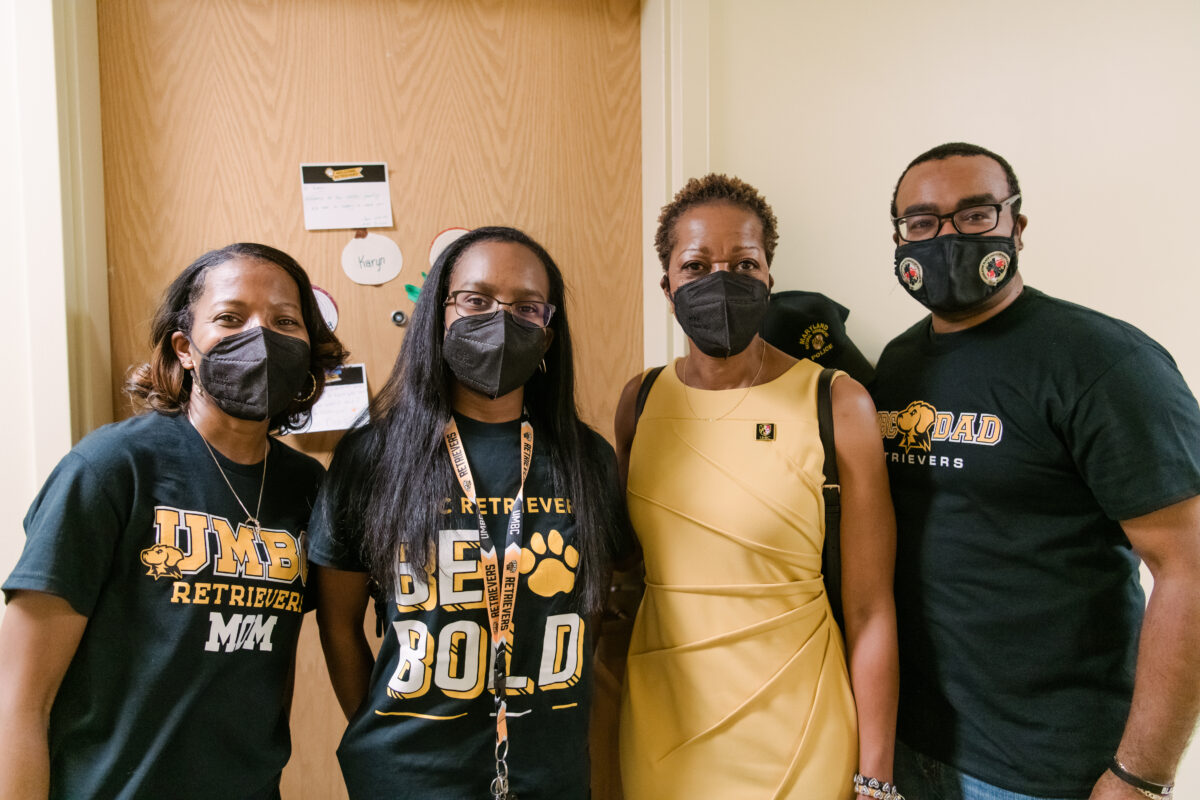 A Retriever family stops to pose with President Sheares Ashby (in gold). They include (l-r): Myra Sydnor, Camryn Sydnor, and Maryland State Senator Charles Sydnor. (Marlayna Demond ’11/UMBC)
If new Retrievers didn’t know the school colors before, they certainly did now. Swag tables, information tables, and goodie tables lined the field, all decked out in UMBC’s signature black and gold. Even the animals in the petting zoo got the memo.
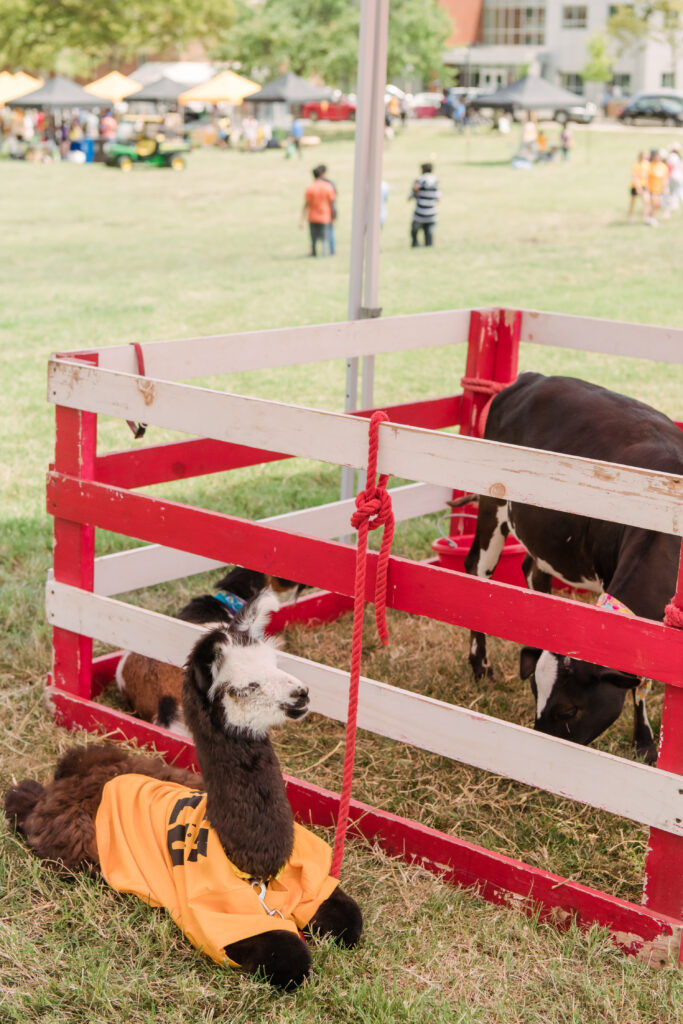 Just your normal campus petting zoo. (Marlayna Demond ’11/UMBC)
Once families said their goodbyes and maybe a few students and parents teared up got something in their eye, celebrations continued with Playfair and the annual fireworks display. New Retrievers played “getting to know you” games to break the ice and capped off the night with a spectacular fireworks show.
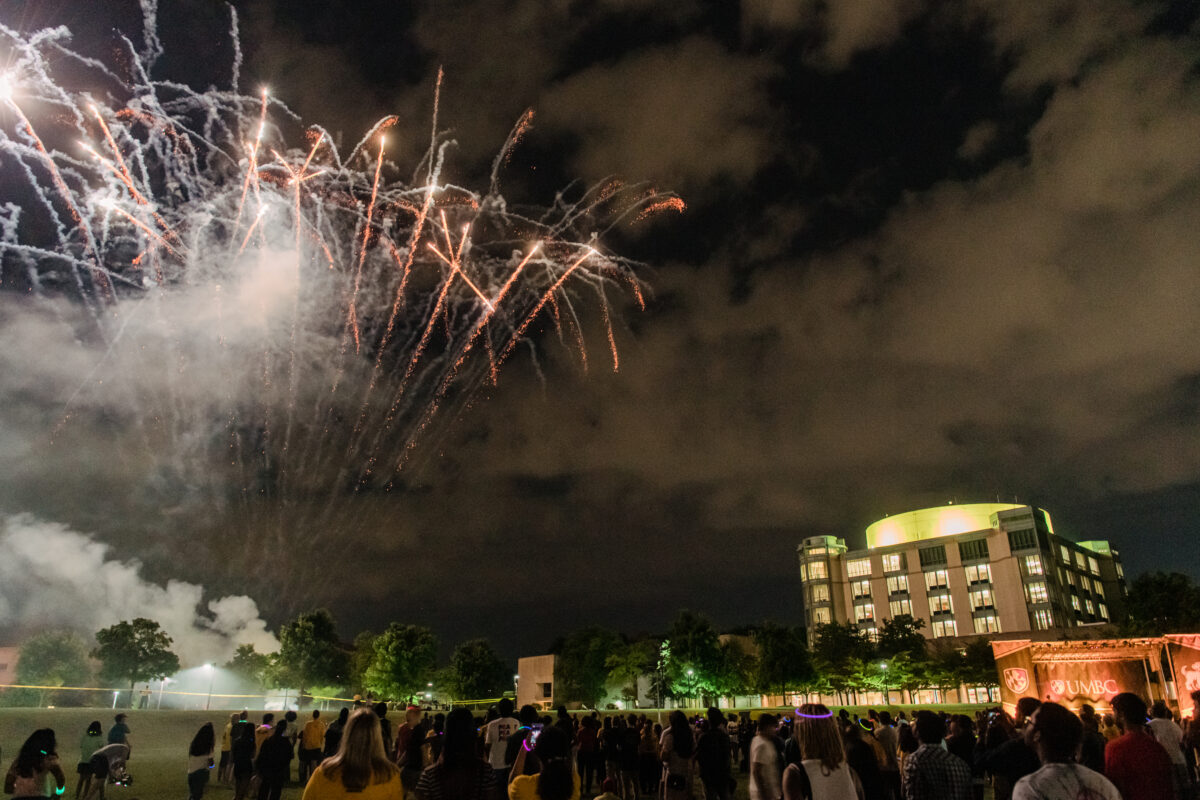 Fireworks lighting up the UMBC night sky. (Marlayna Demond ’11/UMBC)
A place for everyone
Incoming transfer student Luther Daigle, mechanical engineering, summed up the feeling hearing about UMBC versus coming to UMBC by saying, “It wasn’t until I toured the campus and I felt an overwhelming sense of belonging that I knew I wanted to continue my academic career at UMBC.” And that feeling has carried through the start of his first semester.
 Daigle addresses the crowd at Fall Opening Meeting. (Marlayna Demond ’11/UMBC)
This sense of belonging extends to UMBC’s rapidly growing population of international students. As of the end of August, over 2,200 international students were enrolled for the 2022 – 2023 academic year.
“As UMBC’s international reputation continues to grow, more students from around the world choose to join our campus community,” says David Di Maria, associate vice provost for international education. “We are very pleased to welcome the largest number of international students in UMBC’s history.”
Jok Thon, an incoming graduate student studying entrepreneurship, innovation, and leadership, is the first student from South Sudan to enroll at UMBC and he was buoyed by the diversity represented in the community he’d be joining.
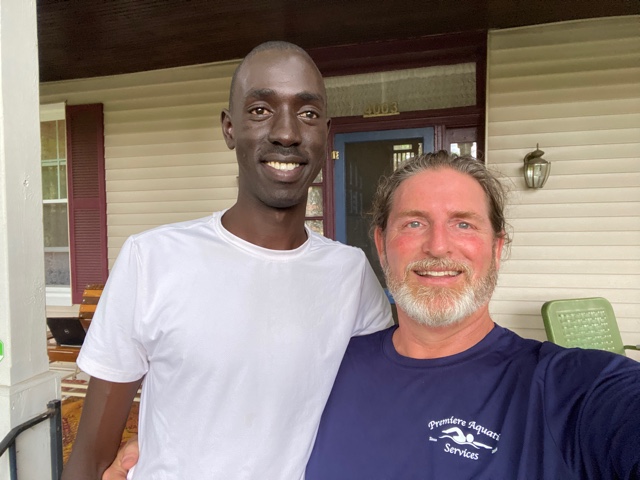 Thon and Joby Taylor, Ph.D. ’05, LLC, director of the Shriver Peaceworker Fellows Program. (Image courtesy of Taylor)
Addressing his peers at the annual Fall Opening Meeting, Thon said, “We have an incredibly diverse and creative campus community. We have such an opportunity to learn from this global village…maybe we should even think of it as our responsibility as global citizens to learn from each other during our time at UMBC.”
During Convocation, 2022 Presidential Teaching Award recipient Tamra Mendelson echoed the importance of this saying, “Inclusive to me means that we not only value, we require a diversity of backgrounds to make the world a better place. It’s the only way we will achieve a more accurately educated, environmentally conscious civil society.”
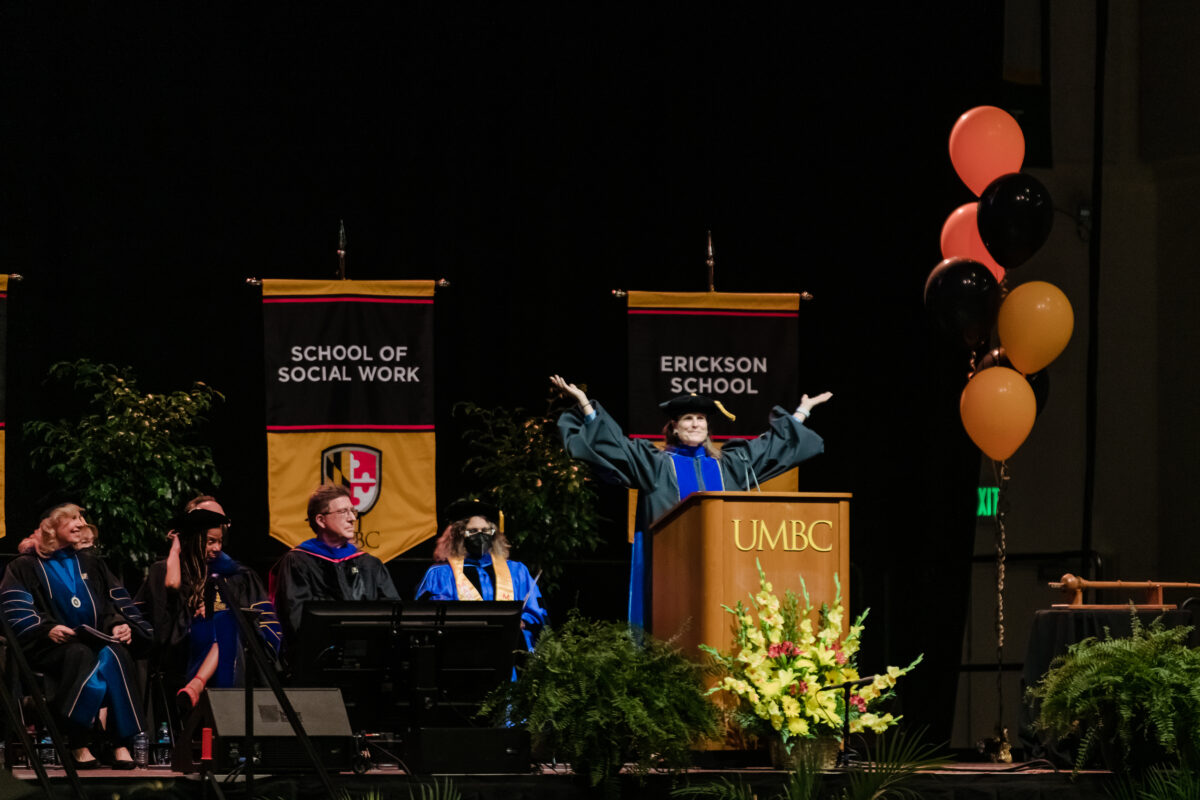 Mendelson expresses her excitement at opening another school year. (Marlayna Demond ’11/UMBC)
Students at the center
While students may think faculty and staff are the backbone of their educational career, their educators and advisors would argue it’s the opposite—students themselves are at the core of UMBC.
“If there was an equation to describe UMBC, our students would be the essential term. We are committed to providing each of our outstanding students with a first-class education and the support needed to achieve success, whether that means meeting with the CNMS success coach, participating in programs at The Learning Collaboratory, or working one-on-one with a faculty mentor,” said William R. LaCourse, dean of the College of Natural and Mathematical Sciences (CNMS). “Inclusive excellence is more than just words—it is our mission.”
LaCourse himself knows the importance of connecting with students on a foundational level. In the spring, you can find him co-teaching CHEM 100: The Chemical World to non-chemistry majors.
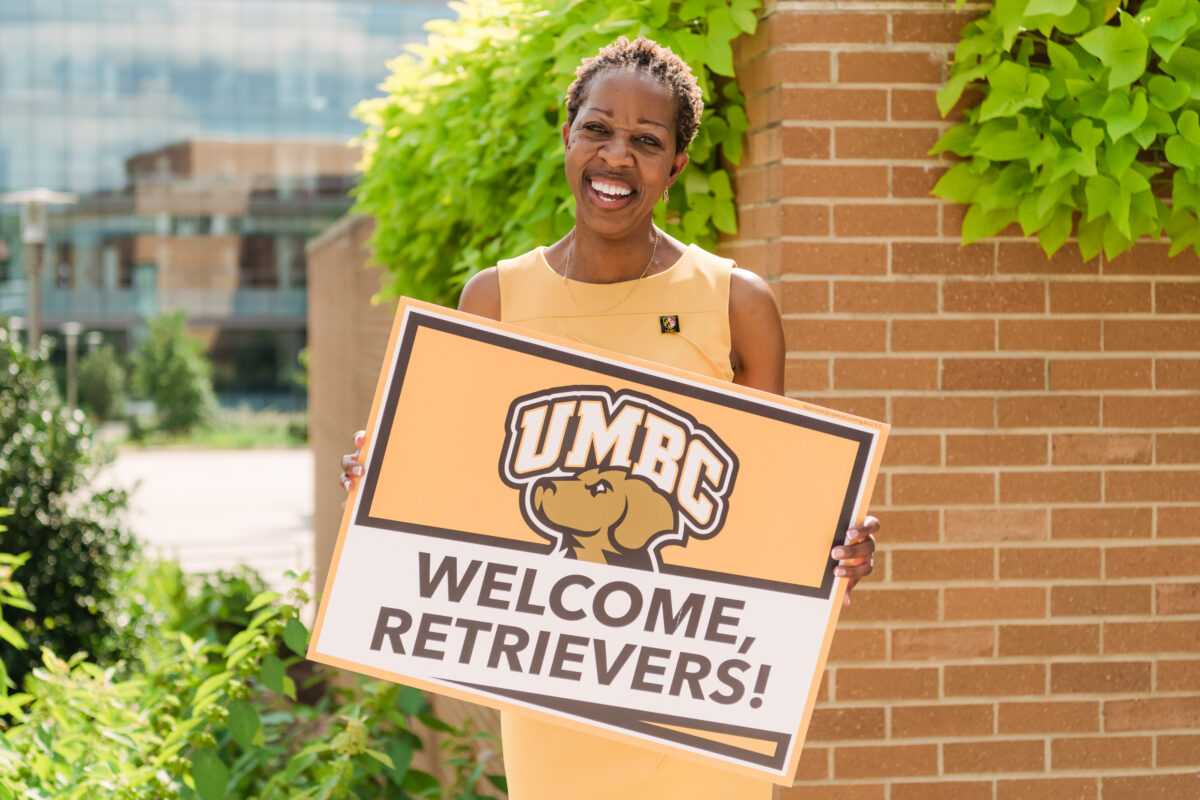 President Sheares Ashby eagerly welcomes UMBC’s new students. (Marlayna Demond ’11/UMBC)
Keith J Bowman, dean of the College of Engineering and Information Technology (COEIT), points to the essential role that student leaders play in reaching out to and connecting with new students, and helping them feel welcome and connected.
“All summer I have been hearing from student org leaders from our college,” says Bowman. “Their enthusiasm to engage with current and new members is very exciting.”
Among the new students Dean Kimberly Moffitt welcomed to UMBC’s College of Arts, Humanities, and Social Sciences (CAHSS) this year are several Shriver Peaceworker Fellows, who gathered on campus on August 1 to kick off their fellowship. These Returned Peace Corps Volunteers pursue graduate degrees in a range of fields (such as teaching and applied sociology) while also working with community partner organizations to address diverse social needs, and actively reflecting on their learning and engagement experiences.
This multifaceted approach exemplifies how work in the classroom, hands-on learning, community engagement, and service connect to form the unique UMBC student experience.
]]>
“ “This is a time when you begin to define what you love, what really matters to you, who you want to be in this world, and what difference you want to make in the lives of...
https://umbc.edu/stories/umbc-opens-new-academic-year-with-new-president-largest-ever-incoming-class/
https://my3.my.umbc.edu/api/v0/pixel/news/127230/guest@my.umbc.edu/a88f8efff8f07beedd8f08ca7c180207/api/pixel
cahss
civic
cnms
coeit
community
diversityandinclusion
news
shrivercenter
UMBC News & Magazine
https://my3.my.umbc.edu/groups/umbc-news-magazine
https://assets1-my.umbc.edu/system/shared/avatars/groups/000/001/943/24435aa6207c452e7bc15cc74b42c7bb/xsmall.png?1748556657
https://assets1-my.umbc.edu/system/shared/avatars/groups/000/001/943/24435aa6207c452e7bc15cc74b42c7bb/original.png?1748556657
https://assets2-my.umbc.edu/system/shared/avatars/groups/000/001/943/24435aa6207c452e7bc15cc74b42c7bb/xxlarge.png?1748556657
https://assets2-my.umbc.edu/system/shared/avatars/groups/000/001/943/24435aa6207c452e7bc15cc74b42c7bb/xlarge.png?1748556657
https://assets3-my.umbc.edu/system/shared/avatars/groups/000/001/943/24435aa6207c452e7bc15cc74b42c7bb/large.png?1748556657
https://assets1-my.umbc.edu/system/shared/avatars/groups/000/001/943/24435aa6207c452e7bc15cc74b42c7bb/medium.png?1748556657
https://assets2-my.umbc.edu/system/shared/avatars/groups/000/001/943/24435aa6207c452e7bc15cc74b42c7bb/small.png?1748556657
https://assets1-my.umbc.edu/system/shared/avatars/groups/000/001/943/24435aa6207c452e7bc15cc74b42c7bb/xsmall.png?1748556657
https://assets2-my.umbc.edu/system/shared/avatars/groups/000/001/943/24435aa6207c452e7bc15cc74b42c7bb/xxsmall.png?1748556657
UMBC News & Magazine
0
0
false
Thu, 01 Sep 2022 15:02:09 -0400
Thu, 01 Sep 2022 15:02:09 -0400
Peaceworkers in Action
Michael Hassett and Chiara Collette first met each other in 2014 at the Los Angeles International Airport before boarding a 17-hour flight to the Kingdom of Tonga in the middle of the southwestern Pacific Ocean. Hassett applied to the Peace Corps hoping to be placed in Eastern Europe focusing on rural development. As a certified teacher, Collette didn’t have a specific country in mind. She was more interested in being able to teach.
Both were placed in Tonga in teaching positions. Little did they know that this shared placement would permanently intertwine their personal and professional lives. In 2018, the couple got married and co-founded an internationally recognized nonprofit, Friends of Tonga—which earned a 2021 Literacy Award from the Library of Congress. Since then, Hassett and Collette have used their literacy educational tools and public policy skills gained at UMBC, and connections in Tonga to support the island nation they have come to love.
Community building
Hassett, M.P.P. ’17, Ph.D. ’19, public policy, lived in the village of Fahefa on the main island of Tongatapu. Collette, M.A. ’21, TESOL, lived in the village of Ta’anga, on the outer island of ‘Eua part of an archipelago made of 170 islands.
Working and living alongside their community members and fellow teachers, they helped design and implement programs to further develop students’ English speaking, writing, and reading skills. As the second official language of Tonga, students are expected to master English and complete their high school entrance exams in English.
Hassett remembers within the first two months a parent asked if he could tutor her high school-aged son. He agreed to begin that very night. “As I waited, I heard the pigs and chickens run across the yard and smelled the wafting smoke of cooking fires in the air,” he remembers. Then he heard people yelling in Tongan. ”Before my eyes, my one student expanded into a crowd of high school kids from around the village, all bearing plates of food, fresh fruits, vegetables, and bread,” he says. Their parents began running out of their houses to ask if he could tutor their children, too? His one-on-one tutoring session evolved into a weekly night class.
One of Collette’s favorite teaching memories was working with 3rd and 4th-grade students on a career interest project. “Students created life-size cardboard cutouts of their heads and hands and decorated them according to the profession of their choice. “They wrote and memorized speeches explaining their career choice,” says Collette. “Students then presented their speeches to their parents while wearing their ‘professional outfits.’”
And similar to Hassett’s unexpected evening tutoring class, Collette developed a friendship with the principal at the primary school where she worked, offering help as he worked towards his bachelor’s degree in education from the University of the South Pacific remotely.
Through these experiences, Collette and Hassett forged strong friendships and partnerships giving them a great sense of connection across all sectors of the Tongan community beyond their Peace Corps experience.
At the same time, their friendship evolved into a relationship. They started dating and continued long-distance while Hassett traveled after he completed his service and when they returned back to the United States until they relocated to Baltimore together so Hassett could matriculate into UMBC’s Public Policy program as a Shriver Peaceworker. Collette became a teacher in Baltimore City Public Schools and Anne Arundel County Public Schools eventually enrolling in UMBC’s M.A. TESOL program.
Tongan allies
Focusing on their graduate degrees did not replace the bond that had grown between themselves and the people of Tonga. In 2018, cyclone Gita hit Tonga with over a hundred mile per hour winds causing the most damage in 60 years. They were not aware of any other U.S. non-profits directly working in Tonga that were not religiously affiliated. Equipped with their skills from the Peace Corps and UMBC, along with their community-engaged connections, the pair co-founded Friends of Tonga with Peace Corps colleagues, friends in the nonprofit and development community, and members of the Tongan community.
One such member is Tu’amelie Mahe, the principal Collette used to work with. He now serves as education officer for school grant and asset management at the Ministry of Education and is the current program manager for Friends of Tonga. There are also Tongan’s in New Zealand participating. “From the perspective of a New Zealand born Tongan, being a part of Friends of Tonga allows those Tongans, who are a part of the diaspora, to actively participate in charity work that directly benefits Tonga,” says Neomai Maka, a high school teacher in Auckland, New Zealand. Her parents originate from the villages of Fua’amotu and Tatakamotonga in Tonga.
What began as reactive disaster relief support work, grew to become a proactive Peace Corps model community supporting Tongan-identified initiatives like education resources, English language skill development, and building cyclone safe schools.
“I am a friend of Tonga. I’m not Tongan. I can’t speak on their behalf,” shares Hassett. “I am not interested as a white man in telling Tongans what to do or what they need. I can be an ally and I can support them and champion the causes that they tell us they need help with.”
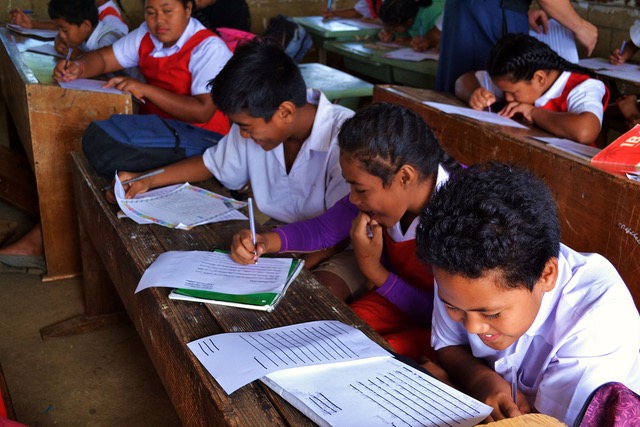 Tongan children at school. Image courtesy of Hassett and Collette.
Weathering the storm
Later that year, they returned to Tonga for both their honeymoon and their Sapate Uluaki, a wedding celebration. Hassett’s host family, the Fainga’a family, planned this celebration weaving Hassett and Collette deeper into their Tongan community.
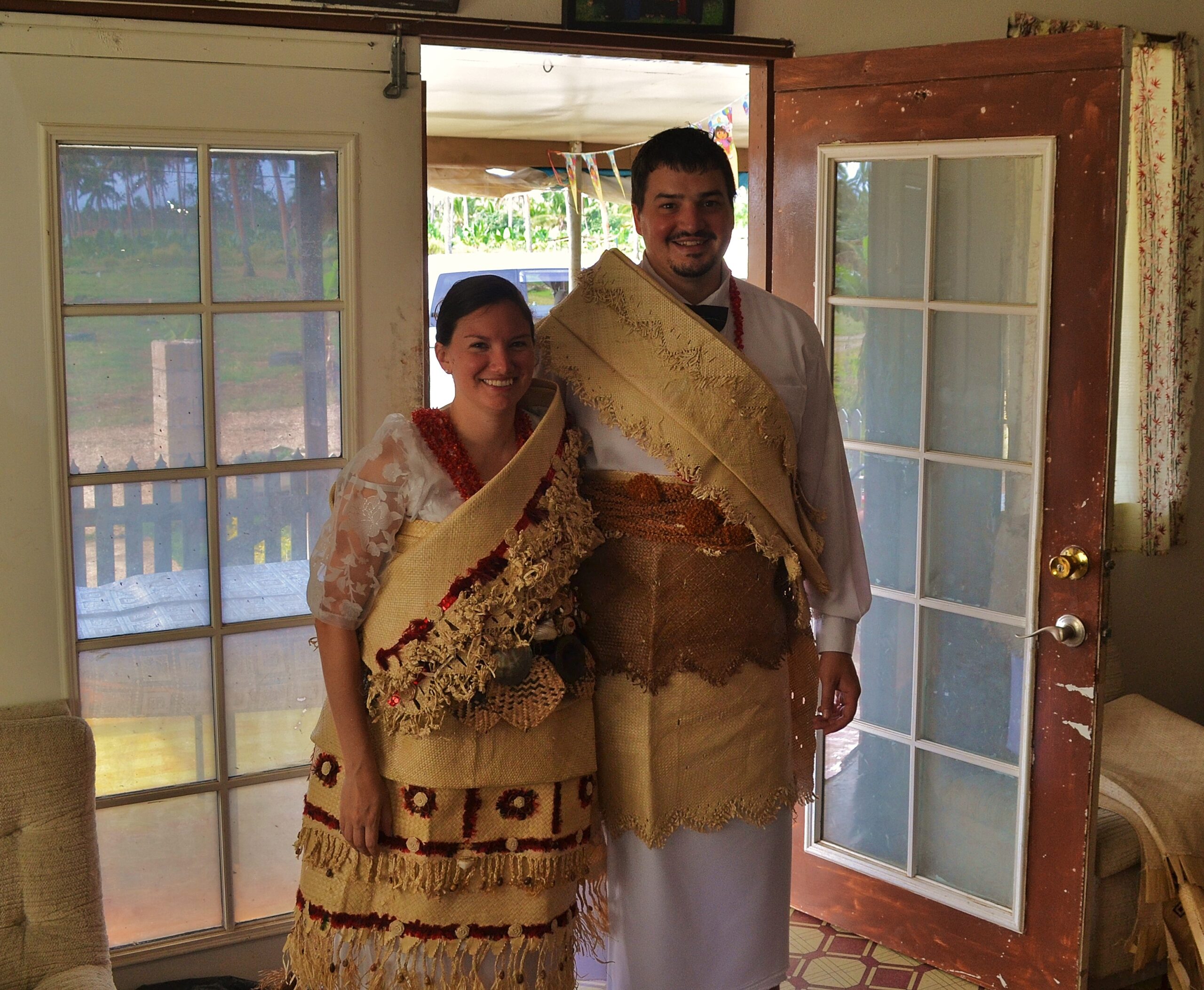 Hassett and Collette on their wedding day.
Images courtesy of the couple.
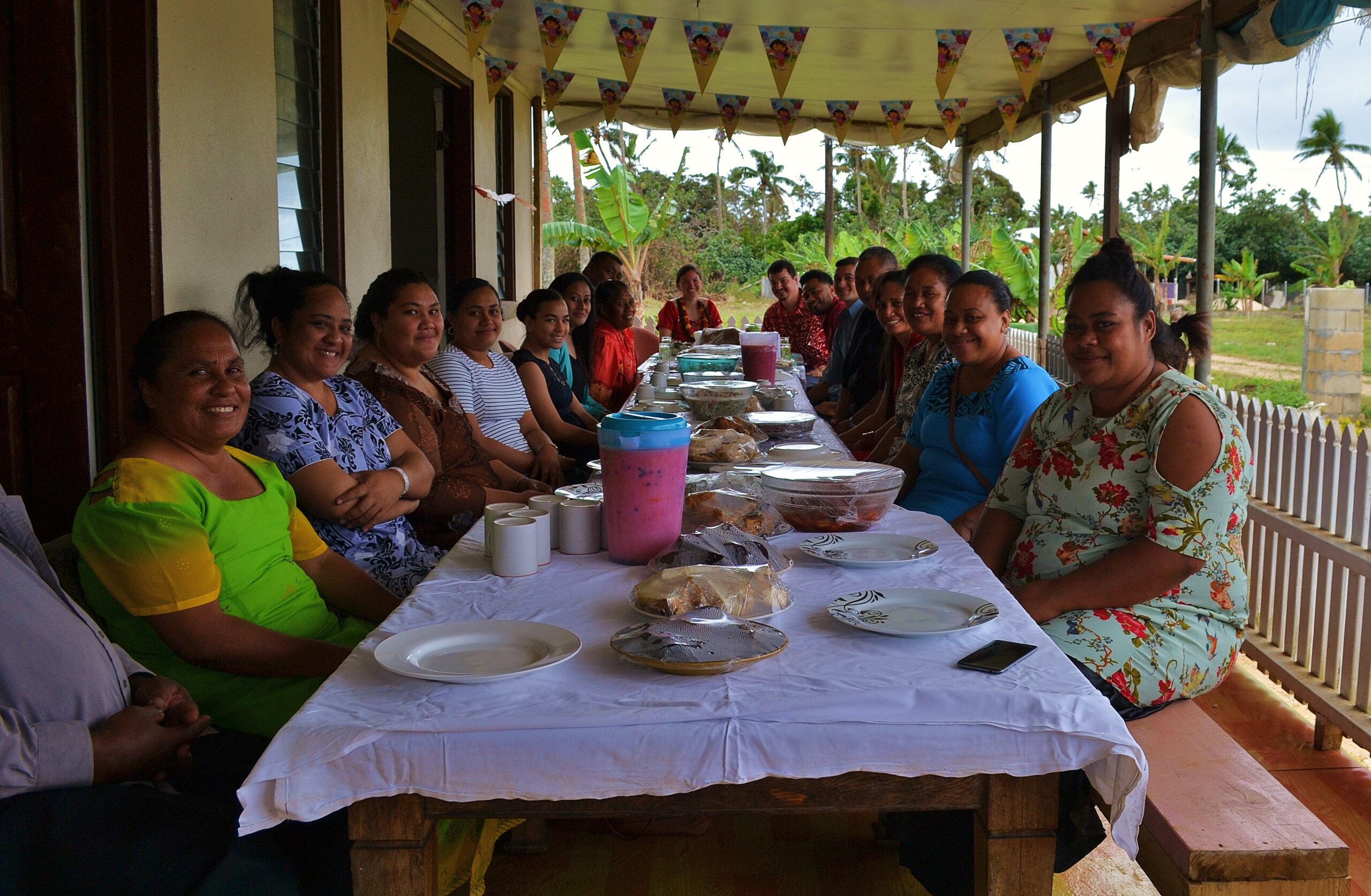 Friends celebrate the wedding of Hassett and Collette.
During this visit, Friends of Tonga was asked to help rebuild the kindergarten that had been destroyed by a category four cyclone earlier in the year and had been operating out of a tent ever since. Collette and Hassett had lived through Cyclone Ian and Kofi in January and March 2014 respectively and witnessed the damage caused by bands of heavy rain, strong winds, and flash flooding.
“We jumped in,” says Collette. The logistical challenges of building a school were great. They reached out to their friend who is the CEO of Schools for Children of the World. “It was a true collaborative effort between architects and engineers familiar with building schools in countries prone to hurricanes, the Tongan Ministry of Education, and community members,” says Hassett. Via a string of Facebook calls with engineers and architects, Tongan’s first cyclone and hurricane-resistant building was created. This one structure now functions as a school, community center, a shelter, and a place to house emergency supplies. The need for these types of structures was evident and a key factor in continuity of education and services.
Sustainable English language learning
Collette began working on assisting teachers find resources to improve English reading, writing, and speaking skills to increase student’s access to high school and further education opportunities. The obvious answer might have been increasing access to English language books but, with students spread over 170 islands, a central library would only give access to students living near the library. Books that are donated are often not aligned developmentally or content-wise. Buying books, transporting them, and managing the wear and tear caused by tropical and extreme weather makes a physical library costly and unsustainable.
The answer was not in the past but in the future. Wi-fi reaches most of the islands allowing at least one family member the use of a smartphone. A resource that is bound to grow makes digital resources sustainable. With permission from authors and volunteer readers, Collette developed a digital video library of English language beginner, intermediate, and advanced books.
Today, the library has 85 books that teachers, parents, and students can download using very little data. The theories and best practices gained during her TESOL master’s program, guided Collette in developing an English language learning curriculum for teachers and parents to use in tandem. “A video library meant rural students who didn’t have access to English language materials could download a file and share it with friends and family,” says Collette.
Collette and Hassett note that UMBC “is baked into all of our programming.” Joby Taylor, Ph.D. ’05, language, literacy, and culture, director of the Shriver Peaceworker Program, along with fellow Peaceworkers read many of the stories in the read-aloud program. Lauren Hamilton Edwards, assistant professor of public policy, is also guiding them in their strategic planning process.
Dear Tonga
Reading was only part of the puzzle needed to improve English language skills. Students needed more practice writing in English for their high school entrance exam. Collette designed a penpal program between Tongan students and students in the U.S. The written conversation became a way to learn about other cultures, practice sentence structure, and purposeful communication needed in school and in jobs.
“The results of a curriculum specifically for Tongan English language learners is exactly what the teachers, the Ministry of Education, and Friends of Tonga hoped it would be,” says Hassett. “Based on an analysis I did, the high school entrance exam scores increased by 10%.”
The Library of Congress took note and awarded Friends of Tonga, one of only 14 recipients globally, with a 2021 Literacy Award for “their implementation of highly successful practices in literacy promotion… and in recognition of the need for the international community to unite in achieving universal literacy.”
This was only the beginning. As an early childhood educator, Collette began searching for opportunities to assist the Ministry of Education and teachers to create a PreK-K program.
Then the Hunga Tonga–Hunga Ha‘apai volcano erupted on January 15, 2022, followed by a tsunami. The eruption lasted for 11 hours and devastated homes across the archipelago.
A Strong Network
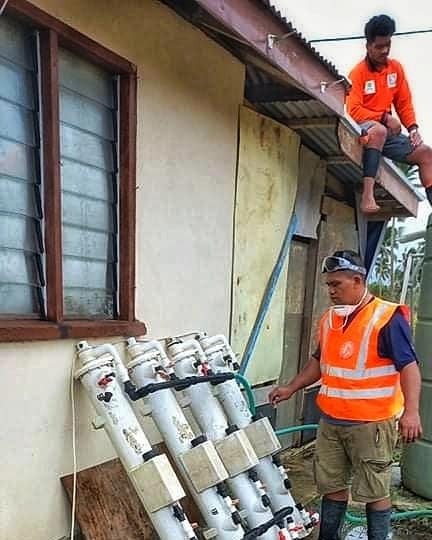 In partnership with The Civil Society Forum of Tonga, teams help clean up rain collection tanks, filtering and purifying the rain water from the volcanic ash.
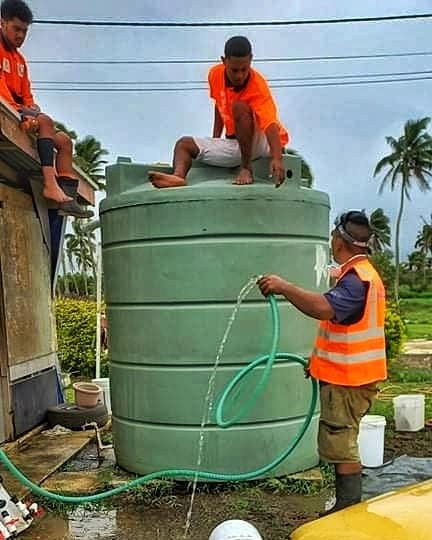 With CSFT, volunteers work to clean up after the tsunami. Images courtesy of Hassett and Collette.
The volcano completely disconnected wi-fi service, blanketed Tonga with ash, toppled homes, and contaminated rain water collection points. Hassett and Collette did not hear from their Tongan community for weeks. Thankfully, Friends of Tonga is made up of community members in Tonga as well as in New Zealand allowing a close point of contact to provide information, identify needs, and provide direct support. Through their networks, they were able to hear that the cyclone proof school was not affected by the volcano or the tsunami.
Friends of Tonga funded $15,000 to The Civil Society Forum of Tonga, a Tongan-led and Tongan driven NGO, and fundraised $9,000 for the Mainstreaming of Rural Development Innovation Tonga Trust. The funding is helping to provide water, sanitation, hygiene services, and assist farmers with harvesting crops damaged by the tsunami before they spoil. The food is being given to the communities that were evacuated from outer islands.
“The work that began a decade ago as Peace Corps volunteers was intentionally driven to build strong, long lasting, community, and personal relationships,” shares Hassett, the 2021 recipient of UMBC’s Distinguished Service Alumni Award. “We created a strong infrastructure of people and resources that has made it possible for us to support Tongans right now more than ever before.”
]]>
Michael Hassett and Chiara Collette first met each other in 2014 at the Los Angeles International Airport before boarding a 17-hour flight to the Kingdom of Tonga in the middle of the southwestern...
https://umbc.edu/stories/umbc-peaceworkers-in-action/
https://my3.my.umbc.edu/api/v0/pixel/news/126242/guest@my.umbc.edu/6894d76c0740bf1c26fe61922ec991c6/api/pixel
alumni
magazine
shrivercenter
summer-2022
UMBC News & Magazine
https://my3.my.umbc.edu/groups/umbc-news-magazine
https://assets1-my.umbc.edu/system/shared/avatars/groups/000/001/943/24435aa6207c452e7bc15cc74b42c7bb/xsmall.png?1748556657
https://assets1-my.umbc.edu/system/shared/avatars/groups/000/001/943/24435aa6207c452e7bc15cc74b42c7bb/original.png?1748556657
https://assets2-my.umbc.edu/system/shared/avatars/groups/000/001/943/24435aa6207c452e7bc15cc74b42c7bb/xxlarge.png?1748556657
https://assets2-my.umbc.edu/system/shared/avatars/groups/000/001/943/24435aa6207c452e7bc15cc74b42c7bb/xlarge.png?1748556657
https://assets3-my.umbc.edu/system/shared/avatars/groups/000/001/943/24435aa6207c452e7bc15cc74b42c7bb/large.png?1748556657
https://assets1-my.umbc.edu/system/shared/avatars/groups/000/001/943/24435aa6207c452e7bc15cc74b42c7bb/medium.png?1748556657
https://assets2-my.umbc.edu/system/shared/avatars/groups/000/001/943/24435aa6207c452e7bc15cc74b42c7bb/small.png?1748556657
https://assets1-my.umbc.edu/system/shared/avatars/groups/000/001/943/24435aa6207c452e7bc15cc74b42c7bb/xsmall.png?1748556657
https://assets2-my.umbc.edu/system/shared/avatars/groups/000/001/943/24435aa6207c452e7bc15cc74b42c7bb/xxsmall.png?1748556657
UMBC News & Magazine
0
0
false
Wed, 13 Jul 2022 13:19:01 -0400
Wed, 13 Jul 2022 13:19:01 -0400
Community leader renews his Baltimore roots
Keenan Hickman
Degree: M.P.S., Community Leadership
Hometown: Baltimore, MD
Plans: Work in social justice organizations
“Service is a pathway to opportunities for everyone if we allow it to be accessible to all. It is about leading through example and perseverance, and finding joy in completing innovative complex projects with a myriad of community members and organizations.”
Keenan Hickman, M.P.S. ’22, community leadership, has called many different places “home” at some point in his life. Born in Baltimore, he spent part of his childhood in Korea, served in Indonesia as a Peace Corps volunteer, and lived and worked in San Francisco.
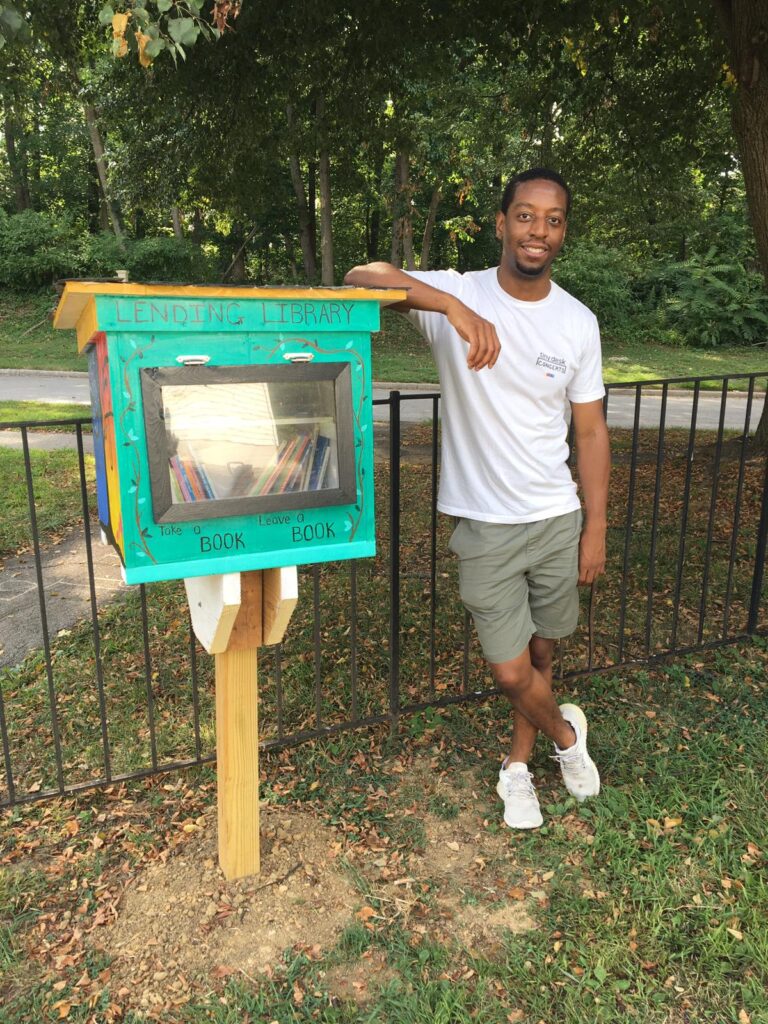
Hickman in Woodlawn, Baltimore next to the Free Lending Library he built during COVID restrictions as lead coordinator at the Walden Circle Community Center. (Image courtesy of Hickman)
Each place presented opportunities to support local communities. In Indonesia, he served as an English instructor while also facilitating trainings on diversity, inclusion, and belonging for local residents. In California, he served as a literacy tutor and a mentor in Big Brothers Big Sisters of the Bay Area Now, after having worked for three years at the U.S. Department of Homeland Security, Hickman is ready to focus on Baltimore.
During his master’s in community leadership at UMBC, he was a lead coordinator at the Walden Circle Community Center. Hickman designed and implemented youth programs, created a lending library, organized community events, and worked on fundraising campaigns.
Hickman sees the future of empowerment for disenfranchised communities at the intersection of leadership, technology, and innovation. He has a vision for moving forward a new model of social justice work focused on growing equitable, anti-racist communities, starting in Baltimore.
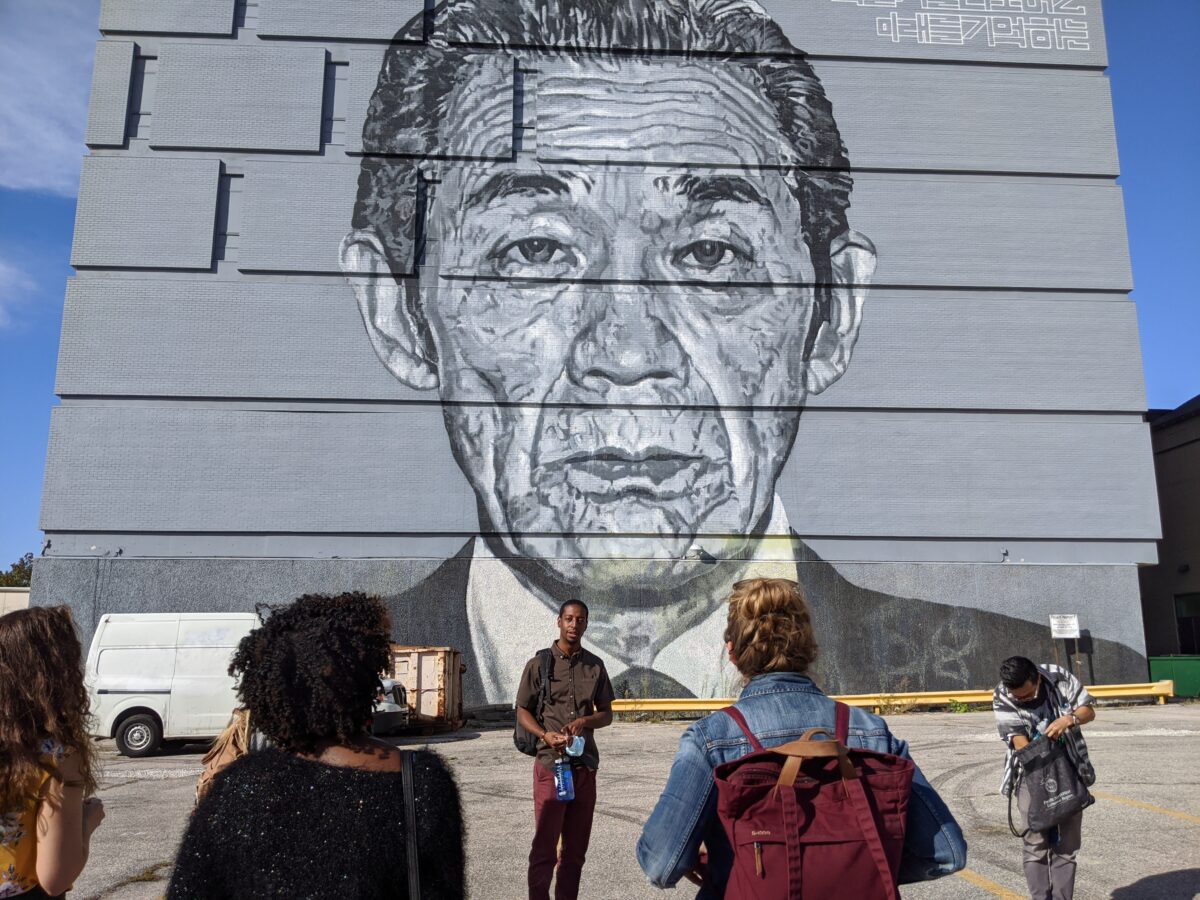 Hickman facilitating a community learning practicum on identity and placemaking in Baltimore’s historic Koreatown as a UMBC Peaceworker Progam fellow. (Image courtesy of Hickman)
]]>
Keenan Hickman Degree: M.P.S., Community Leadership Hometown: Baltimore, MD Plans: Work in social justice organizations “Service is a pathway to opportunities for everyone if we allow...
https://umbc.edu/stories/community-leader-renews-his-baltimore-roots/
https://my3.my.umbc.edu/api/v0/pixel/news/119415/guest@my.umbc.edu/584035cdb167aac120eac97236353282/api/pixel
baltimorecommunities
cahss
class-of-2022
graduateschool
news
shrivercenter
UMBC News & Magazine
https://my3.my.umbc.edu/groups/umbc-news-magazine
https://assets1-my.umbc.edu/system/shared/avatars/groups/000/001/943/24435aa6207c452e7bc15cc74b42c7bb/xsmall.png?1748556657
https://assets1-my.umbc.edu/system/shared/avatars/groups/000/001/943/24435aa6207c452e7bc15cc74b42c7bb/original.png?1748556657
https://assets2-my.umbc.edu/system/shared/avatars/groups/000/001/943/24435aa6207c452e7bc15cc74b42c7bb/xxlarge.png?1748556657
https://assets2-my.umbc.edu/system/shared/avatars/groups/000/001/943/24435aa6207c452e7bc15cc74b42c7bb/xlarge.png?1748556657
https://assets3-my.umbc.edu/system/shared/avatars/groups/000/001/943/24435aa6207c452e7bc15cc74b42c7bb/large.png?1748556657
https://assets1-my.umbc.edu/system/shared/avatars/groups/000/001/943/24435aa6207c452e7bc15cc74b42c7bb/medium.png?1748556657
https://assets2-my.umbc.edu/system/shared/avatars/groups/000/001/943/24435aa6207c452e7bc15cc74b42c7bb/small.png?1748556657
https://assets1-my.umbc.edu/system/shared/avatars/groups/000/001/943/24435aa6207c452e7bc15cc74b42c7bb/xsmall.png?1748556657
https://assets2-my.umbc.edu/system/shared/avatars/groups/000/001/943/24435aa6207c452e7bc15cc74b42c7bb/xxsmall.png?1748556657
UMBC News & Magazine
0
0
false
Thu, 12 May 2022 14:15:44 -0400
Tue, 17 May 2022 14:15:44 -0400
Campus Compact Mid-Atlantic names UMBC’s Rehman Liaqat, human rights advocate, a 2022-23 Civic Fellow
Hickman facilitating a community learning practicum on identity and placemaking in Baltimore’s historic Koreatown as a UMBC Peaceworker Progam fellow. (Image courtesy of Hickman)
]]>
Keenan Hickman Degree: M.P.S., Community Leadership Hometown: Baltimore, MD Plans: Work in social justice organizations “Service is a pathway to opportunities for everyone if we allow...
https://umbc.edu/stories/community-leader-renews-his-baltimore-roots/
https://my3.my.umbc.edu/api/v0/pixel/news/119415/guest@my.umbc.edu/584035cdb167aac120eac97236353282/api/pixel
baltimorecommunities
cahss
class-of-2022
graduateschool
news
shrivercenter
UMBC News & Magazine
https://my3.my.umbc.edu/groups/umbc-news-magazine
https://assets1-my.umbc.edu/system/shared/avatars/groups/000/001/943/24435aa6207c452e7bc15cc74b42c7bb/xsmall.png?1748556657
https://assets1-my.umbc.edu/system/shared/avatars/groups/000/001/943/24435aa6207c452e7bc15cc74b42c7bb/original.png?1748556657
https://assets2-my.umbc.edu/system/shared/avatars/groups/000/001/943/24435aa6207c452e7bc15cc74b42c7bb/xxlarge.png?1748556657
https://assets2-my.umbc.edu/system/shared/avatars/groups/000/001/943/24435aa6207c452e7bc15cc74b42c7bb/xlarge.png?1748556657
https://assets3-my.umbc.edu/system/shared/avatars/groups/000/001/943/24435aa6207c452e7bc15cc74b42c7bb/large.png?1748556657
https://assets1-my.umbc.edu/system/shared/avatars/groups/000/001/943/24435aa6207c452e7bc15cc74b42c7bb/medium.png?1748556657
https://assets2-my.umbc.edu/system/shared/avatars/groups/000/001/943/24435aa6207c452e7bc15cc74b42c7bb/small.png?1748556657
https://assets1-my.umbc.edu/system/shared/avatars/groups/000/001/943/24435aa6207c452e7bc15cc74b42c7bb/xsmall.png?1748556657
https://assets2-my.umbc.edu/system/shared/avatars/groups/000/001/943/24435aa6207c452e7bc15cc74b42c7bb/xxsmall.png?1748556657
UMBC News & Magazine
0
0
false
Thu, 12 May 2022 14:15:44 -0400
Tue, 17 May 2022 14:15:44 -0400
Campus Compact Mid-Atlantic names UMBC’s Rehman Liaqat, human rights advocate, a 2022-23 Civic Fellow
Rehman Liaqat ’22, political science, has received the inaugural Campus Compact Mid-Atlantic (CCMA) Civic Fellowship. He is one of 13 students chosen from institutions across Maryland, Delaware, and Washington D.C. This honor follows Liaqat’s recent recognition as a 2022 finalist for the prestigious Truman Scholarship.
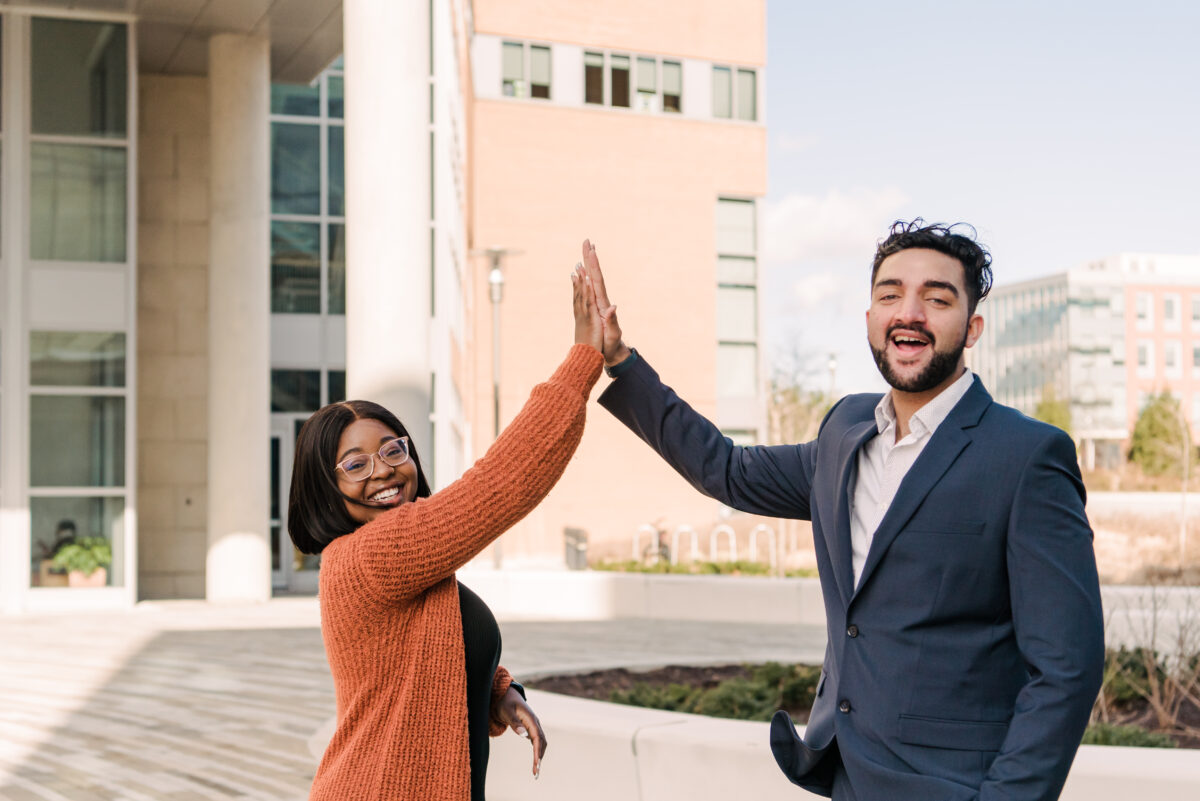 Haleemat Adekoya and Rehman Liaqat 2022. (Marlayna Demond ’11/UMBC)
The CCMA Civic Fellows program develops student leaders who are “engaged global citizens, actively contributing to the creation of equitable, healthy, sustainable, and socially just communities.” CCMA will provide Liaqat with learning and networking opportunities that emphasize personal, professional, and civic growth. This includes conversations with regional and national experts focused on leadership development and advancing equity through civic and community engagement in the Mid-Atlantic region.
Crossing bridges
Liaqat came to the United States from Pakistan when he was eleven. He spent his teen years in Wicomico County Public Schools in Salisbury on Maryland’s Eastern Shore. His time was split between school and working at OC Quickstop, one of three family-owned gas stations. In a predominantly white public high school, Liquat felt like he didn’t quite fit.
In retrospect, not fitting in gave him insight into managing two cultures, two countries, and many different social worlds. So when a group of Pakistani women moved into his apartment complex, Liaqat’s mother encouraged him to serve as a cultural tutor of sorts. Two times a week he would review how to fill out school forms for their children, apply for other resources, and access services.
”I found value in the knowledge I had acquired transitioning into living and working in Salisbury,” says Liaqat. These skills became a tool to help the Pakistani women feel empowered as members of the community.
This project caught the attention of Liaqat’s English teacher, who nominated him for a Light of Literacy Youth Luminary award hosted by the Friends of the Wicomico County Public Libraries. At the award ceremony, he connected with local leaders who invited him to volunteer on political campaigns. He didn’t know at the time how all of these experiences would shape his path.
Transformative mediation
When Liaqat began researching colleges he wasn’t sure what his future would look like, but he did have a clear example of the impact he wanted to have from his grandfather. His grandfather leads community-oriented mediation sessions through restorative practices among local villagers in Chak Pindi, Punjab, Pakistan. The villagers depend on his grandfather’s mediation skills, Liaqat explains, because often they cannot depend on the legal system, due to cost and corruption.
“When I was eight I began to sit next to him as he mediated. It showed me, at an early age, the dire need in our community for advocacy and well-being, especially when the systems in place become undependable,” says Liaqat. “Reflecting back, sitting next to him and observing his mediation depicts, to me, the power of meaningful public service. This work can completely transform the lives of people left vulnerable by the system and by society.”
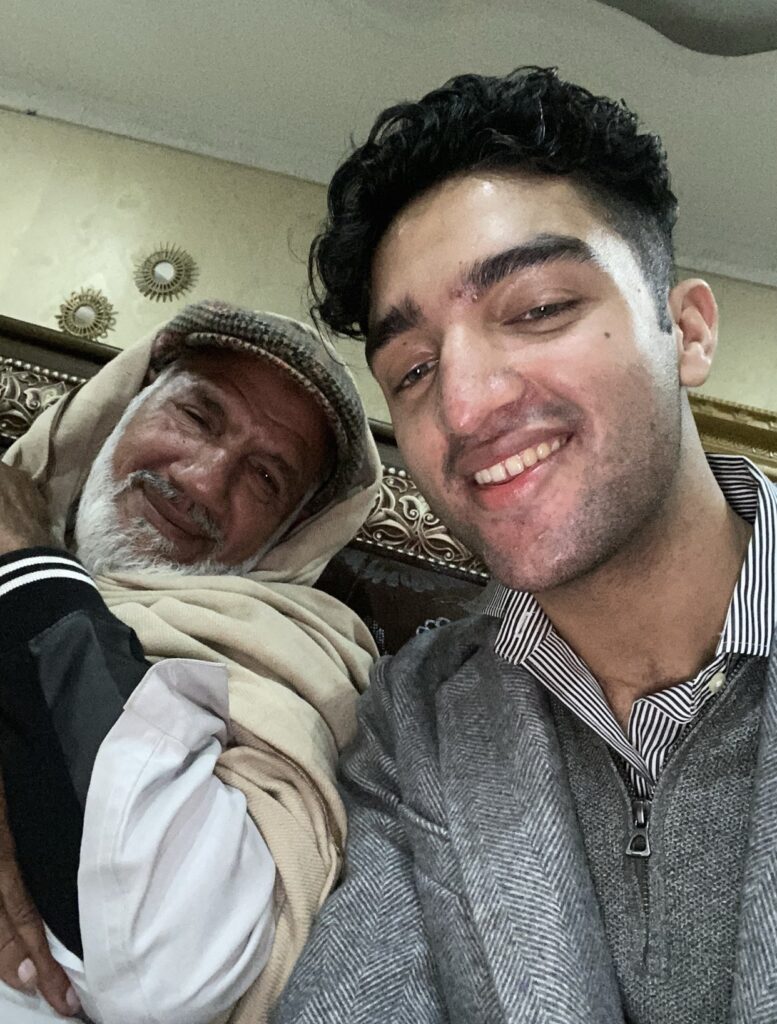 Liaqat with his grandfather. (Image courtesy of Liaqat)
His experiences in Maryland and in Pakistan revealed to him the importance of representation and community action. He ardently worked to convince his parents that attending UMBC—a diverse community rich with new opportunities for his future—was the best decision for him. He would be the first-ever member of his family, across generations, to move out of the family home to go to college.
It wasn’t just moving out, but moving away across the Chesapeake Bay Bridge, 2.5 hours from Salisbury. Over the past four years, Liaqat has driven back home every weekend to work at his family’s gas station. He’s also remained involved with his communities, all while maintaining a 4.0 GPA.
Beyond my comfort zone
“My family is very traditional,” says Liaqat. “They are very proud of me and what I have accomplished.” At the same time, he says he is very proud of himself for “going out of my comfort zone to become the person I want to be.”
Liaqat, who will be entering Georgetown University in the fall, thanks his mentors for guiding him toward increasingly challenging growth opportunities throughout his four years. During his first week on campus, he reached out to four faculty and staff members for guidance and resources. He was surprised by the immediate and heartfelt responses he received from them all, and their willingness to answer all of his questions without hesitation.
Lori Hardesty, associate director of applied learning and community engagement at UMBC’s Shriver Center, connected Liaqat with an applied learning experience. “She was the first person to ‘see me’ at UMBC,” shares Liaqat. “I still remember sitting in her office four years ago when she said, “What matters is that you are here now and you have the opportunity to make a difference every day.’’
 Lori Hardesty with Liaqat. (Image courtesy of Hardesty)
Liaqat also remembers being inspired by the words of Sargent Shriver, the center’s namesake, who said, “Serve, serve, serve… because, in the end, it will be the servants who save us all.” Shriver’s meaningful contributions to society have become an inspiration for a journey of lifelong service, says Liaqat.
Over the years, Liaqat has served as a peer mentor and peer facilitator for the Shriver First-Year Experience course and as a workshop facilitator for UMBC’s Community Read program. Through the Shriver Center, he has also helped support Baltimore City students by participating in the Choice Program’s annual Jam and Slam event and College Night program.
“As a son of Pakistani immigrants who was the first to pursue higher education in the U.S., I was expected to pursue a path that was determined for me,” says Liaqat. “However, as I became a member of UMBC’s Shriver Living Learning Community, I felt more confident embracing a path of my own design.”
Broader perspective
With the support of the Shriver Center, Liaqat felt more comfortable seeking out mentors and exploring UMBC’s social change resources. He remembers fondly walking into the Center for Democracy and Civic Life intent on creating a UMBC football team.
There he met Center Director David Hoffman, Ph.D. ’13, language, literacy, and culture (LLC), and Assistant Director Romy Hübler ’09, modern languages and linguistics, M.A. ’11, intercultural communication, Ph.D. ’15, LLC. “They didn’t know who I was and I had no idea if the center would listen to all of my ideas,” says Liaqat.
 David Hoffman with Liaqat. (Marlayna Demond ’11/UMBC)
For weeks Hoffman and Hübler sat with him as he shared his passionate ideas. “They never deterred me,” says Liaqat. Instead, they walked him through the process of seeing different points of view and the intentionality of the decision of university leadership to invest in a broad range of sports rather than putting significant funds toward a football team. This process informed his work in student and community organizations for the rest of his time at UMBC.
“Rehman arrived at UMBC with a thirst for learning, a desire to make a difference, and big ideas,” says Hübler. “Over the past four years, we have spent many hours talking about his commitment to addressing social issues and approaches he could take to doing so. It has been a wonderful experience seeing him build relationships, empower his peers, and strengthen our community.”
Beyond theory
In a political science course, William Blake, associate professor and associate chair of political science, brought to life constitutional law for Liaqat. He enrolled in all of Blakes’s human and civil rights classes, discovering a passion for understanding the power of a constitution to impact lives. He joined UMBC’s Moot Court team and eventually became its president, with Blake as the organization’s faculty advisor.
 Liaqat (second from right) with Moot Court team. (Image courtesy of Liaqat)
“Rehman is one of those rare students whose passion, curiosity, and analytical skills make him a force to be reckoned with,” says Blake. “He is an impressive student leader, and it has been a pleasure to have a chance to teach him and work with him on the UMBC Moot Court team.”
Liaqat also worked closely with Carolyn Forestiere, professor of political science, as executive president of the department’s council of majors. “Rehman has been a guiding force in our Council of Majors over the past several years,” Forestiere says. She notes that Liaqat has been instrumental in very important ways, including co-leading an effort to develop a diversity, inclusion, and equity initiative that would impact the department’s syllabi and curricula.
 Hardesty (l), Liaqat (c), Carolyn Forestiere (r). (Marlayna Demond ’11/UMBC)
“His professionalism and passion for promoting positive change are fundamental elements of his character,” says Forestiere. “He leaves a legacy of sincere compassion and engaged activism that I hope students emulate for years to come.”
Growing confidence, growing impact
Through mentorship and new experiences, Liaqat’s confidence grew. He learned to navigate diverse political environments as a legal intern at the Maryland Office of the Public Defender, Maryland’s State’s Attorney’s Office, and at Pakistan’s Supreme Court and Ministry of Human Rights. He is now the co-founder of a human rights legal aid organization in Pakistan, which has been asked to expand its reach by local leaders. And he has pursued an accelerated master’s degree in public policy at UMBC alongside his undergraduate degree.
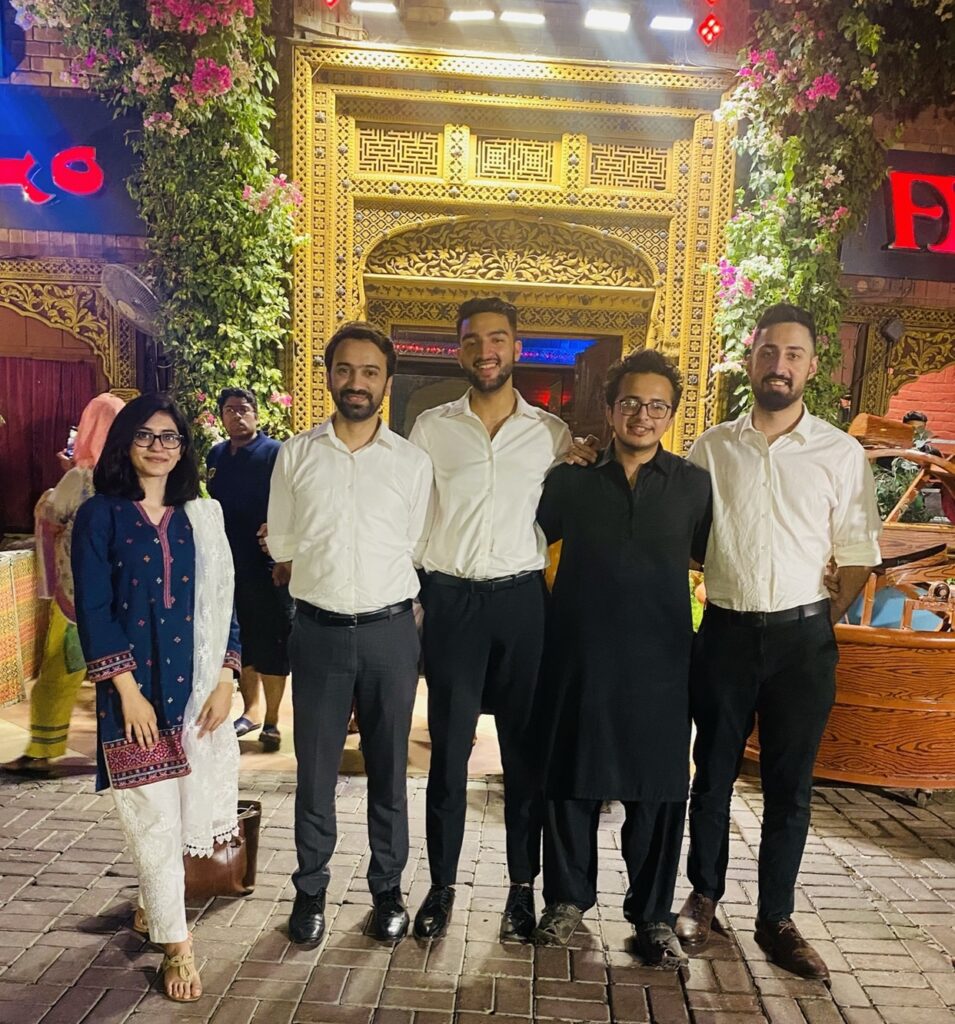 Liaqat (c) in Pakistan with other Pakistan Supreme Court law clerks and attorneys from
Axis Law Chambers. (Image courtesy of Liaqat)
Liaqat arrived at UMBC in 2018 full of excitement, but also uncertainty. “Coming to UMBC meant my family would be far away. I was a college kid who had a lot of ambitions to do more, but had never gone beyond my home environment,” says Liaqat. He says his mentors gave him the self-assurance to grow in new directions while still remaining part of his family’s life and culture.
 Liaqat (third from the left) with attorneys from the Bar Council in Lahore, Pakistan. (Image courtesy of Liaqat)
Now, Liaqat is graduating as a CCMA Civic Fellow who will soon begin a joint master’s of public policy and juris doctor program at the McCourt School of Public Policy and the Georgetown University Law Center.
Liaqat says he was told “UMBC is a magical place” during orientation, and this proved to be true. He has had meaningful, enriching civic engagement experiences throughout his undergraduate years. “UMBC’s magic is real, genuine, and more alive than ever,” he says, “because of the commitment and devoted service by every member of its community.”
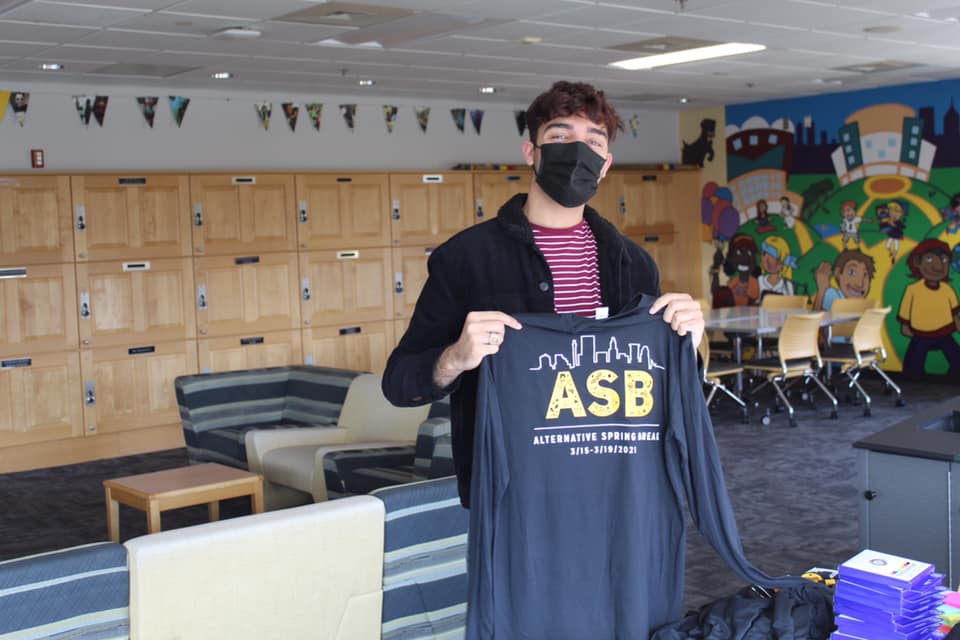 Liaqat preparing for Alternative Spring Break. (Image courtesy of Liaqat)
He hopes to take a piece of this magic with him well after graduation. The first step will be living out his Civic Fellowship’s driving mission: to create equitable, healthy, sustainable, and socially just communities. He says, “I want to show future generations of Pakistani students all that is possible.”
]]>
Rehman Liaqat ’22, political science, has received the inaugural Campus Compact Mid-Atlantic (CCMA) Civic Fellowship. He is one of 13 students chosen from institutions across Maryland, Delaware,...
https://umbc.edu/stories/rehman-liaqat-named-civic-fellow/
https://my3.my.umbc.edu/api/v0/pixel/news/119427/guest@my.umbc.edu/0d2dc8fc01d52b8189dd59bfd78679df/api/pixel
cahss
cahssresearch
center-for-democracy-and-civic-life
choiceprogram
policy-and-society
politicalscience
research
shrivercenter
UMBC News & Magazine
https://my3.my.umbc.edu/groups/umbc-news-magazine
https://assets1-my.umbc.edu/system/shared/avatars/groups/000/001/943/24435aa6207c452e7bc15cc74b42c7bb/xsmall.png?1748556657
https://assets1-my.umbc.edu/system/shared/avatars/groups/000/001/943/24435aa6207c452e7bc15cc74b42c7bb/original.png?1748556657
https://assets2-my.umbc.edu/system/shared/avatars/groups/000/001/943/24435aa6207c452e7bc15cc74b42c7bb/xxlarge.png?1748556657
https://assets2-my.umbc.edu/system/shared/avatars/groups/000/001/943/24435aa6207c452e7bc15cc74b42c7bb/xlarge.png?1748556657
https://assets3-my.umbc.edu/system/shared/avatars/groups/000/001/943/24435aa6207c452e7bc15cc74b42c7bb/large.png?1748556657
https://assets1-my.umbc.edu/system/shared/avatars/groups/000/001/943/24435aa6207c452e7bc15cc74b42c7bb/medium.png?1748556657
https://assets2-my.umbc.edu/system/shared/avatars/groups/000/001/943/24435aa6207c452e7bc15cc74b42c7bb/small.png?1748556657
https://assets1-my.umbc.edu/system/shared/avatars/groups/000/001/943/24435aa6207c452e7bc15cc74b42c7bb/xsmall.png?1748556657
https://assets2-my.umbc.edu/system/shared/avatars/groups/000/001/943/24435aa6207c452e7bc15cc74b42c7bb/xxsmall.png?1748556657
UMBC News & Magazine
0
0
false
Wed, 11 May 2022 09:02:24 -0400
Wed, 11 May 2022 09:02:24 -0400