Innovation and Social Impact
 Helena Mentis
Now more than ever, STEM careers are demanding their workforce keep the social impact of their work at the forefront. Interdisciplinary teams at UMBC are researching methods to support these efforts.
In the past five years, more than 14,000 students in the College of Engineering and Information Technology (COEIT) took courses in the College of Arts, Humanities, and Social Sciences (CAHSS), home to many courses that cultivate socially responsible thinking (SRT). At the same time, faculty in COEIT were also incorporating SRT concepts in their classes. This overlap was identified as an opportunity to collaborate, leveraging strengths of both colleges to imbue the STEM curriculum with an SRT approach.
“We want computing and engineering students to have a deeper understanding of the social impact of their work and how they are integrating SRT into their learning,” explains Helena Mentis, professor of information systems. Mentis is the lead investigator in the joint research project between COEIT and the Center for Social Science Scholarship (CS3) titled Identifying an Interdisciplinary Path to Social Responsibility Education Across the COEIT Curriculum.
 Felipe Filomeno
Felipe Filomeno, associate professor of political science and global studies and CS3 associate director and co-PI, says that the first step of the project is listening to faculty. “We are not imposing a preconceived approach to how social responsibility should be integrated into a STEM education.”
Mentis also emphasizes the importance of alumni in this process—their practical experience can provide students with insights into how industry leaders are implementing SRT. Kara Seidel ’18, psychology, now a language, literacy, and culture doctoral student, is a research assistant on the project. “This project is a great way to get my feet wet in all the fields at once,” shares Seidel. “I’m here to learn and help bring all the pieces together so the team can craft and integrate the research in a way that will be most beneficial in the long run.”
UMBC faculty are also working on addressing the negative social impact of existing technologies, such as the ethics in machine learning and data science.
Jordan Troutman ’21, M29, computer science and mathematics—and a valedictorian for the class of 2021—researches how to eliminate bias in algorithms. Troutman won the 2018 Rutgers RISE 5MP for his research, Fairness in Machine Learning, about how the COMPAS algorithm, which is used in the U.S. court system for recidivism prediction, is twice as likely to falsely classify Black men as more likely to reoffend compared to white men.
 James Foulds
Troutman notes that people inherently give power to computers when they start to depend on them to make very complex human decisions. He wants computer scientists “to understand the impact of how our program—discriminatory or not—can affect the world we live in.”
 Vandana Janeja
Troutman works with James Foulds, assistant professor of information systems, on identifying biases in machine learning technologies. Foulds received the National Science Foundation (NSF) CAREER Award in 2021 to develop technical solutions to resolve practical limitations of fair AI techniques.
Foulds also approaches ethical thinking from the data science perspective with his colleague Vandana Janeja, information systems professor and chair. “Ethics cannot be tacked onto one part of the data life cycle,” says Janeja. “It has to be integrated across the data life cycle and infused into each step of the process of discovering patterns in the data and in context of the data being considered.”
The goal of all this work, Mentis explains, is “to develop the next generation of technologists who have the framework and vocabulary to address the relationships between STEM and society.”
*****
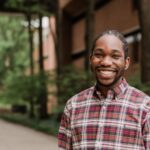
Header image: Jordan Troutman ’21 on campus in spring 2021. All photos by Marlayna Demond ’11.
]]>
Helena Mentis Now more than ever, STEM careers are demanding their workforce keep the social impact of their work at the forefront. Interdisciplinary teams at UMBC are researching methods to...
https://umbc.edu/stories/innovation-and-social-impact/
https://my3.my.umbc.edu/api/v0/pixel/news/119602/guest@my.umbc.edu/eb6706d3ae7cc266cc20ac989836fe9c/api/pixel
cahss
coeit
cs3
discovery
information-systems
sidebar
spring-2021
UMBC News & Magazine
https://my3.my.umbc.edu/groups/umbc-news-magazine
https://assets1-my.umbc.edu/system/shared/avatars/groups/000/001/943/24435aa6207c452e7bc15cc74b42c7bb/xsmall.png?1748556657
https://assets1-my.umbc.edu/system/shared/avatars/groups/000/001/943/24435aa6207c452e7bc15cc74b42c7bb/original.png?1748556657
https://assets2-my.umbc.edu/system/shared/avatars/groups/000/001/943/24435aa6207c452e7bc15cc74b42c7bb/xxlarge.png?1748556657
https://assets2-my.umbc.edu/system/shared/avatars/groups/000/001/943/24435aa6207c452e7bc15cc74b42c7bb/xlarge.png?1748556657
https://assets3-my.umbc.edu/system/shared/avatars/groups/000/001/943/24435aa6207c452e7bc15cc74b42c7bb/large.png?1748556657
https://assets1-my.umbc.edu/system/shared/avatars/groups/000/001/943/24435aa6207c452e7bc15cc74b42c7bb/medium.png?1748556657
https://assets2-my.umbc.edu/system/shared/avatars/groups/000/001/943/24435aa6207c452e7bc15cc74b42c7bb/small.png?1748556657
https://assets1-my.umbc.edu/system/shared/avatars/groups/000/001/943/24435aa6207c452e7bc15cc74b42c7bb/xsmall.png?1748556657
https://assets2-my.umbc.edu/system/shared/avatars/groups/000/001/943/24435aa6207c452e7bc15cc74b42c7bb/xxsmall.png?1748556657
UMBC News & Magazine
0
0
false
Wed, 09 Jun 2021 19:06:42 -0400
Vaccine Victories

UMBC students and staff have shown their resilience in myriad ways during the pandemic, but maybe nothing showcases the Retriever spirit more than the volunteer hours put in to assist in the region-wide vaccination challenge.
Vaccine hunters Jen Dress, associate director of Campus Life, and Candace Martinez-Doane, assistant director of Leadership and Government, started their journeys by finding appointments for people within their immediate circles. As more people became eligible for vaccines, those circles widened to include more than 600 people they’ve helped register.
Part of their efforts focused on frontline UMBC community members, including over 30 ABM staff, who help maintain and clean UMBC facilities and residential buildings. Dress and Martinez-Doane partnered with UMBC Transit to organize UMBC coach buses to transport the ABM workers to and from their vaccine appointments. Next up on their list is helping 60 Chartwells dining staff members be successfully vaccinated to prepare for fall 2021 operations on campus.
UMBC co-sponsored a pop-up vaccine event with the Lakeland community in south Baltimore. Photos by Marlayna Demond ’11.
UMBC students are also going above and beyond to volunteer their time. Of students in the University System of Maryland, Retrievers led the way attending 30 volunteer shifts at the M&T Bank Stadium mass vaccination site, giving approximately 175 hours of their time. According to Chris Bankert of the State of Maryland’s COVID-19 response team, “UMBC has been doing fantastic work at M&T Bank Stadium, and I have been hearing great feedback from the management staff on site.”
In mid-April, UMBC leveraged its long term partnership with the Lakeland community in south Baltimore to co-sponsor a pop-up vaccine event to serve 100 members of the community. “With deep community connections and strong partners like Casa de Maryland, we were ready to bring health resources to the community,” says Joshua Michael ’10, political science, director of the Baltimore School Partnerships and the Sherman Scholars Program,.
In other ways, Michael notes, Retrievers have adapted to meet the opportunity of the moment. In summer 2020, 15 Sherman Scholars taught math online to 150 Lakeland students. And this fall, 30 UMBC students will provide additional support in mathematics through evening tutoring. “At UMBC,” says Michael, “our humanity has guided us to meet this moment.”
— Morgan Casey ’22 and Randianne Leyshon ’09
A version of this story was originally published by The Retriever.
]]>
UMBC students and staff have shown their resilience in myriad ways during the pandemic, but maybe nothing showcases the Retriever spirit more than the volunteer hours put in to assist in the...
https://umbc.edu/stories/vaccine-victories/
https://my3.my.umbc.edu/api/v0/pixel/news/119604/guest@my.umbc.edu/57081189deeb5db09166d940cd92ef7d/api/pixel
campus-life
covidresearch
sidebar
spring-2021
umbctogether
UMBC News & Magazine
https://my3.my.umbc.edu/groups/umbc-news-magazine
https://assets1-my.umbc.edu/system/shared/avatars/groups/000/001/943/24435aa6207c452e7bc15cc74b42c7bb/xsmall.png?1748556657
https://assets1-my.umbc.edu/system/shared/avatars/groups/000/001/943/24435aa6207c452e7bc15cc74b42c7bb/original.png?1748556657
https://assets2-my.umbc.edu/system/shared/avatars/groups/000/001/943/24435aa6207c452e7bc15cc74b42c7bb/xxlarge.png?1748556657
https://assets2-my.umbc.edu/system/shared/avatars/groups/000/001/943/24435aa6207c452e7bc15cc74b42c7bb/xlarge.png?1748556657
https://assets3-my.umbc.edu/system/shared/avatars/groups/000/001/943/24435aa6207c452e7bc15cc74b42c7bb/large.png?1748556657
https://assets1-my.umbc.edu/system/shared/avatars/groups/000/001/943/24435aa6207c452e7bc15cc74b42c7bb/medium.png?1748556657
https://assets2-my.umbc.edu/system/shared/avatars/groups/000/001/943/24435aa6207c452e7bc15cc74b42c7bb/small.png?1748556657
https://assets1-my.umbc.edu/system/shared/avatars/groups/000/001/943/24435aa6207c452e7bc15cc74b42c7bb/xsmall.png?1748556657
https://assets2-my.umbc.edu/system/shared/avatars/groups/000/001/943/24435aa6207c452e7bc15cc74b42c7bb/xxsmall.png?1748556657
UMBC News & Magazine
0
0
false
Wed, 09 Jun 2021 15:08:12 -0400
Exploring Every Angle: Climate Research at UMBC
Researchers across UMBC are using unique, interdisciplinary approaches to explore global environmental challenges. Here are just three examples.
Lipi Mukherjee, Ph.D. ’20, atmospheric physics, developed an algorithm to identify the abundance and type of particles present just under the surface of the ocean. Her algorithm is 6,000 times faster than previous methods.
 (left to right:) Anthony Bratt, Lipi Mukherjee, Dr. Pengwang Zhai, and Dr. Meng Gao, courtesy of the UMBC Atmospheric and Oceanic Optics Group.
“That’s the difference between impossible and doable,” says Mukherjee’s advisor, Pengwang Zhai, assistant professor of physics. Mukherjee trained her model to identify different particle types using neural network technology, rather than relying on existing observational data. This method “has the reliability as well as the speed” today’s scientists need, Mukherjee explains.
The model, which analyzes data collected by orbiting satellites, mostly detects colored dissolved organic matter (CDOMs). Some of these particles can be poisonous to sea life. They can also serve as a proxy for carbon stored in the ocean, which is important to understand in the context of climate change.
Zhai is excited to continue to validate Mukherjee’s model. He’ll also use her model to analyze data coming from three instruments that will launch with NASA’s PACE mission in 2024, including UMBC’s own HARP2.
Mukherjee has moved on to a position at the National Center for Atmospheric Research. She’s applying her knowledge of neural networks to interpret magnetic and thermodynamic properties of the sun’s atmosphere, which can lead to solar flares that interrupt GPS tracking and telecommunication systems. “That’s the beauty of the physics Ph.D.,” Zhai says. “You may not work on the exact same topic after you graduate, but your skill set is highly relevant.”
Answers in the air
Ruben Delgado, assistant research professor at the Joint Center for Earth Systems Technology (JCET), a UMBC partnership with NASA, studies a different resource: our air. Since a major air quality study over Chesapeake Bay in 2011, UMBC has gained national prominence for air quality research. Delgado’s group uses data collected by aircraft, satellites, and ground-based systems to understand where, when, and how much of certain pollutants appear near ground level.
The research led to new regulation that has decreased air pollution in the region. Impressed, the federal Environmental Protection Agency asked UMBC in 2016 to serve as the central hub for a fast-growing network of instruments. Delgado and his students analyze air quality data coming in from sites across the U.S. and Canada.
 Delgado, third from left, with a group of physics students in 2019 next to the observatory on the roof of the physics building. Photo by Marlayna Demond ’11.
The instruments at different sites produce raw data that look slightly different. It’s up to the computer science majors on the team to find ways to analyze it all efficiently and then visualize the results in a way that makes sense to the end user.
Some of the students regularly post their findings on a website affectionately known as the “Smog Blog.” During the worst of this fall’s fires in the West, officials from Pennsylvania called to check on the status of blog posts. The governor expected daily updates on how the smoke was affecting local air quality—and their team was relying on the Smog Blog.
“That’s when we give the wake up call to the students: ‘By the way, your work is being used by government officials,’” Delgado says. “Some of them might not have previously thought at all that their coding skills would be useful for environmental research. It’s a point of pride for the students that their work is being used and highlighted.”
Phytoplankton to polar bears
Rather than collecting data at a distance via satellites, Nicole Trenholm spends much of her time on small boats in the Arctic Ocean, exploring everything from ocean currents to algal blooms to microplastics in ice cores. After earning a bachelor’s in geology, research missions to the Arctic with NASA made her want to pursue an advanced degree.
“I was seeing things and making connections, but I was just a data delivery girl at the time,” Trenholm says. “I wanted to go back to school and learn how to lead the science myself.”
 Trenholm on a research site. Photo courtesy of the Department of Geography and Environmental Systems.
Trenholm has a passion for messy questions about the relationships between melting Arctic glaciers and changes in the surrounding biological communities, from phytoplankton to polar bears. Those interests brought her to UMBC, where she is a Ph.D. student co-advised by geography and environmental systems professor Jeff Halverson and JCET scientist Kevin Turpie.
Trenholm is taking advantage of her fieldwork experience to bridge the gap between climate data collected from afar and ecological data collected on the ground. “I’m doing my best to not go one direction or the other, but really try to stay in between and help solve these crossover questions,” she says.
“Glacier melt isn’t just influencing sea level rise—it’s also influencing the future health of marine ecosystems, fisheries, water quality—all this kind of stuff,” Trenholm adds. “And that’s a story that hasn’t been fully investigated at this point.”
On her next research cruise, she’ll be the only graduate student aboard with a group of senior researchers exploring currents in the Beaufort Sea north of Alaska. The trip will be exciting and educational, but it doesn’t come without risk.
“This is going to be one of the nastier times of year to be up in the oceans,” Trenholm says. “We’ll be out there fighting the seas, collecting data. I’ll be wearing a hard hat and be soaking wet most of the time.”
But she’ll be doing important work, gathering information to help scientists better understand our changing world. And, in the true spirit of a committed scientist, she continues, “It’ll be fun. I brought some audio books and my ukulele.”
*****
Learn more about Retrievers’ roles in researching climate change in the Arctic in this fall 2020 feature On Thin Ice.
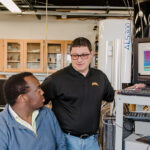
Header imager: Delgado, standing, works with students in his lab in 2019. Photo by Marlayna Demond ’11.
]]>
Researchers across UMBC are using unique, interdisciplinary approaches to explore global environmental challenges. Here are just three examples. Lipi Mukherjee, Ph.D. ’20, atmospheric...
https://umbc.edu/stories/exploring-every-angle-climate-research-at-umbc/
https://my3.my.umbc.edu/api/v0/pixel/news/119734/guest@my.umbc.edu/b53a6dade15361cf3a2dbcbf23d29187/api/pixel
cnms
discovery
fall-2020
ges
physics
professorsnottomiss
sidebar
UMBC News & Magazine
https://my3.my.umbc.edu/groups/umbc-news-magazine
https://assets1-my.umbc.edu/system/shared/avatars/groups/000/001/943/24435aa6207c452e7bc15cc74b42c7bb/xsmall.png?1748556657
https://assets1-my.umbc.edu/system/shared/avatars/groups/000/001/943/24435aa6207c452e7bc15cc74b42c7bb/original.png?1748556657
https://assets2-my.umbc.edu/system/shared/avatars/groups/000/001/943/24435aa6207c452e7bc15cc74b42c7bb/xxlarge.png?1748556657
https://assets2-my.umbc.edu/system/shared/avatars/groups/000/001/943/24435aa6207c452e7bc15cc74b42c7bb/xlarge.png?1748556657
https://assets3-my.umbc.edu/system/shared/avatars/groups/000/001/943/24435aa6207c452e7bc15cc74b42c7bb/large.png?1748556657
https://assets1-my.umbc.edu/system/shared/avatars/groups/000/001/943/24435aa6207c452e7bc15cc74b42c7bb/medium.png?1748556657
https://assets2-my.umbc.edu/system/shared/avatars/groups/000/001/943/24435aa6207c452e7bc15cc74b42c7bb/small.png?1748556657
https://assets1-my.umbc.edu/system/shared/avatars/groups/000/001/943/24435aa6207c452e7bc15cc74b42c7bb/xsmall.png?1748556657
https://assets2-my.umbc.edu/system/shared/avatars/groups/000/001/943/24435aa6207c452e7bc15cc74b42c7bb/xxsmall.png?1748556657
UMBC News & Magazine
0
0
false
Wed, 02 Dec 2020 19:31:34 -0500
 Helena Mentis
 Felipe Filomeno

