UMBC’s Haleemat Adekoya receives prestigious Truman Scholarship for education advocacy

Haleemat Adekoya ‘23, political science, received a surprise phone call last Tuesday morning. On the line were both UMBC President Freeman Hrabowski and Valerie Sheares Ashby, who just one day earlier was announced as UMBC’s next president. They were calling together to share, with heartfelt congratulations, her selection as a 2022 Truman Scholar.
Adekoya has spent the last year preparing to apply for the renowned national scholarship focused on public service. After a series of rigorous interviews, the Harry S. Truman Scholarship Foundation announced Adekoya as one of just 58 students nationwide to receive the award. Adekoya is UMBC’s fifth Truman Scholar.
“I am incredibly proud of Haleemat. Her authenticity, sincerity and humility permeate everything she does,” says Carolyn Forestiere, professor of political science. “I feel very fortunate to have worked with this extraordinary young person as her professor at UMBC, and I know she will excel at whatever she decides to do with her future.”
The Foundation selected recipients from a pool of over 700 applicants who showed a strong record of public service and also submitted a policy proposal addressing a concerning issue in society. Scholars receive $30,000 to attend the graduate school of their choice, as well as access to public service programs, mentorship, and job opportunities within the federal government.
“It is an honor and a pleasure to know that I have been named a 2022 Truman Scholar. All I can say is Glory be to God and to my village, thank you forever,” says Adekoya. “I look forward to continuing to engage in my commitment to cultivate transformative learning spaces and elevating the voices of Black children and celebrating their brilliance.”
Two finalists
This year also marked the second time two UMBC students reached the final round of Truman Scholar selection. In addition to Adekoya, Rehman Liaqat ‘22, political science, was also chosen as a finalist.
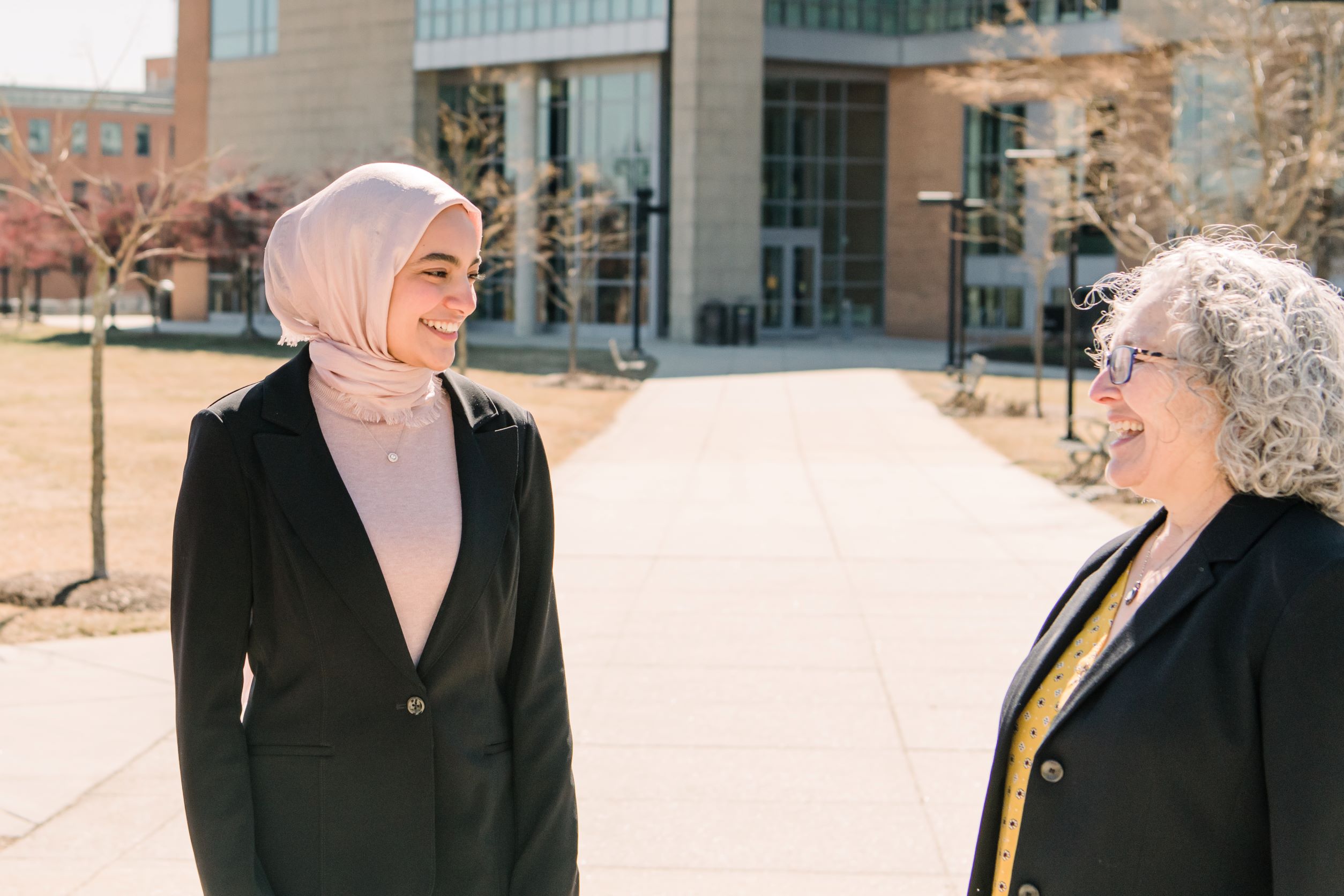
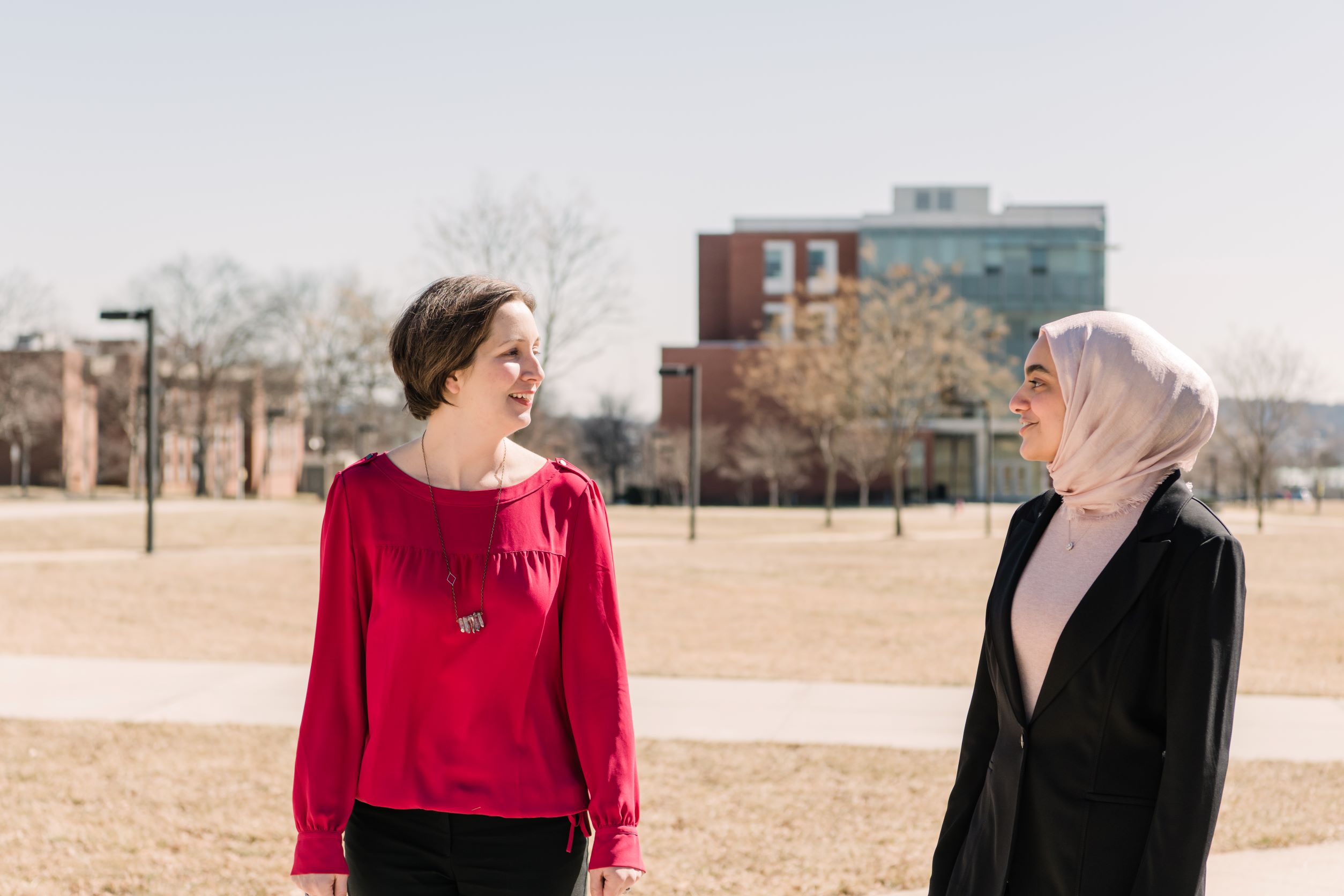
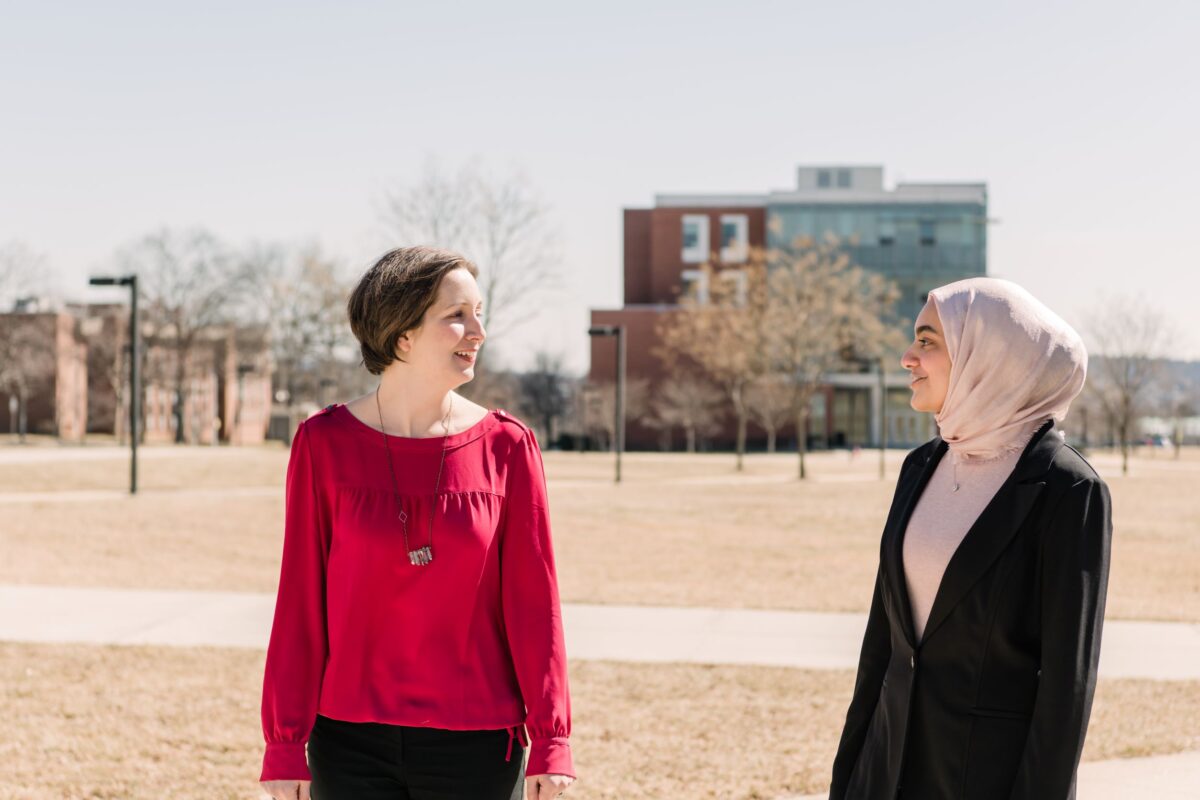
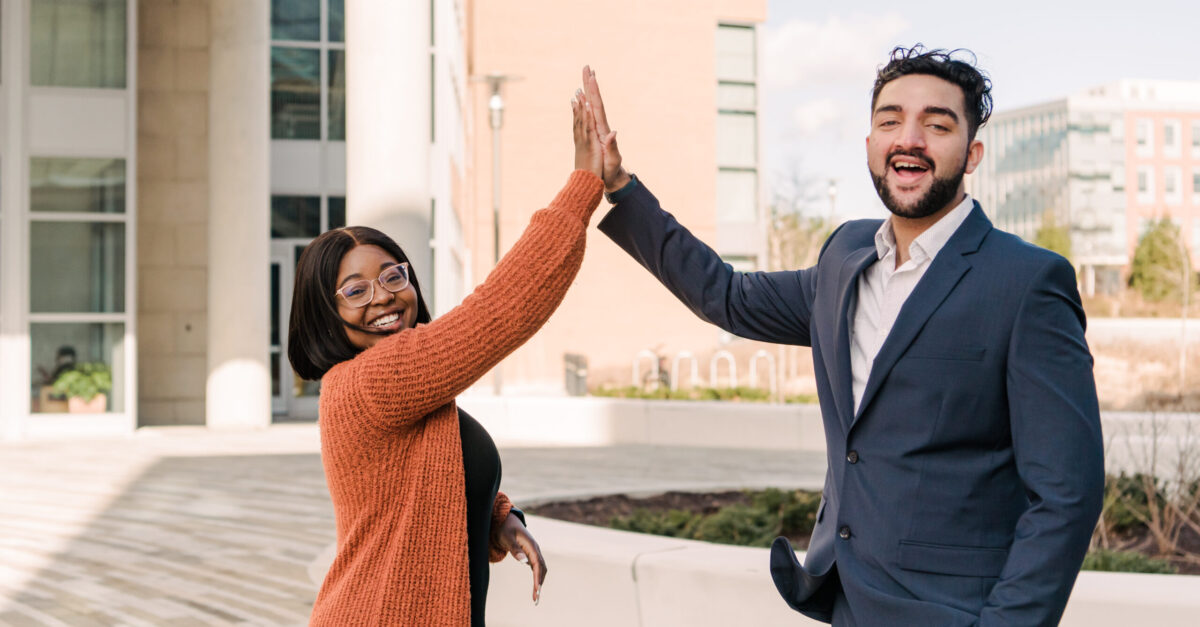 Haleemat Adekoya and Rehman Liaqat 2022. (Marlayna Demond ’11/UMBC)
“Having two finalists is a huge honor for UMBC,” says April Householder, director of undergraduate research and prestigious scholarships. “With only 58 winners selected, that means that our students are highly competitive for this award.” Other institutions with multiple finalists include Duke, Harvard, MIT, and Stanford.
Liaqat and Adekoya are macro thinkers who have learned to both identify everyday problems at a local level and work towards systemic solutions. Liaqat has focused on legal advocacy while Adekoya’s interest is in education reform. Their steadfast commitment to personal growth in service of numerous communities made them strong candidates for the 2022 Truman Scholarship.
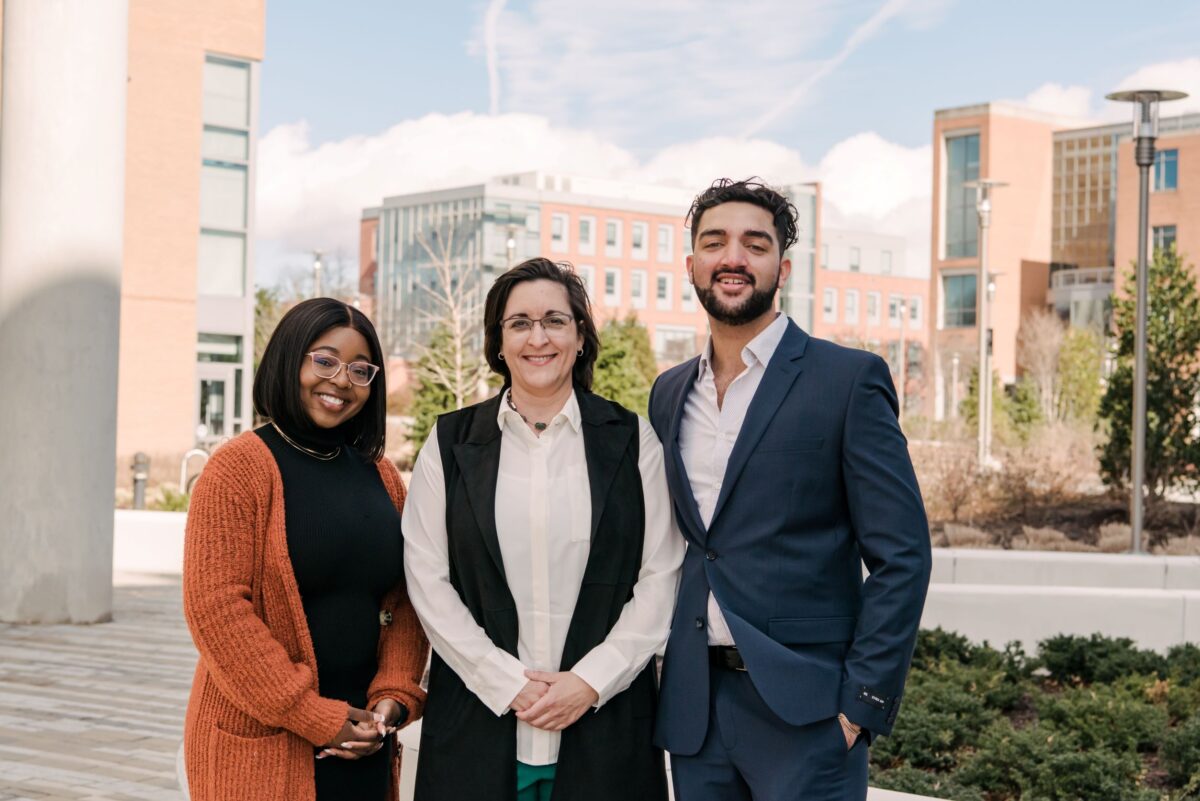 Adekoya (l), Householder (c), and Liaqat (r).
“Haleemat and I both began our journeys at UMBC serving with the Shriver Center, and now, we are both following a pathway towards lifelong public service,” says Liaqat. “This national recognition highlights the fact that UMBC is indeed a magical place that fosters community leaders and passionate public servants, such as Haleemat.”
“This journey has only solidified what UMBC is all about: a community of care and ‘true grit’ towards transformative excellence,” he reflects.
“To have been nominated as one of the two Truman Scholarship finalists is an experience that still has me on cloud nine. Words cannot describe how grateful I am to have been able to experience the scholarship process with someone as incredible as Rehman,” says Adekoya. “I am confident that the better world we reimagine is more than possible because of revolutionary, compassionate, and devoted dreamers like him.”
Collective vision
When Adekoya reflects on her path leading to the Truman Scholarship she sees the combined hard work of Baltimore City and County Public School teachers and students, her UMBC family, and the Sherman STEM Teacher Scholars Program. Their collective vision for sustainable and intentional full-service community schools propels her to think of education reform as an everyday practice.
“Education is said to be the most powerful tool one can use to change the world. However, our current education system excludes many Black students from experiencing such a transformative tool,” reflects Adekoya. “As an education advocate for Black students, I hope to one day develop multi-faceted strategies that address the flaws within our education system.”
Driving change
With this goal in mind, Adekoya participated in the launch of UMBC’s Sherman STEM Teacher Scholars Program intensive virtual math incubator for 150 students at Lakeland Elementary/Middle School in Baltimore City during the first COVID summer. Concurrently, she served as an intern at the Maryland State Department of Education, with the Student, Family, and School Support Committee, in 2020 – 2021. The Maryland Higher Education Commission (MHEC) then chose Adekoya as student representative, serving on its Education Policy Committee and Outreach, Grants, and Financial Assistance Committee for 2021 – 2022.
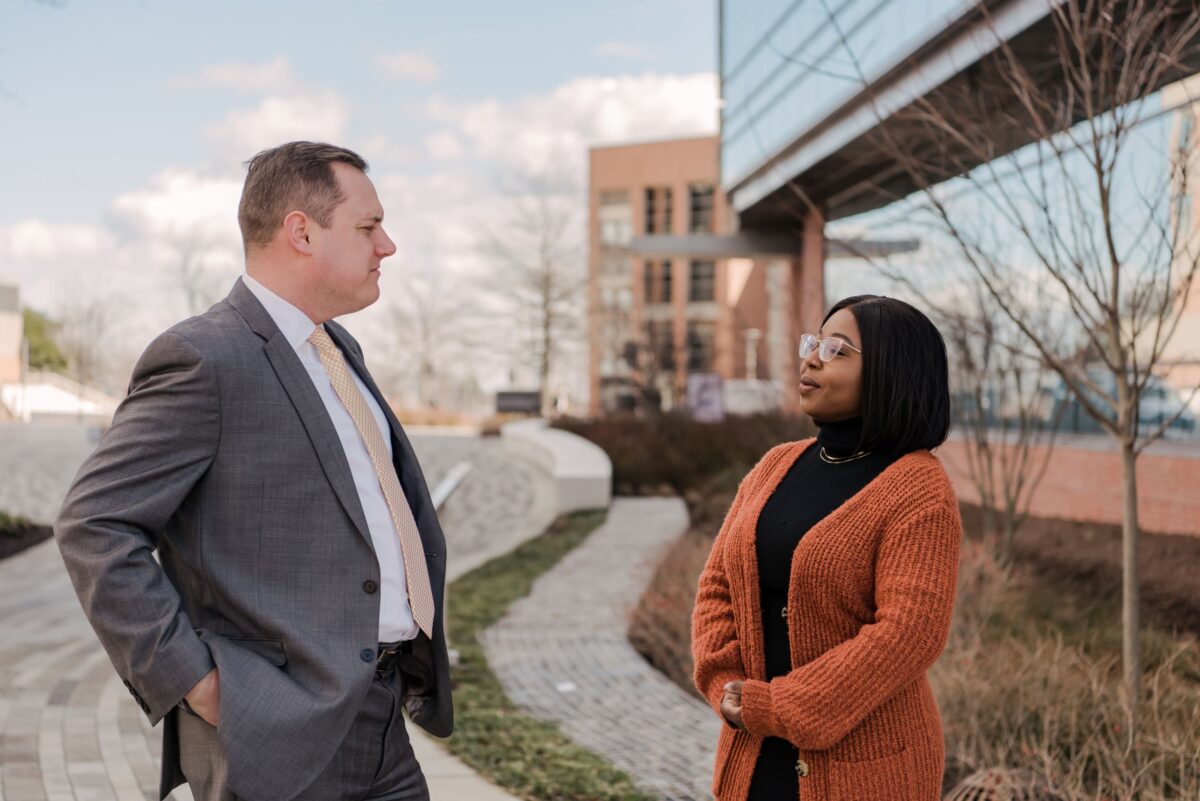 Adekoya (r) with Josh Michael ’10, political science and education, director of Baltimore school partnerships for UMBC’s Sherman STEM Teacher Scholars Program.
In 2019, prior to joining UMBC, Baltimore County Government awarded Adekoya with the “Young Woman of the Year” award for her community-engaged work as a member of the Superintendent’s Student Advisory Council; a mentor in a STEM program for girls; a local coordinator for the From Prison Cells to PhD program; and as founder of Dare2Bee, an empowerment organization for girls ages 9 – 18.
“Haleemat is such a strong and compassionate leader. One of the things that inspires me most about her is her commitment to others,” says her mentor Jasmine Lee, director of inclusive excellence in UMBC’s Division of Student Affairs.
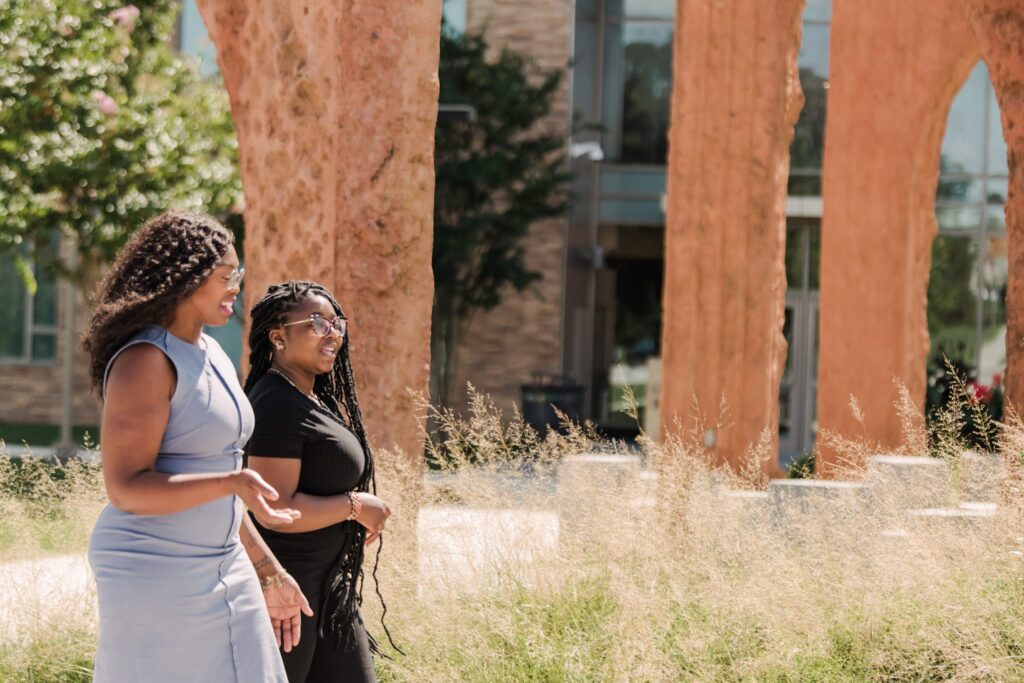 Adekoya (r) with Jasmine Lee.
“She’s not a leader because she’s ‘ahead of the pack’…but instead because she is concerned about everyone making it,” Lee shared when Adekoya was named MHEC student commissioner. “She seems to move from the front to the back, and throughout the middle, empowering everyone to move at their own pace.”
Striving together
Liaqat, a political science major, came to the United States from Pakistan when he was eleven. He spent his teen years in Salisbury, on Maryland’s eastern shore. His time was split between school and working at OC Quickstop, one of three family-owned gas stations.
He earned recognition for supporting his local community and came to UMBC ready to build connections and his leadership skills. He soon also discovered a love of constitutional law, and a commitment to promoting human rights internationally.
In addition to being named a Truman Scholar finalist, he has also earned the inaugural Campus Compact Mid-Atlantic Civic Fellow award. He is completing his master’s in public policy through an accelerated program at UMBC, at the same time as his undergraduate degree. Next, he will next enter a four-year joint degree program (MPP/JD) at the McCourt School of Public Policy and the Georgetown University Law Center.
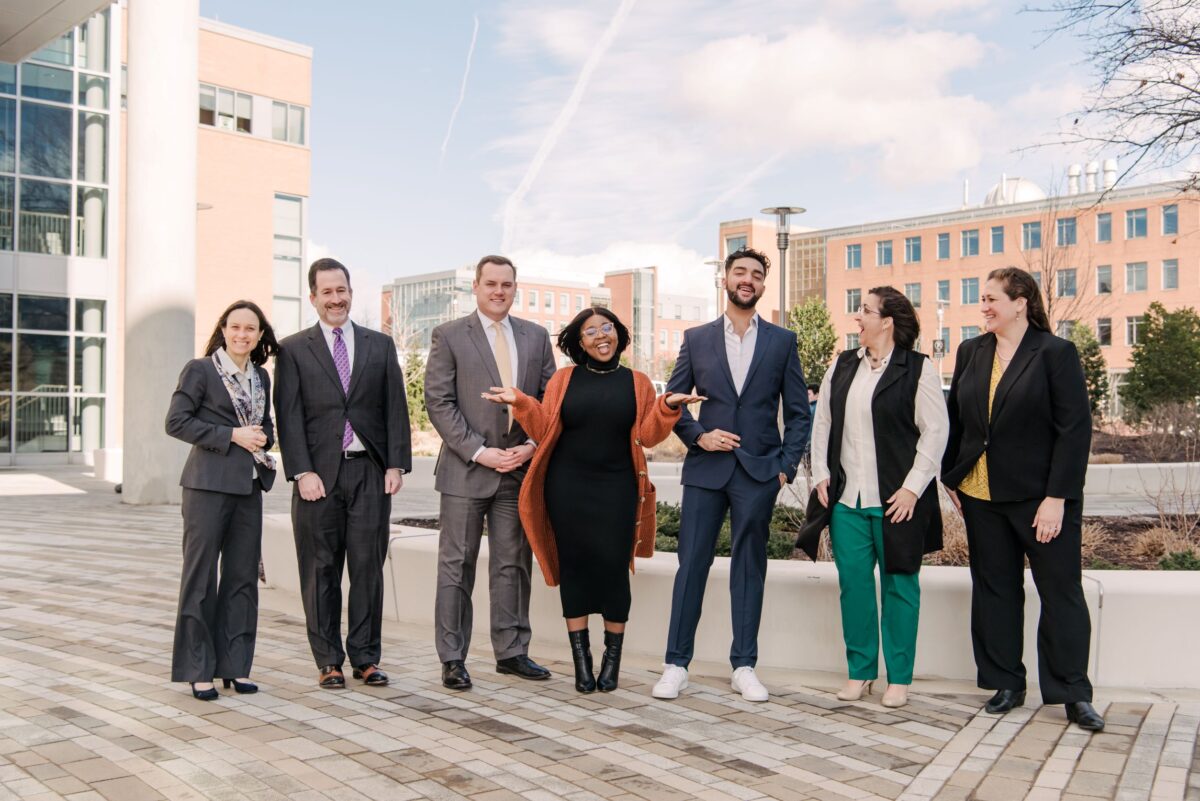 Adekoya and Liqat (center) with their mentors: (l-r) Laura Antkowiak, associate professor of political science and director of the Sondheim Scholars Program; David Hoffman, Ph.D. ’13, language, literacy, and culture, director of the Center for Democracy and Civic Life; Michael; Householder; and Lori Hardesty, associate director of applied learning and engagement at the Shriver Center.
Householder says Adekoya’s win and Liaqat’s recognition as a finalist are “a testament to the hard work of these students” and the support they receive from programs like the Sondheim Public Affairs Scholars and Sherman STEM Teacher Scholars, as well as the Honors College, Undergraduate Research and Prestigious Scholarships, and the Shriver Center.
“This is a community that provides rich experiences for our students,” says Householder. “Those experiences spark their passions for becoming public servants and using their well-honed talents to help others.”
Featured image: Haleemat Adekoya. All photos by Marlayna Demond ’11 for UMBC.
]]>
Haleemat Adekoya ‘23, political science, received a surprise phone call last Tuesday morning. On the line were both UMBC President Freeman Hrabowski and Valerie Sheares Ashby, who just one day...
https://umbc.edu/stories/umbcs-haleemat-adekoya-receives-prestigious-truman-scholarship-for-education-advocacy/
https://my3.my.umbc.edu/api/v0/pixel/news/119449/guest@my.umbc.edu/b89895f67caf32aeb7f4896c6a3a7022/api/pixel
cahss
cahssresearch
honorscollege
majoraward
news
page1
policy-and-society
politicalscience
shermanscholars
shrivercenter
sondheimscholars
UMBC News & Magazine
https://my3.my.umbc.edu/groups/umbc-news-magazine
https://assets1-my.umbc.edu/system/shared/avatars/groups/000/001/943/24435aa6207c452e7bc15cc74b42c7bb/xsmall.png?1748556657
https://assets1-my.umbc.edu/system/shared/avatars/groups/000/001/943/24435aa6207c452e7bc15cc74b42c7bb/original.png?1748556657
https://assets2-my.umbc.edu/system/shared/avatars/groups/000/001/943/24435aa6207c452e7bc15cc74b42c7bb/xxlarge.png?1748556657
https://assets2-my.umbc.edu/system/shared/avatars/groups/000/001/943/24435aa6207c452e7bc15cc74b42c7bb/xlarge.png?1748556657
https://assets3-my.umbc.edu/system/shared/avatars/groups/000/001/943/24435aa6207c452e7bc15cc74b42c7bb/large.png?1748556657
https://assets1-my.umbc.edu/system/shared/avatars/groups/000/001/943/24435aa6207c452e7bc15cc74b42c7bb/medium.png?1748556657
https://assets2-my.umbc.edu/system/shared/avatars/groups/000/001/943/24435aa6207c452e7bc15cc74b42c7bb/small.png?1748556657
https://assets1-my.umbc.edu/system/shared/avatars/groups/000/001/943/24435aa6207c452e7bc15cc74b42c7bb/xsmall.png?1748556657
https://assets2-my.umbc.edu/system/shared/avatars/groups/000/001/943/24435aa6207c452e7bc15cc74b42c7bb/xxsmall.png?1748556657
UMBC News & Magazine
0
0
false
Thu, 14 Apr 2022 11:36:01 -0400
Thu, 14 Apr 2022 11:36:01 -0400
UMBC’s Farah Helal, longtime student advocate, is named USM student regent
“Educators genuinely want what is best for their students,” says Farah Helal ’24, the newly appointed 2022 University System of Maryland (USM) student regent. “Student representatives provide educators and policymakers with the perspective needed to ensure the student voice is valued and understood throughout the decision-making process.”
Governor Hogan announced Farah Helal’s appointment to the USM Board of Regents as a student regent in February and she was formally confirmed in March. She will serve as one of two USM student regents from July 1, 2022 through June 30, 2024, including as a voting member during her second year.
Helal will represent the USM student voice in meetings and committees working on issues that impact the system’s twelve institutions. Key topics involve setting tuition and fee rates, approving new degree programs, and approving capital and operating budgets.
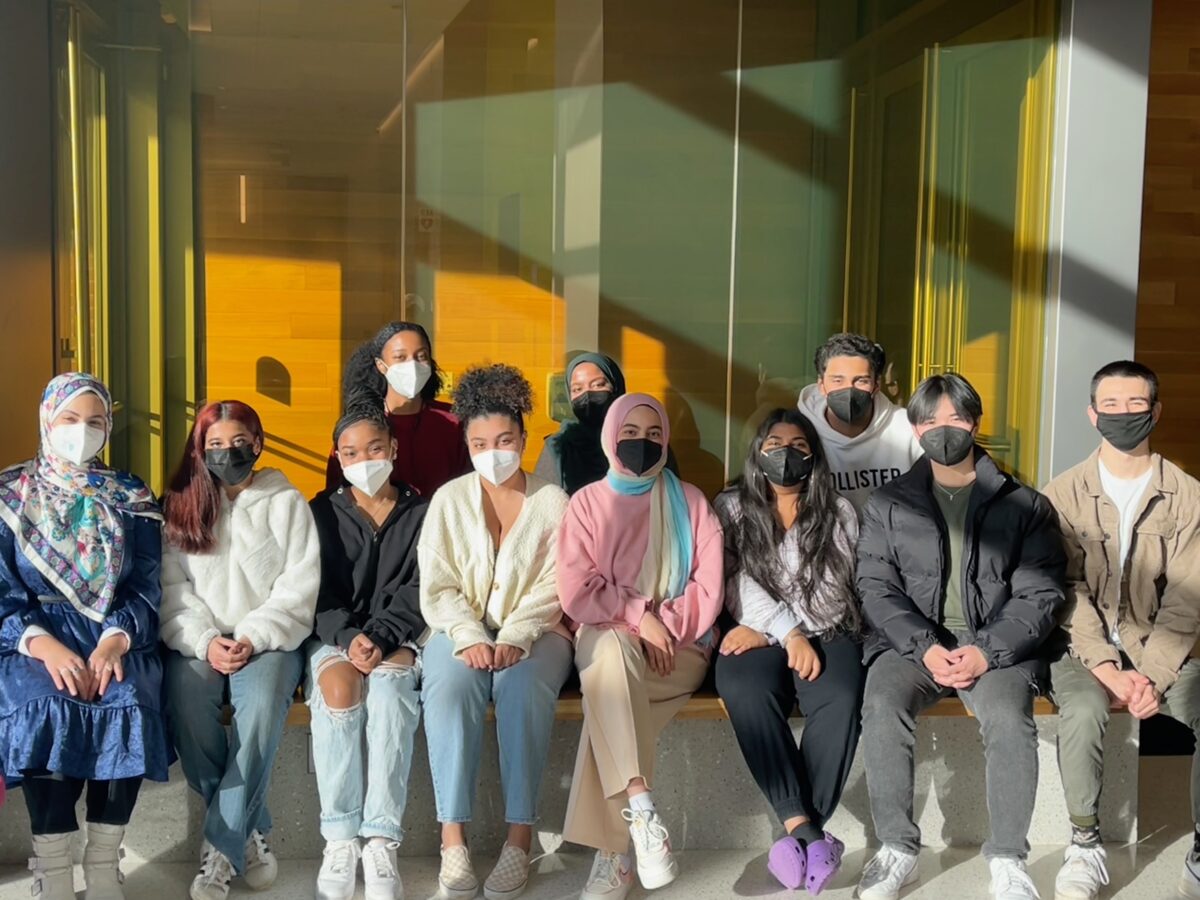 Farah Helal, center, with members of UMBC’s SGA Government Affairs Committee.
Photo courtesy of Helal.
“I recognize the value and impact of having accurate representation,” says Helal. “This appointment comes with a great deal of responsibility, but the value and benefit to my community makes it worth it.”
Focusing on structural changes
Helal is eager to represent Maryland college students at a time when students are in need of additional support and resources. In addition to focus areas guided by student input, there are three areas of improvement she would like to help address.
First, she wants to support initiatives that address how students have experienced the pandemic. This includes shifts in their learning experiences as well as evolving concerns regarding health and safety.
Like many of her peers, Helal is experiencing the pandemic during a heightened social justice movement. Her second focus area highlights college students’ commitments to challenging structural barriers to diversity, equity, and inclusion.
“My generation is proactive in creating the social change we want to see within our institutions,” says Helal. “This will require the university system to effectively address issues with curriculum and infrastructure that perpetuate inequalities on our campuses.”
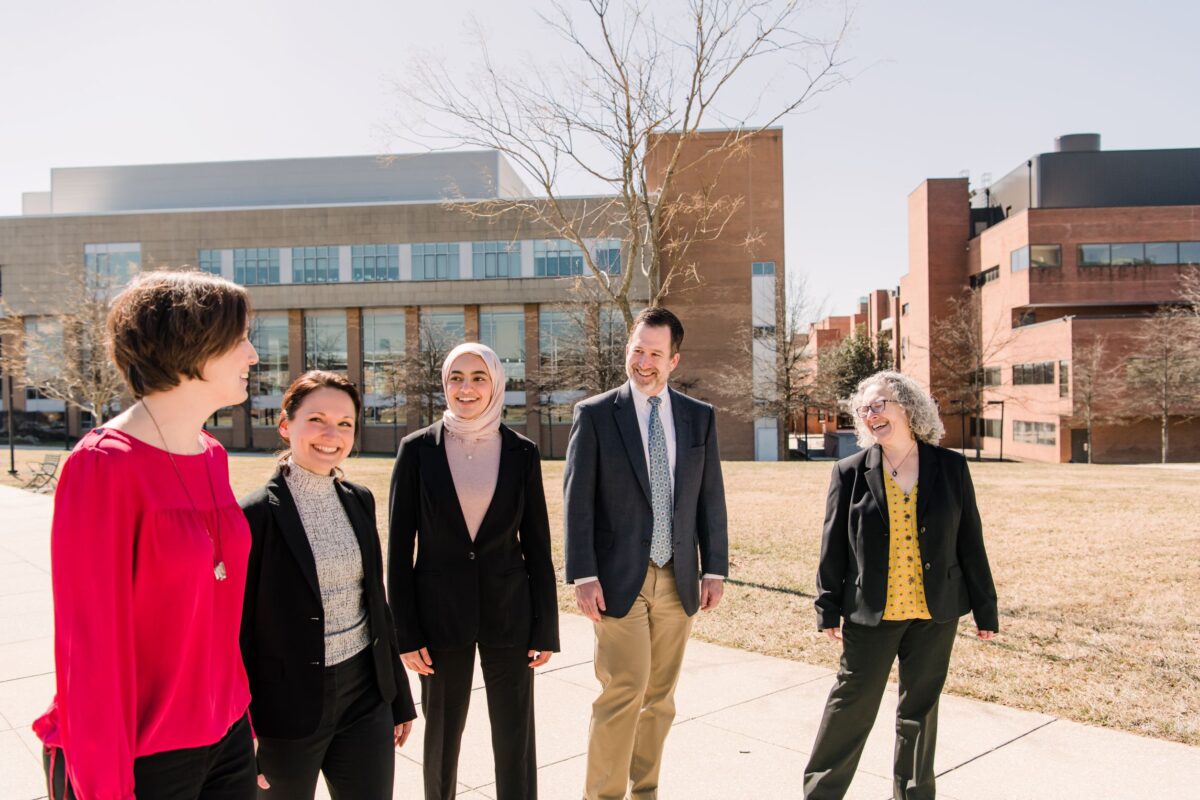 Helal (center) with UMBC faculty and staff from the Sondheim Scholars Program, the Center for Democracy and Civic Life, and the Honors College.
Her third area of focus is student mental health and wellbeing. Helal notes that having grown up in an “electronically dependent society with the influence of social media” has created a culture of constant communication where every type of news is immediate. This constant flow of vast quantities of information is straining student mental health and wellbeing, she suggests, particularly when combined with work, academic, and personal stressors. Helal looks forward to collaborating with the board and community members to improve mental health resources on USM campuses.
Leading with experience
Helal is a Sondheim Public Affairs Scholar in UMBC’s Honors College, majoring in global studies and political science. She also holds a variety of leadership positions at UMBC that have helped her prepare for serving community needs.
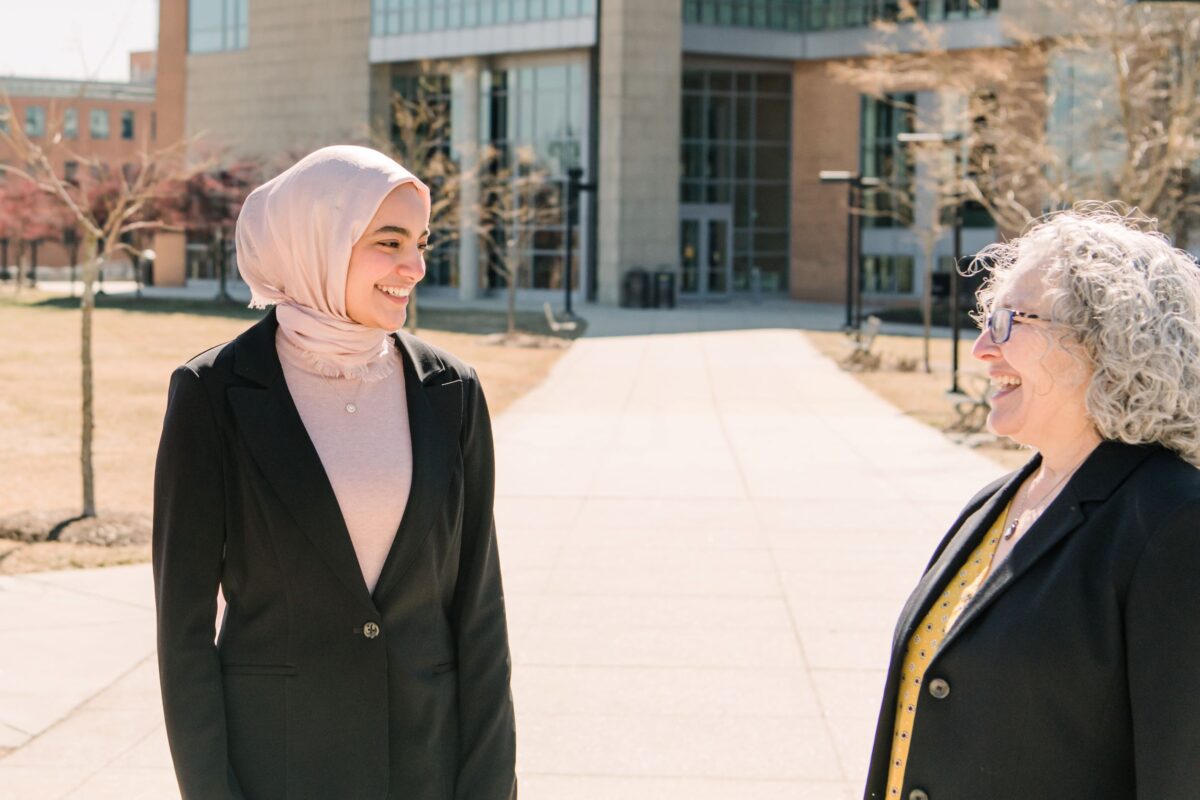 Helal with her academic advisor, Julie Oakes, assistant director of curriculum and retention for the Honors College.
She also serves as director of the Government Affairs Committee for UMBC’s undergraduate Student Government Association. One of her roles is as chief lobbyist pursuing SGA’s county, state, and federal agenda.
“Farah consistently goes well beyond the requirements and makes meaningful contributions to all that she is involved in,” says Jessica Cook, associate director of the Sondheim Scholars Program. “Farah has breathed new life into SGA’s government affairs work and has earned everyone’s respect.”
 Jessica Cook (l) with Farah Helal (r).
Helal notes the committee was able to bring a bill for consideration before the Maryland General Assembly to increase wages for the incarcerated people who are working for Maryland Correctional Enterprises. It is an issue many USM students care about and want to change, she says.
UMBC’s Candace Martinez-Doane, assistant director of leadership and governance for Campus Life, is Helal’s SGA advisor. She has seen Helal care deeply about those around her and strive to ensure their voices are heard.
“Part of that work has been to help her committee members refocus when their work stalls or hits roadblocks,” explains Martinez-Doane. “She does her research and works with kindness and tact in a way that has shown her maturity and skill.”
Beyond UMBC
On the USM Student Council, Helal advocates for student-led legislation as co-director of government relations. She also collaborates with USM institutions on their legislative agendas and coordinates the legislative activities of the Student Council within the Maryland General Assembly and the Office of the Governor.
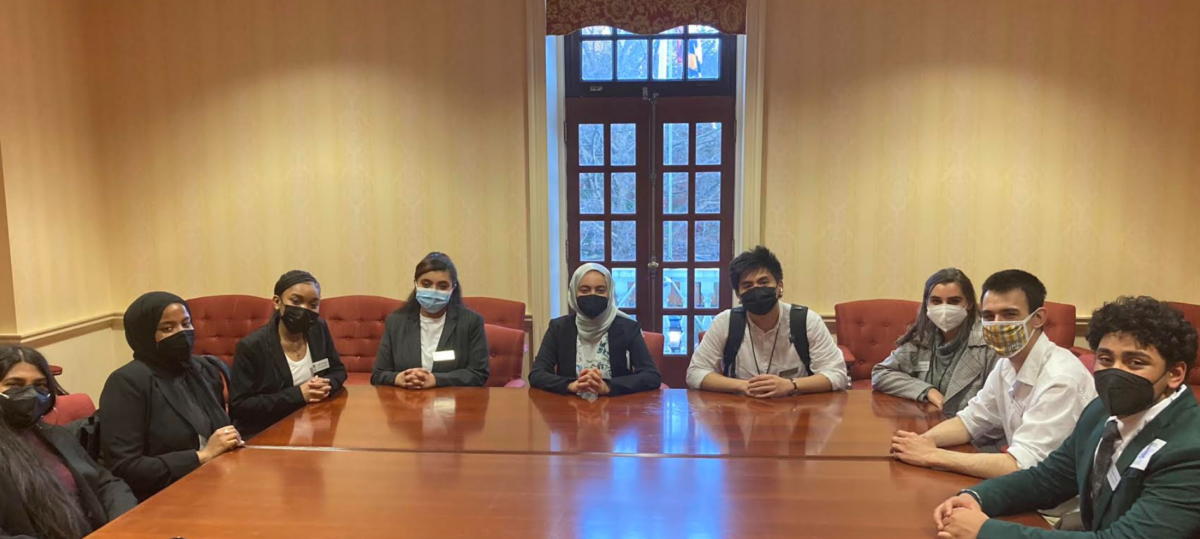 Helal, center, with members of UMBC’s SGA Government Affairs Committee at the Maryland Senate. Photo courtesy of Helal.
Helal also remains dedicated to Howard County, where she is from, as a student representative on the Diversity, Equity and Inclusion Advisory Committee of the Howard County Public School System. The group is part of Howard County’s High School Advisory Council to the Superintendent.
Value of reflection
Helal’s focus on raising awareness about students’ mental health and wellbeing has been a longtime commitment. In high school she ran a two-year research project to study how academic stress impacts students’ mental and physical health and academic success.
The study helped Helal understand how important it is to stop and assess wellbeing before burning out. On a personal level, she learned that the quality of her work is dependent on how well she takes care of herself, and she encourages others to think about this connection.
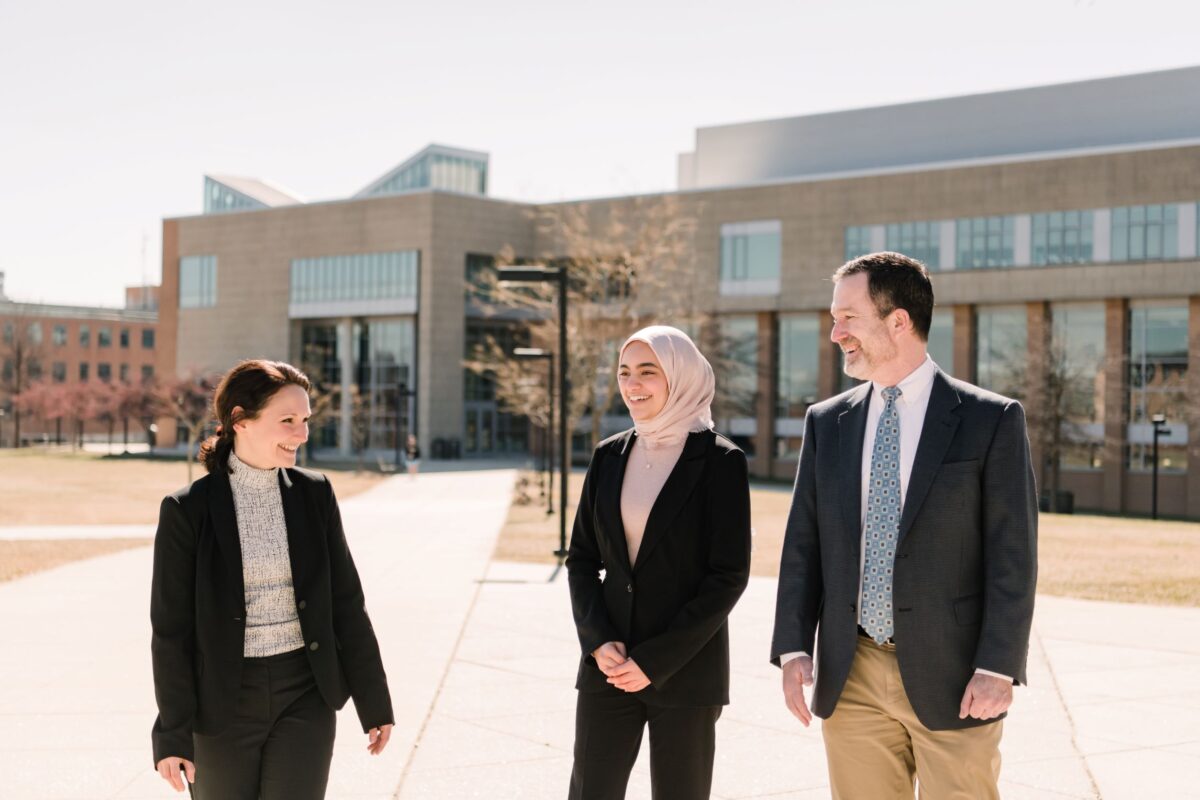 Helal (center) with Romy Hübler ‘09, modern languages and linguistics, M.A. ‘11, intercultural communication, Ph.D. ‘15, language, literacy, and culture (LLC), left, and David Hoffman, Ph.D. ’13, LLC, right. As associate director and director of the Center for Democracy and Civic Life, they have provided Helal with guidance in her civic engagement work on and off campus.
Helal uses daily reflection exercises as a tool to help assess the impact of her work and her needs, and she encourages her peers to do so as well. She also notes the importance of enjoying life outside of school and work, to keep perspective. Spending time with her family, taking time to have fun, and being active in her Egyptian, Arab, and Muslim communities are all activities that reenergize her.
“I constantly reflect about the time, effort, and energy it takes to work towards something that is meaningful, impactful, and purposeful,” says Helal. “Pausing to reflect and take part in my community is how I ensure my work is aligned with my purpose and intentions, and stays consistent with what I initially set out to be—a student voice for positive change.”
Featured photo: Farah Helal. All photos by Marlayna Demond ’11 for UMBC unless otherwise indicated.
]]>
“Educators genuinely want what is best for their students,” says Farah Helal ’24, the newly appointed 2022 University System of Maryland (USM) student regent. “Student representatives provide...
https://umbc.edu/stories/umbcs-farah-helal-longtime-student-advocate-is-named-usm-student-regent/
https://my3.my.umbc.edu/api/v0/pixel/news/119455/guest@my.umbc.edu/165a218f1a50e0fb95ce6f0020ddfb34/api/pixel
cahss
civic
community
globalstudies
honorscollege
news
page1
policy-and-society
political-science
sondheimscholars
UMBC News & Magazine
https://my3.my.umbc.edu/groups/umbc-news-magazine
https://assets1-my.umbc.edu/system/shared/avatars/groups/000/001/943/24435aa6207c452e7bc15cc74b42c7bb/xsmall.png?1748556657
https://assets1-my.umbc.edu/system/shared/avatars/groups/000/001/943/24435aa6207c452e7bc15cc74b42c7bb/original.png?1748556657
https://assets2-my.umbc.edu/system/shared/avatars/groups/000/001/943/24435aa6207c452e7bc15cc74b42c7bb/xxlarge.png?1748556657
https://assets2-my.umbc.edu/system/shared/avatars/groups/000/001/943/24435aa6207c452e7bc15cc74b42c7bb/xlarge.png?1748556657
https://assets3-my.umbc.edu/system/shared/avatars/groups/000/001/943/24435aa6207c452e7bc15cc74b42c7bb/large.png?1748556657
https://assets1-my.umbc.edu/system/shared/avatars/groups/000/001/943/24435aa6207c452e7bc15cc74b42c7bb/medium.png?1748556657
https://assets2-my.umbc.edu/system/shared/avatars/groups/000/001/943/24435aa6207c452e7bc15cc74b42c7bb/small.png?1748556657
https://assets1-my.umbc.edu/system/shared/avatars/groups/000/001/943/24435aa6207c452e7bc15cc74b42c7bb/xsmall.png?1748556657
https://assets2-my.umbc.edu/system/shared/avatars/groups/000/001/943/24435aa6207c452e7bc15cc74b42c7bb/xxsmall.png?1748556657
UMBC News & Magazine
0
0
false
Tue, 05 Apr 2022 13:17:28 -0400
Tue, 05 Apr 2022 13:17:28 -0400
UMBC’s 2021 grads advance research with public impact—from disaster response to assistive tech

Students from across all of UMBC’s colleges and schools are graduating this week having taken advantage of the unique undergraduate research opportunities and supportive mentorship UMBC offers. They’re poised to take their research to the next level and move on to new challenges through graduate school and careers.
For example, Davis Cappabianca ’21 is recommending reforms to better coordinate multi-agency disaster relief efforts. Hana Flores ’21is conducting cutting-edge HIV studies. Keren Herrán ’21, M29, is incorporating environmental science to improve public health. Ali Abdolrahmani, Ph.D. ’21, is developing innovative assistive technologies for the blind community, and Briscoe Turner ’21 is reimagining public safety with an eye to community empowerment.
Big breakthroughs
Cappabianca took advantage of UMBC’s individualized study program (INDS) to tailor his degree around his interests. As a U.S. Navy veteran, Cappabianca knows that coordination between the military and civilian relief groups in the aftermath of disasters is often clumsy. He also expects, as an aspiring Navy medical doctor, that he will be involved in these situations in the future. He wanted to find a way to improve outcomes in these situations, because, he says, “The end goal [is] helping the most people possible in the most effective way.”

Davis Cappabianca ’21 in his U.S. Navy uniform. Photo courtesy of Cappabianca.
“I realized that my background in the U.S. Navy provided me with a lot of unique experiences,” he shares, “and what I found in INDS was a way for me to bring those experiences into my education and claim my own degree.” His two degree mentors, Stephen Kosloski, joint director of Naval ROTC at UMBC and University of Maryland, College Park and Joby Taylor, director of the Peaceworker Program at UMBC, brought very different perspectives to his research.
“More often than not, the melding of their ideas was what got me to major breakthroughs in my research,” Cappabianca says. Learning to always consider multiple perspectives was one of the most valuable takeaways from his INDS degree, he adds. “I think it will fundamentally change the way you approach problems, even if it’s subconsciously.” He plans to pursue medical school or a master’s degree in emergency management.
Environmental science meets public health
Herrán also designed her degree around her experiences. Answering a call for more Spanish-speaking participants, she spent spring break of her first year at UMBC in Nicaragua with the UMBC chapter of Global Medical Brigades, a student-run organization committed to implementing sustainable health systems worldwide.
She noticed the relationship between water quality and community health in Nicaragua, and reflected on similar challenges she observed during her childhood summers in Puerto Rico and El Salvador (the birthplaces of her parents). “Coming back to UMBC, I thought, this is what I want to dedicate my life to,” she says.
 Keren Herrán ’21, right, In Honduras while participating in the Honduras Leadership Institute. Photo courtesy of Herrán.
Her degree has included courses in environmental science, sociology, research methods, and writing—even cartography. Why? Herrán sees significant overlap between study of the environment and public health, but, in practice, doesn’t see the fields as very connected in today’s world. She says, “I want to be in that overlap.”
“I think INDS has been crucial to my acceptance to graduate school, because it’s given me the opportunity to be intentional in my choice of classes, and to claim my education,” Herrán notes. “I knew that I wanted to pursue research and partner with communities, not just come in and tell them what to do,” she says. She has had the opportunity to take that approach in her undergraduate work.
This fall, Herrán will begin a Ph.D. at University of South Carolina as a Presidential Fellow in health promotion, education, and behavior.

Keren Herrán in her graduation regalia, spring 2021. Photo courtesy of Herrán.
Asking challenging questions
Turner and Abdolrahmani also focused on issues close to their hearts. As a Sondheim Public Affairs Scholar and psychology major, Turner has studied community building in the context of reimagining public safety and justice.
“I’m really interested in the community aspect, alternatives to policing, and understanding how you build as a community and solve these problems without the use of force—with understanding and restorative practices,” she says. “I’ve grown in that way, and thought about, ‘What does abolition look like? How do we expand our thinking and make sure that we’re tapping into new ideas of how we operate with each other, and how we communicate with each other, and how we treat each other, rather than sticking to historical practices?’”
 Briscoe Turner ’21, rear, second from right, with other members of the UMBC Black Lives Matter Club in 2019. Photo courtesy of Turner.
Her current research with Bronwyn Hunter, assistant professor of psychology, focuses on college students who have had parents incarcerated or struggle with substance use, and understanding the students’ ideas of what justice looks like. In addition to her work with Hunter, a Public Policy and International Affairs Junior Summer Institute at Princeton University “opened my eyes to how public policy works,” Turner says. Now, she’s asking big questions: “I’m trying to understand what the world could look like, and how do we get there?”
This summer, Turner is headed to Brown University to pursue a master’s of public affairs. “I’ve really enjoyed my UMBC experience. That’s why I picked Brown,” she says. “I felt like it had a lot of similar aspects to it as UMBC, so I want to continue that community feel and the support that I got here.”
 Briscoe Turner ’21, left front, with UMBC’s Black Lives Matter Club in the UMBC Commons. Photo courtesy of Turner.
Inclusive design
Abdolrahmani has spent the last seven years investigating and developing assistive technologies for the blind community in the human-centered computing Ph.D. program. He decided to pursue a Ph.D. after being exposed to the field of assistive technology while working in his home country to improve the internet banking experience for blind customers. Intrigued and wanting to make a bigger contribution to the field, Abdolrahmani, who is legally blind, moved to the U.S. with his wife at age 36 to study with UMBC faculty in information systems.
“I wanted to understand how I could develop technologies to improve the independent living of the blind community or other people with disabilities,” Abdolrahmani says. He first worked on a project to develop a wearable indoor navigation assistive device. Later, he worked to enhance the user experience of mainstream voice assistants such as Amazon Alexa and Google assistant for the blind. And, finally, he brought the two together for his thesis project, which focused on the use of mainstream voice assistants for navigating airports.
Along the way, he learned that not only did blind people appreciate the technologies he was developing, but so did sighted people and members of other groups. His research “shows that these technologies have great potential for future use for different groups of users in different contexts,” he explains.
Now, Abdolrahmani is looking for roles where he can have an even more direct impact as a member of a product design team, “so that I can inspire more accessibility and inclusive design in products, to see that products are designed in such a way that people with different abilities can use them right away out of the box.”
Becoming a scientist
A culture of supportive mentorship has helped sustain all of these students on their path to commencement. For Hana Flores, her first mentor on campus was none other than President Freeman Hrabowski.

Hana Flores ’21, center, with Phyllis Robinson, right, and Ernestine Baker, after Floes received an award for her presentation at the Annual Biomedical Research Conference for Minority Students in 2019. Photo courtesy of Flores.
The CEO of Prince George’s County Public Schools connected Flores with Hrabowski after hearing her deliver the valedictorian address at Bowie High School and learning that she would attend UMBC. On the day of their meeting, when Flores heard Hrabowski’s booming voice from the anteroom to his office, she was nervous. “But once he entered the room, any nerves I had went away,” she recalls. “He was so interested, and genuinely wanted to know what my goals and aspirations were.”
Soon thereafter, she joined the lab of Michael Summers, Distinguished University Professor of chemistry and biochemistry and Howard Hughes Medical Institute investigator. And she’s been conducting research with his team on the structure of HIV since.
 Hana Flores ’21, left, Pengfei Ding, center, and Ridhi Chaudry ’22, right, at UMBC’s Summer Undergraduate Research Fest in 2019. Photo courtesy Flores.
Postdoc Pengfei Ding, in particular, spurred her growth by encouraging his mentees to contribute to the intellectual direction of the research, rather than simply teaching them specific laboratory techniques. “Dr. Pengfei Ding essentially was a catalyst for me to grow into a more independent researcher,” Flores says.
Her many professors in chemical engineering also had a role to play. “They are really focused on students being able to achieve. I felt comfortable going to office hours,” she says. “And I feel like they didn’t just care about me accomplishing in my classes, they also cared about how I was as a person.”
Flores has presented at national conferences, conducted summer research at MIT, and joined the UMBC Honors College and U-RISE Program. Shes also a contributing author for one published and two pending research articles. This fall, she’ll begin a Ph.D. at MIT as a Dean of Science Fellow, where she hopes to pursue interests in protein engineering and regeneration.

Hana Flores ’21. Photo courtesy Flores.
The power of mentoring
Herrán had support from research mentor Dawn Biehler, associate professor of geography and environmental systems, as well as her INDS and Meyerhoff Scholar communities. Biehler “is invested in her mentees and their growth and development, and she’s just incredibly kind and supportive,” Herrán says.
On her Meyerhoff experience, Herrán reflects, “I’m a minority in many aspects, and Meyerhoff is so beautiful, because it’s so rare to be in a cohort of more than 50 other students who are also minorities, who are also trailblazers within their families and their cultural communities. You relate to one another, you support one another—it’s a family for life.”
Abdolrahmani also received support from multiple angles. Stacey Branham, formerly of UMBC and now on the faculty at University of California, Irvine, “had a very deep trust in me and my abilities and my creativity for different research projects that we collaborated on together,” he says. Ravi Kuber, associate professor of information systems, was his primary advisor and “the first one who trusted me when I arrived in 2014.”

Keren Herrán ’21, right, at the University of Pennsylvania, where she gave a poster presentation on research completed during the Leadership Alliance Summer Research – Early Identification Program in 2018. Photo courtesy Herrán.
A strong believer in peer mentoring, Abdolrahmani thinks back to the supportive relationships he developed with both graduate and undergraduate students. With the undergrads, in particular, “I trained them academically, but also how to interact with me as a blind person, what kind of support I need,” Abdolrahmani says, “so I had the support that Ph.D. students need through the collaboration of my mentors and colleagues in the team.”
Circle of support
Turner’s research mentor, Hunter, offered valuable insights beyond their specific research project, supporting Turner as a whole person. “I’ve learned a lot from her about criminal justice and research and just about life,” Turner says of Hunter.
That support included walking her through the graduate school application process and providing an emotional anchor point. “I really appreciated her and the graduate students sharing their experiences,” Turner says. “She would also check in with me during our one-on-one meetings to see how I was doing throughout the process, given how difficult this past year has been.”

Briscoe Turner ’21 in graduation regalia. Photo courtesy Turner.
Faculty in the Sondheim Scholars and Honors College programs completed Turner’s circle of support. “All of them have been there for me, which I really appreciate, for personal growth and also my career goals,” she reflects.
Connections and pathways
Other graduating students, too, have benefited from strong mentorship and rich research experiences. Caleb Robelle ’21, M29, mathematics and computer science, had the opportunity to connect with research mentors across UMBC, Rutgers, Texas A&M, and Johns Hopkins, and was accepted into all 17 of the Ph.D. programs he applied to. He will pursue his Ph.D. in theoretical computer science at MIT. Olumide Fagboyegun ’21, M29, biochemistry, will pursue a Ph.D. in neuroscience at Harvard as a Herchel Smith and NSF Graduate Research Fellow after completing neurological research with Erin Green, assistant professor of biological sciences.
Jordan Troutman ’21, M29, computer science and mathematics, is UMBC’s first Knight-Hennessy Scholar. He will pursue a Ph.D. in computer science at Stanford. And Samuel Patterson ’21, economics and mathematics, will attend Oxford as the second Rhodes Scholar in UMBC’s history, with a focus on transportation economics.
Thinking ahead
In UMBC tradition, on the eve of their graduation these students are already thinking about how they can support those coming after them. Flores, for example, benefited from being paired with a graduate student as part of her summer research experience at MIT. She’s planning to become a mentor once she arrives on campus to begin her Ph.D.
They all agree that community connections matter. “It’s powerful to give people the platform to share their stories, their lives, their hopes, their dreams,” Turner says. “There’s a lot of power in community—building with each other and climbing as you go.”
Banner image: Hana Flores, left, and Keren Herrán, right, on campus. Photo by Marlayna Demond ’11 for UMBC.
]]>
Students from across all of UMBC’s colleges and schools are graduating this week having taken advantage of the unique undergraduate research opportunities and supportive mentorship UMBC offers....
https://umbc.edu/stories/umbcs-2021-grads-advance-research-with-public-impact-from-disaster-response-to-assistive-tech/
https://my3.my.umbc.edu/api/v0/pixel/news/119624/guest@my.umbc.edu/6e9d91d1885cc087c2aaa37d2c9da9ee/api/pixel
cahss
cbee
chembiochem
civic
classof2021
cnms
coeit
community
csee
economics
ges
gradresearch
honorscollege
inds
is
marcustar
mathstat
meyerhoffscholars
naval
policy-and-society
psychology
research
science-and-technology
shrivercenter
sondheimscholars
undergradresearch
UMBC News & Magazine
https://my3.my.umbc.edu/groups/umbc-news-magazine
https://assets1-my.umbc.edu/system/shared/avatars/groups/000/001/943/24435aa6207c452e7bc15cc74b42c7bb/xsmall.png?1748556657
https://assets1-my.umbc.edu/system/shared/avatars/groups/000/001/943/24435aa6207c452e7bc15cc74b42c7bb/original.png?1748556657
https://assets2-my.umbc.edu/system/shared/avatars/groups/000/001/943/24435aa6207c452e7bc15cc74b42c7bb/xxlarge.png?1748556657
https://assets2-my.umbc.edu/system/shared/avatars/groups/000/001/943/24435aa6207c452e7bc15cc74b42c7bb/xlarge.png?1748556657
https://assets3-my.umbc.edu/system/shared/avatars/groups/000/001/943/24435aa6207c452e7bc15cc74b42c7bb/large.png?1748556657
https://assets1-my.umbc.edu/system/shared/avatars/groups/000/001/943/24435aa6207c452e7bc15cc74b42c7bb/medium.png?1748556657
https://assets2-my.umbc.edu/system/shared/avatars/groups/000/001/943/24435aa6207c452e7bc15cc74b42c7bb/small.png?1748556657
https://assets1-my.umbc.edu/system/shared/avatars/groups/000/001/943/24435aa6207c452e7bc15cc74b42c7bb/xsmall.png?1748556657
https://assets2-my.umbc.edu/system/shared/avatars/groups/000/001/943/24435aa6207c452e7bc15cc74b42c7bb/xxsmall.png?1748556657
UMBC News & Magazine
0
0
false
Thu, 20 May 2021 15:02:24 -0400
Doing their homework: Graduating Retrievers use internships to jumpstart their careers

When the time came to start her college career, Sondheim Scholar Viviana Angelini ‘21 traded in the palm trees of Florida for all things Baltimore at UMBC. She had taken some classes at a local community college in Florida while a homeschooled high school student, but starting at UMBC was a very different and exciting experience.
“It was pretty amazing to go from studying literature at home and having small classes, to then come here and see all the students and all the academic buildings,” says Angelini. “When I did a campus tour, two things stuck out to me the most and made me feel like I was where I belonged: walking into the Commons and seeing all the international flags and walking underneath all the trees on Academic Row and feeling the sense of community and excitement about learning.”
 View of Academic Row trees. Photo courtesy of Marlayna Demond ’11.
She felt inspired to make the most of her UMBC experience from day one, eventually adding three minors (international politics, Russian, and music) to her political science major and pursuing internships that had a huge impact on her college experience and her career trajectory. While her individual path was unique, the way she was able to pursue opportunities beyond the classroom, putting her knowledge into practice, is a classic UMBC experience.
Connecting with opportunities

Angelini on campus this spring. Photo courtesy of Marlayna Demond ‘11.
Angelini’s first internship, for two summers, was with Congressman Gus Bilirakis who represents her home district in Florida. She reviewed and analyzed legislation and attended media briefings about military strategy, freedom of the press, and other topics. One highlight, she says, was writing a speech for the congressman to deliver in the House of Representatives about Canadian/American relations.
While this foray into politics piqued her interest, her career goals were further solidified after meeting James Clapper, former director of national intelligence. They connected at a speaking engagement at UMBC and Clapper suggested she apply for an internship with the U.S. Department of Defense. Angelini soon found herself packing her bags again, this time to head to Nebraska for her first position in intelligence.
Defining her path
“I spent the summer working in support of U.S. national security,” she says. “It was an amazing experience, bringing together everything I learned at UMBC and applying it to the real world.”
To further broaden her professional portfolio, Angelini traveled to Colorado the following summer to continue work for the Department of Defense, this time with NORAD and U.S. Northern Command.

Angelini poses with the eight-foot-tall snowman she and friends made during a snowstorm at UMBC.
Since September 2020, Angelini has been interning at Fort Meade, authoring reports for the National Security Agency. After graduating, she’ll attend George Washington University as a graduate fellow as she works towards a master’s in security policy studies with a concentration in conflict resolution.
To students starting their journey at UMBC, Angelini suggests, “Say yes to any opportunity. You don’t know what kind of doors it will open or how it will come back to benefit you in the future. Almost every experience you have in undergrad will help you in the future, either professionally or personally.”
Making the data work
If someone asked you to determine how many people had food-producing gardens in Portland, Oregon, where would you begin? Travis Twigg ‘19, geographic information science, and M.P.S. ‘21, data science, encountered this question during an undergraduate internship in 2018 with geography and environmental systems (GES) at UMBC, and the possibilities that came to mind intrigued him. “I was working with my professor, Dillon Mahmoudi, to try and determine access to healthy food, so I trained a model to do object detection on satellite imagery to find the gardens,” he says.

Portrait courtesy of Twigg.
Working with Mahmoudi had such an impact on Twigg that after graduating with a bachelor’s degree, he enrolled in UMBC’s data science graduate program. He’ll earn his master’s degree this week.
Through internships, Twigg has tackled a broad range of questions related to analyzing maps and satellite imagery. In the summer of 2020, he built upon the machine learning work he began as an undergrad and accepted an internship at NASA Goddard Space Flight Center. He worked to develop a model to distinguish clouds from smoke in satellite imagery. When smoke is too heavy, NASA’s internal operation erroneously mistakes it for clouds and crops it out of the images entirely, causing a cascade of problems. His model was trained to correct the error.
Learning from COVID-19
Twigg also interned as a researcher with the Johns Hopkins Applied Physics Laboratory, where he worked with a team of seven other students across the country to model COVID-19 dynamics.
“This was early summer 2020, so there was a lot of data coming out, but people still weren’t sure how bad the pandemic was going to get—if there was going to be one wave, two waves, et cetera. So, we were trying to create a model to predict that,” says Twigg.
His team also looked at sentiment analysis on Twitter to map the relationship between residents’ political preferences and how they were responding to different state guidelines across the U.S.
Building relationships, experience
A first-generation college student, Twigg wasn’t always sure what his path was going to look like. He graduated with his associate’s degree in mathematics from Frederick Community College and then continued his studies at the University of Maryland, College Park. Still uncertain how he wanted to proceed, Twigg made the decision to take a break from his education and accept a position as a business manager for nearly a decade.
The time away from his studies gave him the opportunity to reflect on what he ultimately wanted in a career. In 2016, he enrolled at UMBC, ready to complete his degree.
 Twigg visiting the Seljalandsfoss waterfall during a trip to Iceland in 2019.
Twigg learned valuable lessons along the way and would advise new Retrievers to “show up, get involved, and network,” including exploring hands-on internship opportunities. “When you’re done with school, employers will care most about the relationships you have been able to build and the experience you’ve gained, and the first step of that is just showing up.”
Next, Twigg will complete a master’s in data analytics at Georgia Institute of Technology.
Hitting the ground running
When Luke Matthews ‘21, financial economics and political science, initially chose a college, he says, “I didn’t really take into consideration how much the school really feeling like home mattered to me.” But he soon realized how important diversity would be to his experience, and he chose to transfer to UMBC in search of a sense of community.“UMBC is incredibly diverse and I think that’s the thing I love most about it,” he shares.
He hit the ground running at UMBC, securing the first of five undergraduate internships. In his sophomore year, Matthews worked with the Baltimore Minority Business Development Center. He helped minority business owners secure funding, including searching for government contracts and providing support to help them win those contracts.
 Portrait courtesy of Matthews.
“It was a small team and I was given a lot of autonomy to try different approaches and lead things at such a young age,” says Matthews. “It was really interesting and I enjoyed it.”
Trying something new
His next opportunity, as a quantitative research intern at the Johns Hopkins Bloomberg School of Public Health, was a departure from what he had envisioned for himself. “I was trying to work for a large investment bank as a sophomore, but I didn’t get accepted at any of the places I applied,” says Matthews. “I figured I could either pout about it or find something else, so I found something else with the help of my statistics professor and Christine Routzahn, director of the UMBC Career Center. It turned out to be one of the most enriching experiences ever.”
He was able to publish research, make connections at Johns Hopkins, and spend the summer living on his own for the first time. In addition to the personal growth it afforded him, Matthews shares that in interviews since then, employers have been intrigued by his real-world experience with biostatistics.
Back to the plan
Matthews got back onto the financial path with his next internship at Facet Wealth, a start-up company looking to revolutionize the financial planning industry. The company was fully virtual, and although the internship ended in January 2020, it offered a timely preview into what the following year would be like. Matthews was able to help build models to inform business decisions and corporate operations.
In summer 2020, before his senior year, Matthews finally landed his dream internship at Bank of America in the investment banking division. It was a perfect fit and ultimately led to a job offer awaiting him after graduation.

Matthews with a group of children he worked with during a UMBC Global Brigades medical and public health service trip to Panama. Photo courtesy of the UMBC Global Brigades, with participant permission.
To further sharpen his skills before graduating, Matthews took a final internship senior year at T. Rowe Price in Baltimore as a fixed income research intern. The position had him speaking directly with portfolio managers about how to allocate money for investment opportunities. The experience offered an opportunity to “become more persuasive and a better speaker, and really hone my rhetorical abilities,” Matthews says.
Next steps
As he prepares to move on to a full-time role in investment banking, Matthews thinks about the supporters at UMBC who helped him access opportunities, particularly Routzahn and her team at Career Services. Like Angelini and Twigg, he advises students to be bold in reaching out for help and guidance. “Almost every internship I had is because of the Career Center.”
Whether you’re a commuting student or live on campus, a transfer student or have been at UMBC from the start, he says, there are people at UMBC to help you start and grow your career.
Banner image: Viviana Angelini in front of international flags in the UMBC Commons. All photos courtesy of students unless otherwise noted.
]]>
When the time came to start her college career, Sondheim Scholar Viviana Angelini ‘21 traded in the palm trees of Florida for all things Baltimore at UMBC. She had taken some classes at a local...
https://umbc.edu/stories/doing-their-homework-graduating-retrievers-use-internships-to-jumpstart-their-careers/
https://my3.my.umbc.edu/api/v0/pixel/news/119626/guest@my.umbc.edu/2875c407bb5ea38a3a937c47766db20b/api/pixel
cahss
careercenter
classof2021
coeit
community
datascience
economics
ges
politicalscience
sondheimscholars
UMBC News & Magazine
https://my3.my.umbc.edu/groups/umbc-news-magazine
https://assets1-my.umbc.edu/system/shared/avatars/groups/000/001/943/24435aa6207c452e7bc15cc74b42c7bb/xsmall.png?1748556657
https://assets1-my.umbc.edu/system/shared/avatars/groups/000/001/943/24435aa6207c452e7bc15cc74b42c7bb/original.png?1748556657
https://assets2-my.umbc.edu/system/shared/avatars/groups/000/001/943/24435aa6207c452e7bc15cc74b42c7bb/xxlarge.png?1748556657
https://assets2-my.umbc.edu/system/shared/avatars/groups/000/001/943/24435aa6207c452e7bc15cc74b42c7bb/xlarge.png?1748556657
https://assets3-my.umbc.edu/system/shared/avatars/groups/000/001/943/24435aa6207c452e7bc15cc74b42c7bb/large.png?1748556657
https://assets1-my.umbc.edu/system/shared/avatars/groups/000/001/943/24435aa6207c452e7bc15cc74b42c7bb/medium.png?1748556657
https://assets2-my.umbc.edu/system/shared/avatars/groups/000/001/943/24435aa6207c452e7bc15cc74b42c7bb/small.png?1748556657
https://assets1-my.umbc.edu/system/shared/avatars/groups/000/001/943/24435aa6207c452e7bc15cc74b42c7bb/xsmall.png?1748556657
https://assets2-my.umbc.edu/system/shared/avatars/groups/000/001/943/24435aa6207c452e7bc15cc74b42c7bb/xxsmall.png?1748556657
UMBC News & Magazine
0
0
false
Wed, 19 May 2021 16:13:36 -0400
The Carnegie Foundation honors UMBC as a leading community-engaged university

The Carnegie Foundation for the Advancement of Teaching has honored UMBC with its distinguished Carnegie Community Engagement Classification. This classification acknowledges UMBC faculty, staff, students, and community partners for their deep commitment to strengthening the bonds between campus and community.
UMBC is one of only 67 public colleges and universities in the U.S. just announced as receiving this honor. To date, 359 U.S. institutions hold this classification. These institutions “are doing exceptional work to forward their public purpose in and through community engagement that enriches teaching and research while also benefiting the broader community,” says Mathew Johnson, executive director of Brown University’s Swearer Center for Public Engagement, the administrative and research home for the classification.
This achievement required a rigorous self-study of UMBC’s work with communities in Greater Baltimore and beyond. That process involved more than 120 members of the UMBC community as well as dozens of community partners.
 Joby Taylor (in yellow coat), Ph.D. ’05, language, literacy, and culture, director of UMBC’s Shriver Peaceworker Program, participates in a leadership development activity with Shriver Peaceworker Fellows. Photo courtesy of Charlotte Keniston, MFA ’14, intermedia and digital art, associate director of the Peaceworker Program.
This recognition is a testament to UMBC’s unwavering support for increasing equity in the Baltimore region and in communities nationally and internationally through work that honors existing sources of community strength, fosters investments in communities, and actively works to address disparities in health outcomes, education, and other core issues.
Preparing public servants
The Shriver Center has stood at the center of UMBC’s community engagement work for decades, preparing and connecting faculty, staff, and students from all academic programs with community partners. The Shriver Center’s applied learning experiences have helped thousands of students to develop as community-minded agents of change and hundreds of partner organizations to meet their goals.
 2018-19 UMBC France-Merrick Scholars. Photo by Raquel Hammer ’20.
“Carnegie’s definition of community engagement emphasizes the importance of reciprocity and mutual benefits in the partnerships that are created,” explains Michele Wolff, director of the Shriver Center. “Shriver Center programs ask us to think about how we can make our partnerships more authentic, to effectively meet the needs of all involved. In this way, the longstanding approach of the Shriver Center also reflects the Carnegie Foundation’s principles of reciprocity and mutuality.”
 Maggie Holland (center, back row), associate professor of geography and environmental systems, interviews a group of farmers in the Amazon about the forests on their properties. Photo courtesy Maggie Holland.
Investing in change
BreakingGround is one long-standing UMBC community engagement initiative with significant impacts, both on and off-campus. This initiative supports work by students, staff, and faculty to address issues they care about, as innovative coalition builders, problem solvers, and agents of social transformation. Examples of projects funded by BreakingGround include environmental justice initiatives and work to improve Baltimore City’s aging water infrastructure.
The work of BreakingGround now fits within UMBC’s Center for Democracy and Civic Life, launched in late 2018.
 David Hoffman (left), director of the Center for Democracy and Civic Life, with UMBC students in a class on democracy and civic engagement.
The Baltimore Traces project, a collaborative teaching initiative in the arts and humanities, amplifies the community voices of Baltimore residents and neighborhoods through various media. This key example of community-engaged teaching, which has been recognized by the National Humanities Alliance, has produced short video documentaries, a website, an interactive map, and radio programming that aired on Baltimore’s WEAA 88.9 FM.
 Baltimore community members and UMBC students participate in the Baltimore Traces Mapping project. Photo courtesy of UMBC’s New Media Studio.
Scholarship and teaching rooted in community engagement also play a significant role in the social sciences at UMBC. In the Sondheim Public Affairs Scholars Program, for example, students spend years honing their skills as future public servants and advocates in local, national, and international communities. Recent UMBC graduate Maheen Haq, global studies and economics, is a Sondheim Scholar who has worked to support communities facing discrimination, from Syria to Baltimore.
 Maheen Haq (left) giving out toys to children in a Syrian refugee camp. Photo courtesy of Haq with permission from Helping Hand for Relief and Development.
UMBC also trains future scientists and engineers to conduct community-based research. The National Science Foundation-supported Bahama Oriole Project, a collaborative research initiative with Bahamian scientists and conservationists, works to save the critically endangered Bahama Oriole. An affordable infant incubator that originated in a UMBC engineering course is now in clinical trials in India and recently won the 2019 Global Health Research Award from the Academic Pediatric Association. And UMBC’s Engineers Without Borders student group has taken trips to Kenya and Costa Rica, working collaboratively with local communities and local university students to improve access to clean water.
 Maggie Holland (far left); Lee Blaney (second from right), associate professor of chemical, biochemical, and environmental engineering; and UMBC students prepare to plant trees in Costa Rica. Photo courtesy of Maggie Holland.
UMBC is also invested in the local community immediately surrounding campus. Recently, the university celebrated the opening of OCA Mocha, the brainchild of students in an entrepreneurship class. OCA stands for Opportunities for Community Alliances. The coffee house and community activity space is located a few minutes from UMBC’s main campus and has already found success hosting UMBC and non-university groups and bringing them together in conversation.
 Co-founders of OCA Mocha (l-r): Krishna Gohel ’18, biological sciences; Deep Patel ’19, biological sciences and financial economics; and Michael Berardi ’19, media and communications studies, with community leaders.
“Thanks to the Carnegie application process, we know the extent and the depth of the community-engaged work that UMBC students, faculty, and staff have achieved over the last five decades,” shares Scott Casper, dean of the College of Arts, Humanities, and Social Sciences. “The Carnegie classification is an opportunity to celebrate that work. It’s also an opportunity to keep growing—coordinating this work to understand better the impacts of our community-engaged partnerships for our faculty, staff, students, alumni, and our partners.”
 Jennifer Mata-McMahon (third from left), associate professor of early childhood education, working with Baltimore City teachers at the Sherman Center for Early Learning in Urban Communities’ summer institute.
“Community engagement and a strong sense of purpose are at the heart of UMBC teaching, learning, and research,” says President Freeman Hrabowski. “The Carnegie Community Engagement Classification is a reflection of our values and our character. It affirms that together we can achieve great things locally, nationally, and internationally.”
Featured photo: Sherman STEM Teacher-Scholar, Vanessa Gonzalez ’19, American studies, works with Lakeland Elementary/Middle School students. All photos by Marlayna Demond ’11 for UMBC unless noted.
]]>
The Carnegie Foundation for the Advancement of Teaching has honored UMBC with its distinguished Carnegie Community Engagement Classification. This classification acknowledges UMBC faculty, staff,...
https://umbc.edu/stories/the-carnegie-foundation-honors-umbc-as-a-leading-community-engaged-university/
https://my3.my.umbc.edu/api/v0/pixel/news/119961/guest@my.umbc.edu/ac5e10ca5609cd82084ff92dd8d5c079/api/pixel
biology
cahss
cnms
coeit
community
engineering
page1
policy-and-society
rankings
science-and-technology
shrivercenter
sondheimscholars
UMBC News & Magazine
https://my3.my.umbc.edu/groups/umbc-news-magazine
https://assets1-my.umbc.edu/system/shared/avatars/groups/000/001/943/24435aa6207c452e7bc15cc74b42c7bb/xsmall.png?1748556657
https://assets1-my.umbc.edu/system/shared/avatars/groups/000/001/943/24435aa6207c452e7bc15cc74b42c7bb/original.png?1748556657
https://assets2-my.umbc.edu/system/shared/avatars/groups/000/001/943/24435aa6207c452e7bc15cc74b42c7bb/xxlarge.png?1748556657
https://assets2-my.umbc.edu/system/shared/avatars/groups/000/001/943/24435aa6207c452e7bc15cc74b42c7bb/xlarge.png?1748556657
https://assets3-my.umbc.edu/system/shared/avatars/groups/000/001/943/24435aa6207c452e7bc15cc74b42c7bb/large.png?1748556657
https://assets1-my.umbc.edu/system/shared/avatars/groups/000/001/943/24435aa6207c452e7bc15cc74b42c7bb/medium.png?1748556657
https://assets2-my.umbc.edu/system/shared/avatars/groups/000/001/943/24435aa6207c452e7bc15cc74b42c7bb/small.png?1748556657
https://assets1-my.umbc.edu/system/shared/avatars/groups/000/001/943/24435aa6207c452e7bc15cc74b42c7bb/xsmall.png?1748556657
https://assets2-my.umbc.edu/system/shared/avatars/groups/000/001/943/24435aa6207c452e7bc15cc74b42c7bb/xxsmall.png?1748556657
UMBC News & Magazine
0
0
false
Wed, 29 Jan 2020 20:50:41 -0500
Meet six Retrievers who went from internship to career success with UMBC Career Center support

Decades after the start of the internship boom, internships continue to be invaluable for both undergraduate and graduate students. As UMBC students demonstrate, gaining real-world experience and networking within an area of interest can have a lasting impact when it comes time to search for a full-time position.
“Most employers use internships as a recruiting tool to find their future full-time employees,” says Christine Routzahn, director of the Career Center. “Nearly 60 percent of our recent graduates who were employed at graduation indicated that they accepted full-time offers with an organization that they interned or worked for while at UMBC.”
These students were able to use the skills and tools they acquired as interns to transition to full-time positions after their UMBC graduation. Many took advantage of the opportunities afforded by UMBC’s Career Center to secure their positions. According to Susan Plitt, associate director of the UMBC Career Center, “Nearly 800 employers visited the UMBC campus last year to connect with our students. Each semester, we coordinate career and internship fairs to aid in making these connections.”
This year’s Fall Career and Internship Fair on September 25 will host 160 organizations, many of whom are seeking summer 2020 interns, from first-year undergraduates to advanced graduate students.
Here, six recent UMBC alumni share how they used campus resources and connections to secure full-time positions and move forward in their career, with advice for today’s UMBC students.
#1 Don’t worry if it doesn’t go according to plan
Jordyn McKenzie ‘19 thought she was coming to UMBC with it all figured out. She’d earn a degree in biology, then pursue a career in the field. A graduate of North Hagerstown High School in Maryland, McKenzie focused on taking STEM courses at UMBC, but over time she found her passion shifting.
After switching to a major in media and communication studies at the end of her first year, McKenzie wasted no time in working towards her new career goals. She completed three internships by the start of her senior year, including one with a local news station in her hometown.
 Jordyn McKenzie ‘19, media and communication studies, poses behind the news desk at Fox45.
“That experience provided me the knowledge and courage I needed to continue pursuing television,” says McKenzie. Then, when it came time to establish connections for her post-graduation career, she says,“I did what most UMBC students do in times of career-related problems—I turned to the Career Center.”
After polishing her resume and getting advice from the Career Center, McKenzie attended UMBC’s Fall Internship and Career Fair in 2018 and sought out WBFF Fox45. This meeting led to an internship with BMORE Lifestyle, a lifestyle show that’s part of the WBFF corporation. As McKenzie geared up to graduate in spring 2019, a production assistant position opened at Fox45—perfect timing for her next move.
McKenzie’s current position requires a cool head, strong communication skills, and the ability to wake up before sunrise without hitting the snooze button. The morning news show she works on runs from 4:30 to 10 a.m. throughout the week. McKenzie is charged with keeping anchors aware of upcoming camera shots, running the teleprompter, and communicating with the control room.
The Career Center was an enormous help to McKenzie as she prepared to make the transition from intern to employee. “The support I was given throughout the entire process was incredible, and I am so lucky to have had such a smooth transition,” she says.
 McKenzie walking the red carpet at the Chesapeake Bay Emmy Awards before Fox45 took home 22 Emmy awards.
In addition to receiving professional guidance from the Career Center, McKenzie also served as their social media intern, where she connected closely with her mentor Caroline Bodnar, assistant director for career development in the UMBC Career Center.
“Mentor, to me, doesn’t necessarily mean someone you work alongside or shadow. I think it’s someone you go to in times of need,” reflects McKenzie. “Caroline is someone that I leaned on throughout my time at UMBC. She helped me navigate my way through career and intern ups and downs and provided meaningful advice.”
 Baltimore County Executive Johnny Olszewski, Jr., Ph.D. ’17, public policy, snapped a photo with McKenzie before his morning segment.
“I’ve spent some time reflecting on my experiences as a Retriever. When I’m asked, ‘If you could do it all again, would you?,’ my answer is ‘yes’ every time,” McKenzie shares. “UMBC truly became a home to me.”
#2 Distinguish yourself by getting involved
Mamadou Diallo ‘19, mechanical engineering, took advantage of numerous professional organizations while at UMBC to help prepare himself for his future career. He was an active member of the National Society of Black Engineers, the American Society of Mechanical Engineers, and was a Mechanical Engineering S-STEM Scholar. When he began connecting with employers, this high level of involvement helped distinguish him among other candidates.
“My advice to other students is to be involved in extracurricular activities. After being hired [for my internship], I spoke with one of the recruiters as to why I was selected out of the many applicants. She replied that my involvement outside of the classroom were what stood out the most,” says Diallo.
To find this dream internship, Diallo didn’t have to go any farther than the Retriever Activity Center (RAC). At the annual Career Fair, he met with representatives from Regal Beloit and followed up through UMBCworks to secure his internship, which later led to a full-time engineering position.
 Mamadou Diallo ‘19, mechanical engineering, poses for a headshot.
As an engineering design and applications intern for a manufacturer of electric motors, Diallo worked to best meet the needs of customers. This included making recommendations to ensure pricing was fair and accurate, and tools continued to meet industry standards.
Diallo was able to boost workflow efficiencies at the company. Thanks to his strong track record as an intern, he was hired as a full-time application engineer prior to graduating from UMBC this past spring.
“UMBC was invaluable in helping me to secure my internship and career,” says Diallo. “The Career Center helped me work on my resume and practice my interviewing skills, and reverse interviews allowed me to interview alumni and learn so many valuable lessons from them.”
#3 Pursue your passions
A long way from her hometown of Albuquerque, New Mexico, Shannon Cole ‘18, biological sciences, works at the U.S. Food and Drug Administration (FDA) in Silver Spring, Maryland. As an Oak Ridge Institute for Science and Education (ORISE) fellow for the Center for Drug Evaluation and Research (CDER) Patient-Focused Drug Development (PFDD) program, she works to ensure that patients’ voices are heard throughout the processes of developing and evaluating medical products.
As a UMBC student, Cole had a strong interest in public health, which led to internships with the Red Cross, the Institute of Fluorescence, and the ORISE program at the FDA.
 Shannon Cole walks the halls of the FDA amidst historical advertisements through the years. Photo by Marlayna Demond ‘11.
While she was working to advance her career with multiple internships, Cole was also greatly involved at UMBC. She was a Sondheim Public Affairs Scholar, a member of the Honors College, a Global Brigades participant, and a mentor with the Refugee Youth Project’s College JUMP program, among others activities.
Cole took advantage of UMBCworks and the Career Fair to make connections and find internship and job opportunities. She also sought help from her professors and mentors.
“Jodi Kelber-Kaye, associate director of the UMBC Honors College, put me in touch with a contact from the FDA before I even knew about the ORISE internship,” explains Cole.
 Cole taking a break from her work at the FDA. Photo by Marlayna Demond ‘11.
This contact would later help Cole transition to her current position. Utilizing UMBC’s Career Center, she was able to confirm that her resume was polished and professional, and she was presenting the best version of herself in interviews.
“The people I was fortunate enough to interact with regularly gave me helpful advice and access to resources that ultimately allowed me to tie all of these experiences together,” says Cole.
#4 Take advantage of the Career Fair
When Erin Patrice ‘19 was deciding where to go to college, she chose to follow in her older brother’s footsteps. Well, more accurately, she decided to run in them.
Older brother Randolph graduated from UMBC in 2015 as a financial economics major and an accomplished sprinter. Patrice followed the same path with the same major and the same love of running. Patrice’s twin sister Kara also continued the family tradition, attending UMBC and pursuing biology while running.
Patrice feels her decision was an easy one, saying, “I chose UMBC because I wanted to attend a school that could create a strong base for me, academically and athletically, to build from.”
Just like Patrice knew what she wanted out of her college experience, she also knew what she was looking for in an internship. “When I started my internship search, I was looking for an experience that would allow me to collaborate with individuals my age, and provide me with an environment where I could constantly be tested,” she says.
 Erin Patrice ‘19, financial economics, at her Morgan Stanley job.
After networking at the Career and Internship Fair and uploading her resume through UMBCworks, Patrice secured a summer internship in fixed income derivative confirmation operations with Morgan Stanley. After completing the internship, Patrice was offered a full-time position as a trading operations analyst upon graduation.
Patrice credits the lessons she learned from both athletics and academics for her career success. “The skills I acquired while learning to handle athletics and the rigorous course load made my transition into working full-time very smooth,” says Patrice. “I was able to prioritize my duties easily and allocate my time efficiently.”
#5 Continue your work outside the classroom
As a computer science major, Chris Mills ‘19 figured out how to stand out from the crowd when vying for a position with one of the biggest names in technology: Google.
“I think what set me apart from other students (especially ones applying from big name schools such as MIT) was the amount of programming outside of class I did,” he explains. “HackUMBC played a large part in my practical proficiency, allowing me to create a product from scratch, to utilize other people’s libraries, and to work with other teammates on a singular project.”
Mills attended on-campus career fairs and spoke with recruiters on-site to find an internship that best suited his interests. His goal was to work in a well-established business in the technology industry with a strong work/life balance and positive workplace culture. He was offered a position as a software engineer intern at Google for summer 2017 and returned the following summer to continue his work.
 Chris Mills ‘19 working on his research for Google.
The coursework Mills completed while at UMBC benefited him greatly in his position at Google, he says. “In many of my required courses, the class lectures gave a good foundation of the theoretical knowledge, while the projects/homework showed practical applications that can and will be used in a software engineer’s career,” he explains.
Since Mills completed two Google internships, he was able to bypass the traditional interview process and start full-time at Google this past summer, immediately after graduation. Mills now works with the Google shopping team as a software engineer building solutions to reduce both latency and space of shopping data that is served to users.
#6 Build relationships with those around you
It was love at first sight when Priyanka Ranade ’18, M.S. ’19, information systems, joined the UMBC community.
“As soon as I stepped foot onto UMBC’s campus, I could see that it replicated the world I wished to see around me,” says Ranade. “The level of diversity, sense of community, as well as UMBC’s clear repertoire of grit and support showed me right away that this was the community I wanted to learn in.”
 Priyanka Rande ’18, M.S. ’19, information systems at Northrop Grumman.
Ranade found an incredibly strong support system in her campus mentors: Anupam Joshi, chair and professor of computer science and electrical engineering; Karuna Joshi, information systems; and Cindy Greenwood, assistant director of the Cyber Scholars program. Ranade actually discovered her internship through an on-campus event through the Center for Women in Technology, a partnership with the Cyber Scholars Program.
“I knew I wanted to learn about cybersecurity issues beyond the undergraduate classroom level,” she says. She actively sought out opportunities through networking, which led to an internship at Northrop Grumman. “Northrop Grumman gave me a big picture idea of cyber and allowed me to spend time in different parts of the company, as well as hear the experiences and journeys of other employees,” Ranade explains.
To prepare for her interview, Ranade had her resume reviewed by UMBC’s Career Center and took advantage of mock interview opportunities to be fully prepared. After a successful summer as a cyber strategy intern, Ranade’s manager recommended her to the Pathways Program, one of three rotational programs at Northrop Grumman.
 Ranade with mentor Lauren Mazzoli Zavala ‘15, computer science, M.S. ‘17, computer science. Photo by Marlayna Demond ‘11.
Ranade currently works in research and development doing machine learning work for military systems at Northrop Grumman. She credits the relationship-building skills she developed at UMBC for her success.
“Out of the many lessons UMBC has taught me, the most prominent one is the strong combination of sincerity in your work as well as fruitful relationships. Relationships are key in building your career,” says Ranade. “Sharpening your skills is one thing, but having mentors who see your potential and guide you to greater heights than you could imagine is key.”
Banner image: Shannon Cole at the U.S. Food and Drug Administration. Photo by Marlayna Demond ’11 for UMBC. All other photos supplied by alumni unless otherwise noted.
]]>
Decades after the start of the internship boom, internships continue to be invaluable for both undergraduate and graduate students. As UMBC students demonstrate, gaining real-world experience and...
https://umbc.edu/stories/meet-six-retrievers-who-went-from-internship-to-career-success-with-umbc-career-center-support/
https://my3.my.umbc.edu/api/v0/pixel/news/120046/guest@my.umbc.edu/272f7bbf263d027250a1c367374b8964/api/pixel
alumni
biology
cahss
careercenter
cnms
coeit
community
csee
cyberscholars
cybersecurity
economics
honorscollege
meche
page1
sondheimscholars
undergradresearch
UMBC News & Magazine
https://my3.my.umbc.edu/groups/umbc-news-magazine
https://assets1-my.umbc.edu/system/shared/avatars/groups/000/001/943/24435aa6207c452e7bc15cc74b42c7bb/xsmall.png?1748556657
https://assets1-my.umbc.edu/system/shared/avatars/groups/000/001/943/24435aa6207c452e7bc15cc74b42c7bb/original.png?1748556657
https://assets2-my.umbc.edu/system/shared/avatars/groups/000/001/943/24435aa6207c452e7bc15cc74b42c7bb/xxlarge.png?1748556657
https://assets2-my.umbc.edu/system/shared/avatars/groups/000/001/943/24435aa6207c452e7bc15cc74b42c7bb/xlarge.png?1748556657
https://assets3-my.umbc.edu/system/shared/avatars/groups/000/001/943/24435aa6207c452e7bc15cc74b42c7bb/large.png?1748556657
https://assets1-my.umbc.edu/system/shared/avatars/groups/000/001/943/24435aa6207c452e7bc15cc74b42c7bb/medium.png?1748556657
https://assets2-my.umbc.edu/system/shared/avatars/groups/000/001/943/24435aa6207c452e7bc15cc74b42c7bb/small.png?1748556657
https://assets1-my.umbc.edu/system/shared/avatars/groups/000/001/943/24435aa6207c452e7bc15cc74b42c7bb/xsmall.png?1748556657
https://assets2-my.umbc.edu/system/shared/avatars/groups/000/001/943/24435aa6207c452e7bc15cc74b42c7bb/xxsmall.png?1748556657
UMBC News & Magazine
0
0
false
Fri, 13 Sep 2019 15:16:33 -0400
Six Baltimore City Schools in UMBC Math Project partnership see math test score gains

Newly released Maryland PARCC test results reveal that Baltimore City schools partnering with UMBC have seen dramatic growth in student math performance. The Baltimore Sun has called this trend one of the “bright spots” at a challenging moment, when many schools across the state are struggling to move the needle on student learning in math.
Math test scores for the six city schools involved with the UMBC Math Project grew by an average of five percentage points this year. Included are Liberty Elementary School, Mary Rodman Elementary School, James McHenry Elementary/Middle School, Federal Hill Preparatory Elementary School, Lakeland Elementary/Middle School, and Maree G. Farring Elementary/Middle School.
In comparison with this proficiency increase, Baltimore’s overall PARCC math scores remained flat and the state of Maryland experienced a drop of 1.1 percent. This year’s growth also builds on last year’s average increase of 6.9 percentage points at UMBC Math Project partner schools.
 Liberty Elementary School Teachers analyze student data as part of the UMBC Math Project.
UMBC Math Project
To achieve this growth, the UMBC Math Project supports teachers and school leaders in elementary and middle grades through ongoing coaching and professional development. The project has involved 60 educators and supported over 2,000 city school students.
 Kevin Older, an eighth grade teacher, and Christina Krasias ’18, mathematics, ’19 M.A.T, a UMBC Sherman Scholar and teacher intern, discuss a lesson during a collaborative planning meeting at Maree G. Farring EMS.
Professional development sessions build teachers’ math content knowledge. They also provide teachers with data analysis techniques to understand where students face challenges, and instructional practices to improve student learning outcomes.
UMBC’s current approach builds on an early partnership with Lakeland Elementary/Middle School supported by the Sherman Family Foundation, with professional development provided by Christopher Rakes of UMBC’s education department.
Today, UMBC facilitators connect with each school in the project in slightly different ways, based on school structures and needs. For some, support is very hands on. For others, consultation focuses on work with school leaders, who then implement professional development strategies with their teachers.
Intentional focus on early grades
Joshua Michael ‘10, political science, and a doctoral student studying education policy, serves as assistant director of the Sherman STEM Teacher Scholars Program at UMBC. He meets with educators in each school every two weeks for collaborative planning and professional development sessions.
“Our focus on elementary and middle grades mathematics is intentional,” Michael says. “Over 50 percent of students are performing notably below grade-level by third grade. We must adapt what and how we teach to meet students where they are and set a plan to meet rigorous standards. We know that algebra readiness is a key link to success in high school and beyond.”
Michael, a graduate of the UMBC Sondheim Public Service Scholars Program, taught in city schools earlier in his career, and he enjoys helping educators develop a renewed sense that they can have a measurable impact on student learning.
“Teachers want to do this work, and will go above and beyond when they are empowered as professionals,” Michael says. “Classroom teachers have great insight into what works for students, and when we honor that knowledge and support teachers in developing more tools to do their work, we see students grow.”
 Rehana Shafi, director of the Sherman STEM Teacher Scholars Program, at left, and Josh Michael, assistant director of the program, at right, stand with UMBC alumni who are now teachers in Maryland, at a May 2018 Celebration of Teaching event. Photo by Marlayna Demond ’11 for UMBC.
Data-informed approach sees results
Michael has found that schools particularly value learning how to use data analysis as a tool to determine what’s working in class, and what they should adjust. As UMBC President Freeman Hrabowski has explained, “We’re bringing more specificity to the work.” And it’s paying off.
From 2016 to 2019, Liberty Elementary School saw an increase from 21.7 to 26 percent in math proficiency. Sara Krauss, assistant principal and math lead at Liberty shares, “Working with the UMBC Math Project has broadened our view on how to attack data. Each teacher now has the tools to make predictions about student growth based on their current math levels using several sources.”
“We use this information to monitor students’ growth, have conversations with students about where they are, and set learning goals,” Krauss explains. “Including students in conversations about their learning is essential.”
 Sara Krauss, assistant principal; Takira Fields, fifth grade teacher; and Joe Manko, principal, start the year by analyzing and recording data for each student at Liberty Elementary School.
Over the same four years, Lakeland Elementary/Middle School saw an increase in math proficiency from 16.7 to 31.8 percent.
From 2017 to 2019, Mary E. Rodman Elementary School has grown from 2.2 to 22.8 proficient in math. “The partnership that our math team formed with UMBC has been transformational,” says third grade teacher Emily Campbell. “The triangulation of data from multiple sources has allowed us to group students in ways which meet their individual needs. It’s taken differentiation to a new level.”
 Sara Bielat, a third grade teacher at Federal Hill Prep, updates and analyzes student achievement data.
Within that same time frame, Federal Hill Preparatory Academy has also seen incredibly strong results, growing from 17.9 to 43.3 percent. Sara Long, principal of Federal Hill Prep, says, “The partnership provided me with an opportunity to grow as an instructional leader. The planning, collaboration, data analysis, and instructional strategies that we developed allowed our staff to implement differentiated high quality instruction that was individually tailored to meet the needs of all of our students.”
James McHenry Elementary/Middle School has also seen steady growth. Of the partner schools, James McHenry started with the most challenging test results, with just 1.7 percent of students reaching proficiency in math in 2017. Just two years later, that has increased nearly three-fold, to 4.9 percent.
Maree G. Farring Elementary/Middle School is the newest UMBC Math Project partner. Over the past year, the school grew its math test scores from 9.2 to 13.1 percent proficient.
Access for all students
Although the current trends are significant, UMBC Math Project leaders and participants also recognize the importance of expanding partnerships like this to more schools across the city and the state. And the partners are beginning to explore the possibility of summer programs to accelerate student learning.
UMBC’s Susan Sonnenschein, professor of psychology, and a team of graduate students are currently evaluating the UMBC Math Project. This is an essential step to ensure future investments are driven by detailed knowledge about how the program works and how it can have the most impact.
“We approach this work with the mindset that these are our students,” says Michael, “and we design learning experiences that we would expect for our own children.”
“Student engagement has sky-rocketed as more and more students are gaining confidence through accessible instruction and high expectations,” he notes. “This is the education our children deserve—an experience where they can build on their strengths and grow to their fullest potential.”
Featured photo: Sherman STEM Teacher Scholar Vanessa Gonzalez ’19, American studies, works with Lakeland Elementary/Middle School students. Photo by Marlayna Demond ’11 for UMBC. Photos not by Demond are by Josh Michael for UMBC.
]]>
Newly released Maryland PARCC test results reveal that Baltimore City schools partnering with UMBC have seen dramatic growth in student math performance. The Baltimore Sun has called this trend...
https://umbc.edu/stories/six-baltimore-city-schools-in-umbc-math-project-partnership-see-math-test-score-gains/
https://my3.my.umbc.edu/api/v0/pixel/news/120057/guest@my.umbc.edu/f6a8d7d2dd75da9d8be0c33c5f4bf043/api/pixel
alumni
cahss
community
education
page1
policy-and-society
psychology
publicpolicy
shermanscholars
sondheimscholars
UMBC News & Magazine
https://my3.my.umbc.edu/groups/umbc-news-magazine
https://assets1-my.umbc.edu/system/shared/avatars/groups/000/001/943/24435aa6207c452e7bc15cc74b42c7bb/xsmall.png?1748556657
https://assets1-my.umbc.edu/system/shared/avatars/groups/000/001/943/24435aa6207c452e7bc15cc74b42c7bb/original.png?1748556657
https://assets2-my.umbc.edu/system/shared/avatars/groups/000/001/943/24435aa6207c452e7bc15cc74b42c7bb/xxlarge.png?1748556657
https://assets2-my.umbc.edu/system/shared/avatars/groups/000/001/943/24435aa6207c452e7bc15cc74b42c7bb/xlarge.png?1748556657
https://assets3-my.umbc.edu/system/shared/avatars/groups/000/001/943/24435aa6207c452e7bc15cc74b42c7bb/large.png?1748556657
https://assets1-my.umbc.edu/system/shared/avatars/groups/000/001/943/24435aa6207c452e7bc15cc74b42c7bb/medium.png?1748556657
https://assets2-my.umbc.edu/system/shared/avatars/groups/000/001/943/24435aa6207c452e7bc15cc74b42c7bb/small.png?1748556657
https://assets1-my.umbc.edu/system/shared/avatars/groups/000/001/943/24435aa6207c452e7bc15cc74b42c7bb/xsmall.png?1748556657
https://assets2-my.umbc.edu/system/shared/avatars/groups/000/001/943/24435aa6207c452e7bc15cc74b42c7bb/xxsmall.png?1748556657
UMBC News & Magazine
0
0
false
Tue, 03 Sep 2019 16:14:42 -0400
“Appreciate the differences”: How study abroad shaped four UMBC student experiences

Many students come to UMBC with the goal of leaving the familiar behind to take on new challenges and gain a fresh perspective. Once they’re on campus, that’s also what inspires some Retrievers to explore international learning opportunities.
Balancing course requirements, activities, research, and other responsibilities, while also pursuing study abroad, can prove challenging. But for these four UMBC students earning undergraduate degrees this month, it’s also been transformative.
Building self-confidence for any situation
When Aliyah Smith ’19, mechanical engineering, started at UMBC as a Meyerhoff Scholar in 2015, she knew right away that she wanted to study abroad in her first year. She was also worried that it would be a challenge to graduate on time in an engineering major if she pursued study abroad, so she took a very strategic approach: an international summer internship. It worked out seamlessly, with Smith enjoying a nine-week mechanical engineering internship at the University of Oxford. That summer also left her with an intense travel bug.
Smith became determined to find a semester-long study abroad opportunity that could fit her degree plan, and that could immerse her in a culture different from others she had experienced before. She spent the spring 2018 semester studying at American University of Sharjah, in the United Arab Emirates. With help from her department and UMBC’s Education Abroad Office, she coordinated her course plan to make all the pieces fit together.
 Aliyah Smith at her study abroad program’s farewell dinner in downtown Sharjah. Photo courtesy of Smith.
“As an engineering student and future engineer, I believe gaining a global perspective is imperative,” Smith says. “My goal as an engineer is to help solve the world’s problems and studying abroad has helped me view problems through a different lens.”
“Studying abroad has taught me how to connect and form relationships with people that are different from myself. It has allowed me to see the similarities and differences among cultures and more particularly, appreciate the differences,” Smith says.
 Aliyah Smith (front right) at her study abroad program’s farewell dinner in downtown Sharjah. Photo courtesy of Smith.
From a practical, professional angle, she notes, “Most research groups are comprised of engineers from around the world. It is very important that I know how to collaborate with the people in these groups.”
Smith’s international experiences have also helped her grow in ways that apply to aspects of her life beyond academics. “At eighteen, I had to figure out how to travel from country to country and problem solve on my own, forcing me to be more outgoing and self-reliant,” she shares. Through study abroad she grew her self-confidence and fine-tuned skills “that I can apply to any situation and in any job, such as interpersonal skills, diligence, and persistence.”
 Aliyah Smith working in lab at the University of Oxford. Photo courtesy of Smith.
In the fall, Smith will attend Stanford University’s Ph.D. program in aeronautics and astronautics. She also recently shared her experience as a Meyerhoff Scholar in a special segment on WYPR, Baltimore’s NPR station.
Growing international experience
As a 14 year old, Gabriela “Gabi” Salas ’19 traveled to Ecuador for a service trip and was troubled by inequalities experienced by young women in the community where she worked. That trip “solidified my commitment to service” she says. It also led her to apply to UMBC’s Sondheim Public Affairs Scholar program and to major in global studies and gender and women’s studies, to prepare her to have an impact through her career.
 Gabi Salas in UMBC’s Public Policy Building, where the Shriver Center is located. Photo by Marlayna Demond ’11 for UMBC.
On campus, Salas became actively involved with the Hispanic Latino Student Union and with the Global Brigades and Human Rights Brigade programs. An alternative spring break program with Global Brigades took her to Panama. “It did so much for me in terms of adding to my experience of working with Latin American women.” That trip also confirmed for her that working on reproductive health research and policy in relationship to Latinx women was the path she wanted to follow.
Salas earned an Undergraduate Research Award to develop a project on the use and accessibility of contraception for women students at UMBC, mentored by Amy Bhatt, associate professor of gender and women’s studies. She evaluated what contraception women at UMBC access through surveys and interviews. Her goal was to explore whether or not stratified reproduction is embedded in our society enough to impact the reproductive rights of college-aged women.
 Gabi Salas presenting at URCAD 2018. Photo by Marlayna Demond ’11 for UMBC.
Salas also had the opportunity to spend a summer researching Mexican-American women’s reproductive health with a faculty member at Columbia University. This work furthered her interest in the field and her commitment to earning a Ph.D. to pursue sociological research on reproductive health. Along the way, she says, UMBC’s Sondheim Scholars and Shriver Center communities have supported her vision and goals, and helped her pursue her passions.
Seeing global challenges from different perspectives
Emily Duan ‘19, mechanical engineering, had always been intrigued by German design and engineering and longed to experience an extended stay in a country where she did not speak the language.
The Center for Women in Technology Scholar got to do just that through the International Winter University program at the University of Kassel in 2018. During the three-week intensive study, language, and cultural immersion program, Duan completed an environmental engineering course on renewable energy sources, an intensive German language course, and lived with a host family in Kassel, Germany.
 Emily Duan in Germany in 2018. Photo courtesy of Duan.
Duan noted that she studied in Germany with students from around the world and that doing so allowed her to “view global challenges from different perspectives.” She shares, “It taught me to approach problems cautiously to avoid making erroneous assumptions, as well as appreciate the value of diversity in a group.”
Duan was especially happy to find the winter program in Kassel as she devoted her college career summers to internship experiences. She worked in automotive and energy research at Oakland University in 2016, at Baltimore Gas and Electric with the Distribution Systems Operations Support Group in 2017, and as a Robotics Institute Summer Scholar at Carnegie Mellon University in 2018.
In the fall, Duan will attend North Carolina State University’s Ph.D. program in mechanical engineering program.
Bridging multiple fields and approaches
With a double major in applied mathematics and mechanical engineering, Lucas McCullum ’19 worried that study abroad would simply be out of reach. But he wasn’t willing to give up on the dream. He had a feeling that an immersive and boundary-breaking international learning experience could have a big impact on his perspective and his sense of life and career possibilities.
McCullum found a way to fulfill this goal through Public Health in the Netherlands, an intensive international learning opportunity conducted through the Council on International Educational Exchange in Amsterdam. The course “allowed me to take a step outside my comfort zone and tackle challenges outside of my traditional academic path,” he shares. It also complemented his core research interest: using medical imaging to improve health outcomes.
As it turned out, McCullum was the only engineering student in the cohort. Although he initially felt uncertain, he says, “I used this as an opportunity to grow as a person and student.” In the end, he says, “it increased my self-confidence and sense of individuality.”
McCullum built off that experience and continued to grow his sense of confidence in collaborative problem-solving as a member of UMBC’s Kinetic Sculpture Race Team.
 McCullum and a kinetic sculpture teammate. Photo by Marlayna Demond ’11 for UMBC.
McCullum further pursued his interest in advancing medical imaging through research. He earned an Undergraduate Research Award to study the use of piezoelectric materials (which generate electrical charge in response to mechanical stress) for more cost-effective tumor screening. He has already presented this research at the 2018 conference for Smart Materials, Adaptive Structures, and Intelligent Systems (SMASIS), and it will soon be published in UMBC Review.
Mark Zupan, associate professor of mechanical engineering and a mentor of McCullum’s, sees tremendous value in his drive to explore diverse learning experiences. Zupan, a strong proponent of international learning opportunities, reflects that McCullum “has truly had an enriched experience at UMBC while completing an immensely difficult double major and actively and successfully performing multiple types of research.”
 Lucas McCullum (left) with his fellow presenters at URCAD 2019. Photo by Marlayna Demond ’11 for UMBC.
After commencement, McCullum will complete a summer internship with the National Renewable Energy Laboratory in Boulder, Colorado, where he will work with a supercomputer to simulate fluid flow around a wind turbine. Next, he will begin Stanford University’s interdisciplinary master’s program in computational and mathematical engineering, with a focus on imaging sciences.
McCullum looks forward to pursuing every new opportunity with a sense of anticipation and possibility. As he shared in 2017, when highlighted for his work as a student researcher, “I believe that when we open ourselves up to new experiences, we allow new doors to open and new lights to shine.”
Learn more about UMBC students’ international learning experiences and plans for the coming months through this feature on the fourteen UMBC students and recent alumni just selected for the Fulbright U.S. Student program—a new university record.
Featured image: Aliyah Smith visiting India during spring break while studying abroad in the UAE. Photo courtesy of Smith.
]]>
Many students come to UMBC with the goal of leaving the familiar behind to take on new challenges and gain a fresh perspective. Once they’re on campus, that’s also what inspires some Retrievers to...
https://umbc.edu/stories/appreciate-the-differences-how-study-abroad-shaped-four-umbc-student-experiences/
https://my3.my.umbc.edu/api/v0/pixel/news/120131/guest@my.umbc.edu/8fd8428cff4969fcb6c19fb57b64a327/api/pixel
cahss
class-of-2019
cnms
coeit
cwit
globalstudies
gwst
international
mathstat
meche
meyerhoffscholars
page1
sondheimscholars
UMBC News & Magazine
https://my3.my.umbc.edu/groups/umbc-news-magazine
https://assets1-my.umbc.edu/system/shared/avatars/groups/000/001/943/24435aa6207c452e7bc15cc74b42c7bb/xsmall.png?1748556657
https://assets1-my.umbc.edu/system/shared/avatars/groups/000/001/943/24435aa6207c452e7bc15cc74b42c7bb/original.png?1748556657
https://assets2-my.umbc.edu/system/shared/avatars/groups/000/001/943/24435aa6207c452e7bc15cc74b42c7bb/xxlarge.png?1748556657
https://assets2-my.umbc.edu/system/shared/avatars/groups/000/001/943/24435aa6207c452e7bc15cc74b42c7bb/xlarge.png?1748556657
https://assets3-my.umbc.edu/system/shared/avatars/groups/000/001/943/24435aa6207c452e7bc15cc74b42c7bb/large.png?1748556657
https://assets1-my.umbc.edu/system/shared/avatars/groups/000/001/943/24435aa6207c452e7bc15cc74b42c7bb/medium.png?1748556657
https://assets2-my.umbc.edu/system/shared/avatars/groups/000/001/943/24435aa6207c452e7bc15cc74b42c7bb/small.png?1748556657
https://assets1-my.umbc.edu/system/shared/avatars/groups/000/001/943/24435aa6207c452e7bc15cc74b42c7bb/xsmall.png?1748556657
https://assets2-my.umbc.edu/system/shared/avatars/groups/000/001/943/24435aa6207c452e7bc15cc74b42c7bb/xxsmall.png?1748556657
UMBC News & Magazine
0
0
false
Mon, 20 May 2019 18:25:21 -0400
Evan Avila is named a Truman Scholar, the fourth in UMBC history
“I want to pursue a career in economics to inform policy that can dismantle structural barriers to economic equality for immigrant communities,” says Evan Avila a junior majoring in economics and political science.
“As a first-generation American from a Mexican-Peruvian immigrant family, I understand well how mastery of English is fundamental to economic prosperity in this country,” Avila says. “Through the Esperanza Center,” he explains, reflecting on a community group he maintains a strong connection with, “I help my community refine their English skills to better defend their rights as essential participants in U.S. economic growth.”
Now, he’ll be even better positioned to do this work. Avila, a Sondheim Public Affairs Scholar, has just been named a 2019 recipient of the distinguished Harry S. Truman Scholarship, an affirming recognition of both his achievements and his potential.
Avila becomes the fourth Truman Scholar in UMBC history. He follows Alicia Wilson ‘04, political science, who was selected in 2003 and now serves as a senior vice president and senior legal counsel for Port Covington Investments.
 Photo courtesy of Alicia Wilson.
“It is thrilling to welcome Evan into the Truman Scholarship Program. I have had the pleasure of having dinner with him and entrusted with knowing his dreams,” says Wilson. “This award is a huge step in the direction of fulfilling his vision to help some of the most vulnerable populations realize their dreams.”
After an intensive application and panel interview process, Avila was chosen for one of just sixty scholar positions out of 840 applicants nationwide. Now, he joins a network, built over the past 40 years, of over 3,000 scholars dedicated to public service in the United States and around the world. These past recipients now serve in leadership positions at the highest levels.
https://vimeo.com/171802452
The award grants Avila $30,000 toward a competitive graduate school of his choice. In addition, scholars gain access to continuous leadership development programs, such as the Truman Scholars Leadership Week and the Summer Institute. Scholars also benefit from mentorship by top leaders in government agencies, nonprofit organizations, public and private educational institutions, and advocacy organizations.
UMBC has a rigorous selection process to nominate a student for a Truman Scholarship. It begins with recruitment from scholars programs, research initiatives, and departments across campus. April Householder, director of undergraduate research and prestigious scholarships, guides a committee that works with candidates. They prioritize the most important factor for Truman applicants: their ability to demonstrate a strong potential as a change agent in their chosen field.
“Evan has taken on endeavors that some students might not see as exciting-—income tax preparation, working for the U.S. Census Bureau, being an English language tutor, and writing policy proposals about retirement—and turned them into deeply meaningful experiences,” reflects Householder. “His work is inextricably linked to empowering people that are invisible to many: immigrants, retirees, and the poor.”
Dreams, words, actions
Avila will spend his senior year finalizing his law school applications. He plans to pursue both a J.D. degree and a master’s of law in taxation, to specialize in taxation and employee benefits law. His goal is to work for the IRS before informing policy on Capitol Hill.
 Avila in his internship at the U.S. Census Bureau. Photo by Marlayna Demond ’11 for UMBC.
Avila began to prepare for these opportunities last summer as an intern at the U.S. Census Bureau and Treasury Department. This summer he will begin to fulfill his dream of working in Capitol Hill as an intern in the Senate Committee on Health, Education, Labor, and Pensions.
He will also present his winning iOME challenge policy proposal, Rethinking Millennial Retirement: Policy Recommendations for a Gig Economy, at the inaugural Latinxs Making Money Moves Conference hosted by Latinos for a Secure Retirement coalition in Washington, D.C. The proposal provides innovative policies to help millennials save for retirement. It will also soon become course material at UMBC in the Erickson School of Aging Studies course How Boomers are Revolutionizing Aging.
As workers, families, and students face unpredictable retirement, Avila, who has worked with these communities, takes these issues personally. “These trends will lead to greater wealth inequality and division,” says Avila. “My driving ambition is to combine the intersections of financial services, taxation, and employee benefits to address this significant challenge.”
A purpose-driven life
UMBC’s Sondheim Public Affairs Scholars program has nurtured Avila’s desire to serve communities most affected by structural inequalities. Notably, the program requires scholars to engage in, and reflect on, applied learning opportunities. Avila began by volunteering as a tax preparer with the UMBC Volunteer Income Tax Assistance (VITA) program, which helps low-income households prepare their taxes for free.
 Avila with the Sondheim 2017 cohort. Photo courtesy of the Sondheim program.
During his sophomore year, when VITA’s leadership was graduating, Avila secured funding to continue the program and became its president and site manager. This year VITA reached a milestone by helping 500 clients for the season, 145 more clients than last year.
While he worked in the VITA program, Avila received support from the Shriver Center, which provides opportunities for engaged scholarship and applied learning, for his work at the Esperanza Center. The Shriver Center acknowledged Avila as a France-Merrick Scholar for his commitment to service, leadership, and civic engagement on the UMBC campus and in Baltimore City. He is also a member of UMBC’s Honors College and board member of UMBC’s Financial Literacy Education Committee.
Avila credits Arthur Johnson, provost emeritus and former director of the Sondheim program, for his mentorship in shaping his path in public service. Johnson has written and spoken often about the meaningful legacy of Walter Sondheim, the program’s namesake. In 2015, he wrote in USM’s The Faculty Voice, “Mr. Sondheim’s career was an ideal model for illustrating the values of public service and dedication to the public interest.”
Johnson explained that Sondheim “led Baltimore City school integration and the transformation of Baltimore’s inner harbor.” He wrote, “We want our students to understand what a ‘life of purpose’ looks like and the good it can accomplish, no matter their chosen career path.”
 2018 Sondheim class picture. Photo courtesy of the Sondheim program.
In becoming a Truman Scholar, Avila joins other Sondheim Scholars who have been recognized through prestigious honors. Rosa Rada ‘17, food systems policy, was a Truman Scholar finalist and became a Bill Emerson National Hunger Fellow through the Congressional Hunger Center. In 2016, Zainab Alkebsi ’09, political science, was admitted to the Bar of the United States Supreme Court through a historic swearing-in of deaf and hard of hearing attorneys. Ari Ne’eman ’10, political science, co-founder of the Autism Self-Advocacy Network, was appointed by President Obama to the National Council on Disability. The Financial Times named Greg Lowe ’05, political science, among its Top 100 LGBT+ executives in 2017, as global head of resilience and sustainability at Aon.
The Sondheim program also has strong global reach and regional impact, with seven Fulbright Student Scholars and three Newman Civic Fellows.
“In the Sondheim Public Affairs Scholars Program, we seek to support students who want to live impactful lives,” says Laura Hussey, associate professor of political science, and director of the program. “Evan is already doing that and with great excellence, integrity, and care for people.”
Banner image (l to r): Simon Stacey, director of the Honors College, and members of the UMBC Truman Selection Committee: Lori Hardesty, associate director of the Shriver Center; Avila; David Hoffman, director of the Center for Democracy and Civic Life; Householder; Brian Souders, Fulbright program advisor.
]]>
“I want to pursue a career in economics to inform policy that can dismantle structural barriers to economic equality for immigrant communities,” says Evan Avila a junior majoring in economics and...
https://umbc.edu/stories/evan-avila-is-named-a-truman-scholar-the-fourth-in-umbc-history/
https://my3.my.umbc.edu/api/v0/pixel/news/120166/guest@my.umbc.edu/097232284c629c827eb09650b99483a0/api/pixel
cahss
economics
honorscollege
inds
international
majoraward
page1
policy-and-society
politicalscience
sondheimscholars
UMBC News & Magazine
https://my3.my.umbc.edu/groups/umbc-news-magazine
https://assets1-my.umbc.edu/system/shared/avatars/groups/000/001/943/24435aa6207c452e7bc15cc74b42c7bb/xsmall.png?1748556657
https://assets1-my.umbc.edu/system/shared/avatars/groups/000/001/943/24435aa6207c452e7bc15cc74b42c7bb/original.png?1748556657
https://assets2-my.umbc.edu/system/shared/avatars/groups/000/001/943/24435aa6207c452e7bc15cc74b42c7bb/xxlarge.png?1748556657
https://assets2-my.umbc.edu/system/shared/avatars/groups/000/001/943/24435aa6207c452e7bc15cc74b42c7bb/xlarge.png?1748556657
https://assets3-my.umbc.edu/system/shared/avatars/groups/000/001/943/24435aa6207c452e7bc15cc74b42c7bb/large.png?1748556657
https://assets1-my.umbc.edu/system/shared/avatars/groups/000/001/943/24435aa6207c452e7bc15cc74b42c7bb/medium.png?1748556657
https://assets2-my.umbc.edu/system/shared/avatars/groups/000/001/943/24435aa6207c452e7bc15cc74b42c7bb/small.png?1748556657
https://assets1-my.umbc.edu/system/shared/avatars/groups/000/001/943/24435aa6207c452e7bc15cc74b42c7bb/xsmall.png?1748556657
https://assets2-my.umbc.edu/system/shared/avatars/groups/000/001/943/24435aa6207c452e7bc15cc74b42c7bb/xxsmall.png?1748556657
UMBC News & Magazine
0
0
false
Thu, 11 Apr 2019 20:39:16 -0400
UMBC’s Maheen Haq receives 2019 Newman Civic Fellowship, affirming the importance of supporting local and global communities facing discrimination

Whether she’s in Jordan or Baltimore, UMBC’s Maheen Haq brings a deep sense of duty to her work with communities facing discrimination. Now, Haq ‘20, global studies and economics, a Sondheim Public Affairs Scholar, has been named a Newman Civic Fellow in recognition of her work.
Haq follows in the footsteps of public service-minded Retrievers who have earned the Newman Civic Fellowship across the nine-year history of the Campus Compact program. They include Stephanie Milani ‘19, computer science and psychology; Sophia Lopresti ‘17, global studies; Maxwell Poole ‘18, computer science; economics; and Kelly Cyr ‘12, biological sciences, and M.S. ’13, applied molecular biology.
With support from the Shriver Center, Haq has engaged with local organizations that work to help communities negatively impacted by social and political issues. As a volunteer at the Esperanza Center, she helped teach English to recent immigrants. She has organized clothing and food drives and distributions for people facing homelessness in Baltimore City. Haq has also been able to work with youth managing social and economic challenges and helped organize protests around issues she cares deeply about, combating hate speech, racism, Islamophobia, and fighting for the rights of immigrants.
Internationally, she’s participated in relief efforts for Syrian refugees in Jordan, working closely with UMBC’s study abroad office to connect with local service organizations. She’s also supported women who are survivors of violence in Pakistan.
 Maheen playing soccer with Syrian children in a Jordanian refugee camp.
Discrimination and privilege
“Because I experienced discrimination growing up, it has opened my eyes to the experiences of other communities who face discrimination,” says Haq.
Haq was born in Maryland after her parents immigrated to the United States from Pakistan. As a Muslim American, she grew up experiencing both subtle and direct Islamophobia, but was also in a position to help others. “In high school, a Syrian refugee visited my mosque asking for support,” says Haq. “I became aware of my own privilege within the United States. I still have access to education, food, and general safety, even while I face discrimination.”
As a student at Smithsburg High School in Hagerstown, this awareness flourished. Haq served as president of the International Awareness Club, Spread the Love Club and the CoExist Club to support students facing any type of discrimination. She also traveled to Pakistan to help with Depilex Smileagain Foundation, a Pakistani organization that helps women who are survivors of acid attacks and ostracization with medical support and workforce development skills.
 Maheen posing with boys from a Syrian refugee camp.
Recently, Haq advocated against exclusion and prejudice through op-eds in the Baltimore Sun. Her first piece focused on her experience living as a Muslim in the United States, and her faith that the Declaration of Independence’s promise of freedom for all will be fulfilled. Her second piece, written as a letter to the Hagerstown’s mayor, reflects on Islamophobia she experienced growing up in the town. Haq followed her op-eds by helping to organize a community town hall and a rally against hate speech.
 Maheen playing with a girl from a Syrian refugee camp.
Amanah is a word in Arabic that means trust. For me this means that if I have knowledge of oppression, I have been trusted with the task of standing up against it,” explains Haq. “I study very hard so that I can develop the best skills to serve communities dealing with grave injustices because they deserve the best.”
Research for the greater good
Haq has used her time at UMBC to develop research skills and a greater understanding of global issues. Through a course on globalization with Felipe Filomeno, assistant professor of political science and global studies, she developed a research study to better understand the role of faith in helping refugees cope with the challenges of daily life. Haq traveled to Jordan to conduct her study, working with Helping Hand for Relief and Development, an organization that provides services to Syrian refugees.
 Maheen getting hugged by a group of girls from a Syrian refugee camp after she handed out soccer shirts to each of them.
Through qualitative interviews, I found that the majority of refugees did not leave their faith, but drew strength from it to manage daily survival,” shares Haq. She hopes to use her findings to develop literature to enhance the way aid is provided to the refugee community.
UMBC President Freeman Hrabowski has recognized Haq’s leadership and commitment to social justice as emblematic of UMBC values and the goals of the fellowship program. “Maheen is a charismatic and dedicated leader with a sustained commitment to promoting intersectional activism locally and globally,” he shares. “She is an ideal recipient of the Newman Civic Fellowship.”
Banner image: Maheen giving out toys to children in a Syrian refugee camp.
All photos courtesy of Maheen Haq with permission from Helping Hand for Relief and Development.
]]>
Whether she’s in Jordan or Baltimore, UMBC’s Maheen Haq brings a deep sense of duty to her work with communities facing discrimination. Now, Haq ‘20, global studies and economics, a Sondheim...
https://umbc.edu/stories/umbcs-maheen-haq-receives-2019-newman-civic-fellowship-affirming-the-importance-of-supporting-local-and-global-communities-facing-discrimination/
https://my3.my.umbc.edu/api/v0/pixel/news/120184/guest@my.umbc.edu/d3f9684039e6762960bd2991ecec5272/api/pixel
cec
community
economics
globalstudies
international
page1
policy-and-society
shrivercenter
sondheimscholars
UMBC News & Magazine
https://my3.my.umbc.edu/groups/umbc-news-magazine
https://assets1-my.umbc.edu/system/shared/avatars/groups/000/001/943/24435aa6207c452e7bc15cc74b42c7bb/xsmall.png?1748556657
https://assets1-my.umbc.edu/system/shared/avatars/groups/000/001/943/24435aa6207c452e7bc15cc74b42c7bb/original.png?1748556657
https://assets2-my.umbc.edu/system/shared/avatars/groups/000/001/943/24435aa6207c452e7bc15cc74b42c7bb/xxlarge.png?1748556657
https://assets2-my.umbc.edu/system/shared/avatars/groups/000/001/943/24435aa6207c452e7bc15cc74b42c7bb/xlarge.png?1748556657
https://assets3-my.umbc.edu/system/shared/avatars/groups/000/001/943/24435aa6207c452e7bc15cc74b42c7bb/large.png?1748556657
https://assets1-my.umbc.edu/system/shared/avatars/groups/000/001/943/24435aa6207c452e7bc15cc74b42c7bb/medium.png?1748556657
https://assets2-my.umbc.edu/system/shared/avatars/groups/000/001/943/24435aa6207c452e7bc15cc74b42c7bb/small.png?1748556657
https://assets1-my.umbc.edu/system/shared/avatars/groups/000/001/943/24435aa6207c452e7bc15cc74b42c7bb/xsmall.png?1748556657
https://assets2-my.umbc.edu/system/shared/avatars/groups/000/001/943/24435aa6207c452e7bc15cc74b42c7bb/xxsmall.png?1748556657
UMBC News & Magazine
0
0
false
Wed, 20 Mar 2019 13:00:55 -0400
 Haleemat Adekoya and Rehman Liaqat 2022. (Marlayna Demond ’11/UMBC)
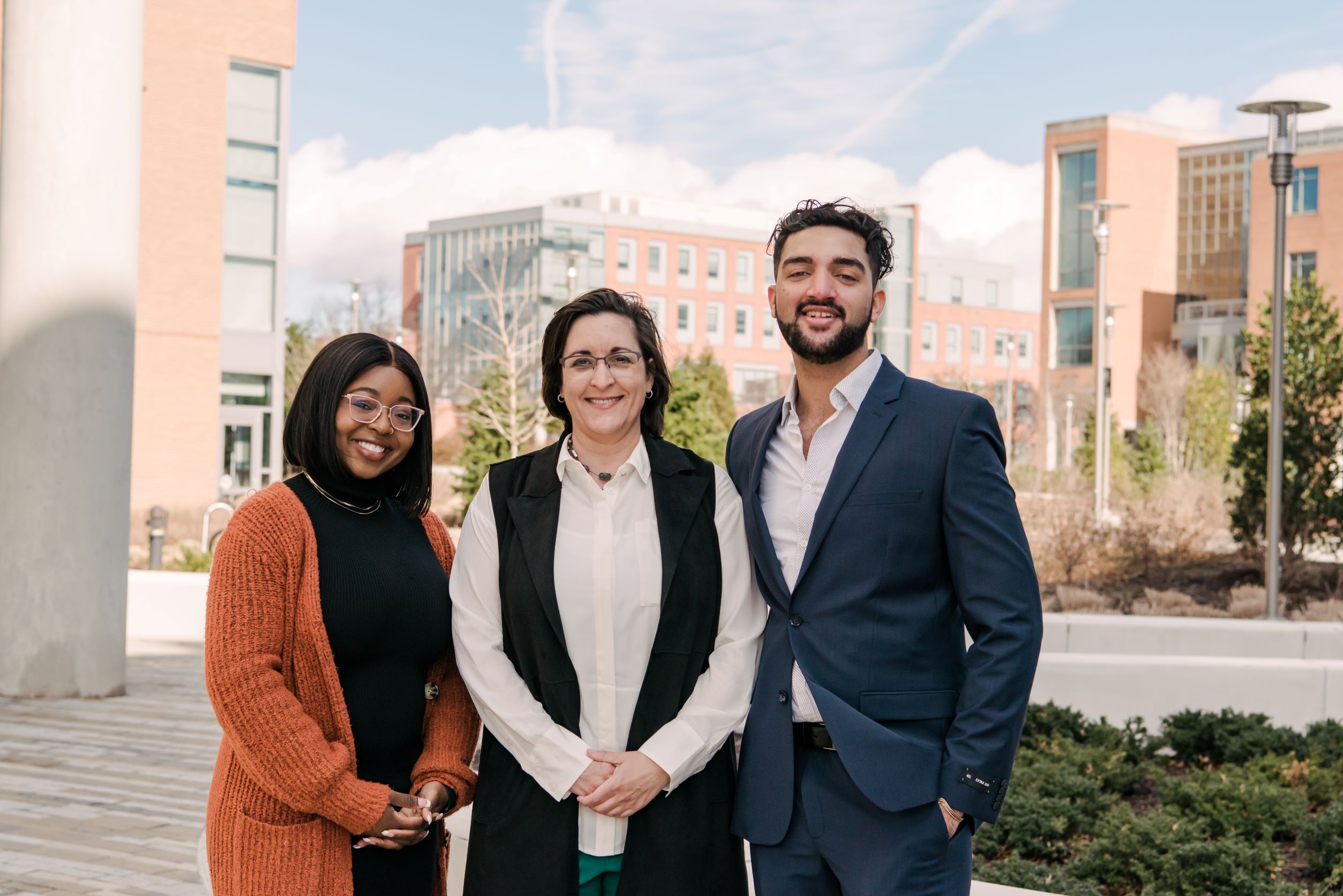 Adekoya (l), Householder (c), and Liaqat (r).
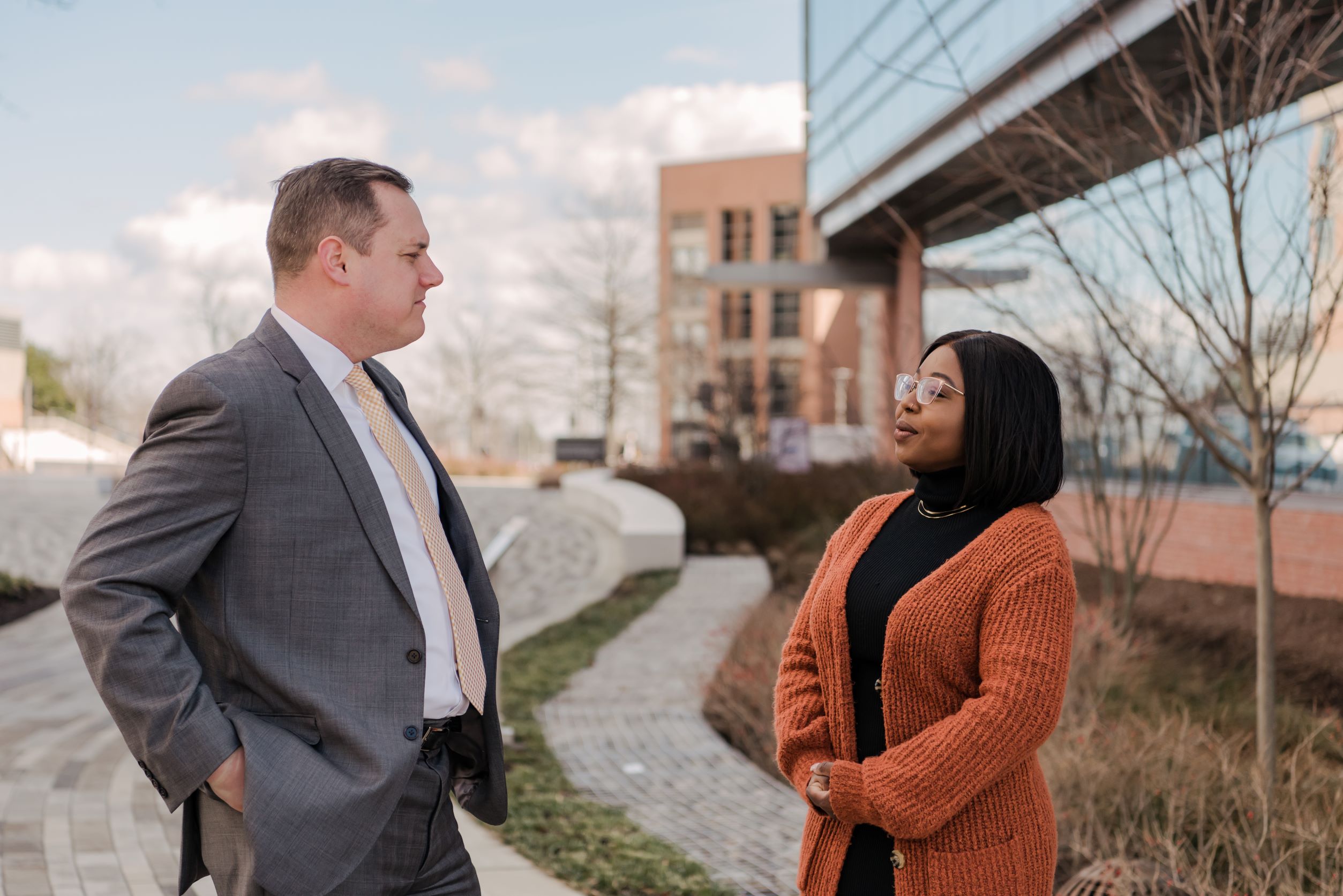 Adekoya (r) with Josh Michael ’10, political science and education, director of Baltimore school partnerships for UMBC’s Sherman STEM Teacher Scholars Program.
 Adekoya (r) with Jasmine Lee.
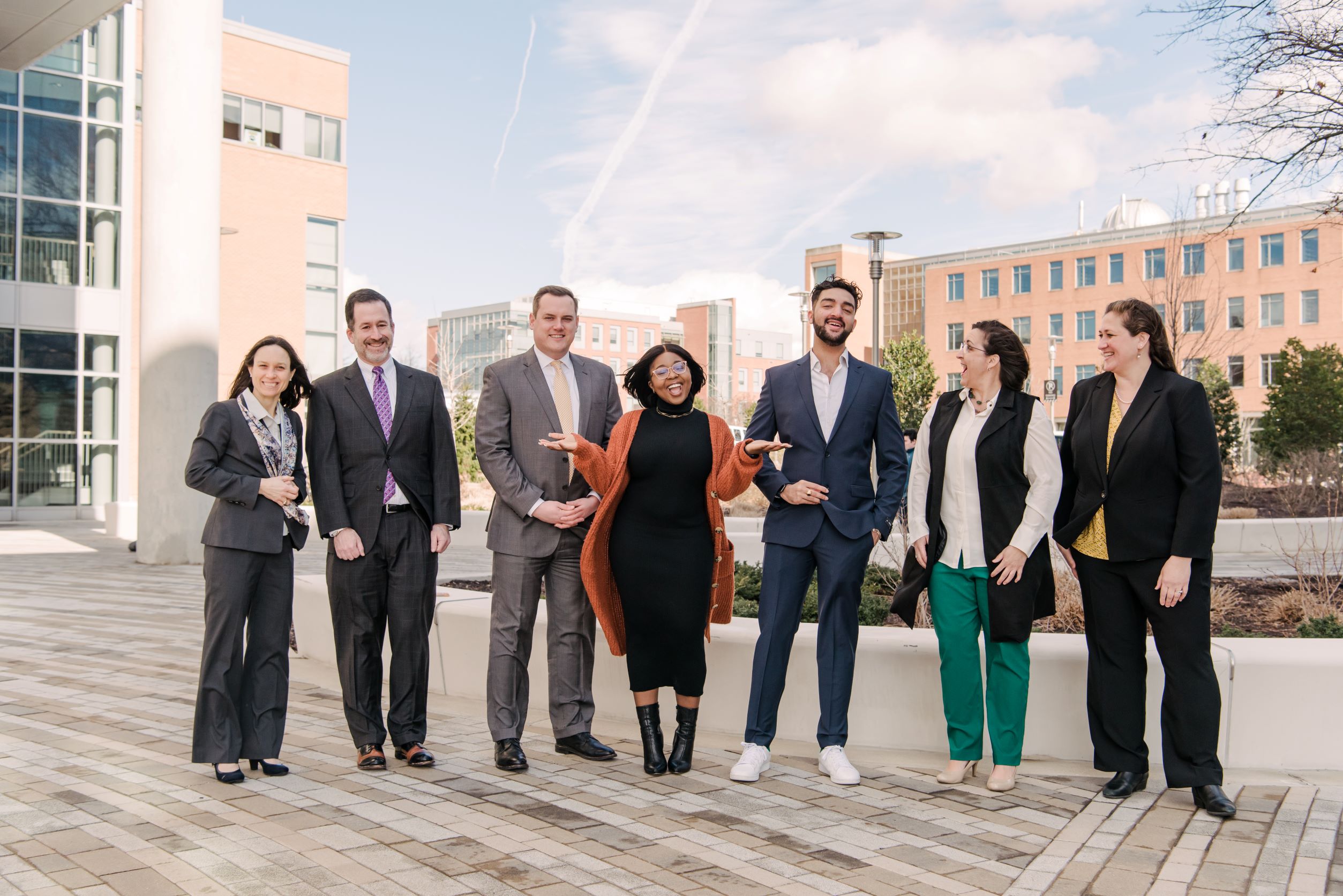 Adekoya and Liqat (center) with their mentors: (l-r) Laura Antkowiak, associate professor of political science and director of the Sondheim Scholars Program; David Hoffman, Ph.D. ’13, language, literacy, and culture, director of the Center for Democracy and Civic Life; Michael; Householder; and Lori Hardesty, associate director of applied learning and engagement at the Shriver Center.