Laughing in the dark—UMBC’s Erin Hogan writes about Spain’s cinema after Franco
Asking Erin Hogan to choose her favorite film is like asking her whether she prefers to study Iberian or Latin American films—both of which she researches and fell in love with as an undergrad. The real answer is that Hogan’s favorite film is whatever film she is studying at the time. For her new book, Patriarchy’s Remains: An Autopsy of Iberian Cinematic Dark Humour (2024), she capped the list at 14 films between 1958 and 2018, whose characters must deal with the death of the male head of household. Hogan uses the visions of 14 diverse directors to study cinematic dark humor through a feminist, biopolitical, and socio-economic inequality lens.
“My work is pretty transversal, not exclusive to writing books about one director, one creator, one film, or one novel. I enjoy analyzing multiple sources and finding the patterns across texts. In this case, I focus on films with dark humor,” said Hogan, a professor of Spanish. Dark humor blends humor with grim topics like death, violence, crime, and social dysfunction through wit, irony, or satire.
“I’ve always been interested in dark humor. When I explain to my students why I study a wide range of texts, films, and languages—Spanish, Italian, Catalan, Portuguese, and most recently, Galego, the language of Galicia in Northwestern Spain—it always comes back to the joy of learning. I encourage students to ask themselves what they want to explore, learn, or know more about, and then to pursue it.”
Spain’s cinema 50 years later
The question Hogan pursues in Patriarchy’s Remains is how and why the legacy of Francisco Franco, Spain’s fascist, repressive, and violent dictator who ruled Spain from 1939 until his death in 1975, continues to impact Spain’s work toward democracy—even 50 years after his death on November 20, 1975.
“I’ve always been interested in dark humor. When I explain to my students why I study a wide range of texts, films, and languages—Spanish, Italian, Catalan, Portuguese, and most recently, Galego, the language of Galicia in Northwestern Spain—it always comes back to the joy of learning. I encourage students to ask themselves what they want to explore, learn, or know more about, and then to pursue it.”
Erin Hogan
associate professor of Spanish
“Patriarchy’s Remains has two meanings. One refers to the on-screen corpse of the patriarch and the other to the persistence of patriarchy in Spain today,” writes Hogan in her book. She draws parallels between the families in the films—who must figure out how to live after the patriarch they depended on dies or is killed—and Spain’s citizens, who are still working to understand what a functioning democracy looks like.
“In critiquing Spanish politics, I aim to highlight how Spanish democracy could better serve its people by heeding the protests of its own citizens, on and off screen,” writes Hogan. “Patriarchy’s Remains reveals persisting inequities in post-Franco Spain to shine a light on the disenfranchised children of democracy who grieve for the unfulfilled promises of greater civil liberties and improved quality of life.”
Interested in learning more about Iberian or Latin American film? Hogan is the co-founder and co-curator of CineMaestro an open-access collaborative digital project designed to promote audiovisual literacy and intercultural competencies through the study and teaching of the cinemas by Spanish, Latin American, and Latinx directors.
]]>
Asking Erin Hogan to choose her favorite film is like asking her whether she prefers to study Iberian or Latin American films—both of which she researches and fell in love with as an undergrad....
https://umbc.edu/stories/erin-hogan-spains-cinema-after-franco/
https://my3.my.umbc.edu/api/v0/pixel/news/155348/guest@my.umbc.edu/4e3b5c8704ab6ce322b0e85698fbd755/api/pixel
arts-and-culture
cahss
cahss-research
humanitiesbooks
mlli
news
spanish
story
UMBC News & Magazine
https://my3.my.umbc.edu/groups/umbc-news-magazine
https://assets1-my.umbc.edu/system/shared/avatars/groups/000/001/943/24435aa6207c452e7bc15cc74b42c7bb/xsmall.png?1748556657
https://assets1-my.umbc.edu/system/shared/avatars/groups/000/001/943/24435aa6207c452e7bc15cc74b42c7bb/original.png?1748556657
https://assets2-my.umbc.edu/system/shared/avatars/groups/000/001/943/24435aa6207c452e7bc15cc74b42c7bb/xxlarge.png?1748556657
https://assets2-my.umbc.edu/system/shared/avatars/groups/000/001/943/24435aa6207c452e7bc15cc74b42c7bb/xlarge.png?1748556657
https://assets3-my.umbc.edu/system/shared/avatars/groups/000/001/943/24435aa6207c452e7bc15cc74b42c7bb/large.png?1748556657
https://assets1-my.umbc.edu/system/shared/avatars/groups/000/001/943/24435aa6207c452e7bc15cc74b42c7bb/medium.png?1748556657
https://assets2-my.umbc.edu/system/shared/avatars/groups/000/001/943/24435aa6207c452e7bc15cc74b42c7bb/small.png?1748556657
https://assets1-my.umbc.edu/system/shared/avatars/groups/000/001/943/24435aa6207c452e7bc15cc74b42c7bb/xsmall.png?1748556657
https://assets2-my.umbc.edu/system/shared/avatars/groups/000/001/943/24435aa6207c452e7bc15cc74b42c7bb/xxsmall.png?1748556657
UMBC News & Magazine
0
0
false
Tue, 16 Dec 2025 12:59:17 -0500
Tue, 16 Dec 2025 12:59:17 -0500
Retrievers learn the art and heart of cooking Salvadoran food at True Grit’s Test Kitchen
“Recipes are like an address to a homeland, but they’re also very personal to your own story,” said Karla T. Vasquez, author of The SalviSoul Cookbook, in True Grit’s Test Kitchen. Celia Bonilla, a business technology administration sophomore, grinned and nodded—the addresses for her own recipes come from El Salvador and Maryland. Bonilla joined other UMBC students earlier this fall for the “More than Pupusas” cooking demonstration, sponsored by the Dresher Center for the Humanities, to learn how to cook Salvadoran street food.
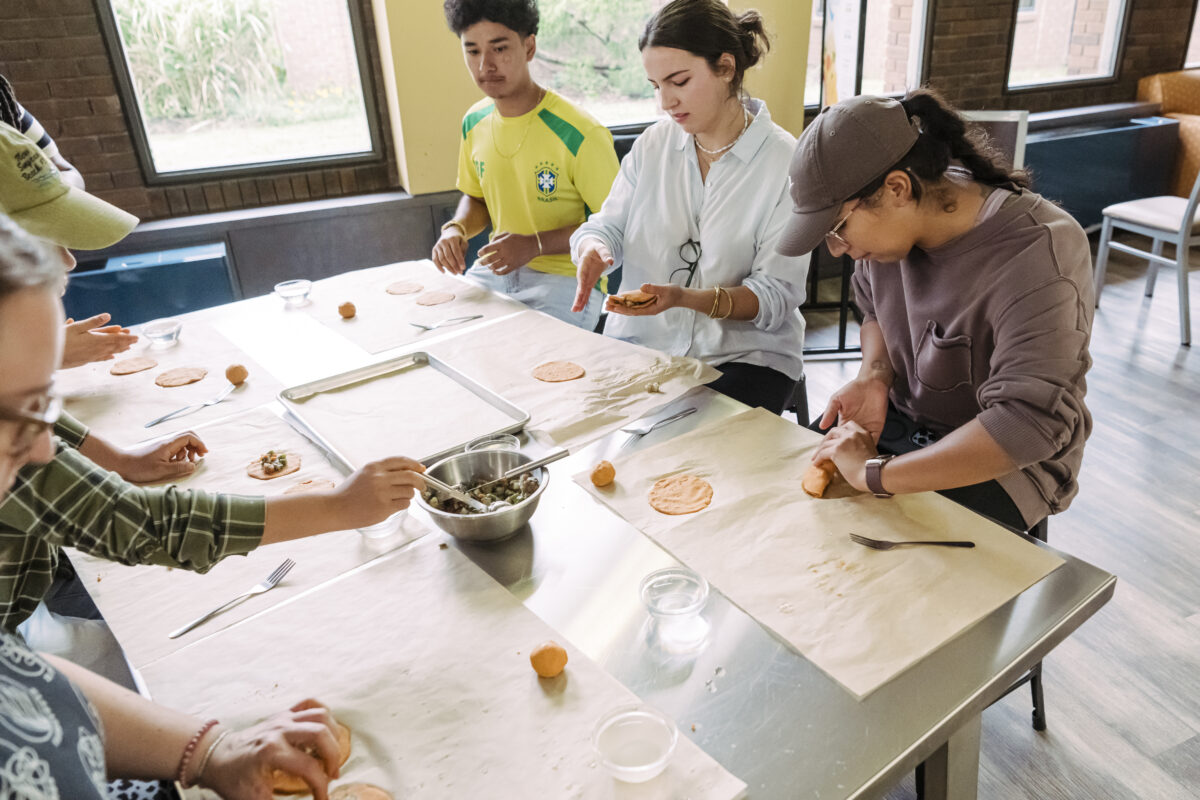
Bonilla sat at one of two tables set with brown butcher paper with her classmates, Stephania Fonseca, a social work sophomore, and Jeffrey Molina Soriano, a computer science junior. They also have roots in Maryland and El Salvador. “Pastelitos [pah-steh-lee-tos] means little pie and it’s the Salvadoran version of empanadas [em-pah-nah-dahs],” said Vasquez. “Empanadas are well known all over Latin America. Greeks, Italians, and other Europeans make meat pies, too.”
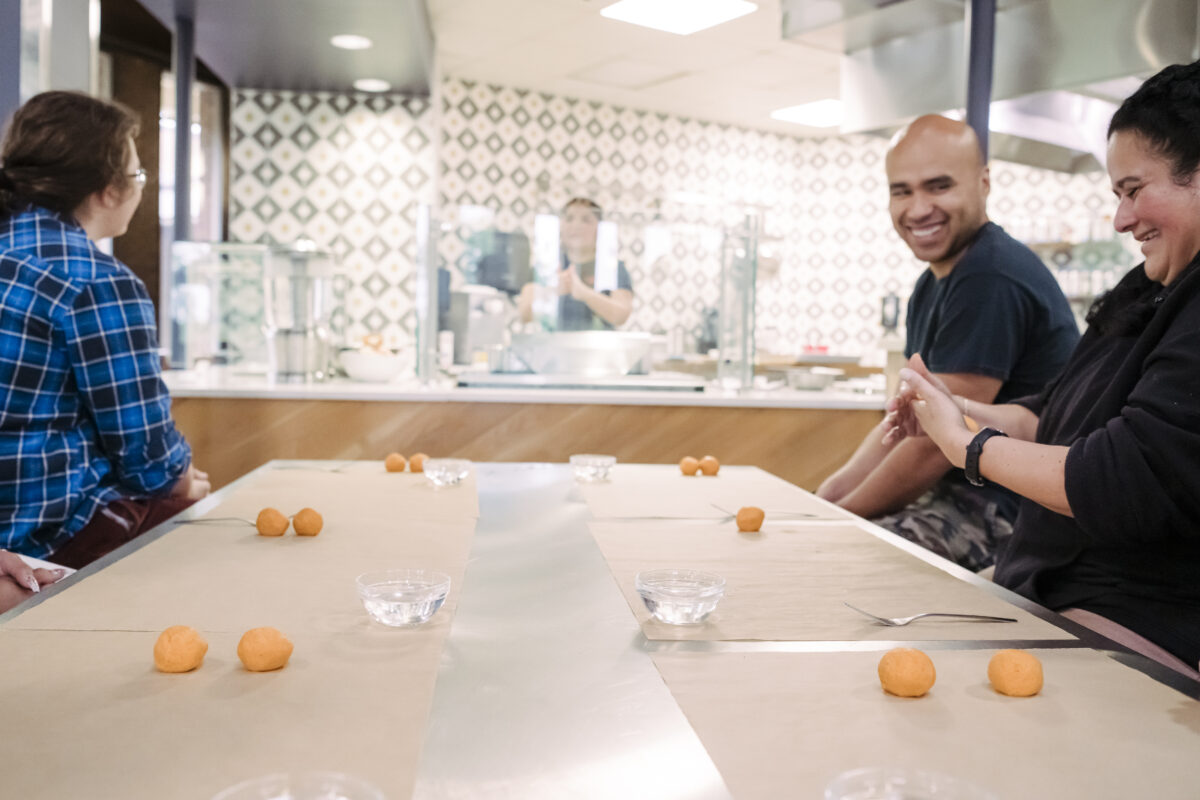 Celia Bonilla and Jeffrey Molina Soriano learn how to mold pastelito dough. (Marlayna Demond ’11/UMBC)
Like many Salvadoran students at UMBC, their journeys to UMBC are as complex as the ingredients they use for this meal. “Sometimes Hispanic Heritage Month events portray Latinx culture as a monolith, often focusing on the Caribbean or Mexican American experience,” said Courtney C. Hobson ’10, M.A. ’14, history, program manager at the James T. and Virginia M. Dresher Center for the Humanities. “I grew up in Prince George’s County, Maryland, where a significant part of the Latinx immigrant community comes from Central America, specifically El Salvador. Many of our Latinx students have roots in Central America—I wanted to organize an event that celebrated the rich culture they represent.”
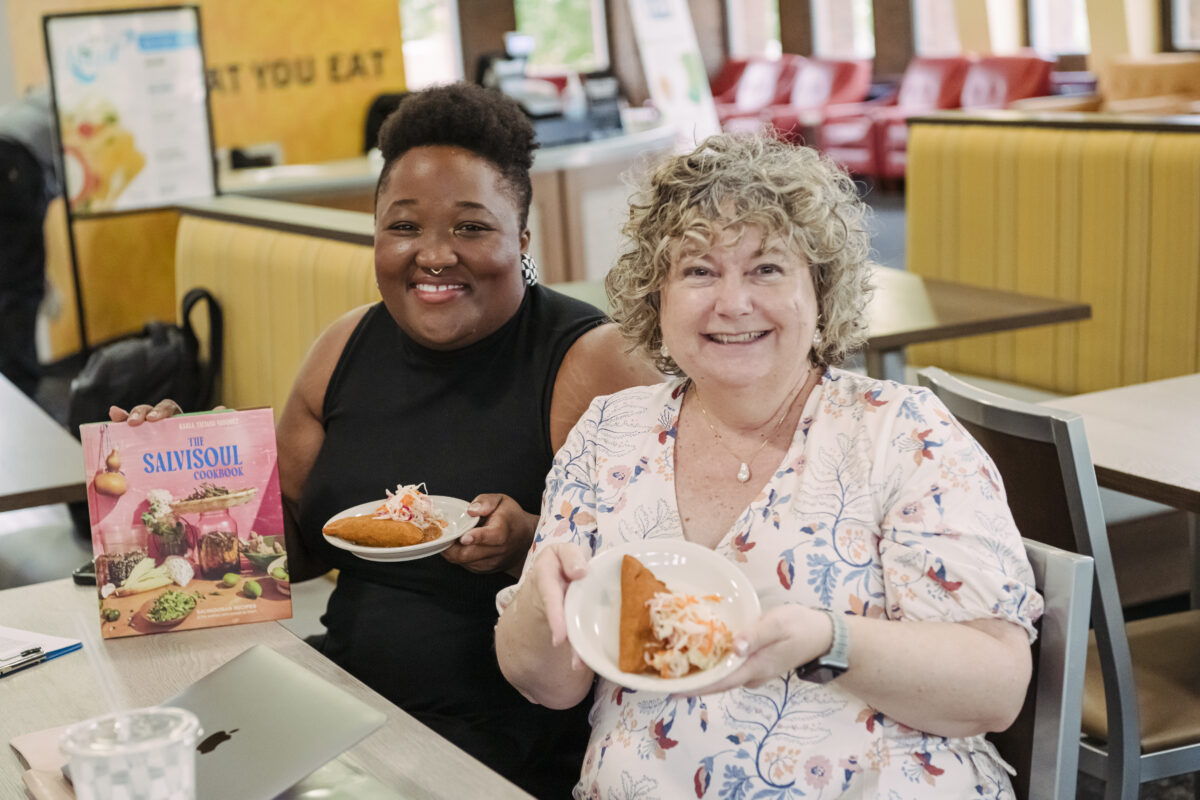 (l-r): Courtney C. Hobson and Amy Froide, professor of history and director of the Dresher Center for the Humanities. (Marlayna Demond ’11/UMBC)
“I came here when I was six years old from El Salvador,” said Bonilla, who attended the event as part of an assignment for the Spanish for Heritage Spanish Speakers class. Students must participate in two on-campus and two off-campus cultural events that celebrate Hispanic/Latinx culture. While Bonilla is familiar with campus events as the parent of a UMBC alum Jasmine Esmeralda Bonilla ’21, chemical engineering, this event felt different. “This class gives me a chance to learn more about my culture and language by engaging with people from various countries and age groups.”
Culinary traditions
Most students at the event said they had eaten pupusas (puh-poo-suhz) at home or at a restaurant. This flat corn flour cake, stuffed with cheese, beans, and sometimes meat is the national dish of El Salvador. “I have an aunt who is from El Salvador. She taught my mom, and then my mom taught me how to make pupusas with my sister,” said Fonseca. “My dad is from El Salvador, and my mom is from Mexico. We learned to make pupusas together as a family. So it became a typical food from my home.”
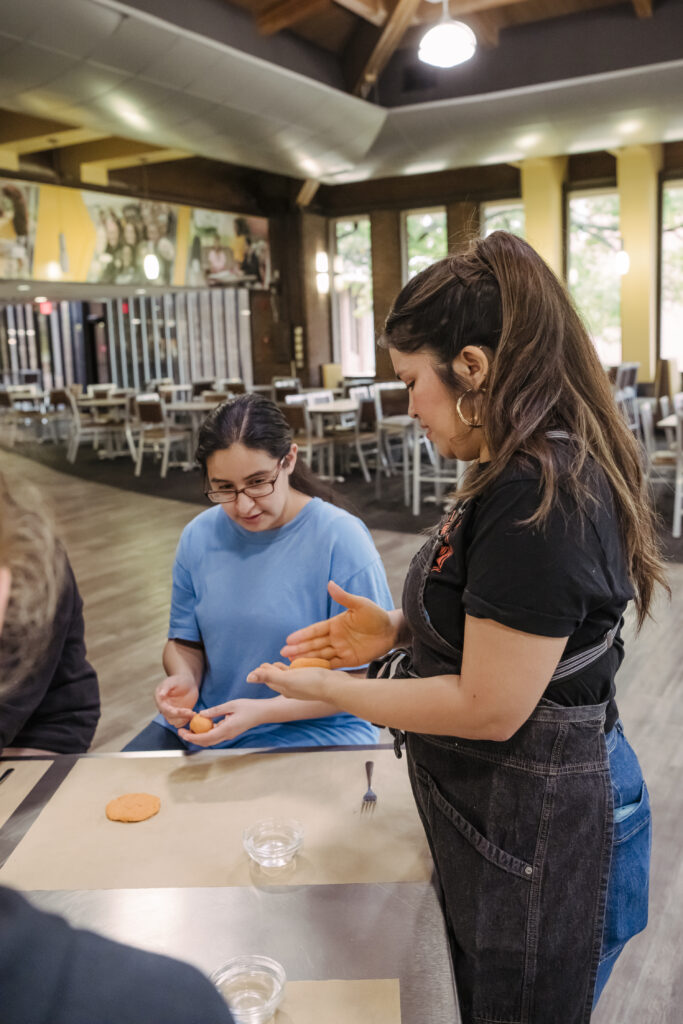
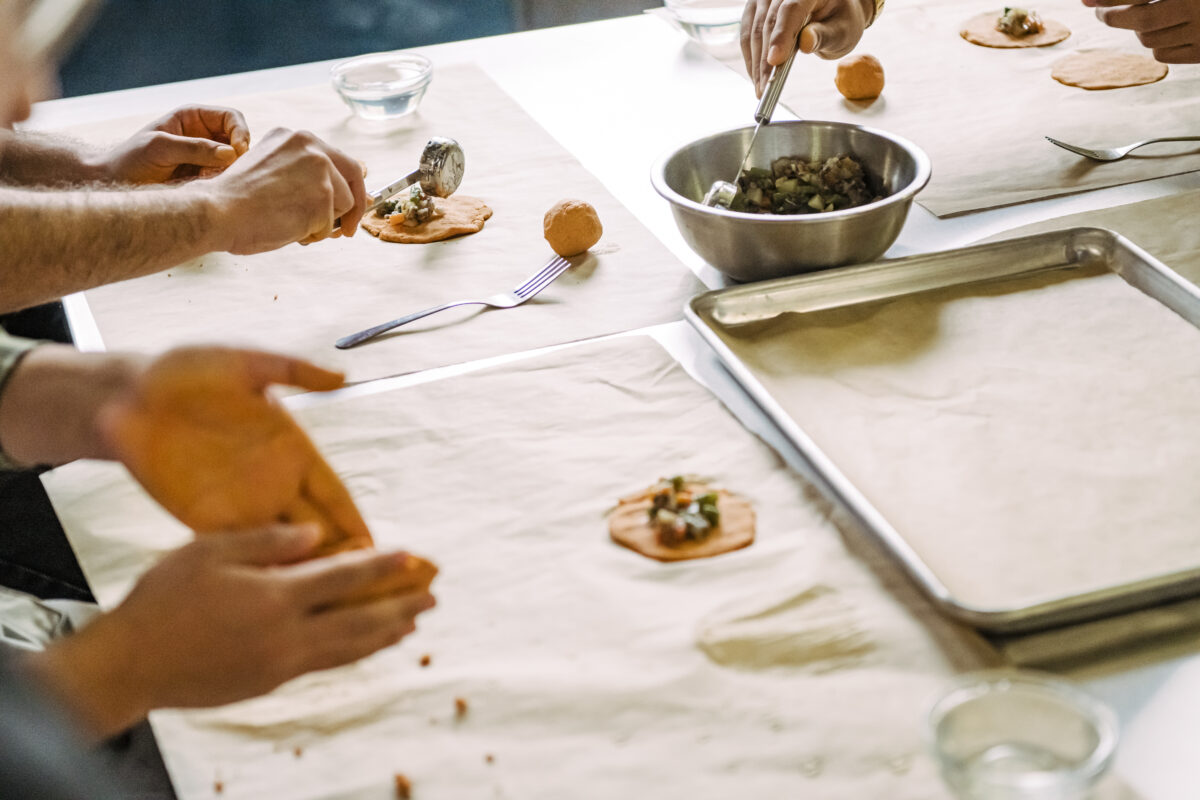
 (l-r): Stephania Fonseca watches Vasquez fold the dough to make a pocket. Students fill the pastelitos with a mushroom filling. (Marlayna Demond ’11/UMBC)
As students kneaded the dough into a palm-sized disc, filled it with sautéed mushrooms, and pinched the edges to seal the pastelitos, they also shared what food meant to them in the context of their family and student life. A clear theme emerged, culinary traditions can extend beyond the kitchen. “We have the Philly pretzel factory. I’ve never been able to find a soft pretzel as good as the Philly Pretzel Factory,” said Ashley Gutshall about her hometown of Royersford, Pennsylvania. Gutshall, a history and Spanish sophomore, shares, “It’s our family tradition to get Philly soft pretzels after doctor’s appointments.”
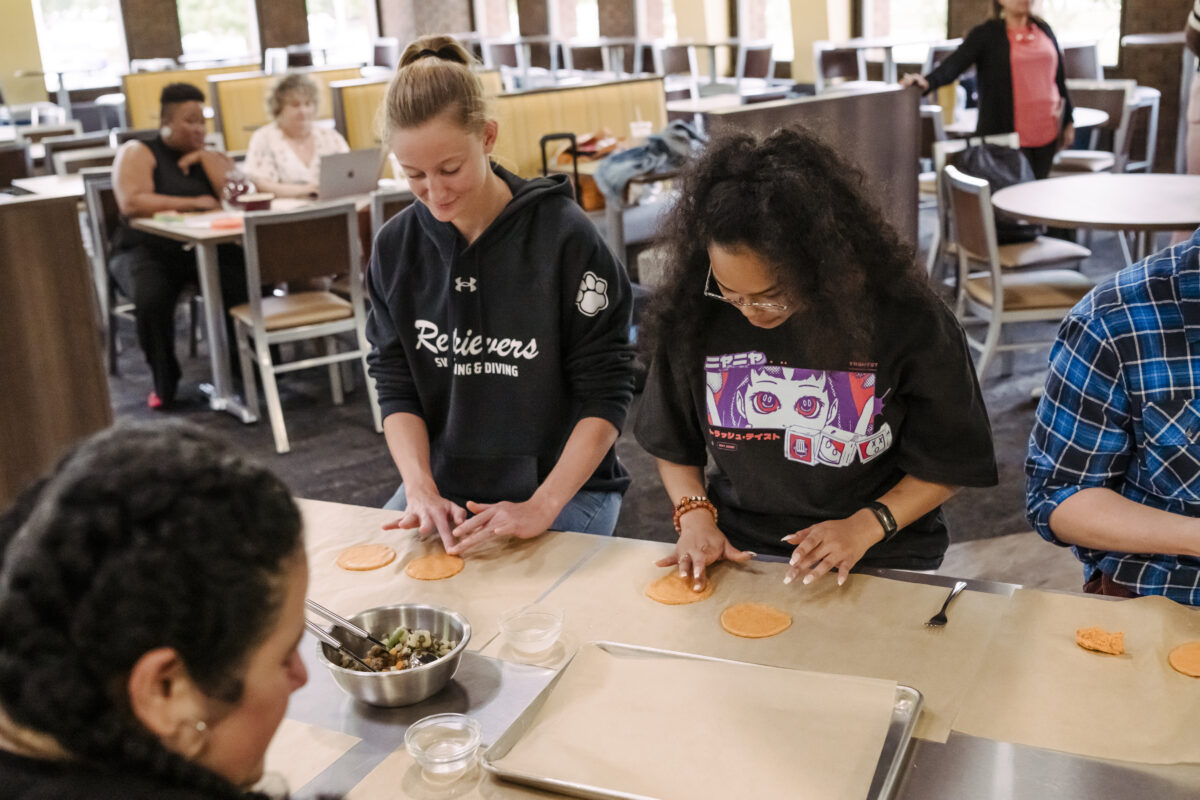 (l): Ashley Gutshall presses dough into a circular shape to make a pastelito. (Marlayna Demond ’11/UMBC)
Snack routines also create taste memories. “I was born in El Salvador during the Civil War [1980-1992] but was raised in Los Angeles. I would often fantasize about the routines my family would have had if they had been able to stay in their homeland,” said Vasquez, as she cooked down strawberries that she used to sweeten a large container of water filled with chan seeds—similar to chia seeds in texture and nutrition. “Fresco de chan satisfied that question for me because it’s a drink students have after school,” said Vasquez.
Food as a cultural bridge
Dishes are a fingerprint of a family’s traditions and tastes that can also serve as a timeline marking the evolution of ingredients locally and globally. “When my mom hears of these new trending food ingredients like chia seeds or quinoa,” says Vasquez, “she argues that they have been used in El Salvador and Central American communities for a long time.”
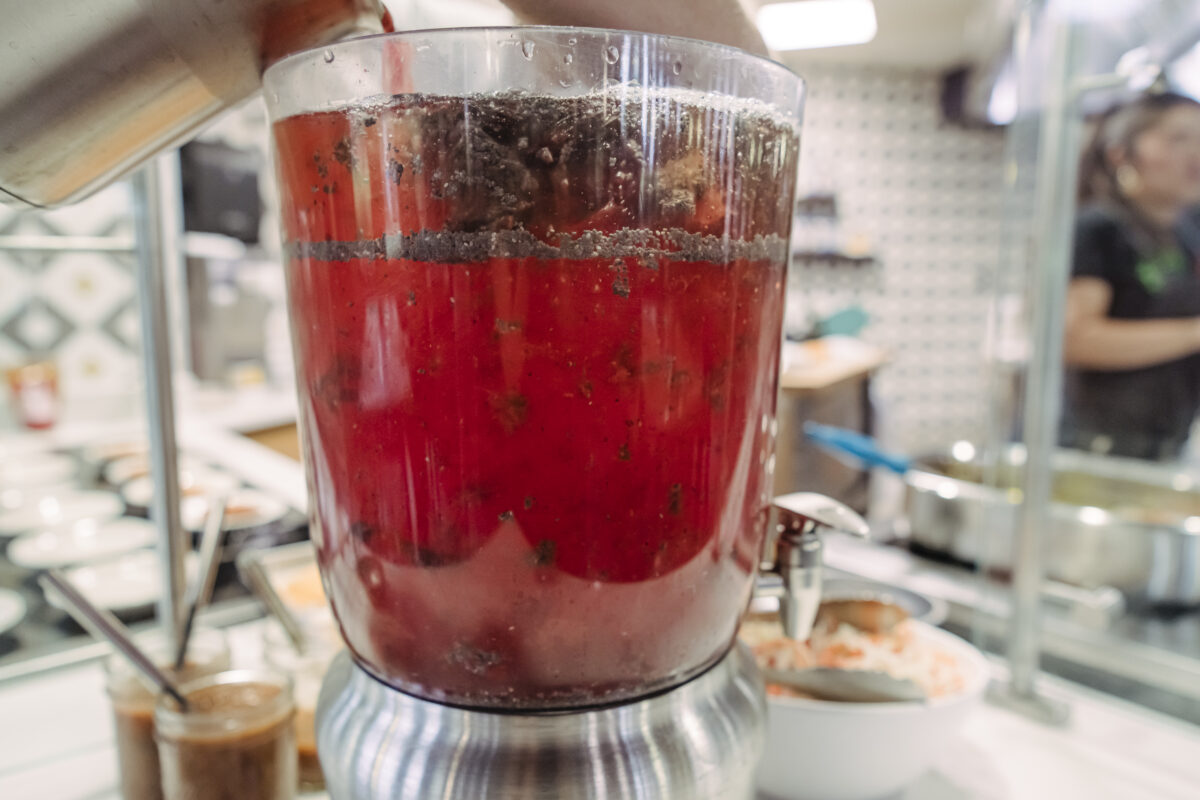
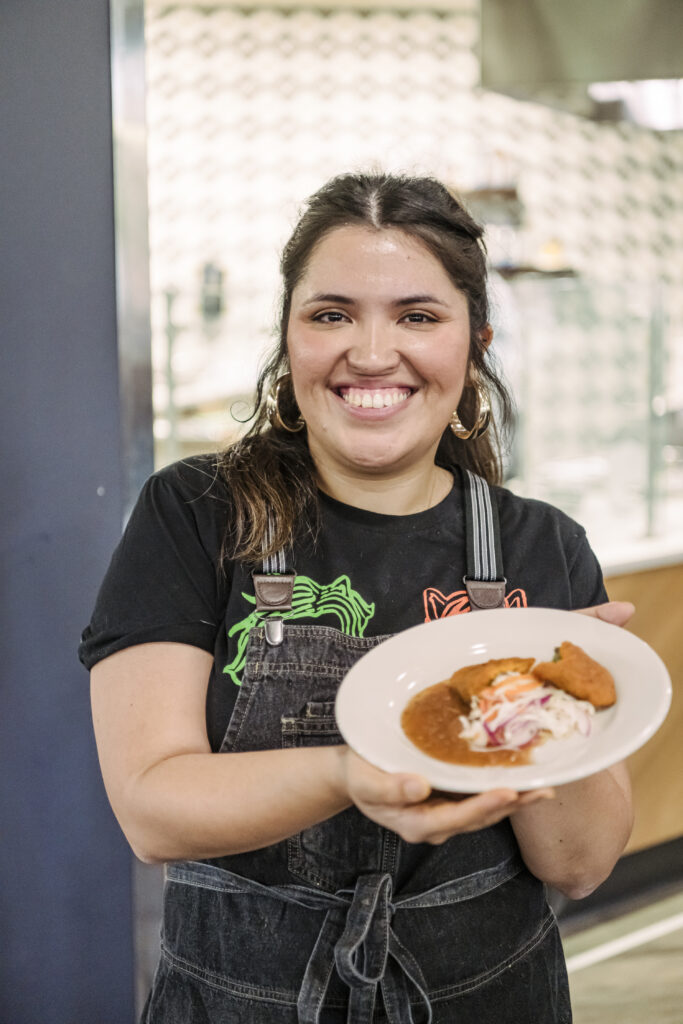
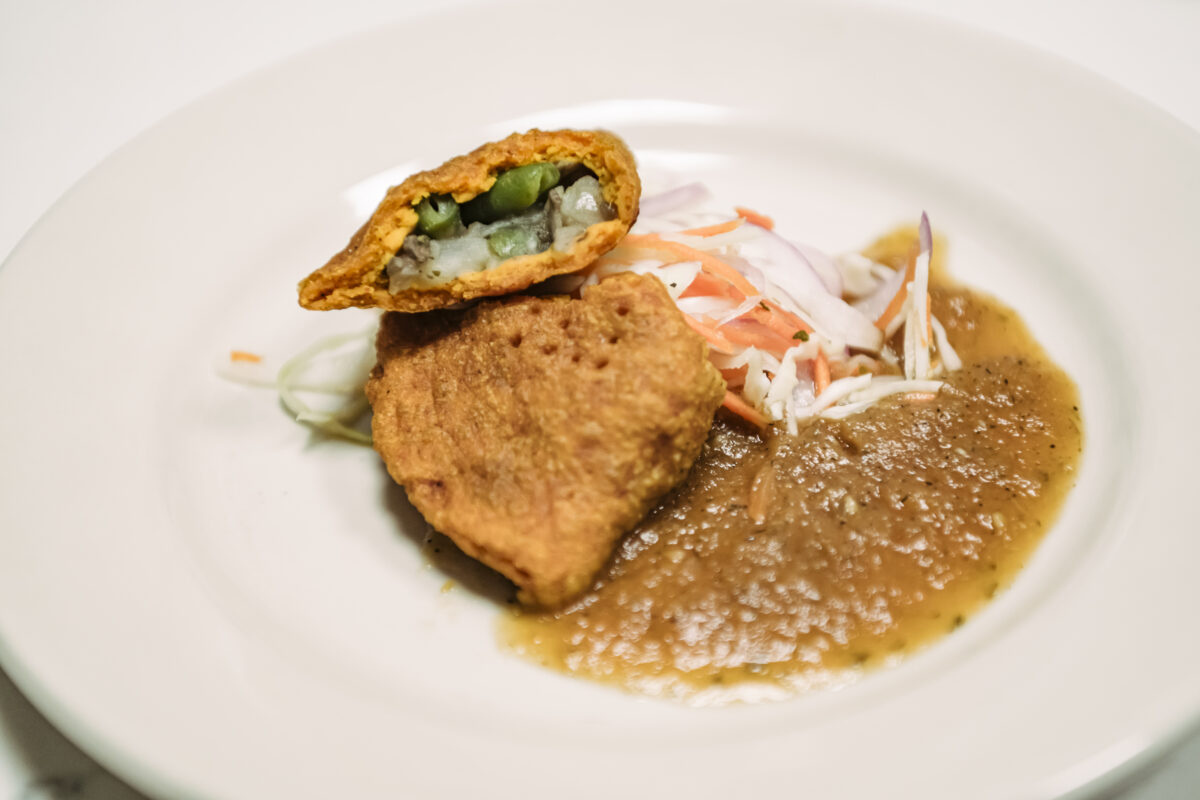 (l-r): Fresco de chan. Karla T. Vasques presents a Salvadoran mushroom pastelito with salsa and slaw. (Marlayna Demond ’11/UMBC)
Whether savory or sweet, the names of foods and spices across Latin America, and the dishes they inspire, are rooted in indigenous, African, and European languages and culinary traditions often fused to create unique dishes with local variations. Vasquez noted that achiote [ah-chee-oh-teh], the spice used to season and enhance the yellow color of the corn flour dough for the pastelitos, is a Nahuat word. Nahuat is a widely spoken indigenous language in Mexico and Central America. The rich legacy of Salvadoran food is seldom recognized alongside Western cuisine, even though many of its ingredients are sourced from the Global South—reinforcing cultural divisions. The Dresher Center’s “More than Pupusas” cooking event aimed to bridge this gap and celebrate the cultural footprint of Salvadoran cuisine.
“I interviewed more than 100 women while I’ve been working on this project. It’s taken me nine years,” says Vasquez about her recent release, The SalviSoul Cookbook. “I wanted to make sure that we’re giving credit where credit is due.”
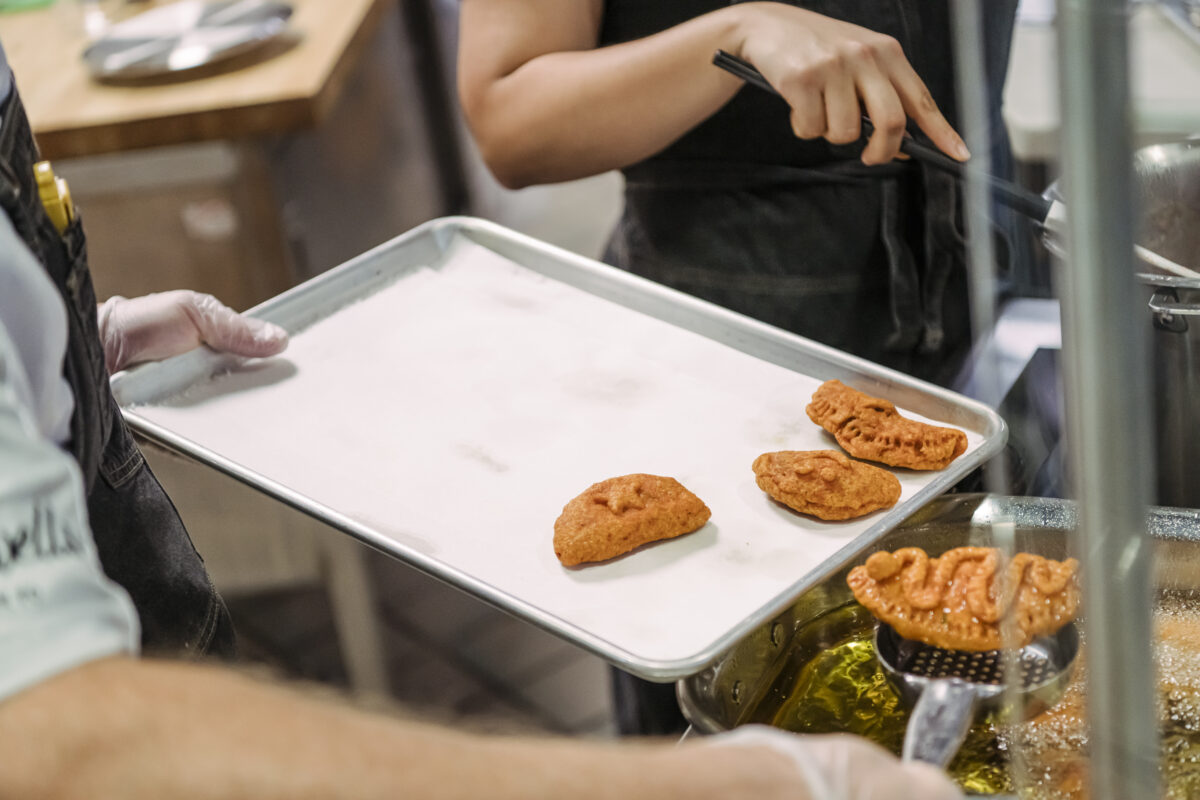
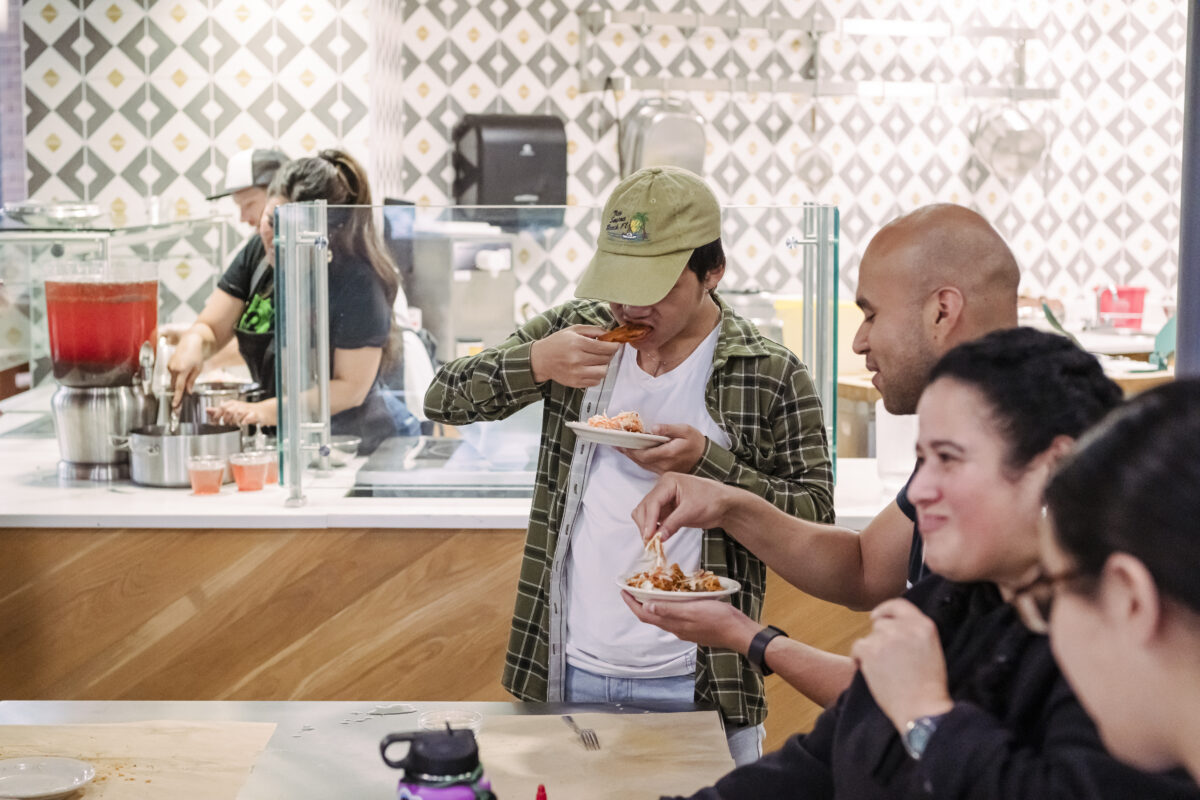
(r): Bonilla and Molina Soriano taste the fried pastelitos. (Marlayna Demond ’11/UMBC)
The tasters and aspiring chefs were grateful to be part of the long tradition of communities brought together across borders and time to learn, cook, and share a meal with new and old friends. They stamped their seal of approval with dough—a squiggly line, a star, a smile—sealing each pastelito with personal flair.
]]>
“Recipes are like an address to a homeland, but they’re also very personal to your own story,” said Karla T. Vasquez, author of The SalviSoul Cookbook, in True Grit’s Test Kitchen. Celia Bonilla,...
https://umbc.edu/stories/retrievers-learn-to-cook-salvadoran-food/
https://my3.my.umbc.edu/api/v0/pixel/news/145379/guest@my.umbc.edu/0e0931c682bcda13e479d7afdd5d4a25/api/pixel
business-technology-administration
cahss
campus-life
chemical-engineering
computer-science
dresher-center
history
magazine
mlli
spanish
story
UMBC News & Magazine
https://my3.my.umbc.edu/groups/umbc-news-magazine
https://assets1-my.umbc.edu/system/shared/avatars/groups/000/001/943/24435aa6207c452e7bc15cc74b42c7bb/xsmall.png?1748556657
https://assets1-my.umbc.edu/system/shared/avatars/groups/000/001/943/24435aa6207c452e7bc15cc74b42c7bb/original.png?1748556657
https://assets2-my.umbc.edu/system/shared/avatars/groups/000/001/943/24435aa6207c452e7bc15cc74b42c7bb/xxlarge.png?1748556657
https://assets2-my.umbc.edu/system/shared/avatars/groups/000/001/943/24435aa6207c452e7bc15cc74b42c7bb/xlarge.png?1748556657
https://assets3-my.umbc.edu/system/shared/avatars/groups/000/001/943/24435aa6207c452e7bc15cc74b42c7bb/large.png?1748556657
https://assets1-my.umbc.edu/system/shared/avatars/groups/000/001/943/24435aa6207c452e7bc15cc74b42c7bb/medium.png?1748556657
https://assets2-my.umbc.edu/system/shared/avatars/groups/000/001/943/24435aa6207c452e7bc15cc74b42c7bb/small.png?1748556657
https://assets1-my.umbc.edu/system/shared/avatars/groups/000/001/943/24435aa6207c452e7bc15cc74b42c7bb/xsmall.png?1748556657
https://assets2-my.umbc.edu/system/shared/avatars/groups/000/001/943/24435aa6207c452e7bc15cc74b42c7bb/xxsmall.png?1748556657
UMBC News & Magazine
1
0
false
Tue, 05 Nov 2024 16:30:49 -0500
Retrievers learn the art and heart of cooking Salvadoran food at True Grit’s Test Kitchen
“Recipes are like an address to a homeland, but they’re also very personal to your own story,” said Karla T. Vasquez, author of The SalviSoul Cookbook, in True Grit’s Test Kitchen. Celia Bonilla, a business technology administration sophomore, grinned and nodded—the addresses for her own recipes come from El Salvador and Maryland. Bonilla joined other UMBC students earlier this fall for the “More than Pupusas” cooking demonstration, sponsored by the Dresher Center for the Humanities, to learn how to cook Salvadoran street food.
Bonilla sat at one of two tables set with brown butcher paper with her classmates, Stephania Fonseca, a social work sophomore, and Jeffrey Molina Soriano, a computer science junior. They also have roots in Maryland and El Salvador. “Pastelitos [pah-steh-lee-tos] means little pie and it’s the Salvadoran version of empanadas [em-pah-nah-dahs],” said Vasquez. “Empanadas are well known all over Latin America. Greeks, Italians, and other Europeans make meat pies, too.”
Celia Bonilla and Jeffrey Molina Soriano learn how to mold pastelito dough. (Marlayna Demond ’11/UMBC)
Like many Salvadoran students at UMBC, their journeys to UMBC are as complex as the ingredients they use for this meal. “Sometimes Hispanic Heritage Month events portray Latinx culture as a monolith, often focusing on the Caribbean or Mexican American experience,” said Courtney C. Hobson ’10, M.A. ’14, history, program manager at the James T. and Virginia M. Dresher Center for the Humanities. “I grew up in Prince George’s County, Maryland, where a significant part of the Latinx immigrant community comes from Central America, specifically El Salvador. Many of our Latinx students have roots in Central America—I wanted to organize an event that celebrated the rich culture they represent.”
(l-r): Courtney C. Hobson and Amy Froide, professor of history and director of the Dresher Center for the Humanities. (Marlayna Demond ’11/UMBC)
“I came here when I was six years old from El Salvador,” said Bonilla, who attended the event as part of an assignment for the Spanish for Heritage Spanish Speakers class. Students must participate in two on-campus and two off-campus cultural events that celebrate Hispanic/Latinx culture. While Bonilla is familiar with campus events as the parent of a UMBC alum Jasmine Esmeralda Bonilla ’21, chemical engineering, this event felt different. “This class gives me a chance to learn more about my culture and language by engaging with people from various countries and age groups.”
Culinary traditions
Most students at the event said they had eaten pupusas (puh-poo-suhz) at home or at a restaurant. This flat corn flour cake, stuffed with cheese, beans, and sometimes meat is the national dish of El Salvador. “I have an aunt who is from El Salvador. She taught my mom, and then my mom taught me how to make pupusas with my sister,” said Fonseca. “My dad is from El Salvador, and my mom is from Mexico. We learned to make pupusas together as a family. So it became a typical food from my home.”
(l-r): Stephania Fonseca watches Vasquez fold the dough to make a pocket. Students fill the pastelitos with a mushroom filling. (Marlayna Demond ’11/UMBC)
As students kneaded the dough into a palm-sized disc, filled it with sautéed mushrooms, and pinched the edges to seal the pastelitos, they also shared what food meant to them in the context of their family and student life. A clear theme emerged, culinary traditions can extend beyond the kitchen. “We have the Philly pretzel factory. I’ve never been able to find a soft pretzel as good as the Philly Pretzel Factory,” said Ashley Gutshall about her hometown of Royersford, Pennsylvania. Gutshall, a history and Spanish sophomore, shares, “It’s our family tradition to get Philly soft pretzels after doctor’s appointments.”
(l): Ashley Gutshall presses dough into a circular shape to make a pastelito. (Marlayna Demond ’11/UMBC)
Snack routines also create taste memories. “I was born in El Salvador during the Civil War [1980-1992] but was raised in Los Angeles. I would often fantasize about the routines my family would have had if they had been able to stay in their homeland,” said Vasquez, as she cooked down strawberries that she used to sweeten a large container of water filled with chan seeds—similar to chia seeds in texture and nutrition. “Fresco de chan satisfied that question for me because it’s a drink students have after school,” said Vasquez.
Food as a cultural bridge
Dishes are a fingerprint of a family’s traditions and tastes that can also serve as a timeline marking the evolution of ingredients locally and globally. “When my mom hears of these new trending food ingredients like chia seeds or quinoa,” says Vasquez, “she argues that they have been used in El Salvador and Central American communities for a long time.”
(l-r): Fresco de chan. Karla T. Vasques presents a Salvadoran mushroom pastelito with salsa and slaw. (Marlayna Demond ’11/UMBC)
Whether savory or sweet, the names of foods and spices across Latin America, and the dishes they inspire, are rooted in indigenous, African, and European languages and culinary traditions often fused to create unique dishes with local variations. Vasquez noted that achiote [ah-chee-oh-teh], the spice used to season and enhance the yellow color of the corn flour dough for the pastelitos, is a Nahuat word. Nahuat is a widely spoken indigenous language in Mexico and Central America. The rich legacy of Salvadoran food is seldom recognized alongside Western cuisine, even though many of its ingredients are sourced from the Global South—reinforcing cultural divisions. The Dresher Center’s “More than Pupusas” cooking event aimed to bridge this gap and celebrate the cultural footprint of Salvadoran cuisine.
“I interviewed more than 100 women while I’ve been working on this project. It’s taken me nine years,” says Vasquez about her recent release, The SalviSoul Cookbook. “I wanted to make sure that we’re giving credit where credit is due.”
(r): Bonilla and Molina Soriano taste the fried pastelitos. (Marlayna Demond ’11/UMBC)
The tasters and aspiring chefs were grateful to be part of the long tradition of communities brought together across borders and time to learn, cook, and share a meal with new and old friends. They stamped their seal of approval with dough—a squiggly line, a star, a smile—sealing each pastelito with personal flair.
]]>
“Recipes are like an address to a homeland, but they’re also very personal to your own story,” said Karla T. Vasquez, author of The SalviSoul Cookbook, in True Grit’s Test Kitchen. Celia Bonilla,...
https://umbc.edu/stories/teaching-pupusas/
https://my3.my.umbc.edu/api/v0/pixel/news/145381/guest@my.umbc.edu/9ca276cb76c35ec0df767c000aca50ec/api/pixel
business-technology-administration
cahss
campus-life
chemical-engineering
computer-science
dresher-center
history
magazine
mlli
spanish
story
UMBC News & Magazine
https://my3.my.umbc.edu/groups/umbc-news-magazine
https://assets1-my.umbc.edu/system/shared/avatars/groups/000/001/943/24435aa6207c452e7bc15cc74b42c7bb/xsmall.png?1748556657
https://assets1-my.umbc.edu/system/shared/avatars/groups/000/001/943/24435aa6207c452e7bc15cc74b42c7bb/original.png?1748556657
https://assets2-my.umbc.edu/system/shared/avatars/groups/000/001/943/24435aa6207c452e7bc15cc74b42c7bb/xxlarge.png?1748556657
https://assets2-my.umbc.edu/system/shared/avatars/groups/000/001/943/24435aa6207c452e7bc15cc74b42c7bb/xlarge.png?1748556657
https://assets3-my.umbc.edu/system/shared/avatars/groups/000/001/943/24435aa6207c452e7bc15cc74b42c7bb/large.png?1748556657
https://assets1-my.umbc.edu/system/shared/avatars/groups/000/001/943/24435aa6207c452e7bc15cc74b42c7bb/medium.png?1748556657
https://assets2-my.umbc.edu/system/shared/avatars/groups/000/001/943/24435aa6207c452e7bc15cc74b42c7bb/small.png?1748556657
https://assets1-my.umbc.edu/system/shared/avatars/groups/000/001/943/24435aa6207c452e7bc15cc74b42c7bb/xsmall.png?1748556657
https://assets2-my.umbc.edu/system/shared/avatars/groups/000/001/943/24435aa6207c452e7bc15cc74b42c7bb/xxsmall.png?1748556657
UMBC News & Magazine
0
0
false
Tue, 05 Nov 2024 16:30:49 -0500
Tue, 05 Nov 2024 16:30:49 -0500
Leaving a Legacy of Support for UMBC’s Hispanic/Latinx Community
Ana María Schwartz Caballero, associate professor of modern languages, linguistics, and intercultural communication, is retiring from UMBC after more than 25 years of service. “This was a very difficult decision but it was the right time for me to retire,” says Schwartz Caballero. “UMBC has been my home for many years.”
Schwartz Caballero joined UMBC in 1984 as a lecturer for Spanish language classes in the modern languages and linguistics department. She became an assistant professor in 1996, received tenure as associate professor in 2002, and chaired the department from 2006 – 2012. Schwartz Caballero was one of the first faculty members to teach Spanish to heritage Spanish speakers.
The many programs, initiatives, associations, and committees she has led and participated in have helped establish a network of support and guidance for the success of UMBC’s Hispanic/Latinx community. And her legacy will continue to have an impact as faculty and students she has mentored carry on her work.
In a recent farewell event honoring Schwartz Caballero, President Freeman Hrabowski thanked her for being the voice for so many in the Latinx/Hispanic community on campus, in Baltimore City, and the State of Maryland. “Ana María has changed the culture of UMBC,” shares Hrabowski. “She has brought such rich diversity, and she has broadened our thinking about the world.”
 Schwartz Caballero’s headshot by Marlayna Demond ’11.
Language learning research
Schwartz Caballero began her career at UMBC as a graduate assistant in the education department while completing her Ph.D. in second language education at the University of Maryland College Park. Soon after graduation, she became a Spanish and second language pedagogy instructor in what is now UMBC’s modern languages, linguistics, and intercultural communication (MLLI) department.
Her research focused on heritage Spanish speakers, language teaching, learning strategies, and curriculum development. In 2002, Schwartz Caballero’s co-authored textbook, Noticias: An Advanced Intermediate Content-Based Course, presented educators with a new approach to teaching Spanish. Instead of a grammar-centered, isolated approach, Schwartz Caballero found students learned Spanish best by reading current Spanish-language media articles from Spanish-language speaking countries. This way students learn grammar structure in context while at the same time learning about the culture and current events.
Schwartz Caballero has developed local, state, and national level professional development courses and instructional materials for Spanish language teachers. She has also provided research-based strategies for the integration and application of the National Standards for Foreign Language Learning.
Understanding heritage speakers
In addition to her research on teaching Spanish as a foreign language, Schwartz Caballero’s work has helped develop best practices to support the learning needs of heritage Spanish speakers learning Spanish and other subjects. As a Spanish language heritage speaker herself from Cuba, Schwartz Caballero has a personal understanding of the complex needs heritage speakers face in the classroom.
 Schwartz Caballero with Ana Oskoz, the current chair of MLLI, on UMBC’s Immigrant Recognition Day in 2017. Photo courtesy of Schwartz Caballero.
She knows Hispanic/Latinx students who come to the U.S. as refugees, like she did when she left Cuba as a teenager, and those who immigrate or are born in the U.S. must grapple with their own diverse social-cultural identities in a country that often homogenizes their languages, race, cultures, and experiences. Her work has helped prepare student teachers and in-service educators with the skills necessary to support the learning needs of heritage Spanish speakers in a variety of contexts.
Schwartz Caballero also teaches educators how to be advocates. “Being an advocate for students,” she says, “can be the difference between a student graduating or dropping out. It is as important as their academic success.” She notes that teachers need to learn about the challenges Latinx/Hispanic students face beyond the classroom. Schwartz Caballero advocates educators to be understanding of a number of Latinx/Hispanic students who are often balancing work, family responsibilities, and financial hardships that hamper their success and can delay graduation.
Schwartz Caballero has been the faculty advisor to UMBC’s undergraduate Latino/Hispanic Union since 1997 and a founding member of the Latinx/Hispanic Admissions Advisory Group which develops best practices in recruitment and admissions.
Working with doctoral students
In addition to her work with undergraduate students, Schwartz Caballero also worked with many graduate and doctoral students, helping them navigate the field and prepare for the next steps of their careers. For many doctoral students, she was also a compassionate ear, a cheerleader, and like family in the most challenging of times—she helped them find solutions to move forward. Adriana Medina, M.A. ’99, intercultural communication, Ph.D. ’04, language, literacy, and culture, one of many doctoral students Schwartz Caballero has advised, credits Schwartz Caballero for her own success in the classroom. “Ana María has been such a fantastic role model as an educator,” shares Medina. “She is empathetic, compassionate, generous, and also tough at times while also encouraging you. Now, I have been able to be that for my students.”
“Ana María knew who I was, she knew my name, and my department. She made me feel so welcome…we are her legacy.”
María Célleri, assistant professor in gender, women’s, and sexuality studies
Luis Carcamo, M.A. ’95, intercultural communication, remembers how Schwartz Caballero “showed me the ropes of how teaching is done.” Now, in his 25th year of teaching, Carcamo has taken what he learned at UMBC to the southernmost tip of Latin America. “My city is the last city in South America. Ana María’s teachings reached not only the rest of the U.S. but also the rest of our America,” shares Carcamo.
In 2007, UMBC’s Chapter of Black and Latino Alumni awarded Schwartz Caballero with the Legends of Excellence Award: 40 Years of Inspiring African American and Latino Students.
Supporting faculty
Schwartz Caballero has worked tirelessly alongside Hispanic/Latinx faculty and UMBC leadership to recruit and retain Latinx/Hispanic faculty and support UMBC’s diversity initiatives. She was co-chair, with Philip Rous, provost and senior vice president for academic affairs, of UMBC’s Executive Committee on the Recruitment and Retention of Underrepresented Minority Faculty, and has been the president of the Hispanic-Latino Faculty Association for 10 years.
Through the Executive Committee, founded in 2011, UMBC has hosted 20 fellows from diverse backgrounds, including five who identify as Latinx. Two of these fellows are now UMBC faculty members, Fernando Tormos-Aponte, assistant professor of public policy, and Erika Fountain, assistant professor of psychology.
 Schwartz Caballero at a 2019 Humanities Forum with (l-r) Thania Muñoz
,
María Martha Manni,
Mayra Santos-Febres, Tania Lizarazo, and María Célleri. Photo courtesy of Schwartz Caballero.
As the lead organizer for the Hispanic Heritage Month speaker, part of the Dresher Center for the Humanities Forum, Schwartz Caballero has helped bring Latinx/Hispanic scholars to UMBC annually for more than a decade.
“Ana María has raised the issue of diversity and inclusion in relation to Hispanic/Latinx folks in meetings, public forums, and anywhere she could,” says Jessica Berman, director of the Dresher Center for the Humanities. “She worked tirelessly to bring issues facing Hispanic/Latinx people forward, especially through many years of arranging speakers for Hispanic Heritage Month.” Berman notes how Schwartz Caballero’s dedication to fundraise for and organize the speakers elevated the event and led to its inclusion as a permanent part of the fall Humanities Forum.
These efforts have drawn Hispanic/Latinx faculty to UMBC who are leading research across all of UMBC’s academic divisions, including economics, engineering, MLLI, psychology, and more.
Many of the Latinx/Hispanic faculty recall Schwartz Caballero as the first person they met when they came for an interview. She would often pick up faculty at the airport and guide them through their visit. Once they joined UMBC, Schwartz Caballero became a valuable resource, advocate, and supporter. María Célleri, assistant professor in gender, women’s, and sexuality studies, remembers her first week on campus in 2019 during Commencement week. “I didn’t know what was going on but Ana María knew who I was, she knew my name, and my department. She made me feel so welcome,” recalls Célleri. “I love her genuine commitment. We are her legacy.”
“Ana María’s teachings reached not only the rest of the U.S. but also the rest of our America.”
Luis Carcamo, M.A. ’95
Faculty also acknowledge her strong voice on their behalf and her example as a leader in her department, across campus, and beyond. “As a woman, it was very inspiring to hear Ana María, the voice of a strong woman in academia,” shares Renée Lambert-Brétière, associate professor of linguistics and French. “I thank her and I aspire to be like her and be a strong voice.”
In 2020, Schwartz Caballero received the UMBC Marilyn E. Demorest Award for Faculty Advancement.
Building on a legacy
Faculty have also valued her honest feedback and direction through different phases of their career by encouraging them to pursue leadership positions in their field, on campus, and in the community. Within the last year alone, María Cristina Sanchez, professor of the practice in mechanical engineering, has become the inaugural director of the Engineering & Computing Education Program, and Felipe Filomeno, associate professor of political science and global studies, has become the inaugural associate director of the Center for Social Science Research. Tormos-Aponte has recently received over $400,000 from the William T. Grant Foundation to conduct research on the policy impact of the Black Lives Matter Movement on youth.
Headshots of Sanchez, Filomeno, and Tormos-Aponte.
Sanchez has been collaborating with Schwartz Caballero in UMBC’s Hispanic/Latinx Faculty Association and in several committees preparing to further the work along with her colleagues. “A lot of us are in the place that we are because of Ana María,” shares Sanchez. “We will try to continue what she started.”
Service to the community
Schwartz Caballero has also worked closely with the Latinx/Hispanic community beyond campus. For 20 years she has been the UMBC representative in the Maryland State Department of Education for world languages. She is the commissioner of the Baltimore City Mayor’s Hispanic Commission. In 2016, her oral story was part of the Smithsonian’s Anacostia Community Museum “Gateways” bilingual exhibition about the Latinx experience in the U.S.
Her dedication to the Hispanic/Latinx community has received national recognition. In 2014, she was awarded the Hispanic Heritage Leadership Award from the National Football League and the Hispanic Heritage Foundation. The award included a $2,000 donation to UMBC’s Esperanza Fund, a scholarship for UMBC undergraduate and graduate students of Latinx or Hispanic ancestry and/or students committed to the advancement of minorities especially of Latinx or Hispanic descent.
UMBC’s broader outlook
Schwartz Caballero is excited for the future of UMBC and the growth of its Latinx/Hispanic community. She played a large part in creating the pathways that are helping Latinx/Hispanic students and faculty learn and contribute to the campus and regional community. “There are more Latinx/Hispanic faculty, staff, and students than when I started. But there is still so much to do,” says Schwartz Caballero. “I know many will continue the work and will also create new opportunities for UMBC to embrace and uplift the Latinx/Hispanic faculty, staff, and students.”
“Ana María has been, and continues to be, the North Star as we develop and evolve our plans to recruit Hispanic and Latinx students to UMBC,” says Dale Bittinger, assistant vice provost of undergraduate admissions, orientation, and school partnerships, and chair of the Hispanic/Latinx Admissions Advisory Group. “She is an invaluable resource and advocate whose teaching extends beyond the classroom. Her work and commitment to students is another example of why UMBC is such a special place.”
*****
Header image courtesy of Schwartz Caballero, her with students at graduation in 2014.
]]>
Ana María Schwartz Caballero, associate professor of modern languages, linguistics, and intercultural communication, is retiring from UMBC after more than 25 years of service. “This was a very...
https://umbc.edu/stories/leaving-a-legacy-of-support-for-umbcs-hispanic-latinx-community/
https://my3.my.umbc.edu/api/v0/pixel/news/119587/guest@my.umbc.edu/2f918cd0333c2988d38fceabb07d5a49/api/pixel
campus-life
hispanic-heritage-leadership-award
latino-hispanic-faculty-association
mlli
professorsnottomiss
spanish
spanish-language
umbc-hispanic-and-latino-student-admissions-advisory-group
UMBC News & Magazine
https://my3.my.umbc.edu/groups/umbc-news-magazine
https://assets1-my.umbc.edu/system/shared/avatars/groups/000/001/943/24435aa6207c452e7bc15cc74b42c7bb/xsmall.png?1748556657
https://assets1-my.umbc.edu/system/shared/avatars/groups/000/001/943/24435aa6207c452e7bc15cc74b42c7bb/original.png?1748556657
https://assets2-my.umbc.edu/system/shared/avatars/groups/000/001/943/24435aa6207c452e7bc15cc74b42c7bb/xxlarge.png?1748556657
https://assets2-my.umbc.edu/system/shared/avatars/groups/000/001/943/24435aa6207c452e7bc15cc74b42c7bb/xlarge.png?1748556657
https://assets3-my.umbc.edu/system/shared/avatars/groups/000/001/943/24435aa6207c452e7bc15cc74b42c7bb/large.png?1748556657
https://assets1-my.umbc.edu/system/shared/avatars/groups/000/001/943/24435aa6207c452e7bc15cc74b42c7bb/medium.png?1748556657
https://assets2-my.umbc.edu/system/shared/avatars/groups/000/001/943/24435aa6207c452e7bc15cc74b42c7bb/small.png?1748556657
https://assets1-my.umbc.edu/system/shared/avatars/groups/000/001/943/24435aa6207c452e7bc15cc74b42c7bb/xsmall.png?1748556657
https://assets2-my.umbc.edu/system/shared/avatars/groups/000/001/943/24435aa6207c452e7bc15cc74b42c7bb/xxsmall.png?1748556657
UMBC News & Magazine
0
0
false
Fri, 02 Jul 2021 18:53:28 -0400
Career Q&A: Nilusha Jayasinghe ’13, biological sciences and Spanish, M.S. ’15 applied molecular biology
Every so often, we’ll chat with an alum about what they do and how they got there. Today we’re talking with Nilusha Jayasinghe ’13, biological sciences and Spanish, M.S. ’15 applied molecular biology, about her work as a researcher at the National Institutes of Health.
 Name: Nilusha Jayasinghe
Job Title: Intramural Research Fellow, National Institutes of Health
Major/Minor: Undergrad: Biology and Spanish, Grad: Applied Molecular Biology (AMB)
Grad Year: Undergrad: 2013, Grad: 2015
Tell me a little about the research project you’re involved in at NIH. I study the genetics of blood and lymph vessel development and differentiation during vertebrate development using the model organism zebrafish. We look at the genes that are critical in different signaling pathways that dictate proper vessel development, which can also play a role in cancer metastasis since tumors need these vessels to survive. Zebrafish develop rapidly and produce transparent embryos which are fertilized outside of the mother, which enable us to use them to study our topic very easily. Most importantly, development in zebrafish is very similar to human development, so we can translate our findings into the genetics behind circulatory defects in humans which is really interesting and useful!
How did your UMBC experience bring you to your current position in research? I was a pre-med student back then at UMBC (currently I’ll call myself pre-health, since I am also considering [physician assistant] school as well), and one of the things that make a competitive applicant is research experience. I also have skills and interests in the biological sciences which were especially refined during my master’s program, so I thought that I’ll take a few years post-graduation to do more research. I ended up at the NIH because of their amazing research facilities and track record, as well as their extensive pre-health community and resources.
Is there a particular class or professor at UMBC that inspired you? Yes! I’ll have to say that Dr. Richard Wolf (now retired, taught prokaryotic molecular biology and directed the AMB program) and Ms. Julia Wolf (taught the lab part of the AMB program) both inspired and challenged me a lot during my master’s program. They were excellent instructors and mentors, teaching with both care and the necessary challenge[s] to push their students to their [maximum] potential.
Having had the experience, what piece of advice would you give a new UMBC student? There is so much that I learned at UMBC and so many things I can say, but I think one of the most valuable things is to realize the amount of resources and great minds there are [here]. With that said, in order to make the best of your experience I think that getting involved and networking is so important! Tell people about what interests you and what you hope to do short-term or long-term, and I guarantee that they will want to help you! You never know what others may know about or can do for you that might open the doors for some of the best experiences of your life. This happened to me many times at UMBC [,and these experiences] helped me land graduate assistantships, learn about the AMB program, and finally get a spot in the NIH, for some examples. So, put yourself out there and let yourself be known!
]]>
Every so often, we’ll chat with an alum about what they do and how they got there. Today we’re talking with Nilusha Jayasinghe ’13, biological sciences and Spanish, M.S. ’15 applied molecular...
https://umbc.edu/stories/career-qa-nilusha-jayasinghe-13-biological-sciences-and-spanish-m-s-15-applied-molecular-biology/
https://my3.my.umbc.edu/api/v0/pixel/news/121538/guest@my.umbc.edu/fb797ce69daaa09385ff7c989428453c/api/pixel
alumni
applied-molecular-biology
biological-sciences
nilusha-jayasinghe
research
spanish
UMBC News & Magazine
https://my3.my.umbc.edu/groups/umbc-news-magazine
https://assets1-my.umbc.edu/system/shared/avatars/groups/000/001/943/24435aa6207c452e7bc15cc74b42c7bb/xsmall.png?1748556657
https://assets1-my.umbc.edu/system/shared/avatars/groups/000/001/943/24435aa6207c452e7bc15cc74b42c7bb/original.png?1748556657
https://assets2-my.umbc.edu/system/shared/avatars/groups/000/001/943/24435aa6207c452e7bc15cc74b42c7bb/xxlarge.png?1748556657
https://assets2-my.umbc.edu/system/shared/avatars/groups/000/001/943/24435aa6207c452e7bc15cc74b42c7bb/xlarge.png?1748556657
https://assets3-my.umbc.edu/system/shared/avatars/groups/000/001/943/24435aa6207c452e7bc15cc74b42c7bb/large.png?1748556657
https://assets1-my.umbc.edu/system/shared/avatars/groups/000/001/943/24435aa6207c452e7bc15cc74b42c7bb/medium.png?1748556657
https://assets2-my.umbc.edu/system/shared/avatars/groups/000/001/943/24435aa6207c452e7bc15cc74b42c7bb/small.png?1748556657
https://assets1-my.umbc.edu/system/shared/avatars/groups/000/001/943/24435aa6207c452e7bc15cc74b42c7bb/xsmall.png?1748556657
https://assets2-my.umbc.edu/system/shared/avatars/groups/000/001/943/24435aa6207c452e7bc15cc74b42c7bb/xxsmall.png?1748556657
UMBC News & Magazine
0
0
false
Thu, 01 Oct 2015 13:00:00 -0400
Meet the Newest Alums: Carpenter, Scheerer, Krach, and Berghaus
UMBC is always full of hard-working people who aspire to do great things, and the class of 2014 is no exception. Today, we wanted to share with you what some of our recent graduates are planning to do with their Retriever education.
 Sondheim Public Affairs Scholar Meghan Carpenter, political science, used her interest in politics to to focus on education policy. She was the director of the Office of Community and Government Relations in the Student Government Association and a Governor’s Summer Intern at the Maryland State Department of Education. As a student, Carpenter proposed a budget to the Maryland General Assembly that would aim to reduce textbook prices. She now works as the Director of Policy and Research for the
Eric Ebersole campaign for State Delegate.
 Editor of the Technology Section in The Retriever Weekly for several years, Emily Scheerer, computer science, was also a Center for Women in Technology Scholar, and interned with the Department of Defense and Booz Allen Hamilton. During her spare time, she worked as a UMBC Welcome Week Leader (Woolie) and was president of the UMBC Ballroom Dance Team. Now, Scheerer plans to continue her education at UMBC and earn an M.S. in computer science.
 Kelsey Krach, cultural anthropology and Spanish, was both a Sondheim Scholar and a valedictorian finalist for the Class of 2014. She interned with the Citizens Planning and Housing Association and Amnesty International USA. Krach also lead an Alternative Spring Break so other students could learn about refugees in Baltimore, won the Outstanding Student in Anthropology Award, and became a member of many honor societies. She now plans to do non-profit community development work.
A native of Germany, Kim Berghaus, physics, dedicated her time at UMBC to her school work and the Women’s Tennis team. She earned the Outstanding Graduating Senior Physics Award, the Joseph F. Mulligan Memorial Lectureship, and was name the Matt Skalsky Outstanding UMBC Scholar. Berghaus was also excellent on the court. She was named the Most Valuable Player for the 2014 season, was a member of the America East Tennis All-Academic Squad, and was the first Retriever to be nationally ranked in women’s tennis. Her freshman year, she was named America East Conference Rookie of the Year and Most Valuable Player. Berghaus now works in Dr. Giuliano Scarcelli’s Lab at the Harvard Medical School.
]]>
UMBC is always full of hard-working people who aspire to do great things, and the class of 2014 is no exception. Today, we wanted to share with you what some of our recent graduates are planning...
https://umbc.edu/stories/meet-the-newest-alums-carpenter-scheerer-krach-and-berghaus/
https://my3.my.umbc.edu/api/v0/pixel/news/122266/guest@my.umbc.edu/3f53c87795b296178736f99f524176cc/api/pixel
alumni
america-east-tennis-all-academic-squad
amnesty-international-usa
baltimore
center-for-women-in-technology
computer-science
cultural-anthropology
emily-scheerer
harvard-medical-school
joseph-f-mulligan-memorial-lectureship
kelsey-krach
kim-berghaus
maryland-general-assembly
maryland-state-department-of-education
matt-skalsky
meghan-carpenter
office-of-community-and-government-relations
outstanding-graduating-senior-physics-award
physics
political-science
retriever-weekly
sondheim-scholar
spanish
student-government-association
tennis-team
umbc-ballroom-dance-team
UMBC News & Magazine
https://my3.my.umbc.edu/groups/umbc-news-magazine
https://assets1-my.umbc.edu/system/shared/avatars/groups/000/001/943/24435aa6207c452e7bc15cc74b42c7bb/xsmall.png?1748556657
https://assets1-my.umbc.edu/system/shared/avatars/groups/000/001/943/24435aa6207c452e7bc15cc74b42c7bb/original.png?1748556657
https://assets2-my.umbc.edu/system/shared/avatars/groups/000/001/943/24435aa6207c452e7bc15cc74b42c7bb/xxlarge.png?1748556657
https://assets2-my.umbc.edu/system/shared/avatars/groups/000/001/943/24435aa6207c452e7bc15cc74b42c7bb/xlarge.png?1748556657
https://assets3-my.umbc.edu/system/shared/avatars/groups/000/001/943/24435aa6207c452e7bc15cc74b42c7bb/large.png?1748556657
https://assets1-my.umbc.edu/system/shared/avatars/groups/000/001/943/24435aa6207c452e7bc15cc74b42c7bb/medium.png?1748556657
https://assets2-my.umbc.edu/system/shared/avatars/groups/000/001/943/24435aa6207c452e7bc15cc74b42c7bb/small.png?1748556657
https://assets1-my.umbc.edu/system/shared/avatars/groups/000/001/943/24435aa6207c452e7bc15cc74b42c7bb/xsmall.png?1748556657
https://assets2-my.umbc.edu/system/shared/avatars/groups/000/001/943/24435aa6207c452e7bc15cc74b42c7bb/xxsmall.png?1748556657
UMBC News & Magazine
0
0
false
Wed, 15 Oct 2014 14:00:27 -0400
Pride Proven
UMBC’s Prove It! Campaign has added greatly to the quality of campus life during its six years of existence, including the creation of a green space outside the Fine Arts Building and a system for tracking campus shuttle buses via GPS technology.
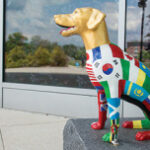
Last year’s winners have finally made their mark at UMBC – three new and vibrantly decorated Chesapeake Bay Retriever statues placed in prominent areas around campus.
 The Retriever Project was the brainchild of UMBC students: Kelsey Krach’ 14, cultural anthropology and Spanish,
Travis Bell ’14, psychology and political science,
and Cami Sotela ’13, psychology.
With funding provided by UMBC’s Student Government Association, Prove It! gives undergraduates with a vision for ways to improve the campus a chance to compete to have their plan realized. Winners of the competition can receive up to $10,000 to implement a winning plan and cash prizes of up to $2,000.
 The idea for the Retriever Project was based on a number of colorful “animals on parade” public art projects around the world – most notably two large projects in nearby Washington, D.C., which featured pandas and then donkeys and elephants.
Krach, Bell, and Sotela spent more than two years planning their Retriever Project entry. The first three statues were placed in front of the Albin O. Kuhn Library, The Commons, and the Performing Arts and Humanities Building. Each statue is painted to reflect a core UMBC value: diversity, academic and social exploration and the breadth and depth of UMBC’s academic program.
— Jessie Orsburn ’14
]]>
UMBC’s Prove It! Campaign has added greatly to the quality of campus life during its six years of existence, including the creation of a green space outside the Fine Arts Building and a system for...
https://umbc.edu/stories/pride-proven/
https://my3.my.umbc.edu/api/v0/pixel/news/122285/guest@my.umbc.edu/5bbd9aedf5d66a2811c895ad56fdf186/api/pixel
albin-o-kuhn-library
alumni
cami-sotela
chesapeake-retrievers
cultural-anthropology
fine-arts
kelsey-krach
political-science
prove-it
psychology
retriever-project
spanish
student-government-association
the-commons
travis-bell
umbc
university-of-maryland-baltimore-county
UMBC News & Magazine
https://my3.my.umbc.edu/groups/umbc-news-magazine
https://assets1-my.umbc.edu/system/shared/avatars/groups/000/001/943/24435aa6207c452e7bc15cc74b42c7bb/xsmall.png?1748556657
https://assets1-my.umbc.edu/system/shared/avatars/groups/000/001/943/24435aa6207c452e7bc15cc74b42c7bb/original.png?1748556657
https://assets2-my.umbc.edu/system/shared/avatars/groups/000/001/943/24435aa6207c452e7bc15cc74b42c7bb/xxlarge.png?1748556657
https://assets2-my.umbc.edu/system/shared/avatars/groups/000/001/943/24435aa6207c452e7bc15cc74b42c7bb/xlarge.png?1748556657
https://assets3-my.umbc.edu/system/shared/avatars/groups/000/001/943/24435aa6207c452e7bc15cc74b42c7bb/large.png?1748556657
https://assets1-my.umbc.edu/system/shared/avatars/groups/000/001/943/24435aa6207c452e7bc15cc74b42c7bb/medium.png?1748556657
https://assets2-my.umbc.edu/system/shared/avatars/groups/000/001/943/24435aa6207c452e7bc15cc74b42c7bb/small.png?1748556657
https://assets1-my.umbc.edu/system/shared/avatars/groups/000/001/943/24435aa6207c452e7bc15cc74b42c7bb/xsmall.png?1748556657
https://assets2-my.umbc.edu/system/shared/avatars/groups/000/001/943/24435aa6207c452e7bc15cc74b42c7bb/xxsmall.png?1748556657
UMBC News & Magazine
0
0
false
Tue, 07 Oct 2014 13:00:41 -0400


