Historical lens—3 stories that scratch the surface of a 5,400 image archive
One of the most influential sets of historical photos in UMBC’s Special Collections is an archive of more than 5,400 images documenting the harsh conditions of child laborers in early 20th-century America. Recently the team in Special Collections—which celebrates its 50th anniversary this year—undertook a massive project to digitize and rehouse the photos in more protective sheaths to help safeguard the images and the hand-written details on them.
The preservation effort gave UMBC student workers hands-on practice with handling the delicate photographs and allowed staff to dive deep into these historical records in order to comment on timely issues around current child labor conditions in the U.S. Their work will allow future students, faculty, and visiting scholars to access this important material for many years to come.
Preserving the photography of Lewis Hine
In the first article in this three-part feature, Rahne Alexander, M.F.A. ’21, writes about how photographer Lewis Hine secured a place in history as an investigative documentarian by observing and sharing the conditions for child laborers. From 1908 through 1930, Hine worked closely with the National Child Labor Committee (NCLC), an organization devoted to preventing the exploitation of children in the workplace. Hine crisscrossed the U.S. creating portraits of a diverse array of children working in fields and factories.
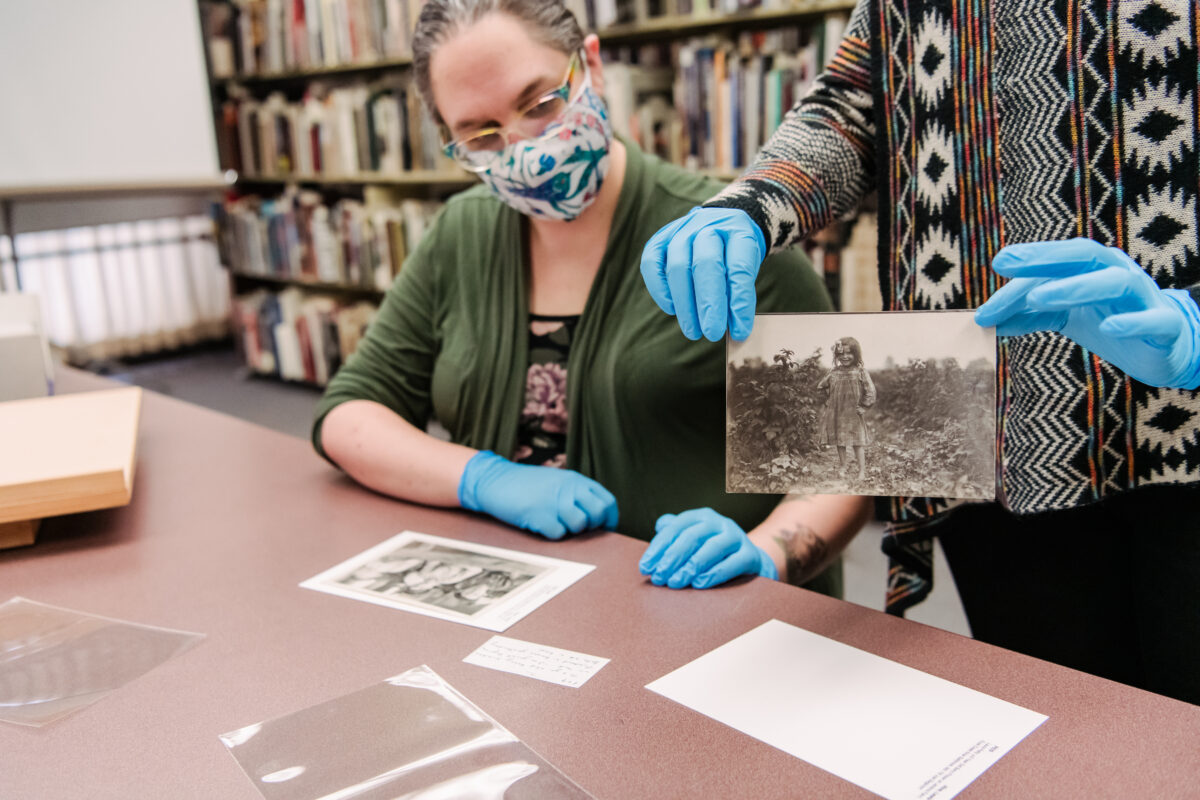 Meredith Power, left, and Susan Graham, right, handle the century-old
photographs. (Marlayna Demond ’11/UMBC)
Meredith Power, left, and Susan Graham, right, handle the century-old
photographs. (Marlayna Demond ’11/UMBC)
Handle with care
Uncovering the work UMBC students put into the project of preserving these historical photos, Catalina Sofia Dansberger Duque interview Special Collections interns Meredith Power ’21, history, a public history graduate student, and Gabe Morrison ’23, anthropology. Along with library staff members, these two worked diligently to ensure that the images of the families and children who lived through these harrowing work conditions are accessible to the public for research and learning.
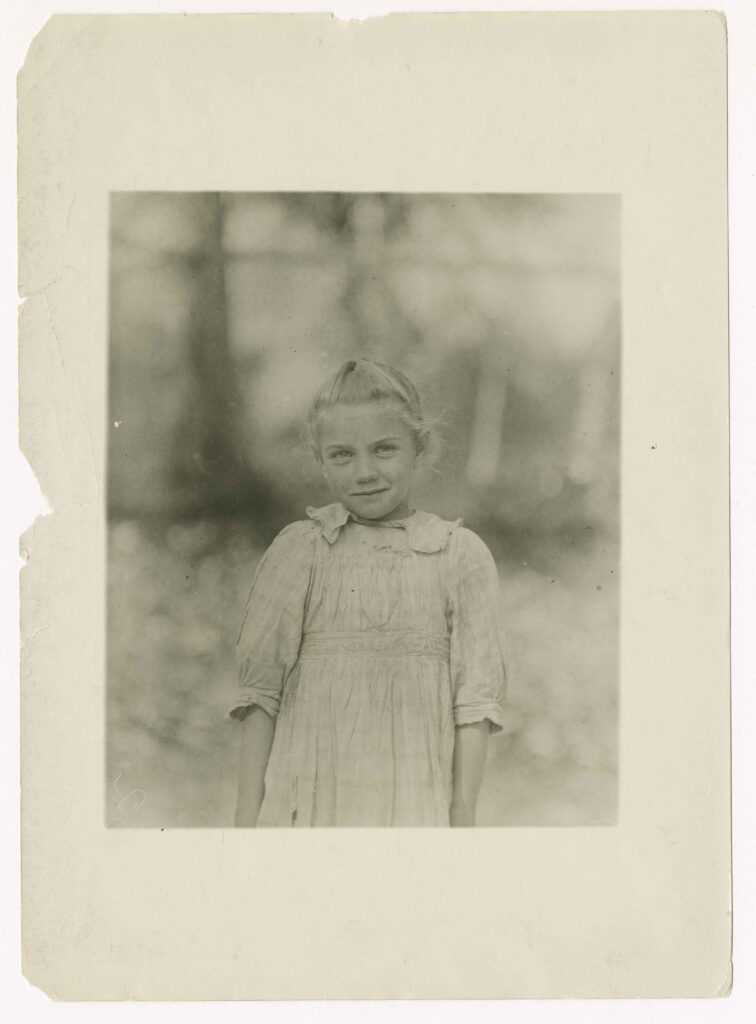
7-year old Rosie. Regular shucker. Her second year at it. Illiterate. Works all day. Shucks only a few pots a day. Varn & Platt Canning Co. in Bluffton, South Carolina, 1911 – 1913.
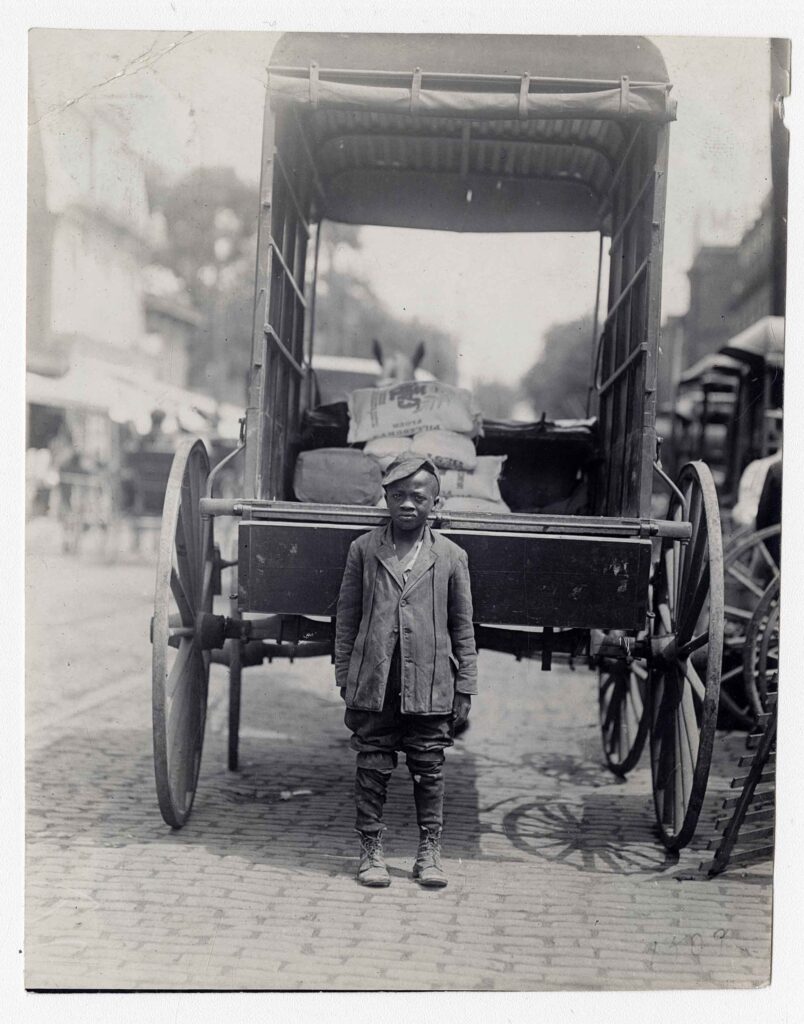
Elwood Palmer Cooper, helper on miller’s wagon, 7 years of age. Carries bags of flour, weighing 25 pounds, from wagon to stores. Receives 25 cents per week. Money not needed at home. Wants money to spend. Wilmington, Delaware, 1910.
The U.S. has a child labor problem
Lastly, in a piece originally published in The Conversation, Curator of Special Collections Beth Saunders, writes, “As I’ve worked with this collection over the last two years, the social and political implications of Hine’s photographs have been very much on my mind. The patina of these black-and-white photographs suggests a bygone era—an embarrassing past that many Americans might imagine they’ve left behind. But with numerous reports of child labor violations, many involving immigrants, occurring in the U.S., along with an uptick in state legislation rolling back the legal working age, it’s clear that Hine’s work is as relevant today as it was a century ago.”
]]>
One of the most influential sets of historical photos in UMBC’s Special Collections is an archive of more than 5,400 images documenting the harsh conditions of child laborers in early 20th-century...
https://umbc.edu/stories/historical-lens-documenting-us-child-labor/
https://my3.my.umbc.edu/api/v0/pixel/news/137603/guest@my.umbc.edu/b7755fbea649a8e09779561afccb2f86/api/pixel
cahss
discovery
fall-2023
feature
history
magazine
special-collections
UMBC News & Magazine
https://my3.my.umbc.edu/groups/umbc-news-magazine
https://assets1-my.umbc.edu/system/shared/avatars/groups/000/001/943/24435aa6207c452e7bc15cc74b42c7bb/xsmall.png?1748556657
https://assets1-my.umbc.edu/system/shared/avatars/groups/000/001/943/24435aa6207c452e7bc15cc74b42c7bb/original.png?1748556657
https://assets2-my.umbc.edu/system/shared/avatars/groups/000/001/943/24435aa6207c452e7bc15cc74b42c7bb/xxlarge.png?1748556657
https://assets2-my.umbc.edu/system/shared/avatars/groups/000/001/943/24435aa6207c452e7bc15cc74b42c7bb/xlarge.png?1748556657
https://assets3-my.umbc.edu/system/shared/avatars/groups/000/001/943/24435aa6207c452e7bc15cc74b42c7bb/large.png?1748556657
https://assets1-my.umbc.edu/system/shared/avatars/groups/000/001/943/24435aa6207c452e7bc15cc74b42c7bb/medium.png?1748556657
https://assets2-my.umbc.edu/system/shared/avatars/groups/000/001/943/24435aa6207c452e7bc15cc74b42c7bb/small.png?1748556657
https://assets1-my.umbc.edu/system/shared/avatars/groups/000/001/943/24435aa6207c452e7bc15cc74b42c7bb/xsmall.png?1748556657
https://assets2-my.umbc.edu/system/shared/avatars/groups/000/001/943/24435aa6207c452e7bc15cc74b42c7bb/xxsmall.png?1748556657
UMBC News & Magazine
3
0
false
Thu, 07 Dec 2023 12:28:52 -0500
Thu, 07 Dec 2023 12:28:52 -0500
Handle with care—students help digitize and rehouse thousands of historical photos
A nine-year-old stands at the mouth of a coal mine covered in coal dust, wearing a small headlamp. A woman holds her baby on her lap as she packs boxes in a warehouse along with her 5-, 8-, and 12-year-olds. These are just two of thousands of evocative black-and white historical photographs handled by Special Collections interns Meredith Power ’21, history, a public history graduate student, and Gabe Morrison ’23, anthropology. Along with library staff members, these two worked diligently to ensure that the images of the families and children who lived through these harrowing work conditions are accessible to the public for research and learning.
Fine motor skills
“Photos from the early 1900s were developed on fine photographic paper that is prone to crinkling around the edges, ripping, and fading,” Power says. Wearing blue nitrile medical gloves, they rehouse photos from their cellophane sleeves to museum-grade mylar sleeves, keeping them from further discoloration, tears, wrinkles, and sticking to the sleeves.
“They’re very delicate,” Power says. “You need good eye-hand coordination to pick up the photos from the corners, remove them from whatever packaging they are in, and slide them into the mylar sleeve.”
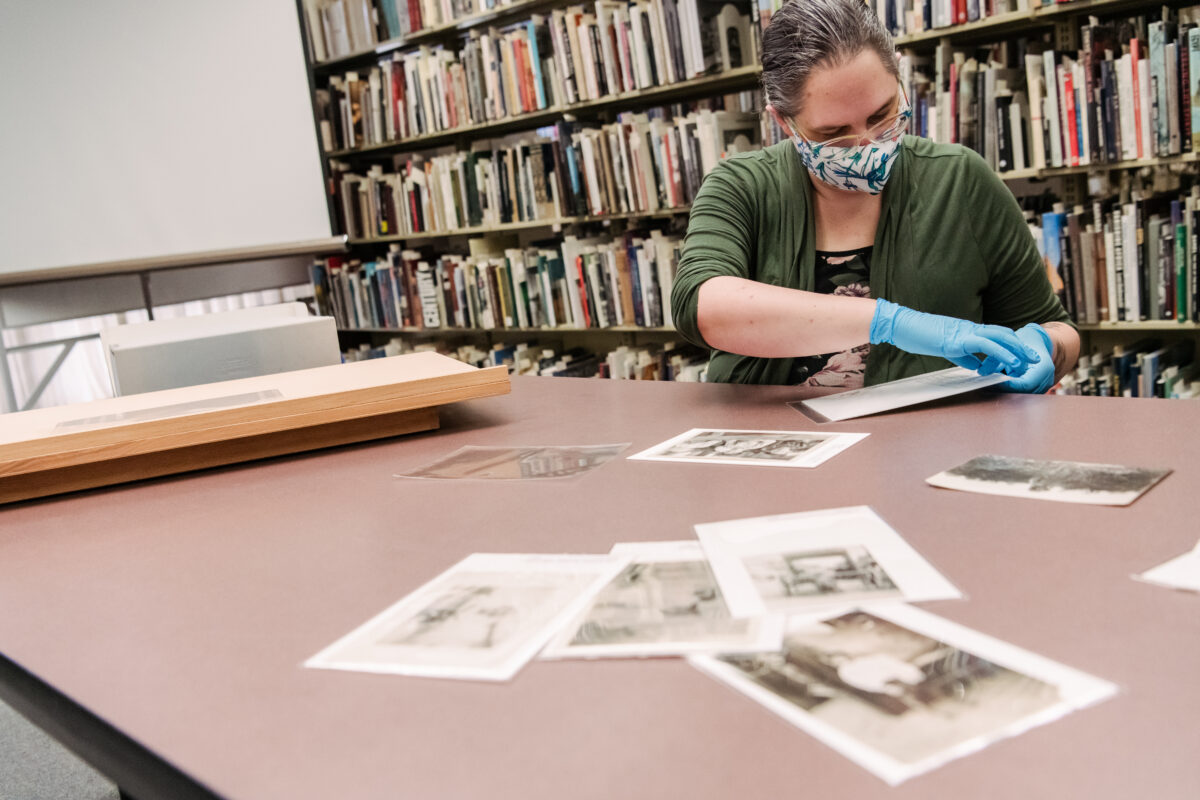 Power puts the historical photos into a mylar sleeve. (Marlayna Demond ’11/UMBC)
This process is second nature for Morrison, who has been working at Special Collections for over a year. He has worked with securing the Lewis Hine photos as part of his public humanities minor, as well as the Maryland Folklife Program Collection, the Coslet-Sapienza Fantasy and Science Fiction Fanzine Collection, and the George Cruikshank illustrations and papers.
“I had to learn how to properly handle photographs and manuscripts and how to catalog them according to the Library of Congress classification system,” Morrison says. For both Power and Morrison, developing greater patience and manual dexterity and embracing working through hundreds of documents alone in a quiet space surrounded by stacks of materials was well worth the effort to broaden access to these historic documents.
“The value of this project is ensuring people understand that this resource exists,” says Power, “to help these photos live beyond a heavily controlled and restricted space on campus into a digital space where more people are able to access the information.”
Digital accessibility
Protecting delicate, historic documents includes digitizing them. The digitizing process is another lesson in precision and patience. Power begins the process by taking a photo out of the mylar sleeve—making sure to only touch the corners—along with a small rectangular white piece of paper describing the photo. They gently place the photo underneath a camera, delicately straightening the image before the camera snaps the picture and sends it to a computer where Power edits it using Adobe Lightroom.
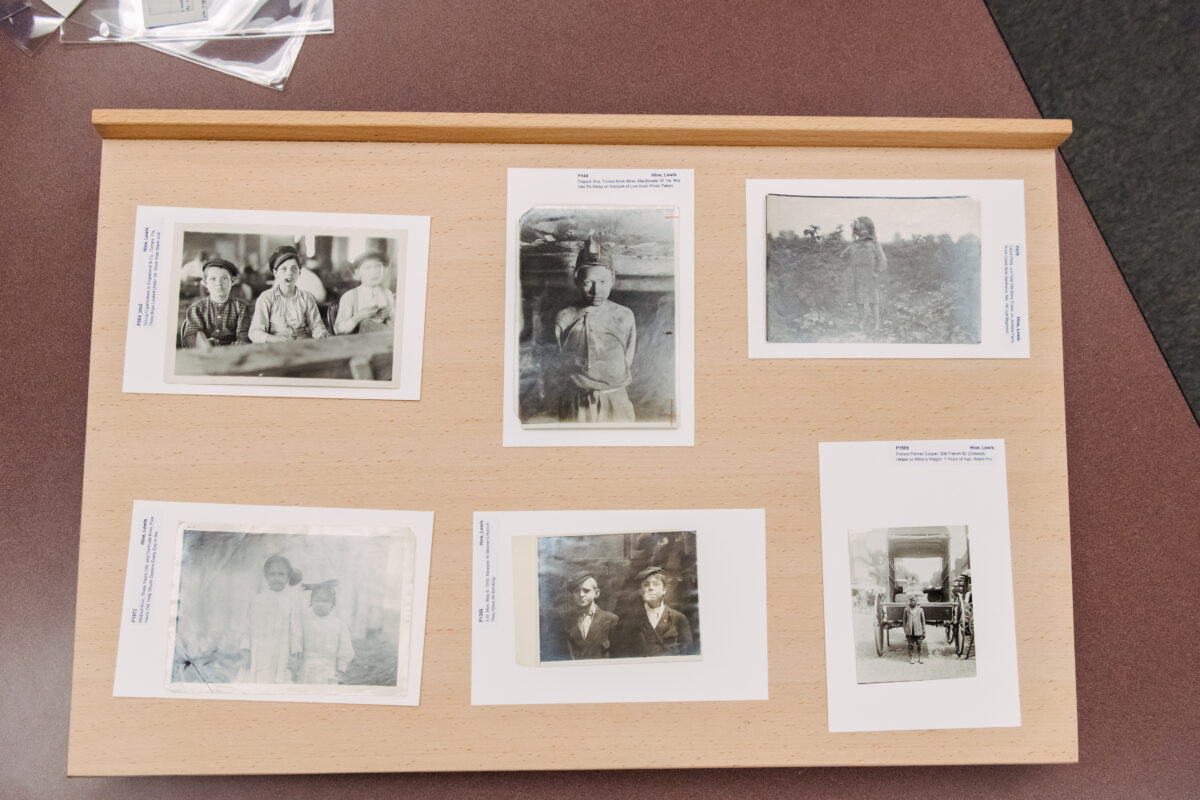 A small collection of the 5,400 photographs that were digitized and rehoused in more protective plastic sleeves. (Marlayna Demond ’11/UMBC)
“It’s an elaborate setup with lights at 45-degree angles, and the camera pointed straight down at a small white stand where I place the image,” explains Power, who would work on digitizing for six to eight hours at a time. “Once I take the image, I edit the size and angle of the photo. The metadata is then added into an Excel spreadsheet, which includes noting if there was a corner missing or if the photo had adhesive stuck to it.”
Digitizing rare books, something Morrison has spent months working on, requires using a special book scanning machine with raised sides, like hands cradling the book open, and small snakelike bean bag weights to keep the pages flat without using his fingers. “I make sure I’m not blocking any text or any important image. And then I press a button, flip a page, press a button, flip a page for hours on end until I finish digitizing that book,” Morrison says, smiling. “So, it’s not the most exciting work, but I find digitization specifically important because it’s a process that helps preserve documents too fragile to be in public circulation. Digitally, you can share it with a broader audience.”
Workforce skills
Both Power and Morrison brought many special collections skills to their public humanities internships. Archaeology camp inspired Morrison to learn about how to study and take care of important and fragile objects. He worked at the Montgomery Parks Archeology Program throughout high school, where he met a friend who introduced him to UMBC’s Special Collections. “I’ve always had an interest in historic things, in the preservation of artifacts,” Morrison says, who plans to apply to a master’s program in library and museum studies after graduation. “I think Special Collections has helped me realize I want to do archival work.”
Power found their footing working full time in the conservation rooms at Baltimore’s Walters Art Museum. “I was the administrative assistant in the Conservation Division and was around a lot of conversations on handling art objects and special collections materials, but I did not work with the materials directly,” says Power. “Working with the Hine Collection was a great opportunity for hands-on experience working with physical items and digitization.” These skills have also come in handy for Power, whose master’s degree focuses on 14th-century religious women hermits in Yorkshire, England. In 2022, Power had the opportunity to visit parish archives in Yorkshire to read through medieval-primary source documents.
For Power, history isn’t just books, dates, and lists of events. They say that there are a lot of living materials out there, whether that’s parish churches or photographs from the early 20th century, like the Hine collection. There is a connection between public history work and the people who lived before us. “It’s important to continue to help students remember that history is not dead and dusty. It’s alive,” says Power. They feel that the connection element is essential, and sometimes it gets lost. “Special Collections prove that these events really happened. They can inspire students to visit those places. To stand in that space where it happened and say, ‘Yeah, I was here too.’ I love that.”
]]>
A nine-year-old stands at the mouth of a coal mine covered in coal dust, wearing a small headlamp. A woman holds her baby on her lap as she packs boxes in a warehouse along with her 5-, 8-, and...
https://umbc.edu/stories/handle-with-care-preserving-historical-photos/
https://my3.my.umbc.edu/api/v0/pixel/news/137604/guest@my.umbc.edu/9c59b0ed09326ab14e553d046e7794b9/api/pixel
anthropology
campus-life
fall-2023
feature
history
magazine
special-collections
UMBC News & Magazine
https://my3.my.umbc.edu/groups/umbc-news-magazine
https://assets1-my.umbc.edu/system/shared/avatars/groups/000/001/943/24435aa6207c452e7bc15cc74b42c7bb/xsmall.png?1748556657
https://assets1-my.umbc.edu/system/shared/avatars/groups/000/001/943/24435aa6207c452e7bc15cc74b42c7bb/original.png?1748556657
https://assets2-my.umbc.edu/system/shared/avatars/groups/000/001/943/24435aa6207c452e7bc15cc74b42c7bb/xxlarge.png?1748556657
https://assets2-my.umbc.edu/system/shared/avatars/groups/000/001/943/24435aa6207c452e7bc15cc74b42c7bb/xlarge.png?1748556657
https://assets3-my.umbc.edu/system/shared/avatars/groups/000/001/943/24435aa6207c452e7bc15cc74b42c7bb/large.png?1748556657
https://assets1-my.umbc.edu/system/shared/avatars/groups/000/001/943/24435aa6207c452e7bc15cc74b42c7bb/medium.png?1748556657
https://assets2-my.umbc.edu/system/shared/avatars/groups/000/001/943/24435aa6207c452e7bc15cc74b42c7bb/small.png?1748556657
https://assets1-my.umbc.edu/system/shared/avatars/groups/000/001/943/24435aa6207c452e7bc15cc74b42c7bb/xsmall.png?1748556657
https://assets2-my.umbc.edu/system/shared/avatars/groups/000/001/943/24435aa6207c452e7bc15cc74b42c7bb/xxsmall.png?1748556657
UMBC News & Magazine
0
0
false
Thu, 07 Dec 2023 12:15:38 -0500
The US has a child labor problem – recalling an embarrassing past that Americans may think they’ve left behind
Written by Beth Saunders, Curator and Head of Special Collections and Gallery, UMBC.
At the University of Maryland, Baltimore County’s Special Collections, where I am head curator, we’ve recently completed a major digitization and rehousing project of our collection of over 5,400 photographs made by Lewis Wickes Hine in the early 20th century.
Traveling the country with his camera, Hine captured the often oppressive working conditions of thousands of children – some as young as 3 years old.
As I’ve worked with this collection over the past two years, the social and political implications of Hine’s photographs have been very much on my mind. The patina of these black-and-white photographs suggests a bygone era – an embarrassing past that many Americans might imagine they’ve left behind.
But with numerous reports of child labor violations, many involving immigrants, occurring in the U.S., along with an uptick in state legislation rolling back the legal working age, it’s clear that Hine’s work is as relevant today as it was a century ago.
‘An investigator with a camera’
A sociologist by training, Hine began making photographs in 1903 while working as a teacher at the progressive Ethical Culture School in New York City.
Between 1903 and 1908, he and his students photographed migrants at Ellis Island. Hine believed that the future of the U.S. rested in its identity as an immigrant nation – a position that contrasted with escalating xenophobic fears.
Based on this work, the National Child Labor Committee, which advocated for child labor laws, hired Hine to document the living and working conditions of American children.
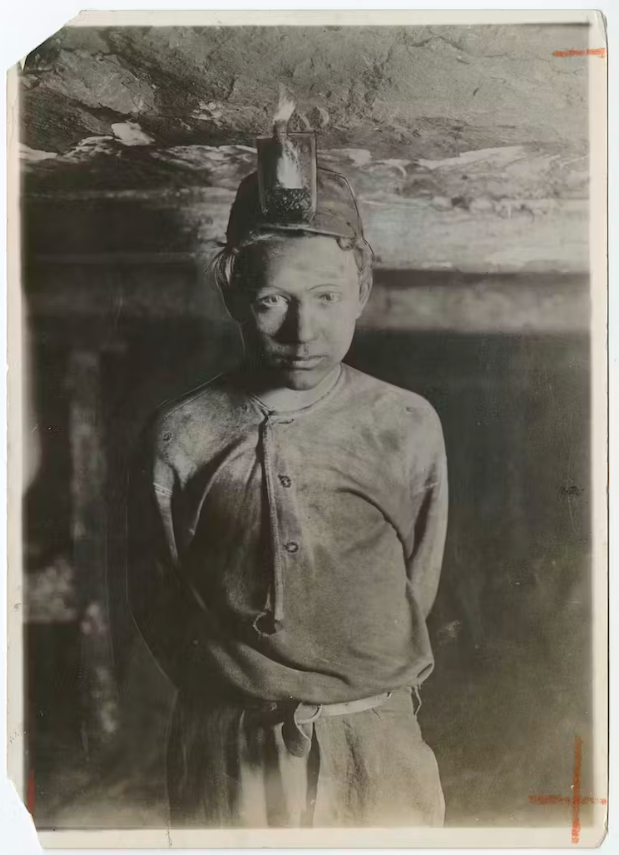 Lewis Wickes Hine, ‘Trapper Boy, Turkey Knob Mine, MacDonald, West Virginia, 1908.’ Gelatin silver print. 5 x 7 in. The Photography Collections, University of Maryland, Baltimore County (P148), CC BY-SA
By the late 19th century, several states had passed laws limiting the age of child laborers and establishing maximum working hours. But at the turn of the century, the number of working kids soared – between 1890 and 1910, 18% of children ages 10 to 15 were employed.
In his work for the National Child Labor Committee, Hine journeyed to farms and mills in the industrializing South and the streets and factories of the Northeast. He used a Graflex camera with 5-by-7-inch glass plate negatives and employed flash powder for nighttime and interior shots, hauling upward of 50 pounds of equipment on his slight frame.
To gain entry into factories and other facilities, Hine sometimes disguised himself as a Bible, postcard or insurance salesman. Other times he’d wait outside to catch workers arriving for or departing from their shifts.
Along with photographic records, Hine collected his subjects’ personal stories, including their ages and ethnicities. He documented their working lives, such as their typical hours and any injuries or ailments they incurred as a result of their labor.
Hine, who considered himself “an investigator with a camera,” used this information to create what he termed “photo stories” – combinations of images and text that could be used on posters, in public lectures and in published reports to help the organization advance its mission.
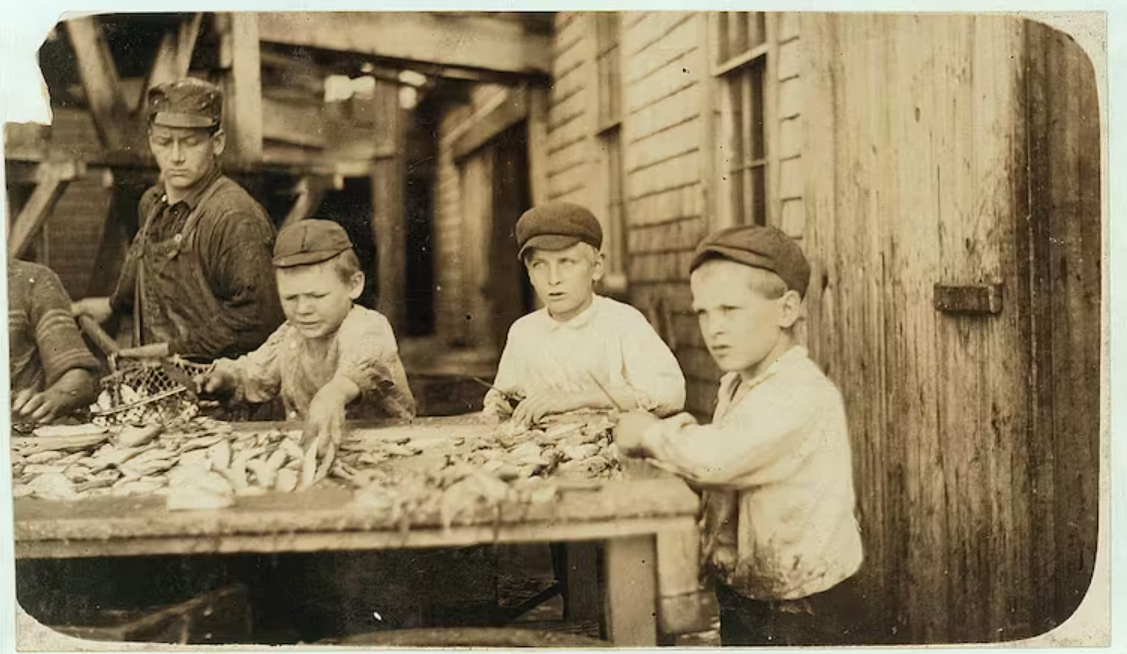 Lewis Wickes Hine’s photograph of three young fish cutters working at the Seacoast Canning Co. in Eastport, Maine. National Child Labor Committee collection, Library of Congress, Prints and Photographs Division
Legislation follows
Hine’s muckraking photographs exemplify the genre of documentary photography, which relies upon the perceived truthfulness of photography to make a case for social change.
The camera serves as an eyewitness to a societal ill, a problem that needs a solution. Hine portrayed his subjects in a direct manner, typically frontally and looking straight into the camera, against the backdrop of the very factories, farmland or cities where they worked.
By capturing details of his sitters’ bare feet, tattered clothes, soiled faces and hands, and diminutive stature against hulking industrial equipment, Hine made a direct statement about the poor conditions and precarity of these children’s lives.
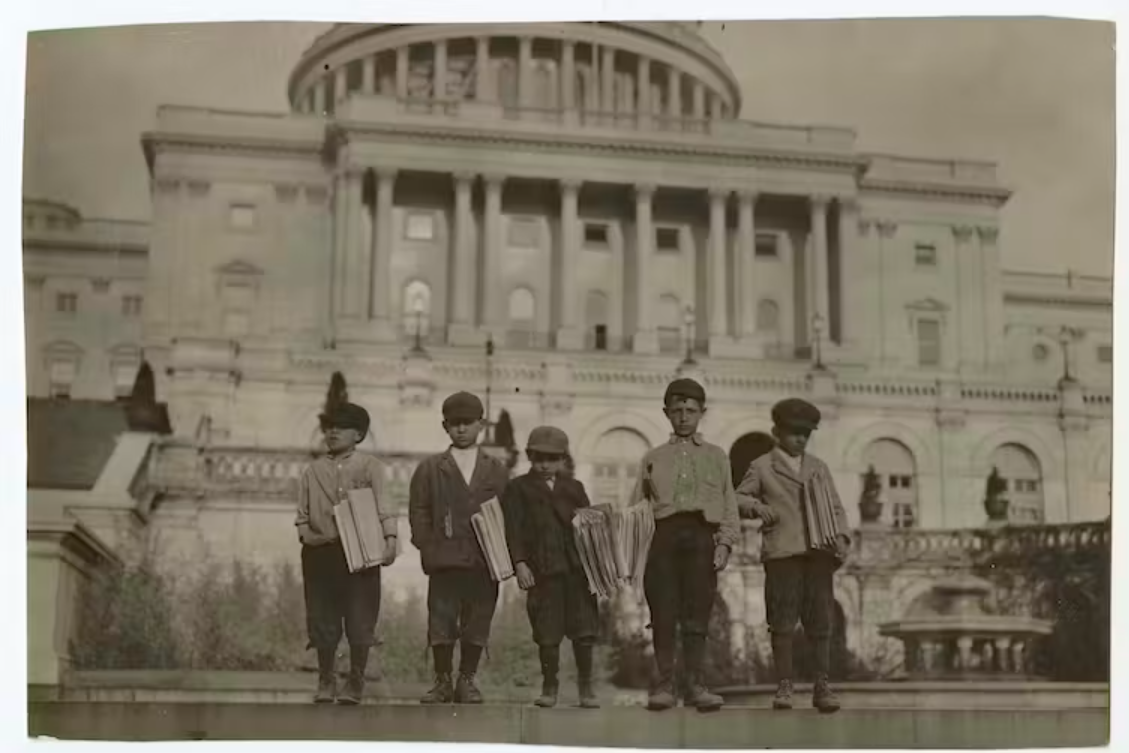 Lewis Wickes Hine, ‘Group of newsies selling on Capitol steps, April 11, 1912.’ The Photography Collections, University of Maryland, Baltimore County (P2904), CC BY-SA
Hine’s photographs made a successful case for child labor reform.
Notably, the National Child Labor Committee’s efforts resulted in Congress establishing the Children’s Bureau in 1912 and passing the Keating-Owen Act in 1916, which limited working hours for children and prohibited the interstate sale of goods produced by child labor.
Although the Supreme Court later ruled it and a subsequent Child Labor Tax Law of 1919 unconstitutional, momentum for enshrining protections for child workers had been created. In 1938, Congress passed the Fair Labor Standards Act, which established restrictions and protections on employing children.
The National Child Labor Committee’s project also included advocacy for the enforcement of existing child labor regulations, a regulatory problem reemerging today as the Department of Labor – the agency tasked with enforcing labor laws – comes under fire for failing to protect child workers.
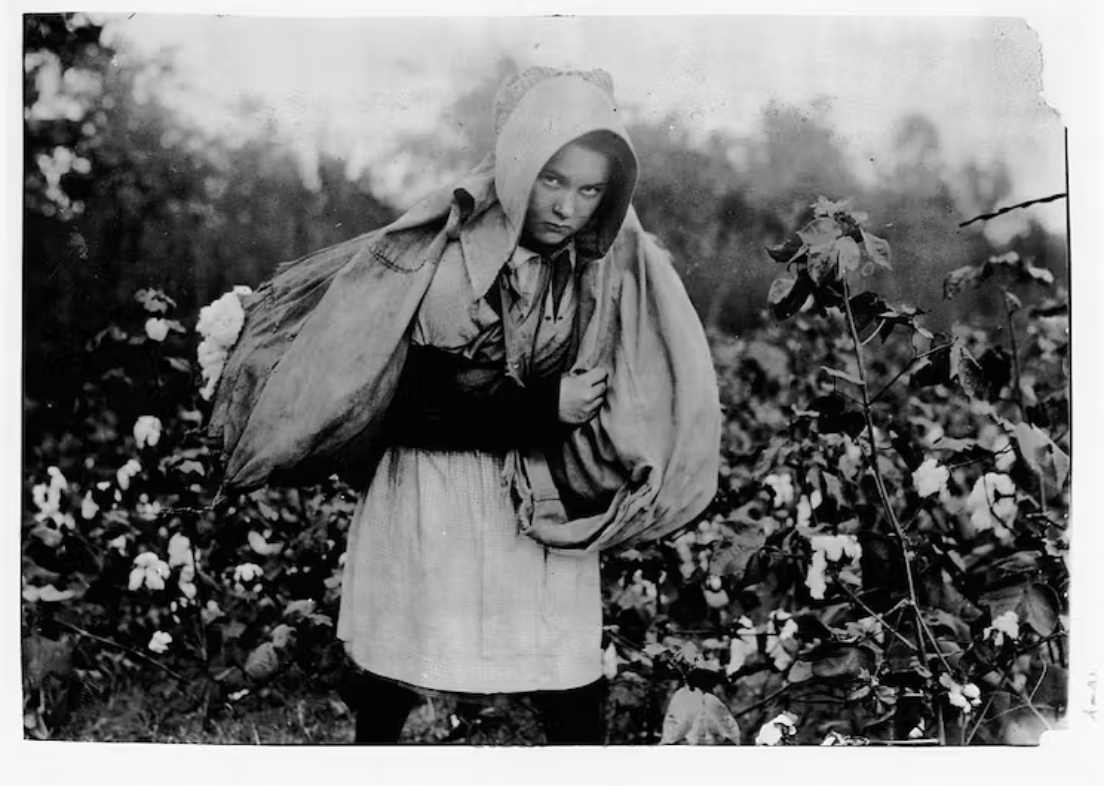 A young picker carries a large sack of cotton on her back. Lewis Wickes Hine/Library of Congress via Getty Images
The ethics of picturing child labor
A recent surge of unaccompanied minors, primarily from Central America, has brought new attention to America’s old problem of child labor and has threatened the very laws Hine and the National Child Labor Committee worked to enact.
Some estimates suggest that one-third of migrants under 18 are working illegally, whether it’s laboring more hours than current laws permit, or working without the proper authorizations. Many of them perform hazardous jobs similar to those of Hine’s subjects: handling dangerous equipment and being exposed to noxious chemicals in factories, slaughterhouses and industrial farms.
While the content of Hine’s photographs remains pertinent to today’s child labor crisis, a key distinction between the subject of Hine’s photographs and working children today is race.
Hine focused his camera almost exclusively on white children who arrived in the country during waves of immigration from Europe during the late-19th and early-20th centuries. As art historian Natalie Zelt argues, Hine’s pictorial treatment of Black children – either ignored or forced to the margins of his images – implied to viewers that the face of childhood in America was, by default, white.
The perceived racial hierarchies of Hine’s era reverberate into the present, where underage migrants of color live and work at the margins of society.
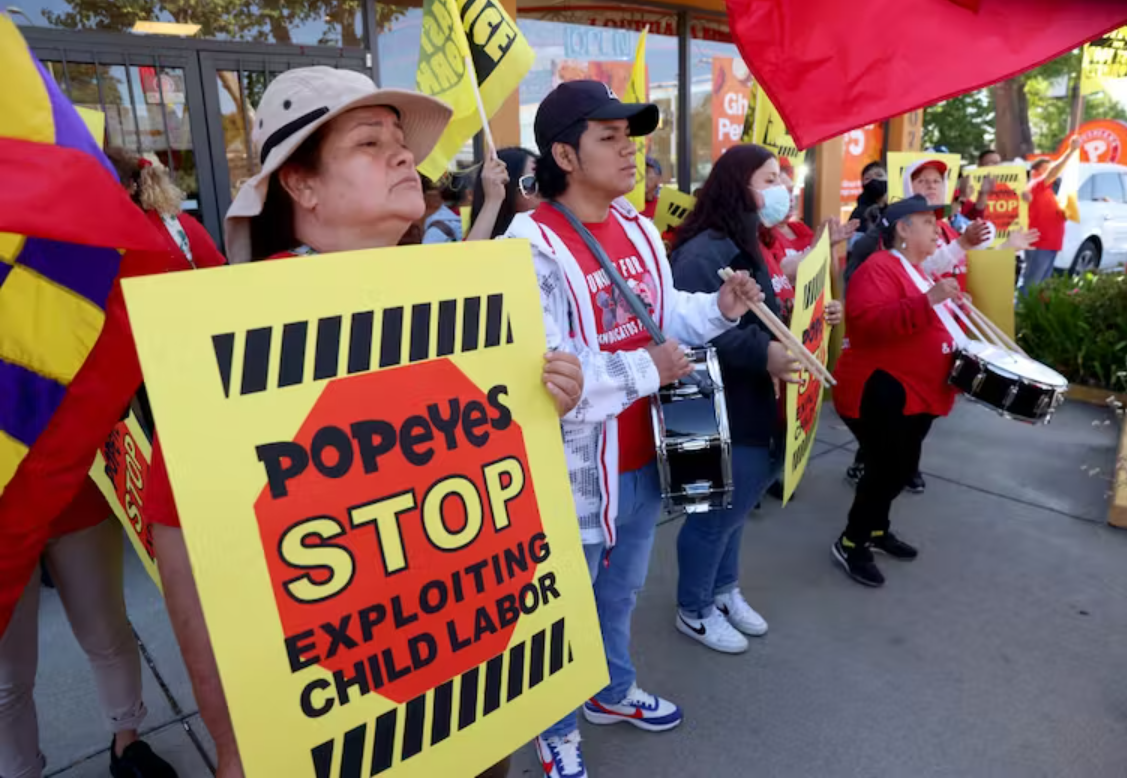 Workers protest outside a Popeye’s restaurant in Oakland, Calif., on May 18, 2023, after reports emerged of the franchise exploiting child labor. Jane Tyska/Digital First Media/East Bay Times via Getty Images
Contemporary reports of child labor violations offer few images to accompany their texts, graphs and statistics. There are legitimate reasons for this. By not including identifying personal information or portraits, news outlets protect a vulnerable population. Ethical guidelines frown upon revealing private details of the lives of children interviewed. And, as Hine’s experience demonstrates, it can be difficult to infiltrate the sites of these labor violations, since they are typically kept secure.
Digital cameras and smartphones offer a workaround. Beginning in 2015, the International Labor Organization urged child laborers in Myanmar to become “young activists” and use their own images and words to create “photo stories” – echoing Hine’s use of the term – that the organization could then disseminate.
Photographs of child labor in foreign countries are far more common than those made in the U.S., which leaves the impression that child labor is someone else’s problem, not ours. Perhaps it’s too hard for Americans to look at this domestic issue square in the eyes.
A similar effect is at work when viewing Hine’s photographs today. While they were originally valued for their immediacy, they can seem to belong to a distant past.
But if Hine’s photographic archive of child laborers is evidence of the power of photography to sway public opinion, does the lack of images in today’s reporting – even if nobly intended – create a disconnect?
Is the public capable of understanding the harmful consequences of lack of labor enforcement when the faces of the people affected are missing from the picture?
This article is republished from The Conversation under a Creative Commons license. Read the original article and see more than 250 UMBC articles available in The Conversation.
]]>
Written by Beth Saunders, Curator and Head of Special Collections and Gallery, UMBC. At the University of Maryland, Baltimore County’s Special Collections, where I am head curator, we’ve...
https://umbc.edu/stories/the-conversation-us-child-labor-problem/
https://my3.my.umbc.edu/api/v0/pixel/news/134034/guest@my.umbc.edu/900a55b9775015504e5a594fcc4fc295/api/pixel
aok-gallery
aok-library
aok-library-gallery
discovery
magazine
special-collections
the-conversation
UMBC News & Magazine
https://my3.my.umbc.edu/groups/umbc-news-magazine
https://assets1-my.umbc.edu/system/shared/avatars/groups/000/001/943/24435aa6207c452e7bc15cc74b42c7bb/xsmall.png?1748556657
https://assets1-my.umbc.edu/system/shared/avatars/groups/000/001/943/24435aa6207c452e7bc15cc74b42c7bb/original.png?1748556657
https://assets2-my.umbc.edu/system/shared/avatars/groups/000/001/943/24435aa6207c452e7bc15cc74b42c7bb/xxlarge.png?1748556657
https://assets2-my.umbc.edu/system/shared/avatars/groups/000/001/943/24435aa6207c452e7bc15cc74b42c7bb/xlarge.png?1748556657
https://assets3-my.umbc.edu/system/shared/avatars/groups/000/001/943/24435aa6207c452e7bc15cc74b42c7bb/large.png?1748556657
https://assets1-my.umbc.edu/system/shared/avatars/groups/000/001/943/24435aa6207c452e7bc15cc74b42c7bb/medium.png?1748556657
https://assets2-my.umbc.edu/system/shared/avatars/groups/000/001/943/24435aa6207c452e7bc15cc74b42c7bb/small.png?1748556657
https://assets1-my.umbc.edu/system/shared/avatars/groups/000/001/943/24435aa6207c452e7bc15cc74b42c7bb/xsmall.png?1748556657
https://assets2-my.umbc.edu/system/shared/avatars/groups/000/001/943/24435aa6207c452e7bc15cc74b42c7bb/xxsmall.png?1748556657
UMBC News & Magazine
0
0
false
Thu, 15 Jun 2023 18:35:31 -0400
UMBC’s galleries deliver interactive and thoughtful art
UMBC’s art galleries are already in full bloom for the spring. With exhibits showcasing historic and innovative 20th century photography, interactive hip-hop data visualization, and the legacies of political resistance as seen through Black hair, the university’s exhibition spaces are bountiful with thought-provoking work.
Hip-Hop and Data at CADVC
Tahir Hemphill: Rap Research Lab runs at the Center for Art, Design, and Visual Culture (CADVC) through March 18. In this exhibition, Tahir Hemphill, the inaugural Fellow for Faculty Diversity in the Visual Arts at UMBC, presents a collection of interactive works that explore what he calls “the hybrid area between art, technology, social engagement, and interdisciplinary research.”
Visitors are invited to participate in Hemphill’s design and research process through evolving artworks, including “Visualisation of Authority,” a kinetic sculpture drawing on Library of Congress research data, and “Mapper’s Delight,” an interactive augmented reality-based middle-school curriculum Hemphill designed in collaboration with Verizon Innovative Learning.
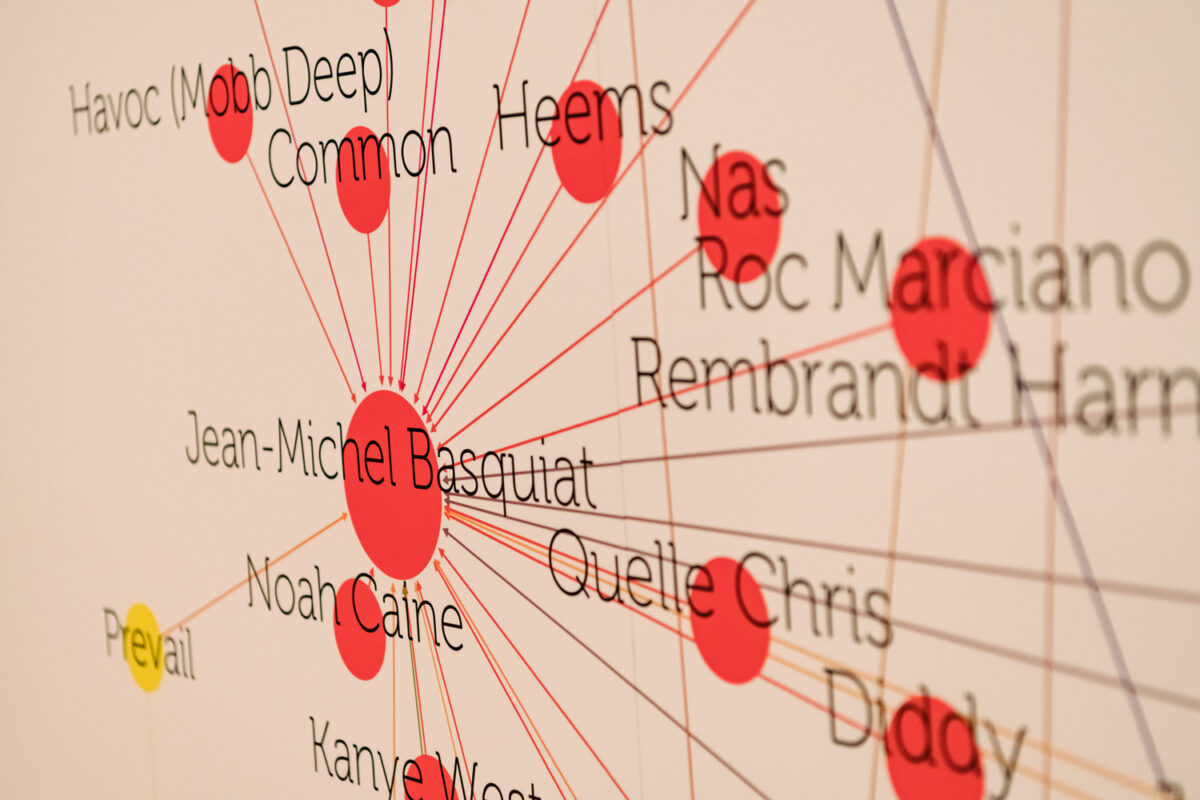 Data visualization from Hemphill’s Rap Research Lab at the CADVC. (Marlayna Demond ’11/UMBC)
Hemphill is using the exhibition space for teaching as well. In a course offered in collaboration between Visual Arts and the UMBC Image Research Center (IRC) students have the opportunity to mine the “Rap Almanac,” Hemphill’s expansive dataset of rap lyrics, to produce work in an internship-based research practicum.
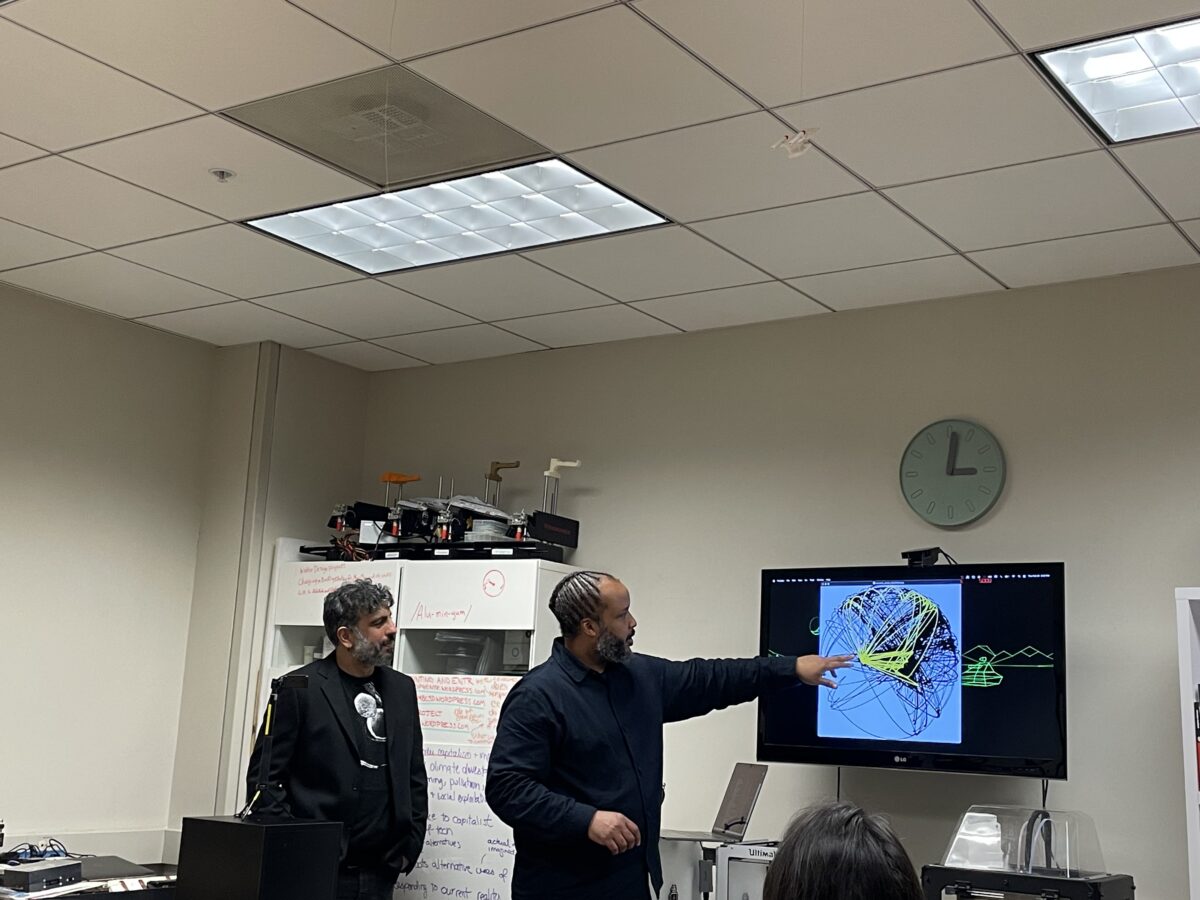 Hamidi, left, and Hemphill, right, talk through data visualization. (Marlayna Demond ’11/UMBC)
“CADVC operates as an art gallery and research center dedicated to scholarship and experimentation in art and culture,” says CADVC Director Rebecca Uchill. “This exhibition demonstrates a terrific range of scholarly inquiries, by Hemphill and his collaborators, into many facets of cultural history and the power of creative data visualization strategies. It is very exciting to watch this research develop in a public-facing presentation!”
Additional programming for the exhibition will include a series of public events such as a choreographed activation of a programmable robot arm, a partnership project with assistant professor Foad Hamidi from the Human-Centered Computing program in Information Systems, and a series of pop-up events.
Historic Hair and Formative Photography at AOK
The Albin O. Kuhn Library Gallery currently features two shows—Aaron Siskind: Formations and Sonya Clark: Hair/Craft—both on view through March 12.
Multidisciplinary artist Sonya Clark presents five works made with human hair and fiber art techniques to explore Black visibility and identity, and to examine the ways Black hair has been employed as an instrument of political resistance across the African diaspora. Clark, whose work explores issues of identity, race, cultural heritage, and collective memory, engages everyday objects and craft traditions to examine narrative threads connecting modern issues with historical origins, including the Black national anthem “Lift Every Voice and Sing” and the biography of Madam C. J. Walker, who became the first female self-made millionaire by selling hair care products to Black women.
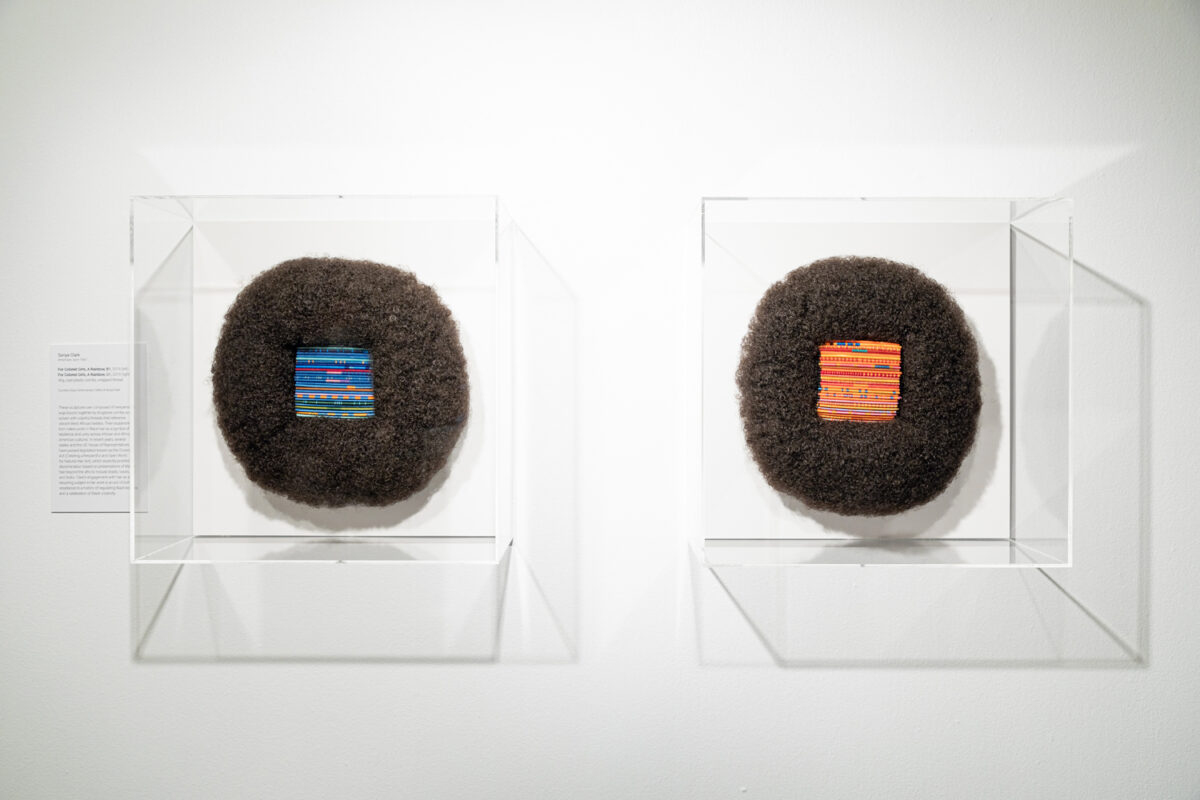 Sonya Clark’s Hair/Craft exhibit at the AOK Library Gallery. (Melissa Penley Cormier, M.F.A. ’17, for Research Graphics)
Influential photographer Aaron Siskind is celebrated through 55 works spanning his prolific career, all part of UMBC’s Photography Collections. Beginning with early documentary works Siskind made as part of the New York Film and Photo League in the 1930s and his groundbreaking abstract works of the 1940s and 1950s, the exhibition continues through phases of architectural studies, travel photography, and Siskind’s famous series focused on divers suspended in mid-air, “Terrors and Pleasures of Levitation.”
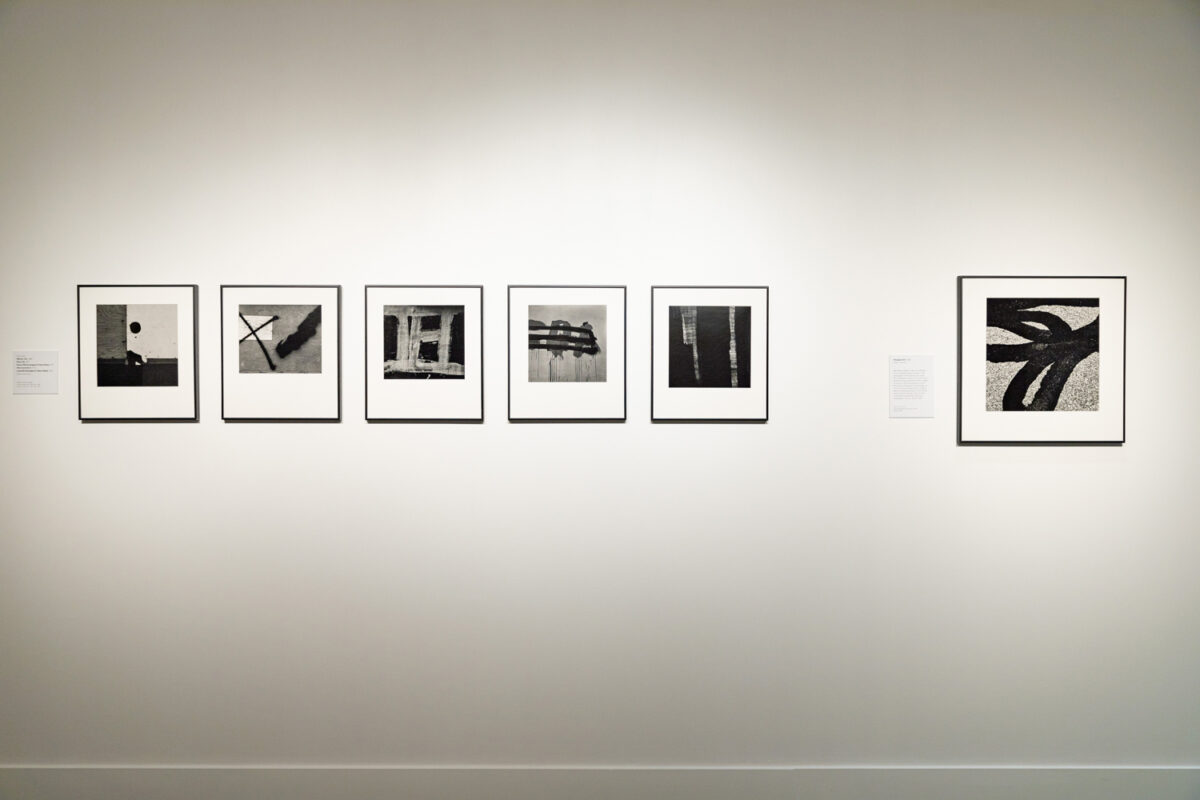 The Aaron Siskind exhibit in the AOK Library Gallery. (Melissa Penley Cormier, M.F.A. ’17, for Research Graphics)
Mind’s Eye in Toronto
With Mind’s Eye: The Psychic Photographs of Ted Serios, UMBC’s Special Collections has gone international. The Image Centre of Toronto Metropolitan University invited UMBC’s Curator of Exhibitions Emily Cullen to curate a show featuring one of AOK’s more fascinating collections, the Jule Eisenbud Collection on Ted Serios and Thoughtographic Photography.
Serios claimed to have the ability to psychically transfer his thoughts onto Polaroid film, a process called “thoughtography.” Chicago psychiatrist Jule Eisenbud investigated these claims, experimenting with Serios for several years in the mid-1960s, and the archive of those results is now part of UMBC’s permanent collection.
Mind’s Eye: The Psychic Photographs of Ted Serios opens at the IMC tomorrow, on view January 25–April 1!
]]>
UMBC’s art galleries are already in full bloom for the spring. With exhibits showcasing historic and innovative 20th century photography, interactive hip-hop data visualization, and the legacies...
https://umbc.edu/stories/umbcs-galleries-deliver-interactive-art/
https://my3.my.umbc.edu/api/v0/pixel/news/131356/guest@my.umbc.edu/5fd578a744572090ba95cb818c844cba/api/pixel
aok-library
arts-and-culture
cadvc
campus-life
is
magazine
media-and-communication-studies
news
special-collections
visual-arts
UMBC News & Magazine
https://my3.my.umbc.edu/groups/umbc-news-magazine
https://assets1-my.umbc.edu/system/shared/avatars/groups/000/001/943/24435aa6207c452e7bc15cc74b42c7bb/xsmall.png?1748556657
https://assets1-my.umbc.edu/system/shared/avatars/groups/000/001/943/24435aa6207c452e7bc15cc74b42c7bb/original.png?1748556657
https://assets2-my.umbc.edu/system/shared/avatars/groups/000/001/943/24435aa6207c452e7bc15cc74b42c7bb/xxlarge.png?1748556657
https://assets2-my.umbc.edu/system/shared/avatars/groups/000/001/943/24435aa6207c452e7bc15cc74b42c7bb/xlarge.png?1748556657
https://assets3-my.umbc.edu/system/shared/avatars/groups/000/001/943/24435aa6207c452e7bc15cc74b42c7bb/large.png?1748556657
https://assets1-my.umbc.edu/system/shared/avatars/groups/000/001/943/24435aa6207c452e7bc15cc74b42c7bb/medium.png?1748556657
https://assets2-my.umbc.edu/system/shared/avatars/groups/000/001/943/24435aa6207c452e7bc15cc74b42c7bb/small.png?1748556657
https://assets1-my.umbc.edu/system/shared/avatars/groups/000/001/943/24435aa6207c452e7bc15cc74b42c7bb/xsmall.png?1748556657
https://assets2-my.umbc.edu/system/shared/avatars/groups/000/001/943/24435aa6207c452e7bc15cc74b42c7bb/xxsmall.png?1748556657
UMBC News & Magazine
1
0
false
Wed, 01 Mar 2023 14:37:02 -0500
Wed, 01 Mar 2023 14:37:02 -0500
Historical Lens: Preserving the photography of social documentarian Lewis Hine
The photographer Lewis Hine secured a place in history as a documentarian of early 20th century life, including a transformational investigation into the conditions for child laborers.
From 1908 through 1930, Hine worked closely with the National Child Labor Committee (NCLC), an organization devoted to preventing the exploitation of children in the workplace. Hine criss-crossed the U.S., creating portraits of a diverse array of children working in fields and factories.
Hine’s body of work was revelatory and immensely impactful in the efforts to implement child labor laws in U.S., and continues to be a relevant resource for researchers working in the intersections of art, history, politics, and more.
For nearly 50 years, UMBC Special Collections has been the caretaker of the Lewis Hine Collection, comprising some 5,400 photographs taken by Hine during his career. This year, the Special Collections team at UMBC’s Albin O. Kuhn Library received a Preservation Assistance Grant from the National Endowment for the Humanities to support conservation of this groundbreaking collection.
“Our set is particularly important because it’s an almost complete collection of the photographs Hine made for the NCLC. It is very rare to have this incredible collection as a whole body,” says Beth Saunders, head of special collections. “It’s one of our most important and most used collections, and it was in immediate danger.”
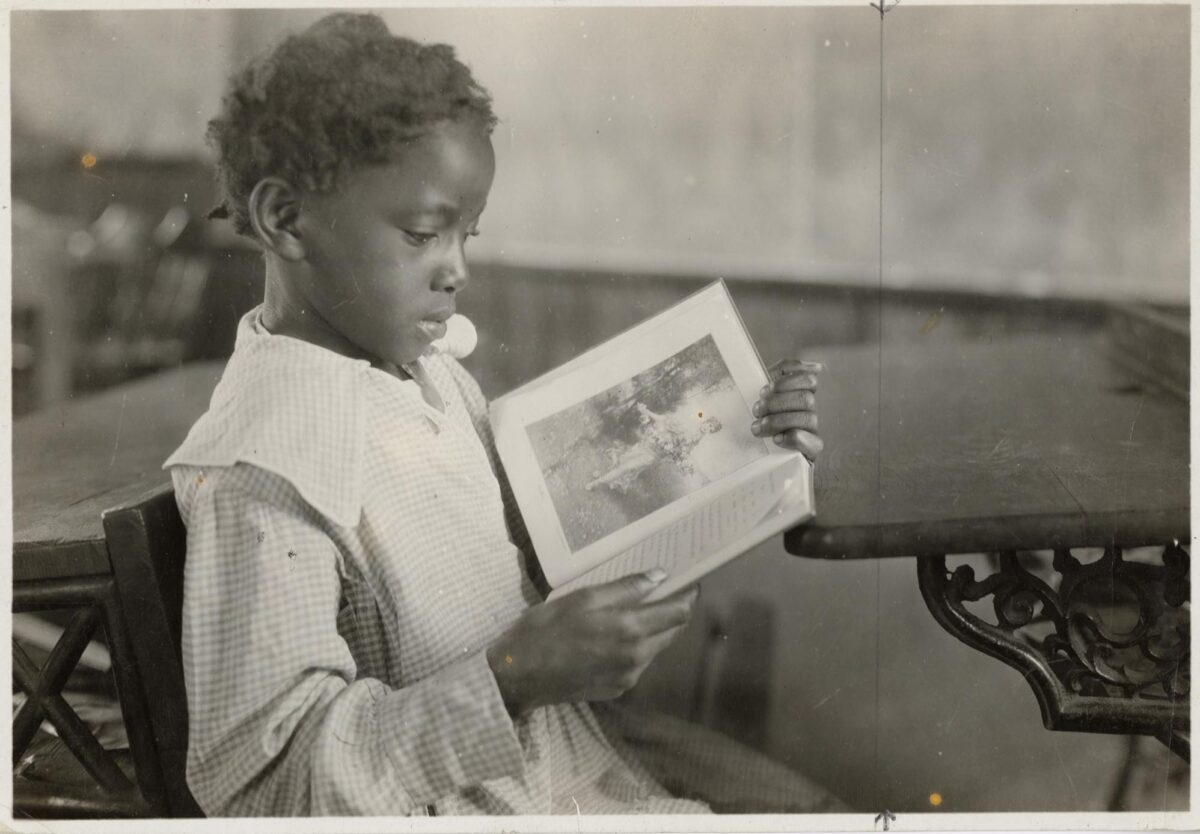
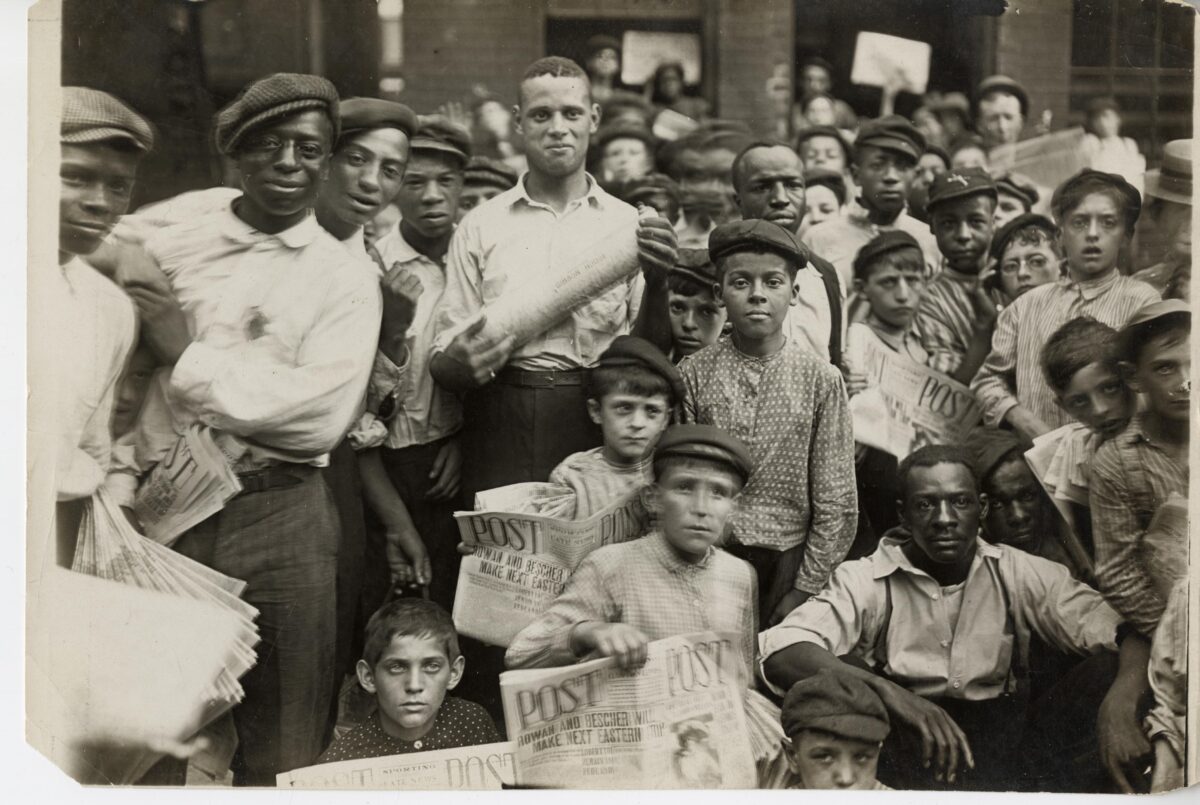 At left: Lewis Hine, Pupil in Pleasant Green School, Pocahontas Co., Pocahontas County, Marlinton, West Virginia, 1921. 5 x 7 in. The Photography Collections, University of Maryland, Baltimore County (P1050) At right: Lewis Hine, Newsboys and Supply Men Waiting At Newspaper Office For Base-Ball Edition, Cincinnati, Ohio, 1908. 5 x 7 in. The Photography Collections, University of Maryland, Baltimore County (P3)
Preserving the work of Lewis Hine
For many decades, the photographs in the collection were protected in envelopes, held in place with adhesive strips. With age, the adhesive has begun to deteriorate, putting the collection at risk.
“If the glue migrates and the photographs are stuck, you have the risk of tearing, discoloration, all the terrible things,” Saunders says. “They’re not mounted, so the versos—the backs—are visible. All of the original inscriptions, notations by Hine or other folks at NCLC, extended captions, those are all intact.”
Part of the current preservation effort will include photographing the detail written on the backs of the photographs, which have until now never been officially digitized.
“It was an opportunity to record the versos of the photographs. We needed to build a new overhead camera setup, and we’re very grateful that Melissa Cormier [M.F.A. ’17] with UMBC’s office of Research Graphics helped us to get that going,” says Saunders, who notes that while the behind-the-scenes work of preservation is unglamorous, the work requires a dedicated multidisciplinary team across the university community.
“My colleagues, Lindsey Loeper [’04] and Susan Graham [’98] have just written an essay about the teaching exercises that they’ve developed out of the Hine collections,” Saunders says. “Lindsey runs our instruction program, and Susan is the mastermind of this project. She’s been the one troubleshooting, setting the standards, and training everybody to do the work.”
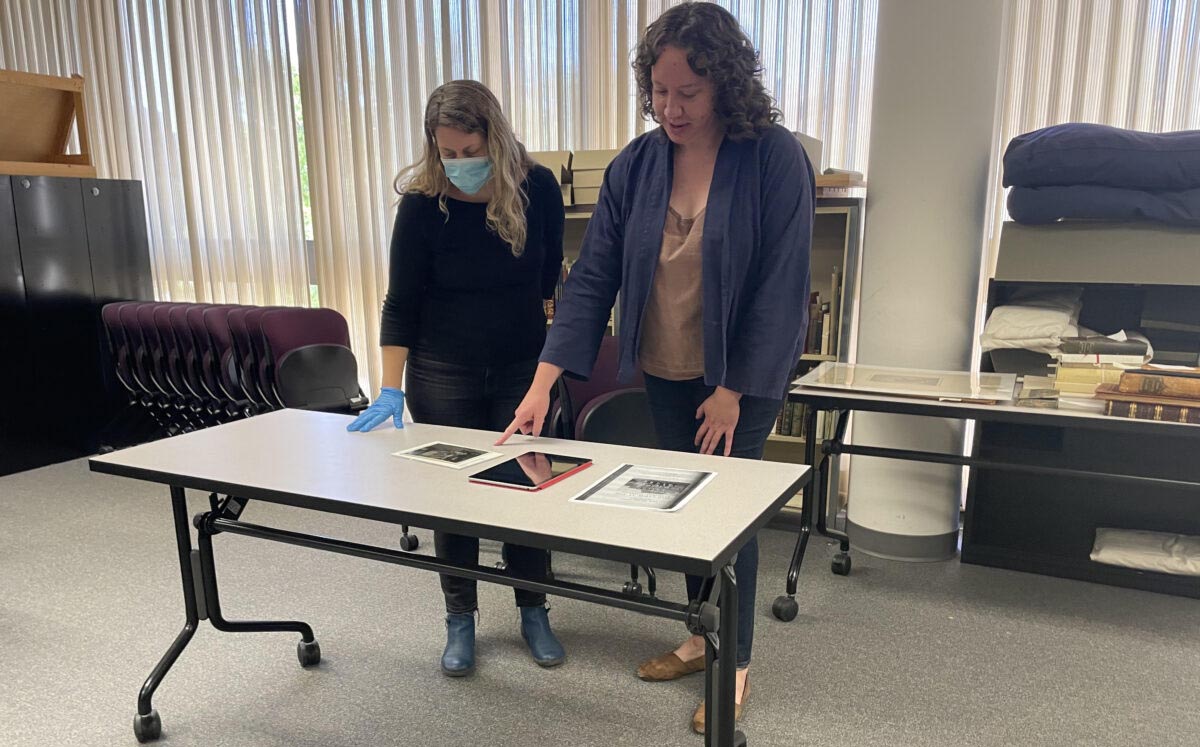 Special Collections staff Susan Graham ’98 and Lindsey Loeper ’04 share pieces of the Lewis Hine collection with students.
Learning from our past
Meredith Power, a graduate student in UMBC’s historical studies program who has been interning with the preservation project, notes the power Hine’s images still possess.
“Some are heartbreaking, some are thought-provoking, while others made me stop short and smile as I pulled them from their storage folder to photograph them,” Power says. “From the bright, sad eyes of the young boys who spent their days underground opening and closing gates inside coal mines, to the cheerful joy on the face of a girl who sold eggs as she hugs her beloved hen, the collection still manages to evoke an emotional response. It’s that emotional connection, the shared sense of experiencing something.”
Next year, the Special Collections department will celebrate its 50th anniversary. The Hine collection was among the inaugural collections for UMBC’s Special Collections, leading in turn to a specific focus on photography in the collection.
In 1974, the Hine collection was acquired by the then new Special Collections program from the NCLC, facilitated by former Library Director Antonio Raimo and Jerry Stephany, a photographer in the visual arts department who had once worked at the George Eastman Museum in Rochester.
“Jerry really saw the importance of a teaching collection of photography,” says Saunders. “The idea behind collecting this particular body of work was to show photography’s relationship to a variety of social issues and the way that photography can be used as a tool of visual communication across disciplines.”
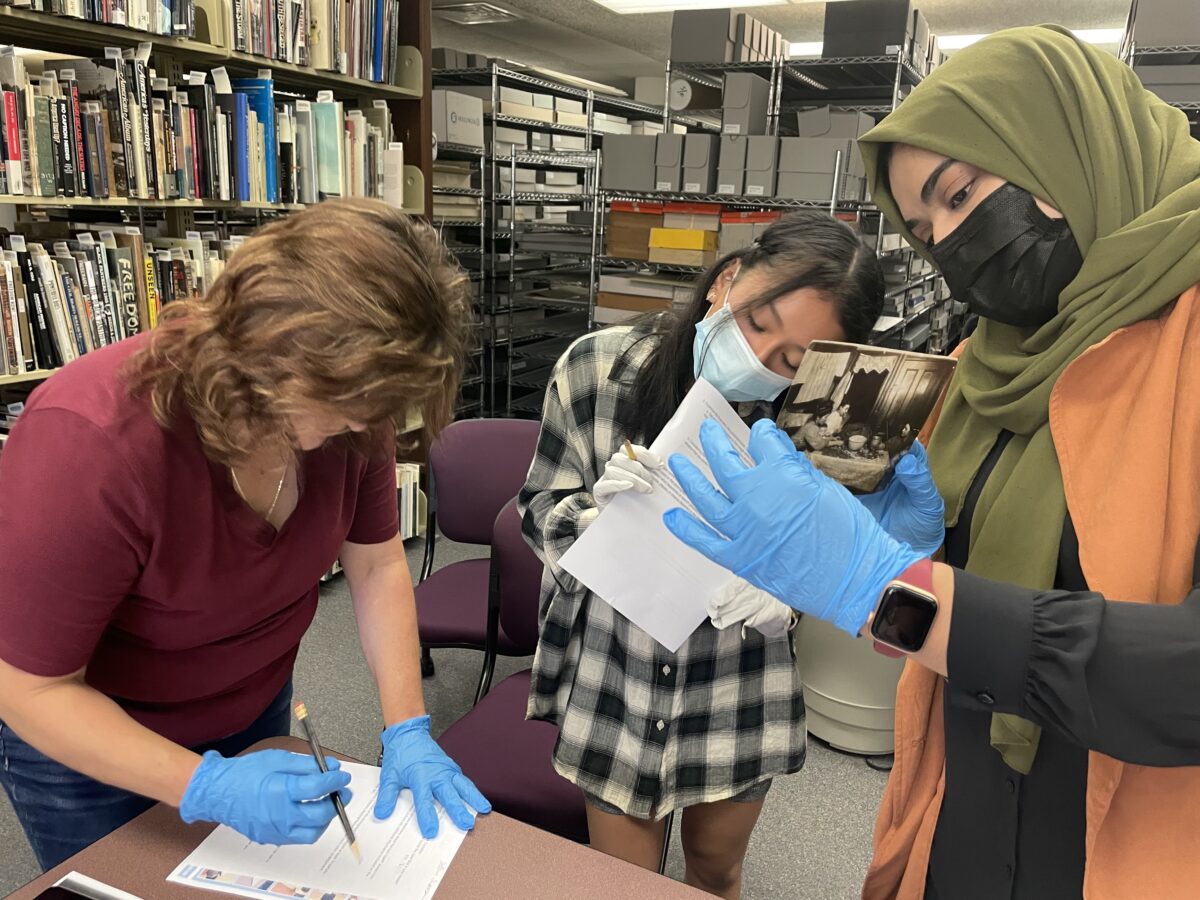
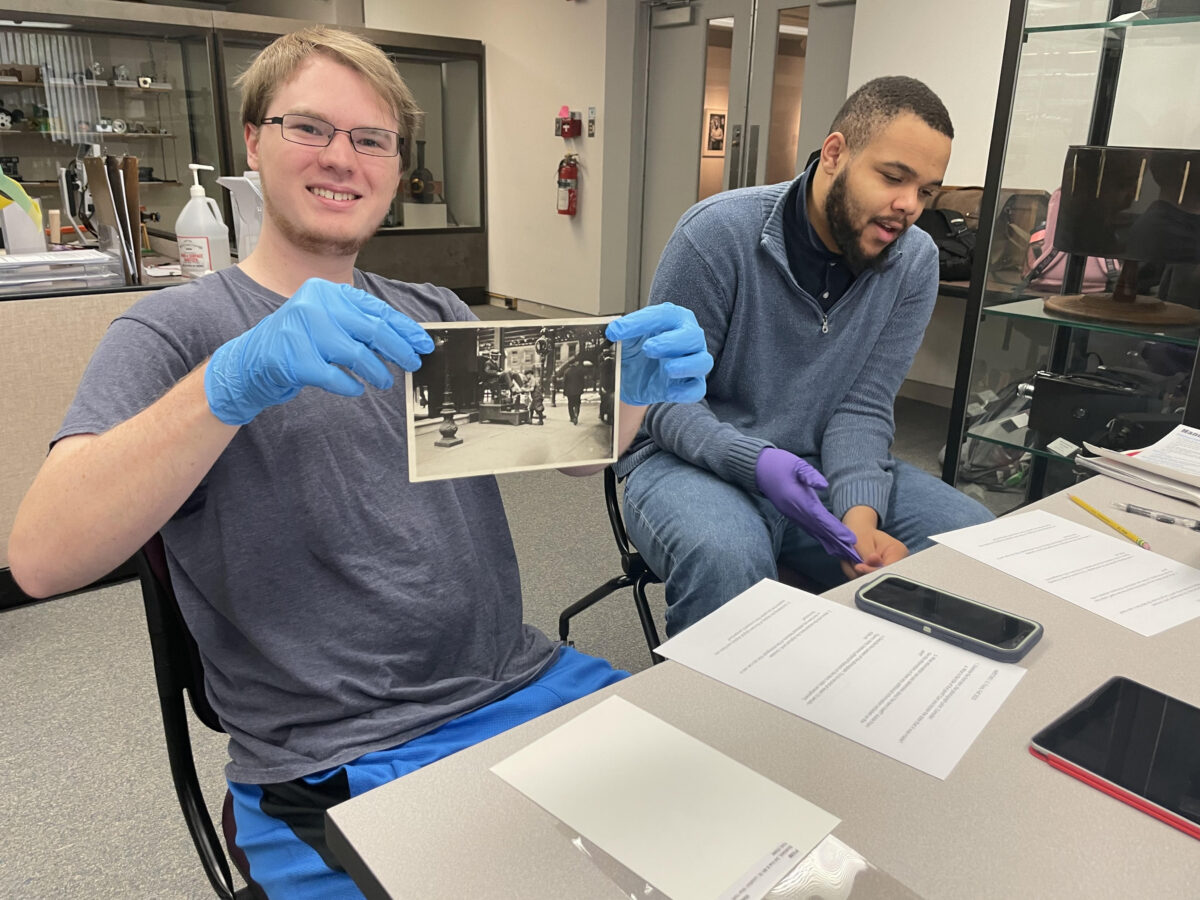 Students in Sarah Fouts’ Approaches to American Studies AMST300 class take part in an activity where student look at the same/similar photographs in a book, in the digital collections, and then the original photo print, and the features and contextual information available with each format. At left (L-R): Hellen Swanson, Sissi Castro, and Fairuaz Mukarama. At right (L-R): Kyle Warfield and Edward Robinson. Photos courtesy of Sarah Fouts.
Power, who is currently working towards an M.A. in UMBC’s historical studies program, researching solitary fourteenth-century religious Englishwomen, notes the interdisciplinary power of the Hine collection and the need to preserve it.
“On the surface, photographs of early twentieth century American child laborers have very little in common with my own academic research,” Power says. “However, as we’ve all learned since COVID-19’s arrival, physical access to research or archival material is sometimes impossible. In those cases, digitized resources and online information about them are invaluable. This is just as true for materials related to medieval religious history as it is for those who are looking into U.S. child labor reform.”
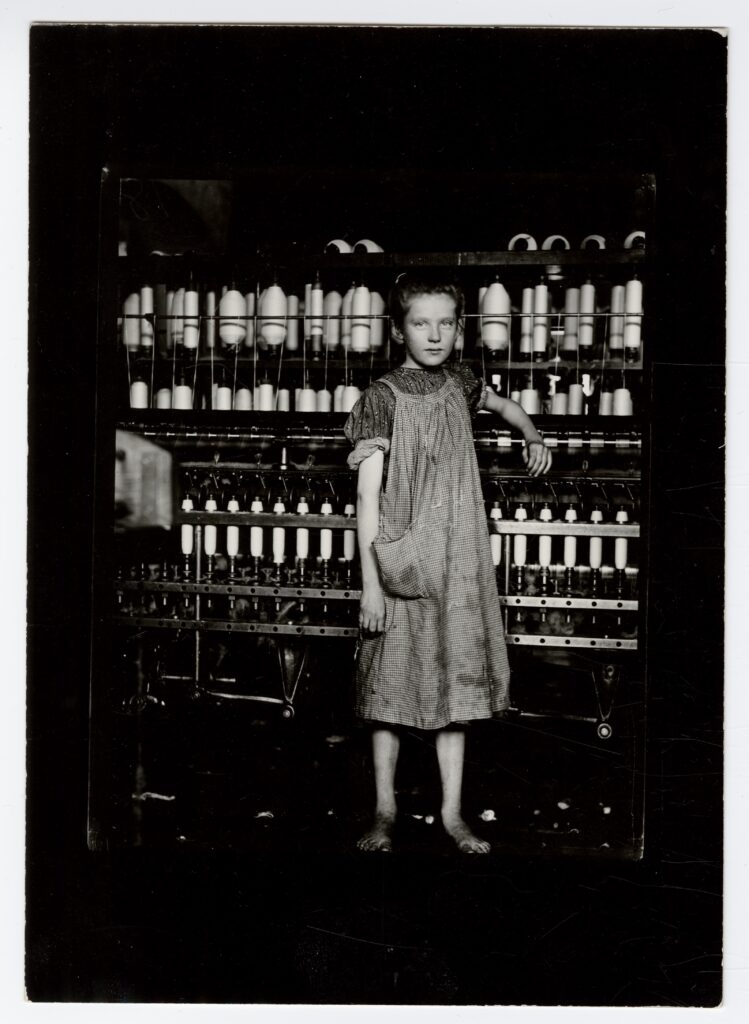 Lewis Hine, Anaemic Little Spinner in North Pownal Cotton Mill, Vermont, 1910. Gelatin silver print, 5 x 7 in. The Photography Collections, University of Maryland, Baltimore County (P1050)
A shared history
Today, UMBC Special Collections holds an estimated three million photographs stretching back to 1840, including the Baltimore Sun archive.
“There is a strong emphasis on documentary photography, which kind of came out of the Hine collection,” says Saunders. “We’re also particularly strong in Maryland history, including the Maryland Traditions archive, the state folklore archive.”
Additionally, Special Collections holds the collection of radical literature from the Alternative Press Center, an extensive collection of historic science fiction, the UMBC archive, and the new Eileen J. Garret Parapsychology Foundation Collection.
]]>
The photographer Lewis Hine secured a place in history as a documentarian of early 20th century life, including a transformational investigation into the conditions for child laborers. From...
https://umbc.edu/stories/preserving-the-photography-of-lewis-hine/
https://my3.my.umbc.edu/api/v0/pixel/news/129185/guest@my.umbc.edu/a1f21e61816717034b9fcac1000f4415/api/pixel
albin-o-kuhn-library-and-gallery
arts-and-culture
cahss
discovery
graduateschool
historical-studies
lewis-hine
magazine
news
special-collections
UMBC News & Magazine
https://my3.my.umbc.edu/groups/umbc-news-magazine
https://assets1-my.umbc.edu/system/shared/avatars/groups/000/001/943/24435aa6207c452e7bc15cc74b42c7bb/xsmall.png?1748556657
https://assets1-my.umbc.edu/system/shared/avatars/groups/000/001/943/24435aa6207c452e7bc15cc74b42c7bb/original.png?1748556657
https://assets2-my.umbc.edu/system/shared/avatars/groups/000/001/943/24435aa6207c452e7bc15cc74b42c7bb/xxlarge.png?1748556657
https://assets2-my.umbc.edu/system/shared/avatars/groups/000/001/943/24435aa6207c452e7bc15cc74b42c7bb/xlarge.png?1748556657
https://assets3-my.umbc.edu/system/shared/avatars/groups/000/001/943/24435aa6207c452e7bc15cc74b42c7bb/large.png?1748556657
https://assets1-my.umbc.edu/system/shared/avatars/groups/000/001/943/24435aa6207c452e7bc15cc74b42c7bb/medium.png?1748556657
https://assets2-my.umbc.edu/system/shared/avatars/groups/000/001/943/24435aa6207c452e7bc15cc74b42c7bb/small.png?1748556657
https://assets1-my.umbc.edu/system/shared/avatars/groups/000/001/943/24435aa6207c452e7bc15cc74b42c7bb/xsmall.png?1748556657
https://assets2-my.umbc.edu/system/shared/avatars/groups/000/001/943/24435aa6207c452e7bc15cc74b42c7bb/xxsmall.png?1748556657
UMBC News & Magazine
2
0
false
Mon, 14 Nov 2022 15:22:11 -0500
Mon, 14 Nov 2022 15:22:11 -0500
UMBC Special Collections receives more than 12,000 volumes from Parapsychology Foundation
UMBC Special Collections has been given an extraordinary gift of one of the world’s largest collections devoted to parapsychology, from the Parapsychology Foundation, Inc. in Greenport, New York. The acquisition will be known as the Eileen J. Garrett Parapsychology Foundation Collection. It includes documents related to hauntings, poltergeists, out-of-body experiences, and séances, as well as spirit photographs and much more.
A renowned resource
The Eileen J. Garrett Parapsychology Foundation Collection contains more than 12,000 volumes and more than 100 periodicals, including rare books on and early journals devoted to psychical research. The collection emphasizes the literature of contemporary parapsychology and those publications that approach the subject from objective and analytical points of view.
The library also maintains strong sections on the history of psychical research and parapsychology, including early Spiritualism, mysticism and relevant philosophical works, as well as on mediumship, apparitions, hauntings, poltergeists, near-death and out-of-body experiences, experimental research on extrasensory perception, psychokinesis and precognition. A number of relevant encyclopedias, doctoral dissertations on parapsychological topics, introductory textbooks, and biographies of researchers, psychics and mediums are also on hand.
The archival collections comprise the history and proceedings of the Parapsychology Foundation and its annual conferences and publications, as well as field work, research notes, and manuscripts from prominent parapsychologists. Among the people and topics included in the collection are: the Bindelof séance phenomena, research files of psychic researcher Hereward Carrington, the poltergeist investigations and personal scrapbook of Nandor Fodor, scrapbooks compiled by Eileen J. Garrett, records pertaining to the R101 Airship crash, and spirit recordings captured by Hans Holzer.
The collection features original manuscripts by Harry Price and others pertaining to the infamous Borley Rectory case, popularly known as the most haunted house in England. It also contains Montague Ullman and Stanley Krippner’s dream telepathy research and many other subjects. Audio visual materials include over 600 audio and video recordings of conferences and lectures, spirit photographs, glass slides, target images, psychokinetic objects, and an ESP testing machine.
The Parapsychology Foundation’s rich history
The non-profit Parapsychology Foundation provides a worldwide forum supporting the scientific investigation of psychic phenomena. The Foundation gives grants; publishes pamphlets, monographs, conference proceedings, and the International Journal of Parapsychology; hosts the Perspectives Lecture Series; conducts an outreach program; and publishes books on the subject through its imprint, Helix Press.
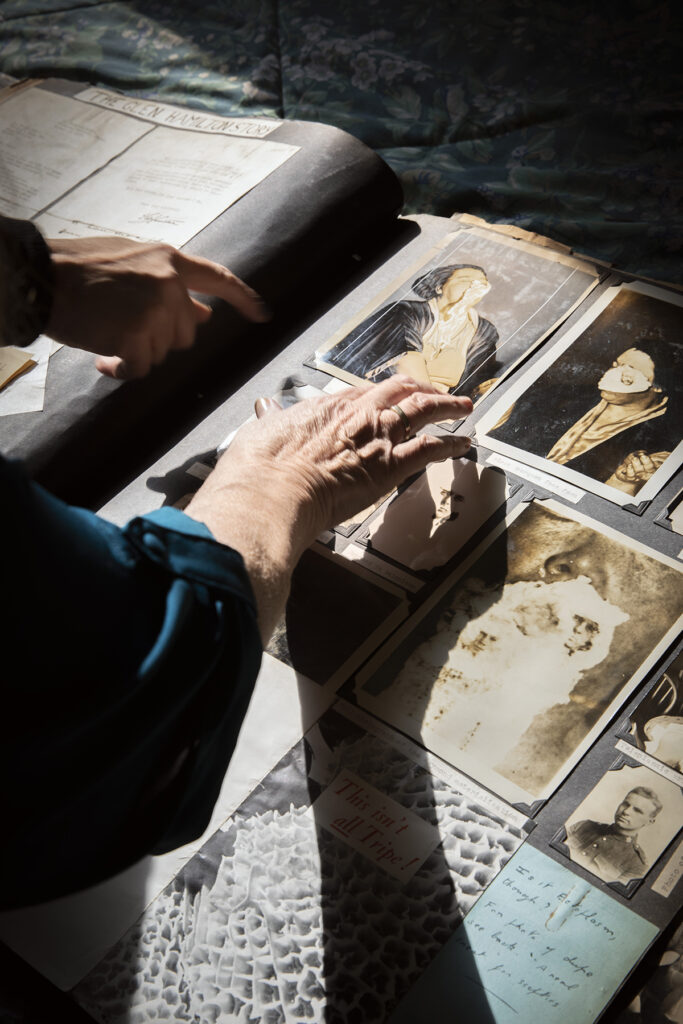 Materials from the Eileen J. Garrett Parapsychology Foundation Collection. (Image courtesy of Shannon Taggart)
The Parapsychology Foundation was founded by trance medium and research advocate Eileen J. Garrett and congresswoman Hon. Frances P. Bolton in 1951 to encourage and support impartial scientific inquiry into psychical aspects of human nature such as telepathy, clairvoyance, precognition, and psychokinesis.
A participant in some of the groundbreaking psychic experiments of the 1920s and 1930s, Garrett understood that psychical research was ignored by a large segment of the academic community. She knew that practical aid for scholars and scientists working in this area, now known as parapsychology, would not be available from most universities nor from other foundations. The Parapsychology Foundation, as envisioned by Garrett, fulfilled this need by providing a worldwide forum for the support of scientific exploration of psychic phenomena.
Establishing a new home for the collection
The Foundation recently decided to transfer its library to an American institution that would be willing to care for, interpret, and provide public access to the Foundation’s collection of scholarly materials. UMBC Special Collections was awarded this major gift thanks to its demonstrated commitment to preservation and accessibility.
Parapsychology Foundation president Lisette Coly states, “While bittersweet to relinquish the care of our library into the most capable hands of UMBC Special Collections, we are confident and excited that it has found a perfect harbor for its continuation and growth. Lovingly maintained throughout our 72 years of existence, we are assured of its preservation and growth as a valued resource disseminating quality information concerning a complex and often misunderstood subject. We eagerly look forward to future collaboration.”
“We are thrilled to bring this important collection to UMBC,” says curator and head of UMBC Special Collections Beth Saunders. “I believe that the Garrett Collection is exemplary of the spirit of free intellectual inquiry that our materials are intended to support.”
Saunders notes, “The collection includes materials relevant to a wide range of academic disciplines including anthropology, art history, sociology, philosophy, psychology, and physics, and addresses fundamental concerns of human experience.”
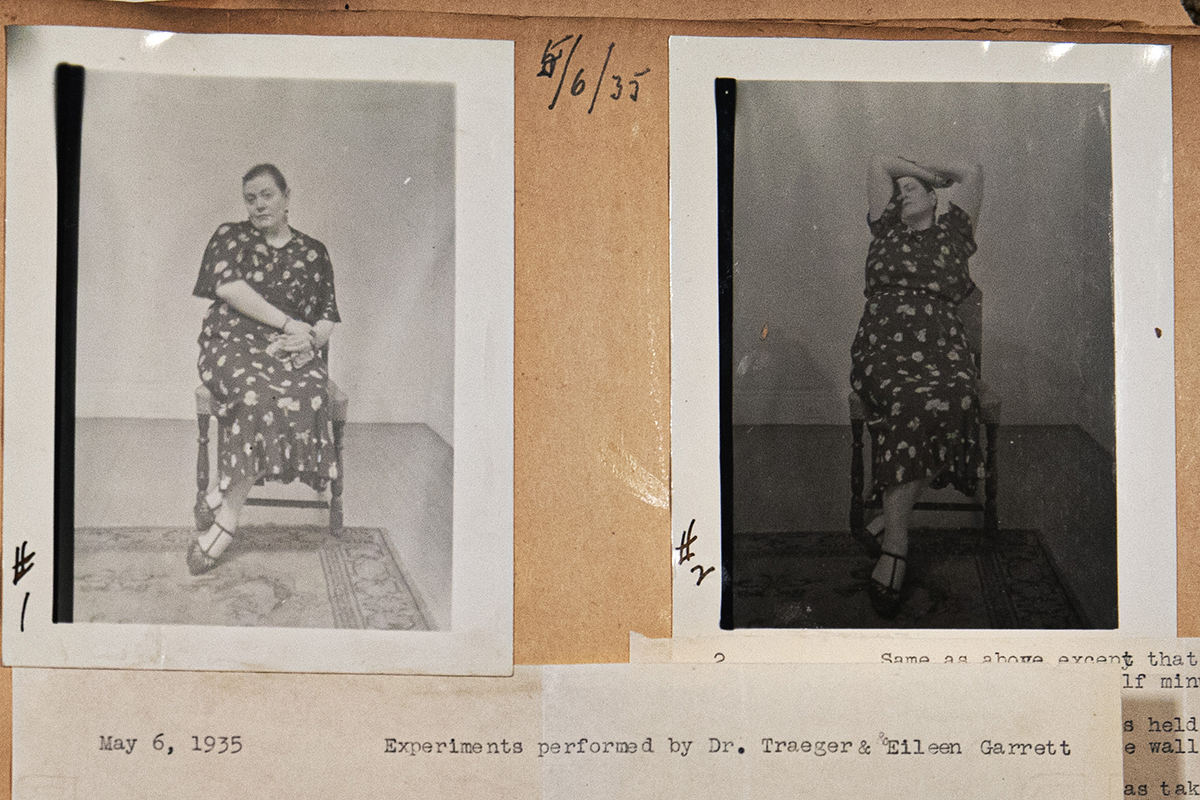 Materials from the Eileen J. Garrett Parapsychology Foundation Collection. (Image courtesy of Shannon Taggart)
Building on strengths
“The Garrett Library also builds upon an existing strength of Special Collections,” adds Saunders. “We are known internationally for our Jule Eisenbud Collection on Ted Serios and Thoughtographic Photography.”
Jule Eisenbud was heavily involved with psychoanalysis and psychology and was a clinical faculty member at the University of Colorado, and an honored member of the American Society for Psychical Research and Parapsychology Foundation. Eisenbud met his main subject, Ted Serios, in 1964 in Chicago. At the time, Serios was an unemployed bellhop who claimed that he had the ability to put images on film with his mind. Although initially skeptical of Serios, a significant number of successful experiments under tightly controlled conditions convinced Eisenbud that Serios’s talent was legitimate.
Ted Serios’s ability, which came to be known as “thoughtography,” gained national attention with his appearance on “The Tonight Show” with Johnny Carson. The Eisenbud Collection includes over 2,000 photographs and is the subject of a forthcoming exhibition organized by Emily Cullen, curator of exhibitions at UMBC’s Albin O. Kuhn Library Gallery, for The Image Centre at Toronto Metropolitan University, as well as a book to be published by Atelier Éditions, both in 2023.
Saunders envisions similar opportunities for the Eileen J. Garrett Parapsychology Foundation Collection. “We plan to focus first on making the collection accessible by cataloging the books and serials and creating a Finding Aid for the archival documents. We also plan to publish detailed research guides to aid scholars in discovery of relevant materials. In the future, there are a number of digitization projects that would make the highest research value materials more widely available, and I’d like to work with students to curate an exhibition from the collection in the Library Gallery.”
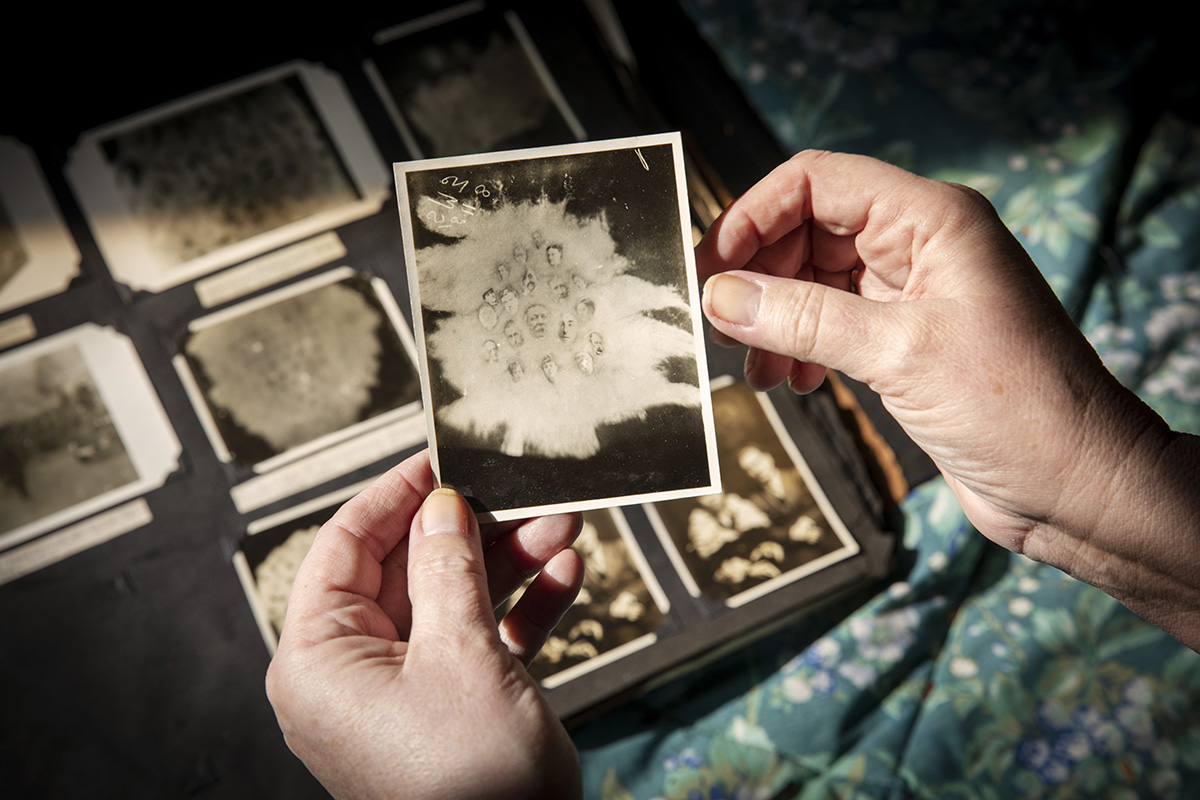 Materials from the Eileen J. Garrett Parapsychology Foundation Collection. (Image courtesy of Shannon Taggart)
UMBC’s Special Collections
The Special Collections department collects materials of enduring historical and cultural value—housing, preserving, and making accessible materials that are original, rare, unique, fragile, and archival. The collections and staff support UMBC’s research and educational mission and its dedication to cultural and ethnic diversity, social responsibility, and lifelong learning. Topical collecting areas are particularly emphasized within the fields of photography, the history of the biological sciences, the Baltimore Sun newspaper, science fiction literature and popular culture, parapsychology, alternative presses, UMBC history and records, and Maryland manuscript, photograph, and newspaper collections.
Saunders notes that Special Collections will continue to work with the Parapsychology Foundation to grow the collections and encourage its scholarly use. The Parapsychology Foundation hopes to administer library grants that will fund researchers visiting the Garrett Collection at UMBC. The organizations would also like to host joint public programs and academic symposia on topics related to the collection in the future.
]]>
UMBC Special Collections has been given an extraordinary gift of one of the world’s largest collections devoted to parapsychology, from the Parapsychology Foundation, Inc. in Greenport, New York....
https://umbc.edu/stories/umbc-special-collections-receives-more-than-12000-volumes-from-parapsychology-foundation/
https://my3.my.umbc.edu/api/v0/pixel/news/128694/guest@my.umbc.edu/5ee699982fb861005e9b679c9c561c11/api/pixel
arts-and-culture
library
news
special-collections
UMBC News & Magazine
https://my3.my.umbc.edu/groups/umbc-news-magazine
https://assets1-my.umbc.edu/system/shared/avatars/groups/000/001/943/24435aa6207c452e7bc15cc74b42c7bb/xsmall.png?1748556657
https://assets1-my.umbc.edu/system/shared/avatars/groups/000/001/943/24435aa6207c452e7bc15cc74b42c7bb/original.png?1748556657
https://assets2-my.umbc.edu/system/shared/avatars/groups/000/001/943/24435aa6207c452e7bc15cc74b42c7bb/xxlarge.png?1748556657
https://assets2-my.umbc.edu/system/shared/avatars/groups/000/001/943/24435aa6207c452e7bc15cc74b42c7bb/xlarge.png?1748556657
https://assets3-my.umbc.edu/system/shared/avatars/groups/000/001/943/24435aa6207c452e7bc15cc74b42c7bb/large.png?1748556657
https://assets1-my.umbc.edu/system/shared/avatars/groups/000/001/943/24435aa6207c452e7bc15cc74b42c7bb/medium.png?1748556657
https://assets2-my.umbc.edu/system/shared/avatars/groups/000/001/943/24435aa6207c452e7bc15cc74b42c7bb/small.png?1748556657
https://assets1-my.umbc.edu/system/shared/avatars/groups/000/001/943/24435aa6207c452e7bc15cc74b42c7bb/xsmall.png?1748556657
https://assets2-my.umbc.edu/system/shared/avatars/groups/000/001/943/24435aa6207c452e7bc15cc74b42c7bb/xxsmall.png?1748556657
UMBC News & Magazine
3
0
false
Mon, 24 Oct 2022 13:33:24 -0400
Mon, 24 Oct 2022 13:33:24 -0400
As spiritualism’s popularity grows, photographer Shannon Taggart takes viewers inside the world of séances, mediums and orbs

By Beth Saunders, Curator and Head of Special Collections and Gallery, UMBC
The word séance conjures images of darkened rooms, entranced mediums, strange occurrences and spirit voices. For many contemporary audiences, these visions might seem like something out of the past, or perhaps a movie, rather than a living belief system.
For the past 20 years, American photographer Shannon Taggart has explored modern spiritualism, a religion whose adherents believe in communication with the dead.
Her photographic series “Séance,” which was recently on view at the Albin O. Kuhn Gallery at the University of Maryland, Baltimore County, provides a window into this often misunderstood religion.
As a curator and art historian who has researched apparition photographs and the art of conspiracy theory, I was drawn to Taggart’s images because they offer a lens through which to examine the role of spirituality in modern life.
In an era defined by a global pandemic, heightened political division and the planetary threat of climate change, I wonder: Is spiritualism due for a major resurgence?
Spiritualism comes knocking
Spiritualism emerged near Rochester, New York, in 1848 when two sisters, Kate and Margaret Fox, claimed to hear a mysterious rapping at their bedroom wall. The adolescents claimed to communicate through a system of knocks with the spirit of a man who had died in the house years earlier. News of the phenomenon traveled quickly, and the girls appeared before crowds demonstrating their purported abilities.
Soon, reports of similar phenomena occurring across the United States appeared in the press, and the possibility of speaking with the deceased fueled the popular imagination.
Spiritualism first grew in private. People who channeled communication with the dead, called mediums, operated out of their homes, where they would organize séance circles, gatherings in which a small group attempted to make contact with the spirit world.
Over time, spiritualists started appearing publicly at conventions and outdoor summer camp meetings. By the 1870s, they began to put down roots, founding like-minded communities and centers of study, such as the spiritualist colony of Lily Dale, New York, established in 1879.
In addition to holding séances, spiritualists practice healings and believe in the gift of prophecy. Mediums say they convey messages from the dead to the living, including reports about the future.
Many spiritualists hoped to make utopian visions of the future a reality in the present by supporting progressive political causes such as abolitionism, women’s rights and Indigenous rights.
Notably, spiritualism gave women an unprecedented role in religion, providing an audience and a platform to deliver messages both personal and political. Suffragists Marion H. Skidmore, Elizabeth Cady Stanton and Susan B. Anthony all spoke at Lily Dale. The views of spiritualists thus represented a radical break from traditional religious and political authority.
Ghosts in the machine
The Fox sisters’ purported ability to communicate with the dead became known as “the spiritual telegraph,” referencing the then-recent invention by Samuel B. Morse. As spiritualism developed, adherents embraced technology as tools for spirit communication and to prove the existence of spirits.
Photography became “the perfect medium” with which to create an iconography of spiritualism. Whether it was through astronomical, microscopic or X-ray photography, cameras could render the unseen visible. Despite the proliferation of altered photographs in the 19th century, the photograph’s status as a truthful representation of reality remained – and, one might argue, continues to remain – largely intact.
Photography also played a leading role in the 19th century’s memorial culture, since the camera could freeze time and render absent loved ones present, if only as a visual trace.
The American Civil War brought death at an unprecedented scale into people’s living rooms through the pages of the illustrated press. Black attire, mourning jewelry and the genre of post-mortem photography were commonplace in a culture of grieving.
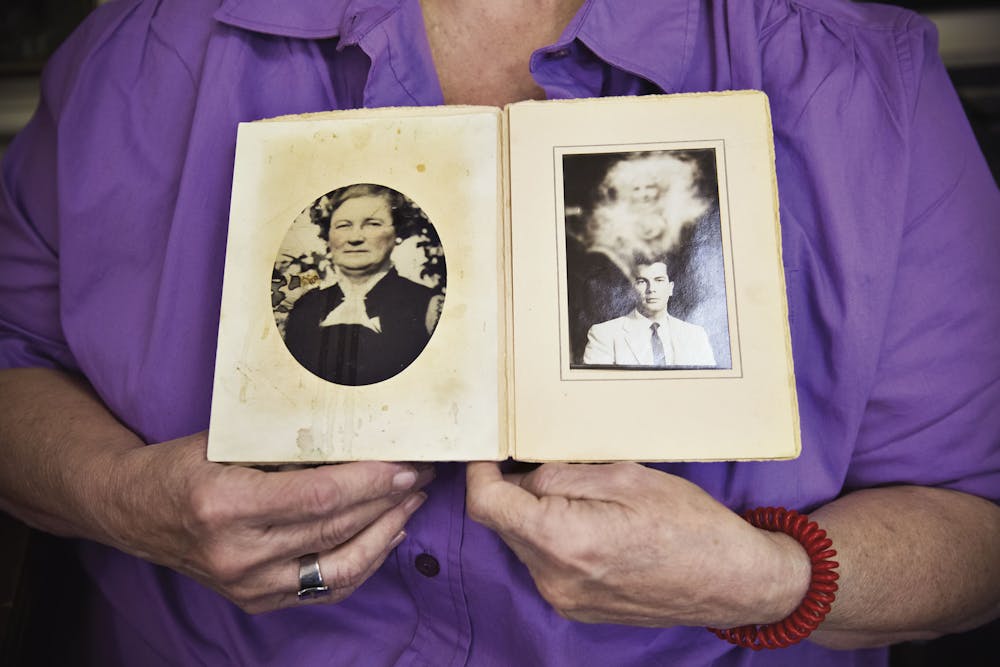
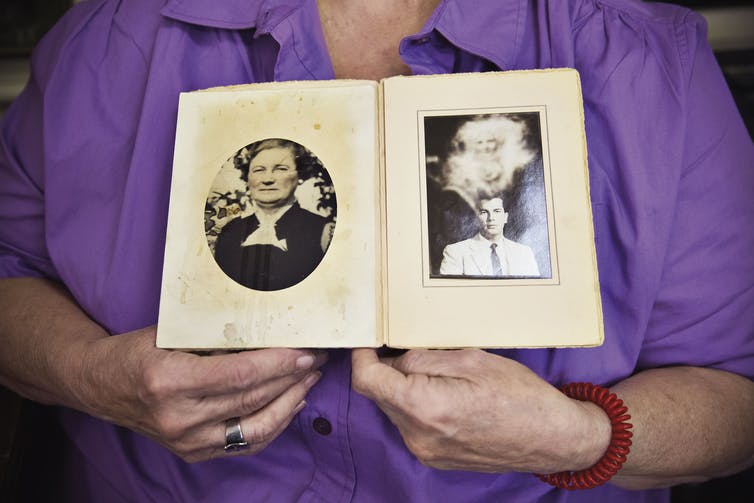 Sandy Candy Eppinger’s family spirit photographs, which show her brother Eugene Candy with the spirits of their grandmother Ethel Philips and great aunt Helen Thompson, at Lily Dale, New York, in 2015. © Shannon Taggart. Courtesy of the Artist, Author provided
In the 1860s, New York portrait photographer William Mumler and his wife, Hannah Mumler, a medium, offered portrait sessions in which spirits of the sitters’ loved ones appeared to manifest in the resulting photographs.
Mumler’s spectacular portraits also raised the specter of hucksterism. The photographer was charged with fraud by claimants who argued he faked the photographs, and none other than showman P.T. Barnum gave evidence for the prosecution.
In the early 20th century, Sherlock Holmes creator Sir Arthur Conan Doyle famously rallied to defend British medium Ada Emma Deane, who was also accused of faking spirit photographs.
The double-sided coin of belief and skepticism haunts these historical examples; nonetheless, the psychological impact of these images among the grieving remained powerful.
Spiritualist revivals
History seems to suggest that catastrophic loss of life can spur renewed interest in spiritualist beliefs.
Perhaps it’s no coincidence that the Mumlers’ portraits became all the rage amid the devastation of the U.S. Civil War, while Deane’s popularity peaked in the wake of World War I and the flu pandemic.
Has the pervading sense of uncertainty induced by the COVID-19 pandemic triggered another spiritualist revival?
Alternative belief structures, including astrology and tarot, seem to have experienced a resurgence, reaching new audiences through the internet and social media.
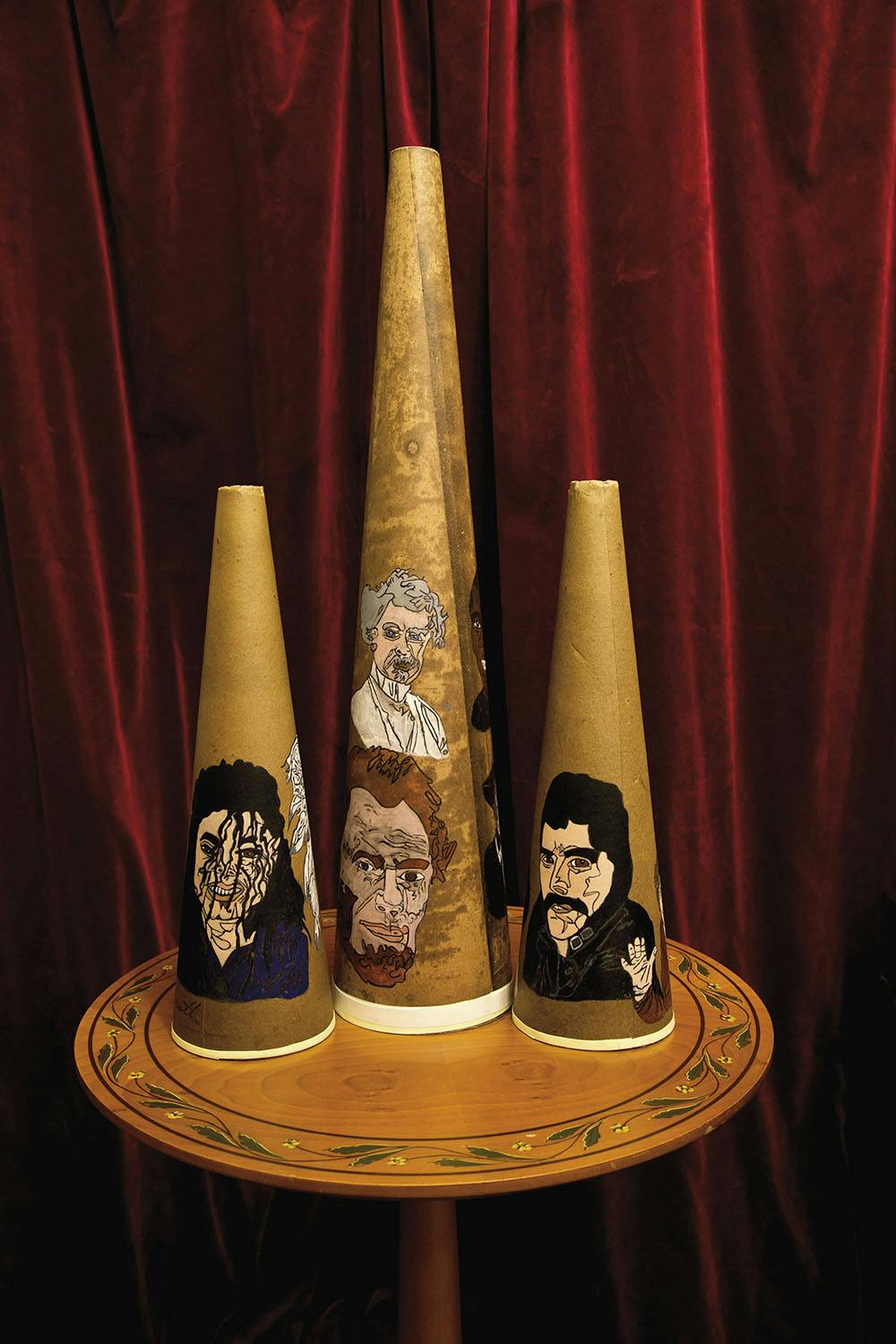
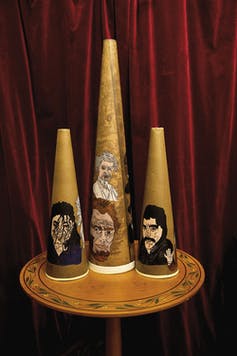 Séance trumpets featuring celebrity spirit guides, including Michael Jackson and Freddie Mercury, hand-painted by medium Sylvia Howarth, in England in 2013. © Shannon Taggart. Courtesy of the Artist., Author provided
Recently, a number of mediums have become famous thanks to their endorsements by celebrity clientele. Some mediums claim to be able to channel stars from the grave, from Louis Armstrong to Elvis Presley.
While modern mediums have their detractors, their eager adoption of television and the internet is a logical step for a religion that has always embraced new technologies.
What was once seen as a niche subculture or the domain of late-night 1-900 call-in shows has gone mainstream: Psychic businesses were a US$2 billion industry in 2018.
Shannon Taggart’s ‘Séance’
This new spirituality has influenced pop culture as well as high art; the Guggenheim’s 2019 retrospective of Swedish artist and mystic Hilma af Klint was the most-visited exhibition in the museum’s history, drawing over 600,000 viewers.
New York Times art critic Roberta Smith argued that the exhibition’s impact amounted to a “psychic and historical shift” in the art world. Smith’s use of the word “psychic” is apt; the exhibition was a watershed not only for restoring to primacy women’s role in the development of abstract painting, but also for re-centering the spiritual within art.
Taggart’s photographs, meanwhile, explore present-day practices, sites and objects of spiritualism.
Allowing chance and automation to guide camera experiments, she reveals processes of transformation and altered states through blurred effects, halos of light and doubling in images that reference historical spirit photographs.
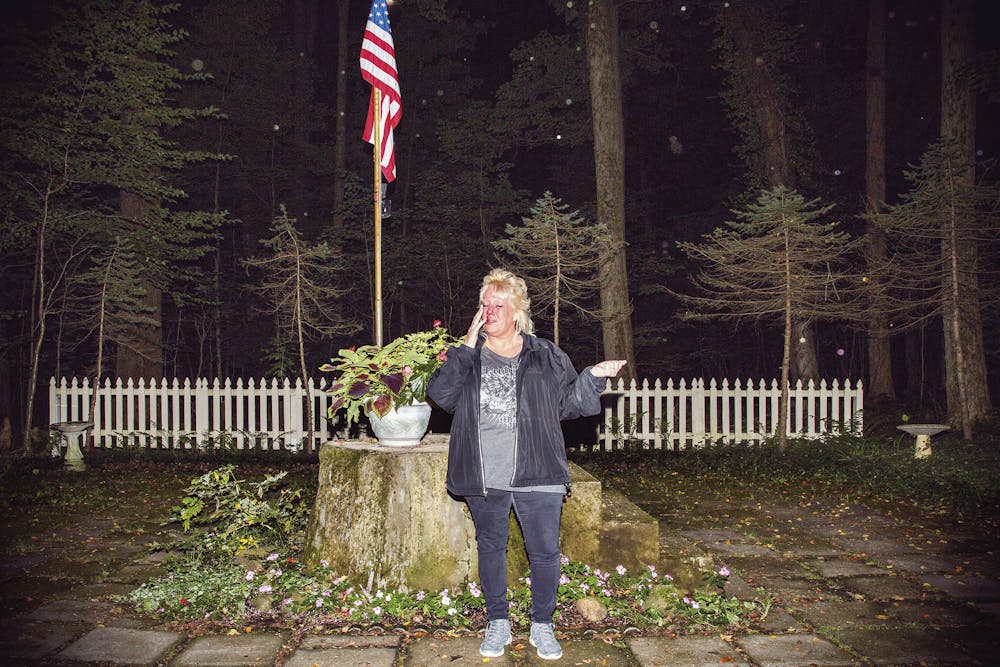
In one image, for example, a grieving mother raises her arms into a darkened sky dotted with circles of light known as orbs. Orb photography is a recent innovation within spirit photography in which practitioners call upon spirits to manifest orbs, which are then captured by digital cameras. Orb photography is another example of the ambiguity of spirit photographs: Does it channel the supernatural, or simply capture reflections of dust on the camera lens?
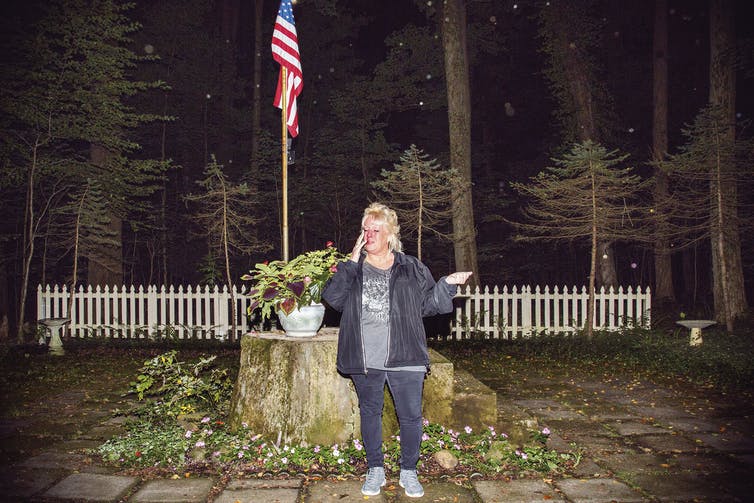 Kim Kitchen calls to her deceased daughter Casey and asks her for orbs in Lily Dale, New York, in 2014. © Shannon Taggart. Courtesy of the Artist, Author provided
For Taggart, that question is largely beside the point. Her aim is to remain truthful to the psychological experience of spiritualism, to make visible what is ineffable.
Taggart’s photographs recover the marginalized history of spiritualism at a moment when the religion feels once again on the verge of a resurgence.
As Taggart is fond of saying, “You don’t have to take spiritualism literally to take it seriously.”
*****
Disclosure statement: Beth Saunders does not work for, consult, own shares in or receive funding from any company or organization that would benefit from this article, and has disclosed no relevant affiliations beyond their academic appointment.
This article is republished from The Conversation under a Creative Commons license. Read the original article here.
Header image: Table-tipping workshop with mediums Jane and Chris Howarth in Erie, Pennsylvania, in 2014. © Shannon Taggart. Courtesy of the Artist., Author provided
]]>
By Beth Saunders, Curator and Head of Special Collections and Gallery, UMBC The word séance conjures images of darkened rooms, entranced mediums, strange occurrences and spirit voices. For...
https://umbc.edu/stories/as-spiritualisms-popularity-grows-photographer-shannon-taggart-takes-viewers-inside-the-world-of-seances-mediums-and-orbs/
https://my3.my.umbc.edu/api/v0/pixel/news/119494/guest@my.umbc.edu/39b74fb9dd3b28f7beea6b413058c864/api/pixel
aok-gallery
discovery
religion-and-spirituality
special-collections
the-conversation
UMBC News & Magazine
https://my3.my.umbc.edu/groups/umbc-news-magazine
https://assets1-my.umbc.edu/system/shared/avatars/groups/000/001/943/24435aa6207c452e7bc15cc74b42c7bb/xsmall.png?1748556657
https://assets1-my.umbc.edu/system/shared/avatars/groups/000/001/943/24435aa6207c452e7bc15cc74b42c7bb/original.png?1748556657
https://assets2-my.umbc.edu/system/shared/avatars/groups/000/001/943/24435aa6207c452e7bc15cc74b42c7bb/xxlarge.png?1748556657
https://assets2-my.umbc.edu/system/shared/avatars/groups/000/001/943/24435aa6207c452e7bc15cc74b42c7bb/xlarge.png?1748556657
https://assets3-my.umbc.edu/system/shared/avatars/groups/000/001/943/24435aa6207c452e7bc15cc74b42c7bb/large.png?1748556657
https://assets1-my.umbc.edu/system/shared/avatars/groups/000/001/943/24435aa6207c452e7bc15cc74b42c7bb/medium.png?1748556657
https://assets2-my.umbc.edu/system/shared/avatars/groups/000/001/943/24435aa6207c452e7bc15cc74b42c7bb/small.png?1748556657
https://assets1-my.umbc.edu/system/shared/avatars/groups/000/001/943/24435aa6207c452e7bc15cc74b42c7bb/xsmall.png?1748556657
https://assets2-my.umbc.edu/system/shared/avatars/groups/000/001/943/24435aa6207c452e7bc15cc74b42c7bb/xxsmall.png?1748556657
UMBC News & Magazine
0
0
false
Wed, 22 Dec 2021 18:59:28 -0500