Discovery – Spring 2017

Runaway Black Hole
A team of researchers including UMBC’s Eileen Meyer and Markos Georganopoulos have found strong evidence of a striking astrophysical phenomenon: a supermassive black hole traveling away from the center of its galaxy at an incredibly rapid pace.
A scenario like this has been predicted for some time.
“The theory is great, but we’ve got to have some observations to see if our simulations are correct,” says Meyer, assistant professor of physics. Those observations are now in hand, with copious lines of evidence all supporting the team’s explanation.
“There have been previous cases of systems like this,” says Georganopoulos, associate professor of physics, “but ours is the most solid case.” Meyer adds, “It’s the only one I can think of where all the little pieces of evidence line up in favor of this scenario very specifically.”
When two galaxies with black holes at their centers merge, gravitational forces pull the black holes to the center of the newly-formed galaxy. The black holes spin around each other, gradually slowing down. This process releases gravitational waves – ripples in the fabric of spacetime that travel outward at the speed of light. Depending on the relative rotational speeds of the two original black holes, once they merge, the new black hole may be kicked out of the galaxy’s center by the gravitational waves.
Data collected by the Hubble Space Telescope and other sources confirm that the black hole’s speed and position – approximately 4.8 million miles per hour, offset from the center of its galaxy – are consistent with the team’s explanation that the black hole has been powerfully ejected from the galaxy by the force of gravitational waves.
First author Marco Chiaberge, research scientist at the Space Telescope Science Institute at the Johns Hopkins University, approached Meyer and Georganopoulos almost two years ago to help interpret the surprising data. Georganopoulos shares, “For me, the most exciting thing was to go from the raw data to building up a scenario – gradually realizing that the other scenarios are very implausible.”
Although alternative explanations are unlikely, the team still wants to collect additional observations to further confirm their interpretation. They’re submitting a proposal for time on the Atacama Large Millimeter Array, a powerful telescope in Chile that could help them answer remaining questions.
“At the same time that it creates the opportunity to solidify our model, it’s also an opportunity to falsify it,” says Georganopoulos, of the possible opportunity to use the array in Chile and the importance of remaining open to new interpretations of the data.
Either way, it will be exciting research. “Even if it doesn’t turn out the way we’re expecting,” says Meyer, “this is still a strange and remarkable system that needs to be studied.”
— Sarah Hansen M.S. ’15
Image: NASA, ESA, and M. Chiaberge (STScI and JHU)
Read more about black holes at UMBC News.
Crossing the Digital Divide

U.S. Librarian of Congress Carla Hayden, former director of Baltimore’s Enoch Pratt Free Library, shared her thoughts on the expansion of digital access to libraries, “a treasure chest just waiting to be opened,” with audiences at UMBC in April.
Hayden recounted meeting with then-President Barack Obama before her nomination. Together, at the Library of Congress, they viewed personal letters that Rosa Parks wrote after her arrest in Montgomery, Alabama in 1955 for refusing to give up her bus seat and discussed the immense potential of historical records to directly inform, affirm, and inspire. What was needed, he expressed, was someone to bring the library’s 160 million items directly to the public.
In her new role, Hayden resolved to open the “treasure chest” for the nation, taking to Twitter with an open invitation for people to discover the library’s offerings. After all, Hayden noted, “This wonderful treasure chest is just a mausoleum if people can’t read and see [what’s inside].”
Many know about Thomas Jefferson’s handwritten draft of the Declaration of Independence and Abraham Lincoln’s Gettysburg Address. Fewer know about the personal correspondence between Jackie Robinson and scout Branch Rickey or the letters Sigmund Freud and Albert Einstein wrote to one another. It’s these discoveries that affirm for her that digital access is a core part of her mission, and that of the library itself.
“This is America’s library. This is your library,” Hayden shared. “We want to be part of people’s lives.”
— Dinah Winnick
Read more about Hayden’s visit to UMBC at UMBC News.
Tech for All Seasons
At the Keith R. Porter Imaging Facility (KPIF), a team of undergraduates becomes the first to observe a new type of phage—a tiny virus that infects bacterial cells. Students view images of the robot-like virus formed by a high-powered microscope on a computer screen, bantering about what to name their discovery.
Meanwhile at Research Graphics (RG), a Ph.D. student produces an animation she’ll use during her thesis defense. Nearby at the Molecular Characterization and Analysis Complex (MCAC), staff from a Baltimore startup define the structure of a molecule they’ve synthesized, and at the Nano-Imaging Facility (NIF), electrical engineering faculty analyze a novel nanomaterial they’ve created. Down the lane, a 90-camera setup in a white room creates a 3D digital model of Baltimore City as it was in 1815 at the Imaging Research Center (IRC), and a curved wall plus a virtual reality headset allows visitors to immerse themselves in data visualizations at the π2 Hybrid Reality Lab.
If this all sounds like a futuristic collection of high-tech labs, it is—except they exist right now at UMBC, and they’re here to support the scientific community on and off campus.
Tools in the labs “are all about the most fundamental aspect of science—observation,” says Dean Bill LaCourse, of the College of Natural and Mathematical Sciences (CNMS). A project 20 years in the making, the four facilities housed within CNMS (KPIF, MCAC, RG, and NIF) allow researchers to “leverage and extend our capabilities so we can look at everything from the atom to the ends of the universe.”
“The leaders of these facilities bring their expertise to your problem and work with you to get somewhere you may not have known you could go,” says Karl Steiner, vice president for research at UMBC. “It’s not the newest and latest instrument that makes a facility successful—it’s the people who run it and work with you.”
One of those people is Tagide deCarvalho, manager of the KPIF, who stresses the teaching and learning aspects of the facilities. “I’m really interested in helping people at all levels,” she shares, “from sample prep, to instrument training, to experimental design.”
Joshua Wilhide, manager of the MCAC, emphasized that the goals of the facilities extend beyond generating results researchers can publish. “We are a university—at the end of the day we have to look at how we’re teaching the next generation,” he shared.
“The instrumentation available and expertise offered by the staff allowed me to take an idea and see it to completion,” shares Gregory Winter Ph.D. ‘16, chemistry, who completed the entirety of his doctoral research at the MCAC. He adds, “The interdisciplinary exposure really improved my skill set as an analytical chemist.” The MCAC can also contribute to personal growth. “The MCAC instills a sense of camaraderie, making it easier to persevere through any setbacks in the research or juggling a busy class schedule,” shares Chloe Kwon ‘16, biological sciences. “The MCAC is a tremendous learning environment.”
But UMBC’s high-tech, interdisciplinary facilities aren’t confined to CNMS. At the π2 Hybrid Reality Lab, opened in 2016 and housed within the College of Engineering and Information Technology, it’s possible to walk around a model of neural networks in the brain or a 3D shape defined by mathematical equations. The π2 lab also creates opportunities to investigate virtual reality technology itself. It brings together tools “that will allow humans and the computer to augment each other,” says Jian Chen, assistant professor of computer science and electrical engineering, who spearheaded development of the lab.
The IRC, housed within the College of Arts, Humanities, and Social Sciences, develops and tests innovative ways to use media in research. Lee Boot, IRC director, says the IRC is dedicated to studying media itself, including how we interact with and are influenced by it. He shares, “We collaborate with media researchers to do a better job of bringing this topic to life in a new way.”
Every core facility at UMBC ultimately exists to serve the community. Jeffrey Gardner, assistant professor of biological sciences, is another beneficiary. He’s one of few faculty outside of chemistry who have taken significant advantage of the MCAC. “Josh [Wilhide] and his team have been very valuable and continue to contribute to the success of my lab,” he shares. “It is an excellent resource to have on the UMBC campus.”
— Sarah Hansen M.S. ’15
]]>
Runaway Black Hole A team of researchers including UMBC’s Eileen Meyer and Markos Georganopoulos have found strong evidence of a striking astrophysical phenomenon: a supermassive black hole...
https://umbc.edu/stories/discovery-spring-2017/
https://my3.my.umbc.edu/api/v0/pixel/news/120666/guest@my.umbc.edu/0ea6db78b2819cd5e7c74d05d5151d92/api/pixel
discovery
spring-2017
UMBC News & Magazine
https://my3.my.umbc.edu/groups/umbc-news-magazine
https://assets1-my.umbc.edu/system/shared/avatars/groups/000/001/943/24435aa6207c452e7bc15cc74b42c7bb/xsmall.png?1748556657
https://assets1-my.umbc.edu/system/shared/avatars/groups/000/001/943/24435aa6207c452e7bc15cc74b42c7bb/original.png?1748556657
https://assets2-my.umbc.edu/system/shared/avatars/groups/000/001/943/24435aa6207c452e7bc15cc74b42c7bb/xxlarge.png?1748556657
https://assets2-my.umbc.edu/system/shared/avatars/groups/000/001/943/24435aa6207c452e7bc15cc74b42c7bb/xlarge.png?1748556657
https://assets3-my.umbc.edu/system/shared/avatars/groups/000/001/943/24435aa6207c452e7bc15cc74b42c7bb/large.png?1748556657
https://assets1-my.umbc.edu/system/shared/avatars/groups/000/001/943/24435aa6207c452e7bc15cc74b42c7bb/medium.png?1748556657
https://assets2-my.umbc.edu/system/shared/avatars/groups/000/001/943/24435aa6207c452e7bc15cc74b42c7bb/small.png?1748556657
https://assets1-my.umbc.edu/system/shared/avatars/groups/000/001/943/24435aa6207c452e7bc15cc74b42c7bb/xsmall.png?1748556657
https://assets2-my.umbc.edu/system/shared/avatars/groups/000/001/943/24435aa6207c452e7bc15cc74b42c7bb/xxsmall.png?1748556657
UMBC News & Magazine
0
0
false
Thu, 21 Sep 2017 19:00:31 -0400
At Play – Spring 2017

Making a Case
Just six years after its founding, the UMBC Mock Trial team is already taking the nation by storm. Having outperformed hundreds of other college and university teams since September, the team made a historic trip to the American Mock Trial Association’s National Championship Tournament in Los Angeles, California, in April, competing against a select group of only 48 teams from across the United States.
UMBC received team and individual honors in L.A., including an honorable mention for the Spirit of AMTA award, for best display collegiality and fair play, and two All-American awards—the highest individual honor in collegiate mock trial. Senior Brandon James, English, won UMBC’s first All-American attorney award, and sophomore Alex Ezigbo won the first All-American witness award.
The year has been a heady one for the team, spending weekends on the road to compete in – and win – invitational tournaments up and down the east coast. After finishing the Baltimore Regional Championship with a record of 5–3, both the A and B Teams advanced to the Opening Round Championship Series, held March 25–26, where the A Team secured one of only six bids to the national competition, and the B Team narrowly missed capturing a second.
Graduating seniors Dylan Rogers Elliott, history; Zuhair Riaz, political science; Kayla Smith, interdisciplinary studies; and James have earned a collective 14 individual mock trial awards, reflecting hundreds of hours spent writing and memorizing materials, in addition to the intense collaboration and team planning required to overcome more established teams.
“From my perspective, this is especially rewarding because of how this program has grown and evolved,” reflects coach Ben Garmoe ’13, political science. “I was on UMBC’s first-ever Mock Trial team, just six years ago,” he says. “It’s hard to believe sometimes how quickly things have grown since then.”
Reflecting on the historic trip, Elliott said, “As a senior, I can graduate happy knowing that I played a role, however small, in the team’s growth.”
While mock trial teams tend to attract students majoring in the humanities and social sciences, UMBC Mock Trial includes students from all three colleges, including a biochemistry major. Team members get experience honing their speaking, writing, and presentation skills, applicable to any career path. For some, like Smith, the team has also inspired future graduate school and career plans.
“Mock Trial has prepared me for a lifetime of experiences,” Smith says. “After my first round in a real courtroom, I thought to myself, ‘I wish I could do mock trial professionally,’ and I realized that was just called being an attorney. I’m now headed to law school in New York, and I wouldn’t have taken this path without Mock Trial.”
She’ll be following in the footsteps of UMBC Mock Trial alumni who have attended prestigious law programs at Georgetown University, UCLA, William & Mary, the University of Maryland, and the University of Baltimore.
As news of UMBC Mock Trial’s win at regionals spread during the height of the basketball postseason, the campus found itself cheering yet another UMBC team’s remarkable victory.
Some might be surprised at the rapid rise of such a young team, but coach Ben Garmoe isn’t. “I told them at the beginning of this season that Nationals was possible,” he says. “They went out and did the work to make it happen.”
— Dinah Winnick
Read more at UMBC News
Odom Honored for Coaching

UMBC men’s basketball coach Ryan Odom has been named 2017 recipient of the Joe B. Hall Award, CollegeInsider.com’s honor recognizing the top first-year Division I coach in the United States. Odom led the team to a record of 21-13, and its first winning season since 2007-08, when the Retrievers went to the NCAA Tournament. UMBC finished the year as the third most-improved team nationwide, and the team’s 21 wins represent the second most wins in a single year in the Division I history of UMBC men’s basketball.
“I would like to thank the committee for this prestigious award,” Odom said. “It is a testament to the work that our players and staff put in all year. I’m humbled by this recognition and I’m extremely blessed to coach such great young men.”
Prior to this season UMBC had never a won a post-season tournament game. Odom’s team posted three wins in the CIT and became the first America East team to win three games in a post-season tournament. UMBC also smashed single-season marks for points and three-point field goals.
“Ryan is an excellent coach, but a better person,” said UMBC Director of Athletics Tim Hall. “He has laid the foundation this year for sustained success. This award is confirmation that he is the right leader for Retriever men’s basketball.”
The award is named in the honor of Joe B. Hall who was given the task of following the legendary Adolph Rupp. In his first season at the University of Kentucky, Hall finished 20-8, won the SEC and advanced to the NCAA Regional Finals.
“Ryan Odom brought a new attitude and a new style to UMBC,” said CollegeInsider.com’s Angela Lento. “He changed the culture and won more games this season than the program had won in the previous three seasons combined.”
— Steve Levy ’85
Image: Gail Burton
Read more at UMBCRetrievers.com.
Fine Dining

Complaining about campus dining is a time-honored college tradition, and even with options as varied as Chick-Fil-A, Indian cuisine, and kosher dining, UMBC is no exception – until recently. A new satisfaction survey by campus caterer Chartwells of more than 200 universities coast to coast lists UMBC fifth overall among students and faculty.
“I actually do find it surprising that it made it that high,” says Karlo Begazo, a junior English major.
Even though the high ratings may surprise some students, the dining program takes them seriously. According to Tom DeLuca, resident district manager of Chartwells, UMBC’s dining is always looking to improve. “We make changes year on year based on our surveys,” he says, such as switching chicken vendors because of student concerns.
Dining options can also factor into prospective students’ choice of schools.
“It is reassuring to know how highly our students think of the quality of dining services on campus,” said Dale Bittinger M.P.P. ’16, Assistant Vice Provost for Undergraduate Admissions, Orientation, and School Partnerships. “This is an important factor, among many others, that prospective students consider when conducting their college search.”
It’s a far cry from UMBC’s earliest days. In the early 1970s, alumnus James Milani ’73, political science, director of administrative affairs in the College of Engineering and Information Technology, recalls a sandwich vending machine containing pre-packaged subs; his favorite was the Italian, which he heated in a microwave oven. The cafeteria also sold sandwiches, pizza, burgers, fries, and more.
One of Milani’s other favorites was a cinnamon bread available in the dining hall once a week. But the cinnamon bread “came to a sad conclusion when we all started to gain weight,” he recalls.
UMBC’s dining has indeed come a long way from vending machine lunches with a push toward better quality and health. The dining hall’s food theme nights have also contributed to these positive changes. By partnering with different student groups, the dining hall hosts various theme nights each year, one of the most popular being Indian food night. The success of the Indian dinner theme sparked the idea to open Masala, which serves Indian cuisine, in The Commons.
“We have come a long way from a sandwich vending machine and commuter cafeteria to the many options that exist today,” notes Milani.
— Allison Cruz ’18
What do Retrievers eat? Find out here.
Retriever Round-Up
UMBC’s winter sports teams all found success in different ways. Here are some highlights.
Men’s Basketball

New coach Ryan Odom turned the team around in his first year, installing a fast-paced offense that took UMBC from a 7-25 team last season to a 21-13 squad that reached the College Insider Tournament semifinals and racked up the second most victories in UMBC’s 30-year Division I history.
“It was an amazing year; it was a lot of fun,” Odom said. “It was a great ride. I’m really proud of each and every one of them. It was truly an unselfish basketball club… and there’s a lot of room for growth.”
UMBC started fast, passing last year’s victory total by mid-December and going on to finish fifth in the America East with a 9-7 conference record. Odom’s new offensive style helped UMBC average 81.1 points per game, ranking them among the top 30 Division I schools in the nation.
The Retrievers lost to New Hampshire in the first round of the America East tournament before earning a CIT bid, where UMBC scored home victories over Fairfield, St. Francis, and Liberty before falling to Texas A&M University-Corpus Christi, 79-61, in the semifinal round.
Swimming and Diving

Both men’s and women’s teams won their third straight team championships. The men captured the Coastal Collegiate Sports Association title while the women won the America East crown.
Coach Chad Cradock ’97 and his staff earned Coaching Staff of the Year honors from their conference while Lauren Day ’17 won the Elite 17 Award for the top GPA at the meet.
Senior Emily Escobedo ’17 truly had a memorable season, making the America East All-Academic team and winning her fourth America East Swimmer of the Year award plus the Dave Alexander Coaches Award, given to the person with most points scored in the meet. However, Escobedo’s biggest moments came later, when she qualified for the NCAA Championships for the fourth time. There, she took third in the 200 breaststroke, setting a new school record and earning All-American status. She also set a new UMBC records in the 100 breaststroke and 200 Individual Medley, in which she finished ninth and twelfth, respectively.
Women’s Basketball

Coach Phil Stern’s team battled numerous injuries but still finished with a 15-16 record, with the Retrievers earning a second consecutive postseason bid. UMBC lost to Brown in the first round of the Women’s Basketball Invitational (WBI) tournament.
“This season was up and down due to the injuries suffered by 13 different players,” Stern said. “Once we were healthy in mid-January, we played the way I knew we could and won 10 of 11. Earning our second straight post-season bid is something to build on for next year.”
The Retrievers finished 10-6 in the America East and earned the No. 3 seed heading into the conference tournament but sixth-seeded Hartford upset UMBC in the first round. After that, the Retrievers fell to Brown (81-75) in the WBI’s opening round.
Senior Taylor McCarley ’17 led the team in scoring and earned first-team All-America East honors and also made the conference’s All-Defensive team. She ended her career ranked fourth all-time in scoring (1,449 points). Junior guard Laura Castaldo ’18 was a third-team All-America East pick while senior forward Pandora Wilson ’17 made the All-Academic team.
Indoor Track and Field
The UMBC men finished fourth, and the women ended up seventh at the America East championship meet.
For the men, the 4×400 meter relay team set a new school record with its victory in the championship meet. Jamal Cody ’19, Erick Soetje ’17, James Oakley ’18, and Darrius Oxley ’17 combined to win in a time of 3 minutes, 14.88 seconds. Cody set a UMBC record in the 400 meters at that championship meet. His time of 48.69 seconds was good enough for a third-place finish in that event. Soetje broke the school mark in the 500 meters at the IC4A championships, finishing second in 1:03.10 to earn a spot on the America East All-Academic team.
For the women, Tori Johnson ’20 was picked as the America East Most Outstanding Female Rookie.
— Jeff Seidel ’85
Grand Master

There can be only one – national women’s chess champ, that is. In April, Sabina Fiosor ’12, modern languages and linguistics, bested former UMBC player (and reigning national champ) Nazi Paikidze to be crowned U.S. Women’s Champion International master. Fellow alumnus Alexander Onischuk ’07, MLL, came in second for the men the same day. Photo courtesy of the Chess Club and Scholastic Center of Saint Louis, Lennart Ootes.
Present to the Future
 Fifty years from now, what will UMBC look like? Will students float around campus on Jetsons-esque jet packs? Will we all plug into teaching modules to download lessons straight into our brains, a la Asimov?
While we may not be able to predict the future, students in 2066 will be able to understand UMBC’s past thanks to a time capsule filled with artifacts from the 50th anniversary year, including a letter written by UMBC’s first graduate, Robin Mayne ’69, to the students of UMBC’s freshman class of 2016; an Election Night Extravaganza t-shirt; copies of the Retriever Weekly, including a copy of the April Fool’s Day “Deceiver” issue, and more.
“We’re hoping that in 2066, members of the UMBC community will be able to open the time capsule and learn a little about what it’s like to be a Retriever in 2016,” said Craig Berger, coordinator of student life for campus and civic engagement, who hopes to make the capsule’s burial a part of fall’s Homecoming.
Berger has been working with UMBC Special Collections to figure out the best ways of keeping items in the capsule safe while also investigating digital options to accompany the project.
While the capsule is more for fun than academic purposes, archivist Lindsey Loeper ’04 agrees that it “can generate a lot of excitement and interest about the history of the university, which is a great thing.”
— Jenny O’Grady
]]>
Making a Case Just six years after its founding, the UMBC Mock Trial team is already taking the nation by storm. Having outperformed hundreds of other college and university teams since...
https://umbc.edu/stories/at-play-spring-2017/
https://my3.my.umbc.edu/api/v0/pixel/news/120668/guest@my.umbc.edu/037197ff5b6aa72fb7b898f451e6416f/api/pixel
campus-life
mock-trial
odom
spring-2017
UMBC News & Magazine
https://my3.my.umbc.edu/groups/umbc-news-magazine
https://assets1-my.umbc.edu/system/shared/avatars/groups/000/001/943/24435aa6207c452e7bc15cc74b42c7bb/xsmall.png?1748556657
https://assets1-my.umbc.edu/system/shared/avatars/groups/000/001/943/24435aa6207c452e7bc15cc74b42c7bb/original.png?1748556657
https://assets2-my.umbc.edu/system/shared/avatars/groups/000/001/943/24435aa6207c452e7bc15cc74b42c7bb/xxlarge.png?1748556657
https://assets2-my.umbc.edu/system/shared/avatars/groups/000/001/943/24435aa6207c452e7bc15cc74b42c7bb/xlarge.png?1748556657
https://assets3-my.umbc.edu/system/shared/avatars/groups/000/001/943/24435aa6207c452e7bc15cc74b42c7bb/large.png?1748556657
https://assets1-my.umbc.edu/system/shared/avatars/groups/000/001/943/24435aa6207c452e7bc15cc74b42c7bb/medium.png?1748556657
https://assets2-my.umbc.edu/system/shared/avatars/groups/000/001/943/24435aa6207c452e7bc15cc74b42c7bb/small.png?1748556657
https://assets1-my.umbc.edu/system/shared/avatars/groups/000/001/943/24435aa6207c452e7bc15cc74b42c7bb/xsmall.png?1748556657
https://assets2-my.umbc.edu/system/shared/avatars/groups/000/001/943/24435aa6207c452e7bc15cc74b42c7bb/xxsmall.png?1748556657
UMBC News & Magazine
0
0
false
Thu, 21 Sep 2017 18:55:49 -0400
Creating a “Pacemaker” for the Brain
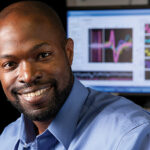
Kafui Dzirasa ’01, chemical engineering, is only 38, but is already emerging as a national leader in brain science. His research – which posits that some of the most common mental illnesses might be explained by unexpected connections between electrical patterns in different parts of the brain – could lead to more targeted and effective ways to treat conditions from schizophrenia to autism to depression.
The former Meyerhoff Scholar has also drawn national attention. Last October, as part of a White House panel on research, he found himself explaining to the leader of the free world what it means to think about the brain as an engineered electrical system.
Dzirasa started out at UMBC as a chemistry major but switched to chemical engineering so he could continue using math and computer science, subjects he enjoyed in high school. As graduation approached, he found himself gravitating toward health-related fields, so he stayed on for a fifth year to take pre-med courses and serve as student body president. “I realized it would be useful to learn as much about the body as I could,” he says.
Dzirasa then headed to Duke University to earn his M.D./Ph.D. in bioengineering, with the goal of designing neuroprosthetics—devices that interface with and augment the brain’s abilities and functions. But a stint in Duke’s schizophrenia ward realigned Dzirasa’s plans, awakening him to the huge need for better mental health treatments. “It was not until I got to the clinic that I realized mental illness was a real thing,” he says. “It was tremendous wake-up call.” Instead of giving healthy people additional capabilities, he realized he could help sick people live fuller lives by creating neuroprosthetics for mental illness.
While scientists believe that psychiatric symptoms should map onto underlying physical conditions in the brain, identifying those conditions has been challenging. Scientists still have a limited understanding of the neural basis of most illnesses or why treatments such as antidepressant drugs and electroshock therapy are effective.
Dzirasa, now an assistant professor in Duke’s biomedical engineering and neurobiology departments, hopes to change that by studying the brain’s electrical signals. Though we hear a lot about brain chemicals, the brain is also electrical: Like the information-processing transistors in your computer or phone, each of the roughly 100 billion neurons in your brain transmits information using electrical impulses. Dzirasa takes advantage of this by inducing various conditions—stress, bipolar disorder, even drug addiction—in mice and using tiny implanted electrodes to measure how electrical activity changes.
He uses mathematical and computational tools to find connections between recorded electrical patterns in different brain areas. In the prestigious journal Neuron, he recently reported an instance in which communication between two regions in a mouse’s brain was influenced by activity in a third, seemingly unrelated, one. When he exposed the mice to stress, the communication broke down. “It’s almost like parents sitting in the front seat of a car and kids sitting in the back,” he says. “When the parents are controlling the kids’ communication, everything is fine. But if you tell the kids to stop talking and they don’t, then you’ve got problems. We found that the parent lost the ability to control the kids’ communication.”
Dzirasa’s ultimate goal is to make a “pacemaker” for the human brain. Like the heart implant that restores a regular heartbeat, his dream device would correct faulty electrical signals that underlie debilitating conditions such as schizophrenia and bipolar disorder. “If mental disorders are problems with electricity, we should be able to treat them using electricity,” he says. “I could see a future in which people sleep in a hat” wired with electrodes to stimulate healthy brain function.
A recent discovery may be a step in that direction: Dzirasa and colleagues have figured out a way to not just read but write electrical information from one part of the brain to another. He has a paper coming out and a patent pending on the technique. But challenges remain. For obvious reasons, he cannot stick wires into a living human the way he can in a mouse, and there are significant differences between how mouse and human brains work that need to be accounted for. Translating his findings from mice to humans is “the next step,” he says.
Dzirasa credits UMBC’s Meyerhoff Scholarship program with shaping his career ambitions. And he is now giving back to the program that helped him, returning to campus once or twice a month to mentor scholars in “everything from career advice to life advice, decision-making advice—all the things that go along with helping college students figure out their place in the world.”
It’s yet another set of connections through which Dzirasa is making the world a better, more caring place.
— Gabriel Popkin
Image: Les Todd, Duke Photography
Read more about brain research at UMBC in “Staking Our Claim.”
]]>
Kafui Dzirasa ’01, chemical engineering, is only 38, but is already emerging as a national leader in brain science. His research – which posits that some of the most common mental illnesses might...
https://umbc.edu/stories/creating-a-pacemaker-for-the-brain/
https://my3.my.umbc.edu/api/v0/pixel/news/120746/guest@my.umbc.edu/2c9ef4a272437f88ceea30b03315d1c0/api/pixel
alumni
brain
duke
kafui-dzirasa
meyerhoff
mhoff
spring-2017
umbc
UMBC News & Magazine
https://my3.my.umbc.edu/groups/umbc-news-magazine
https://assets1-my.umbc.edu/system/shared/avatars/groups/000/001/943/24435aa6207c452e7bc15cc74b42c7bb/xsmall.png?1748556657
https://assets1-my.umbc.edu/system/shared/avatars/groups/000/001/943/24435aa6207c452e7bc15cc74b42c7bb/original.png?1748556657
https://assets2-my.umbc.edu/system/shared/avatars/groups/000/001/943/24435aa6207c452e7bc15cc74b42c7bb/xxlarge.png?1748556657
https://assets2-my.umbc.edu/system/shared/avatars/groups/000/001/943/24435aa6207c452e7bc15cc74b42c7bb/xlarge.png?1748556657
https://assets3-my.umbc.edu/system/shared/avatars/groups/000/001/943/24435aa6207c452e7bc15cc74b42c7bb/large.png?1748556657
https://assets1-my.umbc.edu/system/shared/avatars/groups/000/001/943/24435aa6207c452e7bc15cc74b42c7bb/medium.png?1748556657
https://assets2-my.umbc.edu/system/shared/avatars/groups/000/001/943/24435aa6207c452e7bc15cc74b42c7bb/small.png?1748556657
https://assets1-my.umbc.edu/system/shared/avatars/groups/000/001/943/24435aa6207c452e7bc15cc74b42c7bb/xsmall.png?1748556657
https://assets2-my.umbc.edu/system/shared/avatars/groups/000/001/943/24435aa6207c452e7bc15cc74b42c7bb/xxsmall.png?1748556657
UMBC News & Magazine
0
0
false
Wed, 31 May 2017 13:43:47 -0400
Staking our Claim

UMBC Researchers Explore the New Great Frontier – The Brain
By Megan Hanks
Illustrations by David Plunkert
In the early 1960s, the prospect of being the first nation to plant a flag on the moon stoked America’s collective imagination, leading to a national commitment from scientists, engineers, and researchers – along with their funders – to explore and understand outer space.
In similar fashion, researchers today are scrambling to explore a frontier that’s just as vast, though considerably closer to Earth – the human brain.
“In some ways, what we have right now is an inner space challenge,” explains Karl V. Steiner, vice president for research, who calls understanding how the brain functions “the holy grail” of research. UMBC is playing a major role on this front, employing technological advances – and, often, interdisciplinary approaches – to delve deeply into brain research on topics ranging from pain perception, to mental illness, to the effects of space travel.
“We have committed as a nation to really spend significant resources, money, and people’s time to reach a goal that was unreachable for us a few decades ago before we had tools like fMRI machines, modeling capabilities, and nanosensors” that allow for the measurement and quick analysis of data that previously was not possible.
“Understanding how the brain works will benefit everyone because even though everyone has a brain, no one understands exactly how it works,” he says.
Measuring Stress

One of the great mysteries of the brain is how it perceives pain and stress. By studying the brains of youth and adults enduring types of social discrimination and physical pain, UMBC researchers hope to make in-roads into early intervention practices for patients.
Raimi Quiton, an assistant professor of psychology who was trained as a neuroscientist, is interested in understanding how pain perception can be impacted by biopsychosocial factors, such as race/ethnicity, gender, age, and socioeconomic status.
“There are large disparities in social group membership or socioeconomic group membership in terms of who develops chronic pain,” says Quiton, explaining that discrimination and marginalization can affect the brain, how the brain processes pain, and how people experience pain.
While studies show that women, African-Americans, and older people experience chronic pain at higher rates, Quiton says that the underlying brain mechanisms of why the risk may be higher for those groups of people is unclear, and the impact of social disparities on the brain have not been widely studied. “The overarching goal of the research is to characterize what is happening in the brain that may predispose certain individuals to developing chronic pain later in life, and to try to identify mediating social factors so that there can be early intervention for at-risk individuals,” she explains.
Quiton also studies how people with healthy brains process pain compared to people with post-traumatic stress disorder. To study the effect of pain on the brain, Quiton uses short, harmless bursts of heat pain and pressure pain on human subjects, evoking a response in the brain that can be observed by Quiton on the screens outside of the fMRI machine. (These types of pain stimuli do not harm the human subject or damage the tissue where the pain stimulus is applied.)
“Lived experience really impacts how the brain functions and how pain is processed,” Quiton said.
Tinoosh Mohsenin, assistant professor of computer science and electrical engineering and director of Energy Efficient High Performance Computing (EEHPC) Lab, recently received a CAREER Award from the National Science Foundation for her work developing deep-learning technology and machine-learning algorithms that can be used in medical and non-medical applications. Deep-learning algorithms are modeled and developed to potentially function like the brain.
Mohsenin is also developing battery powered and cost-effective computing techniques that can monitor brain signals and recognize patterns in brain function. These wearable devices can monitor stress, detect seizures, and possibly identify cancer by analyzing brain waves and image data. “The deep-learning technology can potentially help detect cancer with greater accuracy by providing more information than is found in standard imaging,” she says.
Mohsenin hopes deep-learning technologies will help physicians and medical professionals detect seizures and cancer more quickly and accurately by improving the analysis of highly complex brain signals and data images, beyond what can be gleaned from today’s standard brain monitoring and analysis techniques.
“Current deep-learning models have not been explored for power-constrained smart devices, and this research can potentially revolutionize several fields, including health care, transportation, ecology, surveillance, and public utilities,” she explains.
Mohsenin hopes her work will also help people with significant mobility limitations who use small multi-modal sensors on their tongues as well as other methods to maneuver wheelchairs or command other technologies. More complex algorithms and their efficient hardware implementation can notably improve the responsiveness of such tools for users.
Preventing Mental Illness

The early identification of mental disorders and illnesses can lead to early intervention and treatment, and help medical professionals provide better treatment and care to patients. Researchers in UMBC’s psychology, computer science, and electrical engineering departments are working to break ground in these emerging areas of work.
Jason Schiffman, professor of psychology, and psychology Ph.D. candidate Caroline Demro are studying the early identification of psychosis among youth ages 12 to 21, who are at risk for the mental disorder in which a person’s thoughts and emotions lose contact with reality. Diagnosing mental illness in individuals early and tailoring treatment plans to individual patients may help prevent mental illness in people who have risk factors that have been identified at an early age.
For people with indicators of psychosis and other mental illnesses – such as the tendency to mistake sounds for voices or objects – the chemical balance within the brain can differ, including levels of dopamine, which helps control the parts of the brain that indicate reward and pleasure. Schiffman and Demro focus on Baltimore city youth who visit the fMRI facility at Spring Grove for mental health evaluations. They use various techniques to determine how the partners’ brains function at a resting state, including what parts of the brain are receiving oxygen, and then ask subjects to answer questions and complete certain tasks while in the fMRI machine to glean insight into how their brains function and what experiences they have had in the past that may signal potential mental illness in the future. Their findings are consistent with research findings from studying adult brains.
“The implications of the illness are pretty pronounced; the human suffering associated with it are hard to overemphasize for many people,” Schiffman says. “That has implications for their ability to work, their ability to find happiness, and it also has implications for our society in terms of people contributing to society through their gainful employment.”
Fow-Sen Choa, professor of computer science and electrical engineering, is one of three faculty who recently received grant funding from the National Science Foundation under the Neural and Cognitive Systems (NCS) program for his work with faculty at the University of Maryland School of Medicine (UMSM) to develop technology that can deliver stimulation to specific parts of the brain. Deep-brain stimulation is an invasive treatment that is sometimes used to help people with neural diseases, such as Parkinson’s, essential tremor, dystonia, and obsessive compulsive disorder. Choa is working to develop a stimulation and monitoring device that will be tested by UMSM researchers on mice – a technology thought to be less invasive than other alternatives.
Choa explains that deep-brain stimulation is typically used as a last-resort treatment when drugs have not been shown to impact the person. The technology he is developing could serve as a tool to help researchers and physicians understand what parts of the brain should be stimulated in individual patients’ brains, and to make modifications and changes to location, frequency, and strength as the operation is in progress.
“If we can find a way to stimulate the brain noninvasively, that is the key,” Choa says.
Crunching the Data

As Steiner alluded to earlier, a researcher can collect all the raw data in the world – but without the means of analyzing it quickly and accurately, the race to understand the brain could be lost. Tulay Adali, distinguished university professor and professor of computer science and electrical engineering, and Seung-Jun Kim, assistant professor of computer science and electrical engineering, are the two UMBC faculty in addition to Choa who received grant funding from the National Science Foundation under the NCS program. They are analyzing data from a control group of people with healthy brains and patients who have been diagnosed with schizophrenia. Kim and Adali have developed an algorithm that can discern how individual brains function, with particular attention to how differences in the brain can impact treatment plans from person to person. The large datasets that Kim and Adali are studying will help physicians make treatment decisions based on the data, when symptoms first appear.
“There is a great need to effectively capture subject-specific traits,” says Adali, who stresses the importance of balancing prediction accuracy and reproducibility. “This is the key step for developing strategies for individualized therapy, intervention and forecasting – of disease and addiction.”
Adali and Kim are collaborating with Vince Calhoun Ph.D. ’02, electrical engineering, a professor of electrical and computer engineering at the University of New Mexico, and executive science officer at The Mind Research Network in Albuquerque, New Mexico. Adali advised Calhoun while he was completing his Ph.D. at UMBC.
Calhoun explains that brain data is stored around the world and is used for many types of research. Typically, for large sets of data to be analyzed, the data has to be compiled in one central location, a challenge for researchers. The method that Adali, Kim and Calhoun are working on will allow brain imaging data to be processed where it is by sending data summaries and decentralizing the data processing.
“There is so much data available today that new approaches that can leverage advanced multivariate algorithms to extract and draw information from brain networks without actually moving data from its various locations are greatly needed,” says Calhoun. “The ability to capture brain networks that show common characteristics across individuals while also fully leveraging the individual aspect of each brain will advance the field considerably.”
And Now, Back to Outer Space
Traveling and spending time in outer space can have long-lasting effects on the human body, due to lack of gravity and other factors, but the brain can be especially impacted by exposure to radiation – especially over time. That’s where Bernard Rabin, professor of psychology, comes in.
NASA has funded some of Rabin’s research to explore the lifetime limits of exposure to radiation in the atmosphere and the ways the human brain is impacted by this radiation. Astronauts who travel to the International Space Station are exposed to a limited amount of radiation; however, exploratory missions that take astronauts beyond that expose them to higher levels of cosmic rays and high-energy radiation that can cause damage to their brains and even accelerate aging in the body and the brain, Rabin explains.
“The changes we see in neuronal function and cognitive performance [after space travel] are characteristic of those changes that we see in older organisms,” says Rabin, whose work focuses on rats. He explains that when astronauts are being selected for space missions, it is important to tell them about the possible consequences of radiation exposure so they can make informed decisions.
“Informed consent is one of the key issues that astronauts need to be told,” Rabin says. The major effect of exposure to space radiation during exploratory class missions lasting up to three years may be an accelerate of the aging process, which may affect the quality of life after the conclusion of the mission.
Looking Forward

Steiner says that the new Interdisciplinary Life Sciences Building scheduled to open in summer 2019 will give faculty and students new tools and collaborative space to continue studying the brain. Set to begin construction this year, the 130,000 gross square foot building will support course redesign with dynamic high-technology classrooms, seminar rooms, and teaching labs; and support interdisciplinary research with twelve shared labs and other support labs to provide unique opportunities for new study.
“There are tremendous opportunities but also very big challenges to overcome [in brain research],” says Steiner. “These are not easy questions, and because they are not easy questions, you have to draw on groups of experts that focus on the particular question you are trying to study, understand, and solve.”
Related: Creating a “Pacemaker” for the Brain: Dr. Kaf Dzirasa ’01, chemical engineering
Sidebar: Next-Level Tools
Down the road from UMBC, in an unassuming gray building on the Spring Grove Hospital campus, lives a technology integral to much of UMBC’s brain research — a functional magnetic resonance imaging (fMRI) machine. Shared by UMBC, the University of Maryland, Baltimore, and the University of Maryland School of Medicine and its department of psychiatry, the fMRI tracks how water moves in the brain, indicating the flow of blood and activity happening within the brain as subjects complete tasks within the machine’s scanning chamber.
Peter Kochunov, research associate professor of physics and deputy director of the Center for Brain Imaging Research, runs the fMRI technology at the Maryland Psychiatric Research Center. He explains that fMRI is used for a wide range of research focuses, often collaborative, including obtaining quantitative information that can shed light on psychiatric illnesses and genetic risk factors that may predispose someone to these illnesses. Without it, many UMBC projects would not be possible. “Having an fMRI machine within walking distance is a really added benefit to us and our campus,” says Steiner.
Save
Save
]]>
UMBC Researchers Explore the New Great Frontier – The Brain By Megan Hanks Illustrations by David Plunkert In the early 1960s, the prospect of being the first nation to plant a flag on the...
https://umbc.edu/stories/staking-our-claim/
https://my3.my.umbc.edu/api/v0/pixel/news/120748/guest@my.umbc.edu/3f0ba6dc336ffd9fc23e938faeb29bf6/api/pixel
bernard-rabin
brain-research
cahss
caroline-demro
coeit
discovery
fmri
fow-sen-choa
jason-schiffman
karl-steiner
peter-kochunov
raimi-quiton
seung-jun-kim
spring-2017
tinoosh-mohsenin
tulay-adali
vince-calhoun
UMBC News & Magazine
https://my3.my.umbc.edu/groups/umbc-news-magazine
https://assets1-my.umbc.edu/system/shared/avatars/groups/000/001/943/24435aa6207c452e7bc15cc74b42c7bb/xsmall.png?1748556657
https://assets1-my.umbc.edu/system/shared/avatars/groups/000/001/943/24435aa6207c452e7bc15cc74b42c7bb/original.png?1748556657
https://assets2-my.umbc.edu/system/shared/avatars/groups/000/001/943/24435aa6207c452e7bc15cc74b42c7bb/xxlarge.png?1748556657
https://assets2-my.umbc.edu/system/shared/avatars/groups/000/001/943/24435aa6207c452e7bc15cc74b42c7bb/xlarge.png?1748556657
https://assets3-my.umbc.edu/system/shared/avatars/groups/000/001/943/24435aa6207c452e7bc15cc74b42c7bb/large.png?1748556657
https://assets1-my.umbc.edu/system/shared/avatars/groups/000/001/943/24435aa6207c452e7bc15cc74b42c7bb/medium.png?1748556657
https://assets2-my.umbc.edu/system/shared/avatars/groups/000/001/943/24435aa6207c452e7bc15cc74b42c7bb/small.png?1748556657
https://assets1-my.umbc.edu/system/shared/avatars/groups/000/001/943/24435aa6207c452e7bc15cc74b42c7bb/xsmall.png?1748556657
https://assets2-my.umbc.edu/system/shared/avatars/groups/000/001/943/24435aa6207c452e7bc15cc74b42c7bb/xxsmall.png?1748556657
UMBC News & Magazine
0
0
false
Tue, 30 May 2017 18:07:34 -0400
Wilderness Warriors

You’re hiking in the woods. A branch snaps…and suddenly you’re on the ground, immobilized by pain. As the sun begins to set, you wonder what you’ll do next, and who might come to your rescue…
Wilderness Warriors
It takes intense training to rescue and provide excellent medical care to patients under normal, predictable circumstances. To do the same thing in untamed wilderness? Well, that takes an extra layer of grit.
That’s why each spring for the last 33 years, UMBC’s Emergency Health Services (EHS) program has sent a group of hardy students deep into the forest to learn the finer points of search and rescue. Over the course of three days, in remote Garrett County, 17 students in this unique program will practice everything from orienteering to “dead reckoning” and learn to be a team – all under the careful watch of a community of alums and emergency volunteers.
No matter the weather, these Retrievers are ready for anything.
Story by Jenny O’Grady
Photographs by Marlayna Demond ’11
“Everybody Helps Everybody”
A fresh layer of snow covers Abbott’s Orchard, a small clearing near the lodge in New Germany State Park where students will spend their weekend training. The first challenge: pitching tents in less-than-optimal conditions. Later, as the teams gather at benches in units to compare notes and brace themselves for the weekend ahead, they meet the more than 30 alumni and friends from across the EHS program’s history and nearby rescue operations who will teach them everything they know – including bear safety.
“The biggest thing that draws them back is the camaraderie, and the fact that they overcome adversity together,” says Cole Brown ’88, EHS, who leads the training staff for the weekend. Through that, “they build friendships, and they learn how to put aside their personal views and from there come to be a team. So they go from being an I to a we.”
[nivoslider id=”4172″]
Spider Straps and Stokes Baskets
Emergency personnel refer to the “golden hour” as the all-too-limited time between the occurrence of an injury and the best window of opportunity for care to be given. Finding success as a rescuer means not only understanding how to use the best tools for the job – but how to do it quickly and carefully. To prepare for real-world rescue scenarios, EHS students practice everything from orienteering – using compass and paces to estimate locations in unknown terrain – to strapping victims with unknown injuries to back boards, to rolling them safely to care in a wheeled basket. They also study standardized lost person behaviors.
“This training is absolutely essential in wilderness medicine because you can’t always get a helicopter to the scene,” says Jeff Mitchell, a clinical professor in the department, who has run this exercise since its start in 1983.
[nivoslider id=”4259″]
Sweep and Clear
With tools and equipment skills at the ready, students take to the woods searching for clues – and hoping to find their patients in time to be helpful. Alumni like Raven Gronsbell ’15, EHS, who now works as a paramedic in Kent County, volunteer to act as “victims,” often sitting quietly for hours in the woods before being found by student rescuers.
“I will be out there sitting in the woods… waiting… and hoping they’re fast,” says Gronsbell, who in a nighttime search portrayed “Casey Wood,” a teen who wandered away from her family while exploring. Gronsbell spoke so highly of the class that her math major sister, Jessica, decided to take part this year. “I also really enjoy helping out with the training. That’s why I come back.”
[nivoslider id=”4281″]
Read more about the EHS program: Practicing What They Preach
]]>
[Video] You’re hiking in the woods. A branch snaps…and suddenly you’re on the ground, immobilized by pain. As the sun begins to set, you wonder what you’ll do next, and who might come to your...
https://umbc.edu/stories/ehs-slideshow/
https://my3.my.umbc.edu/api/v0/pixel/news/120749/guest@my.umbc.edu/d1c6a563eeca32e03ed21c4adc984223/api/pixel
cahss
discovery
ehs
spring-2017
UMBC News & Magazine
https://my3.my.umbc.edu/groups/umbc-news-magazine
https://assets1-my.umbc.edu/system/shared/avatars/groups/000/001/943/24435aa6207c452e7bc15cc74b42c7bb/xsmall.png?1748556657
https://assets1-my.umbc.edu/system/shared/avatars/groups/000/001/943/24435aa6207c452e7bc15cc74b42c7bb/original.png?1748556657
https://assets2-my.umbc.edu/system/shared/avatars/groups/000/001/943/24435aa6207c452e7bc15cc74b42c7bb/xxlarge.png?1748556657
https://assets2-my.umbc.edu/system/shared/avatars/groups/000/001/943/24435aa6207c452e7bc15cc74b42c7bb/xlarge.png?1748556657
https://assets3-my.umbc.edu/system/shared/avatars/groups/000/001/943/24435aa6207c452e7bc15cc74b42c7bb/large.png?1748556657
https://assets1-my.umbc.edu/system/shared/avatars/groups/000/001/943/24435aa6207c452e7bc15cc74b42c7bb/medium.png?1748556657
https://assets2-my.umbc.edu/system/shared/avatars/groups/000/001/943/24435aa6207c452e7bc15cc74b42c7bb/small.png?1748556657
https://assets1-my.umbc.edu/system/shared/avatars/groups/000/001/943/24435aa6207c452e7bc15cc74b42c7bb/xsmall.png?1748556657
https://assets2-my.umbc.edu/system/shared/avatars/groups/000/001/943/24435aa6207c452e7bc15cc74b42c7bb/xxsmall.png?1748556657
UMBC News & Magazine
0
0
false
Fri, 26 May 2017 20:46:00 -0400
How to Make a Viral Music Video

With Lisa Soumphontphakdy ’14, Visual Arts
 Back in 2012, Lisa Soumphontphakdy ’14, visual arts, was a recent transfer student looking for a home at UMBC. She loved music, she loved to sing, and she especially loved the idea of making more female friends, so the Stilettos, UMBC’s only all-female a cappella group, seemed like a natural fit.
After auditioning, she quickly bonded with the group and became as involved as possible, arranging music, designing T-shirts, acting as president, and shooting and editing the group’s first video – Meghan Trainor’s hit “All About That Bass,” complete with sassy choreography, which she uploaded to YouTube. “I fell in love with it a lot more than I expected,” she says.
“[Lisa] definitely was a maternal figure in Stilettos,” says fellow Stiletto senior Valerie Pasquale, health administration and policy, who was pleased to work with Soumphontphakdy again last fall. “[She] always was pushing the envelope, trying to get us to be the best that we could be.”
The video she made – a cover of “Boy,” originally performed by the British girl group Little Mix, and arranged by junior Becca Nolder, social work – now has more than 11,000 views. So, what exactly does it take to make a video go viral?
STEP 1: GET A DEGREE IN… DESIGN?
While Soumphontphakdy started off at UMBC as a film major, she switched her focus to graphic design to broaden her post-graduation career options: “Every single business needs a graphic designer,” she says. However, she’s kept her video muscle strong in her current job at Educational Funding Company, a Bethesda-based software firm, since video has proven so effective in online marketing in recent years. It would also provide her a golden opportunity off the clock.
STEP 2: GET YOUR GIRLS TOGETHER

Last fall, when Pasquale asked Soumphontphakdy if she wanted to shoot a music video for “Boy,” with its intricately structured harmonies and, as Nolder says, its “empowerment, Cheetah Girls kind of vibe,” Soumphontphakdy jumped at the chance. A cappella was such an integral part of her college career, she says, that she wanted to maintain the connection.
“This was an organization that I loved and was passionate about… I didn’t want it to be a thing where once I left school, I just forgot all about my a cappella life,” she says.
The group laid down the track in the studios at UMBC’s Performing Arts and Humanities Building (PAHB), assisted by fellow Stiletto Jenna Polignone, music and computer science, and Matthew Neary, computer science. After Polignone mixed and mastered the song, the group was ready to shoot. The production ended up spanning locations across the entire PAHB, from the Linehan Auditorium stairwell to the Forum sculpture outdoors.
STEP 3: GET GOOFY!
While a cappella will get you used to being on stage, performing for a camera isn’t always as familiar – or comfortable – an experience. Luckily, Soumphontphakdy had a strategy there, too: during filming, “we had some of us standing behind the camera, dancing and singing, so that they didn’t feel too intimidated by the camera. [We were trying] to get everyone to loosen up and be more comfortable with the video.”
STEP 4: GET TO THE EDITING SUITE
Filming a cappella groups, Soumphontphakdy says, is a multi-step endeavor: with everyone lip-synching in tune with the audio track, it requires multiple takes of each voice part, the soloists, and the group as a whole. “We managed to knock this down in about two to three hours,” she says, with one to two takes of each group. (“I’m a big advocate for being efficient with time,” she adds.)
Lisa shot the video on DSLR and edited it in Adobe Premiere. “It probably took me four or five hours [to edit] because […] I had to watch through each [clip] individually, to make sure I’m grabbing the good bits. I put markers on the parts where I felt like they were particularly good with the energy, or [with] their expressions, or… just in their overall performance.” In splicing together the video, she wanted to gather “the best of everybody.”
STEP 5: GET ONLINE
The video was released on Facebook on November 28, one week ahead of the Stiletto’s 2016 winter concert, and has since garnered more than 11,000 views. Comments poured in from both inside and outside the UMBC a cappella community, including from Soumphontphakdy herself:
On December 4, the Stilettos played to a full house… or, more accurately, a full lecture hall.
Says Pasquale: “We had [our concert] in the afternoon on a Sunday. Usually you wouldn’t think there would be a lot of people that came, but because of the video, everyone was like ‘Oh, we’ve got to see this group!’ So the auditorium was packed. That just tells you how useful the digital marketing was, and how grateful we are for Lisa’s help.”
As of this writing, another Stilettos music video is in the works.
— Julia Celtnieks ’13
https://www.facebook.com/umbcstilettos/videos/10154688410664882/?hc_ref=PAGES_TIMELINE
Watch “Boy” by the Stilettos at bit.ly/umbcstilettosboy.
]]>
With Lisa Soumphontphakdy ’14, Visual Arts Back in 2012, Lisa Soumphontphakdy ’14, visual arts, was a recent transfer student looking for a home at UMBC. She loved music, she loved to sing, and...
https://umbc.edu/stories/how-to-make-a-viral-music-video/
https://my3.my.umbc.edu/api/v0/pixel/news/120750/guest@my.umbc.edu/7112981f776d44fdd9ddec82cb99400d/api/pixel
a-cappella
how-to
perspectives
spring-2017
umbc-stilettos
UMBC News & Magazine
https://my3.my.umbc.edu/groups/umbc-news-magazine
https://assets1-my.umbc.edu/system/shared/avatars/groups/000/001/943/24435aa6207c452e7bc15cc74b42c7bb/xsmall.png?1748556657
https://assets1-my.umbc.edu/system/shared/avatars/groups/000/001/943/24435aa6207c452e7bc15cc74b42c7bb/original.png?1748556657
https://assets2-my.umbc.edu/system/shared/avatars/groups/000/001/943/24435aa6207c452e7bc15cc74b42c7bb/xxlarge.png?1748556657
https://assets2-my.umbc.edu/system/shared/avatars/groups/000/001/943/24435aa6207c452e7bc15cc74b42c7bb/xlarge.png?1748556657
https://assets3-my.umbc.edu/system/shared/avatars/groups/000/001/943/24435aa6207c452e7bc15cc74b42c7bb/large.png?1748556657
https://assets1-my.umbc.edu/system/shared/avatars/groups/000/001/943/24435aa6207c452e7bc15cc74b42c7bb/medium.png?1748556657
https://assets2-my.umbc.edu/system/shared/avatars/groups/000/001/943/24435aa6207c452e7bc15cc74b42c7bb/small.png?1748556657
https://assets1-my.umbc.edu/system/shared/avatars/groups/000/001/943/24435aa6207c452e7bc15cc74b42c7bb/xsmall.png?1748556657
https://assets2-my.umbc.edu/system/shared/avatars/groups/000/001/943/24435aa6207c452e7bc15cc74b42c7bb/xxsmall.png?1748556657
UMBC News & Magazine
0
0
false
Fri, 26 May 2017 19:04:24 -0400
Legend of Excellence
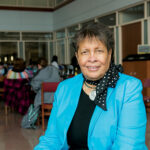
During her years as an undergrad at UMBC, Karen Sutton ’97, history, would constantly see Simmona Simmons ’74, American studies, working quietly in the library. Even today, when she stops in the Albin O. Kuhn Library, she sees Simmons and smiles, for even the sight of the librarian still inspires Sutton to pursue her goals.
“I (wanted to) become a librarian vicariously through her,” says Sutton, a lecturer at UMBC. “I plan to use the skills Simmona taught me to inspire others.”
Despite the major impact she tends to have on the lives of others, Simmons has always kept a low profile. Described as modest, quiet, and unassuming, Simmons maintains that people should be measured by their actions. And after more than fifty years of service at UMBC, she certainly has a lot to be measured by, quietly inspiring others – sometimes without even knowing it.
This year, Simmons, along with three other UMBC faculty members will be honored with the Legends of Excellence Award – a tribute that acknowledges faculty members and staff who have made an impact on UMBC’s African and Latino students. Serving on the library staff since the school opened in 1966, and through her role as library liaison, Simmons has had the opportunity to work with countless staff and students.
“My tenure at the Albin O. Kuhn Library & Gallery has been rewarding because I have had the opportunity to work with students, faculty, and staff, answering interesting queries and assisting with their research needs,” she says. “I have always loved working with the students; as they discover new information and as they mature, it is exciting to contribute a small part to their success.”
Simmons is also one of the founders of the UMBC Women’s Center which first opened in 1991, serving on its advisory board. Along with other founders, she pressed for the Center to be on the “footpath” of campus, ensuring that it be, as it is now, centrally located in The Commons for students to easily access.
“What I have learned from Simmona,” says Jess Myers, Director of the Women’s Center, “is that the work and its impact is most important and getting credit is less important.” Though she keeps out of the spotlight, Simmons is hardly inaccessible.
Through these various roles on campus she has made herself available to the student body, and she thrives on the role of mentorship in bettering one’s career. She often encourages students to seek out community and role models.
“Coming from a background where your parents aren’t educated,” says Simmons, referring to her own childhood, students need to find people who can help them make their way through academia.
“Identify a person that is doing what (you) want to do and hitch (your) wagon to that person,” she says. “Just go for coffee with them and ask them five questions.”
Simmons cites Dr. Gloria Oden, poet and former professor in the English department, as her professional inspiration even across the disciplines, recalling Oden’s constant encouragement to strategize and read better sources, and even to pursue writing for various publications and encyclopedias as a means to continue on in her professional development.
Everyone relies on the same tools to pursue their goals, regardless of family background or academic interests. And anyone can encourage others to use these tools: a poet from the English Department inspires a librarian in the American Studies department who inspires an instructor in the African American studies department.
Simmons has made sure that she can be a resource for students and even for other faculty, learning from those who have helped her in her career how to best help others.
— Kristen Russell
]]>
During her years as an undergrad at UMBC, Karen Sutton ’97, history, would constantly see Simmona Simmons ’74, American studies, working quietly in the library. Even today, when she stops in the...
https://umbc.edu/stories/legend-of-excellence/
https://my3.my.umbc.edu/api/v0/pixel/news/120751/guest@my.umbc.edu/22bc653be9a3f8c1ea4308de2fcce7c8/api/pixel
alumni
american-studies
aok-library
cahss
legends-of-excellence
simmona-simmons
spring-2017
UMBC News & Magazine
https://my3.my.umbc.edu/groups/umbc-news-magazine
https://assets1-my.umbc.edu/system/shared/avatars/groups/000/001/943/24435aa6207c452e7bc15cc74b42c7bb/xsmall.png?1748556657
https://assets1-my.umbc.edu/system/shared/avatars/groups/000/001/943/24435aa6207c452e7bc15cc74b42c7bb/original.png?1748556657
https://assets2-my.umbc.edu/system/shared/avatars/groups/000/001/943/24435aa6207c452e7bc15cc74b42c7bb/xxlarge.png?1748556657
https://assets2-my.umbc.edu/system/shared/avatars/groups/000/001/943/24435aa6207c452e7bc15cc74b42c7bb/xlarge.png?1748556657
https://assets3-my.umbc.edu/system/shared/avatars/groups/000/001/943/24435aa6207c452e7bc15cc74b42c7bb/large.png?1748556657
https://assets1-my.umbc.edu/system/shared/avatars/groups/000/001/943/24435aa6207c452e7bc15cc74b42c7bb/medium.png?1748556657
https://assets2-my.umbc.edu/system/shared/avatars/groups/000/001/943/24435aa6207c452e7bc15cc74b42c7bb/small.png?1748556657
https://assets1-my.umbc.edu/system/shared/avatars/groups/000/001/943/24435aa6207c452e7bc15cc74b42c7bb/xsmall.png?1748556657
https://assets2-my.umbc.edu/system/shared/avatars/groups/000/001/943/24435aa6207c452e7bc15cc74b42c7bb/xxsmall.png?1748556657
UMBC News & Magazine
0
0
false
Fri, 26 May 2017 19:03:55 -0400
Savvy Entrepreneur

Danielle Burnett ’00, M.S. ’05, information systems management, wasted no time putting her UMBC degrees to work. In 2001, a newly-minted college graduate, she founded Applied Technology Services (APS), a technology services company serving commercial and government clients throughout Maryland. Since Burnett launched the company, it’s grown exponentially, recently exceeding 10 million dollars in revenue, and earning her a spotlight in the Baltimore Business Journal. Natural business acumen accounts for much of Burnett’s success, as does the preparation she received at UMBC, she says.
“The information systems program I was in at UMBC was very project-management oriented. And those process-driven skills really did help me in dealing with [business] challenges. That’s where I was able to focus to gain my credibility – my ability to execute,” Burnett says. She also credits the availability of certificate programs at UMBC, such as the one she earned in Electronic Government (she was the first student at UMBC to receive it) as useful to honing the skills she’d eventually apply to her company.
Burnett started out small, with one employee and one consultant. In fact, she remains surprised at the rapid-fire pace growth of ATS. She didn’t always see herself heading up a traditional company with on-site employees. But the contracts were coming so quickly that the accompanying paperwork required to complete them drove ATS from a virtual company to a brick-and-mortar one in 2010.
“All these deals we were working, we needed the paper to move through the organization, from the quote to the order to the invoice,” says Burnett, who took advantage of special programs for minority and small business owners to boost her client base. As a woman-owned company with under 50 employees, ATS qualifies for both. So while most of the country was reeling from the effects of the recession, ATS continued to thrive. Between 2006 and 2011, ATS doubled in size every year.
Burnett is proud not just of her business’ growth, but of the measured way she’s nurtured it. “I’ve never had to let a single employee go,” she says.
For now, the company remains small. She has 12 employees and is contemplating hiring two or three more in the near future. While some employees are family members – including her husband, father and sister-in-law – Burnett says she works to extend the feeling of a family business throughout the company.
Of all of her employees, Burnett says, “I make sure they’re treated fairly, and that they know their importance in the business. And I give them the flexibility to do different things.”
One of the benefits of working for a small business such as ATS, notes Burnett, is that employees can acquaint themselves with various aspects of the organization fairly easily. In fact, it’s an element of the business she conscientiously promotes. “Particularly for younger employees, during performance review, more than anything else, it’s about: ‘What else would you like to be doing?’”
While Burnett feels content about the progress she’s made as a businesswoman, she acknowledges that it hasn’t always been easy. Being a female executive in the IT industry, says Burnett, is challenging. “It’s difficult to earn credibility,” she says, as the field is upwards of 80 percent male.
But she’s plugged on, undeterred. Neither her style nor her company is particularly flashy or trendy, and that’s a point she tries to drive home to young college students whom she mentors through UMBC’s Alex.Brown Entrepreneurship program.
“I try to explain to them that you don’t have to come up with the next Angry Birds to find success as an entrepreneur,” Burnett says.
— Elizabeth Heubeck ’91
]]>
Danielle Burnett ’00, M.S. ’05, information systems management, wasted no time putting her UMBC degrees to work. In 2001, a newly-minted college graduate, she founded Applied Technology Services...
https://umbc.edu/stories/savvy-entrepreneur/
https://my3.my.umbc.edu/api/v0/pixel/news/120752/guest@my.umbc.edu/db6336e4d06376fb9c1525bf284a4b8d/api/pixel
alumni
coeit
danielle-burnett
information-systems-management
spring-2017
UMBC News & Magazine
https://my3.my.umbc.edu/groups/umbc-news-magazine
https://assets1-my.umbc.edu/system/shared/avatars/groups/000/001/943/24435aa6207c452e7bc15cc74b42c7bb/xsmall.png?1748556657
https://assets1-my.umbc.edu/system/shared/avatars/groups/000/001/943/24435aa6207c452e7bc15cc74b42c7bb/original.png?1748556657
https://assets2-my.umbc.edu/system/shared/avatars/groups/000/001/943/24435aa6207c452e7bc15cc74b42c7bb/xxlarge.png?1748556657
https://assets2-my.umbc.edu/system/shared/avatars/groups/000/001/943/24435aa6207c452e7bc15cc74b42c7bb/xlarge.png?1748556657
https://assets3-my.umbc.edu/system/shared/avatars/groups/000/001/943/24435aa6207c452e7bc15cc74b42c7bb/large.png?1748556657
https://assets1-my.umbc.edu/system/shared/avatars/groups/000/001/943/24435aa6207c452e7bc15cc74b42c7bb/medium.png?1748556657
https://assets2-my.umbc.edu/system/shared/avatars/groups/000/001/943/24435aa6207c452e7bc15cc74b42c7bb/small.png?1748556657
https://assets1-my.umbc.edu/system/shared/avatars/groups/000/001/943/24435aa6207c452e7bc15cc74b42c7bb/xsmall.png?1748556657
https://assets2-my.umbc.edu/system/shared/avatars/groups/000/001/943/24435aa6207c452e7bc15cc74b42c7bb/xxsmall.png?1748556657
UMBC News & Magazine
0
0
false
Fri, 26 May 2017 19:00:22 -0400
Our Best Defense

Bill Ermatinger ’86, political science, grew up in rural Baltimore County, in the (then) small town of Reisterstown. Decades later this small town background comes in handy when Ermatinger describes his work at Huntington Ingalls Industries, the largest military shipbuilding company in the U.S. and our nation’s sole builder of nuclear aircraft carriers.
Aircraft carriers, those behemoths of the ocean, are the most complicated piece of machinery in the world, says Ermatinger. “Imagine you’re creating an entire small town. You have to have clean water and a way to feed all your citizens. You need sanitation and waste disposal, a hospital, a school. Put an airport in there. Now put a nuclear reactor in your town. Once all that is built, you have to be able to move that town anywhere on the planet. Now you have an aircraft carrier.”
As executive vice president and chief human resources officer for Huntington Ingalls, Ermatinger oversees employee health and welfare at the company’s Newport News, Virginia, headquarters as well as other domestic and international subsidiary shipyards. “I get to represent 40,000 shipbuilders of this nation – the men and women building things for our commander in chief,” he says. “They don’t decide where or when these assets are employed, but in the event, they are going to make darned sure they are in a fair fight. I get to represent them and that is simply the coolest thing on the planet.”
When Ermatinger graduated from high school during the Reagan era, he says, his friends all headed to Towson State or Salisbury. However, he says, “I was not looking for a social school. In the early ’80s, if you wanted to be challenged academically, UMBC was your choice.”
Above and beyond stellar academics, Ermatinger says he enjoyed the school’s inclusive environment. “Everybody was treated the same, whether it was race or gender or academic ability, the professors and fellow students made a truly welcoming environment that embraced all students,” recalls Ermatinger. “I visited my friends at other schools and it did not feel the same on their campuses – there were cliques, exclusive sub-groups. At UMBC, I never felt that.”
Upon graduating from UMBC, Ermatinger landed a job at Westinghouse Defense – “right next door to campus,” he laughs – working in human resources. Northrop Grumman bought out Westinghouse in 1996, and Ermatinger worked his way up through the administrative ranks there. “Northrop Grumman went on a buying rampage, like many other defense companies, and bought Newport News Shipbuilding in 2005 along with some other ship makers. They asked me to move down to Virginia to become human resources vice president there, and then when Northrop spun off all their shipbuilding assets into a new company, Huntington Ingalls, I became chief human resources officer for the whole new entity,” he explains.
Indeed, Ermatinger is almost uniquely positioned to weigh and compare the outcomes of various institutes of higher learning. He oversees hiring for his company, which is the largest industrial employer in Virginia (as well the largest private employer in Mississippi, where Huntington Ingalls builds non-nuclear military ships). At the same time, he is also looking at schools as a parent. By both standards, he says, “UMBC is a first-choice school, not a school of option.”
Ermatinger has reached this conclusion after hiring “tens of thousands of kids” over a 30-year career in HR. “I’ve seen a wide range of the skills and qualities needed to be successful, and UMBC excels at instilling the soft skills,” he says. According to Ermatinger, these essential, yet too often un-nurtured, skills include the ability to work with others and to be a good listener. The willingness to persist. To be comfortable in charge: those are skills and attributes that employers are ultimately trying to hire. “The GPA is important, the program they graduated from is important, but in an interview we are also looking at intangibles. The whole person, not just their transcript,” says Ermatinger.
(In fact, Ermatinger credits this “whole person” recruitment approach as one reason Huntington Ingalls’ employee attrition rate is below 3% when the manufacturing industry as a whole averages 13.3% attrition annually).
“That is what my professors at UMBC taught me. It’s part of the culture. And I am very proud of that, as an alumnus.”
— Michelle Gienow
]]>
Bill Ermatinger ’86, political science, grew up in rural Baltimore County, in the (then) small town of Reisterstown. Decades later this small town background comes in handy when Ermatinger...
https://umbc.edu/stories/our-best-defense/
https://my3.my.umbc.edu/api/v0/pixel/news/120753/guest@my.umbc.edu/013e97da8c60bb2696f19d5088c6c975/api/pixel
alumni
bill-ermatinger
cahss
political-science
spring-2017
UMBC News & Magazine
https://my3.my.umbc.edu/groups/umbc-news-magazine
https://assets1-my.umbc.edu/system/shared/avatars/groups/000/001/943/24435aa6207c452e7bc15cc74b42c7bb/xsmall.png?1748556657
https://assets1-my.umbc.edu/system/shared/avatars/groups/000/001/943/24435aa6207c452e7bc15cc74b42c7bb/original.png?1748556657
https://assets2-my.umbc.edu/system/shared/avatars/groups/000/001/943/24435aa6207c452e7bc15cc74b42c7bb/xxlarge.png?1748556657
https://assets2-my.umbc.edu/system/shared/avatars/groups/000/001/943/24435aa6207c452e7bc15cc74b42c7bb/xlarge.png?1748556657
https://assets3-my.umbc.edu/system/shared/avatars/groups/000/001/943/24435aa6207c452e7bc15cc74b42c7bb/large.png?1748556657
https://assets1-my.umbc.edu/system/shared/avatars/groups/000/001/943/24435aa6207c452e7bc15cc74b42c7bb/medium.png?1748556657
https://assets2-my.umbc.edu/system/shared/avatars/groups/000/001/943/24435aa6207c452e7bc15cc74b42c7bb/small.png?1748556657
https://assets1-my.umbc.edu/system/shared/avatars/groups/000/001/943/24435aa6207c452e7bc15cc74b42c7bb/xsmall.png?1748556657
https://assets2-my.umbc.edu/system/shared/avatars/groups/000/001/943/24435aa6207c452e7bc15cc74b42c7bb/xxsmall.png?1748556657
UMBC News & Magazine
0
0
false
Fri, 26 May 2017 18:58:18 -0400
Back Story – Spring 2017

For 25 years, the Women’s Center has provided co-curricular programming, support services, and advocacy for marginalized individuals and communities, along with campus-wide activities such as Take Back the Night, Sexual Assault Awareness Month, Critical Social Justice, and more. UMBC Magazine talked with center director Jess Myers, Vice Provost of Faculty Affairs Patrice McDermott, and special projects coordinator Amelia Meman ’15, GWST, for their thoughts about the center’s mission.
What do you see as the role of a women’s center on a university campus in today’s environment?
Jess Myers: There are so many women in higher education. But just because there are more women, doesn’t mean that there is the quality of experience. There’s still sexism. There’s still racism. There’s still able-ism. I think what women’s centers have been doing is really expanding that notion of which women, and really thinking about all the different kinds of women and their experiences in higher education and what can we do to expand the net in regards to reaching them and supporting their experience here at UMBC, but also in higher education as a whole.
Amelia Meman: It’s also about sort of empowering many different sorts of women. So you talk a little bit about gender equity on campus. But that looks like many different things. So supporting survivors of sexual assault because their stories don’t often get told and also supporting women of color, which has been a renewed focus of the Women’s Center in these past years. Critical Social Justice is also important because it is a way of expanding the notion of what activism can look like, and expands the notion of what women can do and what anybody can do really. The Women’s Center tackles all of these things in the broadest way, but also in the most grounded and people-centered way, which is really special to me. We not only do feminism, we not only do stuff for women, but we try to make social justice a priority. It’s something that we take very seriously.
The Women’s Center, in its early years, didn’t always have an office. As an early advocate of the center, Dr. McDermott, how has the place changed since taking up permanent residence in The Commons?
Patrice McDermott: When [The Commons] was created, a lot of the academic student and staff community around these issues fought to get this location and to get a full-time director. And then, we had this space…and what was done with this space, it’s amazing. We never imagined that this is what this would be, physically as well as it’s the hub of not just those sort of traditional issues that you would associate with women – the sort of expansion into a more nuanced understanding of gender rather than just in the body. It’s not a surprise that the Critical Social Justice work is – that this is one of the anchors on campus for that, because even before we used the word in academia – intersectional – that was the ethos of this space.
Myers: When we’re talking about who we are, what we do, we say we’re a place and we’re a space: a space for people to come out and take a deep breath to feel like their home away from home, but also a place of learning and activism and support. So we really do mean it as an active place that is doing things, but also a space to just take a deep breath and be a community and reconnect and be with people.
McDermott: It has a presence that you feel when you walk in the door, but it also has a presence on the campus for people and it’s a very dynamic space. I would be remiss if I didn’t mention that we saw a parallel, but quite different sort of explosion, in the gender and women’s studies department. These are the pillars if you will, on the campus. It’s one of the reasons I’m at UMBC.
See a collection of historic items from the Women’s Center’s history at bit.ly/womenscentercollection.
]]>
For 25 years, the Women’s Center has provided co-curricular programming, support services, and advocacy for marginalized individuals and communities, along with campus-wide activities such as Take...
https://umbc.edu/stories/back-story-spring-2017/
https://my3.my.umbc.edu/api/v0/pixel/news/120754/guest@my.umbc.edu/e47942ca330360e94ee337fa1d9698e6/api/pixel
25th-anniversary
jess-myers
spring-2017
umbc-history
womens-center
UMBC News & Magazine
https://my3.my.umbc.edu/groups/umbc-news-magazine
https://assets1-my.umbc.edu/system/shared/avatars/groups/000/001/943/24435aa6207c452e7bc15cc74b42c7bb/xsmall.png?1748556657
https://assets1-my.umbc.edu/system/shared/avatars/groups/000/001/943/24435aa6207c452e7bc15cc74b42c7bb/original.png?1748556657
https://assets2-my.umbc.edu/system/shared/avatars/groups/000/001/943/24435aa6207c452e7bc15cc74b42c7bb/xxlarge.png?1748556657
https://assets2-my.umbc.edu/system/shared/avatars/groups/000/001/943/24435aa6207c452e7bc15cc74b42c7bb/xlarge.png?1748556657
https://assets3-my.umbc.edu/system/shared/avatars/groups/000/001/943/24435aa6207c452e7bc15cc74b42c7bb/large.png?1748556657
https://assets1-my.umbc.edu/system/shared/avatars/groups/000/001/943/24435aa6207c452e7bc15cc74b42c7bb/medium.png?1748556657
https://assets2-my.umbc.edu/system/shared/avatars/groups/000/001/943/24435aa6207c452e7bc15cc74b42c7bb/small.png?1748556657
https://assets1-my.umbc.edu/system/shared/avatars/groups/000/001/943/24435aa6207c452e7bc15cc74b42c7bb/xsmall.png?1748556657
https://assets2-my.umbc.edu/system/shared/avatars/groups/000/001/943/24435aa6207c452e7bc15cc74b42c7bb/xxsmall.png?1748556657
UMBC News & Magazine
0
0
false
Fri, 26 May 2017 18:53:36 -0400