Milestones and Momentum 1992 – 2022
UMBC has grown in so many ways thanks to the leadership of President Freeman Hrabowski and the drive of our RetriEVER Empowered community near and far. Writers Charis Lawson ’20 and Anna Lee ’22 walk us through some key points of Retriever pride from the last three decades.
1. We focus on inclusive excellence for ALL students.
The establishment of scholarship programs like Meyerhoff, Sherman, Linehan, Sondheim, Humanities, and Center for Women in Technology Scholars has helped talented students from all backgrounds realize their fullest potential. And at the same time, UMBC has made it a priority from early on to provide similar high-level experiences and support for all students—a commitment to truly inclusive excellence.
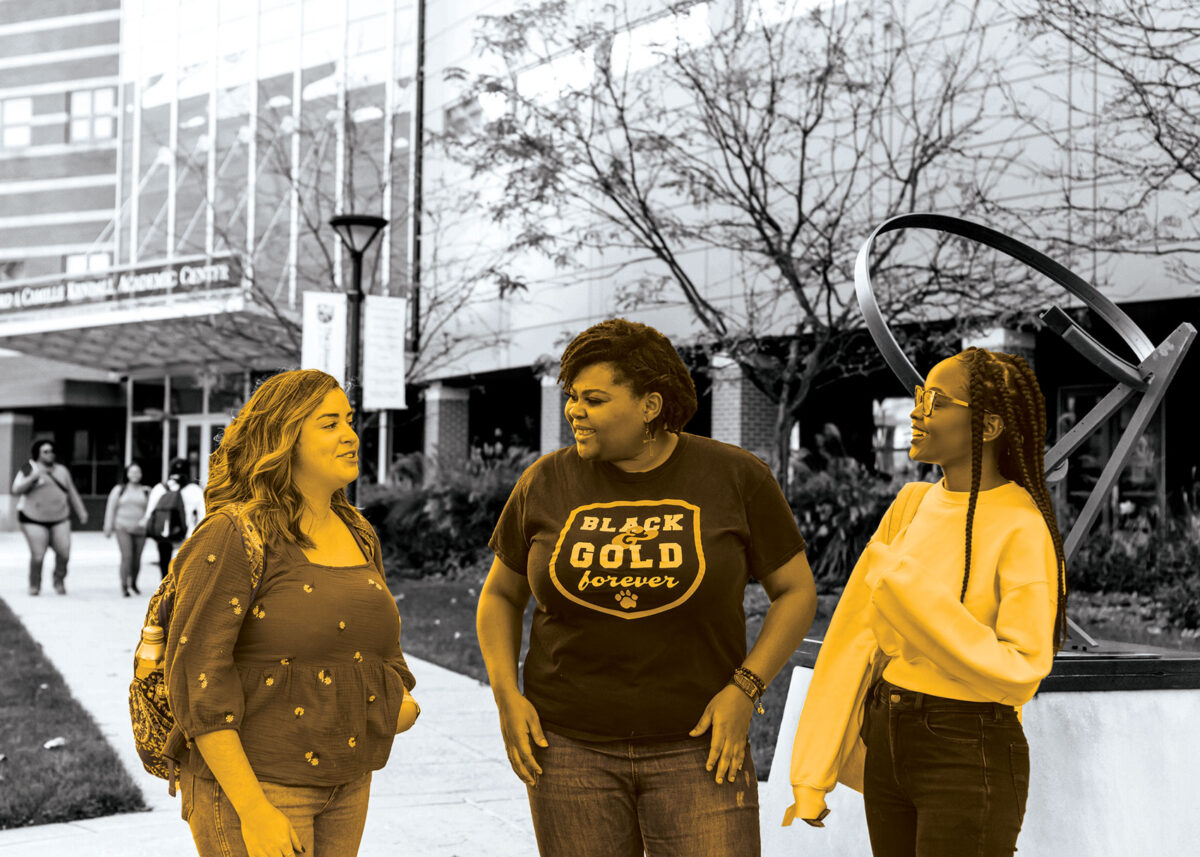
As a new member of the University Innovation Alliance, we are using a data-driven approach to eliminate disparities in educational outcomes based on race and ethnicity.
In 1997, after a rigorous process, UMBC wins approval to launch its Phi Beta Kappa chapter.
2. We exemplify GRIT on and off the court.
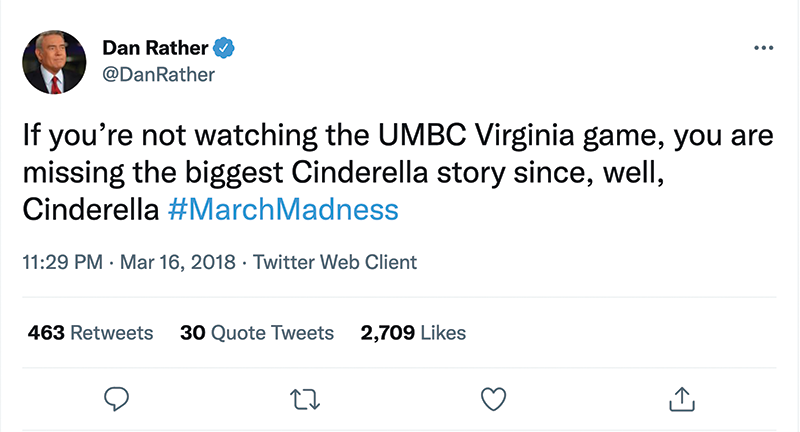
At UMBC, we’re used to surprising outsiders with our grit. When the rest of the nation was shocked by the 2018 NCAA men’s basketball upset, Retrievers took special pleasure in celebrating the victory against number 1 seed University of Virginia. We’re used to overcoming the odds on the court… and, in court, as well. In 2021, the UMBC Mock Trial faced off against Yale in the American Mock Trial Association National Championship, taking home the number 1 spot. But as President Hrabowski always says, “Success is never final.” What will Retrievers do next to surprise the world?
 Students cheer at an athletic event.
In 2009, the UMBC Chess team captured the national record for the most wins (five) in the Pan American Intercollegiate Chess Championship, also known as the “World Series of College Chess.”
3. We provide space and support for entrepreneurial seeds to take root.
UMBC is home to inquiring minds looking to make a difference. When entrepreneurial students wanted to turn their class project for a community-driven coffee shop into a reality, the university partnered to open OCA Mocha. And just across Pig Pen Pond you’ll find collaborations with more than 130 companies at our research and tech park, bwtech, including quite a few run by alumni!
 Deep Patel ’19 and Michael Berardi ’19, founders of OCA Mocha.
A $2 million Kauffman Grant for Entrepreneurship opened the door for the creation of an entrepreneurship minor in 2011 that has already served over 650 students.
In 2020, bwtech@UMBC, the state’s first university research park, wins a $1.3M grant from the U.S. Department of Commerce’s Economic Development Administration to create the Maryland New Venture Fellowship for Cybersecurity. Over the last three decades, bwtech@UMBC has brought more than 1,800 jobs to Baltimore County and generated 4,500 direct and indirect jobs and $700 million in labor income and business sales for the state, according to an assessment by the Sage Policy Group in 2019.
4. Our Retriever alumni are CHANGING the world.
“An organization is more than buildings and rooms. Rather it is the people who animate its mission and purpose,” says Michael Hassett, M.P.P. ’17, Ph.D. ’19. Hassett is living the UMBC mission every day in his work as a budget analyst who also runs a non-profit to spread literacy in Tonga. And the same is true of so many of UMBC’s alumni, who are proudly spreading their Retriever spirit everywhere they go. In politics, the arts, healthcare, higher education, philanthropy, and the sciences, Retrievers are leading the way. And their stories are creating new paths for students to follow in their footsteps.
In 2016, UMBC’s 50th anniversary brought thousands of Retrievers back to campus, including members of our “Founding Four,” who are working on a book about UMBC’s formative years.

5. We <3 our surrounding communities.
UMBC strives to create reciprocal and equitable partnerships with neighboring communities. The Shriver Center and The Choice Program are hubs for community engagement, addressing critical social challenges by bridging campus and community through engaged scholarship and applied learning. And through programs like the Baltimore Field School—made possible by a $125,000 grant from the Andrew W. Mellon Foundation—UMBC is strengthening community engagement with projects aimed at social justice issues and collaborations with partners in Baltimore.
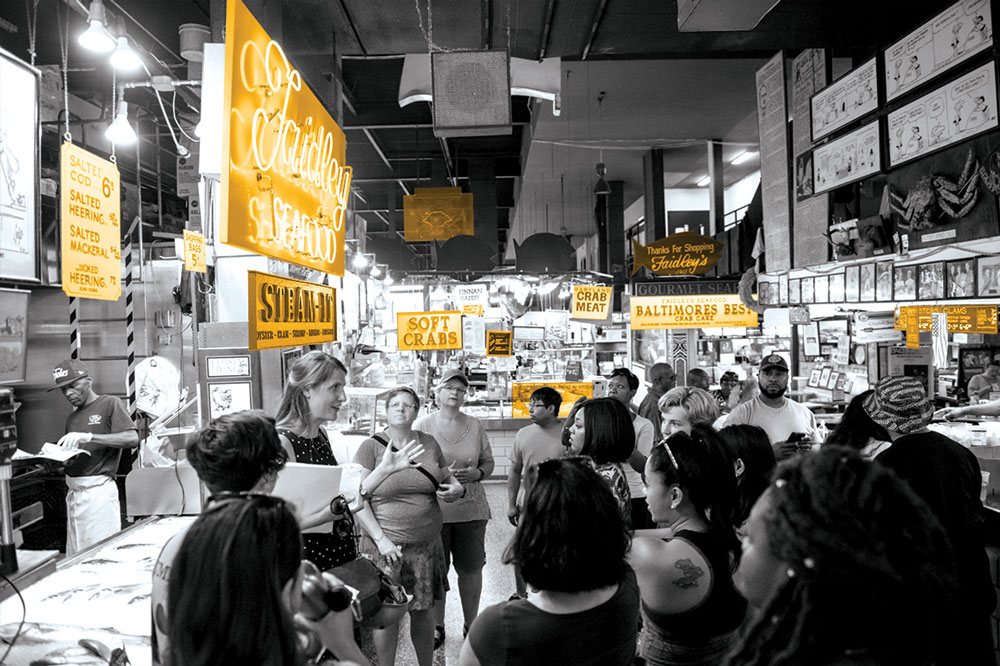 A UMBC walking tour visits Lexington Market in Baltimore.
PARTNERING WITH BALTIMORE CITY SCHOOLS
- In the last five years, the proportion of Sherman Scholar alumni who teach in Baltimore City schools in their first year increased from 13% to 58%.
- In partnership with UMBC, Mary Rodman Elementary saw PARCC scores increase by 14.6% in just one year. Over two years, Lakeland Elementary/Middle School’s scores improved by 11.7%.
- Through Reach Together Tutoring Program nearly 100 UMBC students have provided 7,146 hours of tutoring to 355 2nd-8th grade students in the past semester.
In 2020, the Carnegie Foundation for the Advancement of Teaching honored UMBC with its distinguished Carnegie Community Engagement Classification, acknowledging our deep commitment to strengthening the bonds between campus and community.
6. We believe in PUBLIC research for PUBLIC good.
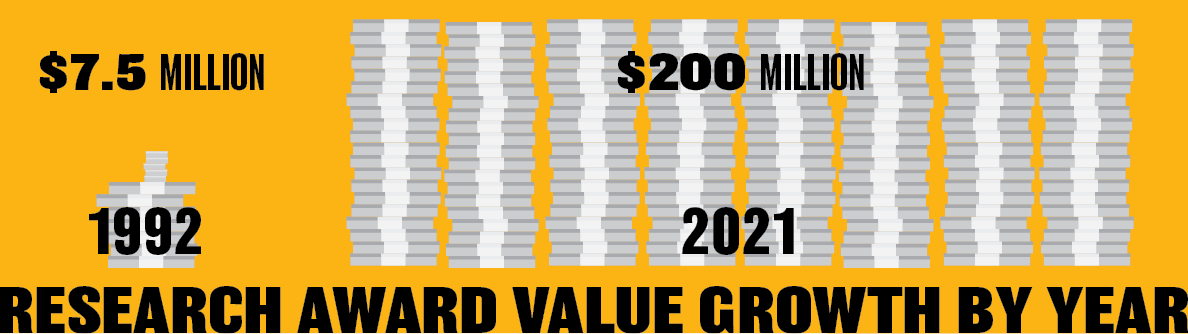
In February 2022, UMBC reached Research 1 status, the nation’s highest level of research performance. Driven by a desire to better understand the world, faculty, graduate, and undergraduate students study everything from quantum computing and spider silk, to public history engagement and building a “toolbox for global thinking.” These projects and so many more allow UMBC to touch countless neighborhoods, universities, and organizations and to strengthen local, national, and global communities.
In 2020, after years in development, a UMBC-designed satellite—the Hyper-Angular Rainbow Polarimeter (HARP)—was launched into space. The satellite’s sensors are collecting new kinds of information about clouds and tiny particles in Earth’s atmosphere, such as wildfire smoke, desert dust, and human-generated pollutants.
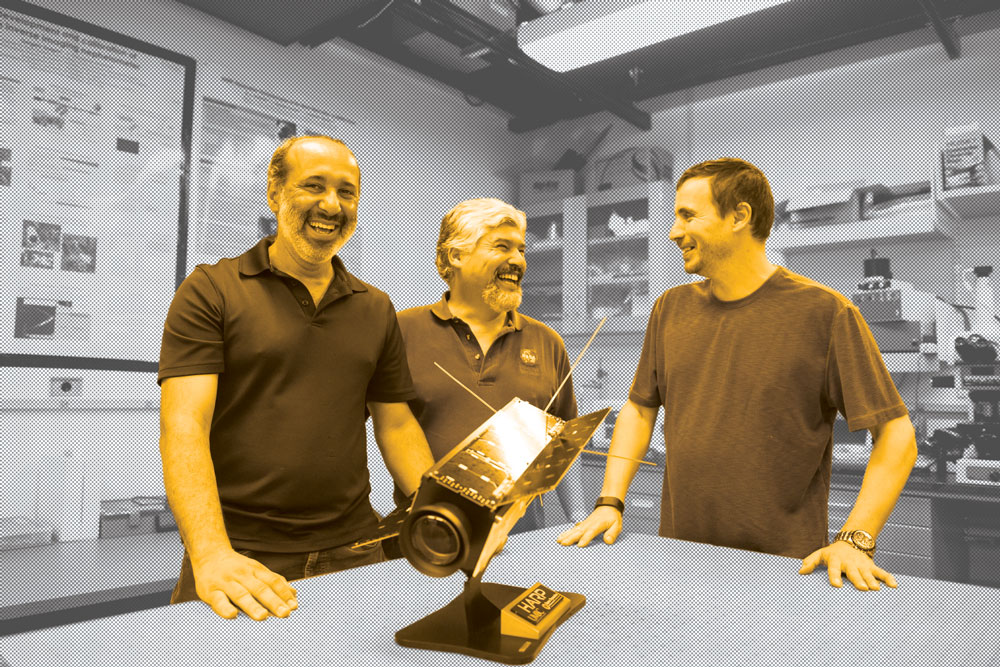 Team members stand with the Hyper-Angular Rainbow Polarimeter.
7. We’re growing by LEAPS and BOUNDS.
What started as a scrappy campus inside Hilltop Circle has now gone global. At the Catonsville campus, new and renovated buildings such as the Center for Well-Being, the Retriever Activities Center, the Performing Arts and Humanities Building, the Chesapeake Employers Insurance Arena, and the Interdisciplinary Life Sciences Building have brought new excitement to Retriever life. Since 1992, we’ve grown from 59 to 76 buildings! Just down I-95 in Rockville, UMBC’s programs at the Universities at Shady Grove speak to specific areas of job growth in and around the region. Add to that our growing numbers online and around the world, and the Retriever reach continues to grow.
In 2021, UMBC welcomed its largest undergrad class in history in Fall 2021, with students representing 96 countries.
]]>
UMBC has grown in so many ways thanks to the leadership of President Freeman Hrabowski and the drive of our RetriEVER Empowered community near and far. Writers Charis Lawson ’20 and Anna Lee ’22...
https://umbc.edu/stories/milestones-and-momentum-1992-2022/
https://my3.my.umbc.edu/api/v0/pixel/news/119430/guest@my.umbc.edu/d17d57fbb002c633eb03299eb6f85e28/api/pixel
magazine
spring-2022
spring-2022-special-issue
umbc-history
UMBC News & Magazine
https://my3.my.umbc.edu/groups/umbc-news-magazine
https://assets1-my.umbc.edu/system/shared/avatars/groups/000/001/943/24435aa6207c452e7bc15cc74b42c7bb/xsmall.png?1748556657
https://assets1-my.umbc.edu/system/shared/avatars/groups/000/001/943/24435aa6207c452e7bc15cc74b42c7bb/original.png?1748556657
https://assets2-my.umbc.edu/system/shared/avatars/groups/000/001/943/24435aa6207c452e7bc15cc74b42c7bb/xxlarge.png?1748556657
https://assets2-my.umbc.edu/system/shared/avatars/groups/000/001/943/24435aa6207c452e7bc15cc74b42c7bb/xlarge.png?1748556657
https://assets3-my.umbc.edu/system/shared/avatars/groups/000/001/943/24435aa6207c452e7bc15cc74b42c7bb/large.png?1748556657
https://assets1-my.umbc.edu/system/shared/avatars/groups/000/001/943/24435aa6207c452e7bc15cc74b42c7bb/medium.png?1748556657
https://assets2-my.umbc.edu/system/shared/avatars/groups/000/001/943/24435aa6207c452e7bc15cc74b42c7bb/small.png?1748556657
https://assets1-my.umbc.edu/system/shared/avatars/groups/000/001/943/24435aa6207c452e7bc15cc74b42c7bb/xsmall.png?1748556657
https://assets2-my.umbc.edu/system/shared/avatars/groups/000/001/943/24435aa6207c452e7bc15cc74b42c7bb/xxsmall.png?1748556657
UMBC News & Magazine
0
0
false
Fri, 06 May 2022 11:38:52 -0400
Fri, 06 May 2022 11:38:52 -0400
Up on the Roof
In his final months at UMBC, Freeman Hrabowski has been hitting the road visiting alumni and friends in a variety of cities as part of the RetriEVER Grateful Tour. Sharing a moment in his office this March, Hrabowski talked a bit about what the tour and his last semester as president have been like and what excites him about the future of UMBC.
UMBC Magazine: You were just in Annapolis for the first stop of the RetriEVER Grateful Tour last night, with quite a few more stops around the country to come, and you’ve also been sharing the UMBC story with state legislators. What has it been like reconnecting with these folks in your final months as president?
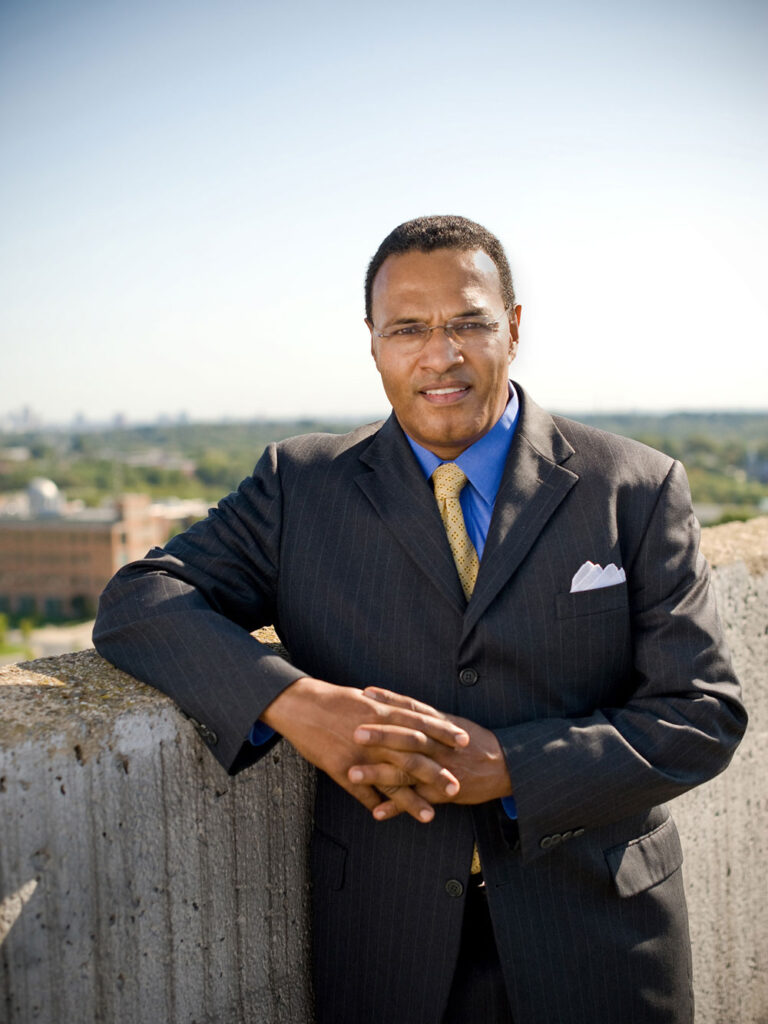
Freeman A. Hrabowski, III
Freeman Hrabowski: It’s been like a special dream. People have been so wonderful. I was seeing people from the Founding Four [the first four years of UMBC graduates], and there were also alumni who are working in state government, including Adrienne Jones [’76, psychology], the speaker of the House of Delegates, and Delegate Mark Chang [’99, psychology], and Senator Charles Sydnor, III [M.P.R. ’00]… and so many other friends and colleagues. And we belonged there. We belonged in Annapolis, telling our story so that people know how UMBC matters in Maryland, and in the country.
UMBC Magazine: You’re also seeing quite a few honors from pretty amazing organizations recently, from your induction into the National Academy of Engineering to the exciting awarding of Carnegie Research 1 status. What a time for all of us!
Hrabowski: It is wonderful, and the point I really want to make is that whenever an award comes to me, it is really for UMBC and the contribution that the university is making to society. It’s really about the body of work of the university. And what it shows is that, as we anticipate the arrival of a wonderful new leader, the people of UMBC know who we are. We know our values. We are so proud of this R1 status. Especially because we have continued to focus on the importance of students, undergrad and grad, and of teaching and learning. And, make no mistake, this new classification speaks volumes about the strength of our research across the disciplines, from the humanities to the sciences.
UMBC Magazine: Can you tell us a little bit about what lies ahead for you? What are you most excited about? Do you have a bucket list?
Hrabowski: I am very excited about working with national agencies, foundations, and universities on those issues of particular interest to me, including academic success of students, of all students, addressing the issue of underrepresentation in STEM, and the importance of enlightened leadership in higher education. And so, I will be working even more closely with Harvard’s leadership programs. I’ll be in that space and working with universities.
So, I don’t have a bucket list. You never know if you’re gonna get a chance to retire—that’s life, right? So you need to just do it. When I leave, you can say ‘He felt so good about his life.’ I have been loved. I have loved deeply, and I love UMBC. So, the bucket list is finished. The cake is baked, and this is about the icing on the cake. This is the time when members of the UMBC community, and our alumni, and our supporters are reflecting on just how far we’ve come in 55 years. And it’s been my honor to have spent 35 of those years with UMBC. I am a blessed man, and that is the truth.
Learn more about the RetriEVER Grateful Tour and upcoming events to celebrate Dr. Hrabowski’s leadership.
]]>
In his final months at UMBC, Freeman Hrabowski has been hitting the road visiting alumni and friends in a variety of cities as part of the RetriEVER Grateful Tour. Sharing a moment in his office...
https://umbc.edu/stories/up-on-the-roof/
https://my3.my.umbc.edu/api/v0/pixel/news/119431/guest@my.umbc.edu/bb1170a5eb67a6b0e8bd02cbd4755226/api/pixel
freeman-hrabowski
impact
magazine
retriever-grateful
spring-2022
spring-2022-special-issue
up-on-the-roof
UMBC News & Magazine
https://my3.my.umbc.edu/groups/umbc-news-magazine
https://assets1-my.umbc.edu/system/shared/avatars/groups/000/001/943/24435aa6207c452e7bc15cc74b42c7bb/xsmall.png?1748556657
https://assets1-my.umbc.edu/system/shared/avatars/groups/000/001/943/24435aa6207c452e7bc15cc74b42c7bb/original.png?1748556657
https://assets2-my.umbc.edu/system/shared/avatars/groups/000/001/943/24435aa6207c452e7bc15cc74b42c7bb/xxlarge.png?1748556657
https://assets2-my.umbc.edu/system/shared/avatars/groups/000/001/943/24435aa6207c452e7bc15cc74b42c7bb/xlarge.png?1748556657
https://assets3-my.umbc.edu/system/shared/avatars/groups/000/001/943/24435aa6207c452e7bc15cc74b42c7bb/large.png?1748556657
https://assets1-my.umbc.edu/system/shared/avatars/groups/000/001/943/24435aa6207c452e7bc15cc74b42c7bb/medium.png?1748556657
https://assets2-my.umbc.edu/system/shared/avatars/groups/000/001/943/24435aa6207c452e7bc15cc74b42c7bb/small.png?1748556657
https://assets1-my.umbc.edu/system/shared/avatars/groups/000/001/943/24435aa6207c452e7bc15cc74b42c7bb/xsmall.png?1748556657
https://assets2-my.umbc.edu/system/shared/avatars/groups/000/001/943/24435aa6207c452e7bc15cc74b42c7bb/xxsmall.png?1748556657
UMBC News & Magazine
0
0
false
Fri, 06 May 2022 10:34:54 -0400
Fri, 06 May 2022 10:34:54 -0400
Because She Can: Jackie Hrabowski’s Service to Students
By Susan Thornton Hobby
The first question on the Jacqueline C. Hrabowski Endowment scholarship application is “How did you develop such a passion for service?”
Jackie Hrabowski answers that one easily: Her parents.
Growing up in rural Virginia, Hrabowski remembers her parents constantly serving others. For years, young Jackie accompanied her parents as they filled out forms, calculated taxes, built brick walls, or repaired houses for her parents’ combined 28 siblings or for the rest of the town. As a teenager, she once pouted, “Why does it always have to be us that helps everyone?”
Her father answered simply, “Because we can.”
“Those are the role models that I saw,” Hrabowski said. “You grow up with that in your DNA. And that’s been the thing that has moved me forward throughout my entire life.”
Hrabowski is a former vice president of community involvement at T. Rowe Price, a passionate advocate for child welfare, and the wife of Freeman. She has been mentoring the recipients of her endowment’s scholarship for 20 years. Because she can.
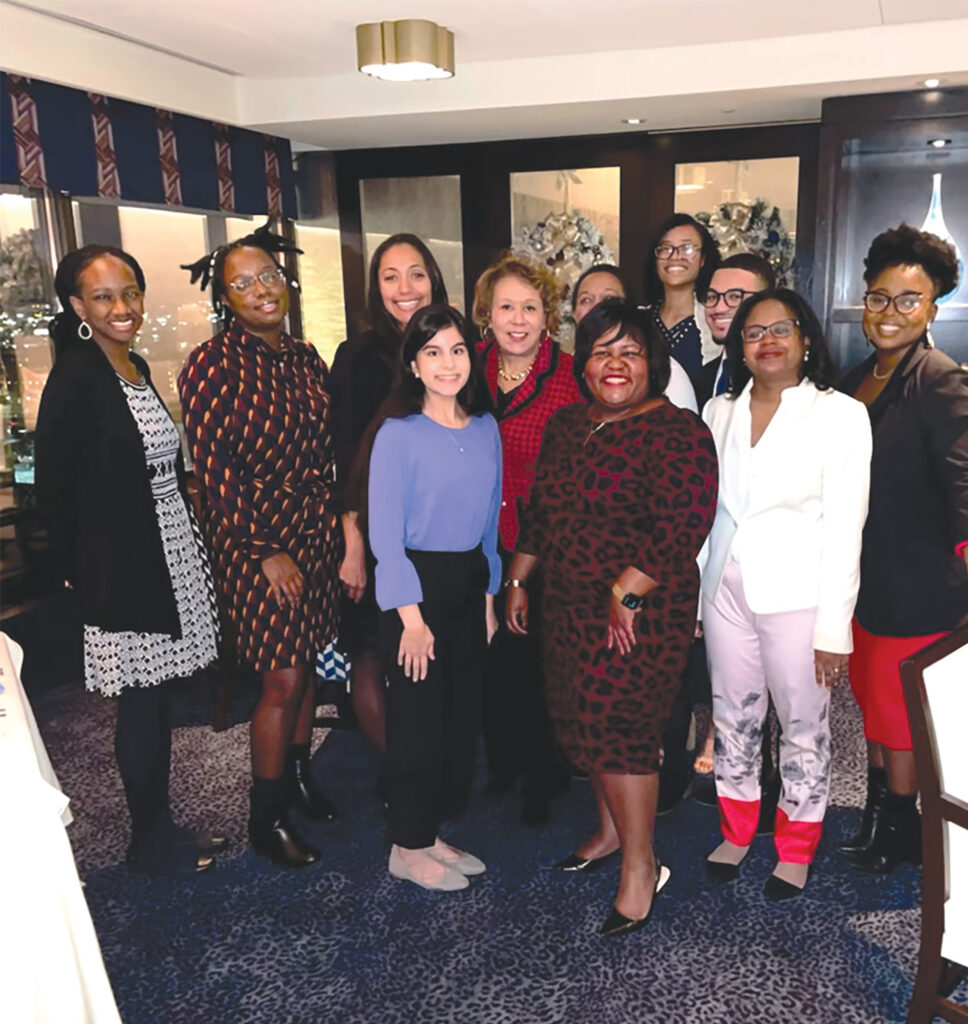 Hrabowski, center, with some of her scholars and alumni in 2022. Photo courtesy of Alicia Wilson ’04.
One of Hrabowski’s mentees, Nia Hampton ’13, media and communications studies, struggled with expectations at the internship that Hrabowski found for her. After Hampton’s rough first day with the company, Hrabowski responded by buying Hampton clothes, getting her hair done, and counseling her on professional behavior.
Now a freelance journalist, multimedia artist, and still a self-proclaimed “rebel,” Hampton recently texted Hrabowski, thanking her for her support.
“Mrs. Hrabowski was really good at connecting me with people who could see me and understand me. I kinda knew I would be something she may not know what to do with,” Hampton said, but Hrabowski didn’t give up, instead connecting Hampton to UMBC Vice Provost and mentor Yvette Mozie-Ross ’88, healthy science and policy. To help mentees toward success, Hampton said, “sometimes it takes all kinds of people.”
Thomas Southerland ’22, economics, met Hrabowski at the scholarship recipients’ cohort dinner she gave at Baltimore’s Center Club.
“She was very supportive and very wise,” he said, and he and many of the scholars took notes while they chatted with their mentor. The connections he made will serve him well in his career in finance after graduation, he said.
You Can’t Be What You Can’t See
Hrabowski excelled at math, even beating her future husband Freeman on their calculus test scores. But she majored in psychology at Hampton University, because a role model, a Fisk University graduate who taught Sunday School at her church, was also a psychology major.
She often quotes the saying posted in her husband’s office: “You Can’t Be What You Can’t See.”
“Role modeling means having to see actual images of what it looks like to be what you want to be,” said Hrabowski, who taught educational psychology and early childhood education at UMBC in the 1980s. “You can sit and talk until you’re blue in the face about what you need to do and how you need to behave. Words alone aren’t enough. They’ve got to see it.”
Alicia Wilson ’04, political science, Hrabowski’s first mentee, agrees.
“Jackie was one of the first Black women I’d ever met in corporate America at the highest level,” said Wilson, now the vice president for economic development at Johns Hopkins University and Health System. “She’s a wonderful mentor—she imparts her knowledge and her experience in a spirit of love and caring and support.”
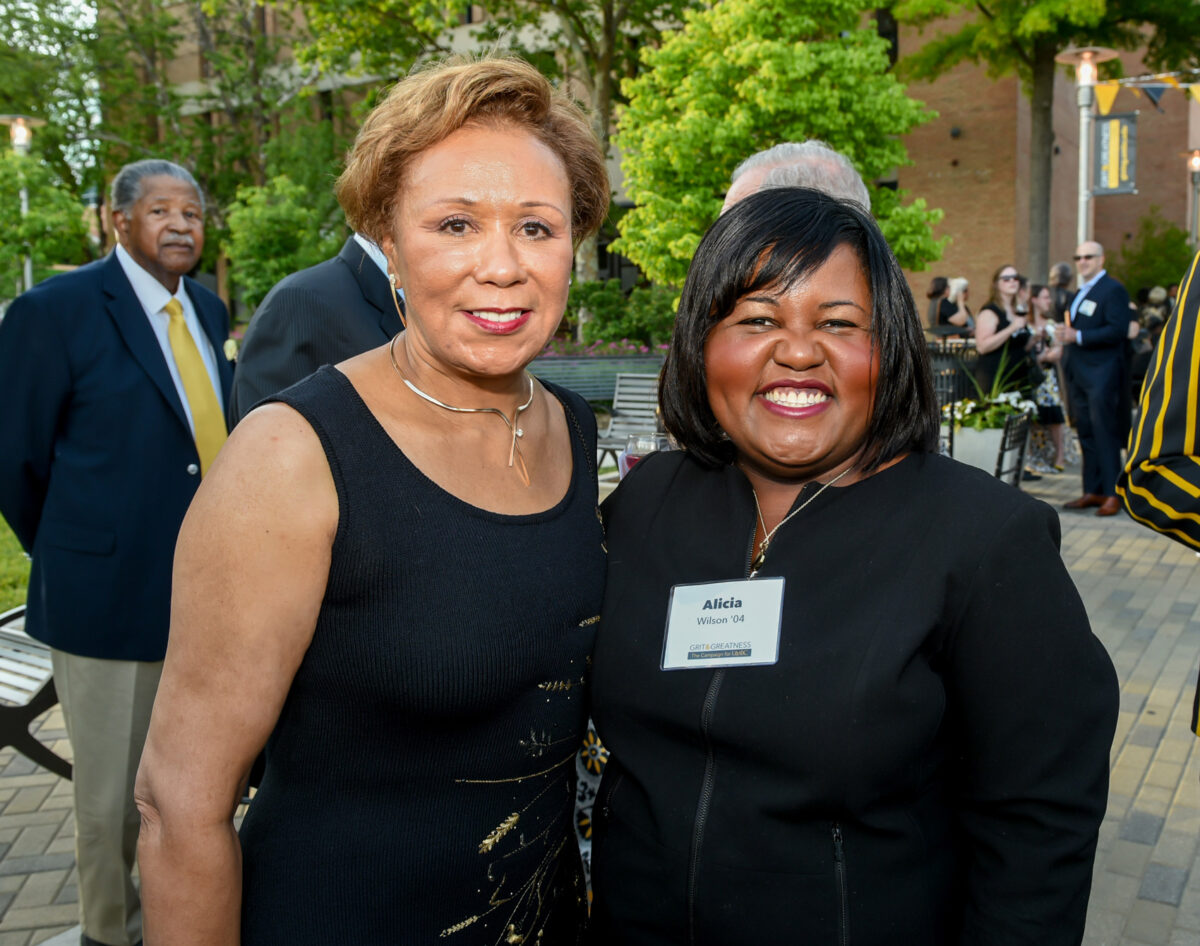 Jackie Hrabowski and Alicia Wilson in 2017, courtesy of Jay Baker.
Now Wilson is mentoring seven Retrievers, making sure she “meets students where they are,” at the UMBC dining hall or outside their dorms.
Wilson, and so many others, clearly learned lessons from Hrabowski.
“You use the talents that you have, not so much for your own purpose, but to make life better for others,” Hrabowski said. “Because when you do that, your universe expands in a positive way as well.”
Read more about the Hrabowskis’ philosophy of mentorship in the Equation of Change.
]]>
By Susan Thornton Hobby The first question on the Jacqueline C. Hrabowski Endowment scholarship application is “How did you develop such a passion for service?” Jackie Hrabowski answers...
https://umbc.edu/stories/because-she-can-jackie-hrabowskis-service-to-students/
https://my3.my.umbc.edu/api/v0/pixel/news/119432/guest@my.umbc.edu/29709dc4c992b7cf7718ab363db10119/api/pixel
donors
impact
jackie-hrabowski
magazine
spring-2022
spring-2022-special-issue
UMBC News & Magazine
https://my3.my.umbc.edu/groups/umbc-news-magazine
https://assets1-my.umbc.edu/system/shared/avatars/groups/000/001/943/24435aa6207c452e7bc15cc74b42c7bb/xsmall.png?1748556657
https://assets1-my.umbc.edu/system/shared/avatars/groups/000/001/943/24435aa6207c452e7bc15cc74b42c7bb/original.png?1748556657
https://assets2-my.umbc.edu/system/shared/avatars/groups/000/001/943/24435aa6207c452e7bc15cc74b42c7bb/xxlarge.png?1748556657
https://assets2-my.umbc.edu/system/shared/avatars/groups/000/001/943/24435aa6207c452e7bc15cc74b42c7bb/xlarge.png?1748556657
https://assets3-my.umbc.edu/system/shared/avatars/groups/000/001/943/24435aa6207c452e7bc15cc74b42c7bb/large.png?1748556657
https://assets1-my.umbc.edu/system/shared/avatars/groups/000/001/943/24435aa6207c452e7bc15cc74b42c7bb/medium.png?1748556657
https://assets2-my.umbc.edu/system/shared/avatars/groups/000/001/943/24435aa6207c452e7bc15cc74b42c7bb/small.png?1748556657
https://assets1-my.umbc.edu/system/shared/avatars/groups/000/001/943/24435aa6207c452e7bc15cc74b42c7bb/xsmall.png?1748556657
https://assets2-my.umbc.edu/system/shared/avatars/groups/000/001/943/24435aa6207c452e7bc15cc74b42c7bb/xxsmall.png?1748556657
UMBC News & Magazine
0
0
false
Thu, 05 May 2022 16:51:01 -0400
Thu, 05 May 2022 16:51:01 -0400
Equation of Change
By: Susan Thornton Hobby Illustrations by: Marissa Clayton ’21
At the start of second grade, Freeman Hrabowski’s textbook, wrapped neatly in brown paper, arrived on his desk. His teacher warned the class to keep the book covers in place. But little Freeman was always curious. He peeled off a strip of paper, then another scrap, and another, until he could see the battered cover and a stamp inside, showing that the book had been used by children in the White school nearby.
Freeman marched up to his teacher’s desk. “Why’d they give us their hand-me-down books?” he asked. His teacher’s face, Hrabowski remembered, showed both embarrassment and anger.
“What do you tell a child who’s been told by the world that the child is second class?” Hrabowski recalled.
“She said, ‘You just remember this: You are a child of God. You are first class. The book may not be new, but the knowledge is worth getting. Just get the knowledge and you will be okay.’ So that wonderful teacher was telling me to believe in myself.”
While the hand-me-down books outraged Hrabowski, his teacher’s advice was treasured and passed along to those he has mentored: Believe in yourself. Hrabowski’s legacy is defined by mentoring, both by the parents and educators who guided him and by his hundreds of mentees. Hrabowski’s mentees are legion, whether they arrive from UMBC’s Meyerhoff Scholarship Program, or as the student body president, or just students he’s met on his walks around campus who then ask for his guidance.
It’s simple math. Hrabowski mentors hundreds. Those hundreds mentor thousands. Those thousands mentor hundreds of thousands. The result is Hrabowski’s exponential equation of change.
During the pandemic, Kafui Dzirasa ’01, M8, chemical engineering, texted Hrabowski, the mentor he calls Doc. “I said, ‘Your mentees are literally leading the coronavirus response, one as the U.S. surgeon general [Jerome Adams ’97, M4, biochemistry & molecular biology and psychology]. And the other one’s making a vaccine [Kizzmekia Corbett ’08, M16, biological sciences and sociology]. Your mentoring is literally going to save millions of lives. The end. That’s mentoring.’”
A Nickel and The Hard Truth
Hrabowski’s first mentors were his parents, a college-educated pair of teachers who supported and challenged him. “From my daddy, my father, I learned the importance of remaining calm in challenging times and giving yourself the time to think through the best approach to use in attacking a problem,” Hrabowski said. “From my mother, the importance of connecting right and left brain thinking… In both cases, they were teaching me how to learn, and think, and approach the world.”
By the time he reached high school, Hrabowski was always the one who tried to solve the math problems his principal would write on the chalkboard. He would bring his solutions to the principal’s office and earn a nickel to spend on Tootsie Rolls if they were right. If his equations weren’t correct, his principal would chastise him for carelessness. Both the nickels and the hard truths stuck with him, Hrabowski said, and he uses that tough love to mentor others.
“I’m first working with my mentees to build trust so that the mentee knows I care deeply,” Hrabowski said. “Then if I say something that is not comfortable, or something that maybe she doesn’t want to hear, I’m saying it out of love. I’m, perhaps, saying what others are thinking and won’t say. And I believe that effective mentors want to help students and their mentees to develop tough skin, to want to get constructive and honest feedback, because we can all improve.”
Kate Tracy, M.A. ’01, Ph.D. ’03, psychology, shadowed Hrabowski and was mentored by him as an American Council on Education Fellow. Hrabowski introduced her, connected her, and guided her for the 2019 to 2020 academic year. Never before, she laughed, had she given out a complete box of 500 business cards.
“As a mentor, Freeman is continuously available…he has an amazing amount of energy and he has an incredibly generous heart,” said Tracy, who serves as a professor in the University of Maryland School of Medicine’s Department of Epidemiology and Public Health and advises the University System of Maryland on COVID-19.
Hrabowski can offer hard truths, she said, because he demonstrates how deeply he cares. He often quotes Emily Dickinson: “Tell all the truth but tell it slant.” He recently gave her a “truth bomb,” Tracy said, and she thought, “he’s saying this for my own good, and if he’s willing to say it, I need to hear it.”
She was touched, Tracy said, when later in the day Hrabowski texted her, telling her how proud he was of her, and how hard it must have been to hear what he had to say.
“When you build a trusting relationship and you put relationships at the center of it, people can hear the hard truth because they know you’re doing it for their greatest good and because you believe in them,” Tracy said.
Chelsea Pinnix ’99, M7, biochemistry and molecular biology, said she learned the primacy of honesty from Hrabowski.
“It’s important to be vulnerable to your mentee,” said Pinnix, who is now the residency program director and associate professor in the Department of Radiation Oncology at Anderson Cancer Center. “Being honest about the mistakes you’ve made, about things that you wish you’d done differently. They are learning from your mistakes, but they’re also recognizing that you have these vulnerabilities and that you make mistakes. So then it’s okay for them to make mistakes, too.”
Telling Yourself a Story
Hrabowski’s early life bolstered his eager mind. When young Hrabowski received straight A’s, the entire congregation of his Birmingham church would rise for a 4.0 standing ovation. Starting at age 15, Hrabowski followed the advice of a mentor and started greeting himself in the mirror as “Dr. Hrabowski.”
At monthly family meetings for the Meyerhoff Scholars, Hrabowski instituted both ovations for good grades and the advice to address yourself in the mirror as your goal self. Have high expectations, Hrabowski said, and students will rise to them.
Dzirasa, an associate professor of psychiatry and behavioral sciences at Duke University who was recently elected to the National Academy of Medicine, thought the mirror exercise was “weird,” he said, laughing. “And yet, we did it. It wasn’t until I became a psychiatrist that I was like, wow, there’s an incredible power to self-reinforcement. Despite all the adversity that comes later, if you tell yourself a story, you will believe it.”
The Meyerhoff story began when Robert Embry, former Baltimore City councilman and longtime president of the Abell Foundation, which works to improve the quality of life in Baltimore, met Hrabowski as a young dean at Coppin State College. Embry was impressed by Hrabowski’s intellect, energy, and high expectations.
Embry eventually connected Hrabowski with philanthropist Robert Meyerhoff, who wanted to help Black science scholars. The Meyerhoff Scholars Program emerged. Years later, Hrabowski recruited Embry to join the board at UMBC.
“It didn’t take much,” Embry said. “Anything I could do to help him and to be identified with him and his success.”
The Meyerhoff Scholars Program, with its nationally recognized success in increasing diversity in the sciences, is one of the places Hrabowski practices what he preaches about mentorship.
In the Meyerhoff Program, Pinnix learned Hrabowski’s “superpower,” she said. “He has this profound ability to inspire. And he’s able to convince people of the things that they can accomplish before they even recognize that they can.”
“Focus, focus, focus,” Annica Wayman’99, M6, mechanical engineering, remembers Hrabowski often saying to Meyerhoff Scholars. Offered a Meyerhoff Scholarship on the spot after she introduced Hrabowski at her high school, Wayman later earned her doctorate at Georgia Tech. She worked for nearly a decade at USAID before returning to UMBC in 2018 as the College of Natural and Mathematical Sciences’ associate dean for Shady Grove affairs. As she leads programs like the Translational Life Science Technology bachelor’s degree, Wayman now mentors students herself, offering them support and hard truth, and telling them to focus, focus, focus.
Master the Self
In 1987, Michael Hooker, then the president of UMBC, recruited Hrabowski to the campus and became his mentor. Hrabowski said he learned a piece of wisdom from Hooker: “The hardest task any human being has is to master self.”
Many mentees need to hear that message, Hrabowski said.
Dzirasa, now a Howard Hughes Medical Institute investigator and a neuroscientist researching how genetics interact with environmental stress to affect the brain’s functioning, recalled when he was at his lowest.
After breezing through undergrad as an engineer at UMBC, he arrived at Duke Medical School thinking he didn’t need to memorize things. Or study. He began to fail classes. Then someone stole his identity and charged $40,000 to his credit. He went to see an advisor, who told him he wasn’t used to being a small fish in a big pond.
Feeling restless and despondent, Dzirasa started driving. He hit the Virginia state line. Then Maryland’s. Dzirasa ended up on Hrabowski’s porch, weeping and ready to drop out of medical school. Hrabowski comforted him, told him whatever choice he made would be okay. But maybe, Dzirasa recalls Doc telling him, he could drive back to Duke and try one more time.
A good mentor, Dzirasa said, dusts you off and urges you to persist, then keeps after you. Hrabowski, Dzirasa said with a laugh, loves to commend him, but then say, “you know…” and proceed to critique a portion of his performance.
Now Dzirasa returns to UMBC once a month as part of his appointment at Duke, to mentor students and to recruit Meyerhoff Scholars for his research lab.
“I basically give those kids all of myself, and in a hoodie and sweatpants,” Dzirasa said. “I look exactly like them, I talk exactly like them, I sat in exactly their chair, and I was probably more trouble than they are. It makes people’s dreams so tangible.”
Touching Eternity
Hrabowski remembers what Walter Sondheim, the Baltimore businessman and public servant, used to tell him: “Live life seriously, but don’t take it seriously.”
He thinks of that advice often. “His point was, it’s never quite as bad as you think it is, and don’t ever think you’re quite as important as people want to make you seem.… The human experience is that we leave, and others replace us, and if we’re lucky, we are connected to those people.”
Connections are vital to Hrabowski, and he still mentors current students. Sometimes though, students end up teaching the president.
Landry Digeon, M.A. ’09, intercultural communications, Ph.D. ’20, language, literacy, and culture, remembers meeting Hrabowski at the campus television studio, where he worked on videos Hrabowski was taping. The president wanted to learn Digeon’s native French. “Push me,” he told Digeon three times, before Digeon decided to take him up on it in 2014.
Ever since, Hrabowski has studied French with Digeon, who admires Hrabowski’s humility to be tutored by a student. They speak in French nearly every day, about poetry and culture, sometimes arguing about the different countries’ values.
“I learn more from him than he has learned from me,” Digeon said. “When he has a goal, he doesn’t let go. And I learn by watching how to treat people—you can be a great man, a renowned man, and be kind. And I’ve changed Freeman’s mind occasionally. I want to be like that—open-minded.”
When Hrabowski turns in his homework, usually late at night, the president ends his emails with, “Bonne nuit, mon professeur.”
The perfect conjugation of French verbs and his connections to scientists and leaders around the world aren’t the only benefits mentorship offers Hrabowski.
“There’s a great gratification when you see people evolving, and developing, and doing well, and seeing how they overcome challenges. It inspires me to want to be better,” Hrabowski said.
Wayman believes inspiring mentorship is the first element in the equation of change.
“Saving the world is first transforming the thinking of people, to think critically, to be more open-minded,” Wayman said.
Hrabowski, who still receives notes from people his mother taught 70 years ago, often remembers what his mother said in her dying days: “Teachers touch eternity through their students.”
“Those of us in education, we live through our students,” Hrabowski said. “We live through the people we help because we are paying it forward. We live through them and their actions.”
Read more about Jackie Hrabowski’s approach to mentorship in Because She Can.
]]>
By: Susan Thornton Hobby Illustrations by: Marissa Clayton ’21 At the start of second grade, Freeman Hrabowski’s textbook, wrapped neatly in brown paper, arrived on his desk. His teacher...
https://umbc.edu/stories/equation-of-change/
https://my3.my.umbc.edu/api/v0/pixel/news/119433/guest@my.umbc.edu/e330b1dec8c03e1a25d798cabde38856/api/pixel
hrabowski
impact
magazine
meyerhoff
spring-2022
spring-2022-special-issue
UMBC News & Magazine
https://my3.my.umbc.edu/groups/umbc-news-magazine
https://assets1-my.umbc.edu/system/shared/avatars/groups/000/001/943/24435aa6207c452e7bc15cc74b42c7bb/xsmall.png?1748556657
https://assets1-my.umbc.edu/system/shared/avatars/groups/000/001/943/24435aa6207c452e7bc15cc74b42c7bb/original.png?1748556657
https://assets2-my.umbc.edu/system/shared/avatars/groups/000/001/943/24435aa6207c452e7bc15cc74b42c7bb/xxlarge.png?1748556657
https://assets2-my.umbc.edu/system/shared/avatars/groups/000/001/943/24435aa6207c452e7bc15cc74b42c7bb/xlarge.png?1748556657
https://assets3-my.umbc.edu/system/shared/avatars/groups/000/001/943/24435aa6207c452e7bc15cc74b42c7bb/large.png?1748556657
https://assets1-my.umbc.edu/system/shared/avatars/groups/000/001/943/24435aa6207c452e7bc15cc74b42c7bb/medium.png?1748556657
https://assets2-my.umbc.edu/system/shared/avatars/groups/000/001/943/24435aa6207c452e7bc15cc74b42c7bb/small.png?1748556657
https://assets1-my.umbc.edu/system/shared/avatars/groups/000/001/943/24435aa6207c452e7bc15cc74b42c7bb/xsmall.png?1748556657
https://assets2-my.umbc.edu/system/shared/avatars/groups/000/001/943/24435aa6207c452e7bc15cc74b42c7bb/xxsmall.png?1748556657
UMBC News & Magazine
0
0
false
Tue, 03 May 2022 16:24:34 -0400
Tue, 03 May 2022 16:24:34 -0400
Leaders Among Us
By Margaret Moffett
For La Jerne Terry Cornish, Ph.D. ’05, language, literacy, and culture, an already remarkable day was about to become unforgettable. There she stood in front of a big crowd at UMBC, accepting the 2019 Outstanding Alumna in the Humanities award. Even better, she was getting the chance to chronicle her journey from high school English teacher to college professor to provost and vice president of Ithaca College in New York.
“I’ve spent the last 21 years trying to be the change I wanted to see,” she told the audience—channeling the wisdom of her role model, who just happened to be sitting behind her on the stage.
Her speech complete, Cornish had returned to her chair when the role model in question leaned toward her. “You’re going to be a college president someday,” he whispered, his eyes no doubt twinkling with delight. “If you say so,” Cornish responded with a nervous laugh, bewildered by his faith in her.
Fast forward three years to March 2022, when Cornish was named Ithaca College’s 10th president. Dr. Freeman Hrabowski was right. Again.
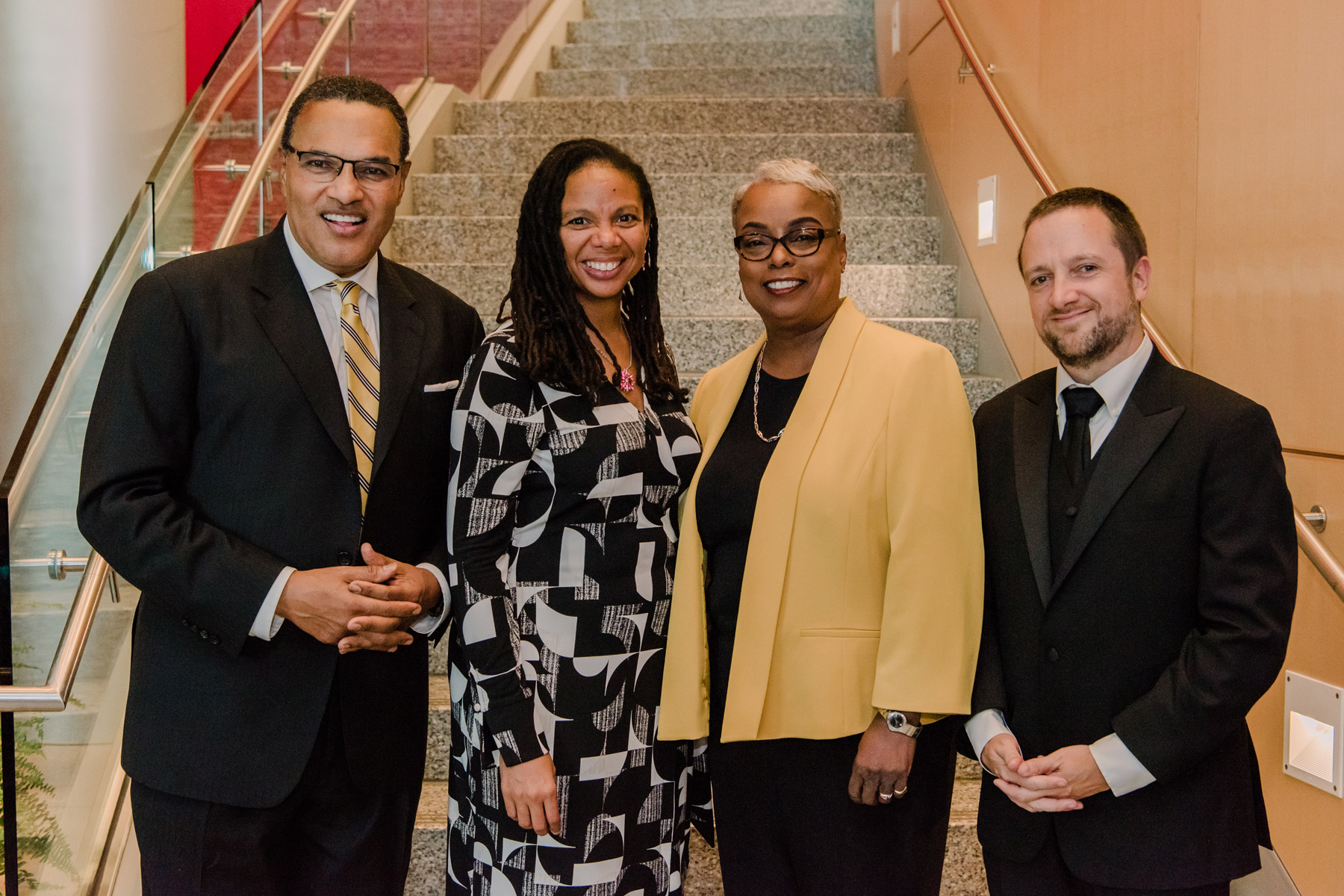
 At the 2019 Alumni Award ceremony, from left to right: Dr. Hrabowski, Dean Kimberly Moffitt, La Jerne Terry Cornish, and former president of the Alumni Association, John Becker ’01. Photo by Marlayna Demond ’11.
As Hrabowski prepares for his retirement as UMBC’s president, mentees like Cornish are reminding the higher education community of one of his legacies. No, not UMBC’s transformation from a young state university to U.S. News & World Report’s No. 1 “Up and Coming University” in the nation. That one’s been well documented. And no, not how he helped UMBC become a powerhouse in STEM education and the alma mater for thousands of engineers and scientists of color. That also has prompted some chatter.
This legacy involves his impact on other chancellors and presidents, along with those who aspire to these roles. In his 30 years as UMBC president, Hrabowski has counseled scores of his peers, including Sylvia Burwell, president of American University; Paula Johnson, president of Wellesley College; and Wendy Raymond, president of Haverford College. He also has taught for 18 years at the week-long Harvard Seminar for New Presidents, which provides a crash course in higher education leadership. And he has mentored countless college and university heads—officially, unofficially, and sometimes without him even knowing it.
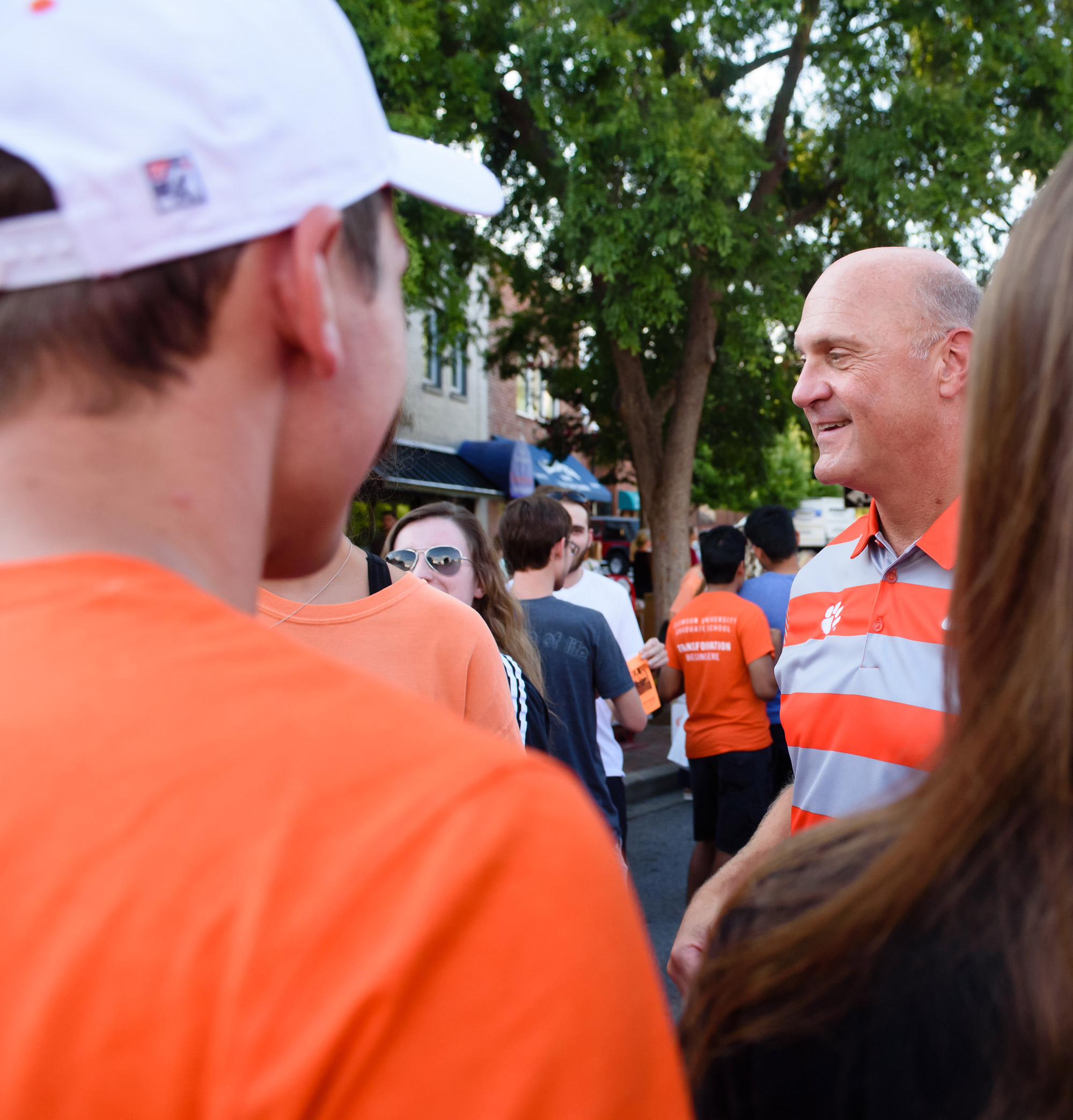
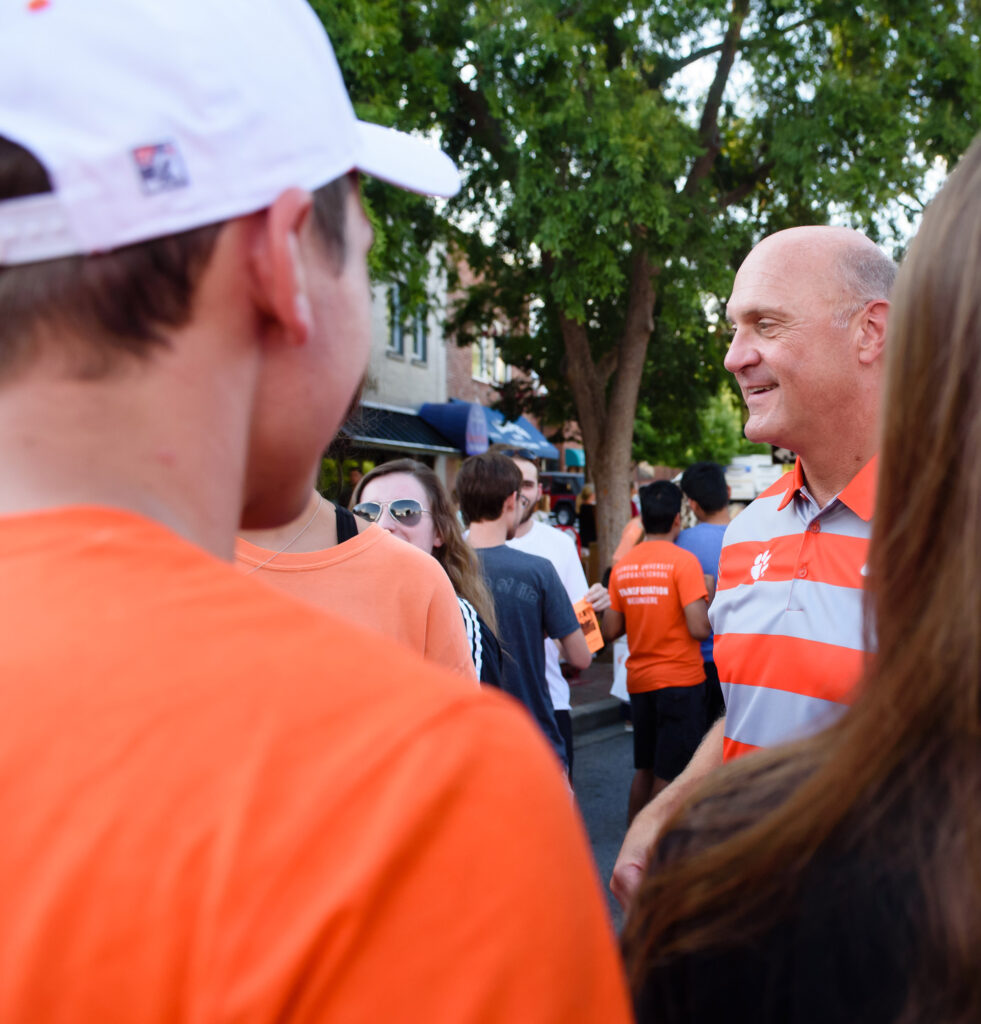 James Clements ’85, M.S. ’91, Ph.D. ’93, serves as president of Clemson University. Photo courtesy of Clemson University.
Hrabowski gave Cornish his cell phone number—along with the promise that she could use it at any time—within weeks of her appointment as interim president at Ithaca in August 2021. She hasn’t needed to use it. But knowing that it’s in her phone gives her a sense of comfort. “He has always been a relational president,” she said. “That’s the one thing about him that stands out for me. I want to be that kind of relational leader—dare I say that kind of servant leader, because that’s what I see in him.”
“I would not be a president if not for him,” said James P. Clements ’85, computer science, M.S. ’91, Ph.D. ’93, operations analysis, who has led Clemson University since 2013. “I have modeled my career after him.”
Had Hrabowski been a fly on the wall during those conversations, he would have brushed aside the accolades, then launched into a speech-slash-sermon about how everyone is capable of greatness, how it’s about the students, not the leader. “He would say that he isn’t that rare,” Cornish said. “He would say that there are other people who, given the opportunity and access, could accomplish just as much as he has and more.”
His imagined protestations notwithstanding, though, it does raise an interesting question: Can a college president learn to lead like Freeman Hrabowski? Are such talents innate or are they teachable?
Said Clements bluntly: “He’s special. Everybody who interacts with him knows it.”
“There is only one Freeman and you can’t be him or become him,” said James Honan, senior lecturer in the Harvard Graduate School of Education. “But when you hear him speak, when he answers your questions, when you watch his role modeling, you can incorporate some practices into your leadership that will help you make your institution better.”
No. 1: Take care of yourself.
No. 2: Be authentic.
No. 3: Own your mistakes.
College and university presidents come to Hrabowski so often for advice that the words come tripping off his tongue when he’s asked to recreate what he tells them. In his mind, they’re just things he has learned over the years—sometimes by watching others, sometimes through trial and error. Part of it, he believes, came from his time as a child leader in the civil rights movement in Birmingham, Alabama. One of his role models then was a preacher renowned for his ability to galvanize support and inspire a revolution: the Rev. Martin Luther King Jr.
“I was very fortunate to have experiences that gave me the chance to lead,” said Hrabowski, who was arrested for his participation in the Children’s Crusade march at age 12. “Each of us is a product of our childhood and young experiences, and those experiences shape who we are, what we like, what we don’t like, how we adjust to change, how we address challenges, how we act in the storm.”
Hrabowski practices what he preaches to the leaders he advises. He follows rule No. 1—taking care of himself—by meditating via the Calm app every day with his wife, Jacqueline Coleman Hrabowski. No. 2, being authentic, just comes naturally to him. And he may take No. 3, owning his mistakes, more seriously than any college president in the world.
Consider, for instance, this story from 2018—26 years into Hrabowski’s tenure as president. At an event honoring several high academic achievers, it seems he spent a little too much time bragging about UMBC’s first Rhodes Scholar, Naomi Mburu ’18, M26, chemical engineering, who is now at Oxford University working on heat transfer applications for nuclear fusion reactors. The others on stage felt slighted by his fawning words for Mburu.
 Mburu with Dr. Gymama Slaughter in her lab at UMBC in 2018. Marlayna Demond ’11.
How does he know this? Because Mburu came to his office and told him so, an act that required her to summon both justice and mercy. Hrabowski was alarmed by her words, which he recognized were true the moment he heard her speak them. He had indeed failed to give enough attention to all the scholars on stage. “I’ve always taken great pride in working to let every person know how much I appreciate them, that they matter,” he said. “And there I was, without even realizing it, not holding up to my own standard.”
So he called each one, apologized, and asked to hear their stories. According to Hrabowski: “It was a lesson for me: Don’t allow my excitement about one person to take away from helping each [honoree] feel her best.”
That may be Hrabowski’s lesson learned. But the larger one for leaders of higher education institutions is the importance of being open to constructive feedback and criticism, especially if it comes from a student. Leaders who reflect on their failures more than their successes are the ones who experience real growth, said Honan.
“Leadership is a practice,” he said. “It doesn’t always work out. One makes mistakes. There are failures. And I think Freeman can help people see that through his own self-reflection in a very powerful way. And when it comes from a distinguished president, that’s even more powerful.”
Perhaps he took Mburu’s feedback more seriously because she was a student. When Clements was a young faculty member at nearby Towson University, he would often find himself at events where Hrabowski was speaking. It was clear that students were his priority, Clements said. “I listened to his words. I watched his heart. And I saw how he cared so much about making a difference in people’s lives,” he said. “He is driven by helping other people succeed by giving them a better life, by giving them a better path.”
Hrabowski has but one non-negotiable tenet for leading a college or university: Students come first. “I don’t think there’s any role we have as educators that’s more important than connecting meaningfully to our students and to each other,” he said. “We prepare them not simply to work on biochemistry but to decide who they are, what’s important to them. What are their habits of mind? How do they think about different issues? How do they approach problems? How do they think about the world? About their place in the world?”
Teachable Moments
Over the years, though, Hrabowski has found himself dealing with the less romantic side of higher education, as college presidents invariably do. Those situations also create teachable moments for his peers—including one that became a case study for Harvard’s Graduate School of Education.
During a state funding crisis in the 1990s, leaders at UMBC and other state-run universities in Maryland had to find creative ways to offset the losses. Hrabowski turned to the then little-known UMBC Board of Visitors, a sleepy advisory committee that met sporadically and whose membership had dwindled to just three. He revitalized the board by appointing 20 prominent leaders in Baltimore, each of whom received a firsthand look at the momentum building at the university. They also got a close-up look at the young, dynamic president who was promising great things for UMBC and its students.
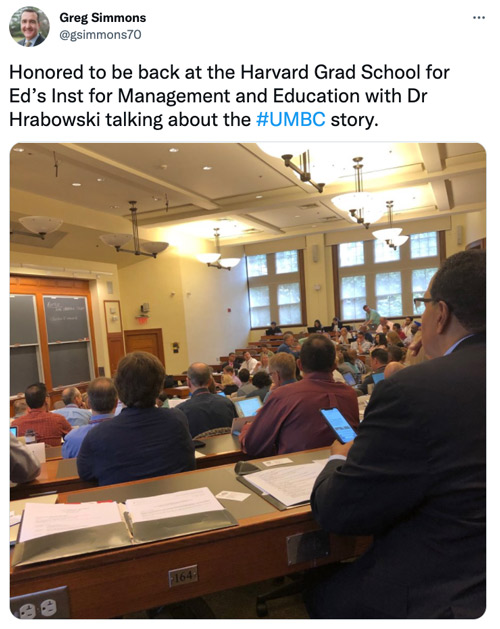
The board—dubbed “Friends of Freeman” by Sheldon Caplis, then the vice president of Institutional Advancement—became a link to millions in private dollars, which helped refill the coffers during brutal times financially. “You’ve got to build relationships, and it’s even more critical when you don’t come from a private school with wealthy trustees or wealthy alumni when you’re really building from the ground up,” said Caplis, who taught alongside Hrabowski at Harvard’s Institute for Management and Leadership in Education for several years. Caplis said that as the pair recounted the “Friends of Freeman” story to the group, much head shaking and laughter would ensue—as though it were some magic trick that only Freeman Hrabowski could pull off.
“These were new presidents, so a lot of them didn’t have any fundraising experience,” Caplis said. “So they really wanted to know, ‘Well, how do you interact?’”
Again, it raises the question of whether you can teach someone to lead like Freeman A. Hrabowski, III. But at the end of the day, it really doesn’t matter whether it’s nature or nurture, this amalgam of personality traits allowed him to reinvent UMBC and go down in history as one of higher education’s best leaders. Forums like the new presidents seminar are simply a way to “peel back the onion a little bit,” said Greg Simmons, M.P.P. ’04, the current vice president of Institutional Advancement and Hrabowski’s most recent teaching partner at the Harvard seminar. The same goes for college presidents like Cornish, Clements, and others who are fortunate enough to receive his mentoring.
“They don’t have to be Freeman,” Simmons said. “They’ve just got to know how to work with other people in a really effective, genuine, human kind of way. That’s Freeman’s real gift.”
Clements said he has met people across the country who consider Hrabowski their mentor. And that, he said, has a multiplying effect that defies calculation.
“We’re trying to make a difference like he did,” Clements said. “It amplifies his impact because of how he’s helped so many other leaders and how he’s shown us how to lead. It allows us to change more lives based on what we saw him do. It goes way beyond UMBC.”
]]>
By Margaret Moffett For La Jerne Terry Cornish, Ph.D. ’05, language, literacy, and culture, an already remarkable day was about to become unforgettable. There she stood in front of a big...
https://umbc.edu/stories/leaders-among-us/
https://my3.my.umbc.edu/api/v0/pixel/news/119434/guest@my.umbc.edu/7596859e673fc636bce6f0a7f4a5ccbc/api/pixel
computer-science
feature
impact
language-literacy-and-culture
magazine
operations-analysis
spring-2022
spring-2022-special-issue
UMBC News & Magazine
https://my3.my.umbc.edu/groups/umbc-news-magazine
https://assets1-my.umbc.edu/system/shared/avatars/groups/000/001/943/24435aa6207c452e7bc15cc74b42c7bb/xsmall.png?1748556657
https://assets1-my.umbc.edu/system/shared/avatars/groups/000/001/943/24435aa6207c452e7bc15cc74b42c7bb/original.png?1748556657
https://assets2-my.umbc.edu/system/shared/avatars/groups/000/001/943/24435aa6207c452e7bc15cc74b42c7bb/xxlarge.png?1748556657
https://assets2-my.umbc.edu/system/shared/avatars/groups/000/001/943/24435aa6207c452e7bc15cc74b42c7bb/xlarge.png?1748556657
https://assets3-my.umbc.edu/system/shared/avatars/groups/000/001/943/24435aa6207c452e7bc15cc74b42c7bb/large.png?1748556657
https://assets1-my.umbc.edu/system/shared/avatars/groups/000/001/943/24435aa6207c452e7bc15cc74b42c7bb/medium.png?1748556657
https://assets2-my.umbc.edu/system/shared/avatars/groups/000/001/943/24435aa6207c452e7bc15cc74b42c7bb/small.png?1748556657
https://assets1-my.umbc.edu/system/shared/avatars/groups/000/001/943/24435aa6207c452e7bc15cc74b42c7bb/xsmall.png?1748556657
https://assets2-my.umbc.edu/system/shared/avatars/groups/000/001/943/24435aa6207c452e7bc15cc74b42c7bb/xxsmall.png?1748556657
UMBC News & Magazine
0
0
false
Fri, 29 Apr 2022 19:20:19 -0400
Fri, 29 Apr 2022 19:20:19 -0400
Get Your Steps in with Dr. Hrabowski

Many of President Freeman Hrabowski’s working hours are spent at his desk on the phone speaking to organizations that can help better the education of his students, but as often as possible, he’ll take a lap around the campus that has shaped him as much as he’s shaped it.
To be a Retriever in any of the last 30-plus years is to have a “Freeman story.” For many people, it’s pretty similar. President Hrabowski saw you on Academic Row and asked your major and where you went to high school. President Hrabowski got on your elevator and asked your major and where you went to high school. President Hrabowski stopped by your lunch table in The Commons and—you guessed it—asked your major and where you went to high school.
You’d think he might get tired of hearing the answers, but instead, they seem to animate him. He has rejoinders for any response and is indefatigable as he strides around the campus he’s watched grow up for more than three decades.


These are the liturgies of life at UMBC under the leadership of President Freeman Hrabowski. He’s always going to say, “Enjoy the food, I was cooking all night.” He’s going to offer you his elbow to bump instead of his hand (he was doing this cold-avoiding precaution well before COVID-19). He’s going to ask if you’ve thought about getting a Ph.D. He’s going to say “focus, focus, focus” and “keep hope alive.” No matter how many times he repeats these things, they never sound trite—and that’s where the magic comes in. He means them each and every time.
Out of Office
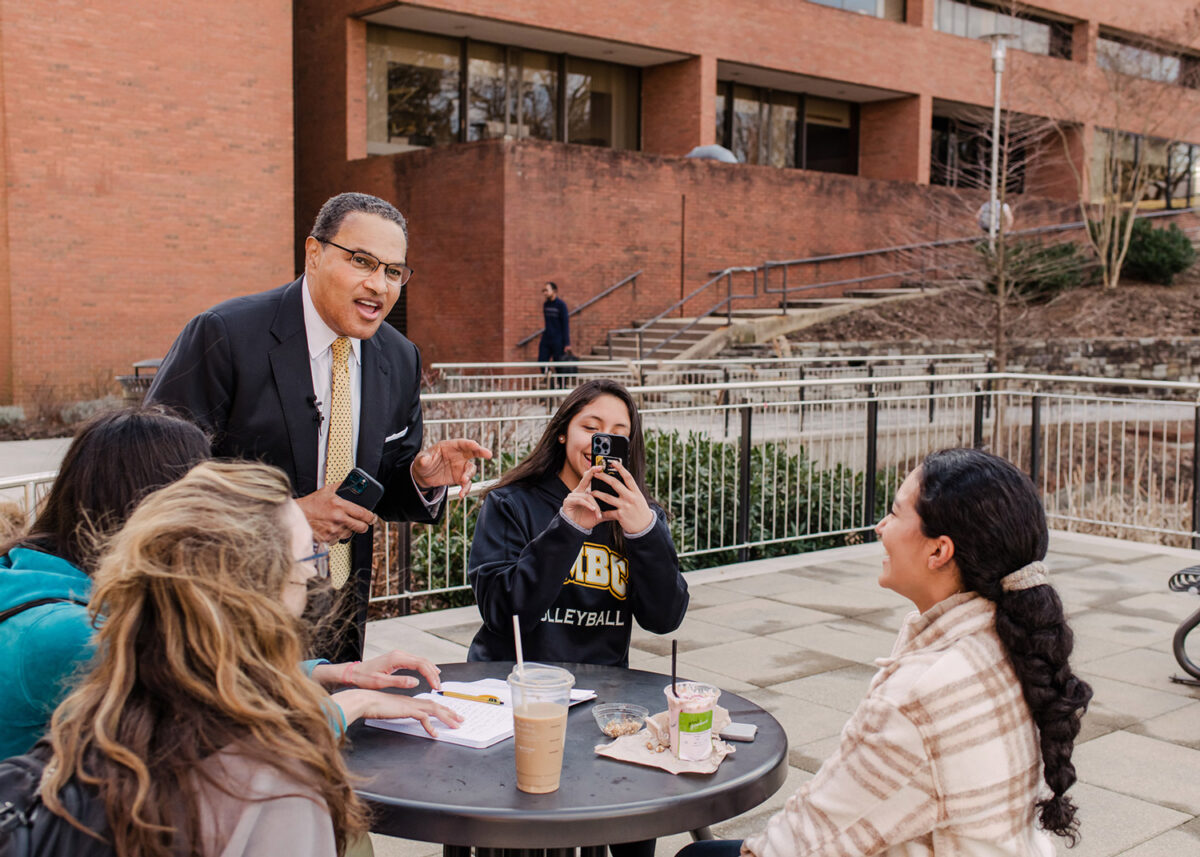
On an exceptionally sunny afternoon this February, Hrabowski walks down the packed corridor of Academic Row. Seemingly every student is outside on this summer-gift of a winter’s day. Chatting with folks like he usually does, an eager student yells out from the University Center terrace “I love you, Freeman!” drawing out all the vowels. His reception among students is closer to that of a celebrity—selfies abound. Staff step up shyly to tell him that he’s the reason they’ve stayed at UMBC for 20 years. He asks a table of students the usual questions and along the way discovers it’s someone’s special day. Without skipping a beat, Hrabowski croons “Happy Birthday” to her, entirely at home.
President’s Day
One of the unsung roles of a president is listening to the complaints and suggestions of students and staff. Hrabowski does this task not only ungrudgingly but often and methodically. By a matter of coincidence, a recent student focus group took place on President’s Day. Hrabowski made it clear to the dozen students (all recent transfers) assembled that he had one hour before he needed to head to Annapolis to speak at the Maryland State House about how we learn and talk about our nation’s founding president. For that hour, he made himself fully present and available, taking notes about registration frustrations, organic chemistry woes, study abroad hopes, and a plethora of other topics.
For each student, he had a resource to give them and encouraged them to follow up with him about their progress. “The thing a president does,” he told the students with a laugh, “is point you to other people who can help you.”
Let’s Go on a Walk
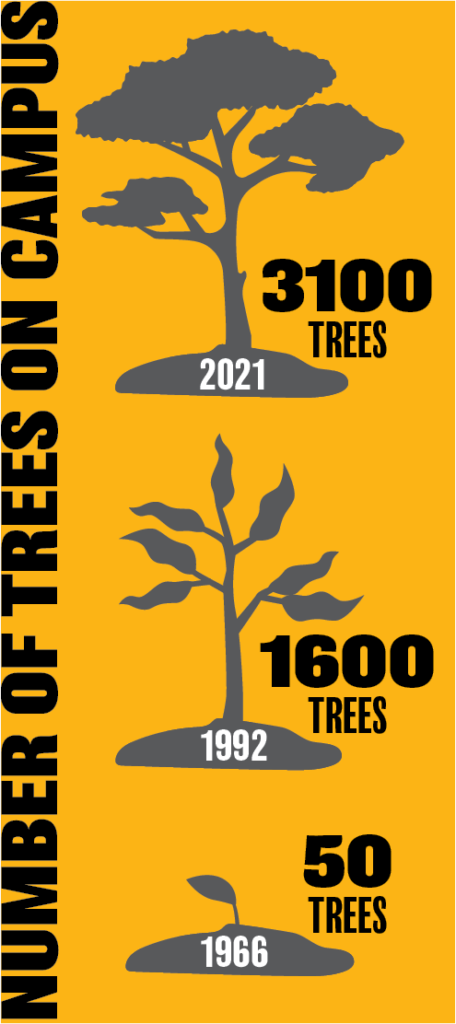
Most of Hrabowski’s days do not include hours-long walks, but as often as possible, he’ll show his guests around a campus that has made its mark on him as much as he has on it. You could nearly measure Hrabowski’s tenure by counting the rings on the trees that wrap around the loop, lending their growing shade to the walking path each year—those trunks and branches were part of an early initiative of his to shape the landscape of campus to be more welcoming.
He’ll make sure to bring guests to the meditative spot in front of a statue of his good friend and mentor, the late philanthropist Walter Sondheim. He’ll want to show visitors the new Performing Arts and Humanities Building (PAHB). One story he shares is that when legislators would come to campus early in his presidency, he’d take them to the Fine Arts Building Recital Hall so that they could experience the sound of the flushing toilets next to the auditorium, audible even during productions. The PAHB offers multiple (soundproof) performing venues and is LEED Gold certified, heightening the visibility of the arts and humanities as major components of campus and community life.
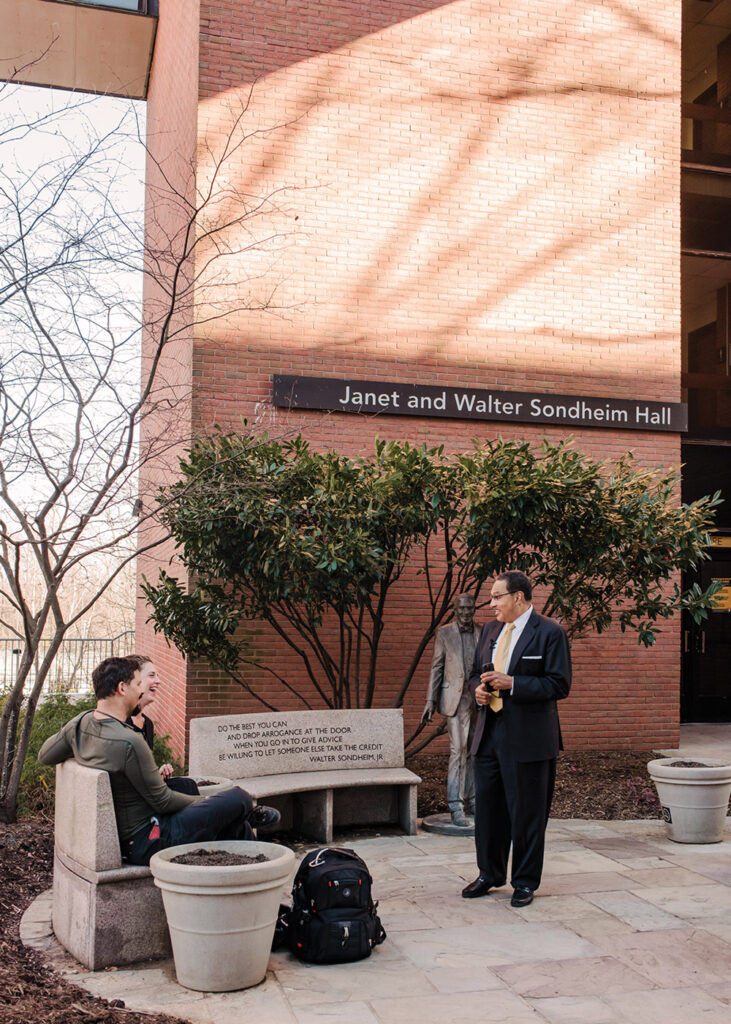
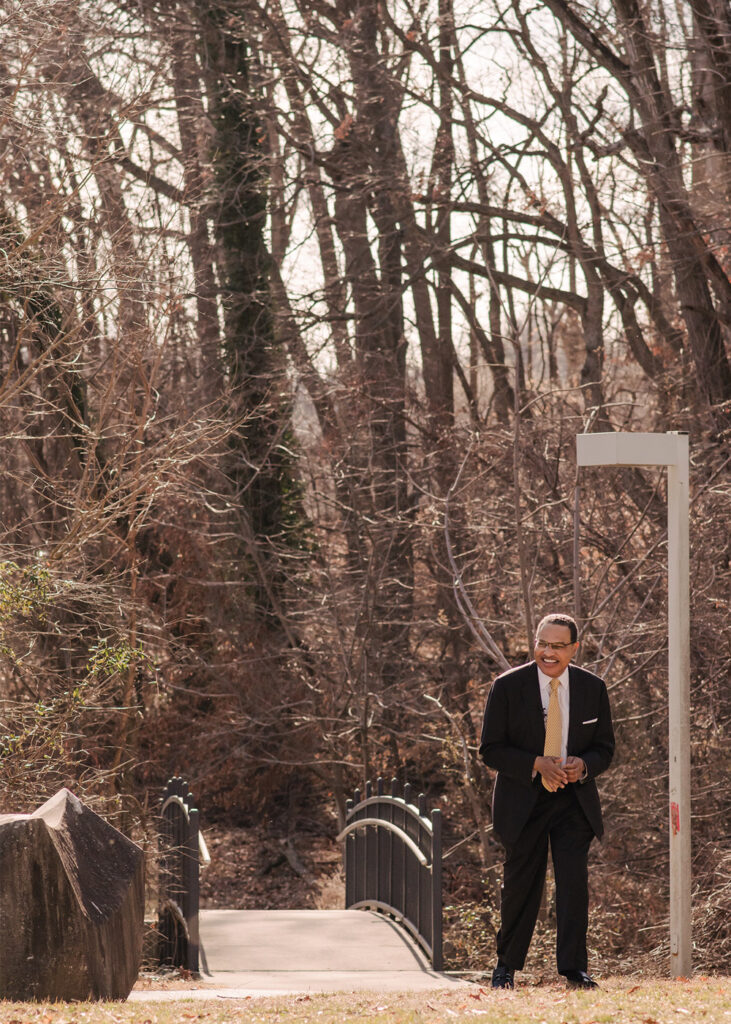
A Break on the Knoll
“Go placidly amid the noise and the haste and remember what peace there may be in silence.” In a virtual Meyerhoff Scholars Program Family Meeting, Hrabowski quotes Max Ehrmann’s “Desiderata,” a poem he memorized 60 years ago. For someone whose role does not offer many moments of silence, Hrabowski does take free seconds throughout the day. When he finds them, he says the shortest prayer, “God help me. God help us.” If he finds a whole minute free, he closes his eyes and meditates. “The hardest thing for any human is not to have a thought,” he says.
In an ideal world, like this perfect day in February, Hrabowski can make the trek down to the Knoll and Joseph Beuys Sculpture Park, across the loop from the UMBC Stadium Complex. The Knoll is a preserved woodland that’s remained undeveloped due to community members continually advocating for campus green space. He pauses here, at peace and temporarily still under the dappled shade.
Interrupting Class
The next stop is the Interdisciplinary Life Sciences Building (ILSB)—a state-of-the-art space for collaborative research and teaching. Hrabowski taps on the door of a class in a large lecture hall to listen in on discussion of math counter examples. His eagerness to be in the classroom is palpable. Hrabowski frequently says, “I have so much more to learn.” Despite the administrative duties he’s called to perform, perhaps the staying power of more than 30 years at a university is an authentic life-long desire for learning. It’s what makes his repeated interactions with students impactful instead of trite—he’s truly curious about the world around him.
Stopping for Research
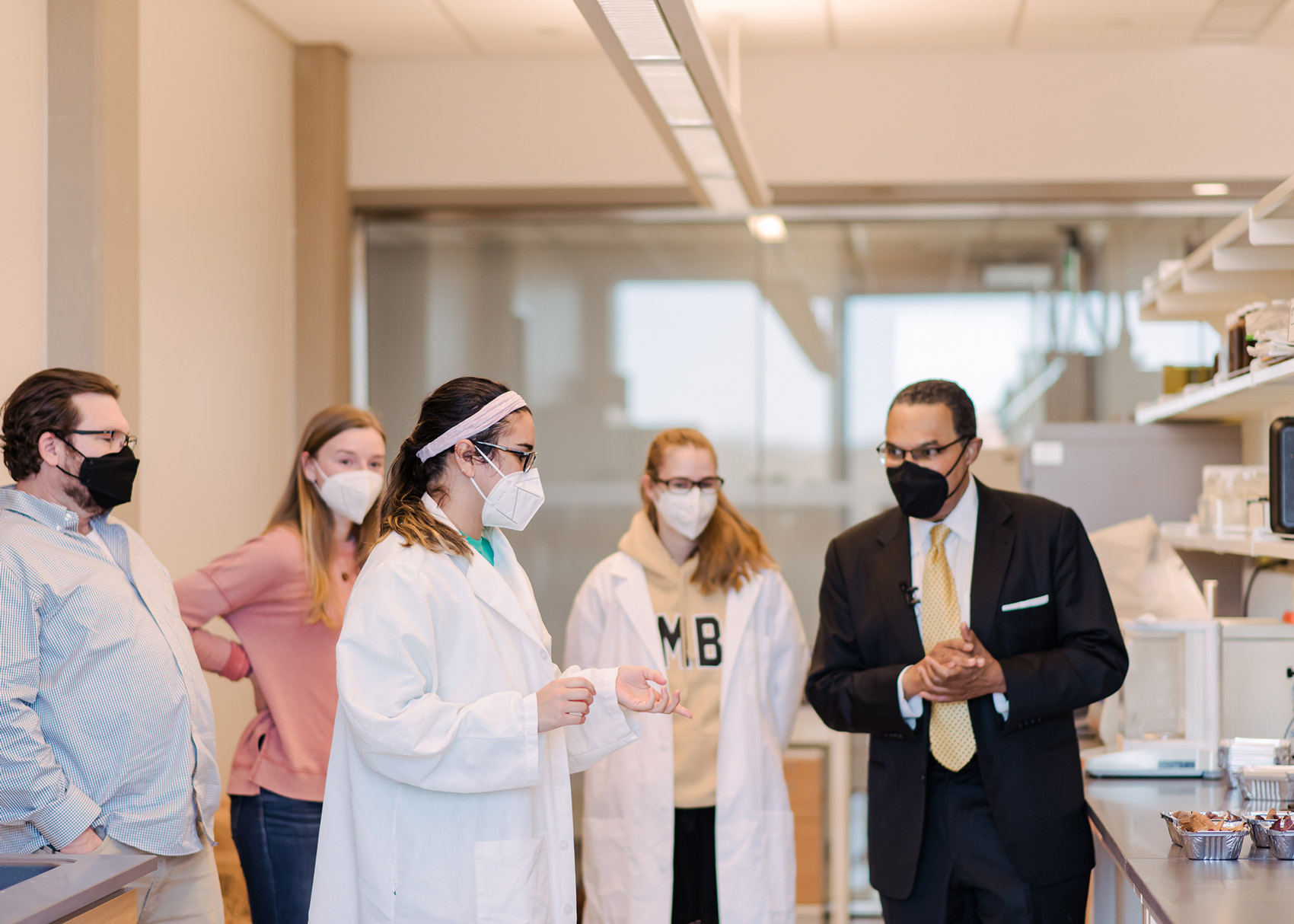
Walking into Professor Chris Swan’s Geography and Environmental Systems lab on the second floor of the ILSB, Hrabowski quips about the tray of leaves on the counter, “Are you heating that up for food or science?” “For science,” the students reassure him as they explain the leaf litter they’re working with. After collecting the specimens from streams on campus, “we measure the functional diversity and the rate of decomposition.”
“And why is this important?” Hrabowski asks genuinely, the constant wheels of learning turning in his head. Swan’s research group responds that they’re establishing the importance of biodiversity to better understand invasive diseases that have decimated some ash and oak species—questions that ultimately might help keep more of UMBC’s many trees alive and healthy.
Making Campus Inviting
It’s nearly 70 degrees outside, and we’re closing in on our step goal. Hrabowski shows no sign of slowing down. He doesn’t need a drink of water, he doesn’t need a break. He stops only to congratulate a group of women’s lacrosse players throwing a ball around the Quad for their explosive win earlier that week (17-9 against American University).
As he makes his way back to the Admin building and his desk and messages waiting for him, Hrabowski recounts an early walk in his tenure as UMBC president. He was showing then Maryland Governor William Donald Schaefer around campus. He wanted the governor to know how well UMBC functioned with the state support it received but also how it could function so much better with more investment. “And for years,” says Hrabowski, “Schaefer told people, ‘That young president walked the hell outta me all over campus,’” laughing that he just had to say “yes” to all of Hrabowski’s requests because he was too out of breath from the vigorous walk to say anything else.
But the results of that and other fruitful conversations over the past three decades are evident everywhere. Students may take The Commons for granted, or the Knoll or even lounge spaces in the library, but all of those spaces are intentional, says Hrabowski.
The campus changes he’s most proud of are those that encourage community. “There are more spaces where you can sit and commune, talk to people, reflect,” says Hrabowski. “In the early years, people would come to campus and then leave. Not all, but those who were not residential. Now there are so many places where people can just study, laugh, get to know other people, and build community over time.” In his eyes, these places of invitation are the crowning achievement of the physical campus.
Up to the 10th Floor
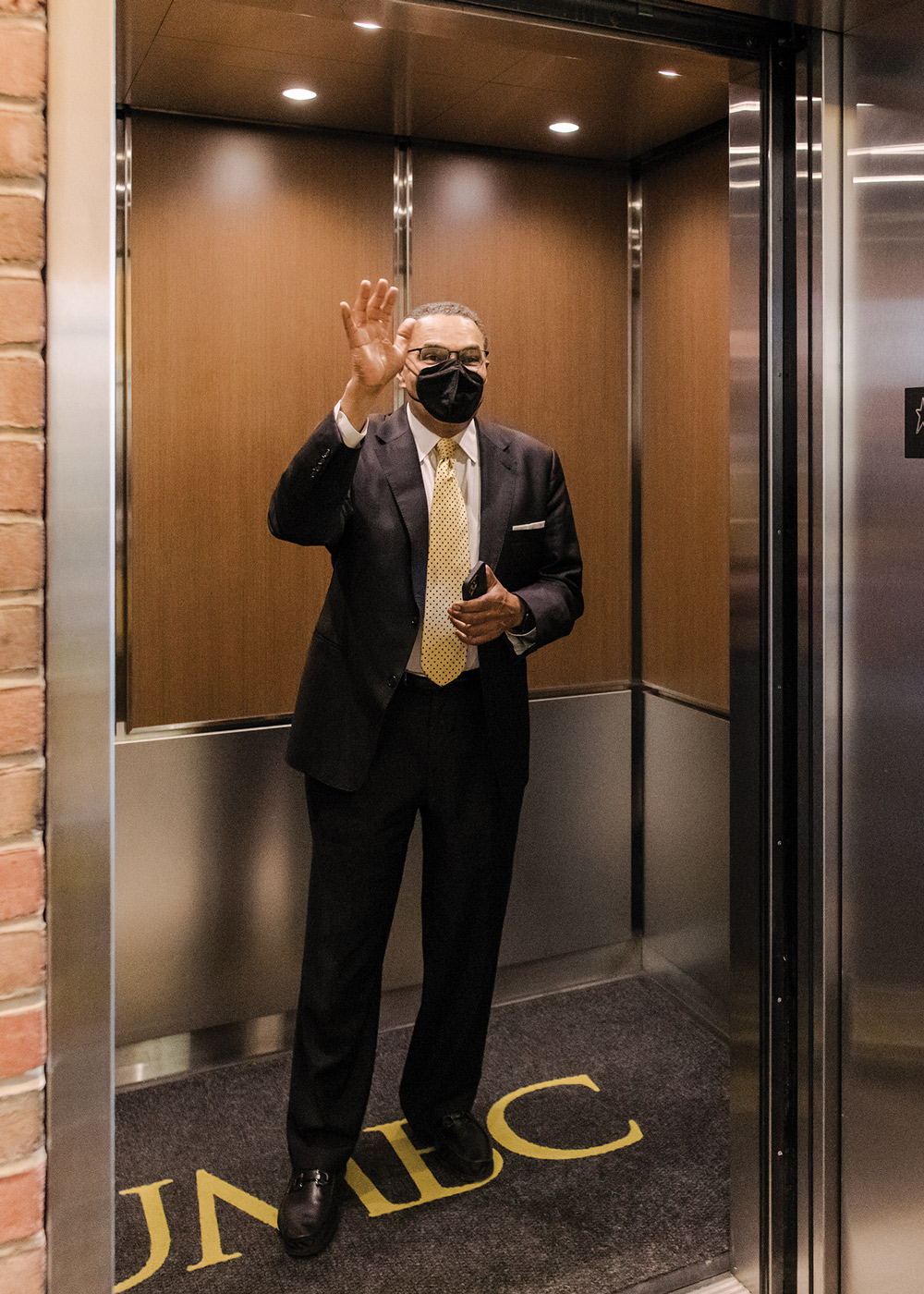
As he enters the elevator to take him to his office, he waves joyfully. The next part of his day will be very different from his crowd-pleasing walk but no less important. He’ll make the case for increased funding to the National Science Foundation. He’ll moderate a Chronicle of Higher Education virtual panel on the importance of resources for our growing population of first-generation students. He’ll make phone calls to put UMBC on the radar of state legislators and other folks in a position to give his students a better education.
He’ll forget to drink more than several cups of tea provided by his executive assistant as he endlessly and eagerly promotes a university that has shaped him as much as he has shaped it. He will do and say the same things over and over again without them sounding trite, because he believes in the power of words. And most of all, he believes we will keep hope alive.
*****
All photos by Marlayna Demond ’11.
]]>
Many of President Freeman Hrabowski’s working hours are spent at his desk on the phone speaking to organizations that can help better the education of his students, but as often as possible,...
https://umbc.edu/stories/get-your-steps-in-with-dr-hrabowski/
https://my3.my.umbc.edu/api/v0/pixel/news/119444/guest@my.umbc.edu/e6fd5aeb9721e2a0604ba41c4aea6788/api/pixel
campus-life
feature
freeman-hrabowski
magazine
spring-2022
spring-2022-special-issue
UMBC News & Magazine
https://my3.my.umbc.edu/groups/umbc-news-magazine
https://assets1-my.umbc.edu/system/shared/avatars/groups/000/001/943/24435aa6207c452e7bc15cc74b42c7bb/xsmall.png?1748556657
https://assets1-my.umbc.edu/system/shared/avatars/groups/000/001/943/24435aa6207c452e7bc15cc74b42c7bb/original.png?1748556657
https://assets2-my.umbc.edu/system/shared/avatars/groups/000/001/943/24435aa6207c452e7bc15cc74b42c7bb/xxlarge.png?1748556657
https://assets2-my.umbc.edu/system/shared/avatars/groups/000/001/943/24435aa6207c452e7bc15cc74b42c7bb/xlarge.png?1748556657
https://assets3-my.umbc.edu/system/shared/avatars/groups/000/001/943/24435aa6207c452e7bc15cc74b42c7bb/large.png?1748556657
https://assets1-my.umbc.edu/system/shared/avatars/groups/000/001/943/24435aa6207c452e7bc15cc74b42c7bb/medium.png?1748556657
https://assets2-my.umbc.edu/system/shared/avatars/groups/000/001/943/24435aa6207c452e7bc15cc74b42c7bb/small.png?1748556657
https://assets1-my.umbc.edu/system/shared/avatars/groups/000/001/943/24435aa6207c452e7bc15cc74b42c7bb/xsmall.png?1748556657
https://assets2-my.umbc.edu/system/shared/avatars/groups/000/001/943/24435aa6207c452e7bc15cc74b42c7bb/xxsmall.png?1748556657
UMBC News & Magazine
0
0
false
Tue, 19 Apr 2022 14:38:34 -0400
Tue, 19 Apr 2022 14:38:34 -0400