STEM BUILD at UMBC leads to lasting institutional change, benefiting STEM students and beyond
From its outset, UMBC’s STEM BUILD—a 10-year undergraduate success initiative and research study at UMBC funded by the National Institutes of Health—has had a unique vision: To emphasize the inclusive reach of the program, STEM BUILD’s motto is “500, not 50.”
The program, which is wrapping up its timeline, was created to identify effective interventions that could be implemented at scale to support all science, technology, engineering and math (STEM) students at UMBC, and to find ways to continue those interventions beyond the existence of STEM BUILD.
“Looking back on nearly 10 years of work, STEM BUILD has been nothing short of wildly successful,” said Justine Johnson, executive director of STEM BUILD and assistant dean for inclusive excellence in the College of Natural and Mathematical Sciences (CNMS).
A research study to support budding researchers
STEM BUILD was carefully designed as a controlled research study, where evaluators randomly assigned students accepted into the program into three cohorts: Trainee, Living Learning Community (LLC), and Comparison.
BUILD Trainees benefited from the most interventions, such as monthly community meetings, intensive monitoring and advising, and multiple group research experiences during “Summer Bridge” programming. Another cohort lived on campus in the STEM Living Learning Community (LLC)—which did not exist prior to STEM BUILD—along with the Trainees, but did not receive additional interventions. A third cohort consisted of similarly qualified students who did not receive targeted interventions or live in the STEM LLC.
According to an analysis by the evaluation team, by the end of their fourth year at UMBC, BUILD Trainees had increased their reported sense of “research self-efficacy,” or their own understanding of their competency as researchers, from 3.50 to 3.87 on a five-point scale, which registered at the highest level of statistical significance. Students in the other two cohorts shifted from 3.66 to 3.61, which was not statistically significant.
Victoria Baskerville ’19, biological sciences, and a BUILD Training program alumna, said the research experiences provided by the program were invaluable.
“They gave me the confidence to navigate in a lab space and gave me the competitive edge I needed to get my position as a technician in a prestigious lab,” said Baskerville, who is currently pursuing her Ph.D. in integrative and biomedical physiology at The Pennsylvania State University.
“I have often received positive comments regarding the amount of research experience I gathered as an undergraduate during interviews,” Baskerville said.
The percentages tell the story
Victor Omoniyi ’20, biological sciences, a former STEM BUILD Trainee, is currently pursuing a Ph.D. in neuroscience at Johns Hopkins University, in the cellular and molecular medicine program.
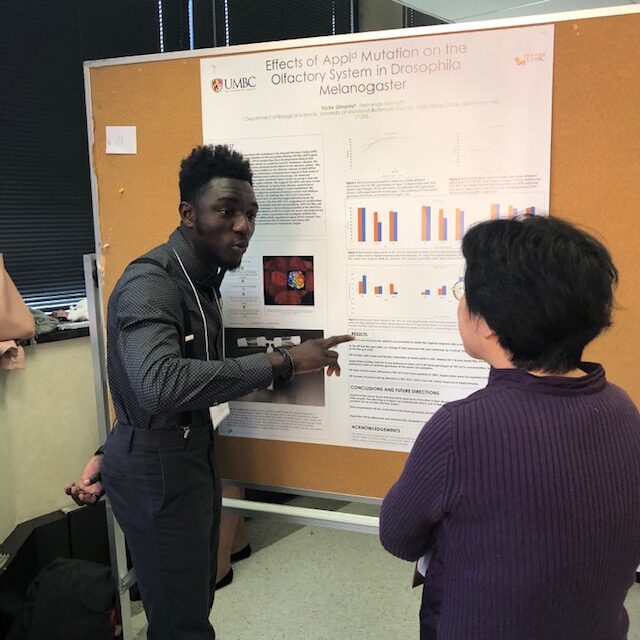 Victor Omoniyi (left) presents research at the 2019 UMBC Undergraduate Research Symposium.
“BUILD was helpful in starting my scientific journey and exposing me to different areas of research and people to network with, which has contributed significantly to where I am now, pursuing a Ph.D.,” Ominiyi said.
Ominiyi’s experience is not unique among Trainees. BUILD Trainees reported completing significantly more research experiences than students in the comparison groups: 45.4 percent completed one to three research experiences, 33.7 percent participated in four to six research experiences, and 9.9 percent completed seven or more research experiences. That’s compared to 53.1 percent, 10.6 percent, and 1.9 percent, respectively, in the comparison groups. Those experiences build students’ confidence with research and nurture relationships with mentors, which likely contribute to students choosing to remain in STEM and pursue graduate education.
Outcomes for BUILD Trainees in cohorts one through five, as of fall 2023, were similarly outstanding, with 56 percent of Trainees having completed a bachelor’s degree, 16 percent having completed or being enrolled in a master’s program, 13 percent attending professional school, and 11 percent pursuing Ph.D. or M.D./Ph.D. programs. All together, 96 percent of Trainees completed their undergraduate degrees, and 40 percent are actively pursuing or have completed an advanced degree.
Bridging the success beyond CNMS
STEM BUILD’s impact goes far beyond its direct benefits to BUILD Trainees. UMBC’s College of Natural and Mathematical Sciences has implemented numerous new programs as part of STEM BUILD that will continue supporting all students after BUILD officially ends—meeting the “500, not 50” goal.
For example, the Active Learning, Inquiry Teaching (ALIT) certificate program is designed to support faculty in adopting teaching approaches that foster the retention of students in STEM majors and support the development of their students as STEM professionals. Initially required for BUILD faculty mentors, today the program is available to all faculty in CNMS and UMBC’s College of Engineering and Information Technology, and a related program inspired by ALIT now also exists in the College of Arts, Humanities, and Social Sciences.
CNMS also developed new courses and summer programs, initially targeting STEM BUILD students but now open to all, focusing on ethics, communication skills, introductory laboratory skills, and more.
CNMS hired a success coach, who offers on-demand mentoring for students in skills like time management, exam preparation, and stress reduction. The coach also offers workshops through The Learning Collaboratory (TLC), another new CNMS initiative. A diversity mentoring program matches STEM students with mentors in STEM from underrepresented backgrounds.
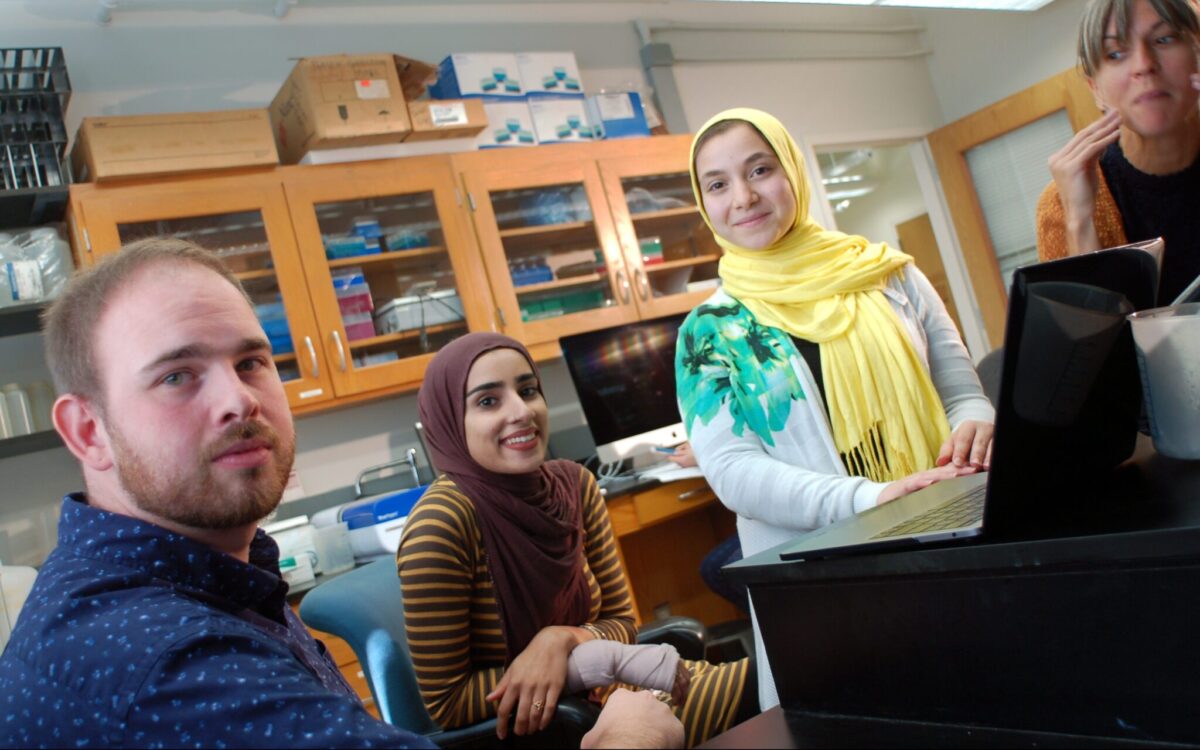 Michael Mercado (left), Zulekha Karachiwalla (center) and Rahaf Alhabashi (right) participated in the Build a Bridge to STEM Internship; Mercado’s ASL interpreter is at the far right. (Photo by Tim Ford)
BUILD has even benefited students who attend other universities.
The BUILD a Bridge to STEM Internship has offered students the opportunity to spend the summer at UMBC, learning laboratory skills and then working in small groups to conduct research with UMBC faculty members and present at UMBC’s Summer Undergraduate Research Fest. Students from regional community colleges, Morgan State University, and Gallaudet University all participated, the latter with the full-time support of ASL interpreters.
Long-lasting, sustainable change
Though STEM BUILD’s 10 years are coming to an end, the institutional change the program has enabled will endure at UMBC.
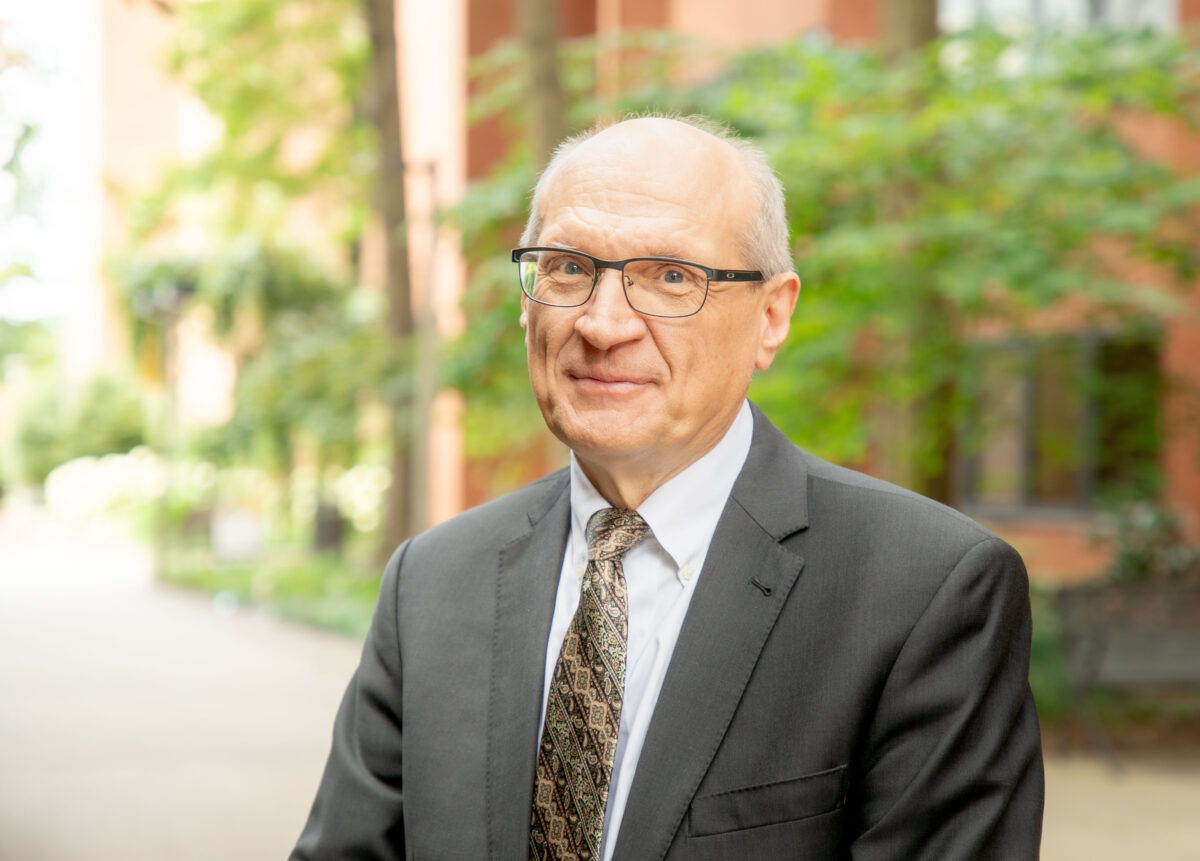 Dean William R. LaCourse has led STEM BUILD at UMBC for the last 10 years. (Marlayna Demond ’11/UMBC)
STEM students will have access to more and better training and professional development opportunities, faculty are employing more effective teaching and mentoring strategies, and scaffolded research experiences are available to prepare students for further study, explained William R. LaCourse, CNMS dean.
As the ideator and champion of many STEM BUILD initiatives that will continue, LaCourse is thrilled to see the impact those initiatives are having on students’ experiences and trajectories.
“It has been my passion and purpose to support all students, especially thosewho are in the middle of the achievement curve when they arrive at UMBC,” LaCourse said. “The STEM BUILD program showed that every student has the potential to excel as a scholar, if given the opportunity and support. By infusing the interventions developed in STEM BUILD into the four-year curriculum for all students, maybe our motto should have been ‘5,000, not 50.’”
]]>
From its outset, UMBC’s STEM BUILD—a 10-year undergraduate success initiative and research study at UMBC funded by the National Institutes of Health—has had a unique vision: To emphasize the...
https://umbc.edu/stories/umbc-stem-build-leads-to-institutional-change/
https://my3.my.umbc.edu/api/v0/pixel/news/142401/guest@my.umbc.edu/f471c4ea3eb95006b2384bd0b610138d/api/pixel
biology
cnms
news
science-and-tech
stembuild
story
UMBC News & Magazine
https://my3.my.umbc.edu/groups/umbc-news-magazine
https://assets1-my.umbc.edu/system/shared/avatars/groups/000/001/943/24435aa6207c452e7bc15cc74b42c7bb/xsmall.png?1748556657
https://assets1-my.umbc.edu/system/shared/avatars/groups/000/001/943/24435aa6207c452e7bc15cc74b42c7bb/original.png?1748556657
https://assets2-my.umbc.edu/system/shared/avatars/groups/000/001/943/24435aa6207c452e7bc15cc74b42c7bb/xxlarge.png?1748556657
https://assets2-my.umbc.edu/system/shared/avatars/groups/000/001/943/24435aa6207c452e7bc15cc74b42c7bb/xlarge.png?1748556657
https://assets3-my.umbc.edu/system/shared/avatars/groups/000/001/943/24435aa6207c452e7bc15cc74b42c7bb/large.png?1748556657
https://assets1-my.umbc.edu/system/shared/avatars/groups/000/001/943/24435aa6207c452e7bc15cc74b42c7bb/medium.png?1748556657
https://assets2-my.umbc.edu/system/shared/avatars/groups/000/001/943/24435aa6207c452e7bc15cc74b42c7bb/small.png?1748556657
https://assets1-my.umbc.edu/system/shared/avatars/groups/000/001/943/24435aa6207c452e7bc15cc74b42c7bb/xsmall.png?1748556657
https://assets2-my.umbc.edu/system/shared/avatars/groups/000/001/943/24435aa6207c452e7bc15cc74b42c7bb/xxsmall.png?1748556657
UMBC News & Magazine
2
0
false
Tue, 11 Jun 2024 10:56:39 -0400
Tue, 11 Jun 2024 10:56:39 -0400
UMBC students receive prestigious Goldwater Scholarship for fifth consecutive year
For the fifth consecutive year, multiple UMBC students have been awarded a Barry Goldwater Scholarship. Gabriel Otubu ’25, biochemistry, Nathaniel Glover ’25, chemical engineering, and Samuel Barnett ’25, biochemistry, were recently named among the 2024 Goldwater Scholars recipients, joining UMBC’s growing list of students to receive this prestigious research scholarship. Since 2005, 31 UMBC students have been awarded a Goldwater Scholarship.
The goal of the Barry Goldwater Scholarship and Excellence in Education Foundation includes ensuring that the “U.S. is producing the number of highly-qualified professionals the nation needs” in the natural sciences, mathematics, and engineering. Otubu, Barnett, and Glover are among the 438 recipients of this year’s scholarship, the largest number of scholars ever supported in a single year in the program’s history.
“UMBC’s continued success with the recent Goldwater recipients is a direct result of the strong faculty mentoring that our students receive,” says April Householder ’95, visual and performing arts, UMBC’s director of undergraduate research and prestigious scholarships. “This is also a reflection of the incredible support programs and staff that UMBC makes available to students, helping them go the extra mile.”
Supported by multiple scholars programs
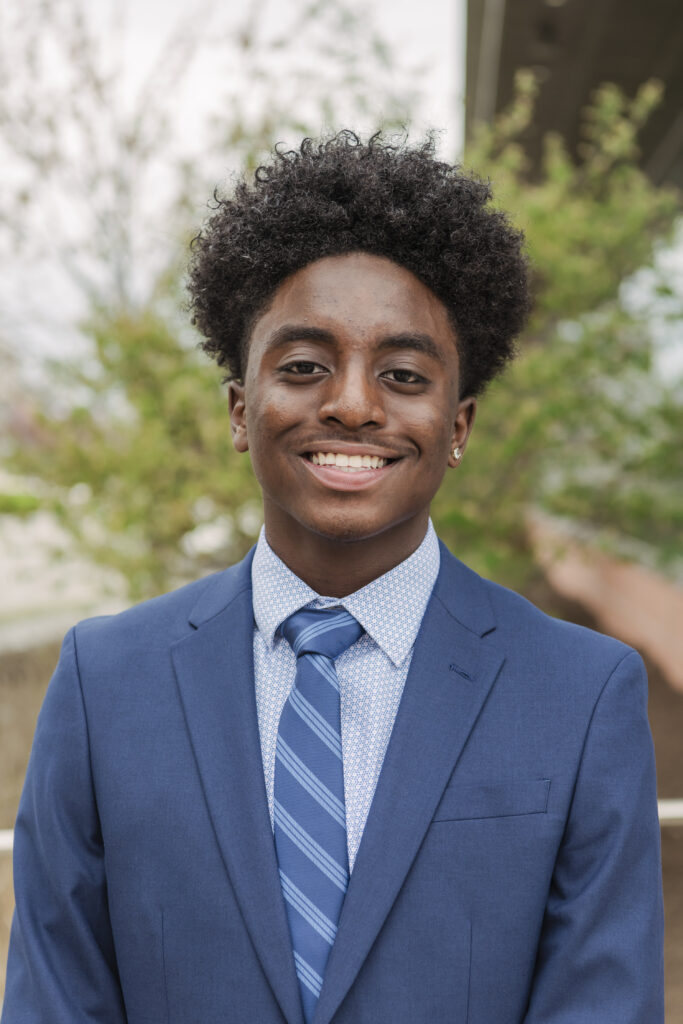 Gabriel Otubu.
As an undergraduate research fellow in biology professor Rachel Brewster’s lab, Gabriel Otubu is investigating the role of the Ndrg1b gene in neurulation—the process of forming a neural tube that takes a hollow shape that differentiates into the brain and spinal cord—and how it affects other genes. This research, Otubu says, is aiming to understand the genetic risk factors associated with specific congenital disorders, such as spina bifida, with a goal of finding treatment options for these disorders.
Otubu, a Meyerhoff Scholar who plans on pursuing an M.D./Ph.D., shares that with Brewster’s guidance, “I learned that the M.D./Ph.D [route] was possible for me, as well as the possibility of being able to have a commitment to helping people in the clinic and also doing research to support that.” He is also an Undergraduate Research Training Initiative for Student Enhancement (U-RISE) Scholar, an experience he says inspired him to pursue a career in research because he was able to be supported by like-minded people.
“One of the most important things about getting the Goldwater Scholarship is the motivation it gives me to be the best researcher I can be,” says Otubu. “It’s great to get that recognition that I’m really committed to research and using my platform to help other people from diverse backgrounds become interested in research.”
Nathaniel Glover, a fellow Meyerhoff Scholar, says that receiving the Goldwater scholarship will “open up a lot of opportunities for me to be a competitive grad school applicant.” His Goldwater proposal included the research he worked on to develop a dual-phase steel that can combat hydrogen embrittlement, the mechanical damage of metal due to the penetration of hydrogen, which causes a reduction in ductility.
Glover worked in the lab of C. Cem Taşan, associate professor of metallurgy at the Massachusetts Institute of Technology (MIT), as an MIT Summer Research Program participant in 2023.
The program, he shares, “was very helpful in teaching me how to write about my research, which was extremely beneficial in the Goldwater application process. Taşan and my research mentor, Dr. Kyung-Shik Kim, were instrumental in developing my research in this project, introducing me to the science behind it, and working with me throughout my work in the project. I learned how to write and portray my research in a way that’s well communicated, interesting, and educational.”
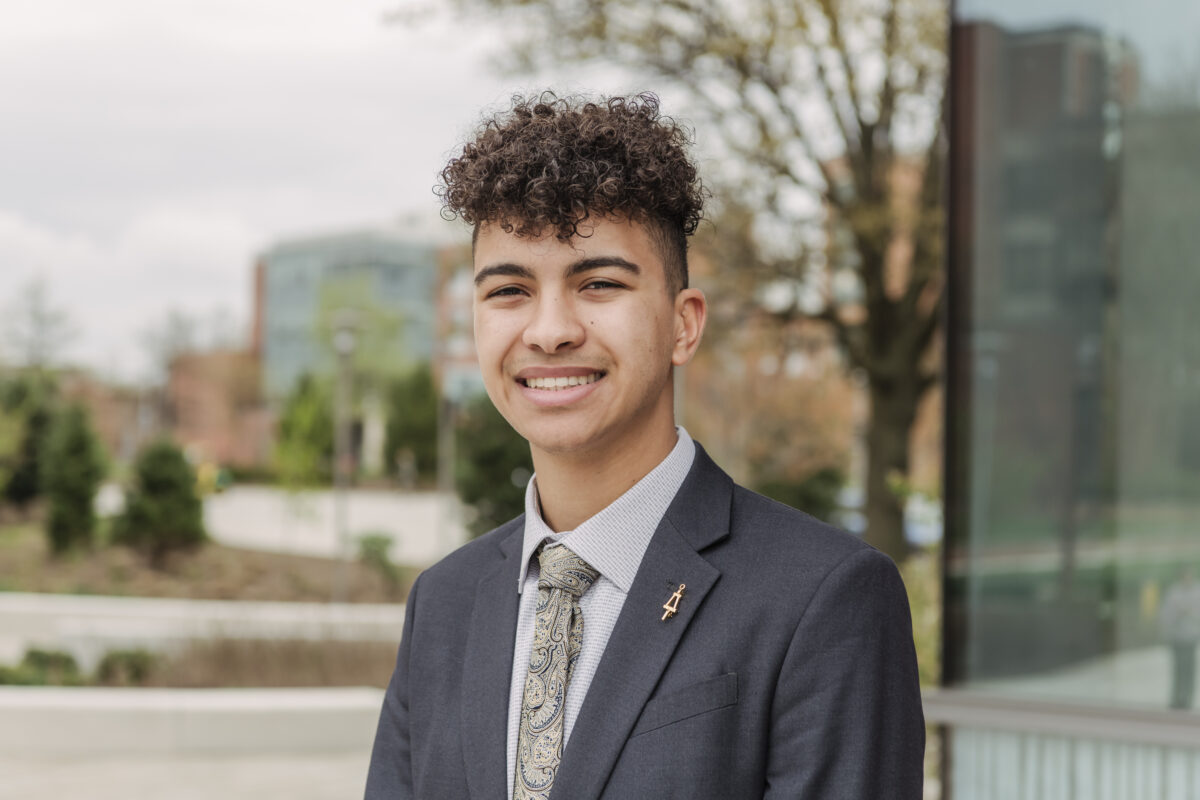 Nathaniel Glover.
Developing into a researcher
Samuel Barnett’s journey in becoming a Goldwater Scholar began during his time as a student at Howard Community College (HCC). Barnett, who transferred to UMBC last fall, was able to take advantage of the updated eligibility requirements for prospective scholarship applicants. The 2024 application cycle amended its eligibility criteria allowing transfer students to be nominated by the school they are currently enrolled in or by the school they matriculated from. With the help of the HCC research department and Householder, Barnett was nominated by HCC to receive the scholarship.
With this recent change, Householder shares that “cross-institutional collaborations like these are opening new pathways between UMBC and its transfer institutions [while] providing an additional layer of support to transfer students who come to UMBC with a strong research background, like Sam.”
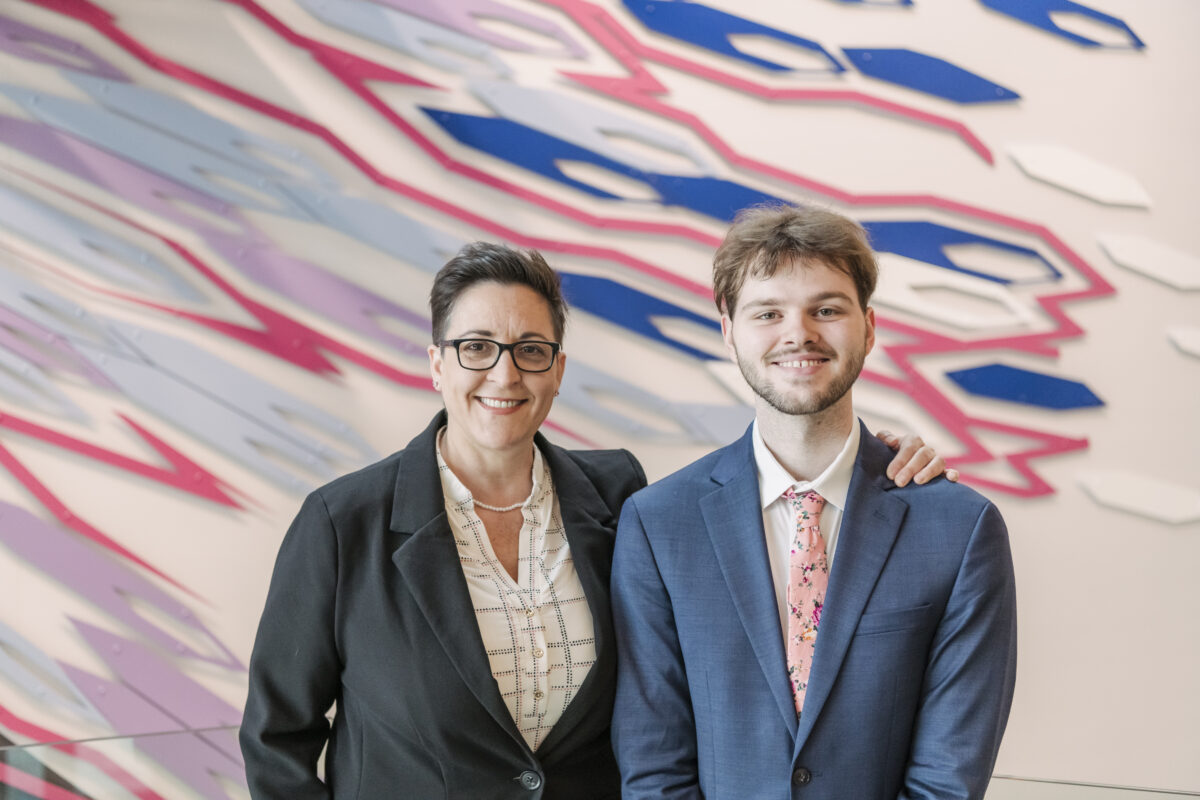 April Householder and Samuel Barnett.
Barnett worked with his mentor Joseph Sparenberg, professor of chemistry at HCC, on a project that uses a species of yeast, Saccharomyces cerevisiae, to model a type of cancer in humans that occurs from mutations in the KRAS gene. The model, which is still in the proof of concept stage, visualizes a live cell to see pathways and tumor growth in real-time.
Barnett nearly called it quits with his academic journey upon enrolling at HCC, saying that he “had no motivation to continue on with my education.” After participating in HCC’s research program, Barnett found a renewed sense of purpose and took his research interests to the next level.
Before transferring to UMBC, Barnett took part in the BUILD a Bridge to STEM internship program, a component of STEM BUILD at UMBC, which he says was vital for “my development in this Goldwater process.” During the internship, Barnett worked with Maria Cambraia Guimaro, assistant director of research and international affairs in the College of Natural and Mathematical Sciences, who he says played a significant role in his research journey at UMBC.
“It was extremely empowering to know that as a community college student, I could experience research there and also win a prestigious award for it,” adds Barnett. “I now have a collection of wonderful mentors throughout my research journey that’s helped to shape who I am today.”
]]>
For the fifth consecutive year, multiple UMBC students have been awarded a Barry Goldwater Scholarship. Gabriel Otubu ’25, biochemistry, Nathaniel Glover ’25, chemical engineering, and Samuel...
https://umbc.edu/stories/goldwater-scholars-24/
https://my3.my.umbc.edu/api/v0/pixel/news/141626/guest@my.umbc.edu/381303eddd955eec99840a46abcd0a28/api/pixel
biochemistry
cbee
chemical-engineering
cnms
coeit
community
meyerhoff
news
research
science-and-tech
stembuild
story
undergraduate-research
UMBC News & Magazine
https://my3.my.umbc.edu/groups/umbc-news-magazine
https://assets1-my.umbc.edu/system/shared/avatars/groups/000/001/943/24435aa6207c452e7bc15cc74b42c7bb/xsmall.png?1748556657
https://assets1-my.umbc.edu/system/shared/avatars/groups/000/001/943/24435aa6207c452e7bc15cc74b42c7bb/original.png?1748556657
https://assets2-my.umbc.edu/system/shared/avatars/groups/000/001/943/24435aa6207c452e7bc15cc74b42c7bb/xxlarge.png?1748556657
https://assets2-my.umbc.edu/system/shared/avatars/groups/000/001/943/24435aa6207c452e7bc15cc74b42c7bb/xlarge.png?1748556657
https://assets3-my.umbc.edu/system/shared/avatars/groups/000/001/943/24435aa6207c452e7bc15cc74b42c7bb/large.png?1748556657
https://assets1-my.umbc.edu/system/shared/avatars/groups/000/001/943/24435aa6207c452e7bc15cc74b42c7bb/medium.png?1748556657
https://assets2-my.umbc.edu/system/shared/avatars/groups/000/001/943/24435aa6207c452e7bc15cc74b42c7bb/small.png?1748556657
https://assets1-my.umbc.edu/system/shared/avatars/groups/000/001/943/24435aa6207c452e7bc15cc74b42c7bb/xsmall.png?1748556657
https://assets2-my.umbc.edu/system/shared/avatars/groups/000/001/943/24435aa6207c452e7bc15cc74b42c7bb/xxsmall.png?1748556657
UMBC News & Magazine
4
0
false
Thu, 02 May 2024 11:17:37 -0400
Thu, 02 May 2024 11:17:37 -0400
STEM BUILD interns shine at UMBC’s Summer Undergraduate Research Fest
At Summer Undergraduate Research Fest (SURF) on August 9, 132 students presented posters and six gave short oral presentations, called “lightning talks,” about research projects covering topics from “forever” chemicals to prostate cancer to alcohol addiction. The University Center Ballroom buzzed with students, mentors, and guests as students shared their progress, interacted with other student researchers, and received feedback. The annual event, sponsored by the College of Natural and Mathematical Sciences (CNMS) since 2005, gives students who are often in the early stages of their research careers an important opportunity to feel like part of a scholarly community.
“We are proud of all that our students accomplished this summer. Now they are more knowledgeable, experienced, and skilled—they are better scientists,” shares CNMS Dean William R. LaCourse. “Their discoveries, their effort, and their willingness to explore have added to the vault of scientific knowledge, which in the end benefits society through empowerment—an empowerment of understanding, prediction, and invention.”
Undergraduate research boosts confidence, opens doors
Community college students who participated in the BUILD a Bridge to STEM Internship, a component of STEM BUILD at UMBC, presented research they conducted in small groups under the mentorship of Maria Cambraia, assistant director of research and international affairs in CNMS. Each group developed a different research question about the earthworm C. elegans, a common model organism, and then designed and carried out experiments to answer that question. The internship operates as a course-based undergraduate research experience, or CURE, a structure designed to create opportunities for more students to gain authentic research experience.
Emily Paz ’25, biological sciences, studied how high sugar diets affected the worms. It was Paz’s first time conducting quantitative research, and the BUILD internship created opportunities to make mistakes and learn from them, she says. “It expanded my career choices, and made me see I really have an interest in this field,” says Paz, a transfer student from Howard Community College.
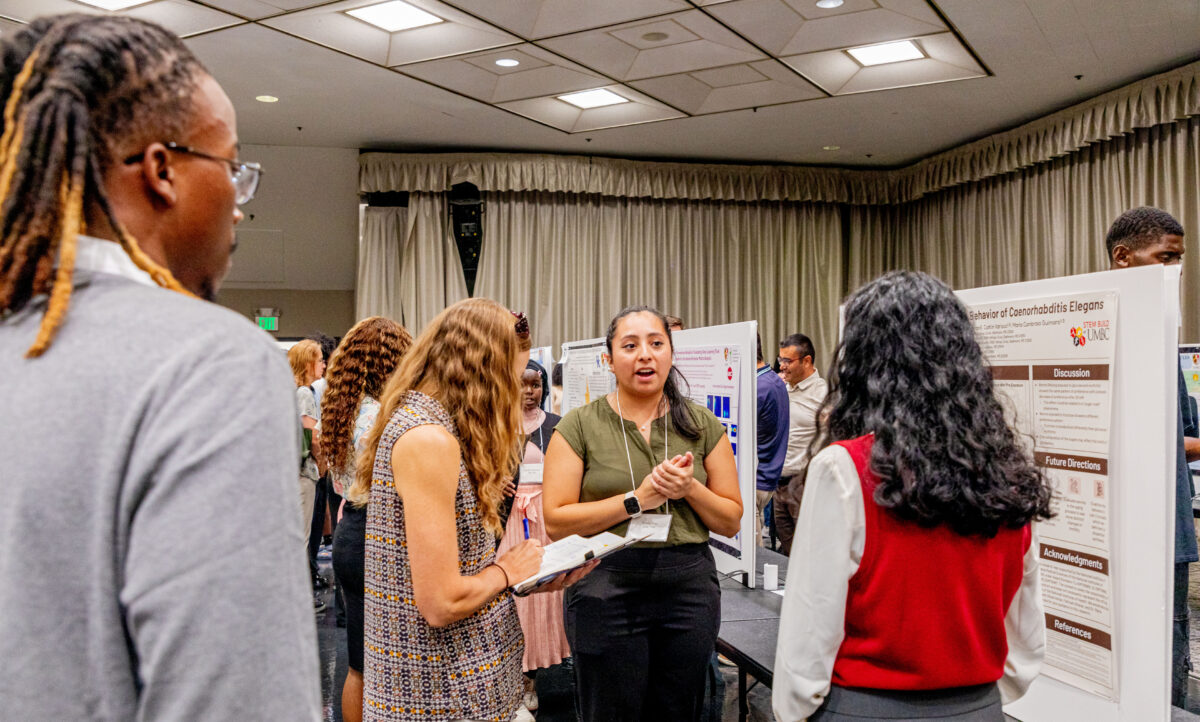 Emily Paz ’25 (center), biological sciences, explains her research to SURF attendees. (Image by Melissa Penley Cormier, M.F.A. ’17/UMBC)
In addition to work in the lab, the process of preparing for SURF and completing the Introduction to Research Badge as part of the internship was valuable for BUILD intern Emily Molnar, a Montgomery College student whose project focused on the relationship between stress and alcohol in C. elegans. Interns completed the badge, a sequence of activities designed to help them get ready to find and pursue undergraduate research opportunities, under the guidance of Caitlin Varisco, assistant director of undergraduate initiatives in CNMS.
“The internship gave me experience with abstracts, posters, and skills to get future opportunities, which boosted my confidence,” Molnar says.
Belonging in science
Student research at UMBC is frequently student driven, which was the experience of Samuel Barnett ’25, biochemistry and molecular biology, another Howard Community College transfer. His project looked at how nicotine influenced the appetite of C. elegans. “You have so much freedom in this program, which I love,” he says. “That really made me feel involved in the research process.”
Third- and fourth-year UMBC students, some of them former STEM BUILD Trainees, mentored the interns along with Cambraia. “I found it uplifting,” says mentor Courtney De Leon ’25, biological sciences. “I’m so proud of the students I mentored.” De Leon also presented her own project at SURF on how long-term nicotine consumption affected growth and reproduction in C. elegans.
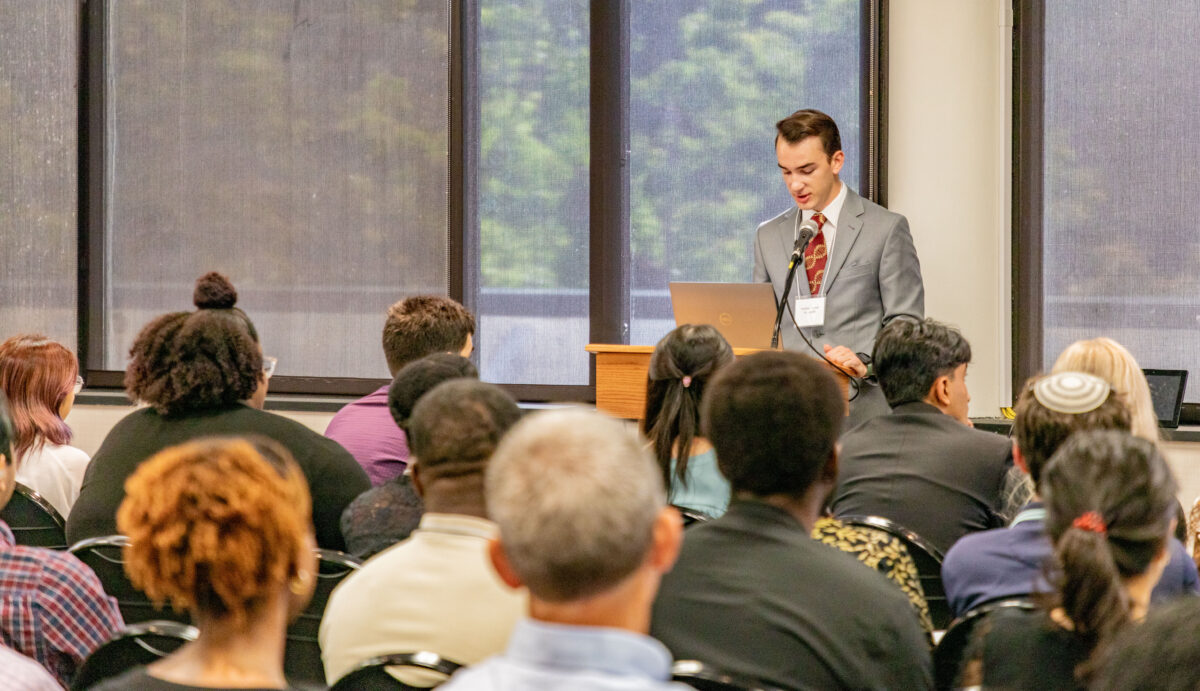 Andrew Opincar ’25, biological sciences and a STEM BUILD Trainee, presents a “lightning talk” at SURF. (Image by Melissa Penley Cormier, M.F.A. ’17/UMBC)
Cambraia notes that after the eight-week internship, the interns identified much more with being scientists than they had at the outset. “Science identity” is documented to increase the chances that students will complete STEM degrees and then continue in related careers.
“That’s why mentoring and peer mentoring are so important in this program,” Cambraia says. “We are not just mentoring them in wet lab techniques, experimental design, and data analysis skills. Our main goal is to help them see and feel that they belong in science and that they can be future leaders in this field.”
“A grand scholarly community”
BUILD a Bridge to STEM is just one example of a student research program that participated in SURF. Students in an array of programs supported by the likes of the National Institutes of Health, Howard Hughes Medical Institute, and the Louis Stokes Alliance for Minority Participation participated, as well as those who arranged their research projects individually.
“These projects all depend on mentors supporting undergraduate research with their time, energy, and resources,” LaCourse notes. UMBC faculty have shown time and again that they are happy to work with students to help them reach their goals, as evidenced by the huge number of students presenting original work at SURF. For many students, SURF is their first time presenting research—but LaCourse hopes it won’t be the last.
“This may be the first of many scientific talks you give,” he told the participants at the end of the day. “By practicing and applying the skills of performing research this summer, you are following in the footsteps of great scientists and researchers—making each of you a part of a grand scholarly community.”
]]>
At Summer Undergraduate Research Fest (SURF) on August 9, 132 students presented posters and six gave short oral presentations, called “lightning talks,” about research projects covering topics...
https://umbc.edu/stories/summer-undergraduate-research-fest-2023/
https://my3.my.umbc.edu/api/v0/pixel/news/134869/guest@my.umbc.edu/bf6ed568dee408d3b3b781a24d8e3346/api/pixel
biology
chemistry-and-biochemistry
cnms
news
rca-2
science-and-tech
stembuild
UMBC News & Magazine
https://my3.my.umbc.edu/groups/umbc-news-magazine
https://assets1-my.umbc.edu/system/shared/avatars/groups/000/001/943/24435aa6207c452e7bc15cc74b42c7bb/xsmall.png?1748556657
https://assets1-my.umbc.edu/system/shared/avatars/groups/000/001/943/24435aa6207c452e7bc15cc74b42c7bb/original.png?1748556657
https://assets2-my.umbc.edu/system/shared/avatars/groups/000/001/943/24435aa6207c452e7bc15cc74b42c7bb/xxlarge.png?1748556657
https://assets2-my.umbc.edu/system/shared/avatars/groups/000/001/943/24435aa6207c452e7bc15cc74b42c7bb/xlarge.png?1748556657
https://assets3-my.umbc.edu/system/shared/avatars/groups/000/001/943/24435aa6207c452e7bc15cc74b42c7bb/large.png?1748556657
https://assets1-my.umbc.edu/system/shared/avatars/groups/000/001/943/24435aa6207c452e7bc15cc74b42c7bb/medium.png?1748556657
https://assets2-my.umbc.edu/system/shared/avatars/groups/000/001/943/24435aa6207c452e7bc15cc74b42c7bb/small.png?1748556657
https://assets1-my.umbc.edu/system/shared/avatars/groups/000/001/943/24435aa6207c452e7bc15cc74b42c7bb/xsmall.png?1748556657
https://assets2-my.umbc.edu/system/shared/avatars/groups/000/001/943/24435aa6207c452e7bc15cc74b42c7bb/xxsmall.png?1748556657
UMBC News & Magazine
0
0
false
Thu, 24 Aug 2023 15:50:30 -0400
Thu, 24 Aug 2023 15:50:30 -0400
NIDA EDUCATE program develops the next generation of addiction researchers
In 2021, the National Institute on Drug Abuse (NIDA) awarded UMBC more than $1 million over five years to create a program specifically for undergraduate scholars interested in research on substance abuse and addiction. A year after the program’s launch, it is thriving as students in fields as diverse as economics, computer science, and chemical engineering find ways to connect their interests to this important topic.
EDUCATE Scholars gathered for an end-of-semester social in spring 2022. (Image courtesy of Yetunde Oshagbemi)
“We need people from all walks of STEM to be able to approach problems to find solutions,” says Patrice Darby. She isprogram coordinator of special projects of the Meyerhoff Scholars Program and a co-lead on the grant, which is called Educating Diverse Undergraduates for Careers in Addiction and substance abuse research via Training Experiences (EDUCATE). The program supports a small, specialized group of Meyerhoff Scholars as EDUCATE Scholars. The grant is administered by UMBC’s College of Natural and Mathematical Sciences and led by the college’s dean, Bill LaCourse.
EDUCATE programming includes talks from researchers whose work touches addiction, as well as workshop series on science communication and on the tools needed to become a successful researcher. EDUCATE Scholars are also expected to participate in a sustained research experience with UMBC faculty mentors and to present their research at a conference. They also take an ethics course and receive intensive academic and career advising from program staff. Funding is available to support summer research experiences for EDUCATE Scholars as well.
“NIDA has really encouraged an interdisciplinary approach,” Darby says. That and the small size of each cohort means “we’re really able to tailor things to the students’ needs.”
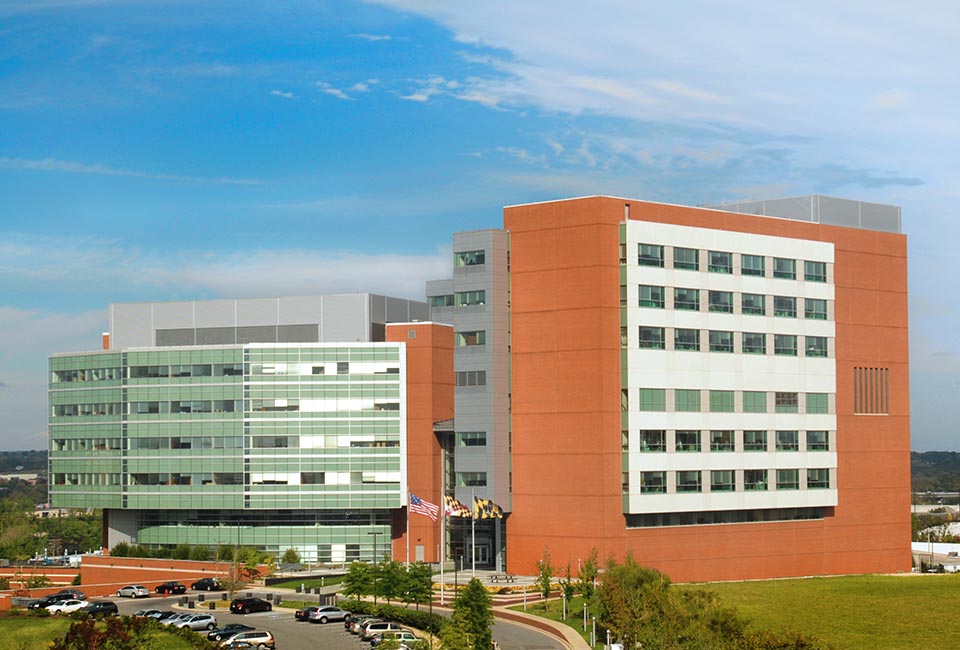 The National Institute on Drug Abuse in Baltimore. (NIDA)
Broader horizons
Yetunde Oshagbemi ’23, economics and mathematics, wants to study economic development in Nigeria, and she is interested in understanding how drug abuse has impacted development. Based on Oshagbemi’s interests, Darby invited an economist with a focus on drug abuse to speak to the scholars. In addition to speaking directly to Oshagbemi’s interest, this offered a fresh perspective for students in other majors.
The talk “reminded me that similar interests can be applied in different ways,” Oshagbemi says. The EDUCATE program as a whole “broadens your horizons and your views on the ways drug abuse is being studied in different disciplines. It’s allowed me to see that there are different ways to answer the questions I have about my interests.”
 Yetunde Oshagbemi ’23, economics and mathematics (left), relaxes with another EDUCATE Scholar at a social event. (Image courtesy of Oshagbemi)
Oshagbemi conducts research with Zoë McLaren, professor of public policy, whose work includes studying infectious disease in developing countries. Oshagbemi also appreciates Darby’s mentorship. Darby helps “make sure that not only am I progressing academically, but my mental health is also doing well,” she says. “She tries to give you the best advice based on the type of person you are and the path you want to go on.”
Family inspiration
Mike Anoruo ’24, computer science,has also benefited from the mentorship and interdisciplinary nature of the program. Darby recommended he apply for a summer workshop at MIT on quantitative methods, which was eye-opening. “I learned a lot about biology and I was able to bring in my computer science knowledge,” Anoruo says.
Anoruo is inspired by his mother, who works at a crisis stabilization center for people who struggle with addiction and substance abuse. “Seeing her passion for it has made me really want to learn more about it,” he says. “From the MIT workshop, I was able to see that computer science has a lot of applications. So if I can find a way to make a difference the same way my mom is, I think I would really enjoy that.”
Knowing that there are so many ways to apply computer science, Anoruo is still considering his options for the future. “I really like being in the EDUCATE program because I get to look into different topics in drug addiction. I’m just trying to explore and see what I want to go into.”
A real contribution
Students who are not EDUCATE Scholars also benefit from the program.
Each year six students, a mix of Meyerhoff Scholars and STEM BUILD Trainees, have the opportunity to participate in research internships at NIDA through a supplement to the EDUCATE grant. STEM BUILD Trainee Precious Oyinloye ’23, chemical engineering, is completing a virtual internship this school year. Her project involves analyzing data to identify chemical compounds involved in addiction.
After learning how to code in the Python language as part of her NIDA experience, “I’m more curious about computer science,” she says. Plus, “being part of a research project offers a sense of fulfillment—I’m really contributing to science.”
Zoha Faraz ’22, psychology and biological sciences, also a STEM BUILD Trainee, used the opportunity to gain important research skills. “Through the internship, I was able to learn a lot about the research process, and I feel more confident in testing my research skills,” she says. “I think it also improved my scientific communication, because I had to make a presentation about my project.”

Zoha Faraz ’22, psychology and biological sciences (Image courtesy of Faraz)
A personalized experience
The EDUCATE program is small, with a maximum of six scholars per year. That allows the staff “to give our students a highly personalized experience,” Darby says.
Between the workshop-style trainings, faculty-mentored research, and availability of committed staff like Darby to offer guidance and feedback, the program is setting the EDUCATE Scholars up for success in whatever field they choose to pursue.
“You don’t have to research addiction to be able to influence addiction research,” Darby says. Addiction is, however, one of the topics that brings the scholars together. At a social event for EDUCATE students earlier this year, that connection was on full display, helping students deepen relationships they may rely on for support for years to come.
“It’s just different to have a special community,” Darby says, “to talk about the impacts of addiction and why our students care.”
]]>
In 2021, the National Institute on Drug Abuse (NIDA) awarded UMBC more than $1 million over five years to create a program specifically for undergraduate scholars interested in research on...
https://umbc.edu/stories/the-next-generation-of-addiction-researchers/
https://my3.my.umbc.edu/api/v0/pixel/news/125582/guest@my.umbc.edu/b72e18144ef0e3cd9ded5fa07df2ad6c/api/pixel
cahss
chemeng
cnms
coeit
csee
economics
mathstat
meyerhoffscholars
psychology
public-policy
science-and-tech
stembuild
undergradresearch
UMBC News & Magazine
https://my3.my.umbc.edu/groups/umbc-news-magazine
https://assets1-my.umbc.edu/system/shared/avatars/groups/000/001/943/24435aa6207c452e7bc15cc74b42c7bb/xsmall.png?1748556657
https://assets1-my.umbc.edu/system/shared/avatars/groups/000/001/943/24435aa6207c452e7bc15cc74b42c7bb/original.png?1748556657
https://assets2-my.umbc.edu/system/shared/avatars/groups/000/001/943/24435aa6207c452e7bc15cc74b42c7bb/xxlarge.png?1748556657
https://assets2-my.umbc.edu/system/shared/avatars/groups/000/001/943/24435aa6207c452e7bc15cc74b42c7bb/xlarge.png?1748556657
https://assets3-my.umbc.edu/system/shared/avatars/groups/000/001/943/24435aa6207c452e7bc15cc74b42c7bb/large.png?1748556657
https://assets1-my.umbc.edu/system/shared/avatars/groups/000/001/943/24435aa6207c452e7bc15cc74b42c7bb/medium.png?1748556657
https://assets2-my.umbc.edu/system/shared/avatars/groups/000/001/943/24435aa6207c452e7bc15cc74b42c7bb/small.png?1748556657
https://assets1-my.umbc.edu/system/shared/avatars/groups/000/001/943/24435aa6207c452e7bc15cc74b42c7bb/xsmall.png?1748556657
https://assets2-my.umbc.edu/system/shared/avatars/groups/000/001/943/24435aa6207c452e7bc15cc74b42c7bb/xxsmall.png?1748556657
UMBC News & Magazine
0
0
false
Tue, 24 May 2022 16:52:34 -0400
Tue, 24 May 2022 16:52:34 -0400
UMBC to launch prestigious Beckman Scholars Program for aspiring M.D./Ph.D.s
UMBC has received a 2022 Beckman Foundation Award to launch a Beckman Scholars Program for outstanding students interested in graduate study in the biological or chemical sciences. The Arnold and Mabel Beckman Foundation today announced 14 institutions across the U.S. as new recipients of three-year institutional awards, totaling over $2.1 million. At UMBC, the program will support six students who aspire to pursue M.D./Ph.D. degrees, each paired with a mentor.
“The specific aim of the program is to build a strong foundation for the Beckman Scholars to become tomorrow’s well-rounded and accomplished physician scientists,” reads UMBC’s award proposal. Importantly, the program also aims to support students from underrepresented backgrounds in medicine.
UMBC is in a strong position to pursue this goal, being the #1 institution in the country for graduating Black students who go on to receive M.D./Ph.D. degrees. UMBC is also #1 for Black graduates who go on to complete Ph.D. degrees in the natural sciences and engineering.
 Weihong Lin (left); Ashley Majekodunmi ’21 (center), biological sciences, a UMBC STEM BUILD Trainee; and Abdullah Al-Matrouk (right), then a Ph.D. candidate in biological sciences, work in Lin’s neurobiology lab in 2018.
Strong foundation
Each Beckman Scholar will receive significant financial, academic, and research support. They will gain community service and leadership experience and have the opportunity to forge relationships with peers and mentors from UMBC and elsewhere. In this way, the program will prepare the scholars for future careers as physician scientists and ground them in a supportive network that they can rely on for years to come.
“I am delighted that UMBC and the College of Natural and Mathematical Sciences (CNMS) have been selected to receive this prestigious award,” says Provost Philip Rous. “This support from the Beckman Foundation recognizes the fundamental roles that justice, equity, diversity, and inclusion play in the advancement of science and innovation, consistent with UMBC’s shared value of inclusive excellence.”
 Provost Philip Rous receives an award from the American Democracy Project at the Civic Learning and Democratic Engagement Meeting in Baltimore, 2017.
Research and mentorship
The 15-month Beckman Scholar experience will include one academic year bookended by two summers. Scholars will conduct research with faculty mentors at UMBC full-time in the summer months and part-time during the school year. The goal is for this work to lead to a peer-reviewed publication, a rare and exciting opportunity for undergraduates.
Mentors will receive financial support as well as training from UMBC’s Faculty Development Center in culturally-responsive mentorship and techniques for fostering self-efficacy and inclusion in emerging researchers.
“Early exposure to research enhances our students’ readiness for post-graduate school and their chosen career paths,” says Bill LaCourse, dean of CNMS, which will house the program. “More importantly, independent research under the mentorship of UMBC’s dedicated faculty can spark a student’s lifelong interest in interdisciplinary learning. In the sciences at UMBC, our motto is, ‘It takes a scientist to train a scientist.’”
 A student works with fruit flies in the lab of Jeff Leips, biological sciences, at UMBC, summer 2019.
Entrepreneurship and service
Beckman Scholars will take courses in science communication, research ethics and integrity, and biomedical case studies. They will also complete UMBC’s Entrepreneurial Skills Training for STEM Undergraduates.
“Entrepreneurship is the ability of an individual to identify a goal, provide the leadership, and mobilize the assets necessary to reach that goal,” UMBC’s proposal says. “Individuals breaking ground in science and technology, by creating innovative solutions to society’s problems, are all entrepreneurs.”
Scholars will also provide community service at local hospitals or clinics, shadow campus leaders, benefit from intensive academic advising, and receive support with the medical school application process. Every aspect is designed to offer experiences and develop skills that will make the scholars competitive candidates for M.D./Ph.D. programs upon graduation.
Each year, the scholars are invited to attend the Beckman Summer Research Symposium, where they can connect with other fellow scholars from around the country. They will also plan and organize an annual Beckman Scholars Forum at UMBC, featuring speakers of interest to rising physician scientists.
 Howard Nicholson ’21, chemical engineering, shares his research on biosensors at UMBC’s 23rd annual Undergraduate Research and Creative Achievement Day (URCAD) in 2019. Students moved outside briefly in response to a fire drill.
Community connections
Because the number of students in the program is small, the Beckman Scholars will collaborate with other STEM-focused scholars programs at UMBC. This will include the renowned Meyerhoff Scholars and the CNMS Scholars, for women in STEM fields in which they are underrepresented.
The Beckman Scholars will benefit from the best practices to support student success that UMBC has developed over many years through these programs. Connecting with members of other programs will also help the Beckman Scholars build a strong sense of community. Community support and belonging are known to enhance persistence and success in STEM, especially among students from underrepresented groups.
 Three Meyerhoff Scholars connect at UMBC in spring 2021.
“We are very proud of the impact that programs such as the Meyerhoff Scholars and CNMS Scholars have had on retaining underrepresented students in STEM disciplines,” says Caitlin Kowalewski, assistant director of undergraduate academic initiatives in CNMS. “We look forward to using the lessons we have learned from these programs to provide the Beckman Scholars with a strong foundation to succeed at their goal of pursuing an M.D./Ph.D.”
UMBC also has a long history of using new programs as opportunities to learn how to best support students, and then institutionalize those elements for an even greater benefit over time. For example, inspired by the success of STEM BUILD, an NIH-funded initiative to diversify the biomedical sciences, CNMS launched The Learning Collaboratory, revitalized its STEM Living Learning Community, and expanded courses in ethics and science communication.
In the future, LaCourse says, “The college intends to use the Beckman Scholars program as a model for increasing the number of students applying for M.D./Ph.D. programs.”
 Meyerhoff Scholars and alumni at the Meyerhoff 30th anniversary celebration, June 2019. President Hrabowski (left) and original program sponsor Robert Meyerhoff (right) seated in front row. More than 800 of UMBC’s Meyerhoff alumni have already earned graduate and professional degrees. Photo by Jim Burger for UMBC.
Springboard to success
To be prepared to pursue an M.D./Ph.D., students must demonstrate a balance of research experience, leadership, community service, clinical experience, and a strong academic record. The Beckman Scholars Program provides ample resources and opportunities to meet all of these requirements and more.
“The Beckman Scholars Program at UMBC will serve as a springboard for students from all backgrounds to launch themselves into successful careers as physician scientists. And as Beckman Scholars, they will be surrounded by a community that enables them to explore, challenge themselves, and, yes, sometimes fail—all while feeling supported,” LaCourse says.
He notes, “Their peers and mentors will help them grow into confident and creative researchers who will make important contributions to medicine and science in the years to come.”
Featured image: Grace Tugado ’23, chemical engineering, working in the SeeTrue Technology lab on UMBC’s campus in summer 2021. The Maryland Technology Internship Program supported her work and she gained prior research experience through UMBC’s STEM BUILD program. All photos by Marlayna Demond ’11 for UMBC unless otherwise noted.
]]>
UMBC has received a 2022 Beckman Foundation Award to launch a Beckman Scholars Program for outstanding students interested in graduate study in the biological or chemical sciences. The Arnold and...
https://umbc.edu/stories/meet-umbc-people-15/
https://my3.my.umbc.edu/api/v0/pixel/news/119483/guest@my.umbc.edu/49b328576728adca4e3e74b89318e31c/api/pixel
beckmanscholars
cnms
diversityandinclusion
meyerhoffscholars
page1
science-and-technology
stembuild
UMBC News & Magazine
https://my3.my.umbc.edu/groups/umbc-news-magazine
https://assets1-my.umbc.edu/system/shared/avatars/groups/000/001/943/24435aa6207c452e7bc15cc74b42c7bb/xsmall.png?1748556657
https://assets1-my.umbc.edu/system/shared/avatars/groups/000/001/943/24435aa6207c452e7bc15cc74b42c7bb/original.png?1748556657
https://assets2-my.umbc.edu/system/shared/avatars/groups/000/001/943/24435aa6207c452e7bc15cc74b42c7bb/xxlarge.png?1748556657
https://assets2-my.umbc.edu/system/shared/avatars/groups/000/001/943/24435aa6207c452e7bc15cc74b42c7bb/xlarge.png?1748556657
https://assets3-my.umbc.edu/system/shared/avatars/groups/000/001/943/24435aa6207c452e7bc15cc74b42c7bb/large.png?1748556657
https://assets1-my.umbc.edu/system/shared/avatars/groups/000/001/943/24435aa6207c452e7bc15cc74b42c7bb/medium.png?1748556657
https://assets2-my.umbc.edu/system/shared/avatars/groups/000/001/943/24435aa6207c452e7bc15cc74b42c7bb/small.png?1748556657
https://assets1-my.umbc.edu/system/shared/avatars/groups/000/001/943/24435aa6207c452e7bc15cc74b42c7bb/xsmall.png?1748556657
https://assets2-my.umbc.edu/system/shared/avatars/groups/000/001/943/24435aa6207c452e7bc15cc74b42c7bb/xxsmall.png?1748556657
UMBC News & Magazine
0
0
false
Tue, 25 Jan 2022 19:01:51 -0500
UMBC to launch prestigious Beckman Scholars Program for aspiring M.D./Ph.D.s
UMBC has received a 2022 Beckman Foundation Award to launch a Beckman Scholars Program for outstanding students interested in graduate study in the biological or chemical sciences. The Arnold and Mabel Beckman Foundation today announced 14 institutions across the U.S. as new recipients of three-year institutional awards, totaling over $2.1 million. At UMBC, the program will support six students who aspire to pursue M.D./Ph.D. degrees, each paired with a mentor.
“The specific aim of the program is to build a strong foundation for the Beckman Scholars to become tomorrow’s well-rounded and accomplished physician scientists,” reads UMBC’s award proposal. Importantly, the program also aims to support students from underrepresented backgrounds in medicine.
UMBC is in a strong position to pursue this goal, being the #1 institution in the country for graduating Black students who go on to receive M.D./Ph.D. degrees. UMBC is also #1 for Black graduates who go on to complete Ph.D. degrees in the natural sciences and engineering.
Weihong Lin (left); Ashley Majekodunmi ’21 (center), biological sciences, a UMBC STEM BUILD Trainee; and Abdullah Al-Matrouk (right), then a Ph.D. candidate in biological sciences, work in Lin’s neurobiology lab in 2018.
Strong foundation
Each Beckman Scholar will receive significant financial, academic, and research support. They will gain community service and leadership experience and have the opportunity to forge relationships with peers and mentors from UMBC and elsewhere. In this way, the program will prepare the scholars for future careers as physician scientists and ground them in a supportive network that they can rely on for years to come.
“I am delighted that UMBC and the College of Natural and Mathematical Sciences (CNMS) have been selected to receive this prestigious award,” says Provost Philip Rous. “This support from the Beckman Foundation recognizes the fundamental roles that justice, equity, diversity, and inclusion play in the advancement of science and innovation, consistent with UMBC’s shared value of inclusive excellence.”
Provost Philip Rous receives an award from the American Democracy Project at the Civic Learning and Democratic Engagement Meeting in Baltimore, 2017.
Research and mentorship
The 15-month Beckman Scholar experience will include one academic year bookended by two summers. Scholars will conduct research with faculty mentors at UMBC full-time in the summer months and part-time during the school year. The goal is for this work to lead to a peer-reviewed publication, a rare and exciting opportunity for undergraduates.
Mentors will receive financial support as well as training from UMBC’s Faculty Development Center in culturally-responsive mentorship and techniques for fostering self-efficacy and inclusion in emerging researchers.
“Early exposure to research enhances our students’ readiness for post-graduate school and their chosen career paths,” says Bill LaCourse, dean of CNMS, which will house the program. “More importantly, independent research under the mentorship of UMBC’s dedicated faculty can spark a student’s lifelong interest in interdisciplinary learning. In the sciences at UMBC, our motto is, ‘It takes a scientist to train a scientist.’”
A student works with fruit flies in the lab of Jeff Leips, biological sciences, at UMBC, summer 2019.
Entrepreneurship and service
Beckman Scholars will take courses in science communication, research ethics and integrity, and biomedical case studies. They will also complete UMBC’s Entrepreneurial Skills Training for STEM Undergraduates.
“Entrepreneurship is the ability of an individual to identify a goal, provide the leadership, and mobilize the assets necessary to reach that goal,” UMBC’s proposal says. “Individuals breaking ground in science and technology, by creating innovative solutions to society’s problems, are all entrepreneurs.”
Scholars will also provide community service at local hospitals or clinics, shadow campus leaders, benefit from intensive academic advising, and receive support with the medical school application process. Every aspect is designed to offer experiences and develop skills that will make the scholars competitive candidates for M.D./Ph.D. programs upon graduation.
Each year, the scholars are invited to attend the Beckman Summer Research Symposium, where they can connect with other fellow scholars from around the country. They will also plan and organize an annual Beckman Scholars Forum at UMBC, featuring speakers of interest to rising physician scientists.
Howard Nicholson ’21, chemical engineering, shares his research on biosensors at UMBC’s 23rd annual Undergraduate Research and Creative Achievement Day (URCAD) in 2019. Students moved outside briefly in response to a fire drill.
Community connections
Because the number of students in the program is small, the Beckman Scholars will collaborate with other STEM-focused scholars programs at UMBC. This will include the renowned Meyerhoff Scholars and the CNMS Scholars, for women in STEM fields in which they are underrepresented.
The Beckman Scholars will benefit from the best practices to support student success that UMBC has developed over many years through these programs. Connecting with members of other programs will also help the Beckman Scholars build a strong sense of community. Community support and belonging are known to enhance persistence and success in STEM, especially among students from underrepresented groups.
Three Meyerhoff Scholars connect at UMBC in spring 2021.
“We are very proud of the impact that programs such as the Meyerhoff Scholars and CNMS Scholars have had on retaining underrepresented students in STEM disciplines,” says Caitlin Kowalewski, assistant director of undergraduate academic initiatives in CNMS. “We look forward to using the lessons we have learned from these programs to provide the Beckman Scholars with a strong foundation to succeed at their goal of pursuing an M.D./Ph.D.”
UMBC also has a long history of using new programs as opportunities to learn how to best support students, and then institutionalize those elements for an even greater benefit over time. For example, inspired by the success of STEM BUILD, an NIH-funded initiative to diversify the biomedical sciences, CNMS launched The Learning Collaboratory, revitalized its STEM Living Learning Community, and expanded courses in ethics and science communication.
In the future, LaCourse says, “The college intends to use the Beckman Scholars program as a model for increasing the number of students applying for M.D./Ph.D. programs.”
Meyerhoff Scholars and alumni at the Meyerhoff 30th anniversary celebration, June 2019. President Hrabowski (left) and original program sponsor Robert Meyerhoff (right) seated in front row. More than 800 of UMBC’s Meyerhoff alumni have already earned graduate and professional degrees. Photo by Jim Burger for UMBC.
Springboard to success
To be prepared to pursue an M.D./Ph.D., students must demonstrate a balance of research experience, leadership, community service, clinical experience, and a strong academic record. The Beckman Scholars Program provides ample resources and opportunities to meet all of these requirements and more.
“The Beckman Scholars Program at UMBC will serve as a springboard for students from all backgrounds to launch themselves into successful careers as physician scientists. And as Beckman Scholars, they will be surrounded by a community that enables them to explore, challenge themselves, and, yes, sometimes fail—all while feeling supported,” LaCourse says.
He notes, “Their peers and mentors will help them grow into confident and creative researchers who will make important contributions to medicine and science in the years to come.”
Featured image: Grace Tugado ’23, chemical engineering, working in the SeeTrue Technology lab on UMBC’s campus in summer 2021. The Maryland Technology Internship Program supported her work and she gained prior research experience through UMBC’s STEM BUILD program. All photos by Marlayna Demond ’11 for UMBC unless otherwise noted.
]]>
UMBC has received a 2022 Beckman Foundation Award to launch a Beckman Scholars Program for outstanding students interested in graduate study in the biological or chemical sciences. The Arnold and...
https://umbc.edu/stories/umbc-to-launch-prestigious-beckman-scholars-program-for-aspiring-m-d-ph-d-s/
https://my3.my.umbc.edu/api/v0/pixel/news/125773/guest@my.umbc.edu/481a4531e46b90d2a10ff28866873b19/api/pixel
beckmanscholars
cnms
diversityandinclusion
meyerhoffscholars
page1
science-and-tech
stembuild
UMBC News & Magazine
https://my3.my.umbc.edu/groups/umbc-news-magazine
https://assets1-my.umbc.edu/system/shared/avatars/groups/000/001/943/24435aa6207c452e7bc15cc74b42c7bb/xsmall.png?1748556657
https://assets1-my.umbc.edu/system/shared/avatars/groups/000/001/943/24435aa6207c452e7bc15cc74b42c7bb/original.png?1748556657
https://assets2-my.umbc.edu/system/shared/avatars/groups/000/001/943/24435aa6207c452e7bc15cc74b42c7bb/xxlarge.png?1748556657
https://assets2-my.umbc.edu/system/shared/avatars/groups/000/001/943/24435aa6207c452e7bc15cc74b42c7bb/xlarge.png?1748556657
https://assets3-my.umbc.edu/system/shared/avatars/groups/000/001/943/24435aa6207c452e7bc15cc74b42c7bb/large.png?1748556657
https://assets1-my.umbc.edu/system/shared/avatars/groups/000/001/943/24435aa6207c452e7bc15cc74b42c7bb/medium.png?1748556657
https://assets2-my.umbc.edu/system/shared/avatars/groups/000/001/943/24435aa6207c452e7bc15cc74b42c7bb/small.png?1748556657
https://assets1-my.umbc.edu/system/shared/avatars/groups/000/001/943/24435aa6207c452e7bc15cc74b42c7bb/xsmall.png?1748556657
https://assets2-my.umbc.edu/system/shared/avatars/groups/000/001/943/24435aa6207c452e7bc15cc74b42c7bb/xxsmall.png?1748556657
UMBC News & Magazine
0
0
false
Tue, 25 Jan 2022 19:01:51 -0500
UMBC STEM BUILD students conduct and present viral research in reimagined summer program
The 19 members of UMBC’s STEM BUILD Cohort 5 and their instructors had been looking forward to a summer wet lab experience. When that wasn’t possible due to the COVID-19 pandemic, they worked together to convert their eight-week, in-person program into a successful online learning experience unlike anything they’d tried before.
“It was different,” says Maria Cambraia, postdoctoral teaching fellow in the STEM BUILD program and one of the instructors, “but we kept the main goal. We wanted to offer them an authentic research experience, and we did.”
Independent exploration
This year, BUILD Trainees worked in groups to analyze the genomes of bacteriophages, viruses that infect bacterial cells. They also viewed and analyzed phages that previous UMBC students had isolated, including some that were unknown to science before the students discovered them. After some initial analysis, each group came up with its own research question to explore using bioinformatics tools.
“Students gain exposure to research techniques in the Bioanalytical Phage Module, but the larger benefit is their experience in self-directed research without predefined results,” says Steven Caruso, principal lecturer of biological sciences. “Because participants are engaging in real research, the experience is different every year.”
 Caroline Moore ’23 (left, offset) presents her team’s research at SURF. (Screenshot from the SURF website)
Caruso has been teaching the Phage Hunters lab to UMBC students since 2008, and he adapted the full-length course for STEM BUILD five years ago. “This experience prepares them for their next step, working with an individual mentor in their own lab,” he says. “It also allows them additional opportunity for productive collaboration with their peers, and for scientific communication during lab meetings and poster presentations.”
Feedback for success
At the end of the eight weeks, the students presented their findings at UMBC’s virtual Summer Undergraduate Research Fest (SURF). The VoiceThread platform allowed students to give and receive feedback in written, audio, and video format, all in real time.
“Leading up to SURF we practiced using VoiceThread and got tons of helpful feedback from our instructors,” shares Caroline Moore ’23, biological sciences. Even though the online format made some things more difficult, she adds, “I think having such a supportive cohort and instructors helped me push through and end up creating an amazing presentation.”
In addition to practicing with the platform, students presented updates on their work every week throughout the summer and got support with designing their posters. “Dr. Cambraia gave detailed feedback, which allowed us to develop skills for creating the abstracts and posters,” shares Angela Kim ’23, chemical engineering.
“We needed to teach them not just how to present, but instead, ‘This is how you present, and this is how you make it effective online,’” Cambraia says.
 Steven Caruso. Photo by Marlayna Demond ’11 for UMBC.
The students also received helpful feedback at SURF itself. “The questions our group received made me think about what can be improved in our research and gave me some ideas for future research as well,” Kim says. Sharath Velliyamattam ‘23, biological sciences, adds, “I learned from this experience to give visual cues, how to engage my audience, and I learned to interact with different types of people, from faculty to students.”
A new field and new confidence
The Bioanalytical Phage Module introduced many of the students to bioinformatics—and bioinformatics tools—for the first time. “The online bioinformatic work with our phage genomes was really interesting,” says Kevin Gibbons ’23, biological sciences. “I never thought I’d be interested in computational or bioinformatic work, but I feel like I gained a lot of skills that will be helpful no matter what type of research I do in the future.”
For Grace Tugado ’23, chemical engineering, the experience sparked a powerful interest in phages. “Whenever I went out with my family on hikes, I brought up phages and what we learned in lecture,” she says.
Overall, “I think this research opportunity has helped me become more confident in my ability to communicate in a research group and has made me better prepared to work collaboratively,” Moore says.
 Angela Kim ’23 (left, offset) presents her research at SURF. (Screenshot from the SURF website)
Building connections
In addition to collaborating with their groups, Cohort 5 students had the opportunity to interact with previous BUILD classes. Cohorts 4 and 5 spent more than two hours discussing their experiences in a virtual meeting. Cohort 6, entering as first-year students this fall, also commented substantially on Cohort 5’s SURF posters.
Through those exchanges, “We really got a behind-the-scenes view of undergraduate research at UMBC,” Velliyamattam says. Throughout the summer, they also became part of it.
These students faced an unusual challenge: conducting independent research, in groups, all online. By the end of the summer, the students improved their presentation skills, learned about a new area of life science, and conquered new online analytical tools. They also bonded more closely as a group—strengthening relationships that will see them through challenges long after the pandemic is over.
Banner image: UMBC’s Biological Sciences Building along Academic Row, where STEM BUILD students would have traditionally completed their summer research experience. Photo by Marlayna Demond ’11 for UMBC.
]]>
The 19 members of UMBC’s STEM BUILD Cohort 5 and their instructors had been looking forward to a summer wet lab experience. When that wasn’t possible due to the COVID-19 pandemic, they worked...
https://umbc.edu/stories/umbc-stem-build-students-conduct-and-present-viral-research-in-reimagined-summer-program/
https://my3.my.umbc.edu/api/v0/pixel/news/119806/guest@my.umbc.edu/766210f609ba065195c5636885b1b702/api/pixel
biology
cnms
science-and-technology
stembuild
undergradresearch
UMBC News & Magazine
https://my3.my.umbc.edu/groups/umbc-news-magazine
https://assets1-my.umbc.edu/system/shared/avatars/groups/000/001/943/24435aa6207c452e7bc15cc74b42c7bb/xsmall.png?1748556657
https://assets1-my.umbc.edu/system/shared/avatars/groups/000/001/943/24435aa6207c452e7bc15cc74b42c7bb/original.png?1748556657
https://assets2-my.umbc.edu/system/shared/avatars/groups/000/001/943/24435aa6207c452e7bc15cc74b42c7bb/xxlarge.png?1748556657
https://assets2-my.umbc.edu/system/shared/avatars/groups/000/001/943/24435aa6207c452e7bc15cc74b42c7bb/xlarge.png?1748556657
https://assets3-my.umbc.edu/system/shared/avatars/groups/000/001/943/24435aa6207c452e7bc15cc74b42c7bb/large.png?1748556657
https://assets1-my.umbc.edu/system/shared/avatars/groups/000/001/943/24435aa6207c452e7bc15cc74b42c7bb/medium.png?1748556657
https://assets2-my.umbc.edu/system/shared/avatars/groups/000/001/943/24435aa6207c452e7bc15cc74b42c7bb/small.png?1748556657
https://assets1-my.umbc.edu/system/shared/avatars/groups/000/001/943/24435aa6207c452e7bc15cc74b42c7bb/xsmall.png?1748556657
https://assets2-my.umbc.edu/system/shared/avatars/groups/000/001/943/24435aa6207c452e7bc15cc74b42c7bb/xxsmall.png?1748556657
UMBC News & Magazine
0
0
false
Wed, 26 Aug 2020 22:05:18 -0400
CNMS celebrates a year of growth in partnerships to support student success
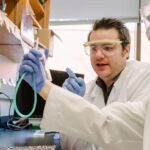
When Bill LaCourse became dean of UMBC’s College of Natural and Mathematical Sciences (CNMS) in 2012, he had three top priorities in mind: innovate undergraduate science education to boost learning outcomes, forge new partnerships, and develop and support a diverse group of faculty. This year, the college took several steps forward in realizing this vision.
“The college has laid the foundation, and now is really in a strong position for growth,” LaCourse says. “It’s all about paying attention to the people and their needs,” he explains, so faculty, staff, and students can do their best work and create a thriving community together.
Student success at the center
This year, CNMS received a $1.4 million grant from the National Science Foundation for Improving Undergraduate Science Education. Faculty at UMBC and community college partners will use the funding to improve the undergraduate experience in biology—the major of one in six UMBC students. This includes focus areas like enhancing the alignment of curriculum across institutions and making sure advising meets the needs of transfer students, both before and after they come to UMBC.
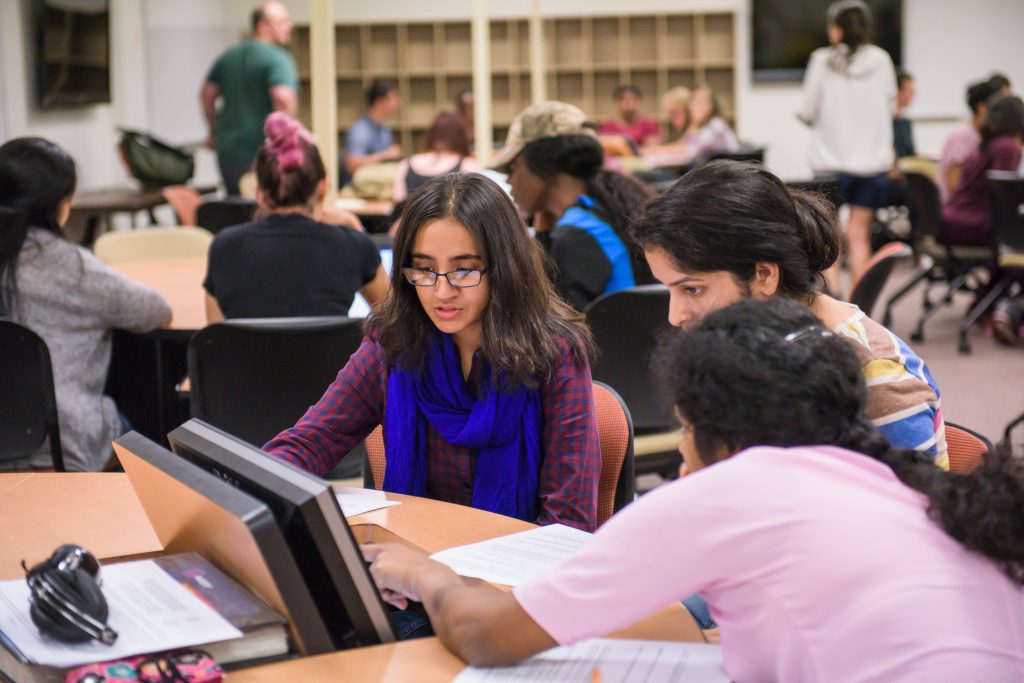
The CNMS Active Science Teaching and Learning Environment (CASTLE) is a classroom designed for team-based instruction. It has tables to facilitate group work, devices set up for screen sharing with large screens at the front and back of the room, and walls covered with whiteboards.
“We’re building community, trust, and relationships with the community colleges,” LaCourse says, and that has huge benefits for students.
The Active Learning Inquiry Teaching (ALIT) certificate offered to UMBC STEM faculty is another growing partnership focused on supporting students. It includes CNMS, the College of Engineering and Information Technology, the Faculty Development Center, and CNMS’s Building Infrastructure Leading to Diversity (BUILD) program. To earn the ALIT certificate, faculty attend a series of workshops on teaching in an active learning style, which has been shown to more effectively engage students and boost performance. They also participate in a teaching observation and other activities.
Initiatives like the Science and Mathematics Advising Resource Team (SMART) are also coming into full swing now. “The program formalizes the relationship between pre-professional advisors, CNMS advisors, and faculty advisors,” explains SMART director Michelle Bulger. “Everyone knows a little about everything,” so no matter which resource they start with, students get the support they need to find their best path through UMBC and into a career.
Celebrating student pioneers
The UMBC STEM BUILD program reached an exciting milestone this academic year: graduating its first program participant, Alexis Waller, in December 2018. Additional BUILD students earned their degrees in May 2019.

BUILD Trainees
Ashley Majekodunmi ’21 (center left) and
Avantika Krishna ’21 (center right) work in the lab with their faculty mentor, Weihong Lin (right).
BUILD is a CNMS initiative funded by the National Institutes of Health. It is designed to help UMBC learn best practices for engaging large numbers of students in mentored research and other practices that support student success in STEM. At some institutions, mentored research experiences are reserved for a select few, often in scholars programs. At UMBC, faculty and staff are actively working to make research accessible to all students.
Three students just became the first to complete another new path through UMBC. Just one day after graduating from UMBC, they were commissioned as officers in the U.S. military. CNMS administers UMBC’s Naval science department, which supports the Naval Reserve Officer Training Corps (NROTC) program. UMBC’s NROTC program was the first of its kind in Maryland when it was launched in 2015.
This spring, ENS Ghazi Nazzal ’19, business technology administration, and ENS Ryan Simpson ’19, environmental science, were commissioned as officers in the U.S. Navy. 2nd Lt Benjamin Dunlap, modern languages, linguistics, and intercultural communication, was commissioned as an officer in the U.S. Marine Corps.
“We’re proud to have them on campus,” says LaCourse, who has a family history of Navy service.
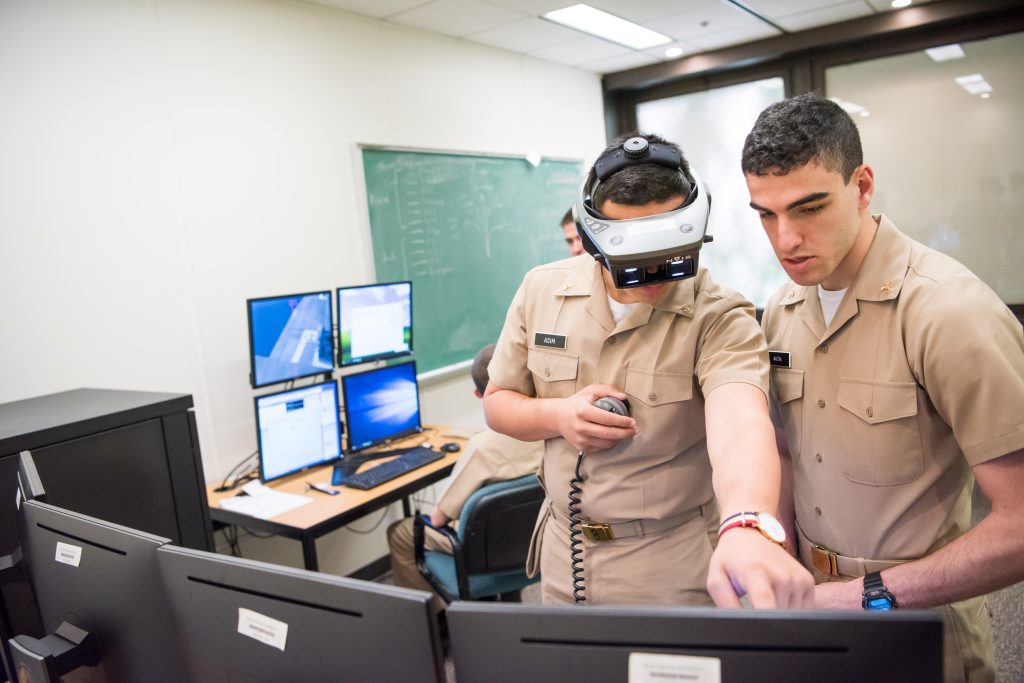
Ghazi Nazzal ’19 (right) assists another midshipman in using UMBC’s state-of-the-art virtual reality naval training system.
Connecting every angle
One of the most exciting CNMS partnerships emerging this year—with the potential to significantly impact students and employers in the region—has a complex name: the Translational Life Science Technology (TLST) program. The program focuses on preparing UMBC students at the Universities at Shady Grove for careers in Montgomery County’s rapidly growing biotech industry. TLST is UMBC’s first undergraduate STEM program at Shady Grove, and this year welcomed its first students.
“With this program as well as the professional master’s degree in biotechnology, CNMS is pioneering UMBC’s expansion at the Shady Grove campus to serve the over one million people in Montgomery County,” says Annica Wayman ’99, M6, mechanical engineering, the new associate dean for Shady Grove affairs for CNMS.
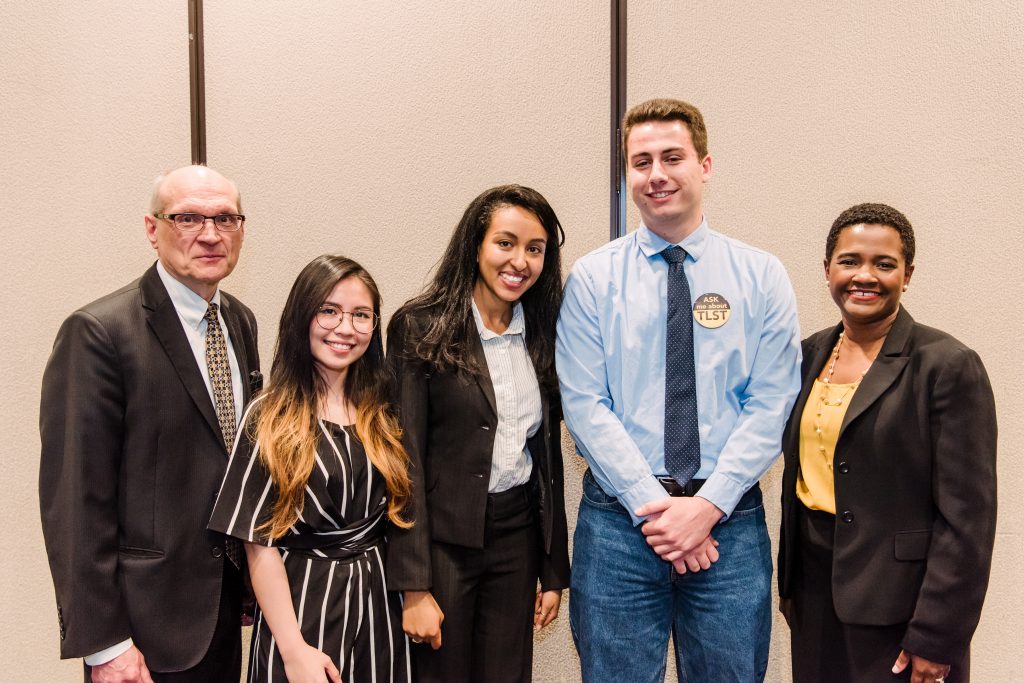
Dean Bill LaCourse (left), Annica Wayman ’99 (right), and some of the first students in the TLST program.
LaCourse sees the new program as the beginning of “a new way of working with Shady Grove.” He shares, “It puts us in a position to bring applied STEM programs to the doorstep of businesses in Montgomery County.”
Constructing collaboration
Perhaps the most visible representation of the college’s commitment to forging partnerships is the Interdisciplinary Life Sciences Building (ILSB), now in the final phases of construction. It will open for classes in fall 2019.
The building includes spacious and bright teaching labs, open faculty laboratory space that promotes collaboration, and classrooms designed for active teaching and learning. Unlike other buildings on campus, faculty who wish to conduct research in the ILSB must propose interdisciplinary projects to be completed there, and the lab spaces are designed to facilitate a variety of kinds of work equally well, from genetics to environmental engineering.
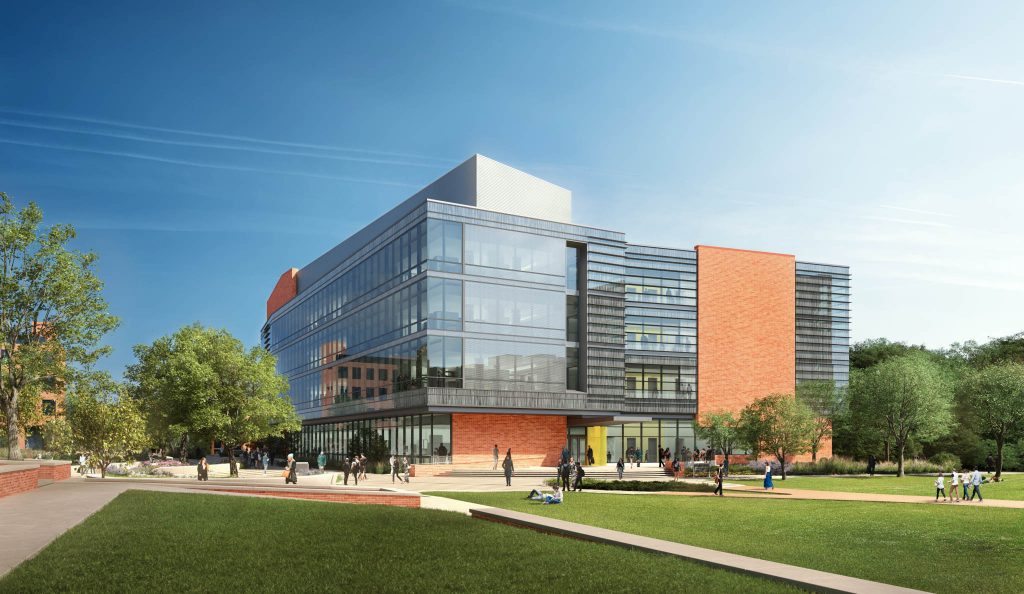
An artist’s rendering of the completed Interdisciplinary Life Sciences Building.
The new building will also house UMBC’s second Maryland Public Art installation: a colorful sculpture that emerges from a large wall and features abstractions of elements found in UMBC research, from bird flight to microscope images of individual cells.
The ILSB is open for use by any department on campus, and is administered by CNMS. “It’s exciting for me to be involved in the operations of the ILSB,” says building manager Dennis Cuddy. “It will be a transformative facility and allow UMBC scientists and students to do important work and cutting edge research in a flexible, state-of-the-art facility.”
Josh Wilhide, manager of UMBC’s Molecular Characterization and Analysis Complex, is particularly excited about new research equipment in the ILSB. One instrument will streamline the process of generating information about the proteins in a sample. It will be “used for drug discovery and genetic exploration for researchers ranging in fields from chemistry to biology to engineering,” Wilhide says. “The ILSB truly is a building designed to drive multi-discipline research.”
Faculty forward
CNMS has also made significant structural changes in the last year to better recruit and support a diverse faculty, and to enhance advancement opportunities and research support for faculty at every level. In addition to Wayman’s new role as associate dean, Kathleen Hoffman, professor of mathematics, now also serves as the CNMS associate dean for faculty advancement. Chuck Bieberich, professor of biological sciences, serves as the associate dean for research.
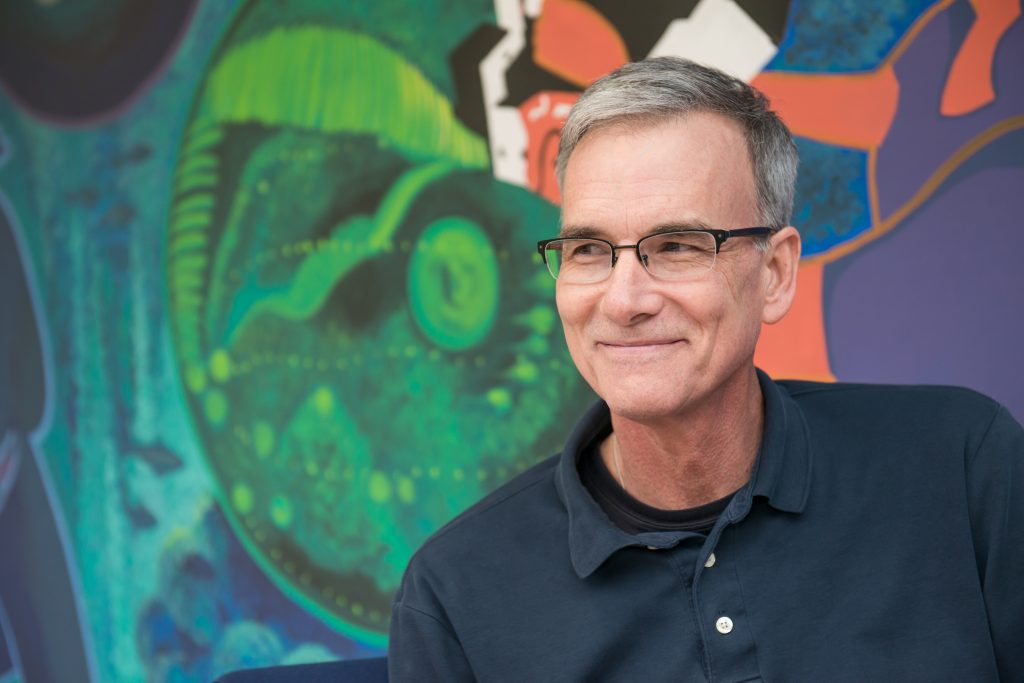
CNMS Associate Dean for Research Chuck Bieberich
“Our college has a strong history of performing cutting-edge research. However, in recent years, the federal funding climate has created new challenges for even the most seasoned researchers,” Bieberich says. “So one dimension of my role as associate dean is to connect our faculty, both newly hired and long-serving, with resources that can increase the likelihood of funding success.”
Hoffman has been supporting faculty advancement, particularly for women in science, for years. She was a key player in developing UMBC’s ADVANCE program, an initiative funded by an NSF Institutional Transformation Grant in 2003 that has led to a 60 percent increase in the number of women faculty in STEM. At a more granular level, ADVANCE has led to a 75 percent increase in women at the associate professor level and a 140 percent increase at full professor.
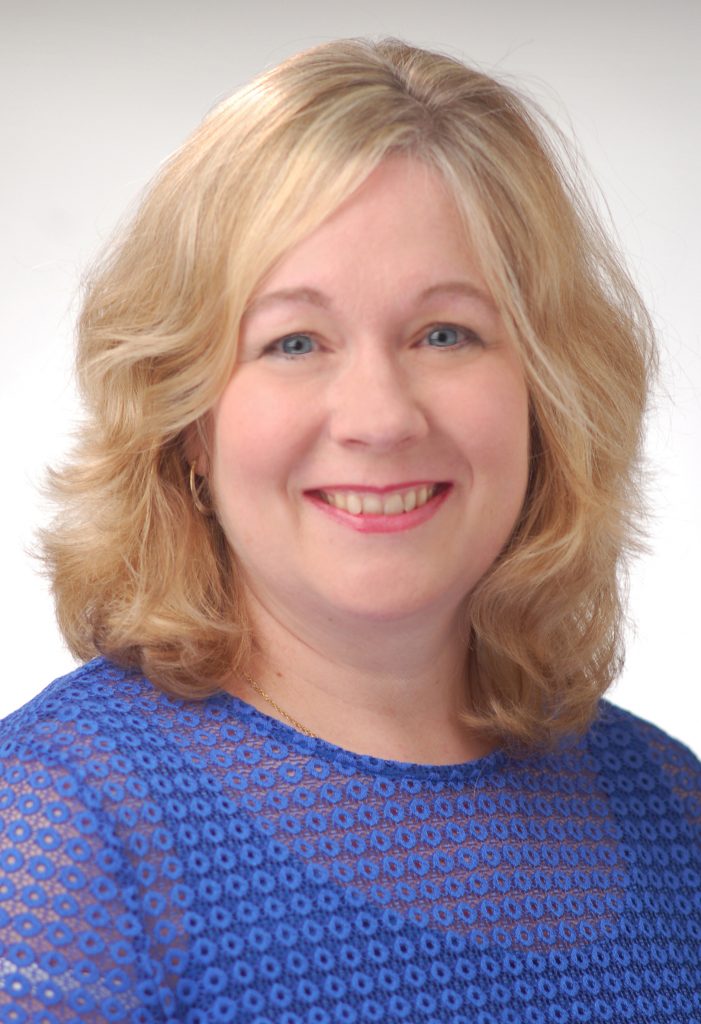
CNMS Associate Dean for Faculty Advancement Kathleen Hoffman
As of fall 2018, 24 percent of faculty in STEM at UMBC are women, which shows both how much progress has been made and how much growth is still needed.
“In this position, I will support CNMS faculty through college-wide workshops and initiatives focused on faculty success,” Hoffman says. She adds that she and Bieberich “will ensure that CNMS faculty have the support they need to fulfill their potential as faculty members in their departments, in the college, and as members of the university community.”
Diversity drives success
This year, CNMS hired two more pre-professoriate fellows. The fellows program is designed to enhance the diversity of CNMS faculty to better reflect the college’s diverse student body and actively welcome faculty who prioritize the value of diversity. Adriana Lima will join physics, and Joseph Bennett will join chemistry and biochemistry.
The biological sciences department led the way with this program, having previously hired Fernando Vonhoff and assistant professor Mercedes Burns. Mathematics and statistics followed with the hire of Yehenew Kifle, who had previously spent a year at UMBC as a visiting professor. Vonhoff and Kifle will successfully convert to assistant professors in August 2019.
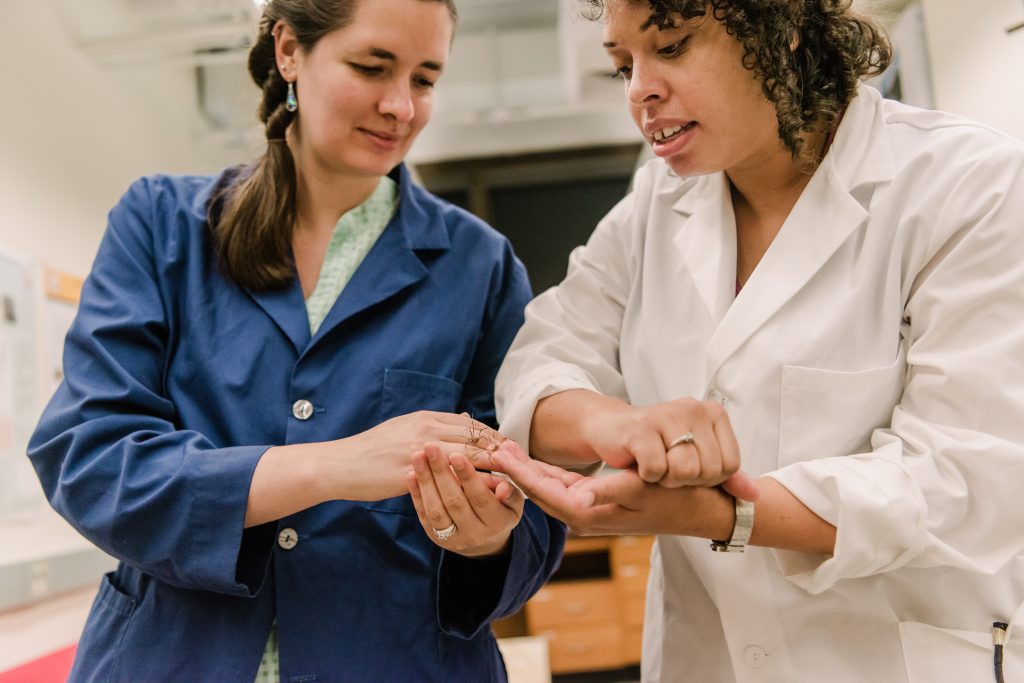
Arachnologist and evolutionary biologist Mercedes Burns (right) and her postdoc, Sarah Stellwagen, transfer a harvestman (commonly known as daddy-long-legs) between them.
“We want to make sure that UMBC can be a good home for faculty from all backgrounds,” says LaCourse. The pre-professoriate program offers incoming faculty two-year appointments as research assistant professors, with structured mentoring and other scaffolds for success. There is the option to convert the fellowship to an assistant professor position.
This year UMBC also partnered in the launch of the PROMISE Academy. This new initiative will draw on the expertise of universities around the nation and evidence-based best practices to recruit and retain a diverse group of faculty members in STEM fields.
With the 15th anniversary of its formation just one year away, “CNMS is coming into its own,” LaCourse says. “We’re ready to move to the next level.”
Banner image: CNMS pre-professoriate fellow Fernando Vonhoff works in the lab with Abby Cruz ’18.
All photos by Marlayna Demond ’11 for UMBC unless otherwise noted.
]]>
When Bill LaCourse became dean of UMBC’s College of Natural and Mathematical Sciences (CNMS) in 2012, he had three top priorities in mind: innovate undergraduate science education to boost...
https://umbc.edu/stories/cnms-celebrates-a-year-of-growth-in-partnerships-to-support-student-success/
https://my3.my.umbc.edu/api/v0/pixel/news/120110/guest@my.umbc.edu/aed9a2081712dfe5aef364009d5e324c/api/pixel
biology
cnms
coeit
community
is
mathstat
naval
science-and-technology
shadygrove
stembuild
UMBC News & Magazine
https://my3.my.umbc.edu/groups/umbc-news-magazine
https://assets1-my.umbc.edu/system/shared/avatars/groups/000/001/943/24435aa6207c452e7bc15cc74b42c7bb/xsmall.png?1748556657
https://assets1-my.umbc.edu/system/shared/avatars/groups/000/001/943/24435aa6207c452e7bc15cc74b42c7bb/original.png?1748556657
https://assets2-my.umbc.edu/system/shared/avatars/groups/000/001/943/24435aa6207c452e7bc15cc74b42c7bb/xxlarge.png?1748556657
https://assets2-my.umbc.edu/system/shared/avatars/groups/000/001/943/24435aa6207c452e7bc15cc74b42c7bb/xlarge.png?1748556657
https://assets3-my.umbc.edu/system/shared/avatars/groups/000/001/943/24435aa6207c452e7bc15cc74b42c7bb/large.png?1748556657
https://assets1-my.umbc.edu/system/shared/avatars/groups/000/001/943/24435aa6207c452e7bc15cc74b42c7bb/medium.png?1748556657
https://assets2-my.umbc.edu/system/shared/avatars/groups/000/001/943/24435aa6207c452e7bc15cc74b42c7bb/small.png?1748556657
https://assets1-my.umbc.edu/system/shared/avatars/groups/000/001/943/24435aa6207c452e7bc15cc74b42c7bb/xsmall.png?1748556657
https://assets2-my.umbc.edu/system/shared/avatars/groups/000/001/943/24435aa6207c452e7bc15cc74b42c7bb/xxsmall.png?1748556657
UMBC News & Magazine
0
0
false
Fri, 14 Jun 2019 21:18:44 -0400
From lab to museum, new UMBC grads show the powerful impact of original research
“I just had this feeling that there had to be more to this story,” says Nicolle “Niki” Konkel ’18, on the striking lack of women in her art history textbooks. So, with the support of faculty mentors, in her senior year she embarked on research that has opened new doors in the art world.
Student passion guided by faculty support is part of the fabric of UMBC. Konkel’s experience is one exciting example of how this winning combination can make possible big breakthroughs.
Hearing marginalized voices
Konkel is an art history and museum studies major who came to UMBC after attending Frederick Community College. While at FCC, She worked 30 hours a week in addition to her studies to fund her first trip to the Netherlands, a voyage that shaped her career goals. Now, she is contributing to a new branch of art history research on women of the De Stijl, an early 20th-century avant garde Dutch art movement.
“There’s so much still to learn, and that fuels my passion to go to graduate school and continue this research,” she says. “When marginalized voices can be heard and placed more within the mainstream, I think that’s so important.”
 DE STIJL “6 decades book.” Photo by de stijl, CC BY 2.0.
This fall, Konkel was also able to gain professional experience as an curatorial intern at the Smithsonian National Museum of American History. She was part of the curatorial team for an entertainment exhibit that will be on display for two decades.
Konkel says the support of her mentors helped make it all possible, especially her senior thesis mentor, visual arts professor Kathy O’Dell. All of the professors “are so invested in us here. They care a lot about my growth and what I’m going to do afterward,” Konkel says. “They want to help you channel your passion.”
Confidence boost
Alexis Waller ’18, biological sciences, has had similarly powerful experiences with research and mentorship. UMBC STEM BUILD, an NIH-funded initiative to increase diversity in the biomedical workforce, “showed me what research actually was,” Waller says. Before UMBC, she shares, “I’d never been inside a lab.” Now? “I just love being in the lab setting and doing hands-on research.”
In her first year, Waller presented at the UMBC Undergraduate Research Symposium with BUILD. With support from Laura Ott, the active learning coordinator for STEM BUILD, Waller joined Michael Summers’s lab in 2016. The lab’s research focuses on how the HIV-1 retrovirus assembles copies of itself within infected cells, so that the copies can emerge to infect other cells.
In addition to Summers, postdoc Pengfei Ding provides direct research mentorship to Waller. “He has always been very patient and encouraged me to ask questions,” Waller says.
 Alexis Waller ’18, right, and her mentor Pengfei Ding at work in Michael Summers’s biochemistry lab. Photo by Marlayna Demond ’11 for UMBC.
Waller started out in a shadowing role in the lab, but says, “as I’ve gotten more confident and knowledgeable, the more responsibility I’ve been given.”
Now a MARC U*STAR Scholar, Waller is continuing work on her team’s project studying a step in the replication of HIV. By contributing to a better understanding of that step, she’s helping provide the knowledge necessary for other scientists to develop treatments to block HIV replication, preventing spread of the infection.
After graduation, Waller will continue to work in the Summers lab as a research assistant while she applies to Ph.D. programs in microbiology. “Being a part of BUILD and MARC, and working in the Summers lab, has all led to me deciding to pursue a Ph.D.,” she says.
Bench to bedside
Like Waller, Abby Cruz ‘18 is also a biological sciences major and a MARC U*STAR Scholar. When she came to UMBC, she believed science was a solitary pursuit, but that changed after she joined Fernando Vonhoff’s biology lab. “I look forward to going to lab because of the collaboration with other people,” she says.
 Abby Cruz ’18, left, and her mentor Fernando Vonhoff discuss an experimental protocol. Photo by Marlayna Demond ’11 for UMBC.
Cruz has been looking at whether certain genes may be associated with human motor neuron diseases, such as ALS, using fruit flies as a model. Scientists at Yale University will use her results to inform their study of motor neuron disease in human cells.
She also works part time in a neurology clinic, where she interacts directly with patients. “I love it,” she says. “It’s what gets me up every day—that I’m part of a community where I can see the research and the clinical side go hand in hand.”
Cruz reached out to Vonhoff just before she joined UMBC from Howard Community College in 2016, and he’s been a supporter ever since. “If it wasn’t for Dr. Vonhoff I wouldn’t have been able to do everything I did,” she says. “If you’re willing to try and put in the effort, his attitude is, ‘Let’s make it happen.’”
 Abby Cruz ’18 and her mentor Fernando Vonhoff check on a vial of fruit flies, their study organism. Photo by Marlayna Demond ’11 for UMBC.
Before starting work in the lab, Cruz was planning on medical school. Now she’s looking toward an M.D./Ph.D. or D.O./Ph.D. (doctor of osteopathic medicine). “Focusing on that connection between the research and the clinic has really solidified my future goals,” she says.
Bridging cultures
When Julian Tash ’18 approached Constantine Vaporis, history professor and former director of UMBC’s Asian studies program, after an art history class one day, he expected a helpful conversation about his career goals. He came away with a game-changing connection to Robert Mintz, the curator of Japanese art at the Walters Art Museum in Baltimore.
Tash, a Humanities Scholar, had noticed Asian art was given less attention than Western art in his high school courses. His further exposure at UMBC to the rich traditions found in Asian art, however, inspired him to pursue a double major in Asian studies and history. With Vaporis’s support, he began an internship at the Walters.
Cataloguing Buddhist statuary at the Walters got Tash “interested in the question of how to connect museum visitors with these statues, when they don’t have a background in the culture in which the objects were produced,” he shares. That interest led to a project he pursued with guidance from Vaporis and visual arts professor Preminda Jacob.
 Julian Tash ’18 says most of his research, when he isn’t doing fieldwork, involves a lot of reading in the library. Photo by Marlayna Demond ’11 for UMBC.
Tash received funding from a UMBC Undergraduate Research Award and a Bridging Scholarship from the American Association of Teachers of Japanese to travel throughout Japan and in the U.S. to explore how Buddhist statues are displayed in their native context compared to in American museums. His resulting research paper, which has been selected for publication in the UMBC Review, recommends that U.S. museums use technology to help visitors see more clearly how the statues appear in their original contexts, in Japanese temples.
Tash has already shared his research with curators at the Metropolitan Museum of Art, British Museum, and Freer and Sackler Galleries. He has also presented other work at the Bard Conference on Asia and the Environment, with research partner Jennifer Christhilf ’19, geography and environmental systems. That project was a new direction for Tash, exploring the impacts of dam construction projects in China and downstream countries such as Vietnam and Cambodia.
 Julian Tash ’18 and one of his mentors, Julie Rosenthal, stand by his research poster about dam removals on the Mekong River in China. Photo by Marlayna Demond ’11 for UMBC.
“Working with someone in the sciences is really emblematic of UMBC, because we’re bringing it all together, in a way that’s vitally important to this region,” says Tash. “That was a great experience and it got me thinking about the intersection of the humanities and policy.”
Although he’s graduating, collaborations Tash has helped build will continue at UMBC, including a Perspectives on Asia conference that will be co-sponsored by Johns Hopkins University.
Tash has applied for a Fulbright Fellowship to conduct research in Taiwan as well as graduate programs.
Like Konkel, Cruz, and Waller, when Tash reflects on his UMBC experience, it all comes back to mentorship and support. “Even though these professors all have really busy schedules, I would go to them with an idea, and even if it wasn’t in their immediate area of study, they all made such phenomenal efforts to support me,” he shares.
“UMBC put the resources in front of me,” Tash says. “I just thought, I could do all these things—I just have to try to pursue them.”
December commencement ceremonies will be livestreamed through both the UMBC Commencement website and UMBC Facebook page. Share well wishes for our grads using #UMBCgrad and #UMBCproud.
Banner image: Alexis Waller ’18 and her mentor, Pengfei Ding, at work in the lab. Photo by Marlayna Demond ’11 for UMBC.
]]>
“I just had this feeling that there had to be more to this story,” says Nicolle “Niki” Konkel ’18, on the striking lack of women in her art history textbooks. So, with the support of faculty...
https://umbc.edu/stories/from-lab-to-museum-new-umbc-grads-show-the-powerful-impact-of-original-research/
https://my3.my.umbc.edu/api/v0/pixel/news/120244/guest@my.umbc.edu/8feb90d9cbb819b272a89488968dd7d0/api/pixel
arts-and-culture
asianstudies
biology
cahss
chembiochem
cirsca
cnms
community
diversityandinclusion
history
marcustar
policy-and-society
science-and-technology
stembuild
strategic-planning
visualarts
UMBC News & Magazine
https://my3.my.umbc.edu/groups/umbc-news-magazine
https://assets1-my.umbc.edu/system/shared/avatars/groups/000/001/943/24435aa6207c452e7bc15cc74b42c7bb/xsmall.png?1748556657
https://assets1-my.umbc.edu/system/shared/avatars/groups/000/001/943/24435aa6207c452e7bc15cc74b42c7bb/original.png?1748556657
https://assets2-my.umbc.edu/system/shared/avatars/groups/000/001/943/24435aa6207c452e7bc15cc74b42c7bb/xxlarge.png?1748556657
https://assets2-my.umbc.edu/system/shared/avatars/groups/000/001/943/24435aa6207c452e7bc15cc74b42c7bb/xlarge.png?1748556657
https://assets3-my.umbc.edu/system/shared/avatars/groups/000/001/943/24435aa6207c452e7bc15cc74b42c7bb/large.png?1748556657
https://assets1-my.umbc.edu/system/shared/avatars/groups/000/001/943/24435aa6207c452e7bc15cc74b42c7bb/medium.png?1748556657
https://assets2-my.umbc.edu/system/shared/avatars/groups/000/001/943/24435aa6207c452e7bc15cc74b42c7bb/small.png?1748556657
https://assets1-my.umbc.edu/system/shared/avatars/groups/000/001/943/24435aa6207c452e7bc15cc74b42c7bb/xsmall.png?1748556657
https://assets2-my.umbc.edu/system/shared/avatars/groups/000/001/943/24435aa6207c452e7bc15cc74b42c7bb/xxsmall.png?1748556657
UMBC News & Magazine
0
0
false
Tue, 18 Dec 2018 20:14:09 -0500
Student scientists take center stage at UMBC’s largest-ever Undergraduate Research Symposium
The College of Natural and Mathematical Sciences (CNMS) hosted its 21st Undergraduate Research Symposium (URS) in the Chemical and Biological Sciences this fall. The event has been growing steadily, and this year set new records: Students presented nearly 300 projects and more than 200 additional guests attended.
“It is so inspiring to see hundreds of undergraduate researchers from over 40 colleges and universities and nearly a dozen states coming together to present research to fellow students, mentors, and faculty judges,” shares Dean Bill LaCourse of CNMS. “Being able to communicate one’s research in a clear, concise, and defensible manner is a critical skill. I wish everyone had the opportunity to feel the students’ energy and excitement, as many presented for the first time.”
 CNMS Dean LaCourse with students in UMBC’s Science Learning Collaboratory
Aleem Mohamed ‘19, biological sciences, and a member of the STEM BUILD Training Program, presented at URS for the first time in 2016. This year, he and his research partner Ilzat Ali ‘19, biochemistry, won first place in their judging group. Mohamed and Ali’s research focuses on figuring out how genes in bacteriophages (viruses that infect bacterial cells) affect a close relative of the bacterium that causes tuberculosis.
As HHMI-SEA Undergraduate Researchers, the duo worked with HHMI investigator Viknesh Sivanathan. Their mentor guided them as they got their project started, preparing them to branch out on their own. Mohamed says the experience “has made me develop a love for the research field I didn’t know I had, and has made me want to do research in my career.”
Joanna Lum ‘19, biological sciences, presented work she completed during a summer Research Experience for Undergraduates at the University of Wisconsin-Madison, and earned second place in her judging group. Lum investigated pathways that regulate viruses that may be involved in initiating cancer.
Gaining early exposure to research and receiving substantial mentoring from a community of scholars through the BUILD program have helped Lum find her way, she explains. Because of that support, “not only am I able to overcome many obstacles in the classroom and in the STEM field, I am also able grow in confidence and see myself as a scientist,” she says.
Lum’s experience with BUILD helped prepare her to apply for other programs, and now she is also a MARC U*STAR Scholar.
The URS event, and the work students do on their way to presenting there, can be a gateway to further research and other accomplishments. The day itself also serves as a stepping stone. Fernando Vonhoff, a pre-professoriate fellow in biological sciences, addressed the students prior to announcing the award winners at the end of the day.
“You are a better scientist now than you were yesterday,” Vonhoff told the students. Award or not, “Science is about the process, rather than the final outcome. Participating in this event and being exposed to so much good science during the whole day has been part of your process.”
“I am confident that this event will have a lasting and positive impact on all those that participated,” added Dean LaCourse, “and UMBC and the college are proud to sponsor this symposium in support of our future scientists.”
Image: Fall on campus. Photo by Marlayna Demond ’11 for UMBC.
]]>
The College of Natural and Mathematical Sciences (CNMS) hosted its 21st Undergraduate Research Symposium (URS) in the Chemical and Biological Sciences this fall. The event has been growing...
https://umbc.edu/stories/student-scientists-take-center-stage-at-umbcs-largest-ever-undergraduate-research-symposium/
https://my3.my.umbc.edu/api/v0/pixel/news/120275/guest@my.umbc.edu/3ff0bc738d6fa61e14ed6422303c84ec/api/pixel
biology
chembiochem
cnms
marcustar
science-and-technology
stembuild
undergradresearch
UMBC News & Magazine
https://my3.my.umbc.edu/groups/umbc-news-magazine
https://assets1-my.umbc.edu/system/shared/avatars/groups/000/001/943/24435aa6207c452e7bc15cc74b42c7bb/xsmall.png?1748556657
https://assets1-my.umbc.edu/system/shared/avatars/groups/000/001/943/24435aa6207c452e7bc15cc74b42c7bb/original.png?1748556657
https://assets2-my.umbc.edu/system/shared/avatars/groups/000/001/943/24435aa6207c452e7bc15cc74b42c7bb/xxlarge.png?1748556657
https://assets2-my.umbc.edu/system/shared/avatars/groups/000/001/943/24435aa6207c452e7bc15cc74b42c7bb/xlarge.png?1748556657
https://assets3-my.umbc.edu/system/shared/avatars/groups/000/001/943/24435aa6207c452e7bc15cc74b42c7bb/large.png?1748556657
https://assets1-my.umbc.edu/system/shared/avatars/groups/000/001/943/24435aa6207c452e7bc15cc74b42c7bb/medium.png?1748556657
https://assets2-my.umbc.edu/system/shared/avatars/groups/000/001/943/24435aa6207c452e7bc15cc74b42c7bb/small.png?1748556657
https://assets1-my.umbc.edu/system/shared/avatars/groups/000/001/943/24435aa6207c452e7bc15cc74b42c7bb/xsmall.png?1748556657
https://assets2-my.umbc.edu/system/shared/avatars/groups/000/001/943/24435aa6207c452e7bc15cc74b42c7bb/xxsmall.png?1748556657
UMBC News & Magazine
0
0
false
Fri, 16 Nov 2018 20:42:47 -0500


