UMBC interns spend summer in Hawai‘i chasing black holes and imagining new paths
UMBC undergraduate students Noah Reichardt and Morgan Robbins spent this summer in Hawai‘i at one of the world’s top astronomy institutes, studying supermassive black holes and colliding galaxies, hiking volcanos, building their scientific networks, and refining their career goals. Their experiences at the Institute for Astronomy (IfA) at the University of Hawaiʻi at Mānoa was made possible by a National Science Foundation grant led by UMBC physicist Adi Foord and her collaborators, including David Sanders at the IfA.
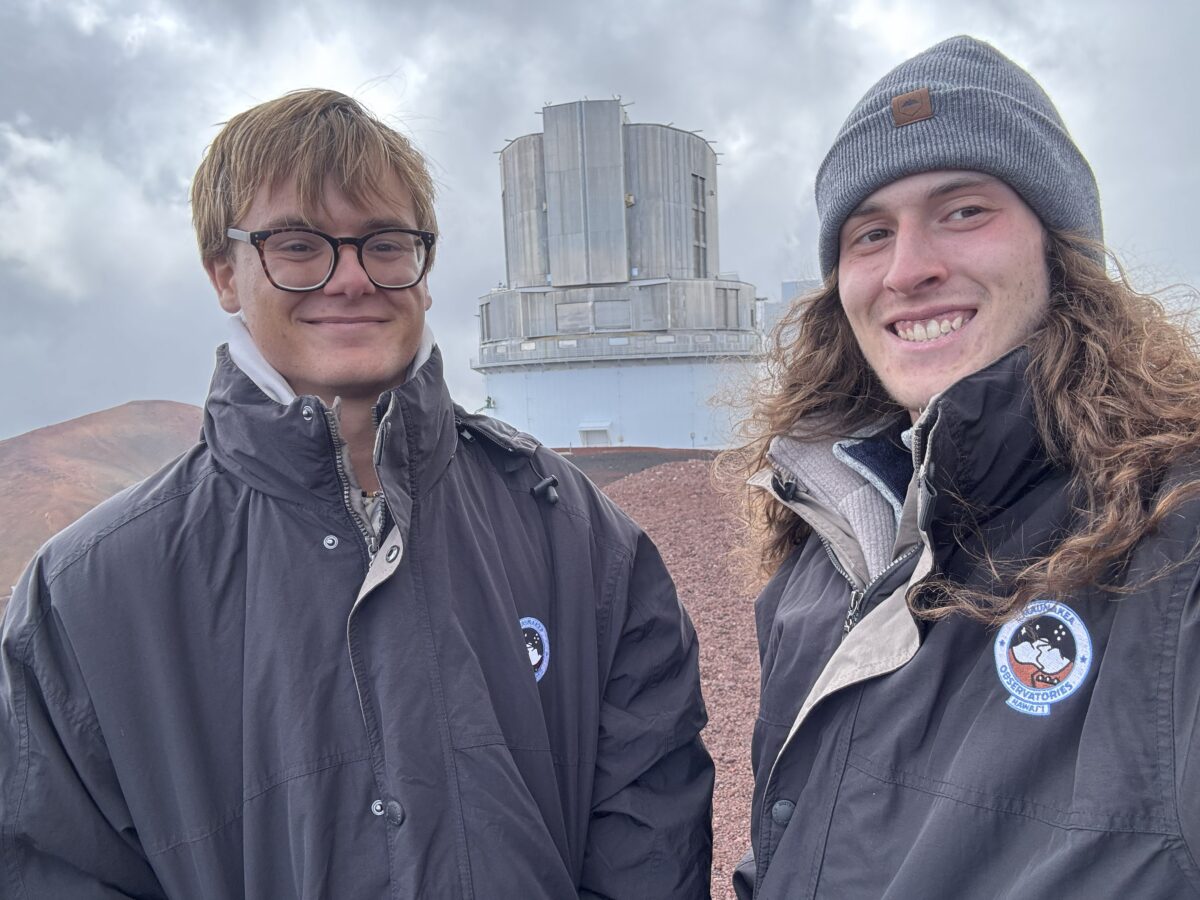
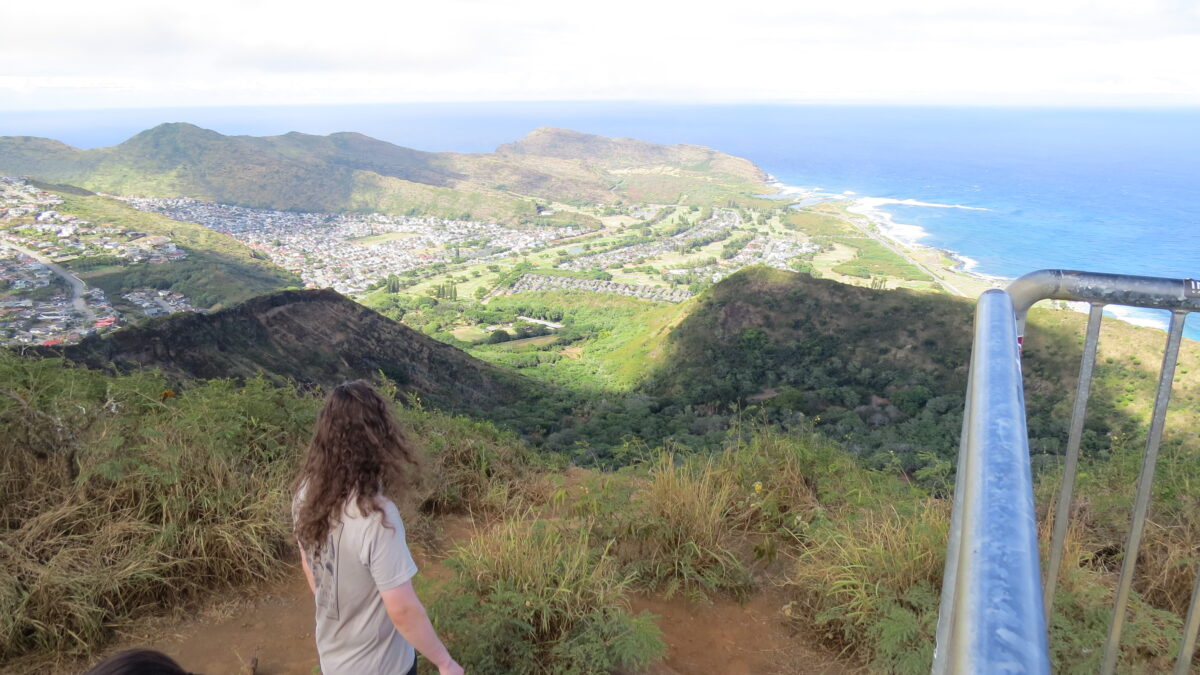 Left: Noah Reichardt (right) and Hyde Kenney, fellow intern from the University of Florida, in front of the Subaru Telescope atop Mauna Kea. Right: Reichardt looks out at Koko Head crater and the Oahu coastline after a group hike to the summit of Koko Head. (Courtesy of Reichardt)
Robbins and Reichardt’s research projects looked at active galactic nuclei (AGN)—a small subset of supermassive black holes that are actively growing by gobbling up matter from their surroundings. To explore these rare cosmic entities, Reichardt and Robbins used fresh data from the James Webb Space Telescope and the Subaru Telescope, located near the summit of Mauna Kea, a dormant volcano in Hawai‘i.
Reichardt, a junior physics major, examined images of 352 active galactic nuclei, hunting for streams of gas and dust that can indicate past or ongoing galaxy collisions. Studying these streams can help explain how black holes and their host galaxies interact. Robbins took a different approach, analyzing 350 spectra—observations of the wavelengths of light coming from supermassive black holes—to measure the masses of 140 AGN. Together, their work paints a richer picture of how these cosmic giants evolve.
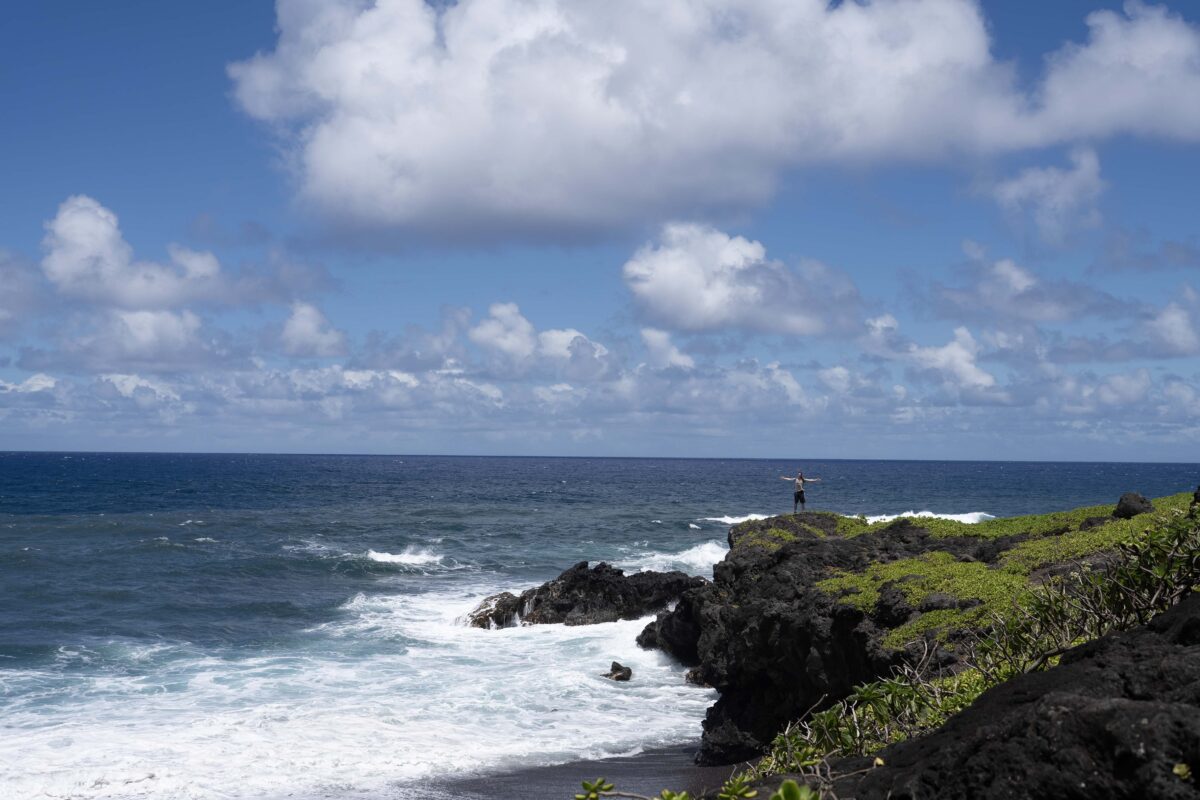 Reichardt stands on a rocky outcrop at Kūloa Point in Haleakalā National Park on Maui. (Photo by Morgan Robbins)
Expanding horizons
But the science was only part of the story. Both Reichardt and Robbins stepped into new territory as researchers, growing their skills and becoming more independent. Through writing his first scientific paper, Reichardt is learning how researchers take piles of raw data and turn them into a polished manuscript. Authoring a scientific paper as an undergraduate is already rare, but Reichardt will be listed as first author, indicating his leadership in the work. He also designed his first research poster and presented it to graduate students, faculty, and staff at the IfA. The experience deepened his interest in galaxy structure and affirmed his future plans.
“I always wanted to go to graduate school for physics or astronomy, but this summer experience further cemented the idea,” Reichardt says. “After spending over two months at the IfA and learning more about the graduate program, it’s become one of my top choices.”
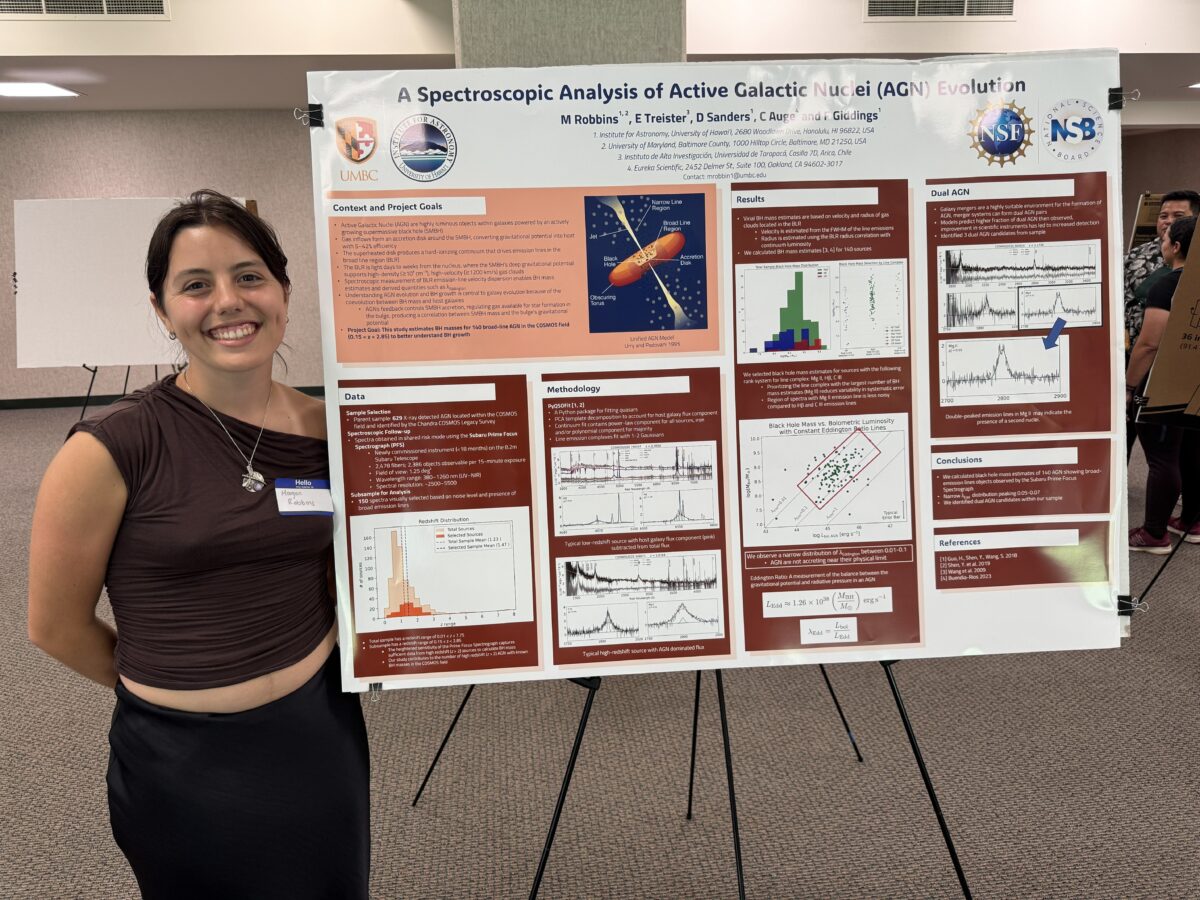
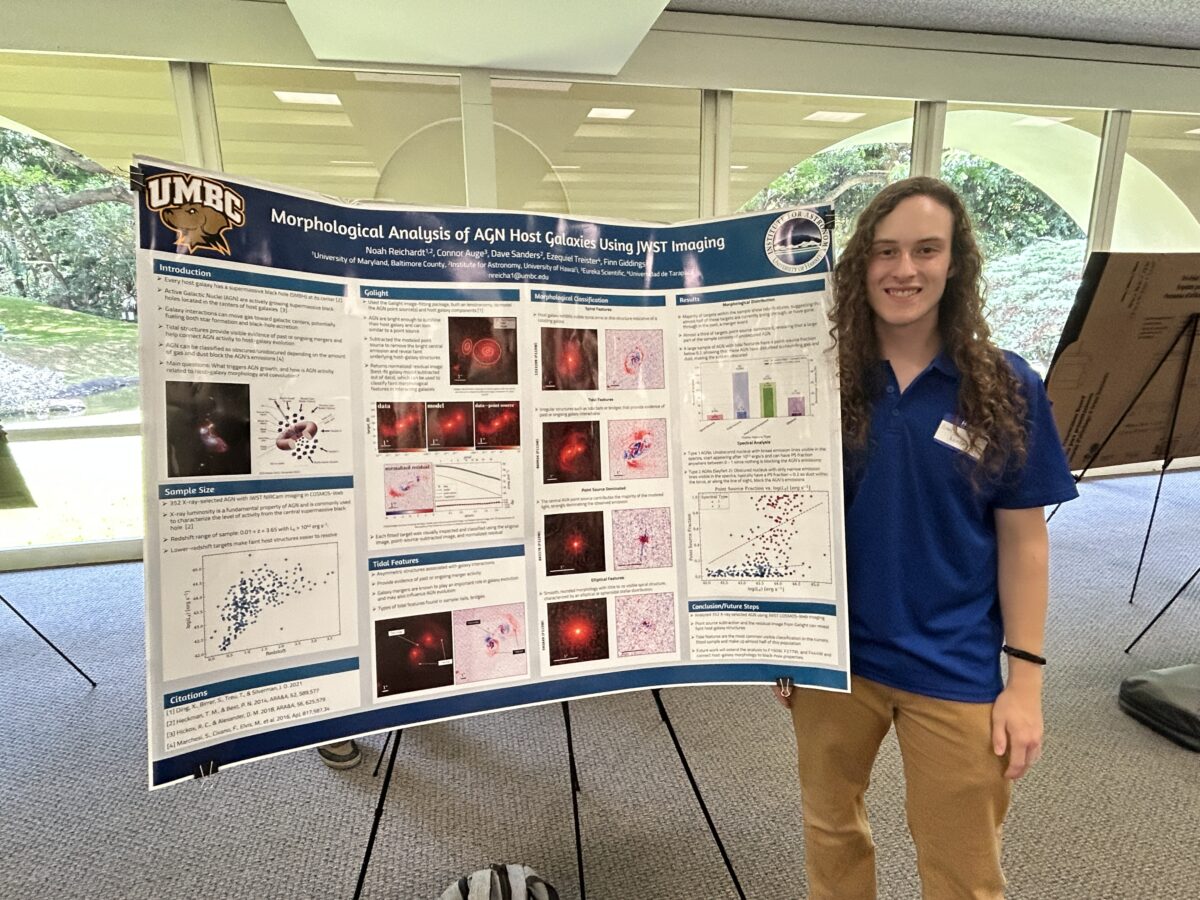 Morgan Robbins (left) and Noah Reichardt (right) present their summer research at the SURE Symposium for the Undergraduate Research Opportunities Program at the University of Hawai‘i Mānoa. (Courtesy of Robbins and Reichardt)
Robbins, a junior computer science major, arrived with strong coding skills but almost no formal astronomy background. By the end of the summer, she had analyzed hundreds of spectra, built tools to organize complex data, created her first science poster, given her first research talk, and started writing her first paper. “Both my scientific and professional experience greatly expanded this summer under the guidance of my mentors, and I am excited to continue working with them,” Robbins says.
“Conducting research at the Institute for Astronomy has opened a potential new career path for me,” Robbins adds. In her remaining time at UMBC, she plans to keep doing astronomy research that capitalizes on her computer science savvy, and she is seriously considering graduate school and a future in academia.


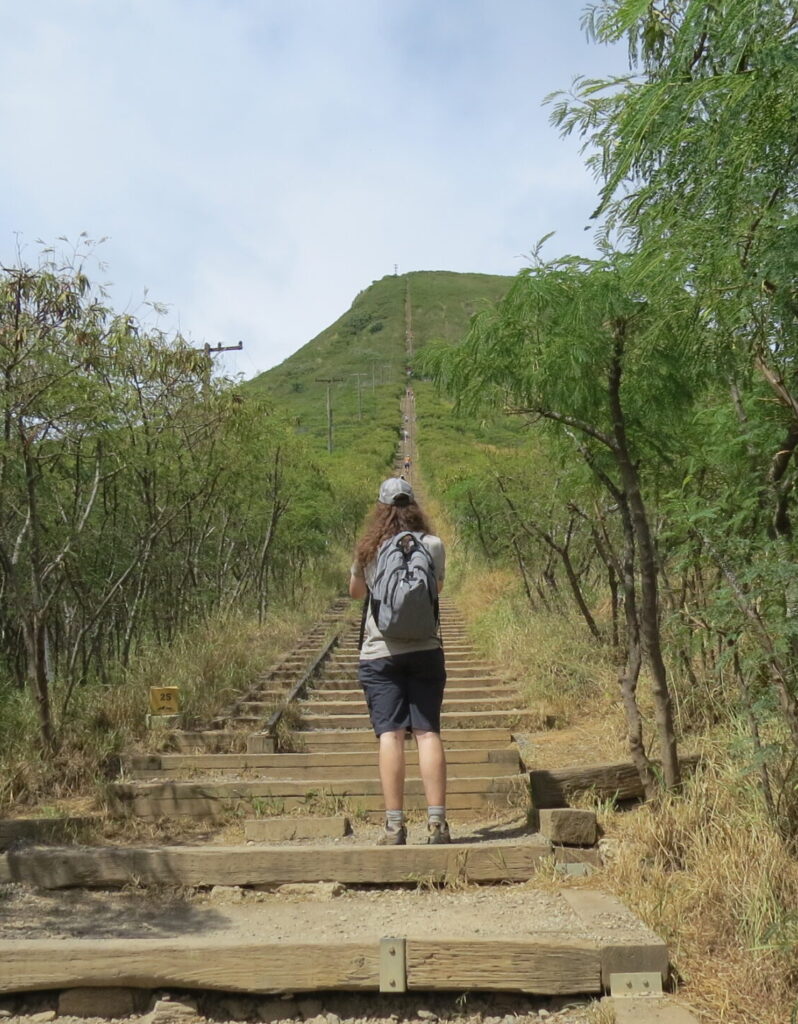 Left: Lulumahu Falls. (Photo by Morgan Robbins) Center: Robbins taking photos in the Nāhuku Lava Tube at Hawaiʻi Volcanoes National Park. (Photo by Noah Reichardt) Right: Reichardt sizes up the climb to Koko Head. (Photo by Robbins)
Growth and inspiration in Hawai’i
Outside the lab, the summer program immersed students in Hawaiian culture and history. Robbins and Reichardt helped maintain taro patches in a loʻi, a traditional type of terraced agriculture. They learned about native plant conservation and hiked in Hawaiʻi Volcanoes National Park. Reichardt’s favorite activity was a challenging hike along the Koʻolau Ridge, a steep mountain range on O‘ahu. Robbins enjoyed learning about traditional Polynesian wayfinding, which relies on natural signs like the stars, at the ‘Imiloa Astronomy Center. “Wayfinding is an incredibly complex art,” Robbins notes, one that was nearly lost and is now being carefully preserved and shared by groups like the Polynesian Voyaging Society. They also experienced sunset followed by stargazing under the Milky Way at the summit of Haleakalā on the Fourth of July.
 The group of interns takes in sunset atop Haleakalā on the Fourth of July. (Courtesy of Robbins and Reichardt)
 The Milky Way as the interns saw it from the summit of Haleakalā (Photo by Dan Chen)
Both students also built lasting connections. They worked closely with Sanders at IfA; Connor Auge, a postdoctoral research scientist at Eureka Scientific; and Ezequiel Treister, a principal investigator at the Institute for Astronomy of the Pontifical Catholic University of Chile. Robbins and Reichardt joined group meetings with scientists from institutions across the country, including the Space Telescope Science Institute in Baltimore. They also formed relationship with peers. “I made friends with students all over the U.S. and made a lot of great memories from the activities and trips we took,” Reichardt says. Robbins added that she hopes to keep those personal and professional ties for years to come.
When Reichardt and Robbins returned to campus for the fall semester and shared their experiences with Foord, with whom the two conduct research at UMBC, she was elated: “This is exactly the kind of growth and inspiration that I hoped to support with the grant.”
“I’m very grateful for the opportunity to conduct research at the IfA this summer,” Reichardt reflects. “It was an amazing experience.”
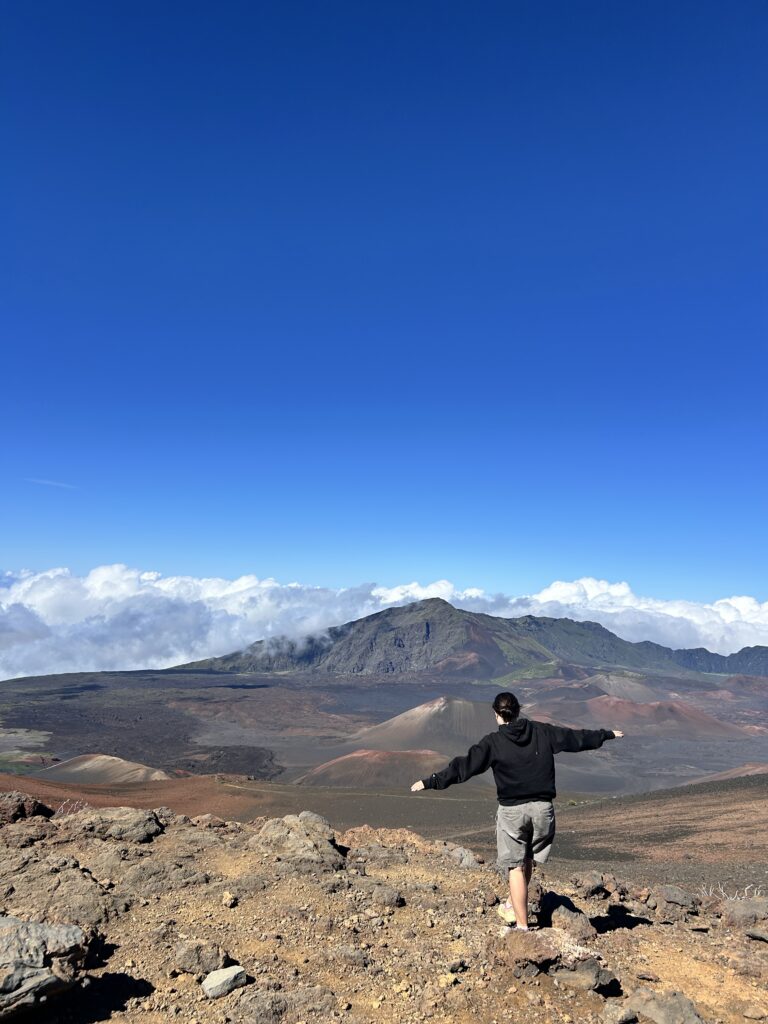

 Left: Robbins balances at a scenic overlook along the Keoneheʻeheʻe (Sliding Sands) Trail at Haleakalā National Park. (Photo by Noah Reichardt) Center: A rowing team practices during sunrise at Lanikai Beach on Oahu. (Photo by Morgan Robbins) Right: Reichardt hikes along the Kūloa Point trail in Maui. (Photo by Morgan Robbins)
]]>
UMBC undergraduate students Noah Reichardt and Morgan Robbins spent this summer in Hawai‘i at one of the world’s top astronomy institutes, studying supermassive black holes and colliding galaxies,...
https://umbc.edu/stories/hawaii-internship-black-holes/
https://my3.my.umbc.edu/api/v0/pixel/news/162452/guest@my.umbc.edu/4bc5359b54fff3a0f1f58e8e5b49a68d/api/pixel
cnms
physics
research
science-and-tech
stories
story
undergraduate-research
UMBC News & Magazine
https://my3.my.umbc.edu/groups/umbc-news-magazine
https://assets1-my.umbc.edu/system/shared/avatars/groups/000/001/943/24435aa6207c452e7bc15cc74b42c7bb/xsmall.png?1748556657
https://assets1-my.umbc.edu/system/shared/avatars/groups/000/001/943/24435aa6207c452e7bc15cc74b42c7bb/original.png?1748556657
https://assets2-my.umbc.edu/system/shared/avatars/groups/000/001/943/24435aa6207c452e7bc15cc74b42c7bb/xxlarge.png?1748556657
https://assets2-my.umbc.edu/system/shared/avatars/groups/000/001/943/24435aa6207c452e7bc15cc74b42c7bb/xlarge.png?1748556657
https://assets3-my.umbc.edu/system/shared/avatars/groups/000/001/943/24435aa6207c452e7bc15cc74b42c7bb/large.png?1748556657
https://assets1-my.umbc.edu/system/shared/avatars/groups/000/001/943/24435aa6207c452e7bc15cc74b42c7bb/medium.png?1748556657
https://assets2-my.umbc.edu/system/shared/avatars/groups/000/001/943/24435aa6207c452e7bc15cc74b42c7bb/small.png?1748556657
https://assets1-my.umbc.edu/system/shared/avatars/groups/000/001/943/24435aa6207c452e7bc15cc74b42c7bb/xsmall.png?1748556657
https://assets2-my.umbc.edu/system/shared/avatars/groups/000/001/943/24435aa6207c452e7bc15cc74b42c7bb/xxsmall.png?1748556657
UMBC News & Magazine
1
0
false
Fri, 04 Sep 2026 14:21:51 -0400
Beyond the visa: UMBC supports its global community through trainings and human connections
Left: Robbins balances at a scenic overlook along the Keoneheʻeheʻe (Sliding Sands) Trail at Haleakalā National Park. (Photo by Noah Reichardt) Center: A rowing team practices during sunrise at Lanikai Beach on Oahu. (Photo by Morgan Robbins) Right: Reichardt hikes along the Kūloa Point trail in Maui. (Photo by Morgan Robbins)
]]>
UMBC undergraduate students Noah Reichardt and Morgan Robbins spent this summer in Hawai‘i at one of the world’s top astronomy institutes, studying supermassive black holes and colliding galaxies,...
https://umbc.edu/stories/hawaii-internship-black-holes/
https://my3.my.umbc.edu/api/v0/pixel/news/162452/guest@my.umbc.edu/4bc5359b54fff3a0f1f58e8e5b49a68d/api/pixel
cnms
physics
research
science-and-tech
stories
story
undergraduate-research
UMBC News & Magazine
https://my3.my.umbc.edu/groups/umbc-news-magazine
https://assets1-my.umbc.edu/system/shared/avatars/groups/000/001/943/24435aa6207c452e7bc15cc74b42c7bb/xsmall.png?1748556657
https://assets1-my.umbc.edu/system/shared/avatars/groups/000/001/943/24435aa6207c452e7bc15cc74b42c7bb/original.png?1748556657
https://assets2-my.umbc.edu/system/shared/avatars/groups/000/001/943/24435aa6207c452e7bc15cc74b42c7bb/xxlarge.png?1748556657
https://assets2-my.umbc.edu/system/shared/avatars/groups/000/001/943/24435aa6207c452e7bc15cc74b42c7bb/xlarge.png?1748556657
https://assets3-my.umbc.edu/system/shared/avatars/groups/000/001/943/24435aa6207c452e7bc15cc74b42c7bb/large.png?1748556657
https://assets1-my.umbc.edu/system/shared/avatars/groups/000/001/943/24435aa6207c452e7bc15cc74b42c7bb/medium.png?1748556657
https://assets2-my.umbc.edu/system/shared/avatars/groups/000/001/943/24435aa6207c452e7bc15cc74b42c7bb/small.png?1748556657
https://assets1-my.umbc.edu/system/shared/avatars/groups/000/001/943/24435aa6207c452e7bc15cc74b42c7bb/xsmall.png?1748556657
https://assets2-my.umbc.edu/system/shared/avatars/groups/000/001/943/24435aa6207c452e7bc15cc74b42c7bb/xxsmall.png?1748556657
UMBC News & Magazine
1
0
false
Fri, 04 Sep 2026 14:21:51 -0400
Beyond the visa: UMBC supports its global community through trainings and human connections
The world researches, teaches, and learns at UMBC thanks to international student and scholar visas. With hundreds of international faculty and staff, our international Retriever family thrives because of the community and the infrastructure that supports their journey. Diane Zeenny Ghorayeb ’20, modern languages, linguistics, and intercultural communication, M.A. ’22, intercultural communication, UMBC’s international scholar senior coordinator, ensures this important and complex process is handled with care, accuracy, and a people-first mindset.
Zeenny Ghorayeb developed that people-first mindset long before she became a Retriever. She was born in Beirut, Lebanon, and lived in Paris, France, for more than 20 years before moving to the United States in 2006. This sparked a curiosity for world cultures and how people adapt when they move to a new country. It also instilled an understanding of what it takes to create a welcoming and compassionate community, inspiring her to combine her experience as a global citizen with her classroom knowledge to design two trainings: a cross-cultural communication training in 2021 and immigration training in 2024.
“My role and trainings are the first of their kind at UMBC. They align with the university’s investment in a globally engaged campus community by providing resources to support the international Retriever experience, be that as employers, teachers, or classmates,” says Zeenny Ghorayeb. She translates complicated requirements for UMBC-sponsored visa categories into practical guidance to help UMBC remain compliant. “It is rewarding seeing people develop new skills and a deeper understanding while also connecting with me and each other,” says Zeenny Ghorayeb, who has been at UMBC for 10 years. “Some of my friends have gone through the trainings, which has made us even closer.”
Immigration process made clear
With constant regulation changes, Zeenny Ghorayeb has adapted her immigration training and taken it on the road to faculty and leadership meetings. More than 350 people have received the training, creating a more informed university on the complexities of working and studying in the U.S.
The trainings teach faculty and staff responsible for managing international employees and students how to initiate visa applications and maintain compliance with J-1 researcher visas, H-1B employee visas, and, in liaison with UMBC’s outside immigration counsel, the United States permanent residency process. As regulations shifted, Zeenny Ghorayeb added sessions for specialized audiences, including human resources staff, leadership, and 30-minute crash courses for new leaders to help them navigate the latest immigration-related requirements and policy changes.
“In this year’s immigration training day,” said Zeenny Ghorayeb, “the audience expanded to include shared services and financial services because they were interested in all the sessions, especially the human resources/payroll session.”
Once a visa petition has been approved by United States Citizenship and Immigration Services (USCIS), the Office of International Students and Scholars (OISS)—the team Zeenny Ghorayeb is a part of—advises UMBC’s international students and scholars on navigating the visa process and maintaining valid immigration status. Immigration advising involves status maintenance, compliance, employment authorization, sponsorship, changing regulations, and individualized case analysis.
However, navigating visa regulations is only one part of welcoming global scholars and students. Faculty, staff, and students must also invest in their interpersonal skills to foster engaging and supportive cross-cultural relationships.
Communicating effectively
Before Zeenny Ghorayeb launched her immigration trainings, she was already a familiar face across campus and the University System of Maryland (USM) as an intercultural communication trainer. The workshops—designed to prepare teams to communicate more effectively across cultural differences—started as a project for one of her master’s classes. It was so well received that she refined it and became a freelance intercultural communications trainer. Since 2021, Zeenny Ghorayeb has partnered with departments across UMBC and throughout USM, equipping them with practical tools and strategies needed to sustain and develop an international workforce and learning environment.
“Cultural differences can create misunderstandings and affect how people interpret each other. When people understand these differences, they become more accepting and better able to work together,” says Zeenny Ghorayeb. “It has been rewarding to see UMBC embrace the processes and interpersonal skills that define a welcoming international R1 institution. What is most important is building collaboration across campus.”
Learn more about UMBC’s Office of International Students and Scholars.
]]>
The world researches, teaches, and learns at UMBC thanks to international student and scholar visas. With hundreds of international faculty and staff, our international Retriever family thrives...
https://umbc.edu/stories/visas-supporting-umbcs-international-community/
Video Preview
https://assets2-my.umbc.edu/system/shared/attachments/e6761cc99cc1be24a8472fe049998400/6a9cb9a2/news/000/162/409/8d806bbec8ab9ba5235e121c05e3154a/rjc_DrlqDFM.jpg?1788475807
https://my3.my.umbc.edu/api/v0/pixel/news/162409/guest@my.umbc.edu/894dfa3381f6b3ca0fcb1a4937baca04/api/pixel
cahss
center-for-global-engagement
cnms
coeit
community
international
stories
story
UMBC News & Magazine
https://my3.my.umbc.edu/groups/umbc-news-magazine
https://assets1-my.umbc.edu/system/shared/avatars/groups/000/001/943/24435aa6207c452e7bc15cc74b42c7bb/xsmall.png?1748556657
https://assets1-my.umbc.edu/system/shared/avatars/groups/000/001/943/24435aa6207c452e7bc15cc74b42c7bb/original.png?1748556657
https://assets2-my.umbc.edu/system/shared/avatars/groups/000/001/943/24435aa6207c452e7bc15cc74b42c7bb/xxlarge.png?1748556657
https://assets2-my.umbc.edu/system/shared/avatars/groups/000/001/943/24435aa6207c452e7bc15cc74b42c7bb/xlarge.png?1748556657
https://assets3-my.umbc.edu/system/shared/avatars/groups/000/001/943/24435aa6207c452e7bc15cc74b42c7bb/large.png?1748556657
https://assets1-my.umbc.edu/system/shared/avatars/groups/000/001/943/24435aa6207c452e7bc15cc74b42c7bb/medium.png?1748556657
https://assets2-my.umbc.edu/system/shared/avatars/groups/000/001/943/24435aa6207c452e7bc15cc74b42c7bb/small.png?1748556657
https://assets1-my.umbc.edu/system/shared/avatars/groups/000/001/943/24435aa6207c452e7bc15cc74b42c7bb/xsmall.png?1748556657
https://assets2-my.umbc.edu/system/shared/avatars/groups/000/001/943/24435aa6207c452e7bc15cc74b42c7bb/xxsmall.png?1748556657
UMBC News & Magazine
0
0
false
Thu, 03 Sep 2026 18:35:46 -0400
Thu, 03 Sep 2026 18:35:46 -0400
Calling our better angels: Computing for Social Good Award launched by alumnus Akshay Java at Google honors work prioritizing people’s well-being
 Akshay Java (Photo courtesy of Java)
Akshay Java, M.S. ’03, Ph.D. ’08, computer science, is a seasoned technology leader whose career spans key roles across the tech industry, including research at Microsoft, co-founding a successful start-up, and leading critical user protection efforts at Google. In his roles at Google across Egregious Harms Protections and Responsibility AI Engineering, he works daily on the front lines of digital safety, addressing both the serious risks and the transformative potential of modern computing technology.
“Technology by itself is not necessarily good or bad, what matters is how we choose to use it,” Java says. “But AI is moving so quickly now—community and technical leaders need to be engaged, making sure the good use cases can be advanced rapidly while preventing the bad from happening.”
It was in this spirit that Java made a generous donation to UMBC to launch the Computing for Social Good Award, to be given annually to one or more students in the College of Engineering and Information Technology (COEIT) who have conducted substantial research with the goal of harnessing technology to make positive social change. The awards are funded by an endowment, which is open to contributions from the community. In May of this year, two students—Rishav Gupta, a Ph.D. student in computer science, and ASM Mobarak Hossain, M.S. ’26, information systems—received the inaugural awards for their work in affordable health monitoring and wheelchair accessibility, respectively.
“We are tremendously grateful to Akshay Java for establishing the Computing for Social Good Award in COEIT,” says Dean Jeanne van Briesen. “His commitment to supporting research that combines technical excellence with meaningful societal impact reflects values that are central to our college. This award celebrates the creativity and dedication of our student researchers and reinforces our belief that engineering and computing can be powerful forces for positive change.”
Monitoring cardiovascular health and improving wheelchair accessibility
Both recipients of the 2026 awards talked about how meaningful it was to them to apply their technical expertise to work that aims to improve people’s lives.
Gupta is working in the lab of his advisor Dong Li on tools to make blood pressure monitoring affordable and accessible using only a commodity smartphone. Hossain worked on a project with advisor Md Osman Gani to develop MyPath, a Google Maps–style app that uses AI, remote sensing measurements, and crowd-sourced data to guide wheelchair users to accessible routes.
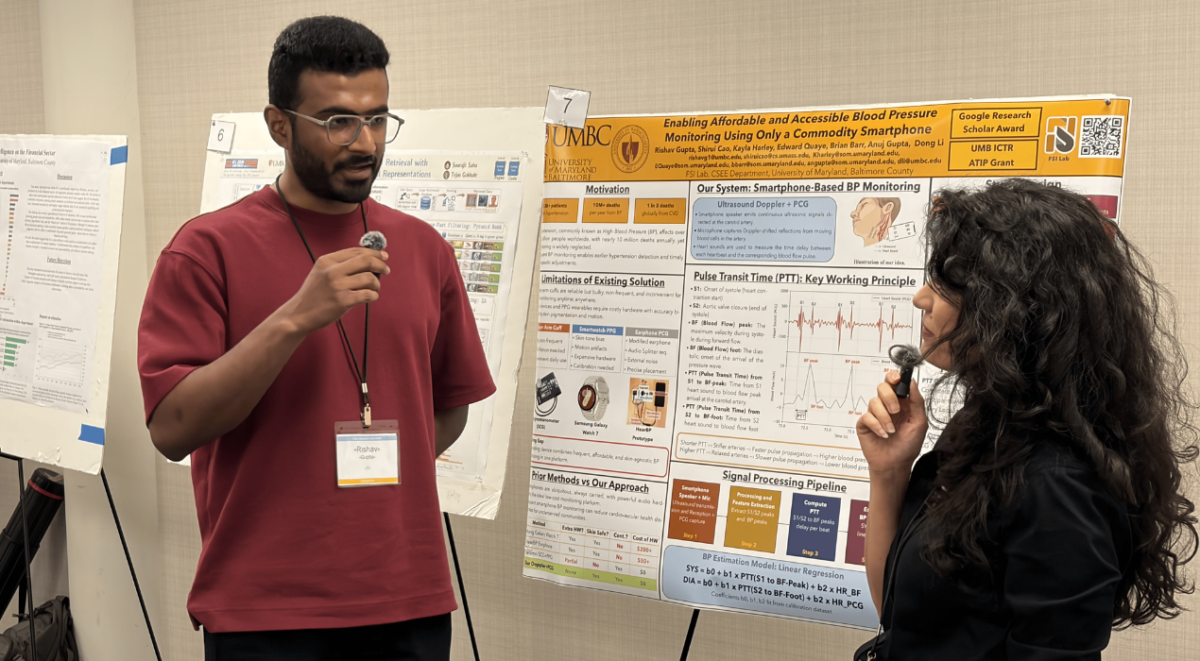 Ph.D. student Rishav Gupta presents at UMBC COEIT Research Day 2026 in front of his poster, “Enabling Affordable and Accessible Blood Pressure Monitoring Using Only a Commodity Smartphone.” (Photo courtesy of Gupta)
“Receiving the COEIT Computing for Social Good Award felt meaningful in a way I didn’t expect,” Gupta says. “I came to UMBC from a career in industry because I wanted my work to matter beyond a product. Being recognized for the research’s social impact felt like confirmation that I’d chosen the right path.”
“Developing MyPath required countless hours of hard work, continuous refinement, and a deep commitment to addressing a meaningful community need,” Hossain says. “Seeing that work recognized by COEIT was incredibly exciting and humbling—it gave me a strong sense of pride in what we’ve built and renewed enthusiasm for creating tools that deliver genuine social value.”
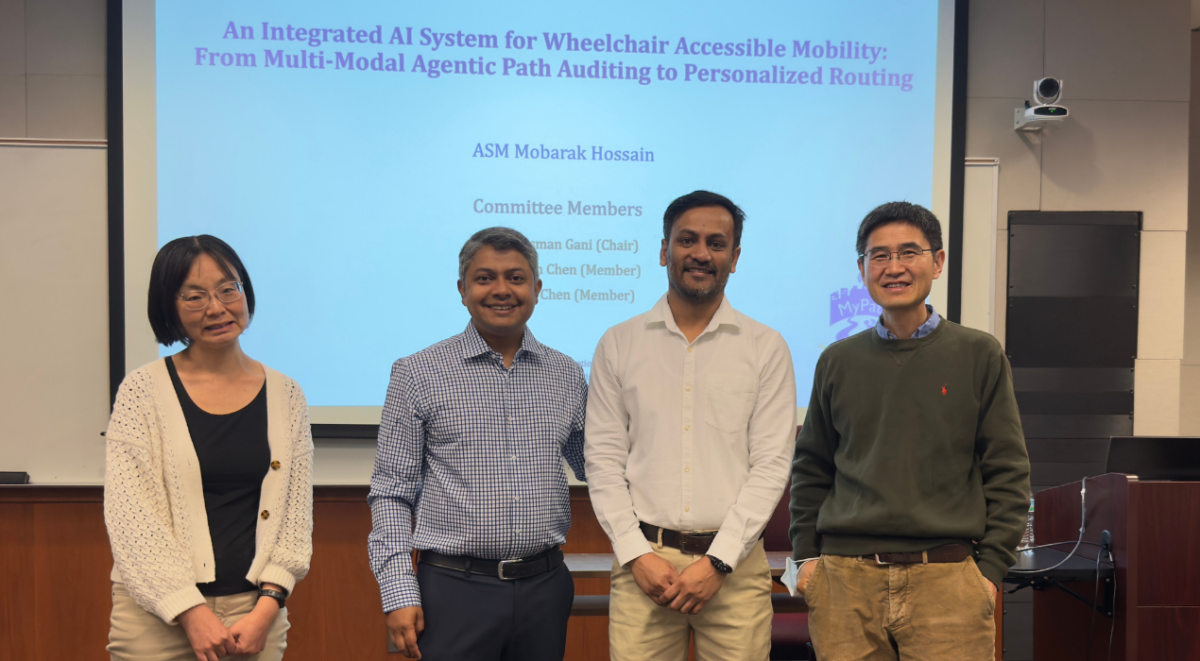 Hossain after his master’s thesis defense at UMBC. From left to right: Karen Chen, Md Osman Gani, Hossain, and Zhiuyan Chen. (Photo courtesy of Hossain)
Seeing the students and the work they are doing has been the most meaningful part of the award process, Java says. “I’m so proud of the students for what they’ve achieved. And I hope this award inspires more students to apply their skills in this space of social good.”
]]>
Akshay Java (Photo courtesy of Java) Akshay Java, M.S. ’03, Ph.D. ’08, computer science, is a seasoned technology leader whose career spans key roles across the tech industry, including...
https://umbc.edu/stories/computing-for-social-good-award/
https://my3.my.umbc.edu/api/v0/pixel/news/162247/guest@my.umbc.edu/b8c62600208724700159c05fd6f43321/api/pixel
alumni
coeit
csee
graduate-research
impact
is
research
science-and-tech
stories
story
UMBC News & Magazine
https://my3.my.umbc.edu/groups/umbc-news-magazine
https://assets1-my.umbc.edu/system/shared/avatars/groups/000/001/943/24435aa6207c452e7bc15cc74b42c7bb/xsmall.png?1748556657
https://assets1-my.umbc.edu/system/shared/avatars/groups/000/001/943/24435aa6207c452e7bc15cc74b42c7bb/original.png?1748556657
https://assets2-my.umbc.edu/system/shared/avatars/groups/000/001/943/24435aa6207c452e7bc15cc74b42c7bb/xxlarge.png?1748556657
https://assets2-my.umbc.edu/system/shared/avatars/groups/000/001/943/24435aa6207c452e7bc15cc74b42c7bb/xlarge.png?1748556657
https://assets3-my.umbc.edu/system/shared/avatars/groups/000/001/943/24435aa6207c452e7bc15cc74b42c7bb/large.png?1748556657
https://assets1-my.umbc.edu/system/shared/avatars/groups/000/001/943/24435aa6207c452e7bc15cc74b42c7bb/medium.png?1748556657
https://assets2-my.umbc.edu/system/shared/avatars/groups/000/001/943/24435aa6207c452e7bc15cc74b42c7bb/small.png?1748556657
https://assets1-my.umbc.edu/system/shared/avatars/groups/000/001/943/24435aa6207c452e7bc15cc74b42c7bb/xsmall.png?1748556657
https://assets2-my.umbc.edu/system/shared/avatars/groups/000/001/943/24435aa6207c452e7bc15cc74b42c7bb/xxsmall.png?1748556657
UMBC News & Magazine
0
0
false
Tue, 01 Sep 2026 11:32:45 -0400
Tue, 01 Sep 2026 11:32:45 -0400
“You belong here”—New and returning Retrievers are welcomed to campus for fall 2026
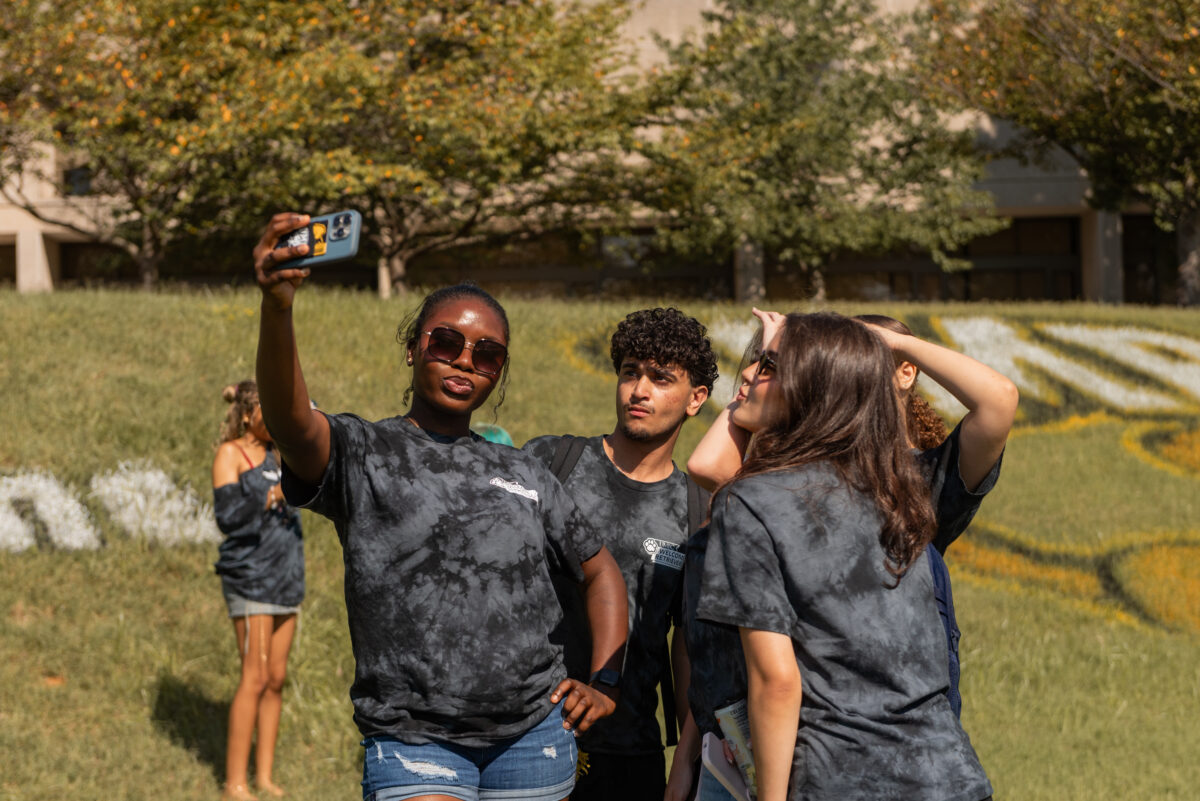
As fall 2026’s first full week of classes wrap up, Retrievers across campus—newly minted and returning—are finding their place. In addition to learning to navigate to the right classroom, they are bringing their unique strengths and voices to this ever evolving community.
This year’s incoming class of over 2,000 Retrievers boasts a median GPA of 4.0. Among them is Rodney Oglesby, an aspiring musician and a Gates Scholar. Oglesby was one of 750 students awarded this high honor among a pool of over 61,000 applicants nationwide.
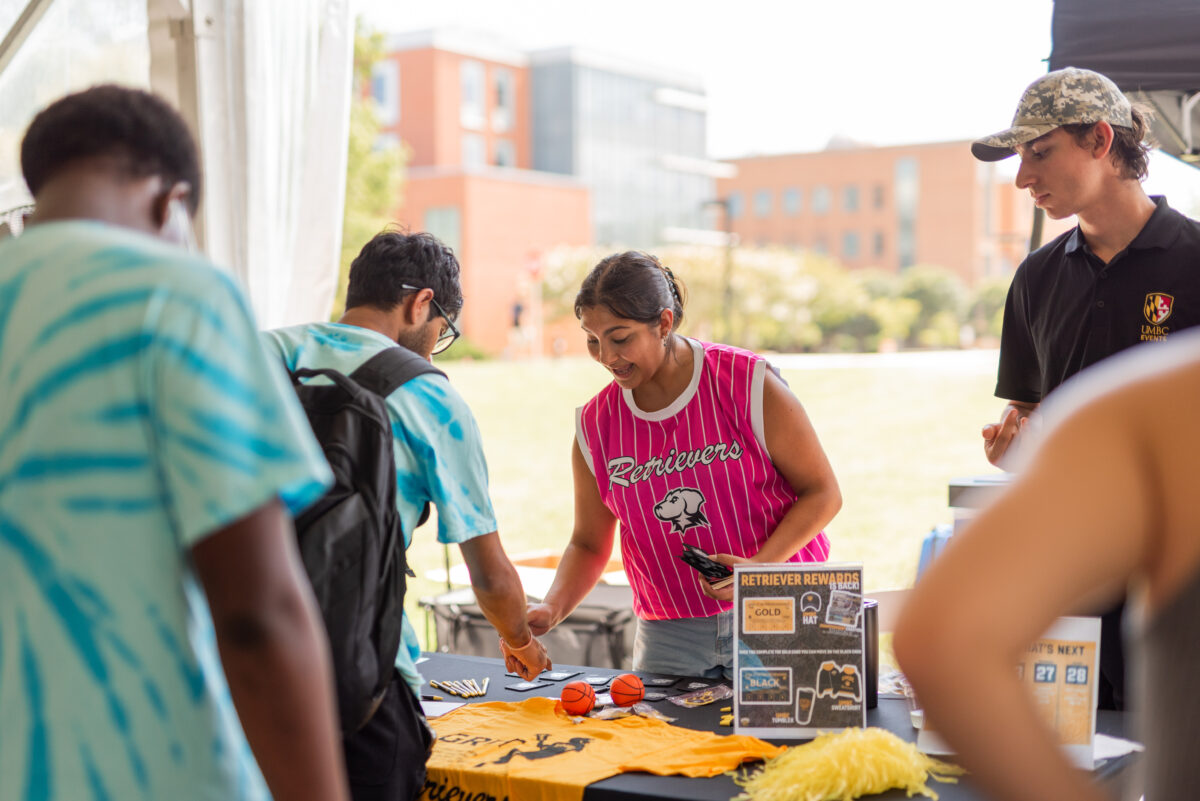
“We are thrilled to welcome another impressive entering undergraduate class, with a 15 percent increase in enrollment from Baltimore City, and, overall, students representing 42 countries,” says Dale Bittinger, M.P.P. ’16, assistant vice provost for strategic undergraduate engagement, partnerships, and pathways. “They are academically talented and engaged and we look forward to all they have to offer to our campus community.”
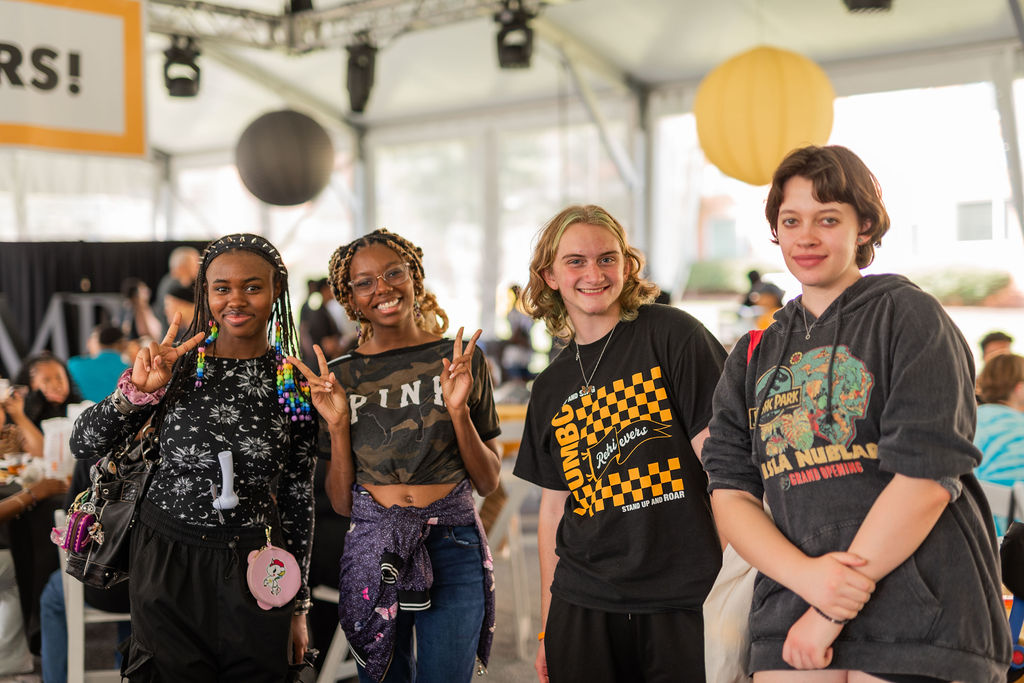
Joining Oglesby is Saad Bin Waqas, a new student who traveled nearly 7,000 miles from his home in Pakistan to address the UMBC community at this year’s Fall Opening Meeting. At just 16, this Sondheim Scholar and geography and environmental studies major is looking forward to planting some roots after growing up in a military family.
“After moving from place to place for much of my life, I am really excited to have a new place I can call home,” shared Waqas.
A place to flourish
Junior Sabirah Burt is joining UMBC as a transfer student from Howard Community College. Her aspirations to ultimately become a physician’s assistant are shaped by her own experience grappling with a medical condition. If you had asked Burt a few months ago to describe herself, she’d say “ticking time bomb.” In June 2025, she was rushed to the hospital for an agonizing headache. Medical professionals eventually discovered she had an active brain bleed and underwent emergency surgery.
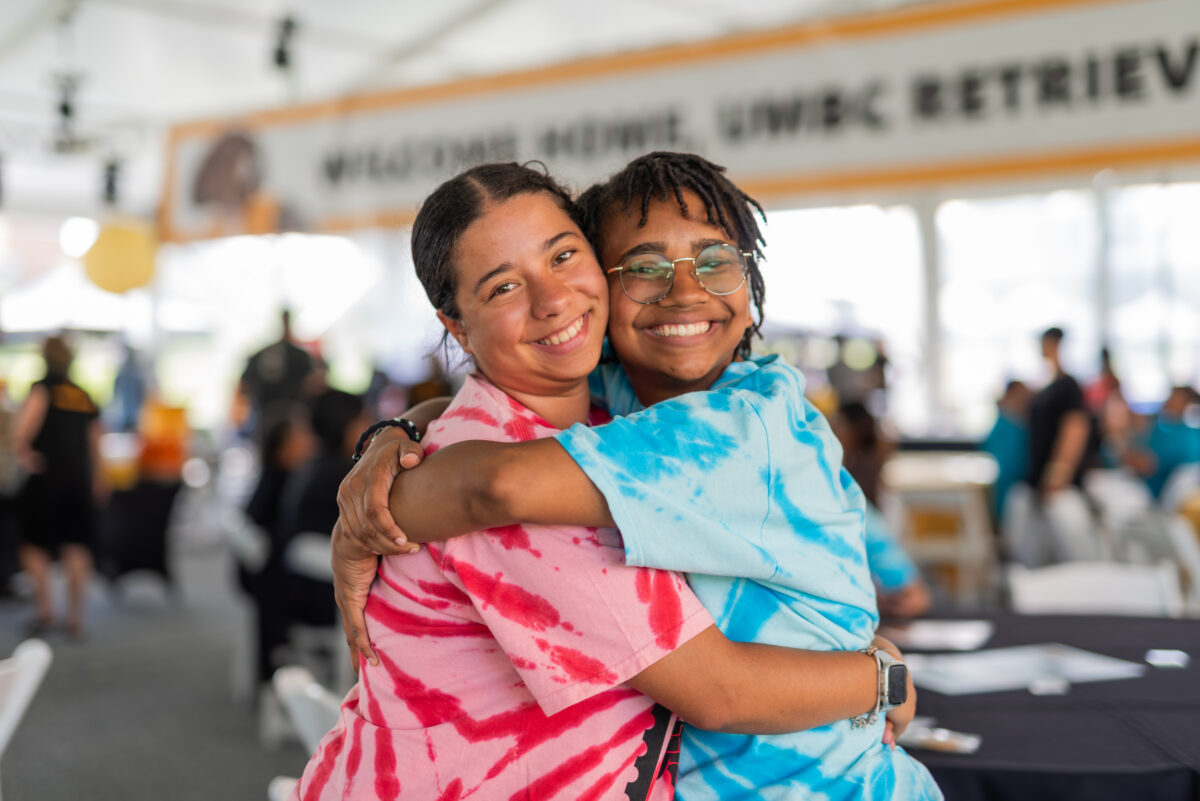
“I believe graduating with a public health degree from here will allow me to flourish when continuing my education and applying to graduate school in the future,” she said. “After going through my tough experiences last year, it’s made me even more passionate to pursue medicine, now more than ever before, and help those lying in hospitals wondering if it will be their last day.”
Strengthening connections—early
Some new Retrievers got a jump start to the year and arrived on campus over the summer to dive into work-integrated learning (WIL)—an educational approach that prepares students for a rewarding career after college by pairing what they are learning in the classroom with hands-on, authentic work experiences. In July, more than 100 incoming first-year and transfer students spent a night on campus, connected with an instructor and teaching assistant, and spent a day participating in service on site at five different community partner locations.
WIL students will participate in service with the same sites throughout their full first year at UMBC, deepening engagement and strengthening connection to their peers and faculty as well as to the campus and community.
“I believe a program like this is an excellent cohort building model. I was able to have individual conversations with all of them, learning what they cared about going into their unique UMBC journeys,” says Emily Passera, the senior program coordinator for community-engaged learning through The Shriver Center at UMBC, who led a group of students to Patterson Park in east Baltimore and will teach the same students in a first-year experience course called UNIV 101.
A community for all
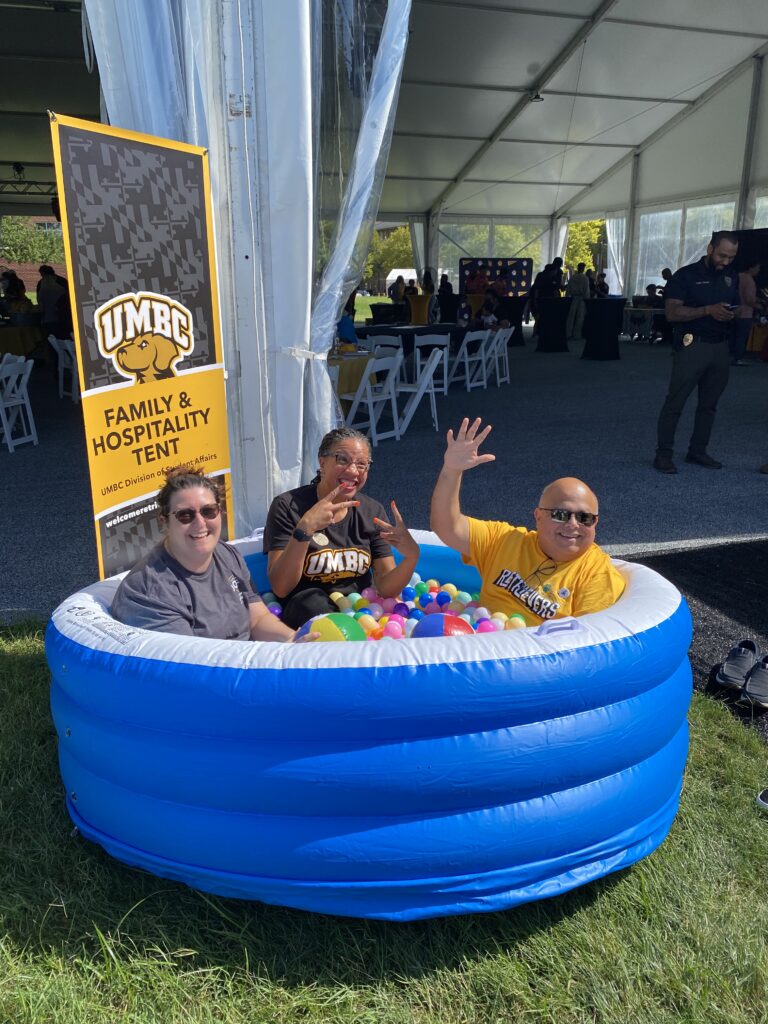 Diaz hangs out with Renique Kersh, vice president for student affairs (center), and Wendy Low, coordinator in the Division of Institutional Equity, in the hospitality tent’s ball pit. (Photo courtesy of Kait McCaffrey)
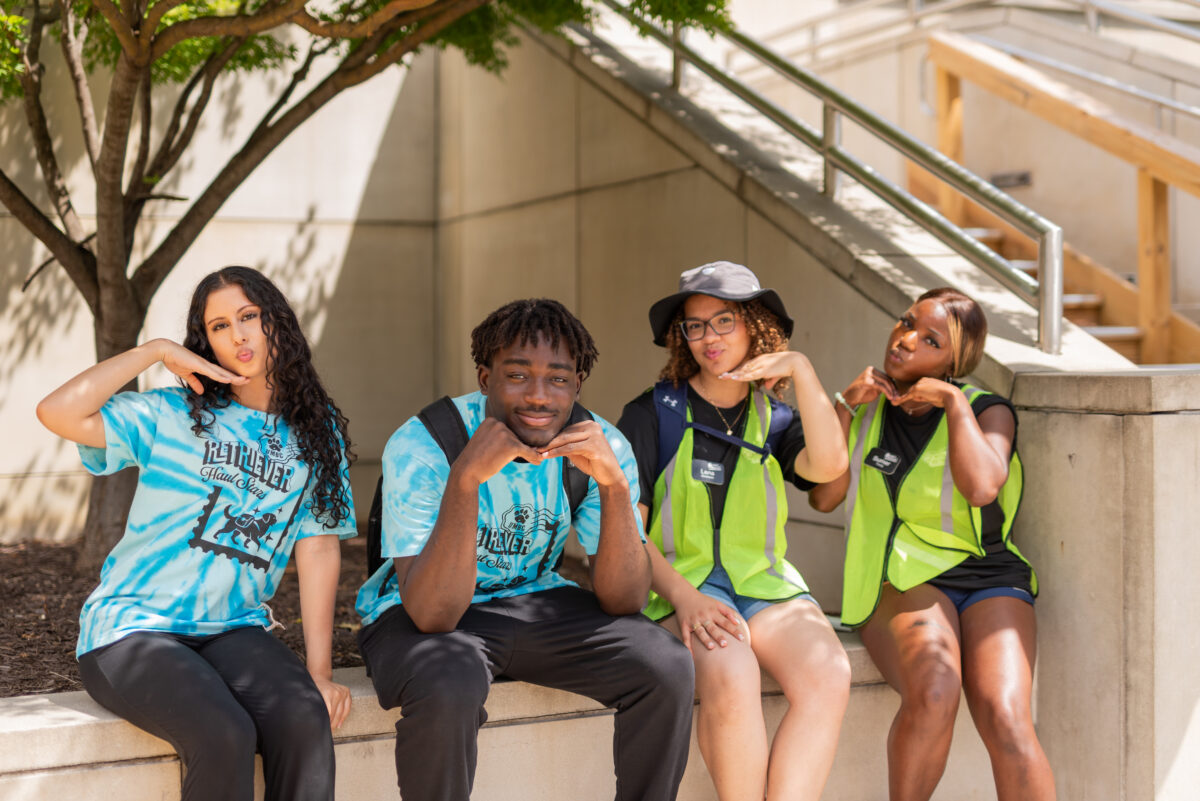
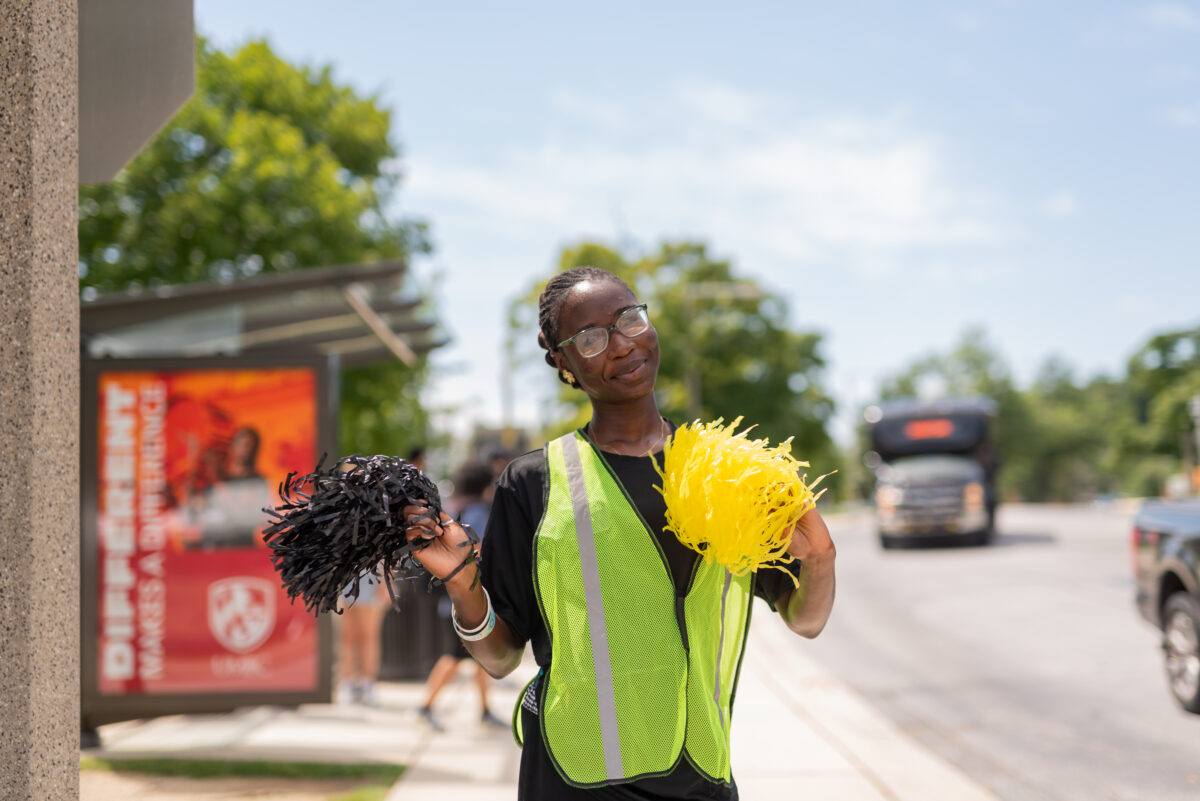
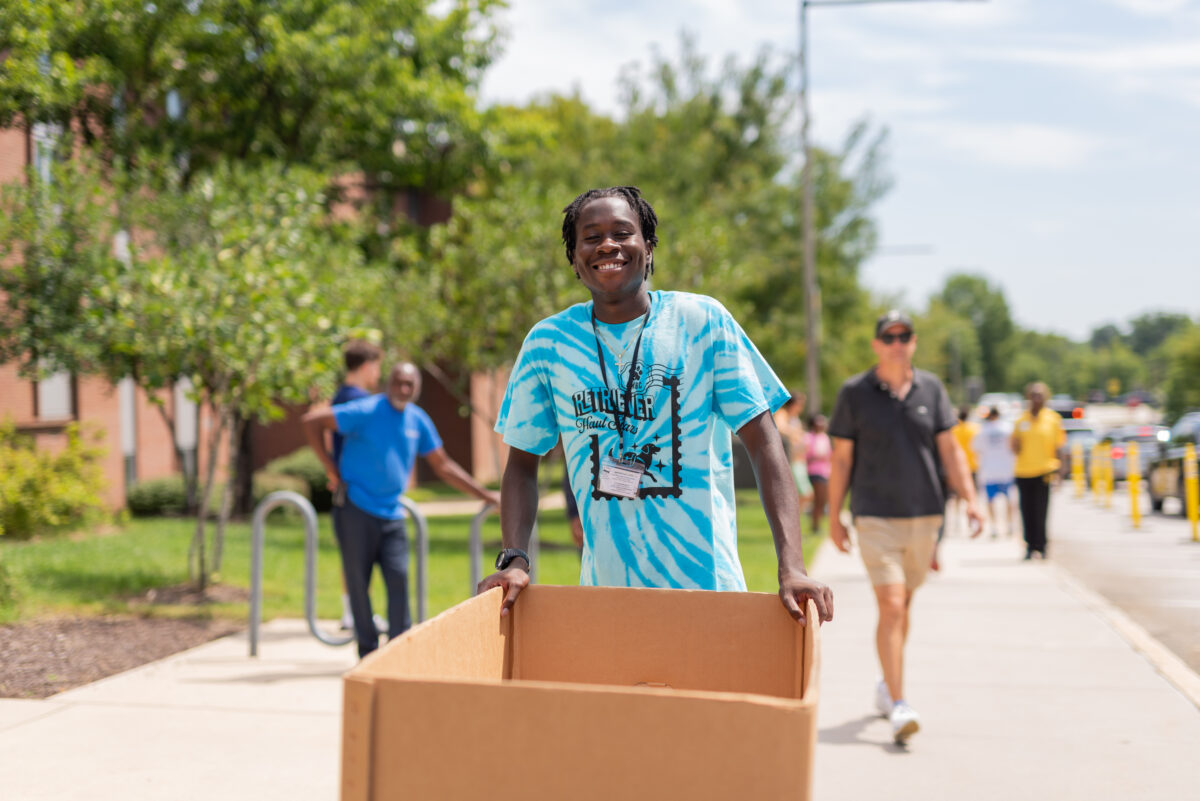
With a full lineup of events, this year’s Welcome, Retrievers efforts ensured that students started to find their place from the minute they stepped onto campus. Student volunteers (“Haul Stars”) were on hand to keep things moving as they helped new students with their belongings and offered directions.
Students weren’t the only ones getting in on the fun. Retriever Fest gave families the opportunity to meet with campus partners and learn more about everything UMBC has to offer—while enjoying refreshments and picking up some swag. Jake Diaz, inaugural assistant vice president and dean of students in the Division of Student Affairs, had a ball welcoming new students.
Throughout the weekend, students continued to enjoy Retriever 101 events, like First Night, an Student Events-Board-sponsored takeover of The Commons with inflatables, prizes, games, and plenty of other activities that cemented the first night as one students will remember for years to come.
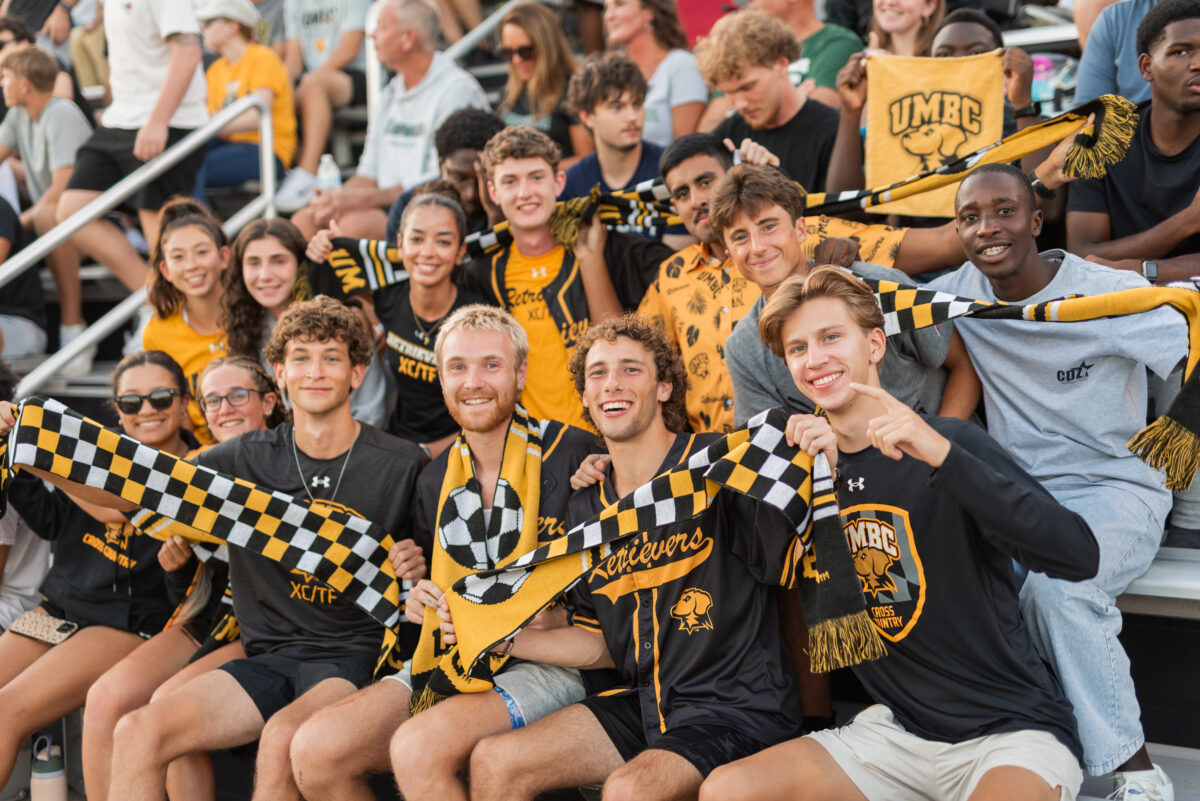
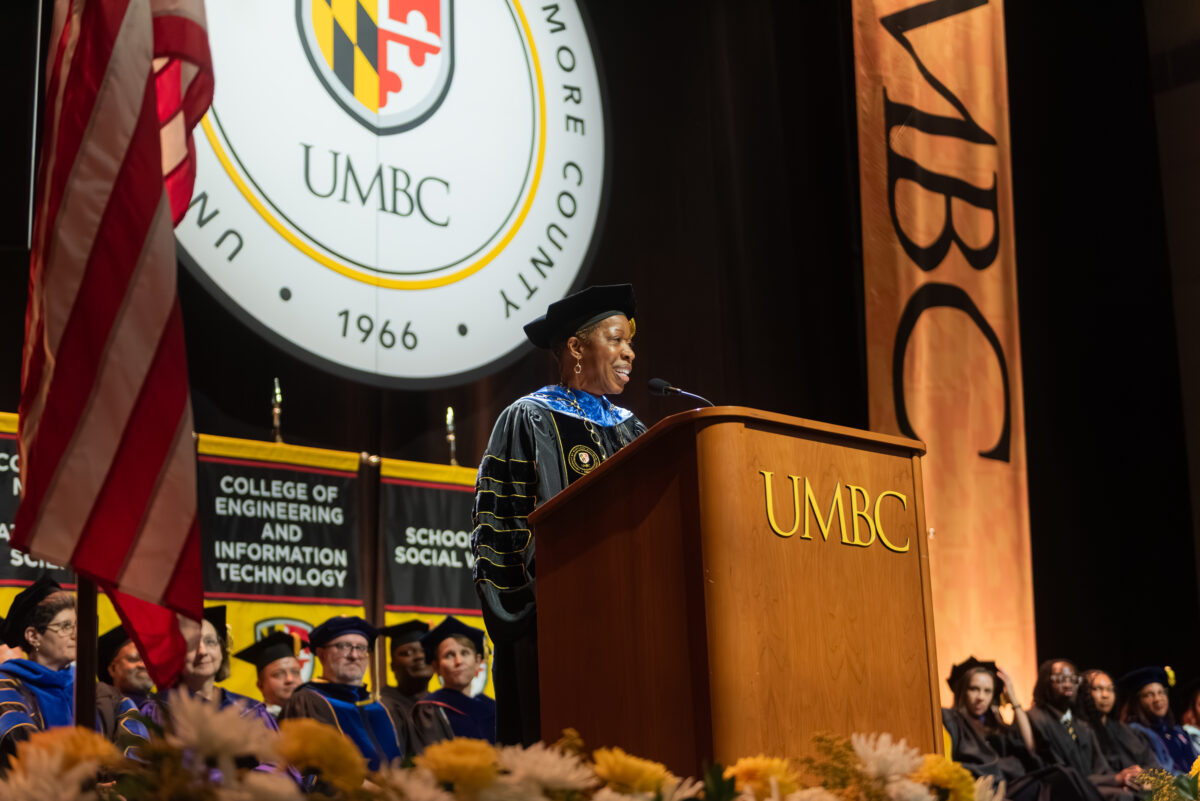
Events like the Taste of UMBC, Your Story Belongs Here, and the annual New Retriever Photo bonded students and filled their camera rolls. The first weekend concluded with Convocation, the official opening of the fall semester. President Valerie Sheares Ashby addressed the new students, reassuring them that UMBC is where they’re meant to be.
“…I want to make sure you hear this from me: You belong here. You have come to an institution that wants you here and believes that you can be successful here, even if you are not yet completely sure of that yourself.”
 ]]>
As fall 2026’s first full week of classes wrap up, Retrievers across campus—newly minted and returning—are finding their place. In addition to learning to navigate to the right classroom, they are...
https://umbc.edu/stories/you-belong-here-welcome-to-campus-for-fall-2026/
https://my3.my.umbc.edu/api/v0/pixel/news/162122/guest@my.umbc.edu/176c4fda6b22f7eb41f50de5e81bf5d4/api/pixel
cahss
campus-life
cnms
coeit
feature
ges
public-health
public-policy
shriver-center
stories
story
student-affairs
transfer
UMBC News & Magazine
https://my3.my.umbc.edu/groups/umbc-news-magazine
https://assets1-my.umbc.edu/system/shared/avatars/groups/000/001/943/24435aa6207c452e7bc15cc74b42c7bb/xsmall.png?1748556657
https://assets1-my.umbc.edu/system/shared/avatars/groups/000/001/943/24435aa6207c452e7bc15cc74b42c7bb/original.png?1748556657
https://assets2-my.umbc.edu/system/shared/avatars/groups/000/001/943/24435aa6207c452e7bc15cc74b42c7bb/xxlarge.png?1748556657
https://assets2-my.umbc.edu/system/shared/avatars/groups/000/001/943/24435aa6207c452e7bc15cc74b42c7bb/xlarge.png?1748556657
https://assets3-my.umbc.edu/system/shared/avatars/groups/000/001/943/24435aa6207c452e7bc15cc74b42c7bb/large.png?1748556657
https://assets1-my.umbc.edu/system/shared/avatars/groups/000/001/943/24435aa6207c452e7bc15cc74b42c7bb/medium.png?1748556657
https://assets2-my.umbc.edu/system/shared/avatars/groups/000/001/943/24435aa6207c452e7bc15cc74b42c7bb/small.png?1748556657
https://assets1-my.umbc.edu/system/shared/avatars/groups/000/001/943/24435aa6207c452e7bc15cc74b42c7bb/xsmall.png?1748556657
https://assets2-my.umbc.edu/system/shared/avatars/groups/000/001/943/24435aa6207c452e7bc15cc74b42c7bb/xxsmall.png?1748556657
UMBC News & Magazine
0
0
false
Fri, 28 Aug 2026 14:55:24 -0400
Fri, 28 Aug 2026 14:55:24 -0400
Record-setting group of UMBC students explores global careers through Albrecht Fellowship
]]>
As fall 2026’s first full week of classes wrap up, Retrievers across campus—newly minted and returning—are finding their place. In addition to learning to navigate to the right classroom, they are...
https://umbc.edu/stories/you-belong-here-welcome-to-campus-for-fall-2026/
https://my3.my.umbc.edu/api/v0/pixel/news/162122/guest@my.umbc.edu/176c4fda6b22f7eb41f50de5e81bf5d4/api/pixel
cahss
campus-life
cnms
coeit
feature
ges
public-health
public-policy
shriver-center
stories
story
student-affairs
transfer
UMBC News & Magazine
https://my3.my.umbc.edu/groups/umbc-news-magazine
https://assets1-my.umbc.edu/system/shared/avatars/groups/000/001/943/24435aa6207c452e7bc15cc74b42c7bb/xsmall.png?1748556657
https://assets1-my.umbc.edu/system/shared/avatars/groups/000/001/943/24435aa6207c452e7bc15cc74b42c7bb/original.png?1748556657
https://assets2-my.umbc.edu/system/shared/avatars/groups/000/001/943/24435aa6207c452e7bc15cc74b42c7bb/xxlarge.png?1748556657
https://assets2-my.umbc.edu/system/shared/avatars/groups/000/001/943/24435aa6207c452e7bc15cc74b42c7bb/xlarge.png?1748556657
https://assets3-my.umbc.edu/system/shared/avatars/groups/000/001/943/24435aa6207c452e7bc15cc74b42c7bb/large.png?1748556657
https://assets1-my.umbc.edu/system/shared/avatars/groups/000/001/943/24435aa6207c452e7bc15cc74b42c7bb/medium.png?1748556657
https://assets2-my.umbc.edu/system/shared/avatars/groups/000/001/943/24435aa6207c452e7bc15cc74b42c7bb/small.png?1748556657
https://assets1-my.umbc.edu/system/shared/avatars/groups/000/001/943/24435aa6207c452e7bc15cc74b42c7bb/xsmall.png?1748556657
https://assets2-my.umbc.edu/system/shared/avatars/groups/000/001/943/24435aa6207c452e7bc15cc74b42c7bb/xxsmall.png?1748556657
UMBC News & Magazine
0
0
false
Fri, 28 Aug 2026 14:55:24 -0400
Fri, 28 Aug 2026 14:55:24 -0400
Record-setting group of UMBC students explores global careers through Albrecht Fellowship
Eight UMBC students are spending part of their summer meeting business leaders, visiting Maryland companies, and getting a closer look at careers that connect the state to the rest of the world.
They were selected for the World Trade Center Institute’s (WTCI) 2026 Albrecht Fellowship, a two-week professional development program hosted in Baltimore City and focused on international business and global affairs. This year, the UMBC group set a record.
Daniel Khoshkepazi, senior manager of fellowships at the World Trade Center Institute, called the eight students “a record for a single university from any given cohort in the past.” WTCI typically limits participation to five or six students from one institution, he says. But UMBC students ranked so highly during what he described as the program’s most competitive application cycle to date that “their exceptional performance earned them a place in the cohort.”
For the students participating, the two weeks are a chance to test assumptions about their careers, see what they have studied at UMBC in practice, and, in some cases, discover work they had never considered.
Trying something different
 Headshot courtesy of Matthew O’Donnell
Matthew O’Donnell applied for the fellowship the day after hearing WTCI CEO Eddie Resende speak at UMBC. O’Donnell, a senior global studies major and political science minor, had been thinking about how he spent his first few years of college and wanted to push himself to try something different. Resende’s description of the fellowship and its focus on global trade and business caught his attention.
“I began to realize I need to step out of my comfort zone more,” O’Donnell says. “I felt that I spent my first semesters too close to the norm, and I wanted to try a new experience to see how it would go.”
Gouri Gupta, a junior, initially had a different reaction when she heard about the opportunity. A global studies and political science double major on the pre-law track, Gupta initially brushed off the fellowship. Marketing, global supply chains, logistics, and other business-oriented topics did not seem particularly relevant to her plans to pursue human rights law or federal law enforcement.
Eventually, that became part of the appeal. Gupta decided there could be value in pursuing an experience that did not neatly match the future she had planned for herself. A few hours before the application closed, she started filling it out. She hit submit just seconds before midnight.
The experience introduced Gupta to industries she had rarely considered. Through site visits, she got a closer look at the systems behind everyday products, from olive oil and power saws to athletic wear. She also began connecting concepts from the classroom with areas such as supply chain management and logistics. For Gupta, the fellowship helped clear up some of the “fuzziness” surrounding careers and industries she had previously known primarily as a consumer.
Seeing coursework in action
That sense of discovery is showing up in the classroom connections students are making, too.
During a fellowship panel on global business and supply chains, O’Donnell found himself fascinated by a field he had known little about. He stayed after the session to talk with several panelists about their work. As he explores new fields through the fellowship, he is also seeing connections to topics he has discussed in his global studies courses at UMBC, including global trade, artificial intelligence, international boundaries, and negotiation.
Bibi Qudsia Tolwak, a senior global studies major and public humanities minor, has studied national and international organizations in her UMBC courses. Through the fellowship, she had the chance to visit organizations and businesses and talk directly with professionals about their work.
Originally from Afghanistan, Tolwak is interested in global affairs, humanitarian work, refugee issues, and advocacy. But one of the things that has stood out to her during the fellowship has less to do with any particular industry.
The professionals the students heard from have taken very different routes to their current roles. Some started as interns. Some applied multiple times before an opportunity came through. Others changed directions or faced challenges such as building careers while speaking English as a second language.
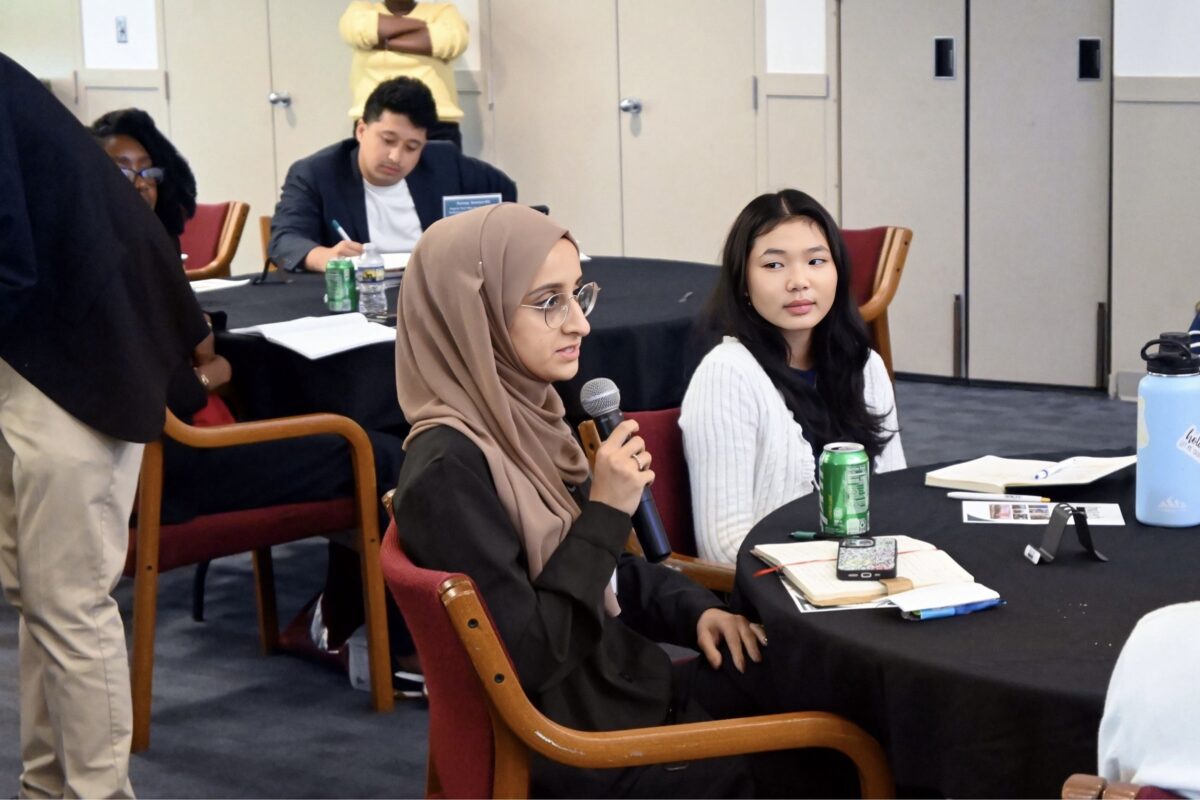 Bibi Qudsia Tolwak speaks at a WTCI group meeting. (Photo courtesy of Tolwak)
“It reminded me that careers do not always happen all at once,” Tolwak says. “Sometimes you just have to say yes to an opportunity and keep moving forward.”
The message resonated with Gupta, too. During a visit to McCormick’s plant and global headquarters in Hunt Valley, Maryland, a panelist shared a message about how the steps toward one career goal may not be the same ones that lead to the next. Gupta says it put into words one of the biggest lessons she is taking from the fellowship: Growth requires being willing to learn and adapt.
Eight Retrievers, one cohort
The size of UMBC’s group has added another dimension to the experience. “It has been great meeting other Retrievers from different majors and backgrounds and learning from their experiences,” Tolwak says. “It also makes me proud to see so many UMBC students represented in the fellowship.”
O’Donnell appreciates that the students bring different interests and strengths to the group. “One thing I love is that nobody feels like they’re overshadowing one another,” he says. “We each have our interests and strengths, and no matter if it’s a group setting or an individual one, we always contribute in a way that aids both ourselves and the group.”
Their paths to the fellowship began months earlier. In April, UMBC’s Global Studies Program hosted Global Career Conversations with Resende, an event focused on international careers. Felipe Filomeno, director of the Global Studies Program, and Christine Routzahn, director of the Career Center, worked together to promote the fellowship and encourage students to apply.
After the UMBC students were selected, the university worked to make sure cost would not prevent any of them from participating. The Division of Student Affairs provided support through a combination of the Career Center’s intern and service funds and divisional resources, allowing all eight students to participate.
Making room for what comes next
As the fellowship continues, the students are not necessarily finding one answer about what comes next. Instead, they are becoming more comfortable with the possibility that their careers may take unexpected turns.
O’Donnell is interested in international relations and more recently, community engagement and local government as well. The fellowship has given him more possibilities to consider rather than one definitive answer.
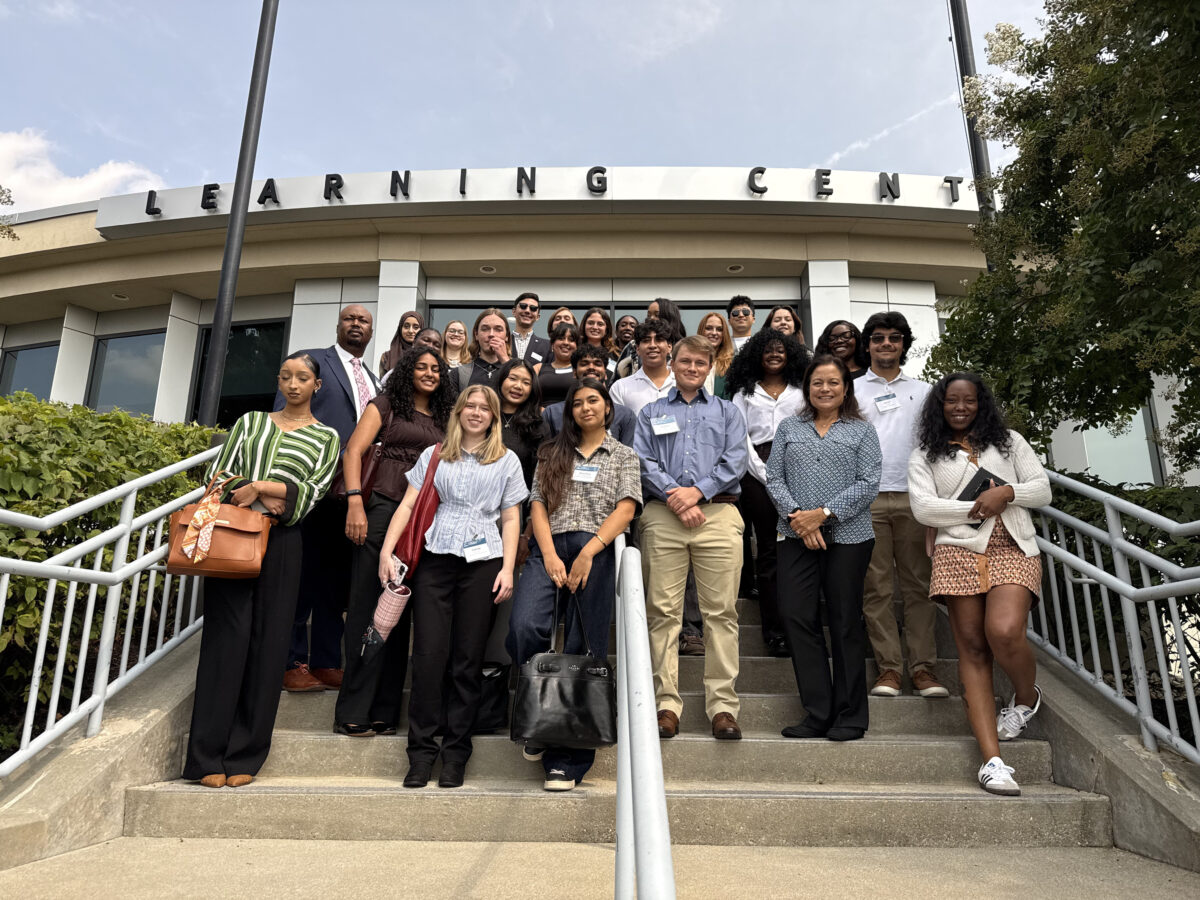 The WTCI interns gather at another site visit. (Photo courtesy of Tolwak).
“The Albrecht Fellowship has certainly given me more to think on, and that’s really what I wanted from this opportunity,” he says.
Tolwak is also still exploring where her interests will lead after UMBC. “I have learned that successful careers are not always straightforward,” Tolwak says. “You do not have to have everything figured out at the beginning; you just have to be willing to learn, keep trying, and say yes to opportunities that can help you grow.”
Gupta is considering law school and careers in human rights or federal law enforcement. The fellowship is also changing how she thinks about entering spaces where she may be younger or less experienced than the people around her.
“If there is one important lesson that the fellowship taught me, it’s that we—as students and professionals—can own our space,” Gupta says.
She hopes to carry that confidence into a field where she wants to make a difference: Gupta specifically wants to increase the representation of South Asian women in federal law enforcement. “I want to change that, and the Albrecht Fellowship has solidified the notion that I can change it.”
]]>
Eight UMBC students are spending part of their summer meeting business leaders, visiting Maryland companies, and getting a closer look at careers that connect the state to the rest of the world....
https://umbc.edu/stories/exploring-global-careers-albrecht-fellowship/
https://my3.my.umbc.edu/api/v0/pixel/news/162085/guest@my.umbc.edu/172c155646d287fefd0c96cd8334dee5/api/pixel
cahss
campus-life
career-center
community
global-studies
political-science
pre-law
public-humanities
stories
story
UMBC News & Magazine
https://my3.my.umbc.edu/groups/umbc-news-magazine
https://assets1-my.umbc.edu/system/shared/avatars/groups/000/001/943/24435aa6207c452e7bc15cc74b42c7bb/xsmall.png?1748556657
https://assets1-my.umbc.edu/system/shared/avatars/groups/000/001/943/24435aa6207c452e7bc15cc74b42c7bb/original.png?1748556657
https://assets2-my.umbc.edu/system/shared/avatars/groups/000/001/943/24435aa6207c452e7bc15cc74b42c7bb/xxlarge.png?1748556657
https://assets2-my.umbc.edu/system/shared/avatars/groups/000/001/943/24435aa6207c452e7bc15cc74b42c7bb/xlarge.png?1748556657
https://assets3-my.umbc.edu/system/shared/avatars/groups/000/001/943/24435aa6207c452e7bc15cc74b42c7bb/large.png?1748556657
https://assets1-my.umbc.edu/system/shared/avatars/groups/000/001/943/24435aa6207c452e7bc15cc74b42c7bb/medium.png?1748556657
https://assets2-my.umbc.edu/system/shared/avatars/groups/000/001/943/24435aa6207c452e7bc15cc74b42c7bb/small.png?1748556657
https://assets1-my.umbc.edu/system/shared/avatars/groups/000/001/943/24435aa6207c452e7bc15cc74b42c7bb/xsmall.png?1748556657
https://assets2-my.umbc.edu/system/shared/avatars/groups/000/001/943/24435aa6207c452e7bc15cc74b42c7bb/xxsmall.png?1748556657
UMBC News & Magazine
0
0
false
Thu, 27 Aug 2026 14:39:28 -0400
Thu, 27 Aug 2026 14:39:28 -0400
With great scientific powers comes great responsibility: Mercedes Burns, arachnid researcher, reviews “Spider-Man: Brand New Day”
Spoiler alert!
The first Spider-Man movie with Tom Holland as Peter Parker, “Homecoming,” was released almost a decade ago in 2017. Mercedes Burns, associate professor of biological sciences and Spider-Man fan, has been studying arachnids for double that. This summer’s blockbuster, “Spider-Man: Brand New Day,” shows Peter Parker slowly becoming an actual spider as the result of hormonal imbalances triggered by extreme stress, trauma, and long-term social isolation. He produces organic webbing, his eyes turn pitch-black, his “Spidey senses” are enhanced, and biological web slingers develop in his wrists for close-quarters combat. Burns, who wore her spider taxonomy t-shirt to the movie, will tell us if these upgrades have any scientific merit.
Q: What was your first reaction to the movie, particularly from a scientific perspective?
A: I enjoyed the movie, though I preferred 2021’s “Spider-Man: No Way Home.” I thought the new movie was a little uneven scientifically. Some things were extremely technical and accurate, while other things were vague. I did some research on the vague hormone discussion, to try to understand why that aspect was much less specific than some of the other science in the movie.
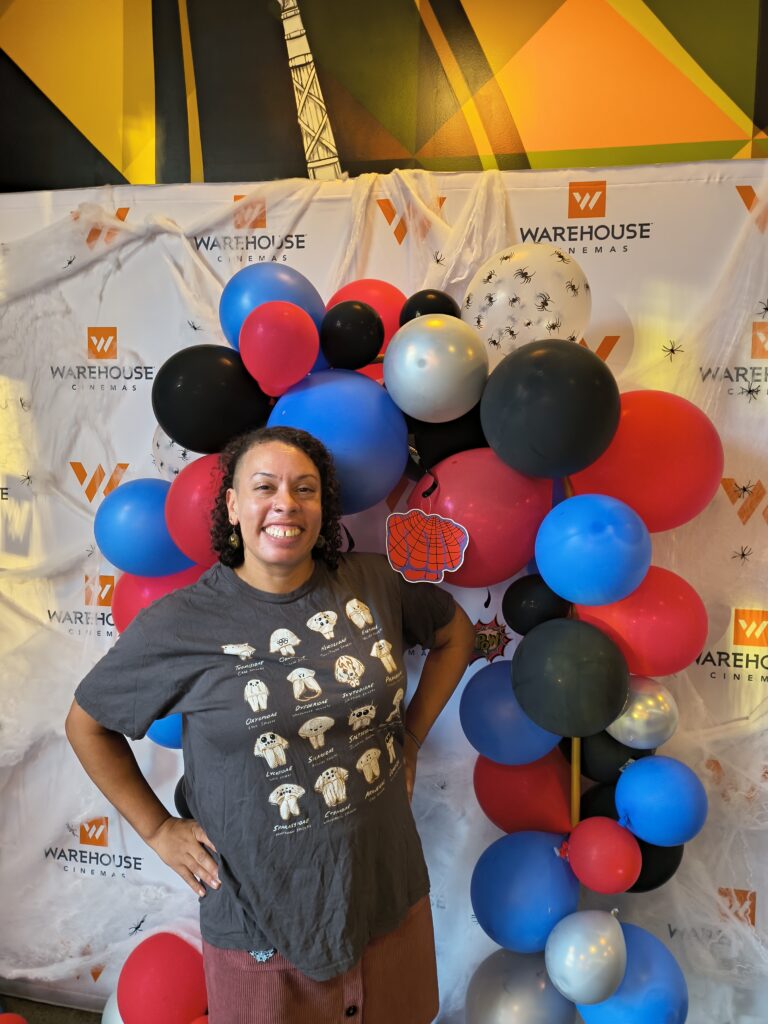 Mercedes Burns wore her spider taxonomy t-shirt to the new Spider-Man movie. (Courtesy of Burns)
There was a piece in the trailer where Bruce Banner, the Hulk—portrayed as a physics professor at the fictional Empire State University—explains the life cycle of the spider that did not make it into the movie. So there was no clear reason for why the changes were happening. It made it seem as though Spider-Man was becoming more spidery simply because he was getting really upset or sad.
Q: Was there anything scientifically inaccurate about Bruce Banner’s explanation of Spider-Man’s DNA changes?
A: There was an extremely complicated discussion of how short non-coding RNAs were being used to limit the Hulk’s and Spider-Man’s powers by binding proteins involved in their abilities. This therapy is based on RNA interference, which was discovered in the late 1990s. It is only very recently that any short-interfering RNA (siRNA) drugs have been FDA-approved, though, such as for certain forms of hemophilia—so this is very recent technology. Overall, I was impressed by how much detail they put into how the DNA limiter worked.
There was one important mistake, though. Professor Banner talked about needing to destroy mRNA before it is transcribed, when the correct terminology is translation. DNA is transcribed into mRNA, and mRNA is then translated into proteins. If they were talking about destroying mRNA before it is used to make a protein, they should have said translated, not transcribed.
Q: What about the explanation about the surge in arachnid hormones?
A: The hormone description was extremely vague compared to the RNA discussion. One arachnid hormone that we know something about is a steroid called ecdysone, which triggers molting and increased body size. Ecdysone opposes the action of juvenile hormone, which has been studied extensively in insects, because it can be used in biological control to prevent insects from maturing.
We know what spiders look like when they are under stress and that some species are very resilient to stress. But we do not know as much about how spiders physiologically deal with stress or whether stress might impact hormone levels, which may be why that aspect of the movie was so vague.
Q: Are these hormones what makes Parker’s new webs stronger?
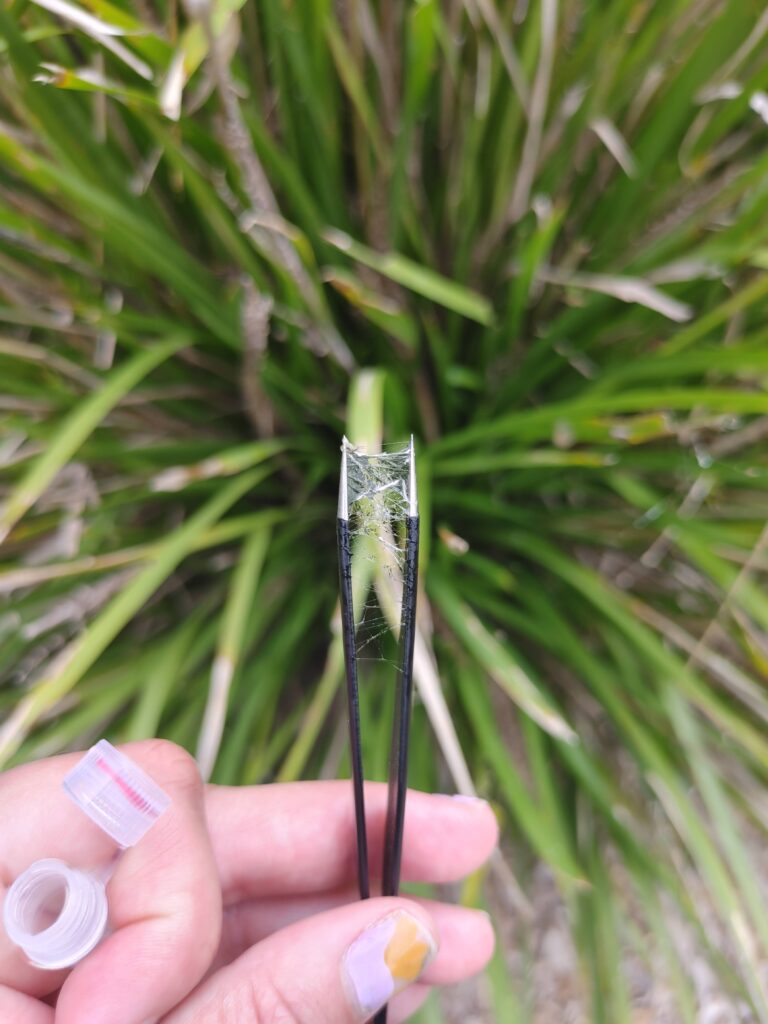 Mercedes Burns collects silk from a Saint Andrew’s cross spider in Australia. (Photo by Mercedes Burns)
A: Probably not. Spider-Man producing silk from his wrists is weird from a biological perspective. It would make more sense if the silk came from his feet, because spinnerets in spiders develop somewhat like a leg, but humans really do not have an equivalent to the spinnerets.
I know a lot about silks, because one of my research projects is focused on sticky proteins that arthropods, including spiders, produce to capture prey. The proteins that spiders make to produce their webs are a unique class of proteins called spidroins.
Spidroins are made up of proteins that form chains. Spiders make these building blocks, which have to align with each other as they are extruded through the spinnerets. The spinnerets contain many little glands where spiders can press out the particular protein that the silk glands produce.
Hypothetically, if you were trying to control the translation of silk proteins in a spider, one way you could do that would be with siRNAs, which could bind to the mRNA and keep the protein from being made—although this would be extremely difficult to do in practice.
Q: Why would it be so difficult to replicate Spider-Man’s web?
A: The silk Spider-Man produces from his wrists is a really sticky, stretchy mass that is also strong. He uses it to stick to surfaces, swing, wrap enemies so that they are restrained without being harmed, and perform other functions. It would be difficult to replicate this material because of how many functions it has.
In reality, spiders make many kinds of silk: some make more than 10 types. Each type has a particular job, such as for wrapping eggs or producing a covering around the eggs. The silks that are probably most important to Spider-Man are flagelliform silk and aggregate spidroin. Flagelliform silk is really stretchy. In a spider web, it forms the capture spiral, the circular part of an orb-weaver’s web. Aggregate spidroin is the sticky part of the capture spiral.
Q: What was scientifically accurate about the explanation Ned Leeds, Spider-Man’s best friend, gave of the mechanical web shooters?
A: Ned asks Spider-Man what material is in Spider-Man’s web shooters. Ned suggests that if it is a synthetic biomaterial, it is probably a liquid polymer inside the web shooters that becomes a fiber. He also suggests that the shearing forces from pressing the material out of the web shooter cause the liquid to become a polymer.
That was spot on.
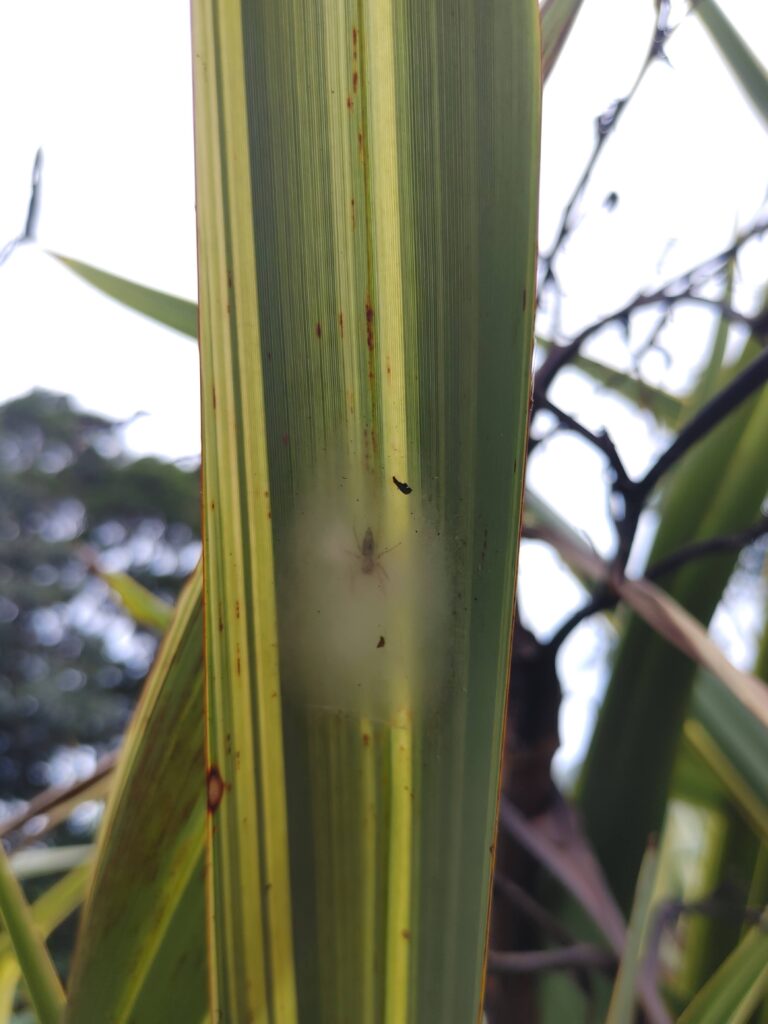
 Spiders use their silk for many purposes. Left: A nursery web spider in its silk hideaway. Right: A fishing spider carries a silk-wrapped egg sac. (Photos by Mercedes Burns)
Inside the glands, the building blocks for spider silk exist as a liquid called dope. The glands’ pH becomes more acidic, which triggers the protein building blocks to start lining up. The dope is also physically pressed through spigots within the spinnerets, and the mechanical force gets the protein into the appropriate conformation. What comes out is a fiber made of blocks of protein.
The web shooters work in a way that could provide the necessary mechanical force to allow a liquid to become a fiber. Ned’s reasoning about a liquid becoming a polymer and then becoming a fiber was remarkably similar to how these biomaterials are described in the scientific literature.
The mystery is the actual material. They know it would be some sort of molecule that polymerizes—that has units that join together as they leave the device. The specific molecule used by Spider-Man remains fictional and proprietary to the story.
Q: How do Spider-Man’s web shooters relate to the way he uses his powers?
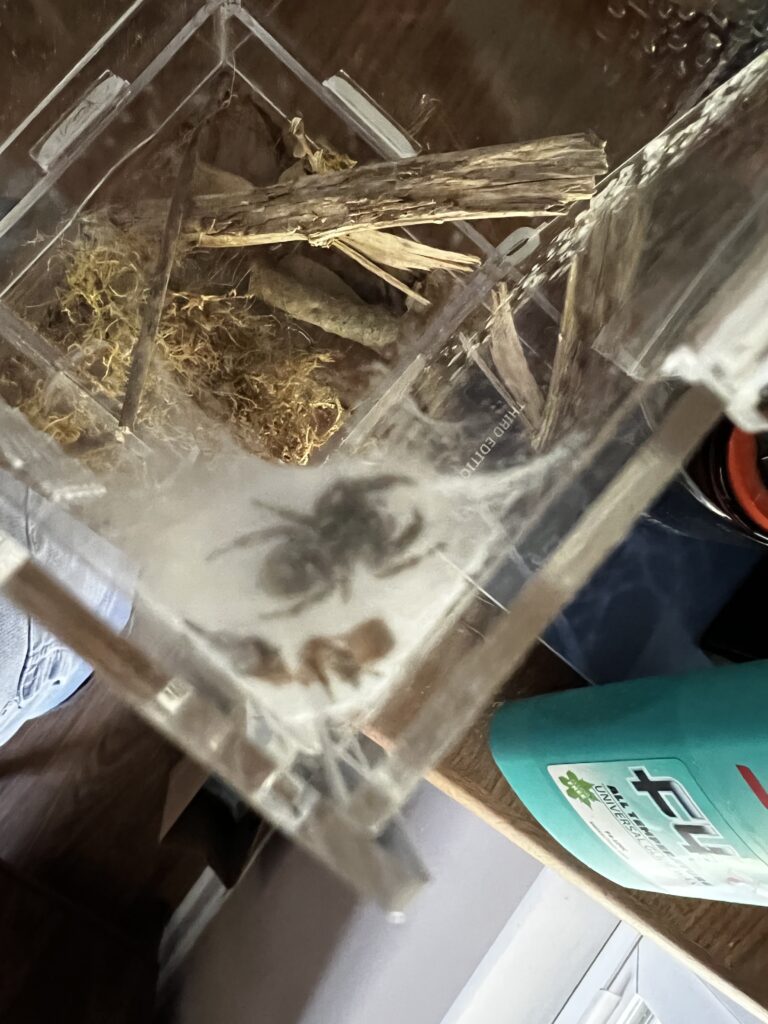 This jumping spider has spun itself a silk hammock in preparation for molting. (Photo by Ryan Bacon, Ph.D. ’26)
A: I am impressed with how Spider-Man learns his own body and his unique way of using his powers in this iteration. His web shooters allow him to work with the police to apprehend criminals without killing them. He can hold people up, restrain them, and throw things in their path. The ingenuity of his use of silk is really cool, because he is using it for good. Spiders are also an example of animals creating structures for good. They live in our houses and feed on pests that we do not like, so they are providing a service for us. In Spider-Man’s case, a human is using similar abilities to protect others.
Q: Is there anything real about the scene where Spider-Man wakes up in a spider cocoon, particularly his black eyes?
A: Yes, there are spiders that produce silk cocoons, such as jumping spiders. When they are getting ready to molt and grow larger, they will often create a little sling or hammock for themselves and surround themselves with silk for protection.
The black eyes, however, are probably a visual effect intended to make Spider-Man look more spider-like. Most spiders probably have poor vision. Their eyes do not have a pupil that focuses in the same way human eyes do.
Q: The trailer hints that Spider-Man is going through the life cycle of a spider. Does this mean Spider-Man will die?
A: I hope not, because for Peter Parker it would be a very short life. There is a lot of variation among spiders. The order of arachnids that includes spiders is vast, with roughly 70,000 species. Some are very long-lived, especially compared to other arthropods like insects and crustaceans. For species that live a long time, such as tarantulas and trapdoor spiders, females typically live longer than males, sometimes up to 30 years.
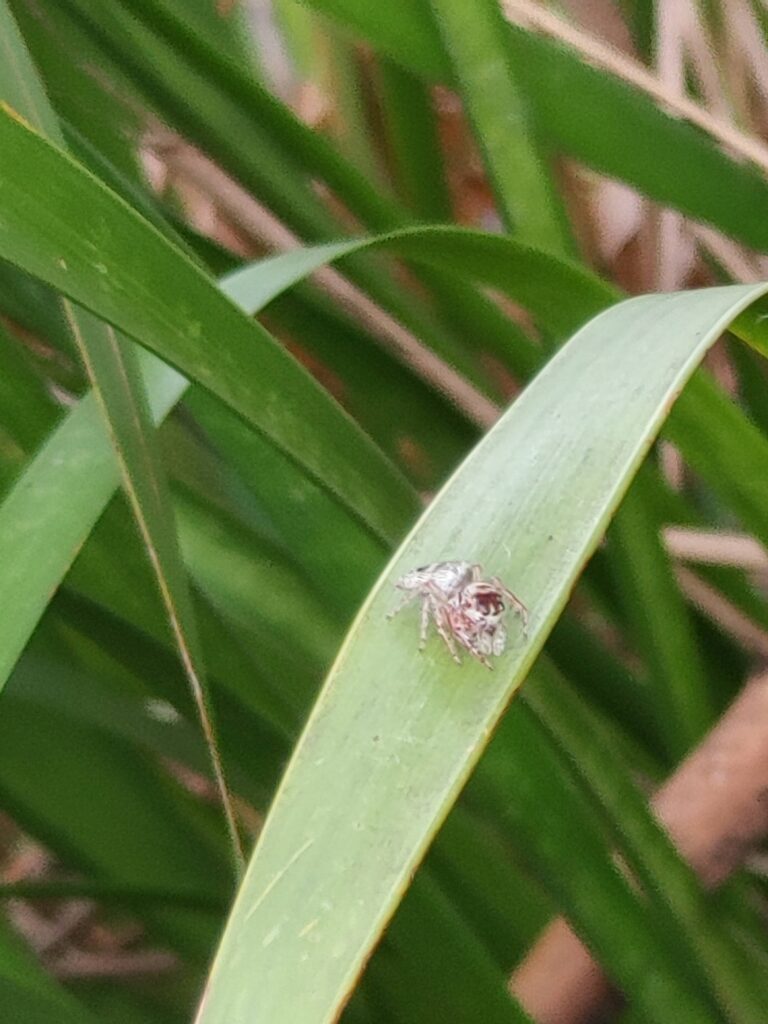 Jumping spiders like this one lay out a “dragline” of silk as they move about, to catch themselves in case of an unexpected fall. (Photo by Mercedes Burns)
Peter Parker is male, however, and many male spiders have incredibly short lives. In many species, males do not survive a mating encounter. A female may eat a male if she is not reproductively mature or if she is hungry. To the degree that a spider’s life cycle involves periods of seclusion, molting, and getting larger, though, there is some similarity.
Q: Is Spider-Man a jumping spider?
A: Spider-Man seems like a combination of different spiders. The art and emblems on his suit would suggest an orb weaver. Spider-Man does have characteristics that are similar to those of a jumping spider, such as cocooning in response to stress. However, jumping spiders always produce a dragline when they are moving through the environment so they can survive a sudden fall, and Spider-Man fires webs to keep himself from falling. So, Spider-Man’s overall appearance may be more like a garden spider, but some of his capabilities better match a jumping spider.
Q: Why did you like “Spider-Man: No Way Home” better?
A: There was more interaction between Peter and his friends. I really enjoy Zendaya’s version of MJ, Spider-Man’s girlfriend. I also really like Ned as a supporting character. They are extremely intelligent in their own right and are curious about things. I like the depiction of three scientifically curious young people working together.
Some of the other Marvel superheroes have AI, magic, or something else that provides them with insight. Spider-Man has his friends. I like this version of Spider-Man because he gets advice from other superheroes here and there, but he is also figuring things out himself and getting some help from his friends. I think it is cool to have your high school friends as your superhero support group.
Learn more about arachnid research in the Burns Arthropod Evolution Lab.
]]>
Spoiler alert! The first Spider-Man movie with Tom Holland as Peter Parker, “Homecoming,” was released almost a decade ago in 2017. Mercedes Burns, associate professor of biological sciences...
https://umbc.edu/stories/mercedes-burns-spider-man/
https://my3.my.umbc.edu/api/v0/pixel/news/162086/guest@my.umbc.edu/4a2ee996b41ea10ccfdb2dca8dd5732f/api/pixel
biology
cnms
science-and-tech
stories
story
UMBC News & Magazine
https://my3.my.umbc.edu/groups/umbc-news-magazine
https://assets1-my.umbc.edu/system/shared/avatars/groups/000/001/943/24435aa6207c452e7bc15cc74b42c7bb/xsmall.png?1748556657
https://assets1-my.umbc.edu/system/shared/avatars/groups/000/001/943/24435aa6207c452e7bc15cc74b42c7bb/original.png?1748556657
https://assets2-my.umbc.edu/system/shared/avatars/groups/000/001/943/24435aa6207c452e7bc15cc74b42c7bb/xxlarge.png?1748556657
https://assets2-my.umbc.edu/system/shared/avatars/groups/000/001/943/24435aa6207c452e7bc15cc74b42c7bb/xlarge.png?1748556657
https://assets3-my.umbc.edu/system/shared/avatars/groups/000/001/943/24435aa6207c452e7bc15cc74b42c7bb/large.png?1748556657
https://assets1-my.umbc.edu/system/shared/avatars/groups/000/001/943/24435aa6207c452e7bc15cc74b42c7bb/medium.png?1748556657
https://assets2-my.umbc.edu/system/shared/avatars/groups/000/001/943/24435aa6207c452e7bc15cc74b42c7bb/small.png?1748556657
https://assets1-my.umbc.edu/system/shared/avatars/groups/000/001/943/24435aa6207c452e7bc15cc74b42c7bb/xsmall.png?1748556657
https://assets2-my.umbc.edu/system/shared/avatars/groups/000/001/943/24435aa6207c452e7bc15cc74b42c7bb/xxsmall.png?1748556657
UMBC News & Magazine
1
0
false
Thu, 27 Aug 2026 14:16:23 -0400
Thu, 27 Aug 2026 14:16:23 -0400
Meet a Retriever—Jacob Diaz, assistant vice president and dean of students, sees his role as developing a culture of care
One of the newest friendly faces recently spotted on campus is Jacob “Jake” Diaz, inaugural assistant vice president and dean of students in the Division of Student Affairs. Jake joined the UMBC community in May, bringing more than two decades of experience advancing student success, community well-being, and inclusive campus environments at public and private universities across the country. Diaz earned a Bachelor of Arts in English literature from the University of California, Santa Barbara, and both his Master of Education and Doctor of Education degrees from the University of Vermont. He is committed to developing a culture of care at UMBC, where students are part of a community filled with resources to help them thrive. He’s also excited to do this work with campus partners. How does he practice self care? What does he love about barbecuing? Read on!
Q: What is the dean of students’ role and what does it encompass?
A: As the dean of students I get to be a part of a team of educators who help students connect the dots of their experience at UMBC. Ultimately, my wish for every student is that they experience all that UMBC offers because it is quite a special place. My office is here to ensure students have the resources to feel supported, included, and empowered throughout their journey here.
Q: What do you love most about working with students?
A: I love to meet them as they begin their academic pursuits and to witness their growth into the human beings they are intended to be.
Q: What has excited you the most so far about being at UMBC?
Diaz hangs out with Renique Kersh, vice president for student affairs (center), and Wendy Low, coordinator in the Division of Institutional Equity, in the Welcome, Retrievers! hospitality tent’s ball pit.
A: I love that UMBC strives to center students each day. It makes me happy to work alongside colleagues who have a deep passion for supporting students. They inspire me to be better each day.
Q: What are your plans to connect and support undergraduate and graduate students and the campus?
A: My initial goals are to raise awareness about what the dean of students’ portfolio of services and programs is and to ensure that students know we are here for them.
Q: What is the importance of campus partnerships in your work?
A: I often think about how any shred of success I have in my role is dependent upon being in a high quality relationship with my colleagues. A dean of students cannot carry out their work in isolation so I would say that campus partnerships is number one for me.
Q: How do we support students in challenging times?
A: Being with a student when they are experiencing life’s challenges is a sacred moment. It is up to us to accompany them, provide resources such as our Retriever CARE team, and be really open to listening to their needs so that we can provide the right type of support to help them stay on track academically and socially. As dean of students, I am proud to connect UMBC students with comprehensive support services designed to promote holistic well-being. Whether in mental health support and basic needs to academic accommodations and inclusive community spaces, our campus offers a robust network of resources dedicated to helping every student thrive.
Q: As a leader, how important is self care to you and how do you practice it?
A: Self care is a topic I would love to talk with students about. It is a daily aspiration for me. My family is a source of support and I love to laugh, watch movies, walk outside and try new things. I plan to take a class to learn how to play pool! I am curious to know what students do for their own self-care.
Q: What do you like to do outside of work?
A: In my life outside of work I love fishing and BBQing. It’s fun to create new flavors of food on the grill. It’s also a relaxing process. Spending time with my daughter and wife is especially restorative for me.
]]>
One of the newest friendly faces recently spotted on campus is Jacob “Jake” Diaz, inaugural assistant vice president and dean of students in the Division of Student Affairs. Jake joined the UMBC...
https://umbc.edu/stories/meet-a-retriever-jacob-diaz-dean-of-students/
https://my3.my.umbc.edu/api/v0/pixel/news/162033/guest@my.umbc.edu/df052ffa59ba1cc88c073a708c6e2264/api/pixel
campus-life
meet-a-retriever
stories
story
student-affairs
UMBC News & Magazine
https://my3.my.umbc.edu/groups/umbc-news-magazine
https://assets1-my.umbc.edu/system/shared/avatars/groups/000/001/943/24435aa6207c452e7bc15cc74b42c7bb/xsmall.png?1748556657
https://assets1-my.umbc.edu/system/shared/avatars/groups/000/001/943/24435aa6207c452e7bc15cc74b42c7bb/original.png?1748556657
https://assets2-my.umbc.edu/system/shared/avatars/groups/000/001/943/24435aa6207c452e7bc15cc74b42c7bb/xxlarge.png?1748556657
https://assets2-my.umbc.edu/system/shared/avatars/groups/000/001/943/24435aa6207c452e7bc15cc74b42c7bb/xlarge.png?1748556657
https://assets3-my.umbc.edu/system/shared/avatars/groups/000/001/943/24435aa6207c452e7bc15cc74b42c7bb/large.png?1748556657
https://assets1-my.umbc.edu/system/shared/avatars/groups/000/001/943/24435aa6207c452e7bc15cc74b42c7bb/medium.png?1748556657
https://assets2-my.umbc.edu/system/shared/avatars/groups/000/001/943/24435aa6207c452e7bc15cc74b42c7bb/small.png?1748556657
https://assets1-my.umbc.edu/system/shared/avatars/groups/000/001/943/24435aa6207c452e7bc15cc74b42c7bb/xsmall.png?1748556657
https://assets2-my.umbc.edu/system/shared/avatars/groups/000/001/943/24435aa6207c452e7bc15cc74b42c7bb/xxsmall.png?1748556657
UMBC News & Magazine
0
0
false
Wed, 26 Aug 2026 14:20:20 -0400
Wed, 26 Aug 2026 14:20:20 -0400
More than skills: Four CNMS interns on mentorship, belonging, and the gift of opportunity
Every morning this summer, junior biological sciences major Magdalen Ruth made her way to the National Institutes of Health in Bethesda—a dense hub of biomedical research. There, at the National Institute of Arthritis and Musculoskeletal and Skin Diseases, she helped investigate a genetic mutation in a patient with a rare form of juvenile arthritis known as Still’s disease, connecting her UMBC training to work that could improve patients’ lives. She is one of four CNMS students whose recent internships at Maryland-based companies and agencies show how local opportunities are helping Retrievers build skills, find mentors, and advance discoveries that matter here and beyond.
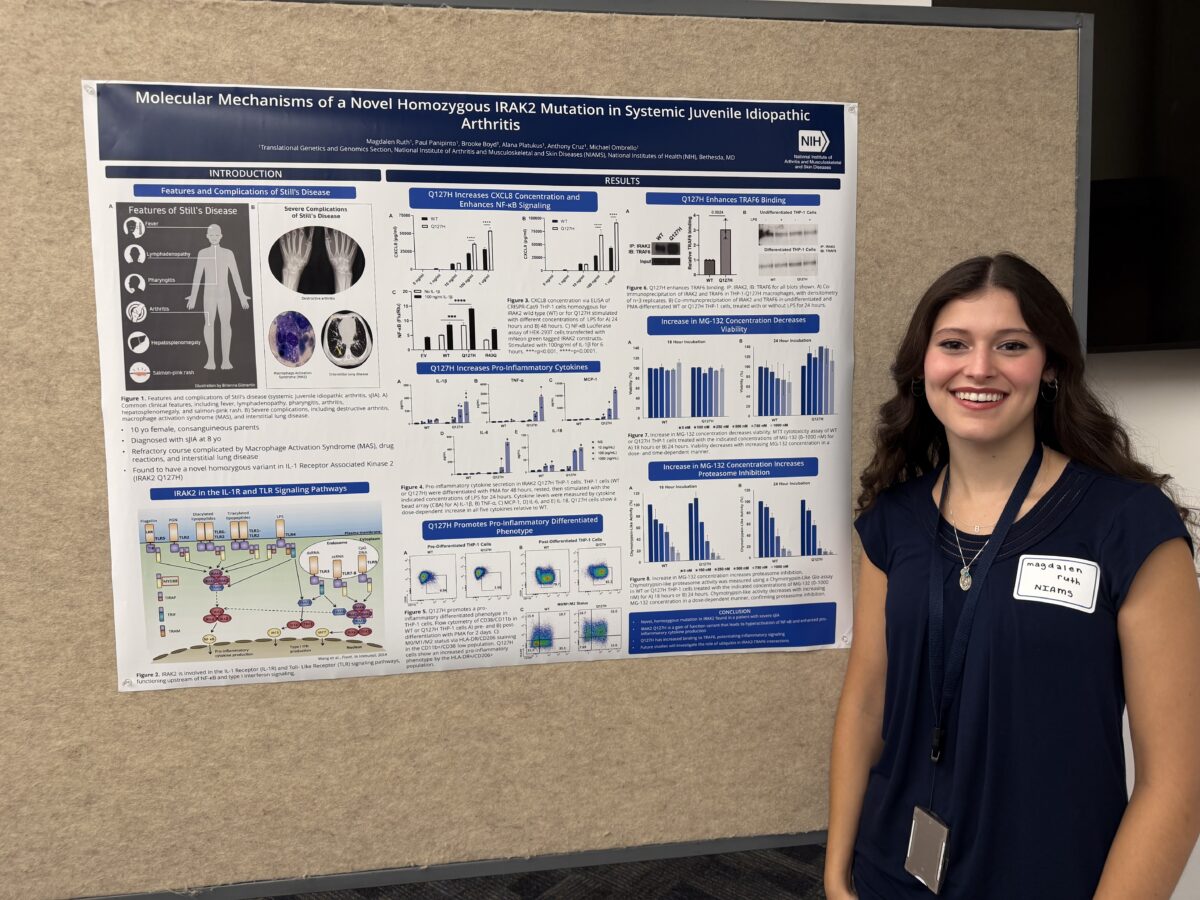 At the conclusion of her NIH internship, Magdalen Ruth presented her summer research on the role of a particular genetic mutation in a rare form of juvenile arthritis. (Courtesy of Ruth)
“I feel like I’m doing really important work,” Ruth, a Meyerhoff and U-RISE scholar, says. “Getting to know the patient’s diagnosis and being able to see that what I’m working on is affecting an actual person in real time has been awesome.” The internship has confirmed her interest in pursuing a career in pharmacology. It’s also stretched her communication skills. While familiar with presenting her work to colleagues in Deepak Koirala’s lab group at UMBC, communicating her research to a mix of researchers and clinicians—who don’t all share the same jargon and expertise—taught her the nuance of communicating with technical and non-technical audiences.
The Meyerhoff community helped make the opportunity possible. “I would not be in the place I am without Meyerhoff,” she notes. On campus, Ruth balances research and leadership as vice president of the STEM Ph.D. Society, a student-run organization designed to help students connect with scholarships, internships, graduate schools, and more. She also takes dance classes, is pursuing a music minor, and volunteers at her family’s Catholic parish—nurturing connections that ground her amid rigorous academic work.
Protecting lives, growing a career
Mark Harrison, a senior biological sciences major who started in chemical engineering, is in his third summer at Aberdeen Proving Ground (APG), a U.S. Army installation in Aberdeen, Maryland. His work involves designing and testing gas masks, bridging his early engineering training and his understanding of physiology. “I’m able to bring an understanding of what a warfighter may be experiencing in their body while wearing a gas mask in a way that others at APG may not,” Harrison says.
His mentors at APG, Jon Sampson ’03, mechanical engineering, and Edward Parshley ’06, chemical engineering, value the perspective Harrison brings and have supported his growth. “They made it clear that they want to reach back and offer opportunities to those coming behind them,” he says. They are making good on that commitment: Harrison will stay on board at APG this fall, and the plan is to transition him into a full-time position after he graduates in December. “They were always asking me what I wanted to learn and then giving me related opportunities,” Harrison says. “I could ask anyone how something worked, and they’d take the time to explain it to me. I’m so grateful for the way they’ve invested in me.”
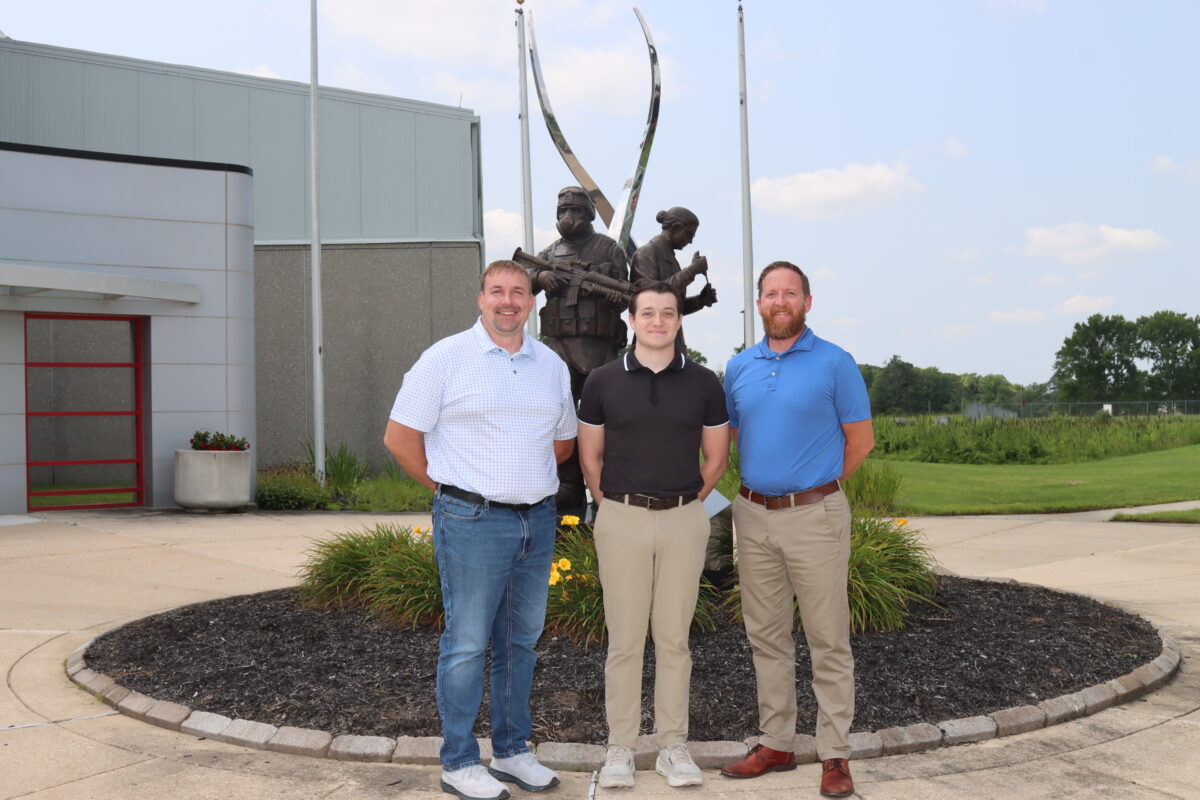 UMBC alumni Jonathan Sampson (right) and Ed Parshley (left) have mentored Mark Harrison (center) over the last two-plus years as he completed three internships at Aberdeen Proving Ground. (Courtesy of Harrison)
Interning in a fast-paced, interdisciplinary environment has also changed how Harrison operates in the classroom. “I learned how to learn at APG,” he says. “Now I don’t have to spend as much time studying, because when I leave class I already have a good understanding of the material. I’m connecting the dots so much better than before.” For Harrison, the work has taken on personal meaning, as well. “I’m fighting right now to try to protect American lives—that’s why I’m here.”
Translating discovery into treatment
Zainab Idowu, a senior biochemistry and molecular biology major and a Meyerhoff Scholar, interned at pharmaceutical giant AstraZeneca in Gaithersburg, Maryland, joining a robust group of Retrievers who’ve grown their skills there. Her project involved testing flow cytometers, which count and characterize individual cells and are used in manufacturing cell therapy treatments. Her goal was to determine the instrument and protocols that would be simplest and most effective for manufacturing teams to implement. The experience shifted Idowu’s focus toward translational medicine and reinforced her plans for an M.D./Ph.D. after UMBC. But the people around her made the biggest impression.
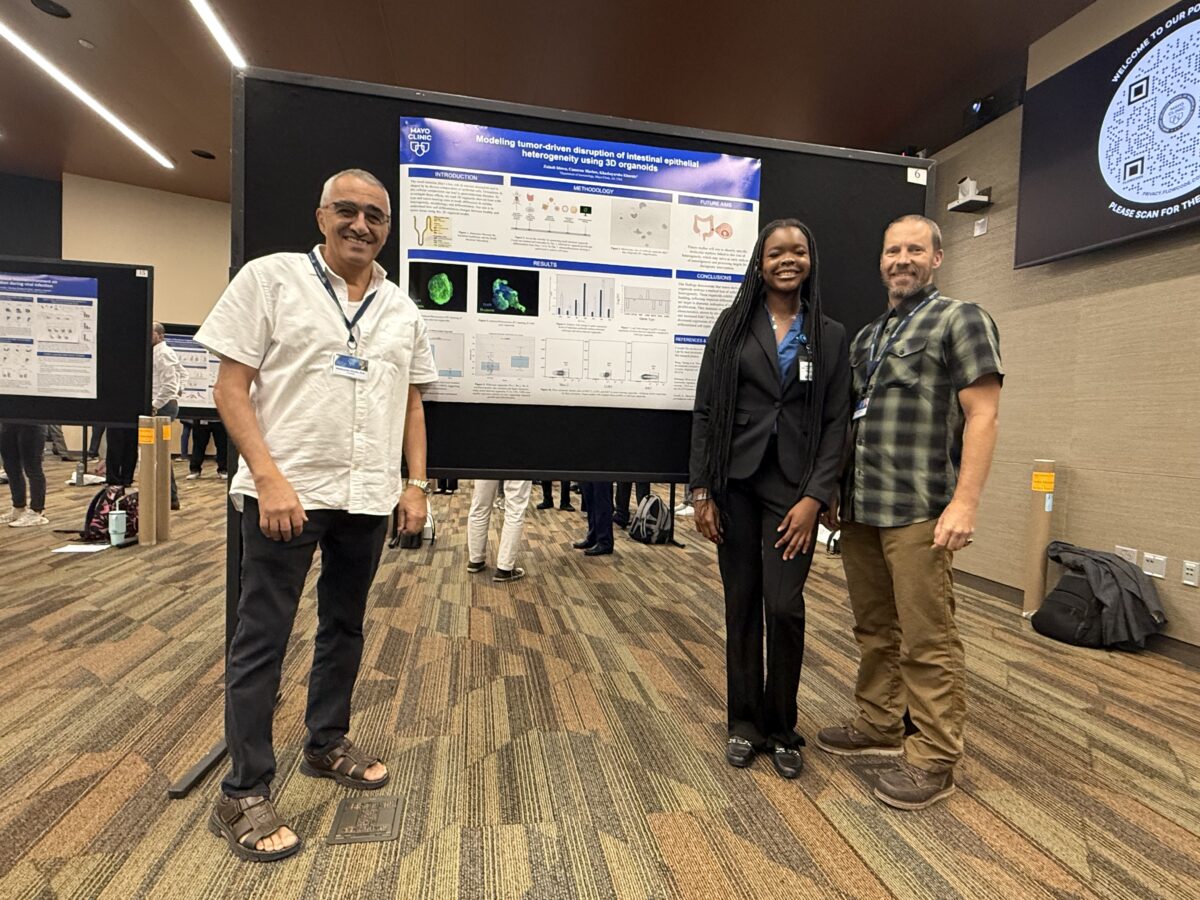
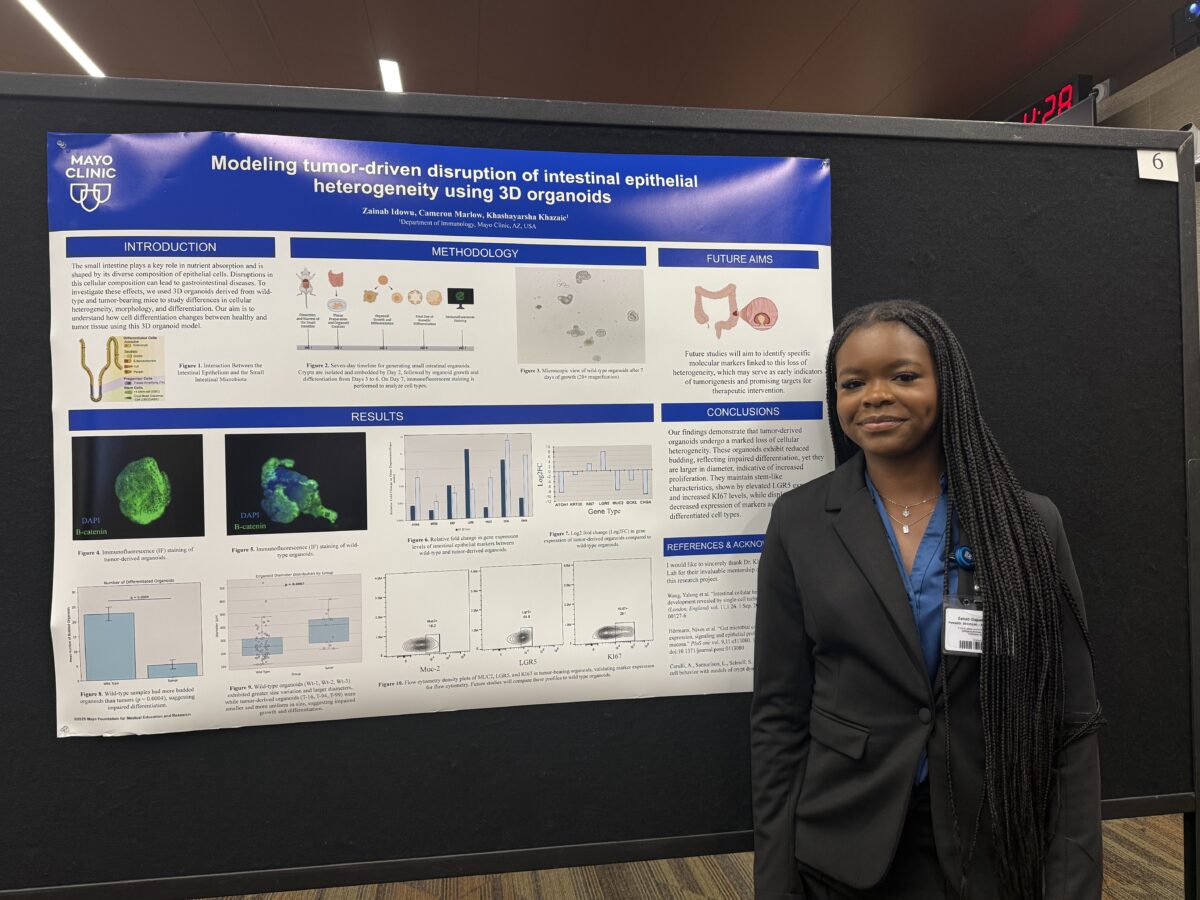 Zainab Idowu presented a research poster at the conclusion of a previous internship at the Mayo Clinic. She was supported by two mentors at the Mayo Clinic, Khashayarsha Khazaie (far left) and Cameron Marlow. (Courtesy of Idowu)
“I love everyone on my team,” Idowu says. “My managers, Ashley Ruddy and Jen Fox, were really insightful—giving me advice on what I want to do post-grad and what I should do my senior year to make sure I’m well-positioned for after graduation.” And when she had questions, the collaborative atmosphere showed her how scientists work together. “They were able to give recommendations and point me to scientific literature to help me along,” she says.
Opportunities through Meyerhoff gave her the chance to connect with AstraZeneca staff, which helped her secure the internship. “I was able to talk to them about my passions for research,” she says. Roles with UMBC’s chapters of the Society of Women Engineers, the international professional medical fraternity Phi Delta Epsilon, the National Society of Black Engineers, and the African Students Association have also enriched her UMBC experience. These organizations, she says, offered “a place to be ourselves, find new friends, and really build a home here at UMBC.”
The benefit of seeing both sides
 Saeed Damadi (left) and his wife Sepideh Hematian at her graduation from UMBC’s master’s program in data science.
Saeed Damadi recently defended his Ph.D. thesis in applied mathematics after beginning in electrical engineering. This summer at the FDA, he developed a mathematical model for how illicit drugs taken during pregnancy transfer to the developing baby through the placenta—increasing important understanding in a situation where human testing would be profoundly unethical.
While the math was familiar, Damadi welcomed the new challenge of jumping into biology. “I learned so many things, and I am still learning,” he says. Yet he found that his interest in how to describe randomness mathematically, which led him to complete a master’s in statistics on the way to his Ph.D., was highly relevant to studying the quirks of the human body. Looking ahead, he wants to continue work at the interface of biology and mathematics.
“Hopefully in the future I can make a contribution by bridging fields,” Damadi says, “because you can computationally simulate millions of parameters and patients at once, which makes the rate of iteration and discovery much faster.” The work Damadi and colleagues do with simulations can help effectively target limited resources for expensive and lengthy clinical studies, he explains.
Damadi and his wife, Sepideh Hematian, M.S. ’23, data science, and a former data scientist at the Maryland Department of Human Services, are planning to build their lives in California. They are both thriving, but “sometimes I get emotional thinking about UMBC,” Damadi says, “because after I arrived nine years ago from Iran, it became like a home to me and my wife.”
 Saeed Damadi (center) with his wife Sepideh Hematian (third from right), Ph.D. advisor Jinglai Shen (third from left), and the rest of his thesis committee and other members of the UMBC math faculty at his Ph.D. defense. (Courtesy of Damadi)
Damadi has given back through his teaching. As an engineer, “I just learned how to use the mathematical tools without understanding what was going on behind the scenes,” he says. Whereas, in math, “you learn the origins of all the theorems and how they work, but not necessarily how to apply them. I feel super lucky to get to see both sides.” So, in undergraduate calculus and linear algebra courses, “I just wanted to explain to my students, ‘Why do you need these equations? Why are they important?’ and give them a feeling of gratitude.”
Gratitude threads through all four of these journeys—for mentors who reach back, for teams that invest in their members, for communities that feel like home, and for the chance to do work that matters. As Magdalen Ruth at NIH puts it, “I’ve just found myself in a great spot with UMBC. I feel really blessed to have had all the opportunities I’ve had. Being able to do these internships has seriously been great.”
]]>
Every morning this summer, junior biological sciences major Magdalen Ruth made her way to the National Institutes of Health in Bethesda—a dense hub of biomedical research. There, at the National...
https://umbc.edu/stories/cnms-interns-mentorship-belonging-opportunity/
https://my3.my.umbc.edu/api/v0/pixel/news/161797/guest@my.umbc.edu/dacd98bb3662b16e6b4733ee94746d77/api/pixel
alumni
biology
career-center
chemical-biochemical-and-environmental-engineering
chemistry-and-biochemistry
cnms
coeit
community
data-science
internships
mathstat
meche
meyerhoff-scholars
science-and-tech
stories
story
undergraduate-research
urise
UMBC News & Magazine
https://my3.my.umbc.edu/groups/umbc-news-magazine
https://assets1-my.umbc.edu/system/shared/avatars/groups/000/001/943/24435aa6207c452e7bc15cc74b42c7bb/xsmall.png?1748556657
https://assets1-my.umbc.edu/system/shared/avatars/groups/000/001/943/24435aa6207c452e7bc15cc74b42c7bb/original.png?1748556657
https://assets2-my.umbc.edu/system/shared/avatars/groups/000/001/943/24435aa6207c452e7bc15cc74b42c7bb/xxlarge.png?1748556657
https://assets2-my.umbc.edu/system/shared/avatars/groups/000/001/943/24435aa6207c452e7bc15cc74b42c7bb/xlarge.png?1748556657
https://assets3-my.umbc.edu/system/shared/avatars/groups/000/001/943/24435aa6207c452e7bc15cc74b42c7bb/large.png?1748556657
https://assets1-my.umbc.edu/system/shared/avatars/groups/000/001/943/24435aa6207c452e7bc15cc74b42c7bb/medium.png?1748556657
https://assets2-my.umbc.edu/system/shared/avatars/groups/000/001/943/24435aa6207c452e7bc15cc74b42c7bb/small.png?1748556657
https://assets1-my.umbc.edu/system/shared/avatars/groups/000/001/943/24435aa6207c452e7bc15cc74b42c7bb/xsmall.png?1748556657
https://assets2-my.umbc.edu/system/shared/avatars/groups/000/001/943/24435aa6207c452e7bc15cc74b42c7bb/xxsmall.png?1748556657
UMBC News & Magazine
1
0
false
Thu, 20 Aug 2026 12:10:24 -0400
Thu, 20 Aug 2026 12:10:24 -0400
Hands-on science, lasting confidence: Student researchers impress at Summer Undergraduate Research Fest
Izabella Maria Marzano, a senior biological sciences major who transferred to UMBC from Anne Arundel Community College, was one of more than 120 undergraduate and high school student presenters who packed the University Center Ballroom on August 5 for UMBC’s 29th annual Summer Undergraduate Research Fest (SURF). Marzano was presenting work she completed with Diana Elizondo, assistant professor of biological sciences, on certain enzymes involved in metabolic dysfunction resulting from a poor diet. The experience had been transformative.
“In the short time I’ve been here, Dr. Elizondo has shown more faith in what I can achieve and given me more confidence than anyone else ever has, and I’m incredibly grateful,” Marzano says. She was one of four undergraduates from Elizondo’s research group who presented their summer work at SURF, which included two poster sessions and six short oral presentations.
Marzano joined the lab after taking Elizondo’s cell biology course, drawn to the group by the far-reaching impact of diabetes research, Elizondo’s approachability, and her desire to gain research experience to support her goal of becoming an orthodontist. In addition to Elizondo, Marzano says graduate students Marveline Akinola and Benjamin Cole have supported her growth.
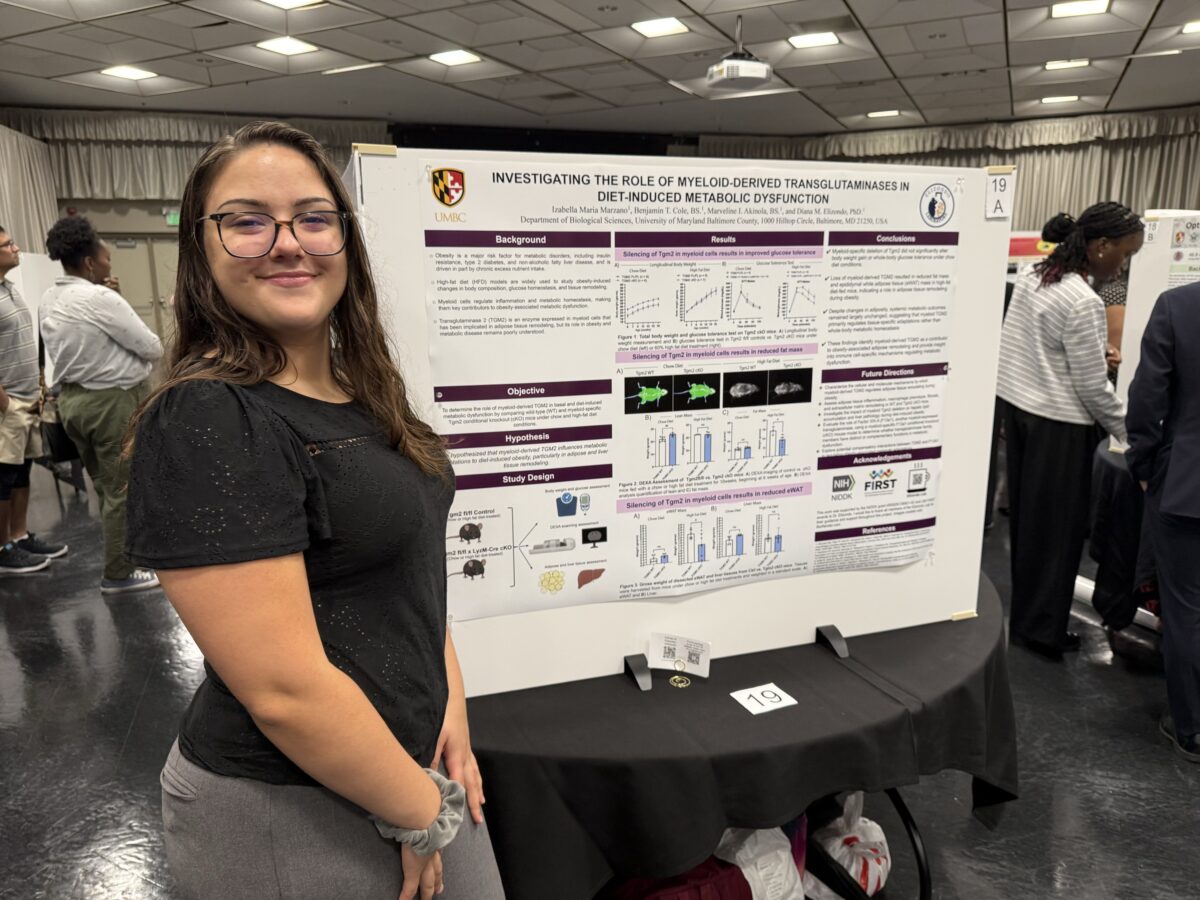
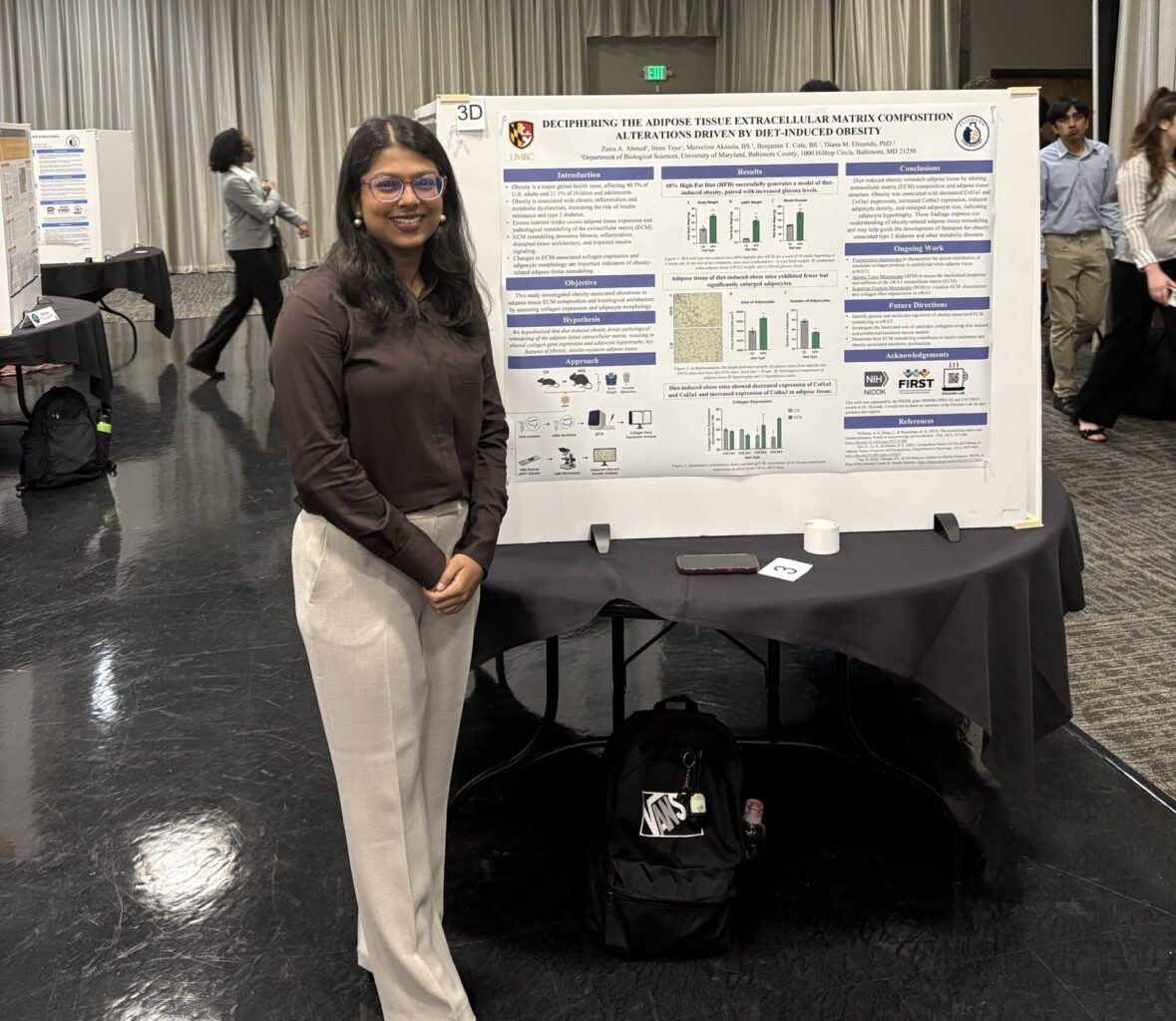 Izabella Marzano (left) and Zaira Ahmed (right) have steadily gained skills and confidence as scientists with the support of their research mentor, Diana Elizondo. Presenting at SURF was an important chance to share their work publicly. (Photos by Diana Elizondo)
Supported independence
Across the room, junior biochemistry and molecular biology major Zaira Ahmed, who began at UMBC this spring after transferring from Prince George’s Community College (PGCC), presented findings on how diet-induced obesity alters the composition of fat tissue’s extracellular matrix—a complex network of proteins, sugars, and other molecules surrounding cells. Ahmed first conducted research at PGCC, and she sought out Elizondo’s lab after taking the same cell biology course as Marzano, motivated in part by family members living with diabetes.
“Dr. Elizondo has been an amazing mentor. She explains everything so clearly and has been hands-on in teaching me different laboratory techniques,” Ahmed says. “But then once she sees I’ve got it, she lets me move forward independently.”
Irene Teye, a junior biological sciences major who started in Elizondo’s lab in January 2025, focused on the three-dimensional structural changes that obesity drives in the extracellular matrix. She worked with Tagide deCarvalho, manager of the Keith R. Porter Imaging Facility at UMBC, to generate and digitally analyze microscopy images of the matrix.
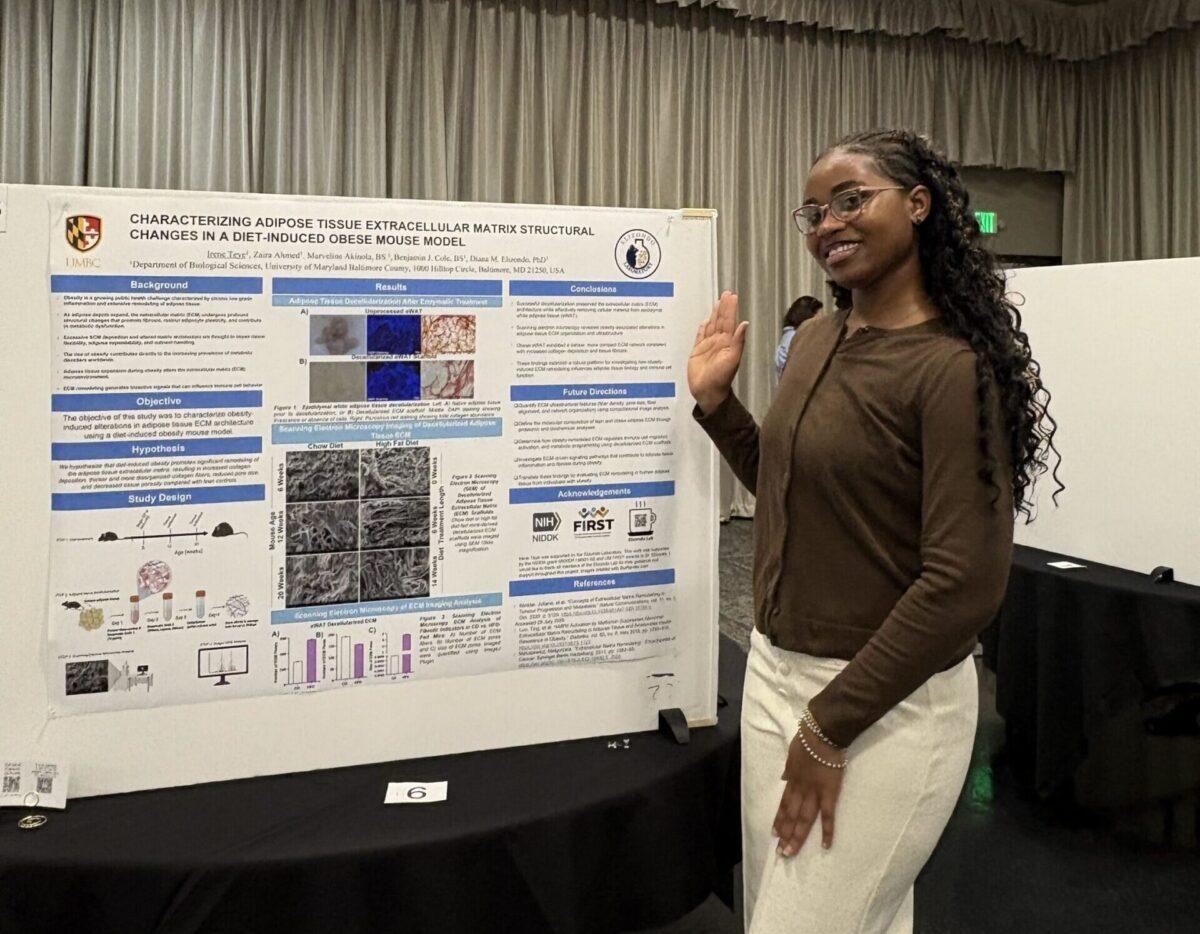
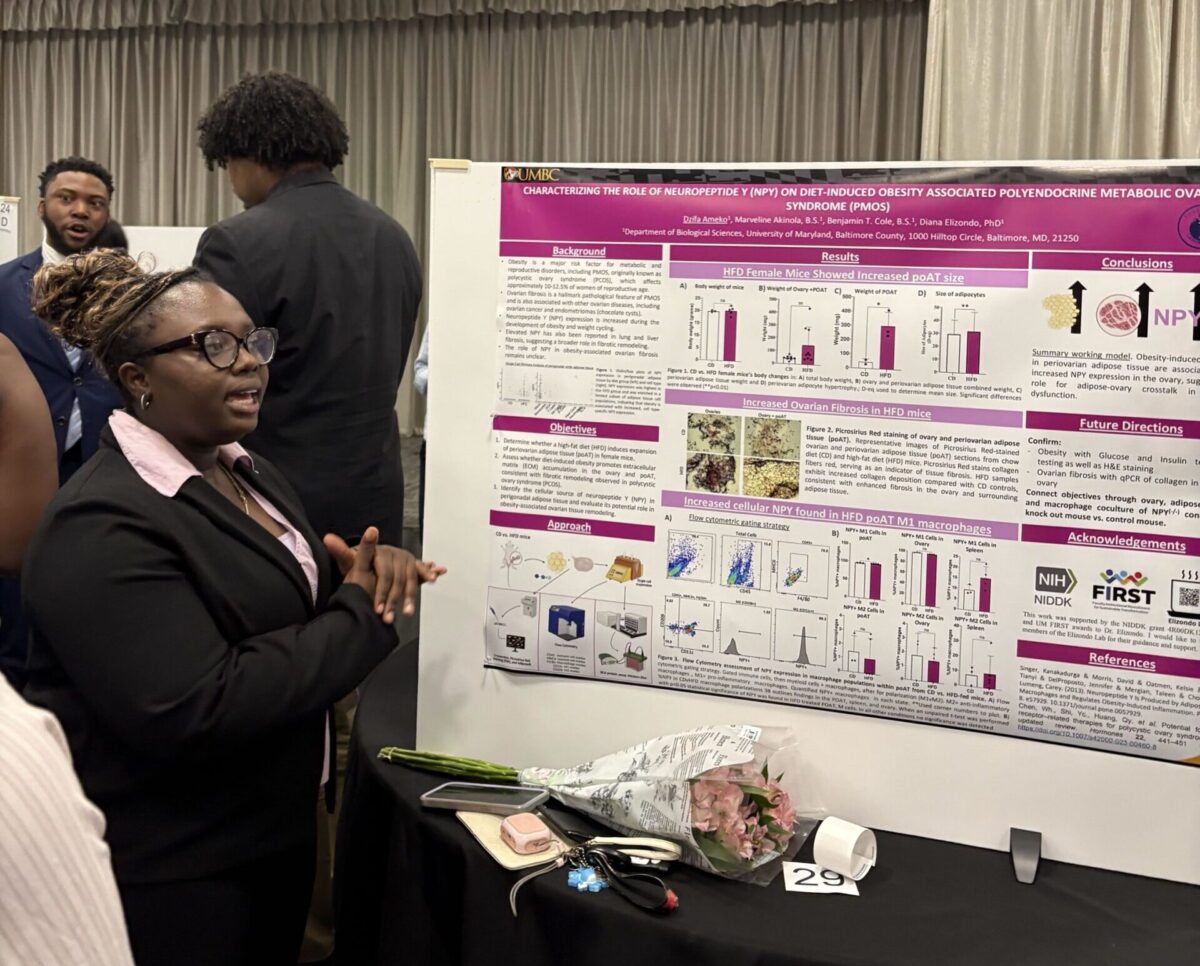 Irene Teye (left) loves working in Diana Elizondo’s research group, for both the sense of accomplishment she experiences doing the science and the closeness of the relationships she’s formed. Dzifa Ameko (right) is passionate about her research with Elizondo for its potential impact on women worldwide. (Photos by Diana Elizondo)
“It took three weeks to analyze the microscopy data to get just two images for my research poster, but it felt like such an accomplishment when I finished,” Teye says. She’s found a home in the Elizondo group, sharing that given how close the members are, “You’d think we’re all related.”
Dzifa Ameko, a junior biological sciences major, began with Elizondo in March 2025 after another faculty member recommended the lab based on Ameko’s interests. Long intrigued by endocrinology and gynecology, she investigated the role of neuropeptide Y, a small signaling molecule released by neurons, in an understudied hormonal and metabolic disorder that affects up to 170 million women worldwide.
“Dr. Elizondo’s door is always open,” Ameko said. “I can also always send her a Slack message and she is so responsive, whether it’s about research or a personal challenge.”
Students at the heart of research
Elizondo, who joined the UMBC faculty in January 2025, sees supporting student researchers as the heart of her work. “One of the most rewarding parts of starting my lab has been watching these students grow in confidence and independence,” she said. “Many of them joined with little or no prior research experience, and it has been incredibly exciting to see them develop into scientists who can think critically, troubleshoot experiments, and communicate their work so effectively. I strongly believe that the best way to learn science is by doing science. My goal is to create an environment where students are genuine contributors to the research, not just assistants.”
 Ben Bazarsuren, a senior mechanical engineering major, was one of six students who gave five-minute “lightning talks” to kick off SURF 2026. (Melissa Penley Cormier, M.F.A. ’17/UMBC)
SURF gave those contributions a public stage. Outgoing dean of the College of Natural and Mathematical Sciences, William R. LaCourse, welcomed participants to the event, highlighting the mix of student researchers from UMBC, regional community colleges, and other institutions. “SURF is one of the highlights of summer each year, because it celebrates the curiosity, perseverance, and excellence of our students and the faculty who guide them,” he said.
For transfer students like Marzano and Ahmed, and for first-time researchers across the university, the combination of hands-on projects, responsive mentoring, and a forum like SURF turns their motivation and potential into tangible results.
“You are ending this summer more knowledgeable, more experienced, more skilled, and a better scientist. Remember that the full benefits of your research may never be known to you. Science is not for those who seek glory—it’s not for me today, it’s for others tomorrow,” LaCourse reflected in his opening remarks. “Your spirit is an inspiration to us all. We hope that UMBC will always be a part of you.”
]]>
Izabella Maria Marzano, a senior biological sciences major who transferred to UMBC from Anne Arundel Community College, was one of more than 120 undergraduate and high school student presenters...
https://umbc.edu/stories/summer-undergraduate-research-fest-2026/
https://my3.my.umbc.edu/api/v0/pixel/news/161750/guest@my.umbc.edu/c89f30e2171cc66e40795d964d59e02f/api/pixel
biology
cnms
coeit
meche
research
science-and-tech
stories
story
transfer-students
undergraduate-research
UMBC News & Magazine
https://my3.my.umbc.edu/groups/umbc-news-magazine
https://assets1-my.umbc.edu/system/shared/avatars/groups/000/001/943/24435aa6207c452e7bc15cc74b42c7bb/xsmall.png?1748556657
https://assets1-my.umbc.edu/system/shared/avatars/groups/000/001/943/24435aa6207c452e7bc15cc74b42c7bb/original.png?1748556657
https://assets2-my.umbc.edu/system/shared/avatars/groups/000/001/943/24435aa6207c452e7bc15cc74b42c7bb/xxlarge.png?1748556657
https://assets2-my.umbc.edu/system/shared/avatars/groups/000/001/943/24435aa6207c452e7bc15cc74b42c7bb/xlarge.png?1748556657
https://assets3-my.umbc.edu/system/shared/avatars/groups/000/001/943/24435aa6207c452e7bc15cc74b42c7bb/large.png?1748556657
https://assets1-my.umbc.edu/system/shared/avatars/groups/000/001/943/24435aa6207c452e7bc15cc74b42c7bb/medium.png?1748556657
https://assets2-my.umbc.edu/system/shared/avatars/groups/000/001/943/24435aa6207c452e7bc15cc74b42c7bb/small.png?1748556657
https://assets1-my.umbc.edu/system/shared/avatars/groups/000/001/943/24435aa6207c452e7bc15cc74b42c7bb/xsmall.png?1748556657
https://assets2-my.umbc.edu/system/shared/avatars/groups/000/001/943/24435aa6207c452e7bc15cc74b42c7bb/xxsmall.png?1748556657
UMBC News & Magazine
0
0
false
Wed, 19 Aug 2026 11:48:37 -0400
Wed, 19 Aug 2026 11:48:37 -0400
Could a smartphone take the place of expensive medical equipment? Dong Li investigates how to make affordable health monitoring accessible
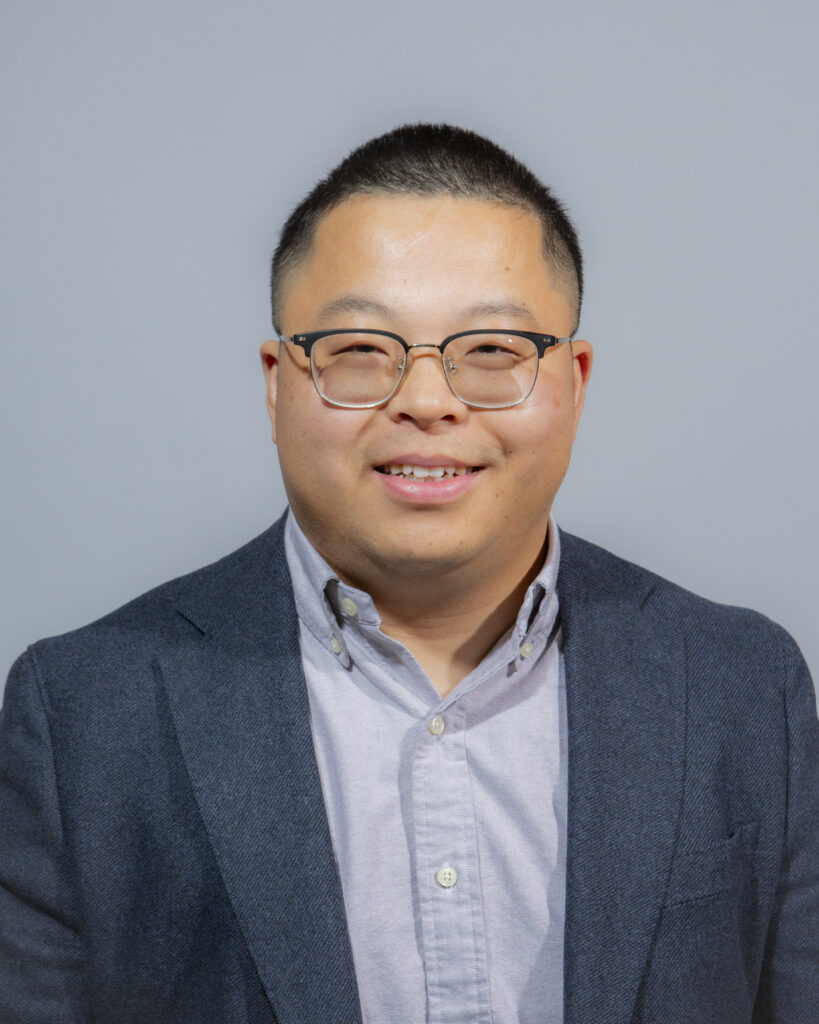 Dong Li (Photo courtesy of Li)
A common saying is “Health is wealth.” Its meaning—that good health gives people the vitality to succeed in life—is found in stories and phrases across cultures and times. Dong Li, an assistant professor in the Department of Computer Science and Electrical Engineering, has long nurtured an interest in helping people stay in good health, from his early childhood interest in becoming a doctor to his current research focusing on developing cost-effective and widely accessible health monitoring technologies.
As the founder and director of the Future Sensing and Interaction Lab, Li studies how affordable devices, such as smartphones and watches, can monitor general health indicators, vital signs, and physical activities. Li also explores how to build innovative computer-human interfaces to deliver an intuitive user experience. His goal is to use the advanced sensing technologies on many smart devices to help people improve their well-being.
“I am a tech believer,” Li says. “Technology has enormous potential to make change, and that’s why I have devoted my efforts and my time to try to develop applications of technology that benefit society.”
Li shares here about his work, its challenges, and his hopes for a world where healthcare is both affordable and accessible.
Q: What are your main areas of research?
A: My main area of research is what we usually call mobile health, or mHealth. The goal is to make health intelligence more accessible by using everyday devices that people already have, such as smartphones, earphones, smartwatches, and even smart rings.
For example, in several projects in my lab, we’re exploring ways to measure things like blood pressure and skin stiffness using a smartphone. One way to think about it is this: as human beings, we have eyes, ears, and a nose that help us sense the world around us. So what if we could use our smartphones as an additional sensing tool—not just to understand our environment, but to sense what’s happening inside our own bodies, such as blood pressure, heart rate, respiration rate, and other physiological signals?
The second part of my research focuses on AI. We’re interested in building AI models that can use data collected from these everyday devices to detect signs of disease at an early stage. Large language models like ChatGPT, for example, are trained on huge amounts of language data. In a similar way, we can train health-related AI models on large amounts of physiological data collected from devices people use in their daily lives. The question is whether the model can learn subtle patterns in that data that may indicate the early stages of disease.
The third part of my research is about security and privacy. If we’re collecting sensitive health information, we need to make sure both the AI model and the overall system are secure, and that people’s private information is protected.
Ph.D. student Rishav Gupta is working with Li. Here he presents the research at UMBC COEIT Research Day 2026. (Photo courtesy of Gupta)
Q: What motivated you to get involved in these areas of research?
To be honest, when I was in primary school, my dream was to become a doctor. But somehow, I ended up choosing computer science as my major.
After I completed my Ph.D. at the University of Massachusetts Amherst and joined UMBC as a faculty member, I learned about opportunities for internal research funding and collaboration between UMBC and the University of Maryland, Baltimore, which has long-established professional schools in areas such as medicine, dentistry, pharmacy, and nursing.
When I heard about those opportunities, I immediately thought, “Okay, this is my chance to reconnect with that childhood dream.” I realized I could combine my background in computer science with healthcare and work on interdisciplinary research that could have a real impact on people’s health.
So in a way, I didn’t become a doctor, but I found another path that allows me to contribute to medicine through technology. That’s really what motivated me to move into this area of research.
Q: How do you hope the research will impact ordinary people’s lives down the road?
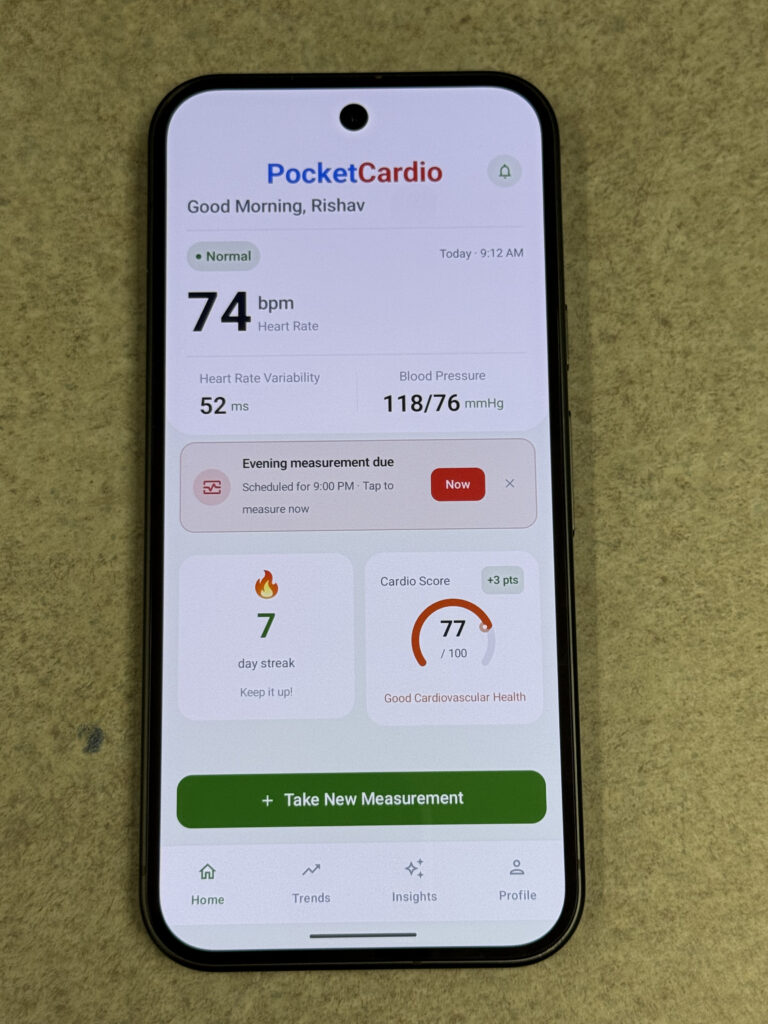 Li and Gupta have created an intuitive interface for the blood pressure monitoring PocketCardio app. (Photo by Ramya Bommakanti)
Our long-term vision is to make health monitoring more accessible and affordable for everyone. Right now, if we want to monitor certain aspects of our health, we often have to go to a doctor for regular examinations or use specialized medical equipment, which can be expensive and may not be easily available to everyone.
What we hope to do is bring some of that monitoring capability into the everyday devices people already use, such as smartphones, earphones, smartwatches, or even smart glasses. Instead of relying only on specialized equipment, people could potentially use these familiar devices to better understand and monitor their health in their daily lives.
If our research is successful, we hope it can give people a simple and convenient way to keep track of their health, identify potential problems earlier, and make more informed decisions about when to seek medical care. Ultimately, the goal is to use technology to help people live healthier lives.
Q: What are the biggest challenges that the research will need to overcome to reach these goals?
The most challenging part is not technical. What I realized when I talked to the clinical doctors from UMB School of Medicine is that the challenge is how to make people aware of this development. The challenge is assuring people of data security. People ask questions like, “What about privacy? How can you make sure you don’t leak our private information?” I think that’s the biggest challenge we will have if we want to make this a product that everybody can benefit from: How can we communicate about the technology so that people can understand it and are willing to use our product in the future?
Q: Do you have any recent results that you are especially excited about?
Yes. We are doing the clinical trials for our blood pressure monitoring project. We have collected data, I believe, from 30 healthy subjects right now, and we are in the process of collecting data from hypertensive patients at the hospital. The data we have right now shows very promising results, and I’m very excited to see if our prototype can work for those hypertensive patients. If it does, I think our next step is that we could do a wider deployment to verify our system. I attended the Maryland NEW VENTURE program [an intensive 12-week accelerator run by bwtech@UMBC that helps early-stage technology founders]. I shared this story with a lot of our investors, and they are super excited about this product. Maybe sometime next year, we will establish a startup company to make it a real product to benefit ordinary people.
 Li (center), Gupta (left) and other members of the PocketCardio team won first place at the Maryland NEW VENTURE pitch competition. (Photo courtesy of Li)
Written by: Ramya Bommakanti, a senior information systems major and communications intern in the COEIT Dean’s office.
]]>
Dong Li (Photo courtesy of Li) A common saying is “Health is wealth.” Its meaning—that good health gives people the vitality to succeed in life—is found in stories and phrases across cultures...
https://umbc.edu/stories/dong-li-affordable-health-monitoring-tech/
https://my3.my.umbc.edu/api/v0/pixel/news/161725/guest@my.umbc.edu/44dfd24726bc854308ec14cb9e1e8f70/api/pixel
bwtech
coeit
csee
graduate-research
impact
research
science-and-tech
stories
story
UMBC News & Magazine
https://my3.my.umbc.edu/groups/umbc-news-magazine
https://assets1-my.umbc.edu/system/shared/avatars/groups/000/001/943/24435aa6207c452e7bc15cc74b42c7bb/xsmall.png?1748556657
https://assets1-my.umbc.edu/system/shared/avatars/groups/000/001/943/24435aa6207c452e7bc15cc74b42c7bb/original.png?1748556657
https://assets2-my.umbc.edu/system/shared/avatars/groups/000/001/943/24435aa6207c452e7bc15cc74b42c7bb/xxlarge.png?1748556657
https://assets2-my.umbc.edu/system/shared/avatars/groups/000/001/943/24435aa6207c452e7bc15cc74b42c7bb/xlarge.png?1748556657
https://assets3-my.umbc.edu/system/shared/avatars/groups/000/001/943/24435aa6207c452e7bc15cc74b42c7bb/large.png?1748556657
https://assets1-my.umbc.edu/system/shared/avatars/groups/000/001/943/24435aa6207c452e7bc15cc74b42c7bb/medium.png?1748556657
https://assets2-my.umbc.edu/system/shared/avatars/groups/000/001/943/24435aa6207c452e7bc15cc74b42c7bb/small.png?1748556657
https://assets1-my.umbc.edu/system/shared/avatars/groups/000/001/943/24435aa6207c452e7bc15cc74b42c7bb/xsmall.png?1748556657
https://assets2-my.umbc.edu/system/shared/avatars/groups/000/001/943/24435aa6207c452e7bc15cc74b42c7bb/xxsmall.png?1748556657
UMBC News & Magazine
4
0
false
Tue, 18 Aug 2026 16:25:10 -0400
Tue, 18 Aug 2026 16:25:10 -0400