UMBC’s Meyerhoff Scholars model heads to UC Berkeley and UCSD through a $6.9M investment from the Chan Zuckerberg Initiative
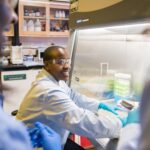
“The key to accelerating discoveries in science or the next tech breakthrough will be dependent on our ability to bring fresh perspectives to STEM fields,” says Priscilla Chan, co-founder of the Chan Zuckerberg Initiative (CZI). Now, CZI has turned to UMBC for a model of how to make that happen.
CZI announced today that it has awarded $6.9 million to support a unique partnership to replicate UMBC’s Meyerhoff Scholars Program at UC San Diego and UC Berkeley.
“California’s openness to new ways of thinking is what has made this state an innovation engine for the world,” says Chan. “With these new grants, we hope to help bring even more diversity of perspective and experience to our state—and to Silicon Valley.”
The UMBC Meyerhoff program, founded in 1989, is recognized as one of the most effective models in the nation to help engage and retain underrepresented students pursuing undergraduate and graduate degrees in STEM fields. Program participants have already earned 300 Ph.D. degrees, 130 M.D. degrees, 54 M.D.-Ph.D. degrees, and 253 master’s degrees. Hundreds more are currently pursuing graduate degrees.
 Abby Cruz ‘18, a Meyerhoff affiliate and MARC U*STAR Scholar, works in Fernando Vonhoff’s biology lab.
These achievements are particularly striking in a national context. UMBC graduates more African American students who go on to earn dual M.D.-Ph.D. degrees than any other college in the U.S.—a credit to the Meyerhoff program model. UMBC is also second in the nation when it comes to graduating African American students who go on to earn a Ph.D. in any STEM field.
A thrilling combination
“It is truly thrilling to think about the national and global impact the Meyerhoff Scholars Program will have through partnerships like this,” says Michael Summers, Robert E. Meyerhoff Chair for Excellence in Research and Mentoring and Distinguished University Professor at UMBC. “By working together we can help shape the future of our national Ph.D. pipeline, with inclusive excellence as a core shared value of our work.”
 Michael Summers (left) with two of the students who have worked in his lab, which focuses 3D structures of protein components that make up HIV-1.
The University of California system is the largest undergraduate and graduate educator of underrepresented and low-income students in the country within the Association of American Universities, and UC Berkeley and UC San Diego are major sources of top talent for Silicon Valley and STEM fields more broadly.
The CZI support announced today will enable UC San Diego and UC Berkeley to apply many of the strategies successfully used at UMBC. These include outreach to high achieving underrepresented high school students, robust research experiences, team learning, peer counseling, intensive advising, preparation in the summer before matriculation, and engagement with students’ families.
Informed by UMBC’s own approach to measuring the impact of student support initiatives, UC San Diego and UC Berkeley will provide rigorous data to measure the effects of their new programs over the five-year grant period. In this way, they hope to determine what approaches work best to create a welcoming and supportive environment for underrepresented groups, and ultimately to improve education for all in STEM fields.
As UMBC recognizes, these findings can also help a university support students beyond STEM, in any field, as they work to discover and fulfill their potential.
Extending community
UMBC Meyerhoff alumni pursuing graduate degrees at UC Berkeley and UC San Diego are particularly excited to see this new partnership grow.
 President Hrabowski congratulates Meyerhoff Scholar and valedictorian Eudorah Vital after she delivers commencement remarks, May 2018.
“Seeing a version of the program come to Berkeley is exciting because it means there is another initiative to increase the support for students of color. It means building and extending the community that wants to see us in academic spaces,” says Robyn Jasper ‘17, M25, biological sciences, who is currently a Ph.D. student at UC Berkeley in plant and microbial biology.
“Being a Meyerhoff Scholar has connected me and continues to connect me with advocates for my personal growth and institutional change,” she shares.
Rockford “Rocky” Sison ‘13, M21, mathematics, a current Ph.D. candidate in applied mathematics at Berkeley, feels similarly. “As an alum of the Meyerhoff Scholars Program, I’m so excited to see other programs spring up across the country,” they share. “It means a lot to me that more students will receive the type of financial, professional, and emotional support I received as an undergraduate. Ideally, every student would get this level of support.”
For Sison, “being a Meyerhoff Scholar meant that I hit the ground running in college.” The Summer Bridge program before their first year and subsequent programming meant “I knew what internships were, office hours weren’t as scary because I knew a couple faculty members, and I was friends with a bunch of people that would also be in my classes.”
 Rocky Sison ’13, M21, speaks at a press conference in California announcing the Chan Zuckerberg Initiative support for replication of the Meyerhoff Scholars in the University of California system. Photo courtesy Chan Zuckerberg Initiative.
Sison carries on that legacy of support, sharing, “When I graduated from UMBC, being a Meyerhoff Scholar meant that I was dedicated to paying it forward, and I had a sprawling network of people with the same commitment.”
Now, UMBC’s Meyerhoff Scholars Program model will reach more people than ever before, reshaping the future of STEM in California and the nation, and unlocking new opportunities for students.
Featured image: Naomi Mburu ’18, chemical engineering, a Meyerhoff Scholar and UMBC’s first Rhodes Scholar. She is now studying nuclear engineering at Oxford. All photos by Marlayna Demond ’11 for UMBC.
]]>
“The key to accelerating discoveries in science or the next tech breakthrough will be dependent on our ability to bring fresh perspectives to STEM fields,” says Priscilla Chan, co-founder of the...
https://umbc.edu/stories/meyerhoff-czi/
https://my3.my.umbc.edu/api/v0/pixel/news/120170/guest@my.umbc.edu/3ff8a8acefca38207471570c65051c3e/api/pixel
alumni
biology
chembiochem
cnms
coeit
community
icp
mathstat
meyerhoffscholars
page1
science-and-technology
se
strategic-planning
UMBC News & Magazine
https://my3.my.umbc.edu/groups/umbc-news-magazine
https://assets1-my.umbc.edu/system/shared/avatars/groups/000/001/943/24435aa6207c452e7bc15cc74b42c7bb/xsmall.png?1748556657
https://assets1-my.umbc.edu/system/shared/avatars/groups/000/001/943/24435aa6207c452e7bc15cc74b42c7bb/original.png?1748556657
https://assets2-my.umbc.edu/system/shared/avatars/groups/000/001/943/24435aa6207c452e7bc15cc74b42c7bb/xxlarge.png?1748556657
https://assets2-my.umbc.edu/system/shared/avatars/groups/000/001/943/24435aa6207c452e7bc15cc74b42c7bb/xlarge.png?1748556657
https://assets3-my.umbc.edu/system/shared/avatars/groups/000/001/943/24435aa6207c452e7bc15cc74b42c7bb/large.png?1748556657
https://assets1-my.umbc.edu/system/shared/avatars/groups/000/001/943/24435aa6207c452e7bc15cc74b42c7bb/medium.png?1748556657
https://assets2-my.umbc.edu/system/shared/avatars/groups/000/001/943/24435aa6207c452e7bc15cc74b42c7bb/small.png?1748556657
https://assets1-my.umbc.edu/system/shared/avatars/groups/000/001/943/24435aa6207c452e7bc15cc74b42c7bb/xsmall.png?1748556657
https://assets2-my.umbc.edu/system/shared/avatars/groups/000/001/943/24435aa6207c452e7bc15cc74b42c7bb/xxsmall.png?1748556657
UMBC News & Magazine
0
0
false
Tue, 09 Apr 2019 22:05:54 -0400
Class project to clinical trials: UMBC’s affordable infant incubator wins Global Health Research Award

When Kevin Tran ‘12, chemical engineering, was a student at UMBC, he took a course on sensors that made him realize the best high tech solution is sometimes a low tech solution.
Govind Rao, professor of chemical, biochemical, and environmental engineering, and director of the Center for Advanced Sensor Technology (CAST) asked Tran and his classmates to explore a problem that could be solved by sensors, but to not lose sight of factors beyond the technology. The team began work on a low-cost infant incubator. After years of refinement in the lab, the invention has now earned the 2019 Global Health Research Award from the Academic Pediatric Association. Rao and co-authors will be recognized at the Pediatric Academic Societies Meeting in Baltimore, April 27–30.
Rao and his students sought to develop an incubator to support premature babies in communities with limited resources, and in remote areas that do not have access to medical facilities. The incubators they developed are made from cardboard, and can be easily disposed of after each use. The materials used to construct them are fairly easy to find, making them inexpensive and accessible to people in low- and middle-income countries.
 Govind Rao, center, explaining the cardboard incubator that he and his collaborators have developed to Maryland Secretary of Commerce Mike Gill. Photo by Marlayna Demond ’11 for UMBC.
Seeing the challenge firsthand
Tran recalls that, from the very beginning, the project stretched his mind and allowed him to think of creative solutions to a significant real-world challenge. “The scope of the project was much broader than just the sensor itself,” and Rao emphasized the need to look at social and economic factors, recalls Tran. “Rather than just trying to make an efficient and low-cost sensor, our design would also be heavily influenced by which target population we were trying to reach.”
After completing the course, Tran joined CAST for the summer to continue working on the project alongside the professor. Tran and several other student researchers joined Rao on a trip to India to see, firsthand, how local medical facilities used incubators for premature infants.
 Govind Rao, third from left, with UMBC students and research partners, during a trip to India. Photo courtesy of Kevin Tran.
The facilities they visited had some access to incubators, but the situation was far from ideal. “We learned that incubators that broke were not able to be serviced at hospitals or primary health care facilities,” explains Tran. “Since many [incubators] were donated…no one know how to go about repairing them.”
Eventually, the collaboration included funding from the Food and Drug Administration to support collaborations with the Sri Ramachandra Institute of Higher Education and Research and Phoenix Medical Systems to conduct clinical trials, which resulted in the award winning work.
 Some incubator development team members during a trip to India. Photo courtesy of Kevin Tran.
Thinking outside the box
The research project has evolved over time to better account for the particular needs of communities that would use this incubator technology. Heating systems are common for incubators in air conditioned facilities, and a heating system for the incubator is currently in a clinical trial in India. But what about incubators used in warm environments without air conditioning?
In these contexts, a cooling system can be just as important to help infants maintain a steady body temperature. Plus, both the heating and cooling systems must be highly reliable and cost-effective.
Elizabeth Tan ‘19, chemical engineering, has worked in CAST for about two years, and is conducting research to develop a cooling system. She is collaborating with Deepika Sagar ’18, mechanical engineering, to develop the system, and she says that working a student in another major has allowed her to learn new skills, from computer-aided design to soldering.
“It’s great to put what you learned into play,” Tan says. She adds, “It’s nothing like what I expected.”
Tan has enjoyed learning about the broader process of how a product is designed, tested, and launched, and all of the factors that go into making it successful. It’s also opened her eyes to the opportunities she has to make an impact on how medical care is delivered in communities with limited resources. “You realize the need” for these kinds of solutions, says Tan. That’s affected how she understands the project and how she envisions her career.
In the future, the team envisions the device being modified at a local level to fit the needs of people in different areas. After all, says Tran, providing care for premature babies is a problem faced by all communities, “not just one country or certain population.”
“The dream is to be able to shift paradigms” throughout the world, he explains, so all communities can access this life-saving technology.
Banner image: An infant’s hand. Photo by Limor Zellermayer on Unsplash.com.
]]>
When Kevin Tran ‘12, chemical engineering, was a student at UMBC, he took a course on sensors that made him realize the best high tech solution is sometimes a low tech solution. Govind Rao,...
https://umbc.edu/stories/class-project-to-clinical-trials-umbcs-affordable-infant-incubator-wins-global-health-research-award/
https://my3.my.umbc.edu/api/v0/pixel/news/120195/guest@my.umbc.edu/063b8ef4ce62ccfada517a4ea5303e74/api/pixel
cast
cbee
cirsca
coeit
science-and-technology
strategic-planning
UMBC News & Magazine
https://my3.my.umbc.edu/groups/umbc-news-magazine
https://assets1-my.umbc.edu/system/shared/avatars/groups/000/001/943/24435aa6207c452e7bc15cc74b42c7bb/xsmall.png?1748556657
https://assets1-my.umbc.edu/system/shared/avatars/groups/000/001/943/24435aa6207c452e7bc15cc74b42c7bb/original.png?1748556657
https://assets2-my.umbc.edu/system/shared/avatars/groups/000/001/943/24435aa6207c452e7bc15cc74b42c7bb/xxlarge.png?1748556657
https://assets2-my.umbc.edu/system/shared/avatars/groups/000/001/943/24435aa6207c452e7bc15cc74b42c7bb/xlarge.png?1748556657
https://assets3-my.umbc.edu/system/shared/avatars/groups/000/001/943/24435aa6207c452e7bc15cc74b42c7bb/large.png?1748556657
https://assets1-my.umbc.edu/system/shared/avatars/groups/000/001/943/24435aa6207c452e7bc15cc74b42c7bb/medium.png?1748556657
https://assets2-my.umbc.edu/system/shared/avatars/groups/000/001/943/24435aa6207c452e7bc15cc74b42c7bb/small.png?1748556657
https://assets1-my.umbc.edu/system/shared/avatars/groups/000/001/943/24435aa6207c452e7bc15cc74b42c7bb/xsmall.png?1748556657
https://assets2-my.umbc.edu/system/shared/avatars/groups/000/001/943/24435aa6207c452e7bc15cc74b42c7bb/xxsmall.png?1748556657
UMBC News & Magazine
0
0
false
Fri, 08 Mar 2019 20:37:06 -0500
UMBC men’s and women’s swimming and diving shatter records, capture America East titles

After four days of intense competition, UMBC’s men’s and women’s swimming and diving teams have both been crowned 2019 America East champions. The men’s team successfully defended their title, giving them their 11th America East title win, and the women’s team collected their seventh conference win. This marks the first time both teams were named champions since the 2010-2011 season. The men also previously competed within the Coastal Collegiate Sports Association.

UMBC men’s and women’s swimming and diving teams celebrate their America East victory. Photo courtesy of Colleen Humel.
“At the beginning of the year, our captains chose the theme ‘enjoy it’ to help guide our season and that’s exactly what we did. We got to the championships and we added ‘live it’ and ‘love it,’ and we used that thinking to be the most relaxed and confident team,” says Coach Chad Cradock ’97, psychology. “From the minute the events started, we all rallied around each other to compete at our best.”
UMBC
]]>
After four days of intense competition, UMBC’s men’s and women’s swimming and diving teams have both been crowned 2019 America East champions. The men’s team successfully defended their title,...
https://umbc.edu/stories/umbc-mens-and-womens-swimming-and-diving-shatter-records-capture-america-east-titles/
https://my3.my.umbc.edu/api/v0/pixel/news/120208/guest@my.umbc.edu/24438ef7d09637fc1329de1f5e32dc9d/api/pixel
athletics
cahss
coeit
community
psychology
se
strategic-planning
visualarts
UMBC News & Magazine
https://my3.my.umbc.edu/groups/umbc-news-magazine
https://assets1-my.umbc.edu/system/shared/avatars/groups/000/001/943/24435aa6207c452e7bc15cc74b42c7bb/xsmall.png?1748556657
https://assets1-my.umbc.edu/system/shared/avatars/groups/000/001/943/24435aa6207c452e7bc15cc74b42c7bb/original.png?1748556657
https://assets2-my.umbc.edu/system/shared/avatars/groups/000/001/943/24435aa6207c452e7bc15cc74b42c7bb/xxlarge.png?1748556657
https://assets2-my.umbc.edu/system/shared/avatars/groups/000/001/943/24435aa6207c452e7bc15cc74b42c7bb/xlarge.png?1748556657
https://assets3-my.umbc.edu/system/shared/avatars/groups/000/001/943/24435aa6207c452e7bc15cc74b42c7bb/large.png?1748556657
https://assets1-my.umbc.edu/system/shared/avatars/groups/000/001/943/24435aa6207c452e7bc15cc74b42c7bb/medium.png?1748556657
https://assets2-my.umbc.edu/system/shared/avatars/groups/000/001/943/24435aa6207c452e7bc15cc74b42c7bb/small.png?1748556657
https://assets1-my.umbc.edu/system/shared/avatars/groups/000/001/943/24435aa6207c452e7bc15cc74b42c7bb/xsmall.png?1748556657
https://assets2-my.umbc.edu/system/shared/avatars/groups/000/001/943/24435aa6207c452e7bc15cc74b42c7bb/xxsmall.png?1748556657
UMBC News & Magazine
0
0
false
Tue, 19 Feb 2019 15:39:33 -0500
Tue, 19 Feb 2019 15:39:33 -0500
UMBC connects insightful students with growing companies through the Maryland Technology Internship Program

In the decade since she graduated from UMBC, Bethany Meyer ‘08, information systems, has become a rising leader in the online learning field. Meyer, now chief technology officer and co-founder of CourseArc, is also dedicated to identifying and training emerging tech talent for her company. The Maryland Technology Internship Program (MTIP) is helping her move that work forward.
MTIP launched in fall 2018 to increase the number of paid technical internships in the state by providing financial assistance to businesses, as well as state and local agencies, to hire more interns. The goal of the UMBC-based, statewide program is particularly to enable smaller companies to support student interns and retain talent, while giving students a chance to gain experience in technical and creative roles that require science, technology, engineering, and math skills.
Through MTIP, Meyer brought onboard Jessica Hutchinson, a student at Towson University, for a CourseArc internship last fall. “It’s been great having someone on our team who is eager to take on a wide range of tasks,” says Meyer. She notes that Hutchinson has worked on projects ranging from market research and quality assurance, regularly sharing fresh ideas and insights with her team.
Strengthening the pipeline
MTIP made headlines this fall when Technical.ly Baltimore interviewed UMBC’s Christine Routzahn about the program. Routzahn is director of UMBC’s Career Center and the MTIP, which is funded by the State of Maryland and administered by UMBC. She explains that the program is especially beneficial for smaller companies that don’t yet have established internship programs or existing funding to support an intern.
The program is open to current students and recent graduates, who have completed their degree within the past year. To participate, companies must be located in Maryland and must be technology-focused. Through the MTIP, employers can be reimbursed for up to half of an intern’s wages, with a maximum reimbursement of $3000 each year for each intern. Companies also designate a supervisor for each intern, to mentor them throughout the semester.
Career pathways
UMBC’s Sheldon Broedel explains, though his experience, that MTIP is not just a useful tool for companies, but has quickly become “part of our hiring strategy.” Broedel is assistant graduate program director of UMBC’s master’s in biotechnology program, as well as founder and CEO of biotech company Athena. Through MTIP, he was able to hire Stevenson University chemistry major Gavin Burton as an intern at Athena Environmental Sciences, Inc.
Hiring new talent and bringing them up to speed is “an iterative process of training that can be expensive and time-consuming,” says Broedel. He sees MTIP as “a way to offset the risk and lower the risk barrier” of bringing on potential new team members. The program helps students expand their knowledge and strengthen their resumes while reducing the expense to the companies who are doing that training, says Broedel.
During his time at Athena, Burton has developed a stronger understanding of the manufacturing process for specialty pharmaceuticals. He explains that having professional experience outside of a university lab has been incredibly valuable, sharing, “It reassured me that I’m on the right path with what I want to do with my life.”
UMBC students also participate in MTIP, and are regularly recognized through MTIP’s intern of the month.
Banner image: Lauren Mazzoli ’15, computer science, M.S. ‘17, computer science, and Priyanka Ranade ’18, information systems, working together during Ranade’s summer internship at Northrop Grumman, prior to the creation of the MTIP. Photo by Marlayna Demond ’11 for UMBC.
]]>
In the decade since she graduated from UMBC, Bethany Meyer ‘08, information systems, has become a rising leader in the online learning field. Meyer, now chief technology officer and co-founder of...
https://umbc.edu/stories/umbc-connects-insightful-students-with-growing-companies-through-the-maryland-technology-internship-program/
https://my3.my.umbc.edu/api/v0/pixel/news/120209/guest@my.umbc.edu/3ce4d86ce6ac52c2e7066c03694890a7/api/pixel
alumni
careercenter
cec
coeit
is
science-and-technology
strategic-planning
UMBC News & Magazine
https://my3.my.umbc.edu/groups/umbc-news-magazine
https://assets1-my.umbc.edu/system/shared/avatars/groups/000/001/943/24435aa6207c452e7bc15cc74b42c7bb/xsmall.png?1748556657
https://assets1-my.umbc.edu/system/shared/avatars/groups/000/001/943/24435aa6207c452e7bc15cc74b42c7bb/original.png?1748556657
https://assets2-my.umbc.edu/system/shared/avatars/groups/000/001/943/24435aa6207c452e7bc15cc74b42c7bb/xxlarge.png?1748556657
https://assets2-my.umbc.edu/system/shared/avatars/groups/000/001/943/24435aa6207c452e7bc15cc74b42c7bb/xlarge.png?1748556657
https://assets3-my.umbc.edu/system/shared/avatars/groups/000/001/943/24435aa6207c452e7bc15cc74b42c7bb/large.png?1748556657
https://assets1-my.umbc.edu/system/shared/avatars/groups/000/001/943/24435aa6207c452e7bc15cc74b42c7bb/medium.png?1748556657
https://assets2-my.umbc.edu/system/shared/avatars/groups/000/001/943/24435aa6207c452e7bc15cc74b42c7bb/small.png?1748556657
https://assets1-my.umbc.edu/system/shared/avatars/groups/000/001/943/24435aa6207c452e7bc15cc74b42c7bb/xsmall.png?1748556657
https://assets2-my.umbc.edu/system/shared/avatars/groups/000/001/943/24435aa6207c452e7bc15cc74b42c7bb/xxsmall.png?1748556657
UMBC News & Magazine
0
0
false
Tue, 19 Feb 2019 15:38:29 -0500
UMBC’s Ivan Erill finds resistance to modern drug in ancient bacteria
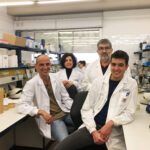
“The drug you design ten years from now may already be obsolete,” Ivan Erill says. In a new study in Frontiers in Microbiology, Erill and colleagues describe how bacteria that existed hundreds of millions of years ago were already resistant to an antibacterial drug not invented until the 1930s. Once farmers began using the new class of drugs in agriculture, resistance spread quickly. As the bacteria were exposed to the drugs on a large scale in soils and waterways, antibiotic-resistant strains began appearing in hospitals within a decade.
How is this all possible? Antibiotic resistance has much deeper roots than most people realize, Erill explains. Many antibiotics used to treat bacterial infections today are based on molecules bacteria naturally produce to out-compete their neighbors. “Your competitors are not just going to stand by,” says Erill, professor of biological sciences, “so over millions of years they are going to develop resistance. That’s a given.”
But the drugs featured in this research are not natural antibiotics. They are synthetic compounds produced by humans. “With synthetic drugs, that’s a different picture altogether,” Erill says. “It’s not a given that you would find resistance.” That’s why the research team was surprised when they did—hundreds of millions of years before the drugs were invented.
Tracking down the source
The synthetic antibacterial drugs in question, called sulfonamides, target an enzyme involved in a pathway necessary for DNA synthesis. If an organism can’t replicate its DNA, it can’t reproduce, so its population quickly dwindles to nothing. The bacteria that are resistant to sulfonamides have modified genes for the target enzyme, called sul genes (for sulfonamide resistance). These genes allow the bacteria to continue reproducing in the presence of the drug, which means the antibiotic won’t work on them.
Most sulfonamide-resistant bacteria have sul genes in what are called mobile elements—small segments of DNA that can easily jump from one individual or species to another. Erill and colleagues used computational tools to figure out which bacteria species had sulfonamide-resistance genes in their chromosomes instead of in mobile elements, indicating that they were the original sources of the resistance. They showed that two groups of bacteria harbor chromosomal sul-like genes.
 Ivan Erill. Photo by Marlayna Demond ‘11 for UMBC.
“You can use algorithms to reconstruct the most likely evolutionary history that explains the development of sulfonamide resistance,” Erill says. Those algorithms allowed the researchers to confirm that the resistance existed 500 to 600 million years ago. To further verify their results, the researchers inserted copies of the chromosomal sul-like genes into bacterial cells in the lab. When exposed to sulfonamides, the cells grew just fine, confirming that the genes confer resistance.
Pure chance
The question remains, though: “How can you explain that bacteria 500 million years ago were resistant to a substance that didn’t yet exist?” asks Erill. While there is an small chance some organism was producing a sulfonamide-like compound hundreds of millions of years ago and resistance evolved in response to that pressure, Erill and his team put forth a different argument.
“There is an enormous amount of bacterial genetic diversity,” Erill says. Miquel Sanchez, a Ph.D. student at the Universitat Autònoma de Barcelona and the first author on the paper, adds, “Resistant variants of the antibacterial target could be present in the global genetic pool even before microbes are exposed to them.”
So, the reason these two bacterial groups were resistant to a compound that had never existed? Erill says, “We argue that this is just pure chance.”
Rogue bacteria
This research has big implications for the development and use of future antibiotics. If scientists develop a new antibiotic, “it is well possible that there might be one bacterium in the world that is already resistant,” Erill says. With conservative use of the antibiotic in human patients, though, it’s unlikely that particular bacterium would ever be exposed to the antibiotic and spread its resistance.
But, “if you overuse the drug, especially in an agricultural setting, where the drug slowly permeates into the soil, waterways, and underground water reservoirs,” you’re exposing “this huge population of bacteria that otherwise would never be bothered by antibiotics or synthetic drugs,” Erill says. And, based on the team’s analysis, if the one bacterium that is already resistant is exposed to the drug, “this variant that is resistant will jump to other species in a matter of years.”
“For me, it’s especially a warning against using antibiotics in farm settings,” Erill says. New drugs are typically tested using disease-causing bacterial species, “but maybe that’s not enough,” he says. “Maybe you should do broader testing, especially on the non-usual suspects, like soil bacteria.”
Erill also says the new finding points toward using combination therapies more often. A bacterium in nature might harbor a chance resistance to one compound it’s never encountered, but it’s unlikely to be resistant to two. If doctors use two drugs at once, it is likely that one of the drugs will kill the bacteria, preventing it from spreading its resistance to the other drug.
These new research findings could affect how well superbugs are kept at bay and the effectiveness of new antibiotic treatments. Whether the agricultural industry and drug developers heed the team’s advice remains to be seen.
Image: From left to right, the authors of the paper: Ivan Erill, Pilar Cortés, Jordi Barbé, and Miquel Sánchez-Osuna. Photo by Ángela Martínez Mateos.
]]>
“The drug you design ten years from now may already be obsolete,” Ivan Erill says. In a new study in Frontiers in Microbiology, Erill and colleagues describe how bacteria that existed hundreds of...
https://umbc.edu/stories/umbcs-ivan-erill-finds-resistance-to-modern-drug-in-ancient-bacteria/
https://my3.my.umbc.edu/api/v0/pixel/news/120219/guest@my.umbc.edu/2c0cab6151ff54246af167ebacc1b2ab/api/pixel
biology
cirsca
cnms
research
science-and-technology
strategic-planning
UMBC News & Magazine
https://my3.my.umbc.edu/groups/umbc-news-magazine
https://assets1-my.umbc.edu/system/shared/avatars/groups/000/001/943/24435aa6207c452e7bc15cc74b42c7bb/xsmall.png?1748556657
https://assets1-my.umbc.edu/system/shared/avatars/groups/000/001/943/24435aa6207c452e7bc15cc74b42c7bb/original.png?1748556657
https://assets2-my.umbc.edu/system/shared/avatars/groups/000/001/943/24435aa6207c452e7bc15cc74b42c7bb/xxlarge.png?1748556657
https://assets2-my.umbc.edu/system/shared/avatars/groups/000/001/943/24435aa6207c452e7bc15cc74b42c7bb/xlarge.png?1748556657
https://assets3-my.umbc.edu/system/shared/avatars/groups/000/001/943/24435aa6207c452e7bc15cc74b42c7bb/large.png?1748556657
https://assets1-my.umbc.edu/system/shared/avatars/groups/000/001/943/24435aa6207c452e7bc15cc74b42c7bb/medium.png?1748556657
https://assets2-my.umbc.edu/system/shared/avatars/groups/000/001/943/24435aa6207c452e7bc15cc74b42c7bb/small.png?1748556657
https://assets1-my.umbc.edu/system/shared/avatars/groups/000/001/943/24435aa6207c452e7bc15cc74b42c7bb/xsmall.png?1748556657
https://assets2-my.umbc.edu/system/shared/avatars/groups/000/001/943/24435aa6207c452e7bc15cc74b42c7bb/xxsmall.png?1748556657
UMBC News & Magazine
0
0
false
Wed, 30 Jan 2019 20:47:42 -0500
Hour of Code brings Baltimore 3rd and 4th graders to UMBC for fun intro to computing

UMBC’s Computer Science Education student group recently hosted the third annual Hour of Code event on campus. This popular community event is an opportunity for both local K-12 students and current UMBC students in other majors to learn more about computing through engaging, hands-on activities.
Hour of Code is part of Computer Science Education Week, an international initiative that aims to increase the participation underrepresented groups in computing, including women and people of color. A major aspect of this work is supporting expanded computer science access for K-12 students.
Third- and fourth-grade students from Baltimore’s Lakeland Elementary/Middle School participated in this year’s hands-on activities, including playing music on a banana keyboard. The bananas are connected by wires and when the fruit is touched it completes the circuit and plays a musical note.
 UMBC students mentor Lakeland students at the Hour of Code.
“It’s important for UMBC to have an impact in our local community. UMBC is a public university and we are part of the community,” says Fayo Ojo ‘20, computer science, who helped coordinate the event. “Hosting events like this shows that UMBC is committed to education beyond the courses offered here.”
Ojo, treasurer of the Computer Science Education club, right, helped the visiting elementary school students play “Mary Had a Little Lamb” on the banana keyboard. “My favorite part of working with the Lakeland students is seeing how excited they were,” she says.
Members of the Computer Science Education club also set up laptops and guided their guests through coding activities, giving them an introduction to the creative work they might do in computing.
 A UMBC student guides a Lakeland student through coding activities during the 2018 Hour of Code.
“Most of the students from Lakeland Elementary that visited UMBC for Hour of Code have never been to a college campus before,” says Ojo. She explains, “They received their first glimpse into what post-secondary education has to offer from UMBC. This experience will have a major impact on these students as they matriculate through school and prepare to go to college themselves.”
When it comes to her group’s motivation and broader goals, Ojo shares, “We want to support initiatives that bring programming classes and programs to students at the K-12 level. Working with these students and seeing how excited they were to learn…reminded me why I decided to pursue computer science in the first place: we love to solve problems and we love technology.”
Banner image: A UMBC student guides a Lakeland student through coding activities during the 2018 Hour of Code. All photos by Marlayna Demond ’11 for UMBC.
]]>
UMBC’s Computer Science Education student group recently hosted the third annual Hour of Code event on campus. This popular community event is an opportunity for both local K-12 students and...
https://umbc.edu/stories/hour-of-code-brings-baltimore-3rd-and-4th-graders-to-umbc-for-fun-intro-to-computing/
https://my3.my.umbc.edu/api/v0/pixel/news/120230/guest@my.umbc.edu/2bcc4d827d4b6bda79df4d7fe8784986/api/pixel
cec
coeit
csee
diversityandinclusion
science-and-technology
strategic-planning
UMBC News & Magazine
https://my3.my.umbc.edu/groups/umbc-news-magazine
https://assets1-my.umbc.edu/system/shared/avatars/groups/000/001/943/24435aa6207c452e7bc15cc74b42c7bb/xsmall.png?1748556657
https://assets1-my.umbc.edu/system/shared/avatars/groups/000/001/943/24435aa6207c452e7bc15cc74b42c7bb/original.png?1748556657
https://assets2-my.umbc.edu/system/shared/avatars/groups/000/001/943/24435aa6207c452e7bc15cc74b42c7bb/xxlarge.png?1748556657
https://assets2-my.umbc.edu/system/shared/avatars/groups/000/001/943/24435aa6207c452e7bc15cc74b42c7bb/xlarge.png?1748556657
https://assets3-my.umbc.edu/system/shared/avatars/groups/000/001/943/24435aa6207c452e7bc15cc74b42c7bb/large.png?1748556657
https://assets1-my.umbc.edu/system/shared/avatars/groups/000/001/943/24435aa6207c452e7bc15cc74b42c7bb/medium.png?1748556657
https://assets2-my.umbc.edu/system/shared/avatars/groups/000/001/943/24435aa6207c452e7bc15cc74b42c7bb/small.png?1748556657
https://assets1-my.umbc.edu/system/shared/avatars/groups/000/001/943/24435aa6207c452e7bc15cc74b42c7bb/xsmall.png?1748556657
https://assets2-my.umbc.edu/system/shared/avatars/groups/000/001/943/24435aa6207c452e7bc15cc74b42c7bb/xxsmall.png?1748556657
UMBC News & Magazine
0
0
false
Thu, 10 Jan 2019 20:03:43 -0500
Times Higher Ed spotlights UMBC as a model in supporting student achievement
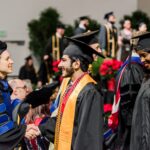
This week, Times Higher Education shined a spotlight on UMBC’s advancements in graduating more low-income and minority students in the sciences—what it calls the “holy grail of academia.” “Everybody wants to understand our model,” UMBC President Freeman Hrabowski told reporter Paul Basken.
As Hrabowski explained, lessons learned in one area can inform another, and UMBC’s work to support underrepresented students in STEM fields has led to investments in support programs for students of all backgrounds across UMBC.
“The words I use are ‘inclusive excellence’,” Hrabowski told the London-based publication. “Yes, we are helping kids of color, but we are helping all kids.”
 President Hrabowski with Orientation Peer Advisors, summer 2018.
The article travels across UMBC’s growing campus. Basken takes a stop in the Chemistry Discovery Center, speaking with Diana Hamilton, Ph.D., ’93, lecturer in chemistry and biochemistry, about effective, team-based approaches to active learning. He also speaks with Yvette Mozie-Ross ’88, vice provost for enrollment management, about UMBC’s strategic use of analytics to determine where students are struggling and how to support students and faculty through additional resources.
“Most institutions have a data warehouse,” says Mozie-Ross. “What most institutions don’t have is an analytics tool to use that data on a daily basis, to make informed decisions” as UMBC does, she explains.
 Yvette Mozie-Ross congratulates a new UMBC graduate at commencement.
As UMBC further expands student support programs across the university, the world is also looking at efforts to replicate UMBC’s Meyerhoff Scholars Program at other institutions, Times Higher Education notes. The Meyerhoff Scholars Program is known as the gold standard in supporting diverse students in STEM fields. UMBC is now the nation’s #1 producer of African American undergraduates who go on to complete M.D./Ph.D. degrees, and #2 nationally for African American undergraduates who complete a Ph.D. in any STEM field.
In 2014, the Howard Hughes Medical Institute made a five-year, $8 million investment in adapting the Meyerhoff program at both Penn State and the University of North Carolina at Chapel Hill. Those efforts are showing strong results, and have sparked interest from other universities across the nation.
Featured image: Associate Professor Laura Hussey congratulates new UMBC graduates during winter commencement, December 2018. All photos by Marlayna Demond ’11 for UMBC.
]]>
This week, Times Higher Education shined a spotlight on UMBC’s advancements in graduating more low-income and minority students in the sciences—what it calls the “holy grail of academia.”...
https://umbc.edu/stories/times-higher-ed-spotlights-umbc-as-a-model-in-supporting-student-achievement/
https://my3.my.umbc.edu/api/v0/pixel/news/120233/guest@my.umbc.edu/8cfbeb7a2b291ed40fe5ed59aafb719f/api/pixel
chembiochem
community
diversityandinclusion
icp
meyerhoffscholars
science-and-technology
strategic-planning
UMBC News & Magazine
https://my3.my.umbc.edu/groups/umbc-news-magazine
https://assets1-my.umbc.edu/system/shared/avatars/groups/000/001/943/24435aa6207c452e7bc15cc74b42c7bb/xsmall.png?1748556657
https://assets1-my.umbc.edu/system/shared/avatars/groups/000/001/943/24435aa6207c452e7bc15cc74b42c7bb/original.png?1748556657
https://assets2-my.umbc.edu/system/shared/avatars/groups/000/001/943/24435aa6207c452e7bc15cc74b42c7bb/xxlarge.png?1748556657
https://assets2-my.umbc.edu/system/shared/avatars/groups/000/001/943/24435aa6207c452e7bc15cc74b42c7bb/xlarge.png?1748556657
https://assets3-my.umbc.edu/system/shared/avatars/groups/000/001/943/24435aa6207c452e7bc15cc74b42c7bb/large.png?1748556657
https://assets1-my.umbc.edu/system/shared/avatars/groups/000/001/943/24435aa6207c452e7bc15cc74b42c7bb/medium.png?1748556657
https://assets2-my.umbc.edu/system/shared/avatars/groups/000/001/943/24435aa6207c452e7bc15cc74b42c7bb/small.png?1748556657
https://assets1-my.umbc.edu/system/shared/avatars/groups/000/001/943/24435aa6207c452e7bc15cc74b42c7bb/xsmall.png?1748556657
https://assets2-my.umbc.edu/system/shared/avatars/groups/000/001/943/24435aa6207c452e7bc15cc74b42c7bb/xxsmall.png?1748556657
UMBC News & Magazine
0
0
false
Fri, 04 Jan 2019 21:24:12 -0500
Grit and community support help UMBC grads envision—and claim—their futures
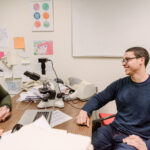
Each UMBC student has a unique journey, including challenges to tackle with tenacity, courage, and grit. For many of UMBC’s newest grads, a culture of community support has made all the difference, enabling them to both claim their future and help others along the way.
Determined to succeed
Jeffrey Inen ’18, graduating with a biological sciences degree this week, grew up down the road from UMBC, but his college journey has had unexpected twists and turns. Support from his UMBC community, particularly faculty mentors, helped him to persevere through significant health challenges. Ultimately, Inen would undergo five rounds of chemotherapy while completing his UMBC degree, doing impactful research, serving as a teaching assistant in cell biology, and holding down a full-time job.
“Enduring my struggles with chemotherapy and trying to obtain my degree felt impossible at times,” says Inen. But after taking some time off and starting anew within the biology department, Inen found the support system that would allow him to not only graduate from UMBC, but flourish academically and personally.
When a teaching assistant recommended Inen to Charles Bieberich’s research lab, his entire academic trajectory shifted.
 Jeff Inen with Charles Bieberich and Michelle Starz-Gaiano. Photo by Marlayna Demond ’11 for UMBC.
“Dr. Bieberich has supported me from the beginning. Even when I’ve made mistakes in the lab, he’s never once given up on me,” says Inen. When he became ill earlier this semester and spent several days in the hospital, Bieberich visited almost daily.
“It has been a true inspiration for me having Jeff in the lab, knowing the physical setbacks he has overcome in the past few years,” says Bieberich. “He brings that same determination to overcome any and all obstacles to his work, and that’s exactly what it takes to succeed in biomedical research environment.”
“Despite his ongoing struggles,” Bieberich says, “he just continues to work hard and continues to be grateful for the opportunity to contribute to our research goals. I’ve learned more from Jeff than he has from me.”
Inen has also developed a close connection with Michelle Starz-Gaiano, associate professor of biological sciences and his academic advisor, as well as a mentor. Inen says, “I can’t express how helpful she has been throughout my time here at UMBC. She has given me the guidance and the support to pursue my goal of obtaining my Ph.D.”
 Inen in the lab with Michelle Starz-Gaiano. Photo by Marlayna Demond ’11 for UMBC.
“The inspiring thing about Jeff is that not only did he persist in the face of extreme difficulties, he remained optimistic and hopeful throughout,” says Starz-Gaiano. “Jeff faced challenges…that would have derailed most people, but he kept going, and kept improving.”
Inen showed that persistent drive to grow, learn, and discover when he earned a summer 2018 research award through the Louis Stokes Alliances for Minority Participation program.
After commencement, Inen will continue to work in Bieberich’s lab on his ongoing research. In February, he’ll apply for STAR-PREP, a post-baccalaureate program at the University of Maryland School of Medicine.
Strength in numbers
On September 20, 2017, Hurricane Maria touched down in Puerto Rico. Over 1,500 miles away in Maryland, Paola Rojas ’18, business technology administration, was in the midst of her studies at UMBC. But her heart was with her hometown of San Lorenzo.
An avid athlete and strong student, Rojas quickly made a name for herself when she came to UMBC in fall 2014. She finished her first season with 11 match appearances and was named to the All-Rookie Team. Accolades continued to roll in throughout her career and she managed to secure a place on the All-Conference First Team and All-Conference Second-Team, even after suffering an injury in the 2016-2017 season.
 Paola Rojas celebrating during a UMBC volleyball game. Photo courtesy of Rojas.
Rojas found a new family of support at UMBC and in the surrounding community. That was never more evident than when disaster befell Puerto Rico.
She and other players from Puerto Rico turned to one another for support while they waited for days to hear news from home, with communications hampered by hurricane damage. After over a week of waiting, Rojas finally heard from her family.
 Paola Rojas with her family during UMBC Senior Night. Photo courtesy of Rojas.
“It was really hard the first time I talked to my mom after the hurricane, on September 27, her birthday, hearing her cry over the phone talking about how Puerto Rico looked like a completely different island and how getting food or gas was beyond hard,” she says. “It broke my heart to know that my family was going through a lot and I couldn’t do anything to make it better.”
Energized by support from teammates and the broader UMBC community, Rojas and friends started a GoFundMe page called Project PRdise to aid in relief efforts in Puerto Rico. Through their fundraising efforts, they were able to raise over $10,000 and gather thoughtful personal messages to support those devastated by Hurricane Maria.
“It was one of the best experiences I’ve had here at UMBC, to see how much people cared and helped,” says Rojas.
 Paola Rojas with family during UMBC Senior Night. Photo courtesy of Rojas.
Head women’s volleyball coach Cristina Robertson provided mentorship and encouragement for Rojas along the way. “Paola exemplifies the student-athlete model,” shares Robertson. “She’s a great student in the classroom and a phenomenal athlete on the volleyball court.”
One memory of her time with her coach stands out to Rojas, from the team’s Senior Day celebration. “I still remember when Coach Cristina was giving her speech. She delivered a portion of it in Spanish so my family could understand,” says Rojas. “That was one of the best days of my life.”
Rojas leaves UMBC as the ninth all-time player in terms of hitting percentage, tenth in assisted blocks, and tied seventh in single-season assisted blocks. She will play volleyball professionally for Las Changas de Naranjito in the Puerto Rico’s Liga de Voleibol Superior Femenino.
Fresh start
This week, Arabia-Iman Tillery ’18, economics, will become the first member of her family to earn a college degree. For a time, she was worried it might not happen.
Tillery started her college career at another university, taking out large loans to pay her tuition. Facing significant debt after just one year, she decided to return home to Maryland and enroll at UMBC. Bolstered by her mother’s support, Tillery rededicated herself to completing her degree. She shares, “I was determined to climb out of that hole…and come out a better person.”
Tillery threw herself into new pursuits on campus, which quickly shaped her day-to-day routine. She’s served as vice president of the Women’s Center’s Women of Color Coalition and a co-founder and president of the Spanish Conversation Club. She’s also interned with Habitat for Humanity and served as treasurer for the UMBC chapter, all while balancing work and her degree.
 Posters from the Women of Color Telling Our Stories project (Arabia-Iman Tillery in the center). Images courtesy of the UMBC Women’s Center.
“With the guidance and support of several members of the UMBC community, I was able to earn great grades while also being involved with other students on campus,” she says.
Tammy Henderson, lecturer of Africana studies and a mentor of Tillery’s, shares, “Arabia is one the most determined and committed students I have had the pleasure of teaching. Her ability to persist despite the obstacles she has had to face makes her a person we should all admire.”
After earning her UMBC degree this week, Tillery will work as a project coordinator for a security company. Thinking back on how much she has achieved and what it took to get here, she shares, “UMBC never, ever gave up on me…UMBC always saw my potential.”
December commencement ceremonies will be livestreamed through both the UMBC Commencement website and UMBC Facebook page. Share well wishes for our grads using #UMBCgrad and #UMBCproud.
Banner image: Jeffrey Inen, right, speaking with his mentor, Javier Guzman. Photo by Marlayna Demond ’11 for UMBC.
]]>
Each UMBC student has a unique journey, including challenges to tackle with tenacity, courage, and grit. For many of UMBC’s newest grads, a culture of community support has made all the...
https://umbc.edu/stories/grit-and-community-support-help-umbc-grads-envision-and-claim-their-futures/
https://my3.my.umbc.edu/api/v0/pixel/news/120240/guest@my.umbc.edu/4c460bb7134ba14af3e88599a93d4e4e/api/pixel
athletics
biology
cahss
cec
class-of-2018
cnms
coeit
community
economics
is
strategic-planning
UMBC News & Magazine
https://my3.my.umbc.edu/groups/umbc-news-magazine
https://assets1-my.umbc.edu/system/shared/avatars/groups/000/001/943/24435aa6207c452e7bc15cc74b42c7bb/xsmall.png?1748556657
https://assets1-my.umbc.edu/system/shared/avatars/groups/000/001/943/24435aa6207c452e7bc15cc74b42c7bb/original.png?1748556657
https://assets2-my.umbc.edu/system/shared/avatars/groups/000/001/943/24435aa6207c452e7bc15cc74b42c7bb/xxlarge.png?1748556657
https://assets2-my.umbc.edu/system/shared/avatars/groups/000/001/943/24435aa6207c452e7bc15cc74b42c7bb/xlarge.png?1748556657
https://assets3-my.umbc.edu/system/shared/avatars/groups/000/001/943/24435aa6207c452e7bc15cc74b42c7bb/large.png?1748556657
https://assets1-my.umbc.edu/system/shared/avatars/groups/000/001/943/24435aa6207c452e7bc15cc74b42c7bb/medium.png?1748556657
https://assets2-my.umbc.edu/system/shared/avatars/groups/000/001/943/24435aa6207c452e7bc15cc74b42c7bb/small.png?1748556657
https://assets1-my.umbc.edu/system/shared/avatars/groups/000/001/943/24435aa6207c452e7bc15cc74b42c7bb/xsmall.png?1748556657
https://assets2-my.umbc.edu/system/shared/avatars/groups/000/001/943/24435aa6207c452e7bc15cc74b42c7bb/xxsmall.png?1748556657
UMBC News & Magazine
0
0
false
Wed, 19 Dec 2018 20:13:50 -0500
Faculty receive START and SURFF awards to pursue new research and creative work
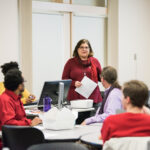
UMBC’s Office of the Vice President for Research recently presented awards to support the work of two dozen UMBC faculty examining topics from health disparities among people with diabetes to natural language processing.
UMBC offers a range of research awards to help faculty launch new research projects, advance ongoing work, and effectively compete for external funding as their projects progress and grow. Strategic Awards for Research Transitions (START) offer up to $25,000. These awards allow faculty to pursue new areas of research and compete for external funding. Summer Research Faculty Fellowship (SURFF) awards offer up to $6,000 in summer funding to non-tenured, tenure-track faculty. Current SURFF awardees received funding for summer 2018, and START awardees will begin their funding cycle in July 2019.
Health and aging
Christine Mair, associate professor of sociology, anthropology, and health administration policy, and a faculty member in the gerontology Ph.D. program, received START funding to complete foundational research visits in global regions that are underrepresented in aging research, across Eastern Europe, Southern Europe, South America, and Asia. She is working to clarify research questions and strengthen relationships with potential research collaborators for a proposal to the National Institute of Aging (NIA).
 Christine Mair, second from left, at the UMB-UMBC Partnership Symposium. Photograph by Marlayna Demond ’11 for UMBC.
With START funding, Sarah Chard, associate professor of sociology, anthropology, and health administration policy, is studying the activity levels of older African-American adults in Baltimore who have diabetes. She is conducting interviews and observing patients to better understand how they experience and manage their illness, their social and physical environments, and how they maintain physical activity routines. This work is helping Chard to develop more effective programs to address health disparities among people with diabetes.
“The aim of my START-funded project is to identify how belief systems and social processes work together to inform physical activity routines among older adult African Americans with diabetes. The project builds on my earlier research on diabetes, which identified many barriers to physical activity for older adults living in Baltimore,” Chard says. “Through START funding, I’m able to shift my focus to look at persons who are engaging in physical activity to see how they create support systems and navigate local barriers. The findings will help address a critical gap in the literature regarding successful community-based physical activity.” Chard will use data from this research for an NIA grant proposal.
 Tasneem Khambaty. Photo courtesy of psychology department.
Tasneem Khambaty, assistant professor of psychology, is using her SURFF award to continue research studying the symptoms and biomarkers of type 2 diabetes, which disproportionately affects African Americans. Khambaty examined how depressive symptoms and executive function impact these biomarkers in the long term, utilizing data from the Healthy Aging in Neighborhoods of Diversity across the Life Span (HANDLS) study, which was conducted in Baltimore. Khambaty is using this research to build a proposal for an NIH Mentored Patient-Oriented Research Career Development Award.
Jiaqi Gong, assistant professor of information systems, is developing innovative ways to understand cognitive and neural systems, specifically in people with multiple sclerosis and ACL injuries. Wearable sensors don’t all work equally well for all people. Previously, Gong developed wearable sensors that perform better in people with multiple sclerosis at different stages. Through his SURFF-funded work, he is utilizing those sensors to study brain mechanisms that control automatic and unconscious motor action, to inform his teaching and further research.
 Jiaqi Gong, right, connects with colleagues at campus event. Photo by Kait McCaffrey.
Drew Holladay, assistant professor of English, utilized SURFF funding to continue revisions of his 2017 dissertation “Articulating the New Normal(s): Mental Disability, Medical Discourse, and Rhetorical Action” for publication as a book. Holladay studies online discussion board posts written by people diagnosed with autism, post-traumatic stress disorder, and schizophrenia. He is expanding his earlier writing to include more linguistic analysis, analyzing how the medical community talks about these diagnoses, as well as adding in illustrations to complement the text.
 Drew Holladay, third from right, participating on UMBC’s Public Humanities and Health Justice Research Forum. Photo by Kait McCaffrey.
Cynthia Matuszek, assistant professor of computer science and electrical engineering (CSEE), was granted START funding to advance her work on robots that assist senior citizens in daily life and enable them to continue to live independently. She is collaborating with eldercare professionals to develop a library that will outline specific examples of how seniors can utilize assistive robots in daily life. Matuszek also received SURFF funding to develop a networking event at the Robotics: Science and Systems conference, to connect junior faculty and postdoctoral researchers with mentors in robotics.
Art, history, and society
Kathryn Bell, associate professor of visual arts, is using START funding to create Metempsychosis, a series of interactive digital video installations that combine art with science, technology, engineering, and math. She is shifting her work from project mapping art to art that is more accessible and less expensive to stage in galleries. Bell will travel to the United Kingdom to study under automata artist Matt Smith, who has exhibited at museums around the world.
Anne Rubin, professor of history, was awarded START funding to visualize the landscape of slavery and freedom in Early Baltimore. Rubin is building a virtual 3D prototype of early Baltimore between 1815 and 1820, in collaboration with UMBC’s Imaging Research Center.
Kathy Marmor, associate professor of visual arts, received START funding to create two new art installations called Mid-Life, inspired by the practice of compiling a book based personal knowledge, which has been common from the seventeenth century through modern times, and is based on one’s “habit of mind.” She is collaborating with faculty in UMBC’s English and computer science and electrical engineering departments. The installations will bring together digital and computer-based imagery, and analog drawings and fiber art to depict women facing mid-life challenges.
 A photo from The Glass Knife exhibition, by Kathy Marmor and Stephen Bradley, which ran in 2016. Image by Stephen Bradley.
Sarah Sharp, assistant professor of visual arts, is using START funding for her new project Off the Press. Sharp will look at small presses and self-published media from the women’s, gay rights, and environmental movements in the 1970s. She will examine the differences and similarities between common practices of that period and contemporary self-publishing practices, such as through social media and other online platforms. Sharp is combining traditional art practices, like quiltmaking and embroidery, with digital video, augmented reality, and 3D modeling.
Earl Brooks, assistant professor of English, utilized a SURFF award to continue his project Black Sonority: Rhetoric and Black Music. This work examines the intersections of Black music, life, and culture. Brooks explores the rhetorical nature of Black music and the various roles it had has in shaping public discussion.
Cross-cultural understanding
Kindel Nash, associate professor of early childhood education, has received SURFF funding to study the relationship between culture, language, and literacy development for young children in the United States and Peru. Nash is examining highly effective literacy practices in U.S. and Peruvian primary schools, which both include populations that are historically underserved in educational settings. She will work to determine the practices’ commonalities and underlying principles, and whether the approaches would be transferable across cultures.
Salem Abo-Zaid, assistant professor of economics, studied attitudes toward immigrant and minority populations in a sample of European countries between 2002 and 2016. He used longitudinal data from the European Social Survey to understand how economic conditions have impacted tolerance toward people in these groups. Abo-Zaid found that economic conditions, in addition to security, political, and cultural tensions, impacted countries’ tolerance of immigrant and minority populations.
Melissa Bailey Kutner, assistant professor of ancient studies, used SURFF funding to complete her book about economics in the Roman Empire. As a part of this work, Kutner studied coins, measured instruments, and wrote accounts of documents found at specific archaeological sites. She looked at how communities used these tools to trace how they shared information and negotiated economic value. Kutner found that how Romans represented value depended on social context, and she developed a model to examine related historical changes across multiple regions.
Technology and environment
Dillon Mahmoudi, assistant professor of geography and environmental systems, used SURFF funding to create a machine-learning algorithm to identify spaces for urban agriculture on single family tax lots. Mahmoudi will study whether urban agriculture plots are more frequently located in richer or poorer neighborhoods. This work focuses on the food production potential of lots in Seattle and Baltimore, expanding on prior research that analyzed lots through satellite images of Portland.
Tim Nohe, professor of visual arts and director of UMBC’s Center for Innovative Research in the Creative Arts, received START funding to use 360 degree immersive video and surround-sound technology to give people a deeper look into the environment through his project “Water Flowing Underground: Immersive Sound and Immersive Video Imaging.” His work will allow viewers to understand sources of pollution that impact Baltimore’s watershed. The research will reveal streams that have been used to collect raw sewage, or have been paved over, impacting the flow of water.
 Tim Nohe at Light City in 2017. Photo by Marlayna Demond ’11 for UMBC.
“This grant has allowed me to begin fieldwork and research on the fractured interface of Baltimore’s watershed and its sanitary sewer system. That breakdown is evident in my neighborhood, and throughout the city,” explains Nohe. “When the sewer system was nearing completion in 1909 it was called an ‘unexcelled marvel of the engineering world,’ but today sanitary sewers routinely spew waste into our streams, the bay, and city basements.”
“I’m forging partnerships with journalists, water quality scientists and nonprofit groups like Blue Water Baltimore to hunt down and expose these breakdowns,” says Nohe, “using the tools of archival research, and documentary immersive video and surround sound.”
Data and computing
Frank Ferraro, assistant professor of CSEE, used SURFF funding to advance his work in natural language processing. He studied how information extraction systems can help deconstruct and summarize highly complex documents. Over the summer, Ferraro developed, trained, and evaluated these systems to determine how they can be effectively used to can help people understand themes within dense and complicated texts.
Haibin Zhang, assistant professor of CSEE, developed an efficient, secure and scalable system that helps prevent compromised sensors from shifting aggregated data results based on polluted data. The system that Zhang designed and put in place helps solve the problem by keeping individual sensor inputs private.
Sisi Duan, assistant professor of information systems, used SURFF funding to study the scalability of blockchains—blocks of data linked using cryptography, that are resistant to tampering. She identified challenges that blockchain researchers sometimes face, and then redesigned and reimplemented a blockchain protocol called BChain, which she developed. Duan implemented BChain as part of the Hyperledger project, a global collaborative project aimed at advancing blockchain technologies across industries.
Curtis Menyuk, professor of CSEE, is working with collaborators at Bangladesh University of Engineering and Technology and at the Maryland Psychiatric Research Center to develop a model that can help explain what contributes to white matter deficits in the brain.
New directions in science
Theodosia Gougousi, professor of physics, received funding to address the shortage of semiconductor-compatible nonlinear optical materials. She will investigate the nonlinear properties of dielectric thin films and nanolaminates formed by atomic layer deposition. Her project is interdisciplinary, bridging the fields of electronics materials and nonlinear optics, with the goal of developing a broader materials toolkit that could be utilized for optoelectronic applications.
Gougousi explains that the funding will support the collaboration of her research group and that of Anthony Johnson, professor of physics. “Our groups have been working together for over a year,” she says. “We expect the award will enable us to complete the characterization of the structure and composition of these films, which is required for competitive proposals to national funding agencies.
Mercedes Burns, assistant professor of biological sciences, studied sexual reproduction in Japanese harvestman, an arachnid with long legs compared to other species. This work, supported by SURFF funding, allowed Burns to collect female Japanese harvestman in order to conduct genotyping analysis. During the summer, she attended the Society of Molecular Biology and Evolution scientific meeting to collaborate with fellow biologists from around the world.
Kathleen Cusick, assistant professor of biological sciences, received SURFF funding to characterize the role of an intracellular signaling molecule in bacteria that regulates cellular function, cell movement, intracellular communication, and how cells respond to the environment. The molecule (called c-di-GMP) has unique trails that make it a particularly good fit for this research into signaling networks.
For more information about UMBC’s START and SURFF programs, visit the UMBC Research website.
Banner image: Anne Rubin, standing, during the 2018 Frederick Douglass transcribe-a-thon. Banner image by Marlayna Demond ’11 for UMBC.
]]>
UMBC’s Office of the Vice President for Research recently presented awards to support the work of two dozen UMBC faculty examining topics from health disparities among people with diabetes to...
https://umbc.edu/stories/faculty-receive-start-and-surff-awards-to-pursue-new-research-and-creative-work/
https://my3.my.umbc.edu/api/v0/pixel/news/120243/guest@my.umbc.edu/714811ac2a01d4a647e7e1503f70268a/api/pixel
ancientstudies
biology
cahss
cirsca
cnms
coeit
csee
economics
education
english
ges
history
is
physics
research
saph
science-and-technology
strategic-planning
visualarts
UMBC News & Magazine
https://my3.my.umbc.edu/groups/umbc-news-magazine
https://assets1-my.umbc.edu/system/shared/avatars/groups/000/001/943/24435aa6207c452e7bc15cc74b42c7bb/xsmall.png?1748556657
https://assets1-my.umbc.edu/system/shared/avatars/groups/000/001/943/24435aa6207c452e7bc15cc74b42c7bb/original.png?1748556657
https://assets2-my.umbc.edu/system/shared/avatars/groups/000/001/943/24435aa6207c452e7bc15cc74b42c7bb/xxlarge.png?1748556657
https://assets2-my.umbc.edu/system/shared/avatars/groups/000/001/943/24435aa6207c452e7bc15cc74b42c7bb/xlarge.png?1748556657
https://assets3-my.umbc.edu/system/shared/avatars/groups/000/001/943/24435aa6207c452e7bc15cc74b42c7bb/large.png?1748556657
https://assets1-my.umbc.edu/system/shared/avatars/groups/000/001/943/24435aa6207c452e7bc15cc74b42c7bb/medium.png?1748556657
https://assets2-my.umbc.edu/system/shared/avatars/groups/000/001/943/24435aa6207c452e7bc15cc74b42c7bb/small.png?1748556657
https://assets1-my.umbc.edu/system/shared/avatars/groups/000/001/943/24435aa6207c452e7bc15cc74b42c7bb/xsmall.png?1748556657
https://assets2-my.umbc.edu/system/shared/avatars/groups/000/001/943/24435aa6207c452e7bc15cc74b42c7bb/xxsmall.png?1748556657
UMBC News & Magazine
0
0
false
Tue, 18 Dec 2018 20:22:13 -0500
From lab to museum, new UMBC grads show the powerful impact of original research
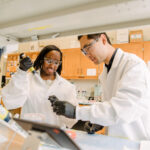
“I just had this feeling that there had to be more to this story,” says Nicolle “Niki” Konkel ’18, on the striking lack of women in her art history textbooks. So, with the support of faculty mentors, in her senior year she embarked on research that has opened new doors in the art world.
Student passion guided by faculty support is part of the fabric of UMBC. Konkel’s experience is one exciting example of how this winning combination can make possible big breakthroughs.
Hearing marginalized voices
Konkel is an art history and museum studies major who came to UMBC after attending Frederick Community College. While at FCC, She worked 30 hours a week in addition to her studies to fund her first trip to the Netherlands, a voyage that shaped her career goals. Now, she is contributing to a new branch of art history research on women of the De Stijl, an early 20th-century avant garde Dutch art movement.
“There’s so much still to learn, and that fuels my passion to go to graduate school and continue this research,” she says. “When marginalized voices can be heard and placed more within the mainstream, I think that’s so important.”
 DE STIJL “6 decades book.” Photo by de stijl, CC BY 2.0.
This fall, Konkel was also able to gain professional experience as an curatorial intern at the Smithsonian National Museum of American History. She was part of the curatorial team for an entertainment exhibit that will be on display for two decades.
Konkel says the support of her mentors helped make it all possible, especially her senior thesis mentor, visual arts professor Kathy O’Dell. All of the professors “are so invested in us here. They care a lot about my growth and what I’m going to do afterward,” Konkel says. “They want to help you channel your passion.”
Confidence boost
Alexis Waller ’18, biological sciences, has had similarly powerful experiences with research and mentorship. UMBC STEM BUILD, an NIH-funded initiative to increase diversity in the biomedical workforce, “showed me what research actually was,” Waller says. Before UMBC, she shares, “I’d never been inside a lab.” Now? “I just love being in the lab setting and doing hands-on research.”
In her first year, Waller presented at the UMBC Undergraduate Research Symposium with BUILD. With support from Laura Ott, the active learning coordinator for STEM BUILD, Waller joined Michael Summers’s lab in 2016. The lab’s research focuses on how the HIV-1 retrovirus assembles copies of itself within infected cells, so that the copies can emerge to infect other cells.
In addition to Summers, postdoc Pengfei Ding provides direct research mentorship to Waller. “He has always been very patient and encouraged me to ask questions,” Waller says.
 Alexis Waller ’18, right, and her mentor Pengfei Ding at work in Michael Summers’s biochemistry lab. Photo by Marlayna Demond ’11 for UMBC.
Waller started out in a shadowing role in the lab, but says, “as I’ve gotten more confident and knowledgeable, the more responsibility I’ve been given.”
Now a MARC U*STAR Scholar, Waller is continuing work on her team’s project studying a step in the replication of HIV. By contributing to a better understanding of that step, she’s helping provide the knowledge necessary for other scientists to develop treatments to block HIV replication, preventing spread of the infection.
After graduation, Waller will continue to work in the Summers lab as a research assistant while she applies to Ph.D. programs in microbiology. “Being a part of BUILD and MARC, and working in the Summers lab, has all led to me deciding to pursue a Ph.D.,” she says.
Bench to bedside
Like Waller, Abby Cruz ‘18 is also a biological sciences major and a MARC U*STAR Scholar. When she came to UMBC, she believed science was a solitary pursuit, but that changed after she joined Fernando Vonhoff’s biology lab. “I look forward to going to lab because of the collaboration with other people,” she says.
 Abby Cruz ’18, left, and her mentor Fernando Vonhoff discuss an experimental protocol. Photo by Marlayna Demond ’11 for UMBC.
Cruz has been looking at whether certain genes may be associated with human motor neuron diseases, such as ALS, using fruit flies as a model. Scientists at Yale University will use her results to inform their study of motor neuron disease in human cells.
She also works part time in a neurology clinic, where she interacts directly with patients. “I love it,” she says. “It’s what gets me up every day—that I’m part of a community where I can see the research and the clinical side go hand in hand.”
Cruz reached out to Vonhoff just before she joined UMBC from Howard Community College in 2016, and he’s been a supporter ever since. “If it wasn’t for Dr. Vonhoff I wouldn’t have been able to do everything I did,” she says. “If you’re willing to try and put in the effort, his attitude is, ‘Let’s make it happen.’”
 Abby Cruz ’18 and her mentor Fernando Vonhoff check on a vial of fruit flies, their study organism. Photo by Marlayna Demond ’11 for UMBC.
Before starting work in the lab, Cruz was planning on medical school. Now she’s looking toward an M.D./Ph.D. or D.O./Ph.D. (doctor of osteopathic medicine). “Focusing on that connection between the research and the clinic has really solidified my future goals,” she says.
Bridging cultures
When Julian Tash ’18 approached Constantine Vaporis, history professor and former director of UMBC’s Asian studies program, after an art history class one day, he expected a helpful conversation about his career goals. He came away with a game-changing connection to Robert Mintz, the curator of Japanese art at the Walters Art Museum in Baltimore.
Tash, a Humanities Scholar, had noticed Asian art was given less attention than Western art in his high school courses. His further exposure at UMBC to the rich traditions found in Asian art, however, inspired him to pursue a double major in Asian studies and history. With Vaporis’s support, he began an internship at the Walters.
Cataloguing Buddhist statuary at the Walters got Tash “interested in the question of how to connect museum visitors with these statues, when they don’t have a background in the culture in which the objects were produced,” he shares. That interest led to a project he pursued with guidance from Vaporis and visual arts professor Preminda Jacob.
 Julian Tash ’18 says most of his research, when he isn’t doing fieldwork, involves a lot of reading in the library. Photo by Marlayna Demond ’11 for UMBC.
Tash received funding from a UMBC Undergraduate Research Award and a Bridging Scholarship from the American Association of Teachers of Japanese to travel throughout Japan and in the U.S. to explore how Buddhist statues are displayed in their native context compared to in American museums. His resulting research paper, which has been selected for publication in the UMBC Review, recommends that U.S. museums use technology to help visitors see more clearly how the statues appear in their original contexts, in Japanese temples.
Tash has already shared his research with curators at the Metropolitan Museum of Art, British Museum, and Freer and Sackler Galleries. He has also presented other work at the Bard Conference on Asia and the Environment, with research partner Jennifer Christhilf ’19, geography and environmental systems. That project was a new direction for Tash, exploring the impacts of dam construction projects in China and downstream countries such as Vietnam and Cambodia.
 Julian Tash ’18 and one of his mentors, Julie Rosenthal, stand by his research poster about dam removals on the Mekong River in China. Photo by Marlayna Demond ’11 for UMBC.
“Working with someone in the sciences is really emblematic of UMBC, because we’re bringing it all together, in a way that’s vitally important to this region,” says Tash. “That was a great experience and it got me thinking about the intersection of the humanities and policy.”
Although he’s graduating, collaborations Tash has helped build will continue at UMBC, including a Perspectives on Asia conference that will be co-sponsored by Johns Hopkins University.
Tash has applied for a Fulbright Fellowship to conduct research in Taiwan as well as graduate programs.
Like Konkel, Cruz, and Waller, when Tash reflects on his UMBC experience, it all comes back to mentorship and support. “Even though these professors all have really busy schedules, I would go to them with an idea, and even if it wasn’t in their immediate area of study, they all made such phenomenal efforts to support me,” he shares.
“UMBC put the resources in front of me,” Tash says. “I just thought, I could do all these things—I just have to try to pursue them.”
December commencement ceremonies will be livestreamed through both the UMBC Commencement website and UMBC Facebook page. Share well wishes for our grads using #UMBCgrad and #UMBCproud.
Banner image: Alexis Waller ’18 and her mentor, Pengfei Ding, at work in the lab. Photo by Marlayna Demond ’11 for UMBC.
]]>
“I just had this feeling that there had to be more to this story,” says Nicolle “Niki” Konkel ’18, on the striking lack of women in her art history textbooks. So, with the support of faculty...
https://umbc.edu/stories/from-lab-to-museum-new-umbc-grads-show-the-powerful-impact-of-original-research/
https://my3.my.umbc.edu/api/v0/pixel/news/120244/guest@my.umbc.edu/8feb90d9cbb819b272a89488968dd7d0/api/pixel
arts-and-culture
asianstudies
biology
cahss
chembiochem
cirsca
cnms
community
diversityandinclusion
history
marcustar
policy-and-society
science-and-technology
stembuild
strategic-planning
visualarts
UMBC News & Magazine
https://my3.my.umbc.edu/groups/umbc-news-magazine
https://assets1-my.umbc.edu/system/shared/avatars/groups/000/001/943/24435aa6207c452e7bc15cc74b42c7bb/xsmall.png?1748556657
https://assets1-my.umbc.edu/system/shared/avatars/groups/000/001/943/24435aa6207c452e7bc15cc74b42c7bb/original.png?1748556657
https://assets2-my.umbc.edu/system/shared/avatars/groups/000/001/943/24435aa6207c452e7bc15cc74b42c7bb/xxlarge.png?1748556657
https://assets2-my.umbc.edu/system/shared/avatars/groups/000/001/943/24435aa6207c452e7bc15cc74b42c7bb/xlarge.png?1748556657
https://assets3-my.umbc.edu/system/shared/avatars/groups/000/001/943/24435aa6207c452e7bc15cc74b42c7bb/large.png?1748556657
https://assets1-my.umbc.edu/system/shared/avatars/groups/000/001/943/24435aa6207c452e7bc15cc74b42c7bb/medium.png?1748556657
https://assets2-my.umbc.edu/system/shared/avatars/groups/000/001/943/24435aa6207c452e7bc15cc74b42c7bb/small.png?1748556657
https://assets1-my.umbc.edu/system/shared/avatars/groups/000/001/943/24435aa6207c452e7bc15cc74b42c7bb/xsmall.png?1748556657
https://assets2-my.umbc.edu/system/shared/avatars/groups/000/001/943/24435aa6207c452e7bc15cc74b42c7bb/xxsmall.png?1748556657
UMBC News & Magazine
0
0
false
Tue, 18 Dec 2018 20:14:09 -0500
 Abby Cruz ‘18, a Meyerhoff affiliate and MARC U*STAR Scholar, works in Fernando Vonhoff’s biology lab.
 Michael Summers (left) with two of the students who have worked in his lab, which focuses 3D structures of protein components that make up HIV-1.
 Rocky Sison ’13, M21, speaks at a press conference in California announcing the Chan Zuckerberg Initiative support for replication of the Meyerhoff Scholars in the University of California system. Photo courtesy Chan Zuckerberg Initiative.


