Young and Hungry

What to do when you achieve a dream job before 30? Brigitte Pribnow Moore ’05, theatre, says you should expand the scope and ambition of that dream. Moore is the executive director of the Washington, D.C.-based Young Playwrights’ Theater (YPT), a group that fosters arts education in area schools via playwriting and allows highschool writers to collaborate with professional theatre makers to see their own work on the stage.
The 2013 recipient of the UMBC Outstanding Alumni of the Year Award in the Visual and Performing Arts has big plans. Over the next three years, Moore aims to expand her organization to an even larger portion of greater Washington and increase its budget to $1 million. And her early successes – including YPT being named as the 2014 winner of The Washington Post Award for Excellence in Nonprofit Management – have already earned her the status of a rising arts management leader.
Moore says UMBC gave her a great start. She arrived at UMBC from her small hometown in Connecticut helped by a University Fellow scholarship. “UMBC’s acting program was amazing: It was kind of conservatory-like in its style but also allowed us to explore other liberal arts,” she says.
One area that Moore explored was political science. She volunteered in campaigns during the 2004 election cycle, and wrote and edited a weekly newsletter for Progressive Maryland – a statewide advocacy organization. The academic freedom to push beyond theatre not only allowed Moore to “learn about the world through a different lens,” but it also led her to Annapolis after graduation to work as legislative director for two Maryland state delegates.
Yet despite her passion for social justice and politics, Moore devoted considerable time to exploring the theatre world as a freelance director and the artistic director of The Unmentionable Theatre – a company dedicated to producing new plays with social and political themes.
Then, in 2006, an ad for a job at Young Playwrights Theater caught Moore’s attention. Although she had never heard of the group before answering the ad, YPT seemed a perfect opportunity to fulfill her desire to make a significant social impact through theatre. As YPT’s vision statement notes, it “seeks to create social justice by providing all young people with the opportunity to realize the power and value of their own voices.”
YPT was just over a decade old in 2006. As a small nonprofit, its four-person staff wore many hats. “It was a period of rapid transition and growth for YPT,” says Moore. “On any given day, I would go from producing a play to making copies to writing a grant proposal.” One of the things she valued most was that “everyone who works at YPT is also an artist,” a situation that she says allowed the playwrights and professional actors employed there to “bring their craft to their work.”
As YPT grew in size and ambition, Moore found it necessary to cultivate and increase her own knowledge and skill set. As YPT’s development director, she enrolled in Georgetown University’s Nonprofit Management Certificate program in 2008, and then continued her studies there from 2010 to 2012, eventually earning a master’s degree in public relations and corporate communications at Georgetown.
That advanced training and the hard work she’d already put into the theatre paid off when the executive director position at YPT opened up in 2012. And Moore has pursued a number of partnerships across the country, helped along in late 2012 by the publication of a book that sums up the theatre’s work and mission: Write to Dream: A Collection of Plays by the Students of Young Playwrights’ Theater And the Tools to Turn Anyone into a Young Playwright.
Moore may have found her dream job, but she did so by being true to her desire to use art for social change. “Am I being true to that?” is a question that Moore says she continues to ask herself as YPT expands to reach a greater number of students locally and nationally.
— Sara Barker
]]>
What to do when you achieve a dream job before 30? Brigitte Pribnow Moore ’05, theatre, says you should expand the scope and ambition of that dream. Moore is the executive director of the...
https://umbc.edu/stories/young-and-hungry/
https://my3.my.umbc.edu/api/v0/pixel/news/122194/guest@my.umbc.edu/c5b70cc5ad1d586515e7384e80b5532f/api/pixel
alumni
arts
brigitte-pribnow-moore
georgetown-university
moore
non-profit-management
oustanding-alumni-of-the-year-award
summer-2014
the-unmentionable-theatre
theatre
umbc
university-of-maryland-baltimore-county
visual-and-performing-arts
young-playwrights-theater
UMBC News & Magazine
https://my3.my.umbc.edu/groups/umbc-news-magazine
https://assets1-my.umbc.edu/system/shared/avatars/groups/000/001/943/24435aa6207c452e7bc15cc74b42c7bb/xsmall.png?1748556657
https://assets1-my.umbc.edu/system/shared/avatars/groups/000/001/943/24435aa6207c452e7bc15cc74b42c7bb/original.png?1748556657
https://assets2-my.umbc.edu/system/shared/avatars/groups/000/001/943/24435aa6207c452e7bc15cc74b42c7bb/xxlarge.png?1748556657
https://assets2-my.umbc.edu/system/shared/avatars/groups/000/001/943/24435aa6207c452e7bc15cc74b42c7bb/xlarge.png?1748556657
https://assets3-my.umbc.edu/system/shared/avatars/groups/000/001/943/24435aa6207c452e7bc15cc74b42c7bb/large.png?1748556657
https://assets1-my.umbc.edu/system/shared/avatars/groups/000/001/943/24435aa6207c452e7bc15cc74b42c7bb/medium.png?1748556657
https://assets2-my.umbc.edu/system/shared/avatars/groups/000/001/943/24435aa6207c452e7bc15cc74b42c7bb/small.png?1748556657
https://assets1-my.umbc.edu/system/shared/avatars/groups/000/001/943/24435aa6207c452e7bc15cc74b42c7bb/xsmall.png?1748556657
https://assets2-my.umbc.edu/system/shared/avatars/groups/000/001/943/24435aa6207c452e7bc15cc74b42c7bb/xxsmall.png?1748556657
UMBC News & Magazine
0
0
false
Tue, 18 Nov 2014 14:30:19 -0500
The Fast Lane

Thirty-eight weekends a year, John Klausmeier ’04, mechanical engineering, gets a trackside view to NASCAR’s fiercest races, carefully watching a high performance Chevrolet SS that he has tuned sweep into the curves at nearly 200 miles per hour.
Growing up, Klausmeier loved diving underneath the hoods of automobiles to find ways to make them go faster. That interest (and his time at UMBC) helped him find a career in which he travels the country’s NASCAR circuit as a lead race engineer for one of the sport’s most successful drivers – Danica Patrick – and her #10 car.
Klausmeier found his passion for automobiles and how they work at his parents’ repair shop in Perry Hall. The shop was where he tinkered with carburetors and other components to figure how they worked, and how they could work better.
When it came time for college, “I felt that studying engineering would be a catalyst for merging something I had as a hobby into a career,” he says.
UMBC’s mechanical engineering program was a perfect place for Klausmeier to accelerate into a career in the highly competitive world of NASCAR. “I was able to gear my course work at UMBC to what I saw would help me in the industry,” he recalls. The degree gave Klausmeier a solid grounding in physics, engineering and materials science that he has applied to all aspects of automotive performance.
In addition to the science, there was the software. At UMBC Klausmeier was able to train on the same software that the pit crews themselves use to monitor their fast-moving machines. The university was also an access point to an invaluable internship with NASCAR legend Dale Earnhardt, Jr.’s race team.
In fact, Klausmeier’s internship led directly to a job as an aerodynamics engineer with Earnhardt after he graduated in 2004. He moved to Charlotte, N.C. – a city that many of the NASCAR racing teams call home.
Klausmeier is one of the youngest lead race engineers in NASCAR, working for Stewart-Haas Racing, run by famed NASCAR driver Tony Stewart. Though Stewart-Haas maintains four teams, Klausmeier works primarily with Patrick – one of the most successful and visible drivers on the circuit and the only woman to win an IndyCar Series race – the 2008 Indy Japan 300.
As lead race engineer, John tweaks the performance of Patrick’s No. 10 car, filling out a playbook using lessons learned from trial runs, wind tunnel tests and many computational simulations. Drivers are only allowed so much time to test run a car on a track, so a lot of work must be done modeling the vehicle’s behavior using a computer.
As a sport, NASCAR has its roots in drivers running moonshine through back country roads, and today’s drivers still seek any edge to stay just a little ahead of each other – if not the law.
“The competition has evolved,” Klausmeier observes. “You have to get to the end result a lot quicker. It’s very engineering driven.”
Stewart-Haas keeps a private airplane to transport the car and the team to the next race. Each week brings a different track, with different characteristics that stress the automobile. “We’re always faced with a different problem,” says Klausmeier. “There is so much competition it is basically like having an exam every week that you have to be prepared for.”
On race day, Klausmeier is a cool head in the noise and color, taking in the feedback both from Patrick behind the wheel and from what the car sensors are showing. Should the shocks or struts be adjusted? How many tires should be changed out at the next pit-stop? How much fuel should be added?
Klausmeier adds that UMBC also gave him a solid work ethic along with this expertise. Both qualities – and his passion for the sport – have prepared him well for the demanding life of a traveling race car team.
“If you have a good technical background and have a good hands-on approach, you’ll do well in this sport,” he says.
— Joab Jackson ’90
]]>
Thirty-eight weekends a year, John Klausmeier ’04, mechanical engineering, gets a trackside view to NASCAR’s fiercest races, carefully watching a high performance Chevrolet SS that he has tuned...
https://umbc.edu/stories/the-fast-lane/
https://my3.my.umbc.edu/api/v0/pixel/news/122243/guest@my.umbc.edu/74bf52184261e792927ea8a1d208ac25/api/pixel
alumni
cars
danica-patrick
engineer
indycar
klausmeier
mechanical-engineering
nascar
racing
stewart-haas-racing
summer-2014
tony-stewart
UMBC News & Magazine
https://my3.my.umbc.edu/groups/umbc-news-magazine
https://assets1-my.umbc.edu/system/shared/avatars/groups/000/001/943/24435aa6207c452e7bc15cc74b42c7bb/xsmall.png?1748556657
https://assets1-my.umbc.edu/system/shared/avatars/groups/000/001/943/24435aa6207c452e7bc15cc74b42c7bb/original.png?1748556657
https://assets2-my.umbc.edu/system/shared/avatars/groups/000/001/943/24435aa6207c452e7bc15cc74b42c7bb/xxlarge.png?1748556657
https://assets2-my.umbc.edu/system/shared/avatars/groups/000/001/943/24435aa6207c452e7bc15cc74b42c7bb/xlarge.png?1748556657
https://assets3-my.umbc.edu/system/shared/avatars/groups/000/001/943/24435aa6207c452e7bc15cc74b42c7bb/large.png?1748556657
https://assets1-my.umbc.edu/system/shared/avatars/groups/000/001/943/24435aa6207c452e7bc15cc74b42c7bb/medium.png?1748556657
https://assets2-my.umbc.edu/system/shared/avatars/groups/000/001/943/24435aa6207c452e7bc15cc74b42c7bb/small.png?1748556657
https://assets1-my.umbc.edu/system/shared/avatars/groups/000/001/943/24435aa6207c452e7bc15cc74b42c7bb/xsmall.png?1748556657
https://assets2-my.umbc.edu/system/shared/avatars/groups/000/001/943/24435aa6207c452e7bc15cc74b42c7bb/xxsmall.png?1748556657
UMBC News & Magazine
0
0
false
Wed, 29 Oct 2014 14:30:48 -0400
Lift Off – Kamili Jackson ’97, M.S. ’99
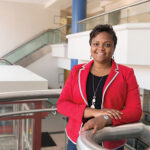
Kamili Jackson ’97, and M.S. ’99, mechanical engineering, has witnessed one NASA space launch in person during her nine years at the agency: the Hubble Servicing Mission 4 in 2009.
Jackson was a contracted materials engineer at NASA for that mission, helping the team make decisions on what metals, plastics and ceramics should be used for the craft. And as she watched her hard work blast off and enter orbit, she was filled with satisfaction.
That same year, Jackson co-founded a project that helps high school students take off into careers in engineering – the Future Innovative Rising Engineers (FIRE), National Society of Black Engineers (NSBE), Junior Chapter in Greenbelt.
“We wanted to have a consistent impact on a set of kids,” says Jackson. The FIRE students come from all over Maryland and even Virginia, and they often stay on the team until they graduate from high school and find a college or university. (In 2013, the program began accepting middle school students as well.)
The competition and mentoring in the program is intense. Professional engineers and parents coach participating students through four national competitions in robotics, model rocketry and math. They also teach them coding, software and building techniques, and also facilitate discussions throughout the process. The goal is for the students to design and build their own robots and rockets.
“We get them to learn by doing,” says Jackson. “We want them to take ownership of what they’re learning.”
Her passion for community service blossomed during her undergraduate years at UMBC, where she was a member of the fourth class of the Meyerhoff Scholars Program. (She has also served on that program’s alumni advisory board.) Among her long list of extracurricular activities at that time were day-long service projects in Baltimore City and mentoring elementary school kids. She also participated in campus governance in the Student Government Association.
“Vice president of student government was a big one as far as starting to figure out my leadership style,” recalls Jackson, who was elected to the position in her senior year. “Student leadership was one of the best things I did in college because you can be a leader, mess up, experiment, and at the same time make things happen.”
She completed a Ph.D. at The Johns Hopkins University and a postdoctoral research fellowship at the University of Cape Town. Jackson began working for NASA in 2005. After five years of consulting on space missions, she was hired as a civil servant to work in Safety and Mission Assurance.
Last year, Jackson was promoted to chief safety and mission assurance officer, and she has leads a team that includes experts in reliability, safety, materials, electronic parts, radiation, and contamination. “This is the first time I have a team at work, which is cool because I am able to use all the skills I have been building up outside of work as a leader,” she says.
Leadership is one of the values she is imparting to her FIRE students. One former program participant who enrolled at UMBC, junior Markus-Allen Proctor, mechanical engineering, won third place in the NSBE Science Fair in 2012 as a senior in high school. Now he serves as the vice president of the UMBC NSBE chapter. As a sophomore, his Proctor’s team took third place in the 2014 Cangialosi Business Innovation Competition for creating EduPal – an online time management tool designed for student success.
Jackson wants her students to “catch the bug of winning” so they can push each other to soar even higher each year.
And winning is what they are doing. At the 2014 FIRST LEGO League Robotics competition, Jackson’s FIRE students built a robot designed to rescue people during a natural disaster. At the Awards Luncheon, her students were presented with the First Place Robot Design Award, and before they’d even finished taking photos for that, they heard their team’s name announced again for achieving the Overall Individual Highest Performance in the competition’s Try-Math-A-Lon “Points Race.”
As future engineers and competitors, they had achieved lift off.
— Salma Sparklin ’11
]]>
Kamili Jackson ’97, and M.S. ’99, mechanical engineering, has witnessed one NASA space launch in person during her nine years at the agency: the Hubble Servicing Mission 4 in 2009. Jackson was a...
https://umbc.edu/stories/lift-off-kamili-jackson-97-m-s-99/
https://my3.my.umbc.edu/api/v0/pixel/news/122479/guest@my.umbc.edu/dbcd338f3801d832eecfea69db8a479b/api/pixel
alumni
summer-2014
UMBC News & Magazine
https://my3.my.umbc.edu/groups/umbc-news-magazine
https://assets1-my.umbc.edu/system/shared/avatars/groups/000/001/943/24435aa6207c452e7bc15cc74b42c7bb/xsmall.png?1748556657
https://assets1-my.umbc.edu/system/shared/avatars/groups/000/001/943/24435aa6207c452e7bc15cc74b42c7bb/original.png?1748556657
https://assets2-my.umbc.edu/system/shared/avatars/groups/000/001/943/24435aa6207c452e7bc15cc74b42c7bb/xxlarge.png?1748556657
https://assets2-my.umbc.edu/system/shared/avatars/groups/000/001/943/24435aa6207c452e7bc15cc74b42c7bb/xlarge.png?1748556657
https://assets3-my.umbc.edu/system/shared/avatars/groups/000/001/943/24435aa6207c452e7bc15cc74b42c7bb/large.png?1748556657
https://assets1-my.umbc.edu/system/shared/avatars/groups/000/001/943/24435aa6207c452e7bc15cc74b42c7bb/medium.png?1748556657
https://assets2-my.umbc.edu/system/shared/avatars/groups/000/001/943/24435aa6207c452e7bc15cc74b42c7bb/small.png?1748556657
https://assets1-my.umbc.edu/system/shared/avatars/groups/000/001/943/24435aa6207c452e7bc15cc74b42c7bb/xsmall.png?1748556657
https://assets2-my.umbc.edu/system/shared/avatars/groups/000/001/943/24435aa6207c452e7bc15cc74b42c7bb/xxsmall.png?1748556657
UMBC News & Magazine
0
0
false
Thu, 03 Jul 2014 20:12:12 -0400
Windfall Prophets

UMBC is at the center of Maryland’s growing efforts to harness the energy of the wind.
By Joel N. Shurkin
Illustrations by Joanna Barnum
Ocean City is the Maryland destination most associated with the summer. But some- day the resort may also be known for a nearby wind farm that could help the state put a dent in its greenhouse gas emissions and the rising costs of generating power.
Both this summer and last summer, UMBC scientists, using a remote sensing technology called LIDAR (Light Detection and Ranging), have been helping the state of Maryland in wind resource assessment efforts to develop the state’s wind energy farms in the Atlantic Ocean near Ocean City.
The project is part of a plan envisioned by Maryland’s legislature in a new law – the Maryland Offshore Wind Energy Act – passed in the 2013 legislative session and signed by Governor Martin O’Malley. The legislation calls for the establishment of a facility at least 10 nautical miles off the state’s coastline that would eventually produce as much as 500 megawatts of power for the state.
Researchers at UMBC were called in to enhance understanding of the role mid-Atlantic weather patterns have on seasonal and temporal wind resource variability off the coast of Maryland, which will ultimately lead to better estimation and optimal development strategies for offshore wind energy production. The first stage of development for Maryland’s wind energy area will be a 200-megawatt wind farm, with potential construction of at least 40 wind turbines initially, with the potential for more than 300 once fully developed.
Knowing the wind variability over a large wind farm is just the latest use for the scanning Doppler Wind LIDAR at UMBC, a technology like radar but one that uses laser light instead of sound waves. LIDAR can make exquisite 3-D images by bouncing off things as small as air particles.
LIDAR is a technology that has become very popular with scientists doing precise long-distance imaging. One team at The College of William & Mary, for instance, has used LIDAR to make a model of where ground water would go if another huge hurricane hit Manhattan; researchers at Carnegie Mellon University used it to plot illegal gold mines in Peru. UMBC scientists have had years of experience with LIDAR in the atmosphere. UMBC’s Atmospheric LIDAR Group measures air quality across the U.S. and runs a much-followed environmental website called the U.S. Air Quality Weblog, aka the “Smog Blog.”
The UMBC team used Doppler Wind LIDAR last summer to see how much wind is available off of Ocean City for the wind farm.

Powering Up
Wind energy is booming all over the United States. But it has yet to come to full strength in Maryland.
Although it remains behind Europe in wind energy (which accounts for 13 percent of that continent’s energy) the United States now gets almost 4 percent of its electricity from wind turbines – enough to power 15 million homes.
The U.S. Department of Energy projects that this figure will rise to 20 percent by the year 2030. States in the Midwest, which have the advantage of wind constantly raking the prairie, already generate substantial amounts of electricity from turbines. Two states, South Dakota and Iowa, generate more than 25 percent of their electricity from the wind. Six states get more than 15 percent; nine get better than 10 percent.
Another key to the rise of wind energy is that the price of wind-generated electricity has fallen 43 percent in the last four years, according to the AWEA U.S. Wind Industry Annual Market Report Year Ending 2013. More than 61,000 turbines have already been built – a boom spurred by the federal Production Tax Credit Act, which gives 2.3 cents of tax relief per kilowatt hour for the first 10 years of a turbine’s life.
Maryland ranks only 32nd in the nation in wind-generated electricity. At present, Maryland gets only 0.9 percent of its electricity from the wind, some 120 megawatts, or enough to power 29,000 homes. The state has 51 turbines in four working projects. The Maryland Renewable Portfolio Standard requires the state get 20 percent of its energy from renewable resources like wind by 2022.
Energy efficiency is only one of the tangible benefits that ramping up the state’s wind-power infrastructure will bring. The Department of Energy estimates that a large facility (200 megawatts) would reduce emissions of carbon dioxide, a greenhouse gas, by more than 378,000 tons per year. Such a plant would be “green” in other ways, creating almost 850 manufacturing and construction jobs over five years and 160 permanent jobs to keep it running, Maryland’s Department of Business & Economic Development projects that would generate $1.3 billion over five years, including $5.6 million in taxes.
Andrew Gohn, senior clean energy program manager at the Maryland Energy Administration (MEA), says when he took his job five years ago Maryland produced no wind energy. It wasn’t clear, he says, that Maryland had the winds that would make wind energy viable.
“Our understanding of the wind evolved,” Gohn says.
Part of that understanding is the role that offshore winds will play for coastal states like Maryland. Offshore wind energy is common in Europe. Europe now gets 8 percent of its electricity from offshore wind farms, with countries like Denmark, Britain and the Netherlands leading the way. By 2020, according to the European Wind Energy Association, a quarter of European power will be generated by offshore turbines. There are no offshore facilities yet in the United States, although 18 are planned, including the Maryland project.
UMBC and its LIDAR lab are key players in charting a course for offshore wind power. Ruben Delgado, a native of Puerto Rico and an assistant research scientist at UMBC’s Joint Center for Earth Systems Technology (JCET), headed the university’s field team. Delgado has used LIDAR technology to measure particles in the upper atmosphere in other experiments, so he had considerable experience using laser remote sensing. His team now had the task of discovering whether there was enough wind offshore to make a Maryland wind farm economically viable.
“We are using lasers to measure the speed of aerosol particles and dust particles [in the air], and from there we can infer the wind velocity, speed and direction, and derive atmospheric parameters such as turbulence and wind shear,” says Delgado.

Navigating the Questions
Delgado and a team of UMBC undergraduate students were embedded with employees of the St. Petersburg, Fla., firm Coastal Planning & Engineering Inc. on a chartered boat (the Scarlett Isabella) off the Maryland coast last summer. The ship sailed a grid pattern – similar to what ships do in rescue searches – to conduct the research, which took place near the coast of Ocean City. The team explored 94-square nautical miles, ranging from 10 nautical miles from Ocean City to as far away as 30.
The voyages lasted over a two-month period, with researchers out on the water in two-week shifts. The time spent on the boat was by no means exciting, but the data the scientists and other researchers gathered was important. Besides the UMBC LIDAR, the ship carried seismic and magnetic detection gear to survey the seabed, which researchers were measuring to see whether it would support wind turbine construction.
Alexandra St. Pé ’13, M.S. geography and environmental systems, is a current Ph.D. student in the department involved with the project. She adds that the researchers didn’t just mind and monitor the computers for the research. They also had to keep an eye out with binoculars for marine wildlife like whales, dolphins, and turtles. Under federal law, the ship – or any vessel – is forbidden from going within 500 meters (around 1,500 feet) from certain protected species. The presence of dolphins also required researchers to turn down the sonar used for exploring to protect the mammals. Lookouts also watched for seabirds and bats.
At one time or another, the researchers spotted all the above along with some sharks and tuna. They had to cease operations six times during the summer because of the presence of marine animals.
Delgado and his team did glean a lot of useful information from their research last summer. “Yes, there is enough wind. There was more than was anticipated,” Delgado says. “The models do a decent job of representing how much wind is out there, but it is not the same as measuring it [with LIDAR]. Measuring the winds offshore last summer and the measurement we are doing now allows us to actually measure the variation of that wind and see how that translates into power.”
For energy purposes wind must be measured the first 250 meters above the surface, where Delgado aimed the LIDAR.
One of the surprises, observes St. Pé, was the strong summertime wind resource offshore. The researchers expected to find, for instance, less wind offshore during the summer due to quiescent, hot weather patterns typical for the region. Low wind speeds during the summer would be a concern due to peak electricity demand from air conditioners running in the Maryland heat.
But that is not what the scientists found. “We see [data] that shows there is more wind than expected in the summer,” says Delgado. “Which is a good thing. The forecasting models indicate that for wind energy to be profitable the average annual wind speed should be approximately 7 meters per second. The summer weather patterns is known to be one of greater energy consumption and low wind speeds. Our measurements indicated that wind speeds greater than 7 meters per second are frequent and can be as high as 14.”
It was important to get the wind speed right because the power that can be harnessed by wind turbines is a function of the cube of the average wind speed. Wind turbines collect 20 to 40 percent of the energy in the wind. Changes in wind velocity help make them more efficient, meaning if the wind doubles in speed, the energy output goes up eight times.
Answering Doubts
Wind power seems to be a perfect solution to help boost clean energy in Maryland. But there are uncertainties. Conservationists worry about the impact wind farms would have on the marine life that the researchers so closely monitored.
Others complain that turbines are an eyesore and make too much noise. The planned offshore facility would be over the horizon – out of sight and out of hearing. But there has been legislative pushback on the proximity of some land-based wind projects to the Patuxent River Naval Air Base in southern Maryland. Skeptics about that project, including U.S. Representative and House Minority Whip Steny Hoyer (Md., 5th District), think the turbines would interfere with radar testing at Patuxent and force the base to close. Such concerns don’t affect the offshore Ocean City project, but they do demonstrate the complexity involved with winning public support of what might seem a simple technology.
But for a long time it was economics, not aesthetics or wildlife concerns, that helped block wind power as a viable option. Coal and gas remained cheaper.
Not anymore. In some places, wind energy now costs about the same as natural gas, thanks to innovations like new kinds of turbines and blades. In Australia, it’s cheaper than both coal and natural gas, and it’s competitive to coal in India.
Since the 1990s, the size of rotors has increased by 90 percent and the hubs of the rotors are now 45 percent higher, some as high as 100 meters (330 feet). They generate 17 times more power than those used 20 years ago. In some areas of the United States – west Texas, for instance – the price of wind energy is down to less than two cents a kilowatt hour. In some places, according to Gohn of the MEA, which is in charge of the project, wind energy has reached “grid parity.” In the mid-Atlantic states it is around 6-1/2 to 8-1/2 cents, close to being competitive.
Wind farms, unlike coal or natural gas-generating facilities, are capital-intensive—the greatest cost is in constructing the wind farm, something like 75 percent of the total cost. Since it does not depend on a commodity to run it – coal or gas – and gets its power for free, a wind farm is cheap to operate. The “fuel” to run it also is stable, which energy companies like.
St. Pé, who is assisting Delgado, says there is room for two leases – perhaps for two different developers – in the offshore area that UMBC researchers canvassed. Those farms could eventually produce 400 to 800 megawatts apiece, creating a total of 800 to 1,600 megawatts.
Two hundred megawatts would power a third to a half of the needs of the Eastern Shore. And local power companies are legally obliged to buy the output. The developers would run the farm and sell their energy to power companies, which are obliged to buy it and balance it with the energy produced by the fossil-fuel generators in the grid, which has limited capacity.
Delgado says that UMBC will be back at Ocean City again this year. This time they’ll be deploying a scanning Doppler Wind LIDAR instrument at Ocean City. He says that the data they obtain will provide even more evidence to help build Maryland’s wind power future.
“Wind is starting to boom in Maryland,” Delgado says. “The effect the high wind speed has off the coast of Maryland makes it a viable source of energy. It has enormous potential offshore.”
]]>
UMBC is at the center of Maryland’s growing efforts to harness the energy of the wind. By Joel N. Shurkin Illustrations by Joanna Barnum Ocean City is the Maryland destination most...
https://umbc.edu/stories/windfall-prophets/
https://my3.my.umbc.edu/api/v0/pixel/news/122483/guest@my.umbc.edu/a9177158ce831b00a4f7f5fe28fcc167/api/pixel
discovery
summer-2014
UMBC News & Magazine
https://my3.my.umbc.edu/groups/umbc-news-magazine
https://assets1-my.umbc.edu/system/shared/avatars/groups/000/001/943/24435aa6207c452e7bc15cc74b42c7bb/xsmall.png?1748556657
https://assets1-my.umbc.edu/system/shared/avatars/groups/000/001/943/24435aa6207c452e7bc15cc74b42c7bb/original.png?1748556657
https://assets2-my.umbc.edu/system/shared/avatars/groups/000/001/943/24435aa6207c452e7bc15cc74b42c7bb/xxlarge.png?1748556657
https://assets2-my.umbc.edu/system/shared/avatars/groups/000/001/943/24435aa6207c452e7bc15cc74b42c7bb/xlarge.png?1748556657
https://assets3-my.umbc.edu/system/shared/avatars/groups/000/001/943/24435aa6207c452e7bc15cc74b42c7bb/large.png?1748556657
https://assets1-my.umbc.edu/system/shared/avatars/groups/000/001/943/24435aa6207c452e7bc15cc74b42c7bb/medium.png?1748556657
https://assets2-my.umbc.edu/system/shared/avatars/groups/000/001/943/24435aa6207c452e7bc15cc74b42c7bb/small.png?1748556657
https://assets1-my.umbc.edu/system/shared/avatars/groups/000/001/943/24435aa6207c452e7bc15cc74b42c7bb/xsmall.png?1748556657
https://assets2-my.umbc.edu/system/shared/avatars/groups/000/001/943/24435aa6207c452e7bc15cc74b42c7bb/xxsmall.png?1748556657
UMBC News & Magazine
0
0
false
Thu, 03 Jul 2014 16:57:33 -0400
Solitary Refinement

UMBC alumnus Ben Marcin ’80 traveled the world with his camera. But he has found acclaim investigating the often bitter poetry, beauty and truth in local landscapes.
The photographs of Ben Marcin ’80, economics, are gaining a much wider audience of late. His work has been shown at venues including the Delaware Art Museum, The Center for Fine Art Photography in Ft. Collins, Colo., and at the C. Grimaldis Gallery in Baltimore – where he is currently represented and recently had a solo show this past winter. His photos are also in a number of group shows this summer, including at the Houston Center for Photography (“Photolucida Presents: How One Thing Leads To Another”); Towson University’s Center for the Arts Gallery (“Artscape 2014: Home: Human = Cage: Cockatoo” from July 10 to August 9) and the Griffin Museum of Photography, Boston (“Peter Urban Legacy 20th Annual Juried Exhibition” from July 10 to August 31).
Marcin’s work is also starting to be seized upon by those working in urban planning and writing about the larger forces at work in American culture. Marcin’s photographs have been featured in online galleries at The Paris Review, The Huffington Post, on Slate and in Wired, and twice in recent months on The Atlantic’s “City Lab” website.
The appeal of Marcin’s work to the larger audiences of policymakers and pundits is clear. His photographs engage with great issues of our time – urban blight and gentrification, homelessness, the vast expanses of rural America seemingly disconnected from our wired world – and yet they never slide into didacticism or agit-prop. The power of his art resides in the stark and unflinching eye of the photographer – and the images he captures with his lens.
UMBC Magazine asked Marcin to talk about his own artistic journey and introduce our readers to some of the series of images that are gripping the public imagination.

This is how I got started.
When I graduated from UMBC in 1980, I was 21 years old, absolutely clueless about what I wanted to do and six years away from buying my first camera. After several months of driving delivery trucks and working out of corporate mailrooms, I landed a job at the Social Security Administration (SSA) headquarters a few exits up the beltway from UMBC. I have worked at SSA to this day, the last 28 years in their enormous IT department helping build large computer programs and systems.
At age 27, I bought a small camera to help feed a creative urge that had been stirring for years, ever since my father started bringing home a series of modern art monographs from his job at the Library of Congress. I slowly taught myself how to use the camera from the ground up. In time, I learned how to take a good picture.
Eventually, I decided that it wouldn’t be a bad idea to start showing some of my photographs. In 1990, I approached the Knight Gomez Gallery in Baltimore. I nervously introduced myself to a very sophisticated young lady who turned out to be the gallery’s curator. Her name was Lynn O’Sullivan and I showed her a page of Kodachrome slides. She didn’t appear overly impressed with this first effort but she didn’t throw me out the door, either. Over time, she helped me with the process of putting together a small portfolio of prints and taught me how to best present them. Eventually she invited me to take part in a three-person photography exhibit at the gallery. That was in 1992 and it was the first of three shows I ended up having there. In 1997, I married Lynn and we have been together ever since.
Throughout my 30s and 40s, I travelled around the world taking photographs. I went through Central and South America, India, Turkey, most of Europe. Shooting locally had become passé for me; I thought I had “seen” everything of interest around Baltimore. It got to the point that between trips my camera would sit on a shelf, largely untouched, until it was time to head off on the next international adventure.
An interesting thing happened as I got older. I started to notice that there were a number of very intriguing things to photograph closer to home. I became more involved in the idea behind a series of photographs rather than the photographs as the endpoint. I shed some of the bright colors and exotic tones of my earlier work. A sort of coming home began to take place as I took a more thoughtful look at my immediate surroundings. In this light, I started several photo essays about some of the more interesting places where people live in and around Baltimore. The following describes some of these projects in more detail.

Last House Standing
One of the architectural quirks of certain cities on the eastern seaboard of the United States is the solo row house. Standing alone, in some of the worst neighborhoods, these 19th century structures were once attached to similar row houses that made up entire city blocks. Time and major demographic changes have resulted in the decay and demolition of many such blocks of row houses. Occasionally, one house is spared – literally cut off from its neighbors and left to the elements with whatever time it has left.
My interest in these solitary buildings is not only in their ghostly beauty but in their odd, almost defiant, placement in the urban landscape. Often three stories high, they were clearly not designed to stand alone like this. Many details that might not be noticed in a homogenous row of 20 attached row houses become apparent when everything else has been torn down. And then there’s the lingering question of why a single row house was allowed to remain upright. Still retaining traces of its former glory, the last house standing is often still occupied.

A House Apart
While working on “Last House Standing,” I was also documenting the many abandoned homesteads in the rural areas around Baltimore that are now becoming planned communities, mega-malls, industrial parks and other forms of urban sprawl. Unlike the row houses, which were originally lived in by many people at one time, the abandoned houses are much more isolated and have the appearance of having been built on the frontier.

The Camps
In 2011, I photographed the homeless camps in and around Baltimore. I do a lot of hiking in the area. As development has encroached upon whatever woods are left in the suburbs and industrial parks of Baltimore, I found myself practically stepping into a number of homeless camps that were carefully hidden among strips of trees or bushes running along highways or behind shopping centers. I became fascinated not only at the effort that went into remaining hidden in plain sight but also at the creativity involved. No two camps were ever alike. They ran the gamut from being completely exposed under bridges or fallen trees to semi-massive structures carefully constructed out of milk crates or wooden doors.
More than one resident told me that living in a tent was a personal choice – yet it seemed to me that there was often no other choice. Even more than the abandoned houses that I’ve documented, the homeless camps directly allude to the life trajectories of their owners. Not one of the camps remains today.
]]>
UMBC alumnus Ben Marcin ’80 traveled the world with his camera. But he has found acclaim investigating the often bitter poetry, beauty and truth in local landscapes. The photographs of Ben...
https://umbc.edu/stories/solitary-refinement/
https://my3.my.umbc.edu/api/v0/pixel/news/122484/guest@my.umbc.edu/3272e71ea1bbad82abb28ac02f532ef8/api/pixel
perspectives
summer-2014
UMBC News & Magazine
https://my3.my.umbc.edu/groups/umbc-news-magazine
https://assets1-my.umbc.edu/system/shared/avatars/groups/000/001/943/24435aa6207c452e7bc15cc74b42c7bb/xsmall.png?1748556657
https://assets1-my.umbc.edu/system/shared/avatars/groups/000/001/943/24435aa6207c452e7bc15cc74b42c7bb/original.png?1748556657
https://assets2-my.umbc.edu/system/shared/avatars/groups/000/001/943/24435aa6207c452e7bc15cc74b42c7bb/xxlarge.png?1748556657
https://assets2-my.umbc.edu/system/shared/avatars/groups/000/001/943/24435aa6207c452e7bc15cc74b42c7bb/xlarge.png?1748556657
https://assets3-my.umbc.edu/system/shared/avatars/groups/000/001/943/24435aa6207c452e7bc15cc74b42c7bb/large.png?1748556657
https://assets1-my.umbc.edu/system/shared/avatars/groups/000/001/943/24435aa6207c452e7bc15cc74b42c7bb/medium.png?1748556657
https://assets2-my.umbc.edu/system/shared/avatars/groups/000/001/943/24435aa6207c452e7bc15cc74b42c7bb/small.png?1748556657
https://assets1-my.umbc.edu/system/shared/avatars/groups/000/001/943/24435aa6207c452e7bc15cc74b42c7bb/xsmall.png?1748556657
https://assets2-my.umbc.edu/system/shared/avatars/groups/000/001/943/24435aa6207c452e7bc15cc74b42c7bb/xxsmall.png?1748556657
UMBC News & Magazine
0
0
false
Thu, 03 Jul 2014 16:56:43 -0400
Up on the Roof – Summer 2014

UMBC President Freeman A. Hrabowski, III, takes your questions.
Q. UMBC is about to embark on a major renovation of the entrance to campus that will transform the way that alumni and visitors – and the UMBC community – encounter and perceive the campus. How does this project reflect the university’s continuing journey as we approach UMBC’s 50th anniversary?
— Richard Byrne ’86, English
A. This campus was established at a time when people were not accustomed to creating new universities. It was simply a matter of practicality to create a new institution connecting to the University of Maryland, Baltimore downtown and its professional schools.
The pedestrian-friendly nature of the early design of UMBC’s campus also made it more insular. People who drove through the campus – from I-95, for example – could pass through and never really get the essence of UMBC. It was all “in the loop.”
The new entrance is moving us “out of the loop” in a sense. It is broadening the definition of the loop. It’s saying we are part of a larger community. And, as such, we want people to sense the importance of this institution as they approach, and reflect on its amazing impact on the larger region.
The new entrance is also a way of saying: “Welcome! You are important to us. We care about the environment. We care about the aesthetics of campus. We want people to be safe in how they approach the campus.”
People will realize that we have come to another level. UMBC is not just a practical place now. We’ve had a chance to think about who we are. What we stand for. Why we are so important to this nation.
Whether we are talking about the new entrance, or the opening of the second phase of the Performing Arts and Humanities Building this fall, or the new Interdisciplinary Life Sciences Building and the new Events Center in coming years, people will see momentum building at UMBC.
None of this happens without the confidence that our elected officials have in UMBC. It is very significant that our own alumna, Speaker Pro Tem of the Maryland House of Delegates Adrienne Jones ’76, psychology, has been at the center of efforts to help us get these projects approved. We also have had strong support for all these projects from Maryland Senator Edward J. Kasemeyer, who represents our district, and from Maryland Senator James E. DeGrange, Sr., whose daughter, Catharine Liberatore ’96, psychology, is an alumna of UMBC.
Q. You mention the Events Center that will open in 2018. What is the thinking behind that building?
A. First and foremost, the Events Center will be a place for students and the campus community to convene. We don’t have a space right now where a sizeable portion of the university can convene. We usually have to hold gatherings in the Ballroom in the University Center and it is always quickly overflowing.
There will also be pride in hosting parents and alumni for commencements at the Events Center. These commencements will be even more enjoyable than any we have ever had.
We are out of space now in the Retriever Activities Center. The RAC has done what it can do with the help of very supportive staff. But when you think about what students expect from a university, first-rate recreational and exercise facilities are very important.
When I go to visit some campuses, the first buildings that people want to show me are the athletics facilities. Now, we’re the kind of campus where we take great pride in taking people to the Albin O. Kuhn Library, and then walking them through The Commons to meet our students. But it will be great when – at the end of that tour – we also show them an Events Center where students can pursue a great student life.
The Events Center will help shine light on this campus. And we know that when the light is shining on us at UMBC, people will be impressed.
To send a question to President Hrabowski, click here.
]]>
UMBC President Freeman A. Hrabowski, III, takes your questions. Q. UMBC is about to embark on a major renovation of the entrance to campus that will transform the way that alumni and visitors –...
https://umbc.edu/stories/up-on-the-roof-summer-2014/
https://my3.my.umbc.edu/api/v0/pixel/news/122488/guest@my.umbc.edu/3e158fa71207026282e297bc3f096341/api/pixel
perspectives
summer-2014
UMBC News & Magazine
https://my3.my.umbc.edu/groups/umbc-news-magazine
https://assets1-my.umbc.edu/system/shared/avatars/groups/000/001/943/24435aa6207c452e7bc15cc74b42c7bb/xsmall.png?1748556657
https://assets1-my.umbc.edu/system/shared/avatars/groups/000/001/943/24435aa6207c452e7bc15cc74b42c7bb/original.png?1748556657
https://assets2-my.umbc.edu/system/shared/avatars/groups/000/001/943/24435aa6207c452e7bc15cc74b42c7bb/xxlarge.png?1748556657
https://assets2-my.umbc.edu/system/shared/avatars/groups/000/001/943/24435aa6207c452e7bc15cc74b42c7bb/xlarge.png?1748556657
https://assets3-my.umbc.edu/system/shared/avatars/groups/000/001/943/24435aa6207c452e7bc15cc74b42c7bb/large.png?1748556657
https://assets1-my.umbc.edu/system/shared/avatars/groups/000/001/943/24435aa6207c452e7bc15cc74b42c7bb/medium.png?1748556657
https://assets2-my.umbc.edu/system/shared/avatars/groups/000/001/943/24435aa6207c452e7bc15cc74b42c7bb/small.png?1748556657
https://assets1-my.umbc.edu/system/shared/avatars/groups/000/001/943/24435aa6207c452e7bc15cc74b42c7bb/xsmall.png?1748556657
https://assets2-my.umbc.edu/system/shared/avatars/groups/000/001/943/24435aa6207c452e7bc15cc74b42c7bb/xxsmall.png?1748556657
UMBC News & Magazine
0
0
false
Thu, 03 Jul 2014 00:35:58 -0400
To You – Summer 2014

 A public research university such as UMBC has to be many things at once – and touch as many lives in a productive way as it can.
At the center of its mission is teaching. New generations of students – undergraduates and graduate students, from Maryland and from all over the world – are flocking to UMBC because of its lofty reputation for undergraduate teaching.
But a key part of that teaching experience is research. At UMBC, even undergraduates can become involved in the other key missions of the university – unlocking new knowledge in the social sciences and humanities, expanding the frontiers of science and technology, and furthering expression through the arts. And a growing number of graduate students are recognizing that the research being done at UMBC is a pathway to their own careers as teachers and investigators.
The work that students do with professors and other researchers at UMBC also has a huge impact on some of the most crucial issues of our time.
Two of the feature stories in this issue of UMBC Magazine demonstrate the sort of impact that research conducted at the university is having on global challenges confronting us.
In “Windfall Prophets,” acclaimed science writer Joel N. Shurkin dives deep into the research and policy implications of UMBC’s work on green energy that can be provided by wind power. Using a cutting edge technology called LIDAR (Light Detection and Ranging) that has already been at the forefront of efforts to track air quality, UMBC researchers are helping Maryland policymakers figure out where best to situate an offshore wind farm that may someday help power thousands of Maryland homes.
Another key challenge facing the global community is communication. And as English becomes more and more of a global lingua franca, teachers of English as a second language are increasingly finding themselves teaching much younger students whose parents and governments want them to learn the language at an earlier age. In “Expanding the Map,” David Glenn looks at the work of Joan Kang Shin ’08, Ph.D., language, literacy and culture, who is a professor of practice in the education department and the director of UMBC’s TESOL professional training programs.
Shin is an expert in teaching English to young learners, and has created far-flung networks (partly in collaboration with National Geographic) to help teachers of English around the world do an even better job at this crucial task.
I am also delighted that UMBC Magazine is featuring the work of Ben Marcin ’80, economics, in this issue. Marcin’s photography is not only beautiful and provocative, but it is also becoming a gateway into some of the thorniest discussion topics in contemporary American life – gentrification, homelessness and community – and reveal how we relate to each other and our surroundings.
— Richard Byrne ’86
]]>
A public research university such as UMBC has to be many things at once – and touch as many lives in a productive way as it can. At the center of its mission is teaching. New generations of...
https://umbc.edu/stories/to-you-summer-2014/
https://my3.my.umbc.edu/api/v0/pixel/news/122489/guest@my.umbc.edu/4352fc93f3956fa99494d238f32f9a89/api/pixel
perspectives
summer-2014
UMBC News & Magazine
https://my3.my.umbc.edu/groups/umbc-news-magazine
https://assets1-my.umbc.edu/system/shared/avatars/groups/000/001/943/24435aa6207c452e7bc15cc74b42c7bb/xsmall.png?1748556657
https://assets1-my.umbc.edu/system/shared/avatars/groups/000/001/943/24435aa6207c452e7bc15cc74b42c7bb/original.png?1748556657
https://assets2-my.umbc.edu/system/shared/avatars/groups/000/001/943/24435aa6207c452e7bc15cc74b42c7bb/xxlarge.png?1748556657
https://assets2-my.umbc.edu/system/shared/avatars/groups/000/001/943/24435aa6207c452e7bc15cc74b42c7bb/xlarge.png?1748556657
https://assets3-my.umbc.edu/system/shared/avatars/groups/000/001/943/24435aa6207c452e7bc15cc74b42c7bb/large.png?1748556657
https://assets1-my.umbc.edu/system/shared/avatars/groups/000/001/943/24435aa6207c452e7bc15cc74b42c7bb/medium.png?1748556657
https://assets2-my.umbc.edu/system/shared/avatars/groups/000/001/943/24435aa6207c452e7bc15cc74b42c7bb/small.png?1748556657
https://assets1-my.umbc.edu/system/shared/avatars/groups/000/001/943/24435aa6207c452e7bc15cc74b42c7bb/xsmall.png?1748556657
https://assets2-my.umbc.edu/system/shared/avatars/groups/000/001/943/24435aa6207c452e7bc15cc74b42c7bb/xxsmall.png?1748556657
UMBC News & Magazine
0
0
false
Wed, 02 Jul 2014 20:35:32 -0400
The News – Summer 2014

A GRAND ENTRANCE
The UMBC community – as well as visitors to campus – will have to pardon some dust and altered traffic patterns over the next two years.
But it’s all for a good cause: a reimagining of the entrance to UMBC that will enhance not only the aesthetic beauty and ease of access to the university’s campus – but also enhance the safety of the pedestrians, cyclists and motorists who travel along its roads and paths.
Construction work on the New Campus Entrance Project began in June 2014 on areas familiar to alumni and others in the UMBC community, including Hilltop Circle, Administration Drive, and the plaza between the Retriever Activities Center and the Administration Building.
One aim of the project is to improve the flow of traffic along UMBC Boulevard, which is the main route onto campus for most drivers. A grander roadway circle and plaza will enhance vehicular and pedestrian safety and facilitate better access for service vehicles, easier pickups and drop-offs. Pedestrians and cyclists will also have a more direct route into the center of campus.
Improving UMBC’s aesthetic appeal is also a priority. The present Administration Drive will become a pedestrian walkway that will boast more trees and greenery. The new plaza will be paved with bricks that say “Hello!” in the many languages of our campus. (Plus, of course, a “Woof!” to represent university mascot True Grit, whose statue will be situated in the heart of the plaza.)
The project will enhance UMBC’s appearance in other ways as well. The long rows of parked cars – especially during the fall and spring semesters – on University Boulevard and Hilltop Circle will be gone, without any loss of actual parking spaces on campus. Those who drive to UMBC will have improved and safer pedestrian walkways to use to get from their parking space to campus, and the university’s outward appearance will more closely track the increased growth in its residential character over recent decades.
The new gateway will be completed in fall 2015.

UMBC also recently announced another addition to the core campus – a new Events Center – that will draw its community closer together as a staging point for commencements and a home for Retriever athletics.
Formally announced at a meeting with members of the communities surrounding UMBC in May, the 5,000 seat Events Center will be constructed directly south of Hilltop Circle. It will be 1,000 seats larger than the current Retriever Activities Center, and be large enough so that the university’s spring undergraduate commencement ceremonies can be moved back to campus from their present home at the First Mariner Arena in downtown Baltimore.
The $85 million Events Center will likely open sometime in 2017 or 2018.
— Richard Byrne ’86
THE POWER OF PARTNERS

Education can blaze a path to a brighter future for kids in underserved communities. Just ask the kids at Lakeland Elementary/Middle School in Southwest Baltimore.
U.S. Secretary of Education Arne Duncan did just that on a visit to UMBC this spring. Sixth-grader NaShaya Maxwell trumpeted her pride in Lakeland’s robotics team. Student Johanna Funes glowed with energy when she described “the many ways to get an answer” in math, her favorite subject.
America’s top education official came to the meeting to see how a powerful new partnership between UMBC and Lakeland is promoting students’ academic success inside and outside the classroom.
UMBC brings two essential pieces to the partnership, which began last fall. The first is a pipeline to teachers from the university’s acclaimed Sherman STEM Teacher Scholars Program. The second is a network of active personal and community interventions spearheaded by two key Shriver Center programs – the Choice Program and Shriver Fellows Peaceworker Program.
Lakeland principal Najib Jammal says that UMBC’s support for the school is already paying dividends. “We believe it will help our students and teachers re-envision what is possible and result in opportunities that allow students to demonstrate their learning,” says Jammal.
The UMBC/Lakeland partnership was created by UMBC President Freeman A. Hrabowski, III, and George and Betsy Sherman, founders of the Sherman Family Foundation, to enable the university to have a more direct and immediate impact in Baltimore schools.
The Sherman STEM Teacher Scholars Program is a selective scholarship program that identifies and nurtures students who want to become science and math teachers serving high-need communities.
“UMBC is providing a gateway to get these field experiences,” F. Atom Zerfas ’13, mathematics, told Duncan, “and the field experiences made me prepared to teach.” Zerfas is a Sherman program alumnus and a teacher at the Baltimore Leadership School for Young Women.
AmeriCorps fellows from UMBC’s Choice Program, a national model for sustained personal and academic support for young people who are in contact with the juvenile justice system, are the other key resource for the partnership. These fellows provide direct assistance to 40 Lakeland students identified by teachers and administrators as those who would most benefit from the program’s intensive support – including 24/7 outreach and intervention from mentors who set high expectations for program participants and give them the stability and assistance they need to meet those expectations.
John Martello, vice provost of UMBC’s Division of Professional Studies, was the executive director of the Shriver Center when Mark Shriver, son of Center founders Sargent and Eunice Kennedy Shriver, created the Choice Program in 1987.
“There wasn’t a university in the country that did direct service in the way that [the Choice Program] did when it was founded,” Martello told Duncan.
The UMBC/Lakeland partnership is still new, but already there has been a boost in parent participation in the school and focus on health and urban gardening initiatives. The Shriver Center has enlisted scholars in its Peaceworker Fellows Program for returning Peace Corps volunteers to build support for the partnership in the local community, extending its reach even further.
— Richard Byrne ’86 and Dinah Winnick
]]>
A GRAND ENTRANCE The UMBC community – as well as visitors to campus – will have to pardon some dust and altered traffic patterns over the next two years. But it’s all for a good cause: a...
https://umbc.edu/stories/the-news-summer-2014/
https://my3.my.umbc.edu/api/v0/pixel/news/122490/guest@my.umbc.edu/3afb701b6b24aeda38207129e397a8b4/api/pixel
campus-life
summer-2014
UMBC News & Magazine
https://my3.my.umbc.edu/groups/umbc-news-magazine
https://assets1-my.umbc.edu/system/shared/avatars/groups/000/001/943/24435aa6207c452e7bc15cc74b42c7bb/xsmall.png?1748556657
https://assets1-my.umbc.edu/system/shared/avatars/groups/000/001/943/24435aa6207c452e7bc15cc74b42c7bb/original.png?1748556657
https://assets2-my.umbc.edu/system/shared/avatars/groups/000/001/943/24435aa6207c452e7bc15cc74b42c7bb/xxlarge.png?1748556657
https://assets2-my.umbc.edu/system/shared/avatars/groups/000/001/943/24435aa6207c452e7bc15cc74b42c7bb/xlarge.png?1748556657
https://assets3-my.umbc.edu/system/shared/avatars/groups/000/001/943/24435aa6207c452e7bc15cc74b42c7bb/large.png?1748556657
https://assets1-my.umbc.edu/system/shared/avatars/groups/000/001/943/24435aa6207c452e7bc15cc74b42c7bb/medium.png?1748556657
https://assets2-my.umbc.edu/system/shared/avatars/groups/000/001/943/24435aa6207c452e7bc15cc74b42c7bb/small.png?1748556657
https://assets1-my.umbc.edu/system/shared/avatars/groups/000/001/943/24435aa6207c452e7bc15cc74b42c7bb/xsmall.png?1748556657
https://assets2-my.umbc.edu/system/shared/avatars/groups/000/001/943/24435aa6207c452e7bc15cc74b42c7bb/xxsmall.png?1748556657
UMBC News & Magazine
0
0
false
Wed, 02 Jul 2014 20:34:13 -0400
How To – Summer 2014
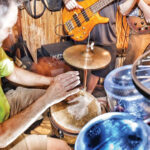
KEEP THE PERFECT BEAT

With Steven McAlpine, assistant director of interdisciplinary studies and percussionist with Straight Up Tribal
Back in 2008, Steven McAlpine decided that UMBC needed a beat. Right at the heart of the campus.
So the director of UMBC’s interdisciplinary studies program sat with his djembe (an African drum) on the UMBC Quad and started to play. He didn’t expect anyone to join in. But his beat proved irresistible and the weekly drum circle that formed around McAlpine quickly grew past double digits. On some Fridays, the gathering of rappers, hoop dancers and other percussionists gets as high as 20 performers.
“We just showed up and didn’t ask permission,” McAlpine says. “But maybe we should have. Some people would stop and listen. Some people would leave quarters in our hats. The best part would be people saying, ‘If I bring a drum next week, can I join in?’”
A more formal ensemble, Straight Up Tribal, has also emerged from the drum circle. McAlpine has fashioned his own drum kit for that group, consisting of an orange Home Depot bucket (bass), two water coolers (toms), and his wife’s bike tire rim (high hat).
“Building your own instrument affects your perception of beat,” he observes.
So whether it’s on a high hat or a hat box, how do you keep the perfect beat?
Tools of the Trade
1. Orange Home Depot bucket
2. Two water coolers
3. Bike tire rim
4. Spirit of adventure
5. A pair of ears to listen
Step 1: DON’T BE OPPRESSED BY PERFECTIONISM
Before starting the Quad drum circle, McAlpine says he was a slave to the metronome and craved precision and planning. He used influences to guide his style rather than allowing himself to play freely.
Since beginning the drum circle and finding the dynamism in playing with a group, he says he has made a much needed shift from “mathematical to soulful.”
One key to keeping a great beat is overcoming the idea that there is only one way to play a song. Depending on what McAlpine plays – the djembe, a traditional kit, or his buckets – the sound comes to him and emerges differently.
The challenge, he says, is to “keep it fresh, but really hone your skill.”

Step 2: FIND THE PULSE IN EVERYTHING
Just as painters find inspiration in the world around them, McAlpine hears a beat in his footsteps or in the ring of someone’s cell phone.
“Beat is in everything,” he says. “We just shape it. In the noise, I hear a pattern, and think, ‘I wonder what that sounds like on the drum.’”
Hear it, feel it, and then make it, McAlpine says.
Step 3: CREATE SPACE
Once you establish a beat, you might think that there’d be no more room for another rhythm or percussive element. But if all the space in a performance is taken up by one driving force, it leaves no room for collaboration.
McAlpine says keeping a great beat is about “filling the spaces, then leaving spaces. Beat is both a prompt as well as a constraint that sets us free.” When collaborating with others, he says, “It’s about an invitation for other people to join in.”

Step 4: WATCH THE AUDIENCE
Any perceptive percussionist is also tuned into the audience. If people start to sway, beat on the table or tap their feet, he knows it’s affecting them. “Does it make you want to dance? To me, that’s the test. It’s about connection.”
McAlpine prefers playing with a large band because of the dynamism that comes with doing so, and the same goes for playing in front of (and sometimes with) an audience.
“If no one’s watching,” he says, “then what’s the point?”
Step 5: GET AMBITIOUS
Even a seasoned percussionist like McAlpine says that there are challenges in collaboration. A singer may start a song with a rhythm that’s not as intuitive as most, so McAlpine waits. And he listens. And then he finds his opportunity and dives in.
“The right way is to play together, to find some common ground,” he says. “We are pattern-making and pattern-detecting people, and the pulse is what allows for creative collaboration.”
— Sarah C. Truckey

By The Numbers
These are the three most influential songs that inspired me as a drummer – delicious puzzles for me that inspired hours of practice and song analysis in the hopes of “mastering” the drum set. I am still working on the mastery part.
1. The Edgar Winter Group, “Frankenstein” (the first drum solo I ever learned note for note, from the album They Only Come Out at Night).
2. Led Zeppelin, “Good Times Bad Times” (from Led Zeppelin I)
3. Rush, “Tom Sawyer” ( from the album Moving Pictures. This song inspired me to use a double bass drum pedal).
— Steven McAlpine
]]>
KEEP THE PERFECT BEAT With Steven McAlpine, assistant director of interdisciplinary studies and percussionist with Straight Up Tribal Back in 2008, Steven McAlpine decided that UMBC needed...
https://umbc.edu/stories/how-to-summer-2014/
https://my3.my.umbc.edu/api/v0/pixel/news/122492/guest@my.umbc.edu/78f4823b5d4adc98ece9b7cac41f29dc/api/pixel
perspectives
summer-2014
UMBC News & Magazine
https://my3.my.umbc.edu/groups/umbc-news-magazine
https://assets1-my.umbc.edu/system/shared/avatars/groups/000/001/943/24435aa6207c452e7bc15cc74b42c7bb/xsmall.png?1748556657
https://assets1-my.umbc.edu/system/shared/avatars/groups/000/001/943/24435aa6207c452e7bc15cc74b42c7bb/original.png?1748556657
https://assets2-my.umbc.edu/system/shared/avatars/groups/000/001/943/24435aa6207c452e7bc15cc74b42c7bb/xxlarge.png?1748556657
https://assets2-my.umbc.edu/system/shared/avatars/groups/000/001/943/24435aa6207c452e7bc15cc74b42c7bb/xlarge.png?1748556657
https://assets3-my.umbc.edu/system/shared/avatars/groups/000/001/943/24435aa6207c452e7bc15cc74b42c7bb/large.png?1748556657
https://assets1-my.umbc.edu/system/shared/avatars/groups/000/001/943/24435aa6207c452e7bc15cc74b42c7bb/medium.png?1748556657
https://assets2-my.umbc.edu/system/shared/avatars/groups/000/001/943/24435aa6207c452e7bc15cc74b42c7bb/small.png?1748556657
https://assets1-my.umbc.edu/system/shared/avatars/groups/000/001/943/24435aa6207c452e7bc15cc74b42c7bb/xsmall.png?1748556657
https://assets2-my.umbc.edu/system/shared/avatars/groups/000/001/943/24435aa6207c452e7bc15cc74b42c7bb/xxsmall.png?1748556657
UMBC News & Magazine
0
0
false
Wed, 02 Jul 2014 20:24:50 -0400
Discovery – Summer 2014

CALM IN A STORM
It was the middle of the night in November 2013, just after Typhoon Haiyan struck, when Sako Narita ’04, interdisciplinary studies (international emergency health services), received an urgent phone call from Japan with a request: a disaster response team organized by Humanitarian Medical Assistance (HuMA) to help provide aid to the Philippines needed her expertise.
The call did not come as a surprise to Narita, who is currently a master’s student in UMBC’s emergency health services (EHS) department. She had prior experience providing disaster response for the 2011 earthquake and tsunami in her native Japan and a previous typhoon in the Philippines in 2012.
Narita spent ten days in the Philippines after Haiyan struck. She provided needs assessment, assisted patients, negotiated with local and international health and government organizations, set up mobile medical clinics, and did whatever she could to ensure typhoon victims received necessary care.
“Believe it or not, the people were more positive than we expected,” says Narita. “Sometimes people were already moving on – they started a new life and started building new houses. But deep inside, they still are struggling.”
One key part of Narita’s job was negotiation – a skill she has developed both in field experience and as part of her UMBC education.
The on-the-ground situation during Narita’s first mission in the Philippines in 2012 required her to negotiate with local officials to gain access to the disaster site for HuMA. During her more recent trip, she brokered a partnership with an Israeli disaster response team.
The international reputation of UMBC’s EHS department as a leader in the field helped attract Narita – a student from Japan who was interested in studying the intersection between medicine and emergency health services.
“All of my knowledge about disaster response I got at UMBC,” Narita observes.
“What makes our program different from every other program is that our focus is on that area of overlap between public health and emergency management,” explains Rick Bissell, a professor of emergency health services and the director of the EHS graduate program.
UMBC’s graduate program offers advanced training in emergency clinical response, management and public health that prepares students like Narita to meet disaster-related emergency health needs (as well as less urgent needs) in both domestic and international situations.
“We educate the whole person,” says Bruce Walz, a professor of emergency health services and the chair of the department. “What we’ve heard back from employers is that our students know how to think. They’re not just doing a protocol. They know why they’re doing that protocol, they know why they’re giving that drug and they can make those decisions in the field.”
This priority on educating students as “whole people” is evident in the work of EHS alumni and students like Narita, who is also a national registered paramedic and Maryland emergency medical technician-paramedic. The level of dedication and quality of work for which the program’s graduates are known makes them much sought after in the aftermath of disasters such as Haiyan.
“HuMA could contact me again,” Narita says, “and I hope they do.”
— Max Cole
PLANTING A SEED

Faculty members at Maryland universities conduct a wide array of cutting-edge research – from providing relief for victims of spinal cord injury to developing new targeted methods to deliver drugs through nanotechnology.
More and more of that vital work is being done in collaborations between faculty at UMBC and the University of Maryland, Baltimore (UMB).
The latest expansion of this research partnership is the UMBC-UMB Research and Innovation Partnership Seed Grant Program that pairs primary investigators from each university to work together as a team. Successful partners are offered research funding of up to $75,000 over twelve months to pursue their collaboration.
The program’s first grant recipients were announced at a ceremony and poster session held at UMBC in February, where UMB Chief Academic and Research Officer and Senior Vice President Bruce Jarrell observed that the program represents a deepening relationship that already includes cooperation on a joint graduate school and the Institute of Marine Environmental Technology (IMET).
“These collaborations already exist,” Jarrell observed. “And we’re proud to have UMBC as a partner.”
UMBC President Freeman A. Hrabowski, III, was enthusiastic about the projects selected, which include investigations that may influence the course of research into cancer, strokes and muscle degeneration.
“The [program] is a means by which both universities can better discover each other’s strengths and needs to see how we can better collaborate,” said Hrabowski.
UMB President Jay Perman said increased partnership between the two universities is a key element of his vision: “The partnerships that UMBC and UMB have enjoyed for years are real, longstanding collaborations, and have been extremely successful, if not widely known.”
William E. Kirwan, Chancellor of the University System of Maryland, also praised the program for its “focus on cutting-edge science and health concerns” and its emphasis on interdisciplinary teamwork.
The first five teams are:
• Kathleen Hoffman, professor of mathematics (UMBC), and Asaf Keller, professor of anatomy and neurobiology (UMB), are exploring the chronic pain of patients with spinal cord injury and how computational modeling may help analyze the neurobiological changes in the central nervous system.
• Martin Schneider, professor of biochemistry and molecular biology (UMB), and Bradford E. Peercy, assistant professor of mathematics (UMBC) are combining forces to analyze a transcription factor (Foxo1) in skeletal muscle that activates genes in a pathway that leads to the breakdown of muscle protein.
• Charles Bieberich, professor of biological sciences (UMBC), and Paul Shapiro, associate professor of pharmaceutical sciences (UMB) are working on a more targeted use of a promising cancer treatment called “kinase inhibition.”
• Marie-Christine Daniel, associate professor of chemistry and biochemistry (UMBC), and Peter Swaan, professor of pharmaceutical sciences (UMB) are exploring how nanotechnology might improve the delivery of drugs.
• Tulay Adali, professor of computer science and electrical engineering (UMBC) and Kelly Westlake, assistant professor of physical therapy and rehabilitation science (UMB) are exploring how using a powerful computational tool (independent vector analysis) can better help the recovery of stroke victims.
— Richard Byrne ’86
BURGEONING BIOINFORMATICS

There are no test tubes, petri dishes or microscopes in Ivan Erill’s research lab. No chemical cabinets or safety goggles. Indeed, the room in the Biological Sciences Building where the assistant professor of biological sciences works is what scientists call a “dry lab” – a bunch of desks, computers and swivel chairs.
Erill is a computational biologist. He describes the field as “a hybrid between computer science and biology.” Bioinformatics, the sister field to computational biology, was founded by Margaret Dayhoff in the 1960s. At that time, sequencing a single gene or protein could earn you a Ph.D. But these days, “next generation” sequencing machines can output more than a billion DNA bases per day.
The DNA molecules in all living things are made up of only four building blocks called “nitrogenous bases” – nicknamed A, T, C, and G. They bond to form pairs: A always bonds with T, C always bonds with G. The sequence of the bases ultimately determines an organism’s traits.
Biologists often rely on models for their work, and computational biologists use large sets of sequence data to design models of biological systems. But all models include assumptions that don’t perfectly represent biological reality.
“Every model is wrong,” says Erill. After comparing the results of a model to experimental data, scientists “refine the model as a way to get a better approximation and confirm theories about how biology works.”
Working in this field requires an eclectic skill set. “In order to create the models you need a technical background,” explains Erill. “[But] you also need enough knowledge of the biology to understand what you are trying to model, why, and the nuances in the biological process.”
UMBC is one of the few universities that offers an undergraduate major in bioinformatics. Some of these students work in Erill’s lab, but most of his graduate students have undergraduate degrees in mathematics or computer science.
These researchers are working on exciting projects, including how the three-dimensional shape of DNA affects where proteins can bind to it. These proteins, known as transcription factors (TFs), help determine which other proteins are produced in a cell. Patrick O’Neill, a graduate student in Erill’s lab, said that these proteins are so fundamental that “whatever you’re studying, soon enough you’re going to bump into a transcription factor.”
Another project looks at the “metagenome.” It’s a concept that explores how DNA sequences in the same environment (like a cow’s gut), can regulate each other even if they are from different species (e.g. the cow and a bacterium). “Very simple systems, with simple parts, can collectively have very complex behavior,” observes O’Neill.
So what’s next for computational biology? You’ve probably heard of the genome, but probably not the “interactome.” Erill describes it as the set of all interactions between molecules in a cell. Computational biologists create 3-D images that represent all these interactions, which Erill describes as “hairy balls.”
When the field began, scientists were looking at isolated systems. But now they’re zooming out. Erill says that the amount of information “balloons super rapidly and becomes one of these hairy balls, and then the problem becomes how do you turn that into useful knowledge for our brains? How does that inform biology? That’s where the big challenge lies.”
— Sarah L. Hansen
Image credit: Andrew Garrow
Human interactome – round1 – Cytoscape
CREATE & COLLABORATE

On a large screen in the Dresher Center for the Humanities, there is a diptych. At the top is the home of Jimmy and Debbie Drake, the last such structure standing in their southeast Baltimore neighborhood; below it is a collection of items left behind post-demolition. The room goes silent as students, staff and faculty lean forward in their chairs to ponder a baby shoe, an AARP membership card, the worn image of a child. But, the quiet doesn’t last long.
Behind the projector, Stephen Bradley, an associate professor of visual arts, and Nicole King, an assistant professor of American Studies, engage the audience in a discussion of their research, a digital mapping and storytelling effort surrounding the history of Baybrook – an industrial neighborhood in Baltimore.
This sort of interdisciplinary research is de rigueur at UMBC, but the venue for the gathering where Bradley and King presented their collaboration – a new “Catalyst” series of informal lunchtime discussions – is relatively new.
It springs from a campus vision that created UMBC’s year-old Center for Innovation, Research, and Creativity in the Arts, or CIRCA – the latest initiative in a concerted push by UMBC to inspire and promote inquiry and experimentation in and across the arts.
“In a very practical way, UMBC has made a commitment to the visual and performing arts to make it visible, and for the research to come into the light and be supported,” says Tim Nohe, a professor of visual arts, and director of the center.
Besides the Catalyst series, which focuses on making interdisciplinary arts research accessible to the UMBC community, CIRCA also provides multiple levels of support to faculty for their research. Young academics can find assistance in learning how to seed a project – from scouring for research dollars to finding a research partner in another discipline. CIRCA also awards small grants for research, with the potential for more in the future, Nohe says.
Nohe credits John Jeffries, dean emeritus of the College of Arts, Humanities and Social Sciences, and others with making CIRCA a reality. He adds that CIRCA also serves as another off-campus extension of the UMBC arts community in the Baltimore art scene and beyond.
“It’s important to remind them there are other players” in Baltimore, Nohe says.
As UMBC’s footprint in the arts (and research into the arts) grows, Nohe hopes CIRCA grows along with it. That means more thoughtful discussions among community members, and more opportunities to share ideas in a way that spurs new research not only among artists, but collaborators across campus. There will be chances overall for CIRCA to make an impact on the arts at UMBC.
“The level of work is incredibly high here, and it’s incredibly creative,” says Nohe. “And it’s CIRCA’s job to shine that light.”
— Jenny O’ Grady
Image credit: “Lost Fairfield,” 2010, by Stephen Bradley
]]>
CALM IN A STORM It was the middle of the night in November 2013, just after Typhoon Haiyan struck, when Sako Narita ’04, interdisciplinary studies (international emergency health services),...
https://umbc.edu/stories/discovery-summer-2014/
https://my3.my.umbc.edu/api/v0/pixel/news/122493/guest@my.umbc.edu/321a9e879b0636fd5d531fdb6e0a9896/api/pixel
discovery
summer-2014
UMBC News & Magazine
https://my3.my.umbc.edu/groups/umbc-news-magazine
https://assets1-my.umbc.edu/system/shared/avatars/groups/000/001/943/24435aa6207c452e7bc15cc74b42c7bb/xsmall.png?1748556657
https://assets1-my.umbc.edu/system/shared/avatars/groups/000/001/943/24435aa6207c452e7bc15cc74b42c7bb/original.png?1748556657
https://assets2-my.umbc.edu/system/shared/avatars/groups/000/001/943/24435aa6207c452e7bc15cc74b42c7bb/xxlarge.png?1748556657
https://assets2-my.umbc.edu/system/shared/avatars/groups/000/001/943/24435aa6207c452e7bc15cc74b42c7bb/xlarge.png?1748556657
https://assets3-my.umbc.edu/system/shared/avatars/groups/000/001/943/24435aa6207c452e7bc15cc74b42c7bb/large.png?1748556657
https://assets1-my.umbc.edu/system/shared/avatars/groups/000/001/943/24435aa6207c452e7bc15cc74b42c7bb/medium.png?1748556657
https://assets2-my.umbc.edu/system/shared/avatars/groups/000/001/943/24435aa6207c452e7bc15cc74b42c7bb/small.png?1748556657
https://assets1-my.umbc.edu/system/shared/avatars/groups/000/001/943/24435aa6207c452e7bc15cc74b42c7bb/xsmall.png?1748556657
https://assets2-my.umbc.edu/system/shared/avatars/groups/000/001/943/24435aa6207c452e7bc15cc74b42c7bb/xxsmall.png?1748556657
UMBC News & Magazine
0
0
false
Wed, 02 Jul 2014 20:17:19 -0400