Turning the Tides

For Christopher Tong, discovering clues hidden in texts documenting history’s most devastating floods isn’t just about the promise of making social, cultural, and political change. It’s also a personal journey inspired by generations of his own family.
In July of 2021, the city of Zhengzhou, China, had more than seven inches of rain in one hour, flooding subway train cars filled with commuters and forcing hundreds of thousands to evacuate.
Around this time Christopher K. Tong, an assistant professor of modern languages, linguistics, and intercultural communication, was surrounded by materials he had collected during his trip to the People’s Republic of China at the Hubei Provincial Archive in Wuhan and from the No. 2 Historical Archive in Nanjing, the national repository for Republican-era government documents. He was translating and analyzing historical, government, and personal documents regarding two major environmental disasters in China during the 1930s: the Yangzi River and Yellow River floods.
Nearly a century ago, the communities surrounding the third- and sixth-longest river systems in the world experienced the most severe flooding in modern China’s history, inundating thousands of miles of land, killing millions of people, and leading to extensive disease and famine.
Witnessing the coverage of the Zhengzhou flood, and watching the past and present intersect, was an extraordinary moment for Tong. Live, minute-by-minute social media posts gave insight into the catastrophic experience. By contrast, the floods from the 1930s did not have such personal coverage. First-person accounts tended to be handwritten letters and only some reached audiences beyond their villages, allowing for a select few, in cities far away from the areas most impacted, to understand what was happening on the ground.
“The Zhengzhou floods confirmed for me how important environmental humanities research is and how this scholarship sheds light on society and politics,” says Tong, who compares the impact of the floods to the impact the Dust Bowl of America’s Great Depression had on American society and politics. This deep research into the political—and personal—nature of environmental disasters like these has won Tong recognition among humanities scholars, social scientists, and policy analysts alike.
The Henry Luce Foundation and the American Council of Learned Societies recently awarded Tong one of 11 prestigious Early Career Fellowships in China Studies, providing funding for an academic year of research, writing, and curriculum development to help meet the needs of China studies in the 21st century. Tong will use this time and rich material to write his book on ecological consciousness and political representation in modern China.
“One of the goals of my book is to offer readers resources to ‘think with China’ on shared concerns such as ecological crises, human rights, and animal advocacy,” says Tong. “I see my work as contributing to cultural diplomacy and what people in the policy world call ‘China literacy.’”
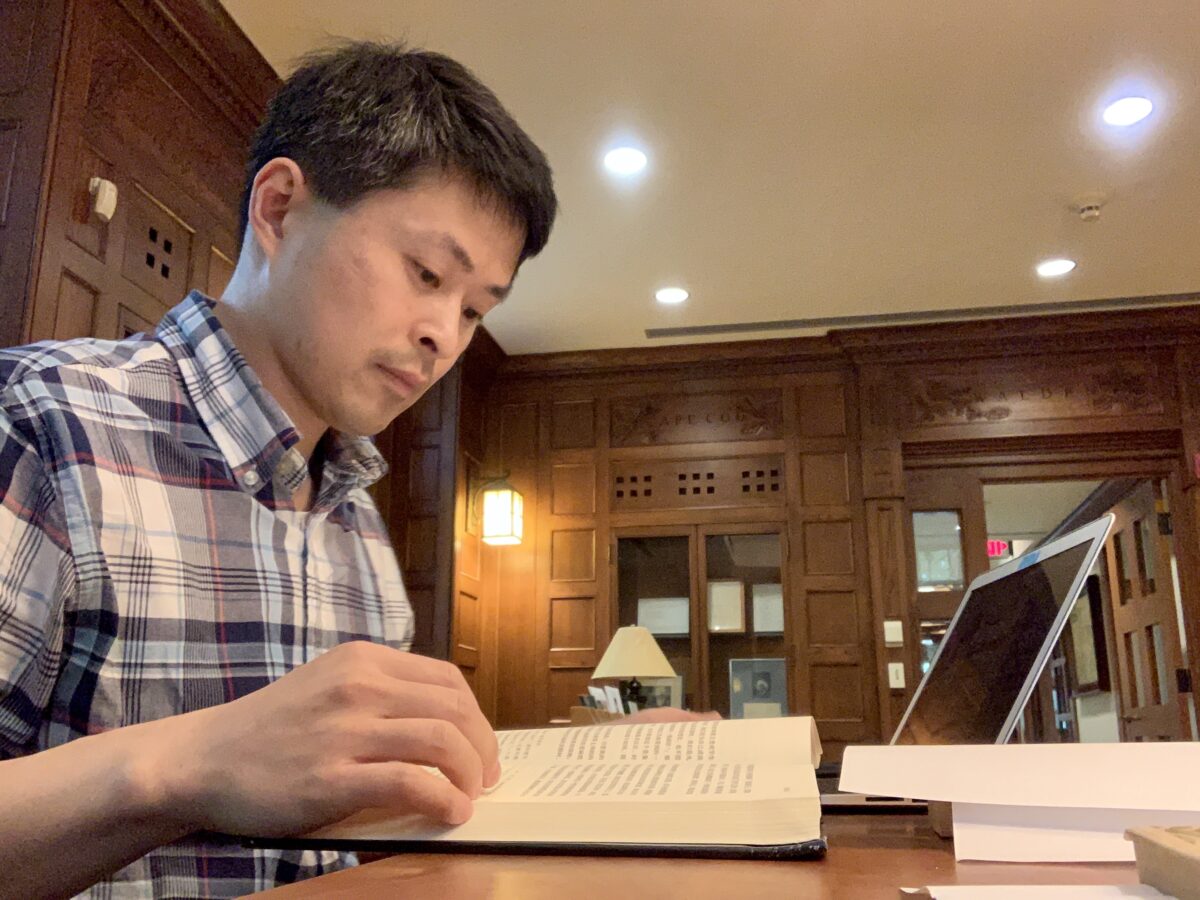
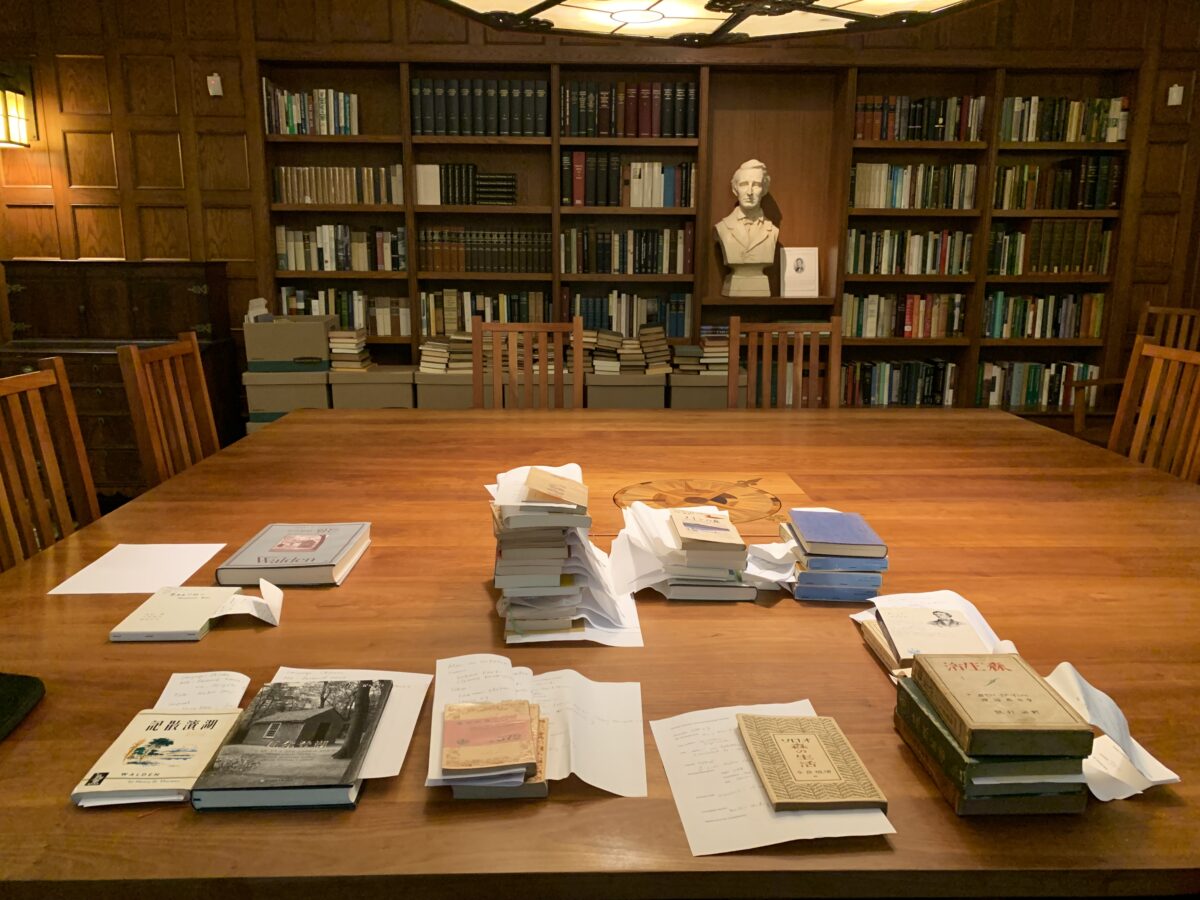 In September 2021, Tong spent two days examining, scanning, and taking notes on a number of Asian translations at the Thoreau Institute. Images courtesy of Tong.
Silent all these years
Historical and literary narratives of the Yangzi River and Yellow River floods tend to shift between focusing on facts and offering a political party’s explanation. The events are inevitably understood within the larger framework of building a national identity, especially the revolutionary history of the People’s Republic of China.
“Official narratives generally serve to build national unity, but there are always gaps and discrepancies in these narratives. It’s about whose voices are missing in the official narratives and why,” says Tong. “Unfortunately, people forget these voices over time, and my project is to recover them.
Wanting to delve into the archives on the floods to see what histories emerged, Tong first had to secure access to the archives. With access granted and the assistance of a Fulbright grant and Nanjing University, between 2018 and 2019 Tong spent 10 months in China analyzing thousands of documents written in classical and modern Chinese. In the archives, amongst letters written by survivors, correspondence between county officials and provincial and central governments lists of survivors at refugee camps, maps, logistical documents, and photos never before studied, was one of many untold stories:
“There are those who try to rescue their parents, but die in the water…There are those who hold their wives and children by the hand, but end up drowning together…[and] families that manage to escape on a single raft, but sink in the middle of the current.”
This excerpt of a rare petition letter written by a village representative was in the archives and mirrored accounts throughout the archives that spoke of death and survival. These voices, silent for decades, were not a story of revolutionary action as many histories of modern China would imply. What Tong unearthed bears witness to the lived experience of rural communities focused on repairing and managing loss. They sought help from government officials, relief workers, each other, and were more civically engaged than previously thought.
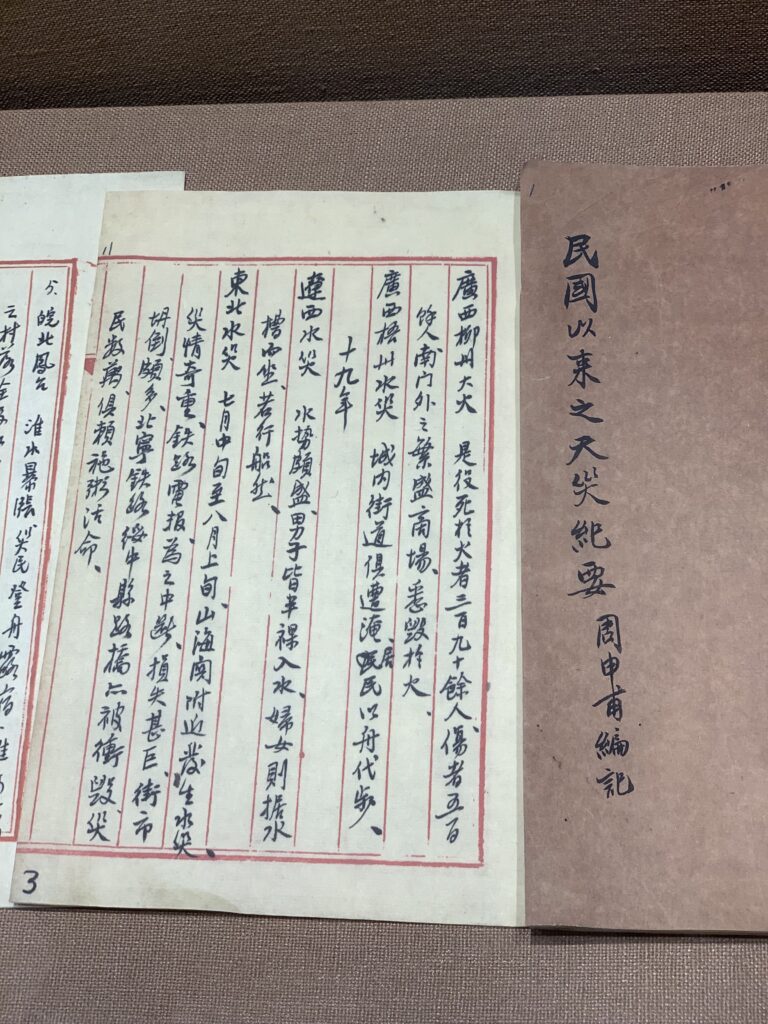 An archival document listing major environmental disasters in Republican China. Image courtesy of Tong.
“Sometimes these efforts are not given enough consideration in disaster narratives and national histories,” says Tong. “But I believe them to be important as building blocks of proto-democratic practices.” He hopes it will inspire the reconceptualization of Chinese literature and history in the early 20th century.
Kirk Denton, professor emeritus of Chinese literature at the Ohio State University and a mentor to Tong through UMBC’s Eminent Scholar Mentoring Program, gave Tong important feedback based on his own research on the representation of historical memory in Chinese and Taiwanese museums. Over the years, Denton has witnessed the evolution of Tong’s work.
“I was heartened to see a young man mature into such an accomplished scholar,” says Denton, who notes that Tong’s work “is at the forefront of the environmental humanities.”
Jessica Berman, professor of English and director of UMBC’s Dresher Center for the Humanities, says that as a scholar of comparative literature, “Christopher uses the core methods of textual analysis, critical theory, and intellectual history to bring out the ramifications of cross-cultural environmental thinking between China and the U.S. in the early 20th century.”
“The climate crisis is often portrayed as something serious that happens over time, like global warming,” says Tong. “However, with the Dust Bowl in the U. S. and floods in China, these disasters were fast and extreme and often contributed to immediate shifts in public sentiment and the government’s capacity to govern.”
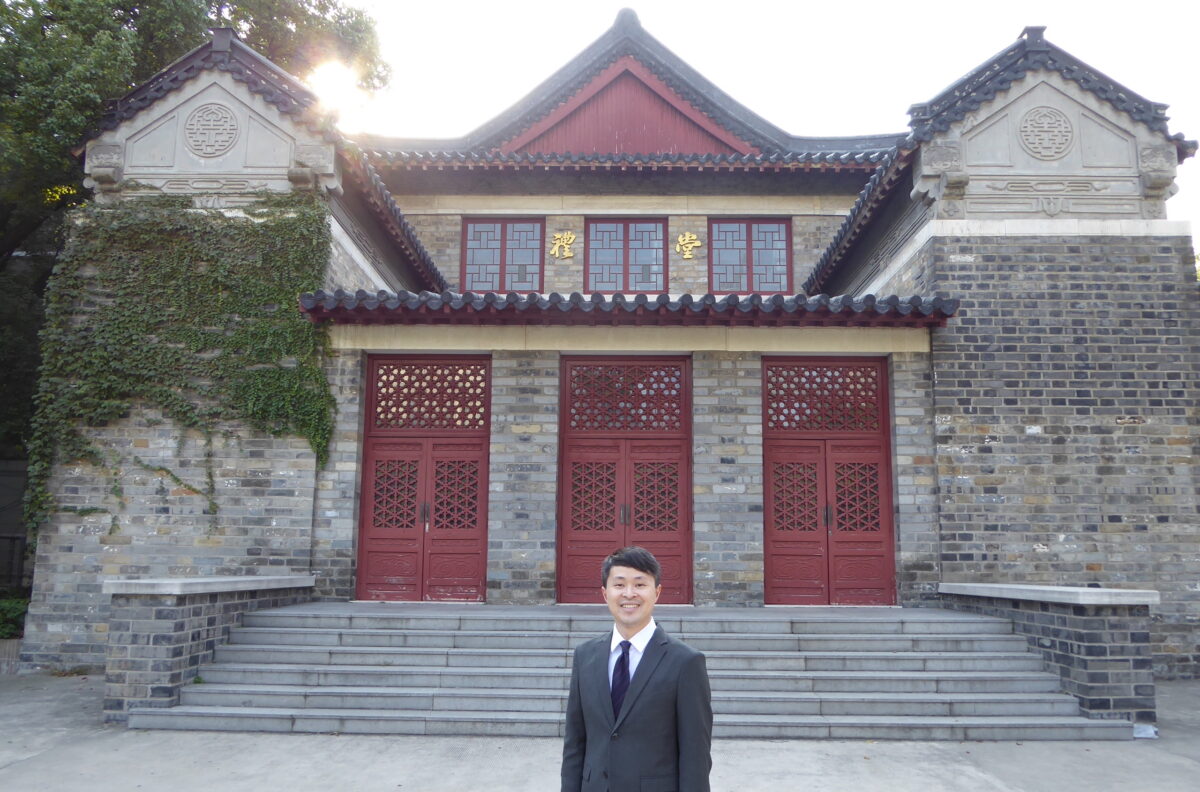 Tong stands in front of Nanjing University’s auditorium at the downtown campus, which features the fusion of traditional Chinese architectural elements and modern Western construction methods. Image courtesy of Tong.
Windows to the past
For Tong, the interconnectedness of his work is both personal and professional. His interest in 20th‑century China and Hong Kong stems from his maternal grandmother’s stories about her life in mainland China in the early 20th century.
“My maternal grandmother and her sibling were artists. She went to an art academy in China briefly during W WII and was the director of a clothing company in Hong Kong after the war. One of her sisters was a film star in Hong Kong who acted opposite a young Bruce Lee in the film Thunderstorm in 1957,” he says.
He remembers learning about his great‑great‑grandfather, Jiang Kong yin, a government official and well‑respected member of the gentry during the Qing dynasty, the last imperial dynasty in China. Jiang helped with the transition from the Qing dynasty to the Republic of China (ROC). Tong’s maternal grandfather learned English early because he was from one of the founding families whose fortune was tied to British Hong Kong. This was especially useful during WWII when he worked for Allied forces in southwestern China with Chinese aviators and the Flying Tigers, U. S. volunteer aviators who fought against Japan.
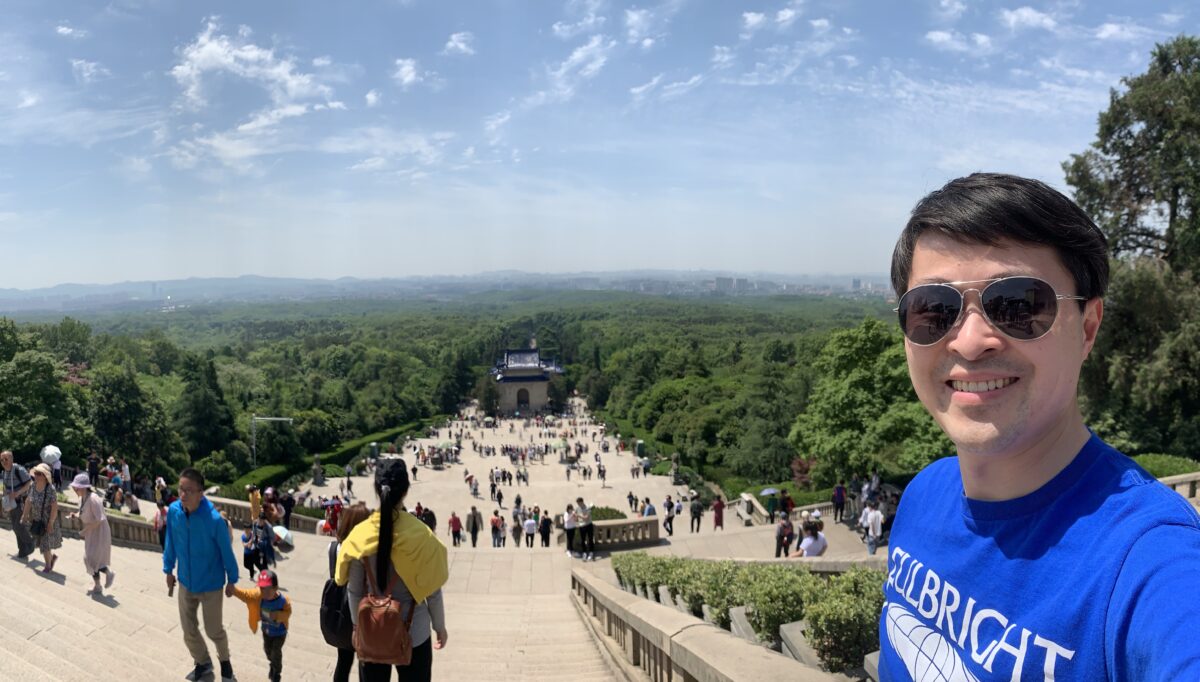
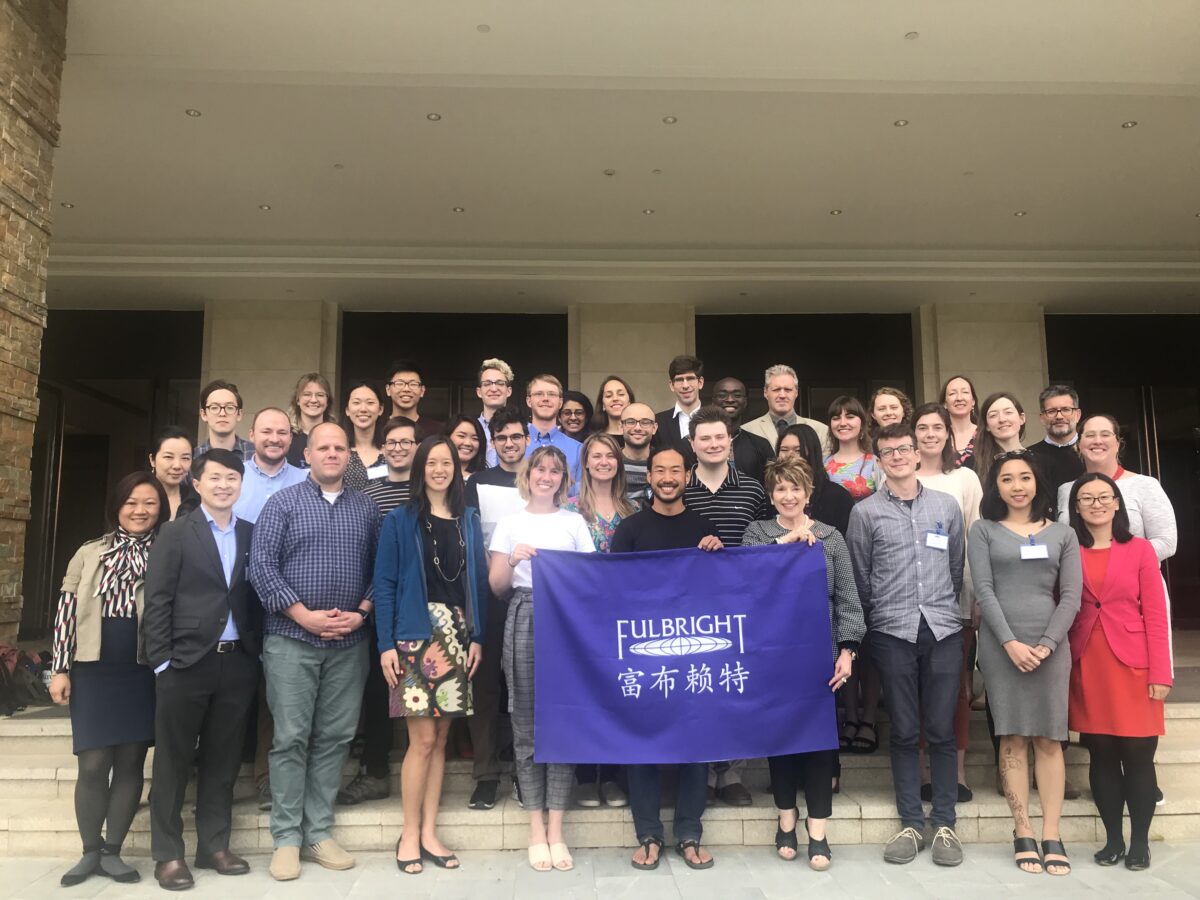 Left: Tong visited Dr. Sun Yat-sen’s Mausoleum on Nanjing’s Purple Mountain and wore his Fulbright shirt as a way to commemorate the US-China connection and his Fulbright experience in China. Right: The Fulbright program in China was cut short in 2020 by the pandemic and subsequently canceled, making Tong’s visit the last full year of Fulbright exchange in the People’s Republic of China. Images courtesy of Tong.
Tong also listened to the stories of his paternal grandfather who worked for an American company in Hong Kong after WWII. His paternal grandmother came from a peasant family and joined her siblings in the U.S. Her siblings ran a Chinese restaurant in Bakersfield, California. This side of Tong’s family eventually moved to the San Francisco Bay Area where his uncles would later work for the U. S. military. California has been home to most of Tong’s family since the late 1960s.
“I’m proud that my research not only broadens scholarship in the humanities,” shares Tong, “but it is also a way to maintain my connection to my family history and imagine what it was like for them to live through those periods.”
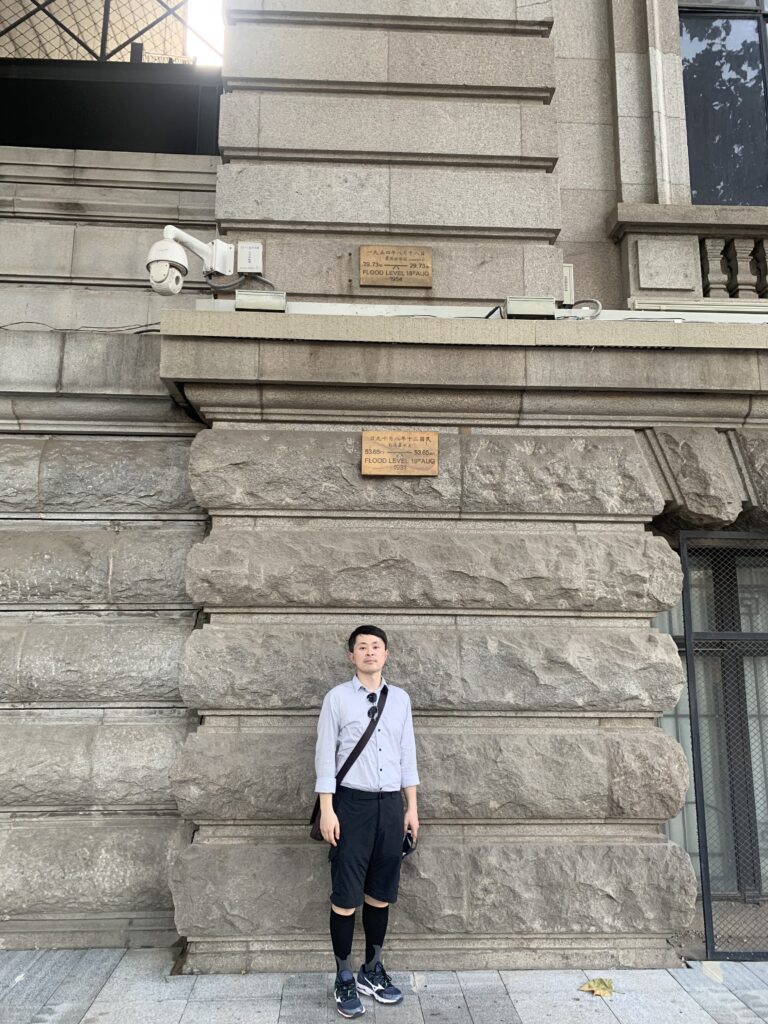 Tong stands below two plaques on the side of the former Hankow Customs House in Wuhan, China. The plaques are placed at the high-water marks of the 1931 floods (lower) and 1954 floods (higher). Image courtesy of Tong.
Mirrors
Tong’s work also holds space for voices missing in the humanities and the environmental movement. “Ecological thought draws heavily on European and North American traditions. Non-Western cultures are often viewed as derivative or marginal,” explains Tong. “Women, people of color, and disabled people are also underrepresented as contributors to environmentalism and animal advocacy.”
He remembers how his family often didn’t feel comfortable using green space, and when they did, people often assumed they were tourists. “Before COVID, I was visiting my grandmother and went for a hike in Muir Woods,” north of San Francisco, says Tong. “People asked me where I was from and were surprised to hear I grew up in the Bay Area.” The times when they did feel comfortable, when they enjoyed spending time outdoors, those experiences were memorable and inspired his career path.
Tong hopes to spur more inclusion and representation in the humanities. The STEM fields (science, technology, engineering, and math) have benefited from the talents and scholarship of Asian Americans and Pacific Islanders, he says, but the humanities have not had equal representation. As an Asian American with Hong Kong roots, Tong has often been the sole person of color or Asian American in classes and conferences. Often, he is mistaken as the “tech-person” or assumed to be in a STEM field, he explains.
Tamara Bhalla, an associate professor of American studies and affiliate faculty in the Asian Studies program, works with Tong on the board of the UMBC Asian and Asian American Faculty and Staff Council (AAAFSC). She says, “Chris has been a tremendous leader…He has brought his expansive intellect and global knowledge to bear in his approach to leadership in AAAFSC.”
Part of this work means going beyond the classroom. Tong participated in a series of talks at the Asian Art Museum of San Francisco on the theme of “After Hope.” His project helped raise awareness of Chinese-language literature in the context of Asian American history and addressed the pandemic, immigration policies, and what wellbeing means. He includes poetry found on Angel Island in the San Francisco Bay where Chinese immigrants were detained in the early 20th century because of the Chinese Exclusion Act.
“We’re an important part of the conversation on culture, politics, and history in American society,” he says. He wants to be one of the people that students can look to and think, “I can also pursue this path and have a career in academia in a humanistic field.”
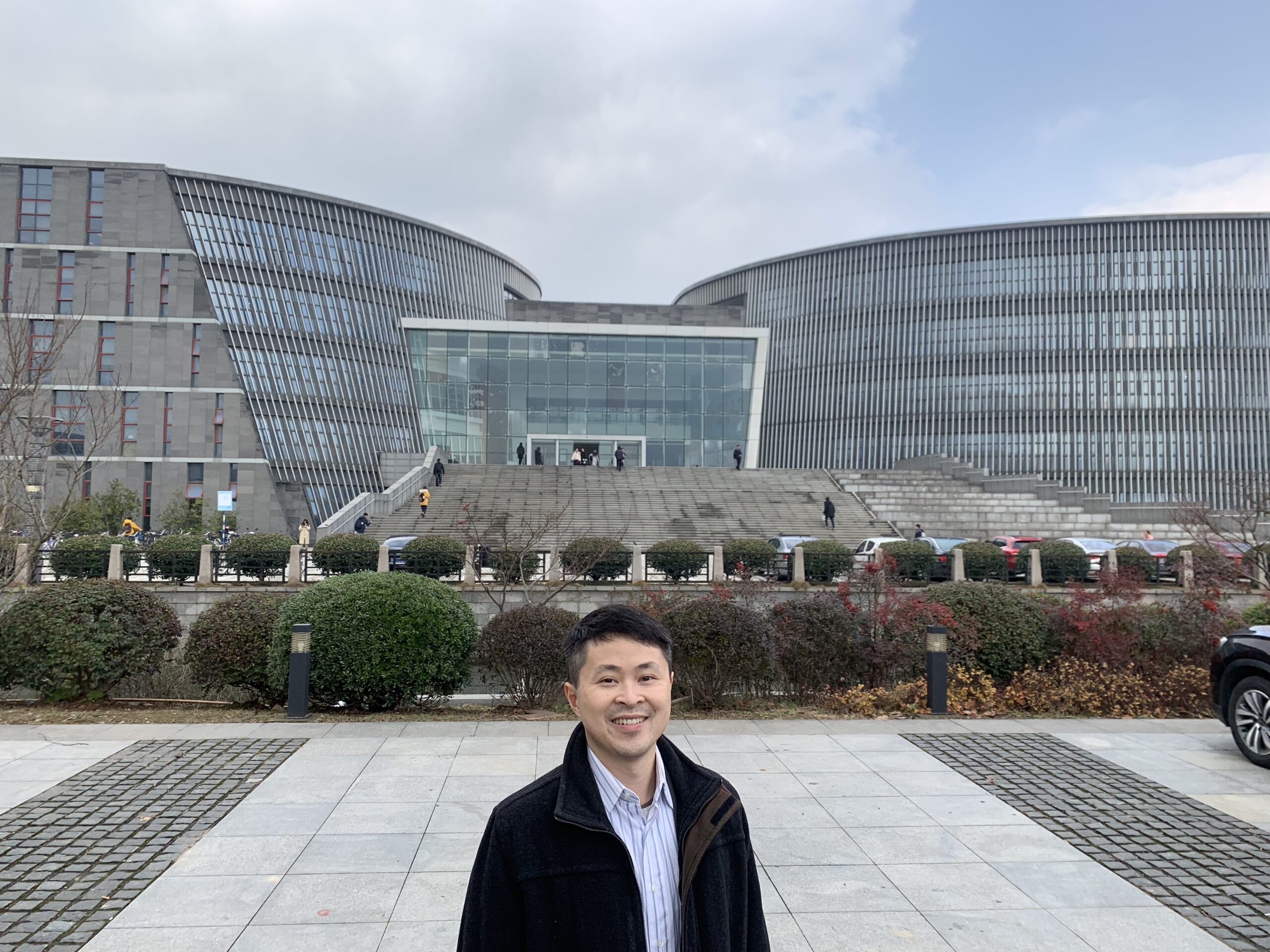
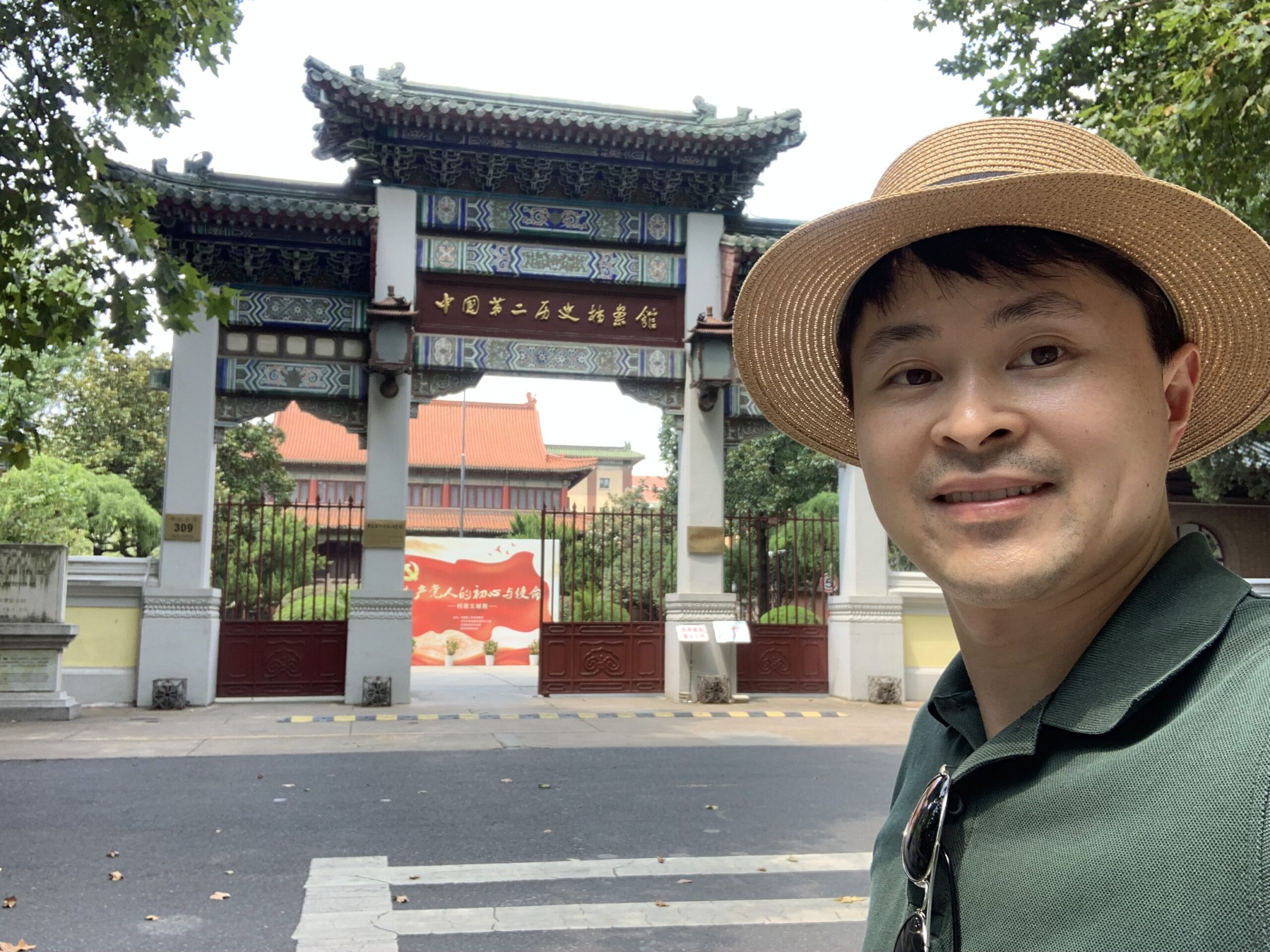 Left: At Nanjing University’s main library at the new campus in the Xianlin district. Right: At The No. 2 Historical Archive, the national repository for Republican-era government documents, in Nanjing. Images courtesy of Tong.
Last year’s flood in Zhengzhou was one of many extreme weather events in China that summer. Many cities and villages in various provinces were bombarded by the floods, killing hundreds and displacing millions.
The New York Times reported on the different accounts given by government officials, meteorologists, and on social media, including those trapped in the flooded subway, wading in the water, leaving their homes, and taking care of the dead while also dealing with COVID-19.
In the meantime, Tong has documents that remain to be analyzed in hopes they will unveil more voices and bring further clarity to China’s environmental history and its future.
“The climate crisis affects everyone every where in some way. It’s the most important issue of our generation,” says Tong. “It affects every domain of knowledge production.”
* * * * *
Header Image: A scene from the Yangzi River in China. Photo by Dong Zhang on Unsplash (2017). All other photos shared by Tong.
]]>
For Christopher Tong, discovering clues hidden in texts documenting history’s most devastating floods isn’t just about the promise of making social, cultural, and political change. It’s also a...
https://umbc.edu/stories/turning-the-tides-historic-flood-research/
https://my3.my.umbc.edu/api/v0/pixel/news/126254/guest@my.umbc.edu/e9ebe414caba9c1c343094233c3e1206/api/pixel
cahss
cahssresearch
discovery
interdisciplinary
international-stories
magazine
mlli
summer-2022
UMBC News & Magazine
https://my3.my.umbc.edu/groups/umbc-news-magazine
https://assets1-my.umbc.edu/system/shared/avatars/groups/000/001/943/24435aa6207c452e7bc15cc74b42c7bb/xsmall.png?1748556657
https://assets1-my.umbc.edu/system/shared/avatars/groups/000/001/943/24435aa6207c452e7bc15cc74b42c7bb/original.png?1748556657
https://assets2-my.umbc.edu/system/shared/avatars/groups/000/001/943/24435aa6207c452e7bc15cc74b42c7bb/xxlarge.png?1748556657
https://assets2-my.umbc.edu/system/shared/avatars/groups/000/001/943/24435aa6207c452e7bc15cc74b42c7bb/xlarge.png?1748556657
https://assets3-my.umbc.edu/system/shared/avatars/groups/000/001/943/24435aa6207c452e7bc15cc74b42c7bb/large.png?1748556657
https://assets1-my.umbc.edu/system/shared/avatars/groups/000/001/943/24435aa6207c452e7bc15cc74b42c7bb/medium.png?1748556657
https://assets2-my.umbc.edu/system/shared/avatars/groups/000/001/943/24435aa6207c452e7bc15cc74b42c7bb/small.png?1748556657
https://assets1-my.umbc.edu/system/shared/avatars/groups/000/001/943/24435aa6207c452e7bc15cc74b42c7bb/xsmall.png?1748556657
https://assets2-my.umbc.edu/system/shared/avatars/groups/000/001/943/24435aa6207c452e7bc15cc74b42c7bb/xxsmall.png?1748556657
UMBC News & Magazine
0
0
false
Thu, 14 Jul 2022 10:53:19 -0400
Thu, 14 Jul 2022 10:53:19 -0400
Peaceworkers in Action
Michael Hassett and Chiara Collette first met each other in 2014 at the Los Angeles International Airport before boarding a 17-hour flight to the Kingdom of Tonga in the middle of the southwestern Pacific Ocean. Hassett applied to the Peace Corps hoping to be placed in Eastern Europe focusing on rural development. As a certified teacher, Collette didn’t have a specific country in mind. She was more interested in being able to teach.
Both were placed in Tonga in teaching positions. Little did they know that this shared placement would permanently intertwine their personal and professional lives. In 2018, the couple got married and co-founded an internationally recognized nonprofit, Friends of Tonga—which earned a 2021 Literacy Award from the Library of Congress. Since then, Hassett and Collette have used their literacy educational tools and public policy skills gained at UMBC, and connections in Tonga to support the island nation they have come to love.
Community building
Hassett, M.P.P. ’17, Ph.D. ’19, public policy, lived in the village of Fahefa on the main island of Tongatapu. Collette, M.A. ’21, TESOL, lived in the village of Ta’anga, on the outer island of ‘Eua part of an archipelago made of 170 islands.
Working and living alongside their community members and fellow teachers, they helped design and implement programs to further develop students’ English speaking, writing, and reading skills. As the second official language of Tonga, students are expected to master English and complete their high school entrance exams in English.
Hassett remembers within the first two months a parent asked if he could tutor her high school-aged son. He agreed to begin that very night. “As I waited, I heard the pigs and chickens run across the yard and smelled the wafting smoke of cooking fires in the air,” he remembers. Then he heard people yelling in Tongan. ”Before my eyes, my one student expanded into a crowd of high school kids from around the village, all bearing plates of food, fresh fruits, vegetables, and bread,” he says. Their parents began running out of their houses to ask if he could tutor their children, too? His one-on-one tutoring session evolved into a weekly night class.
One of Collette’s favorite teaching memories was working with 3rd and 4th-grade students on a career interest project. “Students created life-size cardboard cutouts of their heads and hands and decorated them according to the profession of their choice. “They wrote and memorized speeches explaining their career choice,” says Collette. “Students then presented their speeches to their parents while wearing their ‘professional outfits.’”
And similar to Hassett’s unexpected evening tutoring class, Collette developed a friendship with the principal at the primary school where she worked, offering help as he worked towards his bachelor’s degree in education from the University of the South Pacific remotely.
Through these experiences, Collette and Hassett forged strong friendships and partnerships giving them a great sense of connection across all sectors of the Tongan community beyond their Peace Corps experience.
At the same time, their friendship evolved into a relationship. They started dating and continued long-distance while Hassett traveled after he completed his service and when they returned back to the United States until they relocated to Baltimore together so Hassett could matriculate into UMBC’s Public Policy program as a Shriver Peaceworker. Collette became a teacher in Baltimore City Public Schools and Anne Arundel County Public Schools eventually enrolling in UMBC’s M.A. TESOL program.
Tongan allies
Focusing on their graduate degrees did not replace the bond that had grown between themselves and the people of Tonga. In 2018, cyclone Gita hit Tonga with over a hundred mile per hour winds causing the most damage in 60 years. They were not aware of any other U.S. non-profits directly working in Tonga that were not religiously affiliated. Equipped with their skills from the Peace Corps and UMBC, along with their community-engaged connections, the pair co-founded Friends of Tonga with Peace Corps colleagues, friends in the nonprofit and development community, and members of the Tongan community.
One such member is Tu’amelie Mahe, the principal Collette used to work with. He now serves as education officer for school grant and asset management at the Ministry of Education and is the current program manager for Friends of Tonga. There are also Tongan’s in New Zealand participating. “From the perspective of a New Zealand born Tongan, being a part of Friends of Tonga allows those Tongans, who are a part of the diaspora, to actively participate in charity work that directly benefits Tonga,” says Neomai Maka, a high school teacher in Auckland, New Zealand. Her parents originate from the villages of Fua’amotu and Tatakamotonga in Tonga.
What began as reactive disaster relief support work, grew to become a proactive Peace Corps model community supporting Tongan-identified initiatives like education resources, English language skill development, and building cyclone safe schools.
“I am a friend of Tonga. I’m not Tongan. I can’t speak on their behalf,” shares Hassett. “I am not interested as a white man in telling Tongans what to do or what they need. I can be an ally and I can support them and champion the causes that they tell us they need help with.”
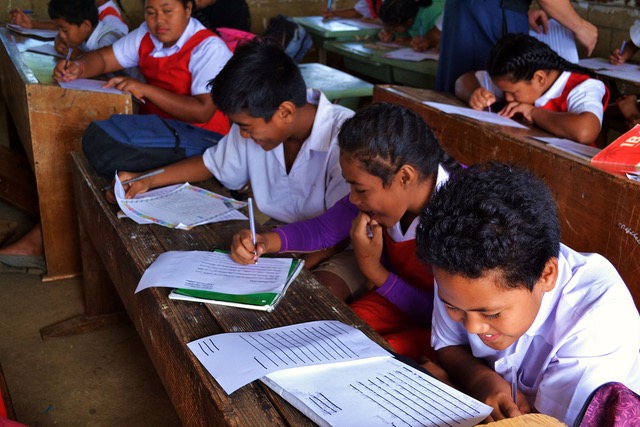 Tongan children at school. Image courtesy of Hassett and Collette.
Weathering the storm
Later that year, they returned to Tonga for both their honeymoon and their Sapate Uluaki, a wedding celebration. Hassett’s host family, the Fainga’a family, planned this celebration weaving Hassett and Collette deeper into their Tongan community.
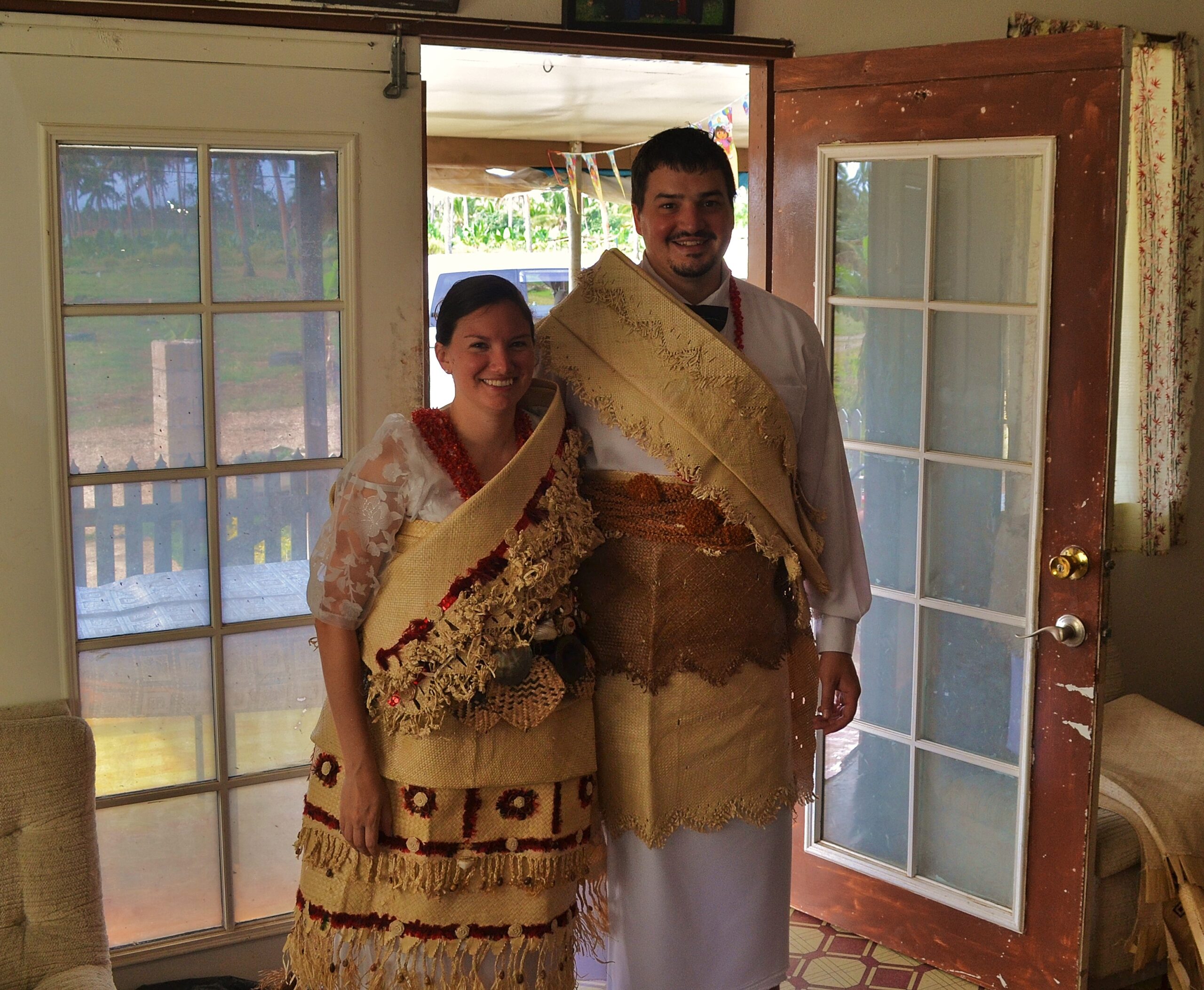 Hassett and Collette on their wedding day.
Images courtesy of the couple.
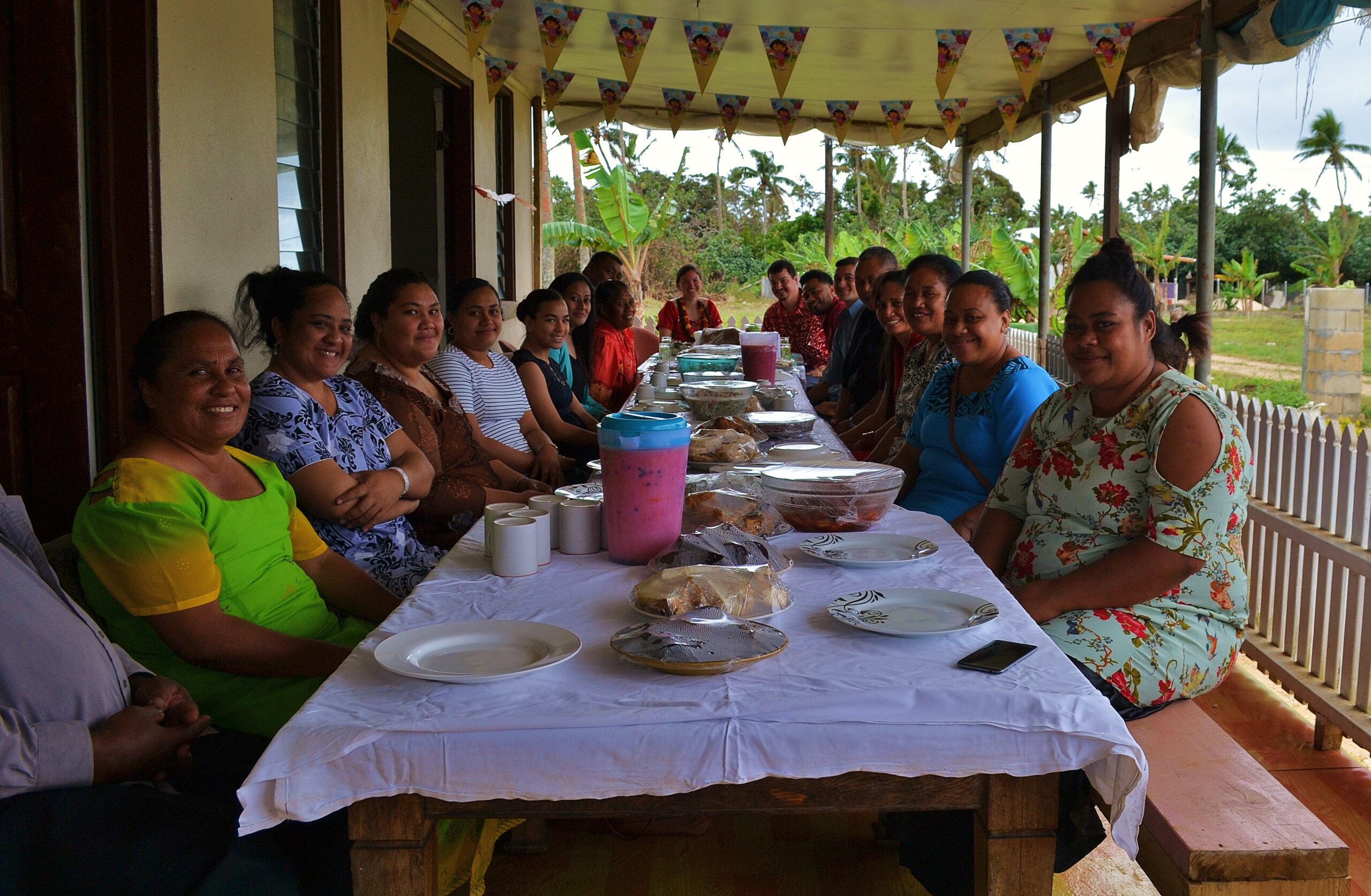 Friends celebrate the wedding of Hassett and Collette.
During this visit, Friends of Tonga was asked to help rebuild the kindergarten that had been destroyed by a category four cyclone earlier in the year and had been operating out of a tent ever since. Collette and Hassett had lived through Cyclone Ian and Kofi in January and March 2014 respectively and witnessed the damage caused by bands of heavy rain, strong winds, and flash flooding.
“We jumped in,” says Collette. The logistical challenges of building a school were great. They reached out to their friend who is the CEO of Schools for Children of the World. “It was a true collaborative effort between architects and engineers familiar with building schools in countries prone to hurricanes, the Tongan Ministry of Education, and community members,” says Hassett. Via a string of Facebook calls with engineers and architects, Tongan’s first cyclone and hurricane-resistant building was created. This one structure now functions as a school, community center, a shelter, and a place to house emergency supplies. The need for these types of structures was evident and a key factor in continuity of education and services.
Sustainable English language learning
Collette began working on assisting teachers find resources to improve English reading, writing, and speaking skills to increase student’s access to high school and further education opportunities. The obvious answer might have been increasing access to English language books but, with students spread over 170 islands, a central library would only give access to students living near the library. Books that are donated are often not aligned developmentally or content-wise. Buying books, transporting them, and managing the wear and tear caused by tropical and extreme weather makes a physical library costly and unsustainable.
The answer was not in the past but in the future. Wi-fi reaches most of the islands allowing at least one family member the use of a smartphone. A resource that is bound to grow makes digital resources sustainable. With permission from authors and volunteer readers, Collette developed a digital video library of English language beginner, intermediate, and advanced books.
Today, the library has 85 books that teachers, parents, and students can download using very little data. The theories and best practices gained during her TESOL master’s program, guided Collette in developing an English language learning curriculum for teachers and parents to use in tandem. “A video library meant rural students who didn’t have access to English language materials could download a file and share it with friends and family,” says Collette.
Collette and Hassett note that UMBC “is baked into all of our programming.” Joby Taylor, Ph.D. ’05, language, literacy, and culture, director of the Shriver Peaceworker Program, along with fellow Peaceworkers read many of the stories in the read-aloud program. Lauren Hamilton Edwards, assistant professor of public policy, is also guiding them in their strategic planning process.
Dear Tonga
Reading was only part of the puzzle needed to improve English language skills. Students needed more practice writing in English for their high school entrance exam. Collette designed a penpal program between Tongan students and students in the U.S. The written conversation became a way to learn about other cultures, practice sentence structure, and purposeful communication needed in school and in jobs.
“The results of a curriculum specifically for Tongan English language learners is exactly what the teachers, the Ministry of Education, and Friends of Tonga hoped it would be,” says Hassett. “Based on an analysis I did, the high school entrance exam scores increased by 10%.”
The Library of Congress took note and awarded Friends of Tonga, one of only 14 recipients globally, with a 2021 Literacy Award for “their implementation of highly successful practices in literacy promotion… and in recognition of the need for the international community to unite in achieving universal literacy.”
This was only the beginning. As an early childhood educator, Collette began searching for opportunities to assist the Ministry of Education and teachers to create a PreK-K program.
Then the Hunga Tonga–Hunga Ha‘apai volcano erupted on January 15, 2022, followed by a tsunami. The eruption lasted for 11 hours and devastated homes across the archipelago.
A Strong Network
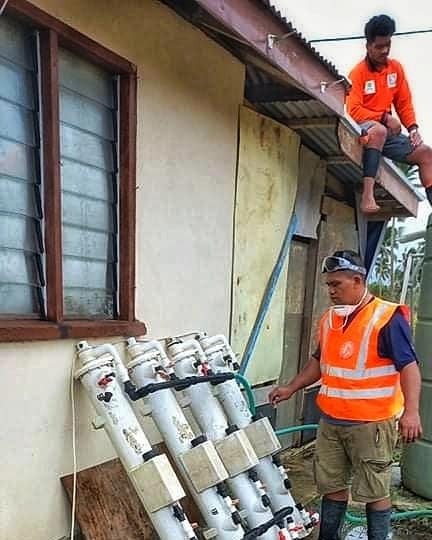 In partnership with The Civil Society Forum of Tonga, teams help clean up rain collection tanks, filtering and purifying the rain water from the volcanic ash.
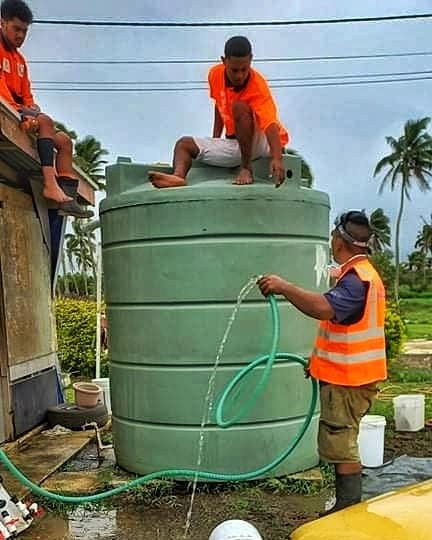 With CSFT, volunteers work to clean up after the tsunami. Images courtesy of Hassett and Collette.
The volcano completely disconnected wi-fi service, blanketed Tonga with ash, toppled homes, and contaminated rain water collection points. Hassett and Collette did not hear from their Tongan community for weeks. Thankfully, Friends of Tonga is made up of community members in Tonga as well as in New Zealand allowing a close point of contact to provide information, identify needs, and provide direct support. Through their networks, they were able to hear that the cyclone proof school was not affected by the volcano or the tsunami.
Friends of Tonga funded $15,000 to The Civil Society Forum of Tonga, a Tongan-led and Tongan driven NGO, and fundraised $9,000 for the Mainstreaming of Rural Development Innovation Tonga Trust. The funding is helping to provide water, sanitation, hygiene services, and assist farmers with harvesting crops damaged by the tsunami before they spoil. The food is being given to the communities that were evacuated from outer islands.
“The work that began a decade ago as Peace Corps volunteers was intentionally driven to build strong, long lasting, community, and personal relationships,” shares Hassett, the 2021 recipient of UMBC’s Distinguished Service Alumni Award. “We created a strong infrastructure of people and resources that has made it possible for us to support Tongans right now more than ever before.”
]]>
Michael Hassett and Chiara Collette first met each other in 2014 at the Los Angeles International Airport before boarding a 17-hour flight to the Kingdom of Tonga in the middle of the southwestern...
https://umbc.edu/stories/umbc-peaceworkers-in-action/
https://my3.my.umbc.edu/api/v0/pixel/news/126242/guest@my.umbc.edu/6894d76c0740bf1c26fe61922ec991c6/api/pixel
alumni
magazine
shrivercenter
summer-2022
UMBC News & Magazine
https://my3.my.umbc.edu/groups/umbc-news-magazine
https://assets1-my.umbc.edu/system/shared/avatars/groups/000/001/943/24435aa6207c452e7bc15cc74b42c7bb/xsmall.png?1748556657
https://assets1-my.umbc.edu/system/shared/avatars/groups/000/001/943/24435aa6207c452e7bc15cc74b42c7bb/original.png?1748556657
https://assets2-my.umbc.edu/system/shared/avatars/groups/000/001/943/24435aa6207c452e7bc15cc74b42c7bb/xxlarge.png?1748556657
https://assets2-my.umbc.edu/system/shared/avatars/groups/000/001/943/24435aa6207c452e7bc15cc74b42c7bb/xlarge.png?1748556657
https://assets3-my.umbc.edu/system/shared/avatars/groups/000/001/943/24435aa6207c452e7bc15cc74b42c7bb/large.png?1748556657
https://assets1-my.umbc.edu/system/shared/avatars/groups/000/001/943/24435aa6207c452e7bc15cc74b42c7bb/medium.png?1748556657
https://assets2-my.umbc.edu/system/shared/avatars/groups/000/001/943/24435aa6207c452e7bc15cc74b42c7bb/small.png?1748556657
https://assets1-my.umbc.edu/system/shared/avatars/groups/000/001/943/24435aa6207c452e7bc15cc74b42c7bb/xsmall.png?1748556657
https://assets2-my.umbc.edu/system/shared/avatars/groups/000/001/943/24435aa6207c452e7bc15cc74b42c7bb/xxsmall.png?1748556657
UMBC News & Magazine
0
0
false
Wed, 13 Jul 2022 13:19:01 -0400
Wed, 13 Jul 2022 13:19:01 -0400
See the Challenge, Be the Change

UMBC’s Grand Challenge Scholars Program prepares students to collaborate across disciplines and address real-world issues.
Illustrations by Kimberly Salt
When Chelsea Okeh ’22, M30, biological sciences, first came to UMBC, she was excited to put her passions to work in a way that might help her community. She already knew she wanted to address health disparities, so she put herself on a course to learn and do all she could.
When a friend in the Meyerhoff Scholars Program mentioned UMBC’s Grand Challenge Scholars Program (GCSP)—which takes an interdisciplinary approach to solving big world problems — she knew she was in the right place. Surrounded by students with a wide range of interests, she could take her ideas to the next level.
“I’ve always had an unbridled ideology that it is possible to change the world,” she says of her interest in the GCSP.” “Little things I’ve done in the past like Girl Scouts and community service really paved the way for wanting to take part in something that has a greater purpose.” Through the program, Okeh expanded her understanding of factors that impact health disparities and outcomes and she is primed to take what she’s learned beyond UMBC.
Tackling societal challenges
Modeled after a national program, UMBC’s GCSP was established in the College of Engineering and Information Technology (COEIT) in Fall 2016. Over the past six years, the program has expanded, drawing together students from various disciplines to address major challenges that the world is facing. Ranging from engineering better medicines and securing cyberspace, to providing access to clean water and advancing personalized learning, the challenges were identified by a group of leaders across academia, policy, and industry that the National Academy of Engineering convened in 2007.
Maria Sanchez, GCSP director since 2018 and a professor of the practice in COEIT, explains that an important part of the program is helping students develop skills that they can apply to their classes and take with them into careers or graduate school. Students are eligible to enter the program during their junior year and participate for two years, building their ideas over time.
Because big challenges require cross-disciplinary thinking, the GCSP brings students from diverse backgrounds together for meaningful conversations and to discuss topics that require multidisciplinary solutions and perspectives. Students in the program connect with organizations on and off campus to put their skills and knowledge to work. For example, a student interested in learning how to improve the quality of water for communities might work with the UMBC chapter of Engineers Without Borders to design a water filtration system in another country in need, or a student passionate about restoring and improving urban infrastructure might pursue a study abroad opportunity to learn about cities on other continents.
“We don’t expect the students to come up with a solution to a grand challenge. It’s more to develop a framework for basic skills and to apply them to their future careers,” Sanchez explains.
The GCSP includes five program areas that help students develop a comprehensive perspective on topics. These elements—research, entrepreneurship, service, interdisciplinarity, and global perspectives—are incorporated into the seminars and the students’ final projects. “Through these experiences, the students reflect on what the experience has meant to them and how they transform themselves or their views,” she says.
The program pivoted during the early months of the COVID-19 pandemic to support students as they adjusted to virtual learning and other sudden changes. The students also processed national current events during classes, including the 2020 election, the pandemic, and racial injustice.
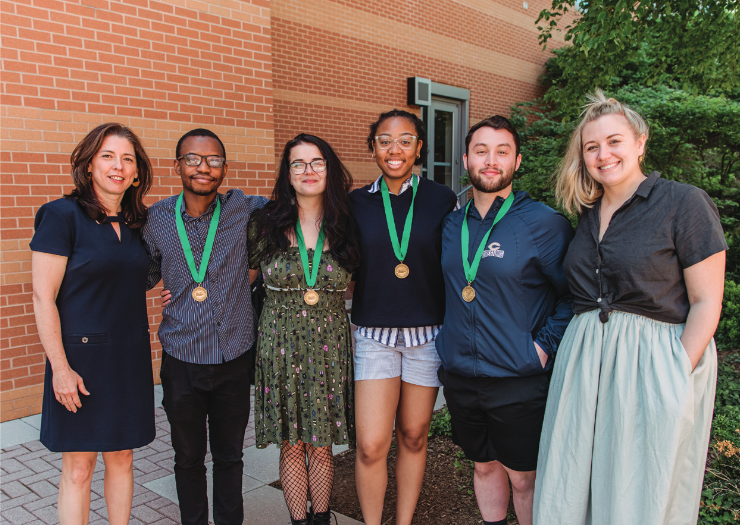 Maria Sanchez (left), director of the Grand Challenge Scholars Program, shares a moment with students Olorunjuwon Ajayi, Diane Stonestreet, Chelsea Okeh, David Paton, and peaceworker fellow Alexandra DeCraene. (Marlayna Demond ’11/UMBC)
Developing models to replicate
The national Grand Challenges Scholars Program was founded by three engineering deans at institutions across the U. S. in 2009. In 2011, Arizona State University (ASU) launched their Grand Challenge Scholars Program, which is housed within the Ira A. Fulton Schools of Engineering. Today, ASU invites all incoming first-year students to participate in the program.
Amy Trowbridge, director of ASU’s program and chair of the interim executive committee of the Grand Challenges Scholars Program Network, explains that the program allows students to create meaningful connections among their peers and mentors. Students joining the program all take a course that lays the foundation for the experiences they will complete to achieve the five GCSP competencies during their time in the GCSP.
“The Grand Challenge Scholars Program is important for students because of the skill set and mindset that it helps them gain through the program,” Trowbridge says. “Members of industry have said that it’s valuable as industry continues to change and evolve, and as technology gets more complex. It’s the interdisciplinary, global perspective that students gain through the program, and the ability to see the big picture.”
Meaningful mentorship
Olorunjuwon Ajayi ’22, computer engineering, has a personal interest in sustainability, so the GCSP challenge of “making solar energy economical” resonated with him. Entering the program, he participated in the seminar classes that allowed him to discuss topics with his peers and be exposed to different perspectives. Soon, he had the tools he needed and a network of fellow students to tackle the challenge.
Through the program, Ajayi has been intentional about connecting the research that he conducts on campus alongside Curtis Menyuk, professor of computer science and electrical engineering, with the challenge that he focuses on in GCSP. The research focuses on lasers and optics and can be applied to solar energy issues. He is particularly interested in optimizing energy harvesting from solar panels. This summer, he will complete an internship with the National Renewable Energy Laboratory. After graduation, Ajayi plans to work in the renewable energy field.
Ajayi says that he has enjoyed the seminar classes because they delve into topics that he doesn’t explore much in other classes. “The classes have been fun but they touch on things people don’t really think about in their majors,” he explains.

Sharing perspectives
To support the GCSP, Sanchez works with Alexandra DeCraene ’22, public policy, a peaceworker fellow through the UMBC Shriver Center who serves as the program coordinator for GCSP. Peaceworker fellows are returned Peace Corps volunteers pursuing their graduate degrees at UMBC while participating in a two-year social change leadership program, which includes a part-time placement with an on-campus program or community partner addressing a range of social needs.
DeCraene explains that she enjoys bringing guest speakers into the classroom to share different perspectives and disciplines with the scholars. She says that one speaker that stands out is a Baltimore-based pastor who got creative about using resources that his churches already had to bring more local food to the community. He connected with local farms and used the church ’s vans to transport fresh produce to farmers markets in Baltimore.
“Being exposed to different ways of thinking, different cultures, and different thought processes has been very valuable to me,” DeCraene says. “The Grand Challenge Scholars Program gives undergraduate students a chance to discuss what is on their minds, share their ideas, and get feedback from their peers.”
Striving for interdisciplinarity
For Okeh, the challenge to engineer better medicines aligned closely with her career goals. She is particularly interested in using her future degrees to address health disparities that are related to socioeconomics, geography, health literacy, and race. Okeh conducts research on the effects of hyperglycemia on neural tubes of zebrafish and works alongside Rachel Brewster, professor of biological sciences. This work can help doctors understand the prevalence of neural tube defects in babies born to pregnant people with diabetes.
“By individualizing and acknowledging the health disparities and the issues they’ve created, and keeping that in the forefront of our minds, we can ultimately engineer better medicines,” explains Okeh, who will complete post-baccalaureate research at the University of Pennsylvania before pursuing her M.D./Ph.D.
“Engineering doesn’t necessarily mean equations and reactions. It could be putting issues that we are already experiencing in our communities under the magnifying glass and seeing how entrenched they are in our medical and healthcare systems.”
Building a solid foundation
In addition to guiding students to reflect on their experiences or perspectives throughout the course, Sanchez would like GCSP alumni to reflect on how the program has provided them with a solid foundation on which to start their careers. Heather Mortimer 18, interdisciplinary studies, decided to apply for the GCSP after she saw a flier about the program on campus. She was intrigued by the interdisciplinary focus on the program and that it had many parallels to her passions and goals.
Mortimer’s self-designed major focused on science communications, museum education and education development, combining her interests in art, education, history, science, and writing, she explains. She participated in the second cohort of the program during her junior and senior years, after transferring to UMBC from art school. Her cohort had fewer than a dozen students, and most of the participants were STEM majors.
The challenge to “advance personalized learning” resonated with Mortimer because part of her major was about active versus passive learning. Her GCSP final project was a remix of things she was already working on for her interdisciplinary studies degree, she says. Looking back on her experience in the program, Mortimer says that she enjoyed the discussions that happened in the classroom as well as the required courses.
As a graphic designer and technical writer at NASA Goddard Space Flight Center, Mortimer says that her participation in GCSP allowed her to be exposed to people with different skills, perspectives, and interests.
“I am the resident creative on a team of mostly STEM professionals,” Mortimer says of her role at NASA. Being a part of the program “gave me a better idea of how scientists see problems and what goes into their thought process. It’s been helpful to integrate some of that same way of thinking into the way that I approach creative projects.”

Challenge accepted
As GCSP continues to expand, Sanchez hopes to continue to incorporate elements of social responsibility—encouraging people and organizations to prioritize the best interests of society and the environment—into the experience.
“I’m very passionate about the idea of social responsibility and thinking about what students are going to be doing as professionals in their careers and what they’re going to apply from their education,” says Sanchez, who is collaborating with Helena Mentis, professor of information systems, on a Hrabowski Innovation Fund Grant to implement elements of social responsibility education into curricula across COEIT departments. Sanchez and Mentis are working with faculty and graduate students in a range of disciplines in UMBC’s College of Arts, Humanities, and Social Sciences.
“Even though the National Academy of Engineering developed the Grand Challenge Scholars Program with engineers in mind, it’s become clear to me that these topics are on students’ minds regardless of discipline,” says Sanchez.
Sanchez plans to continue to develop GCSP’s curriculum and structure so that it may become applicable to other programs or courses at UMBC. Through the program, she hopes that students are able to make meaningful connections at UMBC and in the surrounding communities and contribute to society through their careers.
In the future, Sanchez would like to increase the range of majors that participate in the program and apply elements of the program to connect with more students. Through her experience leading the GCSP, she has found that students value the opportunity to discuss the topic of social responsibility, and it prepares them to collaborate across disciplines in their careers.
“The way that GCSP was designed is a great jumping-off point for future programs,” says Sanchez. “The Grand Challenge Scholars Program has created a foundation and structure for students to think about various topics with social responsibility in mind.”
]]>
UMBC’s Grand Challenge Scholars Program prepares students to collaborate across disciplines and address real-world issues. Illustrations by Kimberly Salt When Chelsea Okeh ’22, M30,...
https://umbc.edu/stories/see-the-challenge-be-the-change/
https://my3.my.umbc.edu/api/v0/pixel/news/126190/guest@my.umbc.edu/9e7b0b8f8c5e3520a238ca01d42bfdd7/api/pixel
cahss
cnms
coeit
discovery
magazine
summer-2022
UMBC News & Magazine
https://my3.my.umbc.edu/groups/umbc-news-magazine
https://assets1-my.umbc.edu/system/shared/avatars/groups/000/001/943/24435aa6207c452e7bc15cc74b42c7bb/xsmall.png?1748556657
https://assets1-my.umbc.edu/system/shared/avatars/groups/000/001/943/24435aa6207c452e7bc15cc74b42c7bb/original.png?1748556657
https://assets2-my.umbc.edu/system/shared/avatars/groups/000/001/943/24435aa6207c452e7bc15cc74b42c7bb/xxlarge.png?1748556657
https://assets2-my.umbc.edu/system/shared/avatars/groups/000/001/943/24435aa6207c452e7bc15cc74b42c7bb/xlarge.png?1748556657
https://assets3-my.umbc.edu/system/shared/avatars/groups/000/001/943/24435aa6207c452e7bc15cc74b42c7bb/large.png?1748556657
https://assets1-my.umbc.edu/system/shared/avatars/groups/000/001/943/24435aa6207c452e7bc15cc74b42c7bb/medium.png?1748556657
https://assets2-my.umbc.edu/system/shared/avatars/groups/000/001/943/24435aa6207c452e7bc15cc74b42c7bb/small.png?1748556657
https://assets1-my.umbc.edu/system/shared/avatars/groups/000/001/943/24435aa6207c452e7bc15cc74b42c7bb/xsmall.png?1748556657
https://assets2-my.umbc.edu/system/shared/avatars/groups/000/001/943/24435aa6207c452e7bc15cc74b42c7bb/xxsmall.png?1748556657
UMBC News & Magazine
0
0
false
Mon, 11 Jul 2022 08:45:00 -0400
Mon, 11 Jul 2022 10:36:04 -0400
Better Living Through Chemistry
From cooking and cleaning to fixing your car, understanding chemistry can enlighten all aspects of life. That’s just one reason why Dean William R. LaCourse still loves sharing the joy of his favorite subject in front of a classroom.
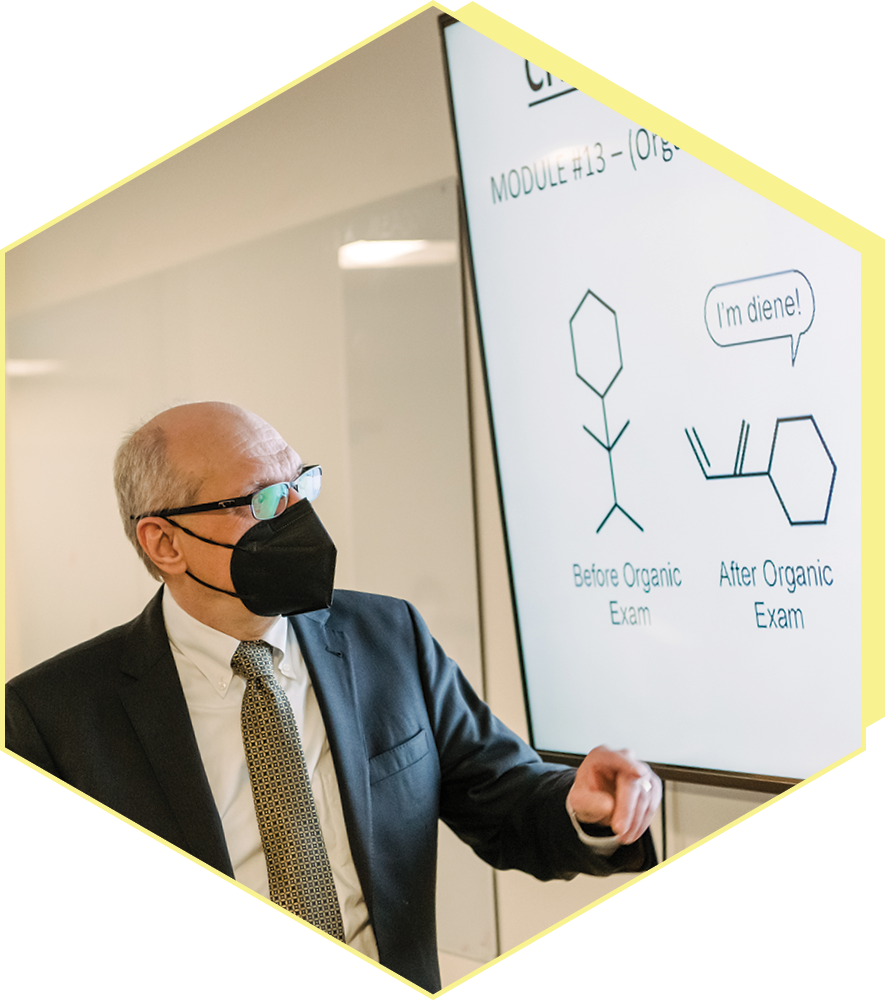
It’s not every institution where you can take a class taught by the dean— especially a 100-level course. It’s even less likely to find that dean sprinkling his weekly lectures with silly chemistry jokes and cultural references. But William R. LaCourse, dean of the College of Natural and Mathematical Sciences (CNMS) since 2011, does exactly that, co-teaching CHEM 100: The Chemical World to non-chemistry majors with Caitlin Kowalewski, assistant director of undergraduate initiatives in CNMS. Every Tuesday afternoon this spring, LaCourse taught his students how chemistry influences their lives.
The jokes and digressions are designed to keep a complex topic like chemistry light and relatable—even fun. After all, LaCourse tells his students one day in March, “This is not a course that’s supposed to stress you out. It’s an empowering course. At the end, you’re gonna know so much more about chemistry.”
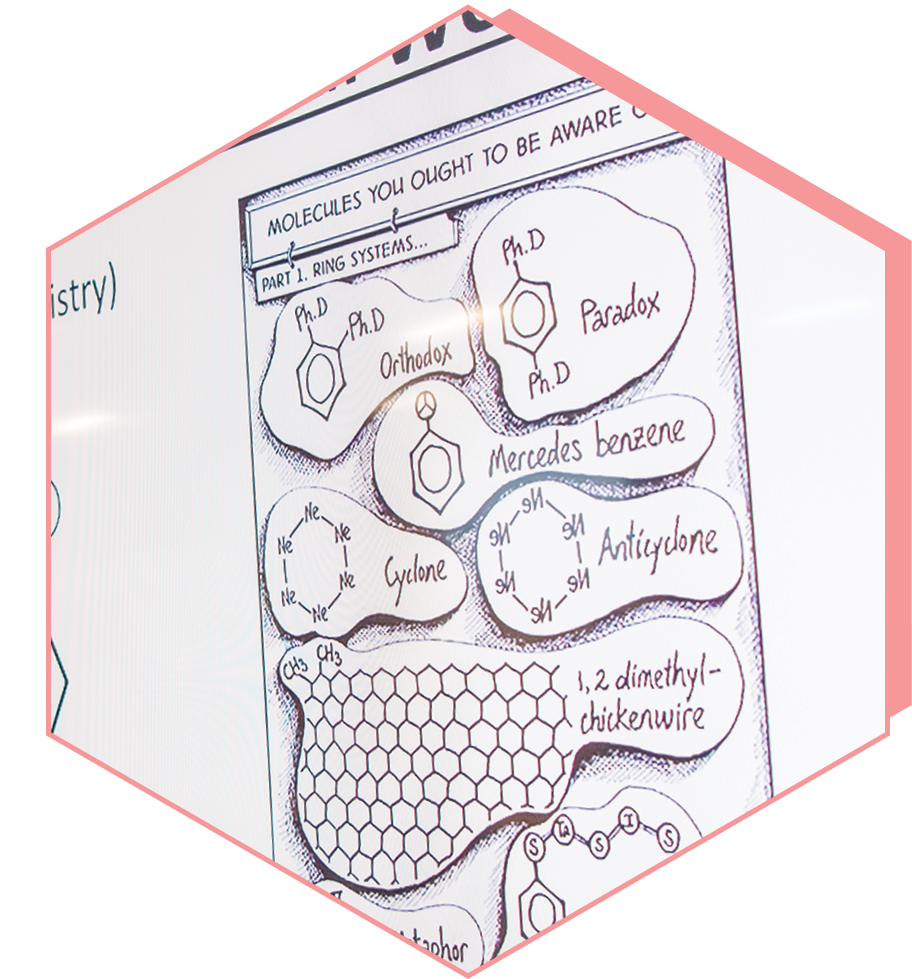
Throughout the class LaCourse affectionately refers to as “the egg lecture,” for example, he teaches the students how best to make hard- and soft-boiled, fried, and baked eggs and exactly why based on the chemistry involved, with the occasional digression. The Lilliputians from Gulliver’s Travels, for example, make an appearance— apparently they went to war over which end of a soft-boiled egg to open. He also takes a moment to share a favorite recipe his wife makes—showing the students he’s more than a university administrator.
After the short lecture, the students answer discussion questions in groups, coming up with a list of compounds important for cooking, such as baking powder and gelatin, and their roles.
“CHEM 100 is all about empowerment,” LaCourse says. “Understanding how the chemical world affects you gives you more control over your life.” For example, you can avoid trendy health hacks that are actually bad for you, he explains. Understanding chemistry can even help you be more self-sufficient. You may be able to “fix your car, cook better meals, or take stains out of your clothing,” LaCourse says.
Students in the course appreciate that LaCourse makes the content relatable. “I don’t think I’ve ever had a science class before that connects to our daily lives in a way I can understand it,” says Keli Amoako ’25, political science. “He makes you aware of the chemistry in everyday life. I think everybody should have to take a class like this,” adds Moroti Oyeyemi ’25, information systems. There is something for everyone. “I have a great love of baking,” says Meghan Seerey ’23, visual arts, “and he connects the class to the culinary arts.”
For their final projects, students had complete freedom to demonstrate how chemistry affects their lives. Some created “day-in-the-life” presentations, explaining the chemistry in activities like brushing their teeth or doing laundry. Others focused on a particular interest, like skin care, fashion, or scuba diving. One student filmed a baking video, and another designed a brochure explaining how to improve one’s garden through soil chemistry. There were podcasts, poems, and even a musical composition in the key of C sharp. (The musical notation for C sharp, C#, looks like CH, representing carbon and hydrogen, two key elements for life.)
Connected to his roots
For LaCourse, teaching CHEM 100 follows naturally from his values. Even with the added responsibilities of a dean, after also serving as chair of the chemistry and biochemistry department for four years, and a member of the department for 15 years before that, “I still have graduate students and I still teach, because that’s the reason I came here in the first place,” LaCourse says. “I think if you move too far away from those roots that you’ll lose the ability to understand and to be empathetic with those who teach, with those who do research, and the issues that they encounter.”
Never has this been truer than over the last two years, as the COVID-19 pandemic forced administrators to make decisions about whether to shift classes online and other changes to the education experience. In Fall 2020 and Spring 2021, LaCourse and Kowalewski taught CHEM 100 fully online, in part to be in solidarity with the rest of the college’s faculty. “All the challenges with technology, grading, and keeping people’s interest…I could understand what the faculty were going through,” LaCourse remembers.
A non-traditional path
In addition to staying connected with the needs of faculty, LaCourse calls on his own experience to explain why he pursued the deanship and why he works so hard to make sure the college is serving all UMBC students well. He starts to talk about when he became department chair, then pauses.
“Actually, I’m gonna go back even faaather,” he says, revealing the Boston accent that still shows up now and then, despite living in the Baltimore area for decades. “I took a very non-traditional pathway to get where I am.”
He goes on to describe a series of experiences—starting out at a technical college, then pursuing a four-year degree at multiple institutions while working full-time, and a graduate education full of “naïve decisions” due in large part to a lack of guidance and support.
All that is what drove him to pursue leadership. It’s one thing to teach a course that shows students from all backgrounds why chemistry matters—and hopefully improve their lives in the process. It’s another to make changes at the department level, and yet another to be able to lead the college. LaCourse says his motto is “There’s always a better way,” similar to one of President Freeman Hrabowski’s sayings that has been adopted by many on campus: “Success is never final.”
“The world changes,” LaCourse says, “and most things will have to evolve to keep up.”
Discovery Learning
When LaCourse started as chair, he felt as if there were too many students failing introductor y chemistr y courses. He believed there was a better way—that the introductory chemistry curriculum needed to evolve. As a result, after a collaborative pilot program, introductory chemistry courses added a weekly, team-based, problem-solving session to the lecture component in 2005. These sessions are still a cornerstone of the chemistry curriculum today. The magic happens in the Chemistry Discovery Center (CDC), and LaCourse calls the technique “discovery learning.”
“Chem Discovery was a different way to do it. The vision was to bring students from a passive to an engaged format, to give them the opportunity to discover,” he says. “People love to discover things, to plant new flags.”
Research faculty get to experience that on a regular basis, LaCourse notes.
“Why don’t we give our students the opportunity to discover knowledge?” he says. “Because when you discover it, you own it—and we know that ownership is important for learning.”
After the Chemistry Discovery Center’s introduction, the fail rate in intro to chemistry dropped by half. The CDC plus a shift among UMBC faculty away from the concept of “weed out” courses has led to continued success, including increased retention and attendance.
Creating opportunities for all
Chemistry Discovery was just the beginning. LaCourse has spent nearly two decades working with colleagues across the college and at community colleges in the region to create more opportunities for students through a number of initiatives that supply the support and structure students need to succeed.
UMBC has proven again and again that relatively small, cohort-based scholars programs that generate a sense of community and offer intensive advising can significantly increase student persistence and success rates in STEM (science, technology, engineering, and math). LaCourse isn’t satisfied with that, though—he wants to see more students get that high-touch experience.
“The whole purpose is to give opportunity and a unique education experience to every student that UMBC lets in,” LaCourse says. “The focus is on what we need to do to make that possible.”
Scaling up
The most comprehensive manifestation of this goal is STEM BUILD, a 10-year, National Institutes of Health-funded initiative at 10 universities to diversify the biomedical sciences workforce. At UMBC, the initiative’s motto is, “500, not 50.” That’s 500 students. “Can we do 500, not 50? Can we make things scalable?” LaCourse asks. “Can we take the pieces of community and intensive advising, and make it so many more people benefit from it?”
The goal of STEM BUILD at UMBC is to identify the most effective practices that support student success and find ways to implement them at scale. Perhaps most important, the college is working hard to weave the most effective elements into regular operations so that when the grant funding sunsets in 2023, students will continue to benefit.
STEM BUILD programming includes group research experiences, a summer bridge that teaches laboratory skills and experimental design, and training in communications and research ethics. Advising, community meetings and socials, living on campus in the STEM Living Learning Community, and a rich culture of staff and faculty support are key community-building elements.
STEM BUILD also spawned an Active Learning, Inquiry Teaching (ALIT) certificate through UMBC’s Faculty Development Center. ALIT has helped faculty transition their courses to more engaged formats, such as team-based problem-solving, rather than lectures. Spaces like the CNMS Active Science Teaching and Learning Environment, opened in 2010, facilitate this transition. CASTLE has round tables rather than desks, and since fall 2019, the new Interdisciplinary Life Sciences Building has offered similar classroom environments, plus features like mobile whiteboards. Originally, ALIT was intended only for faculty directly involved in STEM BUILD activities, but has since been expanded to any interested faculty—an example of the ripple effect of initiatives such as STEM BUILD.
Leading the change
LaCourse has also led efforts to capitalize on UMBC’s location in one of the top biotech clusters in the country. After hiring Annica Wayman ’99, M6, mechanical engineering, as associate dean of Shady Grove affairs in CNMS, degree options for UMBC STEM students at the Universities at Shady Grove have grown. “She has a passion for students and helping them be successful,” LaCourse says.
Wayman came back to UMBC from a successful career in international development at USAID specifically to lead the new Translational Life Science Technology (TLST) bachelor’s degree program, which prepares students for immediate, in-demand careers in biotech. “The relevance, innovative nature, and health-related impact of the TLST program is what attracted me back to UMBC as associate dean, and the many students who come into the program,” she says.
LaCourse’s leadership, in conjunction with community college partners, was crucial to bringing it to life, Wayman adds. “Bill’s educational start in community college and work in the private sector before coming to academia made him the perfect visionary for developing a new bachelor’s degree in biotechnology at UMBC.”
And it’s working. TLST grads like Titina Sirak ’20 and Charmaine Hipolito ’20 are already finding success in the regional biotech market, leaving the program with several job offers for biotech positions in hand.
LaCourse also knows that for students to succeed, faculty need to feel supported and be representative of the student body. The ADVANCE program, for example, has increased the number of women faculty in STEM by 180% since 2003. And now, the Pre-professoriate Fellowship program encourages faculty members committed to supporting diversity and inclusion to apply. The goal is for participants to convert to assistant professors at UMBC.
While persistence and success in STEM majors has significantly increased over the last two decades, “How many more successful students could there be if they could see more people like themselves, who they can relate to better?” LaCourse asks.
Doing right by students
Given his own challenges navigating higher education, supporting success for all students, enabling discovery, and encouraging ownership of their education is deeply embedded in LaCourse’s psyche.
One of his current graduate students in chemistry and biochemistry, Amanda Belunis, confirms this. “Dr. LaCourse always says that he is just a guide, and he wants us to be actively engaged in our own education and learn lessons. He pushes us all to reach our full potential and consistently offers constructive feedback and encouragement, usually paired with a funny anecdote or joke,” she says. “I feel confident that when I finish, I will be leaving the program as an independent critical thinker ready to tackle any problem, and I owe a lot of that to him.”
While some students may be likely to succeed regardless of the support available or not, for others, the right environment can make all the difference.
“When people come in, if you give them the feeling that they belong, and that they can do it, and you give them the help that they need, many, many more will succeed,” LaCourse says. This sentiment applies to faculty, too. Both students and faculty “put their future in the hands of the institution, that we’ll do right by them,” LaCourse says.
Nowhere like UMBC
Through his work with individual students in his laboratory, teaching undergraduates, and securing funding for projects that affect many more students, he’s doing his best to make sure the institution deserves its community members’ trust by creating opportunities and offering support.
“Opportunities are what life is all about,” LaCourse says. “It’s up to an individual to take advantage of them, but we have to put those opportunities in front of people and make people believe that they can take advantage of them.” Through programs like STEM BUILD, TLST, transfer student support programs, and more, “that’s what we train our students to believe—that they belong, that they could do the job, that that opportunity is theirs as much as anybody else’s,” no matter their background.
As a non-traditional candidate for a leadership role in academia, LaCourse also appreciates the opportunities he’s been given to make a difference at UMBC—the chances people took on him and his ideas, which sometimes involved creative new methods. Another pause. And then, “Of course I can’t know—as a scientist, I understand there’s no control group for my life,” he says. “But I don’t think I’d be where I am at any other place than UMBC.”
He’s taken it as his mission to pass on those opportunities to UMBC students—they’re why he’s here, after all. As a leader first in chemistry, and now in CNMS as a whole, he’s worked to “break down silos, and work under umbrellas,” as he says, to make changes that do the greatest good.
“You need to understand what everybody’s going through, and what they’re up against,” he says. “That way you can work together better in the long run—and again, we’re all working for the same purpose.”
Vision of what could be
The significant, positive change that has occurred on his watch is already impressive, and the trajectory is still going in the right direction. More students are succeeding in STEM at UMBC. Students who demonstrate high potential, but may not be at the top of their class or have much experience when they arrive at UMBC, are getting the resources they need and finding their way. Faculty and staff are committed to supporting all of them.
Although he’s not retiring yet, LaCourse has decades of experience at UMBC to reflect on. When asked about what a normal day might look like, after mentioning writing grant proposals, dealing with crises, attending leadership meetings, and, of course, teaching CHEM 100, he pauses again, waxing philosophical.
“A day in the life…” he ponders. “It’s really a lifetime, guided by principles and experiences from my own life. So every decision, every action, draws upon everything in the past, and the vision of what could be.”
Who knows what may come next.
]]>
From cooking and cleaning to fixing your car, understanding chemistry can enlighten all aspects of life. That’s just one reason why Dean William R. LaCourse still loves sharing the joy of his...
https://umbc.edu/stories/better-living-through-chemistry/
https://my3.my.umbc.edu/api/v0/pixel/news/126138/guest@my.umbc.edu/c32ad1a8f0fd5a982f45570f55d41b1f/api/pixel
chemistry
cnms
impact
magazine
summer-2022
UMBC News & Magazine
https://my3.my.umbc.edu/groups/umbc-news-magazine
https://assets1-my.umbc.edu/system/shared/avatars/groups/000/001/943/24435aa6207c452e7bc15cc74b42c7bb/xsmall.png?1748556657
https://assets1-my.umbc.edu/system/shared/avatars/groups/000/001/943/24435aa6207c452e7bc15cc74b42c7bb/original.png?1748556657
https://assets2-my.umbc.edu/system/shared/avatars/groups/000/001/943/24435aa6207c452e7bc15cc74b42c7bb/xxlarge.png?1748556657
https://assets2-my.umbc.edu/system/shared/avatars/groups/000/001/943/24435aa6207c452e7bc15cc74b42c7bb/xlarge.png?1748556657
https://assets3-my.umbc.edu/system/shared/avatars/groups/000/001/943/24435aa6207c452e7bc15cc74b42c7bb/large.png?1748556657
https://assets1-my.umbc.edu/system/shared/avatars/groups/000/001/943/24435aa6207c452e7bc15cc74b42c7bb/medium.png?1748556657
https://assets2-my.umbc.edu/system/shared/avatars/groups/000/001/943/24435aa6207c452e7bc15cc74b42c7bb/small.png?1748556657
https://assets1-my.umbc.edu/system/shared/avatars/groups/000/001/943/24435aa6207c452e7bc15cc74b42c7bb/xsmall.png?1748556657
https://assets2-my.umbc.edu/system/shared/avatars/groups/000/001/943/24435aa6207c452e7bc15cc74b42c7bb/xxsmall.png?1748556657
UMBC News & Magazine
1
0
false
Wed, 06 Jul 2022 11:16:47 -0400
Wed, 06 Jul 2022 11:16:47 -0400
Carrying on a Philanthropic Legacy
Behind every story of giving lies a story about someone’s generosity. For Hema Gowda ’01, biological sciences, this story was about continuing a generational legacy through philanthropy.
“My mom came to this country in the late ’60s, and education was a huge foundation for her in propelling her forward,” says Gowda, a Prince George’s County native who works in pharmaceutical research.
“When she retired, she set up endowments at [The University of Maryland,] College Park in the name of her parents because they were the ones that pushed her for higher education. She is the person she is today because of them…So I’d always been inspired by that and wanted to give back to UMBC because it was the foundation for my career.”
UMBC’s Alumni Endowment Scholarship Fund presents the perfect opportunity for alumni to give back to the university by directly contributing to the success of students in their undergraduate years. In Gowda’s case, the fund allowed her to follow in her mom’s charitable footsteps by establishing the Gowda Scholarship Endowment for UMBC in 2016 (and a similar scholarship at the University of Maryland School of Pharmacy in 2015) to help students interested in pursuing graduate studies in pharmacy find success at UMBC.
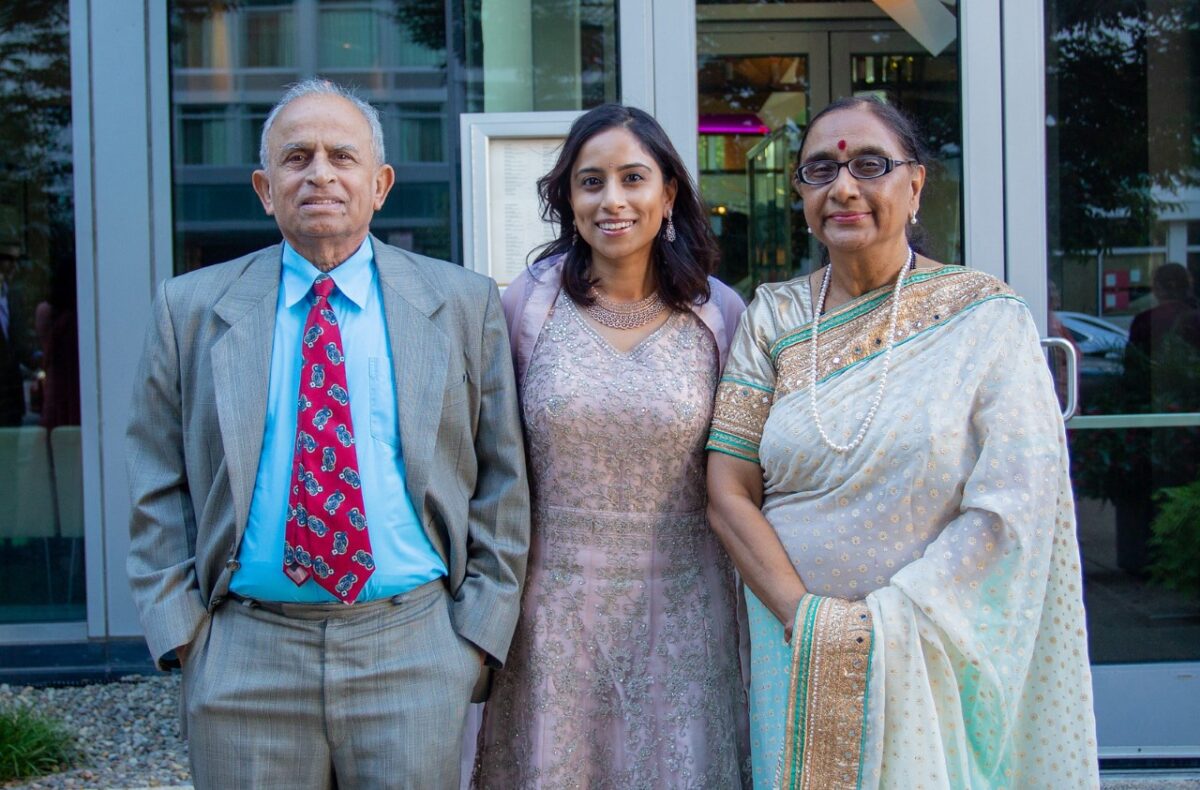 Hema Gowda ’01, center, shares a moment with her parents, Mrs. Vijayalakshmi and Dr. Kusumadhara Gowda. (Image courtesy of Gowda.)
Defining her path
Even as an undergraduate, Gowda knew she wanted to give back to her alma mater, but it took her longer to decide what she really wanted to study at UMBC. When it came to deciding a major, she wanted to pursue the sciences after having been involved in a science and technology program at Eleanor Roosevelt High School. But even after deciding that certain routes like medical school were not for her, it took more steps to narrow down what path called out to her most.
Gowda applied to the University of Maryland School of Pharmacy in her senior year at UMBC and entered the next stage of her academic career. Prior to graduation in 2005, she caught sight of a posting for an editorial internship at the American Society of Health-System Pharmacists —an experience that would eventually lead her to a medical writing position at a medical communications agency in the Philadelphia area the following year. There, Gowda collaborated with pharmaceutical and biotechnology companies to help develop their clinical trial publications and scientific communications for products that were marketed or in development.
After about five years at the agency, Gowda joined the biopharmaceutical company, Incyte, and gained experience in the company’s medical affairs and clinical development groups. This latter opportunity allowed her to take advantage of the communication skills and clinical expertise she had gained through her previous positions and educational experience.
In April 2020, a month into the pandemic, Gowda started her new position as a global development scientist director at AstraZeneca.
“I collaborate with colleagues from many other functions to execute registrational clinical trials in lung cancer. We conduct the trials globally, and gather and submit data for regulatory agencies in hopes of getting new drugs approved for different types of cancers,” explains Gowda.
Gowda’s journey down multiple routes in pharmacy has shown that taking the time to figure out the right path was not at all a setback. Even if it took a bit longer for her to settle on the research route, Gowda did not regret any of the experiences she had gained along the way.
“Each segment of my career helped define my path a little bit better,” Gowda puts it.
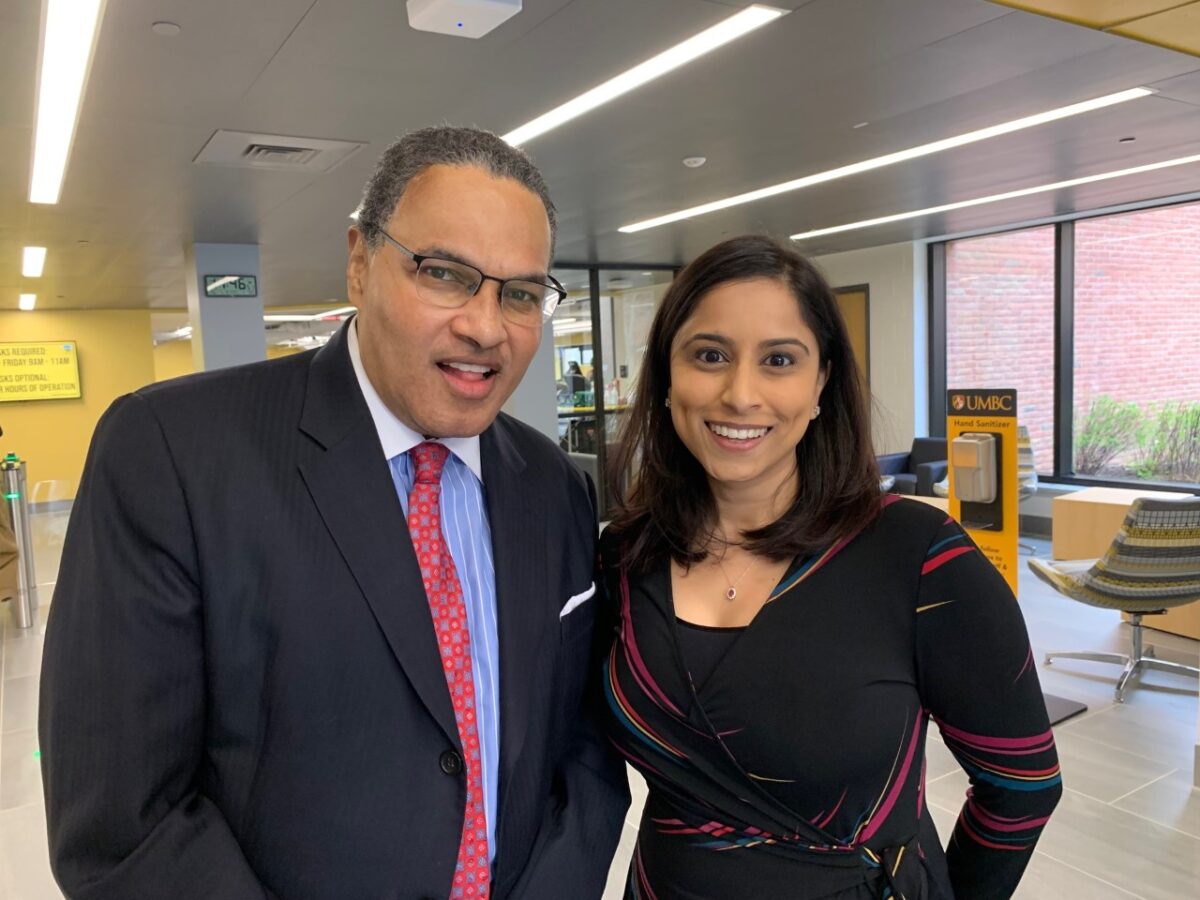 Gowda, right, chats with UMBC president Freeman Hrabowski. (Image courtesy of Gowda.)
Reconnecting to her foundations
The Gowda Scholarship Endowment, open to students interested in pursuing a career in the pharmaceutical sciences, gives preference to students who graduated from a Prince George’s County high school or current residents of the county. On top of wanting to give back to the school system that helped build the foundation for her career, Gowda hopes the scholarship will benefit students who are juggling their responsibilities in the D.C. region.
In describing the time during the pandemic when she met virtually with her first scholar, Adam Kouyate ’22, biological sciences, Gowda says, “[My scholar] was brimming with excitement…and to me, it’s a small amount, but I know it’s a lot for them. And maybe 10 or 20 years from now, that might inspire them to do something similar.”
“Because of this scholarship, I was able to work less hours during the school year and focus more on classes and finding myself.”
– Adam Kouyate ’22
The scholarship lifted a huge burden off Kouyate’s shoulders during a period of burnout. At the time she applied, Kouyate was working at a music store to help pay her tuition. Because she wanted to cover most of the tuition costs on her own, the scholarship allowed her to do so with only $200 coming from her parents. Kouyate was extremely grateful to have been chosen as a scholar, as it also meant she no longer needed to turn to student loans.
“Because of this scholarship, I was able to work less hours during the school year and focus more on classes and finding myself. Though I did end up switching from pharmacy to nursing, this scholarship gave me the peace of mind to focus on what I really wanted to do with my life,” says Kouyate.
Kouyate graduated from UMBC this past spring and will be attending the University of Maryland School of Nursing’s Master’s-Level Entry-Into-Nursing Clinical Nurse Leader program in the fall.
A second recipient of the scholarship, who graduated from Eleanor Roosevelt High School, is also currently studying at UMBC with plans to pursue a graduate degree in pharmacy.
Setting up lifetimes of success
Gowda’s connection to UMBC isn’t just limited to the endowed scholarship, but can be seen through her interactions with friends from her undergraduate days, connections to relatives interested in attending UMBC, and sponsored events such as the Endowed Scholarship Luncheon that is hosted annually at UMBC.
Now and moving forward, Gowda hopes to echo a legacy of giving that has been modeled by her mother as well as inspired by familiar faces at UMBC. Most importantly, she is eager to pass on a future of giving to her scholars—a future that may consist of trial and error, but also with valuable experiences along the way.
“It’s the gift that I want to keep giving, and I can only hope that this small amount for a semester or a year sets them up for a lifetime of success.”
]]>
Behind every story of giving lies a story about someone’s generosity. For Hema Gowda ’01, biological sciences, this story was about continuing a generational legacy through philanthropy. “My...
https://umbc.edu/stories/carrying-on-a-philanthropic-legacy/
https://my3.my.umbc.edu/api/v0/pixel/news/125731/guest@my.umbc.edu/30e5b1d629596f38290c95be093eb18c/api/pixel
alumni-profile
biological-sciences
cnms
impact
magazine
summer-2022
UMBC News & Magazine
https://my3.my.umbc.edu/groups/umbc-news-magazine
https://assets1-my.umbc.edu/system/shared/avatars/groups/000/001/943/24435aa6207c452e7bc15cc74b42c7bb/xsmall.png?1748556657
https://assets1-my.umbc.edu/system/shared/avatars/groups/000/001/943/24435aa6207c452e7bc15cc74b42c7bb/original.png?1748556657
https://assets2-my.umbc.edu/system/shared/avatars/groups/000/001/943/24435aa6207c452e7bc15cc74b42c7bb/xxlarge.png?1748556657
https://assets2-my.umbc.edu/system/shared/avatars/groups/000/001/943/24435aa6207c452e7bc15cc74b42c7bb/xlarge.png?1748556657
https://assets3-my.umbc.edu/system/shared/avatars/groups/000/001/943/24435aa6207c452e7bc15cc74b42c7bb/large.png?1748556657
https://assets1-my.umbc.edu/system/shared/avatars/groups/000/001/943/24435aa6207c452e7bc15cc74b42c7bb/medium.png?1748556657
https://assets2-my.umbc.edu/system/shared/avatars/groups/000/001/943/24435aa6207c452e7bc15cc74b42c7bb/small.png?1748556657
https://assets1-my.umbc.edu/system/shared/avatars/groups/000/001/943/24435aa6207c452e7bc15cc74b42c7bb/xsmall.png?1748556657
https://assets2-my.umbc.edu/system/shared/avatars/groups/000/001/943/24435aa6207c452e7bc15cc74b42c7bb/xxsmall.png?1748556657
UMBC News & Magazine
1
0
false
Fri, 03 Jun 2022 14:42:27 -0400
Fri, 03 Jun 2022 14:42:27 -0400
Six alumni to speak as honorary degree recipients at 2022 Commencement

The six 2022 honorary degree recipients speaking at UMBC’s commencement ceremonies next week have a lot in common. They are each doing amazing things in their respective fields. And they also all happen to be UMBC alumni.
“These honorary degree recipients are wonderful examples of the best of UMBC,” said Greg Simmons, M.P.P., ’04, Vice President for Institutional Advancement. “They are brilliant individuals at the top of their fields, who care deeply about making the world a better place, each in their own way.”
Graduate ceremony speakers
Mark Doms ’86, economics and mathematics, and Kafui Dzirasa ’01, M8, chemical engineering, will speak at UMBC’s graduate commencement ceremony on May 25.
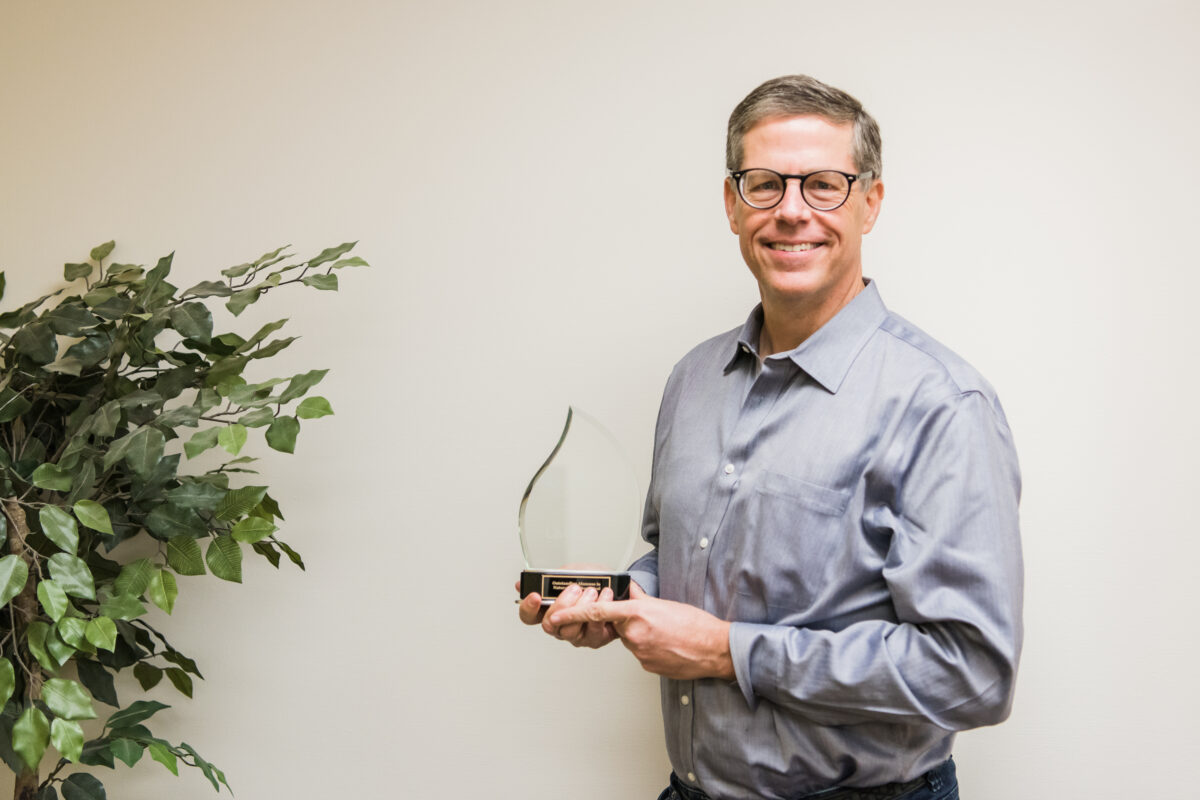
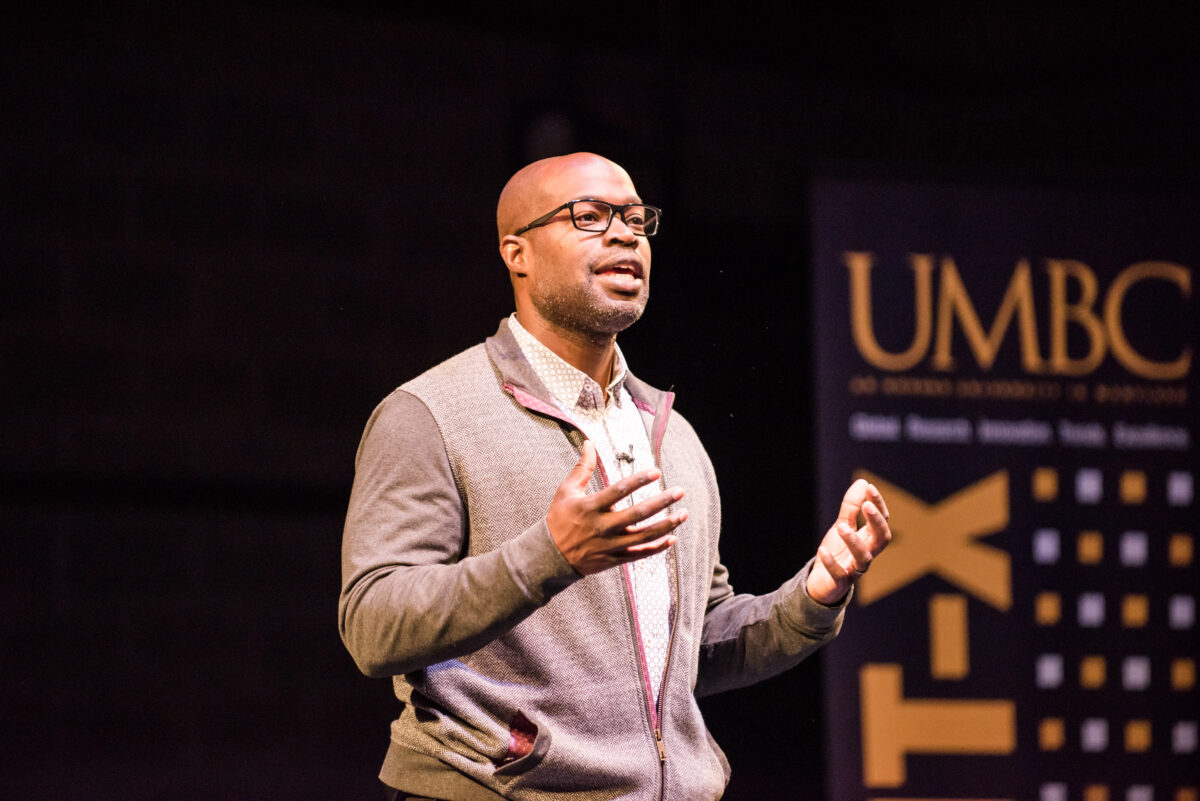 Mark Doms ’86 and Kafui Dzirasa ’01, M8. (Marlayna Demond ’11/UMBC)
After graduating from UMBC in 1986, Doms went on to earn a Ph.D. in economics from the University of Wisconsin-Madison. As an economist with a focus on public policy, Doms has held roles in the Federal Reserve system, the executive branch, and the legislative branch, including joining the Obama administration in 2009 as the Chief Economist at the Department of Commerce. In 2013, the United States Senate confirmed Doms as Under Secretary for Economic Affairs at the Department of Commerce. Currently, Doms serves as the Chief Economist at the Congressional Budget Office, providing high-quality, non-partisan analysis to Congress.
Meanwhile, after leaving UMBC, Dzirasa went on to earn his Ph.D. in neurobiology from Duke University and his M.D. from the Duke University School of Medicine. His ultimate goal is to combine his research, medical training, and community experience to improve outcomes for diverse communities living with neurological and psychiatric illness.
Dzirasa’s work has earned him numerous accolades, including the Presidential Early Career Award for Scientists and Engineers in 2016 and the Benjamin Franklin NextGen Award in 2022. He was inducted into the American Society for Clinical Investigation in 2019, and in 2021 was inducted into the National Academy of Medicine and named a Howard Hughes Medical Institute investigator. Dzirasa currently serves as an associate professor at Duke University with appointments in the Departments of Psychiatry and Behavioral Sciences, Neurobiology, Biomedical Engineering, and Neurosurgery.
Leaders in law and the arts
On May 26, UMBC will host two undergraduate commencement ceremonies. Tiffany Holmes, M.F.A. ’99, imaging and digital arts,and Ricardo Zwaig ’77, Spanish,will speak at the first ceremony, addressing graduates in the College of Arts, Humanities, and Social Sciences, the School of Social Work, and the Erickson School.
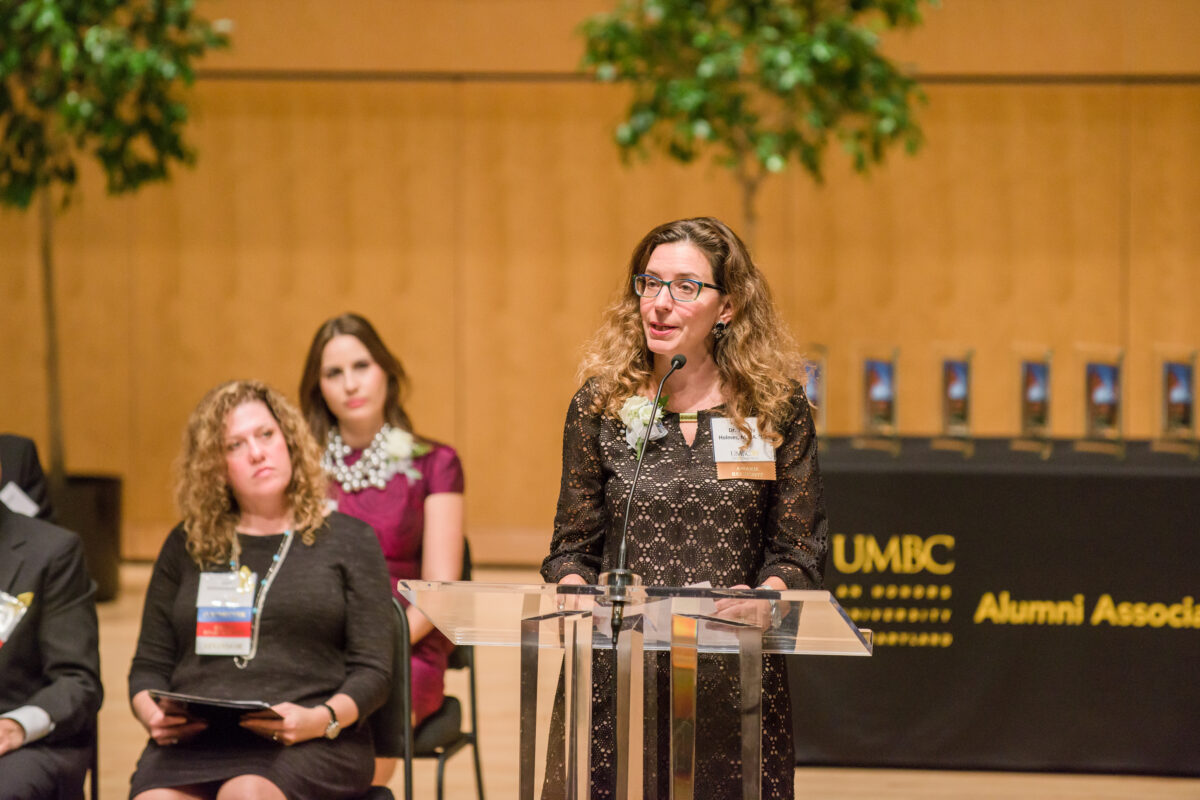
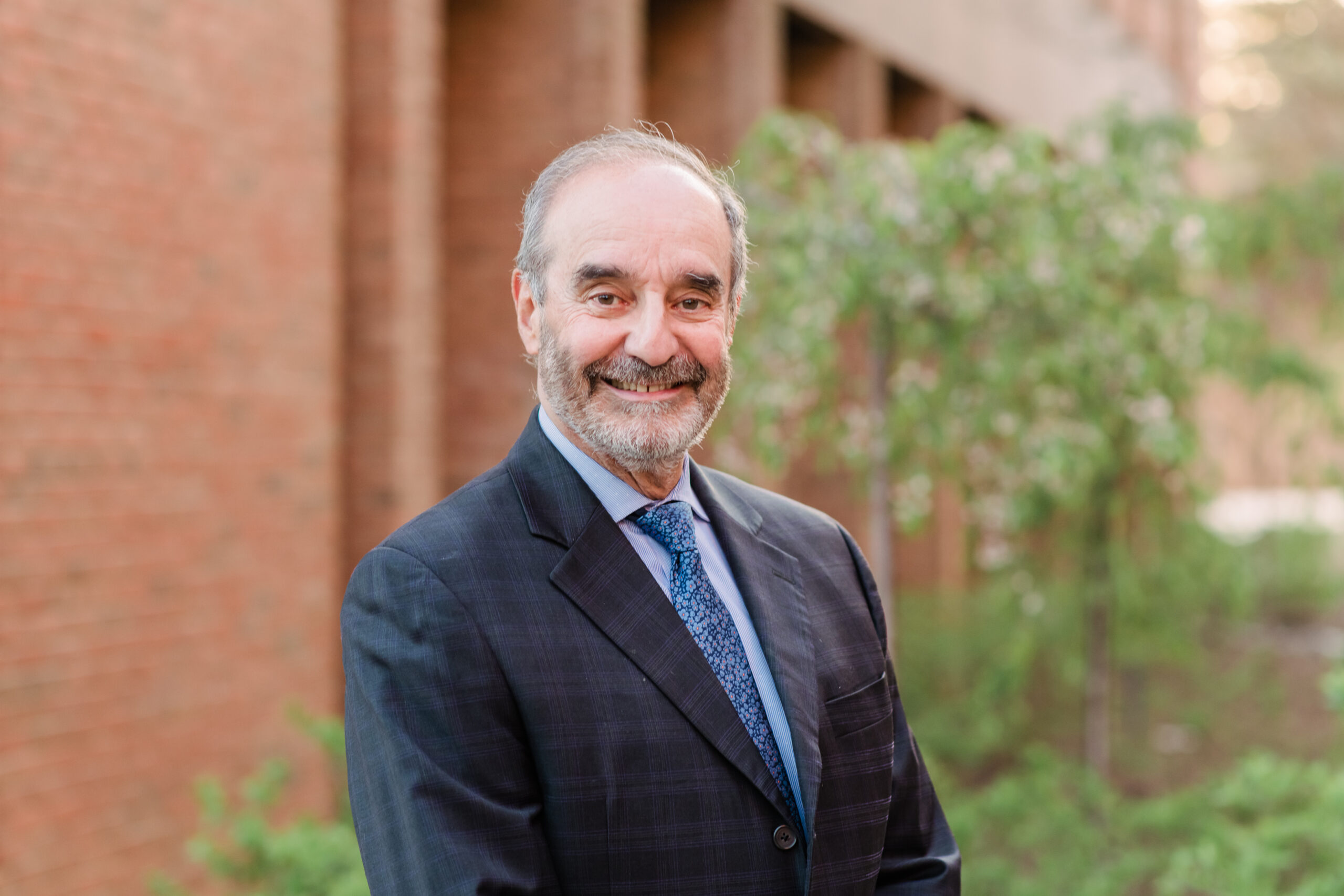 Tiffany Holmes, M.F.A. ’99, and Ricardo Zwaig ’77. (Marlayna Demond ’11/UMBC)
Holmes earned her B.A. in art history from Williams College, an M.F.A. from the Maryland Institute College of Art (MICA), an M.F.A. in digital arts from UMBC, and a Ph.D. from the University of Plymouth. Her studio practice explores the potential of art and design to promote environmental awareness, and has exhibited across the globe at the Museum of Contemporary Art Chicago, J. Paul Getty Museum in Los Angeles, 01SJ Biennial, Siggraph 2000, Interaction ’01 in Japan, ISEA Nagoya, Microwave Festival, Hong Kong. Holmes is currently the interim vice president of Academic Affairs and provost at MICA, after spending 18 years at the School of Art in Chicago as a full professor and dean.
Judge Zwaig earned his law degree from the University of Maryland School of Law after graduating from UMBC. He began his career as a state public defender in Baltimore City before joining the Office of the Federal Public Defender in 1991. He and his brother Michael Zwaig ’81, history, also established the Law Offices of Zwaig & Zwaig, P.A., and helped establish UMBC’s Esperanza Fund in 2008, which offers scholarships for Latinx students.
In 2010, Judge Zwaig became the first Hispanic male appointed to the Maryland Judiciary and was awarded the Maryland Hispanic Bar Association’s Outstanding Achievement Award. He has also served on the Board of Directors for the Columbia Foundation, taught at Catholic University, Columbus School of Law, and at the National Institute for Trial Advocacy Program at the Georgetown University Law Center.
Biomedical research innovators
Kizzmekia Corbett ’08, M16, biological sciences and sociology,and Kaitlyn Sadtler ’11, biological sciences,will speak at UMBC’s second undergraduate commencement ceremony, addressing graduates in the College of Natural and Mathematical Sciences, College of Engineering and Information Technology, and Division of Undergraduate Academic Affairs.
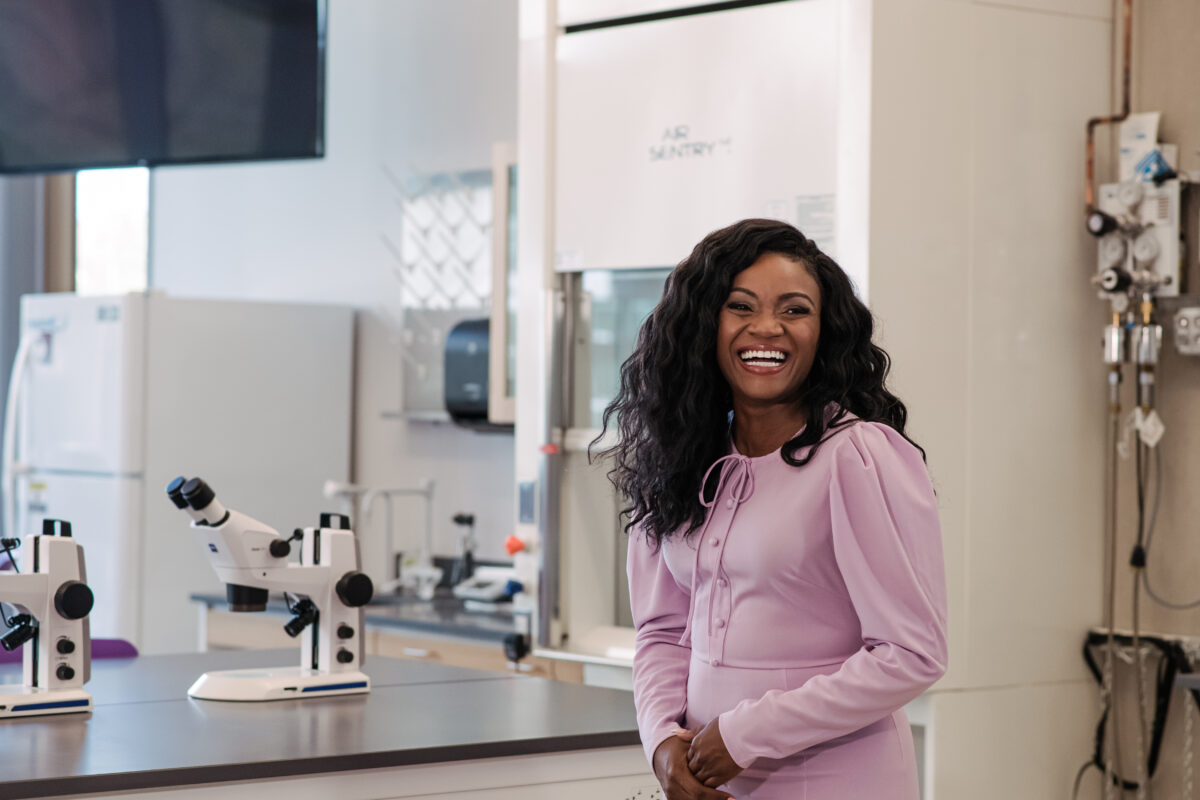
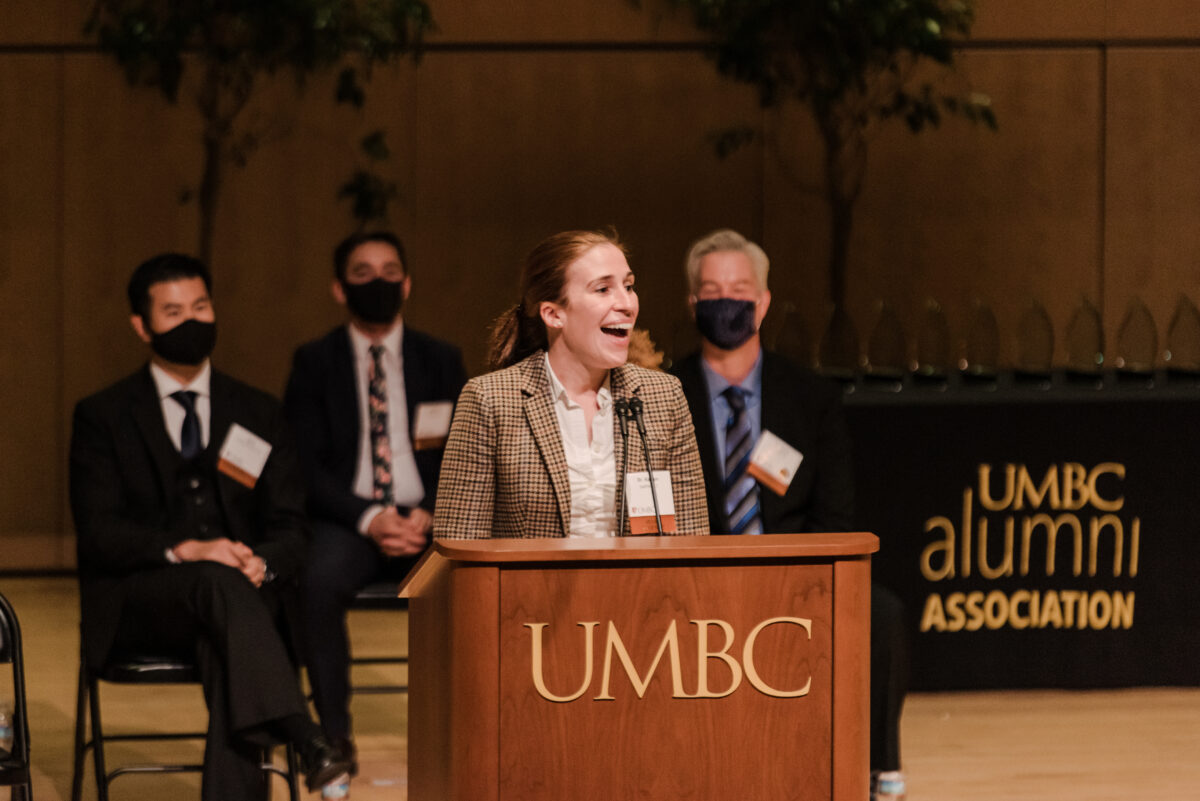 Kizzmekia Corbett ’08, M16, and Kaitlyn Sadtler ’11. (Marlayna Demond ’11/UMBC)
After graduating from UMBC, Corbett went on to earn her Ph.D. in microbiology and immunology from the University of North Carolina at Chapel Hill. Throughout her more than 15-year career studying infectious diseases, she has received several prestigious awards, including the Benjamin Franklin Next Gen Award and the Salzman Memorial Award in Virology. Her work was also instrumental in the development of mRNA-1273, a leading vaccine against SARS-CoV-2 deployed by industry partner Moderna, Inc. Corbett is currently an assistant professor of immunology and infectious diseases at Harvard’s T.H. Chan School of Public Health, Shutzer assistant professor at Harvard’s Radcliffe Institute of Advanced Study, and associate member of the Phillip T. and Susan M. Ragon Institute. She also recently established the Kizzmekia S. Corbett Endowed Scholarship to support students in the Meyerhoff Scholars Program who are emerging leaders at UMBC or in the community.
Sadtler earned her Ph.D. from Johns Hopkins University School of Medicine after graduating from UMBC. She completed a postdoctoral fellowship at the Massachusetts Institute of Technology. Sadtler is currently an investigator and chief of the section on immunoengineering at the National Institute for Biomedical Imaging and Bioengineering, of the National Institutes of Health. Her work has earned her several awards, including a TED Fellowship, an NIH Director’s Award for Mentorship and for her work on COVID-19, as well as inclusion on the 2019 Forbes 30 Under 30 List in Science and the 2021 MIT Technology Review 35 Innovators Under 35 List. Sadtler was also named a World Economic Forum Young Global Leader in 2022.
Pride in UMBC
“When I learned of this year’s honorary degree recipients, I was immediately filled with a sense of pride in knowing that they are not only UMBC alumni but that each has been recognized by the community as Alumni of the Year recipients in recent years,” said Stanyell Odom, Director of Alumni Engagement. “The individual and collective stories and the impact they’ve made will continue to inspire me for many years to come.”
Learn more about UMBC’s 2022 Commencement .
]]>
The six 2022 honorary degree recipients speaking at UMBC’s commencement ceremonies next week have a lot in common. They are each doing amazing things in their respective fields. And they also all...
https://umbc.edu/stories/six-alumni-to-speak-as-honorary-degree-recipients-at-2022-commencement/
https://my3.my.umbc.edu/api/v0/pixel/news/125473/guest@my.umbc.edu/df28b72e146fca3d77ce8a3f4029c8ab/api/pixel
alumni
cahss
cnms
coeit
impact
magazine
summer-2022
UMBC News & Magazine
https://my3.my.umbc.edu/groups/umbc-news-magazine
https://assets1-my.umbc.edu/system/shared/avatars/groups/000/001/943/24435aa6207c452e7bc15cc74b42c7bb/xsmall.png?1748556657
https://assets1-my.umbc.edu/system/shared/avatars/groups/000/001/943/24435aa6207c452e7bc15cc74b42c7bb/original.png?1748556657
https://assets2-my.umbc.edu/system/shared/avatars/groups/000/001/943/24435aa6207c452e7bc15cc74b42c7bb/xxlarge.png?1748556657
https://assets2-my.umbc.edu/system/shared/avatars/groups/000/001/943/24435aa6207c452e7bc15cc74b42c7bb/xlarge.png?1748556657
https://assets3-my.umbc.edu/system/shared/avatars/groups/000/001/943/24435aa6207c452e7bc15cc74b42c7bb/large.png?1748556657
https://assets1-my.umbc.edu/system/shared/avatars/groups/000/001/943/24435aa6207c452e7bc15cc74b42c7bb/medium.png?1748556657
https://assets2-my.umbc.edu/system/shared/avatars/groups/000/001/943/24435aa6207c452e7bc15cc74b42c7bb/small.png?1748556657
https://assets1-my.umbc.edu/system/shared/avatars/groups/000/001/943/24435aa6207c452e7bc15cc74b42c7bb/xsmall.png?1748556657
https://assets2-my.umbc.edu/system/shared/avatars/groups/000/001/943/24435aa6207c452e7bc15cc74b42c7bb/xxsmall.png?1748556657
UMBC News & Magazine
2
0
false
Thu, 19 May 2022 12:44:20 -0400
Thu, 19 May 2022 12:44:20 -0400