Thyme to grow—UMBC’s Little Seed Library starts spreading its roots
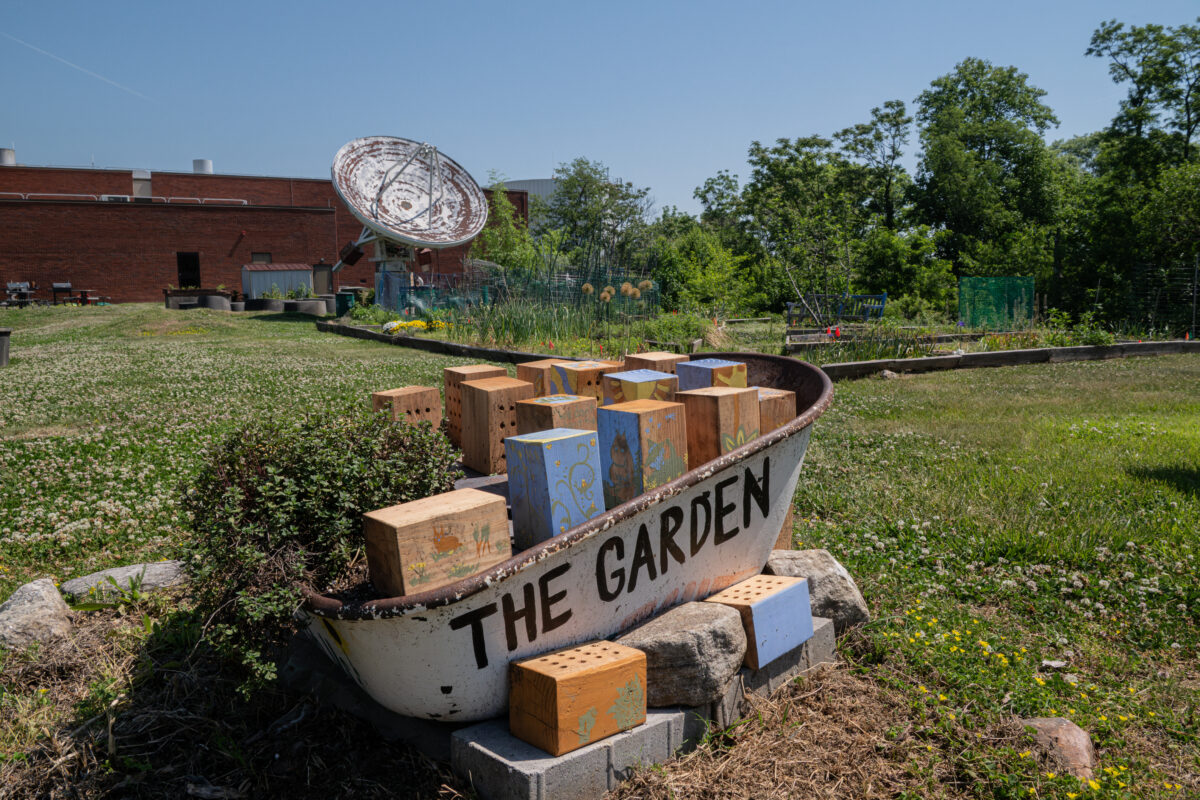
Each plant, whether a small wild buttercup or a massive oak tree, starts out as seed—packed with potential to grow well beyond its original size. By this logic, The Garden’s new Little Seed Library—co-sponsored by Retriever Essentials and the Office of Sustainability and installed by Facilities Management—is seeded with infinite potential.
Based on the now-familiar concept of Little Free Libraries that spread access to the love of reading, the Little Seed Library, down the sidewalk from UMBC Police, is set up for people to donate seeds (perhaps harvested from the adjacent garden) and those who want to put their green thumb to the test can take what they need to get started.
 Laila Kaira takes a look at what’s available in the Little Seed Library.
The idea stemmed from conversations Michael Berardi, assistant director of Retriever Essentials, was having with folks on campus about tangible ways to grow interest in the community garden while wanting to grow awareness of where our food actually comes from. “We want to help campus engage with our food in a more deep and meaningful way,” says Berardi ’19, M.P.S. ’25, who was also a co-founder of the campus-adjacent coffee shop, OCA Mocha.
Andrew Eisenhardt ’21 was one of the people talking to Berardi. He remembers: “We were hiking in the woods of Patapsco State Park brainstorming some ideas for Retriever Essentials. I had recently seen a YouTube video where a community put up seed libraries and people could go to get new seeds and donate their excess. I figured it could be cool to have something like that at UMBC.” Eisenhardt, who already graduated with a double major in geography and environmental systems and media and communication studies and is currently pursuing another bachelor’s in computer engineering, started working in The Garden during his first time at UMBC when he needed a break from doing homework and wanted to see what opportunities were on-campus to get outside and work with nature. “The Little Seed Library serves as a great starting point for community members to participate in and learn about this work,” he says. “Just get a seed, throw it in some soil and see what happens! Worst case scenario, your seed never germinates. Either way you’ll learn something about plants and you might even make some friends along the way who are trying to grow a better future.”
Jessica Graziano, who has been tending a plot in The Garden for several years, only foresees fruitful outcomes for the Little Seed Library. Eventually, in addition to seeds and instructions for planting, Graziano would like to see folks donate gardening tools and horticultural resources. Graziano, the current president of The Garden club, says her favorite thing to grow is perennials. “My current favorite is False Indigo, which I’ve had growing in my plot at The Garden for about two and a half years,” she shares. Recently recognized with a UMBC Community Impact award at SGA’s 2025 – 2026 CelebratingOrgs event, The Garden is lush with promise.
Nicole Wolf, UMBC’s sustainability coordinator, says that the Office of Sustainability has some nutrient rich ideas coming up in connection with the other organizations that help support The Garden. But in the meantime, “access to free seeds and gardening space removes the barrier of not knowing where to start, or even having to leave campus if they choose to use the community plots,” says Wolf. “We will continue to foster this culture by hosting regular ‘seed save collection’ events on our campus to keep the library stocked while teaching attendees about native plants and how to harvest ethically as we go.”
 ]]>
Each plant, whether a small wild buttercup or a massive oak tree, starts out as seed—packed with potential to grow well beyond its original size. By this logic, The Garden’s new Little Seed...
https://umbc.edu/stories/thyme-to-grow-little-seed-library/
https://my3.my.umbc.edu/api/v0/pixel/news/160797/guest@my.umbc.edu/ae8cdb0b87d478cacf6d2a109fb4131d/api/pixel
campus-life
retriever-essentials
spring-2026
stories
story
sustainability
wild-card
UMBC News & Magazine
https://my3.my.umbc.edu/groups/umbc-news-magazine
https://assets1-my.umbc.edu/system/shared/avatars/groups/000/001/943/24435aa6207c452e7bc15cc74b42c7bb/xsmall.png?1748556657
https://assets1-my.umbc.edu/system/shared/avatars/groups/000/001/943/24435aa6207c452e7bc15cc74b42c7bb/original.png?1748556657
https://assets2-my.umbc.edu/system/shared/avatars/groups/000/001/943/24435aa6207c452e7bc15cc74b42c7bb/xxlarge.png?1748556657
https://assets2-my.umbc.edu/system/shared/avatars/groups/000/001/943/24435aa6207c452e7bc15cc74b42c7bb/xlarge.png?1748556657
https://assets3-my.umbc.edu/system/shared/avatars/groups/000/001/943/24435aa6207c452e7bc15cc74b42c7bb/large.png?1748556657
https://assets1-my.umbc.edu/system/shared/avatars/groups/000/001/943/24435aa6207c452e7bc15cc74b42c7bb/medium.png?1748556657
https://assets2-my.umbc.edu/system/shared/avatars/groups/000/001/943/24435aa6207c452e7bc15cc74b42c7bb/small.png?1748556657
https://assets1-my.umbc.edu/system/shared/avatars/groups/000/001/943/24435aa6207c452e7bc15cc74b42c7bb/xsmall.png?1748556657
https://assets2-my.umbc.edu/system/shared/avatars/groups/000/001/943/24435aa6207c452e7bc15cc74b42c7bb/xxsmall.png?1748556657
UMBC News & Magazine
5
0
false
Mon, 22 Jun 2026 11:41:37 -0400
Mon, 22 Jun 2026 11:41:37 -0400
Sherman Hall’s Phase 1 renovation is complete, creating space for creative collaboration
]]>
Each plant, whether a small wild buttercup or a massive oak tree, starts out as seed—packed with potential to grow well beyond its original size. By this logic, The Garden’s new Little Seed...
https://umbc.edu/stories/thyme-to-grow-little-seed-library/
https://my3.my.umbc.edu/api/v0/pixel/news/160797/guest@my.umbc.edu/ae8cdb0b87d478cacf6d2a109fb4131d/api/pixel
campus-life
retriever-essentials
spring-2026
stories
story
sustainability
wild-card
UMBC News & Magazine
https://my3.my.umbc.edu/groups/umbc-news-magazine
https://assets1-my.umbc.edu/system/shared/avatars/groups/000/001/943/24435aa6207c452e7bc15cc74b42c7bb/xsmall.png?1748556657
https://assets1-my.umbc.edu/system/shared/avatars/groups/000/001/943/24435aa6207c452e7bc15cc74b42c7bb/original.png?1748556657
https://assets2-my.umbc.edu/system/shared/avatars/groups/000/001/943/24435aa6207c452e7bc15cc74b42c7bb/xxlarge.png?1748556657
https://assets2-my.umbc.edu/system/shared/avatars/groups/000/001/943/24435aa6207c452e7bc15cc74b42c7bb/xlarge.png?1748556657
https://assets3-my.umbc.edu/system/shared/avatars/groups/000/001/943/24435aa6207c452e7bc15cc74b42c7bb/large.png?1748556657
https://assets1-my.umbc.edu/system/shared/avatars/groups/000/001/943/24435aa6207c452e7bc15cc74b42c7bb/medium.png?1748556657
https://assets2-my.umbc.edu/system/shared/avatars/groups/000/001/943/24435aa6207c452e7bc15cc74b42c7bb/small.png?1748556657
https://assets1-my.umbc.edu/system/shared/avatars/groups/000/001/943/24435aa6207c452e7bc15cc74b42c7bb/xsmall.png?1748556657
https://assets2-my.umbc.edu/system/shared/avatars/groups/000/001/943/24435aa6207c452e7bc15cc74b42c7bb/xxsmall.png?1748556657
UMBC News & Magazine
5
0
false
Mon, 22 Jun 2026 11:41:37 -0400
Mon, 22 Jun 2026 11:41:37 -0400
Sherman Hall’s Phase 1 renovation is complete, creating space for creative collaboration
The west wing of George and Betsy Sherman Hall is open to students and staff again after 18 months undergoing extensive renovations and modernizations. While the renovation on the building’s east wing (adjacent to Academic Row) begins in earnest this semester, west wing residents are settling into their colorful and versatile office set ups and classroom spaces.
Walking into the Sherman Hall atrium, a floating staircase dominates the entryway, but if you take a right and a left and walk past a few brightly colored sitting areas, you’ll find the new offices of Division of Undergraduate Academic Affairs (UAA) and Academic Transition Programs. It’s no longer just the offices of ATP, it’s now also home to the Individualized Study Program (INDS) and the University Innovation Alliance (UIA) as well.
Relocation inspires collaboration
With this exciting new phase for campus, comes disruptions to some normal operations. Laila Shishineh, a new resident in Sherman Hall’s office suites, and the assistant vice provost and assistant dean for UAA, understands the disruption better than most. Shishineh and her team were relocated two years ago because of the renovations to temporary offices that were shared with them by the Academic Success Center. Now as they settle into their new office space—shared with two offices who await their new space in the east wing—Shishineh celebrates the infrastructural improvements and also the new opportunities for collaboration that weren’t possible before.


 Laila Shishineh’s new office in Sherman Hall, overlooking the east wing and the under-construction courtyard. (Tanzila Malik/UMBC)
Under a plan developed by Shishineh alongside Facilities Management, ATP, UIA, and INDS, the new suite space in Sherman Hall’s west wing will be shared by these offices, with hoteling space available for days when employees overlap. This collaboration of 17 people allows flexibility for people to work in the office some days and work from home on other days.
This physical proximity to other departments allows for unique opportunities of collaboration between them. “It’s so nice to have a suite space,” says Shishineh. ”People get to build new relationships and support each other in different ways as opposed to just being ‘doors in a hallway’ somewhere on campus.”

 (Left to right): INDS uses the new conference space for a team meeting; Shishineh speaks with members of Facilities Management about shared space use. (Tanzila Malik, Kayla Logue/UMBC)
As a former resident assistant in college, Shishineh thought of creating an office-mate agreement, based on the concept of a roommate agreement. Across the three departments, people were paired up based on schedule, personalities, and types of roles. A meet and greet was held so everyone could get to know their officemate, and outline an agreement. The agreements include everything from what days each person is working in the office or from home, to how much shelf space they each get.
Student-centered design
 Shared office of Tim Olivella (ATP) and Jose Arenas Gómez (INDS). (Kayla Logue/UMBC)
The new physical structure of Sherman Hall not only allows for more collaboration among the faculty and staff working there, but also for students. A noticeable difference in the layout is the student-centered design: with plenty of collaborative spaces including lounges, conference/study rooms, vending machines, and TVs broadcasting events happening on campus.
“I hope it becomes a place where students come not just for classes, but to hangout, study, and congregate,” says Shishineh. Improvements have also been made to make wayfinding easier in Sherman Hall, since the two wings make some things difficult to find. New signage, room numbering, general space layouts and color-coding help everyone more easily find their way to the other occupied offices in the west wing, including the George and Betsy Sherman Center, which is home to the umbrella of programs that help train up teachers in urban schools that will transform lives in the communities they serve.
A feature to look forward to is the courtyard between the east and west wings of Sherman Hall. This multi-tiered green space with new ramps and stairs will provide gathering places and outdoor classroom opportunities at each level when the entire renovation is complete.
Construction and cost, with a mind for sustainability
At the beginning of the project, UMBC evaluated tearing down Sherman Hall and rebuilding it, versus a significant renovation. It was determined that the structure was still very solid and the cost of a new structure could be as much as 40 percent of the cost of a building, says Stacy Brian, the Facilities Management project manager for the renovation. By renovating instead of starting new, money was saved on excavation, underground utilities to serve the building, new foundations, new steel structure, new stair and elevator shafts and new floor slabs, and more.
But to complete the job, Sherman Hall needed to be gutted down to the bones of the building, with only concrete floor slabs and steel structure remaining. Just about everything else is brand new, says Brian: New elevators, HVAC systems, plumbing, electrical, walls, ceilings, roof, fire alarm and protection systems, finishes, IT/AV, etc.


 Renderings courtesy of Facilities Management show the linked lobby addition with student lounge and study spaces, Sherman Hall’s updated lecture hall, student lounge and study/waiting area between classes; and the outdoor terrace courtyard.
Besides the bottom-line cost, there were more considerations for taking on the renovation. Believe it or not, but “tearing this building down completely in the heart of campus would also have been much more disruptive than what we are experiencing now,” says Brian.
The campus utility tunnel wraps all around Sherman Hall, so a significant amount of money would have been spent on protecting the tunnel so that heating, cooling, and power across all of campus wouldn’t be disrupted.
 Faculty and staff gather together in advance of Homecoming at the new entryway of Sherman Hall. (Brad Ziegler/UMBC)
There were also considerations regarding the environmental sustainability of the project. “It was definitely ‘greener’ (more sustainable) to use as much existing structure as possible to save those items from the landfill, the generation of more embedded carbon, etc.,” says Brian.
Additionally, Sherman Hall is now much more energy efficient, greatly reducing not only UMBC’s carbon footprint but also saving money on utilities. These savings can provide UMBC the opportunity to spend that money on other important upgrades across the campus. Some of the new features include much larger windows, which bring more daylight into the rooms. Students, staff, and faculty can all benefit from more daylight for their mental health and general well-being.

 Renderings from Facilities Management show Sherman Hall’s new front entrance opposite the University Center, rendering of Sherman Hall as viewed from Math/Psych.
“This project has been a shining example of how all of the different departments from many different UMBC divisions can come together and accomplish a very difficult task,” says John Zahor, assistant vice president for Facilities Management.
From sharing offices, providing earbuds to get through the noise of construction, and putting up with all the other disruptions necessary for a project like this, Zahor says that the building’s returning occupants have remained open and flexible, and that’s made all the difference. Zahor says without the cooperation of many folks across campus, an already difficult task would have been impossible. Thanks to Craig Goodwin, the director of design and construction, Molly Power, UMBC’s campus planner in charge of the temporary space planning and Elyse Clegg, manager of facilities support services, and Joe Washington, moving/logistics coordinator and the student workforce supervisor, “This was a job well done,” says Zahor.
“We hope to be done by the beginning of the 2027 spring semester to give this wonderful building back to the campus community without fences and temporary signs, ready for full use,” says Zahor.
]]>
The west wing of George and Betsy Sherman Hall is open to students and staff again after 18 months undergoing extensive renovations and modernizations. While the renovation on the building’s east...
https://umbc.edu/stories/sherman-halls-phase-1-renovation-complete/
https://my3.my.umbc.edu/api/v0/pixel/news/153433/guest@my.umbc.edu/b1ffa191e6fb30e03fadfc32cdfe3b55/api/pixel
community
inds
news
sherman-hall
staff
story
sustainability
UMBC News & Magazine
https://my3.my.umbc.edu/groups/umbc-news-magazine
https://assets1-my.umbc.edu/system/shared/avatars/groups/000/001/943/24435aa6207c452e7bc15cc74b42c7bb/xsmall.png?1748556657
https://assets1-my.umbc.edu/system/shared/avatars/groups/000/001/943/24435aa6207c452e7bc15cc74b42c7bb/original.png?1748556657
https://assets2-my.umbc.edu/system/shared/avatars/groups/000/001/943/24435aa6207c452e7bc15cc74b42c7bb/xxlarge.png?1748556657
https://assets2-my.umbc.edu/system/shared/avatars/groups/000/001/943/24435aa6207c452e7bc15cc74b42c7bb/xlarge.png?1748556657
https://assets3-my.umbc.edu/system/shared/avatars/groups/000/001/943/24435aa6207c452e7bc15cc74b42c7bb/large.png?1748556657
https://assets1-my.umbc.edu/system/shared/avatars/groups/000/001/943/24435aa6207c452e7bc15cc74b42c7bb/medium.png?1748556657
https://assets2-my.umbc.edu/system/shared/avatars/groups/000/001/943/24435aa6207c452e7bc15cc74b42c7bb/small.png?1748556657
https://assets1-my.umbc.edu/system/shared/avatars/groups/000/001/943/24435aa6207c452e7bc15cc74b42c7bb/xsmall.png?1748556657
https://assets2-my.umbc.edu/system/shared/avatars/groups/000/001/943/24435aa6207c452e7bc15cc74b42c7bb/xxsmall.png?1748556657
UMBC News & Magazine
2
0
false
Thu, 09 Oct 2025 13:27:56 -0400
Thu, 09 Oct 2025 13:27:56 -0400
Retrievers going green: 7 ways UMBC has contributed to sustainability efforts
Climate change is an ever growing concern, and at times it can be confusing to know how we can help make a difference. Sustainability practices are the key to accessible and effective progress in our planet’s health, and UMBC is dedicated to this effort by enhancing campus’s culture of sustainability, engaging and empowering UMBC’s community to get involved, and serving as a sustainability leader within the University System of Maryland and nationwide.
Check out how faculty, staff, and students—often under the leadership of the Office of Sustainability—are going green through grants, campus installations, research, and community service projects:
Powered by the sun
UMBC received a $1.2 million solar energy grant from the Maryland Energy Administration to support solar power installations and additional sustainability initiatives on campus. The clean, carbon-free energy generated by the solar installations will meet roughly 2.5 percent of the campus’s current annual electricity demand, reducing UMBC’s carbon footprint by roughly 500 tons per year in support of the university’s Campus Clean Energy Master Plan.
Butterflies welcomed
Recently, UMBC revealed a new pollinator garden at the Center for Well-Being. Planted in June 2025, the garden qualifies as a National Wildlife Federation Certified Wildlife Habitat and a Monarch Watch Waystation. In fact, monarch butterflies have already moved in. The pollinator garden will further promote ecosystem health on campus and bring UMBC closer to achieving the next level in the Green Grounds certification program.
Benefitting the community
PFAS, also called “forever chemicals,” are found throughout the country in water, soil, air, food, cleaning products, clothing, and even our bloodstreams. They are linked to a range of health problems, including decreased fertility, developmental effects in children, reduced immune function, and increased risk of cancer and obesity.
 UMBC Library Pond. (Marlayna Demond ’11/UMBC)
Like in most bodies of water now, PFAS were found close to home in the Baltimore Harbor. Under the leadership of Margaret Siao, M.S. ’25, chemical engineering, UMBC students used PFAS samplers installed around the harbor to measure how much of the chemicals were present and identify possible sources.
Fruitful campus connections
As an initiative of Retriever Essentials, a faculty, staff, and student partnership to tackle food insecurity within the UMBC community has been planted. Ariel Barbosa, program coordinator for Retriever Essentials at UMBC and a master’s student in community leadership, worked hard to ready seven garden plots for crop production in an effort to provide the UMBC community essential nutrition they are not receiving from canned food alone. Namely, The Garden remains a student organization that maintains the beds near the UMBC Police Station and works to address problems such as food waste and food insecurity through service opportunities.
 Ariel Barbosa, left, helps get a garden plot cleared for the growing season. (Marlayna Demond ’11/UMBC)
The slow, steady work of removing invasive species
Over several weeks in fall 2022 and again in spring 2023, Isabel Dastvan ’22, geography and environmental systems, in collaboration with Facilities Management staff, completed on-the-ground surveys, created maps of invasive species, identified the most urgent invasive threats, and determined the best ways to combat their spread. Dastvan’s work revealed that there are at least 100 invasive plant species present in natural and managed spaces on campus, which can threaten native species, reduce ecosystem functions like pollination and water filtration, and increase the chance of fires by thickening vegetation. The end result of her work, completed as a Sustainability Fellow with Climate Corps, is a 187-page, comprehensive Invasive Species Management Plan for UMBC, which continues the school’s legacy of prioritizing sustainability and stewardship of the land the university occupies.
Let’s take a walk
In 2021, a $1 million grant from the Chesapeake and Atlantic Coastal Bays Trust Fund, combined with about $1.4 million of university investment, funded a major stream restoration on campus to address deterioration caused by decades of growth at UMBC and in the surrounding community. The restoration project raised the streambed and added natural features, slowing the stream’s flow and reconnecting it with the floodplain. The project not only created and enhanced wetland and stream habitats and functions, it also provides recreational enhancements such as walking trails with stream access and connection to other existing trails.
 Retrievers can access the Herbert Run Greenway by a walkway that skirts the CEI Arena. (Marlayna Demond ’11/UMBC)
UMBC’s commitment to earth-friendly research
Across the world, energy consumption is associated with an increased standard of living—but burning fossil fuels to produce much of that energy increases the concentration of heat-trapping gases in the atmosphere.
Getting more energy from the sun could help reduce greenhouse gas emissions, but since the sun doesn’t always shine, we also need ways to store that energy and share it on the power grid. Three recently-hired researchers in the College of Engineering and Information Technology will build on the college’s strength in environmental research and expand faculty expertise in important areas such as energy storage.
Learn more about UMBC’s commitment to sustainability and how you can be involved.
]]>
Climate change is an ever growing concern, and at times it can be confusing to know how we can help make a difference. Sustainability practices are the key to accessible and effective progress in...
https://umbc.edu/stories/6-ways-retrievers-are-going-green/
https://my3.my.umbc.edu/api/v0/pixel/news/152949/guest@my.umbc.edu/b1c1a516430e0e5fdcd08d7c7b6d94b4/api/pixel
cahss
campus-life
cnms
coeit
magazine
story
sustainability
UMBC News & Magazine
https://my3.my.umbc.edu/groups/umbc-news-magazine
https://assets1-my.umbc.edu/system/shared/avatars/groups/000/001/943/24435aa6207c452e7bc15cc74b42c7bb/xsmall.png?1748556657
https://assets1-my.umbc.edu/system/shared/avatars/groups/000/001/943/24435aa6207c452e7bc15cc74b42c7bb/original.png?1748556657
https://assets2-my.umbc.edu/system/shared/avatars/groups/000/001/943/24435aa6207c452e7bc15cc74b42c7bb/xxlarge.png?1748556657
https://assets2-my.umbc.edu/system/shared/avatars/groups/000/001/943/24435aa6207c452e7bc15cc74b42c7bb/xlarge.png?1748556657
https://assets3-my.umbc.edu/system/shared/avatars/groups/000/001/943/24435aa6207c452e7bc15cc74b42c7bb/large.png?1748556657
https://assets1-my.umbc.edu/system/shared/avatars/groups/000/001/943/24435aa6207c452e7bc15cc74b42c7bb/medium.png?1748556657
https://assets2-my.umbc.edu/system/shared/avatars/groups/000/001/943/24435aa6207c452e7bc15cc74b42c7bb/small.png?1748556657
https://assets1-my.umbc.edu/system/shared/avatars/groups/000/001/943/24435aa6207c452e7bc15cc74b42c7bb/xsmall.png?1748556657
https://assets2-my.umbc.edu/system/shared/avatars/groups/000/001/943/24435aa6207c452e7bc15cc74b42c7bb/xxsmall.png?1748556657
UMBC News & Magazine
2
0
false
Fri, 26 Sep 2025 13:12:17 -0400
Fri, 26 Sep 2025 13:12:17 -0400
Retrievers going green: 7 ways UMBC has contributed to sustainability efforts
Climate change is an ever growing concern, and at times it can be confusing to know how we can help make a difference. Sustainability practices are the key to accessible and effective progress in our planet’s health, and UMBC is dedicated to this effort by enhancing campus’s culture of sustainability, engaging and empowering UMBC’s community to get involved, and serving as a sustainability leader within the University System of Maryland and nationwide.
Check out how faculty, staff, and students—often under the leadership of the Office of Sustainability—are going green through grants, campus installations, research, and community service projects:
Powered by the sun
UMBC received a $1.2 million solar energy grant from the Maryland Energy Administration to support solar power installations and additional sustainability initiatives on campus. The clean, carbon-free energy generated by the solar installations will meet roughly 2.5 percent of the campus’s current annual electricity demand, reducing UMBC’s carbon footprint by roughly 500 tons per year in support of the university’s Campus Clean Energy Master Plan.
Butterflies welcomed
Recently, UMBC revealed a new pollinator garden at the Center for Well-Being. Planted in June 2025, the garden qualifies as a National Wildlife Federation Certified Wildlife Habitat and a Monarch Watch Waystation. In fact, monarch butterflies have already moved in. The pollinator garden will further promote ecosystem health on campus and bring UMBC closer to achieving the next level in the Green Grounds certification program.
Benefiting the community
PFAS, also called “forever chemicals,” are found throughout the country in water, soil, air, food, cleaning products, clothing, and even our bloodstreams. They are linked to a range of health problems, including decreased fertility, developmental effects in children, reduced immune function, and increased risk of cancer and obesity.
UMBC Library Pond. (Marlayna Demond ’11/UMBC)
Like in most bodies of water now, PFAS were found close to home in the Baltimore Harbor. Under the leadership of Margaret Siao, M.S. ’25, chemical engineering, UMBC students used PFAS samplers installed around the harbor to measure how much of the chemicals were present and identify possible sources.
Fruitful campus connections
As an initiative of Retriever Essentials, a faculty, staff, and student partnership to tackle food insecurity within the UMBC community has been planted. Ariel Barbosa, program coordinator for Retriever Essentials at UMBC and a master’s student in community leadership, worked hard to ready seven garden plots for crop production in an effort to provide the UMBC community essential nutrition they are not receiving from canned food alone. Namely, The Garden remains a student organization that maintains the beds near the UMBC Police Station and works to address problems such as food waste and food insecurity through service opportunities.
Ariel Barbosa, left, helps get a garden plot cleared for the growing season. (Marlayna Demond ’11/UMBC)
The slow, steady work of removing invasive species
Over several weeks in fall 2022 and again in spring 2023, Isabel Dastvan ’22, geography and environmental systems, in collaboration with Facilities Management staff, completed on-the-ground surveys, created maps of invasive species, identified the most urgent invasive threats, and determined the best ways to combat their spread. Dastvan’s work revealed that there are at least 100 invasive plant species present in natural and managed spaces on campus, which can threaten native species, reduce ecosystem functions like pollination and water filtration, and increase the chance of fires by thickening vegetation. The end result of her work, completed as a Sustainability Fellow with Climate Corps, is a 187-page, comprehensive Invasive Species Management Plan for UMBC, which continues the school’s legacy of prioritizing sustainability and stewardship of the land the university occupies.
Let’s take a walk
In 2021, a $1 million grant from the Chesapeake and Atlantic Coastal Bays Trust Fund, combined with about $1.4 million of university investment, funded a major stream restoration on campus to address deterioration caused by decades of growth at UMBC and in the surrounding community. The restoration project raised the streambed and added natural features, slowing the stream’s flow and reconnecting it with the floodplain. The project not only created and enhanced wetland and stream habitats and functions, it also provides recreational enhancements such as walking trails with stream access and connection to other existing trails.
Retrievers can access the Herbert Run Greenway by a walkway that skirts the CEI Arena. (Marlayna Demond ’11/UMBC)
UMBC’s commitment to earth-friendly research
Across the world, energy consumption is associated with an increased standard of living—but burning fossil fuels to produce much of that energy increases the concentration of heat-trapping gases in the atmosphere.
Getting more energy from the sun could help reduce greenhouse gas emissions, but since the sun doesn’t always shine, we also need ways to store that energy and share it on the power grid. Three recently-hired researchers in the College of Engineering and Information Technology will build on the college’s strength in environmental research and expand faculty expertise in important areas such as energy storage.
Learn more about UMBC’s commitment to sustainability and how you can be involved.
]]>
Climate change is an ever growing concern, and at times it can be confusing to know how we can help make a difference. Sustainability practices are the key to accessible and effective progress in...
https://umbc.edu/stories/7-ways-retrievers-are-going-green/
https://my3.my.umbc.edu/api/v0/pixel/news/153000/guest@my.umbc.edu/88b1af659752e08caf5b4d88fec8606f/api/pixel
cahss
campus-life
cnms
coeit
magazine
story
sustainability
UMBC News & Magazine
https://my3.my.umbc.edu/groups/umbc-news-magazine
https://assets1-my.umbc.edu/system/shared/avatars/groups/000/001/943/24435aa6207c452e7bc15cc74b42c7bb/xsmall.png?1748556657
https://assets1-my.umbc.edu/system/shared/avatars/groups/000/001/943/24435aa6207c452e7bc15cc74b42c7bb/original.png?1748556657
https://assets2-my.umbc.edu/system/shared/avatars/groups/000/001/943/24435aa6207c452e7bc15cc74b42c7bb/xxlarge.png?1748556657
https://assets2-my.umbc.edu/system/shared/avatars/groups/000/001/943/24435aa6207c452e7bc15cc74b42c7bb/xlarge.png?1748556657
https://assets3-my.umbc.edu/system/shared/avatars/groups/000/001/943/24435aa6207c452e7bc15cc74b42c7bb/large.png?1748556657
https://assets1-my.umbc.edu/system/shared/avatars/groups/000/001/943/24435aa6207c452e7bc15cc74b42c7bb/medium.png?1748556657
https://assets2-my.umbc.edu/system/shared/avatars/groups/000/001/943/24435aa6207c452e7bc15cc74b42c7bb/small.png?1748556657
https://assets1-my.umbc.edu/system/shared/avatars/groups/000/001/943/24435aa6207c452e7bc15cc74b42c7bb/xsmall.png?1748556657
https://assets2-my.umbc.edu/system/shared/avatars/groups/000/001/943/24435aa6207c452e7bc15cc74b42c7bb/xxsmall.png?1748556657
UMBC News & Magazine
0
0
false
Fri, 26 Sep 2025 13:12:17 -0400
Fri, 26 Sep 2025 13:12:17 -0400
New pollinator garden builds on years of effort to support wildlife on campus
UMBC recently unveiled a new organic pollinator garden at the Center for Well-Being. The new garden builds on years of work to support wildlife on campus, including pollinator gardens, enhanced habitat at the Library Pond, increasing use of native plants in campus flower beds, a major stream restoration of Herbert Run, and a commitment to long-term conservation of The Knoll, a forest patch on campus that includes trees older than the university.
The new pollinator garden qualifies as a National Wildlife Federation Certified Wildlife Habitat and a Monarch Watch Waystation. The garden includes milkweed plants funded by a grant from Monarch Watch and additional species from Chesapeake Natives, a local nonprofit dedicated to supplying plants native to the coastal and Piedmont regions of the Chesapeake Bay Watershed for home and public landscapes.
The new garden and the UMBC sustainability and grounds teams’ other work to promote ecosystem health on campus also brings UMBC one step closer to achieving the next level in the Green Grounds certification program.
“I am excited that UMBC continues to invest in native habitats on our campus. I’m inspired by the amount of wildlife activity I encounter when I walk around, and it reminds me we can create flourishing habitats even in small spaces,” shares Taylor Smith, assistant director of sustainability. “The new pollinator garden is already filling in, and our pollinators are loving it!”
A monarch butterfly enjoys a swamp milkweed plant in the new pollinator garden. (Nicole Wolf)
]]>
UMBC recently unveiled a new organic pollinator garden at the Center for Well-Being. The new garden builds on years of work to support wildlife on campus, including pollinator gardens, enhanced...
https://umbc.edu/quick-posts/pollinator-garden-supports-wildlife/
https://my3.my.umbc.edu/api/v0/pixel/news/151049/guest@my.umbc.edu/84ae146ada82e1c6e32fe683bc62d295/api/pixel
community
news
quick-post
science-and-tech
sustainability
UMBC News & Magazine
https://my3.my.umbc.edu/groups/umbc-news-magazine
https://assets1-my.umbc.edu/system/shared/avatars/groups/000/001/943/24435aa6207c452e7bc15cc74b42c7bb/xsmall.png?1748556657
https://assets1-my.umbc.edu/system/shared/avatars/groups/000/001/943/24435aa6207c452e7bc15cc74b42c7bb/original.png?1748556657
https://assets2-my.umbc.edu/system/shared/avatars/groups/000/001/943/24435aa6207c452e7bc15cc74b42c7bb/xxlarge.png?1748556657
https://assets2-my.umbc.edu/system/shared/avatars/groups/000/001/943/24435aa6207c452e7bc15cc74b42c7bb/xlarge.png?1748556657
https://assets3-my.umbc.edu/system/shared/avatars/groups/000/001/943/24435aa6207c452e7bc15cc74b42c7bb/large.png?1748556657
https://assets1-my.umbc.edu/system/shared/avatars/groups/000/001/943/24435aa6207c452e7bc15cc74b42c7bb/medium.png?1748556657
https://assets2-my.umbc.edu/system/shared/avatars/groups/000/001/943/24435aa6207c452e7bc15cc74b42c7bb/small.png?1748556657
https://assets1-my.umbc.edu/system/shared/avatars/groups/000/001/943/24435aa6207c452e7bc15cc74b42c7bb/xsmall.png?1748556657
https://assets2-my.umbc.edu/system/shared/avatars/groups/000/001/943/24435aa6207c452e7bc15cc74b42c7bb/xxsmall.png?1748556657
UMBC News & Magazine
0
0
false
Wed, 16 Jul 2025 12:49:03 -0400
Maryland Energy Administration awards UMBC $1.2 million for solar panels and more
UMBC has received a $1.2 million solar energy grant from the Maryland Energy Administration (MEA) to support solar power installations on campus and other sustainability initiatives.
The funding will enable construction of solar canopies over the north portion of the Stadium Lot. Rooftop solar arrays will be mounted on UMBC’s central receiving warehouse, located adjacent to the lot. The installations will be highly visible to the UMBC community and members of the public attending events at the Chesapeake Employers Insurance Arena.
Together, these solar installations will generate 1,000 kWAC of clean, carbon-free energy, or about 2.5 percent of UMBC’s current annual electricity. The solar panels’ output will reduce UMBC’s carbon footprint by roughly 500 tons per year and earn Solar Renewable Energy Credits from the state of Maryland, which can be sold to power companies. The combined savings from the electricity generation and accompanying SRECs may save UMBC $200,000 to $300,000 annually.
“This solar energy project is a significant step forward for UMBC to reach its sustainability goals, and will benefit our campus and local communities,” Taylor Smith, assistant director in the Office of Sustainability, says. “For the first time, the university will generate a significant amount of clean, renewable electricity right here on campus. We are lucky to have a community of partners that made this happen.”
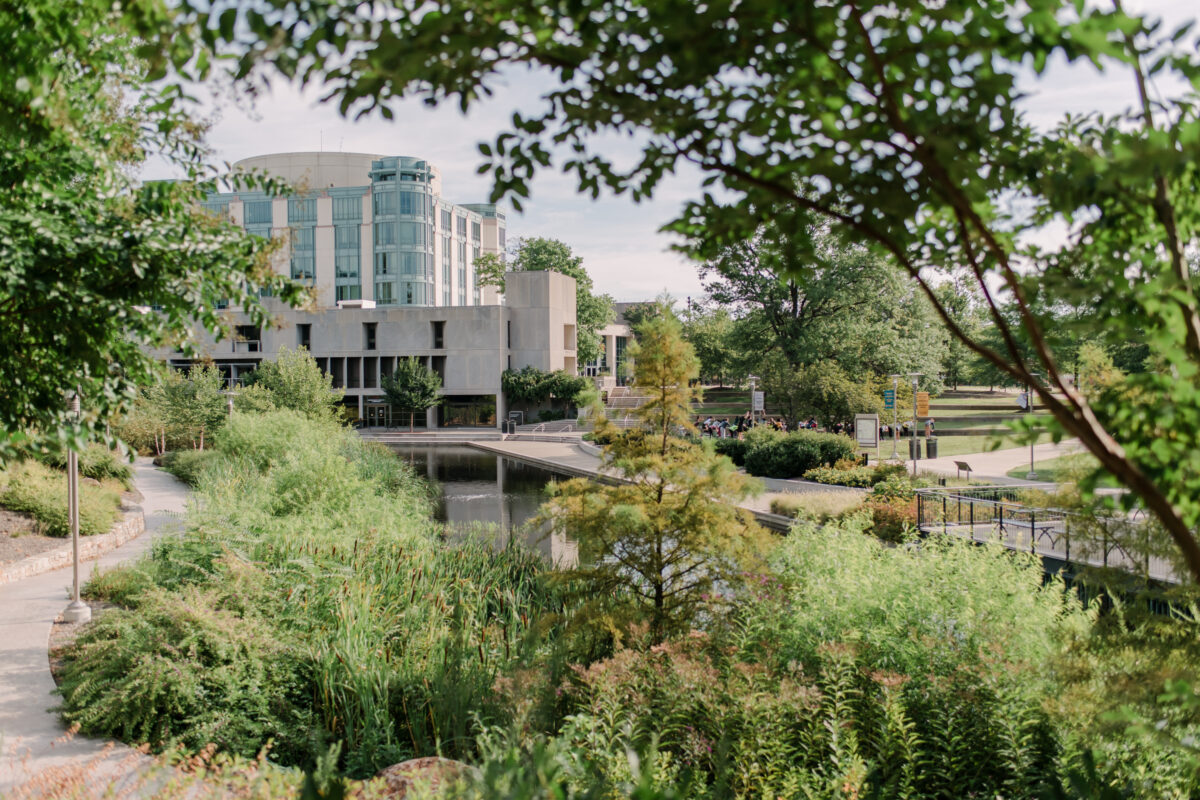 The UMBC Library Pond and surrounding vegetation are home to numerous wildlife species, such as yellow-crowned night herons and red-winged blackbirds. The pond also serves as an important stormwater management feature on campus. (Marlayna Demond ’11/UMBC)
Beyond solar
The grant will also support the development of UMBC’s Campus Clean Energy Master Plan (CCEMP). The CCEMP will rely on past studies and a forthcoming decarbonization engineering study to identify opportunities to save energy and decarbonize campus energy systems, including the central and satellite utility plants.
UMBC’s geography and environmental systems department and engineering faculty affiliated with the Grand Challenges Scholars Program are designing new learning opportunities that will use the solar project as an educational tool. Grant funds will partially fund academic experiences that provide students with hands-on learning opportunities in solar energy technology, renewable energy systems, and sustainability management, integrating real-world problem-solving into the academic curriculum. Five interns will also gain critical experience through supporting these projects, under the supervision of the Office of Sustainability and departmental faculty.
“The campus community can be proud of this commitment to bring solar energy to campus,” Smith says. “This project will not only accelerate UMBC’s shift to clean energy but will also create a visible, tangible symbol of the progress that’s been made. Plus, the new solar arrays will create learning opportunities for students to build the skills they need to thrive in the green economy.”
]]>
UMBC has received a $1.2 million solar energy grant from the Maryland Energy Administration (MEA) to support solar power installations on campus and other sustainability initiatives. The...
https://umbc.edu/stories/mea-funds-solar-panels-and-more/
https://my3.my.umbc.edu/api/v0/pixel/news/149491/guest@my.umbc.edu/7b6a267f5bb303b383508c83b3fe0688/api/pixel
cahss
coeit
community
engineering
gcsp
ges
news
science-and-tech
story
sustainability
UMBC News & Magazine
https://my3.my.umbc.edu/groups/umbc-news-magazine
https://assets1-my.umbc.edu/system/shared/avatars/groups/000/001/943/24435aa6207c452e7bc15cc74b42c7bb/xsmall.png?1748556657
https://assets1-my.umbc.edu/system/shared/avatars/groups/000/001/943/24435aa6207c452e7bc15cc74b42c7bb/original.png?1748556657
https://assets2-my.umbc.edu/system/shared/avatars/groups/000/001/943/24435aa6207c452e7bc15cc74b42c7bb/xxlarge.png?1748556657
https://assets2-my.umbc.edu/system/shared/avatars/groups/000/001/943/24435aa6207c452e7bc15cc74b42c7bb/xlarge.png?1748556657
https://assets3-my.umbc.edu/system/shared/avatars/groups/000/001/943/24435aa6207c452e7bc15cc74b42c7bb/large.png?1748556657
https://assets1-my.umbc.edu/system/shared/avatars/groups/000/001/943/24435aa6207c452e7bc15cc74b42c7bb/medium.png?1748556657
https://assets2-my.umbc.edu/system/shared/avatars/groups/000/001/943/24435aa6207c452e7bc15cc74b42c7bb/small.png?1748556657
https://assets1-my.umbc.edu/system/shared/avatars/groups/000/001/943/24435aa6207c452e7bc15cc74b42c7bb/xsmall.png?1748556657
https://assets2-my.umbc.edu/system/shared/avatars/groups/000/001/943/24435aa6207c452e7bc15cc74b42c7bb/xxsmall.png?1748556657
UMBC News & Magazine
13
0
false
Fri, 25 Apr 2025 16:33:40 -0400
Fri, 25 Apr 2025 16:33:40 -0400
Then and Now—Place of Play to Protected Site

The afternoon sun dances on the water of the Library pond while fish swim below the surface. Most days, you see ducks enjoying the water. Unlike many newer places on campus, the pond has been one of UMBC’s iconic spots since the beginning. But the current generation of fish—and today’s Retrievers—don’t have a long enough memory to know that the pond was once a place of recreation for students.
Photos from UMBC’s 1969 yearbook, Skipjack, reveal students playing tug of war over the pond and other water activities such as rowing and ice skating. Splashing around in the pond is unimaginable today—signs tell those who come to the water feature about its importance to the natural wildlife and the delicate nature of the pond’s ecosystem. he terrace and landscaping around the pond has been reshaped over the years to invite students, faculty, staff, and others to sit on nearby benches admiring the site’s natural beauty.

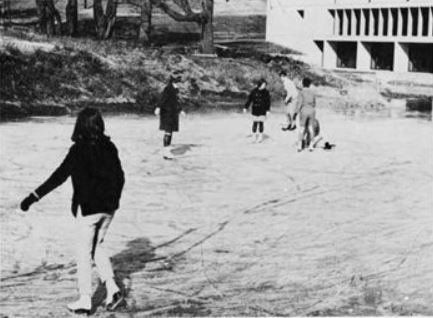
While students no longer play in its water, the pond has never been better monitored. UMBC’s Facilities Management works to keep the pond clean and safe for its many flora and fauna. “A little bit of care goes a long way,” says Ralph Ericksen, grounds manager of maintenance, who explains that Facilities Management is currently focused on controlling vegetation (mainly phragmites—the common reed—which if left unchecked can cause major problems), keeping invasive species out, and managing oxygenation levels in the water. His group works with UMBC’s Office of Sustainability to develop programs to educate students about why it’s important to conserve the pond for many generations of Retrievers to come.
“Ponds create a wonderful atmosphere.” Ericksen commented. The fish and the ducks would agree with him and so would the many visitors over the years.
]]>
The afternoon sun dances on the water of the Library pond while fish swim below the surface. Most days, you see ducks enjoying the water. Unlike many newer places on campus, the pond has been one...
https://umbc.edu/stories/place-of-play-to-protected-site-library-pond/
https://my3.my.umbc.edu/api/v0/pixel/news/146029/guest@my.umbc.edu/12cda80e9726ca91f19c0e949598e2f4/api/pixel
aok-library
campus-life
fall-2024
magazine
pond
story
sustainability
then-and-now
UMBC News & Magazine
https://my3.my.umbc.edu/groups/umbc-news-magazine
https://assets1-my.umbc.edu/system/shared/avatars/groups/000/001/943/24435aa6207c452e7bc15cc74b42c7bb/xsmall.png?1748556657
https://assets1-my.umbc.edu/system/shared/avatars/groups/000/001/943/24435aa6207c452e7bc15cc74b42c7bb/original.png?1748556657
https://assets2-my.umbc.edu/system/shared/avatars/groups/000/001/943/24435aa6207c452e7bc15cc74b42c7bb/xxlarge.png?1748556657
https://assets2-my.umbc.edu/system/shared/avatars/groups/000/001/943/24435aa6207c452e7bc15cc74b42c7bb/xlarge.png?1748556657
https://assets3-my.umbc.edu/system/shared/avatars/groups/000/001/943/24435aa6207c452e7bc15cc74b42c7bb/large.png?1748556657
https://assets1-my.umbc.edu/system/shared/avatars/groups/000/001/943/24435aa6207c452e7bc15cc74b42c7bb/medium.png?1748556657
https://assets2-my.umbc.edu/system/shared/avatars/groups/000/001/943/24435aa6207c452e7bc15cc74b42c7bb/small.png?1748556657
https://assets1-my.umbc.edu/system/shared/avatars/groups/000/001/943/24435aa6207c452e7bc15cc74b42c7bb/xsmall.png?1748556657
https://assets2-my.umbc.edu/system/shared/avatars/groups/000/001/943/24435aa6207c452e7bc15cc74b42c7bb/xxsmall.png?1748556657
UMBC News & Magazine
1
0
false
Tue, 03 Dec 2024 11:48:41 -0500
Tue, 03 Dec 2024 11:48:41 -0500
From solar energy harvesting to advanced batteries: Cohort of new engineering faculty bolster UMBC’s commitment to Earth-friendly research
This April 22, as the campus community celebrated Earth Day, the feel of spring’s natural reawakening was in the air. Birds chirped from newly leafed trees and students strolled in the bright sunshine. But the pleasant day belied a concerning trend: In Maryland and beyond, the balance of Earth’s life-supporting systems is shifting, driven in large part by the heat-trapping greenhouse gasses we humans send into the atmosphere. The Earth is getting hotter; weather patterns are changing; and ecosystems are under stress.
“Climate change is pressing us to adopt a more Earth-friendly lifestyle, to develop renewable energy,” says Özgür Çapraz, an associate professor in the department of chemical, biochemical, and environmental engineering at UMBC, who studies advanced battery technologies. Çapraz, who joined UMBC in fall 2023 from a faculty position at Oklahoma State University, was one of three recent faculty hires in the College of Engineering and Information Technology (COEIT) who all specialize in different aspects of sustainability and renewable energy-related research.
The three hires were part of a COEIT effort to build off recognized strength in the environmental domain, while expanding expertise in important areas such as energy, says Lee Blaney, a professor in the department of chemical, biochemical, and environmental engineering who chaired the search.
The other two hires are Alok Ghanekar, an assistant professor in mechanical engineering, who studies materials that can improve some solar energy harvesting systems, turn waste heat into electricity, and better cool buildings; and Rajasekhar Anguluri, an assistant professor in computer science and electrical engineering, who specializes in the math describing large, complex systems such as the power grid.
The energy conundrum
“Ever since I studied science in high school, I have been interested in energy,” says Ghanekar, who was a postdoctoral researcher at the University of Southern California prior to joining UMBC this spring semester. “Growing up in India, there were regular power outages every week. It is less of a problem now, but energy demand is still growing.”
Across the world, in many ways, energy consumption drives progress and improves people’s lives. But the burning of fossil fuels to produce much of that energy is increasing the concentration of heat-trapping gasses in the atmosphere. While the exact consequences of this change are uncertain, it’s clear the Earth is warming, and that trend is likely to put extreme pressures on societies in the decades to come.
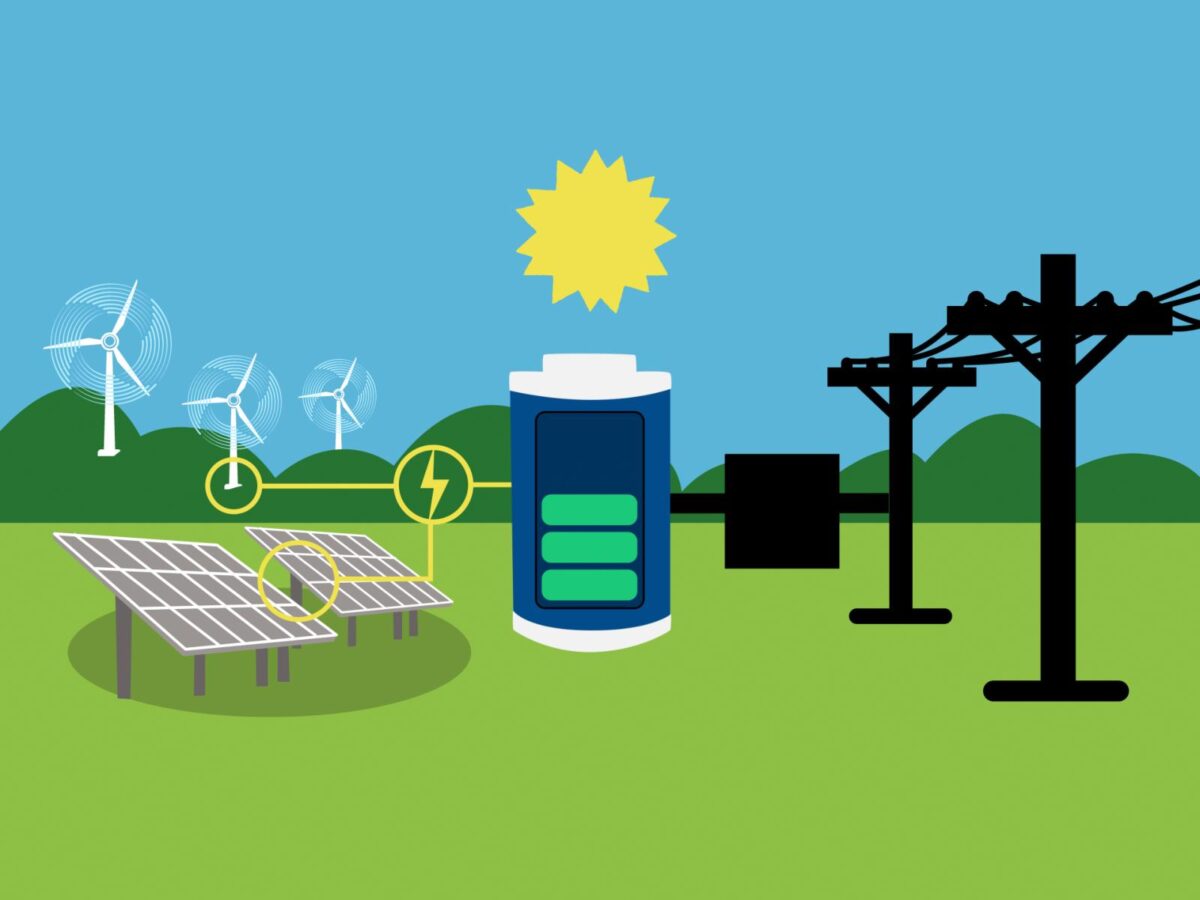 To tap intermittent renewable energy sources, we also need to develop solutions for storing and distributing the energy. (Image by Sara Levine | Pacific Northwest National Laboratory)
A big shift toward clean and renewable sources of energy could be part of the solution. Each of the new hires’ research touches this goal in some ways. In Ghanekar’s case, he studies human-designed materials called metamaterials that, among other potential uses, might one day help significantly increase the amount of energy from the sun that we are able to efficiently turn into electricity.
Getting more energy from the sun could help reduce greenhouse gas emissions, but since the sun doesn’t always shine, we also need ways to store that energy (perhaps with new battery technologies, the expertise of Çapraz) and ways to share that energy on the power grid without disrupting its delicate balance (a challenge that Anguluri has explored).
As academic researchers, they operate at the frontiers of knowledge, asking and seeking to answer fundamental questions that could push the technology forward: How exactly do batteries with new chemistries work, for example, or why does a material degrade over time? Anguluri’s math expertise spans a range of engineering disciplines. He and Ghanekar have already talked about collaborating to mathematically model the behavior of Ghanekar’s metamaterials.
No scientific “Eureka!” moment or technical advance by itself is likely to be a panacea to a problem as complex as global warming, but these incremental steps do offer people more tools.
“As scholars, we like to think, to solve interesting problems,” says Anguluri, who was a postdoc at Arizona State University before arriving at UMBC this year. “As citizens of the world, we must also look at our values and make wise choices.”
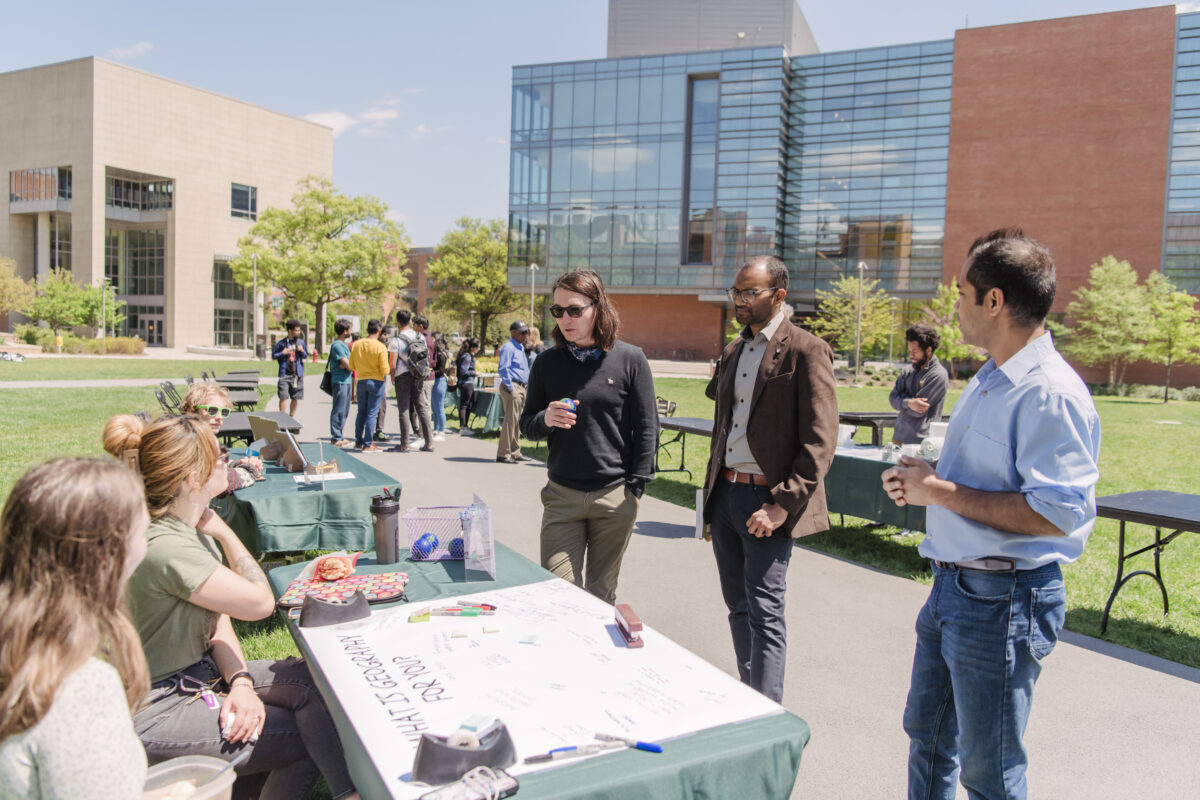 Çapraz, Anguluri, and Ghanekar chat with community members at the Earth Day Community Day event celebrating UMBC environmental research.(Marlayna Demond ’11/UMBC)
Building on a long-standing commitment
Studying people’s impact on the Earth, and working to mitigate environmental harms, is nothing new for researchers at UMBC.
The university boasts multiple research centers that advance environmental research, from the Center for Urban Environmental Research and Education to the Institute for Harnessing Data and Model Revolution in the Polar Regions. The university also has long-standing partnerships with NASA to develop new technology for environmental remote sensing.
Çapraz, Ghanekar, and Anguluri will join faculty at the university who study sustainable aquaculture, wildfire smoke, water and sediment pollution, fusion energy, and more.
“Sustainability research is an area of strength in COEIT,” says Vandana Janeja, the associate dean for research and faculty development in COEIT. “Now there’s a new sense of urgency about it and our recent hires are a testament to that.”
“Climate change is an issue that so many of our students are tapped into,” adds Blaney. “They’re really worried about the impacts of climate change and want to do something to address this global challenge.”
As the new UMBC faculty launch research projects and expand their labs, there will be growing opportunities for interested students to learn about and join their important work. And that’s good news, because as the Earth Day festivities on campus showcased, safeguarding our shared home is a duty shared by all of us.
]]>
This April 22, as the campus community celebrated Earth Day, the feel of spring’s natural reawakening was in the air. Birds chirped from newly leafed trees and students strolled in the bright...
https://umbc.edu/stories/new-sustainability-renewable-energy-faculty/
https://my3.my.umbc.edu/api/v0/pixel/news/141880/guest@my.umbc.edu/d4b5a640a511273cafe1b4d4c119478b/api/pixel
cbee
coeit
csee
meche
news
research
science-and-tech
story
sustainability
UMBC News & Magazine
https://my3.my.umbc.edu/groups/umbc-news-magazine
https://assets1-my.umbc.edu/system/shared/avatars/groups/000/001/943/24435aa6207c452e7bc15cc74b42c7bb/xsmall.png?1748556657
https://assets1-my.umbc.edu/system/shared/avatars/groups/000/001/943/24435aa6207c452e7bc15cc74b42c7bb/original.png?1748556657
https://assets2-my.umbc.edu/system/shared/avatars/groups/000/001/943/24435aa6207c452e7bc15cc74b42c7bb/xxlarge.png?1748556657
https://assets2-my.umbc.edu/system/shared/avatars/groups/000/001/943/24435aa6207c452e7bc15cc74b42c7bb/xlarge.png?1748556657
https://assets3-my.umbc.edu/system/shared/avatars/groups/000/001/943/24435aa6207c452e7bc15cc74b42c7bb/large.png?1748556657
https://assets1-my.umbc.edu/system/shared/avatars/groups/000/001/943/24435aa6207c452e7bc15cc74b42c7bb/medium.png?1748556657
https://assets2-my.umbc.edu/system/shared/avatars/groups/000/001/943/24435aa6207c452e7bc15cc74b42c7bb/small.png?1748556657
https://assets1-my.umbc.edu/system/shared/avatars/groups/000/001/943/24435aa6207c452e7bc15cc74b42c7bb/xsmall.png?1748556657
https://assets2-my.umbc.edu/system/shared/avatars/groups/000/001/943/24435aa6207c452e7bc15cc74b42c7bb/xxsmall.png?1748556657
UMBC News & Magazine
0
0
false
Fri, 10 May 2024 14:05:56 -0400
Fri, 10 May 2024 14:05:56 -0400
Sustainability Fellow Isabel Dastvan ’22 grows her career and invasive species management at UMBC

It’s a spring morning, and Isabel Dastvan ’22, geography and environmental systems, is slowly wending her way through the Conservation Environmental Research Area (CERA) at the southern edge of UMBC’s main campus. Braving the uneven terrain and an occasional thorny branch, she’s carefully recording the presence of a long list of invasive species with photos and in a notebook: garlic mustard there, wavyleaf basketgrass over there, and porcelainberry everywhere.
Over several weeks in fall 2022 and again in spring 2023, Dastvan painstakingly completed a survey of campus invaders—from English ivy to Japanese stiltgrass—all the way from CERA to wooded land north of UMBC’s dorms. Dastvan’s work revealed that there are at least 100 invasive plant species present in natural and managed spaces on campus, which can threaten native species, reduce ecosystem functions like pollination and water filtration, and increase the chance of fires by thickening vegetation.
“UMBC has a long history of agricultural use and urban development, and with land disturbance we’re seeing a lot more invasive species,” says Dastvan, who is excited to apply knowledge she gained as a UMBC undergraduate to real ecological challenges. Some invasives are weakening or even killing native trees, she explains, and trees “are one of the important environmental assets we want to protect to be a more resilient campus in the face of climate change.”
Growing capacity, training leaders
Throughout the academic year, and in deep collaboration with Facilities Management staff, Dastvan completed on-the-ground surveys, created maps of invasive species on campus, identified the most urgent invasive threats, and determined the best ways to combat their spread. The end result is a 187-page, comprehensive Invasive Species Management Plan for UMBC, which Dastvan published in June. Moving forward, Facilities Management staff, led by landscape and grounds manager Charles Hogan, will implement the plan, continuing UMBC’s legacy of prioritizing sustainability and stewarding the land the university occupies.
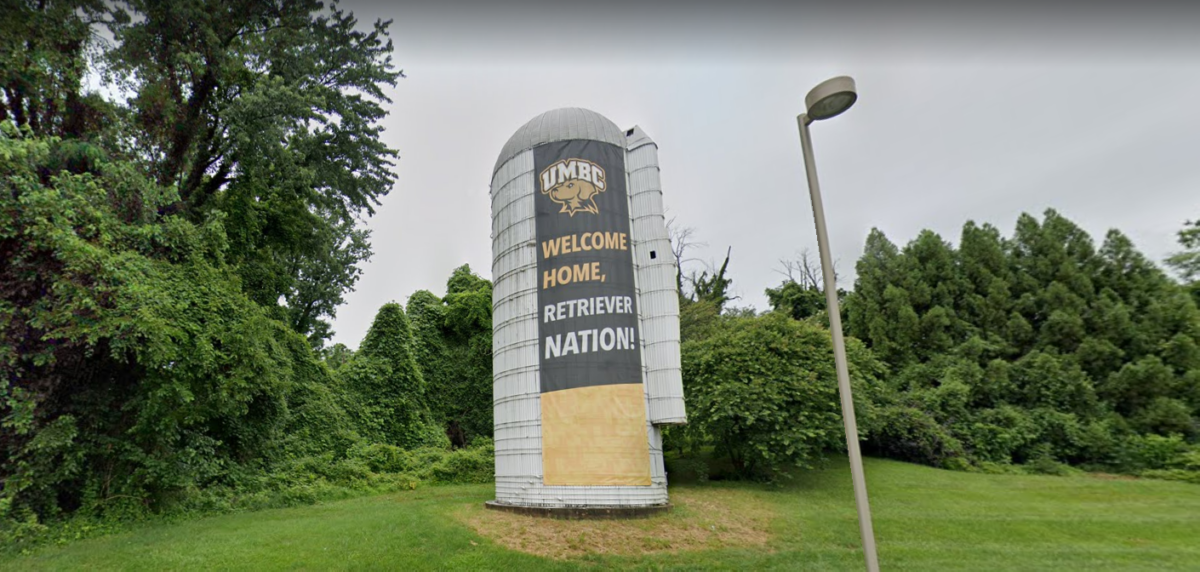 Invasive kudzu blankets vegetation at the entrance to UMBC. Plants underneath—even full-grown trees—are at risk of being smothered. (Image by Google 2023)
Dastvan completed the plan as a 2022 – 2023 Sustainability Fellow with Climate Corps, a program for recent college graduates supported by the non-profit Strategic Energy Innovations in California and the Hannon Armstrong Foundation in Annapolis, MD. Climate Corps connects emerging leaders like Dastvan with non-profits, businesses, governments, and universities with sustainability project needs. Fellows gain valuable professional experience and the institutions they support gain capacity to reach their sustainability goals.
Connecting with the community
UMBC will benefit for years from Dastvan’s work as a Fellow. In addition to the invasive species management plan, she worked to increase awareness of invasive species throughout the UMBC community by meeting with student organizations and informally engaging with people on campus. Dastvan collaborated with the student-led Environmental Task Force club to host weekly cleanups removing invasive plant species in addition to their weekly trash cleanups on campus.
Dastvan also co-hosted an art-making event at Oca Mocha using invasive plant material from campus and recycled paper with Jessie Houff, who has an M.F.A. in community art and is passionate about papermaking and teaching. Dastvan even collaborated with UMBC Dining to inform students about invasive species and offer them at True Grit’s—Chesapeake Bay Blue Catfish, anyone?
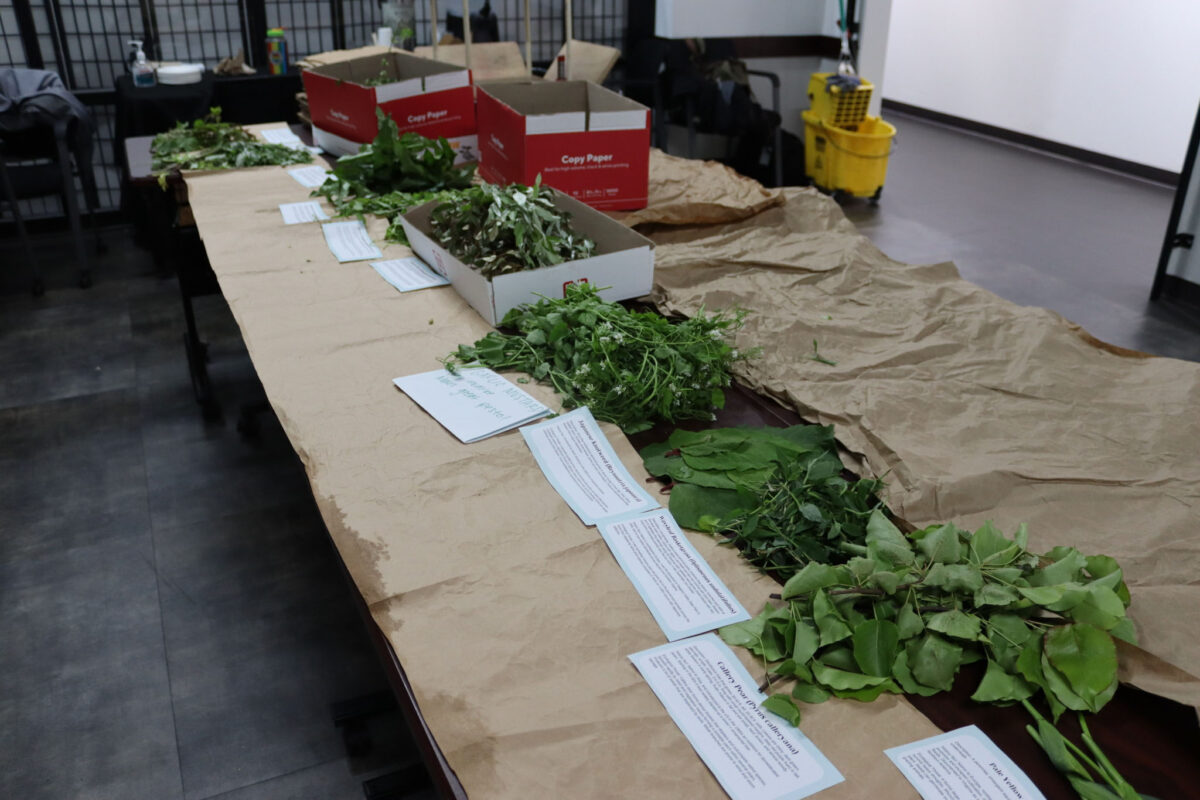 Invasive plant clippings, accompanied by information about the plants, ready to be turned into art.
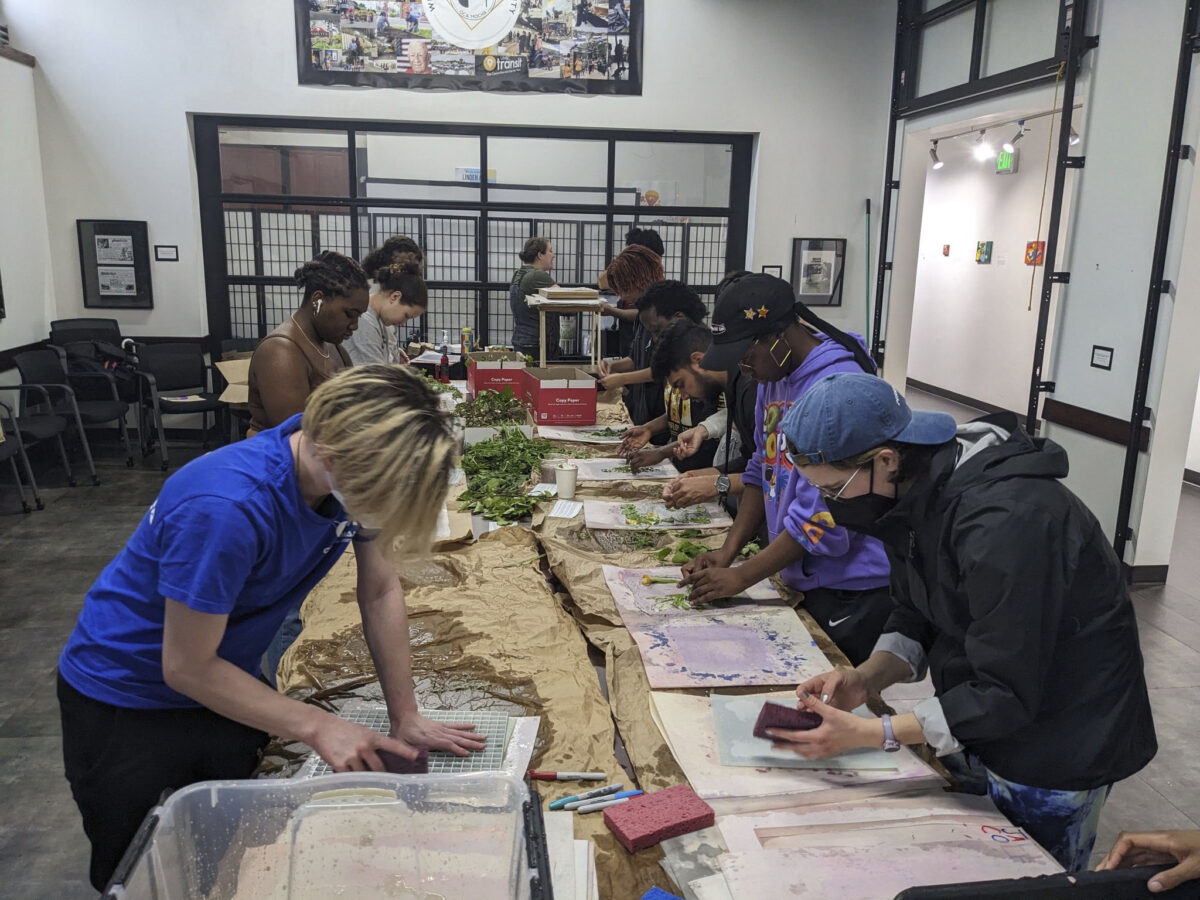 Participants hard at work on their invasive plant art.
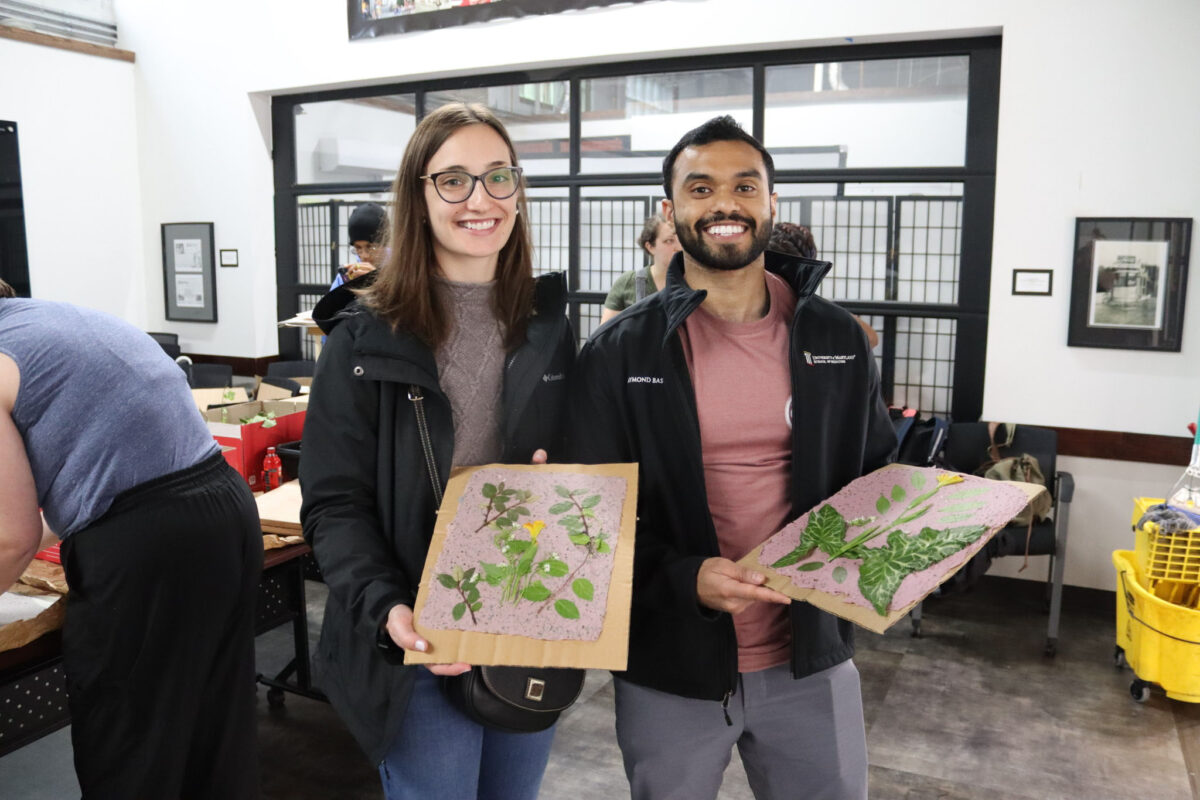 The finished product. (Images by Claire Runquist)
The threat of invasive species is “something that needs to be taken more seriously,” Dastvan says, “so if there are different ways that we can get the community involved, and genuinely excited, I think that’s the best way to go about tackling it. There are a lot of people who are enthusiastic about learning and willing to help out, and a community that creates a space for that is absolutely necessary.”
Claire Runquist, environmental sustainability coordinator at UMBC, oversaw Dastvan’s work. “Bella’s work on invasive species was incredibly valuable to campus—prior to this we didn’t have a comprehensive understanding of what invasive species we had on campus or where exactly they all were,” she shares. “Her project combined GIS mapping along with best management practices and led to prioritization for management.”
Finding her own path
For Dastvan, the impact of her fellowship will likely be even longer-lasting than her invasive species management plan. As a GES major at UMBC, Dastvan threw herself into her studies, including working with the Office of Sustainability to support a farmer’s market on campus. But when she started UMBC’s accelerated master’s program in GES while finishing her Bachelor’s degree program, she quickly experienced burnout. She decided to take some time off from her studies to gain relevant professional experience, and when she saw the Climate Corps program on a UMBC graduate student listserv, it was the perfect fit.
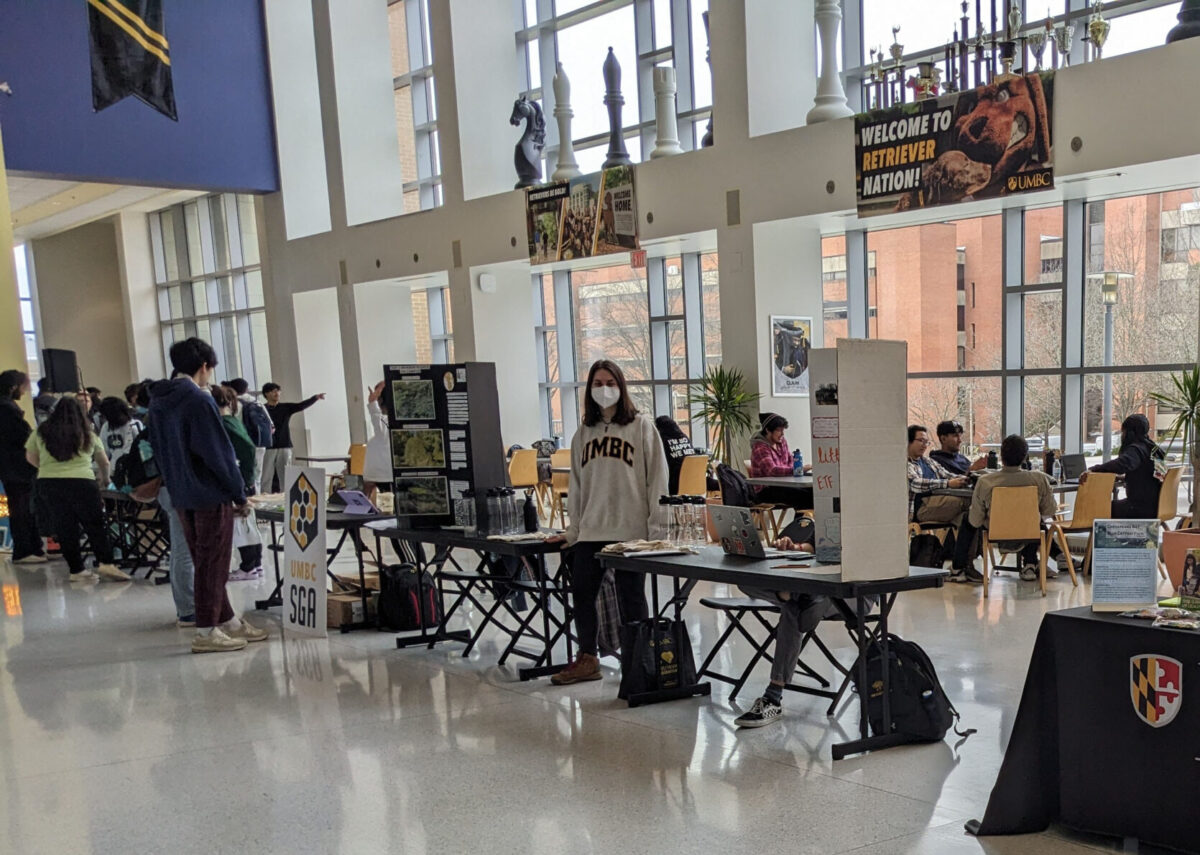 Isabel Dastvan (UMBC sweatshirt, center) shares information about invasive species with people in the UMBC Commons. (Image by Claire Runquist)
When she was selected as UMBC’s Sustainability Fellow through the program, it was a homecoming. “I was very excited to be able to work with the sustainability office from a different lens and be involved on campus in a new way,” Dastvan says.
Her undergraduate degree from UMBC provided the foundational knowledge and skills to make her an effective fellow, and through the Climate Corps program, she gained additional technical and leadership skills and confirmed her desire for a career in a related field. Dastvan was recently thrilled to accept a position as a horticultural technician at Silvec Biologics—and she’ll carry her UMBC experiences everywhere she goes, she says, adding, “I’m just really grateful to have had this opportunity to be on campus and contribute.”
]]>
It’s a spring morning, and Isabel Dastvan ’22, geography and environmental systems, is slowly wending her way through the Conservation Environmental Research Area (CERA) at the southern edge of...
https://umbc.edu/stories/growing-a-career-and-umbc-invasive-species-mgmt/
https://my3.my.umbc.edu/api/v0/pixel/news/134232/guest@my.umbc.edu/babef8334a595a047e207ba7fbf9d33f/api/pixel
alumni
cahss
campus-life
ges
magazine
sustainability
UMBC News & Magazine
https://my3.my.umbc.edu/groups/umbc-news-magazine
https://assets1-my.umbc.edu/system/shared/avatars/groups/000/001/943/24435aa6207c452e7bc15cc74b42c7bb/xsmall.png?1748556657
https://assets1-my.umbc.edu/system/shared/avatars/groups/000/001/943/24435aa6207c452e7bc15cc74b42c7bb/original.png?1748556657
https://assets2-my.umbc.edu/system/shared/avatars/groups/000/001/943/24435aa6207c452e7bc15cc74b42c7bb/xxlarge.png?1748556657
https://assets2-my.umbc.edu/system/shared/avatars/groups/000/001/943/24435aa6207c452e7bc15cc74b42c7bb/xlarge.png?1748556657
https://assets3-my.umbc.edu/system/shared/avatars/groups/000/001/943/24435aa6207c452e7bc15cc74b42c7bb/large.png?1748556657
https://assets1-my.umbc.edu/system/shared/avatars/groups/000/001/943/24435aa6207c452e7bc15cc74b42c7bb/medium.png?1748556657
https://assets2-my.umbc.edu/system/shared/avatars/groups/000/001/943/24435aa6207c452e7bc15cc74b42c7bb/small.png?1748556657
https://assets1-my.umbc.edu/system/shared/avatars/groups/000/001/943/24435aa6207c452e7bc15cc74b42c7bb/xsmall.png?1748556657
https://assets2-my.umbc.edu/system/shared/avatars/groups/000/001/943/24435aa6207c452e7bc15cc74b42c7bb/xxsmall.png?1748556657
UMBC News & Magazine
1
0
false
Thu, 06 Jul 2023 16:37:11 -0400
Thu, 06 Jul 2023 16:37:11 -0400
Major UMBC stream restoration will enhance ecosystems, stormwater management, and the community experience
A high-potential green space on the edge of UMBC’s main campus will see big changes in the coming months. A new $1 million grant from the Chesapeake and Atlantic Coastal Bays Trust Fund, combined with about $1.4 million of university investment, will fund a major stream restoration on campus. The stream is a small tributary of the West Branch Herbert Run, and it flows through campus by the Chesapeake Employers Insurance Arena and bwtech@UMBC. The stream is part of the Patapsco River and Chesapeake Bay watersheds.
“This project will not only create and enhance wetland and stream habitats and functions, it will also provide recreational enhancements such as walking trails with stream access and connection to other existing trails,” says Lenn Caron, associate vice president of facilities management.
Additionally, he notes, “the restored stream will elevate UMBC’s aesthetic appeal and provide a pleasant natural environment for members of the campus and local community for recreation, exercise and watershed education.”
Restoring Herbert Run is part of UMBC’s Institutional Management Plan, a stormwater master plan put in place in 2014. The plan empowers UMBC to “make decisions that serve the campus’s interests on a broader scale—on a watershed basis,” rather than addressing stormwater requirements for new construction projects in isolation, explains Larry Hennessey, associate director of design and construction services and the lead on the restoration work. “This is the outcome of many years of stormwater planning.”

Larry Hennessey at UMBC’s community garden. Photo courtesy Larry Hennessey.
Recreating a healthy stream
The need for the restoration is a result of decades of growth at UMBC and in the surrounding community. In a forest, soil absorbs and filters a large percentage of precipitation exactly where it falls, leaving only a small portion to flow into nearby streams. However, development leads to an increase in surfaces that water can’t penetrate, like concrete and building roofs. This generates more runoff that enters streams. Because the natural stream channel didn’t form to handle that much water, the increased runoff quickly erodes the stream banks.
As the bank erodes, “the stream channel becomes so deep that it’s no longer connected to the floodplain,” Hennessey says. The water can’t spread out and seep into adjacent land, so it flows with greater speed and force through the stream, worsening erosion. “It becomes a self-perpetuating problem,” Hennessey says.
The restoration project will “reconnect the stream with the floodplain by raising the streambed and adding natural features in the stream to slow down the flow,” Hennessey explains. “By spreading the water out, when you do get a big storm event, the impacts won’t be concentrated in a small area. The stream will function the way it was intended to function.”

The West Branch Herbert Run on campus prior to the restoration. The height of the bank indicates extensive erosion that separates the stream from the natural floodplain. Photo courtesy Larry Hennessey.
Welcoming visitors—wild and human
Additional benefits of the project abound. Eroded, fast-flowing streams don’t support nearly as much wildlife as healthy streams connected to the floodplain. While it may alarm some observers that the stream restoration involves removing trees, “Lower portions of the trees are left in the stream to create deeper pools and riffles,” Hennessey says. These microhabitats attract animals like frogs, dragonflies, crayfish, and even herons. “This is going to significantly improve our ecosystem,” he explains.
The restoration will also enhance the experience of Herbert Run for humans. The Herbert Run Greenway walking path traverses the Conservation and Environmental Research Area (CERA) and follows the stream as it meanders across the southeast quadrant of campus.
Along the portion of the stream to be restored, concrete stairs lead down to a frequently submerged concrete walkway, and the land beside the stream is clogged with invasive plants. Once the project is finished, however, a healthier streamside and new nature trail dotted with informational signage will greet visitors in this section of the greenway.

Larry Hennessey (rear, blue shirt) with students from the Environmental Task Force, a UMBC student organization that he advises, after one of their stream clean-ups. Photo courtesy Larry Hennessey.
New tech, new strategies
The campus implemented its first stormwater management facilities decades ago by installing ponds near some buildings to collect stormwater runoff. The ponds prevented a rush of fast-flowing water into streams during storms, slowing erosion. These projects focused on stormwater quantity, but did little to address the quality of the runoff. The runoff would deposit sediment in streams, causing more problems.
This challenge is far from unique to UMBC. “The entire Chesapeake Bay is filled with plumes of sediment after a rain event, because this is happening everywhere,” Hennessey says. “The ponds were a good first step, but they didn’t really solve the problem. We still had detrimental effects of the stormwater runoff coming out of the ponds.”
Over time, as technology and understanding of the damage caused by runoff increased, the strategies changed. New projects, like UMBC’s Interdisciplinary Life Sciences Building, include bioretention facilities that both slow the flow of water to streams and use a special medium underground to effectively filter out sediment and other harmful compounds.

Plantings in the Commons Plaza, adjacent to the Interdisciplinary Life Sciences Building, are the aboveground element of a bioretention facility to remediate runoff generated by the building. Photo by Marlayna Demond ’11 for UMBC.
A commitment to sustainability
Hennessey has been with UMBC since 2007 and has a deep personal commitment to landscape stewardship. Previous projects he’s been involved with included landscape conversions, such as from a lawn to a no-mow pollinator meadow, and improving the functionality of older stormwater management installations, like the ponds.
He is excited to see this new project launch after almost a decade of planning. There was some question as to whether the project as originally designed would come to fruition due to funding constraints, but the grant from Chesapeake and Atlantic Coastal Bays Trust Fund removed that barrier.
The project “highlights our goal of continuous improvement, both visually and functionally,” Caron notes. Simpler options, like street-sweeping, might have met environmental requirements, but would not have yielded the same long-term benefits. The decision to pursue a stream restoration on campus, Caron says, “demonstrates our commitment to environmental sustainability.”
Banner image: The UMBC Library Pond and adjacent vegetation, upgraded in 2014, serve as a stormwater management facility on campus. Photo by Marlayna Demond ’11 for UMBC.
]]>
A high-potential green space on the edge of UMBC’s main campus will see big changes in the coming months. A new $1 million grant from the Chesapeake and Atlantic Coastal Bays Trust Fund, combined...
https://umbc.edu/stories/major-umbc-stream-restoration-will-enhance-ecosystems-stormwater-management-and-the-community-experience/
https://my3.my.umbc.edu/api/v0/pixel/news/119583/guest@my.umbc.edu/9bad3800e86fe61efa25b66337641593/api/pixel
campus
community
page1
science-and-technology
sustainability
UMBC News & Magazine
https://my3.my.umbc.edu/groups/umbc-news-magazine
https://assets1-my.umbc.edu/system/shared/avatars/groups/000/001/943/24435aa6207c452e7bc15cc74b42c7bb/xsmall.png?1748556657
https://assets1-my.umbc.edu/system/shared/avatars/groups/000/001/943/24435aa6207c452e7bc15cc74b42c7bb/original.png?1748556657
https://assets2-my.umbc.edu/system/shared/avatars/groups/000/001/943/24435aa6207c452e7bc15cc74b42c7bb/xxlarge.png?1748556657
https://assets2-my.umbc.edu/system/shared/avatars/groups/000/001/943/24435aa6207c452e7bc15cc74b42c7bb/xlarge.png?1748556657
https://assets3-my.umbc.edu/system/shared/avatars/groups/000/001/943/24435aa6207c452e7bc15cc74b42c7bb/large.png?1748556657
https://assets1-my.umbc.edu/system/shared/avatars/groups/000/001/943/24435aa6207c452e7bc15cc74b42c7bb/medium.png?1748556657
https://assets2-my.umbc.edu/system/shared/avatars/groups/000/001/943/24435aa6207c452e7bc15cc74b42c7bb/small.png?1748556657
https://assets1-my.umbc.edu/system/shared/avatars/groups/000/001/943/24435aa6207c452e7bc15cc74b42c7bb/xsmall.png?1748556657
https://assets2-my.umbc.edu/system/shared/avatars/groups/000/001/943/24435aa6207c452e7bc15cc74b42c7bb/xxsmall.png?1748556657
UMBC News & Magazine
0
0
false
Tue, 13 Jul 2021 14:41:41 -0400


