WMBC is back on the air
“You’re listening to WMBC, UMBC’s freeform student radio station. And you’re in the 2000s right now, thanks to the radio time machine.”
Four years ago, hearing those words would have been impossible. UMBC’s radio station, WMBC—now a bustling hive of musical joy, live concerts, and record painting parties—had been silent after a lack of student staffing and resource issues, leading the student group to hang up their headphones.
But recently, music is on the airwaves again as students and staff work around the clock to breathe new life into the station. After combining operations with The Retriever, UMBC’s long-running student newspaper, and Bartleby, UMBC’s Creative Arts Journal since 1972, WMBC found a new home in the University Center, and a fresh start as part of the newly chartered Student Media Center.
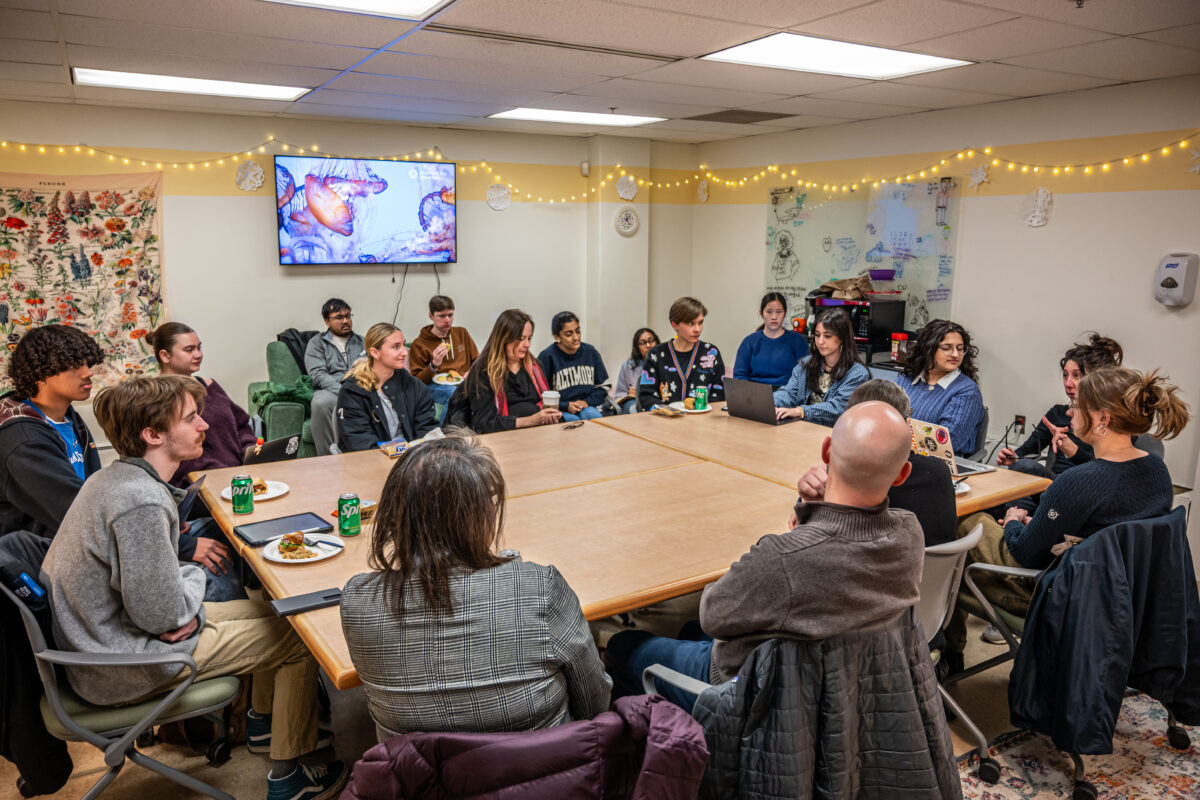 An editorial roundtable event of Student Media Center participants. Photo by The Retriever staff photographer Joshua Able-Carter, sophomore visual arts major.
Legacy media outlets
Retrievers have been media-conscious from the university’s inception. Within the first month of classes at UMBC, a newsroom was established, and the first issue of the student newspaper was published on September 19, 1966. Ever since then, the tradition of reporting student and campus life continued to expand and evolve.
By 1979, the student-run radio station, WMBC, was founded. Originally called the WUMD Radio Club, the station began broadcasting over carrier current circuits, enabling students to tune in from their dorms and at a couple of dining areas on campus.
In recent years, these media outlets, which depend on the ever-changing student body, took a hit. But students weren’t willing to give up their media platforms so easily.
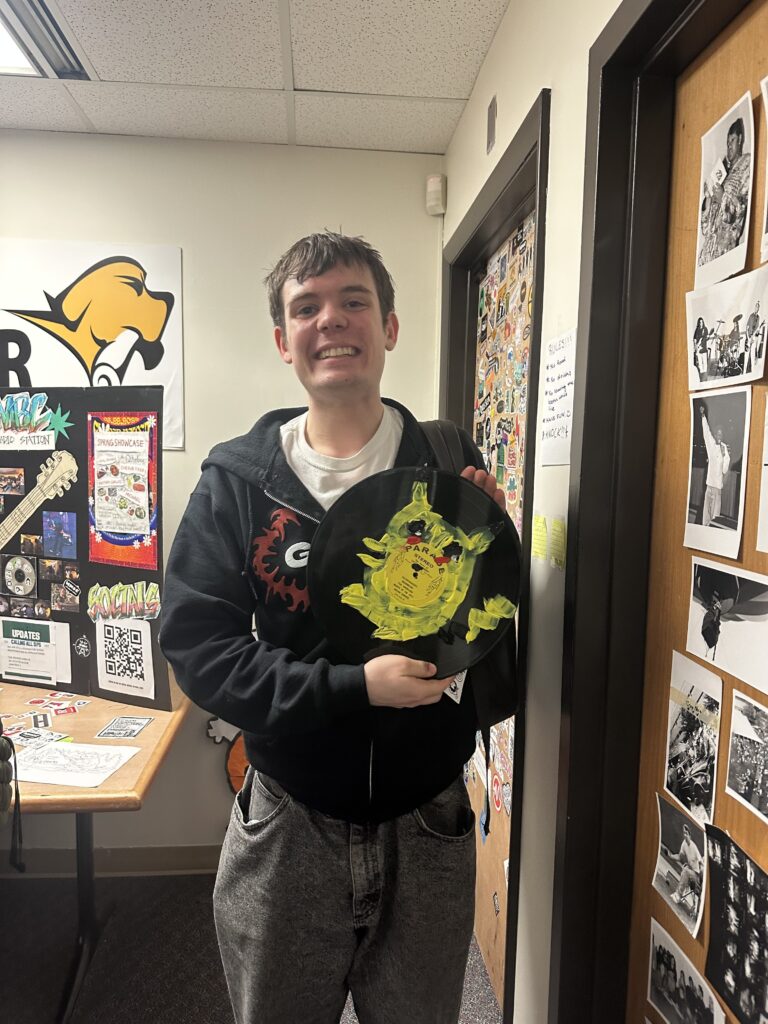 The station held a
record-painting party to draw in students to the UC
214 space. Photo by Miani Kozlowski, sophomore
computer engineering major.
The station held a
record-painting party to draw in students to the UC
214 space. Photo by Miani Kozlowski, sophomore
computer engineering major.
In 2022, WMBC had been inactive for roughly four years. Before COVID even, the student group was having trouble staffing the station, but the org really lost its footing—and its physical space—during the pandemic. Sean Stultz ’24, computer science, WMBC’s station manager his senior year and their chief engineer prior to that, was storing the station’s equipment in his Hillside apartment in Breton, until the station found a permanent place for it.
Around the same time, The Retriever, the student-run newspaper, ran into similar complications. They were working without a dedicated advisor, and the weight of managing everything from organizing meetings to pitching and writing stories, publishing and distributing both in print and online, marketing/running social media accounts, and much more became too much for students to handle alone.
That changed at the end of 2023, when Ann Tropea, the assistant director of the Center for Democracy and Civic Life, was hired as the newspaper’s media advisor. The Retriever members say she has helped immensely with finding advertisers, organizing documents, and advocating for them as a student organization.
“I began working with students from The Retriever and WMBC to create a shared structure that went beyond the two groups simply sharing space in our suite of offices in the UC,” says Tropea, who has a background in law and communications.
The student-run creative arts journal Bartleby joined the other media groups in 2024, and after a year of planning, SGA recently approved a new charter organization—the Student Media Center. The group’s stated mission is to “create a more engaged, informed, and civically empowered student body, and assert First Amendment freedoms at UMBC through the active production of student-run media.”
The Student Events Board (seb) is the only other charter organization at UMBC, so this is historic, says Tropea. And the new structure ensures the longevity and continuous operations of not just WMBC, but The Retriever and Bartleby as well, Tropea adds, who during this planning period was directing her efforts into assisting with WMBC’s revitalization.
Creating a shared mission
Michelle Ibino, a biological sciences junior, who is the events manager for WMBC, says, “Sharing a space and a mission has been positive as it allows for students to cross over into each club. Members of the station have found and gone on to write/work for The Retriever and vice-versa.”
The Retriever has been able to seamlessly work with WMBC to produce stories that provide coverage about the station’s events, and it’s also common to see members of The Retriever enjoying WMBC’s events, which turns the newsroom into a Tiny Desk Concert vibe. “The WMBC/Retriever space is small, but turns out to be a really cool music venue if you just rearrange a few chairs and tables!” says Tim Rogers, The Retriever’s music columnist.
“We might be known as a commuter school, but that doesn’t mean we can’t have a rich student culture just like any other university. The efforts of The Retriever and WMBC bring life to campus,” says Rogers, a sophomore.
When it comes to on-campus events, WMBC hosts concerts, album listening parties, zine creations, record painting, and other activities. WMBC puts together bills that showcase student artists, as well as local bands from the surrounding Baltimore area.
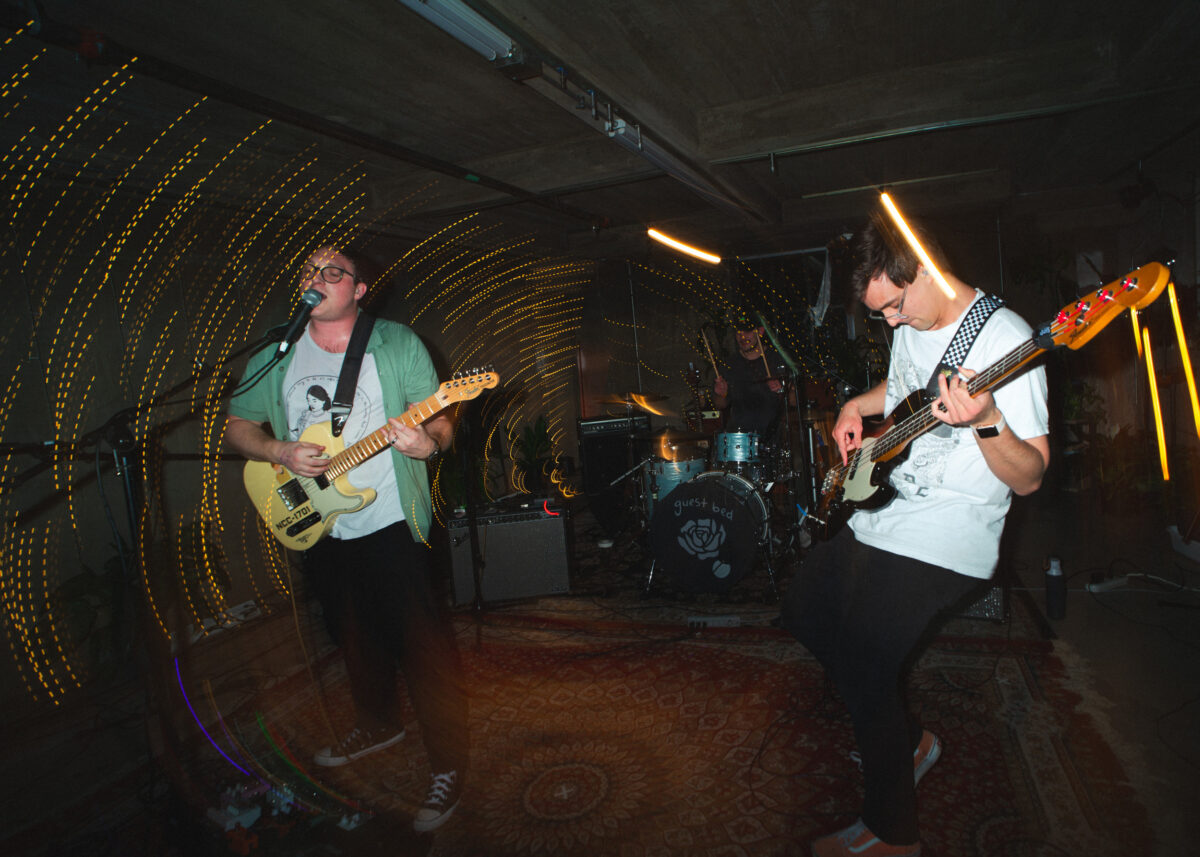 Baltimore band Guest Bed performs at WMBC’s Zine Release Party. Photo by Erin Bennett ’25.
While the newsroom can accommodate only a few dozen people, WMBC is able to organize large-scale events in different places around campus. “WMBC has put together a bunch of really cool music events, some in collaboration with Retriever Music Society (RMS) and others run entirely by the club,” says Rogers. The station’s previous spring music festival was a collaboration with RMS, taking place in the UC Ballroom.
When planning events, Ibino knows how crucial it is that the students have both on-campus and off-campus options. “The off-campus concerts we run are especially important because they allow UMBC students to connect with the large local Baltimore/DMV music scene. As a school in the Baltimore area, I think it is especially important for us to encourage students to explore, interact, and support the Baltimore community, and these concerts are a great way for students to start building connections to do that. Further, our events help like-minded students find each other,” she says.
In addition to events, the integration of the groups has positively impacted campus-wide projects. This has helped both groups to become better advocates for the student community. “Advocating for different groups is an important job that both organizations share as part of the Student Media Center,” says Ibino. “Collaboration is what helps us better represent the diverse voices and interests of the UMBC community.”
Musical connections
Although he’s graduated—and no longer housing the station’s equipment—Stultz has stayed connected with WMBC and appreciates watching it thrive. “The overall campus is thankful for a lot of the stuff that we do,” says Stultz. “We’re equally thankful back to the people on campus who support us and everything because we wouldn’t be able to do any of this without them.”
In addition to being the events manager for WMBC, Ibino is one of the many DJs who broadcast a show through the station. Currently, there are about 40 different shows, and the station is on air weekly from Monday through Friday. With her show “Reverie,” Ibino connects with other students and educates anyone interested in the goth subculture.
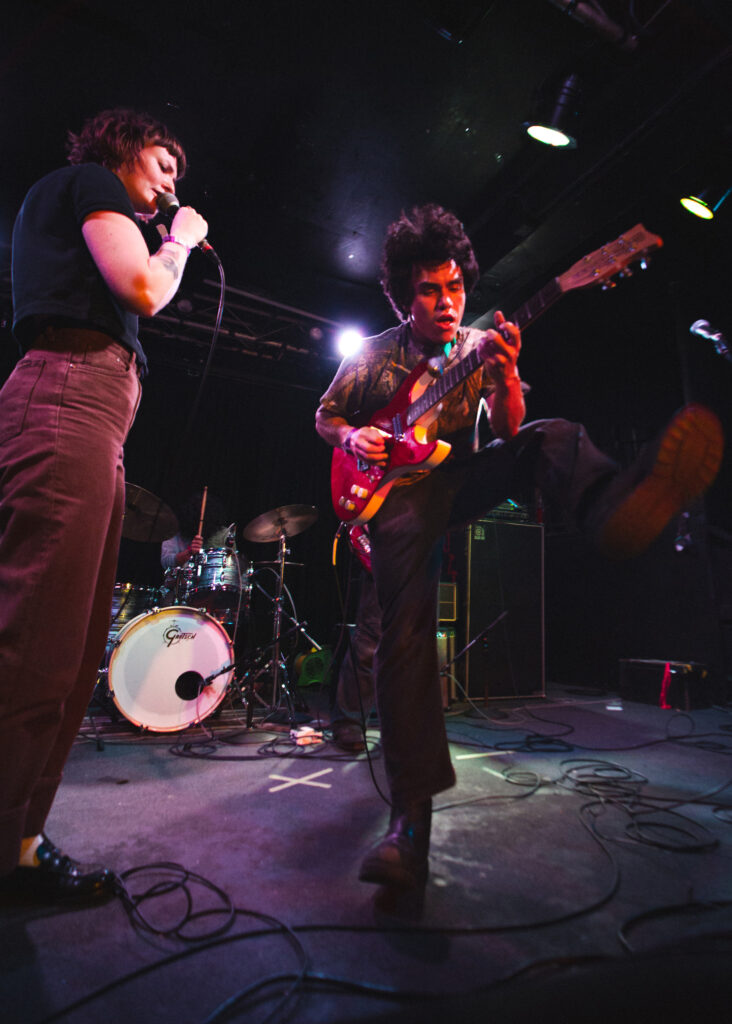
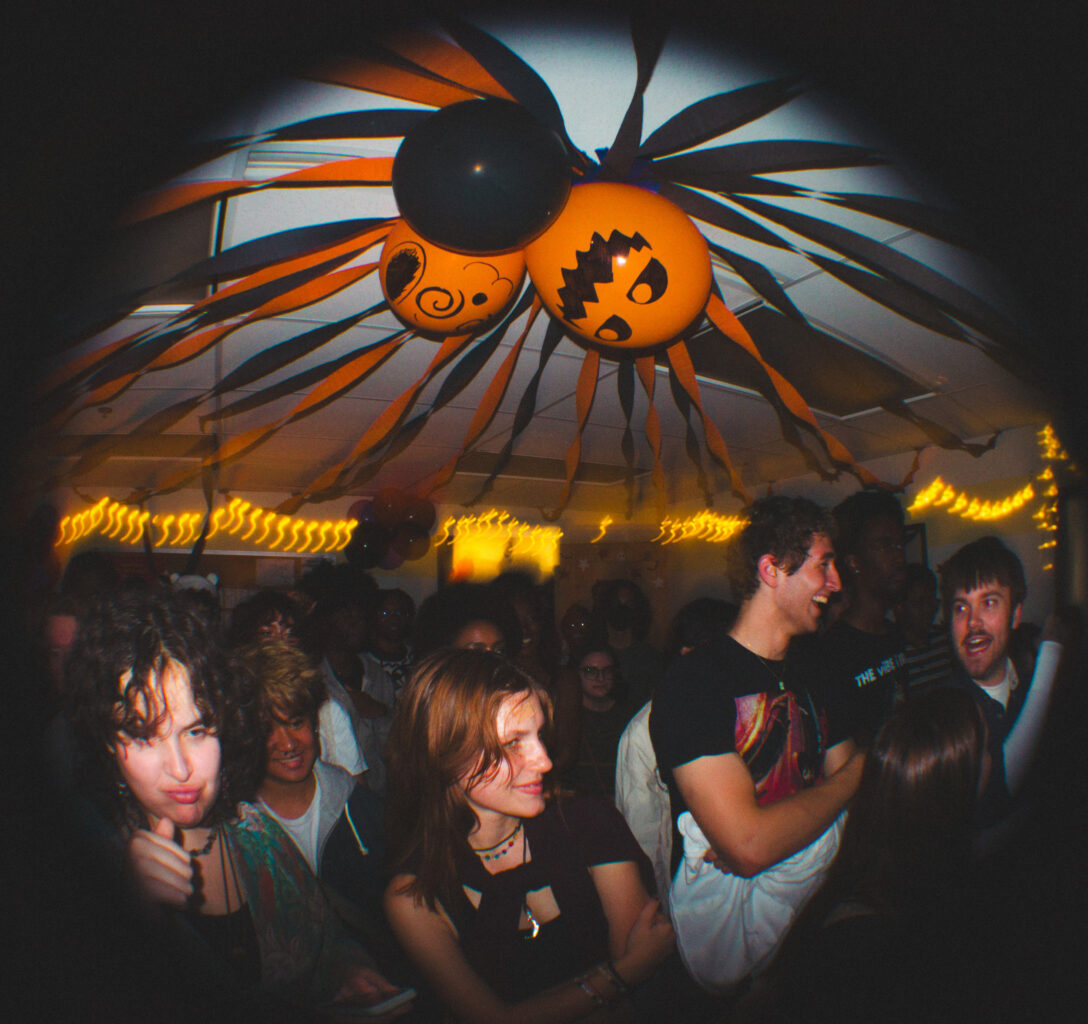
Left: NYC-based band Lyoko at The Ottobar in Baltimore at a WMBC-off campus event. Right: Audience members watch Omanti perform at WMBC’s Great Pumpkin concert in the Student Media Center. Photos by Erin Bennett ’25.
This platform has been valuable to her and has made her feel more grounded within the community. “One of the core principles of the goth community is to be involved and contribute to the subculture,” says Ibino. “Getting to do that through my show has made me feel more connected within the scene. Creating a space where people feel welcome to explore and embrace goth culture has helped me grow more confident in my identity and strengthened my connection to the broader alternative community.”
Another DJ, Daniela Salguero, a junior psychology major, has also used her show as a way to explore her cultural identity. Her show, “Luna Roja Radio,” focuses on alternative Latin American music, and she provides commentary as to what certain songs represent in a wider political context. She explains, “Every week, I pick a theme to hone in on, and I think it’s a really great way for me to just get my feelings out there and to connect more with myself.”
The media organizations have enriched campus life by helping students to get more involved with the Baltimore community. They have also served as an inclusive space for everyone.
The door to the Student Media Center is almost always open. With the station broadcast aired on the office speakers, students are there, working and socializing under the band posters and stories that dot the walls—they’re making and sharing media but they’re also continuing a legacy for the next generation of Retriever writers, editors, and DJs.
]]>
“You’re listening to WMBC, UMBC’s freeform student radio station. And you’re in the 2000s right now, thanks to the radio time machine.” Four years ago, hearing those words would have been...
https://umbc.edu/stories/wmbc-radio-station-back-on-the-air/
https://my3.my.umbc.edu/api/v0/pixel/news/150641/guest@my.umbc.edu/c03d0313743051ed0aaab9bad17e2830/api/pixel
at-play
campus-life
center-for-democracy-and-civic-life
magazine
spring-2025
story
student-life
the-retriever
wmbc
UMBC News & Magazine
https://my3.my.umbc.edu/groups/umbc-news-magazine
https://assets1-my.umbc.edu/system/shared/avatars/groups/000/001/943/24435aa6207c452e7bc15cc74b42c7bb/xsmall.png?1748556657
https://assets1-my.umbc.edu/system/shared/avatars/groups/000/001/943/24435aa6207c452e7bc15cc74b42c7bb/original.png?1748556657
https://assets2-my.umbc.edu/system/shared/avatars/groups/000/001/943/24435aa6207c452e7bc15cc74b42c7bb/xxlarge.png?1748556657
https://assets2-my.umbc.edu/system/shared/avatars/groups/000/001/943/24435aa6207c452e7bc15cc74b42c7bb/xlarge.png?1748556657
https://assets3-my.umbc.edu/system/shared/avatars/groups/000/001/943/24435aa6207c452e7bc15cc74b42c7bb/large.png?1748556657
https://assets1-my.umbc.edu/system/shared/avatars/groups/000/001/943/24435aa6207c452e7bc15cc74b42c7bb/medium.png?1748556657
https://assets2-my.umbc.edu/system/shared/avatars/groups/000/001/943/24435aa6207c452e7bc15cc74b42c7bb/small.png?1748556657
https://assets1-my.umbc.edu/system/shared/avatars/groups/000/001/943/24435aa6207c452e7bc15cc74b42c7bb/xsmall.png?1748556657
https://assets2-my.umbc.edu/system/shared/avatars/groups/000/001/943/24435aa6207c452e7bc15cc74b42c7bb/xxsmall.png?1748556657
UMBC News & Magazine
24
0
false
Thu, 12 Jun 2025 11:53:57 -0400
Thu, 12 Jun 2025 11:53:57 -0400
Special Edition

Under normal circumstances, print news like UMBC’s student newspaper The Retriever binds the campus community together. College students reach for the paper because they know their friend wrote a feature on the front page, or they spot one of their favorite professor’s research on the second page. In a world that has morphed into a socially distanced, spaced-out reality, it turns out that we’re all still yearning for community.
That was my focus as the editor-in-chief of The Retriever during the 2020 – 2021 school year. Every staff member had to make the UMBC community the priority while reporting on all sorts of serious topics. It was learning on the go. Jokes have roamed Twitter about “BC,” or before coronavirus. “BC” for The Retriever was filled with staff meetings twice a week, production meetings to roll out the paper every other week, and continuous in-person interfacing. When we were forced to scatter up and down the East Coast, our editors continued publishing online and in print. We all worked diligently to produce relevant and informative articles. The staff is filled with resilient and strong people, and I am very proud to have had the opportunity to lead them through this tumultuous time.
Newspaper life is frenetic in general, though, so I was excited to be able to connect with two editors from The Retriever’s past—Juan Carlos Ordóñez ’91, philosophy, and Alex Pyles ’09, English—to get their perspectives. Ordóñez shared his experience leading The Retriever while the paper was daily and production days were filled with all-nighters and lively conversation. Pyles described the impact of the internet and the recession on the paper. Our conversation was filled with friendly anecdotes and plenty of shared experiences even given the 32-year gap between our times of leadership. And though our challenges varied, as did our staffs, we all shared one thing in common: our love for The Retriever and our love for the UMBC community.
 DasSarma in front of the A.O.K. Library. Photo by Marlayna Demond ’11.
Where are they now?
Anjali DasSarma: Hi, everyone, I’m Anjali and I’m about to hand off the editorship at The Retriever, but I’ve been the editor in chief since last April so I had the pandemic year….I’m going to Brown University in the fall and I’m going to be studying journalism and inequity and community distrust. I majored in media communication studies. Can you tell me about your careers and how you got there?
Juan Carlos Ordóñez: I was editor of the paper in ’89 and ’90, so quite a while ago. It’s before the paper was in any sort of digital form, which is kind of interesting. After leaving UMBC, I attended law school. I went to Harvard and practiced law for about seven years in New York City, where I did commercial litigation. I got tired of the rat race. I left New York City, left the practice of law and moved back to Guatemala, where I was born. I did some freelance journalism; I volunteered in a number of community organizations; and I met my wife who was from Oregon. So, around 12 years ago, I moved to Oregon and I ended up getting a job at a think tank. We do tax and budget economic policy at the state level. And I’m the communications director, a position I’ve held ever since I got to Oregon, so it’s been over 10 years now. And I have to say that each of those steps—since I left UMBC, my experience from the paper, especially writing—has been invaluable.
Alex Pyles: I’m Alex, and I was the editor of the paper in ’08 and ’09, which was the recession year, which is not a pandemic year, so I’m not comparing the two. But I went from there, and started working in journalism immediately. I was a freelancer for the Wilmington Delaware News Journal and then I went to the University of Maryland to start my master’s degree in journalism. While I was there, I started working for patch.com as a sports editor [and later on] local editor and city editor roles with the same company. I spent a couple of years with Patch and went from there to the Maryland Daily Record where I covered the Maryland State House for two years. I then spent four years at the Baltimore Sun—two years in the sports department, two years in Metro covering as the political editor for Maryland state government in Baltimore City Hall. I left the paper in 2017 to go back to where I got my master’s degree, the Philip Merrill College of Journalism at UMD, where I was the communications director for about two years. And then I joined the faculty and now lecture in the college teaching audience engagement and digital design and editing investigative projects for the Howard Center for investigative journalism.
Deadlines and all nighters
DasSarma: It’s really helpful to see the framework of where you guys went after the paper. Now, I’d like you both to think back on some of your achievements, or things that really stuck out to you, during your time as an editor.
 Ordóñez, tutoring a school child in a 1987 issue of
 The Retriever.
Ordóñez: This may sound sort of mundane, but I don’t think we ever missed a deadline in terms of publishing the paper or getting the paper out on time. I don’t know how often the paper comes out these days, back then we were weekly.
DasSarma: Well it was bi-weekly before the pandemic and in print, and then I had to make some adjustments given that no one was on campus.
Ordóñez: I can only imagine the obstacles. I just remember we would pull all nighters. Back then we would have to lay it out by hand. We would have to cut it and lay out the whole thing on these big boards because it was a broadsheet. And I remember all nighters on weekends and we would get the paper to the printer early Monday morning and, yeah, I don’t think we ever missed a deadline. So that was kind of an achievement, I would say.
Pyles: I had been the sports editor for two years before I became the editor in 2008. And my memory is a little bit foggy, and I don’t want to take credit for something that I didn’t do, but I remember us more or less redesigning and relaunching the website sometime during my years. When I was editor of the paper we were thinking a lot more about putting more things online but we were still thinking about the website as this place where we just sort of dumped the stories that were in the paper, and we more or less just did it whenever the paper went to production.
DasSarma: I definitely built off of what you guys built, especially with digital. Obviously during the pandemic I had grand plans for cultural changes and inviting people to gather more as a group, but obviously that all disappeared when the pandemic hit. But during the summer, I worked at the Baltimore Sun as the editorial intern and then in the evenings I worked on a contingency plan for Retriever to sort of move to digital and how we would [meet as a staff]. In January the pandemic started getting wild, so we created these regularly branded social media channels to share the things that you really need now. And we publish digitally every day now. And I also created the advisory board, which has some local journalists and local media experts and then we also hired a media lawyer. I think if you’re doing good journalism you’re going to make some people angry. So I wanted to have a lawyer on our side especially as we covered some more sensitive topics.
Challenges faced
DasSarma: So that sort of segues into my next leading question, which is, what are some of the biggest challenges that you all faced? And then how did you overcome them?
Ordóñez: I was managing editor my junior year and I had sort of a fallout with the then-editor. And so I ended up leaving and then at the end of my junior year I applied to be the editor against the incumbent and I prevailed. So I came in and some people left, but I actually managed to retain most of the existing staff. But one of the challenges was that they had ordered this new machine… this massive computer. I mean, it was like three big desks put together where you would sort of type in your stories and it would sort of print out these sheets that you would actually cut out and then lay it out…I was sort of handed the keys and given the password for this brand new machine and it was like, here you go, go figure it out. And fortunately I had a brother who was very tech savvy and helped me through it.
DasSarma: Where was The Retriever located at that point? Has it always been in the University Center for you all?
Ordóñez: I mean, I don’t know if the University Center has changed since then, but we were where there was a cafeteria down below and upstairs were some administrative offices, and we were just right on the very end. And there was kind of a big open space. We had a dark room back then, I mean, that’s not something that you would need these days. So I don’t know what happened to that space.
 Pyles in front of M&T Bank Stadium in Baltimore. Photo by Marlayna Demond ’11.
Pyles: I can tell you what happened to the dark room because I was there when we took it out. It became the business office. Is it still the business office?
DasSarma: Yes it is.
Pyles: And technology is still right next door?
DasSarma: Yes.
Pyles: All right. And then production sort of down the hall to the right, if you’re walking out of one of those offices?
DasSarma: Yes. So I didn’t even get to have the editor in chief office; our ceiling fell down actually. There was water damage and some of it went into the editor in chief office. I imagine it would have been nice to have an office.
Pyles: It was pretty cool at 21 to have an office, like oh, ‘I’m an adult now with the rickety torn chair.’ So I mentioned I was editor as the recession started. In the years when I was the sports editor, the editor in chief at the time said, “My goal is that the Retriever can be independent from the university, accept no SGA funding.” We weren’t close at the time, but working toward it. And the fall of my senior year when I was the editor, there was still national advertising coming in from Verizon and large companies. And we were getting large print advertising in the newspaper and then it just dried up, just like that, it was just gone. And I remember really arguing over a $100 here and there in the budget when we went to submit the next budget to the SGA. I know the paper struggled financially for years after that. So I didn’t solve that problem, and I just got to walk away. But it was stressful and it was sad because it felt like we were moving toward independence and it was taken away.
DasSarma: Yeah. I mean, if it makes you feel any better, we’re definitely on better financial standing, I mean, guess it’s bittersweet, right? Because we’re nowhere near being independent. I don’t know Juan Carlos, if you guys ever discussed anything on those lines.
Ordóñez: Our finances were in pretty good shape. I mean, it’s kind of funny that on paper we were doing great, with a lot of advertising. As editor in chief you’re both responsible for the content and managing staff and then you’re ultimately responsible for the business end of it. So you’re handling all these responsibilities for which you were never really trained and you’re sort of learning as you go. And my strength was definitely as the news editor and then managing editor for a time, and so it was really on the content side where my strengths were. And then on the business side on paper, wow, it looks great. And then only towards the end of the year did it really dawn on me, well, we just haven’t been collecting a lot of that revenue, I mean on paper, it’s supposed to be coming in. So it was more of a shortcoming, I guess, on my end of not staying on top of it.
DasSarma: We haven’t been able to have advertising similar to Alex. People haven’t been spending money right now and especially local businesses; it would have been nice. And I think our advertising has not been our priority. The previous editor in chief trained me as much as she could but also I was inheriting a completely different world. I could go on and on about the challenges, but I also feel really lucky that my staff has been super self-sufficient. I gave them a lot of autonomy in terms of meetings. We do weekly editorial meetings on Zoom but I don’t ever really see the writers anymore. I did one general body meeting at the beginning of the year, last semester, and then one during this semester. But it doesn’t make sense to have everyone in the same room anymore because it’s kind of a waste of time for them.
Ordóñez: Yeah. It must be tough because I mean, one of the things that I remember most about the paper was sort of that social aspect of being in the same room and that sort of comradery, it’s hard to replicate it online.
DasSarma: A lot of our staff is very new and so all they know is the Zoom newsroom. But there is camaraderie. I remember we were even sitting in the newsroom when the WHO declared it a global pandemic. And we were all like, oh no, because I sort of sniffed it out early on and I had been working with administration and requesting our pandemic plan and everything and then we got sent home and the previous editor in chief had to sort of clean up. And then I took over in April and then I was like, oh no, we’re not ready for the next year. But all negatives aside, I want to hear your favorite part of the job or favorite parts.
The bright side
 Ordóñez’s headshot courtesy of the Oregon Center for Public Policy.
Ordóñez: I mentioned it already, but those all nighters that we would pull together, I still remember them really fondly because I was with some of my closest friends in college working together on a deadline so it was work but it was fun at the same time. And that’s really one of the things that I most remember from college actually and I look back fondly. I mean, the Retriever office was where we got our work done but it was also the place we would hang out between classes.
Pyles: When I was a senior the men’s basketball team went to the NCAA tournament for the first time and we covered that. I drove two sports writers and a photographer to Raleigh, North Carolina, to cover the game and the tournament and it’s a memory that I’ll never forget. There was just something about knowing that you have that place to go and to learn and to be around people who talk seriously about how to tell stories. That was really fun and I think that experience helped me realize what I wanted to do for a career.
DasSarma: I’ve always loved talking to people and journalism makes a lot of sense, for people who want to listen to other people and hear their stories. And I think one of my favorite parts is just talking to my editors. I think that they’re the most brilliant people in the world. And when I say I’m editor in chief of this paper, I think so much of this role is so managerial and delegating and talking to everyone.
Lessons learned
DasSarma: What are some lessons that you learned as editor in chief and how have you taken those with you where you’ve gone?
Pyles: I think this is where I really learned how to be a good manager, to be able to work with people and get them to work with me. I remember very early on losing my temper with a writer who had missed deadline after deadline. They happened to be a friend and I lost my temper with them and the story got filed but then we had a conversation later on and he said something that is probably pretty obvious, but I couldn’t see it in my anger. I felt betrayed—how could a friend be missing a deadline? And he said, you’re going to be able to work with people much more effectively if you don’t lose your cool. If you’re able to lead with understanding and kindness and ask more questions than make statements.
Ordóñez: I would share something similar. I think it’s sort of learning from the mistakes I made back then. As a news editor I dealt with just a few reporters; I would give them assignments and then we would talk about the edits and whatnot. But really managing a staff was a whole other ball game for which I was not trained and sort of had to figure out on my own and I made a lot of mistakes in that process. I remember not doing it well, not communicating it well at all, and that was a real learning experience for me. And then another positive experience was just learning how to stick with it. Sometimes it really seemed impossible that we were actually going to get the paper out and as a team we really pushed forward and we always got the paper out on time.
DasSarma: I feel like resiliency is something that I’ve learned in addition to understanding. I think I hold myself to extremely high standards and I learned that people have things going on in their personal lives that are outside of the newsroom, and you have to learn to be more understanding, which is just echoing what you guys are saying. And then of course resiliency and understanding people’s limitations….And responsibility, too, like learning how to stay organized for 40-something people and making sure that things get done on time. And when things go wrong, I take responsibility for everything.
Ordóñez: Well, when I look back at my time in college…without a doubt, my experience at the Retriever was by far the most enriching part of my college experience. I mean I loved my classes, I had a great time and did well. But what I learned for the paper, that practical experience and learning how to write, has carried through my whole life.
Pyles: We talked about some of it certainly, but going through the adversity, not only of the business issues, and you’re trying to think about what a budget looks like, and how to adapt to changing circumstances that are beyond your control, and how to deal with different kinds of people while still putting out a good product. And I think one of my favorite parts of the job was getting to talk to Christopher Corbett—he was faculty advisor—every week. I just loved doing that.
DasSarma: The paper really connects you to the campus, too, in a way that I think it’s totally unique. Having to keep track of everything that’s happening. I think this will probably be my favorite part about being at UMBC.
]]>
Under normal circumstances, print news like UMBC’s student newspaper The Retriever binds the campus community together. College students reach for the paper because they know their friend wrote a...
https://umbc.edu/stories/retrievereditors/
https://my3.my.umbc.edu/api/v0/pixel/news/119603/guest@my.umbc.edu/79865cde62358520838999135b09aef4/api/pixel
alumni
english
mcs
philosophy
spring-2021
the-retriever
then-and-now
UMBC News & Magazine
https://my3.my.umbc.edu/groups/umbc-news-magazine
https://assets1-my.umbc.edu/system/shared/avatars/groups/000/001/943/24435aa6207c452e7bc15cc74b42c7bb/xsmall.png?1748556657
https://assets1-my.umbc.edu/system/shared/avatars/groups/000/001/943/24435aa6207c452e7bc15cc74b42c7bb/original.png?1748556657
https://assets2-my.umbc.edu/system/shared/avatars/groups/000/001/943/24435aa6207c452e7bc15cc74b42c7bb/xxlarge.png?1748556657
https://assets2-my.umbc.edu/system/shared/avatars/groups/000/001/943/24435aa6207c452e7bc15cc74b42c7bb/xlarge.png?1748556657
https://assets3-my.umbc.edu/system/shared/avatars/groups/000/001/943/24435aa6207c452e7bc15cc74b42c7bb/large.png?1748556657
https://assets1-my.umbc.edu/system/shared/avatars/groups/000/001/943/24435aa6207c452e7bc15cc74b42c7bb/medium.png?1748556657
https://assets2-my.umbc.edu/system/shared/avatars/groups/000/001/943/24435aa6207c452e7bc15cc74b42c7bb/small.png?1748556657
https://assets1-my.umbc.edu/system/shared/avatars/groups/000/001/943/24435aa6207c452e7bc15cc74b42c7bb/xsmall.png?1748556657
https://assets2-my.umbc.edu/system/shared/avatars/groups/000/001/943/24435aa6207c452e7bc15cc74b42c7bb/xxsmall.png?1748556657
UMBC News & Magazine
0
0
false
Wed, 09 Jun 2021 18:38:00 -0400

