Biotech Buzz

UMBC at the Universities at Shady Grove finds itself uniquely situated—at home within the country’s third largest biotech hub where the demand for highly skilled workers is growing. These Retrievers are filling specialized roles after graduating with the training they need to succeed in this booming industry.
It’s an early Friday morning in the Biological Sciences and Engineering Building and nine students, working in small groups, are bustling back and forth between fume hoods and a large centrifuge. They carefully swish flasks containing cells and growth medium. The smell of sanitizing alcohol pervades the space. Neon orange test tube racks and turquoise tube caps stand out within the sterile white look of the work benches, hoods, and lab coats.
As the cells use oxygen to release energy, they produce carbon dioxide. The CO2 turns the solution yellow, indicating successful cell growth. After the experiment, students sterilize their solution with bleach for disposal; in response to the alkalinity, it blooms to a brilliant magenta. In another room, one student offers tips to her classmate on how to use a pipet more effectively, and the instructor flits between groups, answering questions as needed—but for the most part, the students operate confidently on their own.
This is a regular day in Biotechnology 303: Applied Cell Biology in UMBC’s Translational Life Science Technology (TLST) program. The program, offered by UMBC’s College of Natural and Mathematical Sciences (CNMS) exclusively at the Universities at Shady Grove (USG), a multi-institution education facility in Rockville, Maryland, is designed to offer hands-on training to prepare students for careers in the booming biotech industry in USG’s backyard.
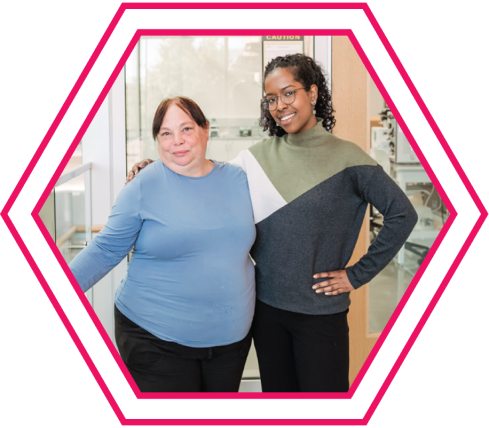
Elizabeth Friar (left) and Samantha Petros ’23 have stayed in touch since Petros graduated.
A clear direction
It was the promise of experiential work with real-world applications that drew Samantha Petros ’23 to the TLST program. “I really liked the convenience of the USG campus, and a lot of the courses were really focused on hands-on learning,” she says. Without really knowing what the work would look like before she started the program, “I was able to try out a lot of different things in a very low-stakes environment and get an idea as to what I found interesting.”
That turned out to be cell culture work. Applied Cell Biology with Elizabeth Friar, lecturer and undergraduate program director in TLST, “cemented that benchwork is what I enjoy doing,” Petros says. From then on, “There was a clearly defined arrowhead in the direction I wanted to go.”
That was a big shift from where she started, as a film major at Montgomery College (MC). A virology course to meet her science requirement turned her on to MC’s biotech associate degree, and then she transitioned to the TLST program at UMBC. After learning some basic lab techniques in TLST classes, she landed a part-time job, where she carried out entry-level manufacturing tasks for malaria vaccines. Today, Petros is thriving as a cell culture specialist studying malaria at Axle Informatics, a contractor for the National Institute of Allergy and Infectious Diseases.
The position she’s in now traditionally requires a master’s degree, which she doesn’t have—yet, anyway. “Knowing that I have valuable skill sets from TLST—working in manufacturing, getting good connections with my professors, and going to the networking events that TLST offers—all of that compounds and has got me to where I am now,” Petros says. “I genuinely believe that I wouldn’t be here if it weren’t for all of those factors, with TLST obviously being the biggest one.”
Location, location, location
TLST is a young program, but it is growing quickly. The first class—just two students—arrived in fall 2019. Friar joined in summer 2020 and began laying the groundwork for the program’s eventual growth. Today, “It’s humming along,” she says. There are currently 50 students who have declared TLST as their major. “Now we’re thinking about what we can do next. How can we expand?”
TLST is unique as the only undergraduate STEM program at UMBC without a footprint on the main campus. The location choice at USG is intentional. The Capital Biohealth Region, encompassing the District of Columbia, Virginia, and Maryland, is the third most competitive biotech hub in the country—and Montgomery County, Maryland, is the hub of the hub, boasting more than 350 life science companies and located a stone’s throw from the NIH, FDA, and National Institute of Standards and Technology (NIST). For TLST alumni, the employment options are seemingly limitless: 80 percent of American pharmaceutical companies are within a two-hour drive, and they can expect a nearly 23 percent growth rate in the biotech industry over the next 10 years—well above the national average.
As Friar puts it, “Regenxbio is down the street. MacroGenics is down the street. MilliporeSigma is opening their new lab right next door, and they’ve now hired eight of our alumni. Soon we’ll have an NIH vaccine lab right down the street. ATCC is right down the street.” All these biotech companies need qualified workers—and TLST is providing them.
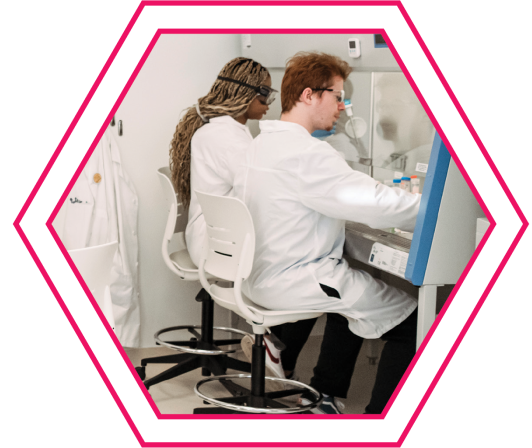
Steven Schaffer (right) and Princess Nyamali work under a biosafety cabinet in Elizabeth Friar’s Applied Cell Biology course.
Training lifetime learners
Jeff Galvin, CEO of American Gene Technologies (AGT), has hired TLST alumni and would hire more. “The TLST program seems to provide a great overview of not just biotechnology techniques,” he says, but it gives students “an understanding of the business in general. I find that UMBC students lean toward being self-motivated problem-solvers. It seems that the administration from the top all the way down promotes that idea of creating value through creative, hard work.”
Titina Sirak ’20, TLST, had a major impact at AGT. She established a brand-new laboratory certified to handle human cells from scratch, Galvin says, “And that’s not easy—there’s a lot of regulations associated with that, even economics.” While she wasn’t an expert at first, “she was able to do enough things right that the project came to life.”
Galvin emphasizes the importance of “learning how to learn,” saying, “Things are changing so fast, that it’s the folks who can adapt and become lifetime learners who are going to be the most successful.And that’s something I saw from the students coming out of TLST.”
A vision fulfilled
So far, TLST has graduated 25 students, and 94 percent of them were employed in the biotech industry within three months of walking across the Commencement stage. “We’ve had a number of really standout students who have gone on to do really great things, so I’m very excited about how it’s going,” Friar says.
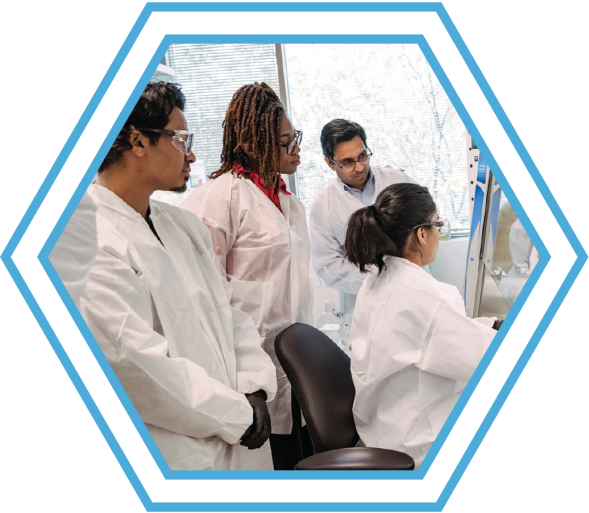
Merryll Kallungal ’24 works under a biosafety cabinet at ATCC. Interns Jason Bose (left) and Tamilore Akinde (second from left) and an ATCC lead scientist observe.
So is William R. LaCourse, CNMS dean, which offers the TLST program. He envisioned the program years before the first two students walked onto the USG campus, and it came together with input from faculty at Montgomery College and five departments at UMBC.
“TLST is an innovative and practical education that combines ‘know-what’ and ‘know-how,’” says LaCourse. “It is a highly flexible program with various pathways to serve the ever-changing needs of a growing industry. TLST is where the silos of disciplines break down and cross-disciplinary knowledge is the goal—both in content and practice.”
The program is shaping up just as LaCourse and Annica Wayman ’99, mechanical engineering, and former associate dean for Shady Grove Affairs in CNMS who led TLST’s launch, had hoped. The state of Maryland is growing its biotech hub while UMBC students are gaining the skills they need to succeed in the workplace and getting well-paying jobs, and the student population is growing.
Connections that build confidence
Just as important as high-demand lab skills, students and alumni value the relationships they’ve formed with faculty. “Every teacher I had was very supportive, very understanding, very willing to work with me,” Petros says. “I think it’s important to get your money’s worth out of college, and I definitely feel like I got that and more in TLST because of the support network that I had there and my teachers.”
Petros is still in touch periodically with Wayman and Friar. “Dr. Wayman was a shining inspiration. She’s just a wonderful person. She’s so knowledgeable and always willing to help,” Petros says. The support she has and the success she’s found now have inspired Petros to look back and help those coming up behind her. In addition to USG resources, as a student Petros attended networking events offered by BioBuzz, a community resource for biotech industry professionals and job seekers in the Capital Biohealth Region. In fact, it’s how she found her current role.
Today Petros is a BioBuzz Ambassador. “I wish I had known about BioBuzz when I first started in biotech,” she says. “Now I want to be that advocate for younger students or people who are just starting in science.”
A strong foundation
“Our students come to us because they want to make a difference in people’s lives, but they don’t necessarily want to go to medical school,” Friar says. It doesn’t hurt that “we have some really spectacular facilities that are a real draw for students,” she adds.
The Biological Sciences and Engineering Building opened at USG in fall 2019 and boasts beautiful modern laboratories and classrooms plus plenty of comfy nooks for meeting with a study group or just relaxing. TLST has also received over $1 million dollars from the National Institute for Innovation in Manufacturing Pharmaceuticals, some of which has supported further upgrades and additions to the teaching laboratories.
A flow cytometer, a machine that can detect properties of interest in up to 10,000 cells per minute, will enable a new mixed undergraduate/graduate course in flow cytometry launching next spring, for example. And equipment to practice skills like protein purification, biomanufacturing processes, and cell culture create rare opportunities for undergraduates. A required TLST course covers the wide range of instrumentation you might find in a modern biotech laboratory.
It’s normal for students to start off nervous when they use complicated and expensive equipment or work with human cells for the first time. “But by the end, they are old hands, and I think they would feel comfortable tackling anything in that lab on their own,” Friar says. “And it’s because the curriculum is really well scaffolded. We add skills as they go along, and then we repeat the old skills. The program is set up to foster growth and independence.”
Princess Nyamali stepped away from the centrifuge for a moment during Biotechnology 303 to share that the TLST coursework “is a really good foundation.” She’s currently completing an internship at NIST, and “everything I’m learning in this cell culture class is stuff I’m doing at NIST.” While it might have been daunting at first, trying so many different things across the TLST curriculum “helps you know that you want to do it,” she says, in addition to showing potential employers that you can.
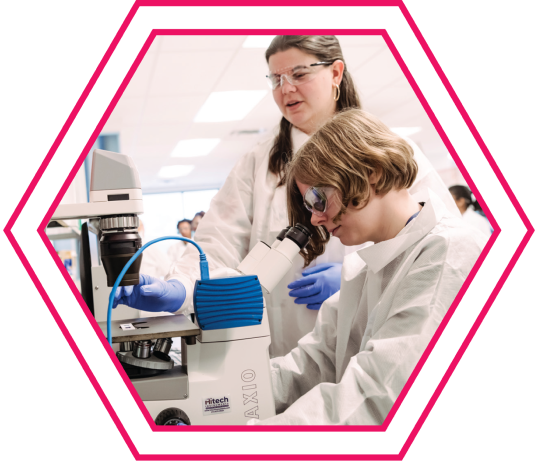
TLST student Fae Switzer works at the microscope with guidance from her mentor, Emma Todd, at ATCC.
Thinking ahead
Although the two-year program initially targeted transfers from regional community colleges, “we were getting so much interest from students on the Catonsville campus, we went ahead and put it on the list of majors for freshmen applying to UMBC,” Friar says. “That’s been the fastest growing cohort in our major.”
Steven Schaffer transferred to TLST after starting on the main campus in bioinformatics. Now he is in the bioinformatics track within TLST; the other option is a biomanufacturing track. Schaffer likes that there is a strong cohort connection because everyone takes mostly the same classes together. “I would recommend TLST. It’s a growing field and the skills you learn are very versatile,” Schaffer adds.
Schaffer hopes to eventually take on a role that leans into engineering at a place like Northrop Grumman. But before that, he’s eyeing UMBC’s Master of Professional Studies in biotechnology. The M.P.S. degree offers advanced instruction in the life sciences, plus coursework in regulatory affairs, leadership, management, and financial management. Friar describes it as “a cross between a science master’s and an M.B.A.”
Academic decathletes
Soon, the confident students in Friar’s cell biology class will arrive in labs across Montgomery County, the capital region, and beyond. They will contribute to drug discovery and production, design manufacturing processes, and, eventually, lead teams and make strategic decisions for major biotech companies.
Jeff Galvin, the ATG CEO, referred to TLST alumni as “academic decathletes.” Like decathletes, they have an array of skills and perform all of them admirably. But rather than medals, they’re seeking an opportunity to contribute to positive change through their work. They’ll translate basic science into diagnostic tests, treatments for disease, and more to improve the lives of their neighbors in Maryland and those in need around the world.
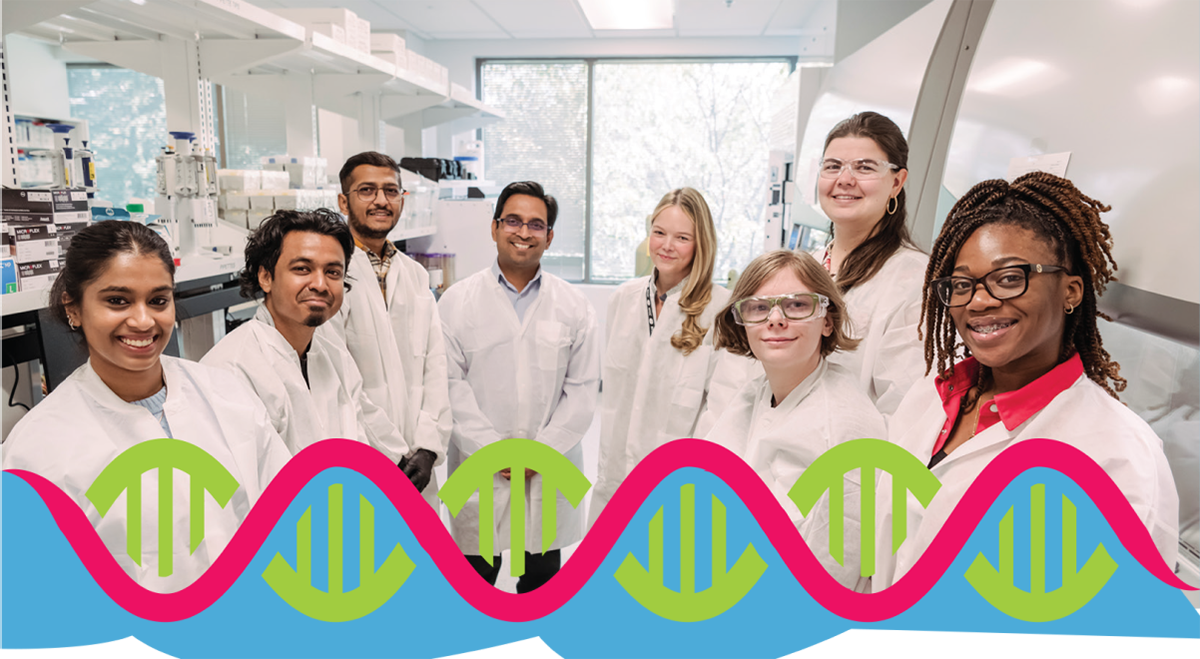
ATCC’s SPARC internship program offers opportunities for TLST students to conduct meaningful work in the biotech industry. Merryll Kallungal (far left) transitioned from her internship to a full-time role at ATCC this summer.
SPARC-ing Rewarding Careers
Just 10 minutes from USG in Gaithersburg, Maryland, biotech company ATCC has capitalized on the TLST talent pipeline. Their Student Partnership and Research Collaboration (SPARC) Program requires USG enrollment and offers qualified students paid, part-time career opportunities throughout the academic year at ATCC’s research facility. As the leading developer and supplier of authenticated cell lines, microorganisms, and associated data for academia, industry, and government, a successful internship at ATCC is a feather in the cap for students pursuing a TLST degree.
Of the seven interns selected for the SPARC program this year, four are TLST students—and they are thriving. The interns praised their SPARC experience while donning lab coats, shoe booties, safety glasses, and gloves in one of ATCC’s labs—where keeping employees safe and protecting lab samples and products from contamination is mission critical.
“I love the TLST program!” exclaimed Fae Switzer, who has wanted to pursue a career in biotech since she learned about CRISPR, the gene-editing platform, as a child. Switzer, a SPARC associate biologist in the microphysiological unit, notes that things she learned in her UMBC classes prepared her for the internship, and things she’s learning at ATCC now are helping her in her classes.
Jason Bose, a SPARC associate biologist on the microbiology team, knew he was interested in biologybut not medical school. When Bose learned about TLST, he thought, “Wow, this aligns with what I want to do,” he says. “It’s been really great so far.” He even uses the basic coding skills and tricks for Excel spreadsheets that he learned in class—which at the time he wasn’t so sure about. “Yep, I use them all the time at ATCC,” he says.
Tamilore Akinde completed an internship last summer at ATCC’s headquarters in Manassas, Virginia, and now she is a SPARC intern. “I like that TLST teaches multidisciplinary skills,” she says. Being able to pivot toward different opportunities that come her way is valuable, she adds.
“The hands-on lab training provided by the TLST program has prepared students for impactful careers at ATCC,” shares Ruth Cheng, general manager and senior vice president for research and industrial solutions at ATCC. “Witnessing students like Merryll Kallungal transition from the SPARC program to a full-time role in cryobiology R&D is a testament to the power of this collaboration.”
After interning at ATCC, Kallungal graduated from TLST in May and assumed a full-time associate biologist role in the cryobiology group in June. The lab techniques she learned in TLST came in handy at ATCC, and she has already learned a lot of new things, too. “I absolutely love what I do,” she says.

Meet Merryll Kallungal, a brand new graduate of the translational life science technology program at UMBC at the Universities at Shady Grove. In this program, students like Merryll learn hands-on skills through biotechnology labs and other applied experiences. We’re excited to hear all about her experience. Take it away, Merryll!
Q: What’s one essential thing you’d want another Retriever to know about you?
A: I majored in translational life science technology (TLST). I mainly attended the USG campus. I was part of the Peer Advisory Team. Outside of classes, I am interested in dancing, reading, and enjoying time with family.
Q: What’s the one thing you’d want someone who hasn’t joined the UMBC community to know about the support you find here?
A: All of the professors have been so wonderful in helping me with any questions i had, whether it be about classes or internship. Your advisors will always be helpful in figuring out what steps you have to take when it comes to registering for classes and also when looking for internships.
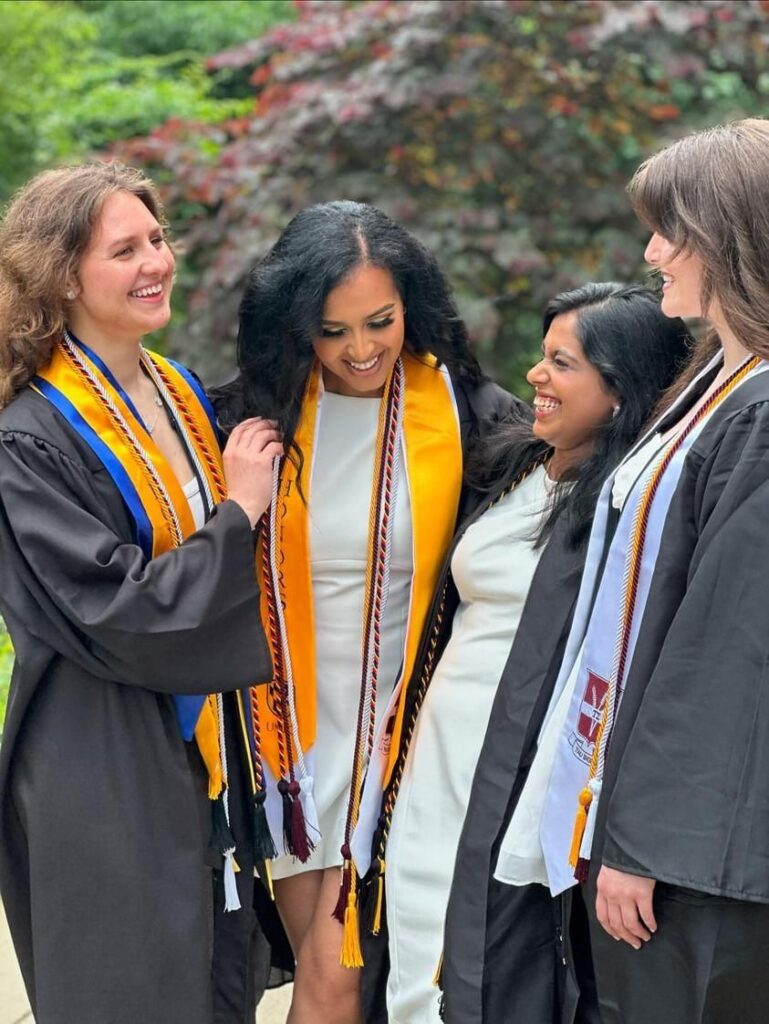 Kallungal (second from right) and classmates at UMBC-Shady Grove celebrate their recent graduation. Photo by Godwin Aizenofe ’24, translational life science technology.
Q: What did you love most about the translational life sciences program at UMBC-Shady Grove?
A: What I love about the TLST program is how close the students are with each other since we are smaller major. Also, how I was able to have that one-on-one relationship with my advisor who is also my professor.
Q: What brought you to UMBC in the first place?
A: I came to UMBC at USG because the program that I was interested was only offered at USG. Plus at USG, the smaller classes allowed me to interact with my professor and get any help I need.
Q: Were you a student leader? What did you like most about it? What advice would you give incoming students?
A: Aside from being the Vice President of the Biotech Club, I was also part of the USG student council, and both these leadership experiences have helped me immensely to become a better student and also improve my leadership skills.
Q: Where are you headed from here, now that you’ve graduated?
A: My post graduation plans are to enter the work field and join a biotech company where I was an intern for the past year, then slowly think about joining graduate school for my master’s.
* * * * *
UMBC’s greatest strength is its people. When people meet Retrievers and hear about the passion they bring, the relationships they create, the ways they support each other, and the commitment they have to inclusive excellence, they truly get a sense of our community. That’s what “Meet a Retriever” is all about.
Learn more about how UMBC can help you achieve your goals.
]]>
Meet Merryll Kallungal, a brand new graduate of the translational life science technology program at UMBC at the Universities at Shady Grove. In this program, students like Merryll learn hands-on...
https://umbc.edu/stories/merryll-kallungal-translational-life-sciences/
https://my3.my.umbc.edu/api/v0/pixel/news/142238/guest@my.umbc.edu/118e12968b4cef86b5bcd0e0f735fa8f/api/pixel
cnms
magazine
meet-a-retriever
perspectives
story
tlst
universities-at-shady-grove
UMBC News & Magazine
https://my3.my.umbc.edu/groups/umbc-news-magazine
https://assets1-my.umbc.edu/system/shared/avatars/groups/000/001/943/24435aa6207c452e7bc15cc74b42c7bb/xsmall.png?1748556657
https://assets1-my.umbc.edu/system/shared/avatars/groups/000/001/943/24435aa6207c452e7bc15cc74b42c7bb/original.png?1748556657
https://assets2-my.umbc.edu/system/shared/avatars/groups/000/001/943/24435aa6207c452e7bc15cc74b42c7bb/xxlarge.png?1748556657
https://assets2-my.umbc.edu/system/shared/avatars/groups/000/001/943/24435aa6207c452e7bc15cc74b42c7bb/xlarge.png?1748556657
https://assets3-my.umbc.edu/system/shared/avatars/groups/000/001/943/24435aa6207c452e7bc15cc74b42c7bb/large.png?1748556657
https://assets1-my.umbc.edu/system/shared/avatars/groups/000/001/943/24435aa6207c452e7bc15cc74b42c7bb/medium.png?1748556657
https://assets2-my.umbc.edu/system/shared/avatars/groups/000/001/943/24435aa6207c452e7bc15cc74b42c7bb/small.png?1748556657
https://assets1-my.umbc.edu/system/shared/avatars/groups/000/001/943/24435aa6207c452e7bc15cc74b42c7bb/xsmall.png?1748556657
https://assets2-my.umbc.edu/system/shared/avatars/groups/000/001/943/24435aa6207c452e7bc15cc74b42c7bb/xxsmall.png?1748556657
UMBC News & Magazine
1
0
false
Wed, 29 May 2024 12:11:55 -0400
Wed, 29 May 2024 12:11:55 -0400
Creating pathways for UMBC student success in Maryland’s growing biotech industry
The biotech industry—or technology-based business that harnesses the power of biology—is booming in Maryland. And with more than 3,000 biotech companies currently operating in the state (with more on the way) and an economic impact estimated at around 17 billion dollars, according to the Maryland Chamber of Commerce, there’s never been a greater demand for highly-skilled workers to fill specialized roles as researchers, biomedical engineers, and technicians.
With its presence expanding beyond the home campus in Catonsville at The Universities at Shady Grove campus in Montgomery County, a hotspot for biotech growth, and its commitment to inclusive excellence, UMBC is uniquely positioned to prepare students for fulfilling jobs in this industry, both at entry and advanced levels.
We sat down with William R. LaCourse, dean of UMBC’s College of Natural and Mathematical Sciences, and Annica Wayman ’99, mechanical engineering, associate dean for Shady Grove Affairs in the College of Natural and Mathematical Sciences, to hear more about what makes UMBC’s programs distinctive, and why it’s so important to make this type of education and training accessible to as many types of students as possible.
UMBC Magazine: Dr. Wayman, you came back to UMBC in 2018 after a career in the biotech industry, at least in part because of UMBC’s emerging work in the translational life sciences. Can you tell us about what drew you here?
Dr. Wayman: When I saw the Translational Life Science Technology (TLST) degree program that UMBC was launching at the Shady Grove site in Rockville, it got me really excited. Because for me, this space of translational science, biotech, and the ability to have a high-impact career where you can help people with their healthcare challenges, is really exciting. The other exciting piece was the interdisciplinary nature of the curriculum—how many types of work can be brought together in new ways—and so it really spoke to those things that I’ve always been interested in. Being able to train students for careers in this space is exciting to me, and I have enjoyed being a part of this community so far.
Dean LaCourse: And speaking of a community, Maryland has such a growing and vibrant biotechnology industry, and it really is all about responding to this great need in the workforce for biotechnology. It’s a tremendous opportunity for students to be trained for really good-paying jobs in the applied sciences. This is something where you can roll your sleeves up and get working.
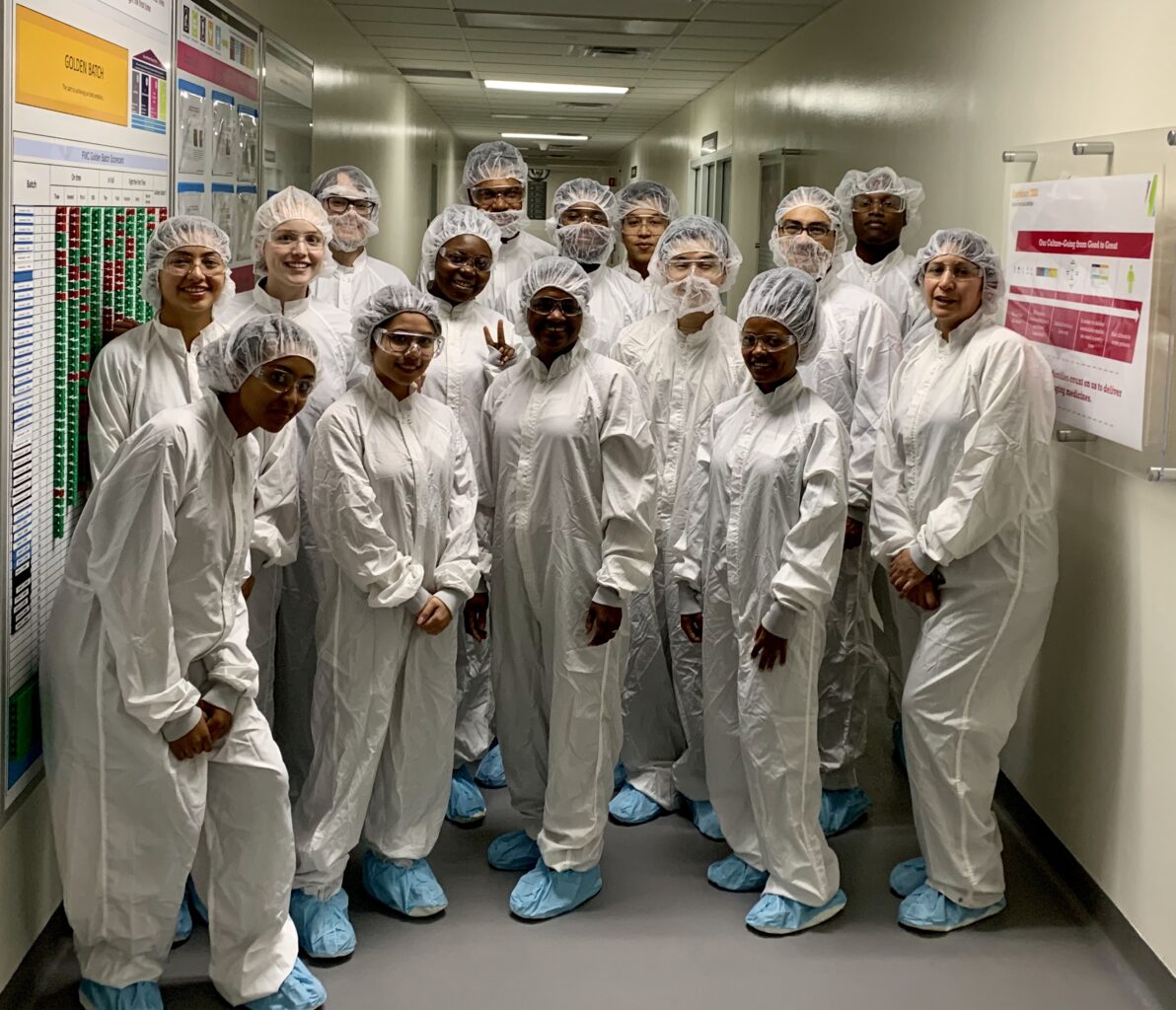 Students in UMBC’s TLST program share a moment together during a class trip to biotech company AstraZeneca. Photo courtesy of the TLST program.
UMBC Magazine: So, what does the journey look like for a student interested in this sort of work?
Dr. Wayman: The idea is to train students for critical jobs that are needed in the biotechnology industry primarily in the private sector at companies like AstraZeneca, Catalent or Kite Pharma. About 70 percent of our students in the TLST bachelor of science degree program come to us after getting their associate’s degree from Montgomery College. We’re seeing a big workforce gap in a number of areas, including cell and gene therapy. So we have this program that increases the pipeline but also trains students in an interdisciplinary way. Students are not just getting the biology, biochemistry, and chemistry. They get bioinformatics, but they also get engineering classes, so biochemical engineering and biomanufacturing. We have a lot of faculty members who are from the industry teaching these courses on a part-time basis, and a lot of guest lecturers from companies who can share what, for example, bioprocess design really looks like in the field and how highly regulated the environment is. And so students really get the skills that they need to hit the ground running in the industry. It really is exciting to see students get all of this out of one degree.
Dean LaCourse: We’re also thinking a lot about the continuum of education. So we have the undergraduate TLST program and then, after students get some work experience and want to build into more of a managerial or technical leadership track, they can come and do the professional master’s in biotechnology to get those leadership and technical skills. I love how UMBC is thinking about this continuum of education where people can come on and off as they see fit, for certain skills or knowledge that they need to gain and move their careers forward.
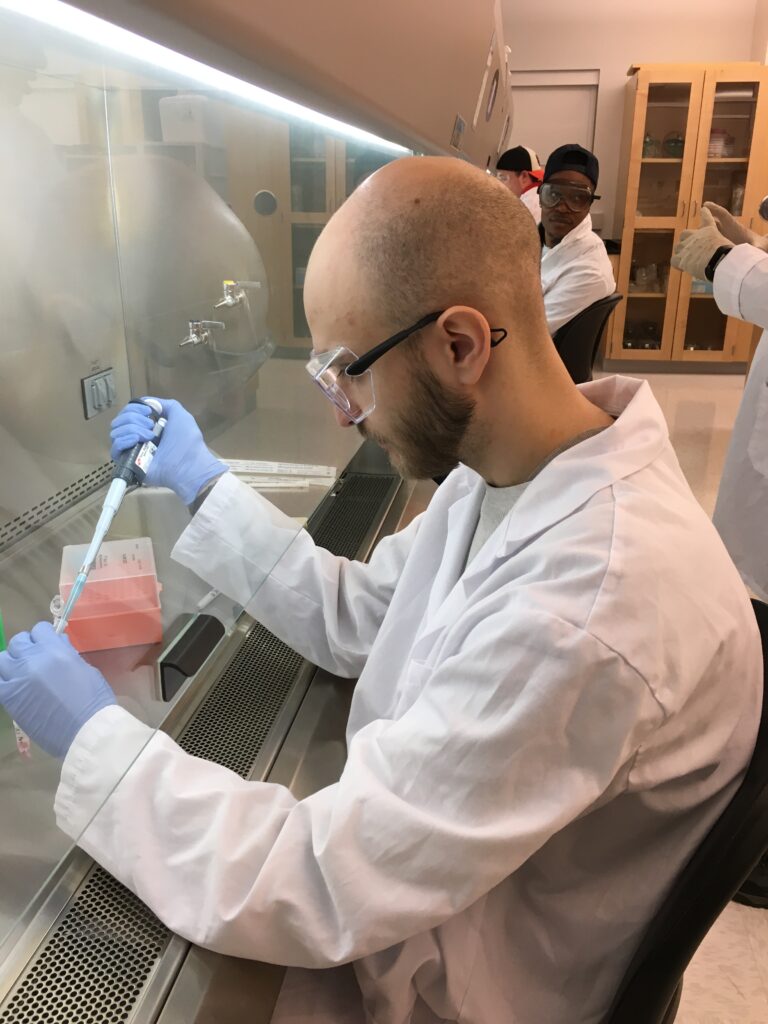 A TLST student in a lab class. Photo courtesy of the TLST program.
UMBC Magazine: Why is it so important to you to make this education accessible to students of all backgrounds? And why is it so important for the industry itself?
Dr. Wayman: These are well-paying jobs with high earning potential where you can leverage your scientific interest and skill to have enormous societal impact. Our TLST and MPS Biotech students are contributing to life-saving solutions. Some students may think that being a doctor or nurse is the only pathway if they are good in science, but these biotech jobs are other possibilities where you’re enabling thousands of doctors and nurses in helping patients – and impacting even more lives. And it’s important that those who work on these life-saving solutions come from diverse backgrounds to bring unique perspectives that reflect the diverse populations being served.
Dean LaCourse: That’s why we create our education systems for everyone. You’re admitted to UMBC, so we owe you the best education possible. No matter what path you took to get here, what disadvantages you have. And that’s why we emphasize professional advising, mentorship, applied learning experiences, compassion, and fairness. Inclusive excellence is what we’re all about.
Learn more about UMBC’s TLST program, the M.P.S. in Biotechnology, and other exciting pathways here.
You know why your goals matter, and UMBC knows how to get you there. Apply to UMBC today!
]]>
The biotech industry—or technology-based business that harnesses the power of biology—is booming in Maryland. And with more than 3,000 biotech companies currently operating in the state (with more...
https://umbc.edu/stories/creating-paths-for-success-in-biotech-industry/
https://my3.my.umbc.edu/api/v0/pixel/news/131452/guest@my.umbc.edu/224e519bce5968adc371b9092310fae8/api/pixel
cnms
discovery
magazine
tlst
universities-at-shady-grove
UMBC News & Magazine
https://my3.my.umbc.edu/groups/umbc-news-magazine
https://assets1-my.umbc.edu/system/shared/avatars/groups/000/001/943/24435aa6207c452e7bc15cc74b42c7bb/xsmall.png?1748556657
https://assets1-my.umbc.edu/system/shared/avatars/groups/000/001/943/24435aa6207c452e7bc15cc74b42c7bb/original.png?1748556657
https://assets2-my.umbc.edu/system/shared/avatars/groups/000/001/943/24435aa6207c452e7bc15cc74b42c7bb/xxlarge.png?1748556657
https://assets2-my.umbc.edu/system/shared/avatars/groups/000/001/943/24435aa6207c452e7bc15cc74b42c7bb/xlarge.png?1748556657
https://assets3-my.umbc.edu/system/shared/avatars/groups/000/001/943/24435aa6207c452e7bc15cc74b42c7bb/large.png?1748556657
https://assets1-my.umbc.edu/system/shared/avatars/groups/000/001/943/24435aa6207c452e7bc15cc74b42c7bb/medium.png?1748556657
https://assets2-my.umbc.edu/system/shared/avatars/groups/000/001/943/24435aa6207c452e7bc15cc74b42c7bb/small.png?1748556657
https://assets1-my.umbc.edu/system/shared/avatars/groups/000/001/943/24435aa6207c452e7bc15cc74b42c7bb/xsmall.png?1748556657
https://assets2-my.umbc.edu/system/shared/avatars/groups/000/001/943/24435aa6207c452e7bc15cc74b42c7bb/xxsmall.png?1748556657
UMBC News & Magazine
0
0
false
Thu, 02 Mar 2023 14:25:46 -0500
Thu, 02 Mar 2023 14:25:46 -0500
UMBC continues to advance Maryland’s biotech workforce through $900K biomanufacturing grant
UMBC has received a $900,000 grant from the National Institute for Innovation in Manufacturing Biopharmaceuticals (NIIMBL) to develop and implement a new, short-term biomanufacturing training program. Four universities, all classified as minority-serving institutions (MSIs), received funding for similar programs, designed to meet critical national workforce needs.
UMBC will offer the biomanufacturing training program at its Universities at Shady Grove (USG) campus in Rockville, Maryland. The program will be adapted from a curriculum first developed at Texas A&M University. Annica Wayman ’99, M6, mechanical engineering, associate dean for Shady Grove affairs in CNMS, and co-lead Manik Ghosh, assistant director of the Translational Life Science Technology (TLST) laboratories at UMBC, will travel to Texas for training on the curriculum and will then work together to adapt it for UMBC. The anticipated training launch is late summer or fall 2023.
“This new program is really the next wave of UMBC expanding our training offerings,” Wayman says. “This kind of short-term programming could enhance our courses as well, to help with educating people in biomanufacturing and strengthening that workforce where there’s a huge gap.”
 Charmaine Hipolito ’20, and Titina Sirak ’20, right, alumni of UMBC’s TLST program at The Universities at Shady Grove, speak with visitors at a celebration for the opening of USG’s new Biomedical Sciences and Engineering Building in November 2019. Photo by Marlayna Demond ’11 for UMBC.
Snowball effect
The gap between supply and demand for skilled workers in biotech is very real, and it’s only growing in the BioHealth Capital Region. This region, which includes Maryland, Washington D.C., and Virginia, ranks #4 among the top biopharma clusters in the country. The pandemic has further expanded the biopharma industry, so the need for qualified local workers in a range of biotech roles has never been greater.
The new biomanufacturing program is a natural outgrowth of previous work by Wayman, Ghosh, and colleagues. The structure of the program will be similar to UMBC’s award-winning Biotech Boot Camp, which trained people who had lost their jobs during the pandemic for new careers in biotech. The boot camp has run twice so far, both times focusing on cell culture techniques and broader “wet lab” skills. Both times, the Montgomery County government and WorkSource Montgomery partnered with UMBC to offer the boot camps at no cost to the students.
The original boot camp was made possible by UMBC’s TLST bachelor’s degree program, fully launched in 2019 in partnership with Montgomery College. TLST was the college’s first new major developed in response to the growing need for biotech workforce development in the region. The TLST program bridges fundamental knowledge in the life sciences with industry-specific applications, practical laboratory skills, and an understanding of the regulatory process for biopharmaceuticals.
“The launch of the TLST program has led to a lot of education and partnership opportunities,” Wayman says. “It’s allowed UMBC to address gaps in the workforce that already existed, and that became even more prominent with the pandemic. We jumped in to help to fill those gaps in a variety of ways. TLST was the impetus and the start of that, and it snowballed from there.”

Associate Dean for Shady Grove Affairs Annica Wayman. Photo by Marlayna Demond ’11 for UMBC.
Short program, lasting impact
Even a short-term training program can have a huge impact on an individual’s career trajectory. A general biomanufacturing program could be the start of a career in fields as diverse as bench research, regulatory affairs, and biomanufacturing process design. These careers work toward answering big questions like, “How do we know this product is safe for use in the human body?” or, “How can we make this sequence of steps more efficient by taking advantage of new technologies?”
Roles in all these areas will be important to fill in the near future, and continuously asking the big questions as technologies emerge, regulations shift, and new scientific knowledge comes to light will help move the industry forward safely and reliably, Wayman notes. Programs like the new biomanufacturing training, the biotech boot camp, TLST, and more at UMBC have the potential to send thousands of well-prepared students into the biotech workforce.

A participant in the Biotech Boot Camp at USG in February 2021. Photo by Annica Wayman.
Looking ahead
Antonio Moreira, vice provost for academic affairs, has seen the potential for Maryland to be a biotechnology leader for years, and has championed UMBC’s efforts to grow opportunities in related fields. “As a component of the Maryland biotechnology ecosystem, UMBC is a major resource for preparing the workforce needed to develop and manufacture critical therapies,” Moreira explains. “Given a shortage in this workforce, graduating students need to be prepared to hit the ground running as they join these biotechnology companies.”
Bill LaCourse, dean of the College of Natural and Mathematical Sciences (CNMS) at UMBC, agrees. “At UMBC, we are driven by the vision that Maryland will continue to grow as a leader in biotech,” he says. “We’re establishing strong pathways to develop the workforce, where students and professionals have an array of choices about how to get to the biotech career they want and that the region needs.”
Wayman leads much of the day-to-day operations of UMBC’s biotech programs. Even while planning next steps, she tries to remind herself how much progress she and her team have already made toward narrowing the workforce gap and setting a new group of students on a path to success.
“When I take a step back, I see how amazing it is that we achieved all this through a pandemic,” she says. And then she, too, looks forward. “But there’s just so much more to do.”
This article describes work performed under a Project Award Agreement from the National Institute for Innovation in Manufacturing Biopharmaceuticals (NIIMBL) and financial assistance award 70NANB21H085 from the U.S. Department of Commerce, National Institute of Standards and Technology.
Header image: The Biomedical Sciences and Engineering Building at The Universities at Shady Grove. TLST courses, the Biotech Boot Camp, and the new biomanufacturing training program all happen here. Photo by Marlayna Demond ’11 for UMBC.
]]>
UMBC has received a $900,000 grant from the National Institute for Innovation in Manufacturing Biopharmaceuticals (NIIMBL) to develop and implement a new, short-term biomanufacturing training...
https://umbc.edu/stories/meet-umbc-people-14/
https://my3.my.umbc.edu/api/v0/pixel/news/119487/guest@my.umbc.edu/46b9bf4a716948e3434505092d495905/api/pixel
cnms
page1
science-and-technology
shadygrove
tlst
UMBC News & Magazine
https://my3.my.umbc.edu/groups/umbc-news-magazine
https://assets1-my.umbc.edu/system/shared/avatars/groups/000/001/943/24435aa6207c452e7bc15cc74b42c7bb/xsmall.png?1748556657
https://assets1-my.umbc.edu/system/shared/avatars/groups/000/001/943/24435aa6207c452e7bc15cc74b42c7bb/original.png?1748556657
https://assets2-my.umbc.edu/system/shared/avatars/groups/000/001/943/24435aa6207c452e7bc15cc74b42c7bb/xxlarge.png?1748556657
https://assets2-my.umbc.edu/system/shared/avatars/groups/000/001/943/24435aa6207c452e7bc15cc74b42c7bb/xlarge.png?1748556657
https://assets3-my.umbc.edu/system/shared/avatars/groups/000/001/943/24435aa6207c452e7bc15cc74b42c7bb/large.png?1748556657
https://assets1-my.umbc.edu/system/shared/avatars/groups/000/001/943/24435aa6207c452e7bc15cc74b42c7bb/medium.png?1748556657
https://assets2-my.umbc.edu/system/shared/avatars/groups/000/001/943/24435aa6207c452e7bc15cc74b42c7bb/small.png?1748556657
https://assets1-my.umbc.edu/system/shared/avatars/groups/000/001/943/24435aa6207c452e7bc15cc74b42c7bb/xsmall.png?1748556657
https://assets2-my.umbc.edu/system/shared/avatars/groups/000/001/943/24435aa6207c452e7bc15cc74b42c7bb/xxsmall.png?1748556657
UMBC News & Magazine
0
0
false
Wed, 19 Jan 2022 20:01:42 -0500
UMBC continues to advance biotech in Maryland through new $900K biomanufacturing grant
A growing list of programs and partnerships is positioning UMBC as a leader in developing Maryland’s biotech and biomanufacturing workforce. UMBC has just received a $900,000 grant from the National Institute for Innovation in Manufacturing Biopharmaceuticals (NIIMBL) to develop and implement a short-term biomanufacturing career training program. Four universities, all classified as minority-serving institutions (MSIs), received funding for similar programs, which will be adapted from a curriculum first developed at Texas A&M University.
UMBC will offer the biomanufacturing training program at its Universities at Shady Grove (USG) campus in Rockville, Maryland. It will be similar to UMBC’s Biotech Boot Camp, which trained people who had lost their jobs during the pandemic for new careers in biotech. The boot camp has run twice so far, both times focusing on cell culture techniques and broader “wet lab” skills.
Montgomery County government and WorkSource Montgomery partnered with UMBC to offer the original boot camps at no cost to the students. The new biomanufacturing training program will also be free to participants the first time it is offered, thanks to the support from NIIMBL.
The biotech industry is booming in the BioHealth Capital Region, which ranks #4 among the top biopharma clusters in the country. The pandemic has drawn even more attention to the biopharma industry, so the need for qualified local workers in a range of biotech roles has never been greater.
“We are driven by the vision that Maryland can be a leader in biotech,” says Bill LaCourse, dean of the College of Natural and Mathematical Sciences (CNMS) at UMBC. “We’re establishing strong pathways to develop the workforce, where students and professionals have an array of choices about how to get to the biotech career they want and that the region needs.”
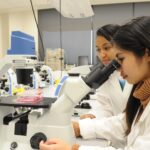
A participant in the Biotech Boot Camp at USG in February 2021 practices their pipetting technique. Photo by Annica Wayman.
Opportunities at every level
The new NIIMBL program is just one of those choices. UMBC’s Translational Life Science Technology (TLST) bachelor’s degree program, fully launched in 2019 in partnership with Montgomery College, was the college’s first new major developed in response to the growing need for biotech workforce development in the region. The TLST program bridges fundamental knowledge in the life sciences with industry-specific applications, practical laboratory skills, and an understanding of the regulatory process for biopharmaceuticals.
“The launch of the TLST program has led to a lot of education and partnership opportunities,” says Annica Wayman ’99, M6, mechanical engineering, and associate dean for Shady Grove affairs in CNMS. “It’s allowed UMBC to address gaps in the workforce that already existed, and that became even more prominent with the pandemic. We jumped in to help to fill those gaps in a variety of ways.”
The TLST program, which has just launched a bioinformatics track, dovetails with the Master of Professional Studies in Biotechnology, also offered at USG. The master’s program is ideal for both recent TLST program graduates and professionals already in biotech seeking to advance their careers.
“We’re trying to build the education pathway that runs in parallel with the career pathways for students in biotech,” Wayman says.

Participants in the Biotech Boot Camp at USG, Feb 2021. Photo by Annica Wayman.
Engaging with industry
UMBC has also cultivated a growing number of partnerships with individuals, industry, government agencies, and regional community colleges that strengthen its offerings. A Biotechnology Advisory Committee includes representatives from companies such as Kite Pharma, Catalent, AstraZeneca, and American Gene Technologies, all of which have facilities in the region. Agencies like the National Institutes of Health (NIH) and National Institute of Standards and Technology (NIST) are also on the committee.
“They’re helping us to refine our curriculum to make sure we’re educating students on the things that industry needs,” Wayman says. “They’re also helping us determine what other gaps we could fill.”
For example, another huge growth area is biomanufacturing process development. With increasing automation and the need for large-scale production of some biopharmaceutical products, there are opportunities to improve the way biomanufacturing facilities operate.
UMBC’s biotech curricula often directly touch industry, as well. TLST courses regularly include guest lecturers from regional companies, and students must complete an internship in order to graduate. TLST classes have also included interviewing support and networking sessions with potential employers, such as members of the Frederick Innovative Technology Center, Inc.
 (l to r): Annica Wayman, Antonio Moreira, Keith Bowman, Bill LaCourse. Photo by Marlayna Demond ’11 for UMBC at the grand opening of the BSE building at USG.
Productive partnerships
UMBC’s new partnership with Aberdeen Proving Ground (APG), the U.S. Army facility near Aberdeen, Maryland, will further enhance opportunities for students across the region. APG has built a robust relationship with Harford Community College, while UMBC already has a thriving relationship with Montgomery College and has been deepening its relationship with Frederick Community College. The new APG partnership, still in its early stages, will create opportunities to enhance UMBC’s relationship with Harford Community College, as well.
“We’ve now built this education partnership alliance with Aberdeen Proving Ground, because we’re looking to provide a pathway for these students through their biotech career,” Wayman says. “They can go from Harford Community College to the TLST program, and have Aberdeen be that partner running throughout who provides experiential opportunities and eventually jobs for these students.”

UMBC’s Interdisciplinary Life Sciences Building offers state-of-the-art spaces for research and teaching. Photo by Marlayna Demond ’11 for UMBC.
An economic engine
Antonio Moreira, vice provost for academic affairs, has seen the potential for Maryland to be a biotechnology leader for years, with UMBC as a major driver of growth. Maryland’s strength “is the result of a life sciences ecosystem that includes federal agencies, major research universities, hundreds of biotechnology companies and strong community colleges,” he says. While this growth has been in process for some time, he notes that the pandemic has brought the need for a robust biotech sector into sharp relief.
“As a component of the Maryland biotechnology ecosystem, UMBC is a major resource for preparing the workforce needed to develop and manufacture critical therapies,” Moreira explains. Given a shortage in this workforce, “the students graduating from the universities need to be prepared to hit the ground running as they join these biotechnology companies.”
The innovative partnerships UMBC is developing with industry, government, and community colleges are creating opportunities for students to gain the complex skills needed to contribute to the growing biotech industry and to pursue careers in high-demand fields. “All these projects, programs, and partnerships are helping fulfill the mission of UMBC as an economic engine and source of workforce development in the state,” Dean LaCourse says.
“We are implementing our shared vision to build a workforce for the biotech industry right here, with the people in Maryland,” LaCourse continues. “We want Maryland businesses to look out their windows to find that workforce that they need—and it’s looking good.”
Header image: Charmaine Hipolito ’20 (right) and Titina Sirak ’20, both graduates of the TLST program, use the microscopes in a teaching lab at the Universities at Shady Grove in 2019. Photo by Marlayna Demond ’11 for UMBC.
]]>
A growing list of programs and partnerships is positioning UMBC as a leader in developing Maryland’s biotech and biomanufacturing workforce. UMBC has just received a $900,000 grant from the...
https://umbc.edu/stories/umbc-continues-to-advance-biotech-in-maryland-through-new-900k-biomanufacturing-grant/
https://my3.my.umbc.edu/api/v0/pixel/news/119518/guest@my.umbc.edu/9f9eedd07c0f342a8ed6967aac0ff235/api/pixel
cnms
science-and-technology
shadygrove
tlst
UMBC News & Magazine
https://my3.my.umbc.edu/groups/umbc-news-magazine
https://assets1-my.umbc.edu/system/shared/avatars/groups/000/001/943/24435aa6207c452e7bc15cc74b42c7bb/xsmall.png?1748556657
https://assets1-my.umbc.edu/system/shared/avatars/groups/000/001/943/24435aa6207c452e7bc15cc74b42c7bb/original.png?1748556657
https://assets2-my.umbc.edu/system/shared/avatars/groups/000/001/943/24435aa6207c452e7bc15cc74b42c7bb/xxlarge.png?1748556657
https://assets2-my.umbc.edu/system/shared/avatars/groups/000/001/943/24435aa6207c452e7bc15cc74b42c7bb/xlarge.png?1748556657
https://assets3-my.umbc.edu/system/shared/avatars/groups/000/001/943/24435aa6207c452e7bc15cc74b42c7bb/large.png?1748556657
https://assets1-my.umbc.edu/system/shared/avatars/groups/000/001/943/24435aa6207c452e7bc15cc74b42c7bb/medium.png?1748556657
https://assets2-my.umbc.edu/system/shared/avatars/groups/000/001/943/24435aa6207c452e7bc15cc74b42c7bb/small.png?1748556657
https://assets1-my.umbc.edu/system/shared/avatars/groups/000/001/943/24435aa6207c452e7bc15cc74b42c7bb/xsmall.png?1748556657
https://assets2-my.umbc.edu/system/shared/avatars/groups/000/001/943/24435aa6207c452e7bc15cc74b42c7bb/xxsmall.png?1748556657
UMBC News & Magazine
0
0
false
Tue, 23 Nov 2021 19:07:49 -0500
UMBC launches Biotech Boot Camp to train workers displaced by COVID-19 for in-demand jobs

This month, 11 Montgomery County residents completed a pilot Biotech Boot Camp offered by UMBC at the Universities at Shady Grove and Montgomery College. The participants were all people who had recently become unemployed or underemployed due to the pandemic. After four weeks of intensive, hands-on training in basic biotech techniques, they are now qualified to apply for in-demand, entry-level roles in the biotech industry.
While some industries have experienced significant setbacks and lost jobs during the pandemic, the biotech industry has seen explosive growth. Hundreds of biotech companies in the region are struggling to fill critical roles with qualified workers. The new program seeks to address this mismatch between available workers and available jobs.
A participant in the Biotech Boot Camp practices his skills at a fume hood. Photo by Elizabeth Friar.
UMBC and Montgomery College partnered with WorkSource Montgomery to identify eligible participants for a skills-based introductory training course. With the support of the Montgomery County government, the experience was tuition-free for participants.
Setting people up to succeed in well-paying new jobs and simultaneously filling the gap in the biotech workforce “is a win-win that we’re really excited to be a part of,” says Annica Wayman ‘99, M6, mechanical engineering. Wayman serves as associate dean for Shady Grove Affairs in UMBC’s College of Natural and Mathematical Sciences.
Leveraging skills
Some of the participants came to the program from lengthy careers in other fields, from sales to transportation. “We’re looking for ways to tie what they used to do to biotech, now that they have these new lab skills,” Wayman says. “We’re trying our best to be matchmakers—we’re racing to do that now.”
Manik Ghosh, assistant director of the Translational Life Science Technology degree program laboratories at UMBC-Shady Grove, is the lead instructor for the boot camp. He is confident that the training he designed will set participants up for success. “If they get interviewed, and they get an opportunity to join a company, we are 100 percent sure that they are capable of entry-level work,” he says.
 A participant in the Biotech Boot Camp loads samples into an incubator. Photo by Elizabeth Friar.
Because they already have extensive work experience, some of the participants may quickly ascend into mid-level positions. These roles can be especially difficult for companies to fill because of a pipeline gap.
“Leveraging their prior skills could be a great way for them to build mid-level careers in biotech very quickly,” Wayman says. A few have also already expressed interest in UMBC’s Master of Professional Studies in Biotechnology, which would help them rise even faster.
Seizing opportunity
When he heard about the project, “I got so excited!” recalls Ghosh, who also teaches courses on cancer biotechnology and biochemistry. His enthusiasm is impossible to ignore; his laughter and smile come easily as he recalls the experience of planning the boot camp and implementing it with the students. He described the planning group, including Wayman; Elizabeth Friar, TLST program director; and himself, as a “dream team.”
Offering the boot camp in person was challenging during the pandemic, though, with everyone masked, gloved, and maintaining social distance. “It’s a very dynamic and challenging environment,” Ghosh says. But at the same time, “This was a great opportunity for us, because this is a pilot program. We got a lot of great experience for if we run another boot camp, so we can change accordingly.”
Seated at a safe social distance, participants in the Biotech Boot Camp use microscopes to observe their samples. Photo by Gabrielle Miller
Optimism in a challenging time
On top of generating a blueprint for future programs, developing the students’ lab skills, and supplying local businesses with qualified talent, the boot camp offered something even more valuable to the participants: confidence and optimism.
“It’s been amazing,” Ghosh says. “The first day, when they joined the boot camp, they looked nervous because they didn’t know anything about biotech. But as time passed, we saw a significant change in their confidence level.”
For the participants who identify with groups underrepresented in STEM, Wayman has been an inspiring presence. “Just me being an African American woman in the sciences has been encouraging for them to know that there are people like them succeeding in this high tech industry, so they can do it, too,” she says.
Wayman has also been working with the students on their resumes and supporting them through personal challenges. “It’s been amazing to make these personal connections in such a short period of time.”
Kevin Wiglesworth came to the program from a long career in sales. Now he’s excited to blaze a new path. “The most exciting thing about camp was taking something I had no experience with and feeling confident in those skills when the camp was over. It proved to me I still have the ability to pursue a new career,” he shared in a note to Ghosh after the program concluded. “Thank you again for all the work you put into teaching a newbie like me. I’ll never forget that.”
Working with students like Wiglesworth “is a great feeling, because I know we worked very hard, and they worked very hard with us,” Ghosh says. “This is a very challenging time, and at the end of the day, we are very satisfied in our hearts because we helped the people who needed it.”
Banner image: The exterior of the Biomedical Sciences and Engineering Building at The Universities at Shady Grove. Dedicated in 2019, the building contains the labs where the Biotech Boot Camp took place. Photo courtesy of USG.
]]>
This month, 11 Montgomery County residents completed a pilot Biotech Boot Camp offered by UMBC at the Universities at Shady Grove and Montgomery College. The participants were all people who had...
https://umbc.edu/stories/umbc-launches-biotech-boot-camp-to-train-workers-displaced-by-covid-19-for-in-demand-jobs/
https://my3.my.umbc.edu/api/v0/pixel/news/119680/guest@my.umbc.edu/7d4dd171bb76413c6430643bd1b85cbf/api/pixel
cnms
science-and-technology
shadygrove
tlst
UMBC News & Magazine
https://my3.my.umbc.edu/groups/umbc-news-magazine
https://assets1-my.umbc.edu/system/shared/avatars/groups/000/001/943/24435aa6207c452e7bc15cc74b42c7bb/xsmall.png?1748556657
https://assets1-my.umbc.edu/system/shared/avatars/groups/000/001/943/24435aa6207c452e7bc15cc74b42c7bb/original.png?1748556657
https://assets2-my.umbc.edu/system/shared/avatars/groups/000/001/943/24435aa6207c452e7bc15cc74b42c7bb/xxlarge.png?1748556657
https://assets2-my.umbc.edu/system/shared/avatars/groups/000/001/943/24435aa6207c452e7bc15cc74b42c7bb/xlarge.png?1748556657
https://assets3-my.umbc.edu/system/shared/avatars/groups/000/001/943/24435aa6207c452e7bc15cc74b42c7bb/large.png?1748556657
https://assets1-my.umbc.edu/system/shared/avatars/groups/000/001/943/24435aa6207c452e7bc15cc74b42c7bb/medium.png?1748556657
https://assets2-my.umbc.edu/system/shared/avatars/groups/000/001/943/24435aa6207c452e7bc15cc74b42c7bb/small.png?1748556657
https://assets1-my.umbc.edu/system/shared/avatars/groups/000/001/943/24435aa6207c452e7bc15cc74b42c7bb/xsmall.png?1748556657
https://assets2-my.umbc.edu/system/shared/avatars/groups/000/001/943/24435aa6207c452e7bc15cc74b42c7bb/xxsmall.png?1748556657
UMBC News & Magazine
0
0
false
Fri, 26 Feb 2021 02:10:08 -0500
UMBC’s Translational Life Science Technology program wins Workforce Champion of the Year

UMBC’s newest undergraduate degree, the bachelor of science in Translational Life Science Technology (TLST), has received the inaugural BioBuzz Workforce Champion of the Year award for its contributions to enhancing the regional biotech workforce.
Bill LaCourse, dean of the College of Natural and Mathematical Sciences, envisioned the program as a way to both support students and help fill a workforce gap in the region’s bustling biotech industry. In fall 2018, the college hired Annica Wayman ’99, M6, mechanical engineering, as associate dean for Shady Grove affairs to oversee implementation of the program. The TLST program, a partnership with Montgomery College, enrolled its first students in fall 2019, and its first graduates will earn their degrees this week.
“It was important to me to implement this program because it is innovative and impactful,” Wayman says. “A multidisciplinary curriculum that includes cell biology, bioinformatics, bioprocess design and control, and epidemiology…more accurately reflects what the drug discovery and development process in the industry looks like. It also helps to build more critical thinkers that have an intellectual curiosity.”
 Left to right: Jackelyn Flores ’21, Charmaine Hipolito ’20, and Titina Sirak ’20 are some of the first participants in UMBC’s Translational Life Science Technology program. Photo by USG.
Ready for biotech careers
In addition to establishing the TLST program, Wayman and her team have re-launched UMBC’s master’s degree in biotechnology management at The Universities at Shady Grove (USG) campus in Montgomery County. Graduates of both programs are prepared to enter a range of well-paying roles in the local biotech industry.
“UMBC’s TLST degree uniquely prepares students for the many jobs in the growing biotechnology industry where medical products are made,” Wayman writes in a USG blog post. “Among the 300-plus biotech companies in Montgomery County, there will be hundreds of jobs opening in the next few years to work on COVID-19 vaccines and treatments, cell and gene therapy products, and other novel biopharmaceuticals.”
New alumni joining these companies will also help support a leading industry in the region’s economy, particularly important in this economically challenging time.
Club Biotech
Titina Sirak ’20, TLST, is graduating this week with multiple job offers for biotech positions. Her experiences with varied coursework and multiple internships have prepared her to succeed. “From those experiences, I got my foot in the door,” Sirak says.
The support she found at Shady Grove, and in the TLST community in particular, was also key for her progress. “I wouldn’t have been able to do it without Dr. Wayman,” Sirak says. “I was new to this country—I just moved here two years ago.”
“I love the openness and the communication between the students and the professors,” adds Charmaine Hipolito ’20, TLST. Together, Sirak and Hipolito created Club Biotech to help their classmates connect with employers and learn more about the industry.
Wayman has long seen TLST as a way to get students excited about careers in biotechnology, as well as to prepare them for biotech jobs. And the experiences of the program’s first graduates show her that it’s already happening.
Charmaine Hipolito ’20 (center left) and Titina Sirak ’20 (center right) speak with visitors at a celebration for the opening of USG’s new Biomedical Sciences and Engineering Building, November 2019. Photo by USG.
A team effort
Although Wayman has been the implementation lead, she is quick to thank the many others who have coaxed the program into existence and continue to nurture its growth. Receiving the BioBuzz Workforce Champion of the Year award, she says, is a credit to the work of a dedicated team.
“It is because of the visionary thinking of [Dean] Bill LaCourse, [Vice Provost] Chris Steele, and many others at UMBC; Sanjay Ray, Margaret Latimer, and Collins Jones at Montgomery College; Stewart Edelstein and Mary Lang at USG; and many others, that the TLST program was created, and now has the opportunity to leverage today’s opportunities and tackle today’s challenges,” Wayman said, in accepting the award. “I thank them so much.”
Wayman continued, “We’re also grateful to the many companies who have collaborated with the TLST program to support applied, practical teaching, hands-on learning, and student internships.” Wayman, LaCourse, and the rest of the TLST team look forward to continuing to create opportunities for students to thrive in the biotech industry, as they address global challenges through gene therapy, vaccine development, and future biotech innovations.
 Several members of the UMBC team involved in launching the TLST program. From left to right: Presient Freeman Hrabowski; Dean Bill LaCourse; Phil Farabaugh, professor and chair of biological sciences; Christopher Austin, vice-chair of the USG board of advisors and director of the National Center for Advancing Translational Sciences; Annica Wayman, associate dean for Shady Grove affairs; Christopher Steele, vice provost for the Division of Professional Studies; and Antonio Moreira, vice provost for academic affairs. Photo by Marlayna Demond 11 for UMBC.
Header image: Titina Sirak ’20, TLST, speaks at the TLST launch event in 2019. Montgomery College President DeRionne Pollard is behind her. The TLST program is a partnership with Montgomery College. Photo by Marlayna Demond ’11 for UMBC.
]]>
UMBC’s newest undergraduate degree, the bachelor of science in Translational Life Science Technology (TLST), has received the inaugural BioBuzz Workforce Champion of the Year award for its...
https://umbc.edu/stories/umbcs-translational-life-science-technology-program-wins-workforce-champion-of-the-year/
https://my3.my.umbc.edu/api/v0/pixel/news/119718/guest@my.umbc.edu/5bb3bd5f74679cf6825e0667c440978e/api/pixel
cnms
science-and-technology
shadygrove
tlst
UMBC News & Magazine
https://my3.my.umbc.edu/groups/umbc-news-magazine
https://assets1-my.umbc.edu/system/shared/avatars/groups/000/001/943/24435aa6207c452e7bc15cc74b42c7bb/xsmall.png?1748556657
https://assets1-my.umbc.edu/system/shared/avatars/groups/000/001/943/24435aa6207c452e7bc15cc74b42c7bb/original.png?1748556657
https://assets2-my.umbc.edu/system/shared/avatars/groups/000/001/943/24435aa6207c452e7bc15cc74b42c7bb/xxlarge.png?1748556657
https://assets2-my.umbc.edu/system/shared/avatars/groups/000/001/943/24435aa6207c452e7bc15cc74b42c7bb/xlarge.png?1748556657
https://assets3-my.umbc.edu/system/shared/avatars/groups/000/001/943/24435aa6207c452e7bc15cc74b42c7bb/large.png?1748556657
https://assets1-my.umbc.edu/system/shared/avatars/groups/000/001/943/24435aa6207c452e7bc15cc74b42c7bb/medium.png?1748556657
https://assets2-my.umbc.edu/system/shared/avatars/groups/000/001/943/24435aa6207c452e7bc15cc74b42c7bb/small.png?1748556657
https://assets1-my.umbc.edu/system/shared/avatars/groups/000/001/943/24435aa6207c452e7bc15cc74b42c7bb/xsmall.png?1748556657
https://assets2-my.umbc.edu/system/shared/avatars/groups/000/001/943/24435aa6207c452e7bc15cc74b42c7bb/xxsmall.png?1748556657
UMBC News & Magazine
0
0
false
Tue, 15 Dec 2020 22:54:08 -0500
UMBC’s newest biotech grads launch careers that will make a difference
UMBC’s Translational Life Science Technology (TLST) degree is the new kid on the block among UMBC undergraduate programs, and its first graduates will earn their degrees this month. These students joined the program—a partnership with Montgomery College—in fall 2019. Through TLST they have gained deep knowledge of all aspects of the biotech industry and hands-on (and virtual) experience through internships and course work. They have also developed genuine and caring relationships with their classmates and professors, and feel ready to launch biotech careers.
Jobs of the future
Take Titina Sirak ’20: She’s already received multiple job offers at biotech companies. She also plans to pursue a graduate degree in data science.
Sirak completed in-person internships in traditional wet labs at the University of Maryland and the University of Maryland School of Medicine. Then, she did a remote internship with Kite Pharma, where she helped design a system for managing workflow, minimizing waste, and maximizing efficiency in their pharmaceutical production.
Charmaine Hipolito ’20 (center) and Titina Sirak ’20 (right) speak with visitors at a celebration for the opening of USG’s new Biomedical Sciences and Engineering (BSE) Building in November 2019. Photo by USG.
“That’s the thing about the TLST major: When you’re studying biotech, you can be in any field. You could be on the data side, you could be in the lab doing manufacturing, you could be planning, you could be on the business side of it,” Sirak says. “That’s how TLST is different from other majors, because you take a whole range of classes. It helps you open up your mind to different sides of biotech.”
Sirak says she loves the manufacturing side and hands-on lab work, but plans to pursue data science because it is where jobs will be most plentiful moving forward. “Lots of things are going to be automated. But if you just look at all the systems that are required to make one pill, every step is recorded data,” she says. “Humans are just figuring out how to deal with all of it. I’m really interested in doing a graduate degree in that, because I want to learn how to analyze and manage data.”
Close-knit community
Sirak’s classmate, Charmaine Hipolito ’20, TLST, also already has more than one biotech job offer in hand. Hipolito originally planned to become a doctor, but a position as a medical assistant helped her realize she wanted to explore other possibilities in the biomedical field. Then she found TLST. “When I looked at the requirements, it seemed like it was just right for what I wanted to do,” she says. “I love lab work and research, and…you’re still helping people. So I thought, ‘Let me try this.’”
 The Universities at Shady Grove campus. Photo by Marlayna Demond ’11 for UMBC.
The program has met her expectations and more. “I really like the classes that the program offered,” Hipolito says. “I feel like those lab courses will really help me right after college, because most of the techniques that we did in class are the things that I’ll be doing in the jobs that are available.”
In addition to the academic program, Hipolito and Sirak both appreciated the closeness of the Shady Grove community.
“Even if it’s small, Shady Grove has been amazing for me,” Sirak says. “You’re close to your professors. It’s easier to develop that close mentoring relationship. There are small class sizes, which helps you feel more connected to the other students. I’m so glad that UMBC has a campus at Shady Grove.”
“It’s very much like a family, and I like that my classmates are really motivated to learn,” Hipolito adds. “When you’re in that kind of environment, it helps you as well. Everyone is really helping everybody. There’s no competition.”
To further support their classmates, Sirak and Hipolito created Club Biotech. Sirak says, “We try to expose the club members to the professional environment and help them find internships and jobs and build networks.”
 Titina Sirak (left) and Charmaine Hipolito with True Grit. Photo by USG.
Real-world connections
Pedram Miraghazadeh, M.P.S. ’20, biotechnology management, is completing a graduate degree at Shady Grove focused on biotech, and he experienced some of the same benefits as the TLST students. “When I first started, I knew I liked biotech, but I wasn’t really sure exactly what I wanted to do,” he says. “Each class was different, so you can find your passion in a specific part of biotechnology.”
Miraghazadeh also felt prepared for his internships because of the hands-on nature of the program. “When I went to the lab, I knew what this centrifuge is going to do, how to clean my hood, how to wear my gown—the simple things that I learned from a book, but now I went to the lab and practiced it.”
Miraghazadeh has a special interest in the regulatory process, which has burst into the national spotlight with the development of COVID-19 vaccines. “I was explaining to all of my friends,” he says. “They always call me asking what’s going to happen with phase 1, phase 2, etc. I learned all that stuff in class, and now I see it in the real world.”
He has also felt supported and welcome in the Shady Grove community and with his professors. Miraghazadeh formed a special connection with Antonio Moreira, vice provost for academic affairs, who taught five of his courses. “As vice provost, he’s always busy, but he always made time for me when I had questions,” he says.
From left to right: Annica Wayman, associate dean of CNMS; Antonio Moreira, vice provost for academic affairs; Keith Bowman, dean of the College of Engineering and IT; and Bill LaCourse, dean of CNMS. Photo by Marlayna Demond ’11 for UMBC, taken at the grand opening of the Biomedical Sciences and Engineering Building at USG. The BSE is where many of the core TLST classes take place.
Changing the face of biotech
All three students shared that UMBC and the Shady Grove campus helped them find their way. Staff members Abigail Granger and Chelsea Moyer smooth TLST students’ transition from Montgomery College to UMBC and organize activities to help students connect with each other and the larger UMBC community. Grainger is assistant director of undergraduate recruitment and retention and Moyer is the director for UMBC at the Universities at Shady Grove.
Other key supporters of students in UMBC’s biotechnology programs include lecturer and active biotech professional Jeffrey Robinson ’99, biological sciences; Manik Ghosh, assistant director of the TLST program; and Annica Wayman ’99, M6, mechanical engineering, associate dean for Shady Grove affairs in the College of Natural and Mathematical Sciences.
“All of my professors have supported me, but Dr. Robinson and Dr. Ghosh have been with us through all three semesters of the program, teaching different classes,” Sirak says. Hipolito adds, “Dr. Robinson is really flexible in working with us, and very understanding when it comes to how some students work at different paces.”
Wayman’s leadership was instrumental in developing and implementing the TLST degree, and re-launching the MPS degree at Shady Grove. She firmly believes these intensive efforts have the potential to make a major difference.
“The impact is in the students we educate, who are often from underrepresented groups in STEM. It’s also in the lives that will be saved through the work they will do after graduating from the TLST program,” Wayman shares. “Additionally, we are able to have impact by addressing the biotechnology workforce crisis in the region.”
“Students leave the program with a greater business acumen and improved leadership and communication skills to complement their technical knowledge and advance their career,” she adds.
 Charmaine Hipolito (second from left) and Titina Sirak (third from left) with Associate Dean Annica Wayman (right) and Dean William LaCourse (left) at a celebration of the TLST program’s launch in May 2019. Photo by Marlayna Demond ’11 for UMBC.
A journey begins
For Wayman, the new graduates’ success is proof that her team’s vision is already coming to life: students are gaining employment in a growing field, feel empowered to make an impact, and know that they have a close network of support.
And for students like Miraghazadeh, UMBC has been more than a degree—it’s been a transformation. He came to the U.S. from Iran seven years ago, spent the first year improving his English, then attended Anne Arundel Community College before graduating from UMBC with his bachelor’s degree. Now he’s completing the biotech MPS with applied internships under his belt. He’s formed meaningful relationships with mentors and peers, and he’s confident and ready to make his own waves.
“UMBC for me,” he shares, “was the place helping me to find out what I want to be.”
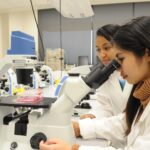
Header image: Charmaine Hipolito (right) and Titina Sirak use the microscopes in a teaching lab at the Universities at Shady Grove. Photo by USG.
]]>
UMBC’s Translational Life Science Technology (TLST) degree is the new kid on the block among UMBC undergraduate programs, and its first graduates will earn their degrees this month. These students...
https://umbc.edu/stories/umbcs-newest-biotech-grads-launch-careers-that-will-make-a-difference/
https://my3.my.umbc.edu/api/v0/pixel/news/119725/guest@my.umbc.edu/a321285186ee315d69133dff905da733/api/pixel
classof2020
cnms
page1
science-and-technology
shadygrove
tlst
UMBC News & Magazine
https://my3.my.umbc.edu/groups/umbc-news-magazine
https://assets1-my.umbc.edu/system/shared/avatars/groups/000/001/943/24435aa6207c452e7bc15cc74b42c7bb/xsmall.png?1748556657
https://assets1-my.umbc.edu/system/shared/avatars/groups/000/001/943/24435aa6207c452e7bc15cc74b42c7bb/original.png?1748556657
https://assets2-my.umbc.edu/system/shared/avatars/groups/000/001/943/24435aa6207c452e7bc15cc74b42c7bb/xxlarge.png?1748556657
https://assets2-my.umbc.edu/system/shared/avatars/groups/000/001/943/24435aa6207c452e7bc15cc74b42c7bb/xlarge.png?1748556657
https://assets3-my.umbc.edu/system/shared/avatars/groups/000/001/943/24435aa6207c452e7bc15cc74b42c7bb/large.png?1748556657
https://assets1-my.umbc.edu/system/shared/avatars/groups/000/001/943/24435aa6207c452e7bc15cc74b42c7bb/medium.png?1748556657
https://assets2-my.umbc.edu/system/shared/avatars/groups/000/001/943/24435aa6207c452e7bc15cc74b42c7bb/small.png?1748556657
https://assets1-my.umbc.edu/system/shared/avatars/groups/000/001/943/24435aa6207c452e7bc15cc74b42c7bb/xsmall.png?1748556657
https://assets2-my.umbc.edu/system/shared/avatars/groups/000/001/943/24435aa6207c452e7bc15cc74b42c7bb/xxsmall.png?1748556657
UMBC News & Magazine
0
0
false
Fri, 11 Dec 2020 23:32:42 -0500
UMBC expands offerings at The Universities at Shady Grove to grow Maryland’s STEM workforce
UMBC students like Jackelyn Flores are increasingly taking advantage of high-impact programs at The Universities at Shady Grove (USG), a Montgomery County campus UMBC shares with eight other Maryland public universities. Opportunities for her and other UMBC-Shady Grove students are expanding even further today with the opening of a new Biomedical Sciences and Engineering (BSE) Education Facility on the popular campus.
Flores ’21 is one of the first students to pursue UMBC’s new degree in translational life sciences technology (TSLT), launched at Shady Grove this fall. Fascinated by biotechnology, she completed her associate’s degree in the field at Montgomery College (MC) while working full-time in the cell therapy department at Lonza, a biotech company near Frederick, Maryland. She’s now enhancing her biomedical sciences knowledge and lab skills through the UMBC program, in a region with particularly high demand for biotech professionals.
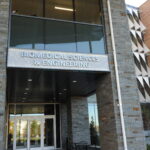
 Exterior of the just-completed Biomedical Sciences and Engineering Facility at The Universities at Shady Grove. Photo courtesy UMBC-Shady Grove.
Access to state-of-the-art science
At USG, UMBC offers both the new TLST bachelor’s degree and a master’s of professional studies in biotechnology that relaunched exclusively at USG last year. Three new teaching labs in the BSE will greatly increase opportunities for students in these programs to develop their skills with state-of-the-art lab equipment, from liquid chromatography to bioreactors to high-end microscopes.
“Because it’s top-notch equipment, this is what they’ll see when they go work at a biotech company,” says Annica Wayman ’99, mechanical engineering, M6, associate dean for Shady Grove affairs in UMBC’s College of Natural and Mathematical Sciences (CNMS). “They’ll be more prepared for those jobs because they’ll already be familiar with the equipment.”
The fact that many disciplines will offer courses in the building will also help students prepare for the workforce. “This building symbolizes an opportunity to bring the disciplines together to address societal problems,” Wayman says, “and to discover how they can work together to address the biggest challenges.”
Wayman hopes the building will be a resource for companies in the area, whether that means project-based courses where students tackle real industry needs, or startups renting time on the equipment for their own projects. These connections would benefit students, too, who will get the chance to work more closely with biotech professionals while completing their degrees.
Annica Wayman ’99, M6, mechanical engineering, is leading UMBC’s efforts to grow STEM programs at UMBC-Shady Grove. Photo by Marlayna Demond ’11 for UMBC.
Blazing a trail in student training
The path that Jackelyn Flores took from Montgomery College to UMBC is one purposefully designed through a collaboration between the two institutions. “CNMS is a trailblazer in keeping our education programs up to date with the rapid pace of science and technology development, and in making sure students have the skills the biotech industry needs now,” Wayman says. “We also work closely with MC so the program pairs well with their very hands-on biotech program. We created this program to build on that.”
As she prepared to transfer from MC to UMBC, Flores found a supportive community that gave her the information and resources she needed to be successful. “UMBC offered plenty of open house sessions where I was able to meet directly with UMBC staff who answered all of my questions, and UMBC staff maintained active communication throughout the application process,” she says. “It was extremely reassuring to know that the school cared and was offering so much help.”
“The program at Montgomery College did an amazing job in helping me develop the lab skills necessary for the industry,” Flores says. “The TLST program is enhancing my lab and critical thinking skills while also reinforcing my knowledge of the biomedical industry.”
 Informal gathering spaces inside the Biomedical Sciences and Engineering Facility encourage interaction and collaboration. Photo courtesy of UMBC-Shady Grove.
Growing Maryland’s STEM workforce
UMBC plans to continue to grow its already robust STEM presence at USG. Beyond offering TLST at the undergraduate level, UMBC offers graduate programs in biotechnology, cybersecurity, data science, geographic information systems, and technical management. Additional STEM programs matching the needs of local employers are on the horizon. Complementing all of these are popular programs in psychology, social work, political science, and history.
“One of the goals of CNMS and UMBC being at Shady Grove is to contribute to workforce development for the state, particularly in STEM,” Wayman says, “The new building provides USG and UMBC the opportunity to greatly expand training students and develop the workforce in high-demand STEM careers.”
It’s working for Flores. “The BSE will open doors for students to network and become involved in the industry while establishing critical connections,” she says, like the one she has with Lonza. “I can’t wait to see what the rest of the TLST program has to offer.”
Banner image: The entryway to the new Biomedical Sciences and Engineering Facility at The Universities at Shady Grove. The new space will facilitate growth in STEM programs offered by UMBC and other institutions at USG. Photo courtesy Universities at Shady Grove.
]]>
UMBC students like Jackelyn Flores are increasingly taking advantage of high-impact programs at The Universities at Shady Grove (USG), a Montgomery County campus UMBC shares with eight other...
https://umbc.edu/stories/umbc-expands-offerings-at-the-universities-at-shady-grove-to-grow-marylands-stem-workforce/
https://my3.my.umbc.edu/api/v0/pixel/news/120018/guest@my.umbc.edu/6523f908b05c6e4907a199f2ee80ddfd/api/pixel
cnms
coeit
meche
science-and-technology
shadygrove
tlst
UMBC News & Magazine
https://my3.my.umbc.edu/groups/umbc-news-magazine
https://assets1-my.umbc.edu/system/shared/avatars/groups/000/001/943/24435aa6207c452e7bc15cc74b42c7bb/xsmall.png?1748556657
https://assets1-my.umbc.edu/system/shared/avatars/groups/000/001/943/24435aa6207c452e7bc15cc74b42c7bb/original.png?1748556657
https://assets2-my.umbc.edu/system/shared/avatars/groups/000/001/943/24435aa6207c452e7bc15cc74b42c7bb/xxlarge.png?1748556657
https://assets2-my.umbc.edu/system/shared/avatars/groups/000/001/943/24435aa6207c452e7bc15cc74b42c7bb/xlarge.png?1748556657
https://assets3-my.umbc.edu/system/shared/avatars/groups/000/001/943/24435aa6207c452e7bc15cc74b42c7bb/large.png?1748556657
https://assets1-my.umbc.edu/system/shared/avatars/groups/000/001/943/24435aa6207c452e7bc15cc74b42c7bb/medium.png?1748556657
https://assets2-my.umbc.edu/system/shared/avatars/groups/000/001/943/24435aa6207c452e7bc15cc74b42c7bb/small.png?1748556657
https://assets1-my.umbc.edu/system/shared/avatars/groups/000/001/943/24435aa6207c452e7bc15cc74b42c7bb/xsmall.png?1748556657
https://assets2-my.umbc.edu/system/shared/avatars/groups/000/001/943/24435aa6207c452e7bc15cc74b42c7bb/xxsmall.png?1748556657
UMBC News & Magazine
0
0
false
Thu, 07 Nov 2019 14:18:23 -0500