“You belong here”—New and returning Retrievers are welcomed to campus for fall 2026
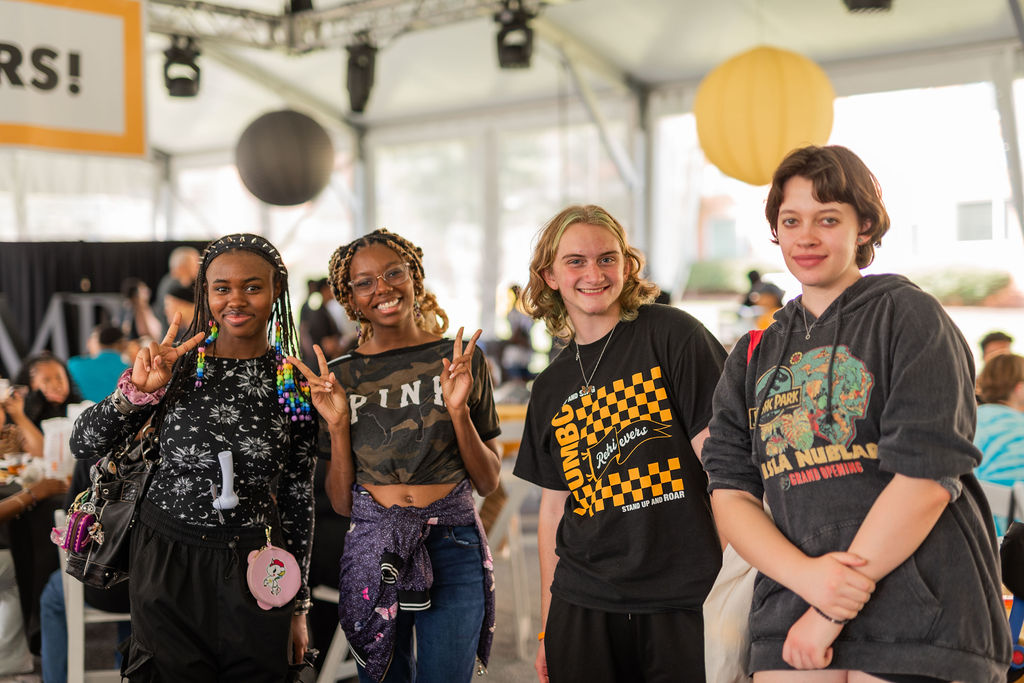
As fall 2026’s first full week of classes wrap up, Retrievers across campus—newly minted and returning—are finding their place. In addition to learning to navigate to the right classroom, they are bringing their unique strengths and voices to this ever evolving community.
This year’s incoming class of over 2,000 Retrievers boasts a median GPA of 4.0. Among them is Rodney Oglesby, an aspiring musician and a Gates Scholar. Oglesby was one of 750 students awarded this high honor among a pool of over 61,000 applicants nationwide.
“We are thrilled to welcome another impressive entering undergraduate class, with a 15 percent increase in enrollment from Baltimore City, and, overall, students representing 42 countries,” says Dale Bittinger, M.P.P. ’16, assistant vice provost for strategic undergraduate engagement, partnerships, and pathways. “They are academically talented and engaged and we look forward to all they have to offer to our campus community.”
Joining Oglesby is Saad Bin Waqas, a new student who traveled nearly 7,000 miles from his home in Pakistan to address the UMBC community at this year’s Fall Opening Meeting. At just 16, this Sondheim Scholar and geography and environmental studies major is looking forward to planting some roots after growing up in a military family.
“After moving from place to place for much of my life, I am really excited to have a new place I can call home,” shared Waqas.
A place to flourish
Junior Sabirah Burt is joining UMBC as a transfer student from Howard Community College. Her aspirations to ultimately become a physician’s assistant are shaped by her own experience grappling with a medical condition. If you had asked Burt a few months ago to describe herself, she’d say “ticking time bomb.” In June 2025, she was rushed to the hospital for an agonizing headache. Medical professionals eventually discovered she had an active brain bleed and underwent emergency surgery.
“I believe graduating with a public health degree from here will allow me to flourish when continuing my education and applying to graduate school in the future,” she said. “After going through my tough experiences last year, it’s made me even more passionate to pursue medicine, now more than ever before, and help those lying in hospitals wondering if it will be their last day.”
Strengthening connections—early
Some new Retrievers got a jump start to the year and arrived on campus over the summer to dive into work-integrated learning (WIL)—an educational approach that prepares students for a rewarding career after college by pairing what they are learning in the classroom with hands-on, authentic work experiences. In July, more than 100 incoming first-year and transfer students spent a night on campus, connected with an instructor and teaching assistant, and spent a day participating in service on site at five different community partner locations.
WIL students will participate in service with the same sites throughout their full first year at UMBC, deepening engagement and strengthening connection to their peers and faculty as well as to the campus and community.
“I believe a program like this is an excellent cohort building model. I was able to have individual conversations with all of them, learning what they cared about going into their unique UMBC journeys,” says Emily Passera, the senior program coordinator for community-engaged learning through The Shriver Center at UMBC, who led a group of students to Patterson Park in east Baltimore and will teach the same students in a first-year experience course called UNIV 101.
A community for all
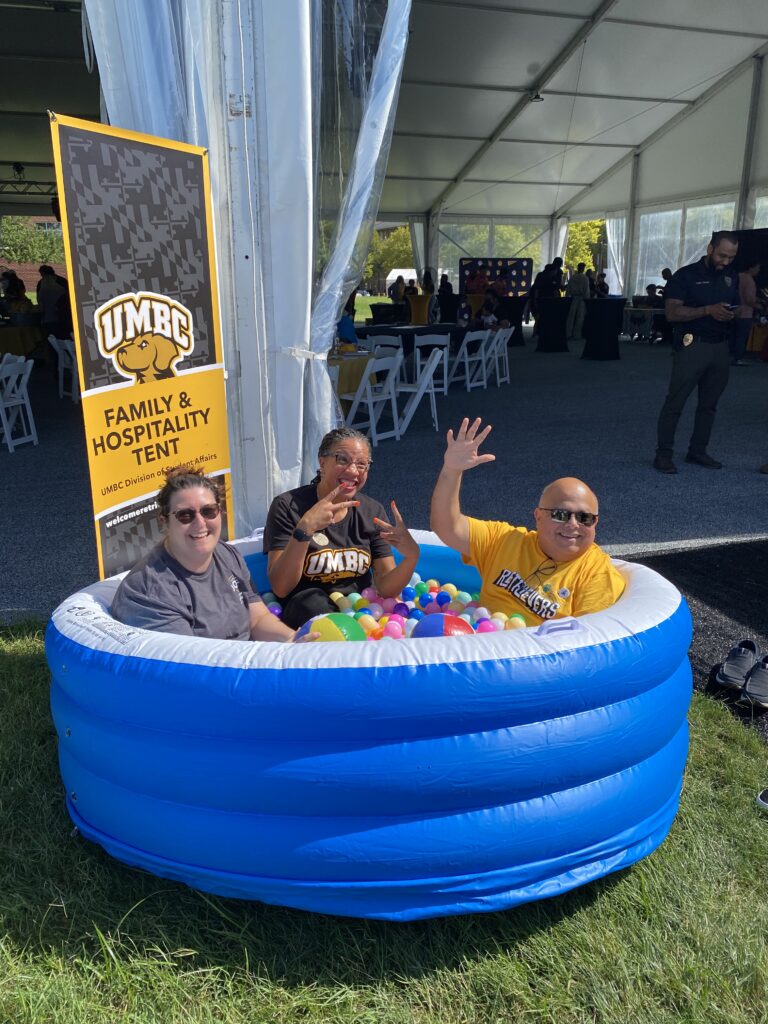 Diaz hangs out with Renique Kersh, vice president for student affairs (center), and Wendy Low, coordinator in the Division of Institutional Equity, in the hospitality tent’s ball pit. (Photo courtesy of Kait McCaffrey)
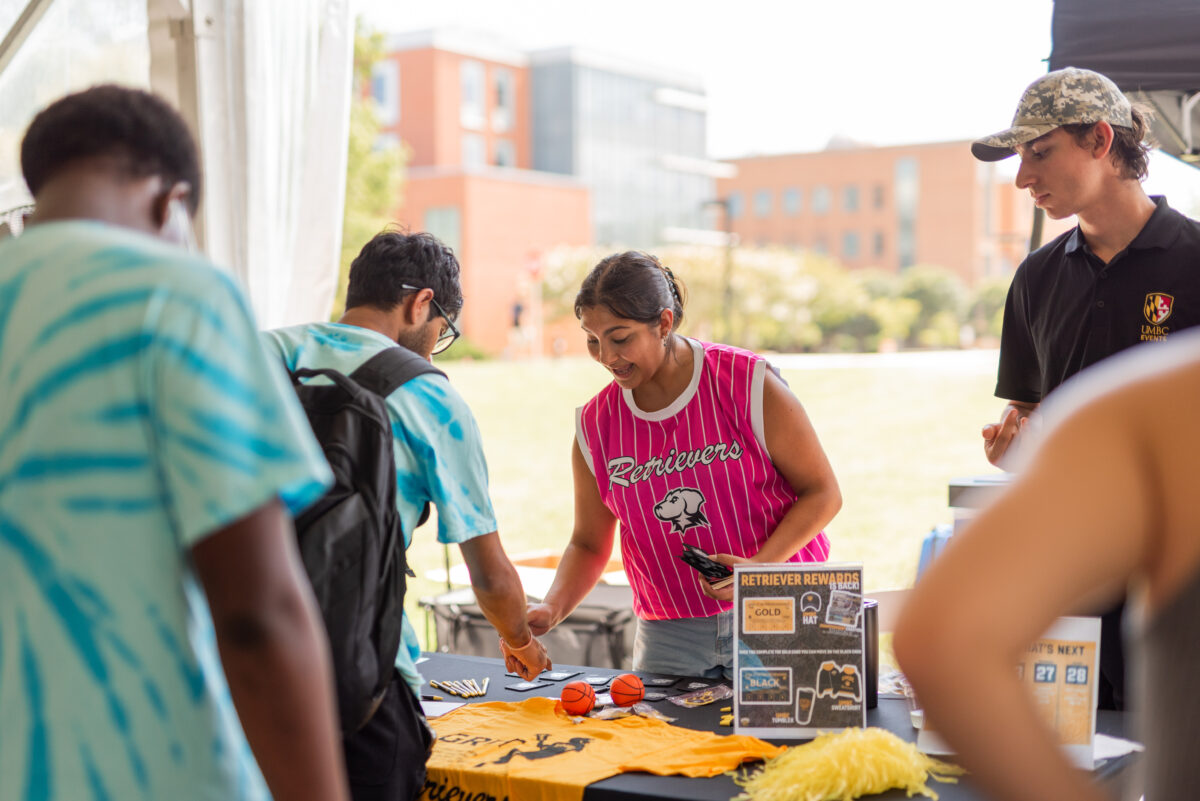
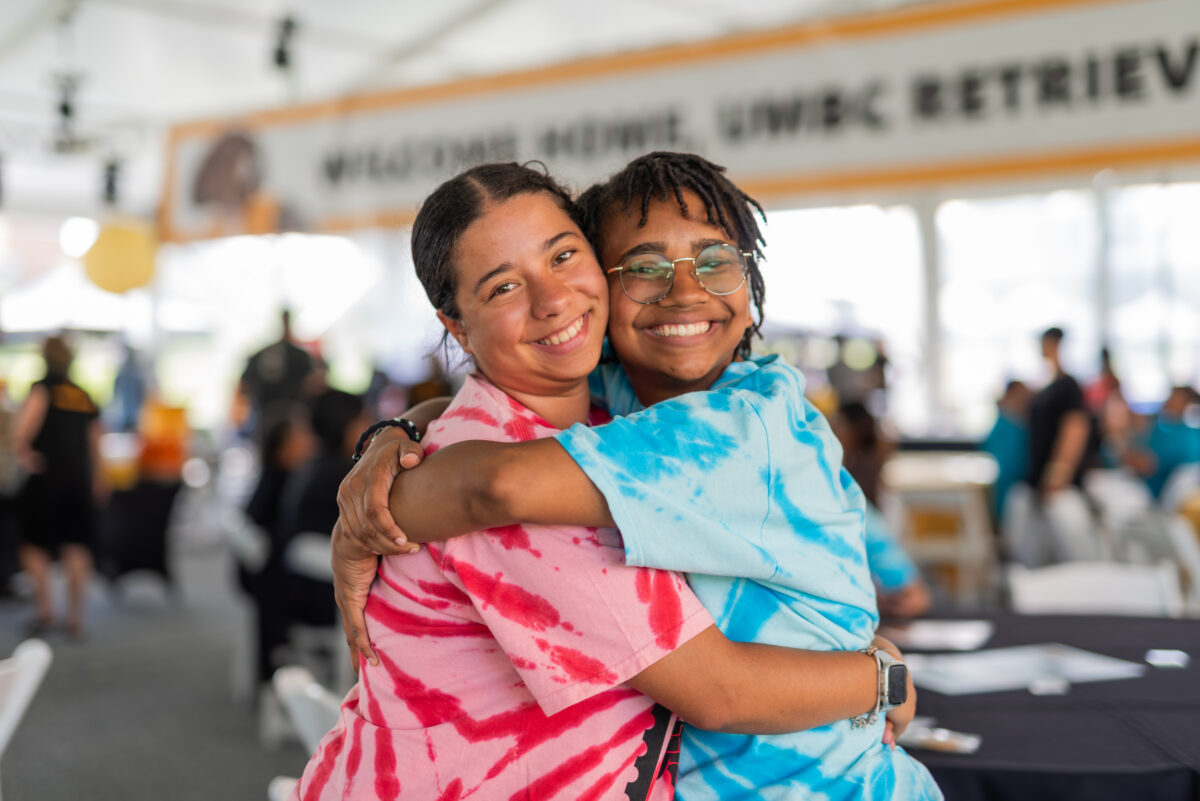
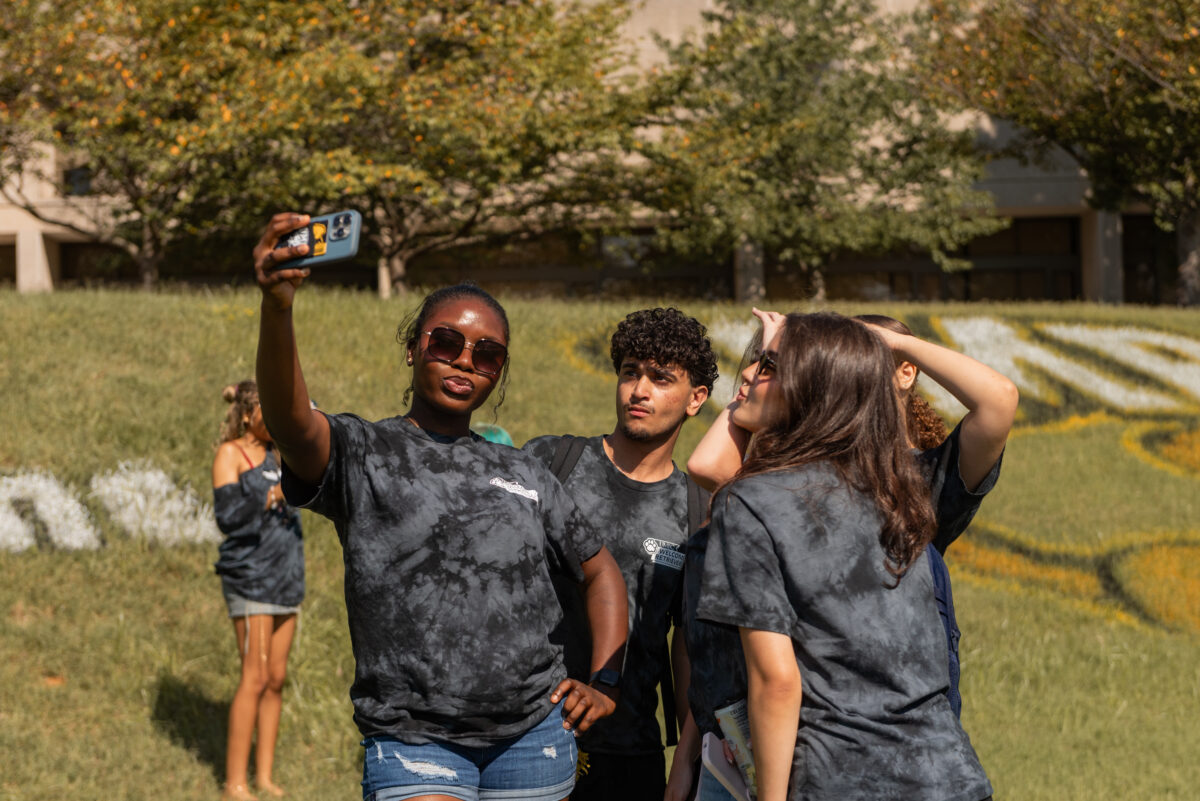
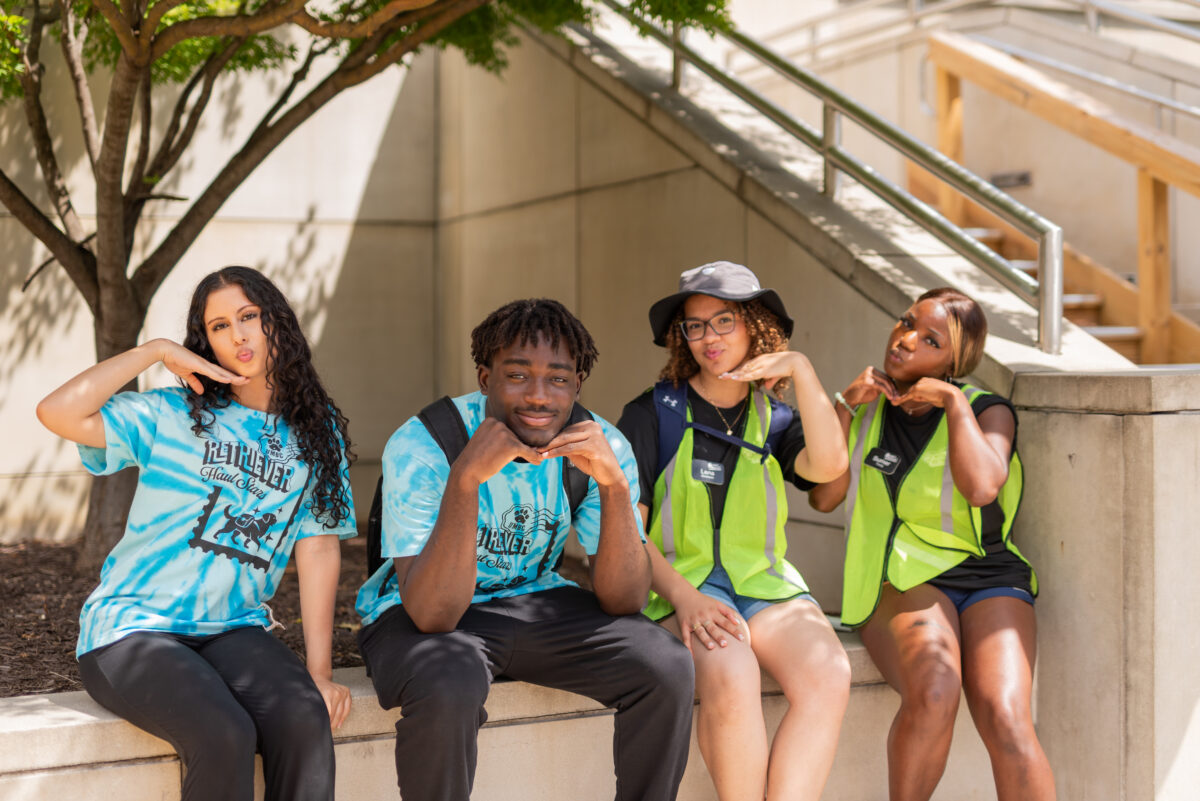
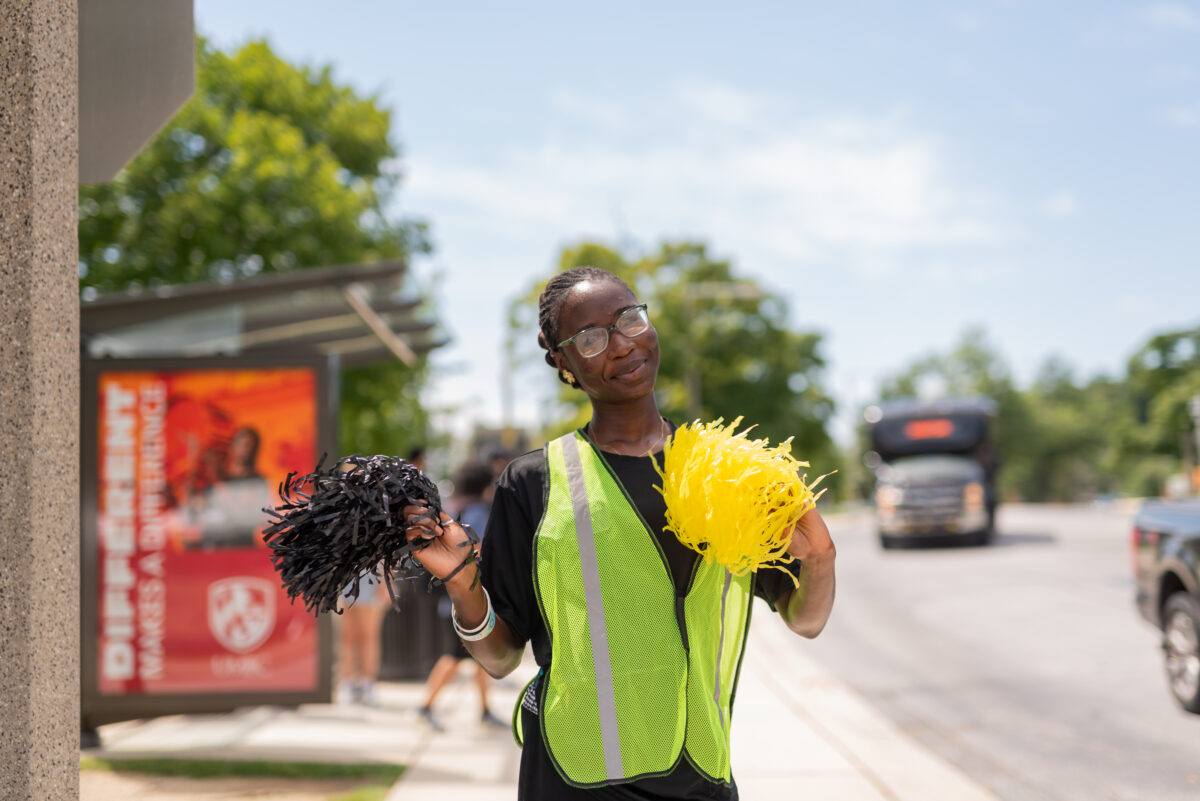
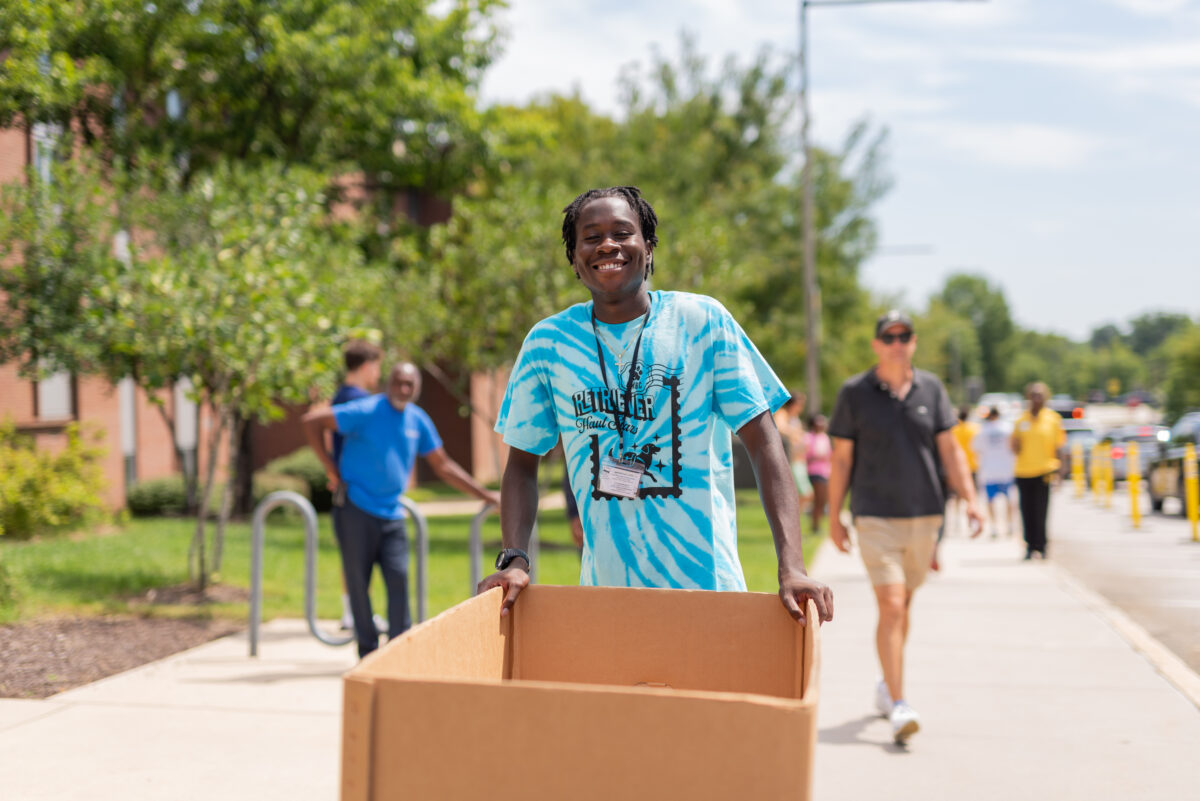
With a full lineup of events, this year’s Welcome, Retrievers efforts ensured that students started to find their place from the minute they stepped onto campus. Student volunteers (“Haul Stars”) were on hand to keep things moving as they helped new students with their belongings and offered directions.
Students weren’t the only ones getting in on the fun. Retriever Fest gave families the opportunity to meet with campus partners and learn more about everything UMBC has to offer—while enjoying refreshments and picking up some swag. Jake Diaz, inaugural assistant vice president and dean of students in the Division of Student Affairs, had a ball welcoming new students.
Throughout the weekend, students continued to enjoy Retriever 101 events, like First Night, an Student Events-Board-sponsored takeover of The Commons with inflatables, prizes, games, and plenty of other activities that cemented the first night as one students will remember for years to come.
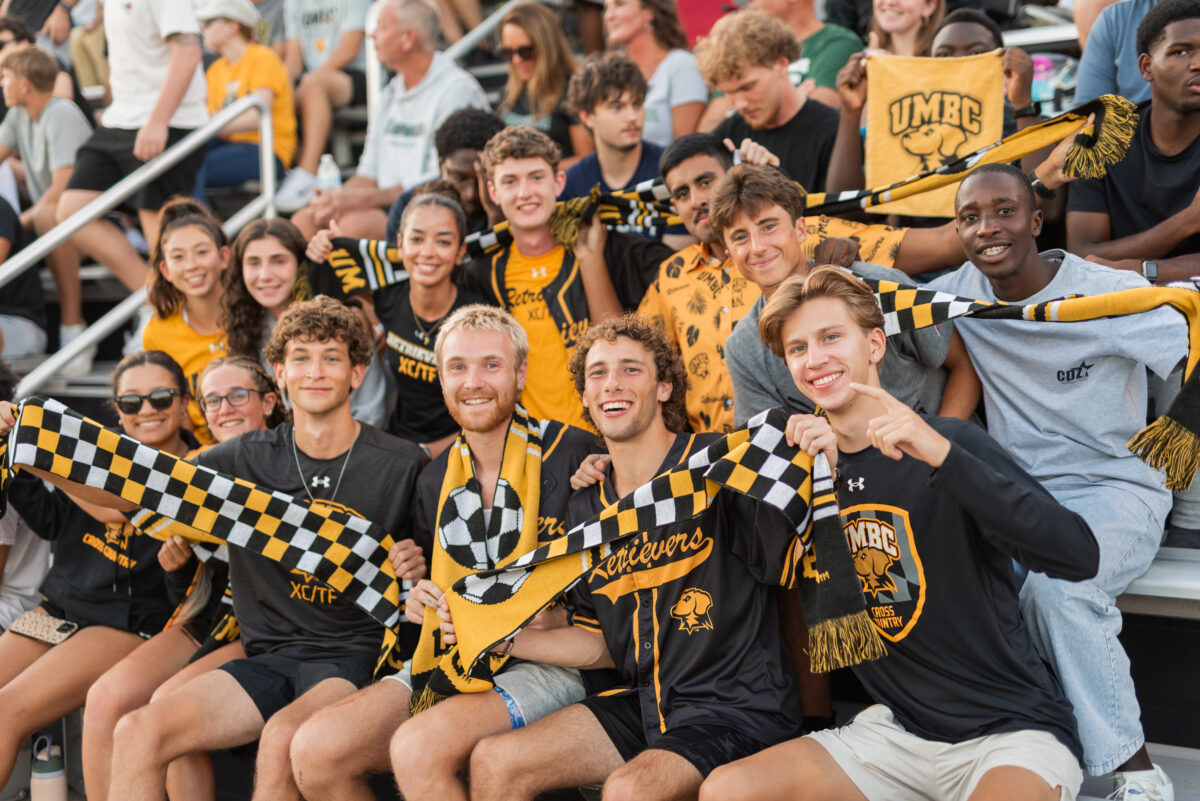
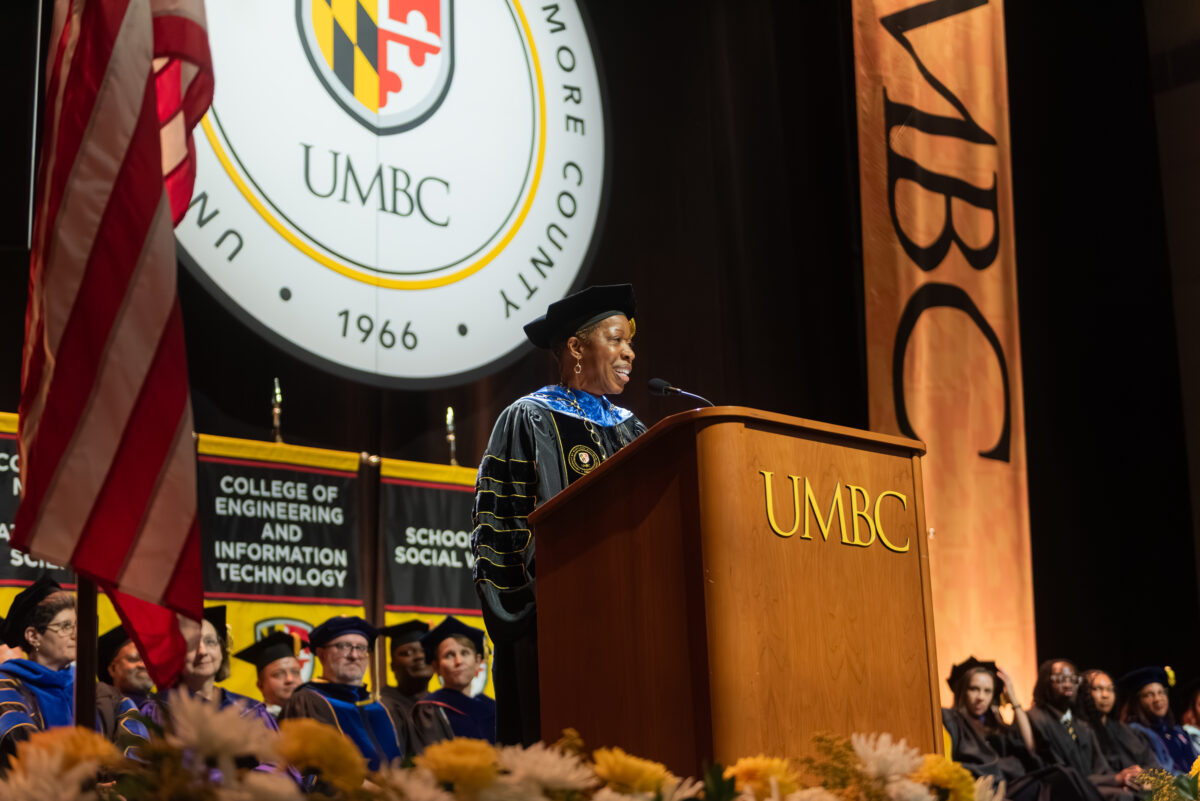
Events like the Taste of UMBC, Your Story Belongs Here, and the annual New Retriever Photo bonded students and filled their camera rolls. The first weekend concluded with Convocation, the official opening of the fall semester. President Valerie Sheares Ashby addressed the new students, reassuring them that UMBC is where they’re meant to be.
“…I want to make sure you hear this from me: You belong here. You have come to an institution that wants you here and believes that you can be successful here, even if you are not yet completely sure of that yourself.”
 ]]>
As fall 2026’s first full week of classes wrap up, Retrievers across campus—newly minted and returning—are finding their place. In addition to learning to navigate to the right classroom, they are...
https://umbc.edu/stories/you-belong-here-welcome-to-campus-for-fall-2026/
https://my3.my.umbc.edu/api/v0/pixel/news/162122/guest@my.umbc.edu/176c4fda6b22f7eb41f50de5e81bf5d4/api/pixel
cahss
campus-life
cnms
coeit
feature
ges
public-health
public-policy
shriver-center
stories
story
student-affairs
transfer
UMBC News & Magazine
https://my3.my.umbc.edu/groups/umbc-news-magazine
https://assets1-my.umbc.edu/system/shared/avatars/groups/000/001/943/24435aa6207c452e7bc15cc74b42c7bb/xsmall.png?1748556657
https://assets1-my.umbc.edu/system/shared/avatars/groups/000/001/943/24435aa6207c452e7bc15cc74b42c7bb/original.png?1748556657
https://assets2-my.umbc.edu/system/shared/avatars/groups/000/001/943/24435aa6207c452e7bc15cc74b42c7bb/xxlarge.png?1748556657
https://assets2-my.umbc.edu/system/shared/avatars/groups/000/001/943/24435aa6207c452e7bc15cc74b42c7bb/xlarge.png?1748556657
https://assets3-my.umbc.edu/system/shared/avatars/groups/000/001/943/24435aa6207c452e7bc15cc74b42c7bb/large.png?1748556657
https://assets1-my.umbc.edu/system/shared/avatars/groups/000/001/943/24435aa6207c452e7bc15cc74b42c7bb/medium.png?1748556657
https://assets2-my.umbc.edu/system/shared/avatars/groups/000/001/943/24435aa6207c452e7bc15cc74b42c7bb/small.png?1748556657
https://assets1-my.umbc.edu/system/shared/avatars/groups/000/001/943/24435aa6207c452e7bc15cc74b42c7bb/xsmall.png?1748556657
https://assets2-my.umbc.edu/system/shared/avatars/groups/000/001/943/24435aa6207c452e7bc15cc74b42c7bb/xxsmall.png?1748556657
UMBC News & Magazine
0
0
false
Fri, 28 Aug 2026 14:55:24 -0400
Maleeha Ahmed ’26 returned to school with purpose and found her calling in social work
]]>
As fall 2026’s first full week of classes wrap up, Retrievers across campus—newly minted and returning—are finding their place. In addition to learning to navigate to the right classroom, they are...
https://umbc.edu/stories/you-belong-here-welcome-to-campus-for-fall-2026/
https://my3.my.umbc.edu/api/v0/pixel/news/162122/guest@my.umbc.edu/176c4fda6b22f7eb41f50de5e81bf5d4/api/pixel
cahss
campus-life
cnms
coeit
feature
ges
public-health
public-policy
shriver-center
stories
story
student-affairs
transfer
UMBC News & Magazine
https://my3.my.umbc.edu/groups/umbc-news-magazine
https://assets1-my.umbc.edu/system/shared/avatars/groups/000/001/943/24435aa6207c452e7bc15cc74b42c7bb/xsmall.png?1748556657
https://assets1-my.umbc.edu/system/shared/avatars/groups/000/001/943/24435aa6207c452e7bc15cc74b42c7bb/original.png?1748556657
https://assets2-my.umbc.edu/system/shared/avatars/groups/000/001/943/24435aa6207c452e7bc15cc74b42c7bb/xxlarge.png?1748556657
https://assets2-my.umbc.edu/system/shared/avatars/groups/000/001/943/24435aa6207c452e7bc15cc74b42c7bb/xlarge.png?1748556657
https://assets3-my.umbc.edu/system/shared/avatars/groups/000/001/943/24435aa6207c452e7bc15cc74b42c7bb/large.png?1748556657
https://assets1-my.umbc.edu/system/shared/avatars/groups/000/001/943/24435aa6207c452e7bc15cc74b42c7bb/medium.png?1748556657
https://assets2-my.umbc.edu/system/shared/avatars/groups/000/001/943/24435aa6207c452e7bc15cc74b42c7bb/small.png?1748556657
https://assets1-my.umbc.edu/system/shared/avatars/groups/000/001/943/24435aa6207c452e7bc15cc74b42c7bb/xsmall.png?1748556657
https://assets2-my.umbc.edu/system/shared/avatars/groups/000/001/943/24435aa6207c452e7bc15cc74b42c7bb/xxsmall.png?1748556657
UMBC News & Magazine
0
0
false
Fri, 28 Aug 2026 14:55:24 -0400
Maleeha Ahmed ’26 returned to school with purpose and found her calling in social work
Caring for others has always been central to who Maleeha Ahmed is. As the oldest of five children, she naturally stepped into caregiving roles early in life, supporting both family members and older adults in her community. Over time, she began to recognize that the work she had been doing informally for many years reflected the values and responsibilities of professional social work.
Balancing caregiving responsibilities and helping manage an accounting business with her husband of 26 years made returning to college challenging, and for many years her education was interrupted by family obligations. However, during the COVID-19 pandemic, Ahmed realized how important it was to complete her degree and build long-term stability for herself. With renewed determination, she returned to school at the Community College of Baltimore County (CCBC), where supportive faculty encouraged her to continue her academic journey.
Ahmed was introduced to social work during UMBC orientation by Kenneth Barron, assistant vice provost for academic advising and student success, who helped her see how the profession aligned with both her experience and her career goals. With his guidance, she chose to pursue social work alongside psychology and ultimately completed both majors after transferring to UMBC.
At UMBC, Ahmed found a welcoming community, especially among other adult learners balancing education with family responsibilities, especially within the social work program. Ahmed will continue her education at Salisbury University this fall in the Master of Social Work program, where she plans to focus on work with older adults and end-of-life care and counseling.
Q: How did you come to be at UMBC?
A: UMBC was always my first choice because it is close to home, which was important since I am a caregiver for my mother and needed to be available if she required support. I had started college several times over the years but had to pause because of caregiving responsibilities and family obligations. During the COVID-19 pandemic, I realized how important it was for me to complete my education and build long-term stability for myself. That experience strengthened my motivation, and when I returned to school, I approached my studies with greater focus and determination. I completed my associate degree at CCBC and then transferred to UMBC to pursue a double major in psychology and social work.
Q: What was different this time?
A: This time I returned to school with a clear purpose and stronger self-confidence. Earlier in my life, caregiving responsibilities, especially caring for my father, made it difficult to continue my education. I also faced challenges as an ESL student returning to college after many years away. However, I eventually recognized that I had already developed strong problem-solving and leadership skills through running a business and supporting my family. That realization helped me believe in my academic ability and stay committed to completing my degree.
Q: How did your professors show their support?
A: At CCBC and UMBC, I was very fortunate to have professors who were supportive and encouraging throughout my academic journey. Their guidance helped me build confidence and stay motivated. I actually began by taking just one class at CCBC in 2022, but the encouragement I received from my professors made me feel capable and excited about learning again. That support played an important role in helping me stay committed and continue my education full time.
 Ahmed is presented with the Tina D’Angelo Memorial Scholarship by Nancy Kusmaul, social work. (Photo courtesy of Ahmed)
Q: What has your community been like here at UMBC?
A: I found the campus community to be welcoming and supportive across different age groups and backgrounds. As an adult learner, it was especially meaningful to connect with other returning students who understood the challenges of balancing school with family responsibilities. We encouraged each other and became an important source of support throughout my time at UMBC.
Q: Why did you choose social work?
A: I have always felt drawn to helping others, but earlier in my life I did not realize that social work was a professional field I could pursue. Through my involvement with my mosque, I supported several refugee families and saw firsthand the importance of family support and counseling services. That experience motivated me to return to school and begin working toward a degree in psychology at CCBC because I was interested in becoming a family therapist.
During orientation, I met Dr. Kenneth Barron, who introduced me to social work as a profession and explained that it would allow me to reach my goal of becoming a therapist more quickly. As an adult learner, time was an important consideration, and his guidance helped me see how social work aligned with both my experience and my career goals. With his encouragement, I added social work as a second major. His mentorship played an important role in my academic journey.
Tell me about your social work field work placement.
I am completing my field placement at Vantage Point, a continuing care retirement community in Columbia. It has been a very meaningful experience, and I have been fortunate to work with two supportive supervisors, one in a clinical role and one in a community-based social work role. This has allowed me to gain exposure to different aspects of practice across the continuum of care for older adults. Through this placement, I have been developing skills in assessment, collaboration with interdisciplinary teams, and supporting residents and families during transitions.
Q: What do you see your career being like when you get your MSW?
A: After completing my MSW, I hope to continue working with older adults, particularly in hospice or end-of-life care. My field placement at Vantage Point has strengthened my interest in aging services and has helped me better understand the importance of providing emotional support to residents and families during times of transition and serious illness. Through this experience, I have seen how meaningful it is for individuals to feel supported, respected, and not alone during vulnerable stages of life.
My interest in hospice work is also shaped by personal experience. I once cared for a refugee woman with cancer in my home when her family was unable to provide support, and I stayed with her until she passed away. I have also been present with three people in my life at the time of their death. Those experiences helped me become more comfortable with end-of-life care and showed me how important it is for someone to be present and provide dignity and companionship during that time.
Q: What benefit do you get from the close contact with people you’re caring for?
A: Working closely with people has always felt meaningful to me because I value helping others feel supported, respected, and understood, regardless of their background or life circumstances. Social work feels like a natural fit for who I am because it allows me to combine compassion with practical support and advocacy. It gives me a strong sense of purpose to know that I am contributing in a way that makes a real difference in people’s lives.
Q: How are you preparing yourself to prioritize self-care in order to undertake a career like this?
A: Earlier in my life, I often focused on caring for others without paying enough attention to my own well-being. Over the past two years at UMBC, I have learned how important it is to recognize my limits and take time to recharge so I can remain effective in supporting others. I now make space for activities such as walking, prayer, and quiet reflection, which help me manage stress and prevent burnout.
Q: How do you hope to look back on your working years?
A: I would like to continue working for as long as I am able because helping others gives me a strong sense of purpose. Most importantly, I hope I will have encouraged people to be resilient, believe in themselves, and continue moving forward even during difficult times.
Q: What would you tell people who think it’s too late to go back and finish their education?
A: It is never too late to return to school. During my time at UMBC, I met many adult learners who were balancing family responsibilities and other life commitments while attending school full time, and their dedication was a constant source of encouragement for me. I also experienced how powerful mutual support can be. For example, a close friend and study partner I met at CCBC had been taking classes only occasionally, but seeing my commitment encouraged her to continue her education. She is now preparing to pursue her nursing degree. Experiences like this have shown me that people can inspire each other at any stage of life, and that with determination and support, it is always possible to move forward.
]]>
Caring for others has always been central to who Maleeha Ahmed is. As the oldest of five children, she naturally stepped into caregiving roles early in life, supporting both family members and...
https://umbc.edu/stories/maleeha-ahmed-26-found-her-calling-in-social-work/
https://my3.my.umbc.edu/api/v0/pixel/news/159708/guest@my.umbc.edu/714453e85ea5fea6daf79d27871c72b0/api/pixel
class-of-2026
news
policy-and-society
social-work
story
transfer
UMBC News & Magazine
https://my3.my.umbc.edu/groups/umbc-news-magazine
https://assets1-my.umbc.edu/system/shared/avatars/groups/000/001/943/24435aa6207c452e7bc15cc74b42c7bb/xsmall.png?1748556657
https://assets1-my.umbc.edu/system/shared/avatars/groups/000/001/943/24435aa6207c452e7bc15cc74b42c7bb/original.png?1748556657
https://assets2-my.umbc.edu/system/shared/avatars/groups/000/001/943/24435aa6207c452e7bc15cc74b42c7bb/xxlarge.png?1748556657
https://assets2-my.umbc.edu/system/shared/avatars/groups/000/001/943/24435aa6207c452e7bc15cc74b42c7bb/xlarge.png?1748556657
https://assets3-my.umbc.edu/system/shared/avatars/groups/000/001/943/24435aa6207c452e7bc15cc74b42c7bb/large.png?1748556657
https://assets1-my.umbc.edu/system/shared/avatars/groups/000/001/943/24435aa6207c452e7bc15cc74b42c7bb/medium.png?1748556657
https://assets2-my.umbc.edu/system/shared/avatars/groups/000/001/943/24435aa6207c452e7bc15cc74b42c7bb/small.png?1748556657
https://assets1-my.umbc.edu/system/shared/avatars/groups/000/001/943/24435aa6207c452e7bc15cc74b42c7bb/xsmall.png?1748556657
https://assets2-my.umbc.edu/system/shared/avatars/groups/000/001/943/24435aa6207c452e7bc15cc74b42c7bb/xxsmall.png?1748556657
UMBC News & Magazine
0
0
false
Wed, 29 Apr 2026 13:20:58 -0400
Fellow Retrievers offer 4 pieces of advice to get the most out of your time at UMBC
Now that the first week of classes is underway and you’re starting to find your new classrooms and make friends, you might be wondering how to make the most of this semester (whether it’s your first or last!) Faculty, staff, and students have chimed in to offer some advice for the year ahead, like embracing discomfort to help you grow, improving your financial literacy, and importantly, carving out your own ways to have fun.
Get money smart
Andrea Cipolla, director of financial aid and scholarships, explains how to get money smart while pursuing a degree: “Being financially responsible is an important aspect of the college experience. Make sure you utilize all the resources available to you. File your FASFA, participate in FinancialSmarts Cash Course to improve your financial awareness and skills, and file the Scholarship Retriever application every year.”
 Students and staff chat in the UMBC Career Center. (Brad Ziegler/UMBC)
Take breaths and take charge
Ann Sofie Clemmensen, associate professor in dance and the Linehan Artist Scholars Program director, highlights the importance of taking a breath, just as much as taking charge: “Do not hesitate to ask your professor, a teaching assistant, academic advisor, or a classmate for help, whether that is asking for clarification on an assignment or advice. In college, you cannot take a passive role, so I encourage every student to take charge of their academic trajectory.” She also wants to remind students that, “Inhalation is the source of inspiration, the exhale is the work that follows… so remember to take in deep breaths. Make sure you carve out time and space to breathe.”

 Many students take charge of their time at UMBC by signing up for clubs at Involvement Fest. (Brad Ziegler/UMBC)
Clemmensen calls attention to a quote by the American filmmaker, David Lynch: “Ideas are like fish. If you want to catch little fish, you can stay in the shallow water. But if you want to catch the big fish, you’ve got to go deeper. Down deep, the fish are more powerful and more pure.” She explains that, “as a student, I encourage you to check in with yourself to see if you are primarily swimming in shallow water. If so, find the courage and motivation to explore further out.”
Use the resources available
Senior dance major, Madison Kayser, offers her resourceful advice as a transfer student to fellow Retrievers: “Really invest time into using resources and events provided to you by the school. I know it seems pointless, but trust me it makes or breaks your experience in college.”
 Students outside the CEI Arena for UMBC’s 2025 Convocation (Kiirstn Pagan ’11/UMBC)
Find the people who motivate you
“Be open minded and explore” is the core of what Tamya Davis, senior psychology and social work double major, wants to remind her fellow students.
“There is a lot to do and experience so trying new things, whether it’s a class or a food, can be really fun. Campus also has a lot happening always so go to different events, different clubs, etc. Never be afraid of being uncomfortable; it just means you have an opportunity to grow.”
 Students celebrate the start of the new school year at Convocation. (Kiirstn Pagan ’11/UMBC)
Tamya also highlights the importance of having fun; “The people you meet on campus will definitely make your experience better since you are building community and a support system. As cliché as it sounds, it really helps to have people around you to motivate you and share your passion.”
Kayla Logue ’27 is a 2025 UCM intern and Linehan Scholar who is majoring in dance.
]]>
Now that the first week of classes is underway and you’re starting to find your new classrooms and make friends, you might be wondering how to make the most of this semester (whether it’s your...
https://umbc.edu/stories/retrievers-offer-4-pieces-of-advice/
https://my3.my.umbc.edu/api/v0/pixel/news/152081/guest@my.umbc.edu/dd75a433428f1e2e78cd3e940b7cbdbe/api/pixel
campus-life
financialaid
magazine
perspectives
story
transfer
UMBC News & Magazine
https://my3.my.umbc.edu/groups/umbc-news-magazine
https://assets1-my.umbc.edu/system/shared/avatars/groups/000/001/943/24435aa6207c452e7bc15cc74b42c7bb/xsmall.png?1748556657
https://assets1-my.umbc.edu/system/shared/avatars/groups/000/001/943/24435aa6207c452e7bc15cc74b42c7bb/original.png?1748556657
https://assets2-my.umbc.edu/system/shared/avatars/groups/000/001/943/24435aa6207c452e7bc15cc74b42c7bb/xxlarge.png?1748556657
https://assets2-my.umbc.edu/system/shared/avatars/groups/000/001/943/24435aa6207c452e7bc15cc74b42c7bb/xlarge.png?1748556657
https://assets3-my.umbc.edu/system/shared/avatars/groups/000/001/943/24435aa6207c452e7bc15cc74b42c7bb/large.png?1748556657
https://assets1-my.umbc.edu/system/shared/avatars/groups/000/001/943/24435aa6207c452e7bc15cc74b42c7bb/medium.png?1748556657
https://assets2-my.umbc.edu/system/shared/avatars/groups/000/001/943/24435aa6207c452e7bc15cc74b42c7bb/small.png?1748556657
https://assets1-my.umbc.edu/system/shared/avatars/groups/000/001/943/24435aa6207c452e7bc15cc74b42c7bb/xsmall.png?1748556657
https://assets2-my.umbc.edu/system/shared/avatars/groups/000/001/943/24435aa6207c452e7bc15cc74b42c7bb/xxsmall.png?1748556657
UMBC News & Magazine
0
0
false
Thu, 04 Sep 2025 18:57:46 -0400
Thu, 04 Sep 2025 18:57:46 -0400
By Saving One Life, You Have Saved All Humankind
Arrested for his role in a failed terrorist plot as a teenager, Mohammed Khalid found freedom from his radicalization after prison officials showed him kindness and empathy. Freed in 2017 and now a senior at UMBC, Khalid has surrounded himself with mentors as he researches how to help others see through the lure of extremism.
As an incoming transfer student to UMBC, Mohammed Khalid needed to be excused from some of the mandatory McNair Scholars Program orientation sessions to give a presentation at TEDxJHU. The title of his talk? Reconciling Humanity: Struggles of a Former Teenage Terrorist.
As McNair program director Michael Hunt listened to the information systems major tell his story over the phone, he could hear Khalid gaining more confidence as he went through the details. At the end, Hunt asked if Khalid would like to practice giving his presentation to his fellow McNair scholars before the real thing.
This is not how Khalid normally introduces himself at first meetings, but he doesn’t shy away from it either. “What I told him,” says Hunt, ’06, M13, mathematics, “is that you’re part of us now. You’re one of us. So just know that your story is now our story. Right? I really wanted him to understand that.”
 At the 2019 McNair orientation, Michael Hunt, right, talks to Khalid before he leaves for the TedxJHU event.
Before Khalid immigrated to America at age 13, his perspective of the West was shaped through literary fantasy like the Harry Potter books and The Chronicles of Narnia. Once arrived in a land less magical than he hoped, Khalid would come to be enmeshed in his own struggle of good versus evil, envisioning the world in a false dichotomy of strict black and white, pitting his perceived brothers and sisters versus the world.
Born in the United Arab Emirates and raised in Pakistan, Khalid and his family joined his father in 2007 in Howard County, Maryland. Certain memories stand out from that first day, he says. An overly brusque immigration officer at the airport in New York, his father in the car emphasizing that this is their new home—they will go to school, work, live, and die here one day, he said—and the loneliness of arriving at their townhouse late at night.
One thing that excited Khalid was starting school in his new country. He already knew English well after being brought up in a British education system and was excited to find a group of friends. But when he introduced himself in class, his new classmates snickered, he remembers.
“Mohammed is a terrorist’s name,” they told him.
Sharing his journey
Khalid ’21, information systems—a Cyber Scholar, an Honors College student, and a UMBC McNair Scholar—has shared these painful memories very publicly—in a Vice news segment, in panels around the country, and recently in a national magazine. He presents them not as an excuse for what followed in his teenage years, but as an open way of grappling with the decisions he made, with the goal that he might possibly help someone else avoid the descent into extremist circles.
Mohammed Khalid was the youngest person to be convicted of terrorism in the United States. He was arrested at 17 in July 2011 and released from criminal custody in December 2015, although he was immediately detained by the U.S. Immigration and Customs Enforcement until May 2017. He won his U.S. citizenship in 2018. After his deradicalization in prison, Khalid has dedicated his life to helping other young people not fall under the sway of extremists like he did.
Hunt explains that the McNair program does more than prepare students for graduate education in all disciplines through research, mentoring, and other scholarly activities—it also focuses heavily on community building with an emphasis on providing a space where students can cultivate productive interactions, and speak honestly and critically from their own experience with the goal of mutual learning.
Khalid took Hunt up on the offer to practice his talk in front of the McNair peers he had only just met. “There was a real emotional connection,” remembers Hunt, “and an understanding of his vulnerability. I know that for the community, it really shaped their understanding of the dynamics of the group. So it wasn’t just about him. It was about how this allows you to connect with a group of people who are going to be sharing your journey.”
Who are your brothers and sisters?
Connecting with people in real life was not going well for Khalid in high school. The terrorist comments didn’t abate, and neither did digs at his religion and origins. These insults were completely out of context for Khalid, so he turned to a common source for answers—Google. He then found a home on YouTube where he met people he considered friends—his true brothers and sisters in the faith, he thought at the time—watching and translating into English videos explaining his religion. Soon, the website algorithm changed the videos promoted to Khalid; he was watching suicide bombings and communicating with people tied to Al-Qaeda and other terrorist organizations. He was embraced by people online who called him a brother and welcomed him into their extremist community.
“Calling someone your brother and sister in Islam is the biggest modicum of respect that you can give them,” explains Khalid. “I think that it’s an innate human need to be heard and to be listened to. And these people online who I was calling my brothers and sisters, I would talk to them online and then come to find out they were actually listening to me and they would reflect my feedback. That’s something, I think, very necessary to camaraderie.”
 Khalid spoke at an event in 2019 called the Pathways In and Out of Islamism: A Conversation with Two Former Extremists.
On his way to discovering more about his religion, Khalid mistook extremism for fervor, recognizing now that “extremists had actually hijacked the philosophy and the ideology of Islam, which I call Islamism; the political side of it obviously, not the religious side, which is different.”
In parsing how his thinking worked at the time, Khalid says he thought along these lines: “Well, my classmates are calling me a terrorist because of what’s happening in other countries and at the same time they [Americans] are hurting ‘my people.’ So who does my allegiance lie with? Is it with people who are part of my faith or with people whom I’ve just encountered in this new country who are actually demonstrating this antagonism against me?”
Khalid says he was spending 40 hours a week on YouTube chats with like-minded individuals, all the while pulling away from his real family. His involvement eventually broadened beyond the virtual, and in 2011, he was arrested in connection with an international (unsuccessful) plot to murder a Swedish cartoonist. He attempted to recruit people and solicit funds for an American woman known as “Jihad Jane” who was organizing the hit.
In his TEDx talk, Khalid goes into detail about his arrest and how surreal the situation seemed in the moment. An FBI officer had to remind the then-17-year-old to say goodbye to his parents. After his arrest, Khalid was diagnosed with Asperger’s Syndrome, a type of autism, which has helped explain to him those feelings of detachment during the harrowing moments of his arrest and also when thinking back on how hard it was to make friends in school.
“What I told him is that you’re part of us now. You’re one of us. So just know that your story is now our story. Right? I really wanted him to understand that.”
Michael Hunt, UMBC McNair program director
It was in prison, of all places, that Khalid says he began to see the shared humanity with fellow prisoners and guards alike. “All that the prisoners and prison officials wanted to do was understand, and all I ever wanted in my life was to be understood,” says Khalid. The correctional officers took time to share their own experiences with Khalid, which over time broke down the barriers Khalid had erected. One officer in a juvenile facility even challenged him, “Have you actually read the Qur’an from front to back?” When Khalid said no, he was given a copy.
“And I read it at that point,” Khalid says. “That’s when the ideological farce that I was believing in came breaking down. I think one of the verses that really resonated with me was how saving one life means that you’re saving humanity, and how killing one life, it’s like you’re killing all of humanity. I think that’s just one of the many beautiful principles in the Qur’an, that it is completely divorced from extremism.”
Finding ethical ways of detecting online radicalization
At UMBC, Khalid has jumped head first into his information systems major with a focus on cybersecurity. His drive to help other young people not fall sway to extremism online is apparent, says Vandana Janeja, professor and chair of Information Systems. “Mohammed has tapped into all the right resources for him to advance,” says Janeja. “He’s a real good example for other students—he showcases the best of what we have to offer at UMBC.”
Khalid transferred to UMBC in winter 2019. He quickly reached out to Janeja and Anupam Joshi, professor and chair of Computer Science and Electrical Engineering and the director of the UMBC Center for Cybersecurity, for help with formulating methodology for his research project assessing indicators of online radicalization.
 Khalid shares his poster “Mass Media’s Ideology of Middle Eastern Terror and the Impossibility of the Individual” at the 2019 Annual Biomedical Research Conference for Minority Students.
“Frankly, if I’m being very honest,” says Joshi, “if someone from any background other than Mohammed’s had approached me and said, ‘I want to do this work,’ I would have probably not agreed to do it. In some areas, you can’t bring a certain amount of necessary empathy to your research unless you’ve been in that situation.”
And what Khalid was interested in researching—how to detect signs of Islamist radicalization from online discourse—is extremely complex, adds Joshi. “It sounds deceptively simple, but it’s very hard to do that. Because you’re trying to judge the mental state of a person based purely on what they’re saying in public-facing platforms.”
Both Joshi and Janeja pushed Khalid to study the ethics of data analysis. “In speaking to him about his research, I encouraged him to look at various perspectives to data analytics,” shares Janeja. “In our department, we frequently have conversations around ethics with students. ‘Keep in mind, as you are making choices in your algorithm, that you’re using this threshold to cut off these participants from analysis or using this threshold which impacts people in a certain way.’” Joshi adds that researchers’ biases can also easily enter their algorithms without careful consideration.
“What I told Mohammed,” says Joshi, “was that for his project, I am happy if he just ends up getting exposed to these ideas and how the technology can be applied to detect radicalization. He’ll have the rest of his graduate career or research career if he wants to continue to improve things, because this is a particularly hard problem.”
Holistic mentorship
Khalid is in the distinct position of knowing personally how people can influence you to pursue good or evil. He has become more discerning about the type of mentors he allows into his life, but more than ever understands the need for trust and vulnerability and has surrounded himself with teachers who can address all facets of his mental, physical, spiritual, financial, and academic life.
When Khalid was released from prison in 2017 after his five-year sentence, he quickly sought to make up for lost time. Prior to being arrested, he had received early acceptance to Johns Hopkins University, but now he had to start his educational journey from scratch. “Rejection is the word I associate the most with that period,” Khalid says candidly. He eventually found his footing at the Community College of Baltimore County (CCBC).
 Khalid participates in activities at the February 2019 McNair Scholars Program group interview with other UMBC students.
“Mohammed is the type of student that takes every opportunity that comes before him—every opportunity to grow, to learn, and to serve,” says Natasha Cole-Leonard, associate professor of English and director of the honors program at CCBC, who got to know Khalid when he was a leader in the honors program and on the student honors council.
At some time early in their relationship, Cole-Leonard says Khalid asked for a one-on-one meeting. “In reflection, I appreciated the fact that he trusted me to hear his story before it was a situation where he felt compelled to or because it was breaking news. It was just out of his own desire to be honest about his background.”
Khalid has continued to open up to advisors and mentors at UMBC, and through the McNair program has been mentoring other students as well. It’s a role he’s taken to heart. “One of the things that I really emphasize is empathy. We can all sympathize with anyone, but empathizing is where it becomes difficult because you’re really putting yourself in the other person’s shoes and looking through their eyes, which is super hard,” says Khalid. “It’s exciting and interesting to coach others, providing them with words of affirmation and giving them encouragement and support. I’m letting them know that I’m there for them, no matter what happens.”
McNair program director Hunt is developing his dissertation for the language, literacy, and culture Ph.D. program at UMBC on holistic critical mentoring, which he also practices with his McNair scholars. Some of the tenets Hunt mentions are reciprocity between mentee and mentor, while both parties are asked to collectively bring their culture and lived experiences to the relationship.
 Khalid with fellow McNair cohort member, Dildora Salimjonova ’20 (standing, left), at the 27th Annual UMBC McNair Scholars Conference on September 20, 2019.
“We provide a space where affirmation comes first,” says Hunt. “Before any of the work, before we get to the deadlines, before we get to anything we’re dealing first with their humanity. In our McNair community, we have been intentional about scholars, staff, and mentors being able to show up as fully themselves.”
“Having someone who always believes in you is super important. And that’s something I’ve actually personally experienced at UMBC,” says Khalid. “All these people who I count as my mentors, Dr. Joshi, Dr. Janeja, Cindy Greenwood of the Cyber Scholars program, and Mr. Hunt…all these people actually believed in me when the whole world said I couldn’t do this, and here we are and I’m still a mentee.”
The power of being heard
Khalid’s cautionary tale against the temptations of extremism seems especially necessary in American culture currently. As the country wrestles with conspiracy theories that have torn at the fabric of the nation, what can we learn from the mistakes of teenager Khalid? “People tend to find ideology that already fits in with their perfect narrative…whatever reinforces what they want to believe in, no matter the regard for the facts out there,” says Khalid.
As hard as it might be, Khalid says, we need to work on pinpointing our commonalities.
 Khalid poses with Jonathan Velez, an instructor at University of Pittsburgh who guided Khalid in incorporating machine learning approaches in his research in 2019.
“Emphasize the humanity of the other person and things will get better. I know that sounds like just a perfect world, but I’ve found that people who feel heard—if you listen to their story—that’s a way to start the conversation of what’s bothering them.” He returns to his own period of deradicalization.
“I started to change after I was able to look at these correctional officers in a new light. This led me to come out of that us-versus-them mindset and believe, ‘Well, these people, their humanity is no different than mine,’” he says. “And that was the first crack in the ice, that kind of led to the shattering of the philosophy and the ideology that I was believing in.”
Khalid acknowledges that everyone loves “a classical prison story of redemption,” but knows that he will continue to face questions about the sincerity of his deradicalization. “To that,” he adds, “only time will tell, and time has been telling so far.”
*****
STEM professionals need to prioritize the social impact of their work. Read more about interdisciplinary teams at UMBC researching methods to support these efforts.
Header image: Mohammed Khalid ’21 on campus in spring 2021, by Marlayna Demond ’11. All other images provided by Khalid.
]]>
Arrested for his role in a failed terrorist plot as a teenager, Mohammed Khalid found freedom from his radicalization after prison officials showed him kindness and empathy. Freed in 2017 and now...
https://umbc.edu/stories/by-saving-one-life-you-have-saved-all-humankind/
https://my3.my.umbc.edu/api/v0/pixel/news/119595/guest@my.umbc.edu/cc860579a9436cc783432a90063b9cd9/api/pixel
campus-life
coeit
communityimpact
cybersecurity
information-systems
mcnair
transfer
UMBC News & Magazine
https://my3.my.umbc.edu/groups/umbc-news-magazine
https://assets1-my.umbc.edu/system/shared/avatars/groups/000/001/943/24435aa6207c452e7bc15cc74b42c7bb/xsmall.png?1748556657
https://assets1-my.umbc.edu/system/shared/avatars/groups/000/001/943/24435aa6207c452e7bc15cc74b42c7bb/original.png?1748556657
https://assets2-my.umbc.edu/system/shared/avatars/groups/000/001/943/24435aa6207c452e7bc15cc74b42c7bb/xxlarge.png?1748556657
https://assets2-my.umbc.edu/system/shared/avatars/groups/000/001/943/24435aa6207c452e7bc15cc74b42c7bb/xlarge.png?1748556657
https://assets3-my.umbc.edu/system/shared/avatars/groups/000/001/943/24435aa6207c452e7bc15cc74b42c7bb/large.png?1748556657
https://assets1-my.umbc.edu/system/shared/avatars/groups/000/001/943/24435aa6207c452e7bc15cc74b42c7bb/medium.png?1748556657
https://assets2-my.umbc.edu/system/shared/avatars/groups/000/001/943/24435aa6207c452e7bc15cc74b42c7bb/small.png?1748556657
https://assets1-my.umbc.edu/system/shared/avatars/groups/000/001/943/24435aa6207c452e7bc15cc74b42c7bb/xsmall.png?1748556657
https://assets2-my.umbc.edu/system/shared/avatars/groups/000/001/943/24435aa6207c452e7bc15cc74b42c7bb/xxsmall.png?1748556657
UMBC News & Magazine
0
0
false
Fri, 11 Jun 2021 12:53:04 -0400
Musical Roots

As children, Andy Stack and his older brother Dan listened to Miles Davis as they fell asleep each night in their Catonsville home. His brother had an affinity for Sketches of Spain on repeat, and Stack ’10, music, listened with the hopes of being a great jazz composer like Davis. He started to play any available instrument—steel drums, saxophone, guitar, piano—each one telling a different story; that’s what Stack loved.
The musical layering that fascinated Stack at such a young age found ground to flourish in “the old Fine Arts building,” says Stack, who, after a brief time at the Berklee College of Music, shifted away from jazz composition and returned to Catonsville to finish his degree in music technology at UMBC. “The recording program at UMBC proved to be a really powerful tool to develop my interest and springboard my career.”
 In Wye Oak, Stack provides drums, keyboards, and backup vocals. Photos courtesy of Stack, unless otherwise noted.
At UMBC in 2007, Stack began collaborating with high school friend and fellow Retriever Jenn Wasner to form Wye Oak, an indie rock/dream pop duo whose name pays homage to Maryland’s state tree. The duo found praise and a national audience early on. Reviewing their first album, If Children—produced at UMBC—Pitchfork lauded the 2007 debut, “Vocals trade between Wasner and Stack; her voice bears more sweetness, but the light variety is a palette cleanser. Their total defiance of novelty is almost minimalistic; it’s a reminder that someone who understands food can make a good dish with three or four ingredients.”
Reaching a wider audience
“Wye Oak is really a recording project,” Stack says. Using foundational theory he learned at Berklee and the music technology skills from UMBC, Stack and Wasner find a lot of their excitement in the recording process and on-stage experimentation. During their 2010 NPR Tiny Desk Concert, Wasner opens with the title song from Civilian, their third album,and says that it came up in the studio with all the tools at their fingertips. “We just figured out how to do it live,” Stack says of the result.
 Wasner and Stack started collaborating musically in high school. Photo by Lissa Gotwals.
Since the days in Fine Arts, the band has played around the world. They’ve also collaborated with groups like the Baltimore Symphony Orchestra and Future Islands, and Wasner has been touring with Bon Iver. Their music has been used in films and TV shows like Gossip Girl and The Walking Dead.
Stack and Wasner recorded their first two albums (If Children and The Knot) using student resources available to them on campus. Keeping connected to his Retriever lineage The Knot, which served as Stack’s senior thesis project, featured a cover image that Stack’s father had taken as a photography student at UMBC in the 1970s.
Catonsville connections
Rooted is the word that begins to describe Stack’s connection with UMBC. Every member of the immediate Stack family attended UMBC, including his brother, Dan Stack ’10, visual arts, his sister-in-law, and more than several cousins. Stack credits a lot of his success to his parents, William Stewart Stack ’78, interdisciplinary studies, and Anne Brant Stack ’72, English, for their support and involvement in the Baltimore film community—the family runs Serious Grip & Electric, a local user friendly grip and lighting rental house.
Stack with members of his immediate and extended family, all fellow Retrievers (or future Retrievers).
While still at UMBC, Wye Oak’s work found its record label home in Merge Records. This didn’t change a lot of things for Wasner and Stack, but it did mean more tours in places like New York, Philly, and Boston. Stack says his professors in the music department were supportive of the touring and worked with him to make sure he was able to finish course work.
Alan Wonneberger, director of the recording and music technology program at UMBC, remember enjoying Stack’s contribution to all his classes. “He was a great student, and is a wonderful musician. He excelled at music technology, where he used his musicianship to great advantage,” says Wonneberger.
Still telling stories
Both members have solo projects of their own that add strength to their collaboration. Alongside Wye Oak, Stack tours with bands around the world, and in 2019, he released solo work under the name Joyero.
In a recent song, “AEIOU,” Wye Oak collaborated with the Brooklyn Youth Chorus. In the song the chorus is at the forefront with quiet, small voices beatboxing or scatting A-E-I-O-U throughout. The song is majestic and sprawling, using musical tools and techniques to evoke emotion and story, building on what Stack had begun to explore listening to Sketches of Spain to fall asleep.
— Imani Spence ’16
*****
Header photo by Kendall Atwater.
]]>
As children, Andy Stack and his older brother Dan listened to Miles Davis as they fell asleep each night in their Catonsville home. His brother had an affinity for Sketches of Spain on repeat, and...
https://umbc.edu/stories/musical-roots/
https://my3.my.umbc.edu/api/v0/pixel/news/119611/guest@my.umbc.edu/fad8991f967516eaaa985a40d30f3a3e/api/pixel
alumni
at-play
cahss
communityimpact
music
spring-2021
transfer
UMBC News & Magazine
https://my3.my.umbc.edu/groups/umbc-news-magazine
https://assets1-my.umbc.edu/system/shared/avatars/groups/000/001/943/24435aa6207c452e7bc15cc74b42c7bb/xsmall.png?1748556657
https://assets1-my.umbc.edu/system/shared/avatars/groups/000/001/943/24435aa6207c452e7bc15cc74b42c7bb/original.png?1748556657
https://assets2-my.umbc.edu/system/shared/avatars/groups/000/001/943/24435aa6207c452e7bc15cc74b42c7bb/xxlarge.png?1748556657
https://assets2-my.umbc.edu/system/shared/avatars/groups/000/001/943/24435aa6207c452e7bc15cc74b42c7bb/xlarge.png?1748556657
https://assets3-my.umbc.edu/system/shared/avatars/groups/000/001/943/24435aa6207c452e7bc15cc74b42c7bb/large.png?1748556657
https://assets1-my.umbc.edu/system/shared/avatars/groups/000/001/943/24435aa6207c452e7bc15cc74b42c7bb/medium.png?1748556657
https://assets2-my.umbc.edu/system/shared/avatars/groups/000/001/943/24435aa6207c452e7bc15cc74b42c7bb/small.png?1748556657
https://assets1-my.umbc.edu/system/shared/avatars/groups/000/001/943/24435aa6207c452e7bc15cc74b42c7bb/xsmall.png?1748556657
https://assets2-my.umbc.edu/system/shared/avatars/groups/000/001/943/24435aa6207c452e7bc15cc74b42c7bb/xxsmall.png?1748556657
UMBC News & Magazine
0
0
false
Wed, 02 Jun 2021 17:54:39 -0400
Student Scholarship Q&A: Kirley Silva, information systems
Every so often, we highlight the importance of student scholarships by introducing you to the very students they help to succeed. Today, we’re featuring Kirley Silva ‘15, information systems, who is an Esperanza Scholarship recipient. This scholarship is awarded to a student of Latino or Hispanic ancestry who demonstrates commitment to the advancement of minorities, especially of Latino or Hispanic descent.
Name: Kirley Silva
Major: Information systems
Scholarship(s): Esperanza Scholarship
Q: Why did you decide to attend UMBC?
As an honors university, I chose UMBC for its challenging and prestigious academics, as well as for its amazing support system and endless opportunities for technology students in Baltimore. Also, as a transfer student, UMBC accepted the majority of my credits and provided me with guidance and support through the whole process, making the transition between community college and university seamless and easy.
Q: What’s been the most amazing discovery you’ve made so far as a student here?
I discovered that although UMBC is a big university, there is a very strong community atmosphere which makes going here a very pleasurable and rewarding experience. I work closely with my classmates and we help each other learn together, while the faculty and staff are extremely knowledgeable and resourceful.
Q: Tell us about a class or club that has really opened your mind.
I took a weekend adventure class for gym credit where I had to face many challenges and try new things out of my comfort zone. I learned the value of motivation, leadership, control, and courage. I gained appreciation for new things and pushed myself harder. As a result of this class, I appreciate the hard work and commitment needed to achieve a goal more than ever. This class and the values I took from it will serve as a driving factor as I continue my studies and become a professional.
Q: How important is it to you as a student to get scholarship support?
As an immigrant and being the first in my family to attend college, there have been many challenges along the way. Also, working while being a full-time student makes the journey much more challenging. Being fortunate to receive the financial help of a scholarship provides immense relief and allows me to continue my education by focusing on my goals and the future.
Q: What are you most proud of accomplishing in your time at UMBC?
As a woman in information technology and a Hispanic student, I am proud to represent the hardworking minority of our university and to enrich the school’s diversity. Being an Esperanza scholar allows me to be a role model to similar students, and well as give hope to those students.
Q: What would you say to the people who provided your scholarship?
Thank you for supporting and believing in me. Your help is not only valued but also empowering as I continue my education and reach my goals. Your support has made a world of difference and I will continue working hard to be the best that I can be and to help my community.
Q: What do you hope to do after graduation?
Following graduation I plan to start a career in the fast growing technology sector of Baltimore as a database administrator. I also hope to, in the future, be able to attend officer candidate school and join the US Navy as an information warfare officer.
]]>
Every so often, we highlight the importance of student scholarships by introducing you to the very students they help to succeed. Today, we’re featuring Kirley Silva ‘15, information systems, who...
https://umbc.edu/stories/student-scholarship-qa-kirley-silva-information-systems/
https://my3.my.umbc.edu/api/v0/pixel/news/122431/guest@my.umbc.edu/33ea2b86b02240eb26326a9fd548b5a2/api/pixel
esperanza-scholarship
hispanic
impact
information-systems
information-warefare-officer
kirley-silva
transfer
umbc
us-navy
women-in-technology
UMBC News & Magazine
https://my3.my.umbc.edu/groups/umbc-news-magazine
https://assets1-my.umbc.edu/system/shared/avatars/groups/000/001/943/24435aa6207c452e7bc15cc74b42c7bb/xsmall.png?1748556657
https://assets1-my.umbc.edu/system/shared/avatars/groups/000/001/943/24435aa6207c452e7bc15cc74b42c7bb/original.png?1748556657
https://assets2-my.umbc.edu/system/shared/avatars/groups/000/001/943/24435aa6207c452e7bc15cc74b42c7bb/xxlarge.png?1748556657
https://assets2-my.umbc.edu/system/shared/avatars/groups/000/001/943/24435aa6207c452e7bc15cc74b42c7bb/xlarge.png?1748556657
https://assets3-my.umbc.edu/system/shared/avatars/groups/000/001/943/24435aa6207c452e7bc15cc74b42c7bb/large.png?1748556657
https://assets1-my.umbc.edu/system/shared/avatars/groups/000/001/943/24435aa6207c452e7bc15cc74b42c7bb/medium.png?1748556657
https://assets2-my.umbc.edu/system/shared/avatars/groups/000/001/943/24435aa6207c452e7bc15cc74b42c7bb/small.png?1748556657
https://assets1-my.umbc.edu/system/shared/avatars/groups/000/001/943/24435aa6207c452e7bc15cc74b42c7bb/xsmall.png?1748556657
https://assets2-my.umbc.edu/system/shared/avatars/groups/000/001/943/24435aa6207c452e7bc15cc74b42c7bb/xxsmall.png?1748556657
UMBC News & Magazine
0
0
false
Tue, 29 Jul 2014 10:00:39 -0400