Sisters in science: How one UMBC lab kindled a family tradition of discovery
On the fourth floor of UMBC’s Meyerhoff Chemistry Building, where students are hard at work exploring the intricacies of RNA molecules that may hold the key to combating viral diseases, a unique family tradition has taken root. Three sisters—Huda, Reem, and Rowah Abdelghani—have each stepped into the same research space and found the thrill of discovery, the warmth of community, and a mentor who welcomes eager learners at all levels.
It began with Huda, the trailblazing eldest of the three sisters. As a high school junior in Howard County’s Applications and Research Laboratory (ARL) biotechnology program, she dove into the program’s intensive training—mastering lab basics like micropipetting, PCR, and gel electrophoresis alongside students from across the county. ARL encourages seniors to pursue off-site internships, so Huda cold-emailed labs at nearby universities. “It was tough,” she recalls. “Some of my friends emailed over 30 people before finding a spot. I got lucky with Dr. Koirala.”

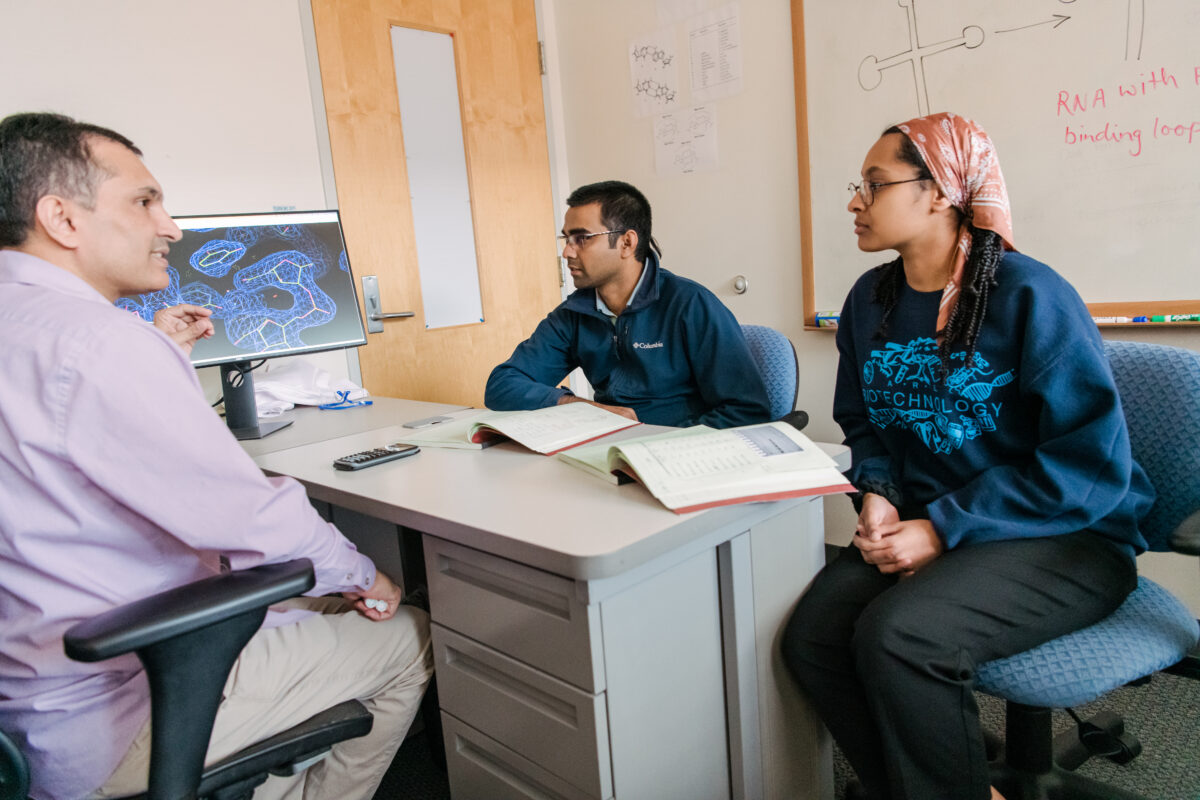 Huda Abdelghani (left) was the first of her three sisters to work in Deepak Koirala’s lab through Howard County’s Applications and Research Laboratory program. At right: Deepak Koirala (left), Naba Krishna Das (center), and Huda Abdelghani discuss their research in Koirala’s office. (Photos by Marlayna Demond ’11/UMBC)
Skills that apply everywhere
Deepak Koirala, associate professor of chemistry and biochemistry, leads a UMBC research group that studies the structures of RNA in enteroviruses—a family of pathogens behind illnesses like hand-foot-and-mouth disease, polio, and myocarditis. Huda joined in the summer of 2022 and stayed through spring 2023. Mentored by a Ph.D. student in the lab, Hasan Al Banna, she quickly learned that scientific research frequently involves failure—but that’s no reason to give up.
“You can do everything right and still not get results,” she says. “It’s not personal—that’s just science.” This lesson in perseverance stuck with her, as did Koirala’s individualized attention. When her graduate student mentor was away, he spent hours helping her set up trays of crystallization plates for her experiments.
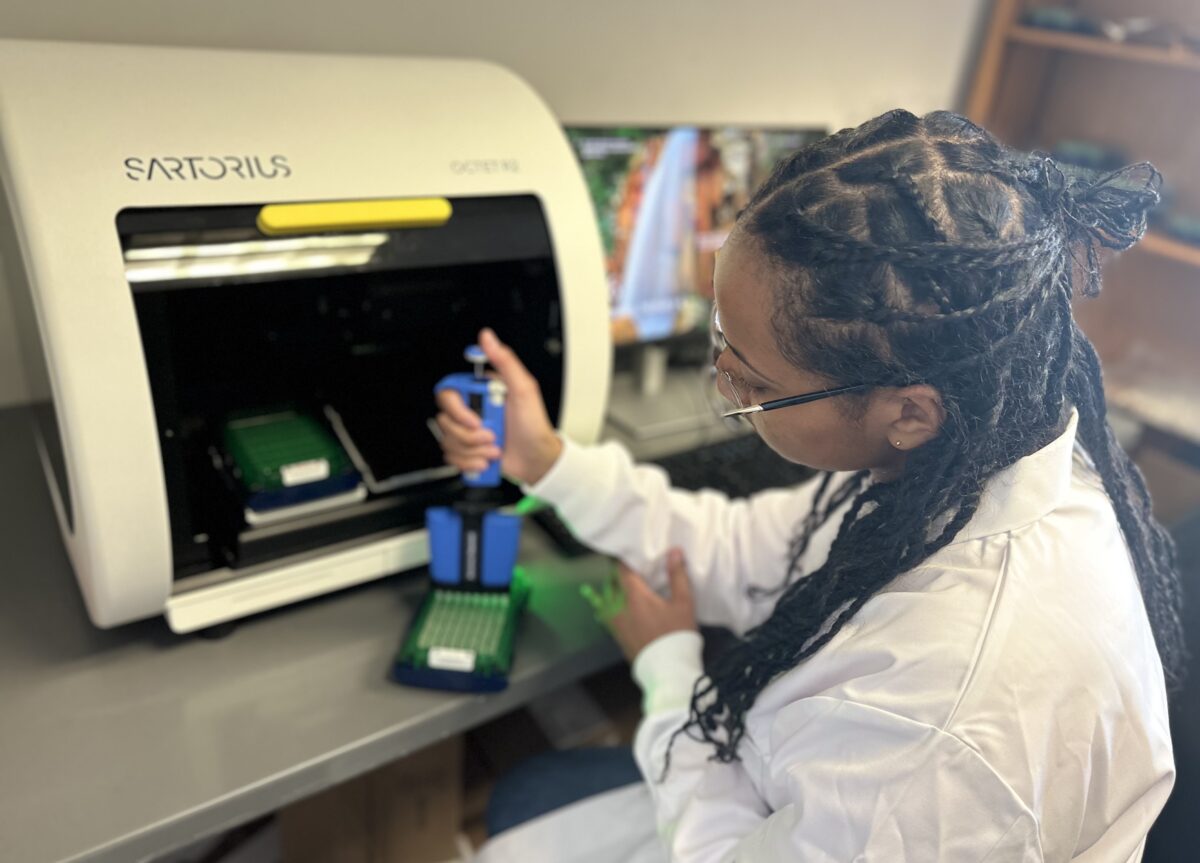
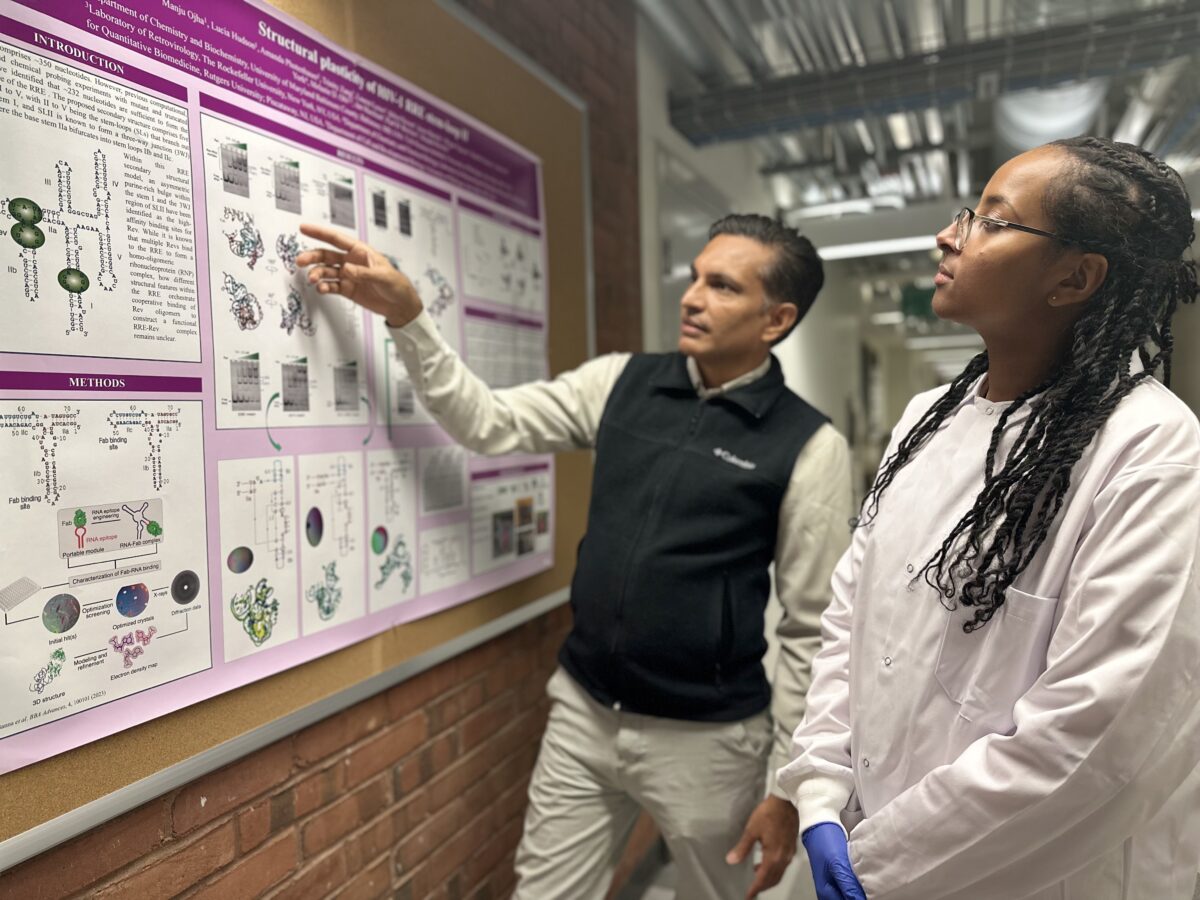 Left: Reem Abdelghani works with a multi-channel micropipet in the lab. Right: Reem and Deepak Koirala discuss research at a poster in the hallway outside Koirala’s lab. (Photos courtesy of Deepak Koirala)
Huda is now a junior mechanical engineering major at MIT, spending this semester on co-op with Apple’s Mac product design team in Austin, Texas—but the lab’s influence lingers. It sparked her interest in tools that help accelerate biochemistry research, like imaging platforms. “The technical and soft skills I gained at UMBC can apply anywhere,” she reflects. Even her first MIT lab connection came from a conversation overheard down the hall from her bench in Koirala’s lab. “It showed me the interconnectedness of academia,” she says.
Shattering preconceptions
Huda’s enthusiasm inspired Reem, the middle sister, to reach out to Koirala for her own ARL biotech internship. She started in Koirala’s lab in the summer of 2024, before her senior year of high school. “I saw how happy Huda was—and it looked like something I’d enjoy, too,” Reem says.
Mentored by Ph.D. student Naba Krishna Das, who isnow a postdoctoral fellow at the National Cancer Institute in Frederick, Maryland, Reem immersed herself in the lab’s operations, from presenting at lab meetings to executing tasks like sterilizing equipment and generating crystal structures of RNA and protein complexes. The lab’s collaborative vibe shattered her preconceptions. “I was worried grad school could be isolating, but it’s so interactive, with people at every stage of their scientific careers,” she explains.
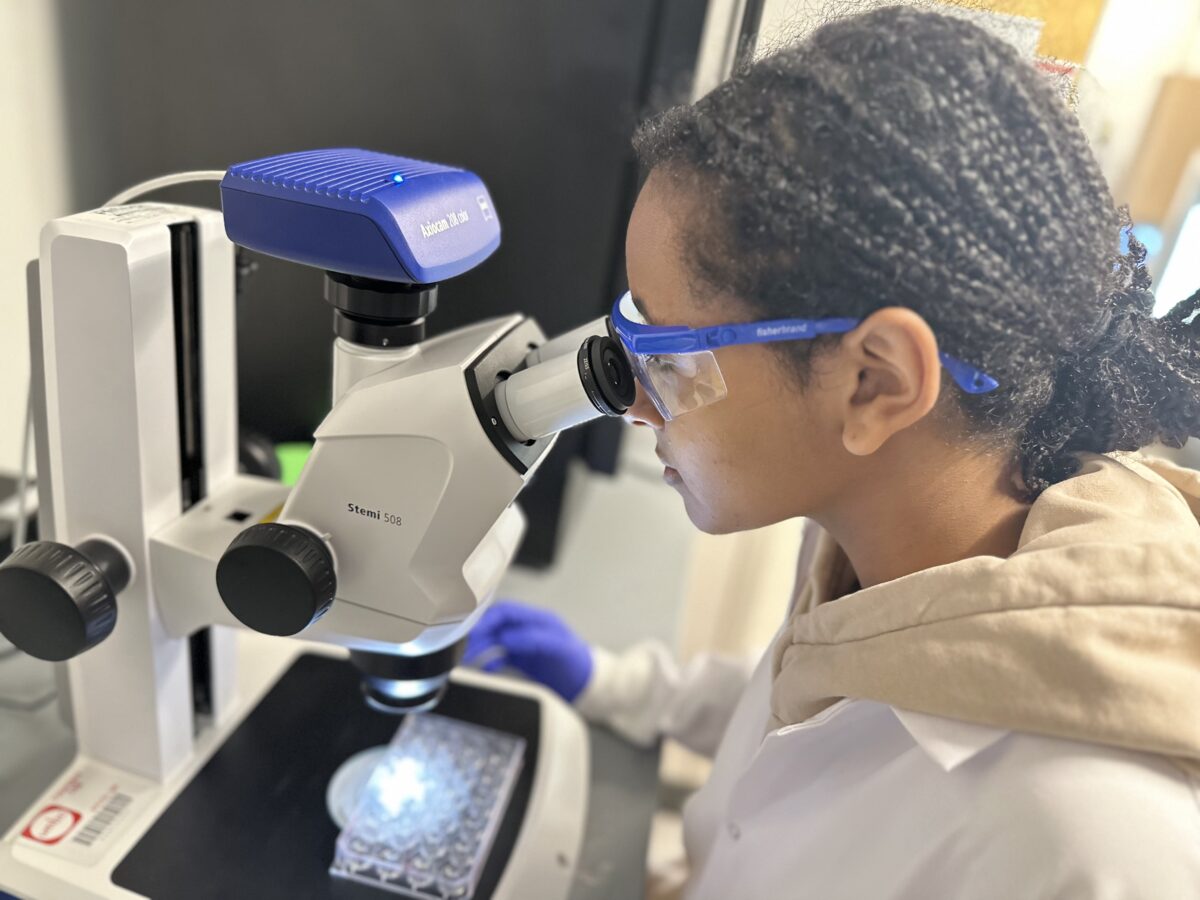
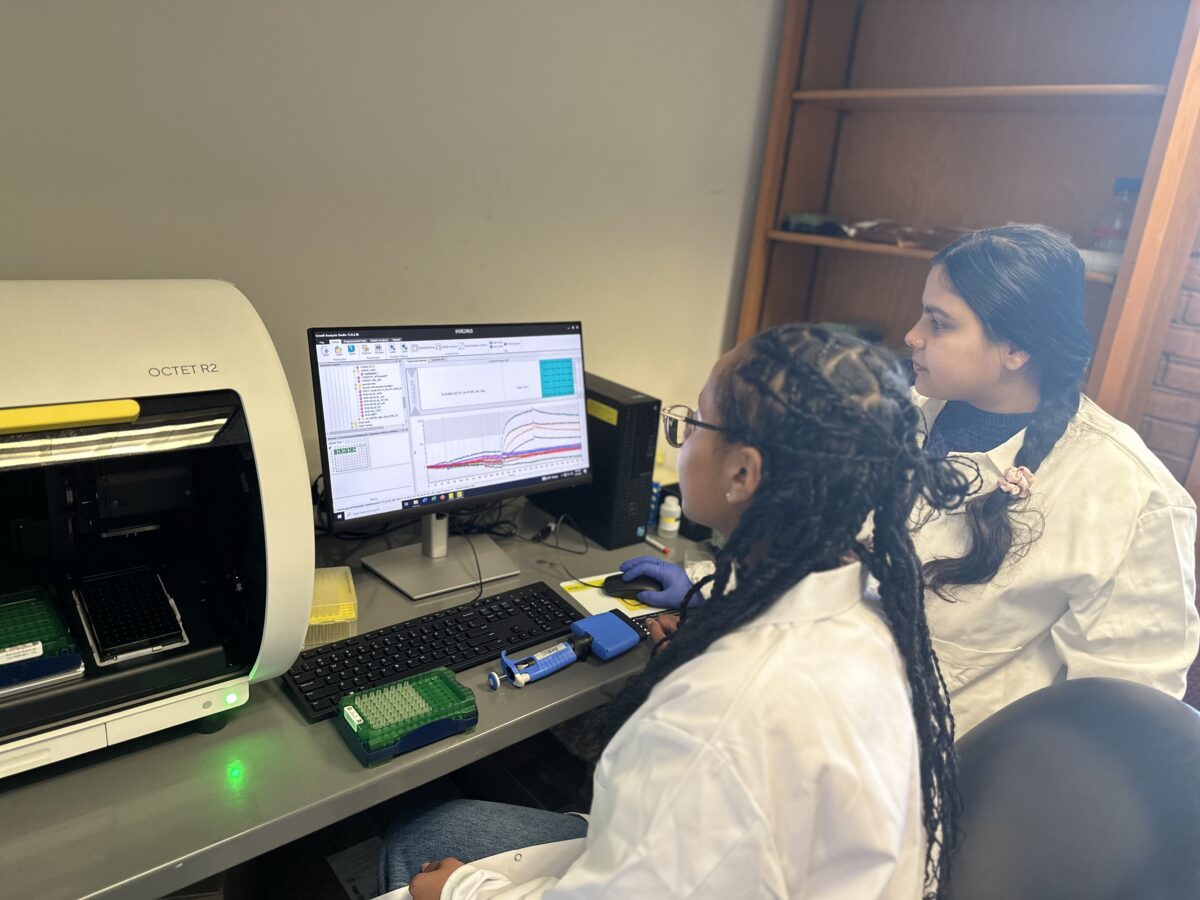 All three sisters gained valuable experience and skills working with Koirala. Left: Rowah looks at experimental wells under a microscope. Right: Reem (left) and Manju Ojha analyze data. (Photos courtesy of Deepak Koirala)
Reem conducted experiments for a project on viral replication, earning co-authorship on a 2025 Nature Communications paper as a high schooler. “I never expected to be so involved—I feel privileged,” she says. The process taught her the value of replication and troubleshooting. “Sometimes it’s trial and error as you’re exploring something new,” she says.
Now a first-year student at UMBC majoring in biochemistry, Reem plans to return to the Koirala lab as soon as space becomes available. “I didn’t consider grad school before, but now it’s definitely on the table,” she says—a perspective born of early research experiences that revealed what the scientific process is really like.
A real community
Rowah, a high school senior, joined the lab last fall. Her expectations of a “scary, strict PI” melted away. “Dr. Koirala is one of the kindest people I’ve met,” Rowah says. The lab’s supportive dynamic impressed her, too. Members shared resources, brainstormed next steps, and lifted each other up. “They push each other to do better—it’s a real community.”
Building on her ARL skills, Rowah felt like a valued member of the team. Her mentor in the lab, Ph.D. student Bethel G. Beyene, provided scientific papers for context, ensuring she grasped the concepts behind the team’s research, not just individual lab techniques. She, too, came face to face with failure and learned from it.
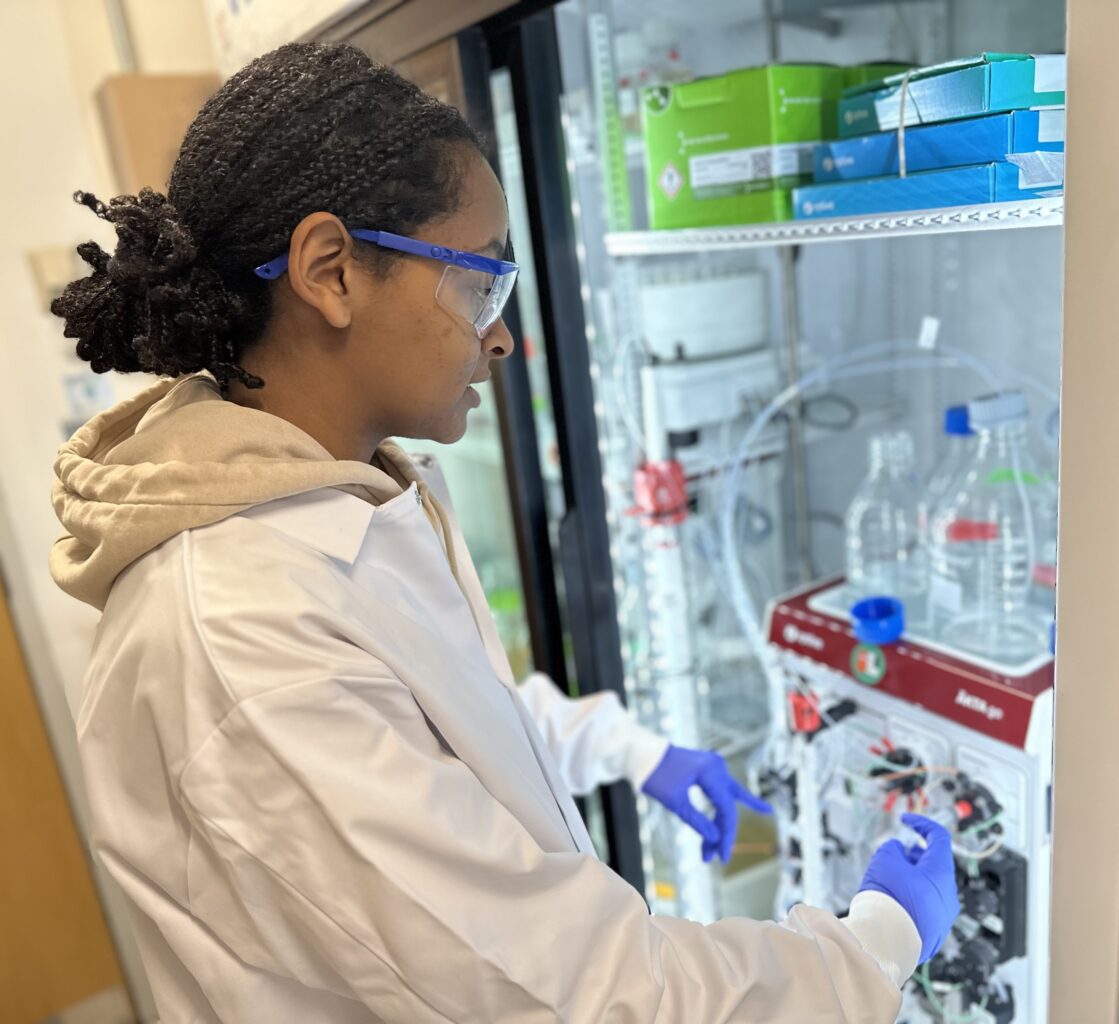
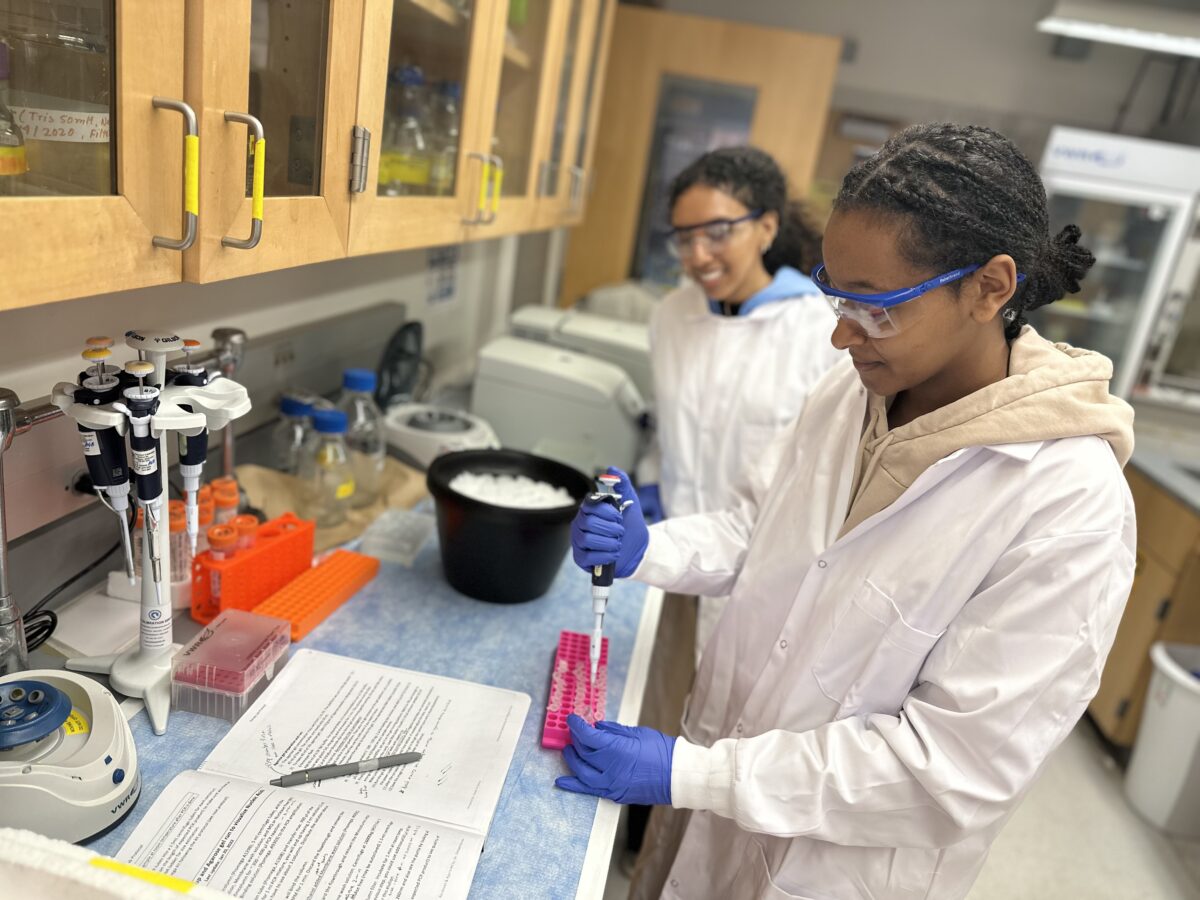 Rowah (at left and pipetting on right) received supportive mentorship from Ph.D. student Bethel Beyene (right photo, background). (Photos courtesy of Deepak Koirala)
“When things go wrong, we sit down and figure it out. It’s not that failure means you’re wrong; overcoming it is how you succeed.” That creative problem-solving carried over into her high school robotics competitions. “I applied lab thinking by evaluating all the possible sources of error to debug our robot—it felt great,” Rowah says. With her interests across biology and engineering, Rowah is considering a biomedical engineering major in the future. “The Koirala lab showed me that I don’t have to choose between my interests,” she says.
Making science better
The sisters’ bond fueled their experiences. “We talk openly—about lab life, plans, even arguments,” Reem laughs. Rowah says her admiration for Huda encouraged her to pursue working in Koirala’s lab. Though they never overlapped in the lab, Huda’s path reassured the others. “If I hadn’t had that chance, I couldn’t have shared it with my family,” Huda says.
Koirala credits the ARL program for bringing talented high schoolers like the Abdelghanis into his group. “They’re not just mentioned in the acknowledgments for completing experiments, but contributing intellectually at the level of authorship,” he says, noting the paper Reem co-authored.
His inclusive approach welcomes students with diverse backgrounds, training the next generation of scientists. “High schoolers, undergrads, women and men from varied backgrounds—they’re all making science better,” Koirala says. Clearly, including less experienced scientists isn’t hurting the lab’s output. Koirala has received multiple major grants and published high-profile papers since he arrived at UMBC in 2020.
In Koirala’s welcoming space, beginners become contributors, failures forge innovators, and family ties amplify ambition. As Rowah troubleshoots gels, Reem eyes graduate school, and Huda designs bioimaging tech at MIT, their paths affirm that science thrives on curiosity, community, and the courage to explore.
]]>
On the fourth floor of UMBC’s Meyerhoff Chemistry Building, where students are hard at work exploring the intricacies of RNA molecules that may hold the key to combating viral diseases, a unique...
https://umbc.edu/stories/sisters-in-science/
https://my3.my.umbc.edu/api/v0/pixel/news/156260/guest@my.umbc.edu/87ca52c1e4d306e0d8b68899f861ab8c/api/pixel
chembiochem
cnms
community
news
research
science-and-tech
story
undergradresearch
UMBC News & Magazine
https://my3.my.umbc.edu/groups/umbc-news-magazine
https://assets1-my.umbc.edu/system/shared/avatars/groups/000/001/943/24435aa6207c452e7bc15cc74b42c7bb/xsmall.png?1748556657
https://assets1-my.umbc.edu/system/shared/avatars/groups/000/001/943/24435aa6207c452e7bc15cc74b42c7bb/original.png?1748556657
https://assets2-my.umbc.edu/system/shared/avatars/groups/000/001/943/24435aa6207c452e7bc15cc74b42c7bb/xxlarge.png?1748556657
https://assets2-my.umbc.edu/system/shared/avatars/groups/000/001/943/24435aa6207c452e7bc15cc74b42c7bb/xlarge.png?1748556657
https://assets3-my.umbc.edu/system/shared/avatars/groups/000/001/943/24435aa6207c452e7bc15cc74b42c7bb/large.png?1748556657
https://assets1-my.umbc.edu/system/shared/avatars/groups/000/001/943/24435aa6207c452e7bc15cc74b42c7bb/medium.png?1748556657
https://assets2-my.umbc.edu/system/shared/avatars/groups/000/001/943/24435aa6207c452e7bc15cc74b42c7bb/small.png?1748556657
https://assets1-my.umbc.edu/system/shared/avatars/groups/000/001/943/24435aa6207c452e7bc15cc74b42c7bb/xsmall.png?1748556657
https://assets2-my.umbc.edu/system/shared/avatars/groups/000/001/943/24435aa6207c452e7bc15cc74b42c7bb/xxsmall.png?1748556657
UMBC News & Magazine
0
0
false
Thu, 05 Feb 2026 13:43:47 -0500
Thu, 05 Feb 2026 13:43:47 -0500
Meet a Retriever—Rishi Nixon, Honors College senior, Parkinson’s researcher, and performing storyteller
Rishi Nixon, a senior biological sciences major and member of the Honors College, brings a kaleidoscope of interests and skills to his time at UMBC after transferring from Montgomery College. He’s been a performing storyteller for more than 10 years, originally with his 4-H youth club and now independently. Nixon conducts research on Parkinson’s disease at the University of Maryland School of Medicine and plans to pursue a medical degree after UMBC.
Q: Tell us about someone in the UMBC community who has inspired or supported you.
A: Meeting Kendyl Walker, my honors college advisor, on my first day of classes made UMBC feel like home. Especially coming into this new environment after leaving my community college—she met me where I was on day one and continues to make me feel supported every time we meet.
Q: Tell us about what you love about your academic program or an organization you’re involved in.
A: My honors college seminar on race, poverty, and gender in Baltimore, taught by Dr. Jodi Kelber-Kaye (“Dr. K.”) opened my eyes to issues facing the city and was one of my most impactful UMBC courses. It helped cut through the ways the city is sometimes talked about in Maryland politics, emphasizing the importance of funding programs that help lift up Baltimore.
This past summer, I had the opportunity to complete a second seminar with Dr. K: an applied community service experience at a nonprofit organization in the city called Moveable Feast, which helps deliver medically-tailored meals to Baltimore residents experiencing food insecurity.
In August 2025, I engaged with the city for the first time in my capacity as a performing storyteller. I performed at the Irvington Peace Park for an annual summer camp organized by Cynthia Wagner, teaching professor in biological sciences, for youth who live in her West Baltimore community. The peace park—a beautiful space built by community members from clearing a vacant lot—was a magical site for the camp, and the kids were a wonderful audience.
Photo right: Rishi Nixon at the National Storytelling Conference in Georgia with the vice chair and vice chair-elect of the board of the National Storytelling Network.

Q: What’s the one thing you’d want someone who hasn’t joined the UMBC community to know about it?
A: Something Dr. K. said once sums it up: “UMBC is a small town.” I see UMBC as a really welcoming place for students who are comfortable leaning on their advisors, mentors, and supporters. It’s very comforting to see faces you recognize each day all over “town.”
Q: What brought you to UMBC?
 Rishi Nixon sits at his lab bench at the University of Maryland School of Medicine, where he conducts Parkinson’s research.
A: I came to UMBC because of its excellent reputation for undergraduate teaching and scientific research opportunities, but also to maintain the small-town feeling and one-on-one learning I received at Montgomery College.
Now that I’m here, UMBC’s research reputation has proven true. I’ve conducted research at the University of Maryland School of Medicine (UMSOM) and also in my coursework. At UMSOM, I study a neuron protein called proSAAS that helps unclump misfolded proteins in the brain that are responsible for neuron death in Parkinson’s disease.
And in my Experimental Biology Lab course, taught by Dr. Tracy Smith, associate teaching professor in biological sciences, I got to participate in ecological research. We visited on-campus sections of the West Branch of Herbert Run to measure the diversity of macroinvertebrates (e.g. fly larvae, water beetles, etc.). We collected them from the stream bed, logged their abundance and the number of types of organisms, and drew a conclusion about the stream’s overall health and pollution levels based on an index of biodiversity levels associated with different degrees of stream health.
Our calculations determined that the stream is very healthy, which is probably a result of UMBC and the Chesapeake and Atlantic Coastal Bays Trust Fund investing in restoring the streams. In fact, the most abundant species of macroinvertebrate we found (damselfly larvae), are actually sensitive to pollutants, yet they were thriving in campus streams when we surveyed in September 2025.
Q: How has UMBC supported your “why”?
A: UMBC’s Honors College has been core to supporting my “why.” They have been huge supporters in connecting me with opportunities for research, and their seminars are excellent for deep one-on-one learning in very niche areas (e.g., Dr. K. and Baltimore). It’s hard for me to imagine my UMBC experience without the Honors College. Its staff and programming helped deepen my existing interests, including pursuing service in Baltimore after my coursework on the city and taking a seminar in neuroscience after conducting research in neurobiology.
Q: What would you tell other transfer students about UMBC?
A: I would encourage other transfer students to apply to the Honors College—I think the small class sizes and the one-on-one advising preserve a similar experience at community colleges. I am also very grateful that UMBC is able to provide generous merit scholarships to support transfer students coming from honors programs at Maryland community colleges.
]]>
Rishi Nixon, a senior biological sciences major and member of the Honors College, brings a kaleidoscope of interests and skills to his time at UMBC after transferring from Montgomery College. He’s...
https://umbc.edu/stories/meet-a-retriever-rishi-nixon-honors-college/
https://my3.my.umbc.edu/api/v0/pixel/news/153825/guest@my.umbc.edu/984747be35e4a4a8a35b1a7c85606166/api/pixel
biology
cahss
campus-life
cnms
community
gwst
honors-college
magazine
perspectives
story
transfer-students
undergradresearch
UMBC News & Magazine
https://my3.my.umbc.edu/groups/umbc-news-magazine
https://assets1-my.umbc.edu/system/shared/avatars/groups/000/001/943/24435aa6207c452e7bc15cc74b42c7bb/xsmall.png?1748556657
https://assets1-my.umbc.edu/system/shared/avatars/groups/000/001/943/24435aa6207c452e7bc15cc74b42c7bb/original.png?1748556657
https://assets2-my.umbc.edu/system/shared/avatars/groups/000/001/943/24435aa6207c452e7bc15cc74b42c7bb/xxlarge.png?1748556657
https://assets2-my.umbc.edu/system/shared/avatars/groups/000/001/943/24435aa6207c452e7bc15cc74b42c7bb/xlarge.png?1748556657
https://assets3-my.umbc.edu/system/shared/avatars/groups/000/001/943/24435aa6207c452e7bc15cc74b42c7bb/large.png?1748556657
https://assets1-my.umbc.edu/system/shared/avatars/groups/000/001/943/24435aa6207c452e7bc15cc74b42c7bb/medium.png?1748556657
https://assets2-my.umbc.edu/system/shared/avatars/groups/000/001/943/24435aa6207c452e7bc15cc74b42c7bb/small.png?1748556657
https://assets1-my.umbc.edu/system/shared/avatars/groups/000/001/943/24435aa6207c452e7bc15cc74b42c7bb/xsmall.png?1748556657
https://assets2-my.umbc.edu/system/shared/avatars/groups/000/001/943/24435aa6207c452e7bc15cc74b42c7bb/xxsmall.png?1748556657
UMBC News & Magazine
0
0
false
Wed, 22 Oct 2025 16:21:36 -0400
Wed, 22 Oct 2025 16:21:36 -0400
A web of mentorship: Weaving support and arachnid research at UMBC
A web of mentorship, as intricate as the arachnids Mercedes Burns studies, stretches from her UMBC lab to University of North Carolina at Charlotte and University of Nevada, Las Vegas.
At the web’s center is Burns, a passionate arachnologist whose guidance heavily influenced Sarah Stellwagen, a former postdoctoral fellow in Burns’ lab and now a faculty member at UNC Charlotte. Burns and Stellwagen both mentored Tyler Brown, Ph.D. ’24, biological sciences, at UMBC, and today Brown is a National Science Foundation postdoctoral fellow with Stellwagen in North Carolina. The web extends to Emily Marinko ’23, biological sciences, who coauthored research with Brown and Burns and today is pursuing graduate work in Nevada.
Like spider silk, this network is strong, flexible, and enduring—fostering a love for science and a supportive environment that extends beyond the lab and into the community. All four of these researchers share a commitment to spreading their love for the often-maligned arachnids they study with broad audiences as a means of dispelling myths, reducing fear, and promoting the value of diversity.
 Tyler Brown (left) earned his Ph.D. in 2024, mentored by Mercedes Burns (right). (Marlayna Demond ’11/UMBC)
Guiding the next generation
Burns’ mentorship style is “a very one-on-one approach,” Stellwagen says. “She has an open door and wants to talk about details and help you think through your experiments and your projects. That was a very successful way to mentor me, and I’m trying to mentor students in that way, too.”
Burns meets students where they are, helping them pursue their interests within her research program’s framework. Burns focuses on the evolutionary ecology of Opiliones, commonly known as daddy longlegs, while Stellwagen explores the material properties of arachnid silks and glues.
“I appreciated Mercedes’ willingness to open up her lab to my interests, so we could push our expertise together, which has made me a lot more successful down the line,” Stellwagen says. “I took that openness to heart. Today, I’m a silk lab, a biomaterials lab—but for people who have different interests, as long as you can incorporate some bit of silks and glues into your research, I’m very open.”
That attitude extends to Brown, who is more interested in behavioral research. In Burns’ lab, he led a study of Opiliones mating behaviors using a novel video-tracking method driven by machine learning. Marinko conducted many of the trials, and both are co-authors with Burns on the resulting paper. Now in Stellwagen’s lab, Brown is continuing to pursue behavioral work with a silk-and-glue twist.
 Emily Marinko (above) conducted research with Mercedes Burns as an undergraduate. Here they present her findings at UMBC’s Undergraduate Research and Creative Achievement Day in 2022. (Sarah Hansen, M.S. ’15/UMBC)
“Connecting with them personally is something I’ve really appreciated with both Mercedes and Sarah. It makes the lab a more comfortable place to be in,” Brown says. In turn, “Being accessible on a personal and professional level to Emily was something that was important for me. I made sure that they had the level of independence they were hoping for.”
The personal, high-touch mentoring style in the Burns lab worked well for Marinko. “Dr. Burns and Tyler were very supportive, and I felt very welcomed. It helped me feel like I was able to ask questions, which I think is a really important part of learning in science,” Marinko says. “I wasn’t just a pair of hands that did busy work. I felt like I was really learning and contributing to the research, and that experience helped me get my position as a grad student.”
Sharing science, breaking down barriers
While much of their work happens in the lab, Burns’ team understands that thoughtful outreach can help the public care for—and perhaps even learn to like—arachnids.
“We’re talking about organisms that most people dislike,” Burns acknowledges, “so if we understand them and are curious about them, that’s going to take some of the fear away.”
For Brown, it started with “getting to know them on a more personal level”—the arachnids, that is. “Working with arachnids every day and learning so much more about them, it just becomes so much more interesting, and any fear you have sort of goes away, the more you understand them,” he says. He wants to help others overcome their fears, too.
 Burns and her lab members use this tarantula as part of their educational outreach to shift how people think about arachnids. (Marlayna Demond ’11/UMBC)
To that end, Brown recently participated in a children’s outreach event at a local library. “A lot of people were very nervous when they saw a bucketful of tarantula molts, but even in the short time frame of the event, getting to explain things and seeing people overcome that initial fear because they’re learning a bit—that has really helped guide me toward what I want to do with outreach.”
The entire Stellwagen lab participated in an outreach event at a major youth museum in Charlotte. “I think the commitment to outreach is born from having such a strong love for these organisms,” she says. “We do this because we love them so much, and we want people to learn about them so they don’t have this stigma. In the end, it’s about, ‘How do you get this information effectively to the public so they can care about and preserve these precious things?’”
Events at libraries, schools, and museums can foster scientific literacy and humanize scientists and the scientific process, leading to a better informed and more open-minded community.
Marinko started out with some of their own hangups around arachnids, but over time, that changed. “When Dr. Burns talked about her research, she was so passionate about it that I wanted to be more like her, I guess. I wanted to overcome my fear; I wanted to be braver,” they say. Today Marinko works with a potentially even scarier organism: ticks. “And obviously since I ended up working with ticks, I’m not as afraid of them as I used to be, either,” Marinko says.
 This summer, Mercedes Burns (left) and Harper Montgomery ’20 (right) traveled to Japan and South Korea to collect arachnid specimens and work in a collaborator’s laboratory. Montgomery is currently pursuing a Ph.D. with Burns, adding to the mentorship web. (Courtesy of Burns)
Embracing difference
Reducing fears of organisms we don’t understand can even affect how we think about and interact with people who are different from us, Burns says. “I don’t think it’s an accident that I’m interested in biodiversity, and I also care a lot about human diversity—about celebrating that experience and how people bring different ideas, passions, and interests to the table,” she says.
Burns strives to promote curiosity, a genuine desire to learn, and a willingness to change one’s mind in all of her students. “If you’re curious about something, there’s less fear and more of a motivation to understand,” she says. “By getting a broad range of students involved in research, they’ll go out and have those casual conversations with friends and family that lead overall to a more open perspective on biodiversity and, more broadly, an appreciation of diversity.”
“When you go into Mercedes’ lab, there’s an excitement about these organisms that you feel,” Stellwagen says. That passion helps attract outstanding students and keep them motivated, she adds. “Mercedes has created arachnology ‘lifers’ with her enthusiasm, and now that’s trickled down into me being able to pull in some lifers, too.”
 Sarah Stellwagen (left) and Mercedes Burns (right) developed a close personal relationship when Stellwagen was a postdoc with Burns; Burns even fills the role of adoptive “auntie” to Stellwagen’s children. Today they are continuing their highly productive research collaboration, with Stellwagen now a faculty member at UNC Charlotte. (Marlayna Demond ’11/UMBC)
Teamwork fuels discovery
The culture of supportive mentorship in Burns’ lab extends beyond work in the lab to the group members’ collaborative approach to applying for grants to fund their ongoing research. Together, Burns, Stellwagen, and Brown refined a strategy—ranking reviewer concerns and proposing solutions—that won funding after initial rejections.
“We collaboratively came up with techniques to go through the grant application process, and that has helped us all a lot,” Burns notes. Having each other for support also kept the group’s morale up, even when they received harsh feedback from reviewers.
Brown was involved in some of those applications, which he says “definitely helped me make mine into a successful application in my second year in Sarah’s lab.”
Burns collaborated with Stellwagen on a major grant when Stellwagen was still a postdoc in her lab, which is not necessarily typical. “I feel like a collaborative approach to grant-writing has been more my style,” Burns reflects. “If we want rich collaborative experiences, we need to enable our colleagues to be co-PIs and apply with us.”
The mentorship web spun by Burns, Stellwagen, Brown, and Marinko at UMBC illustrates a dynamic cycle of learning, collaboration, and outreach. Their shared passion for arachnids not only drives innovative research but also fosters a supportive environment where students can grow into confident scientists.
This network, built on personal connections and open inquiry, extends its impact through public engagement, encouraging broader appreciation for biodiversity. By fostering curiosity and embracing diverse perspectives, the lab’s legacy weaves an ever-expanding web, inspiring new generations to advance science and understanding—and maybe even grow an appreciation for arachnids along the way.
]]>
A web of mentorship, as intricate as the arachnids Mercedes Burns studies, stretches from her UMBC lab to University of North Carolina at Charlotte and University of Nevada, Las Vegas. At the...
https://umbc.edu/stories/arachnids-web-of-mentorship/
https://my3.my.umbc.edu/api/v0/pixel/news/151458/guest@my.umbc.edu/c6c041c5f3c058325d693c5846da6701/api/pixel
biology
cnms
gradresearch
news
research
science-and-tech
story
undergradresearch
UMBC News & Magazine
https://my3.my.umbc.edu/groups/umbc-news-magazine
https://assets1-my.umbc.edu/system/shared/avatars/groups/000/001/943/24435aa6207c452e7bc15cc74b42c7bb/xsmall.png?1748556657
https://assets1-my.umbc.edu/system/shared/avatars/groups/000/001/943/24435aa6207c452e7bc15cc74b42c7bb/original.png?1748556657
https://assets2-my.umbc.edu/system/shared/avatars/groups/000/001/943/24435aa6207c452e7bc15cc74b42c7bb/xxlarge.png?1748556657
https://assets2-my.umbc.edu/system/shared/avatars/groups/000/001/943/24435aa6207c452e7bc15cc74b42c7bb/xlarge.png?1748556657
https://assets3-my.umbc.edu/system/shared/avatars/groups/000/001/943/24435aa6207c452e7bc15cc74b42c7bb/large.png?1748556657
https://assets1-my.umbc.edu/system/shared/avatars/groups/000/001/943/24435aa6207c452e7bc15cc74b42c7bb/medium.png?1748556657
https://assets2-my.umbc.edu/system/shared/avatars/groups/000/001/943/24435aa6207c452e7bc15cc74b42c7bb/small.png?1748556657
https://assets1-my.umbc.edu/system/shared/avatars/groups/000/001/943/24435aa6207c452e7bc15cc74b42c7bb/xsmall.png?1748556657
https://assets2-my.umbc.edu/system/shared/avatars/groups/000/001/943/24435aa6207c452e7bc15cc74b42c7bb/xxsmall.png?1748556657
UMBC News & Magazine
1
0
false
Tue, 12 Aug 2025 12:53:33 -0400
Tue, 12 Aug 2025 12:53:33 -0400
Black hole mergers open doors for students
There are black holes, and then there are supermassive black holes (SMBH), with masses millions to billions of times as great as the Sun. A small percentage of SMBH are furiously gobbling up matter; these are called active galactic nuclei (AGN). Adi Foord, assistant professor of physics, is co-leading a research project designed to further understanding of how this rare type of black hole forms and changes over time.
The project, recently funded by a National Science Foundation (NSF) Astronomy and Astrophysics Research Grant, also creates prime opportunities for undergraduate and graduate students to contribute to the research and connect with leaders in the field for networking and mentorship—experiences with the potential to shape these students’ futures.
In addition to Foord, the three other co-leads are giants in the field of black hole research at institutions with powerhouse astronomy programs: Meg Urry at Yale University, David Sanders at the University of Hawaii, and Nico Cappelluti at the University of Miami. All four co-leads have collaborated for years as members of a research consortium known as the Accretion History of AGN (AHA) group.
“The goal of the NSF project is to try to map out the growth of AGN across cosmic time using as much data as humanly possible,” Foord says. “We’ll be looking at data collected by observatories in space and on the ground over a really wide range of wavelengths.”
By analyzing data from various sources, the team has a better chance of shedding light on how these black holes grow and evolve, “and how their growth mechanisms connect to things like their environments,” Foord adds, “so getting information about the host galaxies that they’re in will be key.”
Foord is particularly interested in what happens when two galaxies, each with a supermassive black hole at its center, merge, and her part of the new grant zeroes in on exploring these merging AGN. For example, the percentage of galaxies that begin to interact and then go on to complete a merger is an open question.
 Adi Foord (left) and Ph.D. students Cassie Daniele (center) and Zack Reeves discuss research data in Foord’s office. (Brad Ziegler/UMBC)
Addressing the bottleneck
Zack Reeves, a UMBC Ph.D. student mentored by Foord, is contributing to the project through his research on dual AGN—pairs of black holes in the early stages of a potential merger. Reeves started with a dataset including 2,684 confirmed AGN, based on data from the X-ray Multi-mirror Mission (XMM) Newton observatory and Sloan Digital Sky Survey. Then he pared down the data further, eventually settling on 38 AGN that met particular data standards.
“This summer, I’m going through each of the XMM X-ray sources, and looking to see if the AGN have any other significant X-ray sources nearby that could indicate a dual AGN,” Reeves says.
XMM Newton includes tools that allow scientists to filter and analyze the data to answer their specific questions, “but the process can be manual and tedious to do observation by observation,” Reeves says. To address that bottleneck, he’s coding a Python script to streamline data analysis, which he’ll run on UMBC’s High-Performance Computing Facility (HPCF), which can analyze all of the samples in parallel, producing results many times faster than completing the task sequentially by hand.
The results will provide important insights into how galaxies and AGN form. Multiple theoretical simulations describe those processes, and “these simulations disagree on certain predictions, like how the dual AGN population will evolve over the course of cosmic time,” Reeves says. “So the interesting part of this project is that we can actually look in space and observationally constrain how this population evolves, and through that we can identify what strengths and weaknesses these simulations have.”
 Weekly lab meetings with Adi Foord, left, allow students to share their progress and ask and answer questions. (Brad Ziegler/UMBC)
Empowering the next generation of astrophysicists
The NSF grant not only creates opportunities for Foord’s students to dive into cutting-edge research—it will also connect them with top scientists and grow their professional networks. For example, Reeves will begin attending regular AHA group meetings this summer and attend the AHA workshop in Miami in December.
Foord considers creating these career-building opportunities for her students a core part of her mission as a faculty member at UMBC.
“It’s really important that we give UMBC students not only great research projects and opportunities, but also visibility to the field and the ability to make connections and network with people,” Foord says.
The grant also funds UMBC undergraduate students to conduct research with the co-leads at their institutions. This summer, funded through the same NSF grant, Katherine Carver, a rising senior physics major, is interning at Yale with Meg Urry.
At Yale, “Networking with so many talented astronomers and physicists and attending unique professional development and astronomy events”—like a workshop on dark matter and a watch party for the reveal of the first Vera Rubin Observatory images—“have been the most beneficial opportunities,” Carver says.
“It’s really important that we give UMBC students not only great research projects and opportunities, but also visibility to the field and the ability to make connections and network with people.”
Adi Foord, assistant professor of physics
“The students are getting an opportunity to learn about what’s going on at these other institutions, how research teams work at these different places, and also to network with scientists there,” Foord says, “and that’s only going to help their careers if they decide to continue in astrophysics.”
“Dr. Foord has been instrumental in my success as an aspiring scientist,” Carver says, “from teaching me how to write scientific proposals to aiding the progression of my research at UMBC.”
Reeves is grateful for Foord’s guidance, too. “She’s teaching me a lot about moves that I should be making right now, and how to network and build connections, and also making those connections for me, which means a lot,” he says.
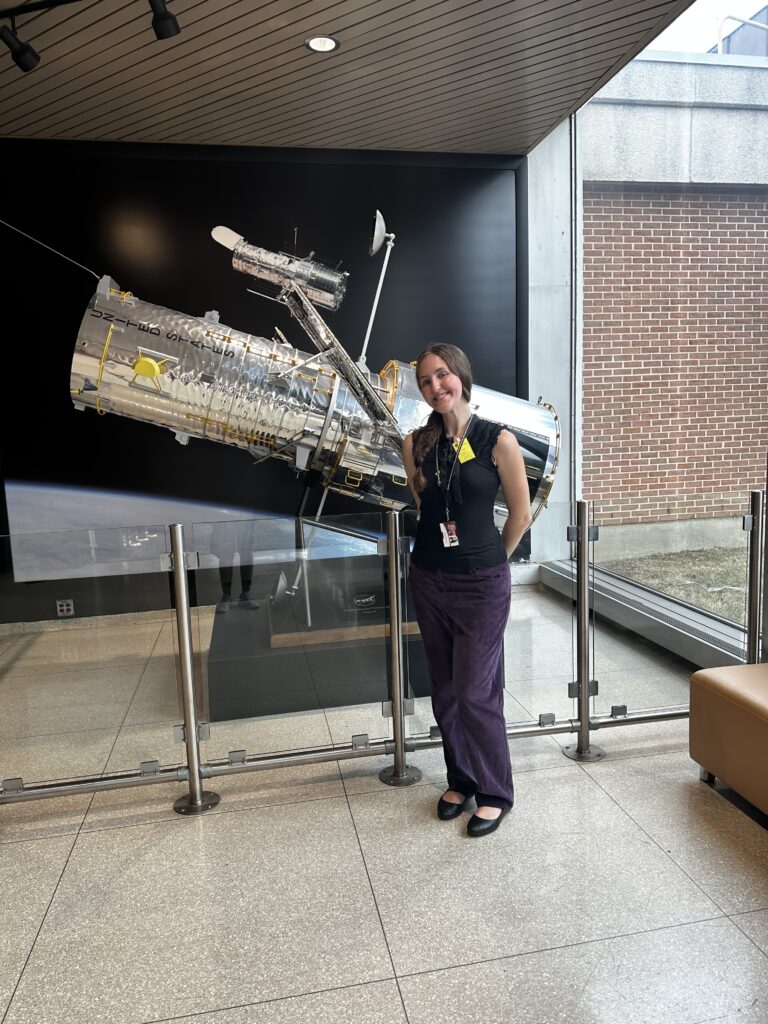 Katherine Carver stands in front of a model of the Hubble Space Telescope at NASA Goddard Space Flight Center in Greenbelt, Maryland. She took a field trip to Goddard in summer 2024 while an intern at the Johns Hopkins Space Telescope Science Institute. (Courtesy of Carver)
Big-picture questions require practical skills
Reeves says that in high school, he romanticized physics; “the lure of figuring out how the universe works” drew him in. Since then, he’s learned that to be successful in the field, big-picture wonder must be backed up with practical skills.
“I consider myself at heart to be an astrophysicist. That’s the dream. That’s what sparks joy in my heart,” he says. Luckily for him, “In practice, I also really enjoy statistics and statistical physics.”
Reeves’ work relies heavily on computer programming, data analysis, and statistics, skills he says are “absolutely critical” for astrophysicists. “I learned quickly in college you have to be really good at problem-solving to succeed in physics,” he notes. Reeves encourages anyone interested in physics to take enough computer science courses to “understand what the code is doing under the hood.” Without that foundation and a solid dose of perseverance, he says, at some point you’ll get stuck.
Thankfully, “Zack is super self-motivated, which is one of the most important aspects to being successful,” Foord says. “I’ve seen so many points in time where he’s hit some sort of wall, and then he comes back the next week and he’s figured out some way to get above that wall.”
 At a lab meeting, Zack Reeves shows how his python script generated the same figure that he created manually previously, demonstrating the code’s efficacy. (Brad Ziegler/UMBC)
Staying close to go far
Carver, too, has picked up additional skills that support her physics research. From her work in Foord’s lab and previous internships at the Johns Hopkins Applied Physics Laboratory and Space Telescope Science Institute, she gained key coding and problem-solving skills. Without that, “I would not have been able to contribute to the level I can now to my project at Yale,” she says. “Those experiences also prepared me to secure the internship.”
Foord’s students benefit from a close relationship with her and other research group members. “The energy in the group meetings and our one-to-ones is always just really positive and encouraging, and there’s no stress,” Reeves says. Foord’s guidance has turbocharged his growth, from tackling advanced projects to presenting his work clearly.
“He already has a really good idea of how to tell a story in a way that will help people who aren’t intimately familiar with his research to understand it,” Foord says.
Through Adi Foord’s mentorship, doors to cutting-edge black hole research have swung wide open for Reeves and Carver, equipping them with skills and networks to explore the cosmos as their careers progress. Already, Reeves is paying it forward, using his communication skills to share his fascination with black holes and spark curiosity about one of the universe’s most mysterious phenomena.
]]>
There are black holes, and then there are supermassive black holes (SMBH), with masses millions to billions of times as great as the Sun. A small percentage of SMBH are furiously gobbling up...
https://umbc.edu/stories/black-hole-mergers-open-doors-for-students/
https://my3.my.umbc.edu/api/v0/pixel/news/150986/guest@my.umbc.edu/f6577e89be8854a0d16bac43da6ba910/api/pixel
cnms
gradresearch
news
physics
research
science-and-tech
story
undergradresearch
UMBC News & Magazine
https://my3.my.umbc.edu/groups/umbc-news-magazine
https://assets1-my.umbc.edu/system/shared/avatars/groups/000/001/943/24435aa6207c452e7bc15cc74b42c7bb/xsmall.png?1748556657
https://assets1-my.umbc.edu/system/shared/avatars/groups/000/001/943/24435aa6207c452e7bc15cc74b42c7bb/original.png?1748556657
https://assets2-my.umbc.edu/system/shared/avatars/groups/000/001/943/24435aa6207c452e7bc15cc74b42c7bb/xxlarge.png?1748556657
https://assets2-my.umbc.edu/system/shared/avatars/groups/000/001/943/24435aa6207c452e7bc15cc74b42c7bb/xlarge.png?1748556657
https://assets3-my.umbc.edu/system/shared/avatars/groups/000/001/943/24435aa6207c452e7bc15cc74b42c7bb/large.png?1748556657
https://assets1-my.umbc.edu/system/shared/avatars/groups/000/001/943/24435aa6207c452e7bc15cc74b42c7bb/medium.png?1748556657
https://assets2-my.umbc.edu/system/shared/avatars/groups/000/001/943/24435aa6207c452e7bc15cc74b42c7bb/small.png?1748556657
https://assets1-my.umbc.edu/system/shared/avatars/groups/000/001/943/24435aa6207c452e7bc15cc74b42c7bb/xsmall.png?1748556657
https://assets2-my.umbc.edu/system/shared/avatars/groups/000/001/943/24435aa6207c452e7bc15cc74b42c7bb/xxsmall.png?1748556657
UMBC News & Magazine
1
0
false
Thu, 10 Jul 2025 17:06:49 -0400
Thu, 10 Jul 2025 17:06:49 -0400
UMBC’s Koirala Lab celebrates students’ award-winning RNA research and peer mentorship
A talented trio of students has earned accolades for their innovative work with Deepak Koirala, assistant professor of chemistry and biochemistry. Their awards are replicating like the RNA they study, as they unravel the complexities of viral RNA and reveal potential therapeutic targets.
Manju Ojha, Ph.D. candidate in biochemistry, Megan Nguyen, rising senior biochemistry and molecular biology major, and Jason Daniels ’25, biochemistry and psychology, all members of Koirala’s lab, recently received awards for their joint research on RNA.
Ojha received the Robert F. Steiner Award in recognition of her significant research contributions and dedicated mentorship of undergraduate students. The award was established in 1999 by Robert Cotter and Catherine Fenselau, former chair of the Department of Chemistry and Biochemistry at UMBC, in tribute to Steiner, a former UMBC faculty member and pioneer in biophysical chemistry.
“This award highlights the growing impact of our work on understanding RNA structure, RNA-protein interactions, and viral replication mechanisms—an area that remains central to advancing structural virology and therapeutic development,” Ojha says. “The recognition underscores the importance of tackling complex questions in RNA structure and function using integrative biochemical and structural approaches.”
 Jason Daniels (right) discusses a research poster with his mentor, Deepak Koirala (center), and lab mate Megan Nguyen, outside the Koirala Lab.
Students at the center of the lab
Koirala’s group focuses on viruses whose genomes are made of RNA, which include those that cause diseases like polio, the common cold, and more. The group is developing novel techniques to determine the 3D structures of RNA, plus running experiments to figure out how RNA structures in the viruses interact with their host cell’s machinery. Students are deeply involved in all of it.
Nguyen has been studying the structure and function of plant RNAs under Ojha’s mentorship since 2023. Plant viruses are a major challenge for some crops. This spring, Nguyen received the Satterfield-Bell Scholarship, established in 2001, which recognizes an outstanding junior in chemistry who has conducted research.
“I have learned so many techniques and so much scientific theory from Manju and other lab members,” Nguyen says. “I’m thankful for this amazing experience and to be recognized for it. However, with the mentorship I’ve received over the past three years, I know this award is not only my own, but everyone’s in the Koirala lab.”
Daniels has leveraged his experience in the Koirala lab into a competitive summer research program, the Children’s Hospital of Philadelphia Research Institute Summer Scholars Program. His long-term goal is to pursue an M.D. Daniels received the Faculty Award for Excellence in Biochemistry, given to a graduating biochemistry major who displays excellence in the classroom and the laboratory.
“I can confidently say that the Koirala lab has been transformative in my academic career and future in science,” Daniels says. “This would not have been possible without mentorship from Manju and Dr. Koirala.”
 Koirala’s lab group includes many undergraduate and graduate students who support and encourage each other. (Marlayna Demond ’11/UMBC)
]]>
A talented trio of students has earned accolades for their innovative work with Deepak Koirala, assistant professor of chemistry and biochemistry. Their awards are replicating like the RNA they...
https://umbc.edu/stories/student-awards-rna-research/
https://my3.my.umbc.edu/api/v0/pixel/news/150930/guest@my.umbc.edu/40a6d0f2568c08a9077487402f6fec48/api/pixel
chembiochem
cnms
news
research
science-and-tech
story
undergradresearch
UMBC News & Magazine
https://my3.my.umbc.edu/groups/umbc-news-magazine
https://assets1-my.umbc.edu/system/shared/avatars/groups/000/001/943/24435aa6207c452e7bc15cc74b42c7bb/xsmall.png?1748556657
https://assets1-my.umbc.edu/system/shared/avatars/groups/000/001/943/24435aa6207c452e7bc15cc74b42c7bb/original.png?1748556657
https://assets2-my.umbc.edu/system/shared/avatars/groups/000/001/943/24435aa6207c452e7bc15cc74b42c7bb/xxlarge.png?1748556657
https://assets2-my.umbc.edu/system/shared/avatars/groups/000/001/943/24435aa6207c452e7bc15cc74b42c7bb/xlarge.png?1748556657
https://assets3-my.umbc.edu/system/shared/avatars/groups/000/001/943/24435aa6207c452e7bc15cc74b42c7bb/large.png?1748556657
https://assets1-my.umbc.edu/system/shared/avatars/groups/000/001/943/24435aa6207c452e7bc15cc74b42c7bb/medium.png?1748556657
https://assets2-my.umbc.edu/system/shared/avatars/groups/000/001/943/24435aa6207c452e7bc15cc74b42c7bb/small.png?1748556657
https://assets1-my.umbc.edu/system/shared/avatars/groups/000/001/943/24435aa6207c452e7bc15cc74b42c7bb/xsmall.png?1748556657
https://assets2-my.umbc.edu/system/shared/avatars/groups/000/001/943/24435aa6207c452e7bc15cc74b42c7bb/xxsmall.png?1748556657
UMBC News & Magazine
0
0
false
Mon, 07 Jul 2025 10:53:54 -0400
Mon, 07 Jul 2025 10:53:54 -0400
Sam Geleta ’25: A biochemist with dreams of taking his skills back home
Koirala’s lab group includes many undergraduate and graduate students who support and encourage each other. (Marlayna Demond ’11/UMBC)
]]>
A talented trio of students has earned accolades for their innovative work with Deepak Koirala, assistant professor of chemistry and biochemistry. Their awards are replicating like the RNA they...
https://umbc.edu/stories/student-awards-rna-research/
https://my3.my.umbc.edu/api/v0/pixel/news/150930/guest@my.umbc.edu/40a6d0f2568c08a9077487402f6fec48/api/pixel
chembiochem
cnms
news
research
science-and-tech
story
undergradresearch
UMBC News & Magazine
https://my3.my.umbc.edu/groups/umbc-news-magazine
https://assets1-my.umbc.edu/system/shared/avatars/groups/000/001/943/24435aa6207c452e7bc15cc74b42c7bb/xsmall.png?1748556657
https://assets1-my.umbc.edu/system/shared/avatars/groups/000/001/943/24435aa6207c452e7bc15cc74b42c7bb/original.png?1748556657
https://assets2-my.umbc.edu/system/shared/avatars/groups/000/001/943/24435aa6207c452e7bc15cc74b42c7bb/xxlarge.png?1748556657
https://assets2-my.umbc.edu/system/shared/avatars/groups/000/001/943/24435aa6207c452e7bc15cc74b42c7bb/xlarge.png?1748556657
https://assets3-my.umbc.edu/system/shared/avatars/groups/000/001/943/24435aa6207c452e7bc15cc74b42c7bb/large.png?1748556657
https://assets1-my.umbc.edu/system/shared/avatars/groups/000/001/943/24435aa6207c452e7bc15cc74b42c7bb/medium.png?1748556657
https://assets2-my.umbc.edu/system/shared/avatars/groups/000/001/943/24435aa6207c452e7bc15cc74b42c7bb/small.png?1748556657
https://assets1-my.umbc.edu/system/shared/avatars/groups/000/001/943/24435aa6207c452e7bc15cc74b42c7bb/xsmall.png?1748556657
https://assets2-my.umbc.edu/system/shared/avatars/groups/000/001/943/24435aa6207c452e7bc15cc74b42c7bb/xxsmall.png?1748556657
UMBC News & Magazine
0
0
false
Mon, 07 Jul 2025 10:53:54 -0400
Mon, 07 Jul 2025 10:53:54 -0400
Sam Geleta ’25: A biochemist with dreams of taking his skills back home
When Samuel Geleta ’25, biological sciences, arrived at UMBC from Ethiopia, he was confident he wanted to go to medical school. But that was before he started conducting HIV research with Michael Summers, Distinguished Professor of Chemistry and Biochemistry, and fell in love with the scientific process. This fall, he’s headed to Yale University to pursue a Ph.D. in biomedical and biological sciences. He dreams of conducting research that he can parlay into biotech entrepreneurship in his home country.
Q: How did you choose UMBC?
A: I’m from Ethiopia, and the health sector there needs a lot of work. I wanted to contribute to my community, and at that time I thought getting a medical degree would be the best way to do that. I first started looking at UMBC because I had family living in Maryland. But what really drew me in was UMBC’s reputation as a research powerhouse in the area, with exciting and innovative research that captured my interest. I also appreciated the more affordable price tag at UMBC, and I really liked the communication I had with UMBC staff while I was applying. Especially as an international student, I had a lot to figure out, and they were very quick to respond to all of my requests. I thought, “This is the kind of environment I want to be in.”
Q: How did you get connected with the Summers lab?
A: I was waiting for an Uber at the campus entrance circle, and I saw then President Freeman Hrabowski walking to his car from the Administration Building. I thought, “Let me go talk to him for a second—this is the president, I might never get another chance.” So I talked to him about where I’m from and my strong interest in science. He mentioned the Meyerhoff Scholars Program, and that conversation started a whole chain of communication with him. Eventually he connected me with Keith Harmon, the director of the Meyerhoff Scholars Program. After I met with Mr. Harmon, I became a friend of the program and started receiving advising and other support from Meyerhoff staff. Mr. Harmon was also the one who connected me with Dr. Summers.

 Sam Geleta works hard in Dr. Michael Summers’ lab (left), but also finds time for fun with friends. At right, he celebrates Diwali on campus at an event hosted by the Hindu Student Association. (Courtesy of Geleta)
I was really excited about what Dr. Summers’ lab was doing, and I wanted to be a part of it. We study HIV’s RNAs and proteins, particularly how the virus replicates and packages its genetic material. That was really exciting for me, because Ethiopia is heavily affected by the HIV epidemic. If I could do research that could help us understand how the virus works and ease the epidemic, I wanted to participate in that. Fast forward, and it’s been two-and-a-half years since I joined the lab.
Q: What are you working on in the lab?
A: My first project was on understanding the role of RNA structures in modulating the translation and packaging of the HIV genome. That project was one of the reasons I became strongly interested in doing research, because it showed me the ups and downs of science. A lot of things didn’t work as planned, but eventually they came together, and just that pursuit itself was an incredibly rewarding experience.
We were able to publish results from that project in the Proceedings of the National Academy of Sciences (PNAS) last summer, and now I’m working on a new project where I study how HIV proteins interact with human proteins—how they hijack cellular factors to enhance their own replication. The goal is to find new therapeutic targets for HIV.
Going to conferences taught me that you’re not just limited to your own little bench. Science goes much wider, and you can collaborate with people from across the country or the world, which is amazing.
Samuel Geleta ’25
Q: How did you decide to pursue a research career?
When we published the paper on my first project, I thought, “Wow, by doing research, I can be a part of a story that’s not done yet, but will continue to help other people. That really got me excited about pursuing my Ph.D. Also, for the paper, we collaborated with researchers at the University of Wisconsin and the University of Michigan. That showed me how much collaboration there is in science—that other people are also trying to figure out what’s going on.
Going to multiple conferences also really inspired me to pursue a Ph.D. I was able to meet people from different places and backgrounds, and it was just amazing how much we had in common in terms of what we wanted to pursue. At the same time, there were differences in how we approached our questions. That was really exciting, because I felt like doing my Ph.D. could connect me to a lot more potential collaborators and opportunities. Going to conferences taught me that you’re not just limited to your own little bench. Science goes much wider, and you can collaborate with people from across the country or the world, which is amazing.

 Left: Sam Geleta poses by the ABRCMS sign, a major conference for undergraduate scientists. Right: Samuel Geleta (far left), Dr. Michael Summers (center) and other undergraduate researchers attend UMBC’s Summer Undergraduate Research Fest in 2023. (Courtesy of Geleta)
Q: Who has supported you through your UMBC career?
A: I chose to work with Dr. Saif Yasin, an M.D./Ph.D. candidate in the Summers lab, because of how passionate he was about his science. We clicked immediately. He gave me a lot of freedom to think like a scientist, and come up with solutions to problems in the lab. He’s been an amazing support, and I learned a lot from him.
After he defended his Ph.D and returned to medical school, now I’m working with Dr. Nele Hollman, a postdoc in the lab. She has helped me take ownership of my work and come up with new ideas for the project that I’m doing right now. Even other grad students and postdocs in the Summers lab are always there if I need help. It’s an awesome environment for doing science.
The entire Meyerhoff staff has also been very supportive, and their support didn’t waver as my goals changed. Dr. Tiffany Gierasch, a teaching professor in chemistry and biochemistry, gave me the opportunity to be a learning assistant for organic chemistry classes, which really helped me understand organic chemistry even more and give back to other students. Dr. Deepak Koirala, an assistant professor of chemistry and biochemistry, has also been an awesome mentor. He does RNA research, and I’ve gotten to know him because we’ve gone to a lot of conferences together. I sit in on some of his classes on RNA structures.
The Center for Global Engagement has been very supportive, too. Whenever I have a question, I just go there during their walk-in hours and talk to someone. They are so responsive.
And I can’t leave out my family and friends—some of them are still in Ethiopia. They’ve also been incredibly supportive and encouraging.
It’s perfectly fine if you are not sure about what you want to do. If you’re confused and looking for inspiration for what to do, then you’re doing the right thing. You should let the process play out. Just explore all the paths and everything you’re interested in, and eventually you will find what you really want to do. And once you find that, just keep going.
Samuel Geleta ’25
Q: What’s next for you?
A: I committed to Yale for my Ph.D. in biomedical and biological sciences. I’m really looking forward to starting life in New Haven and being in a new environment to do science. I’m interested in studying RNA therapeutics and how they can be used for viral interventions in different kinds of viruses.
My research got me looking into biotech as well, and after my Ph.D. I would be interested in pursuing that while also potentially working in academia. I would like my research to produce a product or get patented—translational work. That prospect got me more excited to do my Ph.D. I also want to bring some of the business back to Ethiopia and see what I can do. I want to be an entrepreneurial scientist.
Q: What advice do you have for incoming UMBC students or aspiring undergraduate researchers?
A: It’s perfectly fine if you are not sure about what you want to do. If you’re confused and looking for inspiration for what to do, then you’re doing the right thing. You should let the process play out. Just explore all the paths and everything you’re interested in, and eventually you will find what you really want to do. And once you find that, just keep going.
Also, forming connections is really important. Attend events with people from different places, and you’ll gain new insight into what they do. If you decide to start up a conversation with someone who doesn’t know you, you don’t have to go into the conversation with a specific goal. If you’re kind and curious, the other person will take the next step and want to help you out. Even if they can’t help you directly, they may be able to connect you with someone else who can.
I’m still in touch with Dr. Hrabowski. I told him about my post-grad plans and how he’s impacted me, and he was really happy. When I first had that conversation with him, I didn’t think it would lead up to this. I just took a chance, and it worked out. It’s been amazing.

 Left: Sam Geleta (far left) with Dr. Summers and other members of the laboratory, all sporting sweatshirts advertising where they will pursue further study. Right: Geleta visited Yale’s campus before making his graduate school decision.
]]>
When Samuel Geleta ’25, biological sciences, arrived at UMBC from Ethiopia, he was confident he wanted to go to medical school. But that was before he started conducting HIV research with Michael...
https://umbc.edu/stories/sam-geleta-25/
https://my3.my.umbc.edu/api/v0/pixel/news/150090/guest@my.umbc.edu/3fc41b13d20593ba60d1dd159961735b/api/pixel
biological-sciences
biology
class-of-2025
cnms
community
news
science-and-tech
story
undergradresearch
UMBC News & Magazine
https://my3.my.umbc.edu/groups/umbc-news-magazine
https://assets1-my.umbc.edu/system/shared/avatars/groups/000/001/943/24435aa6207c452e7bc15cc74b42c7bb/xsmall.png?1748556657
https://assets1-my.umbc.edu/system/shared/avatars/groups/000/001/943/24435aa6207c452e7bc15cc74b42c7bb/original.png?1748556657
https://assets2-my.umbc.edu/system/shared/avatars/groups/000/001/943/24435aa6207c452e7bc15cc74b42c7bb/xxlarge.png?1748556657
https://assets2-my.umbc.edu/system/shared/avatars/groups/000/001/943/24435aa6207c452e7bc15cc74b42c7bb/xlarge.png?1748556657
https://assets3-my.umbc.edu/system/shared/avatars/groups/000/001/943/24435aa6207c452e7bc15cc74b42c7bb/large.png?1748556657
https://assets1-my.umbc.edu/system/shared/avatars/groups/000/001/943/24435aa6207c452e7bc15cc74b42c7bb/medium.png?1748556657
https://assets2-my.umbc.edu/system/shared/avatars/groups/000/001/943/24435aa6207c452e7bc15cc74b42c7bb/small.png?1748556657
https://assets1-my.umbc.edu/system/shared/avatars/groups/000/001/943/24435aa6207c452e7bc15cc74b42c7bb/xsmall.png?1748556657
https://assets2-my.umbc.edu/system/shared/avatars/groups/000/001/943/24435aa6207c452e7bc15cc74b42c7bb/xxsmall.png?1748556657
UMBC News & Magazine
8
0
false
Tue, 13 May 2025 11:23:46 -0400
Tue, 13 May 2025 11:23:46 -0400
Three UMBC juniors receive prestigious Goldwater Scholarships
Left: Sam Geleta (far left) with Dr. Summers and other members of the laboratory, all sporting sweatshirts advertising where they will pursue further study. Right: Geleta visited Yale’s campus before making his graduate school decision.
]]>
When Samuel Geleta ’25, biological sciences, arrived at UMBC from Ethiopia, he was confident he wanted to go to medical school. But that was before he started conducting HIV research with Michael...
https://umbc.edu/stories/sam-geleta-25/
https://my3.my.umbc.edu/api/v0/pixel/news/150090/guest@my.umbc.edu/3fc41b13d20593ba60d1dd159961735b/api/pixel
biological-sciences
biology
class-of-2025
cnms
community
news
science-and-tech
story
undergradresearch
UMBC News & Magazine
https://my3.my.umbc.edu/groups/umbc-news-magazine
https://assets1-my.umbc.edu/system/shared/avatars/groups/000/001/943/24435aa6207c452e7bc15cc74b42c7bb/xsmall.png?1748556657
https://assets1-my.umbc.edu/system/shared/avatars/groups/000/001/943/24435aa6207c452e7bc15cc74b42c7bb/original.png?1748556657
https://assets2-my.umbc.edu/system/shared/avatars/groups/000/001/943/24435aa6207c452e7bc15cc74b42c7bb/xxlarge.png?1748556657
https://assets2-my.umbc.edu/system/shared/avatars/groups/000/001/943/24435aa6207c452e7bc15cc74b42c7bb/xlarge.png?1748556657
https://assets3-my.umbc.edu/system/shared/avatars/groups/000/001/943/24435aa6207c452e7bc15cc74b42c7bb/large.png?1748556657
https://assets1-my.umbc.edu/system/shared/avatars/groups/000/001/943/24435aa6207c452e7bc15cc74b42c7bb/medium.png?1748556657
https://assets2-my.umbc.edu/system/shared/avatars/groups/000/001/943/24435aa6207c452e7bc15cc74b42c7bb/small.png?1748556657
https://assets1-my.umbc.edu/system/shared/avatars/groups/000/001/943/24435aa6207c452e7bc15cc74b42c7bb/xsmall.png?1748556657
https://assets2-my.umbc.edu/system/shared/avatars/groups/000/001/943/24435aa6207c452e7bc15cc74b42c7bb/xxsmall.png?1748556657
UMBC News & Magazine
8
0
false
Tue, 13 May 2025 11:23:46 -0400
Tue, 13 May 2025 11:23:46 -0400
Three UMBC juniors receive prestigious Goldwater Scholarships
Lea-Pearl Njei, biological sciences; Caly Ferguson, mechanical engineering; and Jariatu Kargbo, biological sciences, have each received the prestigious Goldwater Scholarship for the 2025 – 2026 academic year. The Barry Goldwater Scholarship and Excellence in Education Foundation strives to promote a strong STEM workforce in the U.S., and Njei, Ferguson, and Kargbo are among this year’s 441 awardees nationwide. Since 2005, 34 UMBC students have been awarded a Goldwater Scholarship.
“Caly, Lea-Pearl, and Jariatu emerged from a field of well-qualified students to represent UMBC in the Goldwater competition,” shares April Householder ’95, director of undergraduate research and prestigious scholarships. “They worked with me and the Goldwater faculty committee to strengthen their applications, and their dedication paid off. For several years in a row, UMBC has had multiple winners for this extremely competitive award.”
Njei is conducting colorectal cancer research with Jean-Pierre Raufman at the University of Maryland School of Medicine, after an internship at Yale sparked her interest in gastrointestinal organs. Njei has found support in the Meyerhoff Scholars program, especially from staff such as Jacqueline King.
“Sometimes I have that fear, where I know I can do something, but I need a little push, or someone to give me that confidence that I can do it,” Njei says. “And Dr. King’s support has been wonderful.”
Raufman, too, “has always been incredibly supportive of me as a young researcher and continually challenges me to grow and reach my full potential,” Njei says.
Njei also appreciates how much assistance she’s received as an international student and the diversity among biological sciences majors. “There are people who want to go to medical school, who want to go to graduate school, and others who want to go into the pharmaceutical industry or engineering,” she says. Njei serves as president of the UMBC chapter of Phi Delta Epsilon, the international medical fraternity. The fraternity offered “another community on campus that, besides seeing myself as a researcher, helped me see myself in the world of medicine.”

 Left: Lea-Pearl Njei presents her research at an NIH symposium. (Courtesy of Njei) Right: Jariatu Kargbo presents her research at a conference. (Courtesy of Kargbo)
The perfect place to grow
Ferguson is developing a prosthetic arm that runs on software driven by machine learning and is also affordable—a tricky combination. His work with Ramana Vinjamuri, associate professor of computer science and electrical engineering, has taken Vinjamuri’s lab in a new direction.
Vinjamuri is “open to ideas,” and tells his students that “the biggest thing you have to do is learn,” Ferguson says. “He’s been an incredible help to me over these past couple of years working on this project. UMBC has been the perfect place for me to grow.”
The project is making good progress, and right now Ferguson is working on a live simulation and moving toward a prototype that other lab members can use in experiments. He’s picked up substantial coding skills from his time in Vinjamuri’s group.
Ferguson is inspired to pursue the prosthetic arm in part because of a birth defect that caused portions of two fingers on each of his hands not to develop. It doesn’t affect his daily life much—Ferguson says he can still type, play basketball, and play video games, for example. “But it got me thinking about people with much bigger challenges,” he says. “Being able to impact that community with technology that I created would be pretty cool, so that’s how I got started with this idea.”

 Caly Ferguson (foreground, right) is developing an affordable robotic hand that runs on machine learning. Parthan Olikkal (background, right) works with Ferguson in Ramana Vinjamuri’s research group. (Melissa Penley Cormier, M.F.A. ’17/UMBC)
Right at your doorstep
Kargbo is studying melanopsin, a protein in the eye, with Phyllis Robinson, professor of biological sciences. “I singled out UMBC because of its emphasis on community and research—that’s what I wanted out of my university experience,” Kargbo says, and she found what she was looking for. She chose Robinson’s lab because of her interactions with other lab members. “It felt like a really safe lab environment for me to make mistakes, learn from them, and then grow as a researcher,” she says, “even though I didn’t understand that much when I first started out.”
Kargbo encourages aspiring researchers not to sell themselves short. “You don’t know what you’re capable of until you actually try to accomplish your goal,” she says. “And if you don’t have the confidence to show what you’re able to do, nobody’s ever going to know about it.”
All of the recipients agreed that receiving the Goldwater will open up a new support network among current and former recipients, and that the application process improved their communication skills and helped them sharpen their career goals.
“Goldwater is another opportunity for me to practice communicating my science,” Kargbo says. “I can now use the skills that I learned from applying for Goldwater, even if I hadn’t won the award, to apply for other grants, for example the NSF Graduate Research Fellowship for graduate school or Fulbright.”
The newest Goldwater scholars also felt that UMBC offered the environment and resources they needed to succeed. To go after big goals, “You need people who believe in you. You need mentors, you need support groups, and you can and will find them at UMBC,” Njei says. “You don’t even have to look too far, because they are all right there at your doorstep.”
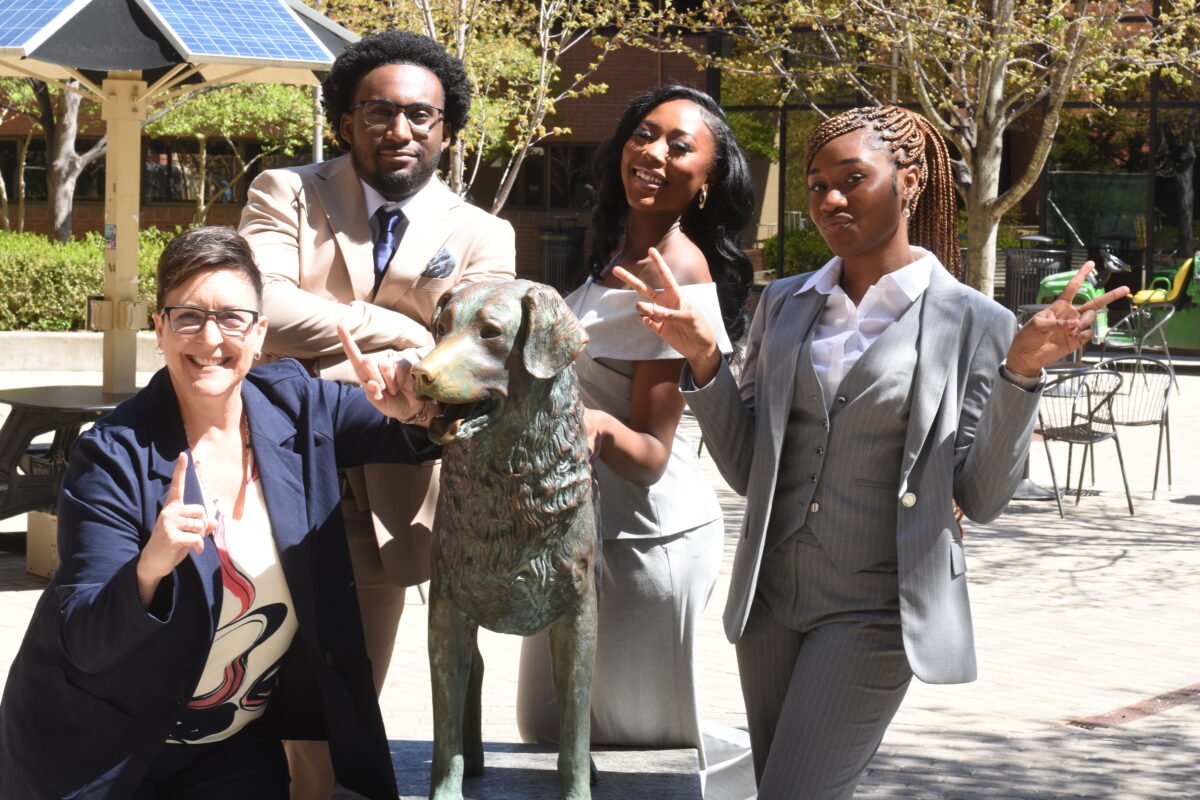 April Householder, left, supports UMBC students through the Goldwater application process. (Michael Mower/UMBC)
]]>
Lea-Pearl Njei, biological sciences; Caly Ferguson, mechanical engineering; and Jariatu Kargbo, biological sciences, have each received the prestigious Goldwater Scholarship for the 2025 – 2026...
https://umbc.edu/stories/goldwater-scholarships-2025/
https://my3.my.umbc.edu/api/v0/pixel/news/149973/guest@my.umbc.edu/aacb0612ba9d283960dfd1e5e25f0516/api/pixel
biology
cnms
coeit
community
meche
news
science-and-tech
story
undergradresearch
UMBC News & Magazine
https://my3.my.umbc.edu/groups/umbc-news-magazine
https://assets1-my.umbc.edu/system/shared/avatars/groups/000/001/943/24435aa6207c452e7bc15cc74b42c7bb/xsmall.png?1748556657
https://assets1-my.umbc.edu/system/shared/avatars/groups/000/001/943/24435aa6207c452e7bc15cc74b42c7bb/original.png?1748556657
https://assets2-my.umbc.edu/system/shared/avatars/groups/000/001/943/24435aa6207c452e7bc15cc74b42c7bb/xxlarge.png?1748556657
https://assets2-my.umbc.edu/system/shared/avatars/groups/000/001/943/24435aa6207c452e7bc15cc74b42c7bb/xlarge.png?1748556657
https://assets3-my.umbc.edu/system/shared/avatars/groups/000/001/943/24435aa6207c452e7bc15cc74b42c7bb/large.png?1748556657
https://assets1-my.umbc.edu/system/shared/avatars/groups/000/001/943/24435aa6207c452e7bc15cc74b42c7bb/medium.png?1748556657
https://assets2-my.umbc.edu/system/shared/avatars/groups/000/001/943/24435aa6207c452e7bc15cc74b42c7bb/small.png?1748556657
https://assets1-my.umbc.edu/system/shared/avatars/groups/000/001/943/24435aa6207c452e7bc15cc74b42c7bb/xsmall.png?1748556657
https://assets2-my.umbc.edu/system/shared/avatars/groups/000/001/943/24435aa6207c452e7bc15cc74b42c7bb/xxsmall.png?1748556657
UMBC News & Magazine
8
0
false
Fri, 09 May 2025 14:55:58 -0400
Fri, 09 May 2025 14:55:58 -0400
Samuel Barnett ’25: Biochemistry researcher with a commitment to giving back
April Householder, left, supports UMBC students through the Goldwater application process. (Michael Mower/UMBC)
]]>
Lea-Pearl Njei, biological sciences; Caly Ferguson, mechanical engineering; and Jariatu Kargbo, biological sciences, have each received the prestigious Goldwater Scholarship for the 2025 – 2026...
https://umbc.edu/stories/goldwater-scholarships-2025/
https://my3.my.umbc.edu/api/v0/pixel/news/149973/guest@my.umbc.edu/aacb0612ba9d283960dfd1e5e25f0516/api/pixel
biology
cnms
coeit
community
meche
news
science-and-tech
story
undergradresearch
UMBC News & Magazine
https://my3.my.umbc.edu/groups/umbc-news-magazine
https://assets1-my.umbc.edu/system/shared/avatars/groups/000/001/943/24435aa6207c452e7bc15cc74b42c7bb/xsmall.png?1748556657
https://assets1-my.umbc.edu/system/shared/avatars/groups/000/001/943/24435aa6207c452e7bc15cc74b42c7bb/original.png?1748556657
https://assets2-my.umbc.edu/system/shared/avatars/groups/000/001/943/24435aa6207c452e7bc15cc74b42c7bb/xxlarge.png?1748556657
https://assets2-my.umbc.edu/system/shared/avatars/groups/000/001/943/24435aa6207c452e7bc15cc74b42c7bb/xlarge.png?1748556657
https://assets3-my.umbc.edu/system/shared/avatars/groups/000/001/943/24435aa6207c452e7bc15cc74b42c7bb/large.png?1748556657
https://assets1-my.umbc.edu/system/shared/avatars/groups/000/001/943/24435aa6207c452e7bc15cc74b42c7bb/medium.png?1748556657
https://assets2-my.umbc.edu/system/shared/avatars/groups/000/001/943/24435aa6207c452e7bc15cc74b42c7bb/small.png?1748556657
https://assets1-my.umbc.edu/system/shared/avatars/groups/000/001/943/24435aa6207c452e7bc15cc74b42c7bb/xsmall.png?1748556657
https://assets2-my.umbc.edu/system/shared/avatars/groups/000/001/943/24435aa6207c452e7bc15cc74b42c7bb/xxsmall.png?1748556657
UMBC News & Magazine
8
0
false
Fri, 09 May 2025 14:55:58 -0400
Fri, 09 May 2025 14:55:58 -0400
Samuel Barnett ’25: Biochemistry researcher with a commitment to giving back
Samuel Barnett ’25, biochemistry, is on his way to the Ph.D. program in cellular and molecular biology at the University of Pennsylvania this fall, after seizing opportunities to conduct research at Howard Community College and then at UMBC. Always mindful of how others have supported him and wanting to pay it forward, Barnett has served in leadership roles in UMBC student organizations and created resources to help his classmates land their own opportunities.
Q: How did you choose your major?
A: My high school biology teacher was adamant about getting high school students involved in STEM. Even though the course was online because of the pandemic, she was still able to enrapture people in the wonders of biological sciences. I added the chemistry aspect because I wanted to dive a little bit deeper into how everything works from a basic science perspective. The interdisciplinary nature of biochemistry can sometimes make things a little more challenging, but also fun. Actually, if what I’m doing isn’t challenging, it’s not going to be as fun, I don’t think.
Q: How did you choose UMBC?
My research mentor at Howard Community College, Joseph Sparenberg, nominated me for the BUILD a BRIDGE to STEM (BBS) Internship at UMBC, part of the STEM BUILD program, after my sophomore year. I can confidently say that BBS was the most crucial turning point of my undergraduate career, making the shift from HCC to the “bigger pond” of UMBC much smoother. The mission of the BBS internship was to give transfer students a sense of belonging while immersing them in biological research. While I had research experience from Howard Community College, BBS made me feel like a researcher at UMBC.
The BBS mentors gave us a lot of autonomy and intellectual freedom to create our own projects, and I acquired experience that was relevant for my lab at UMBC and a later internship at the University of Pennsylvania. I also connected with a diverse network of mentors, familiarized myself with unique scholarship and scientific presentation opportunities, and met fellow community college transfers who helped inspire me to become the scientist I am today.
 Sam Barnett with the research poster he presented to conclude his internship at the University of Pennsylvania. (Courtesy of Barnett)
Q: How did you get connected with your research mentor at UMBC, Fernando Vonhoff, and what are you studying?
A: It’s a funny story, actually—Dr. Vonhoff grew up in Mexico and is fluent in Spanish, and one day he stepped in for my UMBC Spanish teacher. I talked to him after the Spanish class about his work and later visited him in his office to learn more. Even though his lab is mostly focused on behavioral neuroscience, I was up front about the fact that I’m interested in molecular biology. Dr. Vonhoff could have said I wasn’t a good fit, but he gave me a chance and connected me with one of his Ph.D. students, Zach Smith, who does a lot of the molecular work in the lab. Gaining those molecular skills has opened up doors for me when it comes to getting research experience.
I started in the lab in January 2024. Initially, I worked with Zach to master skills like qPCR and later Western blotting—foundational research techniques for identifying and quantifying genetic material and proteins in a sample. This semester I’ve been trusted to do Western blotting completely on my own.
Dr. Vonhoff’s lab works with fruit flies, a common model system for lots of kinds of studies. I’m trying to figure out a better way to identify the presence of a specific very tiny protein in the flies. Because it’s so small, it’s hard to visualize using traditional Western blotting. We tried a procedure that added a larger, fluorescent protein to the small protein to make it easier to see on the blots. It didn’t pan out, but that happens! So now we’re trying to go back to the basics and find new ways to observe the really small protein, but it’s really difficult.
That was definitely disappointing, but I think at the end of the day that’s just how the scientific process works. Progress ebbs and flows. We’re always asking, what can we do beyond this?
Samuel Barnett
That was definitely disappointing, but I think at the end of the day that’s just how the scientific process works. Progress ebbs and flows. We’re always asking, what can we do beyond this? Maybe another type of test or approach will work. I think the best way to approach those challenges is just optimism and to engage your curiosity and expose yourself to alternative solutions.
Q: Along with Vonhoff, who else has supported you along the way?
A: I first met Dr. Maria Cambraia, assistant director for research and international affairs in CNMS, through the BUILD a BRIDGE to STEM internship, and she has since been one of the most influential people on my undergraduate journey. She advised me on what pathways to take when I transferred to UMBC, gave me opportunities to present at national conferences, wrote letters of recommendation for anything and everything under the sun, and has been an overwhelming source of support throughout my undergraduate career. It is genuinely difficult to quantify the impact she has had on me and my fellow undergraduates.
Dr. April Householder, director of undergraduate research and prestigious scholarships, has also been essential in making sure that my place at UMBC was seen and heard. She helped me apply for the prestigious Goldwater and Knight-Hennessy Scholarships, and was always there to lend an ear. She worked overtime with the Goldwater representative at HCC, Cheryl Campo, to help me get my application submitted.
 Sam Barnett, right, with April Householder, director of undergraduate research and prestigious scholarships.
Q: What are you most proud of from your time at UMBC?
A: I am most proud of winning the Barry Goldwater Scholarship. According to the Barry Goldwater Scholarship website it is “the most prestigious undergraduate scholarship in the natural sciences, mathematics, and engineering in America.” An academic institution can select up to five students to apply for the scholarship, including one slot for transfer students. Originally, I competed for the transfer slot at UMBC, but wasn’t selected. However, at a national conference I attended, I met the president of the Goldwater foundation, who told me about a policy change that allowed transfer students to reapply at their previous institution. That led to Dr. Householder and Dr. Campo rushing to help me get my application submitted as a nominee from HCC. In April 2024, I got the email that I had won the scholarship. At the moment I won, I could hardly believe it; I was quite literally shaking and overjoyed.
Q: What else are you involved in at UMBC, and how have those activities benefited, challenged, or surprised you?
A: In addition to research, I’ve served in leadership roles as the vice president of the American Chemical Society’s (ACS) UMBC chapter and secretary of the UMBC chapter of the Tau Sigma National Honor Society, an honor society specifically for transfer students. I’ve also been a tutor for analytical chemistry on campus and volunteered regularly at Grassroots Crisis Intervention.
 Sam Barnett presents at a general body meeting of the UMBC chapter of the American Chemical Society in 2024. (Courtesy of Barnett)
The biggest surprise was my position within the ACS chapter here. It turned out to be a bigger job than I expected. I compiled a list of 200+ active internships to help out other students. Recently, I leveraged one of my connections at the Institute of Marine and Environmental Technology to invite a guest speaker to campus. A lot of my work for the ACS chapter was self-driven, but I’m grateful to the group’s advisor, Dr. Maria van Staveren, who really supported my ambitions to make the position into more than the minimum required.
Q: What’s next for you, and what are you looking forward to?
A: This fall, I’ll begin a Ph.D. in cellular and molecular biology with a concentration in cancer biology at the University of Pennsylvania. I was an intern at Penn’s Center for Cellular Immunotherapies in summer 2024, and I had a really good time there. The rigorous research environment was just enthralling to me. I was able to focus completely on being a researcher for the first time. I had my own independent project, under guidance from a postdoc. It was really intimidating at first. At Penn, you’re able to work through the entire research process and bring new things to the table.
 Sam Barnett, far right, with STEM BUILD Trainees at UMBC’s Summer Undergraduate Research Fest in 2023.
Q: What has been the best part of your UMBC experience?
A: The best part of my UMBC experience has been the opportunity to meet mentors that have defined my career. I’ve been given a lot of opportunities, and sure, I’ve taken initiative and put in effort, but at every step of my undergraduate journey, I’ve had a mentor in my corner who’s been willing to lend me a hand and give me a chance.
UMBC offers many opportunities for undergraduates to get connected to administrators and research faculty. In my experience, faculty have always been friendly and open to connecting with undergraduates. I am extremely grateful to both UMBC and my mentors for the continued support throughout my career, and all that support has inspired me to try to give back, through efforts like the ACS internship database.
Q: What advice do you have for transfer students and aspiring undergraduate researchers?
A: Don’t feel afraid to reach out to everyone—faculty members, classmates, staff. They can all help you. And if they don’t respond via email, you can go to their office to introduce yourself. Even in a period of uncertainty, move forward anyway—research is still necessary and important. Stay ambitious, and stay involved in science.
Read more Commencement 2025 stories.
]]>
Samuel Barnett ’25, biochemistry, is on his way to the Ph.D. program in cellular and molecular biology at the University of Pennsylvania this fall, after seizing opportunities to conduct research...
https://umbc.edu/stories/sam-barnett-biochemistry-researcher/
https://my3.my.umbc.edu/api/v0/pixel/news/149589/guest@my.umbc.edu/95fdbe9b44e03b6629bb1df443d39f4a/api/pixel
biochemistry
chembiochem
class-of-2025
cnms
news
science-and-tech
story
undergradresearch
UMBC News & Magazine
https://my3.my.umbc.edu/groups/umbc-news-magazine
https://assets1-my.umbc.edu/system/shared/avatars/groups/000/001/943/24435aa6207c452e7bc15cc74b42c7bb/xsmall.png?1748556657
https://assets1-my.umbc.edu/system/shared/avatars/groups/000/001/943/24435aa6207c452e7bc15cc74b42c7bb/original.png?1748556657
https://assets2-my.umbc.edu/system/shared/avatars/groups/000/001/943/24435aa6207c452e7bc15cc74b42c7bb/xxlarge.png?1748556657
https://assets2-my.umbc.edu/system/shared/avatars/groups/000/001/943/24435aa6207c452e7bc15cc74b42c7bb/xlarge.png?1748556657
https://assets3-my.umbc.edu/system/shared/avatars/groups/000/001/943/24435aa6207c452e7bc15cc74b42c7bb/large.png?1748556657
https://assets1-my.umbc.edu/system/shared/avatars/groups/000/001/943/24435aa6207c452e7bc15cc74b42c7bb/medium.png?1748556657
https://assets2-my.umbc.edu/system/shared/avatars/groups/000/001/943/24435aa6207c452e7bc15cc74b42c7bb/small.png?1748556657
https://assets1-my.umbc.edu/system/shared/avatars/groups/000/001/943/24435aa6207c452e7bc15cc74b42c7bb/xsmall.png?1748556657
https://assets2-my.umbc.edu/system/shared/avatars/groups/000/001/943/24435aa6207c452e7bc15cc74b42c7bb/xxsmall.png?1748556657
UMBC News & Magazine
3
0
false
Tue, 29 Apr 2025 11:37:11 -0400
Tue, 29 Apr 2025 11:37:11 -0400
Top 5 ways URCAD is a uniquely UMBC experience
UMBC’s Undergraduate Research and Creative Achievement Day (URCAD) is returning for its 29th year on April 16. For nearly three decades, the annual showcase highlights the research, scholarship, and creative work carried out by undergraduate students who are working alongside faculty mentors.
URCAD 2025 returns to the University Center for research on assessing campus vegetation using tethered weather balloons, a student-curated gallery exhibition that explores “the theme of identity,” an analysis of how social media plays a role in Mexican feminist movements, and much more. Throughout the years, URCAD has grown to be a hallmark experience for Retrievers that exemplifies the expansive breadth and collaborative nature of UMBC research. This work is evident by the university’s reconfirmed designation as an R1 institution by the Carnegie Classification of Institutions of Higher Education earlier this year.
As we gear up for the next edition of the highly-anticipated day of undergraduate research, here are five ways URCAD is a uniquely UMBC experience:
1. Retrievers seriously love research
At URCAD, research enthusiasts—including those initially hesitant—have the opportunity to come together and “geek out” about all things research. First-time participants and seasoned presenters alike are able to showcase what they’ve explored and learned in one of UMBC’s many research labs, out in the field, or within specific industries. On average, about 300 student presenters take part in URCAD each year, with last year’s event featuring more than 400 student participants. Even amid a global pandemic, students eagerly participated in the event from their homes, drawing in 8,000 virtual visits in 2020 and 11,000 virtual visitors in 2021.
A recap of the URCAD 2024 event . (Elijah Davis, M.F.A. ’21/UMBC)
2. Stage for multidisciplinary collaboration
True to UMBC’s intentional culture of inclusive excellence, URCAD spotlights the collaboration that happens across multiple colleges, disciplines, and departments. At URCAD 2023, a team of students from the College of Natural and Mathematics Sciences and the College of Engineering and Information Technology presented their research on the tradeoffs that exist between privacy and utility when using smart devices at home. This year’s event will include a presentation of a multidisciplinary capstone team that designed and constructed a fixed-wing unmanned aerial vehicle, among many other other cross-collaborative projects.
3. Community-focused research based in Baltimore
Nearly each URCAD iteration features presentations of research conducted throughout Baltimore City and Baltimore County. Past events have included a short film screening that chronicles the history and the decline of LGBTQ+ nightlife in Baltimore City; a presentation on findings from a 2021 UMBC-led study to better understand the experiences of low-income Baltimore families without broadband access; and a 2017 URCAD photography exhibit that captured the experiences of unhoused people living in Baltimore’s Station North area.
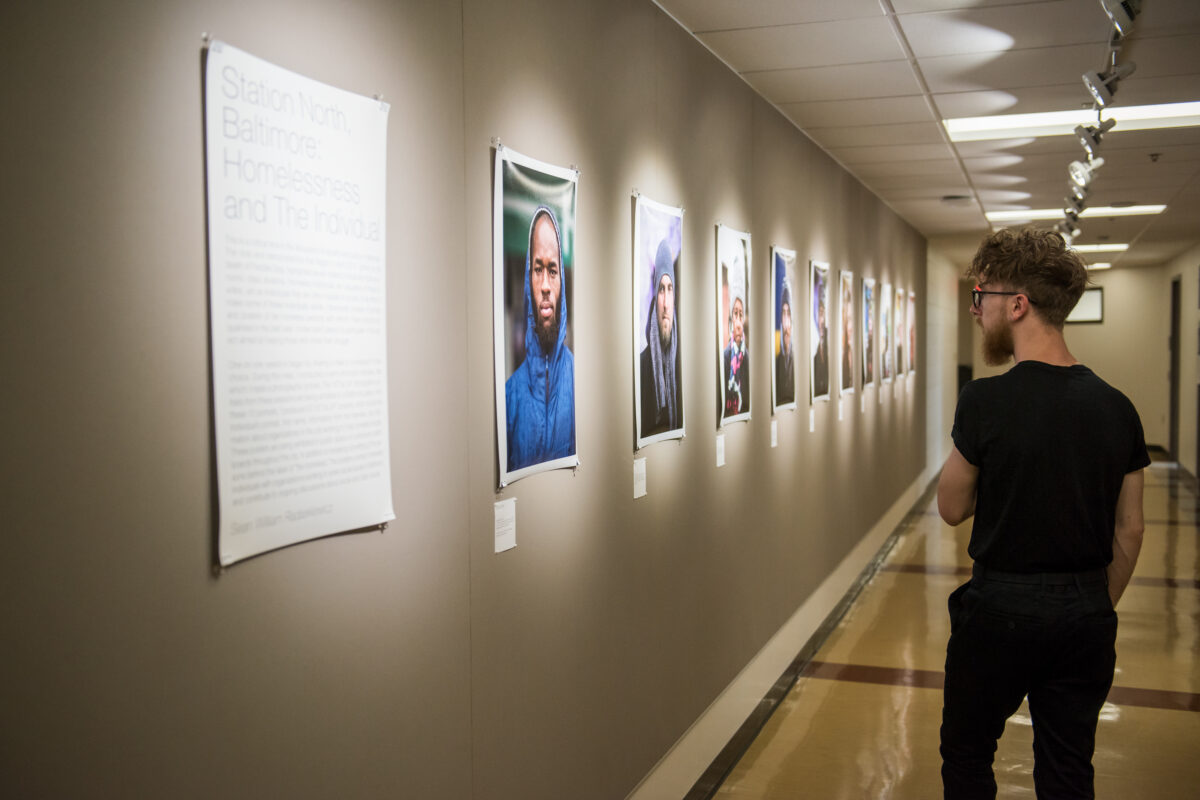 Sean William Radaskiewicz ‘18, visual arts, presented his photography series “Station North, Baltimore: Homelessness and the Individual,” at URCAD 2017. (Marlayna Demond ’11 for UMBC)
4. A return home for alumni researchers
Each year, the research event includes a keynote speech delivered by esteemed UMBC alumni— some of whom were once URCAD presenters themselves—such as the 2024 keynote speaker Stefanie Mavronis ’12, political science, media and communication studies. Mavronis shared her journey of being a student researcher and how her experiences led to her current position as the director of the Mayor’s Office of Safety and Engagement in Baltimore City. Randi Williams ’16, computer engineering, will deliver the URCAD 2025 keynote speech. Williams is the research director of Day of AI, a non-profit organization that provides educators with artificial intelligence literacy curriculums for K-12 students.
 The flyer for URCAD 2025 featuring alumni keynote speaker Randi Williams ’16, computer engineering.
5. Pathway for post-graduation success
Many past URCAD presenters have gone on to pursue advanced degrees and postdoctoral fellowships following their time at UMBC. And they say the early exposure to rigorous research opportunities help land those positions. After presenting at URCAD 2023, Ellie Bare ’23, biological sciences, shared that “having opportunities to improve my science communications abilities was invaluable and really great…it even helped me with my post-baccalaureate interviews.”
Before his current role as a research assistant with the Federal Reserve Board of Governors in Washington, D.C., Peter Wilschke ’24, economics and political science, presented research he worked on as an intern at The Hilltop Institute at UMBC during last year’s URCAD event. Beyond academia, URCAD participants have found industry success. Members of UMBC’s Game Developers Club, some of whom were past URCAD presenters, have gone on to find positions at Facebook, the Unity game engine platform, and Firaxis games, to name a few.
More information on URCAD 2025 presenters and additional sneak peeks of upcoming presentations can be found here.
]]>
UMBC’s Undergraduate Research and Creative Achievement Day (URCAD) is returning for its 29th year on April 16. For nearly three decades, the annual showcase highlights the research, scholarship,...
https://umbc.edu/stories/urcad-2025/
https://my3.my.umbc.edu/api/v0/pixel/news/148905/guest@my.umbc.edu/f7d40e1b3ddbc61b85d468b4ad3ae2f4/api/pixel
cahss
cnms
coeit
community
news
story
undergrad
undergradresearch
urcad
UMBC News & Magazine
https://my3.my.umbc.edu/groups/umbc-news-magazine
https://assets1-my.umbc.edu/system/shared/avatars/groups/000/001/943/24435aa6207c452e7bc15cc74b42c7bb/xsmall.png?1748556657
https://assets1-my.umbc.edu/system/shared/avatars/groups/000/001/943/24435aa6207c452e7bc15cc74b42c7bb/original.png?1748556657
https://assets2-my.umbc.edu/system/shared/avatars/groups/000/001/943/24435aa6207c452e7bc15cc74b42c7bb/xxlarge.png?1748556657
https://assets2-my.umbc.edu/system/shared/avatars/groups/000/001/943/24435aa6207c452e7bc15cc74b42c7bb/xlarge.png?1748556657
https://assets3-my.umbc.edu/system/shared/avatars/groups/000/001/943/24435aa6207c452e7bc15cc74b42c7bb/large.png?1748556657
https://assets1-my.umbc.edu/system/shared/avatars/groups/000/001/943/24435aa6207c452e7bc15cc74b42c7bb/medium.png?1748556657
https://assets2-my.umbc.edu/system/shared/avatars/groups/000/001/943/24435aa6207c452e7bc15cc74b42c7bb/small.png?1748556657
https://assets1-my.umbc.edu/system/shared/avatars/groups/000/001/943/24435aa6207c452e7bc15cc74b42c7bb/xsmall.png?1748556657
https://assets2-my.umbc.edu/system/shared/avatars/groups/000/001/943/24435aa6207c452e7bc15cc74b42c7bb/xxsmall.png?1748556657
UMBC News & Magazine
0
0
false
Wed, 09 Apr 2025 15:16:20 -0400
Wed, 09 Apr 2025 15:16:20 -0400
NIDA EDUCATE program develops the next generation of addiction researchers
In 2021, the National Institute on Drug Abuse (NIDA) awarded UMBC more than $1 million over five years to create a program specifically for undergraduate scholars interested in research on substance abuse and addiction. A year after the program’s launch, it is thriving as students in fields as diverse as economics, computer science, and chemical engineering find ways to connect their interests to this important topic.
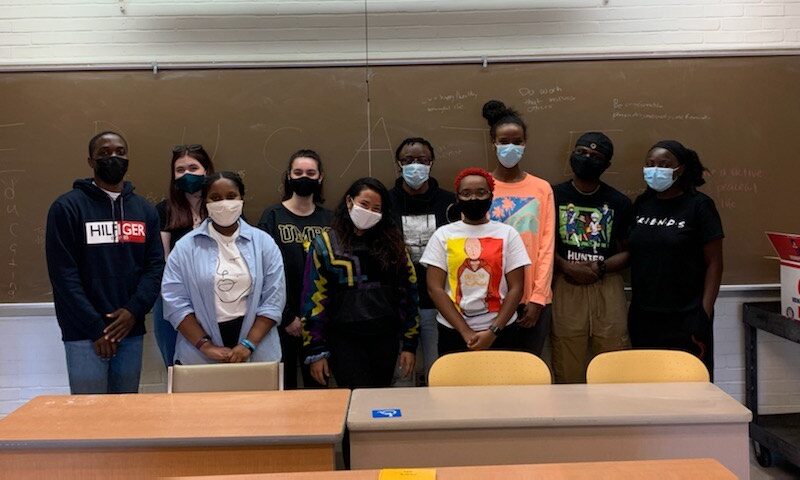
EDUCATE Scholars gathered for an end-of-semester social in spring 2022. (Image courtesy of Yetunde Oshagbemi)
“We need people from all walks of STEM to be able to approach problems to find solutions,” says Patrice Darby. She isprogram coordinator of special projects of the Meyerhoff Scholars Program and a co-lead on the grant, which is called Educating Diverse Undergraduates for Careers in Addiction and substance abuse research via Training Experiences (EDUCATE). The program supports a small, specialized group of Meyerhoff Scholars as EDUCATE Scholars. The grant is administered by UMBC’s College of Natural and Mathematical Sciences and led by the college’s dean, Bill LaCourse.
EDUCATE programming includes talks from researchers whose work touches addiction, as well as workshop series on science communication and on the tools needed to become a successful researcher. EDUCATE Scholars are also expected to participate in a sustained research experience with UMBC faculty mentors and to present their research at a conference. They also take an ethics course and receive intensive academic and career advising from program staff. Funding is available to support summer research experiences for EDUCATE Scholars as well.
“NIDA has really encouraged an interdisciplinary approach,” Darby says. That and the small size of each cohort means “we’re really able to tailor things to the students’ needs.”
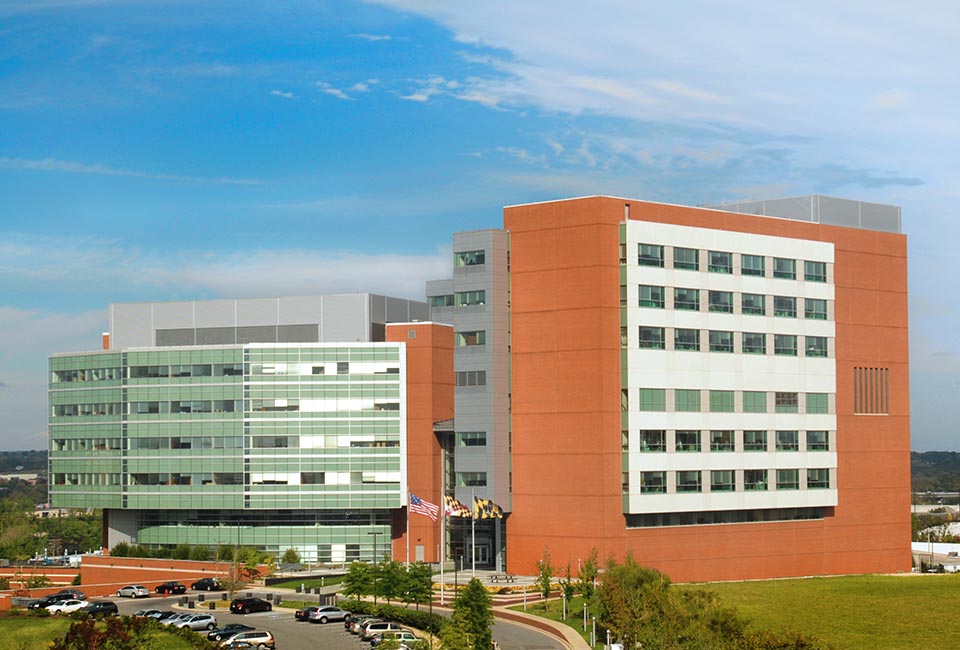 The National Institute on Drug Abuse in Baltimore. (NIDA)
Broader horizons
Yetunde Oshagbemi ’23, economics and mathematics, wants to study economic development in Nigeria, and she is interested in understanding how drug abuse has impacted development. Based on Oshagbemi’s interests, Darby invited an economist with a focus on drug abuse to speak to the scholars. In addition to speaking directly to Oshagbemi’s interest, this offered a fresh perspective for students in other majors.
The talk “reminded me that similar interests can be applied in different ways,” Oshagbemi says. The EDUCATE program as a whole “broadens your horizons and your views on the ways drug abuse is being studied in different disciplines. It’s allowed me to see that there are different ways to answer the questions I have about my interests.”
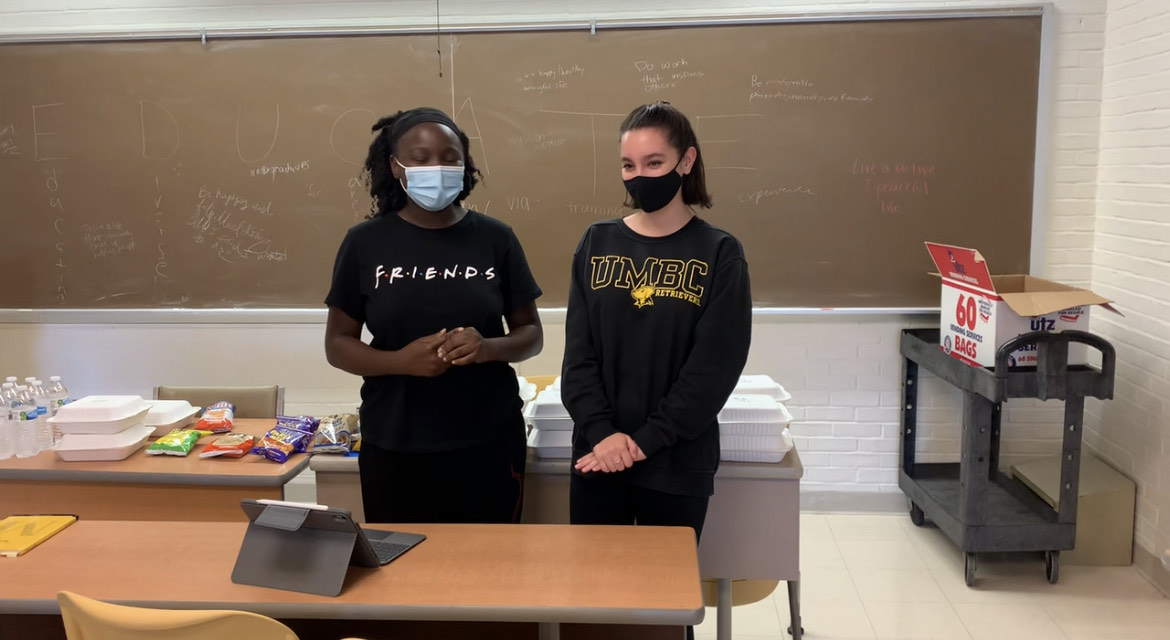 Yetunde Oshagbemi ’23, economics and mathematics (left), relaxes with another EDUCATE Scholar at a social event. (Image courtesy of Oshagbemi)
Oshagbemi conducts research with Zoë McLaren, professor of public policy, whose work includes studying infectious disease in developing countries. Oshagbemi also appreciates Darby’s mentorship. Darby helps “make sure that not only am I progressing academically, but my mental health is also doing well,” she says. “She tries to give you the best advice based on the type of person you are and the path you want to go on.”
Family inspiration
Mike Anoruo ’24, computer science,has also benefited from the mentorship and interdisciplinary nature of the program. Darby recommended he apply for a summer workshop at MIT on quantitative methods, which was eye-opening. “I learned a lot about biology and I was able to bring in my computer science knowledge,” Anoruo says.
Anoruo is inspired by his mother, who works at a crisis stabilization center for people who struggle with addiction and substance abuse. “Seeing her passion for it has made me really want to learn more about it,” he says. “From the MIT workshop, I was able to see that computer science has a lot of applications. So if I can find a way to make a difference the same way my mom is, I think I would really enjoy that.”
Knowing that there are so many ways to apply computer science, Anoruo is still considering his options for the future. “I really like being in the EDUCATE program because I get to look into different topics in drug addiction. I’m just trying to explore and see what I want to go into.”
A real contribution
Students who are not EDUCATE Scholars also benefit from the program.
Each year six students, a mix of Meyerhoff Scholars and STEM BUILD Trainees, have the opportunity to participate in research internships at NIDA through a supplement to the EDUCATE grant. STEM BUILD Trainee Precious Oyinloye ’23, chemical engineering, is completing a virtual internship this school year. Her project involves analyzing data to identify chemical compounds involved in addiction.
After learning how to code in the Python language as part of her NIDA experience, “I’m more curious about computer science,” she says. Plus, “being part of a research project offers a sense of fulfillment—I’m really contributing to science.”
Zoha Faraz ’22, psychology and biological sciences, also a STEM BUILD Trainee, used the opportunity to gain important research skills. “Through the internship, I was able to learn a lot about the research process, and I feel more confident in testing my research skills,” she says. “I think it also improved my scientific communication, because I had to make a presentation about my project.”
Zoha Faraz ’22, psychology and biological sciences (Image courtesy of Faraz)
A personalized experience
The EDUCATE program is small, with a maximum of six scholars per year. That allows the staff “to give our students a highly personalized experience,” Darby says.
Between the workshop-style trainings, faculty-mentored research, and availability of committed staff like Darby to offer guidance and feedback, the program is setting the EDUCATE Scholars up for success in whatever field they choose to pursue.
“You don’t have to research addiction to be able to influence addiction research,” Darby says. Addiction is, however, one of the topics that brings the scholars together. At a social event for EDUCATE students earlier this year, that connection was on full display, helping students deepen relationships they may rely on for support for years to come.
“It’s just different to have a special community,” Darby says, “to talk about the impacts of addiction and why our students care.”
]]>
In 2021, the National Institute on Drug Abuse (NIDA) awarded UMBC more than $1 million over five years to create a program specifically for undergraduate scholars interested in research on...
https://umbc.edu/stories/the-next-generation-of-addiction-researchers/
https://my3.my.umbc.edu/api/v0/pixel/news/125582/guest@my.umbc.edu/b72e18144ef0e3cd9ded5fa07df2ad6c/api/pixel
cahss
chemeng
cnms
coeit
csee
economics
mathstat
meyerhoffscholars
psychology
public-policy
science-and-tech
stembuild
undergradresearch
UMBC News & Magazine
https://my3.my.umbc.edu/groups/umbc-news-magazine
https://assets1-my.umbc.edu/system/shared/avatars/groups/000/001/943/24435aa6207c452e7bc15cc74b42c7bb/xsmall.png?1748556657
https://assets1-my.umbc.edu/system/shared/avatars/groups/000/001/943/24435aa6207c452e7bc15cc74b42c7bb/original.png?1748556657
https://assets2-my.umbc.edu/system/shared/avatars/groups/000/001/943/24435aa6207c452e7bc15cc74b42c7bb/xxlarge.png?1748556657
https://assets2-my.umbc.edu/system/shared/avatars/groups/000/001/943/24435aa6207c452e7bc15cc74b42c7bb/xlarge.png?1748556657
https://assets3-my.umbc.edu/system/shared/avatars/groups/000/001/943/24435aa6207c452e7bc15cc74b42c7bb/large.png?1748556657
https://assets1-my.umbc.edu/system/shared/avatars/groups/000/001/943/24435aa6207c452e7bc15cc74b42c7bb/medium.png?1748556657
https://assets2-my.umbc.edu/system/shared/avatars/groups/000/001/943/24435aa6207c452e7bc15cc74b42c7bb/small.png?1748556657
https://assets1-my.umbc.edu/system/shared/avatars/groups/000/001/943/24435aa6207c452e7bc15cc74b42c7bb/xsmall.png?1748556657
https://assets2-my.umbc.edu/system/shared/avatars/groups/000/001/943/24435aa6207c452e7bc15cc74b42c7bb/xxsmall.png?1748556657
UMBC News & Magazine
0
0
false
Tue, 24 May 2022 16:52:34 -0400
Tue, 24 May 2022 16:52:34 -0400