UMBC’s student Fulbright recipients pursue community-driven research on a global stage
UMBC’s 2026 – 2027 recipients of the prestigious Fulbright U.S. Student Program are joining the ranks of UMBC’s distinguished Fulbright alumni, who have made UMBC a three-time Fulbright Top Producing Institution, a recognition from the U.S. Department of State’s Bureau of Educational and Cultural Affairs.
More than 2,000 Fulbright U.S. Students—recent college graduates, graduate students, and early career professionals—pursue graduate study, conduct research, or teach English in schools abroad each year, earning placements in Africa, Asia and the Pacific, the Middle East, Latin America, and Europe. This year’s Fulbright Retrievers are launching the international phase of their research. From Baltimore to the Dominican Republic, India, and Mexico, these students are working with and for local communities to support local approaches to ongoing challenges.
The art of collaboration
During her senior year, Marelen Acevedo Soto ’26, visual arts, wowed Retrievers at UMBC’s 2025 Undergraduate Research and Creative Achievement Day with an experiential painting that combined projection, animation, and live performance. Now, she is packing up these skills and taking them to Santo Domingo, Dominican Republic, where she was born. Acevedo Soto earned her associate’s degree from Chavón School of Design. She is returning to work with the students to create a large-scale mural titled “Multidimensional Mural: Augmented Reality for Environmental Change” in Santo Domingo’s Zona Colonial (Colonial Zone), a UNESCO World Heritage site. Using QR codes, passersby will access animations and hear community voices describing how pollution affects daily life. The project will close with a Spanish and English multimedia performance combining projected animations, environmental data, and Dominican music.


Acevedo Soto (on the right) with artists from The Music and Me Foundation and at URCAD 2025. (Images courtesy of Acevedo)
“Many of my strongest ideas came from learning across different fields at UMBC,” says Acevedo Soto. “Music theory helped me think about rhythm and emotion. Storytelling taught me how to create meaningful experiences. Psychology helped me better understand how people think and engage with art. Environmental science deepened my understanding of water and the importance of its conservation, and data analysis gave me the tools to measure the impact of my project.”
Researchers’ responsibility
Vunnathi Ankem ’26, psychology, has had a passion for India for years, specifically how cultural exchange in India was shaped by hundreds of years of discourse, colonization, and history. While researching intimate partner violence (IPV) for her honors thesis, Vunnathi Ankem ’26, psychology, became interested in how South Asian students developed their understandings of IPV. Unexpectedly, most of the students she interviewed were from Telugu-speaking regions, such as Hyderabad in southern India. Intrigued, Ankem is now headed to the Psychology Center at the University of Hyderabad to continue her research. “Psychology, as we know it in the Western world, is only one approach to understanding the mind and the body,” says Ankem. “As psychology students, it is our responsibility to explore worlds and lenses beyond the Eurocentric ones.”
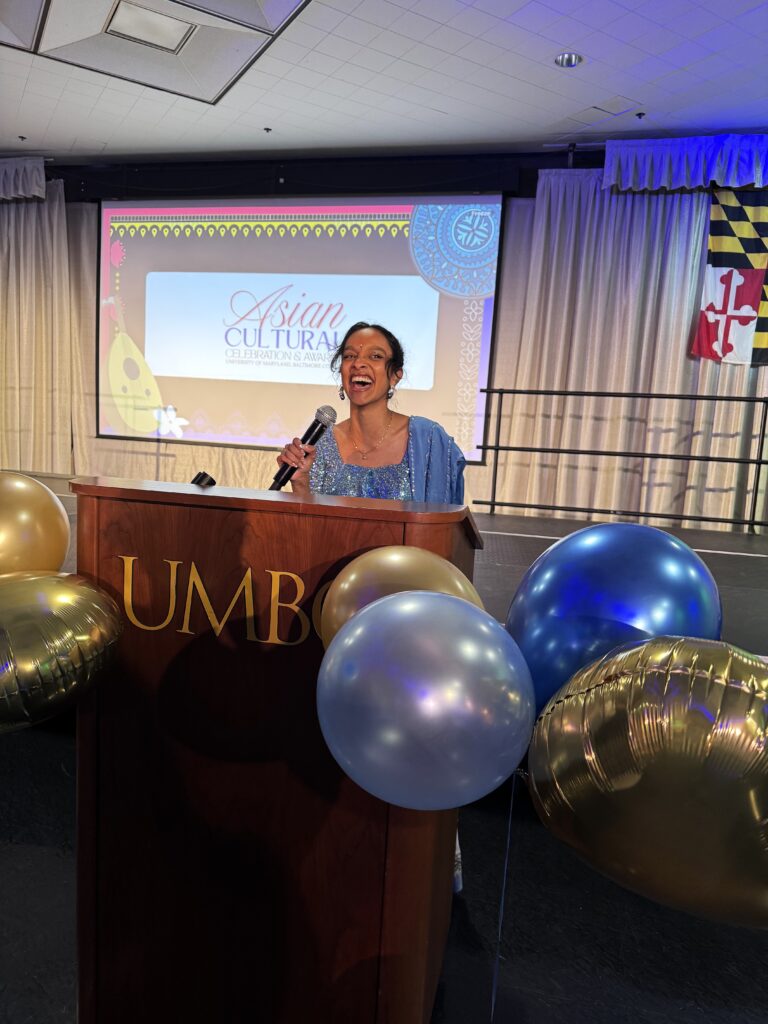
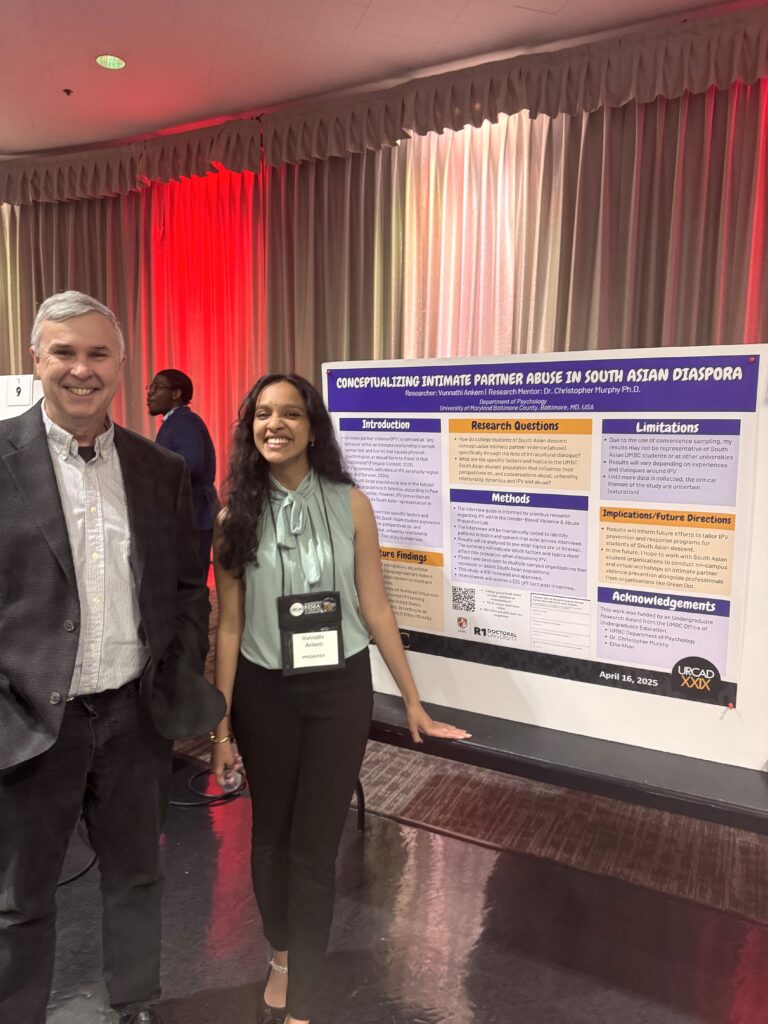
(l-r) Ankem at the 2026 Asian Cultural Celebration and Awards ceremony. Ankem with mentor Christopher Murphy, professor of psychology. (Images courtesy of Ankem)
She will study how systems, class, community, and culture shape experiences of IPV in India and inform more culturally responsive prevention strategies. Ankem will then develop community-based and community-led IPV prevention workshops. “The Fulbright program is giving me the opportunity I have always dreamed about,” says Ankem. “I can’t wait to learn from professionals and clinicians, alongside ancient culture practitioners and experts in India. It will be the experience of a lifetime!”
Humanistic climate futures
After studying climate change and migration on a study abroad trip to Oaxaca, Mexico, Bryan Castro-Velez ’26, geography and environmental studies, knew he was on the right research path—studying humanistic approaches to equitable agroecological systems and land in Indigenous Latin American communities. He says learning directly from indigenous leaders about their farming practices and response to climate change inspired him to apply for the Fulbright García-Robles award for graduate and doctoral research in Mexico. Castro-Velez’s graduate work will focus on agroecology, natural resource management, and rural development in Chiapas, Mexico.
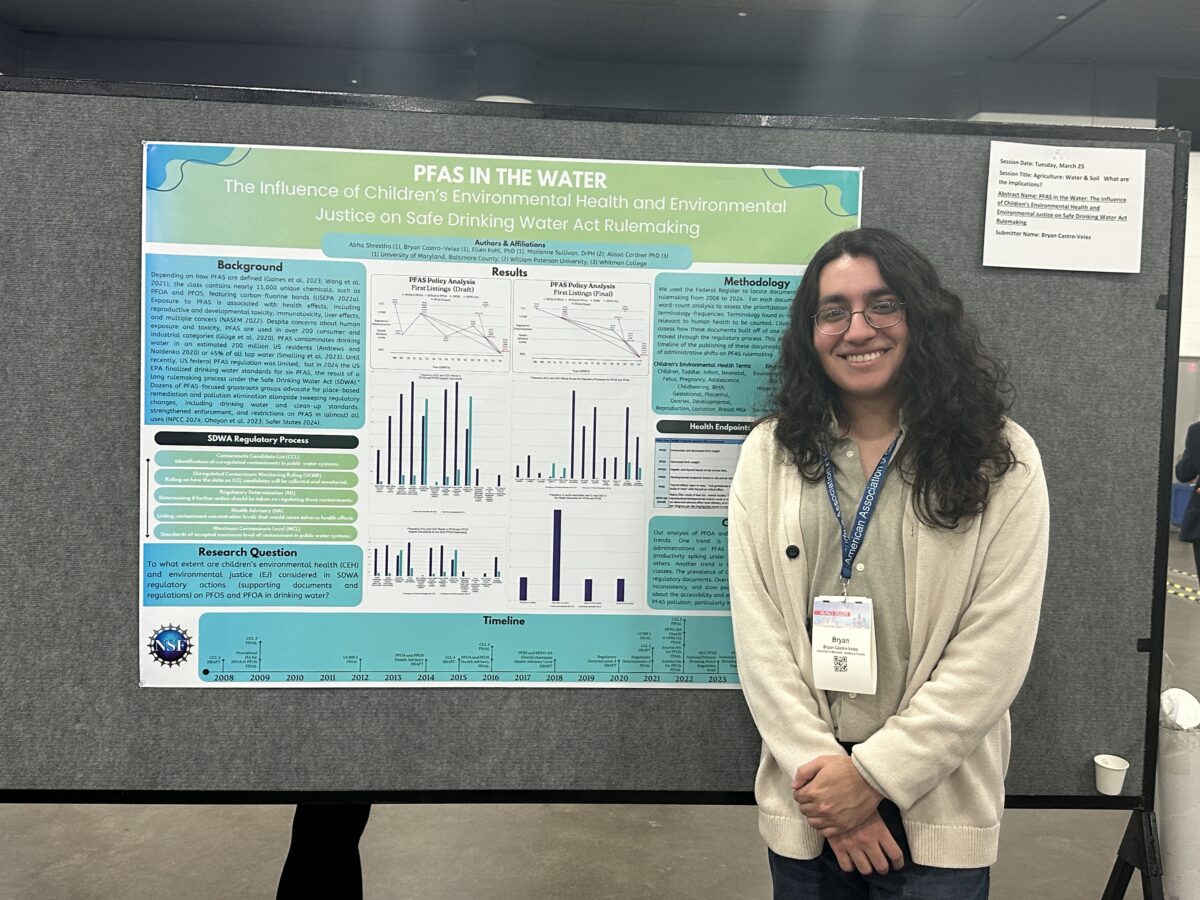 Bryan Castro-Velez at the 2025 Association of American Geographers annual conference in Detroit. (Image courtesy of Castro-Velez)
“I look forward to continuing down this path, encouraging others to do the same, and furthering my education outside the walls of academia,” says Castro-Velez. “My experiences during and outside of UMBC have proven to me that community-based learning systems are fundamental to just climate solutions and humanistic futures.”
As the U.S. Fulbright Program celebrates its 80th anniversary this year, UMBC’s Fulbright program is celebrating by expanding support through the Office of Prestigious Scholarships (OPS) under the leadership of April Householder ’95, director of OPS: “I am looking forward to building on UMBC’s strong legacy as a top producer of Fulbright students,” says Householder, “and expanding student support throughout the processes of exploring, applying, and transitioning abroad.”
Learn more about UMBC’s international opportunities.
]]>
UMBC’s 2026 – 2027 recipients of the prestigious Fulbright U.S. Student Program are joining the ranks of UMBC’s distinguished Fulbright alumni, who have made UMBC a three-time Fulbright Top...
https://umbc.edu/stories/umbcs-2026-student-fulbright-recipients/
https://my3.my.umbc.edu/api/v0/pixel/news/161318/guest@my.umbc.edu/3c2bd6a8225156f81db68222ed9fdd71/api/pixel
alumni
cahss
class-of-2026
community
fulbright
geographic-information-systems
international
policy-and-society
psychology
stories
story
urcad
visual-arts
UMBC News & Magazine
https://my3.my.umbc.edu/groups/umbc-news-magazine
https://assets1-my.umbc.edu/system/shared/avatars/groups/000/001/943/24435aa6207c452e7bc15cc74b42c7bb/xsmall.png?1748556657
https://assets1-my.umbc.edu/system/shared/avatars/groups/000/001/943/24435aa6207c452e7bc15cc74b42c7bb/original.png?1748556657
https://assets2-my.umbc.edu/system/shared/avatars/groups/000/001/943/24435aa6207c452e7bc15cc74b42c7bb/xxlarge.png?1748556657
https://assets2-my.umbc.edu/system/shared/avatars/groups/000/001/943/24435aa6207c452e7bc15cc74b42c7bb/xlarge.png?1748556657
https://assets3-my.umbc.edu/system/shared/avatars/groups/000/001/943/24435aa6207c452e7bc15cc74b42c7bb/large.png?1748556657
https://assets1-my.umbc.edu/system/shared/avatars/groups/000/001/943/24435aa6207c452e7bc15cc74b42c7bb/medium.png?1748556657
https://assets2-my.umbc.edu/system/shared/avatars/groups/000/001/943/24435aa6207c452e7bc15cc74b42c7bb/small.png?1748556657
https://assets1-my.umbc.edu/system/shared/avatars/groups/000/001/943/24435aa6207c452e7bc15cc74b42c7bb/xsmall.png?1748556657
https://assets2-my.umbc.edu/system/shared/avatars/groups/000/001/943/24435aa6207c452e7bc15cc74b42c7bb/xxsmall.png?1748556657
UMBC News & Magazine
0
0
false
Mon, 27 Jul 2026 17:10:21 -0400
Mon, 27 Jul 2026 17:10:21 -0400
Meet a Retriever—Beryl Fuamazeh ’26 is on her way to medical school with an eye on aging care
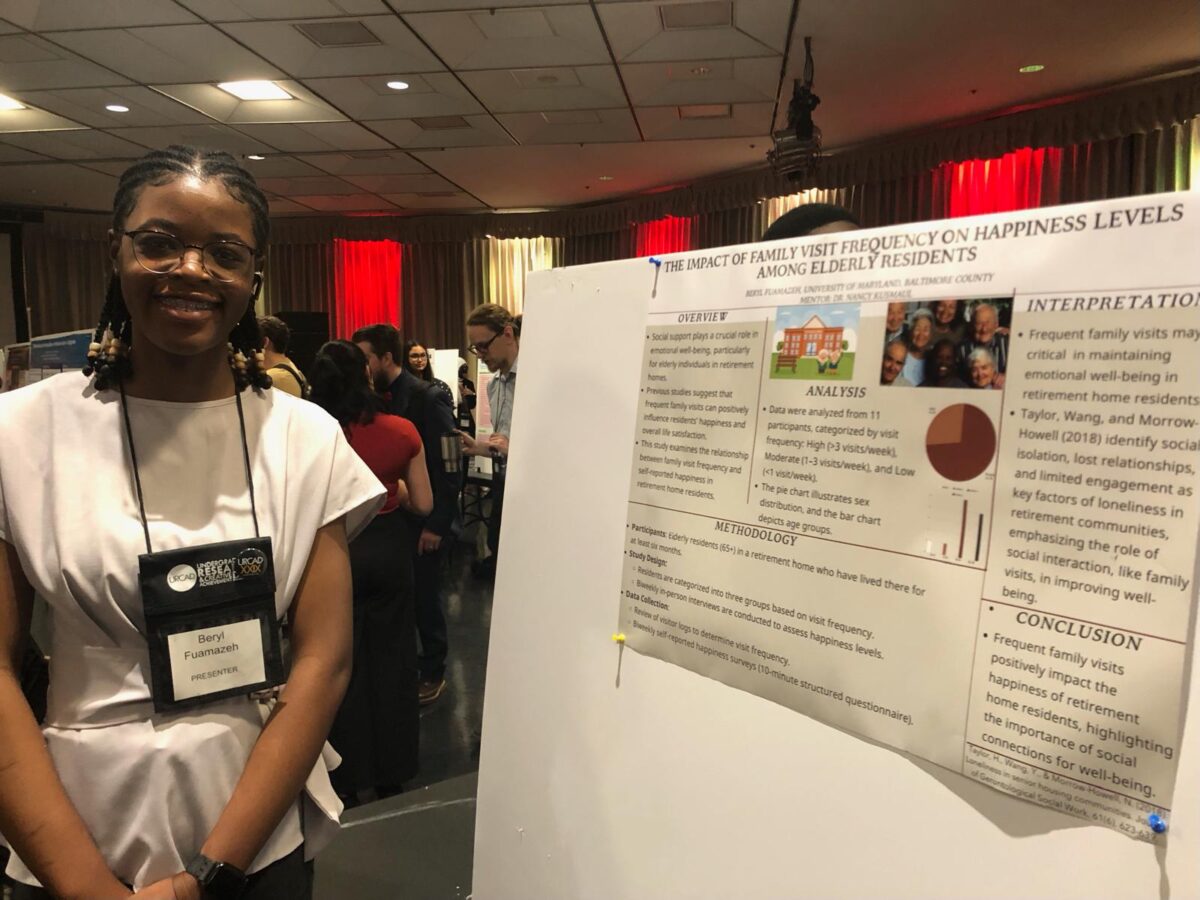
Beryl Fuamazeh ’26, biology, and a minor in health, wellness, and aging, is on her way to Howard University College of Medicine. After connecting with Nancy Kusmaul, professor of social work, Beryl found her research interests piqued by learning more about healthcare and aging care. While at UMBC, Beryl worked as a nursing assistant at a retirement community and volunteered for an organization that supports people with disabilities and older adults. After presenting her research at UMBC’s Undergraduate Research and Creative Achievement Day, she received the Erickson School of Aging Studies Award for Excellence in Undergraduate Research.
Beryl transferred to UMBC from the Community College of Baltimore County through the Degrees to Succeed program, and says that the support and funding she’s received from UMBC has made her education affordable and given her time to focus on her passion: healthcare and aging. Outside of school and work, she loves watching Korean dramas.
Q: Tell us about someone in the UMBC community who has inspired you.
A: Dr. Nancy Kusmaul is my research mentor, and she has been instrumental in my undergraduate research journey. The work she does to support the aging community has deeply inspired me. I have also been greatly influenced by Professor Mary Carter, an English professor here, who taught me how to better express myself through writing—a skill that was invaluable during my medical school application process. The support and guidance both faculty members have given me have truly shaped my experience at UMBC.
Q: Tell us about what you love about your academic program.
A: I’ve really enjoyed being part of the Erickson School of Aging Studies through my minor in health, wellness, and aging. Many of the classes I’ve taken have been meaningful because I can directly apply what I learn to my work as a nursing assistant in a retirement community. My biology major has also given me a strong foundation as I prepare to matriculate into medical school.
Q: What’s one thing you’d want someone to know about the support you find here?
A: Because it’s a smaller university, I’ve been able to build meaningful one-on-one relationships with professors, which has been incredibly valuable. I’ve also loved being surrounded by students who are passionate, driven, and genuinely supportive of one another, especially within the sciences. UMBC is a very supportive community.
Q: What brought you to UMBC in the first place?
A: I wanted to further my education while building meaningful relationships along the way. As someone pursuing the pre-med path, I knew it was important to be surrounded by supportive, like-minded people, and UMBC provided that for me, especially as a transfer student from the Community College of Baltimore County.
I was also drawn to the smaller campus environment, which made it easier to adapt and connect with professors and peers. Through my community college’s Degrees to Succeed partnership program, I was introduced to UMBC and the opportunities it offered, including research experiences, mentorship, and a strong academic community.
Right: Fuamazeh next to her poster at URCAD 2025.
Q: Tell us about the people who are helping you grow at UMBC.
A: Dr. Nancy Kusmaul has been incredibly instrumental in helping me grow at UMBC. She helped me kickstart my undergraduate research journey, which initially felt very daunting. All it took was reaching out to her by email, and she was immediately supportive and responsive. She took time out of her busy schedule to help me develop an individualized research study focused on aging, a topic that has become deeply meaningful to me and the communities it impacts.
Q: How have you connected with the community?
A: I have been involved in community programs, like volunteering with the Trusted Ride Program at Ascension Saint Agnes Hospital, which supports older adults and individuals with disabilities by helping them get to medical appointments safely. Experiences like this have allowed me to stay connected to the community while pursuing my interests in healthcare and aging.
Q: What would you tell others who are in your shoes about UMBC?
A: I transferred to UMBC from the Community College of Baltimore County, and through scholarships and financial support, including merit-based awards, UMBC helped ease the financial burden of pursuing higher education, which allowed me to focus more on my academics and future goals. I also felt well supported as a transfer student through the Degrees to Succeed program, even before officially transferring to UMBC. The transition felt smooth, and I always felt like there were people willing to help guide me along the way.
UMBC’s greatest strength is its people. When people meet Retrievers and hear about the passion they bring, the relationships they create, the ways they support each other, and the commitment they have to inclusive excellence, they truly get a sense of our community. That’s what “Meet a Retriever” is all about.
Learn more about how UMBC can help you achieve your goals.
]]>
Beryl Fuamazeh ’26, biology, and a minor in health, wellness, and aging, is on her way to Howard University College of Medicine. After connecting with Nancy Kusmaul, professor of social work,...
https://umbc.edu/stories/meet-a-retriever-beryl-fuamazeh-aging-care/
https://my3.my.umbc.edu/api/v0/pixel/news/160752/guest@my.umbc.edu/8b4bf215522e0179499e5c60c5bc173d/api/pixel
aging-studies
alumni
cnms
erickson-school
meet-a-retriever
perspectives
social-work
story
urcad
UMBC News & Magazine
https://my3.my.umbc.edu/groups/umbc-news-magazine
https://assets1-my.umbc.edu/system/shared/avatars/groups/000/001/943/24435aa6207c452e7bc15cc74b42c7bb/xsmall.png?1748556657
https://assets1-my.umbc.edu/system/shared/avatars/groups/000/001/943/24435aa6207c452e7bc15cc74b42c7bb/original.png?1748556657
https://assets2-my.umbc.edu/system/shared/avatars/groups/000/001/943/24435aa6207c452e7bc15cc74b42c7bb/xxlarge.png?1748556657
https://assets2-my.umbc.edu/system/shared/avatars/groups/000/001/943/24435aa6207c452e7bc15cc74b42c7bb/xlarge.png?1748556657
https://assets3-my.umbc.edu/system/shared/avatars/groups/000/001/943/24435aa6207c452e7bc15cc74b42c7bb/large.png?1748556657
https://assets1-my.umbc.edu/system/shared/avatars/groups/000/001/943/24435aa6207c452e7bc15cc74b42c7bb/medium.png?1748556657
https://assets2-my.umbc.edu/system/shared/avatars/groups/000/001/943/24435aa6207c452e7bc15cc74b42c7bb/small.png?1748556657
https://assets1-my.umbc.edu/system/shared/avatars/groups/000/001/943/24435aa6207c452e7bc15cc74b42c7bb/xsmall.png?1748556657
https://assets2-my.umbc.edu/system/shared/avatars/groups/000/001/943/24435aa6207c452e7bc15cc74b42c7bb/xxsmall.png?1748556657
UMBC News & Magazine
1
0
false
Wed, 17 Jun 2026 15:25:50 -0400
Wed, 17 Jun 2026 15:25:50 -0400
UMBC gets ready to celebrate 30 years of its signature undergraduate research extravaganza
 The band Fever Dream will perform at URCAD. (Photo courtesy of April Householder)
On April 22, more than 450 student presenters and their friends, mentors, and supporters will fill the Retriever Activities Center (RAC) for the 30th anniversary of the Undergraduate Research and Creative Achievement Day.
It’s the first year the annual event, more commonly known as URCAD, will take place in the RAC, where it has moved because of its record-breaking size. The event will feature poetry readings, live music performances, video game demonstrations, scientific research presentations, artistic exhibits, films, and more. The new space provides room for more live performances and exhibits. This year’s URCAD will feature music by the Dana Idnay band, members of the UMBC Jazz Ensemble, the drum circle, the Down and Dirty Dawg Band, and Fever Dream, a band made up of UMBC undergraduate and graduate students and led by biology professors Jeffrey Lieps and Stephen Caruso.
It’s a tradition of the event to invite an outstanding alum as the keynote speaker. This year, Karena Ingram ‘16, music composition, will speak about her work as a composer and arts advocate who brings issues ranging from domestic violence to video gaming into her projects. As a student, she presented her own research at URCAD on the Baltimore-based composer CK Barlow and her influence in the field of electronic music.
Student participants hail from all corners of campus and will showcase their diverse research and creative projects, including investigations into supermassive black holes, patterns of Antarctic tourism, the effects of 9/11 on U.S. immigration, and much more.
“As we celebrate the 30th anniversary, we recognize that URCAD is one of the oldest and largest events of this kind in the state, and that UMBC has one of the highest rates for undergraduates who do mentored research in the country,” says April Householder ’95, director of undergraduate research and prestigious scholarships. “To commemorate, we are throwing back to the 1990s—stop by the photo booth and graffiti wall and make some memories!”


Students pose for a photo and mingle at a poster session during URCAD in 2024. (Marlayna Demond ’11/UMBC)
A lively festival of the mind
The original URCAD was held in 1997 on the 7th floor of the AOK Library, with about 50 scheduled student presenters. Former Vice Provost and Dean of Undergraduate Education Diane Lee, who had the idea for the event, says she was afraid there wouldn’t be enough attendees.
 Former Vice Provost and Dean of Undergraduate Education Diane Lee, who started URCAD 30 years ago, attends the 2024 event. (Marlayna Demond ’11/UMBC)
“We decided to have a midday program and invite [President Emeritus] Dr. Hrabowski to speak. His presence and wonderful snacks including chocolate covered strawberries ensured a good crowd,” she recalls.
Over the years, the event grew ever larger, but it stayed true to its purpose of showcasing the quality of UMBC students and the depth of the questions they investigate. It also serves as a unifying event, where students from diverse disciplines can learn about each other’s work.
Householder says that because of the size of this year’s event, she briefly considered splitting URCAD across two days—one for STEM and one for artists. But she quickly discarded that idea. “What is special about URCAD is that everyone is together in one space,” she says. “A scientist presenting a biochemistry poster can hear music, a poet who is an English major can see an airplane prototype, and an engineer can check out costumes made for the theatre. UMBC is a place where we don’t exist in boxes.”
]]>
The band Fever Dream will perform at URCAD. (Photo courtesy of April Householder) On April 22, more than 450 student presenters and their friends, mentors, and supporters will fill the...
https://umbc.edu/stories/undergraduate-research-urcad-at-30/
https://my3.my.umbc.edu/api/v0/pixel/news/158974/guest@my.umbc.edu/cc61adb5164b6852c7b0b534f70b72de/api/pixel
cahss
cnms
coeit
community
news
story
undergraduate-research
urcad
UMBC News & Magazine
https://my3.my.umbc.edu/groups/umbc-news-magazine
https://assets1-my.umbc.edu/system/shared/avatars/groups/000/001/943/24435aa6207c452e7bc15cc74b42c7bb/xsmall.png?1748556657
https://assets1-my.umbc.edu/system/shared/avatars/groups/000/001/943/24435aa6207c452e7bc15cc74b42c7bb/original.png?1748556657
https://assets2-my.umbc.edu/system/shared/avatars/groups/000/001/943/24435aa6207c452e7bc15cc74b42c7bb/xxlarge.png?1748556657
https://assets2-my.umbc.edu/system/shared/avatars/groups/000/001/943/24435aa6207c452e7bc15cc74b42c7bb/xlarge.png?1748556657
https://assets3-my.umbc.edu/system/shared/avatars/groups/000/001/943/24435aa6207c452e7bc15cc74b42c7bb/large.png?1748556657
https://assets1-my.umbc.edu/system/shared/avatars/groups/000/001/943/24435aa6207c452e7bc15cc74b42c7bb/medium.png?1748556657
https://assets2-my.umbc.edu/system/shared/avatars/groups/000/001/943/24435aa6207c452e7bc15cc74b42c7bb/small.png?1748556657
https://assets1-my.umbc.edu/system/shared/avatars/groups/000/001/943/24435aa6207c452e7bc15cc74b42c7bb/xsmall.png?1748556657
https://assets2-my.umbc.edu/system/shared/avatars/groups/000/001/943/24435aa6207c452e7bc15cc74b42c7bb/xxsmall.png?1748556657
UMBC News & Magazine
0
0
false
Mon, 20 Apr 2026 11:21:22 -0400
Mon, 20 Apr 2026 11:21:22 -0400
Randi Williams ’16: AI technologist and education advocate headlines 2025 URCAD
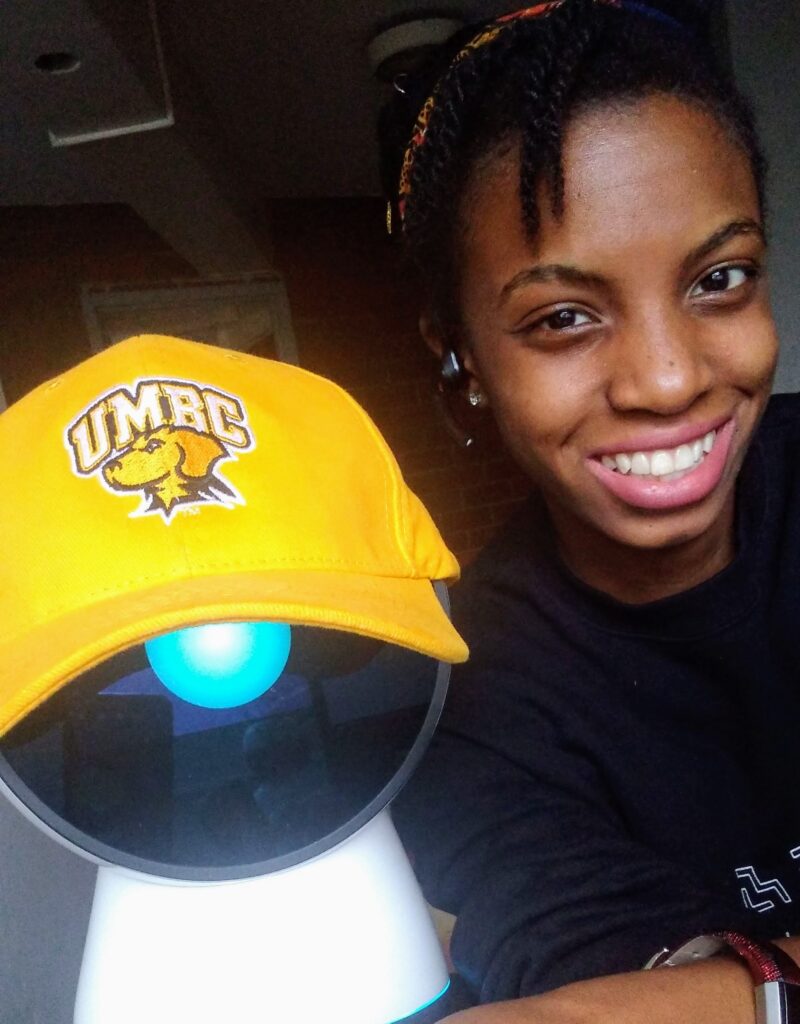 Williams and a Jibo robot show some UMBC pride. (Photo courtesy of Williams)
As a senior in high school in Prince George’s County, Maryland, Randi Williams ’16, computer engineering, was almost certain she was going to MIT for undergrad. Since middle school she’d had the understanding that MIT was the school “for people who want to build things,” and by spring of senior year she had already been admitted under early action. But fate had other plans.
Her mother had learned about UMBC’s Meyerhoff Scholars Program from a 60 Minutes segment that aired right around when Williams was applying to colleges. The nationally renowned Meyerhoff Scholars Program, founded in 1988, works to increase diversity among future leaders in science, technology, engineering, and mathematics by supporting students who intend to pursue a Ph.D. or combined M.D./Ph.D. in these fields.
Williams applied to the program and it was during an on-campus event for top Meyerhoff applicants that her mind began to change. She was impressed with the support and camaraderie the program offered. In the end, Williams opted to become a Retriever—and never looked back.
“If I hadn’t gone to UMBC, I don’t think I would have developed the leadership skills I did,” says Williams, who is returning to campus on April 16 as the keynote speaker for Undergraduate Research and Creative Achievement Day. “My mentors always encouraged me to speak up. I really benefited from that.”
Lifting others up along the way
At UMBC, Williams embraced myriad opportunities to learn and grow. She excelled in her classes, conducted research in the Mobile, Pervasive, and Sensor System Lab of Professor Nilanjan Banerjee, and was involved in the Meyerhoff Scholars, Honors College, and Center for Women in Technology communities.
“Randi’s work was noticeably excellent,” says Charles LaBerge, Ph.D. ’03, electrical engineering, a professor of the practice in the Department of Computer Science and Electrical Engineering who taught Williams in six different courses, from Intro to Engineering to her senior capstone, in which she and her team worked on underwater vision for a robotic sub. “Randi is always upbeat and friendly. Her capstone peers regarded her as a great teammate.”
In her sophomore year, Williams co-founded the hackUMBC student group with fellow Meyerhoff Scholar Perry Ogwuche ’14, computer science and mathematics, and organized the university’s first hackathon, a 24-hour competition where teams of students create innovative solutions to problems that matter to them. Using that experience, she also ran hackathons for youth in Baltimore, centered around issues of community safety and interactions with police.
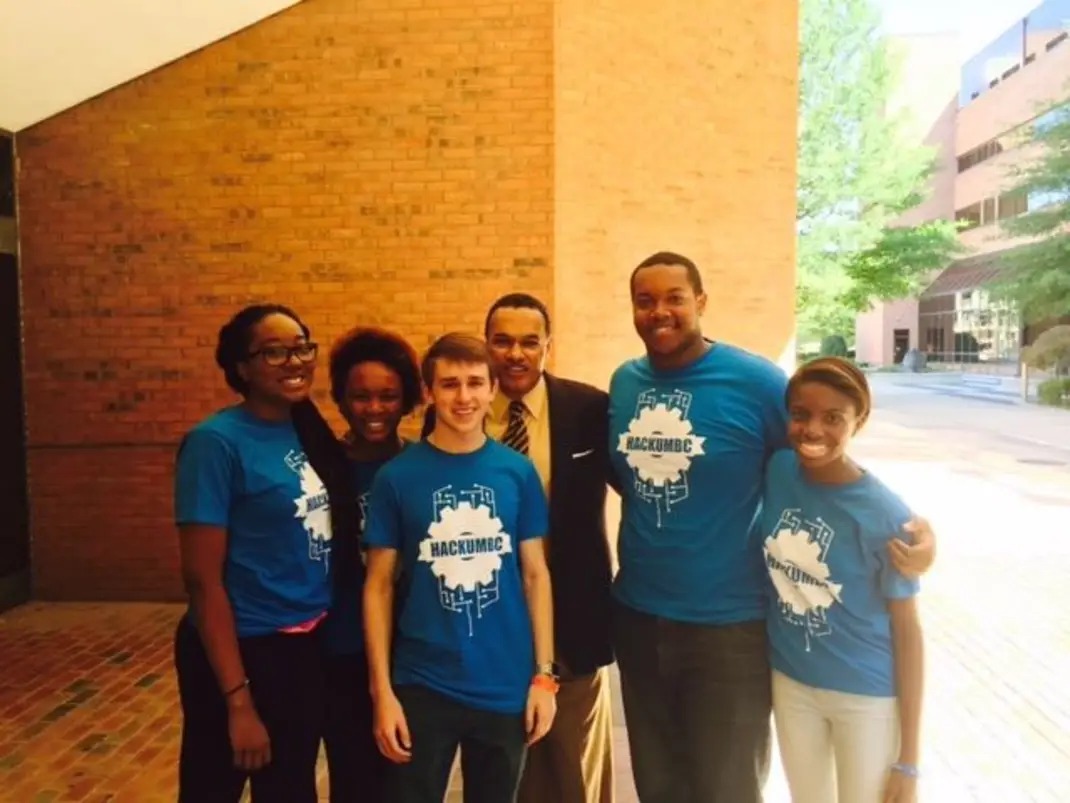 Randi Williams, far right, and other hackUMBC attendees pose for a photo with then UMBC President Freeman Hrabowski. (Photo courtesy of Williams)
Williams always wanted the people around her to succeed, and worked hard to lift everyone up, says her UMBC roommate of four years, Amreen Chadha ’16, financial economics: “I saw Randi pull all-nighters just to help her peers with studying and assignments that she had already completed.”
Throughout her time at UMBC, Williams stayed true to her passions and ideals, Chadha says. “Randi was always herself in the absolute best way: She was honest, thoughtful, caring, and all around great. If I had something on my mind, I was never afraid to be open with her. She balanced her school work and social life so well that it drove others around her to find the same balance.”
To MIT and beyond
After graduating summa cum laude, Williams did at last say “yes” to MIT, where she joined the Personal Robots Group at MIT’s Media Lab. She earned a master’s in media arts in sciences in 2018 and a Ph.D. in the same field in 2024. Williams studied how young children understand and interact with AI, and worked on tools and teaching methods to enable young learners to undertake their own AI-based projects. She developed robots, called PopBots, that can teach AI concepts to preschoolers through social interaction, and also developed a middle school AI and ethics curriculum used by thousands of teachers around the world called “How to Train Your Robot.”
Williams tells the story of one young student she met who wanted to become a doctor and was not, at first, particularly interested in AI. But through a project in Williams’ class the student developed an AI tool to translate when a doctor and patient don’t speak the same language. “This student was inspired by her own situation of translating for her mother in doctors’ offices, and she imagined an AI companion that could do the same,” Williams says.
Williams says the anecdote illustrates how she would like young people to see AI—as a tool to empower themselves and address the problems they see around them.
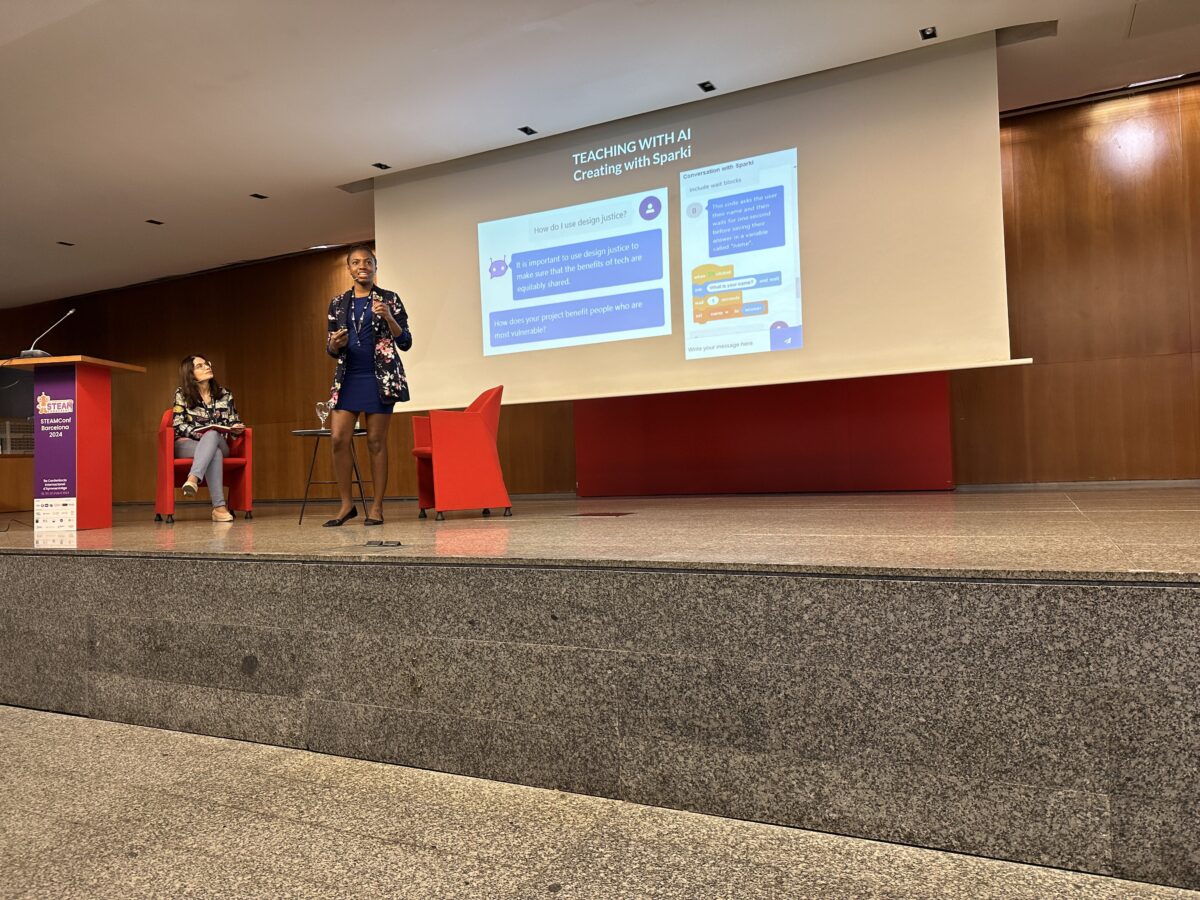 Williams speaks about teaching with AI during STEAMConf Barcelona 2024, a conference about technology education. (Image courtesy of Williams)
Making AI accessible for all
In the summer of 2026, Williams will head to Carnegie Mellon University in Pittsburgh to become an assistant professor in the Human-Computer Interaction Institute.
“Running my own research lab has been my dream for years,” Williams says.
Before beginning that next chapter, she is working as a research lead at Day of AI, a nonprofit organization spun out of MIT, with the mission of preparing K-12 students of all backgrounds and abilities to be successful, responsible, and engaged in an increasingly AI-powered society. The mission fits with Williams’ passion of making technology education accessible to everyone.
“AI is like a big wave approaching us. We can either put our heads in the sand and pretend it’s not coming, or we can ride the wave,” she says. “I want everyone riding the wave.”
Although pop culture often portrays AI as an adversary of humans, Williams prefers to focus on the collaborative potential.
“I tell my students, this is what AI can create—And I’ll make a small circle with my hands; this is what humans can create, and I’ll make a bigger circle; And, putting my arms out wide—this is what we can create together.”
]]>
Williams and a Jibo robot show some UMBC pride. (Photo courtesy of Williams) As a senior in high school in Prince George’s County, Maryland, Randi Williams ’16, computer engineering, was...
https://umbc.edu/stories/randi-williams-ai-technologist/
https://my3.my.umbc.edu/api/v0/pixel/news/148995/guest@my.umbc.edu/53c7daf7dda21ff8b6304cfb2206cd03/api/pixel
alumni
coeit
csee
magazine
story
urcad
UMBC News & Magazine
https://my3.my.umbc.edu/groups/umbc-news-magazine
https://assets1-my.umbc.edu/system/shared/avatars/groups/000/001/943/24435aa6207c452e7bc15cc74b42c7bb/xsmall.png?1748556657
https://assets1-my.umbc.edu/system/shared/avatars/groups/000/001/943/24435aa6207c452e7bc15cc74b42c7bb/original.png?1748556657
https://assets2-my.umbc.edu/system/shared/avatars/groups/000/001/943/24435aa6207c452e7bc15cc74b42c7bb/xxlarge.png?1748556657
https://assets2-my.umbc.edu/system/shared/avatars/groups/000/001/943/24435aa6207c452e7bc15cc74b42c7bb/xlarge.png?1748556657
https://assets3-my.umbc.edu/system/shared/avatars/groups/000/001/943/24435aa6207c452e7bc15cc74b42c7bb/large.png?1748556657
https://assets1-my.umbc.edu/system/shared/avatars/groups/000/001/943/24435aa6207c452e7bc15cc74b42c7bb/medium.png?1748556657
https://assets2-my.umbc.edu/system/shared/avatars/groups/000/001/943/24435aa6207c452e7bc15cc74b42c7bb/small.png?1748556657
https://assets1-my.umbc.edu/system/shared/avatars/groups/000/001/943/24435aa6207c452e7bc15cc74b42c7bb/xsmall.png?1748556657
https://assets2-my.umbc.edu/system/shared/avatars/groups/000/001/943/24435aa6207c452e7bc15cc74b42c7bb/xxsmall.png?1748556657
UMBC News & Magazine
1
0
false
Fri, 11 Apr 2025 14:34:36 -0400
Fri, 11 Apr 2025 14:34:36 -0400
Top 5 ways URCAD is a uniquely UMBC experience
UMBC’s Undergraduate Research and Creative Achievement Day (URCAD) is returning for its 29th year on April 16. For nearly three decades, the annual showcase highlights the research, scholarship, and creative work carried out by undergraduate students who are working alongside faculty mentors.
URCAD 2025 returns to the University Center for research on assessing campus vegetation using tethered weather balloons, a student-curated gallery exhibition that explores “the theme of identity,” an analysis of how social media plays a role in Mexican feminist movements, and much more. Throughout the years, URCAD has grown to be a hallmark experience for Retrievers that exemplifies the expansive breadth and collaborative nature of UMBC research. This work is evident by the university’s reconfirmed designation as an R1 institution by the Carnegie Classification of Institutions of Higher Education earlier this year.
As we gear up for the next edition of the highly-anticipated day of undergraduate research, here are five ways URCAD is a uniquely UMBC experience:
1. Retrievers seriously love research
At URCAD, research enthusiasts—including those initially hesitant—have the opportunity to come together and “geek out” about all things research. First-time participants and seasoned presenters alike are able to showcase what they’ve explored and learned in one of UMBC’s many research labs, out in the field, or within specific industries. On average, about 300 student presenters take part in URCAD each year, with last year’s event featuring more than 400 student participants. Even amid a global pandemic, students eagerly participated in the event from their homes, drawing in 8,000 virtual visits in 2020 and 11,000 virtual visitors in 2021.
A recap of the URCAD 2024 event . (Elijah Davis, M.F.A. ’21/UMBC)
2. Stage for multidisciplinary collaboration
True to UMBC’s intentional culture of inclusive excellence, URCAD spotlights the collaboration that happens across multiple colleges, disciplines, and departments. At URCAD 2023, a team of students from the College of Natural and Mathematics Sciences and the College of Engineering and Information Technology presented their research on the tradeoffs that exist between privacy and utility when using smart devices at home. This year’s event will include a presentation of a multidisciplinary capstone team that designed and constructed a fixed-wing unmanned aerial vehicle, among many other other cross-collaborative projects.
3. Community-focused research based in Baltimore
Nearly each URCAD iteration features presentations of research conducted throughout Baltimore City and Baltimore County. Past events have included a short film screening that chronicles the history and the decline of LGBTQ+ nightlife in Baltimore City; a presentation on findings from a 2021 UMBC-led study to better understand the experiences of low-income Baltimore families without broadband access; and a 2017 URCAD photography exhibit that captured the experiences of unhoused people living in Baltimore’s Station North area.
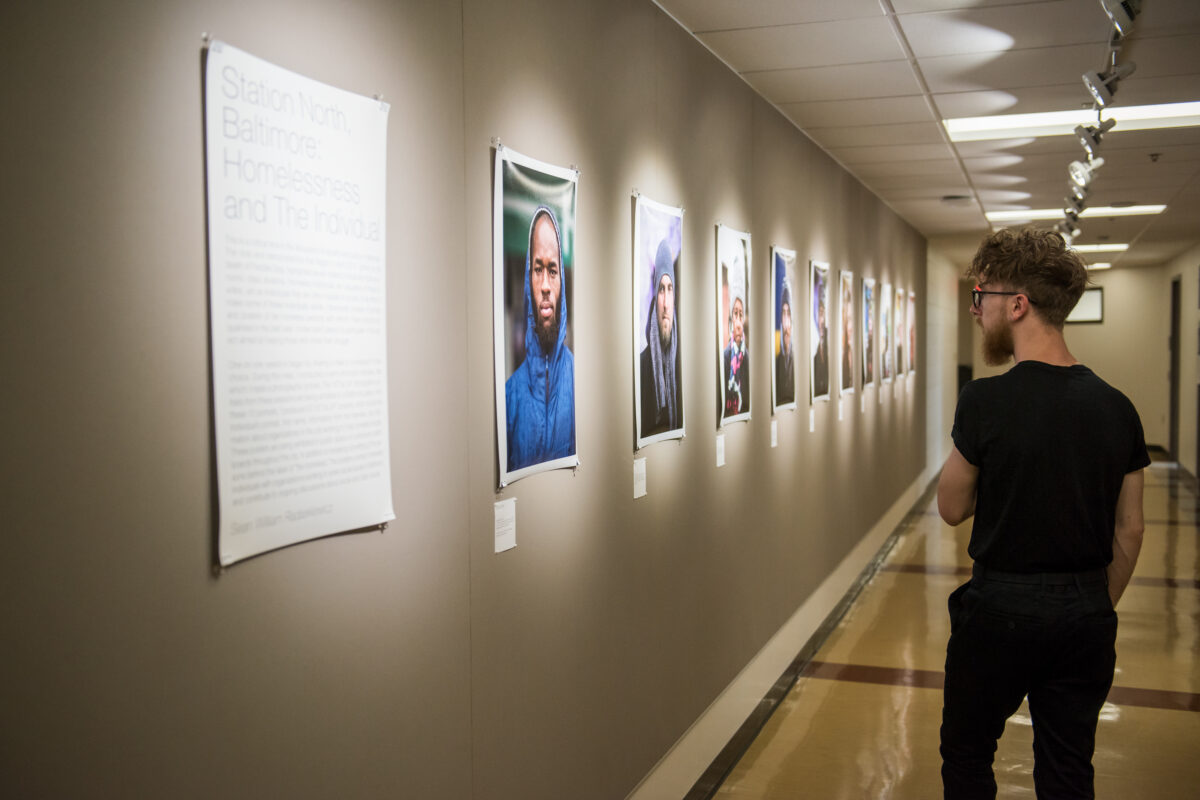 Sean William Radaskiewicz ‘18, visual arts, presented his photography series “Station North, Baltimore: Homelessness and the Individual,” at URCAD 2017. (Marlayna Demond ’11 for UMBC)
4. A return home for alumni researchers
Each year, the research event includes a keynote speech delivered by esteemed UMBC alumni— some of whom were once URCAD presenters themselves—such as the 2024 keynote speaker Stefanie Mavronis ’12, political science, media and communication studies. Mavronis shared her journey of being a student researcher and how her experiences led to her current position as the director of the Mayor’s Office of Safety and Engagement in Baltimore City. Randi Williams ’16, computer engineering, will deliver the URCAD 2025 keynote speech. Williams is the research director of Day of AI, a non-profit organization that provides educators with artificial intelligence literacy curriculums for K-12 students.
 The flyer for URCAD 2025 featuring alumni keynote speaker Randi Williams ’16, computer engineering.
5. Pathway for post-graduation success
Many past URCAD presenters have gone on to pursue advanced degrees and postdoctoral fellowships following their time at UMBC. And they say the early exposure to rigorous research opportunities help land those positions. After presenting at URCAD 2023, Ellie Bare ’23, biological sciences, shared that “having opportunities to improve my science communications abilities was invaluable and really great…it even helped me with my post-baccalaureate interviews.”
Before his current role as a research assistant with the Federal Reserve Board of Governors in Washington, D.C., Peter Wilschke ’24, economics and political science, presented research he worked on as an intern at The Hilltop Institute at UMBC during last year’s URCAD event. Beyond academia, URCAD participants have found industry success. Members of UMBC’s Game Developers Club, some of whom were past URCAD presenters, have gone on to find positions at Facebook, the Unity game engine platform, and Firaxis games, to name a few.
More information on URCAD 2025 presenters and additional sneak peeks of upcoming presentations can be found here.
]]>
UMBC’s Undergraduate Research and Creative Achievement Day (URCAD) is returning for its 29th year on April 16. For nearly three decades, the annual showcase highlights the research, scholarship,...
https://umbc.edu/stories/urcad-2025/
https://my3.my.umbc.edu/api/v0/pixel/news/148905/guest@my.umbc.edu/f7d40e1b3ddbc61b85d468b4ad3ae2f4/api/pixel
cahss
cnms
coeit
community
news
story
undergrad
undergradresearch
urcad
UMBC News & Magazine
https://my3.my.umbc.edu/groups/umbc-news-magazine
https://assets1-my.umbc.edu/system/shared/avatars/groups/000/001/943/24435aa6207c452e7bc15cc74b42c7bb/xsmall.png?1748556657
https://assets1-my.umbc.edu/system/shared/avatars/groups/000/001/943/24435aa6207c452e7bc15cc74b42c7bb/original.png?1748556657
https://assets2-my.umbc.edu/system/shared/avatars/groups/000/001/943/24435aa6207c452e7bc15cc74b42c7bb/xxlarge.png?1748556657
https://assets2-my.umbc.edu/system/shared/avatars/groups/000/001/943/24435aa6207c452e7bc15cc74b42c7bb/xlarge.png?1748556657
https://assets3-my.umbc.edu/system/shared/avatars/groups/000/001/943/24435aa6207c452e7bc15cc74b42c7bb/large.png?1748556657
https://assets1-my.umbc.edu/system/shared/avatars/groups/000/001/943/24435aa6207c452e7bc15cc74b42c7bb/medium.png?1748556657
https://assets2-my.umbc.edu/system/shared/avatars/groups/000/001/943/24435aa6207c452e7bc15cc74b42c7bb/small.png?1748556657
https://assets1-my.umbc.edu/system/shared/avatars/groups/000/001/943/24435aa6207c452e7bc15cc74b42c7bb/xsmall.png?1748556657
https://assets2-my.umbc.edu/system/shared/avatars/groups/000/001/943/24435aa6207c452e7bc15cc74b42c7bb/xxsmall.png?1748556657
UMBC News & Magazine
0
0
false
Wed, 09 Apr 2025 15:16:20 -0400
Wed, 09 Apr 2025 15:16:20 -0400
Office Hours with President Sheares Ashby and URCAD student artist
During her office hours, President Valerie Sheares Ashby makes it a point to meet weekly with students and hear about their UMBC experiences and their aspirations for life after UMBC. Today, Jenna Beshara, a senior English and visual arts double major, shares her Undergraduate Research and Creative Achievement Day (URCAD) project with the president. Beshara, who spent last summer on a study abroad program in Wales, painted a series of Welsh watercolor landscapes with paints she made herself using only natural ingredients. In this excerpt of their conversation, she and President Sheares Ashby discuss the importance of pursuing art and research through a sustainability lens.
President Sheares Ashby: These paintings are just beautiful. I feel like the water is just coming off the page. Is that the way you painted it or is it actually texture?
Jenna Beshara: Thank you! It’s a little bit of both, because the pigment—no matter how much you grind it or sift it—it’s still going to be a little bit coarse and gritty. I found out that it takes about a week to make one batch of pigment. You start with flowers or vegetables or plants—red cabbage actually makes the best blue—and you put them in a pot and pour boiling water over it. Then it’s a sequence of simmering and letting it rest. After you strain out all the materials, you add in a salt compound and baking soda. You grind what’s left, which turns into a mud-like consistency. It needs a week to dry and then you grind it and strain it several times.
But to make the paint, there’s quite a bit of chemistry involved. The idea just kind of came to me because acrylic paint is like liquid plastic. It’s really bad for the environment.
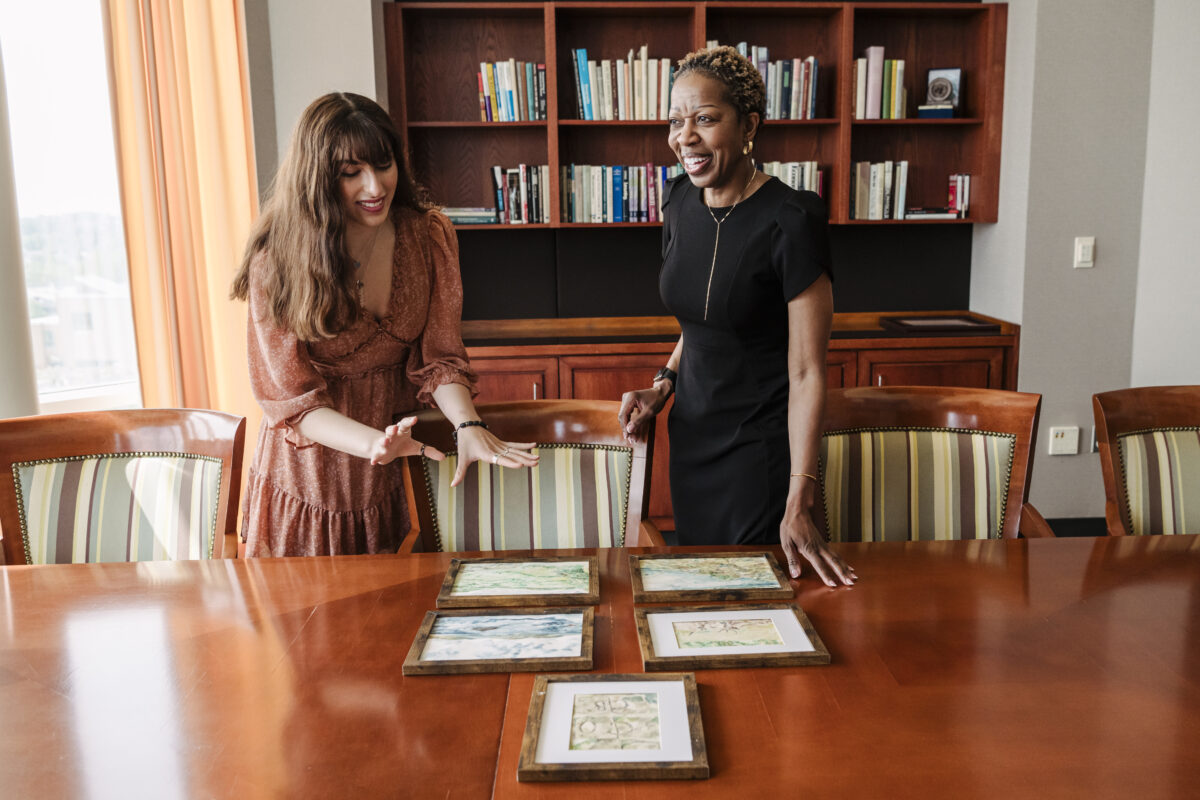 Beshara shares her paintings with President Sheares Ashby.
Sheares Ashby: I am a polymer chemist, so I know what you mean. I appreciate that you did watercolor and environmentally friendly materials. That is very impressive. How did you decide to start this project?
Beshara: After I came back from Wales, I knew I wanted to apply for a Fulbright student grant to do more arts research. My mentor, Timothy Nohe, a professor in visual arts, suggested I use URCAD as a jumping-off point for my research project. He supports me in everything that I do. I’ll come to him and I’m like, “Hey, I want to do this.” And he’s like, “Awesome, do it.”
At one point in this project, I was so frustrated because I wanted to make oil paintings. The homemade oil wasn’t drying, and it looked so gritty. So I went to Professor Nohe and said, “I don’t know what I’m doing.” And he said, “Well, if the medium isn’t working, just change it.” And that blew my mind, and I was like, “Whoa, I can do that?”
Sheares Ashby: When I look at these paintings of these beautiful landscapes, it reminds me that from an environmental framework that if we do not care for this, it will not continue to look like this. This beauty that you have captured is not guaranteed. We have a responsibility to keep this as beautiful as it is.
I love UMBC because our students are so focused on making some version of difference in the world, no matter the discipline.
President Valerie Sheares Ashby
Beshara: I’m applying for an Undergraduate Research Award to keep studying this because the supplies to make the paint can get a little pricey. But it’s so important, with climate change, that sustainability and art can go hand-in-hand.
Sheares Ashby: I love UMBC because our students are so focused on making some version of difference in the world, no matter the discipline. It is rare that I run into a student who doesn’t think about whatever they care about in an interdisciplinary way. Most of my students—like you—are thinking about how they are going to change something in the world to make it better.
]]>
During her office hours, President Valerie Sheares Ashby makes it a point to meet weekly with students and hear about their UMBC experiences and their aspirations for life after UMBC. Today, Jenna...
https://umbc.edu/stories/office-hours-with-president-shears-ashby-2/
https://my3.my.umbc.edu/api/v0/pixel/news/142122/guest@my.umbc.edu/79494f0d2927aa37691f432bd65d99fd/api/pixel
cahss
campus-life
english
magazine
office-hours
spring-2024
story
study-abroad
undergraduate-research
urcad
visualarts
UMBC News & Magazine
https://my3.my.umbc.edu/groups/umbc-news-magazine
https://assets1-my.umbc.edu/system/shared/avatars/groups/000/001/943/24435aa6207c452e7bc15cc74b42c7bb/xsmall.png?1748556657
https://assets1-my.umbc.edu/system/shared/avatars/groups/000/001/943/24435aa6207c452e7bc15cc74b42c7bb/original.png?1748556657
https://assets2-my.umbc.edu/system/shared/avatars/groups/000/001/943/24435aa6207c452e7bc15cc74b42c7bb/xxlarge.png?1748556657
https://assets2-my.umbc.edu/system/shared/avatars/groups/000/001/943/24435aa6207c452e7bc15cc74b42c7bb/xlarge.png?1748556657
https://assets3-my.umbc.edu/system/shared/avatars/groups/000/001/943/24435aa6207c452e7bc15cc74b42c7bb/large.png?1748556657
https://assets1-my.umbc.edu/system/shared/avatars/groups/000/001/943/24435aa6207c452e7bc15cc74b42c7bb/medium.png?1748556657
https://assets2-my.umbc.edu/system/shared/avatars/groups/000/001/943/24435aa6207c452e7bc15cc74b42c7bb/small.png?1748556657
https://assets1-my.umbc.edu/system/shared/avatars/groups/000/001/943/24435aa6207c452e7bc15cc74b42c7bb/xsmall.png?1748556657
https://assets2-my.umbc.edu/system/shared/avatars/groups/000/001/943/24435aa6207c452e7bc15cc74b42c7bb/xxsmall.png?1748556657
UMBC News & Magazine
5
0
false
Tue, 21 May 2024 14:32:07 -0400
Tue, 21 May 2024 14:32:07 -0400
Watch: A recap of URCAD 2024
UMBC’s Undergraduate Research and Creative Achievement Day (URCAD) returned earlier this month for its 28th year, bringing together more than 400 student presenters and the broader university community for a day filled with posters, performances, demonstrations, and much more.
With excitement and energy in the air of the University Center, undergraduate students—many accompanied by faculty mentors—presented a broad range of research and creative projects to peers, family, friends, and inquiring minds of all kinds. The day included a film festival, interactive video game demonstrations, musical performances, a photography and painting exhibition, as well as poster board and oral presentations from students across colleges.
“This showcase event not only exemplifies UMBC’s commitment to our students from all disciplines, but defines our commitment by providing them the opportunity to engage in mentored projects, and, through creative thought and focused inquiry, to discover in themselves their passion,” said Katherine Cole, dean and vice provost of undergraduate academic affairs.
Among this year’s group of presenters was Chiad Onyeje ’24, chemical engineering, who explained the research he’s worked on for nearly three years to develop “spherical shells that we can use as internal Band-Aids” he said in this URCAD 2024 recap video.
“URCAD is different from any other presentations that I’ve been able to give on my research thus far. It really felt like a celebration in comparison,” said Onyeje. “I could go in, have a good time, talk about my research to interested parties, and share why I love this project so much—because it can help people.”
UMBC’s 2024 Undergraduate Research and Creative Achievement Day (URCAD). (Elijah Davis, M.F.A. ’21/UMBC)
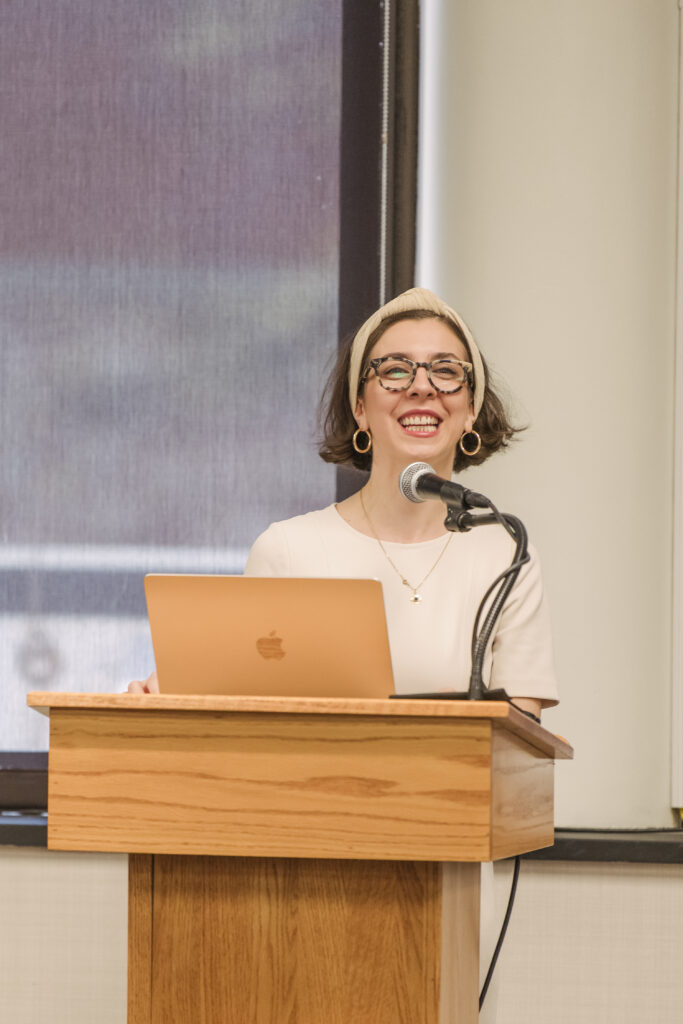 Stefanie Mavronis delivering the URCAD 2024 keynote speech.
From URCAD to the Mayor’s Office
Stefanie Mavronis ’12, political science, media and communication studies, delivered this year’s URCAD keynote speech. Just over a decade ago, Mavronis, who is the director of the Mayor’s Office of Safety and Engagement (MONSE) in Baltimore City, was once a student presenter at URCAD where she premiered her short documentary titled, “Reclamation and Resistance: Audiovisual Tools in Bolivia.”
“The documentary captured the experiences of indigenous Bolivians who were using art and media technologies to challenge and transform the legacy of hundreds of years of colonization in Bolivia. I learned about decolonization, self determination, reciprocity, and representation,” Mavronis shared with the audience.
Mavronis, a UMBC Sondheim Public Affairs Scholar alumna, spoke of her journey to finding her passion for public service and how it led to her positions within Baltimore Mayor Brandon Scott’s election campaign and then office. Her work in MONSE has resulted in the office’s implementation of Baltimore’s Comprehensive Violence Prevention Plan—the city’s first ever comprehensive, 5-year public safety strategy.
“When I think back to it, it was UMBC that was the first to help me see myself as a creative practitioner. It’s the place that prepared me to confront the challenges and harsh realities of the world head on and to do so while embracing clear values,” says Mavronis. “It was through my time at UMBC that I uncovered my commitment to Baltimore…through the opportunities that the institution afforded me to see the world outside of the city.”
“Supporting our students’ applied learning experiences is central to our mission at UMBC,” added Cole, “as it develops creative thinking skills, the ability to communicate effectively, analyze information, share stories, and connect with people from diverse cultures, disciplines, and ideologies. These are the skills our students will take forward as leaders of the future.”
For more on UMBC’s undergraduate research and creative work, check out the 2024 UMBC Review, the journal of undergraduate research, volume 25. Free copies of the current issue are available for pick up at the Office of Undergraduate Research and Prestigious Scholarships, located in the Albin O. Kuhn Library and Gallery.
]]>
UMBC’s Undergraduate Research and Creative Achievement Day (URCAD) returned earlier this month for its 28th year, bringing together more than 400 student presenters and the broader university...
https://umbc.edu/stories/watch-a-recap-of-urcad-2024/
https://my3.my.umbc.edu/api/v0/pixel/news/141350/guest@my.umbc.edu/27ac972da9f508eb4826ff0caf48d7a3/api/pixel
cahss
cbee
cnms
coeit
community
news
research
story
undergraduate-research
urcad
UMBC News & Magazine
https://my3.my.umbc.edu/groups/umbc-news-magazine
https://assets1-my.umbc.edu/system/shared/avatars/groups/000/001/943/24435aa6207c452e7bc15cc74b42c7bb/xsmall.png?1748556657
https://assets1-my.umbc.edu/system/shared/avatars/groups/000/001/943/24435aa6207c452e7bc15cc74b42c7bb/original.png?1748556657
https://assets2-my.umbc.edu/system/shared/avatars/groups/000/001/943/24435aa6207c452e7bc15cc74b42c7bb/xxlarge.png?1748556657
https://assets2-my.umbc.edu/system/shared/avatars/groups/000/001/943/24435aa6207c452e7bc15cc74b42c7bb/xlarge.png?1748556657
https://assets3-my.umbc.edu/system/shared/avatars/groups/000/001/943/24435aa6207c452e7bc15cc74b42c7bb/large.png?1748556657
https://assets1-my.umbc.edu/system/shared/avatars/groups/000/001/943/24435aa6207c452e7bc15cc74b42c7bb/medium.png?1748556657
https://assets2-my.umbc.edu/system/shared/avatars/groups/000/001/943/24435aa6207c452e7bc15cc74b42c7bb/small.png?1748556657
https://assets1-my.umbc.edu/system/shared/avatars/groups/000/001/943/24435aa6207c452e7bc15cc74b42c7bb/xsmall.png?1748556657
https://assets2-my.umbc.edu/system/shared/avatars/groups/000/001/943/24435aa6207c452e7bc15cc74b42c7bb/xxsmall.png?1748556657
UMBC News & Magazine
1
0
false
Thu, 25 Apr 2024 08:42:48 -0400
Thu, 25 Apr 2024 08:42:48 -0400
Lighting design to flu treatment: UMBC students share research and creative work at URCAD 2023

In 2020, Renata Taylor-Smith ’24, theatre, eagerly prepared for her first trip to Munich, Germany to study theatrical lighting design, but a week before she was meant to fly to Germany, her trip was canceled due to COVID-19. She learned that the show she helped to prepare the lighting design for, a production of Jessica Dickey’s The Amish Project, would be postponed indefinitely.
“That roadblock forced me to think creatively about how I could redesign my project,” says Taylor-Smith. With the help of her faculty mentor Adam Mendelson, senior lecturer in theatre, Taylor-Smith sought new ways to gain hands-on experience in lighting design research. Mendelson connected her with other Baltimore-based lighting designers and encouraged her to attend the Live Design International conference and trade show to network with industry professionals.
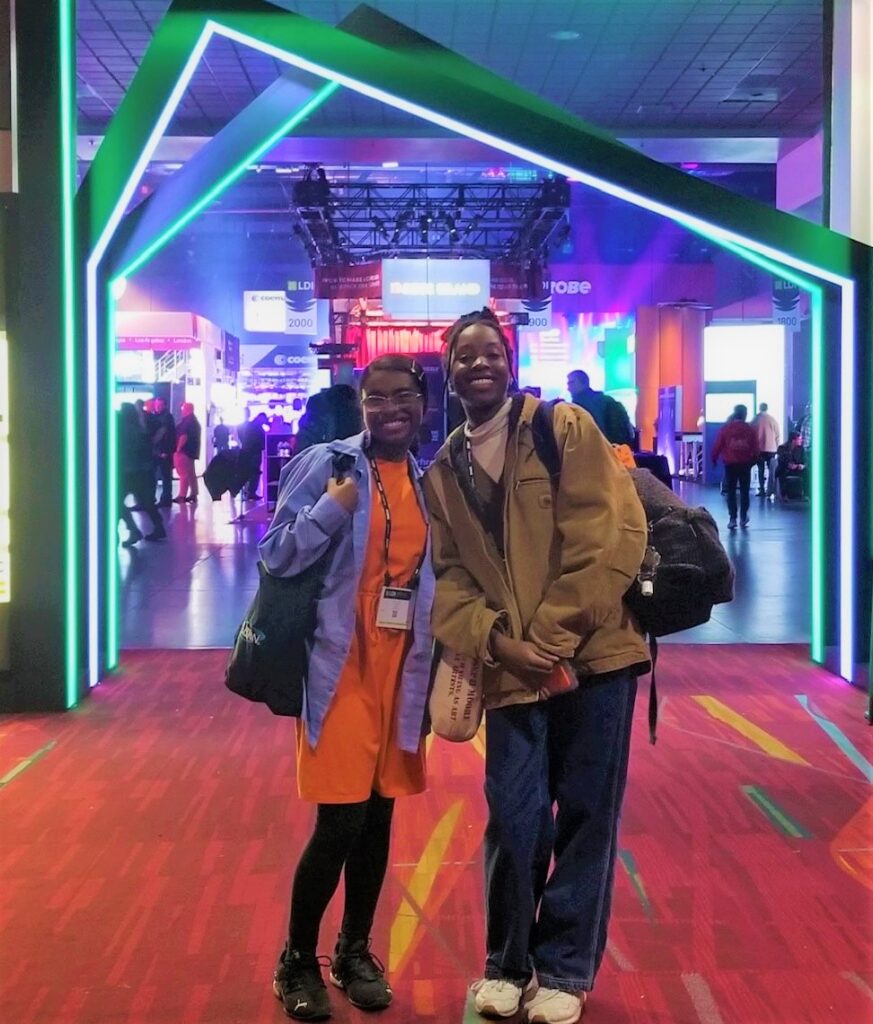 Renata Taylor-Smith (R) with Niya John ’24, theatre, at the Live Design International conference and trade show in November 2022. (Photo curtesy of Renata Taylor-Smith)
Taylor-Smith says, “I was able to meet the intended goal of my research project while also expanding the scope of my project to include opportunities to learn from other designers.” It came full-circle this year when Taylor-Smith worked as the assistant lighting designer, and later transitioned to head designer, for a production of The Amish Project at UMBC’s Black Box Theatre.
Last week Taylor-Smith showcased that work at UMBC’s 2023 Undergraduate Research and Creative Achievement Day (URCAD), held in person for the first time since COVID-19. There, she and nearly 200 other UMBC students convened to present their research and creative projects.
“I was really stressed about presenting my research,” says Taylor-Smith, sharing a feeling that many first-time URCAD presenters initially experience. “I had to remind myself that I spent almost a whole year working on this and all I had to do was talk about what I’ve done. I’m taking the experience that I’ve gained from doing shows to become more confident in my voice as a lighting designer and in my design choices.”
Lighting in the final scene of The Amish Project, designed by Renata Taylor-Smith. (Video courtesy of Renata Taylor-Smith)
Mendelson shares that he was excited to support Taylor-Smith with her URCAD project because hands-on research “allows students who have an interest to really get started, grow, and think through their ideas.”
With support from UMBC’s William T. Brown Shakespeare on Wheels Research Award and an Undergraduate Research Award, Taylor-Smith expects to finally make her way to Germany later this year.
“When someone believes in you…believe them.”
This year’s URCAD featured a talk by special guest Alicia Wilson’04, political science, who is the managing director and global head of philanthropy for the North America region for JPMorgan Chase. Wilson captivated an audience of URCAD presenters and attendees, sharing her personal journey, the value of her research experience, and the power of mentorship.
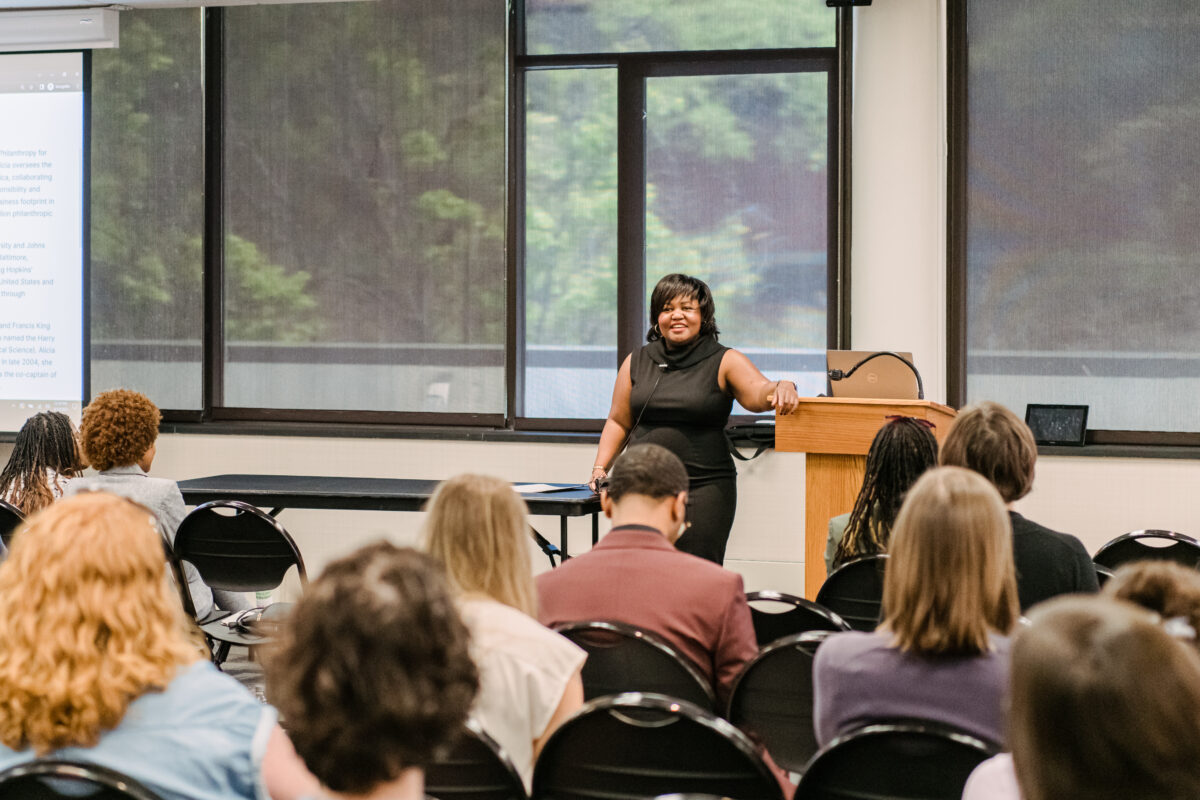 Alicia Wilson delivering the keynote speech at URCAD 2023. (Marlayna Demond ’11/UMBC)
“UMBC, for me, represents so much of who I am and what I want to be in the world,” says Wilson. “My pathway to where I am now is rooted in relationships, being able to care for my community and people regardless of their background. I learned at UMBC to treat everyone well and to research and understand things.”
She advised students to “explore any type of research that you might be interested in,” saying that “it all leads to a great place.” Wilson also encouraged students to take heed of their supporters’ belief in their abilities: “When someone believes in you—even if you can’t believe in yourself—believe them. Don’t believe your doubts. Believe in their belief in you.”
Wilson, who presented her research on community-building at UMBC’s 2022 GRIT-X event, also shared her experience building and sustaining connections, from an 8-year-old who became her mentee to former first lady Michelle Obama.
The language of toys
Theo Reinhert ’23, media and communications studies, is one of the hundreds of UMBC students who presented their work at URCAD this year. Reinhert engaged a crowd of URCAD observers with a display of children’s toys, gathered to demonstrate his analysis of how gender ideologies can be coded in toys.
“While growing up and struggling with my own gender, toys were one of those media that impacted and had power over how I viewed my gender,” Reinhert explained after his presentation. It made him curious to understand how material objects can have the power to carry ideas.
Reinhert found presenting at URCAD to be an important learning experience. “As I presented my research, I understood my ideas better,” he said. “Creating a presentation was a step for me to understand the final research outcomes.”
He also found the support of his faculty mentor, Jason Loviglio, associate professor of media and communication studies, to be essential. “Whenever I would feel lost, Dr. Loviglio would assure me that I was experiencing a normal stage in humanities research” and he’d provide valuable insight, Reinhart said.
Balancing privacy and utility in smart devices
Several students worked together to complete complex group research projects. Tartela Tabassum ’23, information systems; Luke Zimmermann ’24, computer science; Ruhshana Bobojonova ’24, biological sciences; and Joshua Cheeks ’25, computer science, collaborated to explore the tradeoffs that exist between privacy and utility when using smart devices at home.
The group worked in the DAta Management and Semantics (DAMS) research lab led by Roberto Yus, assistant professor of computer science and electrical engineering. They built a prototype of a framework to generate inferences about a person based on audio and video input like speech data collected by a smart speaker and images from a smart security camera, using open-source code and artificial intelligence and machine learning algorithms.
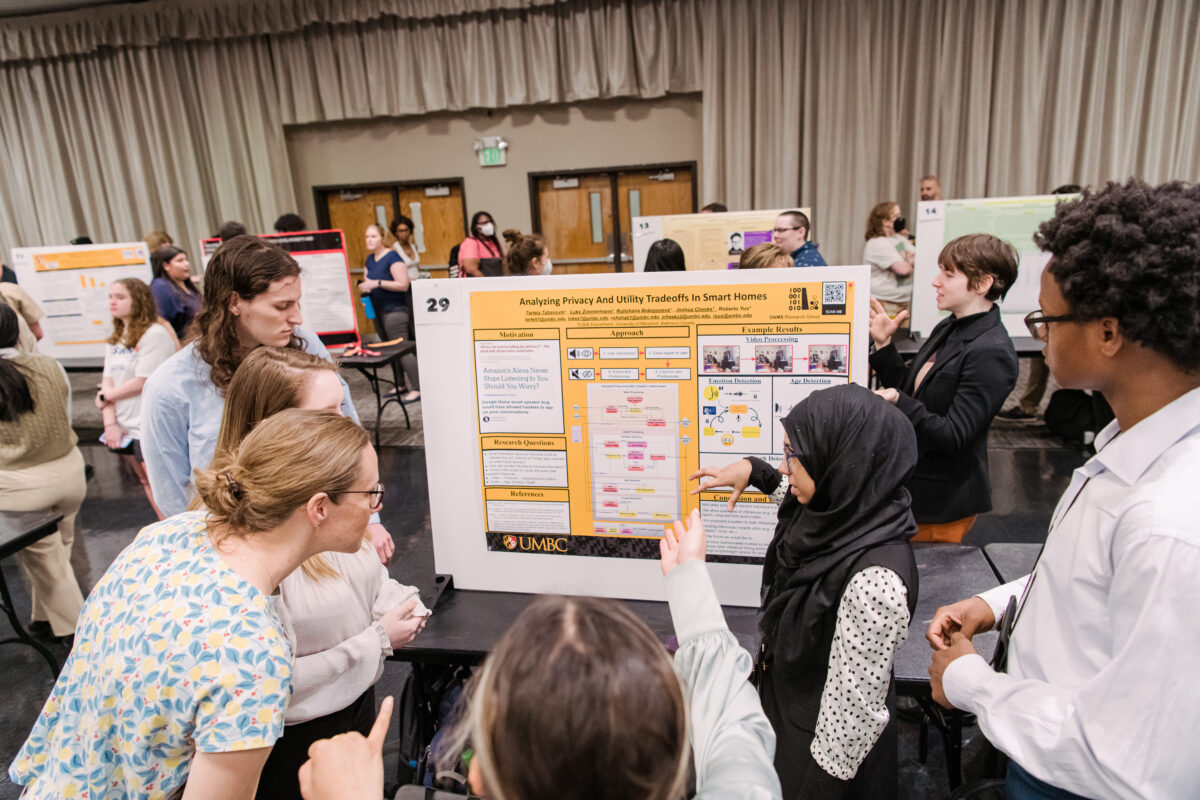 Tartela Tabassum (in black) with her group explaining their research at URCAD 2023 (Marlayna Demond ’11/UMBC)
“We think that privacy is a rising issue,” says Tabassum. “There are things going on with the government trying to ban social media platforms like Tik Tok because of these privacy issues. We want to give users more autonomy with their own privacy.”
Developing flu treatments
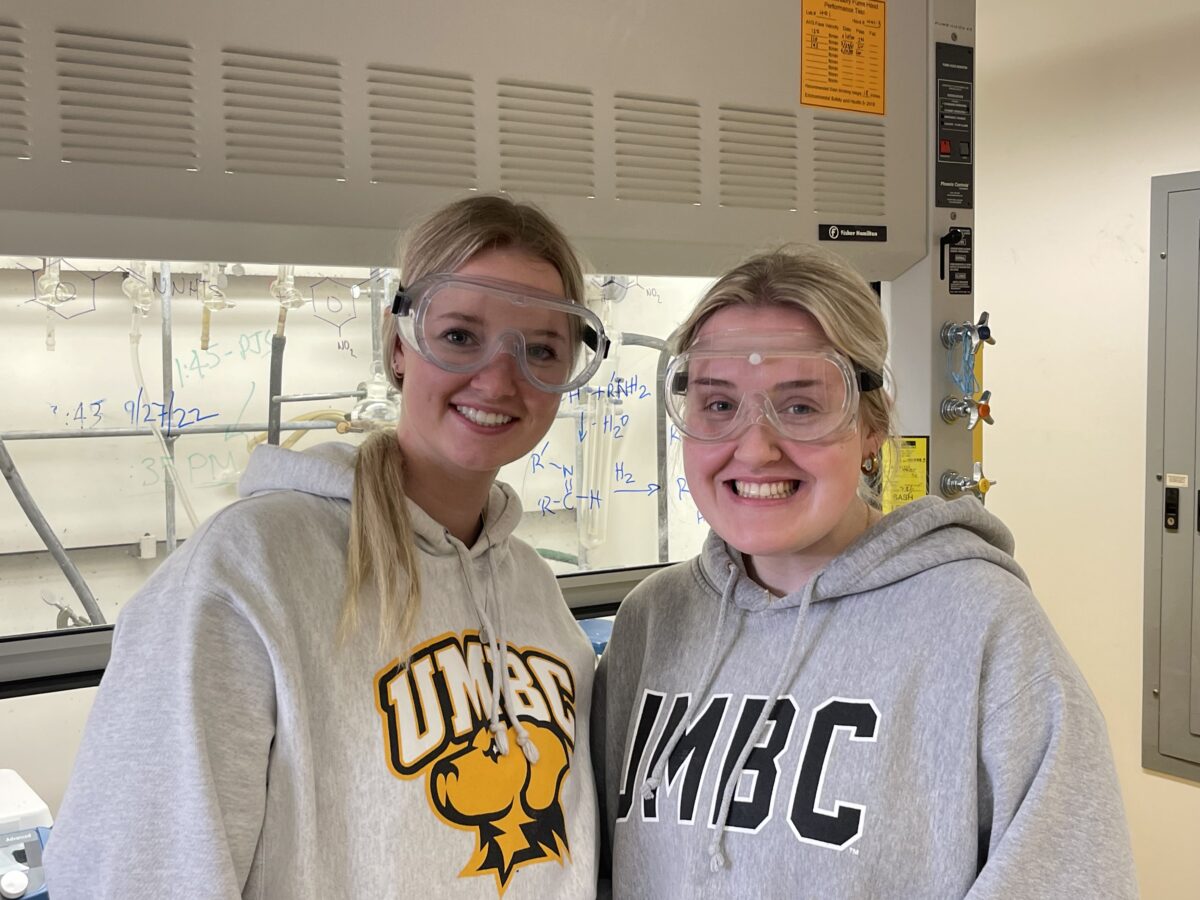 Brooke Nelson (left) and Lillian Kidd. (Photo courtesy of Lillian Kidd)
Lillian Kidd ’24, biochemistry and molecular biology, explored the design and synthesis of palmitoyltransferase inhibitors as potential therapeutics for influenza, or the flu, with her research partner Brooke Nelson ’23, biological sciences. Kidd and Nelson received an Undergraduate Research Award to support their work with faculty mentor Paul Smith, associate professor of chemistry and biochemistry.
“I think doing research is a lot like standing in front of a mirror. It exposes you to what you’re scared of and inversely, what you’re excited about. I learned a lot about my approaches to problem solving and discovered a deep interest in biochemistry,” says Kidd.
She shares that her preparation leading up to URCAD helped her to grow as a research scientist: “There is so much specificity to every single step in our synthesis of palmitoyltransferase inhibitors that pushed me beyond what I had learned in the class environment. Actively using all of the information I studied to carry out research in the lab was such a fundamental experience to my growth as a research scientist.”
A history of Baltimore’s LGBTQ+ nightlife
Ava Sekowski ’24, political science and media and communication studies, was inspired to explore the history of LGBTQ+ nightlife in Baltimore after growing up hearing stories about The Hippo, a now-defunct LGBTQ+ bar where her parents met. Sekowski created the short film “Out in the Open: Tracing the History of Gay Nightlife in Baltimore,” which chronicles the decline in LGBTQ+ nightlife establishments in the city.
“In coming to UMBC, I wanted to explore more about the history of Baltimore through the lens of the LGBTQ+ community,” shares Sekowski. For this project, she says, “I wanted to explore why The Hippo is gone. I heard about the bar my whole life being this amazing club that was welcoming, and I wanted to explore if that was true and who it was welcoming for.”
Ava Sekowski’s short film “Out in the Open: Tracing the History of Gay Nightlife in Baltimore.”
The project enabled Sekowski to practice her editing and interviewing skills and taught her how to navigate the post-production process. “The process was much harder than I thought it would be,” she shares. “I was a one-person filming and editing crew. The hardest part, for me, was filming and getting the lighting correct, but in the end, I’m pretty happy with how it turned out.”
A bioinformatics approach to understanding DNA
In his research, Emmanuel Mekasha ’25, biological sciences, explores promoter regions located in DNA structures and how they are fundamental to our understanding of how gene expression is regulated. He is helping to tackle the challenge of designing generic computational programs capable of finding promoters across different organisms, with the guidance of his mentor Ivan Erill, professor of biological sciences, and biological sciences Ph.D. student Elia Mascolo.
“I have always been an interdisciplinary learner. Based on bioinformatics approaches, my project combines the best aspects of mathematics, statistics, computation, and biology,” says Mekasha. “I thoroughly enjoyed everything that went into this project, from the literature review to the experimental design.”
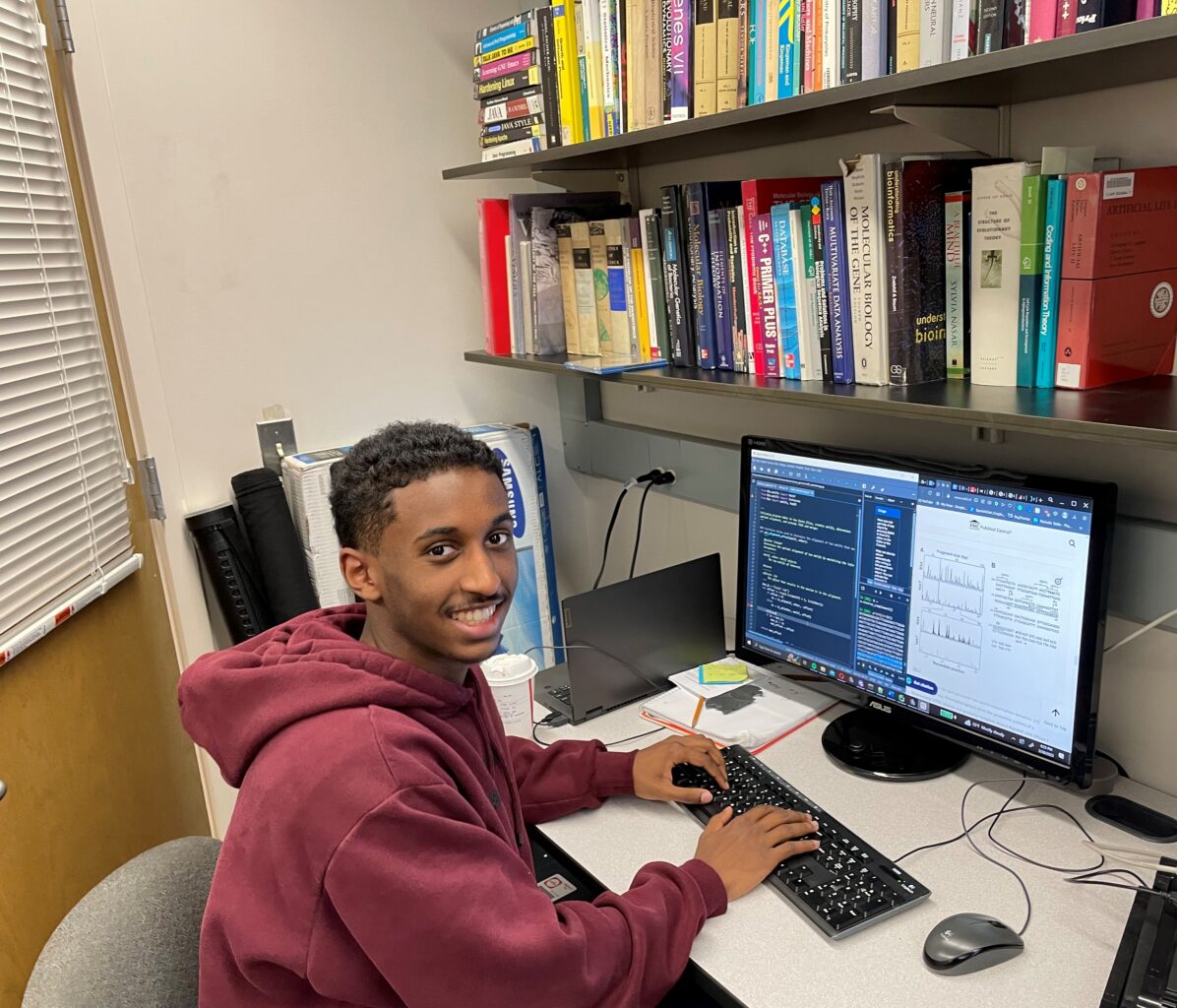 Emmanuel Mekasha (Photo courtesy of Emmanuel Mekasha)
Mekasha already has his sights set on continuing his research pursuits beyond his time at UMBC. “This project, and previous research experiences, have made me certain that I want to do research in the future, leading me to my goal of achieving an MD-Ph.D. degree.”
Implicit bias in healthcare
Thu Dinh ’23, biological sciences; Maryamah Ndao ’23, psychology; and Jorge Saucedo ’23, psychology, worked as research assistants in the Social Determinants of Health Inequities Lab (SoDHI), led by their faculty mentor Danielle Beatty Moody, associate professor of psychology. The group examined the systemic impact of implicit bias from healthcare providers on patient health outcomes. For Ndao, this was a research topic she’s been interested in since her first year at UMBC.
Ndao describes her main focus as “making sure that the healthcare needs…of Black people, especially Black women, are heard.”
 Maryamah Ndao (left) with President Valerie Sheares Ashby at URCAD 2023. (Marlayna Demond ’11/UMBC)
“The data is very clear and the disparities are clear but there’s a lack of action,” Ndao shared during the group’s poster presentation. “Having this opportunity at URCAD to be able to speak to people directly is beneficial because a lot of people [may not] know about this.”
For Saucedo, this research interested him on a personal level, as someone who has lived with chronic pain and felt that medical professionals didn’t believe the amount of pain he was experiencing.
“As a minority myself, I’ve faced a lot of discrepancies and had people not take my pain seriously. I’ve had experiences through the healthcare system that made me feel as if I wasn’t fully represented culturally. I felt as if I was neglected from having proper care because of that,” says Saucedo. Because of his experiences, Saucedo was interested in exploring the research being done at the SoDHI lab.
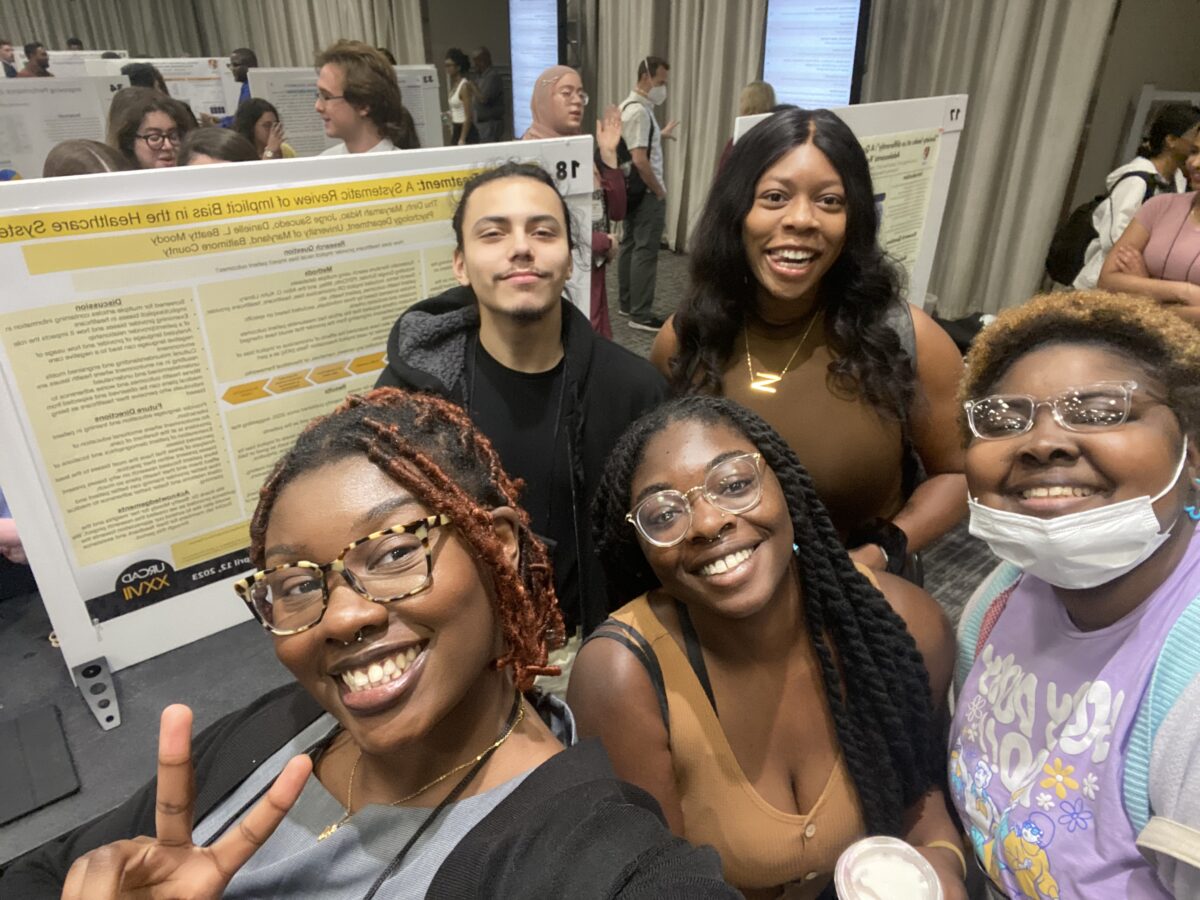 Maryamah Ndao (front row, left) with Jorge Saucedo (back row, left) and friends at URCAD 2023. (Photo courtesy of Maryamah Ndao)
Ndao hopes to one day open her own mental health medical practice to better help individuals from marginalized groups, and also impact the conversation on bias in healthcare. “I want to do more advocating. I love speaking about this topic,” says Ndao.
Reducing pain after shoulder surgery
Supported by UMBC’s Mechanical Engineering S-STEM program, Jacob Lombardo ’25, mechanical engineering, explored how the use of a cooling pad could be beneficial in the healing of surgical repair sites of shoulder injuries. His research asserts that effective cooling may temporarily reduce nerve activity by disrupting the transmission of pain signals and could be a cost-effective approach to decrease the use of painkiller medications during surgical recovery.
With the help of his faculty mentor Liang Zhu, professor of mechanical engineering, Lombardo learned how to circumvent obstacles that arose during the research process. “Research allows you to overcome problems that don’t have a textbook answer,” says Lombardo.
For example, he explains, “My research included the use of a blood flow measurement device. I initially encountered difficulties getting meaningful results from the device. With the encouragement of my advisor, I got in contact with the manufacturer.” Their engineers explained in more detail how the device worked and shared best practices for using it effectively in research.
This experience learning more about medical technologies has inspired him to continue to pursue biomedical engineering. He says, “I am motivated by the possibility of improving patient care through research, and I am eager to expand upon my experience in future projects.”
UMBC Review
Several URCAD presenters and other student researchers have shared the results of their research and creative work in UMBC Review, a peer-reviewed research publication completely directed by UMBC undergraduate students. Free print copies of the new 24th edition are available in the Office of Undergraduate Research and Prestigious Scholarships, located in the Albin O. Kuhn Library and Gallery.
]]>
In 2020, Renata Taylor-Smith ’24, theatre, eagerly prepared for her first trip to Munich, Germany to study theatrical lighting design, but a week before she was meant to fly to Germany, her trip...
https://umbc.edu/stories/urcad-2023/
https://my3.my.umbc.edu/api/v0/pixel/news/132830/guest@my.umbc.edu/488530977e3b461f9c2f11bb6ff1f78e/api/pixel
arts-and-culture
cahss
cnms
coeit
community
news
rca-2
research
science-and-tech
urcad
UMBC News & Magazine
https://my3.my.umbc.edu/groups/umbc-news-magazine
https://assets1-my.umbc.edu/system/shared/avatars/groups/000/001/943/24435aa6207c452e7bc15cc74b42c7bb/xsmall.png?1748556657
https://assets1-my.umbc.edu/system/shared/avatars/groups/000/001/943/24435aa6207c452e7bc15cc74b42c7bb/original.png?1748556657
https://assets2-my.umbc.edu/system/shared/avatars/groups/000/001/943/24435aa6207c452e7bc15cc74b42c7bb/xxlarge.png?1748556657
https://assets2-my.umbc.edu/system/shared/avatars/groups/000/001/943/24435aa6207c452e7bc15cc74b42c7bb/xlarge.png?1748556657
https://assets3-my.umbc.edu/system/shared/avatars/groups/000/001/943/24435aa6207c452e7bc15cc74b42c7bb/large.png?1748556657
https://assets1-my.umbc.edu/system/shared/avatars/groups/000/001/943/24435aa6207c452e7bc15cc74b42c7bb/medium.png?1748556657
https://assets2-my.umbc.edu/system/shared/avatars/groups/000/001/943/24435aa6207c452e7bc15cc74b42c7bb/small.png?1748556657
https://assets1-my.umbc.edu/system/shared/avatars/groups/000/001/943/24435aa6207c452e7bc15cc74b42c7bb/xsmall.png?1748556657
https://assets2-my.umbc.edu/system/shared/avatars/groups/000/001/943/24435aa6207c452e7bc15cc74b42c7bb/xxsmall.png?1748556657
UMBC News & Magazine
0
0
false
Thu, 20 Apr 2023 14:16:37 -0400
Thu, 20 Apr 2023 14:16:37 -0400
Four tips from UMBC faculty on what to do and see at Undergraduate Research and Creative Achievement Day

UMBC’s annual Undergraduate Research and Creative Achievement Day—known on campus as URCAD—has long been a must-see event. It’s a chance for community members to get a glimpse of what students have dedicated hours to exploring and creating throughout the year. This year, many wondered if the event would be in person, as COVID cases dipped, but URCAD XXVI will again be online, for the third year in a row, starting today. Why? Going virtual has boosted access and engagement.
During the pandemic, what was once a day-long in-person event shifted gears. The new online URCAD format that launched in 2020 spanned a full week. The virtual format enables community members to easily browse projects, performances, and creative works of all types. With VoiceThread, student researchers upload poster presentations, performances, and visual artwork, adding commentary and responding to questions from the online audience over a period of days rather than hours.
For each of the past two years, audiences have tuned in from nations around the world at all hours of the day, yielding unprecedented engagement.
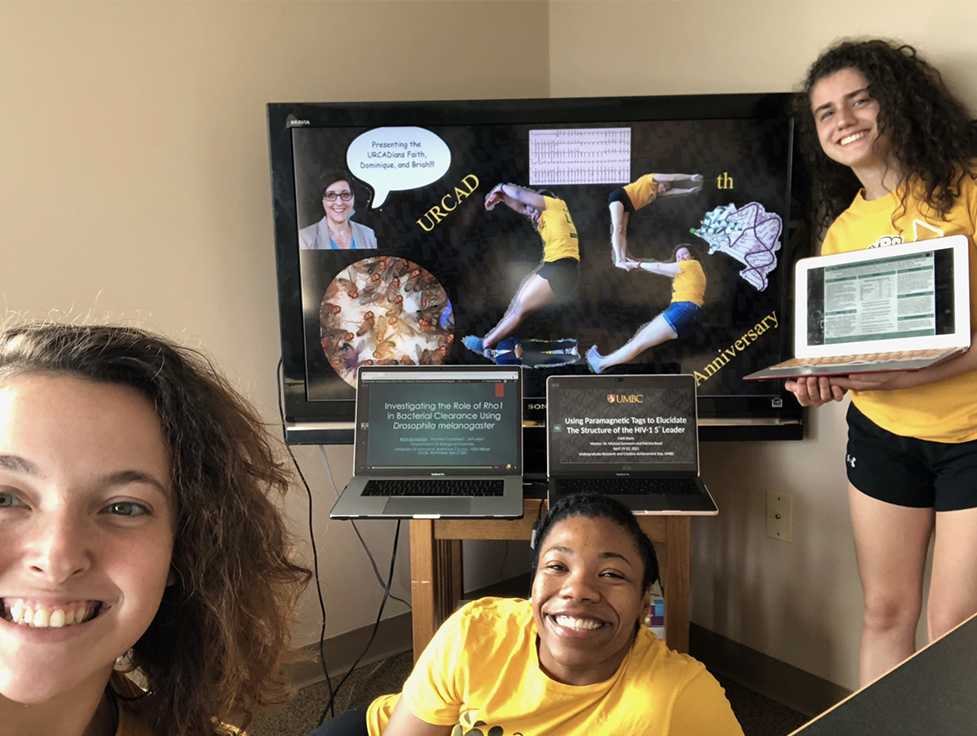 Faith Davis, left, the winner of the 2021 URCAD selfie contest, with her roommates and their URCAD presentations. Photo courtesy of Davis.
This year the event will take place April 18 – 24. Student creativity is on display, not just in the work itself but in how each presenter uses the online format to their advantage. Many share their work in ways that wouldn’t be possible at an in-person event with physical posters and more traditional presentations and performances.
Here are four tips from faculty whose students have participated in URCAD in years past on how to navigate this exciting event.
#1 Set aside more time than you expect. You’ll use every minute.
“Because you’ll be blown away by the depth and creativity of everyone’s projects, give yourself time to fully experience presentations, from start to finish,” says Lia Purpura, writer in residence at UMBC. “As when attending any big conference—pace yourself.”
Consider starting by taking the time to explore the full list of URCAD projects, which is available by student name and department. You can search for specific terms that interest you, or peruse “sneak peeks” of highlighted projects.
#2 Post a comment or question—it makes a huge difference.
“Interact with the presenters via VoiceThread. Since this year is virtual, the presentations will be live over several days and presenters will have a chance to answer questions and take comments within the VoiceThread platform,” explains Corrie Parks, assistant professor of visual arts.
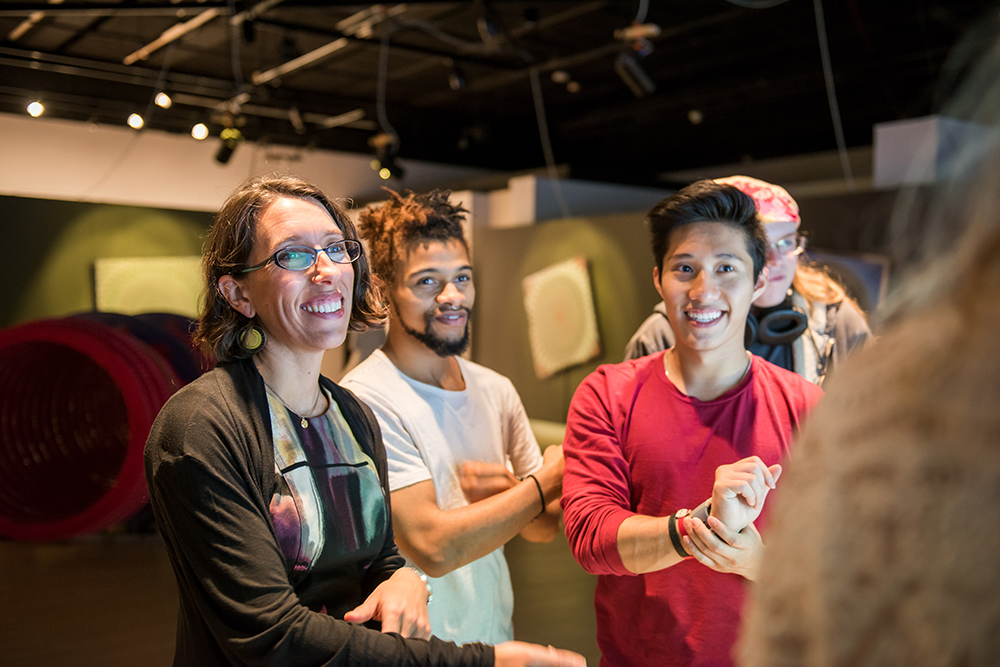
Corrie Parks, visual arts, smiles with students at an art exhibit.
Parks’ students often share their animations through URCAD. “As a presenter, it’s a great encouragement to get a question or comment, because then they know someone is watching their presentation,” she shares. Instructions on how to use VoiceThread are available through an online visitor guide.
#3 Seek out projects on topics that are new to you.
URCAD is a great chance for people interested in the same topic to connect with each other. It’s also a wonderful opportunity to explore something that’s entirely new.
Marc Olano, associate dean of academic programs and learning for UMBC’s College of Engineering and Information Technology, says, “Don’t forget the creative achievement pieces. There can be a lot of focus on the research side of the Undergraduate Research and Creative Achievement Day, but the artistic work is well worth checking out!”
Olano is also director of the game development track in computer science, so it’s no surprise when he shares, “I am, of course, partial to the games!”
#4 Always catch the keynote speaker. They offer relatable advice.
“The keynote is with no doubt a highlight of the event. It usually is a perfect combination of inspiring work accomplishments and career advice at the personal and professional level,” says Fernando Vonhoff, assistant professor of biological sciences.
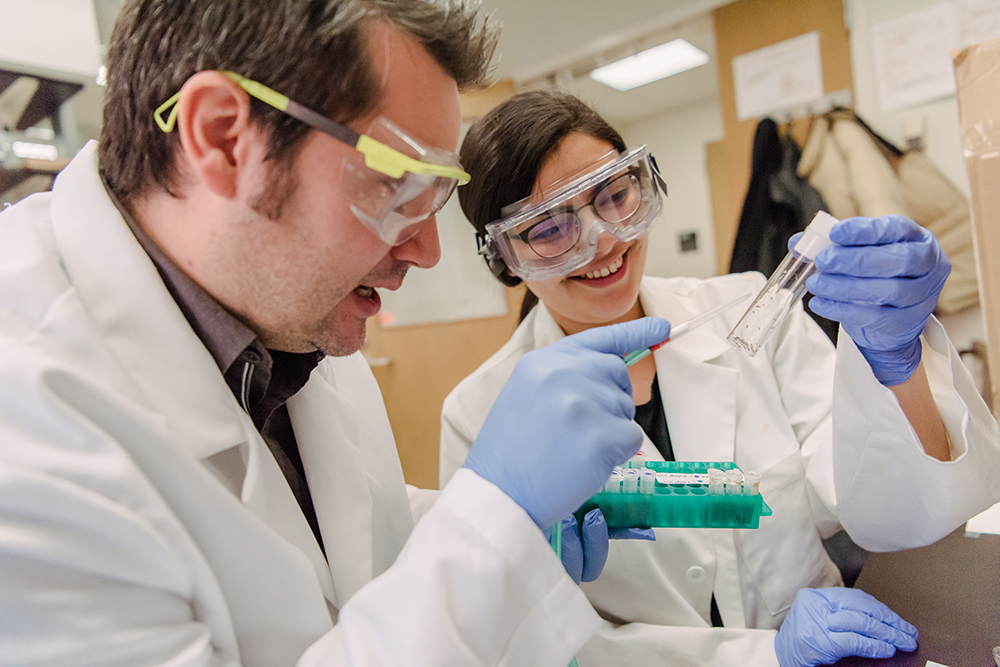
Fernando Vonhoff, biological sciences, works with a student in his lab.
“It is encouraging for anyone to hear from people who had to work hard and overcome all kinds of challenges to get where they are now,” Vonhoff says. “Most importantly, we get a realistic feeling that we can do it, too.”
This year’s keynote speaker is Kaitlyn Sadtler’11, biological sciences, introduced by President Freeman Hrabowski. Sadtler is an Earl Stadtman tenure-track investigator at the National Institute of Biomedical Imaging and Bioengineering, a division of the NIH, and a UMBC Alumni Award winner.
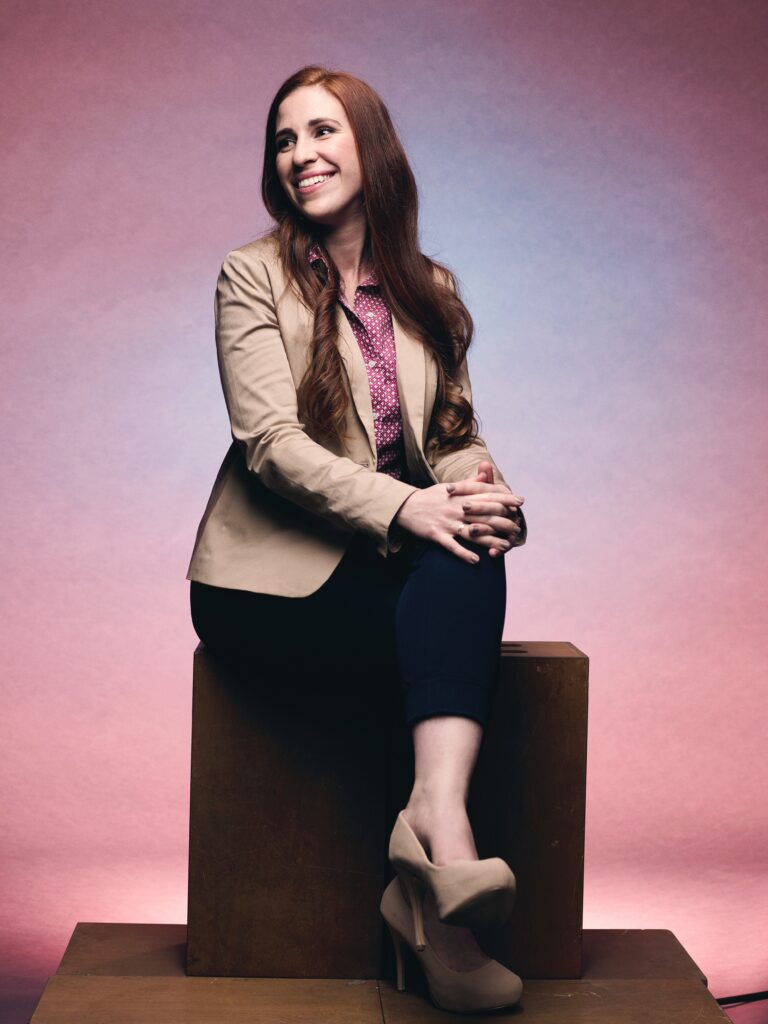 Portrait of Kaitlyn Sadtler by Bret Hartman/TED, provided by Sadtler.
Sadtler will discuss her work studying SARS-CoV-2 infections as well as her path from student to scientist.
Participants and attendees alike are invited to share their URCAD advice, experience, and congratulations to students via #UMBCurcad.
Featured image: An illuminated signboard welcomes people to URCAD. All photos by Marlayna Demond ’11 for UMBC, unless otherwise noted.
]]>
UMBC’s annual Undergraduate Research and Creative Achievement Day—known on campus as URCAD—has long been a must-see event. It’s a chance for community members to get a glimpse of what students...
https://umbc.edu/stories/four-tips-from-umbc-faculty-on-what-to-do-and-see-at-undergraduate-research-and-creative-achievement-day/
https://my3.my.umbc.edu/api/v0/pixel/news/119445/guest@my.umbc.edu/7ec7e74d20bd918f45a91667460b063b/api/pixel
arts-and-culture
cahss
cnms
coeit
news
research
science-and-tech
urcad
UMBC News & Magazine
https://my3.my.umbc.edu/groups/umbc-news-magazine
https://assets1-my.umbc.edu/system/shared/avatars/groups/000/001/943/24435aa6207c452e7bc15cc74b42c7bb/xsmall.png?1748556657
https://assets1-my.umbc.edu/system/shared/avatars/groups/000/001/943/24435aa6207c452e7bc15cc74b42c7bb/original.png?1748556657
https://assets2-my.umbc.edu/system/shared/avatars/groups/000/001/943/24435aa6207c452e7bc15cc74b42c7bb/xxlarge.png?1748556657
https://assets2-my.umbc.edu/system/shared/avatars/groups/000/001/943/24435aa6207c452e7bc15cc74b42c7bb/xlarge.png?1748556657
https://assets3-my.umbc.edu/system/shared/avatars/groups/000/001/943/24435aa6207c452e7bc15cc74b42c7bb/large.png?1748556657
https://assets1-my.umbc.edu/system/shared/avatars/groups/000/001/943/24435aa6207c452e7bc15cc74b42c7bb/medium.png?1748556657
https://assets2-my.umbc.edu/system/shared/avatars/groups/000/001/943/24435aa6207c452e7bc15cc74b42c7bb/small.png?1748556657
https://assets1-my.umbc.edu/system/shared/avatars/groups/000/001/943/24435aa6207c452e7bc15cc74b42c7bb/xsmall.png?1748556657
https://assets2-my.umbc.edu/system/shared/avatars/groups/000/001/943/24435aa6207c452e7bc15cc74b42c7bb/xxsmall.png?1748556657
UMBC News & Magazine
0
0
false
Mon, 18 Apr 2022 20:45:15 -0400
Mon, 18 Apr 2022 20:45:15 -0400
UMBC celebrates 25th Undergraduate Research and Creative Achievement Day with an expanded global audience

UMBC’s 25th Undergraduate Research and Creative Achievement Day (URCAD) reached more viewers than ever before, with visitors connecting online from as far away as Spain, Indonesia, Nigeria, Brazil, Bhutan, Germany, and the U.K.. Audiences logged more than 11,000 visits (compared with 8,000 in 2020) and posted more than 3,500 comments over the course of the week-long event.

Winner of URCADs “Best Selfie With The Number “25”
Angelika Albertorio ’21, English and dance.
“While we are eager to get back to the live event, there are definitely aspects of the online event that have widened the scope of URCAD,” says April Householder, director of undergraduate research and prestigious scholarships. “Presenters were able to invite friends and family members from other countries to view their presentations, and invite international scholars as potential future collaborators.”
Over 350 students presented projects, from novel artistic work to lab research to analysis of historical archives. The questions they asked reflected engagement with significant challenges and opportunities of today.
Anti-Asian racism
Zoe Hwang, English, was inspired to study the history of Koreans in Baltimore after reading a chapter about Korean immigrant communities in the city written by Aletheia Hyun-Jin Shin in the book Baltimore Revisited. Then COVID-19 happened and with it came a rise in hate crimes toward members of Asian communities in the United States. “I’m scared to go outside,” shares Hwang, who is Korean and lives in Maryland. “I was surprised that so many people thought this was new and were unaware of the history of racism toward the Asian community.”
She decided to widen the scope of her research for URCAD. In “We Were Never Welcome Here: How American History Predicted the Rise of Racism and Xenophobia During COVID-19,” Hwang uses archival posters and newspapers to contextualize racism toward Chinese and Japanese communities in the U.S. from 1850 to the present, while demonstrating how negative sentiments about one Asian community have often translated into violence for other Asian communities. “I want to continue to educate others about the diversity of the Asian community and the dangers of lumping the people and cultures under a single term,” says Hwang.
Connecting Baltimore
When COVID struck, many Baltimore families without internet access were completely disconnected from much-needed services that had moved online, and were disconnected from their communities. In fall 2020, Foad Hamidi, assistant professor of information systems, received NSF funding to research this problem in collaboration with the Digital Harbor Foundation and Project Waves, providing affordable internet service in Baltimore. Hamidi and Nora McDonald, research assistant professor of information systems, led a study to understand the experiences of low-income Baltimore families without broadband access, and student researchers played a major role in the work.

The Project Waves team installing a sector antenna in downtown Baltimore City.
Photo courtesy of Project Waves.
Hamidi says a lot has changed from when they started the project. “The preliminary findings have found that participants and partners value connectivity that is affordable, that can be used with social distancing, is offered by grassroots community organizations, and is private,” he shares.
Working on project Waves has been a humbling and a very rewarding experience for Karina Lopez-Brown ‘21, information systems. “Our research in Project Waves demonstrated to me that it doesn’t matter the level of knowledge or expertise that we have,” says Lopez-Brown, “we just need to be willing to share our knowledge to help our community.”
In addition to Lopez-Brown, the student team included seniors Rushaad Wright, business technology administration, and Daniel Laguna, information systems, as well as Lydia Stamato, a doctoral student in human-centered computing.
For Laguna, the project has been an opportunity to strengthen relationships with his peers and mentors and to collaborate with the Baltimore City community. “In these times where we have had to remain physically distant from one another it’s been easy to feel isolated from the world,” says Laguna. “But all of these connections have really helped me feel closer to the rest of the world.”
Conversation with squeegee kids
Growing up in Baltimore City, Sydney Fryer ’22, psychology, was accustomed to seeing young Black boys and men standing on downtown street corners ready with squeegees, trying to earn money by cleaning car windshields. Fryer saw the “Squeegee Kids” as a positive part of Baltimore City’s culture and economy but knew some residents and visitors didn’t share this sentiment.

Sydney Fryer.
Photo by Marlayna Demond ’11 for UMBC.
In “Decriminalizing (and Re-Humanizing) the ‘Squeegee Kid,” Fryer used Baltimore Sun archives, social media data, and interviews with the youth to examine the criminalization of these young men over forty years of city history. “Sydney’s methodology was designed to recognize the crucial role that discourse and policy play in shaping young people’s daily experiences,” says Dena Aufseeser, assistant professor of geography and environmental systems.
Fryer found that White boys and men doing similar work were seen as entrepreneurial while “Squeegee Kids” were often described through unsubstantiated narratives about crime and violence. She says her interviews revealed that, “many of them are working to buy clothes, food, books, and to help their families,” so what they earn often goes right back into the city’s economy.
Understanding the structure of HIV
As COVID-19 vaccine research moved forward at light speed this past year, research on other pandemics continued to make steady progress. Three groups of students presented their research on HIV-1, the retrovirus that causes AIDS.
Michael Summers, Distinguished University Professor of chemistry and biochemistry and Howard Hughes Medical Institute investigator, mentored over a dozen students that contributed to two of the major collaborative projects presented at URCAD, focused on the structures of HIV-1 MAL junction conformers and the HIV-1 5′ leader. Faith Davis ‘22, sociology and biological sciences, is part of the second project and a 2021 Newman Civic Fellow.

Davis (left) with her co-researchers tied for URCAD’s 2021 “Best Overall Selfie” award.
Photo courtesy of April Householder, director of undergraduate research and prestigious scholarships.
“The work is focused on determining an unsolved piece of the structure of the 5` leader of HIV-1’s genome, which is what makes HIV so infectious,” she explains. “If the structure of this area can be determined, it could possibly inform cures or better treatments for HIV.”
Collaborative process
For UMBC’s video game designers, going virtual was not new. Marc Olano, associate professor of computer science and electrical engineering, mentored four projects presented at URCAD, each led by a group of about four students. They include Sword Shibe; Recurring Moment – A Time Travel Puzzle Platformer; Jump Starters, and the two-player Android and PC strategy game Hamster Toaster Checker. Students in UMBC’s computer science game development track collaborated with students in animation and interactive media to envision and begin developing the new games.
“The beauty of the CMSC 493 class is that it brings artists and programmers together and the management of the project is completely led by us,” says Kristian Mischke ‘21, computer science, the game designer for the Recurring Moment project.

A scene from Recurring Moment.
Image courtesy of Mischke.
In Sword Shibe, players take a dog with a sword through different paths. The student team that created it drew inspiration for its concept designs from Japanese culture, folklore, and legends. The dog in the game is also inspired by a Shiba Inu, which is a breed of hunting dog from Japan.
Olano worked to model the students’ project experience on the structure of the game design and development industry. “Students began working through ideas in small teams and worked their way through prototypes and onto a bigger team,” he explains. “In the game industry, you have to work collaboratively or you fail.”
Mischke explains how he would bounce ideas off the artists for visual appeal or about the game’s narrative arc. With the other programmers, he talked through implementation feasibility. “We all would give feedback and discuss adaptations together,” says Mischke. “Everyone on the team was able to be part of the process and apply their unique skill set.”
Thought-provoking animation
UMBC artists also shared short animated films through URCAD. These include projects like “Finding the Sun” and “Familiarity in Change,” which resonated with audiences.

Young’s avatar.
Courtesy of Young.
“Finding the Sun” was created by Michelle Young ‘21, visual arts, who directed, animated, and composed the music for the film. She took an interdisciplinary approach by combining her illustration, design, 2D animation, and sound design skills to explore the themes of self-worth and self-acceptance.
The girl in the movie wakes up to a dark world and goes in search of the sun, says Young, only to find out she is the light in the world—that she is enough. “I was hoping that the simplicity of the character would allow the viewer to put themselves in their shoes,” she explains. “I wanted to create something that was meaningful and encouraging to people wherever they are in this difficult time in our lives.”
“Familiarity in Change” shows viewers imagery of various locations, such as an empty beach and snowy park, that express a desolate feeling. However, by pairing those images with peaceful music, creator Angela Endres ‘22, visual arts, transforms the mood to serenity and comfort.
Endresfinds meaning in showing the emptiness of these places, which prior to COVID would have been enjoyed by family and friends coming together. “Isolation has made me see the beauty in everyday life,” she shared in her URCAD talk. “The world has changed and that’s OK.”
Banner image: A scene from Michelle Young’s short film “Finding the Sun.” Image courtesy of Young.
]]>
UMBC’s 25th Undergraduate Research and Creative Achievement Day (URCAD) reached more viewers than ever before, with visitors connecting online from as far away as Spain, Indonesia, Nigeria,...
https://umbc.edu/stories/umbc-celebrates-the-25th-undergraduate-research-and-creative-achievement-day-with-an-expanded-global-audience/
https://my3.my.umbc.edu/api/v0/pixel/news/119637/guest@my.umbc.edu/65dfaf8d60c48038f5cd90721ba37421/api/pixel
arts-and-culture
biology
cahss
cnms
coeit
csee
diversityandinclusion
english
ges
interdisciplinary
international
policy-and-society
psychology
saph
science-and-technology
undergradresearch
urcad
visualarts
UMBC News & Magazine
https://my3.my.umbc.edu/groups/umbc-news-magazine
https://assets1-my.umbc.edu/system/shared/avatars/groups/000/001/943/24435aa6207c452e7bc15cc74b42c7bb/xsmall.png?1748556657
https://assets1-my.umbc.edu/system/shared/avatars/groups/000/001/943/24435aa6207c452e7bc15cc74b42c7bb/original.png?1748556657
https://assets2-my.umbc.edu/system/shared/avatars/groups/000/001/943/24435aa6207c452e7bc15cc74b42c7bb/xxlarge.png?1748556657
https://assets2-my.umbc.edu/system/shared/avatars/groups/000/001/943/24435aa6207c452e7bc15cc74b42c7bb/xlarge.png?1748556657
https://assets3-my.umbc.edu/system/shared/avatars/groups/000/001/943/24435aa6207c452e7bc15cc74b42c7bb/large.png?1748556657
https://assets1-my.umbc.edu/system/shared/avatars/groups/000/001/943/24435aa6207c452e7bc15cc74b42c7bb/medium.png?1748556657
https://assets2-my.umbc.edu/system/shared/avatars/groups/000/001/943/24435aa6207c452e7bc15cc74b42c7bb/small.png?1748556657
https://assets1-my.umbc.edu/system/shared/avatars/groups/000/001/943/24435aa6207c452e7bc15cc74b42c7bb/xsmall.png?1748556657
https://assets2-my.umbc.edu/system/shared/avatars/groups/000/001/943/24435aa6207c452e7bc15cc74b42c7bb/xxsmall.png?1748556657
UMBC News & Magazine
0
0
false
Wed, 12 May 2021 19:04:27 -0400


