PhD defense: Z. Wang, Learning Representations and Modeling Temporal Signals
Computer Science PhD Dissertation Defense
Learning Representations and Modeling Temporal Signals:
Symbolic Approximation, Deep Learning, Optimization and Beyond
Zhiguang Wang
1:00pm Tuesday, 31 May 2016, ITE 325, UMBC
Most real-world data has a temporal component, whether it is measurements of natural or man-made phenomena. Specifically, complex, high-dimensional and noisy temporal data are often difficult to model because the intrinsic temporal/topographic structures are highly non-linear, which makes the learning and optimization procedure more complicated. This talk will cover three correlated but self-contained topics to address the problem of representation learning in time series, deep learning optimization, and unsupervised feature learning.
First, I will show how to incorporate ideas from symbolic approximation with simple NLP techniques to represent and model temporal signals. To improve the symbolic approximation to model signals as words, we build a time-delay embedding vector (AKA skip gram) to extract the dependencies at different time scales, which yields state-of-the-art classification performance with a bag-of-patterns and vector space model. A non-parametric pooling/weighting scheme is proposed to extend the methods to multivariate signals
Second, I will show how to encode signals as images to learn and analyze them with deep learning methods. The Gramian Angular Field (GAF) and Markov Transition Field (MTF), as two novel approaches to encode both multi-scale spatial correlation and first order Markov dynamics of the temporal signals as images, are proposed. These visual representations are proved to work well in both visualizations by humans and pattern recognition using deep learning approaches. This work yields state-of-the-art algorithms for temporal data classification and imputation.
Finally, deep learning in image recognition (e.g. pictures or GAF/MTF images) involves high-dimensional non-convex optimization. Such optimization is generally intractable. However, I show how to use a set of exponential form based error estimators (NRAE/NAAE) and learning approaches (Adaptive Training) to attack the non-convex optimization problems in training deep neural networks. Both in theory and practice, they are able to achieve optimality on accuracy and robustness against outliers/noise. They provide another perspective to address the non-convex optimization problem (especially saddle points) in deep learning.
Committee: Tim Oates (Chair), Matt Schmill (Miner & Kasch), Hamed Pirsiavash, Yun Peng, Kostas Kalpakis
]]>
Computer Science PhD Dissertation Defense Learning Representations and Modeling Temporal Signals: Symbolic Approximation, Deep Learning, Optimization and Beyond Zhiguang Wang 1:00pm...http://www.csee.umbc.edu/2016/05/phd-defense-z-wang-learning-representations-and-modeling-temporal-signals/https://my3.my.umbc.edu/api/v0/pixel/news/60411/guest@my.umbc.edu/3f3cfbda913e0338e360b9ddb5e2fb67/api/pixelcomputer-sciencedefensegraduatenewsresearchComputer Science and Electrical Engineeringhttps://my3.my.umbc.edu/groups/cseehttps://assets3-my.umbc.edu/system/shared/avatars/groups/000/000/099/d117dca133c64bf78a4b7696dd007189/xsmall.png?1314043393https://assets1-my.umbc.edu/system/shared/avatars/groups/000/000/099/d117dca133c64bf78a4b7696dd007189/original.png?1314043393https://assets1-my.umbc.edu/system/shared/avatars/groups/000/000/099/d117dca133c64bf78a4b7696dd007189/xxlarge.png?1314043393https://assets4-my.umbc.edu/system/shared/avatars/groups/000/000/099/d117dca133c64bf78a4b7696dd007189/xlarge.png?1314043393https://assets3-my.umbc.edu/system/shared/avatars/groups/000/000/099/d117dca133c64bf78a4b7696dd007189/large.png?1314043393https://assets1-my.umbc.edu/system/shared/avatars/groups/000/000/099/d117dca133c64bf78a4b7696dd007189/medium.png?1314043393https://assets2-my.umbc.edu/system/shared/avatars/groups/000/000/099/d117dca133c64bf78a4b7696dd007189/small.png?1314043393https://assets3-my.umbc.edu/system/shared/avatars/groups/000/000/099/d117dca133c64bf78a4b7696dd007189/xsmall.png?1314043393https://assets3-my.umbc.edu/system/shared/avatars/groups/000/000/099/d117dca133c64bf78a4b7696dd007189/xxsmall.png?1314043393Computer Science and Electrical Engineering10trueMon, 30 May 2016 21:55:02 -0400CSEE’s Marc Olano at TEDx Towson: technology is changing the way we perceive reality
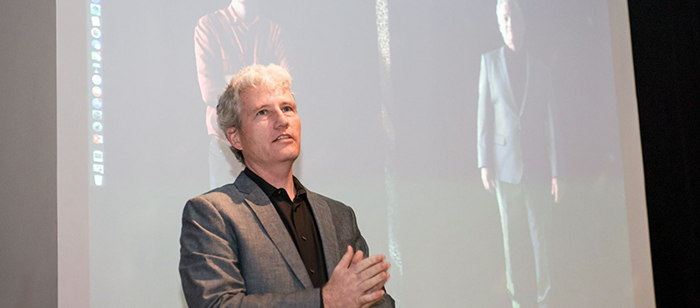
Image: Marc Olano during the opening of the 3D Scanning Room at UMBC. Photo by Marlayna Demond ’11 for UMBC.
CSEE professor Marc Olano talked at TEDx Towson on how technology has changed how we think about reality. “New technology has started blurring the lines between the real and the virtual,” he said at the May 5 event. He focused on how new 3D technologies have evolved and used examples including 3D graphics, virtual reality, video games and 3D printers. Professor Olano ended his talk pointing out that while he had not mentioned science fiction, “I can feel the world of holodecks and replicators on the horizon.” Read more about his TEDx talk at UMBC News and watch it on YouTube.
]]>
Image: Marc Olano during the opening of the 3D Scanning Room at UMBC. Photo by Marlayna Demond ’11 for UMBC. CSEE professor Marc Olano talked at TEDx Towson on how technology has changed how we...http://www.csee.umbc.edu/2016/05/csees-marc-olano-at-tedx-towson-technology-is-changing-the-way-we-perceive-reality/https://my3.my.umbc.edu/api/v0/pixel/news/60380/guest@my.umbc.edu/1a7497d9d36d1dd7aec98da1e73a1a28/api/pixelcomputer-sciencedata-sciencefaculty-and-staffnewsComputer Science and Electrical Engineeringhttps://my3.my.umbc.edu/groups/cseehttps://assets3-my.umbc.edu/system/shared/avatars/groups/000/000/099/d117dca133c64bf78a4b7696dd007189/xsmall.png?1314043393https://assets1-my.umbc.edu/system/shared/avatars/groups/000/000/099/d117dca133c64bf78a4b7696dd007189/original.png?1314043393https://assets1-my.umbc.edu/system/shared/avatars/groups/000/000/099/d117dca133c64bf78a4b7696dd007189/xxlarge.png?1314043393https://assets4-my.umbc.edu/system/shared/avatars/groups/000/000/099/d117dca133c64bf78a4b7696dd007189/xlarge.png?1314043393https://assets3-my.umbc.edu/system/shared/avatars/groups/000/000/099/d117dca133c64bf78a4b7696dd007189/large.png?1314043393https://assets1-my.umbc.edu/system/shared/avatars/groups/000/000/099/d117dca133c64bf78a4b7696dd007189/medium.png?1314043393https://assets2-my.umbc.edu/system/shared/avatars/groups/000/000/099/d117dca133c64bf78a4b7696dd007189/small.png?1314043393https://assets3-my.umbc.edu/system/shared/avatars/groups/000/000/099/d117dca133c64bf78a4b7696dd007189/xsmall.png?1314043393https://assets3-my.umbc.edu/system/shared/avatars/groups/000/000/099/d117dca133c64bf78a4b7696dd007189/xxsmall.png?1314043393Computer Science and Electrical Engineering40trueThu, 26 May 2016 09:33:38 -0400Microsoft Student Partners program
Microsoft Student Partners (MSPs) are student technology leaders, empowered to build Microsoft communities on their campus and share their deep knowledge and passion for technology with their fellow classmates. See here for more information. Apply by 15 July 2016.
]]>
Microsoft Student Partners (MSPs) are student technology leaders, empowered to build Microsoft communities on their campus and share their deep knowledge and passion for technology with their...http://www.csee.umbc.edu/2016/05/microsoft-student-partners-program/https://my3.my.umbc.edu/api/v0/pixel/news/60370/guest@my.umbc.edu/9cfe82a9622e39ff897477354097d674/api/pixelcomputer-engineeringcomputer-sciencegraduatenewsstudentsundergraduateComputer Science and Electrical Engineeringhttps://my3.my.umbc.edu/groups/cseehttps://assets3-my.umbc.edu/system/shared/avatars/groups/000/000/099/d117dca133c64bf78a4b7696dd007189/xsmall.png?1314043393https://assets1-my.umbc.edu/system/shared/avatars/groups/000/000/099/d117dca133c64bf78a4b7696dd007189/original.png?1314043393https://assets1-my.umbc.edu/system/shared/avatars/groups/000/000/099/d117dca133c64bf78a4b7696dd007189/xxlarge.png?1314043393https://assets4-my.umbc.edu/system/shared/avatars/groups/000/000/099/d117dca133c64bf78a4b7696dd007189/xlarge.png?1314043393https://assets3-my.umbc.edu/system/shared/avatars/groups/000/000/099/d117dca133c64bf78a4b7696dd007189/large.png?1314043393https://assets1-my.umbc.edu/system/shared/avatars/groups/000/000/099/d117dca133c64bf78a4b7696dd007189/medium.png?1314043393https://assets2-my.umbc.edu/system/shared/avatars/groups/000/000/099/d117dca133c64bf78a4b7696dd007189/small.png?1314043393https://assets3-my.umbc.edu/system/shared/avatars/groups/000/000/099/d117dca133c64bf78a4b7696dd007189/xsmall.png?1314043393https://assets3-my.umbc.edu/system/shared/avatars/groups/000/000/099/d117dca133c64bf78a4b7696dd007189/xxsmall.png?1314043393Computer Science and Electrical Engineering00trueWed, 25 May 2016 13:29:26 -0400UMBC and IBM Research launch Accelerated Cognitive Cybersecurity Lab
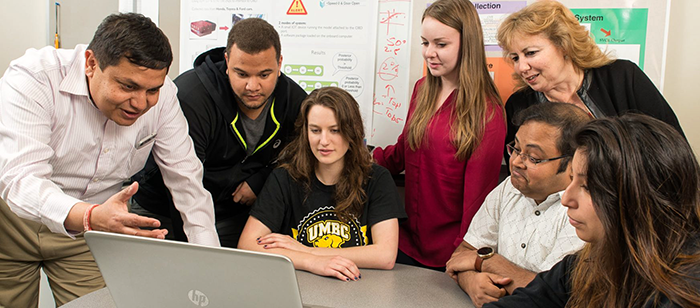
Anupam Joshi and Yelena Yesha working with several UMBC students. Photo by Mitro Hood/Feature Photo Service.
UMBC and IBM Research have announced a collaboration to create the Accelerated Cognitive Cybersecurity Lab (ACCL), opening at UMBC in fall 2016. Housed in the College of Engineering and Information Technology and supported with a multi-year commitment from IBM, it will advance scientific frontiers in cybersecurity and machine learning. Anupam Joshi, director of the UMBC Center for Cybersecurity and chair of the Computer Science and Electrical Engineering Department, will lead the ACCL.
The lab will build on UMBC’s prior research on AI, high performance computing, data visualization and cybersecurity and work IBM researchers to apply IBM’s cognitive computing systems and tools, including the Watson computer system.
You can read more about the new partnership from IBM’s press releases (here and here), UMBC’s announcement and other new media (e.g., here).
]]>
Anupam Joshi and Yelena Yesha working with several UMBC students. Photo by Mitro Hood/Feature Photo Service. UMBC and IBM Research have announced a collaboration to create the Accelerated...http://www.csee.umbc.edu/2016/05/umbc-and-ibm-research-launch-accelerated-cognitive-cybersecurity-lab/https://my3.my.umbc.edu/api/v0/pixel/news/60293/guest@my.umbc.edu/a00df7971ec4de287b7f115dce9982c5/api/pixelcomputer-sciencecybersecuritydata-sciencenewsresearchComputer Science and Electrical Engineeringhttps://my3.my.umbc.edu/groups/cseehttps://assets3-my.umbc.edu/system/shared/avatars/groups/000/000/099/d117dca133c64bf78a4b7696dd007189/xsmall.png?1314043393https://assets1-my.umbc.edu/system/shared/avatars/groups/000/000/099/d117dca133c64bf78a4b7696dd007189/original.png?1314043393https://assets1-my.umbc.edu/system/shared/avatars/groups/000/000/099/d117dca133c64bf78a4b7696dd007189/xxlarge.png?1314043393https://assets4-my.umbc.edu/system/shared/avatars/groups/000/000/099/d117dca133c64bf78a4b7696dd007189/xlarge.png?1314043393https://assets3-my.umbc.edu/system/shared/avatars/groups/000/000/099/d117dca133c64bf78a4b7696dd007189/large.png?1314043393https://assets1-my.umbc.edu/system/shared/avatars/groups/000/000/099/d117dca133c64bf78a4b7696dd007189/medium.png?1314043393https://assets2-my.umbc.edu/system/shared/avatars/groups/000/000/099/d117dca133c64bf78a4b7696dd007189/small.png?1314043393https://assets3-my.umbc.edu/system/shared/avatars/groups/000/000/099/d117dca133c64bf78a4b7696dd007189/xsmall.png?1314043393https://assets3-my.umbc.edu/system/shared/avatars/groups/000/000/099/d117dca133c64bf78a4b7696dd007189/xxsmall.png?1314043393Computer Science and Electrical Engineering20trueSun, 22 May 2016 21:56:19 -0400COEIT Alumni Happy Hour, 6-8pm 6/14
IT & Engineering Alumni Happy Hour
6:00–8:00pm Tuesday, 14 June 2016
Union Jack’s, 10400 Little Patuxent Parkway, Columbia MD 21044
Join fellow graduates of the College of Engineering and Information Technology and those who now work in those fields for a networking happy hour. Enjoy fabulous food and drinks on us while connecting with other IT&E Retrievers. Sponsored by the UMBC Alumni Association. RSVP by June 6 here. Questions? Contact Amy Dalrymple at Sorry, you need javascript to view this email address.
]]>
IT & Engineering Alumni Happy Hour 6:00–8:00pm Tuesday, 14 June 2016 Union Jack’s, 10400 Little Patuxent Parkway, Columbia MD 21044 Join fellow graduates of the College of Engineering and...http://www.csee.umbc.edu/2016/05/coeit-alumni-happy-hour-6-8pm-614/https://my3.my.umbc.edu/api/v0/pixel/news/60266/guest@my.umbc.edu/8baa4c0cff295610a5a0acb8da5a21bb/api/pixelalumnicomputer-engineeringcomputer-sciencecybersecurityelectrical-engineeringeventsnewsComputer Science and Electrical Engineeringhttps://my3.my.umbc.edu/groups/cseehttps://assets3-my.umbc.edu/system/shared/avatars/groups/000/000/099/d117dca133c64bf78a4b7696dd007189/xsmall.png?1314043393https://assets1-my.umbc.edu/system/shared/avatars/groups/000/000/099/d117dca133c64bf78a4b7696dd007189/original.png?1314043393https://assets1-my.umbc.edu/system/shared/avatars/groups/000/000/099/d117dca133c64bf78a4b7696dd007189/xxlarge.png?1314043393https://assets4-my.umbc.edu/system/shared/avatars/groups/000/000/099/d117dca133c64bf78a4b7696dd007189/xlarge.png?1314043393https://assets3-my.umbc.edu/system/shared/avatars/groups/000/000/099/d117dca133c64bf78a4b7696dd007189/large.png?1314043393https://assets1-my.umbc.edu/system/shared/avatars/groups/000/000/099/d117dca133c64bf78a4b7696dd007189/medium.png?1314043393https://assets2-my.umbc.edu/system/shared/avatars/groups/000/000/099/d117dca133c64bf78a4b7696dd007189/small.png?1314043393https://assets3-my.umbc.edu/system/shared/avatars/groups/000/000/099/d117dca133c64bf78a4b7696dd007189/xsmall.png?1314043393https://assets3-my.umbc.edu/system/shared/avatars/groups/000/000/099/d117dca133c64bf78a4b7696dd007189/xxsmall.png?1314043393Computer Science and Electrical Engineering10trueFri, 20 May 2016 02:00:40 -0400Fri, 20 May 2016 02:00:40 -0400UMBC’s Dean Julia Ross on Everyday AI
UMBC’s Julia Ross, Dean of the College of Engineering and Information Technology, and IBM Watson General Manager David Kenny discussed Everyday AI — new and developing technologies in Artificial Intelligence that are leaving the lab and entering the consumer market at the Washington Post’s Transformers live journalism event on 18 May 2016.
]]>
UMBC’s Julia Ross, Dean of the College of Engineering and Information Technology, and IBM Watson General Manager David Kenny discussed Everyday AI — new and developing technologies in Artificial...http://www.csee.umbc.edu/2016/05/umbcs-dean-julia-ross-on-everyday-ai/https://my3.my.umbc.edu/api/v0/pixel/news/60264/guest@my.umbc.edu/669ce07714d7138f8a525644abffae43/api/pixelaicomputer-sciencenewsresearchComputer Science and Electrical Engineeringhttps://my3.my.umbc.edu/groups/cseehttps://assets3-my.umbc.edu/system/shared/avatars/groups/000/000/099/d117dca133c64bf78a4b7696dd007189/xsmall.png?1314043393https://assets1-my.umbc.edu/system/shared/avatars/groups/000/000/099/d117dca133c64bf78a4b7696dd007189/original.png?1314043393https://assets1-my.umbc.edu/system/shared/avatars/groups/000/000/099/d117dca133c64bf78a4b7696dd007189/xxlarge.png?1314043393https://assets4-my.umbc.edu/system/shared/avatars/groups/000/000/099/d117dca133c64bf78a4b7696dd007189/xlarge.png?1314043393https://assets3-my.umbc.edu/system/shared/avatars/groups/000/000/099/d117dca133c64bf78a4b7696dd007189/large.png?1314043393https://assets1-my.umbc.edu/system/shared/avatars/groups/000/000/099/d117dca133c64bf78a4b7696dd007189/medium.png?1314043393https://assets2-my.umbc.edu/system/shared/avatars/groups/000/000/099/d117dca133c64bf78a4b7696dd007189/small.png?1314043393https://assets3-my.umbc.edu/system/shared/avatars/groups/000/000/099/d117dca133c64bf78a4b7696dd007189/xsmall.png?1314043393https://assets3-my.umbc.edu/system/shared/avatars/groups/000/000/099/d117dca133c64bf78a4b7696dd007189/xxsmall.png?1314043393Computer Science and Electrical Engineering40trueThu, 19 May 2016 21:22:21 -0400talk: Cognitive Computing & Visualization at IBM Research/RPI, 10am Thur 5/19, UMBC
Cognitive Computing and Visualization at IBM Research/RPI CISL
Dr. Hui Su, IBM Research
10:00-11:00am, Thursday, 19 May 2016, ITE 325b
Dr. Hui Su will talk about Cognitive and Immersive Systems Lab, a research initiative to develop the new frontier of immersive cognitive systems that explore and advance natural, collaborative problem-solving among groups of humans and machines. This lab is a collaboration between IBM Research and Rensselaer Polytechnic Institute. Dr. Su will talk about why the research for human computer interaction is extended to build a symbiotic relationship between human beings and smart machines, what research is going to be important to build immersive cognitive systems in order to transform the way professionals work in the future.
Dr. Hui Su is the Director of Cognitive and Immersive Systems Lab, a collaboration between IBM Research and Rensselaer Polytechnic Institute. He has been a technical leader and an executive at IBM Research. Most recently, he was the Director of IBM Cambridge Research Lab in Cambridge, MA and was responsible for a broad scope of global missions in IBM Research, including Cognitive User Experience, Center for Innovation in Visual Analytics and Center for Social Business. As a technical leader and a researcher for 19 years at IBM Research, Dr. Su has been an expert in multiple areas ranging from Human Computer Interaction, Cloud Computing, Visual Analytics, and Neural Network Algorithms for Image Recognition etc. As an executive, he has been leading research labs and research teams in the US and China. He is passionate about game-changing ideas and fundamental research, passionate in speeding up the impact generation process for technical innovations, discovering and developing new linkages between innovative research work and business needs.
Host: Jian Chen (Sorry, you need javascript to view this email address. )
]]>
Cognitive Computing and Visualization at IBM Research/RPI CISL Dr. Hui Su, IBM Research 10:00-11:00am, Thursday, 19 May 2016, ITE 325b Dr. Hui Su will talk about Cognitive and Immersive...http://www.csee.umbc.edu/2016/05/talk-cognitive-computing-visualization-at-ibm-researchrpi-10am-thur-519-umbc/https://my3.my.umbc.edu/api/v0/pixel/news/60205/guest@my.umbc.edu/1fc1cf7e20f45cdbf6047bab251ec583/api/pixelaicomputer-sciencedata-sciencenewsresearchtalksComputer Science and Electrical Engineeringhttps://my3.my.umbc.edu/groups/cseehttps://assets3-my.umbc.edu/system/shared/avatars/groups/000/000/099/d117dca133c64bf78a4b7696dd007189/xsmall.png?1314043393https://assets1-my.umbc.edu/system/shared/avatars/groups/000/000/099/d117dca133c64bf78a4b7696dd007189/original.png?1314043393https://assets1-my.umbc.edu/system/shared/avatars/groups/000/000/099/d117dca133c64bf78a4b7696dd007189/xxlarge.png?1314043393https://assets4-my.umbc.edu/system/shared/avatars/groups/000/000/099/d117dca133c64bf78a4b7696dd007189/xlarge.png?1314043393https://assets3-my.umbc.edu/system/shared/avatars/groups/000/000/099/d117dca133c64bf78a4b7696dd007189/large.png?1314043393https://assets1-my.umbc.edu/system/shared/avatars/groups/000/000/099/d117dca133c64bf78a4b7696dd007189/medium.png?1314043393https://assets2-my.umbc.edu/system/shared/avatars/groups/000/000/099/d117dca133c64bf78a4b7696dd007189/small.png?1314043393https://assets3-my.umbc.edu/system/shared/avatars/groups/000/000/099/d117dca133c64bf78a4b7696dd007189/xsmall.png?1314043393https://assets3-my.umbc.edu/system/shared/avatars/groups/000/000/099/d117dca133c64bf78a4b7696dd007189/xxsmall.png?1314043393Computer Science and Electrical Engineering10trueTue, 17 May 2016 11:53:43 -0400Tue, 17 May 2016 11:53:43 -0400Rick Forno and Anupam Joshi discuss ‘cyberbombs’ in The Conversation
America is ‘dropping cyberbombs’ – but how do they work?
Richard Forno and Anupam Joshi
Recently, United States Deputy Defense Secretary Robert Work publicly confirmed that the Pentagon’s Cyber Command was “dropping cyberbombs,” taking its ongoing battle against the Islamic State group into the online world. Other American officials, including President Barack Obama, have discussed offensive cyber activities, too.
The American public has only glimpsed the country’s alleged cyberattack abilities. In 2012 The New York Times revealed the first digital weapon, the Stuxnet attack against Iran’s nuclear program. In 2013, former NSA contractor Edward Snowden released a classified presidential directive outlining America’s approach to conducting Internet-based warfare.
The terms “cyberbomb” and “cyberweapon” create a simplistic, if not also sensational, frame of reference for the public. Real military or intelligence cyber activities are less exaggerated but much more complex. The most basic types are off-the-shelf commercial products used by companies and security consultants to test system and network security. The most advanced are specialized proprietary systems made for exclusive – and often classified – use by the defense, intelligence and law enforcement communities.
So what exactly are these “cyberbombs” America is “dropping” in the Middle East? The country’s actual cyber capabilities are classified; we, as researchers, are limited by what has been made public. Monitoring books, reports, news events and congressional testimony is not enough to separate fact from fiction. However, we can analyze the underlying technologies and look at the global strategic considerations of those seeking to wage cyber warfare. That work allows us to offer ideas about cyber weapons and how they might be used.
]]>
America is ‘dropping cyberbombs’ – but how do they work? Richard Forno and Anupam Joshi Recently, United States Deputy Defense Secretary Robert Work publicly confirmed that the Pentagon’s...http://www.csee.umbc.edu/2016/05/forno-and-joshi-discuss-cyberbombs-in-the-conversation/https://my3.my.umbc.edu/api/v0/pixel/news/60156/guest@my.umbc.edu/f1d0251a3f4561167ea22aed17deb79b/api/pixelcomputer-sciencecseecybersecuritynewsComputer Science and Electrical Engineeringhttps://my3.my.umbc.edu/groups/cseehttps://assets3-my.umbc.edu/system/shared/avatars/groups/000/000/099/d117dca133c64bf78a4b7696dd007189/xsmall.png?1314043393https://assets1-my.umbc.edu/system/shared/avatars/groups/000/000/099/d117dca133c64bf78a4b7696dd007189/original.png?1314043393https://assets1-my.umbc.edu/system/shared/avatars/groups/000/000/099/d117dca133c64bf78a4b7696dd007189/xxlarge.png?1314043393https://assets4-my.umbc.edu/system/shared/avatars/groups/000/000/099/d117dca133c64bf78a4b7696dd007189/xlarge.png?1314043393https://assets3-my.umbc.edu/system/shared/avatars/groups/000/000/099/d117dca133c64bf78a4b7696dd007189/large.png?1314043393https://assets1-my.umbc.edu/system/shared/avatars/groups/000/000/099/d117dca133c64bf78a4b7696dd007189/medium.png?1314043393https://assets2-my.umbc.edu/system/shared/avatars/groups/000/000/099/d117dca133c64bf78a4b7696dd007189/small.png?1314043393https://assets3-my.umbc.edu/system/shared/avatars/groups/000/000/099/d117dca133c64bf78a4b7696dd007189/xsmall.png?1314043393https://assets3-my.umbc.edu/system/shared/avatars/groups/000/000/099/d117dca133c64bf78a4b7696dd007189/xxsmall.png?1314043393Computer Science and Electrical Engineering10trueFri, 13 May 2016 18:33:32 -0400Fri, 13 May 2016 18:33:32 -0400talk: Predicting Demographics and Affects in Social Networks, 11am Fri 5/13, UMBC
UMBC Information Systems Department
Predicting Demographics and Affects in Social Networks
Social media predictive analytics bring unique opportunities to study people and their behaviors in real time, at an unprecedented scale: who they are, what they like and what they think and feel. Such large-scale real-time social media predictive analytics provide a novel set of conditions for the construction of predictive models. This talk focuses on various approaches to handling this dynamic data for predicting latent user demographics, from constrained-resource batch classification, to incremental bootstrapping, and then iterative learning via interactive rationale (feature) crowdsourcing. In addition, we present the relationships between a variety of perceived user properties e.g., income, education etc. and opinions, emotions and interests in a social network.
Svitlana Volkova received her PhD in Computer Science from Johns Hopkins University. She was affiliated with the Center for Language and Speech Processing and the Human Language Technology Center of Excellence. Her PhD research focused on building predictive models for sociolinguistic content analysis in social media. She built online models for streaming social media analytics, fine-grained emotion detection and multilingual sentiment analysis, and effective annotation techniques via crowdsourcing incorporated into the active learning framework. She interned at Microsoft Research in 2011, 2012 and 2014 at the Natural Language Processing and Machine Learning and Perception teams. She was awarded the Google Anita Borg Memorial Scholarship in 2010 and the Fulbright Scholarship in 2008.
]]>
UMBC Information Systems Department Predicting Demographics and Affects in Social Networks Dr. Svitlana Volkova Pacific Northwest National Laboratory 11am Friday, 13 May 2016, ITE 459...http://www.csee.umbc.edu/2016/05/talk-predicting-demographics-and-affects-in-social-networks-11am-fri-513-umbc/https://my3.my.umbc.edu/api/v0/pixel/news/60136/guest@my.umbc.edu/e698957f6ef16b523bccbbbfa3dd9131/api/pixelcomputer-sciencedata-sciencenewsresearchtalksComputer Science and Electrical Engineeringhttps://my3.my.umbc.edu/groups/cseehttps://assets3-my.umbc.edu/system/shared/avatars/groups/000/000/099/d117dca133c64bf78a4b7696dd007189/xsmall.png?1314043393https://assets1-my.umbc.edu/system/shared/avatars/groups/000/000/099/d117dca133c64bf78a4b7696dd007189/original.png?1314043393https://assets1-my.umbc.edu/system/shared/avatars/groups/000/000/099/d117dca133c64bf78a4b7696dd007189/xxlarge.png?1314043393https://assets4-my.umbc.edu/system/shared/avatars/groups/000/000/099/d117dca133c64bf78a4b7696dd007189/xlarge.png?1314043393https://assets3-my.umbc.edu/system/shared/avatars/groups/000/000/099/d117dca133c64bf78a4b7696dd007189/large.png?1314043393https://assets1-my.umbc.edu/system/shared/avatars/groups/000/000/099/d117dca133c64bf78a4b7696dd007189/medium.png?1314043393https://assets2-my.umbc.edu/system/shared/avatars/groups/000/000/099/d117dca133c64bf78a4b7696dd007189/small.png?1314043393https://assets3-my.umbc.edu/system/shared/avatars/groups/000/000/099/d117dca133c64bf78a4b7696dd007189/xsmall.png?1314043393https://assets3-my.umbc.edu/system/shared/avatars/groups/000/000/099/d117dca133c64bf78a4b7696dd007189/xxsmall.png?1314043393Computer Science and Electrical Engineering00trueThu, 12 May 2016 19:07:47 -0400talk: Topic Modeling for Analyzing Document Collection, 11am Mon 3/16
CHMPR Lecture Series
Topic Modeling for Analyzing Document Collection
Mitsunori Ogihara
Department of Computer Science, University of Miami
11:00am Monday, 16 May 2016, ITE 325b, UMBC
Topic modeling (in particular, Latent Dirichlet Analysis) is a technique for analyzing a large collection of documents. In topic modeling we view each document as a frequency vector over a vocabulary and each topic as a static distribution over the vocabulary. Given a desired number, K, of document classes, a topic modeling algorithm attempts to estimate concurrently K static distributions and for each document how much each K class contributes. Mathematically, this is the problem of approximating the matrix generated by stacking the frequency vectors into the product of two non-negative matrices, where both the column dimension of the first matrix and the row dimension of the second matrix are equal to K. Topic modeling is gaining popularity recently, for analyzing large collections of documents.
In this talk I will present some examples of applying topic modeling: (1) a small sentiment analysis of a small collection of short patient surveys, (2) exploratory content analysis of a large collection of letters, (3) document classification based upon topics and other linguistic features, and (4) exploratory analysis of a large collection of literally works. I will speak not only the exact topic modeling steps but also all the preprocessing steps for preparing the documents for topic modeling.
Mitsunori Ogihara is a Professor of Computer Science at the University of Miami, Coral Gables, Florida. There he directs the Data Mining Group in the Center for Computational Science, a university-wide organization for providing resources and consultation for large-scale computation. He has published three books and approximately 190 papers in conferences and journals. He is on the editorial board for Theory of Computing Systems and International Journal of Foundations of Computer Science. Ogihara received a Ph.D. in Information Sciences from Tokyo Institute of Technology in 1993 and was a tenure-track/tenured faculty member in the Department of Computer Science at the University of Rochester from 1994 to 2007.
]]>
CHMPR Lecture Series Topic Modeling for Analyzing Document Collection Mitsunori Ogihara Department of Computer Science, University of Miami 11:00am Monday, 16 May 2016, ITE 325b,...http://www.csee.umbc.edu/2016/05/talk-topic-modeling-for-analyzing-document-collection-11am-mon-316/https://my3.my.umbc.edu/api/v0/pixel/news/60131/guest@my.umbc.edu/91fb0afc30b52a265bc7d9a766de7bd8/api/pixelcomputer-sciencedata-sciencenewsresearchtalksComputer Science and Electrical Engineeringhttps://my3.my.umbc.edu/groups/cseehttps://assets3-my.umbc.edu/system/shared/avatars/groups/000/000/099/d117dca133c64bf78a4b7696dd007189/xsmall.png?1314043393https://assets1-my.umbc.edu/system/shared/avatars/groups/000/000/099/d117dca133c64bf78a4b7696dd007189/original.png?1314043393https://assets1-my.umbc.edu/system/shared/avatars/groups/000/000/099/d117dca133c64bf78a4b7696dd007189/xxlarge.png?1314043393https://assets4-my.umbc.edu/system/shared/avatars/groups/000/000/099/d117dca133c64bf78a4b7696dd007189/xlarge.png?1314043393https://assets3-my.umbc.edu/system/shared/avatars/groups/000/000/099/d117dca133c64bf78a4b7696dd007189/large.png?1314043393https://assets1-my.umbc.edu/system/shared/avatars/groups/000/000/099/d117dca133c64bf78a4b7696dd007189/medium.png?1314043393https://assets2-my.umbc.edu/system/shared/avatars/groups/000/000/099/d117dca133c64bf78a4b7696dd007189/small.png?1314043393https://assets3-my.umbc.edu/system/shared/avatars/groups/000/000/099/d117dca133c64bf78a4b7696dd007189/xsmall.png?1314043393https://assets3-my.umbc.edu/system/shared/avatars/groups/000/000/099/d117dca133c64bf78a4b7696dd007189/xxsmall.png?1314043393Computer Science and Electrical Engineering00trueThu, 12 May 2016 17:26:43 -0400