Dr. Özgür Çapraz: Leading Sustainable Energy Research
from UMBC NEWS
Excerpt from UMBC News:
From solar energy harvesting to advanced batteries: Cohort of new engineering faculty bolster UMBC’s commitment to Earth-friendly research
By: Catherine Meyers | Published: May 10, 2024
This April 22, as the campus community celebrated Earth Day, the feel of spring’s natural reawakening was in the air. Birds chirped from newly leafed trees and students strolled in the bright sunshine. But the pleasant day belied a concerning trend: In Maryland and beyond, the balance of Earth’s life-supporting systems is shifting, driven in large part by the heat-trapping greenhouse gasses we humans send into the atmosphere. The Earth is getting hotter; weather patterns are changing; and ecosystems are under stress.
“Climate change is pressing us to adopt a more Earth-friendly lifestyle, to develop renewable energy,” says Dr. Özgür Çapraz, an associate professor in the department of chemical, biochemical, and environmental engineering at UMBC, who studies advanced battery technologies. Çapraz, who joined UMBC in fall 2023 from a faculty position at Oklahoma State University, was one of three recent faculty hires in the College of Engineering and Information Technology (COEIT) who all specialize in different aspects of sustainability and renewable energy-related research.
The three hires were part of a COEIT effort to build off recognized strength in the environmental domain, while expanding expertise in important areas such as energy, says Lee Blaney, a professor in the department of chemical, biochemical, and environmental engineering who chaired the search.
Read full article
PHOTO CREDIT: From left to right, Özgür Çapraz, Rajasekhar Anguluri, and Alok Ghanekar. (Marlayna Demond ’11/UMBC)
]]>
Excerpt from UMBC News: From solar energy harvesting to advanced batteries: Cohort of new engineering faculty bolster UMBC’s commitment to Earth-friendly research By: Catherine Meyers |...
https://my3.my.umbc.edu/api/v0/pixel/news/142214/guest@my.umbc.edu/4490c0bd179b46e495a1284e04cd62c8/api/pixel
blaney
capraz
faculty
research
spring-2024
Chemical, Biochemical and Environmental Engineering
https://my3.my.umbc.edu/groups/cbee
https://assets4-my.umbc.edu/system/shared/avatars/groups/000/000/771/b5e579e81b2e3624611890fa3ca2716a/xsmall.png?1746794587
https://assets2-my.umbc.edu/system/shared/avatars/groups/000/000/771/b5e579e81b2e3624611890fa3ca2716a/original.png?1746794587
https://assets1-my.umbc.edu/system/shared/avatars/groups/000/000/771/b5e579e81b2e3624611890fa3ca2716a/xxlarge.png?1746794587
https://assets2-my.umbc.edu/system/shared/avatars/groups/000/000/771/b5e579e81b2e3624611890fa3ca2716a/xlarge.png?1746794587
https://assets2-my.umbc.edu/system/shared/avatars/groups/000/000/771/b5e579e81b2e3624611890fa3ca2716a/large.png?1746794587
https://assets4-my.umbc.edu/system/shared/avatars/groups/000/000/771/b5e579e81b2e3624611890fa3ca2716a/medium.png?1746794587
https://assets1-my.umbc.edu/system/shared/avatars/groups/000/000/771/b5e579e81b2e3624611890fa3ca2716a/small.png?1746794587
https://assets4-my.umbc.edu/system/shared/avatars/groups/000/000/771/b5e579e81b2e3624611890fa3ca2716a/xsmall.png?1746794587
https://assets1-my.umbc.edu/system/shared/avatars/groups/000/000/771/b5e579e81b2e3624611890fa3ca2716a/xxsmall.png?1746794587
Chemical, Biochemical and Environmental Engineering
https://assets3-my.umbc.edu/system/shared/thumbnails/news/000/142/214/4dfc4b81e77387298bc1b6beb5cfdc10/xxlarge.jpg?1716913531
https://assets2-my.umbc.edu/system/shared/thumbnails/news/000/142/214/4dfc4b81e77387298bc1b6beb5cfdc10/xlarge.jpg?1716913531
https://assets4-my.umbc.edu/system/shared/thumbnails/news/000/142/214/4dfc4b81e77387298bc1b6beb5cfdc10/large.jpg?1716913531
https://assets3-my.umbc.edu/system/shared/thumbnails/news/000/142/214/4dfc4b81e77387298bc1b6beb5cfdc10/medium.jpg?1716913531
https://assets3-my.umbc.edu/system/shared/thumbnails/news/000/142/214/4dfc4b81e77387298bc1b6beb5cfdc10/small.jpg?1716913531
https://assets1-my.umbc.edu/system/shared/thumbnails/news/000/142/214/4dfc4b81e77387298bc1b6beb5cfdc10/xsmall.jpg?1716913531
https://assets3-my.umbc.edu/system/shared/thumbnails/news/000/142/214/4dfc4b81e77387298bc1b6beb5cfdc10/xxsmall.jpg?1716913531
0
0
true
Tue, 28 May 2024 12:11:43 -0400
Wed, 29 May 2024 11:47:07 -0400
Dr. Blaney: Marilyn E. Demorest Faculty Advancement Awardee
Annual Presidential Faculty and Staff Awards
Congratulations to Dr. Lee Blaney, professor of chemical, biochemical, and environmental engineering for Marilyn E. Demorest Award for Faculty Advancement at annual Presidential Faculty and Staff Awards.
Click here to view more
]]>
Congratulations to Dr. Lee Blaney, professor of chemical, biochemical, and environmental engineering for Marilyn E. Demorest Award for Faculty Advancement at annual Presidential Faculty and Staff...
https://my3.my.umbc.edu/api/v0/pixel/news/141882/guest@my.umbc.edu/16b26c06971f9dc61b21c4240ab2a872/api/pixel
award
blaney
faculty
spring-2024
Chemical, Biochemical and Environmental Engineering
https://my3.my.umbc.edu/groups/cbee
https://assets4-my.umbc.edu/system/shared/avatars/groups/000/000/771/b5e579e81b2e3624611890fa3ca2716a/xsmall.png?1746794587
https://assets2-my.umbc.edu/system/shared/avatars/groups/000/000/771/b5e579e81b2e3624611890fa3ca2716a/original.png?1746794587
https://assets1-my.umbc.edu/system/shared/avatars/groups/000/000/771/b5e579e81b2e3624611890fa3ca2716a/xxlarge.png?1746794587
https://assets2-my.umbc.edu/system/shared/avatars/groups/000/000/771/b5e579e81b2e3624611890fa3ca2716a/xlarge.png?1746794587
https://assets2-my.umbc.edu/system/shared/avatars/groups/000/000/771/b5e579e81b2e3624611890fa3ca2716a/large.png?1746794587
https://assets4-my.umbc.edu/system/shared/avatars/groups/000/000/771/b5e579e81b2e3624611890fa3ca2716a/medium.png?1746794587
https://assets1-my.umbc.edu/system/shared/avatars/groups/000/000/771/b5e579e81b2e3624611890fa3ca2716a/small.png?1746794587
https://assets4-my.umbc.edu/system/shared/avatars/groups/000/000/771/b5e579e81b2e3624611890fa3ca2716a/xsmall.png?1746794587
https://assets1-my.umbc.edu/system/shared/avatars/groups/000/000/771/b5e579e81b2e3624611890fa3ca2716a/xxsmall.png?1746794587
Chemical, Biochemical and Environmental Engineering
https://assets3-my.umbc.edu/system/shared/thumbnails/news/000/141/882/b5750c268c96b60c5ff1976e623d3ba7/xxlarge.jpg?1715367522
https://assets2-my.umbc.edu/system/shared/thumbnails/news/000/141/882/b5750c268c96b60c5ff1976e623d3ba7/xlarge.jpg?1715367522
https://assets1-my.umbc.edu/system/shared/thumbnails/news/000/141/882/b5750c268c96b60c5ff1976e623d3ba7/large.jpg?1715367522
https://assets4-my.umbc.edu/system/shared/thumbnails/news/000/141/882/b5750c268c96b60c5ff1976e623d3ba7/medium.jpg?1715367522
https://assets2-my.umbc.edu/system/shared/thumbnails/news/000/141/882/b5750c268c96b60c5ff1976e623d3ba7/small.jpg?1715367522
https://assets3-my.umbc.edu/system/shared/thumbnails/news/000/141/882/b5750c268c96b60c5ff1976e623d3ba7/xsmall.jpg?1715367522
https://assets4-my.umbc.edu/system/shared/thumbnails/news/000/141/882/b5750c268c96b60c5ff1976e623d3ba7/xxsmall.jpg?1715367522
3
0
true
Fri, 10 May 2024 14:58:58 -0400
Dr. Blaney & team receive grant to remove PFAS from water
Funding from SERDP and ESTCP
Congratulations to Dr. Lee Blaney and his team!
Dr. Lee Blaney, professor of chemical, biochemical, and environmental engineering, received funding for his project titled “Novel functionalization of conventional sorbents for enhanced selectivity and improved concentration of ultrashort- and short-chain PFAS” from the Strategic Environmental Research and Development Program (SERDP) and Environmental Security Technology Certification Program (ESTCP). This project is part of the FY 2024 solicitations for SERDP and ESTCP. This project is a collaboration with Dr. Ke He (UMBC), Dr. Wenqing Xu (Villanova University), and Dr. Jessica Ray (University of Washington).
Project Title: Novel functionalization of conventional sorbents for enhanced selectivity and
improved concentration of ultrashort- and short-chain PFAS
Lead Principal Investigator: Lee Blaney
Objective: The overall goal of this project is to improve commercially available adsorbents, such as
anion-exchange resins and granular activity carbon, through specific surface chemistry modifications that enhance the capacity and selectivity for 18 ultrashort- and short-chain per- and polyfluoroalkyl substances (PFAS). In particular, we will develop (i) hybrid anion-exchange (HAIX) resins, (ii) metal oxide-biochar composites, and (iii) multi-PFAS templated molecularly imprinted polymers on granular activated carbon (mMIP@GAC) adsorbents. These novel materials will be developed, characterized, and evaluated for adsorption, desorption, and performance in PFAS-impacted waters collected from DoD facilities.
Technical Approach: The proposed HAIX, metal oxide-biochar, and mMIP@GAC adsorbents represent paradigm shifts that will improve our ability to remove ultrashort- and short-chain PFAS from impacted waters. We have identified 18 ultrashort- and short-chain PFAS as targets, but additional chemicals of concern will be considered during the project period. The project objective will be achieved through (i) materials development and characterization, (ii) batch adsorption tests to identify isotherm parameters, determine the impacts of water quality parameters, and measure mass transport properties, (iii) batch regeneration tests to optimize not only PFAS desorption, but also PFAS destruction in downstream processes, and (iv) column tests to demonstrate the performance of the proposed materials in at least six real waters collected from DoD facilities, extend treatment capacity compared to the base materials, and measure design parameters needed for future scale-up efforts.
Benefits: The expected outcomes of this work include (i) improved capabilities for the removal and concentration of ultrashort- and short-chain PFAS in ex situ water treatment processes or remediation operations, (ii) better understanding of the fundamental adsorption-desorption behavior of PFAS with innovative adsorbents designed for treatment of PFAS that are poorly adsorbed by conventional materials and (iii) enhanced regeneration protocols that are amenable to downstream PFAS destruction. As all three adsorbent classes build upon commercially available materials, we are confident in the feasibility of technology transfer and timely implementation at DoD facilities. The main benefit to DoD stems from the improved removal of ultrashort- and short-chain PFAS in fixed-bed adsorption reactors. This outcome is important because the targeted compounds, represent a liability for future regulatory requirements based on total PFAS mass concentrations.
]]>
Congratulations to Dr. Lee Blaney and his team! Dr. Lee Blaney, professor of chemical, biochemical, and environmental engineering, received funding for his project titled “Novel...
https://my3.my.umbc.edu/api/v0/pixel/news/141439/guest@my.umbc.edu/16f3c4a32b3028d3a6f0ddc671cf61ad/api/pixel
award
blaney
faculty
research
serdp
spring-2024
Chemical, Biochemical and Environmental Engineering
https://my3.my.umbc.edu/groups/cbee
https://assets4-my.umbc.edu/system/shared/avatars/groups/000/000/771/b5e579e81b2e3624611890fa3ca2716a/xsmall.png?1746794587
https://assets2-my.umbc.edu/system/shared/avatars/groups/000/000/771/b5e579e81b2e3624611890fa3ca2716a/original.png?1746794587
https://assets1-my.umbc.edu/system/shared/avatars/groups/000/000/771/b5e579e81b2e3624611890fa3ca2716a/xxlarge.png?1746794587
https://assets2-my.umbc.edu/system/shared/avatars/groups/000/000/771/b5e579e81b2e3624611890fa3ca2716a/xlarge.png?1746794587
https://assets2-my.umbc.edu/system/shared/avatars/groups/000/000/771/b5e579e81b2e3624611890fa3ca2716a/large.png?1746794587
https://assets4-my.umbc.edu/system/shared/avatars/groups/000/000/771/b5e579e81b2e3624611890fa3ca2716a/medium.png?1746794587
https://assets1-my.umbc.edu/system/shared/avatars/groups/000/000/771/b5e579e81b2e3624611890fa3ca2716a/small.png?1746794587
https://assets4-my.umbc.edu/system/shared/avatars/groups/000/000/771/b5e579e81b2e3624611890fa3ca2716a/xsmall.png?1746794587
https://assets1-my.umbc.edu/system/shared/avatars/groups/000/000/771/b5e579e81b2e3624611890fa3ca2716a/xxsmall.png?1746794587
Chemical, Biochemical and Environmental Engineering
https://assets2-my.umbc.edu/system/shared/thumbnails/news/000/141/439/04754ab6cc8aa597f3e1aa3b99fc51f0/xxlarge.jpg?1714398238
https://assets2-my.umbc.edu/system/shared/thumbnails/news/000/141/439/04754ab6cc8aa597f3e1aa3b99fc51f0/xlarge.jpg?1714398238
https://assets2-my.umbc.edu/system/shared/thumbnails/news/000/141/439/04754ab6cc8aa597f3e1aa3b99fc51f0/large.jpg?1714398238
https://assets3-my.umbc.edu/system/shared/thumbnails/news/000/141/439/04754ab6cc8aa597f3e1aa3b99fc51f0/medium.jpg?1714398238
https://assets3-my.umbc.edu/system/shared/thumbnails/news/000/141/439/04754ab6cc8aa597f3e1aa3b99fc51f0/small.jpg?1714398238
https://assets1-my.umbc.edu/system/shared/thumbnails/news/000/141/439/04754ab6cc8aa597f3e1aa3b99fc51f0/xsmall.jpg?1714398238
https://assets1-my.umbc.edu/system/shared/thumbnails/news/000/141/439/04754ab6cc8aa597f3e1aa3b99fc51f0/xxsmall.jpg?1714398238
3
0
true
Mon, 29 Apr 2024 09:57:29 -0400
Mon, 29 Apr 2024 12:32:04 -0400
Seven CBEE faculty & staff recognized by Career Center
Congratulations to the seven CBEE faculty and staff on their nominations by students as a Career Connector at UMBC! They are among the 156 faculty and staff recognized by students for providing guidance, mentorship, and unwavering support- making a positive impact on their lives.
The Career Center recognized their efforts as an extension of the Career Center's work and a partner in our collective effort to unlock student potential and transform lives.
- Andrea Miller
- Antonio Moreira
- Christopher J. Hennigan
- Gautom Das
- Govind Rao
- Lee Blaney
- Neha Raikar
]]>
Congratulations to the seven CBEE faculty and staff on their nominations by students as a Career Connector at UMBC! They are among the 156 faculty and staff recognized by students for providing...
https://my3.my.umbc.edu/api/v0/pixel/news/141379/guest@my.umbc.edu/9857568a915d320d321b9fb7c53a6190/api/pixel
award
blaney
das
faculty
hennigan
miller
moreira
raikar
rao
spring-2024
Chemical, Biochemical and Environmental Engineering
https://my3.my.umbc.edu/groups/cbee
https://assets4-my.umbc.edu/system/shared/avatars/groups/000/000/771/b5e579e81b2e3624611890fa3ca2716a/xsmall.png?1746794587
https://assets2-my.umbc.edu/system/shared/avatars/groups/000/000/771/b5e579e81b2e3624611890fa3ca2716a/original.png?1746794587
https://assets1-my.umbc.edu/system/shared/avatars/groups/000/000/771/b5e579e81b2e3624611890fa3ca2716a/xxlarge.png?1746794587
https://assets2-my.umbc.edu/system/shared/avatars/groups/000/000/771/b5e579e81b2e3624611890fa3ca2716a/xlarge.png?1746794587
https://assets2-my.umbc.edu/system/shared/avatars/groups/000/000/771/b5e579e81b2e3624611890fa3ca2716a/large.png?1746794587
https://assets4-my.umbc.edu/system/shared/avatars/groups/000/000/771/b5e579e81b2e3624611890fa3ca2716a/medium.png?1746794587
https://assets1-my.umbc.edu/system/shared/avatars/groups/000/000/771/b5e579e81b2e3624611890fa3ca2716a/small.png?1746794587
https://assets4-my.umbc.edu/system/shared/avatars/groups/000/000/771/b5e579e81b2e3624611890fa3ca2716a/xsmall.png?1746794587
https://assets1-my.umbc.edu/system/shared/avatars/groups/000/000/771/b5e579e81b2e3624611890fa3ca2716a/xxsmall.png?1746794587
Chemical, Biochemical and Environmental Engineering
https://assets1-my.umbc.edu/system/shared/thumbnails/news/000/141/379/390fec68f08214699e28add441e3f860/xxlarge.jpg?1714133890
https://assets3-my.umbc.edu/system/shared/thumbnails/news/000/141/379/390fec68f08214699e28add441e3f860/xlarge.jpg?1714133890
https://assets3-my.umbc.edu/system/shared/thumbnails/news/000/141/379/390fec68f08214699e28add441e3f860/large.jpg?1714133890
https://assets2-my.umbc.edu/system/shared/thumbnails/news/000/141/379/390fec68f08214699e28add441e3f860/medium.jpg?1714133890
https://assets2-my.umbc.edu/system/shared/thumbnails/news/000/141/379/390fec68f08214699e28add441e3f860/small.jpg?1714133890
https://assets2-my.umbc.edu/system/shared/thumbnails/news/000/141/379/390fec68f08214699e28add441e3f860/xsmall.jpg?1714133890
https://assets2-my.umbc.edu/system/shared/thumbnails/news/000/141/379/390fec68f08214699e28add441e3f860/xxsmall.jpg?1714133890
4
0
true
Fri, 26 Apr 2024 08:17:26 -0400
Mon, 29 Apr 2024 15:11:33 -0400
CBEE students & faculty highlighted: UMBC LSAMP
2023 Annual Report
The UMBC LSAMP 2022-2023 Annual Report highlights involvement in the UMBC LOUIS STOKES ALLIANCE FOR MINORITY PARTICIPATION (LSAMP) program. LSAMP participants have access to individualized advising, campus workshops, funded research experiences, and national and international conferences to strengthen their STEM identity and promote entry into top graduate programs.
We want to specifically celebrate the achievements of those pursuing their bachelors of science in chemical engineering and the departmental faculty supporting their efforts.
ANNUAL BIOMEDICAL RESEARCH CONFERENCE FOR MINORITIZED STUDENTS (ABRCMS) (Page 11)
Name| Major| Topic | Faculty Advisor
Evalynn Ellison | Chemical Engineering | Molecular Biotechnology | Dr. Brandon DeKosky
Ariel Wilson-Gray | Chemical Engineering | Bioengineering | Dr. Tamara Kinzer-Ursem
SUMMER 2023 RESEARCH FELLOWSHIP PROGRAM (Page 27)
Name and Class | Major |Topic| Faculty Mentor | University
Nhyira Ghunney ‘24 | Biological Sciences | Tissue Engineering | Dr. Erin Lavik | UMBC
Amaya Johnson ‘25 | Biological Sciences | Tissue Engineering | Dr. Erin Lavik | UMBC
CLASS OF 2023 GRADUATING FELLOWS AND POST-GRADUATION PLANS (Page 34-35)
Joana Hernandez Chemical Engineering Prospective Graduate Student
Diego Iglesias Vega Chemical Engineering Graduate Student at MIT
Rachel Myers Chemical Engineering PhD Student at Massachusetts Institute of Technology
]]>
The UMBC LSAMP 2022-2023 Annual Report highlights involvement in the UMBC LOUIS STOKES ALLIANCE FOR MINORITY PARTICIPATION (LSAMP) program. LSAMP participants have access to individualized...
https://my3.my.umbc.edu/api/v0/pixel/news/141323/guest@my.umbc.edu/58d6d4142a98f626fcfb17ac1b11f0da/api/pixel
award
faculty
lavik
lsamp
research
ug
ug-award
ug-research
Chemical, Biochemical and Environmental Engineering
https://my3.my.umbc.edu/groups/cbee
https://assets4-my.umbc.edu/system/shared/avatars/groups/000/000/771/b5e579e81b2e3624611890fa3ca2716a/xsmall.png?1746794587
https://assets2-my.umbc.edu/system/shared/avatars/groups/000/000/771/b5e579e81b2e3624611890fa3ca2716a/original.png?1746794587
https://assets1-my.umbc.edu/system/shared/avatars/groups/000/000/771/b5e579e81b2e3624611890fa3ca2716a/xxlarge.png?1746794587
https://assets2-my.umbc.edu/system/shared/avatars/groups/000/000/771/b5e579e81b2e3624611890fa3ca2716a/xlarge.png?1746794587
https://assets2-my.umbc.edu/system/shared/avatars/groups/000/000/771/b5e579e81b2e3624611890fa3ca2716a/large.png?1746794587
https://assets4-my.umbc.edu/system/shared/avatars/groups/000/000/771/b5e579e81b2e3624611890fa3ca2716a/medium.png?1746794587
https://assets1-my.umbc.edu/system/shared/avatars/groups/000/000/771/b5e579e81b2e3624611890fa3ca2716a/small.png?1746794587
https://assets4-my.umbc.edu/system/shared/avatars/groups/000/000/771/b5e579e81b2e3624611890fa3ca2716a/xsmall.png?1746794587
https://assets1-my.umbc.edu/system/shared/avatars/groups/000/000/771/b5e579e81b2e3624611890fa3ca2716a/xxsmall.png?1746794587
Chemical, Biochemical and Environmental Engineering
https://assets2-my.umbc.edu/system/shared/thumbnails/news/000/141/323/0ee5815fd7ad36a1496f30cb9be4c135/xxlarge.jpg?1713978206
https://assets3-my.umbc.edu/system/shared/thumbnails/news/000/141/323/0ee5815fd7ad36a1496f30cb9be4c135/xlarge.jpg?1713978206
https://assets2-my.umbc.edu/system/shared/thumbnails/news/000/141/323/0ee5815fd7ad36a1496f30cb9be4c135/large.jpg?1713978206
https://assets3-my.umbc.edu/system/shared/thumbnails/news/000/141/323/0ee5815fd7ad36a1496f30cb9be4c135/medium.jpg?1713978206
https://assets2-my.umbc.edu/system/shared/thumbnails/news/000/141/323/0ee5815fd7ad36a1496f30cb9be4c135/small.jpg?1713978206
https://assets2-my.umbc.edu/system/shared/thumbnails/news/000/141/323/0ee5815fd7ad36a1496f30cb9be4c135/xsmall.jpg?1713978206
https://assets1-my.umbc.edu/system/shared/thumbnails/news/000/141/323/0ee5815fd7ad36a1496f30cb9be4c135/xxsmall.jpg?1713978206
1
0
true
Wed, 24 Apr 2024 13:04:06 -0400
Wed, 24 Apr 2024 13:07:34 -0400
In the News: Dr. Rao interviewed by GEN News
from Genetic Engineering & Biotechnology News
Excerpt from:
Machine Learning for Bioprocess Sensor Innovation
By Gareth John Macdonald - January 31, 2024
Machine learning (ML) could allow drug firms to create predictive process models that optimize development, production, and quality control. But, before embracing ML on the factory floor, manufacturers will need data to “train” the computer algorithms that drive the approach. And this means having process sensors sophisticated enough to track multiple parameters in real-time in highly complex cell cultures according to an industry expert.
Machine learning is a specialized form of artificial intelligence in which computer programs learn to solve tasks or understand the dynamics of complex systems with minimal or no direction. The process is iterative, and the solutions improve over time as more data is introduced.
This need for training data is driving innovation in process sensors, says Govind Rao, PhD, who is director of the Center for Advanced Sensor Technology at the University of Maryland, Baltimore County.
“At the end of the day, AI/ML tools will allow for process monitoring to be simplified once data are generated at scale to relate process conditions to critical quality attributes. The need to run QC tests on quarantined bulk drug substance will be greatly reduced,” he explains. “However, to get there will require high-density process monitoring to allow ML/AI algorithms to relate process conditions to off-line measurements such as glycosylation, aggregation, etc.”
Read full article
]]>
Excerpt from: Machine Learning for Bioprocess Sensor Innovation By Gareth John Macdonald - January 31, 2024 Machine learning (ML) could allow drug firms to create predictive process models...
https://my3.my.umbc.edu/api/v0/pixel/news/140934/guest@my.umbc.edu/f71f604cb5f09a711d3d33938ebf4521/api/pixel
faculty
news
rao
research
spring-2024
Chemical, Biochemical and Environmental Engineering
https://my3.my.umbc.edu/groups/cbee
https://assets4-my.umbc.edu/system/shared/avatars/groups/000/000/771/b5e579e81b2e3624611890fa3ca2716a/xsmall.png?1746794587
https://assets2-my.umbc.edu/system/shared/avatars/groups/000/000/771/b5e579e81b2e3624611890fa3ca2716a/original.png?1746794587
https://assets1-my.umbc.edu/system/shared/avatars/groups/000/000/771/b5e579e81b2e3624611890fa3ca2716a/xxlarge.png?1746794587
https://assets2-my.umbc.edu/system/shared/avatars/groups/000/000/771/b5e579e81b2e3624611890fa3ca2716a/xlarge.png?1746794587
https://assets2-my.umbc.edu/system/shared/avatars/groups/000/000/771/b5e579e81b2e3624611890fa3ca2716a/large.png?1746794587
https://assets4-my.umbc.edu/system/shared/avatars/groups/000/000/771/b5e579e81b2e3624611890fa3ca2716a/medium.png?1746794587
https://assets1-my.umbc.edu/system/shared/avatars/groups/000/000/771/b5e579e81b2e3624611890fa3ca2716a/small.png?1746794587
https://assets4-my.umbc.edu/system/shared/avatars/groups/000/000/771/b5e579e81b2e3624611890fa3ca2716a/xsmall.png?1746794587
https://assets1-my.umbc.edu/system/shared/avatars/groups/000/000/771/b5e579e81b2e3624611890fa3ca2716a/xxsmall.png?1746794587
Chemical, Biochemical and Environmental Engineering
https://assets3-my.umbc.edu/system/shared/thumbnails/news/000/140/934/f7ca4e2247a2472fe5f7a91c638a0d44/xxlarge.jpg?1713199903
https://assets3-my.umbc.edu/system/shared/thumbnails/news/000/140/934/f7ca4e2247a2472fe5f7a91c638a0d44/xlarge.jpg?1713199903
https://assets3-my.umbc.edu/system/shared/thumbnails/news/000/140/934/f7ca4e2247a2472fe5f7a91c638a0d44/large.jpg?1713199903
https://assets4-my.umbc.edu/system/shared/thumbnails/news/000/140/934/f7ca4e2247a2472fe5f7a91c638a0d44/medium.jpg?1713199903
https://assets4-my.umbc.edu/system/shared/thumbnails/news/000/140/934/f7ca4e2247a2472fe5f7a91c638a0d44/small.jpg?1713199903
https://assets1-my.umbc.edu/system/shared/thumbnails/news/000/140/934/f7ca4e2247a2472fe5f7a91c638a0d44/xsmall.jpg?1713199903
https://assets4-my.umbc.edu/system/shared/thumbnails/news/000/140/934/f7ca4e2247a2472fe5f7a91c638a0d44/xxsmall.jpg?1713199903
1
0
true
Mon, 15 Apr 2024 12:53:02 -0400
Tue, 16 Apr 2024 09:45:50 -0400
Dr. Lee Blaney receives Faculty Advancement Award
]]>
Congratulations Dr. Lee Blaney on the selection by the UMBC Honors and Awards Committee to receive one of two UMBC Marilyn E. Demorest Faculty Advancement Awards for 2023-2024.
https://my3.my.umbc.edu/api/v0/pixel/news/140932/guest@my.umbc.edu/363732511345c620c2a8528ff169743a/api/pixel
award
blaney
faculty
spring-2024
Chemical, Biochemical and Environmental Engineering
https://my3.my.umbc.edu/groups/cbee
https://assets4-my.umbc.edu/system/shared/avatars/groups/000/000/771/b5e579e81b2e3624611890fa3ca2716a/xsmall.png?1746794587
https://assets2-my.umbc.edu/system/shared/avatars/groups/000/000/771/b5e579e81b2e3624611890fa3ca2716a/original.png?1746794587
https://assets1-my.umbc.edu/system/shared/avatars/groups/000/000/771/b5e579e81b2e3624611890fa3ca2716a/xxlarge.png?1746794587
https://assets2-my.umbc.edu/system/shared/avatars/groups/000/000/771/b5e579e81b2e3624611890fa3ca2716a/xlarge.png?1746794587
https://assets2-my.umbc.edu/system/shared/avatars/groups/000/000/771/b5e579e81b2e3624611890fa3ca2716a/large.png?1746794587
https://assets4-my.umbc.edu/system/shared/avatars/groups/000/000/771/b5e579e81b2e3624611890fa3ca2716a/medium.png?1746794587
https://assets1-my.umbc.edu/system/shared/avatars/groups/000/000/771/b5e579e81b2e3624611890fa3ca2716a/small.png?1746794587
https://assets4-my.umbc.edu/system/shared/avatars/groups/000/000/771/b5e579e81b2e3624611890fa3ca2716a/xsmall.png?1746794587
https://assets1-my.umbc.edu/system/shared/avatars/groups/000/000/771/b5e579e81b2e3624611890fa3ca2716a/xxsmall.png?1746794587
Chemical, Biochemical and Environmental Engineering
https://assets2-my.umbc.edu/system/shared/thumbnails/news/000/140/932/748b5dc8746295d6c0b9bb1704bf591b/xxlarge.jpg?1713198372
https://assets3-my.umbc.edu/system/shared/thumbnails/news/000/140/932/748b5dc8746295d6c0b9bb1704bf591b/xlarge.jpg?1713198372
https://assets3-my.umbc.edu/system/shared/thumbnails/news/000/140/932/748b5dc8746295d6c0b9bb1704bf591b/large.jpg?1713198372
https://assets3-my.umbc.edu/system/shared/thumbnails/news/000/140/932/748b5dc8746295d6c0b9bb1704bf591b/medium.jpg?1713198372
https://assets2-my.umbc.edu/system/shared/thumbnails/news/000/140/932/748b5dc8746295d6c0b9bb1704bf591b/small.jpg?1713198372
https://assets1-my.umbc.edu/system/shared/thumbnails/news/000/140/932/748b5dc8746295d6c0b9bb1704bf591b/xsmall.jpg?1713198372
https://assets2-my.umbc.edu/system/shared/thumbnails/news/000/140/932/748b5dc8746295d6c0b9bb1704bf591b/xxsmall.jpg?1713198372
3
0
true
Mon, 15 Apr 2024 12:47:20 -0400
Wed, 17 Apr 2024 11:06:24 -0400
Dr. Upal Ghosh work is recognized by NIEHS
from UMBC NEWS
National Institutes of Environmental Health Sciences highlight Professor Upal Ghosh’s work cleaning contaminated waterways
By: Catherine Meyers | Published: Feb 23, 2024 | UMBC NEWS
The positive environmental and health impacts of work led by Upal Ghosh, professor of chemical, biochemical, and environmental engineering at UMBC, was recently highlighted by the National Institutes of Environmental Health Sciences (NIEHS). The agency showcased a low-cost technology that Ghosh and his colleagues developed to clean waterways contaminated with polychlorinated biphenyls (PCBs), a group of likely carcinogenic chemicals that were used in insulation, coolants, and electrical equipment for decades before being banned in the U.S. in 1979.
The chemicals are stable and persist in the environment, often accumulating in fish that live in contaminated waterways and posing a risk to humans who consume those fish. NIEHS funded Ghosh’s research into using activated carbon pellets to bind the chemicals in place at the bottom of the waterways. This prevents the PCBs from circulating through the aquatic food chain. In projects carried out in contaminated lakes, rivers, and harbors in Delaware, Maryland, and elsewhere, Ghosh’s team demonstrated that the technique could significantly reduce the concentration of PCBs in the water and in aquatic lifeforms. Importantly, the technique is also significantly cheaper than standard clean-up approaches, such as dredging and disposing of contaminated sediment.
In related work performed with Kevin Sowers, from the Institute of Marine and Environmental Technology, Ghosh’s team also developed a way to combine the activated carbon with microbes that break down PCBs, reducing their toxicity.
With NIEHS support, Ghosh has co-founded two companies—Sediment Solutions and RemBac—to commercialize the technology and deploy it at full-scale to clean up contaminated sites across the country, such as at Mirror Lake in Delaware.
“The technology brings together innovations in material science and biology,” says Ghosh. It’s an honor, he says, that the NIEHS, the leading agency in the country that funds research on public health and the environment, recognized “the real impact our research is having on improving public health.”
]]>
National Institutes of Environmental Health Sciences highlight Professor Upal Ghosh’s work cleaning contaminated waterways By: Catherine Meyers | Published: Feb 23, 2024 | UMBC NEWS The...
https://my3.my.umbc.edu/api/v0/pixel/news/140929/guest@my.umbc.edu/73e47a5784c5de7a8e728b6e8af7374c/api/pixel
faculty
ghosh
news
research
spring-2024
Chemical, Biochemical and Environmental Engineering
https://my3.my.umbc.edu/groups/cbee
https://assets4-my.umbc.edu/system/shared/avatars/groups/000/000/771/b5e579e81b2e3624611890fa3ca2716a/xsmall.png?1746794587
https://assets2-my.umbc.edu/system/shared/avatars/groups/000/000/771/b5e579e81b2e3624611890fa3ca2716a/original.png?1746794587
https://assets1-my.umbc.edu/system/shared/avatars/groups/000/000/771/b5e579e81b2e3624611890fa3ca2716a/xxlarge.png?1746794587
https://assets2-my.umbc.edu/system/shared/avatars/groups/000/000/771/b5e579e81b2e3624611890fa3ca2716a/xlarge.png?1746794587
https://assets2-my.umbc.edu/system/shared/avatars/groups/000/000/771/b5e579e81b2e3624611890fa3ca2716a/large.png?1746794587
https://assets4-my.umbc.edu/system/shared/avatars/groups/000/000/771/b5e579e81b2e3624611890fa3ca2716a/medium.png?1746794587
https://assets1-my.umbc.edu/system/shared/avatars/groups/000/000/771/b5e579e81b2e3624611890fa3ca2716a/small.png?1746794587
https://assets4-my.umbc.edu/system/shared/avatars/groups/000/000/771/b5e579e81b2e3624611890fa3ca2716a/xsmall.png?1746794587
https://assets1-my.umbc.edu/system/shared/avatars/groups/000/000/771/b5e579e81b2e3624611890fa3ca2716a/xxsmall.png?1746794587
Chemical, Biochemical and Environmental Engineering
https://assets3-my.umbc.edu/system/shared/thumbnails/news/000/140/929/575203133eab45ceb0d1367a92bb2028/xxlarge.jpg?1713198214
https://assets3-my.umbc.edu/system/shared/thumbnails/news/000/140/929/575203133eab45ceb0d1367a92bb2028/xlarge.jpg?1713198214
https://assets1-my.umbc.edu/system/shared/thumbnails/news/000/140/929/575203133eab45ceb0d1367a92bb2028/large.jpg?1713198214
https://assets4-my.umbc.edu/system/shared/thumbnails/news/000/140/929/575203133eab45ceb0d1367a92bb2028/medium.jpg?1713198214
https://assets4-my.umbc.edu/system/shared/thumbnails/news/000/140/929/575203133eab45ceb0d1367a92bb2028/small.jpg?1713198214
https://assets3-my.umbc.edu/system/shared/thumbnails/news/000/140/929/575203133eab45ceb0d1367a92bb2028/xsmall.jpg?1713198214
https://assets2-my.umbc.edu/system/shared/thumbnails/news/000/140/929/575203133eab45ceb0d1367a92bb2028/xxsmall.jpg?1713198214
1
0
true
Mon, 15 Apr 2024 12:24:46 -0400
New Publication: Wearable Transdermal Biosensors
Chapter in Wearable Biosensing in Medicine and Healthcare
The team at the Center for Advanced Sensor Technology, University of Maryland Baltimore County and our collaborators, are excited to share the recent publication of the book chapter titled “Wearable Transdermal Biosensors," in Springer. This chapter delves into the fascinating world of biosensors and their potential to revolutionize healthcare.
We are proud of the CAST team for their contributed to the growing body of research in this field and invite you to read our chapter at the link below.
Book Title: Wearable Biosensing in Medicine and Healthcare
Chapter Title: Wearable Transdermal Biosensors
Authors: Govind Rao, Venkatesh Srinivasan, Zach Sheffield, Preety Ahuja, Sanjeev Kumar, Xudong Ge, Ketan Dighe & Chad Sundberg
First Online: 04 January 2024
Keywords:
Wearable sensors
Biomedical diagnostics
Point-of-care
Transdermal sensors
Biosensing
About this book:
This book contains chapters on wearable biomedical sensors and their assistive technologies for promoting behavioral change in medical and health care. Part I reviews several wearable biomedical sensors based on biocompatible materials and nano and micro-electromechanical systems (MEMS) technologies in the medical and dental fields. Part II introduces the latest approaches to wearable biosensing using unique devices for various skin targets such as sweat, interstitial fluid, and transcutaneous gases. Part III presents technologies supporting wearable sensors, including soft and flexible materials, manufacturing methods, skin volatile-marker imaging, and energy harvesting devices.
This book is intended for graduate students, academic researchers, and professors that work in medical and healthcare research fields, as well as industry professionals involved in the development of wearable and flexible sensing devices and measurement systems for human bio/chemical sensing, medical monitoring, and healthcare services, and for medical professionals and government officials who are driving behavior change in health care.
]]>
The team at the Center for Advanced Sensor Technology, University of Maryland Baltimore County and our collaborators, are excited to share the recent publication of the book chapter titled...
https://www.genengnews.com/topics/bioprocessing/point-of-care-drug-production-would-aid-patients-and-industry/
https://my3.my.umbc.edu/api/v0/pixel/news/138161/guest@my.umbc.edu/6c28e828b6b46bf28bdce86f2febfc31/api/pixel
faculty
rao
research
spring-2024
Chemical, Biochemical and Environmental Engineering
https://my3.my.umbc.edu/groups/cbee
https://assets4-my.umbc.edu/system/shared/avatars/groups/000/000/771/b5e579e81b2e3624611890fa3ca2716a/xsmall.png?1746794587
https://assets2-my.umbc.edu/system/shared/avatars/groups/000/000/771/b5e579e81b2e3624611890fa3ca2716a/original.png?1746794587
https://assets1-my.umbc.edu/system/shared/avatars/groups/000/000/771/b5e579e81b2e3624611890fa3ca2716a/xxlarge.png?1746794587
https://assets2-my.umbc.edu/system/shared/avatars/groups/000/000/771/b5e579e81b2e3624611890fa3ca2716a/xlarge.png?1746794587
https://assets2-my.umbc.edu/system/shared/avatars/groups/000/000/771/b5e579e81b2e3624611890fa3ca2716a/large.png?1746794587
https://assets4-my.umbc.edu/system/shared/avatars/groups/000/000/771/b5e579e81b2e3624611890fa3ca2716a/medium.png?1746794587
https://assets1-my.umbc.edu/system/shared/avatars/groups/000/000/771/b5e579e81b2e3624611890fa3ca2716a/small.png?1746794587
https://assets4-my.umbc.edu/system/shared/avatars/groups/000/000/771/b5e579e81b2e3624611890fa3ca2716a/xsmall.png?1746794587
https://assets1-my.umbc.edu/system/shared/avatars/groups/000/000/771/b5e579e81b2e3624611890fa3ca2716a/xxsmall.png?1746794587
Chemical, Biochemical and Environmental Engineering
https://assets4-my.umbc.edu/system/shared/thumbnails/news/000/138/161/9c6e4e1552a02a1879142fd120d06980/xxlarge.jpg?1705071032
https://assets4-my.umbc.edu/system/shared/thumbnails/news/000/138/161/9c6e4e1552a02a1879142fd120d06980/xlarge.jpg?1705071032
https://assets3-my.umbc.edu/system/shared/thumbnails/news/000/138/161/9c6e4e1552a02a1879142fd120d06980/large.jpg?1705071032
https://assets1-my.umbc.edu/system/shared/thumbnails/news/000/138/161/9c6e4e1552a02a1879142fd120d06980/medium.jpg?1705071032
https://assets2-my.umbc.edu/system/shared/thumbnails/news/000/138/161/9c6e4e1552a02a1879142fd120d06980/small.jpg?1705071032
https://assets4-my.umbc.edu/system/shared/thumbnails/news/000/138/161/9c6e4e1552a02a1879142fd120d06980/xsmall.jpg?1705071032
https://assets3-my.umbc.edu/system/shared/thumbnails/news/000/138/161/9c6e4e1552a02a1879142fd120d06980/xxsmall.jpg?1705071032
1
0
true
Fri, 12 Jan 2024 09:57:45 -0500
In the News: UMBC Advance ChemCatBio Research
Novel Symbolic Regression To Speedup Surface Chem Simulation
Excerpt from:
Two Minority Serving Universities Advance ChemCatBio Research Priorities With New Funding
~~ Published in: January, 2024
Catalyst deactivation and slow computational research methods are recognized barriers for rapidly moving catalyst-driven bioenergy technologies from discovery to scale-up. But researchers are closer to mitigating both challenges thanks to two university-led projects in partnership with the Chemical Catalysis for Bioenergy Consortium (ChemCatBio).
The University of New Mexico and University of Maryland, Baltimore County were awarded funding from the U.S. Department of Energy Bioenergy Technologies Office and the Minority Serving Institution STEM Research & Development Consortium as part of a funding call for ChemCatBio. The funding partnership aims to reduce barriers of entry for minority serving institutions and increase bioenergy research collaboration.
According to ChemCatBio Director Josh Schaidle, the projects are part of a consortium strategy to synchronize catalyst innovation and diversity, equity, and inclusion.
"We are excited to partner with both universities and tap the unique expertise they bring to addressing catalyst deactivation and speeding catalyst discovery," he said. "These diverse institutions, people, and perspectives are essential to realizing the vision of ChemCatBio, which is the rapid decarbonization of our economy."
University of Maryland, Baltimore County - Applying a Novel Symbolic Regression To Speed Up Surface Chemistry Simulations
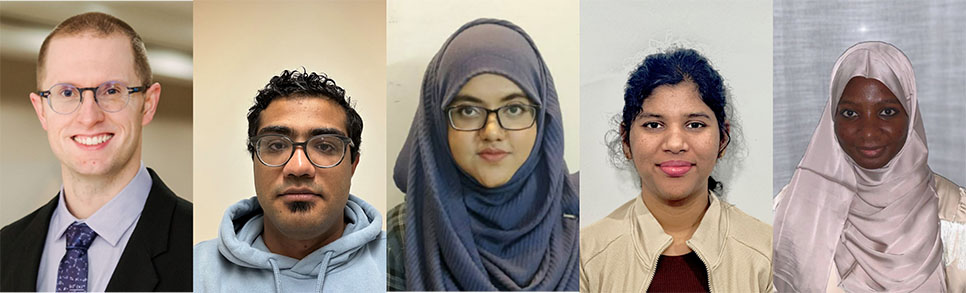
From left: Tyler Josephson, Kianoush Ramezani Shabolaghi, Samiha Sharlin, Charishma Puli, and Fariha Agbere. Photos courtesy of Tyler, Kianoush, Samiha, Charishma, and Fariha, respectively.
Collaborators:
Tyler Josephson, assistant professor
Kianoush Ramezani Shabolaghi, chemical engineering Ph.D. candidate
Samiha Sharlin, Ph.D. candidate
Charishma Puli, data science M.S. student
Fariha Agbere, chemical engineering B.S. student
ChemCatBio researchers are developing methods for upgrading biomass into a feedstock of mixed olefins, which can be upgraded into energy-dense sustainable aviation fuel using zeolite catalysts. However, questions remain on how the molecular shape of the catalyst - especially the porosity of the catalyst - affects the efficiency of those reactions.
In the past, quantum chemistry has been used to study such chemical reactions, but those methods are slow and expensive when scaled up to large systems. To speed up the rate of discovery, a team from the Department of Chemical, Biochemical, and Environmental Engineering at University of Maryland, Baltimore County are using machine learning to learn how the interactions work at the quantum chemistry scale.
"With our new methods, we aim to study larger systems and more realistic conditions," explained Tyler Josephson, the principal investigator, who was recently awarded a NSF career award. "If we can predict in the computer that this zeolite architecture works better than that zeolite architecture, that's useful information for experimentalists."
Josephson said that the project complements broader research work in the ATOMS Lab to bring machine learning and automated reasoning into chemical engineering.
]]>
Excerpt from: Two Minority Serving Universities Advance ChemCatBio Research Priorities With New Funding ~~ Published in: January, 2024 ChemCatBio, ChemCatBio Catalyst deactivation and...
https://www.chemcatbio.org/news/two-minority-serving-universities-advance-chemcatbio-research-priorities-with-new-funding
https://my3.my.umbc.edu/api/v0/pixel/news/138146/guest@my.umbc.edu/9025b4af707103f9267fbbfa7da0a3b2/api/pixel
faculty
grad
josephson
news
research
spring-2024
ug
Chemical, Biochemical and Environmental Engineering
https://my3.my.umbc.edu/groups/cbee
https://assets4-my.umbc.edu/system/shared/avatars/groups/000/000/771/b5e579e81b2e3624611890fa3ca2716a/xsmall.png?1746794587
https://assets2-my.umbc.edu/system/shared/avatars/groups/000/000/771/b5e579e81b2e3624611890fa3ca2716a/original.png?1746794587
https://assets1-my.umbc.edu/system/shared/avatars/groups/000/000/771/b5e579e81b2e3624611890fa3ca2716a/xxlarge.png?1746794587
https://assets2-my.umbc.edu/system/shared/avatars/groups/000/000/771/b5e579e81b2e3624611890fa3ca2716a/xlarge.png?1746794587
https://assets2-my.umbc.edu/system/shared/avatars/groups/000/000/771/b5e579e81b2e3624611890fa3ca2716a/large.png?1746794587
https://assets4-my.umbc.edu/system/shared/avatars/groups/000/000/771/b5e579e81b2e3624611890fa3ca2716a/medium.png?1746794587
https://assets1-my.umbc.edu/system/shared/avatars/groups/000/000/771/b5e579e81b2e3624611890fa3ca2716a/small.png?1746794587
https://assets4-my.umbc.edu/system/shared/avatars/groups/000/000/771/b5e579e81b2e3624611890fa3ca2716a/xsmall.png?1746794587
https://assets1-my.umbc.edu/system/shared/avatars/groups/000/000/771/b5e579e81b2e3624611890fa3ca2716a/xxsmall.png?1746794587
Chemical, Biochemical and Environmental Engineering
https://assets3-my.umbc.edu/system/shared/thumbnails/news/000/138/146/eba8378765bc57ca7fc1e5f2b30bd739/xxlarge.jpg?1705000961
https://assets1-my.umbc.edu/system/shared/thumbnails/news/000/138/146/eba8378765bc57ca7fc1e5f2b30bd739/xlarge.jpg?1705000961
https://assets1-my.umbc.edu/system/shared/thumbnails/news/000/138/146/eba8378765bc57ca7fc1e5f2b30bd739/large.jpg?1705000961
https://assets1-my.umbc.edu/system/shared/thumbnails/news/000/138/146/eba8378765bc57ca7fc1e5f2b30bd739/medium.jpg?1705000961
https://assets2-my.umbc.edu/system/shared/thumbnails/news/000/138/146/eba8378765bc57ca7fc1e5f2b30bd739/small.jpg?1705000961
https://assets2-my.umbc.edu/system/shared/thumbnails/news/000/138/146/eba8378765bc57ca7fc1e5f2b30bd739/xsmall.jpg?1705000961
https://assets3-my.umbc.edu/system/shared/thumbnails/news/000/138/146/eba8378765bc57ca7fc1e5f2b30bd739/xxsmall.jpg?1705000961
0
0
true
Thu, 11 Jan 2024 14:30:53 -0500