Dr. Christopher Hennigan promoted to Professor
Congratulations Dr. Christopher Hennigan on the successful promotion to the rank of Professor!
]]>
Congratulations Dr. Christopher Hennigan on the successful promotion to the rank of Professor!
https://my3.my.umbc.edu/api/v0/pixel/news/133877/guest@my.umbc.edu/363def9560c8a3a409253ee1a7dc84e9/api/pixel
faculty
hennigan
spring-2023
Chemical, Biochemical and Environmental Engineering
https://my3.my.umbc.edu/groups/cbee
https://assets4-my.umbc.edu/system/shared/avatars/groups/000/000/771/b5e579e81b2e3624611890fa3ca2716a/xsmall.png?1746794587
https://assets2-my.umbc.edu/system/shared/avatars/groups/000/000/771/b5e579e81b2e3624611890fa3ca2716a/original.png?1746794587
https://assets1-my.umbc.edu/system/shared/avatars/groups/000/000/771/b5e579e81b2e3624611890fa3ca2716a/xxlarge.png?1746794587
https://assets2-my.umbc.edu/system/shared/avatars/groups/000/000/771/b5e579e81b2e3624611890fa3ca2716a/xlarge.png?1746794587
https://assets2-my.umbc.edu/system/shared/avatars/groups/000/000/771/b5e579e81b2e3624611890fa3ca2716a/large.png?1746794587
https://assets4-my.umbc.edu/system/shared/avatars/groups/000/000/771/b5e579e81b2e3624611890fa3ca2716a/medium.png?1746794587
https://assets1-my.umbc.edu/system/shared/avatars/groups/000/000/771/b5e579e81b2e3624611890fa3ca2716a/small.png?1746794587
https://assets4-my.umbc.edu/system/shared/avatars/groups/000/000/771/b5e579e81b2e3624611890fa3ca2716a/xsmall.png?1746794587
https://assets1-my.umbc.edu/system/shared/avatars/groups/000/000/771/b5e579e81b2e3624611890fa3ca2716a/xxsmall.png?1746794587
Chemical, Biochemical and Environmental Engineering
https://assets2-my.umbc.edu/system/shared/thumbnails/news/000/133/877/9f9dd03f4d8c1128d73acd30a055f5a4/xxlarge.jpg?1686056756
https://assets2-my.umbc.edu/system/shared/thumbnails/news/000/133/877/9f9dd03f4d8c1128d73acd30a055f5a4/xlarge.jpg?1686056756
https://assets2-my.umbc.edu/system/shared/thumbnails/news/000/133/877/9f9dd03f4d8c1128d73acd30a055f5a4/large.jpg?1686056756
https://assets1-my.umbc.edu/system/shared/thumbnails/news/000/133/877/9f9dd03f4d8c1128d73acd30a055f5a4/medium.jpg?1686056756
https://assets2-my.umbc.edu/system/shared/thumbnails/news/000/133/877/9f9dd03f4d8c1128d73acd30a055f5a4/small.jpg?1686056756
https://assets1-my.umbc.edu/system/shared/thumbnails/news/000/133/877/9f9dd03f4d8c1128d73acd30a055f5a4/xsmall.jpg?1686056756
https://assets3-my.umbc.edu/system/shared/thumbnails/news/000/133/877/9f9dd03f4d8c1128d73acd30a055f5a4/xxsmall.jpg?1686056756
10
4
true
Tue, 06 Jun 2023 09:06:21 -0400
New Publication by Hennigan lab
Journal of Hazardous Materials
The Hennigan Lab has a new paper, "Measurement artifacts in the dithiothreitol (DTT) oxidative potential assay caused by interactions between aqueous metals and phosphate buffer", which was just published in the Journal of Hazardous Materials.
The article is available here:
Highlights
• A bias in the dithiothreitol (DTT) oxidative potential (OP) assay is characterized.
• Metal precipitation in the assay is due to interactions with the PO4 buffer matrix.
• Metal precipitation in the DTT assay has a profound effect on the OP response.
• The artifact is affected by the PO4 buffer concentration and ionic strength.
• The assay artifact has implications for studies of particulate matter toxicity.
Abstract
Metals in particulate matter (PM) are hypothesized to have enhanced toxicity based on their ability to catalyze reactive oxygen species (ROS) formation. Acellular assays are used to measure the oxidative potential (OP) of PM and its individual components. Many OP assays, including the dithiothreitol (DTT) assay, use a phosphate buffer matrix to simulate biological conditions (pH 7.4 and 37 °C). Prior work from our group observed transition metal precipitation in the DTT assay, consistent with thermodynamic equilibria. In this study, we characterized the effects of metal precipitation on OP measured by the DTT assay. Metal precipitation was affected by aqueous metal concentrations, ionic strength, and phosphate concentrations in ambient PM sampled in Baltimore, MD and a standard PM sample (NIST SRM-1648a, Urban Particulate Matter). Critically, differences in metal precipitation induced differing OP responses of the DTT assay as a function of phosphate concentration in all PM samples analyzed. These results indicate that comparison of DTT assay results obtained at differing phosphate buffer concentrations is highly problematic. Further, these results have implications for other chemical and biological assays that use phosphate buffer for pH control and their use to infer PM toxicity.
]]>
The Hennigan Lab has a new paper, "Measurement artifacts in the dithiothreitol (DTT) oxidative potential assay caused by interactions between aqueous metals and phosphate buffer", which was just...
https://my3.my.umbc.edu/api/v0/pixel/news/133776/guest@my.umbc.edu/2c42ee478332287f7798a9f33fd63d73/api/pixel
faculty
grad
hennigan
research
spring-2023
Chemical, Biochemical and Environmental Engineering
https://my3.my.umbc.edu/groups/cbee
https://assets4-my.umbc.edu/system/shared/avatars/groups/000/000/771/b5e579e81b2e3624611890fa3ca2716a/xsmall.png?1746794587
https://assets2-my.umbc.edu/system/shared/avatars/groups/000/000/771/b5e579e81b2e3624611890fa3ca2716a/original.png?1746794587
https://assets1-my.umbc.edu/system/shared/avatars/groups/000/000/771/b5e579e81b2e3624611890fa3ca2716a/xxlarge.png?1746794587
https://assets2-my.umbc.edu/system/shared/avatars/groups/000/000/771/b5e579e81b2e3624611890fa3ca2716a/xlarge.png?1746794587
https://assets2-my.umbc.edu/system/shared/avatars/groups/000/000/771/b5e579e81b2e3624611890fa3ca2716a/large.png?1746794587
https://assets4-my.umbc.edu/system/shared/avatars/groups/000/000/771/b5e579e81b2e3624611890fa3ca2716a/medium.png?1746794587
https://assets1-my.umbc.edu/system/shared/avatars/groups/000/000/771/b5e579e81b2e3624611890fa3ca2716a/small.png?1746794587
https://assets4-my.umbc.edu/system/shared/avatars/groups/000/000/771/b5e579e81b2e3624611890fa3ca2716a/xsmall.png?1746794587
https://assets1-my.umbc.edu/system/shared/avatars/groups/000/000/771/b5e579e81b2e3624611890fa3ca2716a/xxsmall.png?1746794587
Chemical, Biochemical and Environmental Engineering
2
0
true
Tue, 30 May 2023 08:57:55 -0400
Tue, 30 May 2023 08:58:41 -0400
Sustainable Aquaculture: Solving the off-flavor problem
Matthew Stromberg, environmental engineering PhD student
Ph.D. student Matthew Stromberg describes his Sustainable Aquaculcure research in this beautiful video. A collaboration between marine biologists and environmental engineers is attempting to solve the critical off-flavor problem in aquaculture while minimizing water usage. See the cool tanks growing salmon in the lab!
]]>
Ph.D. student Matthew Stromberg describes his Sustainable Aquaculcure research in this beautiful video. A collaboration between marine biologists and environmental engineers is attempting to solve...
https://my3.my.umbc.edu/api/v0/pixel/news/133738/guest@my.umbc.edu/96dcc2658ee1fc9a40e78be630e8ab90/api/pixel
faculty
ghosh
grad
research
spring-2023
Chemical, Biochemical and Environmental Engineering
https://my3.my.umbc.edu/groups/cbee
https://assets4-my.umbc.edu/system/shared/avatars/groups/000/000/771/b5e579e81b2e3624611890fa3ca2716a/xsmall.png?1746794587
https://assets2-my.umbc.edu/system/shared/avatars/groups/000/000/771/b5e579e81b2e3624611890fa3ca2716a/original.png?1746794587
https://assets1-my.umbc.edu/system/shared/avatars/groups/000/000/771/b5e579e81b2e3624611890fa3ca2716a/xxlarge.png?1746794587
https://assets2-my.umbc.edu/system/shared/avatars/groups/000/000/771/b5e579e81b2e3624611890fa3ca2716a/xlarge.png?1746794587
https://assets2-my.umbc.edu/system/shared/avatars/groups/000/000/771/b5e579e81b2e3624611890fa3ca2716a/large.png?1746794587
https://assets4-my.umbc.edu/system/shared/avatars/groups/000/000/771/b5e579e81b2e3624611890fa3ca2716a/medium.png?1746794587
https://assets1-my.umbc.edu/system/shared/avatars/groups/000/000/771/b5e579e81b2e3624611890fa3ca2716a/small.png?1746794587
https://assets4-my.umbc.edu/system/shared/avatars/groups/000/000/771/b5e579e81b2e3624611890fa3ca2716a/xsmall.png?1746794587
https://assets1-my.umbc.edu/system/shared/avatars/groups/000/000/771/b5e579e81b2e3624611890fa3ca2716a/xxsmall.png?1746794587
Chemical, Biochemical and Environmental Engineering
https://assets3-my.umbc.edu/system/shared/thumbnails/news/000/133/738/60cf2dfda93076f7c68a70ba6c9b8409/xxlarge.jpg?1685030087
https://assets2-my.umbc.edu/system/shared/thumbnails/news/000/133/738/60cf2dfda93076f7c68a70ba6c9b8409/xlarge.jpg?1685030087
https://assets4-my.umbc.edu/system/shared/thumbnails/news/000/133/738/60cf2dfda93076f7c68a70ba6c9b8409/large.jpg?1685030087
https://assets1-my.umbc.edu/system/shared/thumbnails/news/000/133/738/60cf2dfda93076f7c68a70ba6c9b8409/medium.jpg?1685030087
https://assets2-my.umbc.edu/system/shared/thumbnails/news/000/133/738/60cf2dfda93076f7c68a70ba6c9b8409/small.jpg?1685030087
https://assets4-my.umbc.edu/system/shared/thumbnails/news/000/133/738/60cf2dfda93076f7c68a70ba6c9b8409/xsmall.jpg?1685030087
https://assets3-my.umbc.edu/system/shared/thumbnails/news/000/133/738/60cf2dfda93076f7c68a70ba6c9b8409/xxsmall.jpg?1685030087
4
0
true
Thu, 25 May 2023 11:55:07 -0400
CBEE student and faculty recognized during 2023 CWIT awards
CWIT Community Awards recognize the contributions of exemplary members of our community, increase the visibility of their impact, and inspire others to help further the CWIT mission and uphold the CWIT values. They were recognized at the 2023 CWIT Community Awards and Graduate Recognition Ceremony on May 11, 2023.
Exemplary Peer Mentor Awardee
Catherine Wraback, CWIT Scholar | '23 Chemical Engineering, traditional track
The Exemplary Peer Mentor Award is given to a current CWIT Peer Mentor who has demonstrated CWIT’s values, while actively supporting and mentoring their mentee(s). Current Scholars and Affiliates who are in the role of a Peer Mentor in 2022-2023 academic year are eligible for the award.
Exemplary Faculty Mentor Awardee
Dr. Neha Raikar, Lecturer, CBEE
The Exemplary Faculty Mentor Award is given to a current CWIT Faculty Mentor who has demonstrated CWIT’s values, while actively supporting and mentoring their mentee(s). All Faculty Mentors in 2022-2023 academic year are eligible for the award.
]]>
CWIT Community Awards recognize the contributions of exemplary members of our community, increase the visibility of their impact, and inspire others to help further the CWIT mission and uphold the...
https://my3.my.umbc.edu/api/v0/pixel/news/133687/guest@my.umbc.edu/820997c0b9673d253e8a02d953c03377/api/pixel
award
faculty
raikar
spring-2022
ug
ugrad
Chemical, Biochemical and Environmental Engineering
https://my3.my.umbc.edu/groups/cbee
https://assets4-my.umbc.edu/system/shared/avatars/groups/000/000/771/b5e579e81b2e3624611890fa3ca2716a/xsmall.png?1746794587
https://assets2-my.umbc.edu/system/shared/avatars/groups/000/000/771/b5e579e81b2e3624611890fa3ca2716a/original.png?1746794587
https://assets1-my.umbc.edu/system/shared/avatars/groups/000/000/771/b5e579e81b2e3624611890fa3ca2716a/xxlarge.png?1746794587
https://assets2-my.umbc.edu/system/shared/avatars/groups/000/000/771/b5e579e81b2e3624611890fa3ca2716a/xlarge.png?1746794587
https://assets2-my.umbc.edu/system/shared/avatars/groups/000/000/771/b5e579e81b2e3624611890fa3ca2716a/large.png?1746794587
https://assets4-my.umbc.edu/system/shared/avatars/groups/000/000/771/b5e579e81b2e3624611890fa3ca2716a/medium.png?1746794587
https://assets1-my.umbc.edu/system/shared/avatars/groups/000/000/771/b5e579e81b2e3624611890fa3ca2716a/small.png?1746794587
https://assets4-my.umbc.edu/system/shared/avatars/groups/000/000/771/b5e579e81b2e3624611890fa3ca2716a/xsmall.png?1746794587
https://assets1-my.umbc.edu/system/shared/avatars/groups/000/000/771/b5e579e81b2e3624611890fa3ca2716a/xxsmall.png?1746794587
Chemical, Biochemical and Environmental Engineering
https://assets4-my.umbc.edu/system/shared/thumbnails/news/000/133/687/fc72dbdf2299a25e69808fd7d37b5993/xxlarge.jpg?1684856807
https://assets2-my.umbc.edu/system/shared/thumbnails/news/000/133/687/fc72dbdf2299a25e69808fd7d37b5993/xlarge.jpg?1684856807
https://assets1-my.umbc.edu/system/shared/thumbnails/news/000/133/687/fc72dbdf2299a25e69808fd7d37b5993/large.jpg?1684856807
https://assets4-my.umbc.edu/system/shared/thumbnails/news/000/133/687/fc72dbdf2299a25e69808fd7d37b5993/medium.jpg?1684856807
https://assets3-my.umbc.edu/system/shared/thumbnails/news/000/133/687/fc72dbdf2299a25e69808fd7d37b5993/small.jpg?1684856807
https://assets3-my.umbc.edu/system/shared/thumbnails/news/000/133/687/fc72dbdf2299a25e69808fd7d37b5993/xsmall.jpg?1684856807
https://assets1-my.umbc.edu/system/shared/thumbnails/news/000/133/687/fc72dbdf2299a25e69808fd7d37b5993/xxsmall.jpg?1684856807
1
0
true
Tue, 23 May 2023 11:47:31 -0400
Tyler Josephson advances research with NSF CAREER AWARD
Creating “AI Scientists”
from UMBC NEWS, "Creating “AI Scientists”: Tyler Josephson advances a new field of research through $650,000 NSF CAREER award", by Catherine Meyers on Published: May 12, 2023
Tyler Josephson’s lab sits off a main corridor in the department of chemical, biochemical and environmental engineering at UMBC. Open the door, though, and you’ll see nary a beaker, chemical closet, or lab coat. Inside, a few computers sit on tables. You might see equations scrawled on the white board or a few students poring over lines of code.
Using this modest setup, Josephson has launched an ambitious project to equip computers to make scientific discoveries—starting in the realm of chemistry. This March he won a prestigious NSF CAREER award to advance the project.
The goal of the work is ultimately to speed up the process of science, which should in turn give humanity new knowledge and tools to face down big challenges such as climate change and environmental degradation.
As Josephson and his students dive into the work, they are bringing together techniques from across mathematics, computer science, and chemical engineering. Their first step is to translate chemical theories into a rigorous mathematical language that a computer can understand.
Math as the language of science
In 1623, the Italian natural philosopher Galileo Galilei wrote an essay in which he described nature as a book written in “the language of mathematics.” Many scientists since have puzzled over the mysterious power of math to describe physical phenomena.
Josephson and his students are tapping into this power. They are using a tool developed by researchers at Microsoft called the Lean theorem prover. Lean is both a computer language and a program for checking each step of a rigorous mathematical proof.
“Formal proofs, which are verified by a computer, differ from the informal, handwritten versions often used by scientists,” says Josephson. Informal proofs are easier to write, but they usually skip logical steps, assuming a human reader will have the knowledge and skill to follow along. This means that errors can creep in undetected.
On the other hand, if a proof has been written and checked in Lean, it is guaranteed to be correct as long as the stated assumptions are true.
A community of Lean programmers
Lean has a dedicated community of volunteer developers who have built a large library of mathematical proofs, each of which can then serve as a building block for more complicated proofs. They aim to digitize mathematics, starting with the entirety of the undergraduate math curriculum, which will lay the foundation for formal proofs in advanced modern mathematics.
Josephson plans to build a similar library with formally correct derivations in science and engineering, starting with chemical concepts such as the thermodynamic behavior of gases and of molecules sticking and unsticking from surfaces.
He and his students describe their approach in a first paper on the subject, and are in the process of submitting it to journals.
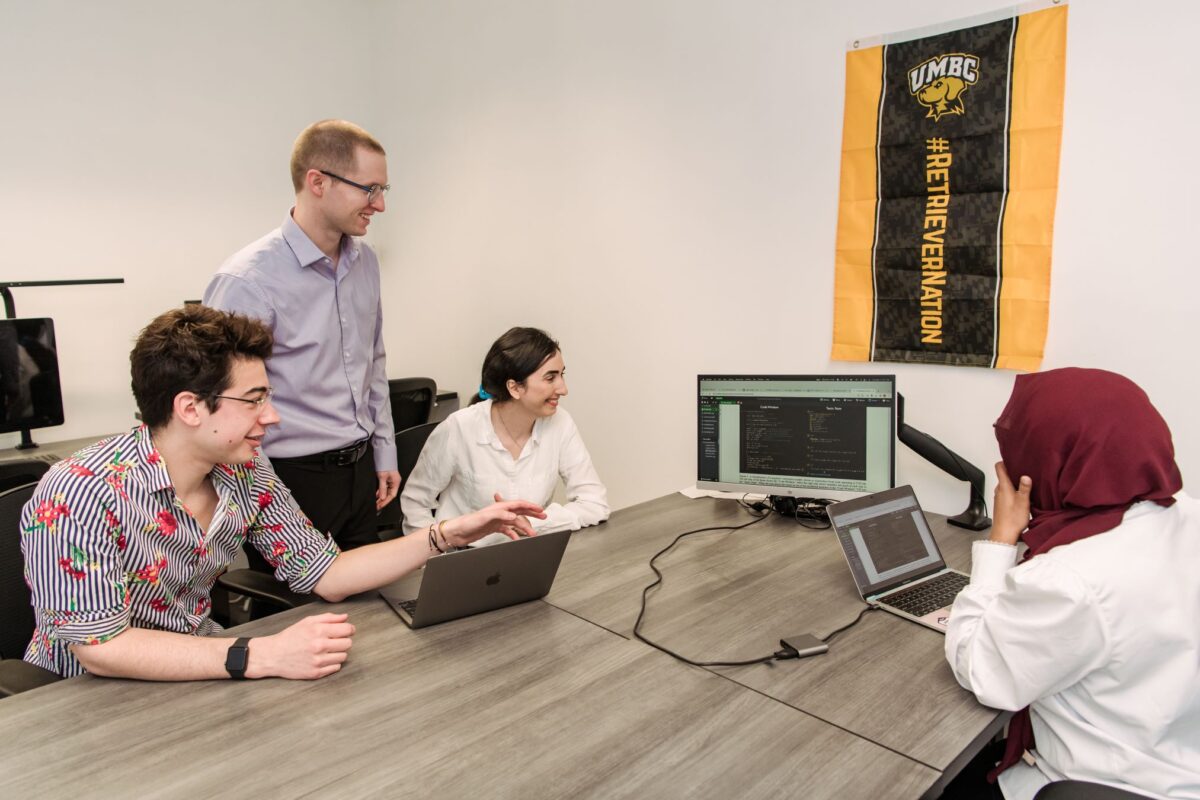 Tyler Josephson (standing) and students Max Bobbin (left), Parivash Feyzishendi (center), and Samiha Sharlin (right) in the lab. (Marlayna Demond ’11/UMBC)
The power of the work will multiply as more of the foundations of science are translated into Lean, so a large part of the team’s work will also be to recruit, inspire, and train fellow proof creators. They will hold workshops to showcase Lean for scientists and engineers, and they plan to create fun and educational games that will teach Lean-programming skills to newcomers.
“I’m really excited to share this tool with students and the scientific community,” Josephson says.
Building better scientific computing tools
Josephson’s goal to formally verify scientific theories isn’t just an intellectual exercise—it’s a means of building better tools for better science. One such tool he plans to create with NSF CAREER award support is Lean-based computer software that can simulate the behavior of molecules under a range of conditions.
Scientists often use such software to test theories as an alternative to physical experiments. It can be easier to run simulations of reactions on a computer, for example, than to mix real chemicals again and again, and some molecular phenomena may happen so fast, or under such extreme conditions, that current experimental tools cannot capture them.
However, bugs can mar the performance of the software. For example, starting in 2011, a hidden coding error fueled a seven-year “war over supercooled water,” in which two scientific groups disagreed about what happens to ultrapure water when it is cooled significantly below the freezing point of normal water, and then suddenly crystallizes.
Code written in Lean is unique from that written in the programming languages commonly used in scientific computing, since it can be provably free of such math errors, Josephson says.
As more scientists and engineers learn to write code and proofs in Lean, others will be able to write bug-free software for applications as diverse as weather forecasting, drug discovery, and predicting material performance.
“AI scientists” who reason on their own
Ultimately, Josephson hopes to use a Lean-based library of scientific knowledge to train computers as fellow scientists. For example, large language models, such as the recently popularized ChatGPT, might be trained on a library of scientific proofs and gain the ability to “autocomplete” proofs on their own, translate informal proofs from the literature into formal ones, and even discover entirely new scientific theories, which could then be checked for correctness by Lean.
A tool like this might revolutionize science. In Galileo’s time, a single person could master large portions of human scientific knowledge, but now scientists usually go to school for decades to become experts in a tiny subfield, Josephson says.
AI scientists capable of digesting a database of thousands of scientific proofs in multiple disciplines might draw connections across them to reveal new discoveries. “Such a tool could lead to an AI-powered Renaissance in interdisciplinary scientific discovery,” says Josephson.
While such lofty goals remain in the future, Josephson and his students are energized by the possibilities. As they embark on an exciting scientific journey, they are thrilled to bring as many people as possible along on the ride.
]]>
from UMBC NEWS, "Creating “AI Scientists”: Tyler Josephson advances a new field of research through $650,000 NSF CAREER award", by Catherine Meyers on Published: May 12, 2023 Tyler...
https://my3.my.umbc.edu/api/v0/pixel/news/133064/guest@my.umbc.edu/3d87a874ac5b8c8fc9d5e108c4749646/api/pixel
award
faculty
josephson
spring-2023
Chemical, Biochemical and Environmental Engineering
https://my3.my.umbc.edu/groups/cbee
https://assets4-my.umbc.edu/system/shared/avatars/groups/000/000/771/b5e579e81b2e3624611890fa3ca2716a/xsmall.png?1746794587
https://assets2-my.umbc.edu/system/shared/avatars/groups/000/000/771/b5e579e81b2e3624611890fa3ca2716a/original.png?1746794587
https://assets1-my.umbc.edu/system/shared/avatars/groups/000/000/771/b5e579e81b2e3624611890fa3ca2716a/xxlarge.png?1746794587
https://assets2-my.umbc.edu/system/shared/avatars/groups/000/000/771/b5e579e81b2e3624611890fa3ca2716a/xlarge.png?1746794587
https://assets2-my.umbc.edu/system/shared/avatars/groups/000/000/771/b5e579e81b2e3624611890fa3ca2716a/large.png?1746794587
https://assets4-my.umbc.edu/system/shared/avatars/groups/000/000/771/b5e579e81b2e3624611890fa3ca2716a/medium.png?1746794587
https://assets1-my.umbc.edu/system/shared/avatars/groups/000/000/771/b5e579e81b2e3624611890fa3ca2716a/small.png?1746794587
https://assets4-my.umbc.edu/system/shared/avatars/groups/000/000/771/b5e579e81b2e3624611890fa3ca2716a/xsmall.png?1746794587
https://assets1-my.umbc.edu/system/shared/avatars/groups/000/000/771/b5e579e81b2e3624611890fa3ca2716a/xxsmall.png?1746794587
Chemical, Biochemical and Environmental Engineering
https://assets1-my.umbc.edu/system/shared/thumbnails/news/000/133/064/f3c6a66c048263f2b362db019ca84932/xxlarge.jpg?1684341161
https://assets4-my.umbc.edu/system/shared/thumbnails/news/000/133/064/f3c6a66c048263f2b362db019ca84932/xlarge.jpg?1684341161
https://assets4-my.umbc.edu/system/shared/thumbnails/news/000/133/064/f3c6a66c048263f2b362db019ca84932/large.jpg?1684341161
https://assets1-my.umbc.edu/system/shared/thumbnails/news/000/133/064/f3c6a66c048263f2b362db019ca84932/medium.jpg?1684341161
https://assets1-my.umbc.edu/system/shared/thumbnails/news/000/133/064/f3c6a66c048263f2b362db019ca84932/small.jpg?1684341161
https://assets4-my.umbc.edu/system/shared/thumbnails/news/000/133/064/f3c6a66c048263f2b362db019ca84932/xsmall.jpg?1684341161
https://assets3-my.umbc.edu/system/shared/thumbnails/news/000/133/064/f3c6a66c048263f2b362db019ca84932/xxsmall.jpg?1684341161
0
0
true
Wed, 17 May 2023 12:37:43 -0400
Mon, 29 Apr 2024 12:36:11 -0400
Working to diversify and advance environmental science
UMBC, USGS and EPA sign new agreement
CBEE faculty, Dr. Claire Welty, Professor of Department of Chemical, Biochemical and Environmental Engineering and Director of Center for Urban Environmental Research and Education, Drs. Lee Blaney, Upal Ghosh, Chris Hennigan, Brian Reed, Claire Welty, are also affiliated with the Interdisciplinary Consortium for Applied Research in the Environment (ICARE) are beneficiaries of successful collaborations between the three organizations.
]]>
On a recent Friday, representatives of UMBC, the U.S. Geological Survey and the U.S. Environmental Protection Agency gathered in UMBC’s Albin O. Kuhn Library Gallery and pledged to work together...
https://my3.my.umbc.edu/api/v0/pixel/news/133435/guest@my.umbc.edu/fd829d8fd572efa3ed4d0ec8236f6fed/api/pixel
blaney
faculty
ghosh
hennigan
reed
research
spring-2023
welty
Chemical, Biochemical and Environmental Engineering
https://my3.my.umbc.edu/groups/cbee
https://assets4-my.umbc.edu/system/shared/avatars/groups/000/000/771/b5e579e81b2e3624611890fa3ca2716a/xsmall.png?1746794587
https://assets2-my.umbc.edu/system/shared/avatars/groups/000/000/771/b5e579e81b2e3624611890fa3ca2716a/original.png?1746794587
https://assets1-my.umbc.edu/system/shared/avatars/groups/000/000/771/b5e579e81b2e3624611890fa3ca2716a/xxlarge.png?1746794587
https://assets2-my.umbc.edu/system/shared/avatars/groups/000/000/771/b5e579e81b2e3624611890fa3ca2716a/xlarge.png?1746794587
https://assets2-my.umbc.edu/system/shared/avatars/groups/000/000/771/b5e579e81b2e3624611890fa3ca2716a/large.png?1746794587
https://assets4-my.umbc.edu/system/shared/avatars/groups/000/000/771/b5e579e81b2e3624611890fa3ca2716a/medium.png?1746794587
https://assets1-my.umbc.edu/system/shared/avatars/groups/000/000/771/b5e579e81b2e3624611890fa3ca2716a/small.png?1746794587
https://assets4-my.umbc.edu/system/shared/avatars/groups/000/000/771/b5e579e81b2e3624611890fa3ca2716a/xsmall.png?1746794587
https://assets1-my.umbc.edu/system/shared/avatars/groups/000/000/771/b5e579e81b2e3624611890fa3ca2716a/xxsmall.png?1746794587
Chemical, Biochemical and Environmental Engineering
0
0
true
Thu, 11 May 2023 11:26:41 -0400
Ellington wins awards at 2023 CPRC-HDC Joint Spring Meeting
The Society of Environmental Toxicology and Chemistry 2nd Annual Hudson-Delaware & Chesapeake-Potomac Regional Chapter Joint Spring Meeting was held in Easton, Maryland from April 17 - 28, 2023.
In preparation for the 2023 CPRC-HDC Joint Spring Meeting, Marriah Ellington, M.S. chemical and biochemical engineering ' 23, received a travel award to attend the conference to presenter the research she conducted under the mentorship of Dr. Lee Blaney, Professor of Chemical, Biochemical and Environmental Engineering.
During the meeting, Ellington won the 2nd place poster presentation award for her poster titled "Improving transformation efficiency, recovery efficiency, and throughput for total oxidizable precursor analysis of PFAS in soil"
Authors: Marriah Ellington, Ke He, Margaret Siao, Jiabao Liang, Lee Blaney
Abstract: Per- and polyfluoroalkyl substances (PFAS) comprise more than 10,000 compounds with variable physicochemical properties. Targeted analytical approaches require standards that are limited, expensive, or unavailable. The total oxidizable precursor (TOP) assay represents one option to address the complexity associated with unknown PFAS precursors. In particular, the TOP assay transforms precursors into perfluoroalkyl acid (PFAA) endpoints via hydroxyl and sulfate radical-driven reactions. Solid samples, such as soil, sediment, and biosolids, contain high concentrations of reactive species scavengers that inhibit precursor oxidation; furthermore, PFAS extraction from solids involves solvent addition, which increases the potential for reactive species scavenging and necessitates further processing steps. The objective of this work was to improve the transformation efficiency, recovery efficiency, and throughput of the TOP assay for soil samples. Recovery efficiency was tracked via mass-labeled PFAA surrogates, which were not oxidized in TOP. Transformation efficiency was evaluated by introducing the M8-PFOSA surrogate standard into the original sample before extraction. PFAS, precursors, and mass-labeled surrogates were extracted with methanol, and the extracts were diluted with deionized water to 20% methanol. To improve transformation efficiency, solid-phase extraction with weak-anion exchange cartridges was used to remove background organic matter. Precursors were eluted with acetonitrile, evaporated, and reconstituted with TOP reagents. After 24 h at 85 °C, the PFAA end-products were present in saline water, affecting analytical compatibility and complicating enrichment. A QuEChERS extraction was employed by adding acetonitrile, magnesium sulfate, and sodium chloride. The acetonitrile-based extract was evaporated, reconstituted with internal standards, and analyzed for targeted PFAS. Recovery efficiency was dependent on chain length and ranged from 64 to 115%. The M8-PFOSA transformation efficiency was greater than 75% for over 20 soil samples from a PFAS-impacted site. Results showed ng g-1 quantitation of over 30 PFAS, highlighting the strong performance of this modified TOP assay for real solid samples.
]]>
The Society of Environmental Toxicology and Chemistry 2nd Annual Hudson-Delaware & Chesapeake-Potomac Regional Chapter Joint Spring Meeting was held in Easton, Maryland from April 17 - 28,...
https://my3.my.umbc.edu/api/v0/pixel/news/133356/guest@my.umbc.edu/8e326e4445bce880c5515e0e3d6fdb99/api/pixel
award
blaney
faculty
grad
spring-2023
Chemical, Biochemical and Environmental Engineering
https://my3.my.umbc.edu/groups/cbee
https://assets4-my.umbc.edu/system/shared/avatars/groups/000/000/771/b5e579e81b2e3624611890fa3ca2716a/xsmall.png?1746794587
https://assets2-my.umbc.edu/system/shared/avatars/groups/000/000/771/b5e579e81b2e3624611890fa3ca2716a/original.png?1746794587
https://assets1-my.umbc.edu/system/shared/avatars/groups/000/000/771/b5e579e81b2e3624611890fa3ca2716a/xxlarge.png?1746794587
https://assets2-my.umbc.edu/system/shared/avatars/groups/000/000/771/b5e579e81b2e3624611890fa3ca2716a/xlarge.png?1746794587
https://assets2-my.umbc.edu/system/shared/avatars/groups/000/000/771/b5e579e81b2e3624611890fa3ca2716a/large.png?1746794587
https://assets4-my.umbc.edu/system/shared/avatars/groups/000/000/771/b5e579e81b2e3624611890fa3ca2716a/medium.png?1746794587
https://assets1-my.umbc.edu/system/shared/avatars/groups/000/000/771/b5e579e81b2e3624611890fa3ca2716a/small.png?1746794587
https://assets4-my.umbc.edu/system/shared/avatars/groups/000/000/771/b5e579e81b2e3624611890fa3ca2716a/xsmall.png?1746794587
https://assets1-my.umbc.edu/system/shared/avatars/groups/000/000/771/b5e579e81b2e3624611890fa3ca2716a/xxsmall.png?1746794587
Chemical, Biochemical and Environmental Engineering
https://assets2-my.umbc.edu/system/shared/thumbnails/news/000/133/356/dc21b508147255d7f6deda0eccd1fad1/xxlarge.jpg?1683648095
https://assets2-my.umbc.edu/system/shared/thumbnails/news/000/133/356/dc21b508147255d7f6deda0eccd1fad1/xlarge.jpg?1683648095
https://assets1-my.umbc.edu/system/shared/thumbnails/news/000/133/356/dc21b508147255d7f6deda0eccd1fad1/large.jpg?1683648095
https://assets2-my.umbc.edu/system/shared/thumbnails/news/000/133/356/dc21b508147255d7f6deda0eccd1fad1/medium.jpg?1683648095
https://assets2-my.umbc.edu/system/shared/thumbnails/news/000/133/356/dc21b508147255d7f6deda0eccd1fad1/small.jpg?1683648095
https://assets1-my.umbc.edu/system/shared/thumbnails/news/000/133/356/dc21b508147255d7f6deda0eccd1fad1/xsmall.jpg?1683648095
https://assets4-my.umbc.edu/system/shared/thumbnails/news/000/133/356/dc21b508147255d7f6deda0eccd1fad1/xxsmall.jpg?1683648095
3
0
true
Tue, 09 May 2023 11:37:04 -0400
Wed, 10 May 2023 10:17:51 -0400
CBEE students win regional AIChE Jeopardy competition
Team qualifies for National competition, four years running
UMBC chemical engineering students win first place in the 2023 Mid-Atlantic Regional AIChE ChemE Jeopardy Competition. Thus, qualifying for the 2023 National AIChE ChemE Jeopardy Competition in Orlando, FL in November as part of the AIChE National Conference. This is the fourth year in a row a UMBC team qualified for the National AIChE ChemE Jeopardy Competition.
Eighteen teams competed during the AIChE ChemE Jeopardy Mid-Atlantic Competition held at Virginia Tech in Blacksburg, VA, including two teams from UMBC. After the preliminary rounds, the UMBC teams placed first and second in the semi-finals, tied at 9 points each. The semifinal round was a knockout round, and UMBC’s ‘Team One’ advanced to the finals. The final round of competition was between UMBC, Johns Hopkins University (2nd place) and Stony Brook University (3rd place).
The success of both teams is the result of consistent hard work and support from the teams’ faculty advisors are Dr. Neha Raikar and Dr. Mariajosé Castellanos as well as other students. Taylor deSilva, chemical engineering ‘23, is instrumental in preparing the teams for competition by organizing weekly practices including setting up sample game boards.
Team One
-
Ethan Banks, chemical engineering, traditional track ‘24
-
Paul Loberg, chemical engineering, biotechnology and bioengineering track ‘24
-
Max Bobbin, chemical engineering, environmental engineering & sustainability track ‘23
-
Catherine Wraback - chemical engineering, traditional track ‘23
Team Two
- Pavan Umashankar, chemical engineering, biotechnology and bioengineering track ‘24
-
Colin Jones, chemical engineering, biotechnology and bioengineering track ‘25
-
Jacob Craft, chemical engineering, environmental engineering & sustainability track ‘24
-
Zachary Bogart, chemical engineering, environmental engineering & sustainability track ‘23
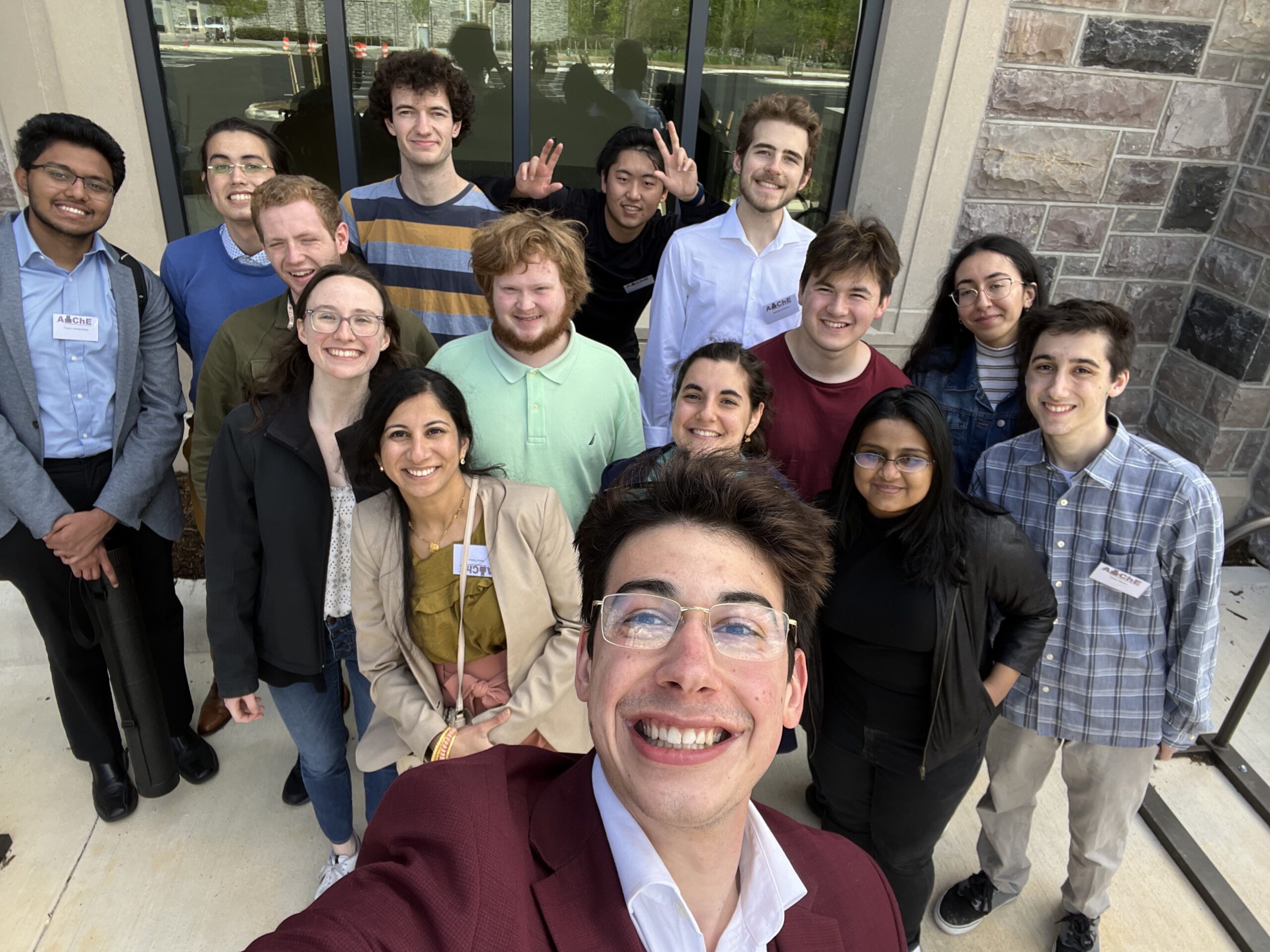
UMBC CBEE students and advisor at the AIChE 2023 Mid-Atlantic Student Regional Conference, April 22-23
Photo Credit: Max Bobbin
Back to front; Pavan Umashankar, Paul Loberg, Caton , David Ni, Zachary Bogart, Ben Willing, Catherine Wraback, Jacob Craft, Colin Jones, Neha Sian, Dr. Neha Raikar, Sarah Donyaee, Afrah Ahmed, Ethan Banks, Max Bobbin.
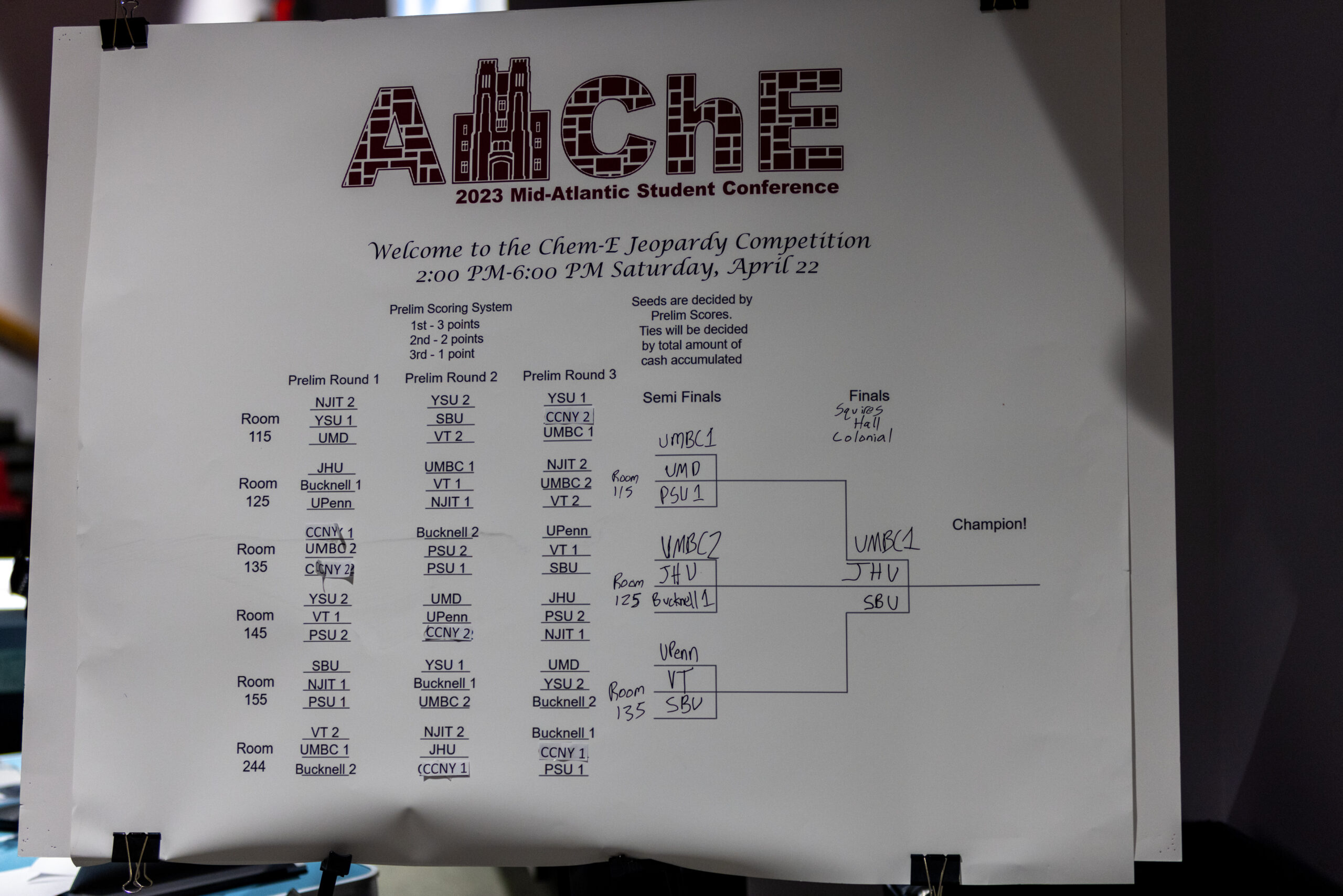
AIChE Conference Chem-E Jeopardy Competition Bracket
UMBC teams placed 1st and 2nd in the Semi Finals round, tied at 9 points.
]]>
UMBC chemical engineering students win first place in the 2023 Mid-Atlantic Regional AIChE ChemE Jeopardy Competition. Thus, qualifying for the 2023 National AIChE ChemE Jeopardy Competition in...
https://my3.my.umbc.edu/api/v0/pixel/news/132968/guest@my.umbc.edu/b383b0d62af4910bf3fa3b38d89da732/api/pixel
castellanos
faculty
jeopardy
raikar
ug
ugrad
Chemical, Biochemical and Environmental Engineering
https://my3.my.umbc.edu/groups/cbee
https://assets4-my.umbc.edu/system/shared/avatars/groups/000/000/771/b5e579e81b2e3624611890fa3ca2716a/xsmall.png?1746794587
https://assets2-my.umbc.edu/system/shared/avatars/groups/000/000/771/b5e579e81b2e3624611890fa3ca2716a/original.png?1746794587
https://assets1-my.umbc.edu/system/shared/avatars/groups/000/000/771/b5e579e81b2e3624611890fa3ca2716a/xxlarge.png?1746794587
https://assets2-my.umbc.edu/system/shared/avatars/groups/000/000/771/b5e579e81b2e3624611890fa3ca2716a/xlarge.png?1746794587
https://assets2-my.umbc.edu/system/shared/avatars/groups/000/000/771/b5e579e81b2e3624611890fa3ca2716a/large.png?1746794587
https://assets4-my.umbc.edu/system/shared/avatars/groups/000/000/771/b5e579e81b2e3624611890fa3ca2716a/medium.png?1746794587
https://assets1-my.umbc.edu/system/shared/avatars/groups/000/000/771/b5e579e81b2e3624611890fa3ca2716a/small.png?1746794587
https://assets4-my.umbc.edu/system/shared/avatars/groups/000/000/771/b5e579e81b2e3624611890fa3ca2716a/xsmall.png?1746794587
https://assets1-my.umbc.edu/system/shared/avatars/groups/000/000/771/b5e579e81b2e3624611890fa3ca2716a/xxsmall.png?1746794587
Chemical, Biochemical and Environmental Engineering
https://assets1-my.umbc.edu/system/shared/thumbnails/news/000/132/968/0776e7de98944c15b7a6b61fe85e0199/xxlarge.jpg?1682511687
https://assets3-my.umbc.edu/system/shared/thumbnails/news/000/132/968/0776e7de98944c15b7a6b61fe85e0199/xlarge.jpg?1682511687
https://assets1-my.umbc.edu/system/shared/thumbnails/news/000/132/968/0776e7de98944c15b7a6b61fe85e0199/large.jpg?1682511687
https://assets4-my.umbc.edu/system/shared/thumbnails/news/000/132/968/0776e7de98944c15b7a6b61fe85e0199/medium.jpg?1682511687
https://assets4-my.umbc.edu/system/shared/thumbnails/news/000/132/968/0776e7de98944c15b7a6b61fe85e0199/small.jpg?1682511687
https://assets1-my.umbc.edu/system/shared/thumbnails/news/000/132/968/0776e7de98944c15b7a6b61fe85e0199/xsmall.jpg?1682511687
https://assets3-my.umbc.edu/system/shared/thumbnails/news/000/132/968/0776e7de98944c15b7a6b61fe85e0199/xxsmall.jpg?1682511687
0
0
true
Wed, 26 Apr 2023 09:08:00 -0400
Wed, 26 Apr 2023 21:13:29 -0400
A new way to make a virus-fighting protein could save lives
A new way to make a virus-fighting protein could save lives during the next pandemic
The quick and portable production process, described in a newly accepted paper in the journal New Biotechnology, could be easily deployed at the source of a future virus outbreak
A multidisciplinary research team has produced a promising virus-fighting protein using a quick, portable process that could be easily deployed at the source of a future virus outbreak. The team includes researchers from the University of Maryland, Baltimore County (UMBC), Stanford University, the National Cancer Institute (NCI) and the National Center for Advanced Translational Science. The research has been accepted for publication in the journal New Biotechnology.
Griffithsin is a protein originally isolated from red algae. More than a decade ago, researchers in the Molecular Targets Program of the NCI discovered it could protect cells from the HIV virus and it is now in Phase 1 clinical trials in humans. Griffithsin sticks to the surface glycoproteins of certain viruses, making it difficult for the virus to enter host cells. (Glycoproteins are proteins with sugar molecules on them.)
“It’s like taking clay and sticking it to the prongs of an electrical plug to prevent it from entering a socket,” says Govind Rao, a professor of chemical and biochemical engineering at UMBC who is one of the lead researchers on the project. The protein disables a wide range of viruses, including the virus that causes COVID-19.
Medicines that are made with biological molecules like griffithsin are called biologics. They are normally manufactured in huge batches using living cells such as E.coli bacteria. (The cells are given DNA-encoded instructions for how to make the medicine.) However, that method has drawbacks, including the need to keep the cells alive.
Rao and his colleagues developed a method to manufacture griffithsin that does not require living cells. Instead, the researchers take the protein-manufacturing “guts” out of the cells. Into this soup of cellular components, they then add the DNA instructions for making griffithsin, along with the needed molecular building blocks.
“The cellular machinery still works, even without a living cell to support it,” says Rao. “The method is simple and effective.”
Using cell-free manufacturing methods, the researchers produced significant quantities of griffithsin in less than 24 hours. They purified the protein to strict standards and demonstrated in lab experiments that it could disable both HIV and SARS-CoV-2 virusesas effectively as the same griffithsin protein made by living cells.
The researchers envision that the method could be quickly deployed to make antiviral medicine at the origin of disease outbreaks. The method could be easily adapted to work with a portable, suitcase-sized biologics manufacturing device, dubbed Bio-MOD, that Rao and a team of mostly UMBC researchers recently developed. They described the device in a 2018 paper in the journal Nature Biomedical Engineering.
The new griffithsin protein manufacturing process together with the portable Bio-MOD device could be a powerful weapon to quickly combat new viruses before they spread.
]]>
NEWS RELEASE 12-APR-2023 A new way to make a virus-fighting protein could save lives during the next pandemic The quick and portable production process, described in a newly accepted...
https://my3.my.umbc.edu/api/v0/pixel/news/132718/guest@my.umbc.edu/016eb6e1310d898946b0551a5b5e0530/api/pixel
faculty
rao
spring-2023
Chemical, Biochemical and Environmental Engineering
https://my3.my.umbc.edu/groups/cbee
https://assets4-my.umbc.edu/system/shared/avatars/groups/000/000/771/b5e579e81b2e3624611890fa3ca2716a/xsmall.png?1746794587
https://assets2-my.umbc.edu/system/shared/avatars/groups/000/000/771/b5e579e81b2e3624611890fa3ca2716a/original.png?1746794587
https://assets1-my.umbc.edu/system/shared/avatars/groups/000/000/771/b5e579e81b2e3624611890fa3ca2716a/xxlarge.png?1746794587
https://assets2-my.umbc.edu/system/shared/avatars/groups/000/000/771/b5e579e81b2e3624611890fa3ca2716a/xlarge.png?1746794587
https://assets2-my.umbc.edu/system/shared/avatars/groups/000/000/771/b5e579e81b2e3624611890fa3ca2716a/large.png?1746794587
https://assets4-my.umbc.edu/system/shared/avatars/groups/000/000/771/b5e579e81b2e3624611890fa3ca2716a/medium.png?1746794587
https://assets1-my.umbc.edu/system/shared/avatars/groups/000/000/771/b5e579e81b2e3624611890fa3ca2716a/small.png?1746794587
https://assets4-my.umbc.edu/system/shared/avatars/groups/000/000/771/b5e579e81b2e3624611890fa3ca2716a/xsmall.png?1746794587
https://assets1-my.umbc.edu/system/shared/avatars/groups/000/000/771/b5e579e81b2e3624611890fa3ca2716a/xxsmall.png?1746794587
Chemical, Biochemical and Environmental Engineering
0
0
true
Mon, 17 Apr 2023 15:50:33 -0400
Mon, 17 Apr 2023 15:52:38 -0400
Dr. Josephson interviewed on Quirks & Quarks
Dr. Tyler Josephson, assistant professor of Chemical, Biochemical and Environmental Engineering at UMBC, is interviewed on Canadian Broadcasting Corporation science show "Quirks and Quarks".
Humans are no longer the only ones capable of making scientific discoveries. Kepler's third law of planetary motion has been re-discovered centuries after it was first described – but this time, an artificial intelligence system is taking the credit.
Dubbed AI-Descartes, this "AI scientist" was developed by a team of researchers from IBM Research, Samsung AI, and the University of Maryland, Baltimore County (UMBC).
"I think scientists have so many different problems to solve. And if we solve them faster with AI, they just open up brand new questions for us to go after next," Tyler Josephson told Quirks & Quarks host Bob McDonald.
FULL ARTICLE & PODCAST :
Image Credit:
Artist's concept of our solar system showing a sense of scale and distance.
The planets and dwarf planet Pluto are shown in their correct order of distance from the sun, their correct relative sizes and their correct relative orbital distances. The sizes of the bodies are greatly exaggerated relative to the orbital distances.
The faint rings of Jupiter, Uranus and Neptune are not shown. Eris, Haumea and Makemake do not appear in the illustration owing to their highly tilted orbits. The dwarf planet Ceres is not shown separately; it resides in the asteroid belt between Mars and Jupiter.
#BBD0E0 »
]]>
Dr. Tyler Josephson, assistant professor of Chemical, Biochemical and Environmental Engineering at UMBC, is interviewed on Canadian Broadcasting Corporation science show "Quirks and Quarks". ...
https://my3.my.umbc.edu/api/v0/pixel/news/132687/guest@my.umbc.edu/ccedc3deaf1efc87ccfd7e85fc6b3ed3/api/pixel
faculty
josephson
spring-2023
Chemical, Biochemical and Environmental Engineering
https://my3.my.umbc.edu/groups/cbee
https://assets4-my.umbc.edu/system/shared/avatars/groups/000/000/771/b5e579e81b2e3624611890fa3ca2716a/xsmall.png?1746794587
https://assets2-my.umbc.edu/system/shared/avatars/groups/000/000/771/b5e579e81b2e3624611890fa3ca2716a/original.png?1746794587
https://assets1-my.umbc.edu/system/shared/avatars/groups/000/000/771/b5e579e81b2e3624611890fa3ca2716a/xxlarge.png?1746794587
https://assets2-my.umbc.edu/system/shared/avatars/groups/000/000/771/b5e579e81b2e3624611890fa3ca2716a/xlarge.png?1746794587
https://assets2-my.umbc.edu/system/shared/avatars/groups/000/000/771/b5e579e81b2e3624611890fa3ca2716a/large.png?1746794587
https://assets4-my.umbc.edu/system/shared/avatars/groups/000/000/771/b5e579e81b2e3624611890fa3ca2716a/medium.png?1746794587
https://assets1-my.umbc.edu/system/shared/avatars/groups/000/000/771/b5e579e81b2e3624611890fa3ca2716a/small.png?1746794587
https://assets4-my.umbc.edu/system/shared/avatars/groups/000/000/771/b5e579e81b2e3624611890fa3ca2716a/xsmall.png?1746794587
https://assets1-my.umbc.edu/system/shared/avatars/groups/000/000/771/b5e579e81b2e3624611890fa3ca2716a/xxsmall.png?1746794587
Chemical, Biochemical and Environmental Engineering
https://assets2-my.umbc.edu/system/shared/thumbnails/news/000/132/687/3e8773a5d2f360213b09c01c950245f3/xxlarge.jpg?1681742769
https://assets4-my.umbc.edu/system/shared/thumbnails/news/000/132/687/3e8773a5d2f360213b09c01c950245f3/xlarge.jpg?1681742769
https://assets4-my.umbc.edu/system/shared/thumbnails/news/000/132/687/3e8773a5d2f360213b09c01c950245f3/large.jpg?1681742769
https://assets4-my.umbc.edu/system/shared/thumbnails/news/000/132/687/3e8773a5d2f360213b09c01c950245f3/medium.jpg?1681742769
https://assets3-my.umbc.edu/system/shared/thumbnails/news/000/132/687/3e8773a5d2f360213b09c01c950245f3/small.jpg?1681742769
https://assets2-my.umbc.edu/system/shared/thumbnails/news/000/132/687/3e8773a5d2f360213b09c01c950245f3/xsmall.jpg?1681742769
https://assets4-my.umbc.edu/system/shared/thumbnails/news/000/132/687/3e8773a5d2f360213b09c01c950245f3/xxsmall.jpg?1681742769
0
0
true
Mon, 17 Apr 2023 10:46:33 -0400