talk: Results of a student study of UMBC computer systems security

The UMBC Cyber Defense Lab presents
Results from the January 2018 SFS Research Study at UMBC
Enis Golaszewski, CSEE, UMBC
12:00-1:00pm Friday, 12 October 2018, ITE 227
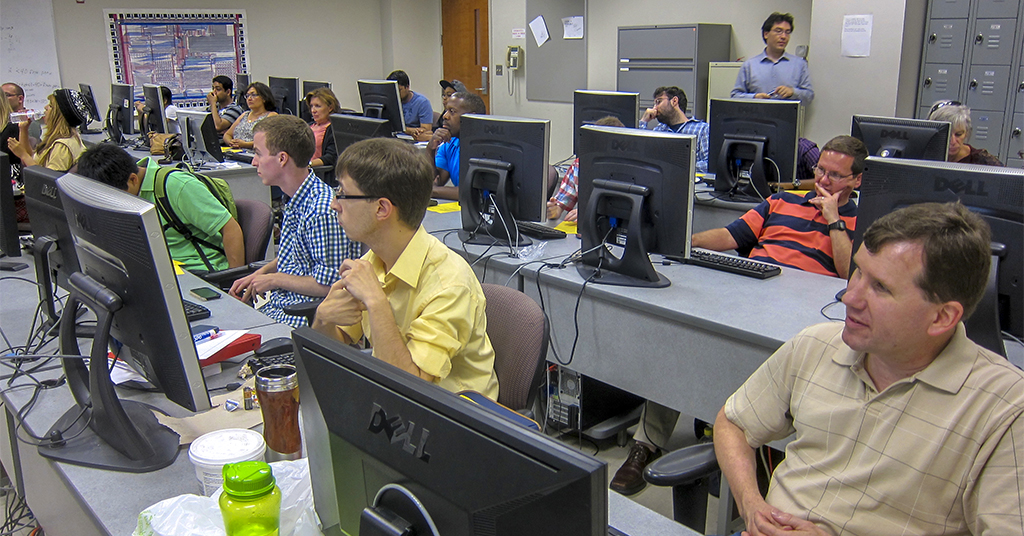
January 22-26, 2018, UMBC SFS scholars worked collaboratively to analyze the security of a targeted aspect of the UMBC computer system. The focus of this year’s study was the WebAdmin module that enables users to perform various functions on their accounts, including changing the password. Students identified vulnerabilities involving failure to sanitize user input properly and suggested mitigations. Participants comprised BS, MS, MPS, and PhD students studying computer science, computer engineering, information systems, and cybersecurity, including SFS scholars who transferred from Montgomery College (MC) and Prince George’s Community College (PGCC) to complete their four-year degrees at UMBC. We hope that other universities can benefit from our motivational and educational strategy of cooperating with the university’s IT staff to engage students in active project-based learning centering on focused questions about the university computer system.
Enis Golaszewski is a PhD student and SFS scholar in computer science working with Dr. Sherman on blockchain, protocol analysis, and the security of software-defined networks.
This project was supported in part by the National Science Foundation under SFS grant 1241576.
Host: Alan T. Sherman, *protected email*
The UMBC Cyber Defense Lab meets biweekly Fridays. All meetings are open to the public.
The post talk: Results of a student study of UMBC computer systems security appeared first on Department of Computer Science and Electrical Engineering.
]]>
The UMBC Cyber Defense Lab presents Results from the January 2018 SFS Research Study at UMBC Enis Golaszewski, CSEE, UMBC 12:00-1:00pm Friday, 12 October 2018, ITE 227 January 22-26,...
https://www.csee.umbc.edu/2018/10/talk-results-of-a-student-study-of-umbc-computer-systems-security/
https://my3.my.umbc.edu/api/v0/pixel/news/79376/guest@my.umbc.edu/6d0ccf28223fa07d9b9e974e1d9d28cb/api/pixel
computer-science
cybersecurity
students
talks
UMBC Cybersecurity Institute Group
https://my3.my.umbc.edu/groups/cybersecurity
https://assets3-my.umbc.edu/system/shared/avatars/groups/000/000/485/196da6a7ec6f4c31eab2e474c17a9ab7/xsmall.png?1734891477
https://assets3-my.umbc.edu/system/shared/avatars/groups/000/000/485/196da6a7ec6f4c31eab2e474c17a9ab7/original.png?1734891477
https://assets4-my.umbc.edu/system/shared/avatars/groups/000/000/485/196da6a7ec6f4c31eab2e474c17a9ab7/xxlarge.png?1734891477
https://assets4-my.umbc.edu/system/shared/avatars/groups/000/000/485/196da6a7ec6f4c31eab2e474c17a9ab7/xlarge.png?1734891477
https://assets2-my.umbc.edu/system/shared/avatars/groups/000/000/485/196da6a7ec6f4c31eab2e474c17a9ab7/large.png?1734891477
https://assets3-my.umbc.edu/system/shared/avatars/groups/000/000/485/196da6a7ec6f4c31eab2e474c17a9ab7/medium.png?1734891477
https://assets3-my.umbc.edu/system/shared/avatars/groups/000/000/485/196da6a7ec6f4c31eab2e474c17a9ab7/small.png?1734891477
https://assets3-my.umbc.edu/system/shared/avatars/groups/000/000/485/196da6a7ec6f4c31eab2e474c17a9ab7/xsmall.png?1734891477
https://assets3-my.umbc.edu/system/shared/avatars/groups/000/000/485/196da6a7ec6f4c31eab2e474c17a9ab7/xxsmall.png?1734891477
UMBC Center for Cybersecurity
0
0
true
Thu, 11 Oct 2018 10:25:13 -0400
MD-AI Meetup holds 1st event at UMBC 6-8pm Wed 10/3, 7th floor library
MD-AI Meetup holds 1st event at UMBC
6-8pm Wed 10/3, 7th floor library
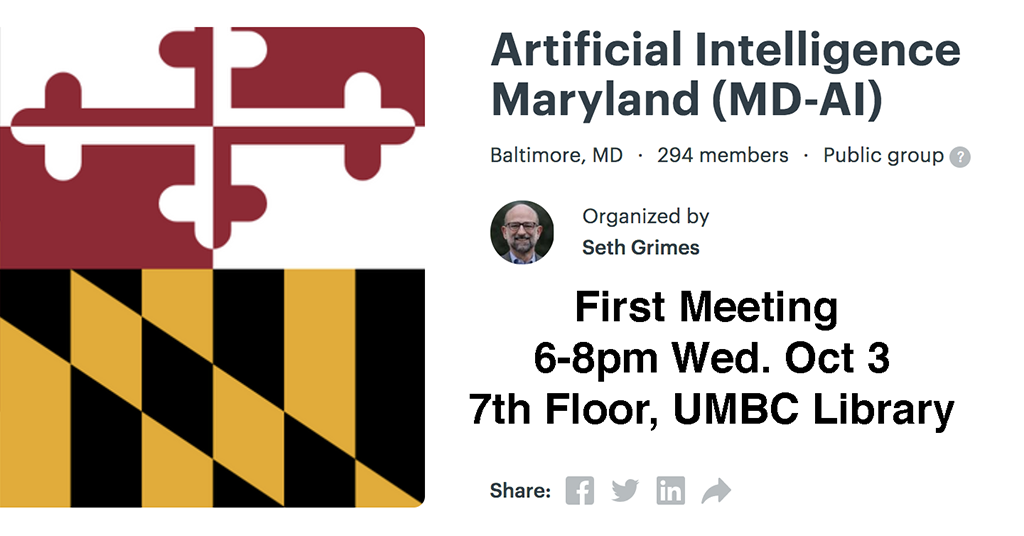
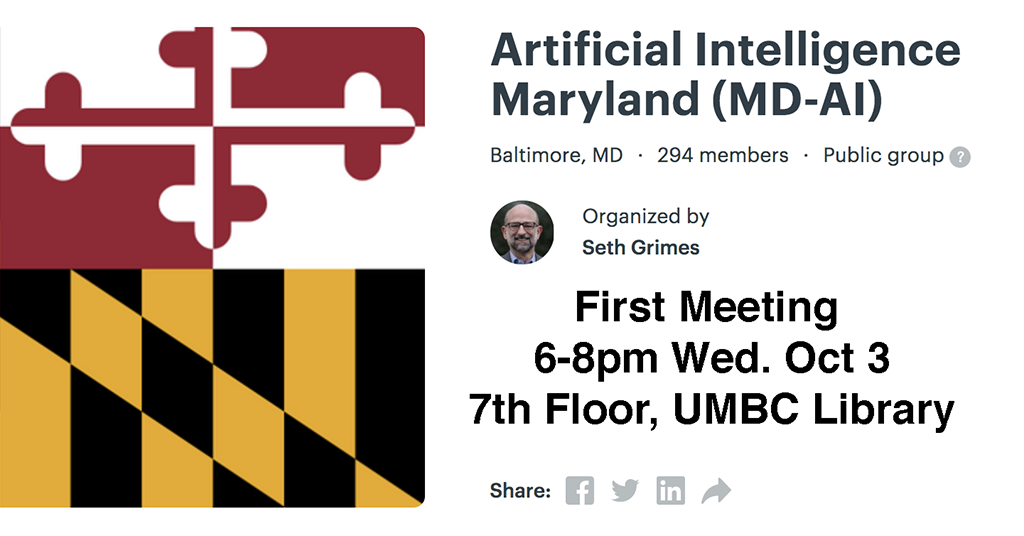
A new Maryland-based meetup interest group has been established for Artificial Intelligence (MD-AI Meetup) and will have its first meeting at UMBC this coming Wednesday (Oct 3) from 6:00-8:00pm in the 7th floor of the library. The first meeting will feature a talk by UMCP Professor Phil Resnik on the state of NLP and an AI research agenda. Refreshments will be provided. The meetup is organized by Seth Grimes and supported by TEDCO, local AI startup RedShred, and the Maryland Tech Council.
If you are interested in attending this and possibly future meetings (which will probably be monthly), go to the Meetup site and join (it’s free) and RSVP to attend this meeting (if there’s still room). If you join the meetup and RSVP, you can see who’s registered to attend.
These meetups are good opportunities to meet and network with people in the area who share interests. It’s a great opportunity for students who are will be looking for internships or jobs in the coming year.
The post MD-AI Meetup holds 1st event at UMBC 6-8pm Wed 10/3, 7th floor library appeared first on Department of Computer Science and Electrical Engineering.
]]>
MD-AI Meetup holds 1st event at UMBC 6-8pm Wed 10/3, 7th floor library A new Maryland-based meetup interest group has been established for Artificial Intelligence (MD-AI Meetup) and will...
https://www.csee.umbc.edu/2018/09/md-ai-meetup-holds-1st-event-at-umbc-6-8pm-wed-10-3-7th-floor-library/
https://my3.my.umbc.edu/api/v0/pixel/news/78988/guest@my.umbc.edu/9f971bc6300fd641f11e4a00be96e2fb/api/pixel
ai
computer-engineering
computer-science
cybersecurity
data-science
events
nlp
robotics
talks
UMBC Cybersecurity Institute Group
https://my3.my.umbc.edu/groups/cybersecurity
https://assets3-my.umbc.edu/system/shared/avatars/groups/000/000/485/196da6a7ec6f4c31eab2e474c17a9ab7/xsmall.png?1734891477
https://assets3-my.umbc.edu/system/shared/avatars/groups/000/000/485/196da6a7ec6f4c31eab2e474c17a9ab7/original.png?1734891477
https://assets4-my.umbc.edu/system/shared/avatars/groups/000/000/485/196da6a7ec6f4c31eab2e474c17a9ab7/xxlarge.png?1734891477
https://assets4-my.umbc.edu/system/shared/avatars/groups/000/000/485/196da6a7ec6f4c31eab2e474c17a9ab7/xlarge.png?1734891477
https://assets2-my.umbc.edu/system/shared/avatars/groups/000/000/485/196da6a7ec6f4c31eab2e474c17a9ab7/large.png?1734891477
https://assets3-my.umbc.edu/system/shared/avatars/groups/000/000/485/196da6a7ec6f4c31eab2e474c17a9ab7/medium.png?1734891477
https://assets3-my.umbc.edu/system/shared/avatars/groups/000/000/485/196da6a7ec6f4c31eab2e474c17a9ab7/small.png?1734891477
https://assets3-my.umbc.edu/system/shared/avatars/groups/000/000/485/196da6a7ec6f4c31eab2e474c17a9ab7/xsmall.png?1734891477
https://assets3-my.umbc.edu/system/shared/avatars/groups/000/000/485/196da6a7ec6f4c31eab2e474c17a9ab7/xxsmall.png?1734891477
UMBC Center for Cybersecurity
0
0
true
Sat, 29 Sep 2018 23:50:53 -0400
Sat, 29 Sep 2018 23:50:53 -0400
Machine learning and AI for cybersecurity: a technical chat with DISA

The UMBC Cyber Defense Lab
Machine Learning and Artificial Intelligence: A Technical Chat with the Defense Information Systems Agency
James Curry
Lead Engineer–DoD Cyber Security Range
Defense Information Systems Agency (DISA)
12:00–1:00pm Friday, 28 September 2018, ITE 227, UMBC
A broad reaching brief on the scope and scale of the DISA Mission, followed by a dive into DISA’s efforts to develop Machine Learning and Artificial Intelligence to help defend the nation’s cyber infrastructure. Attendees are highly encouraged to ask questions.
James Curry is the Lead Engineer of the DoD Cyber Security Range (CSR). The CSR’s mission is to replicate the DoD Information Network (DODIN) environment at lab scale, while maintaining high-fidelity realism. As Lead Engineer, Mr. Curry led the design, acquisition, and implementation of two first-of-its-kind technologies: a Virtual Internet Access Point (vIAP) and a Virtual Joint Regional Security Stack (vJRSS). These technologies enable the DoD Workforce to train in an IaaS-on-demand environment that realistically matches DISA’s core infrastructure. Mr. Curry is a Scholarship for Service (SFS) recipient (2008-2009) and received his masters and bachelors of science in computer science from New Mexico Tech. Email: *protected email*
Host: Alan T. Sherman, *protected email*
The UMBC Cyber Defense Lab meets biweekly Fridays. All meetings are open to the public. Upcoming meetings for Fall 2018 include the following.
- Oct 12 Enis Golaszewski, The 2018 UMBC SFS study
- Oct 26 Enis Golaszewski, Using tools in the formal analysis of cryptographic protocols
- Nov 9 Razvan Mintesu, Legal aspects privacy
- Dec 7 Tim Finin, A knowledge graph for cyber threat intelligence
The post Machine learning and AI for cybersecurity: a technical chat with DISA appeared first on Department of Computer Science and Electrical Engineering.
]]>
The UMBC Cyber Defense Lab Machine Learning and Artificial Intelligence: A Technical Chat with the Defense Information Systems Agency James Curry Lead Engineer–DoD Cyber Security Range...
https://www.csee.umbc.edu/2018/09/machine-learning-and-ai-for-cybersecurity-a-technical-chat-with-disa/
https://my3.my.umbc.edu/api/v0/pixel/news/78945/guest@my.umbc.edu/1d7e79c959c784379822047cd7dd1737/api/pixel
ai
computer-engineering
computer-science
cybersecurity
data-science
machine-learning
UMBC Cybersecurity Institute Group
https://my3.my.umbc.edu/groups/cybersecurity
https://assets3-my.umbc.edu/system/shared/avatars/groups/000/000/485/196da6a7ec6f4c31eab2e474c17a9ab7/xsmall.png?1734891477
https://assets3-my.umbc.edu/system/shared/avatars/groups/000/000/485/196da6a7ec6f4c31eab2e474c17a9ab7/original.png?1734891477
https://assets4-my.umbc.edu/system/shared/avatars/groups/000/000/485/196da6a7ec6f4c31eab2e474c17a9ab7/xxlarge.png?1734891477
https://assets4-my.umbc.edu/system/shared/avatars/groups/000/000/485/196da6a7ec6f4c31eab2e474c17a9ab7/xlarge.png?1734891477
https://assets2-my.umbc.edu/system/shared/avatars/groups/000/000/485/196da6a7ec6f4c31eab2e474c17a9ab7/large.png?1734891477
https://assets3-my.umbc.edu/system/shared/avatars/groups/000/000/485/196da6a7ec6f4c31eab2e474c17a9ab7/medium.png?1734891477
https://assets3-my.umbc.edu/system/shared/avatars/groups/000/000/485/196da6a7ec6f4c31eab2e474c17a9ab7/small.png?1734891477
https://assets3-my.umbc.edu/system/shared/avatars/groups/000/000/485/196da6a7ec6f4c31eab2e474c17a9ab7/xsmall.png?1734891477
https://assets3-my.umbc.edu/system/shared/avatars/groups/000/000/485/196da6a7ec6f4c31eab2e474c17a9ab7/xxsmall.png?1734891477
UMBC Center for Cybersecurity
0
0
true
Thu, 27 Sep 2018 12:49:08 -0400
Learn cybersecurity skills in NSA’s Codebreaker Challenge
Get hands-on cybersecurity and blockchain skills in NSA’s Codebreaker Challenge
NSA’s sixth annual Codebreaker Challenge is a hands-on, cybersecurity engineering challenge in which students work to complete mission-focused objectives and push their university to the top of the competition leaderboard.
The 2018 scenario involves ransomware and blockchain. A new strain of ransomware has managed to penetrate several critical government networks and NSA has been called upon to assist in remediating the infection to prevent massive data losses. For each infected machine, an encrypted copy of the key needed to decrypt the ransomed files has been stored in a smart contract on the Ethereum blockchain and is set to only be unlocked upon receipt of the ransom payment. Your mission is to ultimately (1) find a way to unlock the ransomware without giving in to the attacker’s demands and (2) figure out a way to recover all of the funds already paid by other victims. Are YOU up to the challenge?
UMBC students did well, both individually and as a group, in previous challenges. Let’s make it to the top of the leaderboard this year.
Feedback from previous iterations of the challenge showed that students were able to learn a great deal from participating. Each student receives a slightly different set of challenge binaries and associated files, so that one student’s solution won’t work for someone else. The binaries are similar enough so that students can work together to understand the problems and develop approaches to solutions and hen implement them independently and register their results.
The 2018 challenge consists of a series of tasks that are worth a varying amount of points based upon their difficulty. In previous years, tasks had to be solved in order to unlock the next task and rankings were based upon the quantity of solvers that progressed the furthest from each school. This way of ranking heavily weighted progression above participation and did not allow for skipping ahead if a particular task became a stumbling block. So to address these issues, all tasks will be available immediately upon registration and can be solved in any order. The point value associated with each task is based on relative difficulty and schools will be ranked according to total number of points accumulated by their students. It is still recommended to solve tasks in order since the tasks flow with the storyline, but that is no longer a requirement.
The post Learn cybersecurity skills in NSA’s Codebreaker Challenge appeared first on Department of Computer Science and Electrical Engineering.
]]>
Get hands-on cybersecurity and blockchain skills in NSA’s Codebreaker Challenge NSA’s sixth annual Codebreaker Challenge is a hands-on, cybersecurity engineering challenge in...
https://www.csee.umbc.edu/2018/09/learn-cybersecurity-skills-in-nsas-codebreaker-challenge/
https://my3.my.umbc.edu/api/v0/pixel/news/78824/guest@my.umbc.edu/b5c63a73e1d311c9178ad83678684ddf/api/pixel
csee
cybersecurity
students
uncategorized
UMBC Cybersecurity Institute Group
https://my3.my.umbc.edu/groups/cybersecurity
https://assets3-my.umbc.edu/system/shared/avatars/groups/000/000/485/196da6a7ec6f4c31eab2e474c17a9ab7/xsmall.png?1734891477
https://assets3-my.umbc.edu/system/shared/avatars/groups/000/000/485/196da6a7ec6f4c31eab2e474c17a9ab7/original.png?1734891477
https://assets4-my.umbc.edu/system/shared/avatars/groups/000/000/485/196da6a7ec6f4c31eab2e474c17a9ab7/xxlarge.png?1734891477
https://assets4-my.umbc.edu/system/shared/avatars/groups/000/000/485/196da6a7ec6f4c31eab2e474c17a9ab7/xlarge.png?1734891477
https://assets2-my.umbc.edu/system/shared/avatars/groups/000/000/485/196da6a7ec6f4c31eab2e474c17a9ab7/large.png?1734891477
https://assets3-my.umbc.edu/system/shared/avatars/groups/000/000/485/196da6a7ec6f4c31eab2e474c17a9ab7/medium.png?1734891477
https://assets3-my.umbc.edu/system/shared/avatars/groups/000/000/485/196da6a7ec6f4c31eab2e474c17a9ab7/small.png?1734891477
https://assets3-my.umbc.edu/system/shared/avatars/groups/000/000/485/196da6a7ec6f4c31eab2e474c17a9ab7/xsmall.png?1734891477
https://assets3-my.umbc.edu/system/shared/avatars/groups/000/000/485/196da6a7ec6f4c31eab2e474c17a9ab7/xxsmall.png?1734891477
UMBC Center for Cybersecurity
3
0
true
Sun, 23 Sep 2018 09:45:05 -0400
talk: Phishing in an Academic Community, a Study of User Susceptibility and Behavior

The UMBC Cyber Defense Lab
Phishing in an Academic Community:
a Study of User Susceptibility and Behavior
Alejandra Diaz
University of Maryland, Baltimore County
12:00–1:00pm, Friday, 14 September 2018, ITE 227
(joint work with Alan T. Sherman Anupam Joshi)
We present an observational study on the relationship between demographic factors and phishing susceptibility at the University of Maryland, Baltimore County (UMBC). From March through May 2018, we performed three experiments that delivered phishing attacks to 450 randomly-selected students on three different days (1,350 students total) to examine user click rates and demographics within UMBC’s undergraduate student population. The participants were initially unaware of the study. We deployed the Billing Problem, Contest Winner, and Expiration Date phishing tactics. Experiment 1 impersonated banking authorities; Experiment 2 enticed users with monetary rewards; and Experiment 3 threatened users with account cancellation.
We found correlations resulting in lowered susceptibility based on college affiliation, academic year progression, cyber training, involvement in cyber clubs or cyber scholarship programs, amount of time spent on the computer, and age demographics. We found no significant correlation between gender and susceptibility. Contrary to our expectations, we observed an inverse correlation between phishing awareness and student resistance to clicking a phishing link. Students who identified themselves as understanding the definition of phishing had a higher susceptibility rate than did their peers who were merely aware of phishing attacks, with both groups of students having a higher susceptibility rate than those with no knowledge whatsoever. Overall, approximately 70% of the students who opened a phishing email clicked on it.
Alejandra Diaz (*protected email*) is a cyber software engineer at Northrop Grumman. She earned her BS in computer science from UMBC with a concentration in cybersecurity in May 2017, and her MS in computer science in August 2018. As a Cyber Scholar and a Society of Women Studying Information Security Scholar, she has a special interest in the human aspects of cybersecurity.
Host: Alan T. Sherman, *protected email*
Support for this research was provided in part by the National Science Foundation under SFS grant 1241576, the U.S. Department of Defense under CAE grant H988230-17-1-0349, and IBM.
The post talk: Phishing in an Academic Community, a Study of User Susceptibility and Behavior appeared first on Department of Computer Science and Electrical Engineering.
]]>
The UMBC Cyber Defense Lab Phishing in an Academic Community: a Study of User Susceptibility and Behavior Alejandra Diaz University of Maryland, Baltimore County 12:00–1:00pm, Friday, 14...
https://www.csee.umbc.edu/2018/09/talk-phishing-in-an-academic-community-a-study-of-user-susceptibility-and-behavior/
https://my3.my.umbc.edu/api/v0/pixel/news/78459/guest@my.umbc.edu/239c541864336c1f8378903a30fe9277/api/pixel
computer-science
cybersecurity
news
talks
UMBC Cybersecurity Institute Group
https://my3.my.umbc.edu/groups/cybersecurity
https://assets3-my.umbc.edu/system/shared/avatars/groups/000/000/485/196da6a7ec6f4c31eab2e474c17a9ab7/xsmall.png?1734891477
https://assets3-my.umbc.edu/system/shared/avatars/groups/000/000/485/196da6a7ec6f4c31eab2e474c17a9ab7/original.png?1734891477
https://assets4-my.umbc.edu/system/shared/avatars/groups/000/000/485/196da6a7ec6f4c31eab2e474c17a9ab7/xxlarge.png?1734891477
https://assets4-my.umbc.edu/system/shared/avatars/groups/000/000/485/196da6a7ec6f4c31eab2e474c17a9ab7/xlarge.png?1734891477
https://assets2-my.umbc.edu/system/shared/avatars/groups/000/000/485/196da6a7ec6f4c31eab2e474c17a9ab7/large.png?1734891477
https://assets3-my.umbc.edu/system/shared/avatars/groups/000/000/485/196da6a7ec6f4c31eab2e474c17a9ab7/medium.png?1734891477
https://assets3-my.umbc.edu/system/shared/avatars/groups/000/000/485/196da6a7ec6f4c31eab2e474c17a9ab7/small.png?1734891477
https://assets3-my.umbc.edu/system/shared/avatars/groups/000/000/485/196da6a7ec6f4c31eab2e474c17a9ab7/xsmall.png?1734891477
https://assets3-my.umbc.edu/system/shared/avatars/groups/000/000/485/196da6a7ec6f4c31eab2e474c17a9ab7/xxsmall.png?1734891477
UMBC Center for Cybersecurity
0
0
true
Sun, 09 Sep 2018 13:40:05 -0400
NSA highlights strong partnership with UMBC through Featured School campaign

NSA highlights strong partnership with UMBC in Featured School campaign
Over the past two decades, UMBC and the National Security Agency (NSA) have developed a strong relationship, which has led to research, internship, and career opportunities for faculty, students, and alumni. UMBC is the first institution to be highlighted in NSA’s Featured School Series, which launched on September 4.
“UMBC’s long-standing partnership with NSA has provided valuable experiences for our students, faculty, and alumni to pursue internships, careers, and collaborative research opportunities,” said President Freeman Hrabowski. “Through this work we are helping to address the need for well-trained cyber professionals by creating a network of talented people to protect the state, nation, and world.”
More than 1100 NSA employees are UMBC alumni, including Darniet Jennings ‘98, M.S. ‘99, Ph.D. ‘03, information systems management. Jennings continued his dissertation research when he took a job at NSA, where he developed a system to manage big data effectively, which was patented in 2010.
The opportunities at NSA include careers in a broad range of disciplines including cybersecurity, engineering, computer science, language, and biological and chemical sciences. Regina Hambleton ‘87, mathematics, has held a number of positions at NSA and is currently the Agency’s deputy director of Engagement and Policy. She began working at NSA while she was a student at UMBC, and participated in a program that allowed her to spend a semester at UMBC taking courses followed by a semester working at NSA.
The partnership between NSA and UMBC also helps prepare an increasing number of graduates for careers in cybersecurity-related fields, to protect the nation from cyber threats.
Charles Nicholas, professor of computer science and electrical engineering, is also highlighted in the Featured School Series campaign. He has spent two sabbaticals at NSA during his time at UMBC, and has mentored students who completed NSA internships, in addition to students who went on to pursue careers at NSA. Nicholas is interested in the intersection of cybersecurity and data science, and the tools that are used to compare malware specimens.
“There are so many opportunities in the intelligence community, including at NSA,” Nicholas says. “It is important for students interested in those careers to develop technical ability, as well as critical and creative thinking, and I enjoy the chance to help them grow those skills.”
For more information about the partnership, and a few UMBC alumni who work at NSA, visit the UMBC page on the NSA website.
Adapted from a UMBC News article by Megan Hanks. Banner image by Marlayna Demond for UMBC.
The post NSA highlights strong partnership with UMBC through Featured School campaign appeared first on Department of Computer Science and Electrical Engineering.
]]>
NSA highlights strong partnership with UMBC in Featured School campaign Over the past two decades, UMBC and the National Security Agency (NSA) have developed a strong relationship, which has...
https://www.csee.umbc.edu/2018/09/nsa-highlights-strong-partnership-with-umbc-through-featured-school-campaign/
https://my3.my.umbc.edu/api/v0/pixel/news/78345/guest@my.umbc.edu/937bbb0918436a7c5bf367c07f1e6516/api/pixel
computer-engineering
computer-science
cybersecurity
data-science
electrical-engineering
news
UMBC Cybersecurity Institute Group
https://my3.my.umbc.edu/groups/cybersecurity
https://assets3-my.umbc.edu/system/shared/avatars/groups/000/000/485/196da6a7ec6f4c31eab2e474c17a9ab7/xsmall.png?1734891477
https://assets3-my.umbc.edu/system/shared/avatars/groups/000/000/485/196da6a7ec6f4c31eab2e474c17a9ab7/original.png?1734891477
https://assets4-my.umbc.edu/system/shared/avatars/groups/000/000/485/196da6a7ec6f4c31eab2e474c17a9ab7/xxlarge.png?1734891477
https://assets4-my.umbc.edu/system/shared/avatars/groups/000/000/485/196da6a7ec6f4c31eab2e474c17a9ab7/xlarge.png?1734891477
https://assets2-my.umbc.edu/system/shared/avatars/groups/000/000/485/196da6a7ec6f4c31eab2e474c17a9ab7/large.png?1734891477
https://assets3-my.umbc.edu/system/shared/avatars/groups/000/000/485/196da6a7ec6f4c31eab2e474c17a9ab7/medium.png?1734891477
https://assets3-my.umbc.edu/system/shared/avatars/groups/000/000/485/196da6a7ec6f4c31eab2e474c17a9ab7/small.png?1734891477
https://assets3-my.umbc.edu/system/shared/avatars/groups/000/000/485/196da6a7ec6f4c31eab2e474c17a9ab7/xsmall.png?1734891477
https://assets3-my.umbc.edu/system/shared/avatars/groups/000/000/485/196da6a7ec6f4c31eab2e474c17a9ab7/xxsmall.png?1734891477
UMBC Center for Cybersecurity
2
0
true
Wed, 05 Sep 2018 09:12:55 -0400
Wed, 05 Sep 2018 09:12:55 -0400
Weaponized information seeks a new target in cyberspace: Users’ minds
 Cyberattacks target Americans’ thinking. Fancy Tapis/Shutterstock.com
Weaponized information seeks a new target in cyberspace: Users’ minds
The Russian attacks on the 2016 U.S. presidential election and the country’s continuing election-related hacking have happened across all three dimensions of cyberspace – physical, informational and cognitive. The first two are well-known: For years, hackers have exploited hardware and software flaws to gain unauthorized access to computers and networks – and stolen information they’ve found. The third dimension, however, is a newer target – and a more concerning one.
This three-dimensional view of cyberspace comes from my late mentor, Professor Dan Kuehl of the National Defense University, who expressed concern about traditional hacking activities and what they meant for national security. But he also foresaw the potential – now clear to the public at large – that those tools could be used to target people’s perceptions and thought processes, too. That’s what the Russians allegedly did, according to federal indictments issued in February and July, laying out evidence that Russian civilians and military personnel used online tools to influence Americans’ political views – and, potentially, their votes. They may be setting up to do it again for the 2018 midterm elections.
Some observers suggest that using internet tools for espionage and as fuel for disinformation campaigns is a new form of “hybrid warfare.” Their idea is that the lines are blurring between the traditional kinetic warfare of bombs, missiles and guns, and the unconventional, stealthy warfare long practiced against foreigners’ “hearts and minds” by intelligence and special forces capabilities.
However, I believe this isn’t a new form of war at all: Rather, it is the same old strategies taking advantage of the latest available technologies. Just as online marketing companies use sponsored content and search engine manipulation to distribute biased information to the public, governments are using internet-based tools to pursue their agendas. In other words, they’re hacking a different kind of system through social engineering on a grand scale.
 Americans are used to seeing Russian propaganda that looks like this. AP Photo/Kirsty Wigglesworth
Old goals, new techniques
More than 2,400 years ago, the Chinese military strategist and philosopher Sun Tzu made it an axiom of war that it’s best to “subdue the enemy without fighting.” Using information – or disinformation, or propaganda – as a weapon can be one way to destabilize a population and disable the target country. In 1984 a former KGB agent who defected to the West discussed this as a long-term process and more or less predicted what’s happening in the U.S. now.
The Russians created false social media accounts to simulate political activists – such as @TEN_GOP, which purported to be associated with the Tennessee Republican Party. Just that one account attracted more than 100,000 followers. The goal was to distribute propaganda, such as captioned photos, posters or short animated graphics, purposely designed to enrage and engage these accounts’ followers. Those people would then pass the information along through their own personal social networks.
Starting from seeds planted by Russian fakers, including some who claimed to be U.S. citizens, those ideas grew and flourished through amplification by real people. Unfortunately, whether originating from Russia or elsewhere, fake information and conspiracy theories can form the basis for discussion at major partisan media outlets.
As ideas with niche online beginnings moved into the traditional mass media landscape, they serve to keep controversies alive by sustaining divisive arguments on both sides. For instance, one Russian troll factory had its online personas host rallies both for and against each of the major candidates in the 2016 presidential election. Though the rallies never took place, the online buzz about them helped inflame divisions in society.
The trolls also set up Twitter accounts purportedly representing local news organizations – including defunct ones – to take advantage of Americans’ greater trust of local news sources than national ones. These accounts operated for several years – one for the Chicago Daily News, closed since 1978, was created in May 2014 and collected 20,000 followers – passing along legitimate local news stories, likely seeking to win followers’ trust ahead of future disinformation campaigns. Shut down before they could fulfill that end, these accounts cleverly aimed to exploit the fact that many Americans’ political views cloud their ability to separate fact from opinion in the news.
These sorts of activities are functions of traditional espionage: Foment discord and then sit back while the target population becomes distracted arguing among themselves.
Fighting digital disinformation is hard
Analyzing, let alone countering, this type of provocative behavior can be difficult. Russia isn’t alone, either: The U.S. tries to influence foreign audiences and global opinions, including through Voice of America online and radio services and intelligence services’ activities. And it’s not just governments that get involved. Companies, advocacy groups and others also can conduct disinformation campaigns.
Unfortunately, laws and regulations are ineffective remedies. Further, social media companies have been fairly slow to respond to this phenomenon. Twitter reportedly suspended more than 70 million fake accounts earlier this summer. That included nearly 50 social media accounts like the fake Chicago Daily News one.
Facebook, too, says it is working to reduce the spread of “fake news” on its platform. Yet both companies make their money from users’ activity on their sites – so they are conflicted, trying to stifle misleading content while also boosting users’ involvement.
Real defense happens in the brain
The best protection against threats to the cognitive dimension of cyberspace depends on users’ own actions and knowledge. Objectively educated, rational citizens should serve as the foundation of a strong democratic society. But that defense fails if people don’t have the skills – or worse, don’t use them – to think critically about what they’re seeing and examine claims of fact before accepting them as true.
American voters expect ongoing Russian interference in U.S. elections. In fact, it appears to have already begun. To help combat that influence, the U.S. Justice Department plans to alert the public when its investigations discover foreign espionage, hacking and disinformation relating to the upcoming 2018 midterm elections. And the National Security Agency has created a task force to counter Russian hacking of election systems and major political parties’ computer networks.
These efforts are a good start, but the real solution will begin when people start realizing they’re being subjected to this sort of cognitive attack and that it’s not all just a hoax.
Richard Forno, Senior Lecturer, Cybersecurity & Internet Researcher, University of Maryland, Baltimore County
This article was originally published on The Conversation. Read the original article.
The post Weaponized information seeks a new target in cyberspace: Users’ minds appeared first on Department of Computer Science and Electrical Engineering.
]]>
Cyberattacks target Americans’ thinking. Fancy Tapis/Shutterstock.com Weaponized information seeks a new target in cyberspace: Users’ minds Richard Forno, University of Maryland, Baltimore...
https://www.csee.umbc.edu/2018/07/weaponized-information-seeks-a-new-target-in-cyberspace-users-minds/
https://my3.my.umbc.edu/api/v0/pixel/news/77689/guest@my.umbc.edu/709dac98bc2f0a20d6174007b3532da6/api/pixel
cybersecurity
news
UMBC Cybersecurity Institute Group
https://my3.my.umbc.edu/groups/cybersecurity
https://assets3-my.umbc.edu/system/shared/avatars/groups/000/000/485/196da6a7ec6f4c31eab2e474c17a9ab7/xsmall.png?1734891477
https://assets3-my.umbc.edu/system/shared/avatars/groups/000/000/485/196da6a7ec6f4c31eab2e474c17a9ab7/original.png?1734891477
https://assets4-my.umbc.edu/system/shared/avatars/groups/000/000/485/196da6a7ec6f4c31eab2e474c17a9ab7/xxlarge.png?1734891477
https://assets4-my.umbc.edu/system/shared/avatars/groups/000/000/485/196da6a7ec6f4c31eab2e474c17a9ab7/xlarge.png?1734891477
https://assets2-my.umbc.edu/system/shared/avatars/groups/000/000/485/196da6a7ec6f4c31eab2e474c17a9ab7/large.png?1734891477
https://assets3-my.umbc.edu/system/shared/avatars/groups/000/000/485/196da6a7ec6f4c31eab2e474c17a9ab7/medium.png?1734891477
https://assets3-my.umbc.edu/system/shared/avatars/groups/000/000/485/196da6a7ec6f4c31eab2e474c17a9ab7/small.png?1734891477
https://assets3-my.umbc.edu/system/shared/avatars/groups/000/000/485/196da6a7ec6f4c31eab2e474c17a9ab7/xsmall.png?1734891477
https://assets3-my.umbc.edu/system/shared/avatars/groups/000/000/485/196da6a7ec6f4c31eab2e474c17a9ab7/xxsmall.png?1734891477
UMBC Center for Cybersecurity
0
0
true
Mon, 30 Jul 2018 08:47:53 -0400
UMBC’s Sherman receives $5.4m in funding for cybersecurity research and scholarships
UMBC receives $5.4m in funding for new cybersecurity projects
NSF and NSA Fund Three Cybersecurity Projects by Prof. Alan Sherman
Professor Alan Sherman and colleagues were recently awarded more than $5.4 million dollars in three new grants to support cybersecurity research and education at UMBC, including two from the National Science Foundation (NSF) and one from the National Security Agency (NSA). Dr. Sherman leads UMBC’s Center for Information Security and Assurance which was responsible for UMBC’s designation as a National Center of Academic Excellence in Cybersecurity Research and Education.
This summer, NSF funded Sherman’s second CyberCorps Scholarship for Service (SFS) grant (Richard Forno, CoPI) that will fund 34 cybersecurity scholars over five years and support research at UMBC and in the Cyber Defense Lab (CDL). The $5 million award supports scholarships for BS, MS, MPS, and PhD students to study cybersecurity through UMBC degree programs in computer science, computer engineering, cyber, or information systems. SFS scholars receive tuition, books, health benefits, professional expenses, and an annual stipend ($22,500 for undergraduates, $34,000 for graduate students). In return, each scholar must engage in a summer internship and work for government (federal, state, local, or tribal) for one year for each year of support. The program is highly competitive and many of the graduates now work for the NSA.
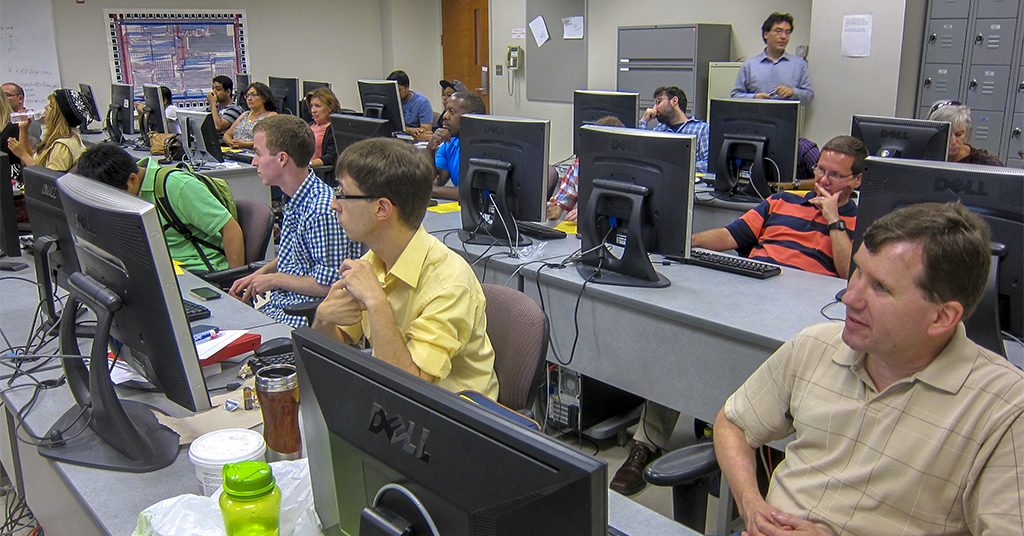
A novel aspect of UMBC’s SFS program is that it builds connections with two nearby community colleges—Montgomery College (MC) and Prince Georges Community College (PGCC). Each year, one student from each of these schools is selected for a scholarship. Upon graduation from community college, the student transfers to UMBC to complete their four-year degree. In doing so, UMBC taps into a significant pool of talent and increases the number of cybersecurity professionals who will enter government service. Each January, all SFS scholars from UMBC, MC, and PGCC engage in a one-week research study. Working collaboratively, they analyze a targeted aspect of the security of the UMBC computer system. The students enjoy the hands-on experience while helping to improve UMBC’s computer security. Students interested in applying for an SFS scholarship should consult the CISA SFS page and contact Professor Sherman. The next application deadline is November 15.
With $310,000 of support from NSF, Sherman and his CoPIs, Drs. Dhananjay Phatak and Linda Oliva, are developing educational Cybersecurity Assessment Tools (CATS) to measure student understanding of cybersecurity concepts. In particular, they are developing and validating two concept inventories: one for any first course in cybersecurity, and one for college graduates beginning a career in cybersecurity. These inventories will provide science-based criteria by which different approaches to cybersecurity education can be assessed (e.g., competition, gaming, hands-on exercises, and traditional classroom). This project is collaborative with the University of Illinois at Urbana-Champaign.
With $97,000 of support from NSA, Sherman is developing a virtual Protocol Analysis Lab that uses state-of-the-art tools to analyze cryptographic protocols for structural weaknesses. Protocols are the structured communications that take place when computers interact with each other, as for example happens when a browser visits a web page. Experience has shown that protocols are so complicated to analyze that there is tremendous value in studying them using formal methods. Sherman and his graduate students are making it easier to use existing tools including CPSA, Maude NPA, and Tamerin, applying them to analyze particular protocols, and developing associated educational materials.
The post UMBC’s Sherman receives $5.4m in funding for cybersecurity research and scholarships appeared first on Department of Computer Science and Electrical Engineering.
]]>
UMBC receives $5.4m in funding for new cybersecurity projects NSF and NSA Fund Three Cybersecurity Projects by Prof. Alan Sherman Professor Alan Sherman and colleagues were recently awarded...
https://www.csee.umbc.edu/2018/07/nsf-and-nsa-fund-three-cybersecurity-projects-by-prof-alan-sherman/
https://my3.my.umbc.edu/api/v0/pixel/news/77651/guest@my.umbc.edu/9b6126873c3cb88cd9ccd6c5510f4393/api/pixel
computer-science
cybersecurity
news
research
students
UMBC Cybersecurity Institute Group
https://my3.my.umbc.edu/groups/cybersecurity
https://assets3-my.umbc.edu/system/shared/avatars/groups/000/000/485/196da6a7ec6f4c31eab2e474c17a9ab7/xsmall.png?1734891477
https://assets3-my.umbc.edu/system/shared/avatars/groups/000/000/485/196da6a7ec6f4c31eab2e474c17a9ab7/original.png?1734891477
https://assets4-my.umbc.edu/system/shared/avatars/groups/000/000/485/196da6a7ec6f4c31eab2e474c17a9ab7/xxlarge.png?1734891477
https://assets4-my.umbc.edu/system/shared/avatars/groups/000/000/485/196da6a7ec6f4c31eab2e474c17a9ab7/xlarge.png?1734891477
https://assets2-my.umbc.edu/system/shared/avatars/groups/000/000/485/196da6a7ec6f4c31eab2e474c17a9ab7/large.png?1734891477
https://assets3-my.umbc.edu/system/shared/avatars/groups/000/000/485/196da6a7ec6f4c31eab2e474c17a9ab7/medium.png?1734891477
https://assets3-my.umbc.edu/system/shared/avatars/groups/000/000/485/196da6a7ec6f4c31eab2e474c17a9ab7/small.png?1734891477
https://assets3-my.umbc.edu/system/shared/avatars/groups/000/000/485/196da6a7ec6f4c31eab2e474c17a9ab7/xsmall.png?1734891477
https://assets3-my.umbc.edu/system/shared/avatars/groups/000/000/485/196da6a7ec6f4c31eab2e474c17a9ab7/xxsmall.png?1734891477
UMBC Center for Cybersecurity
1
0
true
Wed, 25 Jul 2018 22:15:49 -0400
2018 Maryland Cyber Challenge registration opens for student teams
2018 Maryland Cyber Challenge seeks student teams
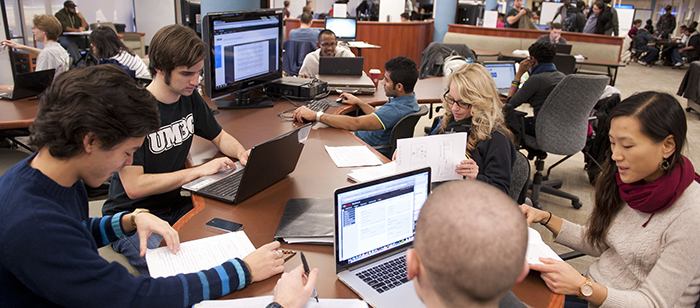
The 2018 Maryland Cyber Challenge seeks teams willing to test a range of skills simulating real-word cyber scenarios. Teams will climb a ladder of challenges demonstrating an ability to work together, understand both simple and complex vulnerabilities, defensive operations and gamified offensive operations.
Registration is now open. An initial orientation session start the week of August 13 and qualification Round 1 will be September 8-9..
The finals will take place live at CyberMaryland 2018 in Baltimore on October 10. Prizes (TBA) will be presented LIVE by during a closing session at CyberMaryland.
Get more information and register here
The post 2018 Maryland Cyber Challenge registration opens for student teams appeared first on Department of Computer Science and Electrical Engineering.
]]>
2018 Maryland Cyber Challenge seeks student teams The 2018 Maryland Cyber Challenge seeks teams willing to test a range of skills simulating real-word cyber scenarios. Teams will...
https://www.csee.umbc.edu/2018/07/2018-maryland-cyber-challenge-registration-opens/
https://my3.my.umbc.edu/api/v0/pixel/news/77610/guest@my.umbc.edu/48f1c9587f34d74433fab384c7e2f6b7/api/pixel
cybersecurity
events
students
UMBC Cybersecurity Institute Group
https://my3.my.umbc.edu/groups/cybersecurity
https://assets3-my.umbc.edu/system/shared/avatars/groups/000/000/485/196da6a7ec6f4c31eab2e474c17a9ab7/xsmall.png?1734891477
https://assets3-my.umbc.edu/system/shared/avatars/groups/000/000/485/196da6a7ec6f4c31eab2e474c17a9ab7/original.png?1734891477
https://assets4-my.umbc.edu/system/shared/avatars/groups/000/000/485/196da6a7ec6f4c31eab2e474c17a9ab7/xxlarge.png?1734891477
https://assets4-my.umbc.edu/system/shared/avatars/groups/000/000/485/196da6a7ec6f4c31eab2e474c17a9ab7/xlarge.png?1734891477
https://assets2-my.umbc.edu/system/shared/avatars/groups/000/000/485/196da6a7ec6f4c31eab2e474c17a9ab7/large.png?1734891477
https://assets3-my.umbc.edu/system/shared/avatars/groups/000/000/485/196da6a7ec6f4c31eab2e474c17a9ab7/medium.png?1734891477
https://assets3-my.umbc.edu/system/shared/avatars/groups/000/000/485/196da6a7ec6f4c31eab2e474c17a9ab7/small.png?1734891477
https://assets3-my.umbc.edu/system/shared/avatars/groups/000/000/485/196da6a7ec6f4c31eab2e474c17a9ab7/xsmall.png?1734891477
https://assets3-my.umbc.edu/system/shared/avatars/groups/000/000/485/196da6a7ec6f4c31eab2e474c17a9ab7/xxsmall.png?1734891477
UMBC Center for Cybersecurity
2
0
true
Mon, 23 Jul 2018 21:37:30 -0400
talk: Robot Governance – Institutions and Issues, 10:30 Tue 7/24, ITR346

Robot Governance – Institutions and Issues
Dr. Aaron Mannes, ISHPI Information Technologies
10:30-11:30 Tuesday, 24 July 2018, ITE 346
Inexpensive sensors and information storage and processing have enabled the large-scale production of robots: autonomous systems capable of acting on the world. These systems represent an enormous technological and economic opportunity that will change society in countless and unpredictable ways. They will also bring new policy challenges. This presentation examines the missions the government will need to undertake to address the challenges raised by this new technology, identifies critical gaps the government faces in carrying out these missions, and discusses institutional options to address these gaps.
Dr. Aaron Mannes is the Senior Policy Advisor at ISHPI Information Technologies, where he supports the Apex Data Analytics Engine (DA-E) at the Department of Homeland Security Science and Technology Directorate. In supporting DA-E, Dr. Mannes collaborates on big data projects that support the Homeland Security Enterprise and researches technology policy. He started at DHS as an American Association for the Advancement of Science Policy Fellow in September 2015. From 2004 to 2015, Dr. Mannes was a researcher at the University of Maryland Institute for Advanced Computer Studies (UMIACS) where he was the subject matter expert on terrorism and international affairs collaborating with a team of inter-disciplinary scientists to build computational tools to support decision-makers facing 21st century security and development problems. Dr. Mannes earned his Ph.D. at the University of Maryland’s School of Public Policy in 2014. His dissertation topic was the evolving national security role of the vice president.
Dr. Mannes is the author or co-author of four books on terrorism and has written scores of articles, papers, and book chapters on an array of topics including Middle East affairs, terrorism, technology, and other international security issues for popular and scholarly publications including Politico, Policy Review, The Wall Street Journal, Foreign Policy, The Journal of International Security Affairs, The Huffington Post, The National Interest, The Jerusalem Post, and The Guardian.
This research was conducted with the support of the Apex Data Analytics Engine in the Department of Homeland Security (DHS) Science and Technology Directorate (S&T). In no way should anything stated in this seminar be construed as representing the official position of DHS S&T or any other component of DHS. Opinions and findings expressed in this seminar, as well as any errors and omissions, are the responsibility of the presenter alone.
The post talk: Robot Governance – Institutions and Issues, 10:30 Tue 7/24, ITR346 appeared first on Department of Computer Science and Electrical Engineering.
]]>
Robot Governance – Institutions and Issues Dr. Aaron Mannes, ISHPI Information Technologies 10:30-11:30 Tuesday, 24 July 2018, ITE 346 Inexpensive sensors and information storage...
https://www.csee.umbc.edu/2018/07/talk-robot-governance-institutions-and-issues-1030-tue-7-24-itr346/
https://my3.my.umbc.edu/api/v0/pixel/news/77606/guest@my.umbc.edu/eb929b4718ba6f9af0b285ec85f5cf78/api/pixel
computer-engineering
computer-science
cybersecurity
news
talks
UMBC Cybersecurity Institute Group
https://my3.my.umbc.edu/groups/cybersecurity
https://assets3-my.umbc.edu/system/shared/avatars/groups/000/000/485/196da6a7ec6f4c31eab2e474c17a9ab7/xsmall.png?1734891477
https://assets3-my.umbc.edu/system/shared/avatars/groups/000/000/485/196da6a7ec6f4c31eab2e474c17a9ab7/original.png?1734891477
https://assets4-my.umbc.edu/system/shared/avatars/groups/000/000/485/196da6a7ec6f4c31eab2e474c17a9ab7/xxlarge.png?1734891477
https://assets4-my.umbc.edu/system/shared/avatars/groups/000/000/485/196da6a7ec6f4c31eab2e474c17a9ab7/xlarge.png?1734891477
https://assets2-my.umbc.edu/system/shared/avatars/groups/000/000/485/196da6a7ec6f4c31eab2e474c17a9ab7/large.png?1734891477
https://assets3-my.umbc.edu/system/shared/avatars/groups/000/000/485/196da6a7ec6f4c31eab2e474c17a9ab7/medium.png?1734891477
https://assets3-my.umbc.edu/system/shared/avatars/groups/000/000/485/196da6a7ec6f4c31eab2e474c17a9ab7/small.png?1734891477
https://assets3-my.umbc.edu/system/shared/avatars/groups/000/000/485/196da6a7ec6f4c31eab2e474c17a9ab7/xsmall.png?1734891477
https://assets3-my.umbc.edu/system/shared/avatars/groups/000/000/485/196da6a7ec6f4c31eab2e474c17a9ab7/xxsmall.png?1734891477
UMBC Center for Cybersecurity
1
0
true
Mon, 23 Jul 2018 17:27:32 -0400