When Good Design Is Invisible: Four UMBC Faculty Share How UDL Supports Student Learning
Small design choices make learning more accessible for all.
Students in Sarah Bass’s chemistry courses who use the course-grounded AI assistant say it feels like talking to their professor. Many of their classmates, though, don’t know the assistant exists or aren’t sure what it’s for.
That gap between a well-designed support and the student who actually uses it was the focus of “When Good Design Is Invisible: Helping Students Recognize UDL,” a National Distance Learning Week panel on November 2. Four UMBC faculty from social work, chemistry, modern languages, and dance shared how Universal Design for Learning (UDL) shapes their courses, and how they help students see and use the choices built into them.

Panelists: Sarah Bass, Jill Vasbinder Morrison, Milvia Hernández, and Tiffany Banks
1. Building a Structure Students Can Predict
With more than 300 students in each chemistry lecture section, Bass relies on consistency. Deadlines follow a predictable pattern and appear everywhere students look: Blackboard, their calendars, and the slides posted after class. After a deadline passes, the material reopens so students can keep practicing. Bass tells students why the course runs this way.
Predictable organization means less energy spent figuring out what to do and more spent on chemistry. She also explains the purpose of each kind of practice, from reviewing foundational concepts to taking practice exams. The goal isn't simply to help students navigate chemistry, but to help them recognize what they need and develop strategies for managing their own learning.
2. Counting More Than One Kind of Participation
In dance courses, participation is essential, and Jill Vasbinder Morrison grades it. She doesn’t define it as raising a hand. Students can talk in pairs, add to shared slides and spreadsheets, serve as class scribe, or join an optional discussion board after a missed class. When she explains this on the first day, she can see the relief. She repeats it in the Start Here folder, the syllabus, every slide deck, and VoiceThread.
A syllabus quiz with multiple attempts reinforces these expectations and helps students locate important course information. When a student still isn’t using any of the options, she reaches out one-on-one to remind them that the choices are real and that they count. By making participation options explicit and reinforcing them throughout the semester, Morrison helps students recognize that contributing to learning doesn't have to look the same for everyone.
3. Explaining the Small Routines
Some of the most effective supports in Milvia Hernández’s asynchronous Spanish courses look almost too simple. Students copy each chapter’s vocabulary by hand, even though it’s in the ebook, and a short video explains why handwriting helps language learning. For a student who can’t handwrite, recording the words aloud serves the same purpose.
Projects unfold in connected stages with feedback along the way, so the final product gathers work students have already done. Students rarely see the point at first, but by the end they say it’s what helped most. In the first week, instead of handing out study tips, Hernández has students find strategies for learning a language online, share them in a forum, and pick one or two to try. Whether students are practicing vocabulary, building a project, or choosing study strategies, Hernández helps them understand why they're doing the work and how those routines support their learning.
4. Making It Safe to Ask
Tiffany Banks opens each semester in her social work courses by telling students what it means to her to be a neuroaffirming educator. Students can ask her for flexibility, such as an extension, even without a diagnosis or formal accommodation. When she can’t say yes, usually because grades are due, she tells them why. In class, she makes it clear that not every activity is graded. A quick thumbs up, sideways, or down tells her whether to slow down or try another approach.
Some of those new approaches last: a visual that one cohort created to understand a difficult concept now appears in her slides for the next class. As Banks emphasized, there's never a perfect solution. UDL is an ongoing process of listening, adjusting, and recognizing that students may need different kinds of support at different times.
Across four very different disciplines, the panelists demonstrated that UDL doesn't require redesigning an entire course. It starts with noticing where students encounter barriers, making one purposeful change, and helping students understand how that change supports their learning. Sometimes the most meaningful improvement isn't adding another activity or resource. It's helping students recognize and use the thoughtful design already built into their learning experience.
Explore UDL in Your Teaching
Interested in applying Universal Design for Learning to your courses? UMBC's Instructional Technology team can help you identify barriers, explore practical strategies, and make purposeful changes that support student learning.
]]>
Students in Sarah Bass’s chemistry courses who use the course-grounded AI assistant say it feels like talking to their professor. Many of their classmates, though, don’t know the assistant exists...
Inline Image
https://assets3-my.umbc.edu/system/shared/attachments/90d0094b4362cb0aa6c15af08194b0b9/6aea90f3/news/000/164/840/6c5f8fc72176d961820f0d9b8ae70006/FourFaculty.jpeg?1793716499
https://my3.my.umbc.edu/api/v0/pixel/news/164840/guest@my.umbc.edu/ed3ab9c93d462fea753ca9d66631f387/api/pixel
da
digital-accessibility
fa2026
faculty
fine-arts
humanities
learner-variability
national-distance-learning-week
ndlw
panel-discussion
social-sciences
stem
student-success
udl
universal-design-for-learning
Instructional Technology
https://my3.my.umbc.edu/groups/instructional-technology
https://assets2-my.umbc.edu/system/shared/avatars/groups/000/001/164/dec3b026b81ee6d890a8f82f75c94a2e/xsmall.png?1446126703
https://assets1-my.umbc.edu/system/shared/avatars/groups/000/001/164/dec3b026b81ee6d890a8f82f75c94a2e/original.png?1446126703
https://assets2-my.umbc.edu/system/shared/avatars/groups/000/001/164/dec3b026b81ee6d890a8f82f75c94a2e/xxlarge.png?1446126703
https://assets1-my.umbc.edu/system/shared/avatars/groups/000/001/164/dec3b026b81ee6d890a8f82f75c94a2e/xlarge.png?1446126703
https://assets1-my.umbc.edu/system/shared/avatars/groups/000/001/164/dec3b026b81ee6d890a8f82f75c94a2e/large.png?1446126703
https://assets4-my.umbc.edu/system/shared/avatars/groups/000/001/164/dec3b026b81ee6d890a8f82f75c94a2e/medium.png?1446126703
https://assets3-my.umbc.edu/system/shared/avatars/groups/000/001/164/dec3b026b81ee6d890a8f82f75c94a2e/small.png?1446126703
https://assets2-my.umbc.edu/system/shared/avatars/groups/000/001/164/dec3b026b81ee6d890a8f82f75c94a2e/xsmall.png?1446126703
https://assets3-my.umbc.edu/system/shared/avatars/groups/000/001/164/dec3b026b81ee6d890a8f82f75c94a2e/xxsmall.png?1446126703
Instructional Technology
https://assets4-my.umbc.edu/system/shared/thumbnails/news/000/164/840/32991528515cbbe70bf544859549e7a3/xxlarge.jpg?1793715741
https://assets2-my.umbc.edu/system/shared/thumbnails/news/000/164/840/32991528515cbbe70bf544859549e7a3/xlarge.jpg?1793715741
https://assets2-my.umbc.edu/system/shared/thumbnails/news/000/164/840/32991528515cbbe70bf544859549e7a3/large.jpg?1793715741
https://assets1-my.umbc.edu/system/shared/thumbnails/news/000/164/840/32991528515cbbe70bf544859549e7a3/medium.jpg?1793715741
https://assets2-my.umbc.edu/system/shared/thumbnails/news/000/164/840/32991528515cbbe70bf544859549e7a3/small.jpg?1793715741
https://assets3-my.umbc.edu/system/shared/thumbnails/news/000/164/840/32991528515cbbe70bf544859549e7a3/xsmall.jpg?1793715741
https://assets1-my.umbc.edu/system/shared/thumbnails/news/000/164/840/32991528515cbbe70bf544859549e7a3/xxsmall.jpg?1793715741
Course Roadmap to Equity Learning Design logo
4
0
true
Tue, 03 Nov 2026 14:30:00 -0500
6 Ways to Make Humanities Content More Accessible
The text matters. So does whether students can reach it.
A student pulls up the assigned primary source the night before class: a scanned nineteenth-century pamphlet, photographed at an angle, half the page lost in shadow. She can make out maybe two-thirds of the text. The rest she'll have to guess -- or skip. She hasn't even reached the difficult work of interpreting the source yet.
Fixing that barrier matters. But even when a text, image, or primary source is technically accessible, students may still struggle to navigate a dense argument, understand an unfamiliar context, or recognize what deserves their attention. Making a source technically accessible is an essential first step. Then ask whether students can use it to achieve the intended learning objective.
That's where the learning purpose becomes important. Humanities courses often ask students to engage with material that is dense, ambiguous, unfamiliar, or complex, and much of that complexity belongs in the course. Before changing the source or activity, ask: What are students supposed to interpret, analyze, or communicate? What needs to remain difficult for that learning to happen?
Then, consider where different learners might get stuck. The goal isn't to simplify the source. It's to reduce barriers that aren't part of interpreting it.
1. Make the Text Reachable Before Asking Students to Read It
A scanned page may look like text, but to a screen reader -- or a student who wants to search, highlight, or resize it -- it may be just an image.
Before students can analyze an argument or perform a close reading, they need access to the words themselves.
-
Choose a native, searchable version when one exists.
-
Run image-based scans through optical character recognition (OCR) and check the results for errors. For PDFs, follow the instructions for running OCR with Blackboard Ally or recognizing text with Adobe Acrobat.
-
Pay particular attention to names, unfamiliar vocabulary, footnotes, and older typefaces.
Quick check: Can you select a sentence and search the document for a word you can see? If not, the file may need attention.
The document's age may be part of what makes it worth studying. It shouldn't also be what makes it unreachable.
2. Give Difficult Sources Another Way In
Handwritten letters, manuscripts, historical newspapers, and other archival materials may be intentionally difficult objects of study. Accessibility doesn't require replacing the original with a cleaned-up version.
-
Pair handwritten, faded, or difficult-to-read sources with a transcription when possible.
-
Keep the original available when layout, annotations, or physical characteristics matter to the analysis.
-
Explain unfamiliar abbreviations or notation when deciphering them isn't part of the learning goal.
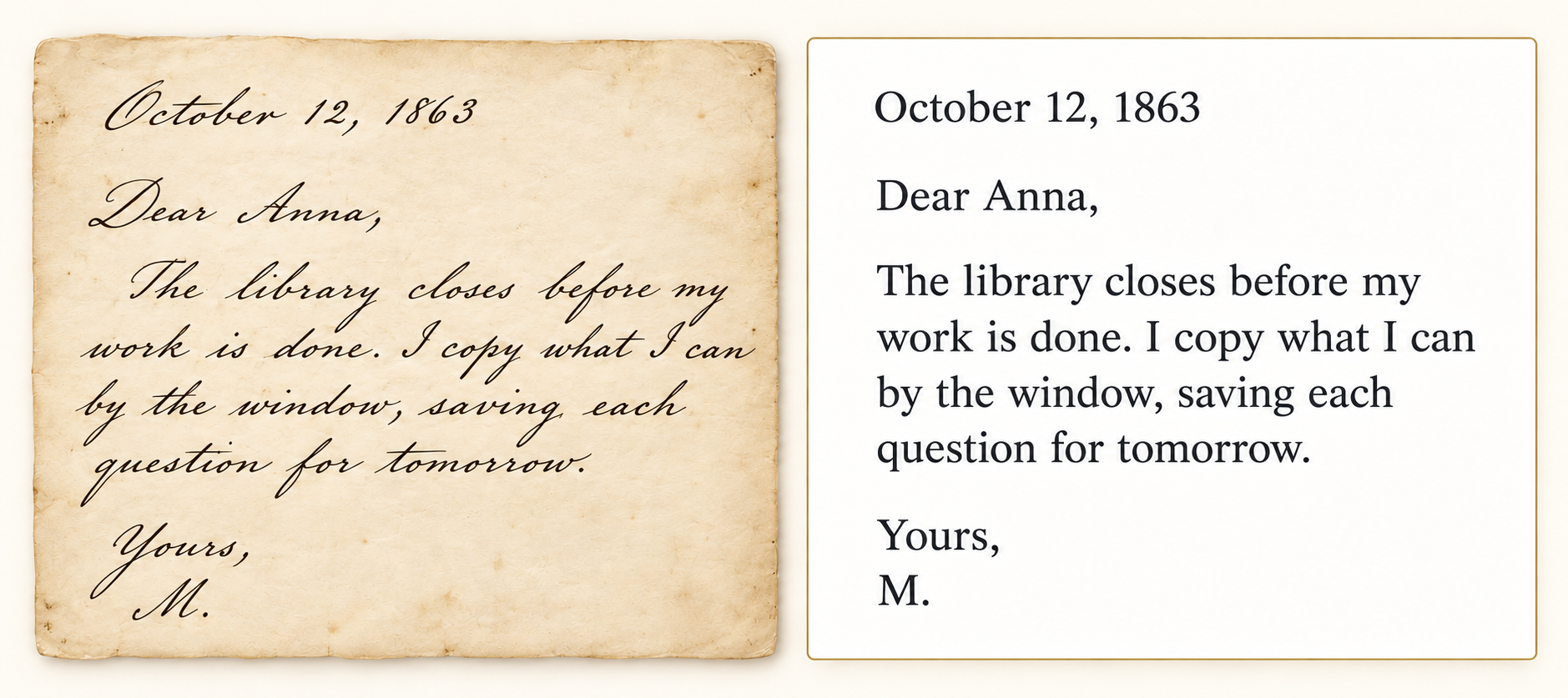
Image: Illustrative example of handwritten letter and transcription.
For example: Keep the original manuscript but provide a transcription alongside it. Students can still examine handwriting, layout, and other material features while using the transcription to access the words. The transcription removes an unnecessary barrier while preserving the interpretive work.
3. Describe What Students Need to Interpret
A painting, political cartoon, map, photograph, or manuscript image may be technically accessible and still not provide students with enough information to perform the analysis.
Start with the assignment: What do students need to notice in order to interpret the source themselves?
-
Use brief alternative text when identifying the image is sufficient.
-
Provide a longer description when students need significant visual detail.
-
Describe relevant composition, objects, text, spatial relationships, or other observable features.
-
Separate description from interpretation.
The goal isn't to interpret the image for students. It's to make sure every student has something to interpret.
4. Support Navigation Without Simplifying the Text
A difficult text should sometimes be difficult. Philosophy, theory, literature, and primary sources can require sustained attention, ambiguity, and rereading. Yet intellectual difficulty isn't the same as difficulty navigating a poorly structured document, or not knowing what to attend to.
-
Use headings and a navigable structure when the source allows it.
-
Break very long readings into meaningful sections where appropriate.
-
Provide questions students can track as they read.
-
Point out major shifts in an argument or places where especially close reading will be useful.
Structure doesn't simplify the text. It helps students direct their effort toward the complexity that matters.
Try this: Before assigning a challenging reading, identify two or three places where students may lose the thread of the argument. Provide guiding questions at those points without explaining the author's conclusions. What support might help students navigate the text while preserving the work of interpretation?
5. Make Multimedia Available for Close Study
Documentaries, recorded lectures, oral histories, and archival audio aren't simply things students watch or hear. They're often sources students need to quote, revisit, compare, and analyze.
-
Caption video and provide transcripts for audio.
-
Check automated captions for names, places, quotations, and specialized terminology.
-
Describe significant visual information when meaning depends on what students can see as well as hear.
A transcript does more than provide technical access. It can let students search for a phrase, compare languages, annotate a passage, or return to a difficult moment.
6. Give Students More Than One Way to Develop an Interpretation
A class discussion may be completely accessible from a technical standpoint and still privilege students who process quickly and are comfortable speaking without preparation.
-
Share discussion questions in advance when possible.
-
Give students time to write, annotate, or gather evidence before discussion.
-
Offer a written way to contribute alongside live discussion when appropriate.
Try this: Before the discussion, give students two minutes to write one claim and identify one piece of evidence from the source. The goal is to help you understand how students interpret the material, not to measure who can formulate an interpretation fastest.
Try One Purposeful Change
First, choose one source or activity where students seem to struggle. Ask: What are students supposed to interpret or analyze? What difficulty belongs to that work—and what difficulty doesn't?
Then, try one change that reduces an unnecessary barrier while preserving the intellectual challenge.
Finally, look for one reasonable sign that the change helped. Are students asking fewer questions about accessing or navigating the source? Are they citing stronger evidence? Are discussions spending more time on what the source means?
Use what you notice to decide what to keep, adjust, or try next.
Keep Exploring
Find step-by-step guidance and additional resources for creating accessible course content on the Digital Accessibility website.
We'll explore strategies like these at Remove Barriers, Not Complexity: Designing Accessible Humanities Learning on October 28. Bring a reading, image, primary source, or discussion activity from your course.
]]>
A student pulls up the assigned primary source the night before class: a scanned nineteenth-century pamphlet, photographed at an angle, half the page lost in shadow. She can make out maybe...
Inline Image
https://assets2-my.umbc.edu/system/shared/attachments/2b716162d79df03200b70c284afc4e65/6aea90f3/news/000/164/463/123e833a90f23ddf2e3befab03913578/blobid0.png?1793109543
https://my3.my.umbc.edu/api/v0/pixel/news/164463/guest@my.umbc.edu/b3f1c3e39527d9e0e7440f62aab21ac9/api/pixel
da
digital-accessibility
fa2026
faculty
humanities
udl
universal-design-for-learning
Instructional Technology
https://my3.my.umbc.edu/groups/instructional-technology
https://assets2-my.umbc.edu/system/shared/avatars/groups/000/001/164/dec3b026b81ee6d890a8f82f75c94a2e/xsmall.png?1446126703
https://assets1-my.umbc.edu/system/shared/avatars/groups/000/001/164/dec3b026b81ee6d890a8f82f75c94a2e/original.png?1446126703
https://assets2-my.umbc.edu/system/shared/avatars/groups/000/001/164/dec3b026b81ee6d890a8f82f75c94a2e/xxlarge.png?1446126703
https://assets1-my.umbc.edu/system/shared/avatars/groups/000/001/164/dec3b026b81ee6d890a8f82f75c94a2e/xlarge.png?1446126703
https://assets1-my.umbc.edu/system/shared/avatars/groups/000/001/164/dec3b026b81ee6d890a8f82f75c94a2e/large.png?1446126703
https://assets4-my.umbc.edu/system/shared/avatars/groups/000/001/164/dec3b026b81ee6d890a8f82f75c94a2e/medium.png?1446126703
https://assets3-my.umbc.edu/system/shared/avatars/groups/000/001/164/dec3b026b81ee6d890a8f82f75c94a2e/small.png?1446126703
https://assets2-my.umbc.edu/system/shared/avatars/groups/000/001/164/dec3b026b81ee6d890a8f82f75c94a2e/xsmall.png?1446126703
https://assets3-my.umbc.edu/system/shared/avatars/groups/000/001/164/dec3b026b81ee6d890a8f82f75c94a2e/xxsmall.png?1446126703
Instructional Technology
https://assets4-my.umbc.edu/system/shared/thumbnails/news/000/164/463/ba2b03d79d95d5f91982c2887b3b7a97/xxlarge.jpg?1792677975
https://assets2-my.umbc.edu/system/shared/thumbnails/news/000/164/463/ba2b03d79d95d5f91982c2887b3b7a97/xlarge.jpg?1792677975
https://assets3-my.umbc.edu/system/shared/thumbnails/news/000/164/463/ba2b03d79d95d5f91982c2887b3b7a97/large.jpg?1792677975
https://assets4-my.umbc.edu/system/shared/thumbnails/news/000/164/463/ba2b03d79d95d5f91982c2887b3b7a97/medium.jpg?1792677975
https://assets2-my.umbc.edu/system/shared/thumbnails/news/000/164/463/ba2b03d79d95d5f91982c2887b3b7a97/small.jpg?1792677975
https://assets1-my.umbc.edu/system/shared/thumbnails/news/000/164/463/ba2b03d79d95d5f91982c2887b3b7a97/xsmall.jpg?1792677975
https://assets2-my.umbc.edu/system/shared/thumbnails/news/000/164/463/ba2b03d79d95d5f91982c2887b3b7a97/xxsmall.jpg?1792677975
Course Roadmap to Equity Learning Design logo
6
0
true
Tue, 27 Oct 2026 12:00:00 -0400