Take Back the Night 2019 Round-Up
This blog was originally written and posted on April 22, 2019 by sambam226.
On April 18th 2019, the Women’s Center hosted the seventh annual Take Back the Night at UMBC. The night began with an introduction by the emcees Autumn, Calista and Women’s Center staff members, Samiksha and Morgan.
Photo credit: Samiksha Manjani
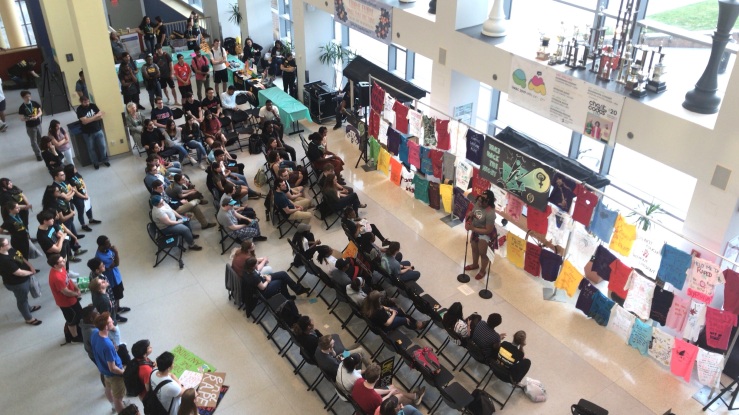
After the introduction was the survivor speak-out. The speak-out is the heart and soul of Take Back the Night. Survivors are encouraged to come up and share their story with the crowd before the march throughout campus. As a survivor, sharing your story at TBTN allows you to acknowledge your experience with others who believe and support you.
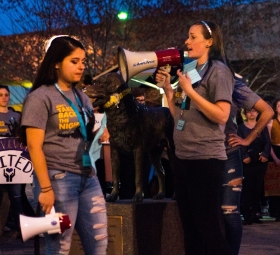
We then moved on to the march portion of the night, where we got loud and chanted in support of victims of sexual violence. We Believe You, an activist group dedicated to ending sexual violence, led the march, the survivor circle of care, and a private discussion in the Women’s Center following the march.
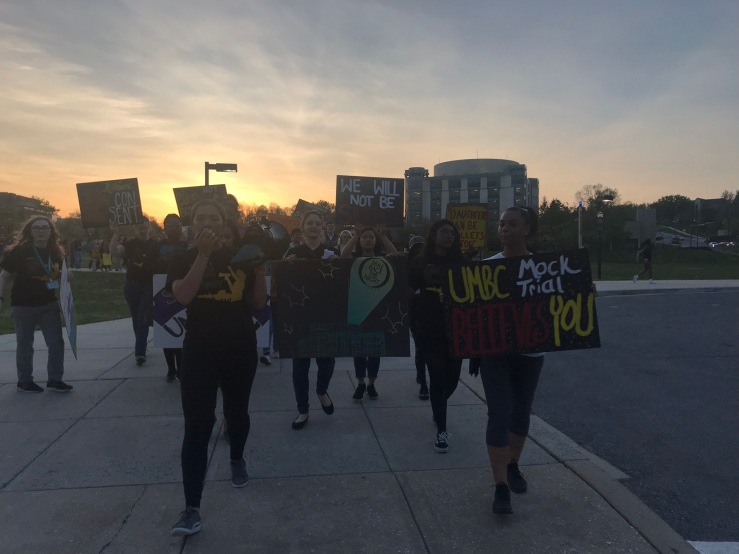

The survivor circle is a new addition to Take Back the Night. At the peak of the march, everyone formed a circle around True Grit. Survivors were invited to the middle of the circle, while supporters chanted the refrain, “We see you. We believe you. You matter.” After the survival circle, the march back to Main Street commenced.
After the march, community members got back together for some craftivism! This part of the night is intended to provide space for reflection, creative expression, and community-building between survivors and supporters alike.
Thank you so much to everyone for a powerful and moving evening. Thank you to every survivor for sharing their story, to every ally who supported the survivors, and a special thank you to all the volunteers and We Believe You members who made TBTN possible!
If you weren’t able to make it, here are some resources:
]]>
This blog was originally written and posted on April 22, 2019 by sambam226. On April 18th 2019, the Women’s Center hosted the seventh annual Take Back the Night at UMBC. The night began with an...
https://my3.my.umbc.edu/api/v0/pixel/news/132423/guest@my.umbc.edu/9a864415a707ff108422047e4de69816/api/pixel
activism
feminism
programs
saam
sexual-assault
sexual-assault-awareness-month
survivors
survivors-of-sexual-violence
take-back-the-night
tbtn
umbc
what-you-need-to-know-tbtn
Women's, Gender, & Equity Center
https://my3.my.umbc.edu/groups/womenscenter
https://assets2-my.umbc.edu/system/shared/avatars/groups/000/000/125/78272a4842689b30dbf74672182b78f8/xsmall.png?1750974263
https://assets1-my.umbc.edu/system/shared/avatars/groups/000/000/125/78272a4842689b30dbf74672182b78f8/original.png?1750974263
https://assets1-my.umbc.edu/system/shared/avatars/groups/000/000/125/78272a4842689b30dbf74672182b78f8/xxlarge.png?1750974263
https://assets1-my.umbc.edu/system/shared/avatars/groups/000/000/125/78272a4842689b30dbf74672182b78f8/xlarge.png?1750974263
https://assets1-my.umbc.edu/system/shared/avatars/groups/000/000/125/78272a4842689b30dbf74672182b78f8/large.png?1750974263
https://assets2-my.umbc.edu/system/shared/avatars/groups/000/000/125/78272a4842689b30dbf74672182b78f8/medium.png?1750974263
https://assets1-my.umbc.edu/system/shared/avatars/groups/000/000/125/78272a4842689b30dbf74672182b78f8/small.png?1750974263
https://assets2-my.umbc.edu/system/shared/avatars/groups/000/000/125/78272a4842689b30dbf74672182b78f8/xsmall.png?1750974263
https://assets3-my.umbc.edu/system/shared/avatars/groups/000/000/125/78272a4842689b30dbf74672182b78f8/xxsmall.png?1750974263
Women's Center
https://assets1-my.umbc.edu/system/shared/thumbnails/news/000/132/423/db9b1ced1636d2d8612c3f5e9b7cb939/xxlarge.jpg?1680883447
https://assets4-my.umbc.edu/system/shared/thumbnails/news/000/132/423/db9b1ced1636d2d8612c3f5e9b7cb939/xlarge.jpg?1680883447
https://assets3-my.umbc.edu/system/shared/thumbnails/news/000/132/423/db9b1ced1636d2d8612c3f5e9b7cb939/large.jpg?1680883447
https://assets2-my.umbc.edu/system/shared/thumbnails/news/000/132/423/db9b1ced1636d2d8612c3f5e9b7cb939/medium.jpg?1680883447
https://assets2-my.umbc.edu/system/shared/thumbnails/news/000/132/423/db9b1ced1636d2d8612c3f5e9b7cb939/small.jpg?1680883447
https://assets2-my.umbc.edu/system/shared/thumbnails/news/000/132/423/db9b1ced1636d2d8612c3f5e9b7cb939/xsmall.jpg?1680883447
https://assets3-my.umbc.edu/system/shared/thumbnails/news/000/132/423/db9b1ced1636d2d8612c3f5e9b7cb939/xxsmall.jpg?1680883447
0
0
true
Fri, 07 Apr 2023 12:12:08 -0400
What You Need To Need Know: TBTN & Why We March
Posted and Written on March 26, 2019 by sambam226
April is Sexual Assault Awareness Month, and the Women's Center is hosting its 7th Take Back the Night on Thursday, April 13th. Over the years, we've had a lot of questions about what Take Back the Night exactly is, why it looks the way it does, and how students can get involved. To help get those questions answered we started the 'What You Need to Know" series focused on TBTN from 2019 and are continuing on the tradition, so stay tuned for more posts over the next couple of weeks. This blog focuses on the evening's campus march against sexual violence.

1,2,3,4 WE WON'T TAKE IT ANYMORE
5,6,7,8 NO MORE VIOLENCE! NO MORE HATE!
As a survivor of sexual assault, the Take Back The Night march reminds me that I'm not alone.
Mariana De Matos Medeiros, '16, and former student staff member at the Women's Center, said "To me, having the opportunity to speak and march at TBTN last year reminded me that I am not alone and that I can stand in my power to speak about my experience. It took me 3 years to finally speak about my assault and one of the very first times was at TBTN last year. Seeing so many gathered to support allowed me to speak and speaking has allowed me to heal."
It can be easy to blame yourself, isolate yourself, and feel like you're the only person struggling with your healing; However, the march lets you connect with people who support you and believe you.
Sarah Lilly, a 2016 and 2017 Take Back The Night student leader says "Marching is us showing that solidarity is a verb, and it brings me great pride to feel so supported by my local UMBC community and to see the unconditional support for everyone else in our community."
In an open letter in her school's newspaper, survivor and student activist, Angie Epifano, recounted the aftermath of her sexual assault, namely her experience with institutional betrayal. She ended the letter with, "Silence has the rusty taste of shame." Due to rape culture, victim blaming, a lack of support for survivors, and more, it is understandable that many survivors do not disclose their experience and sexual assault is rarely spoke of in public.
Much like the Baltimore-based Monument Quilt is creating and demanding public space for survivors to heal, Take Back the Night demands for space in which we will not be shamed into silence. Activists like Angie, the Monument Quilt creators, and YOU during the march are creating a new culture where survivors are publicly supported, rather than publicly shamed.
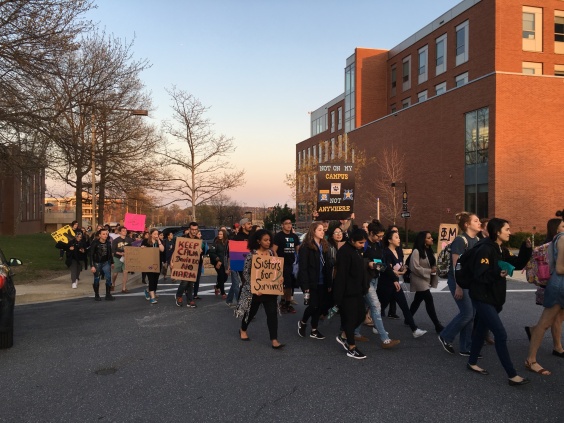
Here's some helpful information about the campus march against sexual violence to those attending Take Back the Night at UMBC:
- The survivor speak-out is intended to center the voices and experience of survivors (of all identities) of sexual violence. The speak-out is for allies to listen and survivors to break their silence but the march is for EVERYONE to GET LOUD!
- We encourage individuals and groups to make rally signs ahead of time. Signs are a great way to show your solidarity and support while also representing your student orgs, res hall communities, and frats/sororities.
-
We'll line everyone up in the march in waves. Survivors wanting to march up front with other survivors are invited to line up first along with other community members needed to take an accessible route march. Everyone else will then line up as survivors begin to march towards the south exit of The Commons.
- As we march, walk slowly and stay together. Try to avoid large gaps in the line.
- This year we're bringing back the Survivor Circle. As we make out way through the route we will stop midway through the march and hold our Survivor Circle.
- The Survivor Circle is a chance for survivors who may or may not have shared their story during the speak out to be recognized, come together, and be surrounded in support and healing by those attending the march. This is an opportunity for those who identify as survivors to come together without having to speak out or share their story if they do not wish to do so.
- The march will end back on Main Street where the space will be ready for the evening's resource fair and craftivism. As you're heading back into The Commons, come all the way into Main Street so everyone else behind you can get into the space as well.
- There will be one more chance to share your experience as a survivor post-march at a survivor discussion group led by the student organization We Believe You in the Women's Center. (This event will be private and for survivors only).
- Counselors-On-Call will be available throughout the evening. Any one needing additional support or simply needs to take a break are invited to visit the self-care station that will be set up in the Commuter Lounge.

For more information about UMBC's TBTN (check out Facebook, Instagram, and Twitter too by searching the hashtag #UMBCTBTN):
- Stop by the Women's Center the week leading up to TBTN to make a rally sign for the march on April 17th
- A blog post about UMBC's 2005 TBTN march written by alum, Dr. Grollman.
- Speak: Knowing a Survivor Without Knowing Their Story - a blog post on cultivating a survivor-responsive campus.
- Register for and attend an upcoming Supporting Survivors of Sexual Violence workshop. Click here for more details on the students workshop.
- The Women's Center 2018 TBTN roundup
Stay tuned for the next installment of what you need to know about TBTN 2019!
What You Need To Need Know: Take Back The Night & Its History
April is Sexual Assault Awareness Month, and the Women’s Center is hosting its 5th consecutive Take Back The Night (TBTN) on Thursday, April 13th. Over the years, we’ve had a lot of questions about what Take Back the Night exactly is, why it looks the way it does, and how students can get involved. To help get those questions answered this year, we’ve doing a “What You Need to Know” series focused on TBTN so stay tuned for more posts over the next couple of weeks. This first post in the series focuses on the history and purpose of TBTN.
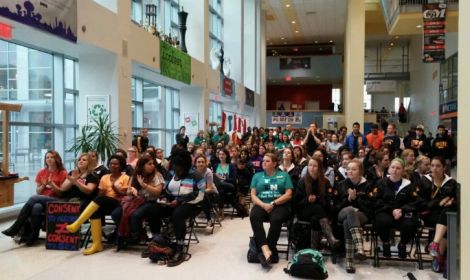
The crowd waiting for UMBC’s TBTN 2014 to begin.
In 1971 in New York a group of women and survivors hosted the first-ever rape speak-out that was organized by the group the New York Radical Feminists. A few years later, one of the first “Take Back the Night” marches was held in Philadelphia, Pennsylvania in October 1975.
Despite some advancements and more attention being paid to sexual violence, we still live in a society where over forty-five years later there is still a need to speak out against rape and sexual assault. There is still a need to say, “It happened to me.” “I believe you.” “You are not alone.” “It is not your fault.” And, so this is why we host Take Back the Night each year at UMBC and why it still happens worldwide.
UMBC (from what we can tell from the archives), held their first TBTN event in the early 2000s for just a few years. Campus stopped hosting it for several years so as to be in solidarity with other area colleges by participating in Baltimore City Hall’s Take Back the Night. But, by 2013, it made the most sense for us to bring back our own Take Back the Night. So the Women’s Center with support from UHS’s Health Education, Greek Week, and a BreakingGround grant did just that. Since then, this campus-wide rally and march against sexual violence has been a signature Women’s Center event every April.
Each year the Women’s Center hosts survivor speak-out followed by a campus march against sexual assault. When marchers return, UMBC’s TBTN spends the rest of the evening doing “craftivism” art healing projects and hosting a community resource fair. A smaller version of the Clothesline Project is also serves as a backdrop to the evening’s events.
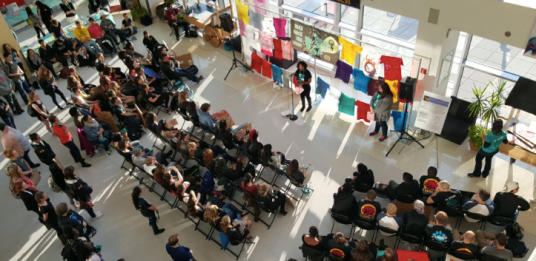
The survivor speak-out at UMBC’s TBTN 2016
Stay tuned for more posts explaining the significance of each portion of Take Back The Night!
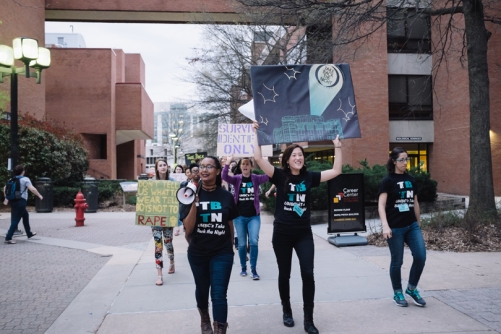
The march against sexual violence at UMBC’s TBTN 2015
For more information about UMBC’s TBTN (check out Facebook, Instagram, and Twitter too by searching the hashtag #UMBCTBTN):
- A BreakingGround post about how the 2013 TBTN came to be – Our Own ‘Take Back the Night’
- Read a blog post written by a UMBC alum related to TBTN 2005 at UMBC.
- The Women’s Center 2016 TBTN roundup
- The Retriever Weekly photo gallery of TBTN
- The Women’s Center visual recap of TBTN 2015
- Stop by the Women’s Center on April 11, 12, and 13th to make a rally sign for the march!
Stay tuned for the next installment of what you need to know about TBTN 2017!
]]>
What You Need To Need Know: Take Back The Night & Its History Posted on March 30, 2017 by kaylasm1 April is Sexual Assault Awareness Month, and the Women’s Center is hosting its 5th...
https://my3.my.umbc.edu/api/v0/pixel/news/132298/guest@my.umbc.edu/1708d21ca502612f28b4c3c519ac736d/api/pixel
activism
feminism
programs
saam
sexual-assault
sexual-assault-awareness-month
survivors
survivors-of-sexual-violence
tbtn
umbc
what-you-need-to-know-tbtn
Women's, Gender, & Equity Center
https://my3.my.umbc.edu/groups/womenscenter
https://assets2-my.umbc.edu/system/shared/avatars/groups/000/000/125/78272a4842689b30dbf74672182b78f8/xsmall.png?1750974263
https://assets1-my.umbc.edu/system/shared/avatars/groups/000/000/125/78272a4842689b30dbf74672182b78f8/original.png?1750974263
https://assets1-my.umbc.edu/system/shared/avatars/groups/000/000/125/78272a4842689b30dbf74672182b78f8/xxlarge.png?1750974263
https://assets1-my.umbc.edu/system/shared/avatars/groups/000/000/125/78272a4842689b30dbf74672182b78f8/xlarge.png?1750974263
https://assets1-my.umbc.edu/system/shared/avatars/groups/000/000/125/78272a4842689b30dbf74672182b78f8/large.png?1750974263
https://assets2-my.umbc.edu/system/shared/avatars/groups/000/000/125/78272a4842689b30dbf74672182b78f8/medium.png?1750974263
https://assets1-my.umbc.edu/system/shared/avatars/groups/000/000/125/78272a4842689b30dbf74672182b78f8/small.png?1750974263
https://assets2-my.umbc.edu/system/shared/avatars/groups/000/000/125/78272a4842689b30dbf74672182b78f8/xsmall.png?1750974263
https://assets3-my.umbc.edu/system/shared/avatars/groups/000/000/125/78272a4842689b30dbf74672182b78f8/xxsmall.png?1750974263
Women's Center
https://assets3-my.umbc.edu/system/shared/thumbnails/news/000/132/298/984b032abb4dc96f7e22ec6d76c90d49/xxlarge.jpg?1680711868
https://assets2-my.umbc.edu/system/shared/thumbnails/news/000/132/298/984b032abb4dc96f7e22ec6d76c90d49/xlarge.jpg?1680711868
https://assets1-my.umbc.edu/system/shared/thumbnails/news/000/132/298/984b032abb4dc96f7e22ec6d76c90d49/large.jpg?1680711868
https://assets2-my.umbc.edu/system/shared/thumbnails/news/000/132/298/984b032abb4dc96f7e22ec6d76c90d49/medium.jpg?1680711868
https://assets2-my.umbc.edu/system/shared/thumbnails/news/000/132/298/984b032abb4dc96f7e22ec6d76c90d49/small.jpg?1680711868
https://assets3-my.umbc.edu/system/shared/thumbnails/news/000/132/298/984b032abb4dc96f7e22ec6d76c90d49/xsmall.jpg?1680711868
https://assets2-my.umbc.edu/system/shared/thumbnails/news/000/132/298/984b032abb4dc96f7e22ec6d76c90d49/xxsmall.jpg?1680711868
0
0
true
Wed, 05 Apr 2023 12:25:39 -0400
Wed, 09 Aug 2023 13:39:50 -0400
Take Back the Night, Forever and Always
Amelia Meman (they/them and she/her), GWST ’15, is the interim director of the Women’s Center. They have worked in the Women’s Center as an intern, a student staff member, a volunteer, and now professional staff member. This is a loving retrospective on Take Back the Night (TBTN), written in the third spring semester where UMBC has not been able to hold such an event.
Author’s Note: I am proud to say that I have been to every single Take Back the Night since its revival on UMBC’s campus in 2013. This does not mean I am an expert on this event nor that my opinion of Take Back the Night is shared by the thousands who have taken part in this event throughout the past nine years. Because Take Back the Night is such a shared experience, I reached out to some alumni who have experienced TBTN as attendees, volunteers, and leaders. You will see their contributions throughout. Thank you, Yoo-Jin, Autumn, Calista, Hannah, and Sydney. 
As we share our spring semester with the pandemic once again, I know I and many of our community members are deeply disappointed to not be able to come together for Take Back the Night. Even more alarming, however, is that many folks don’t know what it is to miss Take Back the Night because they’ve never experienced it.
Our last in-person Take Back the Night was in 2019 and most recently (2021), Jess Myers alongside several student activists and campus partners, created the Take Back the Night Virtual Experience. Before that, the Women’s Center staff and community co-created a zine called “Survivors to the Front,” which invited survivors of gender-based violence to submit their creative works–whether visual art or written word.
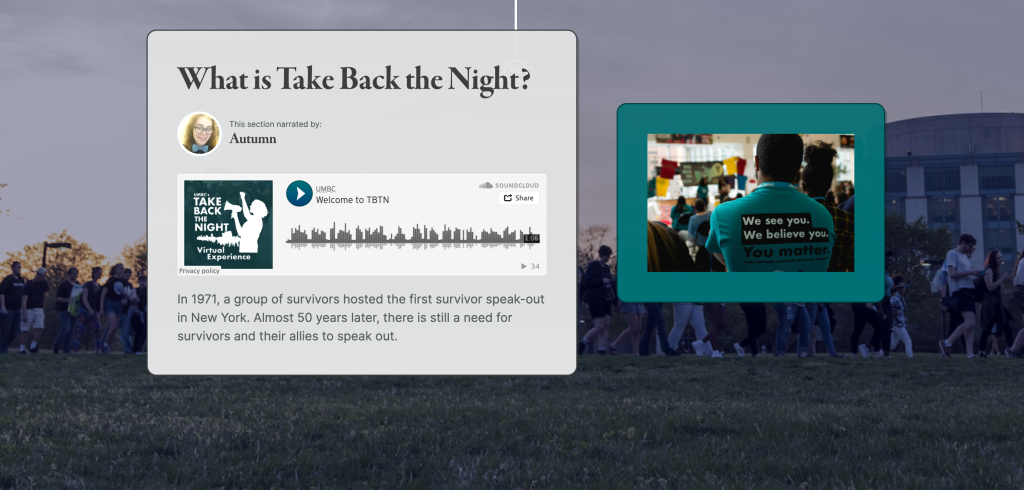

These online options have been balms in an otherwise quiet series of Sexual Assault Awareness Months (SAAM) for the Women’s Center. Normally, April is a huge month for the Women’s Center with [at minimum] weekly programming and often a full, month-long calendar of events, workshops, and educational opportunities offered through various departments on campus.
The major event of April (and for many, the entire school year) is Take Back the Night. In the last 3 years, however, we have not been able to host this event. And that’s why I’m writing this blogpost: because it’s been a long time and in addition to cultivating the hope that we can one day bring Take Back the Night back to its glory days as a large in-person, campus-wide event, I hope to preserve just a little bit of this institutional memory.
A Very Brief History of Take Back the Night at UMBC*
In 1971, a group of feminist advocates and survivors hosted the first-ever rape speak-out in New York. A few years later, one of the first “Take Back the Night” marches was held in Philadelphia, PA in October 1975.
UMBC (from what we can tell from the archives), held their first TBTN event in the early 2000s for just a few years. Campus stopped hosting it for several years so as to be in solidarity with other area colleges by participating in Baltimore City Hall’s Take Back the Night. But, by 2013, it made the most sense for us to bring back our own Take Back the Night. So the Women’s Center with support from UHS’s Health Education, Greek Week, and a BreakingGround grant did just that. Since Spring 2014, this campus-wide rally and march against sexual violence has been a signature Women’s Center event every April. Each year the Women’s Center hosts survivor speak-out followed by a campus march against sexual assault. When marchers return, UMBC’s TBTN spends the rest of the evening doing “craftivism” art healing projects and hosting a community resource fair. A smaller version of the Clothesline Project also serves as a backdrop to the evening’s events.
*Thank you to Kayla Smith, who wrote “What You Need To Need Know: Take Back The Night & Its History” in 2017; almost all of this information is from that resource.
How did Take Back the Night work at UMBC?
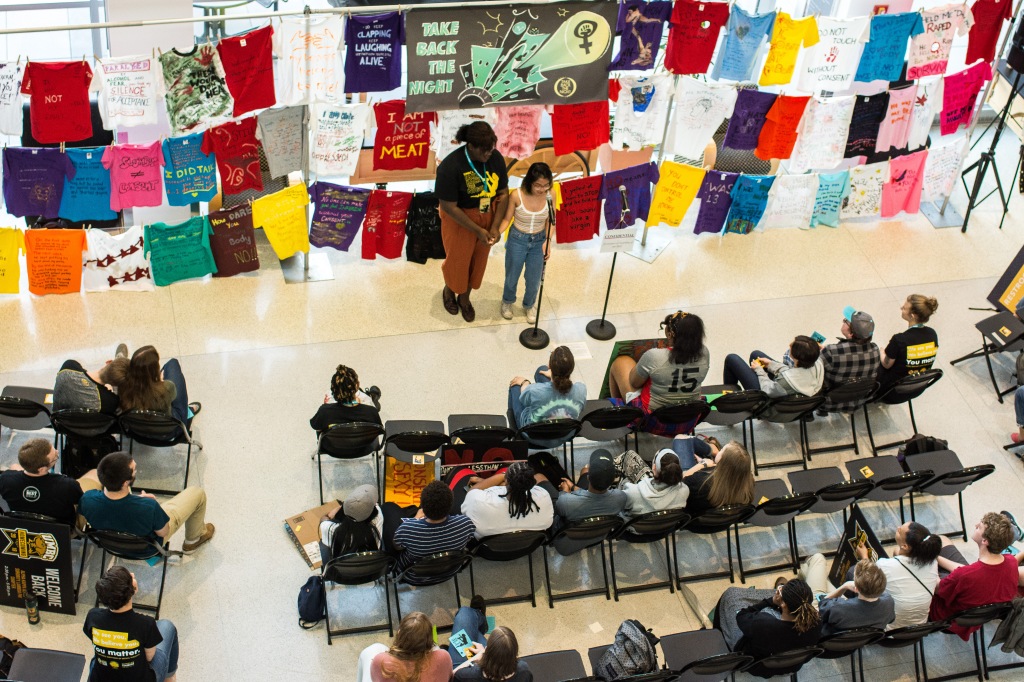
Take Back the Night starts on The Commons’ Main Street with the Survivor Speak Out. On the third Thursday of April, we take over this campus nexus with a mini-Clothesline Project display, microphones, speakers, a ton of folding chairs, resource tables, and hand-painted rally signs. The Speak-Out provides an open opportunity for survivors of power-based violence to tell their stories out loud, in front of an audience.
It was the first time I really identified as a survivor publicly and put myself in that vulnerable position. I remember the wave of emotions while we marched–anger, happiness, relief, anxiety–and how beautiful it was to just feel those things as they came.
Sydney (she/her)
This is a strategic location as it is one of the most heavily trafficked areas of campus. You might ask, “But aren’t the Survivor Speak-Out and the Clothesline Project a little disruptive for all the folks in The Commons?” The answer is yes, and that’s the point. Take Back the Night is placed in such a way that we can bring people together whether they’re attending the event on purpose or walking through and experiencing it randomly.


And that’s how many folks come to be involved in Take Back the Night–they stumble upon this big public event and get wrapped up in the stories they hear over the speakers. For Calista’s (she/her) first speak-out, she was a witness to the power of the event which caused a mixture of emotions: “My first experience felt very comforting seeing others being there for each other. It was also challenging to be in a space that reminded me so much of my trauma — but ultimately made me feel less alone.”
We have heard this reaction echoed in a number of other participants. Survivors are given the opportunity to stand up at a microphone and speak their truth; the result is raw, unfiltered vulnerability and power. Some survivors recall every last detail of their assault. Where it occurred, what they were wearing, who the perpetrator was… Others only talk about what happened in the aftermath. Regardless of what is shared, each person who comes up to the mic speaks their truth and the audience bears witness.
Autumn Cook (M29, ‘21) actually experienced her first TBTN from the front of the stage as one of our TBTN leaders. As a leader, they provide background information about TBTN and also start the Survivor Speak-Out by sharing their own story. Of their first experience, Autumn said:
Jesus. My first TBTN at UMBC was my first year on campus [in 2017]. Before then, I had never interacted with the Women’s Center – either because I didn’t super know what they did or that I was too scared too. But during the lead up to TBTN and aftermath, it felt like I found a family within the Women’s Center. I was one of the intro speakers for TBTN and getting up in front of the massive crowd was fun and illuminating. I was able to share my truth and afterwards I felt loved and seen by everyone in the crowd. The environment of support was like a big warm hug, enveloping and unending.
Autumn Cook (M29, ‘21)
-
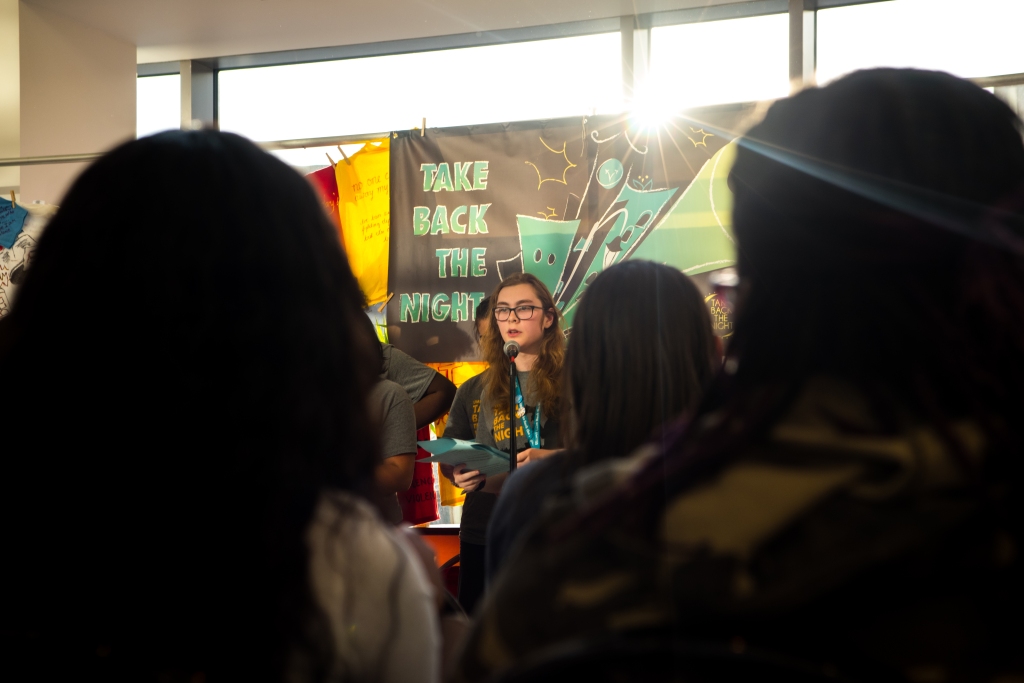 Autumn Cook leads TBTN 2018. Photo credit: Jaedon Huie
And still others experienced TBTN by working the event, like Sydney (she/her):
My first experience with TBTN, I was actually interning with The Monument Quilt. I was completely moved by the survivor speak out and the feeling of the community in the air. I remember watching survivor after survivor get up, being struck by their bravery and thinking “I couldn’t do that,” yet feeling heard and seen and accepted regardless. It was also the first true time I think I accepted my own assault and what that meant. I knew [TBTN] was something I needed to be involved in moving forward.
Sydney (she/her)
-
 The resource tables (covered in teal tablecloths) offer information about Take Back the Night and resources for survivors. Photo credit: Amelia Meman
Following the energy that builds in the Speak-Out, we mobilize all of the people who have gathered as witnesses and speakers to march across campus and demand visibility, justice, and healing for survivors.
We call on folks to move.
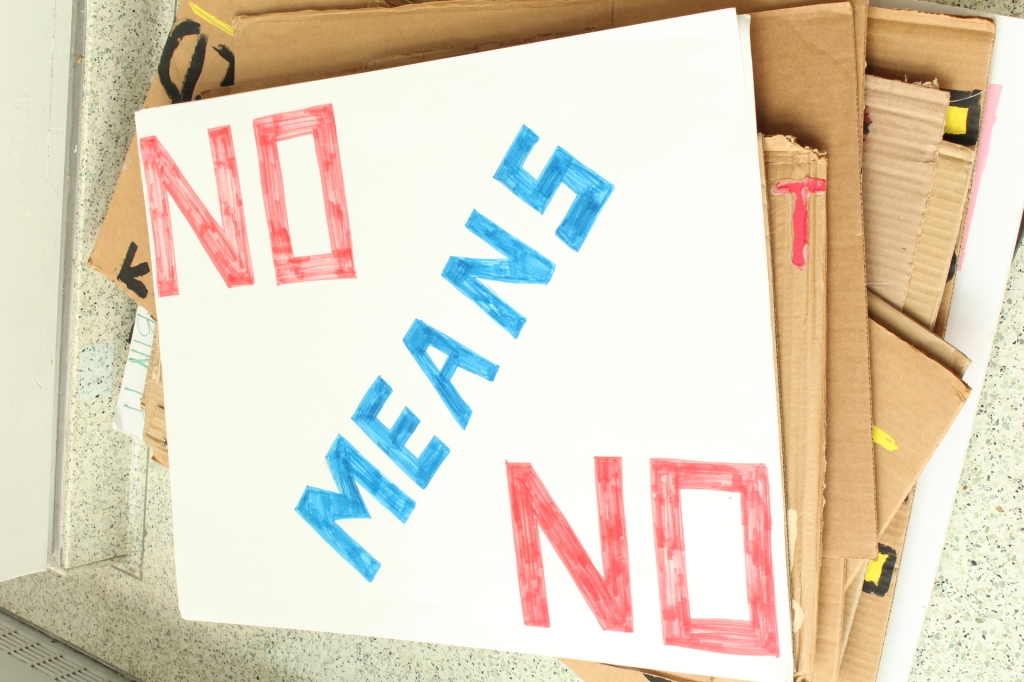
We hand out rally signs to anybody who wants to hold one.
We bring out the megaphones and we line up.
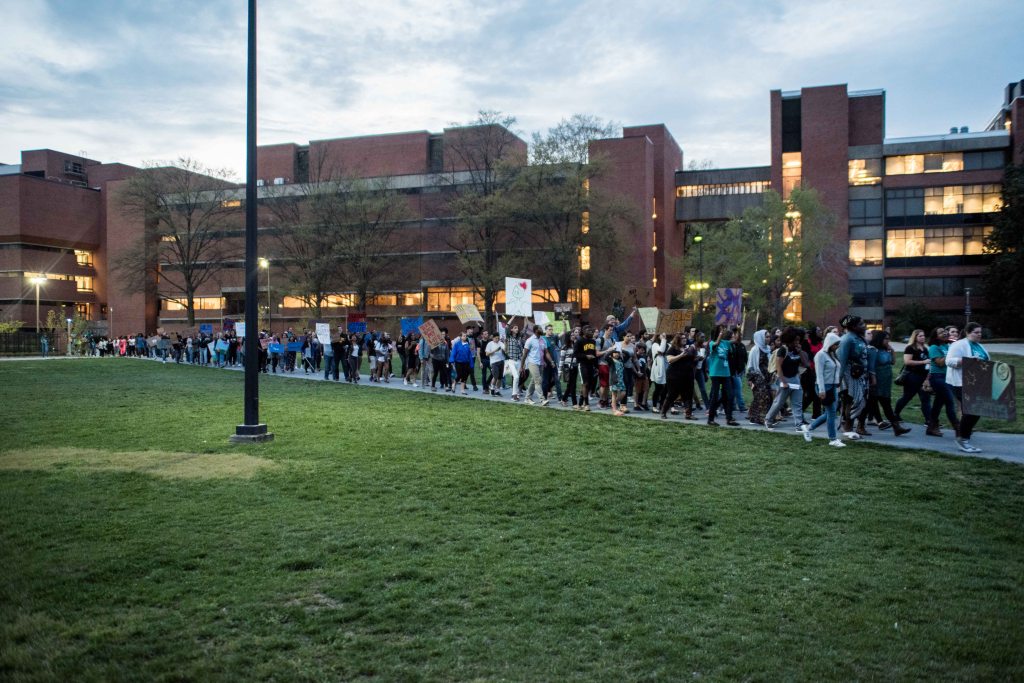
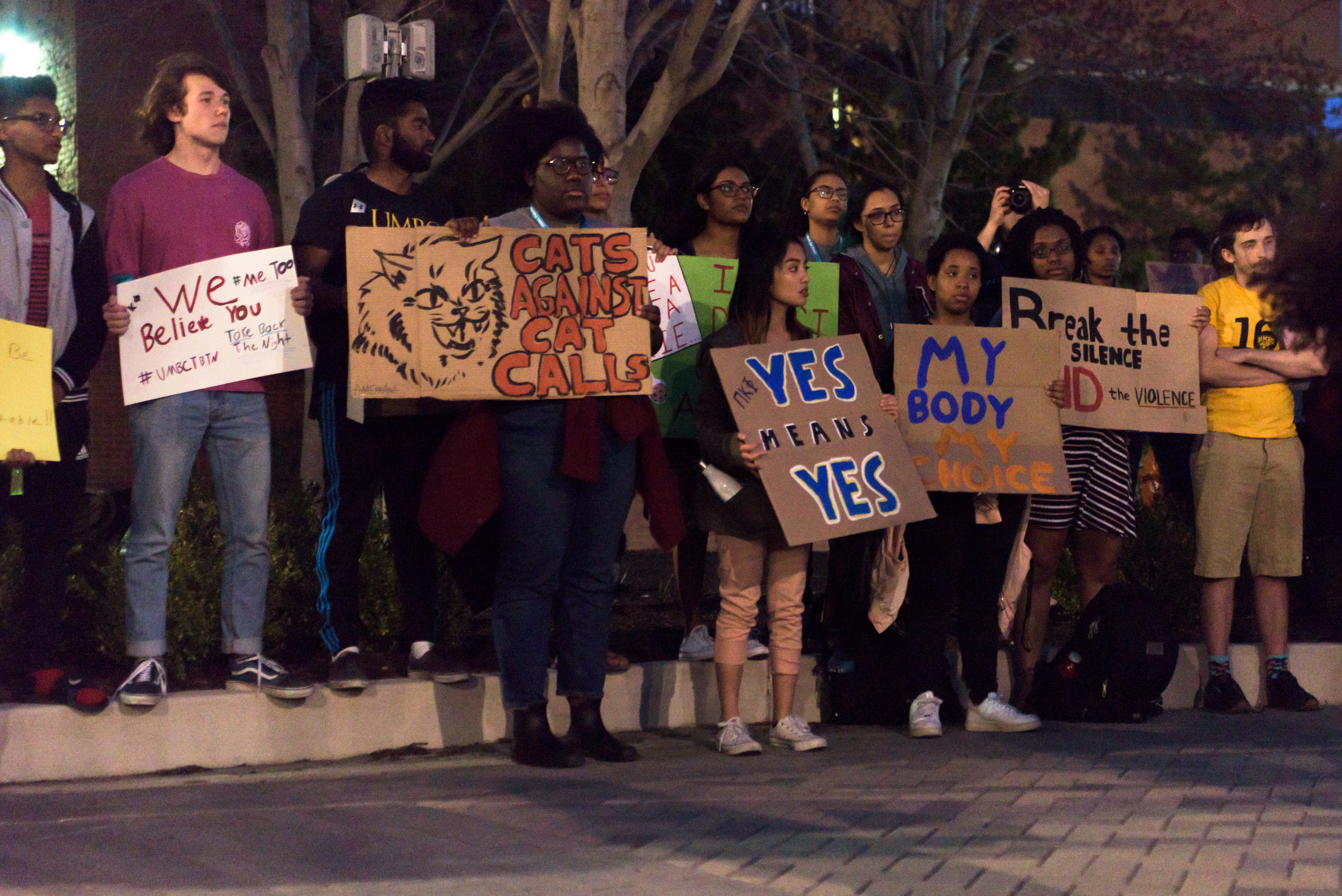
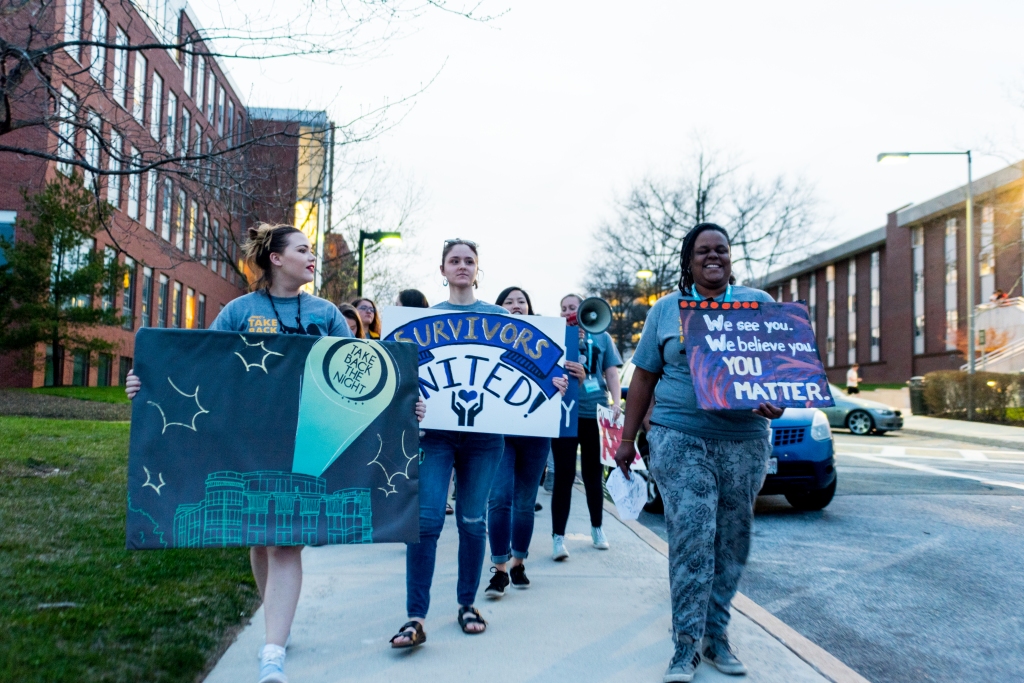
The march is divided with survivors at the front and UMBC community supporters bringing up the back. Marchers are given cards that have different rally chants written on them and line leaders are spread amongst the marchers. Once the march begins, leaders use their megaphones to start chants and direct people along the march route. The number is different at each TBTN, but the march group usually consists of approx. 250 campus community members.
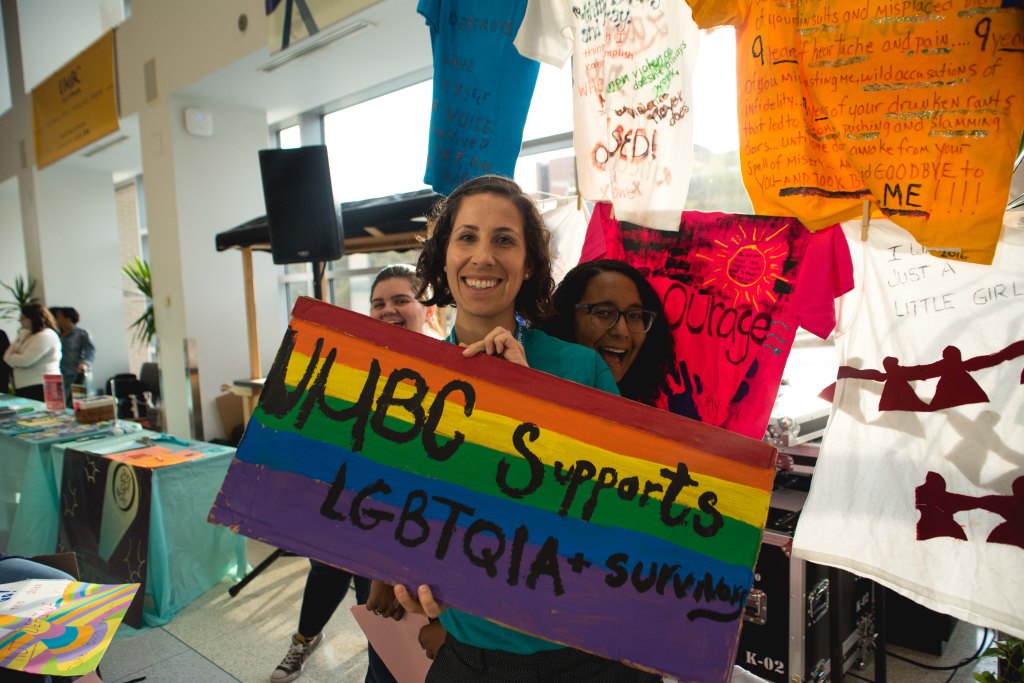
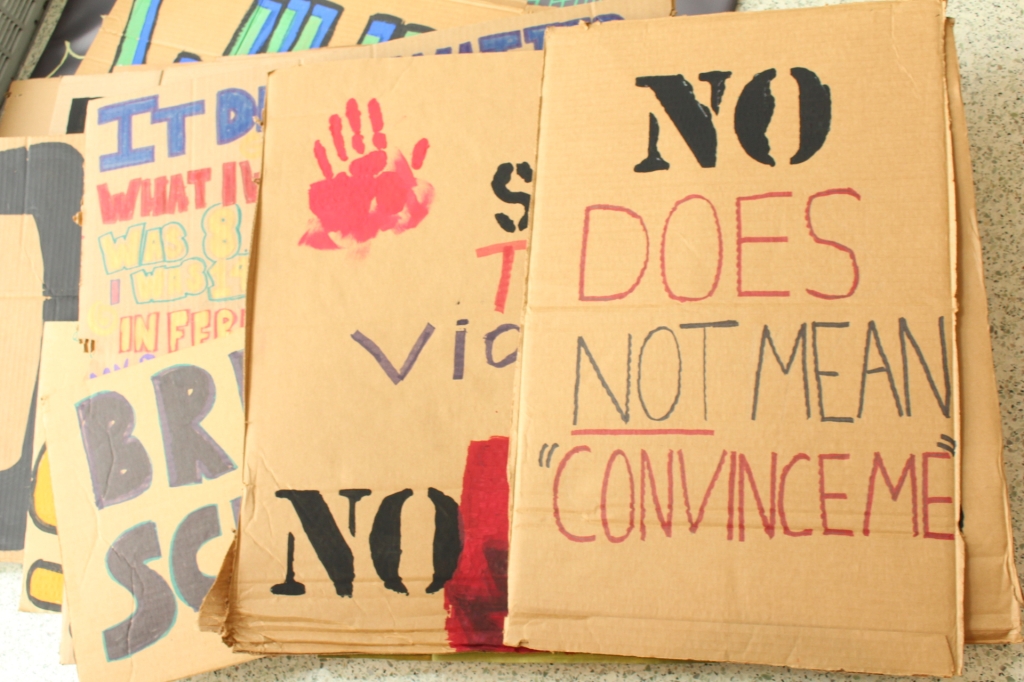


The march is loud and big. Its meant to grab people’s attention, just like the Survivor Speak-Out. Hannah Wilcove, GWST ‘19 remembered her “first encounter was seeing the march pass by me as I was walking back to my dorm freshman year and feeling a kinship with everyone participating that I couldn’t explain. Next year, I wanted to get more involved with the Women’s Center so I volunteered and participated for the first time.”
Many of the people I spoke to have experienced the march from the frontlines and share vivid memories of the emotions that are at play while walking through campus. For Sydney: “It was the first time I really identified as a survivor publicly and put myself in that vulnerable position. I remember the wave of emotions while we marched–anger, happiness, relief, anxiety–and how beautiful it was to just feel those things as they came.”


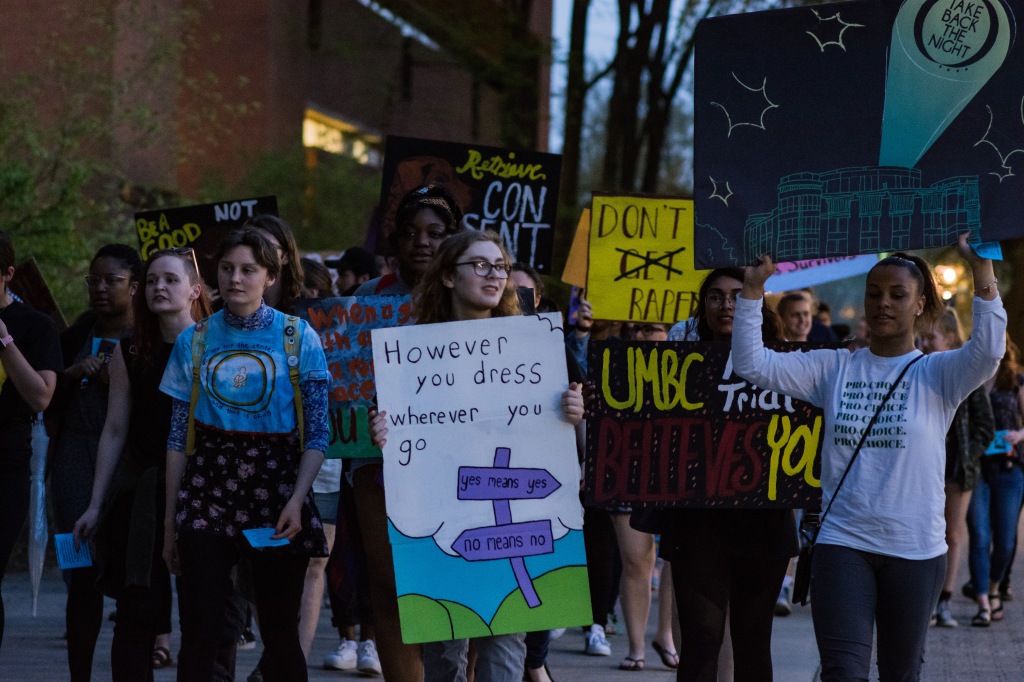
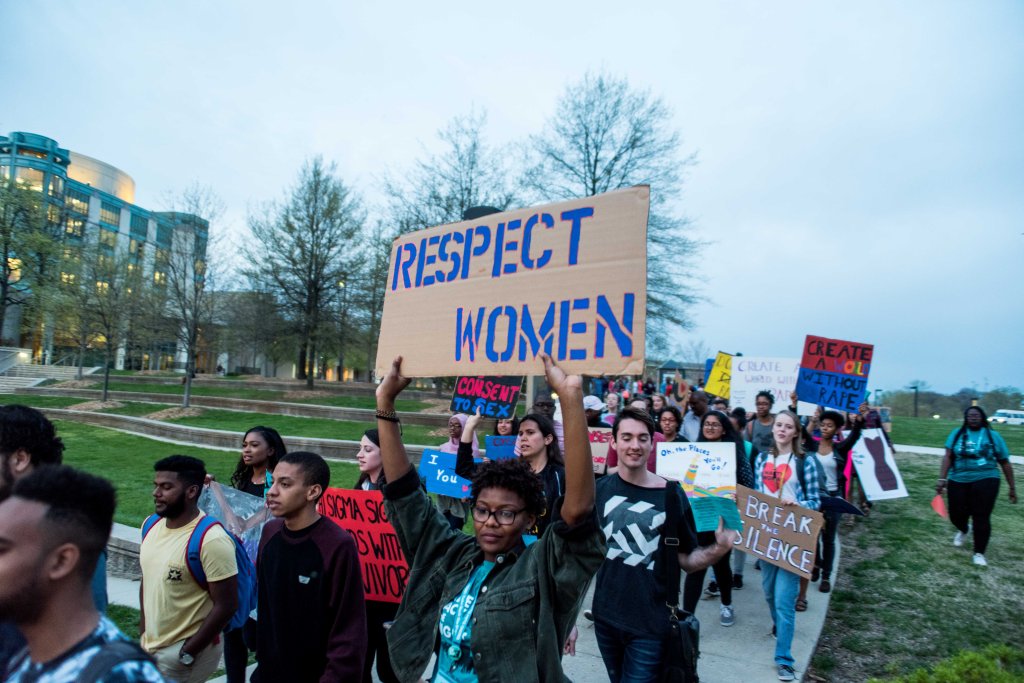
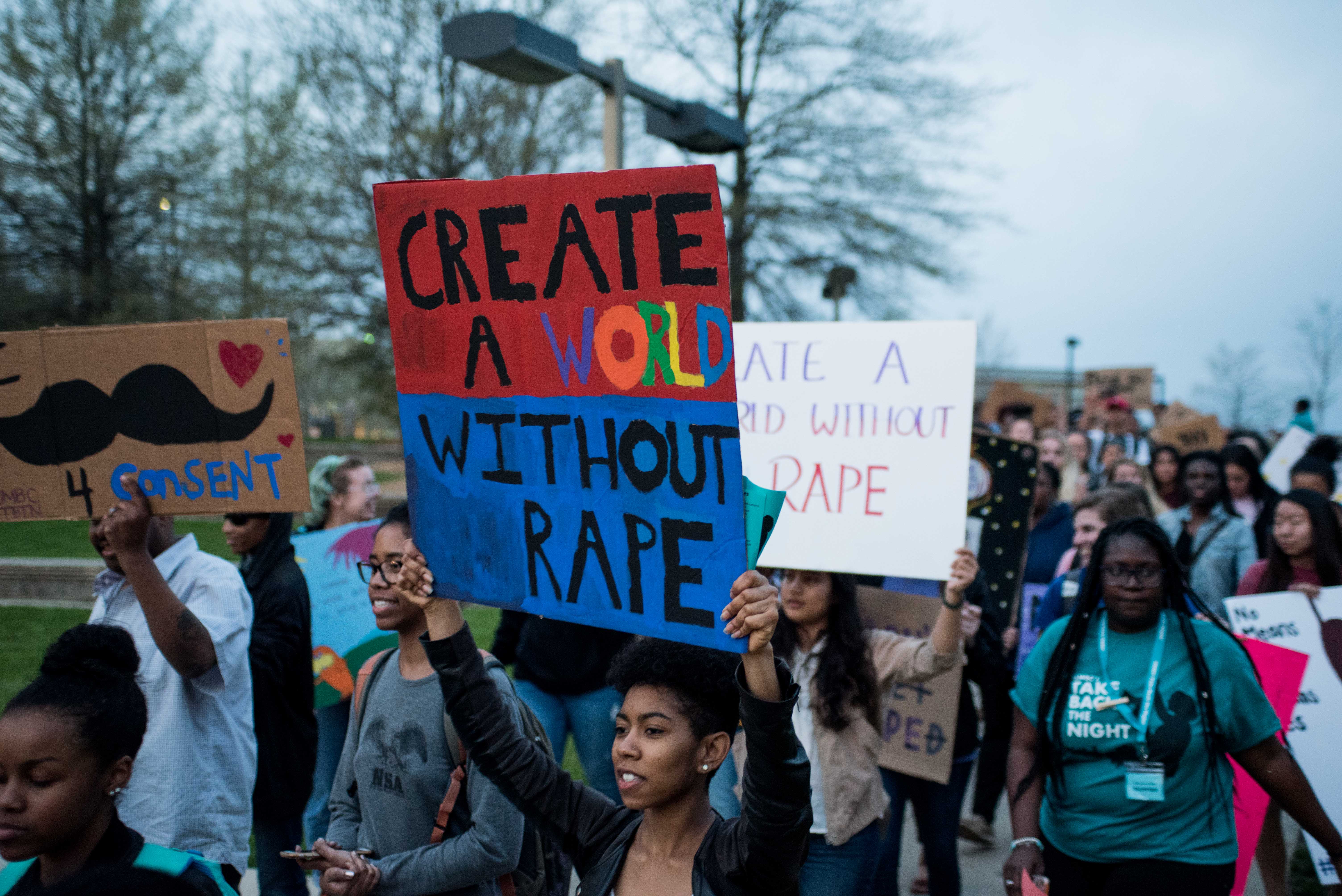
Yoo-Jin Kang, MLL & INDS ‘15 also remembers the rush as she maneuvered the march around campus: “Leading the march with dearest Kayla Smith. Walking alongside powerful survivors, shouting into a mic, and looking back to see a huge line following behind us. I still have chills thinking about it.”
The march goes all the way around campus starting at the southern entrance of The Commons, going east toward True Grits (and sometimes inside True Grits) and up around the Residence Halls before turning northwards and moving up the hill toward Library Pond. From the pond, the march hangs left to go all the way down Academic Row and stops at the statue of True Grit in front of the Administration Building and The RAC.
Recently, the march has added this stop around the True Grit statue so that marchers can circle up with survivors in the center and allies on the outside. The survivor circle rests with one another while the community continues to bear witness and offer respect.
Healing from trauma isn’t linear, but healing can happen and it does happen.


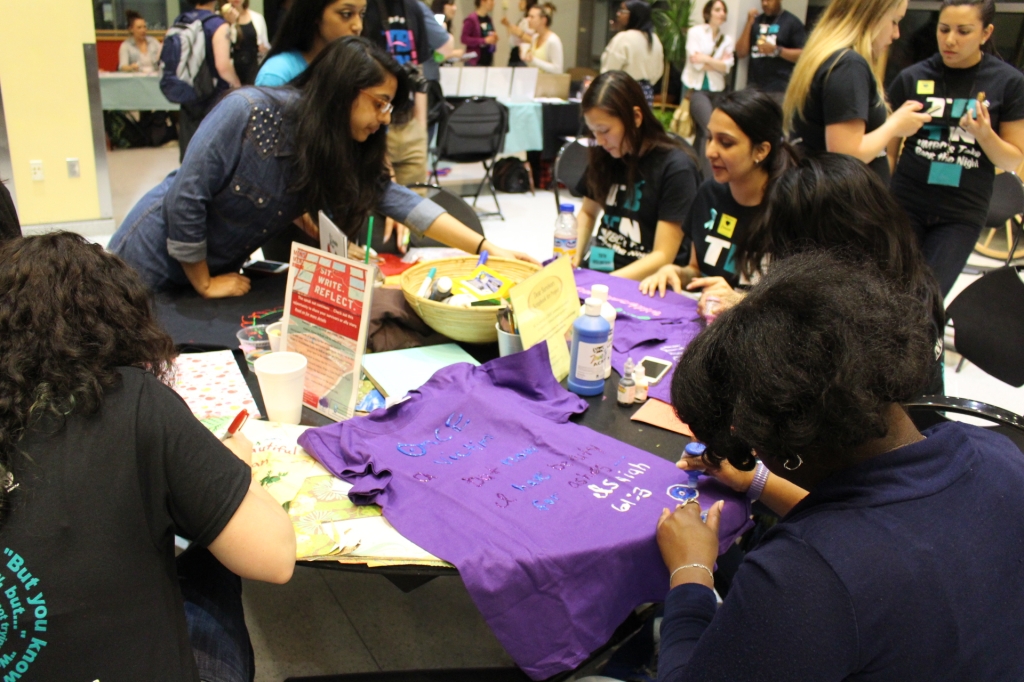
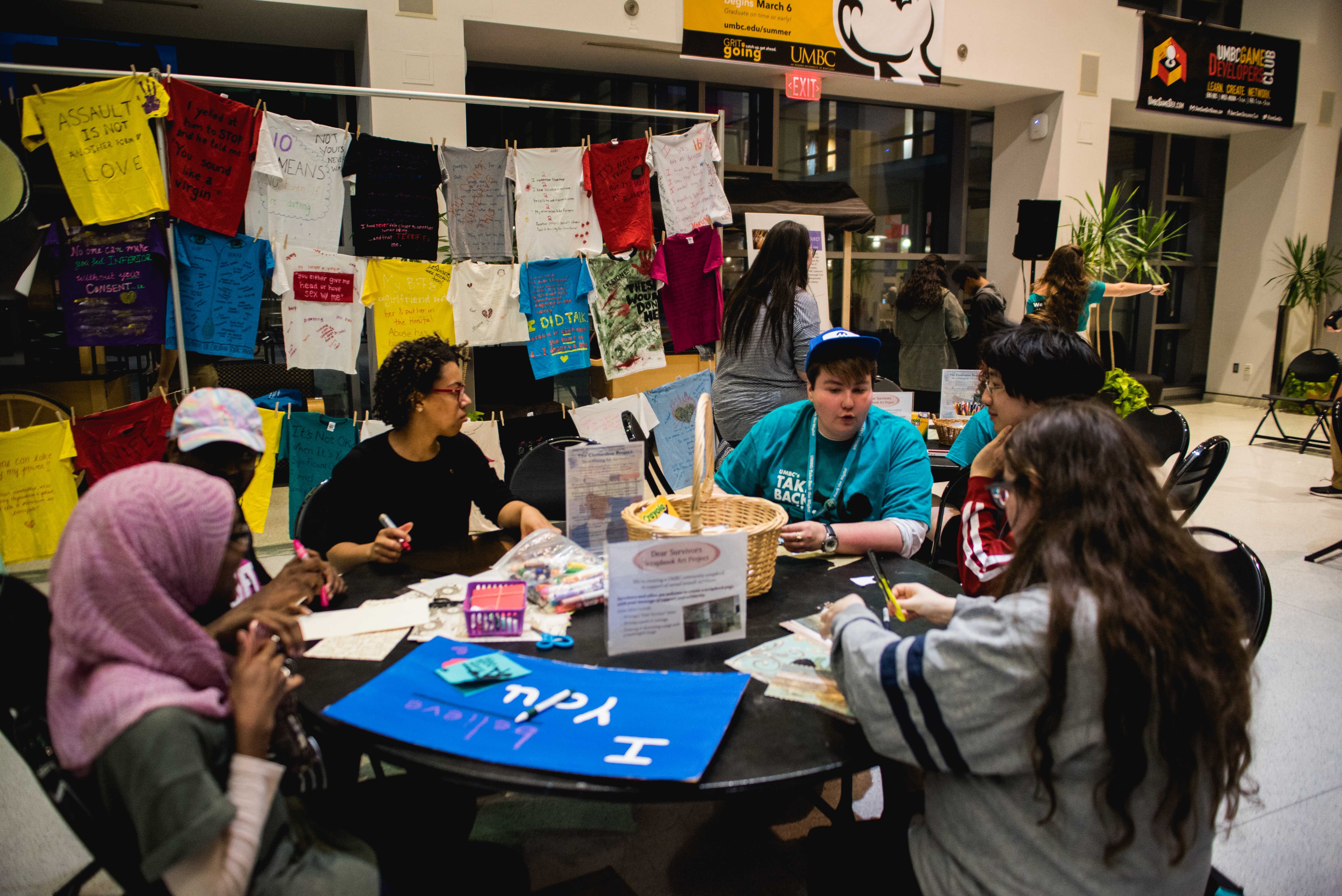
After regrouping in the circles, the march crosses the Quad diagonally and heads back to The Commons. Once inside, participants are met with a once again transformed Main Street. Where there were chairs and microphones for the Survivor Speak-Out there are now big circular tables with crafting materials available for folks to decompress through art, food and drinks to refresh themselves, and music blasting on the speakers so people can dance it out.
Every part of Take Back the Night is my favorite part, but this ending back at Main Street is really distinct. No matter the feelings that have erupted during the last few hours in the speak out and march we can all come back together to breathe. Breathe. Eat a cookie. Breathe. And laugh.
It might be as biologically simple as the flood of endorphins that comes after something painful or difficult… but it feels magical and powerful. We come back to where we had started… and the space is transformed but so are we. Healing from trauma isn’t linear, but healing can happen and it does happen.

What did UMBC’s Take Back the Night feel like?
It’s different for every person and often different minute-by-minute within the event itself, but for many, TBTN is a time of “firsts.” For Yoo-Jin, “TBTN was one of the first times I saw survivor voices lifted up in a public and unapologetic way. It was the first time I shared about my survivor story in public (and cried lots doing it).” With one of the goals of Take Back the Night being to take up space and push things often shrouded by private shame out into the public space, it can act as a catalyst for many as they work to understand their own trauma and their identities as survivors.
Sydney said that TBTN played a major part in her own identity development and growth as a survivor as it “allowed me to come to terms with the fact that I was sexually assaulted and work through all the emotions that came with it. Over the years attending, I was able to come to terms not only with the event but how I wanted to handle it. I didn’t want to do [the] Survivor Speak-Out but I did want to be there to feel community and then to march and let my story out that way.”

As identity-defining and cathartic as Take Back the Night is… it’s also really and honestly hard.
For as much time as I can take extolling high praise, I could also tell you about how deeply it has rocked myself and so many others that I know. Throughout the event, you are made to listen to stories of violence and abuse. As a witness to the Speak-Out, you play an important part in holding space and honoring others’ stories, but that does take energy and emotional endurance. A lot of people (especially those who shared their stories with me) have been able to reckon with Take Back the Night as something extremely positive, but it can also feel agonizing.
Autumn Cook remembered this duality:
Take Back the Night is a really difficult event to attend. It’s almost impossible to not squirm or react to some of the stories that people share, but that is part of the event. We are all living in each other’s horrendous truths and healing together. You’re supposed to be uncomfortable at TBTN. It means that you’re taking in what is happening and processing it. It’s horrible and liberating and healthy.
Autumn Cook (M29, ‘21)


How has Take Back the Night changed over the years?
One of the most beautiful aspects about Take Back the Night is that it’s always growing with our campus. It grows from year to year. It grows with you. Where Calista started as a spectator, she eventually grew to tell her own story… and then to leading the speak out. Calista spoke of this growth as she recalled how she “struggled a lot with my assault and the process of regaining my voice — but TBTN empowered me.”
-
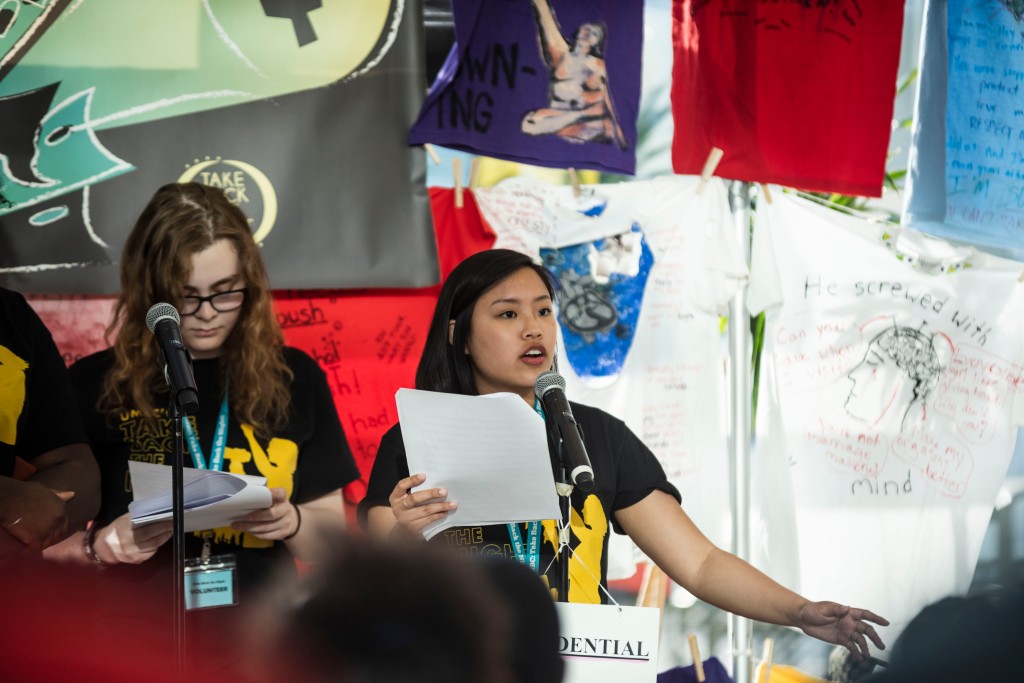 TBTN 2019 Photo credit: Winston Zhou
One person noted that they are still trying to find an outlet similar to Take Back the Night: “I have been looking for TBTN marches or something similar since graduating because I have wanted to share my experience. I don’t think I’d feel ready to do so if I hadn’t participated in it while at UMBC.”
If you look at some of the pictures in this blogpost, you might see the same people show up during different TBTN years. The shirts might look different or their hair might be a little longer. There are different shirts hung up in the Clothesline Project display. The weather during the march goes from sunny to cloudy.
The event has changed each year we’ve put it on to answer the needs and values of our campus community. For example, our march route was adapted to include an accessible route for those with mobility disabilities; previously, stairs were an obstacle for some as they participated in the march. Now we have an accessibility route that is not only available, but has a dedicated volunteer leading folks.
A Personal Reflection + A Conclusion
To be totally honest, I am writing this blogpost for partially selfish reasons… I desperately want to feel the power of Take Back the Night and I am sincerely regretful that I will not have been able to bring Take Back the Night back to UMBC’s campus by the time I start my own next chapter.


There are many reasons why I wanted to work in the Women’s Center and why I love my job now; a big one is Take Back the Night. Over the course of my time at UMBC, I have proudly been present for every single iteration of TBTN since it was revived by Jess and the team in 2013. However, as an undergraduate, I had not yet been able to identify as a survivor nor what I had experienced as abusive.
I worked in the Women’s Center from 2013 to 2015, I was a Gender, Women’s, + Sexuality Studies major, and I had been learning about sexual violence prevention and response work throughout that time but it had never occurred to me to consider my own story and my own experiences. It was only after graduating from UMBC, returning to the Women’s Center as a professional staff member, and a lot of therapy that I began to consider how I might be a survivor… how I am a survivor. My identity and my roles changed–changing my own relationship with TBTN. And TBTN changed again when I began working with student survivors and then again after the September 2018 lawsuit and subsequent Retriever Courage campus activism.
I mention all of this because we are all growing. We are all welcoming new aspects of ourselves–and similarly, Take Back the Night is bound to change. The power Take Back the Night has is in the change it creates for each person who interacts with it.
The power Take Back the Night has is in the change it creates for each person who interacts with it.
Right now, Take Back the Night looks different because it must, but that’s not a death sentence so much as it is an opportunity to welcome and cultivate change.
Perhaps, Take Back the Night will resume its live, in-person status in the Spring of 2023. I have hope that it will. And as much as I worry that it won’t look or feel like the Take Back the Night that I remember… the shared memory that people like Autumn, Sydney, Yoo-Jin, Hannah, Calista and I will continue to hold power and the institutional history of Take Back the Night will only grow. And that’s where the magic of TBTN is and always has been–with the people who are there to witness, the people who speak truth to power, and the people who demand space, time, energy for radical acts of healing.
More information about UMBC’s TBTN:
What You Need to Know About Take Back the Night Series
Take Back the Night at UMBC: Virtual Experience
Survivors to the Front: A Call to Witness Zine (2020)
]]>
Amelia Meman (they/them and she/her), GWST ’15, is the interim director of the Women’s Center. They have worked in the Women’s Center as an intern, a student staff member, a volunteer, and now...
https://womenscenteratumbc.wordpress.com/2022/04/29/take-back-the-night-forever-and-always/
https://my3.my.umbc.edu/api/v0/pixel/news/119056/guest@my.umbc.edu/98f05b1c4595605d0572e5c8c2b4fc12/api/pixel
activism
feminism
programs
saam
sexual-assault
sexual-assault-awareness-month
survivors
survivors-of-sexual-violence
take-back-the-night
tbtn
umbc
uncategorized
what-you-need-to-know-tbtn
Women's, Gender, & Equity Center
https://my3.my.umbc.edu/groups/womenscenter
https://assets2-my.umbc.edu/system/shared/avatars/groups/000/000/125/78272a4842689b30dbf74672182b78f8/xsmall.png?1750974263
https://assets1-my.umbc.edu/system/shared/avatars/groups/000/000/125/78272a4842689b30dbf74672182b78f8/original.png?1750974263
https://assets1-my.umbc.edu/system/shared/avatars/groups/000/000/125/78272a4842689b30dbf74672182b78f8/xxlarge.png?1750974263
https://assets1-my.umbc.edu/system/shared/avatars/groups/000/000/125/78272a4842689b30dbf74672182b78f8/xlarge.png?1750974263
https://assets1-my.umbc.edu/system/shared/avatars/groups/000/000/125/78272a4842689b30dbf74672182b78f8/large.png?1750974263
https://assets2-my.umbc.edu/system/shared/avatars/groups/000/000/125/78272a4842689b30dbf74672182b78f8/medium.png?1750974263
https://assets1-my.umbc.edu/system/shared/avatars/groups/000/000/125/78272a4842689b30dbf74672182b78f8/small.png?1750974263
https://assets2-my.umbc.edu/system/shared/avatars/groups/000/000/125/78272a4842689b30dbf74672182b78f8/xsmall.png?1750974263
https://assets3-my.umbc.edu/system/shared/avatars/groups/000/000/125/78272a4842689b30dbf74672182b78f8/xxsmall.png?1750974263
Women's Center
11
0
false
Fri, 29 Apr 2022 16:23:29 -0400
Fri, 29 Apr 2022 16:23:29 -0400
Microaggressions: an attack on belonging and identity 

Image description: shows student, Jane, smiling in front of a UMBC building
Positionality Statement: This post is written by Jane DeHitta, an adult learner in her final year at UMBC, who works as a student staff and social work intern at the Women’s Center. I am a first generation Filipino-American student who seeks to be self-aware of the power dynamics that take place in the intersections of our identities and strives to be intentional in the ways I speak to and encounter others. In this post, I share my experience of microaggressions against race and discuss a connection between microaggressions of different forms and the impact that can have on the individual. My experience is my own and I use it as a point of reference and not to represent the innumerable diversity of people’s experience with microaggressions. I hope that what I share in this post gives validation to those who have had experiences similar to my own, and to give a moment for thought and self-reflection for those who find themselves as the microaggressor.
Image description: a cartoon gif of two hands holding up a dark blue sign with the words “Words have power” written across it. The word “power” has an animated line being crossed underneath it for emphasis.
“I wonder who is more Asian?” my white female friend said in passing. She and I had been discussing movies we recently watched, among them Crazy Rich Asians and Always Be My Maybe, movies that feature a predominantly Asian cast. My friend had lived for several years in China and even spoke Cantonese and Mandarin, she had the privilege of experiencing much of Chinese culture. I, on the other hand, grew up in Maryland my whole life and have never been back to my parents home country of the Philippines, nor was I taught how to speak their native languages of Tagalog or Cebuano beyond a few conversational words.
Taken aback by my friend’s question, I scoffed and went along with what I assumed was a joke by saying, “between you and me?”
She laughed, “yeah.”
I felt uncomfortable but uncertain why or how to express it so I half-heartedly laughed back and said in an exaggeratedly teasing tone, “don’t make me prove my asianness to you!” We continued our conversation for a few minutes more before parting ways, but that discomfort lingered as a knot in my stomach.
Prior to this recent encounter, I know that I have experienced microaggressions throughout my life, from friends saying, “oh, sometimes I forget your Asian!” to strangers asking me “Where were you born? (Maryland) No, but where are you really from?” But because of my introverted personality and the culture of passivity I grew up in, I learned to respond much like the way I responded to my friend. Ignoring it or laughing it off. I wouldn’t confront the perpetrator or call them out, because it was easier that way, I could deal with my discomfort later. And afterwards I would go through a dialogue in my head that looks something like this, “they didn’t mean it like that. I shouldn’t be offended! They were just kidding! I’m not actually hurt by what they said. It’s fine. It’s not a big deal. Even if I was hurt or bothered, I’ve already laughed and moved on, and so have they. They don’t always say/do things like that. Dwelling on it isn’t going to help. I don’t want to make them uncomfortable or feel bad.” I also struggle with invalidating my own experiences simply because “others have it worse”.
 Infographic shows a breakdown of the impacts of microaggressions; key words: Imposter Syndrome, Stereotype Threat, other bad feelings like poor self-confidence, depression, etc. Link for more information
Growing up in Maryland for the entirety of my 26 years of life, I have had conflicting feelings about my Filipino/Asian identity. My parents did their best to share their culture, through cooking, traditions, and stories; every summer we went to the local Filipino festivals, and were a part of various Filipino groups. I loved going to these places, tasting the food, seeing the traditional clothing, and watching the dances–one of the years, my sisters and I even participated in the procession for Filipino princesses. And there were moments at these events as we would walk through the stalls as a family, when vendors would greet us, striking up a conversation with my parents in Tagalog or Cebuano. While they talked, I would just stand there awkwardly, nodding and smiling, though I didn’t know what was being said. Then they would turn to me and ask me something, and my mom would translate to me so I could answer. The shopkeepers would give a look of disappointment, “Oh you don’t speak Tagalog…?” It was in those moments, I remember this feeling, almost like imposter syndrome, that I’ve blown my cover, that if someone tried to talk to me they would realize I’m not actually Filipino and I didn’t belong.
A microaggression is “a statement, action, or incident regarded as an instance of indirect, subtle, or unintentional discrimination against members of a marginalized group such as a racial or ethnic minority.” These can be subtle and are often considered harmless by the deliverer, but can have a huge impact on the individual.
 This infographic describes how to be an active bystander and address microaggressions. Key words: Observe, Think, Feel, Desire. Link for more information
Once my friend left me to ponder the authenticity of my racial and ethnic identities, I was able to take some time to reflect and navigate through my feelings. I asked myself, what about that question has continued to bother me? I was able to confide in my siblings, and as I processed through the experience with them I realized that the question I felt was lying underneath my friend’s words was this accusation of “are you really Asian if…?” …you haven’t been to the country of origin, if you don’t speak the language, if…
I felt this question cutting at the ties of my belonging and identity. And I broke down crying..
Fortunately, my siblings were quick to support and affirm my feelings of confusion and hurt, as well as, comforting me with a list of reasons of “you’re so Asian you…” (always tap the bags of rice at the grocery store; have a blue sash in Kung Fu; know how to pronounce adobo…etc) It’s funny, I laughed, and also I realized how ridiculous it was to even have a list of these qualifiers.
 Image description: an Asian woman making a “check mark” gesture with her finger saying “okay check!”
Being Asian or belonging to any racial or ethnic minority cannot be qualified and boiled down to a few checkboxes. It’s the different and unique combination of an individual’s upbringing, family history, ancestry, shared culture, passing on of traditions, and along with that, their experience of the intersectionality of their identities of race and ethnicity with gender, religion, sexual orientation, ability/disability, socio-economic status, etc.
The next day, I ran into this same friend and we made small talk. I was about to walk away when in my head I thought, “now is as good a time as any.” I asked if she had a moment to talk about our conversation from the other day and was able to express how what she said had made me uncomfortable. However, I was so concerned about her feelings that I kept downplaying my hurt and focused more on reassuring her “I know that wasn’t what you intended, or what you meant, and you’re not responsible for how I feel or react, but you are responsible for the things you say.” She apologized and shared that she was probably coming from a place of insecurity as well because she sometimes doesn’t feel connected with either her Asian connections and her White-American identity. This is not an uncommon experience, oftentimes when women of color are talking to a white woman to call them on, the conversation moves quickly from impact on the person of color to the guilt the white person feels for having made that impact. Their whiteness becomes centered. I listened and nodded and reassured her. And then I said we were fine and we ended the conversation.
The peace and resolution I felt after that encounter did not last. I found myself avoiding spaces I knew she would be in and feeling unsure of myself because I had already said we were fine, and I didn’t know how to communicate that I was, in fact, not.
I ended up texting my friend and setting a boundary, “Hi, I know we had our conversation but I realize I’m still uncomfortable and I need space. That might look like I’m giving you the silent treatment, but I’m just trying to process.”
She responded, “Thank you for letting me know. I have been thinking about our conversation too. If and when you would like to talk together again or process together I am open to that. I am very sorry for hurting you so deeply.”
After taking a few days, and talking it through with my siblings, I made a plan for having a follow-up to the follow-up conversation with this friend. My sister suggested I write down the things I wanted to be able to say and to think of the reason or goal behind having this conversation:
The point of this conversation is to:
- Express how our second conversation made me feel unheard because it became centered on you
- Be able to freely and authentically express how I feel without interruption or downplaying the impact of your words
Things I wanted to say:
- It’s important to have this conversation because my feelings are valid and important and matter
- I was hurt because it felt like you were asking me to prove my asianness and it hurt to think of the fact that my parents didn’t have the money to send me or my siblings back to the Philippines to visit or that there was an assumption that my parents didn’t care enough to teach me their language
- I think it would’ve been offensive even if you were Asian to say that, but it was more so because you are white and in that sentence you assumed my experience was similar to yours, when your lived experience is fundamentally different simply because you are white. Like when the rise in Asian hate crimes happened, you didn’t have to question how that would affect your behavior or safety.
To be clear, I share this not to villainize my friend. To her credit, she was able to have that conversation with me and give me the space I needed to process with her in that final dialogue without coming to her own defense and explaining where she was coming from. She listened to how her words had affected me, gave a sincere apology, and acknowledged that the excuse of “I wasn’t thinking” was lacking. To that end, I share this to make room for self-reflection for all of us, myself included, “have I said or done things that would be considered microaggressions to others? How have I used language that excludes others from feeling like they belong? Have I, at times, done more to defend myself than to listen to the impact of my actions or words?”
“So maybe another question to ask is, how can I let this person share their experience with me before I assume what their experience has been…?”
These questions are things I have been asking myself.
As The Women’s Center continues their year-long conversation on Disability Justice + Access, I want to pose these questions specifically towards disability, both visible and especially invisible disabilities
Microaggressions can take a number of forms against those with disabilities. As I was reading I was struck by how subtle these can be and how harmful they are to the individual. Becoming aware of them and naming them can help prevent us from making the same hurtful mistakes in how we interact with those in the disabled community.
My experience with having my own racial identity questioned closely resembles the invalidation that people with disabilities often face from those who question whether or not they are actually disabled or disabled enough.
For instance, in this article I read, for those with invisible disabilities who drove, parking in handicapped spots often engendered glares, questions, or negative comments. A woman with a hidden disability stated, “Sometimes I get out of the car and I’m like, ‘Oh, who’s around, like do I need to take out the wheelchair for show?” (Olkin, 2019)
These microaggressions, among other things, can be felt as an attack against belonging and identity. As a non-disabled person, I cannot speak to what these experiences are like, and I don’t want to sit here comparing microaggressions like some sort of oppression olympics; what I want to do is be thoughtful about the ways I encounter those with disabilities (and to be considerate with meeting people in general because you never know what someone might be struggling with). So maybe another question to ask is, how can I let this person share their experience with me before I assume what their experience has been…?
In the last two years, I have been working on finding my voice and learning how to express my needs and feelings. This instance that I’ve shared was the first time that I really addressed a microaggression directed at me. And as I shared, it was not a straight-forward or easy path. I questioned how I was feeling and whether it was worth speaking up. I had to have the conversation a couple of times and sought out support from those who know and love me to help me organize my thoughts.
Image description: An Asian woman saying with a determined expression, “We do speak up now. We do have a voice.”
As I’ve been educating myself more on social identities, I am learning how I can advocate for myself and on behalf of others.
I’m challenging myself to 1) be brave in holding these conversations when someone says something that makes me uncomfortable and 2) be humble and self-reflective if and when someone calls me out or calls me in for something I have said. Making an authentic apology without excuses can be healing for both persons involved.
I encourage you to join me. Together, we can be the change we want to see in the world (too cheesy with the Ghandi line? I think not!).
Image description: A scene from Always Be My Maybe, in which the Asian female lead, Ali Wong points to the camera and smiles affectionately.
Recommendations and Resources:
I quoted this article when talking about microaggressions against disabilities: The Experiences of Microaggressions against Women with Visible and Invisible Disabilities. Olkin, R., Hayward, H., Abbene, M. S., & VanHeel, G. (2019). Journal of Social Issues, 75(3), 757–785. https://doi.org/10.1111/josi.12342
How Microagressions are like Mosquito Bites
A Guide to Responding to Microaggressions
University of Washington made these infographicson microaggressions that can be helpful
Office of Equity and Inclusion also helps with civil rights issues including discrimination, harassment, hate and bias
]]>
Image description: shows student, Jane, smiling in front of a UMBC building Positionality Statement: This post is written by Jane DeHitta, an adult learner in her final year at UMBC, who works...
https://womenscenteratumbc.wordpress.com/2021/11/05/microaggressions-an-attack-on-belonging-and-identity-%ef%bf%bc/
https://my3.my.umbc.edu/api/v0/pixel/news/114827/guest@my.umbc.edu/1b448d80b8ed00d45ecd8cb32c1bdff8/api/pixel
activism
asian-and-pacific-islander-american-voices
critical-social-justice
diversity
diversity-and-inclusion-issues
feminism
filipinoamerican
intersectionality
issues
microaggressions
returning-women-students
selfreflection
social-justice
staff
student-life
umbc
umbc-women-who-rock
uncategorized
white-privilege
women
womens-center-staff
Women's, Gender, & Equity Center
https://my3.my.umbc.edu/groups/womenscenter
https://assets2-my.umbc.edu/system/shared/avatars/groups/000/000/125/78272a4842689b30dbf74672182b78f8/xsmall.png?1750974263
https://assets1-my.umbc.edu/system/shared/avatars/groups/000/000/125/78272a4842689b30dbf74672182b78f8/original.png?1750974263
https://assets1-my.umbc.edu/system/shared/avatars/groups/000/000/125/78272a4842689b30dbf74672182b78f8/xxlarge.png?1750974263
https://assets1-my.umbc.edu/system/shared/avatars/groups/000/000/125/78272a4842689b30dbf74672182b78f8/xlarge.png?1750974263
https://assets1-my.umbc.edu/system/shared/avatars/groups/000/000/125/78272a4842689b30dbf74672182b78f8/large.png?1750974263
https://assets2-my.umbc.edu/system/shared/avatars/groups/000/000/125/78272a4842689b30dbf74672182b78f8/medium.png?1750974263
https://assets1-my.umbc.edu/system/shared/avatars/groups/000/000/125/78272a4842689b30dbf74672182b78f8/small.png?1750974263
https://assets2-my.umbc.edu/system/shared/avatars/groups/000/000/125/78272a4842689b30dbf74672182b78f8/xsmall.png?1750974263
https://assets3-my.umbc.edu/system/shared/avatars/groups/000/000/125/78272a4842689b30dbf74672182b78f8/xxsmall.png?1750974263
Women's Center
3
0
false
Fri, 05 Nov 2021 15:13:19 -0400
Fri, 05 Nov 2021 15:13:19 -0400
Inclusion Council Working Groups: Grad Student Reps Needed!
Gather info, Develop recommendations, Propose plan of action
The Office of Equity and Inclusion and the Inclusion Council is committed to partnering with the UMBC
community. We acknowledge that there are many faculty, staff, and student
groups that are already doing important inclusion work in our community and
beyond. We believe in the power of collaboration and seek to help elevate and
provide space for the important work that is already underway.
The Inclusion Council is now launching working
groups to gather
information, develop recommendations, and propose a plan of action with respect
to a number of issues that have been identified by our community as priorities.
We encourage UMBC community members from a variety of backgrounds to
participate in these working groups. We specifically would like more
graduate student representation in the working groups. As a
community, we plan to draw on the leadership and wisdom of our students,
alumni, faculty, and staff, many of whom confront these issues every day
through their teaching, research, and activism.
If you are interested in joining any of the
working groups, please submit your top two choices via the Inclusion Council Working Group Selection Form. You
will find a brief description of the proposed subject matter for each group
there.
https://docs.google.com/forms/d/e/1FAIpQLSfz9BEOs7QglgCQK_sklMlIxhezsAlf-WvA6q5RWH3UxorLHQ/viewform?usp=sf_link
]]>
The Office of Equity and Inclusion and the Inclusion Council is committed to partnering with the UMBC community. We acknowledge that there are many faculty, staff, and student groups that are...
https://docs.google.com/forms/d/e/1FAIpQLSfz9BEOs7QglgCQK_sklMlIxhezsAlf-WvA6q5RWH3UxorLHQ/viewform?usp=sf_link
https://my3.my.umbc.edu/api/v0/pixel/news/97216/guest@my.umbc.edu/48152faf34d6f38bad1be50a49aafbae/api/pixel
action
activism
community
diversity
equity
inclusion
leadership
UMBC Graduate Student Association
https://my3.my.umbc.edu/groups/gsa
https://assets1-my.umbc.edu/system/shared/avatars/groups/000/000/141/6944ed1afb7c0b0557d52a5e61a6d9c9/xsmall.png?1688588974
https://assets1-my.umbc.edu/system/shared/avatars/groups/000/000/141/6944ed1afb7c0b0557d52a5e61a6d9c9/original.png?1688588974
https://assets2-my.umbc.edu/system/shared/avatars/groups/000/000/141/6944ed1afb7c0b0557d52a5e61a6d9c9/xxlarge.png?1688588974
https://assets3-my.umbc.edu/system/shared/avatars/groups/000/000/141/6944ed1afb7c0b0557d52a5e61a6d9c9/xlarge.png?1688588974
https://assets1-my.umbc.edu/system/shared/avatars/groups/000/000/141/6944ed1afb7c0b0557d52a5e61a6d9c9/large.png?1688588974
https://assets1-my.umbc.edu/system/shared/avatars/groups/000/000/141/6944ed1afb7c0b0557d52a5e61a6d9c9/medium.png?1688588974
https://assets2-my.umbc.edu/system/shared/avatars/groups/000/000/141/6944ed1afb7c0b0557d52a5e61a6d9c9/small.png?1688588974
https://assets1-my.umbc.edu/system/shared/avatars/groups/000/000/141/6944ed1afb7c0b0557d52a5e61a6d9c9/xsmall.png?1688588974
https://assets1-my.umbc.edu/system/shared/avatars/groups/000/000/141/6944ed1afb7c0b0557d52a5e61a6d9c9/xxsmall.png?1688588974
The Office of Equity and Inclusion and the Inclusion Council
https://assets1-my.umbc.edu/system/shared/thumbnails/news/000/097/216/5f1ff0ecb3d321403a65ea4357f88f94/xxlarge.jpg?1604592739
https://assets4-my.umbc.edu/system/shared/thumbnails/news/000/097/216/5f1ff0ecb3d321403a65ea4357f88f94/xlarge.jpg?1604592739
https://assets1-my.umbc.edu/system/shared/thumbnails/news/000/097/216/5f1ff0ecb3d321403a65ea4357f88f94/large.jpg?1604592739
https://assets2-my.umbc.edu/system/shared/thumbnails/news/000/097/216/5f1ff0ecb3d321403a65ea4357f88f94/medium.jpg?1604592739
https://assets4-my.umbc.edu/system/shared/thumbnails/news/000/097/216/5f1ff0ecb3d321403a65ea4357f88f94/small.jpg?1604592739
https://assets3-my.umbc.edu/system/shared/thumbnails/news/000/097/216/5f1ff0ecb3d321403a65ea4357f88f94/xsmall.jpg?1604592739
https://assets3-my.umbc.edu/system/shared/thumbnails/news/000/097/216/5f1ff0ecb3d321403a65ea4357f88f94/xxsmall.jpg?1604592739
0
0
true
Thu, 05 Nov 2020 11:14:27 -0500
Learning to be anti-racist: Calling IN white people and non-Black people of color
This post is written by Amelia Meman, ’15, Assistant Director in the Women’s Center.
I am trying to write this as plainly as I can because there are so many other words that are crowding racial justice spaces and many of them are stemming from the folks who could benefit from saying less in order to listen more.
Foreword: It is valid to feel and process through your pain, but the pain felt by our Black friends, family members, and community is not the same as the pain of white folks and non-Black people of color (POC). Feelings of anger, sadness, betrayal, frustration, exhaustion—all of those things make sense because we are in a time of massive unrest (and a pandemic to boot).
More importantly, it should not be Black people’s jobs to take care of and see to your pain right now. It is also not Black folks’s jobs to hold space for you to learn, to educate you, and to explain themselves.
That’s why I’m writing this. Because the burden we are placing on Black folks in all a manner of places right now, needs to be lifted. It is crucial that we center Black voices and words and prioritize creating and maintaining safe spaces for Black-identified people to feel.
Ally is a verb.
- Being an “ally” is not a moniker that one earns through good intentions, donations, or rallies attended. You will never erase your white privilege, and just so, you will always have to work hard if you want to be an ally to the Black community.
- Being an ally is a process-oriented way of being. It means being conscious of privilege and committed to learning more about social justice. It means that allyship comes from your actions and not from endpoints. In other words, allies are made by doing—not by showing. It is a title you are always earning and always striving to do better at.
- Learn how to take feedback and correction. This work is messy and difficult. “Wokeness” does not come automatically (or ever, but that’s a different blogpost). If someone is calling you in or calling you out, especially if that person is Black-identified, listen and course-correct as needed. There’s no shame in changing your mind or letting people know you made a mistake. Feedback, the good critical kind, stems from a place of trust and care. Trust that you will do better. Care for you. Feedback takes work on both sides, and if someone is offering it to you, see it as a gift.
Check in with your people.
- If you are white-identified, check in with other white people to see where they’re at. Hold space for them to be messy and for them to be uncomfortable. Use your privilege to be tolerant of others who are at different stages of racial consciousness. Yeah, it might feel better to unfriend your middle school friend who “does not understand why you’re supporting riots,” but frankly, this is not about your own sense of comfort and curated content. This is the time to dig in your heels, put on the armor afforded by your privilege, and either defend Black folks or help that person understand why they should care about racial justice.
- If you are white-identified, check in with the POC in your lives, especially Black-identified people, and ask how you can support them. That might mean doing absolutely nothing. It might mean being okay with silence coming from the other end. It might mean donating money, giving rides, helping provide PPE for folks in marches, etc. Please offer your support and send your love, because people are hurting right now.
- If you are a non-Black POC, check in with Black-identified folks and help to create, maintain, and safeguard Black-centering spaces. Help to uplift Black voices. Ask how you can support, and, again, be okay with silence on the other end.
- As you reach out and check in, leave space for all of the ways of being. When a bad thing happens in someone’s life, we often default to problem solving and/or wanting to get someone to smile. I get it. It’s hard to watch and empathize with people who are pained. Right now, though, we do not need the reminder of silver linings, rainbows, or bright sides. Toxic positivity does not make us feel better—it does the opposite and perpetuates this idea that the only good way to be is happy. Here’s the thing: the only good way to be is how you are.
Educate yourself.
- It is not the duty of Black folks to explain themselves or this moment to you.
- Recognize that privilege and white supremacy are not just evidenced by the words we use. It is also about behavior, patterns of behavior, and the social value we give to some but not others. For example, if you are at a rally, pay attention to who grabs the microphone and what they have to say. Pay attention to the space white folks and non-Black folks take up whether through their speech or their behavior. Pay attention when a white woman’s tears are met with empathy or care, and when a Black woman’s raised voice and anger are met with eye rolls or pushback (for being “aggressive,” or “too much”). White people have access to so much more social value and acceptable behavior—pay attention to how that can dominate spaces.
- The resources to understand white privilege and the role you can play in anti-racist work are available in many different places. Below there are a list of resources that you can search through.
- Also! You do not need to know everything in order to do this work! Quality, not quantity! Frankly, the best thing you can learn to do is reorient your yourself so that you are open to feedback, open to learning more and/or changing your mind, and not having easy answers (see more on practicing cultural humility). Those paradigms do not come naturally to most people. We are acculturated to feel shame in not knowing and to hold fast to deeply entrenched beliefs, and so this work is difficult.
- There are many ways to support Black lives and do anti-racist work. It’s not always about being in the streets. It’s sometimes about taking the time to have hard conversations with friends and family who are not totally getting it yet. It might be in taking the time to read a book. It might be in journaling and reflecting on how power and privilege come to play in your life. Just like any movement or group effort, it takes as much work as it does rest and reflection.
Are your social media posts effective in creating change? Or are they performative?
- Social media messaging comes easily. It also means little to nothing beyond helping people see that you “care” about a cause. If you want to join in on hashtags and/or social media campaigns, that’s fine, but that should only be auxiliary to all of the work you can do to support Black lives. Those things include all of the recommendations in this blogpost and put more succinctly:
- Contacting government officials and those in elected office
-
Always. Be. Critically. Engaged. It can be tempting to retweet, repost, share messaging from others’ making powerful statements—BUT when you’re jumping into the trend, look at the “why” and the “who” of what is being posted.
-
Quick killjoy jab: corporations do not care about Black lives right now. They care about where you would like to put your money. Just like with human activists, look at what companies DO and NOT what they SAY.
- For a case study on this, see the origins of #BlackoutTuesday and how far it strayed from the initial campaign by Jamila Thomas and Brianna Agyemang, two black women working in the music industry.
-
Ask yourself why you are posting anything at all:
- What purpose is this message serving?
- Who is this message serving?
Solidarity is the way.
Quick preface: If you’re reading this blog, you have probably gotten to a place of understanding with the difference between “Black Lives Matter” and “All Lives Matter.” The idea of Black lives mattering does not negate others’ importance. Rather it shines a light on the discrepancy between how certain lives are valued more than others.
-
The only way through is together. This is not a feel-good statement—it is a hard truth. My survival is tied to yours and we can only do the radical work of anti-racism by understanding that solidarity is key. This means allying with causes and movements that do not necessarily center your own social identities.
-
Deepa Iyer writes about the difference between transactional and transformational solidarity practices. She uses the case study of attending a rally: in transactional solidarity, one would attend a Black Lives Matter rally in support and return home to post pictures from the rally on my social media profiles. In transformational solidarity practice, one brings friends to the rally, learns more about the historical roots of the cause you’re supporting, engages in deep and meaningful dialogue, and shows up to more rallies on and on.
-
Transformational solidarity practice stretches the activist and the movement in beneficial ways. The actions taken in this practice have the potential to create meaningful change.
I know that was a lot. If you’ve read to the end here, then you might be feeling many different things. Offended, confused, validated, relieved, upset, guilty–and that’s okay. This is the time and the space for sorting through the discomfort of anti-racist work.
Please know that I write this with as much love (albeit tough) as I can muster. I believe in you.
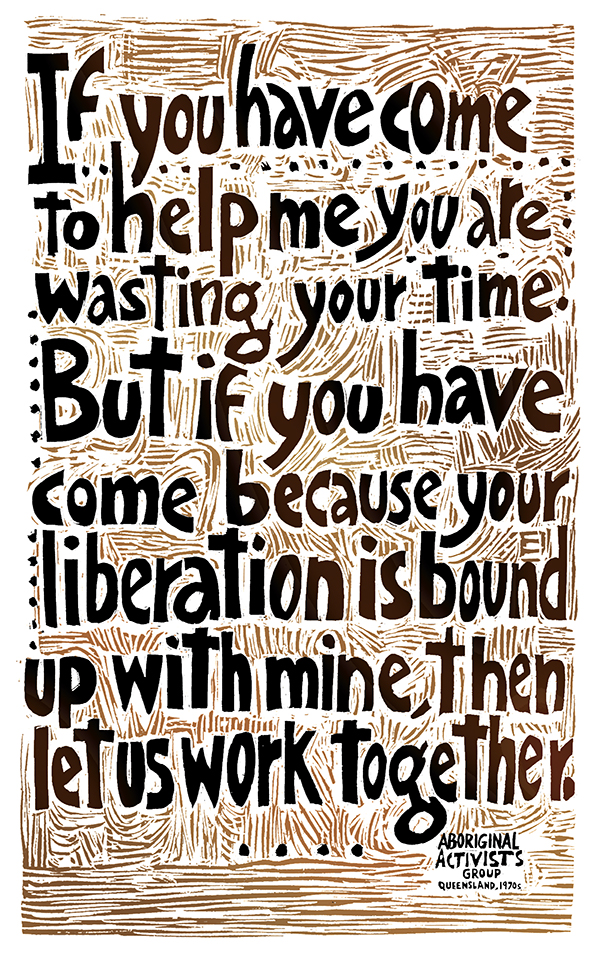
Quotation from Lilla Watson, Aboriginal Australian visual artist and activist.
Thank you to the Mosaic Center for curating many parts of the following Resources list in their recent posting on myUMBC. As UMBC’s leaders in helping our communities embrace and affirm diversity and inclusion, the Mosaic Center is more important than ever. The Women’s Center is, as ever, in close partnership and solidarity with the Mosaic, and we will always commit to that. Thank you, Mosaic Team, for all you do to make the UMBC community and our world a better place.
Resources*
* There are a lot of resources below. A lot. This work is not being timed. There is no deadline. This is a marathon, not a sprint. Many folks feel an urgency to read! All! The! Things! And yes, this work is urgent but also must be sustainable. Take breaks. Breathe. Set SMART goals when it comes to reading, learning, and digesting so as not to burn yourself out.
Books:
Readings:
Podcasts:
Collections:
Resources for white parents to raise anti-racist children:
- Books
- Podcasts
- Videos
- Follow
- The Conscious Kid: follow them on Instagram and consider signing up for their Patreon
UMBC Organizations:
More Organizations:
]]>
This post is written by Amelia Meman, ’15, Assistant Director in the Women’s Center. I am trying to write this as plainly as I can because there are so many other words that are crowding...
https://womenscenteratumbc.wordpress.com/2020/06/04/learning-how-to-be-anti-racist/
https://my3.my.umbc.edu/api/v0/pixel/news/93599/guest@my.umbc.edu/c44c63689dda49e96ceb9e586114246e/api/pixel
activism
activist
ally
allyship
anti-racist
antiracism
black-feminism
black-lives-matter
blm
diversity
higher-ed
inclusion
intersectionality
liberation
performative-activism
racial-justice
racism
resources
social-justice
solidarity
uncategorized
white-supremacy
whiteness
Women's, Gender, & Equity Center
https://my3.my.umbc.edu/groups/womenscenter
https://assets2-my.umbc.edu/system/shared/avatars/groups/000/000/125/78272a4842689b30dbf74672182b78f8/xsmall.png?1750974263
https://assets1-my.umbc.edu/system/shared/avatars/groups/000/000/125/78272a4842689b30dbf74672182b78f8/original.png?1750974263
https://assets1-my.umbc.edu/system/shared/avatars/groups/000/000/125/78272a4842689b30dbf74672182b78f8/xxlarge.png?1750974263
https://assets1-my.umbc.edu/system/shared/avatars/groups/000/000/125/78272a4842689b30dbf74672182b78f8/xlarge.png?1750974263
https://assets1-my.umbc.edu/system/shared/avatars/groups/000/000/125/78272a4842689b30dbf74672182b78f8/large.png?1750974263
https://assets2-my.umbc.edu/system/shared/avatars/groups/000/000/125/78272a4842689b30dbf74672182b78f8/medium.png?1750974263
https://assets1-my.umbc.edu/system/shared/avatars/groups/000/000/125/78272a4842689b30dbf74672182b78f8/small.png?1750974263
https://assets2-my.umbc.edu/system/shared/avatars/groups/000/000/125/78272a4842689b30dbf74672182b78f8/xsmall.png?1750974263
https://assets3-my.umbc.edu/system/shared/avatars/groups/000/000/125/78272a4842689b30dbf74672182b78f8/xxsmall.png?1750974263
Women's Center
https://assets3-my.umbc.edu/system/shared/thumbnails/news/000/093/599/700369a48f30f205d5b759c56410a804/xxlarge.jpg?1591284817
https://assets2-my.umbc.edu/system/shared/thumbnails/news/000/093/599/700369a48f30f205d5b759c56410a804/xlarge.jpg?1591284817
https://assets1-my.umbc.edu/system/shared/thumbnails/news/000/093/599/700369a48f30f205d5b759c56410a804/large.jpg?1591284817
https://assets2-my.umbc.edu/system/shared/thumbnails/news/000/093/599/700369a48f30f205d5b759c56410a804/medium.jpg?1591284817
https://assets2-my.umbc.edu/system/shared/thumbnails/news/000/093/599/700369a48f30f205d5b759c56410a804/small.jpg?1591284817
https://assets2-my.umbc.edu/system/shared/thumbnails/news/000/093/599/700369a48f30f205d5b759c56410a804/xsmall.jpg?1591284817
https://assets3-my.umbc.edu/system/shared/thumbnails/news/000/093/599/700369a48f30f205d5b759c56410a804/xxsmall.jpg?1591284817
42
0
false
Thu, 04 Jun 2020 10:06:25 -0400
Thu, 04 Jun 2020 10:06:25 -0400
Mutual Aid: One for All and All for One

Nandi is a student staff member in the Women’s Center and a Junior English major.
Mutual aid, as a concept, is based in anarchism and the work of Petr Kropotkin. His work, “Mutual Aid: A Factor of Evolution”, is a foundational text for anarchists and other communist movements. But really, you don’t have to be an anarchist or a communist, or know anything about these ideologies to practice mutual aid because it’s an extremely simple concept.
Basically, the theory supposes that people (and other creatures) are FAR more inclined to taking care of each other than they are to individualism, no matter how much our capitalist ruling class argues to the contrary. The Seattle-based collective Big Door Brigade defines the practical application of mutual aid as “when people get together to meet each other’s basic survival needs with a shared understanding that the systems we live under are not going to meet our needs and we can do it together RIGHT NOW!” They also make the point that it is a separate and distinct practice from charity and charitable organizations.
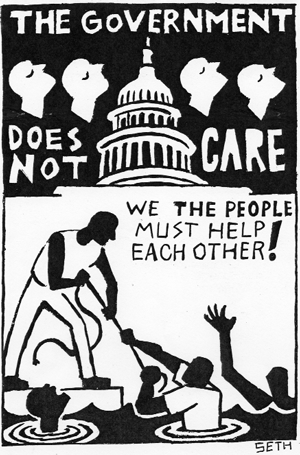
Image by Seth Tobocman
Historically, mutual aid looks a lot of different ways. The Free African Society in 1787 was an organization meant to provide aid amongst free Black people. In the 20th century, there were Italian-American organizations called Societa di Mutuo Soccorso and Mexican-American societies called Sociedad Mutualistas. Larger worker movements and labor unions are also a part of this tradition as they necessitate collaboration and care work as a means to stay afloat while struggling for rights. Labor organizing in the US is at its lowest point in decades, but that doesn’t mean that we still can’t connect to our communities right now in the present to help everyone survive.
In feminist movements, mutual aid is a thread that runs throughout as an ongoing necessity among those who are oppressed under patriarchy. It’s not hard to see why; power-based violence, hiring discrimination, and wage gaps all team up to make people of oppressed genders dependent on one another rather than the institutions that their oppressors control.
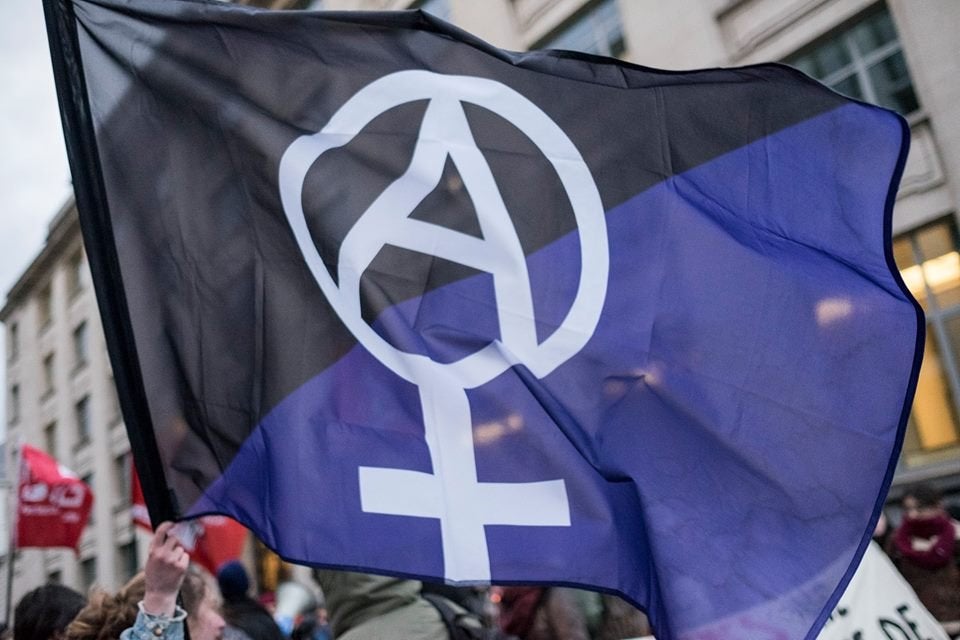
Anarchist Feminist flag
The Association for Women’s Rights in Development has mutual aid as a key piece of their “Solidarity Economy”, an economy in which people’s relationship to goods and services is more sustainable and cooperative. To go along with that, anarchist feminism interprets the labeling of actions like sharing, compassion, and sensitivity as “feminine” to mean that these are direct challenges to the “masculine” hierarchy.
Maybe you’ve seen mutual aid mentioned on social media in the past few weeks, or maybe you haven’t. Right now, due to COVID-19, we’re all in a position to rely on one another for safety and survival. We usually think of networking as a means to further ourselves towards our own goals and ambitions. Now is a time to network with the people in our neighborhoods and communities for our common good. Practicing mutual aid doesn’t mean that everyone has to gather and social distancing has to go out the window because those are important things to do for our communities as well.
If in reaching out you find a need that you can fill, then do so! If someone in your network has access to resources that you can’t find, then make your own needs known! As capable and resourceful as we are, self-reliance is not the order of the day. Lean into your human inclinations towards care and comradeship to make it through.
Hundreds of mutual aid groups have popped up all over the country in the past month to address the dire straits we now find ourselves in, with most of them being led by the organizers who dedicate their lives to this work every day.
To find one near you, you can go to the interactive map on mutualaidhub.org, or this list posted on the Its Going Down digital community center. Its Going Down also has organizing guides and resources so that you don’t have to go into this unlearned. I’ve put in for the Baltimore Maroon Movement! Who in YOUR community needs your help?
]]>
Nandi is a student staff member in the Women’s Center and a Junior English major. Mutual aid, as a concept, is based in anarchism and the work of Petr Kropotkin. His work, “Mutual...
https://womenscenteratumbc.wordpress.com/2020/04/01/mutual-aid-one-for-all-and-all-for-one/
https://my3.my.umbc.edu/api/v0/pixel/news/91741/guest@my.umbc.edu/3e80bc5d5f9bee686255016d8bc9e3ac/api/pixel
activism
anarchism
community-care
community-organizing
covid-19
critical-social-justice
feminism
intersectionality
issues
mutual-aid
pandemic
politics
uncategorized
Women's, Gender, & Equity Center
https://my3.my.umbc.edu/groups/womenscenter
https://assets2-my.umbc.edu/system/shared/avatars/groups/000/000/125/78272a4842689b30dbf74672182b78f8/xsmall.png?1750974263
https://assets1-my.umbc.edu/system/shared/avatars/groups/000/000/125/78272a4842689b30dbf74672182b78f8/original.png?1750974263
https://assets1-my.umbc.edu/system/shared/avatars/groups/000/000/125/78272a4842689b30dbf74672182b78f8/xxlarge.png?1750974263
https://assets1-my.umbc.edu/system/shared/avatars/groups/000/000/125/78272a4842689b30dbf74672182b78f8/xlarge.png?1750974263
https://assets1-my.umbc.edu/system/shared/avatars/groups/000/000/125/78272a4842689b30dbf74672182b78f8/large.png?1750974263
https://assets2-my.umbc.edu/system/shared/avatars/groups/000/000/125/78272a4842689b30dbf74672182b78f8/medium.png?1750974263
https://assets1-my.umbc.edu/system/shared/avatars/groups/000/000/125/78272a4842689b30dbf74672182b78f8/small.png?1750974263
https://assets2-my.umbc.edu/system/shared/avatars/groups/000/000/125/78272a4842689b30dbf74672182b78f8/xsmall.png?1750974263
https://assets3-my.umbc.edu/system/shared/avatars/groups/000/000/125/78272a4842689b30dbf74672182b78f8/xxsmall.png?1750974263
Women's Center
4
0
false
Wed, 01 Apr 2020 08:30:04 -0400
Self Care: An Activists Survival Guide
 Alexia Petasis is an INDS intern on the Women’s Center student staff team. Alexia studies social justice and dance. In the following blog post, she runs through a list of crucial self-care survival strategies for activists.
Every week, the Women’s Center asks a “question of the week” available for anyone to respond to. One week our question was, “what do you do for self-care?” This question was one I have heard many times, but this time it led me to ponder all the ways I have, or have not, practiced self-care as well as what tips I can offer everyone else. I’ve seen many people around campus this semester look drained, fatigued and overwhelmed by our campus climate. For some, this exhaustion was due to the various articles and subsequent student rallies that came about after allegations that UMBC mishandled sexual assault claims.
I’ve gathered some self care tips from my own experiences, the advice my friends find helpful, and others I’ve found online while on a quest to live my best social justice activist life, while not drowning carelessly into the pit of despair that social justice work sometimes feels like. As we head into Thanksgiving, let’s use the next few days off to reflect on ways we can practice self-care….
Take the Time to be Mad:
Over the past semester, many of our campus community members have experienced feelings of anger. Anger at our institution and anger at the fact that this issue was more than an isolated incident. Being mad allows us to feel what we rightfully should feel and allows us to push ourselves to see what we can do about it. If we weren’t mad or bothered about issues like these, then there would be no driving force to pursue change. On that note, I’ve noticed it is equally important to be aware of how much “bad news” you consume.
During the semester, while UMBC was exploding with its own bad news about the alleged mistreatment of survivors of sexual assault, the news was overwhelmingly reminiscent of how the roots of injustice are so deeply ingrained in our society. Survivors of sexual assault nationwide have had to revisit their past trauma with the news pertaining to Supreme Court Judge nominee, Brett Kavanaugh, who was accused of sexual assault. An article published on CNN states, “the day Ford testified in front of senators and the whole country, the sex assault hotline saw a 201% increase in calls compared with a typical day”. It was almost like our school and the federal government were in a parallel universe and the influx of bad news was overwhelming.
So, be mad, but also be careful to balance out time to also think about the good things. As hard as it is, try not to allow yourself to stay so up-to-date with everything that you bombard your mind with all the bad in the world. This can cause opposite results and paralyze your abilities as an activist since it feels as though nothing is getting better. This leads me to my next point.
Surround Yourself with Other Activists:
This one is IMPORTANT! I didn’t realize just how draining it was to be around those who truly don’t give a sh*t about the injustices many face in our world. Therefore, I would first say, have conversations and meet individuals whose views align with yours and who want to help the world become a better place too. At the Women’s Center, I have seen so many bonds created in the lounge area of the Women’s Center and have been part of many conversations empowering us to speak our truths. We Believe You, a student organization on campus, holds weekly discussion group and general body meetings for survivors of sexuals assualt and allies. In the wake of campus conversations around sexual violence, it can sometimes feel good to be with people who are doing the work and also feel similar frustrations.
But, along with meeting activists in person, there are many podcasts out there that can make us feel hopeful of all the other activists we have doing amazing work and raising our consciousness about issues that are all around us.
One of my favorites is called “Transforming Together” by two staff members at HopeWorks, a domestic violence shelter in Howard County. Brittany Eltringham and Heidi Griswold shed light on issues happening in our country with an intersectional feminist perspective. They describe their podcasts as, “a blend of pop culture and social justice, the show is hosted by two queer folks who are committed to healing, laughing, and loving their way to a world free from exploitation, oppression, and violence.” Another resource called Know Your IX mentions various tips for self care on their website as well.

Express Gratitude:
Express gratitude when it’s easy, but more importantly, make the conscious decision and effort to express gratitude when the world feels as if it’s a dumpster fire. Even if it is as simple as I woke up on time today, I made an extra good cup of coffee this morning, or I had a good conversation with someone. Try to start each day or end each night writing five things that you are grateful for that day. Every little bit of positivity you offer to yourself trains your mind to escape this bubble of pessimism towards the world (which frankly I do often too, but I am working on it).
Another cool way to bring in more optimism among all the dreariness that comes with social justice activism is to sign up for The Good Trade email notifications. The Good Trade describes their daily newsletter as, “Everyday Inspiration For The Informed Woman: A 30 second read of good things to listen, follow, visit, browse and read—delivered to your inbox each morning. Curated by and for women.” Their mission statement at the bottom of the newsletter states that the inspiration of the day leaves you “informed + inspired about the good things that rise above the clutter”. To say the least, waking up and reading the good work that others are doing around the world can help to ground us and recenter our views of the world.
Embody Self Preservation:
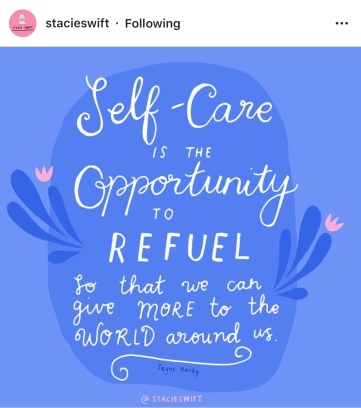
Finally, the infamous quote by Audre Lorde, “Caring for myself is not self-indulgence, it is self-preservation, and that is an act of political warfare.” Viewing self-care as an inherent part of any activism effort and a duty you owe yourself is crucial to taking good care of yourself while you are busy trying to take care of everyone else. As we head into finals and holidays and reasons for activism always continue to exist what will you do to practice self-care? Feel free to share your ideas or comments with us on the Women’s Center social media pages!
]]>
Alexia Petasis is an INDS intern on the Women’s Center student staff team. Alexia studies social justice and dance. In the following blog post, she runs through a list of crucial self-care...
https://womenscenteratumbc.wordpress.com/2018/11/19/self-care-an-activists-survival-guide/
https://my3.my.umbc.edu/api/v0/pixel/news/80511/guest@my.umbc.edu/6049d9e0e90704fc8e908a1df0ded850/api/pixel
activism
audre-lorde
feminism
mental-health
self-care
self-reflection
sexual-violence
Women's, Gender, & Equity Center
https://my3.my.umbc.edu/groups/womenscenter
https://assets2-my.umbc.edu/system/shared/avatars/groups/000/000/125/78272a4842689b30dbf74672182b78f8/xsmall.png?1750974263
https://assets1-my.umbc.edu/system/shared/avatars/groups/000/000/125/78272a4842689b30dbf74672182b78f8/original.png?1750974263
https://assets1-my.umbc.edu/system/shared/avatars/groups/000/000/125/78272a4842689b30dbf74672182b78f8/xxlarge.png?1750974263
https://assets1-my.umbc.edu/system/shared/avatars/groups/000/000/125/78272a4842689b30dbf74672182b78f8/xlarge.png?1750974263
https://assets1-my.umbc.edu/system/shared/avatars/groups/000/000/125/78272a4842689b30dbf74672182b78f8/large.png?1750974263
https://assets2-my.umbc.edu/system/shared/avatars/groups/000/000/125/78272a4842689b30dbf74672182b78f8/medium.png?1750974263
https://assets1-my.umbc.edu/system/shared/avatars/groups/000/000/125/78272a4842689b30dbf74672182b78f8/small.png?1750974263
https://assets2-my.umbc.edu/system/shared/avatars/groups/000/000/125/78272a4842689b30dbf74672182b78f8/xsmall.png?1750974263
https://assets3-my.umbc.edu/system/shared/avatars/groups/000/000/125/78272a4842689b30dbf74672182b78f8/xxsmall.png?1750974263
Women's Center
7
0
false
Mon, 19 Nov 2018 15:17:25 -0500
What You Need to Know About Art & Activism
Get ready for Critical Social Justice: Ignite with our What You Need to Know series. Written by Alexia Petasis.
Activism can be defined as a “practice that emphasizes direct vigorous action especially in support of or opposition to one side of a controversial issue.” This can come in many forms and finding your own voice as an activist can be challenging. Something I’ve realized is that activism can meet you where you are at, and there is beauty in combining your passions with your role as an activist. The arts, whether that is performing arts (dance or theatre), visual arts (painting, photography, etc), or fine arts (poetry, music, etc) have the ability to convey complex stories, perspectives, and emotions and creates space to understand the experiences of others. As a powerful medium of communication, the arts can lend themselves well to activism and advocacy work.
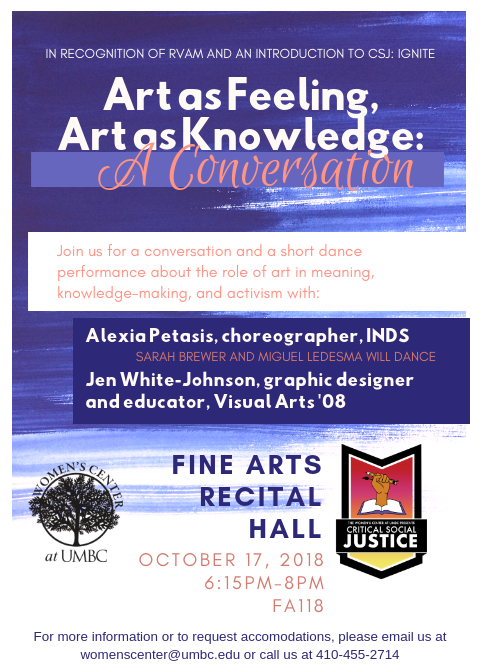 As an introduction to Critical Social Justice week, the Women’s Center will be hosting Art as Feeling, Art as Knowledge: A Conversation, from 6:30 to 8 pm on Wednesday, October 17th in the Fine Arts Recital Hall. This event will demonstrate ways in which both the performing and visual arts can be used for social justice activism. In recognition of Relationship Violence Awareness Month, the dance, choreographed by Alexia Petasis, will reflect the development and progression of relationship violence. Alexia collaborated with the We Believe You student group and the Women’s Center to share her choreographed piece in April 2018 for Sexual Assault Awareness Month. The dance provoked conversation and experiences that many found unable to understand before witnessing this dance piece. Read more on this Retriever review here. Jen White-Johnson, Visual Arts ’08, will be sharing the ways she uses visual art, specifically graphic design, to empower individuals with autism. Inspired by her son Knox and the intersectional identities he has, Jen’s photography, design, and writing celebrate the joy of being a child on the spectrum. See more of her work here.
 Spread from Jennifer White-Johnson’s zine, ‘Advocate Autistic Love’.
Another event the Women’s Center will be hosting as part of CSJ:Ignite is our Community Art Project on October 23, from 11:30 am to 2:30 pm on Academic Row. This event aims to engage and create space for individuals to imagine what a social justice future looks like. Join us to come together as a community and use art as a way of expressing our own visions of a socially just future. There will be popcorn and lots of art supplies! If you are an artist and want to learn how to use your talents to speak out, if you are an activist and haven’t quite considered how art can be integrated within social justice movements, or if you are generally curious about all the knowledge that will be shared throughout this event, everyone is welcome!
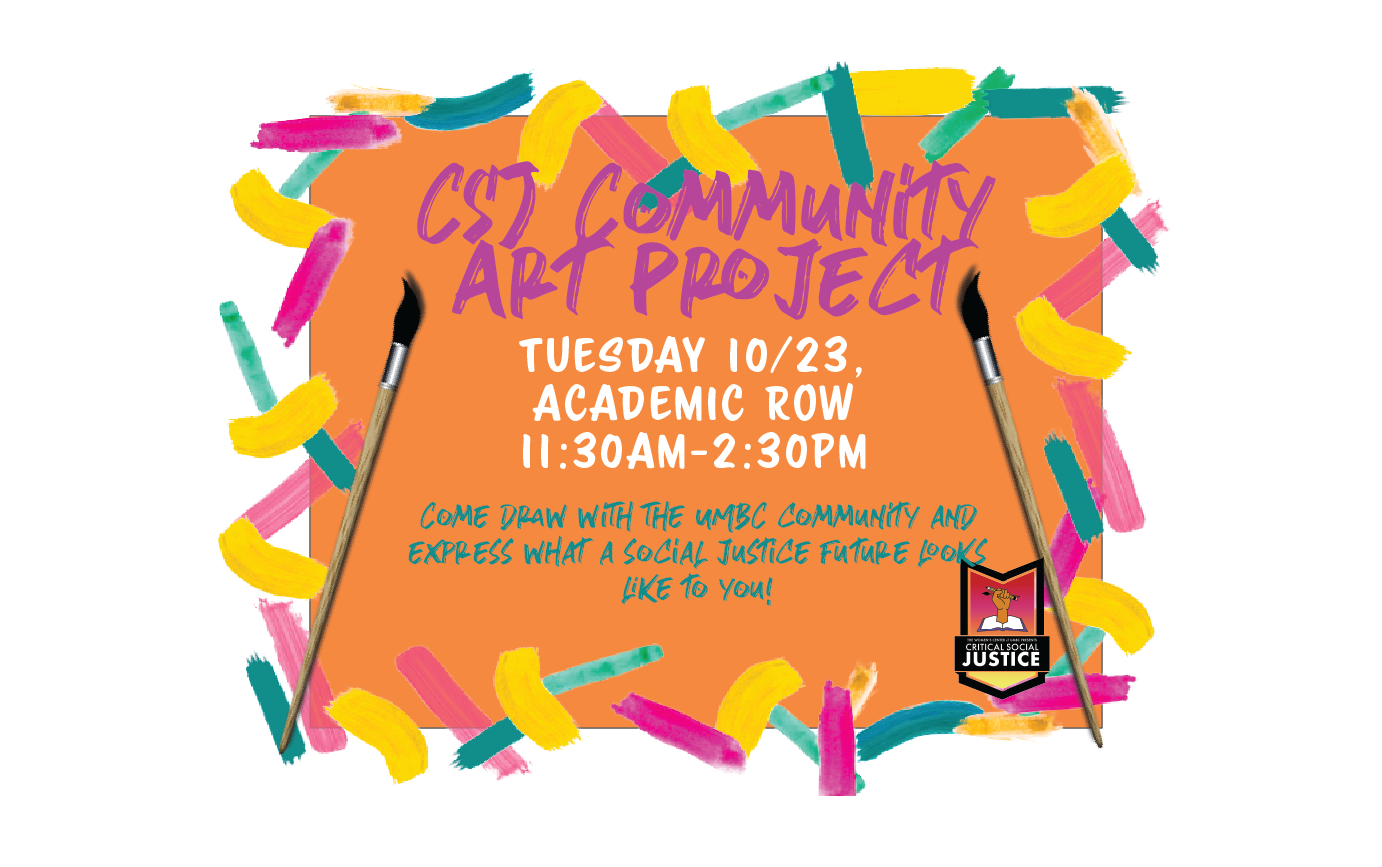
]]>
Get ready for Critical Social Justice: Ignite with our What You Need to Know series. Written by Alexia Petasis. Activism can be defined as a “practice that emphasizes direct vigorous action...
https://critsocjustice.wordpress.com/2018/10/10/what-you-need-to-know-about-art-activism/
https://my3.my.umbc.edu/api/v0/pixel/news/79310/guest@my.umbc.edu/eb86ccb93b0719f8fe70faf8d496a469/api/pixel
activism
art
college-activism
community
community-art
critical-social-justice
csj-ignite
dance
design
feminism
social-justice
what-you-need-to-know
Women's, Gender, & Equity Center
https://my3.my.umbc.edu/groups/womenscenter
https://assets2-my.umbc.edu/system/shared/avatars/groups/000/000/125/78272a4842689b30dbf74672182b78f8/xsmall.png?1750974263
https://assets1-my.umbc.edu/system/shared/avatars/groups/000/000/125/78272a4842689b30dbf74672182b78f8/original.png?1750974263
https://assets1-my.umbc.edu/system/shared/avatars/groups/000/000/125/78272a4842689b30dbf74672182b78f8/xxlarge.png?1750974263
https://assets1-my.umbc.edu/system/shared/avatars/groups/000/000/125/78272a4842689b30dbf74672182b78f8/xlarge.png?1750974263
https://assets1-my.umbc.edu/system/shared/avatars/groups/000/000/125/78272a4842689b30dbf74672182b78f8/large.png?1750974263
https://assets2-my.umbc.edu/system/shared/avatars/groups/000/000/125/78272a4842689b30dbf74672182b78f8/medium.png?1750974263
https://assets1-my.umbc.edu/system/shared/avatars/groups/000/000/125/78272a4842689b30dbf74672182b78f8/small.png?1750974263
https://assets2-my.umbc.edu/system/shared/avatars/groups/000/000/125/78272a4842689b30dbf74672182b78f8/xsmall.png?1750974263
https://assets3-my.umbc.edu/system/shared/avatars/groups/000/000/125/78272a4842689b30dbf74672182b78f8/xxsmall.png?1750974263
Women's Center
4
0
false
Wed, 10 Oct 2018 08:33:29 -0400
Wed, 10 Oct 2018 08:33:29 -0400


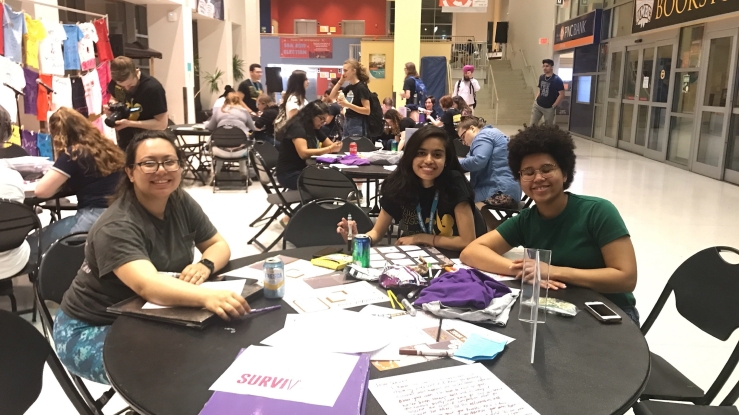


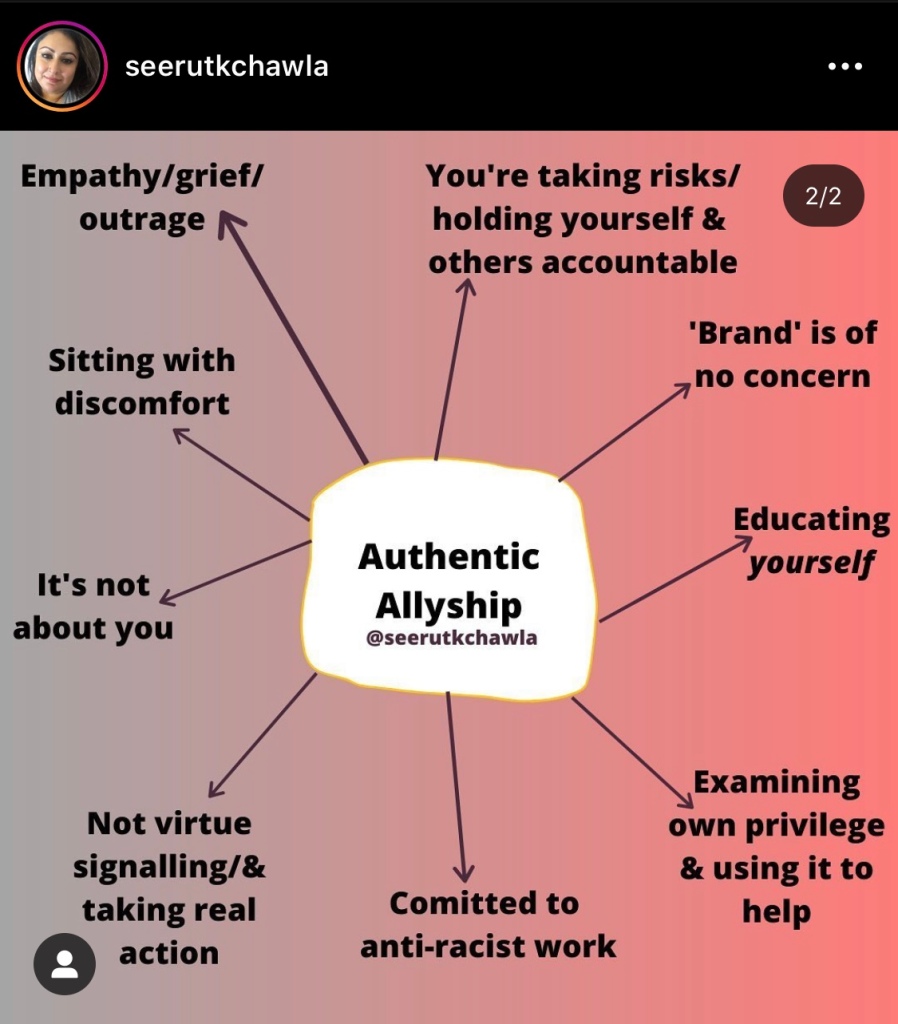 Graphic from the
 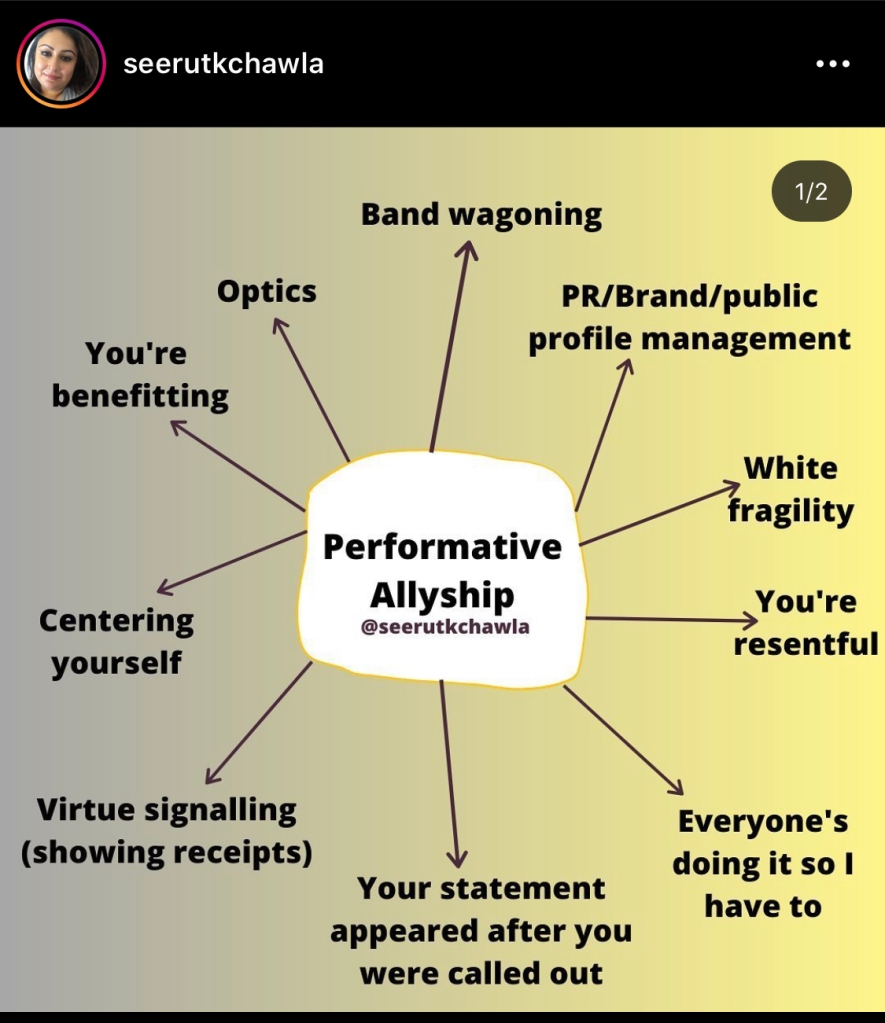 Graphic from the
  Graphic from the
 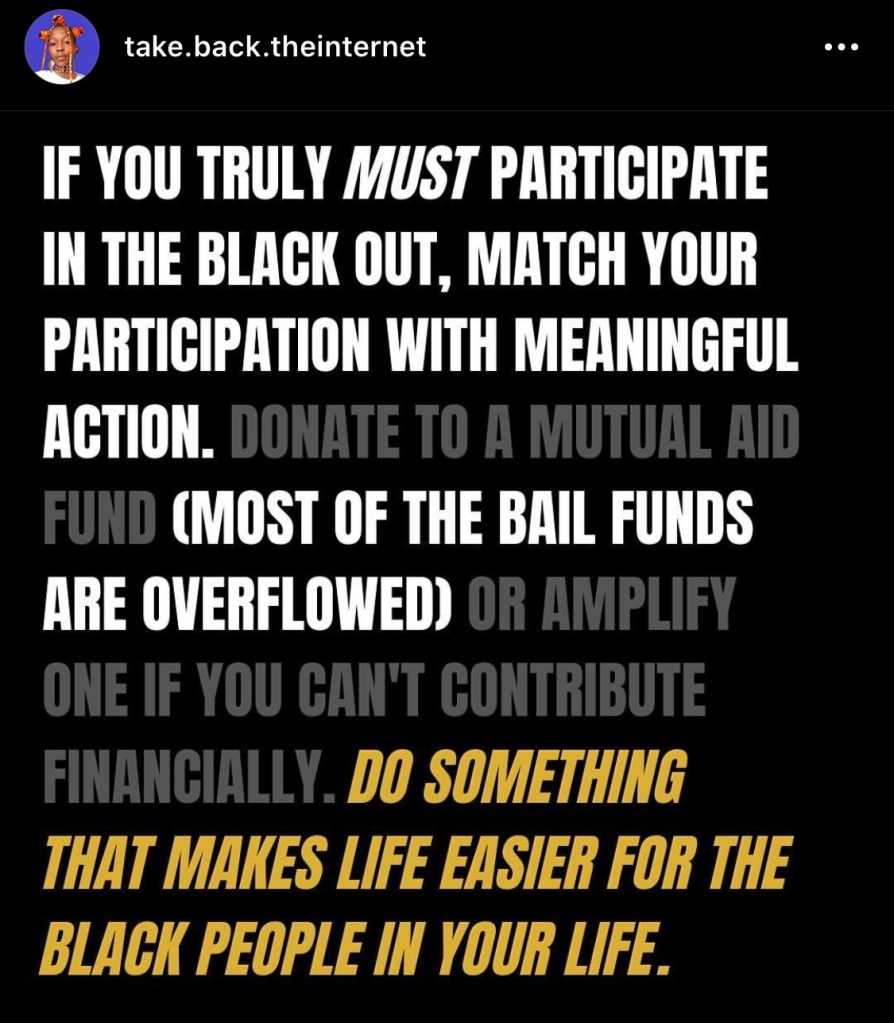 Graphic from the