Exploring Artificial Reproductive Technologies
Positionally statement: This post is written by Audrey Gatewood. I am a senior in the UMBC School of Social Work, completing my field placement at the Women’s Center. I’m writing this blog as a result of learning about reproductive technologies in my personal life, with the belief that other people may be interested too. I do not have any background in medical education, and do not have first- hand experience with reproductive technologies. This blog is written from research I’ve done for myself, prompted by my own interest in using reproductive technologies, and does not cover everyone’s experience or all possible circumstances in which reproductive technologies may be used.

(A simplified illustration of the difference between artificial insemination, in which sperm is injected directly into the uterus, and in vitro fertilization, in which an egg is fertilized in a petri dish before being inserted into the uterus. Photo via https://www.invitra.com/ )
When I mention my partner and I may consider having kids, generally a beat of intrigued confusion follows. My partner and I are both women, and cannot get pregnant on our own. Even surrounded by other LGBTQ people, follow up ensues: Adoption? Intrauterine insemination? Sperm donor?
Fertility is typically viewed as a given for people of a certain age, and parenthood as inherent in long-term heterosexual partnerships. For women in particular, fertility and motherhood are seen as defining states of being. But what about people who are infertile, who can’t get pregnant for health reasons, who want children but don’t want to be pregnant, who are older, lesbian and gay couples, and so on? Disrupting the typical image of childbearing comes with many questions of intention, method, and outcome. Particularly interesting are the medical technologies and methods that people may use to get pregnant, called artificial reproductive technology, or ART.
Artificial reproductive technologies are innovations in healthcare that help people conceive. According to the American Center for Disease Control definition, ART includes
“any fertility-related treatments in which eggs or embryos are manipulated. Procedures where only sperm are manipulated, such as intrauterine inseminations, are not considered under this definition (Jain and Singh, 2023).”
The most well known and common ART procedure is in vitro fertilization, or IVF, in which a sperm and an egg are combined outside of the body in a laboratory dish. Eggs are retrieved in a process called ovarian stimulation, in which a person is given hormonal fertility medications to stimulate multiple egg growth in the ovaries, instead of just one per month (Jain and Singh, 2023). This way there are more chances for the egg to be effectively fertilized and result in a pregnancy, as not every egg will fertilize, and not every fertilized egg will result in a full term pregnancy. The fertilized egg, or multiple eggs, are then transplanted into the uterus, where they may or may not attach to the uterine lining and develop into a pregnancy.

(Illustration of the in vitro fertilization process. Photo via dreamstime.com)
In this same process, one could choose to have eggs and/or embryos frozen for future use in a process called cryopreservation (Jain and Singh, 2023). This saves the person from having to go through the process of ovarian stimulation again, as it’s a relatively involved, 1-2 week long process that requires many doctors visits and potential side effects from hormone fluctuation. Some people choose to use cryopreservation to preserve eggs before undergoing major health undertakings, like chemotherapy, to prevent eggs from being damaged, or if age is a concern, one may choose to freeze their eggs at a younger age and use them at a later time, when they are ready to be pregnant.
IVF is the most common ART in use, but there is also intrauterine insemination, or IUI. IUI is the process of inserting sperm directly into the uterus around the time of ovulation to increase the chance of fertilization (Planned Parenthood). Sperm is collected either from a partner or from a donor, “washed” in a process that collects healthy sperm and removes chemicals in the semen, and inserted via a catheter. The process is much more low- tech than IVF, less invasive, and generally takes about 5-10 minutes. But how do you get pregnant when sperm isn’t readily available? Most likely through a sperm bank, using donor sperm.

(Illustration of the intrauterine insemination process, in which washed sperm is injected into the uterus via a catheter. Photo via Jonathan Dimes for BabyCenter)
People may choose to use donor sperm for a variety of reasons: if their/their partner’s sperm is infertile, to avoid passing down hereditary diseases, if a single woman is ready to have a kid, or if neither partner can produce sperm, like many lesbian couples, for example. People can use sperm from a friend or relative, but often sperm is coming from donors with varying levels of anonymity. Whether and to what degree a donor remains anonymous depends on the sperm bank and policies local to the state and country. Generally, though, total anonymity cannot be guaranteed to a sperm donor, particularly with the rise of consumer-level DNA testing for websites like 23AndMe or Ancestery.com. Generally, a medical history and varying levels of descriptors are provided to a person or couple looking to use donated sperm, descriptors that may include hair color, self-reported personality traits, ethnicity, personal interests/hobbies/ career, and sometimes, though not always, a photo. Sperm donors are heavily screened for infectious and hereditary disease, undergoing extensive medical questionnaires, full physical exams, and sperm analysis. Donors will also go through mental health screening and a criminal background check (UCSF Health 2020).
ART and other related procedures like IUI come with a price. A single IVF cycle can range from $15,000 to $30,000 on average (Forbes Magazine, 2023). IUI can cost between $300 to $1,000 per session, depending on if donor sperm is used (Planned Parenthood). Neither procedure guarantees a full term pregnancy. In fact, national data from the Society for Assisted Reproductive Technology reports that “the rate of live births following first-use IVF for women under the age of 35 using their own oocytes is only 37% (Center for Reproductive Rights, 2020)”. Private insurance companies may cover some or much of the procedure, and there are grants, discount programs and clinical studies that can reduce the cost (Forbes Magazine, 2023).
Even so, fertility treatments come with a barrier of accessibility, and may only be available to those who can afford them. IVF in particular can be burdensome for those who utilize it, not only coming at a huge financial cost, but demanding an investment of time and emotional and physical strain, causing many people to discontinue using it after an unsuccessful first attempt.
IUI faces a much lower barrier of accessibility, but is not an option for everyone in need of fertility assistance. In addition to being financially inaccessible for many, infertility or using ART can come with a stigma, one which typically affects women. Deviance from the typical fertility narrative challenges the societal expectation of women as inherently mothers, and of the normative family dynamic of a married man and woman having children ‘naturally.’ Women using ART due to fertility issues may experience social stigma, personal shame, and anxiety or depression (Center for Reproductive Rights, 2020). Despite the fact that male-factor infertility accounts for 50% of clinical cases, women tend to receive the brunt of this stigma. For lesbian couples using IUI, stigma can follow the couple through their whole lives as a family, as the rules of a normative family structure are broken when a man is removed from the equation, and when pregnancy is achieved in a non-normative way.
There isn’t much representation of lesbian moms. Even surrounded by my sizable LGBTQ community, in a “progressive” city, I haven’t had many examples of what parenting as a lesbain couple could look like. Sometimes I find myself wondering, if I had a kid, what their experience would be like having two moms? Will it be a huge difference from how I grew up? How would our family be treated by others? Will they be asked invasive questions about their birth? How much would they look like the sperm donor? What if they got in touch with the sperm donor when they were older, and what would that mean?
Regardless of these questions, I’m grateful that reproductive technologies exist, and hope to see barriers to access removed. The future potential for growth, not only in the technological aspect, but in the regulation and accessibility of consumer use of fertility treatments, and of societal understanding, points to ongoing questions about medical technology, genetics, parenthood and more.
Reference
Center for Reproductive Rights. (2020). Infertility and IVF access in the United States.
Forbes Magazine. (2023, March 7th). How much does IVF cost?. Forbes.
Jain, Meaghan; Singh, Manvinder. (January 2023) Assisted Reproductive Technology (ART) techniques. National Center for Biotechnology Information.
Planned Parenthood. What is intrauterine insemination (IUI)?
UCSF Health. (2020, October 7). Donor sperm insemination. ucsfhealth.org.
]]>
Positionally statement: This post is written by Audrey Gatewood. I am a senior in the UMBC School of Social Work, completing my field placement at the Women’s Center. I’m writing this blog as a...
https://womenscenteratumbc.wordpress.com/2023/05/16/exploring-artificial-reproductive-technologies/
https://my3.my.umbc.edu/api/v0/pixel/news/133551/guest@my.umbc.edu/98cadefc71272c49fd70b403fd045215/api/pixel
artificial-reproductive-technologies
feminism
ivf
lgbtq
lgbtq-readings
pregnancy
reproductive-health
Women's, Gender, & Equity Center
https://my3.my.umbc.edu/groups/womenscenter
https://assets2-my.umbc.edu/system/shared/avatars/groups/000/000/125/78272a4842689b30dbf74672182b78f8/xsmall.png?1750974263
https://assets1-my.umbc.edu/system/shared/avatars/groups/000/000/125/78272a4842689b30dbf74672182b78f8/original.png?1750974263
https://assets1-my.umbc.edu/system/shared/avatars/groups/000/000/125/78272a4842689b30dbf74672182b78f8/xxlarge.png?1750974263
https://assets1-my.umbc.edu/system/shared/avatars/groups/000/000/125/78272a4842689b30dbf74672182b78f8/xlarge.png?1750974263
https://assets1-my.umbc.edu/system/shared/avatars/groups/000/000/125/78272a4842689b30dbf74672182b78f8/large.png?1750974263
https://assets2-my.umbc.edu/system/shared/avatars/groups/000/000/125/78272a4842689b30dbf74672182b78f8/medium.png?1750974263
https://assets1-my.umbc.edu/system/shared/avatars/groups/000/000/125/78272a4842689b30dbf74672182b78f8/small.png?1750974263
https://assets2-my.umbc.edu/system/shared/avatars/groups/000/000/125/78272a4842689b30dbf74672182b78f8/xsmall.png?1750974263
https://assets3-my.umbc.edu/system/shared/avatars/groups/000/000/125/78272a4842689b30dbf74672182b78f8/xxsmall.png?1750974263
Women's Center
5
0
false
Tue, 16 May 2023 16:06:44 -0400
Tue, 16 May 2023 16:06:44 -0400
What You Need to Know About Take Back The Night & Craftivism
We're resharing our TBTN What You Need To Know Series!
Posted on March 29, 2019 by jdehitta1
Originally written and posted by SamBam226 on March 29, 2019
April is Sexual Assault Awareness Month, and the Women's Center is hosting its seventh Take Back The Night (TBTN) on Thursday, April 13th. Over the years, we've had a lot of questions about what Take Back the Night exactly is, why it looks the way it does, and how students can get involved. To help get those questions answered this year, we've doing a "What You Need to Know" series focused on TBTN so stay tuned for more posts over the next couple of weeks. This is the fifth post in the series and it focuses on the last part of Take Back the Night which is craftivism and community building.
Hearing and sharing survivors' stories of sexual violence can be empowering, challenging, and emotional. We know that people process their feelings in different ways, and so following survivor speak out and march, the event continues with Craftivism on Main Street. This portion of the program is intended to provide space for reflection, creative expression, and community building.
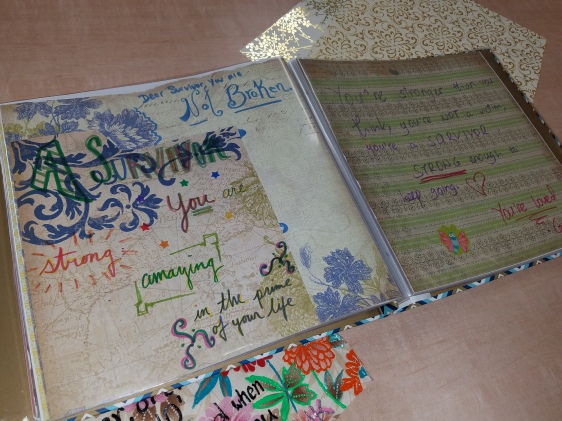
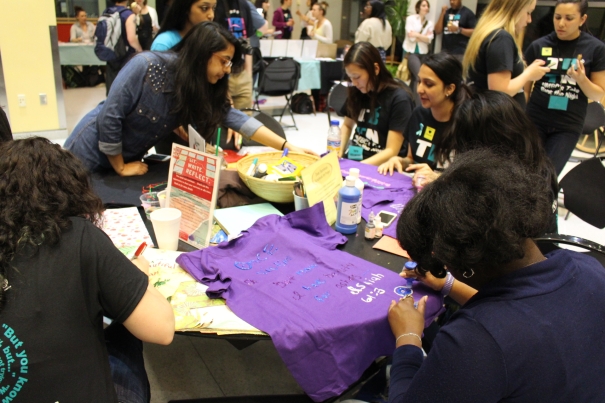
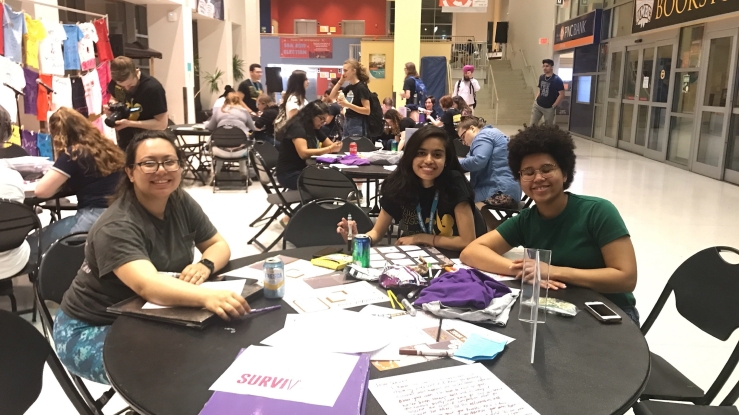
When the marchers return to Main Street, there will be tables set up with art supplies for anyone wishing to contribute to one of the community craft projects we'll have available: sachet bags to fill with scented dried flowers and herbs, the Clothesline Project, and the Dear Survivor scrapbook. We also encourage attendees to check out the resource tables to learn more about various campus and community organizations and services.
All are welcome to add a page to our Dear Survivor scrapbook, which features messages of hope, healing, and solidarity from survivors and allies who have attended TBTN in past years. The scrapbook can be found in the Women's Center lounge.
Materials for the Clothesline Project will be available for survivors who would like to give voice to their experience by decorating a shirt that will be displayed during Sexual Assault Awareness Month. Every April, these shirts are hung shoulder-to-shoulder on a clothesline on Main Street to give public testimony to the problems of sexual and gender-based violence. Please note that while allies are invited to participate in the Monument Quilt and Dear Survivor scrapbook, the Clothesline Project is intended for those who identify as survivors.
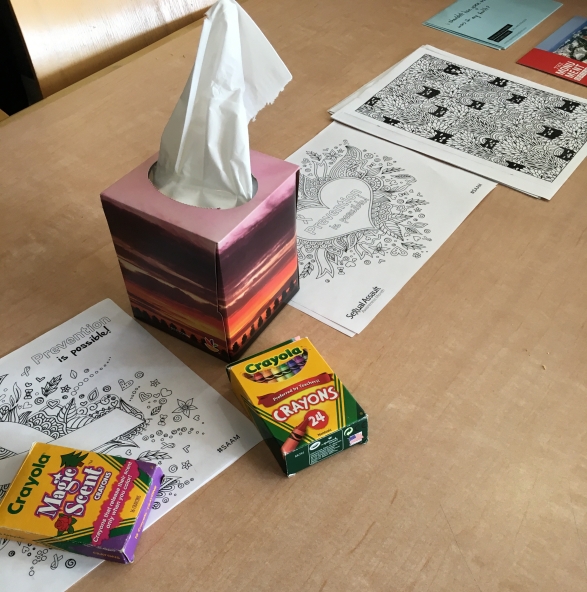
For those who prefer a quieter space for reflection, there will be a self-care station set up in the commuter lounge available during the survivor speak out and the rest of the evening. There will be tissues, stress balls, coloring supplies, and other resources for self-care. The station also provides a more private space where attendees can speak with one of the counselors on call, if needed.
For more information about UMBC's TBTN (check out Facebook, Instagram, and Twitter too by searching the hashtag #UMBCTBTN):
]]>
Posted on March 29, 2019 by jdehitta1 Originally written and posted by SamBam226 on March 29, 2019 April is Sexual Assault Awareness Month, and the Women's Center is hosting its...
https://my3.my.umbc.edu/api/v0/pixel/news/132515/guest@my.umbc.edu/12d0f6dc6d5a1207897d8d16084bcd77/api/pixel
activism
feminism
programs
saam
sexual-assault
sexual-assault-awareness-month
survivors
survivors-of-sexual-violence
tbtn
umbc
what-you-need-to-know-tbtn
Women's, Gender, & Equity Center
https://my3.my.umbc.edu/groups/womenscenter
https://assets2-my.umbc.edu/system/shared/avatars/groups/000/000/125/78272a4842689b30dbf74672182b78f8/xsmall.png?1750974263
https://assets1-my.umbc.edu/system/shared/avatars/groups/000/000/125/78272a4842689b30dbf74672182b78f8/original.png?1750974263
https://assets1-my.umbc.edu/system/shared/avatars/groups/000/000/125/78272a4842689b30dbf74672182b78f8/xxlarge.png?1750974263
https://assets1-my.umbc.edu/system/shared/avatars/groups/000/000/125/78272a4842689b30dbf74672182b78f8/xlarge.png?1750974263
https://assets1-my.umbc.edu/system/shared/avatars/groups/000/000/125/78272a4842689b30dbf74672182b78f8/large.png?1750974263
https://assets2-my.umbc.edu/system/shared/avatars/groups/000/000/125/78272a4842689b30dbf74672182b78f8/medium.png?1750974263
https://assets1-my.umbc.edu/system/shared/avatars/groups/000/000/125/78272a4842689b30dbf74672182b78f8/small.png?1750974263
https://assets2-my.umbc.edu/system/shared/avatars/groups/000/000/125/78272a4842689b30dbf74672182b78f8/xsmall.png?1750974263
https://assets3-my.umbc.edu/system/shared/avatars/groups/000/000/125/78272a4842689b30dbf74672182b78f8/xxsmall.png?1750974263
Women's Center
https://assets1-my.umbc.edu/system/shared/thumbnails/news/000/132/515/0b1bbe0844fc0104a1692173f8383563/xxlarge.jpg?1681225481
https://assets4-my.umbc.edu/system/shared/thumbnails/news/000/132/515/0b1bbe0844fc0104a1692173f8383563/xlarge.jpg?1681225481
https://assets2-my.umbc.edu/system/shared/thumbnails/news/000/132/515/0b1bbe0844fc0104a1692173f8383563/large.jpg?1681225481
https://assets1-my.umbc.edu/system/shared/thumbnails/news/000/132/515/0b1bbe0844fc0104a1692173f8383563/medium.jpg?1681225481
https://assets1-my.umbc.edu/system/shared/thumbnails/news/000/132/515/0b1bbe0844fc0104a1692173f8383563/small.jpg?1681225481
https://assets3-my.umbc.edu/system/shared/thumbnails/news/000/132/515/0b1bbe0844fc0104a1692173f8383563/xsmall.jpg?1681225481
https://assets4-my.umbc.edu/system/shared/thumbnails/news/000/132/515/0b1bbe0844fc0104a1692173f8383563/xxsmall.jpg?1681225481
0
0
false
Tue, 11 Apr 2023 11:10:45 -0400
What You Need To Need Know: TBTN & the Survivor Speak-Out
We're resharing our TBTN What You Need To Know series!
This post was orginially written and posted on April 22nd, 2019 by Sambam226.
April is Sexual Assault Awareness Month, and the Women’s Center is hosting its 7th consecutive Take Back the Night on Thursday, April 13th. Over the years, we’ve had a lot of questions about what Take Back the Night exactly is, why it looks the way it does, and how students can get involved. To help get those questions answered we started the “What You Need to Know” series focused on TBTN last year and are continuing on the tradition, so stay tuned for more posts over the next week. This is an updated post to last year’s information focusing on the survivor speak-out.
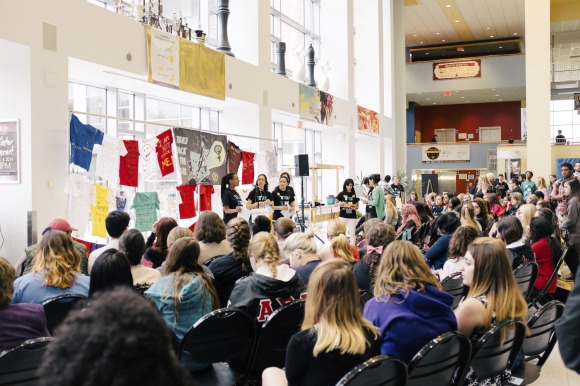
The survivor speak-out is the heart of Take Back the Night. This is the point in the night where survivors are encouraged to come up and share their story with the crowd before the march throughout campus. As a survivor, sharing your story at TBTN allows you to publicly acknowledge your experience with a crowd that believes you and supports you.
Kayla Smith, UMBC Class of 2017, started the speak out in previous years and cherished that moment as a time where she could share her experience with people who she knew wouldn’t judge her. She could look out into a crowd of people who wouldn’t tell her its her fault, ask what she was wearing, ask if she was drinking, or tell her that she was responsible for her assault. “Speaking out about my assault empowers me to talk about my experience with confidence.”
This year we want to focus on dispelling the myth of the “perfect victim” that often times dominates sexual violence discourse. There are a variety of stories and experiences that are shared during the speak- out. Some may share stories or healing while others are still angry, sad, or scared. Many stories may come from women-identified folks and/but male survivors are also invited to share their stories at the speak-out. All of our stories and experiences are valid. And, no matter where you are at in your experience as a survivor (i.e. your assault happened 10 years ago or just last week) or what your identities may be, you’re welcomed to share your story.
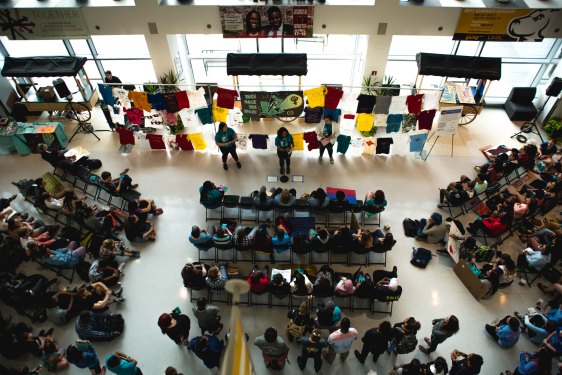
If you’re thinking about speaking at Take Back the Night, feel free to reach out to Women’s Center staff ahead of time if you feel like it would be helpful to talk to someone ahead of time about your story and how you may want to share it. Of course, we know many survivors may not plan on speaking at TBTN and then feel called to do so once the speak-out begins and that’s okay! If you feel uncomfortable sharing during the speak-out, that’s also 100% okay! There will be a chance to be recognized during the March at the Survivor Circle (which will be a new part of this year’s march – stay tuned for our updated What You Need to Know about the March post for more details!) or discuss your experience in a more intimate setting at We Believe You’s survivor discussion group post march.
It’s also totally okay if don’t feel ready to share your story at Take Back the Night – there’s many other ways you can share your story in less public ways throughout Sexual Assault Awareness Month (like making a t-shirt for the Clothesline Project or the other ways at TBTN we mentioned in the above paragraph) and Take Back the Night (counselors will be available throughout the event and there will be the self-care station). Survivors or anyone impacted by sexual violence can also always schedule a time to talk to Women’s Center staff – we’re quasi-confidential resources on campus and can link you to additional support and resources.
Here’s some helpful information about the speak-out we think is helpful for everyone to know whether they’re speaking or listening:
- Any one can be a survivor of sexual violence. Any survivor regardless of their gender identity or sexual orientation is welcomed to share their story at the speak-out. At the beginning of TBTN’s creation the speak out was only for women, but we welcome men and all others who may have differing gender identities to speak out. We wish for the speak out to be an inclusive space of healing and representation of different identities can help dispel the dangerous “perfect victim” narrative.
- The survivor speak-out is intended to center the voices and experience of survivors of sexual violence. The speak-out is for allies to listen and survivors to break their silence. Thank you in advanced for respecting this request. Allies are also encouraged to attend the Women’s Center workshop on Supporting Survivors of Sexual Violence on 4/11.
- Since TBTN functions as a public forum, normal reporting procedures look a bit different. If you choose to share your story, and want to go no further in the reporting process, we encourage you not to disclose any names or other specific identifying information, such as locations or familial relationships, as those details may prompt staff to follow up with you for reporting matters. Staff are available at the event for those who do want additional resources and want to report their experience through UMBC’s Title IX reporting process or police.
- We ask that you try to limit your story to about 3 minutes. We know it may be hard to do so but we want to make sure as many survivors as possible can speak during the allotted speak out time which is one hour long. If you’d like to continue sharing your story, you may want to go to the We Believe You discussion group after the Take Back the Night march.
- Speakers will have the option to identify their story as confidential by placing a sign marked “confidential” on the microphone. Speaking from the “confidential” microphone prohibits anyone from taking pictures, quotes, or recording of any kind.
-
Counselors-On-Call will be available throughout the evening. Any one needing additional support or simply needs to take a break are invited to visit the self-care station that will be set up in the Commuter Lounge.
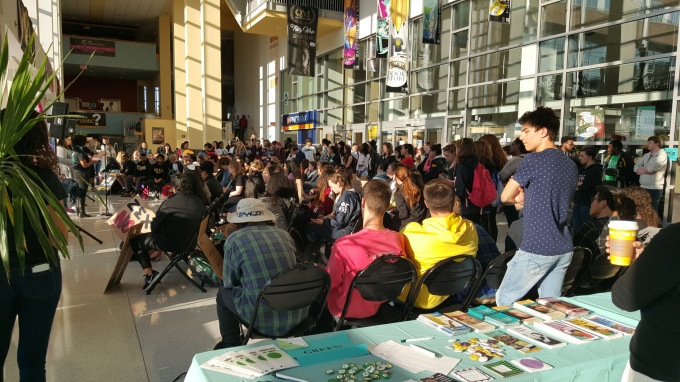
For more information about UMBC’s TBTN (check out Facebook, Instagram, and Twitter too by searching the hashtag #UMBCTBTN):
- Supporting Survivors of Sexual Violence Workshop information for students.
- Speak: Knowing a Survivor Without Knowing Their Story – a blog post on cultivating a survivor-responsive campus.
- The Women’s Center 2018 TBTN roundup
- The Retriever Weekly photo gallery of TBTN
- Stop by the Women’s Center on April 17th to make a rally sign for the march
]]>
This post was orginially written and posted on April 22nd, 2019 by Sambam226. April is Sexual Assault Awareness Month, and the Women’s Center is hosting its 7th consecutive Take Back the Night...
https://my3.my.umbc.edu/api/v0/pixel/news/132482/guest@my.umbc.edu/17cc769205baaa3cd885d379d85ef214/api/pixel
activism
feminism
programs
saam
sexual-assault
sexual-assault-awareness-month
survivors
survivors-of-sexual-violence
tbtn
umbc
what-you-need-to-know-tbtn
Women's, Gender, & Equity Center
https://my3.my.umbc.edu/groups/womenscenter
https://assets2-my.umbc.edu/system/shared/avatars/groups/000/000/125/78272a4842689b30dbf74672182b78f8/xsmall.png?1750974263
https://assets1-my.umbc.edu/system/shared/avatars/groups/000/000/125/78272a4842689b30dbf74672182b78f8/original.png?1750974263
https://assets1-my.umbc.edu/system/shared/avatars/groups/000/000/125/78272a4842689b30dbf74672182b78f8/xxlarge.png?1750974263
https://assets1-my.umbc.edu/system/shared/avatars/groups/000/000/125/78272a4842689b30dbf74672182b78f8/xlarge.png?1750974263
https://assets1-my.umbc.edu/system/shared/avatars/groups/000/000/125/78272a4842689b30dbf74672182b78f8/large.png?1750974263
https://assets2-my.umbc.edu/system/shared/avatars/groups/000/000/125/78272a4842689b30dbf74672182b78f8/medium.png?1750974263
https://assets1-my.umbc.edu/system/shared/avatars/groups/000/000/125/78272a4842689b30dbf74672182b78f8/small.png?1750974263
https://assets2-my.umbc.edu/system/shared/avatars/groups/000/000/125/78272a4842689b30dbf74672182b78f8/xsmall.png?1750974263
https://assets3-my.umbc.edu/system/shared/avatars/groups/000/000/125/78272a4842689b30dbf74672182b78f8/xxsmall.png?1750974263
Women's Center
https://assets1-my.umbc.edu/system/shared/thumbnails/news/000/132/482/420f3c51bce93da9132e86041fe2fdc2/xxlarge.jpg?1681142738
https://assets2-my.umbc.edu/system/shared/thumbnails/news/000/132/482/420f3c51bce93da9132e86041fe2fdc2/xlarge.jpg?1681142738
https://assets3-my.umbc.edu/system/shared/thumbnails/news/000/132/482/420f3c51bce93da9132e86041fe2fdc2/large.jpg?1681142738
https://assets1-my.umbc.edu/system/shared/thumbnails/news/000/132/482/420f3c51bce93da9132e86041fe2fdc2/medium.jpg?1681142738
https://assets1-my.umbc.edu/system/shared/thumbnails/news/000/132/482/420f3c51bce93da9132e86041fe2fdc2/small.jpg?1681142738
https://assets3-my.umbc.edu/system/shared/thumbnails/news/000/132/482/420f3c51bce93da9132e86041fe2fdc2/xsmall.jpg?1681142738
https://assets4-my.umbc.edu/system/shared/thumbnails/news/000/132/482/420f3c51bce93da9132e86041fe2fdc2/xxsmall.jpg?1681142738
0
0
true
Mon, 10 Apr 2023 12:06:07 -0400
Wed, 09 Aug 2023 13:36:03 -0400
Take Back the Night 2019 Round-Up
This blog was originally written and posted on April 22, 2019 by sambam226.
On April 18th 2019, the Women’s Center hosted the seventh annual Take Back the Night at UMBC. The night began with an introduction by the emcees Autumn, Calista and Women’s Center staff members, Samiksha and Morgan.
Photo credit: Samiksha Manjani
After the introduction was the survivor speak-out. The speak-out is the heart and soul of Take Back the Night. Survivors are encouraged to come up and share their story with the crowd before the march throughout campus. As a survivor, sharing your story at TBTN allows you to acknowledge your experience with others who believe and support you.
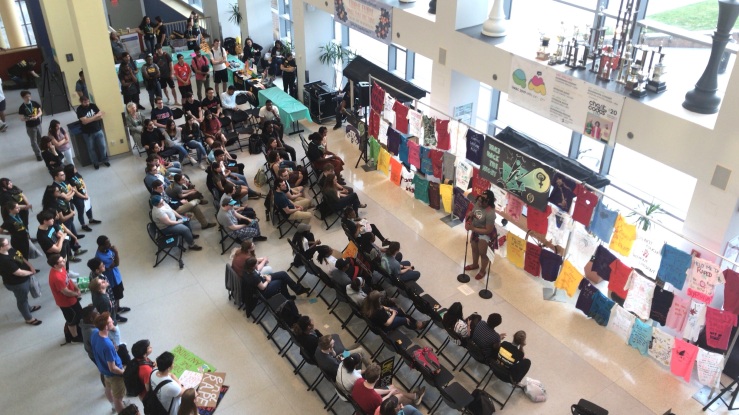
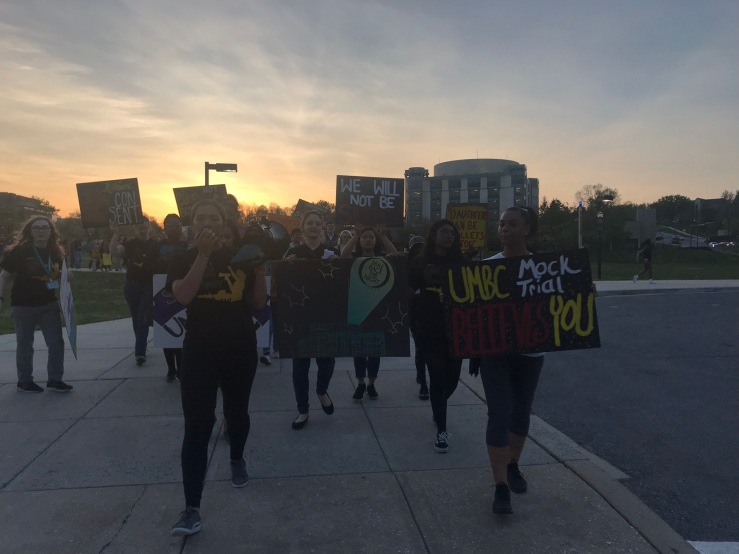
We then moved on to the march portion of the night, where we got loud and chanted in support of victims of sexual violence. We Believe You, an activist group dedicated to ending sexual violence, led the march, the survivor circle of care, and a private discussion in the Women’s Center following the march.

The survivor circle is a new addition to Take Back the Night. At the peak of the march, everyone formed a circle around True Grit. Survivors were invited to the middle of the circle, while supporters chanted the refrain, “We see you. We believe you. You matter.” After the survival circle, the march back to Main Street commenced.
After the march, community members got back together for some craftivism! This part of the night is intended to provide space for reflection, creative expression, and community-building between survivors and supporters alike.
Thank you so much to everyone for a powerful and moving evening. Thank you to every survivor for sharing their story, to every ally who supported the survivors, and a special thank you to all the volunteers and We Believe You members who made TBTN possible!
If you weren’t able to make it, here are some resources:
]]>
This blog was originally written and posted on April 22, 2019 by sambam226. On April 18th 2019, the Women’s Center hosted the seventh annual Take Back the Night at UMBC. The night began with an...
https://my3.my.umbc.edu/api/v0/pixel/news/132423/guest@my.umbc.edu/9a864415a707ff108422047e4de69816/api/pixel
activism
feminism
programs
saam
sexual-assault
sexual-assault-awareness-month
survivors
survivors-of-sexual-violence
take-back-the-night
tbtn
umbc
what-you-need-to-know-tbtn
Women's, Gender, & Equity Center
https://my3.my.umbc.edu/groups/womenscenter
https://assets2-my.umbc.edu/system/shared/avatars/groups/000/000/125/78272a4842689b30dbf74672182b78f8/xsmall.png?1750974263
https://assets1-my.umbc.edu/system/shared/avatars/groups/000/000/125/78272a4842689b30dbf74672182b78f8/original.png?1750974263
https://assets1-my.umbc.edu/system/shared/avatars/groups/000/000/125/78272a4842689b30dbf74672182b78f8/xxlarge.png?1750974263
https://assets1-my.umbc.edu/system/shared/avatars/groups/000/000/125/78272a4842689b30dbf74672182b78f8/xlarge.png?1750974263
https://assets1-my.umbc.edu/system/shared/avatars/groups/000/000/125/78272a4842689b30dbf74672182b78f8/large.png?1750974263
https://assets2-my.umbc.edu/system/shared/avatars/groups/000/000/125/78272a4842689b30dbf74672182b78f8/medium.png?1750974263
https://assets1-my.umbc.edu/system/shared/avatars/groups/000/000/125/78272a4842689b30dbf74672182b78f8/small.png?1750974263
https://assets2-my.umbc.edu/system/shared/avatars/groups/000/000/125/78272a4842689b30dbf74672182b78f8/xsmall.png?1750974263
https://assets3-my.umbc.edu/system/shared/avatars/groups/000/000/125/78272a4842689b30dbf74672182b78f8/xxsmall.png?1750974263
Women's Center
https://assets1-my.umbc.edu/system/shared/thumbnails/news/000/132/423/db9b1ced1636d2d8612c3f5e9b7cb939/xxlarge.jpg?1680883447
https://assets4-my.umbc.edu/system/shared/thumbnails/news/000/132/423/db9b1ced1636d2d8612c3f5e9b7cb939/xlarge.jpg?1680883447
https://assets3-my.umbc.edu/system/shared/thumbnails/news/000/132/423/db9b1ced1636d2d8612c3f5e9b7cb939/large.jpg?1680883447
https://assets2-my.umbc.edu/system/shared/thumbnails/news/000/132/423/db9b1ced1636d2d8612c3f5e9b7cb939/medium.jpg?1680883447
https://assets2-my.umbc.edu/system/shared/thumbnails/news/000/132/423/db9b1ced1636d2d8612c3f5e9b7cb939/small.jpg?1680883447
https://assets2-my.umbc.edu/system/shared/thumbnails/news/000/132/423/db9b1ced1636d2d8612c3f5e9b7cb939/xsmall.jpg?1680883447
https://assets3-my.umbc.edu/system/shared/thumbnails/news/000/132/423/db9b1ced1636d2d8612c3f5e9b7cb939/xxsmall.jpg?1680883447
0
0
true
Fri, 07 Apr 2023 12:12:08 -0400
What You Need To Need Know: TBTN & Why We March
Posted and Written on March 26, 2019 by sambam226
April is Sexual Assault Awareness Month, and the Women's Center is hosting its 7th Take Back the Night on Thursday, April 13th. Over the years, we've had a lot of questions about what Take Back the Night exactly is, why it looks the way it does, and how students can get involved. To help get those questions answered we started the 'What You Need to Know" series focused on TBTN from 2019 and are continuing on the tradition, so stay tuned for more posts over the next couple of weeks. This blog focuses on the evening's campus march against sexual violence.

1,2,3,4 WE WON'T TAKE IT ANYMORE
5,6,7,8 NO MORE VIOLENCE! NO MORE HATE!
As a survivor of sexual assault, the Take Back The Night march reminds me that I'm not alone.
Mariana De Matos Medeiros, '16, and former student staff member at the Women's Center, said "To me, having the opportunity to speak and march at TBTN last year reminded me that I am not alone and that I can stand in my power to speak about my experience. It took me 3 years to finally speak about my assault and one of the very first times was at TBTN last year. Seeing so many gathered to support allowed me to speak and speaking has allowed me to heal."
It can be easy to blame yourself, isolate yourself, and feel like you're the only person struggling with your healing; However, the march lets you connect with people who support you and believe you.
Sarah Lilly, a 2016 and 2017 Take Back The Night student leader says "Marching is us showing that solidarity is a verb, and it brings me great pride to feel so supported by my local UMBC community and to see the unconditional support for everyone else in our community."
In an open letter in her school's newspaper, survivor and student activist, Angie Epifano, recounted the aftermath of her sexual assault, namely her experience with institutional betrayal. She ended the letter with, "Silence has the rusty taste of shame." Due to rape culture, victim blaming, a lack of support for survivors, and more, it is understandable that many survivors do not disclose their experience and sexual assault is rarely spoke of in public.
Much like the Baltimore-based Monument Quilt is creating and demanding public space for survivors to heal, Take Back the Night demands for space in which we will not be shamed into silence. Activists like Angie, the Monument Quilt creators, and YOU during the march are creating a new culture where survivors are publicly supported, rather than publicly shamed.
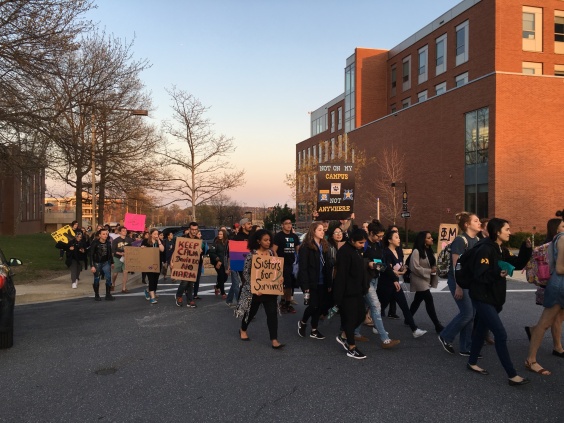
Here's some helpful information about the campus march against sexual violence to those attending Take Back the Night at UMBC:
- The survivor speak-out is intended to center the voices and experience of survivors (of all identities) of sexual violence. The speak-out is for allies to listen and survivors to break their silence but the march is for EVERYONE to GET LOUD!
- We encourage individuals and groups to make rally signs ahead of time. Signs are a great way to show your solidarity and support while also representing your student orgs, res hall communities, and frats/sororities.
-
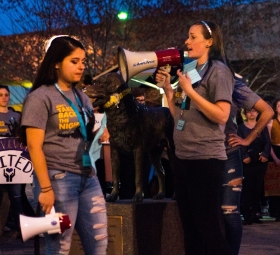
We'll line everyone up in the march in waves. Survivors wanting to march up front with other survivors are invited to line up first along with other community members needed to take an accessible route march. Everyone else will then line up as survivors begin to march towards the south exit of The Commons.
- As we march, walk slowly and stay together. Try to avoid large gaps in the line.
- This year we're bringing back the Survivor Circle. As we make out way through the route we will stop midway through the march and hold our Survivor Circle.
- The Survivor Circle is a chance for survivors who may or may not have shared their story during the speak out to be recognized, come together, and be surrounded in support and healing by those attending the march. This is an opportunity for those who identify as survivors to come together without having to speak out or share their story if they do not wish to do so.
- The march will end back on Main Street where the space will be ready for the evening's resource fair and craftivism. As you're heading back into The Commons, come all the way into Main Street so everyone else behind you can get into the space as well.
- There will be one more chance to share your experience as a survivor post-march at a survivor discussion group led by the student organization We Believe You in the Women's Center. (This event will be private and for survivors only).
- Counselors-On-Call will be available throughout the evening. Any one needing additional support or simply needs to take a break are invited to visit the self-care station that will be set up in the Commuter Lounge.

For more information about UMBC's TBTN (check out Facebook, Instagram, and Twitter too by searching the hashtag #UMBCTBTN):
- Stop by the Women's Center the week leading up to TBTN to make a rally sign for the march on April 17th
- A blog post about UMBC's 2005 TBTN march written by alum, Dr. Grollman.
- Speak: Knowing a Survivor Without Knowing Their Story - a blog post on cultivating a survivor-responsive campus.
- Register for and attend an upcoming Supporting Survivors of Sexual Violence workshop. Click here for more details on the students workshop.
- The Women's Center 2018 TBTN roundup
Stay tuned for the next installment of what you need to know about TBTN 2019!
What You Need To Need Know: Take Back The Night & Its History
April is Sexual Assault Awareness Month, and the Women’s Center is hosting its 5th consecutive Take Back The Night (TBTN) on Thursday, April 13th. Over the years, we’ve had a lot of questions about what Take Back the Night exactly is, why it looks the way it does, and how students can get involved. To help get those questions answered this year, we’ve doing a “What You Need to Know” series focused on TBTN so stay tuned for more posts over the next couple of weeks. This first post in the series focuses on the history and purpose of TBTN.
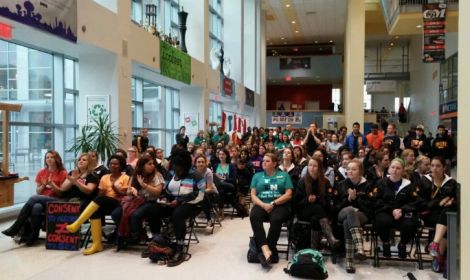
The crowd waiting for UMBC’s TBTN 2014 to begin.
In 1971 in New York a group of women and survivors hosted the first-ever rape speak-out that was organized by the group the New York Radical Feminists. A few years later, one of the first “Take Back the Night” marches was held in Philadelphia, Pennsylvania in October 1975.
Despite some advancements and more attention being paid to sexual violence, we still live in a society where over forty-five years later there is still a need to speak out against rape and sexual assault. There is still a need to say, “It happened to me.” “I believe you.” “You are not alone.” “It is not your fault.” And, so this is why we host Take Back the Night each year at UMBC and why it still happens worldwide.
UMBC (from what we can tell from the archives), held their first TBTN event in the early 2000s for just a few years. Campus stopped hosting it for several years so as to be in solidarity with other area colleges by participating in Baltimore City Hall’s Take Back the Night. But, by 2013, it made the most sense for us to bring back our own Take Back the Night. So the Women’s Center with support from UHS’s Health Education, Greek Week, and a BreakingGround grant did just that. Since then, this campus-wide rally and march against sexual violence has been a signature Women’s Center event every April.
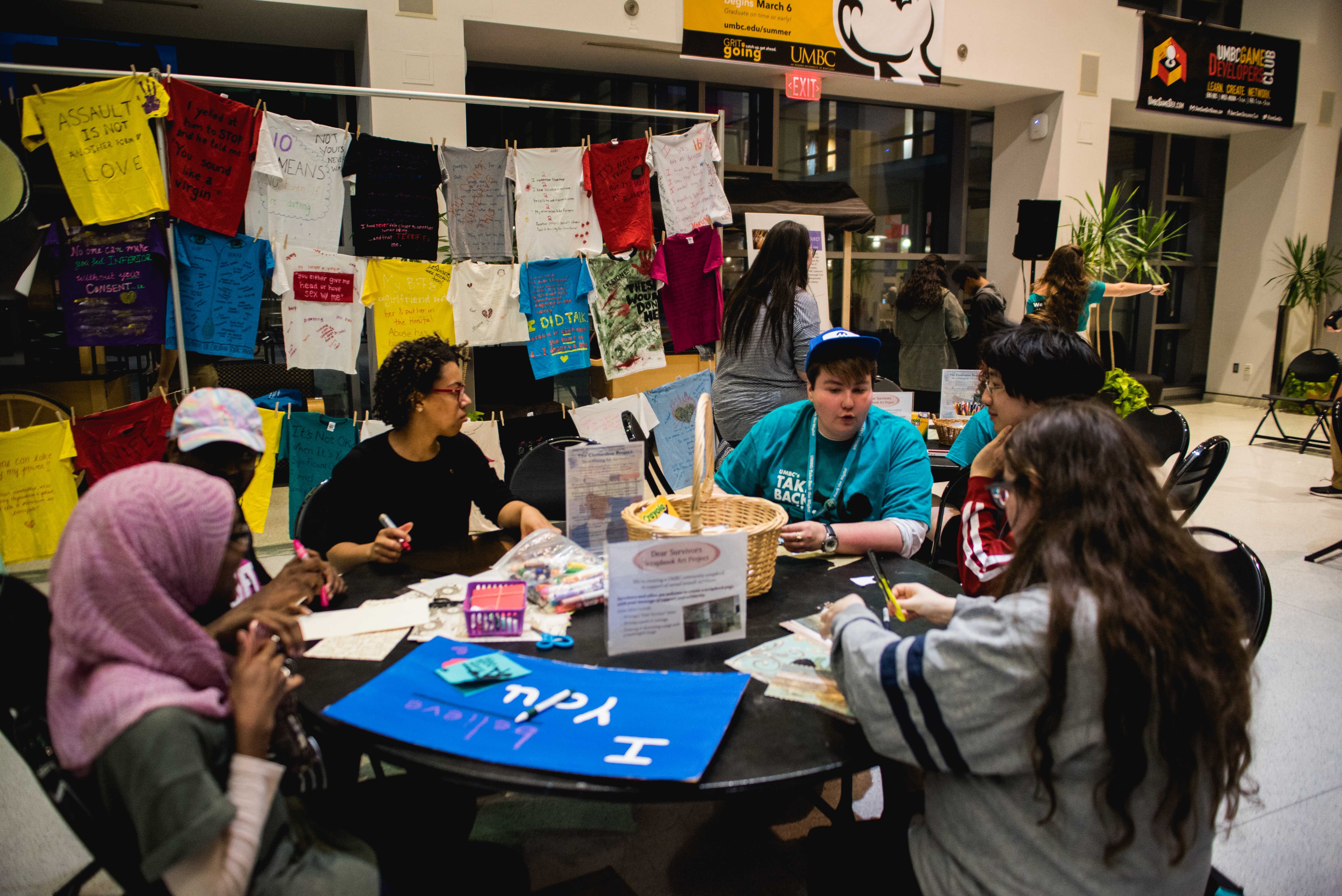
Each year the Women’s Center hosts survivor speak-out followed by a campus march against sexual assault. When marchers return, UMBC’s TBTN spends the rest of the evening doing “craftivism” art healing projects and hosting a community resource fair. A smaller version of the Clothesline Project is also serves as a backdrop to the evening’s events.
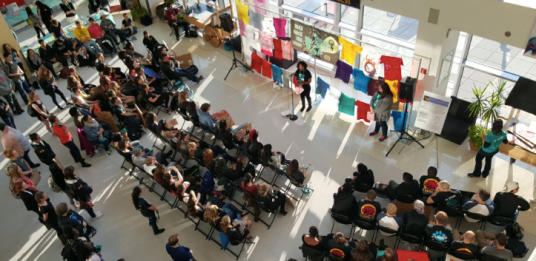
The survivor speak-out at UMBC’s TBTN 2016
Stay tuned for more posts explaining the significance of each portion of Take Back The Night!
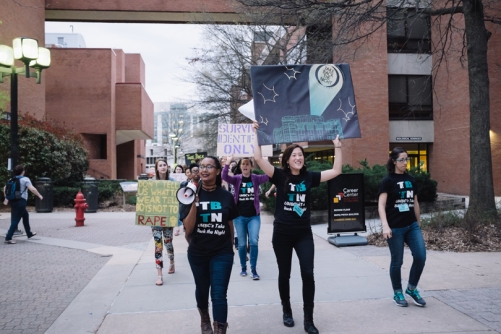
The march against sexual violence at UMBC’s TBTN 2015
For more information about UMBC’s TBTN (check out Facebook, Instagram, and Twitter too by searching the hashtag #UMBCTBTN):
- A BreakingGround post about how the 2013 TBTN came to be – Our Own ‘Take Back the Night’
- Read a blog post written by a UMBC alum related to TBTN 2005 at UMBC.
- The Women’s Center 2016 TBTN roundup
- The Retriever Weekly photo gallery of TBTN
- The Women’s Center visual recap of TBTN 2015
- Stop by the Women’s Center on April 11, 12, and 13th to make a rally sign for the march!
Stay tuned for the next installment of what you need to know about TBTN 2017!
]]>
What You Need To Need Know: Take Back The Night & Its History Posted on March 30, 2017 by kaylasm1 April is Sexual Assault Awareness Month, and the Women’s Center is hosting its 5th...
https://my3.my.umbc.edu/api/v0/pixel/news/132298/guest@my.umbc.edu/1708d21ca502612f28b4c3c519ac736d/api/pixel
activism
feminism
programs
saam
sexual-assault
sexual-assault-awareness-month
survivors
survivors-of-sexual-violence
tbtn
umbc
what-you-need-to-know-tbtn
Women's, Gender, & Equity Center
https://my3.my.umbc.edu/groups/womenscenter
https://assets2-my.umbc.edu/system/shared/avatars/groups/000/000/125/78272a4842689b30dbf74672182b78f8/xsmall.png?1750974263
https://assets1-my.umbc.edu/system/shared/avatars/groups/000/000/125/78272a4842689b30dbf74672182b78f8/original.png?1750974263
https://assets1-my.umbc.edu/system/shared/avatars/groups/000/000/125/78272a4842689b30dbf74672182b78f8/xxlarge.png?1750974263
https://assets1-my.umbc.edu/system/shared/avatars/groups/000/000/125/78272a4842689b30dbf74672182b78f8/xlarge.png?1750974263
https://assets1-my.umbc.edu/system/shared/avatars/groups/000/000/125/78272a4842689b30dbf74672182b78f8/large.png?1750974263
https://assets2-my.umbc.edu/system/shared/avatars/groups/000/000/125/78272a4842689b30dbf74672182b78f8/medium.png?1750974263
https://assets1-my.umbc.edu/system/shared/avatars/groups/000/000/125/78272a4842689b30dbf74672182b78f8/small.png?1750974263
https://assets2-my.umbc.edu/system/shared/avatars/groups/000/000/125/78272a4842689b30dbf74672182b78f8/xsmall.png?1750974263
https://assets3-my.umbc.edu/system/shared/avatars/groups/000/000/125/78272a4842689b30dbf74672182b78f8/xxsmall.png?1750974263
Women's Center
https://assets3-my.umbc.edu/system/shared/thumbnails/news/000/132/298/984b032abb4dc96f7e22ec6d76c90d49/xxlarge.jpg?1680711868
https://assets2-my.umbc.edu/system/shared/thumbnails/news/000/132/298/984b032abb4dc96f7e22ec6d76c90d49/xlarge.jpg?1680711868
https://assets1-my.umbc.edu/system/shared/thumbnails/news/000/132/298/984b032abb4dc96f7e22ec6d76c90d49/large.jpg?1680711868
https://assets2-my.umbc.edu/system/shared/thumbnails/news/000/132/298/984b032abb4dc96f7e22ec6d76c90d49/medium.jpg?1680711868
https://assets2-my.umbc.edu/system/shared/thumbnails/news/000/132/298/984b032abb4dc96f7e22ec6d76c90d49/small.jpg?1680711868
https://assets3-my.umbc.edu/system/shared/thumbnails/news/000/132/298/984b032abb4dc96f7e22ec6d76c90d49/xsmall.jpg?1680711868
https://assets2-my.umbc.edu/system/shared/thumbnails/news/000/132/298/984b032abb4dc96f7e22ec6d76c90d49/xxsmall.jpg?1680711868
0
0
true
Wed, 05 Apr 2023 12:25:39 -0400
Wed, 09 Aug 2023 13:39:50 -0400
Take Back the Night, Forever and Always
Amelia Meman (they/them and she/her), GWST ’15, is the interim director of the Women’s Center. They have worked in the Women’s Center as an intern, a student staff member, a volunteer, and now professional staff member. This is a loving retrospective on Take Back the Night (TBTN), written in the third spring semester where UMBC has not been able to hold such an event.
Author’s Note: I am proud to say that I have been to every single Take Back the Night since its revival on UMBC’s campus in 2013. This does not mean I am an expert on this event nor that my opinion of Take Back the Night is shared by the thousands who have taken part in this event throughout the past nine years. Because Take Back the Night is such a shared experience, I reached out to some alumni who have experienced TBTN as attendees, volunteers, and leaders. You will see their contributions throughout. Thank you, Yoo-Jin, Autumn, Calista, Hannah, and Sydney. 
As we share our spring semester with the pandemic once again, I know I and many of our community members are deeply disappointed to not be able to come together for Take Back the Night. Even more alarming, however, is that many folks don’t know what it is to miss Take Back the Night because they’ve never experienced it.
Our last in-person Take Back the Night was in 2019 and most recently (2021), Jess Myers alongside several student activists and campus partners, created the Take Back the Night Virtual Experience. Before that, the Women’s Center staff and community co-created a zine called “Survivors to the Front,” which invited survivors of gender-based violence to submit their creative works–whether visual art or written word.
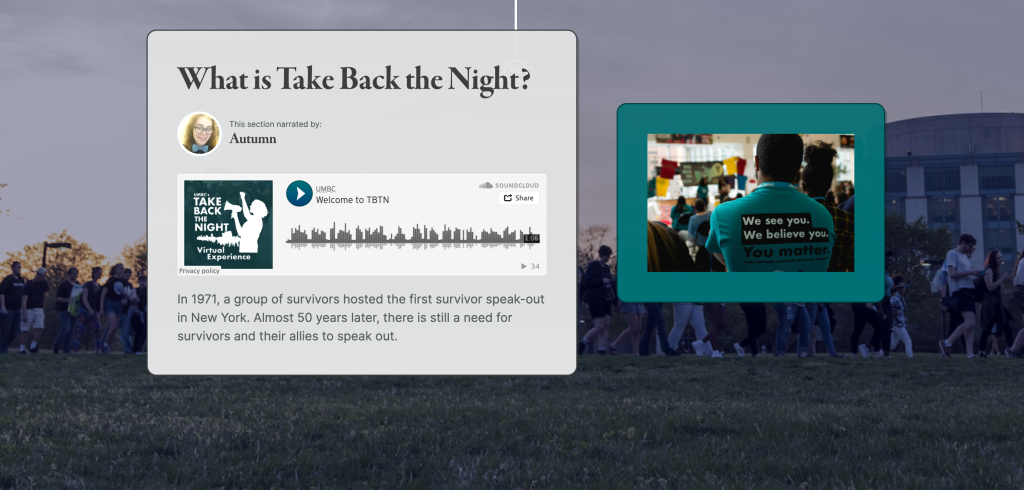

These online options have been balms in an otherwise quiet series of Sexual Assault Awareness Months (SAAM) for the Women’s Center. Normally, April is a huge month for the Women’s Center with [at minimum] weekly programming and often a full, month-long calendar of events, workshops, and educational opportunities offered through various departments on campus.
The major event of April (and for many, the entire school year) is Take Back the Night. In the last 3 years, however, we have not been able to host this event. And that’s why I’m writing this blogpost: because it’s been a long time and in addition to cultivating the hope that we can one day bring Take Back the Night back to its glory days as a large in-person, campus-wide event, I hope to preserve just a little bit of this institutional memory.
A Very Brief History of Take Back the Night at UMBC*
In 1971, a group of feminist advocates and survivors hosted the first-ever rape speak-out in New York. A few years later, one of the first “Take Back the Night” marches was held in Philadelphia, PA in October 1975.
UMBC (from what we can tell from the archives), held their first TBTN event in the early 2000s for just a few years. Campus stopped hosting it for several years so as to be in solidarity with other area colleges by participating in Baltimore City Hall’s Take Back the Night. But, by 2013, it made the most sense for us to bring back our own Take Back the Night. So the Women’s Center with support from UHS’s Health Education, Greek Week, and a BreakingGround grant did just that. Since Spring 2014, this campus-wide rally and march against sexual violence has been a signature Women’s Center event every April. Each year the Women’s Center hosts survivor speak-out followed by a campus march against sexual assault. When marchers return, UMBC’s TBTN spends the rest of the evening doing “craftivism” art healing projects and hosting a community resource fair. A smaller version of the Clothesline Project also serves as a backdrop to the evening’s events.
*Thank you to Kayla Smith, who wrote “What You Need To Need Know: Take Back The Night & Its History” in 2017; almost all of this information is from that resource.
How did Take Back the Night work at UMBC?
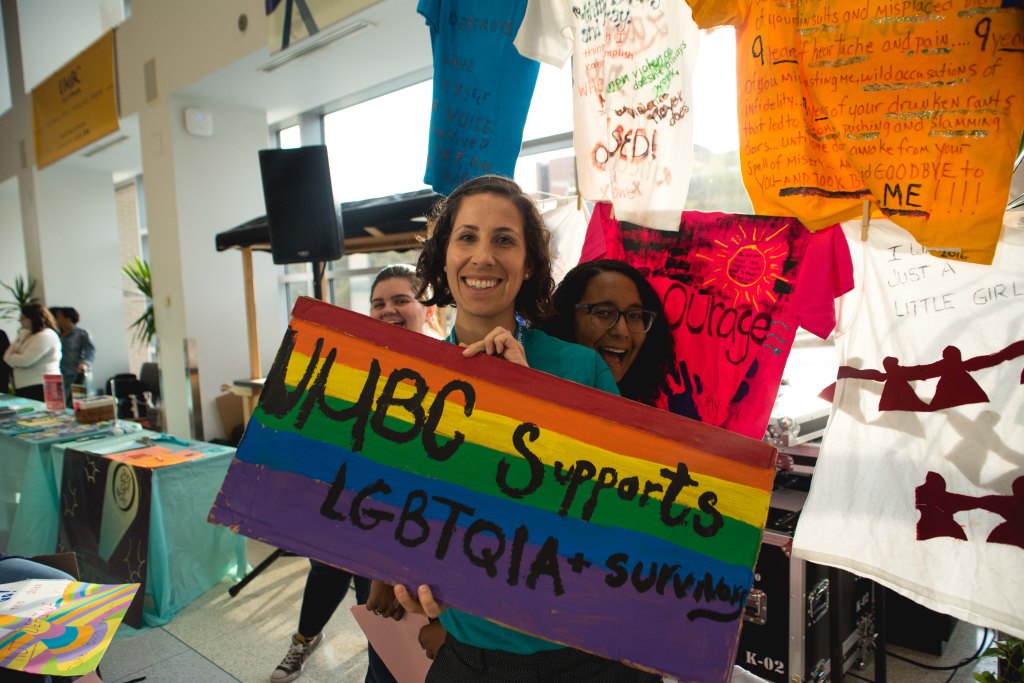
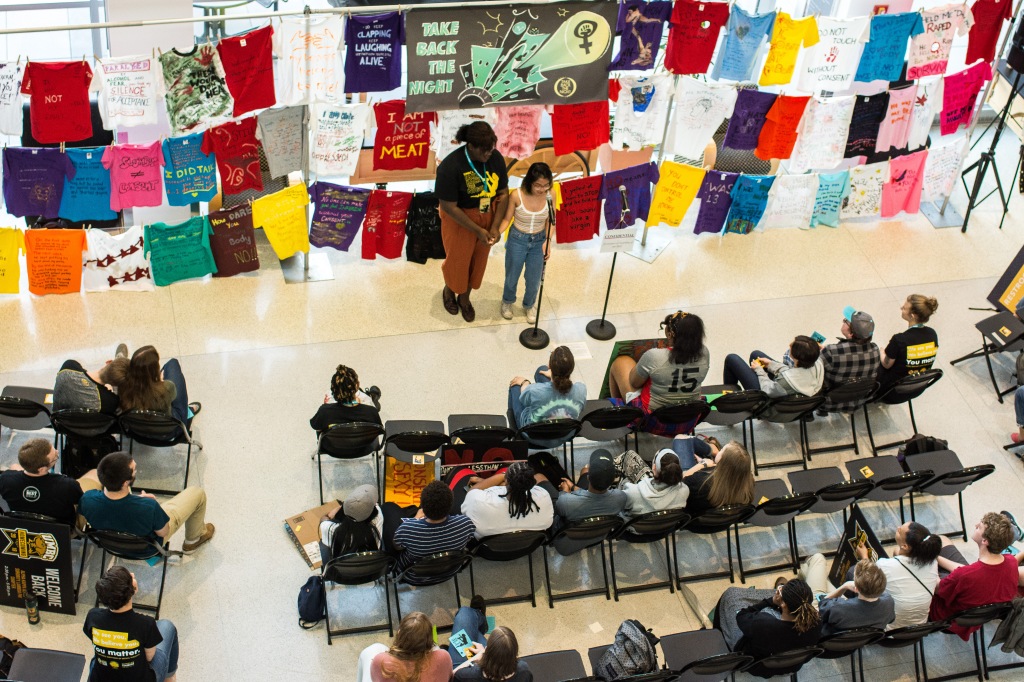
Take Back the Night starts on The Commons’ Main Street with the Survivor Speak Out. On the third Thursday of April, we take over this campus nexus with a mini-Clothesline Project display, microphones, speakers, a ton of folding chairs, resource tables, and hand-painted rally signs. The Speak-Out provides an open opportunity for survivors of power-based violence to tell their stories out loud, in front of an audience.
It was the first time I really identified as a survivor publicly and put myself in that vulnerable position. I remember the wave of emotions while we marched–anger, happiness, relief, anxiety–and how beautiful it was to just feel those things as they came.
Sydney (she/her)
This is a strategic location as it is one of the most heavily trafficked areas of campus. You might ask, “But aren’t the Survivor Speak-Out and the Clothesline Project a little disruptive for all the folks in The Commons?” The answer is yes, and that’s the point. Take Back the Night is placed in such a way that we can bring people together whether they’re attending the event on purpose or walking through and experiencing it randomly.


And that’s how many folks come to be involved in Take Back the Night–they stumble upon this big public event and get wrapped up in the stories they hear over the speakers. For Calista’s (she/her) first speak-out, she was a witness to the power of the event which caused a mixture of emotions: “My first experience felt very comforting seeing others being there for each other. It was also challenging to be in a space that reminded me so much of my trauma — but ultimately made me feel less alone.”
We have heard this reaction echoed in a number of other participants. Survivors are given the opportunity to stand up at a microphone and speak their truth; the result is raw, unfiltered vulnerability and power. Some survivors recall every last detail of their assault. Where it occurred, what they were wearing, who the perpetrator was… Others only talk about what happened in the aftermath. Regardless of what is shared, each person who comes up to the mic speaks their truth and the audience bears witness.
Autumn Cook (M29, ‘21) actually experienced her first TBTN from the front of the stage as one of our TBTN leaders. As a leader, they provide background information about TBTN and also start the Survivor Speak-Out by sharing their own story. Of their first experience, Autumn said:
Jesus. My first TBTN at UMBC was my first year on campus [in 2017]. Before then, I had never interacted with the Women’s Center – either because I didn’t super know what they did or that I was too scared too. But during the lead up to TBTN and aftermath, it felt like I found a family within the Women’s Center. I was one of the intro speakers for TBTN and getting up in front of the massive crowd was fun and illuminating. I was able to share my truth and afterwards I felt loved and seen by everyone in the crowd. The environment of support was like a big warm hug, enveloping and unending.
Autumn Cook (M29, ‘21)
-
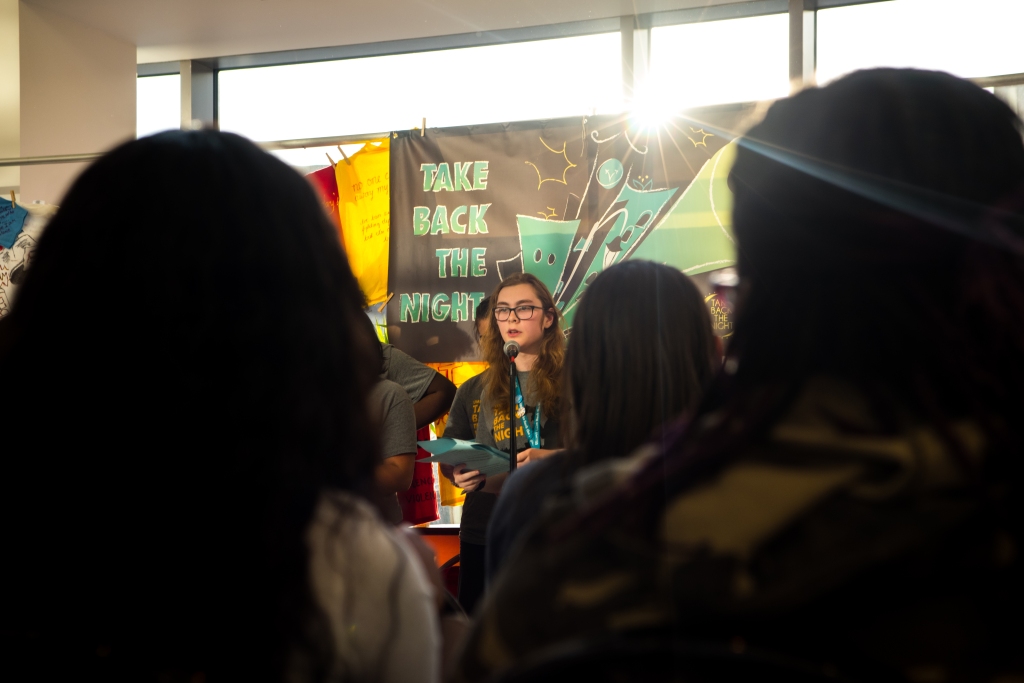 Autumn Cook leads TBTN 2018. Photo credit: Jaedon Huie
And still others experienced TBTN by working the event, like Sydney (she/her):
My first experience with TBTN, I was actually interning with The Monument Quilt. I was completely moved by the survivor speak out and the feeling of the community in the air. I remember watching survivor after survivor get up, being struck by their bravery and thinking “I couldn’t do that,” yet feeling heard and seen and accepted regardless. It was also the first true time I think I accepted my own assault and what that meant. I knew [TBTN] was something I needed to be involved in moving forward.
Sydney (she/her)
-
 The resource tables (covered in teal tablecloths) offer information about Take Back the Night and resources for survivors. Photo credit: Amelia Meman
Following the energy that builds in the Speak-Out, we mobilize all of the people who have gathered as witnesses and speakers to march across campus and demand visibility, justice, and healing for survivors.
We call on folks to move.
We hand out rally signs to anybody who wants to hold one.
We bring out the megaphones and we line up.
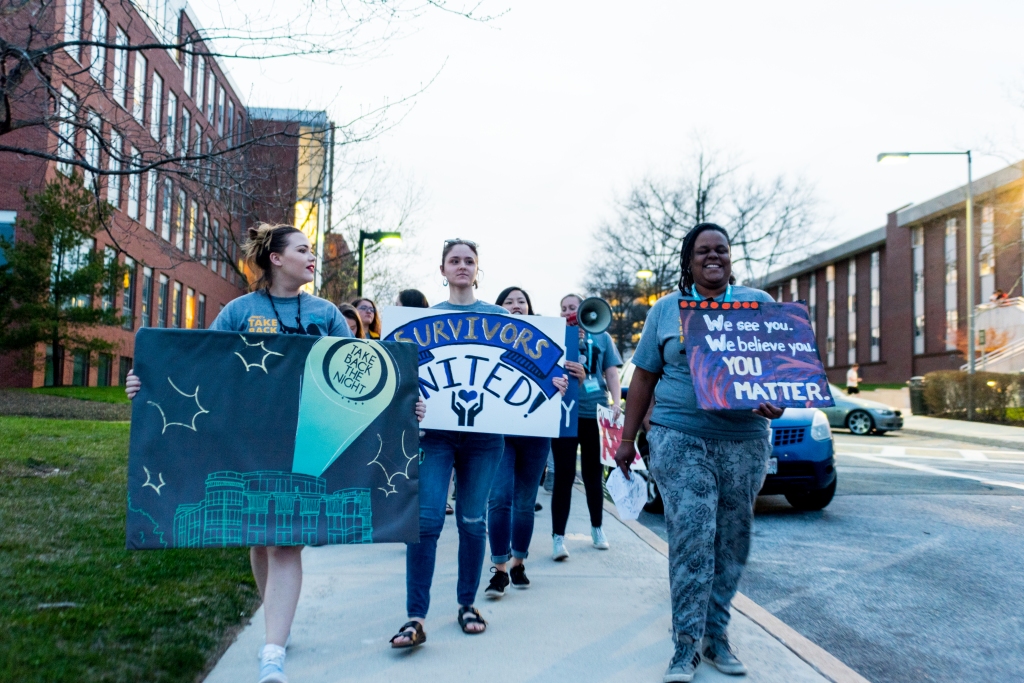
The march is divided with survivors at the front and UMBC community supporters bringing up the back. Marchers are given cards that have different rally chants written on them and line leaders are spread amongst the marchers. Once the march begins, leaders use their megaphones to start chants and direct people along the march route. The number is different at each TBTN, but the march group usually consists of approx. 250 campus community members.
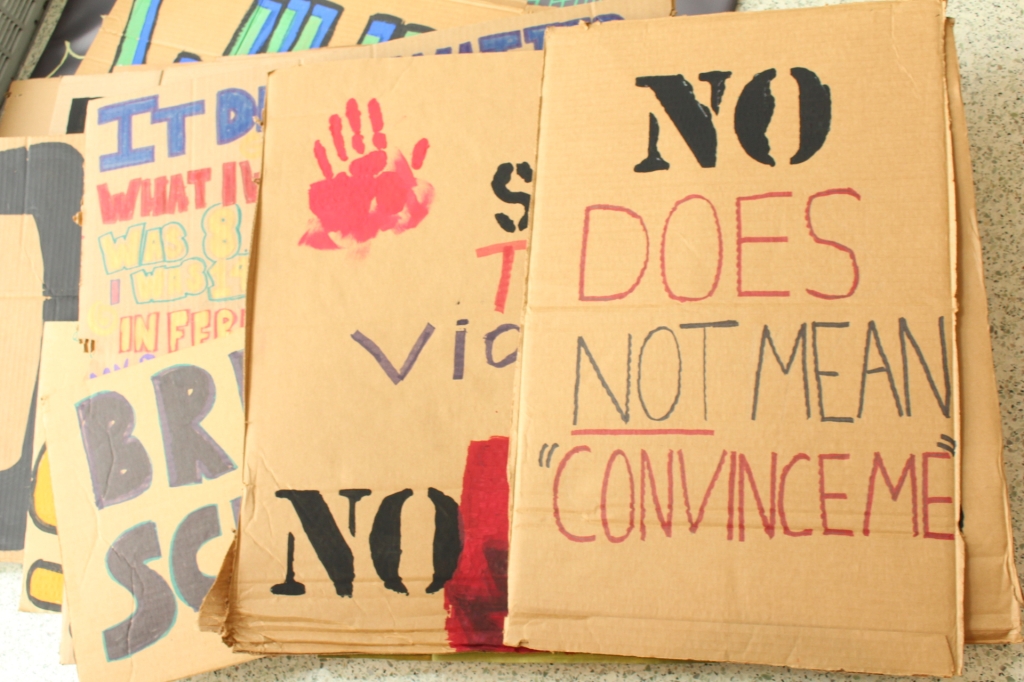
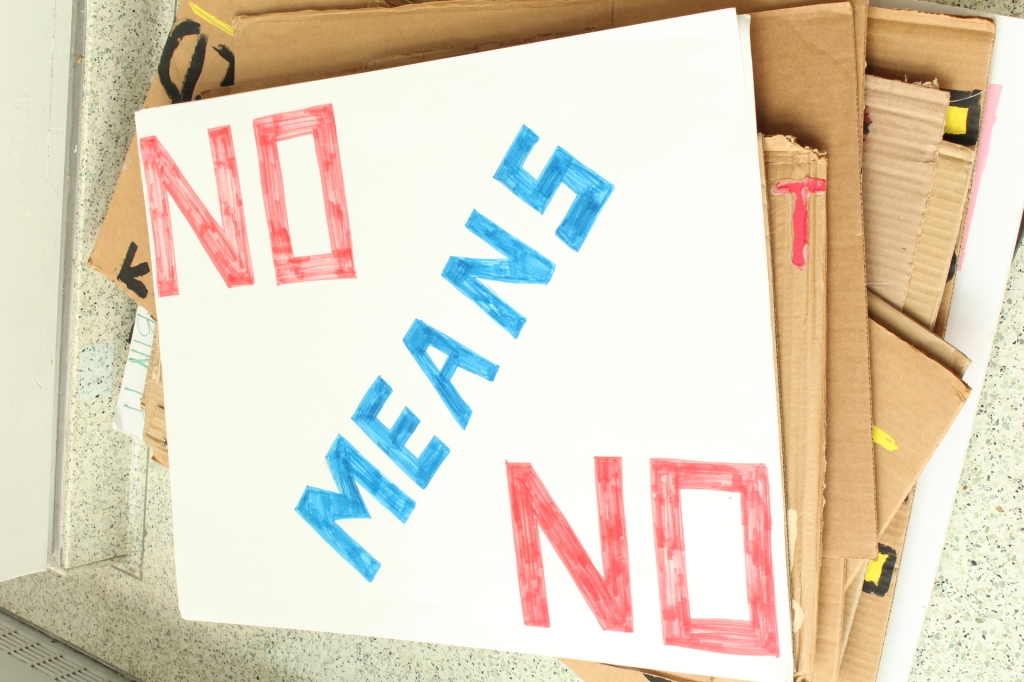


The march is loud and big. Its meant to grab people’s attention, just like the Survivor Speak-Out. Hannah Wilcove, GWST ‘19 remembered her “first encounter was seeing the march pass by me as I was walking back to my dorm freshman year and feeling a kinship with everyone participating that I couldn’t explain. Next year, I wanted to get more involved with the Women’s Center so I volunteered and participated for the first time.”
Many of the people I spoke to have experienced the march from the frontlines and share vivid memories of the emotions that are at play while walking through campus. For Sydney: “It was the first time I really identified as a survivor publicly and put myself in that vulnerable position. I remember the wave of emotions while we marched–anger, happiness, relief, anxiety–and how beautiful it was to just feel those things as they came.”

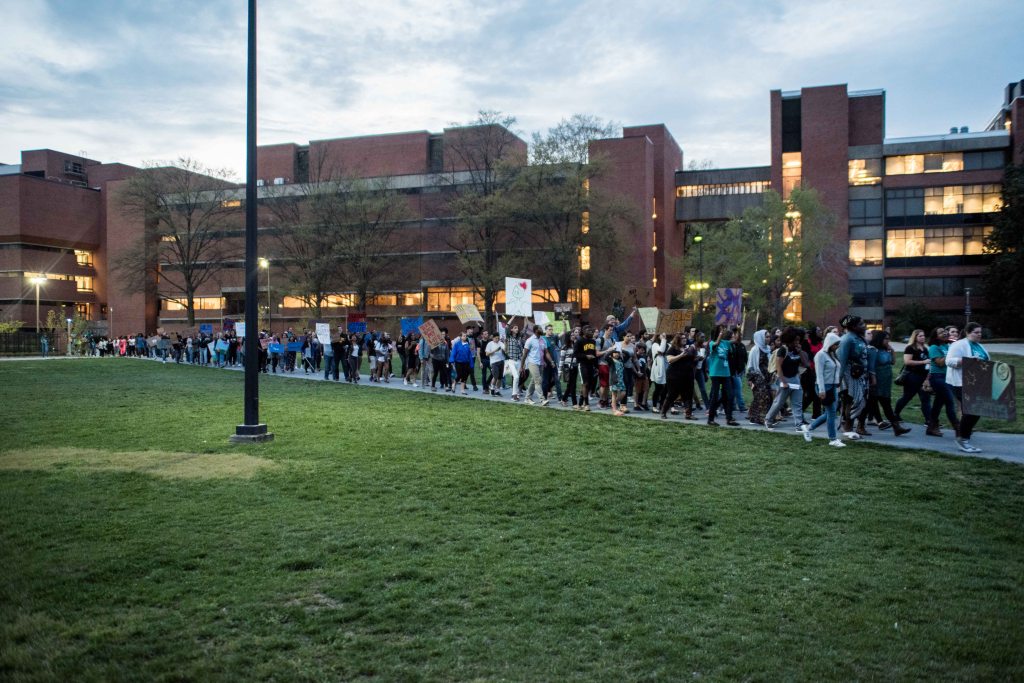

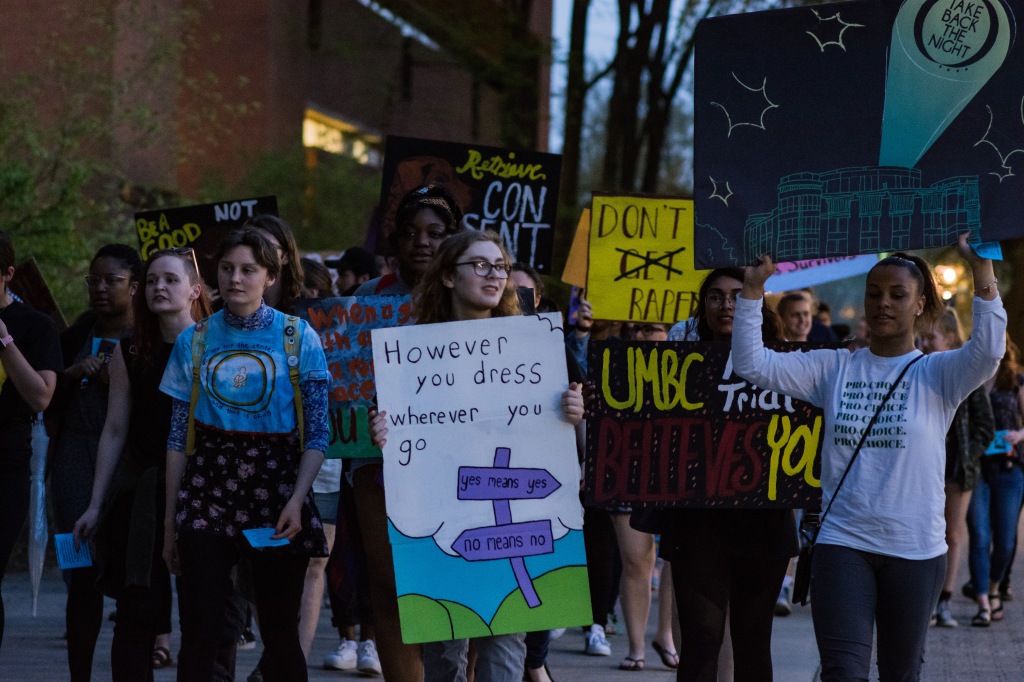
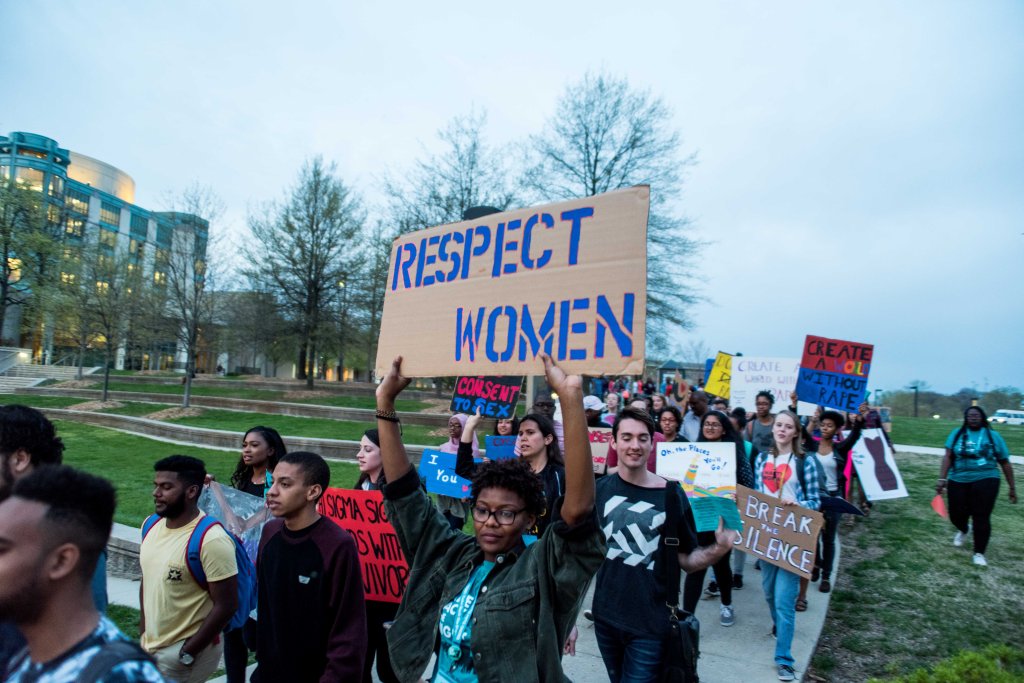
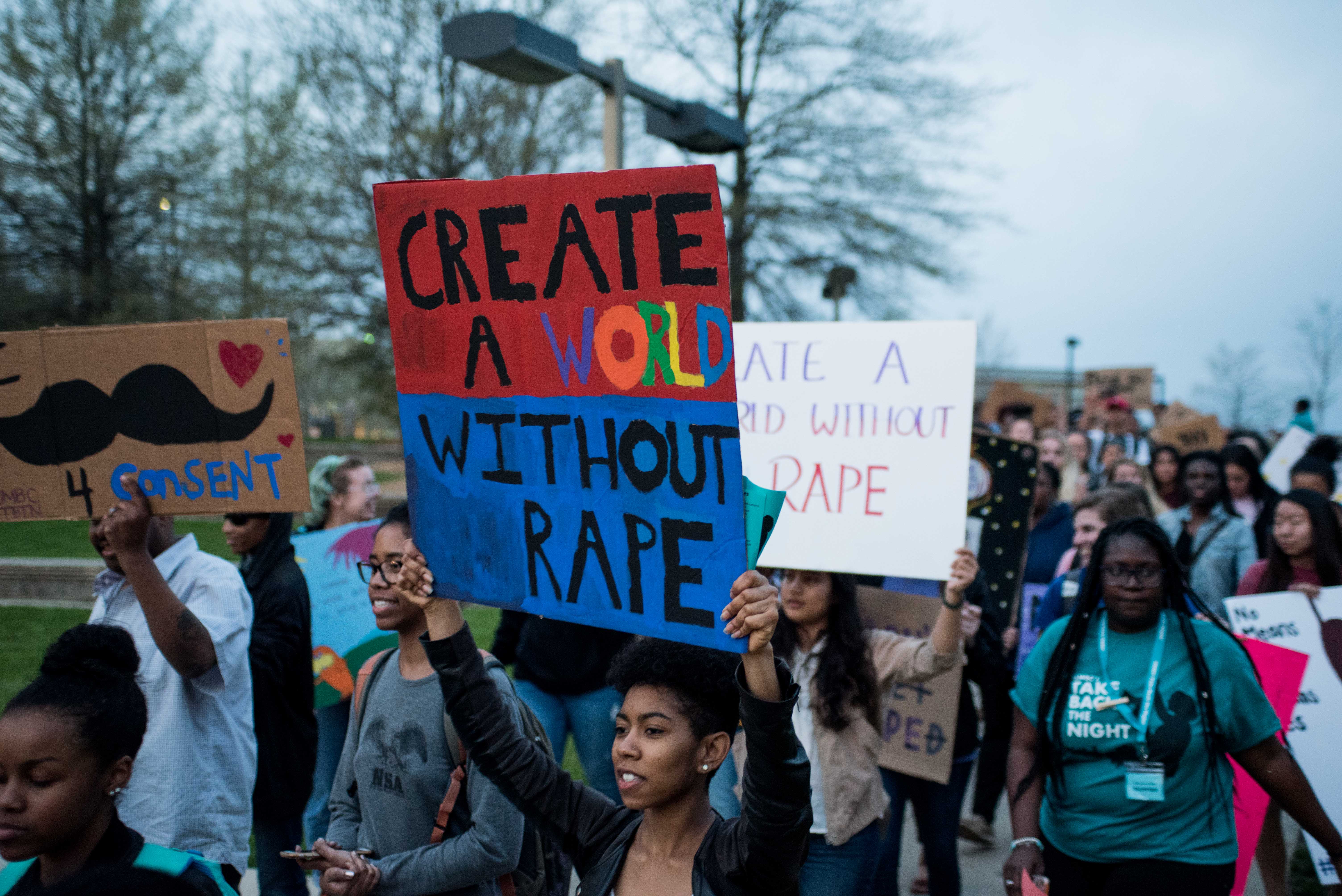
Yoo-Jin Kang, MLL & INDS ‘15 also remembers the rush as she maneuvered the march around campus: “Leading the march with dearest Kayla Smith. Walking alongside powerful survivors, shouting into a mic, and looking back to see a huge line following behind us. I still have chills thinking about it.”
The march goes all the way around campus starting at the southern entrance of The Commons, going east toward True Grits (and sometimes inside True Grits) and up around the Residence Halls before turning northwards and moving up the hill toward Library Pond. From the pond, the march hangs left to go all the way down Academic Row and stops at the statue of True Grit in front of the Administration Building and The RAC.
Recently, the march has added this stop around the True Grit statue so that marchers can circle up with survivors in the center and allies on the outside. The survivor circle rests with one another while the community continues to bear witness and offer respect.
Healing from trauma isn’t linear, but healing can happen and it does happen.


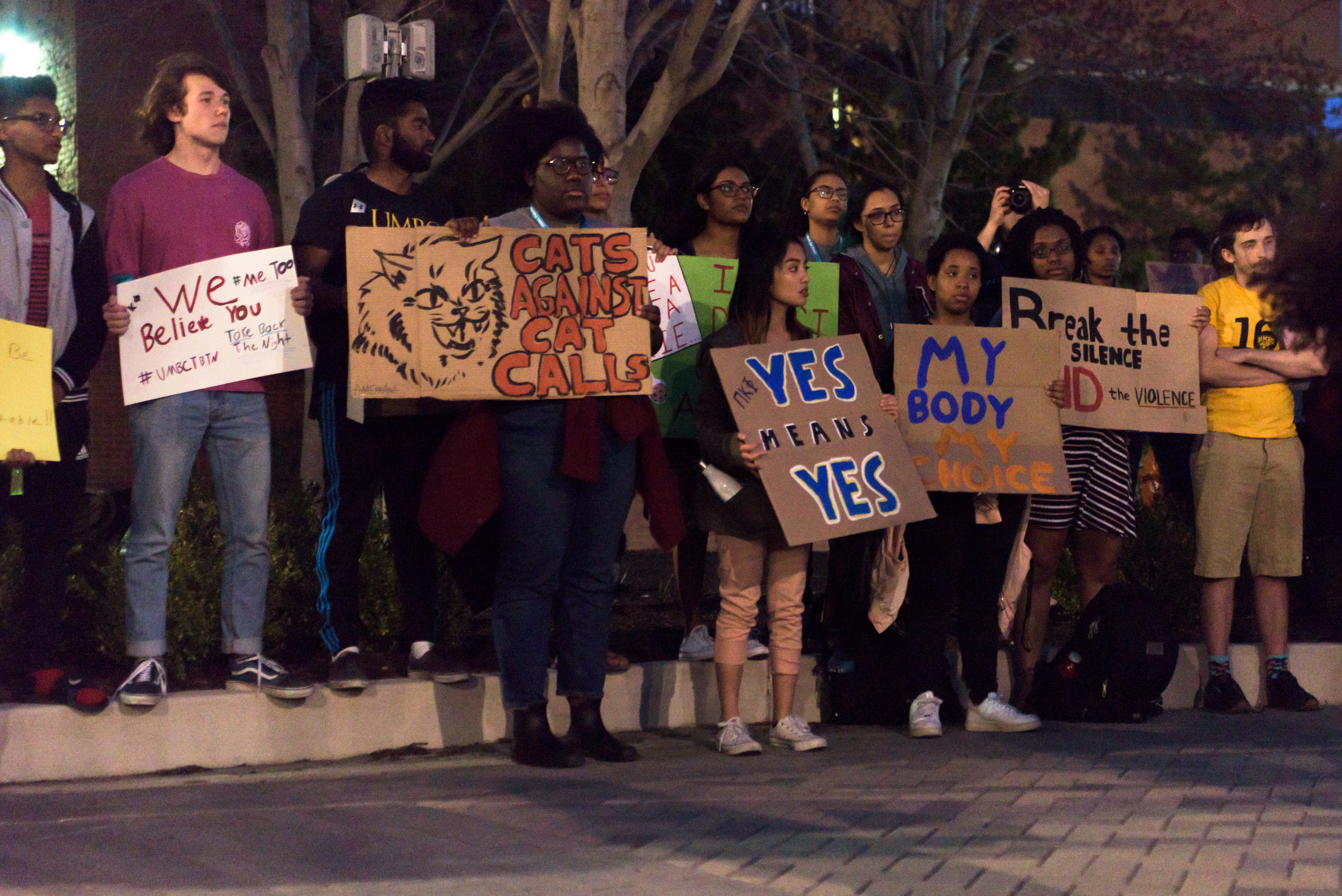
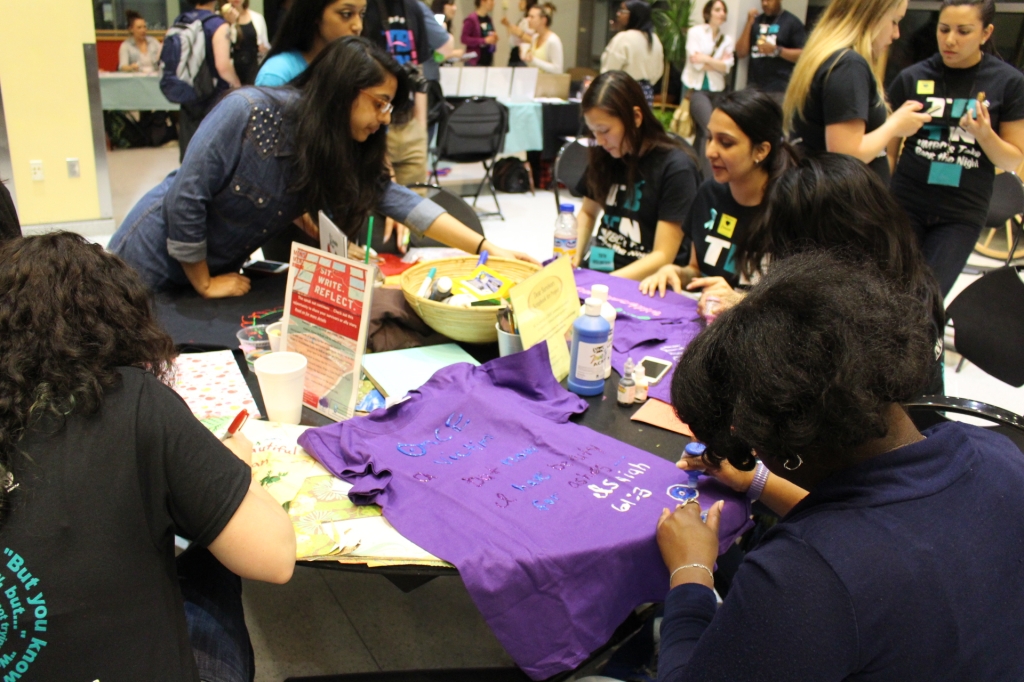
After regrouping in the circles, the march crosses the Quad diagonally and heads back to The Commons. Once inside, participants are met with a once again transformed Main Street. Where there were chairs and microphones for the Survivor Speak-Out there are now big circular tables with crafting materials available for folks to decompress through art, food and drinks to refresh themselves, and music blasting on the speakers so people can dance it out.
Every part of Take Back the Night is my favorite part, but this ending back at Main Street is really distinct. No matter the feelings that have erupted during the last few hours in the speak out and march we can all come back together to breathe. Breathe. Eat a cookie. Breathe. And laugh.
It might be as biologically simple as the flood of endorphins that comes after something painful or difficult… but it feels magical and powerful. We come back to where we had started… and the space is transformed but so are we. Healing from trauma isn’t linear, but healing can happen and it does happen.

What did UMBC’s Take Back the Night feel like?
It’s different for every person and often different minute-by-minute within the event itself, but for many, TBTN is a time of “firsts.” For Yoo-Jin, “TBTN was one of the first times I saw survivor voices lifted up in a public and unapologetic way. It was the first time I shared about my survivor story in public (and cried lots doing it).” With one of the goals of Take Back the Night being to take up space and push things often shrouded by private shame out into the public space, it can act as a catalyst for many as they work to understand their own trauma and their identities as survivors.
Sydney said that TBTN played a major part in her own identity development and growth as a survivor as it “allowed me to come to terms with the fact that I was sexually assaulted and work through all the emotions that came with it. Over the years attending, I was able to come to terms not only with the event but how I wanted to handle it. I didn’t want to do [the] Survivor Speak-Out but I did want to be there to feel community and then to march and let my story out that way.”

As identity-defining and cathartic as Take Back the Night is… it’s also really and honestly hard.
For as much time as I can take extolling high praise, I could also tell you about how deeply it has rocked myself and so many others that I know. Throughout the event, you are made to listen to stories of violence and abuse. As a witness to the Speak-Out, you play an important part in holding space and honoring others’ stories, but that does take energy and emotional endurance. A lot of people (especially those who shared their stories with me) have been able to reckon with Take Back the Night as something extremely positive, but it can also feel agonizing.
Autumn Cook remembered this duality:
Take Back the Night is a really difficult event to attend. It’s almost impossible to not squirm or react to some of the stories that people share, but that is part of the event. We are all living in each other’s horrendous truths and healing together. You’re supposed to be uncomfortable at TBTN. It means that you’re taking in what is happening and processing it. It’s horrible and liberating and healthy.
Autumn Cook (M29, ‘21)


How has Take Back the Night changed over the years?
One of the most beautiful aspects about Take Back the Night is that it’s always growing with our campus. It grows from year to year. It grows with you. Where Calista started as a spectator, she eventually grew to tell her own story… and then to leading the speak out. Calista spoke of this growth as she recalled how she “struggled a lot with my assault and the process of regaining my voice — but TBTN empowered me.”
-
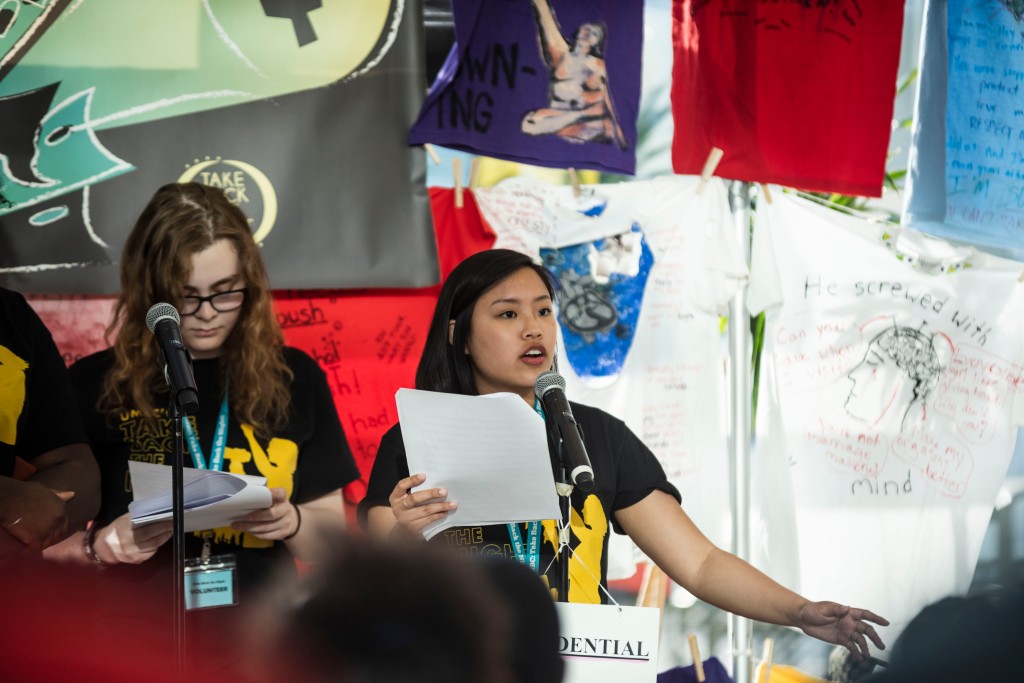 TBTN 2019 Photo credit: Winston Zhou
One person noted that they are still trying to find an outlet similar to Take Back the Night: “I have been looking for TBTN marches or something similar since graduating because I have wanted to share my experience. I don’t think I’d feel ready to do so if I hadn’t participated in it while at UMBC.”
If you look at some of the pictures in this blogpost, you might see the same people show up during different TBTN years. The shirts might look different or their hair might be a little longer. There are different shirts hung up in the Clothesline Project display. The weather during the march goes from sunny to cloudy.
The event has changed each year we’ve put it on to answer the needs and values of our campus community. For example, our march route was adapted to include an accessible route for those with mobility disabilities; previously, stairs were an obstacle for some as they participated in the march. Now we have an accessibility route that is not only available, but has a dedicated volunteer leading folks.
A Personal Reflection + A Conclusion
To be totally honest, I am writing this blogpost for partially selfish reasons… I desperately want to feel the power of Take Back the Night and I am sincerely regretful that I will not have been able to bring Take Back the Night back to UMBC’s campus by the time I start my own next chapter.


There are many reasons why I wanted to work in the Women’s Center and why I love my job now; a big one is Take Back the Night. Over the course of my time at UMBC, I have proudly been present for every single iteration of TBTN since it was revived by Jess and the team in 2013. However, as an undergraduate, I had not yet been able to identify as a survivor nor what I had experienced as abusive.
I worked in the Women’s Center from 2013 to 2015, I was a Gender, Women’s, + Sexuality Studies major, and I had been learning about sexual violence prevention and response work throughout that time but it had never occurred to me to consider my own story and my own experiences. It was only after graduating from UMBC, returning to the Women’s Center as a professional staff member, and a lot of therapy that I began to consider how I might be a survivor… how I am a survivor. My identity and my roles changed–changing my own relationship with TBTN. And TBTN changed again when I began working with student survivors and then again after the September 2018 lawsuit and subsequent Retriever Courage campus activism.
I mention all of this because we are all growing. We are all welcoming new aspects of ourselves–and similarly, Take Back the Night is bound to change. The power Take Back the Night has is in the change it creates for each person who interacts with it.
The power Take Back the Night has is in the change it creates for each person who interacts with it.
Right now, Take Back the Night looks different because it must, but that’s not a death sentence so much as it is an opportunity to welcome and cultivate change.
Perhaps, Take Back the Night will resume its live, in-person status in the Spring of 2023. I have hope that it will. And as much as I worry that it won’t look or feel like the Take Back the Night that I remember… the shared memory that people like Autumn, Sydney, Yoo-Jin, Hannah, Calista and I will continue to hold power and the institutional history of Take Back the Night will only grow. And that’s where the magic of TBTN is and always has been–with the people who are there to witness, the people who speak truth to power, and the people who demand space, time, energy for radical acts of healing.
More information about UMBC’s TBTN:
What You Need to Know About Take Back the Night Series
Take Back the Night at UMBC: Virtual Experience
Survivors to the Front: A Call to Witness Zine (2020)
]]>
Amelia Meman (they/them and she/her), GWST ’15, is the interim director of the Women’s Center. They have worked in the Women’s Center as an intern, a student staff member, a volunteer, and now...
https://womenscenteratumbc.wordpress.com/2022/04/29/take-back-the-night-forever-and-always/
https://my3.my.umbc.edu/api/v0/pixel/news/119056/guest@my.umbc.edu/98f05b1c4595605d0572e5c8c2b4fc12/api/pixel
activism
feminism
programs
saam
sexual-assault
sexual-assault-awareness-month
survivors
survivors-of-sexual-violence
take-back-the-night
tbtn
umbc
uncategorized
what-you-need-to-know-tbtn
Women's, Gender, & Equity Center
https://my3.my.umbc.edu/groups/womenscenter
https://assets2-my.umbc.edu/system/shared/avatars/groups/000/000/125/78272a4842689b30dbf74672182b78f8/xsmall.png?1750974263
https://assets1-my.umbc.edu/system/shared/avatars/groups/000/000/125/78272a4842689b30dbf74672182b78f8/original.png?1750974263
https://assets1-my.umbc.edu/system/shared/avatars/groups/000/000/125/78272a4842689b30dbf74672182b78f8/xxlarge.png?1750974263
https://assets1-my.umbc.edu/system/shared/avatars/groups/000/000/125/78272a4842689b30dbf74672182b78f8/xlarge.png?1750974263
https://assets1-my.umbc.edu/system/shared/avatars/groups/000/000/125/78272a4842689b30dbf74672182b78f8/large.png?1750974263
https://assets2-my.umbc.edu/system/shared/avatars/groups/000/000/125/78272a4842689b30dbf74672182b78f8/medium.png?1750974263
https://assets1-my.umbc.edu/system/shared/avatars/groups/000/000/125/78272a4842689b30dbf74672182b78f8/small.png?1750974263
https://assets2-my.umbc.edu/system/shared/avatars/groups/000/000/125/78272a4842689b30dbf74672182b78f8/xsmall.png?1750974263
https://assets3-my.umbc.edu/system/shared/avatars/groups/000/000/125/78272a4842689b30dbf74672182b78f8/xxsmall.png?1750974263
Women's Center
11
0
false
Fri, 29 Apr 2022 16:23:29 -0400
Fri, 29 Apr 2022 16:23:29 -0400
Being Queer Online Now and Then
Marybeth Mareski, m33@umbc.edu

Headshot of Author
Positionality Statement: This post is written by Marybeth Mareski, a Returning Women’s Scholar and social work intern at the Women’s Center in her final year at UMBC. I am a white person who will be the first person to graduate college in my family. I use she/her and they/them pronouns, often call myself a she/her boy, and while I don’t identify as trans, I also don’t feel comfortable calling myself cis. When trying to summarize my sexual orientation, I tend to arrive at queer butch lesbian, in order to align myself with the radical strain of queer politics, identify that I dress and style myself in a masculine fashion, and to indicate that in the past I have primarily dated women or nonbinary people. I write this post to marvel at how the internet has transformed as a resource to queer people from my childhood to present time, and in support of all queer people trying to exist authentically under settler-colonial capitalism.
When I was coming of age as a young queer person in the late 1900s, the internet was just coming into form as a public place. This was the heady time of Geocities, fansites, and bulletin boards. My own personal digital journey through queerness was facilitated by my deep love of Sailor Moon, about which I collaborated on fanfiction with queer themes, where I explored my understanding of what queer love might be like in conversation with other fans of the show. I learned about queer sex through Scarleteen, an inclusive and feminist sex education site for teens, and the Savage Love archives, a (now widely regarded as problematic) kink-positive advice column written by Dan Savage that originated in alternative newspapers, and was definitely not for teens.
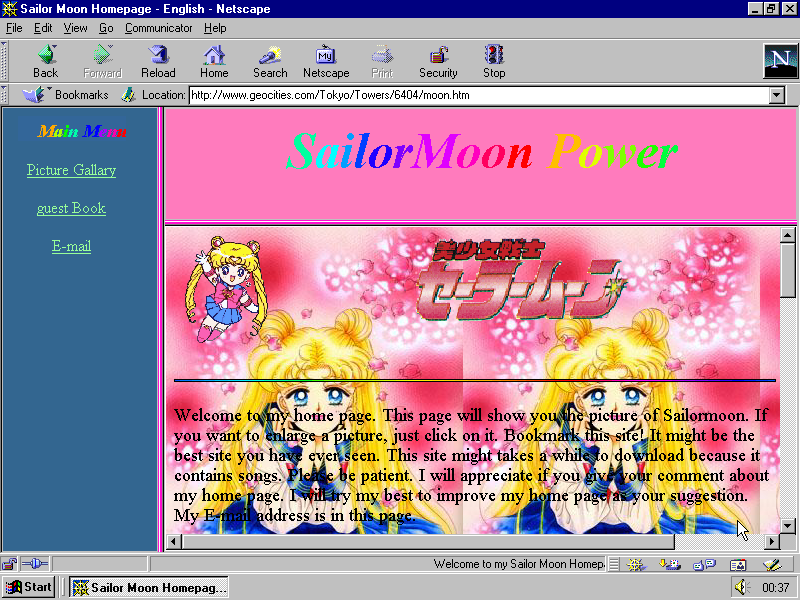
Image Description: A Netscape browser showing a geocities website with a pink background of tiled images of Sailor Moon and rainbow text saying Sailor Moon Power
I navigated a sort of nebulous online space, based primarily in fandom, my only representation of queerness coming from television, movies, anime, bands I liked, or in stories from people older than me. No one that I knew was out. With very few exceptions, I was the only queer person that I knew. Facebook didn’t exist until I graduated from high school. Tumblr didn’t exist until I (would have) graduated from college. I was forced, agonizingly, to forge my own path.
My teacher friend told me a story recently that really illustrated how different things are today. When she was teaching sixth graders last year over Zoom, a pair of her students were doing a presentation about the Daughters of Bilitis, one of the first lesbian organizations founded in the United States. Suddenly after the presentation, kids started coming out in the chat. Queer, pan, asexual, demisexual. Bunches of eleven year olds, sharing their LGBTQ identities with each other, and receiving nothing but support. It was heartwarming, but it also made me wonder: where did these tweens encounter this vocabulary?
At that age, I was spending all of my time researching LGBTQ topics, looking for books with homoerotic subtext, and sneaking peeks at LGBTQ magazines. It was a topic that drew me in completely, but I knew that I had to keep my interest a secret. The comments in my family that acknowledged the existence of gay people were very hostile. Unlike ethnic or religious minorities, being LGBTQ is usually not a culture taught by the family. Indeed, when a young queer person comes to terms with their own identity, they usually keep it hidden from others, especially the family, for fear of repercussions — LGBTQ teens are 140% more likely to be homeless than straight teens, in great part due to rejection by their families (Morton et al, 2017). Queer kids have to learn about being queer from somewhere, and social media and the internet is right there on their phones. And it is full of more queer content, creators, and community than I could have ever imagined when I was a queer teen.
As an 11-year old, I encountered the lesbian couple in Sailor Moon and was entranced. I developed a crush on the butch. Not too long after, I sat on the bus waiting to leave school and watched my fellow middle schoolers walk by and realized, ‘Oh. I think girls are cute. I guess that I am bisexual.’ And then a couple of years went by, and I noticed that I hadn’t thought about boys in all that time, and I thought, ‘Oh. I guess I’m a lesbian!’

Image description: A gif of Sailor Uranus, a short-haired androgynous blonde in a mustard-colored blazer, winking from the driver’s side of an open car.
Meanwhile, here are the terms I have encountered on TikTok over the past two days: Xenogender. Puzzlegender. Genderfluid demisexual. Abrosexual demiboy. When talking to my teacher friend about her students using labels like these, I thought, if all of these terms were available to me when I was eleven, I don’t know how I would have spent time doing anything but trying to pick one out! What an alluring banquet of possible ways of understanding oneself.
Personally, my own experience of my gender expression and sexual orientation has changed plenty throughout my life, based on personal experience, the overall culture trends, and through relationships I’ve formed with other people. In my teens and early twenties, though I thought of myself basically as a boy, I had too much internalized homophobia to dress in as masculine a fashion as I do now. I would see lesbians dressing in men’s clothes and feel repulsed and judgmental, thinking, I may be a lesbian, but I’m not one of those lesbians!
Reader, I am one of those lesbians. I just had to learn to love myself and the idea of being a lesbian.
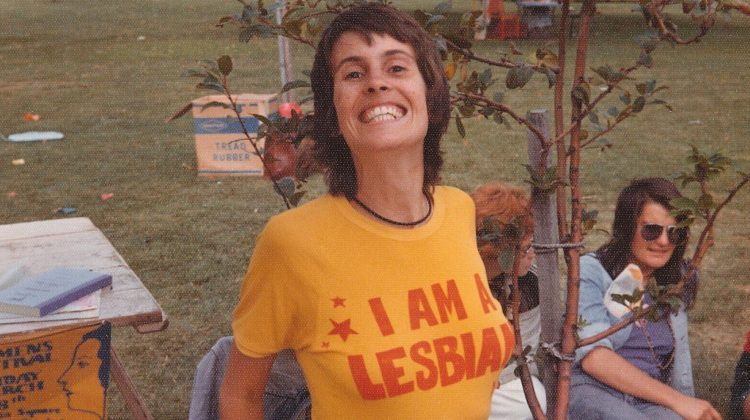
Image description: Vintage photograph from the 70s showing a white woman grinning proudly, wearing a homemade t-shirt that reads ‘I am a lesbian’
But lesbian is only one of the words that I use for myself, and it certainly doesn’t feel like a complete representation. It is suitable for certain contexts, as when I am drawing a comparison to mainstream culture, and inadequate in other contexts, as when I am describing my sexuality to other queer people. At times it feels like a word I fling in proud defiance against those who may judge me, and at other times it feels like a word that connotes an out-of-touch understanding of gender that is insufficiently nuanced. When we are using labels to describe who we are, we are attempting to describe an experience that is messy and cannot be contained, no matter how many labels are available to us. Understanding how we long to express ourselves and how we relate to others is a lifelong learning process, and these labels are simply outfits to try on along the way. Some of them will feel better than others! Some of them will give us delight for a short while, and some of them we will grow comfortable with over a lifetime. In the process of attempting to use language to describe ourselves, which is a venture that is forever doomed to failure, we can look at these labels like playing dress up.
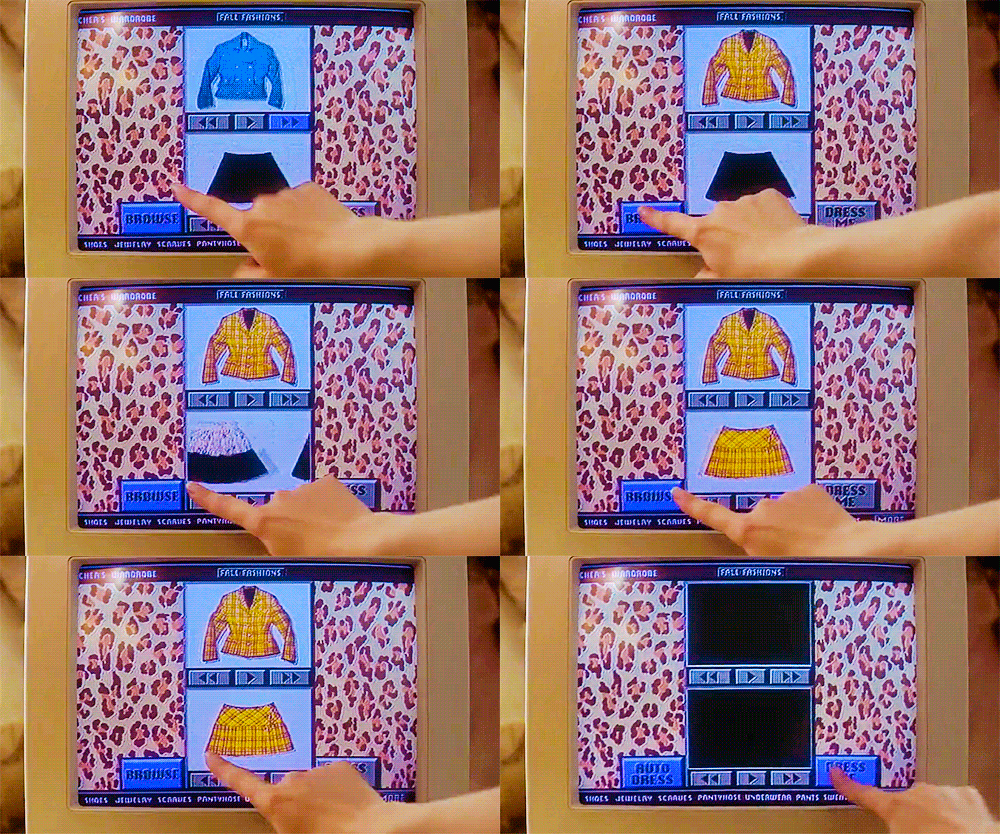
Image description: a gif from the movie Clueless of a finger pressing the ‘browse’ button on computer representation of different tops and bottoms scrolling to form a matching outfit.
The propagating multitudes of microsexualites on TikTok seems innocent enough. Any pathway to self-understanding and acceptance, however convoluted, is probably a net benefit to the world. Other avenues of exploring sexuality and gender identity online, however, are more questionable.
Enter Solace, the app at the forefront of tracking your transition. Solace purports to offer information and resources to trans people about their goals and progress, but in the process it presents a very binary imagining of transness. Sample goals are “Building a Feminine Wardrobe,” “Men’s Hairstyling,” or “Facial Feminization Surgery.” Worse, nearly every “goal” has a tie-in advertisement for a service. The feminine wardrobe goal links to a styling service you can purchase. The hairstyling and facial feminization surgery goals mention how expensive such goals can be, and links to their sister financial management app, Bliss. Because nothing brings bliss like having enough money to finance your binary transition!
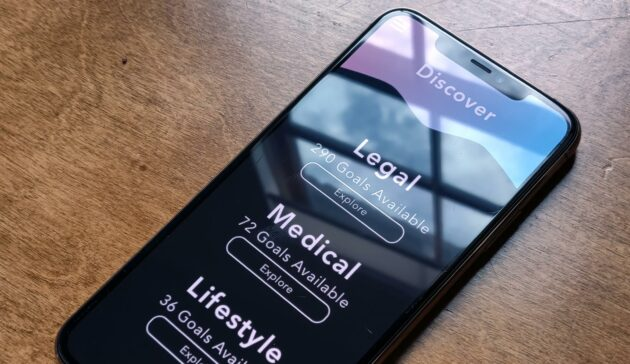
Image description: an iPhone displaying a screen from the Solace app. Options read: Legal, 290 Goals Available. Medical, 72 Goals Available, Lifestyle, 36 Goals Available
Solace in particular demonstrates the transition that the internet has made towards prioritization of commerce from my childhood to today. In the early days (1994 and before), the internet was primarily a small community of people exploring their interests.
As the profitability of the dot com boom made the financial opportunities of the internet clear, a culture of capitalism began to overtake a culture of community on the internet. The commercialization of the internet means that every subgroup is a target audience for a company’s product. As marginalized groups gain ‘acceptance’ in mainstream society, they become profitable demographics to extract resources from. The creator of Solace, who goes by RKA, is a trans woman who designed the app and launched it with venture capital raised from Hilary Clinton. This situates it firmly within the internet start-up tradition — though this app may have been created to provide guidance for trans people, it is also a business designed to make money from trans people.
Ultimately, these words from RKA herself point to one of the bigger problems with Solace. “At the end of the day, I’m just looking for a conformist experience,” she says. “I’m just looking to blend in. And so the idea of being part of a community felt almost opposed to my transition goals.” Aiming for a transition that is a conformist experience is in opposition to the life-affirming magic of the chaos of queerness, and doing so in solitude rejects one of the tenets of queer survival: community.
There is no app that can replace seeing and being seen by people who understand you because they have had similar experiences to yours. There is no app that will replace the mutual aid required by people on the margins of a society that has massive barriers to health care. A ‘conformist’ transition is seeking the affirmation of mainstream society and holding up the very values that make life difficult for trans people to begin with.
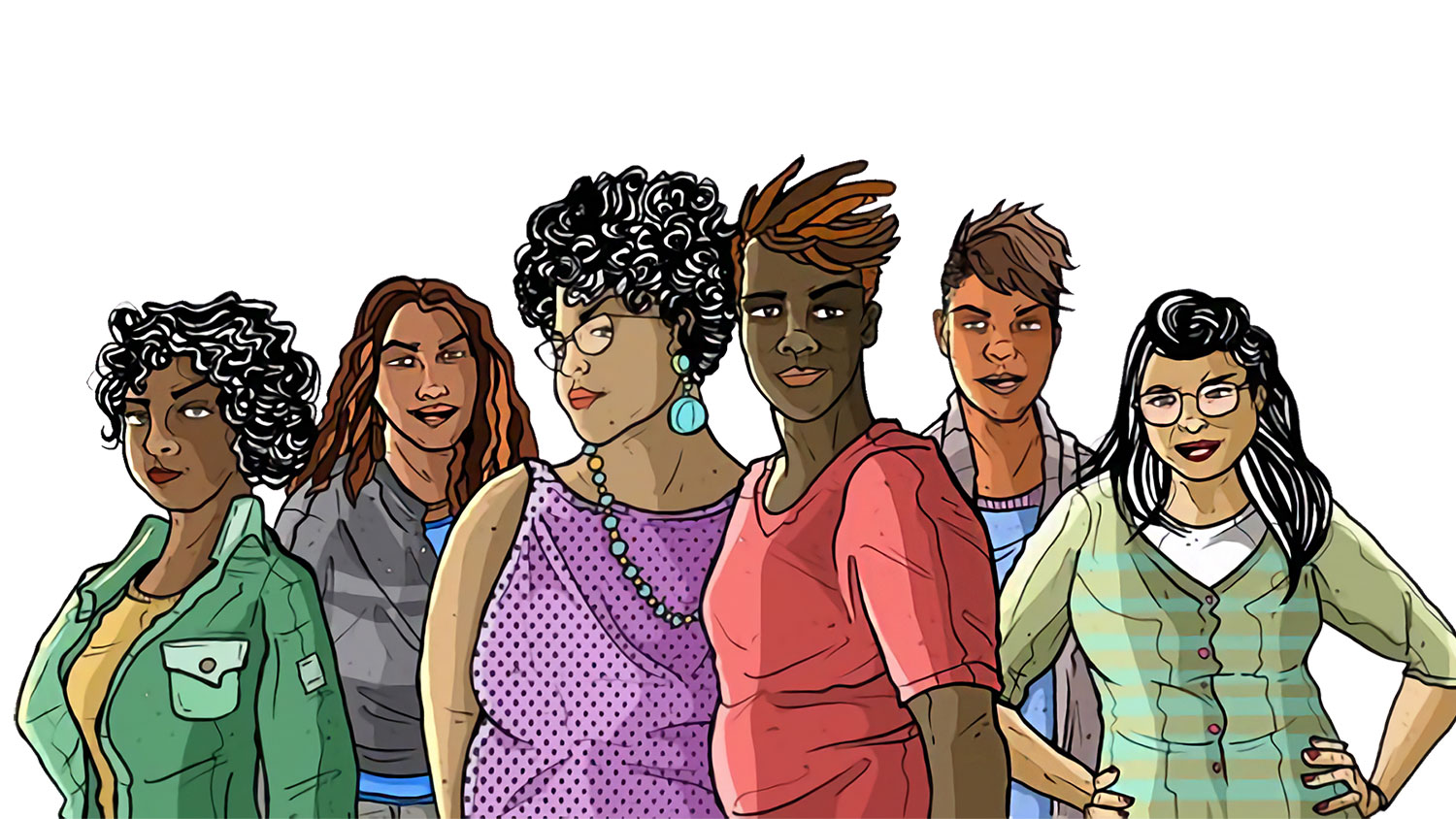
Image description: A drawing of six people of color of varying gender expressions gazing directly at the viewer. *
Ultimately, apps like Solace do not feel like a pathway to self-understanding and acceptance. They feel like a funnel to one vision of being trans, which is transitioning to one side of the binary, and passing.
Queerness is about being against the status quo. Discovering your own queerness should be about imagining new forms of expression. Being queer is about expanding your idea of what is possible, not constricting it. Even though micro identities funnel that exploration into identity labels, at least there seem to be countless identity labels. With Solace, though there are many ‘goals,’ most of them are ways of exploring the ends of the gender binary, without being in conversation with other people, or seeing examples of the variety of experiences of real trans people. It obscures the creativity and playfulness of real trans lives.
The excitement that I felt seeing Sailor Uranus and learning that butchness could be attractive enabled me to explore my nascent butchness, step by tiny step. Through connecting with an online community around Sailor Moon, I found people to share my passions and talk about my experiences with. I created art based off the characters and shared it online with no expectation of making money, and without anyone asking for money from me. At least in the online world where I came of age, the only ones making money off of my exploration of my identity were people selling Sailor Moon merchandise.
*Image taken from Creating Accomplices Workshop Applicable to Everyone | Office for Institutional Equity and Diversity | NC State University
Resources and Recommendations
Morton, M.H., Dworsky, A., & Samuels, G.M. (2017). Missed opportunities: Youth homelessness in America. National estimates. Chicago, IL: Chapin Hall at the University of Chicago.
What are micro-sexualities and why are people arguing about them?
TikTok’s LGBTQ+ Discourse is Just a Re-Run of Tumblr
Solace Is an App That Helps Trans People Transition
Trans Liberation? There’s No App for That
]]>
Marybeth Mareski, m33@umbc.edu Headshot of Author Positionality Statement: This post is written by Marybeth Mareski, a Returning Women’s Scholar and social work intern at the Women’s...
https://womenscenteratumbc.wordpress.com/2021/12/06/being-queer-online-now-and-then/
https://my3.my.umbc.edu/api/v0/pixel/news/115482/guest@my.umbc.edu/53da59eb6757730200755566c9b026a3/api/pixel
diversity-and-inclusion-issues
feminism
internet-culture
lesbian
lgbtq
lgbtq-readings
lgbtqia
pop-culture
pride-voices
returning-women-students
trans-issues
uncategorized
Women's, Gender, & Equity Center
https://my3.my.umbc.edu/groups/womenscenter
https://assets2-my.umbc.edu/system/shared/avatars/groups/000/000/125/78272a4842689b30dbf74672182b78f8/xsmall.png?1750974263
https://assets1-my.umbc.edu/system/shared/avatars/groups/000/000/125/78272a4842689b30dbf74672182b78f8/original.png?1750974263
https://assets1-my.umbc.edu/system/shared/avatars/groups/000/000/125/78272a4842689b30dbf74672182b78f8/xxlarge.png?1750974263
https://assets1-my.umbc.edu/system/shared/avatars/groups/000/000/125/78272a4842689b30dbf74672182b78f8/xlarge.png?1750974263
https://assets1-my.umbc.edu/system/shared/avatars/groups/000/000/125/78272a4842689b30dbf74672182b78f8/large.png?1750974263
https://assets2-my.umbc.edu/system/shared/avatars/groups/000/000/125/78272a4842689b30dbf74672182b78f8/medium.png?1750974263
https://assets1-my.umbc.edu/system/shared/avatars/groups/000/000/125/78272a4842689b30dbf74672182b78f8/small.png?1750974263
https://assets2-my.umbc.edu/system/shared/avatars/groups/000/000/125/78272a4842689b30dbf74672182b78f8/xsmall.png?1750974263
https://assets3-my.umbc.edu/system/shared/avatars/groups/000/000/125/78272a4842689b30dbf74672182b78f8/xxsmall.png?1750974263
Women's Center
10
0
false
Mon, 06 Dec 2021 08:45:00 -0500
Mon, 06 Dec 2021 08:45:00 -0500
Diet Culture v. The Cultural Diet
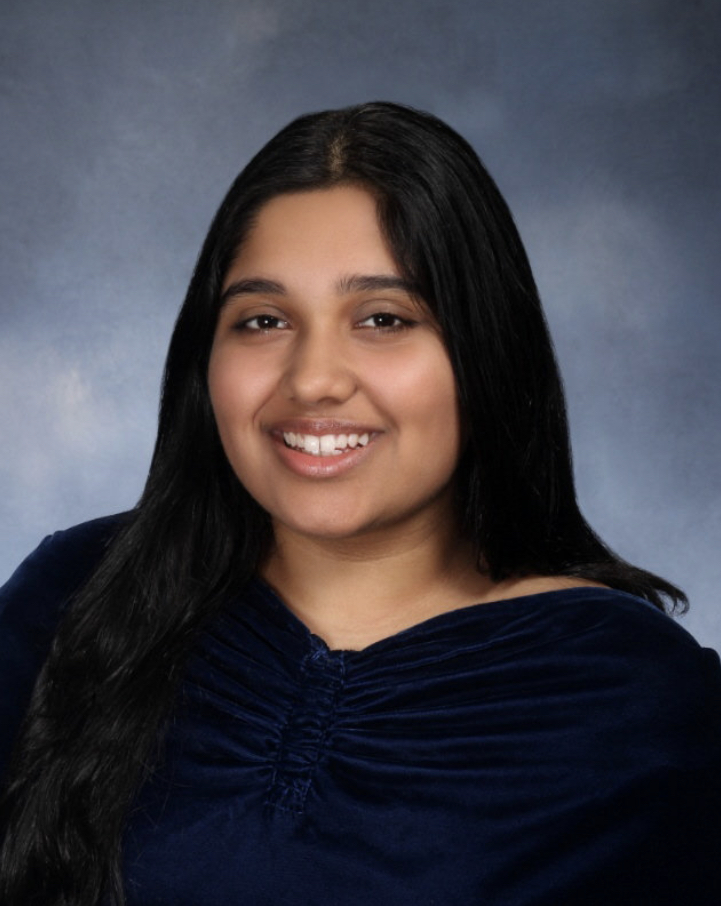 Positionality Statement: This post is written by Ojus Phogat, a second-year student at UMBC and a student-staff member at the Women’s Center. I am a South Asian American woman who has felt the persistent effects of diet culture first-hand. In writing this blog, I hope to identify these impacts and uncover the systems of oppression that keep them afloat. As a reader, I wish to encourage you to alter the way you pass judgment on yourself and others. The more we engage in fatphobic rhetoric, which stems from white supremacy and the patriarchy, the more we uphold these oppressive systems. To all my fellow women of color who have ever been made to feel like less because of the way you look: I hope you learn that you have always been enough.
When I was nine years old, I went to India for my grandfather’s funeral. After the cremation ritual, I was gathered into a room of extended family (most of whom were strangers to me) where the following conversation took place:
Random Uncle: “Do you ever walk on the treadmill?”
Me, a fairly active kid who did hours of dance, basketball, and swimming, and was yes chubby: “Hain Ji?” *yes sir*
Random Uncle: “At what speed? ZERO!”
*eruption of laughter from the surrounding guests*
His Wife: “Take it from me; all the housework you’ll have to do when you’re married will keep it off, but it’s better to start now. We only care about you.”
Image Description: Picture of Oprah wearing a purple sweater and white button-down. Saying “what?”. This image was a snippet from Oprah’s interview with Meghan Markle.
While this was not the first time I heard these kinds of comments from family members, I was crushed. And I sat crying at my grandfather’s funeral, not out of the sadness of his passing (because, to be honest, I didn’t know him very well), but because relatives I didn’t even know decided their opinions on my body were so profound that they had a dire need to communicate them with all the surrounding patrons and me IMMEDIATELY.
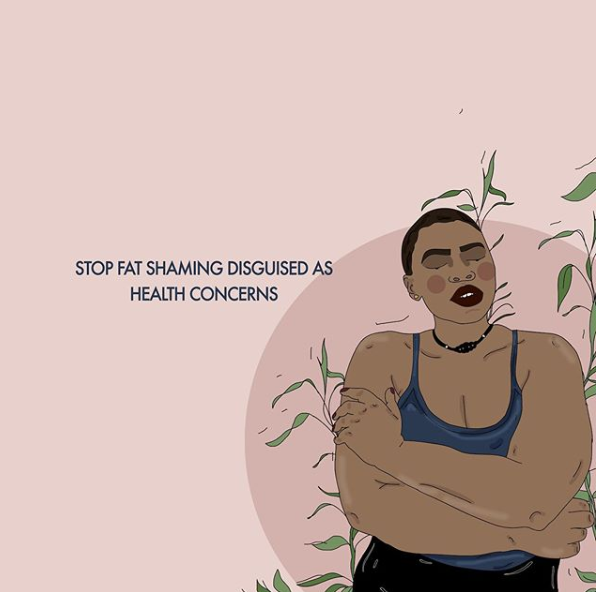
Image Description: Pictured is a graphic design from @recipiesforselflove on Instagram. The image displays a pale pink background and the text “stop fat-shaming disguised as health concerns” is placed slightly left of center. A black woman is illustrated in the bottom right-hand corner wearing a blue tank top and black pants. She is encompassed in a greyish-pink circle and surrounded by tall green plants.
From the first moment of our consciousness, we (women of color) are raised to think of weight as one of our defining characteristics. Something that measures how much human decency we will be allotted, how many people will treat us with respect, and of course, “most importantly” (as many of my fellow South Asian women have been told) how many marriage proposals we will receive when we are older. It does not matter how much we work out or eat nutrient-rich meals; if we do not visually conform to society’s standard of the ideal body, we are not only ridiculed for it, but our existence itself is categorized as inferior. We are silenced, shunned, and demonized for simply existing in non-white, fat bodies. Whether it is from how we observe the world or how we are treated within it, we grow to learn that being fat equates with being of less value, and so we turn to the alternative: ensuring “smallness” by any means necessary.
In order to contextualize western diet culture’s impact on specifically women of color, it is critical to understand its origin as being one compounded by systems of white supremacy and the patriarchy. These systems feed into the creation of a diet culture stemming from anti-blackness that is used as a tool to pit women and groups of color against one another.
Diet Culture & Women of Color
For many communities of color, the discrepancy between how we are taught to consume food—in schools and from our friends—and the cultural foods we enjoy in the comfort of our own homes cultivates a relationship with food defined by confusion, embarrassment, and shame. We are taught that things like carbs and “fatty” oils are the devil incarnate, and for cultural diets—defined by dishes artfully composed of rice and noodles—this can be detrimental. The Indian meals of my childhood like khichdi, pulao, and pav bhaji—rich in spices and made with a foundation of rice or bread—would be considered “unhealthy” because of the carbs and oil they contain. These very meals that nursed me back to health when I fell sick and energized me after hours of dance practice; would also be the source of my shame during school lunch periods and visits to the doctor’s office. Any nutritional value and traditional significance of these and other cultural dishes are often overshadowed by a mistaken idea of what is “healthy”—which in this case really equates to practices that result in supposed physical “smallness.”
The need to conform society to one idea of “health”—which standardizes a “correct” diet —controls how communities of color and communities of women form their relationships with food and nourishment. Health, in this case, becomes a concept encompassing what patterned behaviors keeps one from becoming fat. It dictates how individuals must engage in nutrition in exchange for societal acceptance. This phenomenon, while detrimental to all people—in this case explicitly discussing those impacted by Western practices of diet culture—affects women of color differently as they live in the limbo of two different, often competing cultural identities, each with their own social diet pressures, in conjunction with the necessary pursuit of femininity.
To center white-ness when creating the standard and “correct” American diet, colonizes nutrition and manipulates the mentality around health. It serves to Other* various cultural diets by making Western “health foods” the norm and vilifying any foods that stray from these guidelines. In turn, society claims that the very recipes that strengthened our ancestors, the very recipes that have quite literally borne and sustained our lineages are unacceptable. In reality, what is unacceptable is the rhetoric of disgust and inferiority that often marks cultural food sources. The idea that one should not consume the traditional dishes of their ancestry because of the “white” ideal diet is racist.
Take, for instance, the narrative surrounding MSG (monosodium glutamate)—a food additive utilized in many foods and “naturally found in foods like tomatoes and cheese”(Yeung, 2020), but ridiculed because of its use in traditional Chinese meals. The media has marked MSG as a dangerous and unhealthy ingredient and has linked it to conditions like asthma, drowsiness, and headaches (but not by any scientific backing). This racist rhetoric has steered people away from MSG and has forced the Chinese American community to be mindful of the backlash they may face in using the ingredient, especially for restaurant owners. The overall stigma that surrounds this ingredient displays just how much power white institutions have in dispelling the use of products, especially when those products hold a particular significance in BI-POC cultural cuisines.
The Implications of the Small Feminine Body
There is also a physical element to the requirement of smallness for feminine bodies. It operates under the assumption that women should occupy as little space as physically possible so as to keep their positions of power stifled. The presumption is that women—as the “submissive” gender—must bolster male masculinity by embodying the opposite characteristics of what men possess. By this “rule,” if men are meant to be large to monopolize space and contribute to their dominance, women must then be as small as possible to make “smaller” men adhere to this expectation. Women alone must assume the burden of changing themselves to allow for men to conform to the ideals they have set. Straying away from this ideal—embodying fatness and taking up greater space as a woman—means undermining these systems of the patriarchy that award men greater dominion over the world.
For women of color who reside in the western world, the pursuit of femininity means the expectation of smallness is compounded by the need (for survival purposes) to shed their melanin and present as light-skinned as possible. Because society masculinizes women of color, specifically brown and black women, they must pursue femininity more extremely because of their skin color. If not, they are ridiculed and solidify their low position on the social ladder. Because of this they feel a greater emphasis to conform to the ideals of western femininity, which encompasses the prerequisite of smallness. In doing so, they may often feel at odds with connecting to the traditional cultural foods they grew up with and abiding by the rules of the society in which they reside.
Imperialism's production of the beauty standard—the necessity of thinness and whiteness—for women and girls in places like India portrays this phenomenon at work. The colonial impact left by Persia and Britain in South Asia has ingrained ideologies about correct body shape, colorism, and anti-blackness. 
Image Description: Pictured is a scene from the era of British rule in India. Depicted are British soldiers, dressed in red and white garments, invading an Indian palace. The soldiers hold rifles and clouds of smoke surround them.
Since the reign of the Mughals and later the British East India Company, Indian culture has been defined by the idea that the highest cultural capital** is awarded to those of lighter skin and less weight. Because conforming more to this ideal cultural behavior meant increasing one's socio-economic status, adhering to the beauty standard was a matter of SURVIVAL. It meant that the closer you were to being this standard the better you would be treated by the foreigners who had come to rule your land and who controlled economic and social production within it.
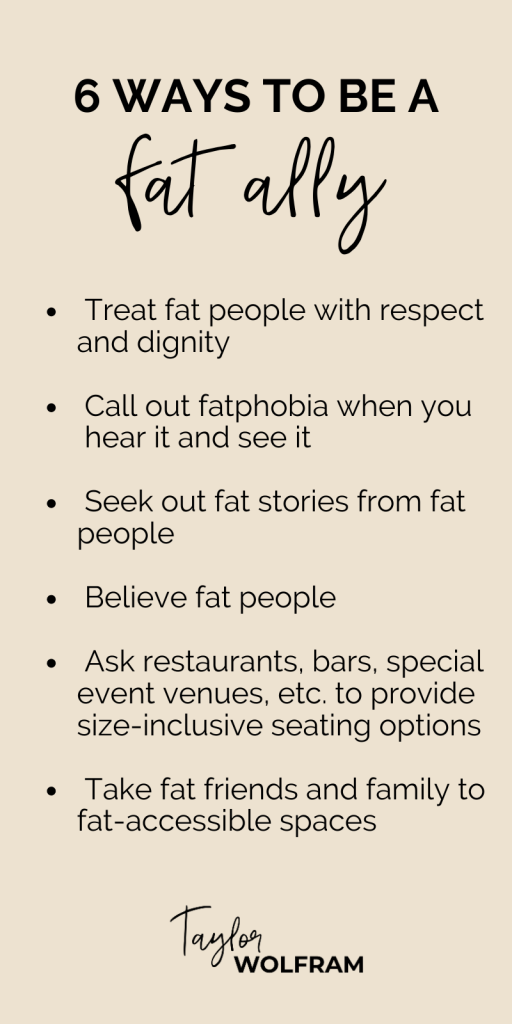
Image Description: Pictured is an infographic made up of a light tan background created by Taylor Wolfram. It says “6 Ways to Be a Fat Ally”. And lists “ treat fat people with respect and dignity, call out fatphobia when you hear it and see it, seek out fat stories from fat people, believe fat people, ask restaurants, bars, special event venues, etc, to provide size-inclusive seating options, take fat friends and family to fat-accessible spaces”.
So with these foundational elements of diet culture’s impact in mind, we can then ask ourselves:
What can we do to mitigate and reverse the rather negative ramifications of this mindset?
We can change the way we think and talk about bodies
They are vessels that carry us through our day, why must we comment on every one we see ...?
We can advocate for ourselves and others when disrespectful rhetoric is used
You deserve to be vocal and correct disrespect even if it is viewed as normalized.
And maybe most importantly we can learn to view ourselves from a neutral lens
Your body is none other than how you move physically from place to place. To frame it in this way may help the preoccupation with how we are perceived because of it.
I know what you’re thinking: these tips are much easier said than done. And you are correct! But, this doesn’t mean we shouldn’t hold ourselves accountable when we say or think about bodies negatively. It also means that if you are being degraded for your appearance: STAND UP FOR YOURSELF! Real change can only be possible when we—women of color—learn that we are worthy of taking up space in this world.
Footnotes
* The act of alienating something by highlighting its “abnormal” characteristics
** The amount of societal status one is given based on various factors (i.e., education, skills, wealth, and discussed the most in this case appearance)
Resources and recommendations you should be sure to check out:
CNN: MSG in Chinese Food Isn't Unhealthy -- You're Just Racist, Activists Say.
Yeung, Jessie. “MSG in Chinese Food Isn't Unhealthy -- You're Just Racist, Activists Say.” CNN, Cable News Network, 19 Jan. 2020, https://www.cnn.com/2020/01/18/asia/chinese-restaurant-syndrome-msg-intl-hnk-scli/index.html.
Harvard University: Occidentalisation of Beauty Standards: Eurocentrism in Asia
Chen, Toby, et al. “Occidentalisation of Beauty Standards: Eurocentrism in Asia.” Zenodo, Harvard University , 16 Dec. 2020, https://zenodo.org/record/4325856#.YZvkpr1Ki3I.
Gloria Lucas: Nalgona Positivity Pride
Yesika Salgado: What Comes After Loving Yourself? Advice from a Fat Fly Brown Girl
Yeskia Selgado: The Hunger
Teen Vogue: Fat is Not a Bad Word
Taylor Wolfram: 6 ways to Be a Fat Ally
Allison Rachel: Recipes for Self-Love
NPR: Code Switch- Is Beauty In The Eyes of The Colonizer
]]>
Positionality Statement: This post is written by Ojus Phogat, a second-year student at UMBC and a student-staff member at the Women’s Center. I am a South Asian American woman who has felt the...
https://womenscenteratumbc.wordpress.com/2021/11/22/diet-culture-v-the-cultural-diet%ef%bf%bc/
https://my3.my.umbc.edu/api/v0/pixel/news/115239/guest@my.umbc.edu/e00d00eebc2a6392d75a92315047070c/api/pixel
acceptance
beauty-standards
body-consciousness
body-neutrality
body-positivity
diversity
diversity-and-inclusion-issues
fatness
feminism
femmes
intersectionality
minorities
people-of-color
self-advocacy
social-awareness
south-asian-voices
women
women-of-color
Women's, Gender, & Equity Center
https://my3.my.umbc.edu/groups/womenscenter
https://assets2-my.umbc.edu/system/shared/avatars/groups/000/000/125/78272a4842689b30dbf74672182b78f8/xsmall.png?1750974263
https://assets1-my.umbc.edu/system/shared/avatars/groups/000/000/125/78272a4842689b30dbf74672182b78f8/original.png?1750974263
https://assets1-my.umbc.edu/system/shared/avatars/groups/000/000/125/78272a4842689b30dbf74672182b78f8/xxlarge.png?1750974263
https://assets1-my.umbc.edu/system/shared/avatars/groups/000/000/125/78272a4842689b30dbf74672182b78f8/xlarge.png?1750974263
https://assets1-my.umbc.edu/system/shared/avatars/groups/000/000/125/78272a4842689b30dbf74672182b78f8/large.png?1750974263
https://assets2-my.umbc.edu/system/shared/avatars/groups/000/000/125/78272a4842689b30dbf74672182b78f8/medium.png?1750974263
https://assets1-my.umbc.edu/system/shared/avatars/groups/000/000/125/78272a4842689b30dbf74672182b78f8/small.png?1750974263
https://assets2-my.umbc.edu/system/shared/avatars/groups/000/000/125/78272a4842689b30dbf74672182b78f8/xsmall.png?1750974263
https://assets3-my.umbc.edu/system/shared/avatars/groups/000/000/125/78272a4842689b30dbf74672182b78f8/xxsmall.png?1750974263
Women's Center
6
0
false
Mon, 22 Nov 2021 17:04:31 -0500
Mon, 22 Nov 2021 17:07:26 -0500
Microaggressions: an attack on belonging and identity 

Image description: shows student, Jane, smiling in front of a UMBC building
Positionality Statement: This post is written by Jane DeHitta, an adult learner in her final year at UMBC, who works as a student staff and social work intern at the Women’s Center. I am a first generation Filipino-American student who seeks to be self-aware of the power dynamics that take place in the intersections of our identities and strives to be intentional in the ways I speak to and encounter others. In this post, I share my experience of microaggressions against race and discuss a connection between microaggressions of different forms and the impact that can have on the individual. My experience is my own and I use it as a point of reference and not to represent the innumerable diversity of people’s experience with microaggressions. I hope that what I share in this post gives validation to those who have had experiences similar to my own, and to give a moment for thought and self-reflection for those who find themselves as the microaggressor.
Image description: a cartoon gif of two hands holding up a dark blue sign with the words “Words have power” written across it. The word “power” has an animated line being crossed underneath it for emphasis.
“I wonder who is more Asian?” my white female friend said in passing. She and I had been discussing movies we recently watched, among them Crazy Rich Asians and Always Be My Maybe, movies that feature a predominantly Asian cast. My friend had lived for several years in China and even spoke Cantonese and Mandarin, she had the privilege of experiencing much of Chinese culture. I, on the other hand, grew up in Maryland my whole life and have never been back to my parents home country of the Philippines, nor was I taught how to speak their native languages of Tagalog or Cebuano beyond a few conversational words.
Taken aback by my friend’s question, I scoffed and went along with what I assumed was a joke by saying, “between you and me?”
She laughed, “yeah.”
I felt uncomfortable but uncertain why or how to express it so I half-heartedly laughed back and said in an exaggeratedly teasing tone, “don’t make me prove my asianness to you!” We continued our conversation for a few minutes more before parting ways, but that discomfort lingered as a knot in my stomach.
Prior to this recent encounter, I know that I have experienced microaggressions throughout my life, from friends saying, “oh, sometimes I forget your Asian!” to strangers asking me “Where were you born? (Maryland) No, but where are you really from?” But because of my introverted personality and the culture of passivity I grew up in, I learned to respond much like the way I responded to my friend. Ignoring it or laughing it off. I wouldn’t confront the perpetrator or call them out, because it was easier that way, I could deal with my discomfort later. And afterwards I would go through a dialogue in my head that looks something like this, “they didn’t mean it like that. I shouldn’t be offended! They were just kidding! I’m not actually hurt by what they said. It’s fine. It’s not a big deal. Even if I was hurt or bothered, I’ve already laughed and moved on, and so have they. They don’t always say/do things like that. Dwelling on it isn’t going to help. I don’t want to make them uncomfortable or feel bad.” I also struggle with invalidating my own experiences simply because “others have it worse”.
 Infographic shows a breakdown of the impacts of microaggressions; key words: Imposter Syndrome, Stereotype Threat, other bad feelings like poor self-confidence, depression, etc. Link for more information
Growing up in Maryland for the entirety of my 26 years of life, I have had conflicting feelings about my Filipino/Asian identity. My parents did their best to share their culture, through cooking, traditions, and stories; every summer we went to the local Filipino festivals, and were a part of various Filipino groups. I loved going to these places, tasting the food, seeing the traditional clothing, and watching the dances–one of the years, my sisters and I even participated in the procession for Filipino princesses. And there were moments at these events as we would walk through the stalls as a family, when vendors would greet us, striking up a conversation with my parents in Tagalog or Cebuano. While they talked, I would just stand there awkwardly, nodding and smiling, though I didn’t know what was being said. Then they would turn to me and ask me something, and my mom would translate to me so I could answer. The shopkeepers would give a look of disappointment, “Oh you don’t speak Tagalog…?” It was in those moments, I remember this feeling, almost like imposter syndrome, that I’ve blown my cover, that if someone tried to talk to me they would realize I’m not actually Filipino and I didn’t belong.
A microaggression is “a statement, action, or incident regarded as an instance of indirect, subtle, or unintentional discrimination against members of a marginalized group such as a racial or ethnic minority.” These can be subtle and are often considered harmless by the deliverer, but can have a huge impact on the individual.
 This infographic describes how to be an active bystander and address microaggressions. Key words: Observe, Think, Feel, Desire. Link for more information
Once my friend left me to ponder the authenticity of my racial and ethnic identities, I was able to take some time to reflect and navigate through my feelings. I asked myself, what about that question has continued to bother me? I was able to confide in my siblings, and as I processed through the experience with them I realized that the question I felt was lying underneath my friend’s words was this accusation of “are you really Asian if…?” …you haven’t been to the country of origin, if you don’t speak the language, if…
I felt this question cutting at the ties of my belonging and identity. And I broke down crying..
Fortunately, my siblings were quick to support and affirm my feelings of confusion and hurt, as well as, comforting me with a list of reasons of “you’re so Asian you…” (always tap the bags of rice at the grocery store; have a blue sash in Kung Fu; know how to pronounce adobo…etc) It’s funny, I laughed, and also I realized how ridiculous it was to even have a list of these qualifiers.
 Image description: an Asian woman making a “check mark” gesture with her finger saying “okay check!”
Being Asian or belonging to any racial or ethnic minority cannot be qualified and boiled down to a few checkboxes. It’s the different and unique combination of an individual’s upbringing, family history, ancestry, shared culture, passing on of traditions, and along with that, their experience of the intersectionality of their identities of race and ethnicity with gender, religion, sexual orientation, ability/disability, socio-economic status, etc.
The next day, I ran into this same friend and we made small talk. I was about to walk away when in my head I thought, “now is as good a time as any.” I asked if she had a moment to talk about our conversation from the other day and was able to express how what she said had made me uncomfortable. However, I was so concerned about her feelings that I kept downplaying my hurt and focused more on reassuring her “I know that wasn’t what you intended, or what you meant, and you’re not responsible for how I feel or react, but you are responsible for the things you say.” She apologized and shared that she was probably coming from a place of insecurity as well because she sometimes doesn’t feel connected with either her Asian connections and her White-American identity. This is not an uncommon experience, oftentimes when women of color are talking to a white woman to call them on, the conversation moves quickly from impact on the person of color to the guilt the white person feels for having made that impact. Their whiteness becomes centered. I listened and nodded and reassured her. And then I said we were fine and we ended the conversation.
The peace and resolution I felt after that encounter did not last. I found myself avoiding spaces I knew she would be in and feeling unsure of myself because I had already said we were fine, and I didn’t know how to communicate that I was, in fact, not.
I ended up texting my friend and setting a boundary, “Hi, I know we had our conversation but I realize I’m still uncomfortable and I need space. That might look like I’m giving you the silent treatment, but I’m just trying to process.”
She responded, “Thank you for letting me know. I have been thinking about our conversation too. If and when you would like to talk together again or process together I am open to that. I am very sorry for hurting you so deeply.”
After taking a few days, and talking it through with my siblings, I made a plan for having a follow-up to the follow-up conversation with this friend. My sister suggested I write down the things I wanted to be able to say and to think of the reason or goal behind having this conversation:
The point of this conversation is to:
- Express how our second conversation made me feel unheard because it became centered on you
- Be able to freely and authentically express how I feel without interruption or downplaying the impact of your words
Things I wanted to say:
- It’s important to have this conversation because my feelings are valid and important and matter
- I was hurt because it felt like you were asking me to prove my asianness and it hurt to think of the fact that my parents didn’t have the money to send me or my siblings back to the Philippines to visit or that there was an assumption that my parents didn’t care enough to teach me their language
- I think it would’ve been offensive even if you were Asian to say that, but it was more so because you are white and in that sentence you assumed my experience was similar to yours, when your lived experience is fundamentally different simply because you are white. Like when the rise in Asian hate crimes happened, you didn’t have to question how that would affect your behavior or safety.
To be clear, I share this not to villainize my friend. To her credit, she was able to have that conversation with me and give me the space I needed to process with her in that final dialogue without coming to her own defense and explaining where she was coming from. She listened to how her words had affected me, gave a sincere apology, and acknowledged that the excuse of “I wasn’t thinking” was lacking. To that end, I share this to make room for self-reflection for all of us, myself included, “have I said or done things that would be considered microaggressions to others? How have I used language that excludes others from feeling like they belong? Have I, at times, done more to defend myself than to listen to the impact of my actions or words?”
“So maybe another question to ask is, how can I let this person share their experience with me before I assume what their experience has been…?”
These questions are things I have been asking myself.
As The Women’s Center continues their year-long conversation on Disability Justice + Access, I want to pose these questions specifically towards disability, both visible and especially invisible disabilities
Microaggressions can take a number of forms against those with disabilities. As I was reading I was struck by how subtle these can be and how harmful they are to the individual. Becoming aware of them and naming them can help prevent us from making the same hurtful mistakes in how we interact with those in the disabled community.
My experience with having my own racial identity questioned closely resembles the invalidation that people with disabilities often face from those who question whether or not they are actually disabled or disabled enough.
For instance, in this article I read, for those with invisible disabilities who drove, parking in handicapped spots often engendered glares, questions, or negative comments. A woman with a hidden disability stated, “Sometimes I get out of the car and I’m like, ‘Oh, who’s around, like do I need to take out the wheelchair for show?” (Olkin, 2019)
These microaggressions, among other things, can be felt as an attack against belonging and identity. As a non-disabled person, I cannot speak to what these experiences are like, and I don’t want to sit here comparing microaggressions like some sort of oppression olympics; what I want to do is be thoughtful about the ways I encounter those with disabilities (and to be considerate with meeting people in general because you never know what someone might be struggling with). So maybe another question to ask is, how can I let this person share their experience with me before I assume what their experience has been…?
In the last two years, I have been working on finding my voice and learning how to express my needs and feelings. This instance that I’ve shared was the first time that I really addressed a microaggression directed at me. And as I shared, it was not a straight-forward or easy path. I questioned how I was feeling and whether it was worth speaking up. I had to have the conversation a couple of times and sought out support from those who know and love me to help me organize my thoughts.
Image description: An Asian woman saying with a determined expression, “We do speak up now. We do have a voice.”
As I’ve been educating myself more on social identities, I am learning how I can advocate for myself and on behalf of others.
I’m challenging myself to 1) be brave in holding these conversations when someone says something that makes me uncomfortable and 2) be humble and self-reflective if and when someone calls me out or calls me in for something I have said. Making an authentic apology without excuses can be healing for both persons involved.
I encourage you to join me. Together, we can be the change we want to see in the world (too cheesy with the Ghandi line? I think not!).
Image description: A scene from Always Be My Maybe, in which the Asian female lead, Ali Wong points to the camera and smiles affectionately.
Recommendations and Resources:
I quoted this article when talking about microaggressions against disabilities: The Experiences of Microaggressions against Women with Visible and Invisible Disabilities. Olkin, R., Hayward, H., Abbene, M. S., & VanHeel, G. (2019). Journal of Social Issues, 75(3), 757–785. https://doi.org/10.1111/josi.12342
How Microagressions are like Mosquito Bites
A Guide to Responding to Microaggressions
University of Washington made these infographicson microaggressions that can be helpful
Office of Equity and Inclusion also helps with civil rights issues including discrimination, harassment, hate and bias
]]>
Image description: shows student, Jane, smiling in front of a UMBC building Positionality Statement: This post is written by Jane DeHitta, an adult learner in her final year at UMBC, who works...
https://womenscenteratumbc.wordpress.com/2021/11/05/microaggressions-an-attack-on-belonging-and-identity-%ef%bf%bc/
https://my3.my.umbc.edu/api/v0/pixel/news/114827/guest@my.umbc.edu/1b448d80b8ed00d45ecd8cb32c1bdff8/api/pixel
activism
asian-and-pacific-islander-american-voices
critical-social-justice
diversity
diversity-and-inclusion-issues
feminism
filipinoamerican
intersectionality
issues
microaggressions
returning-women-students
selfreflection
social-justice
staff
student-life
umbc
umbc-women-who-rock
uncategorized
white-privilege
women
womens-center-staff
Women's, Gender, & Equity Center
https://my3.my.umbc.edu/groups/womenscenter
https://assets2-my.umbc.edu/system/shared/avatars/groups/000/000/125/78272a4842689b30dbf74672182b78f8/xsmall.png?1750974263
https://assets1-my.umbc.edu/system/shared/avatars/groups/000/000/125/78272a4842689b30dbf74672182b78f8/original.png?1750974263
https://assets1-my.umbc.edu/system/shared/avatars/groups/000/000/125/78272a4842689b30dbf74672182b78f8/xxlarge.png?1750974263
https://assets1-my.umbc.edu/system/shared/avatars/groups/000/000/125/78272a4842689b30dbf74672182b78f8/xlarge.png?1750974263
https://assets1-my.umbc.edu/system/shared/avatars/groups/000/000/125/78272a4842689b30dbf74672182b78f8/large.png?1750974263
https://assets2-my.umbc.edu/system/shared/avatars/groups/000/000/125/78272a4842689b30dbf74672182b78f8/medium.png?1750974263
https://assets1-my.umbc.edu/system/shared/avatars/groups/000/000/125/78272a4842689b30dbf74672182b78f8/small.png?1750974263
https://assets2-my.umbc.edu/system/shared/avatars/groups/000/000/125/78272a4842689b30dbf74672182b78f8/xsmall.png?1750974263
https://assets3-my.umbc.edu/system/shared/avatars/groups/000/000/125/78272a4842689b30dbf74672182b78f8/xxsmall.png?1750974263
Women's Center
3
0
false
Fri, 05 Nov 2021 15:13:19 -0400
Fri, 05 Nov 2021 15:13:19 -0400