Diet Culture v. The Cultural Diet
 Positionality Statement: This post is written by Ojus Phogat, a second-year student at UMBC and a student-staff member at the Women’s Center. I am a South Asian American woman who has felt the persistent effects of diet culture first-hand. In writing this blog, I hope to identify these impacts and uncover the systems of oppression that keep them afloat. As a reader, I wish to encourage you to alter the way you pass judgment on yourself and others. The more we engage in fatphobic rhetoric, which stems from white supremacy and the patriarchy, the more we uphold these oppressive systems. To all my fellow women of color who have ever been made to feel like less because of the way you look: I hope you learn that you have always been enough.
When I was nine years old, I went to India for my grandfather’s funeral. After the cremation ritual, I was gathered into a room of extended family (most of whom were strangers to me) where the following conversation took place:
Random Uncle: “Do you ever walk on the treadmill?”
Me, a fairly active kid who did hours of dance, basketball, and swimming, and was yes chubby: “Hain Ji?” *yes sir*
Random Uncle: “At what speed? ZERO!”
*eruption of laughter from the surrounding guests*
His Wife: “Take it from me; all the housework you’ll have to do when you’re married will keep it off, but it’s better to start now. We only care about you.”
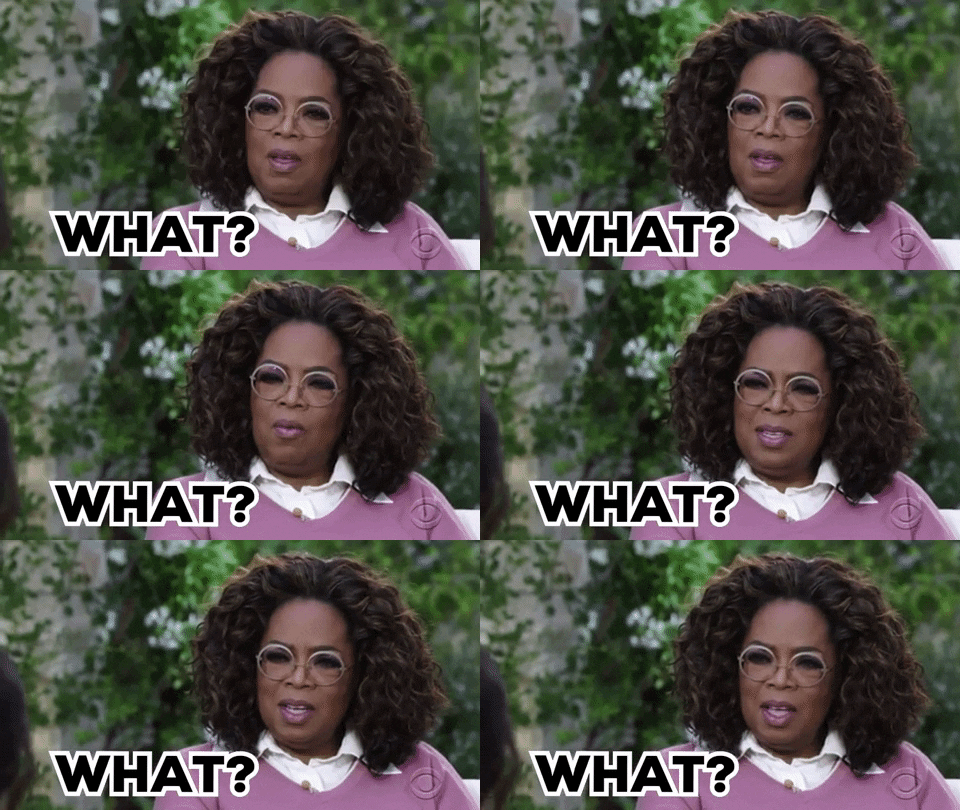
Image Description: Picture of Oprah wearing a purple sweater and white button-down. Saying “what?”. This image was a snippet from Oprah’s interview with Meghan Markle.
While this was not the first time I heard these kinds of comments from family members, I was crushed. And I sat crying at my grandfather’s funeral, not out of the sadness of his passing (because, to be honest, I didn’t know him very well), but because relatives I didn’t even know decided their opinions on my body were so profound that they had a dire need to communicate them with all the surrounding patrons and me IMMEDIATELY.
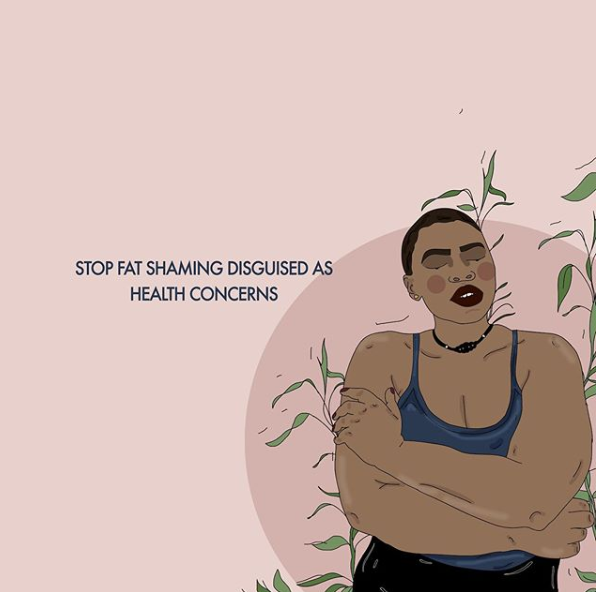
Image Description: Pictured is a graphic design from @recipiesforselflove on Instagram. The image displays a pale pink background and the text “stop fat-shaming disguised as health concerns” is placed slightly left of center. A black woman is illustrated in the bottom right-hand corner wearing a blue tank top and black pants. She is encompassed in a greyish-pink circle and surrounded by tall green plants.
From the first moment of our consciousness, we (women of color) are raised to think of weight as one of our defining characteristics. Something that measures how much human decency we will be allotted, how many people will treat us with respect, and of course, “most importantly” (as many of my fellow South Asian women have been told) how many marriage proposals we will receive when we are older. It does not matter how much we work out or eat nutrient-rich meals; if we do not visually conform to society’s standard of the ideal body, we are not only ridiculed for it, but our existence itself is categorized as inferior. We are silenced, shunned, and demonized for simply existing in non-white, fat bodies. Whether it is from how we observe the world or how we are treated within it, we grow to learn that being fat equates with being of less value, and so we turn to the alternative: ensuring “smallness” by any means necessary.
In order to contextualize western diet culture’s impact on specifically women of color, it is critical to understand its origin as being one compounded by systems of white supremacy and the patriarchy. These systems feed into the creation of a diet culture stemming from anti-blackness that is used as a tool to pit women and groups of color against one another.
Diet Culture & Women of Color
For many communities of color, the discrepancy between how we are taught to consume food—in schools and from our friends—and the cultural foods we enjoy in the comfort of our own homes cultivates a relationship with food defined by confusion, embarrassment, and shame. We are taught that things like carbs and “fatty” oils are the devil incarnate, and for cultural diets—defined by dishes artfully composed of rice and noodles—this can be detrimental. The Indian meals of my childhood like khichdi, pulao, and pav bhaji—rich in spices and made with a foundation of rice or bread—would be considered “unhealthy” because of the carbs and oil they contain. These very meals that nursed me back to health when I fell sick and energized me after hours of dance practice; would also be the source of my shame during school lunch periods and visits to the doctor’s office. Any nutritional value and traditional significance of these and other cultural dishes are often overshadowed by a mistaken idea of what is “healthy”—which in this case really equates to practices that result in supposed physical “smallness.”
The need to conform society to one idea of “health”—which standardizes a “correct” diet —controls how communities of color and communities of women form their relationships with food and nourishment. Health, in this case, becomes a concept encompassing what patterned behaviors keeps one from becoming fat. It dictates how individuals must engage in nutrition in exchange for societal acceptance. This phenomenon, while detrimental to all people—in this case explicitly discussing those impacted by Western practices of diet culture—affects women of color differently as they live in the limbo of two different, often competing cultural identities, each with their own social diet pressures, in conjunction with the necessary pursuit of femininity.
To center white-ness when creating the standard and “correct” American diet, colonizes nutrition and manipulates the mentality around health. It serves to Other* various cultural diets by making Western “health foods” the norm and vilifying any foods that stray from these guidelines. In turn, society claims that the very recipes that strengthened our ancestors, the very recipes that have quite literally borne and sustained our lineages are unacceptable. In reality, what is unacceptable is the rhetoric of disgust and inferiority that often marks cultural food sources. The idea that one should not consume the traditional dishes of their ancestry because of the “white” ideal diet is racist.
Take, for instance, the narrative surrounding MSG (monosodium glutamate)—a food additive utilized in many foods and “naturally found in foods like tomatoes and cheese”(Yeung, 2020), but ridiculed because of its use in traditional Chinese meals. The media has marked MSG as a dangerous and unhealthy ingredient and has linked it to conditions like asthma, drowsiness, and headaches (but not by any scientific backing). This racist rhetoric has steered people away from MSG and has forced the Chinese American community to be mindful of the backlash they may face in using the ingredient, especially for restaurant owners. The overall stigma that surrounds this ingredient displays just how much power white institutions have in dispelling the use of products, especially when those products hold a particular significance in BI-POC cultural cuisines.
The Implications of the Small Feminine Body
There is also a physical element to the requirement of smallness for feminine bodies. It operates under the assumption that women should occupy as little space as physically possible so as to keep their positions of power stifled. The presumption is that women—as the “submissive” gender—must bolster male masculinity by embodying the opposite characteristics of what men possess. By this “rule,” if men are meant to be large to monopolize space and contribute to their dominance, women must then be as small as possible to make “smaller” men adhere to this expectation. Women alone must assume the burden of changing themselves to allow for men to conform to the ideals they have set. Straying away from this ideal—embodying fatness and taking up greater space as a woman—means undermining these systems of the patriarchy that award men greater dominion over the world.
For women of color who reside in the western world, the pursuit of femininity means the expectation of smallness is compounded by the need (for survival purposes) to shed their melanin and present as light-skinned as possible. Because society masculinizes women of color, specifically brown and black women, they must pursue femininity more extremely because of their skin color. If not, they are ridiculed and solidify their low position on the social ladder. Because of this they feel a greater emphasis to conform to the ideals of western femininity, which encompasses the prerequisite of smallness. In doing so, they may often feel at odds with connecting to the traditional cultural foods they grew up with and abiding by the rules of the society in which they reside.
Imperialism's production of the beauty standard—the necessity of thinness and whiteness—for women and girls in places like India portrays this phenomenon at work. The colonial impact left by Persia and Britain in South Asia has ingrained ideologies about correct body shape, colorism, and anti-blackness. 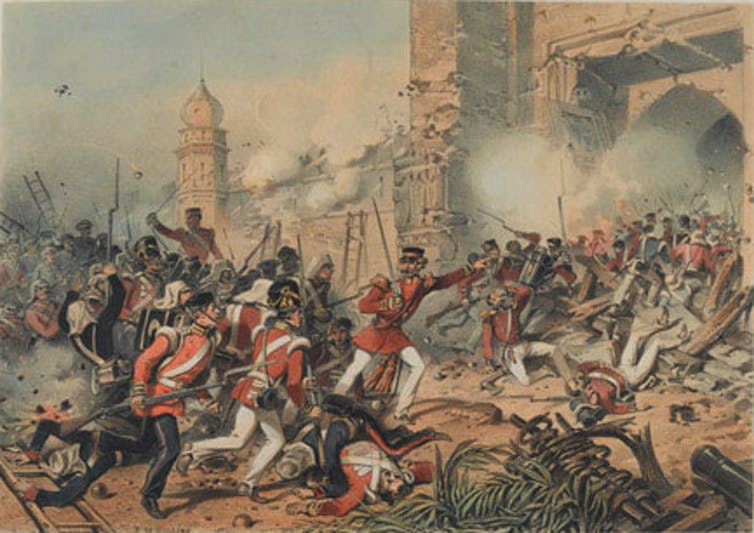
Image Description: Pictured is a scene from the era of British rule in India. Depicted are British soldiers, dressed in red and white garments, invading an Indian palace. The soldiers hold rifles and clouds of smoke surround them.
Since the reign of the Mughals and later the British East India Company, Indian culture has been defined by the idea that the highest cultural capital** is awarded to those of lighter skin and less weight. Because conforming more to this ideal cultural behavior meant increasing one's socio-economic status, adhering to the beauty standard was a matter of SURVIVAL. It meant that the closer you were to being this standard the better you would be treated by the foreigners who had come to rule your land and who controlled economic and social production within it.
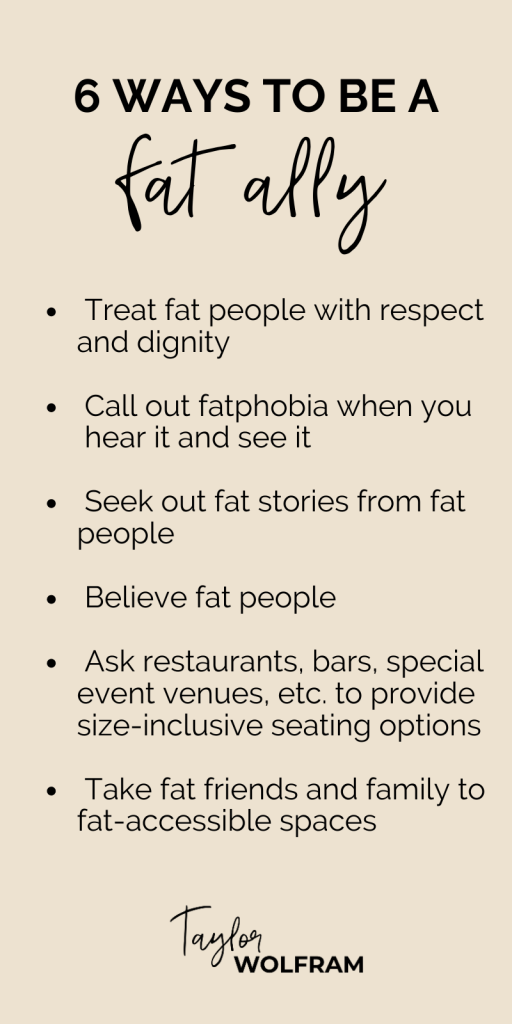
Image Description: Pictured is an infographic made up of a light tan background created by Taylor Wolfram. It says “6 Ways to Be a Fat Ally”. And lists “ treat fat people with respect and dignity, call out fatphobia when you hear it and see it, seek out fat stories from fat people, believe fat people, ask restaurants, bars, special event venues, etc, to provide size-inclusive seating options, take fat friends and family to fat-accessible spaces”.
So with these foundational elements of diet culture’s impact in mind, we can then ask ourselves:
What can we do to mitigate and reverse the rather negative ramifications of this mindset?
We can change the way we think and talk about bodies
They are vessels that carry us through our day, why must we comment on every one we see ...?
We can advocate for ourselves and others when disrespectful rhetoric is used
You deserve to be vocal and correct disrespect even if it is viewed as normalized.
And maybe most importantly we can learn to view ourselves from a neutral lens
Your body is none other than how you move physically from place to place. To frame it in this way may help the preoccupation with how we are perceived because of it.
I know what you’re thinking: these tips are much easier said than done. And you are correct! But, this doesn’t mean we shouldn’t hold ourselves accountable when we say or think about bodies negatively. It also means that if you are being degraded for your appearance: STAND UP FOR YOURSELF! Real change can only be possible when we—women of color—learn that we are worthy of taking up space in this world.
Footnotes
* The act of alienating something by highlighting its “abnormal” characteristics
** The amount of societal status one is given based on various factors (i.e., education, skills, wealth, and discussed the most in this case appearance)
Resources and recommendations you should be sure to check out:
CNN: MSG in Chinese Food Isn't Unhealthy -- You're Just Racist, Activists Say.
Yeung, Jessie. “MSG in Chinese Food Isn't Unhealthy -- You're Just Racist, Activists Say.” CNN, Cable News Network, 19 Jan. 2020, https://www.cnn.com/2020/01/18/asia/chinese-restaurant-syndrome-msg-intl-hnk-scli/index.html.
Harvard University: Occidentalisation of Beauty Standards: Eurocentrism in Asia
Chen, Toby, et al. “Occidentalisation of Beauty Standards: Eurocentrism in Asia.” Zenodo, Harvard University , 16 Dec. 2020, https://zenodo.org/record/4325856#.YZvkpr1Ki3I.
Gloria Lucas: Nalgona Positivity Pride
Yesika Salgado: What Comes After Loving Yourself? Advice from a Fat Fly Brown Girl
Yeskia Selgado: The Hunger
Teen Vogue: Fat is Not a Bad Word
Taylor Wolfram: 6 ways to Be a Fat Ally
Allison Rachel: Recipes for Self-Love
NPR: Code Switch- Is Beauty In The Eyes of The Colonizer
]]>
Positionality Statement: This post is written by Ojus Phogat, a second-year student at UMBC and a student-staff member at the Women’s Center. I am a South Asian American woman who has felt the...
https://womenscenteratumbc.wordpress.com/2021/11/22/diet-culture-v-the-cultural-diet%ef%bf%bc/
https://my3.my.umbc.edu/api/v0/pixel/news/115239/guest@my.umbc.edu/e00d00eebc2a6392d75a92315047070c/api/pixel
acceptance
beauty-standards
body-consciousness
body-neutrality
body-positivity
diversity
diversity-and-inclusion-issues
fatness
feminism
femmes
intersectionality
minorities
people-of-color
self-advocacy
social-awareness
south-asian-voices
women
women-of-color
Women's, Gender, & Equity Center
https://my3.my.umbc.edu/groups/womenscenter
https://assets2-my.umbc.edu/system/shared/avatars/groups/000/000/125/78272a4842689b30dbf74672182b78f8/xsmall.png?1750974263
https://assets1-my.umbc.edu/system/shared/avatars/groups/000/000/125/78272a4842689b30dbf74672182b78f8/original.png?1750974263
https://assets1-my.umbc.edu/system/shared/avatars/groups/000/000/125/78272a4842689b30dbf74672182b78f8/xxlarge.png?1750974263
https://assets1-my.umbc.edu/system/shared/avatars/groups/000/000/125/78272a4842689b30dbf74672182b78f8/xlarge.png?1750974263
https://assets1-my.umbc.edu/system/shared/avatars/groups/000/000/125/78272a4842689b30dbf74672182b78f8/large.png?1750974263
https://assets2-my.umbc.edu/system/shared/avatars/groups/000/000/125/78272a4842689b30dbf74672182b78f8/medium.png?1750974263
https://assets1-my.umbc.edu/system/shared/avatars/groups/000/000/125/78272a4842689b30dbf74672182b78f8/small.png?1750974263
https://assets2-my.umbc.edu/system/shared/avatars/groups/000/000/125/78272a4842689b30dbf74672182b78f8/xsmall.png?1750974263
https://assets3-my.umbc.edu/system/shared/avatars/groups/000/000/125/78272a4842689b30dbf74672182b78f8/xxsmall.png?1750974263
Women's Center
6
0
false
Mon, 22 Nov 2021 17:04:31 -0500
Mon, 22 Nov 2021 17:07:26 -0500
Diet Culture v. The Cultural Diet

Image description: A formal headshot of the author.
Positionality Statement: This post is written by Ojus Phogat, a second-year student at UMBC and a student-staff member at the Women’s Center. I am a South Asian American woman who has felt the persistent effects of diet culture first-hand. In writing this blog, I hope to identify these impacts and uncover the systems of oppression that keep them afloat. As a reader, I wish to encourage you to alter the way you pass judgment on yourself and others. The more we engage in fatphobic rhetoric, which stems from white supremacy and the patriarchy, the more we uphold these oppressive systems. To all my fellow women of color who have ever been made to feel like less because of the way you look: I hope you learn that you have always been enough.
When I was nine years old, I went to India for my grandfather’s funeral. After the cremation ritual, I was gathered into a room of extended family (most of whom were strangers to me) where the following conversation took place:
Random Uncle: “Do you ever walk on the treadmill?”
Me, a fairly active kid who did hours of dance, basketball, and swimming, and was yes chubby: “Hain Ji?” *yes sir*
Random Uncle: “At what speed? ZERO!”
*eruption of laughter from the surrounding guests*
His Wife: “Take it from me; all the housework you’ll have to do when you’re married will keep it off, but it’s better to start now. We only care about you.”
Image Description: GIF of Oprah wearing a purple sweater and white button-down. Saying “what?”. This image was a snippet from Oprah’s interview with Meghan Markle.
While this was not the first time I heard these kinds of comments from family members, I was crushed. And I sat crying at my grandfather’s funeral, not out of the sadness of his passing (because, to be honest, I didn’t know him very well), but because relatives I didn’t even know decided their opinions on my body were so profound that they had a dire need to communicate them with all the surrounding patrons and me IMMEDIATELY.
Image Description: Pictured is a graphic design from @recipiesforselflove on Instagram. The image displays a pale pink background and the text “stop fat-shaming disguised as health concerns” is placed slightly left of center. A black woman is illustrated in the bottom right-hand corner wearing a blue tank top and black pants. She is encompassed in a greyish-pink circle and surrounded by tall green plants.
From the first moment of our consciousness, we (women of color) are raised to think of weight as one of our defining characteristics. Something that measures how much human decency we will be allotted, how many people will treat us with respect, and of course, “most importantly” (as many of my fellow South Asian women have been told) how many marriage proposals we will receive when we are older. It does not matter how much we work out or eat nutrient-rich meals; if we do not visually conform to society’s standard of the ideal body, we are not only ridiculed for it, but our existence itself is categorized as inferior. We are silenced, shunned, and demonized for simply existing in non-white, fat bodies. Whether it is from how we observe the world or how we are treated within it, we grow to learn that being fat equates with being of less value, and so we turn to the alternative: ensuring “smallness” by any means necessary.
In order to contextualize western diet culture’s impact on specifically women of color, it is critical to understand its origin as being one compounded by systems of white supremacy and the patriarchy. These systems feed into the creation of a diet culture stemming from anti-blackness that is used as a tool to pit women and groups of color against one another.
Diet Culture & Women of Color
For many communities of color, the discrepancy between how we are taught to consume food—in schools and from our friends—and the cultural foods we enjoy in the comfort of our own homes cultivates a relationship with food defined by confusion, embarrassment, and shame. We are taught that things like carbs and “fatty” oils are the devil incarnate, and for cultural diets—defined by dishes artfully composed of rice and noodles—this can be detrimental. The Indian meals of my childhood like khichdi, pulao, and pav bhaji—rich in spices and made with a foundation of rice or bread—would be considered “unhealthy” because of the carbs and oil they contain. These very meals that nursed me back to health when I fell sick and energized me after hours of dance practice; would also be the source of my shame during school lunch periods and visits to the doctor’s office. Any nutritional value and traditional significance of these and other cultural dishes are often overshadowed by a mistaken idea of what is “healthy”—which in this case really equates to practices that result in supposed physical “smallness.”
The need to conform society to one idea of “health”—which standardizes a “correct” diet —controls how communities of color and communities of women form their relationships with food and nourishment. Health, in this case, becomes a concept encompassing what patterned behaviors keeps one from becoming fat. It dictates how individuals must engage in nutrition in exchange for societal acceptance. This phenomenon, while detrimental to all people—in this case explicitly discussing those impacted by Western practices of diet culture—affects women of color differently as they live in the limbo of two different, often competing cultural identities, each with their own social diet pressures, in conjunction with the necessary pursuit of femininity.
To center white-ness when creating the standard and “correct” American diet, colonizes nutrition and manipulates the mentality around health. It serves to Other* various cultural diets by making Western “health foods” the norm and vilifying any foods that stray from these guidelines. In turn, society claims that the very recipes that strengthened our ancestors, the very recipes that have quite literally borne and sustained our lineages are unacceptable. In reality, what is unacceptable is the rhetoric of disgust and inferiority that often marks cultural food sources. The idea that one should not consume the traditional dishes of their ancestry because of the “white” ideal diet is racist.
Take, for instance, the narrative surrounding MSG (monosodium glutamate)—a food additive utilized in many foods and “naturally found in foods like tomatoes and cheese”(Yeung, 2020), but ridiculed because of its use in traditional Chinese meals. The media has marked MSG as a dangerous and unhealthy ingredient and has linked it to conditions like asthma, drowsiness, and headaches (but not by any scientific backing). This racist rhetoric has steered people away from MSG and has forced the Chinese American community to be mindful of the backlash they may face in using the ingredient, especially for restaurant owners. The overall stigma that surrounds this ingredient displays just how much power white institutions have in dispelling the use of products, especially when those products hold a particular significance in BI-POC cultural cuisines.
The Implications of the Small Feminine Body
There is also a physical element to the requirement of smallness for feminine bodies. It operates under the assumption that women should occupy as little space as physically possible so as to keep their positions of power stifled. The presumption is that women—as the “submissive” gender—must bolster male masculinity by embodying the opposite characteristics of what men possess. By this “rule,” if men are meant to be large to monopolize space and contribute to their dominance, women must then be as small as possible to make “smaller” men adhere to this expectation. Women alone must assume the burden of changing themselves to allow for men to conform to the ideals they have set. Straying away from this ideal—embodying fatness and taking up greater space as a woman—means undermining these systems of the patriarchy that award men greater dominion over the world.
For women of color who reside in the western world, the pursuit of femininity means the expectation of smallness is compounded by the need (for survival purposes) to shed their melanin and present as light-skinned as possible. Because society masculinizes women of color, specifically brown and black women, they must pursue femininity more extremely because of their skin color. If not, they are ridiculed and solidify their low position on the social ladder. Because of this they feel a greater emphasis to conform to the ideals of western femininity, which encompasses the prerequisite of smallness. In doing so, they may often feel at odds with connecting to the traditional cultural foods they grew up with and abiding by the rules of the society in which they reside.
Imperialism’s production of the beauty standard—the necessity of thinness and whiteness—for women and girls in places like India portrays this phenomenon at work. The colonial impact left by Persia and Britain in South Asia has ingrained ideologies about correct body shape, colorism, and anti-blackness.
Image Description: Pictured is a scene from the era of British rule in India. Depicted are British soldiers, dressed in red and white garments, invading an Indian palace. The soldiers hold rifles and clouds of smoke surround them.
Since the reign of the Mughals and later the British East India Company, Indian culture has been defined by the idea that the highest cultural capital** is awarded to those of lighter skin and less weight. Because conforming more to this ideal cultural behavior meant increasing one’s socio-economic status, adhering to the beauty standard was a matter of SURVIVAL. It meant that the closer you were to being this standard the better you would be treated by the foreigners who had come to rule your land and who controlled economic and social production within it.
Image Description: Pictured is an infographic made up of a light tan background created by Taylor Wolfram. It says “6 Ways to Be a Fat Ally”. And lists “ treat fat people with respect and dignity, call out fatphobia when you hear it and see it, seek out fat stories from fat people, believe fat people, ask restaurants, bars, special event venues, etc, to provide size-inclusive seating options, take fat friends and family to fat-accessible spaces”.
So with these foundational elements of diet culture’s impact in mind, we can then ask ourselves:
What can we do to mitigate and reverse the rather negative ramifications of this mindset?
We can change the way we think and talk about bodies
They are vessels that carry us through our day, why must we comment on every one we see …?
We can advocate for ourselves and others when disrespectful rhetoric is used
You deserve to be vocal and correct disrespect even if it is viewed as normalized.
And maybe most importantly we can learn to view ourselves from a neutral lens
Your body is none other than how you move physically from place to place. To frame it in this way may help the preoccupation with how we are perceived because of it.
I know what you’re thinking: these tips are much easier said than done. And you are correct! But, this doesn’t mean we shouldn’t hold ourselves accountable when we say or think about bodies negatively. It also means that if you are being degraded for your appearance: STAND UP FOR YOURSELF! Real change can only be possible when we—women of color—learn that we are worthy of taking up space in this world.
Footnotes
* The act of alienating something by highlighting its “abnormal” characteristics
** The amount of societal status one is given based on various factors (i.e., education, skills, wealth, and discussed the most in this case appearance)
Resources and recommendations you should be sure to check out:
CNN: MSG in Chinese Food Isn’t Unhealthy — You’re Just Racist, Activists Say.
Yeung, Jessie. “MSG in Chinese Food Isn’t Unhealthy — You’re Just Racist, Activists Say.” CNN, Cable News Network, 19 Jan. 2020, https://www.cnn.com/2020/01/18/asia/chinese-restaurant-syndrome-msg-intl-hnk-scli/index.html.
Harvard University: Occidentalisation of Beauty Standards: Eurocentrism in Asia
Chen, Toby, et al. “Occidentalisation of Beauty Standards: Eurocentrism in Asia.” Zenodo, Harvard University , 16 Dec. 2020, https://zenodo.org/record/4325856#.YZvkpr1Ki3I.
Gloria Lucas: Nalgona Positivity Pride
Yesika Salgado: What Comes After Loving Yourself? Advice from a Fat Fly Brown Girl
Yeskia Selgado: The Hunger
Teen Vogue: Fat is Not a Bad Word
Taylor Wolfram: 6 ways to Be a Fat Ally
Allison Rachel: Recipes for Self-Love
NPR: Code Switch- Is Beauty In The Eyes of The Colonizer
Image description: A formal headshot of the author.
Positionality Statement: This post is written by Ojuswani Phogat, a second-year student at UMBC and a student-staff member at the Women’s Center. I am a South Asian American woman who has felt the persistent effects of diet culture first-hand. In writing this blog, I hope to identify these impacts and uncover the systems of oppression that keep them afloat. As a reader, I wish to encourage you to alter the way you pass judgment on yourself and others. The more we engage in fatphobic rhetoric, which stems from white supremacy and the patriarchy, the more we uphold these oppressive systems. To all my fellow women of color who have ever been made to feel like less because of the way you look: I hope you learn that you have always been enough.
When I was nine years old, I went to India for my grandfather’s funeral. After the cremation ritual, I was gathered into a room of extended family (most of whom were strangers to me) where the following conversation took place:
Random Uncle: “Do you ever walk on the treadmill?”
Me, a fairly active kid who did hours of dance, basketball, and swimming, and was yes chubby: “Hain Ji?” *yes sir*
Random Uncle: “At what speed? ZERO!”
*eruption of laughter from the surrounding guests*
His Wife: “Take it from me; all the housework you’ll have to do when you’re married will keep it off, but it’s better to start now. We only care about you.”
Image Description: GIF of Oprah wearing a purple sweater and white button-down. Saying “what?”. This image was a snippet from Oprah’s interview with Meghan Markle.
While this was not the first time I heard these kinds of comments from family members, I was crushed. And I sat crying at my grandfather’s funeral, not out of the sadness of his passing (because, to be honest, I didn’t know him very well), but because relatives I didn’t even know decided their opinions on my body were so profound that they had a dire need to communicate them with all the surrounding patrons and me IMMEDIATELY.
Image Description: Pictured is a graphic design from @recipiesforselflove on Instagram. The image displays a pale pink background and the text “stop fat-shaming disguised as health concerns” is placed slightly left of center. A black woman is illustrated in the bottom right-hand corner wearing a blue tank top and black pants. She is encompassed in a greyish-pink circle and surrounded by tall green plants.
From the first moment of our consciousness, we (women of color) are raised to think of weight as one of our defining characteristics. Something that measures how much human decency we will be allotted, how many people will treat us with respect, and of course, “most importantly” (as many of my fellow South Asian women have been told) how many marriage proposals we will receive when we are older. It does not matter how much we work out or eat nutrient-rich meals; if we do not visually conform to society’s standard of the ideal body, we are not only ridiculed for it, but our existence itself is categorized as inferior. We are silenced, shunned, and demonized for simply existing in non-white, fat bodies. Whether it is from how we observe the world or how we are treated within it, we grow to learn that being fat equates with being of less value, and so we turn to the alternative: ensuring “smallness” by any means necessary.
In order to contextualize western diet culture’s impact on specifically women of color, it is critical to understand its origin as being one compounded by systems of white supremacy and the patriarchy. These systems feed into the creation of a diet culture stemming from anti-blackness that is used as a tool to pit women and groups of color against one another.
Diet Culture & Women of Color
For many communities of color, the discrepancy between how we are taught to consume food—in schools and from our friends—and the cultural foods we enjoy in the comfort of our own homes cultivates a relationship with food defined by confusion, embarrassment, and shame. We are taught that things like carbs and “fatty” oils are the devil incarnate, and for cultural diets—defined by dishes artfully composed of rice and noodles—this can be detrimental. The Indian meals of my childhood like khichdi, pulao, and pav bhaji—rich in spices and made with a foundation of rice or bread—would be considered “unhealthy” because of the carbs and oil they contain. These very meals that nursed me back to health when I fell sick and energized me after hours of dance practice; would also be the source of my shame during school lunch periods and visits to the doctor’s office. Any nutritional value and traditional significance of these and other cultural dishes are often overshadowed by a mistaken idea of what is “healthy”—which in this case really equates to practices that result in supposed physical “smallness.”
The need to conform society to one idea of “health”—which standardizes a “correct” diet —controls how communities of color and communities of women form their relationships with food and nourishment. Health, in this case, becomes a concept encompassing what patterned behaviors keeps one from becoming fat. It dictates how individuals must engage in nutrition in exchange for societal acceptance. This phenomenon, while detrimental to all people—in this case explicitly discussing those impacted by Western practices of diet culture—affects women of color differently as they live in the limbo of two different, often competing cultural identities, each with their own social diet pressures, in conjunction with the necessary pursuit of femininity.
To center white-ness when creating the standard and “correct” American diet, colonizes nutrition and manipulates the mentality around health. It serves to Other* various cultural diets by making Western “health foods” the norm and vilifying any foods that stray from these guidelines. In turn, society claims that the very recipes that strengthened our ancestors, the very recipes that have quite literally borne and sustained our lineages are unacceptable. In reality, what is unacceptable is the rhetoric of disgust and inferiority that often marks cultural food sources. The idea that one should not consume the traditional dishes of their ancestry because of the “white” ideal diet is racist.
Take, for instance, the narrative surrounding MSG (monosodium glutamate)—a food additive utilized in many foods and “naturally found in foods like tomatoes and cheese”(Yeung, 2020), but ridiculed because of its use in traditional Chinese meals. The media has marked MSG as a dangerous and unhealthy ingredient and has linked it to conditions like asthma, drowsiness, and headaches (but not by any scientific backing). This racist rhetoric has steered people away from MSG and has forced the Chinese American community to be mindful of the backlash they may face in using the ingredient, especially for restaurant owners. The overall stigma that surrounds this ingredient displays just how much power white institutions have in dispelling the use of products, especially when those products hold a particular significance in BI-POC cultural cuisines.
The Implications of the Small Feminine Body
There is also a physical element to the requirement of smallness for feminine bodies. It operates under the assumption that women should occupy as little space as physically possible so as to keep their positions of power stifled. The presumption is that women—as the “submissive” gender—must bolster male masculinity by embodying the opposite characteristics of what men possess. By this “rule,” if men are meant to be large to monopolize space and contribute to their dominance, women must then be as small as possible to make “smaller” men adhere to this expectation. Women alone must assume the burden of changing themselves to allow for men to conform to the ideals they have set. Straying away from this ideal—embodying fatness and taking up greater space as a woman—means undermining these systems of the patriarchy that award men greater dominion over the world.
For women of color who reside in the western world, the pursuit of femininity means the expectation of smallness is compounded by the need (for survival purposes) to shed their melanin and present as light-skinned as possible. Because society masculinizes women of color, specifically brown and black women, they must pursue femininity more extremely because of their skin color. If not, they are ridiculed and solidify their low position on the social ladder. Because of this they feel a greater emphasis to conform to the ideals of western femininity, which encompasses the prerequisite of smallness. In doing so, they may often feel at odds with connecting to the traditional cultural foods they grew up with and abiding by the rules of the society in which they reside.
Imperialism’s production of the beauty standard—the necessity of thinness and whiteness—for women and girls in places like India portrays this phenomenon at work. The colonial impact left by Persia and Britain in South Asia has ingrained ideologies about correct body shape, colorism, and anti-blackness.
Image Description: Pictured is a scene from the era of British rule in India. Depicted are British soldiers, dressed in red and white garments, invading an Indian palace. The soldiers hold rifles and clouds of smoke surround them.
Since the reign of the Mughals and later the British East India Company, Indian culture has been defined by the idea that the highest cultural capital** is awarded to those of lighter skin and less weight. Because conforming more to this ideal cultural behavior meant increasing one’s socio-economic status, adhering to the beauty standard was a matter of SURVIVAL. It meant that the closer you were to being this standard the better you would be treated by the foreigners who had come to rule your land and who controlled economic and social production within it.
Image Description: Pictured is an infographic made up of a light tan background created by Taylor Wolfram. It says “6 Ways to Be a Fat Ally”. And lists “ treat fat people with respect and dignity, call out fatphobia when you hear it and see it, seek out fat stories from fat people, believe fat people, ask restaurants, bars, special event venues, etc, to provide size-inclusive seating options, take fat friends and family to fat-accessible spaces”.
So with these foundational elements of diet culture’s impact in mind, we can then ask ourselves:
What can we do to mitigate and reverse the rather negative ramifications of this mindset?
We can change the way we think and talk about bodies
They are vessels that carry us through our day, why must we comment on every one we see …?
We can advocate for ourselves and others when disrespectful rhetoric is used
You deserve to be vocal and correct disrespect even if it is viewed as normalized.
And maybe most importantly we can learn to view ourselves from a neutral lens
Your body is none other than how you move physically from place to place. To frame it in this way may help the preoccupation with how we are perceived because of it.
I know what you’re thinking: these tips are much easier said than done. And you are correct! But, this doesn’t mean we shouldn’t hold ourselves accountable when we say or think about bodies negatively. It also means that if you are being degraded for your appearance: STAND UP FOR YOURSELF! Real change can only be possible when we—women of color—learn that we are worthy of taking up space in this world.
Footnotes
* The act of alienating something by highlighting its “abnormal” characteristics
** The amount of societal status one is given based on various factors (i.e., education, skills, wealth, and discussed the most in this case appearance)
Resources and recommendations you should be sure to check out:
CNN: MSG in Chinese Food Isn’t Unhealthy — You’re Just Racist, Activists Say.
Yeung, Jessie. “MSG in Chinese Food Isn’t Unhealthy — You’re Just Racist, Activists Say.” CNN, Cable News Network, 19 Jan. 2020, https://www.cnn.com/2020/01/18/asia/chinese-restaurant-syndrome-msg-intl-hnk-scli/index.html.
Harvard University: Occidentalisation of Beauty Standards: Eurocentrism in Asia
Chen, Toby, et al. “Occidentalisation of Beauty Standards: Eurocentrism in Asia.” Zenodo, Harvard University , 16 Dec. 2020, https://zenodo.org/record/4325856#.YZvkpr1Ki3I.
Gloria Lucas: Nalgona Positivity Pride
Yesika Salgado: What Comes After Loving Yourself? Advice from a Fat Fly Brown Girl
Yeskia Selgado: The Hunger
Teen Vogue: Fat is Not a Bad Word
Taylor Wolfram: 6 ways to Be a Fat Ally
Allison Rachel: Recipes for Self-Love
NPR: Code Switch- Is Beauty In The Eyes of The Colonizer
|
NOV 23 4 PMThe Commons : Skylight Room
|
Dear graduate students,
The Graduate School at UMBC and the PROMISE program are partnering this year to host our Annual Fall Harvest Dinner and Networking event on Tuesday, November 23rd, 2021 from 4PM to 6PM in person on the UMBC campus in the Commons Building, 3rd floor, Skylight Room.
Wc call this even a Fall Harvest Dinner to celebrate all that has been planted, sowed, and harvested this past year -in reality and symbolically. Of course, our event occurs very close to November when many American families celebrate a "Thanksgiving" meal. The Thanksgiving tradition often includes sharing foord and verbal expressions of gratitude for what we have in our lives. Our PROMISE staff understands that this national holiday also has roots in a darker history, one of colonialism and the massacre of hundreds and thousands of indigenous Americans. Thus, we will be choosing to incorporate some non-traditional elements into out Fall Harvest celebration: we will pay our respects to the indigenous peoples of this land and their beautiful, deep connection to mother nature and celebrate the diversity of our community. We hope this time together will be an opportunity to connect with grad student from other departments and share a delicious dinner with our peers. We hope you are available to join us!
This year the number of participants will be limited due to COVID-19 protocol, please make sure to RSVP for the event. In addition, the dress code for this occasion is business casual and masks are required to enter the building and must be worn when not eating. Bring your ticket and student ID to enter the event!
It is possible that this event will sell out. Please check the reservation links provided to see if tickets are still available. Even if tickets are sold out, there is an option to be waitlisted for this event which can also be found using the reservation link.
Tickets can be reserved at
this link or at the ticket link provided. If you have any questions or concerns, please contact us at
promise@umbc.edu.
Sincerely,
The PROMISE team
View on myUMBC »
]]>
NOV 23 4 PMThe Commons : Skylight Room Dear graduate students, The Graduate School at UMBC and the PROMISE program are partnering this year to host our Annual Fall Harvest Dinner and...
https://my3.my.umbc.edu/api/v0/pixel/news/115203/guest@my.umbc.edu/966d301bc6f6b836750007b0130c1b7e/api/pixel
UMBC Graduate Student Association
https://my3.my.umbc.edu/groups/gsa
https://assets1-my.umbc.edu/system/shared/avatars/groups/000/000/141/6944ed1afb7c0b0557d52a5e61a6d9c9/xsmall.png?1688588974
https://assets1-my.umbc.edu/system/shared/avatars/groups/000/000/141/6944ed1afb7c0b0557d52a5e61a6d9c9/original.png?1688588974
https://assets2-my.umbc.edu/system/shared/avatars/groups/000/000/141/6944ed1afb7c0b0557d52a5e61a6d9c9/xxlarge.png?1688588974
https://assets3-my.umbc.edu/system/shared/avatars/groups/000/000/141/6944ed1afb7c0b0557d52a5e61a6d9c9/xlarge.png?1688588974
https://assets1-my.umbc.edu/system/shared/avatars/groups/000/000/141/6944ed1afb7c0b0557d52a5e61a6d9c9/large.png?1688588974
https://assets1-my.umbc.edu/system/shared/avatars/groups/000/000/141/6944ed1afb7c0b0557d52a5e61a6d9c9/medium.png?1688588974
https://assets2-my.umbc.edu/system/shared/avatars/groups/000/000/141/6944ed1afb7c0b0557d52a5e61a6d9c9/small.png?1688588974
https://assets1-my.umbc.edu/system/shared/avatars/groups/000/000/141/6944ed1afb7c0b0557d52a5e61a6d9c9/xsmall.png?1688588974
https://assets1-my.umbc.edu/system/shared/avatars/groups/000/000/141/6944ed1afb7c0b0557d52a5e61a6d9c9/xxsmall.png?1688588974
UMBC Graduate Student Association
0
0
true
Mon, 22 Nov 2021 09:56:39 -0500
Community Care for those Impacted by Thursday's Cyberattack
Dear Graduate School Community
Initiatives for Identity, Inclusion & Belonging (i3b) is offering a Community Care Space today, Friday the 19th, from 4-5 PM for any students that have been impacted by the hateful hacking attack during the GSA sponsored meeting on Thursday.
The i3b Mosaic Center, in Commons 2B23 will be open and holding space especially for you to drop-in and process this terrible experience.
The Graduate Student Association Executive Board
Joel Tyson, President
Amy Cruz, Treasurer
Akash Vartak, Historian
]]>
Dear Graduate School Community Initiatives for Identity, Inclusion & Belonging (i3b) is offering a Community Care Space today, Friday the 19th, from 4-5 PM for any students that have been...
https://my3.my.umbc.edu/api/v0/pixel/news/115177/guest@my.umbc.edu/11ad7f219b3e146268885ab00288c17e/api/pixel
UMBC Graduate Student Association
https://my3.my.umbc.edu/groups/gsa
https://assets1-my.umbc.edu/system/shared/avatars/groups/000/000/141/6944ed1afb7c0b0557d52a5e61a6d9c9/xsmall.png?1688588974
https://assets1-my.umbc.edu/system/shared/avatars/groups/000/000/141/6944ed1afb7c0b0557d52a5e61a6d9c9/original.png?1688588974
https://assets2-my.umbc.edu/system/shared/avatars/groups/000/000/141/6944ed1afb7c0b0557d52a5e61a6d9c9/xxlarge.png?1688588974
https://assets3-my.umbc.edu/system/shared/avatars/groups/000/000/141/6944ed1afb7c0b0557d52a5e61a6d9c9/xlarge.png?1688588974
https://assets1-my.umbc.edu/system/shared/avatars/groups/000/000/141/6944ed1afb7c0b0557d52a5e61a6d9c9/large.png?1688588974
https://assets1-my.umbc.edu/system/shared/avatars/groups/000/000/141/6944ed1afb7c0b0557d52a5e61a6d9c9/medium.png?1688588974
https://assets2-my.umbc.edu/system/shared/avatars/groups/000/000/141/6944ed1afb7c0b0557d52a5e61a6d9c9/small.png?1688588974
https://assets1-my.umbc.edu/system/shared/avatars/groups/000/000/141/6944ed1afb7c0b0557d52a5e61a6d9c9/xsmall.png?1688588974
https://assets1-my.umbc.edu/system/shared/avatars/groups/000/000/141/6944ed1afb7c0b0557d52a5e61a6d9c9/xxsmall.png?1688588974
UMBC Graduate Student Association
0
0
true
Fri, 19 Nov 2021 15:09:25 -0500
Support for Victims of Cyberattack
During a virtual meeting organized by the Graduate Student Association on Thursday, a malicious hacker carried out a virtual attack on the zoom meeting. The hacker was able to get complete control of the room and wrote anti-black hate speech on the presentation slide, espoused religious hate, and controlled the accounts of several attendees to make it appear as though they were saying racist and homophobic things.
The hacker also targeted one graduate student in particular with anti-black hate speech using direct messages.
The Graduate Student Association stands behind the victims of this hack, especially the student that appears to have been targeted by their vile actions. We also stand behind the Black Graduate Student Organization and support their advocacy of black graduate students that have to deal with these repeated traumas.
Students who may have been negatively affected by the hackers homophobic statements can also reach out for support to the i3b's Pride Center through Lucy Delgado (
ldelgado@umbc.edu).
As organizers of the event we feel tremendous sadness and responsibility for what has occurred. The GSA is working with university offices to seek justice, prevent this from occurring again and support all those affected.
The GSA condemns the continuing rise of hate and is here to remind students of the
resources available to support us. We look forward to coming together soon to offer a space for community support. In the meantime, please feel free to reach out to us to let us know how we can best support you.
The Graduate Student Association Executive Board
Joel Tyson, President
Amy Cruz, Treasurer
Akash Vartak, Historian
]]>
During a virtual meeting organized by the Graduate Student Association on Thursday, a malicious hacker carried out a virtual attack on the zoom meeting. The hacker was able to get complete control...
https://my3.my.umbc.edu/api/v0/pixel/news/115172/guest@my.umbc.edu/0fc7ce3ff2e295be46eefbecf2fa74c0/api/pixel
UMBC Graduate Student Association
https://my3.my.umbc.edu/groups/gsa
https://assets1-my.umbc.edu/system/shared/avatars/groups/000/000/141/6944ed1afb7c0b0557d52a5e61a6d9c9/xsmall.png?1688588974
https://assets1-my.umbc.edu/system/shared/avatars/groups/000/000/141/6944ed1afb7c0b0557d52a5e61a6d9c9/original.png?1688588974
https://assets2-my.umbc.edu/system/shared/avatars/groups/000/000/141/6944ed1afb7c0b0557d52a5e61a6d9c9/xxlarge.png?1688588974
https://assets3-my.umbc.edu/system/shared/avatars/groups/000/000/141/6944ed1afb7c0b0557d52a5e61a6d9c9/xlarge.png?1688588974
https://assets1-my.umbc.edu/system/shared/avatars/groups/000/000/141/6944ed1afb7c0b0557d52a5e61a6d9c9/large.png?1688588974
https://assets1-my.umbc.edu/system/shared/avatars/groups/000/000/141/6944ed1afb7c0b0557d52a5e61a6d9c9/medium.png?1688588974
https://assets2-my.umbc.edu/system/shared/avatars/groups/000/000/141/6944ed1afb7c0b0557d52a5e61a6d9c9/small.png?1688588974
https://assets1-my.umbc.edu/system/shared/avatars/groups/000/000/141/6944ed1afb7c0b0557d52a5e61a6d9c9/xsmall.png?1688588974
https://assets1-my.umbc.edu/system/shared/avatars/groups/000/000/141/6944ed1afb7c0b0557d52a5e61a6d9c9/xxsmall.png?1688588974
UMBC Graduate Student Association
0
0
true
Fri, 19 Nov 2021 13:52:09 -0500
Concern and Support for UMBC’s Muslim Community
Dear UMBC Community,
We are deeply saddened and concerned to learn about a reported hate-bias crime in The Commons Tuesday night. A UMBC student reported that she was approached by an unknown male who attempted to pull off her hijab, the traditional headscarf worn by some Muslim women.
Acts such as this have no place at UMBC. Hate and bias are counter to UMBC values, especially our community’s deep commitment to diversity and inclusion and welcoming people of all backgrounds.
UMBC Police are investigating, and the Division of Student Affairs and Office of Equity and Inclusion have reached out to the student, as well as other students impacted, including the Muslim Student Association, Student Government Association (SGA), and the Graduate Student Association (GSA).
The UMBC community is invited to a community care space for support and dialogue on Monday, November 22, from 12:30 to 1:30 p.m. The event will be held in the Gathering Space for Spiritual Well-Being at The Center for Well-Being, and is a collaboration between Initiatives for Identity, Inclusion, and Belonging (i3b); the Muslim Student Association; SGA; and GSA. Counselors from Retriever Integrated Health will be on-site to provide additional support as needed. Imam Yaseen Shaikh from The Islamic Society of Baltimore and Rabbi Jeremy Fierstein, chair of the UMBC Religious Council, will also be on-site to provide additional support as needed. The front patio of The Center for Well-Being will be used as a back-up location if needed to accommodate COVID-19 capacity expectations.
Students in need of support can contact i3b at i3b@umbc.edu. Faculty and staff can access support through the Employee Assistance Program.
We are committed to offering a safe and inclusive campus environment where community members and visitors of all backgrounds feel that they belong.
Community members, including students, faculty, staff, and alumni, can always report concerns using this confidential reporting form. Anyone with information about this incident is encouraged to call UMBC Police at 410-455-5555.
It is essential that we continue to work together in building a caring, equitable, and inclusive community. Thank you for your commitment to inclusive excellence at UMBC.
President Freeman Hrabowski
Provost Philip Rous
Mehrshad Devin, President, Student Government Association
Orianne Smith, President, Faculty Senate
Joel Tyson, President, Graduate Student Association
Melody Wright, M.A. '21, President, Non-Exempt Staff Senate
Jess Wyatt, President, Professional Staff Senate
]]>
Dear UMBC Community, We are deeply saddened and concerned to learn about a reported hate-bias crime in The Commons Tuesday night. A UMBC student reported that she was approached by an unknown...
https://my3.my.umbc.edu/api/v0/pixel/news/115155/guest@my.umbc.edu/b1e73693f9023334be7ab0ef0d273b3f/api/pixel
UMBC Graduate Student Association
https://my3.my.umbc.edu/groups/gsa
https://assets1-my.umbc.edu/system/shared/avatars/groups/000/000/141/6944ed1afb7c0b0557d52a5e61a6d9c9/xsmall.png?1688588974
https://assets1-my.umbc.edu/system/shared/avatars/groups/000/000/141/6944ed1afb7c0b0557d52a5e61a6d9c9/original.png?1688588974
https://assets2-my.umbc.edu/system/shared/avatars/groups/000/000/141/6944ed1afb7c0b0557d52a5e61a6d9c9/xxlarge.png?1688588974
https://assets3-my.umbc.edu/system/shared/avatars/groups/000/000/141/6944ed1afb7c0b0557d52a5e61a6d9c9/xlarge.png?1688588974
https://assets1-my.umbc.edu/system/shared/avatars/groups/000/000/141/6944ed1afb7c0b0557d52a5e61a6d9c9/large.png?1688588974
https://assets1-my.umbc.edu/system/shared/avatars/groups/000/000/141/6944ed1afb7c0b0557d52a5e61a6d9c9/medium.png?1688588974
https://assets2-my.umbc.edu/system/shared/avatars/groups/000/000/141/6944ed1afb7c0b0557d52a5e61a6d9c9/small.png?1688588974
https://assets1-my.umbc.edu/system/shared/avatars/groups/000/000/141/6944ed1afb7c0b0557d52a5e61a6d9c9/xsmall.png?1688588974
https://assets1-my.umbc.edu/system/shared/avatars/groups/000/000/141/6944ed1afb7c0b0557d52a5e61a6d9c9/xxsmall.png?1688588974
UMBC Graduate Student Association
1
0
true
Thu, 18 Nov 2021 14:40:47 -0500
Finding and Creating Community Away from Home
|
NOV 17 4 PMThe Commons : 318
|
Join the Center for Democracy and Civic Life for "Finding and Creating Community Away from Home," a facilitated conversation among international students and students who have studied abroad or intend to do so. The conversation will focus on how participants have been or hope to be able to form meaningful connections and make contributions in their temporary communities (geographic, campus, etc.).
View on myUMBC »
]]>
NOV 17 4 PMThe Commons : 318 Join the Center for Democracy and Civic Life for "Finding and Creating Community Away from Home," a facilitated conversation among international students and students...
https://my3.my.umbc.edu/api/v0/pixel/news/115151/guest@my.umbc.edu/9154b87ca13e0bc7d61a601ac1aeaa2e/api/pixel
UMBC Graduate Student Association
https://my3.my.umbc.edu/groups/gsa
https://assets1-my.umbc.edu/system/shared/avatars/groups/000/000/141/6944ed1afb7c0b0557d52a5e61a6d9c9/xsmall.png?1688588974
https://assets1-my.umbc.edu/system/shared/avatars/groups/000/000/141/6944ed1afb7c0b0557d52a5e61a6d9c9/original.png?1688588974
https://assets2-my.umbc.edu/system/shared/avatars/groups/000/000/141/6944ed1afb7c0b0557d52a5e61a6d9c9/xxlarge.png?1688588974
https://assets3-my.umbc.edu/system/shared/avatars/groups/000/000/141/6944ed1afb7c0b0557d52a5e61a6d9c9/xlarge.png?1688588974
https://assets1-my.umbc.edu/system/shared/avatars/groups/000/000/141/6944ed1afb7c0b0557d52a5e61a6d9c9/large.png?1688588974
https://assets1-my.umbc.edu/system/shared/avatars/groups/000/000/141/6944ed1afb7c0b0557d52a5e61a6d9c9/medium.png?1688588974
https://assets2-my.umbc.edu/system/shared/avatars/groups/000/000/141/6944ed1afb7c0b0557d52a5e61a6d9c9/small.png?1688588974
https://assets1-my.umbc.edu/system/shared/avatars/groups/000/000/141/6944ed1afb7c0b0557d52a5e61a6d9c9/xsmall.png?1688588974
https://assets1-my.umbc.edu/system/shared/avatars/groups/000/000/141/6944ed1afb7c0b0557d52a5e61a6d9c9/xxsmall.png?1688588974
UMBC Graduate Student Association
0
0
true
Thu, 18 Nov 2021 13:56:31 -0500
Congratulate our GSotW!!
And the winner is *drumroll*...
.png) ]]>
Image
https://assets3-my.umbc.edu/system/shared/attachments/9ae115541148f3b8ceb30b109e117ff8/69fe4b28/news/000/115/139/e26042b30aef850d108a5014d1f3fe6c/Stylish Model Article Magazine Page (7).png?1637253321
https://my3.my.umbc.edu/api/v0/pixel/news/115139/guest@my.umbc.edu/fccd8c2d61300569cc5782d7a046702e/api/pixel
UMBC Graduate Student Association
https://my3.my.umbc.edu/groups/gsa
https://assets1-my.umbc.edu/system/shared/avatars/groups/000/000/141/6944ed1afb7c0b0557d52a5e61a6d9c9/xsmall.png?1688588974
https://assets1-my.umbc.edu/system/shared/avatars/groups/000/000/141/6944ed1afb7c0b0557d52a5e61a6d9c9/original.png?1688588974
https://assets2-my.umbc.edu/system/shared/avatars/groups/000/000/141/6944ed1afb7c0b0557d52a5e61a6d9c9/xxlarge.png?1688588974
https://assets3-my.umbc.edu/system/shared/avatars/groups/000/000/141/6944ed1afb7c0b0557d52a5e61a6d9c9/xlarge.png?1688588974
https://assets1-my.umbc.edu/system/shared/avatars/groups/000/000/141/6944ed1afb7c0b0557d52a5e61a6d9c9/large.png?1688588974
https://assets1-my.umbc.edu/system/shared/avatars/groups/000/000/141/6944ed1afb7c0b0557d52a5e61a6d9c9/medium.png?1688588974
https://assets2-my.umbc.edu/system/shared/avatars/groups/000/000/141/6944ed1afb7c0b0557d52a5e61a6d9c9/small.png?1688588974
https://assets1-my.umbc.edu/system/shared/avatars/groups/000/000/141/6944ed1afb7c0b0557d52a5e61a6d9c9/xsmall.png?1688588974
https://assets1-my.umbc.edu/system/shared/avatars/groups/000/000/141/6944ed1afb7c0b0557d52a5e61a6d9c9/xxsmall.png?1688588974
UMBC Graduate Student Association
2
0
true
Thu, 18 Nov 2021 11:36:21 -0500
]]>
Image
https://assets3-my.umbc.edu/system/shared/attachments/9ae115541148f3b8ceb30b109e117ff8/69fe4b28/news/000/115/139/e26042b30aef850d108a5014d1f3fe6c/Stylish Model Article Magazine Page (7).png?1637253321
https://my3.my.umbc.edu/api/v0/pixel/news/115139/guest@my.umbc.edu/fccd8c2d61300569cc5782d7a046702e/api/pixel
UMBC Graduate Student Association
https://my3.my.umbc.edu/groups/gsa
https://assets1-my.umbc.edu/system/shared/avatars/groups/000/000/141/6944ed1afb7c0b0557d52a5e61a6d9c9/xsmall.png?1688588974
https://assets1-my.umbc.edu/system/shared/avatars/groups/000/000/141/6944ed1afb7c0b0557d52a5e61a6d9c9/original.png?1688588974
https://assets2-my.umbc.edu/system/shared/avatars/groups/000/000/141/6944ed1afb7c0b0557d52a5e61a6d9c9/xxlarge.png?1688588974
https://assets3-my.umbc.edu/system/shared/avatars/groups/000/000/141/6944ed1afb7c0b0557d52a5e61a6d9c9/xlarge.png?1688588974
https://assets1-my.umbc.edu/system/shared/avatars/groups/000/000/141/6944ed1afb7c0b0557d52a5e61a6d9c9/large.png?1688588974
https://assets1-my.umbc.edu/system/shared/avatars/groups/000/000/141/6944ed1afb7c0b0557d52a5e61a6d9c9/medium.png?1688588974
https://assets2-my.umbc.edu/system/shared/avatars/groups/000/000/141/6944ed1afb7c0b0557d52a5e61a6d9c9/small.png?1688588974
https://assets1-my.umbc.edu/system/shared/avatars/groups/000/000/141/6944ed1afb7c0b0557d52a5e61a6d9c9/xsmall.png?1688588974
https://assets1-my.umbc.edu/system/shared/avatars/groups/000/000/141/6944ed1afb7c0b0557d52a5e61a6d9c9/xxsmall.png?1688588974
UMBC Graduate Student Association
2
0
true
Thu, 18 Nov 2021 11:36:21 -0500
