What You Need to Know About Cultural Appropriation
Written by Women’s Center student staff member Hannah Wilcove.
As of March 23rd, 2017, Dr. Adrienne Keene had written over 15 different posts about the specific issue of celebrities wearing Native American headdresses. If you search for the term “headdress” on her blog, 12 entire pages of results come up, and spoiler alert: most of them are not praising people for doing it right. She has been writing about this phenomenon for seven years, and as she says, “[i]n internet years that’s truly forever.”
So, from all of this comes the question: What is cultural appropriation? And why is it a big deal?
A great definition comes from Maisha Z. Johnson at Everyday Feminism: “cultural appropriation is when somebody adopts aspects of a culture that is not their own.” An example many people are familiar with is the prevalence of Native American headdresses, jewelry, and clothing worn by non-Natives at music festivals like Coachella. It’s easy for people in our society to see when it happens, but it’s often difficult for people to see why it matters. This is because many people use only the above definition, which is accurate, but not comprehensive. This is how we get ordinary people trying to correct the experts, as seen on Dr. Keene’s Instagram below:
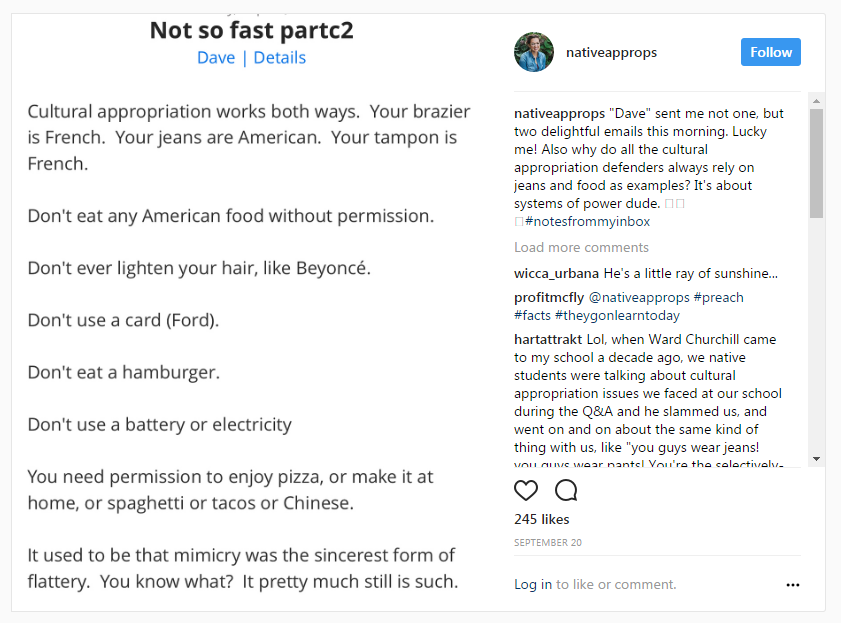 A recent example from Adrienne Keene on how cultural appropriation does NOT work.
In fact, this kind of commentary is so common, there’s a BINGO card for it (we would take a bet that Adrienne has a “blackout”):
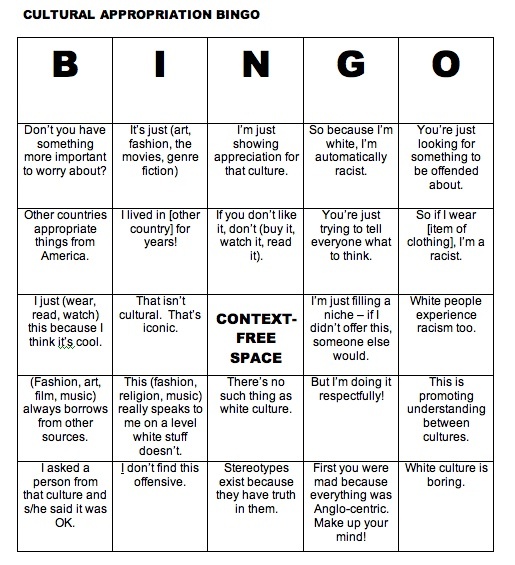 Originally created by Dr. Sheila Addison.
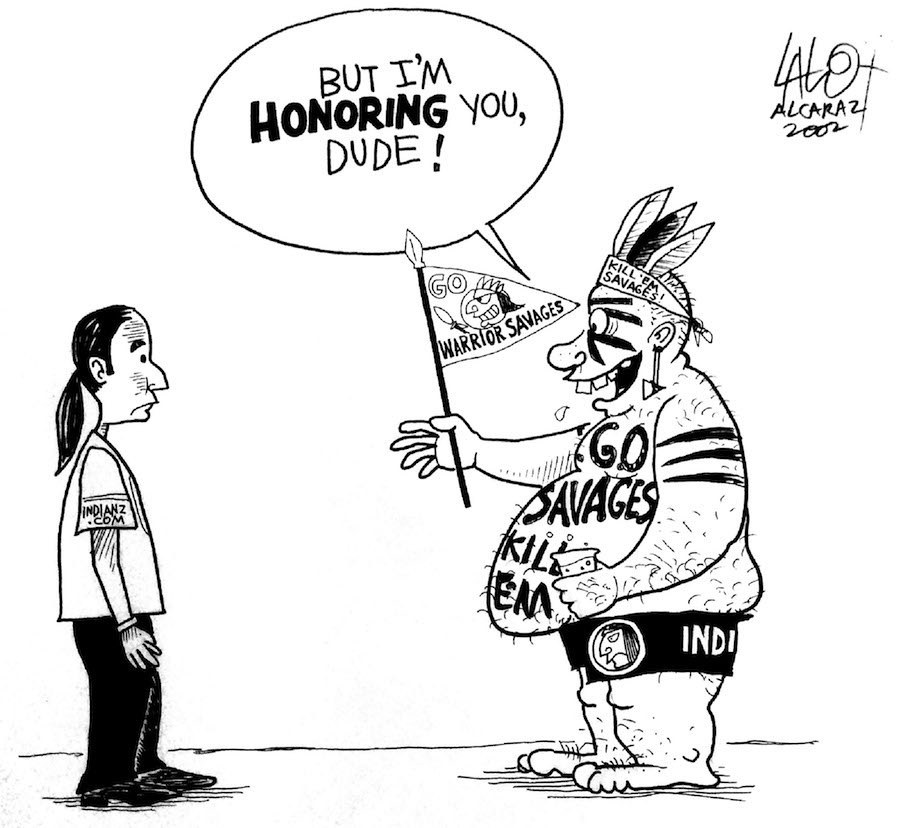
Essentially, it all comes down to power dynamics. The difference between non-Natives wearing a headdress and people other than (white) Americans eating a hamburger is that the former is a marginalized group in our society. Admiration crosses the line and becomes appropriation when the behavior is exploitative and/or contributes to the stereotyping and stigmatization of a culture. The headdresses seen at Coachella rely on stereotypes that ultimately collapse over 500 tribes into one fabricated culture. This one representation is more than just inaccurate; it’s harmful because it erases the current presence of Native Americans, which is still very much affected by a history of colonization and genocide. The following cartoon sums it up pretty nicely:
On a more general note, this is something that extends beyond Native Americans to all subjugated groups (read: not white people). For many people, their race or culture is not a costume they can take off at the end of the day, but rather something that is both a source of pride and a source of oppression. People have fought and are still fighting for the right to exist on an equal playing field where their identity is respected. When it comes to things like what to wear to a music festival, what Halloween costume to choose, what hairstyle looks best, or what forms of dance to try, there are many options, and it is entirely possible to choose one that does not rely on stereotypes. There are real people and extensive histories behind these material things. It is important that we learn about them and respect them as equal members of society.
Further reading below:
Check out the full list of Critical Social Justice: Rise events here.
]]>
Written by Women’s Center student staff member Hannah Wilcove. As of March 23rd, 2017, Dr. Adrienne Keene had written over 15 different posts about the specific issue of celebrities wearing...
https://critsocjustice.wordpress.com/2017/10/11/what-you-need-to-know-about-cultural-appropriation/
https://my3.my.umbc.edu/api/v0/pixel/news/71023/guest@my.umbc.edu/0911b293b13bd1600c1f794829aa9113/api/pixel
adrienne-keene
critical-social-justice
csj
csj-rise
cultural-appropriation
culture
native-activism
native-appropriations
social-justice
tribal
what-you-need-to-know
Women's, Gender, & Equity Center
https://my3.my.umbc.edu/groups/womenscenter
https://assets2-my.umbc.edu/system/shared/avatars/groups/000/000/125/78272a4842689b30dbf74672182b78f8/xsmall.png?1750974263
https://assets1-my.umbc.edu/system/shared/avatars/groups/000/000/125/78272a4842689b30dbf74672182b78f8/original.png?1750974263
https://assets1-my.umbc.edu/system/shared/avatars/groups/000/000/125/78272a4842689b30dbf74672182b78f8/xxlarge.png?1750974263
https://assets1-my.umbc.edu/system/shared/avatars/groups/000/000/125/78272a4842689b30dbf74672182b78f8/xlarge.png?1750974263
https://assets1-my.umbc.edu/system/shared/avatars/groups/000/000/125/78272a4842689b30dbf74672182b78f8/large.png?1750974263
https://assets2-my.umbc.edu/system/shared/avatars/groups/000/000/125/78272a4842689b30dbf74672182b78f8/medium.png?1750974263
https://assets1-my.umbc.edu/system/shared/avatars/groups/000/000/125/78272a4842689b30dbf74672182b78f8/small.png?1750974263
https://assets2-my.umbc.edu/system/shared/avatars/groups/000/000/125/78272a4842689b30dbf74672182b78f8/xsmall.png?1750974263
https://assets3-my.umbc.edu/system/shared/avatars/groups/000/000/125/78272a4842689b30dbf74672182b78f8/xxsmall.png?1750974263
Women's Center
3
0
false
Wed, 11 Oct 2017 08:58:18 -0400
Wed, 11 Oct 2017 08:58:18 -0400
Critical Social Justice: Rise Events
OCT 23 | MONDAY
Free Hour (12pm to 1pm) in UC 310
Join Amelia Meman, project coordinator for the Women’s Center, and Dr. Julie Murphy, senior lecturer of UMBC’s Psychology Department, as they facilitate a dialogue on activism, resistance, and resilience. With the hopes of learning from one another’s experiences, we plan to explore this year’s theme of “rise” and to collaborate to create a plan for continued engagement in critical social justice.
11am to 1:30pm on Academic Row
Stop by Academic Row to chalk your answer to the question, “What do you rise for?” You can also chat with some of our staff and volunteers to learn more about Critical Social Justice, this year’s theme, and more of the week’s events!
OCT 24 | TUESDAY
Lecture Title: “Native Appropriations, Indigenous Social Media, and Responding to Racism”
6pm in UC Ballroom, doors open at 5:30pm, a meet-and-greet reception will follow the keynote
This event is free and open to the public. If you have questions or need accommodations, please contact the Women’s Center at womenscenter@umbc.edu.
Our Critical Social Justice 2017 Keynote Lecturer is Native scholar and activist Dr. Adrienne Keene (Cherokee Nation), who writes about cultural appropriation and stereotypes of Native peoples in pop culture on her blog Native Appropriations. Keene examines the way Indigenous peoples are using new media to challenge racism, present authentic counter-narratives, and create innovative spaces for art and activism.
OCT 25 | WEDNESDAY
Free Hour in UC 310
This panel discussion explores the roles of faculty and staff in the current political atmosphere and pedagogical approaches to social justice. Consisting of UMBC faculty and staff, this panel is for university employees who wish to learn more about navigating politics and social justice in classroom and campus alike.
Panelists include:
-
Jodi Kelber-Kaye (Honors College, Assistant Director), moderator
-
Lee Blaney (Chemical, Biochemical and Environmental Engineering, Associate Professor)
- Keisha Allen (Education, former Post-Doc Diversity Fellow)
- Rehana Shafi (Sherman Scholars, Director)
-
Jason Loviglio (Media and Communication Studies, Associate Professor and Chair)
myUMBC event
Rising in Times of International Tragedies: The Impact of Oppressive Symbols
6pm – 7:30pm, Skylight
Join the Mosaic Center in this featured panel and facilitated discussion centering European, Jewish and African American voices discussing their shared, intersectional perspectives connected to historically oppressive symbols. We will discuss how we can come together to stand against intolerable acts of hate in our country.
Panelists include:
- Dr. Marina Adler (Sociology, Anthropology, and Health Administration and Policy, Professor)
- Corinne Janet (Student Life, Coordinator for Leadership)
- Romy Huebler (Student Life, Coordinator for Student Organizations and Involvement)
- Dr. Jana Rehak (Anthropology, Instructor)
- Dr. Kimberly Moffitt (American Studies, Associate Professor)
- Rabbi Jeremy Fierstein (UMBC Hillel, Executive Director)
OCT 26 | THURSDAY
Display on Erickson Field, 10am to 4pm
Workshop in AOK Library 216L from 2pm to 4pm
“The Monument Quilt is a crowd-sourced collection of thousands of stories from survivors of rape and abuse. By stitching our stories together, we are creating and demanding public space to heal. The Monument Quilt is a platform to not only tell our stories, but work together to forever change how Americans respond to rape. We are creating a new culture where survivors are publicly supported, rather than publicly shamed.” – FORCE
Join us on Erickson Field to take a look and explore the Monument Quilt, and the thousands of stories that are woven into it. In the afternoon, be sure to join The Monument Quilt in a quilt square making workshop in the library. You will be able to take some time to reflect and craft your own quilt square that will be incorporated into the overall project.
OCT 27 | FRIDAY
Meet at the Women’s Center at noon
Throughout history, people have been rising in Baltimore. From labor activists in the railroad industry or food service to the soldiers of the Civil War. Dr. Kate will take us down Pratt Street in the heart of Baltimore for a tour of our city’s sites of activism.
Special thanks to our Critical Social Justice co-sponsors:
Student Life’s Mosaic Center, Residential Life, College of Arts, Humanities, and Social Sciences, Honors College, Off-Campus Student Services, Counseling Center, University Health Services Health Promotions, Human Relations/Title IX Office, LGBTQ Faculty and Staff Association, Relationship Violence Awareness and Prevention (RVAP), The Social Work Program, Student Disability Services, Department of Psychology, Women Involved in Learning and Leadership, Sociology, Anthropology, and Health Administration and Policy (SAHAP), Department of American Studies, Department of Media and Communication Studies, Department of Modern Languages, Linguistics & Intercultural Communication, Race & Inclusion Scholars
]]>
Take a look at all of the events lined up for Critical Social Justice: Rise. We are also constantly adding events from partners, so stay tuned for more updates to this page as they come! Click...
https://critsocjustice.wordpress.com/2017/09/06/critical-social-justice-rise-events/
https://my3.my.umbc.edu/api/v0/pixel/news/71025/guest@my.umbc.edu/f5de01c25094f739704c863e02b72ad0/api/pixel
adrienne-keene
brave-spaces
college-activism
critical-social-justice
csj-event
csj-rise
csj2017
csjrise
feminism
intersectionality
native-appropriations
rise
social-justice
student-affairs
umbc
university
womens-center
Women's, Gender, & Equity Center
https://my3.my.umbc.edu/groups/womenscenter
https://assets2-my.umbc.edu/system/shared/avatars/groups/000/000/125/78272a4842689b30dbf74672182b78f8/xsmall.png?1750974263
https://assets1-my.umbc.edu/system/shared/avatars/groups/000/000/125/78272a4842689b30dbf74672182b78f8/original.png?1750974263
https://assets1-my.umbc.edu/system/shared/avatars/groups/000/000/125/78272a4842689b30dbf74672182b78f8/xxlarge.png?1750974263
https://assets1-my.umbc.edu/system/shared/avatars/groups/000/000/125/78272a4842689b30dbf74672182b78f8/xlarge.png?1750974263
https://assets1-my.umbc.edu/system/shared/avatars/groups/000/000/125/78272a4842689b30dbf74672182b78f8/large.png?1750974263
https://assets2-my.umbc.edu/system/shared/avatars/groups/000/000/125/78272a4842689b30dbf74672182b78f8/medium.png?1750974263
https://assets1-my.umbc.edu/system/shared/avatars/groups/000/000/125/78272a4842689b30dbf74672182b78f8/small.png?1750974263
https://assets2-my.umbc.edu/system/shared/avatars/groups/000/000/125/78272a4842689b30dbf74672182b78f8/xsmall.png?1750974263
https://assets3-my.umbc.edu/system/shared/avatars/groups/000/000/125/78272a4842689b30dbf74672182b78f8/xxsmall.png?1750974263
Women's Center
0
0
false
Wed, 06 Sep 2017 08:23:33 -0400
Wed, 06 Sep 2017 08:23:33 -0400
To my feminist mentor, Megan Tagle Adams
A reflection by Amelia Meman on her feminist mentoring relationship with Assistant Director Megan Tagle Adams.
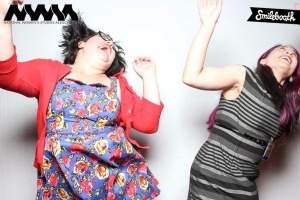
Megan (right) and I in the National Women’s Studies Association (NWSA) photobooth.
With Megan’s departure from UMBC (today!), I feel the Women’s Center is saying goodbye to a real social justice champion on our campus. Someone who was constantly striving for excellence in our institution. More than this, though, I feel I am saying goodbye to someone who has taught me what feminist mentorship—in its best iteration—can be.
Traditional models of mentorship are often paternalistic and hierarchical. Relationships are based on a transactional relationship between a mentor–older, more experienced in a particular professional setting, more “successful”—and their mentee—a younger novice looking for their niche, to expand their professional network, and to build on their skills.
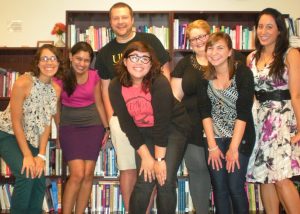
2013-2014 Women’s Center staff photo; both mine and Megan’s first time on staff. From left to right: Jess Myers, Narges Ershad, Michael Fell (top), Amelia (bottom), Kelly Broderick (top), Madison Miller (bottom), Megan.
One of my favorite metaphors for this sort of relationship is Paolo Freire’s metaphor of students as containers to be filled—also called the “banking model” of education. In such a model, teachers deposit knowledge and students are meant to memorize and regurgitate. Such a pedagogical method is less about truly learning, and more about recitation. Freire argues, rather, that student and teacher should be able to learn from one another in a dynamic process. The central idea of Pedagogy of the Oppressed is that pedagogy must be forged with, and not for the oppressed. I know, I know—mentorship =/= teaching; however, I think that Freire’s ideas can be applied to any social justice-oriented relationship—and that is what my mentorship with Megan is in many ways.
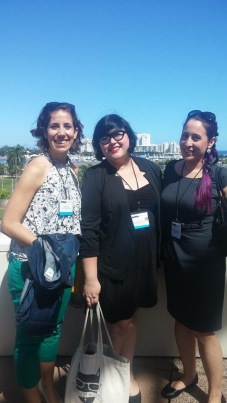
In Puerto Rico for the NWSA conference; from left to right: Jess, Amelia, and Megan.
Additionally, feminist and multicultural academicians have contested what mentorship can look like, especially in reaction to the restrictive and frankly stale traditional mentorship model described above. Feminists have developed new models that ask mentor and mentee to account for power dynamics, to treat both as learners and knowledge makers, and to continue reworking the tension around artificial boundaries between professional, political, and personal worlds. Ultimately, mentoring should be based on the feminist and social justice politics we champion.
I would like to take the following post to illustrate what a successful feminist mentorship can look like—using my mentoring relationship with Megan as a model:
Embrace a relationship of mutual empowerment
When I came onto the Women’s Center scene as an Honors College intern in 2013, I was new and so was our Coordinator (now Assistant Director), Megan Tagle Adams. It was exciting to be partnered with this spunky new purple-haired woman who was obviously super cool because she had so much experience in gender studies and feminist activism and all kinds of things.
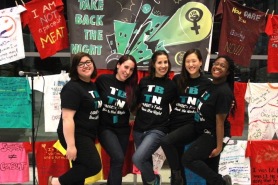
At Take Back The Night (TBTN) 2015; from left to right: Amelia, Megan, Jess, Yoo-Jin Kang, and Bree Best.
It was in our first meetings together (before Megan had an actual office and when she was just behind a big glass partition in the front office) that we worked together on what would come to be Critical Social Justice.
I remember it so so clearly:
My idea was very vague and very ambitious. Initially, I wanted to do some sort of big, one-time event called an, “Inclusivity Fair,” where we would have UMBC community members and people from Baltimore City come and create engaging, social justice-oriented activities. The concept was fluid and gigantic, and my passion for it was white bright fire hot, which is really never a great combination for a truly successful event. Knowing all of this, Megan worked with me to whittle this giant pile of potential into what is now: an annual event on UMBC’s campus.
Together, Megan and I worked to create Critical Social Justice into an event, an initiative, and a way of working. Megan empowered me—and I her—and together (with the help of numerous others) we created CSJ. She helped me funnel my ideas and my energy into something comprehensive, sustainable, and organized—her strengths exactly. I helped Megan make an impact on our campus in her first year here, and we became quick and powerful collaborators. We empower one another to create great things.
Move away from transactional learning wherein knowledge is deposited—share the learning experience
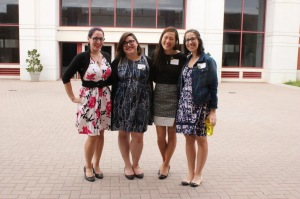
Post-research presentation at Undergraduate Research and Creative Achievement Day (URCAD) in 2015; from left to right: Megan, Amelia, Yoo-Jin, and Jess.
Although I have, in fact, learned a lot from Megan, I have to acknowledge that we have both been learning from each other. For example, Megan was my research mentor for URCAD. My research was an analysis of This Bridge Called My Back using a postpositivist realist theory of identity as a lens. I know. That’s a mouthful and a half.
Luckily, Megan had a lot of knowledge on feminist theories and especially This Bridge. Not as luckily, she was not steeped in postpositivist realist theory like I was. As my mentor, though, Megan allowed me to teach her about this. Rather than trying to learn all about this theoretical perspective and then take a top-down approach to my research, we came together, collaborated, and learned from one another. I taught her about the theory I was using, and she expanded my understanding of This Bridge. Together, we were able to share our experiences and perspectives, and create a research project that was comprehensive, dynamic, and unique. This was only enabled by our ability to teach and learn from one another.
Promote a holistic model of professional/academic life
As many might know, one of the first things Megan did when she got into the Women’s Center was created the Women of Color Coalition and began really centering conversations about racial justice and intersections with feminism.
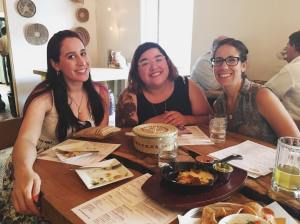
From left to right: Megan, Amelia, and Jess. Picture by Yoo-Jin Kang.
In 2013, when both of us started, I had a lot of trouble understanding my racial identity. Megan and I would often come together and talk about what it meant to be biracial, white and Filipina. We understood the strange privilege and not-privilege that we occupied, how it was different from region to region, and how it translated into our cultural identities. Megan really helped me construct a sense of belonging with other women of color and racial justice activism networks.
The personal is political in feminism—and just so, feminist mentorship should rightly blur the lines to promote holistic success. Megan and I both had boundaries around certain topics (as any relationship should), but we also worked together to make professional, academic, and personal discoveries about ourselves and the world we live in.
Share power, share respect, embrace mutuality
As I believe all of these facets of our relationship have demonstrated, Megan and I shared power, shared respect, and embraced mutuality. We were collaborators, co-leaders, teachers, students, friends. As such, I believe our mentoring relationship was something so much more meaningful and enriching than what a “typical” mentorship looks like. It was never about Megan having more power and teaching me how to gain that power. Rather, it was always about sharing power, learning together, and making the world better with each other.
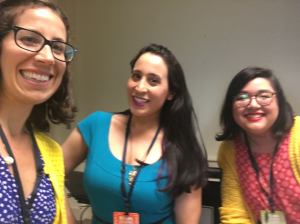
Selfie with Jess, Megan ,and I after we presented on campus activism projects at NCCWSL in 2016.
As folks pursue their careers and their goals, I hope you are able to find mentors that disrupt traditional models of mentorship. As I hope I have demonstrated, mentorship does not have to be limited to learning new skills and benefitting from someone’s established network. Feminist mentorship expands the potentials of this relationship and centralizes the idea of learning from one another to create a world where social justice is essential.
With my mentoring relationship with Megan, I believe we have both grown tremendously and have contributed much to UMBC’s social justice vision. I’m really going to miss my mentor as she starts on a new path as the Director of the Women’s Resource Center at California State University, Dominguez Hills. However, like any other great leader, mentor, and friend, Megan’s impact will continue to resonate throughout UMBC long after she is gone.
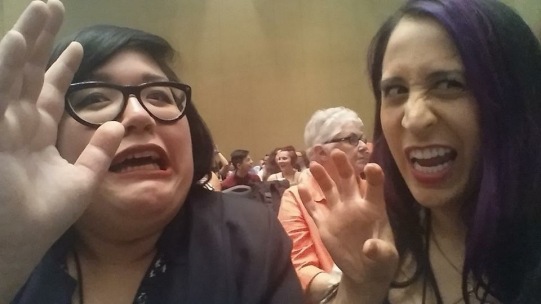
Freaking out before Bell Hooks spoke at NWSA
]]>
A reflection by Amelia Meman on her feminist mentoring relationship with Assistant Director Megan Tagle Adams. Megan (right) and I in the National Women’s Studies Association (NWSA) photobooth....
https://womenscenteratumbc.wordpress.com/2017/08/10/to-my-feminist-mentor-megan-tagle-adams/
https://my3.my.umbc.edu/api/v0/pixel/news/69395/guest@my.umbc.edu/7e41630b2ff6d938c336adc5bb365100/api/pixel
feminist
feminist-mentor
feminist-mentorship
leadership
mentor
mentoring
mentorship
professional
social-justice
uncategorized
women-and-leadership
women-at-work
women-in-college
women-in-labor
women-of-color
Women's, Gender, & Equity Center
https://my3.my.umbc.edu/groups/womenscenter
https://assets2-my.umbc.edu/system/shared/avatars/groups/000/000/125/78272a4842689b30dbf74672182b78f8/xsmall.png?1750974263
https://assets1-my.umbc.edu/system/shared/avatars/groups/000/000/125/78272a4842689b30dbf74672182b78f8/original.png?1750974263
https://assets1-my.umbc.edu/system/shared/avatars/groups/000/000/125/78272a4842689b30dbf74672182b78f8/xxlarge.png?1750974263
https://assets1-my.umbc.edu/system/shared/avatars/groups/000/000/125/78272a4842689b30dbf74672182b78f8/xlarge.png?1750974263
https://assets1-my.umbc.edu/system/shared/avatars/groups/000/000/125/78272a4842689b30dbf74672182b78f8/large.png?1750974263
https://assets2-my.umbc.edu/system/shared/avatars/groups/000/000/125/78272a4842689b30dbf74672182b78f8/medium.png?1750974263
https://assets1-my.umbc.edu/system/shared/avatars/groups/000/000/125/78272a4842689b30dbf74672182b78f8/small.png?1750974263
https://assets2-my.umbc.edu/system/shared/avatars/groups/000/000/125/78272a4842689b30dbf74672182b78f8/xsmall.png?1750974263
https://assets3-my.umbc.edu/system/shared/avatars/groups/000/000/125/78272a4842689b30dbf74672182b78f8/xxsmall.png?1750974263
Women's Center
27
0
false
Thu, 10 Aug 2017 12:10:10 -0400
Why is the Women’s Center Hosting an Overdose Response Training?
Today, the Women’s Center and University Health Services will host an Overdose Response Training. The training is run by the Baltimore City Health Department and it teaches individuals how to respond to opioid overdose and gives them the tools needed to reverse the effects of opioid overdose. Each attendee will be certified to administer Naloxone (or Narcan) and receive a prescription card for a Naloxone kit.
Is opioid overdose really that big of a deal?
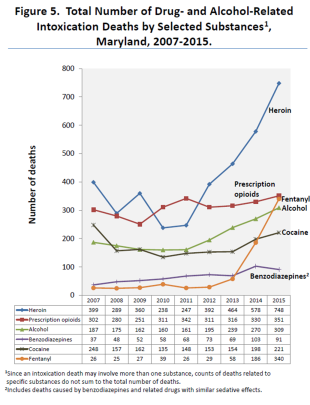 Unfortunately, yes. Opioid use, whether prescription or otherwise, has skyrocketed in the US over the last few years, especially in Baltimore City. In the year 2015, 748 people died of heroin overdose and 351 people died of prescription opioid overdose in Baltimore City. That’s 1,099 deaths, not including overdoses which did not result in death.
Okay so it’s a big deal but like…why is the Women’s Center concerned about it?
Addiction and substance abuse are social justice issues. According to the CDC, LGBTQ populations are significantly more likely to engage in substance use– 20 to 30 percent compared to about 9 percent of the general populations. Women are more likely than men to be addicted to prescription painkillers, and people living in poverty are significantly more likely to be addicted to opiates. Although the rate of opioid use has not dramatically increased for people of color (as opposed to whites), this is not due to lack of use, but due to underprescription of opioid pain medication for people of color. Often, doctors underestimate and undertreat the pain experienced by people of color. This is an issue that disproportionately affects the communities we serve.
Wait, what do you mean when you say addiction and substance abuse are social justice issues?
There are several social and structural factors which contribute to substance use. Populations who lack access to healthcare may turn to illicit substances as a way of managing pain, stress, or mental health issues. These are the same populations which are unable to afford recovery programs or end up in prison instead of treatment.
One of the major factors contributing to the disproportionate rate of substance abuse among LGBTQ populations is the concept of minority stress. Minority stress is the idea that “sexual minority health disparities can be explained in large part by stressors induced by a hostile, homophobic culture, which often results in a lifetime of harassment, maltreatment, discrimination and victimization and may ultimately impact access to care.” This concept can apply to racial issues as well as issues of poverty, gender identity, and sexual orientation. Basically, the stress of experiencing discrimination, harassment, violence, housing and job insecurity, poverty, and a general sense of social stigma and isolation drives people to self-medicate, which, can result in addiction. Addiction and substance use are a direct result of policy and social dynamics.
Whoa, okay, it sounds like this issue is way bigger than training a few people on overdose response.
You’re right, there’s a lot of factors at play here. Ultimately, overdose deaths will only go down when we fix the major issues that cause substance abuse in the first place.
But while we work on all of that, overdose response is part of an approach called harm reduction. Harm reduction is based on the idea that people who use drugs are people and the best way to reduce the harm that comes to those people is to meet them where they’re at and with compassion. According to Harm Reduction International, “Harm Reduction refers to policies, program
s and practices that aim primarily to reduce the adverse health, social and economic consequences of the use of legal and illegal psychoactive drugs without necessarily reducing drug consumption. Harm reduction benefits people who use drugs, their families and the community.” Harm reduction understands all the factors that contribute to substance abuse and rejects the idea that drug users are good or bad. It focuses instead on making sure that people have what they need and are supported as human beings.
Harm reduction focuses on the things people need right now. A person can’t get help if they’re dead, and overdose response can prevent that from happening.
Can’t we just make drugs illegal?
Short answer? Nope.
Most drugs are already illegal, but that obviously doesn’t stop people from using them. In fact, laws are huge barriers which prevent people from seeking or receiving treatment. Many people are afraid of being arrested or institutionalized for seeking help for drug addiction. Many people are arrested for substance use and go to prison instead of rehab, or only receive treatment while in jail. Besides, laws don’t change the social factors that cause people to use drugs in the first place.
Okay, so who should attend an Overdose Response Training?
Well, it’s sort of like CPR. Knowing how to do it and having the tools can save a life, so everyone should do it.
Anyone who is likely to work with opioid users (like people who work with the general public, in medicine, or with homeless and LGBTQ populations) should be trained. That means if you’re a social worker, someone who works in a hospital or medical facility, a campus RA, a health educator, or a volunteer, this training is for you.
If you know someone in your personal life who uses opioids, or if you are part of an at-risk community, this training is also for you.
If you don’t have any of these experiences, this training is still for you. Opioid use (and overdose) occurs frequently and everywhere. Frankly, everyone and anyone should receive this free training.
Where can I learn more?
Naloxone and Overdose FAQ
Baltimore City Overdose Response Program
Baltimore City Overdose Prevention and Response Information
]]>
Today, the Women’s Center and University Health Services will host an Overdose Response Training. The training is run by the Baltimore City Health Department and it teaches individuals how to...
https://womenscenteratumbc.wordpress.com/2017/04/04/why-is-the-womens-center-hosting-an-overdose-response-training/
https://my3.my.umbc.edu/api/v0/pixel/news/66941/guest@my.umbc.edu/681a707f99bd0b0c08f87268c4501a75/api/pixel
events
harm-reduction
issues
naloxone
narcan
opiate-use
overdose-response
social-justice
Women's, Gender, & Equity Center
https://my3.my.umbc.edu/groups/womenscenter
https://assets2-my.umbc.edu/system/shared/avatars/groups/000/000/125/78272a4842689b30dbf74672182b78f8/xsmall.png?1750974263
https://assets1-my.umbc.edu/system/shared/avatars/groups/000/000/125/78272a4842689b30dbf74672182b78f8/original.png?1750974263
https://assets1-my.umbc.edu/system/shared/avatars/groups/000/000/125/78272a4842689b30dbf74672182b78f8/xxlarge.png?1750974263
https://assets1-my.umbc.edu/system/shared/avatars/groups/000/000/125/78272a4842689b30dbf74672182b78f8/xlarge.png?1750974263
https://assets1-my.umbc.edu/system/shared/avatars/groups/000/000/125/78272a4842689b30dbf74672182b78f8/large.png?1750974263
https://assets2-my.umbc.edu/system/shared/avatars/groups/000/000/125/78272a4842689b30dbf74672182b78f8/medium.png?1750974263
https://assets1-my.umbc.edu/system/shared/avatars/groups/000/000/125/78272a4842689b30dbf74672182b78f8/small.png?1750974263
https://assets2-my.umbc.edu/system/shared/avatars/groups/000/000/125/78272a4842689b30dbf74672182b78f8/xsmall.png?1750974263
https://assets3-my.umbc.edu/system/shared/avatars/groups/000/000/125/78272a4842689b30dbf74672182b78f8/xxsmall.png?1750974263
Women's Center
27
0
false
Tue, 04 Apr 2017 08:00:00 -0400
Making Space for Faith in Feminism
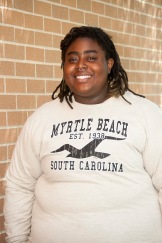 A reflection by Michael Jalloh-Jamboria, Women’s Center student staff member
Saturday, February 12th was the 59th Grammy awards show. The show featured many musical performances and winners, most notably,Beyoncé. At the time of her performance, not only was she pregnant, but she delivered a kickass performance, defied gravity, all the while channeling some major West African, Latin American, and Christian spiritual imagery during her performance.
In both Santeria and West African spirituality, the Goddess Oshun is the goddess of sweet waters–the embodiment of love, fertility, and sensuality. Her love and guidance were instrumental to the creation of the world, so much so that other Orisha (gods and goddesses) were unable to complete their work on earth without Oshun. After Beyonce’s amazing performance, Twitter was going wild with the comparisons between Beyoncé and the goddess Oshun.
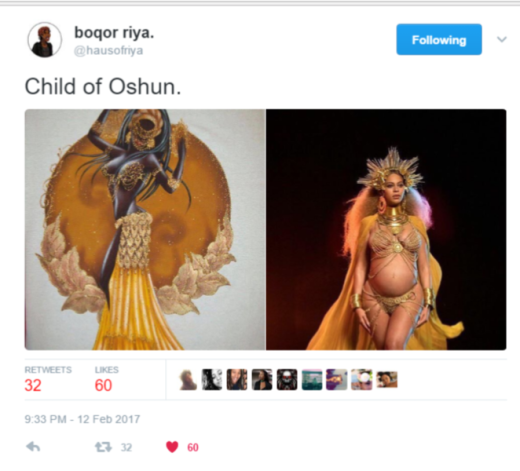
Beyoncé’s performance, her golden outfit, the fact that she was very pregnant, and the influx of Twitter comparisons reminded me of an earlier blog post I had written about my journey of religion and its intersections with my identities. Growing up, my parents loved to tell me stories of the Orisha, or gods and goddesses, and how they created the earth. While I was raised Muslim, my parents never separated our West African spirituality from our Muslim religion. Beyoncé’s performance got me thinking about how different my religion is from my spirituality. While it can be a strange balance, both my religion and my spirituality are important aspects of my identity. But I realized, within the social spaces I occupy, I don’t really talk about those parts of my identity. From there, I began to think about whether or not religion has a place in feminism.
I’ve felt like I can’t talk about my religion and spirituality in feminist and social justice oriented spaces. I’ve been talked over and shut down when I’ve decided to share the ways in which my beliefs have helped me in my expansion of feminist knowledge and activism.
Believe me, I get it. The patriarchy is everywhere! It would be naive to think that religion is exempt from the influences of male supremacy and systematic oppression. But it is important to remember that religious feminists aren’t free from that oppression. We don’t get a pass because we follow that particular faith. None of us can ignore the ways that the perpetuation of sexist interpretations affect us in religious spaces.
Religious feminists have had to grapple with our religion and our identity as feminists. We are cognizant of when and how to speak out against oppression. We work within a system of naysayers and oppressors just to get access to some of the resources that others have. There is still so much work to be done, and the treatment of religious feminists as other hurts everyone, regardless of their religion.
Coalition building between religious and non-religious folks is important. At a time where religious freedom is being targeted, it’s important to make sure that intolerance is not being perpetuated anywhere, but especially within feminist and social justice oriented spaces.
It’s strange to think that religion could shape some of my feminist beliefs. But actually, as I reflect on some of the basic pillars of Islam, there are parallels with how I engage in activist spaces and feminism. For me, simple everyday good deeds turned into wanting to do good for others, especially those less privileged then me. My activism is driven by the thought that putting good energy into the world will be returned. My feminism is filled with love for people, their identities, their lives and their needs, similar to the way that my faith has taught me to love my neighbor and fellow human beings!
During this time of chaos and violence, I’ve also been interested in the crucial ways religion and spirituality helps us heal. After the presidential election, many of us took some time to care for ourselves. For some of us, healing was eating, being angry, planning for the difficult times to come, or crying. While for others, healing included asking our elders how we should proceed, bowing our heads to ask for guidance, lighting a candle or two (or 50), or crying (there was a lot of crying.) No matter how we did it, we all needed to heal and digest the situation before we could get back to our kickass activism. Also, some of us are still healing, and that’s totally valid! Recognizing that our communities needed (or still need) some down time is important as we try to create space for those of different faiths. Similarly, feminists that assume that their religious counterparts are dismissive of social justice issues within their own faith is hard work but it can be done.
While some of us use the power of Beyoncé’s music to heal and process, it’s important to make space for those of us who heal, learn and pray in different ways. As our understanding of feminism and social justice expands, we must continue to incorporate intersectionality into the way we engage with each other.
For more work on the intersections of feminism and Muslim identity, check out “My Hijab Has Nothing To Do With Oppression. It’s A Feminist Statement“. Also, what is the status of women as religious leaders within the US? Check out his Huffington Post article to find out more!
]]>
A reflection by Michael Jalloh-Jamboria, Women’s Center student staff member Saturday, February 12th was the 59th Grammy awards show. The show featured many musical performances and winners,...
https://womenscenteratumbc.wordpress.com/2017/03/06/making-space-for-faith-in-feminism/
https://my3.my.umbc.edu/api/v0/pixel/news/66230/guest@my.umbc.edu/dc1a494d180d1a2bacb310aaf55bc0e9/api/pixel
beyonce
black-women
coalition
community
current-events
feminism
intersectionality
islam
oshun
pop-culture
religion
social-justice
spirituality
uncategorized
Women's, Gender, & Equity Center
https://my3.my.umbc.edu/groups/womenscenter
https://assets2-my.umbc.edu/system/shared/avatars/groups/000/000/125/78272a4842689b30dbf74672182b78f8/xsmall.png?1750974263
https://assets1-my.umbc.edu/system/shared/avatars/groups/000/000/125/78272a4842689b30dbf74672182b78f8/original.png?1750974263
https://assets1-my.umbc.edu/system/shared/avatars/groups/000/000/125/78272a4842689b30dbf74672182b78f8/xxlarge.png?1750974263
https://assets1-my.umbc.edu/system/shared/avatars/groups/000/000/125/78272a4842689b30dbf74672182b78f8/xlarge.png?1750974263
https://assets1-my.umbc.edu/system/shared/avatars/groups/000/000/125/78272a4842689b30dbf74672182b78f8/large.png?1750974263
https://assets2-my.umbc.edu/system/shared/avatars/groups/000/000/125/78272a4842689b30dbf74672182b78f8/medium.png?1750974263
https://assets1-my.umbc.edu/system/shared/avatars/groups/000/000/125/78272a4842689b30dbf74672182b78f8/small.png?1750974263
https://assets2-my.umbc.edu/system/shared/avatars/groups/000/000/125/78272a4842689b30dbf74672182b78f8/xsmall.png?1750974263
https://assets3-my.umbc.edu/system/shared/avatars/groups/000/000/125/78272a4842689b30dbf74672182b78f8/xxsmall.png?1750974263
Women's Center
18
0
false
Mon, 06 Mar 2017 12:00:39 -0500
Mon, 06 Mar 2017 12:00:39 -0500
A Time to Resist + A Time to Take Care
 A reflection written by Women’s Center Special Projects Coordinator, Amelia Meman
So here we are. Another day in this brave new world.
Are you exhausted yet? Emotionally, physically, psychologically?
If you’re not–congratulations! That’s really good and you are a sweet glowing angel.
If you are, though, you’re not alone and you are also a sweet glowing angel.
 I’m tired, too. For all of us feminists, social justice warriors, and snowflakes, this is a tough time. The stream of executive actions and questionable cabinet appointments have rocked our communities and have malignantly affected some of the most vulnerable groups in the U.S. The fights we’ve been engaging in throughout every administration have been exacerbated and fear is alive more than ever.
Seeing the reaction from social justice activists has been heartening for me in many ways. The women’s march was awesome and huge (though not without its fair share of criticism from Black women, the trans community, and many others). Other demonstrations against the refugee ban and the massive uptick in people contacting their elected representatives to demand accountability has shown us that massive swathes of the public have been activated to resist in a great variety of ways.
This work is both vital and neverending. Making an impact is difficult, exhausting work. It involves massive amounts of human energy. What I’m ultimately getting to is this: are you taking care of yourself right now?
The Women’s Center is all about self-care, and I want to stress (get it?) how necessary it is to take care of ourselves as activists. Energy doesn’t come to us out of nowhere. It is derived from resting and caring for ourselves.
As you continue your activist work, here are some things to think about:
Give yourself enough credit
 During this chaotic time, it’s hard to think that we can ever do enough to even make a dent in the system, but you’re so much more powerful than you think. Marches, rallies, and demonstrations are powerful events that increase the visibility of resistance. Regardless of the presidential administration, communicating with legislators is an important part of holding the government accountable to the people. Going to different forums and meetings is a great way to connect with others and get tasks completed. These are some of the actions a lot of people might associate with activism, but there are many other ways to be an activist.
If you are reading a book on social justice, politics, racial justice, feminism, queer theory, etc. you are participating in activism, because you’re learning and informing your activism praxis. If you talk with your friends about politics and learn from one another, that’s a way of participating in activism, because you are creating a transformative moment. If you’re in a class that is helping you talk to others, build things, write, manage money, research, provide medical care, whatever, you are learning skills that are so necessary for activists.
Finally, taking care of yourself is important. It is paramount to being able to do anything ever. So give yourself credit for what you’re doing, whether it’s leading a march or knowing when you need a break.
Make a plan (for activism and for recuperation)
Whatever you’re doing, try to make a plan. When you tell yourself you’re only going to attend the rally for three hours, only attend the rally for three hours. Activism work can be all-consuming. It’s hard to do, and the work is always there, so it can be easy to fall into the rabbit hole. When you do activist type things, try to be informed about the event/activity (i.e. if you’re attending a march, try to have a buddy and/or know some emergency phone numbers) and also make sure to create a plan for recuperation afterwards (i.e. after you go to the march, take a relaxing bath or meditate by yourself). When you make a plan (and keep to the plan), you manage your time and help sustain yourself.
Be authentic to who you are and listen to yourself
Hey, if you don’t like going to big public protests, don’t go. If you dread the thought of being alone and reading a big political theory tome, don’t do it! There are always alternatives for activism. Reflect on what you like to do, what resonates with you, what gives you life, and then think about how that can be of use in the activist environment. Don’t go about forcing yourself to be something that you aren’t, because who you are is exactly what we need.
And if you feel yourself in need of a break from social media or calling legislators, take the break. Listen to yourself. You know you best.
Talk with other activists
 Sometimes the best way to take care of yourself is with a little “ventilation and affirmation” session (thanks School of Social Work for that phrase!). Talk with other activists! We need to support each other in this time, and I think many of us are eager to connect. Despite the sometimes overwhelming desire to isolate in the wake of bad news, sometimes reaching out can be just as healing.
Talking with other activists can also introduce you to new ideas, strategies, communities, all kinds of things. So whether it’s for support or to gain insight (or both), reach out and talk with folks.
Challenge yourself
I know I’ve discussed being gentle with yourself, but there’s “being gentle” and then there’s “coddling.” Self-care can oftentimes be misconstrued as an excuse to dip out of activism. Certainly, you shouldn’t force yourself to do something that you’re not interested in, but don’t let self-care be the reason you use to get out of something that might be difficult at first. If it seems challenging, it might be an opportunity for growth.
Something else to think about as you consider challenging yourself in activism comes with understanding your privileged identities. As a cisgender, queer, upper middle class woman of color, I have a lot of things to sort through, but I try to be cognizant of how my actions are working in solidarity, as an ally, or for me and mine to disrupt oppression.
 For example, I’m not a big fan of calling people out on offensive Facebook posts; however, I like the idea of being very choosey and calling people in especially when it comes to transgender issues.hen somebody posts something offensive, I reflect on whether or not I definitely respect them and whether I believe they will listen. If I respect them and think they’ll listen, I walk out of my comfort zone to have a difficult conversation. This process is integral to my work as a cis ally.
By challenging ourselves, we are also taking care of ourselves. We are being stewards of our own growth. So, when you feel that sense of discomfort or anxiety you can step back–that’s always valid–or you can choose to challenge yourself and, potentially, find out more about yourself as an activist.
Use your resources
Finally, here are some resources that you might find useful as you get involved in activism (and while many of these guides focus on the here and now and this specific administration, these are good resources to serve throughout times on both the local, state, and national levels. Activists existed before November 8th and they’ll continue to exists for years and years and years.):
5 Calls | Turn your passive participation into active resistance. Facebook likes and Twitter retweets can’t create the change you want to see. Calling your Government on the phone can. 5 Calls provides phone numbers and scripts so calling is quick and easy and uses your location to find your local representatives so your calls have more impact. (from the site)
26 Ways to Be in the Struggle Beyond the Streets | A list of ways to engage in activism that are all alternatives to being “in the streets.”
Apps for Organizing | A list of apps that help you get engaged in activism.
Indivisible Guide | A resistance guide compiled by former Congressional staffers.
Project 1461 | This project features daily call-to-actions for organizing under the current administration.
Resistance Calendar | A constantly updating calendar of resistance events happening around the world.
Resistance Manual | The Resistance Manual is premised on the idea that, “Action begins with information.” It is an open-source site that collects information for organizing against the current administration’s actions.
And here are some resources for self-care <3:
6 Apps for Taking Care of Yourself
Free Mindfulness Apps
Self Care in Stress Culture
Radical Self Care

Thanks for reading this blog post and for taking some time for yourself. We’re proud of you over at the Women’s Center, and we’re here when you need support or just want to collect yourself.
P.S. If you know of any more self-care tips for activists or resources that would be useful, please let us know! We would love to hear your ideas and share them with others.
]]>
A reflection written by Women’s Center Special Projects Coordinator, Amelia Meman So here we are. Another day in this brave new world. Are you exhausted yet? Emotionally, physically,...
https://womenscenteratumbc.wordpress.com/2017/02/08/a-time-to-resist-a-time-to-take-care/
https://my3.my.umbc.edu/api/v0/pixel/news/65561/guest@my.umbc.edu/9db985c2c04467b7cff330267dae369b/api/pixel
activism
current-events
feminism
feminist
feminist-activism
politics
self-care
self-love
social-justice
staff
uncategorized
women
Women's, Gender, & Equity Center
https://my3.my.umbc.edu/groups/womenscenter
https://assets2-my.umbc.edu/system/shared/avatars/groups/000/000/125/78272a4842689b30dbf74672182b78f8/xsmall.png?1750974263
https://assets1-my.umbc.edu/system/shared/avatars/groups/000/000/125/78272a4842689b30dbf74672182b78f8/original.png?1750974263
https://assets1-my.umbc.edu/system/shared/avatars/groups/000/000/125/78272a4842689b30dbf74672182b78f8/xxlarge.png?1750974263
https://assets1-my.umbc.edu/system/shared/avatars/groups/000/000/125/78272a4842689b30dbf74672182b78f8/xlarge.png?1750974263
https://assets1-my.umbc.edu/system/shared/avatars/groups/000/000/125/78272a4842689b30dbf74672182b78f8/large.png?1750974263
https://assets2-my.umbc.edu/system/shared/avatars/groups/000/000/125/78272a4842689b30dbf74672182b78f8/medium.png?1750974263
https://assets1-my.umbc.edu/system/shared/avatars/groups/000/000/125/78272a4842689b30dbf74672182b78f8/small.png?1750974263
https://assets2-my.umbc.edu/system/shared/avatars/groups/000/000/125/78272a4842689b30dbf74672182b78f8/xsmall.png?1750974263
https://assets3-my.umbc.edu/system/shared/avatars/groups/000/000/125/78272a4842689b30dbf74672182b78f8/xxsmall.png?1750974263
Women's Center
13
0
false
Wed, 08 Feb 2017 11:02:38 -0500
Wed, 08 Feb 2017 11:02:38 -0500
Why do Disability Issues Matter?
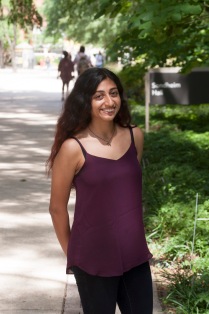 Women’s Center intern Prachi Kochar discusses the importance of disability in relation to many important issues that are going on today, such as police brutality and the 2016 presidential election. Rather than have disability be an afterthought, it should be brought to the forefront of our discussions about social justice issues.
In conversations about social activism and social change, we must remember who is not being talked about. Who is being left out of these conversations and why? In particular, I have noticed a significant amount of ignorance about issues related to people with disabilities throughout my college experience, and relating to several different issues, ranging from accessibility at UMBC to the rights (and respect) of people with disabilities in 2016’s presidential race to how people with disabilities, especially those who are people of color — and especially Black people — are treated by police. People with disabilities are also often left out of conversations about social justice. Think about the last time you heard about a protest, discussion about a social justice issue, or rally. Was there any mention of wheelchair accessible-seating or sign language interpreters? This is particularly striking because 19% of the U.S. population, or 56.7 million people, have some kind of disability.
The word “disabled” and its meanings are often not critically considered, but it is important to remember that just like other identities, such as gender, race, and class, it is socially constructed. This perspective of disability emphasizes that it is society that disables people by rendering some services and institutions inaccessible to people as well as stigmatizing those who are considered to have disabilities. For example, deafness is not considered a disability by the Deaf community because within the Deaf community, there are no barriers to communication — everyone is able to use sign language and communicate clearly. It is also important to recognize that all people with disabilities cannot be lumped together. Even people who seem to have the same “type” of disability may have different needs. This is why it is especially important to listen to diverse groups of people with disabilities and center their voices and experiences, rather than non-disabled people.
Even though I am deaf, as someone who does not have any mobility issues, I initially did not realize how inaccessible UMBC’s campus is to people with mobility issues, especially wheelchair users. For example, getting to the Performing Arts and Humanities Building only seems like a minor annoyance to me, one that just requires giving myself an extra five minutes to walk up all those stairs. However, for someone in a wheelchair, chronic pain, or with crutches, it is necessary to navigate a labyrinth of ramps, building entrances, and elevators to make it to class. Furthermore, most classroom doors, and even some building entrances, do not have buttons that allow them to open automatically, meaning that they must be pushed or pulled to allow access. The same is also true for many bathroom entrances, even bathrooms that have wheelchair accessible stalls. In this way, UMBC creates more barriers for people with mobility issues. Accessibility issues at UMBC do not exist in a vacuum; they reflect how people with disabilities are viewed and treated in American society, intersecting with other dimensions of identity, such as gender, race, and class.
Police brutality against people with disabilities, especially those who are people of color, is an issue rarely spoken about, but it is a very major one. As found in a report that analyzed incidents of police brutality between 2013-2015, up to half of people killed by the police have a disability. Police officers are typically the first respondents to mental health crisis 911 calls, but they are often not trained to deal with various mental health issues as well as physical, emotional, and intellectual disabilities. Furthermore, racism and anti-blackness as well as biases against people with disabilities – where they are perceived as “dangerous” and “non-compliant” greatly contribute to police brutality.
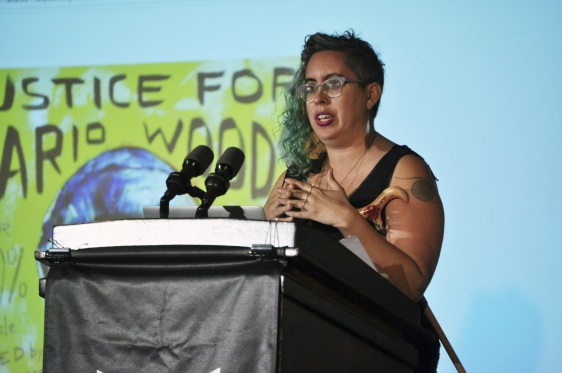
Our Critical Social Justice keynote speaker Leah Lakshmi Piepzna-Samarsinha spoke about issues related to disability justice. You can watch the video of her lecture here! (photo credit: Mike Mower)
Another major area in which disability issues are rarely discussed (except when something particularly shocking or offensive has been said) is the 2016 U.S. Presidential Elections. Yes, I can already hear your groans, but we need to talk about how people with disabilities could potentially be affected by this election, especially because many people with disabilities are women, LGBTQ+, or people of color who already face discrimination on those fronts. You’ve probably heard about Donald Trump’s mocking of a disabled reporter and him calling Marlee Matlin an ableist slur, but very little media attention has been given to the actual policy positions of both Trump and Clinton with regard to disability issues. However, these policies can actually be life or death for some people with disabilities.
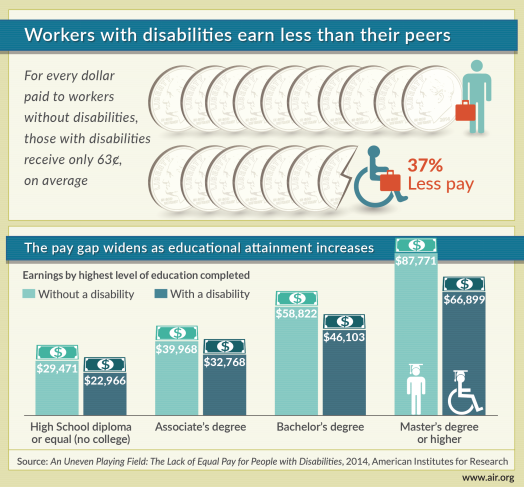
A major issue affecting people with disabilities is employment and salary equity. (credit: AIR.org)
Donald Trump has said little about people with disabilities with regard to official policy positions. Although he has praised himself for making the buildings on his properties accessible to people with disabilities (building wheelchair ramps, for example), this is mandated under the Americans with Disabilities Act. Multiple cases have also come up in which lawsuits were filed because his properties did not comply with ADA guidelines.
Hillary Clinton has been much more vocal on the topic of disability rights, using the failings of Donald Trump to emphasize how she will support people with disabilities. However, while Clinton is miles ahead of Trump on disability issues, that does not mean she is perfect. Her campaign has been criticized for portraying disability rights from the perspective of those without disabilities, rather than amplifying the voices of people with disabilities. Furthermore, despite her stated support of people with disabilities and the Americans with Disabilities Act, Clinton has not given much information on exactly how she will support people with disabilities and what specific issues she will address, creating doubt as to how effective she will be on disability-related policies. While it is important to recognize that Clinton is much better than Trump, it is also important to be critical of her policies and ask for better.
The Democratic Party has also shown their support of disability rights, by focusing on disability issues at the Democratic National Convention and having multiple speakers with disabilities as well as accommodations for all. Even though we have a long way to go with increasing accessibility for people with disability as well as awareness of the issues that people with disabilities face, it is possible for us, both people with disabilities and people without disabilities, to begin making a positive difference and to support disability justice. One of the major ways that we can do that is voting — so make sure you go out and vote if you are able to do so! Together, we can make a positive change and advocate for disability justice.
Resource Round-Up
]]>
Women’s Center intern Prachi Kochar discusses the importance of disability in relation to many important issues that are going on today, such as police brutality and the 2016 presidential...
https://womenscenteratumbc.wordpress.com/2016/11/08/why-do-disability-issues-matter/
https://my3.my.umbc.edu/api/v0/pixel/news/63768/guest@my.umbc.edu/4ae0b6af1014a0600f9fcfa2e28ab9c2/api/pixel
disability
intersectionality
issues
politics
social-justice
Women's, Gender, & Equity Center
https://my3.my.umbc.edu/groups/womenscenter
https://assets2-my.umbc.edu/system/shared/avatars/groups/000/000/125/78272a4842689b30dbf74672182b78f8/xsmall.png?1750974263
https://assets1-my.umbc.edu/system/shared/avatars/groups/000/000/125/78272a4842689b30dbf74672182b78f8/original.png?1750974263
https://assets1-my.umbc.edu/system/shared/avatars/groups/000/000/125/78272a4842689b30dbf74672182b78f8/xxlarge.png?1750974263
https://assets1-my.umbc.edu/system/shared/avatars/groups/000/000/125/78272a4842689b30dbf74672182b78f8/xlarge.png?1750974263
https://assets1-my.umbc.edu/system/shared/avatars/groups/000/000/125/78272a4842689b30dbf74672182b78f8/large.png?1750974263
https://assets2-my.umbc.edu/system/shared/avatars/groups/000/000/125/78272a4842689b30dbf74672182b78f8/medium.png?1750974263
https://assets1-my.umbc.edu/system/shared/avatars/groups/000/000/125/78272a4842689b30dbf74672182b78f8/small.png?1750974263
https://assets2-my.umbc.edu/system/shared/avatars/groups/000/000/125/78272a4842689b30dbf74672182b78f8/xsmall.png?1750974263
https://assets3-my.umbc.edu/system/shared/avatars/groups/000/000/125/78272a4842689b30dbf74672182b78f8/xxsmall.png?1750974263
Women's Center
14
0
false
Tue, 08 Nov 2016 17:00:48 -0500
Tue, 08 Nov 2016 17:00:48 -0500
What You Need To Know About Disability Justice
Get ready for Critical Social Justice: Home with our “What You Need to Know” series. The keynote lecture with Leah Lakshmi Piepzna-Samarasinha, titled “Body/ Land/ Home: Disability Justice, Healing Justice and Femme of Color Brilliance,” will be held on Tuesday, October 25th at 6PM in the University Center Ballroom (event details here).
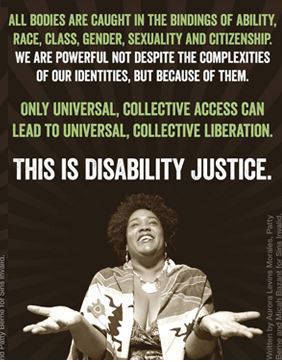
by Auroura Levine Morales, Patty Berne and Micah Bazant
Disability justice is the continuation and expansion of disability rights, a movement that sought equal rights and access for disabled people, but was often constrained by its focus on mostly white and male individuals. Disability justice uses an intersectional lens to bring a more nuanced and active approach to the movement. By challenging assumptions about ability and embracing all kinds of bodies, the disability justice framework looks beyond the commonality of disability to incorporate other identities.
Many people continue to be marginalized within conversations and activism around disability, despite its existence across all communities and populations; to counter these troubling hierarchies, disability justice centers the experiences and needs of queer people and people of color. Emphasizing the interconnectedness of oppression and people, disability justice demands the same integrated approach between all movements for liberation.
“Disability exists in every sector of society: in immigrant communities, in prisons, in religious and spiritual communities, among veterans and homeless folks, among children and elders and everyone in between, so every movement has to advance disability justice, and vice versa. A movement that sees some people as disposable or able to be sacrificed is not disability justice.” – Nomy Lamm, This Is Disability Justice
More than just a theory, disability justice is a movement-building practice that calls upon people to actively protest, perform, and speak out against oppression and injustices globally.
Want to learn more about disability justice?
]]>
Get ready for Critical Social Justice: Home with our “What You Need to Know” series. The keynote lecture with Leah Lakshmi Piepzna-Samarasinha, titled “Body/ Land/ Home: Disability Justice,...
https://critsocjustice.wordpress.com/2016/10/17/what-you-need-to-know-about-disability-justice/
https://my3.my.umbc.edu/api/v0/pixel/news/63189/guest@my.umbc.edu/1124006d0dc77d5bf86f0acce1872c14/api/pixel
csj-home
social-justice
what-you-need-to-know
Women's, Gender, & Equity Center
https://my3.my.umbc.edu/groups/womenscenter
https://assets2-my.umbc.edu/system/shared/avatars/groups/000/000/125/78272a4842689b30dbf74672182b78f8/xsmall.png?1750974263
https://assets1-my.umbc.edu/system/shared/avatars/groups/000/000/125/78272a4842689b30dbf74672182b78f8/original.png?1750974263
https://assets1-my.umbc.edu/system/shared/avatars/groups/000/000/125/78272a4842689b30dbf74672182b78f8/xxlarge.png?1750974263
https://assets1-my.umbc.edu/system/shared/avatars/groups/000/000/125/78272a4842689b30dbf74672182b78f8/xlarge.png?1750974263
https://assets1-my.umbc.edu/system/shared/avatars/groups/000/000/125/78272a4842689b30dbf74672182b78f8/large.png?1750974263
https://assets2-my.umbc.edu/system/shared/avatars/groups/000/000/125/78272a4842689b30dbf74672182b78f8/medium.png?1750974263
https://assets1-my.umbc.edu/system/shared/avatars/groups/000/000/125/78272a4842689b30dbf74672182b78f8/small.png?1750974263
https://assets2-my.umbc.edu/system/shared/avatars/groups/000/000/125/78272a4842689b30dbf74672182b78f8/xsmall.png?1750974263
https://assets3-my.umbc.edu/system/shared/avatars/groups/000/000/125/78272a4842689b30dbf74672182b78f8/xxsmall.png?1750974263
Women's Center
10
0
false
Mon, 17 Oct 2016 14:48:08 -0400
Mon, 17 Oct 2016 14:48:08 -0400
Across Worlds and Identities: The Spaces in Between
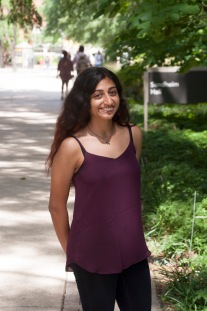 A reflection by Women’s Center staff member Prachi Kochar on identity and “fitting in”. How do we navigate identities that can fit into multiple categories of nationality, ability, race, etc. at once? Or identities that do not perfectly fit into these categories, spilling out and crashing into each other?
This summer, I went to India for my cousin’s wedding, and it was a long trip both physically (twenty-four hours of traveling, with a layover!) and mentally. Even though it has technically been over for months, it continues to affect the way that I think and view the world. It has deepened my understanding of how I navigate the world, both in terms of my physical location and in terms of social situations and relationships.
Before this trip, I had assumed that India was nothing more or less than a second home to my parents, that it was their equivalent of me coming home from school for winter or summer vacation. However, after an interaction with some distant relatives, my mother turned to me and shook her head, saying “They act like we’re not even Indian!” Her comment surprised me because my parents always had been the epitome of Indian to me. In their spare use of Gujarati and Marathi words, I had heard the voice of India, my motherland. Through their cooking, through the bhinda, rotis, and dal, I had tasted my heritage. And in their stories about their childhoods, about school, about their friends, everything, I had experienced life in India.
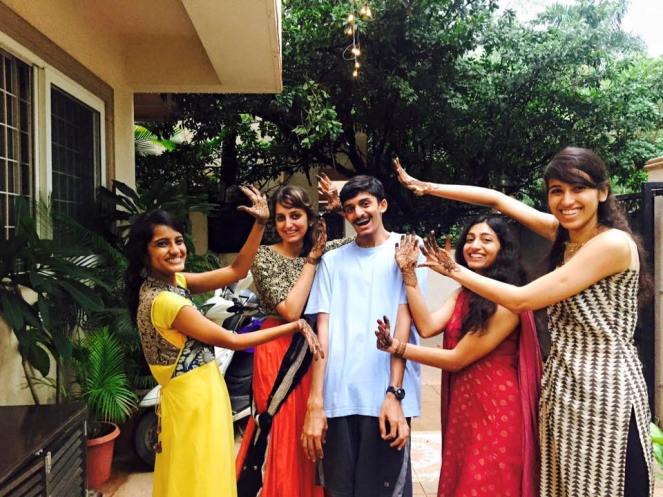 Mehndi ceremonies with family in India
Even though I had known they had lived in the United States for the majority of their lives, eventually becoming US citizens, I was still amazed. My mother explained to me, “We’re too American for the Indians, but then we go home and we’re too Indian for Americans.” At this point, it was difficult for me to not laugh and/or cry out loud, because I had said that same sentence nearly word-for-word in multiple contexts. Later, once we had gotten a break from the wedding chaos, I asked my parents about the exchange again. They both expressed similar feelings, even though they’d had very different experiences of growing up in India and even though my mother is technically South African. Not American enough, but also not Indian enough, they echoed. In the end, I was left with one question playing through my head over and over. What does “enough” mean?
For me, that question makes up the chorus of the soundtrack of my life. I am not Indian enough. I am not American enough. I am also not deaf enough. I am not “hearing” enough. I am not assertive enough. I am not quiet enough. And so on.
Let me back up here. Who or what am I not enough for? may be the question on your mind. And simply put, it is everyone and no one at the same time, including myself.
As a deaf Indian-American woman, I am often subjected to a set of expectations that vary based on context and location.
For example, Indian-Americans often make up the face of “model minorities”. They are expected to excel at math, sciences, and are seen as not facing discrimination in contrast to other minority groups. This “model minority” stereotype is used to perpetuate anti-Blackness among other things, while ignoring that Asian-Americans are not a monolithic group. At the same time, being a woman comes with its own set of expectations that often clash and interact with stereotypes of Indian-Americans. Indian-American girls are often viewed as constantly being oppressed by their vile misogynistic parents and threatened with arranged marriage. It is necessary to recognize that this is an issue that some Indian-American women do deal with, but presenting it universally affecting only one group trivializes the complexity of the problem and pretends that it does not exist in other communities.
Deaf and hard of hearing people also face their own set of stereotypes. For example, one of the most highly touted statistics about the woeful situation of d/Deaf people is that the average deaf high schooler has a fourth-grade reading level, never mind that the average American adult has an eighth grade reading level (in addition to several other issues with this statistic). In addition to being stereotyped as uneducated, d/Deaf people are imagined to be figuratively — if not literally — voiceless. Even though many d/Deaf people are not able to verbally speak, this does not mean that they cannot express themselves through American Sign Language, through writing, through a variety of other formats, just as eloquently as any hearing person can with their voice. Like many other minority groups, d/Deaf people are placed into rigid, narrow boxes that define who they should be, rather than definitions that stretch to accommodate the wholeness of who deaf people actually are.
I find it difficult enough to deal with one set of stereotypes by itself, and dealing with multiple collections of stereotypes presents a shifting set of expectations that feels like it is always changing to trap and trip me up. Navigating all of these stereotypes is something that I do every day, with a broken compass and inaccurate map. For example, when I am in class, I often hesitate to raise my hand and speak up because I worry that I may be monopolizing class time by speaking up too much. I also hesitate because I feel that I’m not “hearing” enough. More specifically, even though I am able to speak using my voice, I have a strong “deaf” accent (with an inability to discriminate between “l” and “n” or say words beginning with “st”), and I often worry that I am annoying others by making them work harder to understand me.
At the same time, I wonder if I should be less quiet, in order to not play into perceptions of Asian-American women as voiceless and invisible. I feel that I should speak freely in class, using American Sign Language and the interpreter to voice for me instead of using my own voice, fully embracing my Deaf identity even though it still feels itchy and uncomfortable to me. With all of these contradictions whirling around in my head, I often end up just doing the old half raise of my hand and hoping (or fearing) that the professor will call on me.
I am not alone in these conflicted feelings. Feeling trapped between two worlds is also an issue that affects many from immigrant families, especially people of color who are visibly marked and judged as an “other” in the United States. Consider Nina Davuluri who was crowned Miss America in 2013, becoming the first South Asian American to hold that title. Immediately after she was announced as the winner, she was the target of various racist attacks on social media, illustrating how many people of color are often not seen as fully American, despite being born and raised here. We are expected to assimilate, but even when we conform perfectly to standards of “Americanness”, we are still seen as outsiders, constantly receiving the “but where are you really from?” question. Being the “perfect” Indian-American is not enough in America, or India, as my parents’ experiences indicate. Similarly, being the “perfect” deaf person is not enough to smoothly navigate hearing spaces. In short, being the “perfect” model of a minority that fits into dominant norms is still not enough to gain total acceptance.
 In 2013, Nina Davuluri became the first Miss America of South Asian origin
So, is there ever a way that we can become enough? While the acceptance of others may be beyond our control, I propose that it is possible for those of us who feel trapped by these paradoxes and stereotypes to become enough for ourselves. We must recognize that it is okay to feel conflicted and confused. We must practice self-care, giving ourselves an outlet to express ourselves and just be. For me, that takes the form of painting, working out at the gym, and playing Pokémon. For you, that might look like baking some cookies, watching Netflix, or blasting some Beyoncé in your bedroom. It is important to recognize that there is no one right way to take care of yourself – do what feels right for you at this point in time and recognize that it is okay if that changes. Navigating these challenges can seem insurmountable sometimes, but giving yourself permission to exist as you are can help you start taking those first steps of confidence forward.

Be like Aishwarya Rai and don’t hold any part of yourself back for anyone.
Resource Round-Up
UMBC Women’s Center Women of Color Coalition – We discuss various issues pertaining to self-identified women of color every other week. I am one of the peer facilitators, so come say hi and share your experiences!
Women of Color – Telling Our Stories
“Twice as Good” On Being a Woman of Color and Overcoming Imposter Syndrome and Perfectionism
Asian American Identities
The Truth about “The Asian Advantage” and “Model Minority Myth”
6 Reasons We Need to Dismantle the Model Minority Myth of Those ‘Hard-Working’ Asians
It’s Time to Talk: South Asian Women in the U.S. Have Some of the Highest Suicide Rates
Deaf/Hard of Hearing Identities
American Deaf Culture
Terminology
]]>
A reflection by Women’s Center staff member Prachi Kochar on identity and “fitting in”. How do we navigate identities that can fit into multiple categories of nationality, ability, race, etc. at...
https://womenscenteratumbc.wordpress.com/2016/10/06/across-worlds-and-identities-the-spaces-in-between/
https://my3.my.umbc.edu/api/v0/pixel/news/62902/guest@my.umbc.edu/11ac6affa8abf436f647f151323c9c35/api/pixel
intersectionality
social-justice
women
women-of-color
Women's, Gender, & Equity Center
https://my3.my.umbc.edu/groups/womenscenter
https://assets2-my.umbc.edu/system/shared/avatars/groups/000/000/125/78272a4842689b30dbf74672182b78f8/xsmall.png?1750974263
https://assets1-my.umbc.edu/system/shared/avatars/groups/000/000/125/78272a4842689b30dbf74672182b78f8/original.png?1750974263
https://assets1-my.umbc.edu/system/shared/avatars/groups/000/000/125/78272a4842689b30dbf74672182b78f8/xxlarge.png?1750974263
https://assets1-my.umbc.edu/system/shared/avatars/groups/000/000/125/78272a4842689b30dbf74672182b78f8/xlarge.png?1750974263
https://assets1-my.umbc.edu/system/shared/avatars/groups/000/000/125/78272a4842689b30dbf74672182b78f8/large.png?1750974263
https://assets2-my.umbc.edu/system/shared/avatars/groups/000/000/125/78272a4842689b30dbf74672182b78f8/medium.png?1750974263
https://assets1-my.umbc.edu/system/shared/avatars/groups/000/000/125/78272a4842689b30dbf74672182b78f8/small.png?1750974263
https://assets2-my.umbc.edu/system/shared/avatars/groups/000/000/125/78272a4842689b30dbf74672182b78f8/xsmall.png?1750974263
https://assets3-my.umbc.edu/system/shared/avatars/groups/000/000/125/78272a4842689b30dbf74672182b78f8/xxsmall.png?1750974263
Women's Center
11
0
false
Thu, 06 Oct 2016 09:00:34 -0400
Thu, 06 Oct 2016 09:00:34 -0400
Voter Suppression

A brief thought by student staff Shira Devorah
This coming Tuesday, I’m going vote in the Maryland Primaries!
I’m excited to participate in this election, but I am also really wary.
Voter suppression is a topic that’s pretty new to me. I’ve never voted before, let alone spent too much time looking into how it works. Most of my efforts have gone towards researching candidates, not worrying that I won’t even get a chance to speak. I knew a little bit about Photo ID laws (boo), but that was about it. I didn’t know about voter suppression before my more politically aware friend pointed it out to me. I like to think that I’m well informed, but clearly I haven’t been paying enough attention. And now that I’m about to vote for the first time, I’m worried that there are a ton of students just as unaware as I am.
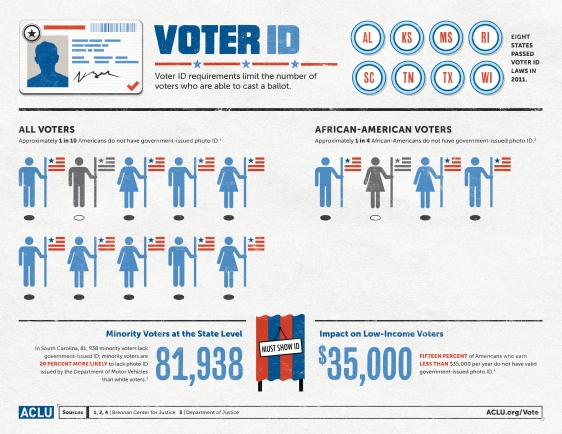
Source: The American Civil Liberties Union
Voter suppression includes a range of strategies aimed at discouraging or preventing people from exercising their right to vote. It can be done legally, through unfair laws, or illegally, through underhanded tactics. Either way, it is a social justice and feminist issue. When politicians get in the way of equity for all, we must educate ourselves and take a stand against unjust practices.
I’m saddened, but not surprised, that America has legal (and illegal) things in place to stop eligible voters from casting their ballots. These unjust tactics are often employed to directly target and disenfranchise marginalized individuals, especially Black and Latinx people. People with prior felony convictions are just starting to get their right to vote back in some states, but overall do not get counted.
Students are also targeted through voter suppression. This recent piece by The Retriever Weekly gives a close-to-home example. This is a huge social justice issue that all students should be aware of when we attempt to head to the polls on Tuesday. Not only so that we UMBC students are conscious of our own votes, but also so that we are aware of the suppression tactics facing our fellow citizens.
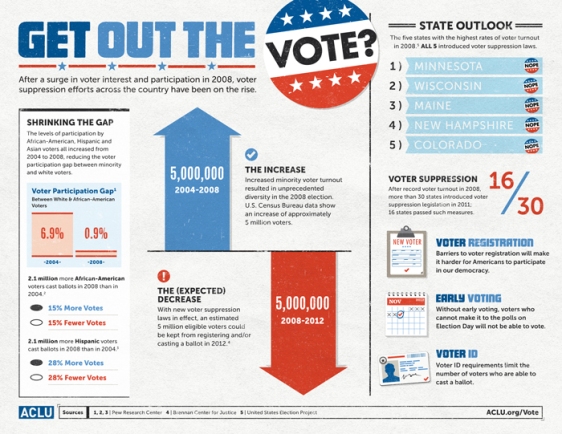
This info graphic from the ACLU is old, but gets the point across
Misinformation about voting procedures, like incorrect deadlines for absentee ballots, complicated instructions, and unfair waiting periods all add up to dissuading voters. There is a history of politicians and lobbyists spreading misinformation through shady robo-calls and flyers. On top of illegal practices, there are actual laws in place specifically created to suppress certain people’s votes. North Carolina’s Monster Voting law, which will have aspects present in this current voting period, would legally dissuade younger voters.
This was all disheartening for me to hear for the first time, but I was also inspired to learn that activist groups all over the country are fighting against voter suppression laws and dirty tricks.
North Carolina’s Vote Defender Project is a way that students are combating voter suppression. These activists are tasked with providing voters with accurate and easily understandable information about the upcoming election process. These vote defenders also look out for active voter suppression tactics and report instances of unjust practices, such as overly-long lines and inadequate equipment at polling stations.

NC Vote Defender, (credit: Vote Defender Project)
campusvoteproject.org helps to empower and inform student voters, and you can look up information specific to your state and district through their website. The Fair Elections Legal Network is actively working to remove barriers to voting through corrective legislation.
People are speaking out and reaching students like me. Before a few days ago, I was completely clueless to this situation. I’m steadily learning, and I now feel like I have a better grasp on how important my vote will be. I now know that there are political groups that do not want me to have my say and having a vote that’s counted is not something to take for granted. We are all just single voices in this election, but if we can come together as more informed citizens, maybe we can fight against those who are trying to take our rights away. To my fellow students, I urge you to go out and make your voices heard. To dirty politicians who want me to stay home- I’ll see you at the polls.
the traditional voter sticker, (credit: Flicker.com)
]]>
A brief thought by student staff Shira Devorah This coming Tuesday, I’m going vote in the Maryland Primaries! I’m excited to participate in this election, but I am also really wary. Voter...
https://womenscenteratumbc.wordpress.com/2016/04/26/voter-suppression/
https://my3.my.umbc.edu/api/v0/pixel/news/59682/guest@my.umbc.edu/e97175d957d6be000c06a4a68def8420/api/pixel
current-events
issues
politics
social-justice
Women's, Gender, & Equity Center
https://my3.my.umbc.edu/groups/womenscenter
https://assets2-my.umbc.edu/system/shared/avatars/groups/000/000/125/78272a4842689b30dbf74672182b78f8/xsmall.png?1750974263
https://assets1-my.umbc.edu/system/shared/avatars/groups/000/000/125/78272a4842689b30dbf74672182b78f8/original.png?1750974263
https://assets1-my.umbc.edu/system/shared/avatars/groups/000/000/125/78272a4842689b30dbf74672182b78f8/xxlarge.png?1750974263
https://assets1-my.umbc.edu/system/shared/avatars/groups/000/000/125/78272a4842689b30dbf74672182b78f8/xlarge.png?1750974263
https://assets1-my.umbc.edu/system/shared/avatars/groups/000/000/125/78272a4842689b30dbf74672182b78f8/large.png?1750974263
https://assets2-my.umbc.edu/system/shared/avatars/groups/000/000/125/78272a4842689b30dbf74672182b78f8/medium.png?1750974263
https://assets1-my.umbc.edu/system/shared/avatars/groups/000/000/125/78272a4842689b30dbf74672182b78f8/small.png?1750974263
https://assets2-my.umbc.edu/system/shared/avatars/groups/000/000/125/78272a4842689b30dbf74672182b78f8/xsmall.png?1750974263
https://assets3-my.umbc.edu/system/shared/avatars/groups/000/000/125/78272a4842689b30dbf74672182b78f8/xxsmall.png?1750974263
Women's Center
26
0
false
Tue, 26 Apr 2016 09:00:46 -0400
Tue, 26 Apr 2016 09:00:46 -0400