Dancing Between Worlds: Culture, Performance, and Identity
By Ashwathi Menon, Bioinformatics & Public Health Major, Student Staff Member
The first thing that comes into play is performance.
The jewelry. The eyeliner so sharp that it can be seen from the last row. The well-rehearsed smile remains unshaken under the lights of the stage. My South Asian heritage comes into our lives through performance—through the vibrancy and color of the thematic films, through dance, and through the celebrated aesthetics.
However, for us, in the South Asian diaspora, culture goes beyond performance.
It is memory. It is an inheritance. It is a translation. It is survival.
During APIDA Heritage Month, there is one question that loops me more than others: how often does culture become something to consume before it is even understood as something normative to society? How can people be impressed by the beauty of South Asian culture without understanding much of the life, struggle, and history that lies beneath it?
Sometimes, being a South Asian woman raised in a Western society means negotiating these two things every day.
Bharatanatyam is a classical dance from Southern India, characterized by storytelling using the language of dance, rhythm, and expression. The hand gestures, called mudras, form an entire language on their own. A single movement can symbolize a flower, rain, heartbreak, prayer, or power. The eyes shift deliberately. The posture remains grounded and strong through aramandi, the half-seated position that forms the foundation of the dance. The face carries emotion just as much as the body does.
In Bharatanatyam, you do not simply dance. You communicate.
The drishti bhedas, the controlled eye movements, require directness. The mudras ask your hands to speak confidently before your voice ever does. The entire form teaches you to take up space physically and emotionally without apologizing for it.
I think that mattered to me long before I had the words to explain why.
The nature of diasporic communities is inherently complex. You were raised with a profound understanding of your homeland, knowing that it exists and yet feeling distant from it. Your traditions have been taught to you secondhand, filtered through generations of parents, language, culture, and customs.
Some days, I feel deeply rooted in my culture. Other days, I feel like I am constantly trying to prove my authenticity, not only to others but also to myself.
Too American in some spaces. Too Indian in others.
I imagine many APIDA students understand this feeling all too well: the struggle of protecting your culture while constantly adapting- the exhaustion of translating yourself so others can comprehend better. It’s a feeling that’s familiar in your day-to-day environments, from classes to leadership positions to informal social gatherings.
Growing up, I’ve repeatedly seen people perceive South Asian women as their projections until they actually get to know us, the studious model minority. The accomplishments are noticed before we are. But life, and especially identity, is far more complicated than this.
Dancing was one of the few things where I ceased to feel pressure. Not because it solved all the conflicts inside me, but because it let me exist amidst them. Bharatanatyam made me realize that strength and grace did not negate each other, that rigor and emotion could coexist, that being visible could be both vulnerable and invigorating.
And perhaps that is why dancing holds such personal significance for me.
Not because of the act of performance itself, but for everything else it represents: continuation, preservation, the refusal to silently vanish.
Especially now, in APIDA Heritage Month, I consider how many children of immigrants go through life translating themselves for everyone else. Softening names. Bringing light to cultural practices. Adapting oneself to be easy to comprehend, bringing centuries’ worth of history into spaces never designed to accommodate it.
But with dance, there is no need for translation. My body just gets it.
Under vivid stage lights, my hands move instinctively through mudras, reflections of the younger version of myself who practiced relentlessly for years. My eyes meet the audience with confidence.
I am finally whole.
]]>
By Ashwathi Menon, Bioinformatics & Public Health Major, Student Staff Member The first thing that comes into play is performance. The jewelry. The eyeliner so sharp that it...
https://womenscenteratumbc.wordpress.com/2026/06/01/dancing-between-worlds-culture-performance-and-identity/
https://my3.my.umbc.edu/api/v0/pixel/news/160459/guest@my.umbc.edu/3642c0c49a4f2805c2a15b6218be03ea/api/pixel
aapi
apida
asian-and-pacific-islander-american-voices
critical-social-justice
diversity
feminism
social-justice
umbc
uncategorized
woman-of-color
women
womens-center-staff
Women's, Gender, & Equity Center
https://my3.my.umbc.edu/groups/womenscenter
https://assets2-my.umbc.edu/system/shared/avatars/groups/000/000/125/78272a4842689b30dbf74672182b78f8/xsmall.png?1750974263
https://assets1-my.umbc.edu/system/shared/avatars/groups/000/000/125/78272a4842689b30dbf74672182b78f8/original.png?1750974263
https://assets1-my.umbc.edu/system/shared/avatars/groups/000/000/125/78272a4842689b30dbf74672182b78f8/xxlarge.png?1750974263
https://assets1-my.umbc.edu/system/shared/avatars/groups/000/000/125/78272a4842689b30dbf74672182b78f8/xlarge.png?1750974263
https://assets1-my.umbc.edu/system/shared/avatars/groups/000/000/125/78272a4842689b30dbf74672182b78f8/large.png?1750974263
https://assets2-my.umbc.edu/system/shared/avatars/groups/000/000/125/78272a4842689b30dbf74672182b78f8/medium.png?1750974263
https://assets1-my.umbc.edu/system/shared/avatars/groups/000/000/125/78272a4842689b30dbf74672182b78f8/small.png?1750974263
https://assets2-my.umbc.edu/system/shared/avatars/groups/000/000/125/78272a4842689b30dbf74672182b78f8/xsmall.png?1750974263
https://assets3-my.umbc.edu/system/shared/avatars/groups/000/000/125/78272a4842689b30dbf74672182b78f8/xxsmall.png?1750974263
Women's Center
0
0
false
Mon, 01 Jun 2026 09:18:22 -0400
The Implementation of Title IX’s Effect on Survivors
By Claudia Gerry Social Work & Gender, Women’s and Sexuality Studies Major, Student Staff Member
Forward
This literature review was my final paper for Dr. Maria Celleri’s Methodologies in Gender, Women’s, and Sexuality Studies (GWST 300) course. I feel that this topic heavily applies to the work the Women’s, Gender, and Equity Center does. As a student staff member, I see how Title IX fails survivors, I see how it hurts survivors, and I see how it makes survivors’ lives just that much harder. I plan to continue this research and present it at URCAD 2027 in order to advocate for change not only on our UMBC campus but across the United States. So… here is a sneak peek!
Introduction
Sexual misconduct is a major problem everywhere, but specifically on college campuses. Sexual assault is defined as any form of unconsensual and unwanted sexual contact, which can include physical contact or sexual coercion (Holland & Cipriano, 2021). Sexual harassment within education is defined as behaviors sexual in nature that are “sufficiently severe, persistent, or pervasive to limit a student’s ability to participate in or benefit from the education program, or to create a hostile or abusive educational environment” (Holland & Howard Valdivia, 2026). Women and LGBTQ+ undergraduate students face the greatest risk of enduring sexual misconduct (Holland & Cipriano, 2021). Those who experience sexual assault often endure many mental health challenges and harms to their education (Holland & Cipriano, 2021), especially if they do not utilize support resources. The campus climate can foster barriers for survivors using these resources. Many survivors feel a minimization of sexual assault, fear of negative treatment, and have social-emotional concerns (Holland & Cipriano, 2021). Awareness of sexual violence is rooted in the second-wave feminist movement. But, this awareness mostly focused on the voices of white, well-educated women. There is a persistent struggle to understand the intersectionality of sexual assault (Jessup-Anger et al., 2018), even though this issue can affect every identity. This Literature review addresses how the implementation of Title IX policies affects survivors of sexual violence within higher education systems in the United States. To begin to understand this, we must know what Title IX is and how it has been implemented through time.
What is Title IX?
Title IX was passed in 1973 as part of the education amendments and is a civil rights law (Kaufman & Nelson, 2025). The main focus of this law is to prohibit sex-based discrimination in educational settings funded by the federal government (Kaufman & Nelson, 2025). Originally, the focus was set on inequality in admissions and educational opportunities, but the scope has widened since then (Kaufman & Nelson, 2025). Title IX has been used to increase access to women’s sports and require educational institutions to address sexual harassment and violence (Kaufman & Nelson, 2025). At the surface level, this law seems to help survivors of sexual assault, but in reality, it often harms the survivor more than it helps.
Every institution’s Title IX policies vary due to different levels of staffing, budget, and number of support and advocacy services. One uniform requirement across all institutions is the requirement of at least one Title IX coordinator, no matter the institution’s size (Kaufman & Nelson, 2025). The Title IX coordinator is located within the Title IX office, which at most universities is housed under the institution’s Equity and Civil Rights department.
The applications of Title IX have changed numerous times through new legislation, Office of Civil Rights (OCR) guidance, and presidential letters called Dear Colleague Letters (DCL). In 1980, Alexander v. Yale argued that sexual harassment in educational institutions constitutes sex-based discrimination under Title IX (Holland & Howard Valdivia, 2026) and is still the precedent today. The main acts passed that affect Title IX are: 1990 Clery Act, 1992 Campus Sexual Assault Victim’s Bill of Rights, 1994 Violence Against Women Act, and 2013 Campus SaVE Act. These acts mainly attempt to address funding for survivor services, requirements for prevention training, and public disclosure of crime rates.
What really affects Title IX implementation the most are DCLs. In 2011, the Obama-era DCL was released. The Obama DCL called attention to the issue of sexual violence on college campuses, reminded Higher Education Institutions (HEIs) of Title IX guidelines, and added additional recommendations. This letter classified sexual violence under the umbrella of sex discrimination under Title IX, lowered investigatory standards of proof, and made it legal to withhold funds from HEIs for not complying (Kaufman & Nelson, 2025). In 2017, the Donald Trump era DCL was released and focused heavily on concerns for the (rights of the) accused (Holland & Howard Valdivia, 2026). The Trump DCL withdrew the Obama DCL and announced new regulations. The main changes were changes in definitions of sexual violence, limited the scope of what HEIs are required to address, added more requirements for formal adjudication, and emphasized the rights of respondents over the well-being of survivors (Webermann et al., 2023). In 2024, the Title IX regulations were changed once again by Joe Biden’s administration. These regulations expanded the scope of conduct covered under the policy and for the most part were similar to 2020 but gave HEIs more discretion (Holland & Howard Valdivia, 2026). Today, we are under the 2025 DCL. This DCL edits the 2024 regulations to include that HEIs “must continue to comply with the 2020 Title IX regulations and operate under the presumption of (inaccurate) binary, biological sex” (Holland & Howard Valdivia, 2026). Overall, Title IX policies have been said to be a political football being passed around and changed with every administration. This makes Title IX regulations hard to understand for the average person. So, not everyone understands their rights and what is expected of their institutions.
Title IX in Action
A theoretical framework to understand the importance of survivors’ interactions with the Title IX Office is the theory of institutional betrayal. Both Webermann et al. (2023) and Holland and Cipriano (2021) use this framework to understand the effects of Title IX on survivors. Institutional betrayal shows the unique ways institutions can harm marginalized groups and “conceptualizes wrongdoings perpetrated by an institution when people are dependent upon the institution and can expect that it will protect its members from harm and will respond appropriately if harm is endured” (Holland & Cipriano, 2021). Students expect their institutions to take steps to restore their access to education, but when the institution fails to do so, there can be negative consequences that can include erosion of trust and belonging at the institution (Holland & Cipriano, 2021). Failures of the institution can be: failure to prevent abuse, normalizing of abusive contexts, difficult reporting procedures, inadequate responses to reports, cover-ups, misinformation, and punishing survivors (Webermann et al., 2023). Survivors who experience institutional betrayal report increased levels of psychological harm (Holland & Cipriano, 2021).Title IX overall affects survivors negatively.
First, Title IX cases are supposed to take up to 60 days to be resolved, but the average length of cases in Webermann’s study is 175.36 days (Webermann et al., 2023). Many institutions elect to have the minimum number of coordinators- one. Staffing levels in the Title IX office affect how long cases may take (Kaufman & Nelson, 2025), so many institutions’ Title IX offices are not staffed enough for every case to be resolved within the 60-day timeframe. Many survivors see major variability in the transparency of their case. Some survivors receive multiple updates and reassurances about their case, while others get little to none (Holland & Cipriano, 2021). According to Holland and Cipriano (2021), “Recent research has found that the majority of sexual assault reports to Title IX Offices do not result in formal investigations and, of those that are investigated, there is rarely a finding of ‘responsibility’”. Many survivors believe that the length of their case affected the outcomes. For example, witnesses may forget parts of their story over time or the respondent might leave the institution before disciplinary action is taken (Webermann et al., 2023).
Second, many survivors report negative treatment from the Title IX office. This negative treatment can include victim-blaming, name-calling, stalling of cases, and being told the institution can do nothing about the case. Holland and Cortina (2017a) found that of the three main support systems they examined (Title IX office, sexual assault center, and housing staff), the Title IX office was not utilized by survivors because of “negative emotions, consequences, contextual characteristics, minimization of behaviors, and alternative coping strategies”. According to Holland and Cipriano (2021), negative reactions to sexual assault disclosures can cause significant psychological harm for survivors.
Third, many survivors experience barriers in receiving support. Kaufman and Nelson (2025) found that “Too often, survivors of sexual assault do not know where to turn and do not receive the support they need despite the seemingly ‘robust’ federal legislation that seeks to address campus sexual violence”. Many survivors deliberately avoid the Title IX office due to fears of poor treatment (Holland & Cipriano, 2021). Within Webermann et al.’s (2023) study, many participants felt unclear about the Title IX reporting process and their options.
Survivors are expected to retell the worst moments of their lives numerous times, reliving it every. single. time. According to Webermann et al. (2023), the survivors in their study had to tell their stories to 2.88 different offices/individuals, not including formal grievance procedures or court procedures. If a survivor wants to make a report and seek justice, they are put in more harm. To help themselves, they have to harm themselves. “It was not just the outcome of their case that caused harm but also the process itself”(Webermann et al., 2023).
Future Steps
Due to all these reasons listed above, survivors are discouraged from standing up for themselves. Working at the Women’s, Gender, and Equity Center (WGEC) has shown me how Title IX actually operates in real life. In my personal experience, the system has failed survivors. Many survivors seek support from the WGEC, as we are a confidential space, and they do not want to bother with reporting to the UMBC Title IX office. The reasons I have heard are: knowing how the office treats other survivors, knowing how many times they will have to relive what they have gone through, concerns over social circumstances, minimization of what happened to them, and many more. With the perpetual changing of guidelines, many survivors do not understand what their institution can do for them anymore, making them give up and move on. At many institutions, there are requirements for mandatory reporting, where staff and faculty are required to report sexual misconduct disclosures to the Title IX office. Many staff and faculty are in the same boat of confusion about what the guidelines are, leading individual reporters to either report too much or too little. In my experience, professors are not trained on what is to be reported and what happens to the student after a report is filed. This leaves students cautious about talking about their experiences in fear of being non-consensually reported.
Many changes need to be made in order to ensure the success of survivors. First, there needs to be an implementation of an oversight committee to ensure the Title IX office acts swiftly, equitably and with accountability (Holland & Cipriano, 2021). This committee could also oversee trauma-informed training for Title IX Office staff and mandated reporters. “Using formal supports that are trauma-informed and survivor-centered can promote psychological well-being for survivors” (Holland & Cipriano, 2021). Second, there needs to be an effort to address the root cause of sexual violence instead of focusing on the aftereffects. “Although most universities comply with Title IX, many side-step confronting the root causes of normalized sexual violence and avoid teaching the realities of campus sexual violence, leaving students confused, isolated, and unsure of how to address the trauma that they or their friends experience”(Kaufman & Nelson, 2025). Third, to address institutional betrayal, we must flip it to institutional support. This can include “supportive responses from individuals within institutions to survivors, such as believing them, apologizing for their experiences, connecting them with resources, and providing autonomy in what happens after reporting”(Webermann et al., 2023). Lastly, frontline workers within the survivor support services need more say in the implementation of Title IX. “Oftentimes, frontline workers, such as victim advocates, are absent from the policy table, yet this article underscores the importance of their positionality and experiences for addressing vulnerabilities in the campus sexual violence intervention system”(Wies, 2015).
Conclusion
Ultimately, under the system we have set in place, Title IX is failing survivors of sexual violence in HEIs in the United States. Survivors are expected to advocate for themselves when their words have been ignored in the past. The Title IX office worries too much about getting sued by the respondent to bring justice for the survivor. Survivors experience major mental health and educational challenges even though Title IX is supposed to ensure equal access to education. If a survivor reports their institution for violation of Title IX policy, the report can take years to process, so Title IX offices are not held accountable. This is why we need to change the policy ONE last time. Modifying Title IX every few years only causes more confusion. We need to support survivors. Survivors need to feel supported, seen, and heard by their institutions.
References
Brubaker, S. J., Keegan, B., Guadalupe-Diaz, X. L., & Beasley, B. (2017). Measuring and reporting campus sexual assault: Privilege and exclusion in what we know and what we do. Sociology Compass, 11(12), e12543. https://doi.org/10.1111/soc4.12543
Holland, K. J., & Cipriano, A. E. (2021). Does a report = support? A qualitative analysis of college sexual assault survivors’ Title IX Office knowledge, perceptions, and experiences. Analyses of Social Issues and Public Policy, 21(1), 1054–1081. https://doi.org/10.1111/asap.12271
Holland, K. J., & Cortina, L. M. (2017a). “It Happens to Girls All the Time”: Examining Sexual Assault Survivors’ Reasons for Not Using Campus Supports. American Journal of Community Psychology, 59(1-2), 50–64. https://doi.org/10.1002/ajcp.12126
Holland, K. J., & Cortina, L. M. (2017b). The evolving landscape of Title IX: Predicting mandatory reporters’ responses to sexual assault disclosures. Law and Human Behavior, 41(5), 429–439. https://doi.org/10.1037/lhb0000253
Holland, K. J., & Howard Valdivia, R. L. (2026). Title IX and Sexual Violence in Higher Education: A Mapping Review and Assessment of Policy Implementation and Effectiveness. The Journal of Sex Research, 1–19. https://doi.org/10.1080/00224499.2026.2623649
Jessup-Anger, J., Lopez, E., & Koss, M. P. (2018). History of Sexual Violence in Higher Education. New Directions for Student Services, 2018(161), 9–19. https://doi.org/10.1002/ss.20249
Kaufman, S. B.-S., & Nelson, L. (2025). Interpreting title IX: A feminist legal geography of sexual assault prevention on U.S. college campuses. Political Geography, 116(5), 103252. https://doi.org/10.1016/j.polgeo.2024.103252
Webermann, A. R., Holland, K. J., & Murphy, C. M. (2023). Student Experiences Reporting Sexual and Gender-Based Misconduct to the Title IX Office at a Public State University. Violence against Women, 30(6-7), 107780122211502. https://doi.org/10.1177/10778012221150274
Wies, J. R. (2015). Title IX and the State of Campus Sexual Violence in the United States: Power, Policy, and Local Bodies. Human Organization, 74(3), 276–286. https://doi.org/10.17730/0018-7259-74.3.276
]]>
By Claudia Gerry Social Work & Gender, Women’s and Sexuality Studies Major, Student Staff Member Forward This literature review was my final paper for Dr. Maria Celleri’s...
https://womenscenteratumbc.wordpress.com/2026/05/30/the-implementation-of-title-ixs-effect-on-survivors/
https://my3.my.umbc.edu/api/v0/pixel/news/160449/guest@my.umbc.edu/3a509ba1a892eceaa8295d5a7f9c8a7c/api/pixel
activism
critical-social-justice
feminism
higher-education
politics
sexual-assault
social-justice
staff
survivors
survivors-of-sexual-violence
title-ix
umbc
womens-center-staff
writing
Women's, Gender, & Equity Center
https://my3.my.umbc.edu/groups/womenscenter
https://assets2-my.umbc.edu/system/shared/avatars/groups/000/000/125/78272a4842689b30dbf74672182b78f8/xsmall.png?1750974263
https://assets1-my.umbc.edu/system/shared/avatars/groups/000/000/125/78272a4842689b30dbf74672182b78f8/original.png?1750974263
https://assets1-my.umbc.edu/system/shared/avatars/groups/000/000/125/78272a4842689b30dbf74672182b78f8/xxlarge.png?1750974263
https://assets1-my.umbc.edu/system/shared/avatars/groups/000/000/125/78272a4842689b30dbf74672182b78f8/xlarge.png?1750974263
https://assets1-my.umbc.edu/system/shared/avatars/groups/000/000/125/78272a4842689b30dbf74672182b78f8/large.png?1750974263
https://assets2-my.umbc.edu/system/shared/avatars/groups/000/000/125/78272a4842689b30dbf74672182b78f8/medium.png?1750974263
https://assets1-my.umbc.edu/system/shared/avatars/groups/000/000/125/78272a4842689b30dbf74672182b78f8/small.png?1750974263
https://assets2-my.umbc.edu/system/shared/avatars/groups/000/000/125/78272a4842689b30dbf74672182b78f8/xsmall.png?1750974263
https://assets3-my.umbc.edu/system/shared/avatars/groups/000/000/125/78272a4842689b30dbf74672182b78f8/xxsmall.png?1750974263
Women's Center
2
0
false
Sat, 30 May 2026 21:37:55 -0400
It’s Not “Just About Chicken”
By: Bekkah West, Social Work Major & WGEC Intern, Psychology Minor
Growing up, I did not understand the gravity of how symbols of hate could tangibly impact a person; how they justify violence, hostility, stigma, and prejudice. You can attribute that to my ignorance, privilege, the developing brain, social conditioning, the predominantly white, rural, and conservative area I grew up in. Whatever the root may be, what is important is that I do now (and have for some time) grasp how crucial it is to not just spout promises of inclusivity and diversity, but to do your best to prove it in action through various means, like through curating a culturally responsive physical environment or following through on committing to advocating for those who are marginalized—or at the very least, not putting them in harm’s way. I fear we as an institution are failing the LGBTQIA2S+ population we serve and our value of inclusive excellence by allowing private corporations such as Chick-fil-A to establish ground here and profit off our student body who may have to compromise their morals and/or sense of safety for an edible meal. It is not “just about chicken” and it is quite literally that deep; or perhaps only as deep as people feel comfortable exploring themselves, their values, and living them fully.
To give a little background for those who may not know, along with over a dozen employment discrimination filings between 1988 and 2007, Chick-fil-A has a long and extensive history opposing gay marriage, publicly denying the validity of the LGBTQIA2S+ community, and donating millions to various organizations set on endangering this population by denying them their human rights and legal protections. Such organizations include the American Family Association (AFA), the Family Research Council (FRC), Exodus International, the Salvation Army, and the Marriage & Family Foundation. The company attempts to conceal their heterosexist views and intentions through the veil of conservative, Christian principles. CEO, Dan Cathy incited protests in 2012 nationwide for encouraging the “biblical definition of the family unit.” It was not until around seven to eight years later that the bad press and pressure would fold Cathy, at least in part, with him officially announcing his discontinuation of donations to organizations with “political agendas.”
In all reality, Dan Cathy just stopped publicly donating to hateful organizations and instead created a private arm of Chick-fil-A, “WinShape”, where he donates to others such as the National Christian Charitable Foundation, who actively opposes the Equality Act, which could amend the current laws to protect LGBTQIA2S+ individuals from discrimination based on how they identify or what their sexual orientation may be. This was only discovered after financial reports were released, and Chick-fil-A and its affiliates appear to continue to dodge any real answers to questioning on these deceitful means of abating public disapproval. Without this as public of an issue as it once was, people may not know that they are still giving their money to a company that has every intention of investing in the devaluing and oppression of the LGBTQIA2S+ community. This is where you, like I once did in my teens, may be thinking to yourself that your individual contribution could not possibly make a difference in the grand scheme of things. This is also where I was, and you very well could be, perpetrating harm unintentionally, in complacency. Just as we see, at times, in our country’s voting process, or in action and lack of consistent progress toward any other pertinent social issue that does not typically impact the majority and/or one directly.
This shortfall in collective action by our campus community can mean Chick-fil-A’s presence on campus leaves some LGBTQIA2S+ students feeling rejected, unsafe, and/or at the very least, uncomfortable. This company is a national symbol of violent discrimination, conversion therapy, trauma, abandonment, and anti-LGBTQIA2S+ rhetoric. Their existence says to LGBTQIA2S+ community members that you are never fully protected or accepted here, in this world, even with offices set up specifically for your population on the exact same campus. It says, a chicken sandwich holds more weight to this institution than the rights and sentiments of the LGBTQIA2S+ students, staff, faculty, and allies on this campus. How can one feel comfortable expressing their true selves fully, with safety and dignity, on a campus that would proudly set such an establishment up—one that vehemently denies their right to exist and love as they please? To overlook this would go against much of what UMBC’s mission and vision is.
This discussion cannot be had without the acknowledgement that 1) there is no entirely ethical consumption under capitalism and 2) there are people of low-SES who may not have a choice between eating what is available and choosing something more ethical. It is a privilege to be able to consume ethically nowadays. That said, there are ways of minimizing harm that we should all try our best to accomplish. There are many different on- and off- campus options outside of Chick-fil-A, and many potential opportunities to partner with new companies, local and otherwise, of equal or lesser cost to the institution. Redirecting funds to finding other non-discriminatory options and the university upholding its statements on inclusion and social justice is possible, shown through many other college campus experiences across the country, and even here in Maryland, such as at St. Mary’s College. We should hold our partners to the same standards we hold ourselves and our community.
There are many ways we can come together as a community to resolve this issue, and I encourage fellow students at UMBC to think about and engage in these ways, if possible. Organizing a campus forum, where students, staff, faculty, dining services, and other administrators can make their voices heard would be valuable. Petitions could be started to collect signatures for the partnership to be discontinued. The Student Government Association could potentially get involved, structuring this in a way that is sound and getting people together in a concentrated effort. Educating each other on the dishonest and harmful background of Chick-fil-A is crucial, as well, even if it can be uncomfortable—your cisgender and heterosexual peers will never know what it is like to have to worry about being and/or feeling victimized in this way.
I am making a call for action not just as an advocate to the LGBTQIA2S+ community or because it is the right thing to do, but as an identifying member myself. We should follow in former Washington D.C. mayor Vincent C. Gray’s footsteps, letting Chick-fil-A know it is not welcome in our city, dubbing it “hate chicken.” Do not get me wrong, I do not think poorly of the students and staff who work hard every day to serve students food at Chick-fil-A here on campus, as they may just need the income, location, and a schedule that works for them. There are larger powers at play here who are more responsible for creating an inclusive and socially just environment for said people to work within. What I believe was part of my responsibility was to bring attention to this issue, firstly, and now to observe how my community will move with me from here. Similar attitudes have been shared with me on campus in the last year and a half I have been here, and I am grateful to have a platform to bring light to such concerns.
]]>
By: Bekkah West, Social Work Major & WGEC Intern, Psychology Minor Growing up, I did not understand the gravity of how symbols of hate could tangibly impact a person; how they justify...
https://womenscenteratumbc.wordpress.com/2025/12/15/its-not-just-about-chicken/
https://my3.my.umbc.edu/api/v0/pixel/news/155330/guest@my.umbc.edu/8053fe57ee658a57e7d76d37549adab2/api/pixel
activism
community
critical-social-justice
diversity
diversity-and-inclusion-issues
inclusion
social-justice
staff
student-life
umbc
Women's, Gender, & Equity Center
https://my3.my.umbc.edu/groups/womenscenter
https://assets2-my.umbc.edu/system/shared/avatars/groups/000/000/125/78272a4842689b30dbf74672182b78f8/xsmall.png?1750974263
https://assets1-my.umbc.edu/system/shared/avatars/groups/000/000/125/78272a4842689b30dbf74672182b78f8/original.png?1750974263
https://assets1-my.umbc.edu/system/shared/avatars/groups/000/000/125/78272a4842689b30dbf74672182b78f8/xxlarge.png?1750974263
https://assets1-my.umbc.edu/system/shared/avatars/groups/000/000/125/78272a4842689b30dbf74672182b78f8/xlarge.png?1750974263
https://assets1-my.umbc.edu/system/shared/avatars/groups/000/000/125/78272a4842689b30dbf74672182b78f8/large.png?1750974263
https://assets2-my.umbc.edu/system/shared/avatars/groups/000/000/125/78272a4842689b30dbf74672182b78f8/medium.png?1750974263
https://assets1-my.umbc.edu/system/shared/avatars/groups/000/000/125/78272a4842689b30dbf74672182b78f8/small.png?1750974263
https://assets2-my.umbc.edu/system/shared/avatars/groups/000/000/125/78272a4842689b30dbf74672182b78f8/xsmall.png?1750974263
https://assets3-my.umbc.edu/system/shared/avatars/groups/000/000/125/78272a4842689b30dbf74672182b78f8/xxsmall.png?1750974263
Women's Center
16
0
false
Mon, 15 Dec 2025 16:14:37 -0500
Mon, 15 Dec 2025 16:14:37 -0500
Tribe or Trap – The Difference Between Community & High Control
-By Amy Taylor, Social Work/Music Major
Humans are wired for belonging. We crave connection, shared purpose, and safety within groups. But not every group that promises community delivers it. Some take that longing and twist it into control. It often happens slowly, without people inside the group noticing. Nobody is immune to these organizations because they prey on people who are going through any sort of life change or who feel alone. As a college student, being away from family and friends for the first time can make one vulnerable to groups that offer “instant community.” College is a time when many students are rebuilding their sense of belonging from scratch, which makes it both exciting and vulnerable terrain.
Born Into Control
I learned about community and control during my earliest years, primarily through what community was not. I was born into a family of eight kids, the third-born and oldest girl. For the first 20 years of my life, my parents raised my siblings and me in a high-control organization (HCO). I knew nothing about a healthy community because the HCO dictated where we went to church, what type of education we received or did not, what we wore, what we did with our time and money, and who we would associate with.
Identity and Expression
High-control organizations prescribe identities to their members, leaving little room for self-expression or discovery. As a child, I was forced to wear clothes I hated, such as long skirts (never pants) that swept the floor in length. My parents made sure that I was painfully modest, wearing baggy shirts that covered any indication that I was a woman, including my collarbone. At the large HCO conferences my family frequented, we had to wear white tops and long navy skirts. The message to me as a woman was clear: ‘cover up, sit down, shut up.’ I am thrilled to say that I overthrew their control, and today I enjoy putting outfits together that express who I am. I dress in vibrant colors and patterns, and even sport blue hair. These little things express my freedom as an individual; they bring me joy and, in a way, make up for lost time. I learned, through contrast, that true community embraces individual expression and differences. In a good community, you can be yourself, because conformity isn’t a value or a virtue.
Leadership and Power
In a healthy community, leadership styles are transparent, service-oriented, and accountable. High control organizations are authoritarian, hierarchical, and unquestionable. The leader of our HCO was not a musician, but he would put families on a pedestal if they were. They were treated with more respect and admiration than other members of the organization. Until they slipped up, of course, if one member of the family committed some faux pas, they were publicly shamed, shunned, and/or banished from the graces of the HCO. To this day, I don’t enjoy being placed on a pedestal for any reason, especially music. While I believe that music is a gift to be shared, I refuse to believe that I am ‘special’ because I’m a musician.
Information and Education
Access to information is, undeniably, a fundamental human right. In a healthy community, that right is expressed through open communication and transparency as well as access to all information. This was not my experience growing up in a high-control organization. All children were restricted to be “homeschooled” for all 12 grades and even beyond. I put the word homeschooled in quotation marks to avoid confusion. I did not receive a proper education.
My days were spent absorbing propaganda released by the high-control organization. This propaganda was designed to distort our thinking by twisting history, science, or any other “school” subject into wild and wrong teachings for us to assimilate into our lives. When I wasn’t busy poring over propaganda, I was taught to read, write, and perform simple arithmetic. That’s all. When it came time for me to learn algebra, I didn’t understand what the book was telling me, and I went to my mother and asked to be placed in tutoring. Her response aligned with the HCO’s teaching; she ripped the book out of my hands and said, “One day you are going to be a wife and a mother; you don’t need to learn algebra.” At the age of thirty, I enrolled in community college, received some tutoring, and crushed four semesters of algebra, a fact that still makes me proud today.
My mother’s censorship reached into what we read as well as what we watched. Each book that entered our house had to be approved by both my parents and the high-control organization. Once, I was given a Molly American Girl Doll book. My parents declared it evil and threw it out the day I got it. Most books I wanted to read got thrown out. We were, instead, encouraged to read about Christian martyrs, all of them coated with the subtextual suggestion that I would perhaps one day face the same fate. While I hope most parents would protect their young children from witnessing violence in movies, my parents were obsessed with it. I was banned from watching Disney movies (I saw my first one at the age of 21), but I was encouraged to watch Christians being burned at the stake (because that might be me one day). My earliest memory of films is watching a movie about Dutch nazi resistor Corrie ten Boom and her time in a concentration camp – incredibly violent, and totally inappropriate for a six-year-old. Instead of having access to age-appropriate material for learning and growing, I was being inundated with frightening messages about what my future would hold. Fear is the glue that holds high-control organizations together.
In a high-control organization, information is controlled, restricted, or distorted in some way. It might not look exactly like my story. Still, censorship and the fear of information are a dark road meant to keep people ingesting pre-selected information while discouraging critical thinking.
Freedom of Thought
Freedom of thought is essential to healthy communities; these communities encourage questioning, critical thinking, and dialogue. In a high-control organization, doubt, dissent, or independent thinking is discouraged and even punished. Thinking for myself was considered dangerous because groupthink was the only acceptable way to exist in the high-control organization. As a Christian, I was heavily shamed for asking questions and threatened with ostracism from my church and the HCO.
Leaving the Trap
That being said, my diaries were my place of refuge. I wrote endless questions in there, and I compared what I was experiencing in my family to other families or individuals I encountered. I felt safe writing in these diaries because no one ever read them. I was able to think critically about all my experiences, and even at the tender age of ten, I was aware that something in my little world wasn’t quite right.
Often, people ask me, “How did you get out?” The answer starts with those diaries and a kids’ radio program that depicted children who liked being near their parents (shocker) because their parents were kind to them. I was afraid of my parents. To me, these programs were a stark contrast to the way I was being raised, and I started journaling, ‘Do I deserve to be treated better?’ Eventually, I came to the conclusion that my parents were never going to care for, protect, or provide for me the way I needed. When two of my brothers planned to move out, I moved out with them.
Building True Community
The ramifications of leaving both the family and the high-control organization were daunting. I was threatened with excommunication, and while that was painful, it no longer felt like annihilation because I was ready to start creating a community of my own. Eventually, I learned through trial and error that the best communities are the ones you forge on your own, not pre-packaged ones that offer instant friendships, pre-made activities, and, eventually, a boatload of hidden rules and restrictions. Today my community is thriving. I have friends and family who are close to me; we stay in regular contact, and together we support each other through all of life’s ups and downs. I am open and friendly with many people, but I have a close circle of friends who are my ride-or-die. I’m thrilled that that circle of friends does not have a leader lording themselves over us. It feels good to be free.
What I’ve noticed about belonging and inclusion is that while high-control organizations accept people conditionally based on conformity and a twisted sense of loyalty, healthy communities base them on empathy, diversity, inclusion, and respect. Today, I get to choose the people in my circle. We laugh, cry, and grow together. There is no hierarchy, no hidden rules, no fear. Just connection. That’s what community should be.
Coming and Going
So if high-control organizations are so awful, why do people join? Answer? They don’t. No one wakes up one day and says, “I wanna join a cult” or “I want someone else to prescribe my identity” or “I want some leader to dictate everything I do.” People don’t willingly or naturally give up their freedoms. There are well-defined psychological, physical, emotional, and social manipulations that lure people into these organizations. In the beginning, it’s all very exciting because we think we’ve found our tribe. Only time reveals the trap: HCOs want to use you and discard you. When it comes to exits and boundaries, an HCO will leave you feeling discouraged, shamed, or punished. Sometimes, the threat of losing everyone in the group is a powerful manipulation to make you stay. However, healthy groups allow people to leave freely without stigma or threats.
What About You?
College is often a time of transition, self-discovery, and searching for belonging. You might meet groups that promise friendship, meaning, grandiose purpose, and “instant community,” but it’s important to pause and think critically. Healthy communities celebrate your individuality, encourage your questions, and let you come and go freely. High-control organizations, on the other hand, disguise control as care and conformity as commitment. Before giving away your trust, ask yourself: Can I be fully myself here? Can I speak up, disagree, or walk away without fear or shame? If the answer is no, then it’s not a tribe, it’s a trap. You deserve relationships and spaces where your freedom, curiosity, and identity are safe. True community doesn’t require you to shrink, it helps you grow. In the end, the difference between a tribe and a trap is freedom – the freedom to think, to question, to express, and to leave. True community doesn’t demand your loyalty; it earns your trust and your love.
If you are caught up in a high-control organization, remember there is hope, help, and resources on the other side. There are many people (including me) waiting to support and encourage you on your journey to find a healthy community. Leaving is hard; it’s easy to feel really alone, especially if your family or close friends stay in the HCO. But I’d encourage you to remember that your journey is just starting. The world is full of many people waiting to connect with you. Get some support, tell your story, and stay free.
Resources
International Cultic Studies Association https://www.icsahome.com/
Freedom of Mind Resource Center (founded by Steven Hassan, cult expert and former member of the Moonies)
freedomofmind.com
The Open Minds Foundation
openmindsfoundation.org
Focuses on education and awareness about undue influence, manipulation, and coercive control.
]]>
-By Amy Taylor, Social Work/Music Major Humans are wired for belonging. We crave connection, shared purpose, and safety within groups. But not every group that promises community delivers it....
https://womenscenteratumbc.wordpress.com/2025/12/11/tribe-or-trap-the-difference-between-community-high-control/
https://my3.my.umbc.edu/api/v0/pixel/news/155264/guest@my.umbc.edu/f9b92062fa7e95f04323bdc65df673cc/api/pixel
community
critical-social-justice
cult
education
family
freedom
identity
intersectionality
issues
life
love
mental-health
social-justice
staff
umbc
women
writing
Women's, Gender, & Equity Center
https://my3.my.umbc.edu/groups/womenscenter
https://assets2-my.umbc.edu/system/shared/avatars/groups/000/000/125/78272a4842689b30dbf74672182b78f8/xsmall.png?1750974263
https://assets1-my.umbc.edu/system/shared/avatars/groups/000/000/125/78272a4842689b30dbf74672182b78f8/original.png?1750974263
https://assets1-my.umbc.edu/system/shared/avatars/groups/000/000/125/78272a4842689b30dbf74672182b78f8/xxlarge.png?1750974263
https://assets1-my.umbc.edu/system/shared/avatars/groups/000/000/125/78272a4842689b30dbf74672182b78f8/xlarge.png?1750974263
https://assets1-my.umbc.edu/system/shared/avatars/groups/000/000/125/78272a4842689b30dbf74672182b78f8/large.png?1750974263
https://assets2-my.umbc.edu/system/shared/avatars/groups/000/000/125/78272a4842689b30dbf74672182b78f8/medium.png?1750974263
https://assets1-my.umbc.edu/system/shared/avatars/groups/000/000/125/78272a4842689b30dbf74672182b78f8/small.png?1750974263
https://assets2-my.umbc.edu/system/shared/avatars/groups/000/000/125/78272a4842689b30dbf74672182b78f8/xsmall.png?1750974263
https://assets3-my.umbc.edu/system/shared/avatars/groups/000/000/125/78272a4842689b30dbf74672182b78f8/xxsmall.png?1750974263
Women's Center
7
0
false
Thu, 11 Dec 2025 15:49:25 -0500
Thu, 11 Dec 2025 15:49:25 -0500
Am I an Activist?
What comes to mind when I think of an activist are images of figures like MLK Jr., Gandhi, Rosa Parks, and others who became symbols of resistance, fighting for civil rights, freedom, equality, or education. This association has made activism feel out of reach for me, something only the Malcolm Xs and Malala Yousafzais of the world can do. I never felt I had the ability or power to do things like organize a protest, start a hunger strike, or other major forms of activism, therefore I didn’t consider myself an “activist.” Yet, I always spread awareness on social justice issues that I’m passionate about, whether it’s posting on my social media channels, implementing themes into my photography, or academic writing.
While social media activism has become synonymous with “slacktivism,” spreading awareness within one’s circle of influence is the first step toward creating change. Problems that we face as individuals are often public issues, even if it feels like we are the only ones struggling. Therefore social media can be a key tool in organizing for change because the more we talk about issues important to us, the more can be done to address them. I often find myself asking “what can I do about it?”, waiting for some opportunity to present itself before I get involved as an “activist.” But I am reminded of President JFK’s famous quote “Ask not what your country can do for you, ask what you can do for your country.” This mentality requires us to self-reflect on what skills we bring to the table.
Activism can take shape in many forms. Rallying in the streets of DC, chaining myself to a tree, or engaging in sit-ins aren’t the be-all end-all of activism. I often shy away from activism because I think I don’t have the position or power to be an activist. However, anyone can be an activist if you utilize the skills and resources you do have. Social change relies on an ecosystem where each of us plays a different role. This framework developed by activist and writer Deepa Iyer, calls us to reflect on our roles in the social change ecosystem. Whether we’re the healers, experimenters, storytellers, disrupters, Iyer says everyone has a role to play in the “pursuit of equity, shared liberation, inclusion, and justice.”

Reflecting on my personal experience, I’ve been able to engage in activism through the opportunities I’ve found at UMBC. In March of 2024, I was a participant in the Alternative Spring Break (ASB) experience through the Center for Democracy and Civic Life. During this trip, I was part of the group called “Improving Life After Prison” which was looking into the incarceration system in Baltimore City. We met with various community leaders, organizations, city officials, and those with personal experience in the incarceration system to get a better understanding of the issues people face and the work being done to address them. Although the trip was just a few short days, it was very eye-opening for me, as it was not an issue I was familiar with prior. I was inspired to engage in this important work myself, and decided to apply for an ASB leadership position this year. For the past few months, my co-leader and I have been working to develop an ASB program for Spring 2025, around environmental justice and sustainability. Our hope is to give this year’s cohort as meaningful of an experience as it was for us, so that they may develop the skills and confidence to create change beyond ASB.
As part of my role at the Women’s Center, I’ve also been given the opportunity to engage in activism through the work we do. In many ways, we are working to bring about social change, such as changing the campus climate to that of a more inclusive environment. Through discussion-based programs, educational workshops, or the Take Back the Night Rally, the Women’s Center has empowered me to engage in activism in ways I didn’t think possible before.
Photos taken by me at the Take Back the Night rally 2024
Engaging in student activism has been a transformative journey for me, one that wouldn’t be possible without the many opportunities UMBC provides. It’s taught me that activism isn’t just protests and rallies, it’s a mindset and commitment to making a difference, no matter how small the act may seem. Whether it’s through organizing events, amplifying voices, or fostering meaningful conversations, as students we have the unique power to create ripples of impact. My journey is ongoing. But it has reaffirmed for me that anyone can be an activist, as long as they are driven to make the world a better place.
]]>
What comes to mind when I think of an activist are images of figures like MLK Jr., Gandhi, Rosa Parks, and others who became symbols of resistance, fighting for civil rights, freedom, equality, or...
https://womenscenteratumbc.wordpress.com/2024/12/20/am-i-an-activist/
https://my3.my.umbc.edu/api/v0/pixel/news/146396/guest@my.umbc.edu/d1d6cb46a6fbeac5bec0b8ded4272a57/api/pixel
activism
critical-social-justice
politics
social-justice
Women's, Gender, & Equity Center
https://my3.my.umbc.edu/groups/womenscenter
https://assets2-my.umbc.edu/system/shared/avatars/groups/000/000/125/78272a4842689b30dbf74672182b78f8/xsmall.png?1750974263
https://assets1-my.umbc.edu/system/shared/avatars/groups/000/000/125/78272a4842689b30dbf74672182b78f8/original.png?1750974263
https://assets1-my.umbc.edu/system/shared/avatars/groups/000/000/125/78272a4842689b30dbf74672182b78f8/xxlarge.png?1750974263
https://assets1-my.umbc.edu/system/shared/avatars/groups/000/000/125/78272a4842689b30dbf74672182b78f8/xlarge.png?1750974263
https://assets1-my.umbc.edu/system/shared/avatars/groups/000/000/125/78272a4842689b30dbf74672182b78f8/large.png?1750974263
https://assets2-my.umbc.edu/system/shared/avatars/groups/000/000/125/78272a4842689b30dbf74672182b78f8/medium.png?1750974263
https://assets1-my.umbc.edu/system/shared/avatars/groups/000/000/125/78272a4842689b30dbf74672182b78f8/small.png?1750974263
https://assets2-my.umbc.edu/system/shared/avatars/groups/000/000/125/78272a4842689b30dbf74672182b78f8/xsmall.png?1750974263
https://assets3-my.umbc.edu/system/shared/avatars/groups/000/000/125/78272a4842689b30dbf74672182b78f8/xxsmall.png?1750974263
Women's Center
1
0
false
Fri, 20 Dec 2024 16:30:43 -0500
Fri, 20 Dec 2024 16:30:43 -0500
Amplifying the Voices of Women of Color
Why is it that women are expected to take up as little space as possible? In elevators, we’re always in the corners making room for others. On crowded sidewalks, we’re the first to let others pass us. In our classrooms and offices, we observe without ever speaking up even when we’re qualified to do so. We speak only when spoken to, which is even more true for women of color. I often find myself sitting in the back of classrooms and not raising my hand unless absolutely necessary, especially in classes with white professors and majority white students. Many of them are conditioned to advocate for themselves, so they tend to be the most vocal. Because of this, I don’t feel like I can raise my hand in class, even when I want to. While it may not be because of social conditioning, it could be that people are just not cognizant of when to take up space or when not to.
There’s nothing inherently wrong with white students raising their voices, except for when it’s at the expense of students of color. Historically, people of color and especially women of color have been left out of academic spaces in the US. Further, our histories have been erased or “whitewashed” in academia, which is why it’s even more important to amplify the voices of students of color when it comes to discourse around our histories and the intersecting issues affecting our communities. A 2012 study from Smith College explored Black students’ silence in classrooms at predominantly white institutions, and found that teaching material that centered around European-American history and culture influenced the silence of Black students.
Implementing the “Step Up, Step Back” model can be effective in ensuring that students have a fair chance at participating in discussions. Stepping back calls us to provide space for others that are willing and able to step up, and not take away their opportunity to contribute. If you are in the position to step up, you should first be aware of whether there is anyone else who can or should be the one to step up in that situation, and encourage them to do so, or rather, give them the space to do it. The silence may be uncomfortable at first, but we must give ourselves and others time to process before we raise our hand. Stepping back allows us to listen to someone else’s perspective that we would miss if we only heard our own voice. It’s very important to take the time to learn other perspectives, especially at a diverse school like UMBC.
Professors also play a huge role in how comfortable students feel engaging in their classes. They can encourage student participation by diversifying their content and literature from different backgrounds. Most times, we read outdated texts and learn about theories from white people, when we could implement more scholarship from people of color. It’s important to learn about new narratives regarding marginalized communities, because it can be damaging when we only ever learn about the same stories over again. For example when we learn about Black history, the struggle narrative is perpetuated by more emphasis being placed on learning about slavery and the Jim Crow era, rather than stories about Black people thriving. When negative messaging about one group is taught while another group is glorified, students of color have a hard time connecting with the content.
UMBC is supposed to be a model for diversity and inclusivity, but it is lacking in its content. It isn’t until students of color feel seen and welcome in their classes, that the university can truly reflect the values that it stands for.
]]>
Why is it that women are expected to take up as little space as possible? In elevators, we’re always in the corners making room for others. On crowded sidewalks, we’re the first to let others pass...
https://womenscenteratumbc.wordpress.com/2024/05/16/amplifying-poc-voices/
https://my3.my.umbc.edu/api/v0/pixel/news/142035/guest@my.umbc.edu/7579ac3bd10f17e7925c22f75bae83e2/api/pixel
bipoc-voices
critical-social-justice
diversity
feminism
social-justice
student-life
umbc
women
Women's, Gender, & Equity Center
https://my3.my.umbc.edu/groups/womenscenter
https://assets2-my.umbc.edu/system/shared/avatars/groups/000/000/125/78272a4842689b30dbf74672182b78f8/xsmall.png?1750974263
https://assets1-my.umbc.edu/system/shared/avatars/groups/000/000/125/78272a4842689b30dbf74672182b78f8/original.png?1750974263
https://assets1-my.umbc.edu/system/shared/avatars/groups/000/000/125/78272a4842689b30dbf74672182b78f8/xxlarge.png?1750974263
https://assets1-my.umbc.edu/system/shared/avatars/groups/000/000/125/78272a4842689b30dbf74672182b78f8/xlarge.png?1750974263
https://assets1-my.umbc.edu/system/shared/avatars/groups/000/000/125/78272a4842689b30dbf74672182b78f8/large.png?1750974263
https://assets2-my.umbc.edu/system/shared/avatars/groups/000/000/125/78272a4842689b30dbf74672182b78f8/medium.png?1750974263
https://assets1-my.umbc.edu/system/shared/avatars/groups/000/000/125/78272a4842689b30dbf74672182b78f8/small.png?1750974263
https://assets2-my.umbc.edu/system/shared/avatars/groups/000/000/125/78272a4842689b30dbf74672182b78f8/xsmall.png?1750974263
https://assets3-my.umbc.edu/system/shared/avatars/groups/000/000/125/78272a4842689b30dbf74672182b78f8/xxsmall.png?1750974263
Women's Center
5
0
false
Thu, 16 May 2024 14:36:42 -0400
Microaggressions: an attack on belonging and identity 

Image description: shows student, Jane, smiling in front of a UMBC building
Positionality Statement: This post is written by Jane DeHitta, an adult learner in her final year at UMBC, who works as a student staff and social work intern at the Women’s Center. I am a first generation Filipino-American student who seeks to be self-aware of the power dynamics that take place in the intersections of our identities and strives to be intentional in the ways I speak to and encounter others. In this post, I share my experience of microaggressions against race and discuss a connection between microaggressions of different forms and the impact that can have on the individual. My experience is my own and I use it as a point of reference and not to represent the innumerable diversity of people’s experience with microaggressions. I hope that what I share in this post gives validation to those who have had experiences similar to my own, and to give a moment for thought and self-reflection for those who find themselves as the microaggressor.
Image description: a cartoon gif of two hands holding up a dark blue sign with the words “Words have power” written across it. The word “power” has an animated line being crossed underneath it for emphasis.
“I wonder who is more Asian?” my white female friend said in passing. She and I had been discussing movies we recently watched, among them Crazy Rich Asians and Always Be My Maybe, movies that feature a predominantly Asian cast. My friend had lived for several years in China and even spoke Cantonese and Mandarin, she had the privilege of experiencing much of Chinese culture. I, on the other hand, grew up in Maryland my whole life and have never been back to my parents home country of the Philippines, nor was I taught how to speak their native languages of Tagalog or Cebuano beyond a few conversational words.
Taken aback by my friend’s question, I scoffed and went along with what I assumed was a joke by saying, “between you and me?”
She laughed, “yeah.”
I felt uncomfortable but uncertain why or how to express it so I half-heartedly laughed back and said in an exaggeratedly teasing tone, “don’t make me prove my asianness to you!” We continued our conversation for a few minutes more before parting ways, but that discomfort lingered as a knot in my stomach.
Prior to this recent encounter, I know that I have experienced microaggressions throughout my life, from friends saying, “oh, sometimes I forget your Asian!” to strangers asking me “Where were you born? (Maryland) No, but where are you really from?” But because of my introverted personality and the culture of passivity I grew up in, I learned to respond much like the way I responded to my friend. Ignoring it or laughing it off. I wouldn’t confront the perpetrator or call them out, because it was easier that way, I could deal with my discomfort later. And afterwards I would go through a dialogue in my head that looks something like this, “they didn’t mean it like that. I shouldn’t be offended! They were just kidding! I’m not actually hurt by what they said. It’s fine. It’s not a big deal. Even if I was hurt or bothered, I’ve already laughed and moved on, and so have they. They don’t always say/do things like that. Dwelling on it isn’t going to help. I don’t want to make them uncomfortable or feel bad.” I also struggle with invalidating my own experiences simply because “others have it worse”.
 Infographic shows a breakdown of the impacts of microaggressions; key words: Imposter Syndrome, Stereotype Threat, other bad feelings like poor self-confidence, depression, etc. Link for more information
Growing up in Maryland for the entirety of my 26 years of life, I have had conflicting feelings about my Filipino/Asian identity. My parents did their best to share their culture, through cooking, traditions, and stories; every summer we went to the local Filipino festivals, and were a part of various Filipino groups. I loved going to these places, tasting the food, seeing the traditional clothing, and watching the dances–one of the years, my sisters and I even participated in the procession for Filipino princesses. And there were moments at these events as we would walk through the stalls as a family, when vendors would greet us, striking up a conversation with my parents in Tagalog or Cebuano. While they talked, I would just stand there awkwardly, nodding and smiling, though I didn’t know what was being said. Then they would turn to me and ask me something, and my mom would translate to me so I could answer. The shopkeepers would give a look of disappointment, “Oh you don’t speak Tagalog…?” It was in those moments, I remember this feeling, almost like imposter syndrome, that I’ve blown my cover, that if someone tried to talk to me they would realize I’m not actually Filipino and I didn’t belong.
A microaggression is “a statement, action, or incident regarded as an instance of indirect, subtle, or unintentional discrimination against members of a marginalized group such as a racial or ethnic minority.” These can be subtle and are often considered harmless by the deliverer, but can have a huge impact on the individual.
 This infographic describes how to be an active bystander and address microaggressions. Key words: Observe, Think, Feel, Desire. Link for more information
Once my friend left me to ponder the authenticity of my racial and ethnic identities, I was able to take some time to reflect and navigate through my feelings. I asked myself, what about that question has continued to bother me? I was able to confide in my siblings, and as I processed through the experience with them I realized that the question I felt was lying underneath my friend’s words was this accusation of “are you really Asian if…?” …you haven’t been to the country of origin, if you don’t speak the language, if…
I felt this question cutting at the ties of my belonging and identity. And I broke down crying..
Fortunately, my siblings were quick to support and affirm my feelings of confusion and hurt, as well as, comforting me with a list of reasons of “you’re so Asian you…” (always tap the bags of rice at the grocery store; have a blue sash in Kung Fu; know how to pronounce adobo…etc) It’s funny, I laughed, and also I realized how ridiculous it was to even have a list of these qualifiers.
 Image description: an Asian woman making a “check mark” gesture with her finger saying “okay check!”
Being Asian or belonging to any racial or ethnic minority cannot be qualified and boiled down to a few checkboxes. It’s the different and unique combination of an individual’s upbringing, family history, ancestry, shared culture, passing on of traditions, and along with that, their experience of the intersectionality of their identities of race and ethnicity with gender, religion, sexual orientation, ability/disability, socio-economic status, etc.
The next day, I ran into this same friend and we made small talk. I was about to walk away when in my head I thought, “now is as good a time as any.” I asked if she had a moment to talk about our conversation from the other day and was able to express how what she said had made me uncomfortable. However, I was so concerned about her feelings that I kept downplaying my hurt and focused more on reassuring her “I know that wasn’t what you intended, or what you meant, and you’re not responsible for how I feel or react, but you are responsible for the things you say.” She apologized and shared that she was probably coming from a place of insecurity as well because she sometimes doesn’t feel connected with either her Asian connections and her White-American identity. This is not an uncommon experience, oftentimes when women of color are talking to a white woman to call them on, the conversation moves quickly from impact on the person of color to the guilt the white person feels for having made that impact. Their whiteness becomes centered. I listened and nodded and reassured her. And then I said we were fine and we ended the conversation.
The peace and resolution I felt after that encounter did not last. I found myself avoiding spaces I knew she would be in and feeling unsure of myself because I had already said we were fine, and I didn’t know how to communicate that I was, in fact, not.
I ended up texting my friend and setting a boundary, “Hi, I know we had our conversation but I realize I’m still uncomfortable and I need space. That might look like I’m giving you the silent treatment, but I’m just trying to process.”
She responded, “Thank you for letting me know. I have been thinking about our conversation too. If and when you would like to talk together again or process together I am open to that. I am very sorry for hurting you so deeply.”
After taking a few days, and talking it through with my siblings, I made a plan for having a follow-up to the follow-up conversation with this friend. My sister suggested I write down the things I wanted to be able to say and to think of the reason or goal behind having this conversation:
The point of this conversation is to:
- Express how our second conversation made me feel unheard because it became centered on you
- Be able to freely and authentically express how I feel without interruption or downplaying the impact of your words
Things I wanted to say:
- It’s important to have this conversation because my feelings are valid and important and matter
- I was hurt because it felt like you were asking me to prove my asianness and it hurt to think of the fact that my parents didn’t have the money to send me or my siblings back to the Philippines to visit or that there was an assumption that my parents didn’t care enough to teach me their language
- I think it would’ve been offensive even if you were Asian to say that, but it was more so because you are white and in that sentence you assumed my experience was similar to yours, when your lived experience is fundamentally different simply because you are white. Like when the rise in Asian hate crimes happened, you didn’t have to question how that would affect your behavior or safety.
To be clear, I share this not to villainize my friend. To her credit, she was able to have that conversation with me and give me the space I needed to process with her in that final dialogue without coming to her own defense and explaining where she was coming from. She listened to how her words had affected me, gave a sincere apology, and acknowledged that the excuse of “I wasn’t thinking” was lacking. To that end, I share this to make room for self-reflection for all of us, myself included, “have I said or done things that would be considered microaggressions to others? How have I used language that excludes others from feeling like they belong? Have I, at times, done more to defend myself than to listen to the impact of my actions or words?”
“So maybe another question to ask is, how can I let this person share their experience with me before I assume what their experience has been…?”
These questions are things I have been asking myself.
As The Women’s Center continues their year-long conversation on Disability Justice + Access, I want to pose these questions specifically towards disability, both visible and especially invisible disabilities
Microaggressions can take a number of forms against those with disabilities. As I was reading I was struck by how subtle these can be and how harmful they are to the individual. Becoming aware of them and naming them can help prevent us from making the same hurtful mistakes in how we interact with those in the disabled community.
My experience with having my own racial identity questioned closely resembles the invalidation that people with disabilities often face from those who question whether or not they are actually disabled or disabled enough.
For instance, in this article I read, for those with invisible disabilities who drove, parking in handicapped spots often engendered glares, questions, or negative comments. A woman with a hidden disability stated, “Sometimes I get out of the car and I’m like, ‘Oh, who’s around, like do I need to take out the wheelchair for show?” (Olkin, 2019)
These microaggressions, among other things, can be felt as an attack against belonging and identity. As a non-disabled person, I cannot speak to what these experiences are like, and I don’t want to sit here comparing microaggressions like some sort of oppression olympics; what I want to do is be thoughtful about the ways I encounter those with disabilities (and to be considerate with meeting people in general because you never know what someone might be struggling with). So maybe another question to ask is, how can I let this person share their experience with me before I assume what their experience has been…?
In the last two years, I have been working on finding my voice and learning how to express my needs and feelings. This instance that I’ve shared was the first time that I really addressed a microaggression directed at me. And as I shared, it was not a straight-forward or easy path. I questioned how I was feeling and whether it was worth speaking up. I had to have the conversation a couple of times and sought out support from those who know and love me to help me organize my thoughts.
Image description: An Asian woman saying with a determined expression, “We do speak up now. We do have a voice.”
As I’ve been educating myself more on social identities, I am learning how I can advocate for myself and on behalf of others.
I’m challenging myself to 1) be brave in holding these conversations when someone says something that makes me uncomfortable and 2) be humble and self-reflective if and when someone calls me out or calls me in for something I have said. Making an authentic apology without excuses can be healing for both persons involved.
I encourage you to join me. Together, we can be the change we want to see in the world (too cheesy with the Ghandi line? I think not!).
Image description: A scene from Always Be My Maybe, in which the Asian female lead, Ali Wong points to the camera and smiles affectionately.
Recommendations and Resources:
I quoted this article when talking about microaggressions against disabilities: The Experiences of Microaggressions against Women with Visible and Invisible Disabilities. Olkin, R., Hayward, H., Abbene, M. S., & VanHeel, G. (2019). Journal of Social Issues, 75(3), 757–785. https://doi.org/10.1111/josi.12342
How Microagressions are like Mosquito Bites
A Guide to Responding to Microaggressions
University of Washington made these infographicson microaggressions that can be helpful
Office of Equity and Inclusion also helps with civil rights issues including discrimination, harassment, hate and bias
]]>
Image description: shows student, Jane, smiling in front of a UMBC building Positionality Statement: This post is written by Jane DeHitta, an adult learner in her final year at UMBC, who works...
https://womenscenteratumbc.wordpress.com/2021/11/05/microaggressions-an-attack-on-belonging-and-identity-%ef%bf%bc/
https://my3.my.umbc.edu/api/v0/pixel/news/114827/guest@my.umbc.edu/1b448d80b8ed00d45ecd8cb32c1bdff8/api/pixel
activism
asian-and-pacific-islander-american-voices
critical-social-justice
diversity
diversity-and-inclusion-issues
feminism
filipinoamerican
intersectionality
issues
microaggressions
returning-women-students
selfreflection
social-justice
staff
student-life
umbc
umbc-women-who-rock
uncategorized
white-privilege
women
womens-center-staff
Women's, Gender, & Equity Center
https://my3.my.umbc.edu/groups/womenscenter
https://assets2-my.umbc.edu/system/shared/avatars/groups/000/000/125/78272a4842689b30dbf74672182b78f8/xsmall.png?1750974263
https://assets1-my.umbc.edu/system/shared/avatars/groups/000/000/125/78272a4842689b30dbf74672182b78f8/original.png?1750974263
https://assets1-my.umbc.edu/system/shared/avatars/groups/000/000/125/78272a4842689b30dbf74672182b78f8/xxlarge.png?1750974263
https://assets1-my.umbc.edu/system/shared/avatars/groups/000/000/125/78272a4842689b30dbf74672182b78f8/xlarge.png?1750974263
https://assets1-my.umbc.edu/system/shared/avatars/groups/000/000/125/78272a4842689b30dbf74672182b78f8/large.png?1750974263
https://assets2-my.umbc.edu/system/shared/avatars/groups/000/000/125/78272a4842689b30dbf74672182b78f8/medium.png?1750974263
https://assets1-my.umbc.edu/system/shared/avatars/groups/000/000/125/78272a4842689b30dbf74672182b78f8/small.png?1750974263
https://assets2-my.umbc.edu/system/shared/avatars/groups/000/000/125/78272a4842689b30dbf74672182b78f8/xsmall.png?1750974263
https://assets3-my.umbc.edu/system/shared/avatars/groups/000/000/125/78272a4842689b30dbf74672182b78f8/xxsmall.png?1750974263
Women's Center
3
0
false
Fri, 05 Nov 2021 15:13:19 -0400
Fri, 05 Nov 2021 15:13:19 -0400
Creating Online Accessible Spaces
 Content Note: This post is written by Sara Stewart, a sophomore and student staff member at the Women’s Center. I am a non-disabled student, who, in my reading, work with CSJ, and personal reflection, hopes to be a better ally to my disabled family members, friends, and community members. I wish to recognize where social and institutional practices reinforce ableism, and work to dismantle that. I hope what I share in this post is thought-provoking, and helps others find opportunities to work on ways to improve online accessibility.
October is in full swing, and the Women’s Center kicked off our 2021-2022 Critical Social Justice Initiative: Disability Justice and Access Matters with our first event, CSJ 101: Disability Justice at UMBC + Beyond. While participants discussed accessibility and the history and principles of the disability justice movement on and off-campus, there were also conversations on how the pandemic forced UMBC, other colleges, schools, and many workplaces to adapt to remote work and learning. Among other things, the flexible hours and ability to work and learn from home are options that disabled people have advocated for years. We must raise the question: What does it mean that it took a global emergency to push accessibility to the forefront of our minds?
With this foundational question, we need to consider the ways we can continue to practice and expand our values of accessibility and inclusivity online. In particular, as acts of oppression and anti-Black violence have been public and widely discussed in online spaces during the pandemic, much of our storytelling, learning, and growth from one another has become more prominent online, especially on social media sites like Instagram, Twitter, and TikTok. This demands that we work together to make social media spaces accessible for all.
Many disability activists and users have long been discussing disability justice on these platforms, sometimes at the risk of being shadow banned: unknowingly having their content hidden from followers and other users. A simple way to be good allies and challenge this online erasure is to reflect on the online learning we choose to engage in and our current accessibility practices, while recognizing where we can hear feedback, grow, and change. Disability justice must exist in all spaces where we are coming together to share knowledge, stories, and cultivate a sense of solidarity.
In my research to improve social media accessibility at the Women’s Center, I’ve focused on image descriptions, alt-text, video captioning, and transcriptions. One of the first pieces I read to get a sense of the issue was this article: ‘May be an image’: what it’s like browsing instagram while blind.’ However, I had trouble picturing and fully understanding the mechanics of a screen reader, so I decided to try it myself by switching on VoiceOver in my phone settings and browsing Instagram. It was nowhere near the same experience, since I’m not visually impaired, but it quickly became clear why not including alt text or image descriptions in a post would become a problem. The screen reader would offer a variety of descriptions of a post’s content, ranging from: “Photo” or “Image” without any more information, or it would guess, “May be an image of: an animal” when describing a Halloween post of a kitten sitting in a Jack-O’-Lantern. As the article discusses, the accuracy of the screen reader was a complete hit or miss without the help of image descriptions or alt text, and people who need this technology would miss out on a lot of content online.
Even though these features may be new to some people, especially to those who are non-disabled, we must do the work together to make the spaces we create online inclusive and accessible. To that end, I’ve put together an easy resource guide of some social media accessibility practices, however, this is not an exhaustive list. Compiled at the end of this blog post is a list of resources and advocates that assisted me in this research, and are also good places to consult for yourself!
Image Descriptions and Alt Text
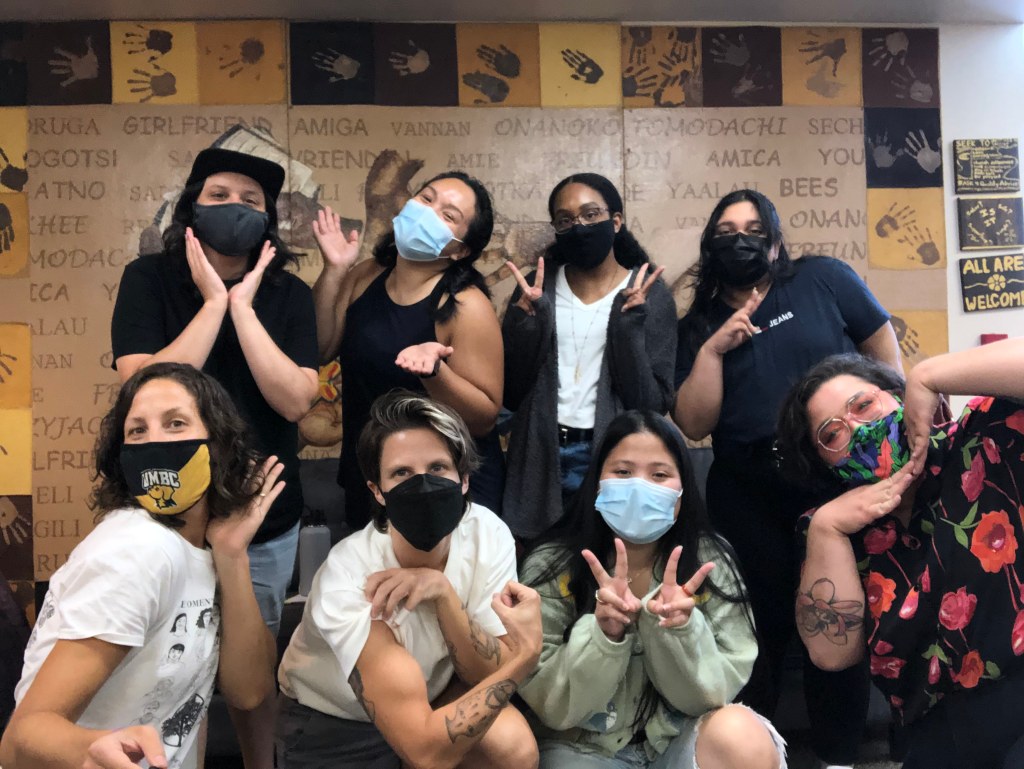 [Image Description: A group snapshot of this year’s 8 Women’s Center staff members. Four of us are standing in the background, while the other four sit in front. We’re all posing by throwing up peace signs, flexing, or doing jazz hands.]
Both image descriptions and alt text are used to describe an image or video being shared online, however, they can be displayed differently. These features are useful for a variety of reasons, for those with limited vision, language-learners, to transcribe difficult fonts, and so much more.
Usually, alt text is not visually displayed, as it primarily refers to the text added to the alt attribute within an image. In other words, alt text is embedded within an image for accessibility purposes and to be shown in the place of an image if it can’t load. Since screen readers can’t “read” an image, they read the alt text instead, passing on the information either through a Braille display or by reading it out in a synthetic voice. On platforms like Instagram and Twitter, alt text can be manually entered by selecting “advanced settings” and “+ALT” when sharing content online. When writing alt text, there are a few things you should keep in mind. There are usually character limits, so try to be short and concise! Consider the context, content, and function of the image and give a very brief description.
On the other hand, image descriptions can be lengthier and more detailed. They can be included in the main caption of a post or in a reply to the original content. When writing image descriptions, think about the reason for sharing an image and the information or message to be conveyed. If the image is a graphic, make sure to transcribe the text. If you’re sharing a picture of your funny dog, take some liberties in describing its goofy expression! You know your audience and their needs best, and the right tone to use when sharing information. Alex Chen, a product designer and writer in Chicago, recommends using a framework of object, action, and context in an attempt to stay concise while also communicating the full intent of the image. In this model, the object would be the main focus or subject of an image, the action would be what the object is doing or what is happening to it, while the context describes the surrounding environment and purpose. While these are only a few helpful pointers, image descriptions will naturally take a bit of practice and getting used to. Don’t be discouraged!
Video Captions and Video Transcriptions
So what about live video? Well, video captions divide speech transcripts using caption frames that are synchronized with the audio. These identify speakers and depict all speech and sound effects, including relevant sounds and inflections. Captions or sticker captions can be added on pre-recorded videos on some platforms such as Instagram and TikTok. Where live-streaming is possible, live captioning is typically available online with some paid services like 3playmedia. Otherwise, on Instagram specifically, auto-generated captions can be included when posting the saved video.
On the other hand, video transcriptions convert all spoken audio and information, including on-screen text and key visual information, into written textual descriptions. The main difference is that transcriptions are separate texts that aren’t synced to any audio, and can be either verbatim or clean read, the latter of which uses light edits to allow for readability.
Both captions and transcriptions are great to use when sharing video content online, and when used in conjunction with image descriptions in alt text, increase the accessibility of social media.
Other Good Practices
- When writing hashtags, use camel case: #CaptionLikeThis #notlikethis
- Place mentions and hashtags at the end of the post
- Use emojis sparingly, since each one is read out by screen readers
- Include trigger warnings and/or content warnings when sharing material that may include sensitive content for some people. Posting these warnings also empowers people to choose what they want to interact with online, or not
- It can be challenging to differentiate between low-contrast colors, so use an online high contrast color checker, such as this one by Coolors, to ensure your image is readable
- In text-based images, use one or two easy-to-read fonts, like Serif or Arial, with large text and ample spacing
Give Credit Where Credit Is Due!
When engaging with and sharing disability activists’ content online, give credit where it’s due! Follow, uplift, and take the time to reflect on what is being shared. When possible, support activists directly by financial means! Part of doing this learning is giving recognition to the people who have been taking the time to do the work of teaching disability justice. Giving credit and offering meaningful engagement are actions that can be so simple, and that go a long way in empowering others.
Just do it!
LINE friends’ Brown offers a thumbs up of encouragement.
While I’m just beginning to explore the ways I can make my online spaces more accessible, there’s still so much more for me to consider. People have advocated for baseline accessibility for a long time, so we must continue to address this and adapt to the needs of those around us. I invite readers to join me on this journey! What suggestions do you have to make social media more accessible? If these are new concepts for you, what’s one takeaway you’ll consider incorporating into your own practices? Feel free to share below in the comments or message on our social media!
We invite you to learn more about this year’s Critical Social Justice Initiative! Our next event, Crip Camp: Screening and Discussion will take place online on October 27th, from 3-6pm. If you would like to be involved in our upcoming events, subscribe to this WordPress and follow us on myUMBC.
Further Resources
]]>
Content Note: This post is written by Sara Stewart, a sophomore and student staff member at the Women’s Center. I am a non-disabled student, who, in my reading, work with CSJ, and personal...
https://womenscenteratumbc.wordpress.com/2021/10/22/creating-online-accessible-spaces/
https://my3.my.umbc.edu/api/v0/pixel/news/113552/guest@my.umbc.edu/b9a6b0984d2ac36e072e18575f903c3f/api/pixel
critical-social-justice
disability
disability-justice
disability-justice-and-neurodiversity
diversity-and-inclusion-issues
issues
social-justice
social-media
umbc
uncategorized
what-you-need-to-know
Women's, Gender, & Equity Center
https://my3.my.umbc.edu/groups/womenscenter
https://assets2-my.umbc.edu/system/shared/avatars/groups/000/000/125/78272a4842689b30dbf74672182b78f8/xsmall.png?1750974263
https://assets1-my.umbc.edu/system/shared/avatars/groups/000/000/125/78272a4842689b30dbf74672182b78f8/original.png?1750974263
https://assets1-my.umbc.edu/system/shared/avatars/groups/000/000/125/78272a4842689b30dbf74672182b78f8/xxlarge.png?1750974263
https://assets1-my.umbc.edu/system/shared/avatars/groups/000/000/125/78272a4842689b30dbf74672182b78f8/xlarge.png?1750974263
https://assets1-my.umbc.edu/system/shared/avatars/groups/000/000/125/78272a4842689b30dbf74672182b78f8/large.png?1750974263
https://assets2-my.umbc.edu/system/shared/avatars/groups/000/000/125/78272a4842689b30dbf74672182b78f8/medium.png?1750974263
https://assets1-my.umbc.edu/system/shared/avatars/groups/000/000/125/78272a4842689b30dbf74672182b78f8/small.png?1750974263
https://assets2-my.umbc.edu/system/shared/avatars/groups/000/000/125/78272a4842689b30dbf74672182b78f8/xsmall.png?1750974263
https://assets3-my.umbc.edu/system/shared/avatars/groups/000/000/125/78272a4842689b30dbf74672182b78f8/xxsmall.png?1750974263
Women's Center
3
0
false
Fri, 22 Oct 2021 15:31:35 -0400
Fri, 22 Oct 2021 15:31:35 -0400
CSJ 101 Round-Up: Disability Justice and Access Matters!
 A graphic for our first CSJ Disability Justice + Access Matters event, “CSJ 101: Disability Justice at UMBC + Beyond”
For more information on disability services at UMBC, including how to get accommodations and reporting issues of inaccessibility, please see our previous post outlining these resources.
This October, as we begin to recognize National Disability Awareness Month, we here in the Women’s Center are excited to relaunch Critical Social Justice with the theme of Disability Justice + Access Matters!
Our goal is for our conversations to build a vision of a world where all bodies are valued and essential, and where we acknowledge and affirm that other identities intersect, creating a unique lived experience. A society built on global capitalism, colonialism, and the multiple oppression of disabled people asserts everyday that people’s bodies are “expendable.” However, we work to challenge that idea and honor that everyone has inherent worth independent of their productivity or labor. As we attempt to “return to normal,” we have to reconsider who “normal” serves and take into account the lessons learned from how we have lived and survived through the pandemic. What can we do, and what should we do, to carry forward the practices of accessibility?
To kick off a year of Critical Social Justice events, we began with CSJ 101: Disability Justice at UMBC + Beyond. Leading this workshop was the Women’s Center’s own, Amelia Meman, who described for participants the current state of the disability rights movement and what disability justice means as a more radical concept.
Participants started by discussing a few definitions of disability justice and the ways it resonated with each individual. A few examples were intersectionality and the myth of a “neutral body”. The conversation then moved into highlighting some important founders of the disability justice movement, which included:
-
Patty Berne: co-founder and artistic director of Sins Invalid, a radical crip artist and activist group prioritizing queer people of color with disabilities
-
Mia Mingus: writer, educator, and trainer for transformative justice and disability justice
-
Stacey Park Milbern: a Bay Area-based organizer and disability justice thought leader
-
Leroy Moore Jr.: a Black artist, writer, poet, activist, feminist, founder of Krip Hop, and co-founder of Sins Invalid
These four figures (and several other queer and disabled activists) developed the idea of disability justice which prioritized the needs of disabled people located at the intersection of multiple identities, and thus, experience layered oppression. With this established, the discussion then illustrated a vision for disability justice (originally developed by Sins Invalid), where we recognize that:
- All bodies are considered unique and essential.
- All bodies have strengths and needs that must be met.
- Each and every person is powerful, not despite the complexities of our bodies, but because of them.
- All bodies are confined by ability, race, gender, sexuality, class, nation state, religion, and more, and we cannot separate them.
With the main founders and principles laid out, the group thought about how we do disability justice, starting with revisiting how we think about disability. The medical model of disability “others” people’s bodies by viewing them as something to be rehabilitated, fixed, or cured. Meanwhile, the social model was established to assert that disability is something born from people with impairments interacting with a society that doesn’t account for accessibility or justice in communication, interpersonal relationships, the political world, or in physical infrastructure. It is the social model which has provided the foundation for the disability justice movement, the idea that disability isn’t related to personal deficit, but that it is the result of an inaccessible society that “disables”.
Next, Amelia led the group through a few ways that allies and others with positional power can do the work to practice and leverage disability justice. This included accepting feedback and changing as necessary, learning about disability justice, considering how to use positional power to create intentional accessibility, making content and spaces accessible, and finally listening and centering disabled people’s experiences.
To wrap up CSJ 101, the group discussed their experiences with disability and access at UMBC and off-campus. Some of the experiences named by those in attendance were*:
- “I often experience the physical campus as inaccessible.”
- “Accessibility routes can be confusing and accommodations are limited for some.”
- “Ableist implicit biases inform us all. We are all unlearning ableism.”
- “I have had frustrating experiences of inconsistent communication and support.”
- “I feel like there is a general lack of understanding, compassion, and humility on the part of UMBC faculty, staff, and other students when it comes to disability access and equity, and in working with disabled students.”
- “The pandemic has made UMBC consider and vastly improve digital and remote accessibility. The hope is that these practices should not end with the effort to “return to normal,” especially since many disabled community members have required and asked for these services for a long time.”
- “We should question the nature of medicalization, and what is considered the “normal” expectation of how a person’s body should look and function in and out of the classroom.”
Just as CSJ 101 participants were left with these questions, we also urge readers and our community members to consider: “What does disability justice mean to you?” and “How will you incorporate disability justice into your life?” Even if it is through small practices such as changing vocabulary or practicing online accessibility, consider what you can do personally and in coordination with any positions of privilege to be in solidarity with the disabled community on and off-campus.
If you are interested, you can access a recording of the CSJ 101: Disability Justice at UMBC + Beyond. We also invite you to join us in our learning by attending our upcoming Critical Social Justice: Disability Justice and Access Matters events. Check out our myUMBC page and follow along by subscribing to this blog!
*Considering this was an event with a small subset of UMBC community members, these themes and personal experiences should be viewed as individual opinions. In other words, many others experiencing impairments may not share the same opinion that this campus feels inaccessible.
For those who are experiencing some level of inaccessibility or ableism, it is important to know that there are resources and offices at our UMBC with the express purpose of assisting to resolve these issues. For more information on student accommodations, please check out the Office of Student Disability Services. For more on UMBC faculty, staff, and visitor accommodations/access needs OR to make a report of an inaccessibility, please check out the Office of Accessibility and Disability Services. If you believe you are being treated unfairly because of your disability and/or impairments (or any other aspect of your social identities), please consider working with the Office of Equity and Inclusion to make a report (anonymous reporting options are also available).
]]>
A graphic for our first CSJ Disability Justice + Access Matters event, “CSJ 101: Disability Justice at UMBC + Beyond” For more information on disability services at UMBC, including how to get...
https://critsocjustice.wordpress.com/2021/10/08/csj-101-round-up-disability-justice-and-access-matters/
https://my3.my.umbc.edu/api/v0/pixel/news/118747/guest@my.umbc.edu/734225b8fa3656a377ffe8c0b91b5a72/api/pixel
critical-social-justice
csj-101
csj-disability-justice
csj-event
csj2021
reflections
social-justice
umbc
what-you-need-to-know
Women's, Gender, & Equity Center
https://my3.my.umbc.edu/groups/womenscenter
https://assets2-my.umbc.edu/system/shared/avatars/groups/000/000/125/78272a4842689b30dbf74672182b78f8/xsmall.png?1750974263
https://assets1-my.umbc.edu/system/shared/avatars/groups/000/000/125/78272a4842689b30dbf74672182b78f8/original.png?1750974263
https://assets1-my.umbc.edu/system/shared/avatars/groups/000/000/125/78272a4842689b30dbf74672182b78f8/xxlarge.png?1750974263
https://assets1-my.umbc.edu/system/shared/avatars/groups/000/000/125/78272a4842689b30dbf74672182b78f8/xlarge.png?1750974263
https://assets1-my.umbc.edu/system/shared/avatars/groups/000/000/125/78272a4842689b30dbf74672182b78f8/large.png?1750974263
https://assets2-my.umbc.edu/system/shared/avatars/groups/000/000/125/78272a4842689b30dbf74672182b78f8/medium.png?1750974263
https://assets1-my.umbc.edu/system/shared/avatars/groups/000/000/125/78272a4842689b30dbf74672182b78f8/small.png?1750974263
https://assets2-my.umbc.edu/system/shared/avatars/groups/000/000/125/78272a4842689b30dbf74672182b78f8/xsmall.png?1750974263
https://assets3-my.umbc.edu/system/shared/avatars/groups/000/000/125/78272a4842689b30dbf74672182b78f8/xxsmall.png?1750974263
Women's Center
0
0
false
Fri, 08 Oct 2021 14:04:46 -0400
Fri, 08 Oct 2021 14:04:46 -0400
Reflecting on My Nigerian Community: Learning How to Be an Ally to Survivors of Sexual Violence

Arifat (she/her/hers) is a Senior majoring in Social Work and Political Science. She is working in the Women’s Center this year for her social work field placement.
Content Note: This blog is written from my experience as a first-generation immigrant and a Nigerian-American. After reading I encourage to think about your own identities and communities of belonging especially in relation to the experiences of survivors of sexual violence and ways allyship can be cultivated by yourself and others.
When I started my internship at the Women’s Center last August, I did not know what to expect. We were going through a pandemic and I never imagined that I would have to do my social work field placement online. I was scared, uncertain and still adjusting to being in the virtual space. One of my assigned responsibilities was to be a co-facilitator for an online We Believe You discussion group. This is a group for survivors of power-based violence like sexual violence and domestic violence. I felt on unsolid ground as I navigated the unknown going into this experience. I kept asking myself, why couldn’t you have been asked to facilitate a different group? Why did it have to be this one? I was worried about how it would affect me mentally; I was worried about saying or doing the wrong thing; I wanted to help, but I was not familiar with providing support to survivors of sexual violence. Yes, I have had friends share their experiences with me, but in those moments when they shared their stories, I was clueless on how to be there for them. I did not know how to be a safe space or what a safe space meant. Fortunately, as I began my work with survivors, I began to learn.
Photo Credit: Women Center’s at UMBC.
Image Description: This is a Flyer that has varying colors of white pink and blue. The words “We Believe You” is written boldly. While “Discussion group” is written right under and “community building, support + Healing space for survivors” is written under that.
To me holding a safe space for survivors is not just about allowing them to share their stories with you. It is not just about nodding with a sad look on your face, but then acting like they never shared their story with you afterwards (trust me, I have inadvertently done this before!). Sometimes being a safe space is about the little things, like asking if they are comfortable with sharing a potentially triggering post and then accompanying it with a content note; checking up on them during stressful times; listening and believing them; asking them what they need, if they need anything that you are capable and comfortable with providing. It is also about educating yourself. Understanding that sexual violence comes in various forms, and it is does not always include physical violence. Most of all maintaining a safe space even when you assume there are no survivors in the spaces means that you are creating an environment that allows everyone to feel comfortable enough to share their experiences, their stories, and ask for support and help when they need it. Over the course of the past few months I have also realized this requires a brave space which is a framework the Women’s Center uses as a foundation to its programs and space. This means cultivating a space where everyone respects each other’s opinion and are able to challenge themselves or each other. The Women’s Center has a more in-depth outline of what it requires to create a brave space. It does take a tremendous amount of courage to in these spaces.
As someone who comes from a community of Africans and immigrants, it has been extra hard for me to show up for survivors. When talking to my parents’ generation and some of my agemates I have found that victim blaming and abuser enablement is rooted in our culture. As a child I witnessed and heard stories of extended families going to beg a wife and her family to come back to her husband. It did not matter that she left because of abuse. It did not matter that she did not feel safe anymore. All that mattered was that their marriage stayed intact. One can just imagine what the African LGBTQ+ community has to go through. Especially with countries like Nigeria, where homosexuality carries a criminal offense. LGBTQ+ survivors are not acknowledged, and oftentimes ignored when they speak up. Accusations of rape are often met with disbelieve, shame, and victim blaming. Being an ally in the African/Nigerian community means speaking out not only when it impacts you, but every time.
And, let me be clear. These challenges to a survivor-centered belief system is not isolated to only the Nigerian community. If you are from a different community think about what the culture behavior towards survivors looks like; what can you do to lend your voice to people from your community who have been victims of sexual violence. Educate yourself and those around you including family. There is a gap in the research on the prevalence of sexual violence in African immigrant communities, or most minority communities, but we are have the capacity to learn and increase awareness of this as a global issue that affects every culture and ethnicity. So, show up and speak out. Be a safe space for anyone who needs someone to believe in them. Find out about resources around you for survivors. You never know who might need it. If you are not sure where to start, some helpful articles will be attached at the end of this blog.
Photo credit: Marie Claire magazine.
Image Description: The picture focuses on two women standing together. One woman is black, while the other is white. They are both turned a way from the camera, and are facing a crowd of people. The crowd is blurred. A big LGBTQ+ pride flag is draped around both of them, and each person holds a hand flag.
African countries like Nigeria might not have laws and resources that protect survivors or victims of sexual violence and assault, but its immigrant community has the opportunity to do better. It might seem like a losing battle against biased cultural beliefs, but I believe it is a battle that can be won. Being at the Women’s Center has shown me the power in creating awareness. Sometimes all some people need is access to education. April is Sexual Assault Awareness Month, so as this month comes to an end I encourage you to a part of the solution. Consider ways in which intersecting identities inform a survivor’s experience as well. For example, as I referenced earlier, the LGBTQ community is one group that shoulders a disproportionate amount of sexual violence globally. This is a group that most minority cultures fail to acknowledge. So, ask questions of your community; Where do these beliefs come from? How can I be a safe space for people within my community? Whether they identify as LGBTQ+, a survivor, or both there is no better time than now.
Helpful Articles/ blogs:
Archives from the Women’s Center blog by clicking here, and here. You can also check out the virtual Take Back the Night experience.
6 Ways to Support a Survivor of Woman on Woman Sexual Violence
Our Society Divides Sexual Violence Survivors into Good and Bad Categories- And There’s an Oppressive History Behind it.
Nigeria has a Rape Culture too
]]>
Arifat (she/her/hers) is a Senior majoring in Social Work and Political Science. She is working in the Women’s Center this year for her social work field placement. Content Note: This blog...
https://womenscenteratumbc.wordpress.com/2021/04/30/reflecting-on-my-nigerian-community-learning-how-to-be-an-ally-to-survivors-of-sexual-violence/
https://my3.my.umbc.edu/api/v0/pixel/news/101419/guest@my.umbc.edu/a064925a925d450779c0d9a7b24c96db/api/pixel
black-lives-matter
black-voices
black-women
critical-social-justice
diversity-and-inclusion-issues
feminism
immigrant-survivors
intersectionality
lgbtq
nigerian
sexual-assault-awareness-month
sexual-violence
survivors-of-sexual-violence
Women's, Gender, & Equity Center
https://my3.my.umbc.edu/groups/womenscenter
https://assets2-my.umbc.edu/system/shared/avatars/groups/000/000/125/78272a4842689b30dbf74672182b78f8/xsmall.png?1750974263
https://assets1-my.umbc.edu/system/shared/avatars/groups/000/000/125/78272a4842689b30dbf74672182b78f8/original.png?1750974263
https://assets1-my.umbc.edu/system/shared/avatars/groups/000/000/125/78272a4842689b30dbf74672182b78f8/xxlarge.png?1750974263
https://assets1-my.umbc.edu/system/shared/avatars/groups/000/000/125/78272a4842689b30dbf74672182b78f8/xlarge.png?1750974263
https://assets1-my.umbc.edu/system/shared/avatars/groups/000/000/125/78272a4842689b30dbf74672182b78f8/large.png?1750974263
https://assets2-my.umbc.edu/system/shared/avatars/groups/000/000/125/78272a4842689b30dbf74672182b78f8/medium.png?1750974263
https://assets1-my.umbc.edu/system/shared/avatars/groups/000/000/125/78272a4842689b30dbf74672182b78f8/small.png?1750974263
https://assets2-my.umbc.edu/system/shared/avatars/groups/000/000/125/78272a4842689b30dbf74672182b78f8/xsmall.png?1750974263
https://assets3-my.umbc.edu/system/shared/avatars/groups/000/000/125/78272a4842689b30dbf74672182b78f8/xxsmall.png?1750974263
Women's Center
5
0
false
Fri, 30 Apr 2021 14:23:28 -0400
Fri, 30 Apr 2021 14:23:28 -0400