The Implementation of Title IX’s Effect on Survivors
By Claudia Gerry Social Work & Gender, Women’s and Sexuality Studies Major, Student Staff Member
Forward
This literature review was my final paper for Dr. Maria Celleri’s Methodologies in Gender, Women’s, and Sexuality Studies (GWST 300) course. I feel that this topic heavily applies to the work the Women’s, Gender, and Equity Center does. As a student staff member, I see how Title IX fails survivors, I see how it hurts survivors, and I see how it makes survivors’ lives just that much harder. I plan to continue this research and present it at URCAD 2027 in order to advocate for change not only on our UMBC campus but across the United States. So… here is a sneak peek!
Introduction
Sexual misconduct is a major problem everywhere, but specifically on college campuses. Sexual assault is defined as any form of unconsensual and unwanted sexual contact, which can include physical contact or sexual coercion (Holland & Cipriano, 2021). Sexual harassment within education is defined as behaviors sexual in nature that are “sufficiently severe, persistent, or pervasive to limit a student’s ability to participate in or benefit from the education program, or to create a hostile or abusive educational environment” (Holland & Howard Valdivia, 2026). Women and LGBTQ+ undergraduate students face the greatest risk of enduring sexual misconduct (Holland & Cipriano, 2021). Those who experience sexual assault often endure many mental health challenges and harms to their education (Holland & Cipriano, 2021), especially if they do not utilize support resources. The campus climate can foster barriers for survivors using these resources. Many survivors feel a minimization of sexual assault, fear of negative treatment, and have social-emotional concerns (Holland & Cipriano, 2021). Awareness of sexual violence is rooted in the second-wave feminist movement. But, this awareness mostly focused on the voices of white, well-educated women. There is a persistent struggle to understand the intersectionality of sexual assault (Jessup-Anger et al., 2018), even though this issue can affect every identity. This Literature review addresses how the implementation of Title IX policies affects survivors of sexual violence within higher education systems in the United States. To begin to understand this, we must know what Title IX is and how it has been implemented through time.
What is Title IX?
Title IX was passed in 1973 as part of the education amendments and is a civil rights law (Kaufman & Nelson, 2025). The main focus of this law is to prohibit sex-based discrimination in educational settings funded by the federal government (Kaufman & Nelson, 2025). Originally, the focus was set on inequality in admissions and educational opportunities, but the scope has widened since then (Kaufman & Nelson, 2025). Title IX has been used to increase access to women’s sports and require educational institutions to address sexual harassment and violence (Kaufman & Nelson, 2025). At the surface level, this law seems to help survivors of sexual assault, but in reality, it often harms the survivor more than it helps.
Every institution’s Title IX policies vary due to different levels of staffing, budget, and number of support and advocacy services. One uniform requirement across all institutions is the requirement of at least one Title IX coordinator, no matter the institution’s size (Kaufman & Nelson, 2025). The Title IX coordinator is located within the Title IX office, which at most universities is housed under the institution’s Equity and Civil Rights department.
The applications of Title IX have changed numerous times through new legislation, Office of Civil Rights (OCR) guidance, and presidential letters called Dear Colleague Letters (DCL). In 1980, Alexander v. Yale argued that sexual harassment in educational institutions constitutes sex-based discrimination under Title IX (Holland & Howard Valdivia, 2026) and is still the precedent today. The main acts passed that affect Title IX are: 1990 Clery Act, 1992 Campus Sexual Assault Victim’s Bill of Rights, 1994 Violence Against Women Act, and 2013 Campus SaVE Act. These acts mainly attempt to address funding for survivor services, requirements for prevention training, and public disclosure of crime rates.
What really affects Title IX implementation the most are DCLs. In 2011, the Obama-era DCL was released. The Obama DCL called attention to the issue of sexual violence on college campuses, reminded Higher Education Institutions (HEIs) of Title IX guidelines, and added additional recommendations. This letter classified sexual violence under the umbrella of sex discrimination under Title IX, lowered investigatory standards of proof, and made it legal to withhold funds from HEIs for not complying (Kaufman & Nelson, 2025). In 2017, the Donald Trump era DCL was released and focused heavily on concerns for the (rights of the) accused (Holland & Howard Valdivia, 2026). The Trump DCL withdrew the Obama DCL and announced new regulations. The main changes were changes in definitions of sexual violence, limited the scope of what HEIs are required to address, added more requirements for formal adjudication, and emphasized the rights of respondents over the well-being of survivors (Webermann et al., 2023). In 2024, the Title IX regulations were changed once again by Joe Biden’s administration. These regulations expanded the scope of conduct covered under the policy and for the most part were similar to 2020 but gave HEIs more discretion (Holland & Howard Valdivia, 2026). Today, we are under the 2025 DCL. This DCL edits the 2024 regulations to include that HEIs “must continue to comply with the 2020 Title IX regulations and operate under the presumption of (inaccurate) binary, biological sex” (Holland & Howard Valdivia, 2026). Overall, Title IX policies have been said to be a political football being passed around and changed with every administration. This makes Title IX regulations hard to understand for the average person. So, not everyone understands their rights and what is expected of their institutions.
Title IX in Action
A theoretical framework to understand the importance of survivors’ interactions with the Title IX Office is the theory of institutional betrayal. Both Webermann et al. (2023) and Holland and Cipriano (2021) use this framework to understand the effects of Title IX on survivors. Institutional betrayal shows the unique ways institutions can harm marginalized groups and “conceptualizes wrongdoings perpetrated by an institution when people are dependent upon the institution and can expect that it will protect its members from harm and will respond appropriately if harm is endured” (Holland & Cipriano, 2021). Students expect their institutions to take steps to restore their access to education, but when the institution fails to do so, there can be negative consequences that can include erosion of trust and belonging at the institution (Holland & Cipriano, 2021). Failures of the institution can be: failure to prevent abuse, normalizing of abusive contexts, difficult reporting procedures, inadequate responses to reports, cover-ups, misinformation, and punishing survivors (Webermann et al., 2023). Survivors who experience institutional betrayal report increased levels of psychological harm (Holland & Cipriano, 2021).Title IX overall affects survivors negatively.
First, Title IX cases are supposed to take up to 60 days to be resolved, but the average length of cases in Webermann’s study is 175.36 days (Webermann et al., 2023). Many institutions elect to have the minimum number of coordinators- one. Staffing levels in the Title IX office affect how long cases may take (Kaufman & Nelson, 2025), so many institutions’ Title IX offices are not staffed enough for every case to be resolved within the 60-day timeframe. Many survivors see major variability in the transparency of their case. Some survivors receive multiple updates and reassurances about their case, while others get little to none (Holland & Cipriano, 2021). According to Holland and Cipriano (2021), “Recent research has found that the majority of sexual assault reports to Title IX Offices do not result in formal investigations and, of those that are investigated, there is rarely a finding of ‘responsibility’”. Many survivors believe that the length of their case affected the outcomes. For example, witnesses may forget parts of their story over time or the respondent might leave the institution before disciplinary action is taken (Webermann et al., 2023).
Second, many survivors report negative treatment from the Title IX office. This negative treatment can include victim-blaming, name-calling, stalling of cases, and being told the institution can do nothing about the case. Holland and Cortina (2017a) found that of the three main support systems they examined (Title IX office, sexual assault center, and housing staff), the Title IX office was not utilized by survivors because of “negative emotions, consequences, contextual characteristics, minimization of behaviors, and alternative coping strategies”. According to Holland and Cipriano (2021), negative reactions to sexual assault disclosures can cause significant psychological harm for survivors.
Third, many survivors experience barriers in receiving support. Kaufman and Nelson (2025) found that “Too often, survivors of sexual assault do not know where to turn and do not receive the support they need despite the seemingly ‘robust’ federal legislation that seeks to address campus sexual violence”. Many survivors deliberately avoid the Title IX office due to fears of poor treatment (Holland & Cipriano, 2021). Within Webermann et al.’s (2023) study, many participants felt unclear about the Title IX reporting process and their options.
Survivors are expected to retell the worst moments of their lives numerous times, reliving it every. single. time. According to Webermann et al. (2023), the survivors in their study had to tell their stories to 2.88 different offices/individuals, not including formal grievance procedures or court procedures. If a survivor wants to make a report and seek justice, they are put in more harm. To help themselves, they have to harm themselves. “It was not just the outcome of their case that caused harm but also the process itself”(Webermann et al., 2023).
Future Steps
Due to all these reasons listed above, survivors are discouraged from standing up for themselves. Working at the Women’s, Gender, and Equity Center (WGEC) has shown me how Title IX actually operates in real life. In my personal experience, the system has failed survivors. Many survivors seek support from the WGEC, as we are a confidential space, and they do not want to bother with reporting to the UMBC Title IX office. The reasons I have heard are: knowing how the office treats other survivors, knowing how many times they will have to relive what they have gone through, concerns over social circumstances, minimization of what happened to them, and many more. With the perpetual changing of guidelines, many survivors do not understand what their institution can do for them anymore, making them give up and move on. At many institutions, there are requirements for mandatory reporting, where staff and faculty are required to report sexual misconduct disclosures to the Title IX office. Many staff and faculty are in the same boat of confusion about what the guidelines are, leading individual reporters to either report too much or too little. In my experience, professors are not trained on what is to be reported and what happens to the student after a report is filed. This leaves students cautious about talking about their experiences in fear of being non-consensually reported.
Many changes need to be made in order to ensure the success of survivors. First, there needs to be an implementation of an oversight committee to ensure the Title IX office acts swiftly, equitably and with accountability (Holland & Cipriano, 2021). This committee could also oversee trauma-informed training for Title IX Office staff and mandated reporters. “Using formal supports that are trauma-informed and survivor-centered can promote psychological well-being for survivors” (Holland & Cipriano, 2021). Second, there needs to be an effort to address the root cause of sexual violence instead of focusing on the aftereffects. “Although most universities comply with Title IX, many side-step confronting the root causes of normalized sexual violence and avoid teaching the realities of campus sexual violence, leaving students confused, isolated, and unsure of how to address the trauma that they or their friends experience”(Kaufman & Nelson, 2025). Third, to address institutional betrayal, we must flip it to institutional support. This can include “supportive responses from individuals within institutions to survivors, such as believing them, apologizing for their experiences, connecting them with resources, and providing autonomy in what happens after reporting”(Webermann et al., 2023). Lastly, frontline workers within the survivor support services need more say in the implementation of Title IX. “Oftentimes, frontline workers, such as victim advocates, are absent from the policy table, yet this article underscores the importance of their positionality and experiences for addressing vulnerabilities in the campus sexual violence intervention system”(Wies, 2015).
Conclusion
Ultimately, under the system we have set in place, Title IX is failing survivors of sexual violence in HEIs in the United States. Survivors are expected to advocate for themselves when their words have been ignored in the past. The Title IX office worries too much about getting sued by the respondent to bring justice for the survivor. Survivors experience major mental health and educational challenges even though Title IX is supposed to ensure equal access to education. If a survivor reports their institution for violation of Title IX policy, the report can take years to process, so Title IX offices are not held accountable. This is why we need to change the policy ONE last time. Modifying Title IX every few years only causes more confusion. We need to support survivors. Survivors need to feel supported, seen, and heard by their institutions.
References
Brubaker, S. J., Keegan, B., Guadalupe-Diaz, X. L., & Beasley, B. (2017). Measuring and reporting campus sexual assault: Privilege and exclusion in what we know and what we do. Sociology Compass, 11(12), e12543. https://doi.org/10.1111/soc4.12543
Holland, K. J., & Cipriano, A. E. (2021). Does a report = support? A qualitative analysis of college sexual assault survivors’ Title IX Office knowledge, perceptions, and experiences. Analyses of Social Issues and Public Policy, 21(1), 1054–1081. https://doi.org/10.1111/asap.12271
Holland, K. J., & Cortina, L. M. (2017a). “It Happens to Girls All the Time”: Examining Sexual Assault Survivors’ Reasons for Not Using Campus Supports. American Journal of Community Psychology, 59(1-2), 50–64. https://doi.org/10.1002/ajcp.12126
Holland, K. J., & Cortina, L. M. (2017b). The evolving landscape of Title IX: Predicting mandatory reporters’ responses to sexual assault disclosures. Law and Human Behavior, 41(5), 429–439. https://doi.org/10.1037/lhb0000253
Holland, K. J., & Howard Valdivia, R. L. (2026). Title IX and Sexual Violence in Higher Education: A Mapping Review and Assessment of Policy Implementation and Effectiveness. The Journal of Sex Research, 1–19. https://doi.org/10.1080/00224499.2026.2623649
Jessup-Anger, J., Lopez, E., & Koss, M. P. (2018). History of Sexual Violence in Higher Education. New Directions for Student Services, 2018(161), 9–19. https://doi.org/10.1002/ss.20249
Kaufman, S. B.-S., & Nelson, L. (2025). Interpreting title IX: A feminist legal geography of sexual assault prevention on U.S. college campuses. Political Geography, 116(5), 103252. https://doi.org/10.1016/j.polgeo.2024.103252
Webermann, A. R., Holland, K. J., & Murphy, C. M. (2023). Student Experiences Reporting Sexual and Gender-Based Misconduct to the Title IX Office at a Public State University. Violence against Women, 30(6-7), 107780122211502. https://doi.org/10.1177/10778012221150274
Wies, J. R. (2015). Title IX and the State of Campus Sexual Violence in the United States: Power, Policy, and Local Bodies. Human Organization, 74(3), 276–286. https://doi.org/10.17730/0018-7259-74.3.276
]]>
By Claudia Gerry Social Work & Gender, Women’s and Sexuality Studies Major, Student Staff Member Forward This literature review was my final paper for Dr. Maria Celleri’s...https://womenscenteratumbc.wordpress.com/2026/05/30/the-implementation-of-title-ixs-effect-on-survivors/https://my3.my.umbc.edu/api/v0/pixel/news/160449/guest@my.umbc.edu/3a509ba1a892eceaa8295d5a7f9c8a7c/api/pixelactivismcritical-social-justicefeminismhigher-educationpoliticssexual-assaultsocial-justicestaffsurvivorssurvivors-of-sexual-violencetitle-ixumbcwomens-center-staffwritingWomen's, Gender, & Equity Centerhttps://my3.my.umbc.edu/groups/womenscenterhttps://assets2-my.umbc.edu/system/shared/avatars/groups/000/000/125/78272a4842689b30dbf74672182b78f8/xsmall.png?1750974263https://assets1-my.umbc.edu/system/shared/avatars/groups/000/000/125/78272a4842689b30dbf74672182b78f8/original.png?1750974263https://assets1-my.umbc.edu/system/shared/avatars/groups/000/000/125/78272a4842689b30dbf74672182b78f8/xxlarge.png?1750974263https://assets1-my.umbc.edu/system/shared/avatars/groups/000/000/125/78272a4842689b30dbf74672182b78f8/xlarge.png?1750974263https://assets1-my.umbc.edu/system/shared/avatars/groups/000/000/125/78272a4842689b30dbf74672182b78f8/large.png?1750974263https://assets2-my.umbc.edu/system/shared/avatars/groups/000/000/125/78272a4842689b30dbf74672182b78f8/medium.png?1750974263https://assets1-my.umbc.edu/system/shared/avatars/groups/000/000/125/78272a4842689b30dbf74672182b78f8/small.png?1750974263https://assets2-my.umbc.edu/system/shared/avatars/groups/000/000/125/78272a4842689b30dbf74672182b78f8/xsmall.png?1750974263https://assets3-my.umbc.edu/system/shared/avatars/groups/000/000/125/78272a4842689b30dbf74672182b78f8/xxsmall.png?1750974263Women's Center20falseSat, 30 May 2026 21:37:55 -0400Am I an Activist?
What comes to mind when I think of an activist are images of figures like MLK Jr., Gandhi, Rosa Parks, and others who became symbols of resistance, fighting for civil rights, freedom, equality, or education. This association has made activism feel out of reach for me, something only the Malcolm Xs and Malala Yousafzais of the world can do. I never felt I had the ability or power to do things like organize a protest, start a hunger strike, or other major forms of activism, therefore I didn’t consider myself an “activist.” Yet, I always spread awareness on social justice issues that I’m passionate about, whether it’s posting on my social media channels, implementing themes into my photography, or academic writing.
While social media activism has become synonymous with “slacktivism,” spreading awareness within one’s circle of influence is the first step toward creating change. Problems that we face as individuals are often public issues, even if it feels like we are the only ones struggling. Therefore social media can be a key tool in organizing for change because the more we talk about issues important to us, the more can be done to address them. I often find myself asking “what can I do about it?”, waiting for some opportunity to present itself before I get involved as an “activist.” But I am reminded of President JFK’s famous quote “Ask not what your country can do for you, ask what you can do for your country.” This mentality requires us to self-reflect on what skills we bring to the table.
Activism can take shape in many forms. Rallying in the streets of DC, chaining myself to a tree, or engaging in sit-ins aren’t the be-all end-all of activism. I often shy away from activism because I think I don’t have the position or power to be an activist. However, anyone can be an activist if you utilize the skills and resources you do have. Social change relies on an ecosystem where each of us plays a different role. This framework developed by activist and writer Deepa Iyer, calls us to reflect on our roles in the social change ecosystem. Whether we’re the healers, experimenters, storytellers, disrupters, Iyer says everyone has a role to play in the “pursuit of equity, shared liberation, inclusion, and justice.”
Reflecting on my personal experience, I’ve been able to engage in activism through the opportunities I’ve found at UMBC. In March of 2024, I was a participant in the Alternative Spring Break (ASB) experience through the Center for Democracy and Civic Life. During this trip, I was part of the group called “Improving Life After Prison” which was looking into the incarceration system in Baltimore City. We met with various community leaders, organizations, city officials, and those with personal experience in the incarceration system to get a better understanding of the issues people face and the work being done to address them. Although the trip was just a few short days, it was very eye-opening for me, as it was not an issue I was familiar with prior. I was inspired to engage in this important work myself, and decided to apply for an ASB leadership position this year. For the past few months, my co-leader and I have been working to develop an ASB program for Spring 2025, around environmental justice and sustainability. Our hope is to give this year’s cohort as meaningful of an experience as it was for us, so that they may develop the skills and confidence to create change beyond ASB.
As part of my role at the Women’s Center, I’ve also been given the opportunity to engage in activism through the work we do. In many ways, we are working to bring about social change, such as changing the campus climate to that of a more inclusive environment. Through discussion-based programs, educational workshops, or the Take Back the Night Rally, the Women’s Center has empowered me to engage in activism in ways I didn’t think possible before.
Photos taken by me at the Take Back the Night rally 2024
Engaging in student activism has been a transformative journey for me, one that wouldn’t be possible without the many opportunities UMBC provides. It’s taught me that activism isn’t just protests and rallies, it’s a mindset and commitment to making a difference, no matter how small the act may seem. Whether it’s through organizing events, amplifying voices, or fostering meaningful conversations, as students we have the unique power to create ripples of impact. My journey is ongoing. But it has reaffirmed for me that anyone can be an activist, as long as they are driven to make the world a better place.
]]>
What comes to mind when I think of an activist are images of figures like MLK Jr., Gandhi, Rosa Parks, and others who became symbols of resistance, fighting for civil rights, freedom, equality, or...https://womenscenteratumbc.wordpress.com/2024/12/20/am-i-an-activist/https://my3.my.umbc.edu/api/v0/pixel/news/146396/guest@my.umbc.edu/d1d6cb46a6fbeac5bec0b8ded4272a57/api/pixelactivismcritical-social-justicepoliticssocial-justiceWomen's, Gender, & Equity Centerhttps://my3.my.umbc.edu/groups/womenscenterhttps://assets2-my.umbc.edu/system/shared/avatars/groups/000/000/125/78272a4842689b30dbf74672182b78f8/xsmall.png?1750974263https://assets1-my.umbc.edu/system/shared/avatars/groups/000/000/125/78272a4842689b30dbf74672182b78f8/original.png?1750974263https://assets1-my.umbc.edu/system/shared/avatars/groups/000/000/125/78272a4842689b30dbf74672182b78f8/xxlarge.png?1750974263https://assets1-my.umbc.edu/system/shared/avatars/groups/000/000/125/78272a4842689b30dbf74672182b78f8/xlarge.png?1750974263https://assets1-my.umbc.edu/system/shared/avatars/groups/000/000/125/78272a4842689b30dbf74672182b78f8/large.png?1750974263https://assets2-my.umbc.edu/system/shared/avatars/groups/000/000/125/78272a4842689b30dbf74672182b78f8/medium.png?1750974263https://assets1-my.umbc.edu/system/shared/avatars/groups/000/000/125/78272a4842689b30dbf74672182b78f8/small.png?1750974263https://assets2-my.umbc.edu/system/shared/avatars/groups/000/000/125/78272a4842689b30dbf74672182b78f8/xsmall.png?1750974263https://assets3-my.umbc.edu/system/shared/avatars/groups/000/000/125/78272a4842689b30dbf74672182b78f8/xxsmall.png?1750974263Women's Center10falseFri, 20 Dec 2024 16:30:43 -0500Fri, 20 Dec 2024 16:30:43 -0500“The Lone Soldier”—Being the Only Advocate in the Room
To quote myself from the start of my first semester here at UMBC, “I have somewhat of a unique position in that I often find myself standing in the middle of the line–I am biracial, bisexual, nonbinary, and have lived below the poverty line in an upper middle to high class area. I straddle many fences, and those experiences have made me sympathetic to both sides. It can be difficult to bridge the gap between marginalized and privileged groups.” I said these things in a reflection on my own activism, contemplating whether or not I could consider myself an activist. To be honest, sometimes I still don’t quite feel like I deserve that title, but I do my best.
Since then, I have learned quite a bit (which one would hope would be the case, considering how much tuition costs). As is the case with any knowledge, situations will arise where you are the only one in the room who is knowledgeable about the subject. Sometimes the conversation is trivial, and it doesn’t matter how much or how little you know about the subject. Sometimes the conversation is important, and your expertise is vital to understanding.
I have often been told that the way I speak, with assertive confidence, gives others the impression that I know what I’m talking about. While I do spend a lot of my free time learning new things, I am by no means an expert in anything but my own experiences. When I have to talk about something I haven’t experienced, I try to pull on what I’ve learned from others who have. But of course, trying to talk about something I haven’t experienced is much more difficult than talking about something I have. And this poses a problem when I’m the most knowledgeable person in the room on the subject.
Most recently, this situation arose while talking with a friend about MoistCr1TiKaL’s response to iDubbbz’s apology for his racist content. For those out of the loop, both MoistCr1TiKaL and iDubbbz are white YouTubers. MoistCr1TiKaL’s content largely focuses on commentary on internet culture and news, and iDubbbz is most well-known for his past comedic content. Unfortunately, a lot of that past comedic content was racist. iDubbbz recognized this, albeit years later, and apologized for the harm his content caused. MoistCr1TiKaL then responded, and subsequently doubled down, that iDubbbz’s apology was unnecessary. MoistCr1TiKaL’s own audience disagreed with him, and several other YouTube commentators put out videos running down the whole situation. D’Angelo Wallace’s and Kat Blaque’s videos discussing the topic provide comprehensive rundowns of the situations and a nuanced discussion about racism and accountability, for those interested.
While talking with this friend, they mentioned not finding the situation all that important. They said they found it almost laughable when people used slurs because, to them, it devalued the racist meaning of the word and made the user look like a fool. This came from their experiences of being both Black and Hispanic and experiencing racism that was much more difficult to deal with than a random creator on the internet. I pointed out that this kind of racism was harmful, too, and it normalized it and harmed others, even if it didn’t personally hurt my friend. But I felt out of my depth; I am white-passing, and my personal experiences with racism are complicated. The way I move through the world is completely different to how my friend moves through the world. In helping my friend understand why such content was harmful, I had to stare into the abyss of my (lack of) knowledge—and it stared back; I was wildly unequipped for this conversation, but if I didn’t have it, I wasn’t sure anyone else in my friend’s life would. So I sent them Kat Blaque’s video on the situation, trusting that her words would make more sense than mine, and that her experiences would resonate more with my friend.
But being the only advocate doesn’t always mean you’re the one who knows the most—sometimes it means you’re the only one willing to speak up. Some groups are so stigmatized that broaching the topic with the wrong crowd can cause conflict. Take, for example, furries. Last semester, I wrote a literature review that argued against the bias that academia holds against furries, and ended with a call to action. This was not, however, a popular topic; most people seemed startled or uncomfortable with the subject. Furry fandom was not something I was very familiar with at the time, but my paper was born from frustration at constant criticism of furries, and even genocidal jokes about them in group chats, largely fueled by misinformation and harmful stereotypes. My concerns about the popularity of using furries as a punching bag were overlooked, even by close friends.
Discussing taboo topics is not easy; you are liable to be given a label you don’t identify with, or even a derogatory one, when you defend a group people love to hate. The main question I received when writing the literature review was, “Are you a furry?” While the frustration of being asked that question did not stop me from continuing my research, the implications can stop others from publicly advocating for a group of people. Sometimes the barrier to being an advocate is simply not wanting to be the one who’s targeted. But the less people who speak up, the harder it is for others to. For some closeted queer people, advocating for queer rights can be dangerous, as it could draw unwanted attention that could pose a physical threat to their lives. The more often we advocate for the fair and equitable treatment of others, the harder it is to target individuals, and the easier it is for others to get involved.
But knowing that doesn’t make it easy. Even with as vocal as I am, I get nervous when I share my opinions. People can be unpredictable; even those you know best can manage to shock you. For courage, I follow the mantra they teach you in kindergarten: “treat others the way you want to be treated.” When I don’t have the courage to speak up, I hope that others will in my stead. How many times growing up did I witness something that I felt powerless to change, if only one other person had stood up for me? Making the world a better place sometimes means stepping up and being the person you needed when you were younger.
Activism looks different for everyone. For some, it is going out and marching or walking out in protest. Some choose to utilize social media to spread awareness and use the algorithm for greater good. For myself, I like to use the definition Dr. Kate Drabinski gave us in her GWST 200 course on activism: “living life in accordance with one’s values.” Whether you choose to be vocal or provide support from the sidelines, it is important that we show up for each other—especially when it may be difficult to do so.
]]>
To quote myself from the start of my first semester here at UMBC, “I have somewhat of a unique position in that I often find myself standing in the middle of the line–I am biracial, bisexual,...https://womenscenteratumbc.wordpress.com/2024/05/16/the-lone-soldier-being-the-only-advocate-in-the-room/https://my3.my.umbc.edu/api/v0/pixel/news/142037/guest@my.umbc.edu/d3ecd652259df0a77e408dc1c16b745c/api/pixelactvisimadvocacybipoc-voicesdiversity-and-inclusion-issueseducationfeminismgrowthintersectionalitylatinx-voicesmental-healthpoliticspop-culturepride-voicesracismstudent-lifeWomen's, Gender, & Equity Centerhttps://my3.my.umbc.edu/groups/womenscenterhttps://assets2-my.umbc.edu/system/shared/avatars/groups/000/000/125/78272a4842689b30dbf74672182b78f8/xsmall.png?1750974263https://assets1-my.umbc.edu/system/shared/avatars/groups/000/000/125/78272a4842689b30dbf74672182b78f8/original.png?1750974263https://assets1-my.umbc.edu/system/shared/avatars/groups/000/000/125/78272a4842689b30dbf74672182b78f8/xxlarge.png?1750974263https://assets1-my.umbc.edu/system/shared/avatars/groups/000/000/125/78272a4842689b30dbf74672182b78f8/xlarge.png?1750974263https://assets1-my.umbc.edu/system/shared/avatars/groups/000/000/125/78272a4842689b30dbf74672182b78f8/large.png?1750974263https://assets2-my.umbc.edu/system/shared/avatars/groups/000/000/125/78272a4842689b30dbf74672182b78f8/medium.png?1750974263https://assets1-my.umbc.edu/system/shared/avatars/groups/000/000/125/78272a4842689b30dbf74672182b78f8/small.png?1750974263https://assets2-my.umbc.edu/system/shared/avatars/groups/000/000/125/78272a4842689b30dbf74672182b78f8/xsmall.png?1750974263https://assets3-my.umbc.edu/system/shared/avatars/groups/000/000/125/78272a4842689b30dbf74672182b78f8/xxsmall.png?1750974263Women's Center100falseThu, 16 May 2024 14:58:40 -0400Thu, 16 May 2024 14:58:40 -0400REPOST: Black Disability History Talk: 504 and BeyondDr. Sami Schalk: Disability Politics w/ Black Panther Party
Sami Schalk, Associate Professor, Gender and Women’s Studies, University of Wisconsin-Madison will be speaking on campus on Thursday February 23rd at 4:00 p.m. in the Performing Arts and Humanities Building Room 132. To RSVP for this in-person event, click on the website button below.
Drawing from the book, Black Disability Politics, this talk will detail the Black Panther Party’s involvement in the 1977 504 Sit-in, in which protesters around the country picketed and occupied government offices to urge passage of delayed regulations related to Section 504 of the Rehabilitation Act of 1973. Schalk will discuss the sit-in as an historical example of how Black cultural workers have engaged with disability as a political issue in ways that have sometimes been obscured in Black studies and disability studies alike.
This lecture is organized by the Dresher Center for the Humanities.
Biography:Dr. Sami Schalk (she/her) is an associate professor of Gender & Women’s Studies at the University of Wisconsin-Madison. She is the author of Bodyminds Reimagined: (Dis)ability, Race and Gender in Black Women’s Speculative Fiction (Duke 2018) and Black Disability Politics (Duke 2022). Dr. Schalk’s academic work focuses on race, disability, and gender in contemporary American literature and culture. She also writes for mainstream outlets, including a monthly column called “Pleasure Practices” in TONE Madison. Dr. Schalk identifies as a fat, Black, queer, disabled femme and a pleasure activist.
Co-sponsored by the Initiatives for Identity, Inclusion, and Belonging (I3B); and the Office of Accessibility and Disability Services.
ASL Interpretation will be provided. Masks are strongly encouraged.
Image description: A multi-racial group of four students is laughing and talking at an outdoor table on UMBC's campus. An image of Dr. Schalk is provided on the Dresher event website.
UMBC is committed to creating an accessible and inclusive environment for all students, staff, and visitors. If you would like to request a disability-based accommodation on site or have questions about this event or its location, please contact us at dreshercenter@umbc.edu.
]]>
Sami Schalk, Associate Professor, Gender and Women’s Studies, University of Wisconsin-Madison will be speaking on campus on Thursday February 23rd at 4:00 p.m. in the Performing Arts and...https://my3.my.umbc.edu/groups/dreshercenter/events/113876https://my3.my.umbc.edu/api/v0/pixel/news/130931/guest@my.umbc.edu/05730d6a6f11def7f42d2af82a062ca2/api/pixelaccessibilityblackcivildcdisabilitydiversityinclusionintersectionalitypantherpoliticsrightssamischalkstudiesOffice of Disability Access and Resourceshttps://my3.my.umbc.edu/groups/accessibilityhttps://assets4-my.umbc.edu/system/shared/avatars/groups/000/001/480/1109171419a1b66ae0d9168429adfb61/xsmall.png?1565792941https://assets1-my.umbc.edu/system/shared/avatars/groups/000/001/480/1109171419a1b66ae0d9168429adfb61/original.jpg?1565792941https://assets1-my.umbc.edu/system/shared/avatars/groups/000/001/480/1109171419a1b66ae0d9168429adfb61/xxlarge.png?1565792941https://assets4-my.umbc.edu/system/shared/avatars/groups/000/001/480/1109171419a1b66ae0d9168429adfb61/xlarge.png?1565792941https://assets3-my.umbc.edu/system/shared/avatars/groups/000/001/480/1109171419a1b66ae0d9168429adfb61/large.png?1565792941https://assets1-my.umbc.edu/system/shared/avatars/groups/000/001/480/1109171419a1b66ae0d9168429adfb61/medium.png?1565792941https://assets1-my.umbc.edu/system/shared/avatars/groups/000/001/480/1109171419a1b66ae0d9168429adfb61/small.png?1565792941https://assets4-my.umbc.edu/system/shared/avatars/groups/000/001/480/1109171419a1b66ae0d9168429adfb61/xsmall.png?1565792941https://assets1-my.umbc.edu/system/shared/avatars/groups/000/001/480/1109171419a1b66ae0d9168429adfb61/xxsmall.png?1565792941Office of Accessibility & Disability Serviceshttps://assets3-my.umbc.edu/system/shared/thumbnails/news/000/130/931/e2add96e57560ae7ffcf65d93deac5ca/xxlarge.jpg?1676410628https://assets1-my.umbc.edu/system/shared/thumbnails/news/000/130/931/e2add96e57560ae7ffcf65d93deac5ca/xlarge.jpg?1676410628https://assets4-my.umbc.edu/system/shared/thumbnails/news/000/130/931/e2add96e57560ae7ffcf65d93deac5ca/large.jpg?1676410628https://assets1-my.umbc.edu/system/shared/thumbnails/news/000/130/931/e2add96e57560ae7ffcf65d93deac5ca/medium.jpg?1676410628https://assets3-my.umbc.edu/system/shared/thumbnails/news/000/130/931/e2add96e57560ae7ffcf65d93deac5ca/small.jpg?1676410628https://assets4-my.umbc.edu/system/shared/thumbnails/news/000/130/931/e2add96e57560ae7ffcf65d93deac5ca/xsmall.jpg?1676410628https://assets2-my.umbc.edu/system/shared/thumbnails/news/000/130/931/e2add96e57560ae7ffcf65d93deac5ca/xxsmall.jpg?167641062820falseThu, 16 Feb 2023 11:05:21 -0500Fri, 17 Feb 2023 16:18:46 -0500Mutual Aid: One for All and All for One
Nandi is a student staff member in the Women’s Center and a Junior English major.
Mutual aid, as a concept, is based in anarchism and the work of Petr Kropotkin. His work, “Mutual Aid: A Factor of Evolution”, is a foundational text for anarchists and other communist movements. But really, you don’t have to be an anarchist or a communist, or know anything about these ideologies to practice mutual aid because it’s an extremely simple concept.
Basically, the theory supposes that people (and other creatures) are FAR more inclined to taking care of each other than they are to individualism, no matter how much our capitalist ruling class argues to the contrary. The Seattle-based collective Big Door Brigade defines the practical application of mutual aid as “when people get together to meet each other’s basic survival needs with a shared understanding that the systems we live under are not going to meet our needs and we can do it together RIGHT NOW!” They also make the point that it is a separate and distinct practice from charity and charitable organizations.
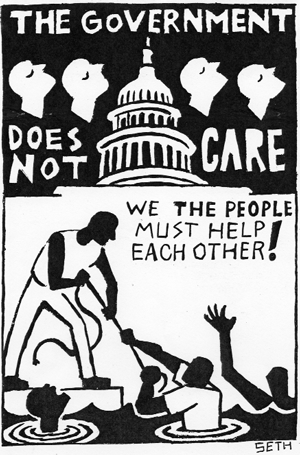
Image by Seth Tobocman
Historically, mutual aid looks a lot of different ways. The Free African Society in 1787 was an organization meant to provide aid amongst free Black people. In the 20th century, there were Italian-American organizations called Societa di Mutuo Soccorso and Mexican-American societies called Sociedad Mutualistas. Larger worker movements and labor unions are also a part of this tradition as they necessitate collaboration and care work as a means to stay afloat while struggling for rights. Labor organizing in the US is at its lowest point in decades, but that doesn’t mean that we still can’t connect to our communities right now in the present to help everyone survive.
In feminist movements, mutual aid is a thread that runs throughout as an ongoing necessity among those who are oppressed under patriarchy. It’s not hard to see why; power-based violence, hiring discrimination, and wage gaps all team up to make people of oppressed genders dependent on one another rather than the institutions that their oppressors control.
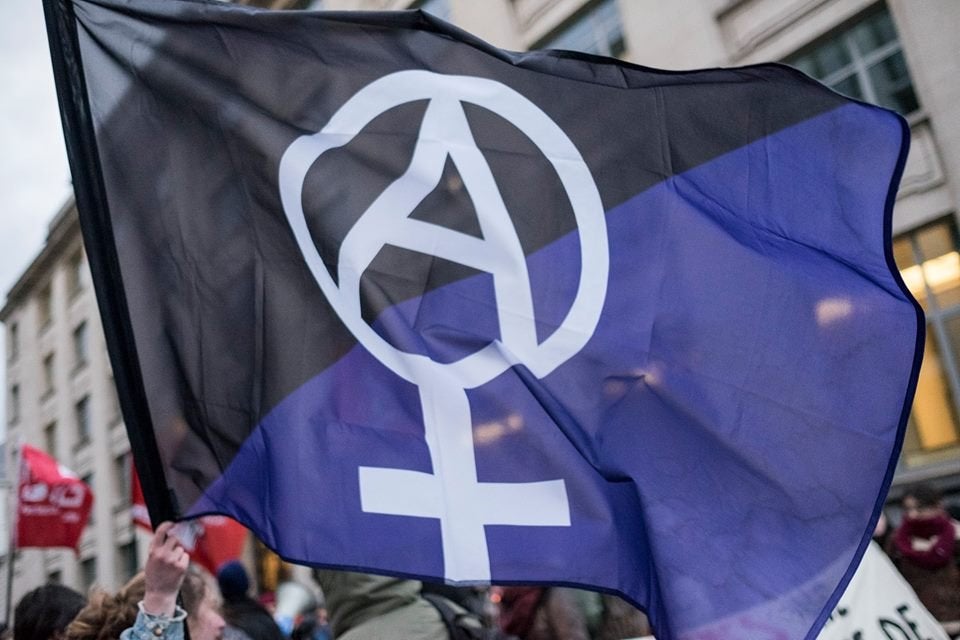
Anarchist Feminist flag
The Association for Women’s Rights in Development has mutual aid as a key piece of their “Solidarity Economy”, an economy in which people’s relationship to goods and services is more sustainable and cooperative. To go along with that, anarchist feminism interprets the labeling of actions like sharing, compassion, and sensitivity as “feminine” to mean that these are direct challenges to the “masculine” hierarchy.
Maybe you’ve seen mutual aid mentioned on social media in the past few weeks, or maybe you haven’t. Right now, due to COVID-19, we’re all in a position to rely on one another for safety and survival. We usually think of networking as a means to further ourselves towards our own goals and ambitions. Now is a time to network with the people in our neighborhoods and communities for our common good. Practicing mutual aid doesn’t mean that everyone has to gather and social distancing has to go out the window because those are important things to do for our communities as well.
If in reaching out you find a need that you can fill, then do so! If someone in your network has access to resources that you can’t find, then make your own needs known! As capable and resourceful as we are, self-reliance is not the order of the day. Lean into your human inclinations towards care and comradeship to make it through.
Hundreds of mutual aid groups have popped up all over the country in the past month to address the dire straits we now find ourselves in, with most of them being led by the organizers who dedicate their lives to this work every day.
To find one near you, you can go to the interactive map on mutualaidhub.org, or this list posted on the Its Going Down digital community center. Its Going Down also has organizing guides and resources so that you don’t have to go into this unlearned. I’ve put in for the Baltimore Maroon Movement! Who in YOUR community needs your help?
]]>
Nandi is a student staff member in the Women’s Center and a Junior English major. Mutual aid, as a concept, is based in anarchism and the work of Petr Kropotkin. His work, “Mutual...https://womenscenteratumbc.wordpress.com/2020/04/01/mutual-aid-one-for-all-and-all-for-one/https://my3.my.umbc.edu/api/v0/pixel/news/91741/guest@my.umbc.edu/3e80bc5d5f9bee686255016d8bc9e3ac/api/pixelactivismanarchismcommunity-carecommunity-organizingcovid-19critical-social-justicefeminismintersectionalityissuesmutual-aidpandemicpoliticsuncategorizedWomen's, Gender, & Equity Centerhttps://my3.my.umbc.edu/groups/womenscenterhttps://assets2-my.umbc.edu/system/shared/avatars/groups/000/000/125/78272a4842689b30dbf74672182b78f8/xsmall.png?1750974263https://assets1-my.umbc.edu/system/shared/avatars/groups/000/000/125/78272a4842689b30dbf74672182b78f8/original.png?1750974263https://assets1-my.umbc.edu/system/shared/avatars/groups/000/000/125/78272a4842689b30dbf74672182b78f8/xxlarge.png?1750974263https://assets1-my.umbc.edu/system/shared/avatars/groups/000/000/125/78272a4842689b30dbf74672182b78f8/xlarge.png?1750974263https://assets1-my.umbc.edu/system/shared/avatars/groups/000/000/125/78272a4842689b30dbf74672182b78f8/large.png?1750974263https://assets2-my.umbc.edu/system/shared/avatars/groups/000/000/125/78272a4842689b30dbf74672182b78f8/medium.png?1750974263https://assets1-my.umbc.edu/system/shared/avatars/groups/000/000/125/78272a4842689b30dbf74672182b78f8/small.png?1750974263https://assets2-my.umbc.edu/system/shared/avatars/groups/000/000/125/78272a4842689b30dbf74672182b78f8/xsmall.png?1750974263https://assets3-my.umbc.edu/system/shared/avatars/groups/000/000/125/78272a4842689b30dbf74672182b78f8/xxsmall.png?1750974263Women's Center40falseWed, 01 Apr 2020 08:30:04 -0400September Knowledge Exchange Roundup: A Voter Resource Guide
Student staff member Hannah Wilcove provides a recap of the semester’s first Knowledge Exchange
Last week, we had our first Knowledge Exchange of the Fall 2018 semester. With the midterm elections coming up in November, our overarching theme for these Knowledge Exchanges is political and civic engagement. The topic for this Knowledge Exchange was knowing your voting rights, and over the course of the event, we talked about the history of the fight for the right to vote, some of the reasons people don’t vote (such as gerrymandering and voter suppression), and issues of accessing information. We also did an activity to demonstrate the overly-strict matching standards some states use to maintain their voter rolls, and discussed the accessibility of political engagement in the United States as well as stories of feeling encouraged or discouraged from voting. For people with family and friends that are active in politics, it can be hard to think that there are people who don’t know how to vote, but the truth is, seeking out that information can be difficult and time-consuming. From this conversation, the need for a voter resource guide was born.
Side note: This blog is meant to be a general resource, and election laws vary by state, which means it’s hard to cover all the complexities and variations. Because so many people at UMBC are from Maryland, that’s what my examples will cover, but if you want more detailed information about a specific state, I encourage you to look up your state’s name and the information you’re looking for (ex: “Virginia voter registration deadline”).
Registration: The first step in voting in the United States is registration. Unlike some other countries, voter registration in the U.S. is not automatic. So if you’re not registered to vote and you would like to be, take 2 minutes to register here. Make sure to do that before your state’s voter registration deadline, and if it’s passed, check whether or not they have same-day registration (you can do all of that here). In case you didn’t know, Maryland’s voter registration deadline is October 16th, 2018 at 9:00 pm. One thing we focused on in our conversation was voter suppression and the fact that many people–including active voters–have been purged from the voter rolls in recent elections. If that’s something you’re concerned about, you can take 30 seconds to double check your registration status here.
Voting Method: So you’ve got your registration all worked out; now it’s time to figure out how you’re going to vote. Depending on your situation, you have a few different options. If you have some time on Election Day (Tuesday, November 6th), then you can go the traditional route: go to the polls, wait in line, and vote. However, that option won’t work for everyone. If that’s the case, fear not. Maybe you have some time before Election Day, but not on that Tuesday. If that’s the case, you should look into early voting. The details vary by state, but here is a link where you can look into which states have early voting (Maryland does), and here is a calendar that tells you when the early voting period for each state is. If that still doesn’t work, you can look into absentee ballot. With absentee ballots, you don’t have to go to the polls because you just mail in your ballot. This is a great option for people who don’t have reliable transportation, but note that there are two downsides to doing this. The first is that absentee ballots aren’t counted unless the difference in other votes is close enough to warrant it (i.e. if Candidate A is 100 votes ahead of Candidate B, and there are only 20 absentee ballots, those 20 votes won’t be counted because they won’t change the outcome), and the second is that you don’t get a sticker. Still, you shouldn’t assume that your vote won’t be counted, so if absentee voting looks like the best option for you, then check out your state’s rules for it here. Just like early voting, the deadlines around absentee ballots vary by state, so take a look here at what your state’s deadlines are.
Action Plan: Once you’ve figured out how you’re going to vote, the next step is making an action plan. This might seem like overkill, but given the craziness that is life, an action plan can help you make sure that you don’t forget to vote or run out of time on election day. So what do you need to know? If you’re voting via absentee ballot, then you just need to make sure that you apply for your ballot and send it in by your state’s deadlines (links are in the above section). If you’re going to the polls, either during early voting or on Election Day, then there’s a little bit more to it. First, you need to figure out where your polling place is, so you can actually go there. You can use this link to find your polling place, but the most reliable method is to use your state’s board of elections website (a list of those is provided on the linked page). For early voting, there may be fewer polling locations open, but you can use this website to find out the specifics for your state and county (you just click on “early voting” under topics and your state, and voila). With these sites, you should also be able to find the specific hours that your polling place is open. Lastly, once you figure out where and when you’re voting, you just need to figure out how to get there. If you have access to a car, then that’s taken care of, but if not, have no fear. If you can’t get a ride from someone, check if your polling place is accessible by public transportation. If so, look up the schedule and make sure that there’s a time you can get there. Not the case? Not a problem. The rideshare company Lyft is offering 50% off rides to the polls on Election Day. For UMBC students, SGA is providing free transportation to early voting in six counties across the state, which you can learn more about here.
Research: You’re all set; you know how you’re going to vote and when, and you’re ready to head to your polling place and vote for…oh, right, you actually need to know who’s on the ballot and what they’re running for. At our Knowledge Exchange, we talked about how hard it can be to figure out all the details because, frankly, not everyone has the time to do that kind of extensive research. The good news is that there are people who have already done some of the work for you. If you need to know what district you’re in, you can use this website if you live in Maryland (just click on the button that says “who represents me” at the top right), and this one if you don’t. The League of Women Voters also has a great tool on their website where you can enter your address and see all the races on your ballot, learn about candidates’ backgrounds, and compare their answers to various questions. For all you Maryland folk reading this, The Baltimore Sun has a voter guide just for you, with comprehensive bios, questionnaires, and articles about each candidate running for elected office in our state.
Tell your friends! Now you’re really all set. If you want to increase the voter rate in the U.S., then one of the best ways to do so is word of mouth! As I’ve said before, it can be difficult and time-consuming to figure all this out, but now that you’re basically an expert, you can help your friends work through it. Plus, with all the links right in front of you, you don’t have to reinvent the wheel; just share this guide with your friends to make voting a little more accessible.
Further Reading:
A video about gerrymandering that we played at the Knowledge Exchange
An article that lists and describes 12 current methods of voter suppression (note that this article does have a clear slant, however it does a great job at explaining each method)
A webpage by the League of Women Voters that has several articles about current efforts to combat voter suppression and increase voter turnout
]]>
Student staff member Hannah Wilcove provides a recap of the semester’s first Knowledge Exchange Last week, we had our first Knowledge Exchange of the Fall 2018 semester. With the midterm...https://womenscenteratumbc.wordpress.com/2018/10/04/september-knowledge-exchange-roundup-a-voter-resource-guide/https://my3.my.umbc.edu/api/v0/pixel/news/79153/guest@my.umbc.edu/bbfc058b69bccc889013756f5c9d122b/api/pixelknowledge-exchangeknowledge-exchange-rounduppoliticsroundtable-roundupvoter-suppressionvotingvoting-rightsWomen's, Gender, & Equity Centerhttps://my3.my.umbc.edu/groups/womenscenterhttps://assets2-my.umbc.edu/system/shared/avatars/groups/000/000/125/78272a4842689b30dbf74672182b78f8/xsmall.png?1750974263https://assets1-my.umbc.edu/system/shared/avatars/groups/000/000/125/78272a4842689b30dbf74672182b78f8/original.png?1750974263https://assets1-my.umbc.edu/system/shared/avatars/groups/000/000/125/78272a4842689b30dbf74672182b78f8/xxlarge.png?1750974263https://assets1-my.umbc.edu/system/shared/avatars/groups/000/000/125/78272a4842689b30dbf74672182b78f8/xlarge.png?1750974263https://assets1-my.umbc.edu/system/shared/avatars/groups/000/000/125/78272a4842689b30dbf74672182b78f8/large.png?1750974263https://assets2-my.umbc.edu/system/shared/avatars/groups/000/000/125/78272a4842689b30dbf74672182b78f8/medium.png?1750974263https://assets1-my.umbc.edu/system/shared/avatars/groups/000/000/125/78272a4842689b30dbf74672182b78f8/small.png?1750974263https://assets2-my.umbc.edu/system/shared/avatars/groups/000/000/125/78272a4842689b30dbf74672182b78f8/xsmall.png?1750974263https://assets3-my.umbc.edu/system/shared/avatars/groups/000/000/125/78272a4842689b30dbf74672182b78f8/xxsmall.png?1750974263Women's Center30falseThu, 04 Oct 2018 10:00:41 -0400Thu, 04 Oct 2018 10:00:41 -0400Music, Movies, and #MeToo
A critical look at the #MeToo movement and its limitations by student staff member, Sydney.
Trigger Warning: This blog deals with Harvey Weinstein, Dr. Luke, and sexual violence/harassment; please practice self-care.
Harvey Weinstein. He’s a huge name in Hollywood but up until a few months ago, myself, and many others did not know who he was or what he did. Today though, he has become a household name… and not for good reasons. It’s been hard NOT to hear about the allegations coming to light about the producer but if you are not familiar with the specific details of Harvey Weinstein’s case I suggest you check them out.
Long, and I mean decades-long, story short, Harvey Weinstein is a Hollywood predator whose committed countless acts of sexual violence and harassment which are now being brought to light by HUNDREDS of actresses. As a woman and one that works closely with sexual violence and survivors, I could talk about Harvey for days, weeks even. I could discuss the coverup, the male “allies”, the tone deaf reactions, but others have been doing this since it all came to light and so I’ll leave that to them.
What I did want to touch on was the huge difference I’ve been seeing between Hollywood’s reaction to the “Harvey Weinstein Scandal” and how the music industry handled Kesha’s lawsuit with Dr. Luke.
I don’t watch awards shows, but I do keep up with the live social media blogging and aftermath, so post-Golden Globes, when I felt empowered by the blackout and Oprah’s rousing speech, I was excited to see what was going to happen at the Grammys.
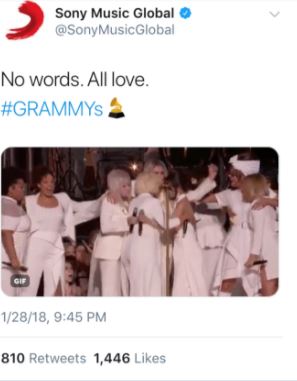
If you watched the Grammys or saw any of the coverage after the fact, you probably heard about Kesha’s performance. Kesha took the stage with other women to sing a heartbreaking rendition of her song “Praying”. I thought this might be an empowering moment of a survivor standing strong, but watching Kesha’s voice crack left me feeling sad and lost.
Throughout the performance, I was wondering why I felt this way and then I realized: Kesha was blacklisted from the music industry for her accusations against Dr. Luke, she didn’t make music or attend shows during or after her case, and she definitely wasn’t believed.
There was no #MeToo movement around Kesha (although there was a #freekesha movement spearheaded by her fans) and even at the Grammys this year, there was no planned Blackout nor was Kesha even acknowledged or awarded for her efforts. Not only was the awards show itself lacking sensitivity, Sony–the company that Dr. Luke worked under and who refused to let Kesha out of her contract or acknowledge the abuse–tweeted their “support” (the tweet was later deleted due to backlash).
Kesha isn’t the first woman, actress, or musician to not be believed, and her experiences point to why Harvey Weinstein (and so many others) went unchecked for so many years. BUT in a day where #MeToo and #TimesUp are taking over Hollywood, social media, and beyond, I can’t help but ask why has no one apologized to Kesha? Dr. Luke still has a career even after attacking Kesha, her mother, and even Lady Gaga. Her fans have been there for her since the court case gained traction, but the music industry was not and they still are only interested in using her for their gain (see Praying performance above).
Kesha wasn’t believed because she is a woman.She also wasn’t believed because she made fun party pop music that was often about drinking and sex, and she was never afraid to discuss her sexuality outside of her music, as well. Kesha was not one of the pure, mega-stars that are accusing Harvey Weinstein, and her public character led people to doubt her.
Just like the doubt, Kesha faced due to her open sexuality and carefree attitude, not all women are facing belief in the light of their accusations of Harvey Weinstein. While sexuality played a role for Kesha, race is definitely playing a role for many others.
Weinstein has remained silent about the accusations he faces–except for a few cases and there’s one thing all of these women have in common- they’re all women of color. When Mexican-American actress Salma Hayek spoke out, Weinstein lashed out in response. He took credit for Salma gaining her role in Frida (despite her role as a producer of the film), noted that he had had a close relationship with her boyfriend at the time, and that the events Hayek spoke of were remembered differently by others. Similarly, when Lupita Nyong’o wrote about her experience with Weinstein in the New York Times discussing how he had made advances on her and threatened her career, he spoke out again. Weinstein again stated that he had a “different recollection of events.”
By addressing only the accusations from women of color, Weinstein attempts to negate their experiences (by publicly gaslighting them) and perpetuates the belief that they cannot be assaulted because of their race. This also relates back to the “perfect victim” (i.e. one who is a pure, white, superstar). Perfect victims like Gwyneth Paltrow, Ashley Judd, Jennifer Lawrence, and Uma Thurman lead to people actually caring about an issue like MeToo or TimesUp. Anyone who is not pure, not white, or not a big enough star, is just not believable or important enough.
Sexual assault and harassment are feminist issues, they are also sexual and racial issues. If we do not acknowledge how intersectionality plays a part in who is and isn’t believed, then we are discounting the many stories of sexual violence and abuse–and we’re also not getting any better as a society. When we find reasons to not believe and support survivors, more people stay silent, more people are blacklisted for speaking out, more people lose court cases, more people feel ashamed, and more and more people feel alone.
You are not alone. We See You. We Believe You. You Matter.
]]>
A critical look at the #MeToo movement and its limitations by student staff member, Sydney. Trigger Warning: This blog deals with Harvey Weinstein, Dr. Luke, and sexual violence/harassment;...https://womenscenteratumbc.wordpress.com/2018/02/19/music-movies-and-metoo/https://my3.my.umbc.edu/api/v0/pixel/news/74072/guest@my.umbc.edu/383da9a3c13f93d3d6c1cf376278aafb/api/pixelartcritical-social-justicecurrent-eventsentertainmentfeminismintersectionalityissuesmetoomusicopinionpoliticspop-culturetelevisiontimesupuncategorizedviolencewomenWomen's, Gender, & Equity Centerhttps://my3.my.umbc.edu/groups/womenscenterhttps://assets2-my.umbc.edu/system/shared/avatars/groups/000/000/125/78272a4842689b30dbf74672182b78f8/xsmall.png?1750974263https://assets1-my.umbc.edu/system/shared/avatars/groups/000/000/125/78272a4842689b30dbf74672182b78f8/original.png?1750974263https://assets1-my.umbc.edu/system/shared/avatars/groups/000/000/125/78272a4842689b30dbf74672182b78f8/xxlarge.png?1750974263https://assets1-my.umbc.edu/system/shared/avatars/groups/000/000/125/78272a4842689b30dbf74672182b78f8/xlarge.png?1750974263https://assets1-my.umbc.edu/system/shared/avatars/groups/000/000/125/78272a4842689b30dbf74672182b78f8/large.png?1750974263https://assets2-my.umbc.edu/system/shared/avatars/groups/000/000/125/78272a4842689b30dbf74672182b78f8/medium.png?1750974263https://assets1-my.umbc.edu/system/shared/avatars/groups/000/000/125/78272a4842689b30dbf74672182b78f8/small.png?1750974263https://assets2-my.umbc.edu/system/shared/avatars/groups/000/000/125/78272a4842689b30dbf74672182b78f8/xsmall.png?1750974263https://assets3-my.umbc.edu/system/shared/avatars/groups/000/000/125/78272a4842689b30dbf74672182b78f8/xxsmall.png?1750974263Women's Center150falseMon, 19 Feb 2018 08:39:23 -0500What are Pop Culture Pop Ups?! The Golden Globes: Black Out and Oprah
A blog post written by student staff member, Sydney.
It’s official! The Women’s Center has a new ongoing event starting this spring semester. What is it you ask?
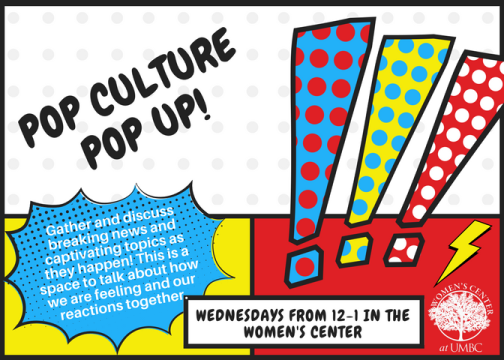
Pop Culture Pop Ups!
You’re probably wondering, “What the heck is a Pop Culture Pop Up?” Well, that’s what I’m here to explain.
If you frequent the Women’s Center you know that it is often a space for spontaneous discussion with others regarding shared interests (about life, events, and school to include the awesome, the good, the bad, and the frustrating – and more!). The energy and critical dialogue that comes from these conversations are what make the Women’s Center the Women’s Center and we wanted to nourish more of these moments by carving out time for more intentional dialogue surrounding both fun and serious topics that come up in our daily lives. Hence, the pop up of these Pop Culture Pop Ups.
We envision these pop ups will create a space for anyone who is on campus and wants to discuss an event, movement, hashtag (and more!) that has gotten huge attention or gone viral to come to the Women’s Center and have a brave space to discuss their feelings, reactions, and ideas linked to the topic. Of course, we’ll make sure to talk about how these pop culture moments intersect with gender and women’s issues, feminism, and social justice. Yet, unlike many of the other events that we hold in the Women’s Center, there won’t be a planned agenda, prepared questions, or a panel of experts and practitioners to guide the conversation.
Essentially, our plan is to take the conversations we notice people are often having on social media and make them into IRL conversations! We may do a bit of background research or read an article that shows up on our Facebook, but this is really a space for raw, immediate reactions to what it happening in a fun and thoughtful way with other people on want to engage in a conversation around the same topic. That’s why our Pop Ups won’t come with a “save the date.” While they will be held on Wednesdays at free hour, they will be spur of the moment decisions (get it, Pop Ups?) in reaction to an event. This means we we could decide to have one the Sunday before or Tuesday night so check our social media for updates!
Some of you may still be confused about what it is we’d talk about or what is considered pop culture, and the ambiguity is kind of the beauty of it (it can really be anything), but it may help to have an example.
A Pop Up we would have loved to have, but unfortunately weren’t able to because of winter break was all things Golden Globes. From the second I heard about #TimesUp and the #whywewearblack Black Out/ Protest, I was hooked and invested. This is something I wanted to discuss and dissect with others. Who was involved in the decision? Did everyone wear black? What is the point? These would all be questions that would definitely come up in a Pop Up.
Hollywood showed up in black this year at the Golden Globes. Photo Credits: Getty/WireImage
If you watched the show, or saw any of the coverage after the fact, you’d know that almost everyone did indeed wear black, but you also would have seen the backlash about why this form of protest just wasn’t good enough. Wearing black isn’t that hard-especially for men, said some while others said that a better idea would be to protest the event all together. Not only did the dress-code come under fire, but so did the men (and some women) who showed up wearing black and the Times Up pin. What about the actors and actresses that are wearing black but work with Woody Allen or other stars that are being held accountable? What does wearing black do when you’re still silent about sexual violence and believing survivors in your daily life as well as career? I know these questions flew around my head and basically everyone’s on the internet. I wish we could have had a Pop-Up to really reflect on how we were feeling post black-out. I still don’t know how I feel about the whole thing. I love the men and women who came out to support, I love that a lot of them made donations and brought activists as their dates, and I love that we’re finally TALKING ABOUT IT…. but I also ask, is it enough? This is why Pop Ups are important. They’ll come together fast, bring us together about current issues, and let us digest these potentially confusing emotions and reactions.
BUT WAIT THERE’S MORE!
While the Blackout is something that could take up a whole Pop Up on its own there was another highlight of the night that we would have LOVED to talk about. You guessed it folks — OPRAH!
Me listening to Oprah’s speech!
Oprah Winfrey accepted the Cecil B. DeMille Award for lifetime achievement (the first Black woman to do so) and delivered a speech that BROUGHT THE HOUSE DOWN. She discussed growing up and representation in the media, people who took a chance on her and how that led to success in her career, her value of the press and the pursuit of the truth, the sexual violence in the entertainment industry and beyond, and the women who are speaking up.
It was moving, brought tears to my eyes, had me fist-pumping, and cheering her on (I encourage you to watch it here). I wish I would have had the chance to see how others felt in person rather than on Facebook and tumblr, especially with so many mixed feelings surrounding the activism at the Golden Globes. Not only could we have discussed this epic speech, but we could also unpack the public’s call for a presidential run and what that really means. Should Oprah run? Some say HELL YEAH, others think she’s just another billionaire and we should support other Black women who are already in politics, while others are saying no more to celebrity presidents. There’s a lot more to unpack here in terms of politics, who we support, and how the institution (both Hollywood and politics) may be changing.
Discussions about how we feel in the present as well as how we move forward in the future about this moments in time are important to have and that’s why the Women’s Center will be bringing you these Pop Culture Pop Up moments.
To stay informed about when Pop-Ups will happen make sure to follow us on myUMBC,Facebook and Twitter. Also follow us on Snapchat (@womencenterumbc) where we will be posting more about daily happenings in the Women’s Center.
If there’s something that comes up over the next semester you want to talk about, be sure to let the Women’s Center staff know (you can also use the hashtag #WCPopUp). It just may become the next Pop Culture Pop-Up!
]]>
A blog post written by student staff member, Sydney. It’s official! The Women’s Center has a new ongoing event starting this spring semester. What is it you ask? Pop Culture Pop Ups!...https://womenscenteratumbc.wordpress.com/2018/01/22/what-are-pop-culture-pop-ups-the-golden-globes-black-out-and-oprah/https://my3.my.umbc.edu/api/v0/pixel/news/73310/guest@my.umbc.edu/981b90f67623c2e3749f3db7b7d4d275/api/pixelartblack-outcommunitycurrent-eventsentertainmentenvironmenteventsfeminismgolden-globeshistoryintersectionalityissuesmetoomusicopinionoprahpoliticspop-cultureprogramssocial-justicetelevisiontimes-upupdatesviolencewomenWomen's, Gender, & Equity Centerhttps://my3.my.umbc.edu/groups/womenscenterhttps://assets2-my.umbc.edu/system/shared/avatars/groups/000/000/125/78272a4842689b30dbf74672182b78f8/xsmall.png?1750974263https://assets1-my.umbc.edu/system/shared/avatars/groups/000/000/125/78272a4842689b30dbf74672182b78f8/original.png?1750974263https://assets1-my.umbc.edu/system/shared/avatars/groups/000/000/125/78272a4842689b30dbf74672182b78f8/xxlarge.png?1750974263https://assets1-my.umbc.edu/system/shared/avatars/groups/000/000/125/78272a4842689b30dbf74672182b78f8/xlarge.png?1750974263https://assets1-my.umbc.edu/system/shared/avatars/groups/000/000/125/78272a4842689b30dbf74672182b78f8/large.png?1750974263https://assets2-my.umbc.edu/system/shared/avatars/groups/000/000/125/78272a4842689b30dbf74672182b78f8/medium.png?1750974263https://assets1-my.umbc.edu/system/shared/avatars/groups/000/000/125/78272a4842689b30dbf74672182b78f8/small.png?1750974263https://assets2-my.umbc.edu/system/shared/avatars/groups/000/000/125/78272a4842689b30dbf74672182b78f8/xsmall.png?1750974263https://assets3-my.umbc.edu/system/shared/avatars/groups/000/000/125/78272a4842689b30dbf74672182b78f8/xxsmall.png?1750974263Women's Center90falseMon, 22 Jan 2018 13:42:43 -0500Researcher of the Week: Richard ElliottThe Effects of Conservative Rhetoric on Political Discourse
Richard is an American
Studies major who will graduate this May. Over the summer, he
worked with Dr. Simone Chambers, Dr. Michael Tesler, and Dr. Davin Phoenix at
the University of California, Irvine, Political Science Department, during the
Summer Undergraduate Research Fellowship
(SURF) Program of the UCI Graduate Division. His research focuses on the intersections of culture and politics and the effects of political rhetoric on voting patterns and election outcomes.
How did you know this was
the project you wanted to do? I had worked on the
origins of this project the previous summer, but I learned from these
professors and incorporated new statistical insights. In this study, a cultural and linguistic approach was used to analyze the effect that speeches by members of the right-wing Tea Party Caucus have had on conservative political discourse. The rhetoric of these politicians after their ascendance in the 2010 congressional elections was compared to the rhetoric used by John McCain, the Republican nominee in 2008, and Donald Trump, the Republican nominee in 2016, to understand their effect on conservative discourse. This shift in discourse was studied using speech analysis to code for instances of negative discourse and establish a comparison between the election years while also noting rhetorical shifts among mainstream conservative politicians.
How much time do you put
into it?I worked on this project
for at least 10 hours each week this past summer, but I also worked on it
during last summer at UMBC as a McNair Scholar in their Summer Research
Institute, and during the winter semester. I received credit through the Career
Center’s internship practicum (PRAC).
How did you hear about
the Undergraduate Research Award (URA) program? I have worked with Dr.
Householder in the past, when she advised me as a McNair Scholar, and my mentor
on my previous project was Dr. Kathy Bryan (American Studies). Both have been
very supportive of my research, and encouraged me to continue working on this
topic through the UCI program.
How much did your mentor
help you with the application?My mentors assisted me
greatly in developing a strong application. They are a key part of the process.
What has been the hardest
part about your research?The hardest thing was
finding speech transcripts for some of the Tea Party congressmen and women.
What was the most
unexpected thing? I didn’t think the increase in harmful discourse usage by
Republicans would be that stark, but I found a fivefold increase from 2008 to
2016.
How does your research
relate to your work in other classes?I have done rhetorical
analyses in multiple American Studies and Political Science classes. This project is a continuation of the research I did last year entitled, “It’s Just A Jump To The Right: How The Tea Party Has Affected Conservative Discourse.” (abstract available here: https://ur.umbc.edu/home/our-researchers/research-profiles-16-17/richard-elliott/)
What else are you
involved in on campus?I am currently the
President of UMBC Progressives and I assist the College Dems as well.
What is your advice to
other students about getting involved in research? Don’t be afraid to follow
up. Don’t be afraid to email professors twice. Use all your leads to try and
get the best opportunities you can.
What are your career
goals?I would like to be an
academic/issue advocate in the Baltimore area.
Have Mentor-led research and want to be featured as a Researcher of the Week? Email aprilh@umbc.edu.
]]>
Richard is an American Studies major who will graduate this May. Over the summer, he worked with Dr. Simone Chambers, Dr. Michael Tesler, and Dr. Davin Phoenix at the University of California,...http://ur.umbc.eduhttps://my3.my.umbc.edu/api/v0/pixel/news/71780/guest@my.umbc.edu/d867d77c25b527b229451dacc5188b18/api/pixelamericanbryanculturediscourseelectionskathypoliticalpoliticsresearchsciencestudiestrumpundergraduatevotingUndergraduate Researchhttps://my3.my.umbc.edu/groups/undergradresearchhttps://assets2-my.umbc.edu/system/shared/avatars/groups/000/000/006/875606ced2b629148af4caa1a4e8dd3c/xsmall.png?1600355057https://assets3-my.umbc.edu/system/shared/avatars/groups/000/000/006/875606ced2b629148af4caa1a4e8dd3c/original.jpg?1600355057https://assets4-my.umbc.edu/system/shared/avatars/groups/000/000/006/875606ced2b629148af4caa1a4e8dd3c/xxlarge.png?1600355057https://assets1-my.umbc.edu/system/shared/avatars/groups/000/000/006/875606ced2b629148af4caa1a4e8dd3c/xlarge.png?1600355057https://assets2-my.umbc.edu/system/shared/avatars/groups/000/000/006/875606ced2b629148af4caa1a4e8dd3c/large.png?1600355057https://assets2-my.umbc.edu/system/shared/avatars/groups/000/000/006/875606ced2b629148af4caa1a4e8dd3c/medium.png?1600355057https://assets4-my.umbc.edu/system/shared/avatars/groups/000/000/006/875606ced2b629148af4caa1a4e8dd3c/small.png?1600355057https://assets2-my.umbc.edu/system/shared/avatars/groups/000/000/006/875606ced2b629148af4caa1a4e8dd3c/xsmall.png?1600355057https://assets4-my.umbc.edu/system/shared/avatars/groups/000/000/006/875606ced2b629148af4caa1a4e8dd3c/xxsmall.png?1600355057Undergraduate Researchhttps://assets3-my.umbc.edu/system/shared/thumbnails/news/000/071/780/7931d92ab94c23defc262039646e9529/xxlarge.jpg?1509982420https://assets3-my.umbc.edu/system/shared/thumbnails/news/000/071/780/7931d92ab94c23defc262039646e9529/xlarge.jpg?1509982420https://assets4-my.umbc.edu/system/shared/thumbnails/news/000/071/780/7931d92ab94c23defc262039646e9529/large.jpg?1509982420https://assets2-my.umbc.edu/system/shared/thumbnails/news/000/071/780/7931d92ab94c23defc262039646e9529/medium.jpg?1509982420https://assets4-my.umbc.edu/system/shared/thumbnails/news/000/071/780/7931d92ab94c23defc262039646e9529/small.jpg?1509982420https://assets1-my.umbc.edu/system/shared/thumbnails/news/000/071/780/7931d92ab94c23defc262039646e9529/xsmall.jpg?1509982420https://assets3-my.umbc.edu/system/shared/thumbnails/news/000/071/780/7931d92ab94c23defc262039646e9529/xxsmall.jpg?1509982420577trueMon, 06 Nov 2017 10:45:07 -0500Mon, 06 Nov 2017 10:48:12 -0500Women in Politics Roundtable Round-Up
The Women’s Center’s Spring Roundtable series has begun! On February 14th, we hosted the first of our three-part roundtable “Underrepresentation of Women in…” series. This roundtable was on “Women in Politics” and focused on the lack of women in the political sphere and the establishment.
For this discussion, our panelists were Political Science professor Lisa Vetter, Language Literacy and Culture student Colonel Ingrid Parker, and student staff member Kayla Smith.
The discussion opened with a question about gendered communication and how to express femininity in a workspace that’s male dominated. Kayla and Colonel Parker both agreed that being a “chameleon,” or being fluid in how they present themselves based on their audience, has worked for them in the past.
The conversation then turned to Hillary Clinton’s presidential loss. The suggestion was made that the glass ceiling was now higher than it had previously been as a result of someone as qualified as Clinton losing to someone as seemingly unqualified as President Trump. People in politics may be more scared to back women running for office because women don’t seem to get the votes to take office. Therefore the goal of making a woman president is even more elusive. Furthermore, after learning that some women need to be asked more than five times to run for office, there was some concern that Clinton’s loss would discourage more women from entering the political sphere for fear of disappointment; however, Colonel Parker reminded everyone that the next step should be to stay hopeful and push forward no matter what happens.
When Jess Myers asked about the silencing of Elizabeth Warren on the Senate floor during the confirmation of Attorney General Jeff Sessions, Kayla pointed out that the silencing of Elizabeth Warren was really the silencing of Coretta Scott King. Kayla went on to explain that, because her feminism is intrinsically connected to her race, it’s impossible for her to ignore the ramifications she faces in the establishment due to being a black woman.
When the discussion was opened up to the audience, a student asked a question about coping with the effects of mental health when looking at barriers to women in politics. Colonel Parker spoke about the benefits of finding coping mechanisms like eating well, spending time with family, and working out. Kayla suggested finding supportive groups of women to help and uplift you in the face of adversity. Women’s Center Assistant Director Megan Tagle Adams added that it isn’t always enough for their to be more women in a space but that they should also be supportive of women excelling instead of engaging in “mean girl” tactics.
Another audience member asked Kayla what her opinion was on changing the establishment to include women and people of color to which she responded, “It’s important for people to be educated. They need to learn that our government and political system is built on white supremacy, racism, and sexism. Nothing will change until people understand where we started and that those things still play a major role in our system.”
Overall, the subject of women’s underrepresentation in politics is vast and complicated and while we barely scratched the surface in this hour long discussion, we did our best to open the dialogue and get people talking and thinking.
Want more information? Below are some links further discussing women, the establishment, and politics.
So has this discussion fired you up? Are you interested in running for office (public, school, or otherwise)? Have you heard about Elect Her? Elect Her is a leadership program that encourages and trains college women to run for student government and future political office
There is an an Elect Her workshop on March 11th from 10:30-3:30 in Fine Arts 011. You will learn how to figure out what your message and platform is, how to craft a communication strategy that works, and you’ll hear from campus and community leaders about what it takes to win. It is going to be a great day!
If you have questions or want to RSVP, contact Dr. Kate. (drabinsk@umbc.edu.)
]]>
The Women’s Center’s Spring Roundtable series has begun! On February 14th, we hosted the first of our three-part roundtable “Underrepresentation of Women in…” series. This roundtable was on “Women...https://womenscenteratumbc.wordpress.com/2017/02/17/women-in-politics-roundtable-round-up/https://my3.my.umbc.edu/api/v0/pixel/news/65808/guest@my.umbc.edu/48eade4fe5dcb70c6e53c66135506e80/api/pixelfeminismfeministmiss-representationpoliticsprogramsrepresentationroundtable-roundupwomenwomen-in-politicsWomen's, Gender, & Equity Centerhttps://my3.my.umbc.edu/groups/womenscenterhttps://assets2-my.umbc.edu/system/shared/avatars/groups/000/000/125/78272a4842689b30dbf74672182b78f8/xsmall.png?1750974263https://assets1-my.umbc.edu/system/shared/avatars/groups/000/000/125/78272a4842689b30dbf74672182b78f8/original.png?1750974263https://assets1-my.umbc.edu/system/shared/avatars/groups/000/000/125/78272a4842689b30dbf74672182b78f8/xxlarge.png?1750974263https://assets1-my.umbc.edu/system/shared/avatars/groups/000/000/125/78272a4842689b30dbf74672182b78f8/xlarge.png?1750974263https://assets1-my.umbc.edu/system/shared/avatars/groups/000/000/125/78272a4842689b30dbf74672182b78f8/large.png?1750974263https://assets2-my.umbc.edu/system/shared/avatars/groups/000/000/125/78272a4842689b30dbf74672182b78f8/medium.png?1750974263https://assets1-my.umbc.edu/system/shared/avatars/groups/000/000/125/78272a4842689b30dbf74672182b78f8/small.png?1750974263https://assets2-my.umbc.edu/system/shared/avatars/groups/000/000/125/78272a4842689b30dbf74672182b78f8/xsmall.png?1750974263https://assets3-my.umbc.edu/system/shared/avatars/groups/000/000/125/78272a4842689b30dbf74672182b78f8/xxsmall.png?1750974263Women's Center180falseFri, 17 Feb 2017 14:39:29 -0500