Join Former Accessibility Trailblazer Award Winner and UMBC Faculty Member Dr. Sarah Bass for an Accessibility Presentation
Repost from Instructional Technology
STEM courses often include complex content—equations, graphs, data tables—that can create significant accessibility barriers for students with disabilities. This session provides STEM faculty with a clear, practical overview of how to make STEM materials accessible. The session will focus on common accessibility challenges in STEM and highlight fixes that faculty can implement without advanced technical skills.
By the end of this session, participants will be able to:
Identify common accessibility barriers in STEM course materials (e.g., math notation, graphs, tables, and PDFs) and explain why these create challenges for students using assistive technologies.
Describe practical strategies and tools for improving accessibility in STEM content, including approaches for math equations, visual data, and structured documents that align with WCAG 2.1 AA standards.
Apply a prioritized approach to remediation by recognizing which fixes are easiest for faculty to implement themselves and where to seek additional support for more complex issues.
The virtual format will be primarily presentational, with brief discussion pauses to address questions and share experiences. Participants will leave with actionable strategies, recommended tools, and resources to begin improving accessibility in their STEM courses. The session will be recorded.
Open to all UMBC and USM faculty, staff, and students. No prior accessibility experience needed.
Presenter: Dr. Sarah Bass, Associate Teaching Professor of Introductory, Analytical and Instrumental Chemistry, University of Maryland, Baltimore County. Dr. Bass is a dedicated faculty champion for accessibility, promoting inclusive teaching practices to create a more supportive educational environment for every learner.
Helpful STEM Links to Review:
Brought to you by:
This session was initially presented as part of the USM Kirwan Center Spring Cleaning 2026 series.
- USM Kirwan Center for Academic Innovation (KCAI)
- Council for the Advancement of Teaching and Learning (CATL)
- USM Digital Accessibility Work Group (DAWG)
- USM Campus Centers for Teaching and Learning
]]>
Topic: Accessibility Strategies for STEM courses Date & Time: Tuesday, March 3, 2026 · 12 - 1 PM Event Details: This session will be hosted via Webex. Register for the event or visit...
https://my3.my.umbc.edu/groups/instructional-technology/events/151561
https://my3.my.umbc.edu/api/v0/pixel/news/156694/guest@my.umbc.edu/56e6d1d824a91e8f1fb1738dd0cc8c44/api/pixel
accessibility
accessible
equations
event
materials
stem
virtual
Office of Accessibility & Disability Services
https://my3.my.umbc.edu/groups/accessibility
https://assets4-my.umbc.edu/system/shared/avatars/groups/000/001/480/1109171419a1b66ae0d9168429adfb61/xsmall.png?1565792941
https://assets1-my.umbc.edu/system/shared/avatars/groups/000/001/480/1109171419a1b66ae0d9168429adfb61/original.jpg?1565792941
https://assets1-my.umbc.edu/system/shared/avatars/groups/000/001/480/1109171419a1b66ae0d9168429adfb61/xxlarge.png?1565792941
https://assets4-my.umbc.edu/system/shared/avatars/groups/000/001/480/1109171419a1b66ae0d9168429adfb61/xlarge.png?1565792941
https://assets3-my.umbc.edu/system/shared/avatars/groups/000/001/480/1109171419a1b66ae0d9168429adfb61/large.png?1565792941
https://assets1-my.umbc.edu/system/shared/avatars/groups/000/001/480/1109171419a1b66ae0d9168429adfb61/medium.png?1565792941
https://assets1-my.umbc.edu/system/shared/avatars/groups/000/001/480/1109171419a1b66ae0d9168429adfb61/small.png?1565792941
https://assets4-my.umbc.edu/system/shared/avatars/groups/000/001/480/1109171419a1b66ae0d9168429adfb61/xsmall.png?1565792941
https://assets1-my.umbc.edu/system/shared/avatars/groups/000/001/480/1109171419a1b66ae0d9168429adfb61/xxsmall.png?1565792941
Office of Accessibility & Disability Services
https://assets2-my.umbc.edu/system/shared/thumbnails/news/000/156/694/a4c9d7cf284e7ad241857cecfbe5aeea/xxlarge.jpg?1771427816
https://assets2-my.umbc.edu/system/shared/thumbnails/news/000/156/694/a4c9d7cf284e7ad241857cecfbe5aeea/xlarge.jpg?1771427816
https://assets1-my.umbc.edu/system/shared/thumbnails/news/000/156/694/a4c9d7cf284e7ad241857cecfbe5aeea/large.jpg?1771427816
https://assets1-my.umbc.edu/system/shared/thumbnails/news/000/156/694/a4c9d7cf284e7ad241857cecfbe5aeea/medium.jpg?1771427816
https://assets2-my.umbc.edu/system/shared/thumbnails/news/000/156/694/a4c9d7cf284e7ad241857cecfbe5aeea/small.jpg?1771427816
https://assets3-my.umbc.edu/system/shared/thumbnails/news/000/156/694/a4c9d7cf284e7ad241857cecfbe5aeea/xsmall.jpg?1771427816
https://assets2-my.umbc.edu/system/shared/thumbnails/news/000/156/694/a4c9d7cf284e7ad241857cecfbe5aeea/xxsmall.jpg?1771427816
professors huddled together and discussing
4
0
false
Wed, 18 Feb 2026 10:19:48 -0500
Wed, 11 Mar 2026 14:53:38 -0400
Making STEM courses more inclusive with lab and lecture hall upgrades
This summer, UMBC is teaming up with the Maryland Department of Disabilities to upgrade nine teaching labs in the Meyerhoff Chemistry Building—marking a major step in fostering inclusive STEM education. The goal: ensure all students, including wheelchair users and those with various disabilities, can fully participate in core chemistry and biochemistry courses.
What's Changing in the Labs?
-
Wheelchair-accessible sinks, fume hoods, lab benches, and cabinets
-
Lowered equipment stations for independent use
-
A research lab redesigned for accessible hands-on experience
Lecture Hall Upgrades Include:
-
Wheelchair-accessible seating in multiple locations with fold-down tablets
-
TV monitors for better visibility for low-vision students
-
Standing desks and seating variations for diverse body types, pregnant students, and orthopedic needs
-
Assisted listening tech and designated interpreter areas for students who are Deaf or hard of hearing
Additional accessibility projects include:
“The Office of Accessibility & Disability Services greatly values our longstanding partnership with Facilities Management to assist us in the mission of inclusive access and elimination of barriers for all UMBC community members,” says Tawny McManus, Assistant Vice President for Accessibility.
Learn how these changes are reshaping inclusion in STEM at UMBC: Read more here.
]]>
This summer, UMBC is teaming up with the Maryland Department of Disabilities to upgrade nine teaching labs in the Meyerhoff Chemistry Building—marking a major step in fostering inclusive STEM...
https://my3.my.umbc.edu/api/v0/pixel/news/151158/guest@my.umbc.edu/fb189618bbb8d951bebbe0905b64bd60/api/pixel
access
accessible
chembiochem
cnms
coeit
disability
education
facilities
inclusion
inclusive
labs
stem
student
success
umbc
Office of Accessibility & Disability Services
https://my3.my.umbc.edu/groups/accessibility
https://assets4-my.umbc.edu/system/shared/avatars/groups/000/001/480/1109171419a1b66ae0d9168429adfb61/xsmall.png?1565792941
https://assets1-my.umbc.edu/system/shared/avatars/groups/000/001/480/1109171419a1b66ae0d9168429adfb61/original.jpg?1565792941
https://assets1-my.umbc.edu/system/shared/avatars/groups/000/001/480/1109171419a1b66ae0d9168429adfb61/xxlarge.png?1565792941
https://assets4-my.umbc.edu/system/shared/avatars/groups/000/001/480/1109171419a1b66ae0d9168429adfb61/xlarge.png?1565792941
https://assets3-my.umbc.edu/system/shared/avatars/groups/000/001/480/1109171419a1b66ae0d9168429adfb61/large.png?1565792941
https://assets1-my.umbc.edu/system/shared/avatars/groups/000/001/480/1109171419a1b66ae0d9168429adfb61/medium.png?1565792941
https://assets1-my.umbc.edu/system/shared/avatars/groups/000/001/480/1109171419a1b66ae0d9168429adfb61/small.png?1565792941
https://assets4-my.umbc.edu/system/shared/avatars/groups/000/001/480/1109171419a1b66ae0d9168429adfb61/xsmall.png?1565792941
https://assets1-my.umbc.edu/system/shared/avatars/groups/000/001/480/1109171419a1b66ae0d9168429adfb61/xxsmall.png?1565792941
Office of Accessibility & Disability Services
https://assets2-my.umbc.edu/system/shared/thumbnails/news/000/151/158/d8168e4e456747e841595a66a754b934/xxlarge.jpg?1753388877
https://assets1-my.umbc.edu/system/shared/thumbnails/news/000/151/158/d8168e4e456747e841595a66a754b934/xlarge.jpg?1753388877
https://assets2-my.umbc.edu/system/shared/thumbnails/news/000/151/158/d8168e4e456747e841595a66a754b934/large.jpg?1753388877
https://assets1-my.umbc.edu/system/shared/thumbnails/news/000/151/158/d8168e4e456747e841595a66a754b934/medium.jpg?1753388877
https://assets4-my.umbc.edu/system/shared/thumbnails/news/000/151/158/d8168e4e456747e841595a66a754b934/small.jpg?1753388877
https://assets4-my.umbc.edu/system/shared/thumbnails/news/000/151/158/d8168e4e456747e841595a66a754b934/xsmall.jpg?1753388877
https://assets4-my.umbc.edu/system/shared/thumbnails/news/000/151/158/d8168e4e456747e841595a66a754b934/xxsmall.jpg?1753388877
A person wearing blue gloves and a lab coat uses a pipette to transfer liquid into a container inside a laboratory setting, with lab equipment and a notebook visible in the background.
17
0
false
Thu, 24 Jul 2025 16:34:25 -0400
Science cannot be apolitical: STEM’s serious problems of elitism

Autumn is a senior Meyerhoff Scholar (M29), pursuing a BS in Chemistry and a BA in Gender, Women and Sexuality Studies dual degree, a member of the Honors College and currently a student staff member at the Women’s Center.
I need to make a disclaimer! I think that it is important to know from the forefront that I am both a STEM student and a humanities student, but the primary focus of my career will be in STEM. Here at UMBC I am pursuing both a BS in Chemistry and a BA in Gender, Women’s, + Sexuality Studies (GWST), and I am a Meyerhoff Scholar so it puts me in a bit of an interesting and unique place to write this blog post critiquing the institution of STEM (by STEM, I am referring to the collection of established scientists that shape the major trajectory of the larger infrastructure of research) from a critical humanitarian perspective because I have a foot on both sides of the channel separating science from humanities and humanities from science. I firmly believe that institutions need to be constantly critiqued and changed in order to remain effective at generating knowledge and not stagnant. After graduation, I plan on pursuing a PhD in a chemistry related field and a career in STEM research, but it is extremely important to me that i do not abandon the framework of thought that I developed within my GWST studies.
Just focusing on UMBC, it is pretty clear to me that our school heavily values its science, technology, engineering and math (STEM) students. A recent editorial in The Retriever detailed the large inequity in funding and resources between UMBC’s STEM programs and UMBC’s non-STEM programs. Just going by raw money, “The College of Arts, Humanities and Social Science (CAHSS) total budget was $39,796,930” compared to “the Engineering and Information Technology and Natural and Mathematical Sciences [Colleges] (COEIT and CNMS respectively) had a total combined budget of $46,064,518,” the editorial goes on to say that the differences in budgeting do not reflect the number of majors offered by COEIT/CNMS and CAHSS. the problem with undervaluing arts and humanities in favor of valuing STEM research and institutions isn’t a problem that is isolated to UMBC or the University System of Maryland’s budgeting process.
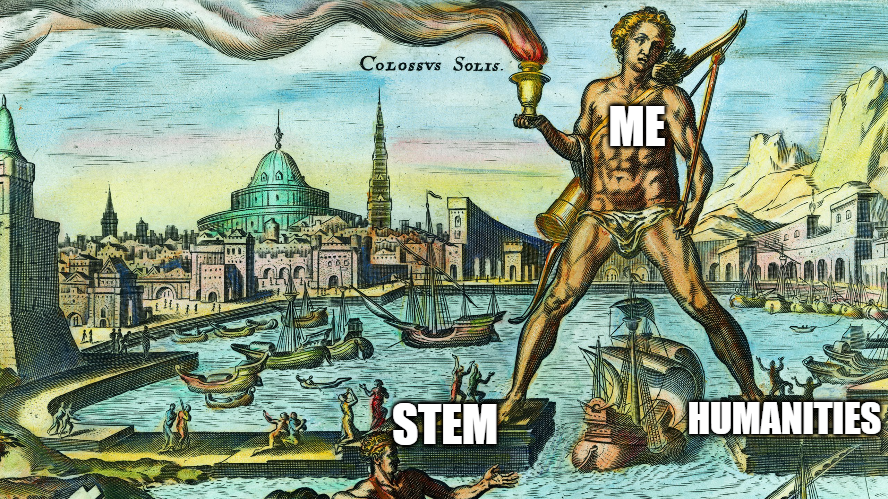 Image Description: This historical engraving, which depicts a large statue of a man straddling an entryway to a harbor, of what artist Martin Heemskerck believed the Colossus of Rhodes looked like with the superimposed text reading “STEM” on one side of the entrance, “HUMANITIES” on the other, and “ME” on top of the statue itself.
This budgetary discrepancy between STEM and non-STEM fields is indicative of a larger problem within society and STEM in general, where science is valued at a higher level than arts and humanities. This disparity gives rise to attitudes of STEM elitism within the science communities.
One of the most pervasive effects of this STEM elitism is the self-imposed isolated mindset. STEM often believes that it is on its own quarantined island, insulated from politics, social issues, and personal biases. The common belief is that STEM research is pure, factual, and just an analysis of how physical phenomena interact with each other. STEM is growing bacteria cultures or doing an electrochemical experiment and just being focused on the chemistry behind it. I mean, how can these bacteria or this newly synthesized compound be impacted by humanities or social science research?
This concept is unique amongst the STEM fields as other fields such as social sciences or humanities are often required by the nature of their research to account for and adjust on behalf of external and internal biases. However, STEM research, despite popular belief, is not immune to these biases. What can STEM learn from the humanities in terms of addressing these issues?
The Notion of STEM Superiority
Accessibility
At UMBC, STEM students are somewhat isolated from the rest of the campus. Whether it is by the student’s own choice or just the actualized reality of their academic career, STEM students usually have to go out of their way to meaningfully interact with non-STEM students. This is, of course, due to the nature of STEM classes being extremely regimented, time intensive, and exclusive. Granted, every single major will separate as the classes become more specialized and start requiring more prerequisites to take, but the extent to which STEM classes separate is not the same as within humanities classes such as GWST courses. For example, many upper level GWST courses only require one or two prerequisite courses to take. For instance, I can take Queer Theory, a 400-level course that is crosslisted as a graduate level course within the GWST department here at UMBC after only taking one prerequisite class (Intro to Critical Sexuality Studies, a 200-level class). This is compared to a 400-level CHEM course, Inorganic Chemistry, which requires more than four prerequisite classes that take over two years to complete following the normal and recommended 4-year plan.
(Un)Biased Knowledge Making?
I think one of the fundamental and one of the most pervasive beliefs surrounding the concepts of “STEM Superiority,” can stem from the fine distinctions between the research environments. STEM research focuses primarily on discovering knowledge pertaining to how the natural world exists, and to explain why natural phenomena happen and how they interact with each other. On the other hand, humanities research details how humans react to the world, and how humans interact with each other. Some scientists believe that because they are studying the fundamental phenomenon of the universe, the social sciences and potential impacts of human biases play no role in their research. At first glance, this might seem like a reasonable understanding of the situation because bacteria, solutions and spectrophotometers aren’t human and cannot be discriminated against! On the surface, this may be true but there are very significant factors that scientists should consider while doing their research. Scientists are human, and therefore have human biases, opinions and prejudices, whether they are well defined or not. Nobody can truly live an apolitical existence, and that includes scientists.
Who is Doing the Research?
These biases, opinions and prejudices can have an impact on the so-called “impartial research” of the scientist. One of the most obvious forms can be analyzed by asking “who is doing the research?” The vast majority of researchers are male, white, and were educated in Western Countries. This can be seen extremely clearly in the breakdown of Nobel Prize winners. As of 2020, no Black scientists have won the Nobel Prize in Physics, Chemistry or in Physiology or Medicine, and only five women have won the prize in Physics (2.2%), nine in Chemistry (4.7%) and twelve in Physiology or Medicine (5.4%). While the demographics of the recipients of the Nobel Prize are not the most representative study of diversity within STEM (or a good signifier of the diversity in STEM because it is a cherry picking of the scientists with the “most significant” research) further evidence of the imbalance within STEM can be signified by the existence of both the Meyerhoff Scholars and Center for Women in Technology (CWIT) Scholars programs at UMBC, with both programs’ main goals being to increase the diversity of underrepresented minorities in STEM. Even within UMBC where the overall student body is composed of 52.1% racial minorities, only 29.1% of our faculty are a part of racial minorities.
Is Science Apolitical?
The lack of diversity can probably, at least, be blamed for the long, storied history of severe ethical breaches. From the Tuskegee Syphilis Study, where the Public Health Service non-consensually experimented on Black men by infecting them with syphilis and subsequently refusing to treat their symptoms all in the name of science, or the continued use of Henrietta Lacks’s cervical cancer cells without proper consent of the Lacks or the Lacks estate to the use them in medical research, science sometimes fails to address how real people are affected by the research that is performed. A lot of research is innocuous and will never affect the layman, but these potential ethical violations are not just historical. Even now, the eugenics implications of being able to selectively edit genes through CRISPR-CAS9 are being hotly debated, especially since two of the major scientists behind finding the enzymes just received the Nobel Prize in Chemistry! Further discussion also needs to be had about the gross amount of waste that chemical and biochemical research produces in both the forms of single use plastic and chemical waste and the numerous pressures that scientists face to capitalize on and make money from their research.
Now, I’m not saying that gross injustices and ethical violations will stop if scientists saw the need to incorporate social science and critical social justice methodologies into their research paradigms, but I do believe that scientists would be more likely to think of the implications of their methods and results within the larger context of the social-political system. While this problem is endemic of the entire system of knowledge-development in science, I think the problem of scientific research not acknowledging the larger work of humanities research and how they intersect can be traced back to how scientists are trained to be scientists. If primarily undergraduate institutions put more of a focus on building bridges between the pure science majors and the humanities majors instead of exclusively focusing on hard science, the students would be much more likely to carry this understanding of the wider world onto graduate school and the rest of the careers as scientists, hopefully eventually changing the entire research ecosystem acknowledge the greater impact of their scientific research.
America’s higher education institutions are historically built upon white supremacy and colonialism, and universities have a vested interest in maintaining their large endowments and reputation within the larger world. Regardless of the feelings and opinions of the people who are actually doing the research at the institutions, a large part of research is funded by the government to promote and further the oppressive agendas of the imperialistic state; for example millions of dollars are being pumped into research and development of the components of novel weapon systems for the military every day.
While a single researcher or lab cannot change the entire institution, I believe that if enough of the STEM academy educate themselves and their colleagues about how science is much more than just looking at imagery data and making conclusions from a graph, STEM will be able to acknowledge and take from humanities and social sciences research to enrich methodologies and be more readily held accountable for its actions and digressions.
]]>
Autumn is a senior Meyerhoff Scholar (M29), pursuing a BS in Chemistry and a BA in Gender, Women and Sexuality Studies dual degree, a member of the Honors College and currently a student staff...
https://womenscenteratumbc.wordpress.com/2020/11/02/science-cannot-be-apolitical/
https://my3.my.umbc.edu/api/v0/pixel/news/97128/guest@my.umbc.edu/6b964dafe07588250ab2ad57e1c504c6/api/pixel
diversity-and-inclusion-issues
diversity-in-stem
higher-ed
humanities-research
research
stem
uncategorized
women-in-stem
Women's, Gender, & Equity Center
https://my3.my.umbc.edu/groups/womenscenter
https://assets2-my.umbc.edu/system/shared/avatars/groups/000/000/125/78272a4842689b30dbf74672182b78f8/xsmall.png?1750974263
https://assets1-my.umbc.edu/system/shared/avatars/groups/000/000/125/78272a4842689b30dbf74672182b78f8/original.png?1750974263
https://assets1-my.umbc.edu/system/shared/avatars/groups/000/000/125/78272a4842689b30dbf74672182b78f8/xxlarge.png?1750974263
https://assets1-my.umbc.edu/system/shared/avatars/groups/000/000/125/78272a4842689b30dbf74672182b78f8/xlarge.png?1750974263
https://assets1-my.umbc.edu/system/shared/avatars/groups/000/000/125/78272a4842689b30dbf74672182b78f8/large.png?1750974263
https://assets2-my.umbc.edu/system/shared/avatars/groups/000/000/125/78272a4842689b30dbf74672182b78f8/medium.png?1750974263
https://assets1-my.umbc.edu/system/shared/avatars/groups/000/000/125/78272a4842689b30dbf74672182b78f8/small.png?1750974263
https://assets2-my.umbc.edu/system/shared/avatars/groups/000/000/125/78272a4842689b30dbf74672182b78f8/xsmall.png?1750974263
https://assets3-my.umbc.edu/system/shared/avatars/groups/000/000/125/78272a4842689b30dbf74672182b78f8/xxsmall.png?1750974263
Women's Center
21
0
false
Mon, 02 Nov 2020 13:57:10 -0500
Mon, 02 Nov 2020 13:57:10 -0500
Math summer program at Maree G. Farring Elem/ Middle School
Number Ninjas
Sherman Scholars kicked off the Number Ninjas math summer program at Maree G. Farring Elementary/Middle School in South Baltimore. Nearly 50 students grades 1-5 enrolled in the four-week, full-day program.
The program is directed by Sherman & UMBC Education Alum Atom Zerfas and staffed by two math teachers, six Sherman Scholars, and six Baltimore high school students through YouthWorks. students engaged in small group lessons, blended learning computer programs, restorative circles, and learning stations. In the afternoon, students participated in math-based projects developed by Sherman Scholars.
]]>
Sherman Scholars kicked off the Number Ninjas math summer program at Maree G. Farring Elementary/Middle School in South Baltimore. Nearly 50 students grades 1-5 enrolled in the four-week, full-day...
Photo
https://assets4-my.umbc.edu/system/shared/attachments/13b6c7da8770077081cf99e144bcef65/69ff296d/news/000/077/365/2247fd8e28edeb7365e8eb85e206487b/IMG_0349-1.jpeg?1530632952
https://my3.my.umbc.edu/api/v0/pixel/news/77365/guest@my.umbc.edu/4bcdec238d4a1411ba29e469b40b8c57/api/pixel
baltimore
education
math
numberninjas
scholars
sherman
stem
teaching
umbc
youthworks
UMBC Department of Education
https://my3.my.umbc.edu/groups/educ
https://assets3-my.umbc.edu/system/shared/avatars/groups/000/001/476/022dd5a7de2507f5eb49a55e6ceb8930/xsmall.png?1573154056
https://assets2-my.umbc.edu/system/shared/avatars/groups/000/001/476/022dd5a7de2507f5eb49a55e6ceb8930/original.png?1573154056
https://assets2-my.umbc.edu/system/shared/avatars/groups/000/001/476/022dd5a7de2507f5eb49a55e6ceb8930/xxlarge.png?1573154056
https://assets1-my.umbc.edu/system/shared/avatars/groups/000/001/476/022dd5a7de2507f5eb49a55e6ceb8930/xlarge.png?1573154056
https://assets3-my.umbc.edu/system/shared/avatars/groups/000/001/476/022dd5a7de2507f5eb49a55e6ceb8930/large.png?1573154056
https://assets4-my.umbc.edu/system/shared/avatars/groups/000/001/476/022dd5a7de2507f5eb49a55e6ceb8930/medium.png?1573154056
https://assets4-my.umbc.edu/system/shared/avatars/groups/000/001/476/022dd5a7de2507f5eb49a55e6ceb8930/small.png?1573154056
https://assets3-my.umbc.edu/system/shared/avatars/groups/000/001/476/022dd5a7de2507f5eb49a55e6ceb8930/xsmall.png?1573154056
https://assets1-my.umbc.edu/system/shared/avatars/groups/000/001/476/022dd5a7de2507f5eb49a55e6ceb8930/xxsmall.png?1573154056
UMBC Department of Education
https://assets3-my.umbc.edu/system/shared/thumbnails/news/000/077/365/7a82b2575908de06971bc397b5e28eb2/xxlarge.jpg?1530632890
https://assets3-my.umbc.edu/system/shared/thumbnails/news/000/077/365/7a82b2575908de06971bc397b5e28eb2/xlarge.jpg?1530632890
https://assets4-my.umbc.edu/system/shared/thumbnails/news/000/077/365/7a82b2575908de06971bc397b5e28eb2/large.jpg?1530632890
https://assets4-my.umbc.edu/system/shared/thumbnails/news/000/077/365/7a82b2575908de06971bc397b5e28eb2/medium.jpg?1530632890
https://assets3-my.umbc.edu/system/shared/thumbnails/news/000/077/365/7a82b2575908de06971bc397b5e28eb2/small.jpg?1530632890
https://assets1-my.umbc.edu/system/shared/thumbnails/news/000/077/365/7a82b2575908de06971bc397b5e28eb2/xsmall.jpg?1530632890
https://assets3-my.umbc.edu/system/shared/thumbnails/news/000/077/365/7a82b2575908de06971bc397b5e28eb2/xxsmall.jpg?1530632890
2
0
true
Tue, 03 Jul 2018 11:51:14 -0400
BEYA STEM Career Fair and Conference
Saturday, February 10, 2018: Washington, D.C.
The BEYA STEM Conference sponsored by Career Communications Group will be held February 8-10, 2018 as part of this large annual conference, representatives from several major corporations and universities will be on hand to meet with students pursuing careers in the STEM (Science, Technology, Engineering and Math) fields as well as Business, Finance, and Marketing. Why you should attend:
- FREE Career Fair
- Career exhibits
- 50 + seminars and workshops
- On the spot job offers
- Networking with recruiters
- Job readiness certification for college students.
The Career Fair portion of the conference, on Saturday, is free of charge for UMBC students and alumni with an active UMBC email address. All students are welcome to attend. Dress to impress and bring plenty of updated resumes!
Registration is required.
To register and for additional information, go to:
http://careers2.umbc.edu/calendar/fairs/beya2018.php
Deadline to pre-register is Feb. 5 (Career Fair) and Feb. 2 for the entire Conference
Contact Diane Crump-Fogle (crump@umbc.edu) or Chrisi Giannakaris (chrisig@umbc.edu) of the UMBC Career Center for additional information.
Free Shuttle Bus
There will be a free shuttle bus to transport students to and from the career fair on Saturday. If you will need transportation, be sure to complete the shuttle bus registration form at the bottom of the BEYA registration page: http://careers2.umbc.edu/calendar/fairs/beyabus.php. Please note that the free shuttle bus is available on a first-come, first-serve basis. The free shuttle will run only on Saturday between 8:30 a.m.-4:00 p.m. Transportation to and from other conference events (such as the BEYA Gala held Saturday evening) is on your own.
]]>
The BEYA STEM Conference sponsored by Career Communications Group will be held February 8-10, 2018 as part of this large annual conference, representatives from several major corporations and...
http://careers2.umbc.edu/calendar/fairs/beya2018.php
https://my3.my.umbc.edu/api/v0/pixel/news/73100/guest@my.umbc.edu/402bdeb953907cc2897b2d1e30de2823/api/pixel
research
stem
Undergraduate Research
https://my3.my.umbc.edu/groups/undergradresearch
https://assets2-my.umbc.edu/system/shared/avatars/groups/000/000/006/875606ced2b629148af4caa1a4e8dd3c/xsmall.png?1600355057
https://assets3-my.umbc.edu/system/shared/avatars/groups/000/000/006/875606ced2b629148af4caa1a4e8dd3c/original.jpg?1600355057
https://assets4-my.umbc.edu/system/shared/avatars/groups/000/000/006/875606ced2b629148af4caa1a4e8dd3c/xxlarge.png?1600355057
https://assets1-my.umbc.edu/system/shared/avatars/groups/000/000/006/875606ced2b629148af4caa1a4e8dd3c/xlarge.png?1600355057
https://assets2-my.umbc.edu/system/shared/avatars/groups/000/000/006/875606ced2b629148af4caa1a4e8dd3c/large.png?1600355057
https://assets2-my.umbc.edu/system/shared/avatars/groups/000/000/006/875606ced2b629148af4caa1a4e8dd3c/medium.png?1600355057
https://assets4-my.umbc.edu/system/shared/avatars/groups/000/000/006/875606ced2b629148af4caa1a4e8dd3c/small.png?1600355057
https://assets2-my.umbc.edu/system/shared/avatars/groups/000/000/006/875606ced2b629148af4caa1a4e8dd3c/xsmall.png?1600355057
https://assets4-my.umbc.edu/system/shared/avatars/groups/000/000/006/875606ced2b629148af4caa1a4e8dd3c/xxsmall.png?1600355057
Undergraduate Research
https://assets4-my.umbc.edu/system/shared/thumbnails/news/000/073/100/25426a9fcea03b93d254bdd1adfd3c01/xxlarge.jpg?1515522150
https://assets4-my.umbc.edu/system/shared/thumbnails/news/000/073/100/25426a9fcea03b93d254bdd1adfd3c01/xlarge.jpg?1515522150
https://assets4-my.umbc.edu/system/shared/thumbnails/news/000/073/100/25426a9fcea03b93d254bdd1adfd3c01/large.jpg?1515522150
https://assets4-my.umbc.edu/system/shared/thumbnails/news/000/073/100/25426a9fcea03b93d254bdd1adfd3c01/medium.jpg?1515522150
https://assets1-my.umbc.edu/system/shared/thumbnails/news/000/073/100/25426a9fcea03b93d254bdd1adfd3c01/small.jpg?1515522150
https://assets3-my.umbc.edu/system/shared/thumbnails/news/000/073/100/25426a9fcea03b93d254bdd1adfd3c01/xsmall.jpg?1515522150
https://assets4-my.umbc.edu/system/shared/thumbnails/news/000/073/100/25426a9fcea03b93d254bdd1adfd3c01/xxsmall.jpg?1515522150
5
0
true
Tue, 09 Jan 2018 13:22:48 -0500
Summer Research Opportunity- University of Nebraska
Deadline: February 1, 2018
The Nebraska Summer Research Program is committed to quality mentoring and research projects. We limit our summer offerings to active research labs and projects led by faculty who have established themselves as excellent undergraduate student mentors. Since each program has several Summer Research Program scholars, you'll have peers and colleagues in which to share your educational experience with.
Programs
]]>
The Nebraska Summer Research Program is committed to quality mentoring and research projects. We limit our summer offerings to active research labs and projects led by faculty who have established...
https://www.unl.edu/summerprogram/home
https://my3.my.umbc.edu/api/v0/pixel/news/72684/guest@my.umbc.edu/0be8adbb2d75093b090841028ccf4d0c/api/pixel
research
stem
summer
Undergraduate Research
https://my3.my.umbc.edu/groups/undergradresearch
https://assets2-my.umbc.edu/system/shared/avatars/groups/000/000/006/875606ced2b629148af4caa1a4e8dd3c/xsmall.png?1600355057
https://assets3-my.umbc.edu/system/shared/avatars/groups/000/000/006/875606ced2b629148af4caa1a4e8dd3c/original.jpg?1600355057
https://assets4-my.umbc.edu/system/shared/avatars/groups/000/000/006/875606ced2b629148af4caa1a4e8dd3c/xxlarge.png?1600355057
https://assets1-my.umbc.edu/system/shared/avatars/groups/000/000/006/875606ced2b629148af4caa1a4e8dd3c/xlarge.png?1600355057
https://assets2-my.umbc.edu/system/shared/avatars/groups/000/000/006/875606ced2b629148af4caa1a4e8dd3c/large.png?1600355057
https://assets2-my.umbc.edu/system/shared/avatars/groups/000/000/006/875606ced2b629148af4caa1a4e8dd3c/medium.png?1600355057
https://assets4-my.umbc.edu/system/shared/avatars/groups/000/000/006/875606ced2b629148af4caa1a4e8dd3c/small.png?1600355057
https://assets2-my.umbc.edu/system/shared/avatars/groups/000/000/006/875606ced2b629148af4caa1a4e8dd3c/xsmall.png?1600355057
https://assets4-my.umbc.edu/system/shared/avatars/groups/000/000/006/875606ced2b629148af4caa1a4e8dd3c/xxsmall.png?1600355057
Undergraduate Research
https://assets4-my.umbc.edu/system/shared/thumbnails/news/000/072/684/042d8ee246be5baeae6562d84284c5cf/xxlarge.jpg?1512741188
https://assets2-my.umbc.edu/system/shared/thumbnails/news/000/072/684/042d8ee246be5baeae6562d84284c5cf/xlarge.jpg?1512741188
https://assets1-my.umbc.edu/system/shared/thumbnails/news/000/072/684/042d8ee246be5baeae6562d84284c5cf/large.jpg?1512741188
https://assets2-my.umbc.edu/system/shared/thumbnails/news/000/072/684/042d8ee246be5baeae6562d84284c5cf/medium.jpg?1512741188
https://assets3-my.umbc.edu/system/shared/thumbnails/news/000/072/684/042d8ee246be5baeae6562d84284c5cf/small.jpg?1512741188
https://assets1-my.umbc.edu/system/shared/thumbnails/news/000/072/684/042d8ee246be5baeae6562d84284c5cf/xsmall.jpg?1512741188
https://assets2-my.umbc.edu/system/shared/thumbnails/news/000/072/684/042d8ee246be5baeae6562d84284c5cf/xxsmall.jpg?1512741188
5
0
true
Fri, 08 Dec 2017 08:53:21 -0500
Goldwater Scholarship for STEM Majors
Up to $7500 for Sophomores and Juniors in STEM Research
SCHOLARSHIP OPPORTUNITY
IN MATHEMATICS, THE NATURAL SCIENCES AND ENGINEERING
Students interested in a research career in mathematics, the natural sciences, or engineering are invited to apply to the Barry Goldwater Scholarship and Excellence in Education Program. Established by Congress in 1986, Goldwater Scholarship and Excellence in Education Foundation operates an educational scholarship program designed to provide opportunities for outstanding U.S. students with excellent academic records and demonstrated interest in, and potential for, research careers in STEM fields.
Scholarships are awarded on the basis of merit to students who are sophomores or juniors during the current academic year and who have excellent academic records and demonstrated interest in and potential for research careers in mathematics, the natural sciences, or engineering. The scholarship covers undergraduate eligible expenses for tuition, fees, books, and room and board to a maximum of $7,500 per academic year.
ELIGIBILITY
To be considered for nomination, a student must:
- Have one or two years of undergraduate
- study left and be pursuing a bachelor’s degree on a full-time basis. (A current sophomore student in a two-year college who plans to transfer to a baccalaureate program may be nominated.)
- Have an average of at least B or the equivalent.
- Be a U.S. citizen or permanent resident.
- Have a demonstrated interest in a research career in mathematics, the natural sciences, or engineering.
- Be nominated by his or her college or university on the official online nomination application provided by the Barry Goldwater Scholarship and Excellence in Education Foundation.
Scholarship recipients nominated as sophomores can expect to receive a maximum of two years of scholarship support.
Scholarship recipients nominated as juniors are eligible for a maximum of one year of scholarship support.
HOW TO APPLY
Colleges and universities nominate students for Goldwater Scholarships. Information may be obtained from the designated Goldwater Scholarship Campus Representative* (Dr. April Householder) at your institution.
SELECTION
A distinguished committee of educators; deans; and mathematics, natural science, and engineering faculty members will review the nominee’s credentials and recommend a pool of qualified individuals to the Board of Trustees of the Goldwater Foundation. The Trustees will make the final approval.
Interested students should contact Dr. April Householder, Director of Undergraduate Research and Nationally Competitive Scholarships.
Attend the Goldwater application workshop on: Wednesday, 11/22 at 12:00pm in 003 Sherman Hall (Meyerhoff Conference Room).
]]>
SCHOLARSHIP OPPORTUNITY IN MATHEMATICS, THE NATURAL SCIENCES AND ENGINEERING Students interested in a research career in mathematics, the natural sciences, or engineering are invited to apply...
https://ur.umbc.edu
https://my3.my.umbc.edu/api/v0/pixel/news/72253/guest@my.umbc.edu/d87984e2190ade31017b666979d95e0d/api/pixel
prestigious
scholarships
stem
Undergraduate Research
https://my3.my.umbc.edu/groups/undergradresearch
https://assets2-my.umbc.edu/system/shared/avatars/groups/000/000/006/875606ced2b629148af4caa1a4e8dd3c/xsmall.png?1600355057
https://assets3-my.umbc.edu/system/shared/avatars/groups/000/000/006/875606ced2b629148af4caa1a4e8dd3c/original.jpg?1600355057
https://assets4-my.umbc.edu/system/shared/avatars/groups/000/000/006/875606ced2b629148af4caa1a4e8dd3c/xxlarge.png?1600355057
https://assets1-my.umbc.edu/system/shared/avatars/groups/000/000/006/875606ced2b629148af4caa1a4e8dd3c/xlarge.png?1600355057
https://assets2-my.umbc.edu/system/shared/avatars/groups/000/000/006/875606ced2b629148af4caa1a4e8dd3c/large.png?1600355057
https://assets2-my.umbc.edu/system/shared/avatars/groups/000/000/006/875606ced2b629148af4caa1a4e8dd3c/medium.png?1600355057
https://assets4-my.umbc.edu/system/shared/avatars/groups/000/000/006/875606ced2b629148af4caa1a4e8dd3c/small.png?1600355057
https://assets2-my.umbc.edu/system/shared/avatars/groups/000/000/006/875606ced2b629148af4caa1a4e8dd3c/xsmall.png?1600355057
https://assets4-my.umbc.edu/system/shared/avatars/groups/000/000/006/875606ced2b629148af4caa1a4e8dd3c/xxsmall.png?1600355057
Undergraduate Research
https://assets4-my.umbc.edu/system/shared/thumbnails/news/000/072/253/36289be5c2073b5bbb3e89999df1bb87/xxlarge.jpg?1511309879
https://assets1-my.umbc.edu/system/shared/thumbnails/news/000/072/253/36289be5c2073b5bbb3e89999df1bb87/xlarge.jpg?1511309879
https://assets4-my.umbc.edu/system/shared/thumbnails/news/000/072/253/36289be5c2073b5bbb3e89999df1bb87/large.jpg?1511309879
https://assets2-my.umbc.edu/system/shared/thumbnails/news/000/072/253/36289be5c2073b5bbb3e89999df1bb87/medium.jpg?1511309879
https://assets1-my.umbc.edu/system/shared/thumbnails/news/000/072/253/36289be5c2073b5bbb3e89999df1bb87/small.jpg?1511309879
https://assets1-my.umbc.edu/system/shared/thumbnails/news/000/072/253/36289be5c2073b5bbb3e89999df1bb87/xsmall.jpg?1511309879
https://assets1-my.umbc.edu/system/shared/thumbnails/news/000/072/253/36289be5c2073b5bbb3e89999df1bb87/xxsmall.jpg?1511309879
8
0
true
Tue, 21 Nov 2017 19:14:17 -0500
Mon, 18 Aug 2025 09:42:26 -0400
Researcher of the Week: Kevin Chen
Exploring links between cancer, diabetes, and obesity
Kevin is a Biology major who will graduate in 2019. The major focus of his work is to explore issues at the interface between development and human disease, with a view towards identifying novel points of therapeutic intervention. He works in Dr. Charles Bieberich's lab on the ongoing question of homeobox gene function in mouse development intersected with human prostate cancer with the discovery of the mouse Nkx3.1 gene.
How did you find you mentor? I work with Dr. Charles Bieberich in the Biological Sciences department. I originally came to hear of his research through searches for researching professors in cancer biology at UMBC. I then emailed him and checked by his office persistently until I was able to schedule a time to meet with him.I began researching in cancer biology during a biophysics high school summer internship at the National Institutes of Standards and Technology in radiation dosimetry. I was enthralled by cancer research ever since and knew after meeting Dr. Bieberich that his research in prostate cancer would be a perfect fit for me.
Is this your first independent research? This is my second independent research project with the first being my radiation dosimetry project at the National Institute of Standards and Technology.
How much time do you put into it? I spend about 15 hours an academic week in the laboratory with a 35-hour week during academic breaks and vacations.
How did you hear about the Undergraduate Research Award (URA) program? I heard about the Undergraduate Research Award from my mentors in the Honors College. I am currently preparing my application for the 2018-19 award.
What has been the hardest part about your research? The hardest part of conducting my research is that since I work with mice, I must be available at any given hour during the day to check on the mice and handle any circumstances that may arise from working within a murine model. It becomes difficult at times to manage working in the laboratory and working on schoolwork.
What was the most unexpected thing? The most unexpected thing to occur from working in Dr. Bieberich’s prostate cancer laboratory is that after two years of working in the laboratory, I would be working on proposing a dietary study that involves the surprising link between prostate cancer, diabetes, and obesity. I never thought that diabetes could actually decrease prostate cancer risk.
How does your research relate to your work in other classes? My work in the laboratory relates to many of the laboratory procedures that I learned about in BIOL141, BIOL302, and BIOL303. My newest research in the effects of diet on prostate cancer relate to my Honors College seminar on the science of obesity.
What else are you involved in on campus? I am Treasurer of the Honors College Council, a Red Cross Volunteer, and Student Brand Ambassador for Kaplan Test Prep.
What is your advice to other students about getting involved in research? My advice to other student about getting involved research is to never be too shy to approach a mentor about their research. Mentors are busy and may seem cold at first, but they genuinely do want to teach students about research and inspire students to become involved in research.
What are your career goals? My career goal is to become a professor in cancer biology researching the effects of macromolecule receptors and microtubule stabilizing proteins on cancer progression.
Want to be featured as a Researcher of the Week?
Email aprilh@umbc.edu
]]>
Kevin is a Biology major who will graduate in 2019. The major focus of his work is to explore issues at the interface between development and human disease, with a view towards identifying novel...
http://ur.umbc.edu
https://my3.my.umbc.edu/api/v0/pixel/news/72195/guest@my.umbc.edu/eac3d79eda5d6491c4814018514c3656/api/pixel
bieberich
biological
cancer
charles
research
sciences
stem
umbc
undergraduate
Undergraduate Research
https://my3.my.umbc.edu/groups/undergradresearch
https://assets2-my.umbc.edu/system/shared/avatars/groups/000/000/006/875606ced2b629148af4caa1a4e8dd3c/xsmall.png?1600355057
https://assets3-my.umbc.edu/system/shared/avatars/groups/000/000/006/875606ced2b629148af4caa1a4e8dd3c/original.jpg?1600355057
https://assets4-my.umbc.edu/system/shared/avatars/groups/000/000/006/875606ced2b629148af4caa1a4e8dd3c/xxlarge.png?1600355057
https://assets1-my.umbc.edu/system/shared/avatars/groups/000/000/006/875606ced2b629148af4caa1a4e8dd3c/xlarge.png?1600355057
https://assets2-my.umbc.edu/system/shared/avatars/groups/000/000/006/875606ced2b629148af4caa1a4e8dd3c/large.png?1600355057
https://assets2-my.umbc.edu/system/shared/avatars/groups/000/000/006/875606ced2b629148af4caa1a4e8dd3c/medium.png?1600355057
https://assets4-my.umbc.edu/system/shared/avatars/groups/000/000/006/875606ced2b629148af4caa1a4e8dd3c/small.png?1600355057
https://assets2-my.umbc.edu/system/shared/avatars/groups/000/000/006/875606ced2b629148af4caa1a4e8dd3c/xsmall.png?1600355057
https://assets4-my.umbc.edu/system/shared/avatars/groups/000/000/006/875606ced2b629148af4caa1a4e8dd3c/xxsmall.png?1600355057
Undergraduate Research
https://assets1-my.umbc.edu/system/shared/thumbnails/news/000/072/195/765f96214a35ef8953596bada136b875/xxlarge.jpg?1511195593
https://assets2-my.umbc.edu/system/shared/thumbnails/news/000/072/195/765f96214a35ef8953596bada136b875/xlarge.jpg?1511195593
https://assets3-my.umbc.edu/system/shared/thumbnails/news/000/072/195/765f96214a35ef8953596bada136b875/large.jpg?1511195593
https://assets1-my.umbc.edu/system/shared/thumbnails/news/000/072/195/765f96214a35ef8953596bada136b875/medium.jpg?1511195593
https://assets4-my.umbc.edu/system/shared/thumbnails/news/000/072/195/765f96214a35ef8953596bada136b875/small.jpg?1511195593
https://assets4-my.umbc.edu/system/shared/thumbnails/news/000/072/195/765f96214a35ef8953596bada136b875/xsmall.jpg?1511195593
https://assets4-my.umbc.edu/system/shared/thumbnails/news/000/072/195/765f96214a35ef8953596bada136b875/xxsmall.jpg?1511195593
29
0
true
Mon, 20 Nov 2017 11:54:45 -0500
Wed, 13 Dec 2017 10:32:20 -0500
The Socialization of Women in Math: Who’s aware?
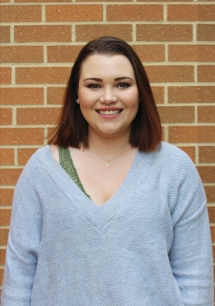 Student staff member Sydney has had a rocky relationship with math throughout her life. As a graduate student in the Applied Sociology program at UMBC she began to rethink her relationship with math through her statistics courses and with the support of her (Women!) professor and TA.
On Thursday September 14, the Women’s Center hosted their first fall roundtable on the topic of Women in Tech. I was there to listen and also write the roundup for the Women’s Center.
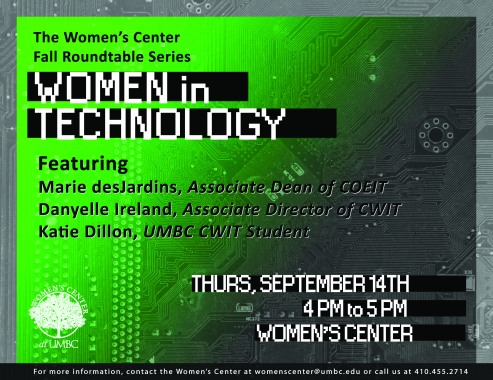 Although I am not a woman in the STEM field, a lot of what was shared really resonated with me and led to a reflection about my relationship with math. Let me start by saying it’s not a positive relationship. I’ve always struggled with math, I feel like it takes me longer than others, my professors (read: male professors) have always seen me as a burden, and now just thinking about it gives me anxiety. I’m talking “I don’t understand anything on this page, I’m going to fail this test, I’m going to fail this class, and I’m never going to get a job and my life is over” types of anxiety.

I used to say I hated math because I thought I was bad at it, but the roundtable really made me reflect on if this is true or if I’ve just been socialized to believe this. I never thought I was a person who was bad at math; I thought I was bad at math because I was a woman.
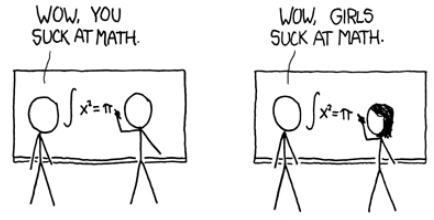
Comic from XKCD
Even as a graduate student who passed all of her undergraduate math classes and received an A in graduate level statistics (make note, I had women professors), I still think I’m inherently bad at math, which makes NO sense. This problem exists outside of my experiences as well and is reflected in the disparities between men and women in the STEM fields. For example, although more women are awarded bachelor’s degrees than men, only 17% of computer science graduates are women.
My reflection made me want to reach out to other women to see what their experiences with math were and if this socialization process affected their relationship with math at all. Like many other quests into knowledge, this one did not go quite as planned, but still I received a lot of feedback that included some key themes I think are important.
The first theme is that those who struggled with math or felt as if they were being told they were bad at math, began to feel this way from a VERY early age (most respondents reported between first grade and early middle school). Young girls who were working out math problems were told that if they didn’t understand it right away that they never would and they should basically give up.
The other theme was that most of these comments (or in some cases just dirty looks) came from male teachers. Not only were women being socialized through verbal interactions to believe they were bad at match, they were also aware of the nonverbal interactions between themselves and their male teachers that added to this thought. The patriarchy is alive and well in the classroom y’all.
Here are some responses:
I was talking with a classmate trying to figure out what a problem meant when the teacher came up to us, yelled at us for distracting our classmates, and that if we didn’t understand it – we wouldn’t ever get it. – Rachel (22).
2nd grade, the teacher said I just wasn’t up to it -Jamie (24)
A college professor told me before the class even started that I was either going to fail or drop out of the class, I ended up passing the class with a high B just to prove him wrong -Jill (23)
Most of the women who wrote about these negative experiences also expressed that their negative relationship with math has continue throughout their lives. In terms of their current feelings, they expressed feelings of doubt and anxiety when doing math, or even a complete avoidance of math in life altogether.
I hate it. I’m super intimidated by it. The thought of having to help my daughters with their math homework in the future, terrifies me! -Marie (38)
Some of the women who had negative experiences early on did end up having a good relationship with math later on. Some women have always had good experiences with math. The one common denominator between these positive math women was: a support system, and most of the time this support system was made up of other women (women teachers, Mom’s who worked in the field, etc.).
I had a teacher, Ms. Raden… I don’t know if it was her approach or the fact that she was a woman that made me more comfortable. I took more advanced classes and eventually got a degree where match and equations are big.- Darcy (31).
My algebra 1 teacher went out her way to encourage girls. -Debbie (55)
I think the support I’ve had from my parents encouraging me to pursue math and science in my career has helped me to not feel inadequate in my mathematical abilities. -Caitlin (25).
Most of the responses I gleaned seemed to be aware of the stereotype of women being bad at math and science. Thus, while I expected emotional answers, I was not prepared for the amount of angry responses I received… which were directed at the survey itself and me. A lot of women took offense that I would “assume” they were bad at math or that their experiences were negative. They had never encountered the problem I was bringing up and therefore didn’t think it was an issue on a larger scale either. I have pretty thick skin, but to be honest, shifting through 30 responses with a large amount being very passionate about why I was wrong hit me hard. I immediately wanted to defend myself but also didn’t know how to respond. I didn’t know how to move forward with the blog or get out the message I was originally trying to convey. At first I just wanted to ignore these responses and focus on my original goal, but after reflecting (again) and getting input from coworkers and an amazing supervisor (Thanks Amelia!) I decided I needed to face what was making me uncomfortable head on.
I think it is important to note that women have a variety of experiences, and all of them are valid. While a lot of women have great experiences with math it is also a fact that there are large disparities in the gender makeup of people in STEM fields and that many women have had negative experiences. I want to foster a space as well as a society where all women’s voices are heard but also not at the expense of women with differing stories. Some experiences are good and some are bad but the consequences of a society that largely labels women at a disadvantage are very real. Although women’s involvement is on the rise, there are still barriers that need to be addressed in order for a more equitable field (and society) to emerge.
To the women in STEM fighting against these barriers, I thank you! To the women who feel comfortable in their own skin around math, I envy you! To the women who avoid math at all costs, I understand you! And to the women who can feel their blood pressure rising just when the word is uttered, I am with you!

On Campus Resources:
UMBC Center for Women in Technology
More about the issue:
Women and Math: The Gender Gap Bridged
Women in Math, Science, & Medicine: Still Work to be Done
The Truth About Gender and Math
]]>
Student staff member Sydney has had a rocky relationship with math throughout her life. As a graduate student in the Applied Sociology program at UMBC she began to rethink her relationship with...
https://womenscenteratumbc.wordpress.com/2017/10/10/the-socialization-of-women-in-math-whos-aware/
https://my3.my.umbc.edu/api/v0/pixel/news/71019/guest@my.umbc.edu/eadb4322a803457468276b9f65d6eba7/api/pixel
cwit-spotlight
education
feminism
gender-stereotypes
girls
issues
math
microagressions
sexism
stem
technology
uncategorized
women
women-in-stem
Women's, Gender, & Equity Center
https://my3.my.umbc.edu/groups/womenscenter
https://assets2-my.umbc.edu/system/shared/avatars/groups/000/000/125/78272a4842689b30dbf74672182b78f8/xsmall.png?1750974263
https://assets1-my.umbc.edu/system/shared/avatars/groups/000/000/125/78272a4842689b30dbf74672182b78f8/original.png?1750974263
https://assets1-my.umbc.edu/system/shared/avatars/groups/000/000/125/78272a4842689b30dbf74672182b78f8/xxlarge.png?1750974263
https://assets1-my.umbc.edu/system/shared/avatars/groups/000/000/125/78272a4842689b30dbf74672182b78f8/xlarge.png?1750974263
https://assets1-my.umbc.edu/system/shared/avatars/groups/000/000/125/78272a4842689b30dbf74672182b78f8/large.png?1750974263
https://assets2-my.umbc.edu/system/shared/avatars/groups/000/000/125/78272a4842689b30dbf74672182b78f8/medium.png?1750974263
https://assets1-my.umbc.edu/system/shared/avatars/groups/000/000/125/78272a4842689b30dbf74672182b78f8/small.png?1750974263
https://assets2-my.umbc.edu/system/shared/avatars/groups/000/000/125/78272a4842689b30dbf74672182b78f8/xsmall.png?1750974263
https://assets3-my.umbc.edu/system/shared/avatars/groups/000/000/125/78272a4842689b30dbf74672182b78f8/xxsmall.png?1750974263
Women's Center
2
0
false
Tue, 10 Oct 2017 11:21:49 -0400
Tue, 10 Oct 2017 11:21:49 -0400
Women in Tech: A Roundtable Round-Up
A resource roundup provided by Women’s Center student staff member, Sydney
Each month the Women’s Center hosts a roundtable discussion where we provide a few chosen panelists with guiding questions and then have a community discussion about a particular topic and how it intersects with women and gender. Roundtables are great opportunities to become involved in discourse and ask questions directly to those involved. On Thursday, September 15th The Women’s Center hosted our September roundtable, Women in Technology. In case you missed it or are interested in revisiting the topics, here is a summary of our discussion. At the end, we include some links to reading materials and additional resources.
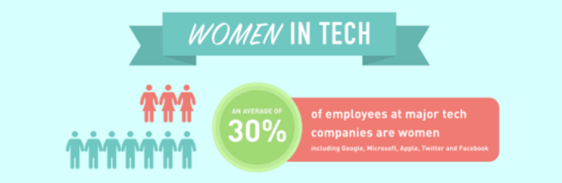
We started off the session by discussing some relevant statistics regarding women college students who are pursuing STEM degrees and careers. Women earn 57.3% of all Bachelor’s degrees but only account for 17.9% of the degrees in Computer Science.
Source: careerfoundry.com
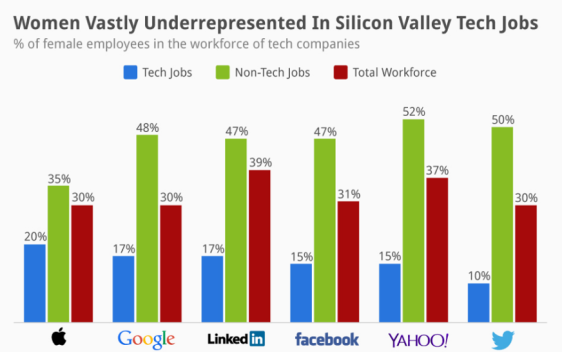
When it comes to the workforce, women make up a small percentage of the tech jobs. And even a smaller percentage of those in leadership positions!
Source: statista.com, 2014
And although women only make up a small percentage of tech jobs at these companies, women use these platforms more than men!

After addressing some of the statistics about the discrepancies surrounding women in STEM fields, we heard from our panel about their experiences in academia and the tech industry.
Dr. Danyelle Ireland who is the Associate Director of the Center for Women in Technology (CWIT) and Dr. Marie desJardins, the Associate Dean of College of Engineering and Information Technology here at UMBC, talked about why there is such a small number of women pursuing STEM. They set out to debunk the myth of a “lack of interest” surrounding technology for women and instead pointed out social factors that contribute to the low numbers. These included:
- A lack of awareness of jobs or role models
- The socialization that STEM is for men reaffirmed by video game and tech advertisements. Specifically, Dr. desJardins’ shared that when personal computers first began to be marketed to the general public in the 1980s, advertisements only focused on men as the would-be-users of this new technology.
- Bias and discrimination that women may face in the workforce.
- A hypercritical culture in which women constantly critique their own work.
- The introduction of AP computer science classes in high schools which women students did not think was their space and a discrepancy of life goals between men and women.
-
The Innate Brilliance Model
- And performance perception in which women are much harsher on their own performance compared to men’s self-perception.
We then heard from our last panelist, Katie Dillon, who is a UMBC CWIT student majoring in computer science. Katie discussed the importance of seeing women in her classes and how, in her experience, CWIT has created a more women-friendly climate in her tech classes. She then talked about her experiences in the tech industry and the sexism she faces as a woman intern in the tech industry. These instances ranged from being mistaken for a secretary (and not the engineer she in fact was) to being told she only got her position only because she is a woman.
We ended our discussion with each panelist giving participants their advice on how to handle workplace sexism or discrimination. There were two common theme throughout the answers – making connections and knowing your limits. For women in tech it is important to surround yourself with allies, whether that be a mentor or fellow women employees, in order to have a soundboard if an issue was to arise. Knowing your reporting guidelines is also important (for example, “Can you report an instance of sexism anonymously at your workplace?”). The last piece of advice the panelists gave was to know what you stand for. Dr. Ireland made a point to tell the audience that it is not worth compromising yourself for a degree or a job and Dr. desJardins gave the advice that people respect when you are unapologetically yourself. Katie also made the great point that you are interviewing a company just as much as they are interviewing you – don’t be afraid to find out what they are willing to do for you!
Below are some resources surrounding Women in Tech:
For further reading:
Be sure to follow the Women’s Center on myUMBC to stay tuned for our next round table event in October!
]]>
A resource roundup provided by Women’s Center student staff member, Sydney Each month the Women’s Center hosts a roundtable discussion where we provide a few chosen panelists with guiding...
https://womenscenteratumbc.wordpress.com/2017/09/19/women-in-tech-a-roundtable-round-up/
https://my3.my.umbc.edu/api/v0/pixel/news/71021/guest@my.umbc.edu/9bbbb7d85d700d0a5ce810531b57dd14/api/pixel
events
issues
roundtable
roundtable-roundup
stem
technology
women-in-stem
Women's, Gender, & Equity Center
https://my3.my.umbc.edu/groups/womenscenter
https://assets2-my.umbc.edu/system/shared/avatars/groups/000/000/125/78272a4842689b30dbf74672182b78f8/xsmall.png?1750974263
https://assets1-my.umbc.edu/system/shared/avatars/groups/000/000/125/78272a4842689b30dbf74672182b78f8/original.png?1750974263
https://assets1-my.umbc.edu/system/shared/avatars/groups/000/000/125/78272a4842689b30dbf74672182b78f8/xxlarge.png?1750974263
https://assets1-my.umbc.edu/system/shared/avatars/groups/000/000/125/78272a4842689b30dbf74672182b78f8/xlarge.png?1750974263
https://assets1-my.umbc.edu/system/shared/avatars/groups/000/000/125/78272a4842689b30dbf74672182b78f8/large.png?1750974263
https://assets2-my.umbc.edu/system/shared/avatars/groups/000/000/125/78272a4842689b30dbf74672182b78f8/medium.png?1750974263
https://assets1-my.umbc.edu/system/shared/avatars/groups/000/000/125/78272a4842689b30dbf74672182b78f8/small.png?1750974263
https://assets2-my.umbc.edu/system/shared/avatars/groups/000/000/125/78272a4842689b30dbf74672182b78f8/xsmall.png?1750974263
https://assets3-my.umbc.edu/system/shared/avatars/groups/000/000/125/78272a4842689b30dbf74672182b78f8/xxsmall.png?1750974263
Women's Center
0
0
false
Tue, 19 Sep 2017 16:02:53 -0400
Tue, 19 Sep 2017 16:02:53 -0400