The Implementation of Title IX’s Effect on Survivors
By Claudia Gerry Social Work & Gender, Women’s and Sexuality Studies Major, Student Staff Member
Forward
This literature review was my final paper for Dr. Maria Celleri’s Methodologies in Gender, Women’s, and Sexuality Studies (GWST 300) course. I feel that this topic heavily applies to the work the Women’s, Gender, and Equity Center does. As a student staff member, I see how Title IX fails survivors, I see how it hurts survivors, and I see how it makes survivors’ lives just that much harder. I plan to continue this research and present it at URCAD 2027 in order to advocate for change not only on our UMBC campus but across the United States. So… here is a sneak peek!
Introduction
Sexual misconduct is a major problem everywhere, but specifically on college campuses. Sexual assault is defined as any form of unconsensual and unwanted sexual contact, which can include physical contact or sexual coercion (Holland & Cipriano, 2021). Sexual harassment within education is defined as behaviors sexual in nature that are “sufficiently severe, persistent, or pervasive to limit a student’s ability to participate in or benefit from the education program, or to create a hostile or abusive educational environment” (Holland & Howard Valdivia, 2026). Women and LGBTQ+ undergraduate students face the greatest risk of enduring sexual misconduct (Holland & Cipriano, 2021). Those who experience sexual assault often endure many mental health challenges and harms to their education (Holland & Cipriano, 2021), especially if they do not utilize support resources. The campus climate can foster barriers for survivors using these resources. Many survivors feel a minimization of sexual assault, fear of negative treatment, and have social-emotional concerns (Holland & Cipriano, 2021). Awareness of sexual violence is rooted in the second-wave feminist movement. But, this awareness mostly focused on the voices of white, well-educated women. There is a persistent struggle to understand the intersectionality of sexual assault (Jessup-Anger et al., 2018), even though this issue can affect every identity. This Literature review addresses how the implementation of Title IX policies affects survivors of sexual violence within higher education systems in the United States. To begin to understand this, we must know what Title IX is and how it has been implemented through time.
What is Title IX?
Title IX was passed in 1973 as part of the education amendments and is a civil rights law (Kaufman & Nelson, 2025). The main focus of this law is to prohibit sex-based discrimination in educational settings funded by the federal government (Kaufman & Nelson, 2025). Originally, the focus was set on inequality in admissions and educational opportunities, but the scope has widened since then (Kaufman & Nelson, 2025). Title IX has been used to increase access to women’s sports and require educational institutions to address sexual harassment and violence (Kaufman & Nelson, 2025). At the surface level, this law seems to help survivors of sexual assault, but in reality, it often harms the survivor more than it helps.
Every institution’s Title IX policies vary due to different levels of staffing, budget, and number of support and advocacy services. One uniform requirement across all institutions is the requirement of at least one Title IX coordinator, no matter the institution’s size (Kaufman & Nelson, 2025). The Title IX coordinator is located within the Title IX office, which at most universities is housed under the institution’s Equity and Civil Rights department.
The applications of Title IX have changed numerous times through new legislation, Office of Civil Rights (OCR) guidance, and presidential letters called Dear Colleague Letters (DCL). In 1980, Alexander v. Yale argued that sexual harassment in educational institutions constitutes sex-based discrimination under Title IX (Holland & Howard Valdivia, 2026) and is still the precedent today. The main acts passed that affect Title IX are: 1990 Clery Act, 1992 Campus Sexual Assault Victim’s Bill of Rights, 1994 Violence Against Women Act, and 2013 Campus SaVE Act. These acts mainly attempt to address funding for survivor services, requirements for prevention training, and public disclosure of crime rates.
What really affects Title IX implementation the most are DCLs. In 2011, the Obama-era DCL was released. The Obama DCL called attention to the issue of sexual violence on college campuses, reminded Higher Education Institutions (HEIs) of Title IX guidelines, and added additional recommendations. This letter classified sexual violence under the umbrella of sex discrimination under Title IX, lowered investigatory standards of proof, and made it legal to withhold funds from HEIs for not complying (Kaufman & Nelson, 2025). In 2017, the Donald Trump era DCL was released and focused heavily on concerns for the (rights of the) accused (Holland & Howard Valdivia, 2026). The Trump DCL withdrew the Obama DCL and announced new regulations. The main changes were changes in definitions of sexual violence, limited the scope of what HEIs are required to address, added more requirements for formal adjudication, and emphasized the rights of respondents over the well-being of survivors (Webermann et al., 2023). In 2024, the Title IX regulations were changed once again by Joe Biden’s administration. These regulations expanded the scope of conduct covered under the policy and for the most part were similar to 2020 but gave HEIs more discretion (Holland & Howard Valdivia, 2026). Today, we are under the 2025 DCL. This DCL edits the 2024 regulations to include that HEIs “must continue to comply with the 2020 Title IX regulations and operate under the presumption of (inaccurate) binary, biological sex” (Holland & Howard Valdivia, 2026). Overall, Title IX policies have been said to be a political football being passed around and changed with every administration. This makes Title IX regulations hard to understand for the average person. So, not everyone understands their rights and what is expected of their institutions.
Title IX in Action
A theoretical framework to understand the importance of survivors’ interactions with the Title IX Office is the theory of institutional betrayal. Both Webermann et al. (2023) and Holland and Cipriano (2021) use this framework to understand the effects of Title IX on survivors. Institutional betrayal shows the unique ways institutions can harm marginalized groups and “conceptualizes wrongdoings perpetrated by an institution when people are dependent upon the institution and can expect that it will protect its members from harm and will respond appropriately if harm is endured” (Holland & Cipriano, 2021). Students expect their institutions to take steps to restore their access to education, but when the institution fails to do so, there can be negative consequences that can include erosion of trust and belonging at the institution (Holland & Cipriano, 2021). Failures of the institution can be: failure to prevent abuse, normalizing of abusive contexts, difficult reporting procedures, inadequate responses to reports, cover-ups, misinformation, and punishing survivors (Webermann et al., 2023). Survivors who experience institutional betrayal report increased levels of psychological harm (Holland & Cipriano, 2021).Title IX overall affects survivors negatively.
First, Title IX cases are supposed to take up to 60 days to be resolved, but the average length of cases in Webermann’s study is 175.36 days (Webermann et al., 2023). Many institutions elect to have the minimum number of coordinators- one. Staffing levels in the Title IX office affect how long cases may take (Kaufman & Nelson, 2025), so many institutions’ Title IX offices are not staffed enough for every case to be resolved within the 60-day timeframe. Many survivors see major variability in the transparency of their case. Some survivors receive multiple updates and reassurances about their case, while others get little to none (Holland & Cipriano, 2021). According to Holland and Cipriano (2021), “Recent research has found that the majority of sexual assault reports to Title IX Offices do not result in formal investigations and, of those that are investigated, there is rarely a finding of ‘responsibility’”. Many survivors believe that the length of their case affected the outcomes. For example, witnesses may forget parts of their story over time or the respondent might leave the institution before disciplinary action is taken (Webermann et al., 2023).
Second, many survivors report negative treatment from the Title IX office. This negative treatment can include victim-blaming, name-calling, stalling of cases, and being told the institution can do nothing about the case. Holland and Cortina (2017a) found that of the three main support systems they examined (Title IX office, sexual assault center, and housing staff), the Title IX office was not utilized by survivors because of “negative emotions, consequences, contextual characteristics, minimization of behaviors, and alternative coping strategies”. According to Holland and Cipriano (2021), negative reactions to sexual assault disclosures can cause significant psychological harm for survivors.
Third, many survivors experience barriers in receiving support. Kaufman and Nelson (2025) found that “Too often, survivors of sexual assault do not know where to turn and do not receive the support they need despite the seemingly ‘robust’ federal legislation that seeks to address campus sexual violence”. Many survivors deliberately avoid the Title IX office due to fears of poor treatment (Holland & Cipriano, 2021). Within Webermann et al.’s (2023) study, many participants felt unclear about the Title IX reporting process and their options.
Survivors are expected to retell the worst moments of their lives numerous times, reliving it every. single. time. According to Webermann et al. (2023), the survivors in their study had to tell their stories to 2.88 different offices/individuals, not including formal grievance procedures or court procedures. If a survivor wants to make a report and seek justice, they are put in more harm. To help themselves, they have to harm themselves. “It was not just the outcome of their case that caused harm but also the process itself”(Webermann et al., 2023).
Future Steps
Due to all these reasons listed above, survivors are discouraged from standing up for themselves. Working at the Women’s, Gender, and Equity Center (WGEC) has shown me how Title IX actually operates in real life. In my personal experience, the system has failed survivors. Many survivors seek support from the WGEC, as we are a confidential space, and they do not want to bother with reporting to the UMBC Title IX office. The reasons I have heard are: knowing how the office treats other survivors, knowing how many times they will have to relive what they have gone through, concerns over social circumstances, minimization of what happened to them, and many more. With the perpetual changing of guidelines, many survivors do not understand what their institution can do for them anymore, making them give up and move on. At many institutions, there are requirements for mandatory reporting, where staff and faculty are required to report sexual misconduct disclosures to the Title IX office. Many staff and faculty are in the same boat of confusion about what the guidelines are, leading individual reporters to either report too much or too little. In my experience, professors are not trained on what is to be reported and what happens to the student after a report is filed. This leaves students cautious about talking about their experiences in fear of being non-consensually reported.
Many changes need to be made in order to ensure the success of survivors. First, there needs to be an implementation of an oversight committee to ensure the Title IX office acts swiftly, equitably and with accountability (Holland & Cipriano, 2021). This committee could also oversee trauma-informed training for Title IX Office staff and mandated reporters. “Using formal supports that are trauma-informed and survivor-centered can promote psychological well-being for survivors” (Holland & Cipriano, 2021). Second, there needs to be an effort to address the root cause of sexual violence instead of focusing on the aftereffects. “Although most universities comply with Title IX, many side-step confronting the root causes of normalized sexual violence and avoid teaching the realities of campus sexual violence, leaving students confused, isolated, and unsure of how to address the trauma that they or their friends experience”(Kaufman & Nelson, 2025). Third, to address institutional betrayal, we must flip it to institutional support. This can include “supportive responses from individuals within institutions to survivors, such as believing them, apologizing for their experiences, connecting them with resources, and providing autonomy in what happens after reporting”(Webermann et al., 2023). Lastly, frontline workers within the survivor support services need more say in the implementation of Title IX. “Oftentimes, frontline workers, such as victim advocates, are absent from the policy table, yet this article underscores the importance of their positionality and experiences for addressing vulnerabilities in the campus sexual violence intervention system”(Wies, 2015).
Conclusion
Ultimately, under the system we have set in place, Title IX is failing survivors of sexual violence in HEIs in the United States. Survivors are expected to advocate for themselves when their words have been ignored in the past. The Title IX office worries too much about getting sued by the respondent to bring justice for the survivor. Survivors experience major mental health and educational challenges even though Title IX is supposed to ensure equal access to education. If a survivor reports their institution for violation of Title IX policy, the report can take years to process, so Title IX offices are not held accountable. This is why we need to change the policy ONE last time. Modifying Title IX every few years only causes more confusion. We need to support survivors. Survivors need to feel supported, seen, and heard by their institutions.
References
Brubaker, S. J., Keegan, B., Guadalupe-Diaz, X. L., & Beasley, B. (2017). Measuring and reporting campus sexual assault: Privilege and exclusion in what we know and what we do. Sociology Compass, 11(12), e12543. https://doi.org/10.1111/soc4.12543
Holland, K. J., & Cipriano, A. E. (2021). Does a report = support? A qualitative analysis of college sexual assault survivors’ Title IX Office knowledge, perceptions, and experiences. Analyses of Social Issues and Public Policy, 21(1), 1054–1081. https://doi.org/10.1111/asap.12271
Holland, K. J., & Cortina, L. M. (2017a). “It Happens to Girls All the Time”: Examining Sexual Assault Survivors’ Reasons for Not Using Campus Supports. American Journal of Community Psychology, 59(1-2), 50–64. https://doi.org/10.1002/ajcp.12126
Holland, K. J., & Cortina, L. M. (2017b). The evolving landscape of Title IX: Predicting mandatory reporters’ responses to sexual assault disclosures. Law and Human Behavior, 41(5), 429–439. https://doi.org/10.1037/lhb0000253
Holland, K. J., & Howard Valdivia, R. L. (2026). Title IX and Sexual Violence in Higher Education: A Mapping Review and Assessment of Policy Implementation and Effectiveness. The Journal of Sex Research, 1–19. https://doi.org/10.1080/00224499.2026.2623649
Jessup-Anger, J., Lopez, E., & Koss, M. P. (2018). History of Sexual Violence in Higher Education. New Directions for Student Services, 2018(161), 9–19. https://doi.org/10.1002/ss.20249
Kaufman, S. B.-S., & Nelson, L. (2025). Interpreting title IX: A feminist legal geography of sexual assault prevention on U.S. college campuses. Political Geography, 116(5), 103252. https://doi.org/10.1016/j.polgeo.2024.103252
Webermann, A. R., Holland, K. J., & Murphy, C. M. (2023). Student Experiences Reporting Sexual and Gender-Based Misconduct to the Title IX Office at a Public State University. Violence against Women, 30(6-7), 107780122211502. https://doi.org/10.1177/10778012221150274
Wies, J. R. (2015). Title IX and the State of Campus Sexual Violence in the United States: Power, Policy, and Local Bodies. Human Organization, 74(3), 276–286. https://doi.org/10.17730/0018-7259-74.3.276
]]>
By Claudia Gerry Social Work & Gender, Women’s and Sexuality Studies Major, Student Staff Member Forward This literature review was my final paper for Dr. Maria Celleri’s...
https://womenscenteratumbc.wordpress.com/2026/05/30/the-implementation-of-title-ixs-effect-on-survivors/
https://my3.my.umbc.edu/api/v0/pixel/news/160449/guest@my.umbc.edu/3a509ba1a892eceaa8295d5a7f9c8a7c/api/pixel
activism
critical-social-justice
feminism
higher-education
politics
sexual-assault
social-justice
staff
survivors
survivors-of-sexual-violence
title-ix
umbc
womens-center-staff
writing
Women's, Gender, & Equity Center
https://my3.my.umbc.edu/groups/womenscenter
https://assets2-my.umbc.edu/system/shared/avatars/groups/000/000/125/78272a4842689b30dbf74672182b78f8/xsmall.png?1750974263
https://assets1-my.umbc.edu/system/shared/avatars/groups/000/000/125/78272a4842689b30dbf74672182b78f8/original.png?1750974263
https://assets1-my.umbc.edu/system/shared/avatars/groups/000/000/125/78272a4842689b30dbf74672182b78f8/xxlarge.png?1750974263
https://assets1-my.umbc.edu/system/shared/avatars/groups/000/000/125/78272a4842689b30dbf74672182b78f8/xlarge.png?1750974263
https://assets1-my.umbc.edu/system/shared/avatars/groups/000/000/125/78272a4842689b30dbf74672182b78f8/large.png?1750974263
https://assets2-my.umbc.edu/system/shared/avatars/groups/000/000/125/78272a4842689b30dbf74672182b78f8/medium.png?1750974263
https://assets1-my.umbc.edu/system/shared/avatars/groups/000/000/125/78272a4842689b30dbf74672182b78f8/small.png?1750974263
https://assets2-my.umbc.edu/system/shared/avatars/groups/000/000/125/78272a4842689b30dbf74672182b78f8/xsmall.png?1750974263
https://assets3-my.umbc.edu/system/shared/avatars/groups/000/000/125/78272a4842689b30dbf74672182b78f8/xxsmall.png?1750974263
Women's Center
2
0
false
Sat, 30 May 2026 21:37:55 -0400
On The Anniversary of the Campus Childcare Closing
I’m writing and posting this reflection on the first year “anniversary” of the closing of childcare center on UMBC’s campus. That was a painful and stressful time on campus for many families and their children. Thankfully, UMBC is committed to being a family-friendly campus not only in name but in actions and renovations to restore the childcare center back to working condition will take place this year with a slated re-opening date of fall 2015.
But the issue of childcare extends beyond UMBC. Here’s some startling facts about the state of childcare in the United States.
In many states, the cost of childcare is more expensive than college tuition.
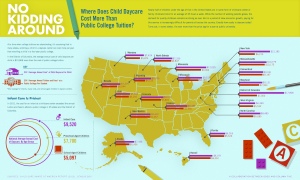
This high price of childcare is particularly important you take into consideration the following statistics found in a National Women’s Law Center analysis of state and national data that addresses the concerns related to low-wage jobs and the intersection of childcare:
- Over 1.2 million mothers with very young children (children ages three and under) are in low-wage occupations (those that typically pay $10.10 or less per hour)
- In every state, working mothers of very young children are disproportionately represented in low-wage occupations.
Moreover, low-wage jobs often entail unstable, unpredictable, or inflexible schedules and lack any paid sick or family leave which can make it difficult to arrange child care. For more information, you can read the full report here.
Getting your college degree and being a parent also isn’t easy. Check out a previous post from our former intern, Emily that specifically focuses the childcare issues faced by college student parents.
There’s also this report from AAUW that specifically addresses childcare issues on a community college level.
And the issue extends beyond access to childcare. These are just two personal stories I’ve heard recently from moms in my life…
A dear friend of mine just had her baby. Leading up to her due date, we spoke about her struggle to understand the ins and outs of her maternity leave (because newsflash: out of 178 nations, the US is one of three that still does not require paid maternity leave benefits). With only weeks to go until her due date, she realized she had been told the wrong information about her leave policies and now had significantly less time to take off during maternity leave than she originally thought. In the moment she wasn’t feeling well and was contemplating starting her leave early before the baby came. She shared with me feeling torn about taking the time off now before the baby was here so she could take care of herself or to save the time for later so she could spend it with the baby once he or she arrived. She asked: “how can I take care of my baby, if I can’t take care of me now?”
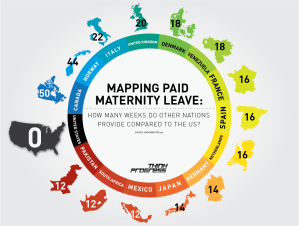
*Recent update… there’s a new push underway at the U.S. Labor Department for paid maternity leave. You can read the 9/24/14 article here.
Upon coming back from maternity leave, my sister-in-law, J, inquired with her HR department about a private space she could pump. She was referred to a single-use bathroom that was generally known around the office… and this is her exact quote… “as the place the guys went to take a dump.” J questioned that location as the only solution and asked if she could use a conference room when it wasn’t in use. She was told that using a conference room wasn’t sanitary for other people who use it… you know in case breast milk got all over the place. Needless to say, she left the meeting crying and feeling pretty hopeless. Thank goodness, HR went back and did their homework and changed their statement when it became apparent that state law made it illegal for workplaces to designate public restrooms as lactation rooms. The next day they turned an empty office into a “wellness center.”
They were probably worried this would happen….
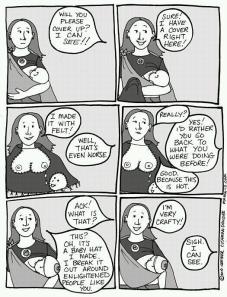
But all joking aside, for UMBC folks, please know the University System of Maryland has a lactation facilities policy and the Women’s Center is the official lactation room for campus. Moreover, on all college campuses that receive federal funding, pregnant and parenting students can find protection under Title IX which prohibits discrimination based on sex in education programs or activities.
During the various conversations I engaged in last year when the campus childcare center closed, it was important for me to emphasize that access to childcare wasn’t just a women’s issue. It was a parent issue. A student success issue. A retention and graduation issue. A work-place satisfaction issue. And, while all of that is true, access to childcare and family-friendly work policies are still also women’s issues that impact pay-equity issues, tenure and promotion issues, work-life balance issues and more. As a society, we need to do a better job at supporting our moms and families. It’s time for a culture shift and we all need to be a part of the solution.
* * * * * * * * *
The Women’s Center has several resources that may be of interest to our UMBC moms and parents:
Mother’s Group list-serv: This list-serv allows members to connect with other moms and parents on campus. Looking for a suggestion for a babysitter, pediatrician, or childcare provider? Email the list! If you’d like to be added provide your contact information to womens.center@umbc.edu
myUMBC Moms and Parents Group: This is clearinghouse of sorts that the Women’s Center created to put all the parenting and childcare resources we know of in one place. Examples of links and documents include the childcare resource guide, employment protections, Grad’s School maternity leave policies, information about Title IX. This can also be a place for parents to post their own discussions or questions.
Childcare Resource Guide: Before the childcare on campus closed, the Women’s Center with the support of the President’s Commission for Women put together a guide to help parents find alternatives to childcare on campus, especially for kiddos between the ages of zero and two. Since the center closed on campus, we’ve added to the guide and continue to update it on a semester by semester basis.
Women’s Center Lactation Room: In addition to the private space, there is also a hospital grade breast pump and a mini-fridge to store your milk (away from everyone’s lunches and dinners).
Mother’s Group Meetings: This is a time for mothers on campus to get together and connect. We’re in the process of re-envisioning what these meetings can look like and how we can make it the best use of time for our busy moms. Stay tuned for updates on when the next meeting will be by following the myUMBC moms and parents page or joining the mother’s group list-serv.
]]>
I’m writing and posting this reflection on the first year “anniversary” of the closing of childcare center on UMBC’s campus. That was a painful and stressful time on campus for many families and...
http://womenscenteratumbc.wordpress.com/2014/09/18/on-the-anniversary-of-the-campus-childcare-closing/
https://my3.my.umbc.edu/api/v0/pixel/news/47685/guest@my.umbc.edu/3a0ef7a62cf414ded574bcdb241ca0d5/api/pixel
awareness
childcare
issues
maternity-leave
mothers
title-ix
Women's, Gender, & Equity Center
https://my3.my.umbc.edu/groups/womenscenter
https://assets2-my.umbc.edu/system/shared/avatars/groups/000/000/125/78272a4842689b30dbf74672182b78f8/xsmall.png?1750974263
https://assets1-my.umbc.edu/system/shared/avatars/groups/000/000/125/78272a4842689b30dbf74672182b78f8/original.png?1750974263
https://assets1-my.umbc.edu/system/shared/avatars/groups/000/000/125/78272a4842689b30dbf74672182b78f8/xxlarge.png?1750974263
https://assets1-my.umbc.edu/system/shared/avatars/groups/000/000/125/78272a4842689b30dbf74672182b78f8/xlarge.png?1750974263
https://assets1-my.umbc.edu/system/shared/avatars/groups/000/000/125/78272a4842689b30dbf74672182b78f8/large.png?1750974263
https://assets2-my.umbc.edu/system/shared/avatars/groups/000/000/125/78272a4842689b30dbf74672182b78f8/medium.png?1750974263
https://assets1-my.umbc.edu/system/shared/avatars/groups/000/000/125/78272a4842689b30dbf74672182b78f8/small.png?1750974263
https://assets2-my.umbc.edu/system/shared/avatars/groups/000/000/125/78272a4842689b30dbf74672182b78f8/xsmall.png?1750974263
https://assets3-my.umbc.edu/system/shared/avatars/groups/000/000/125/78272a4842689b30dbf74672182b78f8/xxsmall.png?1750974263
Women's Center
4
0
false
Thu, 18 Sep 2014 09:07:29 -0400
