Of Note: Social Science Faculty, Students, and Alumni
Congratulations to the following faculty, students, and alumni for their recent accomplishments!
Sylvia Trent Adams, Ph.D. ‘06, Public Policy, delivered her remarks as the keynote speaker of the Appomattox County Chamber of Commerce’s Annual Dinner. In brief homecoming, deputy surgeon general recounts local roots (The News and Advance)
Ian Anson, Political Science, wrote an Op-Ed on the first UMBC Retriever Exit Poll during 2018 gubernatorial elections. Who are the Hogan Democrats? UMBC knows (Baltimore Sun)
Steve Chu '12, Economics, talks about the process of growing Ekiben from a hot dog cart to a brick-and-mortar establishment with UMBC classmates Ephrem Abebe '13, Information Systems management, and Nikhil Yesupriya ‘13, M.S. ’16, biological sciences.
An interview with Ekiben executive chef Steve Chu (The Johns Hopkins News-Letter)
Alicia Wilson '04, Political Science, partnered with Michelle Obama through College Bound Program to provide tickets for her book tour to Baltimore City students. When Michelle Obama calls — and wants to do a favor for 150 Baltimore schoolkids (Baltimore Sun)
Chris Curran, Public Policy, published research findings on the impact of Chicago's Safe Passage program on elementary schools. Morning Education (Politico)
Lisa Gray, Associate Director of Diversity and Inclusion, Jason Ashe, Doctoral Student in Psychology, Blake Hipsley ‘19, Physics and Math, Sylvia Anokam '19, Gender and Women's studies, discussed programs and initiatives for underrepresented millennials. On college campuses, planning for a post-Millennial future (Christian Science Monitor) reprint (Epeak World News) (Scribd)
Jane Arnold Lincove, Public Policy, published research showing a positive effect of automatic admission for high-performing students on low-income students’ college choices. The Power of Guaranteed Admissions (Inside Higher Ed)
John A. Olszewski, Jr Ph.D.'17, Public Policy, is sworn in as new Baltimore County Executive. Olszewski Takes Reins in Baltimore County (Maryland Matters)
Karl Steiner, Vice President of Research, Claire Welty, Director of UMBC’s Center for Urban Environmental Research and Education and Sarah Hansen M.S. ’15, Biological Science, discussed new changes to NSF funding for the Baltimore Ecosystem Study.After 20 years, Baltimore Ecosystem Study federal funding ramps down (Baltimore Sun)
Eric Stokan and Roy Meyers, Political Science, looked at the positive outcomes after losing the bid for Amazon's new headquarters. Opinion: Why we are thankful that Maryland didn't 'win' Amazon HQ2 (Maryland Reporter)
William Rice '16, Economics, was awarded the Trial Advocacy Scholarship Award from the Maryland Association for Justice Foundation. William H.T. Rice | UMBC King Carey Law (The Daily Record)
Cameron Walkup ‘20, Geography and Environmental Studies, named one of three finalists from across the University System of Maryland (USM) for the position of 2019-2020 Student Regent. https://my3.my.umbc.edu/groups/civiclife/posts/80989
Yaakov (Jake) Weissmann '06, Social Work, will serve as chief of staff for Maryland Senate President Thomas V. Mike Miller Jr. Maryland Senate President Miller names new chief of staff (Daily Record)
]]>
Congratulations to the following faculty, students, and alumni for their recent accomplishments! Sylvia Trent Adams, Ph.D. ‘06, Public Policy, delivered her remarks as the keynote speaker of...
https://my3.my.umbc.edu/api/v0/pixel/news/81029/guest@my.umbc.edu/0521f15c99dbb54dd72d28ebef03c37a/api/pixel
Center for Social Science Scholarship
https://my3.my.umbc.edu/groups/csss
https://assets4-my.umbc.edu/system/shared/avatars/groups/000/000/825/333a55a4dd50a0fafb33f7e2e5b0df03/xsmall.png?1544752142
https://assets2-my.umbc.edu/system/shared/avatars/groups/000/000/825/333a55a4dd50a0fafb33f7e2e5b0df03/original.png?1544752142
https://assets3-my.umbc.edu/system/shared/avatars/groups/000/000/825/333a55a4dd50a0fafb33f7e2e5b0df03/xxlarge.png?1544752142
https://assets3-my.umbc.edu/system/shared/avatars/groups/000/000/825/333a55a4dd50a0fafb33f7e2e5b0df03/xlarge.png?1544752142
https://assets4-my.umbc.edu/system/shared/avatars/groups/000/000/825/333a55a4dd50a0fafb33f7e2e5b0df03/large.png?1544752142
https://assets1-my.umbc.edu/system/shared/avatars/groups/000/000/825/333a55a4dd50a0fafb33f7e2e5b0df03/medium.png?1544752142
https://assets2-my.umbc.edu/system/shared/avatars/groups/000/000/825/333a55a4dd50a0fafb33f7e2e5b0df03/small.png?1544752142
https://assets4-my.umbc.edu/system/shared/avatars/groups/000/000/825/333a55a4dd50a0fafb33f7e2e5b0df03/xsmall.png?1544752142
https://assets3-my.umbc.edu/system/shared/avatars/groups/000/000/825/333a55a4dd50a0fafb33f7e2e5b0df03/xxsmall.png?1544752142
Center for Social Science Scholarship
1
0
false
Thu, 13 Dec 2018 11:11:31 -0500
Thu, 13 Dec 2018 11:17:55 -0500
No, You’re Not “So OCD”
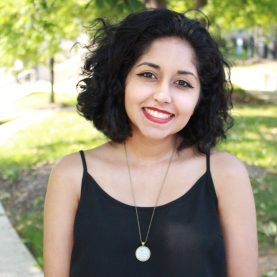 Harini is a student staff member at the Women’s Center and is also the co-facilitator of Between Women.
You have entered a chat with: Friend
1 message from: Friend
Did you hear what happened in class today?
1 message to: Friend
Yes! That girl just had a complete breakdown during her final, I can’t believe it!
2 messages from: Friend
Yes, oh my God!
What a schizo. I swear, she’s does this kind of stuff just to get out of taking tests.
2 messages to: Friend
I mean, she was upset, but do you think you should call her that?
I think she was just stressed out. You’re being kind of mean, don’t you think?
1 message from: Friend
Why are you being so sensitive? I was just expressing my opinion. Stop being lame.
Friend has left the chat.
Language policing is a heightened issue in the age of social media; communication has never been so accessible, but what can accompany the blend of different identities on one interface is thoughtlessness. All people seem alike on the internet, so it can be all too easy to subconsciously adopt the vocabulary of others, whether on the internet or in spoken word.
Those with mental illnesses and learning disabilities forge their own subculture among peers in person and the internet. A shared experience that dramatically impacts daily life is definitely something to bond over; but as with any marginalized group, there is a group with privilege that, knowingly or otherwise, co-opts the culture of the target group. Specifically, neurotypical people have a tendency to hijack mental illnesses and disabilities and use them as adjectives to describe themselves, more commonly described as ableism. Examples of this include claiming that you’re “so OCD” when your room is messy, or that having lots of energy makes you, “so ADHD.”
Do you know what makes you “so OCD?” Having obsessive-compulsive disorder.
Using mental illnesses and learning disabilities to describe traits and actions of neurotypical people only furthers stigma of already marginalized groups. People who seek professional help for very real issues can feel invalidated by their neurotypical peers, who portray mental illness, learning disabilities, and quirks as interchangeable. Neurotypical people regard mental illnesses and learning disabilities as an open buffet, where they can claim whichever parts are most appealing and leave behind the rest. Neurodivergent people do not have such a luxury: they are forced to live with all aspects of their identity.
Another way in which disabled culture is infringed upon is through “inspiration porn,” a concept in which a disability is exploited for the sake of inspiring able-bodied people. People with actual disabilities aren’t any different from those without, apart from that one aspect, but they seem to be the prime target for starring in any sort of inspirational campaign, as if saying, “if a person with prosthetics can be an athlete, why can’t you?” When the meaning of this sentiment is dissected, it appears to offer a challenge for able-bodied people, stating that anything a disabled person does, an able-bodied person should be able to match, if not surpass. The perceptions toward neurodivergent and disabled people are paradoxical in that able-bodied/neurotypical people view the former as a tragic form of inspiration, but also have no qualms about encroaching on their culture and needs.
People without ADD/ADHD take Adderall, a stimulant, to pull all-nighters when they forget to study for a test or finish an essay. Their abuse of the drug led to restrictions in attainment for those who really need it; a paper needs to be signed by the primary physician, which is delivered to the pharmacy, processed by the pharmacist, and finally the prescription is refilled. This has to happen every single time the medication needs a refill, all because neurotypical people claimed something intended to help those with a disadvantage they never experienced. What neurotypical people use to give themselves an extra edge in school, neurodivergents require to function on a level akin to them.
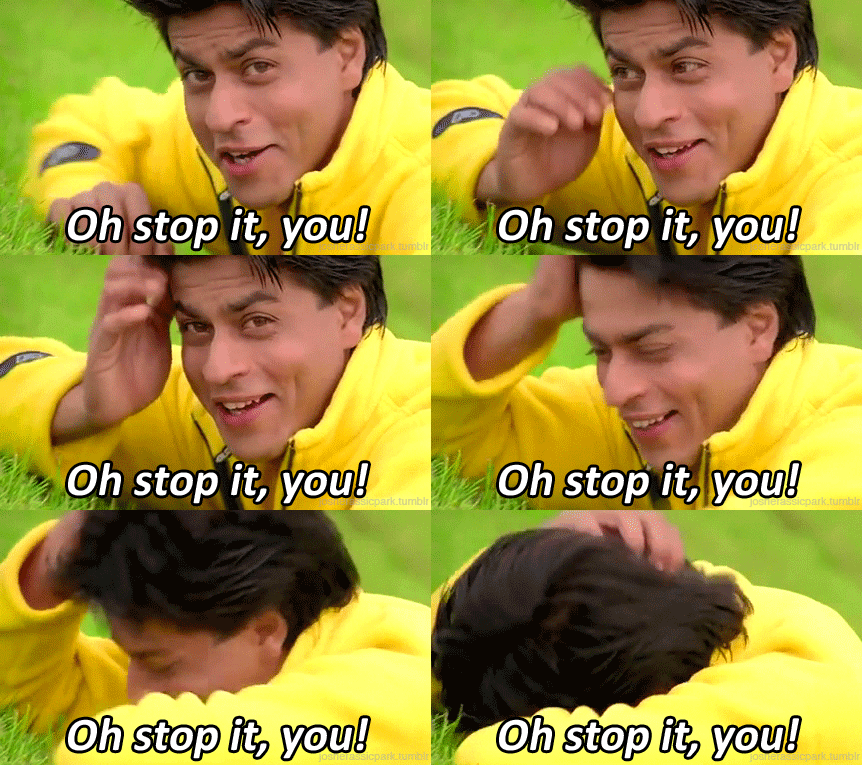
No, please. Stop.
Those with very real mental health issues and learning disabilities are given accommodations to level the playing field; so when neurotypical people steal elements of neurodivergent culture, those accommodations are essentially nullified. Stigma increases, illnesses are invalidated, and no progress is made in furthering mental health awareness.
Saying you’re, “so OCD,” to describe being a neat person demonstrates a staggering lack of understanding of what OCD really is. Substituting “OCD” with a physical ailment demonstrates just how nonsensical this is. “Oh, I’m out of breath from running. I’m so asthmatic!” Unless you have asthma, this just sounds ridiculous. So why say it with mental illnesses?
Having a mental illness isn’t a quirky personality trait; emulating a mentally ill or disabled person doesn’t make you a Manic Pixie Dreamboat (because infringement isn’t gender-exclusive). Being mentally ill simply means your brain chemistry is altered in a way that affects your daily life. The Women’s Center’s own Jess wrote a blog about why she vowed to stop casually using the word “crazy,” which has both ableist and sexist implications. The common use of the word “crazy” in labels is usually in conjunction with some aspect of femininity: Crazy Cat Lady, Crazy Ex-Girlfriend, etc. The same goes for words like “insane,” “lame,” “crippled,” and countless other words that are believed to be innocently used because they’re not being used to describe a disabled or mentally ill person. The connotation still remains, and so does the implied meaning that these negative adjectives are traits describing or indicative of a differently-abled person.
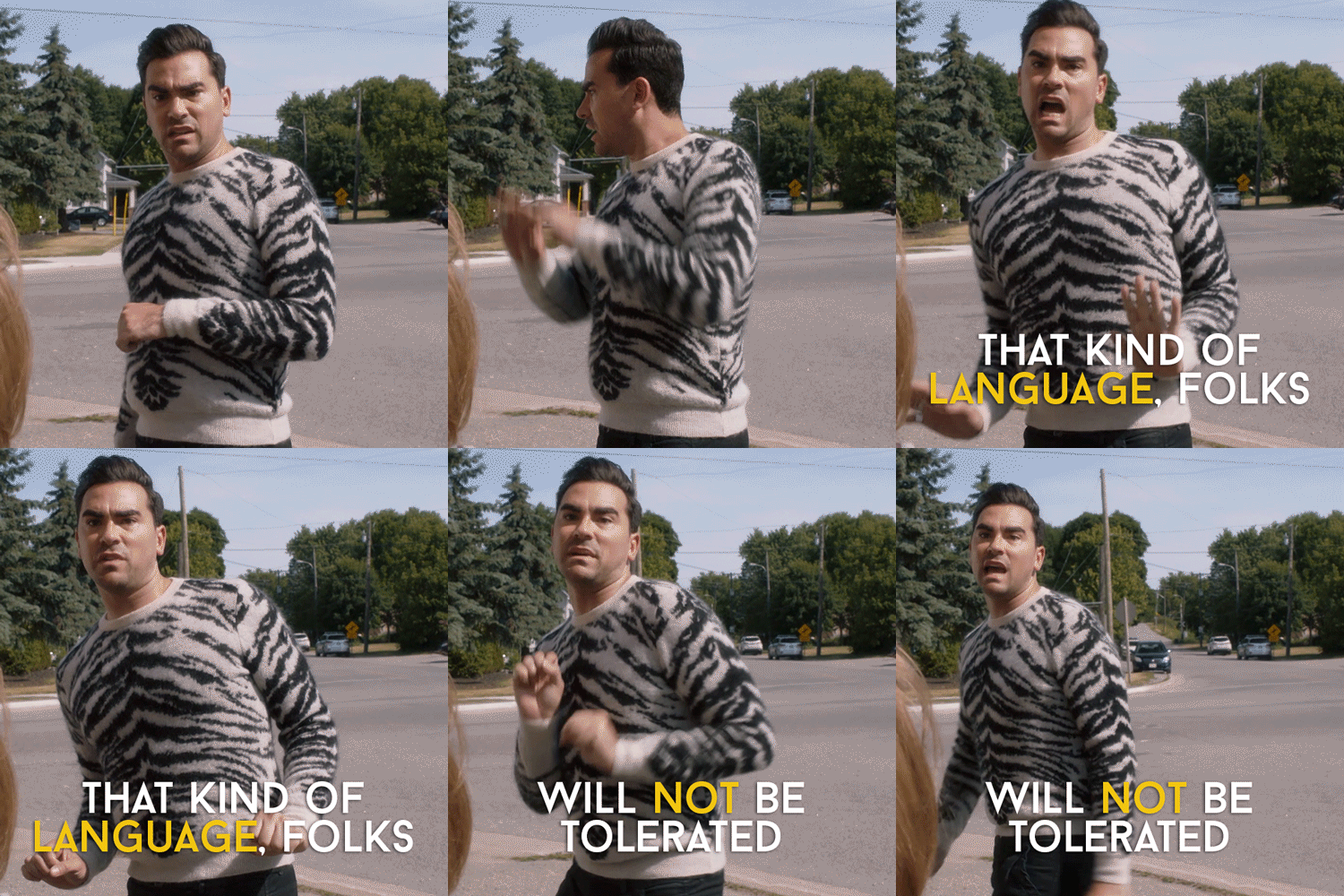
If you’re neurotypical and an ally to those who are neurodiverse, you have a responsibility to stop doing this. Police your own ableist language and catch yourself if you’re about to say something along these lines. Using schizophrenia, depression, anxiety, OCD, etc. as an adjective to describe personality traits is harmful for myriad reasons. However, allyship is not limited to just fixing your own behavior. If a friend or family member speaks like this, use your privilege to correct them and explain the toxicity of their actions. Change begins on an individual level, but its effects can run deeper than imaginable.
For more information about ableist language and neurodivergent culture, feel free to check out these resources!
]]>
Harini is a student staff member at the Women’s Center and is also the co-facilitator of Between Women. You have entered a chat with: Friend 1 message from: Friend Did you hear what...
https://womenscenteratumbc.wordpress.com/2018/12/12/no-youre-not-so-ocd/
https://my3.my.umbc.edu/api/v0/pixel/news/81005/guest@my.umbc.edu/ed50614f7ef0094f19e13df91e001e07/api/pixel
uncategorized
Women's, Gender, & Equity Center
https://my3.my.umbc.edu/groups/womenscenter
https://assets2-my.umbc.edu/system/shared/avatars/groups/000/000/125/78272a4842689b30dbf74672182b78f8/xsmall.png?1750974263
https://assets1-my.umbc.edu/system/shared/avatars/groups/000/000/125/78272a4842689b30dbf74672182b78f8/original.png?1750974263
https://assets1-my.umbc.edu/system/shared/avatars/groups/000/000/125/78272a4842689b30dbf74672182b78f8/xxlarge.png?1750974263
https://assets1-my.umbc.edu/system/shared/avatars/groups/000/000/125/78272a4842689b30dbf74672182b78f8/xlarge.png?1750974263
https://assets1-my.umbc.edu/system/shared/avatars/groups/000/000/125/78272a4842689b30dbf74672182b78f8/large.png?1750974263
https://assets2-my.umbc.edu/system/shared/avatars/groups/000/000/125/78272a4842689b30dbf74672182b78f8/medium.png?1750974263
https://assets1-my.umbc.edu/system/shared/avatars/groups/000/000/125/78272a4842689b30dbf74672182b78f8/small.png?1750974263
https://assets2-my.umbc.edu/system/shared/avatars/groups/000/000/125/78272a4842689b30dbf74672182b78f8/xsmall.png?1750974263
https://assets3-my.umbc.edu/system/shared/avatars/groups/000/000/125/78272a4842689b30dbf74672182b78f8/xxsmall.png?1750974263
Women's Center
34
0
false
Wed, 12 Dec 2018 11:58:55 -0500
UMBC's Cameron Walkup Named Finalist for Student Regent
Congratulations to UMBC junior Cameron Walkup, who has been selected as one of three finalists from across the University System of Maryland (USM) for the position of 2019-2020 Student Regent. The Student Regent serves as a voting member of the USM Board of Regents, representing more than 175,000 undergraduate and graduate students from 12 institutions, including UMBC.
Cameron is pursuing a Geography and Environmental Studies major and Legal Policy minor. A Sondheim Public Affairs Scholar and Honors College student, Cameron has completed internships with Earthjustice and the U.S. House Committee on Natural Resources. He serves as Political Director of College Democrats of Maryland. On campus, Cameron serves as a Hearing Board Justice with UMBC's office of Student Conduct and Community Standards.
The three Student Regent finalists will meet with University System of Maryland officials in the coming weeks, and their names will be submitted to Governor Hogan. The Governor will select the Student Regent later this spring.
]]>
Congratulations to UMBC junior Cameron Walkup, who has been selected as one of three finalists from across the University System of Maryland (USM) for the position of 2019-2020 Student Regent. The...
https://my3.my.umbc.edu/api/v0/pixel/news/80989/guest@my.umbc.edu/109e7a778b46820ab90a13c6c7771c9c/api/pixel
Center for Democracy and Civic Life
https://my3.my.umbc.edu/groups/civiclife
https://assets1-my.umbc.edu/system/shared/avatars/groups/000/001/462/3559ec2c1c4f29266d1c1eb0f1164549/xsmall.png?1554944150
https://assets2-my.umbc.edu/system/shared/avatars/groups/000/001/462/3559ec2c1c4f29266d1c1eb0f1164549/original.png?1554944150
https://assets1-my.umbc.edu/system/shared/avatars/groups/000/001/462/3559ec2c1c4f29266d1c1eb0f1164549/xxlarge.png?1554944150
https://assets1-my.umbc.edu/system/shared/avatars/groups/000/001/462/3559ec2c1c4f29266d1c1eb0f1164549/xlarge.png?1554944150
https://assets3-my.umbc.edu/system/shared/avatars/groups/000/001/462/3559ec2c1c4f29266d1c1eb0f1164549/large.png?1554944150
https://assets1-my.umbc.edu/system/shared/avatars/groups/000/001/462/3559ec2c1c4f29266d1c1eb0f1164549/medium.png?1554944150
https://assets3-my.umbc.edu/system/shared/avatars/groups/000/001/462/3559ec2c1c4f29266d1c1eb0f1164549/small.png?1554944150
https://assets1-my.umbc.edu/system/shared/avatars/groups/000/001/462/3559ec2c1c4f29266d1c1eb0f1164549/xsmall.png?1554944150
https://assets4-my.umbc.edu/system/shared/avatars/groups/000/001/462/3559ec2c1c4f29266d1c1eb0f1164549/xxsmall.png?1554944150
Center for Democracy and Civic Life
https://assets4-my.umbc.edu/system/shared/thumbnails/news/000/080/989/56cd71954860a1f5e835771e21ed6259/xxlarge.jpg?1544550140
https://assets4-my.umbc.edu/system/shared/thumbnails/news/000/080/989/56cd71954860a1f5e835771e21ed6259/xlarge.jpg?1544550140
https://assets3-my.umbc.edu/system/shared/thumbnails/news/000/080/989/56cd71954860a1f5e835771e21ed6259/large.jpg?1544550140
https://assets4-my.umbc.edu/system/shared/thumbnails/news/000/080/989/56cd71954860a1f5e835771e21ed6259/medium.jpg?1544550140
https://assets4-my.umbc.edu/system/shared/thumbnails/news/000/080/989/56cd71954860a1f5e835771e21ed6259/small.jpg?1544550140
https://assets1-my.umbc.edu/system/shared/thumbnails/news/000/080/989/56cd71954860a1f5e835771e21ed6259/xsmall.jpg?1544550140
https://assets4-my.umbc.edu/system/shared/thumbnails/news/000/080/989/56cd71954860a1f5e835771e21ed6259/xxsmall.jpg?1544550140
32
0
true
Tue, 11 Dec 2018 12:43:19 -0500
Wed, 12 Dec 2018 07:22:49 -0500
Too Busy Being Black
Briscoe Turner is a student staff member at the Women’s Center. She is a sophomore Psychology major and Writing minor and a co-facilitator of Women of Color Coalition, a bi-weekly discussion group at the Women’s Center.
Author’s note: This blog is a reflection of my constantly evolving thought process on how intersectionality unveils itself in my life, specifically in regards to my racial and gender identities. Hearing Daily Host Correspondent, Dulcé Sloan’s, insights helped me more clearly articulate my thoughts.
I recently came across a Huffington Post interview where Daily Host Correspondent, Dulcé Sloan, stated, “I Don’t Have Time To Be A Woman, I’m Too Busy Being Black.” Her words resonated with me because she so boldly and clearly laid out a sentiment that I had been trying to articulate for years. I first began to wrestle with this idea– that I was too busy dealing with the social implications of my Blackness to fully address the oppression I face as a woman–when I came across the term intersectionality in high school.

Coined by Kimberlé Crenshaw, intersectionality describes the overlap of our oppressed identities that result in multiple levels of social injustice. I understand that my race and gender operate together, one having an effect on the other, but for some reason, I have felt a greater need to defend my worth as a Black person before I get a chance to defend my worth as a woman. I so vividly remember the various racial microaggressions and slurs I have had to endure throughout the years, but many of my memories surrounding sexism are limited to holding my own against boys during middle school recess basketball games and correcting the occasional uniformed “period jokes.” This is partly due to the fact that I grew up in predominantly White suburbs where my gender stood out less than my Blackness.
In my classes, there were plenty of other girls, but I was normally one of the few, if not only, Black students. This left me constantly feeling the need to prove that I was just as smart and articulate as everyone else, while also asserting the fact that intelligence runs deep in the Black community to avoid tokenism. I also had to defend my Blackness to members of the Black community to avoid being labeled White. Growing up, there were various internal and external battles that I fought in terms of validating my racial identity, that I did not as intensely experience when forming my gender identity. This is not to say that I don’t value my womanhood and understand that there are numerous systems working against me because of it. I just believe that I am often unfairly held back from fully reaping the rewards of feminist victories due to my Blackness.
My experiences have led me to believe that my race is the aspect of my identity that brings me the most joy as well as the most hardship, but I seldom give as much weight to how my gender factors into this strange mixture of pride and oppression.
In a context greater than the neighborhood that I grew up in, I think that this thought process stemmed from my feelings of division and exclusion within the Feminist Movement. In her essay “Age, Race, Class and Sex: Women Redefining Difference,” Audre Lorde presents the idea that, “There is a pretense to a homogeneity of experience covered by the word sisterhood that does not in fact exist.” In conversations about the goals of the feminist movement, I have had to assert the fact that Women of Color are impacted by sexism differently than White woman.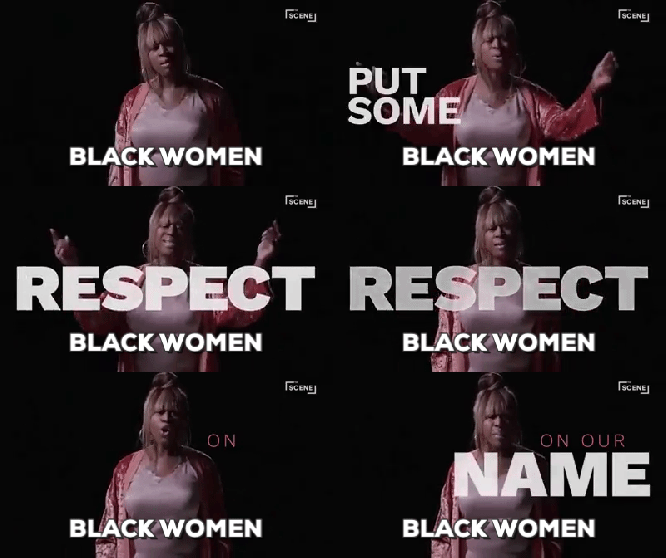
Yes, I can relate to daily instances of sexism, but because I am Black, these instances become intensified. For example, if I am passionate about a topic or asserting myself, I am not only acting on emotional impulses associated with femininity, but I am somehow now the “angry Black girl.” Additionally, Black women are often left out of major dialogues relating to gender equality. In fact, there are many instances where our contributions to the Feminist Movement have been left unacknowledged. Our experiences simply are not the same, and until that is understood, the Feminist Movement will continue to exclude a wide array of women who would be a great asset to the furthering of the cause. Not feeling validated in a group that is supposed to be fighting for your equality is discouraging.
In comparison, I have found a sense of understanding and unity within the Black Lives Matter Movement that makes me believe that my experiences are validated in the fight for justice. Black Lives Matter was founded by three Black women, Alicia Garza, Patrisse Cullors, and Opal Tometi, with the intent of “placing those at the margins closer to the center.” They realized that most Black liberation movements are led by Black, cis-gender, heterosexual men and wanted to make space for the experiences of Black women and Black queer and trans people. A movement with Black women at the core is something that is reaffirming to me.
With that being said, no movement is perfect, and I should look at how other movements approach the issue of diversity. Based on my experiences with the Feminist Movement, I can imagine that there are many movements where people feel stifled or unheard.
The disconnect between wanting to be more involved in the Feminist Movement and not feeling entirely welcomed is something that I struggle with but am actively trying to reconcile. I am a co-facilitator of Women of Color Coalition, a bi-weekly discussion group at the Women’s Center, where I am able to have open dialogues with other Women of Color about our diverse experiences and how we fit into the fight for gender equality. I find that this group has allowed me to connect with people who have similar sentiments as myself. It is spaces like this where I feel that my voice is not only heard but valued. I have come to realize that although my gender is not always at the forefront of my personal understanding of how I am perceived socially, it is a part of my identity that is essential to understanding the impact systemic structures of oppression have on me as a whole.
For more information about the ideas discussed in this blog, check out these resources:
Audre Lorde: “Age, Race, Class, and Sex: Women Redefining Difference”
Black Lives Matter: Herstory
]]>
Briscoe Turner is a student staff member at the Women’s Center. She is a sophomore Psychology major and Writing minor and a co-facilitator of Women of Color Coalition, a bi-weekly discussion group...
https://womenscenteratumbc.wordpress.com/2018/12/10/too-busy-being-black/
https://my3.my.umbc.edu/api/v0/pixel/news/80955/guest@my.umbc.edu/dd9a65655ac8a3043b182453ecfd6fdb/api/pixel
uncategorized
Women's, Gender, & Equity Center
https://my3.my.umbc.edu/groups/womenscenter
https://assets2-my.umbc.edu/system/shared/avatars/groups/000/000/125/78272a4842689b30dbf74672182b78f8/xsmall.png?1750974263
https://assets1-my.umbc.edu/system/shared/avatars/groups/000/000/125/78272a4842689b30dbf74672182b78f8/original.png?1750974263
https://assets1-my.umbc.edu/system/shared/avatars/groups/000/000/125/78272a4842689b30dbf74672182b78f8/xxlarge.png?1750974263
https://assets1-my.umbc.edu/system/shared/avatars/groups/000/000/125/78272a4842689b30dbf74672182b78f8/xlarge.png?1750974263
https://assets1-my.umbc.edu/system/shared/avatars/groups/000/000/125/78272a4842689b30dbf74672182b78f8/large.png?1750974263
https://assets2-my.umbc.edu/system/shared/avatars/groups/000/000/125/78272a4842689b30dbf74672182b78f8/medium.png?1750974263
https://assets1-my.umbc.edu/system/shared/avatars/groups/000/000/125/78272a4842689b30dbf74672182b78f8/small.png?1750974263
https://assets2-my.umbc.edu/system/shared/avatars/groups/000/000/125/78272a4842689b30dbf74672182b78f8/xsmall.png?1750974263
https://assets3-my.umbc.edu/system/shared/avatars/groups/000/000/125/78272a4842689b30dbf74672182b78f8/xxsmall.png?1750974263
Women's Center
15
0
false
Mon, 10 Dec 2018 12:09:33 -0500
After Pittsburgh: Hate Crimes, Gun Violence, and Toxic Masculinity
Truth be told, I’ve been avoiding writing about the tragedy in Pittsburgh. I didn’t want to read any of the numerous articles that were shared, I didn’t want to engage with the flood of posts on social media, and I didn’t want to talk. Except it’s more than not wanting to do any of those things; I felt that I couldn’t. I couldn’t acknowledge what had happened because I was scared I would fall apart. I couldn’t read my friends’ posts because every time I saw them, I was hit with a pang of fear for their safety and for my own. I couldn’t afford to make this tragedy real, because doing so meant grappling with the hard questions.
What do we do now?
Why does this keep happening?
How do we stop it from happening again and again and again?
Who’s next?
In the back of my mind, I knew that I would eventually have to face these fears and questions. I chose the Women’s Center blog as the forum to struggle with them because I recognized the capacity of the people around me to support me as I do so. That said, I don’t intend for this to merely be a personal reflection. There are larger societal factors which continue to influence the culture of violence in this country, and those need to be addressed.
Baseline Information
First things first, let’s look at the numbers. There is no specified definition of the term “mass shooting” nor is there a government agency that keeps track of them. This makes data collection difficult, so many activists have had to rely on media outlets or nonprofits that have taken on the task. As a result, it is easier to identify trends. Here is a really useful video explaining several of them.

Despite this gap in the data, we do know that America has more guns than any other developed country–even when adjusted for population size–and, consequently, more gun deaths. It is important to note that a very small proportion of gun deaths occur from mass shootings, even though they happen so frequently. This is because the leading cause of gun deaths is suicide, followed by homicide (which is defined separately from mass shooting). The specifics are even harder to pin down when it comes to the shooter’s identity, but there are two key trends: the first is that a majority of the shooters are white, and the second is that all but three of these shooters in the last few decades have been men.
Masculinity and Violence
It’s no coincidence that nearly every mass shooter has been a man; it’s a symptom of how society teaches gender. From an early age, we’re taught that men are supposed to be strong, physically aggressive, and that roughhousing is just what boys do. For example, if a boy chases a girl around the playground and pulls her hair, we say that he likes her. This dismissal of boy’s actions teaches them that violence is natural and an acceptable outlet for negative emotions. Think about the playground scenario from a different perspective: what I see is not a little boy expressing positive feelings about a girl, but rather him acting on the negative feeling of frustration that he can’t have her. We don’t just teach boys violence; we teach them a desire to control everything except their emotions.
When we get older, and these actions become more serious (such as sexual violence), we as a society still focus on women as victims. We do not, however, focus on men as perpetrators of this violence. As one of my friends put it, “we teach women not to get raped instead of teaching boys not to rape.” At the Women’s Center, we recognize that sexual violence affects a multitude of people, and that there is no one way a survivor should look; however, this is still a heavily gendered issue, and much of that has to do with patriarchy. With this in mind, we need to consider how we as a society teach and reinforce masculinity. Arguments like “men can’t help themselves” and “boys will be boys” are endemic of both toxic masculinity and rape culture–which often reinforce one another.
Within this context, let’s return to the issue of mass violence. A key piece of the conversation that often gets left out in the media is the history of the perpetrator. For white shooters in particular, people are quick to search their past for mental illness or redeeming qualities, but they often gloss over a common thread, which is a history of commiting domestic violence, interpersonal violence (IPV), and/or sexual violence. For example, it came out that the man who killed over 50 people at a Las Vegas country music concert in October 2017 had abused his ex-girlfriend when they were together. Closer to home, the boy who shot and killed a classmate at Great Mills High School in St. Mary’s County had expressed anger that she had rejected his unwanted advances
Conceptually, this link makes sense. Much of these acts come not from a place of desire, but a place of needing to have power. We teach men that to be masculine means having control and authority over others, so many men view these violent acts as a means of maintaining control over their partners. It’s horrible, but when we don’t teach men a socially acceptable way of expressing negative emotions (and tell them that to be emasculated is to lose status in society) they often turn to violence. Furthermore, if a man views his partner as an object to be controlled, it’s unsurprising that he could view groups of people he’s prejudiced against or feels have wronged him the same way.
Moreover, we continue to normalize and stoke this misogynistic anger in online communities and forums where many men who feel entitled to have a sexual partner, and cheated that they do not, blame women for their problems and often celebrate men who hurt women. In fact, several of these men have used guns against women they do not know, and explicitly stated this misogynistic reasoning. It’s important to be mindful of the way we interpret the numbers here. Because mass shootings make up such a small portion of the gun violence in America, there are very few abusers that actually go on to commit those atrocities. On the flip side, many mass shooters have a history of violence, and it is necessary to understand that correlation. Their possession of assault weapons only makes their acts of violence all the more deadly.
Anti-Semitism and Hate Crimes
Hate crimes have been on the rise over the last few years, across lots of different marginalized groups. An FBI report indicates that overall hate crimes have increased by 17% and that anti-Semitic hate crimes have increased by 37%. Based on data collected by the FBI and the Southern Poverty Law Center, anti-Semitic hate crimes comprise about 11% of hate crimes overall, and 58% of hate crimes against religious groups. For comparison, Jewish people make up about 2% of the United States population, and 0.2% of the world’s population. So why are we so targeted?

It would take an entirely separate post to delineate the long history of violence and persecution against the Jewish people, but it is practically as old as the religion itself. Even in modern history, there are countless examples of anti-Semitic violence, many of which have been forgotten (this article lists just a few over the last hundred years). Many people who commit these acts are fueled by hateful rhetoric they see online.
Most of this anti-Semitic rhetoric stems from ancient stereotypes that still persist today. From Shakespearean villains to old movies to today’s political campaigns, anti-Semitic tropes have a long and ugly history. Samantha Bee did an amazing job of explaining that history and how it’s connected to today’s politics in a segment on her show. Essentially, the use of dog-whistle politics is not explicitly anti-Semitic, but its implications and allusions to deep-rooted stereotypes are like a language that sends a clear signal to those who already speak it.
Where do we go from here?
I really wish that I could conclude this piece on a positive note. I wish I could point to some positive trends that indicate understanding and acceptance are on the rise, while fear and violence are fading away. I wish I could, but I have nothing to point to. Instead, as I finish writing this blog, I get an email notification from the UMBC Police Department alerting the community of yet another display of anti-Semitism on this campus.

I’m tired of this. I’m tired of anti-Semitism being dismissed in progressive movements that advocate for diversity and acceptance. I’m tired of Nazis being referred to as “very fine people” and of free speech being used to defend them. I’m tired of centrists trying to hear “both sides of the story,” as though hate should be treated as a valid political ideology. I’m tired of social media executives bending over backwards to promote community guidelines, but doing nothing about literal neo-Nazis using their platforms. I’m tired and I’m angry. I’ve heard too many Holocaust jokes, had too many stereotypes hurled in my face, and seen too many concerns about anti-Semitism get brushed aside.
I don’t want to see any more swastikas drawn on bathroom walls. I don’t want to be scared for my safety when I go to see one of my favorite shows, and I don’t want to see people–especially people on this campus–use anti-Semitism as the punchline of a joke. Jewish people cannot and should not be the only ones fighting this bigotry. We need people who aren’t Jewish to step up and show some support. Find organizations that combat anti-Semitism, educate yourself on Jewish history and culture, and confront this hatred when you see it. You don’t have to be the loudest voice in the room, but we can’t take any more of your silence.
Sources/Further Reading
https://www.independent.co.uk/voices/stephen-paddock-las-vegas-domestic-violence-fantasy-boston-bomber-orlando-shooting-a7993186.html
https://www.npr.org/2017/10/07/556405489/the-relationship-between-domestic-violence-and-mass-shootings
https://www.newyorker.com/news/daily-comment/searching-for-motives-in-mass-shootings
https://www.statista.com/statistics/476456/mass-shootings-in-the-us-by-shooter-s-race/
https://www.politifact.com/punditfact/statements/2017/oct/06/newsweek/are-white-males-responsible-more-mass-shootings-an/
http://www.phillytrib.com/news/majority-of-mass-shootings-carried-out-by-white-men/article_8b8b0145-c512-525a-8a7d-256bfb3a959f.html
https://www.cosmopolitan.com/sex-love/a23088401/domestic-violence-coercive-control/
]]>
Truth be told, I’ve been avoiding writing about the tragedy in Pittsburgh. I didn’t want to read any of the numerous articles that were shared, I didn’t want to engage with the flood of posts on...
https://womenscenteratumbc.wordpress.com/2018/12/07/after-pittsburgh-hate-crimes-gun-violence-and-toxic-masculinity/
https://my3.my.umbc.edu/api/v0/pixel/news/80917/guest@my.umbc.edu/a2dd0ceb77d57118e6bd0e1fe92c01ce/api/pixel
anti-semitism
gun-violence
hate-crimes
issues
judaism
masculinity
toxic-masculinity
violence
Women's, Gender, & Equity Center
https://my3.my.umbc.edu/groups/womenscenter
https://assets2-my.umbc.edu/system/shared/avatars/groups/000/000/125/78272a4842689b30dbf74672182b78f8/xsmall.png?1750974263
https://assets1-my.umbc.edu/system/shared/avatars/groups/000/000/125/78272a4842689b30dbf74672182b78f8/original.png?1750974263
https://assets1-my.umbc.edu/system/shared/avatars/groups/000/000/125/78272a4842689b30dbf74672182b78f8/xxlarge.png?1750974263
https://assets1-my.umbc.edu/system/shared/avatars/groups/000/000/125/78272a4842689b30dbf74672182b78f8/xlarge.png?1750974263
https://assets1-my.umbc.edu/system/shared/avatars/groups/000/000/125/78272a4842689b30dbf74672182b78f8/large.png?1750974263
https://assets2-my.umbc.edu/system/shared/avatars/groups/000/000/125/78272a4842689b30dbf74672182b78f8/medium.png?1750974263
https://assets1-my.umbc.edu/system/shared/avatars/groups/000/000/125/78272a4842689b30dbf74672182b78f8/small.png?1750974263
https://assets2-my.umbc.edu/system/shared/avatars/groups/000/000/125/78272a4842689b30dbf74672182b78f8/xsmall.png?1750974263
https://assets3-my.umbc.edu/system/shared/avatars/groups/000/000/125/78272a4842689b30dbf74672182b78f8/xxsmall.png?1750974263
Women's Center
8
0
false
Fri, 07 Dec 2018 08:37:51 -0500
Fri, 07 Dec 2018 08:37:51 -0500
End of the Semester Hours!
As the semester comes to a close, our hours will be slightly altered. On Study Day, December 12th, we will be closing at 5pm. Additionally, we will be closed on December 20th and 21st.
Community members needing access to the lactation room should contact Jess and/or see the instructions provided to you via the email received when you signed up for room reservations to see how to access the Women's Center when we're closed.
Happy holidays and good luck on your finals!
]]>
As the semester comes to a close, our hours will be slightly altered. On Study Day, December 12th, we will be closing at 5pm. Additionally, we will be closed on December 20th and 21st....
https://my3.my.umbc.edu/api/v0/pixel/news/80846/guest@my.umbc.edu/8f14ea6b67f7670510208222f3c42bcd/api/pixel
Women's, Gender, & Equity Center
https://my3.my.umbc.edu/groups/womenscenter
https://assets2-my.umbc.edu/system/shared/avatars/groups/000/000/125/78272a4842689b30dbf74672182b78f8/xsmall.png?1750974263
https://assets1-my.umbc.edu/system/shared/avatars/groups/000/000/125/78272a4842689b30dbf74672182b78f8/original.png?1750974263
https://assets1-my.umbc.edu/system/shared/avatars/groups/000/000/125/78272a4842689b30dbf74672182b78f8/xxlarge.png?1750974263
https://assets1-my.umbc.edu/system/shared/avatars/groups/000/000/125/78272a4842689b30dbf74672182b78f8/xlarge.png?1750974263
https://assets1-my.umbc.edu/system/shared/avatars/groups/000/000/125/78272a4842689b30dbf74672182b78f8/large.png?1750974263
https://assets2-my.umbc.edu/system/shared/avatars/groups/000/000/125/78272a4842689b30dbf74672182b78f8/medium.png?1750974263
https://assets1-my.umbc.edu/system/shared/avatars/groups/000/000/125/78272a4842689b30dbf74672182b78f8/small.png?1750974263
https://assets2-my.umbc.edu/system/shared/avatars/groups/000/000/125/78272a4842689b30dbf74672182b78f8/xsmall.png?1750974263
https://assets3-my.umbc.edu/system/shared/avatars/groups/000/000/125/78272a4842689b30dbf74672182b78f8/xxsmall.png?1750974263
Women's Center
https://assets1-my.umbc.edu/system/shared/thumbnails/news/000/080/846/58f22c9a19b296e7e5fbfa7d7a059c79/xxlarge.jpg?1544024261
https://assets4-my.umbc.edu/system/shared/thumbnails/news/000/080/846/58f22c9a19b296e7e5fbfa7d7a059c79/xlarge.jpg?1544024261
https://assets3-my.umbc.edu/system/shared/thumbnails/news/000/080/846/58f22c9a19b296e7e5fbfa7d7a059c79/large.jpg?1544024261
https://assets2-my.umbc.edu/system/shared/thumbnails/news/000/080/846/58f22c9a19b296e7e5fbfa7d7a059c79/medium.jpg?1544024261
https://assets4-my.umbc.edu/system/shared/thumbnails/news/000/080/846/58f22c9a19b296e7e5fbfa7d7a059c79/small.jpg?1544024261
https://assets2-my.umbc.edu/system/shared/thumbnails/news/000/080/846/58f22c9a19b296e7e5fbfa7d7a059c79/xsmall.jpg?1544024261
https://assets4-my.umbc.edu/system/shared/thumbnails/news/000/080/846/58f22c9a19b296e7e5fbfa7d7a059c79/xxsmall.jpg?1544024261
1
0
true
Wed, 05 Dec 2018 10:43:01 -0500
Alternative Spring Break: Still Accepting Applications!
Spend a week addressing social issues & building community!
Apply to join Alternative Spring Break (ASB), a program that consists of student-led experiential learning trips. Participants will work with community partners, government officials, and scholars to critically examine complex issues and identify ways to address them.
All trips will take place in Baltimore to foster sustainable connections and lay the groundwork for long-term collective civic action. The trip dates are March 17 to March 22, 2019.
This year’s trips focus on social issues such as:
Decareration (this trip is full)
Refugee Children Immersion (this trip is full)
Healthy Relationships
Re-Housing
Creative Expression & Community Well-Being
See the flyer attached for more info, or contact Taisha Sims at tsims2@umbc.edu for more specific questions.
***Bake sale coming up to fund-raise for Alternative Spring Break, this Wednesday 12/5 from 11:30 am - 1:30 pm on Commons Main Street
]]>
Apply to join Alternative Spring Break (ASB), a program that consists of student-led experiential learning trips. Participants will work with community partners, government officials, and scholars...
Flyer
https://assets3-my.umbc.edu/system/shared/attachments/3534ca58a9bce85e89652598160ddb01/69f5dc4c/news/000/080/817/2ec14612fd4f01f8865e35f4c3b87ed1/alternative spring break flyer_v3.pdf?1543943018
https://my3.my.umbc.edu/api/v0/pixel/news/80817/guest@my.umbc.edu/4096d1e353eabf85be40a744ba30077a/api/pixel
Political Science
https://my3.my.umbc.edu/groups/poli
https://assets1-my.umbc.edu/system/shared/avatars/groups/000/000/617/47f5d6b9ad18d16095cd0d4fc758b168/xsmall.png?1368723437
https://assets4-my.umbc.edu/system/shared/avatars/groups/000/000/617/47f5d6b9ad18d16095cd0d4fc758b168/original.png?1368723437
https://assets4-my.umbc.edu/system/shared/avatars/groups/000/000/617/47f5d6b9ad18d16095cd0d4fc758b168/xxlarge.png?1368723437
https://assets1-my.umbc.edu/system/shared/avatars/groups/000/000/617/47f5d6b9ad18d16095cd0d4fc758b168/xlarge.png?1368723437
https://assets3-my.umbc.edu/system/shared/avatars/groups/000/000/617/47f5d6b9ad18d16095cd0d4fc758b168/large.png?1368723437
https://assets3-my.umbc.edu/system/shared/avatars/groups/000/000/617/47f5d6b9ad18d16095cd0d4fc758b168/medium.png?1368723437
https://assets2-my.umbc.edu/system/shared/avatars/groups/000/000/617/47f5d6b9ad18d16095cd0d4fc758b168/small.png?1368723437
https://assets1-my.umbc.edu/system/shared/avatars/groups/000/000/617/47f5d6b9ad18d16095cd0d4fc758b168/xsmall.png?1368723437
https://assets1-my.umbc.edu/system/shared/avatars/groups/000/000/617/47f5d6b9ad18d16095cd0d4fc758b168/xxsmall.png?1368723437
Political Science
1
0
true
Tue, 04 Dec 2018 12:04:56 -0500
Tue, 04 Dec 2018 12:05:25 -0500
Winter Course: POLI 395
U.S. National Security
Bombs, borders, election meddling and pandemic health scares!
Study U.S. National Security in POLI 395 this winter. Satisfies Social Science GEP.
No prerequisites necessary.
Please see below for a curated list of upcoming funding opportunities. If you are working on a particular project and would like additional assistance in finding funding opportunities, please email: socialscience@umbc.edu.
Program: Research Grant
Agency: National Science Foundation- Cultural Anthropology Scholars Award
Next Deadline: January 16, 2019
The National Science Foundation announces an opportunity for methodological training by cultural anthropologists who are active researchers. The purpose is to help cultural anthropologists upgrade their methodological skills by learning a specific analytical technique which will improve their research abilities.
See https://www.nsf.gov/funding/pgm_summ.jsp?pims_id=5321&org=SBE&sel_org=SBE&from=fund for details
Email: dwinslow@nsf.gov
Contact: Deborah Winslow, Program Director
Program: Visiting Scholar and Visiting Researcher Program in Ethnic Studies
Agency: UCLA Institute of American Cultures
Next Deadline: January 10, 2019
Offers awards to visiting scholars/researchers to support research on African Americans, American Indians, Asian Americans, and Chicanos. Projects must focus on intergroup or comparative research on one or more of these communities in a local, national, or global context. Grants include the : Visiting Scholar Fellowship Program in Ethnic Studies (1/10/19); Graduate and Predoctoral Fellowship in Ethnic Studies (1/10/19); Research Grants (3/1/19); and Shirley Hune Inter-Ethnic/ Inter-Racial Studies Award (3/1/18) Fellowships include an academic-year stipend of up to $35,000, up to $4,000 in research support, and health benefits. Seehttp://www.iac.ucla.edu/ for details. Email: iaccoordinator@conet.ucla.edu CFDA
Program: Research Grants and Dissertation Fellowships
Agency: Harry Frank Guggenheim Foundation
Next Deadline: February 01, 2019
Supports scholarly research on problems of violence, aggression and dominance. Highest priority is given to increasing the understanding and amelioration of urgent problems of violence and aggression in the modern world. Program is highly competitive. Research grants (annual deadline: 8/1) provide grants of $15,000 to $40,000 up to two years for individuals in any of the natural and social sciences and the humanities. Dissertation Fellowships (annual deadline: 2/1) support at least 10 awards of $20,000 over one year to complete dissertations. Seehttp://hfg.org/ for details. Email: info@hfg.org
Program: Fellowships (Various Short-Term)
Agency: Clark (William Andrews) Memorial Library
Next Deadline: February 01, 2019
Offers residential fellowship programs that support postdoctoral research at UCLA's Clark Library specializing in 17th and 18th century studies: Ahmanson-Getty Postdoctoral Fellowships ($49,188 for theme-based research fellowship in residence); Clark Short-Term Fellowships ($3,000 per month up to three months); ASECS/Clark Fellowships ($3,000 for one month of research on Restoration or the 18th century); Kanner Fellowship in British Studies ($9,000 for three months); and Clark-Huntington Joint Bibliographical Fellowship ($6,000 for two months). Annual deadline: 2/1. Seehttp://www.c1718cs.ucla.edu/ Email: ortiz@humnet.ucla.edu
Contact: Myrna Ortiz
Program: Summer Internship Program in Research for Graduate Students
Agency: Educational Testing Service
Next Deadline: February 01, 2019
Supports interns in an eight-week program to participate in research under the guidance of an ETS mentor. Each intern is required to give a brief presentation about the project at the conclusion of the internship. The 8-week internship (June 3 - July 26, 2019) is carried out in the ETS offices in Princeton, N.J., in one of seven research areas. Open to students in a relevant doctoral program. Offers $6,000 salary, transportation allowance for relocating to and from the Princeton area and a housing allowance or interns commuting more than 50 miles. Annual deadline: 2/1. Seehttp://www.ets.org/research/fellowships.html for details Email: internfellowships@ets.org
Contact: Linda DeLauro
Program: Asian Studies Grants
Agency: Association for Asian Studies
Next Deadline: February 01, 2019 (Target) The Association for Asian Studies (AAS) is a scholarly, non-political, non-profit professional association open to all persons interested in Asia and the study of Asia. AAS offers several grants to support the research of North American scholars to improve the quality of teaching about Asian cultures at the college and pre-college levels. Grant amounts, details and deadlines vary according to program. Annual deadlines: 2/1, and 10/1, with programs to support bringing speakers to campus due 12/1. Also offers prizes for scholarly books. Seehttp://www.asian-studies.org/Grants-and-Awards/AAS-Grant-Programs for details. Email: jwc8v@virginia.edu
Contact: Jack Chen
Program: Library Resident Research Fellowships
Agency: American Philosophical Society
Next Deadline: February 01, 2019
Supports one to two month (3/1/) or year-long (2/1) residential fellowships for research in the library's collections. Subject areas include the: Early American History & Culture; Atlantic History; Intellectual History; Travel, Exploration & Expeditions; History of Science, Technology & Medicine; History of Biochemistry, Physiology & Biophysics; Natural History; Anthropology; Native American History; Culture & Languages; Caribbean & Slavery Studies. Applicants must hold a Ph.D. or the equivalent, be Ph.D. students at the dissertation stage, or independent scholars. Award amounts vary. Annual Deadlines vary by program, but mainly fall on 2/1 and 3/1. Seehttps://www.amphilsoc.org/grants/fellowships for details. Email: lmusumeci@amphilsoc.org
Contact: Linda Musumeci
Program: Research, Grants and Fellowships
Agency: Arthur and Elizabeth Schlesinger Library on the History of Women
Next Deadline: February 04, 2019
Sponsors grants to use the library's holdings. Research Support Grants are open to researchers from any college or university and to independent scholars. Dissertation Grants are open to scholars who are enrolled in a doctoral program in a relevant field, have completed their course work toward the doctoral degree, and have an approved dissertation topic by the time the application is submitted. Oral history grants are open to scholars conducting oral history interviews. Annual deadline for all three: 2/4. Mellon-Schlesinger Summer Research Grants are due 11/15/18. The Pforzheimer Fellowship is due 3/4/19. Seehttp://www.radcliffe.edu/schles/grants.aspx for details. Email: slgrants@radcliffe.harvard.edu
Contact: Cara Raskin
Program: Grant Programs
Agency: Herb Block Foundation
Next Deadline: February 05, 2019
Foundation supports the art of editorial cartooning and makes three types of national grants: Defending Basic Freedoms (10/4/18) supports projects that safeguard the freedoms of the Bill of Rights and prevent discrimination. Encouraging Citizen Involvement (6/6/19) seeks to ensure a responsible, responsive democratic government through citizen involvement. Awards range from $5,000-$25,000. Deadlines refer to required LOIs. Also offers Pathways Out of Poverty for DC (2/5/19) area applicants only and various scholarships. Seehttp://www.herbblockfoundation.org/programs for details. Email: info@herbblock.org
Program: Research Grants and Fellowships
Agency: American Historical Association
Next Deadline: February 15, 2019
Supports several small research grants (up to $1,500; annual deadline 2/15) in the following areas: history of the Western hemisphere; colonial American history, with particular reference to the intercultural aspects of American and European relations; U.S. legal history and the field of law and society; and history of Europe, Asia, and Africa. Only AHA members are eligible to apply for these grants. Also supports two fellowship programs in the areas of American History and Aerospace History (4/1). Seehttp://www.historians.org/prizes/Grants.htm for details. Email: dschaffer@historians.org Contact: Dana Schaffer
Program: Lewis and Clark Fund for Exploration and Field Research
Agency: American Philosophical Society
Next Deadline: February 15, 2019
Offers grants to doctoral students to support the cost of travel and equipment in field research. Areas supported are archeology, anthropology, biology, ecology, geography, geology, linguistics, and paleontology, but grants will not be restricted to these fields. Awards range up to $5,000. Annual deadline: 10/30 for required letters of support; 11/1 for applications. Separate program focusing on astrobiology open to postdoctoral and junior scientists is also available (2/5). Seehttp://www.amphilsoc.org/grants/lewisandclark for details. Email: lmusumeci@amphilsoc.org Contact: Linda Musumeci
Program: Graduate and Postgraduate Research Grants
Agency: Huyck (Edmund Niles) Preserve and Biological Research Station
Next Deadline: February 22, 2019
Supports graduate and postgraduate research using the resources of the Huyck Preserve in NY. Grants support research in basic and applied ecology, taxonomy, animal behavior, evolution, earth sciences, land use history and other areas of natural science. Native flora and fauna are abundant. Facilities include wet/dry labs, conference center and library. Preference given to residencies of one week or more, and grantees must assist in scientific outreach during their residency. Awards from $2000-$3,500. Annual deadline: second Friday in March. Seehttp://tinyurl.com/k8j3b36 Email: Anne@huyckpreserve.org
Contact: Anne Rhoads
Program: Grant Programs
Agency: Graham Foundation
Next Deadline: February 25, 2019
Program offers grants in architecture and its role in arts, culture and society: Production and Presentation Grants for individuals or organizations; and Research and Development Grants for individuals. Grants fund production-related expenses to take a project from conceptualization to realization and public presentation and provide seed money for research-related expenses. Annual deadlines: 2/25 for organizations, 9/15 for individuals. Also offers Carter Manny Award, which supports dissertation research and writing by promising doctoral students (11/15). Seehttp://tinyurl.com/qbrt8a for details. Email: ckelly@grahamfoundation.org
Contact: Carolyn Kelly
312-787-4071
]]>
Please see below for a curated list of upcoming funding opportunities. If you are working on a particular project and would like additional assistance in finding funding opportunities, please...
https://socialscience.umbc.edu/research/
https://my3.my.umbc.edu/api/v0/pixel/news/80693/guest@my.umbc.edu/6c256c5b26834c21c9c27dfa0b397ec5/api/pixel
Center for Social Science Scholarship
https://my3.my.umbc.edu/groups/csss
https://assets4-my.umbc.edu/system/shared/avatars/groups/000/000/825/333a55a4dd50a0fafb33f7e2e5b0df03/xsmall.png?1544752142
https://assets2-my.umbc.edu/system/shared/avatars/groups/000/000/825/333a55a4dd50a0fafb33f7e2e5b0df03/original.png?1544752142
https://assets3-my.umbc.edu/system/shared/avatars/groups/000/000/825/333a55a4dd50a0fafb33f7e2e5b0df03/xxlarge.png?1544752142
https://assets3-my.umbc.edu/system/shared/avatars/groups/000/000/825/333a55a4dd50a0fafb33f7e2e5b0df03/xlarge.png?1544752142
https://assets4-my.umbc.edu/system/shared/avatars/groups/000/000/825/333a55a4dd50a0fafb33f7e2e5b0df03/large.png?1544752142
https://assets1-my.umbc.edu/system/shared/avatars/groups/000/000/825/333a55a4dd50a0fafb33f7e2e5b0df03/medium.png?1544752142
https://assets2-my.umbc.edu/system/shared/avatars/groups/000/000/825/333a55a4dd50a0fafb33f7e2e5b0df03/small.png?1544752142
https://assets4-my.umbc.edu/system/shared/avatars/groups/000/000/825/333a55a4dd50a0fafb33f7e2e5b0df03/xsmall.png?1544752142
https://assets3-my.umbc.edu/system/shared/avatars/groups/000/000/825/333a55a4dd50a0fafb33f7e2e5b0df03/xxsmall.png?1544752142
Center for Social Science Scholarship
1
0
false
Wed, 28 Nov 2018 15:52:14 -0500
Sitting with discomfort: a social justice imperative
Author’s note: The following reflection on discomfort stems from the alumni discussion the Women’s Center hosted as an introduction to Critical Social Justice keynote speaker Deanna Zandt. Throughout the day, Deanna, Yoo-jin, Susie, and I often discussed the need to contemplate feelings of discomfort that stem from uncertainty. Thank you for that inspiring and necessary conversation, friends. Let’s continue that momentum.
Over this semester, one of my mantras has been “sit with discomfort.” This has meant sitting without clear or particularly good answers for very desperate, hurt people turning to me for help and support. It’s meant holding space for tense and harmful conversations that I really don’t want to have with students. It has meant feeling inconsolably angry with a best friend. And it’s meant not having a dryer for two months. Nope, none of those things feel good, but being able to slow down and contemplate a state of anxiety has allowed me to reach new levels of knowledge, awareness, and perspective.
 Privilege and modern amenities (oft-begotten through privilege) enable us to reap the reward of instant gratification and it acculturates us to diminish all discomfort at its onset. Think about when you text your crush. You send something to this cutie asking them about their astrological sign or if they’ve seen that one Vine (RIP 6 seconds of perfection), and then you wait. You wait and you wait and you wait for their response. Sometimes you get that awful read receipt and no response or you get that blinking ellipsis and nothing. So you check your phone for any twitch or tiny breath of a ding obsessively for the next hour. That feeling? That right there is discomfort and we want that to be alleviated desperately, because–oh my god–what if she’s ALSO a pisces and we’re just going to cry a lot together in the future?
We want to alleviate discomfort at its onset and this whole feeling has been altogether alleviated by modern privileges like Amazon’s instant delivery service, Netflix’s extensive library, and the ability to get on the internet from any phone ever.
But–and hear me out–what if we didn’t always get what we wanted? What if your crush never texts back? Or what if they do text back, but in the moments where you feel discomfort you’re also being reflective about what’s going on for you?
Perhaps, in the case of your crush, you need to ask yourself why their reply is so important. Will it add value to yourself? Will it validate the feelings you have? Does it mean anything besides that fact that they were also born arbitrarily under the symbol of two fish?
Now I’m not saying all of this with the purpose of requesting that you deprive yourself of the simple pleasures of life like watching every single episode of We Bare Bears. Do that. If it makes you happy, do that. And totally feel the anxiety related to sending texts to your crush (you’re fine, a good person, you’re great, there are plenty of fish in the sea, yadda, yadda, yadda).
Rather, what I’m saying is that discomfort is a signal that I think we can pay more attention to because it designates a path for learning, catharsis, and/or growth. Not every moment of discomfort, but there are many discomforting moments, especially as we navigate a world that is not always made for us. Given that, discomfort is and can be a great teacher.
Discomfort as integral to social justice work
There are certain pieces of social justice work that just require sitting with discomfort and having the patience to slow down and not leap for the nearest possible resolution.
The root feeling of discomfort is fear. And fear is what drives prejudice. Ipso facto oppression thrives on fear-induced snap judgments. In order to unlearn the fear that we are programmed to associate with difference, we must recognize discomfort, identify the root of it, and address it. When we slow down fear and face it, yeah, it feels bad, but we are then able to start the process of changing our minds.
The following are some social justice practices and tenets that are, among many other things, predicated on uncomfortable situations.
Restorative practices
The focus of restorative practices (also “restorative justice”) is on repairing harm in a community-centered way. This looks like big circles that bring together perpetrators, victims, community advocates, and allies in a dialogue, where everyone is treated equitably. The process of doing so is, as you might imagine, riddled with discomfort materializing through very awkward and vulnerable conversations. Fundamentally, those deep and often hard questions allow us to reach for the context in the story that can help us come to empathy, generosity, and creating dynamic resolutions.

We might get into stories that involve shame or ignorance. We might be forcing a person who has done something bad to talk about that something bad to the victim. If that’s not terribly awkward, I don’t know what is; however, the cool thing about this bringing folks into an awkward feely circle is that this really works to create community-centered solutions. It works to repair harm in a way that also teaches skills to ensure that harm will not continue, and it’s a great alternative to punitive measures that often perpetuate a cycle of harm.
Cultural humility
Cultural humility is a paradigm that offers an alternative to its more popular (but less realistic) cousin, cultural competency. See, cultural competency is a means to an end founded on this idea that if we just put our minds to it and go to enough trainings, maybe we’ll understand what it is to experience racism, xenophobia, transphobia, heterosexism, anti-semitism, sexism, etc. Cultural humility, however, is predicated on process and the idea that people who are different from one another should ask more questions and be willing to admit their lack of knowledge or experience.
It’s kind of like rather than aiming to get an A in a class, you commit to lifelong learning in the subject, because you already know that there’s only so much 3 credits can train you for.
Just so, cultural humility asks us to get into situations feeling confident in the fact that we probably won’t feel confident, that we won’t always know how to move forward, and that that discomfort we’re feeling is okay. That discomfort is a key part of the process of cultural humility.
Self-care
We love to talk about self-care in the Women’s Center, but we’re also afraid that it’s become more of a buzzword and less of the radical act that Audre Lorde professes it to be. As much as we want folks, especially those who experience marginalization, to take care of themselves in the name of social justice and sustainability, we also want people to challenge themselves. It’s only through the difficult dialogues and challenging moments of life–which hit us all too often–that we are able to create paths of growth.
So maybe a conversation gets into a rough territory for you and you feel those problematic hackles starting to rise. Before you abandon ship for a very well-deserved bubble bath, maybe try to see it through? Maybe you’ll be able to see someone through a teachable moment or maybe you’ll totally fail. Either way, there’s an opportunity to learn there, and giving ourselves those moments is also a way to take care of ourselves.
Acknowledging and learning from privilege
Critical to any social justice praxis (or literally just being a good human being) is our understanding of our own privileges. Whether you’re new to this and just understanding the pervasive nature of sexism or this is old hat and you’ve been active in anti-racist work for years, this is a NEVER ENDING JOURNEY.
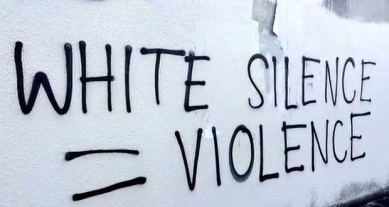
In order to be allies, we have to sit with the harm our privilege deals toward others. It is NEVER comfortable, and it should never be particularly cozy. We should always be asking those questions of: how much space am I taking up? Am I entitled to this? How will this action impact other people around me? Often the answers aren’t clear or flattering, but self-reflection and insight are critical to being a responsible and respectful ally.
Relationship-building and critical generosity
Relationship-building across difference is antithetical to oppression. Yeah, I said it. I’ll say it louder: RELATIONSHIP-BUILDING ACROSS DIFFERENCE IS ANTITHETICAL TO OPPRESSION. Did you say it louder?
And how do you think you grow closer to a person? CONFLICT THAT YOU SURVIVE.
Let’s go back. Remember way back at the beginning of this blogpost when I referred to being inconsolably angry with my best friend. The reason why I held onto that anger is because I knew that I needed to feel it before I could really clarify the problem that I was having with them. Once I was able to process, it made talking through this issue with my friend just a little bit easier (I definitely still cried, but hey, I’m a pisces).
I don’t condone ignoring your gut about the toxic people who definitely need to be yeet-ed up and out of your life. What I’m trying to get to is that I hope we can stick with the folks who make mistakes but who demonstrate that they’re willing to stick with us even when we respond with anger, sadness, disappointment.
Critical generosity is that step where we take a beat and open ourselves up to the realization that not everyone is as infallible as we want them to be. We withhold judgment about a person’s character and we continue to search for the humanity and the story that they’ve lived that has gotten them to the conclusion that they’ve gotten to. Some people might be beyond our time and energy, but there are many others who just need that room to fail or make an error and to be taken in with grace nonetheless.
And finally, discomfort is natural
Finally, nothing is black and white. We exist in the gray matter of the world. When we find conflict or tension or challenges, the reality is that there is no perfect answer in how to resolve that. There are complexities to each solution we try to make. We’re all trying really hard to get through and make those solutions work, but we don’t often get to anything resembling perfect. That’s why the discomfort is so important to listen to.
Discomfort is a part of slowing down and becoming more present. If we acknowledge it and pay attention to it, it means that we’re allowing energy to do what it does naturally which is conflict.
So next time someone inevitably does something that irks you, hurts your feelings, leaves you waiting on a text, and all you want is to crawl back in your shell and just drink hot cocoa and avoid avoid avoid, maybe just take a couple of breaths. Maybe they do indeed understand your “fr e sh a voca do” meme and they don’t think you’re weird. Or they do. Is that really awful?
Resolve to listen to yourself and honor the discomfort your feeling, and think about how maybe it is pointing you toward a new friend, journey, opportunity.
Further reading:
Fearology Pt. 1 with Mary Poffenroth from Alie Ward’s Ologies podcast
From Safe Spaces to Brave Spaces by Brian Arao and Kristi Clemens
Life hacks of the poor and aimless by Laurie Penny
Reflections on cultural humility by Amanda Waters and Lisa Asbill
Restorative Practices at UMBC
]]>
Author’s note: The following reflection on discomfort stems from the alumni discussion the Women’s Center hosted as an introduction to Critical Social Justice keynote speaker Deanna Zandt....
https://womenscenteratumbc.wordpress.com/2018/11/21/sitting-with-discomfort/
https://my3.my.umbc.edu/api/v0/pixel/news/80557/guest@my.umbc.edu/00d8c6f8b8e153b12f0774211f493e34/api/pixel
brave-space
critical-generosity
critical-social-justice
cultural-humility
praxis
privilege
radical
reflection
restorative-justice
restorative-practice
self-care
social-justice
Women's, Gender, & Equity Center
https://my3.my.umbc.edu/groups/womenscenter
https://assets2-my.umbc.edu/system/shared/avatars/groups/000/000/125/78272a4842689b30dbf74672182b78f8/xsmall.png?1750974263
https://assets1-my.umbc.edu/system/shared/avatars/groups/000/000/125/78272a4842689b30dbf74672182b78f8/original.png?1750974263
https://assets1-my.umbc.edu/system/shared/avatars/groups/000/000/125/78272a4842689b30dbf74672182b78f8/xxlarge.png?1750974263
https://assets1-my.umbc.edu/system/shared/avatars/groups/000/000/125/78272a4842689b30dbf74672182b78f8/xlarge.png?1750974263
https://assets1-my.umbc.edu/system/shared/avatars/groups/000/000/125/78272a4842689b30dbf74672182b78f8/large.png?1750974263
https://assets2-my.umbc.edu/system/shared/avatars/groups/000/000/125/78272a4842689b30dbf74672182b78f8/medium.png?1750974263
https://assets1-my.umbc.edu/system/shared/avatars/groups/000/000/125/78272a4842689b30dbf74672182b78f8/small.png?1750974263
https://assets2-my.umbc.edu/system/shared/avatars/groups/000/000/125/78272a4842689b30dbf74672182b78f8/xsmall.png?1750974263
https://assets3-my.umbc.edu/system/shared/avatars/groups/000/000/125/78272a4842689b30dbf74672182b78f8/xxsmall.png?1750974263
Women's Center
13
0
false
Wed, 21 Nov 2018 07:08:03 -0500
Wed, 21 Nov 2018 07:08:03 -0500