2025 RDRC Dissertation and Thesis Grant Applications Open
Deadline January 14, 2025
***reposted from the School of Public Policy***
The School of Public Policy, University of Maryland, Baltimore County, in collaboration with the Heller School of Social Policy and Management at Brandeis University sponsors an annual Dissertation and Thesis Grant Program in the field of retirement, health and disability research through their Retirement and Disability Research Center (RDRC). This RDRC program provides grant support to master’s and/or doctoral students to pursue research or support a thesis or capstone study focused on retirement, health and disability, with funding from the U.S. Social Security Administration (SSA).
The grant proposal must address one of SSA’s 2025 research focal areas:
Focal Area 1: Understanding Service Needs and Improving Service Delivery
Focal Area 2: Studying Causes and Inequities of Overpayment and Underpayment
Focal Area 3. Addressing Barriers to Disability and SSI Programs Participation and Processes
Focal Area 4: Understanding and Improving Communication
Focal Area 5. Identifying Disparities by Race, Ethnicity, and Sex
Focal Area 6: Examining Economic Security of Program Applicants and Beneficiaries
Focal Area 7: Addressing Employment Barriers for People with Disabilities
FY 2025 SSA focal areas can be found here: https://www.ssa.gov/policy/extramural/index.html#rdrc
Dissertation and Thesis Grants
$8,000 grants will be awarded to master’s and doctoral students enrolled in an accredited program at a U.S. university. We encourage individuals from historically underserved or underrepresented communities to apply. We are interested in supporting doctoral students both pre and post comprehensive examination completion and candidacy, as well as master’s students conducting thesis research or conducting a capstone study. The grant recipients may be asked to present their work to the Social Security Administration in Washington, DC or Baltimore, MD. Awardees may also be asked to attend the RDRC Annual Meeting.
Submission
Applicants should submit a 1,000-word proposal that describes the research work they propose and its connection to an SSA research focal area, as well as a discussion of how the grant will be used; a CV; and a letter of support from the applicant’s advisor. Materials should be emailed to Melanie Keys (mkeys3@umbc.edu). The deadline for the 2025 Dissertation and Thesis Grant Program is January 14, 2025.
Additional information
Please contact Melanie Keys (mkeys3@umbc.edu) with any questions about the Dissertation and Thesis Grant Program.
]]>
***reposted from the School of Public Policy*** The School of Public Policy, University of Maryland, Baltimore County, in collaboration with the Heller School of Social Policy and Management at...
https://my3.my.umbc.edu/api/v0/pixel/news/146510/guest@my.umbc.edu/a5460884d0c5bae2cc93fe57979e2b3a/api/pixel
Center for Social Science Scholarship
https://my3.my.umbc.edu/groups/csss
https://assets4-my.umbc.edu/system/shared/avatars/groups/000/000/825/333a55a4dd50a0fafb33f7e2e5b0df03/xsmall.png?1544752142
https://assets2-my.umbc.edu/system/shared/avatars/groups/000/000/825/333a55a4dd50a0fafb33f7e2e5b0df03/original.png?1544752142
https://assets3-my.umbc.edu/system/shared/avatars/groups/000/000/825/333a55a4dd50a0fafb33f7e2e5b0df03/xxlarge.png?1544752142
https://assets3-my.umbc.edu/system/shared/avatars/groups/000/000/825/333a55a4dd50a0fafb33f7e2e5b0df03/xlarge.png?1544752142
https://assets4-my.umbc.edu/system/shared/avatars/groups/000/000/825/333a55a4dd50a0fafb33f7e2e5b0df03/large.png?1544752142
https://assets1-my.umbc.edu/system/shared/avatars/groups/000/000/825/333a55a4dd50a0fafb33f7e2e5b0df03/medium.png?1544752142
https://assets2-my.umbc.edu/system/shared/avatars/groups/000/000/825/333a55a4dd50a0fafb33f7e2e5b0df03/small.png?1544752142
https://assets4-my.umbc.edu/system/shared/avatars/groups/000/000/825/333a55a4dd50a0fafb33f7e2e5b0df03/xsmall.png?1544752142
https://assets3-my.umbc.edu/system/shared/avatars/groups/000/000/825/333a55a4dd50a0fafb33f7e2e5b0df03/xxsmall.png?1544752142
Center for Social Science Scholarship
0
0
false
Thu, 09 Jan 2025 15:22:38 -0500
From Texas to Maryland and Back Again
“We shall not cease from exploration, and the end of all our exploring will be to arrive where we started and know the place for the first time.” – T.S. Eliot
It’s 2021, senior year of high school, and as the COVID-19 pandemic continues to surge we sit anxiously at our computers awaiting responses from the universities and colleges we’ve applied to. Few students dare to break from tradition, choosing instead to follow the well-trodden paths of their parents, grandparents, siblings, or cousins. In Texas—especially at this small Catholic school—tradition carries immense weight, shaping the choices of most graduates.
Because of this, it’s no surprise that when a peer decides to go to an out-of-state school, it’s met with shock and skepticism. “Are you sure you want to move so far away?” they ask, voices tinged with disbelief. “How could you leave your family? What are you even going to do out there? Isn’t it easier to just stay here?” These questions often carry an undertone of judgment, as if breaking away from the familiar is a betrayal of the community or an unnecessary risk.
I was no exception to these questions when I announced that I would be going to the University of Maryland, Baltimore County, (UMBC). Still, I knew deep down that Texas had given me all it could. Despite coming from a liberal family, we couldn’t escape the suffocating grip of conservatism that shaped so much of life in San Antonio. In my 18 years there, I was taught to love Jesus and my family, to believe that abortion was the ultimate sin, and that rape could never result in pregnancy. Texas seemed determined to isolate itself from the rest of the world, and I realized no one around me was going to show me what lay beyond its borders. If I wanted to see the world for what it truly was, I had to leave and discover it with my own eyes.
It wasn’t easy. I often found myself going to great lengths to reassure people that, despite the stereotypes, not everyone in Texas was a bigot. It was true that my life experiences had been limited, but more than anything, I wanted to learn and grow. Being away from my family was a constant challenge. While I formed wonderful friendships, my peers had the privilege of going home after a tough week or celebrating their birthdays with loved ones. My visits were restricted to Thanksgiving and Christmas breaks, and the ache of homesickness sometimes made me question my decision. Yet, I knew deep down that this was a path I had to follow—a necessary step to discover more about myself and the world, no matter how hard it was.
For the first time in my life, I wasn’t required to wear a school uniform, and people asked me about my pronouns and sexuality—things that had never been part of the conversation back home. Here, there was no assumption that I was straight or that I had to stick to she/her pronouns. It was liberating in a way I hadn’t imagined. Every weekend, I called home, brimming with excitement about what I was studying and experiencing. I’ll never forget how thrilled I was to discover new ideas and perspectives that challenged everything I thought I knew.
Reproductive health, in particular, was something I had no idea about when I arrived in Maryland. Growing up in Texas, I was steeped in a culture that avoided honest conversations about sex, contraception, and bodily autonomy. Misinformation shaped my understanding, from the stigmatization of abortion to outright falsehoods about pregnancy and assault. At UMBC, I encountered a starkly different reality—one where access to accurate information and open dialogue about reproductive health was not only encouraged but normalized.
Learning about comprehensive sex education, the science of reproduction, and the policies that impact reproductive rights empowered me to think critically and advocate for myself and others. It has been a transformative experience, allowing me to see how much I had been denied back home.
UMBC felt like an entirely different world, one that revealed just how sheltered my life in Texas had been. I was thrilled to finally learn the information I had missed out on growing up—knowledge that felt empowering and long overdue. More than anything, I wanted to return home and share what I had discovered, to challenge the misconceptions that had shaped so much of my upbringing. I realized how fortunate I was to have the opportunity to attend college out of state, knowing that not everyone has the privilege to explore life beyond the boundaries of their hometown.
Four years later, now in my senior year of college, I am planning for life after graduation—a future that once felt bright and full of promise but now seems clouded by the aftermath of the recent presidential election and its implications. Returning to a conservative state like Texas feels overwhelming, knowing I may encounter skepticism or resistance from those with deeply different views. As a woman, I’m acutely aware of the rights that have been stripped away, and the thought of going back fills me with fear. Yet, my love for my family and my desire to support girls like me—those who don’t have the option to leave—outweigh my hesitation. I want to make Texas a better place for them, a place where they can thrive despite the challenges.
When I share my decision to return to Texas, the reactions from friends and colleagues are often a mix of shock and fear. “Why would you go back there?” they ask, eyes wide, their voices filled with concern. I can’t blame them for their alarm—after all, I’ve spent years speaking openly about the challenges of growing up in a conservative state and the liberating experiences I’ve had here in Maryland. But despite their worry, my decision feels right. Texas shaped me, for better or worse, and I can’t turn my back on the place or the people who are still there, navigating the same struggles I once faced. Yes, moving back is daunting, but it’s also a chance to bring the knowledge I’ve gained and the perspective I’ve developed to a community that needs it. And while leaving the supportive and progressive environment I’ve built in Maryland is bittersweet, I know that going back is not a step backward. It’s a step toward creating change and making my home a place where others like me can see a future worth staying for.
I understand that meaningful change won’t happen overnight, but I truly believe that progress is possible.
]]>
“We shall not cease from exploration, and the end of all our exploring will be to arrive where we started and know the place for the first time.” – T.S. Eliot It’s 2021, senior year of high...
https://womenscenteratumbc.wordpress.com/2025/01/04/from-texas-to-maryland-and-back-again/
https://my3.my.umbc.edu/api/v0/pixel/news/146441/guest@my.umbc.edu/5ffea3d7b4359033105bd5acd3cdeede/api/pixel
activism
feminism
life
social-justice
texas
travel
umbc
uncategorized
Women's, Gender, & Equity Center
https://my3.my.umbc.edu/groups/womenscenter
https://assets2-my.umbc.edu/system/shared/avatars/groups/000/000/125/78272a4842689b30dbf74672182b78f8/xsmall.png?1750974263
https://assets1-my.umbc.edu/system/shared/avatars/groups/000/000/125/78272a4842689b30dbf74672182b78f8/original.png?1750974263
https://assets1-my.umbc.edu/system/shared/avatars/groups/000/000/125/78272a4842689b30dbf74672182b78f8/xxlarge.png?1750974263
https://assets1-my.umbc.edu/system/shared/avatars/groups/000/000/125/78272a4842689b30dbf74672182b78f8/xlarge.png?1750974263
https://assets1-my.umbc.edu/system/shared/avatars/groups/000/000/125/78272a4842689b30dbf74672182b78f8/large.png?1750974263
https://assets2-my.umbc.edu/system/shared/avatars/groups/000/000/125/78272a4842689b30dbf74672182b78f8/medium.png?1750974263
https://assets1-my.umbc.edu/system/shared/avatars/groups/000/000/125/78272a4842689b30dbf74672182b78f8/small.png?1750974263
https://assets2-my.umbc.edu/system/shared/avatars/groups/000/000/125/78272a4842689b30dbf74672182b78f8/xsmall.png?1750974263
https://assets3-my.umbc.edu/system/shared/avatars/groups/000/000/125/78272a4842689b30dbf74672182b78f8/xxsmall.png?1750974263
Women's Center
4
0
false
Sat, 04 Jan 2025 12:40:50 -0500
What Does it Mean to Be “Just A Girl”?
Because femininity is a concept, it can be constantly reshaped, redefined, and distorted based on the beliefs of the society it exists within, and social media works to heighten and mirror that. As a young, Black queer woman navigating both the virtual and physical world, I am able to notice and reflect on instances where social media becomes a space of healing for certain groups, but not others. Across numerous social media platforms, we’ve seen a rise in “girlhood” related trends. From girl dinner to girl math, a curated glimpse into what it means to be a “girl” is flooding our senses and our timelines. While the inherent satirical nature of the trend can be harmless and even beneficial from the surface, as someone who identifies as a woman and sometimes even a girl I am able to see and experience how the trend works to support and promote undertones of exclusivity apparent in Western society.
I want to make an important distinction between how the trend looks and what it communicates. I’ve always been a “girly girl” at heart, it’s a way of embracing femininity that feels comfortable for me, so visually I should relate to a trend built on a hyperfeminine, pink-clad life, right? But I don’t, and that is what compelled me to think more critically and write about this topic. I didn’t see myself reflected in this trend and I feel like I’m not the only one. When I look through videos of girlhood on social media, I am often fed a very idealized image. White, heterosexual, cis-gendered, and able-bodied. This perception of femininity being promoted is one that speaks and appeals to a very specific and very Westernized idea of beauty. For women like me, who were once girls like me, this representation can be jarring. It not only feels like our unique experiences don’t belong in public view but that we should try to conform or assimilate to the experiences being shown to us. For girls like me, social media doesn’t always offer room to express our girlhood in a way that feels right, especially not in a widespread or public manner. Instead, there’s an unspoken pressure to conform to this widely celebrated form of femininity and for those who don’t fit in that box, their experiences are erased. Also, girlhood, like most other trends and phenomena on social media, is heavily commodified, and it always has been. So not only am I being sold a hyperspecific, hyperbolized version of femininity, but it’s one I don’t even identify or relate to. I completely understand the positive aspects of the trend but I also can’t help but approach it with apprehension because of the disappointing tendency the media has of generalizing or erasing my experiences as a Black woman. Because of that, I can’t be surprised that I’m seeing the same thing happen here, but instead of my current experiences as a Black woman, it’s my past experiences as a Black girl.
In my AFST 460 course, Black Hair and Body Politics (highly recommended!) we talk about the concept of the “other”. The other is determined because they are different from what is considered the hegemonic norm. In girlhood and femininity, the norm is white Eurocentric experiences of girlhood, and as a result, all WOC and what we experience are labeled as the other. When you’re the other, there is something inherently wrong with you, how you live, and what you experience. I can’t help but feel as though these trends think there is something wrong with my Blackness and my Black girlhood. There is so much to my girlhood that I value and cherish, like the memories of sitting in my mom’s lap for hours while she braided my hair, visiting my family in the UK, early RnB and funk music, and so much more. I haven’t seen this trend celebrate common aspects of the Black girlhood experience unless it is a Black woman herself making space for it. To me, that isn’t fair. If we’re celebrating girlhood, shouldn’t we celebrate all types of girlhood? My girlhood is shaped by my culture and heritage and that doesn’t always align with the trends that dominate my timeline, and I know I’m not the only one who feels this way.
In the eyes of this trend, there is only one way to be feminine and only one way to heal your inner girl, and if you’re not doing it that way you’re doing it wrong. I urge anyone who relates to this post to appreciate the uniqueness of your girlhood and how it has been impacted by your identity and surroundings. Reclaiming your girlhood doesn’t automatically mean completely conforming to or rejecting mainstream trends, but embracing the beauty of difference. For me, reclaiming my girlhood means doing my hair myself, it reminds me of the bonds I made with my mom when she did it for me. For me, it means listening to the same ’80s and ’90s RnB and funk music my mom used to blast every Saturday morning. These experiences define my girlhood and it wouldn’t be fair to try and apply them to every other woman in the world. That’s my primary issue with this trend, it had so much potential to celebrate the inherent diversity in upbringing. We all have different backgrounds and our girlhoods looked different because of that, regardless we are connected in that we were all girls. Instead, this trend chooses to uplift one version of girlhood and completely exclude all others. There is inherent value in all forms of girlhood, even the ones that aren’t popularized or commodified.
While it is upsetting that yet again women of color are forced to carve out spaces for ourselves within popular media trends, there is still power in reclaiming your girlhood, whatever that means for you. The trend shouldn’t be about commodification or fitting into aesthetic boxes, but celebrating your roots and healing your inner child. There is no one way to be a girl. Girlhood and womanhood are messy, hectic, and beautifully diverse and that is what the trend should be celebrating. Girlhood, like all trends, is fun and fleeting. Despite this, it’s important to recognize how they can be used to perpetuate exclusion and marginalization. For those who fit inside the box this trend has popularized, think critically about the media you’re consuming, and how it might be impacting those who look different from you. For those of us on the outside of mainstream definitions of “girlhood”, it is important to remember our stories, our youth, and our identities are just as valuable –because at our core, we are all just a girl. 
]]>
Because femininity is a concept, it can be constantly reshaped, redefined, and distorted based on the beliefs of the society it exists within, and social media works to heighten and mirror that....
https://womenscenteratumbc.wordpress.com/2024/12/21/what-does-it-mean-to-be-just-a-girl/
https://my3.my.umbc.edu/api/v0/pixel/news/146398/guest@my.umbc.edu/5c8067f18bbf8907d8a4af4994ca74d2/api/pixel
black-feminity
black-girlhood
cancel-culture
diversity
education
feminism
media-literacy
uncategorized
womens-center-staff
Women's, Gender, & Equity Center
https://my3.my.umbc.edu/groups/womenscenter
https://assets2-my.umbc.edu/system/shared/avatars/groups/000/000/125/78272a4842689b30dbf74672182b78f8/xsmall.png?1750974263
https://assets1-my.umbc.edu/system/shared/avatars/groups/000/000/125/78272a4842689b30dbf74672182b78f8/original.png?1750974263
https://assets1-my.umbc.edu/system/shared/avatars/groups/000/000/125/78272a4842689b30dbf74672182b78f8/xxlarge.png?1750974263
https://assets1-my.umbc.edu/system/shared/avatars/groups/000/000/125/78272a4842689b30dbf74672182b78f8/xlarge.png?1750974263
https://assets1-my.umbc.edu/system/shared/avatars/groups/000/000/125/78272a4842689b30dbf74672182b78f8/large.png?1750974263
https://assets2-my.umbc.edu/system/shared/avatars/groups/000/000/125/78272a4842689b30dbf74672182b78f8/medium.png?1750974263
https://assets1-my.umbc.edu/system/shared/avatars/groups/000/000/125/78272a4842689b30dbf74672182b78f8/small.png?1750974263
https://assets2-my.umbc.edu/system/shared/avatars/groups/000/000/125/78272a4842689b30dbf74672182b78f8/xsmall.png?1750974263
https://assets3-my.umbc.edu/system/shared/avatars/groups/000/000/125/78272a4842689b30dbf74672182b78f8/xxsmall.png?1750974263
Women's Center
8
0
false
Sat, 21 Dec 2024 17:17:53 -0500
Am I an Activist?
What comes to mind when I think of an activist are images of figures like MLK Jr., Gandhi, Rosa Parks, and others who became symbols of resistance, fighting for civil rights, freedom, equality, or education. This association has made activism feel out of reach for me, something only the Malcolm Xs and Malala Yousafzais of the world can do. I never felt I had the ability or power to do things like organize a protest, start a hunger strike, or other major forms of activism, therefore I didn’t consider myself an “activist.” Yet, I always spread awareness on social justice issues that I’m passionate about, whether it’s posting on my social media channels, implementing themes into my photography, or academic writing.
While social media activism has become synonymous with “slacktivism,” spreading awareness within one’s circle of influence is the first step toward creating change. Problems that we face as individuals are often public issues, even if it feels like we are the only ones struggling. Therefore social media can be a key tool in organizing for change because the more we talk about issues important to us, the more can be done to address them. I often find myself asking “what can I do about it?”, waiting for some opportunity to present itself before I get involved as an “activist.” But I am reminded of President JFK’s famous quote “Ask not what your country can do for you, ask what you can do for your country.” This mentality requires us to self-reflect on what skills we bring to the table.
Activism can take shape in many forms. Rallying in the streets of DC, chaining myself to a tree, or engaging in sit-ins aren’t the be-all end-all of activism. I often shy away from activism because I think I don’t have the position or power to be an activist. However, anyone can be an activist if you utilize the skills and resources you do have. Social change relies on an ecosystem where each of us plays a different role. This framework developed by activist and writer Deepa Iyer, calls us to reflect on our roles in the social change ecosystem. Whether we’re the healers, experimenters, storytellers, disrupters, Iyer says everyone has a role to play in the “pursuit of equity, shared liberation, inclusion, and justice.”

Reflecting on my personal experience, I’ve been able to engage in activism through the opportunities I’ve found at UMBC. In March of 2024, I was a participant in the Alternative Spring Break (ASB) experience through the Center for Democracy and Civic Life. During this trip, I was part of the group called “Improving Life After Prison” which was looking into the incarceration system in Baltimore City. We met with various community leaders, organizations, city officials, and those with personal experience in the incarceration system to get a better understanding of the issues people face and the work being done to address them. Although the trip was just a few short days, it was very eye-opening for me, as it was not an issue I was familiar with prior. I was inspired to engage in this important work myself, and decided to apply for an ASB leadership position this year. For the past few months, my co-leader and I have been working to develop an ASB program for Spring 2025, around environmental justice and sustainability. Our hope is to give this year’s cohort as meaningful of an experience as it was for us, so that they may develop the skills and confidence to create change beyond ASB.
As part of my role at the Women’s Center, I’ve also been given the opportunity to engage in activism through the work we do. In many ways, we are working to bring about social change, such as changing the campus climate to that of a more inclusive environment. Through discussion-based programs, educational workshops, or the Take Back the Night Rally, the Women’s Center has empowered me to engage in activism in ways I didn’t think possible before.
Photos taken by me at the Take Back the Night rally 2024
Engaging in student activism has been a transformative journey for me, one that wouldn’t be possible without the many opportunities UMBC provides. It’s taught me that activism isn’t just protests and rallies, it’s a mindset and commitment to making a difference, no matter how small the act may seem. Whether it’s through organizing events, amplifying voices, or fostering meaningful conversations, as students we have the unique power to create ripples of impact. My journey is ongoing. But it has reaffirmed for me that anyone can be an activist, as long as they are driven to make the world a better place.
]]>
What comes to mind when I think of an activist are images of figures like MLK Jr., Gandhi, Rosa Parks, and others who became symbols of resistance, fighting for civil rights, freedom, equality, or...
https://womenscenteratumbc.wordpress.com/2024/12/20/am-i-an-activist/
https://my3.my.umbc.edu/api/v0/pixel/news/146396/guest@my.umbc.edu/d1d6cb46a6fbeac5bec0b8ded4272a57/api/pixel
activism
critical-social-justice
politics
social-justice
Women's, Gender, & Equity Center
https://my3.my.umbc.edu/groups/womenscenter
https://assets2-my.umbc.edu/system/shared/avatars/groups/000/000/125/78272a4842689b30dbf74672182b78f8/xsmall.png?1750974263
https://assets1-my.umbc.edu/system/shared/avatars/groups/000/000/125/78272a4842689b30dbf74672182b78f8/original.png?1750974263
https://assets1-my.umbc.edu/system/shared/avatars/groups/000/000/125/78272a4842689b30dbf74672182b78f8/xxlarge.png?1750974263
https://assets1-my.umbc.edu/system/shared/avatars/groups/000/000/125/78272a4842689b30dbf74672182b78f8/xlarge.png?1750974263
https://assets1-my.umbc.edu/system/shared/avatars/groups/000/000/125/78272a4842689b30dbf74672182b78f8/large.png?1750974263
https://assets2-my.umbc.edu/system/shared/avatars/groups/000/000/125/78272a4842689b30dbf74672182b78f8/medium.png?1750974263
https://assets1-my.umbc.edu/system/shared/avatars/groups/000/000/125/78272a4842689b30dbf74672182b78f8/small.png?1750974263
https://assets2-my.umbc.edu/system/shared/avatars/groups/000/000/125/78272a4842689b30dbf74672182b78f8/xsmall.png?1750974263
https://assets3-my.umbc.edu/system/shared/avatars/groups/000/000/125/78272a4842689b30dbf74672182b78f8/xxsmall.png?1750974263
Women's Center
1
0
false
Fri, 20 Dec 2024 16:30:43 -0500
Fri, 20 Dec 2024 16:30:43 -0500
Call for Applications: CS3 Associate Director
Due February 14, 2025
The Center for Social Science Scholarship (CS3) seeks an Associate Director to work closely with the Director and the Center team to shape and implement CS3 events, programs, and budget. The Associate Director will assist the Director in strategic decision making, shaping CS3 goals, and developing CS3 initiatives. The Associate Director will also be responsible for serving in the Director’s place should the Director be unable to attend various CS3 activities or programs, or at university events or meetings.
The appointment would begin July 1, 2025.
Duties for the Associate Director include:
Work with the Center Director and Coordinator to schedule, coordinate, facilitate, and attend CS3 events, trainings, and workshops, including organizing the biennial Social Science Faculty Publications celebration, the annual Social Science Alumni Panel, and the Social Sciences Forum Distinguished Lecture series.
Review applications for CS3 faculty summer fellowships and small research grants to support Center award decisions.
Review applications and reports of interdisciplinary CS3 faculty working groups and research hubs.
Work with the Center Director, Coordinator, and CS3 Advisory Board to plan, develop, and implement other CS3 programming for students and faculty as needed.
Attend bi-weekly staff meetings and monthly board meetings, participate in strategic planning and budgeting.
Attend monthly CAHSS chairs and directors’ meetings in the Director’s place as needed.
Assist in evaluating CS3 activities and writing the Center’s annual report.
Eligibility: Tenure track faculty with expertise in social science fields (minimum: advanced assistant professor; tenured preferred). Preference will be given to applicants who have been formally involved with CS3, such as service on the CS3 Advisory Board or participation in other Center programs or initiatives.
Compensation for this 3-year appointment includes an annual 2-course reduction and a $5K annual stipend.
To apply, please send a short (1 page) letter of interest and current CV by end of day on February 14, 2025, to socialscience@umbc.edu.
Questions? Contact CS3's Director, Eric Stokan: estokan@umbc.edu
]]>
The Center for Social Science Scholarship (CS3) seeks an Associate Director to work closely with the Director and the Center team to shape and implement CS3 events, programs, and budget. The...
https://my3.my.umbc.edu/api/v0/pixel/news/146184/guest@my.umbc.edu/0f7c9d17994386686f8a67afc66e0ec8/api/pixel
Center for Social Science Scholarship
https://my3.my.umbc.edu/groups/csss
https://assets4-my.umbc.edu/system/shared/avatars/groups/000/000/825/333a55a4dd50a0fafb33f7e2e5b0df03/xsmall.png?1544752142
https://assets2-my.umbc.edu/system/shared/avatars/groups/000/000/825/333a55a4dd50a0fafb33f7e2e5b0df03/original.png?1544752142
https://assets3-my.umbc.edu/system/shared/avatars/groups/000/000/825/333a55a4dd50a0fafb33f7e2e5b0df03/xxlarge.png?1544752142
https://assets3-my.umbc.edu/system/shared/avatars/groups/000/000/825/333a55a4dd50a0fafb33f7e2e5b0df03/xlarge.png?1544752142
https://assets4-my.umbc.edu/system/shared/avatars/groups/000/000/825/333a55a4dd50a0fafb33f7e2e5b0df03/large.png?1544752142
https://assets1-my.umbc.edu/system/shared/avatars/groups/000/000/825/333a55a4dd50a0fafb33f7e2e5b0df03/medium.png?1544752142
https://assets2-my.umbc.edu/system/shared/avatars/groups/000/000/825/333a55a4dd50a0fafb33f7e2e5b0df03/small.png?1544752142
https://assets4-my.umbc.edu/system/shared/avatars/groups/000/000/825/333a55a4dd50a0fafb33f7e2e5b0df03/xsmall.png?1544752142
https://assets3-my.umbc.edu/system/shared/avatars/groups/000/000/825/333a55a4dd50a0fafb33f7e2e5b0df03/xxsmall.png?1544752142
Center for Social Science Scholarship
0
0
false
Wed, 18 Dec 2024 14:16:42 -0500
Tue, 18 Feb 2025 21:14:00 -0500
2025 CS3 Summer Fellowships
Applications due February 15, 2025
Applications are now being accepted for the 2025 Center for Social Science Scholarship
Summer Fellowships!
Applications are now being accepted for the Center for Social Science Scholarship Summer Fellowship. The purpose of this fellowship is to support significant social science research by tenure-track or tenured faculty in the UMBC College of Arts, Humanities & Social Sciences, resulting in a submittable product by December 2025. Up to three fellows will receive a $6,000 award during the summer of 2025.
By December 2025, each Fellow agrees to complete a submittable product, which can include an external grant or fellowship proposal, journal article, policy paper, book manuscript, or book chapter; upon completion, Fellows shall provide a copy of this submitted product to the Director of the Center for Social Science Scholarship.
Applications are due by February 15, 2024.
Applications will be reviewed and ranked by members of the Center for Social Science Scholarship Advisory Board, according to the following criteria:
- Quality of proposed research project;
- Significance of the project in its field;
- Publishing/funding potential of the work;
- Qualification of the faculty member to carry out the work, including the requisite expertise in the topic area and prior research productivity;
- Likelihood that the proposed work can be successfully completed with fellowship support and that it will result in a submittable product within the specified time period;
- Approval and recommendation of faculty member's department chair.
For more information, interested faculty may contact Eric Stokan, Director.
Funds for this fellowship are provided by the Center for Social Science Scholarship and the College of Arts, Humanities and Social Sciences (CAHSS).
]]>
Applications are now being accepted for the 2025 Center for Social Science Scholarship Summer Fellowships! Apply here. Applications are now being accepted for the Center for Social Science...
https://socialscience.umbc.edu/summer-faculty-research-fellowships/
https://my3.my.umbc.edu/api/v0/pixel/news/145410/guest@my.umbc.edu/5ba2a76d3e5b86e7a8cd03768bb49cbf/api/pixel
Center for Social Science Scholarship
https://my3.my.umbc.edu/groups/csss
https://assets4-my.umbc.edu/system/shared/avatars/groups/000/000/825/333a55a4dd50a0fafb33f7e2e5b0df03/xsmall.png?1544752142
https://assets2-my.umbc.edu/system/shared/avatars/groups/000/000/825/333a55a4dd50a0fafb33f7e2e5b0df03/original.png?1544752142
https://assets3-my.umbc.edu/system/shared/avatars/groups/000/000/825/333a55a4dd50a0fafb33f7e2e5b0df03/xxlarge.png?1544752142
https://assets3-my.umbc.edu/system/shared/avatars/groups/000/000/825/333a55a4dd50a0fafb33f7e2e5b0df03/xlarge.png?1544752142
https://assets4-my.umbc.edu/system/shared/avatars/groups/000/000/825/333a55a4dd50a0fafb33f7e2e5b0df03/large.png?1544752142
https://assets1-my.umbc.edu/system/shared/avatars/groups/000/000/825/333a55a4dd50a0fafb33f7e2e5b0df03/medium.png?1544752142
https://assets2-my.umbc.edu/system/shared/avatars/groups/000/000/825/333a55a4dd50a0fafb33f7e2e5b0df03/small.png?1544752142
https://assets4-my.umbc.edu/system/shared/avatars/groups/000/000/825/333a55a4dd50a0fafb33f7e2e5b0df03/xsmall.png?1544752142
https://assets3-my.umbc.edu/system/shared/avatars/groups/000/000/825/333a55a4dd50a0fafb33f7e2e5b0df03/xxsmall.png?1544752142
Center for Social Science Scholarship
0
0
false
Wed, 18 Dec 2024 14:14:57 -0500
Tue, 18 Feb 2025 21:14:22 -0500
Sex Will Be Good Again
The week the pandemic shut down all the schools, I went to the gynecologist. Over the past six months, I had been plagued by non-stop yeast infections, and I had tried every home remedy under the sun to cure myself. Then the gynecologist told me I actually had chlamydia.
The diagnosis started me on a path to recovery that would span years. The chlamydia itself cleared up within a week, but the psychological damage of enduring painful sex for so long remained. My partner at the time was abusive, and did not care about my pleasure, or my pain. Sex had been painful, every single time, for six months straight.
I was ashamed, firstly, when I realized I couldn’t use so much as a menstrual cup without experiencing immense, lasting pain, like a cold, persistent ache.
Recalling my lessons from Family Life courses in middle school that taught me to seek out a doctor if I experienced pain using menstrual products, I booked several more appointments with gynecologists, hoping that the next one would find something wrong with me, or tell me some way forward. Each one only had a vague answer, finding nothing and asking for a followup if the pain continued (it always did). I was sure something was wrong down there, to the point where I asked the gynecologist doing my pap smear to look for scarring. There wasn’t any, and she reassured me that any past trauma I had was unlikely to do permanent damage—after all, vaginas are built to push out babies and heal from them.
My paranoia began to eat me alive. Despite the placations, I was still experiencing pain. To top it off, every time I felt an itch I feared it was a yeast infection, or that I had somehow re-infected myself. I asked the nurse to test me for every STI, just in case they had missed it before. They told me it wasn’t necessary to test again if I had no symptoms, but still, I needed to know for sure that I was in the clear.
I was. But the pain continued.
Over and over I had been dismissed, largely because I didn’t have a sexual partner. It seemed as though the nurses and doctors that attended me didn’t see an issue with my pain because they saw my vagina as a sexual vehicle through which sex or birth is performed. Since neither was happening, I was relegated to the margins, told to come back if the pain persisted with a partner. So, the next time I saw a doctor, I lied.
This time she listened to my concerns, and asked me more specific questions: Did the pain persist in all positions, or were some easier than others? Had I tried using pillows to prop my hips up in a comfortable position? Was I using lube? Maybe my cervix was closer to the entrance than most cervixes (the cervix, she informed me, changes positions throughout the menstrual cycle, and canal length varies between bodies). She did a full exam, providing the kind of care I was used to receiving from a doctor when I came in with an issue.
But at the end of the exam, she came up empty. The best advice she had for me was to experiment with positions and keep trying.
The last doctor visit was both the most helpful and simultaneously the least encouraging. I tried a different tactic with this doctor, being extremely honest and upfront about why I was there. I relayed to her all my past experiences and told her the immense pain that had brought me there. After deciding for me that an internal exam wasn’t in my best interest, she leaned forward and whispered, “Do you need to speak to someone?”
Looking back, I am almost certain she asked with good intentions, but at the time, it felt condescending. It felt like she was invalidating my pain, insinuating it was all psychological. Despite having had years of therapy under my belt, I instantly declined the offer, insisting I would just like to figure out what was wrong with me. I was certain it was physical.
The doctor, who was really a nurse practitioner, offered to go and get the head doctor of the practice. She said he could examine me and, with his decades of experience, hopefully give me an idea of what was going on. “But,” she added hesitantly, “he is male. Is that alright?”
It wasn’t alright. I didn’t want a man anywhere near me, especially not when I was so vulnerable. But more than that, I wanted this over. So I agreed. And I waited. And waited.
The head doctor never came. He was busy and wouldn’t be able to make time. It had taken over an hour for them to relay this to me. The nurse practitioner came back in with the printed resources they always gave me, and on the back she had written down a URL for a local pelvic floor physical therapist. The therapist was out of network, but the website provided me with validating information: this pain was not just in my head. Other people experienced it, too; it was called vaginismus. And it could get better.
Sex was not better the next day—it took a lot longer than that. I had to tackle a number of various issues, starting first with getting to know my own body. Finding the right positions is tricky, too, and it can change throughout the month with your hormone cycle or just the way your body is feeling that day. Medications and mental illness also got in the way, lowering my sex drive to null at times. Talk therapy helped a lot, and I am lucky enough to have a therapist that enrolled in additional courses to find a better treatment plan for me. My partner was patient with me, and understood that sex will be painful at times, but we can switch positions, use pillows or lube, and get intimate in other ways to make me more comfortable. Memories of a time when sex had been good kept me going when it seemed impossible to continue.
It was difficult to admit, but sex was painful for a long time for me, both emotionally and physically. I felt like something was wrong with me, that I was doing something wrong somehow. It took countless doctor visits to learn that I needed to first understand my own body, and then to learn how to trust myself. I had to learn to stop saying, “Thank you so much,” and start saying, “Actually, I don’t understand the results. Can you go over them again with me?” I learned that the sex ed I had been taught was severely lacking, because it didn’t go over what to do when sex isn’t fun anymore. I learned to be prepared for when sex becomes difficult, whether due to injury, sex drive, or disability.
When Michel Foucault wrote, “Tomorrow sex will be good again,” he didn’t mean it to be hopeful. Tomorrow does not guarantee a better day; sex is a constant negotiation of power and embodiment. Still, sex can be good again. But tomorrow’s progress does not come without today’s work. If you’re in a similar position, keep trying—learn more about your body, be open and honest about your pain, and don’t stop advocating for the care and comfort you deserve.
]]>
The week the pandemic shut down all the schools, I went to the gynecologist. Over the past six months, I had been plagued by non-stop yeast infections, and I had tried every home remedy under the...
https://womenscenteratumbc.wordpress.com/2024/12/18/sex-will-be-good-again/
https://my3.my.umbc.edu/api/v0/pixel/news/146356/guest@my.umbc.edu/fdac46d9dc185a0563f86a8a67e35777/api/pixel
chronic-pain
disability-justice-and-neurodiversity
health
intersectionality
mental-health
selfadvocacy
sex
sex-education
sexual-health
vaginismus
wellness
Women's, Gender, & Equity Center
https://my3.my.umbc.edu/groups/womenscenter
https://assets2-my.umbc.edu/system/shared/avatars/groups/000/000/125/78272a4842689b30dbf74672182b78f8/xsmall.png?1750974263
https://assets1-my.umbc.edu/system/shared/avatars/groups/000/000/125/78272a4842689b30dbf74672182b78f8/original.png?1750974263
https://assets1-my.umbc.edu/system/shared/avatars/groups/000/000/125/78272a4842689b30dbf74672182b78f8/xxlarge.png?1750974263
https://assets1-my.umbc.edu/system/shared/avatars/groups/000/000/125/78272a4842689b30dbf74672182b78f8/xlarge.png?1750974263
https://assets1-my.umbc.edu/system/shared/avatars/groups/000/000/125/78272a4842689b30dbf74672182b78f8/large.png?1750974263
https://assets2-my.umbc.edu/system/shared/avatars/groups/000/000/125/78272a4842689b30dbf74672182b78f8/medium.png?1750974263
https://assets1-my.umbc.edu/system/shared/avatars/groups/000/000/125/78272a4842689b30dbf74672182b78f8/small.png?1750974263
https://assets2-my.umbc.edu/system/shared/avatars/groups/000/000/125/78272a4842689b30dbf74672182b78f8/xsmall.png?1750974263
https://assets3-my.umbc.edu/system/shared/avatars/groups/000/000/125/78272a4842689b30dbf74672182b78f8/xxsmall.png?1750974263
Women's Center
9
0
false
Wed, 18 Dec 2024 12:17:56 -0500
RTSS Episode 63: How Storytelling Informs the Social Science
with Professor Michael Wilson of Loughborough University
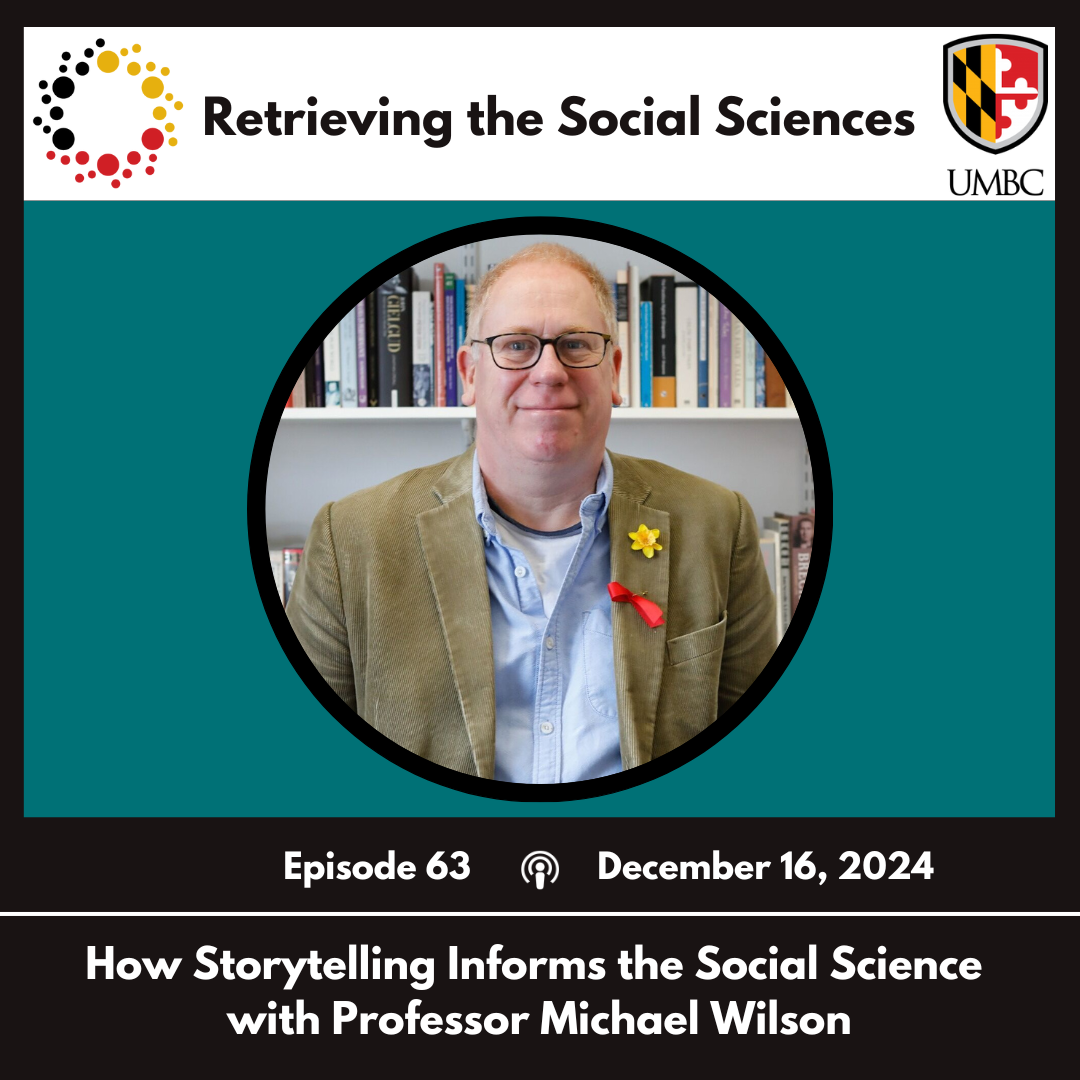
On today's episode, Dr. Anson speaks with Prof. Michael Wilson, Professor of Drama and Director of the Storytelling Academy at Loughborough University in Leicestershire, UK. Dr. Wilson shares information about his ongoing research agenda into storytelling as a scientific tool.
This project's connection to UMBC is through Dr. Sarah Jewett of UMBC's Department of Sociology, Anthropology, and Public Health, who is completing a Fulbright semester at Loughborough this year.
Check out the following links for more information on UMBC, CS3, and our host:
Subscribe on Spotify, Apple, or Amazon!
Retrieving the Social Sciences is a production of the UMBC Center for Social Science Scholarship. Our podcast host is Dr. Ian Anson, and our acting director is Dr. Eric Stokan. Our production intern is Jean Kim. Our theme music was composed and recorded by D’Juan Moreland (UMBC '24). Special thanks to Amy Barnes and Myriam Ralston for production assistance. Make sure to follow us on Twitter, Facebook, Instagram, and YouTube, where you can find full video recordings of recent UMBC events.
]]>
On today's episode, Dr. Anson speaks with Prof. Michael Wilson, Professor of Drama and Director of the Storytelling Academy at Loughborough University in Leicestershire, UK. Dr. Wilson shares...
https://socialscience.umbc.edu/episode-63/
Image
https://assets2-my.umbc.edu/system/shared/attachments/5196ff07a7db44bcf449584e3c24f532/69f0401d/news/000/146/314/87b975920cf2a335c1751a794e57e8c8/Ep 63 Prof Michael Wilson.png?1734381573
https://my3.my.umbc.edu/api/v0/pixel/news/146314/guest@my.umbc.edu/dbcbd918ef2a2d53c2657cb3bae65de1/api/pixel
Center for Social Science Scholarship
https://my3.my.umbc.edu/groups/csss
https://assets4-my.umbc.edu/system/shared/avatars/groups/000/000/825/333a55a4dd50a0fafb33f7e2e5b0df03/xsmall.png?1544752142
https://assets2-my.umbc.edu/system/shared/avatars/groups/000/000/825/333a55a4dd50a0fafb33f7e2e5b0df03/original.png?1544752142
https://assets3-my.umbc.edu/system/shared/avatars/groups/000/000/825/333a55a4dd50a0fafb33f7e2e5b0df03/xxlarge.png?1544752142
https://assets3-my.umbc.edu/system/shared/avatars/groups/000/000/825/333a55a4dd50a0fafb33f7e2e5b0df03/xlarge.png?1544752142
https://assets4-my.umbc.edu/system/shared/avatars/groups/000/000/825/333a55a4dd50a0fafb33f7e2e5b0df03/large.png?1544752142
https://assets1-my.umbc.edu/system/shared/avatars/groups/000/000/825/333a55a4dd50a0fafb33f7e2e5b0df03/medium.png?1544752142
https://assets2-my.umbc.edu/system/shared/avatars/groups/000/000/825/333a55a4dd50a0fafb33f7e2e5b0df03/small.png?1544752142
https://assets4-my.umbc.edu/system/shared/avatars/groups/000/000/825/333a55a4dd50a0fafb33f7e2e5b0df03/xsmall.png?1544752142
https://assets3-my.umbc.edu/system/shared/avatars/groups/000/000/825/333a55a4dd50a0fafb33f7e2e5b0df03/xxsmall.png?1544752142
Center for Social Science Scholarship
0
0
false
Mon, 16 Dec 2024 15:39:33 -0500
Tue, 18 Feb 2025 21:13:19 -0500
Due Friday: Apply for Alternative Spring Break (ASB) 2025
Alternative Spring Break (ASB) is a five-day immersive learning
experience in which UMBC undergraduate and graduate students explore the
systemic and human dimensions of complex social issues in Baltimore.
Participants build connections with local leaders, organizations, and
policy makers and develop a sophisticated understanding of available
resources and challenges. The program helps participants identify
pathways to long-term community engagement.
This year’s ASB program will take place from Monday, March 17 – Friday, March 21, 2025. ASB
participants spend much of the program in small groups (co-led by
undergraduate students trained by the Center for Democracy and Civic
Life) focused on exploring a specific topic in depth. ASB 2025 groups
will focus on:
- Health and Patient Care Equity (co-led by Vunnathi Ankem and Natalia Cooper)
- Environmental Justice and Sustainability (co-led by Bianca Canales and Tanzila Malik)
- Reforming Juvenile Justice (co-led by Aanayah Trotman and Nyssa Vilchis)
As part of your application, you will get to identify the topic groups that interest you most.
Learn more about ASB 2025 and access the application. The application is due by Friday, December 20, 2024 at 11:59 p.m. EST.
The Center for Democracy and Civic Life hosts ASB. If you have questions about ASB, contact Ricky Blissett at rblissett@umbc.edu.
The application for the Center for Democracy and Civic Life’s other immersive program, the STRiVE leadership for public purpose program, also is open now (due November 8).
]]>
Alternative Spring Break (ASB) is a five-day immersive learning experience in which UMBC undergraduate and graduate students explore the systemic and human dimensions of complex social issues in...
https://my3.my.umbc.edu/api/v0/pixel/news/146310/guest@my.umbc.edu/3b72424ef65b2078e77e0f0a5459269d/api/pixel
Center for Democracy and Civic Life
https://my3.my.umbc.edu/groups/civiclife
https://assets1-my.umbc.edu/system/shared/avatars/groups/000/001/462/3559ec2c1c4f29266d1c1eb0f1164549/xsmall.png?1554944150
https://assets2-my.umbc.edu/system/shared/avatars/groups/000/001/462/3559ec2c1c4f29266d1c1eb0f1164549/original.png?1554944150
https://assets1-my.umbc.edu/system/shared/avatars/groups/000/001/462/3559ec2c1c4f29266d1c1eb0f1164549/xxlarge.png?1554944150
https://assets1-my.umbc.edu/system/shared/avatars/groups/000/001/462/3559ec2c1c4f29266d1c1eb0f1164549/xlarge.png?1554944150
https://assets3-my.umbc.edu/system/shared/avatars/groups/000/001/462/3559ec2c1c4f29266d1c1eb0f1164549/large.png?1554944150
https://assets1-my.umbc.edu/system/shared/avatars/groups/000/001/462/3559ec2c1c4f29266d1c1eb0f1164549/medium.png?1554944150
https://assets3-my.umbc.edu/system/shared/avatars/groups/000/001/462/3559ec2c1c4f29266d1c1eb0f1164549/small.png?1554944150
https://assets1-my.umbc.edu/system/shared/avatars/groups/000/001/462/3559ec2c1c4f29266d1c1eb0f1164549/xsmall.png?1554944150
https://assets4-my.umbc.edu/system/shared/avatars/groups/000/001/462/3559ec2c1c4f29266d1c1eb0f1164549/xxsmall.png?1554944150
Center for Democracy and Civic Life
2
0
false
Mon, 16 Dec 2024 14:47:06 -0500
DST 2025 Belém, Brazil – Call for Proposals Now Open
In
its first time in Latin America, the 12th International Digital
Storytelling Conference will take place in Belém, Brazil, November 6 to
8, 2025. Hosted by the Museu da Pessoa, for more information and to submit a proposal, please visit
dst2925.org
Since 2006, the StoryCenter network in
partnership with universities and international organizations has
promoted Digital Storytelling Conferences, providing the global
community with an opportunity to exchange ideas and share experiences.
In its first time in Latin America, the 12th
International Digital Storytelling Conference will take place in Belém,
Brazil, in November 2025. Hosted by Museu da Pessoa , this edition will have as its theme 'Lives, Voices and Knowledge in a World on Fire' ,
exploring the power of storytelling in climate justice. We are
confident that this gathering will be a pivotal moment to inspire action
and strengthen partnerships towards a more sustainable and just future.
Taking place on the eve of COP30, which will also be
held in Belém, the event will offer a unique opportunity to share
stories, inspire action and strengthen partnerships.


