ESI’s new thermal vacuum chamber is up and running
This past week, members of the Earth & Space Institute finished commissioning their new thermal vacuum chamber (TVAC), a breathtaking piece of engineering—literally! In the aerospace industry, TVACs are used to simulate the space environment by evacuating the air in the chamber and cooling test articles to their on-orbit temperatures. In space, satellites operate in a vacuum, meaning they must manage heat in the absence of air. Thermal vacuum tests give engineers pre-launch insight into how their satellite’s thermal system will perform in orbit, whether it will survive the thermal environment, and how well thermal models predict the actual performance.
Photo: ESI presents its new thermal vacuum chamber (TVAC). Photo courtesy of D. Nelson.
Typically, TVAC testing needs to be outsourced to external labs, but ESI’s new chamber will allow these tests to happen right here at UMBC. For a group that designs and builds its own hardware in house, this is an important capability. Work began on this chamber over a year ago, after ESI was awarded a Maryland congressional grant. Designing, building, and testing this equipment was one of the main efforts the grant enabled—and it was no small effort. Everything from the chamber’s internal volume to its power requirements to the feasibility of moving it from the loading dock to the third floor of the Physics building was a consideration for the engineers.
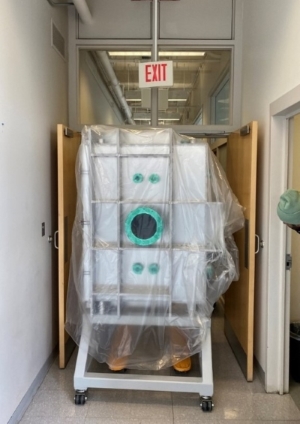
Photo: In UMBC's Physics building, there was just enough clearance to get the chamber through the 3rd floor corridor to the lab.
Photo courtesy of D. Nelson.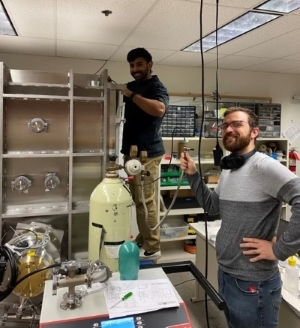 Photo:
 ESI interns Jacob Thomas (
UMBC ME graduate student) and Lars Sobieski (
UMBC ME undergraduate student) perform a leak check on the sealed chamber.
Photo courtesy of D. Nelson.
Since the chamber arrived in January 2025, ESI engineers and engineering interns have been hard at work building its plumbing and control system. Now, the TVAC is fully functional, able to reach pressures as low as 5*10-7 mBar—over 2 billion times lower than atmospheric pressure! Soon ESI will begin using this new facility to test electronics and optical sensors they plan to use in future space missions.
While it’s been a long journey already, this is only the beginning for ESI’s improved in-house space simulation and ground testing capabilities.
Photo, l - r: ESI interns Jacob Thomas and Lars Sobieski along with ESI engineers
Danny Nelson,
CJ Escobar, and
Dominik Cieslak all played roles designing, building, and commissioning the chamber.
Photo provided by D. Nelson.
(Thanks to Danny Nelson for providing this article!)
]]>
This past week, members of the Earth & Space Institute finished commissioning their new thermal vacuum chamber (TVAC), a breathtaking piece of engineering—literally! In the aerospace industry,...
Photo
https://assets3-my.umbc.edu/system/shared/attachments/33f77b692f37428b7d7164fdeafb1fce/69ed9fbb/news/000/151/403/18fd0c19f24e132a9ca0ed7a5ab42b47/TVAC finished product web.jpg?1754686036
https://my3.my.umbc.edu/api/v0/pixel/news/151403/guest@my.umbc.edu/88a311b04e319195f01463bfffbcedd5/api/pixel
esi
meche
Earth and Space Institute
https://my3.my.umbc.edu/groups/esi
https://assets4-my.umbc.edu/system/shared/avatars/groups/000/002/124/0edf78e65ae95730e0c3687aa55486c5/xsmall.png?1708376163
https://assets1-my.umbc.edu/system/shared/avatars/groups/000/002/124/0edf78e65ae95730e0c3687aa55486c5/original.png?1708376163
https://assets3-my.umbc.edu/system/shared/avatars/groups/000/002/124/0edf78e65ae95730e0c3687aa55486c5/xxlarge.png?1708376163
https://assets3-my.umbc.edu/system/shared/avatars/groups/000/002/124/0edf78e65ae95730e0c3687aa55486c5/xlarge.png?1708376163
https://assets3-my.umbc.edu/system/shared/avatars/groups/000/002/124/0edf78e65ae95730e0c3687aa55486c5/large.png?1708376163
https://assets4-my.umbc.edu/system/shared/avatars/groups/000/002/124/0edf78e65ae95730e0c3687aa55486c5/medium.png?1708376163
https://assets3-my.umbc.edu/system/shared/avatars/groups/000/002/124/0edf78e65ae95730e0c3687aa55486c5/small.png?1708376163
https://assets4-my.umbc.edu/system/shared/avatars/groups/000/002/124/0edf78e65ae95730e0c3687aa55486c5/xsmall.png?1708376163
https://assets4-my.umbc.edu/system/shared/avatars/groups/000/002/124/0edf78e65ae95730e0c3687aa55486c5/xxsmall.png?1708376163
Earth and Space Institute
https://assets2-my.umbc.edu/system/shared/thumbnails/news/000/151/403/5e66889d040a846dbcb59fc059a038bb/xxlarge.jpg?1754684682
https://assets4-my.umbc.edu/system/shared/thumbnails/news/000/151/403/5e66889d040a846dbcb59fc059a038bb/xlarge.jpg?1754684682
https://assets4-my.umbc.edu/system/shared/thumbnails/news/000/151/403/5e66889d040a846dbcb59fc059a038bb/large.jpg?1754684682
https://assets4-my.umbc.edu/system/shared/thumbnails/news/000/151/403/5e66889d040a846dbcb59fc059a038bb/medium.jpg?1754684682
https://assets3-my.umbc.edu/system/shared/thumbnails/news/000/151/403/5e66889d040a846dbcb59fc059a038bb/small.jpg?1754684682
https://assets4-my.umbc.edu/system/shared/thumbnails/news/000/151/403/5e66889d040a846dbcb59fc059a038bb/xsmall.jpg?1754684682
https://assets4-my.umbc.edu/system/shared/thumbnails/news/000/151/403/5e66889d040a846dbcb59fc059a038bb/xxsmall.jpg?1754684682
8
0
false
Fri, 08 Aug 2025 17:30:26 -0400
Fri, 08 Aug 2025 17:31:16 -0400
For ESI undergraduate engineer Lars Sobieski, space hardware is both tech and art
Lars Sobieski, undergraduate mechanical engineer at the Earth and Space Institute, spends his day developing hardware and testing for future climate satellites. At ESI, he designs and fabricates some of the ground support equipment (GSE) that will help calibrate future climate instruments, particularly the two-dimensional focal plane arrays (FPA). The FPA is the surface of a detector that collects light across millions of pixels and converts it into an image. ESI is developing FPAs for upcoming satellite instruments that are sensitive to ultraviolet (UV), visible (VIS), and shortwave infrared (SWIR) wavelengths. These are critical spectral ranges for studying Earth’s clouds, aerosols, land, ocean, and atmosphere.
A major type of testing that satellites and their detectors undergo before launch is thermal vacuum (TVAC) testing. In the lab, Mr. Sobieski and ESI faculty are preparing an industrial TVAC chamber, which can submit our space hardware to orbit temperatures (-20C to +20C) and space-like pressures (10-7 millibars and lower). This TVAC chamber was part of a major state grant to ESI, led by Maryland Senators Ben Cardin and Chris Van Hollen, to boost UMBC’s capacity to support new space and satellite projects.
Mr. Sobieski is currently helping to optimize the TVAC chamber for related testing. However, he explains, “Because the TVAC chamber will not be ready for use for some of the FPA tests, I was given the task of designing and building an enclosure that can fit the GSE needed for the UV/VIS FPA test. This enclosure will be purged with dry air to ensure that no condensation will form on the electronics as they are chilled to below the dewpoint. It must also isolate the FPA from electrostatic discharge and provide through-wall access points for power, data, pneumatics, and a liquid cooling loop.” This will be used to verify the operation of the FPA prior to testing it under day-night temperature swings or the low pressures of the orbit environment.
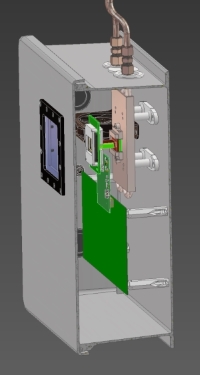
Photo: The full assembly of the UV/VIS FPA (center gray part) and associated electronics in a metal enclosure for electronics testing. Photo Credit: L. Sobieski/ESI.
Since March 2025, he took on a completely different project for ESI in parallel – developing a full-scale 3D-printed model of the HARP CubeSat, ESI’s first foray into small satellite technology for studying Earth’s climate. According to Mr. Sobieski, “The process involved using the existing CAD assembly of the CubeSat to create a new, simplified model from scratch to reduce the part count. While the actual CubeSat had a few thousand parts, the 3D-printable model has only nineteen.” After a few rounds of test prints, gluing, body-filling, sanding, and priming, Mr. Sobieski enlisted the help of his fiancée to do the detail brush painting. For the end result, the 3D model of the HARP CubeSat looks remarkably similar to what actually flew in space from 2020-2022.
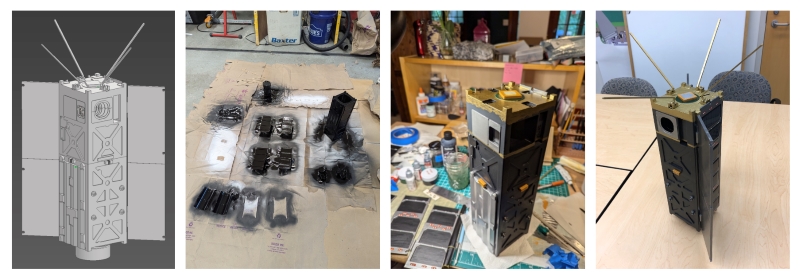
Photos: Process composite of the development of the HARP CubeSat 3D model. The monobloc model derived from the original satellite CAD file (left), components were primed (center left), painted to match the satellite (center right), and the final model (right). Photo Credit: L. Sobieski/ESI.
]]>
Lars Sobieski, undergraduate mechanical engineer at the Earth and Space Institute, spends his day developing hardware and testing for future climate satellites. At ESI, he designs and fabricates...
Photo
https://assets1-my.umbc.edu/system/shared/attachments/6c162c3a59089cdcbb6303ca7c8a629a/69ed9fbb/news/000/151/112/a2a16ef634b4226ccfffd6853193fa56/HARPCubeSat_Process web.jpg?1753206262
https://my3.my.umbc.edu/api/v0/pixel/news/151112/guest@my.umbc.edu/a6ac25d34c07c6d6fcc915ac851397b4/api/pixel
esi
meche
Earth and Space Institute
https://my3.my.umbc.edu/groups/esi
https://assets4-my.umbc.edu/system/shared/avatars/groups/000/002/124/0edf78e65ae95730e0c3687aa55486c5/xsmall.png?1708376163
https://assets1-my.umbc.edu/system/shared/avatars/groups/000/002/124/0edf78e65ae95730e0c3687aa55486c5/original.png?1708376163
https://assets3-my.umbc.edu/system/shared/avatars/groups/000/002/124/0edf78e65ae95730e0c3687aa55486c5/xxlarge.png?1708376163
https://assets3-my.umbc.edu/system/shared/avatars/groups/000/002/124/0edf78e65ae95730e0c3687aa55486c5/xlarge.png?1708376163
https://assets3-my.umbc.edu/system/shared/avatars/groups/000/002/124/0edf78e65ae95730e0c3687aa55486c5/large.png?1708376163
https://assets4-my.umbc.edu/system/shared/avatars/groups/000/002/124/0edf78e65ae95730e0c3687aa55486c5/medium.png?1708376163
https://assets3-my.umbc.edu/system/shared/avatars/groups/000/002/124/0edf78e65ae95730e0c3687aa55486c5/small.png?1708376163
https://assets4-my.umbc.edu/system/shared/avatars/groups/000/002/124/0edf78e65ae95730e0c3687aa55486c5/xsmall.png?1708376163
https://assets4-my.umbc.edu/system/shared/avatars/groups/000/002/124/0edf78e65ae95730e0c3687aa55486c5/xxsmall.png?1708376163
Earth and Space Institute
https://assets4-my.umbc.edu/system/shared/thumbnails/news/000/151/112/96cbecebd85bf663fe7fd366e1d180b3/xxlarge.jpg?1753209288
https://assets4-my.umbc.edu/system/shared/thumbnails/news/000/151/112/96cbecebd85bf663fe7fd366e1d180b3/xlarge.jpg?1753209288
https://assets4-my.umbc.edu/system/shared/thumbnails/news/000/151/112/96cbecebd85bf663fe7fd366e1d180b3/large.jpg?1753209288
https://assets1-my.umbc.edu/system/shared/thumbnails/news/000/151/112/96cbecebd85bf663fe7fd366e1d180b3/medium.jpg?1753209288
https://assets3-my.umbc.edu/system/shared/thumbnails/news/000/151/112/96cbecebd85bf663fe7fd366e1d180b3/small.jpg?1753209288
https://assets3-my.umbc.edu/system/shared/thumbnails/news/000/151/112/96cbecebd85bf663fe7fd366e1d180b3/xsmall.jpg?1753209288
https://assets3-my.umbc.edu/system/shared/thumbnails/news/000/151/112/96cbecebd85bf663fe7fd366e1d180b3/xxsmall.jpg?1753209288
8
0
false
Tue, 22 Jul 2025 14:37:23 -0400
Tue, 22 Jul 2025 15:01:39 -0400