Interested in AI? Join free Discover AI program this Fall
Apply by Fri. 9/3 for 8 week online program & get certificat
UMBC has partnered with AI4ALL to offer its free online Discover AI class introducing AI technology to selected UMBC undergraduate students from any major this Fall. The eight-week program starts in the third week of September, includes both synchronous and asynchronous instruction, and requires 15-20 hours over the eight weeks. It is open to all freshmen, sophomores, and juniors and is structured to accommodate students with and without prior computer science or AI experience. Students finishing the program will get a certificate and the opportunity to apply for free follow-on programs.
AI4ALL programs are designed to bring together and highlight voices that have been historically excluded and that will lead and shape the future of AI. It aims to serve the following students, especially those at the intersection of two or more of these identities:
Indigenous Peoples, Black, Hispanic or Latinx, Pacific Islander, and Southeast Asian
Trans and non-binary; two-spirit; cis women and girls
Lesbian, gay, bisexual, asexual, and queer
Students with a demonstrated financial need (e.g., students receiving financial aid)
First-generation college student
 President Hrabowski (right) with Governor Hogan (center) and Anne Neuberger (left) at the July 2021 cyber summit. Photo by Maryland GovPics, Flickr CC by 2.0.
UMBC, State of Maryland launch Maryland Institute for Innovative Computing
Governor Larry Hogan yesterday announced the launch of the Maryland Institute for Innovative Computing (MIIC) at UMBC during a cybersecurity summit in Annapolis.
The MIIC will address pressing challenges related to computing, analytics, and workforce in state agencies, with a focus on cybersecurity, artificial intelligence, and data science. UMBC faculty, students and staff will work with MIIC partners to provide expertise on the complex process of recovering from cyberattacks. They will also offer technical guidance to inform policy decisions for leveraging data safely, securely, and ethically.
The partnership will also include talent from higher education institutions within the University System of Maryland and across the state, and partners in the public and private sectors.
“Maryland is showing the way by creating this innovative partnership that brings together experienced faculty and students who are eager to apply the knowledge they have acquired, with state agencies that need support facing pressing challenges,” says Anupam Joshi, director of UMBC’s Center for Cybersecurity, and professor and chair of computer science and electrical engineering. “UMBC is proud to lead the way in partnership with the state, staying true to our motto of inclusive excellence.”
As part of the MIIC, UMBC will utilize Computing Innovation Rapid Response Teams to develop real-time solutions to IT and data concerns in state agencies. These teams will include undergraduate and graduate students trained and deployed through internships and capstone courses.
Another component of the collaboration, the MIIC Innovation Lab and Challenge Fund, will use an evidence-based approach to understand how government agencies can innovate in the computing space and can replicate successful approaches.
The collaboration will also leverage the highly successful Maryland Technology Internship Program to develop a comprehensive computing and technology workforce development strategy.
Cybersecurity summit
The summit drew participation from top federal, state, and private-sector cybersecurity leaders, includingAnne Neuberger, deputy assistant to President Biden and deputy national security advisor for cyber and emerging technology. The event opened with remarks fromGovernor Hogan. Three panels followed, focusing on the national cybersecurity agenda, the state cybersecurity ecosystem, and the role of the private sector.
UMBC President Freeman Hrabowski and Dean Keith J Bowman of UMBC’s College of Engineering and Information Technologymoderated panels. UMBC alumna Tina Williams-Koroma ‘02, computer science, president and CEO of TCecure, participated as a panelist.
“There is no greater threat to the safety and security of Americans right now than the cyber vulnerabilities of the systems that support our daily lives, from our drinking water and our power supply, to our railroads and air traffic controls,” said Governor Hogan, in a statement ahead of the summit. “As the cyber capital of America, Maryland is proud to host this summit,” including “an open and productive discussion of our coordinated cybersecurity goals and initiatives as we work to protect the American people.”
Developing cyber talent
Bowman described UMBC’s role in cybersecurity workforce development within Maryland, nurturing talent and giving students opportunities to pursue related careers. He highlighted the Maryland Center for Computing Education, which is housed at UMBC and works to engage K-12 students in computing and support teacher development.
“During my four years at UMBC, our College has benefited from support for both our academic programs and research from the Governor and state,” he said. “That support has enabled us to recruit, retain, and invest in outstanding faculty and staff that are developing Maryland’s next generation of engineering and computing professionals.”
UMBC is a National Cybersecurity Center of Excellence for both education and research and one of the top producers of cyber talent for the National Security Agency. The university is also home to the Cyber Dawgs team, which won the National Collegiate Cyber Defense Competition in 2017 and the Mid-Atlantic Collegiate Cyber Defense Competition in 2021.
Adapted from a UMBC News article written by Megan Hanks.
The post UMBC, State of Maryland launch Maryland Institute for Innovative Computing appeared first on Department of Computer Science and Electrical Engineering.
]]>
President Hrabowski (right) with Governor Hogan (center) and Anne Neuberger (left) at the July 2021 cyber summit. Photo by Maryland GovPics, Flickr CC by 2.0. UMBC, State of Maryland launch...
https://www.csee.umbc.edu/2021/07/umbc-state-of-maryland-launch-maryland-institute-for-innovative-computing/
https://my3.my.umbc.edu/api/v0/pixel/news/111350/guest@my.umbc.edu/2a0ec660e96d1caed449c7d8c5dfdb16/api/pixel
cybersecurity
in-the-news
news
Computer Science and Electrical Engineering
https://my3.my.umbc.edu/groups/csee
https://assets3-my.umbc.edu/system/shared/avatars/groups/000/000/099/d117dca133c64bf78a4b7696dd007189/xsmall.png?1314043393
https://assets1-my.umbc.edu/system/shared/avatars/groups/000/000/099/d117dca133c64bf78a4b7696dd007189/original.png?1314043393
https://assets1-my.umbc.edu/system/shared/avatars/groups/000/000/099/d117dca133c64bf78a4b7696dd007189/xxlarge.png?1314043393
https://assets4-my.umbc.edu/system/shared/avatars/groups/000/000/099/d117dca133c64bf78a4b7696dd007189/xlarge.png?1314043393
https://assets3-my.umbc.edu/system/shared/avatars/groups/000/000/099/d117dca133c64bf78a4b7696dd007189/large.png?1314043393
https://assets1-my.umbc.edu/system/shared/avatars/groups/000/000/099/d117dca133c64bf78a4b7696dd007189/medium.png?1314043393
https://assets2-my.umbc.edu/system/shared/avatars/groups/000/000/099/d117dca133c64bf78a4b7696dd007189/small.png?1314043393
https://assets3-my.umbc.edu/system/shared/avatars/groups/000/000/099/d117dca133c64bf78a4b7696dd007189/xsmall.png?1314043393
https://assets3-my.umbc.edu/system/shared/avatars/groups/000/000/099/d117dca133c64bf78a4b7696dd007189/xxsmall.png?1314043393
Computer Science and Electrical Engineering
2
0
false
Sat, 31 Jul 2021 11:14:17 -0400
UMBC, State of Maryland launch Maryland Institute for Innovative Computing
President Hrabowski (right) with Governor Hogan (center) and Anne Neuberger (left) at the July 2021 cyber summit. Photo by Maryland GovPics, Flickr CC by 2.0.
UMBC, State of Maryland launch Maryland Institute for Innovative Computing
Governor Larry Hogan yesterday announced the launch of the Maryland Institute for Innovative Computing (MIIC) at UMBC during a cybersecurity summit in Annapolis.
The MIIC will address pressing challenges related to computing, analytics, and workforce in state agencies, with a focus on cybersecurity, artificial intelligence, and data science. UMBC faculty, students and staff will work with MIIC partners to provide expertise on the complex process of recovering from cyberattacks. They will also offer technical guidance to inform policy decisions for leveraging data safely, securely, and ethically.
The partnership will also include talent from higher education institutions within the University System of Maryland and across the state, and partners in the public and private sectors.
“Maryland is showing the way by creating this innovative partnership that brings together experienced faculty and students who are eager to apply the knowledge they have acquired, with state agencies that need support facing pressing challenges,” says Anupam Joshi, director of UMBC’s Center for Cybersecurity, and professor and chair of computer science and electrical engineering. “UMBC is proud to lead the way in partnership with the state, staying true to our motto of inclusive excellence.”
As part of the MIIC, UMBC will utilize Computing Innovation Rapid Response Teams to develop real-time solutions to IT and data concerns in state agencies. These teams will include undergraduate and graduate students trained and deployed through internships and capstone courses.
Another component of the collaboration, the MIIC Innovation Lab and Challenge Fund, will use an evidence-based approach to understand how government agencies can innovate in the computing space and can replicate successful approaches.
The collaboration will also leverage the highly successful Maryland Technology Internship Program to develop a comprehensive computing and technology workforce development strategy.
Cybersecurity summit
The summit drew participation from top federal, state, and private-sector cybersecurity leaders, includingAnne Neuberger, deputy assistant to President Biden and deputy national security advisor for cyber and emerging technology. The event opened with remarks fromGovernor Hogan. Three panels followed, focusing on the national cybersecurity agenda, the state cybersecurity ecosystem, and the role of the private sector.
UMBC President Freeman Hrabowski and Dean Keith J Bowman of UMBC’s College of Engineering and Information Technologymoderated panels. UMBC alumna Tina Williams-Koroma ‘02, computer science, president and CEO of TCecure, participated as a panelist.
“There is no greater threat to the safety and security of Americans right now than the cyber vulnerabilities of the systems that support our daily lives, from our drinking water and our power supply, to our railroads and air traffic controls,” said Governor Hogan, in a statement ahead of the summit. “As the cyber capital of America, Maryland is proud to host this summit,” including “an open and productive discussion of our coordinated cybersecurity goals and initiatives as we work to protect the American people.”
Developing cyber talent
Bowman described UMBC’s role in cybersecurity workforce development within Maryland, nurturing talent and giving students opportunities to pursue related careers. He highlighted the Maryland Center for Computing Education, which is housed at UMBC and works to engage K-12 students in computing and support teacher development.
“During my four years at UMBC, our College has benefited from support for both our academic programs and research from the Governor and state,” he said. “That support has enabled us to recruit, retain, and invest in outstanding faculty and staff that are developing Maryland’s next generation of engineering and computing professionals.”
UMBC is a National Cybersecurity Center of Excellence for both education and research and one of the top producers of cyber talent for the National Security Agency. The university is also home to the Cyber Dawgs team, which won the National Collegiate Cyber Defense Competition in 2017 and the Mid-Atlantic Collegiate Cyber Defense Competition in 2021.
Adapted from a UMBC News article written by Megan Hanks.
The post UMBC, State of Maryland launch Maryland Institute for Innovative Computing appeared first on Department of Computer Science and Electrical Engineering.
]]>
President Hrabowski (right) with Governor Hogan (center) and Anne Neuberger (left) at the July 2021 cyber summit. Photo by Maryland GovPics, Flickr CC by 2.0. UMBC, State of Maryland launch...
https://redirect.cs.umbc.edu/2021/07/umbc-state-of-maryland-launch-maryland-institute-for-innovative-computing/
https://my3.my.umbc.edu/api/v0/pixel/news/129841/guest@my.umbc.edu/e1d10eb33ad5abf5bf2762affa3bf1aa/api/pixel
cybersecurity
in-the-news
news
Computer Science and Electrical Engineering
https://my3.my.umbc.edu/groups/csee
https://assets3-my.umbc.edu/system/shared/avatars/groups/000/000/099/d117dca133c64bf78a4b7696dd007189/xsmall.png?1314043393
https://assets1-my.umbc.edu/system/shared/avatars/groups/000/000/099/d117dca133c64bf78a4b7696dd007189/original.png?1314043393
https://assets1-my.umbc.edu/system/shared/avatars/groups/000/000/099/d117dca133c64bf78a4b7696dd007189/xxlarge.png?1314043393
https://assets4-my.umbc.edu/system/shared/avatars/groups/000/000/099/d117dca133c64bf78a4b7696dd007189/xlarge.png?1314043393
https://assets3-my.umbc.edu/system/shared/avatars/groups/000/000/099/d117dca133c64bf78a4b7696dd007189/large.png?1314043393
https://assets1-my.umbc.edu/system/shared/avatars/groups/000/000/099/d117dca133c64bf78a4b7696dd007189/medium.png?1314043393
https://assets2-my.umbc.edu/system/shared/avatars/groups/000/000/099/d117dca133c64bf78a4b7696dd007189/small.png?1314043393
https://assets3-my.umbc.edu/system/shared/avatars/groups/000/000/099/d117dca133c64bf78a4b7696dd007189/xsmall.png?1314043393
https://assets3-my.umbc.edu/system/shared/avatars/groups/000/000/099/d117dca133c64bf78a4b7696dd007189/xxsmall.png?1314043393
Computer Science and Electrical Engineering
0
0
false
Sat, 31 Jul 2021 11:14:17 -0400
Sat, 31 Jul 2021 11:14:17 -0400
UMBC, State of Maryland launch Maryland Institute for Innovative Computing
President Hrabowski (right) with Governor Hogan (center) and Anne Neuberger (left) at the July 2021 cyber summit. Photo by Maryland GovPics, Flickr CC by 2.0.
UMBC, State of Maryland launch Maryland Institute for Innovative Computing
Governor Larry Hogan yesterday announced the launch of the Maryland Institute for Innovative Computing (MIIC) at UMBC during a cybersecurity summit in Annapolis.
The MIIC will address pressing challenges related to computing, analytics, and workforce in state agencies, with a focus on cybersecurity, artificial intelligence, and data science. UMBC faculty, students and staff will work with MIIC partners to provide expertise on the complex process of recovering from cyberattacks. They will also offer technical guidance to inform policy decisions for leveraging data safely, securely, and ethically.
The partnership will also include talent from higher education institutions within the University System of Maryland and across the state, and partners in the public and private sectors.
“Maryland is showing the way by creating this innovative partnership that brings together experienced faculty and students who are eager to apply the knowledge they have acquired, with state agencies that need support facing pressing challenges,” says Anupam Joshi, director of UMBC’s Center for Cybersecurity, and professor and chair of computer science and electrical engineering. “UMBC is proud to lead the way in partnership with the state, staying true to our motto of inclusive excellence.”
As part of the MIIC, UMBC will utilize Computing Innovation Rapid Response Teams to develop real-time solutions to IT and data concerns in state agencies. These teams will include undergraduate and graduate students trained and deployed through internships and capstone courses.
Another component of the collaboration, the MIIC Innovation Lab and Challenge Fund, will use an evidence-based approach to understand how government agencies can innovate in the computing space and can replicate successful approaches.
The collaboration will also leverage the highly successful Maryland Technology Internship Program to develop a comprehensive computing and technology workforce development strategy.
Cybersecurity summit
The summit drew participation from top federal, state, and private-sector cybersecurity leaders, includingAnne Neuberger, deputy assistant to President Biden and deputy national security advisor for cyber and emerging technology. The event opened with remarks fromGovernor Hogan. Three panels followed, focusing on the national cybersecurity agenda, the state cybersecurity ecosystem, and the role of the private sector.
UMBC President Freeman Hrabowski and Dean Keith J Bowman of UMBC’s College of Engineering and Information Technologymoderated panels. UMBC alumna Tina Williams-Koroma ‘02, computer science, president and CEO of TCecure, participated as a panelist.
“There is no greater threat to the safety and security of Americans right now than the cyber vulnerabilities of the systems that support our daily lives, from our drinking water and our power supply, to our railroads and air traffic controls,” said Governor Hogan, in a statement ahead of the summit. “As the cyber capital of America, Maryland is proud to host this summit,” including “an open and productive discussion of our coordinated cybersecurity goals and initiatives as we work to protect the American people.”
Developing cyber talent
Bowman described UMBC’s role in cybersecurity workforce development within Maryland, nurturing talent and giving students opportunities to pursue related careers. He highlighted the Maryland Center for Computing Education, which is housed at UMBC and works to engage K-12 students in computing and support teacher development.
“During my four years at UMBC, our College has benefited from support for both our academic programs and research from the Governor and state,” he said. “That support has enabled us to recruit, retain, and invest in outstanding faculty and staff that are developing Maryland’s next generation of engineering and computing professionals.”
UMBC is a National Cybersecurity Center of Excellence for both education and research and one of the top producers of cyber talent for the National Security Agency. The university is also home to the Cyber Dawgs team, which won the National Collegiate Cyber Defense Competition in 2017 and the Mid-Atlantic Collegiate Cyber Defense Competition in 2021.
Adapted from a UMBC News article written by Megan Hanks.
The post UMBC, State of Maryland launch Maryland Institute for Innovative Computing appeared first on Department of Computer Science and Electrical Engineering.
]]>
President Hrabowski (right) with Governor Hogan (center) and Anne Neuberger (left) at the July 2021 cyber summit. Photo by Maryland GovPics, Flickr CC by 2.0. UMBC, State of Maryland...
https://news.cs.umbc.edu/2021/07/umbc-state-of-maryland-launch-maryland-institute-for-innovative-computing/
https://my3.my.umbc.edu/api/v0/pixel/news/142852/guest@my.umbc.edu/fcad52feca518427509d8e8a5ebacf77/api/pixel
cybersecurity
in-the-news
news
Computer Science and Electrical Engineering
https://my3.my.umbc.edu/groups/csee
https://assets3-my.umbc.edu/system/shared/avatars/groups/000/000/099/d117dca133c64bf78a4b7696dd007189/xsmall.png?1314043393
https://assets1-my.umbc.edu/system/shared/avatars/groups/000/000/099/d117dca133c64bf78a4b7696dd007189/original.png?1314043393
https://assets1-my.umbc.edu/system/shared/avatars/groups/000/000/099/d117dca133c64bf78a4b7696dd007189/xxlarge.png?1314043393
https://assets4-my.umbc.edu/system/shared/avatars/groups/000/000/099/d117dca133c64bf78a4b7696dd007189/xlarge.png?1314043393
https://assets3-my.umbc.edu/system/shared/avatars/groups/000/000/099/d117dca133c64bf78a4b7696dd007189/large.png?1314043393
https://assets1-my.umbc.edu/system/shared/avatars/groups/000/000/099/d117dca133c64bf78a4b7696dd007189/medium.png?1314043393
https://assets2-my.umbc.edu/system/shared/avatars/groups/000/000/099/d117dca133c64bf78a4b7696dd007189/small.png?1314043393
https://assets3-my.umbc.edu/system/shared/avatars/groups/000/000/099/d117dca133c64bf78a4b7696dd007189/xsmall.png?1314043393
https://assets3-my.umbc.edu/system/shared/avatars/groups/000/000/099/d117dca133c64bf78a4b7696dd007189/xxsmall.png?1314043393
Computer Science and Electrical Engineering
0
0
false
Sat, 31 Jul 2021 11:14:17 -0400
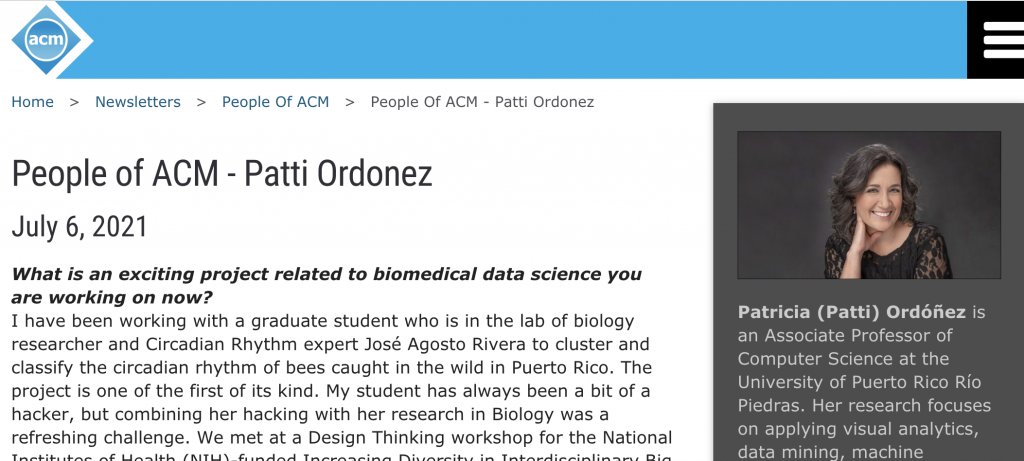
CSEE alumna Patricia Ordóñez featured in People of ACM interview
CSEE alumna Patricia Ordóñez featured in People of ACM interview
Every month ACM, the oldest and largest professional society devoted to computing, features an interview with two of its nearly 100,000 members from more than 100 countries. In July, UMBC CSEE alumna Patricia (Patti) Ordóñez in its People of ACM series. Dr. Ordóñez received her Ph.D. in Computer Science in 2012 for a dissertation jointly supervised by Professors Tim Oates and Marie desJardin on Multivariate Time Series Analysis of Physiological and Clinical Data.
After receiving her Ph.D. in 2012, she joined the University of Puerto Rico Río Piedra as an Assistant Professor and was promoted to Associate Professor with tenure in 2017. She has continued doing research on applying machine learning to problems in the healthcare domain and now focuses on using visual analytics, data mining, machine learning, visualization, and human-computer interaction to medicine and assistive technologies. One of her research goals is to help medical providers create better diagnosis and treatment plans by learning from the data of previous patients with similar conditions.
Dr. Ordóñez followed a nontraditional path to earning her Ph.D. in Computer Science. After getting her undergraduate degree from Johns Hopkins University, she worked for many years as a math and Spanish K-12 teacher and also as a part-time technical trainer for computing courses. She has been very active in supporting efforts to diversify the field of computing. She is is the Program Chair for the 2021 CMD-IT/ACM Richard A. Tapia Celebration of Diversity in Computing Conference also the Co-chair of ACM’s Diversity and Inclusion Council.
Read more about her experiences in the ACM interview.
The post CSEE alumna Patricia Ordóñez featured in People of ACM interview appeared first on Department of Computer Science and Electrical Engineering.
]]>
CSEE alumna Patricia Ordóñez featured in People of ACM interview Every month ACM, the oldest and largest professional society devoted to computing, features an interview with two of its nearly...
https://www.csee.umbc.edu/2021/07/csee-alumna-patricia-ordonez-featured-in-people-of-acm-interview/
https://my3.my.umbc.edu/api/v0/pixel/news/102532/guest@my.umbc.edu/30d53433dbe049e7856155045d24aac6/api/pixel
acm
alumni
computer-science
honors
news
Computer Science and Electrical Engineering
https://my3.my.umbc.edu/groups/csee
https://assets3-my.umbc.edu/system/shared/avatars/groups/000/000/099/d117dca133c64bf78a4b7696dd007189/xsmall.png?1314043393
https://assets1-my.umbc.edu/system/shared/avatars/groups/000/000/099/d117dca133c64bf78a4b7696dd007189/original.png?1314043393
https://assets1-my.umbc.edu/system/shared/avatars/groups/000/000/099/d117dca133c64bf78a4b7696dd007189/xxlarge.png?1314043393
https://assets4-my.umbc.edu/system/shared/avatars/groups/000/000/099/d117dca133c64bf78a4b7696dd007189/xlarge.png?1314043393
https://assets3-my.umbc.edu/system/shared/avatars/groups/000/000/099/d117dca133c64bf78a4b7696dd007189/large.png?1314043393
https://assets1-my.umbc.edu/system/shared/avatars/groups/000/000/099/d117dca133c64bf78a4b7696dd007189/medium.png?1314043393
https://assets2-my.umbc.edu/system/shared/avatars/groups/000/000/099/d117dca133c64bf78a4b7696dd007189/small.png?1314043393
https://assets3-my.umbc.edu/system/shared/avatars/groups/000/000/099/d117dca133c64bf78a4b7696dd007189/xsmall.png?1314043393
https://assets3-my.umbc.edu/system/shared/avatars/groups/000/000/099/d117dca133c64bf78a4b7696dd007189/xxsmall.png?1314043393
Computer Science and Electrical Engineering
1
0
false
Sat, 10 Jul 2021 21:55:32 -0400
CSEE alumna Patricia Ordóñez featured in People of ACM interview
CSEE alumna Patricia Ordóñez featured in People of ACM interview
Every month ACM, the oldest and largest professional society devoted to computing, features an interview with two of its nearly 100,000 members from more than 100 countries. In July, UMBC CSEE alumna Patricia (Patti) Ordóñez in its People of ACM series. Dr. Ordóñez received her Ph.D. in Computer Science in 2012 for a dissertation jointly supervised by Professors Tim Oates and Marie desJardin on Multivariate Time Series Analysis of Physiological and Clinical Data.
After receiving her Ph.D. in 2012, she joined the University of Puerto Rico Río Piedra as an Assistant Professor and was promoted to Associate Professor with tenure in 2017. She has continued doing research on applying machine learning to problems in the healthcare domain and now focuses on using visual analytics, data mining, machine learning, visualization, and human-computer interaction to medicine and assistive technologies. One of her research goals is to help medical providers create better diagnosis and treatment plans by learning from the data of previous patients with similar conditions.
Dr. Ordóñez followed a nontraditional path to earning her Ph.D. in Computer Science. After getting her undergraduate degree from Johns Hopkins University, she worked for many years as a math and Spanish K-12 teacher and also as a part-time technical trainer for computing courses. She has been very active in supporting efforts to diversify the field of computing. She is is the Program Chair for the 2021 CMD-IT/ACM Richard A. Tapia Celebration of Diversity in Computing Conference also the Co-chair of ACM’s Diversity and Inclusion Council.
Read more about her experiences in the ACM interview.
The post CSEE alumna Patricia Ordóñez featured in People of ACM interview appeared first on Department of Computer Science and Electrical Engineering.
]]>
CSEE alumna Patricia Ordóñez featured in People of ACM interview Every month ACM, the oldest and largest professional society devoted to computing, features an interview with two of its nearly...
https://redirect.cs.umbc.edu/2021/07/csee-alumna-patricia-ordonez-featured-in-people-of-acm-interview/
https://my3.my.umbc.edu/api/v0/pixel/news/129842/guest@my.umbc.edu/790fdfc750068211313f655077bc5389/api/pixel
acm
alumni
computer-science
honors
news
Computer Science and Electrical Engineering
https://my3.my.umbc.edu/groups/csee
https://assets3-my.umbc.edu/system/shared/avatars/groups/000/000/099/d117dca133c64bf78a4b7696dd007189/xsmall.png?1314043393
https://assets1-my.umbc.edu/system/shared/avatars/groups/000/000/099/d117dca133c64bf78a4b7696dd007189/original.png?1314043393
https://assets1-my.umbc.edu/system/shared/avatars/groups/000/000/099/d117dca133c64bf78a4b7696dd007189/xxlarge.png?1314043393
https://assets4-my.umbc.edu/system/shared/avatars/groups/000/000/099/d117dca133c64bf78a4b7696dd007189/xlarge.png?1314043393
https://assets3-my.umbc.edu/system/shared/avatars/groups/000/000/099/d117dca133c64bf78a4b7696dd007189/large.png?1314043393
https://assets1-my.umbc.edu/system/shared/avatars/groups/000/000/099/d117dca133c64bf78a4b7696dd007189/medium.png?1314043393
https://assets2-my.umbc.edu/system/shared/avatars/groups/000/000/099/d117dca133c64bf78a4b7696dd007189/small.png?1314043393
https://assets3-my.umbc.edu/system/shared/avatars/groups/000/000/099/d117dca133c64bf78a4b7696dd007189/xsmall.png?1314043393
https://assets3-my.umbc.edu/system/shared/avatars/groups/000/000/099/d117dca133c64bf78a4b7696dd007189/xxsmall.png?1314043393
Computer Science and Electrical Engineering
0
0
false
Sat, 10 Jul 2021 21:55:32 -0400
Sat, 10 Jul 2021 21:55:32 -0400
CSEE alumna Patricia Ordóñez featured in People of ACM interview
CSEE alumna Patricia Ordóñez featured in People of ACM interview
Every month ACM, the oldest and largest professional society devoted to computing, features an interview with two of its nearly 100,000 members from more than 100 countries. In July, UMBC CSEE alumna Patricia (Patti) Ordóñez in its People of ACM series. Dr. Ordóñez received her Ph.D. in Computer Science in 2012 for a dissertation jointly supervised by Professors Tim Oates and Marie desJardin on Multivariate Time Series Analysis of Physiological and Clinical Data.
After receiving her Ph.D. in 2012, she joined the University of Puerto Rico Río Piedra as an Assistant Professor and was promoted to Associate Professor with tenure in 2017. She has continued doing research on applying machine learning to problems in the healthcare domain and now focuses on using visual analytics, data mining, machine learning, visualization, and human-computer interaction to medicine and assistive technologies. One of her research goals is to help medical providers create better diagnosis and treatment plans by learning from the data of previous patients with similar conditions.
Dr. Ordóñez followed a nontraditional path to earning her Ph.D. in Computer Science. After getting her undergraduate degree from Johns Hopkins University, she worked for many years as a math and Spanish K-12 teacher and also as a part-time technical trainer for computing courses. She has been very active in supporting efforts to diversify the field of computing. She is is the Program Chair for the 2021 CMD-IT/ACM Richard A. Tapia Celebration of Diversity in Computing Conference also the Co-chair of ACM’s Diversity and Inclusion Council.
Read more about her experiences in the ACM interview.
The post CSEE alumna Patricia Ordóñez featured in People of ACM interview appeared first on Department of Computer Science and Electrical Engineering.
]]>
CSEE alumna Patricia Ordóñez featured in People of ACM interview Every month ACM, the oldest and largest professional society devoted to computing, features an interview with two of its...
https://news.cs.umbc.edu/2021/07/csee-alumna-patricia-ordonez-featured-in-people-of-acm-interview/
https://my3.my.umbc.edu/api/v0/pixel/news/142853/guest@my.umbc.edu/4043f0f50135e15c94825e2ae3eacaec/api/pixel
acm
alumni
computer-science
honors
news
Computer Science and Electrical Engineering
https://my3.my.umbc.edu/groups/csee
https://assets3-my.umbc.edu/system/shared/avatars/groups/000/000/099/d117dca133c64bf78a4b7696dd007189/xsmall.png?1314043393
https://assets1-my.umbc.edu/system/shared/avatars/groups/000/000/099/d117dca133c64bf78a4b7696dd007189/original.png?1314043393
https://assets1-my.umbc.edu/system/shared/avatars/groups/000/000/099/d117dca133c64bf78a4b7696dd007189/xxlarge.png?1314043393
https://assets4-my.umbc.edu/system/shared/avatars/groups/000/000/099/d117dca133c64bf78a4b7696dd007189/xlarge.png?1314043393
https://assets3-my.umbc.edu/system/shared/avatars/groups/000/000/099/d117dca133c64bf78a4b7696dd007189/large.png?1314043393
https://assets1-my.umbc.edu/system/shared/avatars/groups/000/000/099/d117dca133c64bf78a4b7696dd007189/medium.png?1314043393
https://assets2-my.umbc.edu/system/shared/avatars/groups/000/000/099/d117dca133c64bf78a4b7696dd007189/small.png?1314043393
https://assets3-my.umbc.edu/system/shared/avatars/groups/000/000/099/d117dca133c64bf78a4b7696dd007189/xsmall.png?1314043393
https://assets3-my.umbc.edu/system/shared/avatars/groups/000/000/099/d117dca133c64bf78a4b7696dd007189/xxsmall.png?1314043393
Computer Science and Electrical Engineering
0
0
false
Sat, 10 Jul 2021 21:55:32 -0400
UMBC and Georgia State receive $3M NIMH grant to improve data-driven diagnosis of mood disorders
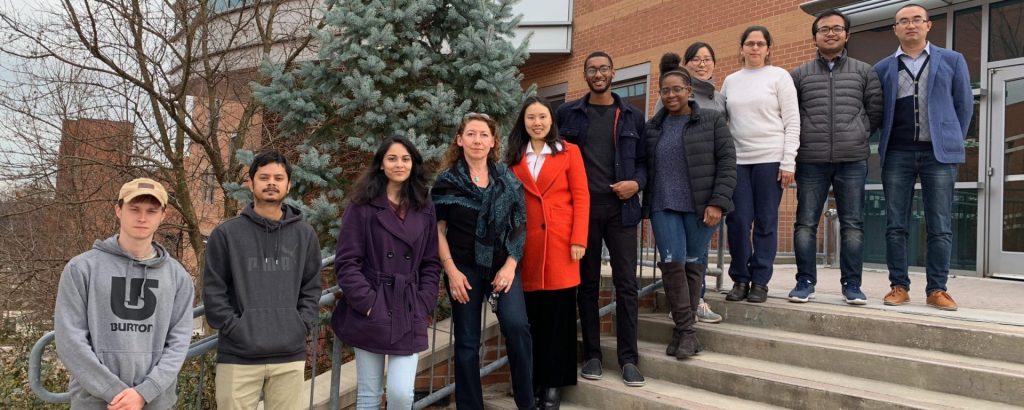 Tulay Adali, fourth from left, with the members of her lab. Photo courtesy of Adali.
UMBC and Georgia State receive $3M NIMH grant to improve data-driven diagnosis of mood disorders
UMBC and Georgia State University have received a $3 million five-year grant from the National Institute of Mental Health (NIMH) for research supporting the diagnosis of mood disorders. Tulay Adali, professor of computer science and electrical engineering (CSEE) and distinguished university professor, will lead UMBC’s portion of the research, which will receive about $870,000 in support.
Mental illnesses and mood disorders are complicated and can be challenging to identify, says Adali. Diagnoses are often made based on symptoms that a person experiences, rather than using quantifiable measures, and descriptions of symptoms can be quite variable and subjectively observed and evaluated.
The research team hopes to improve doctors’ ability to diagnose mood disorders through more quantitative, consistent measures. They will develop dynamic approaches to understanding how the continuously changing state of the brain is affected by mental illness. And their recommendations will include data from a range of sources, to more accurately reflect the complexity of mental illness.
Adali will work with her former graduate student Vince Calhoun, Ph.D. ‘02, electrical engineering. Calhoun is currently the director of the Center for Translational Research in Neuroimaging and Data Science (TReENDS) at Georgia State University. Adali and Calhoun have worked together on multiple research grants in the past.
In this project, the UMBC group led by Adali will focus on diagnostic methods, particularly the use of medical imaging data, including functional magnetic resonance imaging (fMRI). Adali and her team will develop multivariate data-driven models to help capture changes over time and space. They will apply these models to large datasets to evaluate their performance as diagnostic tools. The researchers will assess the reproducibility and replicability of the methods that are developed.
“I am especially excited about our proposal to identify homogeneous subgroups of subjects in a completely data-driven manner from neuroimaging data,” says Adali. “We hope this will enable us to better define subtypes of mental disorders and will help inform effective and personalized forms of therapy.”
This story was adapted from a UMBC News article written by Megan Hanks.
The post UMBC and Georgia State receive $3M NIMH grant to improve data-driven diagnosis of mood disorders appeared first on Department of Computer Science and Electrical Engineering.
]]>
Tulay Adali, fourth from left, with the members of her lab. Photo courtesy of Adali. UMBC and Georgia State receive $3M NIMH grant to improve data-driven diagnosis of mood disorders UMBC and...
https://www.csee.umbc.edu/2021/06/umbc-and-georgia-state-receive-3m-nimh-grant-to-improve-data-driven-diagnosis-of-mood-disorders/
https://my3.my.umbc.edu/api/v0/pixel/news/102325/guest@my.umbc.edu/1d351b6a74709026c30d85f7d1ad990d/api/pixel
csee
electrical-engineering
news
research-awards
Computer Science and Electrical Engineering
https://my3.my.umbc.edu/groups/csee
https://assets3-my.umbc.edu/system/shared/avatars/groups/000/000/099/d117dca133c64bf78a4b7696dd007189/xsmall.png?1314043393
https://assets1-my.umbc.edu/system/shared/avatars/groups/000/000/099/d117dca133c64bf78a4b7696dd007189/original.png?1314043393
https://assets1-my.umbc.edu/system/shared/avatars/groups/000/000/099/d117dca133c64bf78a4b7696dd007189/xxlarge.png?1314043393
https://assets4-my.umbc.edu/system/shared/avatars/groups/000/000/099/d117dca133c64bf78a4b7696dd007189/xlarge.png?1314043393
https://assets3-my.umbc.edu/system/shared/avatars/groups/000/000/099/d117dca133c64bf78a4b7696dd007189/large.png?1314043393
https://assets1-my.umbc.edu/system/shared/avatars/groups/000/000/099/d117dca133c64bf78a4b7696dd007189/medium.png?1314043393
https://assets2-my.umbc.edu/system/shared/avatars/groups/000/000/099/d117dca133c64bf78a4b7696dd007189/small.png?1314043393
https://assets3-my.umbc.edu/system/shared/avatars/groups/000/000/099/d117dca133c64bf78a4b7696dd007189/xsmall.png?1314043393
https://assets3-my.umbc.edu/system/shared/avatars/groups/000/000/099/d117dca133c64bf78a4b7696dd007189/xxsmall.png?1314043393
Computer Science and Electrical Engineering
0
0
false
Sat, 26 Jun 2021 19:33:13 -0400
UMBC and Georgia State receive $3M NIMH grant to improve data-driven diagnosis of mood disorders
Tulay Adali, fourth from left, with the members of her lab. Photo courtesy of Adali.UMBC and Georgia State receive $3M NIMH grant to improve data-driven diagnosis of mood disorders
UMBC and Georgia State University have received a $3 million five-year grant from the National Institute of Mental Health (NIMH) for research supporting the diagnosis of mood disorders. Tulay Adali, professor of computer science and electrical engineering (CSEE) and distinguished university professor, will lead UMBC’s portion of the research, which will receive about $870,000 in support.
Mental illnesses and mood disorders are complicated and can be challenging to identify, says Adali. Diagnoses are often made based on symptoms that a person experiences, rather than using quantifiable measures, and descriptions of symptoms can be quite variable and subjectively observed and evaluated.
The research team hopes to improve doctors’ ability to diagnose mood disorders through more quantitative, consistent measures. They will develop dynamic approaches to understanding how the continuously changing state of the brain is affected by mental illness. And their recommendations will include data from a range of sources, to more accurately reflect the complexity of mental illness.
Adali will work with her former graduate student Vince Calhoun, Ph.D. ‘02, electrical engineering. Calhoun is currently the director of the Center for Translational Research in Neuroimaging and Data Science (TReENDS) at Georgia State University. Adali and Calhoun have worked together on multiple research grants in the past.
In this project, the UMBC group led by Adali will focus on diagnostic methods, particularly the use of medical imaging data, including functional magnetic resonance imaging (fMRI). Adali and her team will develop multivariate data-driven models to help capture changes over time and space. They will apply these models to large datasets to evaluate their performance as diagnostic tools. The researchers will assess the reproducibility and replicability of the methods that are developed.
“I am especially excited about our proposal to identify homogeneous subgroups of subjects in a completely data-driven manner from neuroimaging data,” says Adali. “We hope this will enable us to better define subtypes of mental disorders and will help inform effective and personalized forms of therapy.”
This story was adapted from a UMBC News article written by Megan Hanks.
The post UMBC and Georgia State receive $3M NIMH grant to improve data-driven diagnosis of mood disorders appeared first on Department of Computer Science and Electrical Engineering.
]]>
Tulay Adali, fourth from left, with the members of her lab. Photo courtesy of Adali. UMBC and Georgia State receive $3M NIMH grant to improve data-driven diagnosis of mood disorders UMBC and...
https://redirect.cs.umbc.edu/2021/06/umbc-and-georgia-state-receive-3m-nimh-grant-to-improve-data-driven-diagnosis-of-mood-disorders/
https://my3.my.umbc.edu/api/v0/pixel/news/129843/guest@my.umbc.edu/4ed75e66e23839a2d3d6d30d179da8a3/api/pixel
csee
electrical-engineering
news
research-awards
Computer Science and Electrical Engineering
https://my3.my.umbc.edu/groups/csee
https://assets3-my.umbc.edu/system/shared/avatars/groups/000/000/099/d117dca133c64bf78a4b7696dd007189/xsmall.png?1314043393
https://assets1-my.umbc.edu/system/shared/avatars/groups/000/000/099/d117dca133c64bf78a4b7696dd007189/original.png?1314043393
https://assets1-my.umbc.edu/system/shared/avatars/groups/000/000/099/d117dca133c64bf78a4b7696dd007189/xxlarge.png?1314043393
https://assets4-my.umbc.edu/system/shared/avatars/groups/000/000/099/d117dca133c64bf78a4b7696dd007189/xlarge.png?1314043393
https://assets3-my.umbc.edu/system/shared/avatars/groups/000/000/099/d117dca133c64bf78a4b7696dd007189/large.png?1314043393
https://assets1-my.umbc.edu/system/shared/avatars/groups/000/000/099/d117dca133c64bf78a4b7696dd007189/medium.png?1314043393
https://assets2-my.umbc.edu/system/shared/avatars/groups/000/000/099/d117dca133c64bf78a4b7696dd007189/small.png?1314043393
https://assets3-my.umbc.edu/system/shared/avatars/groups/000/000/099/d117dca133c64bf78a4b7696dd007189/xsmall.png?1314043393
https://assets3-my.umbc.edu/system/shared/avatars/groups/000/000/099/d117dca133c64bf78a4b7696dd007189/xxsmall.png?1314043393
Computer Science and Electrical Engineering
0
0
false
Sat, 26 Jun 2021 19:33:13 -0400
Sat, 26 Jun 2021 19:33:13 -0400
UMBC and Georgia State receive $3M NIMH grant to improve data-driven diagnosis of mood disorders
Tulay Adali, fourth from left, with the members of her lab. Photo courtesy of Adali.
UMBC and Georgia State receive $3M NIMH grant to improve data-driven diagnosis of mood disorders
UMBC and Georgia State University have received a $3 million five-year grant from the National Institute of Mental Health (NIMH) for research supporting the diagnosis of mood disorders. Tulay Adali, professor of computer science and electrical engineering (CSEE) and distinguished university professor, will lead UMBC’s portion of the research, which will receive about $870,000 in support.
Mental illnesses and mood disorders are complicated and can be challenging to identify, says Adali. Diagnoses are often made based on symptoms that a person experiences, rather than using quantifiable measures, and descriptions of symptoms can be quite variable and subjectively observed and evaluated.
The research team hopes to improve doctors’ ability to diagnose mood disorders through more quantitative, consistent measures. They will develop dynamic approaches to understanding how the continuously changing state of the brain is affected by mental illness. And their recommendations will include data from a range of sources, to more accurately reflect the complexity of mental illness.
Adali will work with her former graduate student Vince Calhoun, Ph.D. ‘02, electrical engineering. Calhoun is currently the director of the Center for Translational Research in Neuroimaging and Data Science (TReENDS) at Georgia State University. Adali and Calhoun have worked together on multiple research grants in the past.
In this project, the UMBC group led by Adali will focus on diagnostic methods, particularly the use of medical imaging data, including functional magnetic resonance imaging (fMRI). Adali and her team will develop multivariate data-driven models to help capture changes over time and space. They will apply these models to large datasets to evaluate their performance as diagnostic tools. The researchers will assess the reproducibility and replicability of the methods that are developed.
“I am especially excited about our proposal to identify homogeneous subgroups of subjects in a completely data-driven manner from neuroimaging data,” says Adali. “We hope this will enable us to better define subtypes of mental disorders and will help inform effective and personalized forms of therapy.”
This story was adapted from a UMBC News article written by Megan Hanks.
The post UMBC and Georgia State receive $3M NIMH grant to improve data-driven diagnosis of mood disorders appeared first on Department of Computer Science and Electrical Engineering.
]]>
Tulay Adali, fourth from left, with the members of her lab. Photo courtesy of Adali. UMBC and Georgia State receive $3M NIMH grant to improve data-driven diagnosis of mood disorders...
https://news.cs.umbc.edu/2021/06/umbc-and-georgia-state-receive-3m-nimh-grant-to-improve-data-driven-diagnosis-of-mood-disorders/
https://my3.my.umbc.edu/api/v0/pixel/news/142854/guest@my.umbc.edu/cd0b543ce42f6f493ad95b071f6c913c/api/pixel
csee
electrical-engineering
news
research-awards
Computer Science and Electrical Engineering
https://my3.my.umbc.edu/groups/csee
https://assets3-my.umbc.edu/system/shared/avatars/groups/000/000/099/d117dca133c64bf78a4b7696dd007189/xsmall.png?1314043393
https://assets1-my.umbc.edu/system/shared/avatars/groups/000/000/099/d117dca133c64bf78a4b7696dd007189/original.png?1314043393
https://assets1-my.umbc.edu/system/shared/avatars/groups/000/000/099/d117dca133c64bf78a4b7696dd007189/xxlarge.png?1314043393
https://assets4-my.umbc.edu/system/shared/avatars/groups/000/000/099/d117dca133c64bf78a4b7696dd007189/xlarge.png?1314043393
https://assets3-my.umbc.edu/system/shared/avatars/groups/000/000/099/d117dca133c64bf78a4b7696dd007189/large.png?1314043393
https://assets1-my.umbc.edu/system/shared/avatars/groups/000/000/099/d117dca133c64bf78a4b7696dd007189/medium.png?1314043393
https://assets2-my.umbc.edu/system/shared/avatars/groups/000/000/099/d117dca133c64bf78a4b7696dd007189/small.png?1314043393
https://assets3-my.umbc.edu/system/shared/avatars/groups/000/000/099/d117dca133c64bf78a4b7696dd007189/xsmall.png?1314043393
https://assets3-my.umbc.edu/system/shared/avatars/groups/000/000/099/d117dca133c64bf78a4b7696dd007189/xxsmall.png?1314043393
Computer Science and Electrical Engineering
0
0
false
Sat, 26 Jun 2021 19:33:13 -0400
 President Hrabowski (right) with Governor Hogan (center) and Anne Neuberger (left) at the July 2021 cyber summit. Photo by Maryland GovPics, Flickr CC by 2.0.