UMBC PhD candidate Kavita Krishnaswamy gets Google & Microsoft awards for robotics research
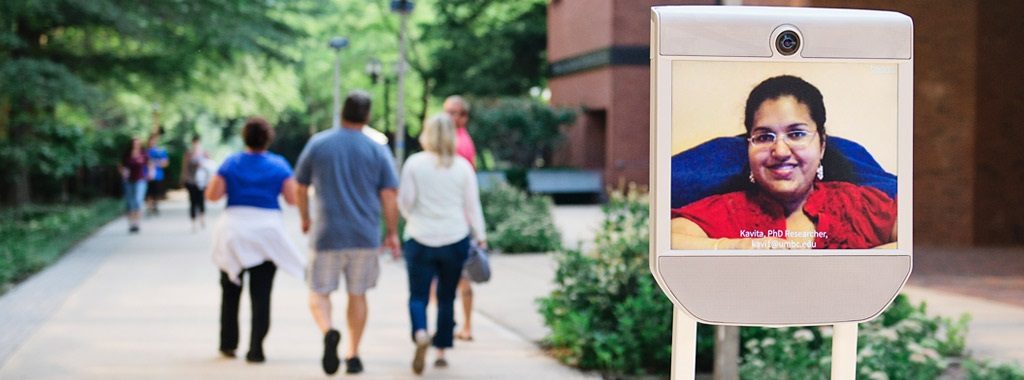
UMBC Ph.D. candidate Kavita Krishnaswamy receives
Google and Microsoft awards for robotics research
Kavita Krishnaswamy ’07, computer science and mathematics, Ph.D. ’18, computer science, has been named both a 2017 Microsoft Fellow and recipient of the Google Lime Scholarship. These prestigious honors recognize emerging scholars in computing who are dedicated to increasing diversity in the field, and Krishnawamy’s awards will support her Ph.D. research on “Smart Algorithms via Knowledge Management of Safe Physical Human-Robotic Care.”
“I am very humbled, honored, and grateful to Google Lime and Microsoft for providing me with this enriching experience and lifetime opportunity to serve society by advancing the field of human-robot interaction,” Krishnaswamy says.
The Google Lime Scholarship seeks to promote greater access to knowledge for people with visible and invisible disabilities. It was established through a partnership between Google and Lime Connect, a nonprofit focused on breaking stereotypes about disability and encouraging companies to recognize the importance and value of employing people with disabilities.
The program encourages students with disabilities to pursue their passions in computing and technology, and to become leaders in those fields. As part of the fellowship program, Krishnaswamy will receive scholarship funding and will participate in the 2017 Google Scholars’ Retreat.
Through the Microsoft Fellowship, Krishnaswamy will receive funding to support her Ph.D. research and will participate in the Microsoft Research workshop held in fall 2017. Her research currently focuses on building a teleoperated mobile robotic prototype, in addition to creating an accessible robotic interface, that seniors and people with disabilities will be able to control by repositioning their arms and legs. Tim Oates, professor of computer science and electrical engineering, is Krishnaswamy’s Ph.D. advisor.
“Our goal is to explore the intersection between providing physical care and robotics, and how it is possible to translate safe patient handling and mobility guidelines into smart human-robotic interaction algorithms,” Krishnaswamy explains. “As assistive robotics become more mainstream, these best practices can improve safety in direct physical care in the process of repositioning the human body with a mobile robotic arm.”
Krishnaswamy is excited about the possible new directions her research can now explore, thanks to support from these awards. “The resources will provide me with a solid and steady foundation to cultivate new technical expertise and professional skills to successfully continue my dissertation research in robotics, and to broaden my knowledge in the field,” she says.
Krishnaswamy has been recognized internationally as an emerging leader in robotics and accessibility design throughout her graduate studies. She is a former Ford Foundation Predoctoral Fellow, and a National Science Foundation Graduate Research Fellow. In 2015, she was named to Robohub’s “25 Women in Robotics You Need to Know About” list.
This post was adapted from a UMBC News article written by Megan Hanks. Image by Kavita Krishnaswamy.
The post UMBC PhD candidate Kavita Krishnaswamy gets Google & Microsoft awards for robotics research appeared first on Department of Computer Science and Electrical Engineering.
]]>
UMBC Ph.D. candidate Kavita Krishnaswamy receives Google and Microsoft awards for robotics research Kavita Krishnaswamy ’07, computer science and mathematics, Ph.D. ’18, computer...
https://www.csee.umbc.edu/2017/07/umbc-ph-d-candidate-kavita-krishnaswamy-receives-google-microsoft-awards-robotics-research/
https://my3.my.umbc.edu/api/v0/pixel/news/69158/guest@my.umbc.edu/1fdd1e383cfcafb502b897e4d0bc1161/api/pixel
computer-science
graduate
news
research
research-awards
robotics
students
Computer Science and Electrical Engineering
https://my3.my.umbc.edu/groups/csee
https://assets3-my.umbc.edu/system/shared/avatars/groups/000/000/099/d117dca133c64bf78a4b7696dd007189/xsmall.png?1314043393
https://assets1-my.umbc.edu/system/shared/avatars/groups/000/000/099/d117dca133c64bf78a4b7696dd007189/original.png?1314043393
https://assets1-my.umbc.edu/system/shared/avatars/groups/000/000/099/d117dca133c64bf78a4b7696dd007189/xxlarge.png?1314043393
https://assets4-my.umbc.edu/system/shared/avatars/groups/000/000/099/d117dca133c64bf78a4b7696dd007189/xlarge.png?1314043393
https://assets3-my.umbc.edu/system/shared/avatars/groups/000/000/099/d117dca133c64bf78a4b7696dd007189/large.png?1314043393
https://assets1-my.umbc.edu/system/shared/avatars/groups/000/000/099/d117dca133c64bf78a4b7696dd007189/medium.png?1314043393
https://assets2-my.umbc.edu/system/shared/avatars/groups/000/000/099/d117dca133c64bf78a4b7696dd007189/small.png?1314043393
https://assets3-my.umbc.edu/system/shared/avatars/groups/000/000/099/d117dca133c64bf78a4b7696dd007189/xsmall.png?1314043393
https://assets3-my.umbc.edu/system/shared/avatars/groups/000/000/099/d117dca133c64bf78a4b7696dd007189/xxsmall.png?1314043393
Computer Science and Electrical Engineering
25
5
true
Thu, 27 Jul 2017 13:35:03 -0400
Engaging Readers in Cybersecurity News, 8/18 National Press Club, Washington DC

Join UMBC experts 4:00-6:00pm on Friday, 18 August 2017 at the National Press Club in Washington DC for a panel on how cybersecurity touches our everyday lives and how journalists can engage a wide range of readers in cybersecurity news. This panel will touch on topics ranging from online commerce to national conversations about security leaks and will explore how best to prepare the next generation of cybersecurity leaders to effectively tackle the challenges we are facing. Registration by August 15 preferred.
Featured panelists include:
- Freeman A. Hrabowski, III, UMBC President
- Anupam Joshi, Director, UMBC Center for Cybersecurity; Professor and Chair, Department of Computer Science and Electrical Engineering
- Rachel Cohen ’16, Computer Science and Cyber Scholar; Software Engineer, Johns Hopkins Applied Physics Laboratory
- Andy Williams, CEO, iCyberCenter@bwtech
- Tina Williams, President, TCecure, LLC; Cybersecurity Academic Innovation Officer for University System of Maryland
Contact Candace Dodson-Reed at *protected email* for questions.
The post Engaging Readers in Cybersecurity News, 8/18 National Press Club, Washington DC appeared first on Department of Computer Science and Electrical Engineering.
]]>
Join UMBC experts 4:00-6:00pm on Friday, 18 August 2017 at the National Press Club in Washington DC for a panel on how cybersecurity touches our everyday lives and how journalists can engage a...
https://www.csee.umbc.edu/2017/07/umbc-engaging-readers-cyber-news-cybersecurity-security-818/
https://my3.my.umbc.edu/api/v0/pixel/news/69145/guest@my.umbc.edu/77a76bd683f87eae0544100d9f9f4de9/api/pixel
cybersecurity
events
news
Computer Science and Electrical Engineering
https://my3.my.umbc.edu/groups/csee
https://assets3-my.umbc.edu/system/shared/avatars/groups/000/000/099/d117dca133c64bf78a4b7696dd007189/xsmall.png?1314043393
https://assets1-my.umbc.edu/system/shared/avatars/groups/000/000/099/d117dca133c64bf78a4b7696dd007189/original.png?1314043393
https://assets1-my.umbc.edu/system/shared/avatars/groups/000/000/099/d117dca133c64bf78a4b7696dd007189/xxlarge.png?1314043393
https://assets4-my.umbc.edu/system/shared/avatars/groups/000/000/099/d117dca133c64bf78a4b7696dd007189/xlarge.png?1314043393
https://assets3-my.umbc.edu/system/shared/avatars/groups/000/000/099/d117dca133c64bf78a4b7696dd007189/large.png?1314043393
https://assets1-my.umbc.edu/system/shared/avatars/groups/000/000/099/d117dca133c64bf78a4b7696dd007189/medium.png?1314043393
https://assets2-my.umbc.edu/system/shared/avatars/groups/000/000/099/d117dca133c64bf78a4b7696dd007189/small.png?1314043393
https://assets3-my.umbc.edu/system/shared/avatars/groups/000/000/099/d117dca133c64bf78a4b7696dd007189/xsmall.png?1314043393
https://assets3-my.umbc.edu/system/shared/avatars/groups/000/000/099/d117dca133c64bf78a4b7696dd007189/xxsmall.png?1314043393
Computer Science and Electrical Engineering
5
0
true
Wed, 26 Jul 2017 12:31:20 -0400
UMBC’s Prof. Cynthia Matuszek receives NSF award for robot language acquisition
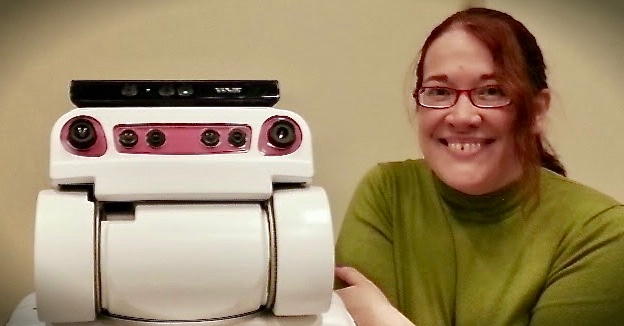
Professor Cynthia Matuszek has received a research award from the National Science Foundation to improve human-robot interactions by enabling them to understand the world from natural language in order to take instructions and learn about their environment naturally and intuitively. The two-year award, Joint Models of Language and Context for Robotic Language Acquisition, will support Dr. Matuszsek’s Interactive Robotics and Language Lab, which focuses on how robots can flexibly learn from interactions with people and environments.
As robots become smaller, less expensive, and more capable, they are able to perform an increasing variety of tasks, leading to revolutionary improvements in domains such as automobile safety and manufacturing. However, their inflexibility makes them hard to deploy in human-centric environments, such as homes and schools, where their tasks and environments are constantly changing. Meanwhile, learning to understand language about the physical world is a growing research area in both robotics and natural language processing. The core problem her research addresses is how the meanings of words are grounded in the noisy, perceptual world in which a robot operates.
The ability for robots to follow spoken or written directions reduces the adoption barrier for robots in domains such as assistive technology, education, and caretaking, where interactions with non-specialists are crucial. Such robots have the potential to ultimately improve autonomy and independence for populations such as aging-in-place elders; for example, a manipulator arm that can learn from a user’s explanation how to handle food or open novel containers would directly affect the independence of persons with dexterity concerns such as advanced arthritis.
Matuszek’s research will investigate how linguistic and perceptual models can be expanded during interaction, allowing robots to understand novel language about unanticipated domains. In particular, the focus is on developing new learning approaches that correctly induce joint models of language and perception, building data-driven language models that add new semantic representations over time. The work will combines semantic parser learning, which provides a distribution over possible interpretations of language, with perceptual representations of the underlying world. New concepts will be added on the fly as new words and new perceptual data are encountered, and a semantically meaningful model can be trained by maximizing the expected likelihood of language and visual components. This integrated approach allows for effective model updates with no explicit labeling of words or percepts. This approach will be combined with experiments on improving learning efficiency by incorporating active learning, leveraging a robot’s ability to ask questions about objects in the world.
The post UMBC’s Prof. Cynthia Matuszek receives NSF award for robot language acquisition appeared first on Department of Computer Science and Electrical Engineering.
]]>
Professor Cynthia Matuszek has received a research award from the National Science Foundation to improve human-robot interactions by enabling them to understand the world from natural language in...
https://www.csee.umbc.edu/2017/07/umbc-cynthia-matuszek-nsf-award-for-robot-naural-language-acquisition-instruction-hri/
https://my3.my.umbc.edu/api/v0/pixel/news/69092/guest@my.umbc.edu/dc342c97118941e06fa971d0c68e9e3e/api/pixel
ai
computer-science
faculty-and-staff
news
research
research-awards
robotics
Computer Science and Electrical Engineering
https://my3.my.umbc.edu/groups/csee
https://assets3-my.umbc.edu/system/shared/avatars/groups/000/000/099/d117dca133c64bf78a4b7696dd007189/xsmall.png?1314043393
https://assets1-my.umbc.edu/system/shared/avatars/groups/000/000/099/d117dca133c64bf78a4b7696dd007189/original.png?1314043393
https://assets1-my.umbc.edu/system/shared/avatars/groups/000/000/099/d117dca133c64bf78a4b7696dd007189/xxlarge.png?1314043393
https://assets4-my.umbc.edu/system/shared/avatars/groups/000/000/099/d117dca133c64bf78a4b7696dd007189/xlarge.png?1314043393
https://assets3-my.umbc.edu/system/shared/avatars/groups/000/000/099/d117dca133c64bf78a4b7696dd007189/large.png?1314043393
https://assets1-my.umbc.edu/system/shared/avatars/groups/000/000/099/d117dca133c64bf78a4b7696dd007189/medium.png?1314043393
https://assets2-my.umbc.edu/system/shared/avatars/groups/000/000/099/d117dca133c64bf78a4b7696dd007189/small.png?1314043393
https://assets3-my.umbc.edu/system/shared/avatars/groups/000/000/099/d117dca133c64bf78a4b7696dd007189/xsmall.png?1314043393
https://assets3-my.umbc.edu/system/shared/avatars/groups/000/000/099/d117dca133c64bf78a4b7696dd007189/xxsmall.png?1314043393
Computer Science and Electrical Engineering
3
1
true
Fri, 21 Jul 2017 21:50:10 -0400
PhD Defense: The Lightweight Virtual File System
Dissertation Defense
The Lightweight Virtual File System
Navid Golpayegani
10:00-12:00 Thursday, 20 July 2017, ITE 325, UMBC
A data center today is responsible for safely managing big data volumes and balancing the complex needs between data producers and consumers. This balance often involves reconciling the needs of easy access and rapid retrieval in ways desired by the consumers with the needs of long term availability, reliability, and expandability of data producers. The long term continuous support of data storage adds another layer of complexity for the file system. As storage architecture and big data volumes evolve, existing file system’s primary focus is performance while less attention is payed to addressing the problems of the above long term servicing needs of their clients.
I have developed the Lightweight Virtual File System (LVFS) to address these problems through the unique conceptual approach of separating the most common tasks involved in a file system; namely storing data, locating data, and organizing data. Standard file systems are developed as single monolithic systems performing all three tasks. LVFS replaces these tasks with an architecture which enables the dynamic combination of different algorithms for each of those tasks. Using this approach, LVFS is capable of constructing a storage system, which allows for ready availability, reliability, expandability, and long term support while, simultaneously, assuring the performance of a stable system customizable to meet the needs of data consumers.
After successful development and testing to allow for merging decades old storage architecture with new and incompatible ones, such as HGST Active Archive System, NASA Goddard Space Flight Center’s Terrestrial Information Systems Laboratory adopted LVFS for their production environment to create a single, integrated storage system without any software modifications. UMBC’s Center for Hybrid Multicore Productivity Research deployed an instance on the IBM iDataPlex ‘BlueWave’ cluster to utilize Seagate’s Active Drive systems as a storage and on-disk compute platform. With LVFS we show we were able to perform MapReduce computation directly on the drive with comparable performance to Hadoop running on BlueWave. It also shows a significant reduction in data leaving the active drive during computation thereby significantly increasing throughput.
Committee Members: Dr.s Milton Halem (Advisor), Yelena Yesha, John Dorband, Charles Nicholas, Curt Tilmes
The post PhD Defense: The Lightweight Virtual File System appeared first on Department of Computer Science and Electrical Engineering.
]]>
Dissertation Defense The Lightweight Virtual File System Navid Golpayegani 10:00-12:00 Thursday, 20 July 2017, ITE 325, UMBC A data center today is responsible for safely managing big...
https://www.csee.umbc.edu/2017/07/umbc-phd-defense-lightweight-virtual-file-system-storage-architecture-data/
https://my3.my.umbc.edu/api/v0/pixel/news/69026/guest@my.umbc.edu/7438b044a392bfd7da460eb3bf557a51/api/pixel
computer-science
data-science
defense
graduate
news
research
Computer Science and Electrical Engineering
https://my3.my.umbc.edu/groups/csee
https://assets3-my.umbc.edu/system/shared/avatars/groups/000/000/099/d117dca133c64bf78a4b7696dd007189/xsmall.png?1314043393
https://assets1-my.umbc.edu/system/shared/avatars/groups/000/000/099/d117dca133c64bf78a4b7696dd007189/original.png?1314043393
https://assets1-my.umbc.edu/system/shared/avatars/groups/000/000/099/d117dca133c64bf78a4b7696dd007189/xxlarge.png?1314043393
https://assets4-my.umbc.edu/system/shared/avatars/groups/000/000/099/d117dca133c64bf78a4b7696dd007189/xlarge.png?1314043393
https://assets3-my.umbc.edu/system/shared/avatars/groups/000/000/099/d117dca133c64bf78a4b7696dd007189/large.png?1314043393
https://assets1-my.umbc.edu/system/shared/avatars/groups/000/000/099/d117dca133c64bf78a4b7696dd007189/medium.png?1314043393
https://assets2-my.umbc.edu/system/shared/avatars/groups/000/000/099/d117dca133c64bf78a4b7696dd007189/small.png?1314043393
https://assets3-my.umbc.edu/system/shared/avatars/groups/000/000/099/d117dca133c64bf78a4b7696dd007189/xsmall.png?1314043393
https://assets3-my.umbc.edu/system/shared/avatars/groups/000/000/099/d117dca133c64bf78a4b7696dd007189/xxsmall.png?1314043393
Computer Science and Electrical Engineering
4
0
true
Tue, 18 Jul 2017 10:41:23 -0400
PhD defense: Deep Representation of Lyrical Style and Semantics for Music Recommendation

Dissertation Defense
Deep Representation of Lyrical Style and Semantics for Music Recommendation
Abhay L. Kashyap
11:00-1:00 Thursday, 20 July 2017, ITE 346
In the age of music streaming, the need for effective recommendations is important for music discovery and a personalized user experience. Collaborative filtering based recommenders suffer from popularity bias and cold-start which is commonly mitigated by content features. For music, research in content based methods have mainly been focused in the acoustic domain while lyrical content has received little attention. Lyrics contain information about a song’s topic and sentiment that cannot be easily extracted from the audio. This is especially important for lyrics-centric genres like Rap, which was the most streamed genre in 2016. The goal of this dissertation is to explore and evaluate different lyrical content features that could be useful for content, context and emotion based models for music recommendation systems.
With Rap as the primary use case, this dissertation focuses on featurizing two main aspects of lyrics; its artistic style of composition and its semantic content. For lyrical style, a suite of high level rhyme density features are extracted in addition to literary features like the use of figurative language, profanity and vocabulary strength. In contrast to these engineered features, Convolutional Neural Networks (CNN) are used to automatically learn rhyme patterns and other relevant features. For semantics, lyrics are represented using both traditional IR techniques and the more recent neural embedding methods.
These lyrical features are evaluated for artist identification and compared with artist and song similarity measures from a real-world collaborative filtering based recommendation system from Last.fm. It is shown that both rhyme and literary features serve as strong indicators to characterize artists with feature learning methods like CNNs achieving comparable results. For artist and song similarity, a strong relationship was observed between these features and the way users consume music while neural embedding methods significantly outperformed LSA. Finally, this work is accompanied by a web-application, Rapalytics.com, that is dedicated to visualizing all these lyrical features and has been featured on a number of media outlets, most notably, Vox, attn: and Metro.
Committee: Drs. Tim Finin (chair), Anupam Joshi, Tim Oates, Cynthia Matuszek and Pranam Kolari (Walmart Labs)
The post PhD defense: Deep Representation of Lyrical Style and Semantics for Music Recommendation appeared first on Department of Computer Science and Electrical Engineering.
]]>
Dissertation Defense Deep Representation of Lyrical Style and Semantics for Music Recommendation Abhay L. Kashyap 11:00-1:00 Thursday, 20 July 2017, ITE 346 In the age of music streaming,...
https://www.csee.umbc.edu/2017/07/phd-defense-deep-cnn-representation-lyrical-style-semantics-rap-music-recommendation/
https://my3.my.umbc.edu/api/v0/pixel/news/69021/guest@my.umbc.edu/eafad32932b17accd858d79374c23611/api/pixel
computer-science
data-science
defense
graduate
news
research
Computer Science and Electrical Engineering
https://my3.my.umbc.edu/groups/csee
https://assets3-my.umbc.edu/system/shared/avatars/groups/000/000/099/d117dca133c64bf78a4b7696dd007189/xsmall.png?1314043393
https://assets1-my.umbc.edu/system/shared/avatars/groups/000/000/099/d117dca133c64bf78a4b7696dd007189/original.png?1314043393
https://assets1-my.umbc.edu/system/shared/avatars/groups/000/000/099/d117dca133c64bf78a4b7696dd007189/xxlarge.png?1314043393
https://assets4-my.umbc.edu/system/shared/avatars/groups/000/000/099/d117dca133c64bf78a4b7696dd007189/xlarge.png?1314043393
https://assets3-my.umbc.edu/system/shared/avatars/groups/000/000/099/d117dca133c64bf78a4b7696dd007189/large.png?1314043393
https://assets1-my.umbc.edu/system/shared/avatars/groups/000/000/099/d117dca133c64bf78a4b7696dd007189/medium.png?1314043393
https://assets2-my.umbc.edu/system/shared/avatars/groups/000/000/099/d117dca133c64bf78a4b7696dd007189/small.png?1314043393
https://assets3-my.umbc.edu/system/shared/avatars/groups/000/000/099/d117dca133c64bf78a4b7696dd007189/xsmall.png?1314043393
https://assets3-my.umbc.edu/system/shared/avatars/groups/000/000/099/d117dca133c64bf78a4b7696dd007189/xxsmall.png?1314043393
Computer Science and Electrical Engineering
6
0
true
Mon, 17 Jul 2017 22:20:37 -0400
PhD Proposal: Analysis of Irregular Event Sequences using Deep Learning, Reinforcement Learning & Visualization

Analysis of Irregular Event Sequences using Deep Learning, Reinforcement Learning, and Visualization
Filip Dabek
11:00-1:00 Thursday 13 July 2017, ITE 346, UMBC
History is nothing but a catalogued series of events organized into data. Amazon, the largest online retailer in the world, processes over 2,000 orders per minute. Orders come from customers on a recurring basis through subscriptions or as one-off spontaneous purchases, resulting in each customer exhibiting their own behavioral pattern when it comes to the way in which they place orders throughout the year. For a company such as Amazon, that generates over $130 billion of revenue each year, understanding and uncovering the hidden patterns and trends within this data is paramount in improving the efficiency of their infrastructure ranging from the management of the inventory within their warehouses, distribution of their labor force, and preparation of their online systems for the load of users. With the ever increasingly availability of big data, problems such as these are no longer limited to large corporations but are experienced across a wide range of domains and faced by analysts and researchers each and every day.
While many event analysis and time series tools have been developed for the purpose of analyzing such datasets, most approaches tend to target clean and evenly spaced data. When faced with noisy or irregular data, it has been recommended to undergo a pre-processing step of converting and transforming the data into being regular. This transformation technique arguably interferes on a fundamental level as to how the data is represented, and may irrevocably bias the way in which results are obtained. Therefore, operating on raw data, in its noisy natural form, is necessary to ensure that the insights gathered through analysis are accurate and valid.
In this dissertation novel approaches are presented for analyzing irregular event sequences using a variety of techniques ranging from deep learning, reinforcement learning, and visualization. We show how common tasks in event analysis can be performed directly on an irregular event dataset without requiring a transformation that alters the natural representation of the process that the data was captured from. The three tasks that we showcase include: (i) summarization of large event datasets, (ii) modeling the processes that create events, and (iii) predicting future events that will occur.
Committee: Drs. Tim Oates (Chair), Jesus Caban, Penny Rheingans, Jian Chen, Tim Finin
The post PhD Proposal: Analysis of Irregular Event Sequences using Deep Learning, Reinforcement Learning & Visualization appeared first on Department of Computer Science and Electrical Engineering.
]]>
Analysis of Irregular Event Sequences using Deep Learning, Reinforcement Learning, and Visualization Filip Dabek 11:00-1:00 Thursday 13 July 2017, ITE 346, UMBC History is nothing but a...
https://www.csee.umbc.edu/2017/07/phd-analysis-irregular-event-sequences-deep-learning-reinforcement-visualization/
https://my3.my.umbc.edu/api/v0/pixel/news/68954/guest@my.umbc.edu/b023d916f149bc71cf0ac289b438eb2e/api/pixel
computer-science
defense
events
graduate
news
research
Computer Science and Electrical Engineering
https://my3.my.umbc.edu/groups/csee
https://assets3-my.umbc.edu/system/shared/avatars/groups/000/000/099/d117dca133c64bf78a4b7696dd007189/xsmall.png?1314043393
https://assets1-my.umbc.edu/system/shared/avatars/groups/000/000/099/d117dca133c64bf78a4b7696dd007189/original.png?1314043393
https://assets1-my.umbc.edu/system/shared/avatars/groups/000/000/099/d117dca133c64bf78a4b7696dd007189/xxlarge.png?1314043393
https://assets4-my.umbc.edu/system/shared/avatars/groups/000/000/099/d117dca133c64bf78a4b7696dd007189/xlarge.png?1314043393
https://assets3-my.umbc.edu/system/shared/avatars/groups/000/000/099/d117dca133c64bf78a4b7696dd007189/large.png?1314043393
https://assets1-my.umbc.edu/system/shared/avatars/groups/000/000/099/d117dca133c64bf78a4b7696dd007189/medium.png?1314043393
https://assets2-my.umbc.edu/system/shared/avatars/groups/000/000/099/d117dca133c64bf78a4b7696dd007189/small.png?1314043393
https://assets3-my.umbc.edu/system/shared/avatars/groups/000/000/099/d117dca133c64bf78a4b7696dd007189/xsmall.png?1314043393
https://assets3-my.umbc.edu/system/shared/avatars/groups/000/000/099/d117dca133c64bf78a4b7696dd007189/xxsmall.png?1314043393
Computer Science and Electrical Engineering
6
0
true
Wed, 12 Jul 2017 23:11:39 -0400
Meet the Staff: Alex Hart

Name: Alex Hart
Educational Background: Bachelor’s degree in Accounting from the University of Maryland, College Park
Hometown: Baltimore, MD (Go O’s and Ravens!)
Current role: As an Accountant I, Alex provides business services support to the CSEE department in the areas of contracts and grants/projects, which includes account monitoring, financial reporting, projections, reconciliations, etc. She also provides backup support for payroll, and she is the property custodian of inventory for CSEE.
Favorite thing about UMBC: “Without a doubt, my favorite thing about UMBC is the people here. I have met a lot of different people who have provided me with a wealth of knowledge since I started working here just a year ago. Everyone has been very inclusive and helpful!”
Students should ask me about: “Students can ask me anything, but maybe about the college experience, since I’m still a recent graduate.”
Alex is originally from Baltimore, MD. She joined CSEE’s Department in February of 2016. She attended UMBC for her first two years of college, then transferred to the University of Maryland College Park’s Robert H. Smith School of Business. She has a BS in Accounting from UMCP.
When not working, Alex loves cheering on the Terps in football and basketball. She also enjoys traveling to new places, cooking, practicing yoga, and reading.
The post Meet the Staff: Alex Hart appeared first on Department of Computer Science and Electrical Engineering.
]]>
Name: Alex Hart Educational Background: Bachelor’s degree in Accounting from the University of Maryland, College Park Hometown: Baltimore, MD (Go O’s and Ravens!) Current role: As an...
https://www.csee.umbc.edu/2017/07/meet-staff-alex-hart/
https://my3.my.umbc.edu/api/v0/pixel/news/68918/guest@my.umbc.edu/84294d1d272e0f74651d4f9c10fd2a02/api/pixel
faculty-and-staff
news
Computer Science and Electrical Engineering
https://my3.my.umbc.edu/groups/csee
https://assets3-my.umbc.edu/system/shared/avatars/groups/000/000/099/d117dca133c64bf78a4b7696dd007189/xsmall.png?1314043393
https://assets1-my.umbc.edu/system/shared/avatars/groups/000/000/099/d117dca133c64bf78a4b7696dd007189/original.png?1314043393
https://assets1-my.umbc.edu/system/shared/avatars/groups/000/000/099/d117dca133c64bf78a4b7696dd007189/xxlarge.png?1314043393
https://assets4-my.umbc.edu/system/shared/avatars/groups/000/000/099/d117dca133c64bf78a4b7696dd007189/xlarge.png?1314043393
https://assets3-my.umbc.edu/system/shared/avatars/groups/000/000/099/d117dca133c64bf78a4b7696dd007189/large.png?1314043393
https://assets1-my.umbc.edu/system/shared/avatars/groups/000/000/099/d117dca133c64bf78a4b7696dd007189/medium.png?1314043393
https://assets2-my.umbc.edu/system/shared/avatars/groups/000/000/099/d117dca133c64bf78a4b7696dd007189/small.png?1314043393
https://assets3-my.umbc.edu/system/shared/avatars/groups/000/000/099/d117dca133c64bf78a4b7696dd007189/xsmall.png?1314043393
https://assets3-my.umbc.edu/system/shared/avatars/groups/000/000/099/d117dca133c64bf78a4b7696dd007189/xxsmall.png?1314043393
Computer Science and Electrical Engineering
6
0
true
Mon, 10 Jul 2017 13:28:55 -0400
UMBC computer scientists explain how AI can help translate legalese before online users click “agree”
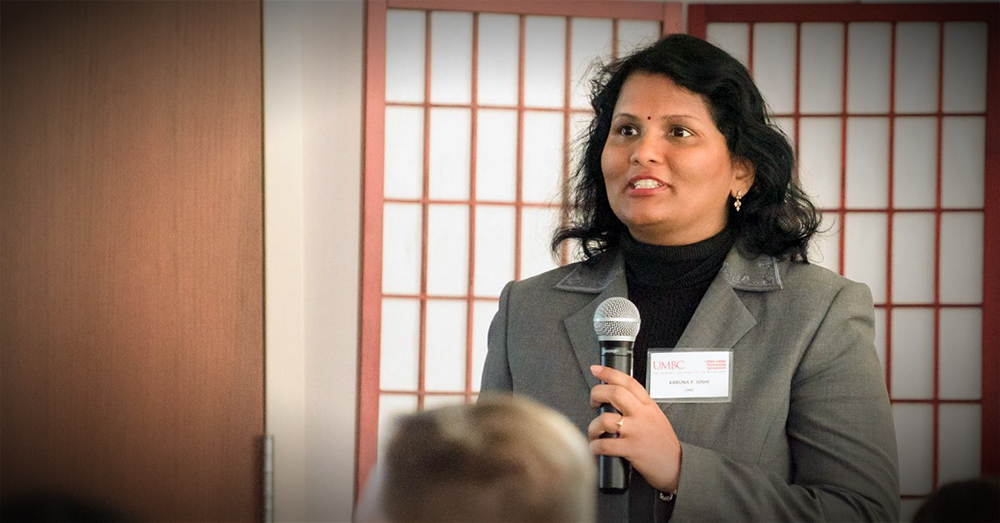
Every day, people interact with large amounts of text online, including legal documents they might quickly skim and sign without full, careful review. In an article recently published in The Conversation, Karuna Joshi, research associate professor of computer science and electrical engineering, and Tim Finin, professor of computer science and electrical engineering, explain how artificial intelligence (AI) is helping to summarize lengthy and complex legalese so people can more easily understand terms of service and similar agreements before they click “accept” to access a new app or online service.
The legal documents that Joshi and Finin are working to summarize—terms of service, privacy policies, and user agreements—often accompany new online services, contests, apps, and subscriptions. “As computer science researchers, we are working on ways artificial intelligence algorithms could digest these massive texts and extract their meaning, presenting it in terms regular people can understand,” they explain.
Through their research, Joshi and Finin ask computers to break down the terms and conditions that regular users “agree” to or “accept.” To process the text, Joshi and Finin employ a range of AI technologies, including machine learning, knowledge representation, speech recognition, and human language comprehension.
Joshi and Finin have found that in many of the privacy policies people are prompted to review and accept online, there are sections that do not actually apply to the consumer or service provider. These sections of the agreements might, for example, “include rules for third parties…that people might not even know are involved in data storage or retrieval,” they note.
After examining these documents, the software Joshi and Finin have developed pinpoints specific items that people should be aware of when they are granting their consent or agreement—what they describe as “key information specifying the legal rights, obligations and prohibitions identified in the document.” In other words, the software takes in all that complex legal language, and then then presents just the most essential information in “clear, direct, human-readable statements,” making it much more feasible for users to understand what they are consenting to before they click “agree.”
Read “Teaching machines to understand — and summarize — text” in The Conversation to learn more about Joshi and Finin’s approach to making online legal documents more accessible through AI.
Adapted from a UMBC News article by Megan Hanks Banner image: Karuna Joshi. Photo by Marlayna Demond ’11 for UMBC.
The post UMBC computer scientists explain how AI can help translate legalese before online users click “agree” appeared first on Department of Computer Science and Electrical Engineering.
]]>
Every day, people interact with large amounts of text online, including legal documents they might quickly skim and sign without full, careful review. In an article recently published in The...
https://www.csee.umbc.edu/2017/07/umbc-computer-scientists-explain-ai-can-help-translate-legalese-online-users-click-agree/
https://my3.my.umbc.edu/api/v0/pixel/news/68874/guest@my.umbc.edu/7fb0e6a5b6f6a486ac1ffb7a02148e6f/api/pixel
ai
computer-science
data-science
faculty-and-staff
news
research
Computer Science and Electrical Engineering
https://my3.my.umbc.edu/groups/csee
https://assets3-my.umbc.edu/system/shared/avatars/groups/000/000/099/d117dca133c64bf78a4b7696dd007189/xsmall.png?1314043393
https://assets1-my.umbc.edu/system/shared/avatars/groups/000/000/099/d117dca133c64bf78a4b7696dd007189/original.png?1314043393
https://assets1-my.umbc.edu/system/shared/avatars/groups/000/000/099/d117dca133c64bf78a4b7696dd007189/xxlarge.png?1314043393
https://assets4-my.umbc.edu/system/shared/avatars/groups/000/000/099/d117dca133c64bf78a4b7696dd007189/xlarge.png?1314043393
https://assets3-my.umbc.edu/system/shared/avatars/groups/000/000/099/d117dca133c64bf78a4b7696dd007189/large.png?1314043393
https://assets1-my.umbc.edu/system/shared/avatars/groups/000/000/099/d117dca133c64bf78a4b7696dd007189/medium.png?1314043393
https://assets2-my.umbc.edu/system/shared/avatars/groups/000/000/099/d117dca133c64bf78a4b7696dd007189/small.png?1314043393
https://assets3-my.umbc.edu/system/shared/avatars/groups/000/000/099/d117dca133c64bf78a4b7696dd007189/xsmall.png?1314043393
https://assets3-my.umbc.edu/system/shared/avatars/groups/000/000/099/d117dca133c64bf78a4b7696dd007189/xxsmall.png?1314043393
Computer Science and Electrical Engineering
13
2
true
Thu, 06 Jul 2017 10:23:24 -0400
Workshop on Solvers for Large, Sparse Linear Systems, July 17-18
Workshop on Solvers for Large, Sparse Linear Systems
Monday and Tuesday, 17-18 July 2017
Engineering Room 022, UMBC
UMBC will host a free, two-day workshop for faculty and students on solvers for large, sparse linear systems on Monday and Tuesday, July 17-18 in Engineering 022 at UMBC. Thanks to UMBC Prof. Matthias Gobbert for organizing and to University of Kassel Prof. Andreas Meister for presenting. If you plan on attending, please RSVP online.
The simulation of real life applications possesses a crucial importance in a wide variety of scientific as well as industrial areas. Thereby, the performance of the whole numerical method is often decisively depend on the properties of the incorporated solver for linear systems of equations.
The course provides a comprehensive introduction to both classical and modern iterative solvers for a stable, efficient and reliable solution of linear systems and is design for students from many disciplines, including Mathematics, Engineering, Physics, Computer Science, Computer Engineering and Electrical Engineering.
The course content covers
- Introduction to basics from numerical linear algebra
- Splitting methods
- Multi-grid schemes
- Krylov subspace methods like CG, GMRES, BiCG, CGS, BiCGSTAB
- Preconditioning
The lectures will be accompanied by practical exercises in MATLAB.
Monday, July 17, 2017
08:30-09:00 Coffee/tea
09:00-10:30 Lecture: Introduction to Splitting Methods
10:30-11:00 Coffee break
11:00-12:00 Lecture: Jacobi-, Gauss-Seidel Methods and Relaxation Techniques 12:00-13:30 Exercise on Splitting Methods
13:30-14:30 Lunch break (participants on their own)
14:30-15:30 Lecture: Method of Conjugate Gradients
15:30-16:00 Coffee break
16:00-17:30 Exercise on Method of Conjugate Gradients
Tuesday, July 18, 2017:
08:30-09:00 Coffee/tea
09:00-10:30 Lecture: Principles of Multigrid Methods
10:30-11:00 Coffee break
11:00-12:30 Lecture: GMRES, BICG, BICGSTAB
12:30-13:30 Lunch break (participants on their own)
13:30-15:00 Exercise on Multigrid and Krylov Subspace Methods
15:00-15:30 Coffee break
15:30-16:30 Lecture: Preconditioning
16:30-17:00 Concluding Discussion
The workshop will be presented by Prof. Dr. Andreas Meister from the Institute for Mathematics, University of Kassel, Germany. He is an internationally renowned researcher in Numerical Analysis with a specialization including iterative solvers for linear system of equations. These methods are modern and form the basis of all numerical kernels in modern software, such as COMSOL, Matlab, PETSc, and many others. Prof. Dr. Meister has taught classes at UMBC during Fall 2013 when he spent a sabbatical at UMBC as part of the partnership between UMBC and the University of Kassel in Germany.
This workshop is hosted by the UMBC High Performance Computing Facility. Light refreshments are graciously sponsored by the UMBC Division of Information Technology.
The post Workshop on Solvers for Large, Sparse Linear Systems, July 17-18 appeared first on Department of Computer Science and Electrical Engineering.
]]>
Workshop on Solvers for Large, Sparse Linear Systems Monday and Tuesday, 17-18 July 2017 Engineering Room 022, UMBC UMBC will host a free, two-day workshop for faculty and students on...
https://www.csee.umbc.edu/2017/06/umbc-workshop-solvers-large-sparse-linear-systems-hpc/
https://my3.my.umbc.edu/api/v0/pixel/news/68780/guest@my.umbc.edu/195ba3e574e66e22645892310741a61d/api/pixel
computer-engineering
computer-science
data-science
education
electrical-engineering
graduate
news
students
Computer Science and Electrical Engineering
https://my3.my.umbc.edu/groups/csee
https://assets3-my.umbc.edu/system/shared/avatars/groups/000/000/099/d117dca133c64bf78a4b7696dd007189/xsmall.png?1314043393
https://assets1-my.umbc.edu/system/shared/avatars/groups/000/000/099/d117dca133c64bf78a4b7696dd007189/original.png?1314043393
https://assets1-my.umbc.edu/system/shared/avatars/groups/000/000/099/d117dca133c64bf78a4b7696dd007189/xxlarge.png?1314043393
https://assets4-my.umbc.edu/system/shared/avatars/groups/000/000/099/d117dca133c64bf78a4b7696dd007189/xlarge.png?1314043393
https://assets3-my.umbc.edu/system/shared/avatars/groups/000/000/099/d117dca133c64bf78a4b7696dd007189/large.png?1314043393
https://assets1-my.umbc.edu/system/shared/avatars/groups/000/000/099/d117dca133c64bf78a4b7696dd007189/medium.png?1314043393
https://assets2-my.umbc.edu/system/shared/avatars/groups/000/000/099/d117dca133c64bf78a4b7696dd007189/small.png?1314043393
https://assets3-my.umbc.edu/system/shared/avatars/groups/000/000/099/d117dca133c64bf78a4b7696dd007189/xsmall.png?1314043393
https://assets3-my.umbc.edu/system/shared/avatars/groups/000/000/099/d117dca133c64bf78a4b7696dd007189/xxsmall.png?1314043393
Computer Science and Electrical Engineering
1
0
true
Wed, 28 Jun 2017 09:38:04 -0400
Cybersecurity Scholarships for UMBC students
Applications sought for major UMBC cybersecurity scholarships
NSF CyberCorps: Scholarship For Service (SFS)
Scholarships for careers in cybersecurity. Earn full tuition, fees, stipends ($22,500 – $34,000), and more ($2000 books, up to $3000 health benefits, $4000 professional expenses). For BS, MS, MPS, or PhD in CS, CE, IS, Cyber or related fields. USA citizenship or permanent residency required. Contact Dr. Alan Sherman, *protected email* who will send you an application.
In academic year 2017-2018, UMBC will support a total of about six additional SFS Scholars at the BS, MS, MPS, and PhD levels in CS and related fields. Each scholarship is potentially for up to the final two years (three years for PhD and combined BS/MS). Interested full-time degree students should contact *protected email* and visit the CISA scholarship page.
Each scholarship covers full tuition, fees, travel, books, and academic year stipend of $34,000 for MS/MPS/PhD, and $22,500 for BS. Applicants must be US citizens or permanent residents capable of obtaining a SECRET or TOP SECRET clearance. Each scholar must work for the federal, state, local, or tribal government (for pay) for one year for each year of award.
Awards made for 2017-2018 will be for one year only, with the potential of renewal if funding permits (we should know by August 31, 2017). The number of awards to be made will be determined by available funds, since there are differences in costs depending on level and in-state status (we have approximately $352,000 to award in 2017-2018).
All applications must be submitted in paper form with official transcripts and signed original letters on letterhead—no staples, folders, or binders.
Application Deadline: 12noon, Friday, July 14, 2017. If positions remain open after the deadline, we will continue to accept applications until classes start.
See https://www.sfs.opm.gov/ and http://www.cisa.umbc.edu for more details.
The post Cybersecurity Scholarships for UMBC students appeared first on Department of Computer Science and Electrical Engineering.
]]>
Applications sought for major UMBC cybersecurity scholarships NSF CyberCorps: Scholarship For Service (SFS) Scholarships for careers in cybersecurity. Earn full tuition, fees, stipends...
https://www.csee.umbc.edu/2017/06/cybersecurity-scholarships-for-umbc-students/
https://my3.my.umbc.edu/api/v0/pixel/news/68736/guest@my.umbc.edu/1d64c2a17ae790ed2a9b54ce6ab0b0f0/api/pixel
computer-engineering
computer-science
cybersecurity
data-science
graduate
news
students
undergraduate
Computer Science and Electrical Engineering
https://my3.my.umbc.edu/groups/csee
https://assets3-my.umbc.edu/system/shared/avatars/groups/000/000/099/d117dca133c64bf78a4b7696dd007189/xsmall.png?1314043393
https://assets1-my.umbc.edu/system/shared/avatars/groups/000/000/099/d117dca133c64bf78a4b7696dd007189/original.png?1314043393
https://assets1-my.umbc.edu/system/shared/avatars/groups/000/000/099/d117dca133c64bf78a4b7696dd007189/xxlarge.png?1314043393
https://assets4-my.umbc.edu/system/shared/avatars/groups/000/000/099/d117dca133c64bf78a4b7696dd007189/xlarge.png?1314043393
https://assets3-my.umbc.edu/system/shared/avatars/groups/000/000/099/d117dca133c64bf78a4b7696dd007189/large.png?1314043393
https://assets1-my.umbc.edu/system/shared/avatars/groups/000/000/099/d117dca133c64bf78a4b7696dd007189/medium.png?1314043393
https://assets2-my.umbc.edu/system/shared/avatars/groups/000/000/099/d117dca133c64bf78a4b7696dd007189/small.png?1314043393
https://assets3-my.umbc.edu/system/shared/avatars/groups/000/000/099/d117dca133c64bf78a4b7696dd007189/xsmall.png?1314043393
https://assets3-my.umbc.edu/system/shared/avatars/groups/000/000/099/d117dca133c64bf78a4b7696dd007189/xxsmall.png?1314043393
Computer Science and Electrical Engineering
10
0
true
Fri, 23 Jun 2017 15:19:40 -0400
