UMBC CyberDawgs win 2017 National Collegiate Cyber Defense Competition
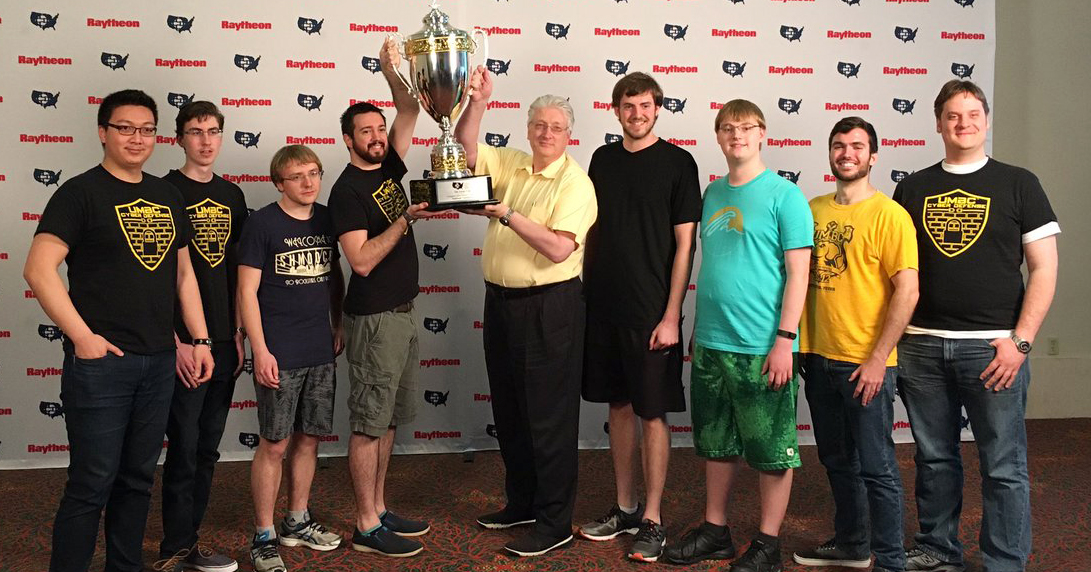
The UMBC CyberDawgs team took first place at the finals of the National Collegiate Cyber Defense Competition (NCCDC). The CyberDawgs had won the Mid-Atlantic Collegiate Cyber Defense Competition earlier in the spring, earning the team an invitation to compete in the final ten national championship match held April 13-15 at the University of Texas, San Antonio. This is UMBC’s second trip to the NCCDC finals – two years ago in their first visit the CyberDawgs came in fourth.
The National Collegiate Cyber Defense Competition has been held annually since 2005 and focuses on the operational aspect of managing and protecting an existing network infrastructure. Teams are scored on their ability to detect and respond to outside threats, maintain availability of existing services such as mail servers and web servers, respond to business requests such as the addition or removal of additional services, and balance security needs against business needs.
This year more than 230 schools participated at the state and regional level with winners of the ten regional competitions faceing off in San Antonio. In addition to UMBC, this year’s finalists included teams from the University of Tulsa (2nd Place), Brigham Young University (3rd place), DePaul University, the University of Washington, California State University Northridge, Rochester Institute of Technology, Montana Tech, University of South Alabama, and University of Alaska, Fairbanks.
The CyberDawgs is a group of UMBC students who share a common interest in computer and network security. The group is advised by UMBC faculty Charles Nicholas and Richard Forno. See the CyberDawgs Web site for information on their activities and how to get involved.
Congratulations to the UMBC CyberDawgs!!!
The post UMBC CyberDawgs win 2017 National Collegiate Cyber Defense Competition appeared first on Department of Computer Science and Electrical Engineering.
]]>
The UMBC CyberDawgs team took first place at the finals of the National Collegiate Cyber Defense Competition (NCCDC). The CyberDawgs had won the Mid-Atlantic Collegiate Cyber Defense Competition...
https://www.csee.umbc.edu/2017/04/umbc-cyberdawgs-win-2017-collegiate-cyber-defense-competition/
https://my3.my.umbc.edu/api/v0/pixel/news/67269/guest@my.umbc.edu/c8d92b3163fc7451c04b39c5a73a0825/api/pixel
cybersecurity
news
students
undergraduate
Computer Science and Electrical Engineering
https://my3.my.umbc.edu/groups/csee
https://assets3-my.umbc.edu/system/shared/avatars/groups/000/000/099/d117dca133c64bf78a4b7696dd007189/xsmall.png?1314043393
https://assets1-my.umbc.edu/system/shared/avatars/groups/000/000/099/d117dca133c64bf78a4b7696dd007189/original.png?1314043393
https://assets1-my.umbc.edu/system/shared/avatars/groups/000/000/099/d117dca133c64bf78a4b7696dd007189/xxlarge.png?1314043393
https://assets4-my.umbc.edu/system/shared/avatars/groups/000/000/099/d117dca133c64bf78a4b7696dd007189/xlarge.png?1314043393
https://assets3-my.umbc.edu/system/shared/avatars/groups/000/000/099/d117dca133c64bf78a4b7696dd007189/large.png?1314043393
https://assets1-my.umbc.edu/system/shared/avatars/groups/000/000/099/d117dca133c64bf78a4b7696dd007189/medium.png?1314043393
https://assets2-my.umbc.edu/system/shared/avatars/groups/000/000/099/d117dca133c64bf78a4b7696dd007189/small.png?1314043393
https://assets3-my.umbc.edu/system/shared/avatars/groups/000/000/099/d117dca133c64bf78a4b7696dd007189/xsmall.png?1314043393
https://assets3-my.umbc.edu/system/shared/avatars/groups/000/000/099/d117dca133c64bf78a4b7696dd007189/xxsmall.png?1314043393
Computer Science and Electrical Engineering
11
0
true
Sat, 15 Apr 2017 17:01:08 -0400
Sat, 15 Apr 2017 17:01:08 -0400
UMBC Cyberdawgs compete in 2017 Collegiate Cyber Defense Competition finals
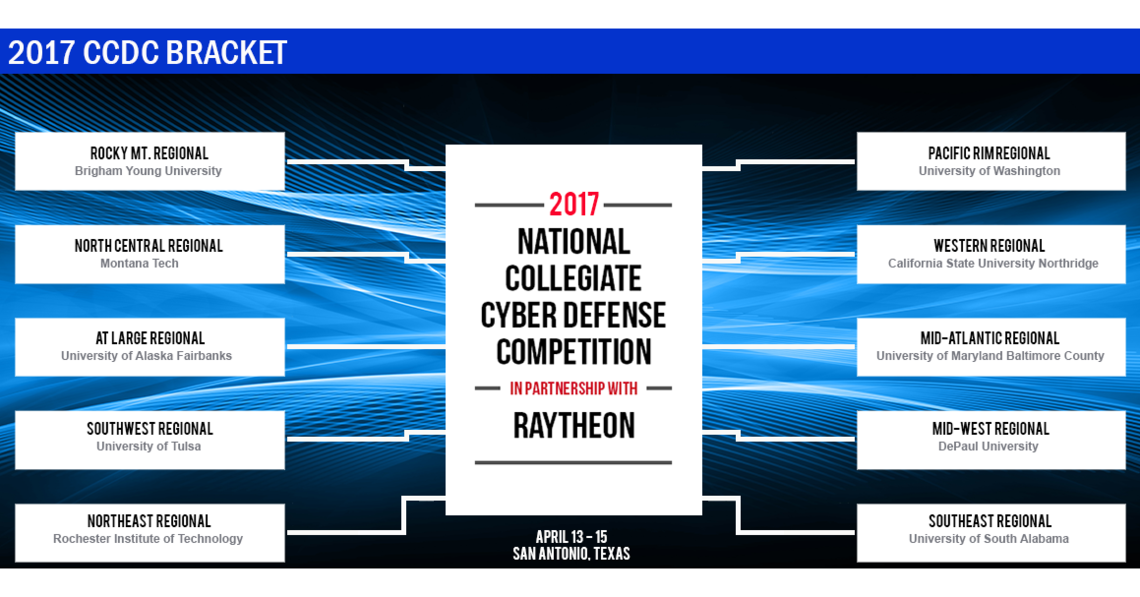
The UMBC CyberDawgs are at the University of Texas, San Antonio competing in the national two-day finals event for the Collegiate Cyber Defense Competition (CCDC) that takes place April 13-14. The CybrDawgs took first place in the Mid-Atlantic regional finals two weeks ago which qualified them for the finals this week. This is UMBC’s second trip to the CCDC national finals – two years ago in their first visit the CyberDawgs came in fourth.
The CyberDawgs is a group of UMBC students who share a common interest in computer and network security. The group is advised by UMBC faculty Charles Nicholas and Richard Forno. See the CyberDawgs Web site for information on their activities and how to get involved.
Good luck to the CyberDawgs!!!
The post UMBC Cyberdawgs compete in 2017 Collegiate Cyber Defense Competition finals appeared first on Department of Computer Science and Electrical Engineering.
]]>
The UMBC CyberDawgs are at the University of Texas, San Antonio competing in the national two-day finals event for the Collegiate Cyber Defense Competition (CCDC) that takes place April 13-14. The...
https://www.csee.umbc.edu/2017/04/umbc-cyberdawgs-compete-2017-collegiate-cyber-defense-competition-finals/
https://my3.my.umbc.edu/api/v0/pixel/news/67204/guest@my.umbc.edu/3be3675df9cb58d4f6258a9fb7b0b525/api/pixel
cybersecurity
news
students
undergraduate
Computer Science and Electrical Engineering
https://my3.my.umbc.edu/groups/csee
https://assets3-my.umbc.edu/system/shared/avatars/groups/000/000/099/d117dca133c64bf78a4b7696dd007189/xsmall.png?1314043393
https://assets1-my.umbc.edu/system/shared/avatars/groups/000/000/099/d117dca133c64bf78a4b7696dd007189/original.png?1314043393
https://assets1-my.umbc.edu/system/shared/avatars/groups/000/000/099/d117dca133c64bf78a4b7696dd007189/xxlarge.png?1314043393
https://assets4-my.umbc.edu/system/shared/avatars/groups/000/000/099/d117dca133c64bf78a4b7696dd007189/xlarge.png?1314043393
https://assets3-my.umbc.edu/system/shared/avatars/groups/000/000/099/d117dca133c64bf78a4b7696dd007189/large.png?1314043393
https://assets1-my.umbc.edu/system/shared/avatars/groups/000/000/099/d117dca133c64bf78a4b7696dd007189/medium.png?1314043393
https://assets2-my.umbc.edu/system/shared/avatars/groups/000/000/099/d117dca133c64bf78a4b7696dd007189/small.png?1314043393
https://assets3-my.umbc.edu/system/shared/avatars/groups/000/000/099/d117dca133c64bf78a4b7696dd007189/xsmall.png?1314043393
https://assets3-my.umbc.edu/system/shared/avatars/groups/000/000/099/d117dca133c64bf78a4b7696dd007189/xxsmall.png?1314043393
Computer Science and Electrical Engineering
10
0
true
Thu, 13 Apr 2017 08:45:52 -0400
UMBC Prof. Tinoosh Mohsenin receives NSF CAREER Award for Deep Learning Technologies

Tinoosh Mohsenin, assistant professor of computer science and electrical engineering, has received a CAREER Award from the National Science Foundation (NSF) to advance her research on energy efficient implementation of deep learning technologies and machine learning algorithms that are developed to function similarly to the brain. Her award totals $475,104 over five years. Mohsenin’s research will enable those in medicine, intelligence, and environmental science to adapt the technology developed in her lab to their own work.
“We congratulate Dr. Mohsenin on her NSF CAREER Award, an important recognition of her groundbreaking work and the impact it will have on other fields,” said Karl V. Steiner, vice president for research. “This recognition of Dr. Mohsenin adds to our growing list of exceptional young faculty recognized by peers and funding agencies alike for the incredible potential their work has to move science and technology forward.”
The CAREER Award will support Mohsenin’s work creating solutions to both software and hardware issues with hardware implementation opportunities in her lab and across many industries. She is the director of the Energy Efficient High Performance Computing (EEHPC) Lab at UMBC. Mohsenin is particularly focused on energy efficiency, and emphasizes the importance of user-friendly, battery-powered and low-cost hardware implementation techniques for future computing.
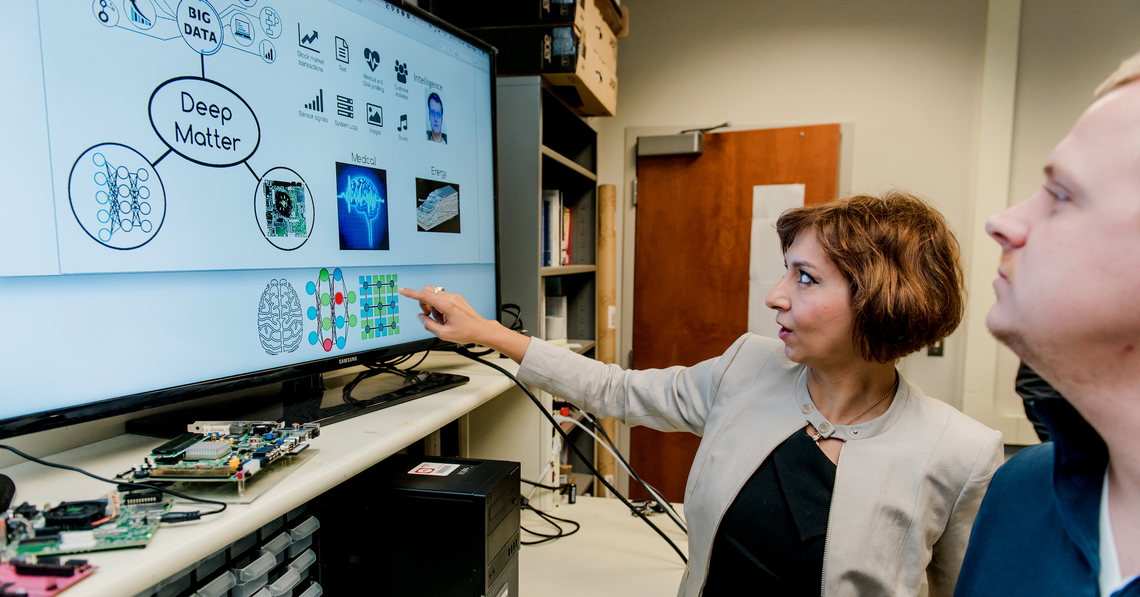 Professor Tinoosh Mohsenin in her lab.
In the medical field, Mohsenin hopes her low power deep learning technology will help physicians and medical professionals detect seizures and cancer more quickly and accurately by improving the analysis of highly complex brain signal and image data, beyond what can be gleaned from today’s standard brain monitoring and analysis techniques. Mohsenin hopes her work will also help people with significant mobility limitations who use small multi-modal sensors on their tongue as well as other methods to maneuver wheelchairs or command other technologies. More complex algorithms and their efficient hardware implementation can notably improve the responsiveness of such technologies for users.
“I am very excited about this award as it allows me to take my research to the next level and help society find new computing techniques for smart wearable or mobile devices,” Mohsenin explains. “Current deep learning models have not been explored for power-constrained smart devices, and this research can potentially revolutionize several fields including healthcare, transportation, ecology, surveillance and public utilities.”
The award will provide her with opportunities to engage more UMBC students in STEM research, particularly among women and minority. She also looks forward to inspiring local middle and high school students to pursue engineering majors and careers.
Adam Page ‘12, computer engineering and Ph.D. ‘16, computer engineering, worked in Mohsenin’s lab on research that will be continued through the CAREER award.
In the last two decades, UMBC faculty have received 34 NSF CAREER awards. Additional UMBC faculty honored with CAREER awards so far in 2017 include Lee Blaney, assistant professor of chemical, biochemical and environmental engineering, for his work on water contamination, and Ting Zhu, assistant professor of computer science and electrical engineering, for his work to develop a networked system that can accommodate solutions for wireless communications, machine learning and data processing.
Adapted from a UMBC News article. Photos by Marlayna Demond ’11 for UMBC.
The post UMBC Prof. Tinoosh Mohsenin receives NSF CAREER Award for Deep Learning Technologies appeared first on Department of Computer Science and Electrical Engineering.
]]>
Tinoosh Mohsenin, assistant professor of computer science and electrical engineering, has received a CAREER Award from the National Science Foundation (NSF) to advance her research on energy...
https://www.csee.umbc.edu/2017/04/umbc-prof-tinoosh-mohsenin-receives-nsf-career-award-deep-learning-technologies/
https://my3.my.umbc.edu/api/v0/pixel/news/67042/guest@my.umbc.edu/e4d1ec78fae03c946587d20ad4524b9b/api/pixel
computer-engineering
computer-science
csee
data-science
faculty-and-staff
news
research
research-awards
Computer Science and Electrical Engineering
https://my3.my.umbc.edu/groups/csee
https://assets3-my.umbc.edu/system/shared/avatars/groups/000/000/099/d117dca133c64bf78a4b7696dd007189/xsmall.png?1314043393
https://assets1-my.umbc.edu/system/shared/avatars/groups/000/000/099/d117dca133c64bf78a4b7696dd007189/original.png?1314043393
https://assets1-my.umbc.edu/system/shared/avatars/groups/000/000/099/d117dca133c64bf78a4b7696dd007189/xxlarge.png?1314043393
https://assets4-my.umbc.edu/system/shared/avatars/groups/000/000/099/d117dca133c64bf78a4b7696dd007189/xlarge.png?1314043393
https://assets3-my.umbc.edu/system/shared/avatars/groups/000/000/099/d117dca133c64bf78a4b7696dd007189/large.png?1314043393
https://assets1-my.umbc.edu/system/shared/avatars/groups/000/000/099/d117dca133c64bf78a4b7696dd007189/medium.png?1314043393
https://assets2-my.umbc.edu/system/shared/avatars/groups/000/000/099/d117dca133c64bf78a4b7696dd007189/small.png?1314043393
https://assets3-my.umbc.edu/system/shared/avatars/groups/000/000/099/d117dca133c64bf78a4b7696dd007189/xsmall.png?1314043393
https://assets3-my.umbc.edu/system/shared/avatars/groups/000/000/099/d117dca133c64bf78a4b7696dd007189/xxsmall.png?1314043393
Computer Science and Electrical Engineering
8
0
true
Thu, 06 Apr 2017 16:29:51 -0400
talk: Stepping Away From the Edge of Illness, 4:30p Thr 4/6

CHMPR Distinguished Lecturer Series
Stepping Away From the Edge of Illness
4:30-5:30pm Thursday, 6 April 2017, UC 310, UMBC
3:30-4:30pm Reception, UC 310
The human body may be afflicted by a multitude of chronic diseases. In principle, any chronic ailment develops along with one or more of the four fundamental pathophysiological processes, namely Insulin Resistance, Systemic Inflammation, Metabolic Deficiency and Tissue/Organ Involution and Degeneration. All of these four fundamental processes are known harbingers of the aging process. Borders between health and disease are blurry, and typical diagnostic cut-offs are arbitrary and in the recent past were subjects for revision. Therefore, neither physicians nor patients should wait until clear signs of crossing the border between health and sickness manifest themselves. To the contrary, they must constantly at all times consciously apply their efforts to ensure the maintenance of proper body homeostasis. By doing so, they can best resist the metabolic derangement which defines an “aged” state. Optimally, for humans to remain healthy throughout inevitable process of aging, biochemical parameters must be monitored longitudinally and balanced with available means. For relatively healthy individuals, these means should be centered on non-pharmacological, predominantly nutritional and nutraceutical approaches. Accordingly, it is reasonably foreseeable that a novel “Health Integrator” profession is anticipated to emerge in order to support the growing need for life-long health maintenance.
Dr. Ancha Baranova is an Associate Professor in School of Systems Biology, George Mason University, Fairfax VA. Dr. Baranova runs both experimental and computational research programs in highly interdisciplinary and collaborative field of Personalized Medicine. She is an expert in systems biology driven analysis of human metabolism, with an emphasis on diseases associated with the process of ageing. She is an author of more than 150 research papers, reviews and opinion pieces in the field of human systems biology.
The post talk: Stepping Away From the Edge of Illness, 4:30p Thr 4/6 appeared first on Department of Computer Science and Electrical Engineering.
]]>
CHMPR Distinguished Lecturer Series Stepping Away From the Edge of Illness Dr. Ancha Baranova, George Mason University 4:30-5:30pm Thursday, 6 April 2017, UC 310, UMBC 3:30-4:30pm...
https://www.csee.umbc.edu/2017/04/ancha-baranova-stepping-away-from-edge-of-illness/
https://my3.my.umbc.edu/api/v0/pixel/news/66944/guest@my.umbc.edu/a89d245a319a28e1e6e6a75bdbf67504/api/pixel
data-science
news
talks
Computer Science and Electrical Engineering
https://my3.my.umbc.edu/groups/csee
https://assets3-my.umbc.edu/system/shared/avatars/groups/000/000/099/d117dca133c64bf78a4b7696dd007189/xsmall.png?1314043393
https://assets1-my.umbc.edu/system/shared/avatars/groups/000/000/099/d117dca133c64bf78a4b7696dd007189/original.png?1314043393
https://assets1-my.umbc.edu/system/shared/avatars/groups/000/000/099/d117dca133c64bf78a4b7696dd007189/xxlarge.png?1314043393
https://assets4-my.umbc.edu/system/shared/avatars/groups/000/000/099/d117dca133c64bf78a4b7696dd007189/xlarge.png?1314043393
https://assets3-my.umbc.edu/system/shared/avatars/groups/000/000/099/d117dca133c64bf78a4b7696dd007189/large.png?1314043393
https://assets1-my.umbc.edu/system/shared/avatars/groups/000/000/099/d117dca133c64bf78a4b7696dd007189/medium.png?1314043393
https://assets2-my.umbc.edu/system/shared/avatars/groups/000/000/099/d117dca133c64bf78a4b7696dd007189/small.png?1314043393
https://assets3-my.umbc.edu/system/shared/avatars/groups/000/000/099/d117dca133c64bf78a4b7696dd007189/xsmall.png?1314043393
https://assets3-my.umbc.edu/system/shared/avatars/groups/000/000/099/d117dca133c64bf78a4b7696dd007189/xxsmall.png?1314043393
Computer Science and Electrical Engineering
2
0
true
Tue, 04 Apr 2017 09:26:20 -0400
talk: Quantum plane and plucking polynomial of rooted trees, 1pm 4/7

UMBC CSEE Seminar Series
Quantum plane and plucking polynomial of rooted trees
1:00-2:00pm, Friday, 7 April 2017, ITE 231
We describe here a new invariant of rooted trees and following up state sum invariant of pointed graphs. We argue that the invariant is interesting on it own, and that it has connections to knot theory and homological algebra. Another reason that we propose this invariant is that we deal here with an elementary, interesting new mathematics and after the talk everybody can take part in developing the topic, inventing new results and connections to other disciplines of mathematics (and likely statistical mechanics and combinatorial biology). The staring point of the talk is the well known formula for $(x+y)^n$ in the quantum plane ($yx=qxy$).
Józef Henryk Przytycki is a mathematician specializing in the fields of knot theory and topology. A native of Poland, Przytycki received a Master of Science degree in mathematics from Warsaw University in 1977 and, after emigrating to the United States, a Ph.D. in mathematics from Columbia University, where his advisor was Joan Birman. He is currently a professor of mathematics at George Washington University in Washington, DC. He has supervised nine Ph.D. students and has authored and co-authored many mathematical publications, including more than 100 research papers, 10 conference proceedings and 2 books.
Host: Samuel Lomonaco
Seminar Organizer: Tulay Adali
About the CSEE Seminar Series: The UMBC Department of Computer Science and Electrical Engineering presents technical talks on current significant research projects of broad interest to the Department and the research community. Each talk is free and open to the public. We welcome your feedback and suggestions for future talks.
The post talk: Quantum plane and plucking polynomial of rooted trees, 1pm 4/7 appeared first on Department of Computer Science and Electrical Engineering.
]]>
UMBC CSEE Seminar Series Quantum plane and plucking polynomial of rooted trees Józef H. Przytycki George Washington University 1:00-2:00pm, Friday, 7 April 2017, ITE 231 We describe here...
https://www.csee.umbc.edu/2017/04/quantum-plane-plucking-polynomial-rooted-trees/
https://my3.my.umbc.edu/api/v0/pixel/news/66937/guest@my.umbc.edu/aa8d1ba66120cc72f20af404d59e0a67/api/pixel
computer-science
news
talks
Computer Science and Electrical Engineering
https://my3.my.umbc.edu/groups/csee
https://assets3-my.umbc.edu/system/shared/avatars/groups/000/000/099/d117dca133c64bf78a4b7696dd007189/xsmall.png?1314043393
https://assets1-my.umbc.edu/system/shared/avatars/groups/000/000/099/d117dca133c64bf78a4b7696dd007189/original.png?1314043393
https://assets1-my.umbc.edu/system/shared/avatars/groups/000/000/099/d117dca133c64bf78a4b7696dd007189/xxlarge.png?1314043393
https://assets4-my.umbc.edu/system/shared/avatars/groups/000/000/099/d117dca133c64bf78a4b7696dd007189/xlarge.png?1314043393
https://assets3-my.umbc.edu/system/shared/avatars/groups/000/000/099/d117dca133c64bf78a4b7696dd007189/large.png?1314043393
https://assets1-my.umbc.edu/system/shared/avatars/groups/000/000/099/d117dca133c64bf78a4b7696dd007189/medium.png?1314043393
https://assets2-my.umbc.edu/system/shared/avatars/groups/000/000/099/d117dca133c64bf78a4b7696dd007189/small.png?1314043393
https://assets3-my.umbc.edu/system/shared/avatars/groups/000/000/099/d117dca133c64bf78a4b7696dd007189/xsmall.png?1314043393
https://assets3-my.umbc.edu/system/shared/avatars/groups/000/000/099/d117dca133c64bf78a4b7696dd007189/xxsmall.png?1314043393
Computer Science and Electrical Engineering
1
0
true
Mon, 03 Apr 2017 21:36:54 -0400
talk: Making in the Classroom: Rationale, Challenge & Imperative, 3pm April 6, UMBC

Making in the Classroom: the Rationale, the Challenge and the Imperative
Professor Francis Quek
Department of Visualization, Texas A&M University
3:00-4:00pm Thursday, 6 April 2017, ITE 217, UMBC
Computing is increasingly focused in interaction with the physical world rather than just in the abstract virtual world of screens and pixels. Physical computing combines the design of physical electronics with computation to bring about possibilities that simply interacting with pixels behind glass cannot. One manifestation of physical computing in our culture is seen in the Maker movement. Technologies such as 3D printing and open source electronics and accessible computing have combined to give rise to a Maker movement that promises to broaden participation in technology-based innovation and production. The potential of Making to enhance learning, especially in areas of Science, Technology, Engineering and Mathematics (STEM) has led to calls to bring Making into education. However, the characteristics of innovation, discovery, and student-directed learning for which Making is prized is not easily incorporated into public school learning. Making-based learning are thus often provided in clubs, community Makerspaces, and workshops. This poses a severe issue of equity as youth participants are implicitly self-selected through parents who have the knowledge and means to enroll their children at such venues. Taking a human-centered perspective, we present a project where Making is integrated with the formal curriculum of a public elementary school that serves predominantly underrepresented populations. We will examine the rationale for employing Making-based classroom learning and review our strategy for curriculum alignment. We will see how our ‘double scaffolding’ approach supports both learning of STEM curricula and knowledge and skills associated with computing and Making. Beside learning STEM material, our approach seeks to support the development of STEM self-efficacy and self-identities in children who may not otherwise see these possibilities in themselves. We present results of our year-long study that show the promise of our approach.
Professor Francis Quek is a Professor of the Department of Visualization (and by courtesy, Professor of Computer Science and Engineering and Professor of Psychology) at Texas A&M University. He joined Texas A&M University as an interdisciplinary President’s Signature Hire to bridge disparities in STEM. Formerly he has been the Director of the Center for Human-Computer Interaction at Virginia Tech. Francis received both his B.S.E. summa cum laude (1984) and M.S.E. (1984) in electrical engineering from the University of Michigan. He completed his Ph.D. in Computer Science at the same university in 1990. Francis is a member of the IEEE and ACM. He performs research in Making for STEM learning, embodied interaction, embodied learning and sensemaking, multimodal verbal/non-verbal interaction, multimodal meeting analysis, interfaces to support learning, vision-based interaction, multimedia databases, medical imaging, assistive technology for the blind, human computer interaction, computer vision, and computer graphics. He leads several multiple-disciplinary research efforts to understand the communicative realities of multimodal interaction.
The post talk: Making in the Classroom: Rationale, Challenge & Imperative, 3pm April 6, UMBC appeared first on Department of Computer Science and Electrical Engineering.
]]>
Making in the Classroom: the Rationale, the Challenge and the Imperative Professor Francis Quek Department of Visualization, Texas A&M University 3:00-4:00pm Thursday, 6 April 2017,...
https://www.csee.umbc.edu/2017/04/talk-making-classroom-rationale-challenge-imperative-umbc/
https://my3.my.umbc.edu/api/v0/pixel/news/66880/guest@my.umbc.edu/599d1fa793de4f72ec8628e64a1cbb4f/api/pixel
news
talks
Computer Science and Electrical Engineering
https://my3.my.umbc.edu/groups/csee
https://assets3-my.umbc.edu/system/shared/avatars/groups/000/000/099/d117dca133c64bf78a4b7696dd007189/xsmall.png?1314043393
https://assets1-my.umbc.edu/system/shared/avatars/groups/000/000/099/d117dca133c64bf78a4b7696dd007189/original.png?1314043393
https://assets1-my.umbc.edu/system/shared/avatars/groups/000/000/099/d117dca133c64bf78a4b7696dd007189/xxlarge.png?1314043393
https://assets4-my.umbc.edu/system/shared/avatars/groups/000/000/099/d117dca133c64bf78a4b7696dd007189/xlarge.png?1314043393
https://assets3-my.umbc.edu/system/shared/avatars/groups/000/000/099/d117dca133c64bf78a4b7696dd007189/large.png?1314043393
https://assets1-my.umbc.edu/system/shared/avatars/groups/000/000/099/d117dca133c64bf78a4b7696dd007189/medium.png?1314043393
https://assets2-my.umbc.edu/system/shared/avatars/groups/000/000/099/d117dca133c64bf78a4b7696dd007189/small.png?1314043393
https://assets3-my.umbc.edu/system/shared/avatars/groups/000/000/099/d117dca133c64bf78a4b7696dd007189/xsmall.png?1314043393
https://assets3-my.umbc.edu/system/shared/avatars/groups/000/000/099/d117dca133c64bf78a4b7696dd007189/xxsmall.png?1314043393
Computer Science and Electrical Engineering
1
0
true
Sat, 01 Apr 2017 22:52:08 -0400
Innovate Good 24-hour Hackathon, 29-30 April 2017, UMBC
Innovate Good is a 24-hour student Hackathon that held at UMBC 29-30 April 2017 with the theme of creating software or hardware projects to benefit social causes. Participating will give you an opportunity to learn new skills, make friends, create your wildest idea, and share it with the world. Whether you want to create a website, dabble with Photoshop, make a robotic arm, or develop a game, it’s up to you to decide what to learn. Food, beverages, swag, workspaces, and sleeping areas will be provided.
Innovate Good will have four main tracks with awards for the best projects (Health/Environmental, Legal/Justice Housing and Education) as well as additional sponsor prizes.
If I don’t have a team or an idea, it’s not a problem. You can find a team once you arrive. Most hackers arrive without a team. You will often find inspiration for ideas at the hackathon.
If don’t don’t code, it’s opportunity to learn something new. There will be workshops geared towards beginners and mentors to help you throughout the event.
All kinds or projects are welcome, including Web, mobile, desktop, IoT and hardware. Projects will be judged based on creativity, technical difficulty, polish, and usefulness.
For more information and to register, see the Innovate Good site (http://innovate.hackumbc.org/). Register early since there is only space for a limited number of participants.
The post Innovate Good 24-hour Hackathon, 29-30 April 2017, UMBC appeared first on Department of Computer Science and Electrical Engineering.
]]>
Innovate Good is a 24-hour student Hackathon that held at UMBC 29-30 April 2017 with the theme of creating software or hardware projects to benefit social causes. Participating will give you an...
https://www.csee.umbc.edu/2017/03/innovate-good-hackathon-29-30-april-2017-umbc/
https://my3.my.umbc.edu/api/v0/pixel/news/66856/guest@my.umbc.edu/2e4a222e962f932aa014d384a907d235/api/pixel
csee
events
news
students
Computer Science and Electrical Engineering
https://my3.my.umbc.edu/groups/csee
https://assets3-my.umbc.edu/system/shared/avatars/groups/000/000/099/d117dca133c64bf78a4b7696dd007189/xsmall.png?1314043393
https://assets1-my.umbc.edu/system/shared/avatars/groups/000/000/099/d117dca133c64bf78a4b7696dd007189/original.png?1314043393
https://assets1-my.umbc.edu/system/shared/avatars/groups/000/000/099/d117dca133c64bf78a4b7696dd007189/xxlarge.png?1314043393
https://assets4-my.umbc.edu/system/shared/avatars/groups/000/000/099/d117dca133c64bf78a4b7696dd007189/xlarge.png?1314043393
https://assets3-my.umbc.edu/system/shared/avatars/groups/000/000/099/d117dca133c64bf78a4b7696dd007189/large.png?1314043393
https://assets1-my.umbc.edu/system/shared/avatars/groups/000/000/099/d117dca133c64bf78a4b7696dd007189/medium.png?1314043393
https://assets2-my.umbc.edu/system/shared/avatars/groups/000/000/099/d117dca133c64bf78a4b7696dd007189/small.png?1314043393
https://assets3-my.umbc.edu/system/shared/avatars/groups/000/000/099/d117dca133c64bf78a4b7696dd007189/xsmall.png?1314043393
https://assets3-my.umbc.edu/system/shared/avatars/groups/000/000/099/d117dca133c64bf78a4b7696dd007189/xxsmall.png?1314043393
Computer Science and Electrical Engineering
2
0
true
Fri, 31 Mar 2017 21:37:06 -0400
Fri, 31 Mar 2017 21:37:06 -0400
2017 Digital Entertainment Conference, 11-5 Sat. April 8, UMBC
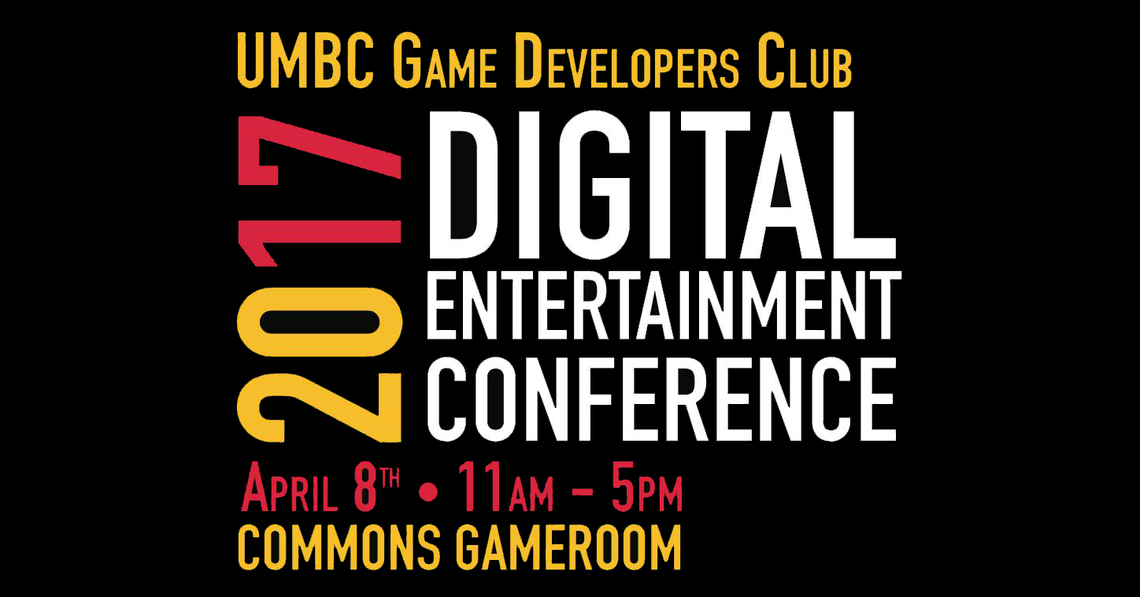
UMBC’s Game Developers Club will hold its twelfth annual Digital Entertainment Conference from 11:00-5:00 on Saturday April 11 in the UMBC Commons. Come learn about the game industry from local game developing companies. High school students, college students, aspiring game developers, and game developers are all welcome.
- Meet professionals in the game industry
- Learn the latest in game art, code and technology
- Network with local game developers
Lunch will be provided. If you have any questions, send email to *protected email*
Parking: You can park in any A, B, or C lot on UMBC Campus. The closest parking garage is the Commons Parking garage on Commons Drive inside the UMBC Hilltop Circle.
If you have any questions, send email to *protected email*
The post 2017 Digital Entertainment Conference, 11-5 Sat. April 8, UMBC appeared first on Department of Computer Science and Electrical Engineering.
]]>
UMBC’s Game Developers Club will hold its twelfth annual Digital Entertainment Conference from 11:00-5:00 on Saturday April 11 in the UMBC Commons. Come learn about the game industry from local...
https://www.csee.umbc.edu/2017/03/2017-umbc-digital-entertainment-conference-saturday-april-8/
https://my3.my.umbc.edu/api/v0/pixel/news/66808/guest@my.umbc.edu/1b3e704b973f450d4d212746497f8cad/api/pixel
events
game-track
news
students
Computer Science and Electrical Engineering
https://my3.my.umbc.edu/groups/csee
https://assets3-my.umbc.edu/system/shared/avatars/groups/000/000/099/d117dca133c64bf78a4b7696dd007189/xsmall.png?1314043393
https://assets1-my.umbc.edu/system/shared/avatars/groups/000/000/099/d117dca133c64bf78a4b7696dd007189/original.png?1314043393
https://assets1-my.umbc.edu/system/shared/avatars/groups/000/000/099/d117dca133c64bf78a4b7696dd007189/xxlarge.png?1314043393
https://assets4-my.umbc.edu/system/shared/avatars/groups/000/000/099/d117dca133c64bf78a4b7696dd007189/xlarge.png?1314043393
https://assets3-my.umbc.edu/system/shared/avatars/groups/000/000/099/d117dca133c64bf78a4b7696dd007189/large.png?1314043393
https://assets1-my.umbc.edu/system/shared/avatars/groups/000/000/099/d117dca133c64bf78a4b7696dd007189/medium.png?1314043393
https://assets2-my.umbc.edu/system/shared/avatars/groups/000/000/099/d117dca133c64bf78a4b7696dd007189/small.png?1314043393
https://assets3-my.umbc.edu/system/shared/avatars/groups/000/000/099/d117dca133c64bf78a4b7696dd007189/xsmall.png?1314043393
https://assets3-my.umbc.edu/system/shared/avatars/groups/000/000/099/d117dca133c64bf78a4b7696dd007189/xxsmall.png?1314043393
Computer Science and Electrical Engineering
2
0
true
Thu, 30 Mar 2017 09:12:47 -0400
talk: Hacking, Security, and Technology In Public Consciousness: The Effects of Myth, 1pm 3/31
 An image from Hackers, a 1995 film that followed a group of high school hackers and their involvement in a corporate extortion conspiracy
UMBC CSEE Seminar Series
Hacking, Security and Technology In Public Consciousness:
The Effects of Myth
Assistant Director, UMBC Center for Cybersecurity
Director, UMBC Cybersecurity Graduate Program
1-2pm, Friday, 31 March 2017, ITE 231
Public portrayals of the digital landscape, particularly through the entertainment mass media and product marketing, can have a profound influence on how the general public perceives the strengths and limitations of technology. Over time, these images, stereotypes and dramatized capabilities are replicated across texts and repeated until, rightly or wrongly, they become the default paradigm for mass understanding of the complex and ever-changing modern technological environment.
For example, one only needs to observe legislative bodies or watch mainstream news media trying to come to understand issues such as encryption, cybersecurity, or even pluralistic applications of the term “to hack” to see just how deeply the stereotype of the god-like yet overweight and socially maladjusted (often male) ‘hacker’ have penetrated popular perceptions. Metaphors like this that act as a useful shorthand in fictional storytelling do not make a good reference basis for policy statements or national decision-making — however, when such sensationalized and/or fictional depictions overshadow more sophisticated or nuanced descriptions of those capabilities in actual practice, it is understandable why unrealistic expectations and unworkable proposals for technology – like “good-guys only” encryption backdoors – continue being proposed.
Drawing on examples from the media and politics, this presentation explores the connections between decades-old media tropes around technology/technologists and current technology debates, especially those related to cybersecurity and cyberwarfare. This interpretively analyzed presentation argues that perception is just as important as performance in terms of outcomes and acknowledges that the models used by mass society, including policy makers, to understand early digital innovations are part of a wider set of mass cultural messages have served a purpose — but now need to be either dispelled or updated. Addressing the assumptions and inaccuracies of these shared media-fueled perceptions of the emerging digital society is an important part of understanding and then working to overcome conflicts between technology and policy.
(This presentation, and its related paper, are part of ongoing research collaborations between Dr. Forno (security) at UMBC and Dr. Erika Pearson (media/comms) of Massey University in Wellington, NZ)
Dr. Richard Forno is a Senior Lecturer in the UMBC Department of Computer Science and Electrical Engineering, where he directs the UMBC Graduate Cybersecurity Program and serves as the Assistant Director of UMBC’s Center for Cybersecurity. His twenty-year career spans the government, military, and private sector, including helping to build the first formal cybersecurity program for the U.S. House of Representatives, serving as the first Chief Security Officer for Network Solutions (operator of the InterNIC), and co-founding the CyberMaryland conference. Dr. Forno was also one of the early thought leaders on the subject of “information warfare” and he remains a longtime commentator on the influence of Internet technology upon society.
Organizer: Tulay Adali, Host: Alan Sherman
About the CSEE Seminar Series: The UMBC Department of Computer Science and Electrical Engineering presents technical talks on current significant research projects of broad interest to the Department and the research community. Each talk is free and open to the public. We welcome your feedback and suggestions for future talks.
The post talk: Hacking, Security, and Technology In Public Consciousness: The Effects of Myth, 1pm 3/31 appeared first on Department of Computer Science and Electrical Engineering.
]]>
An image from Hackers, a 1995 film that followed a group of high school hackers and their involvement in a corporate extortion conspiracy UMBC CSEE Seminar Series Hacking, Security and...
https://www.csee.umbc.edu/2017/03/hacking-security-technology-public-consciousness-myth/
https://my3.my.umbc.edu/api/v0/pixel/news/66673/guest@my.umbc.edu/301d50a09a77a8c609bc31f6bd8f03f5/api/pixel
cybersecurity
news
talks
Computer Science and Electrical Engineering
https://my3.my.umbc.edu/groups/csee
https://assets3-my.umbc.edu/system/shared/avatars/groups/000/000/099/d117dca133c64bf78a4b7696dd007189/xsmall.png?1314043393
https://assets1-my.umbc.edu/system/shared/avatars/groups/000/000/099/d117dca133c64bf78a4b7696dd007189/original.png?1314043393
https://assets1-my.umbc.edu/system/shared/avatars/groups/000/000/099/d117dca133c64bf78a4b7696dd007189/xxlarge.png?1314043393
https://assets4-my.umbc.edu/system/shared/avatars/groups/000/000/099/d117dca133c64bf78a4b7696dd007189/xlarge.png?1314043393
https://assets3-my.umbc.edu/system/shared/avatars/groups/000/000/099/d117dca133c64bf78a4b7696dd007189/large.png?1314043393
https://assets1-my.umbc.edu/system/shared/avatars/groups/000/000/099/d117dca133c64bf78a4b7696dd007189/medium.png?1314043393
https://assets2-my.umbc.edu/system/shared/avatars/groups/000/000/099/d117dca133c64bf78a4b7696dd007189/small.png?1314043393
https://assets3-my.umbc.edu/system/shared/avatars/groups/000/000/099/d117dca133c64bf78a4b7696dd007189/xsmall.png?1314043393
https://assets3-my.umbc.edu/system/shared/avatars/groups/000/000/099/d117dca133c64bf78a4b7696dd007189/xxsmall.png?1314043393
Computer Science and Electrical Engineering
3
0
true
Sat, 25 Mar 2017 11:24:21 -0400
Wikileaks hack highlights importance of cyberdefense basics, UMBC experts write

The Central Intelligence Agency’s latest leak is the most recent major hack exposing information that could possibly compromise national security. In The Conversation, Anupam Joshi and Rick Forno, explain that this hack is a reminder of how cyberdefense strategies must be continually improved to ensure sensitive information is protected.
Joshi is a professor and chair of the department of computer science and electrical engineering and director of UMBC’s Center for Cybersecurity, and Forno is the assistant director of the UMBC Center for Cybersecurity and director of UMBC’s graduate program in cybersecurity. Their latest article has been republished by media across the globe and has been read more than 20,000 times.
“This round of leaks, of documents dating from 2013 to 2016,…reinforces perhaps the most troubling piece of information we already know: Individuals and the government itself must step up cyberdefense efforts to protect sensitive information,” write Joshi and Forno.

They ask readers to consider the risk to security and privacy compared with the benefits and convenience of modern technologies. “As citizens, we must decide what level of risk we — as a nation, a society and as individuals — are willing to face when using internet-connected products.”
Any electronic device connected to the internet is susceptible to a cyber attack, Joshi and Forno go on to explain, noting, “It’s not necessarily a good idea to have always-on and network-enabled microphones or cameras in every room of the house.”
Joshi also spoke with CBS Baltimore about how hacks can impact technologies consumers use every day, such as cars that now feature high tech navigation and entertainment systems. “The more electronic gizmos you have in your car, the newer the car you have, the more you’re connected to the network with your car, the greater the probability something can be done to your car,” he explained. Still, he noted, a hacker would need to have advanced technical knowledge and, likely, close proximity to the car to carry out such an attack.
To ensure that sensitive information is protected, Joshi and Forno say that focusing on “the mundane tasks of cyberdefense” is essential to maintaining security for everyone, from government to individuals, although they emphasize that no internet-connected technologies are immune to cyber hacks. Ultimately, they write, “Keeping others out of key systems is crucial to American national security, and to the proper function of our government, military and civilian systems.”
Read the full article in The Conversation, and watch the complete interview on CBS Baltimore. Adapted from an article in UMBC News.
The post Wikileaks hack highlights importance of cyberdefense basics, UMBC experts write appeared first on Department of Computer Science and Electrical Engineering.
]]>
The Central Intelligence Agency’s latest leak is the most recent major hack exposing information that could possibly compromise national security. In The Conversation, Anupam Joshi and Rick Forno,...
https://www.csee.umbc.edu/2017/03/wikileaks-hack-highlights-importance-of-cyberdefense-basics-umbc-experts-write/
https://my3.my.umbc.edu/api/v0/pixel/news/66645/guest@my.umbc.edu/d5afad0f6ef598b3f4d0d3e744bbe9ff/api/pixel
computer-science
cybersecurity
faculty-and-staff
news
Computer Science and Electrical Engineering
https://my3.my.umbc.edu/groups/csee
https://assets3-my.umbc.edu/system/shared/avatars/groups/000/000/099/d117dca133c64bf78a4b7696dd007189/xsmall.png?1314043393
https://assets1-my.umbc.edu/system/shared/avatars/groups/000/000/099/d117dca133c64bf78a4b7696dd007189/original.png?1314043393
https://assets1-my.umbc.edu/system/shared/avatars/groups/000/000/099/d117dca133c64bf78a4b7696dd007189/xxlarge.png?1314043393
https://assets4-my.umbc.edu/system/shared/avatars/groups/000/000/099/d117dca133c64bf78a4b7696dd007189/xlarge.png?1314043393
https://assets3-my.umbc.edu/system/shared/avatars/groups/000/000/099/d117dca133c64bf78a4b7696dd007189/large.png?1314043393
https://assets1-my.umbc.edu/system/shared/avatars/groups/000/000/099/d117dca133c64bf78a4b7696dd007189/medium.png?1314043393
https://assets2-my.umbc.edu/system/shared/avatars/groups/000/000/099/d117dca133c64bf78a4b7696dd007189/small.png?1314043393
https://assets3-my.umbc.edu/system/shared/avatars/groups/000/000/099/d117dca133c64bf78a4b7696dd007189/xsmall.png?1314043393
https://assets3-my.umbc.edu/system/shared/avatars/groups/000/000/099/d117dca133c64bf78a4b7696dd007189/xxsmall.png?1314043393
Computer Science and Electrical Engineering
1
0
true
Fri, 24 Mar 2017 11:07:42 -0400