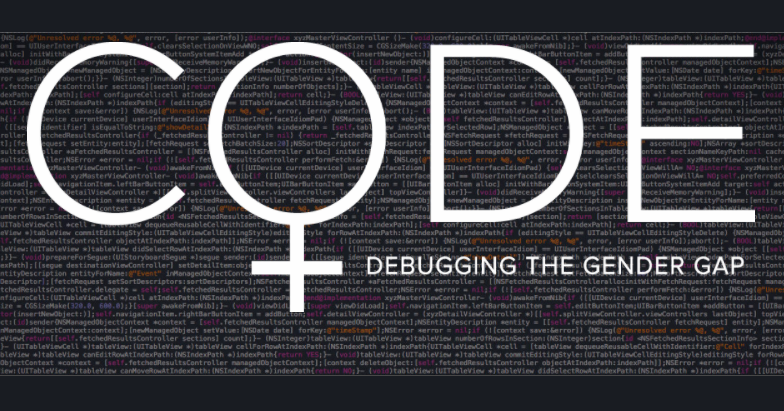
Join the UMBC Computer Science Education Club and the Center for Women in Technology for a free screening of the award winning film, CODE: Debugging the Gender Gap. The documentary exposes the dearth of American female and minority software engineers and explores the reasons for this gender gap. CODE raises the question: what would society gain from having more women and minorities code?
CODE will be screened on Friday March 31 at 3:00-5:00pm in ITE 104. A discussion about the film will immediately follow the screening. Snacks will be provided! RSVP via myUMBC to let the organizers know you will be there on Friday 3/31!.
]]>
Join the UMBC Computer Science Education Club and the Center for Women in Technology for a free screening of the award winning film, CODE: Debugging the Gender Gap. The documentary exposes the...https://www.csee.umbc.edu/2017/03/code-debugging-gender-gap-film/https://my3.my.umbc.edu/api/v0/pixel/news/66550/guest@my.umbc.edu/cd549efc69bfcd71722b67dfddd22853/api/pixelcomputer-engineeringcomputer-sciencecwitcybersecuritydata-scienceeducationeventsnewsstudentsComputer Science and Electrical Engineeringhttps://my3.my.umbc.edu/groups/cseehttps://assets3-my.umbc.edu/system/shared/avatars/groups/000/000/099/d117dca133c64bf78a4b7696dd007189/xsmall.png?1314043393https://assets1-my.umbc.edu/system/shared/avatars/groups/000/000/099/d117dca133c64bf78a4b7696dd007189/original.png?1314043393https://assets1-my.umbc.edu/system/shared/avatars/groups/000/000/099/d117dca133c64bf78a4b7696dd007189/xxlarge.png?1314043393https://assets4-my.umbc.edu/system/shared/avatars/groups/000/000/099/d117dca133c64bf78a4b7696dd007189/xlarge.png?1314043393https://assets3-my.umbc.edu/system/shared/avatars/groups/000/000/099/d117dca133c64bf78a4b7696dd007189/large.png?1314043393https://assets1-my.umbc.edu/system/shared/avatars/groups/000/000/099/d117dca133c64bf78a4b7696dd007189/medium.png?1314043393https://assets2-my.umbc.edu/system/shared/avatars/groups/000/000/099/d117dca133c64bf78a4b7696dd007189/small.png?1314043393https://assets3-my.umbc.edu/system/shared/avatars/groups/000/000/099/d117dca133c64bf78a4b7696dd007189/xsmall.png?1314043393https://assets3-my.umbc.edu/system/shared/avatars/groups/000/000/099/d117dca133c64bf78a4b7696dd007189/xxsmall.png?1314043393Computer Science and Electrical Engineering50trueThu, 16 Mar 2017 15:51:23 -0400talk: Phase synchrony in heart-brain interactions predicts personality and emotions, 1pm 3/17
UMBC CSEE Seminar Series
Phase synchrony in heart-brain interactions predicts personality and emotions
Ehsan Shokri Kojori NIH, National Institute on Alcoloh Abuse and Alcoholism
1:00-2:00pm Friday, 17 March 2017, ITE 231
Despite the historical interest in the link between brain and heart, it is unknown whether brain and heart interactions provide meaningful information about emotions and personality. Here we studied the phase and amplitude of coherence between cardiac pulse and resting state fMRI signals in 203 subjects. We show low-frequency (LF, < 0.1 Hz) components of the resting-state networks (RSN) share significant content with corresponding components in physiological recordings. We found LF cardiovascular components precede those in RSNs, and LF respiratory components follow those in RSNs. Phase dispersion (in LF) between cardiac (but not respiratory) and RSN signals predicted a main positivity-negativity dimension of personality (r = 0.31, p < 0.0001) and emotions (r = 0.24, p = 0.001). Specifically, higher phase dispersion between cardiac and brain RSNs predicted higher tendency toward negative inclinations. In summary, these results provide evidence that brain-wide sensitivity to cardiovascular signaling predicts a main dimension of personality and emotions. Finally, our analysis of phase dispersion may have diagnostic value in specific neuropsychiatric disorders.
Dr. Ehsan Shokri Kojori joined the Laboratory of Neuroimaging at the NIH National Institute on Alcohol Abuse and Alcoholism as a postdoctoral IRTA fellow in August 2014 and became a Research Fellow in May 2016. He earned a PhD degree in cognitive neuroscience from the University of Texas at Dallas in Spring 2014. Ehsan also has a background in electrical engineering and signal processing. His interests include combining brain imaging modalities (e.g., fMRI, DTI, and PET) and behavioral measurements to understand the neurocognitive underpinnings of goal directed behavior. His current work involves studying how addiction and alcohol abuse affect efficiency and energetic cost of the brain networks. He is also working on developing novel methodologies to better characterize anatomical and functional brain connectivity indices.
]]>
UMBC CSEE Seminar Series Phase synchrony in heart-brain interactions predicts personality and emotions Ehsan Shokri Kojori NIH, National Institute on Alcoloh Abuse and Alcoholism...https://www.csee.umbc.edu/2017/03/heart-brain-interactions-predict-personality-emotions/https://my3.my.umbc.edu/api/v0/pixel/news/66465/guest@my.umbc.edu/571df0504daefe21e6e989e13f82cee2/api/pixelcomputer-engineeringcomputer-sciencedata-scienceelectrical-engineeringnewsresearchtalksComputer Science and Electrical Engineeringhttps://my3.my.umbc.edu/groups/cseehttps://assets3-my.umbc.edu/system/shared/avatars/groups/000/000/099/d117dca133c64bf78a4b7696dd007189/xsmall.png?1314043393https://assets1-my.umbc.edu/system/shared/avatars/groups/000/000/099/d117dca133c64bf78a4b7696dd007189/original.png?1314043393https://assets1-my.umbc.edu/system/shared/avatars/groups/000/000/099/d117dca133c64bf78a4b7696dd007189/xxlarge.png?1314043393https://assets4-my.umbc.edu/system/shared/avatars/groups/000/000/099/d117dca133c64bf78a4b7696dd007189/xlarge.png?1314043393https://assets3-my.umbc.edu/system/shared/avatars/groups/000/000/099/d117dca133c64bf78a4b7696dd007189/large.png?1314043393https://assets1-my.umbc.edu/system/shared/avatars/groups/000/000/099/d117dca133c64bf78a4b7696dd007189/medium.png?1314043393https://assets2-my.umbc.edu/system/shared/avatars/groups/000/000/099/d117dca133c64bf78a4b7696dd007189/small.png?1314043393https://assets3-my.umbc.edu/system/shared/avatars/groups/000/000/099/d117dca133c64bf78a4b7696dd007189/xsmall.png?1314043393https://assets3-my.umbc.edu/system/shared/avatars/groups/000/000/099/d117dca133c64bf78a4b7696dd007189/xxsmall.png?1314043393Computer Science and Electrical Engineering30trueTue, 14 Mar 2017 12:13:01 -0400Drs. Joshi and Forno assess CIA Wikileaks ‘Vault7’
This week’s WikiLeaks release of what is apparently a trove of Central Intelligence Agency information related to its computer hacking should surprise no one: Despite its complaints of being targeted by cyberattackers from other countries, the U.S. does a fair amount of its own hacking. Multiple federal agencies are involved, including the CIA and the National Security Agency, and even friendly nations. These latest disclosures also remind us of the cybersecurity truism that any electronic device connected to a network can be hacked.
As cybersecurity researchers conducting a preliminary review of the data released in what WikiLeaks calls “Vault 7,” we find the documents mostly confirm existing knowledge about how common hacking is and how many potential targets there are in the world.
This round of leaks, of documents dating from 2013 to 2016, also reinforces perhaps the most troubling piece of information we already knew: Individuals and the government itself must step up cyberdefense efforts to protect sensitive information.
Almost everything is hackable
For years, security experts and researchers have warned that if something is connected to the internet it is vulnerable to attack. And spies around the world routinely gather intelligence electronically for diplomatic, economic and national security purposes.
One element of the new WikiLeaks “Vault 7” release provides more insight into the scope of government spying. In a project called “Weeping Angel,” CIA hackers and their U.K. counterparts worked to turn Samsung F8000 smart television sets into remote surveillance tools. Hacked TV’s could record what their owners said nearby, even when they appeared to be turned off.
The fact that the CIA specifically targeted smart televisions should serve as yet another a wake-up call to the general public and technology manufacturers about cybersecurity issues inherent in modern devices. Specifically, “smart home” and Internet of Things devices represent a massive vulnerability. They are open to attack not only by government organizations seeking intelligence on national security information, but terrorists, criminals or other adversaries.
The CIA also explored ways to take control of smartphone operating systems, allowing the agency to monitor everything a phone’s user did, said or typed on the device. Doing so would provide a way around post-Snowden encrypted communications apps like WhatsApp and Signal. However, some of the CIA’s methods of attack have already been blocked by technology vendors’ security updates.
Ultimately, as a society, we must continue to debate the trade-offs between the conveniences of modern technologies and security/privacy. There are definite benefits and conveniences from pervasive and wearable computing, smart cars and televisions, internet-enabled refrigerators and thermostats, and the like. But there are very real security and privacy concerns associated with installing and using them in our personal environments and private spaces. Additional problems can come from how our governments address these issues while respecting popular opinion and acknowledging the capabilities of modern technology.
As citizens, we must decide what level of risk we – as a nation, a society and as individuals – are willing to face when using internet-connected products.
We’re frequent attackers – but bad defenders
The WikiLeaks release also reconfirms a reality the U.S. might prefer to keep quiet: While the government objects to others’ offensive cyberattacks against the United States, we launch them too. This isn’t news, but it hurts America’s reputation as a fair and aboveboard player on the international stage. It also also reduces American officials’ credibility when they object to other countries’ electronic activities.
Leaks like this reveal America’s methods to the world, providing plenty of direction for adversaries who want to replicate what government agents do – or even potentially launch attacks that appear to come from American agencies to conceal their own involvement or deflect attribution.
But perhaps the most disturbing message the WikiLeaks disclosure represents is in the leak itself: It’s another high-profile, high-volume breach of information from a major U.S. government agency – and at least the third significant one from the secretive intelligence community.
Our government needs to focus more on the mundane tasks of cyberdefense. Keeping others out of key systems is crucial to American national security, and to the proper function of our government, military and civilian systems.
Achieving this is no easy task. In the wake of this latest WikiLeaks release, it’s certain that the CIA and other agencies will further step up their insider-threat protections and other defenses. But part of the problem is the amount of data the country is trying to keep secret in the first place.
We recommend the federal government review its classification policies to determine, frankly, if too much information is needlessly declared secret. Reportedly, as many as 4.2 million people – federal employees and contractors – have security clearances. If so many people need or are given access to handle classified material, is there just too much of it to begin with? In any case, the information our government declares secret is available to a very large group of people.
If the U.S. is going to be successful at securing its crucial government information, it must do a better job managing the volume of information generated and controlling access to it, both authorized and otherwise. Granted, neither is an easy task. However, absent fundamental changes that fix the proverbial cult of classification, there likely will be many more WikiLeaks-type disclosures in the future.
]]>
Graphic via shutterstock.com This week’s WikiLeaks release of what is apparently a trove of Central Intelligence Agency information related to its computer hacking should surprise no one:...https://www.csee.umbc.edu/2017/03/joshi-forno-assess-cia-wikileaks-vault7/https://my3.my.umbc.edu/api/v0/pixel/news/66343/guest@my.umbc.edu/49076d5a03be0880d519152b4d3e5c35/api/pixelcomputer-sciencecseecybersecuritynewsComputer Science and Electrical Engineeringhttps://my3.my.umbc.edu/groups/cseehttps://assets3-my.umbc.edu/system/shared/avatars/groups/000/000/099/d117dca133c64bf78a4b7696dd007189/xsmall.png?1314043393https://assets1-my.umbc.edu/system/shared/avatars/groups/000/000/099/d117dca133c64bf78a4b7696dd007189/original.png?1314043393https://assets1-my.umbc.edu/system/shared/avatars/groups/000/000/099/d117dca133c64bf78a4b7696dd007189/xxlarge.png?1314043393https://assets4-my.umbc.edu/system/shared/avatars/groups/000/000/099/d117dca133c64bf78a4b7696dd007189/xlarge.png?1314043393https://assets3-my.umbc.edu/system/shared/avatars/groups/000/000/099/d117dca133c64bf78a4b7696dd007189/large.png?1314043393https://assets1-my.umbc.edu/system/shared/avatars/groups/000/000/099/d117dca133c64bf78a4b7696dd007189/medium.png?1314043393https://assets2-my.umbc.edu/system/shared/avatars/groups/000/000/099/d117dca133c64bf78a4b7696dd007189/small.png?1314043393https://assets3-my.umbc.edu/system/shared/avatars/groups/000/000/099/d117dca133c64bf78a4b7696dd007189/xsmall.png?1314043393https://assets3-my.umbc.edu/system/shared/avatars/groups/000/000/099/d117dca133c64bf78a4b7696dd007189/xxsmall.png?1314043393Computer Science and Electrical Engineering40trueThu, 09 Mar 2017 10:45:55 -0500Thu, 09 Mar 2017 10:45:55 -0500UMBC Grand Challenge Scholars Program
UMBC Grand Challenge Scholars Program
Engaging students in problems that matter
Reviewing applications beginning April 1, 2017
Do you want to help solve important problems facing society? Would you like to join and be part of a vibrant interdisciplinary community? Do you want to be recognized by the National Academy of Engineering for your contributions? Apply to the GCSP program and become a Grand Challenge Scholar! Open to all UMBC majors.
What are the NAE Grand Challenges?
✔ Fourteen broad problems facing society in sustainability, health, security, and knowledge ✔ Solutions will require interdisciplinary teams and years of sustained effort
What does a UMBC Grand Challenge Scholar do?
✔ Design a personalized program ✔ Explore a selected Grand Challenge through five program areas: research, interdisciplinarity, entrepreneurship, global perspectives and service
✔ Receive formal designation as an NAE Grand Challenge Scholar at graduation
What are the program requirements?
✔ Three one-credit GCSP seminars (GCSP 301, 302, 401)
✔ GC-related experiences in the five program areas, such as coursework, study abroad, internships and mentored research
How and when do I apply?
✔ Apply online at the GCSP website. Applications after April 1 are subject to program capacity ✔ Submit your transcript, short essay answers, two references and optionally a letter of support ✔ Designed for students completing their sophomore year, but all students may apply ✔ Contact GCSP Director Professor Marie desJardins at *protected email**protected email*with any questions
]]>
UMBC Grand Challenge Scholars Program Engaging students in problems that matter Reviewing applications beginning April 1, 2017 Do you want to help solve important problems facing society?...https://www.csee.umbc.edu/2017/03/umbc-grand-challenge-scholars-program/https://my3.my.umbc.edu/api/v0/pixel/news/66205/guest@my.umbc.edu/73b45c593a3897dbe833594e7e0746f4/api/pixelnewsstudentsundergraduateComputer Science and Electrical Engineeringhttps://my3.my.umbc.edu/groups/cseehttps://assets3-my.umbc.edu/system/shared/avatars/groups/000/000/099/d117dca133c64bf78a4b7696dd007189/xsmall.png?1314043393https://assets1-my.umbc.edu/system/shared/avatars/groups/000/000/099/d117dca133c64bf78a4b7696dd007189/original.png?1314043393https://assets1-my.umbc.edu/system/shared/avatars/groups/000/000/099/d117dca133c64bf78a4b7696dd007189/xxlarge.png?1314043393https://assets4-my.umbc.edu/system/shared/avatars/groups/000/000/099/d117dca133c64bf78a4b7696dd007189/xlarge.png?1314043393https://assets3-my.umbc.edu/system/shared/avatars/groups/000/000/099/d117dca133c64bf78a4b7696dd007189/large.png?1314043393https://assets1-my.umbc.edu/system/shared/avatars/groups/000/000/099/d117dca133c64bf78a4b7696dd007189/medium.png?1314043393https://assets2-my.umbc.edu/system/shared/avatars/groups/000/000/099/d117dca133c64bf78a4b7696dd007189/small.png?1314043393https://assets3-my.umbc.edu/system/shared/avatars/groups/000/000/099/d117dca133c64bf78a4b7696dd007189/xsmall.png?1314043393https://assets3-my.umbc.edu/system/shared/avatars/groups/000/000/099/d117dca133c64bf78a4b7696dd007189/xxsmall.png?1314043393Computer Science and Electrical Engineering20trueSun, 05 Mar 2017 10:40:37 -0500*Reminder* West 14 Event Monday 2/27
Hey Everyone, be sure to attend the West 14 event we are hosting tomorrow at 4-5 pm in ITE 457. Please RSVP here.
]]>
Hey Everyone, be sure to attend the West 14 event we are hosting tomorrow at 4-5 pm in ITE 457. Please RSVP here. http://my.umbc.edu/groups/issa/events/47977https://my3.my.umbc.edu/api/v0/pixel/news/66027/guest@my.umbc.edu/b4ec1e28e36cffe5c959ff957f5a0672/api/pixelissaspring2017Information Systems Security Association, UMBC Chapterhttps://my3.my.umbc.edu/groups/issahttps://assets4-my.umbc.edu/system/shared/avatars/groups/000/000/514/0bdfb1231eca53e69ca24c2de2eb6912/xsmall.png?1772925484https://assets4-my.umbc.edu/system/shared/avatars/groups/000/000/514/0bdfb1231eca53e69ca24c2de2eb6912/original.jpg?1772925484https://assets3-my.umbc.edu/system/shared/avatars/groups/000/000/514/0bdfb1231eca53e69ca24c2de2eb6912/xxlarge.png?1772925484https://assets3-my.umbc.edu/system/shared/avatars/groups/000/000/514/0bdfb1231eca53e69ca24c2de2eb6912/xlarge.png?1772925484https://assets4-my.umbc.edu/system/shared/avatars/groups/000/000/514/0bdfb1231eca53e69ca24c2de2eb6912/large.png?1772925484https://assets2-my.umbc.edu/system/shared/avatars/groups/000/000/514/0bdfb1231eca53e69ca24c2de2eb6912/medium.png?1772925484https://assets1-my.umbc.edu/system/shared/avatars/groups/000/000/514/0bdfb1231eca53e69ca24c2de2eb6912/small.png?1772925484https://assets4-my.umbc.edu/system/shared/avatars/groups/000/000/514/0bdfb1231eca53e69ca24c2de2eb6912/xsmall.png?1772925484https://assets4-my.umbc.edu/system/shared/avatars/groups/000/000/514/0bdfb1231eca53e69ca24c2de2eb6912/xxsmall.png?1772925484Information Systems Security Association, UMBC Chapter00trueSun, 26 Feb 2017 21:01:07 -0500Prof. Gymama Slaughter on the body as a battery at Baltimore’s Light City festival
How can we begin to use our body as a power source? The same way we use a battery: by harnessing its chemical energy. As part of the annual Baltimore Light City Festival: A Festival of Light, Music and Innovations, Dr. Gymama Slaughter will present her research work on “The body as a battery – harnessing its chemical energy to power wearable and implantable sensors that diagnose and monitor diseases.” Dr. Slaughter will show how her team is converting the biochemical energy in blood sugar into electrical power, and how it is used to power wearable and implantable sensors.
The HealthLab@LightCity conference brings together innovators and leaders from Baltimore and across the nation to explore emerging technologies and innovative practices that have the potential to improve the quality of life and health outcomes for all people, here and around the world.
HealthLab@lightcity is presented by Kaiser Permanente and will be held 8:00am-6:00pm on Monday, 3 April 2017 at the IMET Columbus Center (701 E Pratt St, Baltimore, MD 21202) as part of Baltimore’s annual Light City Festival.
]]>
How can we begin to use our body as a power source? The same way we use a battery: by harnessing its chemical energy. As part of the annual Baltimore Light City Festival: A Festival of Light,...https://www.csee.umbc.edu/2017/02/prof-gymama-slaughter-body-battery-baltimores-light-city-festival/https://my3.my.umbc.edu/api/v0/pixel/news/66007/guest@my.umbc.edu/b02151b6ccada13712fcb0e23e97988b/api/pixelbaltimorecomputer-engineeringeventsfaculty-and-staffnewsComputer Science and Electrical Engineeringhttps://my3.my.umbc.edu/groups/cseehttps://assets3-my.umbc.edu/system/shared/avatars/groups/000/000/099/d117dca133c64bf78a4b7696dd007189/xsmall.png?1314043393https://assets1-my.umbc.edu/system/shared/avatars/groups/000/000/099/d117dca133c64bf78a4b7696dd007189/original.png?1314043393https://assets1-my.umbc.edu/system/shared/avatars/groups/000/000/099/d117dca133c64bf78a4b7696dd007189/xxlarge.png?1314043393https://assets4-my.umbc.edu/system/shared/avatars/groups/000/000/099/d117dca133c64bf78a4b7696dd007189/xlarge.png?1314043393https://assets3-my.umbc.edu/system/shared/avatars/groups/000/000/099/d117dca133c64bf78a4b7696dd007189/large.png?1314043393https://assets1-my.umbc.edu/system/shared/avatars/groups/000/000/099/d117dca133c64bf78a4b7696dd007189/medium.png?1314043393https://assets2-my.umbc.edu/system/shared/avatars/groups/000/000/099/d117dca133c64bf78a4b7696dd007189/small.png?1314043393https://assets3-my.umbc.edu/system/shared/avatars/groups/000/000/099/d117dca133c64bf78a4b7696dd007189/xsmall.png?1314043393https://assets3-my.umbc.edu/system/shared/avatars/groups/000/000/099/d117dca133c64bf78a4b7696dd007189/xxsmall.png?1314043393Computer Science and Electrical Engineering30trueFri, 24 Feb 2017 16:55:24 -0500UMBC Cyber Dawgs to hold student cybersecurity competition on Saturday, March 11
The UMBC Cyber Dawgs will hold a cybersecurity Capture the Flag competition on Saturday, March 11th from 9am-5pm in the Public Policy building. The event will be a jeopardy-style competition where individual competitors answer questions about aspects of cybersecurity, including network forensics, reverse engineering, reconnaissance, and cryptography.
The competition is open to all current UMBC students, both beginners and experts alike. Participants will learn and execute both offensive and defensive security practices that are relevant in today’s computing environments using their laptops to access a system that provides hints and guidance on completing the challenges.
Top performers will receive prizes, including a new ChromeBook, a Wireless Pineapple Nano and a YARD Stick One. There will also be door prizes for a few randomly selected, lucky participants, including some Raspberry PIs. Breakfast and lunch will be provided. Some of the Cyber Dawg club’s sponsors will be at the event for students to network with, so bring your resumes.
Students who are interested must register online in advance and bring a laptop to the event. Registration and participation is free but space is limited.
]]>
The UMBC Cyber Dawgs will hold a cybersecurity Capture the Flag competition on Saturday, March 11th from 9am-5pm in the Public Policy building. The event will be a jeopardy-style competition where...https://www.csee.umbc.edu/2017/02/umbc-cyber-dawgs-student-cybersecurity-competition/https://my3.my.umbc.edu/api/v0/pixel/news/65953/guest@my.umbc.edu/0386ca3389a23909826667ce3f70ee4e/api/pixelcybersecurityeventsnewsstudentsComputer Science and Electrical Engineeringhttps://my3.my.umbc.edu/groups/cseehttps://assets3-my.umbc.edu/system/shared/avatars/groups/000/000/099/d117dca133c64bf78a4b7696dd007189/xsmall.png?1314043393https://assets1-my.umbc.edu/system/shared/avatars/groups/000/000/099/d117dca133c64bf78a4b7696dd007189/original.png?1314043393https://assets1-my.umbc.edu/system/shared/avatars/groups/000/000/099/d117dca133c64bf78a4b7696dd007189/xxlarge.png?1314043393https://assets4-my.umbc.edu/system/shared/avatars/groups/000/000/099/d117dca133c64bf78a4b7696dd007189/xlarge.png?1314043393https://assets3-my.umbc.edu/system/shared/avatars/groups/000/000/099/d117dca133c64bf78a4b7696dd007189/large.png?1314043393https://assets1-my.umbc.edu/system/shared/avatars/groups/000/000/099/d117dca133c64bf78a4b7696dd007189/medium.png?1314043393https://assets2-my.umbc.edu/system/shared/avatars/groups/000/000/099/d117dca133c64bf78a4b7696dd007189/small.png?1314043393https://assets3-my.umbc.edu/system/shared/avatars/groups/000/000/099/d117dca133c64bf78a4b7696dd007189/xsmall.png?1314043393https://assets3-my.umbc.edu/system/shared/avatars/groups/000/000/099/d117dca133c64bf78a4b7696dd007189/xxsmall.png?1314043393Computer Science and Electrical Engineering70trueThu, 23 Feb 2017 09:37:30 -0500UMBC CSEE alumnus Josiah Dykstra receives PECASE award for cybercrime work
Josiah Dykstra, Ph.D. ‘13, computer science, has received the prominent Presidential Early Career Award in Science and Engineering (PECASE) for his work on digital forensics cloud computing, with applications in tackling cybercrime.
While he was a graduate student at UMBC, Dykstra worked full-time at the National Security Agency, where he remains a cybersecurity researcher, but for his dissertation took a fresh path and selected an area of research very different from his projects at the agency. Dykstra worked in UMBC’s Cyber Defense Lab with Alan Sherman, professor of computer science and electrical engineering, and studied how crimes using computers are tracked through information stored on the computers themselves and in email accounts.
To determine whether and how a crime occurred, Dykstra explains, a law enforcement official may need to extract data from a phone or computer using a third party vendor. He looked at whether law enforcement could trust that the data they are having analyzed to have not been manipulated. The legal and trust issues associated with accessing such data, and the technical and legal challenges associated with information stored on electronics, formed the central focus of Dykstra’s graduate work.
Reflecting on his PECASE award, Dykstra shares, “I didn’t know when I was doing the work at UMBC that it was a possibility” to receive this kind of recognition. He hopes his achievement offers encouragement for students currently working through their dissertations, tackling challenging research questions. “It’s helpful for students to see people who have done work like this,” he says.
The PECASE is one of the highest honors the federal government can bestow on early-stage science and engineering researchers. PECASE award recipients are presented with their awards during a ceremony at the White House, which will be held in the coming months.
Other recent PECASE recipients from UMBC include Kafui Dzirasa ‘01, chemical engineering, now an assistant assistant professor of psychiatry and behavioral sciences at Duke University, who received the award in spring 2016, and Justin Jacobs ‘14 Ph.D., statistics, who was recognized in spring 2014.
]]>
Josiah Dykstra, Ph.D. ‘13, computer science, has received the prominent Presidential Early Career Award in Science and Engineering (PECASE) for his work on digital forensics cloud computing, with...https://www.csee.umbc.edu/2017/02/csee-alum-josiah-dykstra-receives-pecase-award-work-tackling-cybercrime/https://my3.my.umbc.edu/api/v0/pixel/news/65897/guest@my.umbc.edu/0a6efa42e69901ac7a8b6254508c17d0/api/pixelalumnicybersecuritynewsComputer Science and Electrical Engineeringhttps://my3.my.umbc.edu/groups/cseehttps://assets3-my.umbc.edu/system/shared/avatars/groups/000/000/099/d117dca133c64bf78a4b7696dd007189/xsmall.png?1314043393https://assets1-my.umbc.edu/system/shared/avatars/groups/000/000/099/d117dca133c64bf78a4b7696dd007189/original.png?1314043393https://assets1-my.umbc.edu/system/shared/avatars/groups/000/000/099/d117dca133c64bf78a4b7696dd007189/xxlarge.png?1314043393https://assets4-my.umbc.edu/system/shared/avatars/groups/000/000/099/d117dca133c64bf78a4b7696dd007189/xlarge.png?1314043393https://assets3-my.umbc.edu/system/shared/avatars/groups/000/000/099/d117dca133c64bf78a4b7696dd007189/large.png?1314043393https://assets1-my.umbc.edu/system/shared/avatars/groups/000/000/099/d117dca133c64bf78a4b7696dd007189/medium.png?1314043393https://assets2-my.umbc.edu/system/shared/avatars/groups/000/000/099/d117dca133c64bf78a4b7696dd007189/small.png?1314043393https://assets3-my.umbc.edu/system/shared/avatars/groups/000/000/099/d117dca133c64bf78a4b7696dd007189/xsmall.png?1314043393https://assets3-my.umbc.edu/system/shared/avatars/groups/000/000/099/d117dca133c64bf78a4b7696dd007189/xxsmall.png?1314043393Computer Science and Electrical Engineering20trueTue, 21 Feb 2017 20:47:44 -0500talk: Securing Networks by Detecting Logical Flaws in Protocol Implementations
Securing Networks by Detecting Logical Flaws in Protocol Implementations
Dr. Endadul Hoque
Postdoctoral Research Associate, Northeastern University
12:00pm Wednesday, 22 February 2017, ITE 325b, UMBC
Implementations of network protocols are integral components of various networked computing systems, spanning from Internet-of-Things (IoT) to enormous data centers. Research efforts to defend these implementations by introducing new designs for security and advocating best practices in secure programming are not always feasible, nor effective. Even rigorous analysis of the design of a protocol is not sufficient, as indicated by the frequent reports of bugs discovered in protocol implementations after deployment. Hence, it is crucial to develop automated techniques and tools to help programmers detect logical flaws in actual implementations of protocols.
In this talk, I will first present an automated compliance checker to analyze operational behavior of a protocol implementation for detecting semantic bugs, which cause the implementation fail to comply with its specifications. Next, I will present an automated testing tool to analyze robustness of a protocol implementation against malicious attacks mounted to degrade its runtime performance (e.g., throughput). Finally, I will conclude with several directions for future research to aid the development of secure networked systems.
Endadul Hoque is a Postdoctoral Research Associate in the College of Computer and Information Science at Northeastern University. He received his PhD in Computer Science from Purdue University in 2015. His research revolves around practical cybersecurity problems in the networking domain. His current research focuses on leveraging program analysis and formal verification techniques to create automated analysis tools for ensuring secure and reliable operations of networked systems. During his PhD, he received the Graduate Teaching Fellowship award in 2014 and the Bilsland Dissertation Fellowship award in 2015. His research on automated adversarial testing has also been integrated into course curriculum at Purdue University for teaching secure distributed systems programming.
]]>
Securing Networks by Detecting Logical Flaws in Protocol Implementations Dr. Endadul Hoque Postdoctoral Research Associate, Northeastern University 12:00pm Wednesday, 22 February 2017, ITE...https://www.csee.umbc.edu/2017/02/talk-securing-networks-detecting-logical-flaws-protocol-implementations/https://my3.my.umbc.edu/api/v0/pixel/news/65869/guest@my.umbc.edu/b200687f332b1e4376a0a52bf3721a5e/api/pixelcybersecuritynewsresearchtalksComputer Science and Electrical Engineeringhttps://my3.my.umbc.edu/groups/cseehttps://assets3-my.umbc.edu/system/shared/avatars/groups/000/000/099/d117dca133c64bf78a4b7696dd007189/xsmall.png?1314043393https://assets1-my.umbc.edu/system/shared/avatars/groups/000/000/099/d117dca133c64bf78a4b7696dd007189/original.png?1314043393https://assets1-my.umbc.edu/system/shared/avatars/groups/000/000/099/d117dca133c64bf78a4b7696dd007189/xxlarge.png?1314043393https://assets4-my.umbc.edu/system/shared/avatars/groups/000/000/099/d117dca133c64bf78a4b7696dd007189/xlarge.png?1314043393https://assets3-my.umbc.edu/system/shared/avatars/groups/000/000/099/d117dca133c64bf78a4b7696dd007189/large.png?1314043393https://assets1-my.umbc.edu/system/shared/avatars/groups/000/000/099/d117dca133c64bf78a4b7696dd007189/medium.png?1314043393https://assets2-my.umbc.edu/system/shared/avatars/groups/000/000/099/d117dca133c64bf78a4b7696dd007189/small.png?1314043393https://assets3-my.umbc.edu/system/shared/avatars/groups/000/000/099/d117dca133c64bf78a4b7696dd007189/xsmall.png?1314043393https://assets3-my.umbc.edu/system/shared/avatars/groups/000/000/099/d117dca133c64bf78a4b7696dd007189/xxsmall.png?1314043393Computer Science and Electrical Engineering10trueTue, 21 Feb 2017 08:21:03 -0500talk: Semantic Approach to Automating Big Data and Cloud, 12pm Mon 2/20
A Semantically Rich Approach to Automating Big Data and Cloud
Dr. Karuna Joshi
University of Maryland, Baltimore County
12:00pm Monday, 20 February 2017, ITE 325b, UMBC
With the explosion of Big Data and the growth of data science, there is an urgent need to automate the data lifecycle of generation, ingestion, analytics, knowledge extraction, and archival and deletion. With a promise of rapid provisioning, scalability and high computing capability, cloud based services are being adopted as the default computing environment for Big Data analytics.
To effectively manage their data on cloud, organizations need to continuously monitor the rules/constraints and performance metrics listed in a variety of legal contracts. However, these documents, like Service Level Agreements (SLA), privacy policy, regulatory documents, etc., are currently managed as plain text files meant principally for human consumption. Additionally, providers often define their own performance metrics for their services. These factors hinder the automation of steps of the data lifecycle, leading to inefficiencies in using the dynamic and elastic elements of the Data+Cloud ecosystem and require manual effort to monitor the service performance. Moreover, Cloud-based service providers are collecting large amounts of data about their consumers including Personally Identifiable Information (PII) like contact addresses, credit card details, bank account details, etc. They are offering customized service level agreements which indicate how such data will be handled. To see whether these agreements meet individual or corporate requirements, or comply with statutory constraints, currently involves significant human effort.
In this talk, we present the semantically rich approach that we have developed to automatically extract knowledge from large textual datasets, specially legal documents, using text analytics and Semantic Web technologies. We describe the OWL ontologies that we have developed, and the techniques to extract key terms and rules from textual legal documents. We will also illustrate application of our work in domains such as education, healthcare and cybersecurity.
Karuna P. Joshi is a Research Assistant Professor of Computer Science and Electrical Engineering at the University of Maryland, Baltimore County. Her research focuses on Data Science and Big Data Analytics, especially legal text analytics; knowledge representation and reasoning; privacy and security of Big Data and Cloud; and cloud enabled Health IT services. She has published over 30 papers, including in journals like IEEE Transactions on Service Computing and conferences like IEEE Big Data and IEEE CLOUD. Her research is supported by organizations like DoD, ONR, NIST, NSF, GE and IBM. She was also awarded the TEDCO MII award for exploring the commercialization of her research. She has been awarded the prestigious IBM PhD Fellowship. She also has over 15 years of industrial experience, primarily as an IT project manager. She worked at the International Monetary Fund for nearly a decade. Her managerial experience includes portfolio/program/project management across various domains. She received the MS and PhD degrees in Computer Science from UMBC and bachelor’s degree in Computer Engineering from the University of Mumbai, India.
]]>
A Semantically Rich Approach to Automating Big Data and Cloud Dr. Karuna Joshi University of Maryland, Baltimore County 12:00pm Monday, 20 February 2017, ITE 325b, UMBC With the explosion...https://www.csee.umbc.edu/2017/02/semantically-rich-approach-automating-big-data-cloud/https://my3.my.umbc.edu/api/v0/pixel/news/65833/guest@my.umbc.edu/8ef95438be9ee6b6643c4f2efd20e6b9/api/pixeldata-sciencefaculty-and-staffnewstalksComputer Science and Electrical Engineeringhttps://my3.my.umbc.edu/groups/cseehttps://assets3-my.umbc.edu/system/shared/avatars/groups/000/000/099/d117dca133c64bf78a4b7696dd007189/xsmall.png?1314043393https://assets1-my.umbc.edu/system/shared/avatars/groups/000/000/099/d117dca133c64bf78a4b7696dd007189/original.png?1314043393https://assets1-my.umbc.edu/system/shared/avatars/groups/000/000/099/d117dca133c64bf78a4b7696dd007189/xxlarge.png?1314043393https://assets4-my.umbc.edu/system/shared/avatars/groups/000/000/099/d117dca133c64bf78a4b7696dd007189/xlarge.png?1314043393https://assets3-my.umbc.edu/system/shared/avatars/groups/000/000/099/d117dca133c64bf78a4b7696dd007189/large.png?1314043393https://assets1-my.umbc.edu/system/shared/avatars/groups/000/000/099/d117dca133c64bf78a4b7696dd007189/medium.png?1314043393https://assets2-my.umbc.edu/system/shared/avatars/groups/000/000/099/d117dca133c64bf78a4b7696dd007189/small.png?1314043393https://assets3-my.umbc.edu/system/shared/avatars/groups/000/000/099/d117dca133c64bf78a4b7696dd007189/xsmall.png?1314043393https://assets3-my.umbc.edu/system/shared/avatars/groups/000/000/099/d117dca133c64bf78a4b7696dd007189/xxsmall.png?1314043393Computer Science and Electrical Engineering00trueSat, 18 Feb 2017 11:40:52 -0500